I can’t remember which particular Surrealist I was googling when I learned about Gisèle Prassinos. I do know that it was just a few weeks ago, and I’ve had an interest in Surrealist art and literature since I was a kid, so I was a bit stunned that I’d never heard of her before now—strange, given the origin of her first publication. In 1934, when she was 14, Prassinos was “discovered” by André Breton, and the Surrealists delighted in what they called her “automatic writing.” (Prassinos would later reject that label, and go as far as to declare that she had never been a surrealist). Her first book, La Sauterelle arthritique (The Arthritic Grasshopper) was published just a year later.
Prassinos reading her work to the Surrealists; photograph by Man Ray
I somehow found a .pdf of one of her stories, “A Nice Family,” a bizarre little tale that runs on its own surreal mythology. The story struck me as simultaneously grandiose and miniature, dense but also skeletal. It was impossible. Surreal. I wanted more.
Luckily, just this spring Wakefield Press released The Arthritic Grasshopper: Collected Stories, 1934-1944, a new English translation of a 1976 compendium of Prassinos’s tales, Trouver sans checher. The translation is by Henry Vale and Bonnie Ruberg, whose introduction to the volume is a better review and overview than I can muster here. Ruberg offers a miniature biography, and shares details from her letters and visits with Prassinos. She situates Prassinos within the Surrealists’ gender biases: “For a young writer such as Prassinos, being involved with the surrealists would have meant gaining access to resources like publishers, but it also would have meant being fetishized and marginalized.” Ruberg characterizes Prassinos’s tales eloquently and accurately—no simple feat given the material’s utter strangeness:
Taken collectively, their effect is a piercing cackle, a complete disorientation, rather than an ethical lesson. The politics of these stories are absurdist. They upend the world by making children dangerous, by reanimating the dead, by letting the carefully tended domestic deform, foam, and melt. No social structure holds power in the world of these stories—not on the basis of gender, or nationality, or class. The force that reigns is chaos.
Let’s look at that reigning chaos.
In “The Sensitivity of Others,” one of the earliest tales in the volume, we get the sparest narrative action seemingly possible: A speaker walks forward. And yet dream-nightmare touches impinge on all sides and on all senses. The opening line shows a world that is never stable, and if monsters and other dangers lurk just on the margins of our narrator’s shifting path, so do wonders and the promise of strange knowledge. Here’s the tale in full:
I still have no idea what to make of the punchline there at the end, but those final images—a father, a faulty library, a power failure—hang heavy against the narrator’s trembling walk.
Many of Prassinos’s anti-fables conclude with such apparent non sequiturs, and yet the final lines can also cast a weird light back over the previous sentences. In “Photogenic Quality,” a dream-tale about the act of writing itself, the final line at first appears as sheer absurdity. A man receives a pencil from a child, whittles it into powder, blots the powder on paper, and throws the paper in the river (more things happen, too). The tale concludes with the man declaring, “Brass is made from copper and tin.” It’s possible to enjoy the absurdity here on its own; however, I think we can also read the last line as a kind of Abracadabra!, magic words that describe an almost alchemical synthesis—a synthesis much like the absurd modes of transformative writing that “Photogenic Quality” outlines.
You’ll see above one of Allan Kausch’s illustrations for The Arthritic Grasshopper. Kausch’s collages pointedly recall Max Ernst’s surreal 1934 graphic novel Une semaine de bonté (A Week of Kindness). Kausch’s work walks a weird line between horror and whimsy; images from old children’s books and magazines become chimerical figures, sometimes cute, sometimes horrific, and sometimes both. They’re lovely.
Surreal figures shift throughout the book—monks and kings, daughters and mothers, deep sea divers and knights and salesmen and talking horses—all slightly out of place, or, rather, all making new places. Even when Prassinos establishes a traditional space we might think we recognize—often a fairy trope—she warps its contours, shaping it into something else. “A Marriage Proposal,” with its unsuspecting title, opens with “Once upon a time” — but we are soon dwelling in impossibility: “the garter snake appeared in the doorway, arm in arm with the snail, who was slobbering with happiness.” Other stories, like “Tragic Fanaticism,” immediately condense fairy tales into pure images, leaving the reader to suss out connections. Here is that story’s opening line: “A black hole, a little old woman, animals.” At five pages, “Tragic Fanaticism” is one of the collection’s longer stories. It ends with a four line poem, sung by five red cats to the old woman: “Go home and burn / Darling / You’re the only one we’ll love / Trash Bin.”
I still have a number of stories to read in The Arthritic Grasshopper. I’ve enjoyed its tales most when taken as intermezzos between sterner (or compulsory) reading. There’s something refreshing in Prassinos’s illogic. In longer stretches, I find that I tire, get lazy—Prassinos’s imagery shifts quickly—there’s something even picaresque to the stories—and keeping up with its veering rhythms for tale after tale can be taxing. Better not to gobble it all up at once. In this sense, The Arthritic Grasshopper reminds me strongly of another recently-published volume of surreal, imagistic stories that I’ve been slowly consuming this year: The Complete Stories of Leonora Carrington. In their finest moments, both of these writers can offer new ways of looking at art, at narrative, at the world itself.
I described Prassinos’s tales as “anti-fables” above—a description that I think is accurate enough, as literary descriptions go—but that doesn’t mean there isn’t something that we can learn from them (although, to be very clear, I do not think literature has to offer us anything to learn). What Prassinos’s anti-fables do best is open up strange impossible spaces—there’s a kind of radical, amorphous openness here, one that might be neatly expressed in the original title to this newly-translated volume—Trouver sans checher—To Find without Seeking.
In her preface (titled “To Find without Seeking”) Prassinos begins with the question, “To find what?” Here is a question that many of us have been taught we must direct to all the literature we read—to interrogate it so that it yields moral instruction. Prassinos answers: “The spot where innocence rejoices, trembling as it first meets fear. The spot where innocence unleashes its ferocity and its monsters.” She goes on to describe a “true and complete world” where the “earth and water have no borders and each us can live there if we choose, in just the same way, without changing our names.” Her preface concludes by repeating “To find what?”, and then answering the question in the most perfectly (im)possible way: “In the end, the mind that doesn’t know what it knows: the free astonishing voice that speaks, faceless, in the night.” Prassinos’s anti-fables offer ways of reading a mind that doesn’t know what it knows, of singing along with the free faceless astonishing voice. Highly recommended.
[Ed. note–Biblioklept originally ran this review in August of 2017.]
Describing Geometry in the Dust is a challenge. I’ve deleted so many openings now and my frustration is mounting: so some very basic description:
Geometry in the Dust is a novel by the French author Pierre Senges with accompanying illustrations by the Oubapo comix artist Killoffer. The novel was originally published in France (as Géométrie dans la poussière) in 2004. The English translation is by Jacob Siefring, and was published by Inside the Castle earlier this year. Geometry in the Dust is 117 pages and includes 22 black and white illustrations. The prose is set in two columns per page, with infrequent inclusions of inset notes of a smaller font obtruding into the text proper. The typeset is Venetian. The book is approximately 217cm long, 172cm tall, and 10cm thick. It weighs approximately 210 grams.
This is a lousy way to describe a book.
What is it about?, you’ll want to know. What’s the plot? Who are the characters? What’s the drama, the conflict, the themes?, you’ll insist.
So there’s a geometer.
The geometer is a first-person “I” who addresses himself to the “inheriting prince” who rules a “country of sand.” The geometer is of course also addressing himself to you the reader. In addition to being a geometer, he is also
your minister (of Economy, of Religion, of War, and also of the City, we decided). As your sole, faithful minister, your counsellor, chamberlain, and your scapegoat, having weathered many dry seasons and countless reorganizations of your cabinet, I am your confidant too, and, judging from appearances–one can say this without offending the dignity of your kingdom or its constitution, we might even call me your friend.
And so we have our characters: Geometer and his absent audience, his sultan, his reader.
And so for plot? What is our friend, our confidant doing in Geometry in the Dust? He is trying to describe the city that he and his monarch (?) have…dreamed up? Built from scratch? Proposed as a thought experiment?
(I’m not sure.)
The reality or unreality of the city in question should be dispensed with entirely of course. The city is made of words, and it exists in Geometry in the Dust through words. Our narrator implores us in the novel’s second paragraph: “do not be afraid of words!”
So our narrator the geometer tries to describe the city, this city, the sultan’s city, in words. But of course capturing a city in words is a problem—
How does one form an idea of the city, when all one has seen of it are little pieces of it brought back from voyages in trunks? how to describe a metropolis to someone who has only ever known sand and its forms through the cycle of seasons? how to speak of snow to a Moor, of cannibalism to a vegetarian Jesuit?
Measuring a city for our narrator amounts to measuring the angles of waves as they break on the shore: an impossible task. Even metaphors run dry, point in the wrong directions, and ultimately, “all of these measures will be in vain and mediocre , the descriptions will be lost in allegories.” Nevertheless, our narrator will try.
This trying to describe the city is the plot, I suppose, such as it is. And it’s really quite marvelous, far richer and smarter and funnier than I’ve managed to capture here so far. Our geometer is observant, sharp, witty, strangely sincere, flighty and whimsical at times. He advises his prince, his reader, on the value of getting lost in the city (the only way to know it), and a lot of Geometry might amount to our narrator getting lost himself, losing us, leading us in, out, around.
“You will readily understand that a city is not composed only of itself,” he avers at one point, continuing that, “a city is composed of city, the intentions present in the city, and the difference between the city and those intentions…” Perhaps too Geometry is our narrator’s effort to measure the gaps and lacunae between split intentions, and to situate the various players that fill these gaps: black marketeers and insomniacs, calligraphers and macabre dancers, crowders and loners, musicians and animals (including “an alligator of the White Nile” to reside “in the conduits of our main sewer,” whose presence will surely “spice up the lives of your people, those incorrigible auditors of fables.” And if such an alligator can’t be find, never mind–just spread its legends. Words).
Andthemes?, you ask after. I don’t know. I’ve read Geometry twice now and it’s thick with themes, the basic one, I suppose (and I could be wrong) is: What is a city? (This is too easy, I know). Senges’ narrator invokes and evokes every manner of archaic text, imagined or otherwise; he considers our native tendencies, the roles outsiders play, the movements of crowds, what constitutes a garden, and so forth.
Maybe a better description of Geometry is to simply look at the text itself. Here is a short chapter (go on, read it—click on it if you need a bigger version):
Notice the punctuation: the semicolons, the dashes (em and en), the periods, the parentheses, the commas. Senges’ prose in Geometry is syntactically thick. Sentences, like alleys in a strange city, begin in one place and end up somewhere quite different. The interposition of jostling clauses might cause a reader to lose the subject, to drop the thread or diverge from the path (or pick your metaphor). The effect is sometimes profound, with our narrator arriving at some strange philosophical insight after piling clause upon clause that connects the original subject with something utterly outlandish. And sometimes, the effect is bathetic. In one such example, the narrator, instructing his sovereign on the proper modes of religious observance in the city, moves from a description of the ideal confessional to an evocation of Limbourg’s hell to the necessity of being able grasp a peanut between two fingers. The comical effect is not so much punctured as understood anew though when Senges’ narrator returns to the peanut as a central metaphor for the scope of a city (“there are roughly as many men in the city as peanuts in the city’s bowls”), a metaphor that he extends in clause after clause leading to an invocation of “Hop o’ my Thumb’s pebbles,” a reference to Charles Perrault fairy tale about a boy who uses riverstones to find his way home after having been abandoned in the woods by his parents.
What is the path through Geometry in the Dust? The inset notes, as you can see in the image above, also challenge the reader’s eye, as do the twin columns, so rare in contemporary novels.
Killoffer’s illustrations also challenge the reader. They do not necessarily correspond in pagination to the sections that they (may) illustrate; rather, they seem to obliquely capture the spirit of the novel. The following image is perhaps the most literal illustration in the novel, evoking something in the passage I shared above:
The experience of reading Geometry is confounding but also rewarding. The first time I read it, at least for the first third or so, I kept looking for all those basic signs of a novel—character, plot, clear conflict, etc. I was happy to find instead something else, something more challenging, but also something unexpectedly fun and funny. In its finest moments, Geometry evokes the essays that Borges disguised as short stories. Readers familiar with Italo Calvino and Georges Perec will find familiar notes here too, as well as those who love the absurd tangles Donald Barthelme’s sentences can take. But Senges is singular here, his own weird flavor, a flavor I enjoyed very much. Recommended.
Hulk, in a fit of pique (can’t help it), beats up an old lady who gets in his way, and suddenly his role in the world zigs from hero to villain. Fake distinction. He can always zag back. If they want him to be a bad guy, he’ll do it, but he could do either, or both at the same time. He’s good at them.
To tell the truth (which he always does), he probably likes being a bad guy best. As a hero, he was supposed to save lives, but was anyone except himself really worth it? As a bad guy, he’s free to take lives without remorse, and more or less at random. Which is easier. No pretending. More fun. He’s grown old and fat and is not so great for the hero part anyway. The amazing thing is, everyone still loves him. He understands that. He loves himself.
The only one who won’t admit he loves him and can get away with it is Sam. Sam’s an old buddy. Well, not a buddy exactly. His uncle doesn’t have buddies. More like a family business partner. He runs the corporation, which Sam says is in a gutter fight over what’s left of the Earth’s goods before it all ends catastrophically. His uncle sometimes takes Hulk on as a kind of enforcer. Mr Fixit. Nasty work, but it unleashes him. And it’s for a good cause. Sam calls Hulk a bloated, blank-brained, shit-green abomination, and says he is embarrassed to be anywhere near him, but Hulk knows he’s only kidding. Stupidity is a handicap, Sam always says with a big toothy smile, little tuft of white beard wagging, his finger pointing straight at Hulk like a command: Absolute stupidity rules!
His pal Cap says the Sam may be a ruthless sonofabitch, but he’s also a true-blue patriot who always gave him room to swing, when he could still do that and not fall down. The old fellow’s Captain America costume doesn’t fit him anymore; it bags in the seat, bulges in the middle, hangs like limp rags over his bony shoulders. Thanks to cataract operations, his sight’s back, some of it, but his wits are still missing. Remembers old World War II comic book fantasies better than he remembers five minutes ago. Something off about his smell, too. Good guy, though. Sentinel of Liberty. They both had tyrannical alcoholic fathers and are, consequently, both teetotalers. They understand each other, to the extent that Cap can understand anything. When rage invades Hulk and makes him lose it, Cap’s still there for him. Hero, villain, Cap doesn’t give a shit.
A note about Vollmer. He no longer describes the earth as a library globe or a map that has come alive, as a cosmic eye staring into deep space. This last was his most ambitious fling at imagery. The war has changed the way he sees the earth. The earth is land and water, the dwelling place of mortal men, in elevated dictionary terms. He doesn’t see it any more (storm-spiralled, sea-bright, breathing heat and haze and colour) as an occasion for picturesque language, for easeful play or speculation.
At two hundred and twenty kilometres we see ship wakes and the larger airports. Icebergs, lightning bolts, sand-dunes. I point out lava flows and cold-core eddies. That silver ribbon off the Irish coast, I tell him, is an oil slick.
This is my third orbital mission, Vollmer’s first. He is an engineering genius, a communications and weapons genius, and maybe other kinds of genius as well. As mission specialist, I’m content to be in charge. (The word specialist, in the standard usage of Colorado Command, refers here to someone who does not specialize.) Our spacecraft is designed primarily to gather intelligence. The refinement of the quantum-burn technique enables us to make frequent adjustments of orbit without firing rockets every time. We swing out into high, wide trajectories, the whole earth as our psychic light, to inspect unmanned and possibly hostile satellites. We orbit tightly, snugly, take intimate looks at surface activities in untravelled places. The banning of nuclear weapons has made the world safe for war.
I try not to think big thoughts or submit to rambling abstractions. But the urge sometimes comes over me. Earth orbit puts men into philosophical temper. How can we help it? We see the planet complete, we have a privileged vista. In our attempts to be equal to the experience, we tend to meditate importantly on subjects like the human condition. It makes a man feel universal, floating over the continents, seeing the rim of the world, a line as clear as a compass arc, knowing it is just a turning of the bend to Atlantic twilight, to sediment plumes and kelp beds, an island chain glowing in the dusky sea.
I tell myself it is only scenery. I want to think of our life here as ordinary, as a housekeeping arrangement, an unlikely but workable setup caused by a housing shortage or spring floods in the valley.
July 10th.–A fishing excursion, last Saturday afternoon, eight or ten miles out in the harbor. A fine wind out, which died away towards evening, and finally became quite calm. We cooked our fish on a rock named “Satan,” about forty feet long and twenty broad, irregular in its shape, and of uneven surface, with pools of water here and there, left by the tide,–dark brown rock, or whitish; there was the excrement of sea-fowl scattered on it, and a few feathers. The water was deep around the rock, and swelling up and downward, waving the seaweed. We built two fires, which, as the dusk deepened, cast a red gleam over the rock and the waves, and made the sea, on the side away from the sunset, look dismal; but by and by up came the moon, red as a house afire, and, as it rose, it grew silvery bright, and threw a line of silver across the calm sea. Beneath the moon and the horizon, the commencement of its track of brightness, there was a cone of blackness, or of very black blue. It was after nine before we finished our supper, which we ate by firelight and moonshine, and then went aboard our decked boat again,–no safe achievement in our ticklish little dory. To those remaining in the boat, we had looked very picturesque around our fires, and on the rock above them,–our statues being apparently increased to the size of the sons of Anak. The tide, now coming up, gradually dashed over the fires we had left, and so the rock again became a desert. The wind had now entirely died away, leaving the sea smooth as glass, except a quiet swell, and we could only float along, as the tide bore us, almost imperceptibly. It was as beautiful a night as ever shone,–calm, warm, bright, the moon being at full. On one side of us was Marblehead light-house, on the other, Baker’s Island; and both, by the influence of the moonlight, had a silvery hue, unlike their ruddy beacon tinge in dark nights. They threw long reflections across the sea, like the moon. There we floated slowly with the tide till about midnight, and then, the tide turning, we fastened our vessel to a pole, which marked a rock, so as to prevent being carried back by the reflux. Some of the passengers turned in below; some stretched themselves on deck; some walked about, smoking cigars. I kept the deck all night. Once there was a little cat’s-paw of a breeze, whereupon we untied ourselves from the pole; but it almost immediately died away, and we were compelled to make fast again. At about two o’clock, up rose the morning-star, a round, red, fiery ball, very comparable to the moon at its rising, and, getting upward, it shone marvelously bright, and threw its long reflection into the sea, like the moon and the two light-houses. It was Venus, and the brightest star I ever beheld; it was in the northeast. The moon made but a very small circuit in the sky, though it shone all night. The aurora borealis shot upwards to the zenith, and between two and three o’clock the first streak of dawn appeared, stretching far along the edge of the eastern horizon,–a faint streak of light; then it gradually broadened and deepened, and became a rich saffron tint, with violet above, and then an ethereal and transparent blue. The saffron became intermixed with splendor, kindling and kindling, Baker’s Island lights being in the centre of the brightness, so that they were extinguished by it, or at least grew invisible. On the other side of the boat, the Marblehead light-house still threw out its silvery gleam, and the moon shone brightly too; and its light looked very singularly, mingling with the growing daylight. It was not like the moonshine, brightening as the evening twilight deepens; for now it threw its radiance over the landscape, the green and other tints of which were displayed by the daylight, whereas at evening all those tints are obscured. It looked like a milder sunshine,–a dreamy sunshine,–the sunshine of a world not quite so real and material as this. All night we had heard the Marblehead clocks telling the hour. Anon, up came the sun, without any bustle, but quietly, his antecedent splendors having gilded the sea for some time before. It had been cold towards morning, but now grew warm, and gradually burning hot in the sun. A breeze sprang up, but our first use of it was to get aground on Coney Island about five o’clock, where we lay till nine or thereabout, and then floated slowly up to the wharf. The roar of distant surf, the rolling of porpoises, the passing of shoals of fish, a steamboat smoking along at a distance, were the scene on my watch. I fished during the night, and, feeling something on the line, I drew up with great eagerness and vigor. It was two of those broad-leaved sea-weeds, with stems like snakes, both rooted on a stone,–all which came up together. Often these sea-weeds root themselves on mussels. In the morning, our pilot killed a flounder with the boat-hook, the poor fish thinking himself secure on the bottom.
As a huge fan of Remedios Varo’s art, I was thrilled last year when Wakefield Press published Margaret Carson’s Letters, Dreams and Other Writings.I reached out to Margaret, who was kind enough to talk to me about her translation in detail over a series of emails.
In addition to Letters, Dreams and Other Writings Margaret Carson’s translations include Sergio Chejfec’s Baroni, A Journeyand My Two Worlds. She is Assistant Professor in the Modern Languages Department at Borough of Manhattan Community College, The City University of New York.
Margaret Carson
Biblioklept: When did you first see Remedios Varo’s art?
Margaret Carson: I first heard of Remedios Varo in the mid-80s, when I was living in Madrid. But it was by reading Janet Kaplan’s biography, Remedios Varo: Unexpected Journeys, that I learned more about her life and first saw many images of her paintings. That was in the 90s. On a trip to Mexico City at that same time, I was surprised to find in a bookstore a small collection of her writings, Cartas, sueños y otros textos, and I brought it home with me. I started translating parts of it and later heard about an exhibit of her paintings at the National Museum of Women in the Arts in Washington D.C., in 2000: The Magic of Remedios Varo. That was my first experience seeing her paintings up close, and it blew me away. Nothing compares to standing in front of one of her paintings to see the meticulous details, the true color, and the actual scale (her artworks can be much smaller than you imagine). Since then, I’ve seen other paintings, includingMimetismo/Mimicry andLa creación de las aves/The Creation of the Birds, at theMuseo de Arte Moderno in Mexico City, which has over thirty of her paintings—the largest collection in the world.
Creation of the Birds, 1957
Exciting news for Varo fans in the New York area: MoMA has acquired one of her most extraordinary works,The Juggler, which will be put on display when the museum re-opens in October 2019. Can’t wait to see it!
Biblioklept: I’ve yet to see one of Varo’s pieces in a museum, unfortunately—just reproductions in books and online. But I love them. I think the first time I saw one of her works was in Women, Art, and Society by Whitney Chadwick, sometime in the late 1990s. There’s a tiny black and white reproduction of Celestial Pablum in there, next to a reproduction of a Dorothea Tanning painting. Leonor Fini also gets a black and white reproduction in that chapter, while Leonora Carrington’s Self-Portrait gets a larger, full-color reproduction. All of these painters, with the notable exception of Varo, also show up in another of Thames & Hudson’s World of Art series that was important to me when I was younger, Sarane Alexandrian’s Surrealist Art. While internet archives have made images of Varo’s works easily available to those who search for them, she is still something of a comparatively obscure figure, at least next to other Mexican artists like Frida Kahlo or Leonora Carrington. Have you noticed any change in her prominence as an artist since you first encountered her work?
MC: You brought up Whitney Chadwick, which reminds me of her essential book, Women Artists and the Surrealist Movement, first published in 1985 and still in print. If you don’t know it, take a look. That’s where many readers have had their first encounter with women surrealists. Chadwick devotes several pages to Varo and includes three color reproductions and many black and white images of her work. As to how well known Varo is, it’s hard to tell what causes an artist to move up or down in the fame game. Varo seems to have a solid core of admirers who had an encounter with her work, almost always in reproduction, and the images stick. Why is that? What is it about her paintings? Their inherent narrative quality, their mystical elements, their humor? The simple pleasure of looking at her meticulously composed scenes? I think she’s still fairly unknown, but did you know that in the first chapter of Pynchon’s The Crying of Lot 49 there’s a fascinating description of Varo’s Embroidering the Earth’s Mantle? I just met a young bookseller who told me that that’s how she first heard of Varo. And did you know that in chapter 9 of Amulet, Roberto Bolaño imagines that the main character, Auxilio Lacouture, visits Remedios Varo in her house? So Varo has already popped up in ways that go beyond her artwork.
Embroidering the Earth’s Mantle, 1961
Biblioklept: I’m a huge fan of Bolaño, and I read Amulet eight or nine years ago, but I’d honestly forgotten about the Varo episode! I just went back and reread the chapter, and there’s this wonderful strange moment where Varo shows Auxilio a landscape painting, the “last one,” or maybe the “second-to-last one” she’ll paint, and the painting causes an anxiety in Auxilio that manifests in the vision of “a man made of ice cubes, who will come and kiss” her on the mouth. I love the line because it’s so strange; it shows a kind of poetic rivalry on Bolaño’s part with Varo’s own imagery.
I’m also a huge Pynchon fan. I remember that I wasn’t able to find a reproduction of Embroidering the first time I read The Crying of Lot 49—like in the late nineties—but when I reread it a few years ago it was as easy as a simple internet search. So I think the internet is making her work more accessible. Pynchon apparently actually got to see Emboidering at a retrospective of Varo’s work in Mexico City in 1964, and, as Bill Brown notes, Pynchon essentially reinterprets the painting’s details from memory. He probably didn’t have a reproduction of it. Again, the author enters into a kind of rivalry with the poet.
Letters, Dreams & Other Writings contains a section that features Varo’s own descriptions of her paintings, comments intended for her family back in Spain. She describes Embroidering the Earth’s Mantle like this: “Under the orders of the Great Master, they’re embroidering the earth’s mantle, seas, mountains, and living things. Only the girl has woven a ruse in which she is seen beside her beloved.”
I’m curious about your translation here, particularly of the word “Only,” and the singular “girl,” which seems to contrast the “they” referenced in the previous sentence. Varo seems to describe two parts of the triptych, the second and the third panels. Can you talk a little bit about translating this description?
Toward the Tower, 1960
MC: Varo has a description for each of the paintings in the triptych (her descriptions, of course, shouldn’t close off other interpretations). That singular “girl” is introduced in the first painting,Toward the Tower, which shows a group of convent school girls riding fanciful bicycles made in part from their capes. Varo writes that while the eyes of the other girls are “as if hypnotized,” only the girl in front “resists the hypnosis.” (Sólo la muchacha del primer término se resiste a la hipnosis.) The girl clearly has a mind of her own. Varo follows her into the second painting, Embroidering the Earth’s Mantle. The original is: “Bajo las órdenes del Gran Maestro, bordan el manto terrestre, mares, montañas y seres vivos. Sólo la muchacha ha tejido una trampa en la que se le ve junto a su bienamado.” There’s a repetition in the Spanish, “Sólo la muchacha….” that I picked up in the translation “Only the girl has woven a ruse….” She’s the exception—she stands out from the other girls (“they”) who are under the influence and control of the Great Master and are embroidering what he commands. I could have said “Except that the girl has woven a ruse in which she is seen beside her beloved.” to underscore her act of rebellion more clearly, but then the parallelism would have been lost.
Getting back to the Bolaño, I’d like to re-read Amulet and think about how he works Varo into the narrative and whether he’s referencing any of her paintings or making them up — from your description, I suspect the latter. But more importantly, what did Varo represent to Bolaño? How did he come to know about her work? Did she have some sort of underground fame in Mexico City while he was living there?
I’m also fascinated by the fact that Auxilio visits Varo at her house, which I always make a point of passing by when I’m in Mexico City. (Again, Bolaño’s description is not based on reality.) Varo lived in Colonia Roma on Avenida Álvaro Obregón in a four-story building that’s now boarded up—someone told me it was damaged in an earthquake. But lights are on at night behind windows covered with newspapers, so someone’s living there. Is there any memory in the neighborhood that Varo lived there? It’s where she painted her most famous works. To me, it has a special aura, even in its dilapidated and boarded-up state.
Biblioklept: I’m pretty sure Bolaño made the painting up, although I did spend quite a bit of time looking for a real-world corollary for it. He definitely had a penchant for invention, often taking cult or outsider artists and then attributing works to them that don’t always exist. It seems possible that he could’ve been aware of the location of her house, but I’m guessing he was living in Spain and had been away from Mexico for ages when he wrote Amulet.
On of my favorite pieces in Letters, Dreams & Other Writings is “On Homo rodans,” a Borgesian send-up of scientific monographs. (Varo attributes the monograph to one “Hälikcio von Fuhrängschmidt”). While its style isn’t a huge departure from that of the letters or even fragments in the collection, it stands out a bit. Can you tell us a bit about translating “On Homo rodans,” and a bit about the piece itself?
Facsimile manuscript of “On Homo radans“
MC: Homo rodans is one of Varo’s oddest creations. It has two parts: first, the “fossil find” of the humanoid figure with one big wheel instead of legs, which she crafted out of chicken and turkey neck bones and fish vertebrae. The second part is a pseudo-scientific treatise she wrote to accompany the “fossil,” which purports to explain its origin and the great significance it has—it’s basically a missing chapter in human evolution, a predecessor to Homo sapiens that depicts a road not taken: before evolving into a biped, humans were creatures on a monowheel. (That sort of figure is a recurring leitmotiv in her work—seeTransmisión ciclista con cristales from 1943,Caminos tortuosos from 1957.) I’d now like to clear up a misunderstanding that’s arisen with the English translation. To an English-speaking reader, “rodans” might look like a corrupted version of “rodents.” It’s a similarity that exists only in English. To Varo, rodans was a creative spin on rota, the Latin word for wheel, from which the Spanish rueda descends (in English we have rotate, rotary, rodeo). Varo wasn’t suggesting humankind descended from rats; she was imagining a wheeled ancestor and giving it a suitably Latinate name.
The “fossil” in question
Varo wrote “On Homo rodans” by hand, in the style of an old illuminated manuscript (see attached photo), and gave its narrator the farfetched but seemingly authoritative name of Hälikcio von Fuhrängschmidt, an anthropologist who sets out to correct a colleague’s error about bones discovered on the southern slopes of the Carpathians. I think this was all for the sake of fun, like a lot of her writings. She probably never imagined that anyone would be interested in buying the sculpture and the treatise. It was just by accident, apparently, that someone happened to see it when she was showing it at a bookstore and acquired it for his boss, who was none other than the President of the Republic, Adolfo López Mateos. That was in 1959.
On an investigative level, I’d love to find out who owns Homo rodans now—the sculpture and original manuscript (does the López Mateos family still own it?). I’d also like to do some sleuthing to discover how it was that a small facsimile edition of the treatise was published a few years after Varo’s death. What called that into existence? Who read it? Was it reviewed? It’s because of that edition that we have the text in Spanish.
As to the translation itself, something that helped me catch the antiquated tones of the pedantic von Fuhrängschmidt were nineteenth-century bulletins on scientific expeditions and fossil excavations you can easily find using Google Books. But on the whole it was a wild ride. You’ll notice that the Homo rodans itself only comes up once, toward the end of the piece, after countless disquisitions on unrelated subjects (Babylonian wet nurses, the universal tendency toward hardening and softening (wink-wink), the transcendence of canes, the pterodactyl-turned-first-umbrella…), interspersed with quotes by ancient sages in nonsense Latin. Before I translated it, I thought “On Homo rodans” would mostly be about the one-wheeled fossil. It was only after I got into the translation that I realized the fossil find was just one stop on an extended absurdist romp.
Biblioklept: It’s interesting to me that you used old pieces of science writing as reference points. Was this to help convey the flavor of Varo’s prose, and to give an aural sense of what she’s parodying? Did you use similar techniques elsewhere in this translation, or in other translations of yours?
MC: The Edinburgh Encylopaedia, published in 1832, was an excellent resource to mine for old-fashioned scientific prose. Some of it rubbed off on the translation. “Osseous,” for example, referring to bones, was a word that peaked in the nineteenth century, according to Google Ngram, and it fit in perfectly.
For Varo’s recipes “To Induce Erotic Dreams” and “To Dream You Are King of England,” I consulted cookbooks such as Julia Child’s Mastering the Art of French Cooking to see how the instructions were worded. As strange as the recipes are, I had to keep to the conventions of the cookbook genre: “Set hens to boil.” “Reserve feathers.” “Take the four kilos of honey and with a spatula spread on the bedsheets.” It’s one example of how translators often look at companion texts in the language they’re translating into—some text that shares some stylistic feature with whatever is being translated, or that treats a similar topic. In a previous translation I did, Sergio Chejfec’s Baroni, a Journey, there’s a scene in which a cockfight takes place. Knowing nothing about cockfighting, I looked at Nathaniel West’s The Day of the Locust, where there’s a play-by-play of a cockfight in progress. I pilfered some of the language and phrasing there to help make the translation ring true in English.
The Lovers, 1963
Biblioklept: Varo’s “recipes” are a great example the tension between a conventional form and a kind of, I don’t know, absurd pivot in the language that creates a surreal image. Her letters, too, are infused with vivid and surreal images. She describes raising a “supernatural puppy,” details enclosing a “small volcano” and turning it into a kitchen, and tells one unidentified painter that he may be interested in her “residence in a piece of quartz.” Can you tell us a little bit about translating the letters? Were there letters of Varo’s that were perhaps more conventional that aren’t collected in Letters, Dreams & Other Writings?
MC: The original Cartas, sueños y otros textos contains only eight letters, but I’m sure Varo wrote many more. She had a genius for letter-writing, too—it was simply another medium she excelled at. As you say, the letters are infused with all sorts of surreal images and absurd scenarios, such as the “small volcano” that begins to rise on its own in the courtyard of someone’s house, throwing off lava that her friend Leonor Carrington is allergic to. That’s in my favorite letter, no. 7, “To Mr. Gardner,” i.e. Gerald Gardner, the great British popularizer of Wicca in the 1950s. It’s completely over-the-top! The most notorious is Letter 5, a kind of Surrealist prank, in which she picks a person’s name from the phone book and invites him to a New Year’s Eve party. (See Varo’s “Letter to a Stranger”). What comes next is left to your imagination: did the stranger show up, and if so, what happened?
As to other letters being published elsewhere, I’m aware of a few additional ones, to her mother and to some friends from her schooldays back in Spain, which were included in a personal memoir written by her niece, Beatriz Varo. I suppose you could call those letters more conventional, but they’re equally amusing to read, even when she’s telling her friends about her arduous ocean journey to Mexico in 1941, when she sailed from Europe on the Serpa Pinta with many other refugees who had been granted asylum in Mexico.
I was enchanted by all the letters and I’m hoping more of her correspondence turns up. I’d be especially interested in her side of the correspondence with Benjamin Péret after he returned to France in 1948. His letters to Varo are collected in his Oeuvres complètes, but no one seems to know where hers are…
Biblioklept: It’s a shame that we don’t have Varo’s letters to Péret. It seems like a lot of the work by the women surrealists of the twentieth century was perhaps at the time not seen as important as the work by the men. (I think of The New York Times’s obituary for Frida Kahlo, which opened with this line: “Frida Kahlo, wife of Diego Rivera, the noted painter, was found dead in her home today”). I think that your work, the work of Wakefield Press in general, and the work of other independent publishers is helping to bring the work of people like Varo, Leonora Carrington, Gisèle Prassinos, Unica Zürn and others to a wider audience though. What other women writers and artists would you like to see gain a wider audience?
MC: What writings are out there, out of print, or unknown, hidden in archives, uncatalogued, untranslated? The French poet and artist Alice Rahon, who also lived in Mexico City and moved in the same artistic circles as Varo, should be better known. She published a few books of poetry during her lifetime, and there’s an archive of unpublished work in Mexico City in both French and Spanish to be explored. A few poems in translation appear in Mary Ann Caws’s The Milk Bowl of Feathers, an anthology of surrealist writing published last year by New Directions, and I believe Mary Ann has been translating more of Rahon’s work. The Spanish artist Maruja Mallo, who was slightly older than Remedios Varo, also deserves more attention. Like Varo, she graduated from the prestigious Academia de Bellas Artes in Madrid and also lived in exile, in her case in Uruguay and Argentina, before returning to Spain in the 1960s. They both spent time in Paris in the 1930s, and I’m fairly sure they knew one another. Mallo has gotten some renewed interest lately—there was a recent gallery show in New York—and she has a short text “Surrealism as Manifest in My Work” in Penelope Rosemont’sSurrealist Women: An International Anthology. The artworks clearly take the lead for all three women, but their writings give a window into their strange art (and vice-versa), or maybe, can even stand independently, as do Leonora Carrington’s writings.
Biblioklept: Thanks for that list! I’m curious if you know how much of Carrington’s fiction Varo might have read. Was Carrington a stylistic influence? I’m also curious about other influences you detect in her writing, which seems so strange and original. “On Homo rodans” is definitely Borgesian, and Varo mentions reading Borges’s story “Deutsches Requiem” in one of the “Dreams” in the collection…who and what was Varo reading? How might it have influenced her writing?
The Street of Hidden Presences, 1956
MC:It’s hard to talk about influence because there must have always been a back-and-forth between Varo and Carrington and an intense sharing of mutual passions. They collaborated on a play, El santo cuerpo grasoso (“The Holy Oily Body”), written in the late 1940s and as far as I know, never performed for the general public. The original manuscript shows that they composed it in alternating lines, one hand followed by the other and back again, somewhat like a cadaver exquisit. They appear to have written it as a private amusement, to be performed by a small circle of friends. Carrington has a Varo-like character in The Hearing Trumpet, Carmella Velazquez, who, just as Varo did in the letter mentioned above, wrote letters to complete strangers she picked out of the phone book. She was the one who introduced Varo to Gerald Gardner, the Wicca popularizer. She may also have introduced her friend to Frank Sherwood Taylor, the British author of The Alchemists. A Spanish translation of this book was in Varo’s library.The heroine of Varo’s story “Mistress Thrompston Discovers by Accident the Source of the Tremendous Humidity that Reigns in the County of Kent” seems to be modeled on Carrington. There are other appearances by Carrington in the translation. Varo’sMimicry (Mimesis) makes an obvious nod to Carrington’sSelf-Portrait.
Mimicry, 1960
About their writings, keep in mind that Varo, unlike Carrington, never published her work during her lifetime, and it’s not clear she would have done so if offered the chance. Most of the texts I translated were found in Varo’s notebooks after her death. And don’t forget her long relationship with Benjamin Péret. A comparison of Varo’s and Péret’s writings would also be interesting. Her automatic writings probably date back to the time they were together. In Letters, Dreams Péret appears in the Felina Caprino-Mandrágora story as Benjamin Pérez, an avid bicyclist and the owner of a carrier-pigeon business. It’s a funny little scene, perhaps Péret-like in how it unfolds. All speculation, because I don’t know his work that well.
At a recent exhibition at the Museo de Arte Moderno in Mexico City of items from Remedios Varo’s archive, there were a few shelves of books from her library. I saw titles (in the original French, Spanish or English or in translation) by Jean Ray, H. P. Lovecraft, Rodney Collin (a British writer influenced by the mystics Pyotr Ouspensky and Gurdjieff), Orwell, Aldous Huxley, Katherine Mansfield, Simone Weil. That gives you an idea of other directions her reading took besides Borges. No way of knowing, though, all the books she read, or what her earliest reading was like growing up.
Some titles from Varo’s shelves
Biblioklept: Varo clearly read works of literature both in translation as well as in their original languages. In our own era, it’s very easy to quickly access all kinds of media from around the globe, including media that might not be as challenging to understand as literature might be. Why is reading literature in translation still important?
MC: You’re right—there’s more “content” than ever before and you can find it in a split second via Google. But if you’re asking, is there still a place for literature given the glut of writing, etc. on the Internet, I’d say yes, because it’s not an either/or. At the same time, I don’t think reading literature in translation is something meritorious in itself. It’s simply a natural consequence of being curious about what’s being written in other places: fiction, poetry, essays, plays, graphic novels, comics. It’s inevitable: a lot of it has to come to you in translation.
Biblioklept: One of the longer pieces in Letters, Dreams & Other Writings is titled “Project for a Theater Piece,” which you note was likely to be a collaboration with Leonora Carrington. For me, “Project for a Theater Piece” is simultaneously rich and frustrating. It opens with a character list that includes characters that we never get to meet (and omits characters we actually do meet), and has like a dozen plot openings that remain unresolved. This is what we might expect from a surrealist text: aporia, incongruity, dream logic (and some wonderful humor). At the same time, Varo’s writing strikes me as not bound to any kind of genre expectations.
MC: “Project for a Theater Piece” is indeed fragmentary and puzzling. Leonora (Carrington) and Eva (Sulzer) are inspirations for the Ellen Ramsbottom character. Daphne Fitz is inspired by Edward James, the eccentric Scottish arts patron who was a close friend of Leonora Carrington’s. He also seems to be the inspiration for the Poltergeist, who appears in the story wearing a short plaid skirt, sneakers and ankle socks, and is mistaken at first for a woman. I have no idea why it’s called “Project for a Theater Piece,” since it’s basically a cast of characters followed by two unconnected short stories. I’m assuming the editor of the original book, Isabel Castells, gave it that name. All the texts are said to be from Varo’s notebooks, so everything needed to be transcribed: in her introduction, Castells says that Varo’s last partner, Walter Gruen, did the transcription. I’m not sure if Castells saw the original; she may have been working only with Gruen’s transcription. Did the order in the book follow the order of the texts in Varo’s notebooks? Or was there some editorial intervention by Gruen and/or Castells linking them together? I don’t know. Castells also suggests that Leonora Carrington may have written parts that are missing, in a kind of surrealist chain story. If that’s true, it would be interesting to read “Project for a Theater Piece” against the collaborative play I mentioned above, El santo cuerpo grasoso/The Holy Oily Body, for stylistic similarities. Whatever the case, I wouldn’t read it as a finished text. It’s open to all sorts of speculations about the context in which it was written and about the editorial interventions that occurred later on in preparing the original edition of Cartas, sueños y otros textos for publication.
The Call, 1961
Biblioklept: I’m curious about the samples of automatic writing in the collection—specifically, I’m curious about how you approached translating them. Translating strikes me as a hyper-conscious art, a practice that involves a precision and command of tone, diction, rhythm, etc.—but automatic writing is, ostensibly, writing without consciousness.
MC: These texts seemed like prose poems to me, wonderful bizarre and disconnected, which led to some head scratching, and yes, a hyper-conscious translation. The text starts off with what seems to be a list of ingredients, like a recipe… or is it for some kind of magical spell? Each “ingredient” then becomes the lead word for a short sequence of images that often evoke Varo’s art: the egg, the crevice that widens (Harmony/Armonía), the raw silk being spun, which reminded me of the delicate lines crisscrossingFellow Feeling/Simpatía). The sequences in themselves don’t make much sense, but the words themselves are very clear and simple. Sometimes there’s some wordplay, such as “trasto trastorno, torno” in Incense (literally, “dish upset/overturned, turned”) which I translated as “dish depraved, lathe” to get some of the sound effects of the original and suggest the spindle in the next line. We don’t, unfortunately, have Varo’s description of the conditions under which she wrote these texts, or anything that tells us how she understood “automatic writing.” (Also, remember that she didn’t label these writings as such— it was the book’s editor.) She may not have been a purist. Whatever the case, this section is one of my favorites in the book. I love her random scattering of images and the lack of narrative direction. For me, the more nonsensical, the better.
Biblioklept: The issue of the editor’s hand is of course interesting. The “Automatic Writings” do feel…I don’t know, more automatic than some of the project ideas and fragments, which have narrative properties. There’s something wildly imagistic about the “Automatic Writings,” something cinematic really, mental imagery that seems like it couldn’t be painted. But then you read Varo’s descriptions of her own paintings, and you realize that her imaginative vision could realize seemingly impossible images in both paint and words.
MC: Yes, you wonder what her jumping-off points were. There are a couple of clues. In her “Unpublished Interview” at the beginning of the book, for example, she talks about how a painting develops: “I visualize it before I begin painting, and try to make it conform to the image I’ve already fashioned” (“lo visualizo antes de comenzar a pintar y trato de ajustarlo a la imagen que me he formado”). That’s about as close as she comes to describing her process explicitly. (By the way, it’s very possible that she created this interview herself. It was in one of her notebooks, undated, with both the questions and answers in her handwriting. A published version has never been found.)
Varo’s manuscript notebook
I read the comments she made on her paintings a bit differently, though. She wrote these on the back of photos she sent to family in Spain after the paintings were finished, so she had her brother, mother and other family members in mind as she wrote. The wild creative impulses that went into the act of painting them have calmed down now. Still, she’s not giving away any of their secrets. Of course, when you’re reading the descriptions, you should also be looking at the images, just as her family was. She talks about things you notice in the paintings, but not about all of them.Her descriptions of Harmony and Talleur pour dames (p. 102) are little gems, in my opinion.
Varo’s manuscript description of Woman Leaving the PsychoanalystWoman Leaving the Psychoanalyst, 1960
Biblioklept: Can you tell us anything about your next possible translation project?
MC: No projects at the moment and I’m not sure when I’ll pick up a new translation. Right now I’m doing some investigations around Remedios Varo and her circle of friends. I want to put her writings more in context, for example, that play she collaborated on with Leonora Carrington, or the Homo rodans piece. Or widen the lens to write about the “Surrealists of Calle Gabino Barreda,” the street in Mexico City where Varo and Péret lived in the 1940s. It seems to have been the center for a lot of creative and collaborative activity among the European surrealists in exile.
Biblioklept: Have you ever stolen a book?
MC: I’ve taken books people leave in laundry rooms or out on their front stoops, which happens a lot in brownstone neighborhoods in New York City. I also pass by a “Little Free Library” box on my way to work. I’m usually not tempted to take anything, but one day I saw a volume of Virginia Woolf’s Diaries and grabbed it!
June 23d.–Summer has come at last,–the longest days, with blazing sunshine, and fervid heat. Yesterday glowed like molten brass. Last night was the most uncomfortably and unsleepably sultry that we have experienced since our residence in Concord; and to-day it scorches again. I have a sort of enjoyment in these seven-times-heated furnaces of midsummer, even though they make me droop like a thirsty plant. The sunshine can scarcely be too burning for my taste; but I am no enemy to summer showers. Could I only have the freedom to be perfectly idle now,–no duty to fulfil, no mental or physical labor to perform,–I should be as happy as a squash, and much in the same mode; but the necessity of keeping my brain at work eats into my comfort, as the squash-bugs do into the heart of the vines. I keep myself uneasy and produce little, and almost nothing that is worth producing.
The garden looks well now: the potatoes flourish; the early corn waves in the wind; the squashes, both for summer and winter use, are more forward, I suspect, than those of any of my neighbors. I am forced, however, to carry on a continual warfare with the squash-bugs, who, were I to let them alone for a day, would perhaps quite destroy the prospects of the whole summer. It is impossible not to feel angry with these unconscionable insects, who scruple not to do such excessive mischief to me, with only the profit of a meal or two to themselves. For their own sakes they ought at least to wait till the squashes are better grown. Why is it, I wonder, that Nature has provided such a host of enemies for every useful esculent, while the weeds are suffered to grow unmolested, and are provided with such tenacity of life, and such methods of propagation, that the gardener must maintain a continual struggle or they will hopelessly overwhelm him? What hidden virtue is in these things, that it is granted them to sow themselves with the wind, and to grapple the earth with this immitigable stubbornness, and to flourish in spite of obstacles, and never to suffer blight beneath any sun or shade, but always to mock their enemies with the same wicked luxuriance? It is truly a mystery, and also a symbol. There is a sort of sacredness about them. Perhaps, if we could penetrate Nature’s secrets, we should find that what we call weeds are more essential to the well-being of the world than the most precious fruit or grain. This may be doubted, however, for there is an unmistakable analogy between these wicked weeds and the bad habits and sinful propensities which have overrun the moral world; and we may as well imagine that there is good in one as in the other.
Our peas are in such forwardness that I should not wonder if we had some of them on the table within a week. The beans have come up ill, and I planted a fresh supply only the day before yesterday. We have watermelons in good advancement, and muskmelons also within three or four days. I set out some tomatoes last night, also some capers. It is my purpose to plant some more corn at the end of the month, or sooner. There ought to be a record of the flower-garden, and of the procession of the wild-flowers, as minute, at least, as of the kitchen vegetables and pot-herbs. Above all, the noting of the appearance of the first roses should not be omitted; nor of the Arethusa, one of the delicatest, gracefullest, and in every manner sweetest, of the whole race of flowers. For a fortnight past I have found it in the swampy meadows, growing up to its chin in heaps of wet moss. Its hue is a delicate pink, of various depths of shade, and somewhat in the form of a Grecian helmet. To describe it is a feat beyond my power. Also the visit of two friends, who may fitly enough be mentioned among flowers, ought to have been described. Mrs. F. S—- and Miss A. S—-. Also I have neglected to mention the birth of a little white dove.
I never observed, until the present season, how long and late the twilight lingers in these longest days. The orange hue of the western horizon remains till ten o’clock, at least, and how much later I am unable to say. The night before last, I could distinguish letters by this lingering gleam between nine and ten o’clock. The dawn, I suppose, shows itself as early as two o’clock, so that the absolute dominion of night has dwindled to almost nothing. There seems to be also a diminished necessity, or, at all events, a much less possibility, of sleep than at other periods of the year. I get scarcely any sound repose just now. It is summer, and not winter, that steals away mortal life. Well, we get the value of what is taken from us.
—A father, Stephen said, battling against hopelessness, is a necessary evil. He wrote the play in the months that followed his father’s death. If you hold that he, a greying man with two marriageable daughters, with thirtyfive years of life, nel mezzo del cammin di nostra vita, with fifty of experience, is the beardless undergraduate from Wittenberg then you must hold that his seventyyear old mother is the lustful queen. No. The corpse of John Shakespeare does not walk the night. From hour to hour it rots and rots. He rests, disarmed of fatherhood, having devised that mystical estate upon his son. Boccaccio’s Calandrino was the first and last man who felt himself with child. Fatherhood, in the sense of conscious begetting, is unknown to man. It is a mystical estate, an apostolic succession, from only begetter to only begotten. On that mystery and not on the madonna which the cunning Italian intellect flung to the mob of Europe the church is founded and founded irremovably because founded, like the world, macro and microcosm, upon the void. Upon incertitude, upon unlikelihood. Amor matris, subjective and objective genitive, may be the only true thing in life. Paternity may be a legal fiction. Who is the father of any son that any son should love him or he any son?
What the hell are you driving at?
I know. Shut up. Blast you. I have reasons.
Amplius. Adhuc. Iterum. Postea.
Are you condemned to do this?
—They are sundered by a bodily shame so steadfast that the criminal annals of the world, stained with all other incests and bestialities, hardly record its breach. Sons with mothers, sires with daughters, lesbic sisters, loves that dare not speak their name, nephews with grandmothers, jailbirds with keyholes, queens with prize bulls. The son unborn mars beauty: born, he brings pain, divides affection, increases care. He is a new male: his growth is his father’s decline, his youth his father’s envy, his friend his father’s enemy.
In rue Monsieur-le-Prince I thought it.
—What links them in nature? An instant of blind rut.
Am I a father? If I were?
Shrunken uncertain hand.
—Sabellius, the African, subtlest heresiarch of all the beasts of the field, held that the Father was Himself His Own Son. The bulldog of Aquin, with whom no word shall be impossible, refutes him. Well: if the father who has not a son be not a father can the son who has not a father be a son? When Rutlandbaconsouthamptonshakespeare or another poet of the same name in the comedy of errors wrote Hamlet he was not the father of his own son merely but, being no more a son, he was and felt himself the father of all his race, the father of his own grandfather, the father of his unborn grandson who, by the same token, never was born, for nature, as Mr Magee understands her, abhors perfection.
Stephen Dedalus, holding forth in Ulysses. (Context, if necessary: The referent of He in the second paragraph is William Shakespeare; the play is of course Hamlet).
SALEM, June 15, 1835.–A walk down to the Juniper. The shore of the coves strewn with bunches of sea-weed, driven in by recent winds. Eel-grass, rolled and bundled up, and entangled with it,–large marine vegetables, of an olive-color, with round, slender, snake-like stalks, four or five feet long, and nearly two feet broad: these are the herbage of the deep sea. Shoals of fishes, at a little distance from the shore, discernible by their fins out of water. Among the heaps of sea-weed there were sometimes small pieces of painted wood, bark, and other driftage. On the shore, with pebbles of granite, there were round or oval pieces of brick, which the waves had rolled about till they resembled a natural mineral. Huge stones tossed about, in every variety of confusion, some shagged all over with sea-weed, others only partly covered, others bare. The old ten-gun battery, at the outer angle of the Juniper, very verdant, and besprinkled with white-weed, clover, and buttercups. The juniper-trees are very aged and decayed and moss-grown. The grass about the hospital is rank, being trodden, probably, by nobody but myself. There is a representation of a vessel under sail, cut with a penknife, on the corner of the house.
Returning by the almshouse, I stopped a good while to look at the pigs,–a great herd,–who seemed to be just finishing their suppers. They certainly are types of unmitigated sensuality,–some standing in the trough, in the midst of their own and others’ victuals,–some thrusting their noses deep into the food,–some rubbing their backs against a post,–some huddled together between sleeping and waking, breathing hard,–all wallowing about; a great boar swaggering round, and a big sow waddling along with her huge paunch. Notwithstanding the unspeakable defilement with which these strange sensualists spice all their food, they seem to have a quick and delicate sense of smell. What ridiculous-looking animals! Swift himself could not have imagined anything nastier than what they practise by the mere impulse of natural genius. Yet the Shakers keep their pigs very clean, and with great advantage. The legion of devils in the herd of swine,–what a scene it must have been!
Sunday evening, going by the jail, the setting sun kindled up the windows most cheerfully; as if there were a bright, comfortable light within its darksome stone wall.
In which two sentences I touch the crux and the keynote and the thin damnedness of my life as it is set: of my life, not of myself, for myself lives naked inside the circle of my life.
But my outer life is spaced by my Two plain Dresses. My Two Dresses measure how far removed I presently am from the wide world of things.
In the world of things a woman is judged not specifically by her morals: not invariably by her reputation: not absolutely by her money: not indubitably by her social prestige: only relatively by her beauty: and as to her brain or lack of it—la-la-la! She is judged in the matter-world simply, completely, entirely by her clothes. It is tacitly so agreed and decreed all over the earth—wherever women are of the female sex and men pursue them.
It is no injustice to any woman. It is the fairest fiat in the unwritten code.
Only a few women, the few specialized breeds, can express the fire or the humanness in them by play-acting or suffragetting or singing or painting or writing or trained-nursing or house-keeping. But there’s not one—from a wandering Romany gypsy, red-blooded and strong-hearted, to an over-guarded overbred British princess—who doesn’t express what she is in the clothes she wears and the way she wears them.
Her clothes conceal and reveal, artfully and contradictorily and endlessly.
It is all a limitless field.
No actor could act Hamlet without that perfect Hamletesque black costume.
A nun’s staid beautiful habit interprets her own meanings within and without.
A woman naked may look markedly pure: the same woman clothed conventionally and demurely may achieve a meanly ghoulishly foul seeming.
One either is made or marred by one’s habiliments.
A woman by her raiment’s make and manner can express more of her wit, her ego, her temper, her humor, her plastic pulsating personality than she could by throwing a bomb, by making a good or bad pudding, by losing her chastity or by traducing her neighbor. The germ and shadow and likelihood of each of those acts is in the fashion and line and detail of her garments.
A jury thinks it tries a woman for a crime. Some of the twelve good and true may admit each to himself that they are trying the color of her eyes or the shape of her chin or the droop of her shoulders. But it’s only her clothes they unwittingly try for murder or theft or forgery, or whatever has tripped her. It may be an alluringly shabby little dress that saves her from the gallows. It may be a hat worn at the wrong angle that is found guilty and sentenced to death. A glove in her lap, a fluttering veil, a little white handkerchief dropped to the floor by her chair—those are what the court tries for life or liberty.—
But it is I I tell about, I and my Two plain Dresses.
In me a smart frock or an unbecoming one makes a surprising difference. I impress my costume with my mixed temperament and it retaliates in kind.
One day I looked a beautiful young creature—one August Saturday in New York it was—in a tailored gown of embroidered linen. With it I wore such a good hat: its color was pale olive: its texture was soft Milan straw: its price was forty dollars. My shoes were gray silk. I so fancied myself that day that I feared lest my writing talent had gone away from me. For God takes away the beer if he gives you the skittles. And in ill-conditioned clothes—some days the weather, the devil, the soddenness of life get into one’s garments and make even fair ones look ill-conditioned—I am plain-faced, plain all over—so plain that the villainies of my nature feel doubtful and I half-think I may be a good woman.
In a life full of people I would own varied delicate beautiful clothes since it is by them one is judged, and since I am quite vain. But no people are in my life. I feel deadlocked. I am caught in a vise made by my own analytic ratiocination. I am not free to live a world-life till I’ve someway expressed Me and learned if not whither I go at least where I stand.
So it’s Two plain Dresses I own and none besides.
It may be I shall not ever again need more.
The Two Dresses are at present of serge and voile. Their identity changes with change of fashion and with wearing out. They are cut well and fit me well. But the Two does not change, nor the plainness. I change only from one Frock to the other and from the other to the one again.
I have various other clothes. A woman—whatever her traits and tempers—garners what she can of handmade under-linens and dainty nightgowns and silk hose and all such private panoply. They are the apparel of her sex rather than her individuality. The uncognizant world is unable to judge her by them. But the woman herself judges and respects herself by the goodness of her intimate garments.
My sex is to me a mystic gift. I marvel over it and clothe it silkenly.
Also I own a healthful-looking percale house-gown or two in which I do housework.
But my passing life, my eerie lonely life, is lived in my Two Dresses and none besides, and I need no more.
This is the central question of Jaime Hernandez’s Is This How You See Me? Collecting serialized comics from the past five years into a cohesive graphic novel, Is This How You See Me? is a moving tale of friendship, aging, and how the past shapes how we see the present.
Is This How You See Me? takes place over a single weekend in the mid-2010s. Best friends Maggie and Hopey return to their childhood hometown Huerta (or “Hoppers,” in Love & Rockets slang) for a punk rock reunion party and concert.
June 1st, 1842.–One of my chief amusements is to see the boys sail their miniature vessels on the Frog Pond. There is a great variety of shipping owned among the young people, and they appear to have a considerable knowledge of the art of managing vessels. There is a full-rigged man-of-war, with, I believe, every spar, rope, and sail, that sometimes makes its appearance; and, when on a voyage across the pond, it so identically resembles a great ship, except in size, that it has the effect of a picture. All its motions,–its tossing up and down on the small waves, and its sinking and rising in a calm swell, its heeling to the breeze,–the whole effect, in short, is that of a real ship at sea; while, moreover, there is something that kindles the imagination more than the reality would do. If we see a real, great ship, the mind grasps and possesses, within its real clutch, all that there is of it; while here the mimic ship is the representation of an ideal one, and so gives us a more imaginative pleasure. There are many schooners that ply to and fro on the pond, and pilot-boats, all perfectly rigged. I saw a race, the other day, between the ship above mentioned and a pilot-boat, in which the latter came off conqueror. The boys appear to be well acquainted with all the ropes and sails, and can call them by theirnautical names. One of the owners of the vessels remains on one side of the pond, and the other on the opposite side, and so they send the little bark to and fro, like merchants of different countries, consigning their vessels to one another.
Generally, when any vessel is on the pond, there are full-grown spectators, who look on with as much interest as the boys themselves. Towards sunset, this is especially the case: for then are seen young girls and their lovers; mothers, with their little boys in hand; school-girls, beating hoops round about, and occasionally running to the side of the pond; rough tars, or perhaps masters or young mates of vessels, who make remarks about the miniature shipping, and occasionally give professional advice to the navigators; visitors from the country; gloved and caned young gentlemen,–in short, everybody stops to take a look. In the mean time, dogs are continually plunging into the pond, and swimming about, with noses pointed upward, and snatching at floating chips; then emerging, they shake themselves, scattering a horizontal shower on the clean gowns of ladies and trousers of gentlemen; then scamper to and fro on the grass, with joyous barks.
Some boys cast off lines of twine with pin-hooks, and perhaps pull out a horned-pout,–that being, I think, the only kind of fish that inhabits the Frog Pond.
The ship-of-war above mentioned is about three feet from stem to stern, or possibly a few inches more. This, if I mistake not, was the size of a ship-of-the-line in the navy of Liliput.
All of David Markson’s references in The Last Novel to Walt Whiman:
I am he that aches with amorous love. Wrote Whitman.
Walter, leave off.
Wrote D. H. Lawrence.
Walt Whitman’s claim — never in any way verified — that he had fathered at least six illegitimate children.
Gerard Manley Hopkins, on realizing that he feels a certain kinship with Whitman:
As he is a very great scoundrel this is not a very pleasant confession.
A writer of something occasionally like English — and a man of something occasionally like genius.
Swinburne called Whitman.
Future generations will regard Bob Dylan with the awe reserved for Blake, Whitman, Picasso and the like.
Said an otherwise seemingly rational writer named Jonathan Lethem.
Before the Euro, the portrait of Yeats on Ireland’s twenty-pound note.
America’s Whitman twenty-dollar bill, when?
The Melville ten?
Twenty-five years after his death, Poe’s remains were disinterred from what had been little better than a pauper’s grave and reburied more formally.
Walt Whitman, who made the journey from Camden to Baltimore in spite of being disabled from a recent stroke, was the only literary figure to appear at the ceremonies.
From Chapter XVII of Cormac McCarthy’s novel Blood Meridian—
They grew gaunted and lank under the white suns of those days and their hollow burnedout eyes were like those of noctambulants surprised by day. Crouched under their hats they seemed fugitives on some grander scale, like beings for whom the sun hungered. Even the judge grew silent and speculative. He’d spoke of purging oneself of those things that lay claim to a man but that body receiving his remarks counted themselves well done with any claims at all. They rode on and the wind drove the fine gray dust before them and they rode an army of gray-beards, gray men, gray horses. The mountains to the north lay sunwise in corrugated folds and the days were cool and the nights were cold and they sat about the fire each in his round of darkness in that round of dark while the idiot watched from his cage at the edge of the light. The judge cracked with the back of an axe the shinbone on an antelope and the hot marrow dripped smoking on the stones. They watched him. The subject was war.
The good book says that he that lives by the sword shall perish by the sword, said the black.
The judge smiled, his face shining with grease.
What right man would have it any other way? he said.
The good book does indeed count war an evil, said Irving. Yet there’s many a bloody tale of war inside it.
It makes no difference what men think of war, said the judge. War endures. As well ask men what they think of stone. War was always here. Before man was, war waited for him. The ultimate trade awaiting its ultimate practitioner. That is the way it was and will be. That way and not some other way.
He turned to Brown, from whom he’d heard some whispered slur or demurrer. Ah Davy, he said. It’s your own trade we honor here. Why not rather take a small bow. Let each acknowledge each.
My trade?
Certainly.
What is my trade?
War. War is your trade. Is it not?
And it aint yours?
Mine too. Very much so.
What about all them notebooks and bones and stuff?
All other trades are contained in that of war.
Is that why war endures?
No. It endures because young men love it and old men love it in them. Those that fought, those that did not.
That’s your notion.
The judge smiled. Men are born for games. Nothing else. Every child knows that play is nobler than work. He knows too that the worth or merit of a game is not inherent in the game itself but rather in the value of that which is put at hazard. Games of chance require a wager to have meaning at all. Games of sport involve the skill and strength of the opponents and the humiliation of defeat and the pride of victory are in themselves sufficient stake because they inhere in the worth of the principals and define them. But trial of chance or trial of worth all games aspire to the condition of war for here that which is wagered swallows up game, player, all.
Suppose two men at cards with nothing to wager save their lives. Who has not heard such a tale? A turn of the card. The whole universe for such a player has labored clanking to this moment which will tell if he is to die at that man’s hand or that man at his. What more certain validation of a man’s worth could there be? This enhancement of the game to its ultimate state admits no argument concerning the notion of fate. The selection of one man over another is a preference absolute and irrevocable and it is a dull man indeed who could reckon so profound a decision without agency or significance either one. In such games as have for their stake the annihilation of the defeated the decisions are quite clear. This man holding this particular arrangement of cards in his hand is thereby removed from existence. This is the nature of war, whose stake is at once the game and the authority and the justification. Seen so, war is the truest form of divination. It is the testing of one’s will and the will of another within that larger will which because it binds them is therefore forced to select. War is the ultimate game because war is at last a forcing of the unity of existence. War is god. Brown studied the judge.
Otto is earnestly explaining his views on the Mother Conspiracy. It’s not often a sympathetic girl will listen. The Mothers get together once a year, in secret, at these giant conventions, and exchange information. Recipes, games, key phrases to use on their children. “What did yours use to say when she wanted to make you feel guilty?”
“‘I’ve worked my fingers to the bone!’” sez the girl.
“Right! And she used to cook those horrible casseroles, w-with the potatoes, and onions—”
“And ham! Little pieces of ham—”
“You see, you see? That can’t be accidental! They have a contest, for Mother of the Year, breast-feeding, diaper-changing, they time them, casserole competitions, ja—then, toward the end, they actually begin to use the children. The State Prosecutor comes out on stage. ‘In a moment, Albrecht, we are going to bring your mother on. Here is a Luger, fully loaded. The State will guarantee you absolute immunity from prosecution. Do whatever you wish to do—anything at all. Good luck, my boy.’ The pistols are loaded with blanks, natürlich, but the unfortunate child does not know this. Only the mothers who get shot at qualify for the finals.
Here they bring in psychiatrists, and judges sit with stopwatches to see how quickly the children will crack. ‘Now then, Olga, wasn’t it nice of Mutti to break up your affair with that long-haired poet?’ ‘We understand your mother and you are, ah, quite close, Hermann. Remember the time she caught you masturbating into her glove? Eh?’ Hospital attendants stand by to drag the children off, drooling, screaming, having clonic convulsions. Finally there is only one Mother left on stage. They put the traditional flowered hat on her head, and hand her the orb and scepter, which in this case are a gilded pot roast and a whip, and the orchestra plays Tristan und Isolde.
“Please,” the sailor said. “Go on now. You don’t want to stay here.” She looked in her purse, found a ten and a single, gave him the ten. “I’ll spend it on booze,” he said.
“Remember your friends,” said the arthritic, watching the ten.
“Bitch,” said the sailor. “Why didn’t you wait till he was gone?”
Oedipa watched him make adjustments so he’d fit easier against the mattress. That stuffed memory. Register A . . .
“Give me a cigarette, Ramírez,” the sailor said. “I know you got one.”
Would it be today? “Ramírez,” she cried. The arthritic looked around on his rusty neck. “He’s going to die,” she said.
“Who isn’t?” said Ramírez.
She remembered John Nefastis, talking about his Machine, and massive destructions of information. So when this mattress flared up around the sailor, in his Viking’s funeral: the stored, coded years of uselessness, early death, self-harrowing, the sure decay of hope, the set of all men who had slept on it, whatever their lives had been, would truly cease to be, forever, when the mattress burned. She stared at it in wonder. It was as if she had just discovered the irreversible process. It astonished her to think that so much could be lost, even the quantity of hallucination belonging just to the sailor that the world would bear no further trace of. She knew, because she had held him, that he suffered DT’s. Behind the initials was a metaphor, a delirium tremens, a trembling unfurrowing of the mind’s plowshare. The saint whose water can light lamps, the clairvoyant whose lapse in recall is the breath of God, the true paranoid for whom all is organized in spheres joyful or threatening about the central pulse of himself, the dreamer whose puns probe ancient fetid shafts and tunnels of truth all act in the same special relevance to the word, or whatever it is the word is there, buffering, to protect us from. The act of metaphor then was a thrust at truth and a lie, depending where you were: inside, safe, or outside, lost. Oedipa did not know where she was. Trembling, unfurrowed, she slipped sidewise, screeching back across grooves of years, to hear again the earnest, high voice of her second or third collegiate love Ray Glozing bitching among “uhs” and the syncopated tonguing of a cavity, about his freshman calculus; “dt,” God help this old tattooed man, meant also a time differential, a vanishingly small instant in which change had to be confronted at last for what it was, where it could no longer disguise itself as something innocuous like an average rate; where velocity dwelled in the projectile though the projectile be frozen in midflight, where death dwelled in the cell though the cell be looked in on at its most quick. She knew that the sailor had seen worlds no other man had seen if only because there was that high magic to low puns, because DT’s must give access to dt’s of spectra beyond the known sun, music made purely of Antarctic loneliness and fright. But nothing she knew of would preserve them, or him.


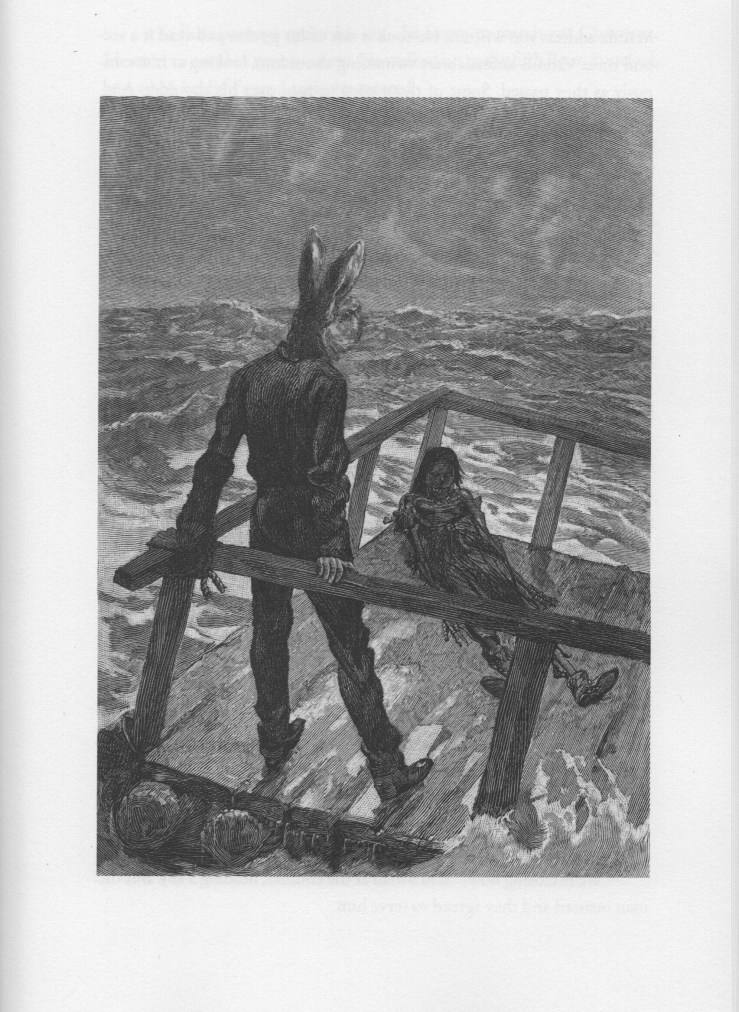


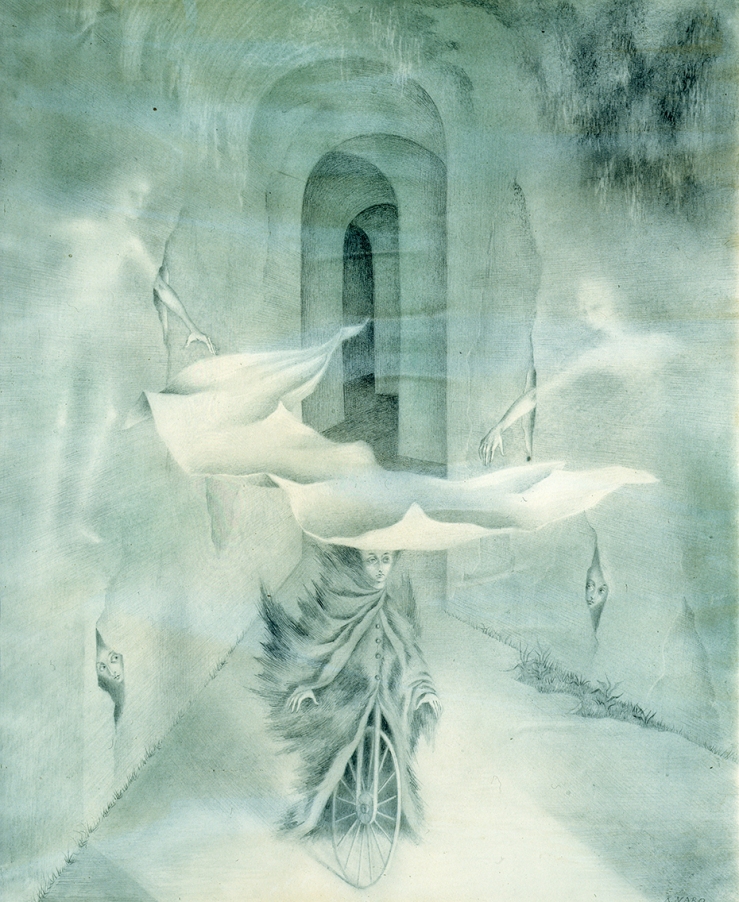


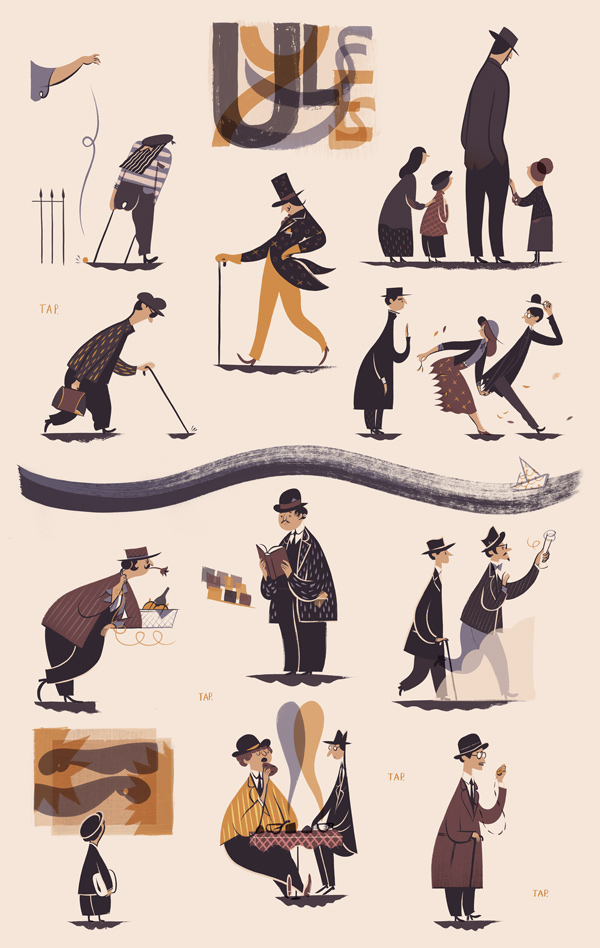

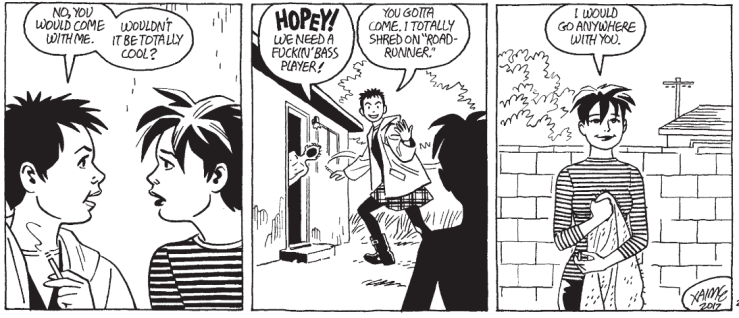
 Biblioklept