PRIEST – Then we should not shrink from the worst of all crimes.
DYING MAN – I say nothing of the kind. Let the evil deed be proscribed by law, let justice smite the criminal, that will be deterrent enough; but if by misfortune we do commit it even so, let’s not cry over spilled milk; remorse is inefficacious, since it does not stay us from crime, futile since it does not repair it, therefore it is absurd to beat one’s breast, more absurd still to dread being punished in another world if we have been lucky to escape it in this. God forbid that this be construed as encouragement to crime, no, we should avoid it as much as we can, but one must learn to shun it through reason and not through false fears which lead to naught and whose effects are so quickly overcome in any moderately steadfast soul. Reason, sir – yes, our reason alone should warn us that harm done our fellows can never bring happiness to us; and our heart, that contributing to their felicity is the greatest joy Nature has accorded us on earth; the entirety of human morals is contained in this one phrase: Render others as happy as one desires oneself to be, and never inflict more pain upon them than one would like to receive at their hands. There you are, my friend, those are the only principles we should observe, and you need neither god nor religion to appreciate and subscribe to them, you need only have a good heart. But I feel my strength ebbing away; preacher, put away your prejudices, unbend, be a man, be human, without fear and without hope forget your gods and your religions too: they are none of them good for anything but to set man at odds with man, and the mere name of these horrors has caused greater loss of life on earth than all other wars and all other plagues combined. Renounce the idea of another world; there is none, but do not renounce the pleasure of being happy and of making for happiness in this. Nature offers you no other way of doubling your existence, of extending it. – My friend, lewd pleasures were ever dearer to me than anything else, I have idolized tham all my life and my wish has been to end it in their bosom; my end draws near, six women lovelier than the light of day are waiting in the chamber adjoining, I have reserved them for this moment, partake of the feast with me, following my example embrace them instead of the vain sophistries of superstition, under their caresses strive for a little while to forget your hypocritical beliefs.
NOTE: The dying man rang, the women entered; and after he had been a little while in their arms the preacher became one whom Nature had corrupted, all because he had not succeeded in explaining what a corrupt nature is.
I had been reading William T. Vollmann’s enormous book Imperial. I bought the book in paperback and then put an illicit copy on my Kindle (this riff is not about the ethics of that move). It’s just easier to read that way, especially at night. At some point in Imperial, probably at some mention of coyotes or polleros—smugglers of humans—I felt a tug in the back of my brain pan, a tug that wanted to pull up Roberto Bolaño’s big big novel 2666—also on my Kindle (also an illicit copy, although I bought the book twice).
This is how I ended up rereading 2666 straight through. It was unplanned.
Like many readers, I aim to reread more than I actually end up rereading.
Truly excellent novels are always better in rereading: richer, fuller, more resonant. Sometimes we might find we’ve thoroughly misread them. (Imagine my horror rereading Lolita in my twenties to discover the vein of evil throbbing through it). Sometimes we find new tones that seemed impossible on the first run through. (I’ve read Blood Meridian at least once a year since the first time I read it, and it keeps getting funnier and funnier). Most of the time, rereading confirms the greatness of the novel, a greatness inhabiting the smallest details. (I’m looking at you Moby-Dick).
Even a riff should have a thesis, and here’s mine: 2666 has a reputation for being fragmentary and inconclusive—and in some ways, yes, of course it is—but a second full reading of 2666 reveals a book that is cohesive, densely allusive, and thematically precise.
Rereading is one way of stepping back to see the bigger picture that Bolaño twists together from smaller fragments. Rereading reveals the intertextual correspondences betweenthe books of 2666 (the five books proper, the “Parts,” of course, but also the texts, invented or real, that those books house).
2666 is also a book about writing.
Earth, Giuseppe Arcimboldo
To wit: “The Part About Archimboldi,” the fifth and final book of 2666, the book that features Benno von Archimboldi, the writer at the heart of 2666—this final chapter sews together many of the book’s (apparently) loose threads.
Two problems with the point above:
A. Benno von Archimboldi (aka Hans Reiter) is not at the heart of 2666 but rather a shadowy trace slipping through the margins, a ghost-presence that’s always there, but not generative or muscular like a heart. (I’m not sure exactly what I mean by this).
B. “The Part About Archimboldi” most decidedly does not sew together all the loose threads: That’s the reader’s job (or task or pleasure or plight or burden).
And so then: “2666 is also a book about writing”): 2666 is also a book about reading: A book about reading as detective work.
Who are the heroes of 2666?
They are all detectives of some kind, literal or otherwise.
Literary critics. Journalists. Philosophers. Psychologists. Psychics and fortune tellers. Police detectives. Private detectives. An American sheriff. A rogue politician. Poets. Publishers. Parents. Searchers.
Archimboldi shows up in the first book of 2666, “The Part About the Critics”; the eponymous critics, literary detectives are searching for him.
How does Archimboldi show up?
Inside a story (the Frisian lady’s) inside a story (the Swabian’s) (inside the story of “Critics,” which is inside the story of 2666).
The Frisian lady asks:
“Does anyone know the answer to the riddle? Does anyone understand it? Is there by chance a man in this town who can tell me the solution, even if he has to whisper it in my ear?”
And Archimboldi answers. He’s a reader, a detective.
Swinging back to the previous point: 2666 is a book about writing, and it shares the postmodern feature of calling attention to its own style and construction, yet it never does this in an overtly clever or insufferable fashion: It’s far more sly.
Water, Giuseppe Arcimboldo
What is the construction or shape of 2666?
A straightforward answer: Five books in an intertextual conversation that seem to loop back around, where the last book prefigures the first book in a strange circuit.
Some possible metaphorical answers:
A void (“Voids can’t be filled,” Archimboldi says).
A labyrinth (the word labyrinth appears 14 times in Wimmer’s translation of 2666).
A mirror (61 times).
An abyss (22 times)
An asylum (43 times; madhouse appears 5 times).
How does Bolaño slyly announce or criticize or puncture his style in 2666?
In Ignacio Echevarria’s “Note to the First Edition” of 2666, he tells us that:
Among Bolaño’s notes for 2666 there appears the single line: “The narrator of 2666 is Arturo Belano.” And elsewhere Bolaño adds, with the indication “for the end of 2666”: “And that’s it, friends. I’ve done it all, I’ve lived it all. If I had the strength, I’d cry. I bid you all goodbye, Arturo Belano.”
Belano is Bolaño’s alter ego, a trace who slips and sails and ducks through the Bolañoverse (he also shows up unnamed in 2666 with his partner Ulises Lima; they manage to father a bastard son, Lalo Cura).
So Belano who narrates 2666 (how?!) is Bolaño: Okay: So? Now?
The channeling is metatextual or intertextual, a series of transpositions between the various narrators and protagonists and readers (detectives all).
The passage that I see most frequently cited from 2666 points to its intertextuality.
The passage is likely frequently cited because
A) Ignacio Echevarria cites it in his note at the beginning of 2666 and
B) it describes Bolaño’s project in 2666, both internally (the book as a strange beast, with intertextual readings within its five (plus) parts), and also externally (intertextually against the canon). Here is the passage (from “The Part About Amalfitano”):
One night, while the kid was scanning the shelves, Amalfitano asked him what books he liked and what book he was reading, just to make conversation. Without turning, the pharmacist answered that he liked books like The Metamorphosis, Bartleby, A Simple Heart, A Christmas Carol. And then he said that he was reading Capote’s Breakfast at Tiffany’s. Leaving aside the fact that A Simple Heart and A Christmas Carol were stories, not books, there was something revelatory about the taste of this bookish young pharmacist, who in another life might have been Trakl or who in this life might still be writing poems as desperate as those of his distant Austrian counterpart, and who clearly and inarguably preferred minor works to major ones. He chose The Metamorphosis over The Trial, he chose Bartleby over Moby-Dick,he chose A Simple Heart over Bouvard and Pecuchet, and A Christmas Carol over A Tale of Two Cities or The Pickwick Papers. What a sad paradox, thought Amalfitano. Now even bookish pharmacists are afraid to take on the great, imperfect, torrential works, books that blaze paths into the unknown. They choose the perfect exercises of the great masters. Or what amounts to the same thing: they want to watch the great masters spar, but they have no interest in real combat, when the great masters struggle against that something, that something that terrifies us all, that something that cows us and spurs us on, amid blood and mortal wounds and stench.
At the risk of belaboring or repeating the last point: Bolaño, ever the canon-maker, the list maker, situates 2666, his final work (he knows it’s his final work) along with “the great, imperfect, torrential works, books that blaze paths into the unknown,” a book that struggles “against that something, that something that terrifies us all, that something that cows us and spurs us on, amid blood and mortal wounds and stench.”
Air, Giuseppe Arcimboldo
So some metatextual moments that, read intertextually, perhaps (perhaps!) work to outline that “unknown,” that “something” of 2666:
Near the end of “The Part About Crimes,” a culminating moment, where a female journalist (NB: a female journalist is the first murder victim in “Crimes”) reads the work of the poet/journalist Mercado:
Hernandez Mercado’s style wavered between sensationalism and flatness. The story was riddled with clichés, inaccuracies, sweeping statements, exaggerations, and flagrant lies. Sometimes Hernandez Mercado painted Haas as the scapegoat of a conspiracy of rich Sonorans and sometimes Haas appeared as an avenging angel or a detective locked in a cell but by no means defeated, gradually cornering his tormentors solely by dint of intelligence.
A description of the style of “The Part About the Crimes”: “The story was riddled with clichés, inaccuracies, sweeping statements, exaggerations, and flagrant lies.”
And, from “The Part About Archimboldi,” a moment where some critics read Ivanov’s novel Twilight and assess it:
Professor Stanislaw Strumilin read it. It struck him as hard to follow. The writer Aleksei Tolstoy read it. It struck him as chaotic. Andrei Zhdanov read it. He left it half finished. And Stalin read it. It struck him as suspect.
These are internal criticisms of 2666.
Another moment from Ansky’s journal that seems to describe “The Part About the Crimes,” 2666, and the Bolañoverse in general:
He mentions names Reiter has never heard before. Then, a few pages on, he mentions them again. As if he were afraid of forgetting them. Names, names, names. Those who made revolution and those who were devoured by that same revolution, though it wasn’t the same but another, not the dream but the nightmare that hides behind the eyelids of the dream.
While I’m using Ansky’s journal as a pseudo key for the intertextual labyrinth of 2666, let me grab this nugget:
Only in chaos are we conceivable.
(I added the note “thesis” in the electronic margin).
Or another description of the novel, couched in a description of history:
. . . history, which is a simple whore, has no decisive moments but is a proliferation of instants, brief interludes that vie with one another in monstrousness.
Another description of 2666 can be found in Bubis’s description of Archimboldi’s second novel:
Lüdicke had yet to come off the presses when Mr. Bubis received the manuscript of The Endless Rose, which he read in two nights, after which, deeply shaken, he woke his wife and told her they would have to publish this new book by Archimboldi.
“Is it good?” asked the baroness, half asleep and not bothering to sit up.
“It’s better than good,” said Bubis, pacing the room.
Then he began to talk, still pacing, about Europe, Greek mythology, and something vaguely like a police investigation, but the baroness fell back asleep and didn’t hear him.
The names of the novels here also suggest something about the structure of 2666: The Endless Rose suggests an eternal loop, as does Lüdicke, which etymologically suggests ludic, recursively playful . . . (Again, I’m just riffing here).
Another description of Archimboldi’s writing, which is of course a description of Bolaño’s 2666:
The style was strange. The writing was clear and sometimes even transparent, but the way the stories followed one after another didn’t lead anywhere: all that was left were the children, their parents, the animals, some neighbors, and in the end, all that was really left was nature, a nature that dissolved little by little in a boiling cauldron until it vanished completely.
Fire, Giuseppe Arcimboldo
Archimboldi’s name is some sort of secret key to the novel. He invents the name, of course, seemingly on the spot. (Invents is not the right word—rather, he synthesizes the name, cobbles it together from his readings. The name is intertextual).
The last name he appropriates from the painter Arcimboldo, whose paintings are instructive in understanding the structure of 2666, a narrative that comprises hundreds of internal discrete narratives that define the shape of the larger picture. The first name?
“They called me Benno after Benito Juarez,” said Archimboldi, “I suppose you know who Benito Juarez was.”
The dark heart of 2666, site of “Crimes,” is Santa Teresa, a transparent stand-in for Ciudad Juarez.
(Florita Almada, psychic medium and honest detective of “Crimes” channels Benito Juarez, the shepherd boy who became the president of Mexico; I’m tempted to quote here at some length but resist).
Re: Above: I foolishly suggested that Archimboldi’s name is some sort of secret key. I don’t think there is a secret key. Just reading. Rereading.
But, still dwelling on “Archimboldi,” there’s a moment in it where an old alpine hermit confesses to murdering his wife by pushing her into a ravine. In some way his confession seems to answer all the puzzles of “Crimes,” all the unresolved abysses, all the falls (literal and metaphorical). How can I justify this claim? How does a man confessing to a murder in a remote German border town in the 1950s answer the murders in Mexico in the 1990s? Or any of the other murders in the book? I suppose it’s a thematic echo, not a solution. Sweating late at night, reading past midnight, the moment struck me as larded with significance. I’m losing whatever thread I had . . .
So to end—how to end? Perhaps I’ll raid my first review of 2666, from January, 2009—surely I must have remarked on the end of the book, or on its apparent inconclusiveness—
—and so I did. And I don’t know if I can do better than this:
Readers enthralled by the murder-mystery aspects of the novel, particularly the throbbing detective beat of “The Part About The Crimes,” may find themselves disappointed by the seemingly ambiguous or inconclusive or open-ended ending(s) of 2666. While the final moments of “The Part About Archimboldi” dramatically tie directly into the “Crimes” and “Fate” sections, they hardly provide the types of conclusive, definitive answers that many readers demand. However, I think that the ending is perfect, and that far from providing no answers, the novel is larded with answers, bursting at the seams with answers, too many answers to swallow and digest in one sitting. Like a promising, strangely familiar turn in the labyrinth, the last page of the book invites the reader back to another, previously visited corridor, a hidden passage perhaps, a thread now charged with new importance . . . 2666 is a book that demands multiple readings.
It was a good suggestion three years ago and I’ll take it up again.
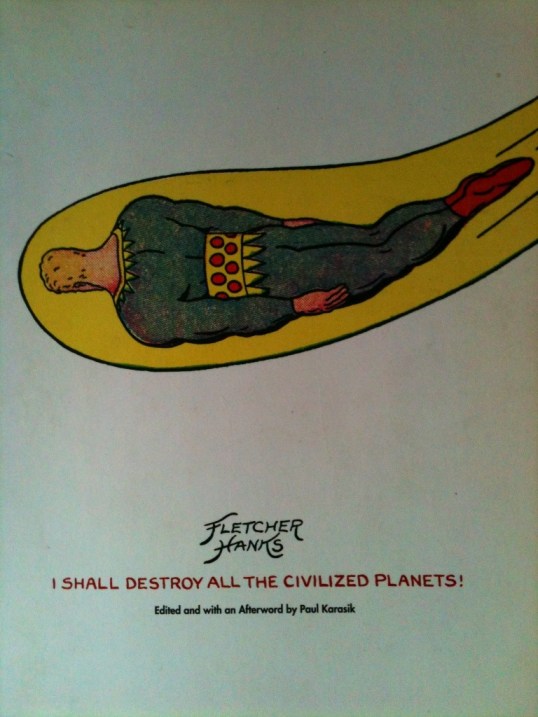
I’ve been wanting to get my mitts on this Fletcher Hanks collection since I first read about it in The Believer five years ago. Finally came across a used copy in pristine shape.
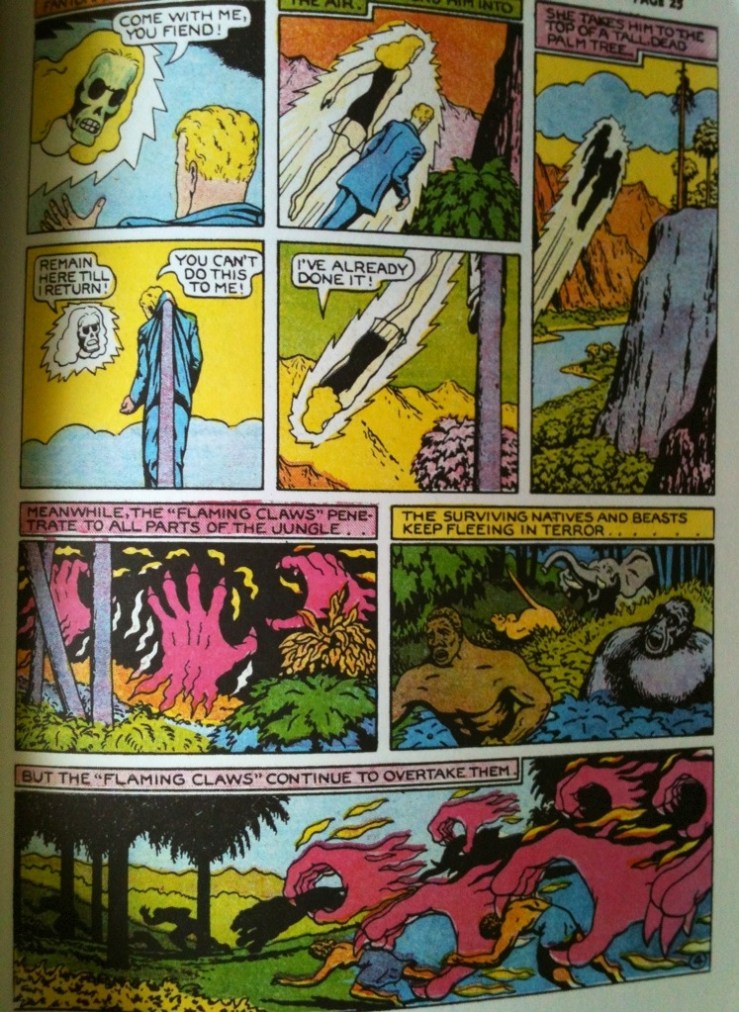
It’s really, really fucking weird. Sample page; full write-up forthcoming:
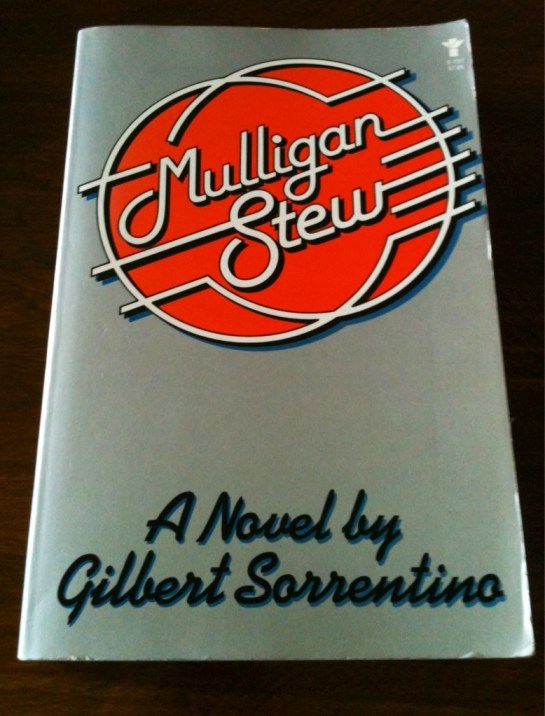
I’ve been itching to read Gilbert Sorrentino’s Mulligan Stew for a while. This copy may or may not be a first edition paperback—the rejection letters in the front are on a different type of paper than the rest of the novel (color/stock). It’s a big book—I’m finishingup a rereading of 2666, so maybe this one will jump in front of Georges Perec’s Life: A User’s Manual. Thoughts?
Neal Stephenson’s 1992 novel Snow Crash opens with an extended scene in which the book’s protagonist races to deliver a pizza on time for the mafia. The scene is thrilling and ridiculous, establishing the book’s frenetic, ironic tone and painting a rough outline of Snow Crash’s milieu. Like many sprawling works of speculative fiction, Snow Crash is more interested in rendering its milieu in vibrant, hyperkinetic color than it is concerned with delivering plot and character development. Snow Crash’s plot is the sort of joyfully convoluted careening mess that makes a reviewer (okay, this reviewer) shudder at the thought of having to successfully paraphrase, so I’m not even going to make an earnest effort. Let’s get to that milieu and the cartoon characters who inhabit it.
Snow Crash is set in the early 21st century, primarily in Los Angeles, which is no longer part of the United States. Actually, there isn’t much of a United States to speak of, really—and not even a municipal Los Angeles, per se. Instead, the terrain is totally privatized. Privatized roads, privatized spaces. People (who can afford to) live in franchised burbclaves protected by hired mercenaries or private militias or robots that keep out the undesirables. (The white folks who live in New South Africa want “racial purity,” while some franchise nations, like Mr. Lee’s Greater Hong Kong are open to anyone who can trade information). Authority is for sale. Conditions are so laissez-faire that the Mafia is truly a Legitimate Business now (complete with their own CosaNostra Pizza University). In fact, all business is legitimate; several times in Snow Crash, a character will refer to “the old days when they had laws.” Without regulation, hyperinflation is the norm; the homeless use trillion-dollar bills to light their campfires.
There’s a hard-edged griminess to the world Stephenson conjures in Snow Crash, but the book is never grim or dour, and instead embraces the anarchic-capitalism it proposes. Perhaps this is because Stephenson’s heroes are such radically exceptional people. The book’s hero is named Hiro Protagonist, the kind of Pynchonian goof that characterizes Snow Crash’s zany tone. Hiro meets the book’s other protagonist, a fifteen year old blonde who goes by Y.T. (“Yours Truly,” although most of the folks tend to hear “whitey”). Y.T. is a Kourier, a skateboarding delivery person who harpoons vehicles to catch a free ride. She helps Hiro deliver that pizza in the opening scene and the two team up after Hiro gives her his business card. It reads: “Last of the Freelance Hackers / Greatest swordfighter in the world / Stringer, Central Intelligence Corporation. Specializing in Software related Intel. (Music, Movies & Microcode.)” Did I neglect to mention that Hiro carries two samurai swords with him wherever he goes?
Hiro’s pretty handy with those swords, but his real skill is hacking, and he spends a good deal of time in the Metaverse, a virtual reality-based internet space where avatars go to bars and chat and sell &c. It’s sort of like a mix between Facebook and World of War Craft. In 1992 (earlier, I suppose), Stephenson’s way ahead of the curve. Here, he describes avatars:
Your avatar can look any way you want it to, up to the limitations of your equipment. If you’re ugly, you can make your avatar beautiful. If you’ve just gotten out of bed, your avatar can still be wearing beautiful clothes and professionally applied makeup. You can look like a gorilla or a dragon or a giant talking penis in the Metaverse. Spend five minutes walking down the Street and you will see all of these.
There are plenty of passages like this, where Stephenson pegs some aspect of internet culture ten years before it actually happens. (I couldn’t help but think about Wikipedia during Hiro’s conversations with a program called Librarian). It’s probably fair to say that the Wachowskis lifted as much from Snow Crash as they did from William Gibson’s cyberpunk trilogies.
While I’m there, I might as well lazily point out that Snow Crash would fit neatly at home on a shelf with Neuromancer or Mona Lisa Overdrive. There’s also a heavy dose of Philip K. Dick weirdness in Snow Crash, particularly when the book settles into its major metaphysical plot about ancient Sumerian gods and goddesses and linguistic viruses and the Tower of Babel. Stephenson’s Snow Crash is zanier than William Gibson’s dark depictions or Dick’s mindmelted milieux, and it would hardly do to call what he does here light—but there is something joyful, playful about his satire. I invoked Pynchon earlier and I’ll do it again; parts of Snow Crash also reminded me of David Foster Wallace’s opus Infinite Jest. Both IJ and SC obsess over the minutest details of speculative technologies and how people might react to such technologies. This is often what sets Snow Crash heads and shoulders above run of the mill cyberpunk. In just one instance, Stephenson parodies the language of bureaucratic speech at length; Y.T.’s mom, who works for what’s left of the Federal Government, is subjected to a memo about toilet paper usage that goes on for pages. The passage is hilarious, and adds absolutely nothing to the plot development—it simply helps to flesh out the contours of the world that Stephenson has imagined.
All of this detailed imagining unfortunately comes at the expense of a plot that only coheres through massive exposition dumps. About a third of the way into the novel, the major conflict is finally established, but only through a dialog between Hiro and the Librarian that reads almost like a catechism. As the book reaches its climax, Hiro actually explains what’s going on to a few of the other major characters—and the reader, of course. It’s a cringe-worthy moment, the sort of rhetorical weakness that smacks of genre fiction; even worse, the plot’s action ultimately hangs on some fairly basic hoary old tropes that wouldn’t be unfamiliar to anyone who’s ever played a video game. The book lags under a juvenile obsession with weapons and badassery in general. And the book’s resolution . . . well, let’s just say that Stephenson sticks the ending, but it all feels too pat and too slight after the dazzling weight of the world that he’s established. Still, at its finest, Stephenson’s prose is zippy, shining, hilarious stuff, and his employment of multiple character perspectives moves the book with an addictive energy. Snow Crash is beach reading for folks who like some humor with their dystopia.
A film adaptation of Snow Crash is supposedly going into production soon, with British director Joe Cornish taking charge. I liked Cornish’s last film Attack the Block, and Snow Crash clearly has a highly-imagistic, cinematic feel to it—but I think a film is not the way to go. Simply put, Snow Crash is too big, too larded with characters and details (so many that I failed to touch on in this review) to translate well onscreen. I think an eight part miniseries on HBO (or a similar network) would be perfect, even if it came at the expense of special effects—-a miniseries would give the filmmakers time to build Stephenson’s nuanced world. I’m afraid otherwise we’ll get a travesty like the adaptation of The Golden Compass, or something like The Hunger Games film, where all but the most basic plot points are elided. But I suppose a miniseries is not as lucrative as a blockbuster film. I hope the filmmakers at least split the book in two. In any case, I’ll be interested to check out the results.
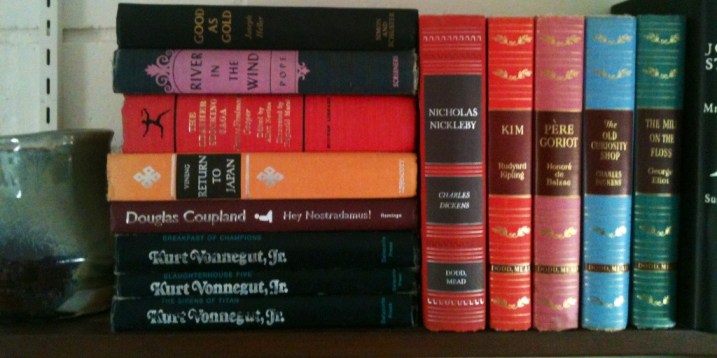
Book shelves series #29, twenty-ninth Sunday of 2012
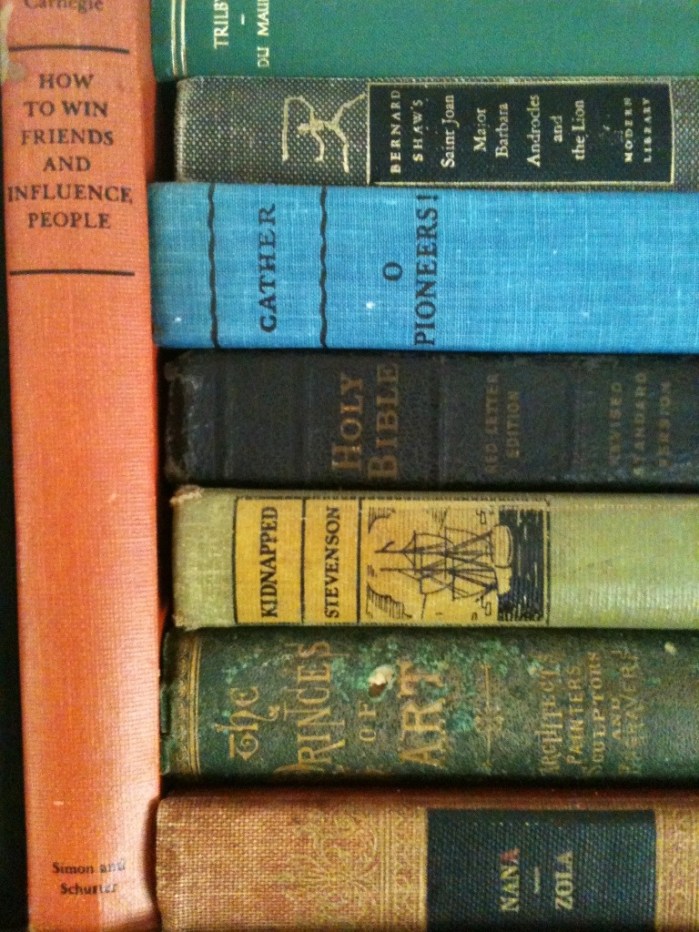
Lots of hardbacks on this long, long shelf. The Vonneguts above were particularly important to me when I was young. They were my father’s. I read them surreptitiously for years and then outright appropriated them at some point. The matching Dodd, Mead hardbacks were rescued from a school I worked at for years. My wife made the vase that serves as a bookend. The copy of Jonathan Strange and Mr. Norrellthat doesn’t quite fit in the frame remains unread.
The BFG: a classic. I reviewed Wabi Sabi. Next to the Crumb:
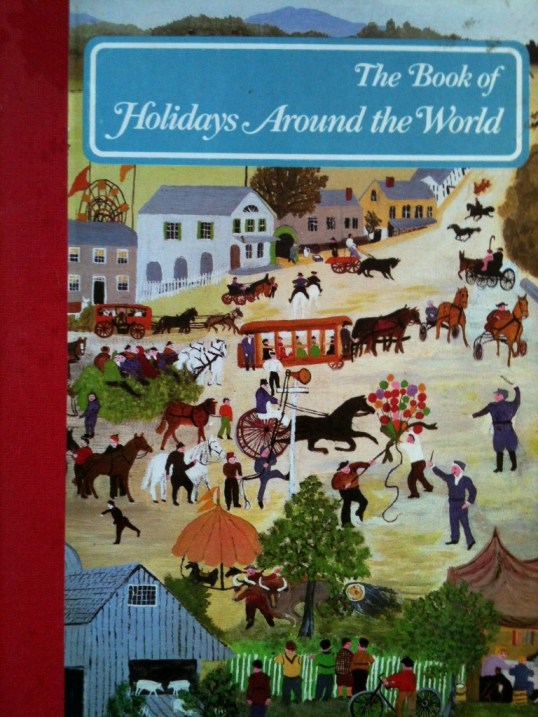
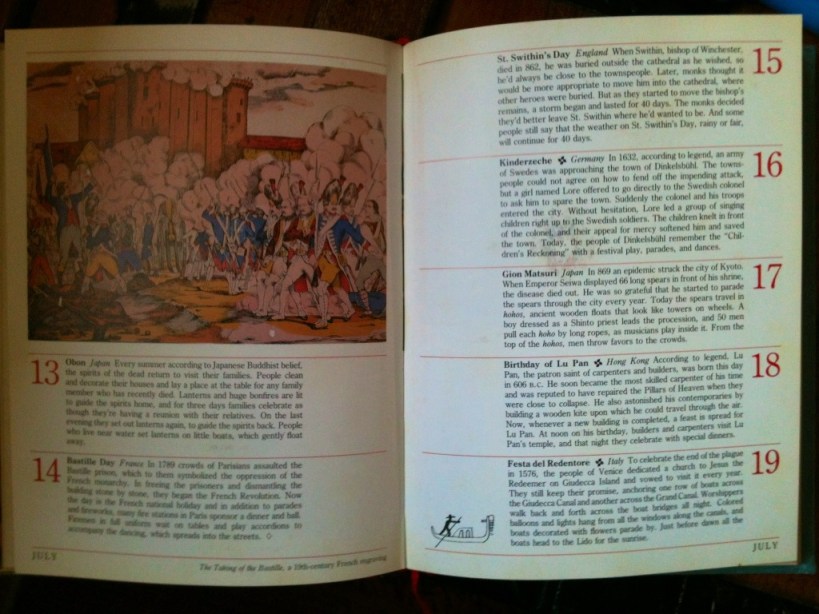
I found Holidays in a box of free books in a library lobby. Love it. Here’s this week’s schedule of holidays:
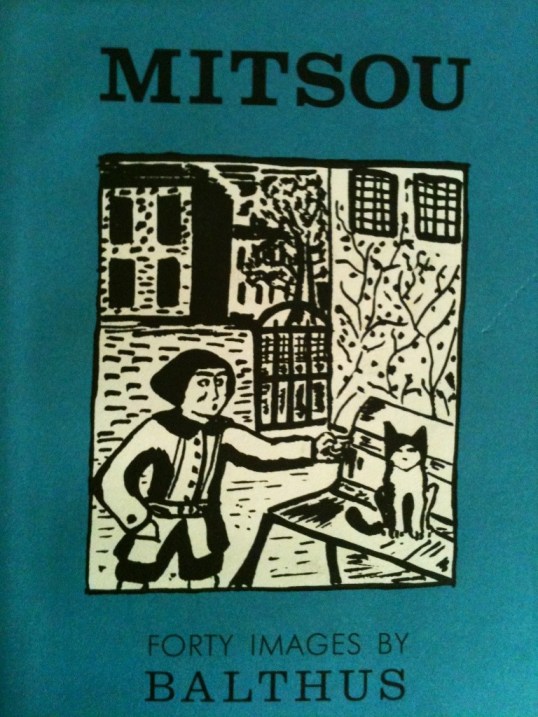
One of my favorite books ever is Mitsou, a book that Balthus did when he was like 10 or 12 or something:
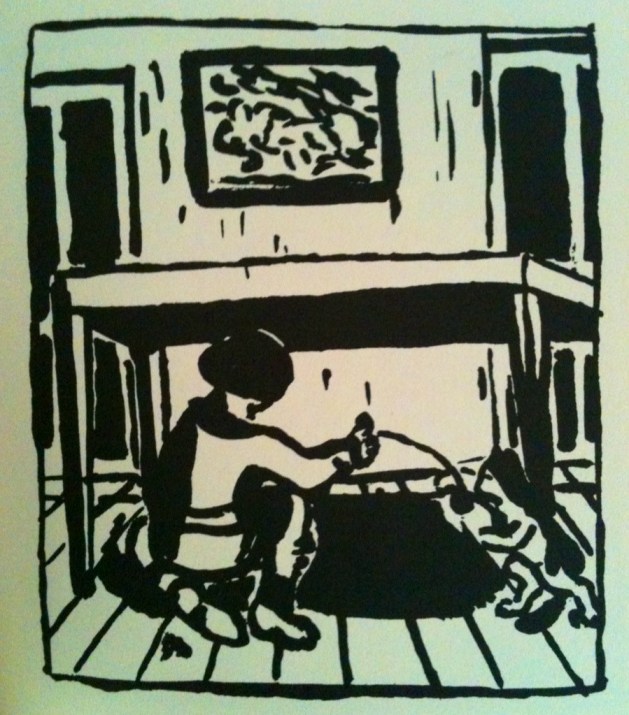
It’s about a young boy who gets a cat and loves the cat and then loses the cat. It’s heartbreaking. Image:
The classics are the books of which we usually hear people say, “I am rereading . . . ” and never “I am reading . . . “
We use the words “classics” for books that are treasured by those who have read and loved them; but they are treasured no less by those who have the luck to read them for the first time in the best conditions to enjoy them
The classics are books that exert a peculiar influence, both when they refuse to be eradicated from the mind and when they conceal themselves in the folds of memory, camouflaging themselves as the collective or individual unconscious.
Every rereading of a classic is as much a voyage of discovery as the first reading.
Every reading of a classic is in fact a rereading.
A classic is a book that has never finished saying what it has to say.
The classics are the books that come down to us bearing the traces of readings previous to ours, and bringing in their wake the traces they themselves have left on the culture or cultures they have passed through (or, more simply, on language and customs).
A classic does not necessarily teach us anything we did not know before. In a classic we sometimes discover something we have always known (or thought we knew), but without knowing that this author said it first, or at least is associated with it in a special way. And this, too, is a surprise that gives much pleasure, such as we always gain from the discovery of an origin, a relationship, an affinity.
The classics are books which, upon reading, we find even fresher, more unexpected, and more marvelous than we had thought from hearing about them.
We use the word “classic” of a book that takes the form of an equivalent to the universe, on a level with the ancient talismans. With this definition we are approaching the idea of the “total book,” as Mallarmé conceived of it.
Your classic author is the one you cannot feel indifferent to, who helps you to define yourself in relation to him, even in dispute with him.
A classic is a book that comes before other classics; but anyone who has read the others first, and then reads this one, instantly recognizes its place in the family tree.
A classic is something that tends to relegate the concerns of the moment to the status of background noise, but at the same time this background noise is something we cannot do without.
A classic is something that persists as a background noise even when the most incompatible momentary concerns are in control of the situation.
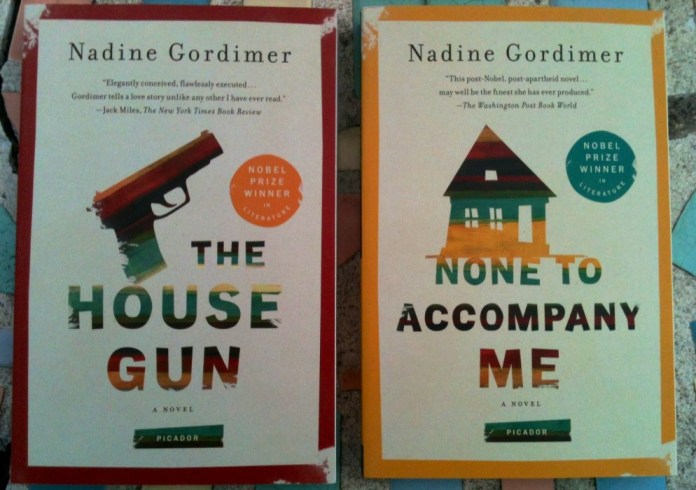
A nice stack from the good folks at Picador this month, including two new entries in their ongoing Nadine Gordimer reissues. I like the design on the series:
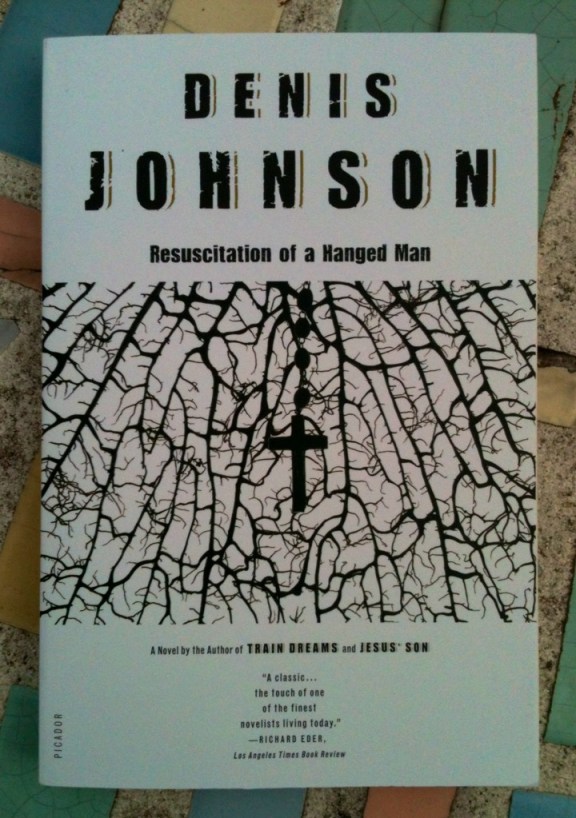
There’s also a reissue of Denis Johnson’s 1991 novel Resuscitation of a Hanged Man, which I haven’t read, but will read soon, because Johnson is just one of those writers I’ll end up reading everything by eventually. From a 1991 NYT review of the novel:
There has never been any doubt about Denis Johnson’s ability to write a gorgeous sentence. The author of “Angels,” “Fiskadoro” and “The Stars at Noon” has become increasingly musical in his prose, and his latest novel, “Resuscitation of a Hanged Man,” depends on such sentences as the primary unit of narrative motion. The novel seems, like a poem, to be written line to line. It is very much a book about one man, one sensibility.
At the outset of the novel, Leonard English, driving to the tip of Cape Cod in the off season, stops for a drink, then spins out of control, running his car onto a traffic island. He ends up taking a taxi to his destination, which is Provincetown. He has attempted suicide before the book’s beginning; now he is moving to the Cape to work for Ray Sands, a private investigator who also owns a small radio station. When we can see him most clearly, English seems very similar to the narrator of the short story — drifting, guilty, in a world of strangers, striving to connect with another person and with his God.
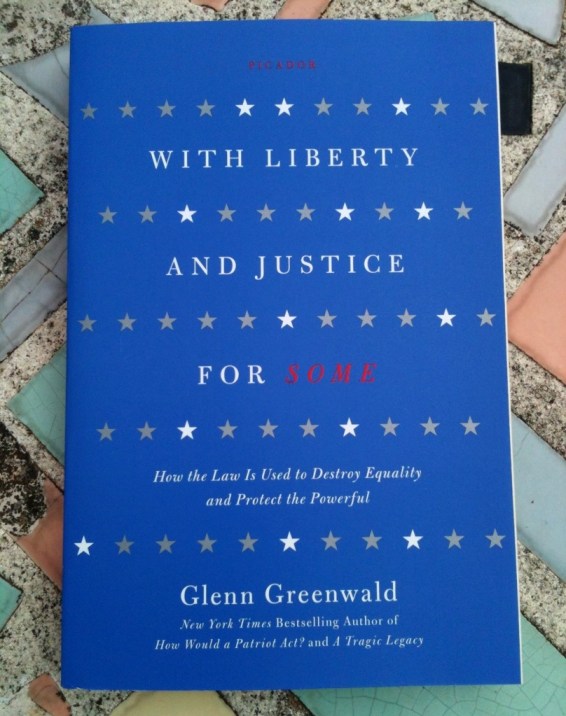
Last year’s With Liberty and Justice for Some is out now in trade paperback. If you are even slightly familiar Glenn Greenwald’s columns at Salon, you’ll likely know what to expect. For those of us predisposed to agree with his analyses, With Liberty and Justice for Some is likely to inspire outrage and a certain kind of fatigue.
American history is suffused with violations of equality before the law. The country was steeped in such violations at its founding. But even when this principle was being violated, its supremacy was also being affirmed: resoundingly and unanimously in the case of the founders. That the rule of law—not the rule of men—would reign supreme was one of the few real points of agreement among all the founders. Arguably it was the primary one.
There’s an obvious element of hypocrisy in this fact; espousing a principle that one simultaneously breaches in action is hypocrisy’s defining attribute. But there’s also a more positive side: the country’s vigorous embrace of the principle of equality before law enshrined it as aspiration. It became the guiding precept for how “progress” was understood, for how the union would be perfected.
And the most significant episodes of progress over the next two centuries—the emancipation of slaves, the ending of Jim Crow, the enfranchisement and liberation of women, vastly improved treatment for Native Americans and gay Americans—were animated by this ideal. That happened because “blind justice”—equality before law—was orthodoxy in American political culture. The principle was sacrosanct even when it was imperfectly applied.
The Ford pardon of Nixon changed that, radically and permanently. When President Ford went on national television to explain to an angry, skeptical citizenry why the most powerful political actor would be fully immunized for the felonies he got caught committing, Ford expressly rejected the rule of law. He paid lip service to its core principle—the “law is no respecter of persons”—but then tacked on a newly concocted amendment designed to gut that principle: “but the law is a respecter of reality.”
In other words, if—in the judgment of political leaders—it’s sufficiently disruptive, divisive, or distracting to hold powerful political officials accountable under the law on equal terms with ordinary Americans, then they should be exempt and the rule of law suspended, all in the name of political harmony, of “moving on.” But of course, it willalways be divisive and distracting, by definition, to prosecute the most powerful political leaders, so Ford’s rationale, predictably, created a template for elite immunity.
The rationale for Ford’s pardon of Nixon was subsequently legitimized, and it created a precedent for shielding the most powerful elites from the consequences of their lawbreaking. The arguments Ford offered are the same ones now hauled out over and over whenever it is time to argue why the most powerful among us should not be held accountable: It’s not just for the good of the immunized criminal, but in the common good, to Look Forward, Not Backward. This direct assault on the rule of law was pioneered by the pardon of Richard Nixon.
Steve Sem-Sandberg’s The Emperor of Lies is a Swedish novel in English Translation by Sarah Death. Look, I’m generally dismissive of Holocaust fiction because 1) the sheer number of books that come in to Biblioklept World Headquarters that use the Holocaust as a milieu and 2) the tacky and generally lazy way that such books often attempt to manipulate their audiences. Still, The Emperor of Lies seems like it’s probably a sight better than most such books, and it’s gotten generally good reviews, including this one from The Independent (UK), which apparently thinks that a book review of five sentences is fine:
Any writer – let alone one from neutral Sweden – who sets out to place another brick in the vast wall of Holocaust fiction must be deluded or inspired. Astonishing to report: Sem-Sandberg belongs in the tiny second band.
Utterly involving, morally scrupulous, written with a verve and pace that belie its dreadful setting, The Emperor of Lies – in Sarah Death’s masterly translation – really does renew the genre.
Its portrait of resistance and survival in the ghetto of Lodz between 1940 and 1944 focuses on the monstrous enigma of Chaim Rumkowski, despotic overlord of his fellow-Jews. Sem-Sandberg catches his capricious charisma. Other characters, who record their fate or fight it, also shine, while their tragic destiny moves on at mesmerising speed.
Another stand-alone segment from Roberto Bolaño’s novel 2666—from “The Part About Archimboldi”:
Our hero Reiter (writer!)—who at this moment (or just before it, unbeknownst to the reader) adopts the ridiculous nom de thing Archimboldi (!!!)—secures a rented typewriter from a failed writer, an old man who takes the time to lecture on writing and camouflage and masterpieces and Jesus &c.—and writing as channeling (or maybe a type of divine madness), as a ventriloquist act (which I touched on here). (Perhaps I’m pushing the limits of copyright law here. Look, I think you should all buy and read this book and give copies to loved ones and enemies alike).
“I was a writer,” said the old man.
“But I gave it up. This typewriter was a gift from my father. An affectionate and cultured man who lived to the age of ninety-three. An essentially good man. A man who believed in progress, it goes without saying. My poor father. He believed in progress and of course he believed in the intrinsic goodness of human beings. I too believe in the intrinsic goodness of human beings, but it means nothing. In their hearts, killers are good, as we Germans have reason to know. So what? I might spend a night drinking with a killer, and as the two of us watch the sun come up, perhaps we’ll burst into song or hum some Beethoven. So what? The killer might weep on my shoulder. Naturally. Being a killer isn’t easy, as you and I well know. It isn’t easy at all. It requires purity and will, will and purity. Crystalline purity and steel-hard will. And I myself might even weep on the killer’s shoulder and whisper sweet words to him, words like ‘brother,’ ‘friend,’ ‘comrade in misfortune.’ At this moment the killer is good, because he’s intrinsically good, and I’m an idiot, because I’m intrinsically an idiot, and we’re both sentimental, because our culture tends inexorably toward sentimentality. But when the performance is over and I’m alone, the killer will open the window of my room and come tiptoeing in like a nurse and slit my throat, bleed me dry.
“My poor father. I was a writer, I was a writer, but my indolent, voracious brain gnawed at my own entrails. Vulture of my Prometheus self or Prometheus of my vulture self, one day I understood that I might go so far as to publish excellent articles in magazines and newspapers, and even books that weren’t unworthy of the paper on which they were printed. But I also understood that I would never manage to create anything like a masterpiece. You may say that literature doesn’t consist solely of masterpieces, but rather is populated by so-called minor works. I believed that, too. Literature is a vast forest and the masterpieces are the lakes, the towering trees or strange trees, the lovely, eloquent flowers, the hidden caves, but a forest is also made up of ordinary trees, patches of grass, puddles, clinging vines, mushrooms, and little wild-flowers. I was wrong. There’s actually no such thing as a minor work. I mean: the author of the minor work isn’t Mr. X or Mr. Y. Mr. X and Mr. Y do exist, there’s no question about that, and they struggle and toil and publish in newspapers and magazines and sometimes they even come out with a book that isn’t unworthy of the paper it’s printed on, but those books or articles, if you pay close attention, are not written by them.
“Every minor work has a secret author and every secret author is, by definition, a writer of masterpieces. Who writes the minor work? A minor writer, or so it appears. The poor man’s wife can testify to that, she’s seen him sitting at the table, bent over the blank pages, restless in his chair, his pen racing over the paper. The evidence would seem to be incontrovertible. But what she’s seen is only the outside. The shell of literature. A semblance,” said the old man to Archimboldi and Archimboldi thought of Ansky. “The person who really writes the minor work is a secret writer who accepts only the dictates of a masterpiece. Continue reading “Minor Works & Masterpieces — An Excerpt from Bolaño’s Novel 2666”→
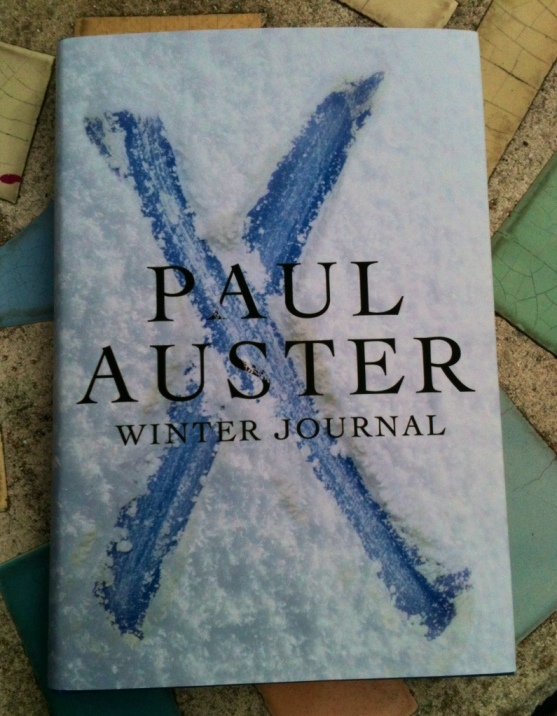
I was pleasantly surprised to find Paul Auster’s forthcoming memoir Winter Journal in the mail after being away for a week. I had mixed feelings about Auster’s last novel Sunset Park, but I dig his nonfiction, and I opened Winter Journal randomly to an episode where the adolescent Auster loses his virginity to a hooker in a passage that’s both tender and funny, so this one seems promising. (It’s also written entirely in the second person pronoun).
Publisher Henry Holt’s blurb:
Facing his sixty-third winter, internationally acclaimed novelist Paul Auster sits down to write a history of his body and its sensations—both pleasurable and painful.
Thirty years after the publication of The Invention of Solitude, in which he wrote so movingly about fatherhood, Auster gives us a second unconventional memoir in which he writes about his mother’s life and death. Winter Journal is a highly personal meditation on the body, time, and memory, by one of our most intellectually elegant writers.
“The Belly of the Whale,” an early chapter of Joseph Campbell’s seminal work The Hero With a Thousand Faces:
The idea that the passage of the magical threshold is a transit into a sphere of rebirth is symbolized in the worldwide womb image of the belly of the whale. The hero, instead of conquering or conciliating the power of the threshold, is swallowed into the unknown, and would appear to have died.
Mishe-Nahma, King of Fishes,
In his wrath he darted upward,
Flashing leaped into the sunshine,
Opened his great jaws and swallowed
Both canoe and Hiawatha.
The Eskimo of Bering Strait tell of the trickster-hero Raven, how, one day, as he sat drying his clothes on a beach, he observed a whale-cow swimming gravely close to shore. He called: “Next time you come up for air, dear, open your mouth and shut your eyes.” Then he slipped quickly into his raven clothes, pulled on his raven mask, gathered his fire sticks under his arm, and flew out over the water. The whale came up. She did as she had been told. Raven darted through the open jaws and straight into her gullet. The shocked whale-cow snapped and sounded; Raven stood inside and looked around.
The Zulus have a story of two children and their mother swallowed by an elephant. When the woman reached the animal’s stomach, “she saw large forests and great rivers, and many high lands; on one side there were many rocks; and there were many people who had built their village there; and many dogs and many cattle; all was there inside the elephant.”
The Irish hero, Finn MacCool, was swallowed by a monster of indefinite form, of the type known to the Celtic world as a peist. The little German girl, Red Ridinghood, was swallowed by a wolf. The Polynesian favorite, Maui, was swallowed by his great-great-grandmother, Hine-nui-te-po. And the whole Greek pantheon, with the sole exception of Zeus, was swallowed by its father, Kronos. The Greek hero Herakles, pausing at Troy on his way homeward with the belt of the queen of the Amazons, found that the city was being harassed by a monster sent against it by the sea-god Poseidon. The beast would come ashore and devour people as they moved about on the plain. Beautiful Hesione, the daughter of the king, had just been bound by her father to the sea rocks as a propitiatory sacrifice, and the great visiting hero agreed to rescue her for a price. The monster, in due time, broke to the surface of the water and opened its enormous maw. Herakles took a dive into the throat, cut his way out through the belly, and left the monster dead.
This popular motif gives emphasis to the lesson that the passage of the threshold is a form oE self-annihilation. Its resemblance to the adventure of the Symplegades is obvious. But here, instead of passing outward, beyond the confines of the visible world, the hero goes inward, to be born again. The disappearance corresponds to the passing of a worshiper into a temple—where he is to be quickened by the recollection of who and what he is, namely dust and ashes unless immortal. The temple interior, the belly of the whale, and the heavenly land beyond, above, and below the confines of the world, are one and the same. That is why the approaches and entrances to temples are flanked and defended by colossal gargoyles: dragons, lions, devil-slayers with drawn swords, resentful dwarfs, winged bulls. These are the threshold guardians to ward away all incapable of encountering the higher silences within. They are preliminary embodiments of the dangerous aspect of the presence, corresponding to the mythological ogres that bound the conventional world, or to the two rows of teeth of the whale. They illustrate the fact that the devotee at the moment of entry into a temple undergoes a metamorphosis. His secular character remains without; he sheds it, as a snake its slough. Once inside he may be said to have died to time and returned to the World Womb, the World Navel, the Earthly Paradise. The mere fact that anyone can physically walk past the temple guardians does not invalidate their significance; for if the intruder is incapable of encompassing the sanctuary, then he has effectually remained without. Anyone unable to understand a god sees it as a devil and is thus defended from the approach. Allegorically, then, the passage into a temple and the hero-dive through the jaws of the whale are identical adventures, both denoting, in picture language, the life-centering, life-renewing act.
“No creature,” writes Ananda Coomaraswamy, “can attain a higher grade of nature without ceasing to exist.” Indeed, the physical body of the hero may be actually slain, dismembered, and scattered over the land or sea—as in the Egyptian myth of the savior Osiris: he was thrown into a sarcophagus and committed to the Nile by his brother Set, and when he returned from the dead his brother slew him again, tore the body into fourteen pieces, and scattered these over the land. The Twin Heroes of the Navaho had to pass not only the clashing rocks, but also the reeds that cut the traveler to pieces, the cane cactuses that tear him to pieces, and the boiling sands that overwhelm him. The hero whose attachment to ego is already annihilate passes back and forth across the horizons of the world, in and out of the dragon, as readily as a king through all the rooms of his house. And therein lies his power to save; for his passing and returning demonstrate that through all the contraries of phenomenality the Un-create-Imperishable remains, and there is nothing to fear.
And so it is that, throughout the world, men whose function it has been to make visible on earth the life-fructifying mystery of the slaying of the dragon have enacted upon their own bodies the great symbolic act, scattering their flesh, like the body of Osiris, for the renovation of the world. In Phrygia, for example, in honor of the crucified and resurrected savior Attis, a pine tree was cut on the twenty-second of March, and brought into the sanctuary of the mother-goddess, Cybele. There it was swathed like a corpse with woolen bands and decked with wreaths of violets. The effigy of a young man was tied to the middle of the stem. Next day took place a ceremonial lament and blowing of trumpets. The twenty-fourth of March was known as the Day of Blood: the high priest drew blood from his arms, which he presented as an offering; the lesser clergy whirled in a dervish-dance, to the sound of drums, horns, flutes, and cymbals, until, rapt in ecstasy, they gashed their bodies with knives to bespatter the altar and tree with their blood; and the novices, in imitation of the god whose death and resurrection they were celebrating, castrated themselves and swooned.
And in the same spirit, the king of the south Indian province of Quilacare, at the completion of the twelfth year of his reign, on a day of solemn festival, had a wooden scaffolding constructed, and spread over with hangings of silk. When he had ritually bathed in a tank, with great ceremonies and to the sound of music, he then came to the temple, where he did worship before the divinity. Thereafter, he mounted the scaffolding and, before the people, took some very sharp knives and began to cut off his own nose, and then his ears, and his lips, and all his members, and as much of his flesh as he was able. He threw it away and round about, until so much of his blood was spilled that he began to faint, whereupon he summarily cut his throat.
Book shelves series #28, twenty-eighth Sunday of 2012
Last month, or maybe the month before last, I forget, an anonymous reader accused me of not putting as much into these posts as I used to, which may or may not be true.
But I’m exhausted today—I’ve been out of town for the past week, enjoying a beach vacation with family and friends &c., and yeah, I’m fragged. Got home late late last night, had to clean up, mow the lawn, all that snazz. (The blog has been on autopilot but I’ll try to write up some original content for next week—maybe a review of Moonrise Kingdom. We’ll see).
Anyway, this Sunday finds us in a new room, the converted garage of my 1956 ranch-style home, a room we use as a family room. I’ll look at each shelf pictured above individually and remark on a few books (there’s some good stuff in there), but I’m just too tired. Sorry the pic is so blurry. Feel free to send me a newer iPhone.
There are two book cases below these shelves, and on top of one of these, under a large framed picture of my children that obscures them, are these ratty volumes:
The Barth books are a throwback to my early college days, when I simply bought the cheapest volume; I don’t buy mass market paperbacks anymore (okay, maybe rarely). The Shakespeare books are too tall to fit on a shelf full of Shakespeare stuff, although there are a few shelves of Shakespeare stuff in the room. Actually, I’m not really sure why these books are here at all. It’s likely that I hid them behind the aforementioned large framed picture one day while cleaning up and never reshelved. Not a pretty shelf.
Mark Twain used to write in bed—so did our greatest poet. But I wonder how often they wrote in bed—or whether they did it twice and the story took hold. Such things happen. Also I would like to know what things they wrote in bed and what things they wrote sitting up. All of this has to do with comfort in writing and what its value is. I should think that a comfortable body would let the mind go freely to its gathering.
You know I always smoke a pipe when I work—at least I used to and now I have taken it up again. It is strange—as soon as a pipe begins to taste good, cigarettes become tasteless. I find I smoke fewer and fewer cigarettes. Maybe I can cut them out entirely for a while. This would be a very good thing. Even with this little change, my deep-seated and perennial cigarette cough is going away. A few months without that would be a real relief.
I have dawdled away a good part of my free time now carving vaguely on a scrap of mahogany, but I guess I have been thinking too. Who knows. I sit here in a kind of a stupor and call it thought.
Now I have taken the black off my desk again, clear down to the wood, and have put a green blotter down. I am never satisfied with my writing surface.
My choice of pencils lies between the black Calculator stolen from Fox Films and this Mongol 2 3/8 F which is quite black and holds its point well—much better in fact than the Fox pencils. I will get six more or maybe four more dozen of them for my pencil tray.
I have found a new kind of pencil—the best I have ever had. Of course it costs three times as much too but it is black and soft but doesn’t break off. I think I will always use these. They are called Blackwings and they really glide over the paper.
In the very early dawn, I felt a fiendish desire to take my electric pencil sharpener apart. It has not been working very well and besides I have always wanted to look at the inside of it. So I did and found that certain misadjustments had been made at the factory. I corrected them, cleaned the machine, oiled it and now it works perfectly for the first time since I have it. There is one reward for not sleeping.
Today is a dawdly day. They seem to alternate. I do a whole of a day’s work and then the next day, flushed with triumph, I dawdle. That’s today. The crazy thing is that I get about the same number of words down either way. This morning I am clutching the pencil very tight and this is not a good thing. It means I am not relaxed. And in this book I want to be just as relaxed as possible. Maybe that is another reason I am dawdling. I want that calmness to settle on me that feels so good—almost like a robe of cashmere it feels.
It has been a good day of work with no harm in it. I have sat long over the desk and the pencil has felt good in my hand. Outside the sun is very bright and warm and the buds are swelling to a popping size. I guess it is a good thing I became a writer. Perhaps I am too lazy for anything else.
On the third finger of my right hand I have a great callus just from using a pencil for so many hours every day. It has become a big lump by now and it doesn’t ever go away. Sometimes it is very rough and other times, as today, it is as shiny as glass. It is peculiar how touchy one can become about little things. Pencils must be round. A hexagonal pencil cuts my fingers after a long day. You see I hold a pencil for about six hours every day. This may seem strange but it is true. I am really a conditioned animal with a conditioned hand.
I am really dawdling today when what I want to write is in my head. It is said that many writers talk their books out and so do not write them. I think I am guilty of this to a large extent. I really talk too much about my work and to anyone who will listen. If I would limit my talk to inventions and keep my big mouth shut about work, there would probably be a good deal more work done.
The callus on my writing finger is very sore today. I may have to sandpaper it down. It is getting too big.
The silly truth is that I can take almost any amount of work but I have little tolerance for confusion.
An old man with steel rimmed spectacles and very dusty clothes sat by the side of the road. There was a pontoon bridge across the river and carts, trucks, and men, women and children were crossing it. The mule-drawn carts staggered up the steep bank from the bridge with soldiers helping push against the spokes of the wheels. The trucks ground up and away heading out of it all and the peasants plodded along in the ankle deep dust. But the old man sat there without moving. He was too tired to go any farther.
It was my business to cross the bridge, explore the bridgehead beyond and find out to what point the enemy had advanced. I did this and returned over the bridge. There were not so many carts now and very few people on foot, but the old man was still there.
“Where do you come from?” I asked him.
“From San Carlos,” he said, and smiled.
That was his native town and so it gave him pleasure to mention it and he smiled.
“I was taking care of animals,” he explained. “Oh,” I said, not quite understanding.
“Yes,” he said, “I stayed, you see, taking care of animals. I was the last one to leave the town of San Carlos.”
He did not look like a shepherd nor a herdsman and I looked at his black dusty clothes and his gray dusty face and his steel rimmed spectacles and said, “What animals were they?”
“Various animals,” he said, and shook his head. “I had to leave them.”
I was watching the bridge and the African looking country of the Ebro Delta and wondering how long now it would be before we would see the enemy, and listening all the while for the first noises that would signal that ever mysterious event called contact, and the old man still sat there.
“What animals were they?” I asked.
“There were three animals altogether,” he explained. “There were two goats and a cat and then there were four pairs of pigeons.”
“And you had to leave them?” I asked.
“Yes. Because of the artillery. The captain told me to go because of the artillery.”
“And you have no family?” I asked, watching the far end of the bridge where a few last carts were hurrying down the slope of the bank.
“No,” he said, “only the animals I stated. The cat, of course, will be all right. A cat can look out for itself, but I cannot think what will become of the others.”
“What politics have you?” I asked.
“I am without politics,” he said. “I am seventy-six years old. I have come twelve kilometers now and I think now I can go no further.” “This is not a good place to stop,” I said. “If you can make it, there are trucks up the road where it forks for Tortosa.”
“I will wait a while,” he said, “and then I will go. Where do the trucks go?”
“Towards Barcelona,” I told him.
“I know no one in that direction,” he said, “but thank you very much. Thank you again very much.”
He looked at me very blankly and tiredly, then said, having to share his worry with some one, “The cat will be all right, I am sure. There is no need to be unquiet about the cat. But the others. Now what do you think about the others?”
“Why they’ll probably come through it all right.” “You think so?”
“Why not,” I said, watching the far bank where now there were no carts.
“But what will they do under the artillery when I was told to leave because of the artillery?”
“Did you leave the dove cage unlocked?” I asked. “Yes.”
“Then they’ll fly.”
“Yes, certainly they’ll fly. But the others. It’s better not to think about the others,” he said.
“If you are rested I would go,” I urged. “Get up and try to walk now.”
“Thank you,” he said and got to his feet, swayed from side to side and then sat down backwards in the dust.
“I was taking care of animals,” he said dully, but no longer to me. “I was only taking care of animals.”
There was nothing to do about him. It was Easter Sunday and the Fascists were advancing toward the Ebro. It was a gray overcast day with a low ceiling so their planes were not up. That and the fact that cats know how to look after themselves was all the good luck that old man would ever have.










 Biblioklept