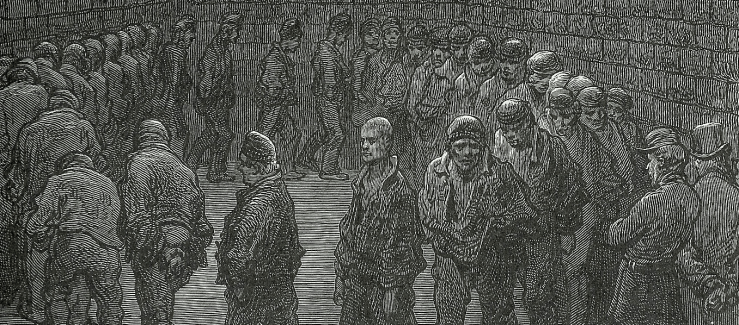
Bamboozle the inspectors (Thomas Pynchon on Donald Barthelme)

One out of several humiliating features about writing fiction for a living is that here after all is just about everybody else, all along the capitalist spectrum from piano movers to systems analysts, cheerfully selling their bodies or body parts according to time-honored custom and usage, while it’s only writers, out at the fringes of the entertainment sector, wretched and despised, who are obliged, more intimately and painfully, actually to sell their dreams, yes, dreams these days you’ll find are every bit as commoditized as any pork bellies there on the financial page. To be upbeat about it, though, in most cases it doesn’t present much moral problem, since dreams seldom make it through into print with anything like the original production values anyway. Even if you do good recovery, learning to write legibly in the dark and so forth, there’s still the matter of getting it down in words that can bring back even a little of the clarity and sweep, the intensity of emotion, the transcendent weirdness of the primary experience. So it’s a safe bet that most writers’ dreams, maybe even including the best ones, manage to stay untranslated and private after all.

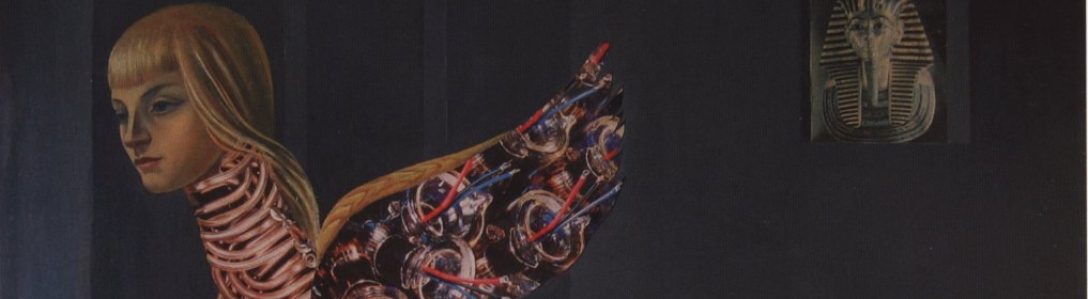
Barthelme, however, happens to be one of a handful of American authors there to make the rest of us look bad, who know instinctively how to stash the merchandise, bamboozle the inspectors, and smuggle their nocturnal contraband right on past the checkpoints of daylight “reality.” What he called his “secret vice” of “cutting up and pasting together pictures” bears an analogy, at least, to what is supposed to go on in dreams, where images from the public domain are said likewise to combine in unique, private, and, with luck, spiritually useful ways. How exactly Barthelme then got this into print, or for that matter pictorial, form, kept the transitions flowing the way he did and so on, is way too mysterious for me, though out of guild solidarity I probably wouldn’t share it even if I did know. The effect each time, at any rate, is to put us in the presence of something already eerily familiar … to remind us that we have lived in these visionary cities and haunted forests, that the ancient faces we gaze into are faces we know.

From Thomas Pynchon’s introduction to The Teachings of Don B. The introduction was republished yesterday in The Paris Review in a version that omits the first two paragraphs. You can read the full version of Thomas Pynchon’s essay on Donald Barthelme at ThomasPynchon.com.

In order to be shown the sign (Gerald Murnane)

The shabbily dressed man spoke to his students at their first class as follows. The best service he could perform for them was to persuade them to give up writing fiction as soon as they had finished his course—or even before then. The writing of fiction was something that a certain sort of person had to do in order to explain himself or herself to an imagined parent or an imagined loved one or an imagined god. He himself had had two novels published more than ten years before but had had nothing published since then and had no intention of writing so much as a sentence of fiction during the remainder of his life. He had stopped writing fiction after having been shown a sign. He had had to write or to prepare to write fiction in order to be shown the sign, but having been shown the sign he no longer wished to write fiction. The shabbily dressed man then said to his class that he had probably said too much to them already and had probably confused them thoroughly. He then said that their first class was over, that their classes for the next month were cancelled, and that they should go away and write their first piece of fiction and deliver it to him three weeks later so that he could prepare photocopies for the workshop classes that would occupy him and them for the rest of the year.

From Gerald Murnane’s short story “The White Cattle of Uppington,” (1995); collected in Stream System (2018).

Blog about Denis Johnson’s story “The Largesse of the Sea Maiden”

img_0381

I finished reading Denis Johnson’s posthumous collection of short stories The Largesse of the Sea Maiden a few weeks ago. I felt a bit stunned by the time I got to the fourth story in the collection, “Triumph Over the Grave,” which ends with these words: “It’s plain to you that at the time I wrote this, I’m not dead. But maybe by the time you read it.”

Denis Johnson died just over a year ago, of course, a fact that haunts any reading of Sea Maiden (at least for fans, and I am a fan). The collection was released just half a year after his death, and I managed to avoid reading any reviews of it. I held out on picking it up for reasons I don’t really know how to explain, but I when I finally read it, I consumed it in a greedy rush.

Anyway, since I finished the book I’ve tried a few times to put together a “review,” but each time I get some words down I find myself sprawling out all over the place, rereading bits of the stories, picking out new motifs, new questions, new parallels between Johnson’s life and the lives of his narrators. Very short review: The Largesse of the Sea Maiden is one of Johnson’s best books, a perfect gift to his readers—his own tragicomic obituary in fictional form. It’s a book about death and writing and art and commerce and regret and salvation, and each time I go back to it I find more in there than I saw the first time–more order, more threads, more design. So instead of a full long review, I’ll offer instead a series of blogs about each of the five stories in the collection. (Perhaps this form is simply an excuse to reread The Largesse of the Sea Maiden).

The first story is the title track, “The Largesse of the Sea Maiden.” First published in The New Yorker back in 2014, this long short story (it runs to not-quite 40 pages) introduces the major themes and tones of the entire collection. “Largesse” is told by a first-person narrator in ten titled vignettes. Some of the titles, like “Widow,” “Orphan,” “Farewell,” and “Memorial,” directly name the themes of both the story and the book.

The narrator of “The Largesse of the Sea Maiden” is a writer—but not a writer of literature or fiction—of art—but of commercials. Although “Largesse” shows him somewhat comfortable in his life in San Diego with his third wife, the narrator nevertheless is melancholy, even dour at times. In the beginning of the vignette “Ad Man,” he declares:

This morning I was assailed by such sadness at the velocity of life—the distance I’ve traveled from my own youth, the persistence of the old regrets, the new regrets, the ability of failure to freshen itself in novel forms—that I almost crashed the car.

(Is there a subtle nod there to one of Johnson’s most well-known stories, “Car-Crash While Hitchhiking”? I think so. If not, I find a thread).

“Ad Man” initiates the major plot trajectory of “Largesse”: Our narrator has won an award for an advertisement he wrote and directed decades ago, and he will have to return to New York City to be given the award at a special dinner. Floating through the vignettes is the ad man’s anxiety about his own legacy of work against the backdrop of the finer arts. We learn in “Accomplices” that he cares enough about the arts to object that his host has hung a Mardsen Hartley oil landscape above a lit fireplace—but he doesn’t prevent the man from burning the painting—his “property”—in a moment where Johnson subtly critiques the relationship between art and commerce. The narrator turns the burning of the painting into a new art though—storytelling.

The narrator later tells us that “looking at art for an hour or so always changes the way I see things afterward,” and “Largesse” is riddled with encounters with art and artists, like the outsider painter Tony Fido, whom the narrator meets at a gallery. The artist offers, unprompted, a scathing critique of a Edward Hopper’s painting Gas:

“You’re a painter yourself.”

“A better painter than this guy,” he said of Edward Hopper.

“Well, whose work would you say is any good?”

“The only painter I admire is God. He’s my biggest influence.”

That attribution — “he said of Edward Hopper” — is a lovely example of Johnson’s sharply-controlled wit.

Tony Fido plays a major minor role in “Largesse.” Fido tells the narrator the story of his encounter with a widow—one of several widows in both “Largesse” and Largesse, and his own suicide—Fido’s—becomes a strange moment for the narrator to realize how little he actually knows about his friend. And of course, all of these plot points give Johnson a chance to riff on the themes of death, loss and regret.

“Largesse” is loaded with thoughts on regret and forgiveness. Talking with a friend, the narrator muses that “we wandered into a discussion of the difference between repentance and regret. You repent the things you’ve done, and regret the chances you let get away.” The vignette “Farewell” stages a chance for the narrator to repent his past sins; his ex-wife, dying of cancer, calls him up to (possibly) forgive him:

In the middle of this I began wondering, most uncomfortably, in fact with a dizzy, sweating anxiety, if I’d made a mistake—if this wasn’t my first wife Ginny, no, but rather my second wife, Jennifer, often called Jenny. Because of the weakness of her voice and my own humming shock at the news, also the situation around her as she tried to speak to me on this very important occasion—folks coming and going, and the sounds of a respirator, I supposed—now, fifteen minutes into this call, I couldn’t remember if she’d actually said her name when I picked up the phone and I suddenly didn’t know which set of crimes I was regretting, wasn’t sure if this dying farewell clobbering me to my knees in true repentance beside the kitchen table was Virginia’s, or Jennifer’s.

I’ve quoted at such length because the moment is an example of Johnson’s tragicomic genius—a sick punchline that disconnects crime from punishment and punishment from forgiveness. The narrator ends up making the connections himself in the end: “after all, both sets of crimes had been the same.” And yet Johnson keeps pushing his character past reconciliation into a midnight walk to clear his conscience:

I wonder if you’re like me, if you collect and squirrel away in your soul certain odd moments when the Mystery winks at you, when you walk in your bathrobe and tasseled loafers, for instance, well out of your neighborhood and among a lot of closed shops, and you approach your very faint reflection in a window with words above it. The sign said “Sky and Celery.”

Closer, it read “Ski and Cyclery.”

“Farewell” ends on this note of a winking Mystery—on the profound insight that we are always susceptible to misreading the signs in front of us.

“The Largesse of the Sea Maiden” is very much a story about trying to put together a cohesive narrative from the strands and fragments around us. Indeed, its very form points to this—the fractured vignettes have to be pieced together by the reader. Johnson fractures not just form but tone. The deadpan, tragicomic, pathos-laden humor that’s run throughout Johnson’s oeuvre dominates in “Largesse,” yes, but there are strange eruptions of sentimental fantasy, particularly in “Mermaid,” a vignette that reads like the narrator’s own imaginative construction, and not the (often banal) reality that most of the narrative is grounded in. After receiving his award in New York, the narrator makes his way to a bar, and here conjures a scene like something from a film noir:

I couldn’t see the musician at all. In front of the piano a big tenor saxophone rested upright on a stand. With no one around to play it, it seemed like just another of the personalities here: the invisible pianist, the disenchanted old bartender, the big glamorous blonde, the shipwrecked, solitary saxophone…And the man who’d walked here through the snow…And as soon as the name of the song popped into my head I thought I heard a voice say, “Her name is Maria Elena.” The scene had a moonlit, black-and-white quality. Ten feet away at her table the blond woman waited, her shoulders back, her face raised. She lifted one hand and beckoned me with her fingers. She was weeping. The lines of her tears sparkled on her cheeks. “I am a prisoner here,” she said. I took the chair across from her and watched her cry. I sat upright, one hand on the table’s surface and the other around my drink. I felt the ecstasy of a dancer, but I kept still.”

The ecstasy here—internalized and “still”—is the ecstasy of storytelling, imagination, art. This is the gift of the mermaid, the largesse of the sea maiden. The minor moment is the real award for our ad man hero, who finds no real transcendence in commercial writing.

I’ve been using “the narrator” in this riff, but our hero has a name, which he reveals to us in the final vignette, “Whit.” It’s here that he describes the ad he’s (not exactly) famous for, an “animated 30-second spot [where] you see a brown bear chasing a gray rabbit.” The chase ends when the rabbit gives the bear a dollar bill.” Narrator Whit explains that this ad for a bank “referred, really, to nothing at all, and yet it was actually very moving.” He goes on:

I think it pointed to orderly financial exchange as the basis of harmony. Money tames the beast. Money is peace. Money is civilization. The end of the story is money.

And yet our ad man, despite his commercial interpretation of his own writing, recognizes too that this work “was better than cryptic—mysterious, untranslatable.” The word “untranslatable” is one of several clues that link the final section of “Largesse” to the final section of Walt Whitman’s long poem, Song of Myself. Whitman’s narrator (“Walt Whitman, a kosmos”) claims that he is, like the spotted hawk who swoops to disturb his reverie, “untranslatable.” Bequeathing himself to us—a gift for our good graces—he reminds us that “You will hardly know who I am,” a line that Johnson echoes in the beginning of “Whit”: “My name would mean nothing to you, but there’s a very good chance you’re familiar with my work.” And then of course, there’s the big tell—Johnson’s narrator is Bill Whitman, a pun that works on several levels. Walt Whitman’s language has seeped into the language of advertising—in a way it is the genesis of a new commercial American idiom—and here Johnson slyly pushes it back into the realm of art.

Just as the conclusion of Song of Myself builds to a self-penned elegy for its self-subject, “The Largesse of the Sea Maiden” reads like Johnson’s elegy for an alter-ego. We learn in the final paragraphs that Bill Whitman is “just shy of sixty-three” — roughly the same age as Johnson would’ve been when the story was published. (We learn that the narrator of “Doppelgänger, Poltergeist,” the final story in The Largesse of the Sea Maiden, is also the same age as Johnson. That narrator was born on “July 20, 1949.” Johnson’s birthday was July 1, 1949).

Narrator Whit reflects on his life in the story’s melancholy penultimate paragraph:

I note that I’ve lived longer in the past, now, than I can expect to live in the future. I have more to remember than I have to look forward to. Memory fades, not much of the past stays, and I wouldn’t mind forgetting a lot more of it.

However, there’s still a restlessness to his spirit, a questing desire to answer the final lines of Song of Myself, perhaps, where Whitman writes:

Failing to fetch me at first keep encouraged,
Missing me one place search another,
I stop somewhere waiting for you

The last paragraph of “The Largesse of the Sea Maiden” is Johnson’s narrator’s implicit response to these lines, and as I cannot improve upon his prose, they will be my last lines as well:

Once in a while, I lie there as the television runs, and I read something wild and ancient from one of several collections of folktales I own. Apples that summon sea maidens, eggs that fulfill any wish, and pears that make people grow long noses that fall off again. Then sometimes I get up and don my robe and go out into our quiet neighborhood looking for a magic thread, a magic sword, a magic horse.

“Breughel” — Aldous Huxley

Screenshot 2018-07-16 at 7.52.38 PM

“Breughel”

by

Aldous Huxley

from Along the Road, 1925


Most of our mistakes are fundamentally grammatical. We create our own difficulties by employing an inadequate language to describe facts. Thus, to take one example, we are constantly giving the same name to more than one thing, and more than one name to the same thing. The results, when we come to argue, are deplorable. For we are using a language which does not adequately describe the things about which we are arguing.

The word “painter” is one of those names whose indiscriminate application has led to the worst results. All those who, for whatever reason and with whatever intentions, put brushes to canvas and make pictures, are called without distinction, painters. Deceived by the uniqueness of the name, aestheticians have tried to make us believe that there is a single painter-psychology, a single function of painting, a single standard of criticism. Fashion changes and the views of art critics with it. At the present time it is fashionable to believe in form to the exclusion of subject. Young people almost swoon away with excess of aesthetic emotion before a Matisse. Two generations ago they would have been wiping their eyes before the latest Landseer. (Ah, those more than human, those positively Christ-like dogs—how they moved, what lessons they taught! There had been no religious painting like Landseer’s since Carlo Dolci died.)

These historical considerations should make us chary of believing too exclusively in any single theory of art. One kind of painting, one set of ideas are fashionable at any given moment. They are made the basis of a theory which condemns all other kinds of painting and all preceding critical theories. The process constantly repeats itself. Continue reading ““Breughel” — Aldous Huxley”

Sometimes not so adequate | Nathaniel Hawthorne’s journal entry for July 14th, 1850

Lenox, July 14th.–The tops of the chestnut-trees have a whitish appearance, they being, I suppose, in bloom. Red raspberries are just through the season.

Language,–human language,–after all, is but little better than the croak and cackle of fowls and other utterances of brute nature,–sometimes not so adequate.

Nathaniel Hawthorne’s journal entry for July 14th, 1850. From Passages from the American Note-Books.

Then would she wheedle and laugh and blarney, beginning in a rage, and ending as if she had been in jest | Nathaniel Hawthorne’s journal entry for July 9th, 1837

July 9th.–Went with B—- to pay a visit to the shanties of the Irish and Canadians. He says that they sell and exchange these small houses among themselves continually. They may be built in three or four days, and are valued at four or five dollars. When the turf that is piled against the walls of some of them becomes covered with grass, it makes quite a picturesque object. It was almost dusk–just candle-lighting time–when we visited them. A young Frenchwoman, with a baby in her arms, came to the door of one of them, smiling, and looking pretty and happy. Her husband, a dark, black-haired, lively little fellow, caressed the child, laughing and singing to it; and there was a red-bearded Irishman, who likewise fondled the little brat. Then we could hear them within the hut, gabbling merrily, and could see them moving about briskly in the candlelight, through the window and open door. An old Irishwoman sat in the door of another hut, under the influence of an extra dose of rum,–she being an old lady of somewhat dissipated habits. She called to B—-, and began to talk to him about her resolution not to give up her house: for it is his design to get her out of it. She is a true virago, and, though somewhat restrained by respect for him, she evinced a sturdy design to remain here through the winter, or at least for a considerable time longer. He persisting, she took her stand in the doorway of the hut, and stretched out her fist in a very Amazonian attitude. “Nobody,” quoth she, “shall drive me out of this house, till my praties are out of the ground.” Then would she wheedle and laugh and blarney, beginning in a rage, and ending as if she had been in jest. Meanwhile her husband stood by very quiet, occasionally trying to still her; but itis to be presumed, that, after our departure, they came to blows, it being a custom with the Irish husbands and wives to settle their disputes with blows; and it is said the woman often proves the better man. The different families also have battles, and occasionally the Irish fight with the Canadians. The latter, however, are much the more peaceable, never quarrelling among themselves, and seldom with their neighbors. They are frugal, and often go back to Canada with considerable sums of money. B—- has gained much influence both with the Irish and the French,–with the latter, by dint of speaking to them in their own language. He is the umpire in their disputes, and their adviser, and they look up to him as a protector and patron-friend. I have been struck to see with what careful integrity and wisdom he manages matters among them, hitherto having known him only as a free and gay young man. He appears perfectly to understand their general character, of which he gives no very flattering description. In these huts, less than twenty feet square, he tells me that upwards of twenty people have sometimes been lodged.

A description of a young lady who had formerly been insane, and now felt the approach of a new fit of madness. She had been out to ride, had exerted herself much, and had been very vivacious. On her return, she sat down in a thoughtful and despondent attitude, looking very sad, but one of the loveliest objects that ever were seen. The family spoke to her, but she made no answer, nor took the least notice; but still sat like a statue in her chair,–a statue of melancholy and beauty. At last they led her away to her chamber.

We went to meeting this forenoon. I saw nothing remarkable, unless a little girl in the next pew to us, three or four years old, who fell asleep, with her head in the lap of her maid, and looked very pretty: a picture of sleeping innocence.

Nathaniel Hawthorne’s journal entry for July 9th, 1837. From Passages from the American Note-Books.

Riff on finishing Middlemarch, George Eliot’s novel of consciousness

Screenshot 2018-06-12 at 8.35.14 PM
Detail of a portrait of Mary Ann Evans (George Eliot) at age 30 by François d’Albert Durade (1804–1886)

I finally finished George Eliot’s long and marvelous 1872 novel Middlemarch.

When I wrote about reading Middlemarch last month, from not-quite-the-middle of the book, I lamented that I’d rather be rereading the book than reading it. Rich and dense, it’s the kind of big book that clearly offers more on repeat readings. And yes, I will reread Middlemarch, but I’ll give it a year or three to mellow in the back of my consciousness.

Middlemarch is a novel about consciousness, and what the novel does best in my estimation is show how different kinds of consciousness mediate and are mediated by the social forces they inhabit (and are inhabited by).

(The word consciousness appears 90 times in Middlemarch. If we include similar iterations, like consciousconsciouslyunconscious, and unconsciously, the count grows to a total of 172 times. In contrast, iterations of the word conscience appear only 38 times).

Dorothea Brooke remained my favorite consciousness throughout the novel, and I missed her when she wasn’t there, when Eliot had us hovering around or even fully inhabiting another consciousness.

I’ll admit that in the final quarter of Middlemarch I found myself a bit weary of the Bulstrode disgrace plot—and yet I appreciate how Eliot inhabited that consciousness as well. Bulstrode provides Eliot a sharp tool to show how consciousness is blind, or even self-blinding—how consciousness massages conscience in order to survive. In a passage that illustrates this process, Eliot writes,

Bulstrode shrank from a direct lie with an intensity disproportionate to the number of his more indirect misdeeds. But many of these misdeeds were like the subtle muscular movements which are not taken account of in the consciousness, though they bring about the end that we fix our mind on and desire. And it is only what we are vividly conscious of that we can vividly imagine to be seen by Omniscience.

Consciousness cannot lay claim to conceiving of an absolute omniscient conscience, an absolute and ever-present moral consciousness. Too, earlier in the novel, Eliot’s narrator observes,

For the egoism which enters into our theories does not affect their sincerity; rather, the more our egoism is satisfied, the more robust is our belief.

Egoism is a central problem in Middlemarch; indeed, Eliot seems to posit egoism as the greatest threat to how individual consciousnesses navigate social reality. Here is here narrator again:

Will not a tiny speck very close to our vision blot out the glory of the world, and leave only a margin by which we see the blot? I know no speck so troublesome as self.

I cannot improve upon “no speck so troublesome as self” and will not adventure an attempt.

But back to the consciousness I liked best in Middlemarch: Dorothea.

Dorothea is a kind of genius of intention, and Eliot harnesses that genius—she shows us Dorothea’s consciousness-in-action. Eliot doesn’t just tell us what’s happening in Dorothea’s head; she makes that consciousness live in our own heads.

Dorothea’s life, like all lives, is beset with foiled plans and terrible mistakes. Still, Middlemarch grants Dorothea something of a happy ending in her marriage to Will Ladislaw, and yet refuses the conclusion of a classical comedy. There is no wedding scene. Indeed, the last time Dorothea speaks in the novel it is to reconcile with her sister Celia—a conclusion that confirms their love story the equal to that of Dorothea and Ladislaw’s love story.

Eliot’s novel is too sophisticated and too realistic for a simplistic happy or tragic conclusion, of course. In the novel’s “Finale,” the narrator reminds us that,

Every limit is a beginning as well as an ending…the fragment of a life, however typical, is not the sample of an even web.

The narrator then gives us broad details of the fates of the novel’s principal couples: Lydgate and Rosamond, skewing depressive; Mary and Fred, skewing comic; and finally Ladislaw and Dorothea. We learn of Ladislaw’s success as a reform politician and understand that Dorothea is an instrumental force in this success.

Eliot’s conclusion for this final pair skews neither comic nor tragic, but is something more complex—more realistic. Dorothea becomes a cautionary tale in the town of Middlemarch; her legacy is one of misspent potential in the eyes of society. The novel ends without indicating that any of the grand plans of Dorothea’s youth have been achieved. And yet the novel concludes with an oblique revelation about Dorothea’s misunderstood legacy.

In the second-to-final paragraph of Middlemarch, Eliot writes that,

those determining acts of [Dorothea’s] life were not ideally beautiful. They were the mixed result of young and noble impulse struggling amidst the conditions of an imperfect social state, in which great feelings will often take the aspect of error, and great faith the aspect of illusion. For there is no creature whose inward being is so strong that it is not greatly determined by what lies outside it.

Eliot refuses a simple happy ending here; her heroine is still a consciousness subject to the social forces around it. Dorothea’s great utopian ambitions are ultimately tempered by the cultural constraints her consciousness would otherwise seek to transcend.

But then the final paragraph of the novel points towards transcendence:

Her finely touched spirit had still its fine issues, though they were not widely visible. … But the effect of her being on those around her was incalculably diffusive: for the growing good of the world is partly dependent on unhistoric acts; and that things are not so ill with you and me as they might have been, is half owing to the number who lived faithfully a hidden life, and rest in unvisited tombs.

Dorothea—and, more significantly, the spirit of Dorothea—did real grand good in the world, an immeasurable good, “incalculably diffusive.” Even if she lived ultimately a “hidden life,” Eliot insists that it is people like Dorothea who have made the world better for “you and me.”

While “hidden life” and “unvisited tombs” may harbor negative connotations, these phrases are ultimately ironic: Eliot’s novel itself is the key to the hidden life of Dorothea Brooke. Middlemarch is a vivid and vivifying tomb for Dorothea, and we readers are the lucky visitors.

Growing dark with a pleasant gloom | Nathaniel Hawthorne’s journal entry for July 8th, 1837

 July 8th.–Yesterday afternoon, a stroll with B—- up a large brook, he fishing for trout, and I looking on. The brook runs through a valley, on one side bordered by a high and precipitous bank; on the other there is an interval, and then the bank rises upward and upward into a high hill, with gorges and ravines separating one summit from another, and here and there are bare places, where the rain-streams have washed away the grass. The brook is bestrewn with stones, some bare, some partially moss-grown, and sometimes so huge as–once at least–to occupy almost the whole breadth of the current. Amongst these the stream brawls, only that this word does not express its good-natured voice, and “murmur” is too quiet. It sings along, sometimes smooth, with the pebbles visible beneath, sometimes rushing dark and swift, eddying and whitening past some rock, or underneath the hither or the farther bank; and at these places B—- cast his line, and sometimes drew out a trout, small, not more than five or six inches long. The farther we went up the brook, the wilder it grew. The opposite bank was covered with pines and hemlocks, ascending high upwards, black and solemn. One knew that there must be almost a precipice behind, yet we could not see it. At the foot you could spy, a little way within the darksome shade, the roots and branches of the trees; but soon all sight was obstructed amidst the trunks. On the hither side, at first the bank was bare, then fringed with alder-bushes, bending and dipping into the stream, which, farther on, flowed through the midst of a forest of maple, beech, and other trees, its course growing wilder and wilder as we proceeded. For a considerable distance there was a causeway, built long ago of logs, to drag lumber upon; it was now decayed and rotten, a red decay, sometimes sunken down in the midst, here and there a knotty trunk stretching across, apparently sound. The sun being now low towards the west, a pleasant gloom and brightness were diffused through the forest, spots of brightness scattered upon the branches, or thrown down in gold upon the last year’s leaves among the trees. At last we came to where a dam had been built across the many years ago, and was now gone to ruin, so as to make the spot look more solitary and wilder than if man had never left vestiges of his toil there. It was a framework of logs, with a covering of plank sufficient to obstruct the onward flow of the brook; but it found its way past the side, and came foaming and struggling along among scattered rocks. Above the dam there was a broad and deep pool, one side of which was bordered by a precipitous wall of rocks, as smooth as if hewn out and squared, and piled one upon another, above which rose the forest. On the other side there was still a gently shelving bank, and the shore was covered with tall trees, among which I particularly remarked a stately pine, wholly devoid of bark, rising white in aged and majestic ruin, thrusting out its barkless arms. It must have stood there in death many years, its own ghost. Above the dam the brook flowed through the forest, a glistening and babbling water-path, illuminated by the sun, which sent its rays almost straight along its course. It was as lovely and wild and peaceful as it could possibly have been a hundred years ago; and the traces of labors of men long departed added a deeper peace to it. I bathed in the pool, and then pursued my way down beside the brook, growing dark with a pleasant gloom, as the sun sank and the water became more shadowy. B—- says that there was formerly a tradition that the Indians used to go up this brook, and return, after a brief absence, with large masses of lead, which they sold at the trading-stations in Augusta; whence there has always been an idea that there is a lead-mine hereabouts. Great toadstools were under the trees, and some small ones as yellow and almost the size of a half-broiled yolk of an egg. Strawberries were scattered along the brookside.

Dined at the hotel or Mansion House to-day. Men were playing checkers in the parlor. The Marshal of Maine, a corpulent, jolly fellow, famed for humor. A passenger left by the stage, hiring an express onward. A bottle of champagne was quaffed at the bar.

Nathaniel Hawthorne’s journal entry for July 8th, 1837. From Passages from the American Note-Books.

“Farewell,” a very short story by Denis Johnson

“Farewell”

by

Denis Johnson

(A vignette from “The Largesse of the Sea Maiden”)


Elaine got a wall phone for the kitchen, a sleek blue one that wears its receiver like a hat, with a caller-I.D. readout on its face just below the keypad. While I eyeballed this instrument, having just come in from my visit with the chiropractor, a brisk, modest tone began, and the tiny screen showed ten digits I didn’t recognize. My inclination was to scorn it, like any other unknown. But this was the first call, the inaugural message.

As soon as I touched the receiver I wondered if I’d regret this, if I was holding a mistake in my hand, if I was pulling this mistake to my head and saying “Hello” to it.

The caller was my first wife, Virginia, or Ginny, as I always called her. We were married long ago, in our early twenties, and put a stop to it after three crazy years. Since then, we hadn’t spoken, we’d had no reason to, but now we had one. Ginny was dying.

Her voice came faintly. She told me the doctors had closed the book on her, she’d ordered her affairs, the good people from hospice were in attendance.

Before she ended this earthly transit, as she called it, Ginny wanted to shed any kind of bitterness against certain people, certain men, especially me. She said how much she’d been hurt, and how badly she wanted to forgive me, but she didn’t know whether she could or not—she hoped she could—and I assured her, from the abyss of a broken heart, that I hoped so, too, that I hated my infidelities and my lies about the money, and the way I’d kept my boredom secret, and my secrets in general, and Ginny and I talked, after forty years of silence, about the many other ways I’d stolen her right to the truth.

In the middle of this, I began wondering, most uncomfortably, in fact with a dizzy, sweating anxiety, if I’d made a mistake—if this wasn’t my first wife, Ginny, no, but rather my second wife, Jennifer, often called Jenny. Because of the weakness of her voice and my own humming shock at the news, also the situation around her as she tried to speak to me on this very important occasion—folks coming and going, and the sounds of a respirator, I supposed—now, fifteen minutes into this call, I couldn’t remember if she’d actually said her name when I picked up the phone and I suddenly didn’t know which set of crimes I was regretting, wasn’t sure if this dying farewell clobbering me to my knees in true repentance beside the kitchen table was Virginia’s, or Jennifer’s.

“This is hard,” I said. “Can I put the phone down a minute?” I heard her say O.K.

The house felt empty. “Elaine?” I called. Nothing. I wiped my face with a dishrag and took off my blazer and hung it on a chair and called out Elaine’s name one more time and then picked up the receiver again. There was nobody there.

Somewhere inside it, the phone had preserved the caller’s number, of course, Ginny’s number or Jenny’s, but I didn’t look for it. We’d had our talk, and Ginny or Jenny, whichever, had recognized herself in my frank apologies, and she’d been satisfied—because, after all, both sets of crimes had been the same.

I was tired. What a day. I called Elaine on her cell phone. We agreed she might as well stay at the Budget Inn on the East Side. She volunteered out there, teaching adults to read, and once in a while she got caught late and stayed over. Good. I could lock all three locks on the door and call it a day. I didn’t mention the previous call. I turned in early.

I dreamed of a wild landscape—elephants, dinosaurs, bat caves, strange natives, and so on.

I woke, couldn’t go back to sleep, put on a long terry-cloth robe over my p.j.’s and slipped into my loafers and went walking. People in bathrobes stroll around here at all hours, but not often, I think, without a pet on a leash. Ours is a good neighborhood—a Catholic church and a Mormon one, and a posh town-house development with much open green space, and, on our side of the street, some pretty nice smaller homes.

I wonder if you’re like me, if you collect and squirrel away in your soul certain odd moments when the Mystery winks at you, when you walk in your bathrobe and tasselled loafers, for instance, well out of your neighborhood and among a lot of closed shops, and you approach your very faint reflection in a window with words above it. The sign said “Sky and Celery.” Closer, it read “Ski and Cyclery.”

I headed home.

This schedule in effect July 5th, 1922

In Chapter 4 of F. Scott Fitzgerald’s The Great Gatsby, narrator Nick Carraway recounts the names of the rich, shallow, parasitic guests who attended Gatsby’s parties. Nick tells us the list comes from “an old time-table” of names he originally recorded in July 5th—significantly, the day after Independence Day: the day after the hopes and dreams of a new country. From the chapter—-

Once I wrote down on the empty spaces of a time-table the names of those who came to Gatsby’s house that summer. It is an old time-table now, disintegrating at its folds, and headed “This schedule in effect July 5th, 1922.” But I can still read the gray names, and they will give you a better impression than my generalities of those who accepted Gatsby’s hospitality and paid him the subtle tribute of knowing nothing whatever about him.

From East Egg, then, came the Chester Beckers and the Leeches, and a man named Bunsen, whom I knew at Yale, and Doctor Webster Civet, who was drowned last summer up in Maine. And the Hornbeams and the Willie Voltaires, and a whole clan named Blackbuck, who always gathered in a corner and flipped up their noses like goats at whosoever came near. And the Ismays and the Chrysties (or rather Hubert Auerbach and Mr. Chrystie’s wife), and Edgar Beaver, whose hair, they say, turned cotton-white one winter afternoon for no good reason at all.

Clarence Endive was from East Egg, as I remember. He came only once, in white knickerbockers, and had a fight with a bum named Etty in the garden. From farther out on the Island came the Cheadles and the O. R. P. Schraeders, and the Stonewall Jackson Abrams of Georgia, and the Fishguards and the Ripley Snells. Snell was there three days before he went to the penitentiary, so drunk out on the gravel drive that Mrs. Ulysses Swett’s automobile ran over his right hand. The Dancies came, too, and S. B. Whitebait, who was well over sixty, and Maurice A. Flink, and the Hammerheads, and Beluga the tobacco importer, and Beluga’s girls.

From West Egg came the Poles and the Mulreadys and Cecil Roebuck and Cecil Schoen and Gulick the state senator and Newton Orchid, who controlled Films Par Excellence, and Eckhaust and Clyde Cohen and Don S. Schwartze (the son) and Arthur McCarty, all connected with the movies in one way or another. And the Catlips and the Bembergs and G. Earl Muldoon, brother to that Muldoon who afterward strangled his wife. Da Fontano the promoter came there, and Ed Legros and James B. (“Rot-Gut.”) Ferret and the De Jongs and Ernest Lilly — they came to gamble, and when Ferret wandered into the garden it meant he was cleaned out and Associated Traction would have to fluctuate profitably next day.

A man named Klipspringer was there so often and so long that he became known as “the boarder.”— I doubt if he had any other home. Of theatrical people there were Gus Waize and Horace O’donavan and Lester Meyer and George Duckweed and Francis Bull. Also from New York were the Chromes and the Backhyssons and the Dennickers and Russel Betty and the Corrigans and the Kellehers and the Dewars and the Scullys and S. W. Belcher and the Smirkes and the young Quinns, divorced now, and Henry L. Palmetto, who killed himself by jumping in front of a subway train in Times Square.

Benny McClenahan arrived always with four girls. They were never quite the same ones in physical person, but they were so identical one with another that it inevitably seemed they had been there before. I have forgotten their names — Jaqueline, I think, or else Consuela, or Gloria or Judy or June, and their last names were either the melodious names of flowers and months or the sterner ones of the great American capitalists whose cousins, if pressed, they would confess themselves to be.

In addition to all these I can remember that Faustina O’brien came there at least once and the Baedeker girls and young Brewer, who had his nose shot off in the war, and Mr. Albrucksburger and Miss Haag, his fiancee, and Ardita Fitz-Peters and Mr. P. Jewett, once head of the American Legion, and Miss Claudia Hip, with a man reputed to be her chauffeur, and a prince of something, whom we called Duke, and whose name, if I ever knew it, I have forgotten.

All these people came to Gatsby’s house in the summer.

A mammoth rat; a collection of pirates, murderers, and the like | Nathaniel Hawthorne’s journal entry for July 4th, 1838

July 4th.–A very hot, bright, sunny day; town much thronged; booths on the Common, selling gingerbread, sugar-plums, and confectionery, spruce beer, lemonade. Spirits forbidden, but probably sold stealthily. On the top of one of the booths a monkey, with a tail two or three feet long. He is fastened by a cord, which, getting tangled with the flag over the booth, he takes hold and tries to free it. He is the object of much attention from the crowd, and played with by the boys, who toss up gingerbread to him, while he nibbles and throws it down again. He reciprocates notice, of some kind or other, with all who notice him. There is a sort of gravity about him. A boy pulls his long tail, whereat he gives a slight squeak, and for the future elevates it as much as possible. Looking at the same booth by and by, I find that the poor monkey has been obliged to betake himself to the top of one of the wooden joists that stick up high above. There are boys going about with molasses candy, almost melted down in the sun. Shows: A mammoth rat; a collection of pirates, murderers, and the like, in wax. Constables in considerable number, parading about with their staves, sometimes conversing with each other, producing an effect by their presence, without having to interfere actively. One or two old salts, rather the worse for liquor: in general the people are very temperate. At evening the effect of things rather more picturesque; some of the booth-keepers knocking down the temporary structures, and putting the materials in wagons to carry away; other booths lighted up, and the lights gleaming through rents in the sail-cloth tops. The customers are rather riotous, calling loudly and whimsically for what they want; a young fellow and a girl coming arm in arm; two girls approaching the booth, and getting into conversation with the folks thereabout. Perchance a knock-down between two half-sober fellows in the crowd: a knock-down without a heavy blow, the receiver being scarcely able to keep his footing at any rate. Shoutings and hallooings, laughter, oaths,–generally a good-natured tumult; and the constables use no severity, but interfere, if at all, in a friendly sort of way. I talk with one about the way in which the day has passed, and he bears testimony to the orderliness of the crowd, but suspects one booth of selling liquor, and relates one scuffle. There is a talkative and witty seller of gingerbread holding forth to the people from his cart, making himself quite a noted character by his readiness of remark and humor, and disposing of all his wares. Late in the evening, during the fire-works, people are consulting how they are to get home,–many having long miles to walk: a father, with wife and children, saying it will be twelve o’clock before they reach home, the children being already tired to death. The moon beautifully dark-bright, not giving so white a light as sometimes. The girls all look beautiful and fairy-like in it, not exactly distinct, nor yet dim. The different characters of female countenances during the day,–mirthful and mischievous, slyly humorous, stupid, looking genteel generally, but when they speak often betraying plebeianism by the tones of their voices. Two girls are very tired,–one a pale, thin, languid-looking creature; the other plump, rosy, rather overburdened with her own little body. Gingerbread figures, in the shape of Jim Crow and other popularities.

In the old burial ground, Charter Street, a slate gravestone, carved round the borders, to the memory of “Colonel John Hathorne, Esq.,” who died in 1717. This was the witch-judge. The stone is sunk deep into the earth, and leans forward, and the grass grows very long around it; and, on account of the moss, it was rather difficult to make out the date. Other Hathornes lie buried in a range with him on either side. In a corner of the burial-ground, close under Dr. P—-‘s garden fence, are the most ancient stones remaining in the graveyard; moss-grown, deeply sunken. One to “Dr. John Swinnerton, Physician,” in 1688; another to his wife. There, too, is the grave of Nathaniel Mather, the younger brother of Cotton, and mentioned in the Magnalia as a hard student, and of great promise. “An aged man at nineteen years,” saith the gravestone. It affected me deeply, when I had cleared away the grass from the half-buried stone, and read the name. An apple-tree or two hang over these old graves, and throw down the blighted fruit on Nathaniel Mather’s grave,–he blighted too. It gives strange ideas, to think how convenient to Dr. P—-‘s family this burial-ground is,–the monuments standing almost within arm’s reach of the side windows of the parlor,–and there being a little gate from the back yard through which we step forth upon those old graves aforesaid. And the tomb of the P. family is right in front, and close to the gate. It is now filled, the last being the refugee Tory, Colonel P—-, and his wife. M. P—- has trained flowers over this tomb, on account of her friendly relations with Colonel P—-.

It is not, I think, the most ancient families that have tombs,–their ancestry for two or three generations having been reposited in the earth before such a luxury as a tomb was thought of. Men who founded families, and grew rich, a century or so ago, were probably the first.

There is a tomb of the Lyndes, with a slab of slate affixed to the brick masonry on one side, and carved with a coat of arms.

Nathaniel Hawthorne’s journal entry for July 4th, 1838. From Passages from the American Note-Books.

“July Stories” — Roberto Bolaño

July has been a strange month. The other day I went to the beach and I saw a woman of about thirty, pretty, wearing a black bikini, who was reading standing up. At first I thought she was about to lie down on her towel, but when I looked again she was still standing, and after that I didn’t take my eyes off her. For two hours, more or less, she read standing up, walked over to the water, didn’t go in, let the waves lap her shins, went back to her spot, kept reading, occasionally put the book down while still standing, leaned over a few times and took a big bottle of Pepsi out of a bag and drank, then picked up the book again, and, finally, without ever bending a knee, put her things away and left. Earlier the same day, I saw three girls, all in thongs, gorgeous, one of them had a tattoo on one buttock, they were having a lively conversation, and every once in a while they got in the water and swam and then they would lie down again on their mats, basically a completely normal scene, until all of a sudden, a cell phone rang, I heard it and thought it was mine until I realized it had been a while since I had a cell phone, and then I knew the phone belonged to one of them. I heard them talking. All I can say is that they weren’t speaking Catalan or Spanish. But they sounded deadly serious. Then I watched two of them get up, like zombies, and walk toward some rocks. I got up too and pretended to brush the sand off my trunks. On the rocks, I watched them talk to a huge, hideously ugly man covered in hair, in fact one of the hairiest men I’ve ever seen in my life. They knelt before him and listened attentively without saying a word, and then they went back to where their friend was waiting for them and everything went on as before, as if nothing had happened. Who are these women? I asked myself once it was dark and I had showered and dressed. One drank Pepsi. The others bowed down to a bear. I know who they are. But I don’t really know.

From Roberto Bolaño’s Between Parentheses: Essays, Articles and Speeches, 1998-2003.

Doomed to contend with such a ferocious banditti of weeds | Nathaniel Hawthorne’s journal entry for July 1st, 1843

Saturday, July 1st.–We had our first dish of green peas (a very small one) yesterday. Every day for the last week has been tremendously hot; and our garden flourishes like Eden itself, only Adam could hardly have been doomed to contend with such a ferocious banditti of weeds.

Nathaniel Hawthorne’s journal entry for July 1st, 1843. From Passages from the American Note-Books.

George Saunders’ “Little St. Don” and the limits of contemporary satire

Screenshot 2018-06-27 at 6.48.39 PM

George Saunders has a new story called “Little St. Don” in this week’s New Yorker. A satirical hagiography of Donald Trump, “Little St. Don” is a pastiche told in little vignettes, parables roughly allegorical to today’s horrorshow headlines. Here’s an example from early in the story:

Little St. Don was once invited to the birthday party of his best friend, Todd. As the cake was being served, a neighbor, Mr. Aryan, burst in, drunk, threw the cake against the wall, insulted Todd’s mother, and knocked a few toddlers out of their seats, requiring them to get stitches. Then Todd’s dad pushed Mr. Aryan roughly out the front door. Again, Little St. Don mounted a chair, and began to speak, saying what a shame it was that those two nice people had both engaged in violence.

Here, Saunders transposes the racist rally at Charlottesville into a domestic affair, a typical move for the writer. Saunders’ heroes are often hapless fathers besieged by the absurdities of a postmodern world. These figures try to work through all the violence and evil and shit toward a moral redemption, a saving grace or mystical love. Collapsing history and myth into the personal and familiar makes chaos more manageable.

The vignettes in “Little St. Don” follow a somewhat predictable pattern: Little St. Don incites racial violence, Little St. Don makes up juvenile nicknames for his enemies, Little St. Don radically misreads Christ’s central message. Etc.

The story’s ironic-parable formula is utterly inhabited by Donald Trump’s verbal tics and rhythms. Here is Saunders’ Little St. Don channeling Donald Trump:

Gentle, sure, yeah, that’s great. Jesus sounds like a good guy. Pretty famous guy. Huh. Maybe kind of a wimp? Within our school, am I about as famous as Jesus was when alive? Now that he’s dead, sure, he’s super-famous. But, when alive, how did he do? Not so great, I bet. Anyway, I like Saviours who weren’t crucified.

We all know these terrible tics and rhythms too well by now—indeed they have ventriloquized the discourse. In repeating Trump’s rhetorical style, Saunders attempts to sharpen the contrast between the narrative’s hagiographic style and the amorality of the narrative’s central figure. Saunders inserts this absurd language into a genre usually reserved for moral instruction to achieve his satire. The reader is supposed to note the jarring disparity between our culture’s moral ideals and our current political reality. The result though is simply another reiteration of Trump’s rhetoric. George Saunders is not the ventriloquist here. He is being ventriloquized. “Little St. Don” redistributes the very rhetoric it seeks to deride. It spreads the virus.

“Little St. Don” exemplifies just how limited contemporary literature’s toolkit is when it comes to acutely skewering our zeitgeist. Trump’s rhetoric purposefully surpasses absurdity; indeed, Trump’s rhetoric is nihilistically absurd, the ur-huckster’s argot that distills over two centuries of American con-artist culture for a 21st-century mass media environment. Ahistorical and amoral, Trump’s rhetoric oozes outside the bounds of allegorical satire. His rhetoric is already kitsch, part and parcel of a self-ironizing aesthetic that is always only-joking-but-hey-not-really-joking. This rhetorical aesthetic is post-postmodern, and Saunders’ postmodern techniques in “Little St. Don” cannot lance it, deflate it, or expose it—Trump’s rhetoric is already exposed. Saunders here is simply describing it, repeating it, and reframing it within  preëxisting literary genres.

Mashing up these genres is a typical 20th-century postmodernist move, one that Saunders’ audience in The New Yorker could expect. Indeed, it seems that connecting with an audience is Saunders’ main concern. But he’s preaching to the choir. The story is like a mediocre cover band’s copy of a terrible greatest hits record. In his mash-up we already know all the tunes, all the rhythms, and all the tones. Hell, we even know the mash-up’s not-so-secret formula. Saunders simply confirms the emotional and intellectual gestures that  preëxist in his New Yorker audience. His story is there to assure us of our own moral rectitude.

Screenshot 2018-06-27 at 6.48.07 PM

There is nothing wrong with a writer writing to please his audience. However, Saunders, who won the Booker Prize last year for his novel Lincoln in the Bardo, is frequently praised as the greatest satirist of his generation. “Little St. Don” is not great satire, but that is not exactly Saunders’ fault. Again, what the little story does well (and why I find it worth writing about) is show us the limitations of literary fiction’s power to satirize our ultra-absurd age. Reality runs a lap or two on fiction, trampling it a little.

This is not to say that fiction is (or has been) powerless to properly target absurd demagoguery and creeping fascism. A number of fiction writers in the late 20th century anticipated, diagnosed, and analyzed our current zeitgeist. Philip K. Dick, JG Ballard, Don DeLillo, Thomas Pynchon, Octavia Butler, Ishmael Reed, and Margaret Atwood all come easily to mind. To be fair, these writers were anticipating a new zeitgeist and not always specifically tackling one corroded personality, which is what Saunders is doing in “Little St. Don.” Thomas Pynchon had 700 pages or so of Gravity’s Rainbow to get us to Richard Nixon, night manager of the Orpheus Theater—that’s a pretty big stage of context to skewer the old crook. But Pynchon’s satire is far, far sharper, and more indelible in its strangeness than “Little St. Don.” Pynchon’s satire offers no moral consolation. Similarly, Ishmael Reed’s sustained attack on a postmodern presidency in The Terrible Twos never tries to comfort its audience by suggesting that the reader is in a position of moral superiority to any of the characters. And I don’t know how anyone can top JG Ballard’s “Why I Want to Fuck Ronald Reagan.”

It might be more fair to look at another short piece from The New Yorker which engaged with the political horrors of its own time. I’m thinking here of Donald Barthelme’s 1968 story “The Indian Uprising.”  Barthelme creates his own rhetoric in this weird and unsettling story. While “The Indian Uprising” is “about” the Vietnam War and the Civil Rights movement, it is hardly a simple allegory. To match the chaos and disruption of his time, Barthelme repeatedly disorients his audience, making them feel a host of nasty, contradictory, and often terrible feelings. The story requires critical participation, and its parable ultimately refuses to comfort the reader. None of this is particularly easy.

If Saunders’ “Little St. Don” is particularly easy, perhaps that’s because the moral response to Trump’s rhetoric should be particularly easy. That a moral response (and not a rhetorical response anchored in “civility”) is somehow not easy for certain people—those in power, say—is the real problem here. Saunders tries to anchor Trump’s rhetoric to a ballast that should have a moral force, but the gesture is so self-evident that it simply cannot pass for satire, let alone political commentary. Saunders offers instead a kind of mocking (but ultimately too-gentle) scolding. He doesn’t try to disrupt the disruptor, but rather retreats to the consolations of good old-fashioned postmodern literature.

But postmodern perspectives have thoroughly soaked our culture (whether we recognize this our not), and good old-fashioned postmodernism-by-numbers isn’t going to work. “Little St. Don” reveals nothing new to its audience, it simply amplifies what they already know and believe, and does so in the very rhetoric that we need to overpower. Literary satire needs to do more than confirm our own morality while lambasting those who perpetrate evil—it needs to invent its own rhetoric, its own form, its own new language.

Ultimately, Saunders’ genre distortions end up doing the opposite of what I think he intends to do. He wants the reader to look through a lens that turns history into fable, but that perspective assuages through distance, rather than alarming us. The ironic lens detaches us from the immediacy of the present—it mediates what should be slippery, visceral, ugly, vital, felt. Separating children from their parents and detaining them in concentration camps, banning entire groups of people from entering the country, fostering reckless xenophobia and feeding resurgent nativism—logging these atrocities as events that “happened” in a hagiographical history—no matter how ironic—promises a preëxisting, preordained history to come.

There’s a teleological neatness to this way of thinking (History will record!) that is wonderfully comforting in the face of such horror. Throughout his career George Saunders has moved his characters through horror and pain to places of hope and redemption. He loves the characters, and he wants us to love them too. And here, I think, is perhaps the biggest failure of “Little St. Don” — Saunders loves his reader too much. The story wants to make us feel comfortable now, comfortable, at minimum, in our own moral agency and our own moral righteousness. But comfort now will not do.

Screenshot 2018-06-27 at 6.48.21 PM

“Auction—Model 1934” — F. Scott Fitzgerald and Zelda Fitzgerald

“Auction—Model 1934”

by

F. Scott Fitzgerald and Zelda Fitzgerald


Of course we asked our friends what they thought and they said it was a perfect house—though not even the California claret could induce them to admit that it was the sort of place they would have lived in. The idea was to stay there until the sheets were shredded away and the bed springs looked like the insides of broken watches: then we wouldn’t have to pack any more—the usages of tune would have set us free. We could travel again in a suit-case, and not be harassed by bills from a storage warehouse. So we gathered our things from here and there; all that remained from fifteen years of buying, except some faded beach umbrellas we had left at the American Express five years ago in Cannes. It was to have been very edifying to have only the things we were fond of around us again and maybe we’d like the new place so well that we’d never move any more but just sit behind the wistaria and watch the rhododendron disintegrate beneath the heat of June, July and August, and the fanfare of the dogwood over the hills.

Then we opened the packing cases.

Lot 1. The first case is oblong and enormous and about the right shape to have contained enormous family portraits—it holds a mirror bought a long time ago for practising ballet-dancing at home. It once decorated the wall of a bordello. Any bids? No! Take it to that little room in the attic.

Lot 2. A smaller crate of the same shape containing fifty photographs of ourselves and drawings of the same by various artists and pictures of the houses we lived in and of our aunts and uncles and of where they were born and died. In some of the pictures we are golfing and swimming and posing with other people’s animals, or tilting borrowed surfboards against the spray of younger summers. There are also many impressive photographs of old and very dear friends whose names we have forgotten. These faces were very precious to us at the time, and now those times are very precious, though it is hard to imagine how we came to ask from life such an exaggerated head of Mae Murray. It must have been that summer day in Paris when we watched the children bowl the summer sun along the paths of the Jardin des Plantes—we might, late that afternoon, have begged for the photograph. And one of Pascin, whom we met over a pebble-rocked table watching the elegant ladies circle the Rondpoint attending upon the natural functions of Pekinese—Pascin already enveloped in tragedy and pursued by a doom so powerful that he could well afford the nonchalance in which lay his sombre charm. And one of Pearl White that she gave us in a spring when she was buying the Paris nights in clusters. Any bidders? No? The little room in the attic, Essie.

Lot 3. A pornographic figurine bought with great difficulty in Florence twelve years ago. “Une statue sale—no, we don’t mean salle that way—we mean sale.” Slightly damaged—any bidders? All right take this, too, Essie, while you’re going up. It seems a shame after all the lascivious gesticulation it took to obtain it. Continue reading ““Auction—Model 1934” — F. Scott Fitzgerald and Zelda Fitzgerald”

“Publication – is the Auction” — Emily Dickinson

“Publication – is the Auction”

by

Emily Dickinson

Publication—is the Auction
Of the Mind of Man—
Poverty—be justifying
For so foul a thing

Possibly—but We—would rather
From Our Garret go
White—Unto the White Creator—
Than invest—Our Snow—

Thought belong to Him who gave it—
Then—to Him Who bear
Its Corporeal illustration—Sell
The Royal Air—

In the Parcel—Be the Merchant
Of the Heavenly Grace—
But reduce no Human Spirit
To Disgrace of Price—

“The Auction,” a very short story by Stephen Crane

“The Auction”

by

Stephen Crane


Some said that Ferguson gave up sailoring because he was tired of the sea. Some said that it was because he loved a woman. In truth it was because he was tired of the sea and because he loved a woman.

He saw the woman once, and immediately she became for him the symbol of all things unconnected with the sea. He did not trouble to look again at the grey old goddess, the muttering slave of the moon. Her splendours, her treacheries, her smiles, her rages, her vanities, were no longer on his mind. He took heels after a little human being, and the woman made his thought spin at all times like a top; whereas the ocean had only made him think when he was on watch.

He developed a grin for the power of the sea, and, in derision, he wanted to sell the red and green parrot which had sailed four voyages with him. The woman, however, had a sentiment concerning the bird’s plumage, and she commanded Ferguson to keep it in order, as it happened, that she might forget to put food in its cage.

The parrot did not attend the wedding. It stayed at home and blasphemed at a stock of furniture, bought on the installment plan, and arrayed for the reception of the bride and groom.

As a sailor, Ferguson had suffered the acute hankering for port; and being now always in port, he tried to force life to become an endless picnic. He was not an example of diligent and peaceful citizenship. Ablution became difficult in the little apartment, because Ferguson kept the wash-basin filled with ice and bottles of beer: and so, finally, the dealer in second-hand furniture agreed to auction the household goods on commission. Owing to an exceedingly liberal definition of a term, the parrot and cage were included. “On the level?” cried the parrot, “On the level? On the level? On the level?”

On the way to the sale, Ferguson’s wife spoke hopefully. “You can’t tell, Jim,” she said. “Perhaps some of ’em will get to biddin’, and we might get almost as much as we paid for the things.”

The auction room was in a cellar. It was crowded with people and with house furniture; so that as the auctioneer’s assistant moved from one piece to another he caused a great shuffling. There was an astounding number of old women in curious bonnets. The rickety stairway was thronged with men who wished to smoke and be free from the old women. Two lamps made all the faces appear yellow as parchment. Incidentally they could impart a lustre of value to very poor furniture.

The auctioneer was a fat, shrewd-looking individual, who seemed also to be a great bully. The assistant was the most imperturbable of beings, moving with the dignity of an image on rollers. As the Fergusons forced their way down the stair-way, the assistant roared: “Number twenty-one!”

“Number twenty-one!” cried the auctioneer. “Number twenty-one! A fine new handsome bureau! Two dollars? Two dollars is bid! Two and a half! Two and a half! Three? Three is bid. Four! Four dollars! A fine new handsome bureau at four dollars! Four dollars! Four dollars! F-o-u-r d-o-l-l-a-r-s! Sold at four dollars.”

“On the level?” cried the parrot, muffled somewhere among furniture and carpets. “On the level? On the level?” Every one tittered.

Mrs. Ferguson had turned pale, and gripped her husband’s arm. “Jim! Did you hear? The bureau—four dollars—”

Ferguson glowered at her with the swift brutality of a man afraid of a scene. “Shut up, can’t you!”

Mrs. Ferguson took a seat upon the steps; and hidden there by the thick ranks of men, she began to softly sob. Through her tears appeared the yellowish mist of the lamplight, streaming about the monstrous shadows of the spectators. From time to time these latter whispered eagerly: “See, that went cheap!” In fact when anything was bought at a particularly low price, a murmur of admiration arose for the successful bidder.

The bedstead was sold for two dollars, the mattresses and springs for one dollar and sixty cents. This figure seemed to go through the woman’s heart. There was derision in the sound of it. She bowed her head in her hands. “Oh, God, a dollar-sixty! Oh, God, a dollar-sixty!”

The parrot was evidently under heaps of carpet, but the dauntless bird still raised the cry, “On the level?”

Some of the men near Mrs. Ferguson moved timidly away upon hearing her low sobs. They perfectly understood that a woman in tears is formidable.

The shrill voice went like a hammer, beat and beat, upon the woman’s heart. An odour of varnish, of the dust of old carpets, assailed her and seemed to possess a sinister meaning. The golden haze from the two lamps was an atmosphere of shame, sorrow, greed. But it was when the parrot called that a terror of the place and of the eyes of the people arose in her so strongly that she could not have lifted her head any more than if her neck had been of iron.

At last came the parrot’s turn. The assistant fumbled until he found the ring of the cage, and the bird was drawn into view. It adjusted its feathers calmly and cast a rolling wicked eye over the crowd.

“Oh, the good ship Sarah sailed the seas,And the wind it blew all day—”

This was the part of a ballad which Ferguson had tried to teach it. With a singular audacity and scorn, the parrot bawled these lines at the auctioneer as if it considered them to bear some particular insult.

The throng in the cellar burst into laughter. The auctioneer attempted to start the bidding, and the parrot interrupted with a repetition of the lines. It swaggered to and fro on its perch, and gazed at the faces of the crowd, with so much rowdy understanding and derision that even the auctioneer could not confront it. The auction was brought to a halt; a wild hilarity developed, and every one gave jeering advice.

Ferguson looked down at his wife and groaned. She had cowered against the wall, hiding her face. He touched her shoulder and she arose. They sneaked softly up the stairs with heads bowed.

Out in the street, Ferguson gripped his fists and said: “Oh, but wouldn’t I like to strangle it!”

His wife cried in a voice of wild grief: “It—it m—made us a laughing-stock in—in front of all that crowd!”

For the auctioning of their household goods, the sale of their home—this financial calamity lost its power in the presence of the social shame contained in a crowd’s laughter.