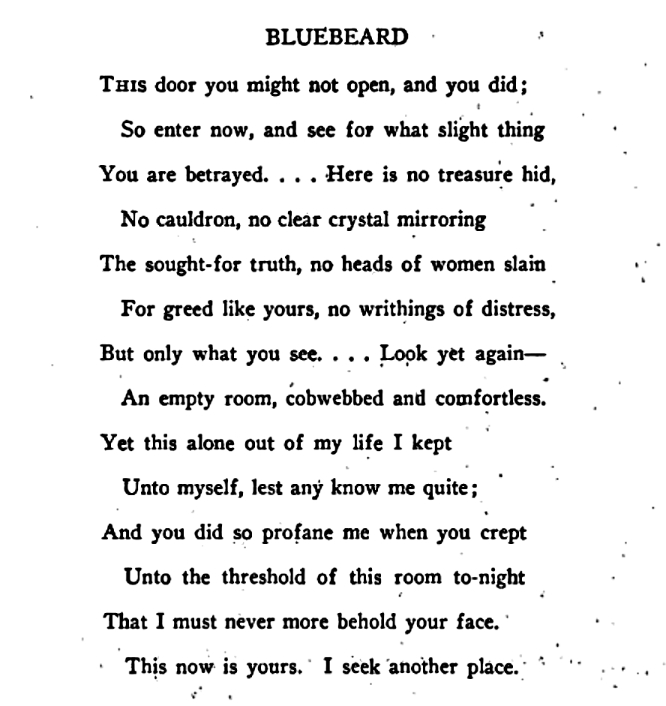
“Bluebeard” — Edna St. Vincent Millay

bluebeard

Jane Bowles’ novel Two Serious Ladies confounds with sinister humor and dark delight

Two Women, Gwen John

Here’s a short review of Jane Bowles’ only novel, Two Serious Ladies: The book is amazing, a confounding, energetic picaresque suffused with sinister humor and dark delight. I read it knowing nothing about the plot on the recommendation of Ben Marcus, who described it as “so insane, so beautiful, and in some sense, unknowable to me. On the surface, it’s not really about much, but the arrangement of words does something chemical to me.” My recommendation is to dispense with the rest of my review and read Bowles’ novel.

“Unknowable” is a fair description, and Two Serious Ladies was met with bewilderment when it was first published in 1943, as Negar Azimi points out in the comprehensive essay “The Madness of Queen Jane”:

Edith Walton, writing in the Times Book Review, called the book senseless and silly: “To attempt to unravel the plot of ‘Two Serious Ladies’ would be to risk, I am sure, one’s own sanity.” Another reviewer said, simply, “The book is about nothing.” Jane’s family, in the meantime, found it unseemly in its stark depiction of lesbianism. Its characters, who have goals and motivations that are hard to grasp, were difficult to relate to. Yet another critic wrote, “The only shocking thing about this novel is that it ever managed to find its way to print.” Jane was only twenty-four.

The notion that “The book is about nothing,” is corrected by Marcus’s qualifier about its “surface”: Two Serious Ladies moves through the phenomenological world that its characters experience, but it does not mediate the concrete contours of that world in a way that its characters can name for the reader. When the characters, those two serious ladies, do stumble into language that might name, pin down, or otherwise fix their experience, fix their consciousness into a stable relation with the world, Bowles spins the wheel again, flings her characters into new scenarios. Moments of epiphany are transitory and hard-purchased. A (perhaps) illustrating passage, offered without context:

Mrs. Copperfield started to tremble after the girl had closed the door behind her. She trembled so violently that she shook the bed. She was suffering as much as she had ever suffered because she was going to do what she wanted to do. But it would not make her happy. She did not have the courage to stop from doing what she wanted to do. She knew that it would not make her happy, because only the dreams of crazy people come true. She thought that she was only interested in duplicating a dream, but in doing so she necessarily became the complete victim of a nightmare.

The free indirect style here still hides so much from the reader, who must suss the characters’ unnamed desires from bewildering details alone. The passage above shows us fear and trembling, dream, nightmare—and crazy people. What does Copperfield want to do? One subtext here is a lesbian desire seemingly comprehended by everyone but Mrs. Copperfield herself. (In some of the book’s strangest moments, Mr. Copperfield leaves his near-mad wife in a dangerous part of a foreign city to encounter hookers of every stripe). Two Serious Ladies is about women searching for something, but something they can’t name, can’t conceive in language—but can perhaps imagine.

A third-act epiphany—again transitory and hard-purchased—parallels Mrs. Copperfield’s fear and trembling. Miss Goering—

—okay, wait, it occurs to me now that I’ve completely neglected to offer any kind of plot description that might anchor this ostensible “review,” to set up who exactly Miss Goering is, etc., so  here goes (and I encourage you to just go ahead and skip the next long paragraph)—

A bad summary: Two Serious Ladies comprises three long chapters, each of which might stand on its own as a long short story. Part the first: Miss Goering is rich but strange. Her childhood is bizarre; alienated from others “she wore the look of certain fanatics who think of themselves as leaders without once having gained the respect of a human being.” Her attempt to baptize another child luckily doesn’t end in a drowning. She grows up out of step with her peers, dresses odd, speaks odd. One day out of nowhere appears a Miss Gamelon, who becomes her (often disagreeable) companion. At a party she runs into the other serious lady, Mrs. Copperfield, whose adventures in Panama comprise the second section of the book. At the same party she meets Arnold, a would-be artist, goes home with him, meets his folks, his father. She elects to move (with Arnold and Miss Gamelon) to a run-down cottage on a drab island, forsaking her wealth, sort of. Part the second: We shift to section two, the Copperfields’ adventures in Panama. Mr. Copperfield checks the couple into a seedy hotel in the wrong part of town and promptly drops his wife off where the brothels are. She moves into a run-down hotel with a prostitute named Pacifica while her husband does God-knows-what. There’s a lot of drinking and near-madness, run-ins with bad boyfriends and snooty hoteliers. Mr. Copperfield leaves without his wife. Part the third: We return to Miss Goering and gang in the dilapidated cottage. Arnold’s father soon moves in with them. Miss Goering starts going out at night alone. She gets picked up at bar and moves in with a man named Andy. She eventually leaves him for a gangster who mistakes her for a prostitute. On a dinner date—okay, not really a dinner date but—on a dinner date with the gangster (who, like the dinner date, is never actually named as a “gangster”), Miss Goering runs into Mrs. Copperfield. Both are much changed.

—okay, so this time with (or without) some context—

A third-act epiphany—again transitory and hard-purchased—parallels Mrs. Copperfield’s fear and trembling. Miss Goering and her gangster:

This man, they had noticed, drove up to the saloon in a very beautiful big automobile that resembled more a hearse than a private car. Miss Goering had examined it one day when the man was drinking in the saloon. It appeared to be almost brand new. She and Andy had looked in through the window and had been a little surprised to see a lot of dirty clothes on the floor. Miss Goering was completely preoccupied now with what course to take should the newcomer be willing to make her his mistress for a little while. She was almost sure that he would, because several times she had caught him looking at her in a certain way which she had learned to recognize. Her only hope was that he would disappear before she had the chance to approach him. If he did, she would be exempt and thus able to fritter away some more time with Andy, who now seemed so devoid of anything sinister that she was beginning to scrap with him about small things the way one does with a younger brother.

And of course she gives in to her terrible desire. The plot of Two Serious Ladies might be described as a search for “anything sinister.”  Miss Goering and Mrs. Copperfield seek the brink of all those things one can be brinked upon: disasters, abysses, madness. Love?

The novel most reminded me of what I love best in the films of David Lynch and the fiction of Roberto Bolaño—that sense of perverse night-time dread, the sordid intimation of just how easily the veneer might crack, of how simple it might be for civilization to give way to the madness under the surface.

David Lynch and Roberto Bolaño suffuse their work with an absurd howling humor that percolates along with the dread, and Two Serious Ladies operates along the same horror/humor axis. The book is hilarious, but my several attempts to capture that here in a few excerpts of dialogue fail to translate into this digest form. Will you take my word? Will you take my word that the book was much funnier the second time I read it?

The reading experience cannot be easily distilled. (Strike that adverb). Two Serious Ladies resists unfolding in the way we expect our narratives to unfold—to be about something—Bowles withholds exposition, clarification, and motivation—well, okay, not withholds, but rather hides, or obscures, or enshadows. (I don’t have the verbs for this book). I think of Harold Bloom’s rubric for canonical literature here. In The Western Canon, he  argues that strong literature exemplifies a “strangeness, a mode of originality that either cannot be assimilated, or that so assimilates us that we cease to see it as strange.” Nearly three-quarters of a century after its publication, Two Serious Ladies is still strange, still strong, still ahead of its time. Its vignettes flow (or jerk or shift or pitch wildly or dip or soar or sneak) into each other with a wonderfully dark comic force that simultaneously alienates and invites the reader, who, bewildered by its transpositions, is compelled to follow into strange new territory. Very highly recommended.

[Ed. note: Biblioklept first published this review of Two Serious Ladies in February of 2015].

A note to readers new to Infinite Jest

A note to readers new to Infinite Jest

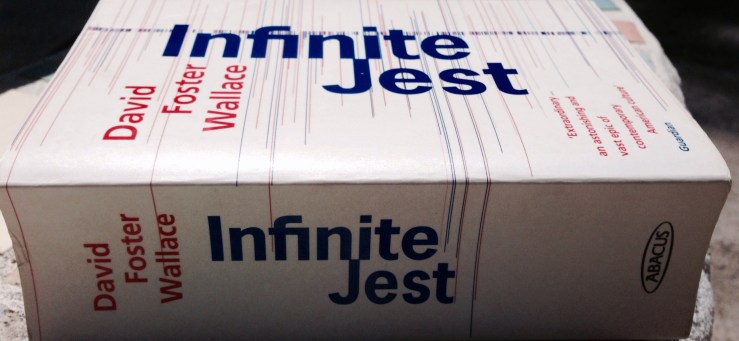
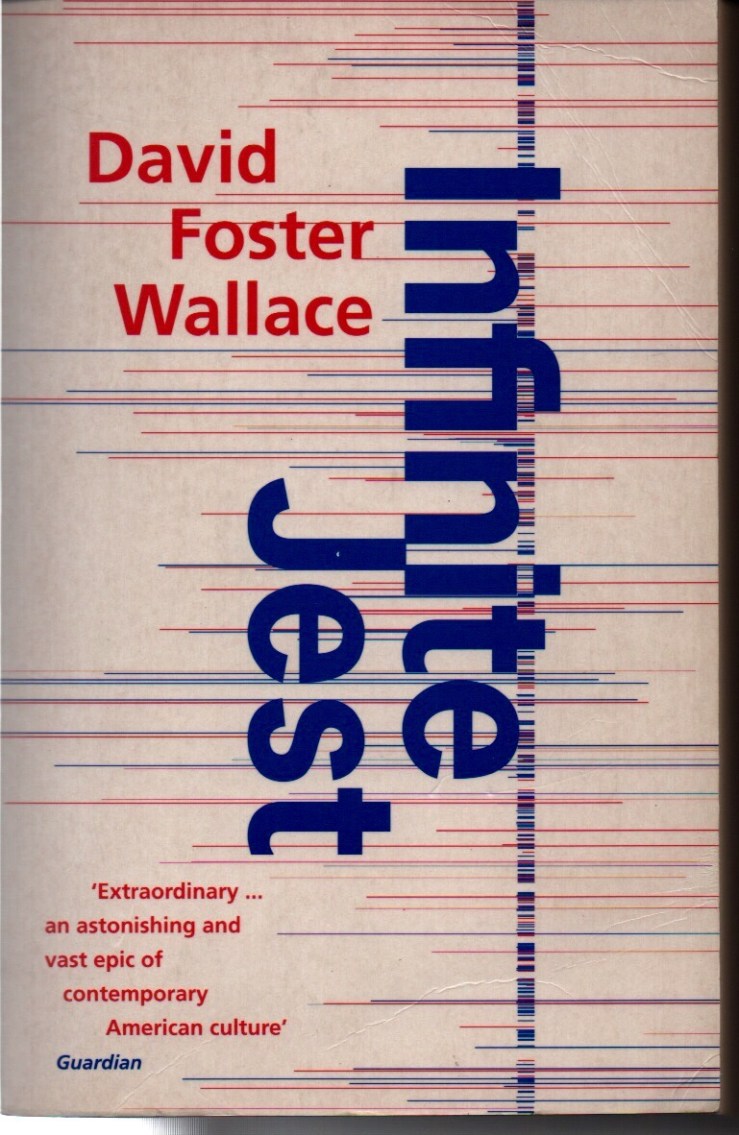
David Foster Wallace’s 1996 novel Infinite Jest poses rhetorical, formal, and verbal challenges that will confound many readers new to the text. The abundance of (or excess of) guides and commentaries on the novel can perhaps have the adverse and unintentional consequence of making readers new to Infinite Jest believe that they can’t “get it” without help.  Many of the online analyses and resources for Infinite Jest are created by and targeted to readers who have finished the novel or are rereading the novel. While I’ve read many insightful and enlightening commentaries on the novel over the years, my intuition remains that the superabundance of analysis may have the paradoxical effect of actually impeding readers new to the text. With this in mind, I’d suggest that first-time readers need only a dictionary and some patience.

Infinite Jest is very long but it’s not nearly as difficult as its reputation suggests. There is a compelling plot behind the erudite essaying and sesquipedalian vocabulary. That plot develops around three major strands which the reader must tie together, with both the aid of—and the challenge of—the novel’s discursive style. Those three major plot strands are the tragic saga of the Incandenzas (familial); the redemptive narrative of Ennet House Drug and Alcohol Recovery House, with Don Gately as the primary hero (socicultural); and the the schemes of the Québécois separatists (national/international/political). An addictive and thus deadly film called Infinite Jest links these three plots (through discursive and byzantine subplots).

Wallace often obscures the links between these plot strands, and many of the major plot connections have to be intuited or outright guessed. Furthermore, while there are clear, explicit connections between the plot strands made for the reader, Wallace seems to withhold explicating these connections until after the 200-page mark. Arguably, the real contours of the Big Plot come into (incomplete) focus in a discussion between Hal Incandenza and his brother Orin in pages 242-58. Getting to this scene is perhaps a demand on the patience of many readers. And, while the scene by no means telegraphs what happens in IJ, it nonetheless offers some promise that the set pieces, riffs, scenes, lists, and vignettes shall add up to Something Bigger. 

Some of those earliest set pieces, riffs, scenes, lists, and vignettes function almost as rhetorical obstacles for a first-time reader. The  novel’s opening scene, Hal Incandenza’s interview with the deans at the University of Arizona, is chronologically the last event in the narrative, and it dumps a lot of expository info on the reader. It also poses a number of questions or riddles about the plot to come, questions and riddles that frankly run the risk of the first-time reader’s forgetting through no fault of his own.

The second chapter of IJ is relatively short—just 10 pages—but it seems interminable, and it’s my guess that Wallace wanted to make his reader endure it the same way that the chapter’s protagonist–Erdedy, an ultimately very minor character—must endure the agonizing wait for a marijuana delivery. The chapter delivers the novel’s themes of ambivalence, desire, addiction, shame, entertainment, “fun,” and secrecy, both in its content and form. My guess is that this where a lot of new readers abandon the novel.

The reader who continues must then work through 30 more pages until meeting the novel’s heart, Don Gately, but by the time we’ve met him we might not trust just how much attention we need to pay him, because Wallace has shifted through so many other characters already. And then Gately doesn’t really show up again until like, 200 pages later.

In Infinite Jest, Wallace seems to suspend or delay introducing the reading rules that we’ve been trained to look for in contemporary novels. While I imagine this technique could frustrate first-time readers, I want to reiterate that this suspension or delay or digression is indeed a technique, a rhetorical tool Wallace employs to perform the novel’s themes about addiction and relief, patience and plateaus, gratitude and forgiveness.

Where is a fair place to abandon Infinite Jest

I would urge first-time readers to stick with the novel at least until page 64, where they will be directed to end note 24, the filmography of J.O. Incandenza (I will not even discuss the idea of not reading the end notes. They are essential). Incandenza’s filmography helps to outline the plot’s themes and the themes’ plots—albeit obliquely. And readers who make it to the filmography and find nothing to compel them further into the text should feel okay about abandoning the book at that point.

What about a guide?

There are many, many guides and discussions to IJ online and elsewhere, as I noted above. Do you really need them? I don’t know—but my intuition is that you’d probably do fine without them. Maybe reread Hamlet’s monologue from the beginning of Act V, but don’t dwell too much on the relationship between entertainment and death. All you really need is a good dictionary. (And, by the way, IJ is an ideal read for an electronic device—the end notes are hyperlinked, and you can easily look up words as you read).

Still: Two online resources that might be useful are “Several More and Less Helpful Things for the Person Reading Infinite Jest,” which offers a glossary and a few other unobtrusive documents, and Infinite Jest: A Scene-by-Scene Guide,” which is not a guide at all, but rather a brief series of synopses of each scene in the novel, organized by page number and year; my sense is that this guide would be helpful to readers attempting to delineate the novel’s nonlinear chronology—however, I’d advise against peeking ahead. After you read you may wish to search for a plot diagram of the novel, of which there are several. But I’d wait until after.

An incomplete list of motifs readers new to Infinite Jest may wish to attend to

The big advantage (and pleasure) of rereading Infinite Jest is that the rereader may come to understand the plot anew; IJ is richer and denser the second go around, its themes showing brighter as its formal construction clarifies. The rereader is free to attend to the imagery and motifs of the novel more intensely than a first-time reader, who must suss out a byzantine plot propelled by a plethora of characters.

Therefore, readers new to IJ may find it helpful to attend from the outset to some of the novel’s repeated images, words, and phrases. Tracking motifs will help to clarify not only the novel’s themes and “messages,” but also its plot. I’ve listed just a few of these motifs below, leaving out the obvious ones like entertainment, drugs, tennis (and, more generally, sports and games), and death. The list is in no way definitive or analytic, nor do I present it as an expert; rather, it’s my hope that this short list might help a reader or two get more out of a first reading.

Heads

Cages

Faces

Masks

Teeth

Cycles

Maps

Waste

Infants

Pain

Deformities

Subjects

Objects

One final note

Infinite Jest is a rhetorical/aesthetic experience, not a plot.

[Ed. note: Biblioklept posted a version of this note in the summer of 2015. Wallace would have turned 55 years old today].

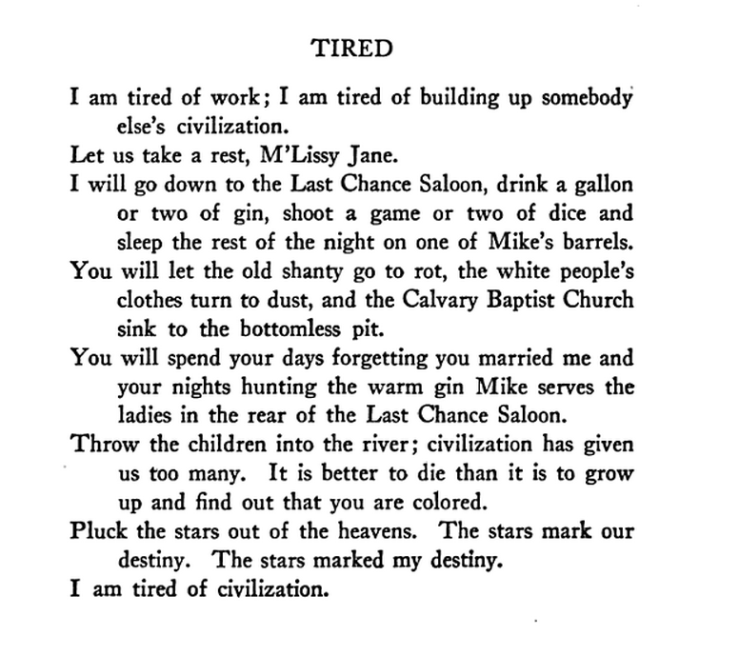
“Tired” — Fenton Johnson

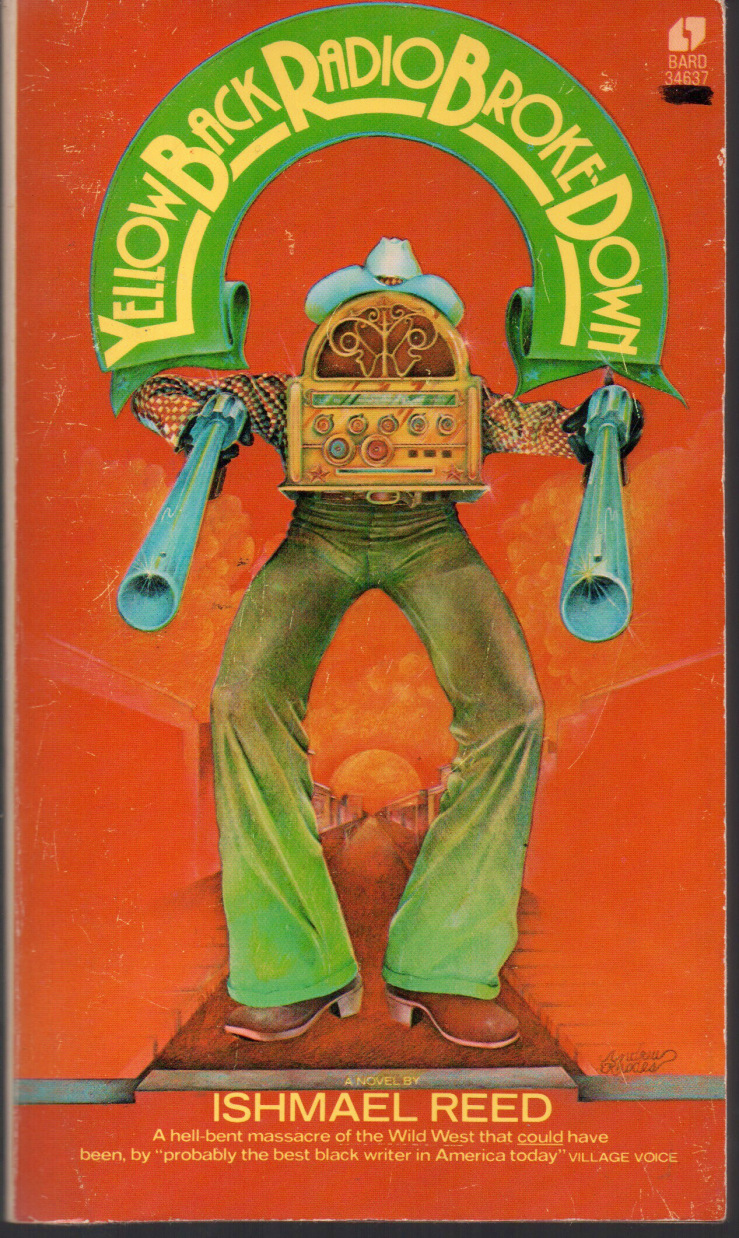
A review of Yellow Back Radio Broke-Down, Ishmael Reed’s syncretic Neo-HooDoo revenge Western

img_0548

Ishmael Reed’s second novel Yellow Back Radio Broke-Down tells the story of the Loop Garoo Kid, a “desperado so onery he made the Pope cry and the most powerful of cattlemen shed his head to the Executioner’s swine.”

The novel explodes in kaleidoscopic bursts as Reed dices up three centuries of American history to riff on race, religion, sex, and power. Unstuck in time and unhampered by geographic or technological restraint, historical figures like Lewis and Clark, Thomas Jefferson, John Wesley Harding, Groucho Marx, and Pope Innocent (never mind which one) wander in and out of the narrative, supplementing its ironic allegorical heft. These minor characters are part of Reed’s Neo-HooDoo spell, ingredients in a Western revenge story that is simultaneously comic and apocalyptic in its howl against the dominant historical American narrative. Yellow Back Radio Broke-Down is a strange and marvelous novel, at once slapstick and deadly serious, exuberant in its joy and harsh in its bitterness, close to 50 years after its publication, as timely as ever.

After the breathless introduction of its hero the Loop Garoo Kid, Yellow Back Radio Broke-Down initiates its plot. Loop’s circus troupe arrives to the titular city Yellow Back Radio (the “nearest town Video Junction is about fifty miles away”), only to find that the children of the town, “dressed in the attire of the Plains Indians,” have deposed the adults:

We chased them out of town. We were tired of them ordering us around. They worked us day and night in the mines, made us herd animals harvest the crops and for three hours a day we went to school to hear teachers praise the old. Made us learn facts by rote. Lies really bent upon making us behave. We decided to create our own fiction.

The children’s revolutionary, anarchic spirit drives Reed’s own fiction, which counters all those old lies the old people use to make us behave.

Of course the old—the adults—want “their” land back. Enter that most powerful of cattlemen, Drag Gibson, who plans to wrest the land away from everyone for himself. We first meet Drag “at his usual hobby, embracing his property.” Drag’s favorite property is a green mustang,

a symbol for all his streams of fish, his herds, his fruit so large they weighed down the mountains, black gold and diamonds which lay in untapped fields, and his barnyard overflowing with robust and erotic fowl.

Drag loves to French kiss the horse, we’re told. Oh, and lest you wonder if “green” here is a metaphor for, like, new, or inexperienced, or callow: No. The horse is literally green (“turned green from old nightmares”). That’s the wonderful surreal logic of Reed’s vibrant Western, and such details (the novel is crammed with them) make Yellow Back Radio Broke-Down a joy to read.

Where was I? Oh yes, Drag Gibson.

Drag—allegorical stand-in for Manifest Destiny, white privilege, capitalist expansion, you name it—Drag, in the process of trying to clear the kids out of Yellow Back Radio, orders all of Loop’s troupe slaughtered.

The massacre sets in motion Loop’s revenge on Drag (and white supremacy in general), which unfolds in a bitter blazing series of japes, riffs, rants, and gags. (“Unfolds” is the wrong verb—too neat. The action in Yellow Back Radio Broke-Down is more like the springing of a Jack-in-the-box).

Loop goes about obtaining his revenge via his NeoHooDoo practices. He calls out curses and hexes, summoning loas in a lengthy prayer. Loop’s spell culminates in a call that goes beyond an immediate revenge on Drag and his henchmen, a call that moves toward a retribution for black culture in general:

O Black Hawk American Indian houngan of Hoo-Doo please do open up some of these prissy orthodox minds so that they will no longer call Black People’s American experience “corrupt” “perverse” and “decadent.” Please show them that Booker T and MG’s, Etta James, Johnny Ace and Bojangle tapdancing is just as beautiful as anything that happened anywhere else in the world. Teach them that anywhere people go they have experience and that all experience is art.

So much of Yellow Back Radio Broke-Down is turning all experience into art. Reed spins multivalent cultural material into something new, something arguably American. The title of the novel suggests its program: a breaking-down of yellowed paperback narratives, a breaking-down of radio signals. Significantly, that analysis, that break-down, is also synthesized in this novel into something wholly original. Rhetorically, Yellow Back Radio Broke-Down evokes flipping through paperbacks at random, making a new narrative; or scrolling up and down a radio dial, making new music from random bursts of sound; or rifling through a stack of manic Sunday funnies to make a new, somehow more vibrant collage.

Perhaps the Pope puts it best when he arrives late in the novel. (Ostensibly, the Pope shows up to put an end to Loop’s hexing and vexing of the adult citizenry—but let’s just say the two Holy Men have a deeper, older relationship). After a lengthy disquisition on the history of hoodoo and its genesis in the Voudon religion of Africa (“that strange continent which serves as the subconscious of our planet…shaped so like the human skull”), the Pope declares that “Loop Garoo seems to be practicing a syncretistic American version” of the old Ju Ju. The Pope continues:

Loop seems to be scatting arbitrarily, using forms of this and that and adding his own. He’s blowing like that celebrated musician Charles Yardbird Parker—improvising as he goes along. He’s throwing clusters of demon chords at you and you don’t know the changes, do you Mr. Drag?

The Pope here describes Reed’s style too, of course (which is to say that Reed is describing his own style, via one of his characters. The purest postmodernism). The apparent effortlessness of Reed’s improvisations—the prose’s sheer manic energy—actually camouflages a tight and precise plot. I was struck by how much of Yellow Back Radio Broke-Down’s apparent anarchy resolves into a bigger picture upon a second reading.

That simultaneous effortlessness and precision makes Reed’s novel a joy to jaunt through. Here is a writer taking what he wants from any number of literary and artistic traditions while dispensing with the forms and tropes he doesn’t want and doesn’t need. If Reed wants to riff on the historical relations between Indians and African-Americans, he’ll do that. If Reed wants to assess the relative values of Thomas Jefferson as a progressive figure, he’ll do that. If Reed wants to attack his neo-social realist critics, he’ll do that. If Reed wants to critique the relationship between militarism and science, he’ll do that. If Reed wants to tell some really dirty jokes about a threesome, he’ll do that. And you can bet if he wants some ass-kicking Amazons to show up at some point, they’re gonna show.

And it’s a great show. Yellow Back Radio Broke-Down begins with the slaughter of a circus troupe before we get to see their act. The real circus act is the novel itself, filled with orators and showmen, carnival barkers and con-artists, pistoleers and magicians. There’s a manic glee to it all, a glee tempered in anger—think of George Herriman’s Krazy Kat, or Thomas Pynchon’s zany rage, or Robert Downey Sr.’s satirical film Putney Swope.

Through all its anger, Yellow Back Radio Broke-Down nevertheless repeatedly affirms the possibility of imagination and creation—both as cures and as hexes. We have here a tale of defensive and retaliatory magic. Yellow Back Radio Broke-Down is the third novel of Reed’s novels I’ve read (after Mumbo Jumbo and The Free-Lance Pallbearers), and my favorite thus far. Frankly, I needed the novel right now in a way that I didn’t know that I needed it until I read it; the contemporary novel I tried to read after it felt stale and boring. So I read Yellow Back Radio Broke-Down again. The great gift here is that Reed’s novel answers to the final line of Loop’s prayer to the Loa: “Teach them that anywhere people go they have experience and that all experience is art.” Like the children of Yellow Back Radio, Reed creates his own fiction, and invites us to do the same. Very highly recommended.

A review of Ishmael Reed’s Yellow Back Radio Broke-Down

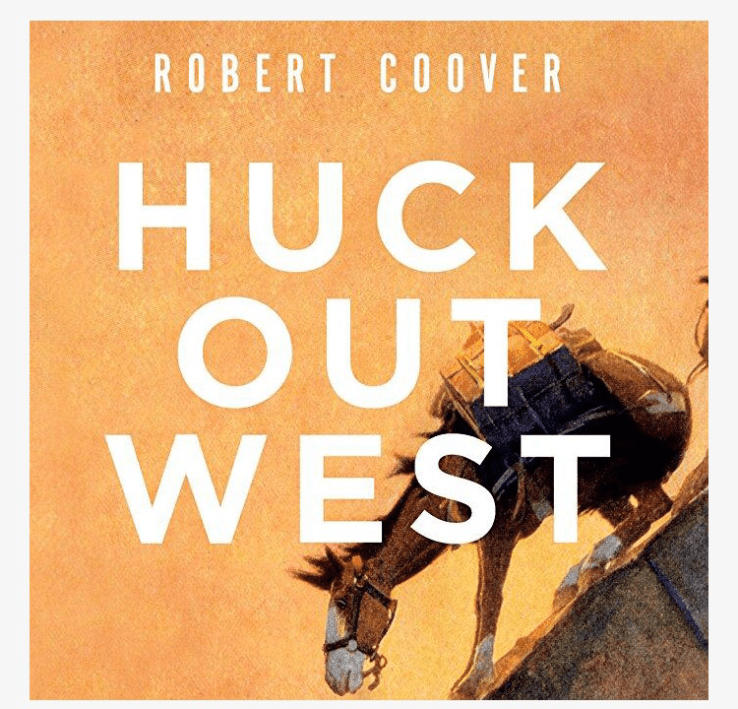
A review of Robert Coover’s excellent new novel Huck Out West

img_4925

In the final lines of Mark Twain’s 1884 novel Adventures of Huckleberry Finn, our narrator-hero declares: “I reckon I got to light out for the Territory ahead of the rest, because Aunt Sally she’s going to adopt me and sivilize me and I can’t stand it. I been there before.”

We have here the signal trope of so much American literature—escape. Escape into the wild, the unknown, the expanse: the Territory. Ishmael goes to sea, Young Goodman Brown wanders into the woods, Rip Van Winkle retreats into the mountains. American literature loves to posit Transcendental escape, and with that escape, a utopian promise, a chance to reinvent “sivilization.” As the poet-critic Charles Olson puts it in the beginning of Call Me Ishmael, “I take SPACE to be the central fact to man born in America. I spell it large because it comes large here.”

The other side of the utopian facade is much darker: westward expansion, continentalism, war, violence, extinction agendas, and the exploitation of all things mineral, vegetable, animal, and human. Manifest Destiny. Olson noted that American space might be large, but it was “Large, and without mercy.” Manifest Destiny offered nineteenth-century Americans an illusion of mercy, a mimesis of meaning, a rhetorical gloss to cover over predation, violence, and genocide. Manifest Destiny was a story to stick to, a story with a purpose, good guys and bad guys, and an ethos to drive a narrative. Through such a narrative, Americans might come to see their nation allegorically maturing, coming of age, expanding freedom. Manifest Destiny offered a narrative of a nation growing, a narrative that made space for itself via the violent erasure of native peoples.

Robert Coover’s new novel Huck Out West is very much about storytelling and maturation–about how we attempt to give meaning to the passing of time. Sure, it’s a yarn, an adventure tale that answers happens to Huckleberry Finn after he’s lit out into the Territory. But it’s also a story of what it means to grow up, essentially asking whether such a thing is even possible. “It was almost like there was something wicked about growing up,” Huck remarks in the novel’s second chapter. Ever the misfit, Huck cannot square the evil around him with the dominant social narratives that would try to justify injustice. He can’t stick out a story. This is a character who has always preferred immediate truth.

Consider a few early lines:

Tom is always living in a story he’s read in a book so he knows what happens next, and sometimes it does. For me it ain’t like that. Something happens and then something else happens, and I’m in trouble again.

Like Twain’s original novel, Huck Out West is also a picaresque, albeit one in which the main character repeatedly wonders how to stitch together the seemingly random episodes of his life into a meaningful narrative. Huck’s life is essentially picaresque, and without Tom Sawyer around to rein the episodes together into a story, Huck’s left with “something happens and then something else happens.” Here’s a picaresque passage that summarizes Huck’s “adventures” in his new milieu:

I wrangled horses, rode shotgun on coaches and wagon trains, murdered some buffalos, worked with one or t’other army, fought some Indian wars, shooting and getting shot at, and didn’t think too much about any of it. I reckoned if I could earn some money, I could try to buy Jim’s freedom back, but I warn’t never nothing but stone broke. The war was still on, each side chasing and killing t’other at a brisk pace clean across the Territory, and they both needed a body like me to scout ahead for them, watch over their stock at night, pony messages to the far side of the fighting, clean their muddy boots and help bury the dead, of which there warn’t never no scarcity, nuther boots nor dead.

Variations of these scenarios, as well as flashbacks to earlier episodes mentioned here, play out as the early plot in Huck Out West; Huck’s only real aim is to “buy Jim’s freedom back.” Jim’s been cruelly sold as a slave to a tribe of Indians by Tom Sawyer. Tom Sawyer is a fucking asshole.

But Tom is Huck’s main partner, or “pard” in Coover’s Twain’s vernacular. And don’t worry, Jim (Huck’s other pard) ends up okay. We meet him again, along with other members of the old gang, including Becky Thatcher, who’s fallen on harder times, and Ben Rogers. Ben has graduated from his youthful playacting in Tom Sawyers’ Gang to armed robbery as a member of a real gang. Huck Finn accidentally joins up. The scene plays out as one of many dark repetitions of Adventures of Huckleberry Finn, and ends in violence.

Huck Out West is a violent novel, and reading it helps to foreground the violence of Twain’s original novel. In his 1960 study Love and Death in the American Novel, critic Leslie Fiedler highlighted the horror of Twain’s novel, horror which hides in plain sight:

Huckleberry Finn, that euphoric boys’ book, begins with its protagonist holding off at gun point his father driven half mad by the D.T.’s and ends (after a lynching, a disinterment, and a series of violent deaths relieved by such humorous incidents as soaking a dog in kerosene and setting him on fire) with the revelation of that father’s sordid death. Nothing is spared; Pap, horrible enough in life, is found murdered brutally, abandoned to float down the river in a decaying house scrawled with obscenities. But it is all “humor,” of course, a last desperate attempt to convince us of the innocence of violence, the good clean fun of horror.

In Huck Out West, no amount of humor can convince us—and, significantly poor Huckleberry—of the innocence of violence. There is no consolation in Manifest Destiny, only genocidal violence. Take the following passage, for example, in which Huck, conscripted by a malevolent general (well, colonel really—but who hasn’t told a stretcher every now and then?) to break horses for the U.S. Army, witnesses the massacre of an Indian tribe:

What happened a few minutes later come to be called a famous battle in the history books and the general he got a power of glory out of it, but a battle is what it exactly warn’t. Whilst me and Star watched over the spare horses, the soldier boys galloped howling through the burning tents and slaughtered more’n a hundred sleepers, which the general called warriors, but who was mostly wrinkled up old men, women, and little boys and girls. I seen eyes gouged out and ears tore off and bellies slit open with their innards spilling out like sausages.

The language of Huck Out West, here and elsewhere—full of missing scalps, ears, limbs, etc.—often veers closer to Cormac McCarthy’s Blood Meridian than Twain’s Adventures of Huckleberry Finn.

As ever, Huck’s sense of justice simply does not square with the narrative (“history books”… “power of glory”) that others will shape from the raw predation he’s witnessed. He’s unable to connect the letter of the law to its spirit—or rather, he plainly sees that the letter is used to gloss over an evil, evil spirit. He’s still the same kid who, in the moral climax of Adventures, elected to “go to hell” rather than see Jim enslaved again.

Anyone familiar with Adventures of Huckleberry Finn will also know that the novel’s ending is an incredibly problematic vaudeville of cruel comedy. Tom Sawyer pops back into the narrative, overwhelming whatever spirit of growth and maturity Huck achieved in the novel’s climax. The pair undertakes a series of cruel jokes on Jim. Their play is, to invert Fiedler’s terms above, a showcase for the violence of innocence, the horror of good clean fun. Critics over the years have either had to brush away the novel’s final chapters, or to try to reconcile them in some way. More germane is the viewpoint of one of Paul Bowles’s narrators (undoubtedly Bowles himself), who, in the short story “Unwelcome Words” laments: “I’ve often wished that someone would rewrite the end of Huckleberry Finn.” Coover provides a rewrite, in a sense: A fuller, more mature revision, one that takes Tom and Huck out of their adolescence into full-blown, inescapable adulthood—a revision that requires Huck resist the cruelty of both Tom and the “sivilization” he represents.

“The Amazing Tom Sawyer,” as various characters call him in Huck Out West is an awful evil instigator: a con-man, a fake-lawyer, a demagogue of the worst stripe. He’s always been this way, but we failed to notice, perhaps, enthralled by his confidence game. And what American doesn’t love a confidence trickster? Hell, Tom had kids lined up to pay him to whitewash a fence.

Tom pops in and out of Huck Out West with a jolting, picaresque force, and in some ways the central plot of the novel revolves around his partnership with Huck—a partnership that requires Huck buy into Tom’s nihilism. “Ain’t nothing fair, starting with getting born and having to die,” Tom scolds Huck. Huck is right though: It isn’t fair. In this case, Huck is protesting the “largest mass hanging in U.S. history,” the execution of over three dozen Sioux Indians in Minnesota in 1862.

Tom dresses up his core nihilism in any number of narratives. The great lie of all these narratives is, of course, the idea that Tom’s various predatory schemes are actually founded in justice, in some kind of manifestation of destiny. Tom sells the narrative to the people he’s conning. For him, maturation is nothing more than progressing, perfecting, and extending the long con on any rubes he can sucker. He dresses up the tribalist demagoguery he uses to sway the herd in romantic legalese, but at heart he’s a brute.

Huck’s maturation is more profound. He understands, spiritually if not intellectually, that he needs to get away from Tom Sawyer and his tribe “sivilzation.” Huck addresses Tom late in the book:

“Tribes,” I says. “They’re a powerful curse laid on you when you get born. They ruin you, but you can’t get away from them. They’re a nightmare a body’s got to live with in the daytime.”

Coover provides a salient contrast to Tom Sawyer in a character of his own invention, a young Lakota Huck calls Eeteh (he can’t pronounce the full name). Eeteh is a holy fool who tells (and perhaps invents) stories of Snake, Raven, and Coyote—trickster tales and origin stories. Eeteh’s storytelling seems to point in a different direction than Tom’s tall tales. Eeteh describes the trickster and hides a kernel of wisdom in his tales; Tom’s stories are tricks on fools, signifying nothing. Significantly, Eeteh is something of an outcast among the Lakota. He understands Huck in ways Huck doesn’t understand himself:

Eeteh says that both of us growed up too early and missed a lot, so really didn’t grow up at all, just only got older. I says that’s probably better’n growing up and Eeteh was of the same opinion.

Huck and Eeteh have both, through their unique early upbringings (or lack-there-of), missed the “sivilizing” influences that would bind them into a dominant social narrative. Coover’s insight here is that “growing up” doesn’t necessarily mean “growing wise,” and that the old often hide their foolishness and venality behind empty stories.

But Coover’s storytelling is marvelous, rich, full. He colors brightly Huck’s moments of epiphany. In one prominent example, Huck Finn the horsebreaker takes (what I’m pretty sure was) mescaline at the behest of the Lakota tribe that temporarily adopts him. He breaks a wild horse, his metaphorical trip literalized in a wild gallop through American history and geography:

We was pounding over a desert, but when I peeked again we was suddenly splashing through a river, then tromping a wheat field, and next on the grasslands, scattering herds a buffalos and yelping coyotes. I had to scrouch down when he run through a low forest, not to get scraped off, then pull my knees up as we raced through a narrow gorge. We hammered in and out a mining and cow towns, Indian camps and army forts.

Huck’s apotheosis is real—for him, anyway—but the Lakota still enjoy a laugh at his expense, just as they have with inside outsider Eeteh. Tribes of any stripe are a nightmare to try to escape from.

And hence the final moments of Huck Out West recapitulate the final lines of Adventures of Huckleberry Finn. Huck and Eeteh—do I give away too much, dear reader? Very well, I give away too much—Huck and Eeteh dream of new frontiers and new freedoms. On the eve of the American centennial anniversary, the pards venture to fresh Territory. As they set out, Eeteh spins a final tale. In this tale, Fox and Coyote create a new being with “two members” made from pre-existing elements:


So they made a new cretur out a parts borrowed from Whooping Crane, Prairie Dog, Mountain Goat, Rainbow Trout, Turkey Vulture, Jack Rabbit, and Porkypine.

“That must a been something to see!” I says. “A cretur with two members, joined up from a crane, prairie dog, goat and trout, plain stops me cold in my tracks, never mind the rest!”

Eeteh says he’s really glad he didn’t try to tell me about Coyote in the Land of the Dead.

“Ain’t that a story about afterlife soul creturs? I thought you don’t take no stock in souls.”

Eeteh sighed and says that’s just what he means.

The final moments of Huck Out West reinvent Huck’s dream of synthesis at the beginning of Twain’s Adventures: “In a barrel of odds and ends it is different; things get mixed up, and the juice kind of swaps around, and the things go better,” Huck tells us in that much older novel.

And even if Huck digs the swap and the flow of the new, he still can’t fully puzzle out Eeteh’s headscratcher. Our boy Huck never was one for narrative. “I was plumb lost,” he admits in the next line, before signaling the new Territory all storytelling opens: “I reckoned we could start over at the campfire tonight.” Tell the story again, tell it new.

So what does Eeteh’s story mean? Is there a rejection here of metaphysical meaning, of, like, a soul? I don’t know but I don’t think so. Perhaps Eeteh’s evoking here something closer to what Emerson called the Over-Soul (“We live in succession, in division, in parts, in particles…but the whole, of which these are shining parts, is the soul”).

But is “Over-Soul” just another simple gloss, a sturdy but rusty nail to hang a narrative on—like “Manifest Destiny”? Coover’s Huck ends his narrative by admitting, “I was lost again,” which seems like a more than fair metaphor for America, if that’s how we’re to take the novel. (There are plenty of other ways to take it: It’s very funny, and the prose is amazing—I mean, here’s a novel that could’ve fallen into the trap of becoming some bizarre bad fanfiction, but Coover’s too good. The novel is aesthetically marvelous. I hope I’ve shared enough samples here to convey that to you, reader).

If Huck is lost again, he has a few solutions, the first one being to “muddytate” on the problem (with some whiskey, some fish, and the company of his pard). And so Huck the escape artist recalls here at the end of his narrative the other paradigm of American literature: the lazing loafer, the shirker, the dreamer. And what is dreaming but the richest form of escape? I think of Walt Whitman leaning and loafing at his ease observing a spear of summer grass, Ishmael’s sea-dreams, Rip Van Winkle dozing through the Revolutionary War… If Huck Out West posits a utopian escape, it’s an escape through imagination, and it’s an escape utopian only in its rejection of all social order outside of a single “pard.”

But ultimately, I don’t think Huck Out West wants its readers to escape from history, from American history, from the ugly awful violence of Manifest Destiny. Rather, I think the novel calls its reader to look anew through the eyes of our naive experienced insider outsider paradox of a hero, Huckleberry Finn—to look afresh at the Big Narrative that has dominated our society, and to decide whether or not it’s something we want to recapitulate—or something we’d be better off reimagining. Huck and his one pard—there is no utopia outside of a pair, it seems—might get to escape into the sunset, but the rest of us are stuck here. Let us all muddytate and then do better.


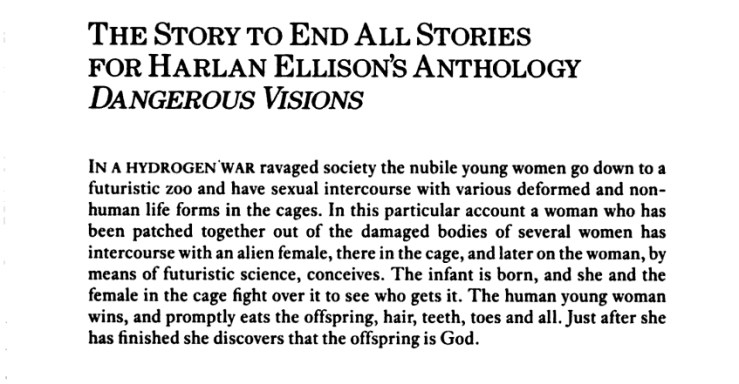
“The Story to End All Stories” — Philip K. Dick

pkd

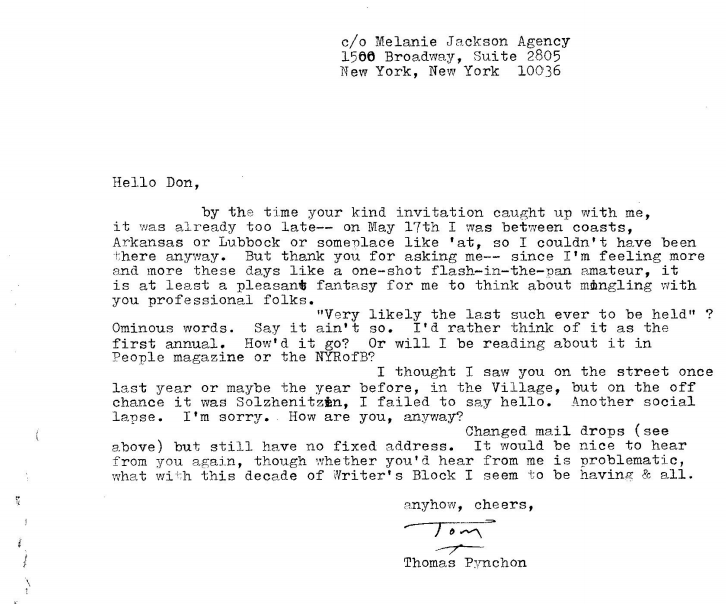
Thomas Pynchon sends his regrets to Donald Barthelme for missing the Postmodern Dinner

screenshot-2017-01-18-at-8-36-27-pm

A 1983 letter from Thomas Pynchon to Donald Barthelme.

Superlibrarian Jessamyn West shared Pynchon’s letter to Barthelme on Twitter yesterday and then posted it on her wonderful Donald Barthelme appreciation page.

Pynchon here is ostensibly apologizing for missing Barthelme’s so-called “Postmodern Dinner” in New York.

In his 2009 Barthelme biography Hiding Man, Tracy Daugherty offers the following recollection from novelist Walter Abish:

Around this time — in the spring of 1983 — “Donald had this idea to make a dinner in SoHo,” says Water Abish. “A major dinner for a group of writers, and he planned it very, very carefully. It was a strange event. Amusing and intriguing. He invited…well, that was the thing of it. The list. I was astounded that he consulted me but he called and said, ‘Should we invite so-and-so?’ Naturally, I did the only decent thing and said ‘Absolutely’ to everyone he mentioned. I pushed for Gaddis. Gass was there, and Coover and Hawkes, Vonnegut and his wife, Jill Krementz, who took photographs, I think. Don’s agent, Lynn Nesbit, was there. She was always very friendly. Susan Sontag was the only woman writer invited.

Daugherty continues:

Pynchon couldn’t make it. He wrote Don to apologize. He said he was ‘between coasts, Arkansas or Lubbock or someplace like ‘at.”

Okay.

Abish recollects that the meal was at a very expensive restaurant, prefix, and the writers had to pay their own way. There were about 21 attendees, and Barthelme was “Very, very dour.”

“Don’t you know you” –Emily Dickinson

ed0739

“Huck And Tom in Minnysota” — Robert Coover

“Huck And Tom in Minnysota”

An episode from Robert Coover’s new novel Huck Out West


It was up in Minnysota that Tom made up his mind to give over cowboying and take on the law. Becky Thatcher was the daughter of a judge and maybe she give him the idea how to set about doing it. Before that him and me was mostly adventuring round the Territories without no thoughts about the next day. We run away from home all them years ago because Tom was bored and hankered to chase after what he said was the noble savages. At first they was the finest people in the world and Tom wanted to join up with them, and then they was the wickedest that ever lived and they should all get hunted down and killed, he couldn’t make up his mind. Some boys in a wagonload of immigrants we come across early on learnt us how to ride and shoot and throw a lasso so that we got to be passing good at all them things.

That story turned poorly and we never seen what was left of them afterward, but ending stories was less important to Tom than beginning them, so we was soon off to other adventures that he thought up or read about in a book or heard tell of. Sometimes they was fun, sometimes they warn’t, but for Tom Sawyer they was all as needful as breathing. He couldn’t stand a day that didn’t have an adventure in it, and he warn’t satisfied until he’d worked in five or six.

Once, whilst we was still humping mail pouches back and forth across the desert on our ponies, I come on a rascally fellow named Bill from near where we come from. He was also keen on adventures and he was heading back east to roust up a gang of bushwhackers in our state to kill jayhawks over in the next one. The way he told it, he had a bunch of swell fellows joining his gang and he wondered if Tom and me might be interested. With the war betwixt the states starting, there were lots of gangs forming up and making sport of burning down one another’s towns, which seemed like sure enough adventures, not just something out of books, so maybe we was looking in the wrong place. But when I told Tom about it the next time we crossed up at a relay station, he says he reckoned he’d just stay out west and maybe get up a gang of his own, because he couldn’t see no profit in going back. But I knowed that warn’t the real reason. The real reason was he couldn’t be boss of it.

Read the rest of “Huck And Tom in Minnysota” at Conjunctions.

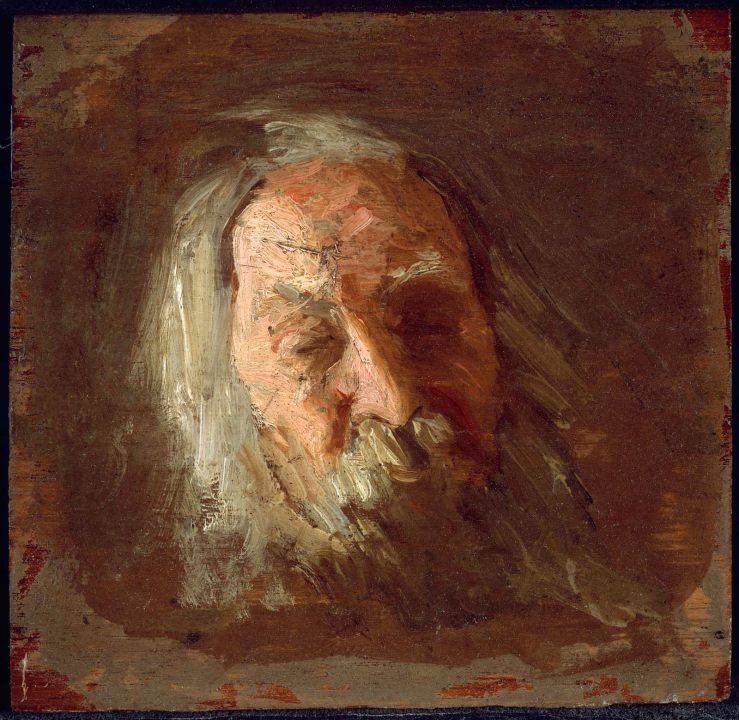
Walt Whitman — Thomas Eakins

sc199568

Tell me, would you please, about Jane Bowles

INTERVIEWER

Tell me, would you please, about Jane Bowles.

BOWLES

That’s an all-inclusive command! What can I possibly tell you about her that isn’t implicit in her writing?

INTERVIEWER

She obviously had an extraordinary imagination. She was always coherent, but one had the feeling that she could go off the edge at any time. Almost every page of Two Serious Ladies, for example, evoked a sense of madness although it all flowed together very naturally.

BOWLES

I feel that it flows naturally, yes. But I don’t find any sense of madness. Unlikely turns of thought, lack of predictability in the characters’ behavior, but no suggestion of “madness.” I love Two Serious Ladies. The action is often like the unfolding of a dream, and the background, with its realistic details, somehow emphasizes the sensation of dreaming.

INTERVIEWER

Does this dreamlike quality reflect her personality?

BOWLES

I don’t think anyone ever thought of Jane as a “dreamy” person; she was far too lively and articulate for that. She did have a way of making herself absent suddenly, when one could see that she was a thousand miles away. If you addressed her sharply, she returned with a start. And if you asked her about it, she would simply say: “I don’t know. I was somewhere else.”

INTERVIEWER

Can you read her books and see Jane Bowles in them?

BOWLES

Not at all; not the Jane Bowles that I knew. Her work contained no reports on her outside life. Two Serious Ladies was wholly nonautobiographical. The same goes for her stories.

INTERVIEWER

She wasn’t by any means a prolific writer, was she?

BOWLES

No, very unprolific. She wrote very slowly. It cost her blood to write. Everything had to be transmuted into fiction before she could accept it. Sometimes it took her a week to write a page. This exaggerated slowness seemed to me a terrible waste of time, but any mention of it to her was likely to make her stop writing entirely for several days or even weeks. She would say: “All right. It’s easy for you, but it’s hell for me, and you know it. I’m not you. I know you wish I were, but I’m not. So stop it.”

INTERVIEWER

The relationships between her women characters are fascinating. They read like psychological portraits, reminiscent of Djuna Barnes.

BOWLES

In fact, though, she refused to read Djuna Barnes. She never read Nightwood. She felt great hostility toward American women writers. Usually she refused even to look at their books.

INTERVIEWER

Why was that?

BOWLES

When Two Serious Ladies was first reviewed in 1943, Jane was depressed by the lack of understanding shown in the unfavorable reviews. She paid no attention to the enthusiastic notices. But from then on, she became very much aware of the existence of other women writers whom she’d met and who were receiving laudatory reviews for works which she thought didn’t deserve such high praise: Jean Stafford, Mary McCarthy, Carson McCullers, Anaïs Nin. There were others I can’t remember now. She didn’t want to see them personally or see their books.

INTERVIEWER

In the introduction that Truman Capote wrote for the collected works, he emphasized how young she’d been when she wrote Two Serious Ladies.

BOWLES

That’s true. She began it when she was twenty-one. We were married the day before her twenty-first birthday.

INTERVIEWER

Was there something symbolic about the date?

BOWLES

No, nothing “symbolic.” Her mother wanted to remarry and she had got it into her head that Jane should marry first, so we chose the day before Jane’s birthday.

INTERVIEWER

Did your careers ever conflict, yours and your wife’s?

BOWLES

No, there was no conflict of any kind. We never thought of ourselves as having careers. The only career I ever had was as a composer, and I destroyed that when I left the States. It’s hard to build up a career again. Work is something else, but a career is a living thing and when you break it, that’s it.

INTERVIEWER

Did you and Jane Bowles ever collaborate?

BOWLES

On a few songs. Words and music. Any other sort of collaboration would have been unthinkable. Collaborative works of fiction are rare, and they’re generally parlor tricks, like Karezza of George Sand and who was it: Alfred de Musset?

INTERVIEWER

How did she feel about herself as an artist—about her work?

BOWLES

She liked it. She enjoyed it. She used to read it and laugh shamefacedly. But she’d never change a word in order to make it more easily understood. She was very, very stubborn about phrasing things the way she wanted them phrased. Sometimes understanding would really be difficult and I’d suggest a change to make it simpler. She’d say, “No. It can’t be done that way.” She wouldn’t budge an inch from saying something the way she felt the character would say it.

INTERVIEWER

What was her objective in writing?

BOWLES

Well, she was always trying to get at people’s hidden motivations. She was interested in people, not in the writing. I don’t think she was at all conscious of trying to create any particular style. She was only interested in the things she was writing about: the complicated juxtapositions of motivations in neurotic people’s heads. That was what fascinated her.

INTERVIEWER

Was she “neurotic”?

BOWLES

Oh, probably. If one’s interested in neuroses, generally one has some sympathetic vibration.

INTERVIEWER

Was she self-destructive?

BOWLES

I don’t think she meant to be, no. I think she overestimated her physical strength. She was always saying, “I’m as strong as an ox,” or “I’m made of iron.” That sort of thing.

INTERVIEWER

Considering how independently the two of you lived your lives, your marriage couldn’t really be described as being “conventional.” Was this lack of “conventionalism” the result of planning, or did it just work out that way?

BOWLES

We never thought in those terms. We played everything by ear. Each one did what he pleased—went out, came back—although I must say that I tried to get her in early. She liked going out much more than I did, and I never stopped her. She had a perfect right to go to any party she wanted. Sometimes we had recriminations when she drank too much, but the idea of sitting down and discussing what constitutes a conventional or an unconventional marriage would have been unthinkable.

INTERVIEWER

She has been quoted as saying, “From the first day, Morocco seemed more dreamlike than real. I felt cut off from what I knew. In the twenty years I’ve lived here, I’ve written two short stories and nothing else. It’s good for Paul, but not for me.” All things considered, do you think that’s an accurate representation of her feelings?

BOWLES

But you speak of feelings as though they were monolithic, as though they never shifted and altered through the years. I know Jane expressed the idea frequently toward the end of her life, when she was bedridden and regretted not being within reach of her friends. Most of them lived in New York, of course. But for the first decade she loved Morocco as much as I did.

INTERVIEWER

Did you live with her here in this apartment?

BOWLES

No. Her initial stroke was in 1957, while I was in Kenya. When I got back to Morocco about two months later, I heard about it in Casablanca. I came here and found her quite well. We took two apartments in this building. From then on, she was very ill, and we spent our time rushing from one hospital to another, in London and New York. During the early sixties she was somewhat better, but then she began to suffer from nervous depression. She spent most of the last seven years of her life in hospitals. But she was an invalid for sixteen years.

INTERVIEWER

That’s a long time to be an invalid.

BOWLES

Yes. It was terrible.

From Paul Bowles’s 1981 Paris Review interview.

Some books I’ll try to read in 2017 (Presented by The Good Intentions Paving Company)

img_4855

I’m in the middle of Paul Bowles’s stories right now, and loving the weird sinister menace of it all. I’ll probably take a crack at some of his novels this year too (The Sheltering Sky next? I’ll need to pick them up).

Senges’s The Major Refutation is also on deck.

Not pictured, because it’s not out yet, is Leonora Carrington’s The Complete Stories (forthcoming in the spring from Dorothy); I’m really looking forward to this one. The NYRB is also publishing Carrington’s memoir Down Below, which looks really cool. I’ve only read the collection The Oval Lady (and that through samizdat means), so I’m happy to see Carrington’s words in print.

The Expedition of Dr. Ramsbottom, Leonora Carrington, 1961

Also not pictured because its forthcoming (from Two Lines Press) is Atlantic Hotel by João Gilberto Noll (translated by Adam Morris). I’m anxious to read more from Noll after digging his novella Quiet Creature on the Corner.

Back to the stack in the picture: I loved Ishmael Reed’s Mumbo Jumbo and The Freelance Pallbearers (which strikes me as a really under-remarked upon novel), and I plan on getting to Yellow Back Radio Broke-Down at some point this year.

I’ve had a few false starts with Arno Schmidt’s The Egghead Republic, but maybe I can knock it out in a weekend.

I’ve taken multiple cracks at the novels by Gray, Murdoch, and Hawkes in the stack…so we’ll see.

I read Leon Forrest’s There Is a Tree More Ancient Than Eden in a blur; I’d like to reread it and the other Forrest novel I picked up last month, Two Wings to Veil My Face.

I’ve read enough Pynchon now to make a better effort with Vineland…but again, we’ll see (I’m actually kind of jonesing to reread Against the Day).

(And oh I didn’t make a list like this in 2016, but I was 4 for 8 in the one I did in 2015).

Good intentions.

Paul Bowles describes a Moroccan trance dance of self-mutilation

The mind is a thing absolutely apart (Paul Bowles)

The only way to do anything is to have it so well rehearsed in one’s imagination that when the moment comes one does it automatically, as though for the hundredth time. Then it is all natural, and there is little likelihood of a slip-up. And there was no slip-up anywhere along the way. It was a heavy day, but not too hot because of the rain, which fell quietly as I walked down the road to the station. On the train I was not in the slightest degree perturbed: I knew there was no chance of any trouble. I kept marveling at the peculiar pleasure afforded by the knowledge that one has planned a thing so perfectly there can be no room for the possibility of failure, all the while being conscious that both the pleasure and the idea itself were completely childish, and that my conviction of success was, at the very least, ill-founded. But certain situations call forth certain emotions, and the mind is a thing entirely apart. I have cakes of soap that I bought twenty-five years ago, still in their wrappers, and I am saving them in the perfect confidence that the right day will come to unwrap each one and use it. And there are probably a hundred books downstairs in the library that I am eager to read, have been eager to read for years, yet refuse to read until the day comes, the day that says to me: This is the morning to start Villiers de L’Isle-Adam, or George Borrow, or Psichari, or someone else. Now, in my logical mind, I know quite well that these promised days are not likely ever to arrive: I shall never use those old cakes of soap that are stored in the linen closet, and I am reasonably sure of never reading Romany Rye, because it doesn’t interest me. But there is that other person, the ideal one that I ought to be, whom it does interest, and it comforts me to think that those things are there waiting for him. Certainly, the mind is a thing absolutely apart.

From Paul Bowles’s 1954 story “If I Should Open My Mouth.”

A review of John Berger’s Pig Earth

People exaggerate the changes in nature so as to make nature seem lighter. Nature resists change. If something changes, nature waits to see whether the change can continue, and it it can’t, it crushes it with all its weight!  Ten thousand years ago the trout in the stream would have been exactly the same as today.

Stasis and disruption and the relation between people and their natural and urban surroundings are the themes John Berger writes about in his 1979 collection of essays, poems and short stories, Pig Earth.  Having moved from England, where he enjoyed considerable renown as an art critic and fiction writer, to the peasant villages of the French Alps, Berger settled into his role as an active participant in rural life, not only turning hay but observing and documenting the disappearance of a way of a once-pervasive mode of life.  Pig Earth was one result of his labors, the first book of a trilogy that took some fifteen-odd years to complete, a moving but not uncritical account of humanity’s struggle to conquer nature by symbiosis.

Maybe symbiosis isn’t the proper term if we agree that humanity is part of nature’s whole, but Berger juxtaposes the frailty of humanity with the earth’s uncaring and often violent strength.  Survival for the family of the subsistence farmer depends upon that family’s ability to tend to the needs of the plant and animal world (as well as more than a little bit of luck).  In the collection’s first true story, “A Calf Remembered,” a baby cow is delivered on a dark winter’s night. Here, Berger stresses the protections that nature and man have designed to ensure the survival of a young, vulnerable animal:  mucus, barn, salt, and sense.  The human spends his night in the barn protecting his property because it provides him not only with sustenance in the forms of milk and meat, but also companionship and a sense of duty.  When daily living requires acts that might mean life or death, the conscious and the instinct converge.

He sat on a milking stool in the dark.  With his head in his hands, his breathing was indistinguishable from that of the cows. The stable itself was like the inside of an animal.  Breath, water, cud were entering it:  wind, piss, shit were leaving.

Pig Earth is a book worth studying as people attempt to make sense of a world transitioning from one type of living to another and fuss over the sources of their own limited strength and vitality. Berger may not have been looking to pioneer a slow-living locavore lifestyle, but his subjects worry about their increasing isolation from the circles of power and industry.  They fret over the pointlessness of passing their knowledge to their children who need entirely different skills to survive in the rapidly encroaching urban wage economy.  In “The Value of Money” a father refuses a tractor, branded “The Liberator” by the manufacturer, that his son has purchased for him because it will render his faithful work-horse obsolete.  This same farmer kidnaps local tax officials because they want to confiscate the products of his labor without compensation for value that he exclusively created.  Unable to make them understand their wrongdoing, he sets them free because “you can only take revenge on those who are your own.”

The final story, “The Three Lives of Lucy Cabrol,” is the lengthiest and perhaps most poignant narrative in the book. It follows the life of a bright, tenacious, physically stunted woman as she grows from young girl to town outcast.  While Berger admired much of the life in the peasant village, he would fail in his duty as critic and chronicler if he ignored its darker sides. Berger often sets the title character’s pluck against the resignation and superstition endemic to village life. When life requires struggle, most people choose to hoard.  When poor choices may lead to death or family hardship, capitulation to those in power, whether those rulers be the town’s big man or Nazi collaborators, can often seem the only obvious choice.  Lucy shows us that cowardice, no matter the circumstances, only seems easy. Pig Earth is highly recommended.

[Ed. note—Biblioklept originally published this review of Pig Earth in 2011. We run it again in appreciation of John Berger, who died today at the age of 90].