“The Priest Is Us”: The Power and The Glory, Graham Greene’s Adventure of Religion and Faith

The Gospels are powerful not simply because Christ performed miracles and taught kindness, strength, and humility. Humanity has long attributed to certain individuals impossible deeds, tremendous suffering, and inordinate wisdom. We survey the collective memory and search for meaning in the lives of renowned teachers so that they might serve as an example during our own unpredictable, harrowing journey. What separates the story of Jesus from the stories of other merely great people in history is the idea that God manifested itself to humans as a human: wracked with doubt, vulnerable to temptation, victim of unimaginable pain.  Although he taught that love is the first commandment, Christ was flailed, tortured, left to die on a cross between two thieves, all ostensibly for no benefit but our own.  Wasn’t it Borges who said that every story is either the Odyssey or the Crucifixion?  The stories we tell each other, in their reflection, become the same nothing cycle of words, told again and again, a record of our inadequacy and cowardice.

Graham Greene, in his short and powerful novel The Power and the Glory, considers the life and death of Jesus as he narrates the life of a man brought low by pride and circumstances. The last priest someplace in southwestern Mexico flees from the authorities.  His hunters seek to free the peasant farmers who populate the land from exploitation and superstition with their own imperfect liberation theologies: the abolition of superstition and private property; the self-sufficiency that follows honest labor.  The men in red shirts ride horses and believe in the impending, always near, revolution.  On the back of a mule, the father sneaks from town to town, trying to fulfill his duty, but without understanding the significance of the words that tumble clumsily from his mouth in Latin. He performs sacred rites in exchange for sanctuary until even a hiding spot is denied to him. The police have started to execute men and boys in villages who they believe have colluded to shelter this wayward man of God.

As the priest travels, he finds himself stripped not only of the vestments of his profession: his chalice, his incense, his robes, and his bible, but his own air of invincibility, privilege and comfort. Exposed, fearful, living in a state of mortal sin and unable to confess, this fallen man of God, like Christ himself, is destroyed.  The priest is, by his own admission, a bad one. He drinks heavily and thinks too much of his own comfort. Led to his profession not so much by attention to the divine will but by a desire for status and privilege, during his exile he recalls fondly dinners lavish dinners with wealthy members of his assembly and the gifts they gave him. While he may have seen that the most of his flock made a meager living on small farms after taxes and fees paid to local bosses, he never stopped to consider the meaning of his own observations, busying himself instead with ambitions for his own greater glory. He is, for the first half of the book, greedy, proud, and self-concerned.

But, as he eludes the authorities and traverses the country, he becomes, in Greene’s capable hands, a symbol of redemption and an affirmation of a full but unrealized life.  Words that lacked meaning help to ameliorate the strongest pain he has ever felt. He is jailed, extorted, and rejected by the people who love him the most, but in humiliation finds real faith.  Performing the sacred rites of his profession, he confronts the banality of evil and comes to finally realize the true power of the promise he brought to those who came to him:

He had an immense self-importance; he was unable to picture a world in which he was only a typical part — a world of treachery, violence, and lust in which his shame was altogether insignificant. How often the priest had heard the same confession — Man was so limited he hadn’t even the ingenuity to invent a new vice: the animals knew as much. It was for this world that Christ had did; the more evil you saw and heard about you, the greater glory lay around the death. It was too easy to die for what was good or beautiful, for home or children or a civilization — it needed a God to die for the half-hearted and the corrupt.

This is a book about religion and faith, but The Power and the Glory doesn’t require its reader to have an inclination towards either.  It is an adventure story, recounted in bold, confident sentences, about a normal man who fears that incorrect choices will cause him to suffer. This fear is real and it manifests itself in the priest’s moral and ethical dilemmas.  We are asked to ponder those things that lead from sadness to strength.  The priest is us: we see ourselves completely in him and give him our sympathy.

I Review House of Holes, Nicholson Baker’s Ovidian Raunchfest

In his Paris Review interviewNicholson Baker says that “one of the questions House of Holes is trying to answer” is: is “there still a point to writing words about sex when you can see anything you want, and a lot of things you don’t want to see, on the Web?” The book answers a goofy, gooey, bright-hearted “yes” to this question, unfolding its pornographic vignettes in a surreal Ovidian holiday, a midsummer’s night sexfest that sails lusty and smiling over the borders of morality, social convention, and plain old biology. Baker creates an organic, oozing world where genitalia is swapped freely between lovers, where one might exchange an arm for a bigger dick, where old tattoos get fucked away, where a woman and a tree can make sweet, sweet love:

She looked out from her high-splayed vantage and she said, “I’m a treefucking woman!” Dappled sunlight shone and emptied itself onto her. She squeezed her Kegeling love muscle around the smooth, thickened branch within, and when the wind came up again all the leaves twittered and shook. The tree itself shuddered: It was having some kind of orgasm.

If it seems like I’m getting ahead of myself, citing text before outlining plot, I assure you I’m not: There really isn’t much of a plot to House of Holes. Well, if there is one, it’s something like this: Lila, a large-breasted madame runs The House of Holes, an equal-opportunity brothel/fantasy factory that can only be accessed through portals that appear in strange spaces. This pornographic Arcadia operates on slippery wet-dream logic in which strangers cheerfully and eagerly engage in all sorts of raunch. Characters of varying physical attributes screw their way through a surreal holiday. There are a few conflicts, most of which are too light to touch on (this is a light book, for sure).

Two conflicts stand out with some (slight) weight though:

First, there’s the Pornmonster, “a personification of polymorphousness unlike anything the world of human suck-fuckery has ever known.” The Pornmonster is the mutant offspring of all the bad porn slurry collected on a pornsucking mission (don’t ask). The Pornmonster is typical of Baker’s tone throughout House of Holes, and its polymorphousness embodies the book’s depictions of sexual metamorphoses. This monster is tamed through playful, loving lust, and becomes a good guy, its raw sexual energy redirected for the forces of good (i.e., good sex). This is a book full of good guys.

Second, there’s the Pearloiner, an embittered, sexually-jealous TSA agent who steals clitorises (two of our heroines are afflicted by this heinous crime). The Pearloiner is a product of post-Homeland Security draconian measures, and her inclusion is about as close to contemporary culture criticism that House of Holes approaches. Sexy fun times interest Baker more.

Like the Pornmonster, the Pearloiner finds herself redeemed at the end of the book; moral shifts of allegiance are as easy as physical transformations in House of Holes. The Pearloiner and the Pornmonster alike atone their sins with a facile simplicity that fits the ludic silliness of Baker’s book. They are invited to participate in the handjob contest that (quite literally) climaxes the book. It’s an easy, orgasmic end to an easy, orgasmic book.

In some ways, House of Holes is more remarkable for what it’s not. Most of the so-called pornographic literature (or literature of pornography, if you prefer) that I’ve read has a darker streak. (I’m thinking of Anaïs Nin, Henry Miller, de Sade,The Story of O, Alan Moore’s The Lost Girls, etc.). Holes shares Willliam Burroughs’s sense of surreal transmogrification and picaresque rambling and J.G. Ballard’s infatuation with the bizarre intersections of sex and technology, but it’s never sinister or cruel, or honestly, even disturbing.

House of Holes is a fundamentally good-natured book,” suggests Baker in his Paris Review interview, also pointing out that it’s a work of “crazy joy”—and he’s absolutely right: The book is joyous, good-natured, affable even. When Baker approaches a remotely Sadean cuckold fantasy he punctures it with a politeness that’s humorous—but he also dramatically lowers any stakes that may have been in play. In short, this is a novel of pure fun, of infinite gain and no loss (quite literally—Lose an arm? Get it back. Lose a clit? Get it back). Holes is silky and slippery and light, more ephemeral than ethereal in the end.

But shame on me. I seem to be faulting the book for not doing something it never sets out to do (namely, I seem to be faulting Holes for a lack of depravity and depth and darkness, three “d’s” the book’s rubric never sets out to register). It’s pure fantasy stuff, reminiscent of the partner-swapping exercise A Midsummer Night’s Dream (I am not saying Baker is Shakespeare) or the erotic shifts in Metamorphoses (ditto: Baker is no Ovid) or the voluptuous Victorian serial The Pearl: dreamy, and perhaps (small r) romantic, but not turbulent—sure, Holes will ruffle unwitting feathers (let’s be clear, it’s pointedly sexually graphic), but it’s unlikely to damage anyone’s soul. (If you’re worried about soul-damage, check out the editorial style-sheet for Holes, which lays out Baker’s invented porn-lexicon).

Is House of Holes a novel or a flimsy pornographic riff? Baker is less interested in ideas than he is in sensations, or rather representations of sensations (which is the most literature can do anyway, I suppose). Holes is unwilling to offer any answers or explications about the deep mysteries behind human desire, but it does pose questions about those desires, and it poses those questions with shameless glee. A fun, breezy read.

Alain de Botton’s Religion for Atheists: A Facile Self-Help Book that Entirely Misses the Point of Free Thinking

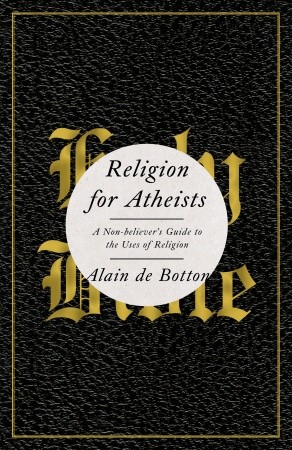
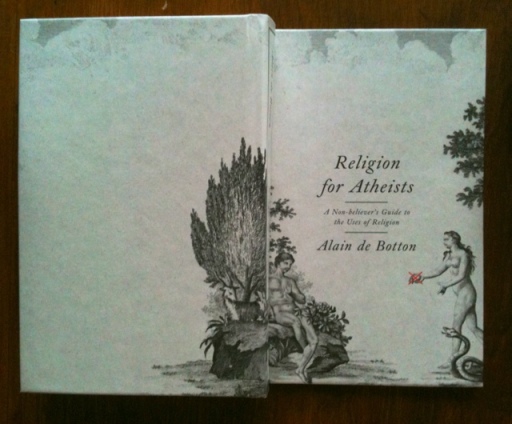
I’m slightly familiar with Alain de Botton’s work, and I’ve taken something of an interest in the so-called “New Atheist” movement — Hitchens, Dawkins, et al — so when a review copy of Religion for Atheists showed up a few weeks ago, it piqued my interest. I found its cover playfully annoying—a hole in the holy book—and its subtitle—A Non-believer’s Guide to the Uses of Religion—downright obnoxious. Still, I gotta give props to the design team at Pantheon for the book that’s under the horrid jacket: 

20120218-101910.jpg

Unfortunately, an attractive hardback design sans jacket is the best this book has to offer.

By way of explication (and my own laziness and indifference on this volume) here’s some copy on the book from de Botton’s website:

What if religions are neither all true or all nonsense? The boring debate between fundamentalist believers and non-believers is finally moved on by Alain’s inspiring new book, which boldly argues that the supernatural claims of religion are of course entirely false – and yet that religions still have some very important things to teach the secular world.

Religion for Atheists suggests that rather than mocking religions, agnostics and atheists should instead steal from them – because they’re packed with good ideas on how we might live and arrange our societies. Blending deep respect with total impiety, Alain (a non-believer himself) proposes that we should look to religions for insights into, among other concerns, how to:

– build a sense of community

– make our relationships last

– overcome feelings of envy and inadequacy

– escape the twenty-four hour media

– go travelling

– get more out of art, architecture and music

– and create new businesses designed to address our emotional needs.

For too long non-believers have faced a stark choice between either swallowing lots of peculiar doctrines or doing away with a range of consoling and beautiful rituals and ideas. At last, in Religion for Atheists, Alain has fashioned a far more interesting and truly helpful alternative.

The tone of the copy gives one a sense of the utter glibness of de Botton’s pamphlet. The book smacks of crude self-helpery, a hodgepodge of faux-intellectual poses for those who can smugly dismiss the history of philosophy. It’s like The Purpose Driven Life for atheists. There is a picture or graphic on every other page; de Botton seems to include these in lieu of, say, providing verbal imagery, or meaningful context, or simply trusting the intellect of his audience.

I suppose that I am fundamentally at odds with de Botton. I agree that religion has done much to initiate and facilitate (and in fairness, perhaps at times mitigate) atrocity; I agree that many (if not most) of the Big Problems in the world stem from the herd-mentality that organized religions impose on the people they indoctrinate. But de Botton would like to replace one herd with another.

Here is the Swiss writer suggesting that the academy (which he too-readily identifies as a bastion of atheist mores) follow the practices of black Southern Baptist churches:

The contrast with the typical lecture in the humanities could hardly be more damning. And unnecessary. What purpose can possibly be served by the academy’s primness? How much more expansive the scope of meaning in Montaigne’s essays would seem if a 100-strong and transported chorus were to voice its approval after every sentence. How much longer might Rousseau’s philosophical truths linger in our consciousness if they were structured around rhythmical verses of call-and-response. Secular education will never succeed in reaching its potential until humanities lecturers are sent to be trained by African-American Pentecostal preachers.

What we see here is a romanticization and idealization of a particular part of a culture that I think de Botton in no way understands. What’s even more disturbing here is his elevation of groupthink and indoctrination practices (I hear, “Oh no, I don’t want to play with Delta children” humming in the background). We see here the same teleological thinking that marks much of religious dogma, the sense that truth has been attained; the search is over—we just need to repeat it rhythmically enough, soak our young in it, until they think just like we do. This position strikes me as potentially dangerous as any organized religion’s attempts at indoctrination.

Religion for Atheists is full of sloppy logic gussied up in rushed anecdotes and glossed over with barely-connected pictures and silly graphs. Look at the following example, a visual non sequitur masquerading as meaningful information:

20120223-180200.jpg

Are we supposed to be horrified that the British spend more on potato chips than poetry books? Apples and oranges, bro. But what’s really ridiculous is the stinky pious claim that “Only religions have been able to turn the needs of the soul into large quantities of money.” This claim is plain silly, or at least predicated on a too-singular definition for “needs of the soul.”

Religion for Atheists seems to miss the point that many (if not most) atheists and agnostics are at heart free thinkers. De Botton romanticizes the mystery, awe, and grace of religion, even as he suggests that there is no metaphysical center from which these attributes emanate. His most basic argument really boils down to something like, “Hey, there is no God, no spirit, but religion does a good job of consoling people and keeping them in moral order, so, instead of TV and junk food, we should use the aesthetics of religion as consolation.” There is nothing revolutionary about this idea.

Religion for Atheists is a smug little tract, the sort of book that a supermarket would sell along with Chicken Soup for the Soul if supermarkets had the guts to sell self-help books for atheists. Readers should not be duped into thinking that de Botton has taken any real stance or said anything new here. Instead, hiding behind the pasteboard mask of utility, he offers a crass dodge away from meaningful inquiry. Get thee to Nietzsche instead.

Teju Cole’s Open City Is a Strange, Marvelous Novel That Captures the Post-9/11 Zeitgeist

“And so when I began to go on evening walks last fall . . .” begins Julius, the perspicacious narrator of Teju Cole’s admirable and excellent début Open City. That opening “And” is significant, an immediate signal to the reader that this novel will refuse to align itself along (or even against) traditional arcs of plot and character development. We will meet Julius in media res, and we will leave him there, and along the way there will be learning and suffering and compassion and strange bubbles of ambiguity that threaten to burst out of the narrative.

As noted, Open City begins with Julius’s peripatetic voyages; he walks the night streets of New York City to ostensibly relieve the “tightly regulated mental environment of work.” Julius is completing his psychiatry fellowship at a hospital, and the work takes a toll on him, whether he admits it or not. In these night walks—and elsewhere and always throughout the novel—Julius shares his sharp observations, both concrete and historical. No detail is too small for his fine lens, nor does he fail to link these details to the raw information that rumbles through his mind: riffs on biology, history, art, music, philosophy, and psychology interweave the narrative. Julius maps the terrain of New York City against its strange, mutating history; like a 21st century Ishmael, he attempts to measure it in every facet—its architecture, its rhythms, its spirit. And if there is one thread that ties Julius’s riffs together it is the nightmare of history:

But atrocity is nothing new, not to humans, not to animals. The difference is that in our time it is uniquely well organized, carried out with pens, train carriages, ledgers, barbed wire, work camps, gas. And this late contribution, the absence of bodies. No bodies were visible, except the falling ones, on the day America’s ticker stopped.

Open City is the best 9/11 novel I’ve read, but it doesn’t set out to be a 9/11 novel, nor does it dwell on that day. Instead, Cole captures something of the post-9/11 zeitgeist, and at the same time situates it in historical context. When Julius remarks on the recent past, the concrete data of history writhes under the surface. He remarks that the 9/11 attack on the World Trade Center “was not the first erasure on the site,” and goes on to detail the 1960s cityscapes that preceded the WTC. Before those, there was Washington Market. Then Julius embarks, via imagination, into the pre-Colombian space of the people we now call Indians or Native Americans. “I wanted to find the line that connected me to my own part in these stories,” he concludes, peering at the non-site that simultaneously anchors these memory-spaces.

Julius’s line, like the lines that comprise New York City (and perhaps, if we feel the spirit of its democratic project, America itself) is a mixed one, heterogeneous and multicultural. Julius’s father, now dead, was an important man in Nigeria, where Julius enjoyed a relatively privileged childhood. Julius’s mother—they are now estranged—is German. He remarks repeatedly about his German grandmother’s own displacements during WWII, reflecting at one point that, from a historical perspective, it was likely impossible that she escaped Cossack rape.

Even though he sometimes seems reticent to do so, Julius delves into the strange violence that marks his lineage. He recalls a childhood fascination with Idi Amin; as a boy, he and his cousins would watch the gory film The Rise and Fall of Idi Amin repeatedly: ” . . . we enjoyed the shock of it, its powerful and stylized realism and each time we had nothing to do, we watched the film again.”

Fascinated horror evinces repeatedly in Open City. In just one example, Julius believes he sees “the body of a lynched man dangling from a tree”; as he moves closer to inspect, he realizes that it is merely canvas floating from a construction scaffold. Perhaps so attuned to history’s grand catalog of spectacular atrocity, Julius finds it lurking in places where it does not necessarily evince.

In turn, despite his profession as psychiatrist, Julius is wary of human sympathy. Throughout the novel, dark-skinned men engage him by calling him “brother.” He almost always deflects these attempts at connection, and internally remarks them as fatuous, or naïve, or false. This is not to say though that Julius doesn’t make significant (if often transitory) connections.

One of the organizing principles of Open City comes in the form of Julius’s infrequent visits to the home of his former English professor, Dr. Saito, who is slowly dying. Saito’s own memories float into Julius—this technique repeats throughout the novel—and we learn that he was interned as a young man during WWII; the sad fact is another ugly kink in the line of American history that Julius attempts to trace.

Julius also befriends Dr. Maillotte, an aging surgeon on a flight to Brussels, where he spends a few weeks of Christmas vacation, ostensibly looking for his oma (a task he performs half-heartedly at best). As Julius daydreams, Dr. Maillotte, European émigré, finds a place within his vision of family members and friends:

I saw her at fifteen, in September 1944, sitting on a rampart in the Brussels sun, delirious with happiness at the invaders’ retreat. I saw Junichiro Saito on the same day, aged thirty-one or thirty-two, unhappy, in internment, in an arid room in a fenced compound in Idaho, far away from his books. Out there on that day, also, were all four of my own grandparents: the Nigerians, the Germans. Three were gone by now, for sure. But what of the fourth, my oma? I saw them all, even the one I had never seen in real life, saw all of them in the middle of that day in September sixty-two years ago, with their eyes open as if shut, mercifully seeing nothing of the brutal half century ahead and better yet, hardly anything at all of all that was happening in their world, the corpse-filled cities, camps, beaches, and fields, the unspeakable worldwide disorder that very moment.

In Brussels, Julius meets Farouq, an angry young man with intellectual, Marxist tendencies. Farouq believes in a theory of “difference” and finds himself at odds with both the dominant Belgian culture and with Western culture in general. Julius’s conversations with Farouq are a highlight of the novel; they help to further contextualize the drama of diaspora in the post-9/11 world. Later, Julius finds a counterweight to some of Farouq’s extreme positions over a late lunch with Dr. Maillotte, who suggests that “For people to feel that they alone have suffered, it is very dangerous.” There’s a sense of reserved moderation to her critique—not outright dismissal nor condemnation, but simply a recognition that there are “an endless variety of difficulties in the world.”

Julius seems to tacitly agree with Maillotte’s assessment. His reluctance to accept brotherhood based on skin color alone speaks to a deeper rejection of simplicity, of tribe mentality, of homogeneity; it also highlights his essential alienation. At the same time, he’s acutely aware of how skin color matters, how identity can be thrust upon people, despite what claims to agency we might make. In search of the line that will connect him to his part of the American story, Julius finds unlikely “brothers” in Farouq, Maillotte, and Saito.

But let us not attribute to Julius a greater spirit than Cole affords him: Open City is a novel rich in ambiguity, with Julius’s own personal failures the most ambiguous element of all. While this is hardly a novel that revolves on plot twists, I hesitate to illustrate my point further for fear of clouding other readers’ perceptions; suffice to say that part of the strange, cruel pleasure of Open City is tracing the gaps in Julius’s character, his failures as a professional healer—and his failures to remark or reflect upon these failures.

But isn’t this the way for all of us? If history is a nightmare that we try to awake from—or, more aptly in a post-9/11 world, a nightmare that we awake to, to paraphrase Slavoj Žižek—then there is also the consolation and danger that time will free us from the memory of so much atrocity, that our collective memory will allow those concrete details to slip away, replaced with larger emblems and avatars that neatly smooth out all the wrinkles of ambiguity. “I wondered if indeed it was that simple, if time was so free with memory, so generous with pardons, that writing well could come to stand in the place of an ethical life,” Julius wonders at one point; later, Saito points out that “There are towns whose names evoke a real horror in you because you have learned to link those names with atrocities, but, for the generation that follows yours, those names will mean nothing; forgetting doesn’t take long.” Julius’s mission then is to witness and remark upon the historical realities, the nitty-gritty details that we slowly edge out of the greater narrative. And Cole? Well, he gives us a novel that calls attention to these concrete details while simultaneously exploring the dangerous subjectivity behind any storytelling.

If it needs to be said: Yes, Open City recalls the work of W.G. Sebald, who crammed his books with riffs on history and melancholy reflections on memory and identity. And yes, Open City is flâneur literature, like Sebald (and Joyce, and Bolaño, perhaps). But Cole’s work here does not merely approximate Sebald’s, nor is it to be defined in its departures. Cole gives us an original synthesis, a marvelous and strange novel about history and memory, self and other. It’s a rich text, the sort of book one wants to immediately press on a friend, saying, Hey, you there, read this, we need to talk about this. Very highly recommended.

Open City is new in trade paperpack from Random House.

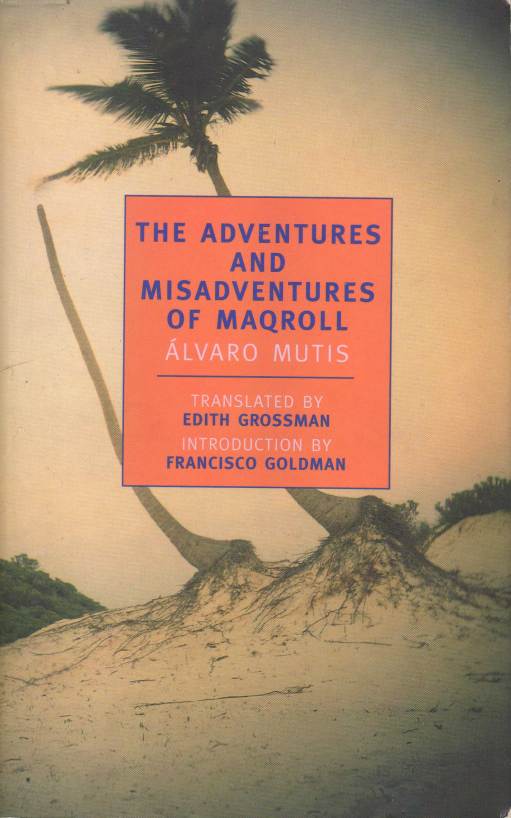
The Adventures and Misadventures of Maqroll — Álvaro Mutis

The Adventures and Misadventures of Maqroll is difficult to categorize. It’s an outlaw adventure story populated by men and women who live where and how they must; these are the people who work near shipyards and the banks of unexplored river tributaries, people who value candor and honesty but for whom strict adherence to the law is often inconvenient. The book is a philosophical rumination on friendship and creation, romance and deception, obstinance and poverty.

The book isn’t a novel, but a collection of seven novellas about Maqroll the Gaviero, written by Álvaro Mutis, who is, according to the introduction and the book jacket, one of Latin America’s finest poets and best friend of Nobel laureate Gabriel Garcia Marquez. A gaviero is the ship’s lookout, the sailor tasked with sitting atop the masts scanning the horizon.  His eyes must always be active.  He must be alert to the nuances of the sea and the capabilities of his vessel.

Mutis is present in these stories, but in a passive role, as reporter of the Gaviero’s adventures. Narrated in no particular order, selected so as to highlight Maqroll’s insatiable desire for experience, each story alludes to many imagined but unwritten characters, places, and events. We’re left with an incomplete impression of a rogue’s beautiful life—Mutis’s ode to his notion of the romantic seafaring gypsy.

The Gaviero is part of a group of wanderers who fascinate those who task themselves with creating whatever literature might be: the spies, pirates, and cowboys who abide the outrageous and rely as much on apathy as on strength in order to avoid the nooses and axes weilded by their enemies.

The Gaviero is not a symbol.  He is a fleshed-out character, as well as the embodiment of an ideal: the knife fighters and Viking poets idolized by Borges, a mixture of Robinson Crusoe, Sam Spade, and Don Quixote. He indulges fantasy but prepares for disappointment. He lives between lawlessness and acceptability. Barkeeps lose a new friend and a good source of business when he leaves town, and one woman always sits in the main room of her home, wondering whether anything she has given will supplement his resolve. He enjoys good food, uncomplicated wine, and the company of interesting friends. The Gaviero is who we all dream of being when we contemplate throwing everything away.

Ilona Comes With the Rain finds Maqroll destitute in Panama City, Panama after the suicide of his ship’s captain. We learn this is a city “like a sedative, full of agreeable but unkept promises of unexpected happiness”; Ilona, the second story in the collection, is indicative of the tone of the collection. Washed up at a hotel owned by a fence and finding himself selling stolen goods outside of tourist attractions, the Gaviero encounters a familiar face by chance, a woman who takes him in, feeds, and clothes him. They make love and decide afterwards to open a brothel catering to men with a thing for stewardesses. It is a magical, buoyant tale and emblematic of the mixture of adventure and world-weariness that Mutis maintains throughout the collection. Before the tragic end we’re treated to stories about a pair of incubi, spirits of noblemen, who drive women insane, the dangers of allowing bookkeepers into whorehouses, and a blind Anatolian with the ability to guess a woman’s place of employment by the texture of the fabric of her clothes.

Throughout the collection, Mutis takes his readers from Malaysia to Finland, from the Mediterranean to the Caribbean.  We live, with the Gaviero, through malarial fever dreams, military interrogations, and assassination attempts.  Un Bel Morir is perhaps the standout story.  Our hero finds himself older, angrier, and  more alone than ever, in a languid town on the banks of a pestilent river.  Broke and bored, knowing better, he takes a job running cargo by mule train up a crumbling mountain trail for a Dutchman with cash (and questionable motives). The Gaviero must evade capture by the rebel forces he has unwittingly aided—as well as the government troops who question his history and motives.

Mutis spent most of his career as a writer crafting verse and not prose, and his poetic inclinations shine through in pieces like this one, a good story that becomes great when the beauty of the unchanging landscape is evoked and contrasted with the hero’s pitiful condition. The cycle of life.  In Un Bel Morir, Maqroll, surrounds himself with beauty, contemplates it, and then tortures himself with unanswerable questions:

. . . the aroma of perpetually damp foliage, the explosion of rich, unrestrained color, the thunder of water in the ravines singing its opulent descent in boiling crests of foam, an ancient restorative peace replaced the weariness of the road and the struggle with the mules. The sordid deceptions he foresaw in the uncertain enterprise lost all reality and were buried in the resigned acceptance of his Islamic fatalism.

This is a delightful book, but not a happy one. The Gaviero symbolizes the struggle to internalize the good while accepting the inevitability of the bad, the chance to create the type of death we envision for ourselves, one with as many or as few regrets as our daily lives will tolerate.

Mutis, a thorough Romantic, compels his readers, through the Gaviero, to examine our reasons for despondency, and instructs us to cherish our innate ability to fall in love with the world and with each other. This collection is an exhortation, a reminder that circumstances change but that innocent pleasures are abundant, available, and free.

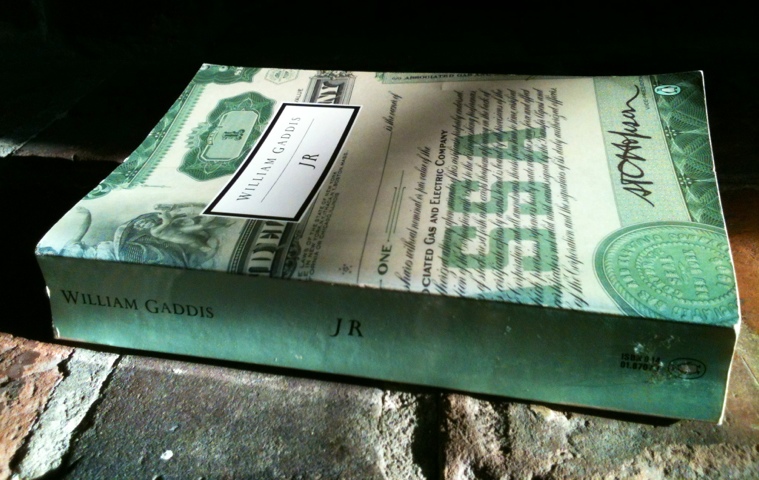
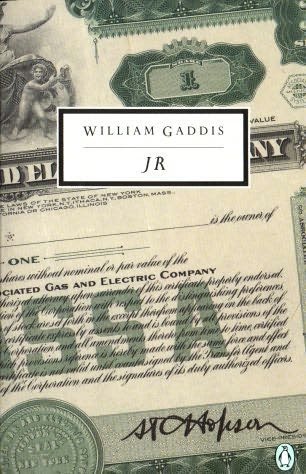
I Riff–Again–on William Gaddis’s Enormous Novel JR (This Time After Finishing It)

20120208-170956.jpg

1. Let me point those of you who may care to my first riff on William Gaddis’s J R, which I wrote about half way into the book, and which will likely provide more context than I’m prepared to offer here. Also, there might be spoilers ahead.

2. The end of J R is heartbreaking. We find some of our principal characters—Bast, Gibbs, and JR—in nebulous spaces, their plans and dreams and hopes crumbling or smoking or fizzing out or jettisoned (pick your verb as I’m too lazy or unequipped).

3. The final face-to-face scene between Bast and JR, the one that begins with them riding in a limousine and ends with Bast’s psycho breakdown—heartbreaking. Little JR, we realize, is most motivated by his intense need for human connection, his desire for family, perhaps, or place, at least. Bast’s rejection of JR—really a rejection of contemporary consumer culture—is almost horrific, even more so because the reader (this reader, anyway) so readily identifies with Bast and JR simultaneously.

4. Here’s Gaddis on his character JR (from The Paris Review interview):

The boy himself is a total invention, completely sui generis. The reason he is eleven is because he is in this prepubescent age where he is amoral, with a clear conscience, dealing with people who are immoral, unscrupulous; they realize what scruples are, but push them aside, whereas his good cheer and greed he considers perfectly normal. He thinks this is what you’re supposed to do; he is not going to wait around; he is in a hurry, as you should be in America—get on with it, get going. He is very scrupulous about obeying the letter of the law and then (never making the distinction) evading the spirit of the law at every possible turn. He is in these ways an innocent and is well-meaning, a sincere hypocrite. With Bast, he does think he’s helping him out.

5. And again:

INTERVIEWER

Which is the novel you care most for?

GADDIS

I think that I care most for JR because I’m awfully fond of the boy himself.

6. In that same interview, Gaddis contends that JR is motivated by “good-natured greed,” which is probably true (see above re: letter vs. spirit). Despite his predatory capitalism, his willingness to strip company employees of basic safety nets, JR remains sympathetic.

7. Why is JR a sympathetic character? He’s just a child, one who lives in a world without adult supervision let alone love and care. In a touching scene that telegraphs the bizarre black humor that runs through the novel, JR suggests that the Eskimos on display at a museum are the work of a taxidermist: That is, said Eskimos were once, like, alive, and are now on display. Amy Joubert, his social studies teacher (and the object of Gibbs’s and possibly Bast’s affection) is moved to both pity and terror by JR’s confusion, and clutches him to her breast.

8. While we’re on Eskimos, which is to say Native Americans, which is to say, perhaps, Indians: The Indian plot in JR fascinates; it recapitulates a bloody, awful past, pointing to the brutal way the quote unquote invisible hand of the market might sweep entire people away and then come back (in a cheap costume) to offer modernity at a price.

9. Ethnic minorities in general find themselves displaced in JR, or at least displaced in the language of JR (and is there a novel that is more language than JR, if such a statement might be permitted to exist (at least metaphorically)? No, I don’t think there is, or at least I don’t know of one). The casual racism of 1%ers like Zona Selk and Cates is ugly and bitter, but the PR man Davidoff is somehow worse—he sees race as something to use, to manipulate, to control.

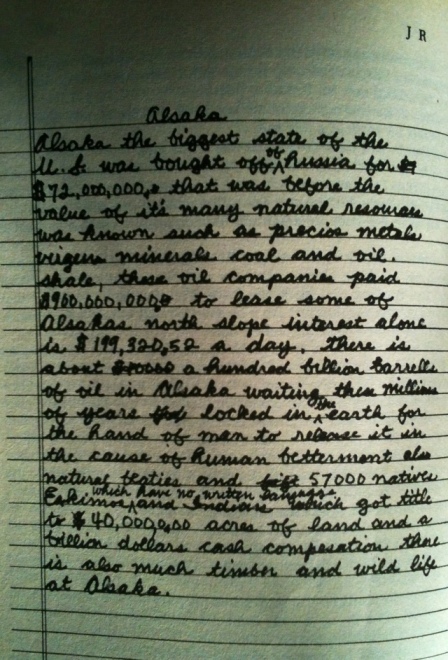
10. And, of course, JR’s infamous “Alsaka Report,” a connection to Manifest Destiny, to the valuation of our ecosystem in the most base and short-sighted terms (there’s a perhaps overlooked streak of environmentalism to JR):

20120208-171005.jpg

11. Sci-fi elements to JR: The Frigicom process, which promises to freeze noise. The Teletravel transmission process.

12. At the end of JR, we learn that poor diCephalis is lost in Teletravel transmission.

13. I couldn’t help but be reminded—repeatedly—of David Foster Wallace’s work during JR (diCephalis stuck in Teletravel recalls poor Orin in the giant glassjar at the end of Infinite Jest). In general, the loose threads of JR recall Wallace’s loose threads (other way round, I know).

14. The phone motif alone might have led me to compare Wallace to Gaddis—but there’s also all that, y’know, thematic unity.

15. And clearly, too, style. I’m sure that longtime readers of Gaddis have likely made the comparisons already, but throughout his work, Wallace repeatedly uses chapters or sections that comprise only dialogue. A good example is §19 of The Pale King (which I riffed on a bit this summer), a conversation between three IRS agents stuck in an elevator. In some ways, the scene, set only a few years after the publication of JR feels like a strange little sequel, or an echo of a shadow of a chapter of a sequel (or maybe not—just riffing here). Wallace’s concerns about civics, ethics, and compassion seem more straightforward than Gaddis’s angry vision of a desacralized world, a world where symphonies must be chopped into three minute segments to allow for commercial interruptions (or, rather, that symphonies must interrupt commercials). Wallace is obviously writing after the victory of Pop Art, of populism, of the slow sprawling stripmalling of America . . . but I’ve riffed off track (there is no track).

16. ” . . . I mean they never lose these banks don’t, I mean where we’re getting screwed . . . ” — JR laments on page 653 of my Penguin Twentieth-Century Classics edition.

17. The above quote as the briefest illustration that, published in 1975, JR is more relevant than ever.

18. To wit, Gaddis again, again from The Paris Review interview, commenting on hollow, false values:

. . . I’d always been intrigued by the charade of the so-called free market, so-called free enterprise system, the stock market conceived of as what was called a “people’s capitalism” where you “owned a part of the company” and so forth. All of which is true; you own shares in a company, so you literally do own part of the assets. But if you own a hundred shares out of six or sixty or six hundred million, you’re not going to influence things very much. Also, the fact that people buy securities—the very word in this context is comic—not because they are excited by the product—often you don’t know what the company makes—but simply for profit: The stock looks good and you buy it. The moment it looks bad you sell it. What had actually happened in the company is not your concern.

19. Gaddis’s take on the “art” of capitalism: design mock ups for a potential logo for the JR Family of Companies:

20120208-171016.jpg

20. JR is one of the most prescient novels I’ve ever read—and not just in its illustration of the the chaos at the intersection of corporatism, Wall Street, government, and military, but also in its handling and treatment of education. Gaddis is way ahead of an ugly curve, showing us an educational system largely disinterested in intellectual, aesthetic, or even athletic development. Instead we get a storehouse for children, reliant on programmed lessons delivered via technology and assessment by standardized testing. It’s ugly and it’s more real than ever now.

21. And here’s Gibb’s railing against it, in a way, in (what’s likely a half-drunken or at least hung-over) rant to his students:

Before we go any further here, has it ever occurred to any of you that all this is simply one grand misunderstanding? Since you’re not here to learn anything, but to be taught so you can pass these tests, knowledge has to be organized so it can be taught, and it has to be reduced to information so it can be organized do you follow that? In other words this leads you to assume that organization is an inherent property of the knowledge itself, and that disorder and chaos are simply irrelevant forces that threaten it from the outside. In fact it’s the opposite. Order is simply a thin, perilous condition we try to impose on the basic reality of chaos . . .

(That’s from page 20 of my Penguin Twentieth-Century Classics edition, by the bye).

22. There are no happy families in JR. Just broken families.

23. I said this at the top of the riff, but again–-heartbreaking.

24. This is probably a direction out of this riff—to resuscitate the emotional dimension of the novel, which is too easily overlooked, perhaps, because Gaddis’s manipulations (and all novelists manipulate their audience) require so much active participation from the reader. JR is without exposition, without the overt imposition of the novelist telling us how to feel: instead there’s a thickness to it, a building of buzz and clatter, yes, but music under all that noise: even a kernel of love (and hope!) under the heavy folds of anger.

25. Very highly recommended.

I Riff on William Gaddis’s Enormous Novel J R (From About Half Way Through)

1. I want to write about William Gaddis’s novel J R, which I am about half way through now.

2. I’ve been listening to the audiobook version, read with operatic aplomb by Nick Sullivan. I’ve also been rereading bits here and there in my trade paperback copy.

3. What is J R about? Money. Capitalism. Art. Education. Desperate people. America.

4. The question posed in #3 is a fair question, but probably not the right question, or at least not the right first question about J R. Instead—What is the form of J RHow is J R?

5. A simple answer is that the novel is almost entirely dialog, usually unattributed (although made clear once one learns the reading rules for J R). These episodes of dialogue are couched in brief, pristine, precise, concrete—yet poetic—descriptions of setting. Otherwise, no exposition. Reminiscent of a movie script, almost.

6. A more complex answer: J R, overstuffed with voices, characters (shadows and doubles), and motifs, is an opera, or a riff on an opera, at least.

7. A few of the motifs in J R: paper, shoes, opera, T.V. equipment, entropy, chaos, novels, failure, frustration, mechanization, noise, hunting, war, music, commercials, trains, eruptions of nonconformity, advertising, the rotten shallowness of modern life . . .

8. Okay, so maybe that list of motifs dipped into themes. It’s certainly incomplete (but my reading of J R is incomplete, so . . .)

9. Well hang on so what’s it about? What happens?—This is a hard question to answer even though there are plenty of concrete answers. A little more riffage then—

10. Our eponymous hero, snot-nosed JR (of the sixth grade) amasses a paper fortune by trading cheap stocks. He does this from a payphone (that he engineers to have installed!) in school.

11. JR’s unwilling agent—his emissary into the adult world—is Edward Bast, a struggling young composer who is fired from his teaching position at JR’s school after going (quite literally) off script during a lesson.

12. Echoes of Bast: Thomas Eigen, struggling writer. Jack Gibbs, struggling writer human. Gibbs, a frustrated, exasperated, alcoholic intellectual is perhaps the soul of the book. (Or at least my favorite character).

13. Characters in J R tend to be frustrated or oblivious. The oblivious characters tend to be rich and powerful; the frustrated tend to be artistic and intellectual.

14. Hence, satire: J R is very, very funny.

15. J R was published over 35 years ago, but its take on Wall Street, greed, the mechanization of education, the marginalization of art in society, and the increasing anti-intellectualism in America is more relevant than ever.

16. So, even when J R is funny, it’s also deeply sad.

17. Occasionally, there’s a histrionic pitch to Gaddis’s dialog: his frustrated people, in their frustrated marriages and frustrated jobs, explode. But J R is an opera, I suppose, and we might come to accept histrionics in an opera.

18. Young JR is a fascinating study, an innocent of sorts who attempts to navigate the ridiculous rules of his society. He is immature; he lacks human experience (he’s only 11, after all), and, like most young children, lacks empathy or foresight. He’s the perfect predatory capitalist.

19. All the love (whether familial or romantic or sexual) in J R (thus far, anyway) is frustrated, blocked, barred, delayed, interrupted . . .

20. I’m particularly fascinated by the scenes in JR’s school, particularly the ones involving Principal Whiteback, who, in addition to his educational duties, is also president of a local bank. Whiteback is a consummate yes man; he babbles out in an unending stammer of doubletalk; he’s a fount of delicious ironic humor. Sadly though, he’s also absolutely real, the kind of educational administrator who thinks a school should be run like a corporation.

21. The middlebrow novelist Jonathan Franzen, who has the unlikely and undeserved reputation of being a literary genius, famously called Gaddis “Mr. Difficult” (in an essay of the same name).

22. Franzen’s essay is interesting and instructive though flawed (he couldn’t make it through the second half of J R). From the essay:

“J R” is written for the active reader. You’re well advised to carry a pencil with which to flag plot points and draw flow charts on the inside back cover. The novel is a welter of dozens of interconnecting scams, deals, seductions, extortions, and betrayals. Between scenes, when the dialogue yields briefly to run-on sentences whose effect is like a blurry handheld video or a speeded-up movie, the images that flash by are of denatured, commercialized landscapes — trees being felled, fields paved over, roads widened — that recall to the modern reader how aesthetically shocking postwar automotive America must have been, how dismaying and portentous the first strip malls, the first five-acre parking lots.

23. Franzen, of course, is not heir to Gaddis. If there is one (and there doesn’t need to be, but still), it’s David Foster Wallace. Reading J R I am constantly reminded of Wallace’s work.

24. But also Joyce. J R is thoroughly Joycean, at least in its formal aspects: that friction between the deteriorated language of commerce and the high aims of art; the sense and sound and rhythms of the street. (Is there a character more frustrated in Western literature than Stephen Dedalus? Surely he finds some heirs in Gibbs, Bast, and Eigen . . .)

25. Gaddis denied (or at least deflected) a Joycean influence. Better to say then that they were both writing the 20th century, only from different ends of said century.

26. And then a question for navel-gazing lit major types, a question of little import, perhaps a meaningless question (certainly a dull one for most decent folks): Is J R late modernism or postmodernism? Late-late modernism?

27. Gaddis shows a touch of the nameyphilia that we see (out of control) in Pynchon: Hence, Miss Flesch, Father Haight, the diCephalis family, Nurse Waddams, Stella Angel, Major Hyde, etc.

28. To return to the plot, or the non-plot, of J R: As I’ve said, I’m only half way through the thing, but I can’t see its shape. That sentence might need a “yet” at the end; or, J R might be so much chaos.

29. In any case, I will report again at the end, if not sooner.

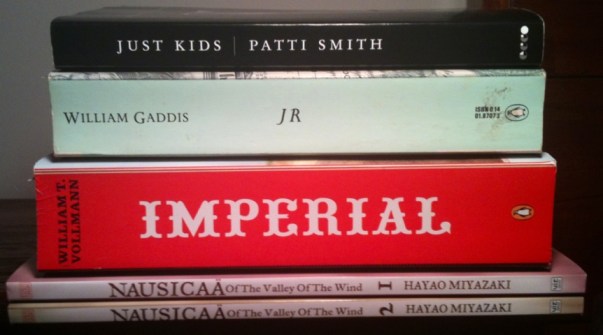
Riff on Recent Reading, 1.09.2012 (Gaddis, Vollmann, Dragons, Nausicaä, Patti Smith)

20120110-181813.jpg

1. Just Kids, Patti Smith

Really slowed down on this one, mostly because the spring semester hath begun, wreaking all sorts of destabilizing tasks on me. Momentum and reading habits will inevitably return. Anyway, Smith’s book is more or less a litany of famous meetings and infamous moments with lots and lots of descriptions of talismanic objects. The scene where she meets Allen Ginsberg is pretty cool. Smith presents herself as earnest, passionate, but also somehow at odds (or at least outs) with the whole Chelsea Hotel scene.

2. Nausicaä of the Valley of the Wind, Vol 1, Hayao Miyazaki

Completed the first volume of Miyazaki’s groundbreaking manga and started the second. The art is well crafted and distinct, but often extremely busy and even frenetic. It sometimes feels squashed in the panels, like it needs room to breathe. I can’t help but compare it to the film that followed, which is visually richer and more expansive. The film, in a sense, helps me to fill out the scope signaled in Miyazki’s inky illustrations.

The story in the manga so far differs subtly but significantly from the film; without adding spoilers (I think fans of the film will enjoy the book), the political dimension of the plot is heightened and gender roles are explored with greater concern. Nausicaä’s initial rashness is also presented with greater intensity (read: violent consequences). More to come.

3. Imperial, William T. Vollmann

Chapter 3 of Imperial, “The Water of Life,” is some of the best gonzo journalism I’ve ever read. Vollmann (along with an improbably game ex-Marine/hotel clerk) takes a raft—a cheap rubber dinghy, really—down the infamous New River, purportedly one of the most polluted waterways in North America. This river is filled with dead birds, dead fish, probably dead humans, lots and lots of garbage, industrial runoff, and lots and lots of human shit.

Of course, Vollmann can find beauty and strangeness and ugliness all at once:

The chapter does everything one wants from the book, and if you’re at all intrigued, there’s a version in the excellent Vollmann reader Expelled from Eden, which is a good starting point for his work.

The next chapter, “Sublineations: Lovescapes,” is this awful emo exploration of a bad breakup and the following heartbreak Volls feels after. It was torturous to get through, the sort of thing that screams for an editor. It also underscores how deeply deeply deeply personal the book is to him, though. More to come.

4. A Dance with Dragons, George R. R. Martin (audiobook read by Roy Dotrice)

Well goddam if I didn’t finally finish it. As I’ve lamented elsewhere in these e-pages, Martin’s fourth and fifth books in the A Song of Ice and Fire series (I hate that name, by the way: Game of Thrones (without the indefinite article) is way cooler sounding) are bloated, sagging, overfilled beasts sorely in need of an enema. Still, Dragons picks up in its final third, and ends with some shockers that, if I remember them 12 years from now when he finally finishes the next one, I may want to read it. Roy Dotrice = a very gifted reader. A great audiobook (still, I can’t believe this one topped so many year end lists).

5. JR, William Gaddis  (tandem reading with audiobook read by Nick Sullivan)

Big thanks to Dwight at A Common Reader for suggesting the audiobook of JR read by Sullivan. I’m a few hours in; I’ve also been rereading bits immediately when I get home (I listen mostly in the car or on walks), retracing the lines that I’ve mentally underlined. Sullivan is a gifted voice actor who brings the many, many voices of JR to vivid life (that line seems hackneyed but it is in no way insincere. If I weren’t riffing I’d revise. If I weren’t riffing I’d edit parenthetical excuses. I’m gonna drink more red zin now). I’m reminded in some ways of RTE’s full-cast unabridged recording—performance really—of Joyce’s Ulysses. I’d read Ulysses twice before, but I feel like the full-cast production was an equally definitive version to the one in my head. Like Ulysses—especially the Sirens episode—JR is extremely aural; it’s mostly dialogue.

I’ve laughed out loud several times so far—had no idea the book would be this funny. Also, reading/hearing it, I can’t help but see how profoundly David Foster Wallace was influenced by Gaddis here: the bizarre corporate-speak, the disjunctive rhythms, the absurd humor, the satire on modernity, the ironic-earnest axis—even the passages of naturalistic description.

On deck: The Orphan Master’s Son by Adam Johnson, Open City by Teju Cole, Smut by Alan Bennett and more more more.

Riff on Recent Reading, 12.31.2011

20111229-200717.jpg

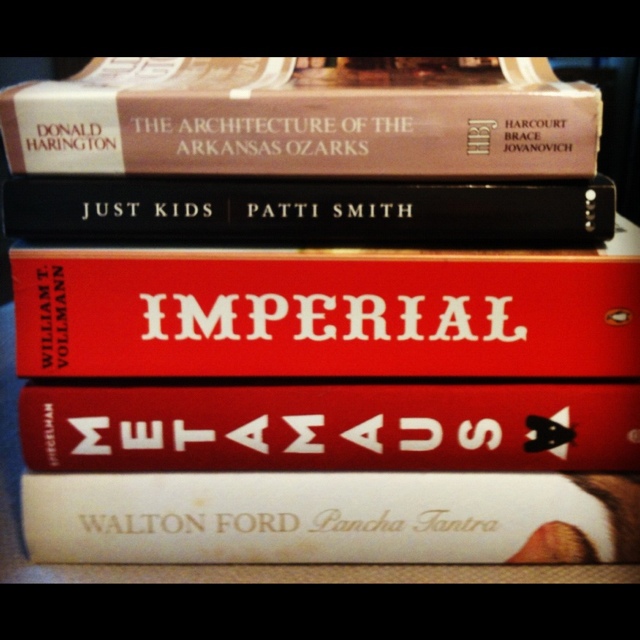
1. Donald Harington, The Architecture of the Arkansas Ozarks

I want to publicly thank blogger BLCKDGRD for sending me this book; it arrived in sections, the binding glue cracked, its abused condition surely a sign of love. I happened to be recaulking the margins of my screened in porch the day it arrived, so I used silicone caulk (along with c-clamp) to repair it.

The Architecture of the Arkansas Ozarks rightfully should have shown up on my Books I Didn’t Read in 2011 post, but it was doubly neglected, left under a pile of half-read books that I intend to keep reading: Georges Perec’s Species of Spaces, the Vollmann reader Expelled from Eden, a volume of stories by Breece D’J Pancake (two stories remain unread; I am sure they are awfully sad), Stendahl’s The Charterhouse of Parma. In short, I didn’t want to own up to abandoning it because I intend to go back and finish it. I read a little over half of Harington’s big, rich, funny history of Arkansas, told through the lens of the species of spaces inhabited by the Ingledews and their fellow Stay Morons. The book is lively, deeply ironic, and stands with Kurt Vonnegut as perfect American satire.

2. Just Kids, Patti Smith

I found Just Kids, which was a Big Deal book in 2010, while looking for a copy of Lillian Smith’s The Killers of the Dream (don’t fret; I found that book too). I’ve loved Smith’s music since I was a kid; like The Talking Heads, she was hard to place, not outright punk rock, definitely not pop, very weird.

I usually read the first few pages of books in the store if I think I’m going to buy them; I ended up reading about 10 pages of Just Kids, taking it home, and then reading for a few more hours. I’m almost finished with it now.

Smith documents a fascinating time in a fascinating place (New York City’s art/lit/music scene in the late sixties/early seventies), but her perspective for most of the book is that of an outsider, a would-be artist struggling to help Robert Mapplethorpe become famous for his art. Smith is in love with literature, particularly Romantic French stuff.

She’s also an object fetishist; I can’t think of another book that details so many tchotchkes, so many surfaces, so many contours, so many things. She’s an aesthete. There are also several incidences of book theft. I’m not sure if I’ll write up a proper review of this book—it won the Nat’l Book award and made all the year end lists in 2010—but I have been enjoying it as a chronicle of creative energy.

3. Imperial, William T. Vollmann

There’s a strange shift between the first and second chapters of Vollmann’s massive book about Imperial County. The first chapter, “The Gardens of Paradise,” reads like a magazine article (and it was; it was published in abbreviated form in Gear in 1999)—lots of dialogue, short paragraph breaks, a spare, lucid syntax, but nevertheless rippling with verve. The second chapter, “Delineations” is a heady brew, a page right out of Ishmael’s big book, as we see Vollmann try to delineate or define his white whale Imperial. And yet he seems to realize that delineation is a fantasy:

People say it was miraculous that Christ walked across the water, and yet they don’t think twice when the same is performed by this entity invisible everywhere except in its representations, whose substance is comprised of equal parts imagination, measurement, memory, authority, and jurisdiction! Delineation is the merest, absurdest fiction, yet delineation engenders control.

The territory and the time Vollmann treks in just a few dozen pages astounds . . .

4. MetaMaus, Art Spiegelman

Okay—not really recent reading, although I did pick it up again and thumb through it before writing this piece; mostly, I wanted to try to write something about this book before the end of the year (I put it on my “best of ’11” list, by the bye). This book is Spiegelman’s attempt to measure Maus: where it came from, how it was made, what making it did to him and for him—and to his family. Like Smith’s book, MetaMaus is very much about the creative process (forgive the hackneyed phrase)—only, where Smith breathlessly gushes in the glowing, enriching flames of art, Spiegelman guides us through the nitty-gritty nooks and crannies of how he made what is perhaps the signature work of comics art of the twentieth century.

The book is beautiful. Take a gander:

5. Pancha Tantra, Walton Ford

The index at the end of Pancha Tantra contains a series of citations that illustrate Ford’s paintings (hang on, the elements of that last phrase should be vice versa, right?). To wit:

20111230-205013.jpg

20111229-200847.jpg

6. A Dance with Dragons, George R. R. Martin (audiobook read by Roy Dotrice)

I really liked the first three Game of Thrones books (yeah, I know they have that long silly name; I’m not gonna write it). I listened to them on audio, all read by Roy Dotrice—who is a great reader—and I gave them a positive review. The first three books detail a world of Machiavellian scheming, a phallocentric, desacralized universe where power is constantly shifting and idealism will get you beheaded. The character development is excellent, the plots are engaging, and the prose is good enough.

The fourth book, narrated by John Lee, was almost too much to get through. Here are some words to describe it: bloated, plodding, sagging, lazy, meandering, over-expansive.

I’d heard that A Dance with Dragons was much better, knew that Dotrice was narrating again, and knew that the book picked up with some of my favorite characters who were left out of that fourth book (Tyrion, Danaerys).

I’m nearing the end—it’s much better than the last one, but not nearly as good as the first three. Martin could probably make the book a third shorter simply by cutting out the endless descriptions of food, the awful, gross sex scenes (actually, he can go ahead and keep those), and the terrible stock phrases. (How long do things last in ADwD? “Half a heartbeat.” Also, I would love to never hear the phrase “Much and more” again in my life. I’m not even kidding. And “Useless as the nipples on a breastplate” doesn’t need to show up more than once in your book).

Even with my gripes, there have been some good episodes so far, including a creepy cabin fever Sadean setpiece that reminded me of the South Africa episode of Pynchon’s V, which is like one of my favorite things in literature.

7. Various public domain books on Kindle Fire, including Poe, Hawthorne, Melville, Whitman, and Dickinson

I got a Kindle Fire. I like it. I downloaded a bunch of obscure American Renaissance stuff—letters, reviews, essays—and have been scrolling over it quite a bit late at night. More thoughts on this device to come.

Read (And Not Read) in 2011

[Our West Coast correspondent A King at Night weighs in on the books he read—and didn’t read—in 2011. Where they fit, I’ve linked book titles to my own reviews, or Noquar’s, our Brooklyn correspondent. –Ed.]

All of the books I did read in 2011:

1. The Recognitions – William Gaddis

If more people were able/interested in surmounting this 960 page giant I think it would be roundly considered possibly the best American novel. But as it is Gaddis sabotaged himself by writing a book that is almost literally too good.

2. City of Glass – Paul Auster

I think this one was my favorite of the New York Trilogy, except that I didn’t think of separating them until I made this list. So really I read three books as three parts of the same novel. One which I loved and adored fully. It was my first Auster and a the beginning of a beautiful friendship.

3. Ghosts – Paul Auster

See above.

4. The Locked Room – Paul Auster

See above.

5. Bright Lights Big CityJay McInerny

Not sure why I read this one. I think I just had it sitting around and it read fast enough to keep me engaged. I’m also not sure why this was as apparently popular as it was upon release. I know he was friends with Bret Ellis, but it just seems like Ellis but kind of declawed. So maybe that’s a good thing for some people. The use of second person narration was cool, I guess you don’t see that very often.

6. Blood Meridian  – Cormac McCarthy

There is almost literally nothing I can say about this that will have any value. I should mention that it fully lived up to the years and years of personal hype I had built up for it.

7. Powr Mastrs vol. 2, 3  – C.F.

This is a weird comic book series a friend introduced me to. Apparently it is ongoing and I think I would like to continue reading it.

8. Point Omega – Don DeLillo

This was my first attempt at DeLillo and I’m pretty sure I chose it because of its minuscule length and awesome cover art. I was totally enthralled and blown away. So much so in fact that Point Omega gets the distinction of the being, so far, the first and only book I have actually read twice in a row. As in I finished it and then flipped back to page one and read it a second time and it was brilliant again.

9. In The Country of Last Things – Paul Auster

I didn’t fully love this as much as I did the NY Trilogy, but I think that is due to a certain lack of detectives and the New York setting. This book kind of reminds me of a big, sad Terry Gilliam movie. Auster is in my opinion the unquestioned master of that meta-text device where what you are reading is actually being written by the character in the book. (I’m sure there is a name for that, but I don’t know it).

10. The Pale King – David Foster Wallace

I’ll try and cut the hyperbole on this one. I don’t care what any people are saying about this book or the man who wrote it. My enjoyment of this and other DFW books is entirely a personal experience. He may in fact be the smartest novelist who ever lived or whatever but I’m not going to browbeat you into believing me, and somehow trying to make myself look good by extension. This book did things for me that no book (including Infinite Jest) has ever done and for that I am grateful. I’ll say no more.

11. Day of The Locust – Nathaniel West

What a weird, dark, little book this is. And why have I never been told that the name Homer Simpson is used prominently throughout? The end of this book was basically jaw-dropping and could be the best sequence Fellini never filmed. I hear there was a movie made based on this, but I think it supposedly wasn’t very good.

12. The Time Machine Did It – John Swartzwelder

This is the first book in a series written following Detective Frank Burly. And the ONLY reason I haven’t immediately read each and every one of them is because they are self-published by the author and therefore impossible to find used. And since I almost never buy books new it would be a huge price adjustment for me. So I’ll take them slow, but if the rest are as fun as this is I predict I will love all of them.

13. Ubik – Phillip K. Dick

Very enjoyable, packed full of ideas (as usual for Dick) and with a pretty engaging plot to tie it all together.

14. Carpenter’s Gothic – William Gaddis

Last time I was home visiting my family I discovered that a copy of this book in my mom’s bathroom. Apparently she had seen me post about Gaddis on Facebook and decided to take my word for it. She was about a third of the way through this relatively slim book but confessed to having a hard time reading it. She asked what about it appealed to me so much and I told her that I view Gaddis as maybe the greatest American writer who ever lived, but that of the three books I’ve read of his Carpenter’s Gothic is the weakest, (or the least amazing, maybe) but that, you know, good luck telling anyone to read a 700 page book written entirely in unattributed dialogue (JR) or a 960 pager about classical art. So yeah CG is more of a little experiment in storytelling (the goal was to tell a massive sociopolitical epic, but done entirely in one location, a house in the country outside new york) than it is an essential work. But if you want to wet yr feet in regards to Gaddis but won’t/can’t commit to his larger, better books, then this is a decent starting point.

15. Child of God – Cormac McCarthy

Totally awesome. I started reading it late at night after finishing the previous book and ended up sitting on the couch until 4:30am and did the whole thing in one sitting. That doesn’t happen too often with me and I can’t really account for why it happened this time . . . but yeah this is the most readable McCarthy I’ve read since The Road.

16. The Transmigration of Timothy Archer – Phillip K. Dick

This is the (sort of) conclusion to PKD’s VALIS trilogy, which I started reading last year. It was the last book he wrote and is I think a pretty wonderful swan song for a guy as freakishly imaginative as him. It isn’t even really sci-fi even, but more like “spi-fi” (the term I just made up for Spiritual Fiction) which is sort of what all of his latter work was I guess, and is a thing that really resonates with me personally.

17. Leviathan – Paul Auster

My fifth Auster of the year: I picked this up because it had a cool cover and I read it mostly on flights to and from a wedding I attended in Wisconsin. This is totally wonderful and probably my second favorite Auster novel (behind NY3). I think if I were to write a longer piece on PA I would probably use this book to talk about his interest in choosing protagonists who are frequently less interesting than a supporting character whom they idolize. And also his interesting views on marriage and adultery. It’s worth noting that the book is dedicated to Don DeLillo and upon seeing that I was inspired to pick up some more of his books and finally some of the others that were piling up on my shelf.

18. White Noise – Don DeLillo

I’ve had a copy for this for like ten years and somehow could never make it past the first two pages, even though they are a really good two pages. Honestly in this case I think it was the edition. I had one of those scholarly ones with all the annotation and stuff that make the book look twice as long and 10x more boring. And then I found the newly printed Penguin paperback and burned through it in like a week. It’s one of the funniest things I’ve read and was really a gateway drug into a binge of DeLillo that was incredibly fulfilling.

19. Running Dog – Don DeLillo

This was probably the least mind-blowing (and the earliest) of the DeLillo I read this year. But still a good time, slightly Pynchonian (Pynchonesque?) probably as a result of DD still finding his own voice at that point. I probably wouldn’t recommend it to anyone who wasn’t already pretty well-into DeLillo but for fans of his I think it would be a good read.

20. Libra – Don DeLillo

Two things in life constantly threaten to destroy me: The Zodiac Killer and JFK. There is always this looming sense that if I were to ever really, fully commit to researching either case I would be entering rabbit-hole I’d never find my way out of. This book was simultaneously the most tempting experience but also the most satisfying. Because even if DD had to invent some of this he still presents a version of the story that is totally plausible. So maybe it’s a placebo but at least I can sleep at night.

21. Underworld – Don DeLillo

It was all a rehearsal for this one though. This big guy had been taking up space on my night stand for months and I’d had a number of friends basically begging me to read it for years. When I finally got around to reading it I was pleased to discover that it is NOT difficult at all, it’s just long. There is a sort of genre of these “big, complex, post-modern(?)” type of books. It’s a thing that I have a weakness for: Gravity’s Rainbow, Mason & Dixon, Against The Day, The Tunnel, The Recognitions, JR, Infinite Jest, etc. And I mean while Underworld has some things in common with these books I would actually characterize it as almost more like a Norman Mailer book or something. Yeah, I’d put it somewhere between a more-sober Thomas Pynchon and a less-horny Norman Mailer. Does that make sense at all?

22. The Orchard Keeper – Cormac McCarthy

I was hoping for a repeat of my Child of God experience with this one. And while that didn’t quite happen I still enjoyed this book a lot. Major props to McCarthy for mentioning Melungeons in the first chapter, being descended from that obscure ethnic group myself, with my dad’s family from east Tennessee, I can tell you that that is exactly the type of super-esoteric, colloquial reference that he later got a lot of praise for utilizing in his more-celebrated western novels. I guess it’s just neat to see that as a part of his style so early and is further proof that he is not in fact a writer of westerns at all, but just possibly the best writer of any region, just wherever he decides to dedicate his interest.

23. Train Dreams – Denis Johnson

I love Denis Johnson so much. I don’t usually buy hardback books but when I saw this cute little book I knew I had to have it. It reads super fast and is really just a great little character piece, telling basically the whole life of this one particular guy. Johnson could write two dozen of these things and I would read every one of them. But he won’t because he’s busy doing whatever other random thing he decides to write brilliantly—-

24. Nobody Move  – Denis Johnson

—-Like this little crime novel he wrote. I don’t think anyone who was around when his first few books would ever have thought he would end up trying to write a pulp novel. I certainly wouldn’t have. But boy am I glad he did. This book was so totally fun to read, with some of the most enjoyable dialogue I’ve ever read in my life. It isn’t as tightly plotted as any of the Coen bros. movies that it reminds me of, but for sentence-by-sentence writing it was one of the best things I read all year.

25. Wild at Heart – Barry Gifford

I had seen the movie a few times and knew I wanted t try the book. I heard that Lynch wrote the script in six days and having read it now I can say that I completely believe that is true. It’s probably one of the closest adaptations I’ve ever seen and really I’m just stunned by how Lychian Gifford’s book already was. It makes so much sense that these two collaborated on Lost Highway and my only wish is that they would work together again sometime.

26. Travels in The Scriptorium – Paul Auster

So I guess with this one Auster officially beat DeLillo for the most-read author of the year prize. I wasn’t even intending to buy another one until I saw the cover of this and instantly knew I had to. Anything that is this visually reminiscent of Twin Peaks has to be good right? It ended up being a great, easy read, which I am learning is typical of PA.

27. The Bailbondsman – Stanley Elkin

This is the first novella is book of three called Searches and Seizures that I just bought the other day. I was sold when I saw that William Gass had a blurb on the back cover saying something like “the three books contained in this volume are among the greatest in our literature” to which I mentally responded “well jeez Bill, I guess we’re going for the hard sell today, fine, I’ll buy it, say no more.” So I’m not ready to agree or disagree with Gass on this one, but I can see why he would like Elkin’s style, which sort of reminds me of a funnier more playful version of what Gass does.

28. The Making of Ashenden – Stanley Elkin

The second novella in Searches and Seizures is shorter and packs a bigger punch than the first. It’s one of these things where if I told you what happens in the story you would probably want to read it, but knowing what happens would reduce the impact when it does happen, so just trust me and read it. The writing is just terrific and it’s really funny. Humor isn’t really a quality that I value in visual entertainment as much, but when someone can write literary fiction that actually has me laughing out loud I tend to think it’ s worth mentioning.

29. No One Belongs Here More Than You – Miranda July

So I was fully ready to finish the third novella in that Elkin collection until I found myself at a friend’s apartment cat-sitting on Christmas Eve and this book was sitting on the shelf. So in keeping with the name of this blog I just went ahead and stole it. I proceeded to read it very quickly and I laughed out loud more than I expected to (remember when I mentioned literary fiction that elicits laughter? This was like that too). I confess that I don’t read a ton of short stories, (a truth this list will generally attest to) but I found this whole collection just wonderful. It might also be that this is the only book written by a woman that I read all year. In the past few years I have generally been on a strict diet of books that fit loosely to the idea of “American Post-Modern Novels” but generally means “Books published after the 60s by white guys mostly from new york.” And while I am proud of the big reading accomplishments this focus has helped me attain, (how else does one read Gaddis if not through sheer force of will?) this slight, sad, funny, collection of contemporary short fiction written by a young-ish female writer has shown me that I definitely need to broaden my palate.

Some of the books I did not read in 2011:

1. Freedom – Jonathan Franzen

Yeah yeah yeah yeah yeah yeah blah blah blah blah blah blah glasses glasses glasses glasses glasses smug smug smug smug smug smug smug. I think I’ll let this one age a bit more before I attempt to read it. Granted his short “Breakup Stories” may literally be my favorite piece of fiction to appear in the new yorker in the past ten or twenty years… but, I have read the first page of The Corrections on three separate occasions (in three different sized editions, so now I know the physical copy is in fact NOT the problem) and each time I woke up in the spring, without having read the book. If I ever did decide to crack this one it would probably be in audio form, and maybe as part of a long road trip alone, specifically without a cell phone or cigarettes so that I would have nothing else I could possibly do.

2. 2666 – Roberto Bolano

I’m sorry Ed. I really am. It will happen, I swear it. But every time I pick this book up I am baraged by random four-part spanish sounding names that are indistinguishable for me, sample sentence: “What Jaun-Carlos Hernandez Jr. admired most about the poetry of Jullio Valdez-Herrara was the tactility of words. They leapt off the page with such precision and style that Jaun-Carlos was transported from the dusty villa where he sat to candlelit hut with a thatched roof, where revolutions are planned. He tried in vain to explain the power of the work to his professor Guillermo-Carlos Nunez but he scoffed at the work of Veldez-Herrara, calling it unworthy of the literary crown of the great Gabriell Marco San Flores.”

3. Suttree – Cormac McCarthy

After all the other McCarthy I read this year, I kind of thought I might just push on through with this one. I’ve been told by a number of people that it is one of his best. But the first page just stopped me dead in my tracks and I instantly knew it wasn’t the right time. No big deal, I’ll get around to it and then the border trilogy afterward.

4. Ulysses – James Joyce

Yes another year busy not-reading Ulysses. I feel I’m in good company on this though so oh well. It can’t really be that difficult can it? I enjoyed both Gravity’s Rainbow and Infinite Jest so my hope is that when I finally do get around to this big guy it will somehow seem quaint and easy. I’m sure that’s an exaggeration though.

5. Anything by David Mitchell

Because seriously fuck this guy. That Cloud Atlas movie adaptation is going to be a huge pile of shit too.

6. Middlesex – Jeffrey Euginides

This book has been haunting me for years, seemingly begging to be read and for some reason I am just 100% uninterested. But it has this weird habit of managing to show up on the bookshelves of people I like and trust, oftentimes sitting very close to other books I like. And sometimes these people tell me to read it. But it never seems very dire does it? No one is rapterous about this book and that makes me think that the Whatever-Prize sticker on the front is causing more people to read it than the actual urgency of the content. Somehow though last year Middlesex managed to get itself into a thrift store in the 50 cent bin, atop a pile of romance novels and pamphlets about Mormons. So now it sits on my shelf, tucked away on that hard to reach, shitty corner next to Cloud Atlas and whatever Dave Eggers books people insist I borrow but that I will never read (because: fuck that guy too). Sometimes though I hear a noise at night and when I wake up Middlesex is lying next to me on the pillow. So I’m pretty much going to have to read it at some point . . . not this year though.

7. Zodiac – Robert Greysmith

Bought it at the Farmer’s Market book stand and held it like a dark version of Willy Wonka’s golden ticket or some kind of box that when opened unleashes Chaos and Evil into the otherwise peaceful world. Right now I have a wife and an apartment and two cats, but I’m pretty sure I would somehow lose all of that the moment I cracked this book. Part of me is delusionally convinced that if I just dedicate my life to the cause that I could solve the Zodiac mystery. NOT reading this book has kept me from indulging that dark obsession for another year.

8. The Beckett Trilogy

Read ten pages or so and just felt like I wasn’t smart enough. Give me a few years and I’ll try it again.

9. Anything by Dennis Cooper

This dude sounds intense and disturbing, but also maybe really awesome. I heard about him first while googling interviews with the band Whitehouse and found Cooper’s blog and a massive post he did on them. Anyone who likes Whitehouse has to be okay right? Well at least I can’t say I wasn’t warned. I plan to get ahold of some of his books but I have no idea where to start, or where to find a bookstore that will give them to me in a plain brown paper bag so I don’t feel weird taking the bus home, as though by holding a Dennis Cooper book I’m sending some strange signal to all the secret sexual deviants around me every day.

10. Crime Wave – James Ellroy

Because I thought it was a novel when I bought it and since I have never read Ellroy I didn’t want to start with a collection of essays.

11. Paradise – Donald Barthelme

I am thrilled to still have a rainy day Barthelme novel left. So as much as it sounds hilarious I am going to hold off reading it for as long as I can.

12. Infinite Jest – David Foster Wallace

Granted I read it three years ago, but every year that I don’t re-read it I get sort of sad. I live vicariously through the one friend every year who reads it for the first time, and every time I listen to them rave for an hour I get it in my head that I’ll snatch it up and give it a quick once over. But when faced with the actual commitment involved I never do it. One day, one day.

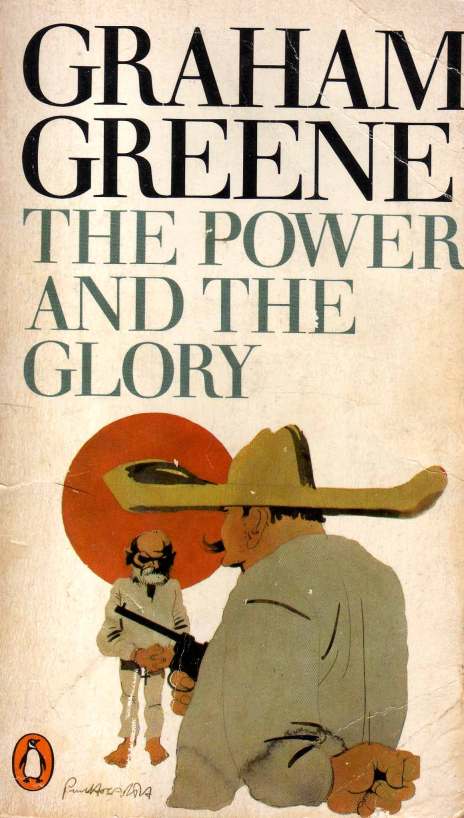
I Review Def Jam 25, the Overstuffed Illustrated Oral History of a Record Label that Helped Change American Culture

It’s hard to underestimate the influence that Def Jam Records brought to bear on contemporary culture. Not only did the label help to legitimize rap and hip hop as commercially viable (and artistic) art form, it also helped to redefine attitudes about fashion, culture, race, and even business. At its core, the early days of Def Jam were an energetic experiment in synthesis, combining the DIY spirit of punk rock with the nascent rhythms of hip hop, all twisted up in a graffiti writer’s aesthetic. Def Jam 25, a huge, overstuffed illustrated oral history of the label’s first quarter century, details the fascinating beginnings, successes—and many, many troubles—of the strange child of Rick Rubin and Russell Simmons.

Rick Rubin Hard at Work

Def Jam 25 focuses its initial energy on Rick Rubin, who comes across as the dark, eccentric spirit whose aesthetic and temperament would come to define the label’s early successes. Rubin started the label out of his NYU dorm to release a single by his artcore band Hose. Rubin was soon introduced to Simmons (by Vincent Gallo, of all people), and the duo would go on to produce and release huge hits from the Beastie Boys, L.L. Cool J, Run DMC, and a host of others.

Early Flyers

Def Jam 25 combines photographs and essays with shorter eyewitness commentaries from the artists, designers, musicians, producers, and business guys who helped define Def Jam. The effect is intriguing, often insightful, occasionally funny, and especially fascinating when folks share very different accounts of how things went down. The early years of the label are documented with an energy that matches the verve of Def Jam’s pioneering work in the ’80s, and if I dwell on the first thirds, it’s only because there’s something so electrifying about those early years, when Slayer and Public Enemy were labelmates and Aerosmith and Run DMC could craft a top ten hit together.

From the "Walk This Way" Sessions

Def Jam’s success continued unabated after Rubin’s departure in 1988, and it’s hard to argue that a label putting out records by EPMD, Nas, De La Soul, Public Enemy, and the Roots was somehow less artistic and more commercial after that point. Still, Rubin’s strange punk rock energy was clearly irreplaceable, and while it remains part of the Def Jam template to this day, it’s hard to get as psyched about Rihanna and Ja Rule as it is about Slick Rick or even Onyx. But that has little to do with the actual book I suppose, which is lovingly crafted and impeccably designed.

Def Jam 25 is a great big coffee table book for people who actually like to read (and for your guests who don’t like to read, the book explodes with vivid imagery). The book reveals (and reflects) Def Jam Records as a marvelous synthesis of art, design, fashion, and business, a label that was (and is) dramatically unstable and also wildly innovative. The book will appeal to fans of music and culture alike. Def Jam 25 is new in hardback from Rizzoli.

Rubin and Simmons, 2009

The Obligatory Best of 2011 List(s)

Best Books I Read in 2011 That Were Published in 2011 (Or Close Enough to 2011)

MetaMaus, Art Spiegelman

The Avian Gospels, Adam Novy

Spurious, Lars Iyer

The Third Reich, Roberto Bolaño

Humiliation, Wayne Koestenbaum

The Pale King, David Foster Wallace

Between Parentheses, Roberto Bolaño

***

Best Books I Read in 2011 That Were Published Before 2011

The Elementary Particles, Michel Houellebecq

Wittgenstein’s Mistress, David Markson

Expelled from Eden: A William Vollmann Reader

Ray, Barry Hannah

Trans-Atlantyk, Witold Gombrowicz

The Garden of Eden, Ernest Hemingway

Light in August, William Faulkner

Hadji Murad, Leo Tolstoy

First Love and Other Sorrows, Harold Brodkey

Airships, Barry Hannah

Speedboat, Renata Adler

Under the Volcano, Malcolm Lowry

Vertigo, W.G. Sebald

***

Best Rereading

Candide, Voltaire

***

Best Audiobook of 2011

The Collected Fictions of Gordon Lish, read by Gordon Lish

***

Best Film of 2011

The Tree of Life

***

Most Charming Film of 2011

Midnight in Paris

***

Most Overhyped Book of 2011

The Art of Fielding, Chad Harbach

***

Best Book Cover of 2011 

***

Best Book Series Design

Melville House’s Neversink Imprint


***

Weirdest (Yet Nevertheless Moving) Novel of 2011

How to Keep Your Volkswagen Alive, Chris Boucher

***

Book I Read in 2011 That Still Confounds and Haunts Me

The Kindly Ones, Jonathan Littell

***

Saddest Book I Read in 2011

Tie: Under the Volcano, Malcolm Lowry; The Stories of Breece D’J Pancake, Breece D’J Pancake

***

Best Essay (Print)

“Some Notes on Translation and on Madame Bovary,” Lydia Davis (The Paris Review)

***

Best Essay (Online)

“Nude in Your Hot Tub, Facing the Abyss (A Literary Manifesto After the End of Literature and Manifestos),”  Lars Iyer (White Review)

***

Worst Literary Trend of 2011

Tie: Lame “literary fiction” novels; Articles that link everything to David Foster Wallace

***

Best Literary Trend of 2011

Plagiarism!

***

Most Obvious Disclaimer

I did not read or see or hear every book or essay or audiobook or film or TV show or record or video that came out in 2011. Also, there are some days left in the year. These are all, just like, opinions man.

I Review The Avian Gospels, Adam Novy’s Dystopian Novel About Family, Torture, Rebellion, and Birds

20111127-205427.jpg

Adam Novy’s novel The Avian Gospels synthesizes dystopian themes with magical realism to tell the story of an unnamed city, in an unnamed time, afflicted by plagues of birds and bands of Gypsies. The novel is marvelous, surreal and very strange, disorienting in its tones and unnerving in its subjects; it’s at once a confounding allegory of torture, suppression, and rebellion, and at the same time a study in intrafamily relationships.

There are two families at the heart of The Avian Gospels. The aristocratic Giggs are led by the Judge, a ruthless patriarch who is both inheritor and perpetrator of endless war. Judge Giggs controls the city through fear, torture, and his fascist personal guard, the RedBlacks. While Judge Giggs seems to hold illimitable power in the city, it isn’t enough to retain the love or even respect of his family. His wife veers into a manic depressive breakdown, brought on in large part by the death of her elder son, who was killed during the last (foolish) war. His second son, Mike, is a loutish ne’er-do-well, a bully who fails to win his father’s approval. The Judge’s daughter Katherine is the apple of his eye, but as she matures in her adolescence, she begins to perceive the violent disconnect between her privileged life and the suppression and poverty forced on the city’s Gypsy population.

The other family (perhaps more of a duo, really) comprises Zvominir, an immigrant claiming to hail from Sweden, and his son Morgan, a petulant teen of an age with Katherine. Routinely beaten bloody by Mike Giggs and his RedBlack goons, Morgan develops a visceral hatred of the Judge’s regime, one that leads the lad to repeatedly (and rashly) lash out against the violent injustice he perceives around him. Zvominir and Morgan live in sad, motherless squalor, separated not only from the suburban greenzoned upper-class, but also from the Gypsies; Zvominir, who leads most of his life genuflecting to or cowering from power, will not even allow his son the joy of partaking in the Gypsies vibrant customs (like rowdy ska music and barbecues).

Most of all, Zvominir tries to contain his son’s bizarre power, a power that he shares with the boy: they can telepathically control the birds. This gift becomes both blessing and curse as the city is overrun by flocks of birds that block out the sun and make roads unnavigable. Zvominir, always kowtowing to power, agrees to employ his gift to “sweep” the city (particularly the area where the rich folks live) of the bird hordes; Morgan agrees to help, but only under the condition that he be allowed to show off his talent in the public square, where eager crowds (of Gypsies and suburbanites alike) gather to marvel at the spectacle of his “birdshows.” In time, Morgan begins writing dissent into his performances:

Birdshows were generally narrative, and featured a bird-made Morgan being chased through the streets by a soldier who was torn to bits by swans, though the swans were made of pigeons, and the soldier of flesh-colored plovers, his uniform of cardinals and crows. Swans would also be pursued through ghetto canyons by flying tigers made of orioles. These were his intentions for the birdshows, at any rate, but Zvominir would censor when the images betrayed but a hint of dangerous content, obscuring Morgan’s work with birdclouds, or worse, laughing babies made of birds. The audience found these touches psychedelic, and weren’t pacified so much as confused, so their passion turned to mumbles. The elder’s power over birds was superior, and Morgan couldn’t stop his father from suppressing the transgressive. It infuriated him.

Falling Bough -- Walton Ford

Zvominir isn’t the only authority figure prone to parental censorship; as the poor old man tries to keep his son safe by “suppressing the transgressive,” the Judge in turn does all in his power to keep his precious daughter Katherine blind and ignorant to the violence and inequality that has purchased her material comfort. However, Katherine meets and becomes fascinated by Morgan, just as the young man’s rebellious attitude comes to find definition and ideology thanks to the Gypsy rebel Jane. Jane harnesses Morgan’s raw anger, turning him into the figurehead of a Gypsy resistance against the Judge’s terrible regime. She literally ushers him into the Gypsy underworld, a surreal setting of nightplants and black markets and ecstatic ska music and donkeys, sprawling in a labyrinthine network of caves and caverns and tunnels under the unnamed city. From this subterranean site, Jane becomes mastermind of a terrorist plot to overthrow the fascist Judge:

They—we—were helpless, and we knew it. She would do to us what Hungary had done, but with stealth; this terror stuff is easy, she mused. Who needs armies? She was poor, and lived in sewers, so nothing could be taken but her life, while we had homes, jobs, children, hopes, dreams and possessions we adored, which all gave meaning to our lives. There was no end to that of which she could deprive us. Our privilege made us vulnerable.

Now seems as reasonable a time as any to remark upon the narrator of The Avian Gospels, as its pronouns color much of the passage I just cited. A first-person plural “we” tells the story, a “we” whose contours and guts alike become more evident as the book unfolds. Much of the joy (and bewilderment and occasional frustration) I felt reading The Avian Gospels came from puzzling out just who this “we” is. As the book progresses, it becomes clear that, like the collective first plural person who narrates, say, William Faulkner’s “A Rose for Emily,” the narrator is part and parcel of the storyis the story, perhaps—and that Novy’s dystopian vision is realized not just in the book’s content, but also in the telling of that content. Calling the narrator unreliable is beside the point; the narrator is the ideology itself that Novy critiques. Rebel Jane provides a very real ideological anesthesia to the narrator’s methods, the Judge’s power, and Morgan’s artistic ambitions:

. . . Jane felt suspicious of beauty, which trafficked in desire, not in justice, and left you lonelier and sadder. It made you feel worse in the guise of feeling better, and left you hungry for more beauty. Further. It enfeebled you politically, by pointing at some hypothetical catharsis, a transcendence that could not be achieved, for who could really say they had communed with a non-religious paradise of aesthetics? The beauty effect: a crescendo of nothing. Beauty distracted from things that were important—the rights of disadvantaged people—in the name of something it claimed was more important, and which didn’t actually exist. It was a cognitive conspiracy, a con that disempowered.

If Jane seems a bit shrewish—and what zealot isn’t?—it’s worth pointing out that her ideas might be the novel’s thesis, a thesis ironically couched in the very beauty that Jane would make us wary of. She’s the cold conscience in a book filled with passions. And she’s a terrorist.

While The Avian Gospels surpasses any allegorical schema we might try to impose upon it, it’s still very much a response to America’s post-9/11 zeitgeist. Novy’s Judge is a figure of malevolence glossed in benevolence. If he’s a sicko who takes dull delight in torturing Gypsies in his Boom Boom Room, he’s also a family man with problems that most of us can relate to. He’s an authoritarian who maintains order in a fractured society through violence and suppression—but he delivers what the suburban greenzoners want from a leader. So what if security comes at the expense of justice, and on the backs of a displaced population to boot?

The Gypsies, refugees from countless wars afflicting the world of The Avian Gospels, aren’t the only displaced persons in the narrative. Novy displaces the readers as well. The Avian Gospels erupts with uncanny moments where the material of our recognizable world overlaps with the crumbled reality of the narrative. Social structures, attitudes, cultural norms and ideals—these remain, more or less. But how to puzzle out a world where China, Bolivia, Angloa, and Oklahoma are among the nations that surround the unnamed city? Or where technology has regressed to the point that the automobile is a thing of the past? (Guns remain). And, uh, the birds, of course.

Novy’s dystopian novel skews more fantasy (or, more properly, magical realism) than sci-fi, but it’s the novel’s strange, shifting tones that most likely will paradoxically estrange and engage most readers. There’s a violent zaniness to The Avian Gospels, but the zaniness is never tinted with even a hint of whimsy. The first-person plural “we” that narrates the text juxtaposes dense, poetic images against the teenspeak of the street. At times, the narrator staggers into a mordant lament, only to retreat into cruel, blackly ironic prose. The effect is disorienting and compelling. Novy’s writing moves rhythmically with a complex energy that I’m faltering to describe. You should probably just read the book.

I’ve neglected thus far to comment on the actual physical books that comprise The Avian Gospels. They are beautiful, compact, oxblood volumes with gilded edges and bookmarks, reminiscent of Gideon bibles, I suppose, but more lovely. They’re also very small, the sort of thing that fits easily into a pocket or a purse. I love books like that.

The Avian Gospels deserves a place on the shelf (or in the pocket) of any fan of cult or dystopian novels. It’s a story about cyclical violence, power and powerlessness, and political and cultural repression. It’s also a story about family and parent-child relationships and what it means to love another person in the face of radical danger, a novel that foregrounds the very real stakes of rebellion, both Oedipal and political. It’s a strange book, one that offers little comfort to its readers and certainly proffers no simple answers. Deeply moving and highly original, I strongly recommend this book.

The Avian Gospels is available now from Hobart. Read my interview with Adam Novy.

Irrepressible: The Life and Times of Jessica Mitford — Leslie Brody

Irrepressible, Leslie Brody’s new biography of Jessica Mitford, is a fascinating study in divergent attitudes about class, politics, and what it might mean to dissent from one’s own family. Jessica Mitford — “Decca” to her friends — was born into English aristocracy, which she promptly tried to escape. Brody offers a succinct outline in the opening pages (“Little D.” is young Decca, of course)—
What was Little D. running away from? The usual: parental rules and regulations, hothouse sibling rivalries, boredom; the more arcane: country estates, nannies, governesses, secret cupboards, and secret languages: conservatism and elitism in her relations; and fascism, in the body politic. Where was she running to? At first, she longed to go to school and, later, to the East End of London to live in a bedsit and be a Communist. To readers of the British press, the Mitfords were the subject of gossip and scrutiny for the fashions they wore and the odd things they did. Anyone not related to her seemed infinitely more fascinating to Decca.

For Decca, experiences with “Anyone not related to her” became her form of school, which her mother forbade her to attend (although, to be fair, brother Tom did hip her to a crash course of Western canonical lit). As the passage above suggests, the trajectory of Decca’s life would be defined and drawn against the conservative values of her family. In an especially instructive scene near the end of her teen years, Decca and her sister “Unity etched symbols of their political affiliations into the window of the room they shared at the top of the house—Unity drew a swastika; Decca a hammer and sickle.” What did these kids use to draw their sigils? A diamond ring.

Brody (thankfully) doesn’t dwell on the psychological motivations that might have led Decca to a life and ideology so dramatically diametrically opposed to her aristocratic, fascist-leaning family, perhaps in part because Decca’s progressive convictions seem, in retrospect, so clearly to have come down on the “right side of history.” As Brody’s biography reveals, however, Decca was not simply some rich kid slumming for a few years; indeed, we find in Jessica Mitford a soul clearly committed to the ideals of equality and democracy throughout her entire life.

And what a strange, wonderful, and often tragic life it was. In a sharp, reportorial style (one that frequently employs primary sources), Brody relates Decca’s tumultuous life, beginning with her early, scandalous marriage with a cousin, Esmond Romilly, their involvement in the Spanish Civil War, and his death in WWII. Soon after Esmond’s death, Decca married Bob Treuhaft, an American civil rights lawyer. The pair moved to Oakland and had children, although Decca doesn’t seem to have been much of a mother (her heavy drinking might have gotten in the way when political obligations like testifying before HUAC didn’t). The bulk of Brody’s narrative covers Decca’s intense involvement in the Civil Rights movement, from its earliest inception right through the Vietnam era and beyond. Decca wrote articles, facilitated meetings, and generally served as a nexus point for creative and political energies devoted to free, progressive thought. Decca went on to author books investigating the funeral home practices, the Vietnam War draft, and the American prison system, but it is likely that her memoirs will be of the greatest interest to readers today.

Brody’s biography seems more relevant than ever as the Occupy movement (particularly in Decca’s adopted Oakland) sheds greater light on the disparity between the rich and poor in America and calls into question the very ground that pioneers like Jessica Mitford fought for. At the same time, Brody’s book is never didactic, nor is it overtly and unnecessarily juicy (which surely must have been a great temptation, considering that Decca’s entire life was something of a scandal). Instead, Brody offers us a tightly drawn, well-researched portrait that is sure to fascinate.

Irrepressible is available in hardback from Counterpoint Press.

Mister Wonderful — Daniel Clowes

There’s an unexpected sweetness to Mister Wonderful, the latest work from Daniel Clowes (new in hardback from Pantheon). Sure, we’re still deep in Clowes territory here, with misanthropic protagonist Marshall offering up acerbic observations on wealthy yuppies, phony poseurs, and jerks on cell phones—all shot through a lens of self-loathing—but Mister Wonderful (subtitled A Love Story) is optimistic, a study in possibility that never tips over the sheer cliff of despair on the other side of romanticism. With its sense of balance, both emotional and narrative, Mister Wonderful is in some way the “good twin” to last year’s Wilson, a work that pointed to the illusory nature of growth and the futility of human connection.

Where Wilson measured the life of its eponymous protagonist over decades (and in extreme hyperbole) as he sought to regain contact with his estranged family, Mister Wonderful  covers just a few hours in the life of Marshall, a sad man set up on a blind date with nutty Natalie, a woman he immediately pegs as way out of his league. Marshall quickly romanticizes the possibility of a life with Natalie, struggling to keep his composure throughout their coffee and dinner date.

Natalie curtails the date to go to a party with old friends, but a surprise (violent) encounter allows Marshall a sliver of heroism—and a chance for more time with Natalie. They head to the party together, only to run into Natalie’s ex-boyfriend, giving Clowes plenty of oomph for a strong third act.

There’s a cinematic scope to Mister Wonderful. The book is 11″ x 6″, and Clowes makes excellent use of his Sunday’s comic page dimensions, exhibiting a level of detail and precision that imbue in Mister Wonderful an air of realism (one that contrasts the cartoony elements of evil twin Wilson). Clowes’s artistic powers are refined, balanced, and agile; he displays a command of color and shape that help define the strange emotional contours of Mister Wonderful, a book about second chances and those rare moments our interior lives might sync unexpectedly with the concrete possibilities life affords us.

Mister Wonderful is funny and balanced, but it’s not for everyone, including some longtime Clowes fans who might quibble with the book’s apparent slightness. Mister Wonderful clocks in at 80 pages, and while some readers may feel shortchanged, perhaps they are overlooking the scope of the work. Clowes is at the height of his powers here, deftly controlling a spare story about  midlife tumult. There’s maturity and depth in this graphic novella. “Novella” isn’t the right term—Mister Wonderful is closer to a long short story, expertly told. Clowes still exhibits some of the sharp, mean edges that marked his earlier work, but the points are more finely honed, more subtle and precise. Some of the erratic weirdness we find in Clowes’s early stuff isn’t on display here, but this is more on account of Clowes’s stronger command of his medium’s formal elements. The bizarre, cynical spirit remains, however. Thankfully, Clowes makes no attempt to redeem his weirdos, nor does he push them into an unearned, false conclusion. Instead, Mr. Wonderful presents their problems and hang-ups and shortcomings as very real, even as it suggests a tint of unironic optimism. Recommended.

The Third Reich: Part III — Roberto Bolaño

As a means of plot summary, here’s an excerpt from my review of the second part of Roberto Bolaño’s novel The Third Reich (serialized this year by The Paris Review and forthcoming in hardback from FSG (uh, the Bolaño’s book, not my review, of course))—

If 2666 impossibly haunts The Third Reich from the future, then paranoid Poe haunts it from the past. Last time we checked in, Udo Berger and his beautiful girlfriend Ingeborg had made tentative friends with another German couple while spending the summer at a seaside resort in Spain. Through this pair, they meet up with two nefarious locals, the Wolf and the Lamb; Udo also begins obsessing over a man named El Quemado, a burn victim who rents paddle boats to tourists. For Udo, the holiday is meant to be a working vacation—he’s a wargame enthusiast, and he plans to write a defining strategy for a new game called “The Third Reich” (implicitly, he plays the Nazi’s side). In the meantime, he’s also taken with the hotel’s owner, Frau Else, a German transplant who mysteriously disappears to take care of an ill husband who no one seems to see.

The third installment of The Third Reich amplifies Udo’s paranoia and isolation. He spends most of his time playing Third Reich with El Quemado, and although he assures his best friend Conrad, via telephone, that he’s beating the burned man, we see his control (and sanity) slipping away. Udo seems unconcerned that Conrad has been comforting Ingeborg, probably because Udo is still trying to bed Frau Else, who has mysteriously disappeared in this third chapter. When he’s not busy sleeping nightmarish sleep or lurking around the hotel at night, Udo picks fights with the night-watchman; clearly, he’s outlasted his welcome in this tourist town.

This section of The Third Reich is shorter than the first two, and although I’ve enjoyed reading the novel in pieces, it’s with this section that the strain of serialization begins to show. Bolaño’s slow-burn Lynchian dread is clearly climaxing here, and it’s unsatisfying to have that suspense interrupted. It’s also unclear how The Third Reich will resolve, or if it will resolve—Bolaño isn’t exactly one to neatly tie up loose ends—but I’m hoping that we’ll get to learn more about El Quemado’s strange motivations, and get another glimpse of Frau Else’s husband. We’ll see soon—the winter issue is out soon with the final installment.

Italo Calvino on Charles Dickens

Italo Calvino on Charles Dickens’s last novel Our Mutual Friend. Essay from Why Read the Classics?:

The Thames at nightfall, dark and muddy, with the tide rising up the piers of the bridges: against this backdrop, which this year’s news stories have brought to our attention in the most lugubrious light, a boat approaches, almost touching the floating logs, barges and rubbish. At its prow stands a man staring with vulture-like eyes at the current as though looking for something; at the oars, half-hidden by the hood of her cheap cloak, is a girl with an angelic face. What are they looking for? We soon learn that the man recovers the corpses of suicides or murder victims who have been flung into the river: the waters of the Thames seem to contain every day a rich catch for this particular fisherman. As soon as he sees a corpse floating on the water’s surface, the man removes the gold coins from his pockets, and then drags him with a rope to a riverside police station, where he will receive a reward. The angelic girl, the daughter of the boatman, tries not to look at this macabre booty: she is terrified, but continues to row.

The openings of Dickens’ novels are often memorable, but none is better than the first chapter of Our Mutual Friend, the second last novel he wrote, and the last one he completed. Carried along on the corpse-fisher’s boat, we seem to enter the dark side of the world.

In the second chapter everything changes. We are now surrounded by characters out of a comedy of manners, attending a dinner-party at the house of parvenus where everyone pretends to be old friends but in fact they barely know each other. However, before the chapter ends the guests’ conversation suddenly turns to the mystery of a man who drowned just as he was about to inherit a vast fortune, and this takes us back to the suspense of the opening chapter.

Continue reading “Italo Calvino on Charles Dickens”