You remember Harmony Korine, right? The scruffy auteur who gave us the nightmare white trash tornado-disaster cat-killing opus Gummo? The curb-dancing maniac who never got around to putting out that movie where he provoked strangers to beat him up? The guy who broke the Dogme 95 rules on Julien Donkey-Boy, a film featuring a pregnant Chloe Sevigny ice skating to Oval? The guy who stitched Trash Humpers together using VHS decks? The guy who wrote Kids? That guy?
So he has this new movie coming out called Spring Breakers. He wrote and directed the film. It stars James Franco, along with Disney alumni Vanessa Hudgens and Selena Gomez.
Here is the NSFW trailer for Spring Breakers:
I am baffled.
I do not know what to make of this.
Sure, there’s something of Kids in there, but the lurid, saturated cinematography by Benoît Debie (who has worked with Gaspar Noé in the past) has this nauseating MTV/Hype Williams feel to it that seems miles away from Larry Clark’s plain, unadorned style, or Korine’s own patchy VHS buzz.
The film also seems to be a fairly straightforward, character-oriented plot, likely with clear exposition, an arc—all that stuff that Korine was known to dismiss in the past. Now, I’m not saying that Korine should just keep making the same films again and again (not that he’s ever done that, to be clear)—I’m just surprised by the look and feel of Spring Breakers, and how it seems to be marketed.
My gut feeling, which might be entirely wrong, is that Spring Breakers is an expensive prank, a film shot entirely in ironic quotation marks that the viewer will never see because Korine will never call attention to them. (This potentially puts Spring Breakers in the same territory as masterpieces like Road House and RoboCop).
Lead actor James Franco, who is currently pursuing seven PhDs in irony studies and metawhatevers, would seem an ideal fit for such a prank. Additionally, Franco’s begrilled performance as Alien is clearly channeling wunderkind RiFF RaFF, (Mr. RaFF even has a song called “RAP GAME JAMES FRANCO” which contains the genius hook “Non-stop through desert / Salisbury steak sweater”). RiFF RaFF’s shtick is even more bewildering than Spring Breakers; it’s difficult to tell if he’s some kind of art genius doing the Andy Kaufman thing or just a white kid from Houston with a bizarre sense of humor. Or both. Or neither. Either way, there’s something endearingly intriguing about him, whether you’re watching him infiltrate an art show in Miami or claim that his underwear is “moccasins.”
But back to Spring Breakers—it looks awful—but so did the previews for Wild Things, so, you know. And, again, the marketing isn’t the film. Still, it’s hard to get excited about this one.
“Ye Legend of Sir Stupid and the Purple Knight” was published in Thomas Pynchon’s high school newspaper; he was 16 at the time. (Via).
“Ye Legend of Sir Stupid and the Purple Knight”
“Ridiculous!” roared King Arthur, slamming his beer mug on the Round Table. “Purple, you say?”
“All purple, my liege,” said Sir Launcelot, nervously wiping the foam from his face, “head to toes. Completely.”
“I say! Most irregular. Well, what does he want?”
“He wants audience with you, my liege. It seems he’s done ole Cholmondesley in.”
“Cholmondesley?”
“With an axe, your grace. A purple axe. He says he’ll do the same to us all if we don’t send a challenger to fight him in fair battle.”“Well?”
“Well, he— he’s— twenty feet tall.”
“Twenty! Oh, I say! Ghastly business! Who’ve we got crazy enough to fight him? How about you, Launcelot?”
“Oh, no, my liege. Cut my finger last night peeling potatoes. The pain is beastly.”
“Rotten luck, old chap. Well,” he addressed the knights of the round table, “there’s a big purple idiot outside who’s looking for a fight. Who’s game?”
Then up spake Sir Bushwack, a sturdy youth with a broad beam and a low center of gravity: “Where is the bloke? I’m not afraid, even if he is twenty feet taII!” Sir Bushwack had been drinking.
Then spake King Arthur to Sir Launcelot, telling him to bid the knight enter. And Launcelot did this, and the horns sounded, and in staggered a tremendous giant, perhaps four feet in height, dragging behind him a ten-foot purple axe. He had a vast quantity of purple hair which fell down over his eyes, and was clad in purple armor, and his feet in purple sneakers. He led a noble steed, also purple, which resembled a cross between a Shetland pony and an armadillo.
King Arthur whispered to Launcelot, “I thought you said he was twenty feet tall.”“That’s what he told me, your majesty.”
“That’s what he what? Why you …”
The rest of King Arthur’s tirade was drowned out by the purple giant, who was bellowing in a mighty voice:
“Okay, I can beat any man in the house! I ain’t scared of nobody ‘cause you’re all … “ he hiccoughed “ … chicken to fight me! Come on, who’s first?”
Up spake Sir Bushwack, shouting, “I challenge thee, Sir Knight!” The purple knight laughed. “Look what’sh challenging me! You slob, I can,—hic—can lick you with, — hic— one hand tied behind my back! Come ahead!” Then did the purple knight pick up the purple axe and begin to whirl it about his head, faster and faster. Sir Bushwack waddled up dubiously with sword in hand, feebly attempted to parry, then quickly retreated. The purple knight stood and laughed.
“Chicken, all of you! Scared to fight me! Har! Har!”
Suddenly, the horns sounded and into the hall rushed a very brave and manly knight, Sir Stupid.
“I say!” he shouted to all and sundry, “Old Fotheringay’s run amok! He and his horse fell into that newly-pressed grape juice up at the distillery, and …”.
Then he caught sight of the purple knight and stopped short. King Arthur started to laugh hysterically, spilling beer hither and yon.
“I say, old Fotheringay’s gone and fallen into the wine vat! Old Fotheringayl Haw, Haw, Haw! Old Fotheringay’s got high on grape juice! Haw! In the still of the knight!”
Old Fotheringay stood digesting this in silence. Then slowly he began to chuckle and whirl that axe.
“Oh, oh,” Sir Stupid whispered to Arthur, “here he goes!” With a savage yell, Old Fotheringay charged the Round Table, swinging his axe. In an instant, the hall became the scene of a free-for-all. The purple knight was in the thick of the whole mess, smashing furniture, beer kegs, and anything else that happened to be in his way. The hall resounded with the clanging of swords, the splintering of wood, and the demonaical chuckling of the purple knight. In the midst of the noise and confusion, Sir Stupid buttonholed Bushwack.
“Noble knight,” he said, “art thou truly dedicated to thy leige?”
“Yes.”
“And wouldst thou suffer discomfort to rid thy liege of this menace?”
“Surely,” Sir Bushwack said absently, as he ducked a flying beer mug.
“That’s all I wanted to know! Fotheringay! You feeble-minded halfwit cretin! Over here!”
Infuriated, the purple knight whirled toward Sir Stupid and raised his axe. Sir Stupid lifted the protesting Bushwack and hurled him bodily at Fotheringay. There was a loud, splintering smash as the purple knight went down, and then all was silent, except for the gurgling of beer from a shattered keg. Sir Stupid stood over the horizontal Fotheringay.
“Now, thou proud knight,” roared Sir Stupid triumphantly, “now what hast thou to say?”
Slowly, the purple knight looked up and sneered. “CHICKEN,” he said.
2. Every time I read Moby-Dick it seems funnier and sadder. Richer. Thicker.
3. I cobbled together my reading over different media and spaces: I listened to William Hootkins‘ outstanding unabridged audiobook version, and then reread on my Kindle key passages I’d mentally underlined; I then checked those passages against the copy of Moby-Dick I annotated the hell out of in grad school.
4. I posted some of my favorite excerpts of Moby-Dick here on Biblioklept because I knew that I wouldn’t be able to write about the book—not really—that I wouldn’t be able to handle all of its language. (My riff on Olson’s book obsesses over Olson’s ability to write after Melville and Melville’s ability to write after Shakespeare).
5. Really, in posting so many fragments of Moby-Dick, I suppose that I’ve attempted to abrogate any kind of critical duty to describe the book under discussion in terms of its own language.
6. Point 5 is really a way of saying: Moby-Dick, like any sublime work of literature, is a self-defining, self-describing, and even self-deconstructing text.
7. Or, another way of making such a claim:
Let me (mis)appropriate Samuel Beckett’s description of Finnegans Wake and contend that the description fits Moby-Dick just as aptly:
Here form is content, content is form. You complain that this stuff is not written in English. It is not written at all. It is not to be read – or rather it is not only to be read. It is to be looked at and listened to. His writing is not about something, it is that something itself.
8. So here circumnavigate back to my own recent reading and auditing of the book:
Hootkins’ audio recording would make a great starting point for anyone (unnecessarily) daunted by Melville’s big book. He performs the book, commanding his audience’s attention. He unpacks the humor that might otherwise hide from untuned 21st century ears; he communicates the book’s deep, profound sorrow. His Ishmael is perceptive, clever, generous. His Stubb, hilarious. His Ahab a strange philosophical terror.
After listening to Hootkins on my commute, I’d return to key passages on my Kindle, and then finally review the notes I wrote in the cheap hardback Signet edition I read in grad school.
But why bring this up?
9. I don’t know.
Maybe: Unpacking Moby-Dick is too hard, too much—would require its own book, a book that would cite the entirety of Melville’s book.
But discussing the book this way seems a disservice to potential readers; it’s as if we would cloak the book in a mystic veil.
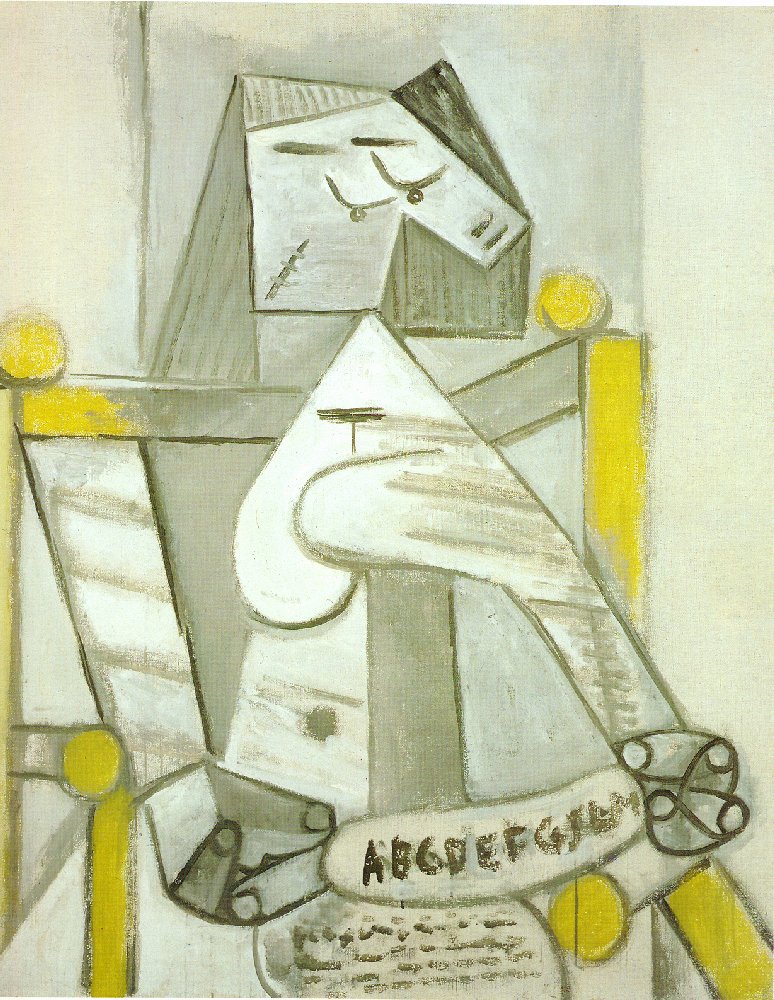
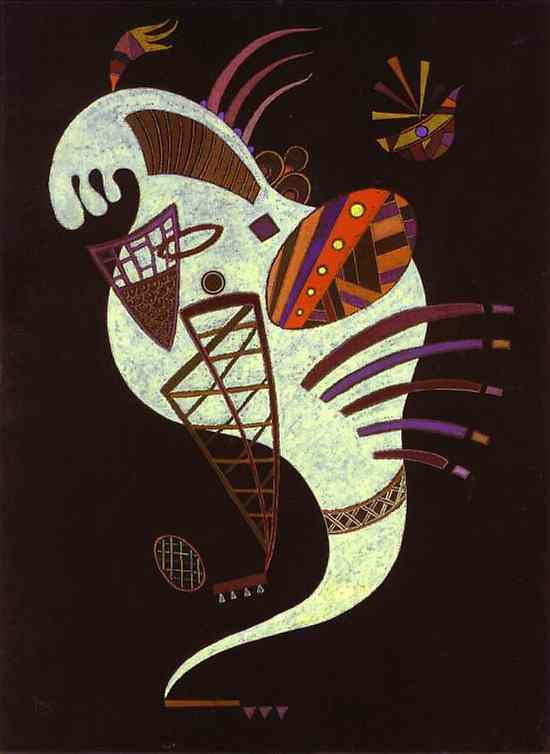
White Figure, Wassily Kandinsky
10. If I have a point to all of this: Moby-Dick is wonderful, funny, moving, engaging; a genre-bender that tackles philosophy, history, science; an adventure tale; a psychological novel brimming with ideas, allusions—but one delivered in sonorous, poetic language. It’s good, great, grand. Read it, if you haven’t. Reread it.
11. So I’ve failed to even try to begin to attempt to pretend to describe the plot.
Here: Ishmael, depressed, suicidal perhaps, decides to go to sea. To go whaling.
He tries to measure the whale, and by measuring the whale, maybe measure the world. But this is not really possible, certainly not in language. Certainly not in first-person perspective.
In Chapter 86, “The Tail,” Ishmael tells us:
The more I consider this mighty tail, the more do I deplore my inability to express it. At times there are gestures in it, which, though they would well grace the hand of man, remain wholly inexplicable. … Dissect him how I may, then, I but go skin deep. I know him not, and never will. But if I know not even the tail of this whale, how understand his head? much more, how comprehend his face, when face he has none? Thou shalt see my back parts, my tail, he seems to say, but my face shall not be seen. But I cannot completely make out his back parts; and hint what he will about his face, I say again he has no face.
(I don’t suppose I need to remark that Melville here lets one mighty tail stand in for another mighty tale—a tale he cannot face).
12. “Call me Ishmael”: our protagonist hails us.
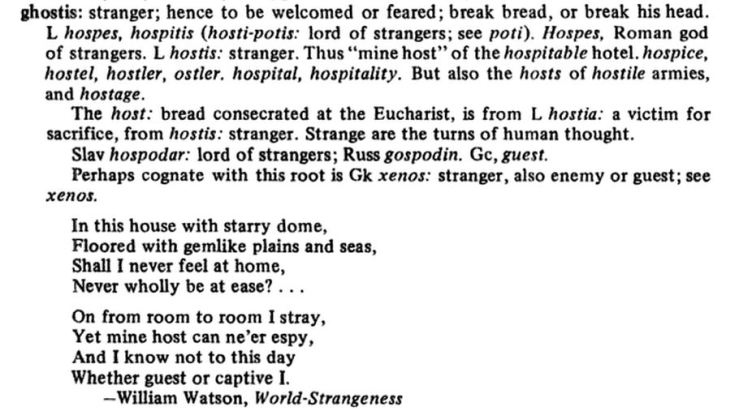
But these famous opening lines aren’t really the beginning of the book. First we have the section titled “Extracts,” and before that “Etymology.” The first entry on the etymology of the whale, from Hackluyt, warns us not to leave out “the letter H, which almost alone maketh up the signification of the word.”
Whaling. Hailing. Wailing.
The whiteness of the whale.
The witness of the wail.
13. How, just how, does Ishmael witness? How does he manage to tell this story? Did I obsess over this in earlier readings? I don’t think so—I was too concerned with absorbing the what and the why of the story to closely attend the how of its telling.
14. The novel begins in standard first-person point-of-view territory, Ishmael guiding us through Manhattan, New Bedford, Nantucket—but by the time he’s boarded the Pequod and set out into the wide watery world, this first-person perspective transcends the limits of physics: Our narrator not only attends the private conversations of Ahab, his mates, his harpooners, his men—but also the very interior of those men, their minds, their dreams, their imaginations.
Is Ishmael a ghost?
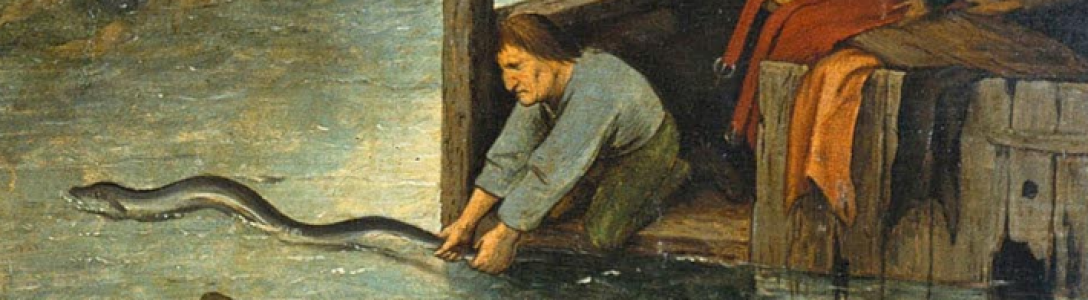
Leviathan-Job 40-21, Salvador Dali
15. And to return to Ahab for a moment: My god, what a voice! His infecting, addicting insanity. His agon with Moby Dick, with the sun, with himself.
16. And Starbuck: Starbuck comes across weaker and weaker each time I read the book. We’re to believe he’s a man of convictions, but he moves in half-measures. In his final moments he tries to match or feign or approximate Ahab’s insanity: tragicomedy.
17. And Stubb: Despite his cruelties, he may be my favorite character in the book.
18. While I’m riffing: Is there a novel more phallic in the American canon than Moby-Dick? All that sperm: All that life-force.
19. This is maybe what Moby-Dick is about: Life-force. The attempt to to resurrect and die and resurrect again. The coffin that serves as life-buoy. The life-line that connects men that might also be their death. A counterpane to counter pain. A condensation of oppositions.
A yarn, a rope, a series of knots, layered, layering, self-contextualizing.
An attempt to put into language what cannot be put into language.
20. Twenty points: Maybe too long for the “short riff” promised in the title, but also surely too short to even begin to start to approach to pretend to say something adequate about the novel. So a parting thought: Moby-Dick is better—richer, fuller, deeper—each time I read it, and I look forward to reading it again.
Shotwell keeps the jacks and the rubber ball in his attaché case and will not allow me to play with them. He plays with them, alone, sitting on the floor near the console hour after hour, chanting “onesies, twosies, threesies, foursies” in a precise, well-modulated voice, not so loud as to be annoying, not so soft as to allow me to forget. I point out to Shotwell that two can derive more enjoyment from playing jacks than one, but he is not interested. I have asked repeatedly to be allowed to play by myself, but he simply shakes his head. “Why?” I ask. “They’re mine,” he says. And when he has finished, when he has sated himself, back they go into the attaché case.
It is unfair but there is nothing I can do about it. I am aching to get my hands on them.
Shotwell and I watch the console. Shotwell and I live under the ground and watch the console. If certain events take place upon the console, we are to insert our keys in the appropriate locks and turn our keys. Shotwell has a key and I have a key. If we turn our keys simultaneously the bird flies, certain switches are activated and the bird flies. But the bird never flies. In one hundred thirty-three days the bird has not flown. Meanwhile Shotwell and I watch each other. We each wear a .45 and if Shotwell behaves strangely I am supposed to shoot him. If I behave strangely Shotwell is supposed to shoot me. We watch the console and think about shooting each other and think about the bird. Shotwell’s behavior with the jacks is strange. Is it strange? I do not know. Perhaps he is merely a selfish bastard, perhaps his character is flawed, perhaps his childhood was twisted. I do not know.
Each of us wears a .45 and each of us is supposed to shoot the other if the other is behaving strangely. How strangely is strangely? I do not know. In addition to the .45 I have a .38 which Shotwell does not know about concealed in my attaché case, and Shotwell has a .25 caliber Beretta which I do not know about strapped to his right calf. Sometimes instead of watching the console I pointedly watch Shotwell’s .45, but this is simply a ruse, simply a maneuver, in reality I am watching his hand when it dangles in the vicinity of his right calf. If he decides I am behaving strangely he will shoot me not with the .45 but with the Beretta. Similarly Shotwell pretends to watch my .45 but he is really watching my hand resting idly atop my attaché case, my hand resting atop my attaché case, my hand. My hand resting idly atop my attaché case. Continue reading ““Game” — Donald Barthelme”→
The drama’s done. Why then here does any one step forth?—Because one did survive the wreck.
It so chanced, that after the Parsee’s disappearance, I was he whom the Fates ordained to take the place of Ahab’s bowsman, when that bowsman assumed the vacant post; the same, who, when on the last day the three men were tossed from out of the rocking boat, was dropped astern. So, floating on the margin of the ensuing scene, and in full sight of it, when the halfspent suction of the sunk ship reached me, I was then, but slowly, drawn towards the closing vortex. When I reached it, it had subsided to a creamy pool. Round and round, then, and ever contracting towards the button-like black bubble at the axis of that slowly wheeling circle, like another Ixion I did revolve. Till, gaining that vital centre, the black bubble upward burst; and now, liberated by reason of its cunning spring, and, owing to its great buoyancy, rising with great force, the coffin life-buoy shot lengthwise from the sea, fell over, and floated by my side. Buoyed up by that coffin, for almost one whole day and night, I floated on a soft and dirgelike main. The unharming sharks, they glided by as if with padlocks on their mouths; the savage sea-hawks sailed with sheathed beaks. On the second day, a sail drew near, nearer, and picked me up at last. It was the devious-cruising Rachel, that in her retracing search after her missing children, only found another orphan.
The untitled epilogue to Melville’s Moby-Dick, which I’ve always thought of by its epigraph from Job, “And I Only Am Escaped Alone to Tell Thee.”





 Biblioklept