It still believes in night | A review of Antoine Volodine’s post-exotic novel Mevlido’s Dreams

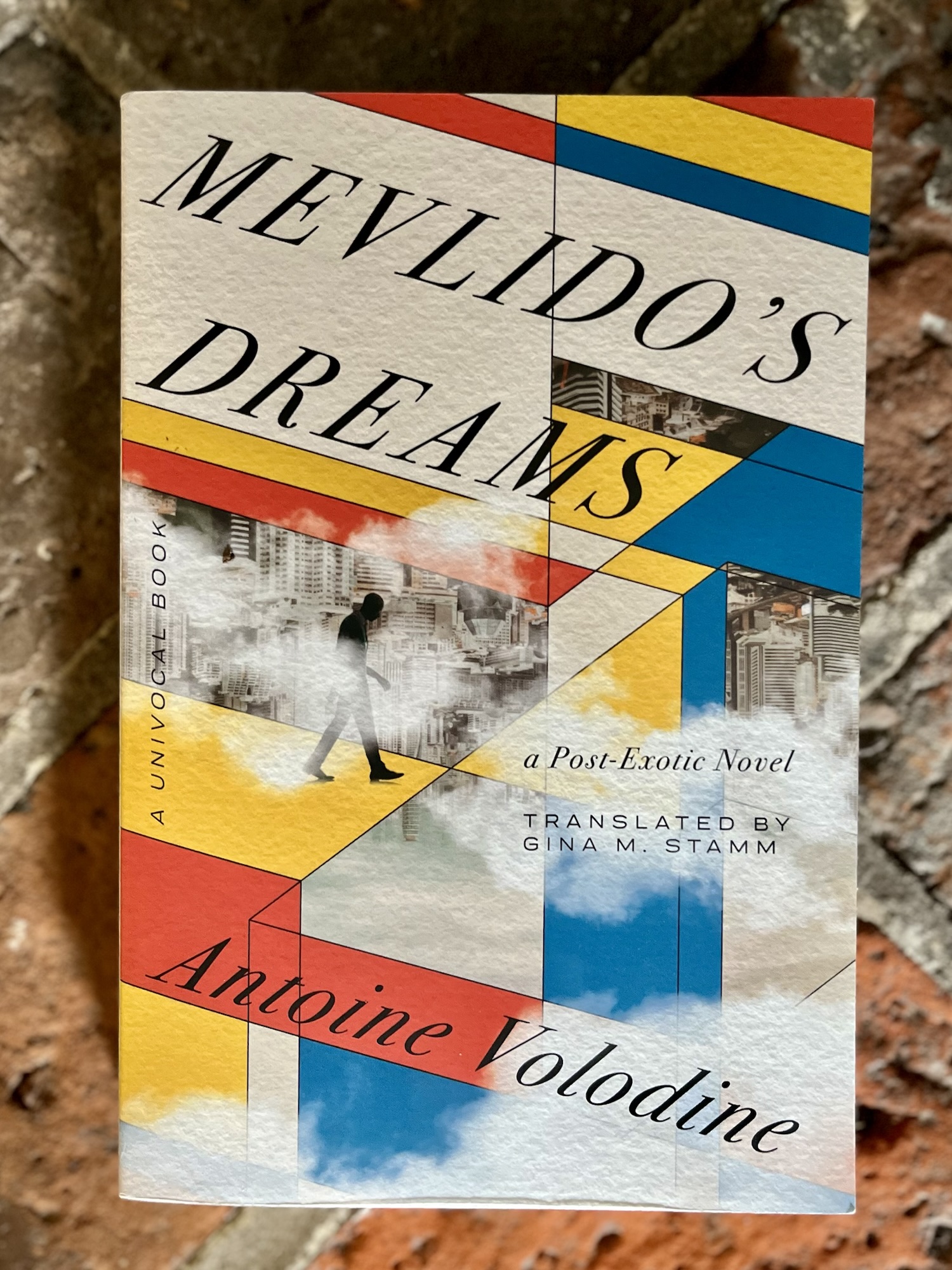
Antoine Volodine’s 2007 novel Mevlido’s Dreams is a bleak, dystopian noir novel set several centuries in the future in the ruined city-state of Oulang-Oulane. Here, weary revolutionary Mevlido lives in a decaying ghetto called Henhouse Four, an eerie quarter inhabited by indigents, junkies, and other remnants of failed uprisings who must contend with the giant mutated birds who terrorize the borough.

Once a soldier of the revolution, Mevlido now serves as a policeman, yet he may also be a double or even triple agent, a sleeper sent through time from a kind of liminal afterlife, a bardo between death and rebirth. The novel drifts between waking and dream states, war memories and spectral futures, as Mevlido’s fragmented consciousness becomes a vessel for Volodine’s haunting post-exotic vision of history, language, and apocalypse.

About halfway through the novel, Mevlido’s bardo boss offers a handy summary of the apocalypse:

They’ve become an inexplicable species. They are just getting out of multiple wars of extermination, but a new conflict is already in sight. The population has decreased by a hundredfold, even more. Entire continents are currently uninhabitable. Those who have survived remain socially organized, but they no longer believe in themselves, or in society. They’ve inherited political systems to which they’ve lost the keys; for them ideology is a prayer devoid of meaning. The ruling classes have become criminalized, the poor obey them. Both classes act as if they were already dead. And as if, on top of that, they don’t even care. … Something in them has changed. You’d think that they no longer have the ability to differentiate between life, dreams, and death.

Our hero will be reborn into this turmoil, his consciousness a roiling mess of anxious irreality. “Even if I’m dreaming, I’m in reality,” he concludes at one point, as if to anchor himself in his mission. What that mission is, exactly, is never fully clear to Mevlido or the reader. Or perhaps the mission is very clear; as translator Gina M. Stamm puts it in her introduction, the plot of Mevlido’s Dreams “has the elements of a fairly classic tragic romance: man and woman are in love, the world prevents their being together, man descends into tragic circumstances.” This motif repeats in dreamlike iterations in the novel; Mevlido drifts through a post-exotic wasteland following orders no one remembers giving, haunted by his dead wife Verena Becker, whose presence threads through his days like a recurring dream or a flickering film reel.

We come to learn that Verena Becker died cruelly, murdered by the “child soldiers” who were pressed in to service by agents of the exploitative upper class. In Mevlido’s present time (or, more specifically one of Mevlido’s present times), the child soldiers are now “ex-child soldiers,” reviled refugees who hide under new identities, hoping to avoid the vengeance of people like Mevlido. The vengeance is not aimed just at these foot soldiers though; one of the novel’s heroes, Sonia Wolguelane, plots the assassination of the upper-echelon genociders who, now absolved of their war crimes, continue to rule the city-state with their one-time political foes. Here is Volodine’s description of one of the men Wolguelane assassinates:

Toni Müller, forty-nine years old, delegate to the Office of Fuel, policy officer during the final project of pacification of the remaining zones, initiator of the so-called controlled genocide practice, threatened with legal action after the disappearance of the Wongres, the Spanish, and the Myrzes, sued for not having been able to provide an explanation for the mysterious annihilation of the inhabitants of the Philippines. Amnestied. Director of the petroleum trusts in the remaining zones, billionaire, numerous books of economics published in his name, numerous honorific titles. During his last self-criticism, he admitted having constantly hidden from the masses the fact that he didn’t share the household chores with his wife.

While the apocalyptic stakes here are swollen to hyperbolic levels, Volodine’s critique of how the ruling class wields power nevertheless applies neatly to our own 21st-century blues. Henry Kissinger, for example, died fat and happy. I’m reminded too here of Thomas Pynchon’s critique of power, particularly in Gravity’s Rainbow, where the narrator laments that the Nazi war criminal Weissmann will not be punished but rather elevated, set to sit “among the successful academics, the Presidential advisers, the token intellectuals who sit on boards of directors. He is almost certainly there. Look high, not low.” Look low for the preterite heroes of Mevlido’s Dreams though. They are the “faded zombies, probably candidates for another hallucinatory expedition, left-behinds who imagine they will be able to leave again.”

I am making the novel sound too grim. It is rich, and much of that richness comes from a bureaucratic, deadpan humor, the laughter of exhausted ideologues trapped in their own paperwork. But what happens to faith in any ideology when it is sundered from observable reality? Consider this exchange, in which a lost Mevlido tries to communicate with a band of men who fail to recognize him as a human being:

“Incredible,” says one of the normal ones, “it’s still talking.”

“And what is it talking about?” asks the red cap.

“About the night,” says the fat one.

“It’s talking about the night?” the bare-chested one asks, surprised.

“Yes, it must still believe in night,” says one of the normal ones.

“Incredible,” says the other normal one, “it still believes in night.”

And beneath the satire, there’s love. Volodine writes love as a metaphysical condition, a persistence that outlasts ideology, memory, and even death. The tenderness between Mevlido and Verena gives the novel its pulse. It’s the one human rhythm left in a mechanical world. Stamm’s translation conveys this rhythm in clipped, moody sentences, wounded and precise.

Like Volodine’s 2014 novel Radiant Terminus, Mevlido’s Dreams operates in the twilight between horror and tenderness. But Mevlido’s Dreams is quieter, more interior—a story of a single man’s dissolution told in flickering vignettes. It reads like the afterimage of a life projected on a cracked wall.

That light, dim and trembling, is what Volodine and Stamm preserve. Mevlido’s Dreams reads not like a film script but like a film itself: shadowy scenes unfolding in silence, broken by bursts of deadpan dialogue and ghostly humor. You can see the ash swirling, hear the echo of curses in an alley haunted by mutant birds.

Oulang-Oulane feels shot through a grim lens, intense, ugly, beautiful, like something from Tarkovsky’s Stalker or a Béla Tarr film, with scenes of desolation punctuated by tenderness. Volodine isn’t cinematic because he borrows film tropes, but because he composes through atmosphere and rhythm. His sentences drift like a camera through fog and memory.

That line above—“it still believes in night”—could be the novel’s credo. Dreaming isn’t retreat; it’s resistance. Writing, too. Mevlido’s Dreams works as both a political fable and a séance for the lost, a way of keeping consciousness flickering in the dark. Highly recommended.


Mid-August riff; some books acquired, etc.

The last two weeks flew by. My kids went back to school this week; they are attending the same school for the first time since elementary school, high school,my own dear mother, that school, and I am relieved, if only temporarily from driving duties. We are making pizzas in an hour or two to celebrate the first Friday of their school year (we make pizzas every Friday as a nifty fridge clearing activity, but let’s not ruin the sparkle). My own semester starts the week after next and I realize that I need to do something more with my summers now that my children are so much older than they were when they were little children, when I was with them all summer, or if I wasn’t exactly right there with them I was hovering in the background.

I am on track to read fewer novels, or books, or whatever, than I read in July of this year. I finished Mauro Javier Cárdenas’s third novel American Abductions and liked it very much, or liked the experience or feeling of reading it, whatever that means, and I owe it a proper review. In July I read Katherine Dunn’s debut novel Attic and loved it. I couldn’t find her 1971 follow-up Truck in any of the used bookstores I frequent, so I ended up listening to it on audiobook. Maybe it was the narrator’s narration but I found it disappointing, but I still appreciate its grime and its abjection and its picaresque energy. I also checked out some Stephen Dixon e-books from my library; I read a handful of fucked up stories (a piece called “The Intruder” was especially weird) before digging into his 1988 novel Garbage. I read the first half of Garbage last night and I don’t even know how to describe it—it’s sort of like wandering upon some forgotten gritty 1970s American exploitation film made by an insane but focused auteur. But it’s also very normal in a way I will not explain. It’s uncanny.

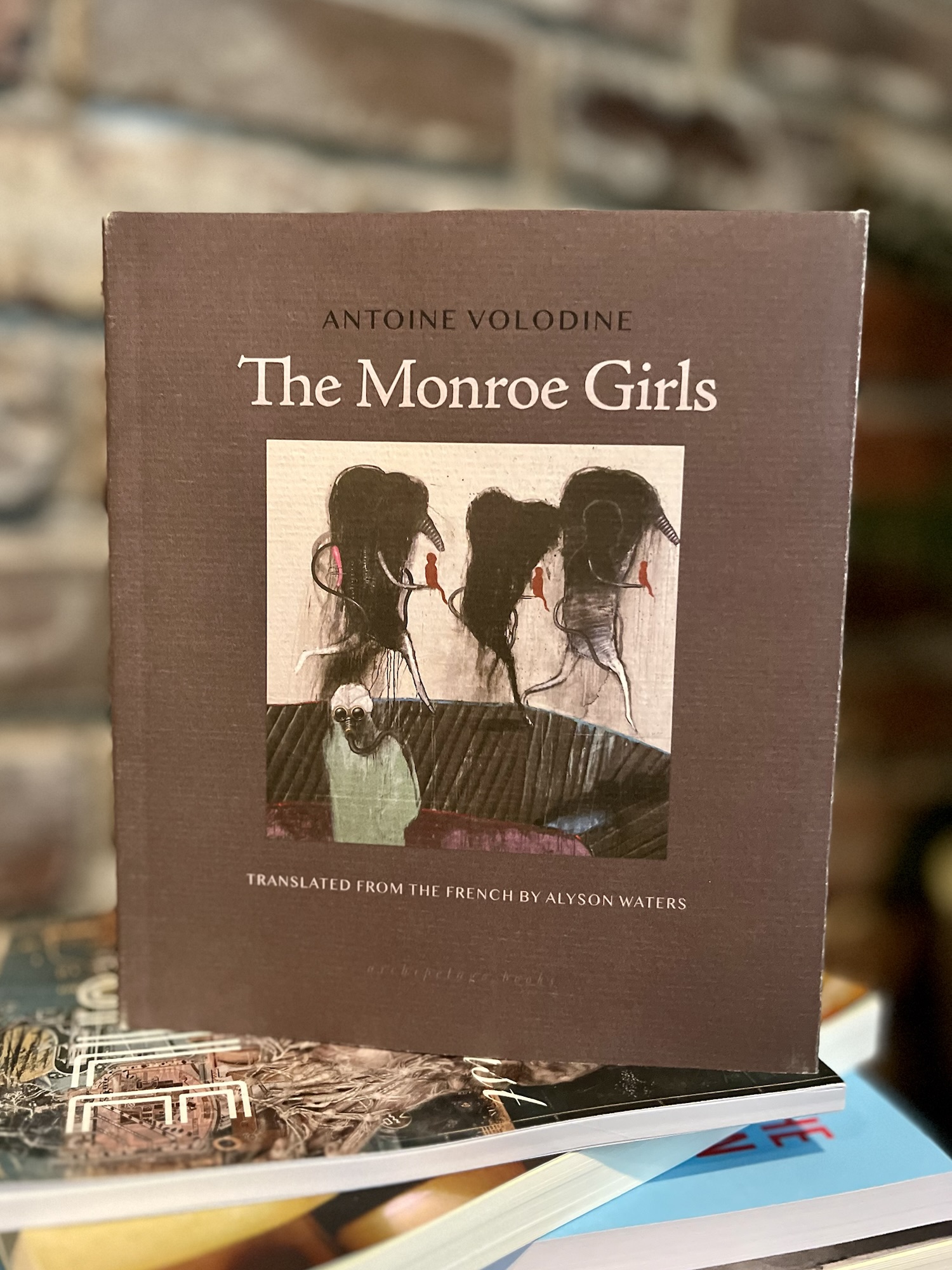
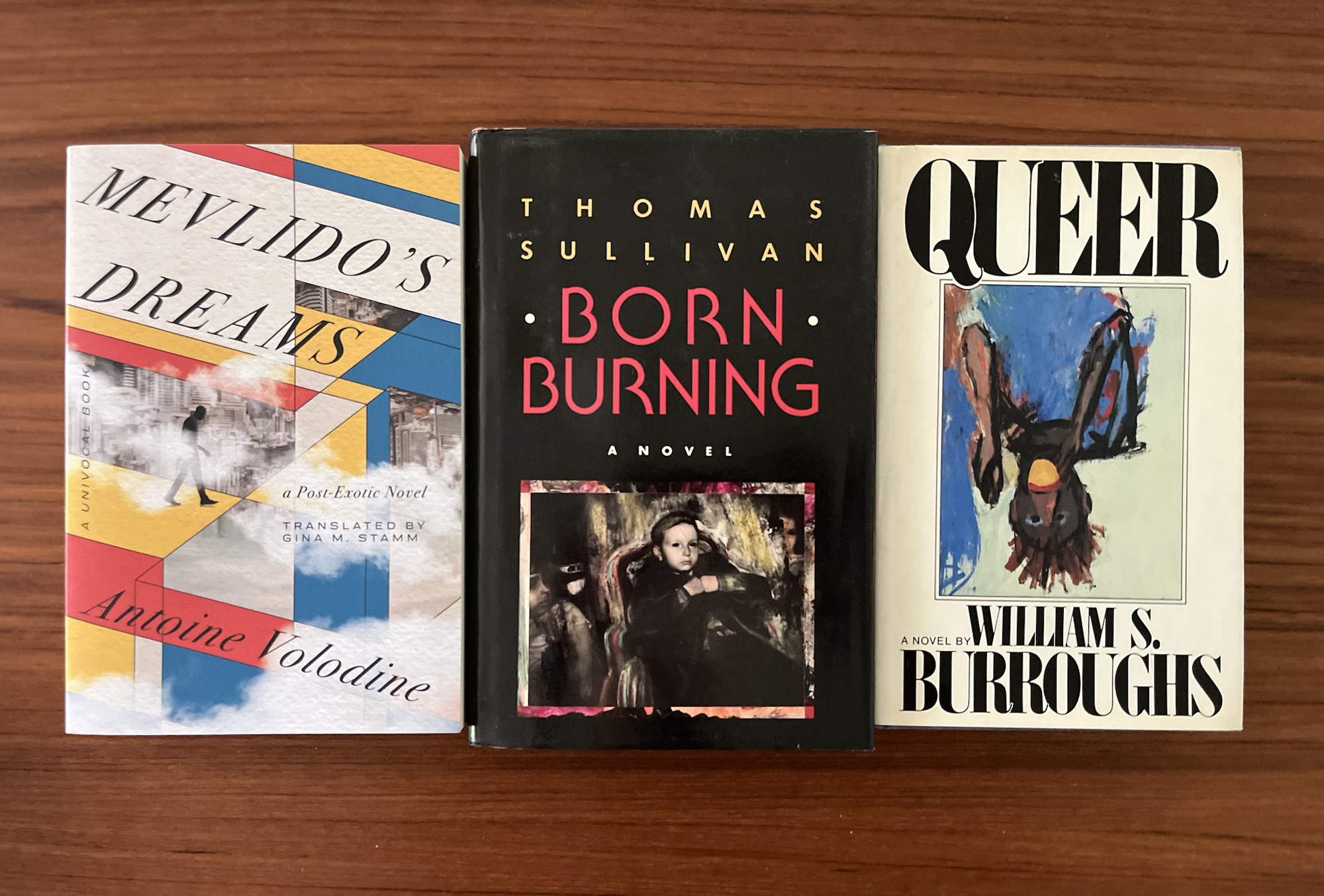
I purged about thirty paperbacks last week at my local used bookstore and ordered a copy of the latest Antoine Volodine novel, Gina M. Stamm’s translation of Mevlido’s Dreams. A recent reading of Volodine’s Radiant Terminus left me hungry for more of that sweet gross post-exotic flavor. I went to pick up the Volodine today and ended up with two hardbacks. I admit that the blurb on the back of Thomas Sullivan’s 1989 novel Born Burning sold me; it compared his previous novel to William Gaddis, John Barth, and Kurt Vonnegut. I also snapped up a first-edition hardback 1985 edition of William S. Burroughs’s novel Queer, which I fear was quite underpriced, although I don’t fear that too much. (All my sweet purged paperback credit is gone!)

I am ready for the summer to end.

Riff on July 2024 reading, etc.

I experienced the middle weeks of July 2024 as simultaneously rapid and static. Doldrums should never be so frenetic. If this decade were a novel I would’ve put it down several chapters back. I try not to obsess over things I cannot control. I try to get away from screens. I try to go outside, but the feels like heat index here in north Florida goes over a hundred and five every day. (At least it’s raining again and nothing is on fire.) So I try to read more (and actually write more).

This July I read some great stuff.

I finished Katherine Dunn’s first novel Attic a couple of days ago. The book is seriously fucked up—like William Burroughs-Kathy Acker fucked up—an abject rant from a woman in prison in the mode of Ginsberg’s Howl. The narrator seems to be an autofictional version of Dunn herself, which is perhaps why Eric Rosenblum, in his 2022 New Yorker review described it as “largely a realist work in which Dunn emphasizes the trauma of her protagonist’s childhood.” Rosenblum uses the term realism two other times to describe Attic and refers to it at one point as a work of magical realism. If Attic is realism then so is Blood and Guts in High School. I need to read her second and third novels (Truck, 1971 and the posthumous Toad) and then go back and reread Geek Love, which I remember as being Gothic and gross but also whimsical. (I don’t sniff any whimsy in Attic.)

There are eight stories in Oğuz Atay’s story collection Waiting for the Fear (in translation by Ralph Hubbell); I’ve read the first five this summer, including the long title story, which is especially good, as is the opener “Man in a White Overcoat.” Atay’s heroes (I use the term loosely) find their antecedents in Kafka’s weirdos. Or Paul Bowles. Or Jane Bowles. I should have a proper review up near the end of October when NYRB publishes Waiting for the Fear.

I had picked up Mauro Javier Cárdenas’s third novel American Abductions earlier this summer and finally started it a few nights ago after finishing Attic. Each chapter is a run-on sentence that has made me want to keep reading and reading, running on with it. The novel is, at least so far, both challenging and entertaining; it is not difficult, exactly, but rather engrossing. Sometimes I’ll find myself a bit lost in the layered consciousnesses, layers (layerings) of speech in Cárdenas’s sentences—especially when I find myself startled by an image or a joke or idea—and then I’ll wade backwards again and pick up the rhythm and keep going. The plot? I’ll steal from the Dalkey Archive’s blurb: “American Abductions opens in a near-future United States whose omnipresence of data-harvesting and algorithms has enabled the mass incarceration and deportation of Latin Americans—regardless of citizenship.” But that’s not really the plot; I mean, this isn’t a third-person dystopian world-building YA thing. The novel, at least its first half, is about a family, daughters Ada and Eva and their father Antonio, a novelist who was abducted by the titular abductors (the Pale Americans!). It’s also about writing, how we construct memory in a surveillance state, and, I suppose, love.

I reviewed Jean-Baptiste Del Amo’s latest novel The Son of Man (in translation by Frank Wynne) in the middle of July, although I think I probably read it in late June. In my review I suggested that The Son of Man “is ultimately a novel about the atavistic transmission of violence from generation to generation.” I also highly recommended it.

I went on a big Antoine Volodine binge a couple of years ago which stalled out before I got to (what I believe is) his longest novel in English translation, Radiant Terminus. I finally started into it a few weeks ago (in translation by Jeffrey Zuckerman), and I think it might be Volodine’s best work. In my longish review, I declared Radiant Terminus “an astounding novel, a work that will haunt any reader willing to tune into its strange vibrations and haunted frequencies. Very highly recommended.” I think it’s a perfect starting place for anyone interested in Volodine’s so-called post-exotic project.

Denis Johnson’s The Stars at Noon was one of two novels I revisited via audiobook this month (the other is Portis’s Gringos, which we’ll get to in a moment). I honestly didn’t remember much about The Stars at Noon other than its premise and the fact that its narrator was an alcoholic journalist-cum-prostitute in Nicaragua. It hadn’t made the same impression on me as other Johnson novels had when I went through a big Johnson jag in the late nineties and early 2000s, and I think that assessment was correct—it’s simply not as strong as AngelsFiskadoro, or Jesus’ Son. As an audiobook though I enjoyed it, especially in Will Patton’s reading. (His narration of Johnson’s perfect novella Train Dreams is the perfect audiobook.) I guess the audiobook came out in conjunction with Claire Denis’ 2022 adaptation of the film, which I still haven’t seen.

The collection of Remedios Varo’s writings On Homo rodans and Other Writings is another book I read earlier in the summer but didn’t write about until July. I was fortunate enough to get a long interview with the translator, Margaret Carson, and I think the result is one of the better things Biblioklept has published this year.

I picked up Dinah Brooke’s “lost” novel Lord Jim at Home in late June, and then read it in something of a sweat over a few days. In my review, I wrote that

Lord Jim at Home is squalid and startling and nastily horrific. It is abject, lurid, violent, and dark. It is also sad, absurd, mythic, often very funny, and somehow very, very real for all its strangeness. The novels I would most liken Lord Jim at Home to, at least in terms of the aesthetic and emotional experience of reading it, are Ann Quin’s BergAnna Kavan’s Ice, Mervyn Peake’s Gormenghast novels, Virginia Woolf’s Mrs. Dalloway, and James Joyce’s Portrait (as well as bits of Ulysses).

Gringos is the other book I “reread” via audiobook this July. Charles Portis wrote five novels and all of them are perfect—but I think Gringos might be my favorite. David Aaron Baker’s reading of the novel is excellent. He conveys the dry humor of narrator Jimmy Burns as well as the cynical sweet pathos at the core of Portis’s last novel. Highly recommended.

So well I guess July is over; the kids will be back in school again soon, and so will I. The air here will remain swamp thick, humidity that starts cooking you the minute you venture out of the desiccating AC that licensed growth on this weird peninsula. It might let up by November. Maybe because I’ve spent my entire adult career as a teacher I have always thought of August as the end of the year, not December. And some years I feel melancholy at this end, this pivot away from freer hours. But writing this on the last day of July, I think I want a return to routine, to something I can think of as a return to normalcy, the kind of normalcy that makes me appreciate the weird fucked up oddball novels that I do so love to hang out inside of.

Horrors and oneiric aberrations | On Antoine Volodine’s post-exotic novel Radiant Terminus

Antoine Volodine’s novel Radiant Terminus is a 500-page post-apocalyptic, post-modernist, post-exotic epic that destabilizes notions of life and death itself. Radiant Terminus is somehow simultaneously fat and bare, vibrant and etiolated, cunning and naive. The prose, in Jeffrey Zuckerman’s English translation, shifts from lucid, plain syntax to poetical flights of invention. Volodine’s novel is likely unlike anything you’ve read before—unless you’ve read Volodine.

Radiant Terminus begins with its hero Kronauer fleeing into an irradiated wasteland. Kronauer and two of his comrades are escaping from the Orbise, the capital of the Second Soviet Union, which has been invaded by dog-headed fascists. World-wide Marxism-Leninism has fallen, and the stability of nuclear-powered self-sufficiency has collapsed into the apocalyptic promise of a “world that nuclear accidents had made unlivable for ten millennia to come.” The world is indeed increasingly unlivable, but it also has become, we will find, a place for the undying as well. “Hell is on the surface, it’s here,” one character flatly remarks, adding, “No need to dive into the core.”

But Kronauer will have to dive into the core, at least metaphorically. When one of his comrades, succumbing to radiation poison, can no longer move, Kronauer seeks help, crossing the steppe and bravely venturing into the dark forest. Born in the sanctity of the Orbise, Kronauer had been schooled to focus “on the future of Communes for workers and countrymen. His view of the world was illuminated by proletarian morality: self-sacrifice, altruism, and confrontation.” He is driven to save his comrade, but we know from the outset that hopes are slim.

What matters here is Kronauer’s essential idealism. By the end of the novel, Kronauer will suffer, wondering if he will eventually abandon the principles that underwrite his sense of self. He worries that he will eventually slip into a “total regression to primitive hunting, intelligence sidelined for instincts, and, especially, deep down, an irrepressible desire to kill, to slaughter, and to hurt, even if he couldn’t remember anymore what had brought about this nightmare.”

We enter Radiant Terminus in the midst of a nightmare that somehow only intensifies. Kronauer finds his way to what might be the prospect of aid for his comrade, the titular Radiant Terminus, a collective farm that is somehow self-sustaining despite the ever-present specter of irradiated death. Not only is Radiant Terminus out of sync with the physical reality of the post-apocalyptic world, its principles don’t fully square with the tenets of the Second Soviet Union that have guided Kronauer’s mindset:

Radiant Terminus functioned on ideological principles that didn’t match up to the collectivist norms of the Orbise, but, as far as the allocation of goods went, the end result was the same. Disdain for property was, as had been the case throughout the Second Soviet Union, commonplace in the Levanidovo. It was a place where the Party had been extinguished, where the Party no longer existed, but where the idea of reestablishing capitalism and the bourgeoisie hadn’t occurred to anyone, and besides it had to be asked just what this thing called capitalism would have looked like at Radiant Terminus, and what bourgeoisie could be called upon to oppress the working class…

We come to understand, elliptically enough, that Radiant Terminus’s apparent prosperity (or at least sustainability) is purchased in large part via sacrifices made to the village’s old nuclear reactor core, which has melted down and is kept locked away. The core is a kind of doorway to hell. The citizens of Radiant Terminus offer it gifts from the old world:

Every month, indeed, the core was fed. The heavy cover for the well was opened, and some of the bric-a-brac collected over the last season or two was knocked over the edge; just to show that people weren’t panicking and weren’t afraid of pathetic radionuclides. Tables and chairs, television sets, the tarry carcasses of cows and cowherds, tractor motors, charred schoolteachers who had been forgotten in their classrooms during the critical period, computers, remains of phosphorescent crows, moles, does, wolves, squirrels, clothes that looked perfect but had only to be shaken to set off a haze of sparks, inflated toothpaste tubes filled with constantly simmering toothpaste, albino dogs and cats, clusters of iron that continued to rumble with an inner fire, new combine harvesters that hadn’t yet been broken in and which gleamed at midnight as if they were lying in full sunlight, garden forks, hoes, axes, debarkers, accordions that spat out more gamma rays than folkloric melodies, pinewood planks that looked like ebony planks, Stakhanovites in their Sunday best with their hands mummified around their diplomas, forgotten when the event halls were evacuated. The ledgers with their pages turning day and night. Cash-register money, the copper coins clinking and shifting without anyone nearby. These were the sorts of things thrown into the void.

The Gramma Udgul was the one to handle the maneuver

We come to understand the Gramma Udgul as priestess-witch archetype; “condemned to immortality from her first interactions with nuclear reactor cores” she is both immune to the ravages of radiation and cursed by it. The Gramma Udgul has her counterpoint in Solovyei, the dominant antagonist of Radiant Terminus.

Solovyei is the “president” of Radiant Terminus, but his role is something closer to an archduke synthesized with an insane wizard. Like the Gramma Udgul, Solovyei is immortal (indeed, a century earlier, the pair were husband and wife). Solovyei rules greedily over Radiant Terminus, and warns Kronauer to stay away from his three daughters. He is an inverted King Lear; mad, yes, but also deeply capable and cunning. Solovyei seems to find metaphysical sustenance in trips to Radiant Terminus’s nuclear core, emerging from time spent there “sizzling and blackened, weighed down with radiation and opaque poems.”

The development of Solovyei as a controlling intelligence—and Kronauer’s ideological resistance to his monomania as well as his three daughters’ battle against his invasive will—forms the main plot, such as it is, of Radiant Terminus. Solovyei is the author of the “horrors and oneiric aberrations” that haunt the characters and landscape that he is both collapsing center and impossible margin of. “It was hard to determine whether he was a mutant bird, a gigantic sorcerer, or a rich farmer from Soviet or Tolstoyan times,” the narrator declares at one point.

“This necromancer of the steppes,” Kronauer calls Solovyei, and then goes on to try to find language for the metaphysical:

This awful kolkhoz matchmaker, this reviver of cadavers, this horrible shadow, this giant impervious to radiation, this shamanic authority from nowhere, this president of nothing, this vampire in the form of a kulak, this strange man sitting on a stool, this abuser, this dominating man, this sleazy man, this unsettling man, this nuclear-reactor creature, this godless and lordless hypnotizer, this manipulator…

One of the key plot points of Radiant Terminus is that Solovyei can literally resurrect the dead, but cannot reanimate them back to what we would understand as true life:

….we all became bodies inhabited by Solovyei. Who knows whether this magic muzhik hasn’t taken advantage of us being dead, and if we aren’t all puppets within a theater where the manager, the actors, and the audience are all one and the same person

Some of Volodine’s chapters seem to inhabit Solovyei’s consciousness, a space that’s somehow both murky and sharp, an intelligence feasting on the agencies of other human beings:

Our best marionettes, I say. Him or me, doesn’t matter. When he’s stuck I keep going. Zombies, deep shadows, devoted servants. The dead stuck forever in the Bardo. Dead come from the dead. Wives come from unknown mothers. Henchmen. Best puppets and best dolls.

Every character who survives in the pages of Radiant Terminus seems to be susceptible to Solovyei’s oneiric horrors. He is the dream police, the puppet master — “Who’s he?” a minor character asks. The answer: “We don’t know…But we do know that he does with us whatever he wants. We’re in his hell.”

Solovyei’s daughters are the most sympathetic of his vampiric victims. These women, forced into the same unasked-for immortality as their father, find themselves repeatedly invaded by Solovyei, who haunts their dreams and walks around in their minds. One daughter sees herself “a creature imagined, possessed, and brought to life by Solovyei. A daughter of Solovyei, a daughter for Solovyei. A female annex in Solovyei’s life: nothing more than that.” They initiate their own eruptions of opposition: violence, suicidal rejection. Writing.

Near the end of Radiant Terminus, the narrator describes the novels of Hannko Vogulian, Solovyei’s eldest daughter:

In effect, they depicted the same twilit suffering of everyone, a magical but hopeless ordinariness, organic and political deterioration, infinite yet unwished-for resistance to death, perennial uncertainty about reality, or a penal progression of thought, penal, wounded, and insane.

We have here an internal description of the novel Radiant Terminus itself. Indeed, Radiant Terminus is always self-describing and always self-deconstructing: “Everything is in the same place, as in some kind of book, if you want to go to the trouble of thinking about it. That’s the ambiguity of ubiquity and achronia,” the narrator muses. When the narrator throws out the sentence, “These are complete works for no audience,” it almost feels like an inside joke. And Volodine can’t resist metanarrative descriptions of his own so-called post-exotic project:

If a post-exotic writer had been present at the scene, he would have certainly described it according to the techniques of magical socialist realism, with flights of lyricism, drops of sweat, and the proletarian exaltation that were part of the genre. It would have been a propagandist epic with reflections on the individual’s endurance in service to the collective.

Volodine’s Radiant Terminus works in all these modes while simultaneously subverting them. The result is an astounding novel, a work that will haunt any reader willing to tune into its strange vibrations and haunted frequencies. Very highly recommended.

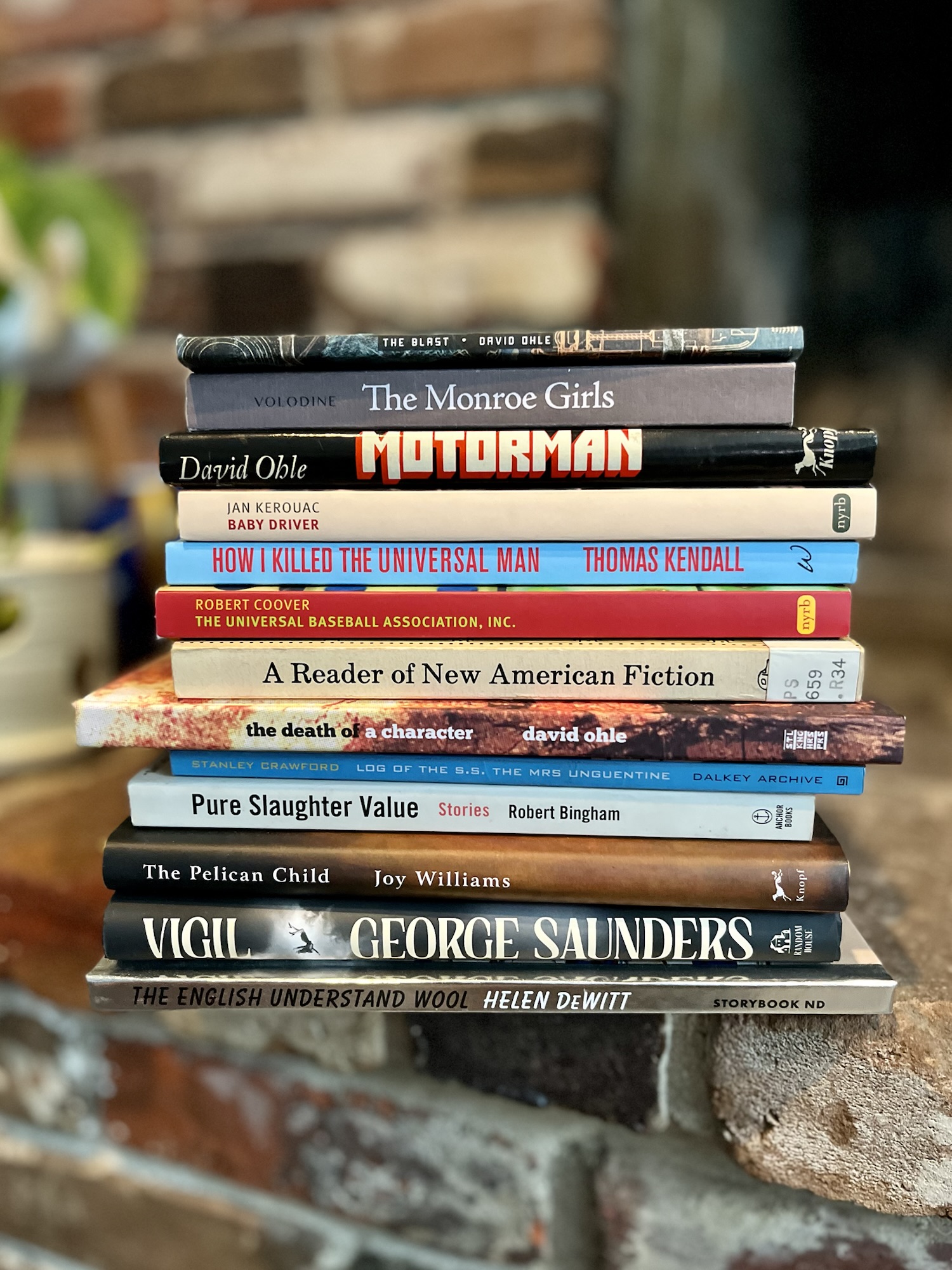
Blog about some recent reading, some books acquired, Hurricane Dorian, etc.

img_3908-1

I am on my second or maybe third dark and stormy and I have cleaned the house twice from top to bottom two days in a row now and I am ready for my kids to go back to school, which was cancelled through Thursday for Hurricane Dorian. My own school, by which I mean my employer, cancelled classes throughout the week, but I’ve been emailing students and trying to maintain some kind of continuity after this weird disruption. We have power here in NE Florida and all seems well. This ride has been a lot easier than Irma.

img_3910-1

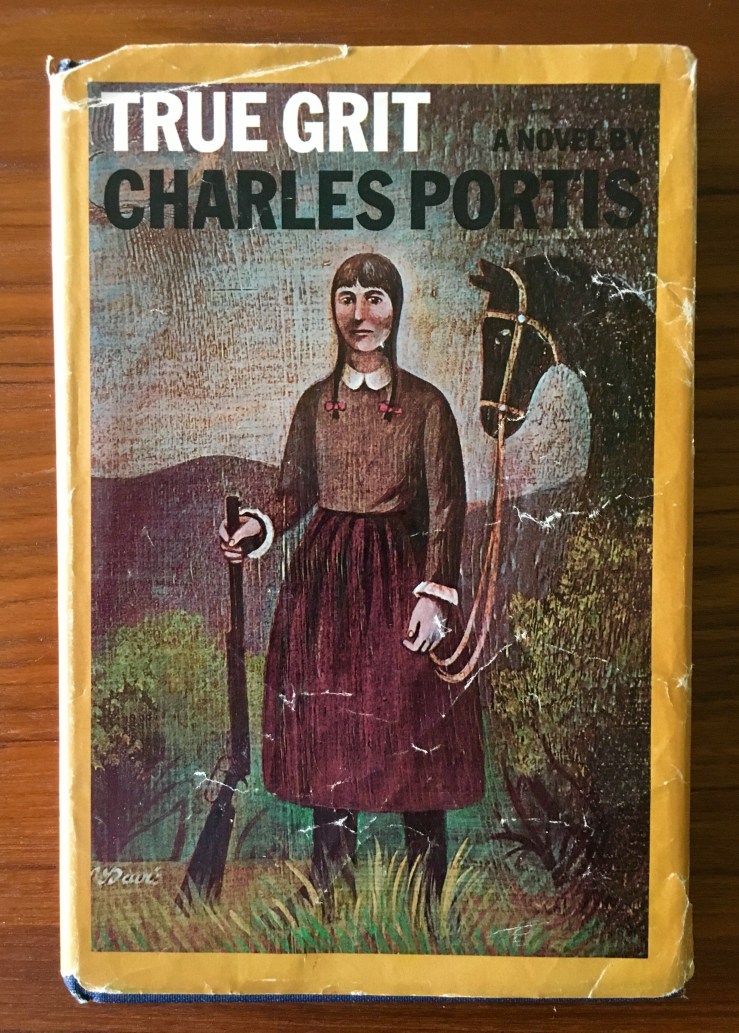
I finished Charles Portis’s famous novel True Grit this afternoon and I must confess it might be my favorite of the four I’ve read by the maestro. I shed a little tear for Little Blackie at the end, and also maybe for Rooster Cogburn. My thought is that I wish I’d read the book years ago, before I’d seen the two film adaptations, both of which are, like, fine, but neither of which capture the pure voice of Mattie Ross. Great stuff. I need to read Gringos next, but maybe I’ll wait a bit.

I have been switching between True Grit and Sylvia Townsend Warner’s nuns-in-the-English-fens-in-the-age-of-the-Black-Death The Corner That Held Them and I love both—both are funny, dry (and wet when they need to be). The Corner That Held Them packs in so much storytelling; pages go on for decades with a sprightly and imaginative and droll clip. I’ve been enjoying it so much I went up to my favorite used bookstore, big box of old books in tow, to find more. I picked up Lolly Willowes, which I understand is excellent, and which I will get to posthaste.

I had burned up most of my credit at this particular bookstore, but the box I done brung afforded me enough trade to not only pick up Lolly Willowes but also a first-edition hardback of Kurt Vonnegut’s Slaughterhouse Five.

img_3909-1

I also got copies of Antoine Volodine’s Writers and Bardo or Not Bardo in the in the mail this week. I don’t rightly recall buying them online, but I know that after finishing In the Time of the Blue Ball by Volodine’s pseudo-pseudonym Manuela Draeger, I went through my Volodines for references to Draeger. I found references in Post-Exoticism in Ten Lessons, Lesson Eleven, but couldn’t find my copy of Writers and then remembered that I gave it to a friend who seemed to promptly move a hundred miles away afterward. (He said he thought it was good.) Anyway: Bardo soon or not soon.

I read Keiler Roberts’ graphic memoir Rat Time yesterday and loved it so much I wrote about it immediately.

Screenshot 2019-09-03 at 3.52.37 PM

The hurricane is not so bad for us.

Blog about some recent reading

img_3869

Let’s start with the meat in the middle: Charles Portis. Why hadn’t I read Charles Portis until 2019? Maybe I initially dismissed the idea after first seeing True Grit (1969) with John Wayne. I know I was a bit more interested after seeing True Grit (2010), but I still didn’t quite realize that Portis is like Cormac McCarthy or Barry Hannah, picaresque and hilarious, a scion of the dirty south. I picked up his first novel Norwood at a tiny wonderful little bookstore in Portland Oregon this summer, prompted by its being in a Vintage Contemporaries edition more than anything else. I loved its energy and humor, and picked up copies of The Dog of the South and Masters of Atlantis, and promptly read them. (I couldn’t find a decent looking copy of True Grit and ended up ordering one on AbeBooks for four bucks.) I’ve heard Masters of Atlantis referred to as the masterpiece, and I thought it was very funny and even Pynchonesque (and also really relevant in its evocation of con artists and scammery), but Dog of the South was the most affecting of the three novels. A kind of bizarre road trip novel, Dog is told in first person narration by an asshole loser who, like most asshole losers, doesn’t realize that he’s an asshole loser. By the end of the novel he won me over though, and even grew as a person (I hate that I wrote that sentence). Dog’s shagginess is a small virtue; Master’s shagginess is unexpectedly grand. Norwood seems like a trial run at both, but also wonderful and grotesque. I read the first part of True Grit yesterday and loved the voice. I need to do a proper Thing on Portis, but for now, color me a Portishead.

I read Fernando A. Flores’ debut novel Tears of the Trufflepig last month, which I picked up after reading J. David Gonzalez’s review in the Los Angeles Review of Books. The concept of the book—a very-near future where drugs are legal and cartels have taken to trafficking “filtered” (genetically-altered) animals is fascinating—but the prose and structure left something to be desired. Trufflepig suffered perhaps from its proximity to my reading Anna Kavan’s Ice and Portis’s Norwood.

I read the first chapter of Sylvia Townsend Warner’s 1948 historical novel The Corner That Held Them today. Amazing stuff: Ironic, mordant, energetic, and surprising. Set primarily in a spare humble corner of 14th century England, Corner starts with a cuckold murdering his wife’s lover, “sparing” her, and then founding a nunnery in her honor when she dies. Warner’s prose shuttles her nuns into the Black Death plague with bathos and wit. Really loved what I read.

I read In the Time of the Blue Ball by Manuela Draeger this weekend and loved it too. There are three tales in the collection, translated by Brian Evenson and Valerie Evenson. Draeger is one of Antoine Valodine’s pseudonyms, but also one of his characters—a concentration camp librarian who invents tales for the camp’s children. The stories are whimsical with a dark edge, an edge perhaps provided if one know more of Volodine’s project (encapsulated neatly in Writers). The Draeger stories focus on a detective named Bobby Potemkine and his dog Djinn, and they are lovely.

I continue nibbling at Chris Ware’s forthcoming opus Rusty Brown. “Nibbling” is not the right verb—look, I’m gobbling this thing up. It’s astounding: funny, painful, gorgeous, maybe the best thing he’s done to date.

Kilian Eng’s Object 10 simply happens to be at the bottom of the pile. It too is gorgeous.

1dde58cb05363a7d06108f54bab648f4_800x

Books acquired, 15 Aug. 2019

img_3825

I went to the used bookstore last week to pick up some of my daughters required reading for school. I fucked up and picked up a heavily-annotated copy of Elie Wiesel’s Night which I will have to return maybe tomorrow or Wednesday.

While there, I picked up Fup by Jim Dodge. I was looking for Dodge’s novel Stone Junction (a twitter-based recommendation based on my taking to Charles Portis), but I couldn’t find a copy. But Fup looked neat. And it’s illustrated (by Norman Green).

img_3857

I also picked up Manuela Draeger’s In the Time of the Blue Bell in English translation by Brian Evenson. Draeger is one of French author Antoine Volodine’s pseudonyms. It’s good stuff. Here is the first paragraph:

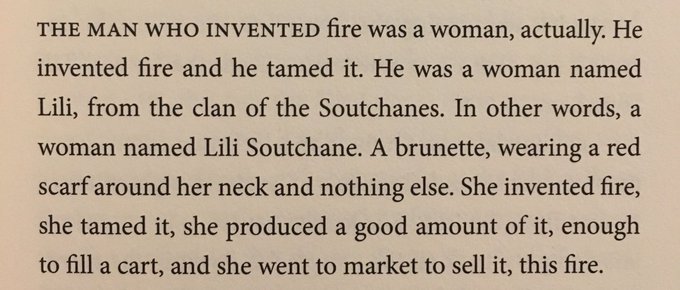
ECDS3K3XUAAkTvN

Antoine Volodine interviewed at the Evergreen Review

Antoine Volodine is interviewed by Andrew Wilson at The Evergreen Review. The interview focuses on Volodine’s 1990 novel Lisbon, Last Frontier. (Wilson’s translation of the first chapter of Lisbon, Last Frontier was recently published in The Evergreen Review). The interview touches on a number of subjects, including Volodine’s invented genre, post-exoticism. From the interview:

AW: Is post-exoticism simply anti-exoticism?

AV: Yes, what’s important in post-exoticism is that it does away with exoticism. You suggested anti-exoticism, and it could just as well have been anti-exoticism, in as much as what characterizes exoticism is the absolute distinction between the metropolis and the margin, between the center and the periphery. With exoticism, there is an interest in the margins–the writer lives on the margins–but it’s all for the sake of the center. In exoticism, one describes the margins with ideas that come from the center, whereas in our books, the characters—who are dying, or perhaps already dead, who are birds, or animals, or insane—have no center, or rather it is their margin that is the center—the center no longer exists. For us, mental derangement doesn’t refer to a discourse of normality outside of it. In the books, it is present, and it is the center, it is what’s creating the world. In Lisbon, Last Frontier, it’s Ingrid Vogel who creates the world. The reader might think she’s completely mad, schizophrenic, paranoid, but, in fact, the book never refers to an outside normality, from which one could judge Ingrid’s experience. Yes, the book enters her imaginary; yes, it creates imaginary spaces for her to inhabit, but it never refers to a normality outside of her. And it’s through this precise mechanism that the books are on the margins, in the dustbin (to borrow an expression from Lisbon, Last Frontier); it’s in this way that they are dustbin literature, a literature from elsewhere, and that’s what comes into being with post-exoticism. That’s what’s important I think: a literature that doesn’t refer to normality, that doesn’t refer to the center. In that sense it’s more anti-exoticism… but of course I’m not going to change it now. It’s too late; it’s post-exoticism until the end!

Read an excerpt from Antoine Volodine’s novel Lisbon, Last Frontier

5

The latest issue of The Evergreen Review features a long excerpt from Antoine Volodine’s novel Lisbon, Last FrontierThe excerpt is translated by Andrew Wilson and features some pretty cool art by Billy Jacobs. Here are the first six paragraphs:

On the Rua do Arsenal, in Lisbon, gallows abound.

“What?” he asked, startled. “What did you say?”
“Gallows,” she confirmed, with a provocative movement of her shoulder.
And: I’ve always wanted to start my novel that way, with a sentence that slaps them in the face. And him: Your novel? You aren’t seriously going to write it? And anyway who is slapping whom? And her: It just hauls off and slaps them, all of them, the overfed slaves of Europe, pudgy little slaves and their tie wearing masters, and all the managers, militarized by America, and the employers’ serfs and all those pathetic types, subjugated by everyone, and the social-traitors and their bulldogs, and you as well, my bulldog, you as well.

He sensed she was drifting, on the verge of hysteria again, and if that happened she was liable to lose the fundamental sense of things, attracting the not necessarily indulgent attention of the passers-by, and creating a scene and, in the wake of that scene, a disaster; for herself certainly, but also for him, for he was up to his neck in this affair. “A slap to the snout of the Western pig,” she hissed playfully. “Please don’t tell me you’re going to ruin everything by writing a book riddled with information,” he countered, “where anyone who cares in the German police will find all he needs to pluck you from your hiding-place, not to mention plucking me from my not so hiding-place and breaking me, dismantling in turn what’s left of your network of nutjobs? Don’t forget I’m up to my neck in this thing.” And her: Would you get a hold of yourself, my brave bulldog, I’d never rat on you. I wouldn’t rat on you for anything in the world. And him: Again happy. And her: Nevertheless, my novel will open with a vision of gallows. And him: That’s absurd. Don’t write anything. And her: I remind you that we are in fact on the Rua do Arsenal, in Lisbon, and gallows do abound. As throughout Europe, I might add. And him: Darling, let me just say: you’re fucking nuts.

He hastily examined the messages being sent by her pupils, diving immediately for the shadows and light, which conveyed, from the other end of this tunnel, her intellect. She’d turned toward him, her sunglasses perched atop her head, as if to hold back abundant curls, but for the past two weeks she’d worn her hair short; it was the face of a young woman sunning, only tormented and hard; her features ravished by passions, hatreds and fear. An arid veil was morphing the transparent blue-green of her eyes; darkening the silver glints, until recently so bright: a wind carrying charred dust across an age-old steppe, where presently everything alive was tempted to rave. She’s going mad, he thought. Despondency rose in him. Her mind is fading, she’s drowning. A cynical mistrust had sunk its claws into him, and already he was drawing up contingency plans, already he was preparing emergency measures, sirens wailing. Their joint survival rested on a ruse. If Ingrid were to crack, she would take him down with her. And he, Kurt, had no intention of stumbling into the void just to keep her company.

As he stared her down, she reigned in her smile, and then broke free, joyous. She nodded with her chin towards the clumps of dried cod hanging in front of the markets.

And: You see, I’m not lying, all around us it’s nothing but disfigured corpses. And him: I’m sorry, I misunderstood. I thought you were sinking into madness. And her: Oh don’t worry I sank ages ago, now I’m just pretending. My bulldog was the only one to realize, such a clever bloodhound. And him: Forget about writing this book. The trail will be too visible. And what’s the point of leaving clues? Forget about literature. And her: First I give up my machine gun, and now black ink; is that how it is, my bulldog?

Read the rest of the excerpt at The Evergreen Review (the last paragraph is, uh, really something).

Blog about a list of films included in Antoine Volodine’s short story “The Theory of Image According to Maria Three-Thirteen”

img_1148

Antoine Volodine’s short story “The Theory of Image According to Maria Three-Thirteen” is collected in Writers, a book available in English translation by Katina Rogers from Dalkey Archive Press.

Writers is one of the best books I’ve read in the past few years: unsettling, bizarre, satirical, and savage, its stories focus on writers who are more than writers: they are would-be revolutionaries and assassins, revolting humans revolting against the forces of late capitalism.

Writers (which I wrote about here) functions a bit like a discontinuous novel that spins its own web of self-references to produce a small large gray electric universe—the Volodineverse, I guess—which we can also see in post-exotic “novels” like Minor Angels and Post-Exoticism in Ten Lessons, Lesson Eleven. 

Volodine’s post-exotic project refers obliquely to the ways in which the late 20th century damns the emerging 21st century. And yet the trick of it all is that the stories and sketches and vignettes seem ultimately to refer only to themselves, or to each other—the world-building is from the interior. This native interiority is mirrored by the fact that many of his writer-heroes are prisoners communicating from their cells, often to interrogators, but just as often to an unresponsive void.

“The Theory of Image According to Maria Three-Thirteen” takes place in such a void, a kind of limbo into which the (anti-)hero Maria Three-Thirteen speaks herself into existence. It’s an utterly abject existence; Maria Three-Thirteen crouches naked like “a madwoman stopped before the unknown, before strangers and nothingness, and her mouth and her orifices unsealed after death…all that remains for her is to speak.” She speaks to a semi-human tribunal, a horrorshow, creatures “without self-knowledge.” After several paragraphs of floating abject abstraction, Maria eventually illustrates her thesis—an evocation of speech without language, speech in a deaf natural voice–to this audience.

Her illustration is a list of scenes from 20th-century films.

I found this moment of the story initially baffling—it seemed, upon first reading, an utter surrender to exterior referentiality on Volodine’s part, a move inconsistent with the general interiority of Writers. Even though the filmmakers alluded to made and make oblique, slow, often silent, often challenging (and always beautiful) films, films aesthetically similar to Volodine’s own project, I found Volodine’s gesture too on-the-nose: Of course he’s beholden to Bergman, Tarkovsky, Bela Tarr!

Rereading the story, and rereading it in the context of having read more of Volodine’s work, I take this gesture as the author’s recognition of his aesthetic progenitors. Volodine here signals that the late 20th-century narrative that most informs his work is cinema—a very specific kind of cinema—and not per se literature.

This reading might be a misreading on my part though. Maybe Volodine simply might have wanted to make a list of some of his favorite scenes from some of his favorite films, and maybe Volodine might have wanted to insert that list into a story. And it’s a great list. I mean, I like the list. I like it enough to include it below. I have embedded the scenes alluded to where possible, and in a few places made what I take to be worthy substitutions.

Here is Volodine; here is Volodine’s Maria Three-Thirteen, speaking the loud deaf voice—

And now, she begins again, to illustrate, I will cite a few images without words or almost without words, several images that make their deaf voice heard. You know them, you have certainly attended cinema showings during which they’ve been projected before you. These are not immobile images, but they are fundamentally silent, and they make their deaf voice heard very strongly.

The chess match with death in The Seventh Seal by Ingmar Bergman, with, in the background, a procession of silhouettes that undertake the arduous a scent of a hill.

https://www.youtube.com/watch?v=abusPM-9mqQ

The man on all fours who barks in the mud facing a dog in Damnation by Bela Tarr.

https://www.youtube.com/watch?v=NJH5BspgKOI

The baby that cries in a sordid and windowless apartment in Eraserhead by David Lynch.

https://www.youtube.com/watch?v=dKhURjt9x5A

The bare facade of an abandoned apartment building, with Nosferatu’s head in a window, in Nosferatu by Friedrich Murnau.

https://www.youtube.com/watch?v=mS4DtjzNudg

The boat that moves away from across an empty sea, overflowing with cadavers, at the end of Shame by Ingmar Bergman.

https://www.youtube.com/watch?v=wHpTmZYL9JM

The desert landscape, half hidden by a curtain that the wind lifts in Ashes of Time by Wong Kar Wai.

The early morning travel by handcar, with the regular sound of wheels, in Stalker by Andrei Tarkovsky.

The old man with cancer who sings on a swing in Ikiru by Akira Kurosawa.

https://www.youtube.com/watch?v=umLtGRl_WE4

The blind dwarfs with their enormous motorcycle glasses who hit each other with canes in Even Dwarfs Started Small by Werner Herzog.

The train station where three bandits wait at the beginning of Once Upon a Time in the West by Sergio Leone.

The flares above the river in Ivan’s Childhood by Andrei Tarkovsky.

The prairie traveled over by a gust of wind in The Mirror by Andrei Tarkovsky.

She is quiet for a moment.

There are many others she thinks. They all speak. They all speak without language, with a deaf voice, with a natural and deaf voice.


Some sentences on some books I’ve read or have been reading

img_0857

I finished Gerald Murnane’s 1982 novel The Plains last week. The Plains is quite short—it’s a novella really—and is divided into three parts. I read Part I in two sittings, gulping down the first-person narrator’s description of an Australia that exists in some alternate universe, where aristocratic plainsmen of Inner Australia keep grand houses populated by every kind of artisan. The novel’s first 70 pages or so move at a brisk pace, brimming with hints of a mythology that Murnane’s narrator keeps always just outside the frame. I read Parts II and III (much shorter than Part I) at a much slower pace. Murnane’s prose condenses here, his sentences tangling out into thick knots of consciousness. I’m still not sure what to make of the novel’s conclusion.

I’m absolutely crawling through Mario Benedetti’s The Truce (in English translation by Harry Morales). Subtitled The Diary of Martín Santomé, this Uruguayan novel is told in lucid prose. Santomé’s journal entries track his day to day life as a man with three children—the youngest approaching adulthood—who was widowed early in life. He’s just now started up a love affair with a younger colleague (an affair that he doesn’t want to call an affair and an affair which I think is like hey a very bad idea, Martin!). It reminds me a bit of John Williams’ novel Stoner. I’ve been reading one or two of the diary entries a day, usually in the morning before I leave for work. It’s a different way to read a book (at least for me anyway).

Herman Melville’s The Confidence-Man is my big re-read right now. I’m having a lot more fun with it the second time. I think the first time taught me how to read it. I’m moving pretty slowly but that’s fine.

I read most of Antoine Volodine’s Post-Exoticism in 10 Lessons, Lesson 11 in two sittings. I want to write a proper review of the novel, or novella, really, or really it’s something besides a novel or novella—anyway, I want to write a proper review on the thing, but I need to go back and finish his novel Minor Angels, which I started earlier in the summer but lost track of (I think I was trying to plow through the end of Eliot’s Middlemarch at the time).

I’ve read the first and third (but not the second) stories in Helen DeWitt’s new collection Some Trick and…I don’t know. There’s a part of me that doesn’t trust my reaction so far. I know that what she’s doing here would’ve flipped any wig I was wearing ten or twelve years ago, but I find myself not particularly persuaded to keep going. I skipped to the third story because it had a bunch of footnotes, a la DF Wallace and that intrigued me. It’s a bit clever, yes?

I’ve only read two of the stories in Tadao Tsuge’s collection of “alternative manga” (mostly from the sixties and seventies) Slum Wolf (in English translation by Ryan Holmberg), but there’s definitely a different flavor here—rough, weird, and a bit chilling. I hope to post a review of Slum Wolf at The Comics Journal next month.

Not pictured above because I read it on an iPad: The first two chapters of Anders Nilsen’s graphic novel Tongues, which is a loose retelling of the story of Prometheus and a few other myths (maybe). There’s a lot going on it. The art is gorgeous—a bit reminiscent of Geof Darrow, but more not as sprawly. Again, I hope to do a review at TCJ soon on these.

img_0635

Also not pictured because also an e-book: Provisional Biography of Mose Eakins, a two-act play by Evan Dara. You can download the play here without paying upfront: The site instead gives this somewhat cryptic message on payment: “If you please, reciprocation accepted only after reading. Thank you.” The message actually makes sense after you’ve read the play, which is very much about paying for language—literally utterances as commodities. Mose Eakins is “imparlent” — he cannot communicate with those around him. The play is often funny, but also very sad, and it’s impossible not to read it as an allegory for the limitations of real communication in the age of late capitalism. I read it all at once last night. Speaking of which, I need to reciprocate now.


Antoine Volodine’s Post-Exoticism in 10 Lessons, Lesson 11 (Book acquired in July, 2018)

img_0454

Even though I haven’t gotten to Minor Angels yet, I went ahead and picked up Antoine Volodine’s Post-Exoticism in Ten Lessons, Lesson Eleven. Publisher Open Letter’s blurb:

Like with Antoine Volodine’s other works (Minor AngelsWe Monks & Soldiers), Post-Exoticism in Ten Lessons, Lesson Eleven takes place in a corrupted future where a small group of radical writers—those who practice “post-exoticism”—have been jailed by those in power and are slowly dying off. But before Lutz Bassmann, the last post-exoticist writer, passes away, journalists will try and pry out all the secrets of this powerful literary movement.

With its explanations of several key “post-exoticist” terms that appear in Volodine’s other books, Lesson Eleven provides a crucial entryway into one of the most ambitious literary projects of recent times: a project exploring the revolutionary power of literature.

Translated from the French by J. T. Mahany

You can read an excerpt from the book here.

Robert Coover/Barry Hannah/Antoine Volodine (Books acquired, 7 June 2018)

img_0040

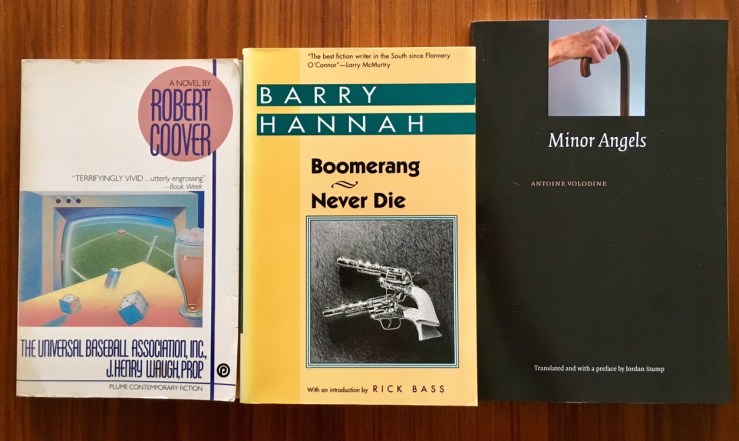
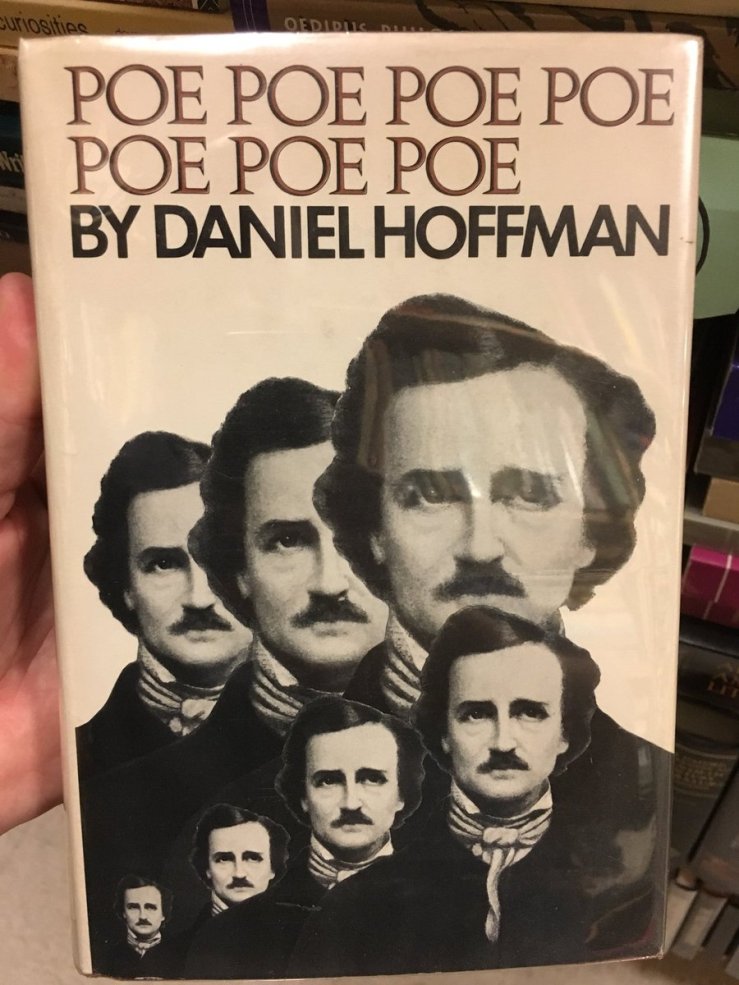
I had ordered Antoine Volodine’s Minor Angels through my favorite bookstore, and it came in yesterday. It’s slim but expensive (ah! university presses!) and ate up all of my store credit, but still I picked up used copies of Robert Coover’s second novel The Universal Baseball Association, Inc., J. Henry Waugh, Prop. and Barry Hannah’s Boomerang b/w Never Die (some of the only Hannah I’ve yet to read). I was tempted also by the title and cover of Daniel Hoffman’s 1971 Poe Poe Poe Poe Poe Poe Poe—but I was not tempted enough to acquire it.

dfg3rjnwaaay2nl

The nightmare has no escape (Antoine Volodine)

Several creatures wake up, semi-human and semi-animal, seated on a tribunal dais. Their memory doesn’t give them any self-knowledge, they knew nothing about the affair that they must judge, or even about the world where they’ve landed. The only landmark they have at their disposal is the individual lamp that illuminates a bit of the table before them. The darkness all around is without hope. Silence reigns, crushing, and prolongs itself. Aware that the situation must be untangled in one way or another, they all imagine being observed by their neighbors with discontent and even hatred. In reality, all share, without knowing it, a vertiginous feeling of guilt and solitude. The strangeness of the situation reinforces itself every moment; immobility grow stronger. The minutes flow, more and more painful. The only way to put an end to the unbearable seems to be to take the floor. Their voice must be heard, they must seem to take on their judiciary function competently. After having cleared its throat, the massive animal who is in the middle, and therefore assumes the need to play the role of president, opens the dossier placed in front of it and begins to read it with thundering voice. Startled by the excessive vibration of its vocal chords, painfully embarrassed by the words it pronounces, it nonetheless continues its speech. What it has before it is a prose poem, surrealist, a completely incongruous text. The creatures sitting to its left and its right have collapsed at the idea that they must now prove their existence and therefore respond. In order not to underscore its own foreignness to the world, each one to the world, each one in turn pretends to know the procedure and intervenes, masking it’s fears under an aggressive excess of confidence. The readings follow one after the other. The poems are not always of a trivial nature and, on the contrary, abound in imprecations and personal attacks;  however, they are formulated in a sufficiently obscure manner that each magistrate feels deeply implicated. The tribunal session has no end. The nightmare has no escape.

From Antoine Volodine’s short story “The Theory of the Image According to Maria Three-Thirteen.” English translation by Katina Rodgers (Dalkey, 2014).

The microfiction, which points to the abject nature of writing/speaking (and witnessing), by the titular heroine, is also a macrofiction for both the story itself, and, perhaps, Volodine’s entire post-exotic project.

Antoine Volodine’s Naming the Jungle (Book acquired 26 May 2018)

I keep meaning to write about the second half of Antoine Volodine’s Writers, which is the best contemporary book I’ve read this year. (I wrote about the first half though).

I had to use the internet to buy Naming the Jungle, and the cover is awful, but I’m eager to read more Volodine.

Publisher’s blurb:

Antoine Volodine has been hailed as one of the most innovative and accomplished writers in France today. Compared by critics to Franz Kafka and Lewis Carroll, Volodine weaves an unusual novel of political and psychological intrigue in a lush, exotic setting. The publication of Naming the Jungle marks his American debut and the first translation of his work into English.

Puesto Libertad could be any Latin American city torn by the strife of civil war. In this isolated capital buried in the jungle, the revolutionary secret police have started digging into Fabian Golpiez’s past. In order to avoid brutal torture and interrogation, he decides to feign madness. Led by a local shaman/psychiatrist in a bizarre talking cure, Golpiez must use indigenous names to prove both his innocence and his true Tupi Indian identity. To name is to conquer. He names the monkeys, the plants, and the insects all around him as he names his fear, his paranoia, and his pathologies.

A masterful storyteller, Volodine speaks to us about the slow and fatal agony of revolution in a haunting and intense novel, one of the most dazzling pieces of fiction to come out of France since the early novels of Robbe-Grillet and Duras.

Blog about the first half of Antoine Volodine’s Writers

img_9711

Antoine Volodine’s collection of loosely-connected stories Writers (2010; English translation by Katina Rogers, Dalkey Archive, 2014) is 108 pages. I have read the first four of the seven stories here—the first 54 pages. This is the first book by Volodine that I have read. Antoine Volodine is in fact a pseudonym, I know, but I don’t know much else about the writer. I’ve been meaning to read him for a few years, after some good folks suggested I do so, but I’ve never come across any of his books in the wild until this weekend. After I finish Writers I will read more about Volodine, but for now I am enjoying (?) how and what this book teaches me about the bigger project Volodine seems to be working towards.

That bigger project evinces in the first story in the collection, “Mathias Olbane,” which centers on the titular character, a writer who tries to hypnotize himself into a suicide attempt. Poor Mathias goes to prison for twenty-six years — “He had assassinated assassins.” Like most of the figures in Writers (so far anyway—you see by the title of this post that I am reporting from half way through, yes?) — like most of the figures in Writers, Mathias is a revolutionary spirit, resisting capitalist power and conformist order through radical violence. Before prison, Mathias wrote two books. The first, An Autumn at the Boyols’ “consisted of eight short texts, inspired by fantasy or the bizarre, composed in a lusterless but impeccable style. Let’s say that it was a collection that maintained a certain kinship with post-exoticism…” The description of the book approximates a description of Writers itself; notably, Volodine identifies his own genre as post-exoticism. Autumn at the Boyols’ doesn’t sell at all, and its sequel, Splendor of the Skiff (which “recounted a police investigation, several episodes of a global revolution, and traumatizing incursions into dream worlds”) somehow fares even worse. Mathias begins a new kind of writing in prison:

…after twenty-six years in captivity, he had forged approximately a hundred thousand words, divided as follows:

  • sixty thousand first and last names of victims of unhappineess
  • twenty thousand names of imaginary plants, mushrooms, and herbs
  • ten thousand names of places, rivers, and localities
  • and ten thousand various words that do not belong to any language, but have a certain phonetic logic that makes them sound familiar

I love the mix of tones here: Mathias Olbane’s grand work is useless and strange and sad and ultimately unknowable, and Volodine conveys this with both sinister humor and dark pathos. Once released from prison, our hero immediately becomes afflicted with a rare and incurable and painful disease. Hence, the suicide urge. But let’s move on.

The second tale in Writers, “Speech to the Nomads and the Dead,” offers another iteration of post-exotic writing, both in form and content. The story plays out like a weird nightmare. Linda Woo, isolated and going mad in a prison cell, conjures up an audience of burn victims, an obese dead man, Mongolian nomads, and several crows. She delivers a “lesson” to her auditors (a “lesson,” we learn, is one of post-exoticism’s several genres). The lesson is about the post-exotic writers themselves. She names a few of these post-exotic writers (Volodine is addicted to names, especially strange names), and delivers an invective against the modern powers that the post-exotic writers write against:

Post-exoticism’s writers…have in their memory, without exception, the wars and the ethnic and social exterminations that were carried out from one end of the 20th century to the other, they forget none and pardon none, they also keep permanently in mind the savageries and the inequalities that are exacerbated among men…

The above excerpt is a small taste of Woo’s bitter rant, which goes on for long sentence after long sentence (Volodine is addicted to long sentences). Like Mathias Olbane, Linda Woo writes in the face of futility, creating the “post-exotic word,” a word that creates an “absurd magic” that allows the post-exotic writers to “speak the world.”

Linda Woo’s name appears in the next story in Writers, “Begin-ing,” if only in passing. This story belongs to an unnamed writer, yet another prisoner. Wheelchair-bound, he is interrogated and tortured by two insane inmates who have taken over their prison, having killed their captors. The pair, Greta and Bruno Khatchatourian, are thoroughly horrific, spouting abject insanities that evoke Hieronymus Boschs’s hell. They are terrifying, and I had a nightmare the night that I read “Begin-ing.” It’s never quite clear if Greta and Bruno Khatchatourian are themselves post-exotic writers gone mad or just violent lunatics on the brink of total breakdown. In any case, Volodine affords them dialogue that veers close to a kind of horror-poetry. “We can also spew out the apocalypse,” Greta defiantly sneers. They torture the poor writer. Why?

They would like it, in the end, if he came around to their side, whether by admitting that he’s been, for a thousand years, a clandestine leader of dark forces, or by tracing for them a strategy that could lead them to final victory. … They would like above all for him to help them to drive the dark forces out from the asylum, to prepare a list of spies, they want him to rid the world of the last nurses, of Martians, of colonialists, and of capitalists in general.

The poor writer these lunatics torture turns inward to his own formative memories of first writings, of begin-ing, when he created his own worlds/words in ungrammatical misspelled scrawlings, filling notebook after notebook. Volodine unspools these memories in sentences that carry on for pages, mostly centering on the writer’s strange childhood in an abject classroom where he engages in depravities that evoke Pasolini’s Salò. And yet these memories are the writer’s comfort—or at least resistance—to the lunatics’ violence. Volodine’s prose in “Begin-ing” conjures Goya’s various lunatics, witches, demons, and dogs. It’s all very upsetting stuff.

Courtyard with Lunatics, 1794 by Francisco Goya (1746-1828)

After the depravity of “Begin-ings,” the caustic comedy of the next story “Acknowledgements” is a welcome palate cleanser. In this story’s twelve pages (I wish there were more!) Volodine simultaneously ridicules and exults the “Acknowledgements” page that often appends a novel, elevating the commonplace gesture to its own mock-heroic genre. The story begins with the the hero-writer thanking “Marta and Boris Bielouguine, who plucked me from the swamp that I had unhappily fallen into along with the bag containing my manuscript.” The “swamp” here is not a metaphor, but a literal bog the writer nearly drowned in. And the manuscript? A Meeting at the Boyols’, a title that recalls poor Mathias Olbane’s first book  An Autumn at the Boyols’. Each paragraph of “Acknowledgments” is its own vignette, a miniature adventure in the form of a thank-you note to certain parties. Most of the vignettes end in sex or death, or an escape from one of the two. “Grad Litrif and his companion Lioudmila” as well as “the head of the Marbachvili archives” (oh the names in this story!) are thanked for allowing the writer

…to access the notebooks of Vulcain Marbachvili, from which I was able, for my story Long Ago to Bed Early, to copy several sentences before the earthquake struck that engulfed the archives. My thanks to these three people, and apologies to the archivist, as I was sadly unable to locate either her name or her body in the rubble.

“Acknowledgments” is littered with such bodies—sometimes victims of disasters and plagues, and elsewhere the bodies of the married or boyfriended women the writer copulates with before escaping into some new strange circumstances (he often thanks the husbands and the boyfriends, and in one inspired moment, thanks a gardener “who one day had the presence of mind to detain Bernardo Balsamian in the orchard while Grigoria and I showered and got dressed again”). He thanks a couple who shows him their collection of 88 stuffed guinea pigs; he thanks “the leader of the Muslim Bang cell” who, during his “incarceration in Yogyakarta…forbid the prisoners on the floor from sodomizing” him; he thanks the “Happy Days” theater troupe who “had the courage” to perform his play Djann’s Awakening three times “before a rigorously empty room.” Most of the acknowledgments connect the writer’s thank-you to a specific book he’s written. I’m tempted to list them all (oh the names!), but just a few—Tomorrow the OttersEve of PandemicJournal of PandemoniumGoodbye CloudsGoodbye RomeoMlatelpopec in ParadiseMacbeth in ParadiseHell in Paradise…Without exaggeration: “Acknowledgements” is one of the funniest stories I’ve ever read.

With its evocations of mad and obscure writers, Volodine’s books strongly reminds me of Roberto Bolaño’s work. And yet reading it is not like reading an attempt to copy another writer—which Volodine is in no way doing—but rather like reading a writer who has filtered much of the same material of the 20th century through himself, and has come to some of the same tonal and thematic viewpoints—Volodine’s labyrinth is dark and weird and sinister and abject, but also slightly zany and terribly funny. More to come.