The Best Blurb I’ve Seen in Ages

20120512-174052.jpg

The back of Alasdair Gray’s 1982, Janine. I promptly secured the book.

Books Acquired, Some Time Last Week (Plus Some Garden Shots)

20120502-155420.jpg

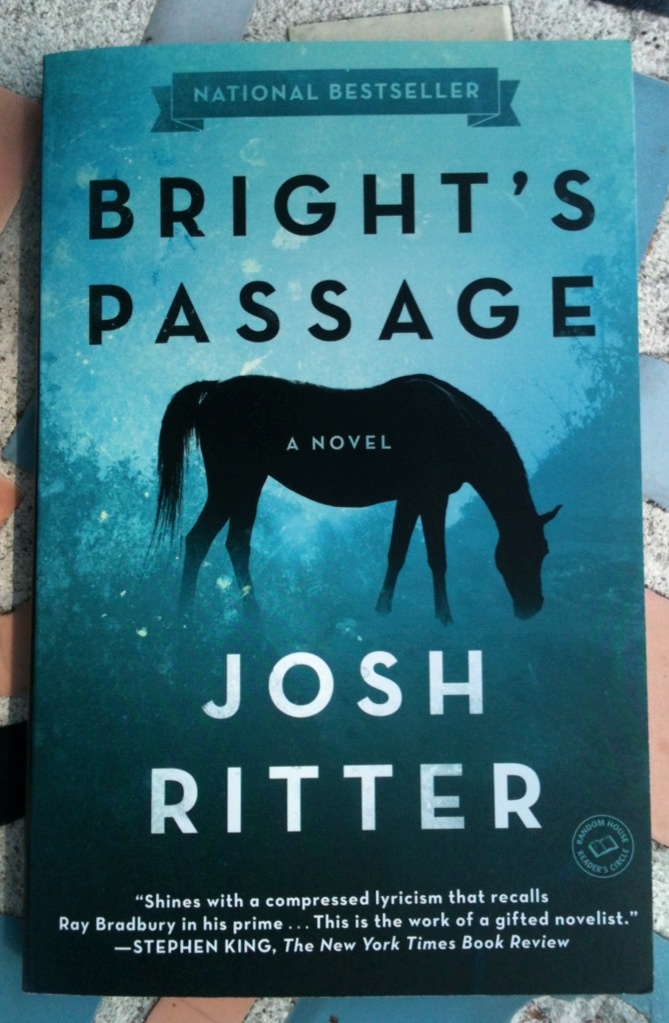
Josh Ritter’s Bright’s Passage is out in trade paperback, featuring a Q&A at the end with Ritter and some guy named Neil Gaiman who used to write comic books or something. Here’s my write up from last year, wherein I quote some guy named Stephen King:

Bright’s Passage is the début novel from songwriter/musician Josh Ritter. This slim novel tells the story Henry Bright, a man who returns to the hills of West Virginia after the trauma of World War I only to have his wife (who is also his first cousin) die in childbirth. Bright buries her body and sets fire to their cabin, which sparks a massive forest fire. Bright then takes his infant son and flees, both from the fire and his unstable father-in-law, “The Colonel,” a vet of America’s adventures in the Philippines who still wears his uniform. The Colonel and his crazy sons pursue Bright, who is guided on the lam by the angel who talks to him—yeah, an angel directs Bright; in fact it was the angel’s idea that Bright marry his cousin, burn down his cabin, and run . . . also, the angel swears that Bright’s son is going to be, like, the new Messiah. Also, Bright’s horse talks. Ritter moves the action between Bright’s flight, his ordeal in WWI, and his youth in simple, concrete, declarative prose. There are echoes here of Chris Adrian’s angel stories (The Children’s Hospital and A Better Angel), and perhaps something of a Cormac McCarthy-lite vibe. Here’s an excerpt from obscure author Stephen King’s review in the Times

At its best, “Bright’s Passage” shines with a compressed lyricism that recalls Ray Bradbury in his prime. When Henry, his talking horse — a kind of holy Mr. Ed — and the Future King of Heaven leave the woods and enter a small town, Ritter writes: “It seemed a tidy place of dappled white houses and American flags. . . . Even the trees here seemed to have a kind of deep green and prepossessing prosperity that the trees of the forest could have no share in.” Recalling his mother’s death, Henry remembers “a windstorm that made the trees bow to one another like ballroom dancers.” More striking still are Henry’s memories of life in the trenches, some of which compare favorably to the prose in Mark Helprin’s “Soldier of the Great War”: “Artillery passed high above their heads in singsong trajectories that merged and lifted with one another into strange musical chords, like cats crossing pump organs.”

And here’s a tomato from my spring garden:

20120502-155432.jpg

20120502-155445.jpg

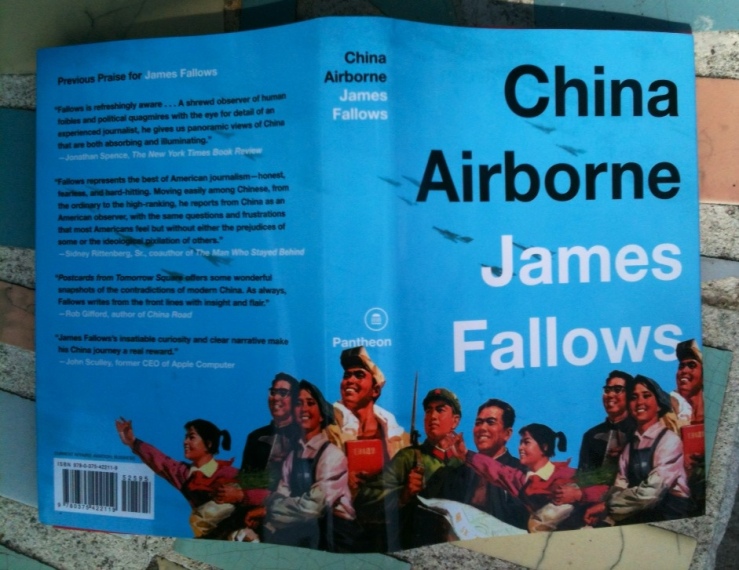
Nice cover on China Airborne, a book about the rise of Chinese industry by James Fallows. Pantheon’s write up:

More than two-thirds of the new airports under construction today are being built in China. Chinese airlines expect to triple their fleet size over the next decade and will account for the fastest-growing market for Boeing and Airbus. But the Chinese are determined to be more than customers. In 2011, China announced its Twelfth Five-Year Plan, which included the commitment to spend a quarter of a trillion dollars to jump-start its aerospace industry. Its goal is to produce the Boeings and Airbuses of the future. Toward that end, it acquired two American companies: Cirrus Aviation, maker of the world’s most popular small propeller plane, and Teledyne Continental, which produces the engines for Cirrus and other small aircraft.

In China Airborne, James Fallows documents, for the first time, the extraordinary scale of this project and explains why it is a crucial test case for China’s hopes for modernization and innovation in other industries. He makes clear how it stands to catalyze the nation’s hyper-growth and hyper- urbanization, revolutionizing China in ways analogous to the building of America’s transcontinental railroad in the nineteenth century. Fallows chronicles life in the city of Xi’an, home to more than 250,000 aerospace engineers and assembly workers, and introduces us to some of the hucksters, visionaries, entrepreneurs, and dreamers who seek to benefit from China’s pursuit of aerospace supremacy. He concludes by examining what this latest demonstration of Chinese ambition means for the United States and the rest of the world—and the right ways to understand it.

Some not-quite-ripe blackberries from my garden:

20120502-155455.jpg

20120502-155504.jpg

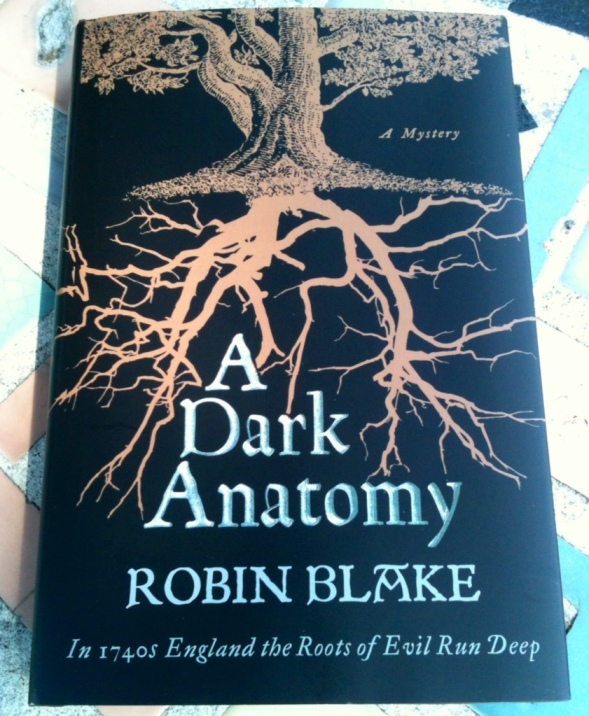
 I like the cover on this one too, a historical mystery by Robin Blake called A Dark Anatomy (and I know someone who might like this book for a present). From Blake’s site:

Mid-Georgian Preston was one of England’s ancient self-governing charter towns, pleasantly and strategically located in the heart of Lancashire, with a thriving agricultural market, and a significant concentration of craft workers amongst its stable population of below 5,000. In the 1600s the town gradually became Lancashire’s prime social and legal centre, and remained so until industrialization transformed and disfigured the town at the end of the century, turning it into the grimy and overcrowded manufactory that Charles Dickens called Coketown, the setting for Hard Times.  Today hardly anything pre-Victorian remains except the medieval street-plan around the central area: the three principle streets of Church Gate (now Church Street), Friar Gate and Fisher Gate,  leading away from the focal point of the flagged market and the site of the old timber-framed Moot Hall, where a 1960s office block of remarkable ugliness now stands.

Politically, like most other borough towns, Georgian Preston was an oligarchy. The council’s 24 members (or burgesses) appointed each other and parceled out the senior offices, including the Mayor and two Bailiffs, annually between themselves. Charter towns like this were virtual city-states where (in Tom Paine’s scathing words) a man’s “rights are circumscribed to the town and, in some cases, to the parish of his birth; and all other parts, though in his native land, are to him as a foreign country”.  These communities reserved the right to run their own affairs, and keep outsiders away at all costs.

I take a few liberties with details of local administration, not least in the Coroner’s office. In historical Preston the unusual custom was for the annually appointed  Mayor to sit as Coroner ex officio. But I wanted my investigator to stand apart from local politics, so I have imposed the more usual model whereby the Coroner was a Crown appointment with life-tenure, and independent of the Corporation. My other inventions in A Dark Anatomy include Garlick Hall, the nearby village of Yolland, and most of the cast of characters.

And here’s a white eggplant from my garden:

20120502-155540.jpg

Bloodstained Book Acquired, 4.16.2012

20120418-144945.jpg

Okay. There aren’t really bloodstains on Catriona McPherson’s mystery Dandy Gilver and the Proper Treatment of Bloodstains—but I’m a sucker for alliteration (and you clicked on the link, didn’t you?).  From The Independent’s review:

. . . Catriona McPherson’s novel . . . appears to be firmly in the cosy camp – but is it? The Dandy Gilver series demonstrates the author’s faultless assimilation of this idiom. A genteel note is sounded throughout, with the middle-class Dandy, an amateur female sleuth in the 1920s, solving knotty mysteries. But there’s a subtle detonation of the cosy genre, as the books soothe the reader while clandestinely taking on more serious concerns.

Subtle detonation? I don’t know enough about the genre to assess such claims. Good cover though. Bloodstains is new in the US from Minotaur.

Book Acquired, 4.14.2012

20120417-113551.jpg

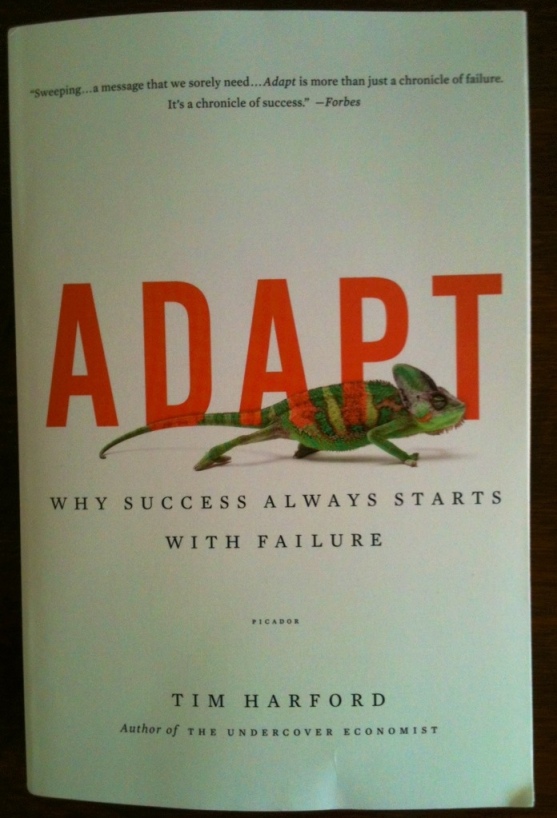
Adapt by Tim Harford. New from Picador. Their description:

In this groundbreaking book, Tim Harford, the Undercover Economist, shows us a new and inspiring approach to solving the most pressing problems in our lives. When faced with complex situations, we have all become accustomed to looking to our leaders to set out a plan of action and blaze a path to success. Harford argues that today’s challenges simply cannot be tackled with ready-made solutions and expert opinion; the world has become far too unpredictable and profoundly complex. Instead, we must adapt.

Deftly weaving together psychology, evolutionary biology, anthropology, physics, and economics, along with the compelling story of hard-won lessons learned in the field, Harford makes a passionate case for the importance of adaptive trial and error in tackling issues such as climate change, poverty, and financial crises—as well as in fostering innovation and creativity in our business and personal lives.

Taking us from corporate boardrooms to the deserts of Iraq, Adapt clearly explains the necessary ingredients for turning failure into success. It is a breakthrough handbook for surviving—and prospering— in our complex and ever-shifting world.

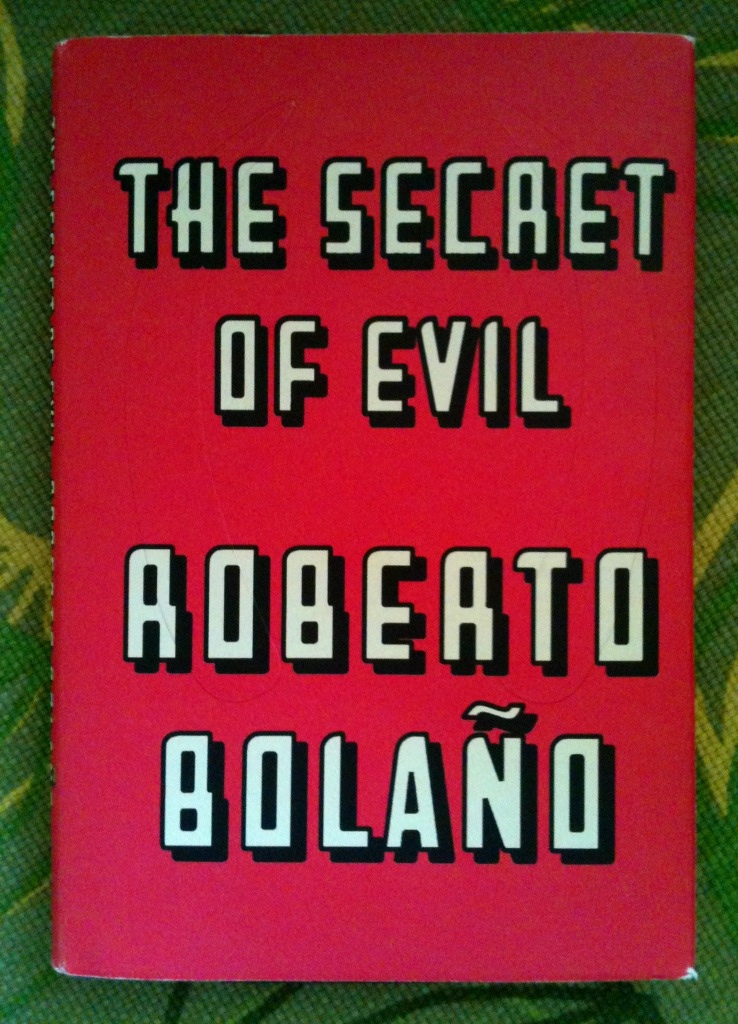
Roberto Bolaño’s The Secret of Evil (Book Acquired, 4.09.2012)

20120414-140951.jpg

How you react to a “new” book by Roberto Bolaño at this point is probably dependent on how much you love or loathe his work—although I imagine those indifferent to or unfamiliar with his writing might be unduly put off by this point at the volume of material that this writer drops posthumously [insert Tupac joke here].

I’m a fan though, so I’m excited about The Secret of Evil, even if the material collected here is in part unfinished . . . although, as Ignacio Echevarria points out in his introduction, all of Bolaño’s “narratives, not just The Secret of Evil, seem to be governed by a poetics of inconclusiveness.” A few of the pieces in Evil have already been excerpted, and I read a few this weekend (who can resist a Bolaño text called “Crimes”?), and while some pieces here are sketchier than others, there’s that preponderance of life force that we expect from late period Bolaño, from a man who seemed to pour what was left of himself into his words and sentences.

From publisher New Directions’ website:

Opening this book is like being granted access to the Chilean master’s personal files. Included in this one-of-a-kind collection is everything Roberto Bolaño was working on just before his death in 2003, and everything that he wanted to share with his readers. Fans of his writing will find familiar characters in new settings, and entirely new stories and styles, too.

A North American journalist in Paris is woken at 4 a.m. by a mysterious caller with urgent information. Daniela de Montecristo (familiar to readers of Nazi Literature in the Americas and 2666) recounts the loss of her virginity. Arturo Belano returns to Mexico City and meets the last disciples of Ulises Lima, who play in a band called The Asshole of Morelos. Belano’s son Gerónimo disappears in Berlin during the Days of Chaos in 2005. Memories of a return to the native land; Argentine writers as gangsters; zombie schlock as allegory…and much more.

The Pale King Paperback (Book Acquired, 4.07.2012)

20120411-174813.jpg

I was happy to get a trade paperback of David Foster Wallace’s The Pale King this weekend (thanks Hachette!) for a few reasons. First, I detest hardback books — that didn’t stop me from picking up (and reviewingTPK when it debuted last year — but I know I’ll prefer this paperback for rereadings. More to the point, the paperback boasts four vignettes not published with the hardback last year, which I’m sure is in no way a cynical marketing ploy cooked up by the publishers. On those scenes:

20120411-172813.jpg

Okay, so yes, I read them. They’re short, and they don’t really add to the novel; actually, they probably take away from the Michael Pietsch’s fine editing work. Still, DFW fans will eat them up. I’ll try to reflect more later.

There’s also one of those reading group guide sections, which cracks me up. Are book clubs gonna read this book? I mean, I hope they do, but they’ll likely hate it. Here’s a question that caught my eye, mostly because I wrote a bit about §19 this summer.

20120411-174805.jpg

I Burn Paris (Book Acquired, Some Time Last Week, Or Maybe Late the Week Before)

20120403-153842.jpg

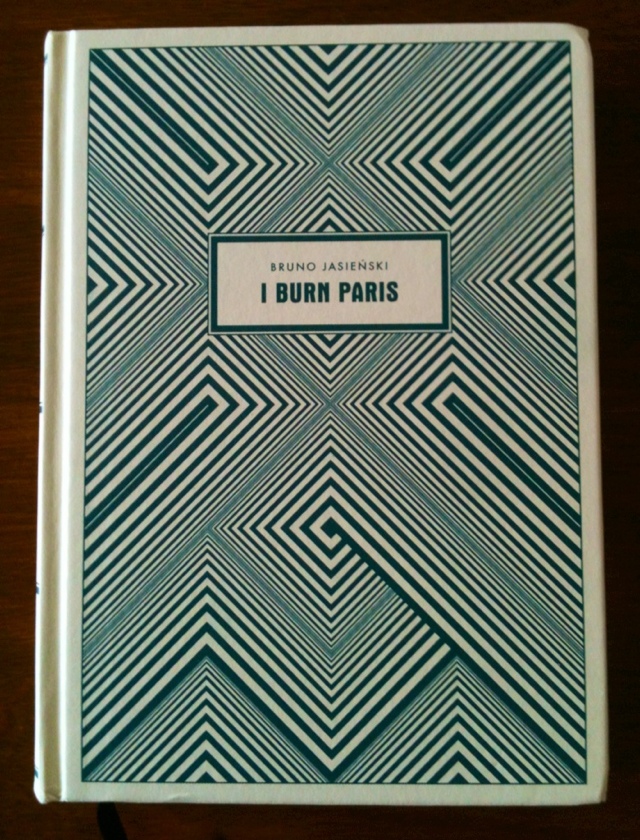
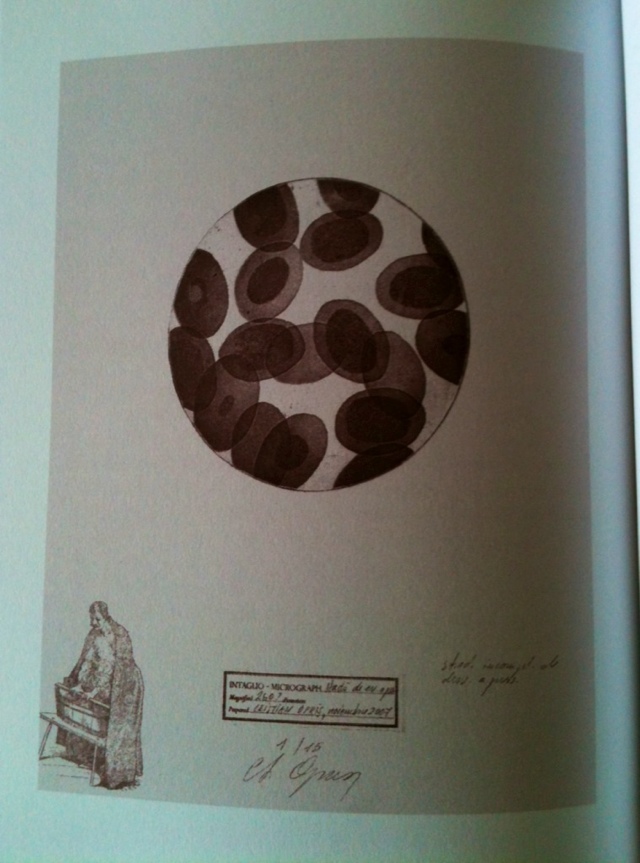
Bruno Jasieński was one of the leaders of the Polish Futurist movement, and his novel I Burn Paris looks fascinating. It’s also a beautiful looking book — publisher Twisted Spoon has done a lovely job here — an embossed hardback with no superfluous jacket, and even a nice lace bookmark (doesn’t show up in my photo). There are also illustrations by Cristian Opris.

20120403-153853.jpg

I’m hoping to get into this this weekend, but for now, here’s publisher Twisted Spoon’s description:

I Burn Paris has remained one of Poland’s most uncomfortable masterstrokes of literature since its initial and controversial serialization by Henri Barbusse in 1928 inL’Humanité (for which Jasienski was deported for disseminating subversive literature). It tells the story of a disgruntled factory worker who, finding himself on the streets, takes the opportunity to poison Paris’s water supply. With the deaths piling up, we encounter Chinese communists, rabbis, disillusioned scientists, embittered Russian émigrés, French communards and royalists, American millionaires and a host of others as the city sections off into ethnic enclaves and everyone plots their route of escape. At the heart of the cosmopolitan city is a deep-rooted xenophobia and hatred — the one thread that binds all these groups together. As Paris is brought to ruin, Jasienski issues a rallying cry to the downtrodden of the world, mixing strains of “The Internationale” with a broadcast of popular music.

With its montage strategies reminiscent of early avant-garde cinema and fist-to-the-gut metaphors, I Burn Parishas lost none of its vitality and vigor. Ruthlessly dissecting various utopian fantasies, Jasienski is out to disorient, and he has a seemingly limitless ability to transform the Parisian landscape into the product of disease-addled minds. An exquisite example of literary Futurism and Catastrophism, the novel presents a filthy, degenerated world where factories and machines have replaced the human and economic relationships have turned just about everyone into a prostitute. Yet rather than cliché and simplistic propaganda, there is an immediacy to the writing, and the modern metropolis is starkly depicted as only superficially cosmopolitan, as hostile and animalistic at its core.

This English translation of I Burn Paris fills a major gap in the availability of works from the interwar Polish avant-garde, an artistic phenomenon receiving growing attention with recent publications such as Caviar and Ashes.

Book Acquired, 3.26.2012 (The Limpopo Academy of Private Detection)

20120328-204340.jpg

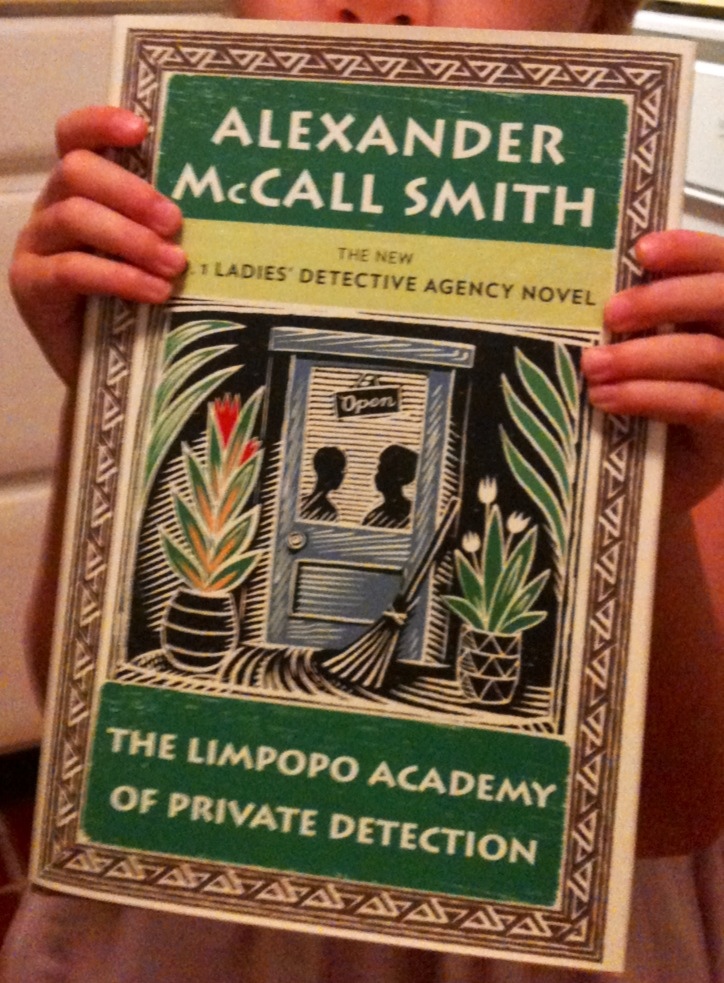
I’ve never read any of Alexander McCall Smith’s No.1 Ladies’ Detective Agency books, or any of his books, but I like the cover of this new one, which is called The Limpopo Academy of Private Detection. I was photographing it clumsily with my old iPhone when my daughter decided to get in the pics and help me out. So, thanks honey.

Jacket copy from publisher Random House:

Precious Ramotswe is haunted by a repeated dream: a vision of a tall, strange man who waits for her beneath an acacia tree. Odd as this is, she’s far too busy to worry about it. The best apprentice at Tlokweng Road Speedy Motors is in trouble with the law and stuck with the worst lawyer in Gaborone. Grace Makutsi and Phuti Radiphuti are building the house of their dreams, but their builder is not completely on the up and up. And, most shockingly, Mma Potokwane, defender of Botswana’s weak and downtrodden, has been dismissed from her post as matron at the orphan farm. Can the No. 1 Ladies’ Detective Agency help restore the beloved matron to her rightful position?

As wealthy and powerful influences at the orphan farm become allied against their friend, help arrives from an unexpected visitor: the tall stranger from Mma Ramotswe’s dreams, who turns out to be none other than the estimable Clovis Andersen, author of the No. 1 Ladies’ prized manual, The Principles of Private Detection.Together, Mma Ramotswe, Mma Makutsi, and their teacher-turned-colleague help right this injustice and in the process discover something new about being a good detective.

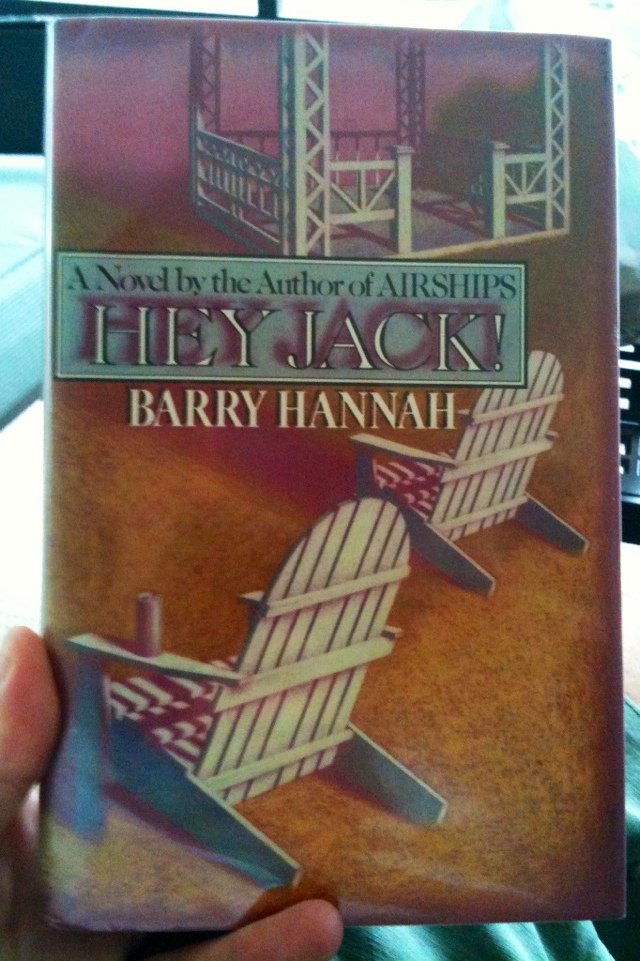
Barry Hannah’s Hey Jack! (Book Acquired, 3.23.2012; Or, Gee, Isn’t It Kinda Sad That This Ex-Library Book Was Checked Out Only Twice in 24 Years?)

20120324-143113.jpg

I bought Barry Hannah’s seventh book Hey Jack! over the internet after my favorite local bookstore told me it would be difficult or expensive for them to order. I bought a first edition hardback brokered by Amazon. It was an ex-library copy. It looks like no one ever read it, and it seems to have been checked out only twice in twenty-four years. A sad business.

I put some wear and tear on it today, reading it outside on my porch during a thunderstorm, using it as a beer coaster at one point, and then taking it into a salted bath where it got damp and curly. I read half of it. Hannah’s novel-in-vignettes is still ahead of its time. Who writes better sentences? (“Christ, the South has been pickled in the juice of its own image”).

20120324-143122.jpg

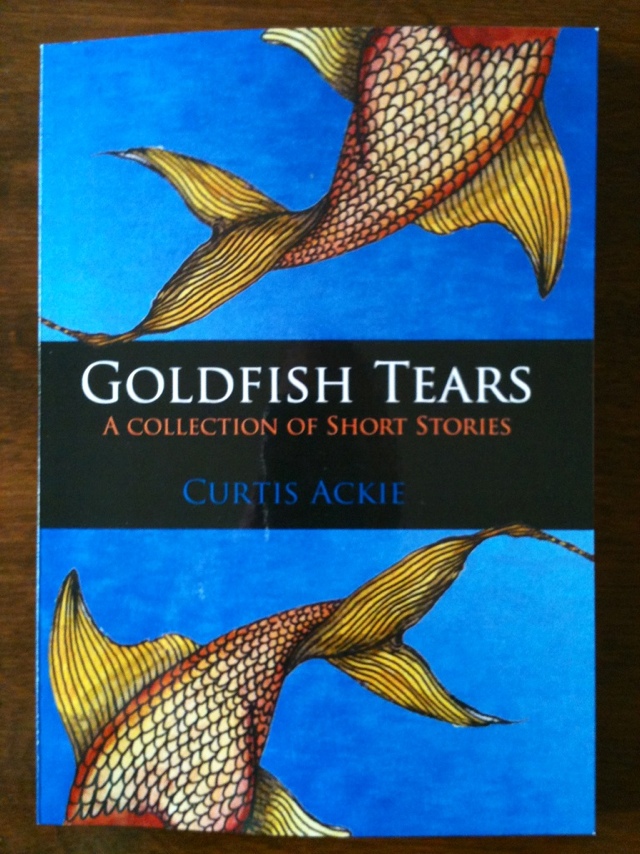
Goldfish Tears (Book Acquired, 3.16.2012)

20120317-170959.jpg

Goldfish Tears by Curtis Ackie: A good looking collection of shorts. Here’s the descriptor:

A perturbed bachelor is beleaguered by his misbehaving shadow; a reclusive alchemist builds a machine to right his wife’s disfigurement; the sun forgets to rise over a sleepy town in the middle of nowhere. Equal parts haunting and outlandish, Goldfish Tears is an enchanting collection of short stories by Curtis Ackie, a young British-born author concerned with the magic of dreams as escapism.

(More).

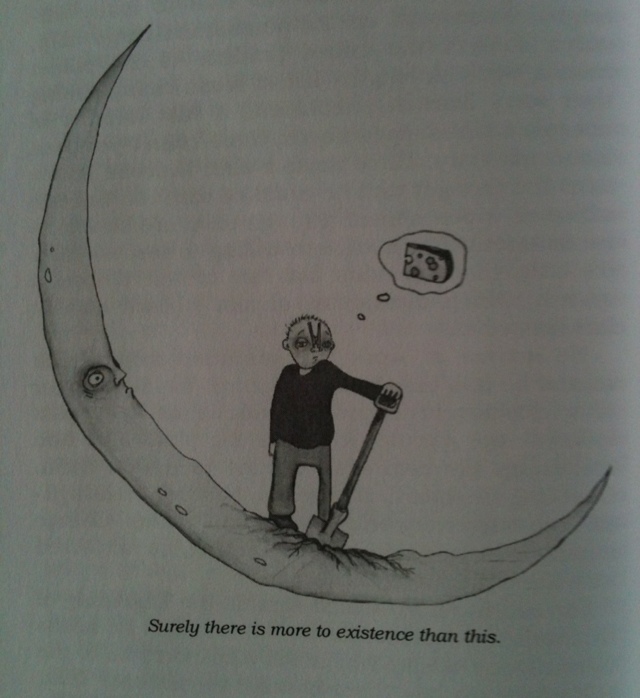
The book is full of charming illustrations that evoke whimsy and dread:

20120317-171007.jpg

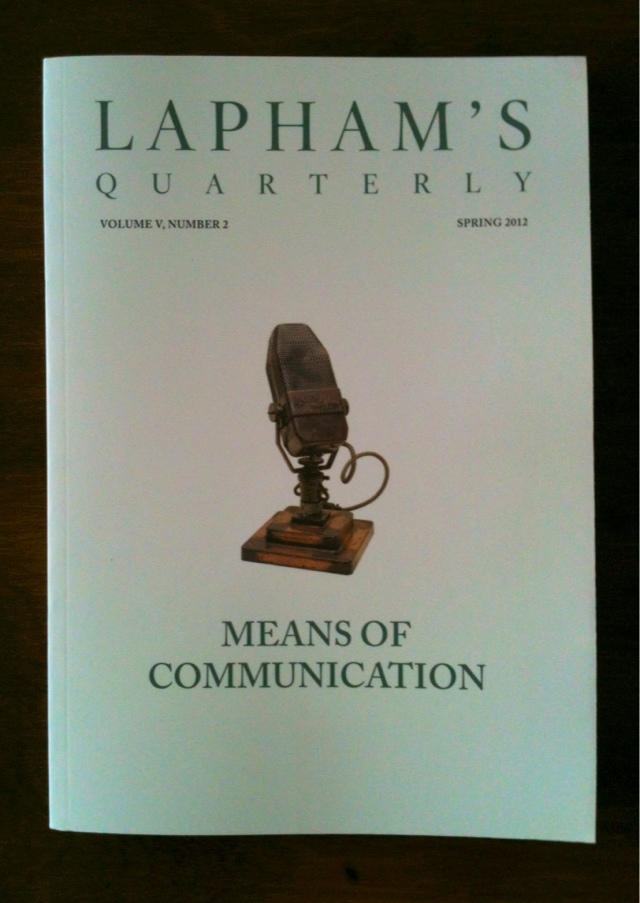
Book Acquired, 3.14.2012 (Lapham’s Quarterly, Spring 2012)

20120317-165618.jpg

20120317-165625.jpg

(Yes, I am enjoying my subscription).

A Partial History of Lost Causes (Book Acquired, 3.06.2012)

20120310-194214.jpg

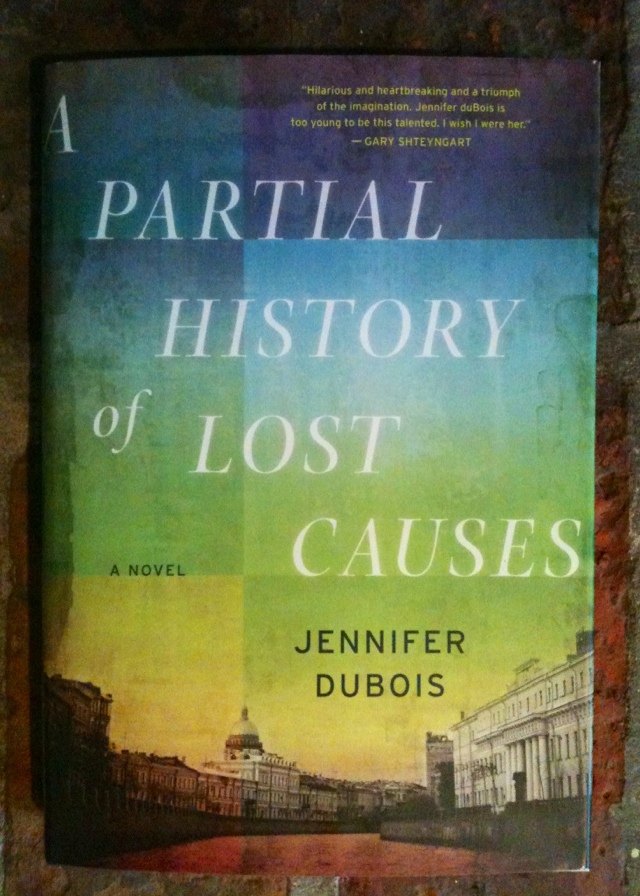
A Partial History of Lost Causes by Jennifer DuBois. Publisher Random House’s copy:

In Jennifer duBois’s mesmerizing and exquisitely rendered debut novel, a long-lost letter links two disparate characters, each searching for meaning against seemingly insurmountable odds.

In St. Petersburg, Russia, world chess champion Aleksandr Bezetov begins a quixotic quest. With his renowned Cold War–era tournaments behind him, Aleksandr has turned to politics, launching a dissident presidential campaign against Vladimir Putin. He knows he will not win—and that he is risking his life in the process—but a deeper conviction propels him forward. And in the same way that he cannot abandon his aims, he cannot erase the memory of a mysterious woman he loved in his youth.

In Cambridge, Massachusetts, thirty-year-old English lecturer Irina Ellison is on an improbable quest of her own. Certain she has inherited Huntington’s disease—the same cruel illness that ended her father’s life—she struggles with a sense of purpose. When Irina finds an old, photocopied letter her father had written to the young Aleksandr Bezetov, she makes a fateful decision. Her father had asked the Soviet chess prodigy a profound question—How does one proceed against a lost cause?—but never received an adequate reply. Leaving everything behind, Irina travels to Russia to find Bezetov and get an answer for her father, and for herself.

Spanning two continents and the dramatic sweep of history, A Partial History of Lost Causes reveals the stubbornness and splendor of the human will even in the most trying times. With uncommon perception and wit, Jennifer duBois explores the power of memory, the depths of human courage, and the endurance of love.

When General Grant Expelled the Jews (Book Acquired, 3.06.2012)

20120309-183304.jpg

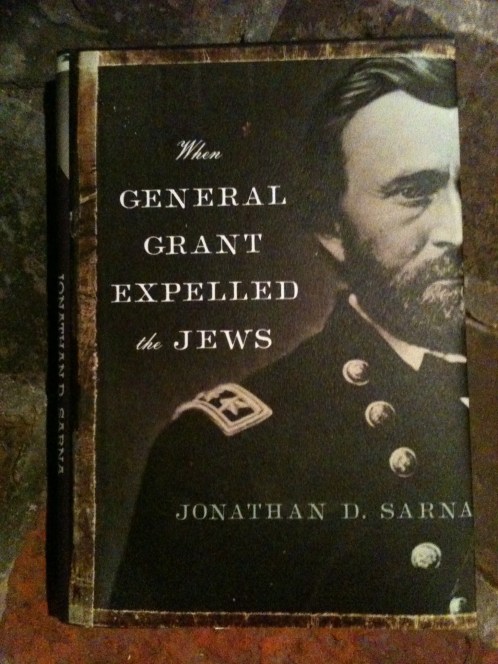
When General Grant Expelled the Jews is new from historian Jonathan D. Sarna (and Shocken books). From Harold Holzer’s review at The Washington Post:

. . . no historian has been able to fully understand — much less justify — why, on Dec. 17, 1862, Grant issued his notorious General Orders No. 11 deporting Jewish citizens. “The Jews, as a class violating every regulation of trade,” went the chilling text, “. . . are hereby expelled from [his command in the West] within twenty-four hours.” Those returning would be “held in confinement until an opportunity occurs of sending them out as prisoners.” Just two weeks before Abraham Lincoln was scheduled to extend freedom to one minority group with the Emancipation Proclamation, his most promising general thus initiated a virtual pogrom against another.

In the end, as the gifted and resourceful historian Jonathan D. Sarna points out in this compelling page-turner, General Orders No. 11 uprooted fewer than 100 Jews. But for a few weeks, he suggests, it terrorized and infuriated the Union’s entire Jewish population. It also inspired one of the community’s first effective lobbying campaigns. Jewish newspapers compared Grant to Haman, the infamous vizier of Persia in the Book of Esther. A delegation of Jewish leaders traveled to the White House to protest directly to the president, who quickly but quietly had the order revoked, eager to right a wrong but reluctant to humiliate a valuable military commander. As Lincoln carefully put it, “I do not like to hear a class or nationality condemned on account of a few sinners.” He never mentioned the episode publicly.

Mostly Redneck (Book Acquired, 2.25.2012)

20120228-173245.jpg

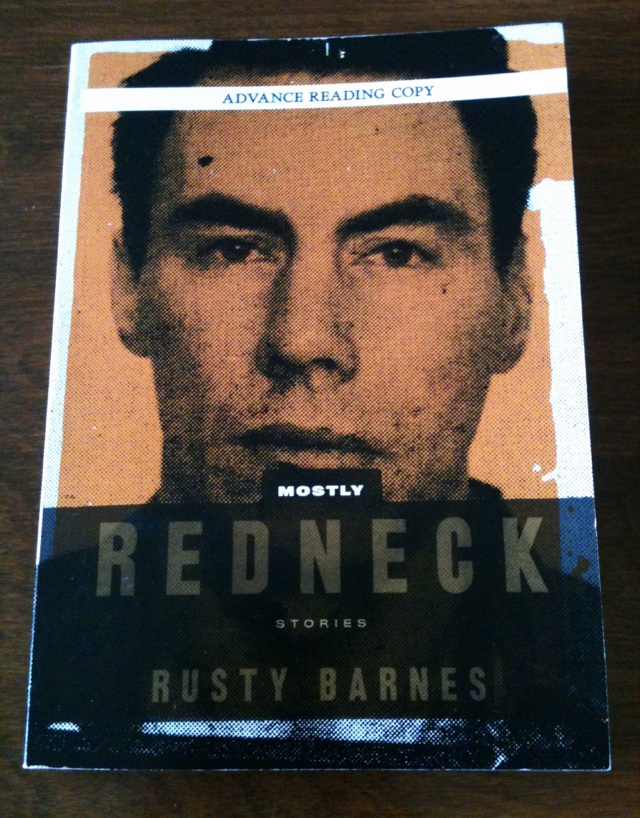
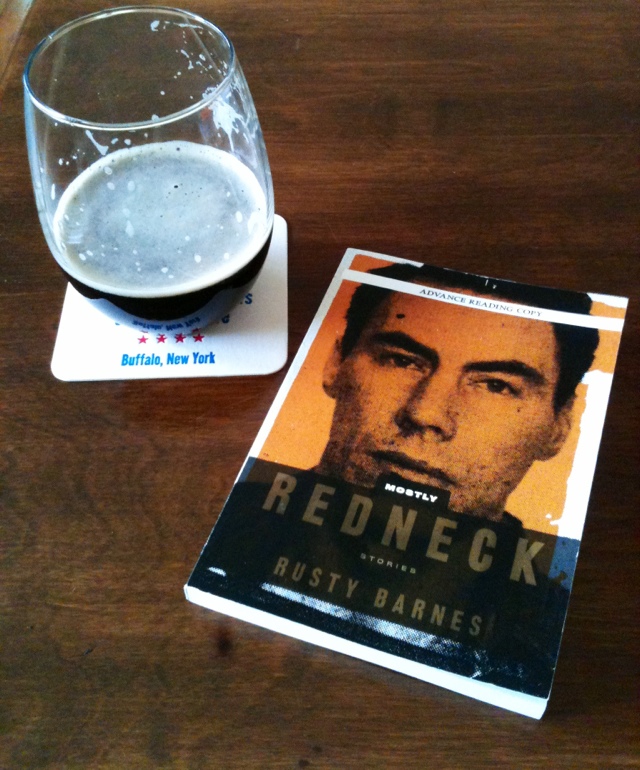
Mostly Redneck is a collection of stories by Rusty Barnes. It’s newish from indie press Sunnyoutside. Back of book:

In Mostly Redneck, Rusty Barnes expounds on his upbringing in disadvantaged rural northern Appalachia to deliver a mastery of country idiom and setting. In one minimalist story after another, he gives perspective and breadth to the widely misunderstood world of a people who still hunt for food, occasionally join their neighbors for church, and sometimes enjoy it when their city kin step in cow shit.

There’s a story about Saddam Hussein! It’s kind of surreal.

I’m pretty sure Sunnyoutside actually printed this book in-house; I know they own a printing press (two, if the website ain’t lying). Did they make this coaster?—

20120228-173252.jpg

I tested the coaster, in any case. It works. Here it is, protecting my midcentury coffee table from condensation that might seep from the interaction between a homebrewed black ale and yon glass:

20120228-173259.jpg

John Cage’s A Year from Monday (Book Acquired 2.21.2012)

20120228-172910.jpg

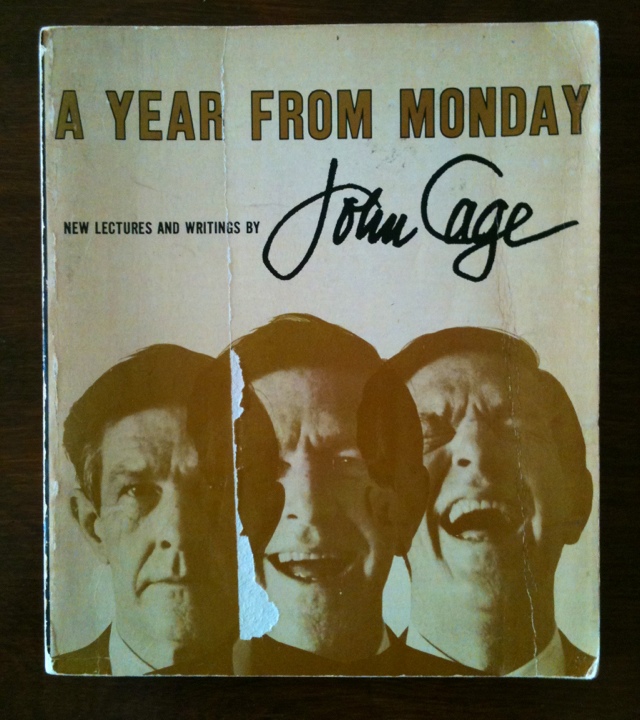
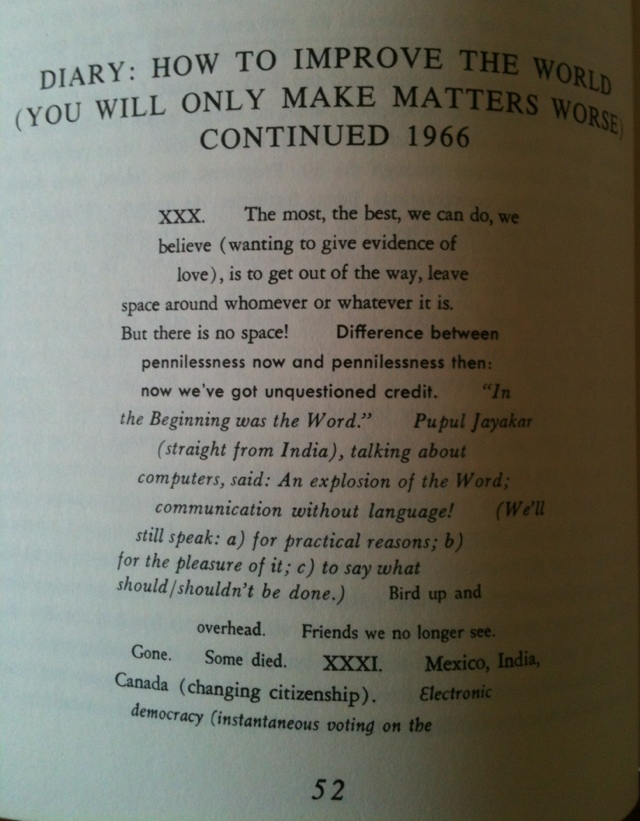
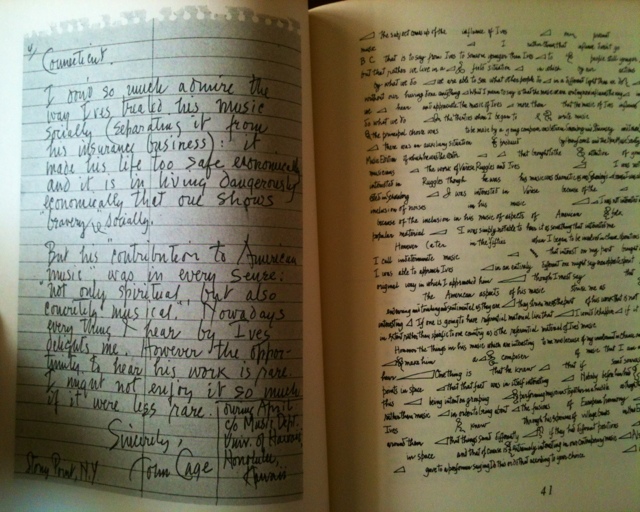
I found this one at random in my favorite used bookshop last week. Had never heard of it before, but it’s really neato—Cage’s lectures, notes, letters, etc. on  a range of subjects, including Charles Ives, Marcel Duchamp, and making the world better. Cover’s in rough shape, but it’s a first edition paperback, so all’s well &c.

A few pics from the strange interior (no worries, I will be plundering the book for posts in the months to come):

20120228-172941.jpg

20120228-172951.jpg

Turing’s Cathedral — George Dyson Explores the Origins of the Digital Universe (Book Acquired, 2.17.2012)

20120225-111107.jpg

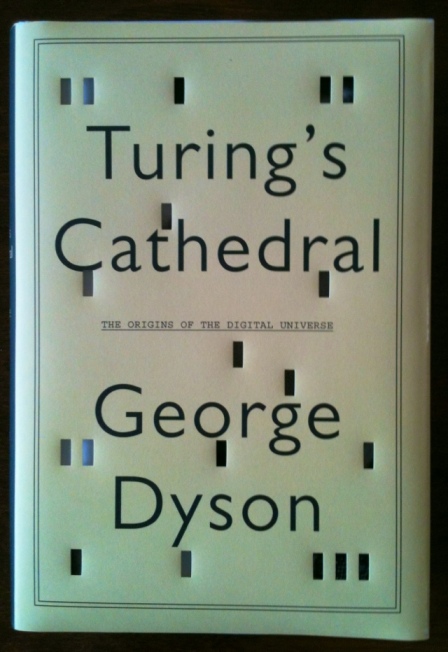
George Dyson’s Turing’s Cathedral looks pretty cool. Here’s some copy from publisher Pantheon:

“It is possible to invent a single machine which can be used to compute any computable sequence,” twenty-four-year-old Alan Turing announced in 1936. In Turing’s Cathedral, George Dyson focuses on a small group of men and women, led by John von Neumann at the Institute for Advanced Study in Princeton, New Jersey, who built one of the first computers to realize Alan Turing’s vision of a Universal Machine. Their work would break the distinction between numbers that mean things and numbers that do things—and our universe would never be the same.

Using five kilobytes of memory (the amount allocated to displaying the cursor on a computer desktop of today), they achieved unprecedented success in both weather prediction and nuclear weapons design, while tackling, in their spare time, problems ranging from the evolution of viruses to the evolution of stars.

Dyson’s account, both historic and prophetic, sheds important new light on how the digital universe exploded in the aftermath of World War II. The proliferation of both codes and machines was paralleled by two historic developments: the decoding of self-replicating sequences in biology and the invention of the hydrogen bomb. It’s no coincidence that the most destructive and the most constructive of human inventions appeared at exactly the same time.

How did code take over the world? In retracing how Alan Turing’s one-dimensional model became John von Neumann’s two-dimensional implementation, Turing’s Cathedral offers a series of provocative suggestions as to where the digital universe, now fully three-dimensional, may be heading next.

I spent an hour with the book this morning and found it engrossing. (It was also a reminder that I don’t read enough nonfiction).

Regular readers will know I despise dust jackets—I’d rather see publisher’s put their efforts into handsome but simple hardback covers. Three out of the last four hardbacks to come in have done so, including Turing’s Cathedral:

20120225-111151.jpg

Still, the design concept for these books (Alain de Botton’s Religion for Atheists and Thomas Mallon’s Watergate are the other two) still involve an integration with the dust jacket. I’d like to see the dust jacket dusted, done away with, expired.

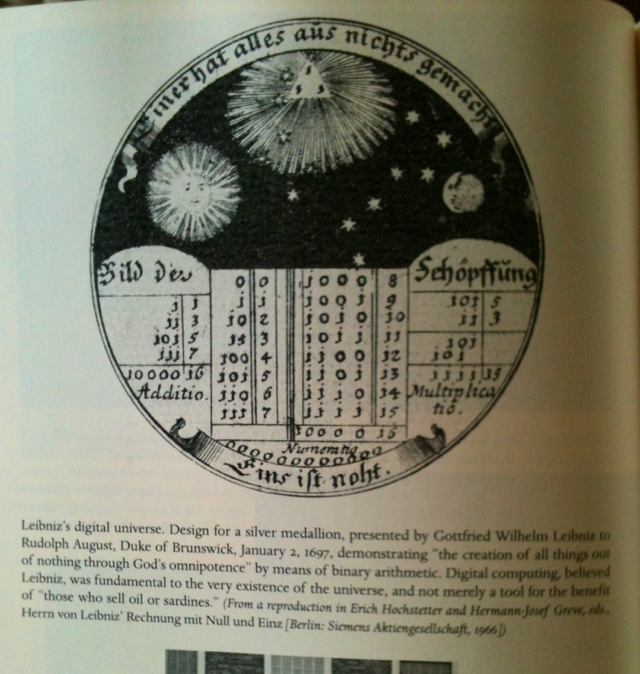
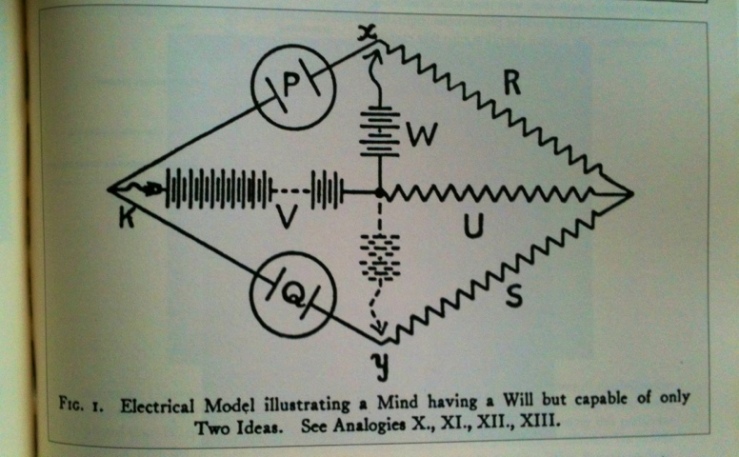
Some cool pics from the Dyson:

20120225-111159.jpg

20120225-111207.jpg

Alain de Botton’s Religion for Atheists: A Facile Self-Help Book that Entirely Misses the Point of Free Thinking

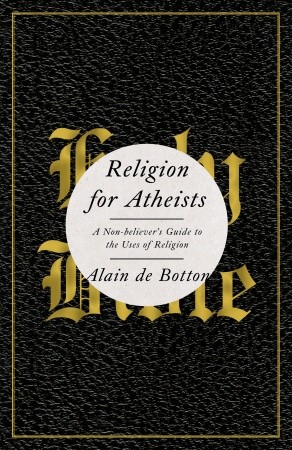
I’m slightly familiar with Alain de Botton’s work, and I’ve taken something of an interest in the so-called “New Atheist” movement — Hitchens, Dawkins, et al — so when a review copy of Religion for Atheists showed up a few weeks ago, it piqued my interest. I found its cover playfully annoying—a hole in the holy book—and its subtitle—A Non-believer’s Guide to the Uses of Religion—downright obnoxious. Still, I gotta give props to the design team at Pantheon for the book that’s under the horrid jacket: 
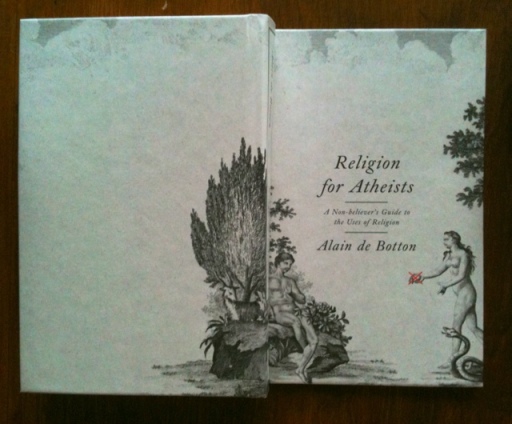
20120218-101910.jpg

Unfortunately, an attractive hardback design sans jacket is the best this book has to offer.

By way of explication (and my own laziness and indifference on this volume) here’s some copy on the book from de Botton’s website:

What if religions are neither all true or all nonsense? The boring debate between fundamentalist believers and non-believers is finally moved on by Alain’s inspiring new book, which boldly argues that the supernatural claims of religion are of course entirely false – and yet that religions still have some very important things to teach the secular world.

Religion for Atheists suggests that rather than mocking religions, agnostics and atheists should instead steal from them – because they’re packed with good ideas on how we might live and arrange our societies. Blending deep respect with total impiety, Alain (a non-believer himself) proposes that we should look to religions for insights into, among other concerns, how to:

– build a sense of community

– make our relationships last

– overcome feelings of envy and inadequacy

– escape the twenty-four hour media

– go travelling

– get more out of art, architecture and music

– and create new businesses designed to address our emotional needs.

For too long non-believers have faced a stark choice between either swallowing lots of peculiar doctrines or doing away with a range of consoling and beautiful rituals and ideas. At last, in Religion for Atheists, Alain has fashioned a far more interesting and truly helpful alternative.

The tone of the copy gives one a sense of the utter glibness of de Botton’s pamphlet. The book smacks of crude self-helpery, a hodgepodge of faux-intellectual poses for those who can smugly dismiss the history of philosophy. It’s like The Purpose Driven Life for atheists. There is a picture or graphic on every other page; de Botton seems to include these in lieu of, say, providing verbal imagery, or meaningful context, or simply trusting the intellect of his audience.

I suppose that I am fundamentally at odds with de Botton. I agree that religion has done much to initiate and facilitate (and in fairness, perhaps at times mitigate) atrocity; I agree that many (if not most) of the Big Problems in the world stem from the herd-mentality that organized religions impose on the people they indoctrinate. But de Botton would like to replace one herd with another.

Here is the Swiss writer suggesting that the academy (which he too-readily identifies as a bastion of atheist mores) follow the practices of black Southern Baptist churches:

The contrast with the typical lecture in the humanities could hardly be more damning. And unnecessary. What purpose can possibly be served by the academy’s primness? How much more expansive the scope of meaning in Montaigne’s essays would seem if a 100-strong and transported chorus were to voice its approval after every sentence. How much longer might Rousseau’s philosophical truths linger in our consciousness if they were structured around rhythmical verses of call-and-response. Secular education will never succeed in reaching its potential until humanities lecturers are sent to be trained by African-American Pentecostal preachers.

What we see here is a romanticization and idealization of a particular part of a culture that I think de Botton in no way understands. What’s even more disturbing here is his elevation of groupthink and indoctrination practices (I hear, “Oh no, I don’t want to play with Delta children” humming in the background). We see here the same teleological thinking that marks much of religious dogma, the sense that truth has been attained; the search is over—we just need to repeat it rhythmically enough, soak our young in it, until they think just like we do. This position strikes me as potentially dangerous as any organized religion’s attempts at indoctrination.

Religion for Atheists is full of sloppy logic gussied up in rushed anecdotes and glossed over with barely-connected pictures and silly graphs. Look at the following example, a visual non sequitur masquerading as meaningful information:

20120223-180200.jpg

Are we supposed to be horrified that the British spend more on potato chips than poetry books? Apples and oranges, bro. But what’s really ridiculous is the stinky pious claim that “Only religions have been able to turn the needs of the soul into large quantities of money.” This claim is plain silly, or at least predicated on a too-singular definition for “needs of the soul.”

Religion for Atheists seems to miss the point that many (if not most) atheists and agnostics are at heart free thinkers. De Botton romanticizes the mystery, awe, and grace of religion, even as he suggests that there is no metaphysical center from which these attributes emanate. His most basic argument really boils down to something like, “Hey, there is no God, no spirit, but religion does a good job of consoling people and keeping them in moral order, so, instead of TV and junk food, we should use the aesthetics of religion as consolation.” There is nothing revolutionary about this idea.

Religion for Atheists is a smug little tract, the sort of book that a supermarket would sell along with Chicken Soup for the Soul if supermarkets had the guts to sell self-help books for atheists. Readers should not be duped into thinking that de Botton has taken any real stance or said anything new here. Instead, hiding behind the pasteboard mask of utility, he offers a crass dodge away from meaningful inquiry. Get thee to Nietzsche instead.