“—boys to your bellybone and chuck a chum a chance!” — Pynchon Riff + Joyce + Moebius + Chloral Hydrate Party

75883c2d61c7b1ea157f39a036480922

1. Here is a rambling riff if ever I rambled and riffed:

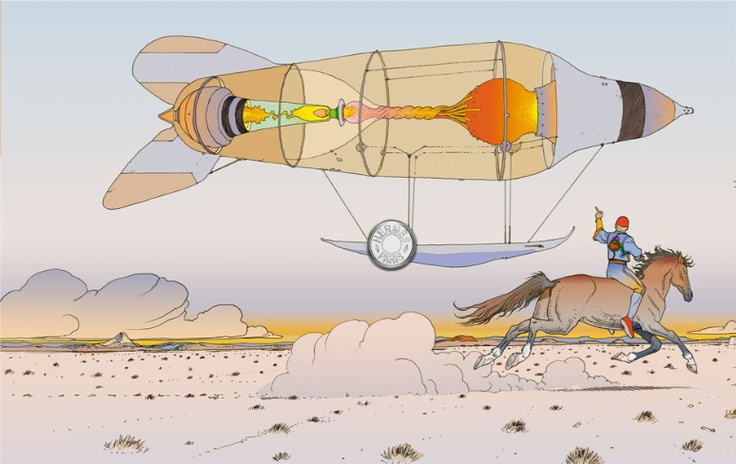
2, First, look, that lovely image—it’s by Jean Giraud, aka Moebius. I came across it a week or two ago and digitally nabbed it.

I love Moebius’s work in general and something about the image reminds me of Thomas Pynchon’s Against the Day, although maybe I’m too immersed in the thick novel to not have much of what I see recall it in some ways.

Something about the airship and the horseman recalls an early passage where Reef Traverse, in the American West, dream-reads the airship adventures of The Chums of Chance into existence. (There are parts of Against the Day that recall to me Cormac McCarthy’s westerns (sometimes—often—called anti-westerns, but come, let’s be adults)…where was I going here? It’s Friday and I’ve consumed the better part (aka “all”) of a bottle of rosé and now I’m circling round some odd notes here—yes—the western/Western thing: Manifest Destiny, etc. — I see it in the Moebius illustration, but of course I bring it with me like a sickness. I move on).

3. ” . . . boys to your bellybone and chuck a chum a chance!” — This is from James Joyce’s Finnegans Wake (85.8). Pointed out to me by Roman Tsivkin, this seems like a most reasonable/splendid source for the namesake of our aeronaut adventurers (who seem rather, uh, absent of late in the final moments of the Bilocations book I’m in right now).

4. Data, perhaps imperfect (again, digitally nabbed)—

In Against the Day:

—Some form of the word invisible appears 173 times—

—The word inconvenience or inconvenient — 84 times—

—The phrase the day — 213 times (usually in a cadence suggestive of the book’s title—some kind of rhythm to it, anyway)—

—The phrase against the day — once (unless you count the chapter (book, really) called “Against the Day,” or the colophon, or what-have-you)—

5. I’m a few sections past this, but a nice passage to end on of a Friday night:

Among students of mathematics here, chloral hydrate was the preferred drug. Sooner or later, whatever the problem being struggled with, having obsessed themselves into nightly insomnia, they would start taking knockout drops to get to sleep—Geheimrat Klein himself was a great advocate of the stuff—and next thing they knew, they were habitués, recognizing one another by the side-effects, notably eruptions of red pimples, known as “the dueling scars of chloralomania.” On Saturday nights in Göttingen, there was always sure to be at least one chloral party, or Mickifest.

It was a peculiar gathering, only intermittently, as you’d say, brisk. People were either talking wildly, often to themselves and without seeming to pause for breath, or lounging draped in pleasurable paralysis across the furniture or, as the evening went along, flat on the floor in deep narcosis.

Read an Excerpt from Cormac McCarthy’s Script for The Counselor

The New Yorker has published an excerpt of Cormac McCarthy’s script for The Counselor, a film directed by Ridley Scott that will come out this fall.

An excerpt of the excerpt:

the kid rakes an object from under the paper into his helmet and puts down the paper and stands and puts the helmet under his arm and crosses the plaza to his bike and puts his foot over the bike and starts it and pulls his gloves from the helmet and lays them on the tank in front of him and pulls on the helmet and fastens the strap and then pulls on the gloves and kicks back the stand and pulls away into the traffic.

night. two-lane blacktop road through the high desert. A car passes and the lights recede down the long straight and fade out. A man walks out from the scrub cedars that line the road and stands in the middle of the road and lights a cigarette. He is carrying a roll of thin braided wire over one shoulder. He continues across the road to the fence. A tall metal pipe is mounted to one of the fence posts and at the top—some twenty feet off the ground—is a floodlight. The man pushes the button on a small plastic sending unit and the light comes on, flooding the road and the man’s face. He turns it off and walks down the fence line a good hundred yards to the corner of the fence and here he drops the coil of wire to the ground and takes a flashlight from his back pocket and puts it in his teeth and takes a pair of leather gloves from his belt and puts them on. Then he loops the wire around the corner post and pulls the end of the wire through the loop and wraps it about six times around the wire itself and tucks the end several times inside the loop and then takes the wire in both hands and hauls it as tight as he can get it. Then he takes the coil of wire and crosses the road, letting out the wire behind him. In the cedars on the far side, a flatbed truck is parked with the bed of the truck facing the road. There is an iron pipe at the right rear of the truck bed mounted vertically in a pair of collars so that it can slide up and down and the man threads the wire through a hole in the pipe and pulls it taut and stops it from sliding back by clamping the wire with a pair of vise grips. Then he walks back out to the road and takes a tape measure from his belt and measures the height of the wire from the road surface. He goes back to the truck and lowers the iron pipe in its collars and clamps it in place again with a threaded lever that he turns by hand against the vertical rod. He goes out to the road and measures the wire again and comes back and wraps the end of the wire through a heavy three-inch iron ring and walks to the front of the truck, where he pulls the wire taut and wraps it around itself to secure the ring at the end of the wire and then pulls the ring over a hook mounted in the side rail of the truck bed. He stands looking at it. He strums the wire with his fingers. It gives off a deep resonant note. He unhooks the ring and walks the wire to the rear of the truck until it lies slack on the ground and in the road. He lays the ring on the truck bed and goes around and takes a walkie-talkie from a work bag in the cab of the truck and stands in the open door of the truck, listening. He checks his watch by the dome light in the cab.

The Adjectives of Cormac McCarthy’s Road

the-road


(By/via).

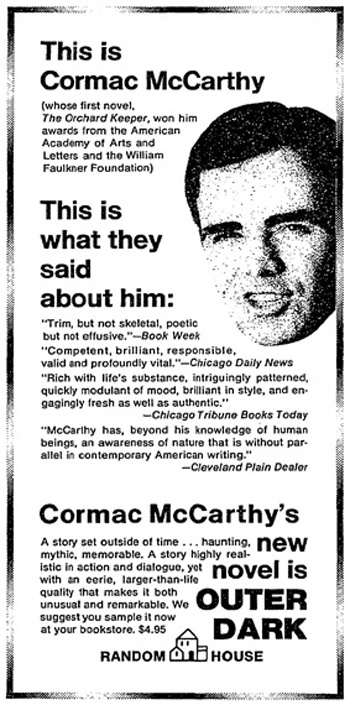
1968 Ad for Cormac McCarthy’s Outer Dark

d05fb40e5ddc4b3a068ca6a01aebc9a3

(Via/more; my review of Outer Dark).

An Interview with Evan Lavender-Smith

Evan Lavender-Smith is an American writer who has published two books, Avatar and From Old Notebooks.

I really really really like his anti-novel (or whatever you want to call it) From Old Notebooks, which has recently been reissued by the good people at Dzanc Books.

(Here is my review of FON). I still haven’t read Avatar.

Evan talked with me about his writing, his reading, and other stuff over a series of emails. He was generous in his answers and I very much enjoyed talking with him.

Evan lives in New Mexico with his wife, son, and daughter. He has a website. Read his books.

author-photo2

Biblioklept: Do you know that first editions of From Old Notebooks are going for like three hundred dollars on Amazon right now?

ELS: Here at the house I have a whole drawer full of them. That’s how I’m planning to pay for the kids’ college.

Biblioklept: I read that Cormac McCarthy won’t sign his books anymore because he has this reserve of signed editions that are for his son to sell and corner the market on. Or I think I read that.

Speaking of your kids: the parts in From Old Notebooks about them are some of my favorites, perhaps because the moments you describe seem so real to me, or that I relate so strongly to the feelings that you express. (My own kids, a daughter and son, are about the same age as your kids are in the book). Is it weird if I ask how your kids are?

ELS: Glad to hear some of that stuff resonates with you. No, I don’t think it’s weird. I believe the book even sort of self-consciously anticipates a certain reader’s empathetic engagement with it. There’s that passage somewhere, for example, in which we get something like an interview answer, something like “The real Evan Lavender-Smith has never made it past the first section of Ulysses, the real Evan Lavender-Smith has no children,” which I think maybe winks at the possibility of that type of readerly engagement. So no, it’s encouraging to hear that parts of the book seemed to work for you. My kids are great, by the way. Sofia’s at her violin lesson, Jackson’s doing an art project with his mom.

Biblioklept: The faux-interview answers crack me up. I think we’ve all done that in some way—that we go through these little experiments of interviewing ourselves, performing ourselves, imagining how others perceive us. You write your own obituary; at one point we get: ” ‘With my first book I hope to get all the cult of personality stuff out of the way’.” You remark that you don’t put dates on anything as “an act of defiance” against your “literary executors.” Moments like these seem simultaneously ironic and sincere.

I’m curious as to how closely you attended to these disjunctions—From Old Notebooks seems incredibly, I don’t know, organic.

ELS: At a certain point I became very aware that I was performing some version or versions of myself in the book, and I think the book tries to find ways of grappling with problems I perceived as bound up with that performance. One way was to insist on a narrative tone or mode somewhere in between irony and sincerity, or to regularly oscillate between or conflate these competing modes. Something like “I am the greatest writer in the history of the world!” might later be countered by “Gosh, my writing really blows, doesn’t it?”; or “My kids are so beautiful, I love them so much,” might be followed by “I wish those little fuckers were never born.” While the function of this variability is, in From Old Notebooks, probably mostly an apology or a mask for a kind of subjectivity I worry might come off as cliche and naive, that particular representation of the thinking subject — cleaved, inconsistent, heterogeneous — does strike me as truer of human experience and perception than the more streamlined consistency of expression and behavior we tend to associate with the conventional narratological device called “character.” When I try to look deep down inside myself, to really get a handle on my thinking, for example, or on my understanding of truth, I end up facing a real mess of disjunctive, contradictory forces competing for my attention. For me — and likely for the book, as well — the most immediate figure for this condition might be the confluence of sincerity and irony, the compossibility of taking a genuine life-affirming pleasure in, and exhibiting a kind of cynical hostility toward, the fact of my own existence.

Biblioklept: That contest between sincerity and irony seems present in many works of post-postmodern fiction. It’s clearly a conflict that marks a lot of David Foster Wallace’s stuff. You invoke Wallace a number of times in From Old Notebooks, but the style of the book seems in no way beholden to his books. Can you talk about his influence on you as a reader? A writer?

ELS: Wallace hugely influenced the way I think about any number of things. I think his most immediate influence on my writing is this blending of hieratic and demotic modes of language when I’m dealing with pretty much anything that requires the serious application of my writing mind; the hip nerdiness of his language was and still is very empowering to me. He made it seem super cool to geek out on books — “The library, and step on it,” says Hal in Infinite Jest — and back in high school and college that example was so vital for me, as someone entirely too obsessed with being both cool and well read. He served to guide my reading of other writers in a way that only John Barth and Brian Evenson have come close to matching; I poured over his essays for names, then went to the library and checked out and read all the books he mentioned, then reread his essays. His fiction’s most common subject matter — addiction, depression, the yearning for transcendence, the incommensurability of language and lived experience, problems of logic vis-a-vis emotion, metafiction’s values and inadequacies — all of this stuff hit very close to home. To my mind there’s little doubt that Infinite Jest is the best English-language novel published in the last 25 years. His advocacy for David Markson has got to be up there among the greatest literary rescue missions of the 20th century. In “Good Old Neon” he wrote what may be the most haunting long short story since “The Death of Ivan Ilych.” He galvanized young writers everywhere right when the internet was taking off and unwittingly served as a touchstone for emerging online literary communities that thrive today. I think for a lot of young writers, myself included, he was, maybe next to the emergence of the internet, the most important force in the language’s recent history. The list goes on and on. And also he helped me out personally, providing encouragement and advice that was so generous and inspiring. I was extremely troubled by his suicide and wasn’t able to write much or think about much else for quite a while.

With all that said, there are some things he says that bother me a bit. The synthesis of art and entertainment he espouses as it pertains to the role of the writer in the age of television — which I think in many ways corresponds to his striving for a new aesthetic in which the cerebral effects associated with 60s and 70s postmodernist fiction are complemented by or synthesized with the more visceral effects associated with 70s and 80s realist fiction — strikes me now as existing very much in opposition to what I believe in most passionately about writing: that it can and in the most important cases should exist in a state of absolute opposition to our entertainments. I’ve come to better appreciate, years after reading Wallace, the writing of people like Woolf and Beckett and Gaddis, those writers who are uncompromising in their vision of narrative art’s most radical and affecting possibilities and who necessarily, I believe, pay very little attention to any sort of entertainment imperative. The books I love most make me feel things strongly, and think things strongly, but rarely do they entertain me. If I want to be entertained, I know exactly where to go: a room without books. I’ve come to think of certain books as my life’s only source of intellectual solace; when I’m not despairing over the futility of everything under the sun, that unflagging commitment to a truly rigorous and uncompromising art that I perceive in a writer like Beckett seems to me a matter of life and death, just as serious as life can ever get. When Wallace talks that shit about art and entertainment, or about the need to add more heart or greater complexity of character to Pynchon or whatever, it makes me feel like I want to throw up. I heard him say once in an interview that he felt he couldn’t write the unfiltered stuff in his head, that it would be too radical or something, and the admission really upset me; it felt like in some serious way he had allowed his projection of an imaginary target audience’s desire to determine the form of his writing. I often feel something similar in the essays; I find many of them to be merely entertaining. I suppose I often judge the essays in relation to the fictions, which I find far superior in their attempt to overcome the strictures and conventions of language and form. Wallace was always at his best, to my reading, when he was really bearing down — when he was at his most difficult.

But no doubt he’s been monumentally important to me, more so than any other recent fiction writer, and in more ways than I can name. There’s something in From Old Notebooks where the methodical awkwardness and wordiness of so many of his sentences is likened to the affectation of bumping up against the limits of language. That’s probably what I take away from him more than anything: when I sit down at the laptop to face the language, I often feel myself struggling with the words as well as struggling to demonstrate that I’m struggling with the words. That’s pure Wallace: word-by-word, letter-by-letter self-consciousness. (There’s another thing in From Old Notebooks about how I’m always talking shit because I care for him so deeply … which is why the paragraph before this one). Continue reading “An Interview with Evan Lavender-Smith”

List with No Name #17

  1. Gordon Lish
  2. Ed Sanders
  3. Nadine Gordimer
  4. Harry Matthews
  5. Doris Lessing
  6. Cynthia Ozick
  7. Philip Roth
  8. Derek Walcott
  9. William H. Gass
  10. John Ashberry
  11. E.L. Doctorow
  12. Lawrence Ferlinghetti
  13. Harold Bloom
  14. Gabriel García Márquez
  15. Joyce Johnson
  16. Milan Kundera
  17. Amiri Baraka
  18. Gary Snyder
  19. Joyce Carol Oates
  20. Mario Vargas Llosa
  21. Joan Didion
  22. Harper Lee
  23. John Barth
  24. Don DeLillo
  25. Cormac McCarthy
  26. Chinua Achebe
  27. Umberto Eco
  28. Günter Grass


Enjoy Thanksgiving with Our Literary Recipes Roundup

Fat Kitchen, Jan Steen

***

Enjoy Thanksgiving with our menu of literary recipes:

F. Scott Fitzgerald’s Turkey Twelve Ways

Zora Neale Hurston’s Mulatto Rice

Ian McEwan’s Fish Stew

James Joyce’s Burnt Kidney Breakfast

Herman Melville’s Whale Steaks

Ernest Hemingway’s Absinthe Cocktail, Death in the Afternoon

Vladimir Nabokov’s Eggs à la Nabocoque

Thomas Pynchon’s Banana Breakfast

Cormac McCarthy’s Turtle Soup

Robert Crumb’s Macaroni Casserole

Truman Capote’s Caviar-Smothered Baked Potatoes with 80-Proof Russian Vodka

Emily Dickinson’s Cocoanut Cake

Thomas Jefferson’s Vanilla Ice Cream

Charles Dickens’s Own Punch

Ben Jonson’s Egg Wine

Christmas Bonus:  George Orwell’s Recipes for Plum Cake and Christmas Pudding

Judge Holden Holds Forth on War (Blood Meridian)

From Chapter XVII of Cormac McCarthy’s novel Blood Meridian

They grew gaunted and lank under the white suns of those days and their hollow burnedout eyes were like those of noctambulants surprised by day. Crouched under their hats they seemed fugitives on some grander scale, like beings for whom the sun hungered. Even the judge grew silent and speculative. He’d spoke of purging oneself of those things that lay claim to a man but that body receiving his remarks counted themselves well done with any claims at all. They rode on and the wind drove the fine gray dust before them and they rode an army of gray-beards, gray men, gray horses. The mountains to the north lay sunwise in corrugated folds and the days were cool and the nights were cold and they sat about the fire each in his round of darkness in that round of dark while the idiot watched from his cage at the edge of the light. The judge cracked with the back of an axe the shinbone on an antelope and the hot marrow dripped smoking on the stones. They watched him. The subject was war.

The good book says that he that lives by the sword shall perish by the sword, said the black.

The judge smiled, his face shining with grease.

What right man would have it any other way? he said.

The good book does indeed count war an evil, said Irving. Yet there’s many a bloody tale of war inside it.

It makes no difference what men think of war, said the judge. War endures. As well ask men what they think of stone. War was always here. Before man was, war waited for him. The ultimate trade awaiting its ultimate practitioner. That is the way it was and will be. That way and not some other way.

He turned to Brown, from whom he’d heard some whispered slur or demurrer. Ah Davy, he said. It’s your own trade we honor here. Why not rather take a small bow. Let each acknowledge each.

My trade?

Certainly.

What is my trade?

War. War is your trade. Is it not?

And it aint yours?

Mine too. Very much so.

What about all them notebooks and bones and stuff?

All other trades are contained in that of war.

Is that why war endures?

No. It endures because young men love it and old men love it in them. Those that fought, those that did not.

That’s your notion.

The judge smiled. Men are born for games. Nothing else. Every child knows that play is nobler than work. He knows too that the worth or merit of a game is not inherent in the game itself but rather in the value of that which is put at hazard. Games of chance require a wager to have meaning at all. Games of sport involve the skill and strength of the opponents and the humiliation of defeat and the pride of victory are in themselves sufficient stake because they inhere in the worth of the principals and define them. But trial of chance or trial of worth all games aspire to the condition of war for here that which is wagered swallows up game, player, all.

Suppose two men at cards with nothing to wager save their lives. Who has not heard such a tale? A turn of the card. The whole universe for such a player has labored clanking to this moment which will tell if he is to die at that man’s hand or that man at his. What more certain validation of a man’s worth could there be? This enhancement of the game to its ultimate state admits no argument concerning the notion of fate. The selection of one man over another is a preference absolute and irrevocable and it is a dull man indeed who could reckon so profound a decision without agency or significance either one. In such games as have for their stake the annihilation of the defeated the decisions are quite clear. This man holding this particular arrangement of cards in his hand is thereby removed from existence. This is the nature of war, whose stake is at once the game and the authority and the justification. Seen so, war is the truest form of divination. It is the testing of one’s will and the will of another within that larger will which because it binds them is therefore forced to select. War is the ultimate game because war is at last a forcing of the unity of existence. War is god. Brown studied the judge.

You’re crazy Holden. Crazy at last.

The judge smiled.


“Where for aught any man knows lies the locality of hell” (A Passage from Blood Meridian)

The malpais. It was a maze. Ye’d run out upon a little promontory and ye’d be balked about by the steep crevasses, you wouldnt dare to jump them. Sharp black glass the edges and sharp the flinty rocks below. We led the horses with every care and still they were bleedin about their hooves. Our boots was cut to pieces. Clamberin over those old caved and rimpled plates you could see well enough how things had gone in that place, rocks melted and set up all wrinkled like a pudding, the earth stove through to the molten core of her. Where for aught any man knows lies the locality of hell. For the earth is a globe in the void and truth there’s no up nor down to it and there’s men in this company besides myself seen little cloven hoof-prints in the stone clever as a little doe in her going but what little doe ever trod melted rock? I’d not go behind scripture but it may be that there has been sinners so notorious evil that the fires coughed em up again and I could well see in the long ago how it was little devils with their pitchforks had traversed that fiery vomit for to salvage back those souls that had by misadventure been spewed up from their damnation onto the outer shelves of the world. Aye. It’s a notion, no more. But someplace in the scheme of things this world must touch the other. And somethin put them little hooflet markings in the lava flow for I seen them there myself.

From Cormac McCarthy’s novel Blood Meridian.


“Attacked by a Vampire” — Cormac McCarthy

They walked on into the dark and they slept like dogs in the sand and had been sleeping so when something black flapped up out of the night ground and perched on Sproule’s chest. Fine fingerbones stayed the leather wings with which it steadied as it walked upon him. A wrinkled pug face, small and vicious, bare lips crimped in a horrible smile and teeth pale blue in the starlight. It leaned to him. It crafted in his neck two narrow grooves and folding its wings over him it began to drink his blood.

Not soft enough. He woke, put up a hand. He shrieked and the bloodbat flailed and sat back upon his chest and righted itself again and hissed and clicked its teeth.

The kid was up and had seized a rock but the bat sprang away and vanished in the dark. Sproule was clawing at his neck and he was gibbering hysterically and when he saw the kid standing there looking down at him he held out to him his bloodied hands as if in accusation and then clapped them to his ears and cried out what it seemed he himself would not hear, a howl of such outrage as to stitch a caesura in the pulsebeat of the world. But the kid only spat into the darkness of the space between them. I know your kind, he said. What’s wrong with you is wrong all the way through you.

—from Cormac McCarthy’s novel Blood Meridian

Cormac McCarthy Shooting Pool in Texas, Like Fifteen Years Ago

(Source).

A Short Riff on Those Horrid, Wonderful Vintage Contemporaries Paperbacks of the 1980s

20121014-173400.jpg

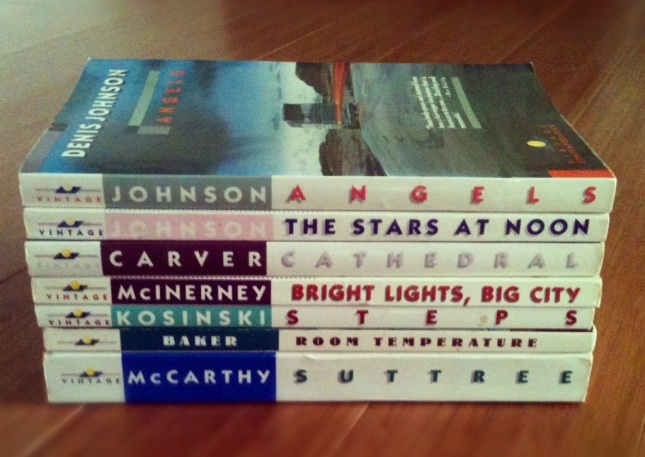
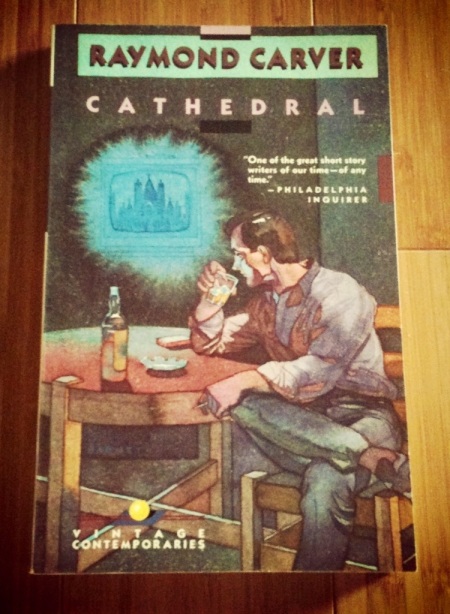
I’ve been a fan of Vintage Contemporaries for years. I’m pretty sure the first one I ever picked up was Raymond Carver’s Cathedral. I recall being vaguely dismayed about the cover and trying to find another used edition, but thrift won out. This was in the early or mid nineties, and book design was trending toward a more minimal, conceptual style.

20121014-173411.jpg

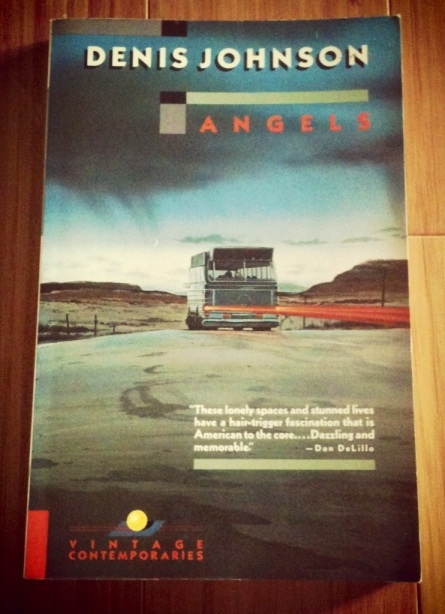
In contrast to a tasteful, minimalist cover, the Vintage Contemporaries edition of Cathedral is garishly literal. Ditto the cover for Denis Johnson’s Angels: sure, there’s a symbolic touch in those storm clouds, and a surreal tweak in the laser lights, but there’s something ghastly about the whole design.

20121014-173423.jpg

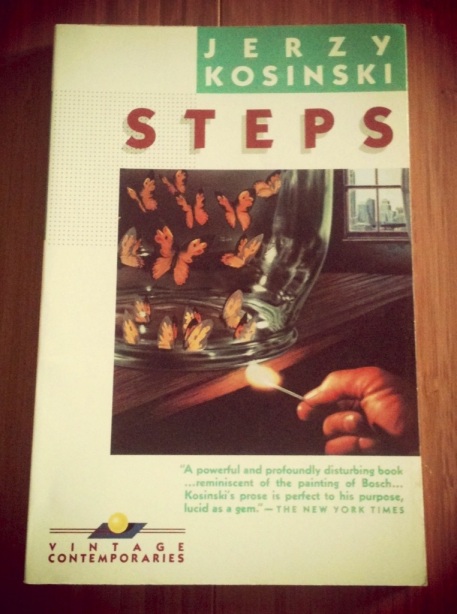
Even the cover for Jerzy Kosinski’s twisted horrorshow-in-vignettes Steps is remarkably literal—sure, the image seems surreal, but it’s straight out of Kosinski’s text. (It’s also one of my favorite covers in the line).

20121014-173436.jpg

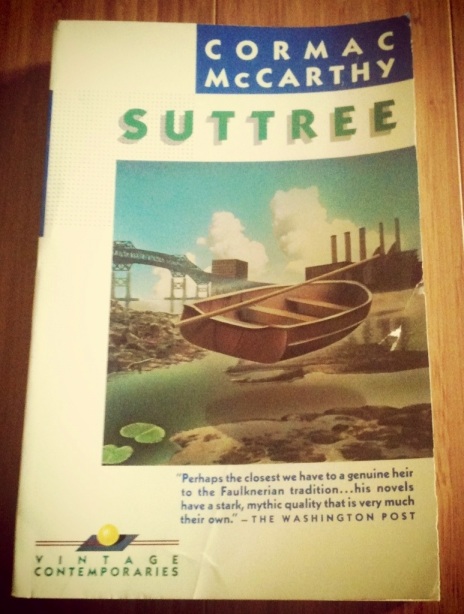
Anyway, in the past few years I’ve kept an eye out for certain titles from the Vintage Contemporaries line, even if I already own the book in another edition—DeLillo, for instance, or Cormac McCarthy. I was thrilled to find this edition of Suttree earlier this year. (And I’d love to get another copy of Harold Brodkey’s First Love and Other Sorrows; I gave mine away to a friend).

20121014-173446.jpg

I’d been wanting to write about the Vintage Contemporaries series for a while now, and had even gone so far as to write to a few artists and designers I know to see if they could put me in touch with a source of info. A few weeks ago, Mahendra Singh was kind enough to point out a thorough, in-depth essay on Vintage Contemporaries over at Talking Covers. Plenty of history, photos, and even interviews. It’s the mother-lode, the post I wished I could’ve mustered. (And if I seem a bit jealous, I can console myself in the knowledge that they used my first pic of Suttree. So there’s that). I encourage you to check it out.

First Page of an Early Draft of Blood Meridian


Nice article at Slate on Cormac McCarthy’s Blood Meridian, touching on how “all the way to galley proof in 1984, McCarthy whittled Blood Meridian down into the lean nightmare we now know. He cut whole characters and became more and more sparing of his description of the ones that remained. This was nowhere more pronounced than with the character of the kid, the nameless ruffian and pseudo-protagonist of the tale.” Good stuff. (Thanks to Garrett for alerting me to it).


Brown and the Farrier — A Vignette from Cormac McCarthy’s Blood Meridian


A self-contained episode from late in Cormac McCarthy’s Blood Meridian; this little vignette captures the book’s strange mix of menace and humor:

Noon he was red-eyed and reeking before the alcalde’s door demanding the release of his companions. The alcalde vacated out the back of the premises and shortly there arrived an American corporal and two soldiers who warned him away. An hour later he was at the farriery. Standing warily in the doorway peering into the gloom until he could make out the shape of things within.

The farrier was at his bench and Brown entered and laid before him a polished mahogany case with a brass nameplatebradded to the lid. He unsnapped the catches and opened the case and raised from their recess within a pair of shotgun barrels and he took up the stock with the other hand. He hooked the barrels into the patent breech and stood the shotgun on the bench and pushed the fitted pin home to secure the forearm. He cocked the hammers with his thumbs and let them fall again. The shotgun was English made and had damascus barrels and engraved locks and the stock was burl mahogany. He looked up. The farrier was watching him.

You work on guns? said Brown.

I do some.

I need these barrels cut down.

The man took the gun and held it in his hands. There was a raised center rib between the barrels and inlaid in gold the maker’s name, London. There were two platinum bands in the patent breech and the locks and the hammers were chased with scrollwork cut deeply in the steel and there were partridges engraved at either end of the maker’s name there. The purple barrels were welded up from triple skelps and the hammered iron and steel bore a watered figure like the markings of some alien and antique serpent, rare and beautiful and lethal, and the wood was figured with a deep red feather grain at the butt and held a small springloaded silver capbox in the toe.

The farrier turned the gun in his hands and looked at Brown. He looked down at the case. It was lined with green baize and there were little fitted compartments that held a wadcutter, a pewter powderflask, cleaning jags, a patent pewter capper.

You need what? he said.

Cut the barrels down. Long about in here. He held a finger across the piece.

I cant do that.

Brown looked at him. You cant do it?

No sir. He looked around the shop. Well, he said. I’d of thought any damn fool could saw the barrels off a shotgun.

There’s something wrong with you. Why would anybody want to cut the barrels off a gun like this?

What did you say? said Brown.

The man tendered the gun nervously. I just meant that I dont see why anybody would want to ruin a good gun like this here. What would you take for it?

It aint for sale. You think there’s something wrong with me?

No I dont. I didnt mean it that way.

Are you goin to cut them barrels down or aint ye?

I cant do that.

Cant or wont?

You pick the one that best suits you.

Brown took the shotgun and laid it on the bench. What would you have to have to do it? he said.

I aint doin it.

If a man wanted it done what would be a fair price?

I dont know. A dollar.

Brown reached into his pocket and came up with a handful of coins. He laid a two and a half dollar gold piece on the bench. Now, he said. I’m payin you two and a half dollars.

The farrier looked at the coin nervously. I dont need your money, he said. You cant pay me to butcher that there gun.

You done been paid.

No I aint.

Yonder it lays. Now you can either get to sawin or you can default. In the case of which I aim to take it out of your ass.

The farrier didnt take his eyes off Brown. He began to back away from the bench and then he turned and ran.

When the sergeant of the guard arrived Brown had the shotgun chucked up in the benchvise and was working at the barrels with a hacksaw. The sergeant walked around to where he could see his face. What do you want, said Brown.

This man says you threatened his life.

What man?

This man. The sergeant nodded toward the door of the shed.

Brown continued to saw. You call that a man? he said.

I never give him no leave to come in here and use my tools neither, said the farrier.

How about it? said the sergeant.

How about what?

How do you answer to this man’s charges?

He’s a liar.

You never threatened him?

That’s right.

The hell he never.

I dont threaten people. I told him I’d whip his ass and that’s as good as notarized.

You dont call that a threat?

Brown looked up. It was not no threat. It was a promise. He bent to the work again and another few passes with the saw and the barrels dropped to the dirt. He laid down the saw and backed off the jaws of the vise and lifted out the shotgun and unpinned the barrels from the stock and fitted the pieces into the case and shut the lid and latched it.

What was the argument about? said the sergeant.

Wasnt no argument that I know of.

You better ask him where he got that gun he’s just ruined. He’s stole that somewheres, you can wager on it.

Where’d you get the shotgun? said the sergeant.

Brown bent down and picked up the severed barrels. They were about eighteen inches long and he had them by the small end. He came around the bench and walked past the sergeant. He put the guncase under his arm. At the door he turned. The farrier was nowhere in sight. He looked at the sergeant.

I believe that man has done withdrawed his charges, he said. Like as not he was drunk.


Five Favorite Fictional Fathers

Literature seems to have an ambivalence toward fatherhood that’s too complex to address in a simple blog post–so I won’t even try. But before I riff on a few of my favorite fathers from a few of my favorite books, I think it’s worth pointing out how rare biological fathers of depth and complexity are in literature. That’s a huge general statement, I’m sure, and I welcome counterexamples, of course, but it seems like relationships between fathers and their children are somehow usually deferred, deflected, or represented in a shallow fashion. Perhaps it’s because we like our heroes to be orphans (whether it’s Moses or Harry Potter, Oliver Twist or Peter Parker) that literature tends to eschew biological fathers in favor of father figures (think of Leopold Bloom supplanting Stephen Dedalus in Ulysses, or Merlin taking over Uther Pendragon‘s paternal duties in the Arthur legends). At other times, the father is simply not present in the same narrative as his son or daughter (think of Telemachus and brave Odysseus, or Holden Caulfield wandering New York free from fatherly guidance). What I’ve tried to do below is provide examples of father-child relationships drawn with psychological and thematic depth; or, to put it another way, here are some fathers who actually have relationships with their kids.

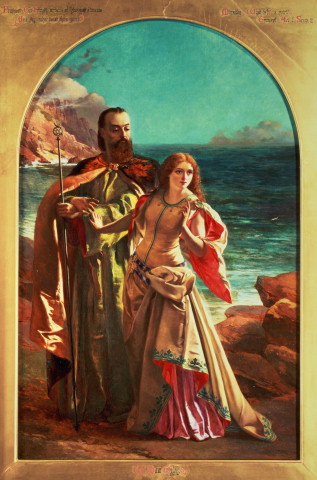
Prospero and Miranda--William Maw Egley
Prospero and Miranda–William Maw Egley

1. Prospero, The Tempest (William Shakespeare)

Prospero has always seemed to me the shining flipside to King Lear’s dark coin, a powerful sorcerer who reverses his exile and is gracious even in his revenge. Where Lear is destroyed by his scheming daughters (and his inability to connect to truehearted Cordelia), Prospero, a single dad, protects his Miranda and even secures her a worthy suitor. Postcolonial studies aside, The Tempest is fun stuff.

2. Abraham Ebdus, The Fortress of Solitude, (Jonathan Lethem)

Like Prospero, Abraham Ebdus is a single father raising his child (his son Dylan) in an isolated, alienating place (not a desert island, but 1970’s Brooklyn). After Dylan’s mother abandons the family, the pair’s relationship begins to strain; Lethem captures this process in all its awkward pain with a poignancy that never even verges on schlock. The novel’s redemptive arc is ultimately figured in the reconciliation between father and son in a beautiful ending that Lethem, the reader, and the characters all earn.

3. Jack Gladney, White Noise (Don DeLillo)

While Jack Gladney is an intellectual academic, an expert in the unlikely field of “Hitler studies” (and something of a fraud, to boot), he’s also a pretty normal dad. Casual reviewers of White Noise tend to overlook the sublime banality of domesticity represented in DeLillo’s signature novel: Gladney is an excellent father to his many kids and step-kids, and DeLillo draws their relationships with a realism that belies–and perhaps helps to create–the novel’s satirical bent.

4. Oscar Amalfitano, 2666 (Roberto Bolaño)

Sure, philosophy professor Amalfitano is a bit mentally unhinged (okay, more than a bit), but what sane citizen of Santa Teresa wouldn’t go crazy, what with all the horrific unsolved murders? After his wife leaves him and their young daughter, Amalfitano takes them to the strange, alienating land of Northern Mexico (shades of Prospero’s island?) Bolaño portrays Amalfitano’s descent into paranoia (and perhaps madness) from a number of angles (he and his daughter show up in three of 2666‘s three sections), and as the novel progresses, the reader slowly begins to grasp the enormity of the evil that Amalfitano is confronting (or, more realistically, is unable to confront directly), and the extreme yet vague danger his daughter is encountering. Only a writer of Bolaño’s tremendous gift could make such a chilling episode simultaneously nerve-wracking, philosophical, and strangely hilarious.

5. The father, The Road (Cormac McCarthy)

What happens when Prospero’s desert island is just one big desert? If there is a deeper expression of the empathy and bonding between a child and parent, I have not read it. In The Road, McCarthy dramatizes fatherhood in apocalyptic terms, positing the necessity of such a relationship in hard, concrete, life and death terms. When the father tells his son “You are the best guy” I pretty much break down. When I first read The Road, I had just become a father myself (my child was only a few days old when I finished it), yet I was still critical of McCarthy’s ending, which affords a second chance for the son. It seemed to me at the time–as it does now–that the logic McCarthy establishes in his novel is utterly infanticidal, that the boy must die, but I understand now why McCarthy would have him live–why McCarthy has to let him live. Someone has to carry the fire.


Denis Johnson’s Train Dreams Is a Perfect Novella

With blunt grace, Denis Johnson navigates the line between realism and the American frontier myth in his perfect novella Train Dreams. In a slim 116 pages, Johnson communicates one man’s life story with a depth and breadth that actually lives up to the book’s blurb’s claim to be an “epic in miniature.”  I read it in one sitting on a Sunday afternoon, occasionally laughing aloud at Johnson’s wry humor, several times moved by the pathos of the narrative, and more than once stunned at the subtle, balanced perfection of Johnson’s prose, which inheres from sentence to paragraph to resonate throughout the structure of the book.

The opening lines hooked me:

In the summer of 1917 Robert Grainier took part in an attempt on the life of a Chinese laborer caught, or anyway accused of, stealing from the company stores of the Spokane International Railway in the Idaho Panhandle.

Three of the railroad gang put the thief under restraint and dragged him up the long bank toward the bridge under construction fifty feet above the Moyea River. A rapid singsong streamed from the Chinaman voluminously. He shipped and twisted like a weasel in a sack, lashing backward with his one free fist at the man lugging him by the neck.

The matter-of-fact violence here complicates everything that follows in many ways, because Grainier it turns out is pretty much that rare thing, a good man, a simple man who tries to make a life in the Idaho Panhandle at the beginning of the 20th century. The rest of the book sees him trying—perhaps not consciously—to somehow amend for the strange near-lynching he abetted.

Grainier works as a day laborer, felling the great forests of the American northwest so that a network of trains can connect the country. Johnson resists the urge to overstate the obvious motifs of expansion and modernity here, instead expressing depictions of America’s industrial growth at a more personal, even psychological level:

Grainier’s experience on the Eleven-Mile Cutoff made him hungry to be around other such massive undertakings, where swarms of men did away with portions of the forest and assembled structures as big as anything going, knitting massive wooden trestles in the air of impassable chasms, always bigger, longer, deeper.

Grainier’s hard work keeps him from his wife and infant daughter, and the separation eventually becomes more severe after a natural calamity, but I won’t dwell on that in this review, because I think the less you know about Train Dreams going in the better. Still, it can’t hurt to share a lovely passage that describes Grainier’s courtship with the woman who would become his wife:

The first kiss plummeted him down a hole and popped him out into a world he thought he could get along in—as if he’d been pulling hard the wrong way and was now turned around headed downstream. They spent the whole afternoon among the daisies kissing. He felt glorious and full of more blood than he was supposed to have in him.

The passage highlights Johnson’s power to move from realism into the metaphysical and back, and it’s this precise navigation of naturalism and the ways that naturalism can tip the human spirit into supernatural experiences that makes Train Dreams such a strong little book. In the strange trajectory of his life, Grainier will be visited by a ghost and a wolf-child, will take flight in a biplane and transport a man shot by a dog, will be tempted by a pageant of pulchritude and discover, most unwittingly, that he is a hermit in the woods. In Johnson’s careful crafting, these events are not material for a grotesque picaresque or a litany of bizarre absurdities, but rather a beautiful, resonant poem-story, a miniature history of America.

Train Dreams is an excellent starting place for those unfamiliar with Johnson’s work, and the book will rest at home on a shelf with Steinbeck’s naturalist evocations or Cormac McCarthy’s Border Trilogy. I have no idea why the folks at FS&G waited almost a decade to publish it (Train Dreams was originally published in a 2002 issue of The Paris Review), but I’m glad they did, and I’m glad the book is out now in trade paperback from Picador, where it should gain a wider audience. Very highly recommended.

Book Shelves #22, 5.27.2012

20120527-111623.jpg

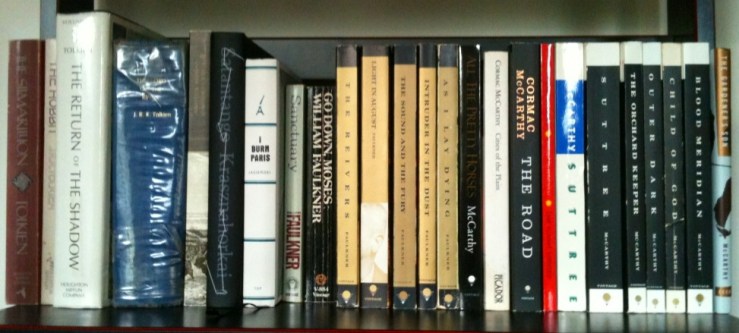
Book shelves series #22, twenty-second Sunday of 2012: Tolkien, Faulkner, McCarthy

As always, sorry for the glare. Shooting this case head on is almost impossible because of the windows on the other side of the room. Anyway.

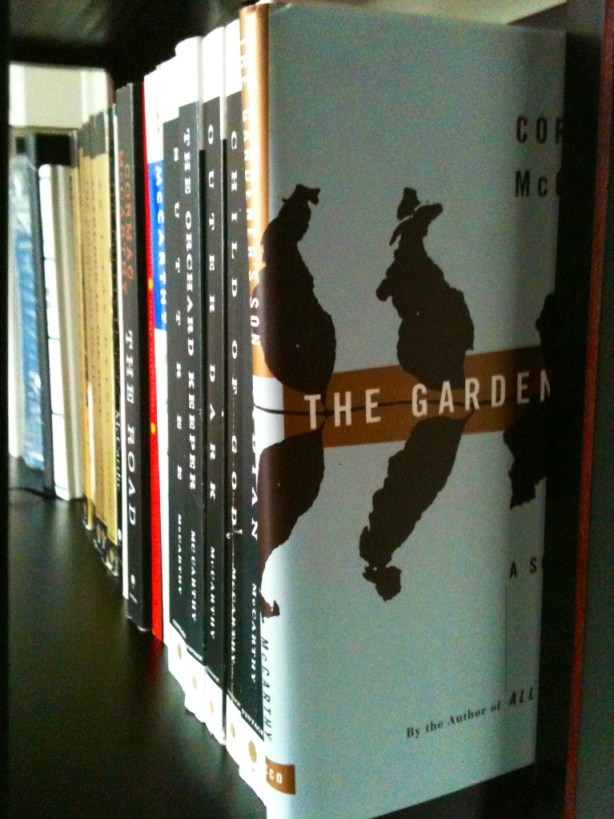
I’ve read everything by Cormac McCarthy with the exception of his screenplay for The Gardener’s Son, which I found a week or two and picked it up. I don’t own a copy of No Country for Old Men because I haven’t found one that isn’t a movie tie-in.

20120527-111632.jpg

This copy of The Lord of the Rings—my first—was a kind gift from some friends we were staying with in Melbourne (the one in Australia, not Florida).

20120527-111642.jpg

I’ve read it at least four times; I have other copies of LoTR and have read them too. It’s probably the book I’ve read the most, although I haven’t read it since 2002. This copy is kindly inscribed:

20120527-111650.jpg

There’s a slim space on the shelf that currently holds a few books that I’ve been meaning to read:

20120527-111659.jpg