
Food
I was preparing a meal for Celeste-a meal of a certain elegance, as when arrivals or other rites of passage are to be celebrated.
First off there were Saltines of the very best quality and of a special crispness, squareness, and flatness, obtained at great personal sacrifice by making representations to the National Biscuit Company through its authorized nuncios in my vicinity. Upon these was spread with a hand lavish and not sitting Todd’s Liver Pate, the same having been robbed from geese and other famous animals and properly adulterated with cereals and other well-chosen extenders and the whole delicately spiced with calcium propionate to retard spoilage. Next there were rare cheese products from Wisconsin wrapped in gold foil in exquisite tints with interesting printings thereon, including some very artful representations of cows, the same being clearly in the best of health and good humor. Next there were dips of all kinds including clam, bacon with horseradish, onion soup with sour cream, and the like, which only my long acquaintance with some very high-up members of the Borden company allowed to grace my table. Next there were Fritos curved and golden to the number of 224 (approx.), or the full contents of the bursting 53c bag. Next there were Frozen Assorted Hors d’Oeuvres of a richness beyond description, these wrested away from an establishment catering only to the nobility, the higher clergy, and certain selected commoners generally agreed to be comers in their particular areas of commonality, calcium propionate added to retard spoilage. In addition there were Mixed Nuts assembled at great expense by the Planters concern from divers strange climes and hanging gardens, each nut delicately dusted with a salt that has no peer. Furthermore there were cough drops of the manufacture of the firm of Smith Fils, brown and savory and served in a bowl once the property of Brann the Iconoclast. Next there were young tender green olives into which ripe red pimentos had been cunningly thrust by underpaid Portuguese, real and true handwork every step of the way. In addition there were pearl onions meticulously separated from their nonstandard fellows by a machine that had caused the Board of Directors of the S&W concern endless sleepless nights and had passed its field trails just in time to contribute to the repast I am describing. Additionally there were gherkins whose just fame needs no further words from me. Following these appeared certain cream cheeses of Philadelphia origin wrapped in costly silver foil, the like of which a pasha could not have afforded in the dear dead days. Following were Mock Ortolans Manques made of the very best soybean aggregate, the like of which could not be found on the most sophisticated tables of Paris, London and Rome. The whole washed down with generous amounts of Tab, a fiery liquor brewed under license by the Coca-Cola Company which will not divulge the age-old secret recipe no matter how one begs and pleads with them but yearly allows a small quantity to circulate to certain connoisseurs and bibbers whose credentials meet the very rigid requirements of the Cellarmaster. All of this stupendous feed being a mere scherzo before the announcement of the main theme, chilidogs.
“What is all this?” asked sweet Celeste, waving her hands in the air. “Where is the food?”
“You do not recognize a meal spiritually prepared,” I said, hurt in the self-love.
“We will be very happy together,” she said. “I cook.”
Tag: Donald Barthelme
Don was there, as well as William Gass, Stanley Elkin, William Gaddis, and half a dozen others of the postmodernist bent.
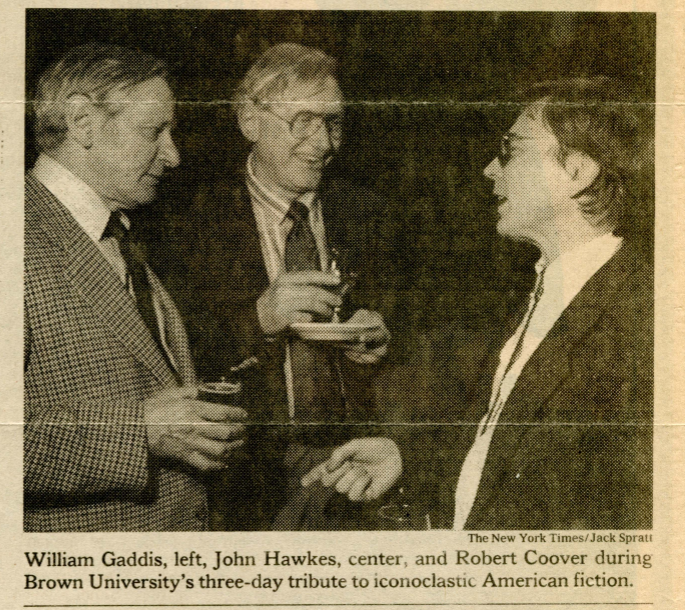
The New Yorker: Last week, there was a three-day festival in your honor at Brown University, in Providence—titled, in part, “Celebrating the Unspeakable Practices of Robert Coover”—featuring appearances by many of your colleagues and admirers, including T. C. Boyle, Don DeLillo, Alexandra Kleeman, Marlon James, Edwidge Danticat, Paul Auster, and many others. What was the stimulus for the festival?
Robert Coover: “Unspeakable Practices” was the title of a farewell party I organized for the then retiring professor and great metafictionist John Hawkes, in 1988—a title taken from Donald Barthelme’s book of stories “Unspeakable Practices, Unnatural Acts.” Don was there, as well as William Gass, Stanley Elkin, William Gaddis, and half a dozen others of the postmodernist bent. After that, over the years, we continued with a sequence of vanguard literary ingatherings, calling them all “Unspeakables.” In effect, this was the last one and perhaps the most brilliant of the lot, peopled by old friends and many former students, now celebrated writers in their own right. The readings on the final day by Edwidge Danticat, Rick Powers, Siri Hustvedt, Don DeLillo, and Paul Auster were sensational, some of the best public performances I’ve ever heard. Its whole title was meant to include my creation of the International Writers Project and its freedom-to-write predecessors at Brown, as well as my pioneer digital language workshops in hyperfiction and “cave writing” (writing in immersive 3-D), both programs launched at Brown in 1989. It was a great party, a party that began with the performance of a short sequence from my son Roderick’s radio play based on “Gerald’s Party,” and ending with a reiteration of an old festival favorite, the “Unspeakable Circus.”
From a brief 2018 exchange between the great American novelist Robert Coover and Deborah Treisman (published in The New Yorker). More on Coover’s “Unspeakable Practices” event here.
Read “The Flight of Pigeons from the Palace,” a very short story by Donald Barthelme
“The Flight of Pigeons from the Palace”
by
Donald Barthelme
In the abandoned palazzo, weeds and old blankets filled the rooms. The palazzo was in bad shape. We cleaned the abandoned palazzo for ten years. We scoured the stones. The splendid architecture was furbished and painted. The doors and windows were dealt with. Then we were ready for the show.
The noble and empty spaces were perfect for our purposes. The first act we hired was the amazing Numbered Man. He was numbered from one to thirty-five, and every part moved. And he was genial and polite, despite the stresses to which his difficult métier subjected him. He never failed to say “Hello” and “Goodbye” and “Why not?” We were happy to have him in the show.
Then, the Sulking Lady was obtained. She showed us her back. That was the way she felt. She had always felt that way, she said. She had felt that way since she was four years old.
We obtained other attractions—a Singing Sword and a Stone Eater. Tickets and programs were prepared. Buckets of water were placed about, in case of fire. Silver strings tethered the loud-roaring strong-stinking animals.
The lineup for opening night included:
A startlingly handsome man
A Grand Cham
A tulip craze
The Prime Rate
Edgar Allan Poe
A colored light
We asked ourselves: How can we improve the show?
We auditioned an explosion.
There were a lot of situations where men were being evil to women—dominating them and eating their food. We put those situations in the show.
In the summer of the show, grave robbers appeared in the show. Famous graves were robbed, before your eyes. Winding-sheets were unwound and things best forgotten were remembered. Sad themes were played by the band, bereft of its mind by the death of its tradition. In the soft evening of the show, a troupe of agoutis performed tax evasion atop tall, swaying yellow poles. Before your eyes.
The trapeze artist with whom I had an understanding . . . The moment when she failed to catch me . . .
Did she really try? I can’t recall her ever failing to catch anyone she was really fond of. Her great muscles are too deft for that. Her great muscles at which we gaze through heavy-lidded eyes . . .
We recruited fools for the show. We had spots for a number of fools (and in the big all-fool number that occurs immediately after the second act, some specialties). But fools are hard to find. Usually they don’t like to admit it. We settled for gowks, gulls, mooncalfs. A few babies, boobies, sillies, simps. A barmie was engaged, along with certain dumdums and beefheads. A noodle. When you see them all wandering around, under the colored lights, gibbering and performing miracles, you are surprised.
I put my father in the show, with his cold eyes. His segment was called My Father Concerned about His Liver.
Performances flew thick and fast.
We performed The Sale of the Public Library.
We performed Space Monkeys Approve Appropriations.
We did Theological Novelties and we did Cereal Music (with its raisins of beauty) and we did not neglect Piles of Discarded Women Rising from the Sea.
There was faint applause. The audience huddled together. The people counted their sins.
Scenes of domestic life were put in the show.
We used The Flight of Pigeons from the Palace.
It is difficult to keep the public interested.
The public demands new wonders piled on new wonders.
Often we don’t know where our next marvel is coming from.
The supply of strange ideas is not endless.
The development of new wonders is not like the production of canned goods. Some things appear to be wonders in the beginning, but when you become familiar with them, are not wonderful at all. Sometimes a seventy-five-foot highly paid cacodemon will raise only the tiniest frisson. Some of us have even thought of folding the show—closing it down. That thought has been gliding through the hallways and rehearsal rooms of the show.
The new volcano we have just placed under contract seems very promising . . .
Some people found the balloon “interesting” | Donald Barthelme
There were reactions. Some people found the balloon “interesting.” As a response this seemed inadequate to the immensity of the balloon, the suddenness of its appearance over the city, on the other hand, in the absence of hysteria or other societally induced anxiety, it must be judged a calm, “mature” one. There was a certain amount of initial argumentation about the “meaning” of the balloon, this subsided, because we have learned not to insist on meanings, and they are rarely even looked for now, except in cases involving the simplest, safest phenomena. It was agreed that since the meaning of the balloon could never be known absolutely, extended discussion was pointless, or at least less purposeful than the activities of those who, for example, hung green and blue paper lanterns from the warm gray underside, in certain streets, or seized the occasion to write messages on the surface, announcing their availability for the performance of unnatural acts, or the availability of acquaintances.
Daring children jumped, especially at those points where the balloon hovered close to a building, so that the gap between balloon and building was a matter of a few inches, or points where the balloon actually made contact, exerting an ever-so-slight pressure against the side of a building, so that balloon and building seemed a unity. The upper surface was so structured that a “landscape” was presented, small valleys as well as slight knolls, or mounds, once atop the balloon, a stroll was possible, or even a trip, from one place to another. There was pleasure in being able to run down an incline, then up the opposing slope, both gently graded, or in making a leap from one side to the other. Bouncing was possible, because of the pneumaticity of the surface, and even falling, if that was your wish. That all these varied motions, as well as others, were within one’s possibilities, in experiencing the “up” side of the balloon, was extremely exciting for children, accustomed to the city’s flat, hard skin. But the purpose of the balloon was not to amuse children.
Four Books (Barthelme, Burroughs, and Barry [Hannah])
If you follow this blog even semi-regularly, you may know that I frequently frequent Chamblin Bookmine. This sprawling bookstore, with an inventory of close to three million books (mostly used, and often very weird), is about a mile from my house, and in some small ways might constitute a mute coauthor of this blog. I don’t get to their second location, Chamblin Uptown (in downtown Jacksonville) that often, and even less during the last few years (for obvious reasons), but I went downtown to watch my nephew wrestle last Sunday, and stopped by. In addition to a pair of Ishmael Reed massmarket 1970s paperbacks, I fetched a small stack of first-edition hardbacks by Donald Barthelme, William Burroughs, and Barry Hannah.
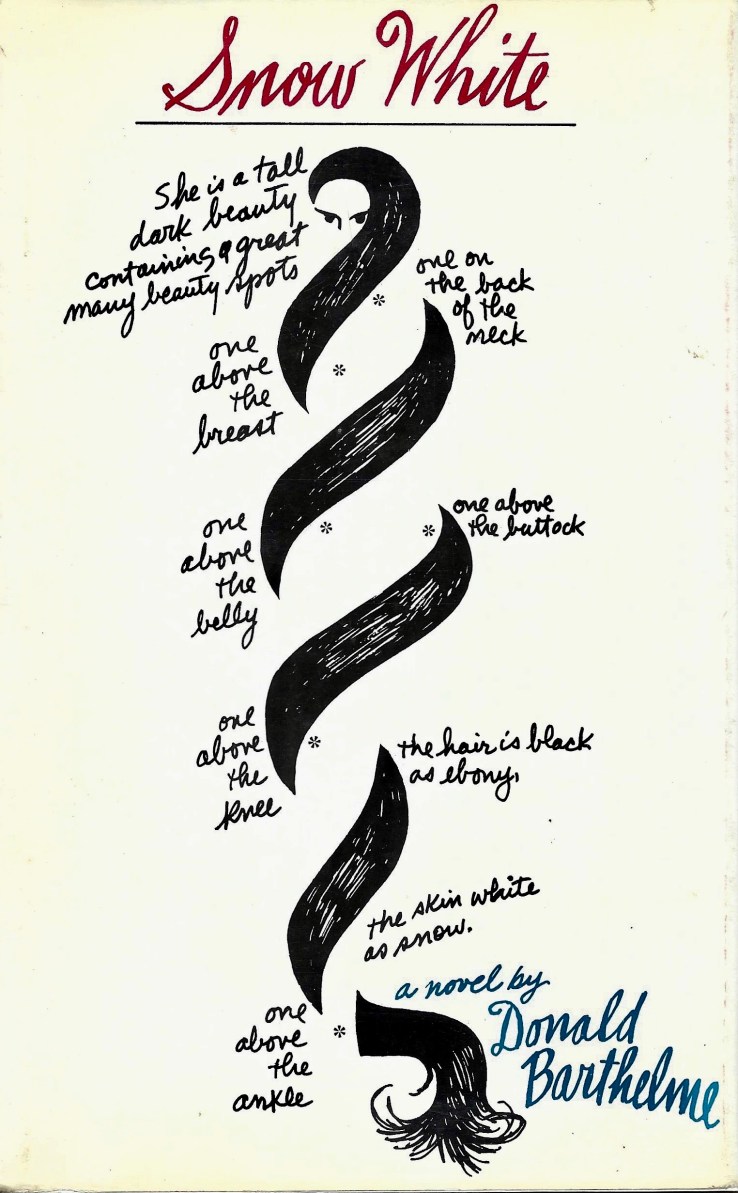
I was thrilled to find a first-edition of Donald Barthelme’s first novel Snow White (Atheneum, 1970), with a jacket by Lawrence Ratzkin. The cover sans jacket is also nice:


Overnight to Many Distant Cities isn’t Barthelme’s best collection, but I couldn’t pass up a first edition (G. P. Putnam’s Sons, 1983). The cover features a photograph by Russell Munson.

So far this year, William S. Burroughs’ late novel Cities of the Red Night has been a reading highlight for me: apocalyptic, utopian, discursive, funny, and more poignant than I had remembered when I first read it two decades ago. I couldn’t pass up on a first-edition of its sequel, The Place of Dead Roads (Holt, Rinehart, and Winston, 1983) with a jacket by Robert Reed (working from an old uncredited photograph). I found an audiobook of Dead Roads at my local library, so I might give that a shot.
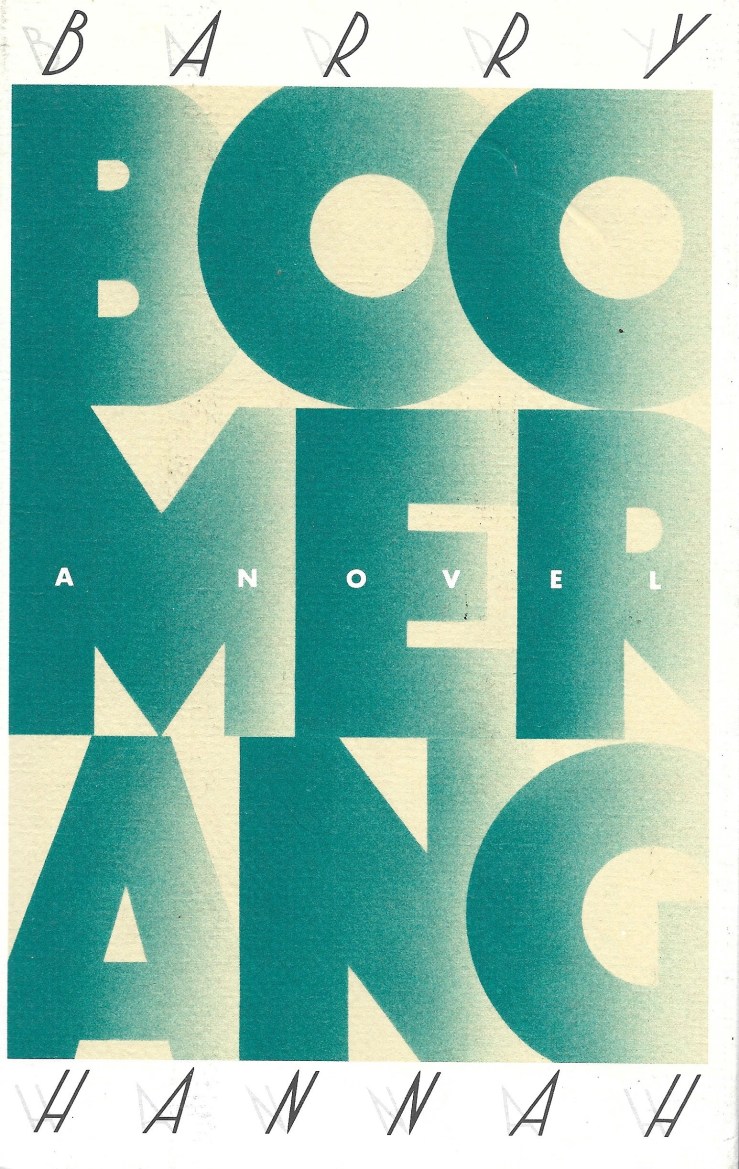
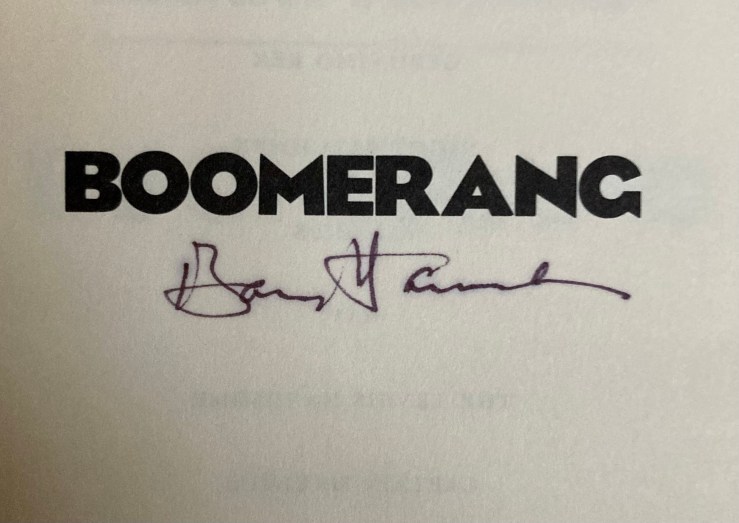
I also grabbed a signed copy of Barry Hannah’s semi-autobiography, Boomerang (Houghton Mifflin, 1989), with a cover by one of my favorite designers, Fred Marcellino. Here’s the autograph:
Marcellino also did the cover for another signed Hannah I have, Captain Maximus (wait, is this Five Books?):

Sunday equinox blog | Atlanta, Di Benedetto, a Paley poem, ghosting William S. Burroughs, etc.

My spring break, which is to say the spring break of the community college which employs me to teach English, rarely coincides with my children’s spring break, but this year it did, and we took full advantage, spending a week in Atlanta. We stayed in Inman Park, enjoying the BeltLine and the city’s vibe in general. Airport aside, I hadn’t been to Atlanta in twenty years, and I took pleasure in our week there. (I dug the High Museum in particular, and shared some favorites from our visit on Twitter.)
I can’t remember the last time I visited a city and didn’t buy a book. A Capella Books was a short walk from our place; it’s a small, well-curated bookshop with a limited selection. A Capella offered a number of signed books by musicians, including Billy Bragg and Chris Frantz. I thought I might regret not picking up a signed copy of Frantz’s memoir Remain in Love (which I read last year), but I feel no regret as I type this sentence. I also visited Posman Books at Ponce Market. It veers close to something like a tasteful gift shop/stationery joint, but the small fiction and poetry selection is pretty good, even if a lot of it is shelf candy. I think if I’d been willing to drive farther out I might’ve found some deeper cuts. (My wife pointed out that our local used bookstore, 1.1 miles away, has utterly spoiled me.)
Anyway: No books acquired in Atlanta. (I did buy some records though: Fat Mattress’s debut and Fleetwood Mac’s Heroes Are Hard to Find.)
I brought Esther Allen’s new translation of Antonio di Benedetto’s novel The Silentiary with me to reread on the trip. I read it back in January, dogeared it, and started a review, but found that I wanted to let it settle a bit. I liked it the first time round, but the reread revealed a sadder, deeper novel than I had initially estimated.
Other stuff I’ve been reading:
Grace Paley’s late collection of poems, Fidelity. Grand stuff. Sample:

I’ve also been picking through Helen Moore Barthelme’s biography Donald Barthelme: Genesis of a Cool Sound, although there’s nothing particularly revelatory about it.
I picked up the Paley and Barthelme when I swung by our campus library to get Don’t Hide the Madness, a series of conversations between Allen Ginsberg and William S. Burroughs. Burroughs is getting pretty close to the end of his life here, and Ginsberg seems to want to get him to further cement a cultural legacy through a late oral autobiography. Burroughs repeatedly derails these attempts though, which is hilarious. Burroughs talks about whatever comes to mind (often his guns). The cover by Robert Crumb is worth sharing:

I initially requested the Burroughs book because I’ve been rereading Cities of the Red Night—and absolutely loving it—and I was trying to figure out who it was who may or may not have played a role in ghostwriting the book with Burroughs. Cities is straighter than much of Burroughs’ work—but it’s still thoroughly Burroughsian. It’s entirely possible that a straighter hand cobbled Burroughs’ images and fragments together, at least to some extent, although I think it’s erroneous to refer to the novel as ghostwritten. As far as I can tell, the claim originates with Dennis Cooper’s obituary in the October 1997 issue of Spin:

My initial guess was that Cooper here insinuates that Victor Bockris helped arrange Cities of the Red Night. Bockris was around Burroughs a lot when Burroughs was working on Cities; however, Bockris suggests that it was Burroughs who corrected his prose:
From 1979 to 1981, I had the privilege of working with William Burroughs (aged sixty-five to sixty-seven) editing two books: my portrait With William Burroughs: A Report from the Bunker (St. Martins, 1996), and his selected essays, The Adding Machine (Arcade, 1996). At the same time, Burroughs was finishing his long-awaited novel, Cities of the Red Night (Holt, 1981), which would inaugurate a whole new person and period in his career, opening the doors to sixteen highly productive, positive years (1981-97) writing, painting, acting, performing, recording. Consequently, I suppose I am one of the ten to twelve people who ever got close enough to Bill professionally to see into his writing center. When I gave him the manuscript of With William Burroughs (75 percent of which was taped dialogue of conversations between Burroughs and fifteen other celebrities), he not only corrected the sometimes atrocious writing, he added a handful of precious inserts.
More digging seems to suggest that it was the artist Steven Lowe who helped Burroughs arrange Cities. Rick Castro’s appreciation of Lowe goes as far as to assert that, Lowe “was a ghostwriter for Burroughs, assisting on Cities of the Red Night, Junkie, and a few other titles.”
Ultimately, I agree with Jamie Russell in Queer Burroughs (2001), that
The rumor that the post-Red Night trilogy texts were partly ghostwritten is perhaps…more of a compliment than the criticism it was intended to be, since it highlights Burroughs’ central theme of the 1980s and 1990s texts: the creation of a post-corporeal real. Who needs a body to write with anyway?
Typing that out, I realize that I’ve inserted an entirely different post into this Sunday equinox post. Oh well.
I love Cities of the Red Night—it’s funny and gross and oddly sweet and even sentimental, an ironic pastiche of the so-called “boys books” genre, as well as a howl against war, conformity, and the military-industrial-entertainment complex. The novel it most reminds me of (apart from other Burroughs’ novels) is Thomas Pynchon’s Against the Day.
I’m also, thanks to the audiobook, into the third section of Marlon James’ Moon Witch, Spider King. The second section focused on the protagonist Sogolon’s domestic life. Frankly, the section sags, although I understand that it likely girds the emotional core of the events to come. The novel pivots dramatically in section three, “Moon Witch.” Sogolon has lost her memory, and is in a strange sunken city centuries in the future. That’s the good shit. More thoughts to come.
Read Donald Barthelme’s uncollected short story “The Ontological Basis of Two”
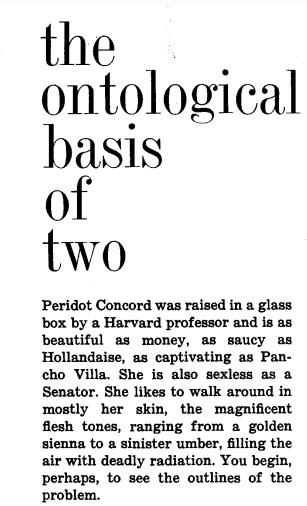
Donald Barthelme published a short story called “The Ontological Basis of Two” under the pseudonym “Michael Houston” in the June, 1963 issue of Cavalier, a “men’s” magazine. In her biography Donald Barthelme: The Genesis of a Cool Sound, Barthelme’s ex-wife Helen Moore Barthelme writes,
…Don had with him the June issue of Cavalier. In it was a story he had written the previous December and submitted to Playboy. But “killing my hopes of a warm winter,” the story was turned down. He then submitted it under a pseudonym to a Playboy-styled magazine, Cavalier…
The story was “The Ontological Basis of Two,” and it appeared under the name of Michael Houston, a pseudonym he had used for Forum. A parody of B.F. Skinner’s Walden Two, it is an ironical tale of a girl–Peridot Concord– “who was raised in a glass box by a Harvard Professor.” He says of Peridot that because she inhabited the box until her fourth year, she “is as healthy and natural as a shrub.” Although she is free of the inhibitions of appearing nude that beset the narrator and everyone else, four years in the box have also left her “lacking in basic carnality.“
The story remains uncollected, but you can read “The Ontological Basis of Two” online thanks to Jessamyn West’s fantastic Barthelme page.
Here’s the opening paragraph of the story:
Photographic portrait of Donald Barthelme at his drum kit, taken by his father Donald Barthelme, Sr.

Donald Barthelme’s “The Indian Uprising,” but just the punctuation
. . , . . . . ” ? ” , , – . . ” . ” , . . . , . , , , , – . . . ” ‘ ‘ ‘ ? ” ” ? ” ” . ” ” , ” . ” , , , . ” ” ? ” ” , ” , ” . ” , , , : ? ? – . , , , , . , , , ( ) , , . , , ; ; – ; – – & , , , , , # ; – – ; , – ; ; ; ; ; , , ; – – ; , , ; . . , . . . , , , , , . . . ” , ” , ” , , , , , . , , , . . . . ” . . . , – . , , , , . , – . – . ” , ” . ” . ” , , , , , , . ” , ” . , . , – , , , . . . . , , , . – . . – – . ” , ” . ” , ” . . . , . . ( , ! ! ) . . . . . , , . . , . . , , . , , , , , , , , , . ” ? ” . ” , ” . ” . . ” ” ? ” ” , ” . ” . . . . . ” ‘ , . , , , : ” ? ” . . , . . . ” , , , . ‘ . ” . ” . ( ) , , , , . ” . ” ? ” ‘ . ” , ” . ” . , , . ” , , , , . . , . ” , ” , ” ? ” ” , ” . , , ” . . , , , # , , , , , , . , ” . , ” # . , ” , ” , , , , , , . , ” . , ” . , ” . , ” , , . . ” . , , , . – – . , . ” ! ! ” , , . . . . , , . – – , . , , , . . . , , , , , , , , . , – . . . . , . . . ! . ‘ , . – , ‘ , ? , , ‘ , ? . ( ‘ ) , ( ‘ ) . , ! , . , , , , , . . & . ” ? ” ” , ! ” . . ” ? ” , , – – , . . , , . . ” , ” . , . ” . . ” ( , ) , , , .
Donald Barthelme’s “The Indian Uprising,” but it’s just the punctuation.
“Food” — Donald Barthelme
Food
I was preparing a meal for Celeste-a meal of a certain elegance, as when arrivals or other rites of passage are to be celebrated.
First off there were Saltines of the very best quality and of a special crispness, squareness, and flatness, obtained at great personal sacrifice by making representations to the National Biscuit Company through its authorized nuncios in my vicinity. Upon these was spread with a hand lavish and not sitting Todd’s Liver Pate, the same having been robbed from geese and other famous animals and properly adulterated with cereals and other well-chosen extenders and the whole delicately spiced with calcium propionate to retard spoilage. Next there were rare cheese products from Wisconsin wrapped in gold foil in exquisite tints with interesting printings thereon, including some very artful representations of cows, the same being clearly in the best of health and good humor. Next there were dips of all kinds including clam, bacon with horseradish, onion soup with sour cream, and the like, which only my long acquaintance with some very high-up members of the Borden company allowed to grace my table. Next there were Fritos curved and golden to the number of 224 (approx.), or the full contents of the bursting 53c bag. Next there were Frozen Assorted Hors d’Oeuvres of a richness beyond description, these wrested away from an establishment catering only to the nobility, the higher clergy, and certain selected commoners generally agreed to be comers in their particular areas of commonality, calcium propionate added to retard spoilage. In addition there were Mixed Nuts assembled at great expense by the Planters concern from divers strange climes and hanging gardens, each nut delicately dusted with a salt that has no peer. Furthermore there were cough drops of the manufacture of the firm of Smith Fils, brown and savory and served in a bowl once the property of Brann the Iconoclast. Next there were young tender green olives into which ripe red pimentos had been cunningly thrust by underpaid Portuguese, real and true handwork every step of the way. In addition there were pearl onions meticulously separated from their nonstandard fellows by a machine that had caused the Board of Directors of the S&W concern endless sleepless nights and had passed its field trails just in time to contribute to the repast I am describing. Additionally there were gherkins whose just fame needs no further words from me. Following these appeared certain cream cheeses of Philadelphia origin wrapped in costly silver foil, the like of which a pasha could not have afforded in the dear dead days. Following were Mock Ortolans Manques made of the very best soybean aggregate, the like of which could not be found on the most sophisticated tables of Paris, London and Rome. The whole washed down with generous amounts of Tab, a fiery liquor brewed under license by the Coca-Cola Company which will not divulge the age-old secret recipe no matter how one begs and pleads with them but yearly allows a small quantity to circulate to certain connoisseurs and bibbers whose credentials meet the very rigid requirements of the Cellarmaster. All of this stupendous feed being a mere scherzo before the announcement of the main theme, chilidogs.
“What is all this?” asked sweet Celeste, waving her hands in the air. “Where is the food?”
“You do not recognize a meal spiritually prepared,” I said, hurt in the self-love.
“We will be very happy together,” she said. “I cook.”
Barthelme/Calvino/Garner/Jackson (Books acquired, 19 Nov. 2021)
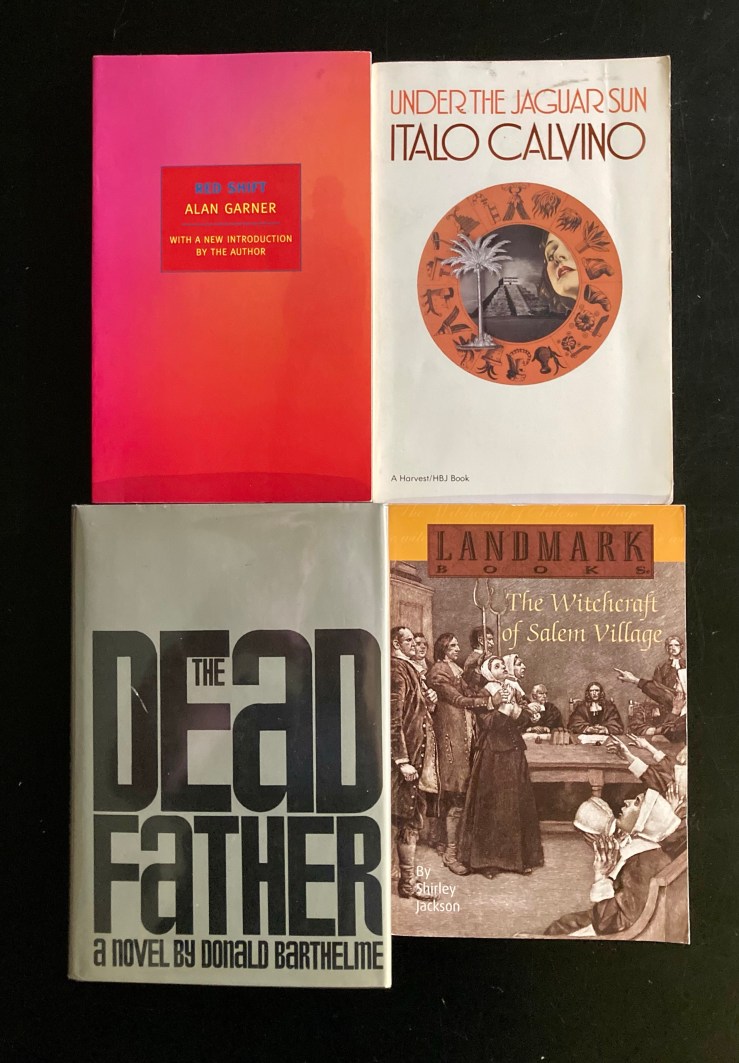
Spent a spare hour this afternoon at the local used bookshop.
A few months ago I found a first edition of Donald Barthelme’s collection Forty Stories. This afternoon I picked up a first edition of my favorite Barthelme novel, The Dead Father. The jacket design–by Ruth Ansel–is really cool, which doesn’t really come through in the photograph. The back cover simply reverses the silver-black set up of the front cover; the spine reads bottom to top instead of top to bottom, like most U.S. titles.
I’ve never read Under the Jaguar Sun by Italo Calvino, but I picked it up because I enjoyed rereading three by Calvino earlier this year (and it’s very short and has a cool cover by Malcolm Tarlofsky).
I’d never heard of Alan Garner’s 1973 novel Red Shift until today. I always pull NYRB spines out, and the novel’s description on the back caught my attention. Part of the description:
In second-century Britain, Macey and a gang of fellow deserters from the Roman army hunt and are hunted by deadly local tribes. Fifteen centuries later, during the English Civil War, Thomas Rowley hides from the ruthless troops who have encircled his village. And in contemporary Britain, Tom, a precocious, love-struck, mentally unstable teenager, struggles to cope with the imminent departure for London of his girlfriend, Jan.
The blurb from Ursula K. Le Guin (“A bitter, complex, brilliant book”) made me pick it up. I love the NYRB cover, which has a My Bloody Valentine feeling to it, at least to me, but I also am a big proponent of genre covers–sci-fi/fantasy covers that might not be as “respectable” as the “literary” crossover covers that adorn works that live a second life. So I trekked over to the sci-fi/fantasy section to see if I could find another edition of Red Shift. This is what I found:

I regret not looking for the artist’s name now. I dig the Ballantine cover, but the NYRB edition was far more readable in the end.
From the sci-fi/fantasy section, I somehow wandered into U.S. history, staring at an endcap titled “Salem witchcraft.” I did not know that Shirley Jackson wrote a book about Salem—or Salem Village, as she points out in her initial note—a place that is not the same place as Salem—I did not know that Jackson wrote a book about the Salem (Village) witchcraft trials. I picked it up and started in and didn’t want to stop.
Apparently it’s a children’s book.
Donald Barthelme’s Sixty Stories in reverse: Chapter the Last, featuring Thirty Stories, Fifteen Stories, and Ten Stories

Previously,
I don’t know if there’s a need for a defense of Donald Barthelme, and I do know that I am not the person to mount that defense. I spent the last two months re-reading Sixty Stories along with/against Tracy Daugherty’s 2010 biography of Barthelme, Hiding Man. I read some other stuff, but most of the writing on this cursed website was about Barthelme’s stories.
Here’s the thing: these stories, even when soaked in the juices of their zeitgeist (“The Sandman,” “The Indian Uprising,” “Robert Kennedy Saved from Drowning”) more than hold up. They are still fresh, funny, strange, charming. I suppose they could be more upsetting–Barthelme’s world is never raw, and always displaces the visceral through a heavy salve of ironic refinements (and a three-martini haze).
But Barthelme’s rhetorical contortions vivify the forms that he parodies here—early French modernism (“Eugénie Grandet”) or Kafkaesque existentialism (“Me and Miss Mandible,” “The Sergeant”) or faux-academic essaying (“On Angels”). He transmutes the material into something more. In his introduction to the 2003 Penguin Classics edition of Sixty Stories that I read, David Gates remarks that,
Barthelme is a quintessential writer of the twentieth century, looking Janus-faced to both the past and future, and with a third eye turned inward. Yet he’s also an anomaly. Nobody before him really reads much like him: neither Beckett or Nabokov, nor such minimalist realists as Hemingway, nor such fabulists as Kafka and Borges…Nor has he become anyone’s Dead Father.
Gates’s appellation “Dead Father” is a nod to Barthelme’s best novel as well as the oedipal undercurrent that surges over and under his ouevre. Gates tries to situate Barthelme’s modernism, a modernism beholden to Dead Father Beckett, himself beholden to Dead Father Joyce.
But Gates never comes out and states what I think is clear after re-reading Sixty Stories (especially against Daugherty’s Barthelme biography)–Barthelme’s success is that he is a failed modernist. In his 1981 interview with J.D. O’Hara, Barthelme stated,
…my father was an architect of a particular kind—we were enveloped in modernism. The house we lived in, which he’d designed, was modern and the furniture was modern and the pictures were modern and the books were modern.
Raised a Modernist, Barthelme transcends Modernism.
And yet he was reticent of any terms that might fix him as something other. In a 1980 interview with Larry McCaffery, he called “‘postmodernism’…the least ugly, most descriptive” of the terms that had been used to pigeonhole his fiction.
He hedged more in his 1987 essay “Not Knowing,” musing that it was “not altogether clear as to who is supposed to be on the bus and who is not.” Postmodernism though is really just a descriptor. And we’re all on the bus.
Gates eventually settles on Barthelme as a “Dark Uncle” of literature, as opposed to a Dead Father. Like Nabokov, Gates suggests Barthelme may have imitators, but not true followers. (Gates does posit the potential of George Saunders to get there, and I’d argue no other living American writer (that I know of) would have at one time been fit to take up the Barthelme mantle, but kudos to Saunders for forging his own schmaltzy overly-empathetic path.)
But enough of Gates’s intro. It’s good. It’s very 2003–mentions of David Eggers, Harold Bloom, a lot of handwringing about postmodernism. (Somehow, unless I’m forgetting, Barthelme’s true contemporary Robert Coover isn’t mentioned.)
Anyway. The stuff in Sixty Stories still shines, still sings–and much of it is far more poignant than I would’ve initially credited.
So here are the silly lists.
If you want to turn Sixty Stories into Thirty Stories, here’s my edit (in reverse chronology):
“Bishop,” (previously uncollected, 1981)
“The Emerald,” (previously uncollected, 1981)
“The King of Jazz,” (Great Days, 1979)
“Cortes and Montezuma,” (Great Days, 1979)
“The Great Hug,” (Amateurs, 1976)
“The School,” (Amateurs, 1976)
“I Bought a Little City,” (Amateurs, 1976)
“At the End of the Mechanical Age,” (Amateurs, 1976)
“A Manual for Sons,” (The Dead Father, 1975)
“Eugénie Grandet,” (Guilty Pleasures, 1974)
“Nothing: A Preliminary Account” (Guilty Pleasures, 1974)
“Daumier” (Sadness, 1972)
“The Rise of Capitalism” (Sadness, 1972)
“The Sandman” (Sadness, 1972)
“The Glass Mountain” (City Life, 1970)
“The Policemen’s Ball” (City Life, 1970)
“Kierkegaard Unfair to Schlegel” (City Life, 1970)
“The Phantom of the Opera’s Friend” (City Life, 1970)
“On Angels” (City Life, 1970)
“Paraguay” (City Life, 1970)
“Views of My Father Weeping” (City Life, 1970)
“The Indian Uprising” (Unspeakable Practices, Unnatural Acts, 1968)
“See the Moon?” (Unspeakable Practices, Unnatural Acts, 1968)
“Report” (Unspeakable Practices, Unnatural Acts, 1968)
“Robert Kennedy Saved from Drowning” (Unspeakable Practices, Unnatural Acts, 1968)
“Game” (Unspeakable Practices, Unnatural Acts, 1968)
“The Balloon” (Unspeakable Practices, Unnatural Acts, 1968)
“For I’m the Boy” (Come Back, Dr. Caligari, 1964)
“Me and Miss Mandible” (Come Back, Dr. Caligari, 1964)
“A Shower of Gold” (Come Back, Dr. Caligari, 1964)
If you want to turn Sixty Stories into Fifteen Stories, here’s my edit (in reverse chronology):
“The Emerald,” (previously uncollected, 1981)
“The School,” (Amateurs, 1976)
“At the End of the Mechanical Age,” (Amateurs, 1976)
“A Manual for Sons,” (The Dead Father, 1975)
“Eugénie Grandet,” (Guilty Pleasures, 1974)
“Daumier” (Sadness, 1972)
“Kierkegaard Unfair to Schlegel” (City Life, 1970)
“On Angels” (City Life, 1970)
“Paraguay” (City Life, 1970)
“Views of My Father Weeping” (City Life, 1970)
“The Indian Uprising” (Unspeakable Practices, Unnatural Acts, 1968)
“Robert Kennedy Saved from Drowning” (Unspeakable Practices, Unnatural Acts, 1968)
“Game” (Unspeakable Practices, Unnatural Acts, 1968)
“The Balloon” (Unspeakable Practices, Unnatural Acts, 1968)
“Me and Miss Mandible” (Come Back, Dr. Caligari, 1964)
If you want to turn Sixty Stories into Ten Stories, here’s my edit (in reverse chronology):
“The Emerald,” (previously uncollected, 1981)
“A Manual for Sons,” (The Dead Father, 1975)
“Eugénie Grandet,” (Guilty Pleasures, 1974)
“Daumier” (Sadness, 1972)
“Kierkegaard Unfair to Schlegel” (City Life, 1970)
“Views of My Father Weeping” (City Life, 1970)
“The Indian Uprising” (Unspeakable Practices, Unnatural Acts, 1968)
“Game” (Unspeakable Practices, Unnatural Acts, 1968)
“The Balloon” (Unspeakable Practices, Unnatural Acts, 1968)
“Me and Miss Mandible” (Come Back, Dr. Caligari, 1964)
Donald Barthelme’s Sixty Stories in reverse, Part X

I am rereading Donald Barthelme’s Sixty Stories, starting with the sixtieth story and working my way to the first and writing about it.
Previous entries:
In this post, stories 6-1, the beginning/end.
6. “The Balloon” (Unspeakable Practices, Unnatural Acts, 1968)
I’ve read “The Balloon” more than any other Barthelme story. I’ve read it at least three times a year, every year, for the past ten years, in the context of an American Literature after 1865 course I teach every Fall-Spring-Summer. It’s widely-anthologized. It’s over-anthologized. It’s probably most folks only exposure to Barthelme, which I think is strange—I think it’s a particularly challenging Barthelme story, even though it’s the Barthelme story I’ve read more than any other Barthelme story.
My students are often exasperated by the story, which seems to lack any traditional plot or character—but I think that’s kind of the point. “The Balloon” is about the creation of “The Balloon.” It’s a story about a story, as much as Barthelme would have protested the notion. This interpretation is not particularly radical. Just earlier this month, the writer Donald Antrim did a reading of “The Balloon” for The New Yorker’s fiction podcast. After the reading, fiction editor Deborah Treisman engages (or tries to engage) Antrim in a discussion of the meaning of the balloon. Antrim insists on rebuking the balloon’s metaphoricity, repeatedly claiming it’s a “real” balloon. Treisman points out that it’s just a story.
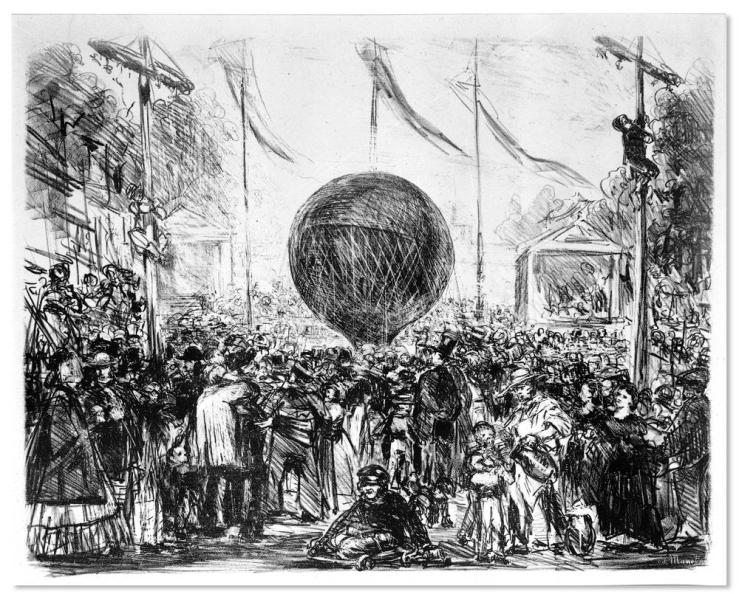
In his Barthelme biography Hiding Man, Tracy Daugherty spends several pages explaining allusions to Édouard Manet’s 1862 lithograph Le Ballon and the scandal that erupted when Manet showed his painting Olympia in 1865. Daugherty writes,
As many readers have observed, Don’s story considers public responses to art. But besides this general theme, he had in mind a specific set of reactions, in a crucial time.
In invoking Manet’s balloon and the Olympia scandal, Don encoded in his story an early chapter of the art that nourished him throughout his career; an art inseparable from social change, resistant to strict ordering, and opposed to the narrowing of perceptions required by commodification.
Daugherty’s analysis encapsulates what I take to be the signal passage of “The Balloon,” which passage you can read here.

5. “Will You Tell Me?” (Come Back, Dr. Caligari, 1964)
One of Barthelme’s more formally challenging stories, “Will You Tell Me?” begins strange (“Hubert gave Charles and Irene a nice baby for Christmas”) and gets even stranger. It’s a subtle satire on soap operas and convoluted prize (“The French countryside (the countryside of France) was covered with golden grass”) shot through anarchic glee:
In the cellar Paul continued making his bombs, by cellarlight. The bombs were made from tall Schlitz cans and a plastic substance which Paul refused to identify. The bombs were sold to other boys Paul’s age to throw at their fathers.
Note the ever-present oedipal theme in Barthelme’s work.
4. “For I’m the Boy” (Come Back, Dr. Caligari, 1964)
Like most of Barthelme’s stories, “For I’m the Boy” is a rewarding re-read. Among the stories in Sixty Stories culled from Come Back, Dr. Caligari, “For I’m the Boy” has a somewhat straightforward plot: A man named Bloomsbury has divorced his wife. He takes his two friends Whittle and Huber with her to the airport to see her off so that there will be no “weeping.” They then drive home, stopping for a bottle of brandy on the way. Whittle and Huber demand details of the divorce from Bloomsbury:
It would be interesting as well as instructive Whittle said casually, to know for instance at what point the situation of living together became untenable, whether she wept when you told her, whether you wept when she told you, whether you were the instigator or she was the instigator, whether there were physical fights involving bodily blows or merely objects thrown on your part and on her part, if there were mental cruelties, cruelties of what order and on whose part, whether she had a lover or did not have a lover, whether you did or did not, whether you kept the television or she kept the television, the disposition of the balance of the furnishings including tableware, linens, light bulbs, beds and baskets, who got the baby if there was a baby, what food remains in the pantry at this time, what happened to the medicine bottles including Mercurochrome, rubbing alcohol, aspirin, celery tonic, milk of magnesia, No-Doze and Nembutal, was it a fun divorce or not a fun divorce, whether she paid the lawyers or you paid the lawyers, what the judge said if there was a judge, whether you asked her for a “date” after the granting of the decree or did not ask, whether she was touched or not touched by this gesture if there was such a gesture, whether the date if there was such a date was a fun thing or not a fun thing – in short we’d like to get the feel of the event he said.
“Give us the feeling,” they insist, but Bloomsbury refuses. At the end of the story Whittle and Huber literally beat it out of him with a brandy bottle and tire iron. The feeling emerges in the form of tears and blood.
In Hiding Man, Daugherty makes a strong argument that “For I’m the Boy” serves as an early aesthetic statement from Barthelme: art is “our most refined public expression of what is private, unreachable, unsayable…it fails–words cannot do the trick–but it is the best we have…art’s value lies in the fact that it offers forms for our experiences.”

3. “Me and Miss Mandible” (Come Back, Dr. Caligari, 1964)
“Me and Miss Mandible” is an excellent and absurd story told by an adult man who is “officially a child.” Here is the story’s opening:
Miss Mandible wants to make love to me but she hesitates because I am officially a child; I am, according to the records, according to the gradebook on her desk, according to the card index in the principal’s office, eleven years old. There is a misconception here, one that I haven’t quite managed to get cleared up yet. I am in fact thirty-five, I’ve been in the Army, I am six feet one, I have hair in the appropriate places, my voice is a baritone, I know very well what to do with Miss Mandible if she ever makes up her mind.
Our narrator handles the mix-up (if it could be called a mix-up) with bemused aplomb. Unlike the hero of Barthelme’s 1976 story “The Sergeant,” who similarly awakes to find himself affixed with the wrong identity, the narrator of “Mandible” seems to find opportunity in his predicament. There’s nothing especially sinister here; the situation is Kafkaesque, but the tone isn’t. The narrator gets to see the American educational system through the eyes of an experienced adult: “Everything is promised my classmates and I, most of all the future. We accept the outrageous assurances without blinking.”
As the story develops, the narrator comes to understand that these promises are perhaps undeliverable:
We read signs as promises. Miss Mandible understands by my great height, by my resonant vowels, that I will one day carry her off to bed. Sue Ann interprets these same signs to mean that I am unique among her male acquaintances, therefore most desirable, therefore her special property as is every thing that is Most Desirable. If neither of these propositions work out then life has broken faith with them.
I myself, in my former existence, read the company motto (“Here to Help in Time of Need”) as a description of the duty of the adjuster, drastically mislocating the company’s deepest concerns. I believed that because I had obtained a wife who was made up of wife-signs (beauty, charm, softness, perfume, cookery) I had found love. Brenda, reading the same signs that have now misled Miss Mandible and Sue Ann Brownly, felt she had been promised that she would never be bored again. All of us, Miss Mandible, Sue Ann, myself, Brenda, Mr. Goodykind, still believe that the American flag betokens a kind of general righteousness.
But I say, looking about me in this incubator of future citizens, that signs are signs, and that some of them are lies. This is the great discovery of my time here.
2. “A Shower of Gold” (Come Back, Dr. Caligari, 1964)
In “A Shower of Gold,” we find Peterson, “a minor artist” with a bad liver, mulling over whether or not to sell out by appearing on the television show Who Am I? He’s tormented by a series of absurd “punishments” for even considering selling out, including having the President of the United States show up and destroy one of his pieces of art. Finally though, broke and beerless, he condescends to the appearance. The tale ends with an epiphanic monologue:
I was wrong, Peterson thought, the world is absurd. The absurdity is punishing me for not believing in it. I affirm the absurdity. On the other hand, absurdity is itself absurd. Before the emcee could ask the first question, Peterson began to talk. “Yesterday,” Peterson said to the television audience, “in the typewriter in front of the Olivetti showroom on Fifth Avenue, I found a recipe for Ten Ingredient Soup that included a stone from a toad’s head. And while I stood there marveling a nice old lady pasted on the elbow of my best Haspel suit a little blue sticker reading THIS INDIVIDUAL IS A PART OF THE COMMUNIST CONSPIRACY FOR GLOBAL DOMINATION OF THE ENTIRE GLOBE. Coming home I passed a sign that said in ten-foot letters COWARD SHOES and heard a man singing “Golden earrings” in a horrible voice, and last night i dreamed there was a shoot- out at our house on Meat Street and my mother shoved me in a closet to get me out of the line of fire.” The emcee waved at the floor manager to turn Peterson off, but Peterson kept talking. “In this kind of world,” Peterson said, “absurd if you will, possibilities nevertheless proliferate and escalate all around us and there are opportunities for beginning again. I am a minor artist and my dealer won’t even display my work if he can help it but minor is as minor does and lightning may strike even yet. Don’t be reconciled. Turn off your television sets,” Peterson said, “cash in your life insurance, indulge in a mindless optimism. Visit girls at dusk. Play the guitar. How can you be alienated without first having been connected? Think back and remember how it was.” A man on the floor in front of Peterson was waving a piece of cardboard on which something threatening was written but Peterson ignored him and concentrated on the camera with the little red light. The little red light jumped from camera to camera in an attempt to throw him off balance but Peterson was too smart for it and followed wherever it went. “My mother was a royal virgin,” Peterson said, “and my father a shower of gold. My childhood was pastoral and energetic and rich in experiences which developed my character. As a young man I was noble in reason, infinite in faculty, in form express and admirable, and in apprehension…” Peterson went on and on and although he was, in a sense, lying, in a sense he was not.
Peterson takes up the mantle Perseus, an ironic hero for an absurd world.
1. “Margins” (Come Back, Dr. Caligari, 1964)
“Margins” is one of only two stories collected in Sixty Stories to directly address race relations in the United States (the other one is “The Sandman”). Interestingly, the “first” story of Sixty Stories is close to pure dialogue, the form that that Barthelme would land on almost exclusively in his latter years. The dialogue here is between Edward, a white man, and Carl, a black man. Edward is critiquing the margins and handwriting of a sandwich board Carl is wearing. This is the text of the sandwich board:
I Was Put In Jail in Selby County Alabama For Five Years For Stealing A Dollar and A Half Which I Did Not Do. While I Was In Jail My Brother Was Killed & My Mother Ran Away When I Was Little. In Jail I Began Preaching & I Preach to People Wherever I Can Bearing the Witness of Eschatological Love. I Have Filled Out Papers for Jobs But Nobody Will Give Me a Job Because I Have Been In Jail & The Whole Scene Is Very Dreary, Pepsi Cola. I Need Your Offerings to Get Food. Patent Applied For & Deliver Us From Evil.
Edward’s microaggressions swell to macroaggressions: “You look kind of crummy,” he tells Carl, and then asks, “Do you think I’m a pretty color…Are you envious?” When Carl replies, “No,” Edward pauses before offering a baffled, “but I’m what.” Carl tries to shift the conversation to something of substance: “Let’s talk about values or something.” Carl recommends a few books to Edward: Italo Svevo’s As a Man Grows Older and John Hawkes’s The Cannibal and The Beetleleg. But Edward isn’t interested in making connections. He demands to know Carl’s “inner reality.” But like Bloomsbury in “For I’m the Boy,” Carl keeps that inner reality for himself: “‘It’s mine,’ Carl said quietly.”
The aggression mounts: Edward accuses Carl of having lied on his sign about stealing a dollar and a half. Carl protests, but does admit to being a biblioklept:
“Mostly in drugstores, ” Carl said. “I find them good because mostly they’re long and narrow and the clerks tend to stay near the prescription counters at the back of the store, whereas the books are usually in those little revolving racks near the front of the store. It’s normally pretty easy to slip a couple in your overcoat pocket, if you’re wearing an overcoat ”
“But…”
“Yes, ” Carl said, “I know what you’re thinking. If I’ll steal books I’ll steal other things. But stealing books is metaphysically different from stealing like money. Villon has something pretty good to say on the subject I believe.
At the end of the story, Carl asks Edward to put on his sign for a minute so Carl can use a nearby restroom. “Boy, they’re kind of heavy aren’t they?” Edward declares, to which Carl replies, “They cut you a bit.” Barthelme notes Carl delivers the line with “a malicious smile.”
“Margins” might seem oblique on a first read, but rereading it there’s a lack of subtlety to Barthelme’s approach–the trading of the sign is a bit heavy handed. But the final strange image saves the story: “When Carl returned the two men slapped each other sharply in the face with the back of the hand-that beautiful part of the hand where the knuckles grow.”
Summary thoughts: Everything here is pretty strong. “Margins” and “Shower of Gold” have an energy that might make up for some zany misteps and heavyhanded symbolism, and “Will You Tell Me?” is a difficult but rewarding read. “Me and Miss Mandible” is Essential Barthelme (as is “The Balloon,” of course). Rereading “Mandible” simply confirmed its excellence. In contrast, I’ll admit that I didn’t remember “For I’m the Boy” at all, but found it to be surprisingly strong and unexpectedly moving for something that didn’t stick with me when I first read Sixty Stories.
Going forward (in reverse): At some point early in this reverse reread I thought, Hey, maybe I’ll do the same thing with Forty Stories, but now, no, no, no. Maybe next year, maybe never. I will have one final post though. I’ll read David Gates’s introduction to my Penguin Classics edition of Sixty Stories and offer my own edits: Thirty Stories, Fifteen Stories, and Ten Stories.
Donald Barthelme’s Sixty Stories in reverse, Part IX
I am rereading Donald Barthelme’s Sixty Stories, starting with the sixtieth story and working my way to the first and writing about it.
Previous entries:
In this post, stories 12-7
12. “The Dolt” (Unspeakable Practices, Unnatural Acts, 1968)
An odd domestic tale, “The Dolt” features the hostilities of a young married couple, Edward and Barbara. Edward is “preparing to take the National Writer’s Examination, a five-hour fifty-minute examination, for his certificate.” He squabbles with Barbara, who is “very sexually attractive…but also deeply mean.” Barbara doesn’t seem to think much of Edward’s chances at earning his “certificate.” Her lack of confidence seems to bear out as we hear the details of Edward’s entry story, a nineteenth century goof on a baron and his faithless wife:
The Baron, a man of uncommon ability, is chiefly remembered for his notorious and inexplicable blunder at the Battle of Kolin: by withdrawing the column under his command at a crucial moment in the fighting, he earned for himself the greatest part of the blame for Friedrich’s defeat, which resulted in a loss, on the Prussian side, of 13,000 out of 33,000 men.
There’s potential in the story, and Barbara begins to be persuaded as Edgar reads the story’s “development.” However, the story is missing something crucial:
“But what about the middle?”
“I don’t have the middle!” he thundered.
There’s a pastiche of ironic biographical details here—writerly anxiety, domestic anxiety—that ultimately gives over to Barthelme’s biggest thematic concern: oedipal anxiety. In an final-act swerve, a surreal figure, “the son manqué,” asking if there’s any “grass in the house.”
The son manqué was eight feet tall and wore a serape woven out of two hundred transistor radios, all turned on and tuned to different stations. Just by looking at him you could hear Portland and Nogales, Mexico.
The giant figure (a strange filial prefiguration of The Dead Father), girded in an amplified cacophony of mass media, suggests an artistic rival that Edgar is unsure he can surpass—even if that rival is a mere manqué. (The word choice “manqué” here is significant in its oddity. Earlier, Edgar points out that, “You put a word like that in now and then to freshen your line…Even though it’s an old word, it’s so old it’s new.)
The story’s final moment leave us in a limbo derivative of Barthelme’s hero Beckett:
Edgar tried to think of a way to badmouth this immense son leaning over him like a large blaring building. But he couldn’t think of anything. Thinking of anything was beyond him. I sympathize. I myself have these problems. Endings are elusive, middles are nowhere to be found, but worst of all is to begin, to begin, to begin.
11. “Report” (Unspeakable Practices, Unnatural Acts, 1968)
“Report” distills one of the main themes of Thomas Pynchon’s 1973 novel: technology drives warfare; indeed, war is an excuse for the advancement of modern technologies. This is about as direct an anti-war story as we would get from Donald Barthelme. It begins:
Our group is against the war. But the war goes on. I was sent to Cleveland to talk to the engineers. The engineers were meeting in Cleveland. I was supposed to persuade them not to do what they are going to do.
Of course, the directness of those opening lines gets refracted and tangled in obliquity and fantasy, as the narrator (the “Soft Ware man”) learns of the unspeakable and unnatural practices of the engineers:
“The development of the pseudoruminant stomach for underdeveloped peoples,” he went on, “is one of our interesting things you should be interested in. With the pseudo-ruminant stomach they can chew cuds, that is to say, eat grass. Blue is the most popular color worldwide and for that reason we are working with certain strains of your native Kentucky Poa pratensis, or bluegrass, as the staple input for the p/r stomach cycle, which would also give a shot in the arm to our balance-of -payments thing don’t you know” . . . I noticed about me then a great number of metatarsal fractures in banjo splints.
“The kangaroo initiative . . . eight hundred thousand harvested last year . . . highest percentage of edible protein of any herbivore yet studied …”
“Have new kangaroos been planted?”
The engineer looked at me.
The Soft Ware man leaves with the engineer’s promise:
I confidently predict that, although we could employ all this splendid new weaponry I’ve been telling you about, we’re not going to do it.”
The Soft Ware man’s audience does not believe the engineer’s promise though.
10. “Robert Kennedy Saved from Drowning” (Unspeakable Practices, Unnatural Acts, 1968)
The version of “Robert Kennedy Saved from Drowning” published in Sixty Stories bears a slight difference from the version first published in New American Review and then later in Unspeakable Practices, Unnatural Act. The Sixty Stories version is the only Barthelme story signed with a date of publication. Here, “April, 1968.”
The date is contextually significant, and something that I overlooked the first time I read ” Robert Kennedy Saved from Drowning” some time around the year 2000. At that time, I read the tale as a kind of hagiography. Barthelme’s Bobby Kennedy — “K,” in the story’s vernacular (a nod perhaps to Kafka’s hero?) — is a Modernist man. In the final vignette, he’s saved by the narrator who emerges in this last paragraph as an “I”:
K. in the water. His flat black hat, his black cape, his sword are on the shore. He retains his mask. His hands beat the surface of the water which tears and rips about him. The white foam, the green depths. I throw a line, the coils leaping out over the surface of the water. He has missed it. No, it appears that he has it. His right hand (sword arm) grasps the line that I have thrown him. I am on the bank, the rope wound round my waist, braced against a rock. K. now has both hands on the line. I pull him out of the water. He stands now on the bank, gasping. “Thank you.”
When I first read this story, I thought it was a sympathetic attempt to save RFK — that the “line” was a metatextual reference to writing itself, an imaginative recouping of yet another assassinated Hero of the Sixties. The parodic Pop Art contours of the story were lost on me.
It wasn’t until I read Tracy Daugerty’s biography Hiding Man (and subsequently read Sixty Stories in full) that I understood that RFK was assassinated in June of 1968—two months after the story was first published. Indeed, Daugherty reports that Barthelme was working on the story as early as 1965, and likely only kept up with it after learning that Saul Bellow, whom Barthelme was competitive with, was working on a profile of RFK for LIFE (the Bellow piece never came out).
In an interview with Arthur Schlesinger, Jr., Barthelme stated,
I cannot account for the concluding impulse of the I-character to ‘save’ him other than by reference to John Kennedy’s death; still, a second assassination was unthinkable at that time. In sum, any precision in the piece was the result of watching television and reading the New York Times.
The story’s publication in April, 1968 also coincided with the assassination of Martin Luther King, Jr. As Daugherty notes in Hiding Man,
[Comedian and activist] Dick Gregory went public with the fact that the FBI harassed King. The agency’s code name for him was “Zorro.” Don had dressed RFK in a Zorro costume, in the story’s final scene, to mock Kennedy’s heroic image. The coincidence unnerved him.
9. “Alice” (Unspeakable Practices, Unnatural Acts, 1968)
“Alice” is probably the most formally challenging and experimental piece in Sixty Stories. I use the word “experimental” here in a pejorative sense—I’m not quite sure Barthelme pulls the experiment off. We get something like the stream of consciousness of an obstetrician who wants to fuck Alice, his friend’s wife. (Is the name an evocation of the Alice of the Wonderland? Stein’s beloved Alice B. Toklas?)
The inside of the narrator is a ball of sticky language:
the hinder portion scalding-house good eating Curve B in addition to the usual baths and ablutions military police sumptuousness of the washhouse risking misstatements kept distances iris to iris queen of holes damp, hairy legs note of anger chanting and shouting konk sense of “mold” on the “muff” sense of “talk” on the “surface” konk all sorts of chemical girl who delivered the letter give it a bone plummy bare legs saturated in every belief and ignorance rational living private client bad bosom uncertain workmen mutton-tugger obedience to the rules of the logical system Lord Muck hot tears harmonica rascal
There are some wonderful fragments there — “mutton-tugger obedience to the rules of the logical system” is a lovely insult from our would-be “harmonica rascal” — but the horny chaos becomes a bit of a headache over seven pages. Still, chaos is the point:
that’s chaos can you produce chaos? Alice asked certainly I can produce chaos I said I produced chaos she regarded the chaos chaos is handsome and attractive she said and more durable than regret I said and more nourishing than regret she said
Chaos—here a disruption of both the (illusion of) prescribed linguistic order and the domestic order—offers both rejuvenation and new possibilities. It may be nourishing and durable, but in “Alice,” it’s also exhausting.
8. “Game” (Unspeakable Practices, Unnatural Acts, 1968)
The narrator of “Game” is a first lieutenant in some unspecified branch of the military. Here is his situation:
Shotwell and I watch the console. Shotwell and I live under the ground and watch the console. If certain events take place upon the console, we are to insert our keys in the appropriate locks and turn our keys. Shotwell has a key and I have a key. If we turn our keys simultaneously the bird flies, certain switches are activated and the bird flies. But the bird never flies. In one hundred thirty-three days the bird has not flown. Meanwhile Shotwell and I watch each other. We each wear a .45 and if Shotwell behaves strangely I am supposed to shoot him. If I behave strangely Shotwell is supposed to shoot me. We watch the console and think about shooting each other and think about the bird.
“Game’s” postmodern paranoia is worth of Poe. The story is full of repetitive tics, frequently about who is “well” and “not well.” While the ostensible object of “Game” is Cold War anxieties about nuclear war, the story’s evocation of paranoia continues to resonate. I won’t say too much more about “Game” here, but it’s a nice little funny horror story and well worth the ten minutes it will take you to read it.
7. “The President” (Unspeakable Practices, Unnatural Acts, 1968)
Is strangeness alone enough?
I am not altogether sympathetic to the new President. He is, certainly, a strange fellow (only forty-eight inches high at the shoulder). But is strangeness alone enough? I spoke to Sylvia: “Is strangeness alone enough?”
The titular President’s strangeness charms the nation, leading to waves of mass faintings. While there’s an absurd comedy to the faintings, they also point towards the story’s sinister, paranoid undertones. For all his charisma, the President is an oddity, an unknowable Pop representation driven by unclear, even mystical motivations. There’s a touch of Invasion of the Body Snatchers here—the seventies one with Sutherland and Nimoy—but just a touch. The whole thing ends in the rapturous applause of an audience overwhelmed by the anachronistic spectacle of Strauss’s operetta The Gypsy Baron.
Summary thoughts: I’m not really sure if “The President” works. “Alice” doesn’t, but is more interesting in its not working than it has any right to be. “Dolt” is good but not great. “Robert Kennedy Saved from Drowning” is as good as a story so situated in a historical moment can be. “Report” is very good. “Game” is excellent.
Going forward (in reverse): The last (by which I mean first) six stories, including some of Barthelme’s Greatest Hits, “The Balloon” and “Me and Miss Mandible.”
Also, I will be happy to be done with this project. It’s better to read these stories as morsels. Better not to pig out. Better not to snort them down or shoot them up. Better to let them breathe a bit.
Donald Barthelme’s Sixty Stories in reverse, Part VIII

I am rereading Donald Barthelme’s Sixty Stories, starting with the sixtieth story and working my way to the first and writing about it.
Previous entries:
This post covers stories 18-13.
18. “The Phantom of the Opera’s Friend” (City Life, 1970)
Barthelme’s goof on Gaston Leroux’s serialized title of the same name is a mix of sweet and mean. The narrator wonders to himself about midway through, “Why must I have him for a friend? I wanted a friend with whom one could be seen abroad.” He quickly elects though to “put these unworthy reflections behind me,” and then the narration gives way to a metatextual moment:
Gaston Leroux was tired of writing The Phantom of the Opera. He replaced his pen in its penholder. “I can always work on The Phantom of the Opera later-in the fall, perhaps. Right now I feel like writing The Secret of the Yellow Room.” Gaston Leroux took the manuscript of The Phantom of the Opera and put it on a shelf in the closet. Then, seating himself once more at his desk, he drew toward him a clean sheet of foolscap At the top he wrote the words, The Secret of the Yellow Room.
“The Phantom of the Opera’s Friend” lines up with Barthelme’s other experimental forays into nineteenth-century novels, but it’s less successful than “Eugénie Grandet” or “Views of My Father Weeping” or “The Dolt.” It does have a lovely conclusion though:
But when I call for the Phantom on Thursday, at the appointed hour, he is not there.
What vexation!
Am I not slightly relieved?
Can it be that he doesn’t like me?
I sit down on the curb, outside the Opera. People passing look at me. I will wait here for a hundred years. Or until the hot meat of romance is cooled by the dull gravy of common sense once more.
17. “On Angels” (City Life, 1970)
A pastiche of essay, fiction, found material, and even poetry, “On Angels” begins with a fundamentally postmodern position:
The death of God left the angels in a strange position. They were overtaken suddenly by a fundamental question. One can attempt to imagine the moment. How did they look at the instant the question invaded them, flooding the angelic consciousness, taking hold with terrifying force? The question was,”What are angels?”
16. “Paraguay” (City Life, 1970)
“Creative misunderstanding is crucial,” we’re told at one point in “Paraguay.” These eruptions lead to the “Creation of new categories of anxiety which must be bandaged” — another kind of art. “Paraguay” is a strange sci-fi fable about art and creation and imagination, a story that constantly defers all available referents in favor of creating “new categories of anxiety.” Consider this early paragraph:
Where Paraguay Is
Thus I found myself in a strange country. This Paraguay is not the Paraguay that exists on our maps. It is not to be found on the continent, South America; it is not a political subdivision of that continent, with a population of 2, 161,000 and a capital city named Asuncion. This Paraguay exists elsewhere. Now, moving toward the first of the “silver cities, ” I was tired but also elated and alert. Flights of white meat moved through the sky overhead in the direction of the dim piles of buildings.
Flights of white meat. Dim piles of buildings.
Great stuff.
15. “Views of My Father Weeping” (City Life, 1970)
Barthelme’s oeuvre is oedipal, both in form and content, a thematic obsession best realized in his novel The Dead Father, but a theme that nevertheless haunts (haunts is not the right verb; Barthelme’s oedipal dead father is a playful mournful ironic ghost—but let’s fall on haunts for now)—nevertheless haunts (he writes again) Barthelme’s fiction proper. “Views of My Father Weeping” is a father-haunted tale—haunted by Barthelme’s own father, the modernist architect, Donald Barthelme Sr., as well as a host of literary fathers (of varying shades of modernism)—Dostoevsky, Freud, Tolstoy, and so on. The plot at first appears to be another goof on hoary nineteenth-century tropes, but Barthelme wads the material into a ball of anxiety dream nightmare stuff worthy of another dead modernist father—Kafka. I’ve neglected to summarize the plot: An aristocrat’s stagecoach runs down the narrator’s father (who may or may not have been drunk at the time). The narrator attempts to solve the case and come up with a crumb of justice. My only quibble with the tale is its failure to resolve — the final paragraph, after a devastating twist, reads simply “Etc.” — I suppose the joke is ahead of its time, but it also feels like our author reached his exhaustion before his plot did.
14. “The Indian Uprising” (Unspeakable Practices, Unnatural Acts, 1968)
If someone asked me, Hey Ed, this Don Barthelme fellow, what should I read first? —which no one ever has and likely no one ever will — I would offer up “The Indian Uprising.”
The story is a formally-challenging success, an experiment that Barthelme pulls off perhaps in spite of himself (some of the other pieces in Unspeakable Practices, Unnatural Acts are beautiful misfires). In his biography of Barthelme Hiding Man, Tracy Daugherty devotes several pages to describing the agon between Barthelme and the story’s original editors in The New Yorker, Roger Angell (who advocated for Barthelme) and William Shawn (who fought Barthelme tooth and nail over commas specifically and syntax in general).
“The Indian Uprising” is a dizzying paste-up of urban American life in the troubled 1960s. This setting is transposed to a mythical Manifest Destiny Westworld, a genocidal project that can be understood as a blackly surreal reading of the Vietnam War. It’s an ugly business. The story’s final paragraph begins with this sentence:
We killed a great many in the south suddenly with helicopters and rockets but we found that those we had killed were children and more came from the north and from the east and from other places where there are children preparing to live.
The imperial project is an infanticidal project.
“The Indian Uprising” is larded with markers of culture. The first paragraph ends with this little descriptor: “The table held apples, books, long-playing record.” The table is the central metaphor of the story—or one of the metaphors, I guess (“central” is an unfit adjective). The narrator has made the table with his own hands from a hollow core door, a symbol perhaps of the American Dream.
The Dream is a nightmare though. “The Indian Uprising” is punctuated by two torture scenes, both of which resonate just as strongly a half century after its publication. Here is the first, a waterboarding adventure:
We interrogated the captured Comanche. Two of us forced his head back while another poured water into his nostrils. His body jerked, he choked and wept…And I sat there getting drunker and drunker and more in love and more in love.
The second scene is an ugly repetition:
We attached wires to the testicles of the captured Comanche. And I sat there getting drunker and drunker and more in love and more in love.
What is the narrator drunk on here? Torture? Pain? Power? And what is the object of his love? Power? Pain? Language?
The power and pain of language overflows in “The Indian Uprising,” challenging the reader to make meaning from waves of images. Barthelme, ever-beholden to the Modernist fathers and mothers, shows a bit of his Gertrude Stein stuff shot through with William Carlos Williams’ dictum, No ideas but in things. Those things:
Red men in waves like people scattering in a square startled by something tragic or a sudden, loud noise accumulated against the barricades we had made of window dummies, silk, thoughtfully planned job descriptions (including scales for the orderly progress of other colors), wine in demijohns, and robes. I analyzed the composition of the barricade nearest me and found two ashtrays, ceramic, one dark brown and one dark brown with an orange blur at the lip; a tin frying pan; two-liter bottles of red wine; threequarter-liter bottles of Black & White, aquavit, cognac, vodka, gin, Fad #6 sherry; a hollow-core door in birch veneer on black wrought-iron legs; a blanket, red-orange with faint blue stripes; a red pillow and a blue pillow; a woven straw wastebasket; two glass jars for flowers; corkscrews and can openers; two plates and two cups, ceramic, dark brown; a yellow-and-purple poster; a Yugoslavian carved flute, wood, dark brown; and other items. I decided I knew nothing.
I decided I knew nothing.
Marvelous stuff.

13. “See the Moon?” (Unspeakable Practices, Unnatural Acts, 1968)
“Yes I know it’s shatteringly ingenuous,” says the narrator of “See the Moon?,” but I wanted to be a painter.”
Why does the narrator (surely a version of Barthelme) want to be a painter?
They get away with murder in my view; Mr. X. on the Times agrees with me. You don’t know how I envy them. They can pick up a Baby Ruth wrapper on the street, glue it to the canvas (in the right place, of course, there’s that), and lo! people crowd about and cry, “A real Baby Ruth wrapper, by God; what could be realer than that!” Fantastic metaphysical advantage. You hate them, if you’re ambitious.
The narrator pieces together bits and bytes and things and souvenirs, tacking them to a wall: “Fragments are the only forms I trust.”
The statement “Fragments are the only forms I trust” sounds like an aesthetic mission statement from DB, but our DB ultimately rejected it in an interview with Jerome Klinkowitz:

And yet “See the Moon?” is clearly a pastiche of Barthelme biography rendered in Pop Art pastings, non sequitur, and cheap funny jokes. It’s also tinged with the notes of melancholy and regret that will heavily flavor Barthelme’s later work. Perhaps as I read backward the material will lighten.
Summary thoughts: Everything here is good and much is great. “The Indian Uprising” is essential, and “See the Moon?” and “Views of My Father Weeping” are definitely Greatest Hits. “Paraguay” seems like a perfect Barthelme gateway drug, and “On Angels” is a fun sad jam. Even the weakest piece here, “The Phantom of the Opera’s Friend,” is pretty good.
Going forward (in reverse): Our penultimate episode is chock full of pieces from 1968’s Unspeakable Practices, Unnatural Acts, including classics “Robert Kennedy Saved from Drowning” and “Game.”
I wanted to be a painter | Fragments are the only forms I trust (Donald Barthelme)
You’ve noticed the wall? I pin things on it, souvenirs. There is the red hat, there the book of instructions for the Ant Farm And this is a traffic ticket written on a saint’s day (which saint? I don’t remember) in 1 954 just outside a fat little town (which town? I don’t remember) in Ohio by a cop who asked me what I did. I said I wrote poppycock for the president of a university, true then.
You can see how far I’ve come. Lunar hostility studies aren’t for everyone.
It’s my hope that these . . souvenirs . . will someday merge, blur–cohere is the word, maybe-into something meaningful. A grand word, meaningful. What do I look for? A work of art, I’ll not accept anything less Yes I know it’s shatteringly ingenuous but I wanted to be a painter. They get away with murder in my view; Mr. X. on the Times agrees with me. You don’t know how I envy them They can pick up a Baby Ruth wrapper on the street, glue it to the canvas (in the right place, of course, there’s that), and lot people crowd about and cry, “A real Baby Ruth wrapper, by God; what could be realer than that!” Fantastic metaphysical advantage. You hate them, if you’re ambitious.
The Ant Farm instructions are a souvenir of Sylvia. The red hat came from Cardinal Y. We’re friends, in a way.
I wanted to be one, when I was young, a painter. But I couldn’t stand stretching the canvas. Does things to the fingernails. And that’s the first place people look.
Fragments are the only forms I trust.
From “See the Moon?” by Donald Barthelme.
Barthelme/Delany/Rivera Garza (Books acquired, 24 Sept. 2021)
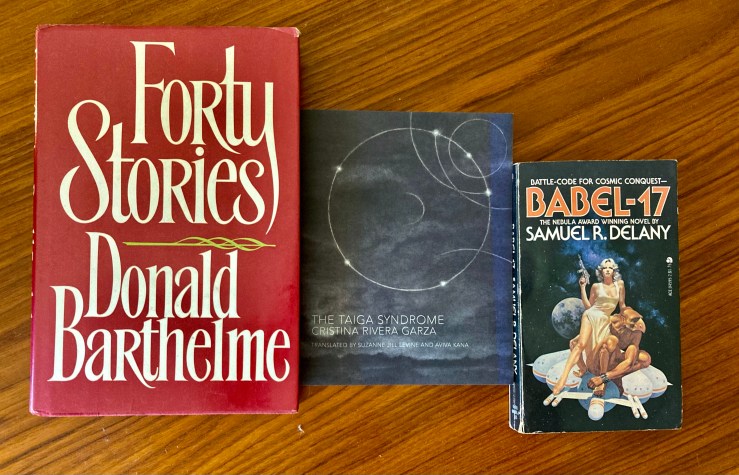
For a few months I’ve been slowly unloading boxes from my grandmother’s old house at my beloved used bookstore, browsing a bit, and coming back with books I don’t need.
Last Friday I found a hardback first edition of Barthelme’s Forty Stories, which is cool (it’s much more handsome and plain than the paperback Penguin Contemporary Fiction edition I have). I’ve been re-reading Barthelme’s Sixty Stories and writing blog posts about them that no one reads for a few weeks now.
I also picked up Cristina Rivera Garza’s novel The Taiga Syndrome, in translation by Suzanne Jill Levine and Aviva Kana. Here’s publisher Dorothy’s blurb:
A fairy tale run amok, The Taiga Syndrome follows an unnamed Ex-Detective as she searches for a couple who has fled to the far reaches of the earth. A betrayed husband is convinced by a brief telegram that his second ex-wife wants him to track her down—that she wants to be found. He hires the Ex-Detective, who sets out with a translator into a snowy, hostile forest where strange things happen and translation betrays both sense and one’s senses. Tales of Hansel and Gretel and Little Red Riding Hood haunt the Ex-Detective’s quest into a territory overrun with the primitive excesses of Capitalism—accumulation and expulsion, corruption and cruelty—though the lessons of her journey are more experiential than moral: that just as love can fly away, sometimes unloving flies away as well. That sometimes leaving everything behind is the only thing left to do.
I picked up Samuel R. Delany’s novel Babel-17 too, maybe in part of a continued attempt to get into his stuff, despite stall outs, shrugs, and, Hey, that was okays, and maybe just because of this cover:
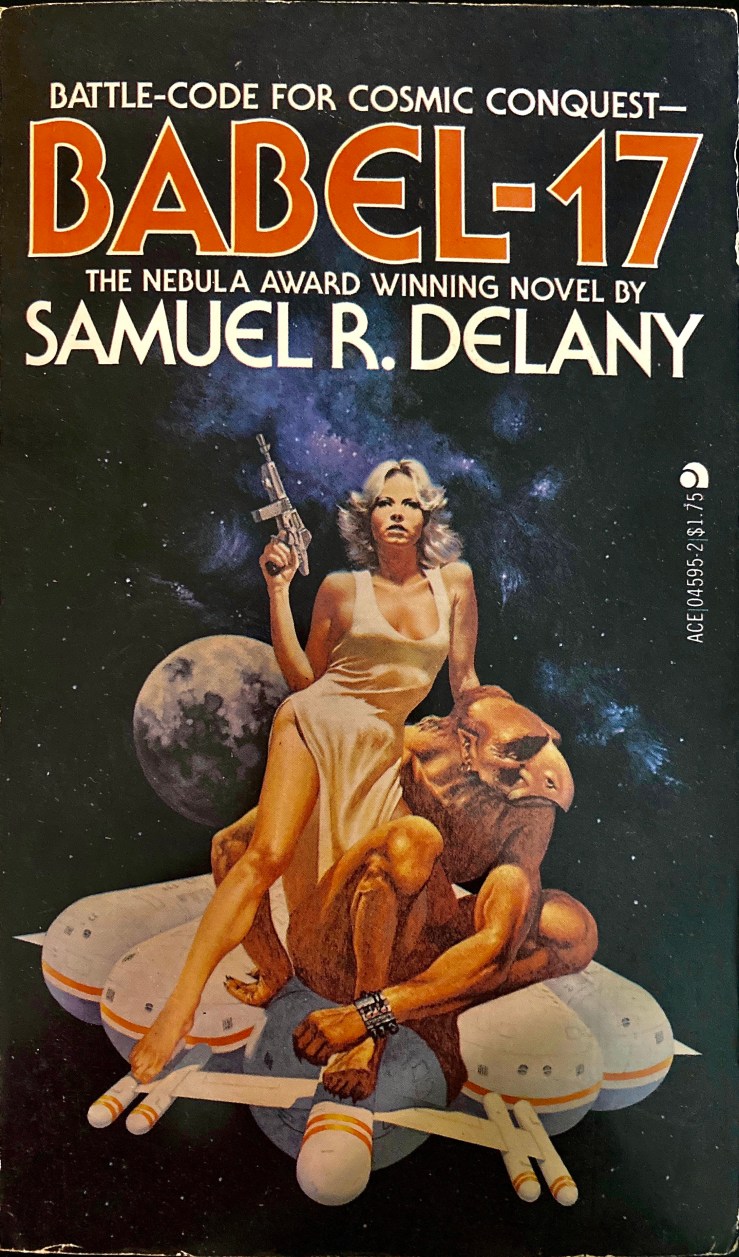
The book’s Wikipedia entry notes that, “Rush drummer and lyricist Neil Peart noted that Babel-17 was one of his early literary influences, and was an important part of the crafting of the band’s hugely successful 2112 album.”
Well there you go.
 Biblioklept