Lydia Davis: “I don’t want to be bored by someone’s imagination”

I’m not tired of all good books, I’m just tired of novels and stories, even good ones, or ones that are supposed to be good. These days, I prefer books that contain something real. I don’t want to be bored by someone’s imagination. Most people’s imaginations just aren’t very interesting—you can guess where the author got this idea and that idea. You can predict what will come next before you finish reading the sentence. It all seems so arbitrary.

From Lydia Davis’s story “Not Interested,” published in this month’s Harper’s and originally published in NOON.


“Unhappiness” — Franz Kafka

“Unhappiness” by Franz Kafka

WHEN it was becoming unbearable – once toward evening in November – and I ran along the narrow strip of carpet in my room as on a racetrack, shrank from the sight of the lit-up street, then turning to the interior of the room found a new goal in the depths of the looking glass and screamed aloud, to hear only my own scream which met no answer nor anything that could draw its force away, so that it rose up without check and could not stop even when it ceased being audible, the door in the wall opened toward me, how swiftly, because swiftness was needed and even the cart horses down below on the paving stones were rising in the air like horses driven wild in a battle, their throats bare to the enemy.

Like a small ghost a child blew in from the pitch-dark corridor, where the lamp was not yet lit, and stood a-tiptoe on a floor board that quivered imperceptibly. At once dazzled by the twilight in my room she made to cover her face quickly with her hands, but contented herself unexpectedly with a glance at the window, where the mounting vapor of the street lighting had at last settled under its cover of darkness behind the crossbars. With her right elbow she supported herself against the wall in the open doorway and let the draught from outside play along her ankles, her throat, and her temples.

I gave her a brief glance, then said ‘Good day,’ and took my jacket from the hood of the stove, since I didn’t want to stand there half-undressed. For a little while I let my mouth hang open, so that my agitation could find a way out. I had a bad taste in my mouth, my eyelashes were fluttering on my cheeks, in short this visit, though I had expected it, was the one thing needful.

The child was still standing by the wall on the same spot, she had pressed her right hand against the plaster and was quite taken up with finding, her cheeks all pink, that the whitewashed walls had a rough surface and chafed her finger tips. I said: ‘Are you really looking for me? Isn’t there some mistake? Nothing easier than to make a mistake in this big building. I’m called So-and-so and I live on the third floor. Am I the person you want to find? Continue reading ““Unhappiness” — Franz Kafka”

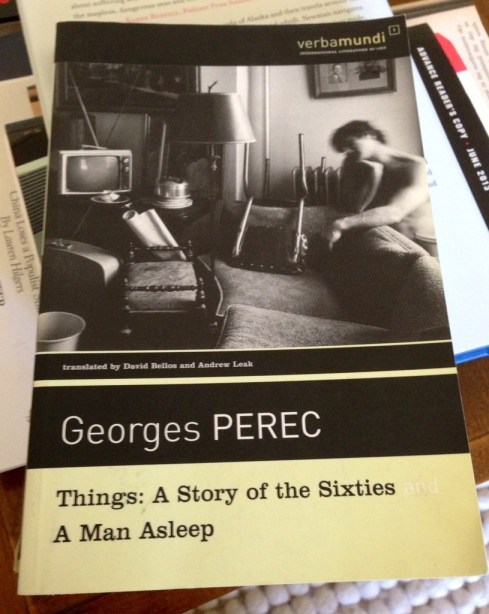
Georges Perec (Books Acquired, Some Time Last Week)

20130304-154911.jpg

I picked up Georges Perec’s twofer Things and A Man Asleep last Friday at the used bookstore. I was there looking for something else. The Perec was not even shelved under “P.” I found it laid on a table. The good people at Melville House also sent me a copy of Perec’s La Boutique Obscure last week, which I do not photograph here because it is an ebook. I read a big chunk of Obscure this week and will do some kind of write-up sometime soon, but here’s David Auerbach’s review at the LA Review of Books in the meantime.

Scott and Zelda Fitzgerald Apply for a Passport

f-scott-fitzgerald

Yoko Ogawa’s Revenge Is an Elegant Collection of Creepy Intertextual Tales

revenge

In Yoko Ogawa’s new collection Revenge, eleven stories of fascinating morbidity intertwine at oblique angles. Tale extends into tale: characters, settings, and images float intertextually from chapter to chapter, layering and reticulating themes of death, crime, consumption, and creation. (And revenge, of course. Let’s not forget revenge). Not quite a story cycle or a novel-in-tales, Revenge’s sum is nevertheless greater than its parts. It’s a brisk, engaging read, and as I worked my way to the final story, I already anticipated returning to the beginning to pull at the motifs threading through the book.

The book’s dominant motifs of death and food arrive in the first tale, “Afternoon Bakery,” where a mother tries to buy strawberry shortcakes for her dead son’s birthday—only the baker is too busy bawling to attend to sales. We learn why this baker is crying in “Fruit Juice,” the second story, a tale that ends inexplicably with an abandoned post office full of kiwi fruit. The third story, “Old Mrs.  J” (one of Revenge’s stand-outs) perhaps answers where those kiwis came from. More importantly, “Old Mrs. J,” with its writer-protagonist, elegantly introduces the thematic textual instability of the collection. There’s a  haunting suspicion here that the characters who glide from one tale to the next aren’t necessarily the silent extras they seem to be on the surface. Our characters, background and fore, are doppelgängers, ghost writers, phantoms.

The penultimate tale “Tomatoes and the Full Moon” lays the ghosting bare. Its protagonist is a magazine writer, whose “articles” really amount to little more than advertising. Staying at a seaside resort, he’s pestered by an old woman, one of the many witches who haunt Revenge. The old woman claims to be a novelist, and points out one of her books in the resort’s library:

Later, in my room, I read ‘Afternoon at the Bakery.’ It was about a woman who goes to buy a birthday cake for her dead son. That was the whole story. I should have gone back to my article, but I read her novel through twice, finishing for the second time at 3:00 a.m. The prose was unremarkable, as were the plot an characters, but there was an icy current running under her words, and I found myself wanting to plunge into it again and again.

The final line is perhaps a description of Revenge’s haunting intertextual program—although to be clear, Ogawa’s plot and characters are hardly “unremarkable,” and her prose, in Stephen Snyder’s English translation, is lucid and descriptive. It’s the “icy current running under her words” that makes Ogawa’s tales stick so disconcertingly in the reader’s psychic gullet. And if her prose is at times “unremarkable,” it’s all in the service of creating a unifying tone. All eleven tales are narrated in first-person, and each narrator is bound to the limits of his or her own language.

These limitations of language bump up against the odd, the spectacular, the alien, as in “Sewing for the Heart”:

She had explained that she was born with her heart outside of her chest—as difficult as that might be to imagine.

The line is wonderful in its mundane trajectory: Our narrator, an artisan bagmaker, witnesses this woman who lives with her heart outside her chest and concedes that such a thing might be “difficult . . . to imagine”! There’s something terribly paltry in this, but it’s also purposeful and controlled: Here we find the real in magical realism.

But this bagmaker can imagine, as we see in an extraordinary passage that moves from the phenomenological world of sight and sound and into the realm of our narrator’s strange desires:

She began to sing, but I could not make out the words. It must have been a love song, to judge from the slightly pained expression on her face, and the way she tightly gripped the microphone. I noticed a flash of white skin on her neck. As she reached the climax of the song, her eyes half closed and her shoulders thrown back, a shudder passed through her body. She moved her arm across her chest to cradle her heart, as though consoling it, afraid it might burst. I wondered what would happen if I held her tight in my arms, in a lovers’ embrace, melting into one another, bone on bone . . . her heart would be crushed. The membrane would split, the veins tear free, the heart itself explode into bits of flesh, and then my desire would contain hers—it was all so painful and yet so utterly beautiful to imagine.

Painful and utterly beautiful: Another description of Revenge.

Sometimes the matter-of-fact tone of the stories accounts for marvelous little eruptions of humor, as in “The Last Hour of the Bengal Tiger”:

At fifteen, I took an overdose of sleeping pills. I must have had a good reason for wanting to kill myself, but I’ve forgotten what it was. Perhaps I was just fed up with everything. At any rate, I slept for eighteen hours straight, and when I woke up I was completely refreshed. My body felt so empty and purified that I wondered whether I had, in fact, died. But no one in my family even seemed to have noticed that I had attempted suicide.

The scene is simultaneously devastating and hilarious, an evocation of abyssal depression coupled with mordant irony. The scene also underscores the dramatic uncertainty that underpins so many of the tales, where the possibility that the narrator is in fact a ghost or merely a character in someone else’s story is always in play.

There’s no postmodern gimmickry on display here though. Ogawa weaves her tales together with organic ease, her control both powerful and graceful. Her narrators contradict each other; we’re offered perspectives, glimpses, shades and slivers of meaning. A version of events recounted differently several stories later seems no more true than an earlier version, but each new detail adds to the elegant tangle. Like David Lynch and Roberto Bolaño, Ogawa traffics in beautiful, venomous, bizarre dread. Like those artists, she offers a discrete world we sense is complete and unified, even as our access to it is broken and discontinuous. And like Angela Carter, Ogawa channels the icy current seething below the surface of our darkest fairy tales, those stories that, with their sundry murders and crimes, haunt readers decades after first readings.

What I like most about Revenge is its refusal to relieve the reader. The book can be grisly at times, but Ogawa rarely goes for the lurid image. Instead, the real horror (and pleasure) of Revenge is the anxiety it produces in the reader, who becomes implicated in the crimes cataloged in the text. Witness to first-person narratives that often omit key clues, the reader plays detective—or perhaps accomplice. Recommended.

Revenge is new in handsome trade paperback from Picador; Picador also released Ogawa’s novel Hotel Iris in 2010.

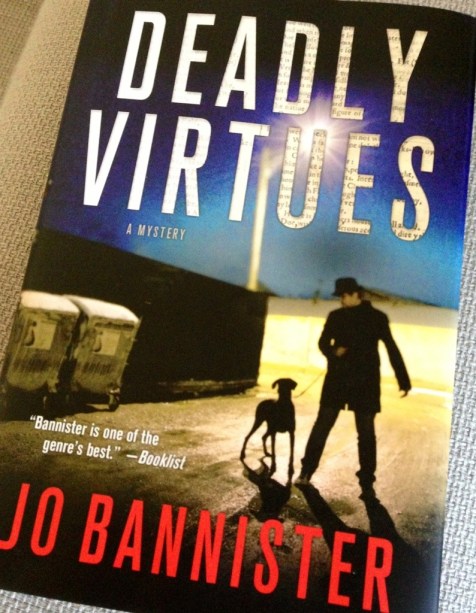
Deadly Virtues (Book Acquired, 3.01.2013)

20130302-105908.jpg

Deadly Virtues, a new mystery from Jo Bannister. Publishers Weekly review:

Stubborn morality and acid-tinged whimsy drive this superior stand-alone from British author Bannister (Liars All and eight other Brodie Farrell mysteries). Recovering mental patient Gabriel Ash looks pathetic and vulnerable as he rambles through the town of Norbold while talking to his dog. One day, at the local police station, where he’s recovering from a beating, Gabriel receives a cryptic message from a man who’s then killed by a crazed prisoner. Gabriel forces himself back into contact with normal humanity because he feels he ought to do something about the crime. Rookie policewoman Hazel Best is also dissatisfied with the official explanation of the tragedy. And so the three—the traumatized beating victim, the idealistic young cop, and the dog—begin sniffing under the pristine surface of the virtually crime-free town. They have no idea how dangerous good intentions can be. Bannister’s plotting is neat and her characterization smooth, with just enough irony to keep people from seeming ostentatiously noble


Selections from One-Star Amazon Reviews of Melville’s Moby-Dick

[Ed. note: The following citations come from one-star Amazon reviews of Herman Melville’s novel Moby-Dick. To be very clear, I think Moby-Dick is fantasticbut I also enjoy seeing what people compelled to write negative reviews of the book on Amazon had to say. What follows are selections of one-star Amazon reviews; I’ve preserved the reviewers’ unique styles of punctuation and spelling. See also: on Joyce’s Ulysses and Markson’s Wittgenstein’s Mistress].


Yechh.

It made for a smashing movie.

If you want to read lots of meaningless whale trivia read the book.

Boy gets whale. Boy loses whale. Boy gets whale. Spawns yawns

I think if you made it into a short comic strip, you would have liked it.

I bought this book for a friend in jail. Alas, he was unable to read it because the font was too small.

Ray Bradbury, who wrote the screenplay for this novel, (a la Gregory Peck) couldn’t even finish the damn thing!

If you like a story with nonessential information and an author that is entirely to verbose, then this book is for you.

I am quite the fan of stories which involve man eating sea creatures, such as Jaws. Moby Dick is nothing compared to such classics, I fear.

Throughout the book, you may read one chapter with some action only to be followed by 5 or 6 chapters of tangents that are not necessary to understand the story.

Moby Dick, was a horrible waiste of time. Along with its wordy paragraphs, it also talked about uninteresting issues. It is also to long, and you don’t hear of them encountering the whale until the end of the book.

The only people who like this book are english teachers who derive a feeling of moral superiority from forcing others to read this incredibly bad novel.

First of all, classiflying it as fiction is a mistake. Probably a good 60% of the book is non-fiction – chapter after chapter dedicated to every imaginable detail of the biology of the whale and every imaginable nuance of whaling.

I love literatur just as much as the next guy but we must face it 100 years or so ago American literature was reall weak and lagging from the rest of the world, perhaps now they’re starting to catch up with writers like Ann Rice and them.

I have seen better writing in a Hallmark card! Boring! Give me a good ole copy of Elvis and Me! A true story that really tugs at your heart strings! I sleep with that one under my pillow! Keep Moby Dick away from my bed!

Those chapters about Ishmael sleeping with whatever his name was and Ishamel had such a good time with the other guy’s arm over him and leg over him that he didn’t know if he was straight or gay any more.

i personally didn’t enjoy the philosophical or deep side of the book, i have read much much better books in that regard.

There is no suspense, and I find the idea of people hunting whales offensive. Offensive with a capital O.

Honestly, Over 400 pages devoted to killing a whale because it ate your hand? Come on.

It is hard to read. like work. Doubt he could get published today.

What is the whales motivation? You dont know.

It is 540somepages of boring whaling details.

No wonder Melville flopped as a writter.

OMG, this is tedious and torture to read.

I HATE this book. Why? It’s BORING!

Moby Ick’s more like it.

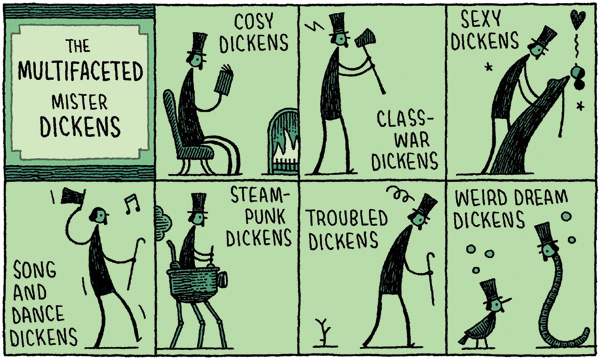
“The Multifaceted Mr. Dickens” — Tom Gauld

dickens(Via/more).

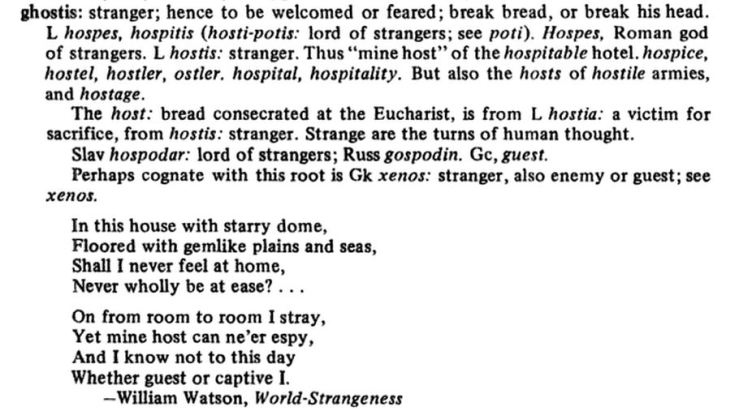
ghostis: stranger, hence to be welcomed or feared; break bread, or break his head. (Etymology)

Capture

(From The Origins of English Words: A Discursive Dictionary of Indo-European Roots by Joseph T. Shipley)

“On Some Technical Elements of Style in Literature” — Robert Louis Stevenson

There is nothing more disenchanting to man than to be shown the springs and mechanism of any art.  All our arts and occupations lie wholly on the surface; it is on the surface that we perceive their beauty, fitness, and significance; and to pry below is to be appalled by their emptiness and shocked by the coarseness of the strings and pulleys.  In a similar way, psychology itself, when pushed to any nicety, discovers an abhorrent baldness, but rather from the fault of our analysis than from any poverty native to the mind.  And perhaps in æsthetics the reason is the same: those disclosures which seem fatal to the dignity of art seem so perhaps only in the proportion of our ignorance; and those conscious and unconscious artifices which it seems unworthy of the serious artist to employ were yet, if we had the power to trace them to their springs, indications of a delicacy of the sense finer than we conceive, and hints of ancient harmonies in nature.  This ignorance at least is largely irremediable.  We shall never learn the affinities of beauty, for they lie too deep in nature and too far back in the mysterious history of man.  The amateur, in consequence, will always grudgingly receive details of method, which can be stated but never can wholly be explained; nay, on the principle laid down in Hudibras, that

‘Still the less they understand,
The more they admire the sleight-of-hand,’

many are conscious at each new disclosure of a diminution in the ardour of their pleasure.  I must therefore warn that well-known character, the general reader, that I am here embarked upon a most distasteful business: taking down the picture from the wall and looking on the back; and, like the inquiring child, pulling the musical cart to pieces.

1.  Choice of Words.—The art of literature stands apart from among its sisters, because the material in which the literary artist works is the dialect of life; hence, on the one hand, a strange freshness and immediacy of address to the public mind, which is ready prepared to understand it; but hence, on the other, a singular limitation.  The sister arts enjoy the use of a plastic and ductile material, like the modeller’s clay; literature alone is condemned to work in mosaic with finite and quite rigid words.  You have seen these blocks, dear to the nursery: this one a pillar, that a pediment, a third a window or a vase.  It is with blocks of just such arbitrary size and figure that the literary architect is condemned to design the palace of his art.  Nor is this all; for since these blocks, or words, are the acknowledged currency of our daily affairs, there are here possible none of those suppressions by which other arts obtain relief, continuity, and vigour: no hieroglyphic touch, no smoothed impasto, no inscrutable shadow, as in painting; no blank wall, as in architecture; but every word, phrase, sentence, and paragraph must move in a logical progression, and convey a definite conventional import.

Now the first merit which attracts in the pages of a good writer, or the talk of a brilliant conversationalist, is the apt choice and contrast of the words employed.  It is, indeed, a strange art to take these blocks, rudely conceived for the purpose of the market or the bar, and by tact of application touch them to the finest meanings and distinctions, restore to them their primal energy, wittily shift them to another issue, or make of them a drum to rouse the passions.  But though this form of merit is without doubt the most sensible and seizing, it is far from being equally present in all writers.  The effect of words in Shakespeare, their singular justice, significance, and poetic charm, is different, indeed, from the effect of words in Addison or Fielding.  Or, to take an example nearer home, the words in Carlyle seem electrified into an energy of lineament, like the faces of men furiously moved; whilst the words in Macaulay, apt enough to convey his meaning, harmonious enough in sound, yet glide from the memory like undistinguished elements in a general effect.  But the first class of writers have no monopoly of literary merit.  There is a sense in which Addison is superior to Carlyle; a sense in which Cicero is better than Tacitus, in which Voltaire excels Montaigne: it certainly lies not in the choice of words; it lies not in the interest or value of the matter; it lies not in force of intellect, of poetry, or of humour.  The three first are but infants to the three second; and yet each, in a particular point of literary art, excels his superior in the whole.  What is that point? Continue reading ““On Some Technical Elements of Style in Literature” — Robert Louis Stevenson”

List with No Name #17

  1. Gordon Lish
  2. Ed Sanders
  3. Nadine Gordimer
  4. Harry Matthews
  5. Doris Lessing
  6. Cynthia Ozick
  7. Philip Roth
  8. Derek Walcott
  9. William H. Gass
  10. John Ashberry
  11. E.L. Doctorow
  12. Lawrence Ferlinghetti
  13. Harold Bloom
  14. Gabriel García Márquez
  15. Joyce Johnson
  16. Milan Kundera
  17. Amiri Baraka
  18. Gary Snyder
  19. Joyce Carol Oates
  20. Mario Vargas Llosa
  21. Joan Didion
  22. Harper Lee
  23. John Barth
  24. Don DeLillo
  25. Cormac McCarthy
  26. Chinua Achebe
  27. Umberto Eco
  28. Günter Grass


Harold Bloom on “The School of Resentment”

Harold Bloom on his agon with “The School of Resentment.” From his 1991 interview with The Paris Review.

INTERVIEWER

How do you account historically for the school of resentment?

BLOOM

In the universities, the most surprising and reprehensible development came some twenty years ago, around 1968, and has had a very long-range effect, one that is still percolating. Suddenly all sorts of people, faculty members at the universities, graduate and undergraduate students, began to blame the universities not just for their own palpable ills and malfeasances, but for all the ills of history and society. They were blamed, and to some extent still are, by the budding school of resentment and its precursors, as though they were not only representative of these ills but, weirdly enough, as though they had somehow helped cause these ills and, even more weirdly, quite surrealistically, as though they were somehow capable of ameliorating these ills. It’s still going on—this attempt to ascribe both culpability and apocalyptic potential to the universities. It’s really asking the universities to take the place that was once occupied by religion, philosophy, and science. These are our conceptual modes. They have all failed us. The entire history of Western culture, from Alexandrian days until now, shows that when a society’s conceptual modes fail it, then willy-nilly it becomes a literary culture. This is probably neither good nor bad, but just the way things become. And we can’t really ask literature or the representatives of a literary culture, in or out of the university, to save society. Literature is not an instrument of social change or an instrument of social reform. It is more a mode of human sensations and impressions, which do not reduce very well to societal rules or forms.

INTERVIEWER

How does one react to the school of resentment? By declaring oneself an aesthete?

BLOOM

Well, I do that now, of course, in furious reaction to their school and to so much other pernicious nonsense that goes on. I would certainly see myself as an aesthete in the sense advocated by Ruskin, indeed to a considerable degree by Emerson, and certainly by the divine Walter and the sublime Oscar. It is a very engaged kind of mode. Literary criticism in the United States increasingly is split between very low level literary journalism and what I increasingly regard as a disaster, which is literary criticism in the academies, particularly in the younger generations. Increasingly scores and scores of graduate students have read the absurd Lacan but have never read Edmund Spenser; or have read a great deal of Foucault or Derrida but scarcely read Shakespeare or Milton. That’s obviously an absurd defeat for literary study. When I was a young man back in the fifties starting out on what was to be my career, I used to proclaim that my chosen profession seemed to consist of secular clergy or clerisy. I was thinking, of course, of the highly Anglo-Catholic New Criticism under the sponsorship or demigodness of T. S. Eliot. But I realized in latish middle age that, no better or worse, I was surrounded by a pride of displaced social workers, a rabblement of lemmings, all rushing down to the sea carrying their subject down to destruction with them. The school of resentment is an extraordinary sort of mélange of latest-model feminists, Lacanians, that whole semiotic cackle, latest-model pseudo-Marxists, so-called New Historicists, who are neither new nor historicist, and third generation deconstructors, who I believe have no relationship whatever to literary values. It’s really a very paltry kind of a phenomenon. But it is pervasive, and it seems to be waxing rather than waning. It is a very rare thing indeed to encounter one critic, academic or otherwise, not just in the English-speaking world, but also in France or Italy, who has an authentic commitment to aesthetic values, who reads for the pleasure of reading, and who values poetry or story as such, above all else. Reading has become a very curious kind of activity. It has become tendentious in the extreme. A sheer deliquescence has taken place because of this obsession with the methods or supposed method. Criticism starts—it has to start—with a real passion for reading. It can come in adolescence, even in your twenties, but you must fall in love with poems. You must fall in love with what we used to call “imaginative literature.” And when you are in love that way, with or without provocation from good teachers, you will pass on to encounter what used to be called the sublime. And as soon as you do this, you pass into the agonistic mode, even if your own nature is anything but agonistic. In the end, the spirit that makes one a fan of a particular athlete or a particular team is different only in degree, not in kind, from the spirit that teaches one to prefer one poet to another, or one novelist to another. That is to say there is some element of competition at every point in one’s experience as a reader. How could there not be? Perhaps you learn this more fully as you get older, but in the end you choose between books, or you choose between poems, the way you choose between people. You can’t become friends with every acquaintance you make, and I would not think that it is any different with what you read.

INTERVIEWER

Do you foresee any change, or improvement, in the critical fashions?

BLOOM

I don’t believe in myths of decline or myths of progress, even as regards to the literary scene. The world does not get to be a better or a worse place; it just gets more senescent. The world gets older, without getting either better or worse and so does literature. But I do think that the drab current phenomenon that passes for literary studies in the university will finally provide its own corrective. That is to say, sooner or later, students and teachers are going to get terribly bored with all the technocratic social work going on now. There will be a return to aesthetic values and desires, or these people will simply do something else with their time. But I find a great deal of hypocrisy in what they’re doing now. It is tiresome to be encountering myths called “The Social Responsibility of the Critic” or “The Political Responsibility of the Critic.” I would rather walk into a bookstore and find a book called “The Aesthetic Responsibilities of the Statesman,” or “The Literary Responsibilities of the Engineer.” Criticism is not a program for social betterment, not an engine for social change. I don’t see how it possibly could be. If you look for the best instance of a socially radical critic, you find a very good one indeed in William Hazlitt. But you will not find that his social activism on the left in any way conditions his aesthetic judgments, or that he tries to make imaginative literature a machine for revolution. You would not find much difference in aesthetic response between Hazlitt and Dr. Samuel Johnson on Milton, though Dr. Johnson is very much on the right politically, and Hazlitt, of course, very much an enthusiast for the French Revolution and for English radicalism. But I can’t find much in the way of a Hazlittian or Johnsonian temperament in life and literature anywhere on the current scene. There are so many tiresomenesses going on. Everyone is so desperately afraid of being called a racist or a sexist that they connive—whether actively or passively—the almost total breakdown of standards that has taken place both in and out of the universities, where writings by blacks or Hispanics or in many cases simply women are concerned.

INTERVIEWER

This movement has helped focus attention on some great novels, though. You’re an admirer, for example, of Ralph Ellison’s Invisible Man.

BLOOM

Oh, but that is a very, very rare exception. What else is there like Invisible Man? Zora Neale Hurston’s Their Eyes Were Watching God has a kind of superior intensity and firm control. It’s a very fine book indeed. It surprised and delighted me when I first read it and it has sustained several rereadings since. But that and Invisible Man are the only full scale works of fiction I have read by American blacks in this century that have survival possibilities at all. Alice Walker is an extremely inadequate writer, and I think that is giving her the best of it. A book like The Color Purple is of no aesthetic interest or value whatsoever, yet it is exalted and taught in the academies. It clearly is a time in which social and cultural guilt has taken over.

INTERVIEWER

I know you find this to be true of feminist criticism.

BLOOM

I’m very fond of feminist critics, some of whom are my close friends, but it is widely known I’m not terribly fond of feminist criticism. The true test is to find work, whether in the past or present, by women writers that we had undervalued, and thus bring it to our attention and teach us to study it more closely or more usefully. By that test they have failed, because they have added not one to the canon. The women writers who mattered—Jane Austen, George Eliot, Emily Dickinson, Edith Wharton, Willa Cather, and others who have always mattered on aesthetic grounds—still matter. I do not appreciate Elizabeth Bishop or May Swenson any more or less than I would have appreciated them if we had no feminist literary criticism at all. And I stare at what is presented to me as feminist literary criticism and I shake my head. I regard it at best as being well-intentioned. I do not regard it as being literary criticism.

INTERVIEWER

Can it be valued as a form of social or political literary criticism?

BLOOM

I’m not concerned with political or social criticism. If people wish to practice it, that is entirely their business. It is not mine, heavens! If it does not help me to read a work of aesthetic value then I’m not going to be interested in it at all. I do not for a moment yield to the notion that any social, racial, ethnic, or “male” interest could determine my aesthetic choices. I have a lifetime of experience, learning, and insight that tells me this.


Zora Neale Hurston’s Love Spells

Conjure up some last-minute romance. In the appendix to her collection of Florida folktales, Mules and Men, author Zora Neale Hurston offers up a host of Hoodoo, including the following love spells:

TO MAKE A MAN COME HOME

Take nine deep red or pink candles. Write his name three times on each candle. Wash the candles with Van-Van. Put the name three times on paper and place under the candles, and call the name of the party three times as the candle is placed at the hours of seven, nine or eleven.

TO MAKE PEOPLE LOVE YOU

Take nine lumps of starch, nine of sugar, nine teaspoons of steel dust. Wet it all with Jockey Club cologne. Take nine pieces of ribbon, blue, red or yellow. Take a dessertspoonful and put it on a piece of ribbon and tie it in a bag. As each fold is gathered together call his name. As you wrap it with yellow thread call his name till you finish. Make nine bags and place them under a rug, behind an armoire, under a step or over a door. They will love you and give you everything they can get. Distance makes no difference. Your mind is talking to his mind and nothing beats that.

TO BREAK UP A LOVE AFFAIR

Take nine needles, break each needle in three pieces. Write each person’s name three times on paper. Write one name backwards and one forwards and lay the broken needles on the paper. Take five black candles, four red and three green.

Tie a string across the door from it, suspend a large candle upside down, It will hang low on the door; bum one each day for one hour. If you burn your first in the daytime, keep on in the day; if at night, continue at night. A tin plate with paper and needles in it must be placed to catch wax in.

When the ninth day is finished, go out into the street and get some white or black dog dung. A dog only drops his dung in the street when he is running and barking, and whoever you curse will run and bark likewise. Put it in a bag with the paper and carry it to running water, and one of the parties will leave town.


Ulysses — Roman Muradov

ulysses

(Roman Muradov’s wonderful illustration to the Wandering Rocks episode of Joyce’s Ulysses; lots more great stuff at Roman’s site and blog).

“Man Carrying Thing” — Wallace Stevens

“Man Carrying Thing” by Wallace Stevens:

The poem must resist the intelligence
Almost successfully. Illustration:

A brune figure in winter evening resists
Identity. The thing he carries resists

The most necessitous sense. Accept them, then,
As secondary (parts not quite perceived

Of the obvious whole, uncertain particles
Of the certain solid, the primary free from doubt,

Things floating like the first hundred flakes of snow
Out of a storm we must endure all night,

Out of a storm of secondary things),
A horror of thoughts that suddenly are real.

We must endure our thoughts all night, until
The bright obvious stands motionless in cold.


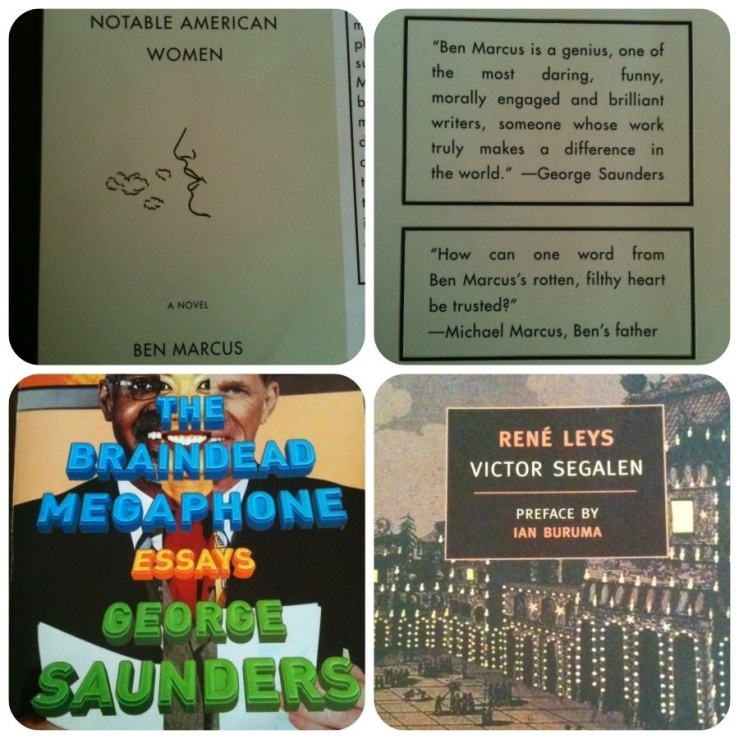
Ben Marcus/Victor Segalen/George Saunders (Books Acquired, 2.01.2013)

20130203-165505.jpg

I went to the bookstore on Friday afternoon to drop off some trade-ins and order a few books for my wife and kids for Valentine’s Day. I had no intention of buying anything, but a bit of random browsing led to me leaving with Ben Marcus’s collection Notable American Women (how could I resist that blurb?), a collection of George Saunders essays, and René Leys by Victor Segalen—the NYRB edition stuck out, and then the blurb sold me on this tale of a Westerner trying to access the Forbidden City of imperial China.

I’m reading Ben Marcus’s The Flame Alphabet right now, along with some short stories by Yoko Ogawa, as well as Lars Iyer’s latest, Exodus; I’m pretty sure René Leys is on deck after one of those.


Selections from One-Star Amazon Reviews of Joyce’s Ulysses

[Ed. note: The following citations come from one-star Amazon reviews of James Joyce’s Ulysses. To be very clear, I think Ulysses is a marvelous, rewarding read (more on that here). Today, February 2nd, is Joyce’s birthday—let’s celebrate by enjoying the observations of some readers who were unimpressed by his masterpiece. While one or two of the reviews are tongue-in-cheek, most one-star reviews of the book are from very, very angry readers who feel duped]

I can sum this book up in two words: “Ass Beating”.

What an awful book this is?

I bought this having been a huge fan of the cartoon series, but Mr Joyce has taken a winning formula and produced a prize turkey. After 20 pages not only had Ulysses failed to even board his spaceship, but I had no idea at all what on earth was going on. Verdict: Rubbish.

When an English/American writer try to explain his/her ideas about life(I mention ideas about meaning,purpose and philosophy of life)and when he/she try to do this with complicated ideas and long sentences(or like very short ones especially in this particular book);what his/her work become to is:A tremendous nonsense!!!

Thi’ got to be the worst, I- I – I mean the worst ever written book ever. Know why? ‘Cause he’ such a showoff, know what I MEAN? He’s ingenious I’ll giv’ ’em that, but ingenuity my friends tire and enervate. Get to the point and stick to it ‘s my motto.

This is one of those books that “smart” people like to “read.”

The grammar is so disjointed as to make it nearly impossible to read.

Ulysses is basically an unbridled attack on the very ideas of heroism, romantic love and sexual fulfillment, and objective literary expression.

What’s with all the foreign languages?

It has no real meaning.

It is a blasphemy that it ever was published.

Anyone who tells you they’ve read this so-called book all the way through is probably lying through their teeth.It is impossible to endure this torture.

A babbling, senseless tome upheld by “literary luminaries” who fear being cast into the tasteless bourgeois darkness for dissent? Yes, that’s the gist.

I discovered that the novel was not what I though it would be.

Joyce is an aesthetic bother of Marcel Duchamp (known for The Fountain, a urinal, now a museum piece) and John Cage (the composer of pieces for prepared piano, where the piano’s strings are mangled with trash.

Two positive things I can say about James Joyce is that he has a great sounding name and he gives wonderful titles to his works.

Ask yourself – are you going to enjoy a book that neccesitates your literature teacher lie next to you and explain its ‘sophistication’ to you ?

It’s the worst book which has ever been written.

Unless you really hate yourself, do not attempt to read this book.

The truth is this book stinks. For one thing it is vulgar, which, I hate to disappoint anyone, requires no talent at all. This is a talent any six year-old boy possesses.

The book is not so good, it is boring, it is a colection of words and a continuous experimentation of styles that, unhappily, do not mean anything to the meaning of the story; that is, the book’s language is snobbish and useless. Those who say that “love” such a writing are to be thought about as non-readers or as victims of a literary abnormality.

…the single most destructive piece of Literature ever written…

I’m all for challenging reads, but not for gibberish which academics persist in labeling erudition.

This book is extremely dull!!! My book club decided to read this book after one of the members visited the James Joyce tower in Ireland, which the author supposedly wrote part of the book in.

Ulysses is a failed novel because Joyce was a bad writer (shown by his other works).

In conclusion, Don’t read the book. Burn it hard. Do not let your children read the book—it will mutilate their brain cells.