“What’s Outside the Window?” (Roberto Bolaño’s The Savage Detectives Revisited)

Untitled (Desert Landscape) by Salvador Dali

Biblioklept has already published two reviews of Roberto Bolaño’s big novel The Savage Detectives.

In the first review, from 2008, I suggested that the book was technically impressive but ultimately “unmoving.” In the second review, from 2010, Dave Cianci argued that my first review “was unfair and premature.”

I tend to agree with Cianci’s criticism of my early review, although in my defense I struggled with a first reading of The Savage Detectives because I was ignorant of the history of Latin America, Central America, and Mexico, a history that provides much of the context for the Bolañoverse. I was like the auditor in The Savage Detectives who listened as Ulises Lima

reeled off a story that I had trouble following, a story of lost poets and lost magazines and works no one had ever heard of, in the middle of a landscape that might have been California or Arizona or some Mexican region bordering those states, a real or imaginary place, bleached by the sun and lost in the past, forgotten, or at least no longer of the slightest importance here . . .  A story from the edge of civilization . . .

The citation above more or less pins down some of the problems first time readers to Bolaño might have with The Savage Detectives. More so than the rest of his oeuvre, Detectives dwells on “lost poets and magazines and works no one had ever heard of.” These poets and writers are mixed in with famous poets (like Octavio Paz, who appears as a character in one segment), and parsing the various characters’ attitudes toward these writers can be a perplexing challenge, and at times a turn off.

And it’s not just the names of poets and writers that can addle a reader: Many of Bolaño’s narrators share an obsessive compulsion to name every avenue, street, or alley they walk on or past, details that become frankly boring over an extended period. It’s a novel of names and places: canonizing, map-making.

Why the map-making? Because this is a book about being lost. Its first section is titled “Mexicans Lost in Mexico.” Notice how many times the word “lost” crops up in the citation above. Indeed, The Savage Detectives is not only about what it means to be lost, but also about what it means to lose—one’s friends, one’s group, one’s country, one’s mind. It’s a book about exiles.

Maybe, dear reader, you’re looking for a bit of plot summary, a morsel at least—that is, maybe you haven’t read The Savage Detectives and you want to know if you should or shouldn’t. I suggest reading Cianci’s review in that case. In any case, I don’t suggest starting Bolaño with The Savage Detectives (although I’m sure plenty of folks might disagree with me here). A better starting place might be the short story collection Last Evenings on Earth. Or really just jump into the beast at the abyssal heart of the Bolañoverse, 2666.

I reread 2666 this summer and immediately knew I had to reread The Savage Detectives, knew I had to parse some of what I missed in my first “unfair and premature” reading. I ended up checking out Blackstone Audio’s recording of the book, featuring the voice talents of Eddie Lopez and Armando Duran.

The audio production is excellent: Lopez, surely a very young man, reads the narratives of Juan García Madero that bookend the central section, “The Savage Detectives,” which is read with a startling depth of range by Duran. Lopez’s García Madero comes across as the naïve pretender to cynicism, the would-be artist faking a life of romance. In Duran’s handling, the myriad characters in the middle of the novel come to life with humor and pathos. He animates the characters, showcasing the irony and pain and sadness and small moments of lunatic joy that erupt in the book. The Savage Detectives makes for a surprisingly excellent audiobook. (Quick note anticipating a query those familiar with the novel may have: The cryptic pictograms that show up late in the novel are included in the audiobook; they displayed on my iPod in tandem with their sections, and I imagine they would pop up on any player with a screen).

I enjoyed The Savage Detectives much, much more this second time. I still found parts of it boring (perhaps purposefully boring, but boring nonetheless), and the episodes I enjoyed most on the first reading (the duel, the cavern, the Liberian segment, the Israeli prison, the campers in Spain) were the ones I enjoyed the most on the second round. Better equipped for this reading, I appreciated the riches of Detectives, the way its fragments, intertextual, metatextual, reach out through the Bolañoverse to couple with other fragments, other texts.

My metaphors above are all wrong—the texts don’t reach or couple—the reader does this work, this reaching, this coupling, this detecting.

In my first reading, not up to playing detective, I surely blew through this passage near the end of the novel, a passage that ripples with strange significance for anyone puzzling over 2666:

And Cesárea said something about days to come, although the teacher imagined that if Cesárea had spent time on that senseless plan it was simply because she lived such a lonely life. But Cesárea spoke of times to come and the teacher, to change the subject, asked her what times she meant and when they would be. And Cesárea named a date, sometime around the year 2600. Two thousand six hundred and something. And then, when the teacher couldn’t help but laugh at such a random date, a smothered little laugh that could scarcely be heard, Cesárea laughed again, although this time the thunder of her laughter remained within the confines of her own room.

Here we have lost poet Cesárea Tinajero, object of the savage detectives’ quest, holed up in her room in Santa Teresa, the central setting for the murders of 2666, a map of a factory (a maquiladora, like the ones the murdered women work at in 2666?) pinned to her wall; here we have Cesárea Tinajero, who keeps “a switchblade with a horn handle and the word Caborca engraved on the blade” by her side, believing she is “under threat of death.” Cesárea Tinajero is prophet to the horrors at the core of 2666.

2666’s Benno von Archimboldi twins Cesárea Tinajero. Just as a quartet of savage detectives search for Tinajero, so to a quartet of literary critics seek out the lost Prussian writer. (Archimboldi even shows up a few times in The Savage Detectives, albeit under the pseudopseudonym “J.M.G. Arcimboldi,” identified as a “Frenchman,” the author of The Endless Rose, his second novel in 2666). Cesárea Tinajero is also repeated in 2666’s Florita Almada, a psychic medium who not only testifies to, but also tries to stop, the unrelenting violence in Santa Teresa.

I suppose I could keep teasing out these intertextual meetings. I could point out that Detectives character Joaquín Font winds up in an insane asylum babbling about fate (fate and insanity being two major themes of 2666). I could point out that Auxilio Lacouture, narrator of Bolaño’s novella Amulet, gets to tell her story in miniature in Detectives. I could point out that the central figures (“central” is not the right word of course) of Detectives, Arturo Belano and Ulises Lima are everywhere in the Bolañoverse—even unnamed, it is clear that one of the duo fathers the bastard Lalo Cura, one of the good detectives of 2666. But what would be my point in elaborating detail after detail here? Or, and perhaps this is the real question I mean to ask here—is a full reading of The Savage Detectives ultimately dependent on intertextual relationships with other Bolaño books?

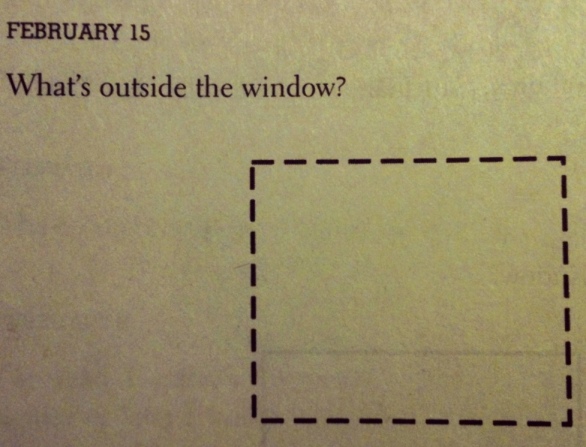
Maybe a better way to finish here is to hash out the last few pages of the novel, which find our narrator García Madero driving around Sonora with Lupe, on the run from the law (maybe). The last few entries of the book—in diary form—are simply a list of place names, obscure places in the Sonora desert the pair presumably drive to. García Madero takes up the mantle of exile and reads Cesárea Tinajero’s notebooks, which perhaps influence him—the last three entries of Detectives feature pictographic riddles that recall Tinajero’s visual poem “Sion.” Here is the final entry, which is also the final page of the book—

20120819-152744.jpg

I suppose there are plenty of answers to Bolaño’s final riddle. What’s outside the window? Abyssvoiduncertainty. Aporia. And also: Possiblityopennessfreedom. Certainty. And also: The perforated suggestions of a shape, lines to guide our scissors, form. And also: It’s to be taken literally, a literal dare to the reader to get up, to look out, to see. I could probably keep going.

If we know Bolaño’s detective games, we know that the mysteries are really labyrinths, mazes where we might get trapped and go insane. (The Savage Detectives is in large part a novel that outlines the risks—mental, physical, emotional—of literature). How do I read the gaps in the visual riddle? The gesture is visual ambiguity, paradox. The dashes open to void and close to make form; they define yet are indefinite; the window is there and is not there. So what we’re left with is a way of seeing, or at least an invitation to a way of seeing, which is to say a way of reading. So, if you like—and I like—what’s outside the window is the rest of the Bolañoverse—or at least an offer to play detective.

I Riff on Clarice Lispector’s Novella The Hour of the Star, a Strange Work of Pity, Humor, Terror, and Abjection

20120814-170735.jpg

1. How to go about this?

A starting place:

Clarice Lispector’s 1977 novella The Hour of the Star is a superb collection of sentences.

2. But what do I mean by this ridiculous statement? I mean isn’t that what all or most writing amounts to–a “collection of sentences”?

What I mean then is that Lispector’s sentences prickle and tweak and glare, launch off in strange angles from each other as if they were building out narratives in disparate, separate tones, moods, colors.

3. Another way to say this: the writing is strange, marvelous, uncanny. The good weird.

4. Or maybe I should let Lispector’s narrator say it:

Remember that, no matter what I write, my basic material is the word. So this story will consist of words that form phrases from which there emanates a secret meaning that exceeds both words and phrases.

(Our narrator repeatedly invokes the power of “the word,” but I’ll linger on the way those words string together in sentences).

5. And yes, our narrator is a “he.” Clarice Lispector the ventriloquist. Early in the book the narrator says that the tale could only come from “a man for a woman would weep her heart out.”

6. I’ll be frank: I don’t know how to unpack all the ventriloquizing here, the layering between Lispector and her narrator Rodrigo S.M., who relates the sad tale of  Macabéa (a typist!), indigent slum-dweller, no talent and no beauty.

7. Narrator Rodrigo S.M. seems unsure himself how to unpack the tale. He spends almost the first fifth of the book dithering over actually how to begin to start to commence:

I suspect that this lengthy preamble is intended to conceal the poverty of my story, for I am apprehensive.

And a page or two later:

I am scared of starting. I do not even know the girl’s name. It goes without saying that this story drives me to despair because it is too straightforward. What I propose to narrate sounds easy and within everyone’s grasp. But its elaboration is extremely difficult. I must render clear something that is almost obliterated and can scarcely be deciphered. With stiff, contaminated fingers I must touch the invisible in its own squalor.

8. (I promise to pick back up on that squalor and whatever invisible might be at the end of this riff).

9. The Hour of the Star: The story is thin, the plot is a shell, a threadbare ancient trope, as brave Rodrigo S.M. repeatedly tells us.

10. The plot is archetypal even. The orphan girl in the big city. Cinderella who imagines the ball, or tries to imagine the ball. Etc.

11. So here’s a proper plot summary, c/o translator Giovanni Pontiero (who surely deserves large praise heaped at his feet (or a location of his choice) for his poetic translation):

The nucleus of the narrative centres on the misfortunes of Macabéa, a humble girl from a region plagued by drought and poverty, whose future is determined by her inexperience, her ugliness and her total anonymity. Macabéa’s speech and dress betray her origins. An orphaned child from the backwoods of Alagoas, who was brought up by the forbidding aunt in Maceió before making her way to the slums of Acre Street in the heart of Rio de Janeiro’s red-light district. Gauche and rachitic, Macabéa has poverty and ill-health written all over her: a creature conditioned from birth and already singled out as one of the world’s inevitable losers.

Her humdrum existence can be summarized in few words: Macabéa is an appallingly bad typist, she is a virgin, and her favorite drink is Coca-Cola. She is a perfect foil for a bullying employer, a philandering boy friend, and her workmate Glória, who has all the attributes Macabéa sadly lacks.

12. A dozen things that The Hour of the Star may or may not be about: Poverty, storytelling, lies, illusions, abjection, resistance, agency, self, class, power, romance, fate.

13. But let’s get back to those words the narrator is braggin’ on:

Another angle at approaching The Hour of the Star: Its page of thirteen alternate titles, which act as a prose-poem descriptor for the novella:

20120814-170352.jpg

14. And some sentences:

The first provides a context. The second tells us everything about Macabéa. The third tells us everything about her awful, venal “boy friend” Olímpico:

For quite different reasons they had wandered into a butcher’s shop. Macabéa only had to smell raw meat in order to convince herself that she had eaten. What attracted Olímpico, on the other hand, was the sight of a butcher at work with his sharp knife.

15.  Macabéa, our primary, and Olímpico a distant second. But also Rodrigo S.M. (and a few others):

The story—I have decided with an illusion of free will—should have some seven characters, and obviously I am one of the more important.

16. (Again though, how to parse Rodrigo from Clarice Lispector . . .)

17. So maybe in one of his (her) parenthetical intrusions (but how can they be intrusions?). From late in the novella:

 (But what about me? Here I am telling a story about events that have never happened to me or to anyone known to me. I am amazed at my own perception of the truth. Can it be that it’s my painful task to perceive in the flesh truths that no one wants to face? If I know almost everything about Macabéa, it’s because I once caught a glimpse of this girl with the sallow complexion from the North-east. Her expression revealed everything about her . . .)

Solipsism? Hubris? Humor? Irony?

Truth?

18. But I want to say something about how funny this novella, but I don’t know how to say it, or I’m not sure how to illustrate it, how to support such a claim with text—how does one support a feeling, a vibe, a phantom idea? Is The Hour of the Star actually funny? Or am I a sick man? Why did I chuckle so much?

19. I think, re: 18, I think that it must be a mild streak of sadism, or an identification with the narrator’s flawed empathy, his raw presentation of a pathetic, abject heroine, a heroine whose heroism can only manifests in strange eruptions of self-possession, minor triumphs of the barest self-assertions.

20. Perhaps an illustration, re: 18/19—a lengthy one maybe, but indulge me (or, rather, indulge yourself):

At this point, I must record one happy event. One distressing Sunday without mandioca, the girl experienced a strange happiness: at the quayside, she saw a rainbow. She felt something close to ecstasy and tried to retain the vision: if only she could see once more the display of fireworks she had seen as a child in Maceió. She wanted more, for it is true that when one extends a helping hand to the lower orders, they want everything else.; the man on the street dreams greedily of having everything. He has no right to anything but he wants everything. Wouldn’t you agree? There were no means within my power to produce that golden rain achieved with fireworks.

Should I divulge that she adored soldiers? She was mad about them. Whenever she caught sight of a soldier, she would think, trembling with excitement: is he going to murder me?

Can you feel the shifts here? A distressing Sunday, a hungry Sunday (“without mandioca”); its strange happiness; an ecstasy that repeats a childhood vision; the desire for more, to rise above one’s allotment (The Right to Protest, or, She Doesn’t Know How to Protest); the limits of words, of language. An unexpected, seemingly irrelevant anecdote. A rare dip into our heroine’s consciousness.

21. There’s a certain absurdity here, a methodical absurdity, of course. There’s a rhythmic certainty to the prose—a sense of aesthetic uniformity—but the content jars against it, the meaning spikes out in subtly incongruous jags that form some other shape. Folks say folks say Lispector echoes Kafka in this way. (I’m reminded of Robert Walser’s sentences too).

22. But I’ve shared enough to give you a sense of Lispector’s style, a taste anyway, right?

What about the book’s claim, its viewpoint, its thesis?

23. Okay, so it’s right there upfront in the  book’s fifth paragraph, delivered early enough when the reader is suitably perplexed, looking for some kind of narrative inroad, not looking necessarily for a theme or a message or what have you:

Even as I write this I feel ashamed at pouncing on you with a narrative that is so open and explicit. A narrative, however from which blood surging with life might flow only to coagulate into lumps of trembling jelly. Will this story become my own coagulation one day? Who can tell? If there is any truth in it—and clearly the story is true even though invented—let everyone see it reflected in himself for we are all one and the same person . . .

24. Let’s not misunderstand the last sentiment as some hippy-dippy bullshit: Let’s go back to: “I must touch the invisible in its own squalor.”

25. That squalor is the abject, the filth, the not-me, the other, signified most strongly in waste, blood, filth, vomit, the corpse.

26. The gesture of The Hour of the Star is to make visible—in sentences, in words, in language—the invisible in its own squalor.

27. Highly recommended.

Roberto Bolaño’s Powers of Horror

    Scenes of Rape and Murder, Francisco Goya
  • In Powers of Horror philosopher Julia Kristeva describes the idea with which she’s most closely identified, the abject, the intense horror our subjective psychology—and our bodies—experience when faced with corporeal reality: the edges of our body: filth, vomit, shit, blood, death: the me that is not me. Breakdown of subject and object: abject.
  • Julia Kristeva shows up as a character, a phantom from a photograph in Roberto Bolaño’s story “Labyrinth,” collected in The Secret of Evil, new from New Directions.
  • (Can there be a more Bolañoesque title than “Labyrinth”?)
  • This is ostensibly a review of that Bolaño collection, but I’ll be riffing on some other things.
  • Bolaño created his own genre. His oeuvre, piecemeal and posthumous at times, is nevertheless a complete fiction or discourse of its own. Think of the Bolañoverse like Middle Earth, like Yoknapatawpha County, like dark Narnia with no Aslan to redeem it.
  • The Bolañoverse is abject. Consider the pile of bodies that heap like rubbish in “The Part About the Crimes,” the cruel center of 2666—has ever a book repeated the phrase “vaginally and anally raped” so many times?
  • Kristeva, in Powers of Horror:

The corpse, seen without God and outside of science, is the utmost of abjection. It is death infecting life. Abject. It is something rejected from which one does not part, from which one does not protect oneself as from an object. Imaginary uncanninness and real threat, it beckons to us and ends up engulfing us.

It is thus not lack of cleanliness or health that causes abjection but what disturbs identity, system, order. What does not respect borders, positions, rules. The in-between, the ambiguous, the composite. The traitor, the liar, the criminal with a good conscience, the shameless rapist, the killer who claims he is a savior . . .  Any crime, because it draws attention to the fragility of the law, is abject, but premeditated crime, cunning murder, hypocritical revenge are even more so because they heighten the display of such fragility.

    Sex Murder, Otto Dix
  • But I promised to remark upon The Secret of Evil; I used the term “review” even.

A few things:

It’s a beautiful book (I mean the physical book itself; the cover, the design). The name is perfect.

Much of what’s collected here is perhaps unfinished—-scraps, riffs, bits of tales, sketches.

But also:

Much of what’s here is finished, or, more to the point, much of what’s here—scratch that, all of what’s collected in The Secret of Evil—fits into the Bolañoverse, fleshes it out, or stretches it, or condenses it maybe (let me have my paradoxes, will you?).

  •  Bolaño’s friend (and literary executor) Ignacio Echevarría puts it aptly in his introduction to The Secret of Evil:

 Bolaño’s work as a whole remains suspended over the abysses that it dares to sound. All his narratives, not just The Secret of Evil, seem to be governed by a poetics of inconclusiveness. The eruption of horror seems to determine the interruption of the storytelling; or perhaps it is the other way around: the interruption of the telling suggests the imminence of horror.

  • I have been slowly, slowly rereading my way through 2666, edging my way into it in the latest of hours. I’m nearing the end, or the end of “The Part About Archimboldi,” and what I find most remarkable upon rereading is how precise, how tight it seems this time, how each book seems to answer to the other. (Take, for instance the female politician who, at the end of “The Part About the Crimes,” seems to peer through a strange mirror into the future (past?) to see the English critic Norton, who, in “The Part About the Critics,” in turn gazes into (the same?) mirror at a woman—not herself but surely the politician. Or take another instance: The visitations to madhouses made by peripheral characters to even more peripheral characters: artists, suspects, lovers, poets, teachers. Or take all the abysses. Or the labyrinths. Or mirrors. Or dreams. Or murders. Maybe I’m tipping into a simple recitation of motifs and themes now).
  • But no, what I want to remark on is how The Secret of Evil is part and parcel of the  Bolañoverse, how it answers backward and forward and throughout  Bolaño’s “poetics of inconclusiveness,” his “eruption[s] of horror.” Fragments like “The Secret of Evil” and “Crimes,” with their journalist heroes and noir lighting seem to dance around the same central mysteries that pulse through 2666. The strange literary criticism of “Vagaries of the Literature of Doom” and “Scholars of Sodom” answers not only to “The Part About the Critics,” but to the entire course of  Bolaño’s work as well. And continuing—
  • Of course Arturo Belano appears in The Secret of Evil, as does his erstwhile partner Ulisses Lima. How could they not? They roam the Bolañoverse beyond their own narrative proper, The Savage Detectives (that is what detectives do), even popping up (unnamed) in 2666 where they father (both of them figuratively and one of them literally) that other savage detective, Lalo Cura.
  • And then (back to The Secret of Evil) there’s “The Colonel’s Son,” a sketch of a zombie film, a B-movie, shades of Robert Rodriguez’s Planet Terror (recall that Rodriguez is given a vague credit for a surreal porno horror film that plays in “The Part About Fate” in 2666). “The Colonel’s Son” shows  Bolaño’s poetics of inconclusiveness at their sharpest. Our narrator describes a terrible film he sees on late night TV, only he misses the beginning, so we are without context, without rationale or reason for the awful onslaught that happens. There’s a labyrinth, 0f course, a dark twisting complex of passageways that hide secrets under a military facility, and then a twin labyrinth, a sewer system. There’s love, familial and romantic. There are Kristevan bodies, zombies, corpses infected with life (or is it the other way around). There’s horrific indeterminancy.
  • I remarked on Bolaño’s powers of horror back in the spring, making a bizarre argument that 2666 was somehow a werewolf story. 2666 and the Bolañoverse in general is crawling with all kinds of monsters though.

    The Murderer, Franz Stuck
  • I’ve used the word Lynchian repeatedly when writing about Bolaño, in reference to the American film director David Lynch—whose name is in fact directly evoked in 2666, in “The Part About Fate.” In his essay “David Lynch Keeps His Head,” David Foster Wallace provides a succinct description of David Lynch’s powers of horror, a description that I believe applies to Bolaño as well:

Characters are not themselves evil in Lynch movies—evil wears them. This point is worth emphasizing. Lynch’s movies are not about monsters (i.e. people whose intrinsic natures are evil) but about hauntings, about evil as environment, possibility, force. This helps explain Lynch’s constant deployment of noirish lighting and eerie sound-carpets and grotesque figurants: in his movies’ world, a kind of ambient spiritual antimatter hangs just overhead. It also explains why Lynch’s villains seem not merely wicked or sick but ecstatic, transported: they are, literally, possessed.

  • The Bolañoverse is darkly haunted, comically haunted, savagely haunted, haunted by history and the present as well. The crimes of the Nazis, maddeningly, expertly elided in “The Part About Archimboldi” extend in “The Part About the Crimes” to Santa Teresa, fictional stand-in to real-life murder capital Juarez—and Nazism percolates out into neo-fascism, into the horrific confessions in By Night in Chile or the art-terror of Distant Star, or to the absurdity of Nazi Literature of the Americas. Throughout it all though, Bolaño crafts his powers of horror not so much through evil individuals (although they are easy to find there) but through, to use Wallace’s term, “evil as environment.”
  • How often do the characters in 2666 look out on the desert in a horror approaching madness?
  • And then madness, too, madness as a type of possession, but also madness as a kind of inescapable outcome, or madness as even a type of salvation, the sense that we might end up mad or dead (murder or suicide).
  • Let me try to connect these last few points in a citation from late in “The Part About the Crimes,” a few lines from our female politician trying to find justice for her friend Kelly who soon learns about the extensive victimization of women in Santa Teresa:

As I learned about other cases, however, as I heard other voices, my rage began to assume what you might call mass stature, my rage became collective or the expression of something collective, my rage, when it allowed itself to show, saw itself as the instrument of vengeance of thousands of victims. Honestly, I think I was losing my mind. Those voices I heard (voices, never faces or shapes) came from the desert. In the desert, I roamed with a knife in my hand. My face was reflected in the blade. I had white hair and sunken cheeks covered with tiny scars. Each scar was a little story that I tried and failed to recall. I ended up taking pills for my nerves.

We see here the descent into madness, the rage of it all, the violence of the landscape, the great ventriloquist act of insanity.

  • Bolaño, master ventriloquist, authors the heteroglossic Bolañoverse with an abyssal void at its invisible center. His characters wish to speak some kind of truth or name or answer to this void, but it exists outside of the realm of language, of possibility, accessible instead only in dreams or nightmares or mirrors or strange transmissions, psychic or otherwise. It’s terrifying, of course.
  • But it’s a mistake to cast Bolaño as some kind of malevolent puppet master, confounding his ventriloquized characters and driving them mad (not to mention his poor readers!). Perhaps it’s instructive to dip into Kristeva again, who gives us the deject to go with her abject. From Powers of Horror:

The one by whom the abject exists is thus a deject who places (himself), separates (himself), situates (himself), and therefore strays, instead of getting his bearings, desiring, belonging, or refusing. Situationist in a sense, and not without laughter—since laughing is a way of placing or displacing abjection.

. . . wishing to know his abjections is not at all unaware of them. Often, moreover, he includes himself among them, casting within himself the scalpel that carries out his separations. . . the space that engrosses the deject, the excluded, is never one, nor homogeneous, nor totalizable, but essentially divisible, foldable, and catastrophic. A deviser of territories, languages, works, the deject never stops demarcating his universe whose fluid confines—for they are constituted of a nonobject, the abject–constantly questions his solidity and impel him to start afresh. A tireless builder, the deject is in short a stray.

  • Bolaño the exile. Bolaño the stray.
  • This riff has swollen now, ballooned up, mutated; I can no longer wrangle the rest of my outline into cohesion at this point. Save it for later.
  • I’ll try to end more sensibly, or at least more practically. The Secret of Evil is not some grand intertextual key that unlocks the secret of the Bolañoverse; the “secret” in the title is not a revelation but a synonym for “mystery”. Fans will find some sharp moments here, but it’s not a good starting place for those unfamiliar with his writing (try Last Evenings on Earth or Distant Star). For completists only—but completists will find dark joy here.

I Audit Hilary Mantel’s Bring Up the Bodies (Part 3 of 3)

Portrait of Thomas Cromwell, Hans Holbein the Younger

(Parts one and two for those who care).

I suppose one sign of a great book is that it leaves you wanting more, and as Bring Up the Bodies arrived smoothly and precisely to its end, I found myself wanting more—more of those impeccable period details, more shots of London crowds gathering to ogle corpses, more of Henry VIII’s pretzel logic—but most of all, more time in Thomas Cromwell’s mind, which is the supreme pleasure of the book. Mantel’s restraint pays off, although a glance at Bring Up the Bodies hardly seems restrained: it’s 432 pages in hardback, or 24 hours in the audiobook version I listened to. I usually shudder when a review copy of 400 pages shows up at Biblioklept World Headquarters. It seems to me that most books of 400 pages could be improved dramatically if the author cut 200 pages—or added 600 more. And surely Mantel could have added 600 or 700 pages to the story of Henry’s offing the Boleyn siblings. The material is just that rich. But Mantel knows what she’s doing here, and the book she delivers is balanced and thorough and engaging and, as I said, leaves the reader wanting more, leaves us anticipating the trilogy’s conclusion, The Mirror and the Light.

Mantel’s ability to express Cromwell’s keen intelligence reanimates the Tudor saga, which I frankly could give a rat’s ass about on its own. Okay, the plot is fascinating, but much of history fascinates. What’s remarkable is the manner by which Mantel channel’s Cromwell’s mind. His brain is always at work, and Mantel shows us that brain at work. It would be a mistake to suggest that Bring Up the Bodies has no prose style, but it’s difficult to describe the style—Mantel elides authorial intrusion; her free indirect style stays close to Cromwell’s perceptions, but she knows when to move her camera out, knows when to show her audience a shot of his face or a gesture of his hand when he receives some piece of information or imparts some command. She rarely tells us what Cromwell is thinking, instead allowing us to go through the cognitive process with him.

And that cognitive process never rests. There’s a remarkable passage near the end of the book that ties together so many of the book’s themes and images. I would quote in full but I listened to the audio, so I’ll have to paraphrase (forgiveness, please). Cromwell is busy making arrangements for the executions of Boleyn and the men accused of sleeping with her, and his mind turns somehow to imagery of gristle and bone and fat—and he wonders what the ancient Greek pagans and Hebrews of the bible did with the meat from their sacrifices—Surely they didn’t waste the meat, surely they gave it to the poor, he thinks. Cromwell figures Boleyn as a sacrifice and then converts that sacrifice into a concern for the common people of the commonwealth.

Of course, it’s a mistake to see Cromwell’s motivations as absolutely pure. The revenge plot of Bring Up the Bodies unfolds so smoothly that the reader (okay, this reader) is slow to catch on, to see how delicately and expertly Cromwell snares those who brought down his beloved mentor Cardinal Wolsey. His control is so precise (Mantel’s control is so precise) that he refuses to tip his hand to himself, let alone the schemers around him, let alone the reader.

Still, Bring Up the Bodies concludes with an uneasy Cromwell, a man already looking for solace in grandchildren, in some kind of futurity, in a life (in a rare metatextual gesture on Mantel’s part) on paper, a figure marked in ink and words. He’s too perceptive—too sharp a reader—not to see the writing on the wall, even if that wall is some years out, even if that writing is still malleable and undefined. Cromwell has controlled the myriad political, familial, and personal circumstances that surround the wishes of his prince, King Henry, but he knows that it’s only a matter of time before his favor falls.

Bring Up the Bodies is a fantastic sequel to Wolf Hall, picking up the reins in media res, yet never resting on that first book’s tropes (“Choose your prince”; “Arrange your face”), but rather absorbing them and then adding to them. Mantel has given those of us not particularly interested in historical fiction a great reason to read some, although dithering about genre seems silly here. Ultimately, she gives us a powerful, character-driven story, a story that we think we already know, but understand anew in her retelling. Recommended.

Some Annotations on the First Sentence of William Gaddis’s Last Novel, Agapē Agape

20120627-145321.jpg

1. Let’s start with the what:

Agapē Agape is the last novel by William Gaddis, that underread titan who gave us The Recognitions and J R. Agapē Agape was published in 2002, four years after Gaddis’s death. Agapē Agape is 96 pages in my Penguin Classics edition (the font is rather large, too)—almost exactly one-tenth the length of The Recognitions in my Penguin Classics edition, which is 956 pages (and in a smaller font).

2. And why?

Let’s say I’ve struggled with this review, perhaps more than I struggled with writing about J R (which I did here and here) or The Recognitions (which I did here and here), which seems nonsensical because those books are so big and this one is so short. But that’s a surface argument.

See, Agapē Agape is dense. It seems to compact and condense all of Gaddis’s themes and ideas and motifs into this little book that’s uranium heavy, too dense to allow for line breaks or paragraph breaks or indentations, let alone chapters. It’s one big block of text.

3. And so—

After reading the book twice I’ve marked every page (which is exactly like marking no pages), and at this point the only way that I can find to discuss it (I know there must be others) is to annotate the opening paragraph, its first sentence, really—which of course isn’t really a paragraph or a sentence in the traditional grammatical sense—I mean, there are a set of clauses, some fused sentences, perhaps a comma splice or two—but what marks it as a discrete sentence is that it’s punctuated by a question mark, a tiny caesura before the next onslaught of words. (Some of Agapē Agape’s sentences go on for pages).

4. The style of Agapē Agape recalls Thomas Bernhard, who Gaddis’s narrator accuses of having plagiarized the book that the narrator has yet to write. The accusation (ironic, purposefully, of course) points to Agapē Agape’s concern for synthesis, for transmitting some clear thesis statement out of the muddle of Western culture. Agapē Agape tries to suss out that muddle and as such is larded with discussions of Plato, Nietzsche, Melville, Hawthorne, Byron, Freud (“Sigi”!), Bach, Caesar, Joyce, Pulitzer, Tolstoy, Frankenstein, Huizinga, Pound, Philo T. Farnsworth, player-pianos . . . It overwhelms the narrator; it overwhelms the reader. But enough dithering—

5. —here is the opening sentence:

No but you see I’ve got to explain all this because I don’t, we don’t know how much time there is left and I have to work on the, to finish this work of mine while I, why I’ve brought in this whole pile of books notes pages clippings and God knows what, get it all sorted and organized when I get this property divided up and the business and worries that go with it while they keep me here to be cut up and scraped and stapled and cut up again my damn leg look at it, layered with staples like that old suit of Japanese armour in the dining hall feel like I’m being dismantled piece by piece, houses, cottages, stables orchards and all the damn decisions and distractions I’ve got the papers land surveys deeds and all of it right in this heap somewhere, get it cleared up and settled before everything collapses and it’s all swallowed up by lawyers and taxes like everything else because that’s what it’s about, that’s what my work is about, the collapse of everything, of meaning, of values, of art, disorder and dislocation wherever you look, entropy drowning everything in sight, entertainment and technology and every four year old with a computer, everybody his own artist where the whole thing came from, the binary system and the computer where technology came from in the first place, you see?

6. “No but you see I’ve got to explain all this because I don’t, we don’t know how much time there is left and I have to work on the, to finish this work of mine while I,”

Ulysses ends with a “Yes”; Agapē Agape begins with a “No.” This is a deeply negative book, cruel almost, bitter, caustic, acidic, but also erudite, funny, and even charming. We see right away the narrator—surely a version of Gaddis himself—concerned with the ancient problem of communication, the problem that occupied Plato and every philosopher since: “I’ve got to explain all this.” We also see here the same stream-of-consciousness technique here that Joyce used so frequently in Ulysses (putting aside Gaddis’s denials of a Joyce influence)—the suspended referent, the unnamed (the unnameable?): “I have to work on the, to finish this work of mine while I”—while I what? Still can? Still live? From the outset, Agapē Agape is a contest against time, death, and entropy.

7. “why I’ve brought in this whole pile of books notes pages clippings and God knows what, get it all sorted and organized”

Synthesis, synthesis, synthesis. Making books out of other books. Plugging literature into other literature. I am quite content to go down to posterity as a scissors-and-paste man, said someone once. And then others said it again. And then I cited it here, now.

I’m reminded here of a list that Gibbs (erstwhile Gaddis stand-in in J R) keeps in his pocket, a scrap paper crammed with ideas, fragments, citations:

Is it possible to get it sorted?

Recall now Gaddis’s hero Ezra Pound. From Tom McCarthy’s essay on synthesis, “Transmission and the Individual Remix”:

With the Cantos, he kept up this furious enterprise for five whole decades, ramping its intensity up and up until the overload destroyed him, blew his mind to pieces, leaving him to murmur, right toward the end: “I cannot make it cohere.”

It is the reader’s job to make Agapē Agape cohere.

8. “when I get this property divided up and the business and worries that go with it”

Agapē Agape may be said to have a few formalizing plots beyond its object of synthesizing Western culture vis-à-vis art and entertainment.

One of these formalizing elements is the idea of an old man divvying up his property to his daughters. Oh, hey, King Lear anyone? What’s most interesting to me about this plot (okay, more of a motif really) is that it’s the only allusive device that the narrator doesn’t remark upon. We have a narrator who’s trying to control all these notes and clippings, all these scraps of culture, a narrator with a sharp (if distracted intelligence) who nevertheless fails to remark upon the fact that his personal circumstances echo the great dismal swan song of English literature. King Lear: madness, unraveling, degeneracy, death, entropy.

9. “while they keep me here to be cut up and scraped and stapled and cut up again my damn leg look at it, layered with staples like that old suit of Japanese armour in the dining hall feel like I’m being dismantled piece by piece,”

Another formalizing element in Agapē Agape are the health issues the narrator faces, presumably a series of surgeries that involve at least one of his legs. The motif of surgeries, of transplants, and implants runs throughout The Recognitions and J R as well. In The Recognitions we get poor Stanley’s mother’s amputated leg, another strange reliquary trace floating through the text. In J R, we get Cates prepped for a heart transplant, yet another organ transferral for this massive man. There’s the idea here of borrowed parts, that humans might not be “natural,” cohesive entities but rather a collection of parts that may be swapped out. Again, synthesis in the face of break down; the surgeon as entropy repairman.

10. “houses, cottages, stables orchards and all the damn decisions and distractions I’ve got the papers land surveys deeds and all of it right in this heap somewhere, get it cleared up and settled before everything collapses and it’s all swallowed up by lawyers and taxes like everything else because that’s what it’s about,”

Here, the personal, the concrete, the immediate, and the real tips into what Gaddis took to be the grand subject of his corpus—collapse, chaos, entropy. Spelled out clearly in the next line:

11. “that’s what my work is about, the collapse of everything, of meaning, of values, of art, disorder and dislocation wherever you look, entropy drowning everything in sight,”

I don’t think commentary from me is necessary here. Instead, let me share a quote from Gibbs in J R, ranting to his young students:

Before we go any further here, has it ever occurred to any of you that all this is simply one grand misunderstanding? Since you’re not here to learn anything, but to be taught so you can pass these tests, knowledge has to be organized so it can be taught, and it has to be reduced to information so it can be organized do you follow that? In other words this leads you to assume that organization is an inherent property of the knowledge itself, and that disorder and chaos are simply irrelevant forces that threaten it from the outside. In fact it’s the opposite. Order is simply a thin, perilous condition we try to impose on the basic reality of chaos . . .

12. “entertainment and technology and every four year old with a computer, everybody his own artist where the whole thing came from, the binary system and the computer where technology came from in the first place, you see?”

The age of the amateur. Paint-by-numbers. Everyone wants to write a novel but no one wants to read one. Etc. When the narrator grumbles “where technology came from in the first place,” he means entertainment. That’s one thesis in Agapē Agape: that the technological progress we so value, that so underwrites the march of our grand civilization has its roots in toymaking and child’s play.

13. The novel that follows this addled, rattled opening line is remarkable for its brilliance, its cruelty, but most of all its sheer verbal force. Gaddis showed a mastery of voice in J R, a heteroglossic novel of speech, speech, speech, a grand dare to any reader, I suppose. Agapē Agape is even more stripped down, the monologue of a dying voice, a voice that’s been too-long ignored and under-appreciated. I don’t know if something so sad, so personally sad can be called perfect, but I can’t think of a more appropriate or fitting final statement from Gaddis.

I Review Tom McCarthy’s Essay “Transmission and the Individual Remix”

Telephone Picture EM 3 — Laszlo Moholy-Nagy

In an interview published back in 2010 (coinciding roughly with the release of his excellent novel C), Tom McCarthy evaluated his work:

I see what I’m doing as simply plugging literature into other literature. For me, that’s what literature’s always done. If Shakespeare finds a good speech in an older version of Macbeth or Pliny, he just rips it and mixes it. It’s like DJing.

McCarthy’s new essay “Transmission and the Individual Remix” explores the idea of artist as DJ, as remixer, as synthesizer. It’s a brief, fun read—28 pages on paper the publicity materials claim, but it’s only available as an etext, so its length is hard to measure in terms of pages. It took me less than an hour to read it on my Kindle Fire. Then I read it again. Although publisher Vintage kindly sent me a copy, I’d argue that it’s well worth the two bucks they’re asking.

“Transmission” is playful and discursive, as befits its subject. The essay is not nearly as pretentious as its subtitle (“How Literature Works”) might suggest. McCarthy riffs on a few subjects to illustrate his thesis: Kraftwerk, the Orpheus myth (and its many, many retellings and interpretations), Rilke, Alexander Graham Bell, “Blanchot, Barthes, or any other dubious French character whose names starts with B,” Ulysses, Kafka, Beckett, etc. But what is his thesis? What does he want? He tells us:

My aim here, in this essay, is not to tell you something, but to make you listen: not to me, nor Beckett and Kafka, but to a set of signals that have been repeating, pulsing, modulating in the airspace of the novel, poem, play—in their lines, between them and around them—since each of these forms began. I want to make you listen to them, in the hope not that they’ll deliver up some hidden and decisive message, but rather that they’ll help attune your ear to the very pitch and frequency of its own activity—in other words, that they’ll help attune your ear to the very pitch and frequency of its own activity—in other words, that they’ll enable you to listen in on listening itself.

McCarthy’s concern here is to point out that nothing is original, that all creation is necessarily an act of synthesis. To read a novel is to read through the novel, to read the novelist’s sources (or, to use McCarthy’s metaphor, to listen through). McCarthy’s insights here are hardly new, of course—Ecclesiastes 1:19 gives us the idea over 2000 years ago, and surely it’s just another transmitter passing on a signal. What makes “Transmission” such a pleasure is its frankness, its clarity. Unlike so much postmodern criticism, McCarthy doesn’t trip over jargon or take flights of fancy into obscure metaphor. And even when he does get a bit flighty, he manages to clarify so many ideas of basic deconstructive theory:

This is it, in a nutshell: how writing works. The scattering, the loss; the charge coming from somewhere else, some point forever beyond reach or even designation, across a space of longing; the surge; coherence that’s only made possible by incoherence; the receiving which is replay, repetition—backward, forward, inside out or upside down, it doesn’t matter. The twentieth century’s best novelist understood this perfectly. That’s why Ulysses’s Stephen Dedalus—a writer in a gestational state of permanent becoming—paces the beach at Sandymount mutating, through their modulating repetition, air- and wave-borne phrases he’s picked up from elsewhere, his own cheeks and jaw transformed into a rubbery receiver . . .

Amazingly, the name Derrida doesn’t show up in “Transmission,” even as McCarthy gives us such a clear outline of that philosopher’s major ideas, as in the above riff’s explication of différance and iterability (with twist of Lacanian lack to boot). Or here, where McCarthy deconstructs the notion of a stable self:

All writing is conceptual; it’s just that it’s usually founded on bad concepts. When an author tells you that they’re not beholden to any theory, what they usually mean is that their thinking and their work defaults, without even realizing it, to a narrow liberal humanism and its underlying—and always reactionary—notions of the (always “natural” and preexisting, rather than constructed self, that self’s command of language, language as vehicle for “expression,” and a whole host of fallacies so admirably debunked almost fifty years ago by the novelist Alain Robbe-Grillet.

So I read Derrida through McCarthy’s reading of Robbe-Grillet. This is all transmission, writing as remix, but also reading as remix.

I could go on, but I fear that I’ll simply start citing big chunks of McCarthy’s essay, which is supremely citable, wonderfully iterable. Recommended.

I Audit Hilary Mantel’s Bring Up the Bodies (Part 2 — In Which I Make Some Game of Thrones Comparisons and Share a Van Gogh Sketch)

1. For context/overview/summary/brief review, read part one.

2. I’m about three-quarters of the way through Bring Up the Bodies, and have thoroughly enjoyed it so far. Rich and detailed, full of ideas and keen perceptions. Mantel posits protagonist Thomas Cromwell as one of the first English Renaissance figures—pre-Elizabeth, pre-Shakespeare. The big payoff of this reading is to see the machinations of a character whose grand task is to make the rest of the world’s ideals (and illusions of those ideals) fit with his own emerging plans for a more egalitarian and democratic world. This isn’t to say that Cromwell is always a nice guy—he can’t be, he has to keep spoiled King Henry happy—but he’s generally sympathetic.

3. Mantel’s Cromwell recalls to me Tyrion Lannister, my favorite character of George R. R. Martin’s A Song of Ice and Fire epic (I enjoyed the first three books very much). In his role as Hand of the King (chronicled this season on the HBO adaptation Game of Thrones), Tyrion faces the thankless task of protecting the people (common and royal) of King’s Landing through a difficult time. Like Cromwell, Tyrion is seriously misunderstood and even hated; he does great good for the “small folk,” yet they will never understand or credit him with these efforts.

Tyrion is also extremely shrewd and cynical, yet also honorable—just like Cromwell. Both characters must play the game of thrones (a game, Martin’s characters remind us and Cromwell equally understands, that you either win or die), but they do not play solely for their own gain. Sure, Cromwell is making boatloads of money from his gig as Henry’s chief minister, but he ultimately has the good of his family and the good of the English people at heart. He and Tyrion want the best for average, common people, and these characters’ humble origins have ensured that they actually understand the needs and wants of average, common people.

4. Why am I belaboring a Game of Thrones comparison? I don’t know. It’s just what’s running through my head as I audit the Bring Up the Bodies audiobook. I guess I think a lot of Martin fans would dig Bring Up the Bodies (and vice versa). Mantel and Martin both do an excellent job at showing the plotting and the scheming, the crafty intrigue that underwrites politics. Both writers have a keen ear for sharp, ironic dialogue, and both writers know not to tip their hands too much to the reader, instead letting the reader puzzle out the shady circumstances for himself.

5. Perhaps off track: Here’s a sketch by Vincent van Gogh of Austin Friars, where Cromwell lived:

6. The thread of language that links Mantel and Martin in my reading is undoubtedly their sources: I am sure that when my ears perk to certain shared phrases (terms of heraldry, descriptions of a plague, “bedwarmer”), what’s really happening is that I’m reading through them, reading their origin texts.

7. Martin handles female perspectives in a patriarchal world with savage aplomb. His women transcend their limited circumstances (as well as the stock conventions that can beleaguer genre fiction). Mantel provides her own subtle critique of patriarchy in Bring Up the Bodies without tripping on historical reality. There’s a remarkable moment when one character—I don’t recall exactly who, but probably a member of Henry’s Privy Council—questions why God didn’t make women’s bellies transparent so that the important matters of succession, inheritance, and paternity might be made, well, clear to all. And while Anne Boleyn is hardly a sympathetic character in Bodies, keep in mind that we’re limited to Cromwell’s perspective. In Wolf Hall, Cromwell showed great concern for Thomas More’s wife and daughters, who were punished for (perceived) crimes that they had no possible agency in abetting. In Bodies, Cromwell shares similar concern for Jane Parker (among other women), wife of George Boleyn (Anne’s brother). Of course, Jane is going to help seal the case against Anne Boleyn for—

8. —brother/sister incest.

9.  And yes, bro-sis incest may be lurid (lurid enough, I’ll admit, to get its own tidy spot on this list)—but it’s to Mantel’s credit that she never exploits the lurid attraction of historical reality (see: Showtime’s The Tudors); she doesn’t have to. That’s not Cromwell’s bag and it’s not necessary anyway. (Here is an obligatory sentence pointing out that one of the major plot points of Game of Thrones rests on brother-sister incest: One of the major plot points of Game of Thrones rests on brother-sister incest ).

10. I’ll end by sticking to Bring Up the Bodies but obliquely suggesting that everything I say about Mantel’s book could apply to Martin’s books, but I’m not going to belabor this post through example (we can chat in the comments section, should you care to, gentle reader). Here’s that ending:

11. Some of my favorite passages in Bring Up the Bodies have to do with Thomas Cromwell’s imaginative capacity,which Mantel channels with fierce brilliance. Cromwell taps into his past in order to shape the present into the future he envisions (an episode with an aging Portuguese knight is especially entertaining). In a few wonderful scenes (perhaps coming to fruition at game’s end?) he imagines a dinner he’ll host with all the courtiers he’s pushing around like pawns; the way he imagines their interactions at table helps him to determine his course of action (or inaction). But the most chilly episodes of imaginative capacity involve Cromwell’s own understanding that his unnatural death is probably a foregone conclusion. He’s too perspicacious to not see that eventually his favor with Henry can only eventually fail. But that’s for the future—for Mantel’s last book in this trilogy, I’m sure, The Mirror and the Light.

I Audit Hilary Mantel’s Bring Up the Bodies (Part 1)

The good people at Macmillan Audio were kind enough to send me a copy of the unabridged audiobook of Hilary Mantel’s Bring Up the Bodies, the highly anticipated sequel to her 2009 Booker prize winner, Wolf Hall. (I loved Wolf Hall, by the way). I’ll be writing about Bring Up the Bodies in brief installments as I audit the book, instead of waiting to complete the whole thing before reviewing (as I usually do) because a) it’s hard to dogear passages from an mp3 and b) the book is pretty damn long (about 24hrs) and c) I’ve yet to read a review of the book that might color my own perceptions.

Bring Up the Bodies—now seems as good a time as any to point out that, hey, that’s just a great title—Bring Up the Bodies picks up right where Wolf Hall left off. Just as that first book throws its audience into the deep end, with one of the more bewildering openings in recent memory, so too does Bring Up the Bodies begin abruptly in media res. Please forgive me if I begin in the middle of things as well—to be clear, it’s not a good idea to jump into Bodies until you’ve read Wolf Hall. And Wolf Hall is worth your time.

It’s 1535 and our protagonist Thomas Cromwell is 50 and starting to feel his age (he laments at one point that he no longer remembers any of the snippets of Welsh he once knew; he can no longer play tennis). His prince, King Henry VIII, is also quickly aging, his body turning to the fat lump that we tend to picture him as these days. An expanding tummy is the least of Henry’s worries, however—and Henry’s worries are Cromwell’s worries. The major plot arc will likely be Henry’s plans to oust his newish bride Anne Boleyn, a repetition of sorts from Wolf Hall, where Henry and Cromwell (mostly Cromwell) worked to annul Henry’s marriage to Queen Katherine. Obviously though, we can’t accuse Mantel of a lack of imagination in crafting her plots. She’s working from history of course, and what’s most amazing about both Wolf Hall and Bring Up the Bodies is how Mantel invigorates that history. Who knew the hoary Tudor saga needed a retelling?

It works here of course because Cromwell is such a fascinating character. Mantel anchors her impeccable free indirect style in Cromwell’s mind, and she channels his intense intellect with sharp grace.  Here’s a remarkable passage that somehow summarizes (broadly, of course) much of Wolf Hall and showcases Mantel’s ability to move her prose seamlessly from exterior to interior,  from how others might see Cromwell to how he might understand himself:

Thomas Cromwell is now about fifty years old. He has a labourer’s body, stocky, useful, running to fat. He has black hair, greying now, and because of his pale impermeable skin, which seems designed to resist rain as well as sun, people sneer that his father was an Irishman, though really he was a brewer and a blacksmith at Putney, a shearsman too, a man with a finger in every pie, a scrapper and brawler, a drunk and a bully, a man often hauled before the justices for punching someone, for cheating someone. How the son of such a man has achieved his present eminence is a question all Europe asks. Some say he came up with the Boleyns, the queen’s family. Some say it was wholly through the late Cardinal Wolsey, his patron; Cromwell was in his confidence and made money for him and knew his secrets. Others say he haunts the company of sorcerers. He was out of the realm from boyhood, a hired soldier, a wool trader, a banker. No one knows where he has been and who he has met, and he is in no hurry to tell them. He never spares himself in the king’s service, he knows his worth and merits and makes sure of his reward: offices, perquisites and title deeds, manor houses and farms. He has a way of getting his way, he has a method; he will charm a man or bribe him, coax him or threaten him, he will explain to a man where his true interests lie, and he will introduce that same man to aspects of himself he didn’t know existed. Every day Master Secretary deals with grandees who, if they could, would destroy him with one vindictive swipe, as if he were a fly. Knowing this, he is distinguished by his courtesy, his calmness and his indefatigable attention to England’s business. He is not in the habit of explaining himself. He is not in the habit of discussing his successes. But whenever good fortune has called on him, he has been there, planted on the threshold, ready to fling open the door to her timid scratch on the wood.

Of course, good fortune is not without its headaches, and Bring Up the Bodies quickly establishes the daily grind of being the king’s chief minister. Cromwell has to worry about the uncertain finances of the kingdom; the plots of the Catholic Church; the ever-present threat of Katherine’s nephew, Charles V, Holy Roman Emperor; Cromwell also has to worry about scheming at court and gossip in the towns. And yet he keeps a level head, even as he appeals to his memories of the late Cardinal Wolsey, who hangs like an ironic ghost over the early chapters of Bring Up the Bodies. (I’m hoping Wolsey’s ghost will continue to haunt the book). It’s when Cromwell turns his sharp mind to a critique of the cleric class (he’d turn out all the abbeys and seize their coffers), or to a flat rebuttal of the concept of confession (“God doesn’t require an intermediary”), or even when he sniffs at Machiavelli as too conservative that we see in Cromwell the advent of modernity.

A quick word on the audio production—it’s great stuff. Reader Simon Vance delivers the tale in a dry, clear cadence that perfectly suits Mantel’s prose. Vance knows when to lean into the ironic inflections that sometimes color Cromwell’s dialogue (both interior dialogue and speech with others), and he employs a range that easily differentiates the other voices that pop up in the narrative without losing a consistent tone. As I’ve stated on this blog many times, a good reader makes all the difference, and Vance is a good reader. More to come.

Denis Johnson’s Train Dreams Is a Perfect Audiobook

Going West (Express Train) — Thomas Hart Benton

A few weeks ago on this blog, I declared Denis Johnson’s Train Dreams a perfect novella, a claim that I feel even more certain about after listening to Macmillan audio’s new production of the book, read by Will Patton.

Precise, funny, and moving, Train Dreams tells the story of Robert Grainier, a laborer (and eventual hermit of sorts) who makes a life in (and against) the strange wilderness of the Idaho panhandle. The book somehow measures the first half of the twentieth century in the US without overreaching; instead, through Grainier’s human (but anti-social) presence, Johnson traces the end of Manifest Destiny, the last strands of the wild frontier. Train Dreams, poised tautly on a line that divides the mythic and metaphysical from the concrete and real, shows us a world where we might catch a glimpse of wolf-children and angels—the real thing, not just the sham show, not just a pale suggestion.

Moving through the book again via Patton’s expert narration, I was struck by how constructed yet seamless Johnson’s narrative is. Johnson gets so much credit for the precision of his syntax, but a rereading of Train Dreams reveals how tight and layered, yet never obvious, his plot is—how he lays out his themes repeatedly without brazenly calling attention to them. (One of the joys of reading is rereading; one of the joys of a novella is that its brevity allows us to easily reread). The book is a gem.

Will Patton’s reading perfectly matches the tone, pacing, and depth of Train Dreams. He understands the restraint of Johnson’s prose, never tripping over into bombast or ghastly over-emoting. Patton’s wry, not-quite-dusty, not-quite-dulcet tone brings Johnson’s small cast to vivid life. In particular, he breathes energy into the humorous dialogues. I found myself laughing aloud over a discourse between Grainier and a man who’s been shot by his own dog. Patton understands the material and brings the same sensitivity, pathos, and wit to it that he brought to his reading of Johnson’s 2007 opus, Tree of Smoke.

A good reader makes all the difference of course. In the wrong hands—excuse me, wrong voice—a book we thought we knew can come across stifled, squashed; the reader can actually hurt the book, impose the wrong tone: misread. A reader like Patton (and I should credit his director and production team too, of course) can enlarge a book for its audience, shining light on the subtle nuances we might overlook, or even clouding phrases we thought we fully understood, empowering the language with a new ambiguity that enriches the overall reading experience. Highly recommended.

Here’s Patton reading the first part of Train Dreams:

“Half Horse Half Alligator” — I Review Charles Olson’s Inimitable Melville Study, Call Me Ishmael

20120616-141629.jpg

The classical Greeks understood that literature is a form of competition. The eminent literary critic Harold Bloom folded a bit of Freudian psychology into this insight, describing the “anxiety of influence” that lurks beneath the impetus to write, the motivation to enter into an agon with the history of letters, to Oedipally assassinate—or at least assimilate—one’s literary forebears. To put this another way: What does it take to write after, say, The Odyssey? How does one answer to The Book of Job? The gall to write after Don Quixote, after Shakespeare, after Dostoevsky, after George Eliot . . .

What about Moby-Dick? What are the possibilities of even writing about Moby-Dick? (One thinks here of Ishmael’s own futile attempts to measure whales). How could Melville write after Job? After Lear? After Moby-Dick? How did Melville assimilate the texts that presented the strongest anxieties of influence in his opus? Could Melville survive the wreckage of The Pequod? These are the questions that poet-critic Charles Olson tackles—sometimes directly, sometimes obliquely, and always with brisk, sharp language—in Call Me Ishmael, his study of Melville and Moby-Dick.

Here’s one answer to my list of questions. It comes early in Olson’s book:

The man made a mess of things. He got all balled up in Christ. He made a white marriage. He had one son die of tuberculosis, the other shoot himself. He only rode his own space once—Moby-Dick. He had to go fast, like an American, or he was all torpor. Half horse half alligator.

Melville took an awful licking. He was bound to. He was an original, aboriginal. A beginner. It happens that way to the dreaming men it takes to discover America . . . Melville had a way of reaching back through time until he got history pushed back so far he turned time into space. He was like a migrant backtrailing to Asia, some Inca trying to find a lost home.

We are the last “first” people. We forget that. We act big, misuse our land, ourselves. We lose our own primary.

Melville went back, to discover us, to come forward. He got as far as Moby-Dick.

This passage illustrates Olson’s forceful, often blunt prose, the kind of language that cracks directly at Melville’s own impossible prose in Moby-Dick. I think here of the critic James Wood’s notation in his essay “Virginia Woolf’s Mysticism” that

The writer-critic, or poet-critic, has a competitive proximity to the writers she discusses. The competition is registered verbally. The writer-critic is always showing a little plumage to the writer under discussion. If the writer-critic appears to generalize, it is because literature is what she does, and one is always generalizing about oneself.

Olson may generalize as he shows a little plumage to master Melville, cutting through huge swaths of history and making poetic leaps into strange similes, but Call Me Ishmael is ultimately keenly attenuated to detail, to the processes of Melville’s constructions at the historical, economic, psychological, religious, and, yes, literary level. Although a slim 119 pages in my 1947 City Lights edition, Call Me Ishmael nevertheless vividly conveys the sources Melville synthesized to create Moby-Dick.

The book begins with an unsourced account of the whaleship Essex, attacked and destroyed by a sperm whale in the Pacific in 1820, a year after Melville’s birth. Olson trusts his readers to connect The Essex to The Pequod. Unlike so much literary scholarship, Olson’s Ishmael doesn’t torture every element of the text into overwrought explications. He provides an overview of the importance of whaling-industry-as-world’s-fuel source in a chapter that reads more like a prose poem than a stuffy history book, and then, in a chapter appropriately titled “Usufruct,” offers up entries from Melville’s own journals as primary evidence of the material that led to Moby-Dick. Olson rarely sticks his nose in here, letting the reader synthesize the selections.

Olson then plumbs Moby-Dick’s literary roots, delving into Shakespeare, particularly Lear and Antony and Cleopatra. He attends to Melville’s own annotations to Shakespeare, and then points out Melville’s literary/political condensation:

As the strongest force Shakespeare caused Melville to approach tragedy in terms of the drama. As the strongest social force America caused him to approach tragedy in terms of democracy.

It was not difficult for Melville to reconcile the two. Because of his perception of America: Ahab . . .

Ahab is the FACT, the Crew the IDEA. The Crew is where what America stands for got into Moby-Dick. They’re what we imagine democracy to be. They’re Melville’s addition to tragedy as he took it from Shakespeare. He had to do more with the people than offstage shouts in a Julius Caesar. This was the difference a Declaration of Independence made.

The Shakespeare section of Call Me Ishmael marvels: Olson’s perceptive powers simultaneously enlighten and make seemingly-familiar territory dark, strange. He then moves into a discussion of post-Moby Melville, a man perhaps crushed by his own achievement—not by any financial success, no, definitely no, but the metaphysical success. Like a Moses, Melville had found the god he so desperately needed:

Melville wanted a god. Space was the First, before time, earth, man. Melville sought it: “Polar eternities” behind “Saturn’s gray chaos.” Christ, a Holy Ghost, Jehovah never satisfied him. When he knew peaces it was with a god of Prime. His dream was Daniel’s: the Ancient of Days, garment white as snow, hair like the pure wool. Space was the paradise Melville was exile of.

When he made his whale he made his god. Ishmael once comes to the bones a Sperm whale pitched up on land. They are massive, and his struck with horror at the “antemosaic unsourced existence of the unspeakable terrors of the whale.”

When Moby-Dick is first seen he swims a snow-hill on the sea. To Ishmael he is the white bull Jupiter swimming to Crete with ravished Europa on his horns: a prime, lovely, malignant white.

Olson agrees with an 1856 journal entry by Nathaniel Hawthorne that he cites at length: Melville “can neither believe, nor be comfortable in his unbelief.” In Olson’s analysis, after having found god-in-the-whale, Melville plummets into an existential crisis. He gives over to his inner-alligator, torpid, enervated, numb, but still fierce and potent and monstrous. “He denied himself in Christianity,” writes Olson, linking the downward spiral of Melville’s career and family life to this religion.

To this end, Olson is too dismissive of Melville’s later work; when he can find nothing of the “old Melville” to praise in Benito Cereno, Bartleby, or Billy Budd, it’s almost as if he’s willfully ignoring evidence that contradicts his thesis. These are marvelous books, and if they can’t win a contest against Moby-Dick, it’s worth pointing out that little of what’s been written after that book can.

And yet we can write after Melville; we can even write on Melville. The will and vitality of Olson’s forceful, intelligent prose opens a way, or at least exemplifies a way. At the same time, paradoxically, a reading of Call Me Ishmael seems to foreclose the need, if not the possibility, of reading another study of Moby-Dick. This statement is not meant to be a knock against Melville scholarship. Here’s the thing though: life is short, time is limited, and if one plans to read a book about Moby-Dick, it should be Olson’s Call Me Ishmael. It’s great, grand stuff.

The Orphan Master’s Son, Adam Johnson’s Novel About Identity and Storytelling in North Korea

Late in Adam Johnson’s novel The Orphan Master’s Son, the titular protagonist muses that, “In North Korea, you weren’t born, you were made.” The Orphan Master’s Son is a novel about what it means to claim agency—to literally make a self—in a totalitarian society that assigns an official narrative to each of its citizens. Our hero is Jun Do, a boy who takes on a martyr’s name like all North Korean orphans, even though he believes with absolute commitment in a narrative he’s created where he’s the son of the man who keeps him and the other orphan boys. His mother? Well, she’s a phantom in a photograph, a beautiful singer disappeared on a forgotten night.

In the orphanage, Jun Do decides which boys will eat and which ones will not, who will freeze and who will stay warm. He even chooses their names from the list of Revolutionary Martyrs. From the outset of his life, Jun Do must navigate a world where his own capacity for human feeling is always threatened, preëmpted, or outright destroyed by institutionalized suffering.

Reaching early adulthood, Jun Do joins the army where he’s trained in martial arts. He joins a tunnel unit, learning how to fight in total darkness. In the tunnels, Jun Do receives the first of many opportunities to defect (in this case to South Korea). Johnson explores the tension of such a choice again and again. In time, a special unit conscripts Jun Do to “pluck” (the official euphemism for kidnap) Japanese citizens from their own beaches and seafronts. As a reward for his skills, he’s allowed to learn English, and soon winds up as a radio spy on a North Korean fishing vessel (these are the best moments of the book). During this time, Jun Do eavesdrops on two American women who plan to row around the world, a plot point that resurfaces in the novel’s second-half. He also finds himself a decorated hero of North Korea—but almost as soon as he finds a would-be home and family in the fishing vessel and crew, he’s plucked away on a mission to Texas.

Okay: If the paragraph above seems all over the place, that’s because the first part of The Orphan Master’s Son, “The Biography of Jun Do,” is all over the place—in a good way. There’s a dazzling giddiness to the tale of Jun Do, and the swift turns of his identity read like a picaresque novel. I was repeatedly reminded of Candide or Invisible Man. It’s worth recalling Ralph Ellison’s description of Invisible Man : “it stands on its own if only as one of those pieces of writing which consists mainly of one damned thing after another sheerly happening.”

“The Biography of Jun Do” stands on its own as well, and for me it was the highlight of The Orphan Master’s Son, full of black humor, satirical venom, and genuine pathos. It also showcases some of the best prose in the novel. Let me share some, at length. Here’s the captain of the fishing boat (probably my favorite character in the novel). A bit of context: Pyongyang orders the fishing boat to obtain fresh shrimp, a mission that will take them illegally into Russian waters—an offense the captain has already been incarcerated for:

“The Russians gave me four years,” he said. “Four years on a fish-gutting ship, forever at sea, never once did we go to port. I got the Russians to let my crew go. They were young, village boys mostly. But next time? I doubt it.”

“We’ll just go out for shrimp,” the Pilot said, “and if we don’t get any, we don’t get any.”

The Captain didn’t say anything to that plan. “The trawlers were always coming,” he said. “They’d be out for weeks and then show up to transfer their catch to our prison ship. You never knew what it would be. You’d be down on the gutting floor, and you’d hear the engines of a trawler coming astern and then the hydraulic gates opening up and sometimes we’d even stand on our saw tables because down the chute, like a wave, would come thousands of fish—yellowtail, cod, snapper, even little sardines—and suddenly you were hip deep in them, and you’d fire up your pneumatic saws because nobody was getting out until you’d gutted your way out. Sometimes the fish were hoarfrosted from six weeks in a hold and sometimes they’d been caught that morning and still had the slime of life on them.

“Toward afternoon, they’d sluice the drains, and thousands of liters of guts would purge into the sea. We’d always go up top to watch that. Out of nowhere, clouds of seabirds would appear and then the topfish and sharks—believe me, a real frenzy. And then from below would rise the squid, huge ones from the Arctic, their albino color like milk in the water. When they got agitated, their flesh turned red and white, red and white, and when they struck, to stun their victims, they lanterned up, flashing bright as you could imagine. It was like watching underwater lightning to see them attack.

“One day, two trawlers decided to catch those squid. One set a drop net that hung deep in the water. The bottom of this net was tethered to the other trawler, which acted like a tug. The squid slowly surfaced, a hundred kilos some of them, and when they started to flash, the net was towed beneath them and buttoned up.

“We all watched from the deck. We cheered, if you can believe that. Then we went back to work as if hundreds of squid, electric with anger, weren’t about to come down that chute and swamp the lot of us. Send down a thousand sharks, please—they don’t have ten arms and black beaks. Sharks don’t get angry or have giant eyes or suckers with hooks on them. God, the sound of the squid tumbling down the chute, the jets of ink, their beaks against the stainless steel, the colors of them, flashing. There was this little guy on board, Vietnamese, I’ll never forget him. A nice guy for sure, kind of green, much like our young Second Mate, and I sort of took him under my wing. He was a kid, didn’t know anything about anything yet. And his wrists, if you’d seen them. They were no bigger than this.”

Jun Do heard the story as if it were being broadcast from some far-off, unknown place. Real stories like this, human ones, could get you sent to prison, and it didn’t matter what they were about. It didn’t matter if the story was about an old woman or a squid attack—if it diverted emotion from the Dear Leader, it was dangerous. Jun Do needed his typewriter, he needed to get this down, this was the whole reason he listened in the dark.

“What was his name?” he asked the Captain.

“The thing is,” the Captain said, “the Russians aren’t the ones who took her from me. All the Russians wanted was four years. After four years they let me go. But here, it never ends. Here, there is no limit to anything.”

“What’s that mean?” the Pilot asked.

“It means wheel her around,” the Captain told him. “We’re heading north again.”

The Pilot said, “You’re not going to do anything stupid, are you?”

“What I’m going to do is get us some shrimp.”

Jun Do asked him, “Were you shrimping when the Russians got you?”

But the Captain had closed his eyes. “Vu,” he said. “The boy’s name was Vu.”

I’ve quoted so much here—really more than belongs in a book review, I suppose—because I think that this little story perfectly condenses the novel’s best features. Our characters are forced into an impossible situation, one that can’t have a good end for them. We also get the sense of the deep personal loss—of disappeared persons—that haunts The Orphan Master’s Son. And: The power of story-telling, to move and motivate and thrill, but also to be yet another agent in the aforementioned disappearing.

The excerpt above is a really great stand-alone piece of writing, and I guess I feel the need to clarify that I think Johnson is a pretty good writer before I set about telling you why I didn’t like the second half of The Orphan Master’s Son.

I should probably clarify that I think many people will enjoy this novel and find it very moving and that the faults I found in its second half likely have more to do with my taste as a reader than they do Johnson’s skill as a writer, which skill,  again I’ve tried to demonstrate is accomplished. I like picaresque novels, fragmentary novels, novels that let the reader do the heavy-lifting, novels that leave open spaces and gaps. The first half of The Orphan Master’s Son is such a novel. The second half, “The Confessions of Commander Ga,” settles down into a plot- and motif-driven arc that too-often overstates its case. For me, a good riff of dark, sad, occasionally hilarious tales cohered too heavily in “Confessions” into a gelatinous mess of plot strands verging on soap opera. Johnson’s admirable ambition leads him to overload the novel with unmanageable plot turns and leitmotifs.

The biggest problem though is the overwhelming suspicion that Johnson is simply out of his element in trying to inhabit the North Korean imagination. Although he’s clearly done his research, North Korea is essentially closed to the rest of the world. And Johnson is a U.S. American. I mean, there’s this whole other impossible-to-digest ball of wax here that makes Johnson’s admirable intent to write a novel about “propaganda” just way too complicated to suss out in a review, and I’ll admit that I tend to read like a reviewer, and that these notions just bugged the hell out of me as the novel progressed.

Johnson’s novel repeatedly reminded me of David Mitchell’s excellent historical epic The Thousand Autumns of Jacob de Zoet, a book that also obsesses over storytelling and identity in a closed nation. Mitchell’s novel provides the Western reader with a European surrogate in the titular de Zoet, an obvious device that nonetheless adds to the book a richness—and frankly an authenticity—that The Orphan Master’s Son lacks. Johnson’s title character (again, reader surrogate) is North Korean, and even though Johnson takes pains to show the internal machinations of his character’s changing personality, there’s a deeply U.S. American perspective that underwrites his psychology. We’re repeatedly told that in North Korea it’s the story that’s absolute, “But in America, people’s stories change all the time. In America, it is the man who matters.” By changing his story, Jun Do emotionally, spiritually, psychologically (choose your idiom) defects to The Land of Opportunity.

If I’ve withheld summarizing or even illustrating the plot of “The Confessions of Commander of Ga,” I’ve done so to avoid spoilers. Again, many people will dig this novel, and any explication would ruin its second half. Let’s just say there’s an actress. And a second life. And those rowers come up again. And a love story. And a branding iron. And the Americans. And The Dear Leader, of course. And Casablanca. And dogs. Etc.

The Orphan Master’s Son is very much a dystopian novel, and its second half often reads like the love story from 1984 (should I point out here how dreary I often found that plot form 1984? No? Fair enough). Toward the end of The Orphan Master’s Son, I began imagining how the novel might read as a work divorced from historical or political reality, as its own dystopian blend—what would The Orphan Master’s Son be stripped of all its North Korean baggage? (This is a ridiculous question, of course, but it is the question I asked myself). I think it would be a much better book, one that would allow Johnson more breathing room to play with the big issues that he’s ultimately addressing here—what it means to tell a story, what it means to create, what it means to love a person who can not just change, but also disappear. These are the issues that Johnson tackles with aplomb; what’s missing though, I think, is a genuine take on what it means to be a North Korean in search of identity.

Denis Johnson’s Train Dreams Is a Perfect Novella

With blunt grace, Denis Johnson navigates the line between realism and the American frontier myth in his perfect novella Train Dreams. In a slim 116 pages, Johnson communicates one man’s life story with a depth and breadth that actually lives up to the book’s blurb’s claim to be an “epic in miniature.”  I read it in one sitting on a Sunday afternoon, occasionally laughing aloud at Johnson’s wry humor, several times moved by the pathos of the narrative, and more than once stunned at the subtle, balanced perfection of Johnson’s prose, which inheres from sentence to paragraph to resonate throughout the structure of the book.

The opening lines hooked me:

In the summer of 1917 Robert Grainier took part in an attempt on the life of a Chinese laborer caught, or anyway accused of, stealing from the company stores of the Spokane International Railway in the Idaho Panhandle.

Three of the railroad gang put the thief under restraint and dragged him up the long bank toward the bridge under construction fifty feet above the Moyea River. A rapid singsong streamed from the Chinaman voluminously. He shipped and twisted like a weasel in a sack, lashing backward with his one free fist at the man lugging him by the neck.

The matter-of-fact violence here complicates everything that follows in many ways, because Grainier it turns out is pretty much that rare thing, a good man, a simple man who tries to make a life in the Idaho Panhandle at the beginning of the 20th century. The rest of the book sees him trying—perhaps not consciously—to somehow amend for the strange near-lynching he abetted.

Grainier works as a day laborer, felling the great forests of the American northwest so that a network of trains can connect the country. Johnson resists the urge to overstate the obvious motifs of expansion and modernity here, instead expressing depictions of America’s industrial growth at a more personal, even psychological level:

Grainier’s experience on the Eleven-Mile Cutoff made him hungry to be around other such massive undertakings, where swarms of men did away with portions of the forest and assembled structures as big as anything going, knitting massive wooden trestles in the air of impassable chasms, always bigger, longer, deeper.

Grainier’s hard work keeps him from his wife and infant daughter, and the separation eventually becomes more severe after a natural calamity, but I won’t dwell on that in this review, because I think the less you know about Train Dreams going in the better. Still, it can’t hurt to share a lovely passage that describes Grainier’s courtship with the woman who would become his wife:

The first kiss plummeted him down a hole and popped him out into a world he thought he could get along in—as if he’d been pulling hard the wrong way and was now turned around headed downstream. They spent the whole afternoon among the daisies kissing. He felt glorious and full of more blood than he was supposed to have in him.

The passage highlights Johnson’s power to move from realism into the metaphysical and back, and it’s this precise navigation of naturalism and the ways that naturalism can tip the human spirit into supernatural experiences that makes Train Dreams such a strong little book. In the strange trajectory of his life, Grainier will be visited by a ghost and a wolf-child, will take flight in a biplane and transport a man shot by a dog, will be tempted by a pageant of pulchritude and discover, most unwittingly, that he is a hermit in the woods. In Johnson’s careful crafting, these events are not material for a grotesque picaresque or a litany of bizarre absurdities, but rather a beautiful, resonant poem-story, a miniature history of America.

Train Dreams is an excellent starting place for those unfamiliar with Johnson’s work, and the book will rest at home on a shelf with Steinbeck’s naturalist evocations or Cormac McCarthy’s Border Trilogy. I have no idea why the folks at FS&G waited almost a decade to publish it (Train Dreams was originally published in a 2002 issue of The Paris Review), but I’m glad they did, and I’m glad the book is out now in trade paperback from Picador, where it should gain a wider audience. Very highly recommended.

I Review the Trailer for Baz Luhrmann’s Adaptation of The Great Gatsby

There’s a part in William Gaddis’s big novel The Recognitions where Basil Valentine talks about how forged paintings are always outed as fakes over time because they ultimately illustrate not the original genius of the artist, but instead show how the current zeitgeist interprets the artist. Film adaptations of books aren’t painted forgeries, but they are highly susceptible to the same critical limitations that Valentine discusses. We can see this plainly in Baz Luhrmann’s 1996 adaptation of Romeo & Juliet, a messy, vibrant, flaky film thoroughly shot-through with the aesthetic spirit of the nineties. I like Luhrmann’s R&J, despite its many, many faults. One of its great saving graces is that it seems aware of its own spectacle—it unselfconciously acknowledges itself as a product of its time, as just one of many, many adaptations of Shakespeare’s deathless work.

Lurhmann has taken a stab at F. Scott Fitzgerald’s The Great Gatsby. He’s not the first. Others attempted to turn Fitzgerald’s classic novel of the jazz age into a movie in 1926 (the film is lost), 1949 (there’s a reason you never saw it in high school), and 1974 (I’ll come back to the Redford Gatsby in a moment). Most recently, a 2000 anemic TV production featured Mira Sorvino as Daisy and Paul Rudd as a terribly miscast Nick Carraway. Up until now, high school teachers across the country who wanted to foist an adaptation on their students (and maybe free up a day or two of lesson planning) have had to choose between the 2000 A&E production or Jack Clayton’s 1974 Francis Ford Coppola-penned debacle—this is the one I was subjected to in high school. It features Robert Redford as Gatsby, Sam Waterston as Nick, and Mia Farrow as Daisy, and none of them are terrible, but the movie is dull, overly-reverential of its source material, and heavy-handed. It also looks incredibly dated now, its evocations of the 1920’s jazz age petrified in gauzy ’70s soft-focus shots. It just looks and feels very 1970s.

Judging by its trailer, Lurhmann’s Gatsby is making absolutely no play at all for timelessness. Just as his earlier mashup, 2001’s Moulin Rouge!, essentially uses the Belle Époque as a sounding board for transgenerational spectacle, Lurhmann’s Gatsby looks like another thoroughly interpretative gesture, a hyperkinetic, hyperstylized film that makes no bid at realism. This is what 2012 thinks 1922 should look like (or at least this is 2012’s ideal, shimmering, sexy version of 1922.) Here’s the trailer:

Overwrought, frenetic spectacle is exactly what I would expect from Luhrmann. There’s a transposition of meaning here, where Gatsby’s famous party turns into a rave of sorts, where Daisy’s phrasing of “You always look so cool” takes on anachronistic dimensions. But the trailer seems faithful (if hyperbolic) to images described in the book. By way of comparison, let’s look at the first shot in the trailer, the car full of young black people treating said car as a party scene. Here’s the text:

As we crossed Blackwell’s Island a limousine passed us, driven by a white chauffeur, in which sat three modish Negroes, two bucks and a girl. I laughed aloud as the yolks of their eyeballs rolled toward us in haughty rivalry.

“Anything can happen now that we’ve slid over this bridge,” I thought; “anything at all. . . .”

Even Gatsby could happen, without any particular wonder.

The energy of the scene is expressed—and magnified—in Luhrmann’s shot, but it’s impossible to say yet whether or not the invocation to change expressed in this citation will transfer to film.

It’s also obviously too early to make any pronouncements on the casting, although I’ll submit that you could find a worse Jay Gatsby than Leonardo DiCaprio (who I think, for the record, was great as petulant, whiny Romeo in Luhrmann’s breakthrough film). I’m not sure about Tobey Maguire as Nick Carraway, but there’s a certain, I don’t know, emptiness to him that may work well in our unreliable narrator. My big concern is Carey Mulligan, who I think is very sweet and I will admit to having a mild crush on—is she right for Daisy Buchanan, one of the meanest, most selfish creatures in literature? The other Buchanan, husband Tom, is portrayed by Joel Edgerton with a kind of seething rage here in the clip. Dude looks positively evil—cartoonishly so (which is really saying something, because Luhrmann seems to turn everything into a cartoon). Edgerton’s Tom presents as the glowering obstacle to the pure, positive love between Daisy and Gatsby. And here might be the biggest trip up with the film: The trailer seems to be advertising a love story.

Now, of course reading is an act of interpretation, a highly subjective experience dependent on any number of factors (see also: the opening paragraph to this riff). But good reading and good interpretation is generally supported by textual evidence, and the textual evidence in Gatsby reveals not so much a love story, but a bunch of nefarious creeps and awful liars who ruin the lives of the people around them with little thought or introspection. I mean, really, the principal characters are basically vile people (hence the reason your high school English teacher loved to point out Nick Carraway’s signature unreliability as a narrator—he glosses over so much evil). But again, it’s just a trailer, and trailers are made to make people buy tickets to movies, and people will pay to see a love story. We’ll have to wait for the film to assess Lurhmann’s interpretation. For now, it’s enough to suggest that the trailer achieved what it needed to—as of now, The Great Gatsby is still trending on Twitter. This is buzz; this is what a trailer is supposed to create. And if a byproduct of that buzz is to get more people reading or rereading, that can’t be a bad thing.

Flann O’Brien’s Novel The Third Policeman Is a Surreal Comic Masterpiece

20120504-141353.jpg

Here’s the short review: Flann O’Brien’s The Third Policeman is a dark, comic masterpiece—witty, bizarre, and buzzing with surreal transformations that push the limits of language. I am ashamed that I came so late to its cult (how the novel escaped my formative teens and twenties escapes me), but also thankful that I trusted the readers of this blog who kindly suggested I read it.

I’m also thankful that I knew pretty much nothing about the book going in; I’m thankful that I skipped over Denis Donoghue’s introduction (which has the gall to spoil the novel’s end); I’m thankful that I resisted looking up information on de Selby, a philosopher I had never heard the name of before The Third Policeman. I read the novel in an ideal state, a kind of Platonic purity of appropriate bewilderment, at turns gaping and guffawing at O’Brien’s sublime impositions on plot, imagery, thought, language.

To be plain, I think that you should read the book too, gentlest reader, and if you are fortunate enough to possess innocence of its strange virtues, all the better. The less you know about The Third Policeman, the more enjoyable your first time will be. But if such conditions are too much to ask, here are a few fragments of plot:

We have an unnamed narrator, a one-legged orphan and would-be de Selby scholar (don’t ask) who enters into a nefarious plot with a man named Divney. Okay, they plan and execute a murder for treasure. Shades of Crime and Punishment creep into the novel by way of Poe’s nervous narrators; the plot even anticipates in some ways The Stranger, though not as moody and far funnier and honestly just way better. (I’m riffing on books here because, again, it seems to me a disservice to the interested reader to overshare the plot of The Third Policeman).

Let’s just say there’s a two-dimensional house. Let’s just say there’s an absurd picaresque quest to recover a missing black box. Let’s just say there are two policemen (okay, there are three), alternately terrifying, edifying, assuaging, bewildering. Let’s just say there’s an army of one-legged men. Let’s just say there’s a soul. Let’s call him “Joe.”

Let’s just say there are bicycles. Lots and lots of bicycles.

And the wisdom (?!) of de Selby, of course, “the savant,” who, via our unnamed narrator’s erudite footnotes (including the notes of de Selby’s esteemed commentators, of course) offers up opinions and maxims on matters of natural science and philosophy alike. Here’s a taste of de Selby, from the epigraph:

Human existence being an hallucination containing in itself the secondary hallucinations of day and night (the latter an insanitary condition of the atmosphere due to accretions of black air) it ill becomes any man of sense to be concerned at the illusory approach of the supreme hallucination known as death.

It’s also a good taste of the bizarre thrust of The Third Policeman; the first five words might work as a dandy summary, or at least summary enough.

But maybe I should share some of O’Brien’s language (and not just some philosopher that if you’re being honest you’ll admit you’ve never heard of before, although it seems like maybe you ought to have heard of him, hmmm?).

Just the first paragraph, gentle soul. It was enough to hook this fish:

Not everybody knows how I killed old Phillip Mathers, smashing his jaw in with my spade; but first it is better to speak of my friendship with John Divney because it was he who first knocked old Mathers down by giving him a great blow in the neck with a special bicycle-pump which he manufactured himself out of a hollow iron bar. Divney was a strong civil man but he was lazy and idle-minded. He was personally responsible for the whole idea in the first place. It was he who told me to bring my spade. He was the one who gave the orders on the occasion and also the explanations when they were called for.

And: two more excerpts that you can read, funny-stuff, context-free.

Okay. Hopefully I’ve convinced you a) to read The Third Policeman and b) to quit reading this review (let’s be honest, this isn’t so much a review as it is a riff, a recommendation, and it’s going to get even ramblier in a moment). You can get The Third Policeman from The Dalkey Archive, so you know it’s good, but oh-my-God-guess-what-can-you-believe-it? The Dalkey Archive is actually named after one of O’Brien’s novels, The Dalkey Archive.

So, yes, very highly recommended, read it, etc.

The rest of this riff I devote to puzzling out (without resolution) some of the marvels and conundrums of The Third Policeman; if you haven’t read the book, I suggest skipping all that follows.

I imagine that there’s a ton of criticism out there that might try to explain or elucidate the meaning of The Third Policeman, and while I’d love to hear or read some opinions on the book, I think it ultimately defies heavily symbolic readings. I suppose we might argue that the bicycle motif points toward the slow mechanization of humanity in the post-industrial landscape (or some such nonsense), or we might try to find some codex for the plot of the novel in the work of the fictional philosopher de Selby (and his critics), or we might try to plumb the novel’s mystical and religious underpinnings. It seems to me though that the absurd, nightmarish fever-joy of The Third Policeman lies in its precise indeterminacy. Here’s an example, at some length, of our narrator’s marvelous powers to describe what cannot be described:

This cabinet had an opening resembling a chute and another large opening resembling a black hole about a yard below the chute. He pressed two red articles like typewriter keys and turned a large knob away from him. At once there was a rumbling noise as if thousands of full biscuit-boxes were falling down a stairs. I felt that these falling things would come out of the chute at any moment. And so they did, appearing for a few seconds in the air and then disappearing down the black hole below. But what can I say about them? In colour they were not white or black and certainly bore no intermediate colour; they were far from dark and anything but bright. But strange to say it was not their unprecedented hue that took most of my attention. They had another quality that made me watch them wild-eyed, dry-throated and with no breathing. I can make no attempt to describe this quality. It took me hours of thought long afterwards to realize why these articles were astonishing. They lacked an essential property of all known objects. I cannot call it shape or configuration since shapelessness is not what I refer to at all. I can only say that these objects, not one of which resembled the other, were of no known dimensions. They were not square or rectangular or circular or simply irregularly shaped nor could it be said that their endless variety was due to dimensional dissimilarities. Simply their appearance, if even that word is not inadmissible, was not understood by the eye and was in any event indescribable. That is enough to say.

O’Brien’s unnamed narrator repeatedly runs up against the problem of the ineffable, of the inability of language to center meaning.

The policemen—Sergeant Pluck and Policeman MacCruiskeen—are handier at navigating the absurd pratfalls of language. When the Sergeant asks the narrator if he’d like “a velvet-coloured colour,” we see the tautological, self-referential scope to description, and hence the underlying trouble of approaching pure communication. Much of the humor of The Third Policeman comes from such language. The Sergeant tells of an angry mob that “held a private meeting that was attended by every member of the general public except the man in question,” and we see the mutability of oppositions like “private/public” played to absurd comic effect.

When the policemen describe machines that break sensation into opposing and contradictory parts, we get here an anticipation of deconstruction, of the idea that difference and instability governs sensation and meaning. There is no purity:

‘We have a machine down there,’ the Sergeant continued, ‘that splits up any smell into its sub – and inter-smells the way you can split up a beam of light with a glass instrument. It is very interesting and edifying, you would not believe the dirty smells that are inside the perfume of a lovely lily-of-the mountain.’

‘And there is a machine for tastes,’ MacCruiskeen put in, ‘the taste of a fried chop, although you might not think it, is forty per cent the taste of…’ He grimaced and spat and looked delicately reticent.

The policemen’s analytic machinery correlates strongly with the narrator’s interest in philosophy and science. Through de Selby and his various critics, O’Brien simultaneously mocks and reveres the atomizing pursuits of knowledge. Delivered mostly in footnotes that would give David Foster Wallace a run for his money, the absurd philosophy of de Selby underpins the physical and metaphysical conundrums of The Third Policeman (this is, after all, the story of a man traversing a world where the laws of physics do not adhere). Here’s an early footnote:

. . . de Selby . . . suggests (Garcia, p. 12) that night, far from being caused by the commonly accepted theory of planetary movements, was due to accumulations of ‘black air’ produced by certain volcanic activities of which he does not treat in detail. See also p. 79 and 945, Country Album. Le Fournier’s comment (in Homme ou Dieu) is interesting. ‘On ne saura jamais jusqu’à quel point de Selby fut cause de la Grande Guerre, mais, sans aucun doute, ses théories excentriques – spécialement celle que nuit n’est pas un phénomène de nature, mais dans l’atmosphère un état malsain amené par un industrialisme cupide et sans pitié – auraient l’effet de produire un trouble profond dans les masses.’

This is wonderful mockery of academicese, a ridiculous idea presented with some commentary in French. At this point in the novel, I started to doubt the existence of de Selby; as the narrator’s notations of de Selby’s ideas grew increasingly bizarre, I soon realized the joke O’Brien had played on me.

And yet these jokes do not deflate the essential metaphysical seriousness of The Third Policeman: This is a novel about punishment, about crime, about damnation; this is a novel about not knowing but trying to know and describe what can’t be known or described.

This not knowing extends strongly to the reader of The Third Policeman. I was never sure if the narrator was dreaming or hallucinating or wandering through a strange afterlife—and in a way, it didn’t matter. There’s no allegorical match-up or metaphysical scorecard from which to parse The Third Policeman’s final meaning because there is no final meaning. Here’s O’Brien—or really Brian O’Nolan, I suppose; O’Brien was a pseudonym—summarizing the novel in a 1940 letter to William Saroyan:

I’ve just finished another book. The only thing good about it is the plot and I’ve been wondering whether I could make a crazy…play out of it. When you get to the end of this book you realize that my hero or main character (he’s a heel and a killer) has been dead throughout the book and that all the queer ghastly things which have been happening to him are happening in a sort of hell which he earned for the killing. Towards the end of the book (before you know he’s dead) he manages to get back to his own house where he used to live with another man who helped in the original murder. Although he’s been away three days, this other fellow is twenty years older and dies of fright when he sees the other lad standing in the door.

Then the two of them walk back along the road to the hell place and start thro’ all the same terrible adventures again, the first fellow being surprised and frightened at everything just as he was the first time and as if he’d never been through it before. It is made clear that this sort of thing goes on for ever – and there you are. It is supposed to be very funny but I don’t know about that either…I think the idea of a man being dead all the time is pretty new. When you are writing about the world of the dead – and the damned – where none of the rules and laws (not even the law of gravity) holds good, there is any amount of scope for back-chat and funny cracks.

Happily, as I mentioned earlier, I skipped the introduction and thus missed this letter, which I think deflates the novel in some ways, including the authorial spoiler. Also, O’Brien’s just plain wrong when he contends that the “only good thing about it is the plot” — there’s also the language, the ideas, the rhythm, the structure . . .

But 1940 was not ready for such a strange novel, and The Third Policeman wasn’t published until 1967, a year after its author’s death. By 1967 Thomas Pynchon had published V. and The Crying of Lot 49, John Barth has published The Sot-Weed Factor and Giles Goat-Boy, Don DeLillo had quit advertising to start writing novels, Donald Barthelme had published Snow-White, Kurt Vonnegut had gained a large audience—in short, the world of letters had caught up to O’Brien (or O’Nolan, if you prefer). Here was a post-modern novel delivered while Modernism was still in full swing.

But literary labels are no fun. You know what’s fun? The Third Policeman is fun. And unnerving. And energetic. And surreal. And really, really great. Very highly recommended.

Parenting After the Apocalypse — I Review Matt Bell’s Cataclysm Baby

Cataclysm-Baby-Final-Cover-Front

Each of the twenty-six short pieces that comprise Matt Bell’s Cataclysm Baby offers a different take on family life after the apocalypse. The opening paragraphs of “Abelard, Abraham, Absalom”—the first tale in the collection—offers an overview of Cataclysm Baby’s program:

The smoldered cigar, last of a box of twenty, bought to celebrate happier times, now smoked to keep away the smell of our unwashed skin, of our slipping flesh, of our baby grown in my wife’s belly, the submerged sign of a prophecy burning, stretching taut her hard bulge: All hair, just like the others, gone wrong again.

Fists of black hail fall from the cloudless sky and spatter the house, streak the skin of our walls, break windows above broken beds. The birth-room fills with air the texture of mud, with black birds forgetting how to fly, these crows and vultures waiting to make a nest of our child, and still I I focus, keep my eyes on shattered glass, on my wife’s pelvis tilting toward sunlight, toward sun turned the color of baby’s first stool, then the color blood.

We see here the vestiges of civilization, emblematic in the narrator’s cigar smoking down to ash; we see the mutated child, another hirsute monster “just like the others, gone wrong again”; we see the backdrop of ecological disaster, of carrion birds that can no longer fly yet nevertheless maintain a brutal Darwinian competition with humanity; we see a deathly world that seems to all but occlude birth. These motifs—the end of social order, the species-transformation of new children, the utter collapse of ecological norms—run throughout Cataclysm Baby, telegraphed in Bell’s precise, concrete style.

These short fables are also united by the alphabet: “Abelard, Abraham, Absalom” gives way to “Beatrice, Bella, Blaise,” and so on until “Zachary, Zahir, Zedekiah.” However, Bell’s apocalypse is discontinuous; each tale evokes its own paradigm, its own idiom of grief. He’s less interested in the invention and world-building that marks so much of sci-fi and fantasy than he is in tapping into the mythological undercurrents of end-of-the-world narratives. The short pieces in Cataclysm Baby unfold (or burst, or twist) like strange, dark fairy tales, each proposing another vision of collapse.

Even in these collapses, Bell hints at some sense of social order, suggesting the occasional dystopia, as in “Fawn, Fiona, Fjola,” where forced breeders exchange their child for a basement with an oxygen supply and the occasional shower, or “Grayson, Griffin, Guillermo,” where the narrator-father’s awful offspring dooms the rest of the town:

How many babies are born before we realize that all their children are boys? That our town’s women are the past, thanks to my one-note issue, to their deadly sperm making deathly pregnancies, taking each of their partners the way of their own mother: the blood-wet, breath-gasped, split-wombed, at best to linger, never to recover from the makings of their children?

Elsewhere, there’s pure horror, like in “Svara, Sveta, Sylvana,” a riff on parenting-as-grave-digging, or “Prescott, Presley, Preston,” where precognitive children sound out their own infanticidal doom. Horror generally pervades Bell’s language, as in the opening paragraph of “Isaac, Isaiah, Ishmael”:

Even at birth they were already damaged, their brittle bones opened and crushed, powdered by their mother’s powerful organs, her pressing canal: All those thin ribs snapped and splintered upon the stainless steel of the operating room. All those skulls crooked and cracked, all those twisted greenstick limbs. We lifted each child out from the mother’s body and into surgeries of its own, did our best to splint and screw our prides together.

Despite its horrors, there are occasional moments of (very) dark humor in Cataclysm Baby, absurd comic eruptions, like these lines from “Domina, Doreen, Dorma”:

A chrysalis? I ask my wife. A cocoon?

What’s the difference, she says, when it’s your child inside, when it’s your caterpillar?

I’m tempted to offer more examples, but I fear that I’m approaching over-paraphrasing here when much of the pleasure (is this the right noun?) of Cataclysm Baby comes from its strange familiarity, its uncanny contours, its ugly surprises. Bell’s cryptic details—shaved heads, missing mothers, night soot—allow the reader’s imagination do much of the work. This trust pays off; Bell is aware of the tradition he taps into and equally aware of reader awareness.

The apocalyptic tradition evinces in the two epigraphs Cataclysm Baby bears. The first, from the King James bible version of Noah’s apocalypse, notes “the creeping thing” — a bizarre expression, frightening, frustrating, and intriguing in its vivid vagueness. (Bell appropriates the expression later in one of his narratives). The other epigraph comes fromThe Road, Cormac McCarthy’s sad apocalypse story about a father and son who are “carrying the fire.” There’s little room for other characters in The Road  and in a sense, Cataclysm Baby offers variations on the characters who might lurk in the margins of McCarthy’s story, or the edges of the other end-of-the-world stories we know. These parents simultaneously fear and fear for their children, harbingers of a world they will not survive. Recommended.

Cataclysm Baby is new from Mud Luscious Press.

Steinbeck on Critics: “Curious Sucker Fish Who Live with Joyous Vicariousness on Other Men’s Work”

ON CRITICS

This morning I looked at the Saturday Review, read a few notices of recent books, not mine, and came up with the usual sense of horror. One should be a reviewer or better a critic, these curious sucker fish who live with joyous vicariousness on other men’s work and discipline with dreary words the thing which feeds them. I don’t say that writers should not be disciplined, but I could wish that the people who appoint themselves to do it were not quite so much of a pattern both physically and mentally.

I’ve always tried out my material on my dogs first. You know, with Angel, he sits there and listens and I get the feeling he understands everything. But with Charley, I always felt he was just waiting to get a word in edgewise. Years ago, when my red setter chewed up the manuscript of Of Mice and Men, I said at the time that the dog must have been an excellent literary critic.

Time is the only critic without ambition.

Give a critic an inch, he’ll write a play.

From John Steinbeck’s 1969 interview in The Paris Review.

“Effect of Quantity” (Nietzsche on Shakespeare)

162. Effect of Quantity. —The greatest paradox in the history of poetic art lies in this: that in all that constitutes the greatness of the old poets a man may be a barbarian, faulty and deformed from top to toe, and still remain the greatest of poets. This is the case with Shakespeare, who, as compared with Sophocles, is like a mine of immeasurable wealth in gold, lead, and rubble, whereas Sophocles is not merely gold, but gold in its noblest form, one that almost makes us forget the money-value of the metal. But quantity in its highest intensity has the same effect as quality. That is a good thing for Shakespeare.

From Human, All Too Human, Part II by Friedrich Nietzsche.