“A Parable Nobody Is Supposed to Get” — Thomas Pynchon

She’s wearing desert-camo fatigues and her signature snood, today a sort of electric green. Her commencement speech turns out to be a parable nobody is supposed to get.

“Once upon a time, there was a city with a powerful ruler who liked to creep around town in disguise, doing his work in secret. Now and then someone recognized him, but they were always willing to accept a small handful of silver or gold to forget all about it. ‘You have been exposed for a moment to a highly toxic form of energy,’ is his usual formula. ‘Here is a sum I trust will compensate you for any damage done. Soon you will begin to forget, and then you’ll feel better.”

“At the time, out and about in the night, there was also an older lady, probably didn’t look too different from your grandmother, who carried a huge sack full of dirty rags, scraps of paper and plastic, broken appliances, leftover food, and other rubbish she collected off the street. She went everywhere, she had lived out in the city longer than anyone there, unprotected and in the open regardless of the weather, and she knew everything. She was the guardian of whatever the city threw away.

“On the day she and the ruler of the city finally crossed paths, he got a rude surprise—when he offered his well-meant handful of coins, she angrily flung them back at him. They went scattering and ringing on the paving stones. ‘Forget?’ she screeched. ‘I cannot and must not forget. Remembering is the essence of what I am. The price of my forgetting, great sir, is more than you can imagine, let alone pay.”

“Taken aback, somehow thinking he must not have offered enough, the ruler began to dig through his purse again, but when he looked up, the old woman had vanished. That day he returned from his secret tasks earlier than usual, in a queer state of nerves. He supposed now he’d have to find this old woman and render her harmless. How awkward.

“Though he was not by nature a violent person, he had learned a long time ago that nobody held on to a job like his unless they were willing to do whatever it took. For years he had sought new and creative methods short of violence, which usually came down to buying people off. Stalkers of imperial celebrities were hired as bodyguards, journalists with nasal-length issues were redesignated ‘analysts’ and installed at desks in the state intelligence office.

“By this logic the old woman with her sack of garbage should have become an environmental cabinet minister and someday get parks and recycle centers all across the realm named after her. But whenever anyone tried to approach her with job offers, she was never to be found. Her criticisms of the regime, however, had already entered the collective consciousness of the city and become impossible to delete.

“Well, kids, it’s just a story. The kind of story you were likely to hear in Russia back in the days when Stalin was in power. People told each other these Aesop’s fables and everybody knew what stood for what. But can we in the 21st-century U.S. say the same?

“Who is this old lady? What does she think she’s been finding out all these years? Who is this ‘ruler’ shes’s refusing to be bought off by? And what’s this ‘work’ he was ‘doing in secret’? Suppose ‘the ruler’ isn’t a person at all but a soulless force so powerful that though it cannot ennoble, it does entitle, which, in the city-nation we speak of, is always more than enough? The answers are left to you, the Kugelblitz graduating class of 2001, as an exercise. Good luck. Think of it as a contest. Send your answers to my Weblog, tabloidofthedamned.com, first prize is a pizza with anything you want on it.”

From Thomas Pynchon’s novel Bleeding Edge. The (commencement) speaker is committed leftist March Kelleher.

Thomas Pynchon beats J.G. Ballard to win the 2020 Tournament of Zeitgeisty Writers

2020-03-31_183554

Thomas Pynchon beat out J.G. Ballard, earning 61% of 337 votes of my totally-scientific and not-at-all arbitrary twitter poll to become the Champion of the 2020 Tournament of Zeitgeisty Writers. Mr. Pynchon’s trophy is at Biblioklept World Headquarters here in Florida. After this whole quarantine business is over I’m sure he’ll arrange to pick it up.

My gut feeling is that the people who follow me on twitter are skewed toward Pynchon more than Ballard. Either of the pair could have taken the prize and I’d have been happy.

FG2744-3-14a

J.G. Ballard described the late twentieth century as good as anyone, and anticipated almost every aspect of our zeitgeist. The dude not only understood the intersection of commerce and politics and sex and art, but he could convey it in wild (and wildly-entertaining, forgive the cliche) stories and novels of the blackest and bleakest humor. There are any number of great starting places for Ballard, but if you haven’t read him yet, I’d recommend High-Rise or Concrete Island before jumping into the more challenging Crash. Then: The Atrocity Exhibition, the earlier novels (1962’s The Drowned World is particularly prescient) and the early stories of Vermilion Sands. Actually, if you can get a hold of The Complete Short Stories of J.G. Ballard, go for it. (I riffed on reading all the stories back in 2014.) I don’t recommend starting with the later novels—Ballard’s descriptions are so prescient that there’s this weird drop off in quality when reality catches up to him. In the meantime, why not read “The Secret Autobiography of  J G B”? (It was composed in 1981 but published in 2009; it took autofiction a few decades to catch up with the Notorious JGB.) Ballard is great.

Thomas Pynchon’s novels are famously byzantine, shaggy, esoteric, and paranoid. He captures both the zaniness and the menace of our zeitgeist. His protagonists are often straight figures who go crooked, insiders pushed to the outside through maladventure and adventure alike. Pynchon places a premium on the underdog who resists the Them—the technocracy, the war machine, the military-industrial-entertainment complex. His most famous (and probably best) novel Gravity’s Rainbow is an indictment of war and capitalism; although it’s set in WW2, it also addresses itself, ultimately, to that war’s hangover and the Nixonian evil contemporary with its publication. Pynchon’s loose California trilogy—The Crying of Lot 49Vineland, and Inherent Vice—document, describe, and deconstruct the myth of the American cultural revolution of the 1960s. Pynchon’s “historical novels,” Mason & Dixon and Against the Day are probably my favorites. Both analyze American history as a series of strange mistakes, big blunders, and minor foibles. His longest (and strangely, most accessible) novel Against the Day is also his clearest attack on the nebulous Them who oppose freedom, progress, and, ultimately, love. The humor and intelligence of Pynchon’s writing often softens the core anger of his work, an anger directed at the invisible forces that cry out, to steal from the Dead Kennedys, “Give me convenience or give me death!” He is a national treasure and I hope he lives forever—which he will, through his works.

Finally: I hope that everyone who participated in this thing had (at least the tiniest of sliver of) fun. I don’t think pitting writers against each other has anything to do with literature. I missed college basketball in March, so this is what I did. It also helped me drift off into other places for a while. Ballard is gone but I would love to read his quarantine novel. And I’ll read anything else we get from Pynchon.

Peace to all.


Final Round: The 2020 Tournament of Zeitgeisty Writers)

zeitgeisty


What’s there to say?

We’ve hit the final round of the 2020 Tournament of Zeitgeisty Writers.

Top-seeded Aldous Huxley fell to number five seed J.G. Ballad in a match that was never close for a second.

The stranger and more divisive match, at least for my metaphorical money, was between Thomas Pynchon and Cormac McCarthy.

Pynchon’s comic zaniness beat out McCarthy’s wryer apocalypticism (or maybe just more people on Twitter dig Pynchon).

I hope everyone had dumb stupid distracting fun with all of this.


The Final Four(horsemen of the Apocalypse) match-ups and Round Four results for the 2020 Tournament of Zeitgeisty Writers)

The Elite Armageddon Eight of the 2020 Tournament of Zeitgeisty Writers is all wrapped up, and we now have our Final Four(horsemen of the Apocalypse).

Let’s go bracket by bracket:

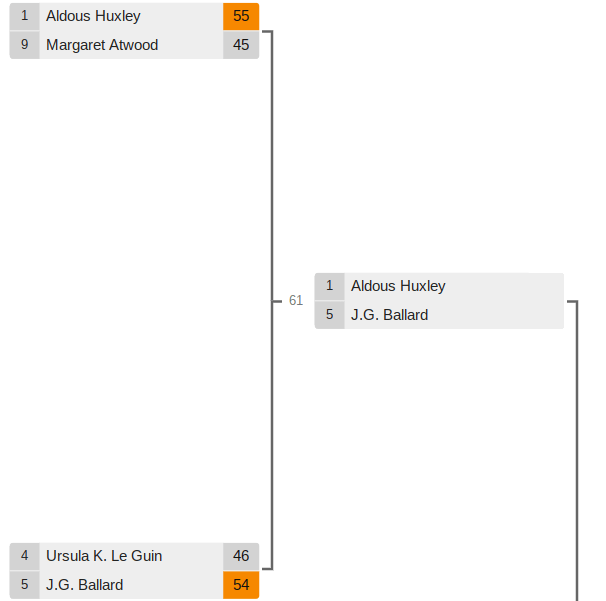
Margaret Atwood kept it close with Aldous Huxley, but lost in the end. I was rooting for her. I’m a huge fan of Huxley’s under-read apocalyptic pre-postmodernist Ape and Essence, but I have to admit I was rooting for Atwood.

I was torn between Ballard and LeGuin in the second bracket—both authors described and diagnosed our zeitgeist. Ballard prevailed.

Ballard will square off against Huxley in the Dead British Writers bracket of the Final Four.

Screenshot 2020-03-29 at 8.31.31 PM

Pynchon and DeLillo both had tough roads to the Final Four. Pynchon beat out Anna Kavan and David Foster Wallace to get to the Elite Eight; DeLillo bested Pat Frank and Philip K. Dick. All of these writers are great, and, more importantly to our rubric, seemed to presciently capture the current dystopia the 20th century was brewing. (Okay, Frank isn’t great, but.)

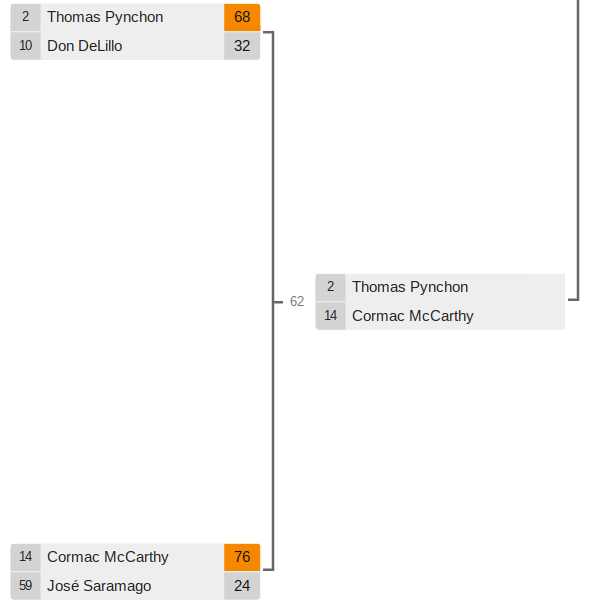
Pynchon beat DeLillo easily though.

Like Pynchon, Cormac McCarthy pretty much thumped everyone he was matched against, including low seed José Saramago in the Elite Eight. While I’m sure a ton of folks will cite The Road as his zeitgeistiest novel, I’d argue it’s Blood Meridian (or even No Country for Old Men).

Pynchon will contend with McCarthy in the White American Authors in Their Eighties bracket of the Final Four. I’m not sure how to vote. In some ways, this is like, the final bracket for me.

Screenshot 2020-03-29 at 8.32.00 PM


Charles Wright/Steve Erickson (Books acquired, 18 March 2020)

img_5192

A couple of days ago I took my daughter to the bookstore for what I imagine will be the last time for a while. She browsed the “Teen” section, which is new for both of us, and picked out a few books.

I picked up The Complete Novels of Charles Wright, which collects The Messenger, The Wig, and Absolutely Nothing to Get Alarmed About. I’m generally not a fan of omnibus editions, but I’m not sure how easy it is to get a hold of The Messenger or Absolutely Nothing (the bookstore had another copy of The Wig, which makes me think it’s in wider circulation). This Harper Perennial edition has no introduction, and I’m not crazy about the no-contrast cover, but it’s got a nice texture to it.

I also picked up Steve Erickson’s debut novel Days Between Stations, in part because Thomas Pynchon blurbed it (even though I wasn’t wild about the last novel I read because Pynchon blurbed it, Wurlitzer’s Nog), and also in part because I’m a sucker for Vintage Contemporaries editions, especially ones with covers illustrated by Rick Lovell.

Here’s Pynchon’s blurb:


img_5194

Steve Erickson has that rare and luminous gift for reporting back from the nocturnal side of reality, along with an engagingly romantic attitude and the fierce imaginative energy of a born storyteller. It is good news when any of these qualities appear in a writer– to find them all together in a first novelist is reason to break out the champagne and hors-d’oeuvres.

Pynchon also blurbed Jim Dodge’s novel Stone Junction (or wrote an introduction for it rather), which I’ve been looking for unsuccessfully for a while now—not because Pynchon blurbed it (which I only found out recently), but because I’ve heard it compared to Charles Portis. I was unsuccessful again this time.

I hope I’ll be able to get out of the house soon, but in the meantime I have more than enough reading material.

Blog about some recent reading (Spring break/quarantine (?) edition)

img_5159

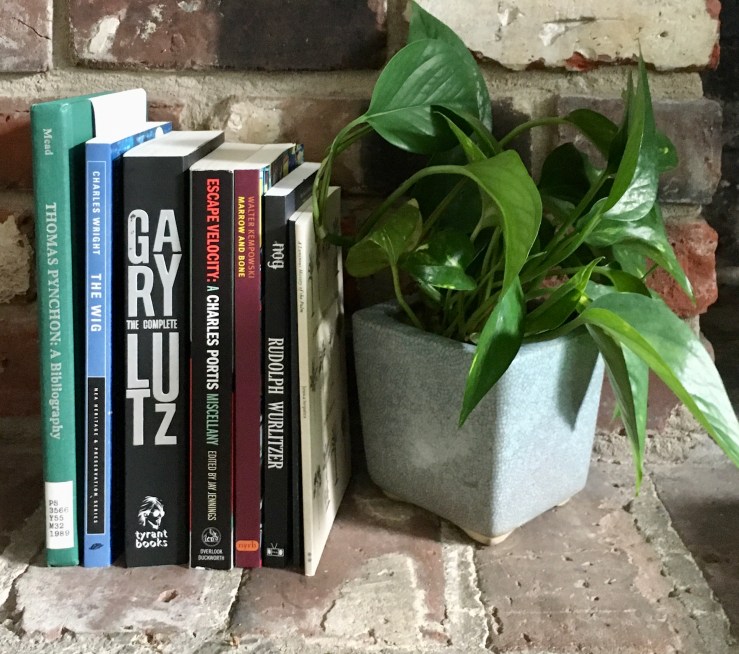
Left to right:

I used interlibrary loan to check out a copy of Clifford Mead’s Thomas Pynchon: A Bibliography. It’s pretty neat, and includes some photos of Our Reclusive Favorite that I’d never seen before, like this one:

I read Charles Wright’s 1966 novel The Wig last weekend. The novel is amazing—a picaresque, burlesque, Black black comedy that made me want to reread Invisible Man and read all the Ishmael Reed that I’ve left unread. And more Charles Wright. The energy of The Wig enraptured me; Wright’s cartoon vision of 1960’s Harlem is poised just on the edge of horror. I loved loved loved this novel, and aim for a full review sometime this week.

To its right is The Complete Gary Lutz, which I’ve been nibbling at for a few months. It’s like a rich cheese block or a lovely single malt—not something to inhale all at once, but wonderful in moderation.

I’ve also been picking through Escape Velocity: A Charles Portis Miscellany, mostly reading the journalism at the front end. (I’m saving the play, Delray’s New Moon for…I don’t know…like a quarantine or something?)

This afternoon, I dipped into Marrow and Bone, Walter Kempowski’s satirical road novel set in Germany and Poland right before the fall of the Berlin Wall. Charlotte Collins’s translation renders Kempowski’s prose as frank, funny, and often ironic.

I’m a little over halfway through Rudolph Wurlitzer’s 1969 cult classic Nog. The novel is far more abject and despair-inflected than I had imagined, and so far, anyway, the despair and abjection isn’t leavened with any humor that’s registered with me. I dig the absurdity, but I’ve got to admit that the book isn’t working for me. I wanted to love it—-blurbed by Pynchon, right? features an imaginary octopus, right?—but something’s missing for me. (The vague something in the previous sentence is humor—there are maybe some jokes or japes I’m missing, to be fair, but…) The book’s strengths bleed over with its weaknesses. Wurlitzer does an admirable job portraying a consciousness dissolving and resolving, only to desire to not desire consciousness at all, only static, Buddhist peace. Nog is essentially a narrative voice, a howl disintegrating in on itself, bubbling down, and revivifying itself via verbal goo to speak anew. There are Big Western Themes, too—Wurlitzer’s critique of America’s favorite myth of Manifest Destiny is subtle but sharp. The novel’s druggy haze recalls William Burroughs or Allen Ginsberg, but a bit more focused. It so far makes me think of better novels by João Gilberto Noll, though. I very much love two films that Rudolph Wurlitzer wrote: Two-Lane Blacktop (1971; dir. Monte Hellman) and Pat Garrett and Billy the Kid (1973; dir. Sam Peckinpah). I’d love to see two others he wrote: America (1986; dir. Robert Downey Sr.) and Walker (1987; dir. Alex Cox).

Nog also has some really gross sex scenes.

(I think I might be enjoying Wurlitzer’s debut novel more if I hadn’t read The Wig immediately before it.)

The last two skinny volumes there on the right are new joints from Sublunary Editions. Vik Shirley’s Corpses is like a thirty-paragraph prose-poem, part comic, part morbid.  The blurb for Jessica Sequeira’s A Luminous History of the Palm describes the tract:

This little book can be read as a series of small portraits through time, all of which include a palm tree. Or it can be read as a revolutionary tract. The palm is a symbol traced through history, a hidden portal to intimate moments that bring geographies and situations to life. A vital presence, it coaxes out vitality. It’s everywhere once you start to look, a secret joyful emblem.

To the right of Palms is a pothos plant that was formerly thriving on the window sill of my office. Our college’s spring break starts tomorrow, but I wasn’t sure if we’d be coming back after it, so I brought my plants home. It turns out we’ll come back, sans students. I brought my textbooks home too, but I forgot my copy of  S.D. Chrostowska’s novel The Eyelid, which I’d brought to work to snack on. So it isn’t in this blog, except it is.

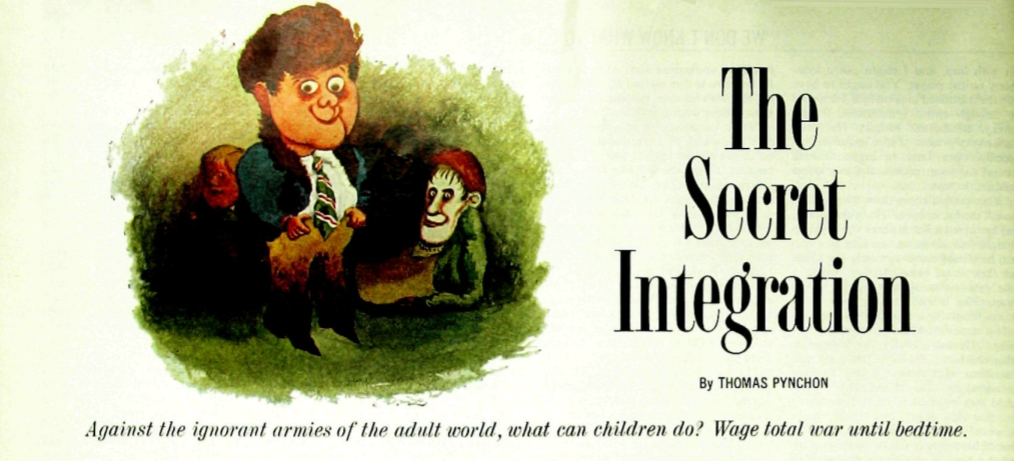
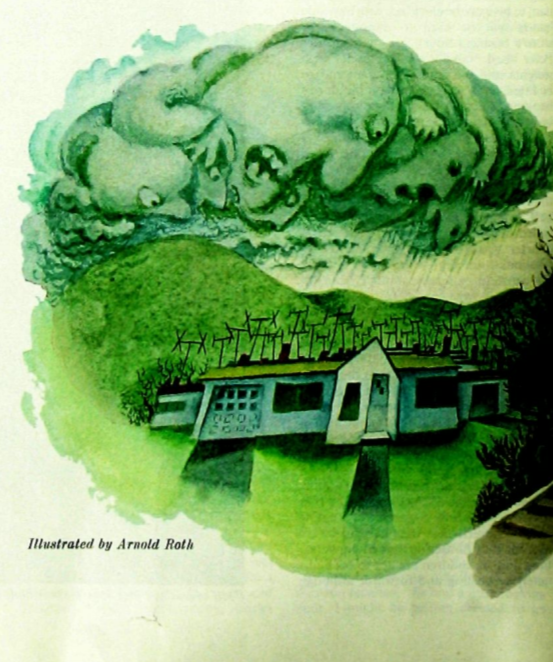
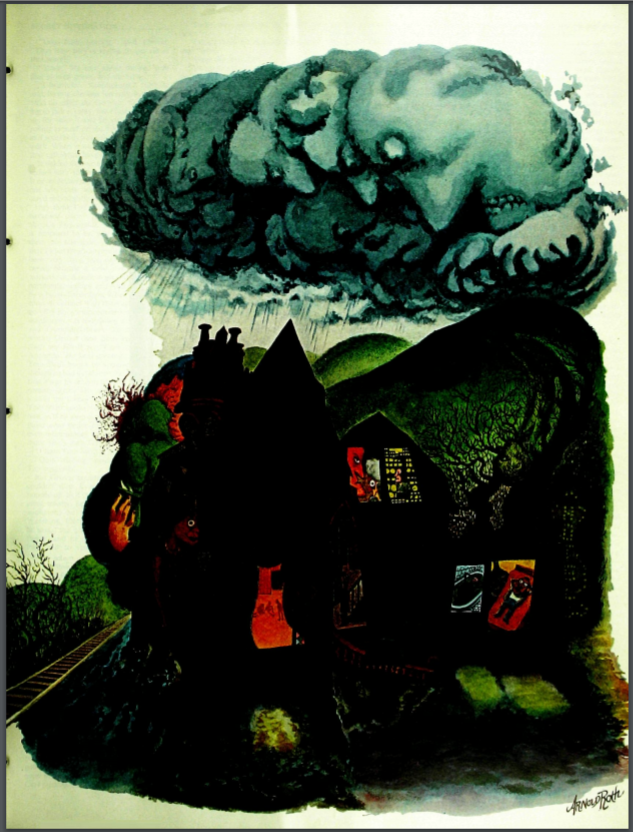
Arnold Roth’s original illustrations for Thomas Pynchon’s 1964 short story “The Secret Integration” (and a link to the full text of the story)

ar 2

Thomas Pynchon’s short story “The Secret Integration” was first published in a December issue of The Saturday Evening Post, and later published again as part of Pynchon’s first and only short story collection, Slow Learner.

In a 2018 article published at The Yale Review, Terry Reilly suggested that by publishing “The Secret Integration” in The Saturday Evening Post,

…Pynchon uses the form of an apparently simple, entertaining adolescent boys’ story to engage and then to manipulate the Post readers; to invoke various features of the publication history of The Saturday Evening Post while simultaneously calling attention to the magazine’s limited scope and conservative bias concerning issues of civil rights and racial integration in 1964.

ar 3

Pynchon’s story was accompanied by three illustrations by the cartoonist Arnold Roth, including a header, a small illustration, and this full page illustration below:

ar

The first page of the story:

“The Secret Integration”

by

Thomas Pynchon


OUTSIDE it was raining, the first rain of October, end of haying season and of the fall’s brilliance, purity of light, a certain soundness to weather that had brought New Yorkers flooding up through the Berkshires not too many weekends ago to see the trees changing in that sun. Today, by contrast, it was Saturday and raining, a lousy combination. Inside at the moment was Tim Santora, waiting for ten o’clock and wondering how he was going to get out past his mother. Grover wanted to see him at ten this morning, so he had to go. He sat curled in an old washing machine that lay on its side in a back room of the house; he listened to rain going down a drainpipe and looked at a wart that was on his finger. The wart had been there for two weeks and wasn’t going to go away. The other day his mother had taken him over to Doctor Slothrop, who painted some red stuff on it, turned out the lights and said, “Now, when I switch on my magic purple lamp, watch what happens to the wart.” It wasn’t a very magic-looking lamp, but when the doctor turned it on, the wart glowed a bright green. “Ah, good,” said Doctor Slothrop. “Green. That means the wart will go away, Tim. It hasn’t got a chance.” But as they were going out, the doctor said to Tim’s mother, in a lowered voice Tim had learned how to listen in on, “Suggestion therapy works about half the time. If this doesn’t clear up now spontaneously, bring him back and we’ll try liquid nitrogen.” Soon as he got home, Tim ran over to ask Grover what “suggestion therapy” meant. He found him down in the cellar, working on another invention. Continue reading “Arnold Roth’s original illustrations for Thomas Pynchon’s 1964 short story “The Secret Integration” (and a link to the full text of the story)”

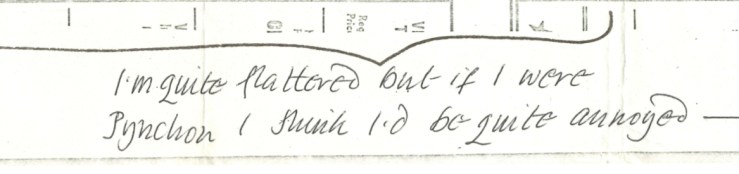
“I’m quite flattered but if I were Pynchon I think I’d be quite annoyed” | William Gaddis annotates a review of Gravity’s Rainbow

irubg8x7lzj41

This is a clipping of W.G. Rogers’ (circa 1973) review of Gravity’s Rainbow (click on the image to enlarge it). The marginal annotation is by William Gaddis:

gaddis

Rogers’ review of Gravity’s Rainbow is eleven paragraphs long in two columns. The final three paragraphs are devoted to a comparison with The Recognitions (this comparison takes up about three quarters of the second column). Rogers refers to Gaddis’s novel as Recognitions.

The final paragraph reads:

Gaddis could have written Gravity’s Rainbow and Pynchon could have written Recognitions [sic].That two hearts can beat as one is no proof two minds can. Would we not expect Gaddis to use his own respected name? Could there be two separate master hands? I suppose so, but…

Gaddis published his second novel J R, two years later, in 1975.

This document is part of the William Gaddis Papers collection at Washington University. I saw it earlier this morning thanks to Reddit user Signor Mantissa.


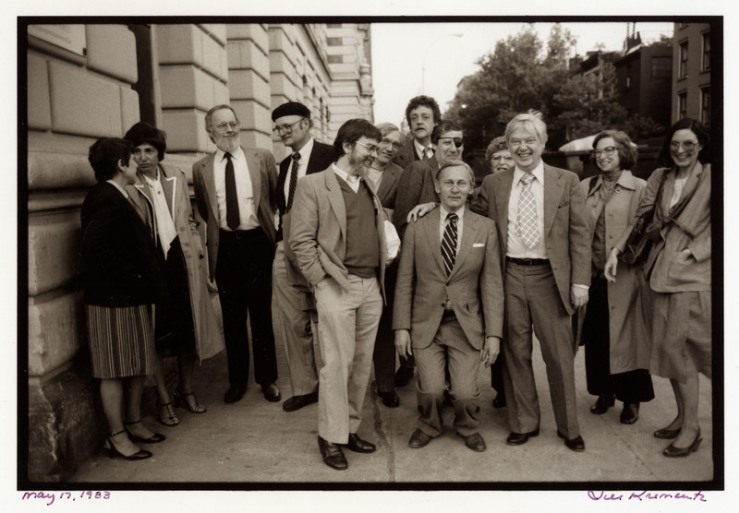
Photograph from “The Postmodernists Dinner” — Jill Krementz

1fa8c7cbf8dc977653f7750905725da4

Photograph from “The Postmodernists Dinner,” 1983 by Jill Krementz (b. 1940)

From the University of Houston’s collection of Barthelme’s papers. The entry’s description:

Left to right: unidentified, unidentified, Donald Barthelme, John Barth, Robert Coover (turned), unidentified, Kurt Vonnegut, Walter Abish (with patch), William Gaddis (squatting), unidentified, William Gass, unidentified, unidentified. In 1983, Barthelme arranged a “Postmodernists Dinner” for the group of writers who were often lumped together under the “postmodernist” label. The reclusive Thomas Pynchon declined the invitation.

It would be swell if anyone could identify the women in the photograph. [Ed. note–the woman to Walter Abish’s left (behind Gass) is the artist Cecile Abish, Walter’s wife. Thanks to Terry in the comments.]

In his 2009 Barthelme biography  Hiding Man, Tracy Daugherty offers the following recollection of the “Postmodernist Dinner” from novelist Walter Abish:

Around this time — in the spring of 1983 — “Donald had this idea to make a dinner in SoHo,” says Water Abish. “A major dinner for a group of writers, and he planned it very, very carefully. It was a strange event. Amusing and intriguing. He invited…well, that was the thing of it. The list. I was astounded that he consulted me but he called and said, ‘Should we invite so-and-so?’ Naturally, I did the only decent thing and said ‘Absolutely’ to everyone he mentioned. I pushed for Gaddis. Gass was there, and Coover and Hawkes, Vonnegut and his wife, Jill Krementz, who took photographs, I think. Don’s agent, Lynn Nesbit, was there. She was always very friendly. Susan Sontag was the only woman writer invited.

Daugherty continues:

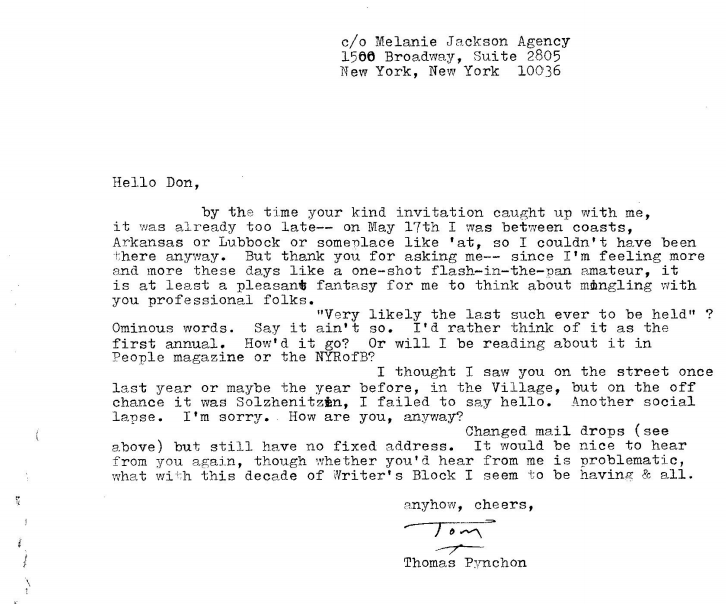
Pynchon couldn’t make it. He wrote Don to apologize. He said he was ‘between coasts, Arkansas or Lubbock or someplace like ‘at.”

Abish recollects that the meal was at a very expensive restaurant, prefix, and the writers had to pay their own way. There were about 21 attendees, and Barthelme was “Very, very dour.”

Here is Pynchon’s letter declining the invite (via Jessamyn West, both on Twitter and her wonderful Donald Barthelme appreciation page):

screenshot-2017-01-18-at-8-36-27-pm

I had never seen the photograph until today when Ethelmer shared it with me on Twitter. Thanks!

(Not Quite) All the Food in Thomas Pynchon’s Books

I was looking for something else when I found a fun article from six years ago in Bon Appétit. The article, by Nicole Villeneuve, is called “All the Food in Thomas Pynchon’s Books (and What It Means, Sorta),” and it riffs on most of the food in Pynchon’s oeuvre.

Here’s the section on “The Inedible,” which includes notes on two of my favorite scenes from Gravity’s Rainbow—–

The Inedible

“A lot of people who think they’re cooks but are clinically deluded,” says a mess hall manager in Vineland. Pynchon includes a lot of their misguided creations in his books, relishing the gross and inedible—the places where “even [the] Jell-O salads have scum on them.”

Maybe the most memorable example is the “English Candy Drill,” in which a parade of disgusting sweets are sampled, unwillingly, by Tyrone Slothrop, the protagonist (sorta) in Gravity’s Rainbow: rhubarb creams, cherry-quinine petit fours, eucalyptus-flavored fondant, and pepsin-flavored nougat, licorice drops with a “dribbling liquid center, which tastes like mayonnaise and orange peels” and “a hard sour gooseberry shell into a wet spurting unpleasantness of, he hopes it’s tapioca, little glutinous chunks of something all saturated with powdered cloves.”

Gravity’s Rainbow includes another scene that’s hard to stomach: As a culinary prank, Bodine and Roger hold a dinner party with an intentionally revolting menu: “snot soup,” “sum soufflé,” “vomit vichyssoise” and “wart waffles.” Needless to say, “A general loss of appetite reigns, not to mention overt nausea.”

It’s a fun article, like I said, but there are a few things missing. It notes Against the Day’s cult of mayonnaise but leaves out all the ketchup (ketjap) stuff in Mason & Dixon, as well as Mason & Dixon’s important core distinction between Grape People and Grain People:

“If this is as bad as it gets, why I can abide thah’. As long as the Spirits don’t run out.”

“Nor the Wine.”

“Wine.” Dixon is now the one squinting. Mason wonders what he’s done this time. ” ‘Grape or Grain, but ne’er the Twain,’ as me Great- Uncle George observ’d to me more than once,— ‘Vine with Corn, beware the Morn.’ Of the two sorts of drinking Folk this implies, than’ is, Grape People and Grain People, You will now inform rne of Your membership in the Brotherhood of the, eeh, Grape…? and that You seldom, if ever, touch Ale or Spirits, am I correct?”

“Happily so, I should imagine, as, given a finite Supply, there’d be more for each of us, it’s like Jack Sprat, isn’t it.”

“Oh, I’ll drink Wine if I must…?— and now we’re enter’d upon the Topick,— ”

“— and as we are in Portsmouth, after all,— there cannot lie too distant some Room where each of us may consult what former Vegetation pleases him?”

Dixon looks outside at the ebbing wintry sunlight. “Nor too early, I guess…?”

“We’re sailing to the Indies,— Heaven knows what’s available on Board, or out there. It may be our last chance for civiliz’d Drink.”

“Sooner we start, the better, in thah’ case…?”

Again, a fun article—but what other food bits are missing? (We can leave the coprophagia and urolagnia in Gravity’s Rainbow out, though.)

Culte de la mayonnaise (Thomas Pynchon)

THE NEXT TIME he saw Pléiade Lafrisée was at a café-restaurant off the Place d’Armes. It would not occur to him until much later to wonder if she had arranged the encounter. She was in pale violet peau de soie, and a hat so beguiling that Kit was only momentarily surprised to find himself with an erection. It was still early in the study of these matters, only a few brave pioneers like the Baron von Krafft-Ebing had dared peep into the strange and weirdly twilit country of hat-fetishism—not that Kit noticed stuff like that ordinarily, but it happened actually to be a gray toque of draped velvet, trimmed with antique guipure, and a tall ostrich plume dyed the same shade of violet as her dress. . . .

“This? One finds them in every other midinette’s haunt, literally for sous.”

“Oh. I must’ve been staring. What happened to you the other night?”

“Come. You can buy me a Lambic.”

The place was like a museum of mayonnaise. This being just at the height of the culte de la mayonnaise then sweeping Belgium, oversize exhibits of the ovoöleaginous emulsion were to be encountered at every hand. Heaps of Mayonnaise Grenache, surrounded by plates of smoked turkey and tongue, glowed redly as if from within, while with less, if any, reference to actual food it might have been there to modify, mountains of Chantilly mayonnaise, swept upward in gravity-impervious peaks insubstantial as cloud, along with towering masses of green mayonnaise, basins of boiled mayonnaise, mayonnaise baked into soufflés, not to mention a number of not entirely successful mayonnaises, under some obscure attainder, or on occasion passing as something else, dominated every corner.

“How much do you know of La Mayonnaise?” she inquired.

He shrugged. “Maybe up to the part that goes ‘Aux armes, citoyens’—”

But she was frowning, earnest as he had seldom seen her. “La Mayonnaise,” Pléiade explained, “has its origins in the moral squalor of the court of Louis XV—here in Belgium the affinity should not be too surprising. The courts of Leopold and Louis are not that different except in time, and what is time? Both monumentally deluded men, maintaining their power through oppression of the innocent. One might usefully compare Cleo de Mérode and the marquise de Pompadour. Neuropathists would recognize in both kings a desire to construct a self-consistent world to live inside, which allows them to continue the great damage they are inflicting on the world the rest of us must live in.

“The sauce was invented as a new sensation for jaded palates at court by the duc de Richelieu, at first known as mahonnaise after Mahon, the chief port of Minorca, the scene of the due’s dubious ‘victory’ in 1756 over the illfated Admiral Byng. Basically Louis’s drug dealer and pimp, Richelieu, known for opium recipes to fit all occasions, is also credited with the introduction into France of the cantharides, or Spanish fly.” She gazed pointedly at Kit’s trousers. “What might this aphrodisiac have in common with the mayonnaise? That the beetles must be gathered and killed by exposing them to vinegar fumes suggests an emphasis on living or recently living creatures—the egg yolk perhaps regarded as a conscious entity—cooks will speak of whipping, beating, binding, penetration, submission, surrender. There is an undoubtedly Sadean aspect to the mayonnaise. No getting past that.”

Kit was a little confused by now. “It always struck me as kind of, I don’t know . . . bland?”

“Until you look within. Mustard, for example, mustard and cantharides, n’estce pas? Both arousing the blood. Blistering the skin. Mustard is the widelyknown key to resurrecting a failed mayonnaise, as is the cantharides to reviving broken desire.”

“You’ve been thinking about mayonnaise a lot, mademoiselle.”

“Meet me tonight,” a sudden fierce whisper, “out at the Mayonnaise Works, and you shall perhaps understand things it is given only to a few to know. There will be a carriage waiting.” She pressed his hand and was gone in a mist of vetiver, abruptly as the other evening.

A passage from Thomas Pynchon’s novel Against the Day; I don’t think you need any context to appreciate this passage.


The real business of the War is buying and selling | Annotations for page 105 of Gravity’s Rainbow

“The blackmarket blights peace,” Dutch postwar propaganda poster, 1946

Don’t forget the real business of the War is buying and selling 1. The murdering and the violence are self-policing, and can be entrusted to non-professionals. The mass nature of wartime death is useful in many ways 2. It serves as spectacle, as diversion from the real movements of the War. It provides raw material to be recorded into History, so that children may be taught History as sequences of violence, battle after battle, and be more prepared for the adult world 3. Best of all, mass death’s a stimulus 4 to just ordinary folks, little fellows 5, to try ’n’ grab a piece of that Pie while they’re still here to gobble it up. The true war is a celebration of markets 6. Organic markets, carefully styled “black” 7 by the professionals, spring up everywhere. Scrip, Sterling, Reichsmarks continue to move, severe as classical ballet, inside their antiseptic marble chambers. But out here, down here among the people, the truer currencies come into being. So, Jews are negotiable. Every bit as negotiable as cigarettes, cunt, or Hershey bars. Jews also carry an element of guilt, of future blackmail, which operates, natch, in favor of the professionals. 8

From page 105 of Thomas Pynchon’s 1973 novel Gravity’s Rainbow.

1 Gravity’s Rainbow is often (unjustly and unfairly) maligned as a messy, even pointless affair—but here’s our author speaking through the narrator, offering up one of the novel’s points—clearly, without equivocation.

Our narrator digs irony though…

Entropy is all—but entropy doesn’t make for good capitalism, by which our sly narrator means, Their Capitalism. The adult world needs to be organized, systematized, caused and effected.

Cf. Jack Gibbs’s rant to his erstwhile young students, early in William Gaddis’s 1975 novel of capitalism, J R:

Before we go any further here, has it ever occurred to any of you that all this is simply one grand misunderstanding? Since you’re not here to learn anything, but to be taught so you can pass these tests, knowledge has to be organized so it can be taught, and it has to be reduced to information so it can be organized do you follow that? In other words this leads you to assume that organization is an inherent property of the knowledge itself, and that disorder and chaos are simply irrelevant forces that threaten it from the outside. In fact it’s the opposite. Order is simply a thin, perilous condition we try to impose on the basic reality of chaos . . .

Note the not-so-oblique reference to GR’s theme of stimulus-response (and upending that response).

Not too much earlier in the narrative, dedicated Pavlovian Dr. Edward W.A. Pointsman worries about the end of cause and effect, the rise of entropy:

Will Postwar be nothing but ‘events,’ newly created one moment to the next? No links? Is it the end of history?

5…the preterite?

Pynchon reiterates his thesis.

Note that organic (entropic?) markets fall outside of Their System—y’know, Them—the Professionals—these organic (chaotic, necessary) markets must be labeled “black” (preterite?).

Here’s another Dutch propaganda poster:

“Protect them against the black market!”, Dutch propaganda poster, 1944

Page 105 of Gravity’s Rainbow “happens,” more or less, in 1944, in the middle of an extended introduction of Katje Borgesius, a Dutch double agent. (Or is that double Dutch agent?). The propaganda poster above strikes me as overtly racist, but also seems to nod to King Kong (1933, dir. Cooper and Schoedsack). Gravity’s Rainbow is larded with references to King Kong, a sympathetic but powerful force of entropy, a force against the Professionals.

kong1933a
Still from King Kong, 1933

From the invaluable annotations at Pynchon Wiki’s Gravity’s Rainbow site (there is no annotation for page 105 at Pynchon Wiki, by the way, and no notes on the passage I’ve cited above either in Steven Weisenburger’s A Gravity’s Rainbow Companion):

King Kong & the Like

Fay Wray look, 57; Fay Wray, 57, 179, 275; “You will have the tallest, darkest leading man in Hollywood,” 179; “headlights burning like the eyes of” 247; “the black scapeape we cast down like Lucifer,” 275; Mitchell Prettyplace book about, 275; “Giant ape” 276; “the Fist of the Ape,” 277; “orangutan on wheels,” 282; taking a shit, 368; “The figures darkened and deformed, resembling apes” 483; “a troupe of performing chimpanzees” 496; “on the tit with no motor skills,” 578; “Negroid apes,” 586; “that sacrificial ape,” 664; “a gigantic black ape,” 688; Carl Denham, 689; poem based on King Kong, 689; See also: actors/directors film/cinema references;

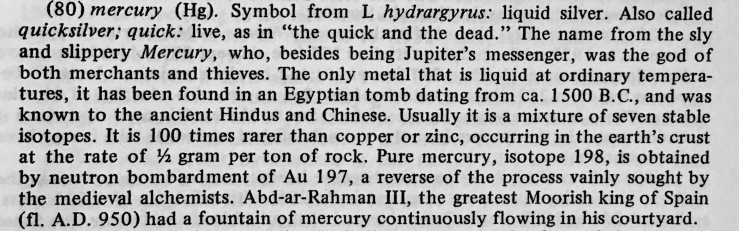
The Kong-figure in the Dutch propaganda poster seems to wear the petasos (winged hat) and wield the caduceus of Hermes or Mercury—god of thieves. But also god of the market, of commerce, merchandise, all things mercenary.

From Joseph T. Shipley’s The Origin of English Words: A Discursive Dictionary of Indo-European Roots (1984):

img_3604

The passage as a whole, which emphasizes war as a conduit for the techne of the market (or do I have that backwards? should I note the market of techne?) echoes an earlier passage. From page 81:

It was widely believed in those days that behind the War—all the death, savagery, and destruction—lay the Führer-principle. But if personalities could be replaced by abstractions of power, if techniques developed by the corporations could be brought to bear, might not nations live rationally? One of the dearest Postwar hopes: that there should be no room for a terrible disease like charisma.

All signs seem to point to No.

Plastics and paranoia (Harold Bloom on Thomas Pynchon)

For Pynchon, ours is the age of plastics and paranoia, dominated by the System. No one is going to dispute such a conviction; reading the New York Times first thing every morning is sufficient to convince one that not even Pynchon’s imagination can match journalistic irreality. What is more startling about Pynchon is that he has found ways of representing the impulse to defy the System, even though both impulse and its representations always are defeated. In the Zone (which is our cosmos as the Gnostics saw it, the kenoma or Great Emptiness) the force of the System, of They (whom the Gnostics called Archons), is in some sense irresistible, as all overdetermination must be irresistible. Yet there is a Counterforce, hardly distinguished in its efficacy, but it never does (or can) give up. Unfortunately, its hero is the extraordinarily ordinary Tyrone Slothrop, who is a perpetual disaster, and whose ultimate fate, being “scattered” (rather in biblical sense), is accomplished by Pynchon with dismaying literalness. And yet—Slothrop, who has not inspired much affection even in Pynchon’s best critics, remains more Pynchon himself.

From Harold Bloom’s introduction to Bloom’s Critical Modern Views: Thomas Pynchon.

“Bartleby” is the first great epic of modern Sloth (Thomas Pynchon)

By the time of “Bartleby the Scrivener: A Story of Wall-Street” (1853), acedia had lost the last of its religious reverberations and was now an offense against the economy. Right in the heart of robber-baron capitalism, the title character develops what proves to be terminal acedia. It is like one of those western tales where the desperado keeps making choices that only herd him closer to the one disagreeable finale. Bartleby just sits there in an office on Wall Street repeating, “I would prefer not to.” While his options go rapidly narrowing, his employer, a man of affairs and substance, is actually brought to question the assumptions of his own life by this miserable scrivener — this writer! — who, though among the lowest of the low in the bilges of capitalism, nevertheless refuses to go on interacting anymore with the daily order, thus bringing up the interesting question: who is more guilty of Sloth, a person who collaborates with the root of all evil, accepting things-as-they-are in return for a paycheck and a hassle-free life, or one who does nothing, finally, but persist in sorrow? “Bartleby” is the first great epic of modern Sloth, presently to be followed by work from the likes of Kafka, Hemingway, Proust, Sartre, Musil and others — take your own favorite list of writers after Melville and you’re bound sooner or later to run into a character bearing a sorrow recognizable as peculiarly of our own time.

From Thomas Pynchon’s 1993 essay “Sloth; Nearer, My Couch, to Thee.”

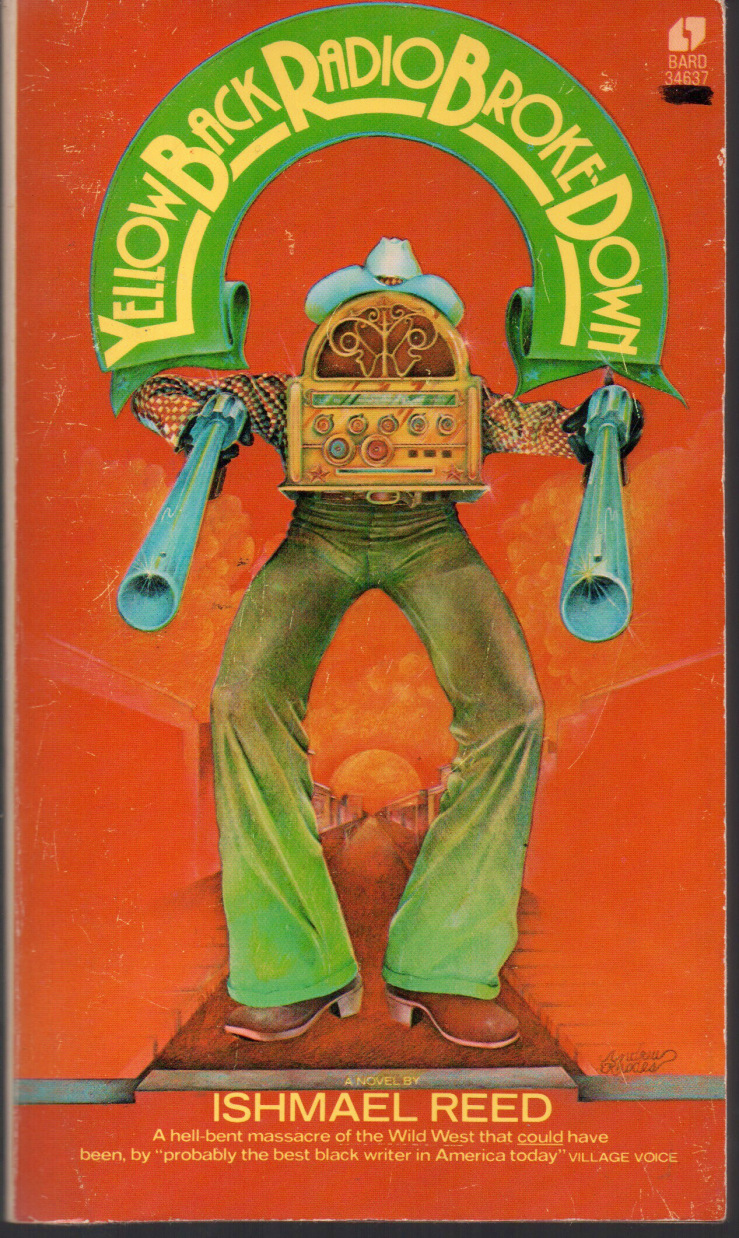
A review of Yellow Back Radio Broke-Down, Ishmael Reed’s syncretic Neo-HooDoo revenge Western

img_0548

Ishmael Reed’s second novel Yellow Back Radio Broke-Down tells the story of the Loop Garoo Kid, a “desperado so onery he made the Pope cry and the most powerful of cattlemen shed his head to the Executioner’s swine.”

The novel explodes in kaleidoscopic bursts as Reed dices up three centuries of American history to riff on race, religion, sex, and power. Unstuck in time and unhampered by geographic or technological restraint, historical figures like Lewis and Clark, Thomas Jefferson, John Wesley Harding, Groucho Marx, and Pope Innocent (never mind which one) wander in and out of the narrative, supplementing its ironic allegorical heft. These minor characters are part of Reed’s Neo-HooDoo spell, ingredients in a Western revenge story that is simultaneously comic and apocalyptic in its howl against the dominant historical American narrative. Yellow Back Radio Broke-Down is a strange and marvelous novel, at once slapstick and deadly serious, exuberant in its joy and harsh in its bitterness, close to 50 years after its publication, as timely as ever.

After the breathless introduction of its hero the Loop Garoo Kid, Yellow Back Radio Broke-Down initiates its plot. Loop’s circus troupe arrives to the titular city Yellow Back Radio (the “nearest town Video Junction is about fifty miles away”), only to find that the children of the town, “dressed in the attire of the Plains Indians,” have deposed the adults:

We chased them out of town. We were tired of them ordering us around. They worked us day and night in the mines, made us herd animals harvest the crops and for three hours a day we went to school to hear teachers praise the old. Made us learn facts by rote. Lies really bent upon making us behave. We decided to create our own fiction.

The children’s revolutionary, anarchic spirit drives Reed’s own fiction, which counters all those old lies the old people use to make us behave.

Of course the old—the adults—want “their” land back. Enter that most powerful of cattlemen, Drag Gibson, who plans to wrest the land away from everyone for himself. We first meet Drag “at his usual hobby, embracing his property.” Drag’s favorite property is a green mustang,

a symbol for all his streams of fish, his herds, his fruit so large they weighed down the mountains, black gold and diamonds which lay in untapped fields, and his barnyard overflowing with robust and erotic fowl.

Drag loves to French kiss the horse, we’re told. Oh, and lest you wonder if “green” here is a metaphor for, like, new, or inexperienced, or callow: No. The horse is literally green (“turned green from old nightmares”). That’s the wonderful surreal logic of Reed’s vibrant Western, and such details (the novel is crammed with them) make Yellow Back Radio Broke-Down a joy to read.

Where was I? Oh yes, Drag Gibson.

Drag—allegorical stand-in for Manifest Destiny, white privilege, capitalist expansion, you name it—Drag, in the process of trying to clear the kids out of Yellow Back Radio, orders all of Loop’s troupe slaughtered.

The massacre sets in motion Loop’s revenge on Drag (and white supremacy in general), which unfolds in a bitter blazing series of japes, riffs, rants, and gags. (“Unfolds” is the wrong verb—too neat. The action in Yellow Back Radio Broke-Down is more like the springing of a Jack-in-the-box).

Loop goes about obtaining his revenge via his NeoHooDoo practices. He calls out curses and hexes, summoning loas in a lengthy prayer. Loop’s spell culminates in a call that goes beyond an immediate revenge on Drag and his henchmen, a call that moves toward a retribution for black culture in general:

O Black Hawk American Indian houngan of Hoo-Doo please do open up some of these prissy orthodox minds so that they will no longer call Black People’s American experience “corrupt” “perverse” and “decadent.” Please show them that Booker T and MG’s, Etta James, Johnny Ace and Bojangle tapdancing is just as beautiful as anything that happened anywhere else in the world. Teach them that anywhere people go they have experience and that all experience is art.

So much of Yellow Back Radio Broke-Down is turning all experience into art. Reed spins multivalent cultural material into something new, something arguably American. The title of the novel suggests its program: a breaking-down of yellowed paperback narratives, a breaking-down of radio signals. Significantly, that analysis, that break-down, is also synthesized in this novel into something wholly original. Rhetorically, Yellow Back Radio Broke-Down evokes flipping through paperbacks at random, making a new narrative; or scrolling up and down a radio dial, making new music from random bursts of sound; or rifling through a stack of manic Sunday funnies to make a new, somehow more vibrant collage.

Perhaps the Pope puts it best when he arrives late in the novel. (Ostensibly, the Pope shows up to put an end to Loop’s hexing and vexing of the adult citizenry—but let’s just say the two Holy Men have a deeper, older relationship). After a lengthy disquisition on the history of hoodoo and its genesis in the Voudon religion of Africa (“that strange continent which serves as the subconscious of our planet…shaped so like the human skull”), the Pope declares that “Loop Garoo seems to be practicing a syncretistic American version” of the old Ju Ju. The Pope continues:

Loop seems to be scatting arbitrarily, using forms of this and that and adding his own. He’s blowing like that celebrated musician Charles Yardbird Parker—improvising as he goes along. He’s throwing clusters of demon chords at you and you don’t know the changes, do you Mr. Drag?

The Pope here describes Reed’s style too, of course (which is to say that Reed is describing his own style, via one of his characters. The purest postmodernism). The apparent effortlessness of Reed’s improvisations—the prose’s sheer manic energy—actually camouflages a tight and precise plot. I was struck by how much of Yellow Back Radio Broke-Down’s apparent anarchy resolves into a bigger picture upon a second reading.

That simultaneous effortlessness and precision makes Reed’s novel a joy to jaunt through. Here is a writer taking what he wants from any number of literary and artistic traditions while dispensing with the forms and tropes he doesn’t want and doesn’t need. If Reed wants to riff on the historical relations between Indians and African-Americans, he’ll do that. If Reed wants to assess the relative values of Thomas Jefferson as a progressive figure, he’ll do that. If Reed wants to attack his neo-social realist critics, he’ll do that. If Reed wants to critique the relationship between militarism and science, he’ll do that. If Reed wants to tell some really dirty jokes about a threesome, he’ll do that. And you can bet if he wants some ass-kicking Amazons to show up at some point, they’re gonna show.

And it’s a great show. Yellow Back Radio Broke-Down begins with the slaughter of a circus troupe before we get to see their act. The real circus act is the novel itself, filled with orators and showmen, carnival barkers and con-artists, pistoleers and magicians. There’s a manic glee to it all, a glee tempered in anger—think of George Herriman’s Krazy Kat, or Thomas Pynchon’s zany rage, or Robert Downey Sr.’s satirical film Putney Swope.

Through all its anger, Yellow Back Radio Broke-Down nevertheless repeatedly affirms the possibility of imagination and creation—both as cures and as hexes. We have here a tale of defensive and retaliatory magic. Yellow Back Radio Broke-Down is the third novel of Reed’s novels I’ve read (after Mumbo Jumbo and The Free-Lance Pallbearers), and my favorite thus far. Frankly, I needed the novel right now in a way that I didn’t know that I needed it until I read it; the contemporary novel I tried to read after it felt stale and boring. So I read Yellow Back Radio Broke-Down again. The great gift here is that Reed’s novel answers to the final line of Loop’s prayer to the Loa: “Teach them that anywhere people go they have experience and that all experience is art.” Like the children of Yellow Back Radio, Reed creates his own fiction, and invites us to do the same. Very highly recommended.

[Ed. note—Biblioklept originally ran this review in February of 2017.]