A conversation with Mahendra Singh on American Candide, the drooling imbecility of contemporary politics and mass-media, comix vs. comics, and much, much more

Mahendra Singh is an author, illustrator and editor in Montreal. His other published books include a graphic novel version of The Hunting of the Snark, illustrations for D.A. Powell’s Cocktails, BSFA-award winner Adam Roberts’s 20 Trillion Leagues Under the Sea and Martin Olson’s NYT-best selling Adventure Time Encyclopaedia. American Candide is his first novel—read my review of it here. He was kind enough to talk with me about American Candide over a series of emails.

ac_final-cover4x7_300dpi-small

Biblioklept: How long have you been working on American Candide? When did you get the germ for the book?

Mahendra Singh: The Iraq War and its brazen marketing campaign got me started on American Candide. Not just the war but the hopelessness of opposing it made me realize how lightly the Enlightenment sits upon modern America. The way that people insisted upon being told what to think, it was torn from 18th-century headlines. Also, the ease with which religion fit into the war’s marketing scheme, almost like it was made for that …  It’s not just the USA, of course, this is human nature throughout the world but since modern America is the equivalent of the Ancien Regime in so many ways, a riposte from the Enlightenment seemed indicated.

I had always wanted to update a classic that is only a classic because it no longer stings. Voltaire’s attacks on god, the military, imperialism and money don’t make many people squirm anymore. I wanted genuine squirm … I wanted younger readers to realize that we read the classics not because of dead white guys or because everybody-says-so but because the classics show us how little human nature changes. And once you realize that things were just as weird in the 18th-century, then you are embarked on the path of genuine free-thinking. It worked for some of the Founding Fathers so it’s actually double-plus-more patriotic than being clueless-and-proud-of-it.

I started working seriously on American Candide around the time of Hurricane Katrina (which could have been a 21st-century Lisbon Earthquake if it had happened to Boston) and the book’s first draft was done in about 3 months. I wanted to match Voltaire’s MO as best as possible:

1. Same word count
2. As close to the original plot as possible
3. Easy to read with no stylistic stuff to impede the story. Voltaire knew people don’t want to be preached to, they want to laugh and then you slip them the mickey. Hence the book can be read in three sessions (toilet, subway, opium den), I really did plan that.

After the first draft, it took several years to finish because I also freelance as an illustrator. Unlike Voltaire, I don’t live off the stock market.

Biblioklept: Was there a particular translation of Candide that you worked from or favored? Or did you read it in French, perhaps?

MAHENDRA_SINGH_headshot_lor
Mahendra Singh

MS: I used the Barnes & Noble reprint of the old Henry Morley translation, revised by Lauren Walsh. I am not too fussy about translations and this one is fine. But the number one reason I got this edition is that it features the excellent illustrations of Alan Odle, a sort of Bloomsbury precursor of Ralph Steadman. I don’t know much about him but his sense of the grotesque was unique. An inspired choice of illustrator for this text. The cover price of $4.95 also influenced my decision.

I’ve read Candide in French and Morley is a bit more turgid than The Master … Voltaire’s French is slightly flatter and lighter. My French is not very good, most Francophones freak out when they hear me mangling their mother tongue. They are more touchy about that than Anglophones, which probably explains why English is the global lingua franca, ha!

Even people who don’t speak a word of French freak out when I do so. Must be the moustache, like watching Saddam Hussein doing his cocktail party impression of Pepe le Pew. You WILL laugh.

Biblioklept: I first read Candide in Lowell Bair’s translation, with some awfully bawdy illustrations (by Sheilah Beckett) that left an indelible mark on me. The book zapped me. I was in the 10th grade and I didn’t know that such literature existed—that serious literature, like, the lit that the English teacher assigned could be like Marvel Comics, with folks dying in wild ways and then coming back to life. I want to come back to illustrations in Candide in a bit, but I’m curious about your first encounter with the book…

MS: After a bit of internet poking, I found some samples of your Candide illustrator, Sheilah Beckett, and was very impressed. That old-fashioned, fluid American draftsmanship, I love it. I did some more poking and found the first Candide I read, probably when I was about 12 years old, the Washington Square Press paperback with Zadig included, translator Tobias Smollett. I remember enjoying both stories as amazingly fast-paced ripping yarns. I was also a Gulliver’s Travels fan and Smollett must have made the connection even stronger.

My father was an English professor so our home was a bookworm’s paradise, he had a home and office library. I had read pretty widely in the classics by then and I remember sensing that there was something hidden behind the surface in Voltaire, not quite accessible to a kid and thus even more intriguing. The authorial perversity of punishing the hero and allowing the wicked to prosper without ever once doing something about it, it was very adult … but clearly not the standard-issue adult of 1960s-70s America.

That is the genius of Voltaire, when it comes to ideas AND execution, he is perpetual beta. The Enlightenment still inspires fear and loathing in most quarters, the drooling imbecility of contemporary politics and mass-media is proof positive of that.

tumblr_o6tewcm2fr1s4y9aso1_500

Biblioklept: The drooling imbecility of contemporary politics and mass-media is what makes American Candide a possible book, a funny book, but also, I think, a somewhat sad book.

MS: I made a reader laugh and weep simultaneously, success at last! The original Candide was also black-humored but at least Voltaire’s readers could hope that their on-going Enlightenment was going to change things. We know nothing’s changed that much and American Candide wallows in that particular Slough of Despond. We are a drooling species of slack-jawed idiots and the more we try to clean up, the more we smear ourselves filthy.

The core message of the Enlightenment is thinking-for-yourself, as clearly and simply as possible. It’s very difficult, no matter how clever we think we are, it’s genuine hard work and we are a profoundly lazy and shiftless species. You will never get a majority of Homo sapiens to simultaneously think logically about anything (especially in voting booths). We only think in disorganized spurts, usually on our own and in the privacy of our own homes, just in case any other monkeys are snooping around, looking for easy egg-head prey.

The current American political mess is just mass cognition waxing and waning in a natural cycle, it’s not an American thing, it’s a human thing. The wicked revel in their cleverness while the mob cheers them on, despite the hurt it does them … that’s as old as the Peloponnesian War. At some point, things will improve, probably after considerable pain and suffering for those who least deserve it and most tried to get out of its way. A clinching argument to prove the suitability of god’s plan for us if you think god was made in the human image.

Life’s a bummer but perhaps after we struggle and suffer all our lives for mostly nothing in particular, we’ll die and be reborn as cute puppies or cuddly kittens. That’s what religion’s about, mostly … it is all a bit sad, I agree, but it could be even worse — what if all the rubbish inside people’s heads was actually true?

So let’s count our blessings and laugh, laugh, laugh!

Continue reading “A conversation with Mahendra Singh on American Candide, the drooling imbecility of contemporary politics and mass-media, comix vs. comics, and much, much more”

Posted in Art

Despite our Ballardian present, the High-Rise film adaptation is a nostalgia piece

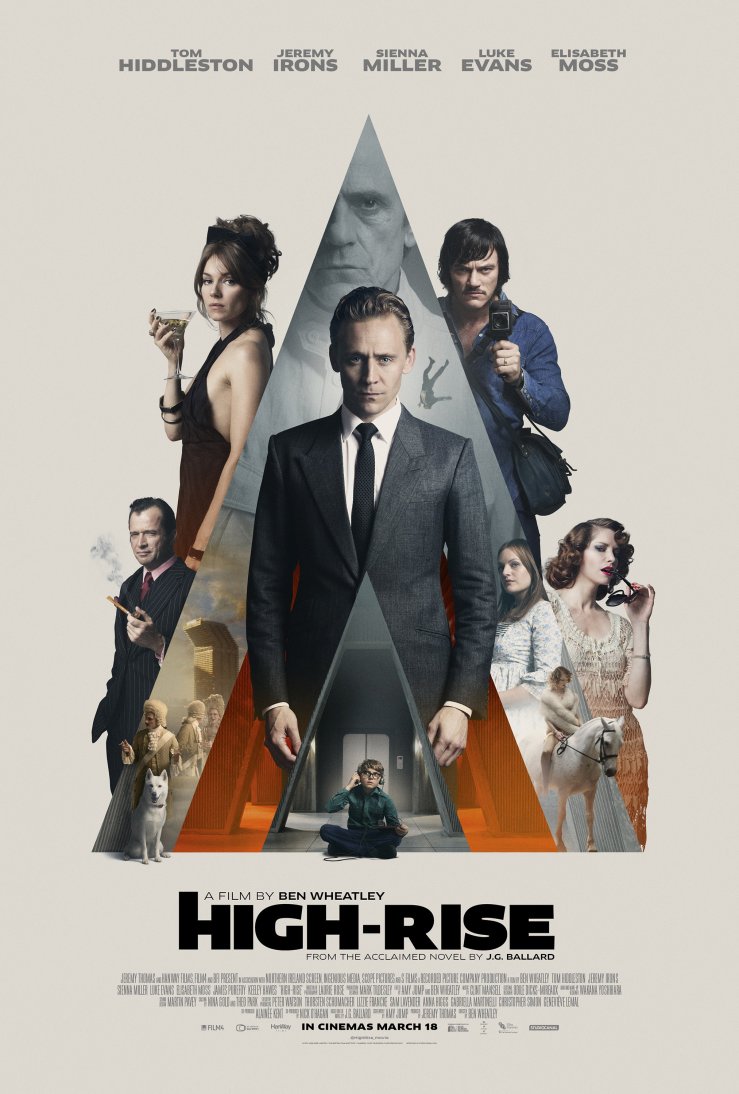
high-rise-poster

  1. Our present is utterly Ballardian.
  2. Our present is so utterly Ballardian that our present is actually our (unevenly distributed) future.
  3. Like, what is the 2016 U.S. presidential election but a short story Ballard might have written in 1983 (and hopefully thrown in the trash)?
  4. Ballard’s 1975 novel High-Rise is particularly concerned with this present-future condition: the phrase to come (as in a future to come) repeats throughout the novel, a key dissonant note.
  5. Near the end of the novel, Ballard’s free indirect style drifts into the mind of protagonist Robert Laing:

    ...he found it difficult not to believe that they were living in a future that had already taken place, and was now exhausted.

  6. A version of this line shows up in the first minutes of director Ben Wheatley’s 2015 film adaptation of High-Rise.
  7. While Ballard’s satire evokes the post-future’s psychological (ir)reality, Wheatley’s film adaptation feels like a nostalgic period piece for a future that came and skedaddled. Perhaps he (and his fellow filmmakers—screenwriter Amy Jump, the editor, the set designers and costumers, etc.) found it impossible to do more than stylistically recapitulate the Modernist contours that Ballard transcended.
  8. Critic Tasha Robinson lays it out neatly in her proper review at The Verge:

    The retro cars, suits, and architecture all put High-Rise more in a quaint, remote past than a dystopian future. They also add to the sense of otherworldliness that hangs over the film.

    And so does the sense that High-Rise is driven more by Wheatley’s poster-ready striking images —€” a suicide falling from a high balcony in ultra slow motion, Laing expressionless and spattered with paint — than by any sort of human drives.

  9. (I modify “review” in the above with “proper” because Robinson wrote a real review; I’m not doing that here. I think her take on the film is far more detailed and broad than what I’m doing here, and certainly attends more to the, like, plot of the film—even as she acknowledges that the plot basically gets put on the back-burner for long stretches).
  10. So probably my biggest quibble with the High-Rise film adaptation is its nostalgia, its obsession with midcentury modernism and Brutalism and style—by which I mean the idea of style—over, like, ideas. 
  11. Those ideas: Ballard’s central critiques of capitalism, consumerism, and class do come through in the film, but Wheatley and his team resist giving them any air to breathe, let alone room to stretch their legs. (My god. Forgive me these metaphors, this terrible personification).
  12. There are very, very few scenes in the film where people exchange ideas.
  13. Instead, ideas are wedged in, often in snippets lifted directly from the book, crammed quickly into a frame that will surely veer back into the film’s main technique: Montage!
  14. The first chapter of Ballard’s novel is titled “Critical Mass.” As I pointed out in my review of the novel, “Ballard dispenses with any simmering in his tale of depraved debauchery,” and gets his pot boiling in a hurry.
  15. In contrast, Wheatley’s film gets a slower—but strong—start. (The first 50 or so minutes are actually pretty great).
  16. At its midway point though, the High-Rise film tries to pick up the pace—dramatically. The solution is montage after montage.
  17. Indeed, the final hour of the film slips into a state of near-constant montage. The big set piece scenes (y’know—dance parties and food riots and orgies and the like) dissolve into the film’s frenetic technique. It often feels as if Wheatley is more interested in making a bunch of cool music videos than a film. While this jumpy method might have been the filmmakers’ intention—y’know, to evoke paranoia, anxiety, exhaustion, claustrophobia, etc.—the result, at least for me, was a kind of paradoxical lethargy, a creeping dullness.
  18. Key moments, like the first encounter between Wilder and Royal for example, fly by in rushed blips. It’s as if Wheatley was afraid that if he let two people talk on-screen for more than 30 seconds the viewers would not, y’know, pick up on the fact that we are witnessing the thin veneer of society crack open revealing an abject tumult of sex and violence underneath.
  19. (Wilder—the Id man! Royal the Superego. So much of Ballard’s psychological stuff gets lost in the film, which foregrounds class hierarchy instead of synthesizing the two. But that’s a separate quibble).
  20. What were likely great performances (and much potential for humor) get lost in all the short cuts and montage.
  21. Still:  Sienna Miller is great as Charlotte Melville, and Tom Hiddleston is charming enough.
  22. But best in the film—at least for me—is Elizabeth Moss as Wilder’s pregnant wife Helen.
  23. Still, the filmmakers insist on mining her pregnancy for cheap nostalgic jokes—she’s always smoking, always finishing a drink or pouring a new one.
  24. Which brings me back to: Why a period piece? Why not update High-Rise—or, even better take it outside of time completely?
  25. (It will be interesting to look at the film in twenty years: Oh! These were the aesthetic obsessions of the 2010’s, these were the nostalgic totems of that silly decade).
  26. (And while I’m wedging points in parenthetically in a rush: The ending. I read the novel’s conclusion ironically—the high-rise is a phallic failure, and as its patriarchy devolves into chaos and death, a matriarchy arises (or maybe coalesces is the verb I want). But the film concludes more ambiguously—sure, it points to the idea of a matriarchy (or harem)—but it leaves Laing in the kind of alpha male position that the novel had sought to ironize).
  27. And, to return to point 24: Did the filmmakers underestimate the currency of Ballard’s satire? We live in an era of radical wealth inequality, where the richest in our society are rapidly establishing their own private greenzones away from the plebeians. High-Rise is more timely now than ever.
  28. (A short list of (non-)adaptations of J.G. Ballard’s High-Rise: Pete Travis’s Dredd (2012), Matteo Garrone’s Gomorra (2008), and George Romero’s Land of the Dead (2005)).
  29. (And re: point 27 w/r/t adaptations—in a sense, Ballard adapted/revised the novel himself in his 2003 novel Millennium People).
  30. Reading back over this riff, briefly, I see that there’s so much I left out—on stuff the filmmakers left out (why change the key plot point of Laing’s sister?)—on stuff I should’ve praised more (great soundtrack; good cinematography)—but most of all, what doesn’t come through is my admiration that the filmmakers tried. And they tried hard, successfully evoking a Ballardian style. But while the High-Rise adaptation delivers Ballardian style, that Ballardian style only points at itself, and not at our Ballardian present, our Ballardian future.

In American Candide, Mahendra Singh reboots Voltaire’s classic satire

tumblr_o71467dk931s4y9aso1_1280

About halfway through Mahendra Singh’s American Candide, our omniscientish (yet beguiled) narrator slows down for a moment to offer an internal critique (and useful summary) of the novel thus far:

If Candide could address the reader right now, he would probably apologize for both the breakneck pace and pixelated tenor of his adventures so far. Modern literature evolved beyond that sort of thing long ago, and an easy-to-swallow plot enlivened with a soupçon of ironic handwringing is all the rage today. The idea of a fictional hero running afoul of angry fathers, jihadi terrorists, secret police, corporate mercenaries, a cable TV network, and a secret cabal of global warmers simply boggles the reader’s mind, an authorial fate worse than death.

And yet of course many readers enjoy a good mind boggling every now and then.

I do, anyway.

Our narrator’s little condensation of the novel thus far reminds us that stylistically and formally, American Candide is a true heir to Voltaire’s Candide. Both novels offer a “breakneck pace and pixelated tenor”; both novels pulse with picaresque energy; both novels drip with delightfully venomous satiric acid; both novels are basically one-damn-thing-happening-after-another. Both novels are funny as fuck all.

Our narrator’s quick summary also jabs at the limitations of contemporary socially-conscious-realistic fiction—you know, “serious literature”—which limitations American Candide dispenses with in favor of frenzied fun. Instead of a soupçon of ironic handwringing, we get full-blown glorious agitation.

What’s all the agitation over?

American Candide’s full title is American Candide; or Neo-Optimism, a direct nod to Voltaire’s full title, Candide; or Optimism. But Singh’s subtitular prefix points to other connotations: Neoliberalism, neoconservatism—hell, neofascism—but most of all, the irony that very little of human nature really has changed in three centuries. The big ideals of the Enlightenment continue to radiate too radically for some folks.

tumblr_o6f5s07t9a1s4y9aso1_1280

To wit, American Candide carves sharply into the last two decades, synthesizing the dangerous follies of the Bush Gang (and the subsequent fallout of their crimes) into a kind of mythical transposition. Singh offers a cruel fun satire of the neo-optimism that underwrites blind belief in “the better-than-best of all possible worlds, 21st-century America”. The novel’s satirical sting is simultaneously sweetened by intense humor and painfully amplified by the cruel realism underneath Singh’s zany hyperbole. Tell all the truth but tell it slant, as the poet advised.

And so American Candide is terribly terribly funny but also terribly terribly sad.

For example, Singh’s take on Hurricane Katrina shows American Candide’s capacity to condense historical critique into sharp moments that bristle with anger leavened in caustic humor:

The offending hurricane was clearly an act of god, and the Freedonian government prided itself on its special relationship with god.

Another snippet (“Hooterville” is New Orleans’s Freedonian stunt double):

The winds howled, the clouds unleashed a torrential rain, and the fetid waters of an entire ocean climbed over the heads of those surviving Hootervillains too patently lazy to live on higher ground.

Just a page or two later, Candide and Pangloss mistake armed and uniformed authorities for civil peacekeepers:

Rah! Ooh! We’re better than best police! … We’re Tender-Mercynaries® from Baron Incorporated, booyah, and this is a federally-restricted emergency disaster area, yoot-yoot rah booh!

Instead of helping our heroes, the mercenaries abduct, torture, and interrogate them. Candide and Pangloss find themselves in black hoods at a black site, and even though our young hero “had been lightly sodomized and beaten and even urinated upon…his innermost Freedonian convictions had not been too badly shaken.”

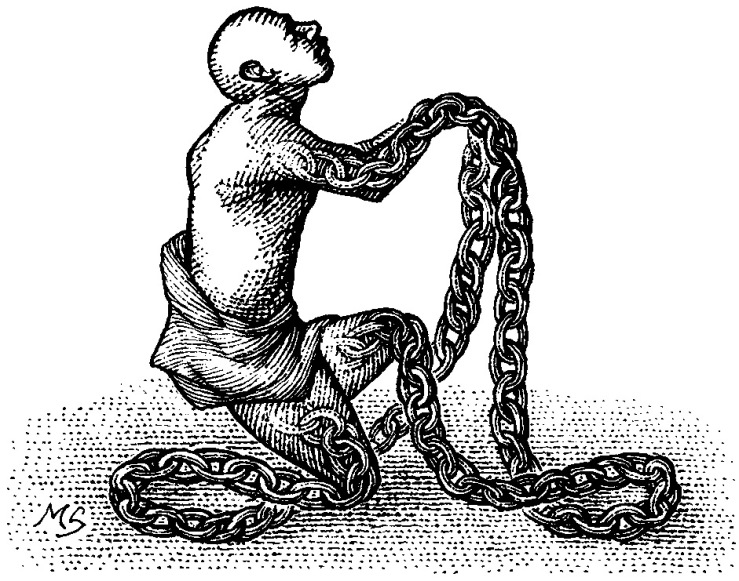
It’s the reader who shakes, in a mix of laughter and rage. The world of American Candide is simply our own world dressed up in a satirical frock that somehow reveals, rather than covers over, our society’s garish ugliness, our addictions to binding illusions. Man is born free, and everywhere he is in chains, commented Rousseau (Voltaire hated Rousseau).

tumblr_o70wqo1hoq1s4y9aso1_1280

American Candide’s  blurb warns that, “College-boy sissies will call it a Juvenalian satire upon America’s penchant for mindless optimism and casual racism.” Hooray for college-boy sissies! But no, really, I think that’s a fair assessment—as is Singh’s Candide’s assessment from the aforementioned blurb: “rage against the rage, Voltaire-dude!”

But it’s not just rage: Laughter—laughter in the all-seeing eye of absurdity—it’s laughter that undergirds American Candide.

img_1468

In a review of Lowell Blair’s translation of Voltaire’s Candide, I suggested:

The book’s longevity might easily be attributed to its prescience, for Voltaire’s uncanny ability to swiftly and expertly assassinate all the rhetorical and philosophical veils by which civilization hides its inclinations to predation and evil. But it’s more than that. Pointing out that humanity is ugly and nasty and hypocritical is perhaps easy enough, but few writers can do this in a way that is as entertaining as what we find in Candide.

Singh’s update-reboot-translation of Candide fittingly answers Voltaire’s pessimistic prescience with not just bitter affirmations of contemporary predation and evil, but also with an eye toward entertainment—to the affirmations of laughter.

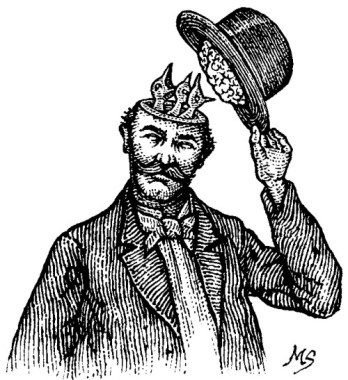
[Note: All the illustrations in this review are by Mahendra Singh, and are part of American Candide].

“First—listen. Listen to Joyce, to Woolf, to Faulkner, to Melville” | On Audiobooks of “Difficult” Novels

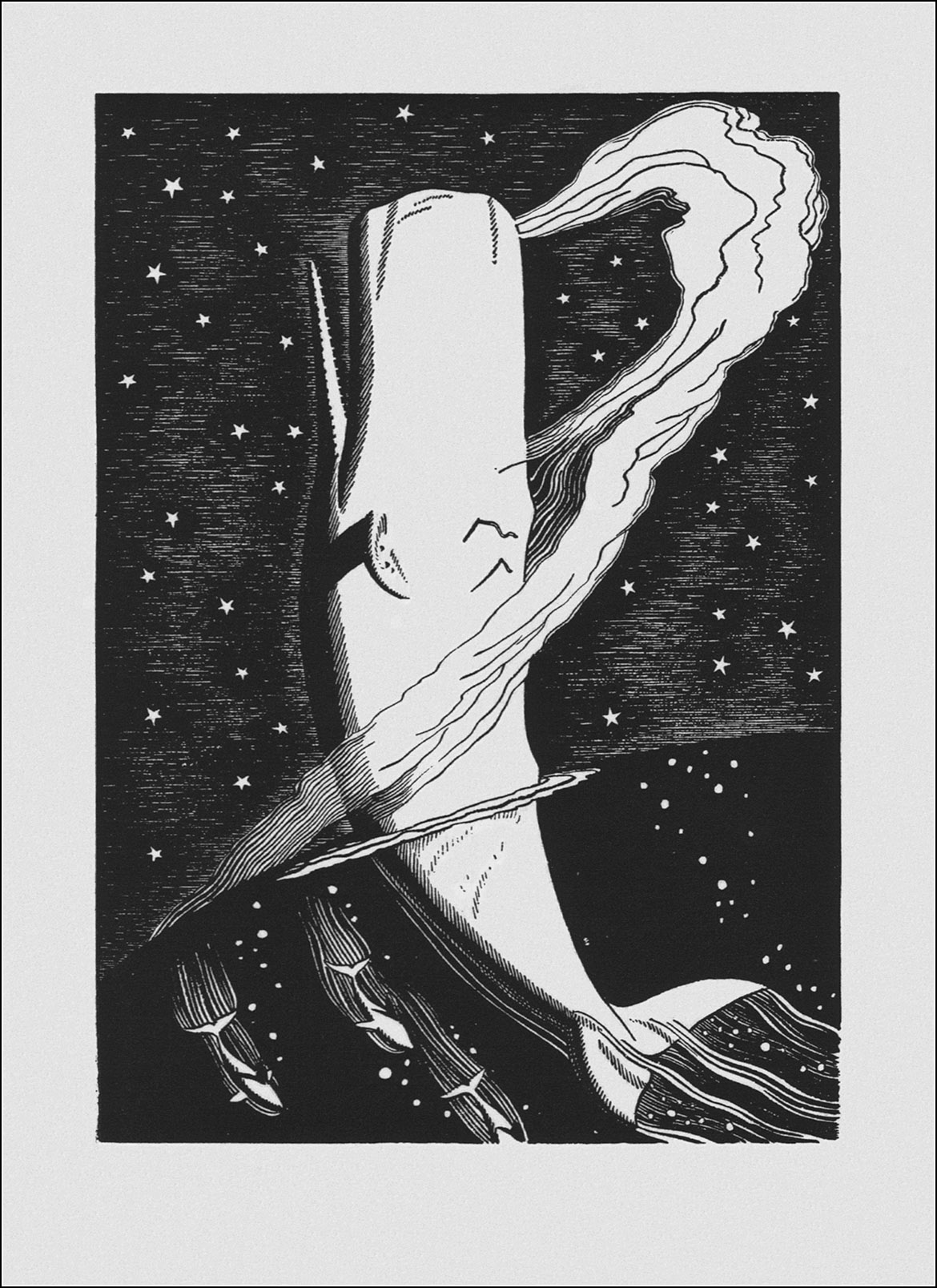
Moby-Dick, Rockwell Kent
I am a huge fan of audiobooks. I’ve pretty much always got one going—for commutes, jogs, workaday chores, etc. The usual. I love to listen to audiobooks of books I’ve already read, in particular, but I of course listen to new stuff too, or stuff that’s new to me, anyway. There just isn’t time to get to all the reading and rereading I want to do otherwise.

Beyond the fact that audiobooks allow me to experience more books than I would be able to otherwise, I like the medium itself: I like a reader reading me a story. Like a lot of people, some of my earliest, best memories are of someone reading to me. (The narrative in my family was always that my mother fell asleep while reading me The Lion, the Witch and the Wardrobe and that I picked it up and finished it on my own and that’s how I “learned” to read—I’m not really sure of this tale’s veracity, which makes it a good story, of course). So I’ve never fully understood folks who sniff their noses at audiobooks as less than real reading. 

Indeed, the best literature is best read aloud. It is for the ear, as William H. Gass puts it in his marvelous essay “The Sentence Seeks Its Form”:

Breath (pneuma) has always been seen as a sign of life . . . Language is speech before it is anything. It is born of babble and shaped by imitating other sounds. It therefore must be listened to while it is being written. So the next time someone asks you that stupid question, “Who is your audience?” or “Whom do you write for?” you can answer, “The ear.” I don’t just read Henry James; I hear him. . . . The writer must be a musician—accordingly. Look at what you’ve written, but later … at your leisure. First—listen. Listen to Joyce, to Woolf, to Faulkner, to Melville.

Joyce, Woolf, Faulkner, Melville—a difficult foursome, no? I would argue that the finest audiobooks—those with the most perceptive performers (often guided by a great director and/or producer) can guide an auditor’s ear from sound to sense to spirit. A great audiobook can channel the pneuma of a complex and so-called difficult novel by animating it, channeling its life force. The very best audiobooks can teach their auditors how to read the novels—how to hear and feel their spirit.

I shall follow (with one slight deviation, substituting one William for another) Gass’s foursome by way of example. Joyce initiates his list, so:

I had read Joyce’s Ulysses twice before I first experience RTÉ’s 1982 dramatized, soundtracked, sound-effected, full cast recording of the novel (download it via that link). I wrote about the Irish broadcast company’s production at length when I first heard it, but briefly: This is a full cast of voices bringing the bustle and energy (and torpor and solemnity and ecstasy and etc.) of Bloomsday to vivid vivacious vivifying life. It’s not just that RTÉ’s cast captures the tone of Ulysses—all its brains and hearts, its howls and its harrumphs—it’s also that this production masterfully expresses the pace and the rhythm of Ulysses. Readers (unnecessarily) daunted by Ulysses’s reputation should consider reading the book in tandem with RTÉ’s production.

Woolf is next on Gass’s list. Orlando is my favorite book of hers, although I have been told by scholars and others that it is not as serious or important as To the Lighthouse or Mrs. Dalloway. It is probably not as “difficult” either; nevertheless, put it on the list! Clare Higgins’s reading of Orlando remains one of my favorite audiobooks of all times: arch without being glib, Higgins animates the novel with a picaresque force that subtly highlights the novel’s wonderful absurdities.

Faulkner…well, did you recall that I admitted I would not keep complete faith to Gass’s short list? Certainly Faulkner’s long twisted sentences evoke their own mossy music, but alas, I’ve yet to find an audiobook with a reader whose take on Faulkner I could tolerate. I tried Grover Gardner’s take on Absalom, Absalom! but alas!—our reader often took pains to untangle what was properly tangled. I don’t know. I was similarly disappointed in an audiobook of The Sound and the Fury (I don’t recall the reader). And yet I’m sure Faulkner could be translated into a marvelous audiobook (Apprise me, apprise me!).

Let me substitute another difficult William: Gaddis. I don’t know if I could’ve cracked J R if I hadn’t first read it in tandem with Nick Sullivan’s audiobook. J R is a tragicomic opera of voices—unattributed voices!—and it would be easy to quickly lose heart without signposts to guide you. Sullivan’s reading is frankly amazing, a baroque, wild, hilarious, and ultimately quite moving performance of what may be the most important American novel of the late twentieth century. A recent reread of J R was almost breezy; Sullivan had taught me how to read it.

Mighty Melville caps Gass’s list. I had read Moby-Dick a number of times, studying it under at least two excellent teachers, before I first heard William Hootkins read it. (Hootkins, a character actor, is probably most well-known as the X-wing pilot Porkins in A New Hope). As a younger reader, I struggled with Moby-Dick, even as it intrigued me. I did not, however, understand just how funny it was, and even though I intuited its humor later in life, I didn’t fully experience it until Hootkins’ reading. Hootkins inhabits Ishmael with a dynamic, goodwilled aplomb, but where his reading really excels is in handling the novel’s narrative macroscopic shifts, as Ishmael’s ego seems to fold into the crew/chorus, and dark Ahab takes over at times. But not just Ahab—Hootkins embodies Starbuck, Flask, and Stubb with humor and pathos. Hootkins breaths spirit into Melville’s music. I cannot overstate how much I recommend Hootkins audiobook, particularly for readers new to Moby-Dick. And readers old to Moby-Dick too.

“What can we do to find out how writing is written? Why, we listen to writers who have written well,” advises (or scolds, if you like) William Gass. The best audiobook performances of difficult books don’t merely provide shortcuts to understanding those books—rather, they teach auditors how to hear them, how to feel them, how to read them.

Audiobook Riff 1 (a non-definitive list (mine) and a Maqroll anecdote (not mine))

I got a lovely email, with the subject line “Audiobooks,” a few weeks ago from a guy named Ben. Basically, he asked me to do a post on some of my favorite audiobooks, which I suppose I could’ve done fairly easy as a list (and which, yes, if you want to drop down, I will list below, oh-so-non-definitively)—but after thinking about his question, I thought I might break the post up into a couple of posts on audiobooks in general—the excellent ones, the average ones, the terrible ones afflicted by readers who misread the material; the audiobooks I’m auditing now/recently; childhood favorites (on vinyl!); hell, maybe even a totally pretentious post called “How to listen to audiobooks” or some such garbage.

Before I go on though, let me share Ben’s email (he gave me his permission), which is mostly a marvelous anecdote about Álvaro Mutis’s Maqroll novellas:

After reading your post on The Adventures and Misadventures of Maqroll, I immediately ordered the book and read it with my father as we travelled through Borneo, passing it back and forth every dozen pages. The reading became even more significant as we reached the passage in which Maqroll is laid up sick in Northridge, California, in an area surrounded by orange groves. This area is where my father spent his childhood. Reading Maqroll with my father on that trip stands as my most meaningful reading experience. I thank you for putting us onto that book.

Have you done a post yet on your favorite audiobooks? I’d like to get your recommendations. I recall you mentioning a few in previous posts, but could not track them down. Keep at it.

Ben’s Maqroll story surely deserves a response in full, fleshed out detail, and my next post will discuss in detail why I praise the following audio productions. But for now a list (sans, alas, Álvaro Mutis: our Gaviero Maqroll has not found his way into an audiobook yet, at least to my knowledge).

In no real order, and by no means definitive, a list of eight perfect or near-perfect audiobooks:

Herman Melville’s Moby-Dick, as read by William Hootkins

James Joyce’s Ulysses RTÉ’s 1982 full cast production (that second link links to a free download!).

Virginia Woolf’s Orlando, as read by Claire Higgins

J.R.R. Tolkien’s The Hobbit, as read by Nicol Williamson

William Gaddis’s J R, as read by Nick Sullivan

Cormac McCarthy’s Blood Meridian, as read by Richard Poe

Gordon Lish’s The Collected Fictions of Gordon Lish, as read by Gordon Lish 

Denis Johnson’s Train Dreams, as read by Will Patton

Extinction, Gilgamesh, Miyazaki’s Wolfchild, etc. (A Riff)

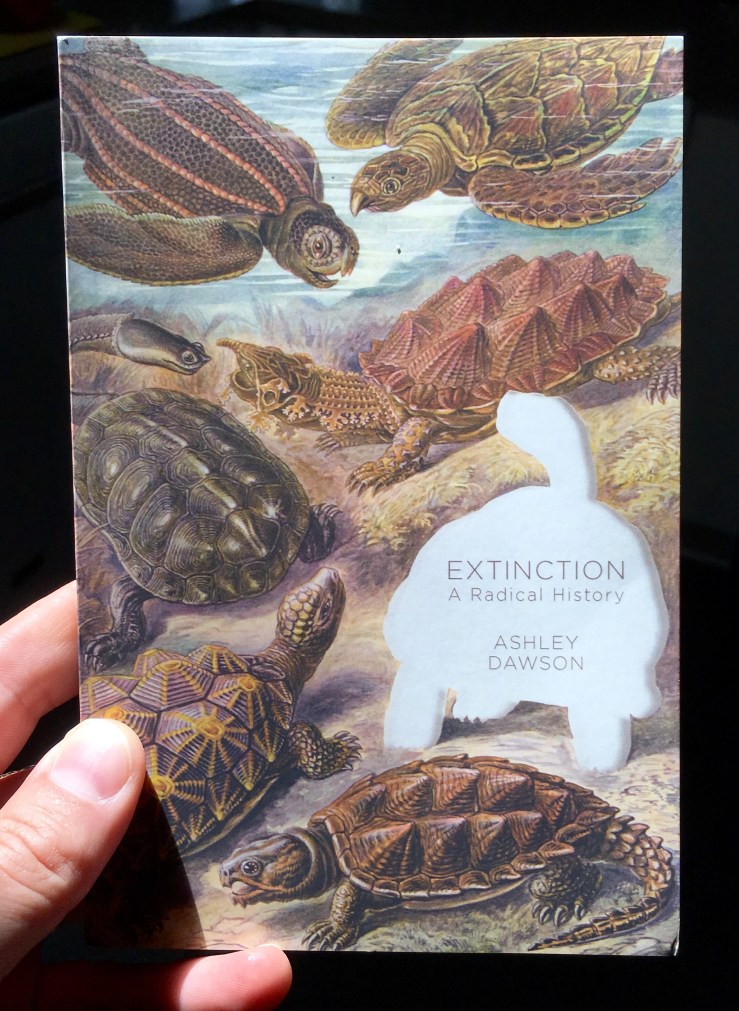
img_1916

Reading the introduction to Ashley Dawson’s Extinction: A Radical History this afternoon (forthcoming from OR Books), I felt a surreal yet nevertheless familiar twinge of apocalypse anxiety creeping into my right eye, where it tussled around. Is unnerved the metaphor I look for, here? Or is my response more literal? “Extinction is the product of a global attack on the commons, the great trove of air, water, plants and creatures, as well as collectively created cultural forms such as language, that have been regarded traditionally as the inheritance of humanity as a whole,” writes Dawson, and I nod my head. Dawson continues: “capital of course depends on continuous commodification of this environment to sustain its growth.” I nod some more. “Indeed, there is no clearer example of the tendency of capital accumulation to destroy its own conditions of reproduction than the sixth extinction.” More nodding, more anxiety.

Chapter 2 of Extinction, “An Etiology of the Present Catastrophe,” assuages (not its intent, thank gawd) some of my anxiety by beginning with a passage from old ancient historical literature. Dawson gives us a passage from The Epic of Gilgamesh; we get Gilgamesh and his homeboy Enkidu killing the forest guardian spirit Humbaba. I’m more at home in literature, in history, outside of the awful present (I’m thinking that later in the book, in chapters titled “Anti-Extinction” and “Radical Conservation,” that Dawson might like call on me to do something other than to extol the virtues of Thoreau and Emerson to college sophomores. (And nod in agreement with him)).

But so and anyway, reading this prefatory paragraph from Gilgamesh, I made the immediate imaginative leap that literature licenses me: the episode that Dawson has invoked, this city-statesman vs. nature narrative featuring Gilgamesh straight up beheading the forest protector—well, that’s the central conflict/plot in Hayao Miyazki’s 1997 film Mononoke-hime (rendered in English as Princess Mononoke, but I think better translated as Spirit-Monster Wolfchild or something like that, although no one asked me).

More on that in a second, but first, Dawson again, from the middle of “An Etiology of the Present Catastrophe,” wherein we move from literature to history to the present:

The violence generated by what geologists call the Holocene epoch was directed not just at other human beings but also at nature. Indeed what is perhaps humanity’s first work of literature, the Epic of Gilgamesh (1800 BCE), hinges on a mythic battle with natural forces. In the epic, the protagonist Gilgamesh, not content with having built the walls of his city-state, seeks immortality by fighting and beheading Humbaba, a giant spirit who protects the sacred cedar groves of Lebanon. Gilgamesh’s victory over Humbaba is a pyrrhic one, for it causes the god of wind and storm to curse Gilgamesh. We know from written records of the period that Gilgamesh’s defeat of the tree god reflects real ecological pressures on the Sumerian empire of the time. As the empire expanded, it exhausted its early sources of timber. Sumerian warriors were consequently forced to travel to the distant mountains to the north in order to harvest cedar and pine trees, which they then ferried down the river to Sumer. These journeys were perilous since tribes who populated the mountains resisted the Sumerians’ deforestation of their land.

Dawson goes on to to detail how the Sumerians’ short-sighted, expansion-oriented agricultural methods led to the downfall of their empire: A scarcity of timber and farming practices that led to a “salt-soaked earth” led to Iraq’s modern deserts.

Before my eye starts twitching again let me return (retreat) to Miyazaki—

111

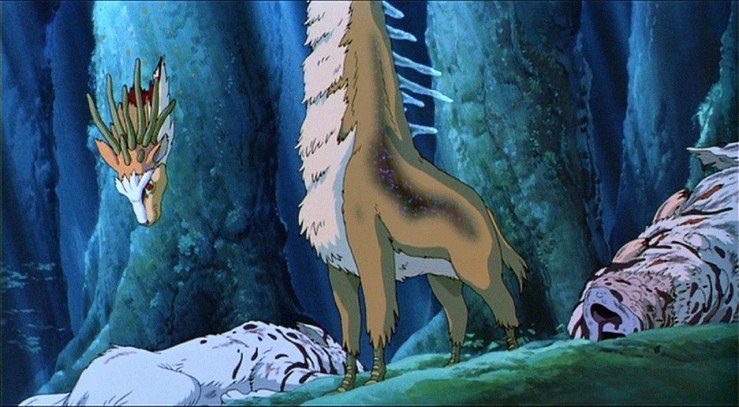
—well, I watched Princess Mononoke just this Saturday, the Saturday before Easter—for like the first time in a decade. (We watch his films all the time with our kids (PonyoTotoro, and Spirited Away especially), but not Mononoke, which is too abject and violent yet for their tender years. And not Porco Rosso, which isn’t really for kids. Or The Wind Rises).

Anyway: So: Mononoke, I was thinking, rewatching it, was/is this wonderfully, beautiful, aesthetically astonishing take on the beginning of industrialization, and the weaponization of industry, and, like man vs nature, in a primordial sense. It’s also a Japanese Western, a meditation on purity and defilement, and a study of sorts on a feral child. Not having seen it in some time, I was perhaps most struck by how complex, brave, and intriguing I found the industrialist arms-designer/manufacturer Lady Eboshi (voiced by Minnie Driver). She fights against the forest gods, she destroys and pollutes nature, she creates new weapons capable of killing people with a proficiency not yet seen on this earth. And yet at the same time, she finds a home for lepers and prostitutes—and not just a home, but a reason to be, an agency, an existential calling outside of the feudal system that would otherwise reject them. She’s the most human character in the film, perhaps. Miyazaki’s villains are rarely absolute. They are gray, human. And in their complicated, seemingly realistic humanity, I find the consolation of fantasy, yes?

So in viewing Mononoke this Easter eve—well maybe it was the wine I drank transubstantiating (or do I mean consubstantiating?) my blurred vision toward something more (an aesthetic illusion)—

—or and but anyway, so in Mononoke, I found some kind of synthesis, some kind of reconciliation between the wolfchild (Princess Mononoke, human-divine emissary of the old gods, the human not in nature but of and for nature) and the film’s protagonist (the self-exiled marked man Ashitaka—a cursed wanderer like Cain).

tumblr_inline_o1qoyqk5ln1t6t6sv_500

But no redemption. Or maybe only aesthetic redemption—which is ultimately anaesthetic, no? The rebirth in Mononoke—spoilers, maybe sorry—well the rebirth is predicated on the same sacrifices (same same but different) detailed in the Easter story.  Self-sacrifice: Obliteration of self. The tree-god-guardian—as in Gilgamesh—is beheaded. But Miyazaki contrives a heroic restoration of the godhead, one that turns the literal megafauna creature into a metaphor, an idea—a concept of nature to be attended to—stewarded by—humankind. This is wish-fulfillment, of course.

But hey and so: that fantastic wonderful megafauna, eh? They range and lumber and speak and act and assert agency throughout Mononoke. Boars, wolves, elk. A kirin. Hell, apes. In Extinction, Dawson takes us through the mass extinction of the megafauna that once trudged and bounded over the earth, detailing the “Pleistocene wave of megadeath.” (Should I note that saber tooth tigers and giant sloths and wooly mammoths populated my childhood fantasies more than any T-rex or triceratops?). We—that is humans—we are the big animals now, elephants be damned! (Dawson opens his book with the shocking line “His face was hacked off.” This, in reference to the elephant Satao, felled by poachers). Is it my dreams and fantasies that I find consolation in? In aesthetics? In the crusty rime of religion that sticks to my consciousness?

Extinction frightens me—wait, I said that already, forgive me, I’ve been applying anaesthetics, okay—Dawson’s take is realurgentvital. It makes me face that I prefer my ecological criticism couched in the fantasy of the fantasy-past (Mononoke) or the doomed-but-hey-maybe-not-so-doomed-future (I’ll call here on Mononoke’s twin, Miyazaki’s 1984 epic Nausicaä of the Valley of the Windas an example). But prefer is not the right mode/verb here (and neither is the spirit of this riff, a solipsistic navel-gazing blog of myself). This failure is my failure.

Maybe skip ahead, eh?— “The struggle to preserve global biodiversity must be seen as an integral part of a broader fight to challenge an economic and social system based on feckless, suicidal, expansion,” Dawson writes later. And skimming ahead more, I see notes on regenesis, ideas toward rewilding. Dawson’s last paragraphs—damn me, I skipped way ahead, looking for rhetorical solace—point toward “a human capacity to dream and to build a more just, more biologically diverse world.” A rhetorical flourish is easy but Dawson’s claim here is real—a future requires imagination, but an imagination beyond solace, beyond consolation. Miyazaki’s ecoverses perhaps point toward an imaginative collective future—or perhaps don’t. I don’t have a rhetorical flourish to finish off this riff.

William Gaddis’s J R (A short riff on a long book)

img_1659

1.

I reread William Gaddis’s 1975 novel J R this February and, as is usually the case with a reread, I was pleasantly unsurprised by all its unremembered surprises—the jokes and japes, riffs and routines that had oozed from my brain-sieve since that first read back in 2012.

How could I forget about a scheme to freeze sound, or an art theft subplot, or the Indian uprising? How could I forget that in J R, Gaddis anagrammatically parodies the critical rejections of his first novel The Recognitions? (I did remember the stuffed Eskimo).

2.

What I was surprised surprised surprised about in my rereading of J R was how much of the first reading had stuck. And stuck hard, soaked in, saturated—the sign of a great grand thing, the em-word thing, the masterpiece thing.

3.

Only a handful of novels are so perfectly simultaneously comic and tragic. Moby-Dick? Yes. Gravity’s Rainbow? Absolutely. (G R and J R, a duo published two years apart, spiritual twins, massive American novels that maybe America hardly deserves (or, rather: theses novels were/are totally the critique America deserves). I guess maybe what I’m saying is J  R is the Great American Novel to Come (The Recognitions is perhaps overpraised and certainly not Gaddis’s best novel; J R is. The zeitgeist has been caught up to J R, the culture should (will) catch up).

4.

So I already wrote on J R on this blog: A misfire of sorts from halfway through (in which I offer more description of the novel’s plot and form than I intend to here, maybe), and a thing I wrote after finishing it which (this thing I wrote before, I mean) might be better than anything I can muster here, in terms of analysis, of like, theme. I’ll limit myself to, I don’t know, eleven points in this riff, yes? (Why 11? Why not? Why not go to 11? 11 for Chapter 11, for bankruptcy, for the moral artistic intellectual bankruptcy that the novel J R skewers). So, having limited myself to eleven points, and having not gotten to the damn point yet, which is—

5.

J R is so good, y’all. The book is a performance, an opera, an essay on America, a howl, a condemnation, a farce, a romance, a tragedy. When I read it in 2012 I couldn’t believe how prescient it was, a feeling reconfirmed with force four years later. J R diagnoses and describes and ridicules American corporatism, the industrial-military-entertainment-banking-education-etc. -complex. And then it weeps.

6.

But wait—what I wanted to say is J R is so good—so, uh, entertaining. It’s fucking funny. And sweet.

7.

(And bitter).

8.

And J R’s not as hard a read as some dudes would have you believe. Sure, it’s composed almost entirely in unattributed dialogue—and that can be tough, to start, but you can learn to hear it very quickly.

In his essay “William Gaddis and His Goddamn Books,” William Gass writes that, “J R takes time. J R takes patience. J R takes faith.” But Gass also points out the payoff of J R “unlike other faiths…is immediately and continuously redeeming.”

It is redeeming (continuously), and I don’t just echo Gass here as some kind of rhetorical flourish—reading J R again was a reminder that the novel posits redemption through Bast’s call to action, to his resolve to, as the failed writer (or stymied writer) Eigen puts it, “go do what [he has] to do” to make real art—or, in our hero Bast’s own terms: “…until a performer hears what I hear and can make other people hear what hears it’s just trash isn’t it…”

9.

And in J R the reader becomes the performer, making the voices, singing the voices, (muttering the voices), navigating all the trash, the entropy—J R is a novel of unraveling, where art trips over commercial trash and literal trash–old ads, betting tickets, stock ticker tape, phone book pages, train tickets, scraps. Is there another American novel so aware of its own textuality, its own metatextuality—I mean one that doesn’t goddamn wink all the time at its readers like so much clever postmodern slop?

Gass again: “[J R] is written in speech scraps, confetti-like wiggles of brightly colored cliché. As a medium, it would appear to be as unpromising as might be imagined. And the reader has to ride in the parade and organize all that fluttering that’s come down from on high.” High and low.

10.

And all the heroes of J R—Bast and Gibbs and Amy Joubert, but also the titular J R his own goddamn self (and maybe, if we’re feeling charitable examining this novel of capitalism, Eigen)–they’re falling apart and trying to put themselves back together (even their clothes unraveling, their shoes falling apart). Chaos, entropy.

The whole deal is best summed up in an early episode in which Gibbs rants against the modern education system: “Order is simply a thin, perilous condition we try to impose on the basic reality of chaos…”

Or maybe it’s best summed up (not the right phrasal verb—maybe described by the chaos of, but gee-dee that’s clunky) in the scraps Gibbs keeps wadded in his pocket or in his folders, scraps toward something bigger

img_1658

Gibbs’s novel is Agapē Agape, which is also Gaddis’s last novel. And to go back to whatever thrust this riff had re: rereading—J R coheres, perhaps (it doesn’t have to cohere) after a reading of Agapē Agape (which also, Agapē Agape, works to dismantle coherence, or to emphasize the chaos of thought, or to highlight entropy, or to you know what goddamn it pick your own phrase). What I mean to say is I think it’s a good move to read Agapē Agape after J R.

(What I mean to say is that I care and cry for Jack Gibbs, and find in Agapē Agape for him a redemption and resurrection (and dissolution, of course…)).

11.

So I get to point 11 and fail to say so many things I intended to say—about the novel’s sexiness (it’s sexy!)—about its wit (goddamn!)—

——-about its repetition of phrases like god damn and its unrelenting use of forms of the verb threaten—and ——– and

—–and here I see/read/hear that I’ve been referring to the novel as its own agency, its own its, as if it were its own beast independent of its master Gaddis—

—-which I guess, like any Great Novel (American or otherwise), it is.

Independent, I mean.

And great, I mean.

And, <enthusiasm> You should read read it! </enthusiasm>.

I mean, I love it.

The Coen Brothers’ film Hail, Caesar! adds up to less than the sum of its parts


download (2)
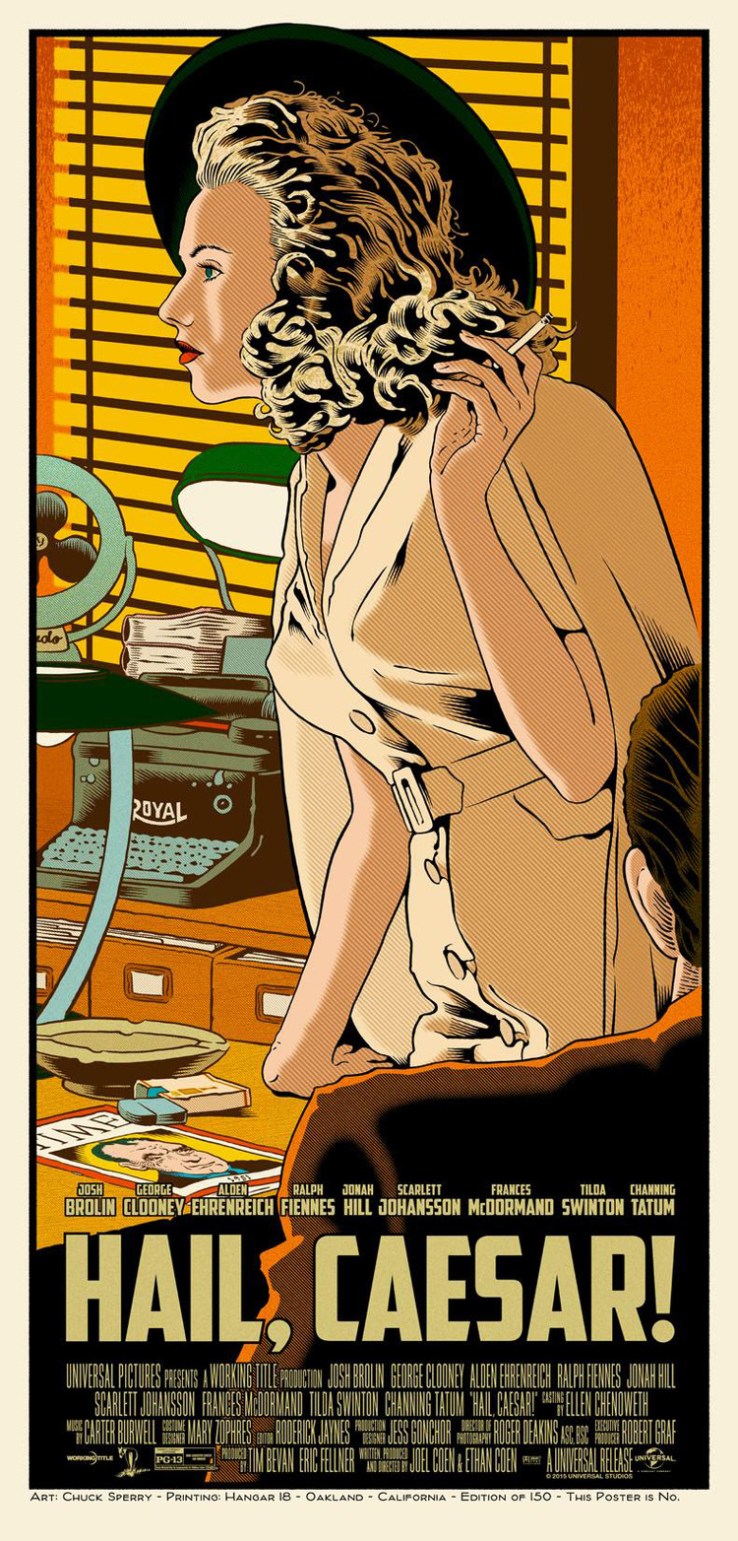
Hail, Caesar! film poster by Chuck Sperry
In her cameo in the Coen brothers’ newest film, Hail, Caesar!,  Frances McDormand gets her scarf stuck in her editing machine. It nearly chokes her (or, I should write, her character, film editor C.C. Calhoun) before Josh Brolin’s studio head/fixer Eddie Mannix hits “Reverse,” saving her life.

Like so many of the scenes in Hail, Caesar!, the editing scene is funny, well-acted, impeccably filmed, and ultimately superfluous. It’s a throwaway, a wonderful scrap, one of many scraps that the Coens seem to toss to their audience, goading, Hey, you put all of this together.

The McDormand scene is ultimately just another way for the Coens to highlight the artificiality of their medium. Hail, Caesar! is of course a film about film, a film that aims to satirize how the metaphorical sausage is made. As such, Hail, Caesar! is self-satirizing, meta-metaphorical. It’s the Coens pointing out the flawed seams or imperfect varnish before the product is even finished. McDormand’s editor getting caught in the machine is some kind of clumsy synecdoche then.

These metatextual gestures only helped to heighten my own awareness of Hail, Caesar’s! flawed seams. This is a film brimming with wonderful, energetic set pieces—synchronized swimming with Scarlett Johannsson! — Channing Tatum tap-dancing on a bar! — Alden Ehrenreich (not so famous, yet) stunting on horses!—that add up to almost nothing. The end result would almost be fascinating were it not so dull.

Alden Ehrenreich’s singing cowboy Hobie Doyle is not dull, and every time he’s on the screen Hail, Caesarthreatens to become interesting. “Called up” to be in more, eh, prestigious fare than the cowboy pictures he’s been doing so well in, young Hobie’s plot has the slightest (just the slightest) tinge of Mulholland Drive — “This is the girl.” (Or, eh, “This is the boy. The cowboy”).

Hail, Caesar! can’t commit fully to Hobie for its hero, alas. Instead the film, after an initial bout of goodwill-building (including an especially funny early scene in which religious leaders are invited to critique Hail, Caesar!, the film-within-a-film here)—instead the film (the Coens’ Hail, Casear!, that is) plods along a few not-quite-intersecting tracks, introducing the occasional grotesque for a cameo that serves no real plot point.

Look, I get it. Having a character’s fate expositioned away via clumsy dialogue at the end of the film is like, meta, right? It’s the Coens way of grinning at the corny clumsy past of their chosen medium, hey? It’s like, purposefully, self-reflexively bad, a piss-take on an audience’s willed suspension of disbelief, hm?

Suspension of disbelief—faith. Does Hail, Caser! aim to take on faith? It certainly dabbles, exploring (“exploring” is not the right verb—but I already used “dabbles”) political faith, economic faith, religious faith. Faith in the aesthetic power of film, which again and again Hail, Caesar! attempts to embody via kinetic spectacle before puncturing said aesthetic transcendence with ironc winking (or technical failure).

The signal moment in the film’s ironic treatment of faith is delivered in its penultimate scene. George Clooney’s character Baird Whitlock’s character (a Roman soldier whose name I can’t recall, but, hey, note the layering, man) deilvers a monologue. The speech is meant to be this kinda sorta Road-to-Damascus epiphanic transcendence deaile, and the aesthetic power of Clooney’s Whitlock’s delivery is confirmed internally on set by the various film people  (grips and script folk, etc.) offering up admiring Brady nods—only Whitlock stumbles over the last word of the speech—which last word, of course, was faith.  Charlie Kaufman did the same thing much better in the funeral monologue near the end of his film Synecdoche, New York. In Hail, Caesar!, the moment feels like a glib trick played on the audience

It’s entirely likely that there’s a much finer design to Hail, Caesar! than I’ve credited the Coens here. Maybe on a second viewing, I won’t be bogged down so hard looking for a thread to follow. (Shagginess is hardly a sin though, yes Lebowski?). And I’ve failed to point out some of the fine performances here—Josh Brolin anchors the film admirably (although half the time he was on the screen, I kept hoping the film would turn into Inherent Vice). Hail, Caesar! has plenty of great moments, and those moments, like I said, might cohere into something sharper upon a second screening. But right now there’s nothing that compels me toward a second screening any time soon.

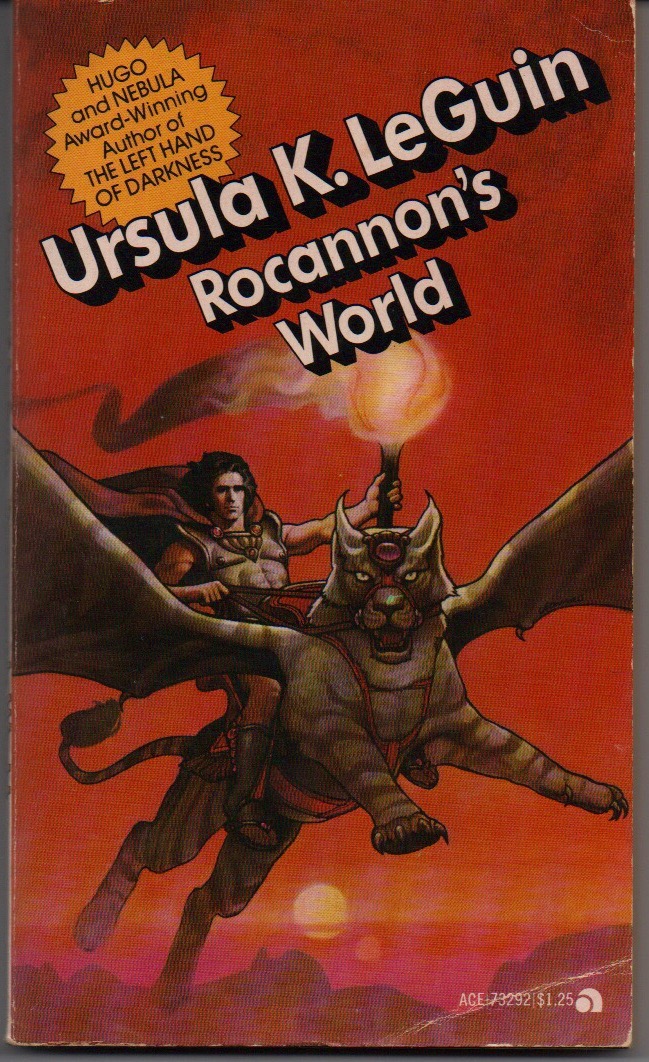
A conversation on Ursula K. Le Guin’s first novel, Rocannon’s World

After I posted a review on this site of Ursula K. Le Guin’s novel The Lathe of Heaven, the novelist Adam Novy recommended that I check out her under-read first novel, Rocannon’s World. So I did. Our email exchanges about the book developed over a few weeks (during which time I ended up reading all of Le Guin’s so-called Hainish novels), and Adam’s analysis of the novel is, I think, especially perceptive. An edit of our conversation is below.

Adam Novy’s novel The Avian Gospels is fantastic. Buy it from Hobart.

img_1534

Edwin Turner: Thanks for suggesting Rocannon’s World, Adam. I’m not really sure how I missed it in my first few forays into Le Guin—when I was younger it might not have been in my school library—but I’m glad I read it. Very vivid stuff. You told me it was your favorite Le Guin. Why?

Adam Novy: There are many reasons why I love Rocannon’s World. The beautiful and exact descriptive writing, and the syntax. Le Guin can really sing. The sadness of the heroes for their vanished civilizations. The way so many passages evoke the feel of hiking. The flying cats. The incomparable ending.

But it’s the way Le Guin explores the idea of agency sets the book apart for me. The protagonists, Semley and Rocannon, take decisive action they believe in, which sets in motion plots that spiral out of control and annihilate their intentions. Rocannon and Semley end up being massive historical figures, yet also tiny cogs in galaxy-sized machines. This comparison of the massive and the tiny is not a calculated stalemate—not the cultivated balance I think a lot of writers feel we must produce these days, as if our calculations will be checked and we might get partial credit—but an ambivalence that’s immune to human desire or even narrative. It’s one of the things I love about Le Guin. Her idea of a human being’s influence in the world is like the ancients’.

This is fascinating to me in a lot of ways, first at the level of plot. How much should a character affect the world around her? Too much power can seem unserious and thrillery, like a fantasy, like competence porn. (A possible new definition of literary fiction is “incompetence porn.”)  Le Guin is just so elegant with this. Semley and Rocannon may be important figures in their communities—Semley is a kind of Duchess and Rocannon is a government anthropologist with administrative dominion over half the galaxy—and yet, by merely performing their own social roles, they ruin everything they care about, including the context in which their identities exist. Le Guin’s formula is magical: a central figure in a community commits a deliberate act, and the consequences are massive, unforeseen, accidental, and diminish this central figure to almost nothing. And yet, despite their total disempowerment, their influence endures in major ways. But even this is misconstrued by people in the future, who tell the history. There is no linear connection between intention and result. The reader feels the ages passing every time Rocannon takes a step.

This leads to the other aspect of the plot I really love, which is political. Rocannon is a bureaucrat in a colonial hegemony, and by honestly yet patronizingly trying to protect the subjects he administrates, he initiates a plot that will destroy them, and himself. He’s a kind of blinkered, well-meaning liberal who does not know what the hell he’s really doing, or how power works, since the force that does the destroying—an anti-government entity called “the enemy”—seems to emanate from the government Rocannon works for. In the end, his people simply don’t belong on the planet, which he only learns when he, too, is a refugee.

ET: But there’s also the sense that Rocannon integrates into the planet—he marries into the Angyar at the end, although we don’t really hear that story. It’s an epilogue that fulfills the legend-structure of the tale. So, on one hand Le Guin’s written this story that’s highly ironic—especially in the ironic title, Rocannon’s World—a title that points to the novel’s themes of colonialism. On the other hand, there’s a sense of discovery and exploration—a kind of High Adventure narrative à la Verne, where our viewpoint character ascends, peers down over the planet from his flying machine (in this case a winged cat).

And then Rocannon sort of achieves his Romantic quest of attaining Semley, or rather the idea of Semley—the exotic, the beautiful, the aristocratic—by marrying into her ancestral chain, and becoming a sort of Duke. This is all very much Fairy Tale stuff, Fantasy stuff. And Le Guin isn’t really synthesizing fantasy tropes with sci-fi in Rocannon’s World. It’s more like she’s tapping into a deeper, mythic vein—so on some level, I think that the novel is really about storytelling itself. There’s something oral and episodic about it, with its riffs on Eurydice and winged men and Valhalla. I reread The Dispossessed after Rocannon’s World. The Dispossessed strikes me as more deliberately structured than Rocannon’s World—more dialectical, more focused, but also centered much more on dialogue-monologue (similar to The Lathe of Heaven). Rocannon’s World is literally more fantastical than The Dispossessed. Do you think that Le Guin’s first novel has been overlooked as a book of ideas? Continue reading “A conversation on Ursula K. Le Guin’s first novel, Rocannon’s World”

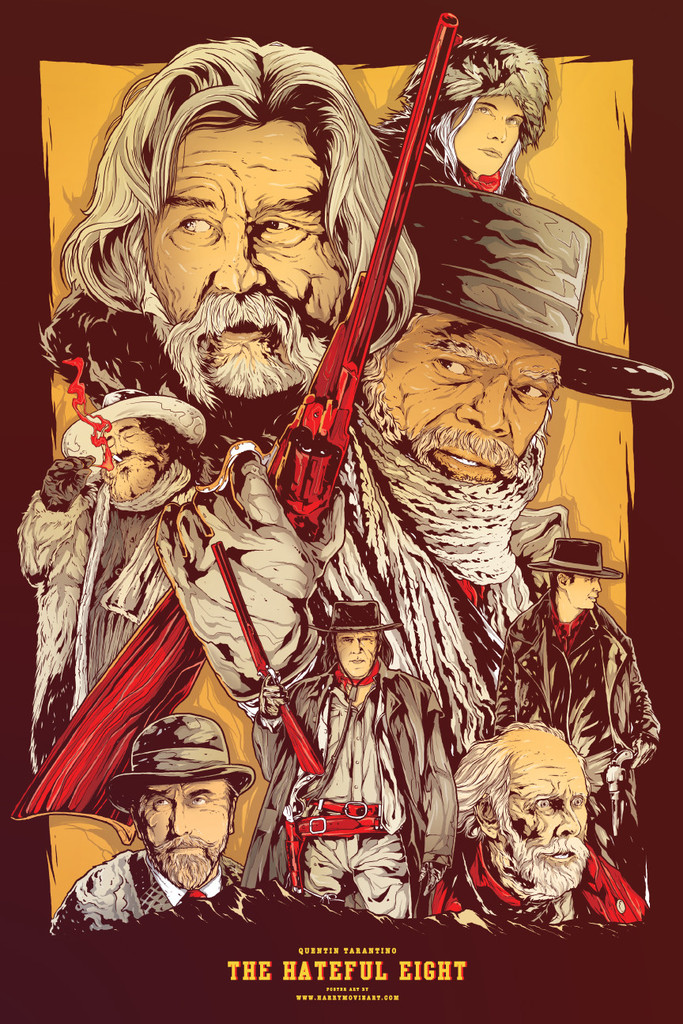
Does anything good happen in The Hateful Eight?

Hateful-eight-12x18_1024x1024

I don’t like films where nothing good happens, my wife told me years ago. I can’t remember the film that occasioned this remark, and I don’t find myself beholden to her rubric, but I still find myself applying it to films now and then. Especially after watching Quentin Tarantino’s The Hateful Eight.

Does anything good happen in The Hateful Eight?

(This is not the right question to ask about a film, but—).

This question isn’t the same as, say, Is any part of The Hateful Eight good?—because so many of the elements are good—excellent even—Ennio Morricone’s score, Robert Richardson’s cinematography, Yohei Taneda’s set design.

And the acting is great, or sorta great, or it’s hard to tell, maybe. Let’s say the performances are great. I mean, it’s Tarantino, so the acting is always at least one level removed from reality—even in Sam Jackson, the realest dude, the dude who carries the film as former Union officer, Major Marquis Warren. Sam Jackson is Tarantino’s main man, his star of hyperreality, and his performance is electric here.

But for hyperreality, it’s Jennifer Jason Leigh who stands out in The Hateful Eight. Her portrayal of prisoner Daisy Domergue is refined Looney Tunes slapstick. Cartoon soul. Watching Walton Goggins (vile racist ex-Confederate marauder Chris Mannix) or Kurt Russell (bounty hunter John Ruth)—both of whom get lots and lots of lines and screen time—one can’t help but realize one is seeing an actor acting—or, more Tarantinoesque—a character acting.

But Jennifer Jason Leigh, remanded to a punching bag for much of the film—or even stranger, a chained work-wife to Kurt Russell’s John Wayne parody (via Kurt Russell’s John Wayne parody as Jack Burton in Big Trouble in Little Trouble)—JJL imbues her Daisy Domergue with a wily pathos that surpasses both the script she’s made to read and her Seussian name.

Not that JJL’s Daisy Domergue’s isn’t vile, nasty, deeply racist, and hateful…but her hatefulness points towards something, I dunno, complex. Real. True. (I should mention now Laura Bogart’s essay “Hipster Misogyny: The Betrayal of The Hateful Eight,” which I think offers an intriguing read on the film. Bogart seems to argue that JJL’s DD is not complex enough, or not given enough complexity, which, hey, okay, fair enough—but I think also that Bogart was disturbed by the film’s conclusion—which I was too, disturbed). 

But: Does anything good happen in The Hateful Eight?

What do I mean here by good? Should I just admit I don’t know “good,” but rather feel “good”? Okay. I don’t know good through definition, but rather by example. Fuzzy precis. Good: Perhaps a moment of redemption, but like, say, an earned one, a real one, one not forced through a Hollywood formula. Good might be kernel of hope—a real moment of hope, not just an up established for a foreshadowed down. Or maybe by good I just mean something aesthetically true.

Tarantino’s best films—the Kill Bill films, Pulp FictionJackie Brown, and Reservoir Dogs—point to something good in their conclusions—and by conclusions I mean both literal endings and thesis statements. I’m not sure if I find this same “goodness” evident in the conclusion of The Hateful Eight, or, if it is there, it’s awfully ambiguous.

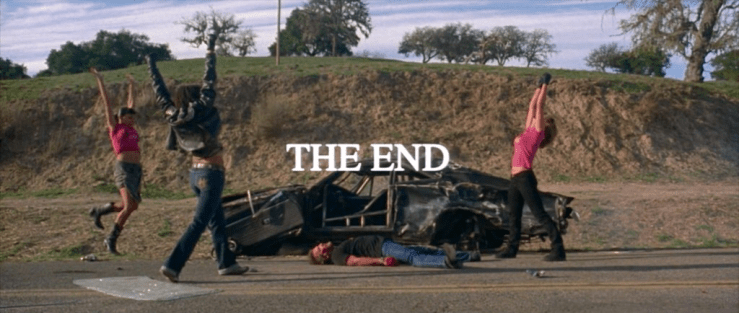
The conclusion of The Hateful Eight is the not-exact opposite of the end of my favorite Tarantino conclusion, the end of Kill Bill 2:

img_0370

And The Hateful Eight’s conclusion is the not-exact opposite of the ending of Jackie Brown’s bittersweet take on redemption, loss, and escape—American lives that earn second acts.

And The Hateful Eight’s conclusion is the not-exact opposite of the ending Pulp Fiction, a film that resurrects Vincent Vega and sees Sam Jackson’s Jules Winnfield suspend wrathful violence and judgment on Tim Roth’s Ringo (or Pumpkin. Or whatever his name was).

And what about those films that didn’t make my silly little list of “Best Tarantino” — Inglorious Basterds (which is one of my faves, actually, just to watch for like, pure entertainment), Django Unchained, and Death Proof (which actually belongs on that best-of list, maybe, or at least the final sequence)? Shoshanna Dreyfus using film as weapon to end the Nazis? Django’s righteous rampage against slavery? Or the ecstatic violence of “the girls” destroying serial killer Stuntman Mike?

img_0372

What most of QT’s conclusions share in common is that they somehow mediate the relationship between revenge and justice, and do so in a way that’s aesthetically convincing. The Hateful Eight also seeks to be a film about the relationship between revenge and justice. Its final moments attempt to aesthetically recapitulate much of American history into a morbid sequence of violence.

[Fair warning: There’s a discussion of the conclusion of The Hateful Eight coming up, including what some folks might call spoilers].

Continue reading “Does anything good happen in The Hateful Eight?”

A riff on Ursula K. Le Guin’s Hainish novels


img_1190

“Are we not Men?”

— The Island of Dr. Moreau, H.G. Wells (1896)

“A country, a people…Those are strange and very difficult ideas.”

— Four Ways to Forgivenss, Ursula K. Le Guin (1995)

—Each of the novels in Ursula K. Le Guin’s so-called Hainish cycle obliquely addresses Wells’s question by tackling those strange and very difficult ideas of “a country, a people.” The best of these Hainish books do so in a manner that synthesizes high-adventure sci-fi fantasy with dialectical philosophy.

—What am I calling here “the best”? Well—

The Left Hand of Darkness

Planet of Exile/City of Illusions (treat as one novel in two discursive parts)

The Dispossessed

—(How oh how oh how dare I rank The Dispossessed—clearly a masterpiece, nay?—so low on that little list? It’s too dialectical, maybe? Too light on the, uh, high adventure stuff, on the fantasy and romance and sci-fi. Its ideas are too finely wrought, well thought out, expertly cooked (in contrast to the wonderful rawness of Rocannon’s World, for example). None of this is to dis The Dispossessed—it’s probably the best of the Hainish books, and the first one casual readers should attend to. (It was also the first one I read way back when in high school)).

—The novels in Le Guin’s so-called Hainish cycle are

Rocannon’s World (1966)

Planet of Exile (1966)

City of Illusions (1967)

The Left Hand of Darkness (1969)

The Dispossessed (1974)

The Word for World is Forest (1976)

Four Ways to Forgiveness (1995)

The Telling (2000)

—Okay, so I decided to include For Ways to Forgiveness in the above list even though most people wouldn’t call it a “novel” — but its four stories (novellas, really) are interconnected and tell a discrete story of two interconnected planets that are part of the Hainish world. And I pulled a quote from it above. So.

—I read, or reread, Le Guin’s so-called Hainish cycle close to the chronological order proposed by the science fiction writer Ian Watson. I don’t necessarily recommend this order.

—(I keep modifying “Hainish cycle” with “so-called” because the books aren’t really a cycle. Le Guin’s world-building isn’t analogous to Tolkien’s Middle Earth or Faulkner’s Yoknapatawpha County. (Except when her world-building is analogous). But let us return to order).

Le Guin on the subject:

People write me nice letters asking what order they ought to read my science fiction books in — the ones that are called the Hainish or Ekumen cycle or saga or something. The thing is, they aren’t a cycle or a saga. They do not form a coherent history. There are some clear connections among them, yes, but also some extremely murky ones. And some great discontinuities (like, what happened to “mindspeech” after Left Hand of Darkness? Who knows? Ask God, and she may tell you she didn’t believe in it any more.)

OK, so, very roughly, then:

Rocannon’s World, Planet of Exile, City of Illusions: where they fit in the “Hainish cycle” is anybody’s guess, but I’d read them first because they were written first. In them there is a “League of Worlds,” but the Ekumen does not yet exist.

—I agree with the author. Read this trilogy first. Read it as one strange book.

—(Or—again—pressed for time and wanting only the essential, read The Dispossessed and The Left Hand of Darkness—but you already knew that, no?).

Continue reading “A riff on Ursula K. Le Guin’s Hainish novels”

RIP David Bowie

img_1322

I don’t remember the first time I heard David Bowie because I was born in 1979 and he was always there, ahead of me. Always on.

I don’t remember the first time I heard David Bowie, but I do remember my uncle and my cousin would riff this routine on Bowie and Jagger’s video for “Dancing in the Streets,” which I knew even as a child (the video; the routine) was campy fun. Maybe I didn’t know the fun was camp. Maybe I learned the camp from Bowie.

I don’t remember the first time I heard David Bowie, but I do remember the first time I saw Labyrinth.

I don’t remember the first time I heard David Bowie, but I do remember my babysitter, who I believed I was in love with—I was nine, a mature (?!) , impressionable nine—declaring, “David Bowie is my hero” in a dreamy voice. I didn’t that was an option, that a singer could be a hero. I hadn’t heard “Heroes” yet.

I don’t remember the first time I heard David Bowie, but I do remember being utterly bewildered as Macauly Culkin introduced Tin Machine on Saturday Night Live. This was in 1991. I was in, what, seventh, sixth grade? Why weren’t they David Bowie and Tin Machine? My father couldn’t tell me.

I don’t remember the first time I heard David Bowie, but I do remember the first Bowie tape I bought on my own, Diamond Dogs. I think I paid $7.99 for it at the Camelot in the mall. I was in the ninth grade. Then Ziggy Stardust—they were like novels, like sci-fi novels. (I think I tried The Man Who Sold the World next and didn’t quite understand its blues).

I don’t remember the first time I head David Bowie, but I do remember not understanding what the hell was going on in the beginning of Fire Walk With Me.

I don’t remember the first time I heard David Bowie, but I do remember the first time I head Earthling and I thought it wasn’t half bad.

I don’t remember the first time I heard David Bowie, but I do remember my first real Bowie phase, in my freshman year of college: Low“Heroes,” Lodger. And later: Young Americans. Although all you needed for a real proper dance part was Changesbowie (even “Fame ’90” was a jam). You could (you can!) sweat and grind and flop and writhe with others to Bowie; you could (you can!) sit in your room and listen to Bowie on big headphones. Drive to Bowie.

I don’t remember the first time I heard David Bowie, but I do remember that my friend Nick was always ahead of me on Bowie, always sort of leading me into and through Bowie. That Bowie was and is somehow mixed into our friendship.

I don’t remember the first time I heard David Bowie, but I do remember coming home from college one weekend to discover my father had bought ‘Hours…’. This perplexed me. The old man was never a big Bowie fan. “I liked ‘Thursday’s Child.'”

I don’t remember the first time I heard David Bowie, but I do remember the first time I saw The Man Who Fell to Earth. And the next few times.

I don’t remember the first time I heard David Bowie, but I do remember the first time I heard Adrian Belew’s guitar playing on “Boys Keep Swinging.”

I don’t remember the first time I heard David Bowie, but I do remember his evocation of Andy Warhol in Basquiat. And how appropriate, now, I suppose: Bowie does Warhol. That Bowie extended Warhol was a given—Bowie transcended Warhol, and Bowie performing Warhol is a perfect trick, given the relationship of both artists to authenticity and art. Bowie intuited—and then exemplified and engendered and practiced—that authenticity is a performance, that authentic authenticity must be performed. This is why David Bowie was the signal artist of the emerging 21st century.

I don’t remember the first time I heard David Bowie, but I do remember a few months after I graduated college, on the way to work, sleepy, maybe a bit hungover, breaking down in tears at “Space Oddity” for no good reason.

I don’t remember the first time I heard David Bowie, but I do remember the first time I heard David Bowie at a wedding.

I don’t remember the first time I heard David Bowie, but I do remember drunkenly demanding that my best friend blast “Blue Jean” at a party he was having.

I don’t remember the first time I heard David Bowie, but I do remember my son asking who John was re: “John, I’m Only Dancing.”

I don’t remember the first time I heard David Bowie, but I do remember the first time I heard Blackstar. How?

I don’t remember the first time I heard David Bowie, but I do remember how sad I felt the day Lou Reed died—was he not immortal? If Lou Reed could die anybody could die. But not David Bowie. David Bowie is too immortal to die.

The intimacy we feel with our heroes. They sing for us. They sing loud and public, or privately for us. We sweat to them or fall asleep or space out or more. We jam them into our ear. We know that they wrote those songs for usAbout us. How ridiculous to think, Well of course you didn’t know David Bowie! Of course I knew David Bowie.

I don’t remember the first time I heard David Bowie, but I do remember pulling out David Bowie records and playing tracks from them all afternoon.

I don’t remember the first time I heard David Bowie, but I do remember that there’s a lot I’m forgetting, but I’m just riffing and ranting and maybe you loved him too. I bet you did.

The obligatory 2015 year-end list

img_1228

Favorite Reading Experiences

I finally read Thomas Pynchon’s novel Gravity’s Rainbow in full in 2015. Then I immediately read it again (which is sort of like really reading it), occasionally dipping into Steven Weisenburger’s A Gravity’s Rainbow Companion. Rewarding, hilarious, challenging, perplexing, Gravity’s Rainbow is too brilliant to look at directly, and is perhaps best approached slantwise, as one Ms. Dickinson of Amherst has advised.

On page 588 of Gravity’s Rainbow, the narrator (?!) suggests that we “Check out Ishmael Reed.” So I did. His novel Mumbo Jumbo is like nothing I’ve ever read before—the reviewer’s crutch “dazzling performance” comes to mind, because Mumbo Jumbo is a performance (jazz, bebop, soft shoe, vaudeville, a hoodoo magic show, an exorcism: performance art), and it does dazzle, overwhelm, energize, haunt, titillate, reverberate, howl…and there are pictures! Reed uses photos in a way that Sebald would a few decades later—documentary evidence of a sort. I don’t know. I just don’t know.

Like Reed’s novel, Anne Carson’s novel-poem-myth-book Autobiography of Red is impossible to categorize and extremely difficult to describe. I tried to write about it a few times on this site and failed, which is fine. What matters here is the reading experience: Carson’s book zapped me, gave me tingles, reminded me that what I want to think and feel when I read is, How is this possible? How is this allowed? (Another huge thank you to BLCKDGRD for sending me Autobiography of Red and its sorta-sequel Red Doc>).

Also: Nabokov’s Pale FireTwo Serious Ladies by Jane BowlesHomesick by Lucia Berlin and Evan Dara’s novel Fleewhich I loved reading with Biblioklept contributor Ryan Chang .

And finally, Ursula K. Le Guin, whose so-called Hainish Cycle I read most of this year. I still have to read The Telling, but great stuff, and a full write-up early in the new year.

Favorite Books I Read in 2015 That Were Actually Published in 2015

Signs Preceding the End of the World, Yuri Herrera

Cess, Gordon Lish

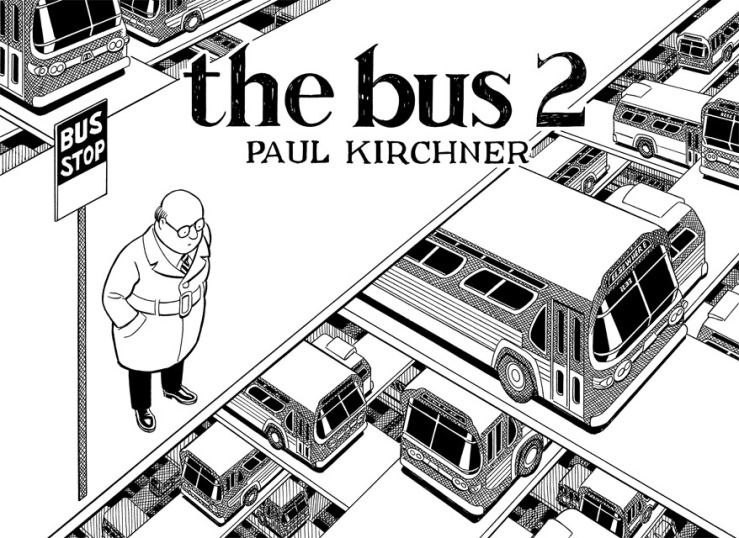
The Bus 2, Paul Kirchner

Mislaid, Nell Zink (although I liked The Wallcreeper better, but hey, it was published last year)

Favorite Indie Presses of 2015

You can’t beat Nobrow, Dorothy, OR, and/or And Other Stories.

Favorite Films I Saw in 2015 That Came Out in 2015

IMG_0340

I had a relatively contrarian opinion of Fury Road, but I enjoyed it overall, I suppose. The Force Awakens was a better spectacle for my money/nostalgia. Overall, 2015 was kind of a weak year for movies, filled with overrated indies, comic book schlock, and self-serious entertainments that Tried Too Hard. Hard to Be a God was the only thing that really zapped me, although a quick google shows that it was actually released in 2014.

You know, Inherent Vice was released in late 2014 too, but I saw it and loved it and obsessed over it in 2015…so, Inherent Vice, yeah…

I also liked that Scientology documentary, which was full-on Pynchon.

Favorite Television Shows of 2015

I thought the second season of Fargo was near-perfect and found the tawdry spectacle of The Jinx thrilling, but there was no show I enjoyed watching and reading about more than the second season of True Detective

Favorite Albums of 2015

The albums I listened to the most this year were soundtracks that came out before 2015: Inherent Vice and The Good, The Bad, and The Ugly. But I did like a number of new albums this year, including Joanna Newsom’s Divers, Jim O’Rourke’s Simple Songs, and Destroyer’s Poison Season.

Favorite Books I Didn’t Finish in 2015

I’ve been crawling my way through a full read of Leslie Fiedler’s Love and Death in the American Novel, but: No end in sight. I also read most of the essays in William T. Vollmann: A Critical Companion (check out my interview with the editors). I also read a hefty chunk of the Ben Marcus-edited collection New American Stories. My favorite discursive reading though was dipping into William H. Gass’s nonfiction.

Favorite Rereads

…speaking of Gass—well, I read his essay “Even If, by All the Oxen in the World” in conjunction with a reread of David Foster Wallace’s Infinite Jest, which turned out to be most rewarding—both the rereading and the reading-in-conjunction. Reading Infinite Jest for the first time since 2001 ended up being a deflating, even depressing experience, but I wouldn’t trade it. I also reread against the second reading of Gravity’s Rainbow. Other rereading highlights included Pynchon, Ursula K. Le Guin, High Rise by J.G. Ballard, and Blood Meridian by Cormac McCarthy (which I’ve reread every year since I first read it). But it was McCarthy’s Suttree that I got the most out of rereading this year.

2016

I’ll finish out Le Guin’s Hainish books with The Telling, and then probably crack into William H. Gass’s Eyes. In between I might read Marianne Fritz’s novel The Weight of Things. More Lucia Berlin for sure. Thomas Bernhard if it ever cools down again. (End of December 2015 and it feels like early summer here in Florida). I’d also love to take a shot at William T. Vollmann’s The Dying Grass, but who knows…there are always more pages than hours.

A probably incomplete list of books I read in 2015

The Crying of Lot 49, Thomas Pynchon*

Dockwood, Jon McNaught

A German Picturesque, Jason Schwartz*

Inherent Vice, Thomas Pynchon*

Two Serious Ladies, Jane Bowles

Flee, Evan Dara

Birchfield Close, Jon McNaught

Nazi Literature in the Americas, Roberto Bolaño*

Signs Preceding the End of the World, Yuri Herrera

Infinite Fictions, David Winters

Syrian Notebooks, Jonathan Littell

Girl in a Band, Kim Gordon

Can’t and Won’t, Lydia Davis

Gravity’s Rainbow, Thomas Pynchon

Gaha: Babes of the Abyss, Jon Frankel

The Spectators, Victor Hussenot

Mumbo Jumbo, Ishmael Reed

Infinite Jest, David Foster Wallace*

The Wallcreeper, Nell Zink

Cess, Gordon Lish

Station Eleven, Emily St. John Mandel

High Rise, J.G. Ballard*

Millennium People, J.G. Ballard

Pale Fire, Vladimir Nabokov

Mislaid, Nell Zink

The Diamond Age, Neal Stephenson

Culture and Value, Ludwig Wittgenstein

Martian Time-Slip, Philip K. Dick

Autobiography of Red, Anne Carson

Suttree, Cormac McCarthy*

Blood Meridian, Cormac McCarthy*

Red Doc>, Anne Carson

The Buried Giant, Kazuo Ishiguro

The Lathe of Heaven, Ursula K. Le Guin

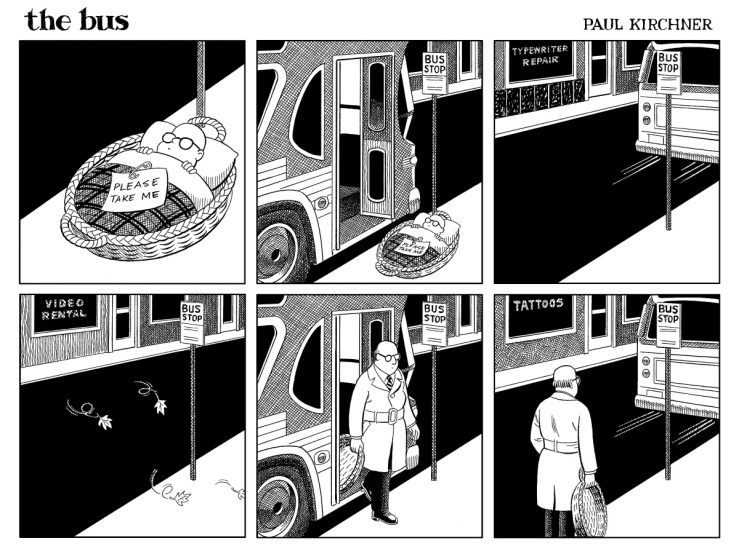
The Bus, Paul Kirchner

The Bus 2, Paul Kirchner

The Free-Lance Pall Bearers, Ishmael Reed

Vertigo, Joanna Walsh

Rocannon’s World, Ursula K. LeGuin

Censorship Now!!, Ian Svenonius

750 Years in Paris, Vincent Mahé

The Dispossessed, Ursula K. Le Guin*

The Word for World Is Forest, Ursula K. Le Guin

Planet of Exile, Ursula K. Le Guin

City of Illusions, Ursula K. Le Guin

Homesick, Lucia Berlin

The Left Hand of Darkness, Ursula K. Le Guin*

* indicates a reread

Thirty-point riff on Star Wars: The Force Awakens

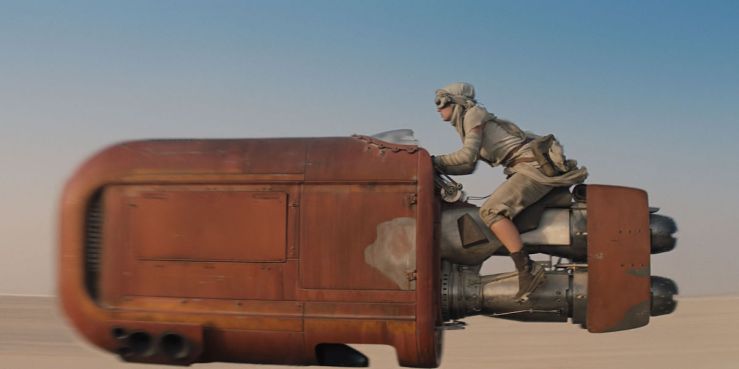
Rey-Star-Wars-Episode-7-Force-Awakens

  1. Star Wars: The Force Awakens is a fun entertainment that achieves its goals, one of which is not to transcend the confines of its brand-mythos.
  2. SW: TFA takes Star Wars itself (as brand-mythos) as its central subject. The film is “about” Star Wars.
  3. To this end, SW: TFA is basically a remake of A New Hope. My saying this is not insightful and cannot be insightful.
  4. In the first Star Wars film, A New Hope (aka Episode IV, aka simply Star Wars), George Lucas synthesized Flash Gordon and Kurosawa, Joseph Campbell and WWII serials into a cultural product that was simultaneously new and old, hokey and profound, campy and heroic.
  5. SW: TFA is not a synthesis (and does not seek to be a synthesis); rather it is a transcription, repetition, and  replication of the previous Star Wars films—particularly the so-called “original trilogy” (Episodes IV, V, and VI).
  6. Hence, SW: TFA often feels like a greatest hits collection, its sequences and visuals (engaging and visually spectacular) cribbed from the previous films. I could spend the rest of the riff outlining the correspondences—major and minor—but why? The correspondences are intentionally obvious to anyone who has seen the film; furthermore, they are not allusions, but the formal structure of the film.
  7. And this formal technique, this replication—it’s all very enjoyable and often warm and unexpectedly humorous and at times awfully sad even.
  8. And I liked the new characters very much, which I was of course supposed to. They are all in some ways replications of previously existing characters, just as the set pieces and sequences they act in/out/upon are replications.
  9. Let’s consider Rey, the heroine of The Force Awakens really quickly: She is, in some ways, a synthesis, but only a synthesis of the principals of the Star Wars brand-mythos: She is at once Han, Luke, and Leia: A figuration in the foreground: A childhood fantasy.
  10. A childhood fantasy: Watching SW: TFA feels like watching a Star Wars film—which is the film’s intention, obviously.
  11. But not obviously and really quickly and not a gripe: Isn’t there a part of us, by which us I mean me, that wants something more than the feeling of (the feeling of) a Star Wars film? That wants something transcendent—something beyond that which we have felt and can name? Something that we don’t know that we want because we haven’t felt it before?
  12. Re: Point 11: I already made an (awfully) oblique argument at some length almost three years ago about franchise films in general and Star Wars films in particular, arguing (maybe arguing) for, say, Wong Kar Wai to direct the next Star Wars film.
  13. In that riff I wrote that, “J.J. Abrams is a safe bet. I can more or less already imagine the movie he’ll make.” That prediction was incorrect only in that I enjoyed the product that he made more than I thought I would. That prediction was wholly correct in that I could imagine the product Abrams made. It was easy to imagine. I’d already seen the film dozens of times before he even made it.
  14. So, to return to point 11, the “not a gripe” point: Is the argument then that film as an art form allows us (the illusion of) a transcendent perspective? That film at its best, at its strongest and strangest, offers us a new way of seeing?
  15. (Yes).
  16. The Force Awakens is strong but not strange. Its major advancement (by which I mean break from previous films) evinces in its casting choices—but these reflect the progress of our own era, not the brand-mythos of Star Wars itself, which was of course always diverse.
  17. The Force Awakens is fun. Entertaining. Like I wrote in point 1.
  18. And, to repeat point 2 after repeating point 1: SW: TFA is “about” Star Wars.
  19. So what do I mean by this? Consider for a minute what the other Star Wars films are “about.”
  20. A New Hope is about escape and rescue, both in the literal, romantic, and metatextual sense.
  21. The Empire Strikes Back is about Oedipal anxieties and Oedipal violence, family entanglements, friendships and loyalties.
  22. Return of the Jedi is about restoration and redemption, a film about the genius of ecology over mechanization.
  23. And while the (so-called) prequels are generally reviled, I like them: They are “about” something.
  24. For example, Revenge of the Sith is about democracy and fascism, community and ego—and more of that Oedipal violence.
  25. Indeed the entire series is Oedipally structured—which The Force Awakens replicates and continues.
  26. Yet Abrams’s reverence for Star Wars bears no clear trace (at least on my first viewing) of Oedipal anxiety towards Lucas. No attempt to transcend or surpass—as such a move would entail a kind of critical (if metaphorical) violence directed at Lucas’s vision. (Notably, many of the criticisms of the so-called prequels rest on the way those films look beyond their predecessors (in a way that Abrams’s film doesn’t)).
  27. “In order to criticize a movie, you have to make another movie,” said Jean-Luc Goddard.
  28. And Harold Bloom: “Every poem is a misinterpretation of a parent poem. A poem is not an overcoming of anxiety, but is that anxiety…There are no interpretations but only misinterpretations, and so all criticism is prose poetry.”
  29. Abrams’s goal was not to criticize Star Wars or poetically engage it; his goal was to praise it—to praise it as stasis, to replicate its comforts, to avow and vindicate its forms and tropes. And he succeeded.
  30. And of course the biggest success of the film: I want to watch it again.

A review of Paul Kirchner’s surreal sequel, The Bus 2

couv-1

Paul Kirchner’s cult classic comic strip The Bus originally ran in Heavy Metal from 1979-1985. The (anti-)story of “a hapless commuter and a demonic bus” (as Kichner put it himself in a recent memoir at The Boston Globe), The Bus, at its finest moments, transcends our expectations for what a comic strip can and should do. Sure, Kirchner delivers the set-ups, gags, japes, and jests we expect from a cartoon—but more often than not The Bus surpasses the confines of its form and medium. Its protagonist The Commuter is an allegorical everyman, a passenger tripping through an absurd world. Kirchner’s strip often shows us ways to see that absurd world—which is of course our own absurd world—with fresh eyes.

Thanks in part to the internet (and, in particular, an album of scans posted at Imgur), Kirchner’s comic has found a new audience. Over the past few years, Kirchner’s produced more than 40 new strips, which are now collected in one handsome volume as The Bus 2 (or the bus 2 if you like) from French publisher Tanibis EditionsTanibis also has collected the original run of The Bus in an edition that’s more complete (and polished) than the Imgur album. These books are fantastic stuff.

The Bus 2 picks up in full satirical mode with an intro that informs us that “the studio that produced ‘The Bus’ was forced to shut down” in 1985; “Its closing left over 70 talented employees jobless.” The intro unwinds over a few pages—we’re told the bus itself and the “commuter’s iconic overcoat” are now in museums, and that the role of the commuter in this sequel will be played by the son of the actor who played the original commuter. From the outset, Kirchner uses irony to draw our attention to the artificiality of his strip, highlighting The Bus as a performance, an entertainment focused on the utterly mundane topic of a daily commute. And even though the intro unfolds over four pages, Kirchner keeps it true to form—literally: Six equal black and white panels.

The first strip in the new collection positions The Commuter as an ironic hero, a foundling in a basket like Moses or Superman (note the signs that Kirchner employs to show the passage of time):

01 Continue reading “A review of Paul Kirchner’s surreal sequel, The Bus 2”

Two graphic novels about Paris reviewed: 750 Years in Paris and The Spectators

IMG_0534

Two new(ish) graphic novels from Nobrow, Vincent Mahé’s 750 Years in Paris and Victor Hussenot’s The Spectators, showcase Paris as an enduring site of progression, turbulence, and renewal, both in culture and consciousness. Mahé’s 750 Years in Paris is a time-machine, putting its viewer in a stationary position to observe the dramatic changes in one building—and French society and culture—over the course of nearly a millennium. Hussenot’s The Spectators is a dream-machine, shuttling its characters through different skins, faces, and eyes. The titular spectators transcend not only time and space, but mind. Both books attest to the power of transformation while subtly noting the various forces that shape identity.

IMG_0614

Vincent Mahé’s 750 Years in Paris begins in 1265 and moves its viewer through time to 2015. The book takes us through the Black Death Plague and the 100 Years War, the reigns of Louis XIV and IV, the storming of the Bastille and the Reign of Terror, Napoleon and Hausmann, a grand Metro and a terrible Flood. The second shot in this chronology shows us a Knights Templar procession in 1270. The crusaders remind us that Western history is inextricably bound in violence, religion, and territorial expansion—but also in the exchange of ideas, information, and knowledge. We get to May 1968 with a strong visual context for France’s history of intellectual turbulence.

IMG_0613The book ends in 2015; I’ll let Mahé’s image speak for itself:
IMG_0612

750 Years in Paris shows us that Paris not only survives drastic change, but progresses in the face of violence. When we see, for example, that a winch has been used to hang a Protestant during the St. Bartholomew’s Day Massacre of 1572—

IMG_0615

—it’s worth noting that on the next page, neighbors help each other during a terrible fire. The winch remains in the picture, a visual motif of progress, of building up.IMG_0617

image

Like every Nobrow title I’ve read, Victor Hussenot’s The Spectators is better experienced than described. Its aesthetic is its narrative and its narrative is its aesthetic, flowing from a lovely dream-logic of identity shifts. Who shall I be today?, the book asks.

IMG_0608

The titular spectators try on different skins, wear different hats, look through different eyes. Paris’s metro becomes a labyrinth dream-lab, where the spectators create the world anew by synthesizing known with unknown:IMG_0609

This vision of synthesis carries the narrative through a poetic examination of individuality and society. How much of me is me? Hussenot frames his characters in the geometry of picture puzzles, only to blur the borders that would constrain them.

It’s possible to imagine the spectators of Hussenot’s book gazing on Mahé’s ever-changing Paris building. Or, conversely, we can take Mahé’s building as one of Hussenot’s spectators—another shapeshifter in a city of shapeshifters.

I’ll close with an image from The Spectators that points towards a dream of synthesis, of infinite perspective, of unity. We have here not just a dream, but a vision of progress:

IMG_0610