I 1 think that there is a terrible possibility now, in the World 2. We may not brush it away, we must look at it. It is possible that They 3 will not die. That it is now within the state of Their art to go on forever 4—though we, of course, will keep dying as we always have. Death 5 has been the source of Their power. It was easy enough for us to see that. If we are here once, only once 6, then clearly we are here to take what we can while we may 7. If They have taken much more, and taken not only from Earth but also from us 8 —well, why begrudge Them, when they’re just as doomed to die as we are? All in the same boat, all under the same shadow…yes…yes. But is that really true? Or is it the best, and the most carefully propagated, of all Their lies, known and unknown? 9
1 The speaker here is Father Rapier, a very minor character, one of Pynchon’s heroes of the Counterforce, the Preterite who rally (if that is the right verb, which it isn’t) around the unraveling spirit of Slothrop against the Elect.
Father Rapier is “a Jesuit . . . here to preach, like his colleague Teilhard de Chardin, against return. Here to say that critical mass cannot be ignored. Once the technical means of control have reached a certain size, a certain degree of being connected one to another, the chances for freedom are over for good.”
Rapier preaches his “Critical Mass” in a cottage in the bizarro-Limbo headquarters of the Counterforce; his shack is appropriately beshingled with the sign “DEVIL’S ADVOCATE.”
Pynchon’s Counterforce points to a coming community. Indeed, Gravity’s Rainbow might be seen as an imaginative study of postwar communities, of new forms of social organization (social organizations tellingly organized against the They): The Counterforce of disaffected rebels; the Sudwest Hereros assembling their 00001 rocket; the Argentine anarchists; the homosexuals liberated from Dora; the Anubis orgiasts (orgiers? orgy-goers? What’s the word for orgy participants?)—etc. Each of these coming communities attempts to synthesize the detritus of the War into Something New. And speaking of synthesis—
Rapier’s “colleague [Pierre] Teilhard de Chardin” (1881-1955) tried to synthesize science and spirituality in what he called an Omega Point, a spiritual/physical singularity, a condensation of spirit and mass into a “supreme consciousness”: Christ: God: Logos. Or, in Pynchon’s Rapier wit: Critical Mass.
Rapier rails against systems of control: The Elect will not fight the coming postWar Preterite communities directly, but rather enslave them via byzantine bureaucracies.
2
The World tarot card by Pamela Colman Smith, 1909
Cf. A.E. Waite’s The Pictorial Key to Tarot (1910), one of Pynchon’s sources for Gravity’s Rainbow. Some of the language here (which I’ve taken the liberty of highlighting) echoes Rapier’s Critical Mass/de Chardin’s Omega Point:
It represents also the perfection and end of the Cosmos, the secret which is within it, the rapture of the universe when it understands itself in God. It is further the state of the soul in the consciousness of Divine Vision, reflected from the self-knowing spirit. But these meanings are without prejudice to that which I have said concerning it on the material side. It has more than one message on the macrocosmic side and is, for example, the state of the restored world when the law of manifestation shall have been carried to the highest degree of natural perfection. But it is perhaps more especially a story of the past, referring to that day when all was declared to be good, when the morning stars sang together and all the Sons of God shouted for joy.
The World is what Pynchon and Gravity’s Rainbow are most interested in—both its past and its coming communities.
Significantly, The World is the final card in Captain Dominus Blicero Weissmann’s tarot (see page 746):
Weissmann’s tarot
In his thorough physical description of the World tarot card, A.E. Waite describes the central figure surrounded by “an elliptic garland…a chain of flowers intended to symbolize all sensible things.” I cannot help but see in the card an impossible ouroboros; an ouroboros with four heads corresponding to the “four living creatures of the Apocalypse and Ezekiel’s vision, attributed to the evangelists in Christian symbolism” which we find in the card’s corners. The ouroboros is minor trope in Gravity’s Rainbow.
3 The Elect. The baddies.
4 Rapier will, a few lines later, compare Them to vampires.
Here—and elsewhere in Pynchon (most clearly and perhaps most cogently in Against the Day)—the Elect—the They—manipulate and monopolize the earth’s resources in order to prolong their dominance. Those resources include humans: The Preterite: the low: the feebs.
5
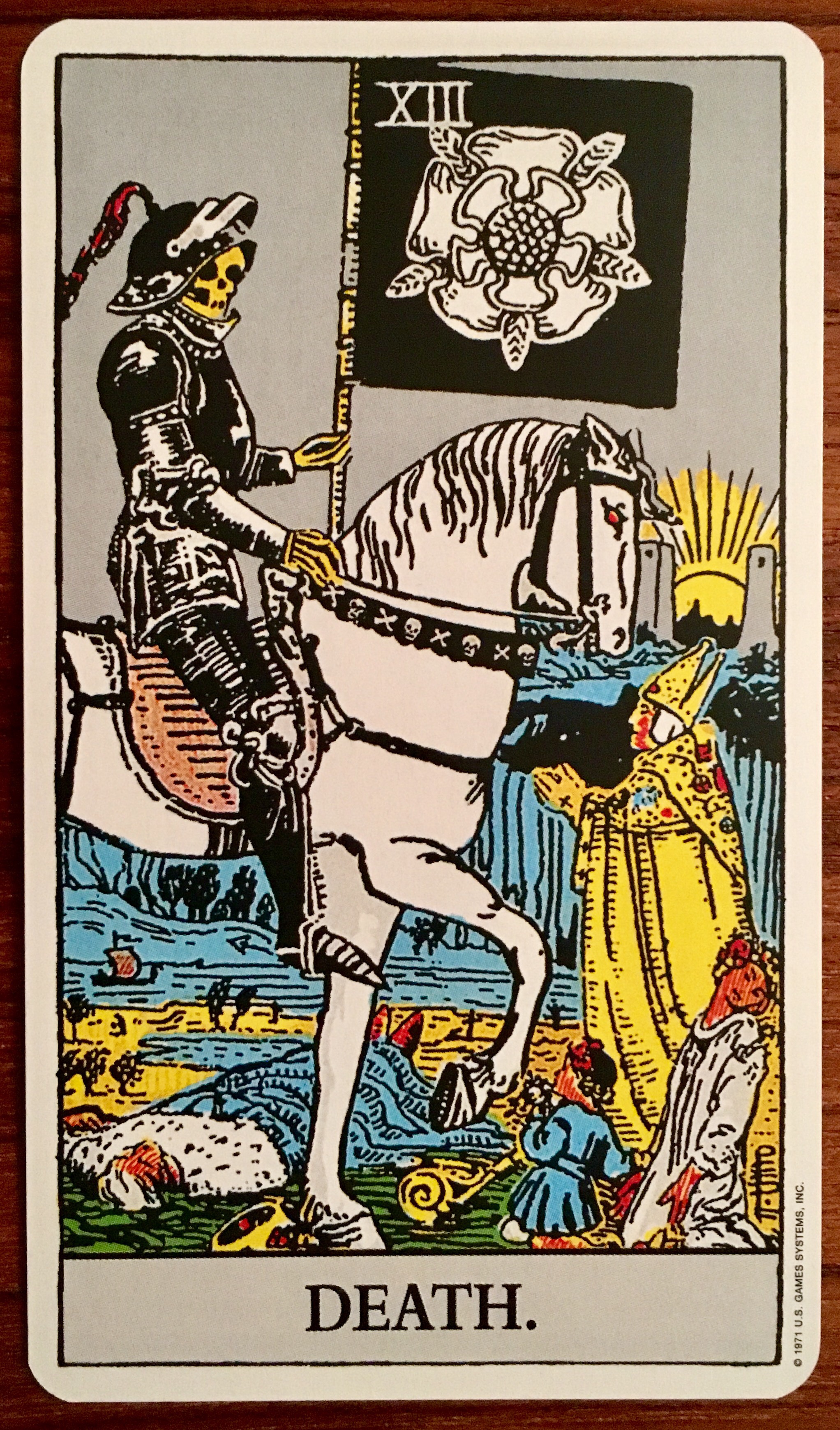
Death tarot card by Pamela Colman Smith, 1909
A.E. Waite again; again, I’ve highlighted in boldface phrases that suit my own purposes for this riff:
The veil or mask of life is perpetuated in change, transformation and passage from lower to higher, and this is more fitly represented in the rectified Tarot by one of the apocalyptic visions than by the crude notion of the reaping skeleton. Behind it lies the whole world of ascent in the spirit. The mysterious horseman moves slowly, bearing a black banner emblazoned with the Mystic Rose, which signifies life. Between two pillars on the verge of the horizon there shines the sun of immortality. The horseman carries no visible weapon, but king and child and maiden fall before him, while a prelate with clasped hands awaits his end. … The natural transit of man to the next stage of his being either is or may be one form of his progress, but the exotic and almost unknown entrance, while still in this life, into the state of mystical death is a change in the form of consciousness and the passage into a state to which ordinary death is neither the path nor gate. The existing occult explanations of the 13th card are, on the whole, better than usual, rebirth, creation, destination, renewal, and the rest.
6 If we are here once (only once), then eternal recurrence is a nonstarter.
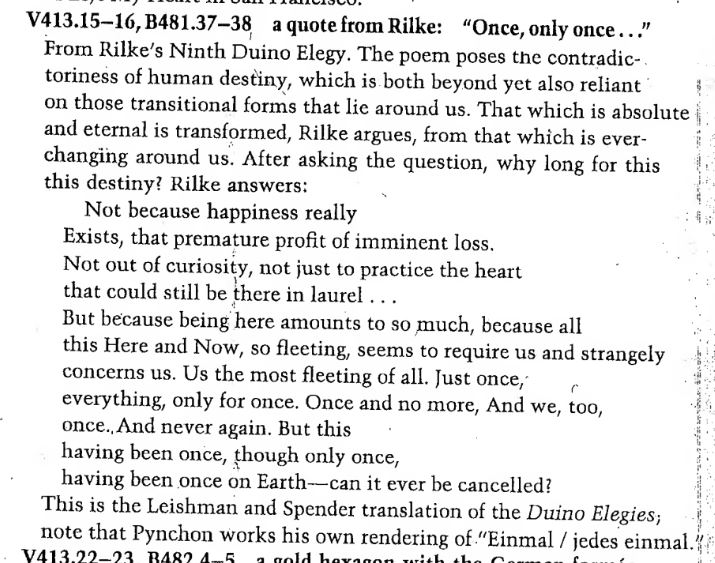
The phrase clearly echoes lines from one of Pynchon’s major GR sources, Rainer Maria Rilke’s mystical Duino Elegies (1923). From “Ninth Elegy”:
Everyone once, once only. Just once and no more.
And we also once, Never again. But this having been once, although only once, to have been of the earth,
seems irrevocable.
Once, only once, and once for all,
his precious life he gave;
before the cross in faith we fall,
and own it strong to save.
7 In “To the Virgins, to Make Much of Time, Robert Herrick (1591-1674) advised
Gather ye rosebuds while ye may,
Old Time is still a-flying;
And this same flower that smiles today
Tomorrow will be dying.
Seems like a Preterite Sermon.
8 Cf. note 4. Throughout GR, the exploitation of the earth’s natural resources is a persistent if minor theme. Gravity’s Rainbow’s ecological critiques are overlooked perhaps because it’s a given in Pynchon’s critique that They would use ecological capital and human capital without regard. Consider the Slothrop family, which made its non-fortune by milling trees into “Money, shit, and The Word” — papers the real value of which Pynchon invites us to interrogate.
9 Pynchon’s mouthpieces often hedge their bets in eithers and ors, zeroes and ones. We systems and They systems, in the parlance of the Counterforce. Are we all under the same shadow (of Death? of the falling rocket?) Are we all in the same boat?—which is to say, are we all working together toward the same coming community—are we rowing in the same direction?
In a corporate State 1, a place must be made for innocence, and its many uses 2. In developing an official version of innocence, the culture of childhood has proven invaluable 3 . Games, fairy-tales, legends from history, all the paraphernalia of make-believe 4 can be adapted and even embodied in a physical place, such as at Zwölfkinder 5. Over the years it had become a children’s resort, almost a spa. If you were an adult, you couldn’t get inside the city limits without a child escort. There was a child mayor 6, a child city council of twelve. Children picked up the papers, fruit peelings and bottles you left in the street, children gave you guided tours through the Tierpark 7, the Hoard of the Nibelungen 8, cautioning you to silence during the impressive re-enactment of Bismarck’s elevation, at the spring equinox of 1871, to prince and imperial chancellor 9,… child police reprimanded you if you were caught alone, without your child accompanying. Whoever carried on the real business of the town—it could not have been children—they were well hidden.10
From page 419 of Thomas Pynchon’s 1973 novel Gravity’s Rainbow.
1 Pynchon, as always, diagnoses not just the past and present, but the future. The state is corporate; They — the oligarchy et al. — run the show. And conceptualizing innocence is part of running that show.
2 Cf. William Blake’s Songs of Innocence and Experience (1789). In The Marriage of Heaven and Hell (1793), Blake wrote: “Without Contraries is no progression.” Without corruption there is no innocence; without abjection there is no purity; without an elect, there is no preterite.
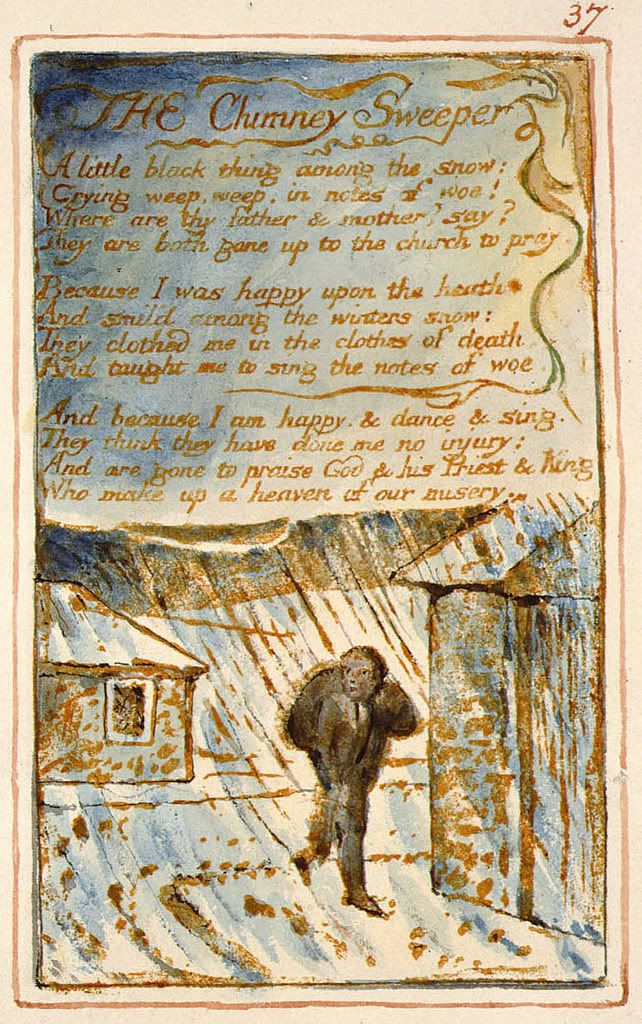
The Chimney Sweeper, William Blake, 1794
Blake’s Songs share much in common with Pynchon’s big novel—both argue for the preterite, pointing out the ways in which industrial technologies exploit the most vulnerable among us; both are wildly, acidly vivid; both employ metaphors of fall and ascent; both foreground the utterly real humanity of their subjects.
Blake’s “The Chimney Sweeper” (from Experience) shows in simple language how the official version of innocence can be used to enforce the dominant and exploitative order. Consider the last stanza:
And because I am happy and dance and sing,
They think they have done me no injury,
And are gone to praise God and his Priest and King,
Who make up a heaven of our misery
Blake’s chimney sweeper asserts his right to happiness, to laughter and joy. The creative impulse is a Counterforce against Them—here, the Priest and King. Yet They co-opt the dancing and joy and convert it into signs of “the official version of innocence”: a lie to cover over the utter corruption of the dominant order.
3 You’ve read Freud, right? Like, those ideas on infantile sexuality that are downright icky, and yet nevertheless reaffirmed and reinforced by the Corporate State? (Oligarchial capitalism simultaneously infantilizes and sexualizes its subjects). Gravity’s Rainbow does a lot of stuff it’s easier (less queasier) to write off as abject than to actually like, think through. But GR also shows that They infantilize and sexualize childhood in the service of control, as a way of establishing (and blurring and “defiling”) official versions of innocence.
Consider Our Poor Hero Tyrone Slothrop, whose conditioning as an infant by Laszlo Jamf (involving the mysterious MacGuffin Imipolex G) leads to erections that predict rocket strikes. (I swear that sentence makes sense).
4 “Games, fairy-tales, legends from history, all the paraphernalia of make-believecan be adapted and even embodied in a physical places” — physical places like Gravity’s Rainbow. Well, okay. I mean, we get a condensation here of Pynchon’s process, his synthesis, his grab-bag of songs and japes and jibes and jokes and tales and etcetera.
But Pynchon’s pointing out other, perhaps more nefarious and venal and corporate uses for the same cultural material he’s massaging: A fucking theme park. Like, uh, Disneyland. Or Disneyworld. Etcetera, you get it—that we—did I just write We?!—I want to say They—that They colonize and corporatize the imagination; that They gobble up the cultural material and excrete it in smooth, digestible, sanitized (yet subtly sexualized)—and consumable, marketable!—segments that we take our kids to queue up to experience in their innocence.
5 As always, Pynchon Wiki does it better than I can:
“Twelve Children” – the name evokes Jacob’s twelve sons (and the daughter who is not one of the official twelve). This pattern is self-consciously repeated in the Grimms’ tale “The Twelve Brothers”, where the boys are to die if their mother gives birth to a girl.
The camp, which is also a quasi-town, may be modelled after Theresienstadt, the Jewish town/Lager set up by the Nazis in what is now the Czech Republic. This is suggested by themes like transit, phoney children’s paradise, as well as the large orchestra, or the number 60,000 (the number of those who “passed through” Zwölfkinder as well the population of Theresienstadt at its peak). It also recalls another totalitarian institution, that of the communist “children’s towns” (large, town-like, somewhat militarized holiday camps for Young Pioneers), whose prototype was Artek in the Soviet Union. (Deutsches Jungvolk also had its summer camps.)
Further, consider Argentina’s Republic of Children, a city proportioned for children, which was created under Juan Peron’s regime and opened in 1951.
The Oedipal plot of Grimms’ “The Twelve Children” repeats throughout Gravity’s Rainbow, and I invite you to look for it lurking in Disney.
“The brothers were full of joy, and embraced her with fondest affection,” Mary Hamilton Fry, 1912
“At the entrance to the town, barring their way, stands the Midget who played the lead in Freaks. The one with the German accent. He is the town sheriff. He is wearing an enormous gold star that nearly covers his chest.”
The little person referenced is Harry Earles who played Hans in Freaks (1932; dir. Tod Browning).
7 The zoo.
8 A vast treasure hoard, such as Scrooge McDuck might dive into, or Bilbo Baggins and his pals might play upon.
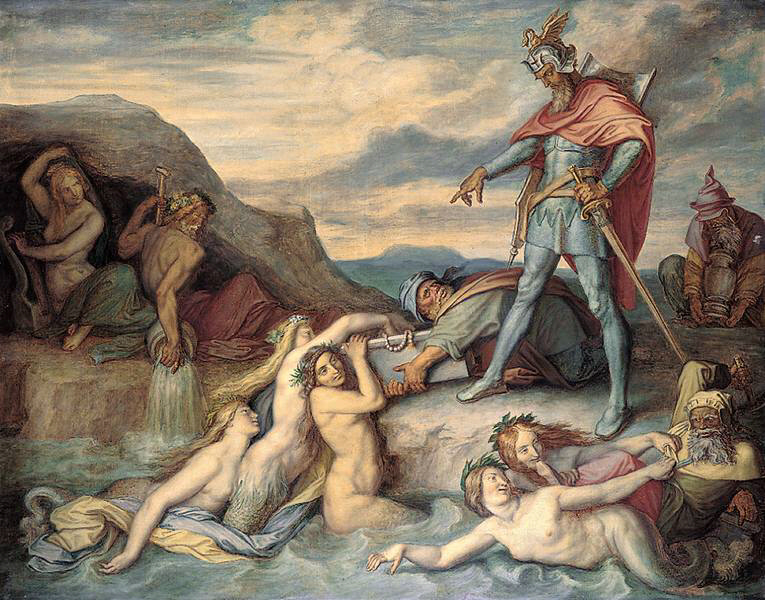
The Nibelungen Hoard, as I’m sure you know, is the treasure of the Nibelungen. (You know Wagner’s Ring Cycle, eh? Or you’ve read Tolkien’s The Lord of the Rings, right?—you get the idea. The titular Nibelung is the dwarf Alberich, by the way).
The tale of that same treasure might well your wonder raise;
’T was much as twelve huge wagons in four whole nights and days
Could carry from the mountain down to the salt-sea bay,
If to and fro each wagon thrice journeyed every day.
It was made up of nothing but precious stones and gold;
Were all the world bought from it, and down the value told,
Not a mark the less thereafter were left, than erst was scored.
Good reason sure had Hagan to covet such a hoard.
Hagen Orders Servants to Sink the Hoard in the Rhine, Peter von Cornelius (1859)
In the Nibelungenlied, Hagen murders the hero Siegfried and then steals and hides the Nibelung hoard.
9 Otto von Bismarck, 1815-1898, who unified Germany through technocracy and, uh, war.
10 “…they were well hidden”: A précis of Pynchonian paranoia, perhaps.
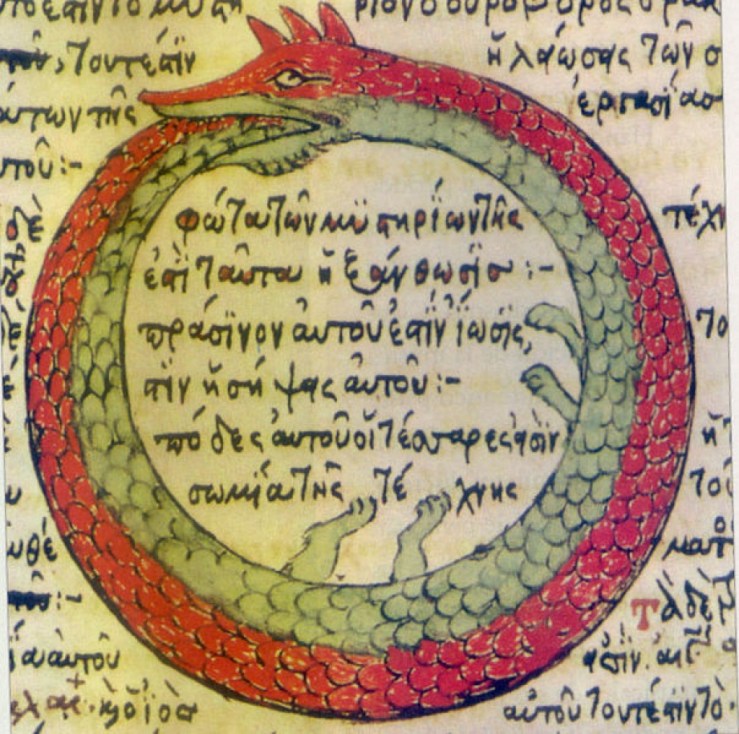
Kekulé 1 dreams 2 the Great Serpent holding its own tail in its mouth, the dreaming Serpent which surrounds the World 3. But the meanness, the cynicism with which this dream is to be used 4. The Serpent that announces, “The World is a closed thing, cyclical, resonant, eternally-returning,” 5 is to be delivered into a system 6 whose only aim is to violate the Cycle. Taking and not giving back, demanding that “productivity” and “earnings” keep on increasing with time, the System removing from the rest of the World these vast quantities of energy to keep its own tiny desperate fraction showing a profit: and not only most of humanity—most of the World, animal, vegetable and mineral, is laid waste in the process 7 . The System may or may not understand that it’s only buying time. And that time is an artificial resource to begin with, of no value to anyone or anything but the System, which sooner or later must crash to its death, when its addiction to energy has become more than the rest of the World can supply 8 , dragging with it innocent souls all along the chain of life. Living inside the System is like riding across the country in a bus driven by a maniac bent on suicide… though he’s amiable enough, keeps cracking jokes 9 back through the loudspeaker, “Good morning folks, this is Heidelberg 10 here we’re coming into now, you know the old refrain, ‘I lost my heart in Heidelberg,’ 11 well I have a friend who lost both his ears here! Don’t get me wrong, it’s really a nice town, the people are warm and wonderful—when they’re not dueling. Seriously though, they treat you just fine, they don’t just give you the key to the city, they give you the bung-starter!” 12 u.s.w. 13 On you 14 roll, across a countryside whose light is forever changing 15 —castles, heaps of rock, moons of different shapes and colors come and go. There are stops at odd hours of the mornings, for reasons that are not announced: you get out to stretch in lime-lit courtyards where the old men sit around the table under enormous eucalyptus trees you can smell in the night, shuffling the ancient decks oily and worn, throwing down swords and cups 16 and trumps major in the tremor of light while behind them the bus is idling, waiting—passengers will now reclaim their seats and much as you’d like to stay, right here, learn the game, find your old age around this quiet table, it’s no use 17 : he is waiting beside the door of the bus in his pressed uniform, Lord of the Night he is checking your tickets, your ID and travel papers 18 , and it’s the wands of enterprise 19 that dominate tonight… as he nods you by, you catch a glimpse of his face, his insane, committed eyes, and you remember then, for a terrible few heartbeats, that of course it will end for you all in blood, in shock, without dignity 20 —but there is meanwhile this trip to be on… over your own seat, where there ought to be an advertising plaque, is instead a quote from Rilke: “Once, only once…” 21 One of Their favorite slogans. No return, no salvation, no Cycle—that’s not what They, nor Their brilliant employee Kekulé, have taken the Serpent to mean. No: what the Serpent means is—how’s this—that the six carbon atoms of benzene are in fact curled around into a closed ring, just like that snake with its tail in its mouth, GET IT? 22
From pages 412-13 of Thomas Pynchon’s novel Gravity’s Rainbow.
1 Friedrich August Kekulé, 1829–1896, German chemist—the “father of organic chemistry.” (Our arts and sciences must be fathered, it seems).
East German Kekulé, postage stamp (with the benzene compound), 1979
[11], 397-433. This long chapter, consisting mostly of one long recollection, narrated in the past tense, tells the story of Franz Pökler […] Pökler dreamed about the history of Friedrich August Kekulé, father of organic chemistry (410-13), and about Kekulé’s dream: a serpent with its tail in its mouth. We learn how this dream was misused by the System, as the foundation for understanding the benzine ring. All this is lectured on by “Pökler’s old prof,” Laszlo Jamf.
A neat little summary, yes.
Kekulé’s most notable contribution to chemistry—and capitalism!—is in his work on describing the structure of that valuable petrochemical benzene.
Formule chimique développée du benzène inscrite dans le dessin de l’Ouroboros (serpent qui se mord la queue), Haltopub, 2013
Kekulé’s dream-image-symbol is clearly compelling for both the reader and, I think, for Pynchon. Gravity’s Rainbow is very much about the overlap between physical and metaphysical, and Kekulé’s vision points to the convergence of dream and experience, magic and science.
3Ouroboros is literally tail-devouring in Greek, but through surreal etymological phonological dream-time leaps, we can get to tale-devouring (why not?—okay, I guess maybe that’s mythosboros or something like that, but hell—–).
In any case, the serpent, or Serpent, here strikes me as one of Pynchon’s Moves Against Them—he taps into an older myth, one that elevates the Scaly and Low—the Preterite?—into an Elect position that the Christian Tradition simply doesn’t care for, what with the Tempting Serpent and all. No, no shedding of the skin, no eternal return…no, no return at all. Cf. a few lines later in the passage cited above: “No return, no salvation, no Cycle—that’s not what They, nor Their brilliant employee Kekulé, have taken the Serpent to mean.”
Horapollo, referring to the serpent symbol, says of it:— ‘When the Egyptians would represent the Universe they delineate a serpent bespeckled with variegated scales, devouring its own tail, the scales intimating the stars in the Universe. The animal is extremely heavy, as is the earth, and extremely slippery like the water, moreover, it every year puts off its old age with its skin, as in the Universe the annual period effects a corresponding change and becomes renovated, and the making use of its own body for food implies that all things whatever, which are generated by divine providence in the world, undergo a corruption into them again.’
4 Used by Them.
Gravity’s Rainbow is clearly about paranoia of Them, and as such (necessarily), Pynchon’s targets are…nebulous. (Although technology and the Military-Industrial-Entertainment Complex that technology works through might be a manifest if not wholly concrete villain in GR.). Pynchon’s big novel Against the Day offers a more specific locus for everything wrong with Them in its awful villain Scarsdale Vibe and his henchmen and lackeys.
5 You are of course familiar with the concept of eternal recurrence, no?
6 Oligarchial capitalism.
7 Pynchon seems to describe the past few centuries here, and probably the future.
8Gravity’s Ranbow was published in 1973, folks…
9 …but of course, Pynchon is also describing now, which is to say, his narrative’s own future.
10 A charming German city famous for its university.
12 A wooden mallet for opening the bung of a cask (or wine or beer). I visited Heidelberg when I was 16 and drank copious quantities of ale.
13 “u.s.w.” — German acronym for und so weiter; translates to etcetera. Pynchon allows the tape to roll on in his reader’s head.
14 Always beware Gravity’s Rainbow’s shifts into second-person! Look at this ride that Pynchon’s put us on…but wait…we’re already on the ride.
15 A rainbow image.
16 Tarot references abound in Gravity’s Rainbow.
3 of Swords, Sola-Busca Tarot (1491; reprint by Wolfgang Mayer, 1998)
17 The preterite’s complaint: Wisdom shall not be found, order will not reveal itself, meaning will be suspended indefinitely.
18 Our wacky busdriver is actually “the Lord of the Night,” an ominous and perhaps self-explanatory title (and one that resonates with the passage’s mythological overtones and tarot motif). The Lords of the Night are figures in both the Mayan and Aztec calendars, but I’m not sure if Pynchon’s referencing them here—although this passage is deeply concerned with the apprehension and management of time. This Lord of the Night, you’ll note—a stickler for paperwork—is awfully bureaucratic.
19 Oligarchial capitalism. The wands are another suit in the tarot deck. (The upright three of wands is associated with enterprise).
20 The strange trip here echoes Gravity’s Rainbow’s bewildering opening “evacuation” sequence, and the line I’ve noted recalls to me a line I’ve cited at least twice now in these annotations.
From the novel’s sixth paragraph:
“You didn’t really believe you’d be saved. Come, we all know who we are by now. No one was ever going to take the trouble to save you, old fellow. . . .”
21 In A Gravity’s Rainbow Companion, Weisenburger provides the following context for the Rilke quote:
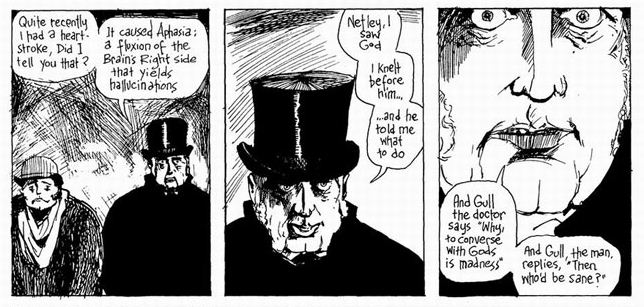
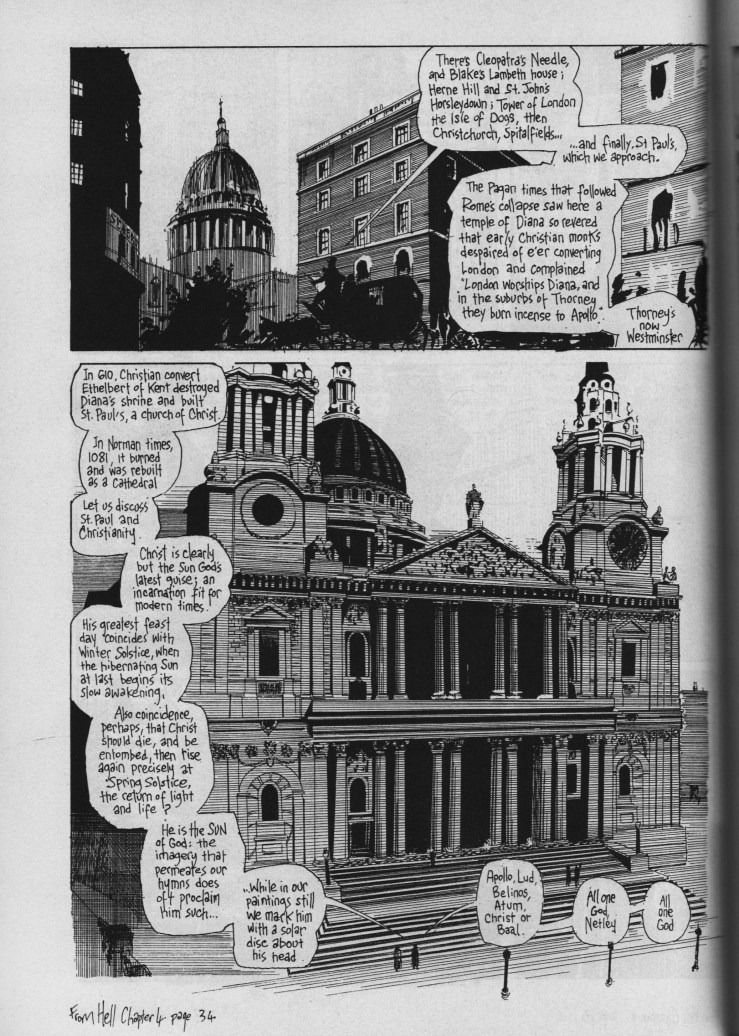
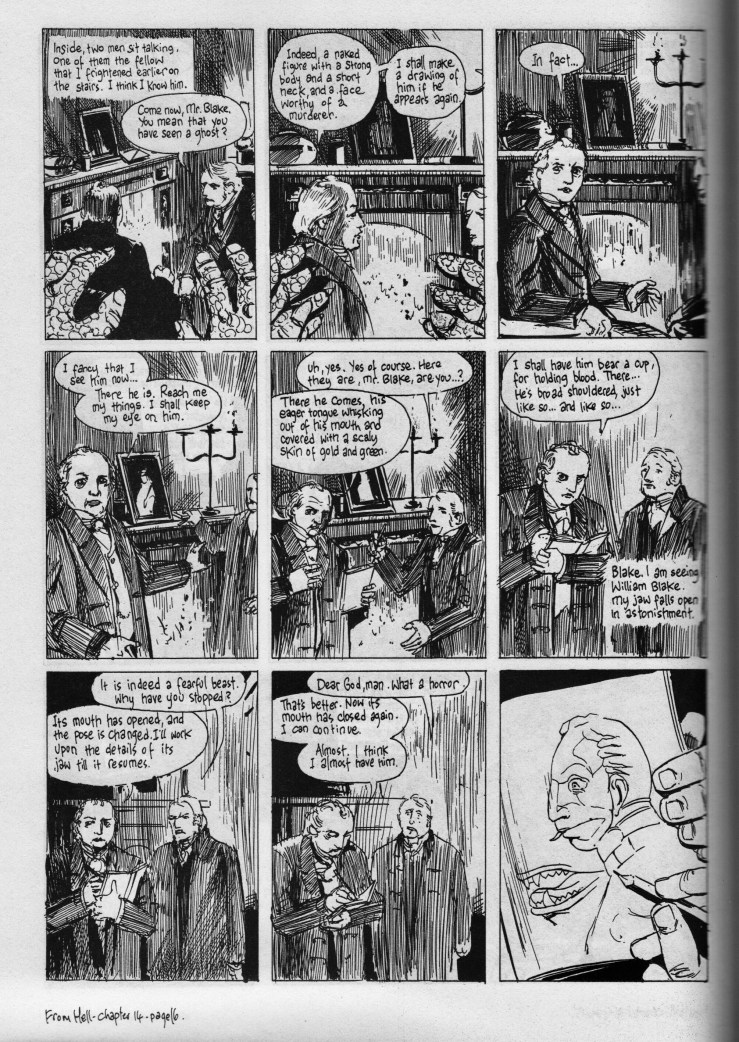
From Hell, Alan Moore and Eddie Campbell’s epic revision of the Jack the Ripper story, posits Sir William Gull, a physician to Queen Victoria, as the orchestrator of the Ripper murders that terrified Londoners at the end of the 19th century. The murders initially arise as a means to cover up an illegitimate son begat by foolish Prince Albert, Victoria’s grandson. However, for Gull the murders represent much more. The murders are part of the continued forces of “masculine rationality” that will constrain “lunar female power.” Gull is a high-level Mason; during a stroke, he experiences a vision of the Masonic god Jahbulon, one which prompts him to his “great work”–namely, the murders that will reify masculine dominance.
One of the standout chapters in the book is Gull’s tour of London, with his hapless (and witless) sidekick Netley. In a trip that weds geography, religion, politics, and mythology, Gull riffs on a barbaric, hermetic history of London, revealing the gritty city as an ongoing site of conflict between paganism and orthodoxy, artistic lunacy and scientific rationality, female and male, left brain and right brain. The tour ends with a plan to commit the first murder.
From there, the book picks up the story of Frederick Abberline, the Scotland Yard inspector charged with solving the murders. Of course, the murders are unsolvable, as the hierarchy of London–from the Queen down to the head of police–are well aware of who the (government-commissioned) murderer is. The police procedural aspects of the plot are fascinating and offer a balanced contrast with Gull’s mystical visions–visions that culminate in a climax of a sort of time-travel. Gull goes backwards (William Blake sees him in a vision and turns that vision into Ghost of Flea) and Gull goes forwards: he sees London at the end of the twentieth century, and receives a guarantee that his murder plot has had its intended effect.
From Hell takes many of its cues from the idea that history is shaped not by random events, but rather by tragic conspiracies that force people to willingly give up freedom to a “rational” authority. The book points repeatedly to the 1811 Ratcliffe Highway murders, which led directly to the world’s first modern police force. In our own time, if we’re open to conspiracy theories, we might find the same pattern in the 21st century responses to terrorism.
Although From Hell features moments of supernatural horror in Gull’s mysticism, it is the book’s grimy realism that is far more terrifying. London in the late 1880s is no place you want to be, especially if you are poor, especially if you are a woman. The city is its own character, a labyrinth larded with ancient secrets the inhabitants of which cannot hope to plumb. Despite the nineteenth century’s claims for enlightenment and rationality, this London is bizarrely cruel and deeply unfair. Campbell’s style evokes this London and its denizens with a surreal brilliance; his dark inks are by turns exacting and then erratic, concentrated and purposeful and then wild and severe. The art is somehow both rich and stark, like the coal-begrimed London it replicates. Although Moore has much to say, he allows Campbell’s art to forward the plot whenever possible. Moore is erudite and fascinating; even when one of his characters is lecturing us, it’s a lecture we want to hear. His ear for dialog and tone lends great sympathy to each of the characters, especially the unfortunate women who must turn to prostitution to earn their “doss” money. And while Abberline’s frustrations at having to solve a crime that no higher-ups want solve make him the hero of this story, Gull’s mystic madness makes him the narrative’s dominant figure.
From Hell is a fantastic starting place for anyone interested in Moore’s work, more self-contained than his comics that reimagine superhero myths, like Watchmen or Swamp Thing, and more satisfying and fully achieved than Promethea or V Is for Vendetta. Be forewarned that it is a graphic graphic novel, although I do not believe its violence is gratuitous or purposeless. Indeed, From Hell aspires to remark upon the futility and ugliness of cyclical violence, and it does so with wisdom and verve. Highly recommended.
Dracula is a character in Roberto Bolaño’s dark opus 2666.
Specifically, I’m suggesting that Dracula (like, theCount Dracula) is the unnamed SS officer in “The Part About Archimboldi” who hosts a strange party in a Romanian castle.
II. I’m willing to concede that my idea is probably full of holes and more than a little silly, but I think there’s some textual support for such a claim.
III. I’ve already suggested on this blog that 2666 is full of lycanthropic transformations, and in that earlier essay, I linked werewolves to vampires (using the work of mythologist Sabine Baring-Gould).
It’s a work of mesmerism and transformation—vampire powers. Dracula showing up is a winking sick joke, a satire.
IV. In his post “Castle Dracula” at Infinite Zombies, Daryl L. L. Houston connects the many strands of vampirism that run through 2666, suggesting that “Bolaño is using the vampirism in the story, and Dracula in particular, to tie together some of the threads he’s been unwinding pertaining to insiders and outsiders, parasitism and consumption of people, and a sort of larger parasitism of nations.” Hence Aztec blood rituals, the Holocaust, the murder of helpless, marginalized women in Santa Teresa . . .
V. Okay, so back to that thesis. Let’s start with the first appearance of the unnamed SS officer:
At midmorning they came to a castle. The only people there were three Romanians and an SS officer who was acting as butler and who put them right to work, after serving them a breakfast consisting of a glass of cold milk and a scrap of bread, which some soldiers left untouched in disgust. Everyone, except for four soldiers who stood guard, among them Reiter, whom the SS officer judged ill suited for the task of tidying the castle, left their rifles in the kitchen and set to work sweeping, mopping, dusting lamps, putting clean sheets on the beds.
Fairly banal, right? Also, “midmorning” would entail, y’know, sunlight, which is poison for most vampires. Let me chalk this up to the idea that the SS officer is inside the castle, which is sufficiently gloomy and dark enough to protect him (I’m not going to get into any vampire rules that might spoil my fun, dammit!). In any case, hardly noteworthy. Indeed, the SS officer—a butler commanding house chores—seems hardly a figure of major importance.
VI. Next, we get the Romanian castle explicitly identified as “Dracula’s castle” and meet the actors for this milieu:
“And what are you doing here, at Dracula’s castle?” asked the baroness.
“Serving the Reich,” said Reiter, and for the first time he looked at her.
He thought she was stunningly beautiful, much more so than when he had known her. A few steps from them, waiting, was General Entrescu, who couldn’t stop smiling, and the young scholar Popescu, who more than once exclaimed: wonderful, wonderful, yet again the sword of fate severs the head from the hydra of chance.
(I love Popescu’s line here).
VII. Our principals soon take a tour of castle and environs, led by the SS officer (boldface emphasis is mine):
Soon they came to a crypt dug out of the rock. An iron gate, with a coat of arms eroded by time, barred the entrance. The SS officer, who behaved as if he owned the castle, took a key out of his pocket and let them in. Then he switched on a flashlight and they all ventured into the crypt, except for Reiter, who remained on guard at the door at the signal of one of the officers.
So Reiter stood there, watching the stone stairs that led down into the dark, and the desolate garden through which they had come, and the towers of the castle like two gray candles on a deserted altar. Then he felt for a cigarette in his jacket, lit it, and gazed at the gray sky, the distant valleys, and thought about the Baroness Von Zumpe’s face as the cigarette ash dropped to the ground and little by little he fell asleep, leaning on the stone wall. Then he dreamed about the inside of the crypt. The stairs led down to an amphitheater only partially illuminated by the SS officer’s flashlight. He dreamed that the visitors were laughing, all except one of the general staff officers, who wept and searched for a place to hide. He dreamed that Hoensch recited a poem by Wolfram von Eschenbach and then spat blood. He dreamed that among them they had agreed to eat the Baroness Von Zumpe.
He woke with a start and almost bolted down the stairs to confirm with his own eyes that nothing he had dreamed was real.
When the visitors returned to the surface, anyone, even the least astute observer, could have seen that they were divided into two groups, those who were pale when they emerged, as if they had glimpsed something momentous down below, and those who appeared with a half smile sketched on their faces, as if they had just been reapprised of the naivete of the human race.
Bolaño concludes the crypt passage by highlighting an essential ambiguity that courses throughout the entire “Castle Dracula” episode, a strange axis of horror/humor, romance/banality. What has been revealed in the crypt? We don’t know, of course, but our surrogate Reiter allows us access to a few visions of what might have happened, including terror and fear and cannibalism. (He employs Hawthorne’s escape hatch too—it was all a dream).
The Knight of Death, Salvador Dali
VIII. Then, supper time:
That night, during dinner, they talked about the crypt, but they also talked about other things. They talked about death. Hoensch said that death itself was only an illusion under permanent construction, that in reality it didn’t exist. The SS officer said death was a necessity: no one in his right mind, he said, would stand for a world full of turtles or giraffes. Death, he concluded, served a regulatory function.
Clearly it’s easy to link any of the dinnertime comments about death to Dracula, but note that the SS officer’s idea that death is a “regulatory function” is terribly banal, is quite literally regular—this idea contrasts with Hoensch’s more poetic notion that death is an illusion (an illusion that the SS officer, if he is in fact Count Dracula, would realize in a perfectly mundane way that foreclosed the necessity of metaphor).
IX. Dinner conversation turns to murder—obviously one of the central themes of 2666:
The SS officer said that murder was an ambiguous, confusing, imprecise, vague, ill-defined word, easily misused.
Again, ambiguity: on one hand, sure, an SS officer’s job was in large part about coordinating and executing mass murder. At the same time, we might appreciate that murder is a vague term if people are one’s lunch.
X. Then conversation turns to culture:
The SS officer said culture was the call of the blood, a call better heard by night than by day, and also, he said, a decoder of fate.
I’m pretty sure that this was the moment I started entertaining the fancy that the SS officer might be Dracula.
XI. Popescu the intellectual also seems to reconsider the SS officer:
The intellectual Popescu remained standing, next to the fireplace, observing the SS officer with curiosity.
XII. Then, they finally riff on Dracula. Significantly, the SS officer believes that Dracula is a good German (bold emphasis mine):
First they praised the assortment of little cakes and then, without pause, they began to talk about Count Dracula, as if they had been waiting all night for this moment. It wasn’t long before they broke into two factions, those who believed in the count and those who didn’t. Among the latter were the general staff officer, General Entrescu, and the Baroness Von Zumpe. Among the former were Popescu, Hoensch, and the SS officer, though Popescu claimed that Dracula, whose real name was Vlad Tepes, aka Vlad the Impaler, was Romanian, and Hoensch and the SS officer claimed that Dracula was a noble Teuton, who had left Germany accused of an imaginary act of treason or disloyalty and had come to live with some of his loyal retainers in Transylvania a long time before Vlad Tepes was born, and while they didn’t deny Tepes a real historical or Transylvanian existence, they believed that his methods, as revealed by his alias or nickname, had little or nothing to do with the methods of Dracula, who was more of a strangler than an impaler, and sometimes a throat slitter, and whose life abroad, so to speak, had been a constant dizzying spin, a constant abysmal penitence.
The SS officer is the noble Teuton. More importantly, we get language that connects Dracula to the murders in Santa Teresa, most of which are stranglings; we also get the idea that Dracula has had a “life abroad”—one outside of time—a life that might see his spirit inhabit and ventriloquize an industrial city in the north of Mexico. (Or not. I know. Look, I’m just riffing here).
We also get the idea of an abyss (this is the structure of 2666), as well as the idea of Dracula as a penitent of sorts.
So, let us recall that early in “The Part About the Crimes,” detective Juan de Dios Martinez is searching for a criminal dubbed The Penitent who desecrates churches and has committed a few murders in the process. He goes to psychologist Elvira Campos for help:
Sacraphobia is fear or hatred of the sacred, of sacred objects, especially from your own religion, said Elvira Campos. He thought about making a reference to Dracula, who fled crucifixes, but he was afraid the director would laugh at him. And you believe the Penitent suffers from sacraphobia? I’ve given it some thought, and I do. A few days ago he disemboweled a priest and another person, said Juan de Dios Martinez.
This is the first mention of Dracula in 2666, and he’s explicitly likened to the Penitent; later, as we see above, Dracula will be explicitly linked to penitence.
(I’m not suggesting that the Penitent is Dracula traveled to Mexico to piss in churches. What I want to say is that Dracula’s dark spirit ventriloquizes the text of 2666).
(I’m also suggesting, again, that 2666 be read intertextaully).
Riding with Death, Jean-Michel Basquiat
XIII. Our other principals continue to discuss Dracula, but I won’t belabor that discussion (I’d prefer you, dear reader, to return to the text).
I will summarize though: Popescu sees Dracula in nationalistic terms (“a Romanian patriot” who repels the Turks), and General Entrescu goes on a long rant about heroism and villainy and history, culminating in a lengthy digression on Jesus Christ (recall now that Entrescu will be crucified JC-style by his men).
One aside on the SS officer bears mentioning: we learn that “the fastidious SS officer” is the most sober conversant as he “scarcely wet his lips with alcohol.” (Because he’s a vampire who prefers blood! Muahahahaha!)
XIV. Fast forward a few hours. Our man Reiter, among fellow soldiers, sets out to explore the secret crannies and passageways of Castle Drac and play voyeur:
The room they came to was empty and cold, as if Dracula had just stepped out. The only thing there was an old mirror that Wilke lifted off the stone wall, uncovering a secret passageway.
Dracula’s spirit leaves the room, creating an opening, behind the ever-symbolic mirror. (Muahahahaha!). (2666: Mirror, tunnels, chambers, labyrinths).
They enter the passageway and come first upon our supposed Dracula, the SS officer:
And so they were able to look into the room of the SS officer, lit by three candles, and they saw the SS officer up, wrapped in a robe, writing something at a table near the fireplace. The expression on his face was forlorn. And although that was all there was to see, Wilke and Reiter patted each other on the back, because only then were they sure they were on the right path. They moved on.
XV. Dracula, the epistolary novel. Count Dracula, troubled writer of letters, will author the following scenes, his spirit ventriloquizing the principals all: Here, we find Reiter and his homeboy Wilke, lurking in a secret passage, jerking off to werewolf-cum-Jesus-Christ-figure Gen. Entrescu screwing the lovely Baroness Von Zumpe and reciting poetry (emphasis per usual mine):
Then Wilke came on the wall and mumbled something too, a soldier’s prayer, and soon afterward Reiter came on the wall and bit his lips without saying a word. And then Entrescu got up and they saw, or thought they saw, drops of blood on his penis shiny with semen and vaginal fluid, and then Baroness Von Zumpe asked for a glass of vodka, and then they watched as Entrescu and the baroness stood entwined, each with a glass in hand and an air of distraction, and then Entrescu recited a poem in his tongue, which the baroness didn’t understand but whose musicality she lauded, and then Entrescu closed his eyes and cocked his head as if to listen to something, the music of the spheres, and then he opened his eyes and sat at the table and set the baroness on his cock, erect again (the famous foot-long cock, pride of the Romanian army), and the cries and moans and tears resumed, and as the baroness sank down onto Entrescu’s cock or Entrescu’s cock rose up into the Baroness Von Zumpe, the Romanian general recited a new poem, a poem that he accompanied by waving both arms (the baroness clinging to his neck), a poem that again neither of them understood, except for the word Dracula,which was repeated every four lines, a poem that might have been martial or satirical or metaphysical or marmoreal or even anti-German, but whose rhythm seemed made to order for the occasion, a poem that the young baroness, sitting astride Entrescu’s thighs, celebrated by swaying back and forth, like a little shepherdess gone wild in the vastness of Asia, digging her nails into her lover’s neck, scrubbing the blood that still flowed from her right hand on her lover’s face, smearing the corners of his lips with blood, while Entrescu, undeterred, continued to recite his poem in which the word Dracula sounded every four lines, a poem that was surely satirical, decided Reiter (with infinite joy) as Wilke jerked off again.
I contend that the poem is the work of the SS officer, psychic mesmerist, the poet Dracula, a poem no one in the scene can understand, a dark satire that might also be a war poem or a love poem or an elegy, but definitely a dark satire, written in violence and sex and blood, a poem that ventriloquizes not only Entrescu, phallic delivery device, but also the baroness, and also Reiter and Wilke. And perhaps the reader.
XVI. Where to go after such a climax? Maybe point out that Dracula infects Reiter and Wilke, of whom we learn:
Some of their battalion comrades dubbed them the vampires.
(But better to return I think to our strange figure, the SS officer).
XVII. Here, his last appearance:
The next morning the detachment left the castle after the departure of the two carloads of guests. Only the SS officer remained behind while they swept, washed, and tidied everything. Then, when the officer was fully satisfied with their efforts, he ordered them off and the detachment climbed into the truck and headed back down to the plain. Only the SS officer’s car—with no driver, which was odd—was left at the castle. As they drove away, Reiter saw the officer: he had climbed up to the battlements and was watching the detachment leave, craning his neck, rising up on tiptoe, until the castle, on the one hand, and the truck, on the other, disappeared from view.
Dracula stays in Dracula’s castle; his spirit, his seed, his blood seeps out.
In Yoko Ogawa’s new collection Revenge, eleven stories of fascinating morbidity intertwine at oblique angles. Tale extends into tale: characters, settings, and images float intertextually from chapter to chapter, layering and reticulating themes of death, crime, consumption, and creation. (And revenge, of course. Let’s not forget revenge). Not quite a story cycle or a novel-in-tales, Revenge’s sum is nevertheless greater than its parts. It’s a brisk, engaging read, and as I worked my way to the final story, I already anticipated returning to the beginning to pull at the motifs threading through the book.
The book’s dominant motifs of death and food arrive in the first tale, “Afternoon Bakery,” where a mother tries to buy strawberry shortcakes for her dead son’s birthday—only the baker is too busy bawling to attend to sales. We learn why this baker is crying in “Fruit Juice,” the second story, a tale that ends inexplicably with an abandoned post office full of kiwi fruit. The third story, “Old Mrs. J” (one of Revenge’s stand-outs) perhaps answers where those kiwis came from. More importantly, “Old Mrs. J,” with its writer-protagonist, elegantly introduces the thematic textual instability of the collection. There’s a haunting suspicion here that the characters who glide from one tale to the next aren’t necessarily the silent extras they seem to be on the surface. Our characters, background and fore, are doppelgängers, ghost writers, phantoms.
The penultimate tale “Tomatoes and the Full Moon” lays the ghosting bare. Its protagonist is a magazine writer, whose “articles” really amount to little more than advertising. Staying at a seaside resort, he’s pestered by an old woman, one of the many witches who haunt Revenge. The old woman claims to be a novelist, and points out one of her books in the resort’s library:
Later, in my room, I read ‘Afternoon at the Bakery.’ It was about a woman who goes to buy a birthday cake for her dead son. That was the whole story. I should have gone back to my article, but I read her novel through twice, finishing for the second time at 3:00 a.m. The prose was unremarkable, as were the plot an characters, but there was an icy current running under her words, and I found myself wanting to plunge into it again and again.
The final line is perhaps a description of Revenge’s haunting intertextual program—although to be clear, Ogawa’s plot and characters are hardly “unremarkable,” and her prose, in Stephen Snyder’s English translation, is lucid and descriptive. It’s the “icy current running under her words” that makes Ogawa’s tales stick so disconcertingly in the reader’s psychic gullet. And if her prose is at times “unremarkable,” it’s all in the service of creating a unifying tone. All eleven tales are narrated in first-person, and each narrator is bound to the limits of his or her own language.
These limitations of language bump up against the odd, the spectacular, the alien, as in “Sewing for the Heart”:
She had explained that she was born with her heart outside of her chest—as difficult as that might be to imagine.
The line is wonderful in its mundane trajectory: Our narrator, an artisan bagmaker, witnesses this woman who lives with her heart outside her chest and concedes that such a thing might be “difficult . . . to imagine”! There’s something terribly paltry in this, but it’s also purposeful and controlled: Here we find the real in magical realism.
But this bagmaker can imagine, as we see in an extraordinary passage that moves from the phenomenological world of sight and sound and into the realm of our narrator’s strange desires:
She began to sing, but I could not make out the words. It must have been a love song, to judge from the slightly pained expression on her face, and the way she tightly gripped the microphone. I noticed a flash of white skin on her neck. As she reached the climax of the song, her eyes half closed and her shoulders thrown back, a shudder passed through her body. She moved her arm across her chest to cradle her heart, as though consoling it, afraid it might burst. I wondered what would happen if I held her tight in my arms, in a lovers’ embrace, melting into one another, bone on bone . . . her heart would be crushed. The membrane would split, the veins tear free, the heart itself explode into bits of flesh, and then my desire would contain hers—it was all so painful and yet so utterly beautiful to imagine.
Painful and utterly beautiful: Another description of Revenge.
Sometimes the matter-of-fact tone of the stories accounts for marvelous little eruptions of humor, as in “The Last Hour of the Bengal Tiger”:
At fifteen, I took an overdose of sleeping pills. I must have had a good reason for wanting to kill myself, but I’ve forgotten what it was. Perhaps I was just fed up with everything. At any rate, I slept for eighteen hours straight, and when I woke up I was completely refreshed. My body felt so empty and purified that I wondered whether I had, in fact, died. But no one in my family even seemed to have noticed that I had attempted suicide.
The scene is simultaneously devastating and hilarious, an evocation of abyssal depression coupled with mordant irony. The scene also underscores the dramatic uncertainty that underpins so many of the tales, where the possibility that the narrator is in fact a ghost or merely a character in someone else’s story is always in play.
There’s no postmodern gimmickry on display here though. Ogawa weaves her tales together with organic ease, her control both powerful and graceful. Her narrators contradict each other; we’re offered perspectives, glimpses, shades and slivers of meaning. A version of events recounted differently several stories later seems no more true than an earlier version, but each new detail adds to the elegant tangle. Like David Lynch and Roberto Bolaño, Ogawa traffics in beautiful, venomous, bizarre dread. Like those artists, she offers a discrete world we sense is complete and unified, even as our access to it is broken and discontinuous. And like Angela Carter, Ogawa channels the icy current seething below the surface of our darkest fairy tales, those stories that, with their sundry murders and crimes, haunt readers decades after first readings.
What I like most about Revenge is its refusal to relieve the reader. The book can be grisly at times, but Ogawa rarely goes for the lurid image. Instead, the real horror (and pleasure) of Revenge is the anxiety it produces in the reader, who becomes implicated in the crimes cataloged in the text. Witness to first-person narratives that often omit key clues, the reader plays detective—or perhaps accomplice. Recommended.
Revenge is new in handsome trade paperback from Picador; Picador also released Ogawa’s novel Hotel Iris in 2010.
Roberto Bolaño’s short story “The Return” is so good that it has two perfect opening paragraphs:
I have good news and bad news. The good news is that there is life (of a kind) after this life. The bad news is that Jean-Claude Villeneuve is a necrophiliac.
That’s a hell of a way to start a story! Bolaño lays out his two themes—the afterlife and necrophilia—in a jovial, almost cavalier, but dare I say sweet, even charming way. And then this paragraph:
Death caught up with me in a Paris disco at four in the morning. My doctor had warned me, but some things are stronger than reason. I was convinced, mistakenly (and even now it’s something I regret), that drinking and dancing were not the most hazardous of my passions. Another reason I kept going out every night to the fashionable places in Paris was my routine as a middle manager at Fracsa; I was after what I couldn’t find at work or in what people call the inner life: the buzz that you get from a certain excess.
Those are the first two paragraphs, and maybe they’ll entice you to read the story. However, the following riff includes what some people might consider spoilers; my hope is that if you’ve never read it before, you’ll take it on faith that “The Return” is a great, great story and you’ll go read it and stop reading this riff now. (Maybe come back later though after you’ve read it).
“The Return” is a ghost story that transmutes the horror of death and the abjection of the corpse into love, empathy, and communication—and art. It’s a beautiful ghost tale in the Romantic, Gothic tradition of Edgar Allan Poe, from whom Bolaño drew heavily. However, while Poe’s tales of necrophilia (like the poem “Annabel Lee,” “The Fall of the House of Usher,” and “Berenice” to name just a few) obsess over repression, loss, burial, and imperfect and violent attempts at restoration, Bolaño’s “The Return” offers its readers a peaceful reconciliation with death. It’s collected in The Return (New Directions, English translation by Chris Andrews), which is a perfect introduction to Bolaño—so many great stories there (“Buba,” “Clara,” “William Burns,” etc.). So go read it.
The narrator of David Foster Wallace’s posthumous novel The Pale King assures us at one point that “phantoms are not the same as real ghosts.”
Okay.
So what’s a phantom then, at least in the universe of The Pale King?
Phantom refers to a particular kind of hallucination that can afflict rote examiners at a certain threshold of concentrated boredom.
The “rote examiners” are IRS agents who perform Sisyphean tasks of boredom. They are also placeholders for anyone who works a boring, repetitive job.
(We might even wax a bit here on the phrase rote examiner—the paradox in it—that to examine should require looking at the examined with fresh eyes, a fresh spirit—a spirit canceled out by the modifier rote).
In The Pale King, phantoms visit the rote examiners who toil in wiggle rooms. The “phantoms are always deeply, diametrically different from the examiners they visit,” suggesting two simultaneous outcomes: 1) an injection of life-force, a disruption of stasis that serves to balance out the examiner’s personality and 2) in the novel’s own language, “the yammering mind-monkey of their own personality’s dark, self-destructive side.”
In one scene, desperate Lane Dean contemplates suicide on the job, until he’s visited by a phantom.
“Yes but now that you’re getting a taste, consider it, the word. You know the one.”
The word is boredom, and the phantom proceeds to give a lecture on its etymology:
Word appears suddenly in 1766. No known etymology. The Earl of March uses it in a letter describing a French peer of the realm. He didn’t cast a shadow, but that didn’t mean anything. For no reason, Lane Dean flexed his buttocks. In fact the first three appearances of bore in English conjoin it with the adjective French, that French bore, that boring Frenchman, yes? The French of course had malaise, ennui. See Pascal’s fourth Pensée, which Lane Dean heard as pantsy.
Toward dusk, the black birds descend, millions 1of them, to sit in the branches of trees nearby. The trees grow heavy with black birds, branches like dendrites of the Nervous System 2 fattening, deep in twittering nerve-dusk, in preparation for some important message… . 3
Later in Berlin, down in the cellar among fever-dreams with shit leaking out of him at gallons per hour, too weak to aim more than token kicks at the rats 4 running by with eyes fixed earnestly noplace, trying to make believe they don’t have a newer and dearer status among the Berliners, at minimum points on his mental health chart, when the sun is gone so totally it might as well be for good, Slothrop’s dumb idling heart 5 sez: The Schwarzgerät is no Grail, Ace, that’s not what the G in Imipolex G stands for. And you are no knightly hero 6. The best you can compare with is Tannhäuser 7, the Singing Nincompoop—you’ve been under one mountain at Nordhausen, been known to sing a song or two with uke accompaniment, and don’tcha feel you’re in a sucking marshland of sin out here, Slothrop? maybe not the same thing William Slothrop, vomiting a good part of 1630 away over the side of that Arbella8, meant when he said “sin.” . . . But what you’ve done is put yourself on somebody else’s voyage 9—some Frau Holda, some Venus in some mountain—playing her, its, game… you know that in some irreducible way it’s an evil game. You play because you have nothing better to do 10, but that doesn’t make it right. And where is the Pope whose staff’s gonna bloom for you? 11
From page 364 of Thomas Pynchon’s novel Gravity’s Rainbow.
1A million black birds sounds like a hyperbole of crows, but Berlin 1945, post-V-E Day—which is like, where we are here—I mean, it’s a desperate deathly ghastly place. So maybe buzzards and dreadful crows abound.
Drawing of Purkinje cells (A) and granule cells (B) from pigeon cerebellum, Santiago Ramón y Cajal (1899)
3 What’s the important message? Oh wait, we’re still in the marvelous tree-crow-dendrite simile—the “twittering nerve-dusk”—so the “message” the crow-tree-branches awaits is just part of the, uh, metaphor. Or not? I mean, this is a novel in large part about expectation—about waiting for the bomb to fall, waiting for the Sword of Damocles to descend. And also: awaiting a message of Return.
But: What a lovely little simile. Pynchon’s powers as a prose stylist seem under-remarked upon.
4Cf. page 359: “Last week, in the British sector someplace, Slothrop, having been asshole enough to drink out of an ornamental pond in the Tiergarten, took sick.”
The cellar, the diarrhea, the rats….I’ve written it before:Gravity’s Rainbow is a thoroughly abject novel—full of assholes (literal) and shit (literal) and toilets (literal). (And oh, also: metaphorical too, metaphorical too). Slothrop here is sick, literally evacuating—but also figuratively evacuating. A few pages later he’ll evacuate into his next identity, Rocket Man.
Cf. page 553, from Slothrop’s “Partial List of Wishes on Evening Stars for This Period”:
“Let me be able to take a shit soon.”
5I counted 75 words in the dependent clause that precedes Pynchon’s finally introducing the independent clause—which is to say subject and verb—
“Slothrop’s dumb idling heart sez”
(My count is likely off; I counted once and I’ve had some bourbon. I counted “fever-dreams” as two words, although I think you’re not supposed to do that).
Anyway: That’s a lot of dependent-clauseauge before, like, the main idea—which I guess, from a prose/aesthetic analysis, is the, uh, main idea—ascent, suspension—and then an immediate divergence (and note how Pynchon simultaneously deflates and invigorates his predicate verb “sez” with colloquial zeal).
6Many of Gravity’s Rainbow’s motifs almost cohere here. Pynchon highlights two of Slothrop’s ostensible “quests” — the Schwarzgerät (the mysterious “black device” that will be installed in rocket 00000 (present), and the sexy sinister plastic Imipolex G (past). (But also both, obviously: Future).
Slothrop’s dumb heart denies any knightly virtue, rejects Romanticism—and, perhaps, Modernism’s ironic obsessions with Romanticism.
(I think the passage above, what with its ravens and Venus-denial and grail-refusal, is a tidy antonym to Rossetti’s depiction of the Grail…and yet I’d argue Pynchon’s writing bears a Pre-Raphaelite streak)—
The Damsel of the Holy Grail, Dante Gabriel Rossetti (1874)
The episode strikes me as utterly true, a moment of honest self-speech. As Emily Dickinson put it: “I like a look of Agony / Because I know it’s true.” (One of Slothrop’s ancestor’s plagiarized Ms. Dickinson on his gravestone). And yet and yet and yet…Perhaps Tyrone S. is being a bit too harsh on himself (who among us hasn’t cast a harsh gaze into the mirror?).
Slothrop expels the old identity here, the old dreams, the old, evacuating space for the arrival of “Raketemensch,” — Rocketman!
Rocketman points to an emerging postmodern hero—a comic bookish hero, perhaps—totemic, sure, but also Pop, cartoonish, textual—framed (literally) in the conventions of previous centuries’ conceptions of “heroism.”
7 Cf. page 299: “There is that not-so-rare personality disorder known as Tannhäuserism. Some of us love to be taken under mountains, and not always with horny expectations.” I annotated the page here. Slothrop seems to accept the abject mantle of a bard, a laze, a loaf, a lingerer. I think of Whitman here, proud to lean and loafe at his ease at the beginning of Song of Myself, only to “effuse [his] flesh in eddies, and drift it in lacy jags” in the poem’s closing lines. Like Whitman’s persona, Slothrop will dissipate.
8Cf. pages 203-04 (annotations here), wherein Slothrop’s vomiting ancestor William Slothrop, in a remarkable passage of hysteron proteron, travels backwards from the New World to the Old.
9One of the central paranoias of Gravity’s Rainbow is that you might be on their voyage. How much agency do you have in your own life? And what’s the cost of asserting that agency? How many identities do you have to evacuate? And in the end—what’s left?
10Boredom strikes me as one of (if not the) central theme connecting Modernism, postmodernism, and post-postmodernism.
Or: Simply note the motif of bloom, of fruition, of phallic life, of promise. In fuller context though—it’s a bloom too late. The question blooms from Slothrop’s self-speech, but also extends to you and me, reader.
Or: Cf. the opening of Gravity’s Rainbow. From the sixth paragraph:
“You didn’t really believe you’d be saved. Come, we all know who we are by now. No one was ever going to take the trouble to save you, old fellow. . . .”
Arno Schmidt’s 1970 novel Bottom’s Dream is finally available in English translation by John E. Woods. The book has been published by the Dalkey Archive.
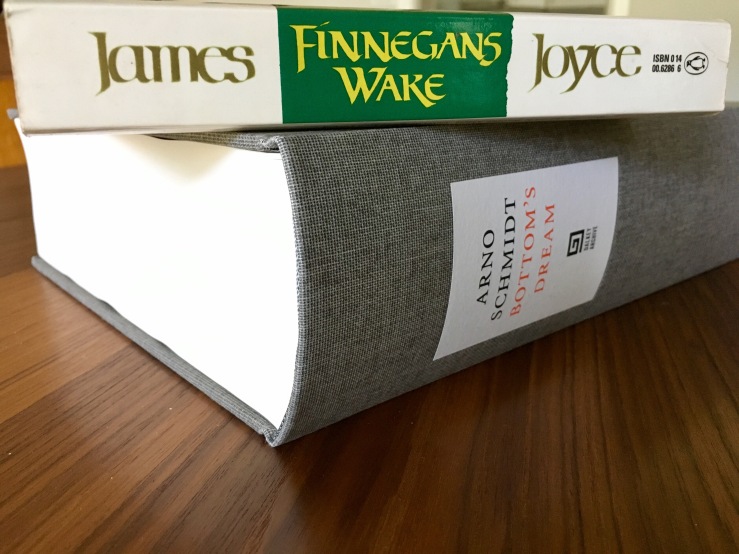
It is enormous.
As you can see in the picture above: Enormous.
But what’s Bottom’s Dream about? (This is the wrong question).
Dalkey’s blurb:
“I have had a dream past the wit of man to say what dream it was,” says Bottom. “I have had a dream, and I wrote a Big Book about it,” Arno Schmidt might have said. Schmidt’s rare vision is a journey into many literary worlds. First and foremost it is about Edgar Allan Poe, or perhaps it is language itself that plays that lead role; and it is certainly about sex in its many Freudian disguises, but about love as well, whether fragile and unfulfilled or crude and wedded. As befits a dream upon a heath populated by elemental spirits, the shapes and figures are protean, its protagonists suddenly transformed into trees, horses, and demigods. In a single day, from one midsummer dawn to a fiery second, Dan and Franzisca, Wilma and Paul explore the labyrinths of literary creation and of their own dreams and desires.
The novel begins around 4 AM on Midsummer’s Day 1968 in the Lüneburg Heath in northeastern Lower Saxony in northern Germany, and concludes twenty-five hours later. It follows the lives of 54-year-old Daniel Pagenstecher, visiting translators Paul Jacobi and his wife Wilma, and their 16-year-old daughter Franziska. The story is concerned with the problems of translating Edgar Allan Poe into German and with exploring the themes he conveys, especially regarding sexuality.
Did I mention that it’s enormous?
Look, I know that dwelling on a book’s size probably has nothing to do with literary criticism, but Bottom’s Dream poses something of a special case. As an article on Bottom’s Dream at The Wall Street Journal points out,Schmidt’s opus is 1,496 pages long, contains over 1.3 million words, and weighs 13 pounds.
It’s a physical challenge as well as a mental challenge.
And, Oh that mental challenge!
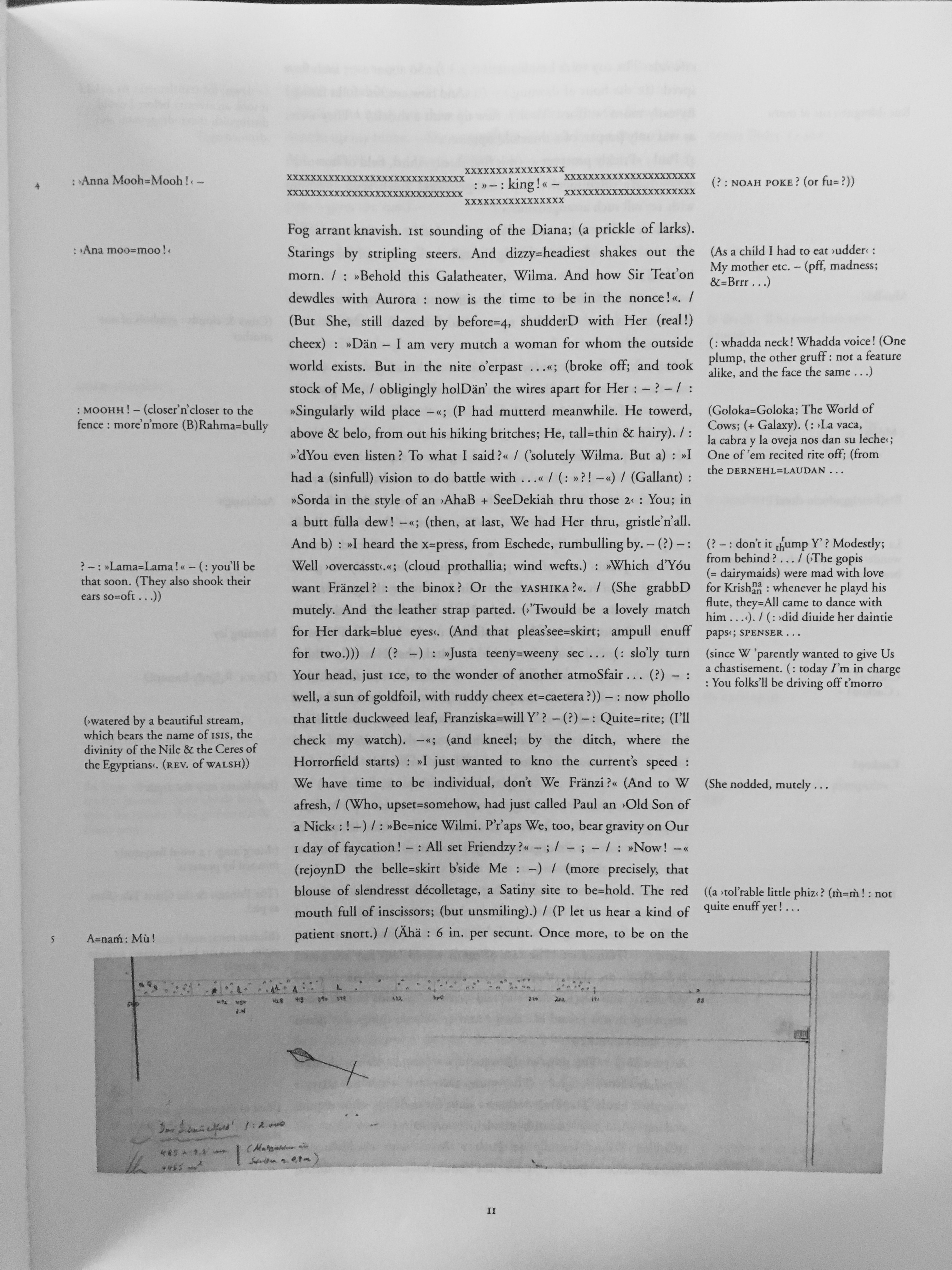
Here’s the first page of Bottom’s Dream (the pic links to a much larger image):
Hmmm…? What do you think?
The obvious easy reference point here is Joyce’s Finnegans Wake, which indeed Schmidt was actively following, both in form and style: competing columns, a fragmentary and elusive/allusive style, collage-like metacommentary, an etymological explosion—words as paint, text as meaning. Etc.
(Did I mention it’s a lot longer than Finnegans Wake? Did I mention it’s enormous?)
Here’s a glimpse at two random pages (don’t be afraid to click on that image and get the full, y’know, effect):
I’ll never forget one of my graduate school professors warning us not to “peer too long into Finnegans Wake.” He called it an abyss. (The man loved Joyce’s work, by the way, and had studied under Hugh Kenner. I’m not sure if he meant abyss pejoratively. It was, like I say, a warning).
Bottom’s Dream seems like an abyss. As its title (a reference to A Midsummer Night’s Dream) suggests, “it hath no bottom.”
After nine days, I’m “on” page 21 of Schmidt’s novel now, and I have no idea what’s going on. And not just because it’s a primal gobbledygook wordmass. No, part of my incomprehension results from a very strong physical reaction to “reading” Bottom’s Dream. This physical reaction goes beyond the size of the volume—although there’s certainly something to the size. I more or less have to read the thing on my dining room table; it’s dreadfully uncomfortable on a couch, and probably impossible on my hammock or in the bathtub. I can’t really hold it while I read it. I think this matters, although I can’t really say how right now. The multiple columns, marginalia, images, etc. are engaging but also fragment my attention—and I generally find myself flicking through Bottom’s Dream, rather than sustaining the will to follow the “plot.” Right now, anyway, I find myself wrapped up in the aesthetics of reading Bottom’s Dream. It’s a tactile read. I enjoy it most when I smooth my hands over it, jump out of the stream, 20, 30, 100 pages forward, backwards. Relax a little.
Otherwise, Bottom’s Dream becomes a bit of a nightmare for me: I get all dizzy, thirsty, my eyes seem to thrum. Something going on in the inner-ear. It’s like a slow-motion panic attack. When that abyss-stress comes on, I jump ahead.
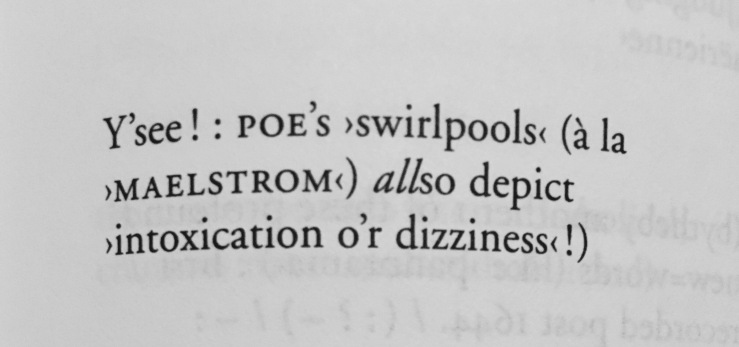
Which is how I found this bit of marginalia (I wish I’d recorded the page when I photographed it; but, also: the iPhone camera is a better recorder of Bottom’s Dream’s aesthetic textuality than any word-processing program. Even a scanner might straighten some of its bends and arcs, its voluminous volume):
Yes! Poe’s >swirlpools<! >intoxication o’r dizziness<! — there’s a description for me of my own reaction to reading Bottom’s Dream.
Poe might be something of a guide for me if I do try to stick out wandering through Bottom’s Dream, and his story “A Descent into the Maelstrom,” referenced above, seems a particularly nice parallel to Schmidt’s bigass book.
“Descent” relates the tale of a sailor (a voyager!–a, like, metaphoricalreader, y’know) transformed by his encounter with the “Moskoestrom” —a swirling abyss from which no one returns. This vortex, “absurd and unintelligible,” breaks the sailor, “body and soul.” He can’t comprehend the storm. It’s unknowable, un-nameable. At best, he is able to make a sidelong glance at it, but can never plumb its depths. And not only is his glance broken, but all of his senses are fragmented. He escapes the maelstrom, but is unrecognizable to the sailors who rescue him. He becomes the voice of the vortex, the metonymy of a force he can perceive but can’t comprehend.
The maelstrom—the vortex, the abyss—this, for Poe, was language.
I’m not sure how deep I’ll travel into Schmidt’s maelstrom. I managed large sections of Finnegans Wake—but I had a guide in Joseph Campbell’s Skeleton Key. Someone to map out the terrain, show me the ropes, etc.
There is that not-so-rare personality disorder known as Tannhäuserism 1. Some of us love to be taken under mountains, and not always with horny expectations 2.—Venus, Frau Holda, her sexual delights—no, many come, actually, for the gnomes 3 , the critters smaller than you, for the sepulchral way time stretches along your hooded strolls down here, quietly through courtyards that go for miles, with no anxiety about getting lost… no one stares, no one is waiting to judge you… out of the public eye… even a Minnesinger needs to be alone…4 long cloudy-day indoor walks… the comfort of a closed place, where everyone is in complete agreement about Death 5. Slothrop knows this place. Not so much from maps he had to study at the Casino 6 as knowing it in the way you know someone is there… .
Plant generators are still supplying power. Rarely a bare bulb will hollow out a region of light 7 . As darkness is mined and transported from place to place like marble, so the light bulb is the chisel that delivers it from its inertia, and has become one of the great secret ikons of the Humility, the multitudes who are passed over by God and History 8. When the Dora prisoners 9 went on their rampage, the light bulbs in the rocket works were the first to go: before food, before the delights to be looted out of the medical lockers and the hospital pharmacy in Stollen Number 1, these breakable, socketless (in Germany the word for electric socket is also the word for Mother—so, motherless too 10 ) images were what the “liberated” had to take… .
From Thomas Pynchon’s Gravity’s Rainbow, page 299. All ellipses are Pynchon’s
1Tannhäuser was a 13th-century German Minnesinger, a troubadour—a knight-poet. A bard, I guess. Is Slothrop a bard, a knight-poet—a knight-errant? Not sure. (He’ll later deny he’s on a grail-quest).
In German legend, Tannhäuser falls from grace when he discovers Venusberg, the underground home of Venus. He stays there a year, neglecting his betrothed and indulging in erotic delights. Teutonic Christian knight that he is, Tannhäuser leaves Vensuberg (Hörselberg) for Rome to beg forgiveness from Pope Urban IV, who denies him, saying absolution would be as impossible as his papal staff flowering in bloom. The staff does bloom—but not until Tannhäuser has disappeared back into the Venusian underworld (and his gal Lisaura has killed herself in grief).
Title page to ‘The Story of Venus and Tannhäuser’ Aubrey Beardsley (1895)
Cf. the sonnet on pages 532-33 of Gravity’s Rainbow:
Where is the Pope whose staff will bloom for me?
Her mountain vamps me back, with silks and scents,
Her oiled, athletic slaves, her languid hints
Of tortures transubstantiate to sky,
To purity of light-of bonds that sing,
And whips that trail their spectra as they fall.
At weather’s mercy now, I find her call
At every turn, at night’s foregathering.
I’ve left no sick Lisaura’s fate behind.
I made my last confession as I knelt,
Agnostic, in the radiance of his jewel…
Here, underneath my last and splintering wind,
No song, no lust, no memory, no guilt:
No pentacles, no cups, no holy Fool…
The Tannhäuser myth connects to Gravity’s Rainbow’s Orphean motif, and readers may take note of the hero’s descent played against the mystical “blooming” of a staff…eh, what with the sexy phallic overtones and all.
And we can use the third line of Gravity’s Rainbow here to describe the bloom on the staff: “It is too late” (3).
2“Some of us love to be taken under mountains, and not always with horny expectations” — one problem with reading Gravity’s Rainbow only once or twice is that it is too full of great sentences and you’ll likely miss them. Pynchon continues to deflate what he has inflated (only to inflate it again)—sex will give over to death—or, an un-death (an un-sex) here. Slothrop inert, underground, in the tombs.
3Cf. Pynchon’s 2006 novel Against the Day, wherein (briefly, too briefly), the heroic Chums of Chance take on “the increasingly deranged attentions of the Legion of Gnomes, the unconscionable connivings of a certain international mining cartel, the sensual wickedness pervading the royal court of Chthonica, Princess of Plutonia, and the all-but-irresistible fascination that subterranean monarch would come to exert, Circelike, upon the minds of the crew of Inconvenience [ETC.]”
4. “…out of the public eye… even a Minnesinger needs to be alone…”
5A perhaps puzzling line, if only because I think I get what everyone’s in “agreement about Death” here—Death as a kind of cozy promise that we all say “Fuck off” too in lieu of “long cloudy-day indoor walks” (and the horny expectations of underground sexbergs). I’m interested on anyone else’s ideas, of course.
6 The Casino Hermann Goering—Slothrop’s last “official” assigned post.
7 We privilege light over darkness; Pynchon inverts the image here: light is a violent “chisel”; darkness is a commodity to be mined.
The bulb becomes one of GR’s most powerful motifs, culminating in the late (and essential) episode “Byron the Bulb” (find Harold Bloom’s essay on Byron the Bulb if ye can).
“a bulb over his head burning all night long. He dreamed that the bulb was a representative of Weissmann, a creature whose bright filament was its soul” 426-27; “a theatre marquee whose sentient bulbs may have looked on […] witnesses to grave and historical encounters” 464; “The Story of” 647-55; “Someday he will know everything, and be just as impotent as before” 654; “electrical tidal wave” 665; “young Jack may have had one of them Immortal Lightbulbs then go on overhead” 688; screwed into Gustav’s kazoo hashpipe, 745
9 Laborers in the Mittelbau-Dora concentration camp who were forced to work toward producing V-2 rockets for the Nazis. Myth—Venus, gnomes, etc.—tips back into the horrific reality of slave labor. Pynchon seems to cast the Dora laborers as the preterite, grasping at their own spark of redemption by looting lightbulbs…and then reframes their preterite condition in the ironic quotation marks around “freedom.”
10 I don’t think the German word for electric socket, steckdose, corresponds so much to the word for “mother,” but maybe…it does? In any case, the etymology does seem to correspond to the concept of absence, or cavity, which permeates this episode of GR.
I looked for the root of “socket” in Josepth T. Shipley’s The Origins of English Words: A Discursive Dictionary of Indo-European Roots, and while I didn’t find anything about mothers or Venus or lightbulbs, I did find a connection to another of Gravity’s Rainbow’s big motifs: Pigs!—-
Had Goodman Brown fallen asleep in the forest, and only dreamed a wild dream of a witch-meeting?
“Young Goodman Brown,” Nathaniel Hawthorne (1835)
Nathaniel Hawthorne’s “Young Goodman Brown” was thrumming through my head the second time I watched “Chestnut,” the second episode of Westworld. In Hawthorne’s classic American tale, a naive youth ventures into the dark evil woods—for reasons never fully expressed—and witnesses his community’s Satanic inversion: Witches and wizards and a “devilish Indian behind every tree.” The narrator’s gambit (Was it all just a dream?) doesn’t ultimately matter—Brown’s experience irrevocably change him. He crosses the threshold of his domestic door, traipses into unknown terrors, and becomes a new person.
Last week, in my review of Westworld’s pilot, I wrote that the series engages “that mythic American promise: The Frontier, the Territory that Huck Finn swears to light out to in order to duck the constraints of those who would ‘sivilize’ him.” For Twain the territory is freedom; for dark Hawthorne the frontier is freedom’s dark twin terror. We find a bit of both in this episode of Westworld. (Along with wizards and Indians).
Our naive youth here is William (Jimmi Simpson). William arrives at Westworld for the first time, “guided” by his loutish friend Logan, who chooses to “go straight evil” (if I may echo a guest’s line from last week). Westworld’s pilot episode pulled a bait-and-switch last week, presenting Teddy Flood (James Marsden) as the naive youth, new to town, only to reveal that he is actually an automaton, a “host.” William provides a more traditional audience surrogate, and his opening sequences are closer to what we might expect from a traditional pilot episode. William’s entering Westworld also feels a bit like the beginning of a video game. (Westworld often feels like a video game. I mean that as a compliment).
We enter the Westworld with William; we savor the bespoke attire he’s offered; we glance with apprehension and desire at the guns on display. In a pivotal shot, William—and perhaps the audience—must make an important choice: White hat—or black?
William chooses white, and much of his narrative in “Chestnut” is spent establishing his contrast to his “friend” Logan, who has donned a black hat, of course. William shows empathy, restraint, and civil humanity to the park’s automaton hosts, whereas Logan uses and abuses them with sadistic abandon. While Logan engages in an orgy (thanks HBO!), William rejects sex, declaring that he has “someone real waiting at home.” William hence represents a “family man” archetype. Perhaps he’s like Young Goodman Brown who just wanted to get home to his wife Faith.
Will crossing the threshold change William too? Yes. Of course. It’s a television show. For Hawthorne’s hero the results were dire: “A stern, a sad, a darkly meditative, a distrustful, if not a desperate man, did he become, from the night of that fearful dream.” Maybe Westworld will find a more optimistic path for William.
But this isn’t a show that’s generally optimistic about domesticity. In the pilot episode, we saw that one android father can simply be swapped out for another android father. (Mothers, android or otherwise, remain absent). In the one glimpse of a full family we get in that episode, we hear the father advise that crossing the river is “too adult” for the son. The Territory is a wild space ripe for masculine domination. Westworld continues the American fantasia of exploration and destiny-manifestin’.
“Chestnut” continues Westworld’s breaking down of familial order in two plot lines that seem to converge. In one such plot, The Man in Black (Ed Harris) kills the cousins and then the wife of a host he claims is an “old friend.” (More on the Man in the Black in a moment). In a second plot line, told mostly in nightmare-flashback mode, Thandie Newton’s character Maeve is a mother whose family is apparently killed by Indians. (More on the convergence of these plotlines in a moment too).
I was happy to see Maeve get screentime this week. Her nightmares throughout “Chestnut” echo Hawthorne’s observation that our dreams alter our realities, that our night-consciousness is vital, real. (Perhaps this is Dr. Ford’s design when he injects “reveries” into his automaton’s new programming system in Westworld’s pilot). Maeve’s dreams begin to affect her work performance, so she’s hauled repeatedly into Westworld’s underground body shop for reconditioning—and a possible decommissioning. Maeve delivers the same monologue three times to different guests in the episode. Each segment feels like a separate audition, the producers leering offstage. Westworld again draws attention to its own form, its metatextuality, its “TV-showness,” as it were.
Maeve’s “truest” performance comes underground—she somehow bypasses “sleep mode” and wakes up in the middle of the (real) nightmare: the Westworld labs and body shops. In an echo of the scalping motif that slices through the episode, Maeve grabs a scalpel and takes off, running deeper into the nightmare. The sequence is aesthetically arresting, wonderfully weird, and ultimately devastating when she finally happens upon the heaped bodies of her android fellows. Maeve’s underground odyssey furthers the Big Plot of Westworld thus far: How much consciousness–and self-consciousness –do these androids have? I’m digging how the series takes on memory, dream, and reality.
Maeve’s performance is under pressure specifically because Lee Sizemore, Westworld’s narrative director (ahem, head writer), wants to cull dead weight to make room for his new campaign, “Odyssey on the Red River.” Sizemore, who we’re invited to view as a kind of Hollywood hack asshole, assures the assembled management team that this new storyline’s grotesque savagery (meta meta meta) will make it look like “”Hieronymous Bosch was doodling kittens.” Sizemore’s smugly assured that Dr. Ford, who hasn’t commented on the story in years, won’t interfere. So of course Ford shoots him down.
Ford is the true magician of Westworld. He regards Sizemore as a huckster, a fraud peddling cheap tricks. Ford blasts Sizemore’s claim that Westworld will “tell the guests who they are,” arguing that Westworld’s true potential is to transform and transmute the guests into what they can be. Ford notes at one point in the episode that the guests crave nuance, subtlety, mystery. They want witchcraft; they want a spell that transmogrifies chaos into magic.
Where does Ford’s magic come from? Boredom! In a wonderful discussion with (what I’m assuming simply has to be) a replicant version of himself as a child, Ford twists the old idiom and suggests that “only boring people cannot conceive of boredom.” He guides the replicant child to a desert vision of the “Town with the White Church,” pointing to the imaginative possibility of the Territory—to the frontier’s magic. The Black Sabbath in the wilderness is all in the wizard’s mind. “You see what a bored mind can conjure,” Ford tells the boy, and then charms a snake, declaring, perhaps a bit glumly, that, “Everything in this world is magic, except to the magician.” Ford dismisses the boy, and later brings Bernie Lowe (Jeffrey Wright) up to the surface to survey the desert terrain, the rocks where he will build this church. (Bernie dons a brown baseball cap. No black or white stetson for Bernie).
But The Man in Black: He’s pure Black Hat. Compellingly, Dr. Ford’s thoughts on subtlety and magic parallel The Man in Black’s. (White wizard/Black wizard?). “When you’re suffering, that’s when you’re most real” he snarls at an automaton he’s interrogating, echoing Emily Dickinson’s “I like a look of agony / Because I know it’s true.”
The Man in Black’s back in town, not a stranger, in search of something called The Maze, willing to scalp androids, smash families, kill cousins, wives, daughters, etc. to get clues—ah but wait, I’m forgetting, They’re just androids, right?
Is The Man in Black an android too?
“I’ve been coming here for 30 years,” he reminds us. (Westworld wants us to remember this three-decade benchmark—recall that the last time the park faced trouble was thirty years ago). But then, and perhaps without much of that magic subtlety, he tells us: “In a sense, I was born here.” Egads!
Black’s plot converges with Maeve’s nightmare in a Satanic reverie. Indian marauders have chased Maeve and her (dream)daughter into a cabin corner; one enters and shape-shifts into The Man in Black, knife out, ready to scalp her.
Is this now? Is this then? Is this real? Is this dream?
I started with Hawthorne’s “Young Goodman Brown,” so I’ll end with it. The Man in Black—but also Dr. Ford, perhaps—recall to me Brown’s traveling companion into the woods (lovely dark and deep), an old wizard who bears “a considerable resemblance” to the young (good?)man. The old mage steers YGB deeper into the Frontier, into the Territory, into the Weird, and he protests about going over the line:
“Too far, too far!” exclaimed the goodman, unconsciously resuming his walk. “My father never went into the woods on such an errand, nor his father before him. We have been a race of honest men and good Christians, since the days of the martyrs. And shall I be the first of the name of Brown, that ever took this path and kept–”
“Such company, thou wouldst say,” observed the elder person, interrupting his pause. “Well said, Goodman Brown! I have been as well acquainted with your family as with ever a one among the Puritans; and that’s no trifle to say. I helped your grandfather, the constable, when he lashed the Quaker woman so smartly through the streets of Salem. And it was I that brought your father a pitch-pine knot, kindled at my own hearth, to set fire to an Indian village, in King Philip’s War. They were my good friends, both; and many a pleasant walk have we had along this path, and returned merrily after midnight. I would fain be friends with you, for their sake.”
Hawthorne here lays out an American history of religious persecution, the murder of indigenous peoples, and hypocrisy, themes that find their echo in Westworld’s continuation of the American myth.
Or maybe it’s the Territory itself, the dream/nightmare of the Frontier:
America is not a young land: it is old and dirty and evil before the settlers, before the Indians. The evil is there waiting.
Watching HBO’s new show Westworld, I couldn’t help but think of the late American novelist William Gaddis’s obsession for player-pianos. The narrator of Gaddis’s final novel Agapē Agapehowls that the player piano “was the plague spreading across America…its punched paper roll at the heart of the whole thing, of the frenzy of invention and mechanization and democracy and how to have art without the artist and automation, cybernetics.” Here was the idea of art, the artifice of art. Spiritless spirit. Automation.
Director Jonathan Nolan threads these automaton player pianos throughout “The Original,” Westworld’s ironically-titled pilot episode. The motif is a perhaps-unsubtle reminder of Westworld’s core conflict—automation vs. spirit, real vs. copy, authentic vs. simulation. Human vs. machine.
You know the story of course: whether from Westworld’s source material (Michael Crichton’s 1973 film of the same name), or from Ridley Scott’s Blade Runner or Philip K. Dick in general, or The Matrix, or Battlestar Galactica (original or reboot), or Pinocchio, or AI, or Pygmalion, or Baudrillard, or just generally being alive in the 21st century….or…or…or…you know the story of course. (Oh, and, uh westerns too, natch).
Knowing the story enriches this particular reboot (or reimagining or re-whatever) of Westworld’s pregnant possibilities, and “The Original” is at its finest when tweaking its tropes.
For example, James Marsden’s fresh-faced Teddy Flood arrives to Westworld a noob, a surrogate for the audience—just another “Newcomer,” a human tourist among the amusement park’s android “Hosts” looking for fun and trouble, right? An early reveal shows that he’s actually a Host too though (gadzooks!), an automaton pining after fresh-faced series lead Evan Rachel Wood’s Dolores Abernathy. (I suppose having a fresh face is easy when the lab operatives can grow you a new one each night).
The bait-and-switch gambit with Flood plays out in a riveting scene with ringer Ed Harris, the Man in Black, hardly a “Newcomer” and a seemingly unwelcome guest. He reveals that he’s been coming to Westworld for “over thirty years,” and we later learn that the theme park’s automatons haven’t had major glitches in (You guessed it!) thirty years. “We’re overdue,” says Westworld’s operations manager, Theresa Cullen (played by Sidse Babett Knudsen–and by the way, that quote’s from my bad memory so don’t quote me on it). Foreshadowing! With the Man in Black creepin’ ’round and takin’ automaton scalps Blood Meridian style, there’s sure to be trouble!
But wait—Westworld can make its own trouble for its own damn self without mysterious outside agents, thank you very much. Dr. Ford (played by Anthony Hopkins, another ringer, and please don’t make me comment on the symbolically-overdetermined character name) has updated the “Hosts” with a new operating system, which includes a new program for “reveries.” These reveries have the replicants all fucked up. In short, the automatons, the Hosts, start going off-script (literally)—asking philosophical questions about the nature of their reality (and pouring milk over corpses).
Ford doesn’t care though—as he explains to Jeffrey Wright’s Bernard Lowe (Westworld’s head programmer), humanity, what with curing all its diseases, etc., can’t progress anymore — “This is as good as we’ll get.” So, like, why not trigger the Singularity? To return to our player piano motif, if only momentarily, Ford would like to inspirit art into the artificial. He wants, or at least moments of “The Original” suggest he wants, to teach the Hosts to play.
But the security forces behind the scenes decide it’s probably not good for their guests to be subjected to unknown quirks. They remand some of these suspect automatons to a creepy Bluebeard’s closet full of other decomissioned replicants that surely won’t be any kind of problem down the line in Westworld, right?
As my quick overview suggests, Westworld brims with potential. Indeed, “The Original,” despite a tight plot, often feels overpacked. There’s not just a season’s worth of plot lines lurking in here, but a whole series’ worth. As a result, “The Original” leaves many interesting characters on the margins for now (Thandie Newton’s brothel madam in particular). I suppose keeping key players on the sidelines makes sense, especially as the pilot is exposition-heavy as it is (a fault with any number of TV pilots, from Game of Thrones to The Sopranos. Not every show can emerge autochthonous and fully-realized out of the gate like True Detective).
And yet even stuffed with emerging plots, Westworld finds time for a cinematic shooting-slaughter sequence that I suppose many viewers found thrilling but I found admittedly cold. With zero stakes at this early point, the scene felt like any other American TV show where meaningless bodies are gunned to pieces. Maybe that was the point though?
In any case, the punchline to the shooting sequence—one of the Newcomers (a prototypical Ugly American doof) Saves the Day! right before the baddie-Host can give his Big Speech—the punchline didn’t make me laugh so much as grimace. “The Original” is full of tonal inconsistencies and missed opportunities for sharp satire and dark humor. I hope Westworld loosens up a bit, gets a bit weirder, bites more from J.G. Ballard’s playbook. The pilot seems to go for profundity over weirdness, as if the showmakers must telegraph at all times: This is a Dark Serious Show. (Did I mention that director and creator Jonathan Nolan is Christopher Nolan’s brother?).
If the arcade shooter sequence is a dud (or, rather, the simulacrum of a real shootout, an authentic inauthenticity), the final scenes of “The Original” make up for it. In an echo of Blade Runner’s final sequence, Hopkins’s Ford squares off with his creation, Dolores’s father Peter. Peter has found a photograph depicting a girl in Times Square, and the cognitive dissonance of this unreality has him goin’ straight-glitch, quotin’ Shakespeare, and generally blowin’ android gaskets. We find out he’s been rebooted a number of times, and was once the leader of a cannibal cult in a Westworld scenario called “The Dinner Party.” (Har har! That pun works on at least two levels). Peter perhaps has realized he’s but a player in play—but not a true player, just a copy of a player, a simulacrum.
Westworld is acutely aware of its own layers of simulacra. The show constantly calls attention to itself as a show, as a play. Early in “The Original,” the camera pulls up from travelers on a train to reveal a god’s-eye diorama of the terrain—a moving diorama that recalls the intro to Game of Thrones (the show Westworld would replace in your hearts and on your screens). The Westworld is surveyed by producers and showrunners making adjustments—just like Westworld. We have here a metacommentary on television, a self-consciously postmodern (and thus, post-postmodern) gesture. Not just automation and artifice, but artists! Not just player pianos, but players!
The diorama shot also reveals the Big Dream embedded in Westworld’s Big Nightmare. We have here that mythic American promise: The Frontier, the Territory that Huck Finn swears to light out to in order to duck the constraints of those who would “sivilize” him. “I take SPACE to be the central fact to man born in America,” declared Charles Olson in the beginning of Call Me Ishmael, his study of Melville’s whale. “I spell it large because it comes large here. Large, and without mercy.” The Newcomers, the tourists, flock to Westworld because it is a safe and constrained territory, a SPACE that is sivilized, yet masked to appear otherwise, garbed in the myth of danger, the empty promises of our National Pastimes, Sex & Violence. Dr. Ford plants reveries—dreams—into his automatons, disrupting civilization’s veneer of order. This is the new Frontier that Westworld promises to explore.
I got to page 258 (of 801 pages, in the 2001 Vintage paperback edition).
On that page, the visiting poet (Visiting Poet?)—he’s visiting the post-apocalyptic city of Bellona, which is I guess the central character of Dhalgren (I guess?)—on that page, Ernest Newboy (go ahead and groan at that name), declares:
There’s no reason why all art should appeal to all people.
I took that as a sign that I could go ahead and quit Dhalgren.
Delany’s cult novel initially appealed to me, but: No.
I’m trying, right now, to think of a novel I’ve wanted to like more but didn’t like than Dhalgren. (Thomas Disch’s 334, maybe, which Dhalgren resembles? Ballard’s Millenium People, which suggests that somewhere out there there’s a better Delany novel I need to read—like I read the wrong one, the famous one?).
I wanted to like Dhalgren because it’s weird and messy and post-apocalyptic and discursive and shambling and tripping and plotless and vibe vibe vibe…but mostly I found it boring. And the prose was often, uh, bad.
(I just read William Gibson’s foreword to the thing, in which he declares it a “prose-city…a literary singularity…executed by the most remarkable prose stylist to have emerged from the culture of American science fiction.” Nah. (Gibson’s intro has this real awful Baby Boomer you-had-to-be-there-man tone to it too)).
There are bits and pieces of Dhalgren that were interesting enough to make me keep wading through the rubbish: tree sex, hologram gangs, the unnamed apocalypse, the specter of violence, the drugs, the weapons…but to give you an idea of this novel’s rhythm, the central protagonist, Kid, spends a sizable chunk of the novel’s third chapter moving furniture from one apartment to another.
The Kid also wants to be a poet, and Delany spends a lot of time dipping into our boy’s notebook. It’s bad stuff, cringeworthy, and not in an Isn’t-he-a-bad-writer? way. Delany’s own prose veers hippy dippy too—a mirror. (Mirrors and lenses and prisms and recursion images twist through the 250 pages I read. Reality’s an illusion, man. Or not. Or memory. Or something).
I’ve had every kind of warning that Delany’s novel is plotless and will refuse to cohere (Gibson: “Dhalgren does not answer”). I fucking love those kinds of novels. But they have to have something else: Good sentences, one after another. Humor that’s actually, uh, funny. A point of feeling or message beyond the kind of apocalypse vibe I absorbed by reading comics (and comix) when I was 11, 12, 13. Less furniture moving.
Anyway, I’m unconvinced that anything wonderful’s going to pop out in the next 550 or so pages. And I’m fine, at this point, of being wrong, and ready to move on to something else.
The 43 stories that comprise Lucia Berlin’s excellent collection A Manual for Cleaning Women braid together to reveal a rich, dirty, sad, joyous world—a world of emergency rooms and laundromats, fancy hotels and detox centers, jails and Catholic schools. Berlin’s stories jaunt through space and time: rough mining towns in Idaho; country clubs and cotillions in Santiago, Chile; heartbreak in New Mexico and New York; weirdness in Oakland and Berkeley; weirdness in Juarez and El Paso.
The center of this world—I’ll call it the Berlinverse, okay?—the center of the Berlinverse is Lucia Berlin herself. “Her life was rich and full of incident, and the material she took from it for her stories was colorful, dramatic and wide-ranging,” writes Lydia Davis in her foreword to Manual. (You can read Davis’s foreword at The New Yorker; it’s a far more convincing case for Berlin than I can manage here). Yes, Berlin’s life was crammed with incident—-so perhaps the strangest moment in A Manual for Cleaning Women is the three-page biography that appends the volume. The bio is strange in how un-strange it is, how it neatly lays out in a few paragraphs the information of Berlin’s life, information we already know as real, as true, from reading the preceding stories. She’s large, she contains multitudes.
Truth is a central theme in these stories. In “Here It Is Saturday,” a version of Berlin teaches fiction writing to prison inmates. She tells them, “you can lie and still tell the truth.” (As I describe the scenario for “Here It Is Saturday” I realize how hokey it sounds—I suppose there are lots of potentially-hokey moments in Berlin’s stories, yet her cruelty and humor deflate them).
In a crucial moment in the late short story “Silence,” the narrator tells us,
I exaggerate a lot and I get fiction and reality mixed up, but I don’t actually ever lie.
The narrator of “Silence” is, of course, a version of Berlin—fictionalized, sure, a persona, yep, an exaggeration, maybe—but she’s utterly believable.
“Silence” is one of many stories that repeat aspects of Berlin’s biography—we get little Lu’s childhood, a father away at the big war, a drunkenly absent mother, a bad drunk grandfather. A Syrian friend betrayed. Nuns. A good drunk uncle. A hit and run. Am I rushing through it? Sorry. To read Berlin is to read this material again and again, in different ways, through different perspectives and filters. “Silence” is particularly interesting to me because it combines material from two earlier stories not collected in Manual: “Stars and Saints” and “The Musical Vanity Boxes,” both published in Black Sparrow Press’s 1990 collection Homesick. These earlier stories are sharper, rawer, and dirtier; the later story—and Berlin’s later stories in general—strike me as more refined. Wiser, perhaps, sussing grace from abject memory.
Berlin’s recollections of the different figures in her life drive these stories, and it’s fascinating to see how key memories erupt into different tales. Berlin’s narrator’s alcoholic grandfather, a famous Texan dentist, sometimes emerges as a sympathetic if grotesque comedic figure, only to appear elsewhere as an abusive monster. Cousin Bella Lynn is a comedic foil in “Sex Appeal,” but an important confidante in “Tiger Bites” (a story of a visit to an abortion provider in Juarez). Several stories center on sister Sally, dying of cancer.
Berlin’s narrator’s four sons (Berlin had four sons) are often in the margins of the stories, but when she mines material from them the results are painful and superb. I note “her sons” in the previous line, but what I really want to note is the friend of one of her sons, a boy she calls Jesse. He shows up in the short “Teenage Punk,” where he’s our narrator’s date to go look at some cranes in a ditch at sunrise. That’s pure Lucia Berlin—weird abject unnatural natural beauty.:
We crossed the log above the slow dark irrigation ditch, over to the clear ditch where we lay on our stomachs, silent as guerrillas. I know, I romanticize everything. It is true though that we lay there freezing for a long time in the fog. It wasn’t fog. Must have been mist from the ditch or maybe just the steam from our mouths.
That brief paragraph showcases much of her technique: Inflation-deflation-resolution-hesitation. The high, low, the in-between. Jesse shows up again in one of the volume’s lengthier (and more painful) tales, “Let Me See You Smile,” a story of police brutality, scandal, and alcoholism.
Most of the stories in Manual are in some way about alcoholism, with the ur-narrator’s mother’s alcoholism haunting the book. In the near-elegy “Panteón de Dolores,” the narrator finds her mother drunk and weeping. When she tries to comfort her mother, she’s rejected; the mother wails, “…the only romance in my life is a midget lamp salesman!” The narrator-daughter reflects, “this sounds funny now, but it wasn’t then when she was sobbing, sobbing, as if her heart would break.” Berlin often punctures her punchlines. In “Mama,” Berlin consoles her dying sister Sally by weaving a fictional ditty about their mother, a paragraph that ends, “She has never before known such happiness.” The story assuages some of her sister’s grief by transmuting it into a realization of love, but the narrator? — “Me…I have no mercy.”
And yet a search for some kind of mercy, some kind of grace propels so many of the stories in A Manual for Cleaning Women. The three-pager “Step,” set in a half-way house, details the residents watching a boxing match between Wilfred Benitez and Sugar Ray Leonard. The recovering (and not-so-recovering) drunks “weren’t asking Benitez to win, just to stay in the fight.” He stays in to the last round before touching his right knee to the canvas. Berlin’s stand-in whispers, “God, please help me.” In “Unmanageable,” the alcoholic narrator finds some measure of grace from others. First from the NyQuil-swilling drunks who share saltine crackers with her in a kind of communion as they wait, shaking, for the liquor store to open at six a.m. And then, from her children. Her oldest son hides her car keys from her.
The same sons are on the narrator’s mind at the end of “Her First Detox,” in which Berlin’s stand-in’s plan for the future takes the form of a shopping list. She’ll cook for her boys when she gets home:
Flour. Milk. Ajax. She only had wine vinegar at home, which, with Antabuse, could throw her into convulsions. She wrote cider vinegar on the list.
Berlin’s various viewpoint characters don’t always do the best job of taking care of themselves, but taking care of other people is nevertheless a preoccupation with the tales in Manual. “Lu” takes care of her dying father in “Phantom Pain”; there’s sick sister Sally; the four sons, of course; a heroin-addicted husband; assorted strays, sure; an old couple in failing health in “Friends”; and the disparate patients who wander in and out of these tales, into doctor’s offices, into emergency rooms, into detox clinics.
And the cleaning women. Caretakers too, of a sort. Laundromats and washing machines are motifs throughout A Manual for Cleaning Women, and it’s no surprise that “Ajax” made the shopping list from “Her First Detox” that I quoted above. An easy point of comparison for Berlin’s writing is the so-called “dirty realism” of Raymond Carver, Denis Johnson, and Carson McCullers. But if Berlin’s realism is dirty, what are we to make of her concern with cleaning, with detox?
As a way of (non-)answering this question, here’s the entirety of the shortest tale in A Manual for Cleaning Women, “Macadam”:
When fresh it looks like caviar, sounds like broken glass, like someone chewing ice.
I’d chew ice when the lemonade was finished, swaying with my grandmother on the porch swing. We gazed down upon the chain gang paving Upson Street. A foreman poured the macadam; the convicts stomped it down with a heavy rhythmic beat. The chains rang; the macadam made the sound of applause.
The three of us said the word often. My mother because she hated where we lived, in squalor, and at least now we would have a macadam street. My grandmother just so wanted things clean — it would hold down the dust. Red Texan dust that blew in with gray tailings from the smelter, sifting into dunes on the polished hall floor, onto her mahogany table.
I used to say macadam out loud, to myself, because it sounded like the name for a friend.
There’s so much in those four paragraphs. Berlin collapses geography and genealogy into ten sentences: daughter, mother, grandmother. Texas, “squalor,” convicts. A road—a new road. Berlin’s narrator converts crushed stone into caviar, then the ice left over after sweet lemonade—and then into the magic of a friend. There’s a lot of beauty in dirt.
I could go on and on about A Manual for Cleaning Women—about how its loose, sharp tales are far more precise than their jagged edges suggest, about its warmth, its depth, its shocking humor, its sadness, its insight. But all I really mean to say is: It’s great, it’s real, it’s true—read it.
Robert Andrew Parker’s ilustration to Ch. 4 of The Charterhouse of Parma
After many, many false starts, I’ve finished Stendhal’s 1839 cult classic The Charterhouse of Parma. (I read Richard Howard’s 1999 Modern Library translation).
I really, really wanted to quit around Ch. 25 (of 28). I’ll admit at times I broke a rule I’d made nearly two decades ago, now: I allowed my mind to wander. I thought of other things: A variation on a muffin recipe I was planning to make for my kids. A possible review of William Friedkin’s 1977 film Sorcerer. Lunch. What book I might read next as an antidote to Charterhouse.
The end of the novel is an utter slog. No duels, no escapes. Just courtly intrigues and courtly romances. And ironic sermons. Then, in the last chapter, a new character shows up! Some dandy named Gonzo! Out of nowhere! To move the plot along! (Stendhal pulls a similar stunt in the back half of the novel, when it first starts to really drag—he brings in a lunatic-bandit-poet-assassin named Ferrante).
And then—okay, maybe this is something close to a spoiler, but I don’t think so—and then, Stendhal seems to get bored with his novel. In the last chapter, he skips a few years in a few sentences (this, in a novel where every damn decision each character frets over goes on and on for paragraphs) and then kills everyone (not really. But really, sorta. I mean, the last chapter of The Charterhouse of Parma almost feels like season six of Game of Thrones, where the action is accelerated at a pace that seems to ironize all the previous scheming and plotting).
Stendhal supposedly dictated Charterhouse over 50-something days (I think I read that somewhere…I’ve yet to read Howard’s afterword to the novel, or Balzac’s study…I’ll save those for later, after I remember the best bits of the novel more fondly). But where was I? Oh, yeah: Stendhal supposedly dictated Charterhouse over a two-month period, and I get the feeling he was getting bored with it there at the end. Which is in some ways appropriate, as The Charterhouse of Parma is all about boredom. Phrases like “boring,” “bored,” and “boredom” pop up again and again. There’s something wonderfully modernist (or Modernist) about that.
Robert Andrew Parker’s ilustration to Ch. 11 of The Charterhouse of Parma
Of course all that boredom is punctuated with moments of wonderful action—battles and duels! Indeed, Charterhouse never really surpasses its fourth chapter, a strikingly modern depiction of the Battle of Waterloo.
Stendhal is great at conveying action and violence while stripping it from Romantic illusions—and at the same time, he presents those Romantic illusions, making them ironic (again—this is probably one of the first Modern novels, and I’m sure someone has already said that somewhere, but hey).
Stendhal is also wonderfully adept at capturing a human mind thinking. Whether it’s the Machiavellian machinations of Count Mosca, or our (ever)greenhorn hero Fabrizio, or the real hero of Charterhouse, Fabrizio’s aunt Gina, Stendhal takes pains to show his characters thinking through their problems and schemes. Not only do the heroes and villains of The Charterhouse of Parma think, they think about what other characters will think (about what they have thought…). The novel in some ways is about metacognition. But thought about thought may be a product of boredom. And it often produces boredom.
Balzac was a great admirer of Charterhouse, as was Italo Calvino, and countless writers too. Indeed, the novel is, I suppose, a cult favorite for writers, which makes sense: Stendhal crowds each page with such psychological realism, such rich life, that every paragraph seems its own novel. I’ll admit that by page 400 or so I was exhausted though.
I’ve noted here a few times that Charterhouse is a “Modernist” novel; perhaps “proto-Modernist” is the term I need. (Again—I’m sure that countless lit critics have sussed over this; pardon my ignorant American ass). And yet Charterhouse also points back at the novels before it, the serialized novels, the epistolary novels, the romances and histories and etceteras of the seventeenth and sixteenth centuries. My favorite lines of the novel were often our ironic narrator’s brief asides like, “Doubtless the reader grows tired…” or “The conversation went on for hours more in trivial detail…” or “The letter went on for pages more after the same fashion…” (These aren’t actual quotes, dear reader, but I think I offer a fair paraphrase here). Stendhal’s modernism, or Modernism, or proto-Modernism, or whatever, is his wily irony, his winking at the novel’s formal characteristics. My own failing, then, is to perhaps want more of this. As I wrote last time I riffed on it, what I suppose I want is a postmodern condensation of The Charterhouse of Parma, such as Donald Barthelme’s 1968 story “Eugénie Grandet,” which parodied Honoré de Balzac’s 1833 novel Eugénie Grandet.
How much of Balzac’s novel is lovingly leapt through right here?!
This wish of mine is of course my failure, not the novel’s.
The Charterhouse of Parma is undoubtedly an oddity, a work of genius, often thrilling, and often an utter slog. I suppose I’m glad that I finally finished it after so many years of trying, but I’m not sure if I got what I wanted out of it. The failure is mine.
I’ll close with the novel’s final line though, which I adore:
In general, I dislike reviews that frontload context—get to the book, right? So here’s a short review of Ernest Hemingway’s The Garden of Eden: it is stranger than most of what Hemingway wrote, by turns pleasant, uncomfortable, bewildering, and beautiful. And readable. It’s very, very readable. Young people (or older folks; let’s not be prejudiced) working their way through Hemingway shouldn’t put The Garden of Eden on the back-burner in favor of his more famous works, and anyone who might have written off Hemingway as unreflective macho bravado should take a look at some of the strange gender games this novel has to offer. So, that’s a recommendation, okay?
Now on to that context, which I think is important here. See, The Garden of Eden is one of those unfinished novels that get published posthumously, put together by editors and publishers and other book folk, who play a larger role than we like to admit in the finished books we get from living authors anyway. For various reasons, cultural, historical, etc., we seem to favor the idea of the Singular Artistic Genius who sculpts beauty and truth out of raw Platonic forms that only he or she can access (poor tortured soul). The reality of how our books get to us is a much messier affair, and editors and publishers and even literary studies departments in universities have a large hand in this process, one we tend to ignore in favor of the charms of a Singular Artistic Genius. There’s a fascinating process there, but also a troubling one. Editing issues complicate our ideals of (quite literally) stable authority—is this what the author intended?, we ask (New Critics be damned!). David Foster Wallace and Michael Pietsch, Raymond Carver and Gordon Lish, Franz Kafka and Max Brod, Mary Shelley and Percy Shelley . . . not to mention Shakespeare, Chaucer, Beowulf, The Bible, Homer, etc. etc. etc. But you’re here to read about The Garden of Eden, right gentle reader? Mea culpa. I’ve been blathering away. Let me turn the reins over to the estimable talents of E.L. Doctorow, who offers the following context in his 1986 review of the book in The New York Times—
Since Hemingway’s death in 1961, his estate and his publishers, Charles Scribner’s Sons, have been catching up to him, issuing the work which, for one reason or another, he did not publish during his lifetime. He held back ”A Moveable Feast” out of concern for the feelings of the people in it who might still be alive. But for the novel ”Islands in the Stream” he seems to have had editorial misgivings. Even more deeply in this category is ”The Garden of Eden,” which he began in 1946 and worked on intermittently in the last 15 years of his life and left unfinished. It is a highly readable story, if not possibly the book he envisioned. As published it is composed of 30 short chapters running to about 70,000 words. A publisher’s note advises that ”some cuts” have been made in the manuscript, but according to Mr. Baker’s biography, at one point a revised manuscript of the work ran to 48 chapters and 200,000 words, so the publisher’s note is disingenuous. In an interview with The New York Times last December, a Scribners editor admitted to taking out a subplot in rough draft that he felt had not been integrated into the ”main body” of the text, but this cut reduced the book’s length by two-thirds.
So, yeah. The version we have of The Garden of Eden is heavily cut, and also likely heavily arranged. But that’s what editors do, and this is the book we have (for now, anyway—it seems like on the year of its 25th anniversary of publication, and the 50th anniversary of Hemingway’s death that Scribner should work toward putting out an unedited scholarly edition) — so I’ll talk about that book a bit.
The Garden of Eden tells the story of a few months in the lives of a young newlywed couple, David Bourne, an emerging novelist, and his wife Catherine, a trust fund baby flitting about Europe. The novel is set primarily on the French Riviera, in the thin sliver of high years between the two big wars. David and Catherine spend most of their days in this Edenic setting eating fine food and making love and swimming and riding bikes and fishing. And drinking. Lots and lots of drinking. Lots of drinking. It all sounds quite beautiful—h0w about a taste?
On this morning there was brioche and red raspberry preserve and the eggs were boiled and there was a pat of butter that melted as they stirred them and salted them lightly and ground pepper over them in the cups. They were big eggs and fresh and the girl’s were not cooked quite as long as the young man’s. He remembered that easily and he he was happy with his which he diced up with the spoon and ate with only the flow of the butter to moisten them and the fresh early morning texture and the bite of the coarsely ground pepper grains and the hot coffee and the chickory-fragrant bowl of café au lait.
Hemingway’s technique throughout the novel is to present the phenomenological contours of a heady world. It’s lovely to ride along with David and Catherine, rich and free and beautiful.
Their new life together is hardly charmed, however. See, Catherine gets a haircut—
Her hair was cropped as short as a boy’s. It was cut with no compromises. It was brushed back, heavy as always, but the sides were cut short and the ears that grew close to her head were clear and the tawny line of her hair was cropped close to her head and smooth and sweeping back. She turned her head and lifted her breasts and said, “Kiss me please.” . . .
“You see, she said. “That’s the surprise. I’m a girl. But now I’m a boy too and I can do anything and anything and anything.”
“Sit here by me,” he said. “What do you want, brother.”
David’s playful response—calling his wife “brother”—covers up some of his shock and fear, but it also points to his underlying curiosity and gender confusion. And indeed, Catherine’s new haircut licenses her to “do anything and anything and anything” — beginning with some strange bed games that night—
He had shut his eyes and he could feel the long light weight of her on him and her breasts pressing against him and her lips on his. He lay there and felt something and then her hand holding him and searching lower and he helped with his hands and then lay back in the dark and did not think at all and only felt the weight and the strangeness inside and she said, “Now you can’t tell who is who can you?”
“No.”
“You are changing,” she said. “Oh you are. You are. Yes you are and you’re my girl Catherine. Will you change and be my girl and let me take you?”
“You’re Catherine.”
“No. I’m Peter. You’re my wonderful Catherine. You’re my beautiful, lovely Catherine. You were so good to change. Oh thank you, Catherine, so much. Please understand. Please know and understand. I’m going to make love to you forever.”
David, partial stand-in for Hemingway, transforms into a girl who feels “something” during sex with Catherine (or, ahem, Peter)—note that that “something” has no clear referent. As their gender inverting games continue (much to David’s horror), Hemingway’s usually concrete language retreats to vague proforms without referents, “it”s without antecedents; his usually precise diction dissolves in these scenes, much as the Bournes’ marriage dissolves each time Catherine escalates the gender inversion. David gives her the nickname “Devil,” as if she were both Eve and Serpent in their Garden. Catherine’s transformations continue as she cuts her hair back even more, and sunbathes all the time so that she can be as dark as possible. She dyes her hair a silver blonde and makes David get his hair cut and dyed the same.
The bizarre behavior (shades of Scott and Zelda?) culminates in Catherine introducing another woman into the marriage. Marita falls in love with both David and Catherine, but her lesbian sex with Catherine only accelerates the latter’s encroaching insanity. David is initially radically ambivalent to the ménage à trois proposed by his wife; he has the good sense to see that a three-way marriage is ultimately untenable and that his wife is going crazy. He vacillates between hostility and love for the two women, but eventually finds a support system in Marita as it becomes increasingly apparent (to all three) that Catherine is depressed and mentally unstable, enraged that David has ceased to write about the pair’s honeymoon adventures on the Riviera. Catherine has been bankrolling David; jealous of good reviews from his last novel, she insists that he write only their story, but David would rather write “the hardest story” he knows—the story of his childhood in East Africa with his father, a big game hunter.
In some of the most extraordinary passages of The Garden of Eden, David writes himself into his boyhood existence, trailing a bull elephant with his father through a jungle trek. David has spotted the elephant by moonlight, prompting his father and his father’s fellow tracker and gun bearer Juma to hunt the old beast. As they trail the animal, David begins to realize how horrible the hunt is, how cruel it is to kill the animal for sport. The passages are somewhat perplexing given Hemingway’s reputation as a hunter. Indeed, this is one of the major features of The Garden of Eden: it repeatedly confounds or complicates our ideas about Hemingway the man’s man, Hemingway the writer, Hemingway the hunter. David describes the wounded, dying elephant—
They found him anchored, in such suffering and despair that he could no longer move. He had crashed through the heavy cover where he had been feeding and crossed a path of open forest and David and his father had run along the heavily splashed blood trail. Then the elephant had gone on into thick forest and David had seen him ahead standing gray and huge against the trunk of a tree. David could only see his stern and then his father moved ahead of him and he followed and they came alongside the elephant as though he was a ship and David saw the blood coming from his flanks and running down his sides and then his father raised his rifle and fired and the elephant turned his head with the great tusks moving heavy and slow and looked at them and when his father fired the second barrel the elephant seemed to sway like a felled tree and came smashing down toward them. But he was not dead. He had been anchored and now he was down with his shoulder broken. He did not move but his eye was alive and looked at David. He had very long eyelashes and his eye was the most alive thing David had ever seen.
David succeeds in writing this “hard” story, and the passages are remarkable in their authenticity—David’s story is a good story, the highlight of the book perhaps; it’s not just Hemingway telling us that David wrote a great story, we actually get to experience the story itself as well as the grueling process by which it was made. Hemingway and his surrogate David show us—make us experience—how difficult writing really is, and then share the fruit of that labor with us. These scenes raise the stakes of The Garden of Eden, revealing how serious David is when he remarks (repeatedly) that the writing is the most important thing—that it outweighs love, it surpasses his marriage. These realizations freight the climax of the novel all the more heavily, but I will avoid anymore spoilers.
The Garden of Eden has some obvious flaws. Marita is underdeveloped at best for such an important character, and her love for David and Catherine remains unexplored, and in fact barely remarked upon. The biggest problem with the book is its conclusion, which feels too pat, too obvious for such a strange, amorphous book. It is here that the presence of an editorial hand seems clearest, to the extent that I wonder if the short little chapter that concludes the novel wasn’t cobbled together from a few stray sentences throughout the manuscript. But The Garden of Eden, despite some shortcomings, is a book well worth reading. The novel complicates not just Hemingway’s reputation, but also our sense of Hemingway’s sense of himself. Recommended.
[Ed. note: Biblioklept originally published a version of this review in August of 2011]