Somewhere in his big and often laborious book The Western Canon, Harold Bloom defines canonical literature as that which possesses a “strangeness, a mode of originality that either cannot be assimilated, or that so assimilates us that we cease to see it as strange.” Gilgamesh strikes me as exemplary of that second clause: It’s a foundational epic that has assimilated its readers such that we can no longer easily perceive its strangeness. In many of the prose translations we encounter, Gilgamesh becomes smoothed-out, a document in which we find universal symbols, characters, and themes, all ordered into a narrative scheme that resonates with our conceptualizations of story-telling. And while Gilgamesh and his wild-man companion Enkidu are clearly archetypal figures, the version of their story most of us read in our high school English class is overtly familiar, fitting too-neatly into a literary tradition with Homer, the Bible, and Shakespeare.
Stuart Kendall’s new translation of Gilgamesh reintroduces us to the strangeness of Gilgamesh, juxtaposing the epic’s irreconcilable eruptions against the archetypes it helped to originate. By using language reminiscent of Modernist poets like Ezra Pound and William Carlos Williams, Kendall’s version calls attention to the strange discontinuities of Gilgamesh, even as it paints for us a bold, concrete vision of action. Kendall’s Gilgamesh highlights the psychological dimensions of the epic, situating its heroes’ dramas of consciousness against a physical world that blends into metaphysical spaces.
Here’s a sample of Kendall’s precise language; the scene is from late in the narrative, after the death of Enkidu, as Gilgamesh searches for Utnapishtim—and immortality:
The language here forces us to recontextualize, and thus perhaps understand anew, a scene so archetypal as to have become commonplace in even the most banal Hollywood adventure film (that is, the hero seeking admittance to a sacred space). Kendall’s language points to the narrative links between the physical and metaphysical worlds, an unstable opposition that frames the existential crisis at the heart of Gilgamesh.
I interviewed Kendall last month, where he posed the psychological stakes of Gilgamesh more aptly than I am able to:
As a drama of consciousness, then, Gilgamesh is a strange book. It is intensely physical in the sense of describing things in the world, in the same moment as it is highly symbolic. The characters are themselves symbolic and they travel through a symbolic landscape. They are recognizably human, though, and the tale is so moving, I think, because of the drama of consciousness grappling with these different registers of experience. Put a little differently, it is not hard to see that the characters are anything but fixed. They undergo changes large and small and they suffer those changes.
Elsewhere in our interview, Kendall remarks that,
The characters’ moods alternate between dream, denial and delirium through the book. For heroes, they spend a great deal of time in abject fear of the animate cosmos. This is a startling portrait for scientifically minded contemporary readers, confident in a stable view of subjects and objects in the world. Gilgamesh shakes that confidence.
Kendall’s translation highlights the radical instability of human experience, an instability that first-person consciousness often attempts to organize (or otherwise give meaning to) through narrative. As such, Kendall’s translation is often far more ambiguous than many of the textbook versions we might have read. In particular, his ending refuses to specifically point toward redemptive wisdom or reconciliation with death. In this version, Gilgamesh’s quest does not stabilize his identity and square his relationship with mortality; rather, we see strange and discontinuous responses to the (unresolved) problem of death.
Kendall’s translation is an excellent opportunity to rediscover a text many of us assume that we already know and have mastered. His introduction and end notes are enlightening, but it’s the poetry that will surely engage readers’ sustained attention: it’s by turns energetic and mystifying, filled with strange adventure, pathos, and even humor. Recommended.
Harry Crews died today at 76 in Gainesville, FL, where he lived and worked for years.
This isn’t an obituary—I’m sure you can find them elsewhere (I haven’t looked yet, but they’ll be out there)—it’s more a riff about me than Crews. Solipsistic, narcissistic, sure. Let’s say I feel a sense of unearned pride for the man, a geographical kinship, as if some of his bloody bravura might splatter on me, anoint me, confer on me a glimpse of his strange powers. (And although I would feel this way in any case, I’ll point out that Crews and I shared the same birthday). Maybe I should wait to write, put together a detailed overview of his work, delineate a chronological progression of his life and work . . . But it’s a warm spring day in Florida, I’m three beers down, a small buzz behind my eyes, the whir of the cheap electric fans on my backporch goading me into dim golden memory . . .
I graduated high school in 1997 and went to the University of Florida in Gainesville that fall—just in time to learn that Crews had retired his position in the Creative Writing department (he was also a graduate of the university) that spring. It was disappointing for me.
I’d read a few of Crews’s blistering, blustering novels, dark comic rants about the dirty malfeasance backwood Cracker folk get into after dark, and he’d come to occupy a fabled place in my impressionable mind—a Southern answer to the Bukowski and Henry Miller books I devoured in kind.
I was 18 and dramatically naïve. I honestly thought that I was going to write a Really Great Novel, and I honestly thought that Crews was going to teach me how. In that first semester of college, the poor underpaid graduate student who led the Creative Writing class I took—a class that all but killed a desire to write creatively for years (I write “all but” because I took a second fiction writing class that was the metaphorical nail in the coffin) informed me that Crews was no longer writer-in-residence (!), that some guy named Padgett Powell had taken up that mantle. This news dispirited me, took some of the wind out of my romantic illusions (without, y’know, properly killing them off). Maybe I’d have stuck it through the program if I thought it might end in a seminar with Crews, it’s hard to say. (I’ll also point out that it took me years to give Padgett Powell a fair read).
I won’t pretend to be sad at the death of Harry Crews: 76 is pretty old if you drank and fought and lived like that man did, and he’s already given more literature to the world than most of us could ever hope to. I was more sad at 18 to learn that I wouldn’t learn from him (not realizing at that age that reading is a way of learning). These statements seem in bad taste as I write them, but I assure you they’re not. You’re being too sensitive. But I do want to connote some reverence for the man, for his work at least, for his tales of rage and poverty, for the truth he sussed out of the swampy south.
Here’s a shift: Barry Hannah, another Southern boy whose work I’ve come to love, was not on my radar until his death in 2010. This isn’t to say I wouldn’t have found his stuff if he hadn’t died then, but I think that we all know what I’m pointing to here, the grand appraisals and reappraisals that we focus on our late writers, whose deaths might entail a second life, a life again in new readers. And Crews deserves readers: His writing is raw and jagged and ugly. It’s hard to imagine someone producing something like A Feast of Snakesor The Gypsy’s Curse today—I mean it would just be too politically incorrect I suppose. Crews is the kind of cult writer whose cult will likely grow a little now, after his death.
Starting places: The anthology Classic Crews collects Crews’s memoir Childhood, the novels Car and The Gypsy’s Curse, as well as some essays. There’s also Florida Frenzy, an essay collection larded with sex and violence and animals. You can’t go wrong with his novel A Feast of Snakes. Well, maybe you can. It’s actually entirely possible that Crews isn’t for your faint heart or delicate sensibilities—and that’s fine. But for those intrigued, come and get the grit.
The twenty-five short (and short-short and micro) stories that comprise Matt Mullins’s Three Ways of the Saw bristle with gritty, buzzing energy—these are crack-shot tales, simultaneously precise and off-center. Mullins offers a world of stumbling rock bands and day-drinkers, sorry sons and ugly lovers, all fumbling for meaning against the world’s sharp edges. Organized into three novellas-(of sorts)-in-stories, Saw is spiky, stinging, but also deeply moving, probing some of the darker places we’ve all been (or might be headed to).
Matt was kind enough to talk to me about his work over a series of emails, even though I’m sure he was busy—he had just gotten back from this year’s Association of Writers & Writing Programs (AWP) conference in Chicago where he helped promote Saw, which is fresh from Atticus Books. Matt teaches creative writing at Ball State University. In addition to his writing, he’s also a musician and filmmaker. Check out his blog.
Biblioklept: How was AWP?
Matt Mullins: I had an excellent time at AWP. Things had come full circle. Three years ago at AWP Chicago, I’d interviewed for the tenure-track job I now have teaching creative writing at Ball State University. Two years ago in Denver, I was part of the hiring committee that brought us our most recent fiction hire, Cathy Day. Last year in DC I found out Three Ways of the Saw had been accepted by Atticus Books. This year I was back in Chicago signing the book for people at the Atticus booth in the book fair, and hustling boxes of wooden matches with a picture of book cover on them. I believe AWP is in Boston next year If I go, I’m planning on buying a lotto ticket and a twelve pack at the first party store I see inside the city limits.
Biblioklept: The twelve pack will come in use if your luck is bold or ill (but I hope your luck remains good).
MM: Truly, the beer shares its love with us whether we’re drowning sorrows or celebrating.
The writer, in repose, enjoys a libation and book
Bibliokept: Could you describe the vibe at AWP for those of us who’ve never been? How important is it for authors?
MM: The vibe at AWP, the book fair specifically, always reminds me that there is a hell of a lot of love for books out there, regardless of what the cyber-world might cause us to think with the rise of e-readers and online literary magazines. Hundreds of tables filled with beautifully crafted books, some of them hand typeset, hand-stitched, custom illustrated, others slicker and more traditional, but all of them filled with an astonishing breadth of literature. More great books than anyone could read in a lifetime. There’s definitely that going on, a serious love for the book as an object.
Then there’s the conference. 8,000 writers descending upon a swanky hotel in City X (Austin, Chicago, New York, Vancouver, D.C., etc. It changes each year.) to attend panels on a wide variety of subjects of concern to writers who teach in university/college creative writing programs. Readings by notable authors in both the literary and indie publishing worlds. Fancy receptions with open bars put on by various sponsors. Serious networking.
Then there’s all the crazy “off site” events. Parties put on by lit magazines and publishers. Readings in bars and clubs. All the things you can imagine happening when you let thousands of writers and artistically inclined people loose on a city en masse for a long weekend. One of the interesting things I’ve noticed with AWP over the last few years is that there are now two strains that intermingle at will. There is what I would call the “indie-lit” community, the more recent community of people running small non-university affiliated presses and online literary magazines, and there is the longer standing community of university affiliated presses and creative writing programs. It’s been great to see how the coming together of these two communities (which have communities within and across their own larger communities) has energized the whole situation. It’s brought more people who love good writing together. This year the conference sold out for the first time in its forty-some year history.
In terms of its importance for authors: Many writers can take it or leave it. It’s a great place to meet editors of literary magazines and otherwise make connections with people who are potentially interested in reading your work. And personally, I’ve always enjoyed wandering through the book fair with a back pack and picking up submission guidelines at each journal’s table that I’ll sort through later as I get ready to send out a round of stories or poems. But it’s not a make or break situation for a writer by any means. I’m sure there are many writers out there to whom this conference would not appeal one bit. More power to them.
Biblioklept: Well, it sounds like you’ve had a lot of success at AWP. I hope that Three Ways of the Saw picked up some traction there. It’s a cool book, somehow simultaneously raw and refined. There’s a gritty energy to your prose, but it’s also precise and even elegant in its economy. Some of my favorite pieces in the book, like “Steam” and “Accepting Inner Change at the Grocery Store,” are these succinct moments that somehow encode epiphanies that aren’t forced, that are, for lack of a better word, naturalistic (this is a long-winded way of me saying: I completely identify with the truth of these moments as a reader, as a human). I’m curious about how you draft and execute them.
MM: For me there’s a certain grace inhabiting those things living at the very edge of our understanding. When, for various reasons, they spill over into some kind of sense we can apprehend we get a feeling of momentary clarity that can resonate forward into a longer lasting epiphany that changes the way we see ourselves and the world. There are those things born of a raw truth that come to us like a slap in the face. And there are those things that slide over us with a gentle sadness or joy. Whatever their type, they’re always there. They surround us. What brings them into focus is life context bumping up against individual consciousness.
When I’m trying to work that mechanism in a story, I don’t really know what that moment might be when I start out. Or if I do think I know what it is when I start out, it usually ends up being something else. What tends to happen, though, is that I end up writing my character into outer circumstances that allow a kind of collision, subtle or raw, with the character’s inner circumstances that result in this third element, this realization (or failed realization) of that new collided inner/outer state.
The language is the delivery mechanism for this idea, so it must be precise if the meaning is to come across. But language is sound and rhythm and even shape as well as meaning so all of those elements need to come together if this “third thing” as I’m calling it is to emerge fully. I think maybe it’s the attention to the language and the fact that these true moments don’t need to be conjured so much as revealed and caused to shine anew through the method of their delivery that makes their arrival feel natural rather than forced. Saying something the reader already intuits to be true in an unexpected way makes the gut say yes even as it makes the head tease out the complexities of the idea.
Biblioklept: There’s a moment in the title story, “Three Ways of the Saw,” when the narrator connects the scientific fact that matter can never be created nor destroyed, only changed, to the philosophical implication that, “if this is true it means the whole universe already contains everything that ever was or will be” — and hence all people are intrinsically connected (the narrator goes on to link himself to Nixon and Hitler and Gandhi and Jesus and rubber bands). Your collection contains a strong, unifying tone, but you also get inside the heads of lots of different kinds of people. Where do your characters come from?
MM: My characters come from within and from without. By within I mean two things. First, every character, no matter where it comes from, has a little part of me in its chemistry, if only by virtue of the fact that it’s being filtered through my consciousness. Secondly, some characters are wholly products of my imagination. That is, they are born in my head and I evolve them from there.
By without, I mean some of my characters are based partly on my experience with others. Some are inspired by people I know well. Others come from people I’ve seen or encountered indirectly. But even these characters that come from without have to be filtered through me to end being in the story, so they invariably take on facets of my perception, intentional or not, which makes them that first type of character I mentioned that comes from within. So, to untangle that, I guess the answer is that all my characters come from within–eventually–regardless of if they were born in my head or were filtered through it.
But more than where they come from is what I want from them. I want them to be compelling, flawed, multi-faceted and someone a reader can attach themselves to, whether it’s by way of sympathy or interest in “what’s going to happen to this person next.”
You make a good point about the collection’s unifying tone across its variety of characters. I believe in the idea of universality through specifics. That is, the more specific you get with a character’s mind, world and situation, the more universal your story becomes. It appears antithetical at first glance and I’ve had many a student tell me they wrote something purposefully vague because they wanted everyone to “Get it.” But what happens with vagueness is detachment and disinterest. So I always tell them to get that vaseline off the camera lens and start showing me the facets of the diamond. Because this much I’ve learned: When things vividly emerge for the reader, they descend into the story and the resulting empathy/interest allows them to attach themselves to the character and their experience. That’s why we could all relate to a well written story about astronauts that might say something universal about loss or isolation or perspective, or whatever, even though 99.99999% will never be in outer space.
Biblioklept: I teach basic college composition, not fiction writing, but I have a similar mantra: get to the abstract through what’s concrete. I’m curious about your teaching: Has it influenced how you write?
MM: Teaching influences my writing in that it keeps the creative process, revision and the idea of reading good examples by writers I admire in the forefront of my mind. Those are the general practices I try to pass along to my students. I’ve been teaching a lot of screenwriting over the last few years, and this has given me certain ideas about plot and character arc and scene and dialogue that have influenced the shape of some things I write as well, the more narrative stories particularly. I also have a clearer understanding of how to book end scenes I want to purposefully withhold so they emerge in the reader’s mind without literally appearing in the story. But screenwriting also pushes me toward more non-narrative forms of storytelling, because sometimes I want to get away from that more traditionally narrative mode. So this makes me more experimental in my approaches at times. But In general, teaching influences my writing by keeping me engaged in the idea of craft, how to talk about it, what I understand it to be. It keeps my mind focused on the practical application of techniques, which is where the true guts of writing are, at least for me, whether it’s in a traditional narrative or experimental mode.
Biblioklept: One of the techniques you use in a few of the stories is second-person perspective. What are the risks and payoffs in writing in this POV?
MM: Second person is much maligned, I think sometimes rightly so, for being presumptuous. Forcing the reader into a story as the protagonist–it’s a leap some readers aren’t willing to make, especially if they can’t connect themselves to the characterization or the outer realities of the character. 2nd person requires that leap of faith on the reader’s part. Especially when the reader gets drug through some shit and those “you’s” aren’t dwelling in very happy places. So there’s a risk in alienating the reader due to the nature of the leap you’re asking of them. Also, it’s a self-conscious device to create “intimacy” between the reader and the story, something that brings attention to what is usually a more subconscious relationship between reader/character that’s different from the objective subjectivity of the first person and the more distant narrative omniscience of 3rd; and that self-consciousness can put people off. This is why I only use 2nd person sparingly, and when I do it’s for very specific reasons. For me, unless 3rd person is essential to some aesthetic element of the story, I won’t use it.
For example, in “Getting Beaten” I’m using it to get the reader in close on a rather lost, though I hope sympathetic, character who undergoes a violent experience. I wanted to put the reader as close to that experience and subsequent catharsis as possible. 2nd person seemed the best way to bring across that character’s inner turmoil while attaching the reader to the outer situation. But that in itself wouldn’t justify its use for me. That story can be told just as well in 1st or 3rd person. 2nd person became integral to that story when I realized its true ending, which involves the projection of a second “you” into the story that pulls up next to the “you” the reader has been associating with the entire time–this effect of one you watching the other you in the context of how the story makes the idea of those two presences interact with each other would be impossible to write in the 1st or 3rd person.
“Accepting Inner Change in the Grocery Story” is a kind of companion piece in that it’s assumed the “you” is the same character if you were to view him objectively. With that story there’s also this idea of the doppelgänger, you confronting you, and this idea of a kind of psychic time travel. Using 2nd person here allowed me to get a character to confront himself literally while also throwing the idea of the reader inside that same mirror while pulling them back and forth in time.
In “The Bachelor’s Last Will and Testament” I shift between the 2nd person and that 1st person legalese of the will. So using 1st person for the beginning of the piece wasn’t working and 3rd felt too distant.
In “How to Time an Engine” I’m using it more in the poetic tradition of direct address, though I’ve angled the address to the character on the receiving end of my marveling over luck and timing versus karma, divine providence and fate and how maybe they’re all just different versions of the same thing. Using second person in that piece allows me to turn the reader into the example itself (the you) as we (reader and narrator) consider the idea together.
So, for me, when I’m trying to bend the whole idea of what “person” means in fiction, I might employ 2nd person. But, knowing its risks, I don’t make that choice too often. I think if a writer takes that kind of considered approach to 2nd person they’ll probably reap the rewards rather than suffer the risks.
Biblioklept: I’m curious what you’re working on now—more short stories? Music? Film? Do you have plans for a novel? Another Mortal Kombat film? (Oh, wait, I think that’s a different Matt Mullins . . .)
MM: Yeah, that other Matt Mullins. He’s something else. You’ve got to check him out on YouTube. He does all that acrobatic flying through the air ass-kicking type stuff. He also looks a little bit like I did when I was younger. When I first stumbled upon him it was almost like seeing an alternate reality version of myself, as if after the last time I had my nose busted in a fist fight I said, “Forget this reading and writing bullshit,” and started studying the martial arts instead. It makes me wonder how many Matt Mullins are out there and what they’re into. Maybe one likes to write. Maybe we can trade books one day or have a beer.
As for what I’m working on now: My interactive literary project in progress currently lives at lit-digital.com. I’ve been working on some videopoems and short, experimental films when I have the time. I have a manuscript of prose-poem type things called The Roaring Engine of Here that I want to finish up and start shopping around. I have a couple feature-length screenplays roughed out that I need to finish, and I have an idea for a novel that blows up my time spent as copywriter in corporate America. Basically, I just need to nail down what I want to focus on and get to it.
Biblioklept: Have you ever stolen a book?
MM: I went to an all-boys Catholic boarding school. We actually had to wear suit jackets with a crest on the breast pocket. But it was not some quasi Ivy League prep school. It was like the knock off version of that–an ignorant, ugly, cruel, violent place, but it taught me something of life’s truths early. You were required to bring your Bible to theology class under threat of “detention” and/or “demerits.” One day, I found I’d lost my Bible . . .
I finished reading William Gaddis’s enormous opus The Recognitions a few days ago. I made a decent first attempt at the book in the summer of 2009, but wound up distracted not quite half way through, and eventually abandoned the book. I did, however, write about its first third. I will plunder occasionally from that write-up in this riff. Like here:
In William Gaddis‘s massive first novel, The Recognitions, Wyatt Gwyon forges paintings by master artists like Hieronymous Bosch, Hugo van der Goes, and Hans Memling. To be more accurate, Wyatt creates new paintings that perfectly replicate not just the style of the old masters, but also the spirit. After aging the pictures, he forges the artist’s signature, and at that point, the painting is no longer an original by Wyatt, but a “new” old original by a long-dead genius. The paintings of the particular artists that Wyatt counterfeits are instructive in understanding, or at least in hoping to understand how The Recognitions works. The paintings of Bosch, Memling, or Dierick Bouts function as highly-allusive tableaux, semiotic constructions that wed religion and mythology to art, genius, and a certain spectacular horror, and, as such, resist any hope of a complete and thorough analysis. Can you imagine, for example, trying to catalog and explain all of the discrete images in Bosch’s triptych, The Garden of Earthly Delights? And then, after creating such a catalog, explaining the intricate relationships between the different parts? You couldn’t, and Gaddis’s novel is the same way.
I still feel the anxiety dripping from that lede, the sense that The Recognitions might be a dare beyond my ken. Mellower now, I’m content to riff.
I read this citation in Friedrich Nietzsche’s Human, All Too Human, Part II the other night, mentally noting, “cf. Gaddis”:
188. The Muses as Liars. —“We know how to tell many lies,” so sang the Muses once, when they revealed themselves to Hesiod.—The conception of the artist as deceiver, once grasped, leads to important discoveries.
The Recognitions: crammed with poseurs and fakers, forgers and con-men, artists and would-be artists.
To recognize: To see and know again. Recognition entails time, experience, certitude, authenticity.
Who would not dogear or underline or highlight this passage?:
That romantic disease, originality, all around we see originality of incompetent idiots, they could draw nothing, paint nothing, just so the mess they make is original . . .
In many ways The Recognitions, or rather the characters in The Recognitions whom we might identify with genuine talent, genius, or spirit (to be clear, I’m thinking of Wyatt/Stephan, Basil Valentine, Stanley, Anselm, maybe, and Frank Sinisterra) are conservative, reactionary even; this is somewhat ironic considering Gaddis’s estimable literary innovations.
Esme: A focus for the novel’s masculine gaze, or a critique of such gazes?
The central problem of The Recognitions (perhaps): What confers meaning in a desacralized world?
Late in the novel, in one of its many party scenes, Stanley underlines the problem, working in part from Voltaire’s (in)famous quote that, “If there were no God, it would be necessary to invent him”:
. . . even Voltaire could see that some transcendent judgments is necessary, because nothing is self-sufficient, even art, and when art isn’t an expression of something higher, when it isn’t invested you might even say, it breaks up into fragments that don’t have any meaning . . .
Here we think of Wyatt: Wyatt who rejects the ministry, contemporary art, contemporary society, sanity . . .
Wyatt’s quest: To find truth, meaning, authenticity in a modern world where the sacred does not, cannot exist, is smothered by commerce, noise, fakery . . .
The Recognitions conveys a range of tones, but I like it best when it focuses its energies on comic irony and dark absurdity to detail the juxtapositions and ironies between meaning and noise, authenticity and forgery.
(I like The Recognitions least when its bile flares up too much in its throat, when its black humor tips over into a screed of despair. A more mature Gaddis handles bitterness far better in JR, I think—but I parenthesize this note, as it seems minor even in a list of minor digressions).
Probably my favorite chapter of the book — after the very first chapter, which I believe can stand on its own — is Chapter V of Part II. This is the chapter where Frank Sinisterra reemerges, setting into motion a failed plan to disseminate his counterfeit money (“the queer,” as his accomplice calls it). We also meet Otto’s father, Mr. Pivner, a truly pathetic figure (in all senses of the word). This chapter probably contains more immediate or apparent action than any other in The Recognitions, which largely relies on implication (or suspended reference).
More on Part II, Chapter V: Here we find a savagely satirical and very funny discussion of Dale Carnegie’s How to Win Friends and Influence People, a book that seems to stand as an emblem (one of many in The Recognitions) of the degraded commercial world that Gaddis repeatedly attacks. The entire discussion of Carnegie’s book is priceless — it begins on page 497 of my Penguin edition and unfurls over roughly 10 pages—and the book is alluded to enough in The Recognitions to become a motif.
I’ll quote from page 499 a passage that seems to ironically situate How to Win Friends and Influence People against The Recognitions itself (this is one of the many postmodern moves of the novel):
It was written with reassuring felicity. There were no abstrusely long sentences, no confounding long words, no bewildering metaphors in an obfuscated system such as he feared finding in simply bound books of thoughts and ideas. No dictionary was necessary to understand its message; no reason to know what Kapila saw when he looked heavenward, and of what the Athenians accused Anaxagoras, or to know the secret name Jahveh, or who cleft the Gordian knot, the meaning of 666. There was, finally, very little need to know anything at all, except how to “deal with people.” College, the author implied, meant simply years wasted on Latin verbs and calculus. Vergil, and Harvard, were cited regularly with an uncomfortable, if off-hand, reverence for their unnecessary existences . . . In these pages, he was assured that whatever his work, knowledge of it was infinitely less important that knowing how to “deal with people.” This was what brought a price in the market place; and what else could anyone possibly want?
I’m not sure if Gaddis is ahead of his time or of his time in the above citation.
The Recognitions though, on the whole, feels more reactionary than does his later novel JR, which is so predictive of our contemporary society as to produce a maddening sense of the uncanny in its reader.
Even more on Part II, Chapter V (which I seem to be using to alleviate the anxiety of having to account for so many of the book’s threads): Here we find a delineation of (then complication of, then shuffling of) the various father-son pairings and substitutions that will play out in the text. (Namely, the series of displacements between Pivner, Otto, and Sinisterra, with the subtle foreshadowing of Wyatt’s later (failed) father-son/mentor-pupil relationship with Sinisterra).
Is it worth pointing out that the father-son displacements throughout the text are reminiscent of Joyce’s Ulysses, a book that Gaddis pointedly denied as an influence?
Ignorant of Gaddis’s deflections, I wrote the following in my review almost three years ago:
Gaddis shows a heavy debt to James Joyce‘s innovations in Ulysses here (and throughout the book, of course), although it would be a mistake to reduce the novel to a mere aping of that great work. Rather, The Recognitions seems to continue that High Modernist project, and, arguably, connect it to the (post)modern work of Pynchon, DeLillo, and David Foster Wallace. (In it’s heavy erudition, numerous allusions, and complex voices, the novel readily recalls both W.G. Sebald and Roberto Bolaño as far as I’m concerned).
When ”The Recognitions” arrived on the scene, it was already too late for those large acts of literary power ambition used to be good for. Joyce had come and gone. Imperially equipped for masterliness in range, language and ironic penetration, born to wrest out a modernist masterpiece but born untimely, Mr. Gaddis nonetheless took a long draught of Joyce’s advice and responded with surge after surge of virtuoso cunning.
We are not obligated to listen to Gaddis’s denials of a Joyce influence, of course. When asked in his Paris Review interview if he’d like to clarify anything about his personality and work, he paraphrases his novel:
I’d go back to The Recognitions where Wyatt asks what people want from the man they didn’t get from his work, because presumably that’s where he’s tried to distill this “life and personality and views” you speak of. What’s any artist but the dregs of his work: I gave that line to Wyatt thirty-odd years ago and as far as I’m concerned it’s still valid.
And so Nietzsche again, again from Human, All Too Human, Part II:
140. Shutting One’s Mouth. —When his book opens its mouth, the author must shut his.
And if I’m going to quote German aphorists, here’s a Goethe citation (from Maxims and Reflections) that illustrates something of the spirit of The Recognitions:
There is nothing worth thinking but it has been thought before; we must only try to think it again.
And if I’m going to quote Goethe, I’ll also point out then that Gaddis began The Recognitions as a parody of Goethe’s Faust. Peter William Koenig writes in his excellent and definitive essay “Recognizing Gaddis’ Recognitions” (published in the Winter Volume Contemporary Literature, 1975):
To understand Gaddis’ relationship to his characters, and thus his philosophical motive in writing the novel, we are helped by knowing how Gaddis conceived of it originally. The Recognitions began as a much smaller and less complicated work, passing through a major evolutionary stage during the seven years Gaddis spent writing it. Gaddis says in his notes: “When I started this thing . . . it was to be a good deal shorter, and quite explicitly a parody on the FAUST story, except the artist taking the place of the learned doctor.” Gaddis later explained that Wyatt was to have all talent as Faust had all knowledge, yet not be able to find what was worth doing. This plight-of limitless talent, limited by the age in which it lives-was experienced by an actual painter of the late 1940s, Hans Van Meegeren, on whom Gaddis may have modeled Wyatt. The authorities threw Van Meegeren into jail for forging Dutch Renaissance masterpieces, but like Wyatt, his forgeries seemed so inspired and “authentic” that when he confessed, he was not believed, and had to prove that he had painted them. Like Faust and Wyatt, Van Meegeren seemed to be a man of immense talent, but no genius for finding his own salvation.
The Faust parody remained uppermost in Gaddis’ mind as he traveled from New York to Mexico, Panama and through Central America in 1947, until roughly the time he reached Spain in 1948. Here Gaddis read James Frazer’s The Golden Bough, and the novel entered its second major stage. Frazer’s pioneering anthropological work demonstrates how religions spring from earlier myths, fitting perfectly with Gaddis’ idea of the modern world as a counterfeit-or possibly inspiring it. In any case, Frazer led Gaddis to discover that Goethe’s Faust originally derived from the Clementine Recognitions, a rambling third-century theological tract of unknown authorship, dealing with Clement’s life and search for salvation. Gaddis adapted the title, broadening the conception of his novel to the story of a wandering, at times misguided hero, whose search for salvation would record the multifarious borrowings and counterfeits of modern culture.
Is Wyatt the hero of The Recognitions? Here’s Basil Valentine (page 247 of my ed.):
. . . that is why people read novels, to identify projections of their own unconscious. The hero has to be fearfully real, to convince them of their own reality, which they rather doubt. A novel without a hero would be distracting in the extreme. They have to know what you think, or good heavens, how can they know that you’re going through some wild conflict, which is after all the duty of a hero.
If Wyatt is the hero, then what is Otto? Clearly Otto is a comedic double of some kind for Wyatt, a would-be Wyatt, a different kind of failure . . . but is he a hero?
When I first tried The Recognitions I held Otto in special contempt (from that earlier review of mine):
Otto follows Wyatt around like a puppy, writing down whatever he says, absorbing whatever he can from him, and eventually sleeping with his wife. Otto is the worst kind of poseur; he travels to Central America to finish his play only to lend the mediocre (at best) work some authenticity, or at least buzz. He fakes an injury and cultivates a wild appearance he hopes will give him artistic mystique among the Bohemian Greenwich Villagers he hopes to impress. In the fifth chapter, at an art-party, Otto, and the reader, learn quickly that no one cares about his play . . .
But a full reading of The Recognitions shows more to Otto besides the initial anxious shallowness; Gaddis allows him authentic suffering and loss. (Alternately, my late sympathies for Otto may derive from the recognition that I am more of an Otto than a Wyatt . . .).
The Recognitions is the work of a young man (“I think first it was that towering kind of confidence of being quite young, that one can do anything,” Gaddis says in his Paris Review interview), and often the novel reveals a cockiness, a self-assurance that tips over into didactic essaying or a sharpness toward its subjects that neglects to account for any kind of humanity behind what Gaddis attacks. The Recognitions likes to remind you that its erudition is likely beyond yours, that it’s smarter than you, even as it scathingly satirizes this position.
I think that JR, a more mature work, does a finer job in its critique of contemporary America, or at least in its characterization of contemporary Americans (I find more spirit or authentic humanity in Bast and Gibbs and JR than in Otto or Wyatt or Stanley). This is not meant to be a knock on The Recognitions; I just found JR more balanced and less showy; it seems to me to be the work of an author at the height of his powers, if you’ll forgive the cliché.
I’ll finish this riff-point by quoting Gaddis from The Paris Review again:
Well, I almost think that if I’d gotten the Nobel Prize when The Recognitions was published I wouldn’t have been terribly surprised. I mean that’s the grand intoxication of youth, or what’s a heaven for.
(By the way, Icelandic writer Halldór Kiljan Laxness won the Nobel in lit in 1955 when The Recognitions was published).
Looking over this riff, I see it’s lengthy, long on outside citations and short on plot summary or recommendations. Because I don’t think I’ve made a direct appeal to readers who may be daunted by the size or reputation or scope of The Recognitions, let me be clear: While this isn’t a book for everyone, anyone who wants to read it can and should. As a kind of shorthand, it fits (“fit” is not the right verb) in that messy space between modernism and postmodernism, post-Joyce and pre-Pynchon, and Gaddis has a style and approach that anticipates David Foster Wallace. (It’s likely that if you made it this far into the riff that you already know this or, even more likely, that you realize that these literary-historical situations mean little or nothing).
Unsure of how to “review” David Marson’s last novel The Last Novel, I here provide a series of citations from said novel with my own brief comments. The citations are organized not by theme or idea, but rather simply by the order in which they appear in the book, from first to last. My intention is to provide a clear picture of Markson’s method with some brief commentary on his themes.
By way of recommendation: The Last Novel engrossed and obsessed me, commanding most of my attention for four days, during which time I read it twice and then picked at again and again, as one might return to the generous leftovers of a Thanksgiving meal.
I hope I have not strained the limits of copyright law with my citations of Markson’s citations. To wit, from the colophon:
All rights reserved. No part of this book may be used or reproduced in any manner whatsoever without written permission from the Publisher, except in the case of brief quotations embodied in critical articles and reviews.
Library of Congress Cataloging-in-Publication Data
Is The Last Novel fiction? Does this question matter? “Fiction–Authorship–Fiction” — this seems like a fair descriptor.
Our author, by way of summary, announces his themes, his name, and his prophetic conclusion:
Old. Tired. Sick. Alone. Broke.
All of which obviously means that this is the last book Novelist is going to write.
And now his method, followed by two examples of said method:
Nonlinear. Discontinuous. Collage-like. An assemblage.
I do not see why exposition and description are a necessary part of a novel.
Said Ivy Compton-Burnett.
I am quite content to go down to posterity as a scissors and paste man.
Said Joyce.
And a comment on that method, and Novelist’s textual place in it:
A novel of intellectual reference and allusion, so to speak minus much of the novel.
And thus in which Novelist will say more about himself only when he finds no way to evade doing so, but rarely otherwise.
On the first theme announced, “Old”:
Rereading a Raymond Chandler novel in which Philip Marlowe stops in for a ten-cent cup of coffee.
Old enough to remember when the coffee would have cost half that.
A citation that seems to hold all the themes, but especially “Sick” and “Broke”—-and then a Renard citation that fits Markson (or “Novelist,” if you prefer) into a grand tradition of starving artists:
The bleak image Novelist is granted of himself as he asks a question of a local pharmacist — and becomes aware of the woman contemplating the conspicuously threadbare and even ragged ends of his coat sleeves.
Writing is the only profession where no one considers you ridiculous if you earn no money.
Said Jules Renard.
On aging:
Moments in which Novelist does something like leaving his desk to retrieve a book from across the room — and finding himself staring vacantly into the refrigerator.
Or tossing his keys into a drawer — without having opened the drawer
Markson instructs us how to read his work, and at the same time makes a grand grab at glory; he then moves to reflect on death, and perhaps a fear of going unread, before pointing out the sublime powers of art :
Novelist’s personal genre. For all its seeming fragmentation, nonetheless obstinately cross-referential and of cryptic interconnective syntax.
Wondering why one is surprised to realize that Thoreau was dead at forty-five.
A lament of Schopenhauer’s:
Over how frequently the mere purchase of a book is mistaken for the appropriation of its contents.
Two pages of The Mill on the Floss are enough to start me crying.
Said Proust.
The intersection of commerce and art and madness (or, really, I just like this citation):
Because bookshops are among the very few places where one can spend time without spending any money, George Orwell noted, any number of practically certifiable lunatics are guaranteed to be regularly found in most of them.
My least favorite reading experience of all time is Clarissa:
The endless commentary, and analysis, and even retelling, in Clarissa. Anyone reading it just for the story would hang himself, Johnson said.
A good definition, but also a sideways description of entering The Last Novel:
Thinking with someone else’s brain.
Schopenhauer called reading.
Markson is fond of the dependent clause as a stand-alone thought. He often lets the reader complete the sentence, or, as below, responds perhaps obliquely with another citation—his synthesis is subtle but always in play:
Reviewers who have accused Novelist of inventing some of his anecdotes and/or quotations — without the elemental responsibility to do the checking that would verify every one of them.
Asking a working writer what he thinks about critics is like asking a lamppost what it feels about dogs.
Said John Osborne.
The Last Novel is in part a work of canon-formation, one that situates Markson’s place in arts and letters; it is often angry or bitter, as he tries to situate being “Alone” and “Broke” into a historical tradition of suffering writers:
Another of Novelist’s economic-status epiphanies:
Walking four or five blocks out of his way, and back, to save little more than nickels on some common household item.
While needing to stop to rest at least two or three times en route.
Writers are the beggars of Western society.
Said Octavio Paz.
There is no way of being a creative writer in America without being a loser.
Said Nelson Algren.
Markson repeatedly reveals his anxiety of influence: Where and how will he be remembered when he dies?:
Old enough to have started coming upon likenesses on postage stamps of other writers he had known personally or had at least met in passing.
Occasionally in The Last Novel, because he doesn’t always attribute his citations, it’s unclear to me if a string of sentences are original to Markson or not. Markson describes his method again:
A seminonfictional semifiction.
And with its interspersed unattributed quotations at roughest count adding up to a hundred or more.
A note on book theft, germane to (the original mission of) this website:
Please return this book. I find that though many of my friends are poor mathematicians, they are nearly all good bookkeepers.
Read Walter Scott’s bookplate.
A dependent clause:
Reviewers who protest that Novelist has lately appeared to be writing the same book over and over.
Again, the intersection of economics, art, and how we honor and remember genius (with the implicit underlying anxiety over Markson’s own fate):
Before the Euro, the portrait of Yeats on Ireland’s twenty-pound note.
America’s Whitman twenty-dollar bill, when?
The Melville ten?
I think the Melville ten is a grand idea. I’d put Hawthorne on the twenty and Emerson on the penny.
On death-dialing:
A quirky new impulse of Novelist’s, at news of several recent deaths — Dialing the deceased, in the likelihood that no one would have yet disconnected their answering machines — and contemplating their voices one eerie final time.
The voice of an agitated colleague? Friend? Student? Is the quote a composite of complaints? Is it verbatim?:
Listen, I bought your latest book. But I quit after about six pages. That’s all there is, those little things?
Many of us have wondered:
Why did Harper Lee never write another novel?
It is possible she never wrote that first one.
Again, money and writers:
America’s Emily Dickinson dime?
We could put Thoreau on the nickel and Poe on the fifty.
Conclusions as a kind of interception; the author offstage, off scene, ob skena — obscene:
Novelist’s personal genre. In which part of the experiment is to continue keeping him offstage to the greatest extent possible — while compelling the attentive reader to perhaps catch his breath when things achieve an ending nonetheless.
Conclusions are the weak point of most authors.
George Eliot said.
If you know what you’re doing, you don’t get intercepted.
Said Johnny Unitas.
I feel like I’ve skated over the book, failed to plumb it at all: But I also protest that the book is a work of autocriticism, a work that decenters its themes, bats them around, analyzes them, tosses them back to the reader, sometimes bitter, sometimes melancholy, always erudite and engaging.
I cite from the end now. Can the end be spoiled? Markson tells us this is his last, that he will die (“Old. Tired. Sick. Alone. Broke.”). He dies a few years after the publication of The Last Novel. (He dies on the day my son is born, or, rather, his body is found on the day my son is born. He is very much alone. The New York Times publishes his obituary on my birthday). The novel ends with a series of citations that mull on death:
Dispraised, infirm, unfriended age.
Sophocles calls it.
Unregarded age in corners thrown.
Shakespeare echoes.
And what it means to be an artist, a writer, a critic, to write in and on and through others’ books:
The worn copy of Donne’s verses, inked throughout with notes in Coleridge’s handwriting. And at the rear:
I shall die soon, my dear Charles Lamb, and then you will not be sorry that I bescribbled your book.
Life as pain, death as transcendence:
Then come kiss me, sweet-and-twenty,Youth’s a stuff will not endure. Be patient now, my soul, thou hast endured worse than this.
Odysseus once says.
Mais où sont les neiges d’antan? Is it true then, what they say — that we become stars in the sky when we die?
George Boorujy’s marvelous paintings explore humanity’s paradoxical engagements and disengagements with “Nature” — a system that we are manifestly a part of, yet nevertheless philosophically define ourselves against. The first Boorujy painting I saw, a gorgeous bluebird, stunned me: simultaneously delicate and fierce, it emanates pride but also an ineffable quality that surpasses rational, systematic thought. The painting’s vivid colors and subject recalled to me Albrecht Dürer’sWing of a Blue Roller. I soon found more of Boorujy’s work at the P.P.O.W. Gallery home to the artist’s second solo show, Blood Memory (535 W. 22nd St., NYC, March 15th — April 14th). Blood Memory continues Boorujy’s depiction of animals and landscapes, subjects that resonate with his extensive travels across the US as well as his background in marine biology, a subject the New Jersey native initially pursued at the University of Miami before switching to a BFA. He completed his MFA at the School of Visual Arts in NYC. Boorujy is based out of Brooklyn; he paints and teaches, and works a project called New York Pelagic, where he launches original drawings of water birds (along with a questionnaire) in glass bottles into New York waterways. Check out his website.
Father -- George Boorujy -- Part of Blood Memory
I was thrilled to talk to George over a series of emails: he was personable, funny, and very generous. He ended his first email with one of the best sign-offs I’ve ever read: “I’m gonna go drink in the shower now.” Like many folks of delicate sensibilities and fine upbringing, I too enjoy shower beers. We rapped about Florida, ecology, Swamplandia!, the arts and sciences, the Hipster Mujahideen, the possibility of a racist ibis, and much more.
The Artist in repose next to the freshly completed work When Was It That I Knew You
Biblioklept: Tell us about your solo show at the P.P.O.W. Gallery. It’s called Blood Memory—what kind of pieces are you showing?
George Boorujy: Animals. Surprise! But really this is the most purely animal show or body of work that I’ve done. I think there’s only one piece that isn’t of an animal. They’re mostly portrait type pieces, some quite large. I’m finishing up a lynx which is 6 by 11 feet. It sort of looks like Goya’s Colossus. There’s a black white-tailed doe, a meadowlark, a blue jay, a ram, a pronghorn, a frigate bird, a cormorant, another few deer, a Burmese python (hi Florida!). And a mountain. I always seem to need a mountain.
Biblioklept: Your past work has often focused on animals and landscapes, often with implicit ecological arguments. I know you initially studied marine biology in school—how did that course of study influence your art?
GB: I think my brain is somewhat organized like a school where arts and sciences are lumped together. So I’m using the practice of art instead of the practice of science to explore the things I’m interested in. Art and science are very similar in many ways. They are often both a pursuit of the truth. Just different tools and methods are used. Although I am an environmentalist (whatever that actually means) I try not to have any explicit agenda with the work. I want it to stir the viewer or trigger something within them, but not give them an answer or a specific point of view. If I make a piece that shows a manipulated landscape, I’m not necessarily saying it is wrong to manipulate the landscape. We all do it, and we all take advantage of fossil fuels – I love fossil fuels! They’re amazing and we should respect them more and conserve them more – I just want to show what is. Same goes for the treatment of an animal. I’m sure they’re stand-ins for something in my deep sub-conscious, but they are also just what they are, with all attendant veins and ticks and dust in their fur.
Biblioklept: How do you make your animals look so imperious, so proud?
GB: I think maybe it’s because I make them big. I try to actually give them a very indifferent expression so that people can read whatever they want into it. I suppose there is an inherent pride in the form of the animal itself because it is the result of millions of years of evolution that have made it this far. A lot of people think they look sad, which isn’t intended either. I was leaving the studio a few months back when I had a lot of them up and they all looked very judgmental. But then it was better the next day.
Hunters, George Boorujy
Biblioklept: Let’s shift to people for a moment (although people are animals too, of course). In works like Moraine and Hunters there’s a sense—at least for me—of distance, or almost intrusion (even voyeurism, if I’m being honest). I find your picture of Lincoln fascinating too. I’m curious about how you actually create these pictures: How do you plan them? How do you execute them? What motivates them?
GB: I’m happy that you felt like a voyeur. I never want the pieces to be just observations, I want them to be interactions. Those two pieces in particular could have ended up looking like dioramas or re-enactments or something if there wasn’t the eye contact and the acknowledgement of the viewer. In Hunters, there’s even a small boy hailing the viewer on the right hand side. As though the viewer was coming up in a canoe or something.
As much as I love to draw people, it’s tricky. As soon as you see someone you immediately jump to, “Who’s that? What’s her deal?” We have so much baggage and built in signifiers that it’s difficult to represent someone as a human not of a particular era or class or culture. I wanted both of those pieces to look as though they could be taking place a thousand years in the future or ten thousand years in the past. Hence, no clothes. But no clothes in situations where there would be no clothes – on the beach (a clue there with the title, Moraine, as in a glacial moraine. I live in Brooklyn down the hill from a glacial moraine, and really all of Long Island is a glacial moraine), or in the case of Hunters, people who have just come out of the water or are doing something in the water. I had to be careful with how to depict the men – one of which is me – would they be bearded? I was afraid they’d look too caveman-ish, or too much like the Hipster Muhajideen (I coined that by the way). I wanted them to be kempt as I wasn’t interested in depicting a post apocalyptic scenario or a definable Paleolithic one either. I also like the play between the indifferent expressions on the men and the smiling hailing boy.
As far as creating them, with the animals I usually make a sculpture first and then make the two-dimensional image out of that because there would be no pictures of the animals in the poses and situations that I put them. With the people, I took some pictures of myself and my friends. Then I changed some things here and there. The girls are my sister and her childhood best friend – but they weren’t naked! They had on bathing suits! And the guys are me and my friend, although it’s my body both times because I changed my mind on a pose. Nudity is a funny thing – I wanted to show them naked, but not in a sexy way. So that’s why they’re pretty modest, even though I guess you can see my dick in the one.
That same issue came up with the Lincoln piece. Originally I thought about doing him full body. But then I knew people would just be looking at his penis, which wasn’t the point. It’s easy to be sensationalistic. Harder to go for the slow burn. And I love the slow burn. Not saying that I always get there, but I am more interested in that generally. I looked at as many pictures of Lincoln that I could find and then came up with a good amalgam. With him it was almost the opposite of what I do when depicting people. Instead of going for neutrality, I was interested in showing one of the most recognizable figures as what he – and all of us – was. A human, an animal. It’s sort of like what I’m always doing, trying to make people re-see what they have seen a million times. Like, what was Lincoln? What does a jack-rabbit really look like? What are we? What are these other beings, what makes a horse?.
"I really do mix my inks in shot glasses. I'm not that much of a drunk."
Biblioklept: What are you reading now?
GB: This seems like a set-up but I actually am reading that biography of Audubon by Rhodes. It is such a good read. Tracing Audubon really traces the beginning of the country, and that guy got around. So you get these really interesting portraits of cities we know today in their infancy, and cities that were once prominent but are now considered backwaters. And the countryside and rivers before they were drastically changed. I often think about how weird it is that when my grandfather was a child we still had passenger pigeons and Carolina parakeets. That’s not so very long ago. Now the parakeets I see are introduced monk parakeets or escaped pets. If they become established then it will be less than a geological blip where we didn’t have parakeets here. The life between introduced and native is an interesting one to ponder.
Biblioklept: As we’re on birds, it seems like a good time to bring up your New York Pelagic project. You put original drawings of birds along with questionnaires in bottles and set them loose on New York waterways. Your blog discusses the motivations and goals behind the project in detail, but maybe you could give our readers a brief overview of your expectations? Is it difficult seeing your original work float away?
GB: It’s funny, I really had no idea what to expect. I was afraid none would ever be found. But, depending on how you count it, four or five have been found out of… 15? I actually have to update the blog and do some counting. So that’s a pretty good ration considering. I didn’t expect the project to become such an exploration of the city, I’ll tell you that much. But honestly, the history of New York is so amazing, and so rich, that you can’t pick your nose without flicking a booger on an old Dutch millstone or some such thing. And it is compelling. I didn’t expect to get so writer-y. I’ve never really written before, and it’s actually pretty fun. And as far as responses I was hoping people would be excited and happy. Which, except for once, they were.
As far as letting the work go, it is surprisingly easy. I thought I’d be more sad about it. But in actuality I’ve done some of them twice to make sure the one in the bottle is really good, not just middling. I want people to find something beautiful. And even if it never gets found there’s something very satisfying about letting something I’ve worked hard on go away. Christ, I ain’t no Buddhist, but there’s something zen about it I suppose. Maybe it’s a good foil to the other work I do which is so labor intensive and made to be seen and hopefully preserved. There’s also something so nice about it being pictures of seabirds that go (mostly) missing. We don’t see then really, just the gulls in the parking lot for most of us. The large majority of them live in habitats that don’t really overlap with ours.
Biblioklept: Let’s talk Florida — you went to Miami, I went to UF in Gainesville, and I live in Northeast Florida now, which is basically a different state than South Florida . . .
GB: Miami is totally a different country. From North Florida and from the rest of the U.S. I was always bummed about not doing a semester abroad when I was there, but then realized that going there is basically eight semesters abroad. So funny that you went to UF. Our big rivals were the Seminoles of course. Which I remember some people used to refer to as the Semen Holes. Which wasn’t as disturbing as a t-shirt I remember of our mascot — an ibis of all things! – jerking off on a Seminole Indian. I would kill for that shirt now, no matter how many racist nightmares it would induce. If an ibis can be racist against a Native American . . .
I love Florida in all it’s David Lynchian beauty. Hmmm . . . this brings me to something that I read recently having to do with Florida – [Karen Russell’s] Swamplandia! I hated it. And for very specific reasons. She is trying desperately to be funny, but she’s not. And it really brings down the whole thing.Every character in the book is trying so hard to out-quirk the next. There’s no straight man. Not that there has to be per se, but there is no anchor to the book. And I like flawed characters, but none of hers are particularly likeable. Even with all their quirks—in defter hands it would work. But like I said, she’s just not a funny writer and it seems like she thinks she has to be. Which is a shame, because there’s an interlude in the book (which I think was in The New Yorker) which is beautiful. So well written and evocative and moody. And well told. It’s not funny, but not everything has to be. I wish she had just expanded that into a whole novel instead of crowbarring a bunch of kooks around it. But now I’m listening to State of Wonder as I finish up a painting for the show and it is excellent.
Biblioklept: Have you ever stolen a book?
GB: I thought I hadn’t, but then I realized I had. And this seems almost like a plant as well. It was a Swedish publication about Seabirds. And I really passively stole it from the New York Public Library. I honestly think I was the only one who ever took it out. And then I kept bringing it back late. And then one time it was so late that they just billed me for it as a lost book. I could have returned it, but it was only like 14 bucks! Over the years I had probably paid 20 in late fees on it already. Wait—maybe I didn’t steal one because I paid the 14 bucks. But it was somehow dishonest.
In his Paris Review interview, Nicholson Baker says that “one of the questions House of Holesis trying to answer” is: is “there still a point to writing words about sex when you can see anything you want, and a lot of things you don’t want to see, on the Web?” The book answers a goofy, gooey, bright-hearted “yes” to this question, unfolding its pornographic vignettes in a surreal Ovidian holiday, a midsummer’s night sexfest that sails lusty and smiling over the borders of morality, social convention, and plain old biology. Baker creates an organic, oozing world where genitalia is swapped freely between lovers, where one might exchange an arm for a bigger dick, where old tattoos get fucked away, where a woman and a tree can make sweet, sweet love:
She looked out from her high-splayed vantage and she said, “I’m a treefucking woman!” Dappled sunlight shone and emptied itself onto her. She squeezed her Kegeling love muscle around the smooth, thickened branch within, and when the wind came up again all the leaves twittered and shook. The tree itself shuddered: It was having some kind of orgasm.
If it seems like I’m getting ahead of myself, citing text before outlining plot, I assure you I’m not: There really isn’t much of a plot to House of Holes. Well, if there is one, it’s something like this: Lila, a large-breasted madame runs The House of Holes, an equal-opportunity brothel/fantasy factory that can only be accessed through portals that appear in strange spaces. This pornographic Arcadia operates on slippery wet-dream logic in which strangers cheerfully and eagerly engage in all sorts of raunch. Characters of varying physical attributes screw their way through a surreal holiday. There are a few conflicts, most of which are too light to touch on (this is a light book, for sure).
Two conflicts stand out with some (slight) weight though:
First, there’s the Pornmonster, “a personification of polymorphousness unlike anything the world of human suck-fuckery has ever known.” The Pornmonster is the mutant offspring of all the bad porn slurry collected on a pornsucking mission (don’t ask). The Pornmonster is typical of Baker’s tone throughout House of Holes, and its polymorphousness embodies the book’s depictions of sexual metamorphoses. This monster is tamed through playful, loving lust, and becomes a good guy, its raw sexual energy redirected for the forces of good (i.e., good sex). This is a book full of good guys.
Second, there’s the Pearloiner, an embittered, sexually-jealous TSA agent who steals clitorises (two of our heroines are afflicted by this heinous crime). The Pearloiner is a product of post-Homeland Security draconian measures, and her inclusion is about as close to contemporary culture criticism that House of Holes approaches. Sexy fun times interest Baker more.
Like the Pornmonster, the Pearloiner finds herself redeemed at the end of the book; moral shifts of allegiance are as easy as physical transformations in House of Holes. The Pearloiner and the Pornmonster alike atone their sins with a facile simplicity that fits the ludic silliness of Baker’s book. They are invited to participate in the handjob contest that (quite literally) climaxes the book. It’s an easy, orgasmic end to an easy, orgasmic book.
In some ways, House of Holes is more remarkable for what it’s not. Most of the so-called pornographic literature (or literature of pornography, if you prefer) that I’ve read has a darker streak. (I’m thinking of Anaïs Nin, Henry Miller, de Sade,The Story of O, Alan Moore’s The Lost Girls, etc.). Holes shares Willliam Burroughs’s sense of surreal transmogrification and picaresque rambling and J.G. Ballard’s infatuation with the bizarre intersections of sex and technology, but it’s never sinister or cruel, or honestly, even disturbing.
“House of Holes is a fundamentally good-natured book,” suggests Baker in his Paris Review interview, also pointing out that it’s a work of “crazy joy”—and he’s absolutely right: The book is joyous, good-natured, affable even. When Baker approaches a remotely Sadean cuckold fantasy he punctures it with a politeness that’s humorous—but he also dramatically lowers any stakes that may have been in play. In short, this is a novel of pure fun, of infinite gain and no loss (quite literally—Lose an arm? Get it back. Lose a clit? Get it back). Holes is silky and slippery and light, more ephemeral than ethereal in the end.
But shame on me. I seem to be faulting the book for not doing something it never sets out to do (namely, I seem to be faulting Holes for a lack of depravity and depth and darkness, three “d’s” the book’s rubric never sets out to register). It’s pure fantasy stuff, reminiscent of the partner-swapping exercise A Midsummer Night’s Dream (I am not saying Baker is Shakespeare) or the erotic shifts in Metamorphoses (ditto: Baker is no Ovid) or the voluptuous Victorian serial The Pearl: dreamy, and perhaps (small r) romantic, but not turbulent—sure, Holes will ruffle unwitting feathers (let’s be clear, it’s pointedly sexually graphic), but it’s unlikely to damage anyone’s soul. (If you’re worried about soul-damage, check out the editorial style-sheet for Holes, which lays out Baker’s invented porn-lexicon).
Is House of Holes a novel or a flimsy pornographic riff? Baker is less interested in ideas than he is in sensations, or rather representations of sensations (which is the most literature can do anyway, I suppose). Holes is unwilling to offer any answers or explications about the deep mysteries behind human desire, but it does pose questions about those desires, and it poses those questions with shameless glee. A fun, breezy read.
Stuart Kendall is the author of several books, including The Ends of Art and Design, a work that examines the role of experience-events in the post-subjective world, and Georges Bataille, a critical biography of that influential author. Stuart also edited and contributed to Terrence Malick: Film and Philosophy. Stuart has produced and published numerous translations, including works by Bataille, Guy Debord, Paul Éluard, and Maurice Blanchot. His latest translation is a telling of Gilgamesh, one that casts the ancient epic poem in modernist poetry. Stuart has taught at several universities and colleges, including Boston University and the California College of the Arts, where he is currently Chair of Critical Studies. Stuart was kind enough to talk to me about Gilgamesh—and Malick—over a series of emails. You can read more about Stuart’s work at his website. Gilgamesh is available now from Contra Mundum Press.
Biblioklept: Why Gilgamesh?
Stuart Kendall:Gilgamesh is the oldest extended tale that has come down to us and it speaks to us from a pivotal moment in the history of human experience. It is also a particularly rich text, as rich in its depths, ranging back in time prior to its composition, as it is in its reach, remaining relevant to our own drama. Gilgamesh dates to the Bronze Age but the roots of the story, the bones of it, reflect notions about human experience that may stretch back beyond the Neolithic era to the Paleolithic. The text, to my understanding, contains layer upon layer of cultural renewal and reinterpretation. These layers of renewal are reflected in the extended life of the text beyond Gilgamesh into the related texts of the ancient world, like the Hebrew scriptures, and beyond those writings into the fundamental attitudes and ideas of Western civilization, many of which have been profoundly wrongheaded, to put the matter lightly.
From another angle, in part due to the age of the text, Gilgamesh reaches beyond relevance to Western civilization into world religious history through motifs related to shamanism, a practice that many historians of religion suggest may be at the origin of every religious tradition.
Finally, Gilgamesh is perhaps first and foremost a document of ancient Mesopotamia, ancient Iraq. It is a text that can be traced into and through the fundamentally Judaic traditions of both Christianity and Islam. Our lifetimes have been scarred by the clash of these related worlds. An encounter with Gilgamesh cannot heal the breach caused by the tragic hubris and shortsightedness of some American politicians but it certainly can serve as one part of an on-going discussion about commonalities and differences in human experience bound as we are by time and place.
I hope it is clear that I don’t think that Gilgamesh contains a positive record of something that we share, some universally valid message. Rather I view it as a product of a specific time and place, a distinct product of the process of history. But as such we can see the deeper past through it, trace our traditions to it, and measure ourselves against it in, I think, valuable ways.
Biblioklept: What motivated the project?
ST: This project was conceived in the classroom. I had been teaching Gilgamesh for a number of years, always to great interest, but also without finding a translation that both accurately and accessibly represented the text. Though there are a number of translations of Gilgamesh, they generally fall into two categories that I refer to as scholarly and popular. The scholarly translations are awkward to read since they assiduously and accurately represent areas of the text which are uncertain, either through the material decay of cuneiform tablets or through our failure to fully understanding the meaning of ancient terms. These translations also typically segregate different versions of the story — Sumerian, Akkadian, etc. — in different sections of a book, forcing a reader to flip back and forth to compare the different versions. While this is obviously the most accurate way to present the material, it is not the most expressive way to do so and students and I think other general readers often struggle with it. On the other hand, the more accessible translations of the text, like those by Herbert Mason, David Ferry or Stephen Mitchell, are often misleading, particularly in regard to the theology of the text. These translations, or versions more rightly, are also often too fluid. They emphasize the narrative flow of the story over the poetic or expressive devices at work within it and thereby offer a satisfying, but false, sense of continuity to the materials, as if it were a novel. They are if anything too accessible.
Semester after semester, I saw students respond positively to the text but always only up to a certain limit, depending upon the specific translation I assigned. Eventually I decided that I should do my own version, following a middle path between the scholarly and popular translations. About four years ago I began working on it, testing my draft in the classroom along the way. I’ve also had some friends who have tested the translation in their classes. While I don’t think that the task of translation can ever be finished, I do think that this Gilgamesh is ready for readers.
Biblioklept: Translation seems like such a daunting task . . . how did you approach and execute it?
SK: The translation process for this project was of necessity very different from the process developed through my other translations. At this point I’ve translated ten or so books directly from French to English — rather diverse books by Bataille, Char, Blanchot, Eluard, Baudrillard, and Debord, among others — as well as a large number of articles and shorter pieces. By diverse I mean that these writings have included essays, poems, lectures, letters, notes, and aphorisms across a wide range of fields from belles lettres,broadly speaking, to visual studies, cultural criticism, philosophy, and theology, all generally rooted in an avant-garde orientation to cultural change. The diversity of these texts is thus disciplinary, formal, and stylistic, as well as presenting challenging thoughts. I emphasize this diversity because it is part of what attracted me to Gilgamesh, since Gilgamesh is a text which itself includes a wide range of contents: psychological, philosophical, and religious. One of my main goals was to reveal some of this diversity in the work: this is after all a book in which gods speak. We live in a time in which the gods are silent. Entering into an alternate theological imagination presents an enormous challenge for readers, and, as a translator, I hope that I have done what I could to be helpful toward this end.
In terms of actual process, since I am not an Assyriologist by training or profession, I have had to rely upon the rigorous scholarship of leaders in the field, Andrew George foremost among them, for the core content of the work. George’s two-volume The Babylonian Gilgamesh Epic (published by Oxford) is the current standard edition of the ancient Gilgamesh materials. But there are a number of other scholarly translations of the work, in whole and in part, in its various ancient versions, that have been instructive, particularly by marking points of contrast. Beyond those materials, specifically tied to Gilgamesh there are histories of the period, cultural, religious and otherwise. And beyond that, a number of far more wide-ranging works within what I would call the history of consciousness, often of psychoanalytical inspiration — Weston La Barre’s The Ghost Dance, Norman O. Brown’s Love’s Body, Eshleman’s Juniper Fuse — books that frame human experience in the most intricate yet capacious way, have been helpful.
Comparing all of the available scholarly translations of Gilgamesh, across all of the ancient versions of the text, including the stories that migrated beyond Gilgamesh proper, like the flood story in the Hebrew Bible, allowed me to develop a basic ur-text from which to develop my version. As suggested above, the distinctions between the scholarly translations were often more instructive than the points of agreement between them. Where scholarly consensus exists, I tend to follow it. Where the scholars disagree, I fall back on my readings in history and the history of consciousness for guideposts in my interpretation.
Once I had developed the basic text, I worked with it, inspired by the formal language of twentieth century American poetry, particularly the modernist language of Pound and Williams and the postmodern projective and open verse of Olson, Duncan, Eshleman and others. The point was to carry the experience of Gilgamesh into the language of our century without compromising that experience or that language by making either one overly familiar.
I think it is important to emphasize the fact that my method was essentially the same as that of other translators who have produced popular versions of the text, like David Ferry and Stephen Mitchell, neither of whom are Assyriologists by training. I hope that readers find my Gilgamesh to be more rigorous than those versions and more imaginative than the scholarly translation.
Biblioklept: I’ve read various translations of Gilgamesh—all prose—at different times in my life, and I’ve always appreciated it as an adventure story with a mythological scope. I still remember the first time I read Gilgamesh; I was in the 10th grade and the relationship between Enkidu and Gilgamesh struck me as fascinating and strange (and seemed overtly homoerotic too, of course).
One of my favorite moments in your new translation is the first meeting of the pair, when Enkidu interrupts Gilgamesh’s lord’s rights to ravish a new bride in Uruk. The scene is energetic, violent, and sexual; it’s almost figuratively a wedding, or a replacement for Gilgamesh’s taking of the bride—it even ends in a kiss.
The depiction of Gilgamesh and Enkidu’s relationship is clearly important to how the narrative illustrates human consciousness. Why does their friendship (and rivalry, and love) continue to fascinate (and perhaps inform) readers?
SK: Undoubtedly some of the fascination follows from the enigmatic nature of the relationship, particularly for modern readers. The relationship is familiar, since we all have friends, but also ambiguous. Why are these two characters friends? What is the nature of their friendship? In the earliest extant versions of the tale, the two aren’t friends. Enkidu is Gilgamesh’s servant. In later versions of the story, and in the Standard Version, they are friends. The change can be explained in part as a means of lending additional drama to Enkidu’s death and also, thereafter, Gilgamesh’s quest for immortality. It is one thing for your servant to die and another for your closest friend to die. The bond between the two is obscure. They are in many ways opposites. I see them as complementary characters, Enkidu being as close to the animals as Gilgamesh is to the gods, Enkidu from the wild, Gilgamesh from the city, etc. Together they form a kind of complete composite of human experience, like two sides of one character. William Blake’s notion, from The Marriage of Heaven and Hell, that opposition is true friendship, certainly applies to Gilgamesh and Enkidu. The larger symbolic affiliations – Enkidu with the animals, Gilgamesh with the gods – are significant in almost all of their encounters both with one another and with the other characters in the major episodes in the narrative, like Humbaba and Ishtar.
The potentially homoerotic element of their relationship is of course highly contentious. For some readers, such a notion is very appealing. For others, it is repellent. I myself am reluctant to project contemporary social or sexual norms into the ancient text. There are countries in the world today where men kiss men or women kiss women without sexual connotation. Something has been lost in our contemporary discourse of physical experience and human relationship if we must treat or imagine every physical relationship as being of one kind. On this point, characters do have sex in the book. Gilgamesh clearly has sex with the young brides of Uruk and Enkidu has sex with Shamhat. But Enkidu and Gilgamesh don’t have sex. I think we go too far if we speculate as to whether or not the authors of the ancient text what readers to imagine the relationship to be sexual. The two characters are however obviously very close friends whose bond makes us reflect on the proximity of opposites and the role of opposition in friendship as well as illustrating issues in the fundamental duality of human character.
Biblioklept: How might Gilgamesh challenge contemporary readers’ attitudes and beliefs about human consciousness?
SK: Gilgamesh challenges contemporary readers in a number of ways. It challenges Jewish and Christian readers with an alternate, and very different, version of the flood story from the Hebrew Bible. It also challenges Christian readers with an alternate version of life after death. The Christian notion of heaven is entirely absent from Gilgamesh. In its place, one finds a pagan notion of a barren world of shades, where priests and kings are powerless and food and drink are tasteless. This vision — conveyed in a dream, or rather a nightmare — is not a vision of Hell or of some other kind of eternal punishment. It isn’t pleasant at all, but it isn’t torture. It is more like non-life and that is the horror of it. The pleasures and the pains of earthly life are absent after death and that is a terrifying notion. Gilgamesh, in other words, gives us a worldview that fears death as the loss of this world and that vision goes against the dogma that this world is in some way fallen, that our true reward is to be found in some alternate reality called heaven. There are many similarly challenging themes and motifs throughout the book.
In part notions like these are so deeply disturbing because they cut to the core of our perspective on reality. As part of a thoroughly pagan text, Gilgamesh consistently encounters gods in the things and people around him. But he also fears some of those same things as much as he savors others. The text provides rich details about objects and animals. It shows people looking at and enjoying other people. It is a book of sensual celebration as much as it is a journey into despair and the two are related, as I suggested just now: death is to be feared because life is so very full.
As a drama of consciousness, then, Gilgamesh is a strange book. It is intensely physical in the sense of describing things in the world, in the same moment as it is highly symbolic. The characters are themselves symbolic and they travel through a symbolic landscape. They are recognizably human, though, and the tale is so moving, I think, because of the drama of consciousness grappling with these different registers of experience. Put a little differently, it is not hard to see that the characters are anything but fixed. They undergo changes large and small and they suffer those changes. Here I am thinking in particular of the journey to kill Humbaba, the protector of the forest. On each night of the journey, Enkidu performs a kind of shaman ritual, preparing a bed for Gilgamesh. And each night Gilgamesh has a new nightmare which Enkidu, again as a shaman, interprets for him. The immediate effect upon the reader is to elevate our foreboding about their journey to confront Humbaba. But in another way the repeated nightmares – and these aren’t the only ones in the book – testify to the porousness of consciousness within the world. The characters’ moods alternate between dream, denial and delirium through the book. For heroes, they spend a great deal of time in abject fear of the animate cosmos.
This is a startling portrait for scientifically minded contemporary readers, confident in a stable view of subjects and objects in the world. Gilgamesh shakes that confidence.
Pierre Klossowski once remarked that consciousness is never absolute. Our mind, in other words, isn’t like a light that is either on or off. It is more like a light on a dimmer switch subject to the fluctuations of an unexpected power surge. Gilgamesh is, in some ways, a guide to living with and through altered states of consciousness.
Biblioklept: I’ve read your essay on Terrence Malick’s Days of Heaven, a favorite film of mine. In the essay, you discuss the film’s disruptive, destabilizing properties. Aspects of your analysis seem equally applicable to Malick’s most recent film, The Tree of Life, a film that deeply divided audiences.
In your previous answer, you discuss how Gilgamesh potentially threatens to destabilize the reader’s sense of a world anchored in fixed, absolute meaning. Do Malick’s films operate in the same way? Why was The Tree of Life such an affront to so many people’s sense of narrative propriety?
SK: I’m glad you brought this up. Malick’s films are deeply fascinating to me and, yes, I do see a certain continuity of concern, if not necessarily technique, between Malick’s films and Gilgamesh. The continuity of concern between these two types of cultural production is what attracts me to both of them, though obviously they are world’s apart.
In the essay on Malick’s Days of Heaven that you mention, “The Tragic Indiscernability of Days of Heaven,”I attempted to show that Malick’s film style, particularly in that film, might be compared to Greek tragedy in a formal way, since both Malick’s film and Greek tragedy overdetermine language and images with religious, political, and philosophical meaning. They do so not to integrate those different types of meaning but rather to demonstrate the extent to which these different types of meaning might be incompatible with one another. The viewer is put in the awkward position of having to choose between different registers of meaning, essentially different interpretations of the object, sometimes moment by moment, or viewing by viewing. There’s that remark from Kierkegaard, that what looks like politics and imagines itself to be political will one day unmask itself as a religious movement. But in the case of Days of Heaven and tragedy, what looks like politics one day, might look more like religion the next, since it is both simultaneously and therefore also unstable.
I don’t believe one can make the same kind of claims about The Tree of Life however. The Tree of Life is a very demanding film, in part because it asks theological questions in visual terms. In a way, the film might be the direct contrary of Days of Heaven. While Days of Heaven is saturated with meaning, overdetermined, The Tree of Life is underdetermined. The viewer must constantly ask whether its images are in fact evidence of the existence of god or not. Are they, in other words, meaningful, or not. For a believer, The Tree of Life is challenging because it does not correspond to common visions of faith, even though many believers do I think recognize self-organizing systems — like a flock of birds in flight — as evidence for the existence of their god.
But The Tree of Life is challenging at the most basic level as well. In the first part of the film, the viewer is given very little narrative information. We see the parents being told that their child has died but it is far from explicit: the mother, played by Jessica Chastain, reads a telegram to herself and reacts to it. The father, played by Brad Pitt, is told over the phone while standing near an airplane. He can barely hear the call; we certainly can’t. In order to construct the narrative, the viewer has to look very deeply into the film. And once the meaning is clear, it still isn’t clear, since the entire film explores the problem of meaning in this way. There is a lot more to say about this film, obviously, particularly about the final section of the film.
Returning to Gilgamesh, I think it is important to observe that Gilgamesh is very different from both of these films even though it does share many of the same concerns. For one thing, rather than being the work of a single author — or even cultural group — Gilgamesh, I think, is best understood as a palimpsest of materials aggregated by several ancient cultures over fifteen hundred to two thousand years. Roughly contemporary works with a similar ambition include Joyce’s Finnegans Wake, Pound’s Cantos, and Olson’s Maximus Poems. In film, Jean-Luc Godard’s Histoire(s) du Cinéma offers some similarities; it is certainly a visual palimpsest, even though it only spans the 100 year history of cinema. All of these works as well are distinct from Gilgamesh because they are the products of individual authors, though Pound, Olson, and Godard all do incorporate many different types of “found” materials. As a palimpsest, Gilgamesh is far more heterogeneous than most readers, I think, give it credit for being. The tale offers several different responses to the problem of death, for example, at different points, each without referencing the others. Another example can be seen in the three different methods of obtaining immortality shoved together at the end, none of which reference the others or suggest that the series might not continue indefinitely.
The point I’m trying to make here is that Malick’s films are highly crafted, whether overdetermined or underdetermined. They are built in such a way as to give their viewer a fairly specific task. Gilgamesh, on the other hand, is overdetermined in a completely different way, in part due to the historical circumstances of its collation, composition being perhaps too strong a word for it. The challenge for readers of Gilgamesh is to get into the perspective or perspectives that originated the narratives it contains. It is much closer to the perspective expressed by Kierkegaard in the quote I referenced above. A good example of this is the encounter with Ishtar. Ishtar is the goddess of fertility, love, and war, essentially a nature goddess, and she is the patroness of the city where Gilgamesh is king. In the story, she offers herself to Gilgamesh in marriage, promising fecundity for the city. In one ancient worldview, it is the function of the king to “marry” the goddess of nature and thereby ensure the abundance of the land and safety of the people. Gilgamesh however has different ideas. He does not trust Ishtar — and how can you trust nature? Instead, he forms a community with his male companion, Enkidu. The two of them fight Ishtar together and, successful in their conquest, have a feast. The story is clear as a story. The allegory is clear as an allegory (that has been catastrophic for our civilization). But the conflict between the two historical perspectives — sacred marriage vs. community of men — is masked by the successful integration of the text.
Where Malick uses instability and overdetermination to create an aesthetic object that raises questions or creates problems for his viewer, Gilgamesh, as an object, uses integration as a mask for heterogeneous cultural and historical materials. The reader of Gilgamesh has to do the work of peeling the layers of the text apart (without hope of finding a stable, original, core meaning). That in mind, the casual reader of Gilgamesh might not realize how very complex and multi-layered it really is, whereas the complexity of Malick’s films is self-evident. Put differently, it is easy to see why Gilgamesh is quite popular among casual readers and Malick off-putting to casual viewers.
Biblioklept: Do you have another translation project on the horizon? What are you writing now?
SK: I’ve been working on some translations of René Char’s later poetry, some of which is forthcoming in Plume among other places. I’m also finishing a short book on Andy Goldsworthy and another, on Georges Bataille, Gregory Bateson, sustainability and the sacred. Both of these later projects fall under the general heading of the ecological imagination.
Biblioklept: Can you elaborate on “the ecological imagination”?
SK: I’ve been using the phrase ecological imagination as a way of evoking the history of our human awareness of and interaction with our environment. Ecology is environment or habitat, but more generally also the situation or system that supports life. I emphasize imagination here rather than “thought” because the notion of thought too quickly enters into the history of rationality or even ideas, whereas imagination retains a strong connection with the imaginary, which can include the untrue. As Nietzsche insists, untruth is often a necessary part of life. Gilgamesh is part of this ecological imagination project as well, an early panel reflecting our disconnection from nature, whereas the more contemporary panels — on Goldsworthy, Bataille and Bateson — are concerned with recent attempts to reestablish some kind of physical connection to our world.
Biblioklept: Have you ever stolen a book?
SK: I stole a copy of Shelley’s complete poetry, an Oxford edition paperback, from a public library when I was a teenager. At the time, the book seemed essential to me. The edition itself is undistinguished and, frankly, a minor annoyance to me now. I don’t enjoy reading it but I also don’t enjoy Shelley enough to replace it with a better edition. On a few other occasions I’ve walked away with a cheap paperback or two, though never from a bookstore. Books have nevertheless been my abiding passion in life, the only material possessions that really excite me.
I’m slightly familiar with Alain de Botton’s work, and I’ve taken something of an interest in the so-called “New Atheist” movement — Hitchens, Dawkins, et al — so when a review copy of Religion for Atheistsshowed up a few weeks ago, it piqued my interest. I found its cover playfully annoying—a hole in the holy book—and its subtitle—A Non-believer’s Guide to the Uses of Religion—downright obnoxious. Still, I gotta give props to the design team at Pantheon for the book that’s under the horrid jacket:
Unfortunately, an attractive hardback design sans jacket is the best this book has to offer.
By way of explication (and my own laziness and indifference on this volume) here’s some copy on the book from de Botton’s website:
What if religions are neither all true or all nonsense? The boring debate between fundamentalist believers and non-believers is finally moved on by Alain’s inspiring new book, which boldly argues that the supernatural claims of religion are of course entirely false – and yet that religions still have some very important things to teach the secular world.
Religion for Atheists suggests that rather than mocking religions, agnostics and atheists should instead steal from them – because they’re packed with good ideas on how we might live and arrange our societies. Blending deep respect with total impiety, Alain (a non-believer himself) proposes that we should look to religions for insights into, among other concerns, how to:
– build a sense of community
– make our relationships last
– overcome feelings of envy and inadequacy
– escape the twenty-four hour media
– go travelling
– get more out of art, architecture and music
– and create new businesses designed to address our emotional needs.
For too long non-believers have faced a stark choice between either swallowing lots of peculiar doctrines or doing away with a range of consoling and beautiful rituals and ideas. At last, in Religion for Atheists, Alain has fashioned a far more interesting and truly helpful alternative.
The tone of the copy gives one a sense of the utter glibness of de Botton’s pamphlet. The book smacks of crude self-helpery, a hodgepodge of faux-intellectual poses for those who can smugly dismiss the history of philosophy. It’s like The Purpose Driven Life for atheists. There is a picture or graphic on every other page; de Botton seems to include these in lieu of, say, providing verbal imagery, or meaningful context, or simply trusting the intellect of his audience.
I suppose that I am fundamentally at odds with de Botton. I agree that religion has done much to initiate and facilitate (and in fairness, perhaps at times mitigate) atrocity; I agree that many (if not most) of the Big Problems in the world stem from the herd-mentality that organized religions impose on the people they indoctrinate. But de Botton would like to replace one herd with another.
Here is the Swiss writer suggesting that the academy (which he too-readily identifies as a bastion of atheist mores) follow the practices of black Southern Baptist churches:
The contrast with the typical lecture in the humanities could hardly be more damning. And unnecessary. What purpose can possibly be served by the academy’s primness? How much more expansive the scope of meaning in Montaigne’s essays would seem if a 100-strong and transported chorus were to voice its approval after every sentence. How much longer might Rousseau’s philosophical truths linger in our consciousness if they were structured around rhythmical verses of call-and-response. Secular education will never succeed in reaching its potential until humanities lecturers are sent to be trained by African-American Pentecostal preachers.
What we see here is a romanticization and idealization of a particular part of a culture that I think de Botton in no way understands. What’s even more disturbing here is his elevation of groupthink and indoctrination practices (I hear, “Oh no, I don’t want to play with Delta children” humming in the background). We see here the same teleological thinking that marks much of religious dogma, the sense that truth has been attained; the search is over—we just need to repeat it rhythmically enough, soak our young in it, until they think just like we do. This position strikes me as potentially dangerous as any organized religion’s attempts at indoctrination.
Religion for Atheists is full of sloppy logic gussied up in rushed anecdotes and glossed over with barely-connected pictures and silly graphs. Look at the following example, a visual non sequitur masquerading as meaningful information:
Are we supposed to be horrified that the British spend more on potato chips than poetry books? Apples and oranges, bro. But what’s really ridiculous is the stinky pious claim that “Only religions have been able to turn the needs of the soul into large quantities of money.” This claim is plain silly, or at least predicated on a too-singular definition for “needs of the soul.”
Religion for Atheists seems to miss the point that many (if not most) atheists and agnostics are at heart free thinkers. De Botton romanticizes the mystery, awe, and grace of religion, even as he suggests that there is no metaphysical center from which these attributes emanate. His most basic argument really boils down to something like, “Hey, there is no God, no spirit, but religion does a good job of consoling people and keeping them in moral order, so, instead of TV and junk food, we should use the aesthetics of religion as consolation.” There is nothing revolutionary about this idea.
Religion for Atheists is a smug little tract, the sort of book that a supermarket would sell along with Chicken Soup for the Soul if supermarkets had the guts to sell self-help books for atheists. Readers should not be duped into thinking that de Botton has taken any real stance or said anything new here. Instead, hiding behind the pasteboard mask of utility, he offers a crass dodge away from meaningful inquiry. Get thee to Nietzsche instead.
“And so when I began to go on evening walks last fall . . .” begins Julius, the perspicacious narrator of Teju Cole’s admirable and excellent début Open City. That opening “And” is significant, an immediate signal to the reader that this novel will refuse to align itself along (or even against) traditional arcs of plot and character development. We will meet Julius in media res, and we will leave him there, and along the way there will be learning and suffering and compassion and strange bubbles of ambiguity that threaten to burst out of the narrative.
As noted, Open City begins with Julius’s peripatetic voyages; he walks the night streets of New York City to ostensibly relieve the “tightly regulated mental environment of work.” Julius is completing his psychiatry fellowship at a hospital, and the work takes a toll on him, whether he admits it or not. In these night walks—and elsewhere and always throughout the novel—Julius shares his sharp observations, both concrete and historical. No detail is too small for his fine lens, nor does he fail to link these details to the raw information that rumbles through his mind: riffs on biology, history, art, music, philosophy, and psychology interweave the narrative. Julius maps the terrain of New York City against its strange, mutating history; like a 21st century Ishmael, he attempts to measure it in every facet—its architecture, its rhythms, its spirit. And if there is one thread that ties Julius’s riffs together it is the nightmare of history:
But atrocity is nothing new, not to humans, not to animals. The difference is that in our time it is uniquely well organized, carried out with pens, train carriages, ledgers, barbed wire, work camps, gas. And this late contribution, the absence of bodies. No bodies were visible, except the falling ones, on the day America’s ticker stopped.
Open City is the best 9/11 novel I’ve read, but it doesn’t set out to be a 9/11 novel, nor does it dwell on that day. Instead, Cole captures something of the post-9/11 zeitgeist, and at the same time situates it in historical context. When Julius remarks on the recent past, the concrete data of history writhes under the surface. He remarks that the 9/11 attack on the World Trade Center “was not the first erasure on the site,” and goes on to detail the 1960s cityscapes that preceded the WTC. Before those, there was Washington Market. Then Julius embarks, via imagination, into the pre-Colombian space of the people we now call Indians or Native Americans. “I wanted to find the line that connected me to my own part in these stories,” he concludes, peering at the non-site that simultaneously anchors these memory-spaces.
Julius’s line, like the lines that comprise New York City (and perhaps, if we feel the spirit of its democratic project, America itself) is a mixed one, heterogeneous and multicultural. Julius’s father, now dead, was an important man in Nigeria, where Julius enjoyed a relatively privileged childhood. Julius’s mother—they are now estranged—is German. He remarks repeatedly about his German grandmother’s own displacements during WWII, reflecting at one point that, from a historical perspective, it was likely impossible that she escaped Cossack rape.
Even though he sometimes seems reticent to do so, Julius delves into the strange violence that marks his lineage. He recalls a childhood fascination with Idi Amin; as a boy, he and his cousins would watch the gory film The Rise and Fall of Idi Amin repeatedly: ” . . . we enjoyed the shock of it, its powerful and stylized realism and each time we had nothing to do, we watched the film again.”
Fascinated horror evinces repeatedly in Open City. In just one example, Julius believes he sees “the body of a lynched man dangling from a tree”; as he moves closer to inspect, he realizes that it is merely canvas floating from a construction scaffold. Perhaps so attuned to history’s grand catalog of spectacular atrocity, Julius finds it lurking in places where it does not necessarily evince.
In turn, despite his profession as psychiatrist, Julius is wary of human sympathy. Throughout the novel, dark-skinned men engage him by calling him “brother.” He almost always deflects these attempts at connection, and internally remarks them as fatuous, or naïve, or false. This is not to say though that Julius doesn’t make significant (if often transitory) connections.
One of the organizing principles of Open City comes in the form of Julius’s infrequent visits to the home of his former English professor, Dr. Saito, who is slowly dying. Saito’s own memories float into Julius—this technique repeats throughout the novel—and we learn that he was interned as a young man during WWII; the sad fact is another ugly kink in the line of American history that Julius attempts to trace.
Julius also befriends Dr. Maillotte, an aging surgeon on a flight to Brussels, where he spends a few weeks of Christmas vacation, ostensibly looking for his oma (a task he performs half-heartedly at best). As Julius daydreams, Dr. Maillotte, European émigré, finds a place within his vision of family members and friends:
I saw her at fifteen, in September 1944, sitting on a rampart in the Brussels sun, delirious with happiness at the invaders’ retreat. I saw Junichiro Saito on the same day, aged thirty-one or thirty-two, unhappy, in internment, in an arid room in a fenced compound in Idaho, far away from his books. Out there on that day, also, were all four of my own grandparents: the Nigerians, the Germans. Three were gone by now, for sure. But what of the fourth, my oma? I saw them all, even the one I had never seen in real life, saw all of them in the middle of that day in September sixty-two years ago, with their eyes open as if shut, mercifully seeing nothing of the brutal half century ahead and better yet, hardly anything at all of all that was happening in their world, the corpse-filled cities, camps, beaches, and fields, the unspeakable worldwide disorder that very moment.
In Brussels, Julius meets Farouq, an angry young man with intellectual, Marxist tendencies. Farouq believes in a theory of “difference” and finds himself at odds with both the dominant Belgian culture and with Western culture in general. Julius’s conversations with Farouq are a highlight of the novel; they help to further contextualize the drama of diaspora in the post-9/11 world. Later, Julius finds a counterweight to some of Farouq’s extreme positions over a late lunch with Dr. Maillotte, who suggests that “For people to feel that they alone have suffered, it is very dangerous.” There’s a sense of reserved moderation to her critique—not outright dismissal nor condemnation, but simply a recognition that there are “an endless variety of difficulties in the world.”
Julius seems to tacitly agree with Maillotte’s assessment. His reluctance to accept brotherhood based on skin color alone speaks to a deeper rejection of simplicity, of tribe mentality, of homogeneity; it also highlights his essential alienation. At the same time, he’s acutely aware of how skin color matters, how identity can be thrust upon people, despite what claims to agency we might make. In search of the line that will connect him to his part of the American story, Julius finds unlikely “brothers” in Farouq, Maillotte, and Saito.
But let us not attribute to Julius a greater spirit than Cole affords him: Open City is a novel rich in ambiguity, with Julius’s own personal failures the most ambiguous element of all. While this is hardly a novel that revolves on plot twists, I hesitate to illustrate my point further for fear of clouding other readers’ perceptions; suffice to say that part of the strange, cruel pleasure of Open City is tracing the gaps in Julius’s character, his failures as a professional healer—and his failures to remark or reflect upon these failures.
But isn’t this the way for all of us? If history is a nightmare that we try to awake from—or, more aptly in a post-9/11 world, a nightmare that we awake to, to paraphrase Slavoj Žižek—then there is also the consolation and danger that time will free us from the memory of so much atrocity, that our collective memory will allow those concrete details to slip away, replaced with larger emblems and avatars that neatly smooth out all the wrinkles of ambiguity. “I wondered if indeed it was that simple, if time was so free with memory, so generous with pardons, that writing well could come to stand in the place of an ethical life,” Julius wonders at one point; later, Saito points out that “There are towns whose names evoke a real horror in you because you have learned to link those names with atrocities, but, for the generation that follows yours, those names will mean nothing; forgetting doesn’t take long.” Julius’s mission then is to witness and remark upon the historical realities, the nitty-gritty details that we slowly edge out of the greater narrative. And Cole? Well, he gives us a novel that calls attention to these concrete details while simultaneously exploring the dangerous subjectivity behind any storytelling.
If it needs to be said: Yes, Open City recalls the work of W.G. Sebald, who crammed his books with riffs on history and melancholy reflections on memory and identity. And yes, Open City is flâneur literature, like Sebald (and Joyce, and Bolaño, perhaps). But Cole’s work here does not merely approximate Sebald’s, nor is it to be defined in its departures. Cole gives us an original synthesis, a marvelous and strange novel about history and memory, self and other. It’s a rich text, the sort of book one wants to immediately press on a friend, saying, Hey, you there, read this, we need to talk about this. Very highly recommended.
Open City is new in trade paperpack from Random House.
Bobbi Lurie is the author of three poetry collections: Grief Suite, Letter from the Lawn, and The Book I Never Read. In addition to being a writer she has worked as a teacher, editor, therapist, visual artist, muralist and printmaker. She was kind enough to talk to me about her work via a series of emails.
Biblioklept: I want to start with the cover of your book, which I like very much. It’s a woodcut that seems to depict a woman in pain or suffering; the image sets the tone for Grief Suite, in a way. You did the woodcut yourself, right? Did you make it before or after putting the collection together? Can you tell us a about this process?
Bobbi Lurie: I made that particular woodcut a long time ago; long before I called myself a printmaker, long before I thought of writing as an art form.I was in love with Japanese woodcuts, and I appreciated the discipline of it.
The main thing to know, for those who care about ownership of their images, is that the image is reversed in the process of making a woodcut. Once the “art” “idea” has met the gouging, repetitious sense of self embodying the role of a woodcarver, there can be no clinging to ownership. One works for hours within the process and hopes for the best.
Woodcuts are a relief printing technique in which the parts to be printed (the parts which will receive the ink and become the positive image) remain level with the surface where the rice paper meets it. The image is rubbed onto the paper’s surface. The first look at the printed image is always exciting, whether there is disappointment or joy. Regardless, I think it is dishonest for someone who makes woodcuts to take ownership completely. I bow to the process. I feel that way with every form of art.
The areas meant to show “white” are cut away with a knife or chisel.
Woodcuts can be made in multiples. I only had one copy of this particular woodcut, though. Had I printed multiples, every print would have been different. Whatever expression you see on the face of this woodcut, it would have appeared differently had it been printed at another time.
I consider this woodcut to be the first poem of the book.
Biblioklept: I like the idea that the cover of a book is part of the content of the book, that it was created by the author of the book.
I know that most of the poems in your collection were published in different places; they are also stylistically varied. Did you always see them as a cohesive work?
BL: When I’m working on a poem, I never think of it as anything but its individual self. But, just as the cover woodcut is the first poem, the book, as a whole, is the last poem. This book reflects my particular process (at that time) of layering poems. It is a feeling which is, basically, “musical,” for me. Each poem is a note and the manuscript, when it’s finished, is a song.
I order the poems into a narrative. That is important to me. It can be surprising at first: going through poems, discovering a pattern of memories and ideas, looked at as a whole. The pattern is created long after the poems have been made. Seeing a whole new entity emerge is very exciting. Keeping to it, building on it, having the right tone, the right music, is very challenging.
You ask about varying styles on the page. The page is very important to me. Poems, for me, are as visual as my etchings were. I think of the visual layout of a poem first. I am still a visual artist, regardless of words.
Biblioklept: I’m curious then — does the idea for the poem come first, and then you think of its form on the page, and then think about the words and the arrangement of the words? I think about the title of a poem in the collection here: “Feeling Finds Pattern in Language” . . .
BL: I think I feel images rather than think ideas. Also, sound is very important to me. And the rhythm of words. There is a sense of something and then there is the sound of the words coming through. I don’t think I write things volitionally, or, at least, never entirely. There is the first sound and then there is the juxtaposition of other sounds, other words, like colors used in an attempt to communicate an image.
The poem “Feeling Finds Pattern in Language” is a visual memory of the sun setting, while sitting in a cafe, beside the ocean, watching two lovers at the next table. He was holding her hands. Her coffee sat there, untouched, for a long time. I’m sure it turned cold. I was the one who was drawing on the napkin. That moment felt significant. I knew I would always remember it. We all have significant moments like those, which stay with us, I think. The first words of the poem came there, in the cafe, and I wrote it on the napkin I had been drawing on. I put the napkin away. It stayed as a single line for a long time. This is a poem I worked and re-worked. I wanted it to be twelve lines. It could have been three stanzas of four lines each, representing a three part progression in their relationship, as I imagined it. But only the first stanza ended up with the four line format I started with. The second stanza is seven lines because I felt it added a sense of speed and density, in the way that action is swift, yet dense, affecting the physical world, unlike thought. It requires more description than the image of someone being very still, deciding whether to act or not. That image of hesitation is the first stanza. The last line is separate, the end result, the secret not said, not seen by me, but imagined and, therefore, in parentheses, as if the speaker is the only one who knew what happened after or as if it the speaker found out how things played out beyond that scene. For me, the format of the poem is similar to a musical score, a sense of time and pauses. In screenwriting, the word “beat” is placed where the action stops; where there is a pause. I see the blank space between stanzas as a pause and so I placed a pause between the 7 line stanzas and the last line. The last line my way of showing the future).
The title was the process. I felt something very tender, watching these two lovers. I wanted very much to put that tenderness I felt into words. And the feeling found a pattern (in language). The title of that poem came to me from the process of putting that poem together. A lot of it was influenced by the beauty of the sky, the fact that I was traveling and would be leaving the next day…a sense of brevity.
“Feeling Finds Pattern in Language”
her hands are wings he takes them into his
presses them with the map he drew on the napkin where they meet
where the coffee sits cold
because they cannot drink
suffering like a saint she takes the cold cup
lifts it to her lips
the tender touch of porcelain
the bitter tip of tongue
the sun already set
reflects a sacred filament of light
reaching out to the street where they sit
(later she takes communion with the sacredness of his kiss)
Biblioklept: As I’ve already remarked, the poems in Grief Suite vary stylistically; I’m curious, in light of your last explication, about “Purity Becomes a Kind,” which features elements of what appears to be html code . . .
BL: I saw a fragment of html and it reminded me of hieroglyphics, something I’ve always loved, visually. Although poets who identify themselves as being visual poets might not call this a visual poem, for me it is just as much a visual poem as a language poem in the sense that it must be looked at, seen as an image; it cannot be experienced through sound alone. A lot of the poetry world believes in reading poems out loud. Many feel that the performance of the poem, or reading of the poem, is of major significance. I think of my poems as being more visual and silent. “Purity Becomes A Kind” is the third piece in the book. I placed it there because I felt I needed a transition, a place of seeing, as well as hearing, of sight, as well as language, or sound. It is placed here because I wanted to give the reader a break from narrative. The poem which follows this is “Feeling Finds Pattern In Language.” I wanted something unobtrusive, in terms of narrative, to precede that poem. I am suggesting something about “purity” here and the poem which follows deals with the hesitation a woman has in committing to love. I wanted to express that hesitation before it even happened. I wanted to express an incoherent, deeper voice, which is vague, not yet formed into language, into thought, or action, something existing before consciousness of a thought takes place. That is why this piece is placed previous to it. It works, for me, as a transition, a moment to pause and look, as well as read.
> purity becomes a kind
> > of holy innocence wronged by everyt=
hing in the world
> that stands in its way.
> > Perhap=
s "The girl whose flesh was dreamed"<br>>
are you?<br>
<br>
<br>
Biblioklept: Do you read your poems aloud—publicly, I mean?
BL: I suppose this is one of the most important questions you could ask me.
I’ve stuttered all my life. As a child, I said things I didn’t mean because I chose my words according to which words were easier to say without stuttering.
I do read my poems out loud but not as often as a lot of other poets do. For me, reading out loud is a performance. It takes me weeks to prepare for a poetry reading/ performance. Since stutterers don’t stutter when they sing, I choose poems I can sing, or, flow with, through speech, trying my best not to make it seem like I’m singing, though, for me: they are songs. I write them out as a type of musical score, with specific notations to keep the flow going. I record the way I recite them, thinking of them as music, judging them accordingly, changing organization and speed to accommodate my stuttering. Sometimes I surprise myself and don’t stutter at all during a reading. Sometimes I stutter a few times, sometimes more.
The point for me is that I am not thinking of the poems as much as I am thinking of speech itself. I often pull it off quite well. But it is difficult for me to reconcile what I write, from within myself, with performing it outwardly.
Biblioklept: Have you ever stolen a book?
BL: No, I never stole a book. I’ve spent more money on books than on anything else in my life. I’d be rich had I not bought all those books. When people come into my house, they are usually shocked at how books take up most of my living space. I need to move now and am in the process of deciding which books I’m willing to let go of in order to live in a smaller place. It’s quite a challenge to make the decision to give books away. It’s like redefining who I am as a person and, because of this, the books I feel I cannot let go of are all the more precious to me.
Last month, I kinda sorta reviewed the trailer for Moonrise Kingdom, the new film from Wes Anderson. Moonrise Kingdom has all the hallmarks of an Anderson joint: an idealistically romantic protagonist who strives to fit the world to his skewed view of it; an overtly hermetic setting (crammed like a Russian nesting doll with even more hermetic settings); a fetish for staginess; a fetish for once useful objects that are now obsolete; the usual cast of characters; etc.
Anyway, one commenter on that post suggested that Anderson adapt V.C. Andrews’s lurid gothic incest romance Flowers in the Attic—and I couldn’t agree more. Andrews’s story grotesquely enshrines the hermetic world of forbidden love that Anderson repeatedly engages in (see the incestuous, or at least Oedipally-displaced romances of The Royal Tennenbaums and Rushmore). The Flowers suggestion (and another comment suggesting a DeLillo adaptation) got me to thinking about other stories I’d love to see Anderson take on.
(Those who hate to see a silly, ridiculous, fanboyish, and entirely hypothetical post should exit anon).
While Anderson has authored most of his own scripts (with cowriters like Owen Wilson or Roman Coppola), he showed he could do fine work with people’s stories on Roald Dahl’s The Fantastic Mr. Fox. I’d love to see him do something with Shel Silverstein or Edward Gorey as well, perhaps as a series of animated shorts of some kind. Like Dahl, Silverstein and Gorey deftly explore the dark undercurrent of childhood in a way that’s simultaneously charming and meaningful.
I’d probably be happy with any Wes Anderson superhero movie, but I’d love to see him do a big screen live action version of The New Mutants, a title that ran in the 1980s that focused on teens who were basically X-Men junior. Anderson would be right at home in Charles Xavier’s School for Gifted Youngsters, and the types of missions these teenagers took on were not nearly as intense as the X-Men’s, allowing for a smaller, more emotional film, than, say, Bryan Singer’s bombastic nonsense. Bill Murray for Professor X?
While I’m on big-budget franchise type characters: James Bond. A Bond film would give Anderson plenty of opportunity to play with design and style, as well as humor; Anderson also showed a sense for old-fashioned adventure and action in The Life Aquatic. Owen Wilson as Bond? (As a side note, I should point out that in general I’d love to see the Bond franchise branch out to a series of stylized one-offs, featuring different actors playing Bond, and helmed by different directors like Spike Lee and Quentin Tarantino).
How about Twain’s The Adventures of Tom Sawyer (not Huck Finn, people)? Maybe as a mini-series on HBO?
Anderson has always been deeply entrenched in J.D. Salinger territory, and although he arguably already did so in Tennenbaums, a film that somehow organizes the lives of the Glass family would be pretty cool.
Harold Brodkey’s overlooked masterpiece First Love and Other Sorrows may be a collection of short stories, but they share a common theme that resonates with Anderson’s aesthetic. Brodkey’s decaying families (which all seem to share a misplaced sense of privilege) would be fertile ground for Anderson (and their midcentury settings would make for some snappy outfits).
Also: Heller’s Catch-22.
Maybe Anderson could highlight some of the humor in Bret Easton Ellis’s Less Than Zero. (Okay, maybe not, but I’d love to see what he’d do with that milieu. And speaking of that milieu—).
I’d love to see the failure that would be Anderson’s take on Fitzgerald’s The Great Gatsby (suggestion: use Jim Henson-style puppets).
And: A Nabokov biopic, preferably one that focuses on his lepidoptery. Could Bill Murray play Nabokov? This question is rhetorical.
Anderson’s films have been repeatedly criticized for their racial insensitivity, but in spite of this (or, perhaps, because of this), I’d like to see his take on Kipling’s The Jungle Book.
Speaking of imperialism: Another Tintin film. And while he’s at it: Lil’ Orphan Annie.
Faulkner’s a bit too gritty, too dirty (not to mention too Southern) for Anderson, but he would probably do a great feature length adaptation of “A Rose for Emily.” Decay, incest, the crumbling of an old value system.
And: It’s about time someone made that Night Court movie, right? Okay, maybe not.
1. Let me point those of you who may care to my first riff on William Gaddis’s J R, which I wrote about half way into the book, and which will likely provide more context than I’m prepared to offer here. Also, there might be spoilers ahead.
2. The end of J R is heartbreaking. We find some of our principal characters—Bast, Gibbs, and JR—in nebulous spaces, their plans and dreams and hopes crumbling or smoking or fizzing out or jettisoned (pick your verb as I’m too lazy or unequipped).
3. The final face-to-face scene between Bast and JR, the one that begins with them riding in a limousine and ends with Bast’s psycho breakdown—heartbreaking. Little JR, we realize, is most motivated by his intense need for human connection, his desire for family, perhaps, or place, at least. Bast’s rejection of JR—really a rejection of contemporary consumer culture—is almost horrific, even more so because the reader (this reader, anyway) so readily identifies with Bast and JR simultaneously.
4. Here’s Gaddis on his character JR (from The Paris Review interview):
The boy himself is a total invention, completely sui generis. The reason he is eleven is because he is in this prepubescent age where he is amoral, with a clear conscience, dealing with people who are immoral, unscrupulous; they realize what scruples are, but push them aside, whereas his good cheer and greed he considers perfectly normal. He thinks this is what you’re supposed to do; he is not going to wait around; he is in a hurry, as you should be in America—get on with it, get going. He is very scrupulous about obeying the letter of the law and then (never making the distinction) evading the spirit of the law at every possible turn. He is in these ways an innocent and is well-meaning, a sincere hypocrite. With Bast, he does think he’s helping him out.
5. And again:
INTERVIEWER
Which is the novel you care most for?
GADDIS
I think that I care most for JR because I’m awfully fond of the boy himself.
6. In that same interview, Gaddis contends that JR is motivated by “good-natured greed,” which is probably true (see above re: letter vs. spirit). Despite his predatory capitalism, his willingness to strip company employees of basic safety nets, JR remains sympathetic.
7. Why is JR a sympathetic character? He’s just a child, one who lives in a world without adult supervision let alone love and care. In a touching scene that telegraphs the bizarre black humor that runs through the novel, JR suggests that the Eskimos on display at a museum are the work of a taxidermist: That is, said Eskimos were once, like, alive, and are now on display. Amy Joubert, his social studies teacher (and the object of Gibbs’s and possibly Bast’s affection) is moved to both pity and terror by JR’s confusion, and clutches him to her breast.
8. While we’re on Eskimos, which is to say Native Americans, which is to say, perhaps, Indians: The Indian plot in JR fascinates; it recapitulates a bloody, awful past, pointing to the brutal way the quote unquote invisible hand of the market might sweep entire people away and then come back (in a cheap costume) to offer modernity at a price.
9. Ethnic minorities in general find themselves displaced in JR, or at least displaced in the language of JR (and is there a novel that is more language than JR, if such a statement might be permitted to exist (at least metaphorically)? No, I don’t think there is, or at least I don’t know of one). The casual racism of 1%ers like Zona Selk and Cates is ugly and bitter, but the PR man Davidoff is somehow worse—he sees race as something to use, to manipulate, to control.
10. And, of course, JR’s infamous “Alsaka Report,” a connection to Manifest Destiny, to the valuation of our ecosystem in the most base and short-sighted terms (there’s a perhaps overlooked streak of environmentalism to JR):
11. Sci-fi elements to JR: The Frigicom process, which promises to freeze noise. The Teletravel transmission process.
12. At the end of JR, we learn that poor diCephalis is lost in Teletravel transmission.
13. I couldn’t help but be reminded—repeatedly—of David Foster Wallace’s work during JR (diCephalis stuck in Teletravel recalls poor Orin in the giant glassjar at the end of Infinite Jest). In general, the loose threads of JR recall Wallace’s loose threads (other way round, I know).
14. The phone motif alone might have led me to compare Wallace to Gaddis—but there’s also all that, y’know, thematic unity.
15. And clearly, too, style. I’m sure that longtime readers of Gaddis have likely made the comparisons already, but throughout his work, Wallace repeatedly uses chapters or sections that comprise only dialogue. A good example is §19 of The Pale King (which I riffed on a bit this summer), a conversation between three IRS agents stuck in an elevator. In some ways, the scene, set only a few years after the publication of JR feels like a strange little sequel, or an echo of a shadow of a chapter of a sequel (or maybe not—just riffing here). Wallace’s concerns about civics, ethics, and compassion seem more straightforward than Gaddis’s angry vision of a desacralized world, a world where symphonies must be chopped into three minute segments to allow for commercial interruptions (or, rather, that symphonies must interrupt commercials). Wallace is obviously writing after the victory of Pop Art, of populism, of the slow sprawling stripmalling of America . . . but I’ve riffed off track (there is no track).
16. ” . . . I mean they never lose these banks don’t, I mean where we’re getting screwed . . . ” — JR laments on page 653 of my Penguin Twentieth-Century Classics edition.
17. The above quote as the briefest illustration that, published in 1975, JR is more relevant than ever.
18. To wit, Gaddis again, again from The Paris Review interview, commenting on hollow, false values:
. . . I’d always been intrigued by the charade of the so-called free market, so-called free enterprise system, the stock market conceived of as what was called a “people’s capitalism” where you “owned a part of the company” and so forth. All of which is true; you own shares in a company, so you literally do own part of the assets. But if you own a hundred shares out of six or sixty or six hundred million, you’re not going to influence things very much. Also, the fact that people buy securities—the very word in this context is comic—not because they are excited by the product—often you don’t know what the company makes—but simply for profit: The stock looks good and you buy it. The moment it looks bad you sell it. What had actually happened in the company is not your concern.
19. Gaddis’s take on the “art” of capitalism: design mock ups for a potential logo for the JR Family of Companies:
20. JR is one of the most prescient novels I’ve ever read—and not just in its illustration of the the chaos at the intersection of corporatism, Wall Street, government, and military, but also in its handling and treatment of education. Gaddis is way ahead of an ugly curve, showing us an educational system largely disinterested in intellectual, aesthetic, or even athletic development. Instead we get a storehouse for children, reliant on programmed lessons delivered via technology and assessment by standardized testing. It’s ugly and it’s more real than ever now.
21. And here’s Gibb’s railing against it, in a way, in (what’s likely a half-drunken or at least hung-over) rant to his students:
Before we go any further here, has it ever occurred to any of you that all this is simply one grand misunderstanding? Since you’re not here to learn anything, but to be taught so you can pass these tests, knowledge has to be organized so it can be taught, and it has to be reduced to information so it can be organized do you follow that? In other words this leads you to assume that organization is an inherent property of the knowledge itself, and that disorder and chaos are simply irrelevant forces that threaten it from the outside. In fact it’s the opposite. Order is simply a thin, perilous condition we try to impose on the basic reality of chaos . . .
(That’s from page 20 of my Penguin Twentieth-Century Classics edition, by the bye).
22. There are no happy families in JR. Just broken families.
23. I said this at the top of the riff, but again–-heartbreaking.
24. This is probably a direction out of this riff—to resuscitate the emotional dimension of the novel, which is too easily overlooked, perhaps, because Gaddis’s manipulations (and all novelists manipulate their audience) require so much active participation from the reader. JR is without exposition, without the overt imposition of the novelist telling us how to feel: instead there’s a thickness to it, a building of buzz and clatter, yes, but music under all that noise: even a kernel of love (and hope!) under the heavy folds of anger.
Daniel Nayeri was born in Iran and spent a couple of years as a refugee before immigrating to Oklahoma at age eight with his family. He is the author of Straw House, Wood House, Brick House, Blow, a collection of four novellas; Kirkus called it, “Provocative and deeply satisfying,” Bookpage named it “a delightful amalgam of the high and the low, the silly and the sublime,”and the BCCB mentioned the “breathtakingly vivid word smithery” in its starred review.
In addition to his writing, Daniel is an editor of picture books, novels, and graphic novels at Houghton Mifflin Harcourt, an accomplished filmmaker, and a professional pastry chef.
Daniel was kind enough to talk to us about his work via email.
Biblioklept: Your book was composed entirely on an iPhone. Can you tell us a bit about that process? How did you start? How intentional was the process in the beginning? Did you use a specific program? Did you edit on the iPhone at all?
Daniel Nayeri: Several years ago, I was reading an article about the “cell phone novel” phenomenon in Japan. The tone of the article was basically, “check out this super popular thing in Japan that all the literary folks hate.” It described the authors as these quiet teen girls, and early-twenty-something women, who would dash off a few chapters on the subway and email them to a website service. The authors didn’t do themselves any favors by saying they disliked reading “real” books, and the critics didn’t do themselves any favors by flipping out and wondering out loud if this trend meant the “death of the author.”
For me, the fascinating tidbit came from a few comments that noted the possible effects of writing on a cell phone. Every undergrad discusses the interplay of form and content (Dickens’s serialized form, the oral iterations of the Iliad, etc). I got really excited about forcing my imagination to live in an incredibly small space. The Japanese authors discussed that when they moved to computers, their vocabulary became “richer” and their “sentences have also grown longer.” I wanted to see if I could push those boundaries out a little (maybe I’m the crazy person who tries to paint the Mona Lisa on an Etch-a-Sketch).
As for the program I used. I bought the first-gen iPhone, so I was using the notepad app that comes with the phone (without cut and paste). To edit, I got very tired of deleting sentences and retyping them three pages down, so I created a code system. For example, if I wanted to move a paragraph up by two pages, I would bracket off the section I wanted and place a symbol next to it. Then I would go up two pages and just place the same symbol. By the end of my editing, there would be pages of work that were nothing but symbols, connected with various prepositions.
Biblioklept: Did you always have the idea to write a quartet of novellas over different genres? How did the idea come about?
DN: I think in general, novels have gotten fatter. As an editor, my first pass on nearly every manuscript is to ask for major cuts. I’m actually kind of petulant about it. My position is that if a book isn’t going to be as good as Anna Karenina, then it probably shouldn’t be as long.
It’s a reactionary position to take, so I thought I would challenge myself with telling stories and building worlds as large and as complex as I could possibly make them, with the limitation of 35-45 thousand words. Obviously, I sort of cheated by connecting some of my thoughts and themes in a collection of four. Hypocrisy and petulance—that’s the sort of delightful company you’ll get if you find yourself working with me.
(Another reason was that I’m still young, and I’d like to learn a lot more before I start demanding the attention of readers for five hundred pages at a time).
Biblioklept: What challenges did you face when working in the variety of genres you worked in?
DN: Presenting four very different voices (to whatever extent one might think it succeeded) is the aspect of this project I am most proud of, actually. The nicest thing anyone has said about the book so far has been to say it is, “the literary equivalent of a singer with a four-octave range.”
To me, it represents the ability to assimilate—a quality any first-generation immigrant valorizes at one point or another. When I first came to the states, I quickly took up the Texas/Oklahoma speech patterns. I was a voracious cataloguer of idioms. When I moved to New York, I did the same. I picked up “kitchen Spanish” in my years as a pastry chef. I love local parlance. As a kid struggling with English, having a proficient knowledge of colloquial expressions represented mastery over the language.
So to me, genres and forms with heavy use of lingo (sports writing, noir, poetry) were the height literary achievement. It sounds backwards, but if you learned the queen’s English first, then you value Huckleberry Finn’s jargon highest of all.
Biblioklept:Straw House, Wood House, Brick House, Blow is being marketed as a YA book. There’s been some debate in the past few years about a perceived sense of darkness or violence in YA. What place do dark or violent themes have in YA fiction?
DN: I almost never think about this as a writer. I almost never stop thinking about it in my capacity as an editor at Houghton Mifflin Harcourt. My personal interests keep me PG-13, generally. But geez, people send me some crazy-inappropriate material—even for general consumption. Lots of incest. Lots of racial hang-ups. Lots of creepy.
I believe strongly in an editor’s responsibility to put out well-written work (whether or not it’s politically or ethically aligned with one’s self). The old Voltaire quote -– “I disapprove of what you say, but will defend to the death your right to say it” –- has difficult implications for “gatekeepers” in any media.
But just because there is an ethical challenge to acquire broadly, doesn’t mean the public can’t resist-—meaning that the marketplace often creates pressure to move material toward the unobjectionable. When minors are involved, however, I would hope there are adults who will curate the material. I think the majority of adults agree that there is such a thing as “age appropriateness.” I think both sides of the argument are often concern-trolling-—one side saying kids shouldn’t hear the f-word, and the other side screaming censorship to the culling of anything short of snuff-porn.
The conversation seems to dance around a rating system (as with the MPAA for films, or the ESA for video games), but that has a ton of complications. I’m not sure what I think of a rating system, personally. I just think the discussion would be more interesting than making fun of people over Twitter.
Biblioklept: What are you working on next?
DN: Straw House has four very western genres, so I’m working on another set of four stories, but this time in eastern genres. I’m from Iran and immigrated to Oklahoma, so collections about the East West interaction have always fascinated me (Rushdie wrote a great essay collection call East West).
There’s an Ibn Battuta travelogue, a 1001 Nights tale, a parable, etc. I’m about halfway finished.
Biblioklept: Have you ever stolen a book?
DN: I’ve never stolen from a retailer, but when I was in middle school, I volunteered at the local library. When I forgot to return books after a long time, the head librarian would let me go into the database and erase my fine, as well as the book itself. That’s how I got my first copy of The Fellowship of the Ring, a CD of Boston’s greatest hits, and a book on juggling. So basically what I’m saying is that I was pretty hardcore.
1. I got a Kindle Fire for Christmas this year, and have been using it for about a month now. I’m not sure how to go about “reviewing” this product, so I’m going to riff a bit.
2. Let’s get the whole Amazon-as-Evil-Empire thing out of the way up front: Yes, Amazon’s business practices are unsavory; yes, attempting to decimate the publishing industry as it currently exists is Not Good; yes, their practices threaten brick-and-mortar stores (the kind that actually pay local and state taxes!); yes their practices work to undermine key figures in the publishing industry—y’know, people like editors.
3. Picking up on that last clause: self-publishing (and the self-publishing “revolution” that e-readers like the Kindle Fire entail) may seem fine and dandy cotton candy, but there’s a reason that editors (and publishers and publicists, etc.) exist. These people make books better. These people make books. (And no, by the way, I’m not interested in reading your self-published ebook, so quit sending me email blasts).
5. Franzen’s reaction is rooted in part against a (common, teleological, utopian) misconception about the longevity and stability of digital content. Simply put, many people are operating under a dramatic misunderstanding of just how unstable digital content is. Where will all these books be stored, and in what format? Who will be responsible for archiving these materials?
6. A simple thought experiment, germane to item 5 above: Think back on all the obsolete media that you have used in your lifetime. I am in my thirties; my list would include cassette tapes, VHS tapes, laser disks, floppy disks, minidiscs, CDRs . . . (I don’t include vinyl records in this list. I still own hundreds of them and play them regularly).
7. To recontextualize: Printed books are a far more stable format than ebooks.
8. To wit: Ursula LeGuin in her essay “Staying Awake” from a 2008 issue of Harper’s:
The book itself is a curious artifact, not showy in its technology but complex and extremely efficient: a really neat little device, compact, often very pleasant to look at and handle, that can last decades, even centuries. It doesn’t have to be plugged in, activated, or performed by a machine; all it needs is light, a human eye, and a human mind. It is not one of a kind, and it is not ephemeral. It lasts. It is reliable. If a book told you something when you were fifteen, it will tell it to you again when you are fifty, though you may understand it so differently that it seems you’re reading a whole new book.
9. Points 2-8 seem like so much hemming and hawing, so much reticence to discuss what I seemed to promise at the outset: Some sense of what reading on the Kindle Fire is like.
10. Some things I like very much about reading on the Kindle Fire:
It creates its own light for night reading.
It’s easy to highlight and annotate passages (and then open up a new screen to look at just those highlights and annotations, isolated from the text proper).
It’s lightweight and ergonomic and, when I read with it over my head, my wrists don’t constrict and go tingly.
It holds a lot of books.
11. Some things I like about the Kindle Fire that I would think I wouldn’t like about the Kindle Fire, were I to read such a list from another person:
I can determine how far I have read into a book as a percentage.
I can stop and browse the internet in the middle of reading.
I can look up words or even wikis as I go by simply hovering a finger over a word or phrase.
12. My daughter loves the thing. Loves loves loves it. She is probably the primary user. She is four and a half. I think the interactive books she adores are marvelous.
13. Some things I don’t like about the Kindle Fire:
No book smell.
One texture for all books: This is probably the biggest problem I can see with the Kindle Fire.
It requires a battery charge, so there’s a built in level of accessibility; a sense that one must needs “prepare” ahead of time to read, perhaps (unlike our old friend the print book, which only requires a light source).
No bath time reading.
I can’t read it around my daughter, because she will attempt to take it, or, at minimum, curl up in my lap.
It is not possible to have like three or four books open at once.
Can’t read .cbr files. Why? Why?
I had to buy a USB micro B cable to connect the Kindle to the computer that I use to store digital content. Why not include this cable, Amazon? (It’s almost as if the company wants consumers to be solely reliant on Amazon’s services as a content provider . . .)
14. I’ve found it nearly impossible to read an electronic book on the Kindle that I started as a print book. For example, I’m about half-way through Teju Cole’s novel Open City; the kind publicist who sent it to me also sent me an electronic version of the text. I began the print copy in earnest, but the other night, after reading a bit of Hawthorne on the Kindle, I found myself wanting to sink back into Cole’s Sebaldian orbit. When I found my place in the text though, I felt alienated, bleak even, as if I were not reading the definitive version of Cole’s book but instead its cheap ghost. There is no intellectual or objective justification for this feeling. Call it a vibe or a habit.
15. Books that I enjoy reading on the Kindle Fire:
David Markson’s The Last Novel, which perhaps begs to be read on such a device.
Anything by Nietzsche, but his aphoristic works especially.
A .pdf version of Luigi Serafini’s rare and expensive book The Codex Seraphinianus (one of many verboten tomes on my Kindle, but remember the name of this site if you please . . .)
Anything by Whitman, especially letters and other non-essentials that I would not normally pursue.
Ditto Hawthorne.
Ditto Dickinson.
Ditto Melville.
Oh, and beyond the overlooked and underfamous works of certain American Renaissance faves: Moby-Dick too, which seems looser, freer, more aphoristic on the Kindle. (Why?)
Neal Stephenson’s novel Snow Crash, which seems simultaneously dated and futuristic. Like William Gibson with a strong streak of Pynchonian sillies.
And Gibson: Rereading Burning Chrome. Had forgotten how good some of these shorts are.
Houellebecq’s Whatever: its brevity, its succinctness gels with my nascent Kindle habits, or perhaps instructs my Kindle habits, or more likely creates my Kindle habits.
16. To return to a point in #13 above: The Kindle Fire necessarily imposes a uniform texture on every book that one reads on it; this would be true of any e-reader. Sure, you can change the background (white, black, or a sepia color, which is what I prefer), fonts, sizes, spacing, etc. — but there is no sense of physicality, of individual identity, of, dare I say it, specialness, to the texts. I am aware that these are terribly subjective and overtly Romantic terms, but hell, I like physical books. I like their covers and their smells and their discolorations. I like leaving bookmarks in every book that I finish or abandon—I almost always find a new bookmark for every book that I read (the autobookmark on the Kindle is useful, but how can it compare with a photograph of my son or drawing by my daughter or a postcard from a stranger or a scrap of poetry from a discontinued textbook or an old grocery list of my wife’s from years before we were married?).
17. I titled this post “A Riff on the Kindle Fire,” but that’s a bit ambiguous I suppose: I did not compose the post on the Kindle Fire, which I find awkward re: blogging/wordprocessing. I used a laptop (with some help from an iPhone). Maybe the preposition “about” would be more suitable.
18. By way of closing, after four weeks with the thing:
It’s light.
It’s convenient for night reading, but you probably shouldn’t take it in the bath.
I’m almost ashamed to admit that I hadn’t seen W.D. Richter’s slapdash madcap sci-fi send up The Adventures of Buckaroo Banzai Across the 8th Dimension until this summer. The film is so strange, so aggressively and willfully weird, that I don’t know how its cult vibes hadn’t enmeshed me earlier.
The film stars a deadpan Peter Weller as the titular Buckaroo, a neurosurgeon/rock star/superhero who, alongside his team/fellow bandmates, the Hong Kong Cavaliers, must stop the Red Lectroids from Planet 10. Or something like that.
The plot is a shambolic mess, sprawling out in bizarre directions. Buckaroo Banzai is never sure if it’s cyberpunk or Moonlighting or a winking jab at Flash Gordon or a riff on a rock movie. It’s enthralling and terrible at the same time.
But there’s no need to oversummarize here, when all one must needs do to get a feel for Buckaroo Banzai is watch its marvelous end title sequence. Go ahead, watch it:
There’s nothing I don’t love about these four minutes: The strutting! The skinny ties! Jeff Goldblum in furry chaps and a cowboy hat! Smokin’ hot Ellen Barkin! That little hop that Peter Weller does at 1:40! The promise of a sequel that never came! And that song! That jaunty joyful whistling slice of ’80s cheese! Love love love it!
1. I want to write about William Gaddis’s novel J R, which I am about half way through now.
2. I’ve been listening to the audiobook version, read with operatic aplomb by Nick Sullivan. I’ve also been rereading bits here and there in my trade paperback copy.
3. What is J R about? Money. Capitalism. Art. Education. Desperate people. America.
4. The question posed in #3 is a fair question, but probably not the right question, or at least not the right first question about J R. Instead—What is the form of J R—How is J R?
5. A simple answer is that the novel is almost entirely dialog, usually unattributed (although made clear once one learns the reading rules for J R). These episodes of dialogue are couched in brief, pristine, precise, concrete—yet poetic—descriptions of setting. Otherwise, no exposition. Reminiscent of a movie script, almost.
6. A more complex answer: J R, overstuffed with voices, characters (shadows and doubles), and motifs, is an opera, or a riff on an opera, at least.
7. A few of the motifs in J R: paper, shoes, opera, T.V. equipment, entropy, chaos, novels, failure, frustration, mechanization, noise, hunting, war, music, commercials, trains, eruptions of nonconformity, advertising, the rotten shallowness of modern life . . .
8. Okay, so maybe that list of motifs dipped into themes. It’s certainly incomplete (but my reading of J R is incomplete, so . . .)
9. Well hang on so what’s it about? What happens?—This is a hard question to answer even though there are plenty of concrete answers. A little more riffage then—
10. Our eponymous hero, snot-nosed JR (of the sixth grade) amasses a paper fortune by trading cheap stocks. He does this from a payphone (that he engineers to have installed!) in school.
11. JR’s unwilling agent—his emissary into the adult world—is Edward Bast, a struggling young composer who is fired from his teaching position at JR’s school after going (quite literally) off script during a lesson.
12. Echoes of Bast: Thomas Eigen, struggling writer. Jack Gibbs, struggling writer human. Gibbs, a frustrated, exasperated, alcoholic intellectual is perhaps the soul of the book. (Or at least my favorite character).
13. Characters in J R tend to be frustrated or oblivious. The oblivious characters tend to be rich and powerful; the frustrated tend to be artistic and intellectual.
14. Hence, satire: J R is very, very funny.
15. J R was published over 35 years ago, but its take on Wall Street, greed, the mechanization of education, the marginalization of art in society, and the increasing anti-intellectualism in America is more relevant than ever.
16. So, even when J R is funny, it’s also deeply sad.
17. Occasionally, there’s a histrionic pitch to Gaddis’s dialog: his frustrated people, in their frustrated marriages and frustrated jobs, explode. But J R is an opera, I suppose, and we might come to accept histrionics in an opera.
18. Young JR is a fascinating study, an innocent of sorts who attempts to navigate the ridiculous rules of his society. He is immature; he lacks human experience (he’s only 11, after all), and, like most young children, lacks empathy or foresight. He’s the perfect predatory capitalist.
19. All the love (whether familial or romantic or sexual) in J R (thus far, anyway) is frustrated, blocked, barred, delayed, interrupted . . .
20. I’m particularly fascinated by the scenes in JR’s school, particularly the ones involving Principal Whiteback, who, in addition to his educational duties, is also president of a local bank. Whiteback is a consummate yes man; he babbles out in an unending stammer of doubletalk; he’s a fount of delicious ironic humor. Sadly though, he’s also absolutely real, the kind of educational administrator who thinks a school should be run like a corporation.
21. The middlebrow novelist Jonathan Franzen, who has the unlikely and undeserved reputation of being a literary genius, famously called Gaddis “Mr. Difficult” (in an essay of the same name).
22. Franzen’s essay is interesting and instructive though flawed (he couldn’t make it through the second half of J R). From the essay:
“J R” is written for the active reader. You’re well advised to carry a pencil with which to flag plot points and draw flow charts on the inside back cover. The novel is a welter of dozens of interconnecting scams, deals, seductions, extortions, and betrayals. Between scenes, when the dialogue yields briefly to run-on sentences whose effect is like a blurry handheld video or a speeded-up movie, the images that flash by are of denatured, commercialized landscapes — trees being felled, fields paved over, roads widened — that recall to the modern reader how aesthetically shocking postwar automotive America must have been, how dismaying and portentous the first strip malls, the first five-acre parking lots.
23. Franzen, of course, is not heir to Gaddis. If there is one (and there doesn’t need to be, but still), it’s David Foster Wallace. Reading J R I am constantly reminded of Wallace’s work.
24. But also Joyce. J R is thoroughly Joycean, at least in its formal aspects: that friction between the deteriorated language of commerce and the high aims of art; the sense and sound and rhythms of the street. (Is there a character more frustrated in Western literature than Stephen Dedalus? Surely he finds some heirs in Gibbs, Bast, and Eigen . . .)
25. Gaddis denied (or at least deflected) a Joycean influence. Better to say then that they were both writing the 20th century, only from different ends of said century.
26. And then a question for navel-gazing lit major types, a question of little import, perhaps a meaningless question (certainly a dull one for most decent folks): Is J R late modernism or postmodernism? Late-late modernism?
27. Gaddis shows a touch of the nameyphilia that we see (out of control) in Pynchon: Hence, Miss Flesch, Father Haight, the diCephalis family, Nurse Waddams, Stella Angel, Major Hyde, etc.
28. To return to the plot, or the non-plot, of J R: As I’ve said, I’m only half way through the thing, but I can’t see its shape. That sentence might need a “yet” at the end; or, J R might be so much chaos.
29. In any case, I will report again at the end, if not sooner.


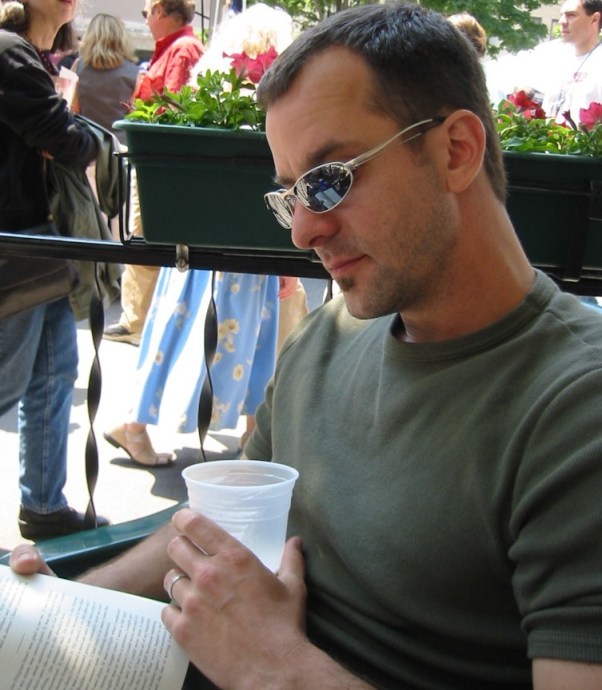

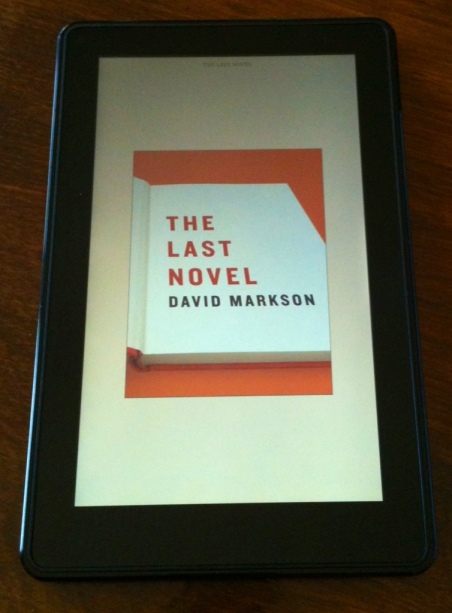
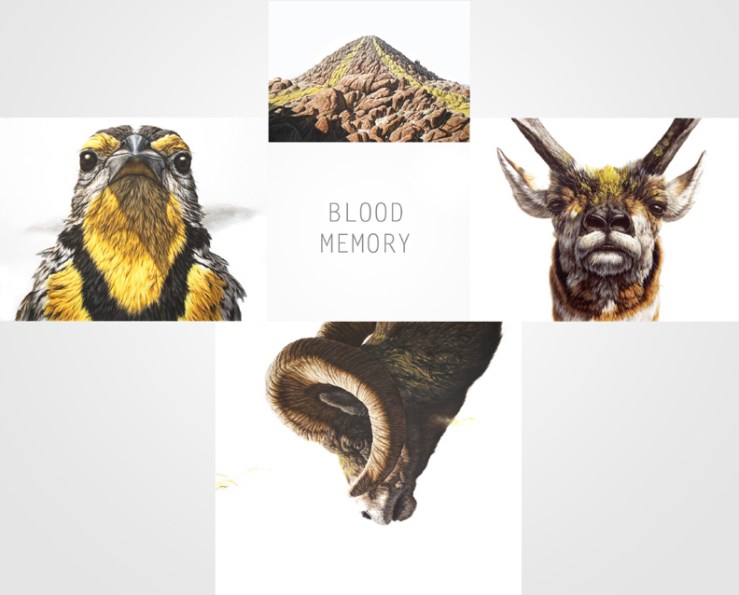


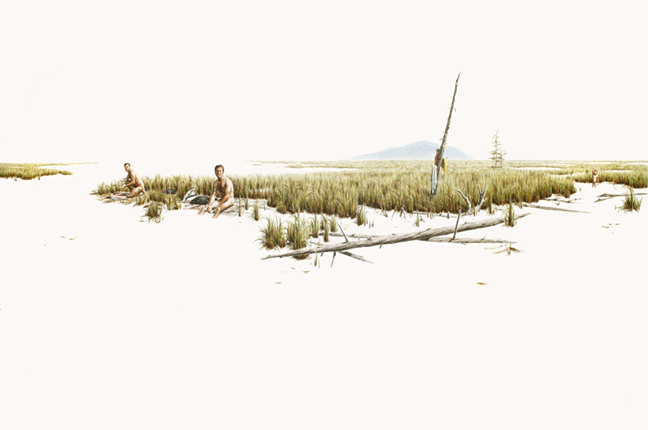

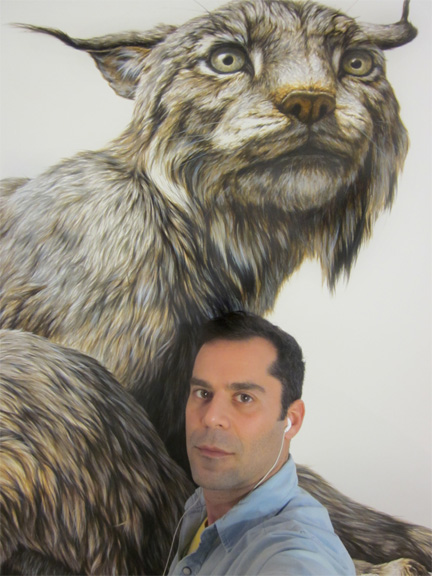

 Stuart Kendall is the author of several books, including The Ends of Art and Design, a work that examines the role of experience-events in the post-subjective world, and Georges Bataille, a critical biography of that influential author. Stuart also edited and contributed to Terrence Malick: Film and Philosophy. Stuart has produced and published numerous translations, including works by Bataille, Guy Debord, Paul Éluard, and Maurice Blanchot. His latest translation is a telling of Gilgamesh, one that casts the ancient epic poem in modernist poetry. Stuart has taught at several universities and colleges, including Boston University and the California College of the Arts, where he is currently Chair of Critical Studies. Stuart was kind enough to talk to me about Gilgamesh—and Malick—over a series of emails. You can read more about Stuart’s work at his
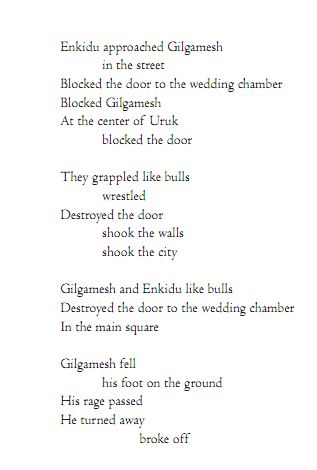
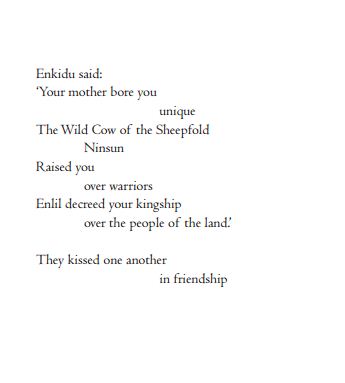
 In part notions like these are so deeply disturbing because they cut to the core of our perspective on reality. As part of a thoroughly pagan text, Gilgamesh consistently encounters gods in the things and people around him. But he also fears some of those same things as much as he savors others. The text provides rich details about objects and animals. It shows people looking at and enjoying other people. It is a book of sensual celebration as much as it is a journey into despair and the two are related, as I suggested just now: death is to be feared because life is so very full.
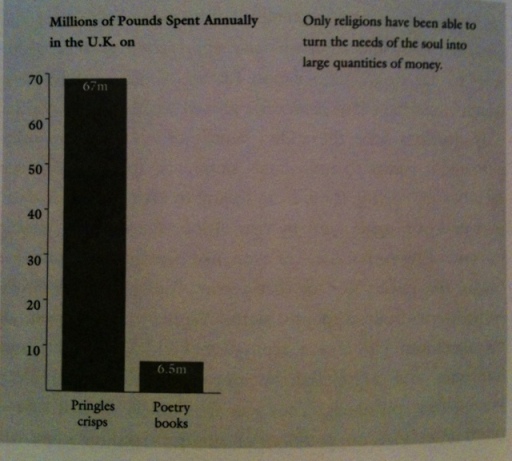

 BL: When I’m working on a poem, I never think of it as anything but its individual self. But, just as the cover woodcut is the first poem, the book, as a whole, is the last poem. This book reflects my particular process (at that time) of layering poems. It is a feeling which is, basically, “musical,” for me. Each poem is a note and the manuscript, when it’s finished, is a song.
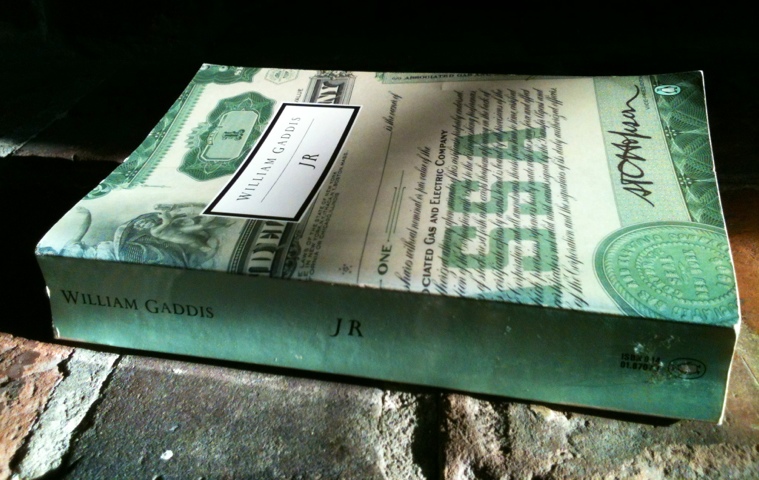


 Daniel Nayeri was born in Iran and spent a couple of years as a refugee before immigrating to Oklahoma at age eight with his family. He is the author of Straw House, Wood House, Brick House, Blow, a collection of four novellas; Kirkus called it, “Provocative and deeply satisfying,” Bookpage named it “a delightful amalgam of the high and the low, the silly and the sublime,”and the BCCB mentioned the “breathtakingly vivid word smithery” in its starred review.
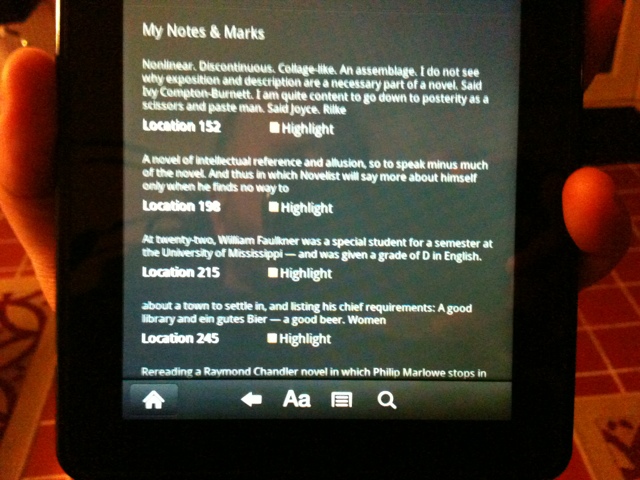

 Biblioklept