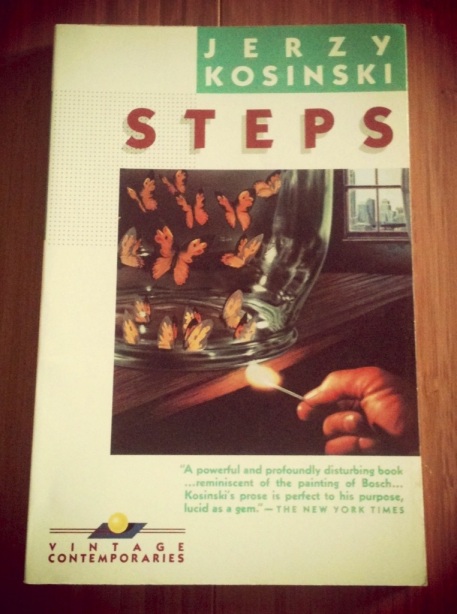
An Obligatory Review of Jonathan Franzen’s Freedom

Do you know about the Oedipal complex? That Freudian thing? Of course you do. But if for some reason you don’t, or need a refresher, here’s a quick summary from one of my all time favorite lyricists, David Byrne: “Mom and Pop / They will fuck you up / For sure.”  That joyful nugget is from one of the last songs Talking Heads recorded, “Sax and Violins,” a great little piece on modern life that is far more entertaining (and much shorter) than Jonathan Franzen’s over-hyped new novel Freedom.

Freedom works hard to prove that Mom and Pop will fuck you up. Your family will fuck you up. Then you will fuck up your own kids. Franzen’s (boring, oh my god are they boring) characters seem bound to play out repeated variations of the Oedipal complex. Furthermore, according to Freedom, our extra-familial relationships are merely substitutions or recapitulations of our own Oedipal family dramas. Even worse, Franzen seems to suggest in Freedom that all our ideologies, our passions, our beliefs are really just formed by our “morbidly competitive” impulses, impulses born in our fucked-up, Oedipal families. (“Morbidly competitive,” by the way, is Franzen’s term).

The novel centers on one family, the Berglunds, a perfectly normal (in the upper-middle-class-white-educated sense of “perfectly normal”) fucked up family of four. I’m dispassionate about this novel, so I’ll just lazily crib a short summary from a well-written piece I’m largely simpatico with, Ruth Franklin’s review at TNR

Freedom takes place over a period of about thirty years, but its primary focus is on the George W. Bush era. When it begins, Patty and Walter Berglund, college sweethearts, are among the first wave of urban pioneers putting the gentry back into gentrification, fixing up a house in a blighted area of St. Paul that they will soon populate with their two children. The short preamble offers an overview of their lives from the perspective of their neighbors, from the time they move in as a young couple to their departure around the time the children leave for college. Patty, a former college basketball star who once made “second-team all-American,” is a mother and housewife in the newly popular liberal model: “tall, ponytailed, absurdly young, pushing a stroller past stripped cars and broken beer bottles and barfed-upon old snow. . . . Ahead of her, an afternoon of public radio, the Silver Palate Cookbook, cloth diapers, drywall compound, and latex paint; and then Goodnight Moon, then zinfandel.” She bakes cookies for the neighbors on their birthdays and opens her house to their children. But Patty’s baking and mothering cannot keep her home together: her son Joey, while still in high school, moves out to live down the street with his girlfriend Connie and her family, which happens to include the only Republican on the block. The strain that their child’s defection places on the Berglunds’ marriage is obvious to all. When they leave in the early 2000s for Washington, where Walter has a new job doing something vaguely ominous involving the coal industry, one of the neighbors remarks, “I don’t think they’ve figured out yet how to live.”

This overture sets the stage for the rest of the book, which begins and more or less ends with a ridiculously well-written journal by Patty. Patty (who is somehow a  more-than-competent novelist despite having no training) allows the audience to witness her marriage crumbling from her perspective; we are also supposed to sympathize with her because her own childhood was fucked up by her family. Also, she was date-raped, a manipulative detail that adds little to the narrative (I’d call it Nice Writing at its worst). Patty’s seemingly interminable journal eventually gives way to shorter chapters focusing on Joey and Walter. There’s also Patty and Walter’s lifelong friend, ex-punk/would-be indie rock star Richard Katz. Much of the novel revolves around Patty’s desire for Richard and Walter’s desire for Richard (no homo) and Richard’s desire for what he thinks Walter and Patty have and Walter’s desire to be desired by Patty the way that Patty desires Richard and blah blah blah. It’s one big boring circle of “morbidly competitive” Oedipal tension. Franzen spends most of his time expounding on how each character feels about how another character feels about him or her in an endless solipsistic chain that fails to enlighten or even amuse. Too much telling, not enough showing.

Freedom threatens to become interesting when it picks up the Walter narrative. Walter, a die-hard environmentalist oozing oodles of liberal guilt, is hard at work with a bevy of über-Republicans and defense contractors and Texas oil men to save the planet. Via the novel’s ever-present free indirect style, Walter goes to great, finicky pains to explain how working with these creeps will actually, like, save the ecosystem. Hey, doesn’t “eco” come from the Greek “oikos,” meaning “house”? Why yes it does! Must be some kind of parallel there–save the planet, save your house, save your fucked up family . . . Only none of that pans out; instead the section gets bogged down in a cluster of details that mingle with Walter’s increasing attraction (no, deep love and lust) for his twenty-something assistant. Meanwhile, his son Joey is growing up all wrong and fucked up, falling in with neocons who hide their war profiteering in a cloak of patriotic ideology. The democratic freedom we think we cherish is a lie; the personal freedoms we struggle to obtain–by escaping our fucked-up families–is ultimately a damning, soul-devouring curse. The American Dream is just morbid competitiveness.

If Franzen intended to write a zeitgeist novel, a How We Live Now novel, I wonder if this is this really what he thinks the spirit of our age boils down to? He gets many of the details of the last decade right, but the prose is bloodless and the characters are dull, unlikable, and unsympathetic. Of course, real people can be dull, unlikable, and unsympathetic, but that usually means that we don’t want to hang out with them, let alone read about their fears and desires for almost 600 pages. If our own families are dull, at least they are usually likable and sympathetic–at least to us, anyway (I love and like my family, in any case). Freedom feels like a novel with nothing at stake, or, perhaps, a novel where everything has already been lost, where outcomes are drawn null and void from the outset. And really, I wouldn’t mind all of that if it wasn’t so tedious. It practically buckles under its own sense of weighted importance in trying to reveal how Oedipal tension underwrites ideology. Oedipus might have been fated from the get-go, but at least there was some action and excitement in his story–some level of heroism, anyway.  And because I’ve brought up Oedipus again, I’ll indulge myself and cite Talking Heads one more time.

In “Once in a Lifetime,” probably the group’s most famous song, Byrne sings, “You may ask yourself / Well, how did I get here?” The song’s narrator wonders if he can escape time, wonders if his suburban confine is a trap or a paradise; there’s a sense of sublime ridiculousness  to it all, as if he might transcend time and space and contemporary life and take off “Into the blue again /Into silent water.” He’s trying to navigate the weird gap between suburbia and ecology, between duty and freedom. It is a song that at once recognizes the existential despair of a modern, suburban life, comments on its absurdity, and then surpasses it heroically. The song is undeniably about a figure in crisis, but that figure decides that “Time isn’t holding us / Time isn’t after us.” That figure is freer than the characters in Freedom, and freer still in his weird warp of ambiguity (a warp concretely codified in Byrne’s bizarre dance in the video). The hero of “Once in a Lifetime” transmutes existential absurdity into sound and vision; Oedipus saves his country (and provides the audience with catharsis) via his ironic, tragic self-mutilation; Patty and Walter kiss and make up. It’s a dreadfully facile ending, the worst kind of wish-fulfillment that seems wholly unsupported by the narrative preceding it.

But perhaps this is an unfair way to review a book that is apparently so important–to compare it to Oedipus Rex and a few Talking Heads songs. And I’ll admit that if Freedom had not been so wildly over-praised in the past few months, I’d probably try to find something positive to say about it. So I’ll try: Franzen is deeply intelligent, even wise, and his analysis of the past decade is perhaps brilliant. It’s also incredibly easy to read, but this is mostly because it requires so little thought from the reader. Franzen has done all the thinking for you. The book has a clear vision, a mission even, but it lacks urgency and immediacy; it is flaccid, flabby, overlong. It moans where it should howl. Nevertheless, the book is not a failure, at least not on its own terms. I believe that Franzen has written the book that he intended to write, that he has documented the zeitgeist the way that he perceives it–I just happen to find his analysis dull and his characters irredeemably uninteresting. Do not feel obligated to read Freedom.
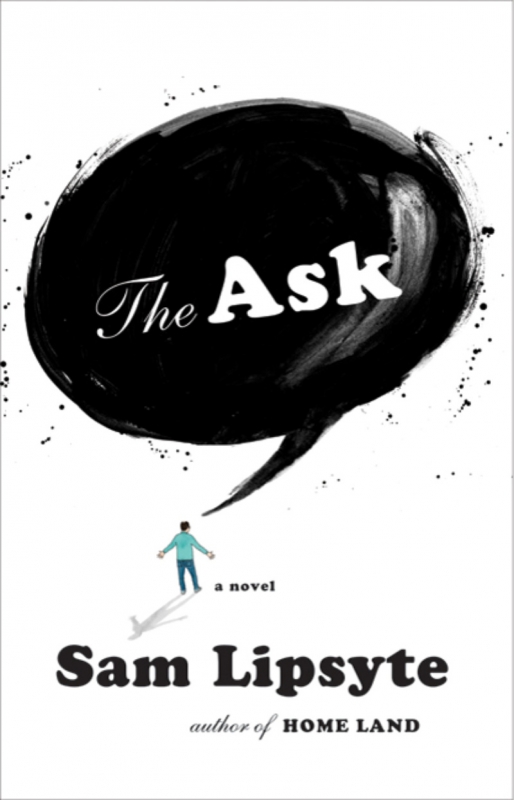
The Ask — Sam Lipsyte

I listened to the audiobook version of Sam Lipsyte’s hilarious, wistful, mean, and devastating novel The Ask last week. I invented chores and took any scenic route available when driving to get more of the book faster, frequently laughing out loud, or grimacing, or even feeling weird and shameful pangs of remorseful identification with the book’s protagonist and narrator, Milo Burke. I’m going to do my best to unpack the book’s themes–particularly the way it simultaneously eulogizes, valorizes, and mocks the American Dream–but first I need to get something out-of-the-way, a mea culpa of sorts.

As I mentioned, I listened to the book, but I don’t have a copy, so, shamefully, I can’t really quote any of Lipyste’s marvelous sentences. He is a master stylist, capable of zapping our dead modern idioms with the kind of alarming twists that highlight just how vacant language has become. Lipsyte also has a gift for rhythm, tone, and cadence, and he’s a master of the deadpan punchline. While the sentences in his last novel Home Land sometimes felt overly fussed over, straining under their own polish, The Ask showcases an effortless style that both seduces and repels. Lipsyte reads The Ask audiobook himself, yet lets the tone and cadence of his words dictate the tone and timbre of his voice. It’s all very good. And you’ll have to just take my word for all that as I have nothing to quote now (I’m sure I’ll re-review the book when I pick it up in paperback, though).

The plot is rather thin: Milo Burke, who once aspired to being a celebrated painter, now works for the grants department of a mediocre liberal arts college. His job, essentially, is to beg wealthy parents and alumni to donate massive gifts of cash to the school — this is “the ask.” Or rather, that was his job before he got fired for losing his cool with the spoiled brat daughter of a major patron. This leaves Milo moping around Queens, drinking too much, and pissing off the wife he is slowly becoming estranged from. Which is a shame, because he’s trying to be a good husband and father to his young son; despite his own shitty childhood–boozing, philandering father, emotionally absent mother–Milo is doing his best to give his family the American Dream. He’s more or less abandoned his own dreams of being a painter, and along with it, the weird faith he located in the various theorists–Marxists, feminists, deconstructionists, etc.–who informed his art school years. Much of the novel finds Milo pondering not just on the value (or lack thereof) in his liberal arts education, but also on the friends and anti-friends who he slummed with in those days. Just as the narrator of Home Land dwells on his high school days, Milo Burke can’t quit thinking about his college years in The Ask.

That past returns in the form of Purdy, a rich kid who slummed with Milo and his druggy art kid friends back in their college days. Purdy is incredibly wealthy even after the stock market crashes of the late 2000s, and has Milo specifically reinstated by the university to officiate an intended “give” (the answer to “the ask”). Purdy’s real intention though is to turn Milo into a kind of bag man, a go-between to deliver large sums of cash to Purdy’s caustically embittered illegitimate son Don, an Iraq War vet who’s lost both his legs to an IED. This arrangement thrusts Milo into Purdy’s surreal world of privilege and power, but also puts him into contact with a deranged, maimed, and deeply, deeply hurt young man who will, essentially, change the way that he examines the world and his role in it.

I’m now going to gloss over much of the book: there are many, many very funny situations, strange characters, and wonderful little insights. And now that theme I mentioned: the death of the American Dream.

Late in the novel, Milo calls America “Dead America.” Earlier in the novel, he complains that America never got to be Rome; that America is a dying, crumbling empire that never even got to revel in its hedonist excesses. Milo is keenly aware that his own white, white-collar, privileged, urban existence as a liberal-arts-educated American puts him in a position of greater material comfort than 99.9% of the rest of the people in the world, yet this fact does nothing to assuage his despair–in fact, it exacerbates it. Milo is ashamed of his despair, too-cognizant of its implications. His shame becomes a meta-, self-referential shame, and it leads to Milo essentially surrendering any power or agency he might have claimed in the universe. His liberal arts education and his own sensitivities render him feckless and bitter, always grumbling over the cosmic injustice of modern, Dead America. He is a walking, rambling critique of power, yet–as his wife likes to point out–he never does anything about the injustice he perceives. It’s only after interacting with Don that Milo begins to see an inroad to agency.

Don is, it must be said, a miserable, caustic human being, a racist blackmailer, and perennially cruel to anyone who extends a hand. He’s also performed the most real “give” in the novel–he’s lost his legs for Dead America, sacrificing his own mobility and freedom (those constituents of the dream) for the freedom of others, or at least for the illusion of other people’s freedom. Don’s toxic behavior makes him utterly repellent and thoroughly anti-heroic, but in Milo’s identification with the young man–and in Milo’s willingness to lose financial security and familial stability by essential siding with Don over Purdy– there is a glimmer (just a glimmer) of redemption and agency for Milo. Don embodies everything about America that Milo (and presumably Lipsyte) hates, yet he has also answered “the ask,” both literally and symbolically. The novel invokes then not just scathing ironic attack on the American Dream, but also a pity that reveals an intrinsic (and perhaps childish) wish to believe, a wish to make Dead America live again. The novel ends with Milo reclaiming (or maybe just claiming) some degree of agency, beginning with getting back an old war knife his father had given him, a clear symbol of paternal, phallic power (the kind that his liberal arts education told him was bad, bad, bad). And yet there’s no resolution, no pat answers–how could there be? Instead, the novel ends in another crisis–not Milo’s this time, but Don’s. But I won’t spoil that, because, hey, you’re going to read this now, aren’t you? Very highly recommended.

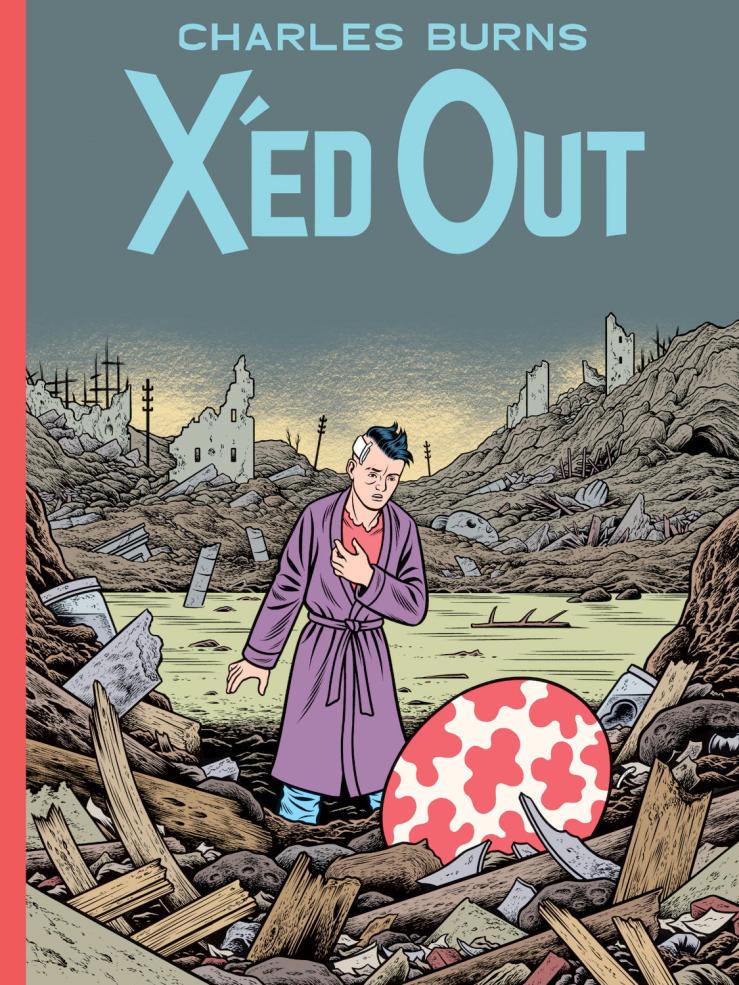
X’ed Out — Charles Burns

If you like Charles Burns, go ahead and pick up X’ed Out, the first (and very promising) entry in a new trilogy. Skip this review. You’ll probably be happier (and more unsettled) just experiencing all that vivid, glorious weirdness for yourself without any potential spoilers. If you need convincing, read on.

X’ed Out begins in a strange fever-dreamland that doesn’t immediately announce itself as such. Instead, we tentatively enter this weird world with Doug, the book’s protagonist, who, like Alice following the white rabbit, chases his (long dead) childhood cat through a crack in the wall. Doug traverses a cavernous, ruinous place, littered with murky detritus and swamped in a strange flood, to finally arrive in a bizarre desert town that approximates William Burroughs’s Interzone. Populated by mean lizards who dress like Mormon slackers and other grubby grotesques, the terrain readily recalls both Tatooine and Asian bazaars. Hapless Doug, still in pajamas, house coat, and slippers — and marked by an as-yet-unexplained head wound — soon finds himself under the guidance of a strange little diapered dwarf, who may or may not have his best interest in mind. The dreamworld unravels as Doug glances an old man — an “oldie,” as the dwarf says — who we will learn later is Doug’s father. An all of a sudden we’re back in the real world, back in waking life.

But no. That’s not right. Not “back” — we were never in the waking world to begin with. Significantly, X’ed Out begins in the Burroughsian dreamworld and then moves to a conscious, concrete reality. Burns’s dreamworld sequences explicitly reference Belgian cartoonist Hergé’s seminal Tintin comics (you can see how X’ed Out’s cover riffs on the Tintin adventure The Shooting Star here). Doug’s dream face is an expressive, stark mask, a naïve, cartoonish contrast to the bizarre nightmare to which it reacts.


from X'ed Out by Charles Burns


Doug — the waking world Doug, the “real” Doug, that is — pulls a similar mask over his more realistically drawn face later in the story when he does his “Burroughs thing” at a slummy art punk party. Alienated from the scenesters who don’t get his cut-up poetry performance, Doug takes up with Sarah, a girl from his photography class with a thing for razor blades and pig hearts. The same night they meet, he loses his girlfriend, and her crazy boyfriend goes to jail for assaulting a cop. They initiate their romance in Patti Smith records, lines of cocaine, and sick Polaroids. Ah, young love.

But all of that is in another kind of dreamworld, the past, a retreat for the “real,” contemporary Doug, who spends his few waking hours cringing in his bathrobe, poring over old photos, and eating the occasional Pop Tart. At night he eats pain pills and goes to Interzone-land, a place that seems as real and solid and valid as his past with Sarah, a past he has apparently lost. Doug bears a huge patch over half his head (significantly x-shaped in his Interzone version), and both this wound as well as the psychic trauma he’s obviously endured (and is enduring) remain unexplained throughout X’ed Out. However, Burns’s often-grisly images hint repeatedly at a past event filled with violence and loss. X’ed Out leaves us in the Interzone, with the dwarf making long-term plans for Tintinized Doug. There’s even talk of establishing residency and employment–it feels like Doug is here to stay (at least in his non-waking hours). X’ed Out ends maddeningly with a girl who visually recalls Sarah being borne by lizard men to a giant hive. The dwarf explains that she is their new queen–and like some insect queen, she is a breeder. Yuck. The ending is the biggest problem with X’ed Out, simply because it leaves one stranded, wanting more weirdness.

In Black Hole, Burns established himself as a master illustrator and a gifted storyteller, using severe black and white contrast to evoke that tale’s terrible pain and pathos. X’ed Out appropriately brings rich, complex color to Burns’s method, and the book’s oversized dimensions showcase the art beautifully. This is a gorgeous book, both attractive and repulsive (much like Freud’s concept of “the uncanny,” which is very much at work in Burns’s plot). Like I said at the top, fans of Burns’s comix likely already know they want to read X’ed Out; weirdos who love Burroughs and Ballard and other great ghastly fiction will also wish to take note. Highly recommended.

X’ed Out is available in hardback from Pantheon on October 19th, 2010.

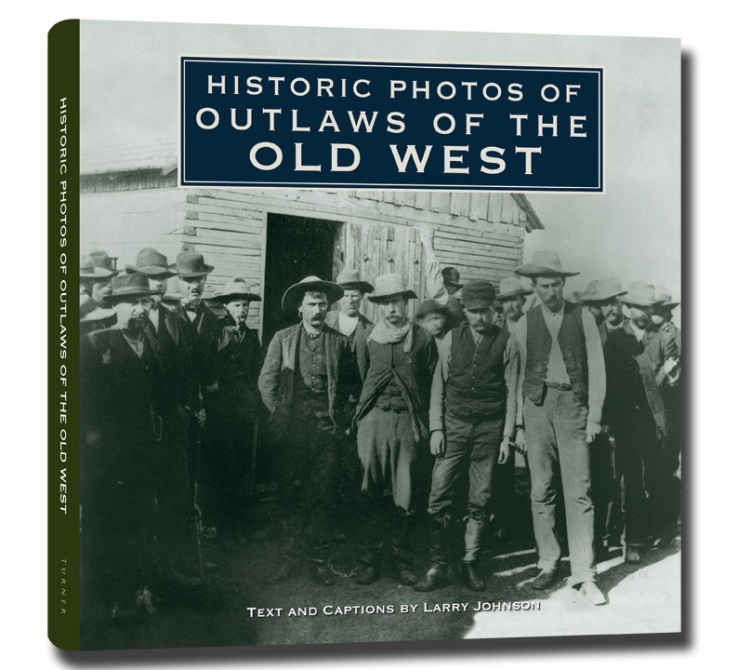
Historic Photos of Outlaws of the Old West

The romantic myth of the Western outlaw still remains central to American identity. If we are part Puritan, we also like to think of ourselves as the kind of anti-social cowboys who go out and manifest our own destiny. It’s no wonder that we have a tradition of valorizing outlaws like Billy the Kid, the Dalton gang, and Frank and Jesse James, transfiguring their bullying and theft into a kind of partisan resistance to hegemony. These men did not steal from the rich to give to the poor, yet we like to pretend that they were Robin Hoods. Turner Publishing’s new collection Historic Photos of Outlaws of the Old West presents 200 archival images of infamous (and not so famous) robbers, road agents, and rascals in the kind of gruesome detail that outlines just how awful these people really were. The Old West isn’t so romantic after all.
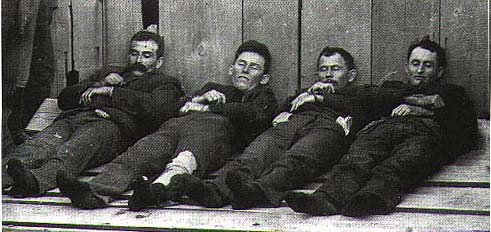
The book moves from the beginning of photography in the early 1850s to the unlikely end of an era, the 193os when the West Coast finally settled down and civilized (at least a little bit). Larry Johnson provides informative and unobtrusive text, letting the stark and often grisly photos convey the tone and emotion of the book. Simply put, this isn’t for kids. There are plenty of dead bodies, many hanging from nooses or laid out in a row, like this charmer of the Dalton gang–

Or how about Ned Christie, unfairly framed for the murder of Deputy Marshal David Maples in 1887, Oklahoma? This picture of Christie reveals that the emerging art/science of photography allowed for a certain fetishizing of the dead body–that the corpse, via mechanical reproduction, might somehow live on. Grisly.

We can see the same fascination with death in this famous image of Jesse James, who was shot in the back by Robert Ford while adjusting a picture. (Their complicated story is told in the brilliant revisionist film The Assassination of Jesse James by the Coward Robert Ford, by the way).

There are less famous but equally intriguing figures as well, like Benjamin Hodges, a black Mexican cowboy who made his living as a con artist in Dodge City. Here is the confident confidence man–

The images in Outlaws of the Old West are both fun and unsettling, and Johnson never glosses over or sugar coats the ugly truths behind these images (he even points out that, though we see the shootout at the OK Corral as a kind of archetypal battle between good vs. evil, the Earps and their pal Doc Holliday were hardly angels). The pictures in this book gel more with the imagery we find in revisionist Westerns like Cormac McCarthy’s Blood Meridian or Sam Peckinpah’s bloody films, which is another way of saying that they aren’t for the faint of heart–and I enjoy that about the volume. Check it out.

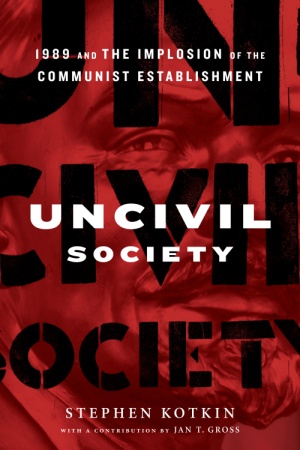
Uncivil Society — Stephen Kotkin

Stephen Kotkin’s Uncivil Society earned rave reviews when it debuted last year in hardback; this week Modern Library releases the trade paperback version. Uncivil Society is a revisionist history that dispels the romantic myth that a “civil society” of dissenting citizens orchestrated the fall of Eastern European Communism (and its symbol, the Berlin Wall). Rather, Kotkin (along with colleague Jan T. Gross) concisely and methodically shows that the Eastern Bloc’s demise resulted from the corruption and incompetence of the ruling class of bureaucrats and ideologues–the “uncivil society” who borrowed massively from the West to buy consumer goods they could not afford. Kotkin finds case studies in East Germany, Romania, and Poland, but his analysis extends beyond these countries to indict the Soviet model.

Kotkin’s writing is direct and precise, stuffed with concrete facts and political analysis without sacrificing narrative integrity. In other words, he takes a murky subject and illuminates it. The narrative proper is slim at under 150 pages, making the book a quick and ideal survey of a widely misunderstood time. Students and politics of history will wish to take note of Uncivil Society, a straightforward and agile read.

Angels — Denis Johnson

Angels, Denis Johnson’s 1983 début novel, begins as a small book about not very much and ends as a small book about pretty much everything. Johnson has a keen eye and keener ear for the kinds of marginal characters many of us would rather overlook all together, people who live and sweat and suffer in the most wretched, unglamorous, and anti-heroic vistas of a decayed America. The great achievement of the novel (beyond Johnson’s artful sentences) is in staging redemption for a few–not all, but a few–of its hopeless anti-heroes.

Take Jamie, for instance. Angels opens on this unfortunate young woman as she’s hauling her two young children onto a Greyhound bus. She’s leaving her cheating husband for relatively unknown prospects, lugging her children around like literal and symbolic baggage. Jamie should be sympathetic, but somehow she’s not. She’s someone we’d probably rather not look at, yelling at her kids while she drags on a Kool. Even she knows it. Of two nuns on the bus: “But Jamie could sense that they found her make-up too thick, her pants too tight. They knew she was leaving her husband, and figured she’d turn for a living to whoring. She wanted to tell them what was what, but you can’t talk to a Catholic.” Jamie finds a closer companion, or at least someone equally bored and equally prone to drinking and substance abuse, in Bill Houston. The ex-con, ex-navy man is soon sharing discreet boilermakers with her on the back of the bus, and she makes the first of many bad decisions in deciding to shack up with him over the next few weeks in a series of grim motels.

The bus, the bus stations, the motels, the bars–Johnson details ugly, urgent gritty second-tier cities and crumbling metropolises at the end of the seventies. The effect is simply horrifying. This is a world that you don’t want to be in. Johnson’s evocation never veers into the grotesque, however; he never risks tipping into humor, hyperbole, or distance. The poetic realism of his Pittsburgh or his Chicago is virulent and awful, and as Jamie drunkenly and druggily lurches toward an early trauma, one finds oneself hoping that even if she has to fall, dear God, just let those kids be okay. It’s tempting to accuse Johnson of using the kids to manipulate his audience’s sympathy, but that’s not really the case. Sure, there’ s a manipulation, but it veers toward horror, not sympathy. (And anyway, all good writing manipulates its audience). Johnson’s milieu here is utterly infanticidal and Jamie is part and parcel of the environment: “Jamie could feel the muscles in her leg jerk, she wanted so badly to kick Miranda’s rear end and send her scooting under the wheels, of, for instance, a truck.”

Jamie is of course hardly cognizant of the fact that her treatment of her children is the psychological equivalent of kicking them under a truck. She’s a bad mother, but all of the people in this novel are bad; only some are worse–much worse–than others. Foolishly looking for Bill Houston on the streets of Chicago, she notices that “None of these people they were among now looked at all legitimate.” Jamie is soon conned, drugged, and gang-raped by a brother and his brother-in-law; the sister/wife part of that equation serves as babysitter during the horrific scene.

And oh, that scene. I put the book down. I put the book away. For two weeks. The scene is a red nightmare, the tipping point of Jamie’s sanity, and the founding trauma that the rest of the novel must answer to–a trauma that Bill Houston, specifically, must somehow pay for, redress, or otherwise atone. The rape and its immediate aftermath are hard to stomach, yet for Johnson it’s no mere prop or tasteless gimmick. Rather, the novel’s narrative thrust works to somehow answer to the rape’s existential cruelty, its base meanness, its utter inhumanity. Not that getting there is easy.

Angels shifts direction after the rape, retreating to sun-blazed Arizona, Bill Houston’s boyhood home and home to his mother and two brothers. There’s a shambling reunion, the book’s closest moment of levity, but it’s punctuated and punctured by Jamie’s creeping insanity, alcoholism, and drug addiction. Johnson’s signature humor is desert-dry and rarely shows up to relieve the narrative tension. Jamie hazily evaporates into the background of the book as the Houston brothers, along with a dude named Dwight Snow, plan a bank robbery. Another name for Angels might be Poor People Making Bad Decisions out of Sheer Desperation. Burris, the youngest Houston, has a heroin habit to feed. James Houston is just bored and nihilistic and seems unable to enjoy his wife and child and home. On hearing about the bank robbery plan, Jamie achieves a rare moment of insight: “Rather unexpectedly it occurred to her that her husband Curt, about whom she scarcely ever thought, had been a nice person. These people were not. She knew that she was in a lot of trouble: that whatever she did would be wrong.” And of course, Jamie’s right.

The bank robbery goes wrong–how could it not?–but to write more would risk spoiling much of the tension and pain at the end of Angels. Those who’ve read Jesus’ Son or Tree of Smoke will see the same concern here for redemption, the same struggle, the same suffering. While Jesusian narratives abound in our culture, Johnson is the rare writer who can make his characters’ sacrifices count. These are people. These are humans. And their ugly little misbegotten world is hardly the sort of thing you want to stumble into, let alone engage in, let alone be affected by, let alone be moved by. But Johnson’s characters earn these myriad affections, just as they earn their redemptions. Angels is clearly not for everyone, but fans of Raymond Carver and Russell Banks should make a spot for it on their reading lists (as well as Johnson fans like myself who haven’t gotten there yet). Highly recommended.

“It was a lone tree burning on the desert” — Blood Meridian’s Moral Core

Cormac McCarthy’s Blood Meridian begins as a strange, violent picaresque bildungsroman, detailing the adventures of a teenage runaway known only as “the kid.” When the Kid falls in with John Glanton’s marauders, the narrative lens expands and pulls back; Glanton’s gang essentially envelopes the Kid’s personality. The pronoun “they” dominates the Kid’s own agency, for the most part, and the massive figure of Judge Holden usurps the narrative’s voice. The effect is that the Glanton gang’s killing, raping, and scalping spree becomes essentially de-personalized, and, to a certain extent, amoralized.

The Kid, and perhaps the ex-priest Tobin and the Kid’s erstwhile partner Toadvine, are the only major characters who bear any semblance of conventional morality in the narrative. The Kid exhibits a willingness to help others early on when he agrees to stitch one of Tobin’s wounds; later, he removes an arrowhead from a wounded man when no other member of the company will (Tobin chides him for caring, declaring that the wounded man would have killed the Kid had the Kid’s efforts been unsuccessful). For most of the central narrative though, the Kid’s individual actions are consumed into the gang’s “they.” However, at the beginning of chapter 15 the narrative focuses again on the Kid, who is charged with killing a wounded man named Shelby to “spare” him from the approaching Mexican army (this is a bizarre version of mercy in Blood Meridian). Shelby pleads to live and the Kid allows it, even giving the man some water from his own canteen. After he leaves he catches up with a man named Tate whose horse is wounded. Tate remarks on the boy’s foolishness for helping him, but the Kid does so nonetheless, sharing Tate’s burden as they try to make their way back to the rest of their party. Tate is soon killed by Mexican scouts. In both cases, the outcome of the Kid’s moral actions–the will to help, to save, to preserve life–are negated by the book’s narrative outcomes, but I would argue that his intentions in the face of violence somehow secure his humanity.

His journey alone to rejoin the Glanton gang is figured as a kind of vision quest, a strange echo of Christ in the desert, perhaps. At its core–and perhaps the moral core of the book–is the following strange passage–

It was a lone tree burning on the desert. A herladic tree that the passing storm had left afire. The solitary pilgrim drawn up before it had traveled far to be here and he knelt in the hot sand and held his numbed hands out while all about in that circle attended companies of lesser auxiliaries routed forth into the inordinate day, small owls that crouched silently and stood from foot to foot and tarantulas and solpugas and vinegarroons and the vicious mygale spiders and beaded lizards with mouths black as a chowdog’s, deadly to man, and the little desert basilisks that jet blood from their eyes and the small sandvipers like seemly gods, silent and the same, in Jedda, in Babylon. A constellation of ignited eyes that edged the ring of light all bound in a precarious truce before the torch whose brightness had set back the stars in their sockets.

The burning tree alludes to YHWH’s appearance to Moses as a burning bush, and also the tree of smoke that led the Israelites through the desert. Significantly, all the strange, terrible creatures of the desert come to meet around it in a “precarious truce.” The burning tree inverts the natural, inescapable violence that dominates the novel and turns it into a solitary, singular moment of peace. When the Kid awakes–alone–the tree is merely a “smoldering skeleton of a blackened scrog.” God is not in the permanence of the object but rather in the witnessing of the event–Blood Meridian locates (a version of a) god in the natural violence of burning and consumption. There is a strong contrast here, I believe, with the book’s other version of god, the Judge’s proclamation that “War is god.” The Judge, a cunning, devilish trickster, wants to reduce (or enlarge) war to all contest of wills, to pure violence–to divorce it from any ideological structure. Yet the burning tree episode reveals natural violence divorced from ideology. The animals (and the man, the Kid) suspend their Darwinian animosities in order to witness the sublime. The episode is silent, outside of language, order, ideology. This silence is echoed in the novel’s final confrontation between the Judge and the Kid, who retorts simply “You ain’t nothin'” to the Judge’s barrage of grandiose language. While the rejoinder may not save the Kid, its rejection perhaps saves his soul (if such a thing exists in the novel, which I believe it does). So, while larger-than-life Judge Holden may dominate the novel, Cormac McCarthy has nonetheless given us another moral road to follow, should we choose to.

“The Authentic American Apocalyptic Novel” — Harold Bloom on Blood Meridian

The Triumph of Death, Pieter Bruegel the Elder, c. 1562

Harold Bloom’s esteem for Blood Meridian may have done much to advance the novel’s reputation over the past decade. His essay on the book, first published in his 2000 collection How to Read and Why and later included as the preface to Random House’s Modern Library editions, makes a strong case for Blood Meridian’s canonical status. Bloom begins, in typical Bloomian fashion–the anxiety of influence is always at work–by situating McCarthy’s book against other heavies–

Blood Meridian (1985) seems to me the authentic American apocalyptic novel, more relevant even in 2000 than it was fifteen years ago. The fulfilled renown of Moby-Dick and of As I Lay Dying is augmented by Blood Meridian, since Cormac McCarthy is the worthy disciple both of Melville and of Faulkner. I venture that no other living American novelist, not even Pynchon, has given us a book as strong and memorable as Blood Meridian . . .

The Garden of Earthly Delights — Hell, Hieronymus Bosch, 1503-1504

Bloom goes  on to rate Blood Meridian over DeLillo’s Underworld, several books by Philip Roth, and even McCarthy’s own All the Pretty Horses. Indeed, Bloom proclaims Blood Meridian “the ultimate Western, not to be surpassed.” This doesn’t mean that Bloom is at home with the book’s violence; he confesses that it took him two attempts to read through its “overwhelming carnage.” Still, he makes a case for reading it in spite of its gore–

Nevertheless, I urge the reader to persevere, because Blood Meridian is a canonical imaginative achievement, both an American and a universal tragedy of blood. Judge Holden is a villain worthy of Shakespeare, Iago-like and demoniac, a theoretician of war everlasting. And the book’s magnificence–its language, landscape, persons, conceptions–at last transcends the violence, and converts goriness into terrifying art, an art comparable to Melville’s and to Faulkner’s.

Bloom repeatedly invokes Melville and Faulkner in his essay, arguing that Blood Meridian’s “high style” is one of its key strengths (unlike fellow aesthetic critic James Wood, who seems to think that McCarthy is a windbag). The trajectory of Bloom’s essay follows Melville and Shakespeare, finding in Judge Holden both a white whale (and not so much an Ahab) and an Iago. He writes–

Since Blood Meridian, like the much longer Moby-Dick, is more prose epic than novel, the Glanton foray can seem a post-Homeric quest, where the various heroes (or thugs) have a disguised god among them, which appears to be the Judge’s Herculean role. The Glanton gang passes into a sinister aesthetic glory at the close of chapter 13, when they progress from murdering and scalping Indians to butchering the Mexicans who have hired them.

I think that Bloom’s great insight here is to read the book as a prose epic as opposed to a linear novel; to see that Blood Meridian foregrounds a deeply tragic and ironic reworking of the great American myth of Manifest Destiny. While hardly a pastiche, the book is somehow a collage; a massive, deafening collage that numbs, stuns, and overwhelms with its layers of thick, bloody prose. The effect is akin to the apocalyptic paintings of Hieronymus Bosch and Pieter Bruegel. Dense and full of allusion, paintings like The Triumph of Death and The Garden of Earthly Delights surge over the senses, destabilizing narrative logic. Like Blood Meridian, these paintings employ a graphic grammar that disorients and then reorients. They are apocalyptic in all senses of the word: both revelatory and portentously conclusive. And like Blood Meridian, they showcase “a sinister aesthetic glory” (to use Bloom’s term), a terrible, awful, awesome ugliness that haunts us with repulsive beauty.

“Books Are Made out of Books” — Blood Meridian and Samuel Chamberlain

In his 1992 interview with The New York Times, Cormac McCarthy said, “The ugly fact is books are made out of books. The novel depends for its life on the novels that have been written.” McCarthy’s masterpiece Blood Meridian, as many critics have noted, is made of some of the finest literature out there–the King James Bible, Moby-Dick, Dante’s Inferno, Paradise Lost, Faulkner, and Shakespeare. While Blood Meridian echoes and alludes to these authors and books thematically, structurally, and linguistically, it also owes much of its materiality to Samuel Chamberlain’s My Confession: The Recollections of a Rogue.

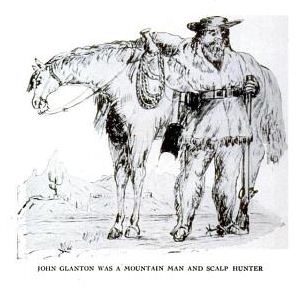
Chamberlain, much like the Kid, Blood Meridian’s erstwhile protagonist, ran away from home as a teenager. He joined the Illinois Second Volunteer Regiment and later fought in the Mexican-American War. Confession details Chamberlain’s involvement with John Glanton’s gang of scalp-hunters. The following summary comes from the University of Virginia’s American Studies webpage

According to Chamberlain, John Glanton was born in South Carolina and migrated to Stephen Austin’s settlement in Texas. There he fell in love with an orphan girl and was prepared to marry her. One day while he was gone, Lipan warriors raided the area scalping the elderly and the children and kidnapping the women- including Glanton’s fiancee. Glanton and the other settlers pursued and slaughtered the natives, but during the battle the women were tomahawked and scalped. Legend has it, Glanton began a series of retaliatory raids which always yielded “fresh scalps.” When Texas fought for its independence from Mexico, Glanton fought with Col. Fannin, and was one of the few to escape the slaughter of that regiment at the hands of the Mexican Gen. Urrea- the man who would eventually employ Glanton as a scalp hunter. During the Range Wars, Glanton took no side but simply assassinated individuals who had crossed him. He was banished, to no avail, by Gen. Sam Houston and fought as a “free Ranger” in the war against Mexico. Following the war he took up the Urrea’s offer of $50 per Apache scalp (with a bonus of $1000 for the scalp of the Chief Santana). Local rumor had it that Glanton always “raised the hair” of the Indians he killed and that he had a “mule load of these barbarous trophies, smoke-dried” in his hut even before he turned professional.
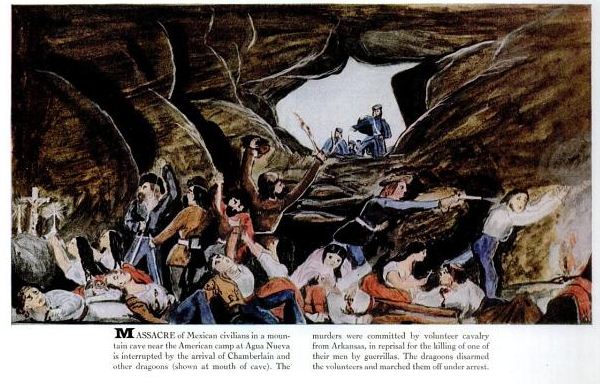
Chamberlain’s Confession also describes a  figure named Judge Holden. Again, from U of V’s summary–

Glanton’s gang consisted of “Sonorans, Cherokee and Delaware Indians, French Canadians, Texans, Irishmen, a Negro and a full-blooded Comanche,” and when Chamberlain joined them they had gathered thirty-seven scalps and considerable losses from two recent raids (Chamberlain implies that they had just begun their careers as scalp hunters but other sources suggest that they had been engaged in the trade for sometime- regardless there is little specific documentation of their prior activities). Second in command to Glanton was a Texan- Judge Holden. In describing him, Chamberlain claimed, “a cooler blooded villain never went unhung;” Holden was well over six feet, “had a fleshy frame, [and] a dull tallow colored face destitute of hair and all expression” and was well educated in geology and mineralogy, fluent in native dialects, a good musician, and “plum centre” with a firearm. Chamberlain saw him also as a coward who would avoid equal combat if possible but would not hesitate to kill Indians or Mexicans if he had the advantage. Rumors also abounded about atrocities committed in Texas and the Cherokee nation by him under a different name. Before the gang left Frontreras, Chamberlain claims that a ten year old girl was found “foully violated and murdered” with “the mark of a large hand on her throat,” but no one ever directly accused Holden.

It’s fascinating to note how much of the Judge is already there–the pedophilia, the marksmanship, the scholarship, and, most interesting of all, the lack of hair. Confession goes on to detail the killing, scalping, raping, and raiding spree that comprises the center of Blood Meridian. Chamberlain even describes the final battle with the Yumas, an event that signals the dissolution of the Glanton gang in McCarthy’s novel.

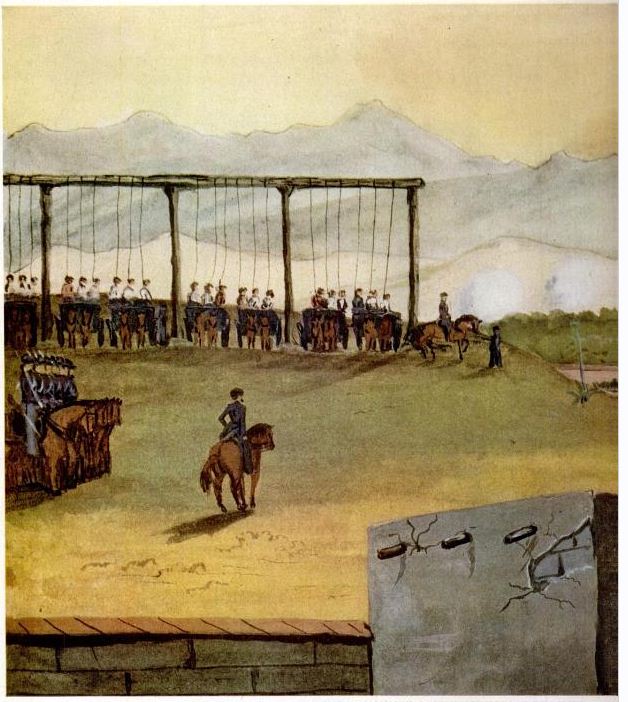
Content aside, Chamberlain’s prose also seems to presage McCarthy’s prose. In his book Different Travelers, Different Eyes, James H. Maguire notes that, “Both venereal and martial, the gore of [Chamberlain’s] prose evokes Gothic revulsion, while his unschooled art, with its stark architectural angles and leaden, keen-edged shadows, can chill with the surreal horrors of the later Greco-Italian painter Giorgio de Chirico.” Yes, Chamberlain was an amateur painter (find his paintings throughout this post), and undoubtedly some of this imagery crept into Blood Meridian.

You can view many of Chamberlain’s paintings and read an edit of his Confession in three editions of Life magazine from 1956, digitally preserved thanks to Google Books–here’s Part I, Part II, and Part III. Many critics have pointed out that Chamberlain’s narrative, beyond its casual racism and sexism, is rife with factual and historical errors. He also apparently indulges in the habit of describing battles and other events in vivid detail, even when there was no way he could have been there. No matter. The ugly fact is that books are made out of books, after all, and if Chamberlain’s Confession traffics in re-appropriating the adventure stories of the day, at least we have Blood Meridian to show for his efforts.
James Wood (Is Wrong) on Blood Meridian

Critic James Wood wrote extensively about Cormac McCarthy’s Blood Meridian in his 2005 essay for The New Yorker, “Red Planet.” Here’s his lede–

To read Cormac McCarthy is to enter a climate of frustration: a good day is so mysteriously followed by a bad one. McCarthy is a colossally gifted writer, certainly one of the greatest observers of landscape. He is also one of the great hams of American prose, who delights in producing a histrionic rhetoric that brilliantly ventriloquizes the King James Bible, Shakespearean and Jacobean tragedy, Melville, Conrad, and Faulkner.

Wood later details McCarthy’s gift as “one of the greatest observers of landscape”–

“Blood Meridian” is a vast and complex sensorium, at times magnificent and at times melodramatic, but nature is almost always precisely caught and weighed: in the desert, the stars “fall all night in bitter arcs,” and the wolves trot “neat of foot” alongside the horsemen, and the lizards, “their leather chins flat to the cooling rocks,” fend off the world “with thin smiles and eyes like cracked stone plates,” and the grains of sand creep past all night “like armies of lice on the move,” and “the blue cordilleras stood footed in their paler image on the sand like reflections in a lake.”

Wood then goes about attempting to explain his problems with McCarthy the “ham” who produces “histrionic rhetoric” —

[McCarthy’s] prose opens its lungs and bellows majestically, in a concatenation of Melville and Faulkner (though McCarthy always sounds more antique, and thus antiquarian, than either of those admired predecessors).  . . .

It is a risky way of writing, and there are times when McCarthy, to my ear, at least, sounds merely theatrical. He has a fondness for what could be called analogical similes, in which the linking phrase “like some” introduces not a visual likeness but a hypothetical and often abstract parallel: “And he went forth stained and stinking like some reeking issue of the incarnate dam of war herself.” . . .

The danger is not just melodrama but imprecision and, occasionally, something close to nonsense. . . .

The inflamed rhetoric of “Blood Meridian” is problematic because it reduces the gap between the diction of the murderous judge and the diction of the narration itself: both speak with mythic afflatus. “Blood Meridian” comes to seem like a novel without internal borders.

So, Blood Meridian doesn’t meet the standard of Wood’s cherished “free indirect style,” where an author subtly shifts into a character’s voice. Wood craves these delicate internal borders. He can’t bear the idea that the towering figure of Judge Holden might come to ventriloquize the novel. It is worth noting here that Wood frequently extols the free indirect styles of Marcel Proust and Henry James–two authors McCarthy dismissed in a 1992 interview with The New York Times, saying “I don’t understand them . . . that’s not literature.”  Wood values a mannered precision of realism that McCarthy openly professes little interest in; rather, McCarthy uses a mythic, amplified, and at times grandiose style in Blood Meridian to explore issues of life and death. And Wood is perhaps not wrong here. At times Blood Meridian edges into bombast, although I believe McCarthy controls his language more than Wood allows. In either case, McCarthy’s language is ripe for parody, as exemplified in this clip from Wes Anderson’s 2001 film The Royal Tenenbaums

I would be happy to leave Wood’s criticism of Blood Meridian and McCarthy alone at this point. Fine, Wood doesn’t like it when McCarthy goes balls-to-the-wall; whatever. But at the end of “Red Planet” Wood turns to attacking McCarthy’s perceived failure to vindicate God’s goodness in the face of evil. Wood here (and elsewhere, always elsewhere) shows his deep conservatism. Wood necessitates that all literature reveal a platonic center, a stable, beating heart that must also be a platonic good. Here he is, griping about McCarthy’s “metaphysical cheapness”–

Like most writers committed to pessimism, McCarthy is never very far from theodicy. Relentless pain, relentlessly displayed, has a way of provoking metaphysical complaint. . . .

But McCarthy stifles the question of theodicy before it can really speak. His myth of eternal violence—his vision of men “invested with a purpose whose origins were antecedent to them”—asserts, in effect, that rebellion is pointless because this is how it will always be. Instead of suffering, there is represented violence; instead of struggle, death; instead of lament, blood.

If Wood finds only a nihilism in Blood Meridian (and the rest of McCarthy’s oeuvre) that he fundamentally disagrees with, he should simply say so. Instead, Wood demands that Blood Meridian be a theodicy and then condemns it for not being one. He shamefully attempts to hold the work to a radically subjective rubric that cannot be answered. Put another way, the failure that Wood finds in Blood Meridian is a failure to answer to a version of God–and God’s judgment–that Wood would like to believe in (or, more accurately, be comforted by).

Wood is a bully (of both authors and readers) whose criticisms rarely enlarge the works they seek to address. We see his program at work in “Red Planet,” where his aim is to deflate Blood Meridian’s giant language and not appraise it on its own terms. That the book survives–and thrives–despite Wood’s criticism is hardly surprising; that a critical conversation of Blood Meridian should include Wood is depressing.

Blood Meridian — Cormac McCarthy

Blood Meridian is a blood-soaked, bloodthirsty bastard of a book, and certainly the most violent piece of literature I’ve read outside of the Bible and certain Greek tragedies. Cormac McCarthy’s 1985 novel passes itself off as a Western–and it is a Western, to be sure–but more than anything, it’s a brutal horror story.

Set predominantly in the 1850s, Blood Meridian chronicles the westward journey of a protagonist we know only as “the kid.” After a few false starts (including getting shot, robbed, arrested, and surviving a Comanche massacre) the kid eventually meets up with John Joel Glanton‘s “expedition”–a group of men of mixed backgrounds hired by Mexican authorities to kill–and scalp–the nomadic Apache who prey upon Mexican villages. However, led by the nefarious, larger-than-life Judge Holden, Glanton’s gang quickly descends into a relentless robbing, raping, and killing spree; they savagely massacre peaceful Indian settlements along with the Mexican villages they were contracted to protect.

I could keep summarizing the book, but I don’t see the point, honestly–a mere description of the plot could never do real justice to the weight of this book. The narrative is taut and fast-paced–in fact, at points the action is so radically condensed that I had to go back and re-read sections–and there’s no shortage of the “men doing men stuff” that McCarthy is so good at detailing–but it’s really the combination of the book’s evocative imagery and philosophical pondering that hook the reader.

Most of that philosophical pondering comes from the Judge, who waxes heavy on everything from space aliens to metallurgy. In his parables and aphorisms, the Judge comes across as part-Mephistophelean, part-Nietzschean, all dark wisdom and irreverent chaos. I found myself re-reading the Judge’s speeches several times and chewing them over, trying to digest them; for me, they were the best part of a great book.

Blood Meridian, like most excellent things, is simply not for everyone, and I don’t mean that in any snobbish, elitist sense. Any reader turned off by its freewheeling violence would be justified, and I’m sure plenty of folks out there would take issue with its ambiguous conclusion. Depictions of genocidal mania that seem to end inconclusively are not for everyone, particularly when they are rife with archaisms, untranslated Spanish, and McCarthy’s signature apostrophe-free punctuation. I had two false starts with the novel, including one where, at about exactly half way through, I realized I had to go back and start the novel again. I owed it that much. And it was worth it.

Blood Meridian is literally stunning; perhaps the best analogy I can think of is going to see a really, really good band that plays really, really brutal and strange music that sorta melts your face off. After the show you’re sweaty and exhilarated and even unnerved; your ears are ringing and your chest is pounding. And then the band packs up, and the house lights go on, and they pump in music from a CD, of all things, and the music just sounds tinny and pale and blanched of life after the raw power you’ve witnessed. Reading anything else right after finishing Cormac McCarthy’s Blood Meridian, or the Evening Redness in the West is sort of like that. Highly recommended.

[Editorial note–Biblioklept originally published this review on April 6th, 2008. We’re running it again as part of a week of coverage celebrating Blood Meridian’s 25th anniversary].

Cloud Atlas — David Mitchell

Friedrich Nietzsche famously wrote that “There are no facts, only interpretations.” David Mitchell takes this idea to heart in his 2004 novel Cloud Atlas, using six nested narratives to mull over Nietzschean matters of truth and perspective, the will to power, what it means to be a slave or a master, and the different methods by which one might narrativize one’s life. At its core, Cloud Atlas works to illustrate Nietzsche’s hypothesis of eternal recurrence, the idea that we live our lives again and again. To wit, each of the central characters in Cloud Atlas‘s six sections seems to be a reincarnation of a previous one. Mitchell arranges his narrative like a matryoshka doll, interrupting the first five stories with Scheherazade-style cliffhangers. Each narrative propels the book’s chronology forward a century or more until reaching a crescendo in a post-apocalyptic world, the only section that remains uninterrupted. Mitchell then resumes each narrative, working backward through time to his starting point in 1850, with The Pacific Journal of Adam Ewing.

The Pacific Journal of Adam Ewing features a naïve American’s tour of the South Pacific, focusing roughly on his trek from New Zealand to Hawaii. The journal’s style readily and purposefully recalls Herman Melville; indeed, Ewing himself professes to be a fan of Melville. Early in Ewing’s journal–which is to say, early in the novel Cloud Atlas–we are treated to (or subjected to) a somewhat lengthy description of the enslavement and slaughter of the pacifist Moriori tribes of the Chatham Islands at the hands of the Māori. Here, Mitchell introduces his novel’s dominant theme of slavery and civilization. Again and again in Cloud Atlas, we find groups of people preying upon other people, enslaving them and decimating their cultures. The Pacific Journal reiterates this theme when Ewing helps to rescue an enslaved Moriori who has escaped his slavers by stowing away; the episode also echoes the relationship between Ishmael and Queequeg, of course.

The next episode, Letters from Zedelghem, features a young bisexual composer named Frobisher; his narrative comprises letters he sends to his best-friend (and sometime lover) Rufus Sixsmith. Frobisher’s robust voice is one of the great achievements of Cloud Atlas; he finds music everywhere and in everything, and even though he repeatedly gets himself into terrible situations (which are always entirely his own fault) it’s hard not to feel for him. In debt and on the lam, he finds work as an amanuensis in Belgium, laboring under an aged, sometimes-despotic composer named Ayrs. Ayrs enlists Frobisher’s talents in creating a work named “Eternal Recurrence,” but ends up stealing most of his ideas. The Frobisher narrative is the only section to explicitly name Nietzsche and his ideas. Given the setting–Belgium, 1931, Europe precariously dangling before the precipice of another war–there’s a certain ambivalence toward Nietzsche perhaps, or at least a tacit acknowledgment that ideas like the Will to Power might be radically misapplied. Letters also most openly alludes to the structure of Cloud Atlas. In its second part–which is to say its conclusion, which is to say near the end of Cloud Atlas–Frobisher writes the following–

Spent the fortnight gone in the music room, reworking my year’s fragments into a “sextet for overlapping soloists”: piano, clarinet, ‘cello, flute, oboe, and violin, each in its own language of key, scale, and color. In the first set, each solo is interrupted by its successor: in the second, each interruption is recontinued, in order. Revolutionary or gimmicky?

Frobisher’s question perhaps reflects Mitchell’s own reticence over his complicated structure; in any case, it amounts to a post-modern wink. Frobisher’s narrative also initiates the book’s process of connecting the narratives, as each protagonist finds a copy of the earlier principal’s story. Frobisher finds Ewing’s Journal and devours it; in one of the book’s funnier moments, he scolds Ewing’s naïvety, comparing him to Captain Delano in Melville’s Benito Cereno. Frobisher’s criticism is apt. With its themes of slavery and mastery, truth and representation, and exterior and interior, there is probably no book that Cloud Atlas echoes as strongly as Benito Cereno.

Mitchell moves from a wonderful and witty approximation of the epistolary novel into a dull exercise in boilerplate fiction with the next narrative. Half-Lives: The First Luisa Rey Mystery follows the adventures of a plucky newspaper reporter in the 1970s as she tries to reveal a multinational corporation’s evil doings to the public. Aided by the report of a scientist named Rufus Sixsmith (yes, that Rufus Sixsmith), Luisa plunges into a world of intrigue and mystery and blah blah blah. Half-Lives intends to comment on airport novels, but Mitchell outdoes himself with the bad writing–it’s easily the weakest section of Cloud Atlas, and although it plays with the novel’s overarching themes it does little to enlarge or invigorate them. It does, however, introduce the comet-shaped birthmark that connects the heroes of these tales as they are born and reborn.

Mitchell seems more at home in the amplified voice that propels The Ghastly Ordeal of Timothy Cavendish. Set in and outside of London in the near future–that is to say, our near future–The Ghastly Ordeal is probably the funniest section of Cloud Atlas. Cavendish, the aging publisher of a small vanity press, finds success (and trouble) when one of his authors openly murders a critic. A dispute over royalties finds him hitting the road and fleeing for safety outside the urbane confines of London. Soon, he’s held prison in a home for the elderly somewhere in the barbaric north. Cavendish is scowling, imperious, overeducated, and arch; his racism and classism seem to belong to a different age and he’s prone to hyperbole (scratch that–he’s all hyperbole). Cavendish’s narrative is deeply reactionary: early in, he relates being mugged by a group of school girls, and the episode seems to come from A Clockwork Orange. How honest he is here, of course, is under suspicion, but that’s kinda sorta the whole point of Cloud Atlas. Cavendish’s narrative is the hardest to place stylistically–it doesn’t immediately resonate with any of the genre tropes that characterize the other section–but I suppose that there’s something of the post-Modernist (as opposed to postmodernist, of course) white-male-reactionary flavor to his Ordeal–hints of Saul Bellow, Updike, Roth perhaps? I’m not sure. The Ghastly Ordeal is the most contemporaneous episode of Cloud Atlas, so its tropes may be harder to spot.

The dystopian tropes of An Orison of Sonmi-451 are more readily apparent. Orison jumps centuries ahead, pointing to a future where an imperial Korean dominates what’s left of the non-burned Earth. Corporations have replaced government and consumerism has replaced religion. The rigid class structure that has developed relies on a slave class of fabricants–genetically modified clones–who perform dangerous jobs and manual labor. The narrative unfolds as an interview with Sonmi-451, a fabricant who “ascends,” positioning her in a level of unprecedented self-awareness that positions her to become the signal in a revolution to end slavery. There’s more to Orison than I can possibly unpack here, an observation that cuts both ways for Cloud Atlas. On one hand, Mitchell’s dystopia is repellent and enchanting, grimy and brightly lit, a world of fascinating extrapolations that mirror and satire contemporary society. On the other hand, Orison is overstuffed; its seams show the strains of containment. One gets the sense that Mitchell’s had to restrain an entire novel here, and the frequent need to dump exposition on his readers undercuts his otherwise nimble prose. (Alternately, the clunky exposition dumping might be a reference to Philip K. Dick). Mitchell is clearly comfortable working in the idiom of Orwell and Huxley (Sonmi explicitly references both writers, by the by), but the second half of Orison–the descending half, if you will–cannot reclaim the energy of its first part. Beyond Orison, a sense of contraction rules the second half of Cloud Atlas.

Perhaps the deflation in the novel’s second half results from its triumphant middle passage, Sloosha’s Crossin’ an’ Ev’rythin’ After. Dystopia moves to post-apocalypse, and maybe a thousand years after the time of Ewing, we are back in the Pacific, in the Hawaiian islands, where a man named Zachry spins one of the better adventure yarns I’ve heard in some time. Mitchell writes Sloosha’s Crossin’ in an invented argot that readily (and purposefully) recalls Russell Hoban’s post-apocalyptic masterpiece Riddley Walker. Like that book, Sloosha’s Crossin’ showcases an environment removed from the apocalypse–the narrative is more about how civilizations might reform after a fall. When a woman named Meronym from a “tribe” called the Prescients comes to stay with Zachry’s family, the stress between civilization and savagery comes to a head. The Prescients seem to be the last group of people on earth with any vestige of command over prelapsarian technology. Meronym (who bears a comet-shaped birthmark) does her best not to intervene in the day-to-day life of the family, but when the Kona, an aggressive tribe of slavers attack, she finds her self unable not to act. As the central, unbroken narrative of Cloud Atlas, Sloosha’s Crossin’ must both climax the novel as well as tie its disparate ends to its organizing themes. It doesn’t disappoint, both encapsulating, repeating, and commenting on the various slave-slaver narratives that run through the rest of the text. When the Kona attack Zachry’s Valleysmen, we see eternal recurrence–Māori slaughtering Moriori, Christian colonials ousting aboriginals, corporations using their fabricants for slave labor. A dialogue between Zachry and Meronym (delivered in Zachry’s argot, of course) spells out the novel’s concerns. Zachry asks Meronym if it’s “better to be savage’n to be Civ’lized?” She replies–

What’s the naked meanin’ b’hind them two words?

Savages ain’t got no laws, I said, but Civ’lizeds got laws.

Deeper’n that it’s this. The savage sat’fies his needs now. He’s hungry, he’ll eat. He’s angry, he’ll knuckly. He’s swellin’, he’ll shoot up a woman. His master is his will, an if his will say soes “Kill” he’ll kill. Like fangy animals.

Yay, that was the Kona.

Now the Civ’lized got the same needs too, but he sees further. He’ll eat half his food now, yay, but plant half so he won’t go hungry ‘morrow. He’s angry, he’ll stop’n’ think why so he won’t get angry next time. He’s swellin’, well, he’s got sisses an’ daughters what need respectin’ so he’ll respect his bros’ sisses and daughters. his will is his slave, an’ if his will say soes, “Don’t!” he won’t, nay.

What we see here is, I believe, a subtle reading of Nietzsche’s famous, infamous, and not-so-well understood concept of the will to power. Meronym’s solution to save endangered humanity is not blind adherence to conventional morality but rather an individual’s ability to overcome his or her animal instincts to thrive. The Übermensch enslaves his own will, his id, and preserves his ego.

As Sloosha’s Crossin’ concludes and Cloud Atlas moves outward and back into the past, there’s a twin sense of deflation and redemption. Orision does not have the room it needs to breathe; although Sonmi’s inevitable martyrdom follows a narrative logic that Sloosha’s Crossin’ more than justifies, it feels undercooked. The second half of the Cavendish narrative is more fulfilling. No spoilers. Mitchell manages to shoehorn a strange missive by a physicist into the second half of Luisa Rey; it’s only a page and a half, it doesn’t really belong there, and it’s the most interesting thing about the whole narrative. Like Frobisher’s description of his sextet, it functions as one description of the book. Luisa gets to hear that sextet, by the way; she special orders one of only fifty pressings. Frobisher’s narrative I’ve remarked upon at some length, so I will leave it alone by saying that it’s one of the finer points of Cloud Atlas and noting that it ends with a specific invocation of Nietzsche’s idea of eternal recurrence. The Journal of Adam Ewing is also very satisfying; in many ways it has to be, for it is the beginning and the end and the second end (and thus new beginning) of the novel. Ewing’s experiences–which, to leap right through the chain of protagonists, must also be Meronym’s experiences–lead him to reject the common morality of his time. As the novel concludes, he elects to return to the United States as a committed abolitionist, his stated mission in life to fight slavery in all its forms.

Cloud Atlas is a postmodern novel through and through. It riffs on genre and style with a keen awareness of textuality, an overt reliance on intertextuality, and a formally experimental schema that, as one of its principals puts it, might be “Revolutionary or gimmicky.” It lovingly pairs the high with the low, the philosophical with the vulgar, the musical with the mud, and its best moments do so seamlessly and gracefully. It’s a very good read–a fun read–and readers daunted by its structure need not be: Mitchell has created a book that they in many ways probably already know–they just don’t know that they know it like this. Highly recommended.

W.G. Sebald: Image, Archive, Modernity — J.J. Long

In W.G. Sebald: Image, Archive, Modernity, J.J. Long posits that the work of the late German author W.G. Sebald is best understood as the struggle for autonomous subjectivity in a world conditioned by the power structures of modernity. If the term “power structures” wasn’t a big enough tip-off, yes, Long’s analysis of Sebald is largely Foucauldian, and although he cites Foucault more than any other theorist (Freud is a distant second), the book is not a dogged attempt to make Sebald’s prose stick to Foucault’s theories. Rather, Long uses Foucault’s techniques to better understand Sebald’s works. As such, Long examines the ways that modernity affects power on the human body in Sebald’s work, tracing his protagonists’ encounters with modern institutions that exert power via archive and image.
From the outset, Long distinguishes his book-length study on Sebald from the tradition of so-called Holocaust studies, as well as some of the other foci that dominate analyses of Sebald — “trauma and memory, melancholy, photography, travel and flânerie, intertextuality and Heimat.” Long claims that these are simply “epiphenomena” of the “problem of modernity” that dominates Sebald’s work, and goes on to scrutinize Sebald’s novels like The Emigrants, Austerlitz, and The Rings of Saturn by focusing instead on the various ways that modern institutions proscribe power on the subject’s body. Long writes–

Sebald is interested in the ways in which subjectivity in modernity is formed by archival and representational systems through which various forms of disciplinary power are exercised. He is also concerned with the scope that might exist for eluding disciplinary power or reconfiguring its archival systems in order to assert a degree of subjective autonomy or evade the determinations of power/knowledge.

Long’s study of Sebald is very much a description of modernity; in particular, of modernity as a series of affects of power and discipline upon the subject (again, very Foucauldian). It’s not particularly surprising then that Long, after locating so many Sebaldian traumas in the 19th and early 20th centuries, asserts that Sebald is a modernist and not a postmodernist. He bases this claim not on the formal elements of Sebald’s prose, which he readily concedes can just as easily be read as postmodernist, but rather on the way his “texts respond to the specific historical constellation” of modernity. Long continues–

What is notable about Sebald is that the fictional worlds he constructs are not postmodern spaces of global capital, hyperspace and ever-faster cycles of production, consumption and waste (despite his narrators’ occasional visits to McDonald’s). His texts do not present unrelated present moments in time, nor do they partake of the waning of history that is frequently noted as a characteristic of the postmodern. Sebald’s spaces are those of an earlier modernity that are deeply marked by the traces of history.

If the question of whether or not a book is postmodern or modern strikes you as merely academic, that’s because it is merely academic. Long makes a solid case for Sebald-as-modernist, but the best parts of his book are really his Foucauldian analyses of Sebald’s texts. They make you want to go back and reread (or, in some cases read for the first time.) I’m inclined to believe that Sebald (along with a host of other writers) is better described as something beyond modern or postmodern, something we might not have a name for yet, but that’s fine–we need distance, time. In Long’s take, Sebald is, of course, trying to sort out the detritus of modernity–even as it’s happening to him. But I’m not sure if that makes him a modernist.

W.G. Sebald: Image, Archive, Modernity is available now from Columbia University Press.

Richard Yates — Tao Lin

Tao Lin has made the choice to be a very visible, very public author, one whose antics might lead audiences to form opinions on the 27 year old’s work before even reading it. I mention his age because he’s young, and not only is he young, he seems to be gunning to speak for his generation–always a precarious position.

Lin’s new novel Richard Yates is about young people. Specifically, it’s about a 22-year-old slacker named Haley Joel Osment and his 16-year-old girlfriend Dakota Fanning (I’ll address those names in a moment). Haley Joel Osment lives in Manhattan where he apparently is trying to make it as a writer–something that the book rarely delves into. Haley Joel Osment (Lin always writes the entire name out, part of the book’s numbing, trance-inducing program) meets fellow weirdo Dakota Fanning, and soon begins paying furtive visits to her New Jersey home, hiding in closets and under covers to avoid Dakota Fanning’s mother–who nevertheless soon discovers their illicit romance.

This is the primary conflict in the book–the age-of-consent gap between the young lovers–but the real trauma of the book lies in the couple’s urge toward self-annihilation. In conversations with each other–in person or in email, but primarily in Gmail chat–Haley Joel Osment and Dakota Fanning frequently promise to kill themselves, usually in a casual, detached tone. If “I will probably kill myself later this week” is one of their mantras, the other is “I’m fucked” or “We’re so fucked.” These are not happy people. Here’s Haley Joel Osment writing an email to Dakota Fanning, summarizing his philosophical position: “At each moment you can either kill yourself, try harder to detach yourself from people and reality, or be thinking of and doing what you can for the people you like.”

The bulk of the book consists of such conversations, mopey or mordant or mean. Haley Joel Osment accuses Dakota Fanning of being the type of person who wants to detach from others and reality, yet he’s just as guilty. Lin allows the audience into Haley Joel Osment’s interior, where we find a deeply troubled young man, alienated by his own inability to stop over-processing everything he sees. The problem is that Haley Joel Osment is the core referent of all of Haley Joel Osment’s observations; his solipsism prevents him from actually really knowing anyone else. Mulling over Dakota Fanning’s minutest movements, he repeatedly reads in them signs about her own regard for him. Even when he attempts to be the type of person who is “thinking of and doing what [he] can for the people” he likes, he’s not. He’s selfish and cannot see his own selfishness. The kernel of self-destruction at the heart of Haley Joel Osment and Dakota Fanning’s relationship doesn’t emerge from their age difference but rather his slow, cruel manipulation of her self-image. As the book progresses, Haley Joel Osment’s “advice” cripples Dakota Fanning, leading her down a path of bulimia and self-mutilation.

Lin’s style is flat, dry, and utterly concrete. The only metaphors or similes he employs come (quite artlessly) from his characters. Furthermore, these figures of speech seem incidental; even the couple’s code word “cheese beast” feels like a metaphor with no referent (or perhaps too many referents). There are no symbols (or perhaps the book is all symbols). In many ways, Richard Yates recalls Bret Easton Ellis’s early work, although Lin’s observations and comments on twenty-first century materialism are even more oblique and ambiguous than the moralism of Less Than Zero. The most immediate rhetorical technique, of course, is the book’s title. Although the text refers to the writer Richard Yates several times, his name seems utterly arbitrary, perhaps an obscure joke meant to purposefully confuse. And those character names. For the first few pages, Lin’s choice to name his protagonists after famous child stars seems gimmicky or overdetermined, but in time these names displace their original referents, as well as any other associations. They become like placeholders; Lin might as well have named them X and Y. As if to flatten out his characters even more, Lin also transliterates all of their speech. Much of the novel takes place in conversations over Gmail chat, email, and text messages, but Lin turns these truncated forms into full, affectless sentences. He even removes most contractions. His characters often speak like androids, albeit androids prone to spouting non sequiturs.


Lin also makes the odd decision to include an index to the book, part of which you can see above. In a sense, reading the index is like reading a condensed version of the book. It’s a lump sum of nouns that the book treats with more or less equal weight. The long list under the entry “facial expression” perhaps reveals the most about the book’s program, about its refusal to yield insights or give away anything beyond surfaces–it reads almost like a cheat sheet for someone with Asperger syndrome. The index seems like a postmodern gesture but it’s something else–I’m not sure exactly what else–but there’s nothing sly or even self-referential about it: it’s literal, it’s surface, it’s referential. In turn, Lin resists commenting on or satirizing the sundry brand names and corporate locations that populate his index (and, of course, his novel)–a marked contrast to the postmodern tradition.

This is all perhaps a way of saying that Lin is clearly attempting something new with his fiction, a kind of writing that abandons most conceits of post-modern cleverness and self-commentary, yet also compartmentalizes the pathos that characterizes social realist novels. This latter comparison might seem odd unless one considers the concreteness of social realist works, their emphasis on the body, on food, on places. Richard Yates shares all of these emphases, yet it divorces them from ideology; or, more accurately perhaps, it documents an as-yet-unnamed ideology, a 21st century power at work on body and soul. If Lin’s goal then is to document these forces, he succeeds admirably–but I want more; more soul, more insight, more, yes, abstraction. Richard Yates gives us the who and the what, replicates the when and where with uncanny ease; it even tells us how. But many readers, like me, will want to know the why, even if it is just a guess. And I’d love to hear Lin’s guess.

Richard Yates is new this week from Melville House.

Wolf Hall — Hilary Mantel

Wolf Hall, Hilary Mantel’s revisionist retelling of the Tudor saga through the eyes of Thomas Cromwell, is new in trade paperback this week from Picador. When the book won the Man Booker Prize last year, chairman James Naughtie credited its success to the “bigness of the book . . . [its] boldness [and] scene setting.” In The Atlantic, Christopher Hitchens noted that the book put Mantel “in the very first rank of historical novelists.” In The New York Review of Books, Stephen Greenblatt pointed out that this “is a novel too in which nothing is wasted, and nothing completely disappears.” Here’s what Biblioklept had to say:

I’m coming to the end of Hilary Mantel’s brilliant treatment of the Tudor saga,Wolf Hall. Sign of a great book: when it’s finished, I will miss her characters, particularly her hero Thomas Cromwell, presented here as a self-made harbinger of the Renaissance, a complicated protagonist who was loyal to his benefactor Cardinal Wolsey even though he despised the abuses of the Church. Mantel’s Cromwell reminds us that the adjective “Machiavellian” need not be a pejorative, applied only to evil Iago or crooked Richard III. The Cromwell of Wolf Hall presages a more egalitarian–modern–extension of power. Cromwell here is not simply pragmatic (although he is pragmatic), he also has a purpose: he sees the coming changes of Europe, the rise of the mercantile class signaling economic power over monarchial authority. Yet he’s loyal to Henry VIII, and even the scheming Boleyns. “Arrange your face” is one of the book’s constant mantras; another is “Choose your prince.” Mantel’s Cromwell is intelligent and admirable; the sorrows of the loss of his wife and daughter tinge his life but do not dominate it; he can be cruel when the situation merits it but would rather not be. I doubt that many people wanted yet another telling of the Tudor drama–but aren’t we always looking for a great book? Wolf Hall demonstrates that it’s not the subject that matters but the quality of the writing. Highly recommended.

Presenting all these reviews is simply a way of pointing out that if you know anything about contemporary lit, you probably already know that there’s a strong critical consensus that the book is excellent. Which it is. And if you like historical fiction, particularly of the English-monarchy variety, it’s likely you’ve already read it (and if not, why not? Jeez). However, I think it’s important–particularly now, with the current brouhaha over what literary fiction is and how female writers are treated by critics–to point out that what makes Mantel’s novel so excellent–and distinctly literary–is the writing: the narrative craft, the intensity of characterization, the vitality of prose. There’s nothing gimmicky about Wolf Hall even though its hero Cromwell has been traditionally reviled. Furthermore, Mantel resists fetishizing her set pieces, unlike so many writers of historical fiction, who feel the need to bombard their readers with extraneous details, as if the author’s painstaking research were a weapon rather than a tool.

My original review of Wolf Hall overlapped with a reading of James Wood’s essay on Thomas More from his collection The Broken Estate (also, incidentally, available in paperback from Picador). More is the major villain of Wolf Hall, and Wood savages him in “Sir Thomas More: A Man for One Season.” It was strange then (not too strange, though) to see Mantel and Wood intersect again a few months later, in Wood’s New Yorker review of David Mitchell’s historical novel The Thousand Autumns of Jacob de Zoet. Here’s Wood–

Meanwhile, the historical novel, typically the province of genre gardeners and conservative populists, has become an unlikely laboratory for serious writers, some of them distinctly untraditional in emphasis and concern. (I am thinking not just of Mitchell but of Thomas Pynchon, Susan Sontag, Steven Millhauser, A. S. Byatt, Peter Carey.) What such novelists are looking for in those oldfangled laboratories is sometimes mysterious to me; and how these daring writers differ from a very gifted but frankly traditional and more commercial historical novelist like Hilary Mantel is an anxiously unanswered question.

Wood is typically dismissive of the historical novel even as he admits its attraction–one he doesn’t understand (or pretends not to understand)–to “serious writers,” a collective from which he deems to exclude Mantel. Wood’s rubric seems to be that Mantel is too “commercial” and “traditional” to warrant her inclusion in his club (even as he damns her with faint praise), but I think that his Mitchell review reveals a deep antipathy to anything that seems, y’know, approachable for most readers. That Pynchon leads Wood’s list is telling. Pynchon’s historical fictions range from fantastic and funny (V.Gravity’s Rainbow) to belabored and difficult (Mason & Dixon) to dense and inscrutable (Against the Day). But Pynchon is Pynchon and it’s not fair to exclude Mantel from the “serious writers” club for not being Pynchon (I sometimes think that poor James Wood has just been a book critic too long and hates reading). This is a roundabout way of arguing that, yes, Wolf Hall is serious writing, that it is literary writing, that it transcends its subject matter and comments on the human condition, on soul, on psyche, on spirit. That it happens to entertain at the same time is, of course, why we care. Highly recommended.

You Do Understand — Andrej Blatnik

There’s a central irony that emanates throughout Slovenian author Andrej Blatnik’s new collection, You Do Understand–namely, this is a book about misunderstanding. Take the first piece, “Few Words,” for example. Here it is in full–

“Do you believe in a tomorrow together?”

“First I’d like to believe that tonight really happened.”

Or, even more to the point (if that’s possible), here’s “Misunderstanding” (again, in full)–

“You’re even more beautiful when you come,” he said.

How would you know, she thought.

These two stories are probably the shortest of the fifty or so pieces in the collection, but even the longest selections barely pass four pages, creating a terse, clipped rhythm that lends You Do Understand a poetic immediacy. This rhythmic consistency, along with the book’s central theme, give it the feel of a novel-in-vignettes as opposed to a collection of unrelated stories.

You Do Understand begins with a series of miserable young single people shambling from failed romantic encounter to dismal hookup to ugly awkward sex. Take the (non)couple in “Do It Quickly, She Said” who both just want to get the sex over with so that one of them can leave, or the pair in “Melting Point” who trip over their own expectations. The narrator of “Say That” defers his drunken confusion and guilt by speaking his story in the second person. “Say that you’re kissing a strange girl,” he begins. As the microstory unfolds, it turns out that “your” dilemma is twofold–it’s not just that “you” are approaching cheating on “your” wife (if “you” haven’t already crossed a line), but also that this “strange girl” just might be a guy.

Blatnik never names his characters, but by drawing them in spare, concrete details, he makes them real nonetheless. The effect is uncanny–these are aliens you probably know in your own life, only, y’know, not. Stories like “Words Matter,” where a man fails to order a hooker for his hotel room, or “I Write These Words,” where another hotel-dweller finds his writing interrupted by paramedics fetching a dead body, express a core loneliness intrinsic to modern, transient existence.

There are other travelers in You Do Understand–although none of them seem to have a clear destination in mind. In “Other Paths,” a stranger arrives in a village in what might be a Third World country, perhaps with a romanticized notion of getting away from civilization. His illusion dissipates when he realizes that the villagers cannot even spare a bowl of rice for him to eat. In “Stains,” an expedition picks up a man in the middle of the desert, robbed and dehydrated. As he drinks their precious water, they nervously wonder if he’ll ask for the help that they don’t want to give him. It’s a cruel world, and at times You Do Understand is a cruel book, although it’s also quite funny–but never at the expense of the humanity of its cast, whom Blatnik measures with a distant compassion and a deep cynicism, as if human beings were programmed to fail, but also programmed to try again. Tamara Soban’s nimble English translation highlights Blatnik’s telegraphic style in these brisk but heavy stories, which call for rereading. Recommended.

You Do Understand is available September 7th, 2010 from Dalkey Archive Press.

Steps — Jerzy Kosinski

One of the many small vignettes that comprise Jerzy Kosinski’s 1968 book Steps begins with the narrator going to a zoo to see an octopus that is slowly killing itself by consuming its own tentacles. The piece ends with the same narrator discovering that a woman he’s picked up off the street is actually a man. In between, he experiences sexual frustration with a rich married woman. The piece is less than three pages long.

There’s force and vitality and horror in Steps, all compressed into lucid, compact little scenes. In terms of plot, some scenes connect to others, while most don’t. The book is unified by its themes of repression and alienation, its economy of rhythm, and, most especially, the consistent tone of its narrator. In the end, it doesn’t matter if it’s the same man relating all of these strange experiences because the way he relates them links them and enlarges them. At a remove, Steps is probably about a Polish man’s difficulties under the harsh Soviet regime at home played against his experiences as a new immigrant to the United States and its bizarre codes of capitalism. But this summary is pale against the sinister light of Kosinski’s prose. Consider the vignette at the top of the review, which begins with an autophagous octopus and ends with a transvestite. In the world of Steps, these are not wacky or even grotesque details, trotted out for ironic bemusement; no, they’re grim bits of sadness and horror. At the outset of another vignette, a man is pinned down while his girlfriend is gang-raped. In time he begins to resent her, and then to treat her as an object–literally–forcing other objects upon her. The vignette ends at a drunken party with the girlfriend carried away by a half dozen party guests who will likely ravage her. The narrator simply leaves. Another scene illuminates the mind of an architect who designed concentration camps. “Rats have to be removed,” one speaker says to another. “Rats aren’t murdered–we get rid of them; or, to use a better word, they are eliminated; this act of elimination is empty of all meaning. There’s no ritual in it, no symbolism. That’s why in the concentration camps my friend designed, the victim never remained individuals; they became as identical as rats. They existed only to be killed.” In another vignette, a man discovers a woman locked in a metal cage inside a barn. He alerts the authorities, but only after a sinister thought — “It occurred to me that we were alone in the barn and that she was totally defenseless. . . . I thought there was something very tempting in this situation, where one could become completely oneself with another human being.” But the woman in the cage is insane; she can’t acknowledge the absolute identification that the narrator desires. These scenes of violence, control, power, and alienation repeat throughout Steps, all underpinned by the narrator’s extreme wish to connect and communicate with another. Even when he’s asphyxiating butterflies or throwing bottles at an old man, he wishes for some attainment of beauty, some conjunction of human understanding–even if its coded in fear and pain.

In his New York Times review of Steps, Hugh Kenner rightly compared it to Céline and Kafka. It’s not just the isolation and anxiety, but also the concrete prose, the lucidity of narrative, the cohesion of what should be utterly surreal into grim reality. And there’s the humor too–shocking at times, usually mean, proof of humanity, but also at the expense of humanity. David Foster Wallace also compared Steps to Kafka in his semi-famous write-up for Salon, “Five direly underappreciated U.S. novels > 1960.” Here’s Wallace: “Steps gets called a novel but it is really a collection of unbelievably creepy little allegorical tableaux done in a terse elegant voice that’s like nothing else anywhere ever. Only Kafka’s fragments get anywhere close to where Kosinski goes in this book, which is better than everything else he ever did combined.” Where Kosinski goes in this book, of course, is not for everyone. There’s no obvious moral or aesthetic instruction here; no conventional plot; no character arcs to behold–not even character names, for that matter. Even the rewards of Steps are likely to be couched in what we generally regard as negative language: the book is disturbing, upsetting, shocking. But isn’t that why we read? To be moved, to have our patterns disrupted–fried even? Steps goes to places that many will not wish to venture, but that’s their loss. Very highly recommended.