A review of Trey Ellis’s polyglossic satire Platitudes

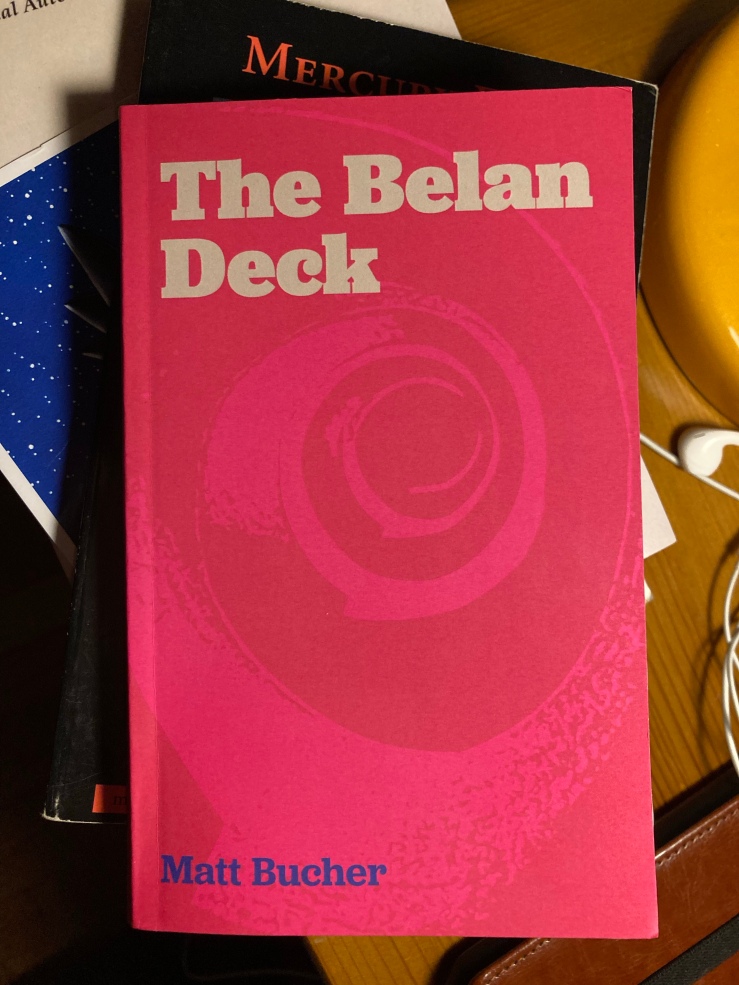
Trey Ellis’s 1988 debut novel Platitudes begins with a typical metatextual conceit: the novel-within-a-novel gambit. Our story starts with Earle, a nerdy, idealistic high school sophomore who lusts after True Love (and some sex if he can get it). After about a dozen pages though, the “author” shows his hand. Depressed divorced Dewayne Wellington is Earle’s creator, and he’s stuck in his novel-in-progress Platitudes. “I’m sorry. I don’t know what more to write,” Wellington declares, before soliciting help from his readers.

Wellington soon receives manuscript pages from bestselling author Isshee Ayam, who transplants his story from 1980s Manhattan to 1930s rural Georgia. When Wellington introduces worldly and gorgeous Dorothy as Earle’s romantic foil, Ayam’s rhetorical interventions take on a new intensity as the two authors duel to guide the spirit of the novel-in-progress.

The plot threads and styles intertwine, with Wellington’s experimental mode clashing with Ayam’s “Afro-baroque” style (as Ellis described it in a 1989 Los Angeles Times profile). A parodic pastiche of competing Black American artistic voices, Platitudes ultimately synthesizes polyglossic tones into a strangely endearing romantic comedy. Sharp but breezy, ironic and earnest, and utterly metatextual yet soaked in pathos, Ellis’s first novel seems to be an overlooked late-postmodernist gem.

Although Platitudes remains in print (via Northeastern University Press’s New England Library of Black Literature series), I have never seen it mentioned along with its contemporaries—books like David Foster Wallace’s 1989 collection Girl with Curious Hair or Bret Easton Ellis’s 1987 novel The Rules of Attraction. Instead, Ellis’s novel seems to be connected more often along with the works of Ishmael Reed, particularly his 1986 novel Reckless Eyeballing.

Reed’s novel concerns an experimental playwright who finds his career under attack from feminists. As Itabari Njeri pointed out in the LA Times profile mentioned above, many readers “assumed that Ayam is a thinly veiled Alice Walker and that Wellington is the novelist, poet and playwright, Ishmael Reed.” Ellis told Njeri that he hadn’t read Reckless Eyeballing until after he finished Platitudes. He also stated in the profile that he hadn’t read Walker’s The Color Purple. Before I read the Njeri profile I was almost certain that Ellis was parodying (lovingly though at times sharply) Reed and Walker.

Ayam’s “Afro-baroque” style is a particularly purple prose, telegraphed in the oh-so-unsubtle titles of her bestsellers: Chillun o’ de Lawd, Hog Jowl Junction, and My Big Ol’ Feets Gon’ Stomp Dat Evil Down. Here’s the first sentence of Ayam’s version of Platitudes:

Earle awakened to a day as new and as fresh as Mama’s hand-starched and sun-dried petticoat, a huge, plain garment as large and as fresh-smelling as the revival tents that bloomed every summer along Route 49 in Lowndes County, Georgia.

What an awesomely bad awesome sentence! The simple sentence is there: “Earle awakened,” but the adornment tacks on and on, a traffic jam of adjectives glommed onto a simile growing out of another simile, like a lichen that grows on a moss that grows on a rock.

Here’s Ayam’s next sentence:

Yes, from out of those wide Baptist thighs, thighs that shook with the centuries of injustice and degradation, thighs that twitched with the hope of generations yet unplanted, thighs that quivered with the friction of jubilant, bed-thumping, and funky-smelling lovemaking, emerged Earle.

“I’m speechless, Ms. Ayam,” responds Wellington by post after receiving her pages, and offers up as a return gift a list of Earle’s favorite things (to be sung to the tune Coltrane’s take on the Rodgers and Hammerstein song):

All kinds of tanks, Janey Rosebloom, Cream of Wheat, neighbors, Corinthians, toast-r-waffles, his own bean-fart vapors,

A tightly-tucked-in-bed,

Chef Boy-Ar-Dee

Schefflera, balsa wood, and Pay TeeVee.

Eff. Ay. Oh. Schwarz, lingerie straps, cowboy boots and hats.

Sunggle sacks, Chap Stick tubes, BeeBee guns, and films!

Sci-fi, cars, dance—Slurpees.

This list, printed in the console font that demarcates the many other lists, charts, menus, etc. that populate Platitudes then gives way to a brick list paragraph in whatever font Vintage Contemporaries are printed in. This second list might also comprise some of Wellington’s (and perhaps even Ellis’s?) favorite things, and includes “Jamaican accents, cleavage, efficiency, artificial cheese-food product” and

the way a pretty woman’s high heel dangles insecurely from the big toe of the crossed leg always near falling or—from a slight kick—flying spike-over-toe—an exotic Oriental weapon; but never doing either, just dangling, the toe of the shoe covering just enough to promise…

The back-and-forth of the two authors plays out as a personification of the tensions between two modes of Black literature that Ellis seeks to parody, synthesize, and ultimately transcend in Platitudes. While appreciative of the traditions and anti-traditions that came before him, he sought something new in his novel. A year later after the publication of Platitudes, Ellis published his essay “The New Black Aesthetic” in the journal Callaloo. Here, Ellis argued for a new kind of Black arts, evoking the concept of a ludic “cultural mulatto,” an artist free to borrow from both tradition and popular culture alike: “We no longer need to deny or suppress any part of our complicated and sometimes contradictory cultural baggage to please either white people or black,” Ellis declared in his essay.

Platitudes is not an essay—far from it—but it does enact the radical hybridization that Ellis put forth in his New Black Aesthetic manifesto. In his LA Times profile, Ellis declared Platitudes an “anti-novel,” adding that “It’s satirical and primarily about language performance, which has its own delights, as opposed to traditional narrative.”

And yet there is a traditional narrative here. Call it boy meets girl or coming of age or classical-in-the-Aristotelian-sense comedy or whatever you want, but Platitudes offers its reader a satisfying conclusion without selling out the ambiguities and ironies that course through its 180 or so pages.

In his back-cover blurb for Platitudes, Ishmael Reed wrote: “I was zapped by Trey Ellis’s humongous talent. His book, Platitudes, is delightfully rad.” Zapped and delightfully rad are perfect descriptors, and I feel like I’ve neglected to share enough of Ellis’s prose, which at times approximates linguistic channel surfing (at one point, quite literally). The book is both fun and funny, and while the book has not been neglected in academia (Christian Schmidt devotes a chapter to it in his study Postblack Aesthetics, for example), it deserves a wider readership from those who enjoy satirical postmodern novels. Highly recommended.

Blog about some recent reading

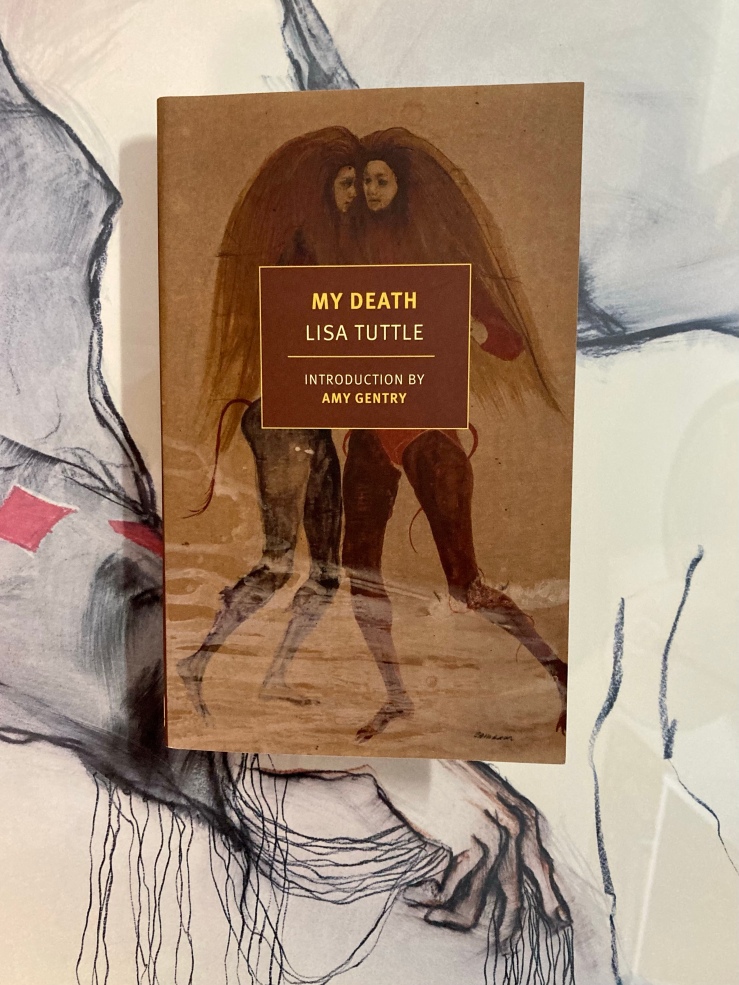
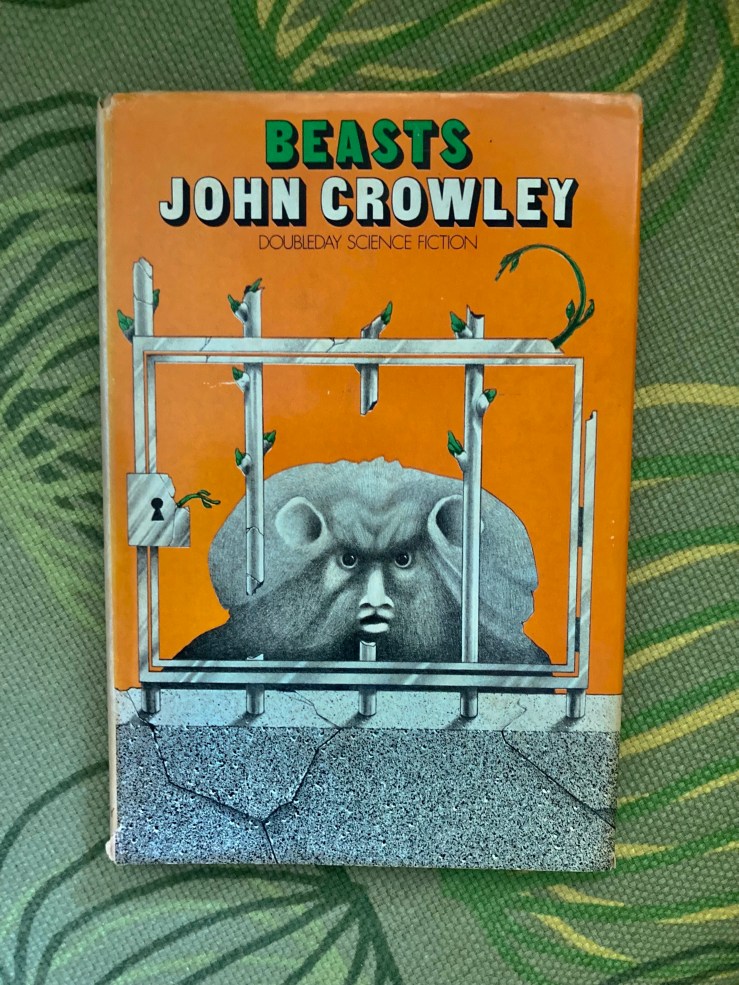
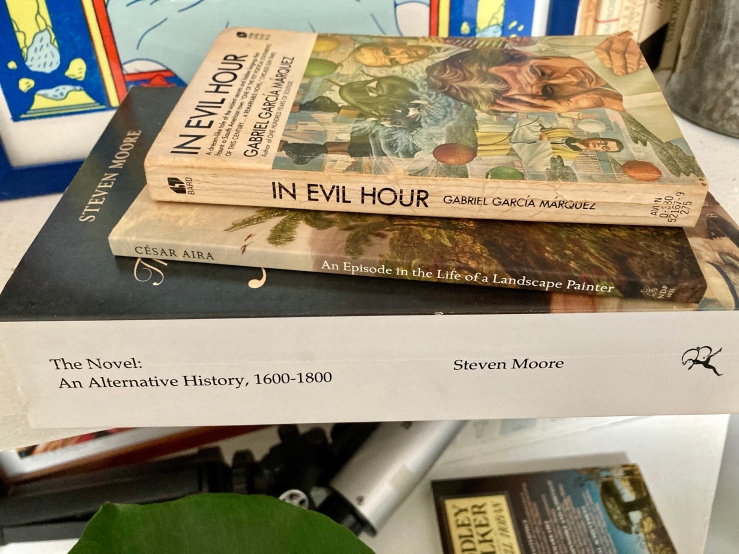
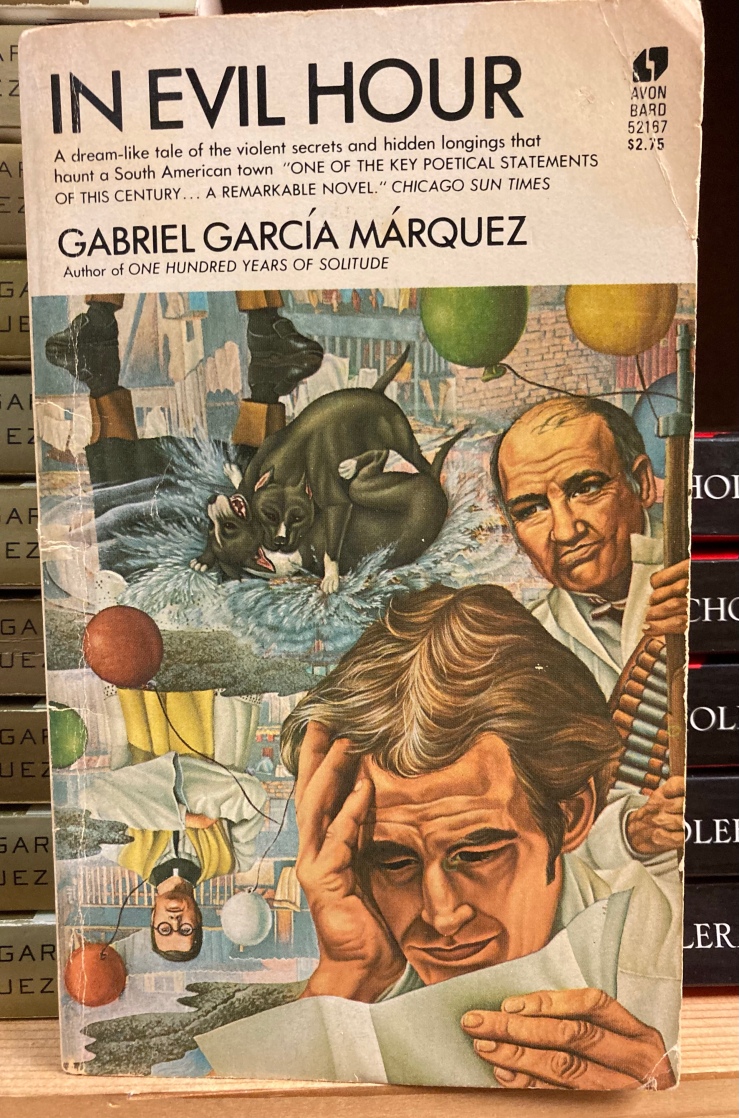
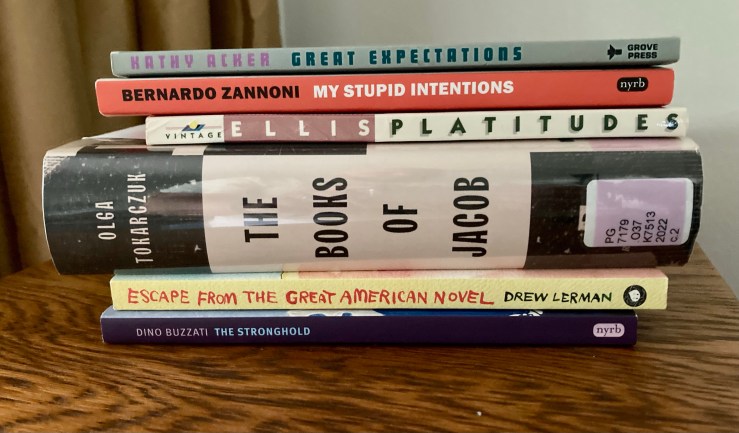
With the end of the spring term (and, frankly, a renewed commitment to weeknight sobriety), I’ve been reading a lot more and a lot faster the past few weeks. Top to bottom:

I pulled Kathy Acker’s Great Expectations out a few nights ago and ended up reading all of it over two nights and two mornings. Not the best starting point for Acker but strangely super, super readable.

Bernardo Zannoni’s My Stupid Intentions: I actually haven’t even done one of those silly “book acquired” posts for this one: I picked it up and just kept reading. Totally zapped me, fantastic stuff: a brash, sharp, sardonic animal rant against god his own self. Loved loved loved it.

I’ve got about a third left of Trey Ellis’s first 1988 novel Platitudes, and it’s really good—reminds me a lot of Ishmael Reed’s middle period stuff, Fran Ross’s Oreo, David Foster Wallace’s early fiction, and even Bret Easton Ellis. Platitudes is a send up of coming-of-age novels conveyed through linguistic channel surfing.

I finished the audiobook of Olga Tokarczuk’s novel The Books of Jacob (translated by Jennifer Croft) this afternoon. I’d been switch-hitting between the novel and audiobook, but gave over to my earplugs during a week of long commutes and longer chores—but returning to the print version for the images, maps, and, uh names. This is a novel larded with names and names and names. The Books of Jacob is a (and I don’t use this hackneyed bookworld word lightly) kaleidoscopic biopic of the 18th-c. messianic cult leader Jacob Frank. Close to 1000 pages/36 hours, The Books of Jacob is exhaustive, exhilarating, and exhaustive. Best of all, at the end of all, we don’t really know Jacob—we just get picture after perspective after point of view on the self-proclaimed savior.

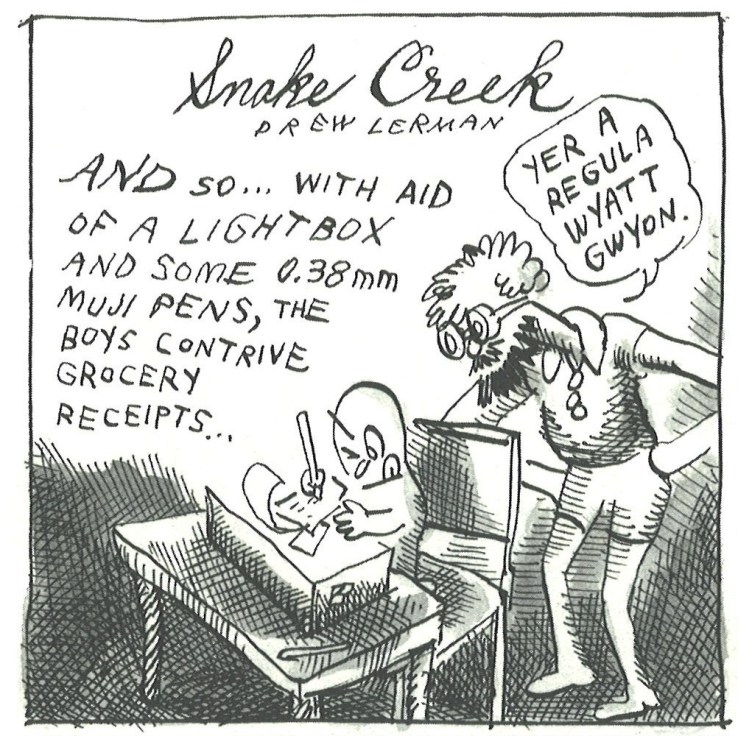
I wrote about Drew Lerman’s Escape from the Great American Novel yesterday, right?

I also managed to get out a review of Lawrence Venuti’s new English translation of Dino Buzzati’s novel The Stronghold, which is strong holding the bottom of the stack above.

Under the Volcano and elsewhere (Books acquired, week of 10 March 2023)

My family and I had a wonderful time vacationing in Mexico City last week. We rented an apartment in Condesa, a friendly, walkable neighborhood marked by shade trees, lush gardens, and robust parks. And dogs. Lots of lovely dogs. Over eight days, we took in as much of the city as we could (as well as some excellent day trips to Grutas Tolantongo in Hidalgo and Teotihuacán in Edomex). The city is huge, with more than 150 museums, and the food is excellent. While the four members of our family share common interests (including a love of art), making sightseeing somewhat streamlined, I left Mexico City feeling like I had barely scratched the surface. It reminded me in disparate ways of New York City, Bangkok, and New Orleans. Like those cities, there’s not a single aspect that intrigues me, but rather a vibe. But this is not a travel blog, it is a book blog, so:

The first thing I noticed is that the selection of titles in the several bookstores I visited (a few just very briefly) was generally excellent. Shops tended to feature big-ell Literature titles in lieu of bestsellers and airport novels, with new releases like Mircea Cartarescu’s Solenoid and Yuri Herrera’s La estación del pantano getting prominent displays.

I visited both locations of Cafebrería El Péndulo, and picked up an inexpensive Debolsillo edition of Roberto Bolaño’s La literatura nazi en America, resisting the urge to grab one of the big novels. I’ve read Chris Andrews’ translation of Nazi Literature in the Americas a few times, and I figured that it would be better for me to attempt reading and comparing the shorter sketches here than to jump into 2666 in Spanish. Although I practiced my Spanish for a year in preparation for the trip (it helps to have a Spanish professor friend whose office is down the hall from mine), my vocabulary is still limited and my conjugations are a mess.

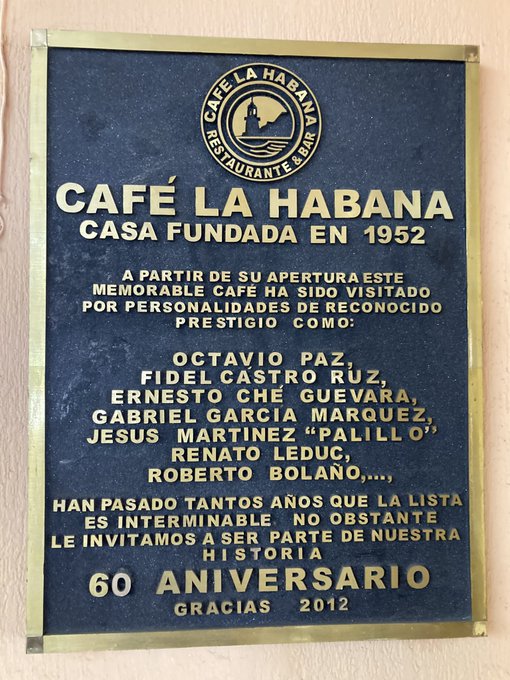
Also Bolaño-related: We lunched at Café la Habana, a charming restaurant boasting a history as a salon for poets, politicians, theorists and other bullshitters. In Bolaño’s Mexican opus The Savage Detectives, Café la Habana appears as Café Quito.

I also visited Under the Volcano, a tiny and charming bookstore in Condesa that carries English-language books–mostly literature. The store is named for Malcolm Lowry’s excellent novel, but there didn’t appear to be any of his books there the day I visited. There was a first-edition hardback copy of Robert Coover’s Pricksongs and Descants, but it was jacketless and out of my price range. There was also a standalone magazine-sized Dalkey Archive edition of William H. Gass’s story Willie Master’s Lonesome Wife, which, based on its price, the owner seemed to believe the most valuable item in the store. I also spied a copy of Jay McInerney’s 1984 novel Ransom, notable because it’s the first and so-far only hardcover of a Vintage Contemporaries edition I’ve ever seen.

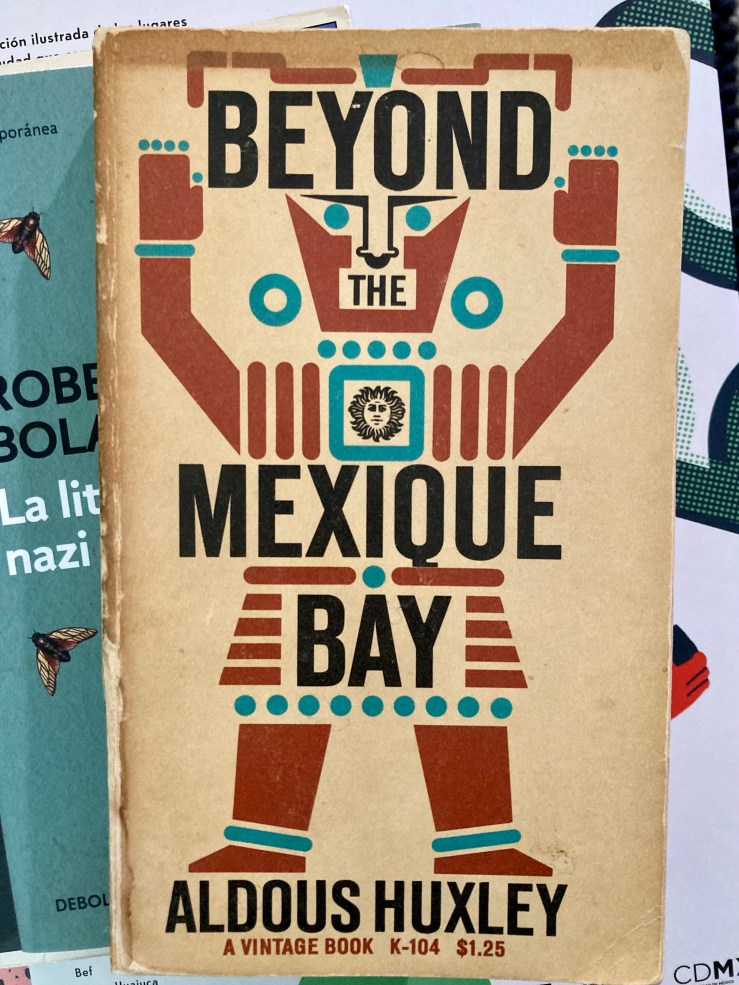
I wound up with two books from Under the Volcano: a Europa Editions of Steven Erickson’s Zeroville and Vintage edition of Aldous Huxley’s Beyond the Mexique Bay. I listened to the audiobook of Zeroville a few years ago, loved it, and have kept an eye out for a reasonably-priced copy ever since. I admit that I picked up Huxley’s essay collection in large part because of its title and its cover design (by Bradbury Thompson). I only found it because I was looking for a copy of Huxley’s The Devils of Loudun. I’ve been falling asleep to an audiobook version of Devils for about three weeks now.

I stopped into a La Increíble Librería at random while walking through Condesa. It’s a charming store that specializes in art books and arty children’s books. They also sell a small but excellent selection of Latin American titles in English translation. I picked up a coffee table book there called 50 íconos de la Ciudad de México. The book is in both Spanish and English, and features lovely illustrations of iconic Mexico City locations by ten different artists. Here’s a detail from Diego Huacuja’s illustration of the Auditorio Nacional:

As we looked through this book this morning, my wife remarked on just how few of the fifty icons presented we missed seeing on this trip. And although we saw a lot that’s not in the book, it nevertheless confirmed my feeling that we need to visit Mexico City again.

First riff: The Letters of William Gaddis, “Growing Up, 1930–1946”

The Letters of William Gaddis, ed. Steven Moore, NYRB, 2023

Chapter One: “Growing Up, 1930-1946”

Earliest letter:

To Edith Gaddis (mother), 9 Dec. 1930

Latest letter:

To Frances Henderson Diamond (early love interest), 13 March 1946

Synopsis, citations, and observations:

Most of the letters collected by Moore in this first section of Letters are addressed to Edith Gaddis, whom Moore appropriately describes as “the heroine of the first half of this book: his confidante, research assistant, financial benefactor, his everything.”

His everything clearly includes everything, but I would’ve thrown in the words earliest audience. The letters featured in this earliest chapter show only the barest germ of the writer into which Gaddis would evolve—but they do show a tenacious foundation for practice, one facilitated by a loving, motherly reader.

Here is the first letter in the volume:

Merricourt
Dec. 9, 1930

Dear Mother.

Our vacation is from Sat. Dec. 20. to January 4.
We are making scrapbooks and lots of things. We are learning about the Greek Gods.
I am making an airplane book.

With love
Billy

Little Billy is a few weeks shy of eight years old here, attending boarding school in Connecticut. He attended Merricourt from the time he was five—around the same time his mother Edith separated from his father, William T. Gaddis.

It’s clear why Moore would single out this particular letter for inclusion. The mechanical notion of “making” books, in particular books from scrap, recalls Jack Gibbs, hero of J R., who keeps scraps of newspapers and magazines in his pockets). Our boy was always a scissors-and-paste man.

The Letters gets through childhood and adolescence fairly quickly (a few scant pages) before we find 17-year old Bill sailing on the Caribbean on the SS Bacchus. There’s not much to the Caribbean adventure, but it does initiate an early theme of The Letters—young Bill goes on adventures, often getting in over his head, but also expanding his worldview. “A good part of the crew are colored but they’re okay too,” he writes to Mama Gaddis, a cringeworthy line, sure, but also one that underscores that Our Hero is a man of privilege.

A year later he’s at Harvard.

But not at Harvard for long!

This theme of attending and departing Harvard goes on a bit in the first part of Letters. (Gaddis never earned a degree). Young Bill fell ill his first semester (making him part of a famous fraternity of sick writers: Joyce, O’Connor, Kafka, Walser, Keats, Crane, Wharton, etc.),

What to do? Our Hero heads West, eventually landing in Arizona to recuperate.

Eastern Boy Gaddis’s Western Adventure is especially humorous against the backdrop of his literary oeuvre to come, particularly The Recognitions, which sardonically roasted poseurs (while simultaneously lifting up the efforts of counterfeiters who channel True Art). Our Boy decides to be a cowboy. In a letter to Mama Edith dated 17 Jan. 1942, he details his cowboy outfit:

I have gotten a pair of blue jeans ($1.39) and a flannel shirt (98¢) for this riding—expect to get another pair of jeans today—and later perhaps a pair of “frontier pants” and a gabardine shirt. No hat as yet as they do seem sort of “dudey”—but I can see that it too will become almost a necessity before too long.

The letter is part of an early genre that Gaddis hacked away at, if never perfecting: Mom, need money. 

It continues:

As for wanting anything else—well there are things down here that make me froth just to look at them!—belts such as I never dreamed of—rings—beautiful silver and leather work—but I figure I don’t need any of it now and will let it go until I’ve been around a bit more and seen more of these things that I’ve always known must exist somewhere!

We’ve all been twenty, all made questionable fashion choices, all wanted Beautiful Things We Could Not Afford. (Most of us have not had the misfortune to have our private letters published.)

Letters includes a photograph of Cowboy Bill, duded up in boots with horse. He did not give up the affect easily; in a later letter from the fall of 1942, when he’d returned to Harvard, he requested the following of Dear Mother:

Say when you get a chance could you start the following things on their way up here to make our room more habitable[:] the leopard skin on the lodge closet door—the spurs on the floor nearby—both of Smokey’s pictures—the small rug—both machetes and the little Mexican knife & sheath & chain to the right of the east hayloft windows (one machete is over hayloft door—the other on edge of balcony)—also any thing else you think might look intriguing on our wall—oh yes the steers’ horns—

Bill Gaddis spent much of the year bumming around the American West, getting to Los Angeles, Wyoming, and as far as east as St. Louis, where he meets a woman

hard of hearing—and her son Otto, who’s about 23—is sort of—simple. He went thru college—then started in at Harvard (!) and then cracked up it seems.

The first time I read The Recognitions, I found Otto a repugnant poseur of the worst stripe. Reading and rereading The Letters and Gaddis’s first novel, I find myself far more sympathetic.

The version of Young Gaddis we get from these early letters will resonate with anyone who’s held artistic ambitions. He’s callow, largely unread, generally ignorant of just how ignorant he is, charming, brave, and foolish. And while his reliance on his mama’s money transfers can occasionally irk, there’s a deep tenderness in his writing to her—for her. Again, almost every one of these letters are written to and for Edith.

William Thomas Gaddis Junior’s father and namesake hardly pops up in the discourse (at least in Moore’s edit), but a letter to Edith dated 26 Jan. 1942 is unusually detailed on the paternal topic:

And then as you say this slightly ironic setup—about my father. …As you said it has not been a great emotional problem for me, tho it does seem queer; you see I still feel a little like I must have when I said “I have no father; I never had a father!,” and since things have been as they have, I have never really missed one—honestly—and only now does it seem queer to me. All I know of fathers I have seen in other families, and in reading, and somehow thru the deep realization I have gained of their importance; of father-and-son relations; and families: not just petty little groups, but generations—a name and honour and all that goes with it—this feeling that I have gained from other channels without ever having missed its actual presence: somehow these are the only ties I feel I have with him.

Father-son relationships wrinkle queerly throughout Gaddis’s novel, always deferrals and deflections, whether Wyatt-Otto in The Recognitions or Bast-JR in J R or the King Lear tirade of Gaddis’s final letter to the world, Agapē Agape.

Gaddis returned to Harvard in the fall of 1942 (“devil to pay for eight months hence I guess”). He reads Nietzsche and Schopenhauer, or at least tells his mother he reads Nietzsche and Schopenhauer—but I believe him. Reading Nietzsche and Schopenhauer seems like a thing a young man might do. In a letter of December 1942, “so angry now am about to fly,” he complains of being recommended a history book that “turns out to be history of Communism and Socialism–Marxism–enough to make me actively ill.” A postscript lauds William Saroyan but worries that “G Stein is still a little beyond!” Our Lad has room to grow.

By the spring of 1943, Gaddis is working on the Harvard Lampoon. He would eventually become the President of the Lampoon (or, um, ‘Poon, as he writes his Mama). This project seems to entirely consume him, distracting him from his studies.

Gaddis was eventually kicked out of Harvard after an “incident” with the police (Our Boy was drunk and disorderly). The last few letters in the collection are bitter and a bit sad. Gaddis worked as a fact checker at The New Yorker for not-quite-a-year, with scant letters from this period appearing in Letters. There is a letter from a vacation to Montreal in the summer of 1945 that attests the following disillusionment:

Frankly the more I move along the more I find that every city is quite like the last one.

Not long after, Gaddis would start writing material that would wind up in The Recognitions.

NYRB 2023 updates to the Dalkey Archive’s 2013:

In addition to a smattering of letters to women who are not Edith Gaddis, NYRB’s new edition includes two new pictures–Gaddis’s Harvard 1944 yearbook picture and a professional head shot of Frances Henderson Diamond. There’s also this close-up of a photograph of children included in the Dalkey edition, clarifying which kid is Billy Gaddis.

Love Our Dude’s pipe!

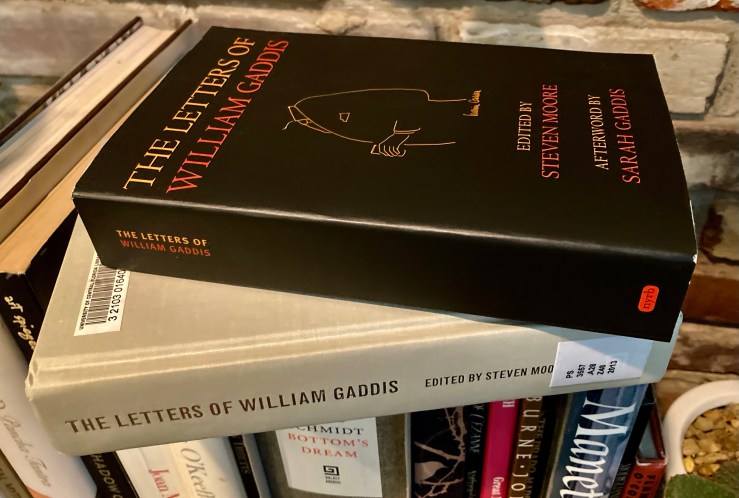
The Letters of William Gaddis (Book acquired, 1 Feb. 2023)

Ten years ago, Dalkey Archive published The Letters of William Gaddis. Edited and introduced by Steven Moore, Letters functions as an ersatz autobiography or a one-sided epistolary autobiographical novel. As a public-facing author, Gaddis was hardly a Pynchon or Salinger, but, in a 1986 Paris Review interview, he did stick by the hero of his first novel The Recognitions, contending,

What’s any artist but the dregs of his work[?]: I gave that line to Wyatt thirty-odd years ago and as far as I’m concerned it’s still valid,

Wyatt, and Gaddis, wanted to know “what people want from the man they didn’t get from his work.” The Letters offers some answers—close to 700 pages of them in the new NYRB edition of the book that includes “over two dozen new letters and photographs.”

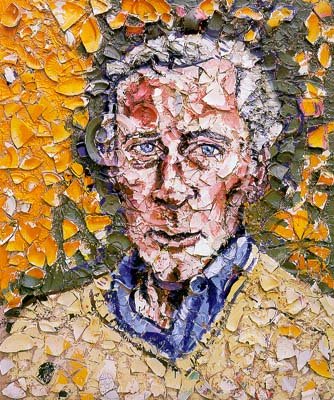
Portrait of William Gaddis, Julian Schnabel, 1987

I first read The Letters of William Gaddis slowly between 2014 and 2019 as an e-book (both legit and samizdat). Moore organized the collection around Gaddis’s five books, and I found myself often distracted, opening up the the volumes to find parallels between life and art (or moments where WG outright stole from reality). I’d never actually held the Dalkey edition, but I wanted to get a comparison, so I asked my librarian to engage in some hot library on library action, and I now have the University of Central Florida’s copy in my possession. The hardback volume is missing the jacket, which featured Julian Schnabel’s 1987 portrait of Gaddis on the cover.

The new NYRB edition, perhaps more appropriately, features Gaddis’s self-portrait as cover art. The black, gold, and red, as well as the extra-large dimensions (by NYRB standards) match the NYRB versions of The Recognitions and J.R. It’s longer and a bit smaller than the hardback Dalkey, but the print is about the same size.

I’ve decided to cover the book at my own pace; I’ve reread the first two sections, “Growing Up,” and “The Recognitions,” which covers 1930-1955. I remembered pretty much all of it, and my judgments remain the same: Gaddis is an unrepentant mama’s boy, his sweet ma Edith is the early hero of the book, quick to send money and books. Angry Young Man Gaddis is more Otto than Wyatt, but he can sling sentences with the best of them—and that’s the joy of The Letters: the writing is really, really good.

Like I said though, I’ll cover the volume at my own pace. I’ve got notes prepped for the first two sections, and I aim to get those blogs out sooner than later. In the meantime, here’s the publisher’s blurb, almost certainly Moore’s writing, updated just a tad from the Dalkey:

Now recognized as one of the giants of postwar American fiction, William Gaddis shunned the spotlight during his life, which makes this collection of his letters a revelation. Beginning in 1930 when Gaddis was at boarding school and ending in September 1998, a few months before his death, these letters function as a kind of autobiography, and also reveal the extent to which he drew upon events in his life for his fiction. Here we see him forging his first novel, The Recognitions (1955), while living in Mexico, fighting in a revolution in Costa Rica, and working in Spain, France, and North Africa. Over the next twenty years he struggles to find time to write the National Book Award–winning J R (1975) amid the complications of work and family; deals with divorce and disillusionment before reviving his career with Carpenter’s Gothic (1985); then teaches himself enough about the law to produce A Frolic of His Own(1994). Resuming his lifelong obsession with mechanization and the arts, he finishes a last novel, Agapē Agape (published in 2002), as he lies dying.

This newly revised edition includes clarifying notes by Gaddis scholar Steven Moore, as well as an afterword by the author’s daughter, Sarah Gaddis.


On A.V. Marraccini’s ekphrastic, discursive book We the Parasites

Detail from The Age of Alexander, 1959 by Cy Twombly

“The best and most skilled of parasites live, reproduce, and die, without their hosts ever really knowing, or at least being able to do anything about it,” declares A.V. Marraccini, early in her new book We the Parasites. “I’m not even a good parasite because painters or novelists can see me seeing them, drawing off their vital fluid, forming new and odd things in my dark-lobed ovarians, and then shoving them out, hastily and fitfully, into the world of papers and reviews.”

We the Parasites belongs in part to that “world of papers and reviews,” that world of criticism, but it also exists on the other side of any genre margin we might wish to impose. A.V. Marraccini’s book is generative, creative, fruitful, a hybrid that points to something beyond the lyric essay. It is stuffed with art and poetry and life; it is erudite and frequently fun; it is moody and sometimes melodramatic, but tonally consistent.
Marraccini’s central metaphor is that critics are parasites. This metaphor gives Marraccini space in which to wander: through history, through art. Through her own history and her present consciousness. She concocts a discursive ekphrasis that zigs and zags from the commensalism of figs and wasps to the paintings of Cy Twombly to John Updike’s novel 1963 The Centaur.

These nimble discursions are one of the primary joys in reading We the Parasites. Marraccini will offer a nice chunk of an H.D. poem before grafting an entire section of Cy Twombly’s Wikipedia page into her text. The particular section Marraccini excises details the so-called Phaedrus incident, in which “Cambodian-French artist Rindy Sam [was arrested] after she kissed one panel of Twombly’s triptych Phaedrus. The panel, an all-white canvas, was smudged by Sam’s red lipstick and she was tried in a court in Avignon for ‘voluntary degradation of a work of art.’ …The prosecution described the act as a ‘sort of cannibalism, or parasitism…'” Marraccini goes on to describe Twombly’s Phaedrus as “a sort of cannibalism or parasitism on Theocritus.”

Apart from Marraccini herself, Cy Twombly strikes me as the major figure of We the Parasites. This statement is arguable, as others loom–Alexander the Great, Rainer Maria Rilke, the pseudonymous “Chiron,” one-time mentor to Marraccini who insists she read Updike’s novel The Centaur. But it’s Twombly whom Marraccini most frequently and successfully trains her ekphrastic powers on. Her multivalent reading of Twombly’s 1959 painting The Age of Alexander consumes the end of the book, and no wonder, for she attests that she sees the painting in her sleep, finding in its grafts a symbolic aesthetic language that approaches her own obsessions of parasitism:

Am I “over interpreting” this painting? Probably. It certainly meant nothing about wounds and fish louses to Cy Twombly. Were I writing an historical or academic argument I would have to care then, about the boundary conditions for believability, for perceived intent, and for context. Whatever this is, I’ve now called them off. I can say anything, which is nothing so much as dangerously overwhelming. I do this all the time to the whole world; see it as a layering of partially readable signs and portents, like some unlucky augur forever staring into the guts of sheep, the flightpath of certain birds. This often calls for melodrama, especially when the drama of the world as it really is doesn’t result in any kind of expected catharsis, Aristotelian or otherwise. I map myself onto whatever interpretation I’ve divined for that day, that hour, and then map myself back into the world again in another looping cycle.

Detail from The Age of Alexander, 1959 by Cy Twombly

While she never states it directly, Marraccini’s appreciation for Twombly’s paintings seems to come as an aesthetic reaction to their hybridity, their apparent incompleteness, their textual overdetermination. Many of Twombly’s paintings seem like studies, unfinished things that the viewer must complete with their own gaze. (Perhaps such thoughts or feelings went through Rindy Sam’s mind right before she kissed Phaedrus.) In a section of We the Parasites that has nothing to do with Twombly, she writes

Sometimes the study is better than the finished thing as it is here, suffused with longing. The provisionality of the study leaves room for it to be free. Right now, like time and the future, language is also provisional, so provisional and free that it feels like you might fall of something huge and intractable every time you write a sentence. There is danger here, with passion, the same frisson always but configured anew. No one is touching anyone’s strange body.

“No one is touching anyone’s strange body.” This is not some tortured metaphor, no. We the Parasites is a stealth plague memoir. 2020 and Covid-19 hang over the book, inverting its would-be-flânerie into flânerie for silent nights, cybernights, flânerie for necessary introversion. We stroll (or jog, or even run) along with Marraccini (a “3 a.m. cryptid”) and her private thoughts, late at night in dead quiet London. She scavenges with some foxes. She names the foxes. She thinks about Twombly; she thinks about an old love; she thinks about “Chiron.”

But We the People is not a straightforward Covid-19 memoir (it is not a straightforward anything)—its memoir intentions are largely aesthetic, often dwelling on Marraccini’s feelings of being an outsider in the Oxbridge world she now inhabits:

I’m a thief; a  thousand hundred generations of starving Sicilian farmers indenturing their backs to some steep, rocky crag, a thousand hundred shtetl girls married off young. I’m from a hot, flat suburb of a third-rate city near a swam and the sea, I’m nothing from nowhere to you. I’ve seen the seen the asphalt burble in the heat before a thunderstorm in the summer. Do you think that there are barbarians? That I am one? Well, barbar then.

(Oh, you’re also from Florida? I thought after reading these sentences.)

But I don’t think that Marraccini really would accept the mantle of barbarian. There’s a defensive hedging in some of We the Parasite’s erudition; there are times our author need not try so hard. The prose flows finer (or coarser, as necessary) when the hedges give way: “We always go back to Homer, or I do, the I who wants to be the authoritative we,” Marraccini admits. The next sentence highlights the anxiety inherent in the pretense of critical authority: “I have also always been late to Homer, that same belatedness that creeps up everywhere again.” The anxiety here echoes an early sentiment, one I believe plainly felt by anyone who has ever dared to write about art:

All the battles royale are decided…How do you look at the plain, the beach, the walls of the city, the oak trees and the cauldrons on the tripods over small fires—how do you look at it all and live with the fact that you are always after? Always, somehow, about to break into tenderness and despair?

And yet an abiding love and appreciation and a desire to communicate that love and appreciation overcomes this despair. Like any writer sensitive enough to attend to all the before that they have come after, Marraccini understands the risk and guts it takes to write. The critic may be a parasite, but the critic does not seek to remove art from the world—the critic seeks to enliven the art, to expand its lifeforce:

If I am greedy for, say, a novel, or Bruegel’s Fall of Icarus, or the piano sonatas of the Younger of the Scarlattis, I don’t take it from the world. Or I do, a version of it, and put it in my Simoneidean memory house which is perhaps also a private brothel. But the Bruegel is still there, the Scarlatti, the novel, to seduce other people, other critics. Parasites want their hosts to live so they can spread.

But We the Parasites isn’t exactly a work of sustained criticism, nor is it a lyric essay, nor a memoir. It grafts elements of those genres, in the spirit of works by authors like W.G. Sebald, S.D. Chrostowska, Claudine Rankine, Ben Lerner, and Maggie Nelson. I’ve tried to give enough of a sample of the prose and scope of Marraccini’s book here to let potential readers determine whether or not this is their cup of figs and wasps. I admired much in We the People, and even admired it when it irritated me. I look forward to seeing what Marraccini will do next. Recommended.

We the Parasites is new from Sublunary Editions.

Blog about some weekend book browsing and book buying, other stuff

I took a box of books to trade in at my local used bookstore on Saturday. I was hoping to find a short history of Mexico City, or maybe some travel writing about Mexico City, but I didn’t find anything like that, although I rarely look through the history section or travel writing section when I browse there so was perhaps a bit overwhelmed. .

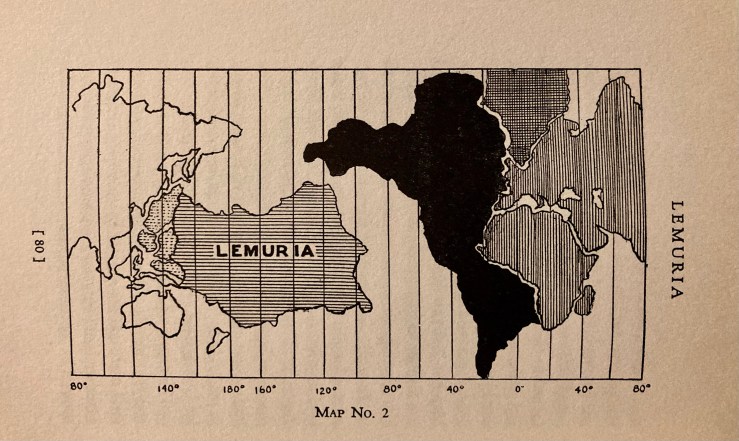
did come across a book published by something called Rosicrucian Press in the 1930s–W.S. Cerve’s Lemuria: The Lost Continent of the Pacific. Lost Lemuria hangs over a few Pynchon novels (and is touched on in Charles Portis masterful and zany Masters of Atlantis)—so of course I picked up Cerve’s book. Chapters include “The First Races of Man in America,” “Mysterious Forces in the Universe,” and “Present Day Mystic Lemurians in California.” There are also diagrams, charts, and maps, like this one:

This bookstore, Chamblin’s Bookmine, also featured a display of books removed from classrooms and school libraries in our city as a result of the current Florida Governor’s efforts to suppress critical thinking, whitewash American history, and generally turn Florida’s soul into a puddle of tepid piss. University of North Florida English Professor Laura Heffernan documented the display in the following tweet (notice a common thread?):

Today I stopped by Chamblin’s second, downtown location, Chamblin’s Uptown, mostly because I was dropping my daughter off at a birthday party about five minutes away. I go there only a few times a year, so it was nice to browse for a spare hour.

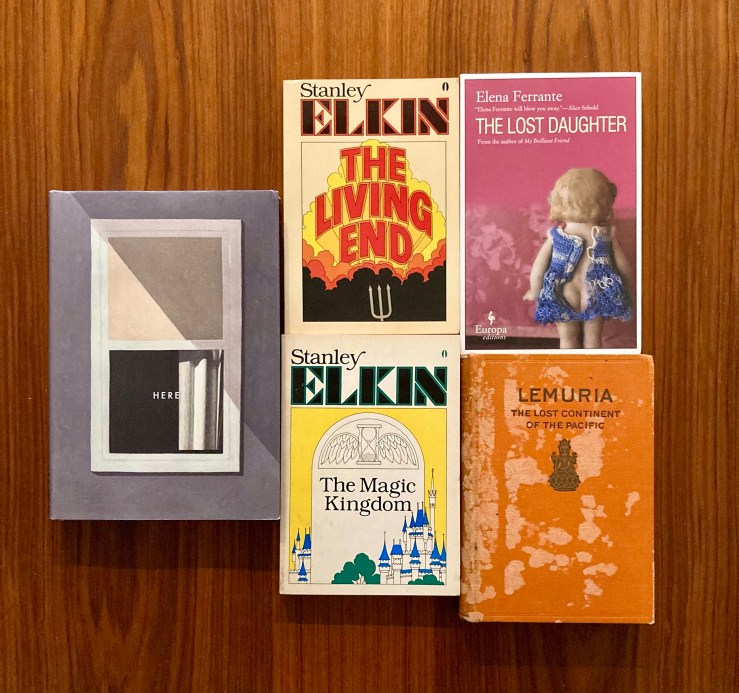
I snapped up two Stanley Elkins, The Magic Kingdon and The Living End, in Janet Halverson-designed editions that match my copy of Elkin’s The Dick Gibson Show. I listened to an audiobook of The Living End this summer and loved it–it made me want to get into more Elkin.

Going from the Es to the Fs, I spotted a nice used copy of Ann Goldstein’s translation of The Lost Daughter. I’ve been wanting to read it for a while, but picked it out for my wife to read first (I don’t think she really likes reading Valeria Luiselli’s Lost Children Archive, which I gave her a few weeks ago. And now that I type this out, I see that I may have picked a weird substitute).

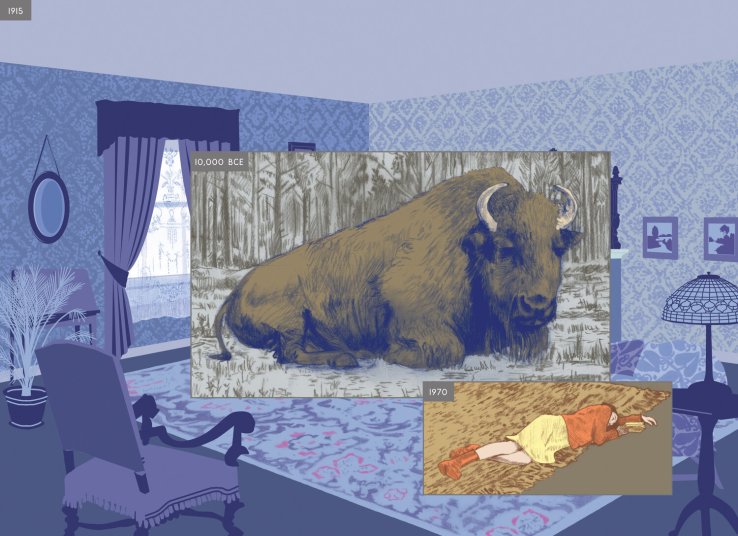
I also snagged a pristine used copy of Richard McGuire’s graphic novel Here. I checked it out from the library a few years ago when new copies seemed prohibitively expensive.

At the checkout I picked up a pamphlet describing strategies for undoing the book banning here in Jacksonville (and Florida in general). This whole fucking thing has had me so mad and sad, and I have friends who are checking out of Florida, but I feel like we shouldn’t have to cede territory to these dull monsters—and it feels good to see other people who feel the same.

A succinct summary from the pamphlet:


Blog about some recent reading

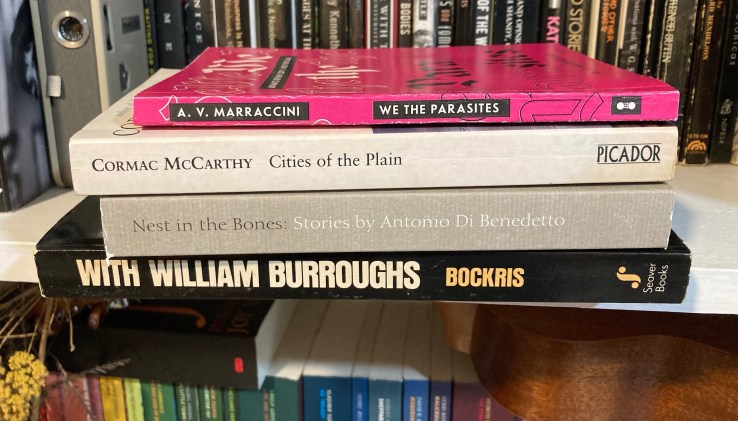
I finished A. V. Marraccini’s We the Parasites very very early Friday morning and then sneaked in two hours of sleep before a nine a.m. alarm. We the Parasites is a discursive  ekphrasis, its finest moments concentrated on Cy Twombly (and his historical painting The Age of Alexander in particular). Marraccini turns her lens also to John Updike’s novel The Centaur, Jean Genet, and pomegranates and wasps. 2020 and Covid-19 hang over the book, inverting its would-be-flânerie: It’s flânerie for silent nights, cybernights, flânerie for necessary introversion.

I’m about 100 pages into Cities of the Plain, the final book of Cormac McCarthy’s Border Trilogy. I read it maybe fifteen years ago and recall almost nothing about it other than McCarthy uniting the two heroes of the first two books, John Grady Cole and Billy Parham. So far, the novel is a far quicker read than the first two Border novels—more direct, more cinematic, less adolescent, its intensities tamped by experience. About thirty pages in, McCarthy devotes two entire pages to a description of changing a tire. It’s beautiful.

Nest in the Bones collects a career-spanning selection of Antonio Di Benedetto short stories (in translation by Martina Broner). I’ve been trying to read one or two a day. Many of the early stories are quite short, and Di Benedetto perhaps shows a bit too much debt to Kafka here, but the oddity of it all is wonderful.

It is true that William S. Burroughs was fond of dinners with famous and interesting people, and was totally fine with having a young, perhaps good looking Victor Bockris serve as a nexus and recorder for such events, events that have nothing to do with big-ell Literature. But my favorite thing here (as was the case with Allen Ginsberg’s nineties jaunt with Burroughs in the same vein, Don’t Hide the Madness), my favorite thing here is how Burroughs undercuts any pretension or redirects conversation to his own strange obsessions.

Best Books of 1973?

A conversation with a colleague in January of 2022 led to my blogging about the possible “Best Books of 1972.” The post was fun to research, so here’s a sequel of sorts: What were the best books from fifty years ago?

(I don’t have to do any research for a quick answer: Gravity’s Rainbow was the best novel of 1973.)

Just as in last year’s post, I’m mostly interested in novels here, or books of a novelistic/artistic scope.

Still, with that said, I’ll begin with commerce: What were the bestsellers of 1973? The New York Times bestsellers list for 1973 picks up where their ’72 list left off, with Richard Bach’s Jonathan Livingstone Seagull leading sales for the first 11 weeks (Bach’s novel was the bestseller of 1972 for half a year). Genre fiction from Frederick Forsyth, Jacqueline Susann, and Mary Stewart accounts for more than half the year. More notable bestsellers include Kurt Vonnegut’s Breakfast of Champions, Gore Vidal’s Burr, and Graham Greene’s The Honorary Consul. (Gravity’s Rainbow was not a chart topper.)

Critic John Leonard’s end of the year wrap up for the Times in 1973 is especially instructive. He leads with Gravity’s Rainbow, describing it as

…one of the longest, darkest, most difficult and most ambitious novels in years. Its technical and verbal resources bring to mind Melville, Faulkner and Nabokov and establish Pynchon’s imaginative continuity with the great modernist movement of the early years of this century. Gravity’s Rainbow is bone‐crushingly dense, compulsively elaborate, silly, obscene, funny, tragic, poetic, dull, inspired, horrific, cold and blasted.

Leonard also recommends Doris Lessing’s The Summer Before the Dark (“her most artful exploration of her major themes: the relation of self and society, intelligence and feeling, madness and health, and, above all, the role of modern woman”) and John Leonard Clive’s  Macaulay, the Shaping of the Historian.

Some notable titles that the editors of the NYT Book Review append to Leonard’s feature include Philip Roth’s The Great American Novel, Thomas McGuane’s Ninety‐Two in the Shade, and John Cheever’s The World of Apples. The editors also call out “disappointing efforts by Don DeLillo (Great Jones Street) and Marge Piercy (Small Changes).”

In addition to the essayistic feature, the Times also offered up an extensive list of notable titles. There are around 200 books on this list, which I’ve used to help generate my own list at the end of this post. (The most interesting entry I’d never heard of is The Exile of James Joyce by Helene Cixous 

Eudora Welty’s short novel The Optimist’s Daughter is not on the list because it was not published in 1973. It was published in 1972. But it won the Pulitzer for fiction in 1973.

Infamously, there was no Pulitzer Prize awarded for fiction in 1974, even though the jurists were unanimous in their recommendation that Thomas Pynchon win it for Gravity’s Rainbow. (Gravity’s Rainbow did win the 1974 National Book Award.)

The New York Times list also fails to include Patrick White’s novel The Eye of the Storm. White won the Nobel Prize in Literature in 1973.

Neither does the NYT list include Alan Gardner’s Red Shift, J.G. Ballard’s Crash, Leon Forrest’s There Is a Tree More Ancient Than Eden, William Goldman’s The Princess Bride, B. S. Johnson’s Christie Malry’s Own Double-Entry, Anna Kavan’s Who Are You?, Clarice Lispector’s Água Viva, Jerzy Kosiński’s The Devil Tree, Cormac McCarthy’s Child of God, Toni Morrison’s Sula, Erica Jong’s Fear of Flying, Charles Bukowski’s South of No North, Harold Bloom’s The Anxiety of Influence, Madeleine L’Engle’s A Wind in the Door, Italo Calvino’s The Castle of Crossed Destinies, Susan Sontag’s On Photography, Peter Shaffer’s Equus, Kobo Abe’s The Box Man, Ursula K. Le Guin’s The Ones Who Walk Away from Omelas, Adrienne Rich’s Diving into the Wreck, E.M. Cioran’s The Trouble with Being Born or Thomas Rockwell’s juvenile classic How to Eat Fried Worms.

Here is my (almost certainly incomplete) list of the best books of 1973:

Água Viva, Clarice Lispector

The Anxiety of Influence, Harold Bloom

Breakfast of Champions, Kurt Vonnegut

Child of God,  Cormac McCarthy

Christie Malry’s Own Double-Entry, B. S. Johnson

Crash, J.G. Ballard

Fear and Loathing on the Campaign Trail, Hunter S. Thompson

Fear of Flying, Erica Jong

Gravity’s Rainbow, Thomas Pynchon

The Princess Bride, William Goldman

Red Shift, Alan Gardner

State of Grace, Joy Williams

Sula, Toni Morrison

There Is a Tree More Ancient Than Eden, Leon Forrest

Here is my short (complete) list:

Gravity’s Rainbow, Thomas Ruggles Pynchon

On Gwendoline Riley’s First Love, a spare, precise study of passive-aggressive cruelty, abjection, and sublimated dreams

I forced myself through the last half of Gwendoline Riley’s 2017 novel First Love wondering if I actually liked her latest novel My Phantoms, a book I read just a few weeks ago.

(What do I mean to capture in the puny verb like?)

The material of First Love will be familiar to anyone who’s read My Phantoms, and I kept mentally underlining the similarities: first-person narrator, woman, living in London, a city she is culturally alienated from; bad parents–abusive asshole dad, narcissistic dippy mum. Vegetarian cooking.

Like My Phantoms, First Love is a slim, spare, precise study of passive-aggressive cruelty, sublimated dreams, and lowered expectations. Pervading the novel is a general sense that one would prefer not to get stuck in a corner with any of these characters at a party, let alone end up living with one.

The thrust of First Love (one wouldn’t call it a plot, which isn’t a negative criticism) is something like this: Neve, a thirty-three-year-old writer (who makes some money teaching) is married to a man named Edwyn, who is a generation older from her, and suffering a heart condition. His heart condition has left him close to death at least once, but it also doubles as a symbol for his trashed spirit: Edwyn’s heart condition is that Edwyn has the heart of an asshole.

Edwyn belittles and abuses Neve, condescends her feminism, and generally bullies her. Most of the abuse is verbal, but sometimes it is physical. The abuse is always awful though—an abuse of spirit, of love.

Riley announces the themes of this awful “love” by the novel’s fourth paragraph:

We don’t talk much in the evenings, but we’re very affectionate. When we cuddle on the landing, and later in the kitchen, I make little noises—little comfort noises—at the back of my throat, as does he. When we cuddle in bed at night, he says, ‘I love you so much!’ or ‘You’re such a lovely little person!’ There are pet names, too. I’m ‘little smelly puss’ before a bath, and ‘little cleany puss’ in my towel on the landing after one; in my dungarees I’m ‘you little Herbert!’ and when I first wake up and breathe on him I’m his ‘little compost heap’ or ‘little cabbage.’ Edwyn kisses me repeatingly, and with great emphasis, in the morning.

There have been other names, of course.

‘Just so you know,’ he told me last year, ‘I have no plans to spend my life with a shrew. Just so you know that. A fishwife shrew with a face like a fucking arsehole that’s had…green acid shoved up it.’

‘You can always just get out if you find me so contemptible,’ he went on, feet apart, fists clenched, glaring at me over on the settee. ‘You have to get behind the project, Neve, or get out.’

What’s the project? you might wonder, as does Neve—well, it’s not “winding up” Edwyn and “feel like shit all the time!’”

Does Edwyn actually feel abused by Neve’s behavior?

Riley certainly gives the man plenty of opportunities to vocalize his self-pitying and abusive rants. The central totem Edwyn hangs his anger on is an episode in which Neve drank alcohol excessively and vomited (apparently) all over the couple’s apartment. Riley does not depict the episode because Neve, natch, cannot recall it. The bits we get from it involve Edwyn’s violence, his anger. An ugly and true recollection of the sweaty abject reality of a hangover.

Much of First Love is mired in abjection—sweat and grime and piss and shit. Early in the book Neve and Edwyn exchange reminiscences of their young mothers on the toilet, Neve’s suffering IBS, Edwyn terrified of “The thundering waterfall of her first piss” in the early morning. “Terrifying. I thought bodies were terrifying.”

The abject reality of bodies and filth repulses Edwyn, and he buries his repulsion into a store of misogynistic tropes and curses that explode with more ugly frequency as First Love progresses. “You live in shit, so we all have to live in shit, is that right?” he demands of Neve, who he repeatedly accuses of slovenliness, filth. For Edwyn, Neve’s apparent uncleanliness is also related to her Northernness, underscoring the novel’s themes of class and place. Neve herself capitulates, reminiscing:

But was anybody clean back then? When I think of my friends’ houses, they weren’t any less filled with shit. Here were cold, cluttered bedrooms, greased sheets. The kitchens were a horror show: ceilings bejewelled with pus-coloured animal fat, washing-up sitting in water which was spangled like phlegm. Our neighbour’s house, where we went after school, was an airlocked chamber smelling of bins that hadn’t been put out. There was a long skid mark, I remember, on one of the towels in their bathroom. It was there for three years.

So—I did grow up in shit. It was no slander.

Shit, filth, stupidity, dishonesty. (Mother looking up slyly from a crying jag.)

I did use to be sick a lot. No slander, though Edwyn didn’t know it.

Edwyn doesn’t know fucking anything. I was relieved in the novel’s final moments, where the narrative disappeared him.

But now and so I go back to the beginning of this riff and see the opening clause, I forced: I did force myself to finish First Love, poison cup. And, that second sentence up at the top: Did I like the novelNo. Reading it hurt. Riley offers up raw reality, ugly, abject, mean. The novel is well-written, which I don’t mean pejoratively: no seams show, and thematic resonance carries from minute details: dialogue, concrete imagery, minor moments that coalesce into an abject portrait of sick “love,” messy and cruel. I am so happy that I’m now outside of the thing.

What else? | Last scattered thoughts on Cormac McCarthy’s novel The Passenger

What else?

The Passenger, Cormac McCarthy

Versions of the phrase What else repeat throughout The Passenger, sometimes at the beginning of a sentence but more often than not as a two-word statement or question. It’s a verbal tic not unlike the plentiful instances of They rode on to be found in Blood Meridian, and like that phrase, it serves as a linguistic placeholder that both moves the action of the novel and also advances one of its central philosophical themes.

What else? here is plaintive, existential, but also human, relatable.


The novel Blood Meridian (1985) establishes Cormac McCarthy as unchallenged king of literary mule carnage. No fewer than fifty-nine specific mules die in the book, plus dozens more that are alluded to in groups and bunches. Mules are shot, roasted, drowned, knifed, and slain by thirst; but the largest number, 50 out of a conducta of 122 mules carrying quicksilver for mining, plummet from a single cliff during an ambush, performing an almost choreographic display of motion and color, “the animals dropping silently as martyrs, turning sedately in the empty air and exploding on the rocks below in startling bursts of blood and silver as the flasks broke open and the mercury loomed wobbling in the air in great sheets and lobes and small trembling satellites. . . . Half a hundred mules had been ridden off the escarpment.”

The Dead Mule Rides Again,” Jerry Leath Mills


A small mule danced in a flowered field. He stopped to watch it. It rose on its hind legs like a satyr and sawed its head about. It whinnied and hauled at its rope and kicked and it stopped and stood splayfooted and stared at Western and then went hopping and howling. It had browsed through a nest of wasps but Western didnt know how to help it and he went on.

The Passenger, Cormac McCarthy

This minor scene in the last pages of The Passenger seems like another previously-rare self-referential move on McCarthy’s part. Our “unchallenged king of literary mule carnage” sets up what appears, at first, a bucolic, even corny image—a mule dancing in a field of flowers. The pastoral, frolicking image comes undone under scrutiny—the mule is not at play but under duress. But the duress is not the result of a moral malice. It’s simply natural. Western cannot assuage the mule’s pain, he can only observe it, which he does so with a stoic measure of sympathy.

Detail from Don Quixote, Sancho Panza and the Dead Mule, Honore Daumier, 1867

He said that the souls of horses mirror the souls of men more closely than men suppose and that horses also love war. Men say they only learn this but he said that no creature can learn that which his heart has no shape to hold.

All the Pretty Horses, Cormac McCarthy


The other dream was this. There was a riderless horse standing at a gate at dawn. Some other country, some other time. The news that the horse brings is a day’s ride old, no more. The horse’s dreams were once of mares and grass and water. The sun. But those dreams are no more. His is a world of blood and slaughter and the screams of men and animals all of which he has little understanding of. The horse stands at the gate with his head bowed while the day breaks. He wears a cloak of knitted steel dark with blood and he stands with one forefoot tilted upon the stones. No one comes. The news does not arrive.

The Passenger, Cormac McCarthy

The above passage was probably the saddest moment in The Passenger for me. The speaker is the ghost of Long John Sheddan, present in the consciousness of Bobby Western. It is the horse’s dream inside of Sheddan’s dream (inside of Western’s dream (McCarthy’s dream)) that I find so sad—an Edenic vision flooded with the reality of blood and violence, by the mechanics of war. The horse stalks the stones of the earth, awaiting a revelation that does not come to pass. No one comes. The news does not arrive.


I always thought when I got older that God would sort of come into my life in some way. He didn’t. I don’t blame him. If I was him I’d have the same opinion about me that he does.

No Country for Old Men, Cormac McCarthy


I waited to hear from God and I never did.

The Passenger, Cormac McCarthy


Like most writers committed to pessimism, McCarthy is never very far from theodicy. Relentless pain, relentlessly displayed, has a way of provoking metaphysical complaint. . . .

But [in Blood Meridian] McCarthy stifles the question of theodicy before it can really speak. His myth of eternal violence—his vision of men “invested with a purpose whose origins were antecedent to them”—asserts, in effect, that rebellion is pointless because this is how it will always be. Instead of suffering, there is represented violence; instead of struggle, death; instead of lament, blood.

Red Planet”, James Wood

Critic James Wood was unkind in his estimation of Blood Meridian. He demanded a theodicy from McCarthy—never McCarthy’s intention—and then failed to attend to any evidence in the novel that would indicate the possibility of resistance to unrepentant Darwinian malice, to an illiterate taste for mindless violence.


I don’t know if Wood has written on the latest, not last, but close-to-last, novel from McCarthy. The only review I’ve read was a short tweet from a contemporary Irish writer whose latest novel I very-much admired. He did not think The Passenger was good. I believe he wrote that it was, in fact, very bad. I really loved The Passenger, and when I finally get this last little riff out of my system, I might even read some reviews.


In the dawn there is a man progressing over the plain by means of holes which he is making in the ground. He uses an implement with two handles and he chucks it into the hole and he enkindles the stone in the hole with his steel hole by hole striking the fire out of the rock which God has put there. On the plain behind him are the wanderers in search of bones and those who do not search and they move haltingly in the light like mechanisms whose movements are monitored with escapement and pallet so that they appear restrained by a prudence or reflectiveness which has no inner reality and they cross in their progress one by one that track of holes that runs to the rim of the visible ground and which seems less the pursuit of some continuance than the verification of a principle, a validation of a sequence and causality as if each round and perfect hole owed its existence to the one before it there on that prairie upon which are the bones and the gatherers of bones and those who do not gather. He strikes fire in the hole and draws out his steel. Then they all move on again.

Blood Meridian, Cormac McCarthy


In the end, she had said, there will be nothing that cannot be simulated. And this will be the final abridgment of privilege. This is the world to come. Not some other. The only alternate is the surprise in those antic shapes burned into the concrete.

The Passenger, Cormac McCarthy

The final moments of The Passenger, particularly Alicia Western’s words (via Bobby’s memory) seem to echo the gnostic dream that is the epilogue of Blood Meridian. Her apocalyptic final line (again, via Bobby’s consciousness) evokes the consequences of the atomic bomb, a new original sin of creation: “My father’s latterday petroglyphs and the people upon the road naked and howling.”

Alicia chooses to erase herself from the world, while Bobby stays in it, lives. The final moments of The Passenger point to a sliver of metaphysical hope:

He knew on the day of his death he would see her face and he could hope to carry that beauty with him into the darkness with him, the last pagan on earth, singing softly on his pallet in an unknown tongue.


You have to carry the fire.

The Road, Cormac McCarthy.


The incest thing | More scattered thoughts on Cormac McCarthy’s novel The Passenger

He’s in love with his sister and she’s dead.

The Passenger, Cormac McCarthy


The theme of brother-sister incest haunts the early American novel on its lower levels of literacy as well as on the higher—a nightmare from which our writers do not choose to awake too soon, since it is one their readers are willing to pay to share.

Love and Death in the American Novel, Leslie Fiedler


When he woke she was leaning against his shoulder. He thought she was asleep but she was looking out the plane window. We can do whatever we want, she said.

No, he said. We cant.

The Passenger, Cormac McCarthy


She turned to the Kid. What does it say on the trunk?

What does what say? 

There’s a sticker on the trunk.

Yeah. It says progeny of Western Union.

Progeny?

The Passenger, Cormac McCarthy


The last in the series of quotes above is an exchange between Alicia Western and her hort/figment/projection the Thalidomide Kid. The Kid has caused to be brought to Alicia a wiseassed—cruel, even—ventriloquist dummy. The dummy is another fitting prop in the Alicia-Kid episodes that punctuate The Passenger. It again underlines the vaudevillian aspect of these interstitial pieces, while also highlighting the novel’s themes of ventriloquism—of how memory of the dead might speak through the living, as the living grapple with death.

The quips above feature another of the Kid’s malapropisms — in this case his substitution of “progeny of Western Union” for property of Western Union. The Freudian slip (never really a slip on our imp’s tongue) points to The Passenger’s incest motif. It turns out that the dummy’s name is Crandall (perhaps named for the typewriter?). It’s likely Alicia herself named Crandall, and her grandmother tailored his clothes. I think the strong implication is that handy Bobby Western built (fathered) Crandall. In this sense, Crandall is the dreamchild born of a Western union. “I was only six,” Alicia cries as he disappears back into his case.


The incest motif perforates the literary tradition. We find it in Oedipus, in Lot seduced by his daughters, in David’s children Tamar and Amnon–a tale recapitulated in Faulkner’s southern Gothic Absalom! Absalom! We find it coded in Poe’s tale “The Fall of the House of Usher” or made strange but more clear in Melville’s baffling Pierre. We find it in the tawdry attic of V.C. Andrew’s lurid Dollanganger novels (likely read by many more Americans than the other novels I’ve named).

The incest thing in literature is, of course, an exploration of taboo, and is such the rightful property (or progeny) of literature. In his seminal (and often bombastic) study Love and Death in the American Novel, Leslie Fiedler suggests that “brother-sister incest in particular comes to stand in Romantic symbology for the rebellion against paternal authority, for the spirit of revolution itself.” He continues, declaring that the “Oedipal significance” of this revolutionary spirit “projects not only the desire to revolt, but also to die; that is to say, beneath the yearning for rebellion lies hidden the wish to be punished for it.”


Le’ts follow Fiedler’s reading (ahem, rehashing of Freud) and stick it on to the Western children: What is the paternal authority they rebel against—that is, beyond the actual literal father (a marginal memory)? Père Western was one of the lead authors of the atomic bomb. He changed the American relationship to death, permanently.


I have a little under a hundred pages left to go in The Passenger, but if either Bobby or Alicia has expressed overt familiar guilt over their father’s work in engineering mass death, I’ve missed it. What does linger is a deep-seated, unspoken anxiety about their father’s deeds.


At the end of his own surreal and improbable conversation with the Thalidomide Kid, Bobby expresses the only loss of his life, the only ashes in his world:

There is no other loss. Do you understand? The world is ashes. Ashes. For her to be in pain? The least insult? The least humiliation? Do you understand? For her to die alone? Her? There is no other loss. Do you understand? No other loss. None.

The emotional outburst, with its plaintive tone and cycle of repetitions, is rare for Bobby Western: for the most part, when The Passenger juts its free indirect speech into Bobby’s skull, we get simple, direct (if increasingly paranoid) language.


It’s when he thinks of his sister Alicia that Bobby’s voice gives over to passion, to a kind of Gothic romantic language that recalls Poe more than Hemingway. Consider how Gothic frills in the following passage soon give way to an archaic and obscure (yet still ornate) style that recalls the Cormac McCarthy of Blood Meridian:

In his dreams of her she wore at times a smile he tried to remember and she would say to him almost in a chant words he could scarcely follow. He knew that her lovely face would soon exist nowhere save in his memories and in his dreams and soon after that nowhere at all. She came in half nude trailing sarsenet or perhaps just her Grecian sheeting crossing a stone stage in the smoking footlamps or she would push back the cowl of her robe and her blonde hair would fall about her face as she bent to him where he lay in the damp and clammy sheets and whisper to him I’d have been your shadowlane, the keeper of that house alone wherein your soul is safe. And all the while a clangor like the labor of a foundry and dark figures in silhouette about the alchemic fires, the ash and the smoke. The floor lay littered with the stillborn forms of their efforts and still they labored on, the raw half-sentient mud quivering red on the autoclave. In that dusky penetralium they press about the crucible shoving and gibbering while the deep heresiarch dark in his folded cloak urges them on in their efforts. And then what thing unspeakable is this raised dripping up through crust and calyx from what hellish marinade. He woke sweating and switched on the bedlamp and swung his feet to the floor and sat with his face in his hands. Dont be afraid for me, she had written. When has death ever harmed anyone?


(I had not intended to type out the entire passage above, but once I got going I couldn’t stop.)


Bobby’s dream begins as an erotic manifestation of his sister, a Gothic evocation in silk ribbon or Grecian garb. She takes to a “stone stage,” again underscoring the shift into high drama. “I’d have been your shadowlane, the keeper of that house alone wherein your soul is safe,” she declares. The word shadowlane here seems like a symbolic substitution for the near homphone chatelaine, an archaic word for a woman who keeps a castle or great house (readers of Wolfe’s Book of the New Sun series will be familiar with the word).

A chatelaine also refers to a chain belt used for holding keys, an image that carries over into the second half of Bobby’s dream, which shifts from eroticism to terror. Shadowy figures inhabit a “dusky penetralium,” an innermost chamber, a locked place. Here, the figures labor with red “half-sentient mud” (Adamic atoms) in an “autoclave” (self-key). Amidst a litter of stillbirths, the figures toil to bring a new creature into being.

Bobby’s dream moves from brother-sister incest to the Gothic terror of a laboratory creation coming to life—an evocation of the father’s sins. Bobby’s subconscious mind transmutes the Manhattan Project into a satanic ritual presided over by a clandestine “heresiarch” — the damning father figure whose strange experiment impede Bobby’s incestuous consummation. Instead, we get another Western union. And the promise of death.


(More thoughts to come.)

Scattered thoughts on starting Cormac McCarthy’s novel The Passenger (Book acquired, 25 Oct. 2022)

I picked up Cormac McCarthy’s new novel The Passenger today. The last Cormac McCarthy novel was The Road, which came out way back in 2006, year of this blog’s birth. I read most of The Road in the delivery ward over a few days when my daughter was born. Since then I’ve read pretty much everything by McCarthy that’s been published (excepting the screenplay for The Counselor), and a lot of it more than once. (I’ve reread Blood Meridian more times than I can think of. I fall asleep to the audiobook version sometimes when I have trouble sleeping, starting at a random chapter.) In the decade and a half after his last novel The Road became an unlikely, Oprah-endorsed hit, McCarthy wrote a screenplay for a film I can’t even pretend is any good and an article about “The Kekulé Problem,” which was published in Nautilus. He seemed to devote most of his time to hanging around the Santa Fe Institute, where he is a trustee.

Rumors of The Passenger have slipped around the internet for the past seven years—it would be about lawyer, it would be about a mathematician, it would be the first McCarthy novel to feature a woman as its main character, it would be in a wholly new style. Scraps and rumors seeped out, but like a lot of readers, I suspect, or at least readers I spoke to online and even in the flesh, I didn’t expect to see a completed version of The Passenger published in McCarthy’s lifetime. (He’s 89, just a few years younger than my dear sweet grandmother, also from Tennessee, who passed away this past Thursday.) I thought that we might see a version of the text, eventually, posthumous, possibly even cobbled together, a la Wallace’s The Pale King or Hemingway’s Garden of Eden.

But Knopf announced not only would The Passenger publish in 2022, so too would a shorter, connected novel Stella Maris. I’ll admit I was both excited and apprehensive, especially after reading The Silence by Don DeLillo two years ago. DeLillo is (like Thomas Pynchon) just four years younger than Cormac McCarthy. And The Silence is hardly his strongest stuff. But apples and oranges: who am I to worry one old master against another old master? So I was excited. (But apprehensive.)

So I picked up Cormac McCarthy’s new novel The Passenger today. The cover is not as bad as it looked in the early internet promotional pics—not as static and flat. But it’s still not a great cover (and I say this as one partial to blue and orange, colors of my alma mater).

But a cover is not a book. I went into the pages. Before I get into the words on the pages, here’s a bit on the form of The Passenger. The novel appears to switch between two viewpoint characters: Alicia and her brother Bobby Western. (Bobby Western sounds like a William S. Burroughs character.) The Alicia passages are shorter, written completely in italics (which is fucking annoying) and given chapter numbers. The Bobby Western chapters look like regular ole Cormac McCarthy chapters.

And so well: I ended up reading the first chapter, the Alicia chapter twice. It is unlike anything else McCarthy has written. The chapter takes place in Alicia’s head in the form of a discursive discussion with “the Thalidomide Kid,” a vaudevillian interlocutor who’s quick with punning wordplay that’s rare in McCarthy’s work (of the apparent suicide note Alicia aims to write, he chides that it will be a “wintry summary”). With all his japes and clowning and weird zany energy (and hell, that name), the Thalidomide Kid seems like something more out of a Pynchon or Robert Coover story than a McCarthy novel. The closest thing that I can compare it to, at least in McCarthy’s oeuvre, is the trip scene in Suttree. I really really dig it. It’s dark and weird.

The first Alicia section ends with a dream of her brother, whom we then meet in the next section. Bobby Western is a salvage diver working with the Coast Guard in the Gulf of Mexico. It’s three am and freezing cold and there’s a jet with nine dead bodies down in the dark water. The writing here is what I would expect from McCarthy: lots of ands and thens, a general disregard for punctuation, and a lot of descriptions of men doing things. (There’s even a He spat in there!) This particular section was excerpted in The New York Times a fortnight ago, and you can read it without anything being spoiled for you, but I don’t think it’s nearly as interesting without the hallucinatory Alicia chapter that precedes it.

And that’s all I’ve got for now. I saw some lit folks I respect who have apparently read the novel already suggest that it’s Not Good, but I’ve liked what I’ve seen so far, and Want More.


Ann Quin’s novel Passages collapses hierarchies of center and margin

Ann Quin’s third novel Passages (1969) ostensibly tells the story of an unnamed woman and unnamed man traveling through an unnamed country in search of the woman’s brother, who may or may not be dead.

The adverb ostensibly is necessary in the previous sentence, because Passages does not actually tell that story—or it rather tells that story only glancingly, obliquely, and incompletely. Nevertheless, that is the apparent “plot” of Passages.

Quin is more interested in fractured/fracturing voices here. Passages pushes against the strictures of the traditional novel, eschewing character and plot development in favor of pure (and polluted) perceptions. There’s something schizophrenic about the voices in Passages. Interior monologues turn polyglossic or implode into elliptical fragments.

Quin repeatedly refuses to let her readers know where they stand. Indeed, we’re never quite sure of even the novel’s setting, which seems to be somewhere in the Mediterranean. It’s full of light and sea and sand and poverty, and the “political situation” is grim. (The woman’s brother’s disappearance may or may not have something to do with the region’s political instability.)
Passage’s content might be too slippery to stick to any traditional frame, but Quin employs a rhetorical conceit that teaches her reader how to read her novel. The book breaks into four unnamed chapters, each around twenty-five pages long. The first and third chapters find us loose in the woman’s stream of consciousness. The second and fourth chapters take the form of the man’s personal journal. These sections contain marginal annotations, which might be meant to represent actual physical annotations, or perhaps mental annotations–the man’s stream of consciousness while he rereads his journal.

Quin’s rhetorical strategy pays off, particularly in the book’s Sadean climax. This (literal) climax occurs at a carnivalesque party in a strange mansion on a small island. We see the events first through the woman’s perception, and then through the man’s. But I’ve gone too long without offering any representative language. Here’s a passage from the woman’s section, just a few paragraphs before the climax. To set the stage a bit, simply know that the woman plays voyeur to a bizarre threesome:

Mirrors faced each other. As the two turned, approached. Slower in movement in the centre, either side of him, turning back in the opposite direction to their first movement. Contours of their shadows indistinct. The first mirror reflected in the second. The second in the first. Images within images. Smaller than the last, one inside the other. She lay on the floor, wrists tied together. She bent back over the chair. He raised the whip, flung into space.

Later, the man’s perception of events at the party both clarify and cloud the woman’s account. As you can see in the excerpt above, the woman frequently refuses to qualify her pronouns in a way that might stabilize identities for her reader. Such obfuscation often happens in the course of a sentence or two:

I ran on, knowing I was being followed. She came to the edge, jumped into expanding blueness, ultra violet tilted as she went towards the beach. We walked in silence.

The woman’s becomes a She and then merges into a We. The other half of that We is a He, the follower (“He later threw the bottle against the rocks”), but we soon realize that this He is not the male protagonist, but simply another He that the woman has taken as a one-time lover.

The woman frequently takes off somewhere to have sex with another man. At times the sex seems to be part of her quest to find her brother; other times it’s simply part of the novel’s dark, erotic tone. The man is undisturbed by his lover’s faithlessness. He is passive, depressive, and analytical, while she is manic and exuberant. Late in the novel he analyzes himself:

How many hours I waste lying in bed thinking about getting up. I see myself get up, go out, move, drink, eat, smile, turn, pay attention, talk, go up, go down. I am absent from that part, yet participating at the same time. A voyeur in all senses, in my actions, non-actions. What a delight it might be actually to get up without thinking, and then when dressed look back and still see myself curled up fast asleep under the blankets.

The man longs for a kind of split persona, an active agent to walk the world who can also gaze back at himself dormant, passive.

This motif of perception and observation echoes throughout Passages. Consider one of the man’s journal entries from early in the book:

Above, I used an image instead of text to give a sense of what the journal entries and their annotations look like. Here, the man’s annotation is a form of self-observation, self-analysis.

Other annotations dwell on describing myths or artifacts (often Greek or Talmudic). In a “December” entry, the man’s annotation is far lengthier than the text proper. The main entry reads:

I am on the verge of discovering my own demoniac possibilities and because of this I am conscious I am not alone with myself.

Again, we see the fracturing of identity, consciousness as ceaseless self-perception. The annotation is far more colorful in contrast:

An ancient tribe of the Kouretes were sorcerers and magicians. They invented statuary and discovered metals, and they were amphibious and of strange varieties of shape, some like demons, some like men, some like fishes, some like serpents, and some had no hands, some no feet, some had webs between their fingers like gees. They were blue-eyed and black-tailed. They perished struck down by the thunder of Zeus or by the arrows of Apollo.

Quin’s annotations dare her reader to make meaning—to put the fragments together in a way that might satisfy the traditional expectations we bring to a novel. But the meaning is always deferred, always slips away. Passages collapses notions of center and margin. As its title suggests, this is a novel about liminal people, liminal places.

The results are wonderfully frustrating. Passages is abject, even lurid at times, but also rich and even dazzling in moments, particularly in the woman’s chapters, which read like pure perception, untethered by traditional narrative expectations like causation, sequence, and chronology.

As such, Passages will not be every reader’s cup of tea. It lacks the sharp, grotesque humor of Quin’s first novel, Berg, and seems dead set at every angle to confound and even depress its readers. And yet there’s a wild possibility in Passages. In her introduction to the new edition of Passages recently published by And Other Stories, Claire-Louise Bennett tries to capture the feeling of reading Quin’s novel:

It’s difficult to describe — it’s almost like the omnipotent curiosity one burns with as an adolescent — sexual, solipsistic, melancholic, fierce, hungry, languorous — and without limit.

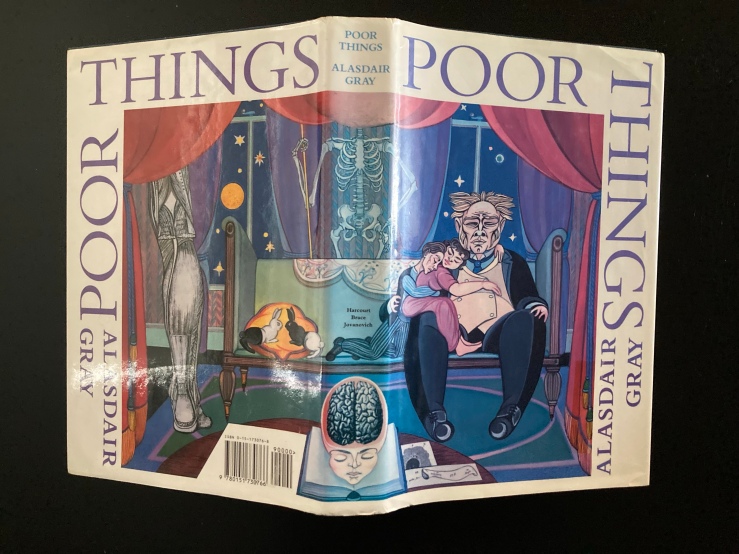
Bennett, whose anti-novel Pond bears the stamp of Quin’s influence, employs the right adjectives here. We could also add disorienting, challengingabject and even distressing. While clearly influenced by Joyce and Beckett, Quin’s writing in Passages seems closer to William Burroughs’s ventriloquism and the hollowed-out alienation of Anna Kavan’s early work. Passages also points towards the writing of Kathy Acker, Alasdair Gray, and João Gilberto Noll, among others. But it’s ultimately its own weird thing, and half a century after its initial publication it still seems ahead of its time. Passages is clearly Not For Everyone but I loved it. Recommended.

[Ed. note: Biblioklept first published this review in May, 2021. Quin’s fourth and final novel, Tripticks, is being reissued this month by And Other Stories.]

Last Friday of no-school summer blog

Our air conditioner broke this week. Specifically, the fan motor broke, after a big power surge that left us without electricity for about six hours.

I read most of Fernanda Melchor’s novel Paradais (in Sophie Hughes’ translation) that day. While it’s not as rich and full (and really, just long) as her novel Hurricane Season, it’s cut from the same abject cloth. Two kids working towards becoming full-time alcoholics in an upscale development somewhere in Mexico ruin their lives. It’s a grimy glowing postmodern gothic, part of the Nothing Good Happens genre of what I think of as the Nothing Good Happens genre, reminiscent of Handke’s Funny Games, Bolaño’s myth crimes, and Nicolas Winding Refn’s neon romance terrors. Good stuff.

But our air conditioner is still broken, and school starts for the kids this Monday, and Florida is burning hot, like a lot of the northern hemisphere. It’s pretty bad! I taped foil to the skylights, where the infrared thermometer was hitting over a hundred today, even though it was cloudy. It’s likely that the twenties might offer some of the best years this century will yield,. Dour thought.

I had covid for a nice-not-nice chunk of July. I still have a cough from it, although I never got really sick. I went to the used bookstore maybe a week ago. It was the first place I went to after I recovered and cleared quarantine. I  picked up Vladimir Sorokin’s Ice “trilogy” (BroIce, and 23,000), in translation by Jame Gambrell. I also picked up a Vintage Contemporaries edition of Nicholson Baker’s The Mezzanine. I didn’t read those this week; I read Vladimir Sorokin’s Blue Lard (trans. Max Lawton), a true mindfuck, and Melchor’s Paradais. 

Some dirty motherfucker stabbed Salman Rushdie today. Antarctic heatwave. The US DOJ is investigating a former president of the United States of America for espionage related to selling nuclear secrets. I went to the bookstore again.

I picked up a thin novel published by New Directions, Adania Shibli’s Minor Detail, in translation by Elisabeth Jaquette. Here is ND’s jacket copy:

Minor Detail begins during the summer of 1949, one year after the war that the Palestinians mourn as the Nakba—the catastrophe that led to the displacement and exile of some 700,000 people—and the Israelis celebrate as the War of Independence. Israeli soldiers murder an encampment of Bedouin in the Negev desert, and among their victims they capture a Palestinian teenager and they rape her, kill her, and bury her in the sand.

Many years later, in the near-present day, a young woman in Ramallah tries to uncover some of the details surrounding this particular rape and murder, and becomes fascinated to the point of obsession, not only because of the nature of the crime, but because it was committed exactly twenty-five years to the day before she was born. Adania Shibli masterfully overlays these two translucent narratives of exactly the same length to evoke a present forever haunted by the past.

I ran into a former student today at the bookstore. Always feels good. So I guess I’ll end on that, a positive note, a little hope.

Blog about the audiobook of Claire-Louise Bennett’s Checkout 19

I finished the audiobook of Claire-Louise Bennett’s second book Checkout 19 a few minutes ago, or really, a few minutes before I started writing this blog.

Bennett reads the book herself.

Sometimes listening to an author read their own writing is revelatory; the author imposes a performance that the prose alone, particularly the syntax, couldn’t conjure in your mind’s ear. There’s more to the work than you’d imagined. (And then, later, when you settle down, maybe you realize: there’s less.)

And sometimes hearing the author read their own work is painful. It’s not the writer’s fault, necessarily, but they shouldn’t be encouraged to visit microphones. They ham it up, or their restraint cools the prose, or, maybe they’re just nervous. They wrote the book to be read, not audited, maybe.

The other category of audiobooks read by their authors, or one of the other categories of audibooks read by their authors, is in my estimation the optimal experience: The writer reads their book in the most natural of manners, as if reading something they’d worked on for months or years or whatever into a digital audio file was just a natural thing, a normal thing, and that the author, the reader—the author is the reader, now, of her own work—the author can read her own work without a veil of artifice, without a smirk, without hedging.

Claire-Louise Bennett’s reading of Claire-Louise Bennett’s book Checkout 19 falls into this third category. The experience is unforced, an adjective that I don’t know what to do with now that I’ve written it. I’ll retreat to summary and description for a moment then: the audiobook of Claire-Louise Bennett’s Checkout 19, as read by Claire-Louise Bennett, is not quite seven hours long. It is divided into seven chapters, and, generally, very generally speaking, offers a kind of early autobiography through reading and writing. It is a kind of Künstlerroman, a word I learned in college which is not really useful here. In more contemporary terms it might be called autofiction, although I don’t know what that means either.

The chapters of Checkout 19 circulate not circularly in an elliptical rhythm, tracing and retracing foundational moments in Bennett’s, or Bennett’s narrator’s, life.

(I don’t believe for a minute that anything in Checkout 19 is false, even the embellishments, even possible lies.)

These moments are primarily connected to reading and writing, and something that I loved about Checkout 19 was how often Bennett concretized how physical and temporal reading and writing are: How we remember not just what or why we read or wrote, but also where, and when, and how: Where did we find spaces to carve out our own little stories? What were the beautiful covers of books we failed to read yet nevertheless lugged around with us? Why are some pens suited for drawing but not writing?

We get Bennett’s narrator sussing out the world of letters from a young age. Her Roald Dahl is the same Roald Dahl who wrote her mother’s copy of Switch Bitch, but he’s not the same Roald Dahl. Later, a boyfriend worries that Sylvia Plath and Anne Sexton might not be good for her, and tries to keep them from her. He’s the same boyfriend who gets way too into Bukowski, embarrassing really. And even later (as a sort of capping grace on this motif in the story) Bennett’s narrator reclaims Anaïs Nin from freshman dorms everywhere, declaring her a talent to be reread later. Bennett’s book made me want to revisit Anaïs Nin, who I’ll admit I’ve compartmentalized along with Plath, Sexton, and Bukowski as writers I read in college.

There are lots of other books that pop up, full lists at times, canon-making, frankly (enough to make me order a physical copy of the book), but E.M. Forster’s A Room with a View, which I have never read, is a major touchstone. Checkout 19 didn’t make me want to read A Room with a View, but I did relate very strongly to a moment when Bennett’s narrator admits to misremembering a key detail in the narrative in a way that fundamentally impacts her life.

Bennett also weaves and estimable biography of the avant garde writer Ann Quin into Checkout 19, which I hope will lead lots of people to read the novels of the avant garde writer Ann Quin. (Start with Berg.)

What else, what else? So much else—boyfriends and obsessions, mean girls and chronic boredoms, a Russian magician, bearing Nietzsche books, a hanged man at the children’s park. Bennett smuggles in a magnificent, strange story in, the life of one Tarquin Superbus, who acquires an impossible library only to find every book blank and null. Only Tarquin Superbus’s mentor assures him that there’s a magic sentence hiding somewhere in there—he just needs to hunt for it. The story is like something from Eco or Calvino, and I would’ve lapped up more of it.

What else, what else? There were parts that cracked me up to no end, as when the narrator lends her copy of a Paul Bowles novel—must’ve been The Sheltering Sky—to a guy who had had some flowers he’d bought for himself ruined while attempting to bicycle them home. She witnesses a car drive over the flowers and sees her friend, or acquaintance maybe, upset, and decides to loan him the Bowles novel when she meets him at the pub, but he’s too caught up in the story of his destroyed flowers to really take note, and he doesn’t even open the book—which Bennett’s narrator had purchased in Morocco or Algeria (look, I can’t remember right now, I don’t have a physical copy)—and he doesn’t even open The Sheltering Sky (it couldn’t have been Let It Come Down, right?), he just keeps retelling the story of his flowers destroyed, ever more tragic. Worst of all, he hates that she’s already witnessed the flowers’ ruin: he can’t tell his tragedy. She never gets the book back. And isn’t that always the way?

If you read and loved Bennett’s first book Pond like I did, you’ve probably already read Checkout 19 or put it into some stack to get to. If you haven’t read Pond, read Pond—and then check out Checkout 19. Great stuff.

End of July blog

It is the end of July 2022 and I am on the seventh day of quarantine in my bedroom. I tested positive for COVID-19 again on Friday, and while I feel fine for the most part, the first few days of the illness were a fog. I had always thought I’d catch up on reading or watching films if I were to catch covid, but my brain didn’t work that way. Instead, I played a lot of online chess, losing a lot more than usual, with the extended editions of The Lord of the Rings films on in the background on an old laptop.

Over the past few days I’ve felt a lot better, and have been able to retain what I’ve read. A lot of that reading consisted of essay drafts for the online Summer B classes I’m teaching, which come to end very soon. But last night I was able to jump back into Vladimir Sorokin’s novel Blue Lard, in translation by Max Lawton (forthcoming from NYRB next year). It is simply amazing, a totally fucked up wild ride that’s impossible to summarize. Here’s a brief description from Max (via email): “The reader should be confused and it should hurt—then feel fucking good. This isn’t gloppy OLDOSEX; when reading Sorokin, we’re fucking nostrils with forked dicks (or—getting our nostrils fucked by the same).” THE READER SHOULD BE CONFUSED AND IT SHOULD HURT—THEN FEEL FUCKING GOOD! Yes!

I have a big stack of books in the room, including several by Sorokin. They form a big stack only because I stacked them up to take the picture below to accompany this blog; previously they were in smaller stacks or strewn or in a basket to the right of my bed.

There’s a lot of Sorokin in the stack, but not Max Lawton’s Blue Lard translation, because it doesn’t exist in a hard copy in English. Day of the Oprichnik (trans. Jamey Gambrell) was good, but the language wasn’t nearly as rich as the language of Telluria—although Oprichnik felt like it could fit into Telluria, or at least the same universe. I got Their Four Hearts in the mail yesterday, and Ice a few weeks ago, but haven’t dipped into either.

Other thoughts on the stack: I felt well enough yesterday (aided by two coffees and a prednisone) to write something on Dashiel Carrera’s debut novel The Deer. I brought the Turgenev back here when I first tested positive with covid because it was on a stack on my coffee table of books I was ostensibly going to get to or needed to review. I read Blixa Barged’s Crosswise Europe back in June and couldn’t really think of anything to say about it. I had it out because I’ve been meaning to mail it to a friend.

I must’ve acquired the copy of McCarthy’s All the Pretty Horses on 14 July 2022, right before I left for a week in Washington, D.C. (the trip that undoubtedly resulted in the covid). I know the date because I posted some cool book covers on twitter that day.

I had painted our living room that week, which involved cleaning, moving, and sorting three ladder bookcases. I ended up culling about forty titles, and I took maybe half of those to the used bookstore on the fourteenth and turned them into a first edition hardback of All the Pretty Horses.

I wrote about acquiring Fernanda Melchor’s Paradais (and covid) in D.C. After I finish Blue Lard, this is on deck. Also in the stack but unread: Amina Cain’s A Horse at Night. Ugo Tognazzi’s The Injester is a cookbook from Contra Mundum. I read Anthony Michael Perri’s The Lonely Boxer earlier this month and need to write a review of it (it’s good!). The bottom three books (Powell, Lispector, O’Connor) I picked up at an estate sale two weeks ago (wrote about it here). I tried reading one of the Powell stories on Tuesday (or Wednesday?) but couldn’t focus.

Wedged in the middle there is a Grove Press edition of Beckett’s Waiting for Godot that I had been destroying in office hours back in 2014. I had really been enjoying writing over it and posting pics of the pages I’d done, but someone wrote in to tell me that it was corny and for some reason that really got to me and I stopped. I was younger then (obviously); if someone did that today I’d probably ignore it completely.

I opened the book just now; I’d left off on page 24, although the last one I posted on the blog was page 22. Here is page 22:

20140626-162657-59217614.jpg

I’ll do page 25 now.

Here is page 25:

Not my best work, but I enjoyed the process!

So there’s the stack.

So, end of July, ass end of summer. There were positive times—hanging with extended family on the Fourth of July week on the beautiful Florida Gulf Coast (my now not-so-little cousins actually still wanted to play D&D). Some nice museum visits in D.C., some good reads in between. But July came in with a host of draconian Supreme Court rulings that seem to push the U.S. more steeply towards an outright autocracy in the making and closed with my spending over a week in quarantine, and the only good thing about the global heatwave that’s burned up the month might be that it seemed to wake a few people up to a future that’s already here. So, yeah, fuck July.