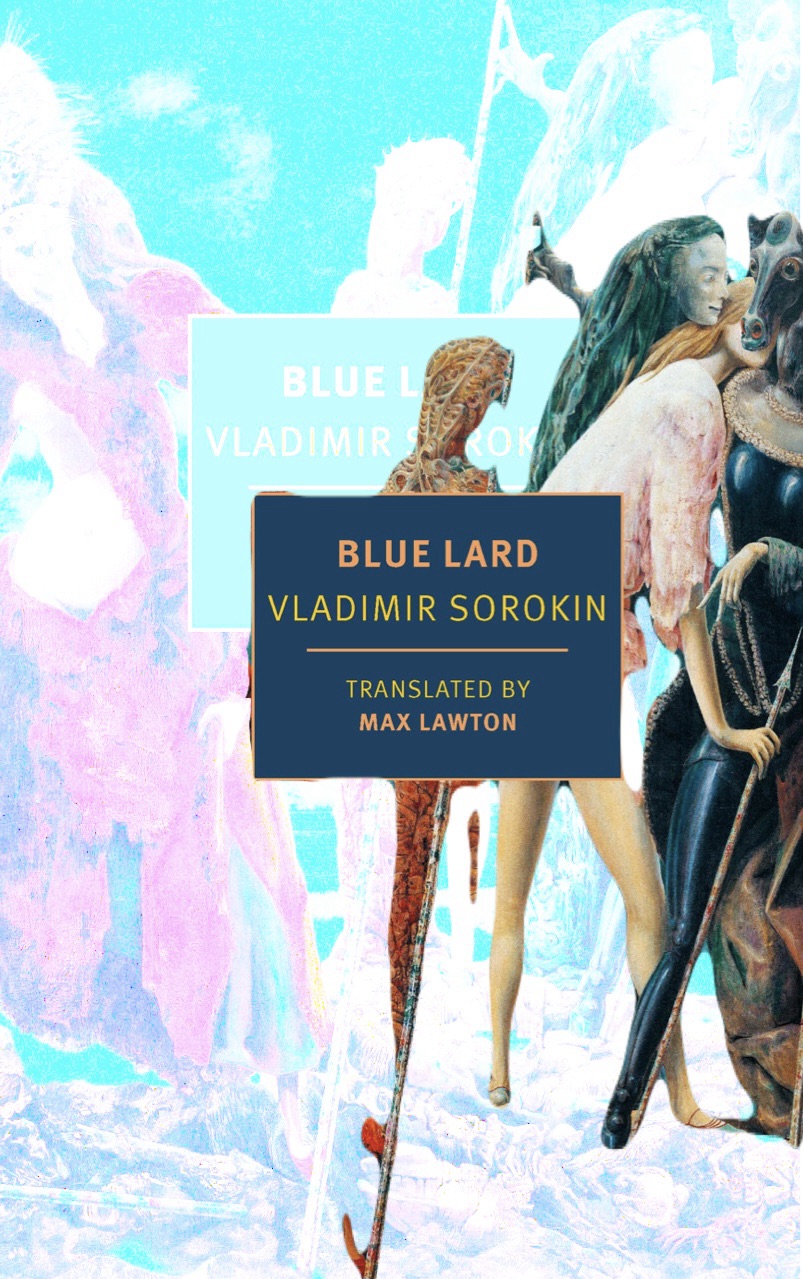
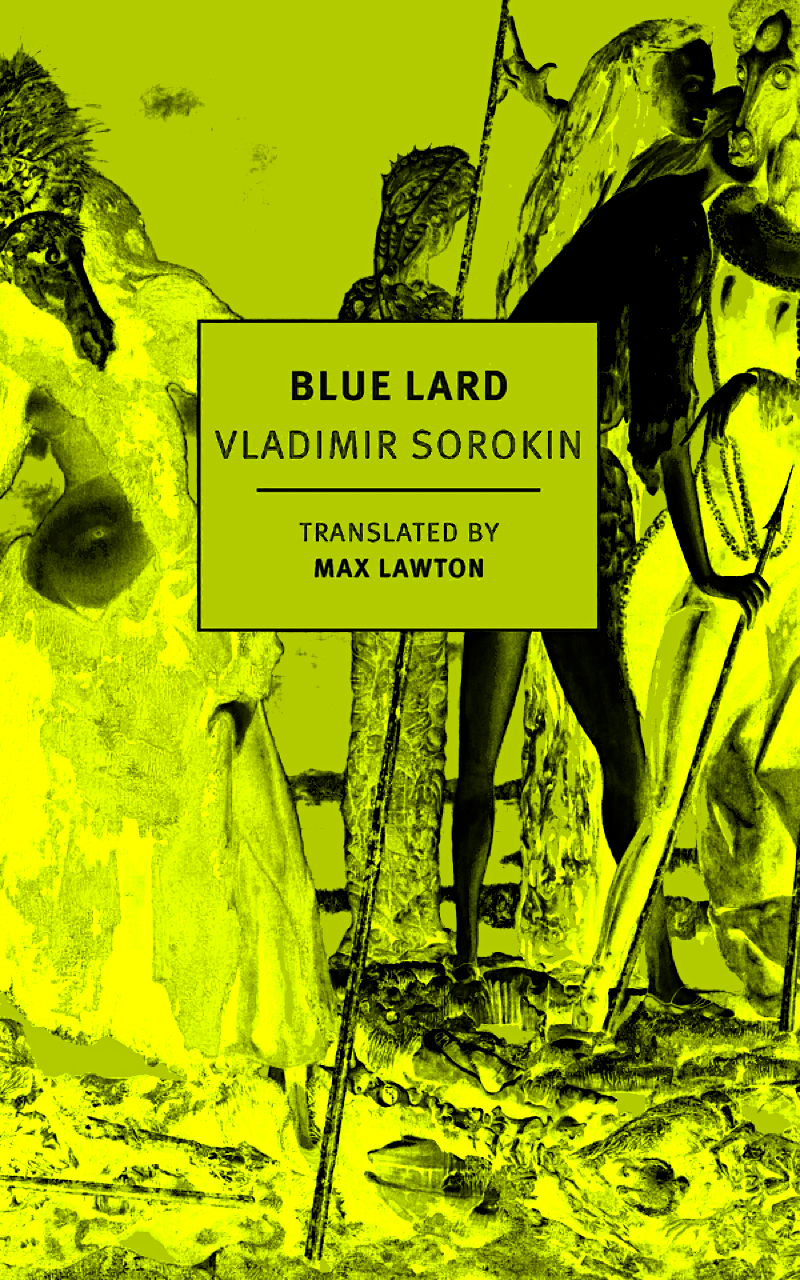
On Vladimir Sorokin’s Blue Lard, pp. 111-61 (L-harmony, 2 measures of red ants, a child’s tiny golden hand, fantasies on paper)

Previously on Blue Lard…

pp. 1-47

pp. 48-110

The following discussion of Vladimir Sorokin’s novel Blue Lard (in translation by Max Lawton) is intended for those who have read or are reading the book. It contains significant spoilers; to be very clear, I strongly recommend entering Blue Lard cold.

The first hundred or so pages of Sorokin’s Blue Lard switch between Boris Gloger’s letters to his lover and the narratives of seven cloned Russian writers (the clone-narratives are, textually speaking, included in Boris’s letters).

The shifts between these layered texts are initially quite disarming. Boris’s letters are filled with invented futurese, neologisms, and Chinese slang; the clone-narratives each impose their own linguistic taxes (and rewards) on the reader.

However, these first hundred pages do establish some of the baselines one might expect of a traditional novel: setting (a futuristic laboratory in frozen northeast Siberia), characters (scientists with a military guard—and seven clones), and a basic mission (cloning Russian writers who, in writing their compositions, produce an enigmatic substance called blue lard).

That mission is a clear success by the time we get to Boris’s last letter (dated 8 April for those keeping track), and our team, “the arbiters of the BL-3 Project, have total L-rights to relax.” So they decide to throw a cocktail party. (“It’s sometimes necessary to drink cocktails all day. Not, of course, for L-harmony, rips ni ma de, but JUST ‘CAUSE,” bold Boris boasts boldly.)

As in some of the previous scenes of hard-drinking downtime, the BL-3 Project’s futuristic cocktail party feels like something from a pop sci-fi film. Much of the dialogue seems inscrutable in a first run through the novel, but the jargon and bickering and bantering over political and cultural circumstances alien to the reader are simply texture–verbal adornment to fill out the scene.

Sorokin does bolster his futurese with occasional asides of historical analysis though:

Everything is working out for the Chinese now, just as it did for the Americans in the twentieth century, the French in the nineteenth century, the English in the eighteenth century, the Germans in the seventeenth century, the Italians in the sixteenth century, the Russians in the fifteenth century, the Italians in the fourteenth century, and the Jews in the first (I think) century.

That “I” is Boris, although the style of the party section has subtly but significantly shifted from the flirtatious and gossipy tone of his love letters home.

But enough with style! Back to the party!

There is drinking and dancing and drinking and drinking and drinking. The ol’ fashioned colonel whips up a batch of whiskey sours (“A drink for lonely men who test AEROSEX once a month and prefer books to holo-bubbles,” a geneticist opines), and from there, the BL-3 Project crew goes to town in inventing ever-more daring cocktails.

Here is the recipe for Fan Fei’s CHINA 21:

5 measures of tomato juice

3 measures of spiritus vini

2 measures of red ants

1 measure of salty ice

1 pod of red pepper

Our party is in full drunken swing, abject sweat flung from the dancefloor, another round of cocktails called for, when all of a sudden the novel’s perspective upends itself (again).

The disruptive narrative event here would, again, not be out of place in a sci-fi actioner. A band of rebels (the “Brothers,” as they refer to themselves) breach the laboratory’s bunker, exchange gunshots with the soldiers, and kill everyone but our heretofore main character, Boris.

But the stylistic shift is intense—we go from the strange comfort of Boris’s letters to a new style, one utterly outside of Boris’s consciousness. Indeed, it’s through the eyes of these invading “Brothers” that we actually see Boris for the first time: The Brothers-centered narrator informs us he is “rail-thin… His face was narrow and swarthy skin clung to the bones of his skull. Metal plates in complicated shapes were visible beneath the skin of his temples.” He is the last living witness to the BL-3 Project—but not for long.

Again, the scene plays out as a cinematic trope, the scientist interrogated before his death. Boris isn’t much use explaining just what the blue lard is for or how it works. But he does tell us there’s

something called the MINOBO Project. I don’t know the details… [but] they’re building a reactor on the moon, a constant-energy reactor. They’re building it in the shape of pyramids… pyramids made of fifth-generation superconductors and blue lard… layers… layers and layers of it… and that allows them to plus-directly solve the problem of perpetual energy.

Our one-time narrator is then summarily executed, his brains ironically sprayed over a safety placard.

We are now firmly in the narrative purview of the Brothers. They harvest the blue lard from the bodies of the clones and head back to their lair, mumbling about their poor diet and their ever-constant war with “the whorish” who populate the surface of the earth. They are of the Earth-Fuckers, a bizarre monastic sect dwelling in a strange hierarchical series of underground caverns that seem to descend infinitely into the earth.

The narrative too moves with these earth-fucking brothers, as does the blue lard, a vibrant constant in a constantly-changing scene. Along the way we are treated to ever-stranger rituals and routines. Sorokin, in Lawton’s deft translation, gives us a surreal but limpid portrait of this subterrestrial monastery, where sacred cloister gives way to another sacred cloister:

The descent was quick––the staircase led into a large, dusky hall with a marble floor and marble walls. In the hall, there were ten marble desks, at which bald men in black suits were sitting. Green lamps were burning atop their desks. On the wall, a sigil made of rock crystal, jasper, and granite was illuminated in green light: a man copulating with the earth.

The blue lard slowly makes its way down to “the magister” who informs the reader that when he looks at his hands, he sees tiny golden children’s hands on his wrist. These tiny golden children’s hands speak to him through a language based on wrist rotations. He has transcribed some of these communications, including something called “The Swim,” a very short story about a group of military swimmers who hold torches aloft to create a constellation of language. They are swimming raft of lighted language, passing by crowds who read from afar the quotations they have created—quotations that the swimmers themselves cannot rightly read. They are, quite literally, marks. The story “The Swim” is actually a version of an older Sorokin short story, underscoring the intertextual nature of Blue Lard’s internal and external composition. This is a novel about writing; or, a novel about writing writing.

The Earth-Fuckers section of Blue Lard is probably where, on first reading, I truly gave into the novel’s strange wave and just went with it. After all, my dear epistolarian Boris Gloger was now deceased and I found myself far from the false stability of the BL-3 Project’s base. The section plays out as a series of wonderful deferrals, stories that descend into new stories as one Earth-Fucker descends to a new level of their strange subterranean labyrinth. There’s the infanticidal Nadelina, who gives birth to a child by a different father every year–twenty-six children in total in Max’s translation (one for each letter of the English-language alphabet?). She sacrifices the children so that she might always be able to “water the earth with her milk.” There are three mischievous “babes” — devilishly horny little cherubs who float around in what could be the set of a nightmarish technicolor Hollywood musical. There’s the history lesson of the great schism between the Northern and Southern Earth-Fuckers. There are enormous genitals.

The Earth-Fuckers section is larded with surreal episodes (all anchored in precise, clear imagery), but a re-read reveals that Sorokin is not solely interested in throwing bizarre satirical scenarios at his reader. Traditional novel-making elements are in play here, even if it’s easy to miss them in a dazzled first read. As Sorokin prepares to transition to a new sequence, he offers his readers a recap of the story so far, a blunt summary from an Earth-Fucker’s perspective. After declaring the blue lard an “eternal substance” that will never burn or freeze but “shall forever be exactly as warm as the blood of man,” we get this exchange:

And how did the whorish manage to produce this substance?

By accident, oh my father. They were doing whorish experiments restoring and regrowing people from the memories in their bones. These were people of various professions. But only those people who had at some point written down their fantasies on paper turned out to be capable of producing blue lard.

Again, Blue Lard is writing about writing (about writing about writing…). And, soon, another writer will enter the text and deliver the textual tissue between Blue Lard’s lobes: “The Indigo Pill.”

More to come.

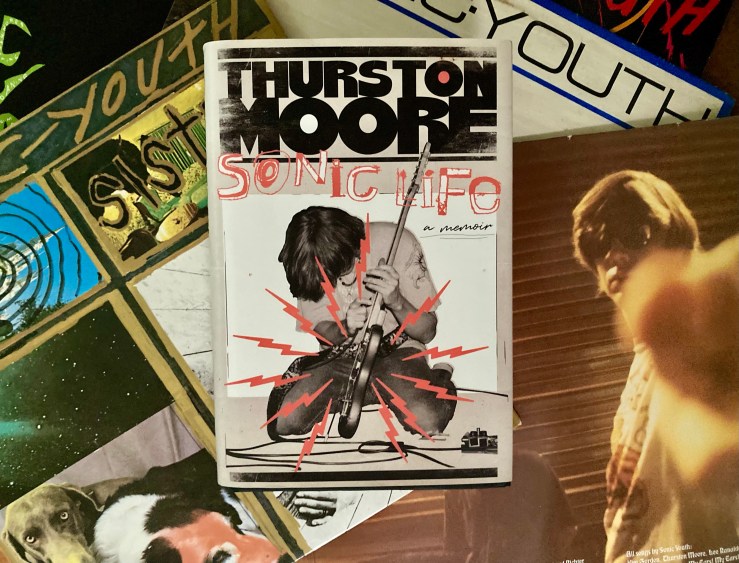
A Review of Sonic Life, Thurston Moore’s Rock n’ Roll Fantasia

Thurston’s Rock n’ Roll Fantasy

Thurston Moore’s memoir Sonic Life kicks off in 1963 with his older brother Gene bringing home a 45 of the Kingsmen’s “Louie Louie,” blowing open five-year-old Moore’s mind to the sonic possibilities of raw guitar power.

Moore describes the primal garage hit as the introduction to “a new current of electricity,” one that rewrites the “soundworld” of his earlier suburban life. Our narrator chases that current, finding it in its purest form in The Stooges’ “I Wanna Be Your Dog,” a pre-punk anthem Moore’s band Sonic Youth would cover on their first full-length album, 1983’s Confusion Is Sex. Sonic Youth would also play “I Wanna Be Your Dog” live throughout their career and eventually perform it with Moore’s hero Iggy Pop.

Moore meets many of his heroes in his Sonic Life. It’s a goddamn rock n’ roll fantasy, albeit a fantasy filtered through the gritty reality of punk, No Wave, and smelly indie rock touring vans.

Sure, Moore meets some of the biggies, especially late in the memoir, as Sonic Youth reaches their sonic majority. He chats with Paul McCartney, professing a preference for McCartney’s brother Mike McGear’s stuff to the Beatles. Sonic Youth gets to back David Bowie on “I’m Afraid of Americans.” (Bowie later coos to Moore’s toddler daughter Coco). Moore tours and records with Yoko Ono.

But Moore’s eyes star starrier for the rough luminaries of the New York seventies scene he thrust himself into: Patti Smith, Joey Ramone, Richard Hell, Alan Vega, Tom Verlaine, Lenny Kaye, et al. He’s just as hot for contemporaries like the Minutemen, Black Flag, and Dinosaur Jr., and maybe even hotter for the bands that took Sonic Youth’s squeal to heart, like Pavement, Royal Trux, and My Bloody Valentine.

Sonic Life is larded with people, vibrations, art, life, a love of the weird. Sonic Youth were always as important as curators of the underground, channeling it to seekers of the strange, as they were as a musical act, and Sonic Life is the literary summation of that career.

Thurston’s Literary Fantasy

Any fan who followed Sonic Youth closely, especially in their nineties heyday, would attest that Thurston Moore was the band’s loquacious mouthpiece, a bit of tall charmed ADHD in verbal action, chatting up the world. Sonic Life is liquid, loquacious, loving. Literary protopunk hero Patti Smith populates the pages from the earliest chapters through the last.

Moore also works his decades-long sightings and meetings of William S. Burroughs into the book. Moore first spies Burroughs in 1977 in NYC at a Patti Smith show; decades later the band gets to hang with him a bit. (It’s unclear if Burroughs registers any of this.)

Kathy Acker’s spirit occasionally pops up; it’s clear she was a hero to Moore and his band, but she ghosts them at a planned joint performance in Rotterdam in 1985. The band reads passages of Blood and Guts in High School between songs, tearing out the pages and destroying the book.

Longtime Sonic Youth fans will anticipate Moore’s prose. Seemingly-oblique psychedelic expressions explode, artful phrases dash into each other, ultimately cushioned carefully into a comfortable syntactic register. The effect is not unlike much of Sonic Youth’s post-Sister output, which by turns twisted avant-garde experimentation into pop sugar and deconstructed classic rock riffs into punk scuzz.

Moore’s punchy prose is best summed up in the titles of his 71 chapters, most of them cribbed from song titles and lyrics (including his own): “Flaming Telepaths,” “Mere Animal in a Pre-Fact Clamour,” “Ecstatic Stigmatic,” “Secret Knowledge of Backroads,” “Latex Gold,” etc. The chapter titles are wonderful clues, sometimes direct, sometimes cryptic, always evocative. The prose generally hurtles along, with Moore’s verbal tricks wedged into easy, flowing configurations, but some of the tricks get tired. Particularly, Moore is particularly fond of “Particularly” as a linking expression. Too, we find the book peopled by characters who “could only laugh” at whatever absurdity life has conjured. An editor might have attended these repetitions, but I’m not sure if Moore’s best stuff ever came about via the hands of an editor. The book is generally well-written.

Experimental New York, Seventies and No Wave

Sonic Life begins in 1963, blasting the Kingsmen’s “Louie Louie,” and ends in 2009 with Moore naming Sonic Youth’s last album The Eternal. There are moments outside of this neat chronology though. Discussing his family, Moore goes back a few generations, if only for a paragraph or two. He touches briefly on the dissolution of both Sonic Youth and his marriage to Kim Gordon in 2011. That’s not what the book’s about. Sonic Life compresses events before 1977 and events after 1994. The book is almost 500 pages long; Steve Shelley, who joined the band in 1985 and who most fans think of as “the drummer of Sonic Youth,” shows up around page 300. This isn’t a tour diary or a tell-all.

Instead, much of Moore’s narrative focuses on New York in the scummy seventies and early eighties. Dirt, crime, and drone rock rules. Glenn Branca, Teenage Jesus and the Jerks, the last days of Sid Vicious. Difficulty making even the cheapest rents. No phones, No Wave, and his first stolen guitar. Moore documents an interstitial period in NYC history. He arrives after punk’s (non-)glory daze, too young to partake, too old to really fit in with the emerging wave of hardcore. Along with Kim Gordon and Lee Ranaldo, Moore shapes the noise and grime and angles and raw hope into something new–Sonic Youth.

Kim Gordon

Kim Gordon is a huge part of Thurston Moore’s life and a huge part of Sonic Life. She’s not exactly Moore’s muse, but he clearly looks up to her, as he, tall boy, looks up to so many of the people who people this memoir. Moore is frank in his description of Gordon as an artistic and musical partner, one whom he sometimes clearly grated on and at other times found himself astounded by.

In Moore’s telling, Gordon often felt outside of the band. Moore relates that when the band (working with Mike Watt under the name Ciccone Youth) were putting together the noises that eventually became The White(y) Album, Gordon felt herself out of sync with the band. She went to a mall and recorded a video karaoke cover of Robert Palmer’s “Addicted to Love,” an artistic gesture that confounded and impressed Moore and the rest of the band, lending ironic license to their Pop Art leanings.

Fans looking for anything gossipy in Moore’s memoir about his marriage and divorce from Gordon won’t find it. His focus is on Gordon as an artist and musician. Indeed, much of duo’s communication was rooted in the actual songs they wrote and played. In one of the book’s stronger passages, Moore details creating a punk poster that appropriated the image of a naked young Latina from a calendar he’d found. He scrawled some would-be feminist slogans over the image and hung it in their house. Gordon didn’t say anything at the time. However, when the band rehearsed their new song “Flower” (which would appear on 1985’s Bad Moon Rising), Gordon began singing Moore’s slogans as lyrics: “Support the power of women / Use the power of man.” But Moore then added her own words:

There’s a new girl in your lifeLong red wavy hairGreen, green lips and purple eyesSkinny hips and big round breastsHanging on your wall

Moore ends the chapter by noting that “the two of us never talked about it outright, only through our songwriting. It wouldn’t be the last time that music was the mode of dialogue in our relationship.” Throughout Sonic Life, he heaps praise on his ex-wife as an artist, intellect, musician, and mother, but she ultimately remains a cipher–like the other members of Sonic Youth.

Lee Ranaldo

Moore credits Ranaldo as the better musician and guitar player throughout his memoir, but for the most part he’s a blip in a book of nearly five hundred pages. Maybe that was Ranaldo’s choice—maybe he asked his musical partner of three decades if it was okay to share certain stories and Ranaldo said No.

Richard Edson

Richard Edson was the first drummer of Sonic Youth. Moore credits him with suggesting “the music would be far more effective if there was some semblance of an arrangement, guitars locking into a rhythm so changes could be audibly established.” Moore seems to receive this basic concept of songwriting as a revelation.

Edson went on to star in Stranger Than Paradise and Do the Right Thing, although most people would probably recognize him from a bit part as one of the garage guys in Ferris Bueller’s Day Off. He also had a bit part in Desperately Seeking Susan, a film featuring Madonna.

Madonna

Madonna wasn’t in Sonic Youth, but she floated in the same circles (and even briefly dated Swans frontman Michael Gira).

Moore brings up Madonna more than Lee Ranaldo or Steve Shelley.

Bob Bert

Moore spends a paragraph or two of Sonic Life implicitly apologizing to Bob Bert, whom Sonic Youth as a whole treated pretty shabbily. They fired and rehired him a few times. He gets more air time than Richard Edson or Steve Shelley (but not as much as Madonna).

Steve Shelley

Steve Shelley’s drumming made Sonic Youth Sonic Youth. He continues to play and record with Thurston Moore, so maybe the lack of words on Shelley in Sonic Life was by way of Shelley’s own request.

Our Band Could Be Your Sonic Life

Michael Azerrad’s 2001 book Our Band Could Be Your Life devotes a skeptical chapter to Sonic Youth. The editorial position of that history of indie bands in the eighties seems to posit that Sonic Youth were art rock prima donnas who eventually yoked a bevy of underground bands into major label harnesses. Azerrad’s book is really about real-life social networks and overlaps and DIY—Black Flag, SST, The Minutemen, Dischord, seven inches and tapes, and touring! touring! touring! Sonic Life doesn’t exactly duplicate Azzerad’s indie serial, but it does further authenticate it.

Range Life

Michael Azerrad’s 2001 book Our Band Could Be Your Life, at least in my memory, tends to dwell on touring: stinky vans, unpaid gigs, hard lodging. Moore doesn’t elide this aspect of the band’s identity, but neither does he dwell on it. Moore focuses on the energies on the stage, calling the band a “sonic democracy” — and really, here, I take back what I said above. They are not ciphers but sonics, musicians making the vibrations come alive. What else could we want?

Einstein A Go-Go

Thurston Moore includes the Einstein a Go-Go in a very short list of “clubs that welcomed the underground scene into their chambers, each with [their] own distinct environment.”

Einstein’s was an all-ages club that existed from 1985 to 1997 in Jacksonville Beach, FL. You could go there and dance to wild music for like a five buck cover, and you could see all kinds of cool bands play for maybe eight or ten bucks. I was there pretty much every Friday and Saturday night between ’95-’97 (and sometimes just hung out outside and walked the beach if I didn’t have the cover). Kids wept when it closed. I got to move, leave for college, words that now, as I type them, seem so cruel.

Sonic Youth played Einstein’s with fIREHOSE in the fall of 1986. This performance left a weird little dent in the city that could be felt a decade later by bands who had seen (or at least claimed they had seen) Thurston, Watt, Kim. There were always the older kids who had seen the band, or they had heard about it from older kids who had seen the band…this was called “a scene.”

The Faircloth family who ran Einstein’s were great people. Bands didn’t want to come to Florida; still don’t, really. The Faircloths made sure the bands were comfortable, had good lodging, good food (fried chicken!), leading to a pipeline of bands coming through — 10,000 Maniacs, Flaming Lips, They Might Be Giants, Alex Chilton, Ween, Soundgarden, Mudhoney, Meat Puppets, Dinosaur Jr., Primus, The Replacements, Jane’s Addiction, Nirvana…

By the time I was old enough to go to the all-ages club, the major indie acts that had passed through had graduated to Bigger Times. But I got to see so many great second-wave indie bands: Archers of Loaf, Polvo, Sebadoh, Thinking Fellers Union Local 282, Luna, the Swirlies, Superchunk, and so many, many more.

My stupid high school band got to play there a few times too. We were too loud and used weird tunings on the cheap guitars that we kept swapping between songs in lieu of actual songwriting.

Better than that, at Einstein’s I got to dance to the music I wanted to dance to through an incredibly loud speaker system, including Sonic Youth “hits” like “Teenage Riot,” “100%,” and “Bull in the Heather.” Some of that feeling of fucked up dancing reverberates still in Sonic Life.

Punk Breaks, Major $$$, Nirvana, Ecstatic Peace

Where does it all go? Well, you know. Punk breaks. Nirvana breaks. Sonic Youth signs to a major label, opens for Neil Young, and later makes enough money touring on Lollapalooza to build their Echo Canyon studio on Murray Street. They start their own label, SYR, releasing some of their more avant-garde projects. Opportunities expand. All of their equipment gets stolen. Moore and Gordon have a kid and move to the burbs. They still keep an apartment in NYC; Gordon is there the morning of the September 11, 2001 attacks on the Twin Towers. A plane engine crashes on Murray Street; thankfully, Sonic Youth producer and bassist Jim O’Rourke escapes, though not unharrowed. O’Rourke leaves the band and is replaced by Pavement’s Mark Ibold. Sonic Youth releases their last studio record, The Eternal, on indie Matador, having fulfilled their contract with Geffen. Moore begins an affair with Eva Prinz, an editor at Rizzoli. In 2011 he and Gordon divorce and Sonic Youth is kaput. Moore and Prinz marry and start a poetry imprint, Ecstatic Peace Library. He claims to have found his own ecstatic peace.

Radical Compression

As I mentioned above, Moore’s memoir focuses on the late seventies and the eighties. He condenses the band’s last twenty years (and the last ten of their sixteen studio albums) into about 100 pages, just a fifth of the book. And that’s probably for the better; Sonic Youth, while not exactly overexposed, were pretty well documented in print and film and web by the onset of the mid-nineties.

The radical compression is wonderfully effective at times, giving the book a clipped, propulsive rhythm and allowing Moore’s humor to shine through. A standout is Ch. 66, “Latex Gold,” the first chapter of the book’s final sixth section. It begins in 1996 with a Pacific Rim tour with the Beastie Boys and Foo Fighters. Moore and Gordon have enlisted Thurston’s sweet mother Eleanor to help out with Coco (and see a bit of the world). She gets hurt in the mosh pit, trying to take photographs, and ends up wheelchair-bound, but ex-Germs, ex-Nirvana Foo Fighter Pat Smear takes up her cause, making sure she doesn’t get left behind when everyone heads to a flea market in Jakarta. A page later, the band plays Late Night with Conan O’Brien; a few paragraphs later, Moore is remixing Yoko Ono, then playing guitar with Patti Smith. Then the band is on The Simpsons: “It was the single mainstream cultural event that we’d find ourselves identified with across the world.” A paragraph later, Moore is seated on a couch between Lou Reed and Jim Carroll watching a rough cut of The Basketball Diaries. Moore praises DiCaprio’s performance; Reed describes the film as “Fucking terrible” and leaves immediately. On the next page, Moore is driving an aging, overweight, and likely insane John Fahey around a series of gigs in the northeast. Fahey greets Moore at his motel room door one morning, fully nude, Fahey’s cracked CDs strewn across the floor. Moore tells Fahey he could be selling the CDs at their gigs. Fahey offers Moore to take as many CDs he wants. By the end of the ten-page chapter, Sonic Youth are backing up David Bowie at the Thin White Duke’s Madison Square Garden birthday bash.

End Hits

I really loved reading Sonic Life. It’s not a perfectly-written or balanced book, but it feels real. Moore forges a fascinating tone, at times deeply apologetic, particularly to the best friend of his teenage years, Harold Paris, whom he eventually alienates to the point of a break up in the mid eighties. The memoir is filled with conciliatory gestures and admissions of punk snottiness, whether it’s Moore apologizing for a nasty music review he wrote in his one semester of college, conceding that his brattiness to mentor Glenn Branca was likely misplaced, or expressing regret at getting in Dee Snider’s face to flip the bird at a Twisted Sister concert. Moore doesn’t try to spin his divorce from Kim Gordon; his recollection of his affair with Eva Prinz is brief, blunt, and frankly loving. Perhaps the most fascinating example of his zen reflection in the memoir is his take on the 1999 theft of all of Sonic Youth’s musical equipment while on tour in California. The band relied on racks of guitars in alternate tunings for their sound; the theft struck me as devastating at the time. Moore affords the episode just a few spare paragraphs, concluding that although he would miss his Fender Jazzmaster, he “embraced the liberation of losing things, being stripped of attachments” — a chance to “reignite” their musical mission. What did Moore feel at the time though? He doesn’t tell us, but the outlook he provides suggests wisdom and emotional maturity.

Mixtape

I made a mixtape based on the chapter titles and content of Sonic Life. I enjoyed listening to the music as I read Moore’s memoir, revisiting old gems and hearing cuts I haven’t heard in ages, along with a few tracks and artists new to me. And that’s what I think Moore and Sonic Youth always did best—expand a taste of the weird and the noisy, share the sonic love.


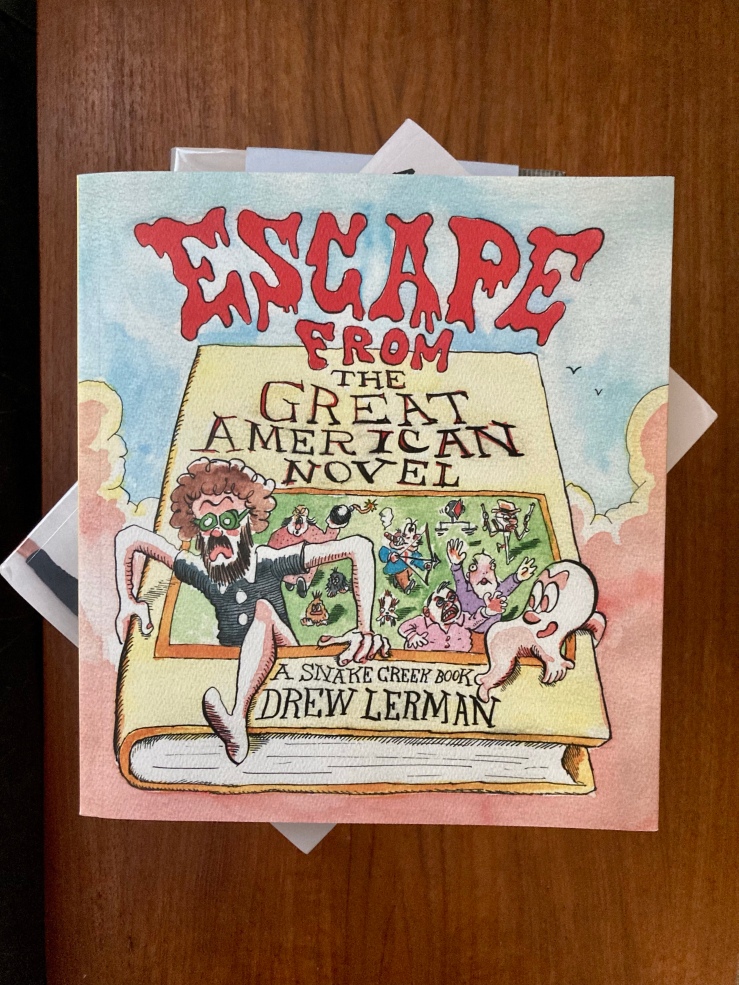
A review of Escape from the Great American Novel, Drew Lerman’s zany satire on art, nature, and capitalism

Drew Lerman’s comic strip Snake Creek takes us into the world of best pals Roy and Dav, weirdos among weirdos in Weirdest Florida. Their adventures and misadventures are both absurdly comic and zanily tragic, calling to mind George Herriman’s Krazy Kat strips and Samuel Beckett’s pessimism, Walt Kelly’s primeval Pogo and Robert Coover’s jivetalk, all rendered in kinetic black ink four-panel doses. I’ve been a big fan of the strip for a few years now, and Lerman’s latest collection Escape from the Great American Novel is his best work to date, a fun, messy, spirited send-up of the relationship between art, nature, and commerce.

Escape from the Great American Novel is a novel in just over 150 strips, spanning the end of August, 2019 through the beginning of August, 2021. If you reflect on those dates for a minute, you might recall that we squeezed in a lot of history there. Many of the (so-called) real-life tensions of that tumultuous time bubble up (and occasionally erupt) in the zany, myth-elastic world of Snake Creek.

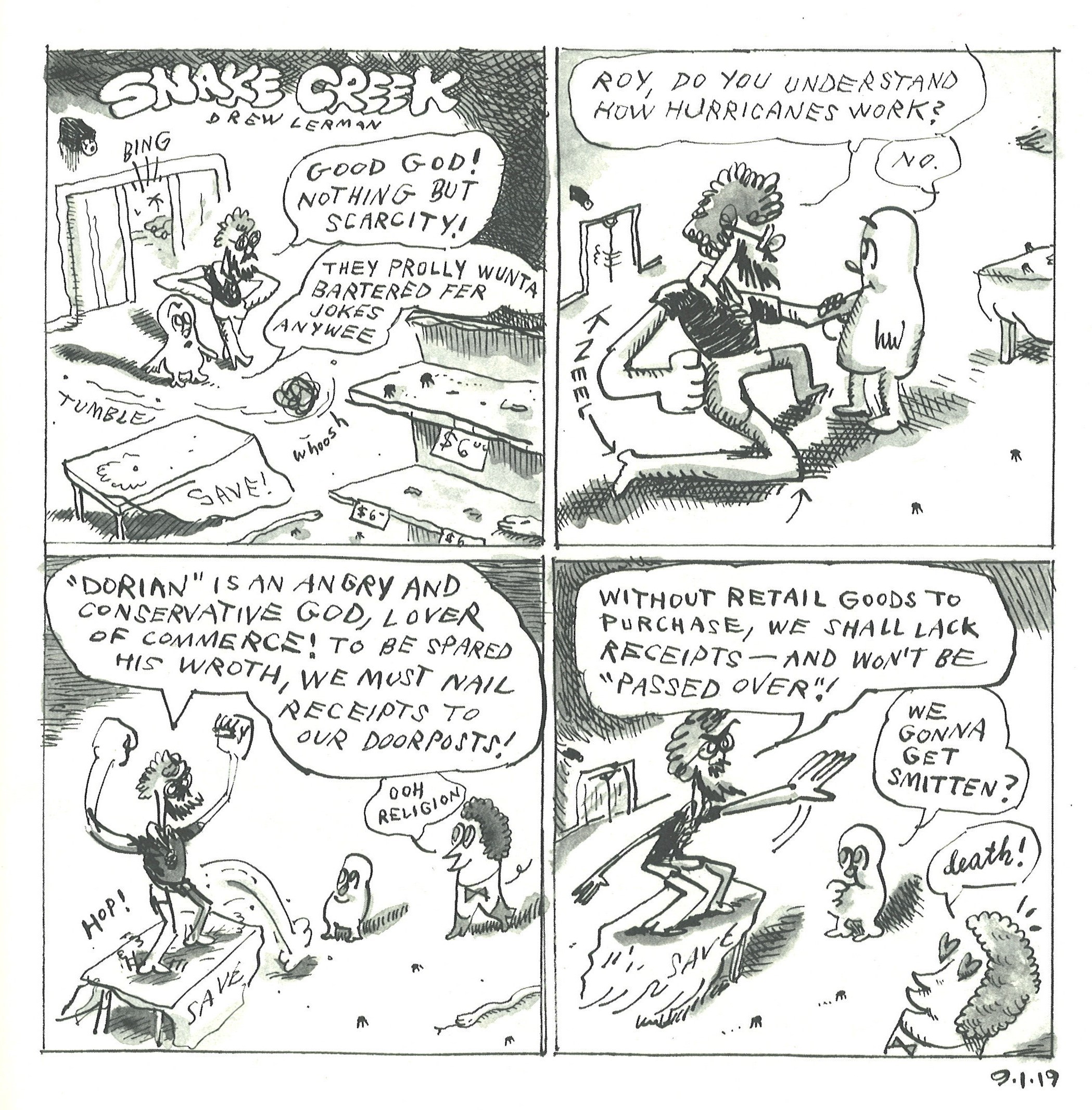
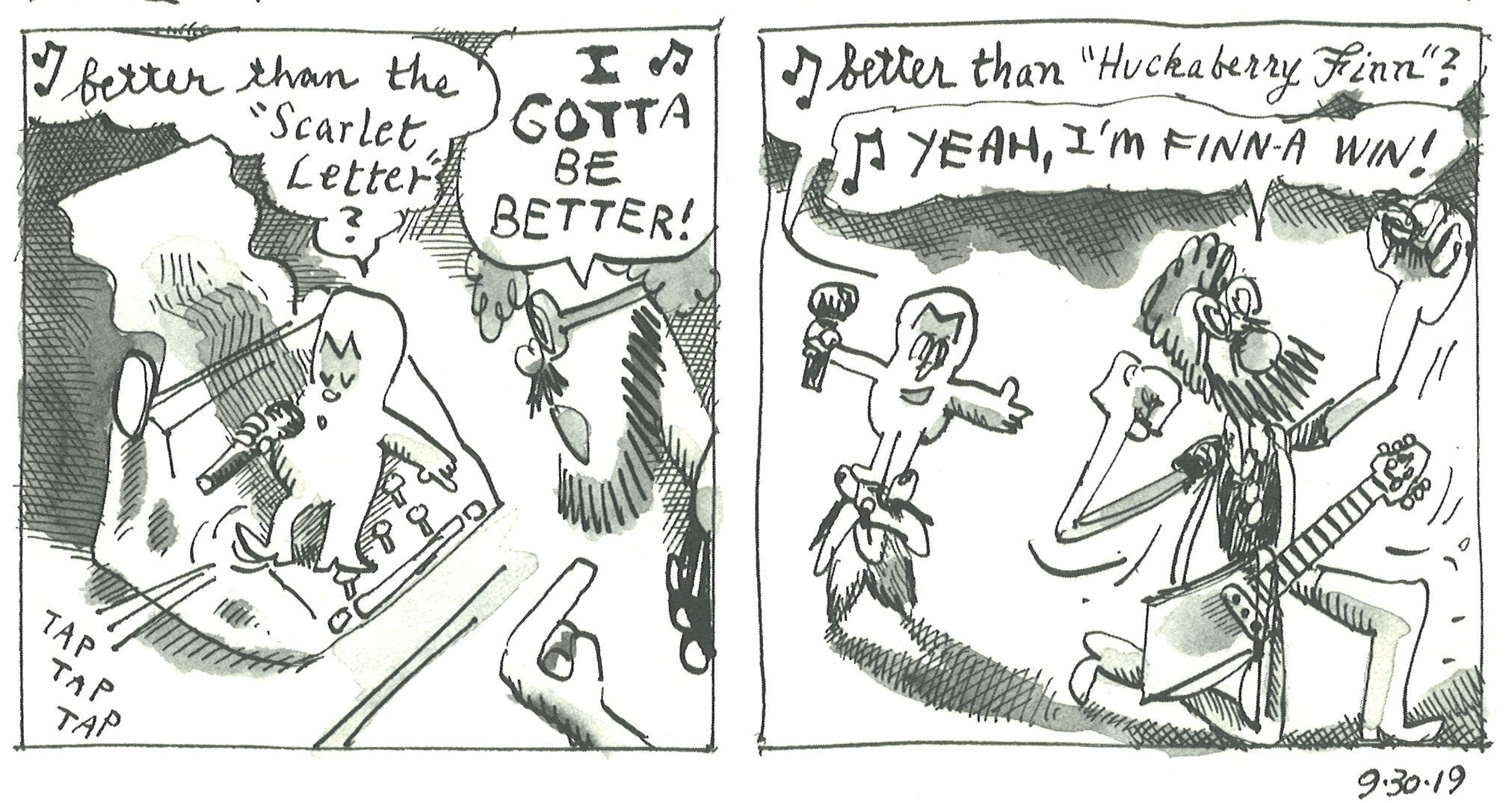
Things begin simply enough, with Dav seeking to reclaim his “status as a reader of books.” Our protagonist simply wants to dig in to fine literature, but news of approaching Hurricane Dorian blocks his book time. Lerman is a Miamian (a Floridian like myself), and although the world of Snake Creek reverberates with massive streaks of irreality, it is nevertheless also beholden to real-life forces of nature. Ever the slackers, Dav and Roy are ill-prepared for an impending Cat 5. Lerman lays out a comedic scene that might be familiar to anyone who’s tried to buy batteries and water and plywood at the last minute:

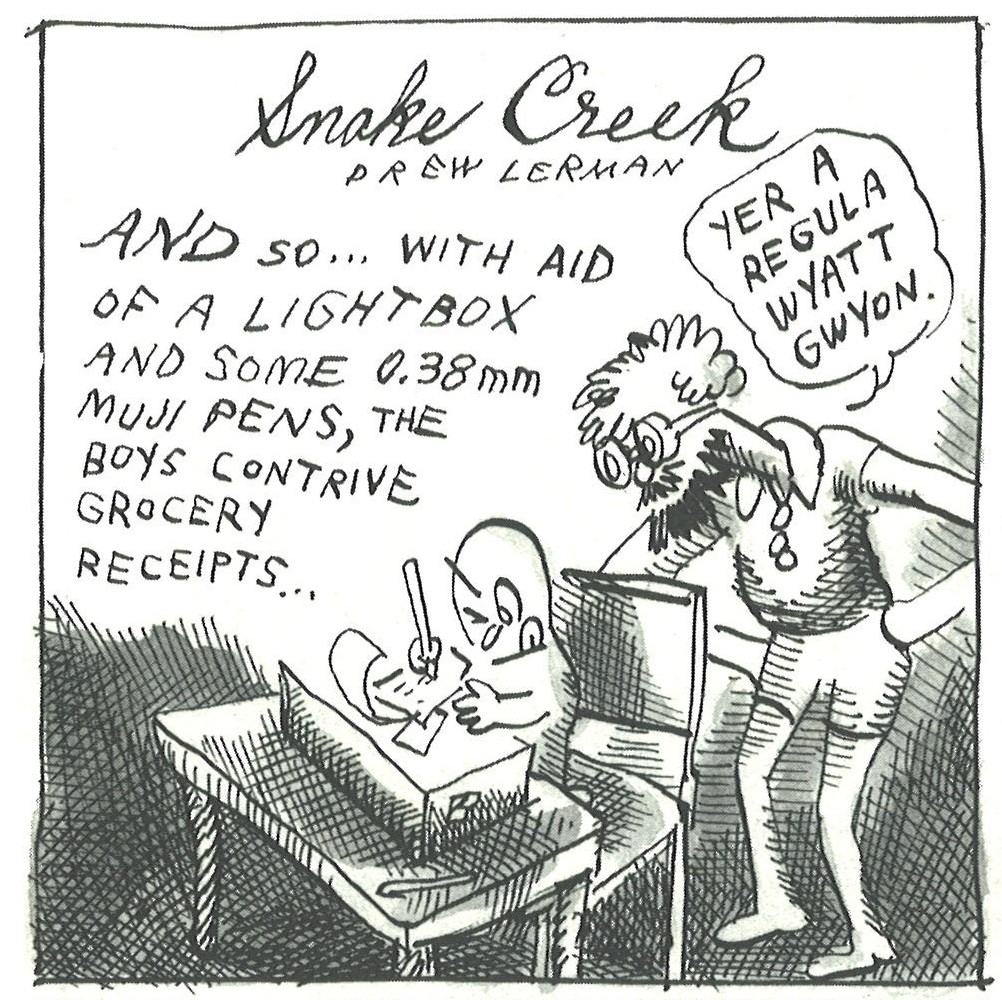
The early Dorian episodes of Escape usher in a critique of capitalism-as-religion, or capitalism-as-philosophy (as opposed to, say, the naked reality of exploitation both of people, animals, and natural resources). Short on capital or material, Dav and Roy concoct a plan to forge receipts, totems of capital that might ward off the angry Nature God Dorian. Lerman sneaks in a reference to the erstwhile hero of William Gaddis’s 1955 novel The Recognitions, the forger Wyatt Gwyon:

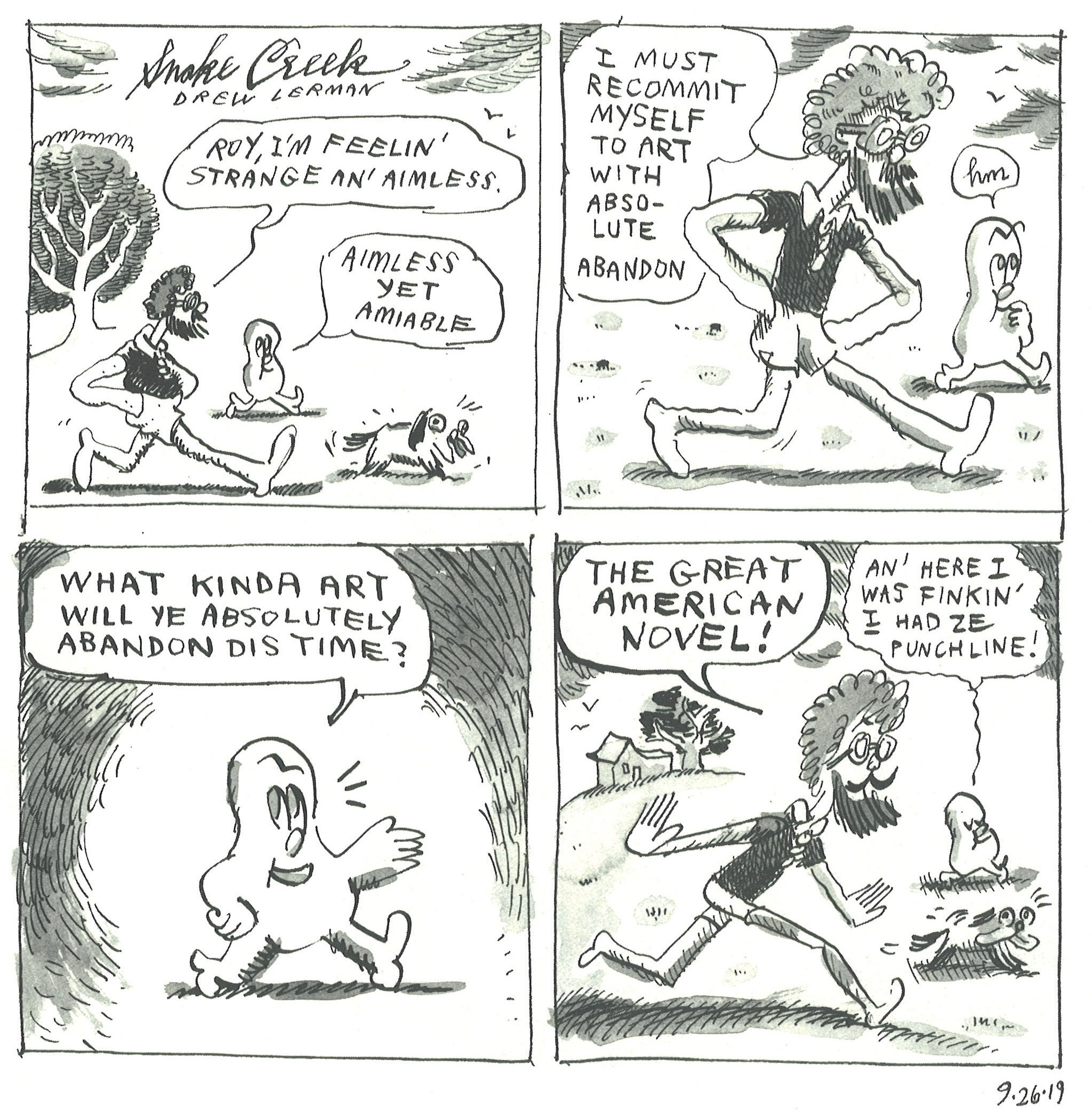
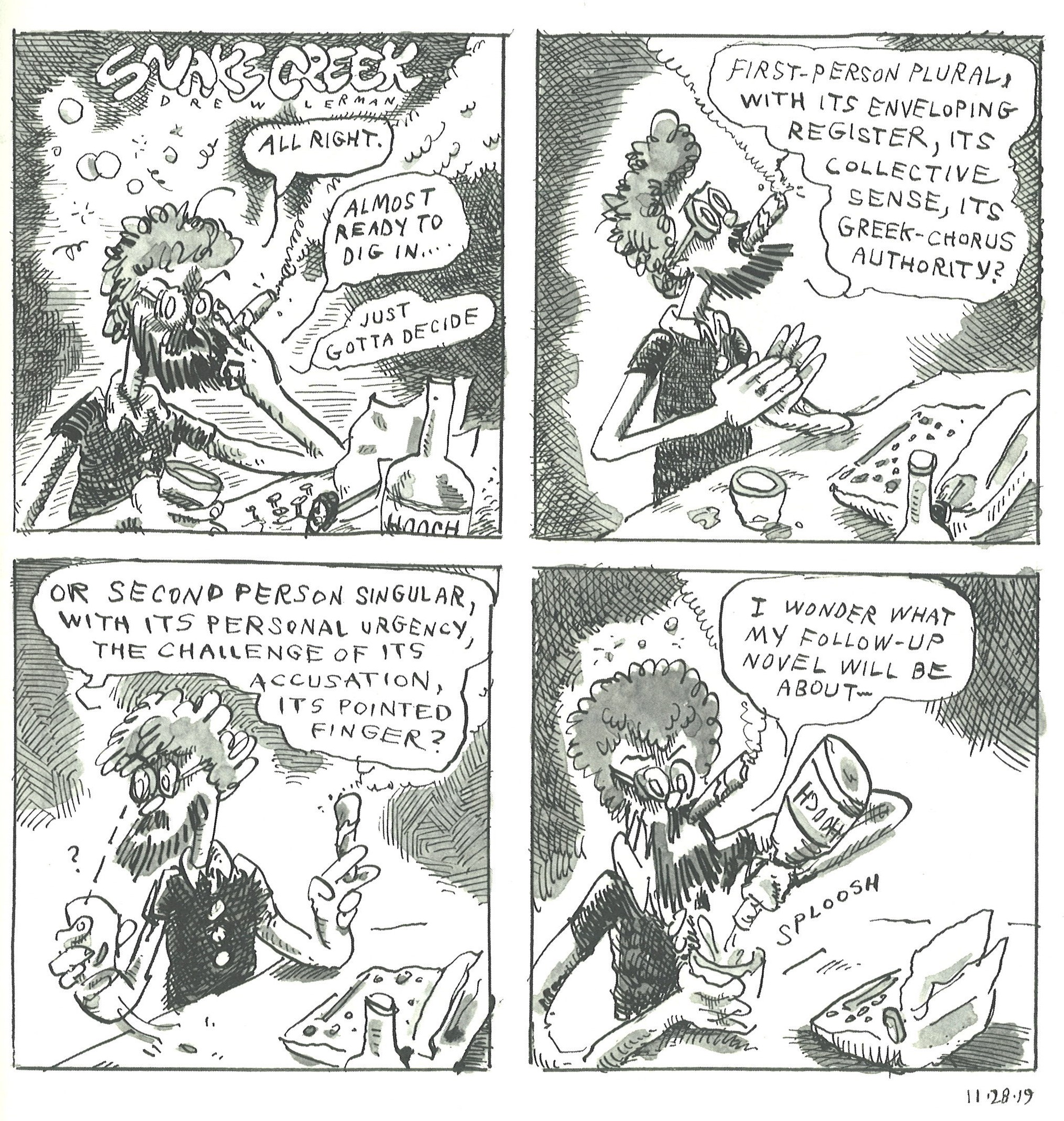
The storm passes, post-hurricane sobriety settles in, and Dav finds himself reflective: Just what is he doing with his life? And, maybe more to the point, what can he do to extend that life into immortality? His solution, immediately ridiculed by friend Roy, is to commit himself to writing The Great American Novel:

Dav’s quest takes a solipsistic turn. He plays the tortured artist, his ambition a block to his actual progress in writing The Great American Novel. Lerman satirizes the over-inflated but self-defeating ego of the artist who aspires to surpass all the great works came before him. While the pratfalls of a would-be tortured artist is not a particularly fresh subject matter, Lerman brings vitality to his depiction of Dav’s struggle against the anxiety of influence. If we enjoy mocking Dav, it’s because we understand and empathize with him. Who doesn’t want to contend with the greats?

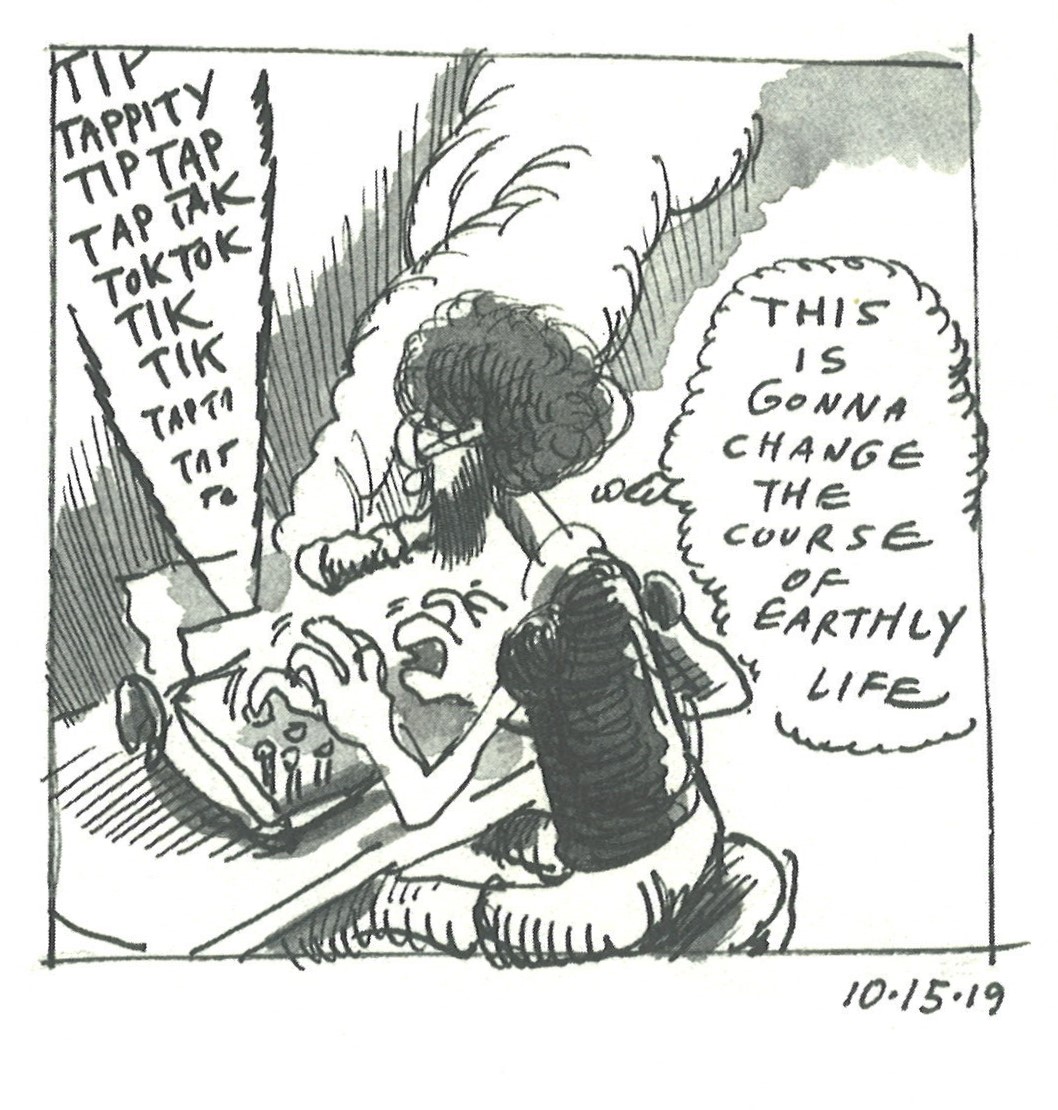
Dav’s quest also takes a turn away from his shenanigans with Roy. The pair’s riffing has always been the heart of Snake Creek, but Lerman keeps his partners apart for much of Escape. Dav’s dive into writing (or preparing to write, or preparing to prepare to write) distract him from Roy time. Initially, Dav chugs out reams of pages in the thrill of early enterprise. His ego swells, inflated by the grandeur of his illusions:

Only a few strips later, we find Dav’s illusions deflated. “S’all trash!” he declares over the mess of his nascent manuscript. Roy tries to help Dav. Snake Creek folk are all riled up over the plans of some “ollie garx” and the people are protesting. Roy rightfully recognizes potential inspiration here. He can bring his pal back to earth. “Sum sorter politicka thing” is happening, and that might be the inspirational grist Dav needs, right? But Dav rejects him: “I do not wish to know about anything that happened on this earth.” It might be hard to change the course of earthly life with that attitude. Instead of heeding Roy’s advice, Dav falls deeper into navel-gazing, imagining his future success, and generally doing anything except writing.

Dav’s dithering with the typewriter leaves Roy loose and “roving.” An amiable fellow, Roy soon takes up with two Russian oligarchs, Lev and Igor. This nefarious pair wishes to drill for oil in Snake Creek, destroying the weird paradise for profit. They plan to use charismatic, naïve Roy as their mouthpiece, a trusted liaison to the Creek community who can convince the locals on board to “drill baby drill.”

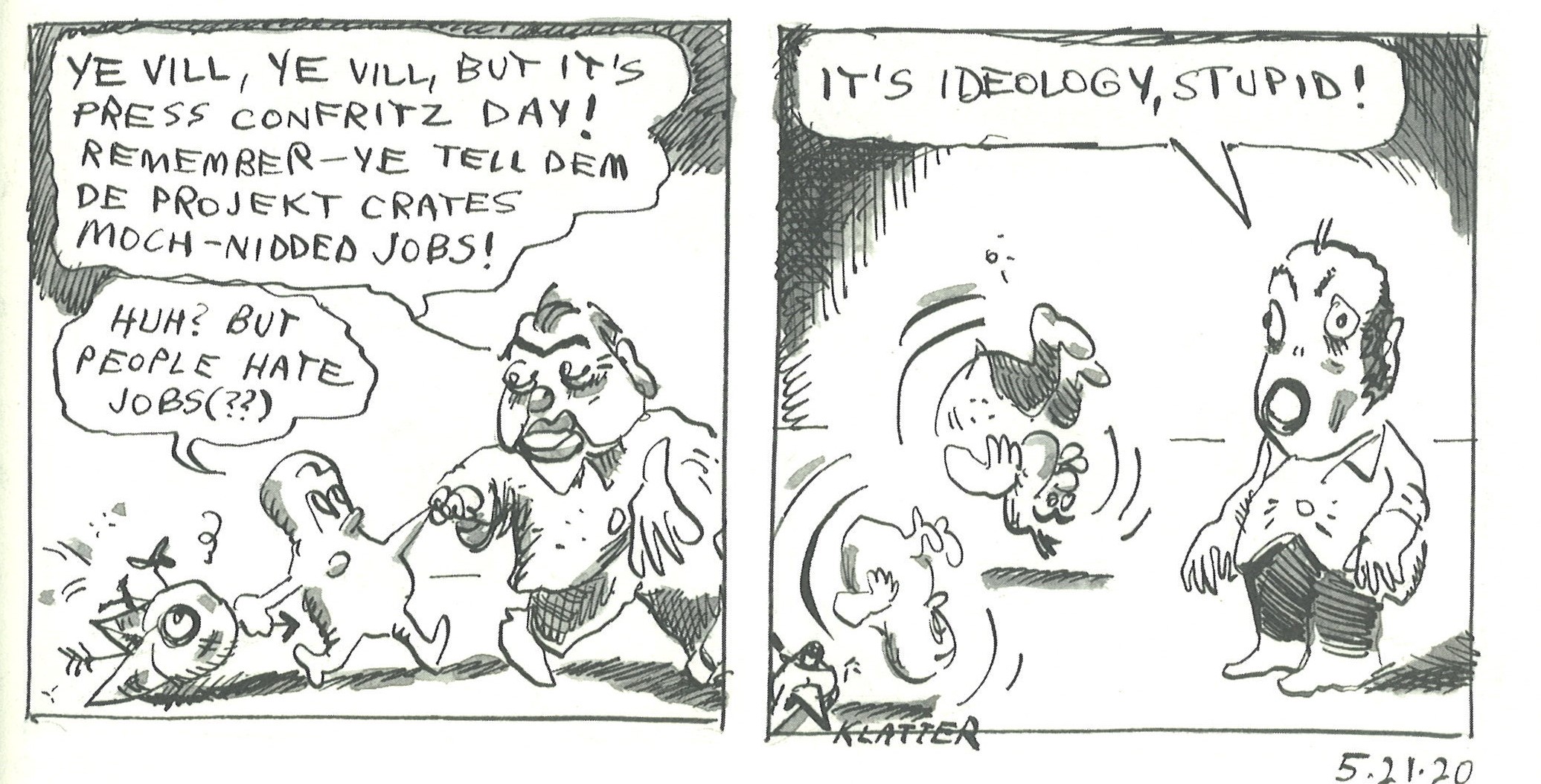
Lerman’s satire of these “ollie garx” and their relations with Roy is riddled with great gags. The oligarchs give Roy bald eagle eggs, which he proceeds to fry up to Dav’s dismay. They take him golfing and try to get him into Ayn Rand. They explain their anti-nature views—Mother Earth isn’t a caring mother but a devouring father who must, in oh-so Freudian terms, be eliminated. (Lerman, who always sneaks literary allusions into his strips, can’t resist referencing Faulkner’s As I Lay Dying during this exchange.) In one of my favorite exchanges in Escape, the oligarchs try to explain to Roy why his main talking point to convince the Snake Creek denizens to drill should be the promise of jobs:

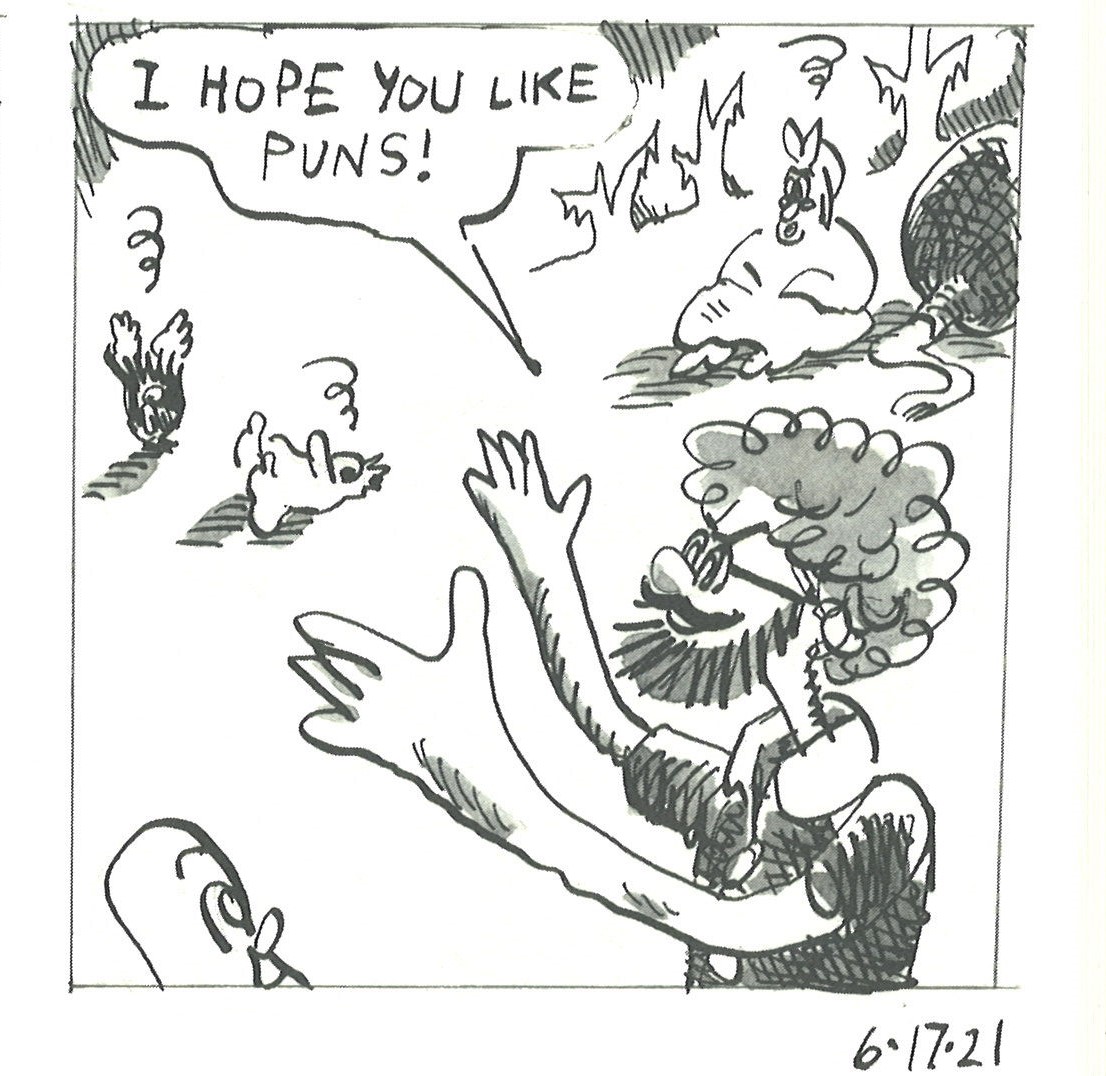
“But people hate jobs” — yes. And it is ideology, but you’re not stupid, reader, although the oligarchs might think you are. Their attempted seduction of sweet Roy plays out against Dav’s egotistical self-seduction into a fantasy of literary greatness in the twin threads of Escape from the Great American Novel. There are meditations on art, immortality, capitalism, and the role of our native environs. There are throwaway jokes on Harold Bloom and arguments over the better English translation of Camus’ L’Etranger. There are drones and fecal preoccupations and a nice ACAB reference; there are anarchist swamp folk and bombs! And there are puns. I hope you like puns.

The strips collected in Escape from the Great American Novel span two years that often felt in “real time” like an eternity. Many of us were separated from friends and family over these months. Lerman’s gambit, intentional or otherwise, is to keep his central characters separated, which adds real tension to a comic novel that otherwise might be a loose collection of funny riffs. As I stated before, Roy and Dav are the heart of Snake Creek, so when Lerman finally reunites them the moment is not just cathartic, it’s literarily metaphysical. For all its sardonic jags, ribald japes, and erudite allusions, Escape from the Great American Novel is in the end a sweet, even heartwarming read (Dav and Roy would find a way to mock this sentiment, I’m sure). I loved it. Highly recommended.

Escape from the Great American Novel is available in print from Radiator Comics.


Gravity’s Rainbow is a picaresque, apocalyptic, absurdist novel that creates a complex mythology to describe our present predicament

L.E. Sissman’s contemporary review of Gravity’s Rainbow offers one of the better summaries I’ve ever read of Thomas Pynchon’s enormous novel:

Gravity’s Rainbow is a picaresque, apocalyptic, absurdist novel that creates a complex mythology to describe our present predicament. It is supposedly about a brief period in the decline of the West—fall, 1944, through fall, 1945. It is actually about our entire century, from the roots of the First World War through the final calamity, which keeps on threatening right up to press time. Beyond that, it is about the whole modern tendency of man to subordinate himself to the whims of the products of his intelligence, to the self-aggrandizing dictates of machines. It is also about the paranoia this subordination instills in men—a paranoia of which they are absolved as their persecution dreams come true and, ironically, destroy them.

Later in the review, Sissman, a poet, discusses Pynchon’s prose:

Pynchon’s talent is far greater than mere mimicry, though he is master of that. He is almost a mathematician of prose, who calculates the least and the greatest stress each word and line, each pun and ambiguity, can bear, and applies his knowledge accordingly and virtually without lapses, though he takes many scary, bracing linguistic risks. Thus his remarkably supple diction can first treat of a painful and delicate love scene and then roar, without pause, into the sounds and echoes of a drugged and drunken orgy.

Sissman’s review was published in a May 1973 issue of The New Yorker. I think the review would work as a strong introduction for anyone daunted by but interested in reading Gravity’s Rainbow. 

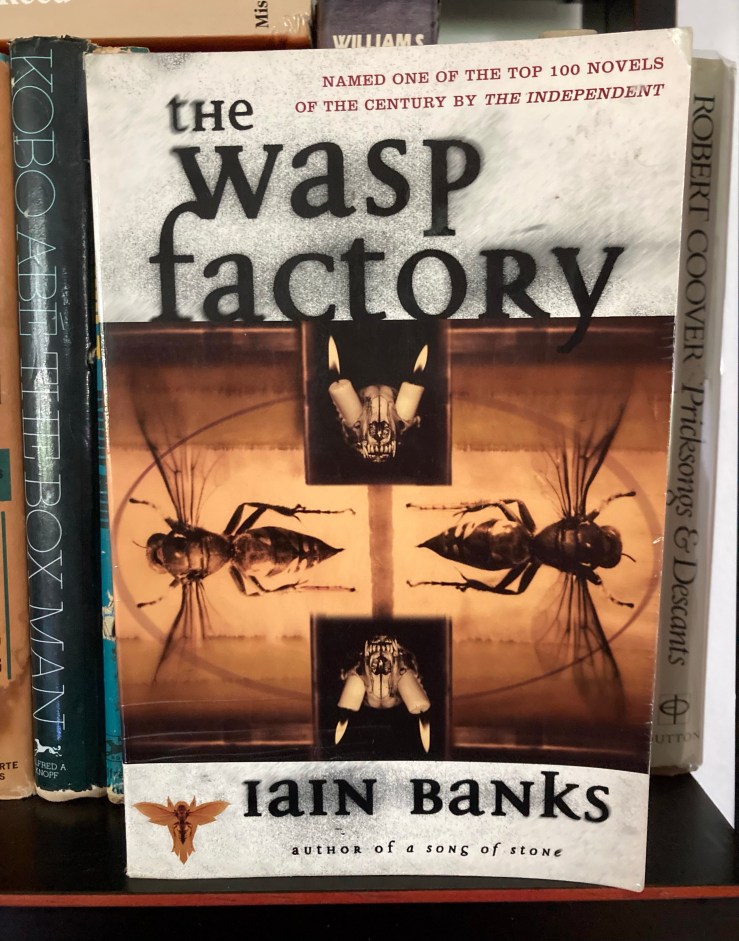
Iain Banks’s The Wasp Factory is an abject coming-of-age novel narrated by a teenage psychopath

Frank Cauldhame, the narrator of Iain Banks’s 1984 debut novel The Wasp Factory, is a teenage psychopath. Frank lives with his eccentric father on an island in rural Scotland. He is an unregistered person with “no birth certificate, no National Insurance number,” nothing to officially prove his existence. He enjoys this unofficial existence, patrolling his island, which he protects through various rituals.

One of these rituals is to construct and maintain “Sacrifice Poles,” and when we first meet Frank, he is “making the rounds” of these talismans: “One of the Poles held a rat head with two dragonflies, the other a seagull and two mice.” Frank has to keep plenty of dead animals on hand for his ritual defenses, and he kills them by slingshot, air-gun, explosives, and even an improvised flamethrower. (Readers sensitive to depictions of animal cruelty, or just cruelty in general, may wish to avoid The Wasp Factory.)

Another of Frank’s rituals consists of sacrificing a live wasp to the titular Wasp Factory (“beautiful and deadly and perfect,” in our narrator’s words). Frank has devised the Wasp Factory as a bizarre death trap built from “the face of the old clock which used to hang over the door of the Royal Bank of Scotland in Porteneil.” Once introduced to the Factory, the poor wasp can fall prey to one of a dozen different deaths, including the Boiling Pool, the Spider’s Parlour, the Acid Pit, or even “the rather jocularly named Gents (where the instrument of ending is [Frank’s] own urine, usually quite fresh).”

Frank’s urine becomes an important motif in The Wasp Factory. We learn fairly early that he is a “unique eunuch,” supposed victim of a dog bite accident that has left him forever unmanned (and deeply misogynistic). Our lad must piss sitting down, a shame he accepts with a hateful forbearance. Urine flows throughout the novel, an abject magical potion.

Indeed, Frank’s rituals frequently call for the most abject residues and excretions for the magic to work. Consider the Naming Ceremony he performs for a new weapon he’s purchased:

I smeared the metal, rubber and plastic of the new device with earwax, snot, blood, urine, belly-button fluff and toenail cheese, christened it by firing the empty sling at a wingless wasp crawling on the face of the Factory, and also fired it at my bared foot, raising a bruise.

Parts of me thought all this was nonsense, but they were in a tiny minority. The rest of me knew this sort of thing worked. It gave me power, it made me part of what I own and where I am. It makes me feel good.

Were it not for the animal cruelty, Frank’s rituals, no matter how abject, might be the stuff of antic children’s games–playing war, building dams, shooting pellets at cans, and so forth. But the ritualized animal murders are part and parcel of Frank’s most sadistic crimes. He is a serial killer.

Frank confesses his crimes early in The Wasp Factory, and the Scribner trade paperback edition uses his confession as copy on the back of the book to entice would-be readers, so I don’t think I’ll spoil much by sharing it:

Two years after I killed Blyth I murdered my young brother Paul, for quite different reasons than I’d disposed of Blyth, and then a year after that I did for my young cousin Esmerelda, more or less on a whim.

That’s my score to date. I haven’t killed anybody for years, and don’t intend to ever again.

It was just a stage I was going through.

The punchline there at the end is indicative of the dark humor that pervades The Wasp Factory. The edition I’m quoting includes blurbs from negative reviews as well, again highlighting Banks’s mordant glee with the monster he’s conjured. “Rubbish!” declares The Times of London; “There’s nothing to force you, having been warned, to read it; nor do I recommend it,” warns The Scotsman.

Elsewhere, Banks’s humor is earthier, as when Frank recounts some of the early days of his homeschooling at the hands of his ex-hippy chemist father:

For years I believed Pathos was one of the Three Musketeers, Fellatio was a character in Hamlet, Vitreous a town in China, and that the Irish peasants had to tread the peat to make Guinness.

There’s also a sweet streak to the book as well as Frank himself, who, despite his psychotic behavior, is a genuinely caring person at times. His relationship to his only friend, a dwarf named Jamie, is damn near tender; Frank perches Jamie on his shoulders so that the latter can better see the awful punk bands at the local pub.

Frank also cares deeply for his older brother Eric. In the first line of the novel, we learn that Eric has “escaped”; we soon learn he’s escaped from a psychiatric ward he’d been sent to after terrorizing the town folk. Eric’s insane crimes also involve animal cruelty: burning local dogs; force-feeding children worms.

The plot of The Wasp Factory is actually quite simple: What will happen when Eric comes home? Banks keeps the pot boiling through a series of phone calls Eric makes to Frank. We come to see that while Frank might be a psychopath, he is not insane in the way that his older brother is. (A late reveal in the novel that explains the cause of Eric’s insanity is one of the most disgusting pieces of prose I’ve ever read (I write this in admiration.)) In the meantime, Frank attempts to break into the office door that his father has always kept locked.

These twin plots—prodigal son coming home, daddy’s secret locked door—drive the action of The Wasp Factory (oh, and Frank’s basement is full of explosive cordite, too). The book’s real weight comes not from the plot, but from Frank’s narration. He’s a perceptive intelligence, and tuning into his voice is by turns mesmerizing and horrifying.

Not everyone will enjoy The Wasp Factory, as I’ve tried to make as clear as possible in this review. To borrow from The Scotsman, “There’s nothing to force you, having been warned, to read it.” And even admirers may find the twist ending a bit dated and the final moments of Frank’s deep reflection a bit rushed. But Banks does give the reader a conclusion, when it might have been so much easier to leave his characters (and readers) in a noncommittal fuzz of ambiguity. There’s a point of view here, even if it disturbs. The Wasp Factory is a truly fucked up coming-of-age novel, an abject anti-Huckleberry Finn whose narrator makes Holden Caulfield seem perfectly well adjusted. Not for everyone, but I loved it. Recommended.

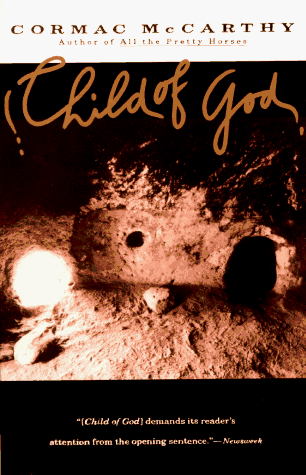
A life obscene | On Cormac McCarthy’s early novel Child of God

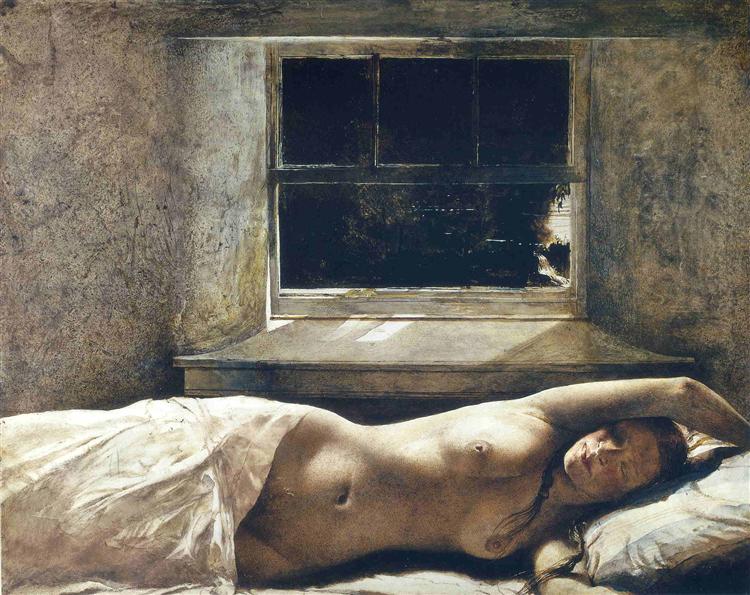
Overflow, 1978, Andrew Wyeth

In ancient Greek drama, acts of violence or sex were “ob skena,” relegated to offstage. Thus, the horrific violence of Oedipus gouging out his eyes is not shown, but rather reported by a messenger. We see the same tradition in Shakespeare, of course, as well as the modern novel. And while many writers elide scenes too taboo or offensive to the sensibilities of the general reading public, books like Ulysses, Lolita, and Tropic of Capricorn, demonstrate that novels are often the site of debate over what can and cannot be shown or described or articulated plainly in our culture. Our concept of “the obscene” (the Greek “ob skena” simply translates to “off stage”) demands that certain actions might only be referred to or implied, but not graphically depicted, that the offensive action takes place out of our vision. The great lie or paradox of the obscene then is that in pushing the offensive action off stage, the author necessitates that the audience must envision that very action that was removed, that they must privately articulate their own understanding or schema or representation of what is taboo.

While this strategy can often be quite effective and affecting (think of Tarantino pulling the camera away as Mr. Blonde cuts off the cop’s ear in Reservoir Dogs), in a character-centered novel it can also lead to a larger denial, a larger exclusion. What if one’s entire life was obscene? In his third novel, Child of God, Cormac McCarthy tells the story of a man who has been pushed from life’s stage, who exists in the uncanny and indigent margins of society.

The ersatz protagonist of Child of God, Lester Ballard, is a poor, stooped, abject wretch of a man. The book opens with Ballard losing his house in a humiliating debacle. From there, he wanders the earth, finding an abandoned shack and barely eking out the means to leave. Ballard is an outsider, literally, always looking in at the lives of more normal, more stable people. His voyeurism leads him to creep up to parked cars to spy on the lovers inside. Wanting some connection or sense of love–or perhaps just out of general dejected weirdness–he masturbates against the cars, watching the people inside. His identity as voyeur is magnified in his only apparent skill. Ballard is an ace sharpshooter who carries his rifle almost everywhere he goes, surreptitiously spying on the normal folks through its lethal scope.

As the book develops in McCarthy’s spare, terse prose, Ballard becomes more and more unhinged. Everywhere he goes he is slighted or outright rejected and cheated by his fellow man. The indignities and affronts against Ballard range from being falsely accused of rape to simply being ignored by his neighbors. At the same time, Ballard is a creep, a loser, and seems largely deserving of this treatment. And yet, as McCarthy points out early in the novel, he is a “child of God, much like yourself perhaps.” This early call to identify with Ballard as a fellow human being is constantly strained by his wildly antisocial behavior, and yet it’s McCarthy’s genius as a writer that anchors the novel in some measure of sympathy for such a wretched anti-hero. When a young girl rejects Ballard’s advances, she taunts him, saying, “You ain’t even a man. You’re just a crazy thing.” In many ways, this is the major question of the novel: Is Ballard a man, or a thing? What makes a person a person, and not simply an object estranged from the human race? To test this question, McCarthy has Ballard plumb almost every conceivable taboo, from murder to arson to necrophilia. However, Ballard isn’t the only one in these Tennessee backwoods who behaves despicably: there’s the father who rapes his daughter, the gangster behavior of the Ku Klux Klan, and the mob justice of the townspeople as a whole. Still, Ballard’s descent into violence and madness–graphically portrayed by McCarthy–is the central action in this compelling novel.

child-of-godReaders looking for redemptive story arcs or tales of heroism will likely be turned off by Child of God, and squeamish readers will probably not get past the first fifty pages. Those interested in McCarthy’s fiction will find more in common here with the visceral grit of The Road or Blood Meridian than the reflective romanticism of his “Border Trilogy” novels (including crowd-pleaser All the Pretty Horses). Child of God continues the Gothicism of Carson McCullers and William Faulkner, bearing a favorable comparison to those writers’ works. And like those writers’ works, McCarthy’s novel has faced its challengers. Those who see the book as obscene are perhaps right, in the sense that the word implies “that which must be shown off stage.” However, one of the legal definitions of obscenity necessitates that the work “lacks serious literary, artistic, political or scientific value,” a claim that I do not think can be seriously substantiated against Child of God. Don’t believe me? Read it for yourself.

[Ed. note–Biblioklept first published a version of this review in 2009. I recently reread the novel in January of 2023, as part of a big McCarthy reread prompted by the publication of his final novels, Stella Maris and The Passenger, and I found Child of God much funnier and sadder than I had remembered.]

A review of Trey Ellis’s polyglossic satire Platitudes

Trey Ellis’s 1988 debut novel Platitudes begins with a typical metatextual conceit: the novel-within-a-novel gambit. Our story starts with Earle, a nerdy, idealistic high school sophomore who lusts after True Love (and some sex if he can get it). After about a dozen pages though, the “author” shows his hand. Depressed divorced Dewayne Wellington is Earle’s creator, and he’s stuck in his novel-in-progress Platitudes. “I’m sorry. I don’t know what more to write,” Wellington declares, before soliciting help from his readers.

Wellington soon receives manuscript pages from bestselling author Isshee Ayam, who transplants his story from 1980s Manhattan to 1930s rural Georgia. When Wellington introduces worldly and gorgeous Dorothy as Earle’s romantic foil, Ayam’s rhetorical interventions take on a new intensity as the two authors duel to guide the spirit of the novel-in-progress.

The plot threads and styles intertwine, with Wellington’s experimental mode clashing with Ayam’s “Afro-baroque” style (as Ellis described it in a 1989 Los Angeles Times profile). A parodic pastiche of competing Black American artistic voices, Platitudes ultimately synthesizes polyglossic tones into a strangely endearing romantic comedy. Sharp but breezy, ironic and earnest, and utterly metatextual yet soaked in pathos, Ellis’s first novel seems to be an overlooked late-postmodernist gem.

Although Platitudes remains in print (via Northeastern University Press’s New England Library of Black Literature series), I have never seen it mentioned along with its contemporaries—books like David Foster Wallace’s 1989 collection Girl with Curious Hair or Bret Easton Ellis’s 1987 novel The Rules of Attraction. Instead, Ellis’s novel seems to be connected more often along with the works of Ishmael Reed, particularly his 1986 novel Reckless Eyeballing.

Reed’s novel concerns an experimental playwright who finds his career under attack from feminists. As Itabari Njeri pointed out in the LA Times profile mentioned above, many readers “assumed that Ayam is a thinly veiled Alice Walker and that Wellington is the novelist, poet and playwright, Ishmael Reed.” Ellis told Njeri that he hadn’t read Reckless Eyeballing until after he finished Platitudes. He also stated in the profile that he hadn’t read Walker’s The Color Purple. Before I read the Njeri profile I was almost certain that Ellis was parodying (lovingly though at times sharply) Reed and Walker.

Ayam’s “Afro-baroque” style is a particularly purple prose, telegraphed in the oh-so-unsubtle titles of her bestsellers: Chillun o’ de Lawd, Hog Jowl Junction, and My Big Ol’ Feets Gon’ Stomp Dat Evil Down. Here’s the first sentence of Ayam’s version of Platitudes:

Earle awakened to a day as new and as fresh as Mama’s hand-starched and sun-dried petticoat, a huge, plain garment as large and as fresh-smelling as the revival tents that bloomed every summer along Route 49 in Lowndes County, Georgia.

What an awesomely bad awesome sentence! The simple sentence is there: “Earle awakened,” but the adornment tacks on and on, a traffic jam of adjectives glommed onto a simile growing out of another simile, like a lichen that grows on a moss that grows on a rock.

Here’s Ayam’s next sentence:

Yes, from out of those wide Baptist thighs, thighs that shook with the centuries of injustice and degradation, thighs that twitched with the hope of generations yet unplanted, thighs that quivered with the friction of jubilant, bed-thumping, and funky-smelling lovemaking, emerged Earle.

“I’m speechless, Ms. Ayam,” responds Wellington by post after receiving her pages, and offers up as a return gift a list of Earle’s favorite things (to be sung to the tune Coltrane’s take on the Rodgers and Hammerstein song):

All kinds of tanks, Janey Rosebloom, Cream of Wheat, neighbors, Corinthians, toast-r-waffles, his own bean-fart vapors,

A tightly-tucked-in-bed,

Chef Boy-Ar-Dee

Schefflera, balsa wood, and Pay TeeVee.

Eff. Ay. Oh. Schwarz, lingerie straps, cowboy boots and hats.

Sunggle sacks, Chap Stick tubes, BeeBee guns, and films!

Sci-fi, cars, dance—Slurpees.

This list, printed in the console font that demarcates the many other lists, charts, menus, etc. that populate Platitudes then gives way to a brick list paragraph in whatever font Vintage Contemporaries are printed in. This second list might also comprise some of Wellington’s (and perhaps even Ellis’s?) favorite things, and includes “Jamaican accents, cleavage, efficiency, artificial cheese-food product” and

the way a pretty woman’s high heel dangles insecurely from the big toe of the crossed leg always near falling or—from a slight kick—flying spike-over-toe—an exotic Oriental weapon; but never doing either, just dangling, the toe of the shoe covering just enough to promise…

The back-and-forth of the two authors plays out as a personification of the tensions between two modes of Black literature that Ellis seeks to parody, synthesize, and ultimately transcend in Platitudes. While appreciative of the traditions and anti-traditions that came before him, he sought something new in his novel. A year later after the publication of Platitudes, Ellis published his essay “The New Black Aesthetic” in the journal Callaloo. Here, Ellis argued for a new kind of Black arts, evoking the concept of a ludic “cultural mulatto,” an artist free to borrow from both tradition and popular culture alike: “We no longer need to deny or suppress any part of our complicated and sometimes contradictory cultural baggage to please either white people or black,” Ellis declared in his essay.

Platitudes is not an essay—far from it—but it does enact the radical hybridization that Ellis put forth in his New Black Aesthetic manifesto. In his LA Times profile, Ellis declared Platitudes an “anti-novel,” adding that “It’s satirical and primarily about language performance, which has its own delights, as opposed to traditional narrative.”

And yet there is a traditional narrative here. Call it boy meets girl or coming of age or classical-in-the-Aristotelian-sense comedy or whatever you want, but Platitudes offers its reader a satisfying conclusion without selling out the ambiguities and ironies that course through its 180 or so pages.

In his back-cover blurb for Platitudes, Ishmael Reed wrote: “I was zapped by Trey Ellis’s humongous talent. His book, Platitudes, is delightfully rad.” Zapped and delightfully rad are perfect descriptors, and I feel like I’ve neglected to share enough of Ellis’s prose, which at times approximates linguistic channel surfing (at one point, quite literally). The book is both fun and funny, and while the book has not been neglected in academia (Christian Schmidt devotes a chapter to it in his study Postblack Aesthetics, for example), it deserves a wider readership from those who enjoy satirical postmodern novels. Highly recommended.

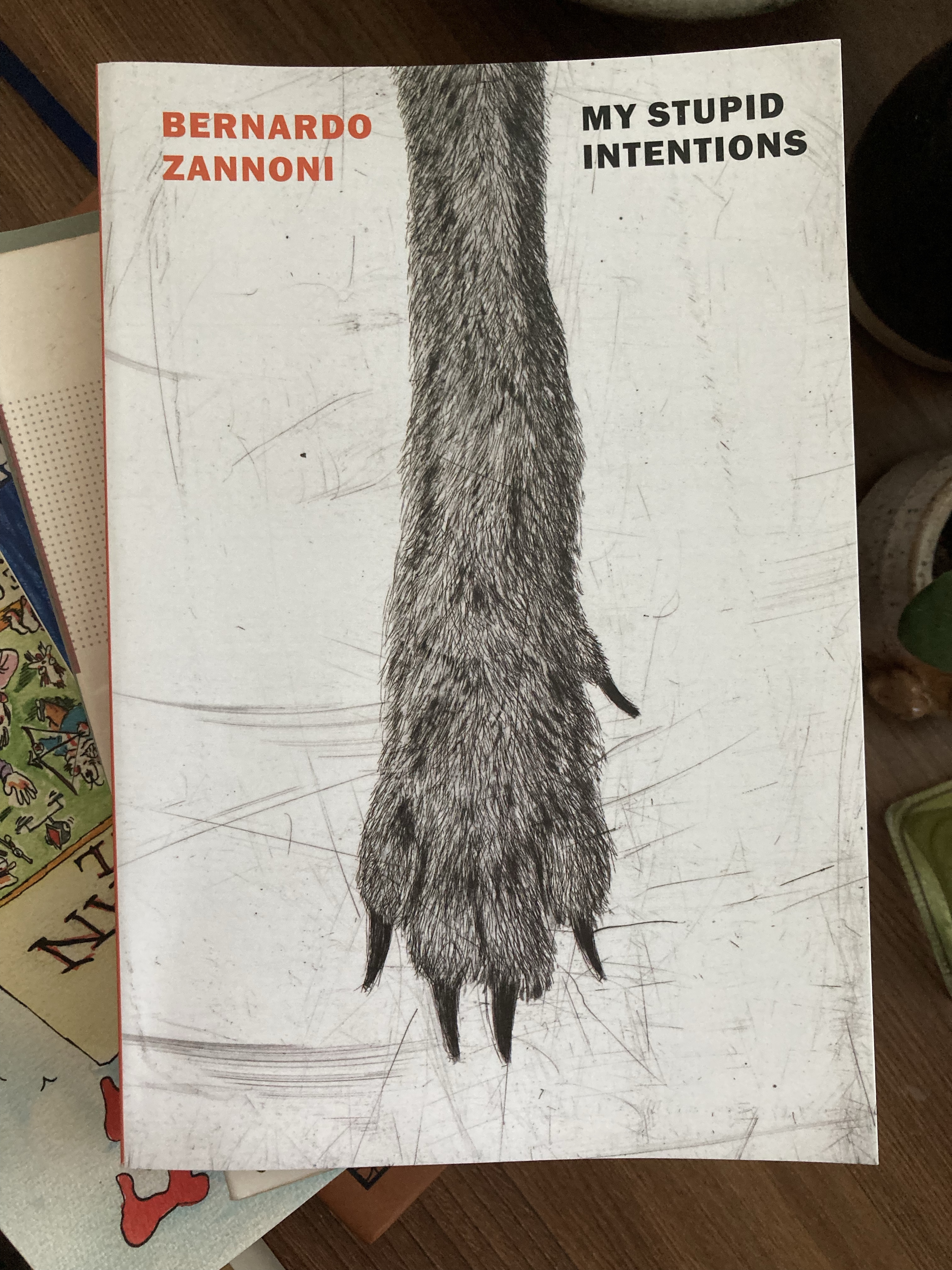
Bernardo Zannoni’s My Stupid Intentions is a brash and brilliant picaresque fable

A few pages into Bernardo Zannoni’s brash, brilliant novel My Stupid Intentions, our narrator Archy and his eldest brother Leroy have the following conversation about their youngest brother Otis:

“Are you cold?” he said.

“I’m hungry.”

“Me too. We could eat Otis. He’s small, and weak.”

Otis is small and weak, but his brothers ultimately elect to remain hungry and not consume him. A few pages later, Archy falls from a tree, leaving one leg permanently lame. He then engages in sexual intercourse with his sister Louise. And poor Otis? “I’m going to die because I’m not growing,” he declares at the family dinner. This prediction quickly proves true. Archy is then sold into the service of a writer named Solomon for the low price of one and a half chickens.

Perhaps, having put forth details in lieu of a bigger picture, I should backtrack:

My Stupid Intentions (I miei stupidi intenti) is Bernardo Zannoni’s first published novel. It won the 2022 Campiello Prize, and is now available in English thanks to translator Alex Andriesse and publisher NYRB. I enjoyed all 211 pages of it.

Archy, the narrator of My Stupid Intentions is a beech marten, a kind of mustelid similar to a weasel or ferret. My Stupid Intentions is Archy’s life story—and it is crammed with life, with nerve, joy, terror, anger, and discovery.

I mentioned some names above, mostly of Archy’s family members, but we can dispense with them now. The most important character in Archy’s life is Solomon, an old fox who has learned to read and write. Solomon’s ability to cipher makes him a market nexus for the animals of the forest, who come to him to trade in goods like chickens, eggs, and vegetables. A fiercely loyal dog named Joel protects Solomon and their enterprise (Joel claims that Solomon rescued him from a wasp’s nest when he was an infant). Crippled Archy soon finds his place in Solomon and Joel’s routine, even venturing out with Joel to collect delinquent accounts.

In time, Solomon teaches Archy to read and write. They begin with the business, keeping track of customers’ debts, but soon advance to the bible. Here, Archy learns about God and comes to despise him: “Why had he inflicted this pain upon me? Why wasn’t I a man? Hadn’t I sought him, hadn’t I been on his side?”

In knowing God, Zannoni seems to suggest, Archy and Solomon become imbued with a consciousness otherwise unavailable to animals. The curse of this consciousness is the revelation of mortality. While other animals comprehend that death exists, they do not, at least from Archy’s perspective, fully understand what death entails. Understanding his own mortality is Archy’s curse, and his agon with God weaves through the novel’s bright and dark adventures. In one of the novel’s most poignant moments, Archy, unable to provide succor to his friend Joel, offers him an illusion, a proper telos for his dog’s soul:

He went off searching for a place that didn’t exist, beyond the wrong mountains, where no three rivers parted ways. He would wander all his life, clinging to a spurious hope, the only thing that made him keep going, like a phantom. I am terrified to think he may still be out there, searching. I am terrified to think he may have realized he has been damned to a pointless existence, a life of grasping at smoke. I am terrified to think I have been crueler than God.

My Stupid Intentions is full of cruelties and heroics. There are bandits and thieves and duels. There is a strange underground club for maimed and toothless animals to huddle together. (“Even in their loneliness, their exhaustion, their absence of appetite, they did not think they were going to die, and absurdly I envied them.”) There are doctors and apprentices and violent brigands—again, Zannoni’s novel bristles with life, teems with a propulsive energy.

This energy pulses at both the sentence and paragraph level in Andriesse’s nimble translation. The book’s jacket summary describes My Stupid Intentions as a “picaresque fable,” and it indeed rockets along with picaresque energy, its sharp turns often made even sharper by an ironic quip from Archy.

As for the “fable” bit…well, any story with anthropomorphic animals might be called a “fable,” especially if there is a moral dimension highlighted. Archy’s complaint against God is direct yet ultimately ambiguous. I didn’t catch a didactic whiff from Zannoni. My Stupid Intentions is more complex than Aesop’s fables; it has more in common with the visceral reality of Richard Adam’s novel Watership Down or the zany violence of Roald Dahl’s The Fantastic Mr. Fox (especially in Anderson’s film adaptation). My Stupid Intentions also reminded me strongly of Neko Case’s nature songs, some of the essays in Joy Williams’ collection Ill Nature, Disney’s loose, picaresque 1970’s take on the legend of Robin Hood, Russell Hoban’s inimitable novel Riddley Walker, Brian Jacques’ Redwall books, and Italo Calvino’s novel The Baron in the Trees.

My Stupid Intentions is also a book about writing, a kind of self-creating document, Archy’s autobiography in action, a sort of funny animal Künstlerroman. If there were any urges on Zannoni’s part to give into postmodern cleverness here, to play with the metatextual nature of his tale, not a trace of such frippery is evident. The novel is, for all its twisting and turning and snapping, wonderfully and refreshingly straightforward. There is nothing stupid about this book. I loved it. Highly recommended.


First riff: The Letters of William Gaddis, “Growing Up, 1930–1946”

The Letters of William Gaddis, ed. Steven Moore, NYRB, 2023

Chapter One: “Growing Up, 1930-1946”

Earliest letter:

To Edith Gaddis (mother), 9 Dec. 1930

Latest letter:

To Frances Henderson Diamond (early love interest), 13 March 1946

Synopsis, citations, and observations:

Most of the letters collected by Moore in this first section of Letters are addressed to Edith Gaddis, whom Moore appropriately describes as “the heroine of the first half of this book: his confidante, research assistant, financial benefactor, his everything.”

His everything clearly includes everything, but I would’ve thrown in the words earliest audience. The letters featured in this earliest chapter show only the barest germ of the writer into which Gaddis would evolve—but they do show a tenacious foundation for practice, one facilitated by a loving, motherly reader.

Here is the first letter in the volume:

Merricourt
Dec. 9, 1930

Dear Mother.

Our vacation is from Sat. Dec. 20. to January 4.
We are making scrapbooks and lots of things. We are learning about the Greek Gods.
I am making an airplane book.

With love
Billy

Little Billy is a few weeks shy of eight years old here, attending boarding school in Connecticut. He attended Merricourt from the time he was five—around the same time his mother Edith separated from his father, William T. Gaddis.

It’s clear why Moore would single out this particular letter for inclusion. The mechanical notion of “making” books, in particular books from scrap, recalls Jack Gibbs, hero of J R., who keeps scraps of newspapers and magazines in his pockets). Our boy was always a scissors-and-paste man.

The Letters gets through childhood and adolescence fairly quickly (a few scant pages) before we find 17-year old Bill sailing on the Caribbean on the SS Bacchus. There’s not much to the Caribbean adventure, but it does initiate an early theme of The Letters—young Bill goes on adventures, often getting in over his head, but also expanding his worldview. “A good part of the crew are colored but they’re okay too,” he writes to Mama Gaddis, a cringeworthy line, sure, but also one that underscores that Our Hero is a man of privilege.

A year later he’s at Harvard.

But not at Harvard for long!

This theme of attending and departing Harvard goes on a bit in the first part of Letters. (Gaddis never earned a degree). Young Bill fell ill his first semester (making him part of a famous fraternity of sick writers: Joyce, O’Connor, Kafka, Walser, Keats, Crane, Wharton, etc.),

What to do? Our Hero heads West, eventually landing in Arizona to recuperate.

Eastern Boy Gaddis’s Western Adventure is especially humorous against the backdrop of his literary oeuvre to come, particularly The Recognitions, which sardonically roasted poseurs (while simultaneously lifting up the efforts of counterfeiters who channel True Art). Our Boy decides to be a cowboy. In a letter to Mama Edith dated 17 Jan. 1942, he details his cowboy outfit:

I have gotten a pair of blue jeans ($1.39) and a flannel shirt (98¢) for this riding—expect to get another pair of jeans today—and later perhaps a pair of “frontier pants” and a gabardine shirt. No hat as yet as they do seem sort of “dudey”—but I can see that it too will become almost a necessity before too long.

The letter is part of an early genre that Gaddis hacked away at, if never perfecting: Mom, need money. 

It continues:

As for wanting anything else—well there are things down here that make me froth just to look at them!—belts such as I never dreamed of—rings—beautiful silver and leather work—but I figure I don’t need any of it now and will let it go until I’ve been around a bit more and seen more of these things that I’ve always known must exist somewhere!

We’ve all been twenty, all made questionable fashion choices, all wanted Beautiful Things We Could Not Afford. (Most of us have not had the misfortune to have our private letters published.)

Letters includes a photograph of Cowboy Bill, duded up in boots with horse. He did not give up the affect easily; in a later letter from the fall of 1942, when he’d returned to Harvard, he requested the following of Dear Mother:

Say when you get a chance could you start the following things on their way up here to make our room more habitable[:] the leopard skin on the lodge closet door—the spurs on the floor nearby—both of Smokey’s pictures—the small rug—both machetes and the little Mexican knife & sheath & chain to the right of the east hayloft windows (one machete is over hayloft door—the other on edge of balcony)—also any thing else you think might look intriguing on our wall—oh yes the steers’ horns—

Bill Gaddis spent much of the year bumming around the American West, getting to Los Angeles, Wyoming, and as far as east as St. Louis, where he meets a woman

hard of hearing—and her son Otto, who’s about 23—is sort of—simple. He went thru college—then started in at Harvard (!) and then cracked up it seems.

The first time I read The Recognitions, I found Otto a repugnant poseur of the worst stripe. Reading and rereading The Letters and Gaddis’s first novel, I find myself far more sympathetic.

The version of Young Gaddis we get from these early letters will resonate with anyone who’s held artistic ambitions. He’s callow, largely unread, generally ignorant of just how ignorant he is, charming, brave, and foolish. And while his reliance on his mama’s money transfers can occasionally irk, there’s a deep tenderness in his writing to her—for her. Again, almost every one of these letters are written to and for Edith.

William Thomas Gaddis Junior’s father and namesake hardly pops up in the discourse (at least in Moore’s edit), but a letter to Edith dated 26 Jan. 1942 is unusually detailed on the paternal topic:

And then as you say this slightly ironic setup—about my father. …As you said it has not been a great emotional problem for me, tho it does seem queer; you see I still feel a little like I must have when I said “I have no father; I never had a father!,” and since things have been as they have, I have never really missed one—honestly—and only now does it seem queer to me. All I know of fathers I have seen in other families, and in reading, and somehow thru the deep realization I have gained of their importance; of father-and-son relations; and families: not just petty little groups, but generations—a name and honour and all that goes with it—this feeling that I have gained from other channels without ever having missed its actual presence: somehow these are the only ties I feel I have with him.

Father-son relationships wrinkle queerly throughout Gaddis’s novel, always deferrals and deflections, whether Wyatt-Otto in The Recognitions or Bast-JR in J R or the King Lear tirade of Gaddis’s final letter to the world, Agapē Agape.

Gaddis returned to Harvard in the fall of 1942 (“devil to pay for eight months hence I guess”). He reads Nietzsche and Schopenhauer, or at least tells his mother he reads Nietzsche and Schopenhauer—but I believe him. Reading Nietzsche and Schopenhauer seems like a thing a young man might do. In a letter of December 1942, “so angry now am about to fly,” he complains of being recommended a history book that “turns out to be history of Communism and Socialism–Marxism–enough to make me actively ill.” A postscript lauds William Saroyan but worries that “G Stein is still a little beyond!” Our Lad has room to grow.

By the spring of 1943, Gaddis is working on the Harvard Lampoon. He would eventually become the President of the Lampoon (or, um, ‘Poon, as he writes his Mama). This project seems to entirely consume him, distracting him from his studies.

Gaddis was eventually kicked out of Harvard after an “incident” with the police (Our Boy was drunk and disorderly). The last few letters in the collection are bitter and a bit sad. Gaddis worked as a fact checker at The New Yorker for not-quite-a-year, with scant letters from this period appearing in Letters. There is a letter from a vacation to Montreal in the summer of 1945 that attests the following disillusionment:

Frankly the more I move along the more I find that every city is quite like the last one.

Not long after, Gaddis would start writing material that would wind up in The Recognitions.

NYRB 2023 updates to the Dalkey Archive’s 2013:

In addition to a smattering of letters to women who are not Edith Gaddis, NYRB’s new edition includes two new pictures–Gaddis’s Harvard 1944 yearbook picture and a professional head shot of Frances Henderson Diamond. There’s also this close-up of a photograph of children included in the Dalkey edition, clarifying which kid is Billy Gaddis.

Love Our Dude’s pipe!

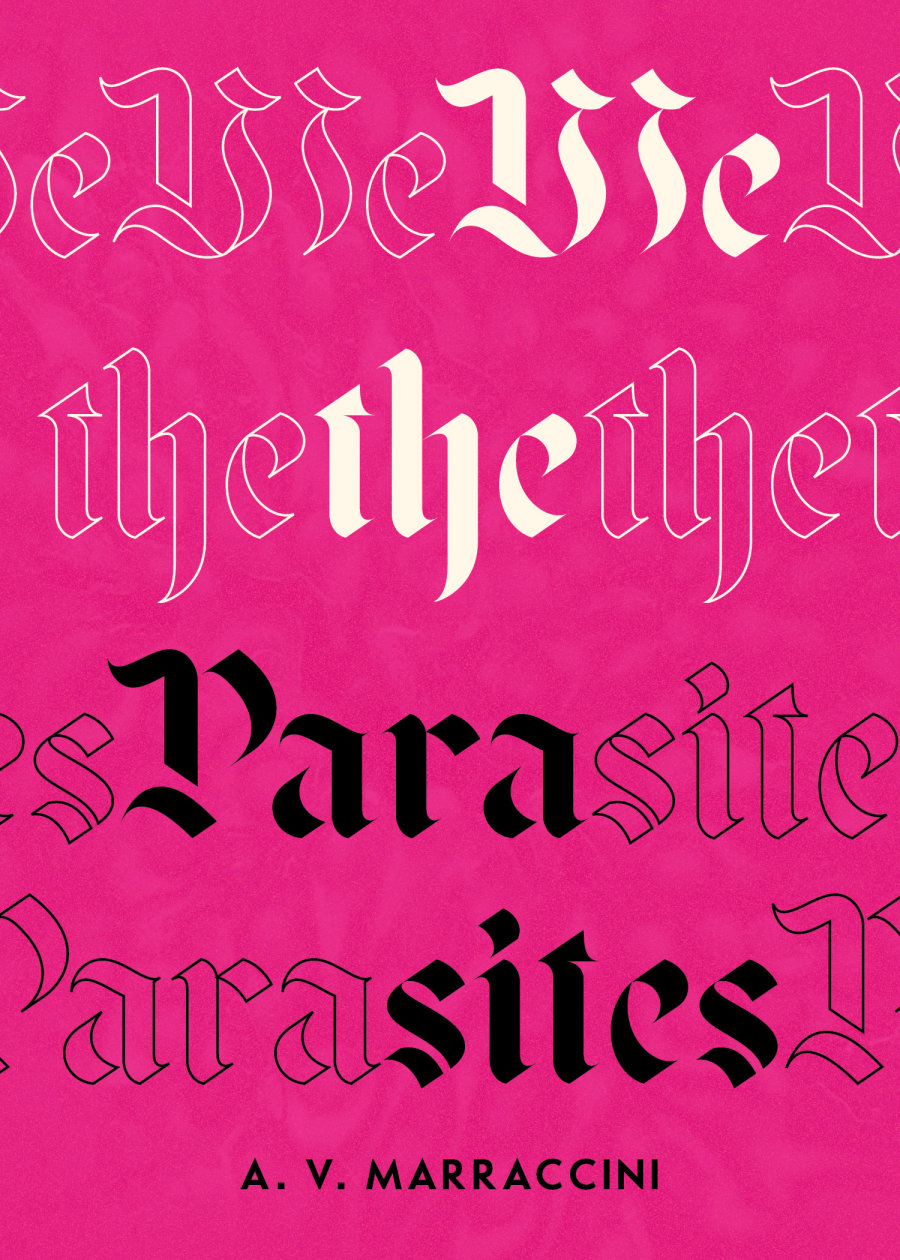
On A.V. Marraccini’s ekphrastic, discursive book We the Parasites

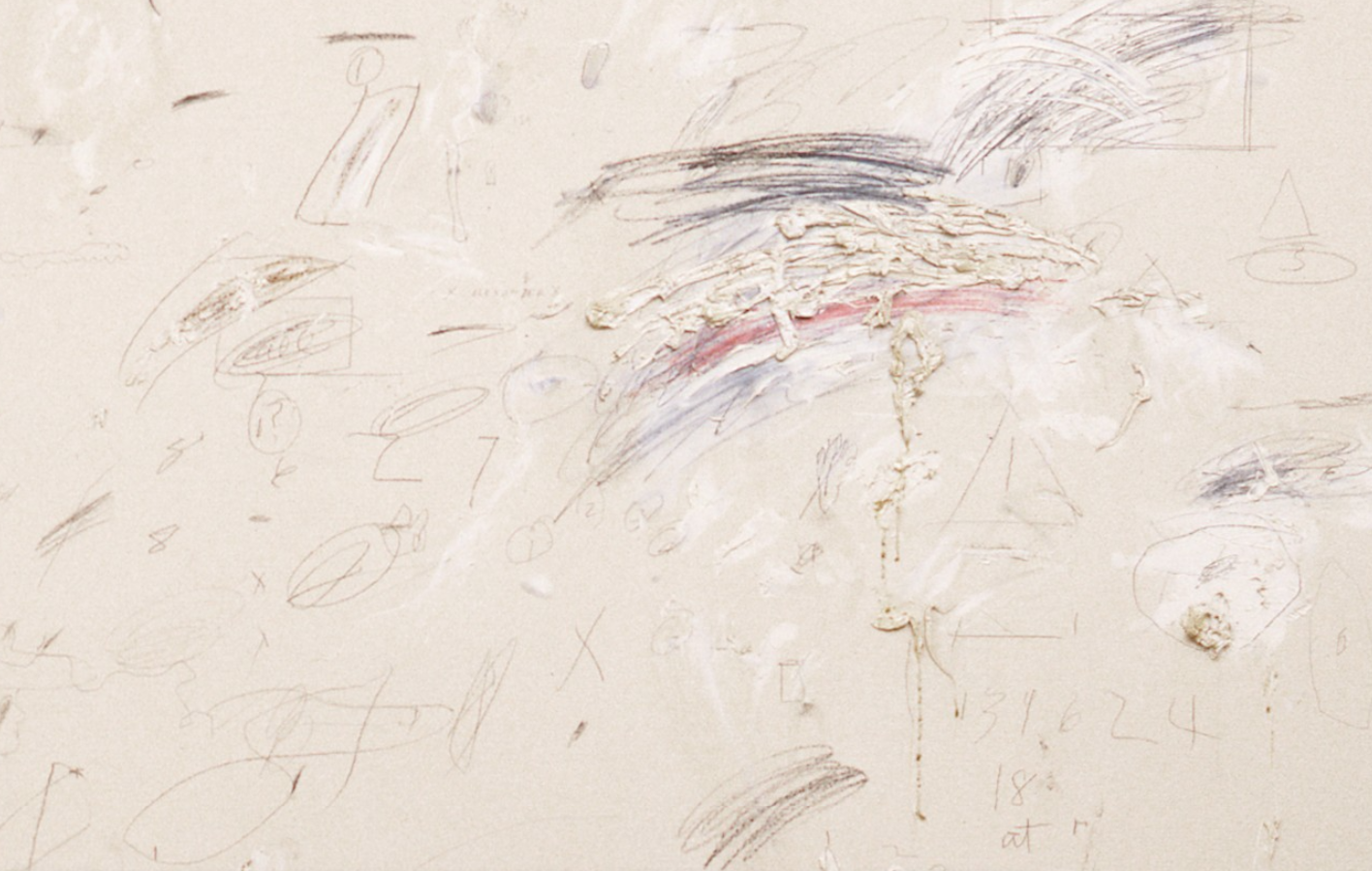
Detail from The Age of Alexander, 1959 by Cy Twombly

“The best and most skilled of parasites live, reproduce, and die, without their hosts ever really knowing, or at least being able to do anything about it,” declares A.V. Marraccini, early in her new book We the Parasites. “I’m not even a good parasite because painters or novelists can see me seeing them, drawing off their vital fluid, forming new and odd things in my dark-lobed ovarians, and then shoving them out, hastily and fitfully, into the world of papers and reviews.”

We the Parasites belongs in part to that “world of papers and reviews,” that world of criticism, but it also exists on the other side of any genre margin we might wish to impose. A.V. Marraccini’s book is generative, creative, fruitful, a hybrid that points to something beyond the lyric essay. It is stuffed with art and poetry and life; it is erudite and frequently fun; it is moody and sometimes melodramatic, but tonally consistent.

Marraccini’s central metaphor is that critics are parasites. This metaphor gives Marraccini space in which to wander: through history, through art. Through her own history and her present consciousness. She concocts a discursive ekphrasis that zigs and zags from the commensalism of figs and wasps to the paintings of Cy Twombly to John Updike’s novel 1963 The Centaur.

These nimble discursions are one of the primary joys in reading We the Parasites. Marraccini will offer a nice chunk of an H.D. poem before grafting an entire section of Cy Twombly’s Wikipedia page into her text. The particular section Marraccini excises details the so-called Phaedrus incident, in which “Cambodian-French artist Rindy Sam [was arrested] after she kissed one panel of Twombly’s triptych Phaedrus. The panel, an all-white canvas, was smudged by Sam’s red lipstick and she was tried in a court in Avignon for ‘voluntary degradation of a work of art.’ …The prosecution described the act as a ‘sort of cannibalism, or parasitism…'” Marraccini goes on to describe Twombly’s Phaedrus as “a sort of cannibalism or parasitism on Theocritus.”

Apart from Marraccini herself, Cy Twombly strikes me as the major figure of We the Parasites. This statement is arguable, as others loom–Alexander the Great, Rainer Maria Rilke, the pseudonymous “Chiron,” one-time mentor to Marraccini who insists she read Updike’s novel The Centaur. But it’s Twombly whom Marraccini most frequently and successfully trains her ekphrastic powers on. Her multivalent reading of Twombly’s 1959 painting The Age of Alexander consumes the end of the book, and no wonder, for she attests that she sees the painting in her sleep, finding in its grafts a symbolic aesthetic language that approaches her own obsessions of parasitism:

Am I “over interpreting” this painting? Probably. It certainly meant nothing about wounds and fish louses to Cy Twombly. Were I writing an historical or academic argument I would have to care then, about the boundary conditions for believability, for perceived intent, and for context. Whatever this is, I’ve now called them off. I can say anything, which is nothing so much as dangerously overwhelming. I do this all the time to the whole world; see it as a layering of partially readable signs and portents, like some unlucky augur forever staring into the guts of sheep, the flightpath of certain birds. This often calls for melodrama, especially when the drama of the world as it really is doesn’t result in any kind of expected catharsis, Aristotelian or otherwise. I map myself onto whatever interpretation I’ve divined for that day, that hour, and then map myself back into the world again in another looping cycle.

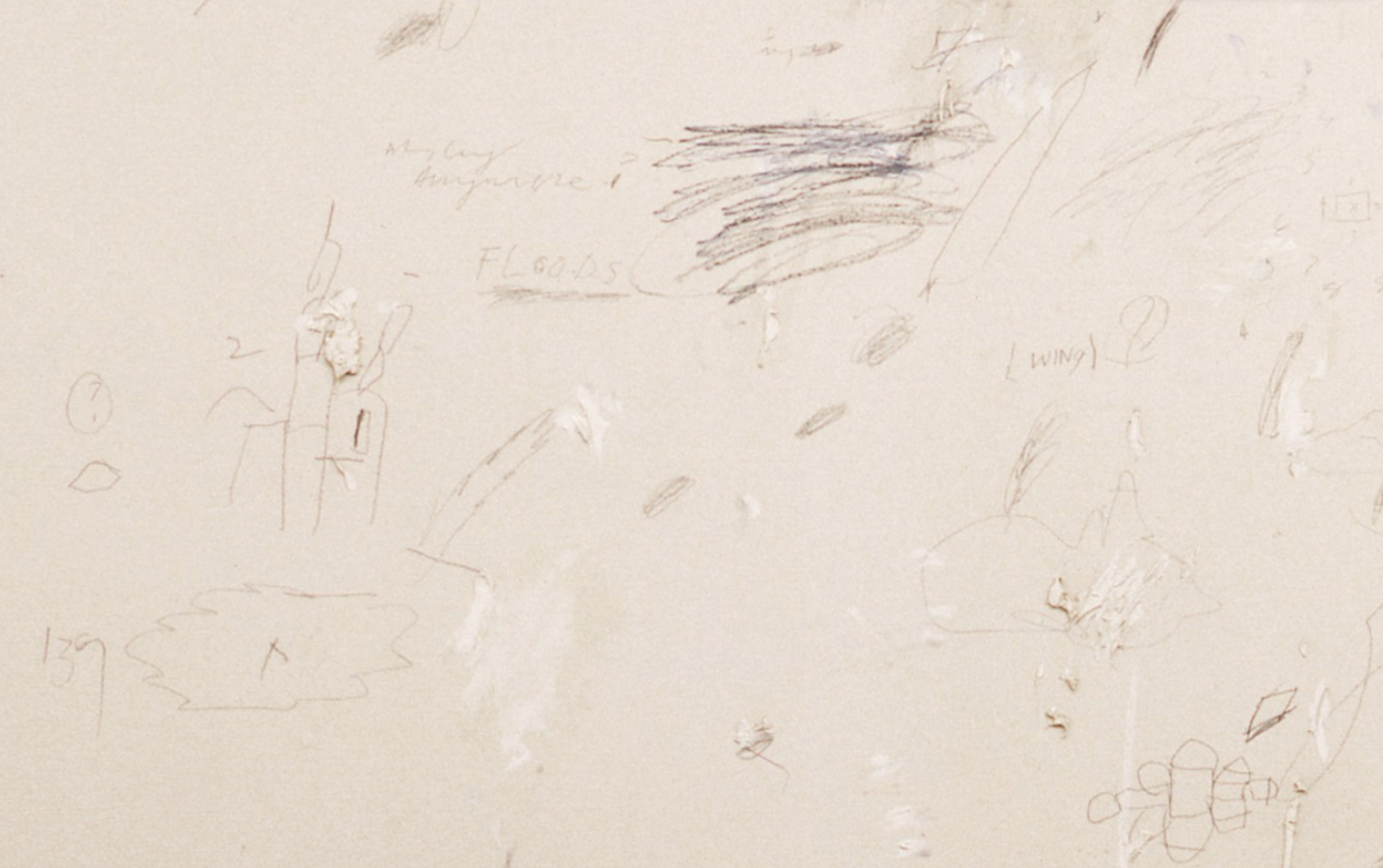
Detail from The Age of Alexander, 1959 by Cy Twombly

While she never states it directly, Marraccini’s appreciation for Twombly’s paintings seems to come as an aesthetic reaction to their hybridity, their apparent incompleteness, their textual overdetermination. Many of Twombly’s paintings seem like studies, unfinished things that the viewer must complete with their own gaze. (Perhaps such thoughts or feelings went through Rindy Sam’s mind right before she kissed Phaedrus.) In a section of We the Parasites that has nothing to do with Twombly, she writes

Sometimes the study is better than the finished thing as it is here, suffused with longing. The provisionality of the study leaves room for it to be free. Right now, like time and the future, language is also provisional, so provisional and free that it feels like you might fall of something huge and intractable every time you write a sentence. There is danger here, with passion, the same frisson always but configured anew. No one is touching anyone’s strange body.

“No one is touching anyone’s strange body.” This is not some tortured metaphor, no. We the Parasites is a stealth plague memoir. 2020 and Covid-19 hang over the book, inverting its would-be-flânerie into flânerie for silent nights, cybernights, flânerie for necessary introversion. We stroll (or jog, or even run) along with Marraccini (a “3 a.m. cryptid”) and her private thoughts, late at night in dead quiet London. She scavenges with some foxes. She names the foxes. She thinks about Twombly; she thinks about an old love; she thinks about “Chiron.”

But We the People is not a straightforward Covid-19 memoir (it is not a straightforward anything)—its memoir intentions are largely aesthetic, often dwelling on Marraccini’s feelings of being an outsider in the Oxbridge world she now inhabits:

I’m a thief; a  thousand hundred generations of starving Sicilian farmers indenturing their backs to some steep, rocky crag, a thousand hundred shtetl girls married off young. I’m from a hot, flat suburb of a third-rate city near a swam and the sea, I’m nothing from nowhere to you. I’ve seen the seen the asphalt burble in the heat before a thunderstorm in the summer. Do you think that there are barbarians? That I am one? Well, barbar then.

(Oh, you’re also from Florida? I thought after reading these sentences.)

But I don’t think that Marraccini really would accept the mantle of barbarian. There’s a defensive hedging in some of We the Parasite’s erudition; there are times our author need not try so hard. The prose flows finer (or coarser, as necessary) when the hedges give way: “We always go back to Homer, or I do, the I who wants to be the authoritative we,” Marraccini admits. The next sentence highlights the anxiety inherent in the pretense of critical authority: “I have also always been late to Homer, that same belatedness that creeps up everywhere again.” The anxiety here echoes an early sentiment, one I believe plainly felt by anyone who has ever dared to write about art:

All the battles royale are decided…How do you look at the plain, the beach, the walls of the city, the oak trees and the cauldrons on the tripods over small fires—how do you look at it all and live with the fact that you are always after? Always, somehow, about to break into tenderness and despair?

And yet an abiding love and appreciation and a desire to communicate that love and appreciation overcomes this despair. Like any writer sensitive enough to attend to all the before that they have come after, Marraccini understands the risk and guts it takes to write. The critic may be a parasite, but the critic does not seek to remove art from the world—the critic seeks to enliven the art, to expand its lifeforce:

If I am greedy for, say, a novel, or Bruegel’s Fall of Icarus, or the piano sonatas of the Younger of the Scarlattis, I don’t take it from the world. Or I do, a version of it, and put it in my Simoneidean memory house which is perhaps also a private brothel. But the Bruegel is still there, the Scarlatti, the novel, to seduce other people, other critics. Parasites want their hosts to live so they can spread.

But We the Parasites isn’t exactly a work of sustained criticism, nor is it a lyric essay, nor a memoir. It grafts elements of those genres, in the spirit of works by authors like W.G. Sebald, S.D. Chrostowska, Claudine Rankine, Ben Lerner, and Maggie Nelson. I’ve tried to give enough of a sample of the prose and scope of Marraccini’s book here to let potential readers determine whether or not this is their cup of figs and wasps. I admired much in We the People, and even admired it when it irritated me. I look forward to seeing what Marraccini will do next. Recommended.

We the Parasites is new from Sublunary Editions.

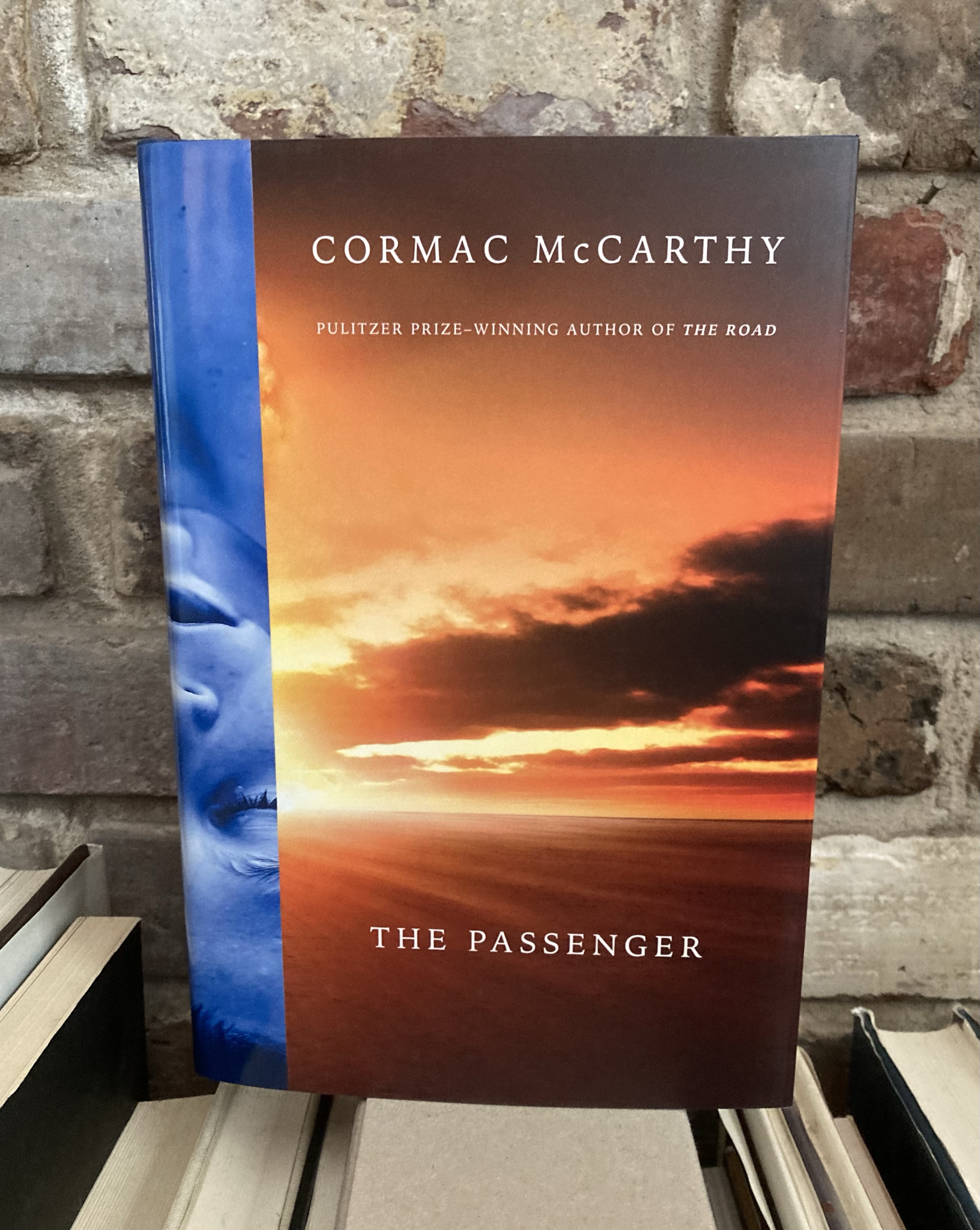
White Meridian | More scattered thoughts on Cormac McCarthy’s novel The Passenger

He’d bought a small ruled notebook at the stationer’s in Ibiza. Cheap pulp paper that would soon yellow and crumble. He took it out and wrote in it with his pencil. Vor mir keine Zeit, nach mir wird keine Sein.

The Passenger, Cormac McCarthy

In the second paragraph of the last chapter of Cormac McCarthy’s new novel The Passenger, protagonist Bobby Western, now living on a Spanish island near Ibiza, writes in German a sentence in a cheap notebook. The sentence translates to something like, Before me there will be no time, after me there will be none.


Vor mir war keine Zeit, nach mir wird keine seyn,
Mit mir gebiert sie sich, mit mir geht sie auch ein.

Sexcenta Monodisticha Sapientum, III, II, Daniel von Czepko (1655)

Western’s line appears to be cribbed from an epigram by the early seventeenth-century German poet, Daniel von Czepko. Czepko’s epigram translates to something like, Before me there was no time, after me there will be none / With me she gives birth, with me she dies.


I deny, in a high number of instances, the existence of succession. I deny, in a high number of instances, contemporaneity as well.

“A New Refutation of Time,” Jorge Luis Borges, translated by James E. Irby

Did McCarthy find Czepko’s in Borges’ essay “A New Translation in Time,” where I found it when I first searched the German phrase?


All language is of a successive nature: it does not lend itself to reasoning on eternal, intemporal matters.

“A New Refutation of Time,” Jorge Luis Borges, translated by James E. Irby


I feel like I’ve jumped into the deep end here too quickly for this riff, what with the seventeenth-century German poet and the wonky Borges essay that feels like a gimmicky (and perhaps ironic) championing of idealism in service towards forging an aesthetics of time. Let me put in a simpler substitution for Western’s (McCarthy’s (Borges’ (Czepko’s))) epigram, a favorite line from another life-and-deather with oceanic motifs:

Perhaps an individual must consider his own death to be the final phenomenon of nature.

“The Open Boat,” Stephen Crane


Start again: This is a scattered mess. I finished The Passenger yesterday, punched in the face by the final chapter, where McCarthy condenses characters and tropes and symbols and allegories into a slim 19 pages that points to both infinity and death. The Passenger is possibly McCarthy’s baggiest novel, messier than Suttree, and eschewing even a glimmer of the precision of Blood Meridian. Like No Country for Old MenThe Passenger is bound in genre fiction tropes—crime novels, detective novels, 1970s paranoia novels, Westerns, and so on. Like No Country, The Passenger purposefully derails reader expectations for what the genre plot should do. The refusal to go forward with the initial promised plot (Who is the missing passenger, escaped or removed from the sunken plane?) reinforces the tense ambiguity in the core of McCarthy’s worldview. The apparent abandoning of a tight plot might alienate some readers, but I suspect most fans of the trajectory of McCarthy’s work would have been disappointed if he’d stuck to a story that Makes Sense and Follows a Clear Trajectory and Ultimately Resolves. I would have been furious if the end of The Passenger gave up some kind of easy answer.


For only Gossamer, my Gown –
My Tippet – only Tulle –
“Because I could not stop for Death” (poem 479), Emily Dickinson

In her white gown carrying the barnlantern out through the trees. Holding the hem of her gown, her slender form candled in the sheeting. The shadows of the trees, then just the dark. The cold in the stone amphitheatre and the slow turning of the stars overhead.

The Passenger, Cormac McCarthy


Last time I wrote about The Passenger, I wrote about its dominant incest motif. I suggested that the dummy Crandall was the dreamchild of incestuous Western union. I had not yet gotten to the episode where Bobby, on the lam in Idaho, dreams of an incestuous stillborn child, one with only the rudiments of a brain. Bobby queries the dream doctor of his dreamchild: “Does it have a soul?” Bobby’s True Love, his sister Alicia, is the barest slip of a ghost in the final chapter of The Passenger (in contrast to the ghost of Long John Sheddan, who gets a full last dialogue with Bobby), but she shows up again here—theatrical, ghostly, an echo of the speaker of Emily Dickinson’s “Because I could not stop for Death.” I hope we get more from Alicia Western in Stella Maris.


His father. Who had created out of the absolute dust of the earth an evil sun by whose light men saw like some hideous adumbration of their own ends through cloth and flesh the bones in one another’s bodies.

The Passenger, Cormac McCarthy


Père Western, coauthor of the atom bomb (“evil sun”/evil son, evil Adam) is a background wraith in The Passneger (although more present than Ma Western—but I’m sure the lack of mothers in McCarthy’s oeuvre has been commented on at length, perhaps in academic papers. Dude doesn’t include mothers, and mother figures, if they appear, are tangential, marginalized). Wait, where was I? Père Western, haunting the background of The Passenger, takes a bit more of the stage (just a bit) in the final chapter of The Passenger. His Big Crime seems to soak diver Bobby, even if Bobby can’t directly address it.


It was a lone tree burning on the desert. A herladic tree that the passing storm had left afire. The solitary pilgrim drawn up before it had traveled far to be here and he knelt in the hot sand and held his numbed hands out while all about in that circle attended companies of lesser auxiliaries routed forth into the inordinate day, small owls that crouched silently and stood from foot to foot and tarantulas and solpugas and vinegarroons and the vicious mygale spiders and beaded lizards with mouths black as a chowdog’s, deadly to man, and the little desert basilisks that jet blood from their eyes and the small sandvipers like seemly gods, silent and the same, in Jedda, in Babylon. A constellation of ignited eyes that edged the ring of light all bound in a precarious truce before the torch whose brightness had set back the stars in their sockets.

Blood Meridian, Cormac McCarthy


His father spoke little to them of Trinity. Mostly he’d read it in the literature. Lying face down in the bunker. Their voices low in the darkness. Two. One. Zero. Then the sudden whited meridian. Out there the rocks dissolving into a slag that pooled over the melting sands of the desert. Small creatures crouched aghast in the sudden and unholy day and then were no more. What appeared to be some vast violetcolored creature rising up out of the earth where it had thought to sleep its deathless sleep and wait its hour of hours.

The Passenger, Cormac McCarthy.


More than a decade ago, I suggested on this site that the moral core of McCarthy’s best novel Blood Meridian is a sequence wherein a host of creatures coalesce into a “constellation of ignited eyes…in a precarious truce” to observe a burning tree in the desert. Witness and attendant, his own eyes presumably ignited, is the kid, the hero of Blood Meridian. The sequence rebukes the pronouncements of Judge Holden, satanic anchor of that novel, pointing towards coexistence and peace.

The whited meridian sequence in The Passenger, evoking the first ever detonation of a nuclear weapon, reverses McCarthy’s previous passage—blanches it, makes a ghost of it, turns its blood white. Whites it.


(I have a few more thoughts scribbled on a cheap yellow legal pad but the hour grows late and a big storm looms—so, more thoughts to come (including a kind of peace with mules?)


Scattered thoughts on starting Cormac McCarthy’s novel The Passenger (Book acquired, 25 Oct. 2022)

I picked up Cormac McCarthy’s new novel The Passenger today. The last Cormac McCarthy novel was The Road, which came out way back in 2006, year of this blog’s birth. I read most of The Road in the delivery ward over a few days when my daughter was born. Since then I’ve read pretty much everything by McCarthy that’s been published (excepting the screenplay for The Counselor), and a lot of it more than once. (I’ve reread Blood Meridian more times than I can think of. I fall asleep to the audiobook version sometimes when I have trouble sleeping, starting at a random chapter.) In the decade and a half after his last novel The Road became an unlikely, Oprah-endorsed hit, McCarthy wrote a screenplay for a film I can’t even pretend is any good and an article about “The Kekulé Problem,” which was published in Nautilus. He seemed to devote most of his time to hanging around the Santa Fe Institute, where he is a trustee.

Rumors of The Passenger have slipped around the internet for the past seven years—it would be about lawyer, it would be about a mathematician, it would be the first McCarthy novel to feature a woman as its main character, it would be in a wholly new style. Scraps and rumors seeped out, but like a lot of readers, I suspect, or at least readers I spoke to online and even in the flesh, I didn’t expect to see a completed version of The Passenger published in McCarthy’s lifetime. (He’s 89, just a few years younger than my dear sweet grandmother, also from Tennessee, who passed away this past Thursday.) I thought that we might see a version of the text, eventually, posthumous, possibly even cobbled together, a la Wallace’s The Pale King or Hemingway’s Garden of Eden.

But Knopf announced not only would The Passenger publish in 2022, so too would a shorter, connected novel Stella Maris. I’ll admit I was both excited and apprehensive, especially after reading The Silence by Don DeLillo two years ago. DeLillo is (like Thomas Pynchon) just four years younger than Cormac McCarthy. And The Silence is hardly his strongest stuff. But apples and oranges: who am I to worry one old master against another old master? So I was excited. (But apprehensive.)

So I picked up Cormac McCarthy’s new novel The Passenger today. The cover is not as bad as it looked in the early internet promotional pics—not as static and flat. But it’s still not a great cover (and I say this as one partial to blue and orange, colors of my alma mater).

But a cover is not a book. I went into the pages. Before I get into the words on the pages, here’s a bit on the form of The Passenger. The novel appears to switch between two viewpoint characters: Alicia and her brother Bobby Western. (Bobby Western sounds like a William S. Burroughs character.) The Alicia passages are shorter, written completely in italics (which is fucking annoying) and given chapter numbers. The Bobby Western chapters look like regular ole Cormac McCarthy chapters.

And so well: I ended up reading the first chapter, the Alicia chapter twice. It is unlike anything else McCarthy has written. The chapter takes place in Alicia’s head in the form of a discursive discussion with “the Thalidomide Kid,” a vaudevillian interlocutor who’s quick with punning wordplay that’s rare in McCarthy’s work (of the apparent suicide note Alicia aims to write, he chides that it will be a “wintry summary”). With all his japes and clowning and weird zany energy (and hell, that name), the Thalidomide Kid seems like something more out of a Pynchon or Robert Coover story than a McCarthy novel. The closest thing that I can compare it to, at least in McCarthy’s oeuvre, is the trip scene in Suttree. I really really dig it. It’s dark and weird.

The first Alicia section ends with a dream of her brother, whom we then meet in the next section. Bobby Western is a salvage diver working with the Coast Guard in the Gulf of Mexico. It’s three am and freezing cold and there’s a jet with nine dead bodies down in the dark water. The writing here is what I would expect from McCarthy: lots of ands and thens, a general disregard for punctuation, and a lot of descriptions of men doing things. (There’s even a He spat in there!) This particular section was excerpted in The New York Times a fortnight ago, and you can read it without anything being spoiled for you, but I don’t think it’s nearly as interesting without the hallucinatory Alicia chapter that precedes it.

And that’s all I’ve got for now. I saw some lit folks I respect who have apparently read the novel already suggest that it’s Not Good, but I’ve liked what I’ve seen so far, and Want More.


A review of My Phantoms, Gwendoline Riley’s novel of disappointed expectations

Gwendoline Riley’s novel My Phantoms is not so much a sad novel as it is an unhappy one—an unhappy novel about an unhappy family. Some joker once suggested that every unhappy family is unhappy in its own way, but the unhappiness of the unhappy family evoked in My Phantoms will feel familiar to anyone who grew up with a narcissistic or depressed, passive-aggressive parent.

Our unhappy family are the Grants: mom Helen (“Hen”), father Lee, and sisters Michelle and Bridget (“Bridge”). Bridge is our narrator and her foil is mother Hen. In some ways, My Phantoms amounts to an oblique biography Hen, one patched together through estrangement and emotional distance. Bridge does not let her mother into her life: she refuses to introduce Hen to her boyfriends and will not let her into her home. She meets Hen once yearly for a dreary birthday dinner filled with passive-aggressive banter.

Late in the novel, Bridge finally acquiesces to spend a few days with Hen, caring for her after a surgery, and the pair almost—almost—come to a communication breakthrough. Hen, an extrovert with two failed marriages and only one close friend (whom she does not like), repeats her mantra: It was just what you did. The It in that sentence stands in for a proscribed life: getting married when you were a certain age, moving to the suburbs, abandoning your dreams. Having children, even if you didn’t want children.

As My Phantoms progresses, it becomes clear that, even if she never states it, Hen resents that Bridge has evaded the proscriptions of It was just what you did. Bridge has engineered a patchwork of phrases and prompts to make it through her “conversations” with Hen, but as her caretaker visit comes to a close, she actually opens up to her mother, suggesting that Hen starts therapy. Bridge continues:

Can I tell you what I think? You need to think about what you want. And why what you get seems to leave you so empty. This comes up a lot with you, this note of disappointed expectation. I think you feel like a bargain has been broken when you say you do what you’re supposed to do. You understand that a deal was never struck, don’t you?

Hen never attends therapy, but she is finally permitted to go to her daughter’s flat for dinner and meet her boyfriend, John. A man Hen met traveling also attends the dinner. The awkward evening is yet another example in a series of Hen’s disappointed expectations. She is unable to converse naturally with anyone at the table. John observes of Hen, after their first meeting, that:

It just became quickly obvious that she wasn’t going to engage with anything that was actually being said. She had a stance, she was sticking to that, and that precluded reacting to what was actually happening. Or experiencing what was actually happening.

Hen’s inability to square her idealized expectations with reality and the impact that inability has on her children will be familiar to many readers. Riley’s evocation of the passive-aggressive mother is understated and deeply realistic. There’s nothing hyperbolic about My Phantoms, which makes the novel’s core unhappiness even more unsettling.

Take for instance Riley’s portrayal of Bridge’s narcissistic father Lee. Like Hen, he is unable to clearly communicate with his daughters. Instead, he picks on them with stock phrases and formulations. “I’m testing the produce!” Lee declares in the grocery store, stealing grapes to his daughters’ embarrassment. He mocks Bridge for reading Chekov, insisting that she’s merely “posing with a book. He makes lewd comments about women’s bodies to his daughters. And yet his hectoring ultimately fails to get under their skin. They learn to tune him out, and choose to have nothing to do as soon as they are able. Lee is possibly the most annoying character I’ve read in a contemporary novel. Unable to communicate with his daughters, he verbally bullies them in a light style that might be plausibly denied as actual abuse. But it is abusive. Lee is a man who believes himself to be much smarter and much funnier than he is, and when the world around him fails to notice his supposed brilliance, he responds by amplifying his obnoxiousness. I am sure you know someone just like him in your own life.

Bridge’s estrangement from her parents is unhappy—and realistic, as I’ve noted repeatedly. It’s her disconnection from her sister Michelle that I find most sad about the novel. It is not that the two are on bad terms; rather, they seem to have cultivated distance as a coping mechanism. What might have brought them closer instead separates them. But again, that separation is realistic.

There’s no joy in My Phantoms, and the bits of humor are bitter. The enjoyment in the novel comes from slowly piecing together the emotional reality behind the accretion of realistic details in the foreground. Bridge isn’t necessarily an unreliable narrator, but she’s rarely direct. She shows us scenes from her life and comments on their emotional impact–but she never tells us what they mean, even as we reach the novel’s indelible and unhappy final image.

My Phantoms is available now from NYRB.

October recommendation: Fireworks, Angela Carter’s collection of sadomasochistic erotica

It’s October, and maybe you want some light heavy reading, something titillating but deep, sharp, maybe a little gross at times, always unnerving, right?

How about reading Angela Carter’s 1974 collection Fireworks?

Subtitled Nine Profane Pieces, the collection features nine profane pieces. Actually, I don’t think profane is the right adjective (although I’d always cede to Carter’s judgment in matters of diction). Many, no, most, of these stories approach the spiritual—albeit in a roundabout, okay, profane, manner. In the phallically-titled “Penetrating to the Heart of the Forest,” for example, Carter reimagines Adam and Eve in a new garden through a lens that ironizes both Rousseau’s notion of the noble savage as well as the European colonial project in general. There’s also some mild incest in the tale, to boot—so, okay, sure, profane.

The noun in Carter’s subtitle, pieces, is wholly accurate: the selections in Fireworks have a unified tone, but are disparate in form. There are fabulous thrillers here (“The Loves of Lady Purple,” the story of a puppet prostitute who sucks the life out of her ventriloquist master), morality tales (“Master,” a riff on the Great White Hunter with a figurative middle finger pointed in the general direction of Defoe’s Crusoe), and reminiscences that approach so-called autofiction (“A Souvenir of Japan” and “The Smile of Winter,” mementos of the years Carter lived in Japan). “Flesh and the Mirror” expands on Carter’s years in Japan, but swerves into Borgesian territory; “Reflections” goes straight through the Borgesian mirror into Burroughs world (William S., with just a touch of Edgar R.).

The strongest piece in the collection, at least in my estimation, is “The Executioner’s Beautiful Daughter,” which reads like a travelogue into incestuous abjection. “Here we are, high in the uplands,” our detached narrator begins, before offering up an anthropological catalog of life in that upland. The barest ghost of a plot clutches onto “The Executioner’s Beautiful Daughter,” and the piece is all the stronger for it. Instead, we get a cold, ugly study in cruelty and horror.

Readers new to Carter might prefer to start with her seminal 1979 collection The Bloody Chamber, a book whose inverted fairy tales eviscerate the adjective I used in the previous clause, that adjective seminalThe Bloody Chamber is great! (Check out “Wolf-Alice” for a taste.) (And while I’m hanging out in parentheses, I’ll point out that Burning Your Boats collects pretty much all of Carter’s short fiction.) But back to Fireworks—if the pieces here are not as refined and unified as the anti-fairy tales that comprise Carter’s more-celebrated collection The Bloody Chamber, they are all the more fascinating as studies in sadomasochism, alienation, and the emerging of a new literary consciousness. Great stuff.

Vladimir Sorokin’s Their Four Hearts made me physically ill. (This is praise.)

Vladimir Sorokin’s novel Their Four Hearts (in English translation by Max Lawton) made me physically ill several times. To be clear, the previous statement is a form of praise. I finished it a few weeks ago and put it on a high shelf where no one in my family might come across it.

I picked up Their Four Hearts on the strength of the first Sorokin novel I read, Telluria, and the third, Blue Lard (both also in translation by Max Lawton). The kinetic energy of those novels evoked cinema in my mind’s eye—something akin to Alejandro Jodorowsky’s surreal Holy Mountain or Luis Buñuel’s comic masterpiece L’Age d’Or—narratives that engender their own new visual grammars. In Their Four Hearts, I again found a cinematic comparison, this time in Pier Paolo Pasolini’s study of depravity and cruelty, Salò, or the 120 Days of Sodom.

Like Salò, Sorokin’s Their Four Hearts explores seemingly every form of depravity in extreme detail. It is not for the faint of heart or stomach. (Sorokin’s potent language, in Lawton’s sharp translation, would eviscerate the cliches that precede this parenthetical aside.) Their Four Hearts is fairly short—200 pages, including over 30 pages of charcoal illustrations by Greg Klassen—but I had parcel it out over four distinct sittings. (After the second time I had to put it down because of nausea, I decided to avoid reading it close to mealtimes.)

Frontispiece for Their Four Hearts, Greg Klassen

Before I touch briefly on that depravity, it might be useful to interested readers to offer a gloss on the plot of Their Four Hearts. There is no recognizable plot. Or, rather, the plot hides behind the accumulation of violent, abject details, forever unavailable to a reader, no matter how keen a detective that reader might be. It is a cannibalizing plot, both literally and figuratively, stochastic, absurd, consuming its own horrific iterations.

But, like, what is it about?, hypothetical you might ask. In lieu of a list of depravities, let me cannibalize the back cover copy:

Their Four Hearts follows the violent and nonsensical missions carried out by a group of four characters who represent Socialist Realist archetypes: Seryozha, a naive and optimistic young boy; Olga, a dedicated female athlete; Shtaube, a wise old man; and Rebrov, a factory worker and a Stakhanovite embodying Soviet manhood. However, the degradation inflicted upon them is hardly a Socialist Realist trope. Are the acts of violence they carry out a more realistic vision of what the Soviet Union forced its “heroes” to live out? A corporealization and desacralization of self-sacrificing acts of Soviet heroism? How the Soviet Union truly looked if you were to strip away the ideological infrastructure? As we see in the long monologues Shtaube performs for his companions––some of which are scatological nonsense and some of which are accurate reproductions of Soviet language––Sorokin is interested in burrowing down to the libidinal impulses that fuel a totalitarian system and forcing the reader to take part in them in a way that isn’t entirely devoid of aesthetic pleasure.

Libidinal forces . . . totalitarian system . . . forcing the reader . . . aesthetic pleasure?

Aesthetic pleasure? Pleasure is doing a lot in that phrase, although I was admittedly alternately rapt by Their Four Hearts even while I was (quite literally) disgusted. I’ve read enough Sorokin to this point that I didn’t have to be forced into the surreal, jarring logic of the plot, finding instead deeply dark humor in it, where possible (although more often than not, horror without humor).

“Rebrov took a noose out of his pocket and put it around Alexandra Olegnova’s neck,” Greg Klassen

I have resisted turning this ostensible “review” into a catalog of the horrors Sorokin offers in Their Four Hearts. These horrors are all the more horrible for their sensory evocation set against their seemingly senseless (lack of) meaning. When the foursome, very early in the novel, drug and murder Seryozha’s parents, remove the glans from his father’s penis, and pop into the kid’s mouth to suck on, does that mean something exterior to the novel’s own aesthetics? That the quartet continues to trade the glans off, taking turns sucking on it throughout the novel—are we to plumb that for some kind of allegorical gloss? Or do we simply ride with it? Their Four Hearts confounds its readers, creating not only its own inventions of vocabulary, but its own grammar of storytelling.

Instead of my describing further the horrors of Their Four Hearts (murder, pedophilia, parricide, torture, mutilation, coprophagia, rape, cannibalism, etc. ), it might be more profitable for interested readers to inspect the illustrations by Greg Klassen I’ve included in this review. Reminiscent of George Grosz or Hans Bellmer, Klassen’s charcoals capture the tone and vibe of Their Four Hearts. They add to the text’s cinematic quality. (Publisher Dalkey Archive should have given Klassen the cover.)

“With only a few strokes, Schtaube opened up the maxillary sinus cavities in the corpse’s face,” Greg Klassen

By now you likely have a clear idea if Their Four Hearts is For You or Not For You. I found the experience of reading Sorokin’s novel paradoxically compelling and repellent. (One of the closest experiences I can compare reading it to was eating beef chitterlings at a Korean restaurant in Tokyo. The waitress brought the raw gray intestines to our table, where we grilled them ourselves over charcoal, dipping them in sauces. We ate three orders.)

“He skewered all of their hands on the first meter-long spoke,” Greg Klassen

Telluria and the forthcoming Blue Lard are much better starting places for those interested in Sorokin, but his translator Lawton suggested in an interview that,

…any new reader of Sorokin [should] immediately chase TELLURIA with THEIR FOUR HEARTS: those two combined give something like a complete picture of the master at work.

It’s a strange chaser, and it leaves a flavor unlike anything else I’ve ever tasted. Highly recommended.

Mild derealization at the used bookstore (Books acquired, 23 Sept. 2022)

The first time that I remember having intense derealization in my adult life was when I spent a few hours cleaning out a large spare closet in the house my wife and I were then living in.

This was about sixteen years ago, close to the birth of our first child, our daughter, and I was removing from the closet boxes of nostalgia: high school and college papers, paintings and sketches, patches, guitar pedals, old issues of MAD Magazine, punk zines, stereo wire, soon-to-be obsolete audiovisual cables, record sleeves without records, 3.5 inch floppy disks, memory cards from abandoned cameras, rolls of film, tennis balls, band t-shirts I’d never fit into again, heavy stereo equipment, and so on and etc.

I was removing all these old things to make space for new things, a pattern that I’ve followed ever since. And well anyway, not an hour into the process I began to get an odd dizziness, a feeling that none of this was real. I was not thinking about any of the objects but something about their accumulated physicality overruled my subjectivity. I recall having to turn off the record I was listening to, drinking a lot of cold water, and lying down. But the sensation kept on, like a low-grade psychotropic trip.

I experienced similar misadventures later in similar circumstances—reorganizing large bookshelves, moving offices, more stuff with closets. I also began to (rarely) experience full-blown anxiety attacks later in life, usually triggered by driving an automobile over a large bridge or on a complex highway, and the feelings of derealization I’d previously experienced were a part of those attacks, but they were also accompanied by feelings of dread and difficulty breathing. Those kinds of attacks are awful; the derealization thing is just trippy and weird. And it happened to me today while I was browsing for books. I’m not sure if it was the closeness of the aisles or the smell or a certain book or the mild change in weather that we had in north Florida today, where the throbbing humidity and scorching sun relaxed to a cloudy eighty. I think it was the screaming child who triggered it though, thrashing around on the ancient cut carpet, slapping the carpet, kicking her feet like a swimmer. Her mother and siblings walked away from her, walked into another aisle of this mazelike used bookstore, while I completely lost and never regained the name of the author I was searching for in the “T” section of Classics.

From there I leaned into the unreality and made a nice little trip of it, reminding myself that if I am a little bit crazy, that makes me a normal American. I too have microplastics in my blood! I too feel the stress of the appearance of unrelenting, non-stop change!

I picked up two books: Javier Marías’s Thus Bad Begins and Osvaldo Soriano’s A Funny Dirty Little War. I mostly knew Marías from his “La Zona Fantasma” columns in The Believer, and I have read only one book by MaríasVoyage Along the Horizon, which I scarcely remember. But I know Roberto Bolaño was a fan, so I’d always meant to return and try again. Today, I saw a hardback copy of Thus Bad Begins (translated by Margaret Jull Costa) propped lazily up against a hardback copy of Hilary Mantel’s novel Beyond Black. Mantel died yesterday; Marías died a dozen days ago; both books had strayed from their author’s placards, not unusual in this wonderful sprawling store. So I picked it up. It’s probably not the best starting place for Marías, right? I’ll try. I love the title; I am shallow.

The title on the spine attracted me to Osvaldo Soriano’s A Funny Dirty Little War (translated by Nick Caistor), the goofy, menacingly violent cover intrigued me and the Calvino blurb and first three pages sold me.

I don’t have a conclusion for this blog. I still feel a little outside of myself.


Vladimir Sorokin’s novel Telluria is a polyglossic satirical epic pieced together in vital miniatures


Vladimir Sorokin’s 2013 novel Telluria, in its first English translation thanks to the estimable talents of Max Lawton, is one of the best contemporary novels I’ve read in a long time. Telluria is a polyglossic satirical epic pieced together in vital miniatures. Its fifty sections are simultaneously discrete and porous, richly dense but also loose and funny. It teems with life and language, exploding notions of stable storytelling into a carnival of wild voices.

The world Sorokin conjures in Telluria is best experienced without map or gloss. My joy in reading the novel came from wandering through its fifty chapters and slowly building my own sense of this post-collapse world. You explore Telluria, finding footing after stumbling initially over the disorienting newness of a particular section. And just as you’ve tuned into the particular section’s frequency, you find yourself in a new chapter, a new idiom, a new voice. It’s a goddamn linguistic picaresque best enjoyed on its own terms, terms it refuses to spell out in simple exposition.

Telluria does not have a plot in the traditional sense, although its sum is greater than its parts. The fifty sections are not mere exercises in style, but rather a reflection of post-twentieth century consciousness: fractured, paranoid, hallucinatory, kaleidoscopic, chaotic, joyous, dystopian, utopian, ironic, earnest, strange…The reader who wanders through the fifty chapters will piece together a brave weird world where our contemporary nation states and political alliances have splintered into a cacophony of fiefdoms, city states, monarchies, republics, and so on. (There’s even a system of “enlightened theocratocommunofeudalism.”)

The needle that threads through it all is tellurium, a real (if earth-rare) element (as you’ll undoubtedly recall from your high-school chemistry class). In our world, tellurium is mostly employed in creating alloys for machines. In the world of Telluria, it is a drug that can take its user on a transcendental journeys, Those lucky enough to get their hands on a tellurium spike might find themselves transported into metaphysical spaces. Expert “carpenters” hammer tellurium nails into the heads of seekers, and these seekers go on to communicate with the dead, rampage fearlessly in battle, meet Christ in heaven, fly above mountaintops, or, in some cases, simply perish.

I should have by now offered a taste of the language in Telluria. A nice chunk of text set within the gum of context, no? But I don’t know how to do that effectively–Telluria is a dazzle of tongues. Offering a taste of just two or three of the sections would insufficient. It would amount to something like the parable of the blind men and the elephant.

Instead, I’ll offer Max Lawton’s thoughts on translating Telluria, from an interview he granted me earlier this year

Sorokin’s conceit in writing the thing was not to symbolically represent a particular historical period or something like that, but to give voice to difference itself. 50 voices and 50 differences. Because of that, my task was monomaniacal in its complexity: to follow Sorokin out into deep waters of difference and, like him, give birth to 50 absolutely unique voices…I had to be impenetrable where he was impenetrable, ungainly where he was ungainly, and senseless where he was senseless; anything less would have been a betrayal of what makes the book worth reading. As such, I appealed to Chaucer (for the centaur), Céline (for the bagmen), Turgenev translations (for the hunting), Faulkner and McCarthy (for the oral narratives about highly rural situations…), Ginsberg (for the “Howl” rip-off), Mervyn Peake (for the overripe fantasy-novel fun), and a great many others.

Telluria’s verbal carnival matches (and, really, engenders) seemingly endless imaginative invention on Sorokin’s part. We get dog-headed mutants engaged in philosophical discourse, “litluns” planning a revolution over the normies, the Carpenters of Western Europe hammering tellurium spikes into an army of Knights Templar who are about to set off on their thirteenth flying crusade against Islamic invaders. There are late-night, drug-fueled, multilingual bullshitting sessions, orgies, a princess who gets her kicks slumming it in disguise and fucking the serfs. There are lovers separated by thousands of miles, mutated horses larger than three-story houses, tourists in the USSR — the Ultra-Stalinist Soviet Socialist Republic. A centaur falls in love. Etc.

I copped out of citing any passages from Telluria above, protesting that it might offer an incomplete picture—and that’s true. But reviewing my notes, I think it’s worth sharing one passage at some length, a passage that I think both describes the milieu of the novel as well as approaches a kind of moral vision for the novel (with the strong caveat that any one distinct moral vision is necessarily exploded and ironized by the other voices that thread through the novel—as Lawton stated in our interview, Telluria is “an ode to difference….For Sorokin, the world is a million different textures, a million different languages, and no ONE can be said to triumph.”)

“We must not take anyone else’s karma upon ourselves, not even in small matters,” the brigadier continued. “Especially now in our renewed, post-war world. Take a look at the Eurasian continent: after the collapse of ideological, geopolitical, and technological utopias, it was finally plunged back into the blessèd and enlightened Middle Ages. The world returned to human scale. Nations found themselves. Man ceased to be the sum of the technology around him. Mass production is living out its final years. There aren’t two identical nails beaten into humanity’s head. Man regained a sense of the thing, started to eat healthy grub and ride horses again. Genetic engineering helps man to feel his true size. Man has regained faith in the transcendental. Regained his sense of time. We’re not rushing anywhere anymore. Most importantly–we understand that there can be no technological heaven on earth. And, and in broader terms, no heaven at all. Earth has been given to us as an island of overcoming. Everyone chooses what to overcome and how to overcome it. And they make that choice themselves!”

Sorokin’s post-collapse world doesn’t seem all that bad to me. 

Telluria was my first encounter with Sorokin, and I think it makes a grand introduction. I’ve since read Day of the Oprichnik (translated by Jamey Gambrell) and Blue Lard (forthcoming next year from NYRB and also translated by Max Lawton). I’m currently reading Lawton’s translation of Their Four Hearts. While I think Blue Lard is the strongest of these titles (and I look forward to/dread reviewing it in the future), Telluria is an excellent introduction to Sorokin’s work, offering an engaging taste of his methods (all through Lawton’s lively translation). The book’s energy and imagination offer a nice counter to the dour dystopian narratives that abound these days.

Telluria is Not For Everyone. Readers interested in clear “worldbuilding” or plots that tie up all the loose ends will find themselves exasperated, as will readers who actively resist the linguistic playfulness of Lawton’s translation. Similarly, readers searching for a moral analogy for contemporary Russian politics and culture will find themselves straining to apply whatever mold they’ve already forged in their minds. Neither is this book particularly interested in the Americas or Western Europe. Sorokin’s province is the vast vacillating mass of Eurasia. In his 2012 book Russia: A Very Short History, Geoffrey Hosking notes “the arduous and challenging task of building a coherent polity on the flat open plains of northern Eurasia,” arguing that although Russia “has been a remarkable success story,” it is nevertheless a country “which had its own weaknesses programmed into it.” Hoskings continues: “[Russia] rested on a tacit compact between ruler, elites, and communities of ordinary people, renewed after periods of upheaval and crisis, yet never wholly harmonious, always subject to internal strains.” Telluria is an ecstatic and jarring exploration of those upheavals, those crises, those wonderful strains, a satire on the very notion of a coherent polity.

I loved it. Very highly recommended.