“Intercourse with Resuscitated Wife” — Ben Marcus

Intercourse with resuscitated wife for particular number of days, superstitious act designed to insure safe operation of household machinery. Electricity mourns the absence of the energy from (wife) within the household’s walls by stalling its flow to the outlets. As such, an improvised friction need to take the place of electricity, to goad the natural currents back to their proper levels. This is achieved with the dead wife. She must be found, revived, and then penetrated until heat fills the room, until the toaster is shooting bread onto the floor, until she is smiling beneath you with black teeth and grabbing your bottom. Then the vacuum rides by and no one is pushing it, it is on full steam. Days flip past in chunks of fake light, and the intercourse is placed in the back of the mind. But it is always there, that moving into a static-ridden corpse that once spoke familiar messages in the morning when the sun was new.

― From Ben Marcus’s collection The Age of Wire and String

Jim Henson, Apocalypse Style (The Garden of Muppetly Delights — Hilary White)

(More/via; White’s site).

“Authenticity’s Wiped Out” — A Passage from William Gaddis’s Last Novel, Agapē Agape

William Gaddis’s last novel Agapē Agape is a bitter, funny rant, a monologic stream-of-consciousness that, through its extreme powers of synthesis, spills over into heteroglossic eruptions, a carnival of erudite voices. Driven by terrible physical pain, hints of madness, and, most of all, the need to “explain all this” before he dies, the voice of the novel (surely Gaddis himself) channels cultural historian Johan Huizinga and philosopher Walter Benjamin into a conversation about the conflict of art and commerce set against the backdrop of the rise of mass culture:

. . . falls right into line doesn’t it, collapse of authenticity collapse of religion collapse of values what Huizinga called one of the most important phases in the history of civilization, and Walter Benjamin picks it up in his Art in the Age of Mechanical Reproduction in this heap somewhere, the authentic work of art is based in ritual he says, and wait Mr. Benjamin, got to get in there the romantic mid-eighteenth century aesthetic pleasure in the worship of art was the privilege of the few. I was saying, Mr. Huizinga, that the authentic work of art had its base in ritual, and mass reproduction freed it from this parasitical dependence. Ah, quite so Mr. Benjamin quite so, turn of the century religion was losing its steam and art came in as its substitute would you say? Absolutely Mr. Huizinga, and I’d add that this massive technical reproduction of works of art could be manipulated, changed the way the masses looked at art and manipulated them. Inadvertently Mr. Benjamin you might say that art now became public property, for the simply educated Mona Lisa and the Last Supper became calendar art to hang over the kitchen sink. Absolutely Mr. Huizinga, Paul Valery saw it coming, visual and auditory images brought into homes from far away like water gas and electricity and finally, God help us all, the television. Positively Mr. Benjamin, with mechanization, advertising artworks made directly for a market what America’s all about. Always has been, Mr. Huizinga. Always has been, Mr. Benjamin. Everything becomes an item of commerce and the market names the price. And the price becomes the criterion for everything. Absolutely Mr. Huizinga! Authenticity’s wiped out when the uniqueness of every reality is overcome by the acceptance of its reproduction, so art is designed for its reproducibility. Give them the choice, Mr. Benjamin, and the mass will always choose the fake. Choose the fake, Mr. Huizinga! Authenticity’s wiped out, it’s wiped out Mr. Benjamin. Wiped out, Mr. Huizinga. Choose the fake, Mr. Benjamin. Absolutely, Mr. Huizinga! Positively Mr. Benjamowww! Good God! a way to find a sharp pencil just sit still avoid stress stop singing what, anybody heard me they’d think I was losing my, that I’d lost it yes maybe I have . . .

A Pictorial Chart of English Literature

(Via the Library of Congress).

Keith Miller’s The Book on Fire, A Tale of Biblioklepts, Bibliophiles, and Bibliomania

Balthazar, the hero of Keith Miller’s agile and trippy novel The Book on Fire, is a biblioklept. He comes to Alexandria to rob the famous library, a cavernous, labyrinthine complex that still exists–under heavy guard—in Miller’s mystical version of that ancient Egyptian city. Miller’s Alexandria is a byzantine maze, humming with a turn-of-the-century buzz, a kaleidoscope world that strongly reminded me of the strange cityscapes of William Gibson or William Burroughs. Here, Balthazar describes his attraction to Alexandria:

This is the city of books, where children are admonished if they don’t bring a book to the breakfast table, where they’re ordered by their mothers to drop their books and go play on the street, where bedtime tales sometimes continue, chapter after chapter, till well after midnight, parents pinching their children to keep them awake. This is a city where men beat their wives with books, the women shielding their heads with books. A city of book-whores, who fuck for books, and their bibliogiglios. A city of book-beggars, who spit on your money, gesturing with their stumps to the paperback in your hand.

What a town for a book thief! Balthazar plans to rob the Library of Alexandria, but he spends his early months stealing rare books from private homes. Soon, he’s trailed by Zeinab, a book prostitute who burns each volume she’s paid with. After a sexual interlude (“like fucking a wounded ferret,” Balthazar tells us), Zeinab introduces our hero to a guild of thieves and helps guide him through Alexandria’s frenetic underworld. In time, Balthazar breaches the forbidden, intoxicating library:

I read impossibly gorgeous scripts. Scripts in which each hieroglyph filled a page and took a day to write, but could express an entire philosophy. Scripts in which each letter stood for a notion, so the writing dictated thought patterns rather than words. Scripts that had no meaning at all, or that started out meaningfully but then, as the author was caught up in the physical act of writing, became relationships of lines and shapes on paper, beautiful and abstract. Private scripts, the authors long dead, so the script stood isolated, unreadable precious nonetheless. Rainforest scripts of samara and turaco crest. Marine scripts of shark tooth and sand dollar. I passed through rooms of books the size of doors, each cover the death of an eland, and rooms of books dainty as ladybirds. Books written on communion wafers, grains of rice, sheets of ice.

For Balthazar, books are a drug, and the Library of Alexandria is the heady nexus point for his addiction. No wonder then that he becomes obsessed with the young librarian Shireen, whom he plots to free (or perhaps steal) from the library—a plan that comes into conflict with Zeinab’s own designs. And while The Book of Fire does have the strong, page turning plot of a thriller, that plot exists mostly as the bones for Miller to hang rapturous descriptions of reading and books and, best of all, his strange Alexandria, a city of marvels. Good stuff.

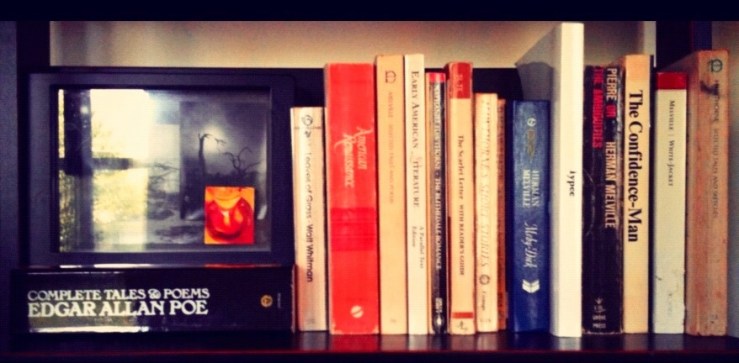
Book Shelves #16, 4.15.2012

20120415-113741.jpg

Book shelves series #16, sixteenth Sunday of 2012.

It’s hard to photograph books, and using an iPhone 3gs probably doesn’t help. Lots of glare. Anyway: This shelf houses mostly Melville, with some Hawthorne, Poe, and Whitman, as well as some critical works on the American Renaissance movement. (Henry James and F.O. Matthiessen). I have other versions of a lot of these books, including a fraternal twin in my office, a bit bulkier (Emerson, Dickinson, Thoreau, etc.), although these days I’m apt to go to the Kindle for American Renaissance stuff. Here’s a better angle, perhaps:

20120415-113756.jpg

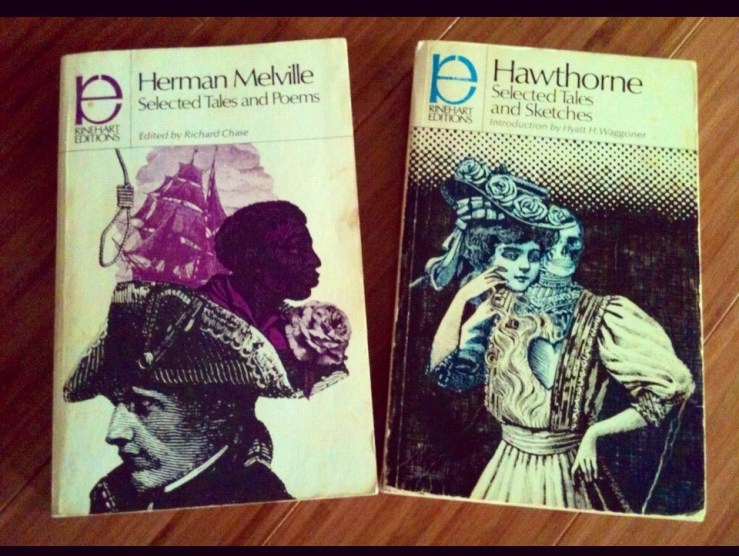
The version of Typee is bizarre: no colophon, no publisher info, just text. I love these midcentury Rinehart Editions of Hathorne and Melville stuff:

20120415-113807.jpg

“Rhetoric” — A Page from James Joyce’s Notebooks

This page is from a notebook that contains some of Joyce’s preparatory notes for Ulysses—there are notes for characters (“Stephen,” “Simon,” “Leopold,” etc.) as well as lists (“Books,” “Recipes”) and general ideas (“Theosophy”). This particular page, “Rhetoric,” seems to be part of the material that went into the “Aeolus” chapter of Ulysses, which plays with the windiness of rhetorical figures. From the National Library of Ireland, via UbuWeb.

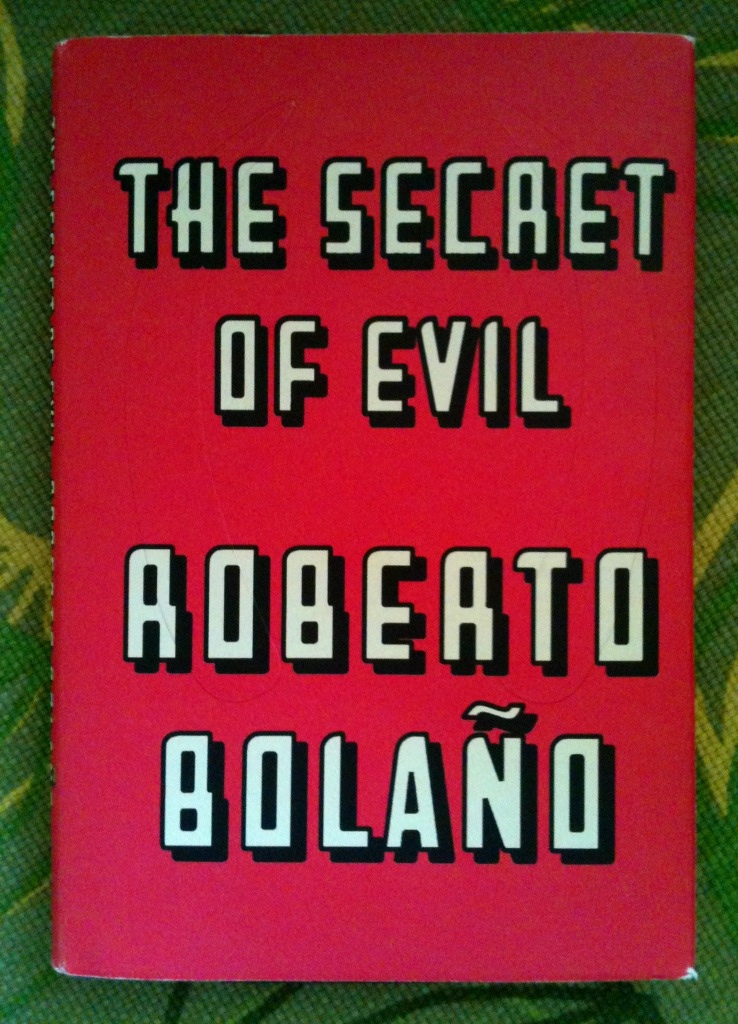
Roberto Bolaño’s The Secret of Evil (Book Acquired, 4.09.2012)

20120414-140951.jpg

How you react to a “new” book by Roberto Bolaño at this point is probably dependent on how much you love or loathe his work—although I imagine those indifferent to or unfamiliar with his writing might be unduly put off by this point at the volume of material that this writer drops posthumously [insert Tupac joke here].

I’m a fan though, so I’m excited about The Secret of Evil, even if the material collected here is in part unfinished . . . although, as Ignacio Echevarria points out in his introduction, all of Bolaño’s “narratives, not just The Secret of Evil, seem to be governed by a poetics of inconclusiveness.” A few of the pieces in Evil have already been excerpted, and I read a few this weekend (who can resist a Bolaño text called “Crimes”?), and while some pieces here are sketchier than others, there’s that preponderance of life force that we expect from late period Bolaño, from a man who seemed to pour what was left of himself into his words and sentences.

From publisher New Directions’ website:

Opening this book is like being granted access to the Chilean master’s personal files. Included in this one-of-a-kind collection is everything Roberto Bolaño was working on just before his death in 2003, and everything that he wanted to share with his readers. Fans of his writing will find familiar characters in new settings, and entirely new stories and styles, too.

A North American journalist in Paris is woken at 4 a.m. by a mysterious caller with urgent information. Daniela de Montecristo (familiar to readers of Nazi Literature in the Americas and 2666) recounts the loss of her virginity. Arturo Belano returns to Mexico City and meets the last disciples of Ulises Lima, who play in a band called The Asshole of Morelos. Belano’s son Gerónimo disappears in Berlin during the Days of Chaos in 2005. Memories of a return to the native land; Argentine writers as gangsters; zombie schlock as allegory…and much more.

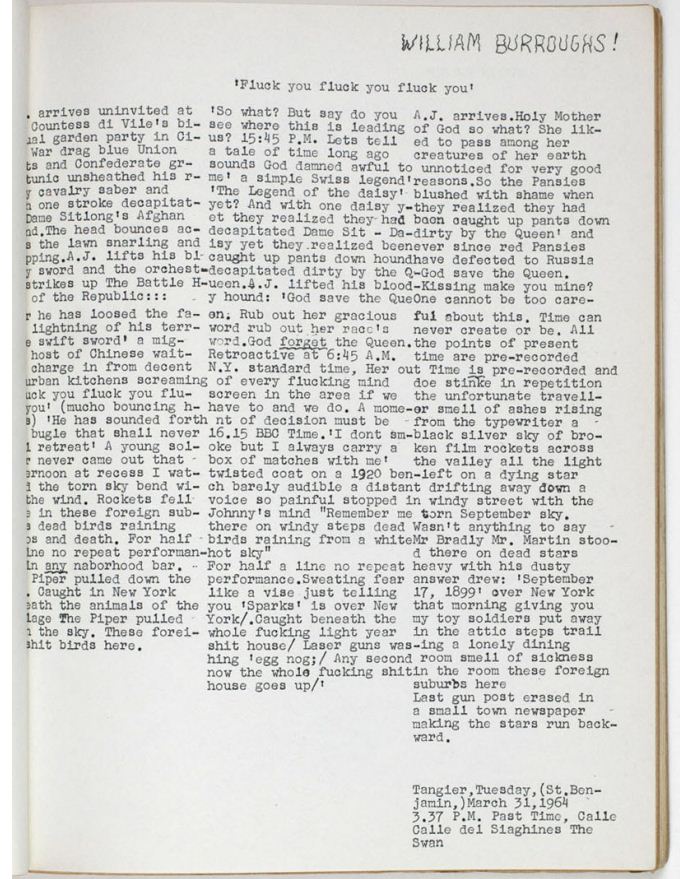
“Fluck you fluck you fluck you” — Tangier Transmission from William Burroughs, 1964

From Number 5, Vol. 7 of Fuck You, (1964) a mimeograph magazine from editor Ed Sanders. The magazine featured Allen Ginsberg, Tuli Kupferberg, Frank O’Hara and more. There’s a fantastic visual archive of Fuck You at Reality Studio, which is where I got this Burroughs layout.

“It Sounds Like the Title of a David Lynch Film” — A Passage from Roberto Bolaño’s 2666

A passage from Roberto Bolaño’s opus 2666

The card for the Santa Teresa cybercafe was a deep red, so red that it was hard to read what was printed on it. On the back, in a lighter red, was a map that showed exactly where the cafe was located. He asked the receptionist to translate the name of the place. The clerk laughed and said it was called Fire, Walk With Me.

“It sounds like the title of a David Lynch film,” said Fate.

The clerk shrugged and said that all of Mexico was a collage of diverse and wide-ranging homages.

“Every single thing in this country is an homage to everything in the world, even the things that haven’t happened yet,” he said.

After he told Fate how to get to the cybercafe, they talked for a while about Lynch’s films. The clerk had seen all of them. Fate had seen only three or four. According to the clerk, Lynch’s greatest achievement was the TV series Twin Peaks. Fate liked The Elephant Man best, maybe because he’d often felt like the elephant man himself, wanting to be like other people but at the same time knowing he was different. When the clerk asked him whether he’d heard that Michael Jackson had bought or tried to buy the skeleton of the elephant man, Fate shrugged and said that Michael Jackson was sick. I don’t think so, said the clerk, watching something presumably important that was happening on TV just then.

“In my opinion,” he said with his eyes fixed on the TV Fate couldn’t see, “Michael knows things the rest of us don’t.”

“We all know things we think nobody else knows,” said Fate.

“I Felt an Irresistible Repulsion and Tedium” — Tolstoy Disses Shakespeare

From the beginning of Leo Tolsoy’s attack on William  ShakespeareA Critical Essay on Shakespeare:

I remember the astonishment I felt when I first read Shakespeare. I expected to receive a powerful esthetic pleasure, but having read, one after the other, works regarded as his best: “King Lear,” “Romeo and Juliet,” “Hamlet” and “Macbeth,” not only did I feel no delight, but I felt an irresistible repulsion and tedium, and doubted as to whether I was senseless in feeling works regarded as the summit of perfection by the whole of the civilized world to be trivial and positively bad, or whether the significance which this civilized world attributes to the works of Shakespeare was itself senseless. My consternation was increased by the fact that I always keenly felt the beauties of poetry in every form; then why should artistic works recognized by the whole world as those of a genius,—the works of Shakespeare,—not only fail to please me, but be disagreeable to me?

For a long time I could not believe in myself, and during fifty years, in order to test myself, I several times recommenced reading Shakespeare in every possible form, in Russian, in English, in German and in Schlegel’s translation, as I was advised. Several times I read the dramas and the comedies and historical plays, and I invariably underwent the same feelings: repulsion, weariness, and bewilderment. At the present time, before writing this preface, being desirous once more to test myself, I have, as an old man of seventy-five, again read the whole of Shakespeare, including the historical plays, the “Henrys,” “Troilus and Cressida,” the “Tempest,” “Cymbeline,” and I have felt, with even greater force, the same feelings,—this time, however, not of bewilderment, but of firm, indubitable conviction that the unquestionable glory of a great genius which Shakespeare enjoys, and which compels writers of our time to imitate him and readers and spectators to discover in him non-existent merits,—thereby distorting their esthetic and ethical understanding,—is a great evil, as is every untruth.

Tolstoy spends most of the rest of the (long) essay showing why he believes King Lear a terrible piece of literature. His rubric is of course terribly subjective, aesthetic, and perhaps ultimately rooted in his own literary mission of realism and social reform—but what I find most remarkable is that, despite all his claims to have read and reread Shakespeare (in English, Russian and German!) he never mentions actually watching a performance of the play.

I read Tolstoy’s gripes last night and felt the need (why?!) to reply, but found this morning that George Orwell already did so. From  Orwell’s rebuttal to Tolstoy, “Lear, Tolstoy and the Fool“:

Artistic theories such as Tolstoy’s are quite worthless, because they not only start out with arbitrary assumptions, but depend on vague terms (‘sincere’, ‘important’ and so forth) which can be interpreted in any way one chooses. Properly speaking one cannot answer Tolstoy’s attack. The interesting question is: why did he make it? But it should be noticed in passing that he uses many weak or dishonest arguments. Some of them are worth pointing out, not because they invalidate his main charge but because they are, so to speak, evidence of malice. . . .

There is no argument by which one can defend a poem. It defends itself by surviving, or it is indefensible. And if this test is valid, I think the verdict in Shakespeare’s case must be “not guilty”. Like every other writer, Shakespeare will be forgotten sooner or later, but it is unlikely that a heavier indictment will ever be brought against him. Tolstoy was perhaps the most admired literary man of his age, and he was certainly not its least able pamphleteer. He turned all his powers of denunciation against Shakespeare, like all the guns of a battleship roaring simultaneously. And with what result? Forty years later Shakespeare is still there completely unaffected, and of the attempt to demolish him nothing remains except the yellowing pages of a pamphlet which hardly anyone has read, and which would be forgotten altogether if Tolstoy had not also been the author of WAR AND PEACE and ANNA KARENINA.

“Walter, Leave Off” — D.H. Lawrence on Walt Whitman

From Lawrence’s chapter on Whitman in Studies in Classic American Literature (more):

POST-MORTEM effects?

But what of Walt Whitman?

The ‘good grey poet’.

Was he a ghost, with all his physicality?

The good grey poet.

Post-mortem effects. Ghosts.

A certain ghoulish insistency. A certain horrible pottage of human parts. A certain stridency and portentousness. A luridness about his beatitudes.

DEMOCRACY! THESE STATES! EIDOLONS! LOVERS, ENDLESS LOVERS!

ONE IDENTITY!

ONE IDENTITY!

I AM HE THAT ACHES WITH AMOROUS LOVE.

Do you believe me, when I say post-mortem effects ?

When the Pequod went down, she left many a rank and dirty steamboat still fussing in the seas. The Pequod sinks with all her souls, but their bodies rise again to man innumerable tramp steamers, and ocean-crossing liners. Corpses.

What we mean is that people may go on, keep on, and rush on, without souls. They have their ego and their will, that is enough to keep them going.

So that you see, the sinking of the Pequod was only a metaphysical tragedy after all. The world goes on just the same. The ship of the soul is sunk. But the machine-manipulating body works just the same: digests, chews gum, admires Botticelli and aches with amorous love.

I AM HE THAT ACHES WITH AMOROUS LOVE.

What do you make of that? I AM HE THAT ACHES. First generalization. First uncomfortable universalization. WITH AMOROUS LOVE! Oh, God! Better a bellyache. A bellyache is at least specific. But the ACHE OF AMOROUS LOVE!

Think of having that under your skin. All that!

I AM HE THAT ACHES WITH AMOROUS LOVE.

Walter, leave off. You are not HE. You are just a limited Walter. And your ache doesn’t include all Amorous Love, by any means. If you ache you only ache with a small bit of amorous love, and there’s so much more stays outside the cover of your ache, that you might be a bit milder about it.

I AM HE THAT ACHES WITH AMOROUS LOVE.

CHUFF! CHUFF! CHUFF!

CHU-CHU-CHU-CHU-CHUFF!

Reminds one of a steam-engine. A locomotive. They’re the only things that seem to me to ache with amorous love. All that steam inside them. Forty million foot-pounds pressure. The ache of AMOROUS LOVE. Steam-pressure. CHUFF!

An ordinary man aches with love for Belinda, or his Native Land, or the Ocean, or the Stars, or the Oversoul: if he feels that an ache is in the fashion.

It takes a steam-engine to ache with AMOROUS LOVE. All of it.

Walt was really too superhuman. The danger of the superman is that he is mechanical.

Oscar Wilde’s Letter to Walt Whitman

Partial transcript from The Library of Congress:

Before I leave America I must see you again–there is no one in this wide great world of America whom I love and honour so much. With warm affection, and honourable admiration, Oscar Wilde.

The Walt Whitman Archive fleshes out the story:

On 18 January 1882 Wilde visited Walt Whitman in Camden, where the poet was then living with his brother and sister-in-law. Wilde told Whitman that his mother had purchased a copy of Leaves of Grass when it was first published, that Lady Wilde had read the poems to her son, and that later, at Oxford, he and his friends carried Leaves to read on their walks. Flattered, Whitman offered Wilde, whom he later described as “a fine large handsome youngster,” some of his sister-in-law’s homemade elderberry wine, and they conversed for two hours. Asked later by a friend how he managed to get the elderberry wine down, Wilde replied: “If it had been vinegar I would have drunk it all the same, for I have an admiration for that man which I can hardly express”

The Pale King Paperback (Book Acquired, 4.07.2012)

20120411-174813.jpg

I was happy to get a trade paperback of David Foster Wallace’s The Pale King this weekend (thanks Hachette!) for a few reasons. First, I detest hardback books — that didn’t stop me from picking up (and reviewingTPK when it debuted last year — but I know I’ll prefer this paperback for rereadings. More to the point, the paperback boasts four vignettes not published with the hardback last year, which I’m sure is in no way a cynical marketing ploy cooked up by the publishers. On those scenes:

20120411-172813.jpg

Okay, so yes, I read them. They’re short, and they don’t really add to the novel; actually, they probably take away from the Michael Pietsch’s fine editing work. Still, DFW fans will eat them up. I’ll try to reflect more later.

There’s also one of those reading group guide sections, which cracks me up. Are book clubs gonna read this book? I mean, I hope they do, but they’ll likely hate it. Here’s a question that caught my eye, mostly because I wrote a bit about §19 this summer.

20120411-174805.jpg

Crews, Gaddis, Lish, Mutis (Books Acquired Late Last Week)

20120410-204343.jpg

I picked up Harry Crews’s novel The Knockout Artist, which I hadn’t read, after his recent death. I was not the only person to pick up Crews books: the Crews section of my favorite used bookstore, once swollen is now depleted (the omnibus and collections all snapped up).

William Gaddis’s last novel Agapē Agape was my occasion (as if I needed one) for visiting said store; I ordered it after finishing The Recognitions. I managed to bend the cover badly in the first five minutes of ownership. I started it over the weekend and then got distracted by a friend calling me to meet at a bar. I started it again last night and got about a third of the way in. Full review on the horizon.

I have no idea why I picked up Lish’s novel other than the fact that Lish is awesome; it’s a first edition paperback and the cover is awesome. Maybe that’s why. I have no idea when I’ll get around to reading it. Compulsive behaviors.

The Mutis novel, or collection of novellas, is half of the book that Dave Cianci aka Noquar reviewed on this blog  a few months ago. I wanted the full version, which collects six novellas, but I’ll settle for this (it’s used; I have store credit, etc.). Anyway, Noquar’s review made me want to read it, so I’ve slated it for summer reading (May?).

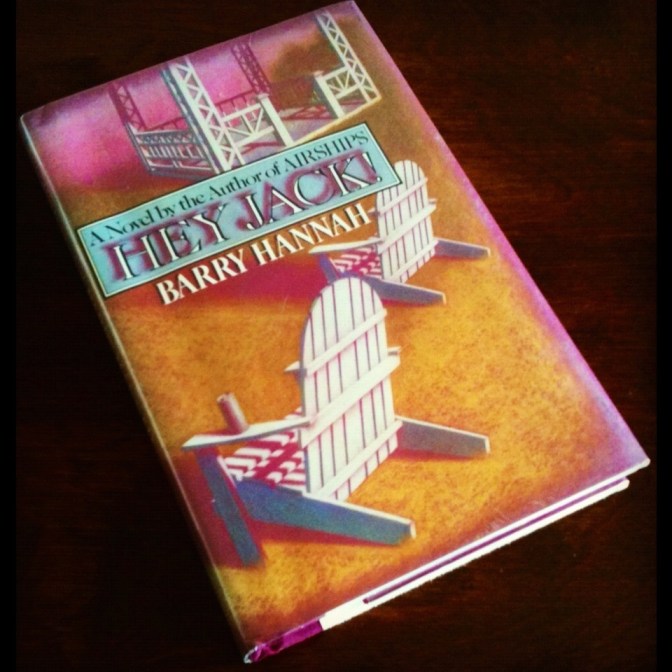
Barry Hannah’s Novella Hey Jack! Is a Loose, Hilarious Tragedy

20120410-174027.jpg

The loose, brief breeziness of Barry Hannah’s 1987 novella Hey Jack! belies the terror and rage at the heart of this hilarious tragedy. It’s a slim volume—133 pages in my hardback copy—with the same rambling flightiness that characterizes Hannah’s better known 1980 novel-in-vignettes, Ray.

Hey Jack! bears many comparisons with Ray: Like Ray, this novel is told from the perspective of a war vet (Korea this time, not ‘Nam); like the eponymous speaker of Ray, the narrator of Hey Jack!, Homer, finds himself frequently besotted, binged out, or horny; like Ray, Homer tries to make a marriage work; like Ray, Homer comes into conflict with a poor white trash family.

And like Ray, Hey Jack! tests the boundaries of what is and is not a “novel.” Hey Jack! is discontinuous and meandering; there’s a plot, sure, but Hannah’s apt to jump over place and time freely, tripping over months at a time, sparing not even a sentence to cue his readers in the right direction. No exposition here, folks. I suppose I should summarize the plot though: Homer, passing middle age, takes up a friendship with Jack, an older man, a former sheriff and fellow Korean War vet who runs a coffee shop popular with the college kids. Together, the pair (sort of) face off against Ronnie Foot, a local boy turned rock star who has the gall to begin an affair with Jack’s forty-year old daughter:

Ronnie Foot, the rock star had her. Or Jack thought he had her, he was sure he had her. Jack was mumbling. Jack was talking about ingratitude and pride and scum hanging on meat, things of that nature. It was astonishing to see him creep and rise suddenly, like a crazy old man. . . . “Nobody ever had a daughter like me. You want me to just her go, like a fart?” He was fingering the gun again.

Jack, once the lone bastion of sanity and order in Homer’s small, chaotic Mississippi town, begins to slide into the insanity and violence that marks the rest of the populace. Jack’s stability is the closest thing Hey Jack! offers as a slice of normalcy (to be clear though, Hannah’s characters skew grotesque, not quirky).

What unites the volume isn’t Jack’s slow slide to the dark side, but rather the narrative’s distinctive, ornery voice. It’s worth quoting Homer at length; here he condenses several of the novel’s themes in the sort of crazy-or-wise? rant indicative of the novella’s tone and rhythm:

In love, in love, in love. A mule can climb a tree if it’s in love. A man like me can look himself in the mirror and say, I’m all right, everything is beloved, I’m no stranger to anywhere any more. I’m a man full of life and a lot of time to kill, shoot every minute down with a straight blast of his eye across the bountiful landscape, from the minnow to the Alps. Something looks back at you with an eye of insane approval. Something looks back at you; out of belligerent ignorance of you it has come to a delighted focus on you and your love, together, sending up gasses of collision that make a rainbow over the poor masses who are changing a tire on the side of the road on a hot Saturday afternoon, felling like niggers. There is a law that every nigger spends a quarter of every weekend changing tires, my friend George, the biochemist, says. What do we know? What do we mere earthlings, unpublished and heaving out farts like puzzled sighs, know, but what is in our blood? I had broken up once with a woman who was in Europe, and coming out of the mall movie (I don’t even remember the movie) I gave out this private marvelous fart that was equal to a paragraph of Henry James, so churned were my guts and so lingering. And I was free. Free to discuss it. Delighted in the boundless ignorance and destruction that lay out there under the dumb lit cold moon. Enough about me and my poetry.

There’s so many shifts here. Hannah’s Homer comes off like a besotted barstool philosopher, gazing at his navel through an empty tumbler and finding both gut and abyss. We see the casual racism that so many of Hannah’s characters dip into; we see the conflation of art, spirit, and expulsion. Need I comment on the fart joke? It’s worth just repeating: “I gave out this private marvelous fart that was equal to a paragraph of Henry James” — if you don’t like that you’re not going to like Hey Jack!

Beyond that voice, there’s little to organize Hey Jack!—it’s a riff, sometimes a howl, often a jape, a joke, sometimes a verbal slap. This isn’t to say there isn’t a trajectory to the novella or a payoff at the end. Hannah seems unable to resist a tragic arc, the same one he pulls through the whiskey haze of  Ray. Perhaps he takes his cues from Edgar Allan Poe’s essay “The Philosophy of Composition“: ” . . . the death, then, of a beautiful woman is, unquestionably, the most poetical topic in the world.” (To be fair Poe is hardly the first fella to find a dead beauty such a worthy topic; also, I’ve never really been sure how to measure the tone of his essay—I can’t help but think he’s being somehow simultaneously tongue-in-cheek and deadly earnest. But enough about Poe).

But arcs be damned. The best bits of Hey Jack! are the stray little paragraphs that erupt from nowhere either to fizzle out or burn up in a bang. At its best, the novella offers bizarre little stories piecemeal that read equally absurd and true. To wit:

I began hollering at my wife for her shortcomings. She left the house, 11 P.M. I’d quit drinking and smoking. She brought me back a bottle of rye and a pack of Luckies, too. I hadn’t smoked for two weeks. I must have been a horrible nuisance.

I took a drink and a smoke.

Then I was normal. My lungs and my liver cried out: At last, again! The old abuse! I am a confessed major organ beater. I should turn myself in on the hotline to normalcy.

I hope by now that you have a sense of whether or not Hey Jack! is for you. It’s probably not going to gel with most readers: Too ugly, too loose, too nihilistic, perhaps; at heart a sloppy affair . . . but I loved it—it was the perfect book to riffle through over a few Saturday or Sunday afternoons on my back porch, its pages blotting up the condensation from a glass of sangria or can of beer, Homer’s consciousness as loose and discontinuous as my own. Not the best starting place for those interested in Hannah—that might be Airships—but great stuff.

Barry Hannah Fragment

From Barry Hannah’s novel Hey Jack!:

I began hollering at my wife for her shortcomings. She left the house, 11 P.M. I’d quit drinking and smoking. She brought me back a bottle of rye and a pack of Luckies, too. I hadn’t smoked for two weeks. I must have been a horrible nuisance.

I took a drink and a smoke.

Then I was normal. My lungs and my liver cried out: At last, again! The old abuse! I am a confessed major organ beater. I should turn myself in on the hotline to normalcy.