Richardson pulled up his horse, and looked back over the trail where the crimson serape of his servant flamed amid the dusk of the mesquit. The hills in the west were carved into peaks, and were painted the most profound blue. Above them the sky was of that marvellous tone of green—like still, sun-shot water—which people denounce in pictures.
José was muffled deep in his blanket, and his great toppling sombrero was drawn low over his brow. He shadowed his master along the dimming trail in the fashion of an assassin. A cold wind of the impending night swept over the wilderness of mesquit.
“Man,” said Richardson in lame Mexican as the servant drew near, “I want eat! I want sleep! Understand—no? Quickly! Understand?”
“Si, señor,” said José, nodding. He stretched one arm out of his blanket and pointed a yellow finger into the gloom. “Over there, small village. Si, señor.”
They rode forward again. Once the American’s horse shied and breathed quiveringly at something which he saw or imagined in the darkness, and the rider drew a steady, patient rein, and leaned over to speak tenderly as if he were addressing a frightened woman. The sky had faded to white over the mountains, and the plain was a vast, pointless ocean of black.
Suddenly some low houses appeared squatting amid the bushes. The horsemen rode into a hollow until the houses rose against the sombre sundown sky, and then up a small hillock, causing these habitations to sink like boats in the sea of shadow.
A beam of red firelight fell across the trail. Richardson sat sleepily on his horse while his servant quarrelled with somebody—a mere voice in the gloom—over the price of bed and board. The houses about him were for the most part like tombs in their whiteness and silence, but there were scudding black figures that seemed interested in his arrival. Continue reading ““Horses,” a short story by Stephen Crane”→
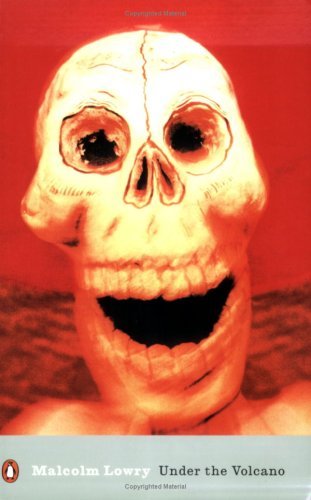
Most of Malcolm Lowry’s dense, depressing novel Under the Volcano takes place over the course of November 2nd, 1938, the Mexican Day of the Dead. Like a reticent, dour Virgil, Lowry guides the reader through the day’s tragic arc, floating between the minds of his novel’s three protagonists: Geoffrey Firmin, his half-brother Hugh, and Geoffrey’s estranged wife Yvonne. Geoffrey is British Consul to Mexico — ex-Consul, really, as British-Mexican relations sour against the backdrop of Spanish fascism and the rise of nationalism in Mexico — but he is almost always referred to as “the Consul,” a blackly ironic title. See, the Consul bears little authority aside from an extreme expertise on how to stay drunk (or “drunkly sober un-drunk”) 24/7. He’s ambassador to bar stools, a manager of mescal and little else (certainly not his own life; certainly not diplomatic affairs). The Consul is a wreck, an alcoholic to put Hemingway and Fitzgerald’s (and even Bukowski’s) alter-egos to shame.
After a first chapter that seems to derail all but the most patient readers, the narrative conflict arrives when Yvonne returns to Quauhnahuac, Mexico, a year after leaving (and divorcing) the Consul. She arrives to find the Consul (“Geoffrey,” as he’s called when the free indirect style inhabits her mind) drinking whiskey in a hotel bar in order to sober up (yep). It’s not immediately clear why Yvonne has returned to the Consul, but it seems that she hopes to save him from drowning in a drunken downward spiral. As the pair walks to the Consul’s house, they pass numerous advertisements for a boxing match; a child’s funeral proceeds down the avenue. These motifs of fighting, death, and futility permeate the novel.
During the walk we learn that Yvonne is not the only one concerned about the Consul’s health; his (much) younger brother Hugh has come to stay with him in the hopes of sobering him up. (Hugh employs a revolting and unsuccessful “strychnine cure”). That Hugh has also returned doubly complicates the plot. Much of Under the Volcano remains implicit, unnamed, hinted at, and this seems especially true of the implication that Yvonne cheated on the Consul with Hugh in the recent past (this implication may have been stated conclusively at some point in the novel, but I’ve only read the book once, which is perhaps like not having read it at all). What’s certainly clear is that Yvonne cheated on the Consul with a French filmmaker, Jacques Laruelle, a man whom the Consul, through sheer bizarre coincidence (but of course it isn’t sheer bizarre coincidence), spent a childhood summer with, an experience which bonded them as brothers in an Edenic holiday that eventually (inevitably) soured.
Despite her infidelities, Yvonne is generally present (I choose the verb “present” over “presented as” to highlight Lowry’s impeccable Modernist style) as a sympathetic character. Still, it is hard not to identify with the Consul (with “Geoffrey,” I suppose, if we are going to be familiar), the dark soul of this novel, and his complicated, painful feelings for Yvonne form the core of Volcano’s tragedy. He longs for her, pines for a complete life with her, yet resents her, cannot forgive her, hates her. For what? For leaving him. For betraying him. But perhaps foremost, he despises her inability to understand his alcoholism (he is particularly upset when she refuses to share a morning libation with him when they meet for the first time in a year). I’ll quote a passage at length now, one that showcases Lowry’s free indirect style, and one that reveals the strange indignities of the Consul’s sense of his own alcoholism. For context, dear reader, you must only know that Yvonne has suggested that she and the Consul might make long-term plans when he is sober “in a day or two”—
The Consul sat perfectly still staring at the floor while the enormity of the insult passed into his soul. As if, as if, he were not sober now! Yet there was some elusive subtlety in the impeachment that still escaped him. For he was not sober. No, he was not, not at this very moment he wasn’t! But what had that to do with a minute before, or half an hour ago? And what right had Yvonne to assume it, assume either that he was not sober now, or that, far worse, in a day or two he would be sober? And even if he were not sober now, by what fabulous stages, comparable indeed only to the paths and spheres of the Holy Cabbala itself, had he reached this stage again, touched briefly once before this morning, this stage at which alone he could, as she put it, “cope,” this precarious precious stage, so arduous to maintain, of being drunk in which alone he was sober! What right had she, when he had sat suffering the tortures of the damned and the madhouse on her behalf for fully twenty-five minutes on end without having a decent drink, even to hint that he was anything but, to her eyes, sober? Ah, a woman could not know the perils, the complications, yes, the importance of a drunkard’s life! From what conceivable standpoint of rectitude did she imagine she could judge what was anterior to her arrival? And she knew nothing whatever of what all too recently he had gone through, his fall in the Calle Nicaragua, his aplomb, coolness, even bravery there—the Burke’s Irish whiskey! What a world! And the trouble was she had now spoiled the moment.
The “fall in the Calle Nicaragua” the Consul references is quite literally a drunkard’s blackout (followed by the aforementioned fortifying whiskey, courtesy of a tourist), but it — falling — is perhaps the dominant motif in a novel crammed with motifs. In allegorical terms, if we want to ruin a good book (I don’t recommend this, of course), Volcano is pure Faust-stuff: end of innocence, fall of man, intractability of the human condition, ethical peril, moral inertia. While the Consul’s fall dominates the novel, Lowry brings this decline into dramatic relief in a late, climactic episode when his (anti-)heroic trio encounter a dying (dead?) man on the side of the road. Hugh tries to help, but the Darwinian venality of Mexican commonplace law makes his attempt impotent. Yvonne and the Consul are basically paralyzed.
Hugh’s attempt to save the man is a desperate call to action, an endeavor to perform some good in a world dominated by war and fascism. Hugh’s character fascinates. We learn of his past in one of the novel’s most intriguing episodes, a mini-bildungsroman that finds young Hugh working in the merchant marine as a calculated ploy to lend romance to his persona — he longs to prevail as a songwriter. He returns to find that no one cares about — has even heard — his guitar compositions; his publicity stunt fails. Although Hugh is only twenty-nine, he already seems himself as a failure, a fallen hero; he obsesses over the Battle of Ebro, daydreaming of helming a ship laden with hidden arms that he will deliver to the Loyalists who oppose the Fascists. Hugh’s greatest pain — and perhaps (only perhaps) Lowry’s greatest cruelty — is the awareness that the idealism of romantic heroism is intrinsically bound to a kind of selfish egoism. Hugh, perhaps with the visceral signal of his half-brother as a kind of radical prescience, can already see his own fall; his parts in Volcano are in a sense a constant meditation on falling. Hugh tries to save the dying man on the road, the cold double of his brother, whom he also tries to save — and yet it is all to little avail.
In Lowry’s world, in the volcano-world, there is only expulsion from the Eden. Lowry spells out this theme near the middle of his novel in a strange episode. The Consul wanders into his neighbor’s garden and reads a sign —
¿LE GUSTA ESTE JARDÍN?
¿QUE ES SUYO?
¡EVITE QUE SUS HIJOS LO DESTRUYAN!
The Consul stared back at the black words on the sign without moving. You like this garden? Why is it yours? We evict those who destroy! Simple words, simple and terrible words, words which one took to the very bottom of one’s being, words which, perhaps a final judgement on one, were nevertheless unproductive of any emotion whatsoever, unless a kind of colourless cold, a white agony, an agony chill as that iced mescal drunk in the Hotel Canada on the morning of Yvonne’s departure.
Significantly, either the sign is posted with improper punctuation, or (and?) the Consul’s translation is wrong — in either case a meaningful misreading occurs. We later receive the “proper” version of the sign: “¿Le gusta este jardín, que es suyo? ¡Evite que sus hijos lo destruyan! – “Do you like this garden that is yours? See to it that your children do not destroy it!” The Consul’s first reading is a corruption, a cruel misreading that questions humanity’s right to happiness, and, tellingly, he connects the sign to the end of his relationship with Yvonne. The second version of the sign, while still foreboding, perhaps signals a kernel of hope in Lowry’s bleak work — the idea that a garden might be preserved, might be tended to; that children might be raised who do not kill, cheat, steal, rape, enslave, or otherwise prey on each other. Still, Lowry refuses to imagine what such a world might look like for us. Did I mention that Volcano is really, really sad?
For all its bleak, bitter bile, Volcano contains moments of sheer, raw beauty, especially in its metaphysical evocations of nature, which always twist back to Lowry’s great themes of Eden, expulsion, and death. Lowry seems to pit human consciousness against the naked power of the natural world; it is no wonder then, against such a grand, stochastic backdrop, that his gardeners should fall. The narrative teems with symbolic animals — horses and dogs and snakes and eagles — yet Lowry always keeps in play the sense that his characters bring these symbolic identifications with them. The world is just the world until people walk in it, think in it, make other meanings for it.
In many ways, Under the Volcano is an antipodal response to Joyce’s Ulysses. Both novels stream through a number of consciousnesses over the course of one day; both novels invert and subvert mythical frameworks against diurnal concerns; both novels point to the ways that the smallest meannesses — and kindnesses — can color and affect our lives. And while there are many divergences (chiefest, I believe, the spirit of redemption in Ulysses that seems entirely absent from Volcano), the greatest similarity may be their difficulty. Simply put, Lowry, like Joyce, throws his readers into the deep end. The first chapter of the novel inhabits the mind of Jacques Laruelle and takes place exactly one year after the events of the rest of the novel. It is both overture and context for all that follows, and yet it is radically alienating; indeed, it only fully makes sense after one finishes the novel and goes back and reads it again, realizing it is the rightful coda, the sad epilogue of a sad story. Lowry leads with his conclusion, show us the fall-out up front, the splinters and shards of the narrative to come. Picking up these pieces is hardly easy and never joyful, but it is a rewarding experience. Very highly recommended.
[Editorial note: Biblioklept ran a version of this review in March of 2011; we run it again in honor of The Day of the Dead]
Dracula is a character in Roberto Bolaño’s dark opus 2666.
Specifically, I’m suggesting that Dracula (like, theCount Dracula) is the unnamed SS officer in “The Part About Archimboldi” who hosts a strange party in a Romanian castle.
II. I’m willing to concede that my idea is probably full of holes and more than a little silly, but I think there’s some textual support for such a claim.
III. I’ve already suggested on this blog that 2666 is full of lycanthropic transformations, and in that earlier essay, I linked werewolves to vampires (using the work of mythologist Sabine Baring-Gould).
It’s a work of mesmerism and transformation—vampire powers. Dracula showing up is a winking sick joke, a satire.
IV. In his post “Castle Dracula” at Infinite Zombies, Daryl L. L. Houston connects the many strands of vampirism that run through 2666, suggesting that “Bolaño is using the vampirism in the story, and Dracula in particular, to tie together some of the threads he’s been unwinding pertaining to insiders and outsiders, parasitism and consumption of people, and a sort of larger parasitism of nations.” Hence Aztec blood rituals, the Holocaust, the murder of helpless, marginalized women in Santa Teresa . . .
V. Okay, so back to that thesis. Let’s start with the first appearance of the unnamed SS officer:
At midmorning they came to a castle. The only people there were three Romanians and an SS officer who was acting as butler and who put them right to work, after serving them a breakfast consisting of a glass of cold milk and a scrap of bread, which some soldiers left untouched in disgust. Everyone, except for four soldiers who stood guard, among them Reiter, whom the SS officer judged ill suited for the task of tidying the castle, left their rifles in the kitchen and set to work sweeping, mopping, dusting lamps, putting clean sheets on the beds.
Fairly banal, right? Also, “midmorning” would entail, y’know, sunlight, which is poison for most vampires. Let me chalk this up to the idea that the SS officer is inside the castle, which is sufficiently gloomy and dark enough to protect him (I’m not going to get into any vampire rules that might spoil my fun, dammit!). In any case, hardly noteworthy. Indeed, the SS officer—a butler commanding house chores—seems hardly a figure of major importance.
VI. Next, we get the Romanian castle explicitly identified as “Dracula’s castle” and meet the actors for this milieu:
“And what are you doing here, at Dracula’s castle?” asked the baroness.
“Serving the Reich,” said Reiter, and for the first time he looked at her.
He thought she was stunningly beautiful, much more so than when he had known her. A few steps from them, waiting, was General Entrescu, who couldn’t stop smiling, and the young scholar Popescu, who more than once exclaimed: wonderful, wonderful, yet again the sword of fate severs the head from the hydra of chance.
(I love Popescu’s line here).
VII. Our principals soon take a tour of castle and environs, led by the SS officer (boldface emphasis is mine):
Soon they came to a crypt dug out of the rock. An iron gate, with a coat of arms eroded by time, barred the entrance. The SS officer, who behaved as if he owned the castle, took a key out of his pocket and let them in. Then he switched on a flashlight and they all ventured into the crypt, except for Reiter, who remained on guard at the door at the signal of one of the officers.
So Reiter stood there, watching the stone stairs that led down into the dark, and the desolate garden through which they had come, and the towers of the castle like two gray candles on a deserted altar. Then he felt for a cigarette in his jacket, lit it, and gazed at the gray sky, the distant valleys, and thought about the Baroness Von Zumpe’s face as the cigarette ash dropped to the ground and little by little he fell asleep, leaning on the stone wall. Then he dreamed about the inside of the crypt. The stairs led down to an amphitheater only partially illuminated by the SS officer’s flashlight. He dreamed that the visitors were laughing, all except one of the general staff officers, who wept and searched for a place to hide. He dreamed that Hoensch recited a poem by Wolfram von Eschenbach and then spat blood. He dreamed that among them they had agreed to eat the Baroness Von Zumpe.
He woke with a start and almost bolted down the stairs to confirm with his own eyes that nothing he had dreamed was real.
When the visitors returned to the surface, anyone, even the least astute observer, could have seen that they were divided into two groups, those who were pale when they emerged, as if they had glimpsed something momentous down below, and those who appeared with a half smile sketched on their faces, as if they had just been reapprised of the naivete of the human race.
Bolaño concludes the crypt passage by highlighting an essential ambiguity that courses throughout the entire “Castle Dracula” episode, a strange axis of horror/humor, romance/banality. What has been revealed in the crypt? We don’t know, of course, but our surrogate Reiter allows us access to a few visions of what might have happened, including terror and fear and cannibalism. (He employs Hawthorne’s escape hatch too—it was all a dream).
The Knight of Death, Salvador Dali
VIII. Then, supper time:
That night, during dinner, they talked about the crypt, but they also talked about other things. They talked about death. Hoensch said that death itself was only an illusion under permanent construction, that in reality it didn’t exist. The SS officer said death was a necessity: no one in his right mind, he said, would stand for a world full of turtles or giraffes. Death, he concluded, served a regulatory function.
Clearly it’s easy to link any of the dinnertime comments about death to Dracula, but note that the SS officer’s idea that death is a “regulatory function” is terribly banal, is quite literally regular—this idea contrasts with Hoensch’s more poetic notion that death is an illusion (an illusion that the SS officer, if he is in fact Count Dracula, would realize in a perfectly mundane way that foreclosed the necessity of metaphor).
IX. Dinner conversation turns to murder—obviously one of the central themes of 2666:
The SS officer said that murder was an ambiguous, confusing, imprecise, vague, ill-defined word, easily misused.
Again, ambiguity: on one hand, sure, an SS officer’s job was in large part about coordinating and executing mass murder. At the same time, we might appreciate that murder is a vague term if people are one’s lunch.
X. Then conversation turns to culture:
The SS officer said culture was the call of the blood, a call better heard by night than by day, and also, he said, a decoder of fate.
I’m pretty sure that this was the moment I started entertaining the fancy that the SS officer might be Dracula.
XI. Popescu the intellectual also seems to reconsider the SS officer:
The intellectual Popescu remained standing, next to the fireplace, observing the SS officer with curiosity.
XII. Then, they finally riff on Dracula. Significantly, the SS officer believes that Dracula is a good German (bold emphasis mine):
First they praised the assortment of little cakes and then, without pause, they began to talk about Count Dracula, as if they had been waiting all night for this moment. It wasn’t long before they broke into two factions, those who believed in the count and those who didn’t. Among the latter were the general staff officer, General Entrescu, and the Baroness Von Zumpe. Among the former were Popescu, Hoensch, and the SS officer, though Popescu claimed that Dracula, whose real name was Vlad Tepes, aka Vlad the Impaler, was Romanian, and Hoensch and the SS officer claimed that Dracula was a noble Teuton, who had left Germany accused of an imaginary act of treason or disloyalty and had come to live with some of his loyal retainers in Transylvania a long time before Vlad Tepes was born, and while they didn’t deny Tepes a real historical or Transylvanian existence, they believed that his methods, as revealed by his alias or nickname, had little or nothing to do with the methods of Dracula, who was more of a strangler than an impaler, and sometimes a throat slitter, and whose life abroad, so to speak, had been a constant dizzying spin, a constant abysmal penitence.
The SS officer is the noble Teuton. More importantly, we get language that connects Dracula to the murders in Santa Teresa, most of which are stranglings; we also get the idea that Dracula has had a “life abroad”—one outside of time—a life that might see his spirit inhabit and ventriloquize an industrial city in the north of Mexico. (Or not. I know. Look, I’m just riffing here).
We also get the idea of an abyss (this is the structure of 2666), as well as the idea of Dracula as a penitent of sorts.
So, let us recall that early in “The Part About the Crimes,” detective Juan de Dios Martinez is searching for a criminal dubbed The Penitent who desecrates churches and has committed a few murders in the process. He goes to psychologist Elvira Campos for help:
Sacraphobia is fear or hatred of the sacred, of sacred objects, especially from your own religion, said Elvira Campos. He thought about making a reference to Dracula, who fled crucifixes, but he was afraid the director would laugh at him. And you believe the Penitent suffers from sacraphobia? I’ve given it some thought, and I do. A few days ago he disemboweled a priest and another person, said Juan de Dios Martinez.
This is the first mention of Dracula in 2666, and he’s explicitly likened to the Penitent; later, as we see above, Dracula will be explicitly linked to penitence.
(I’m not suggesting that the Penitent is Dracula traveled to Mexico to piss in churches. What I want to say is that Dracula’s dark spirit ventriloquizes the text of 2666).
(I’m also suggesting, again, that 2666 be read intertextaully).
Riding with Death, Jean-Michel Basquiat
XIII. Our other principals continue to discuss Dracula, but I won’t belabor that discussion (I’d prefer you, dear reader, to return to the text).
I will summarize though: Popescu sees Dracula in nationalistic terms (“a Romanian patriot” who repels the Turks), and General Entrescu goes on a long rant about heroism and villainy and history, culminating in a lengthy digression on Jesus Christ (recall now that Entrescu will be crucified JC-style by his men).
One aside on the SS officer bears mentioning: we learn that “the fastidious SS officer” is the most sober conversant as he “scarcely wet his lips with alcohol.” (Because he’s a vampire who prefers blood! Muahahahaha!)
XIV. Fast forward a few hours. Our man Reiter, among fellow soldiers, sets out to explore the secret crannies and passageways of Castle Drac and play voyeur:
The room they came to was empty and cold, as if Dracula had just stepped out. The only thing there was an old mirror that Wilke lifted off the stone wall, uncovering a secret passageway.
Dracula’s spirit leaves the room, creating an opening, behind the ever-symbolic mirror. (Muahahahaha!). (2666: Mirror, tunnels, chambers, labyrinths).
They enter the passageway and come first upon our supposed Dracula, the SS officer:
And so they were able to look into the room of the SS officer, lit by three candles, and they saw the SS officer up, wrapped in a robe, writing something at a table near the fireplace. The expression on his face was forlorn. And although that was all there was to see, Wilke and Reiter patted each other on the back, because only then were they sure they were on the right path. They moved on.
XV. Dracula, the epistolary novel. Count Dracula, troubled writer of letters, will author the following scenes, his spirit ventriloquizing the principals all: Here, we find Reiter and his homeboy Wilke, lurking in a secret passage, jerking off to werewolf-cum-Jesus-Christ-figure Gen. Entrescu screwing the lovely Baroness Von Zumpe and reciting poetry (emphasis per usual mine):
Then Wilke came on the wall and mumbled something too, a soldier’s prayer, and soon afterward Reiter came on the wall and bit his lips without saying a word. And then Entrescu got up and they saw, or thought they saw, drops of blood on his penis shiny with semen and vaginal fluid, and then Baroness Von Zumpe asked for a glass of vodka, and then they watched as Entrescu and the baroness stood entwined, each with a glass in hand and an air of distraction, and then Entrescu recited a poem in his tongue, which the baroness didn’t understand but whose musicality she lauded, and then Entrescu closed his eyes and cocked his head as if to listen to something, the music of the spheres, and then he opened his eyes and sat at the table and set the baroness on his cock, erect again (the famous foot-long cock, pride of the Romanian army), and the cries and moans and tears resumed, and as the baroness sank down onto Entrescu’s cock or Entrescu’s cock rose up into the Baroness Von Zumpe, the Romanian general recited a new poem, a poem that he accompanied by waving both arms (the baroness clinging to his neck), a poem that again neither of them understood, except for the word Dracula,which was repeated every four lines, a poem that might have been martial or satirical or metaphysical or marmoreal or even anti-German, but whose rhythm seemed made to order for the occasion, a poem that the young baroness, sitting astride Entrescu’s thighs, celebrated by swaying back and forth, like a little shepherdess gone wild in the vastness of Asia, digging her nails into her lover’s neck, scrubbing the blood that still flowed from her right hand on her lover’s face, smearing the corners of his lips with blood, while Entrescu, undeterred, continued to recite his poem in which the word Dracula sounded every four lines, a poem that was surely satirical, decided Reiter (with infinite joy) as Wilke jerked off again.
I contend that the poem is the work of the SS officer, psychic mesmerist, the poet Dracula, a poem no one in the scene can understand, a dark satire that might also be a war poem or a love poem or an elegy, but definitely a dark satire, written in violence and sex and blood, a poem that ventriloquizes not only Entrescu, phallic delivery device, but also the baroness, and also Reiter and Wilke. And perhaps the reader.
XVI. Where to go after such a climax? Maybe point out that Dracula infects Reiter and Wilke, of whom we learn:
Some of their battalion comrades dubbed them the vampires.
(But better to return I think to our strange figure, the SS officer).
XVII. Here, his last appearance:
The next morning the detachment left the castle after the departure of the two carloads of guests. Only the SS officer remained behind while they swept, washed, and tidied everything. Then, when the officer was fully satisfied with their efforts, he ordered them off and the detachment climbed into the truck and headed back down to the plain. Only the SS officer’s car—with no driver, which was odd—was left at the castle. As they drove away, Reiter saw the officer: he had climbed up to the battlements and was watching the detachment leave, craning his neck, rising up on tiptoe, until the castle, on the one hand, and the truck, on the other, disappeared from view.
Dracula stays in Dracula’s castle; his spirit, his seed, his blood seeps out.
[Ed. note: This post was originally published in 2012].
[Editorial note: The following citations come from one-star Amazon reviews of Bram Stoker’s novel Dracula.I’ve preserved the reviewers’ original punctuation and spelling. More one-star Amazon reviews].
Crapula
hack author
Painfully verbose
he lives in a castle!
hard to understand
NOTHING is happening
find an abridged version
I have read many horror novels
may be the worst book ever written
being the avid vampire fan that I am
attempt to cash in on the vampire craze
cavort lasciviously with the sons of the devil
Watch the movie and save yourself some time
I’m always willing to read new vampire fiction
epistolary format is monotonous and repetitive
Turns out the vampire in this book is an old guy
It was so stupid and the movie was even stupider
If you’re like me, just tring this book to make yourself feel brave, forget it
I think I have been hacked or my late wife’s daughter is using our account
Any vampire fan knows that vampires roam the streets of upper middle class suburbia
Over the past couple years I’ve started a collection of vampire books which totals over 100 now
I’ll be returning this on my next trip to the library and sticking to the teen reading section for finding my next vampire novel
I fully realize that this is a fictional/fantasy tale containing elements that obviously require a certain amount of leeway and suspension of belief, but
Epostolary novel told from multiple perspectives about the vampire, Count Dracula, who is trying to invade London and turn everyone else into vampires. A bunch of rich guys and a chick decide to stop him.
no relationship between Lucy and the Count-which i suppose makes more sense as to why he bit her
up pops a homoerotic cover with naked men, one whose penis is exposed in the background
the book is down hill from the time Dracula is in London and it is decided that he must be destroyed
the method being used to advance the plot being in disuse since quite some time
he is not a suave romantic movie/play character but an angry stupid animal
Amazon markets this book not to children but homosexual adult men
The movie was so much better even with Keanu Reeves’ awful acting
what are the standards when it comes to classic books
October 25th.–A walk yesterday through Dark Lane, and home through the village of Danvers. Landscape now wholly autumnal. Saw an elderly man laden with two dry, yellow, rustling bundles of Indian corn-stalks,–a good personification of Autumn. Another man hoeing up potatoes. Rows of white cabbages lay ripening. Fields of dry Indian corn. The grass has still considerable greenness. Wild rose-bushes devoid of leaves, with their deep, bright red seed-vessels. Meeting-house in Danvers seen at a distance, with the sun shining through the windows of its belfry.Barberry-bushes,–the leaves now of a brown red, still juicy and healthy; very few berries remaining, mostly frost-bitten and wilted. All among the yet green grass, dry stalks of weeds. The down of thistles occasionally seen flying through the sunny air.
It is a northern country; they have cold weather, they have cold hearts. Cold; tempest; wild beasts in the forest. It is a hard life. Their houses are built of logs, dark and smoky within. There will be a crude icon of the virgin behind a guttering candle, the leg of a pig hung up to cure, a string of drying mushrooms. A bed, a stool, a table. Harsh, brief, poor lives. To these upland woodsmen, the Devil is as reals as you or I. More so; they have not seen us nor even know that we exist, but the Devil they glimpse often in the graveyards, those bleak and touching townships of the dead where the graves are marked with portraits of the deceased in the naif style and there are no flowers to put in front of them, no flowers grow there, so they put out small votive offerings, little loaves, sometimes a cake that the bears come lumbering from the margins of the forests to snatch away. At midnight, especially on Walpurgisnacht, the Devil holds picnics in the graveyards and invites the witches; then they dig up fresh corpses, and eat them. Anyone will tell you that. Wreaths of garlic on the doors keep out the vampires. A blue-eyed child born feet first on the night of St. John’s Eve will have second sight. When they discover a witch – some old woman whose cheeses ripen when her neighbours’ do not, another old woman whose black cat, oh, sinister! follows her about all the time, they strip the crone, search for her marks, for the supernumerary nipple her familiar sucks. They soon find it. Then they stone her to death.
Winter and cold weather.
Go and visit grandmother, who has been sick. Take her the oatcakes I’ve baked for her on the hearthstone and a little pot of butter.
The good child does as her mother bids – five miles’ trudge through the forest; do not leave the path because of the bears, the wild boar, the starving wolves. Here, take your father’s hunting knife; you know how to use it.
The child had a scabby coat of sheepskin to keep out the cold, she knew the forest too well to fear it but she must always be on her guard. When she heard that freezing howl of a wolf, she dropped her gifts, seized her knife, and turned on the beast.
It was a huge one, with red eyes and running, grizzled chops; any but a mountaineer’s child would have died of fright at the sight of it. It went for her throat, as wolves do, but she made a great swipe at it with her father’s knife and slashed off its right forepaw.
The wolf let out a gulp, almost a sob, when it saw what had happened to it; wolves are less brave than they seem. It went lolloping off disconsolately between the trees as well as it could on three legs, leaving a trail of blood behind it. The child wiped the blade of her knife clean on her apron, wrapped up the wolf’s paw in the cloth in which her mother had packed the oatcakes and went on towards her grandmother’s house. Soon it came on to snow so thickly that the path and any footsteps, track or spoor that might have been upon it were obscured.
She found her grandmother was so sick she had taken to her bed and fallen into a fretful sleep, moaning and shaking so that the child guessed she had a fever. She felt the forehead, it burned. She shook out the cloth from her basket, to use it to make the old woman a cold compress, and the wolf’s paw fell to the floor.
But it was no longer a wolf’s paw. It was a hand, chopped off at the wrist, a hand toughened with work and freckled with old age. There was a wedding ring on the third finger and a wart in the index finger. By the wart, she knew it for her grandmother’s hand.
She pulled back the sheet but the old woman woke up, at that, and began to struggle, squawking and shrieking like a thing possessed. But the child was strong, and armed with her father’s hunting knife; she managed to hold her grandmother down long enough to see the cause of her fever. There was a bloody stump where her right hand should have been, festering already.
The child crossed herself and cried out so loud the neighbours heard her and come rushing in. They know the wart on the hand at once for a witch’s nipple; they drove the old woman, in her shift as she was, out into the snow with sticks, beating her old carcass as far as the edge of the forest, and pelted her with stones until she fell dead.
Now the child lived in her grandmother’s house; she prospered.
I don’t remember how old I was the first time I saw Blade Runner (dir. Ridley Scott, 1982), but I do remember that it had an instant and formative aesthetic impact on me. Blade Runner’s dark atmosphere and noir rhythms were cut from a different cloth than the Star Wars and Spielberg films that were the VHS diet of my 1980’s boyhood. Blade Runner was an utterly perplexing film, a film that I longed to see again and again (we didn’t have it on tape), akin to Dune (dir. David Lynch, 1984), or The Thing (dir. John Carpenter, 1982)—dark, weird sci-fi visions that pushed their own archetypes through plot structures that my young brain couldn’t quite comprehend.
By the time Scott released his director’s cut of the film in 1993, I’d read Philip K. Dick’s source novel Do Androids Dream of Electric Sheep? and enough other dystopian fictions to understand the contours and content of Blade Runner in a way previously unavailable to me. And yet if the formal elements and philosophical themes of Blade Runner cohered for me, the central ambiguities, deferrals of meaning, and downright strangeness remained. I’d go on to watch Blade Runner dozens of times, even catching it on the big screen a few times, and riffing on it in pretty much every single film course I took in college. And while scenes and set-pieces remained imprinted in my brain, I still didn’t understand the film. Blade Runner is, after all, a film about not knowing.
Like its predecessor, Blade Runner 2049 (dir. Denis Villeneuve, 2017) is also a film about not knowing. Moody, atmospheric, and existentialist, the core questions it pokes at are central to the Philip K. Dick source material from which it originated: What is consciousness? Can consciousness know itself to be real? What does it mean to have–or not have—a soul?
Set three decades after the original, Blade Runner 2049 centers on KD6-3.7 (Ryan Gosling in Drive mode). K is a model Nexus-9, part of a new line of replicants created by Niander Wallace and his nefarious Wallace Corporation (Jared Leto, who chews up scenery with tacky aplomb). K is a blade runner, working for the LAPD to hunt down his own kind. At the outset of the film, K doesn’t recognize the earlier model Nexuses (Nexi?) he “retires” as his “own kind,” but it’s clear that the human inhabitants of BR ’49’s world revile all “skinjobs” as the same: scum, other, less human than human. K, beholden to his human masters, exterminates earlier-model replicants in order to keep the civil order that the corporate police state demands. This government relies on replicant slave labor, both off-world—where the wealthiest classes have escaped to—and back here on earth, which is recovering from a massive ecological collapse. The recovery is due entirely to Niander Wallace’s innovations in synthetic farming—and his reintroduction of the previously prohibited replicants.
Our boy K “retires” a Nexus-8 at the beginning of the film. This event leads to the film’s first clue: a box buried under a dead tree. This (Pandora’s) box is an ossuary, the coffin for a (ta da!) female replicant (a Nexus-7 if you’re counting). Skip the next paragraph if you don’t want any plot spoilers.
If I had understood the terms of that one-sided contract with Satan, the Time of Witching would have lasted longer–you may be sure of that. But how was I to tell? It just happened, and has never happened again, though I’ve tried the same preliminaries as far as I could control them.
The thing began all of a sudden, one October midnight–the 30th, to be exact. It had been hot, really hot, all day, and was sultry and thunderous in the evening; no air stirring, and the whole house stewing
with that ill-advised activity which always seems to move the steam radiator when it isn’t wanted.
I was in a state of simmering rage–hot enough, even without the weather and the furnace–and I went up on the roof to cool off. A top-floor apartment has that advantage, among others–you can take a walk without the mediation of an elevator boy!
There are things enough in New York to lose one’s temper over at the best of times, and on this particular day they seemed to all happen at once, and some fresh ones. The night before, cats and dogs had broken my rest, of course. My morning paper was more than usually mendacious; and my neighbor’s morning paper–more visible than my own as I went down town–was more than usually salacious. My cream wasn’t cream–my egg was a relic of the past. My “new” napkins were giving out.
Being a woman, I’m supposed not to swear; but when the motorman disregarded my plain signal, and grinned as he rushed by; when the subway guard waited till I was just about to step on board and then slammed the door in my face–standing behind it calmly for some minutes before the bell rang to warrant his closing–I desired to swear like a mule-driver.
At night it was worse. The way people paw one’s back in the crowd! The cow-puncher who packs the people in or jerks them out–the men who smoke and spit, law or no law–the women whose saw-edged cart-wheel hats, swashing feathers and deadly pins, add so to one’s comfort inside.
Well, as I said, I was in a particularly bad temper, and went up on the roof to cool off. Heavy black clouds hung low overhead, and lightning flickered threateningly here and there.
A starved, black cat stole from behind a chimney and mewed dolefully. Poor thing! She had been scalded.
The street was quiet for New York. I leaned over a little and looked up and down the long parallels of twinkling lights. A belated cab drew near, the horse so tired he could hardly hold his head up.
Then the driver, with a skill born of plenteous practice, flung out his long-lashed whip and curled it under the poor beast’s belly with a stinging cut that made me shudder. The horse shuddered too, poor wretch, and jingled his harness with an effort at a trot.
George Saunders has won the 2017 Man Booker Prize for Fiction for his first novel Lincoln in the Bardo. He is the second American (in a row) to win this British prize after the prize’s rules were changed in 2013 to allow U.S. authors. (Paul Beatty’s The Sellout won last year).
I’m a fan of many of Saunders’s short stories, especially those in CivilWarLand in Bad Decline, which I did not review on this website, unlike the collections Pastoraliaand Tenth of December, which I did review on this website.
I really, really, really wanted to love Lincoln in the Bardo, but I didn’t. I tried to read it at least three times earlier this year and failed to make it past the halfway mark.
I first tried via the audiobook, a gimmicky affair that caught my interest. I’m a fan of audiobooks and like most humans I crave novelty. The Lincoln audiobook features 166 readers over a relatively slim seven and a half hours, and is led by the capable Nick Offerman, along with David Sedaris, George Saunders, Carrie Brownstein, Miranda July, Lena Dunham, et. al. I quit the first time maybe only an hour in, assuming that the chorus of narrators was throwing me off. But then I thought, Shit, Ed, it’s not even eight hours, just knock it out. After three hours I found that I genuinely hated it. So I picked up a physical copy from the library and tried again—maybe the audiobook was the wrong media—maybe I needed to see it on the page? But: Nope.
Lincoln in the Bardo might be a really good novel and I just can’t see it or hear it or feel it. I see postmodernism-as-genre, as form; I read bloodless overcooked posturing; I feel schmaltz. I failed the novel, I’m sure. I mean, I’m sure it’s good, right? The problem is me, as usual. I’m tempted here to launch into a long rant about how little contemporary fiction seems to do for me lately, but why? Why rant?
(The last really really great contemporary American novel I read was Atticus Lish’s Preparation for the Next Life, a novel that does everything I think Lincoln wants to do with a real raw precise blood-coursing intensity that I’ll never forget. And (I know this because I used my Twitter timeline as a reference just now) I just realized that I picked up Preparation for the Next Life on the same day that I downloaded the audiobook of Lincoln in the Bardo—so I was reading/auditing the novels at pretty much the exact same time. Look, let me very strongly recommend Atticus Lish’s novel Preparation for the Next Life).
In the second paragraph of this silly riff I wrote the words “I’m a fan of many of Saunders’s short stories.” One of those stories is a perfect two-paragraph joint, “Sticks,” which he included in Tenth of December. As I wrote in my review of that collection,
…the short, visceral two-paragraph perfection of “Sticks”…seems freer, sharper. At fewer than four hundred words it’s easily the shortest piece in the collection (and the shortest thing I’ve read by Saunders). “Sticks” condenses the harried middle class hero of almost every Saunders tale into one ur-Dad, stunning, sad, majestic. It’s also the oldest story in the collection, originally published by Harper’s in 1995, which means it predates the publication of all his other collections.
I figure out a way to insert “Sticks” into pretty much any literature class I teach—I love sharing it with students so I’ll share it with you:
Every year Thanksgiving night we flocked out behind Dad as he dragged the Santa suit to the road and draped it over a kind of crucifix he’d built out of metal pole in the yard. Super Bowl week the pole was dressed in a jersey and Rod’s helmet and Rod had to clear it with Dad if he wanted to take the helmet off. On Fourth of July the pole was Uncle Sam, on Veterans Day a soldier, on Halloween a ghost. The pole was Dad’s one concession to glee. We were allowed a single Crayola from the box at a time. One Christmas Eve he shrieked at Kimmie for wasting an apple slice. He hovered over us as we poured ketchup, saying, Good enough good enough good enough. Birthday parties consisted of cupcakes, no ice cream. The first time I brought a date over she said, What’s with your dad and that pole? and I sat there blinking.
We left home, married, had children of our own, found the seeds of meanness blooming also within us. Dad began dressing the pole with more complexity and less discernible logic. He draped some kind of fur over it on Groundhog Day and lugged out a floodlight to ensure a shadow. When an earthquake struck Chile he laid the pole on its side and spray-painted a rift in the earth. Mom died and he dressed the pole as Death and hung from the crossbar photos of Mom as a baby. We’d stop by and find odd talismans from his youth arranged around the base: army medals, theater tickets, old sweatshirts, tubes of Mom’s makeup. One autumn he painted the pole bright yellow. He covered it with cotton swabs that winter for warmth and provided offspring by hammering in six crossed sticks around the yard. He ran lengths of string between the pole and the sticks, and taped to the string letters of apology, admissions of error, pleas for understanding, all written in a frantic hand on index cards. He painted a sign saying LOVE and hung it from the pole and another that said FORGIVE? and then he died in the hall with the radio on and we sold the house to a young couple who yanked out the pole and left it by the road on garbage day.
October 12th.–The cawing of the crow resounds among the woods. A sentinel is aware of your approach a great way off, and gives the alarm to his comrades loudly and eagerly,–Caw, caw, caw! Immediately the whole conclave replies, and you behold them rising above the trees, flapping darkly, and winging their way to deeper solitudes. Sometimes, however, they remain till you come near enough to discern their sable gravity of aspect, each occupying a separate bough, or perhaps the blasted tip-top of a pine. As you approach, one after another, with loud cawing, flaps his wings and throws himself upon the air.
There is hardly a more striking feature in the landscape nowadays than the red patches of blueberry and whortleberry bushes, as seen on a sloping hill-side, like islands among the grass, with trees growing in them; or crowning the summit of a bare, brown hill with their somewhat russet liveliness; or circling round the base of an earth-imbedded rock. At a distance, this hue, clothing spots and patches of the earth, looks more like a picture than anything else,–yet such a picture as I never saw painted.
The oaks are now beginning to look sere, and their leaves have withered borders. It is pleasant to notice the wide circle of greener grass beneath thecircumference of an overshadowing oak. Passing an orchard, one hears an uneasy rustling in the trees, and not as if they were struggling with the wind. Scattered about are barrels to contain the gathered apples; and perhaps a great heap of golden or scarlet apples is collected in one place.
Friday, October 6th.–Yesterday afternoon I took a solitary walk to Walden Pond. It was a cool, windy day, with heavy clouds rolling and tumbling about the sky, but still a prevalence of genial autumn sunshine. The fields are still green, and the great masses of the woods have not yet assumed their many-colored garments; but here and there are solitary oaks of deep, substantial red, or maples of a more brilliant hue, or chestnuts either yellow or of a tenderer green than in summer. Some trees seem to return to their hue of May or early June before they put on the brighter autumnal tints. In some places, along the borders of low and moist land, a whole range of trees were clothed in the perfect gorgeousness of autumn, of all shades of brilliant color, looking like the palette on which Nature was arranging the tints wherewith to paint a picture. These hues appeared to be thrown together without design; and yet there was perfect harmony among them, and a softness and a delicacy made up of a thousand different brightnesses. There is not, I think, so much contrast among these colors as might at first appear. The more you consider them, the more they seem to have one element among them all, which is the reason that the most brilliant display of them soothes the observer, instead of exciting him. And I know not whether it be more a moral effect or a physical one, operating merely on the eye; but it is a pensive gayety, which causes a sigh often, and never a smile. We never fancy, for instance, that these gayly clad trees might be changed into young damsels in holiday attire, and betake themselves to dancing on the plain. If they were to undergo such a transformation, they would surely arrange themselves in funeral procession, and go sadly along, with their purple and scarlet and golden garments trailing over the withering grass. When the sunshine falls upon them, they seem to smile; but it is as if they were heartbroken. But it is in vain for me to attempt to describe these autumnal brilliancies, or to convey the impression which they make on me. I have tried a thousand times, and always without the slightest self-satisfaction. Fortunately there is no need of such a record, for Nature renews the picture year after year; and even when we shall have passed away from the world, we can spiritually create these scenes, so that we may dispense with all efforts to put them into words.
Walden Pond was clear and beautiful as usual. It tempted me to bathe; and, though the water was thrillingly cold, it was like the thrill of a happy death. Never was there such transparent water as this. I threw sticks into it, and saw them float suspended on an almost invisible medium. It seemed as if the pure air were beneath them, as well as above. It is fit for baptisms; but one would not wish it to be polluted by having sins washed into it. None but angels should bathe in it; but blessed babies might be dipped into its bosom.
In a small and secluded dell that opens upon the most beautiful cove of the whole lake, there is a little hamlet of huts or shanties inhabited by the Irish people who are at work upon the railroad. There are three or four of these habitations, the very rudest, I should imagine, that civilized men ever made for themselves,–constructed of rough boards, with the protruding ends. Against some of them the earth is heaped up to the roof, or nearly so; and when the grass has had time to sprout upon them, they will look like small natural hillocks, or a species of ant-hills,–something in which Nature has a larger share than man. These huts are placed beneath the trees, oaks, walnuts, and white-pines, wherever the trunks give them space to stand; and by thus adapting themselves to natural interstices, instead of making new ones, they do not break or disturb the solitude and seclusion of the place. Voices are heard, and the shouts and laughter of children, who play about like the sunbeams that come down through the branches. Women are washing in open spaces, and long lines of whitened clothes are extended from tree to tree, fluttering and gambolling in the breeze. A pig, in a sty even more extemporary than the shanties, is grunting and poking his snout through the clefts of his habitation. The household pots and kettles are seen at the doors; and a glance within shows the rough benches that serve for chairs, and the bed upon the floor. The visitor’s nose takes note of the fragrance of a pipe. And yet, with all these homely items, the repose and sanctity of the old wood do not seem to be destroyed or profaned. It overshadows these poor people, and assimilates them somehow or other to the character of its natural inhabitants. Their presence did not shock me any more than if I had merely discovered a squirrel’s nest in a tree. To be sure, it is a torment to see the great, high, ugly embankment of the railroad, which is here thrusting itself into the lake, or along its margin, in close vicinity to this picturesque little hamlet. I have seldom seen anything more beautiful than the cove on the border of which the huts are situated; and the more I looked, the lovelier it grew. The trees overshadowed it deeply; but on one side there was some brilliant shrubbery which seemed to light up the whole picture with the effect of a sweet and melancholy smile. I felt as if spirits were there,–or as if these shrubs had a spiritual life. In short, the impression was indefinable; and, after gazing and musing a good while, I retraced my steps through the Irish hamlet, and plodded on along a wood-path.
According to my invariable custom, I mistook my way, and, emerging upon the road, I turned my back instead of my face towards Concord, and walked on very diligently till a guide-board informed me of my mistake. I then turned about, and was shortly overtaken by an old yeoman in a chaise, who kindly offered me a drive, and soon set me down in the village.
There was a time when I could travel England for weeks on end and remain at my sharpest—when, if anything, the travelling gave me an edge. But now that I am older I become disoriented more easily. So it was that on arriving at the village just after dark I failed to find my bearings at all. I could hardly believe I was in the same village in which not so long ago I had lived and come to exercise such influence.
There was nothing I recognized, and I found myself walking forever around twisting, badly lit streets hemmed in on both sides by the little stone cottages characteristic of the area. The streets often became so narrow I could make no progress without my bag or my elbow scraping one rough wall or another. I persevered nevertheless, stumbling around in the darkness in the hope of coming upon the village square—where I could at least orient myself—or else of encountering one of the villagers. When after a while I had done neither, a weariness came over me, and I decided my best course was just to choose a cottage at random, knock on the door, and hope it would be opened by someone who remembered me.
I stopped by a particularly rickety-looking door, whose upper beam was so low that I could see I would have to crouch right down to enter. A dim light was leaking out around the door’s edges, and I could hear voices and laughter. I knocked loudly to insure that the occupants would hear me over their talk. But just then someone behind me said, “Hello.”
A self-contained episode from late in Cormac McCarthy’s Blood Meridian; this little vignette captures the book’s strange mix of menace and humor:
Noon he was red-eyed and reeking before the alcalde’s door demanding the release of his companions. The alcalde vacated out the back of the premises and shortly there arrived an American corporal and two soldiers who warned him away. An hour later he was at the farriery. Standing warily in the doorway peering into the gloom until he could make out the shape of things within.
The farrier was at his bench and Brown entered and laid before him a polished mahogany case with a brass nameplatebradded to the lid. He unsnapped the catches and opened the case and raised from their recess within a pair of shotgun barrels and he took up the stock with the other hand. He hooked the barrels into the patent breech and stood the shotgun on the bench and pushed the fitted pin home to secure the forearm. He cocked the hammers with his thumbs and let them fall again. The shotgun was English made and had damascus barrels and engraved locks and the stock was burl mahogany. He looked up. The farrier was watching him.
You work on guns? said Brown.
I do some.
I need these barrels cut down.
The man took the gun and held it in his hands. There was a raised center rib between the barrels and inlaid in gold the maker’s name, London. There were two platinum bands in the patent breech and the locks and the hammers were chased with scrollwork cut deeply in the steel and there were partridges engraved at either end of the maker’s name there. The purple barrels were welded up from triple skelps and the hammered iron and steel bore a watered figure like the markings of some alien and antique serpent, rare and beautiful and lethal, and the wood was figured with a deep red feather grain at the butt and held a small springloaded silver capbox in the toe.
The farrier turned the gun in his hands and looked at Brown. He looked down at the case. It was lined with green baize and there were little fitted compartments that held a wadcutter, a pewter powderflask, cleaning jags, a patent pewter capper.
You need what? he said.
Cut the barrels down. Long about in here. He held a finger across the piece.
I cant do that.
Brown looked at him. You cant do it?
No sir. He looked around the shop. Well, he said. I’d of thought any damn fool could saw the barrels off a shotgun.
There’s something wrong with you. Why would anybody want to cut the barrels off a gun like this?
What did you say? said Brown.
The man tendered the gun nervously. I just meant that I dont see why anybody would want to ruin a good gun like this here. What would you take for it?
It aint for sale. You think there’s something wrong with me?
No I dont. I didnt mean it that way.
Are you goin to cut them barrels down or aint ye?
I cant do that.
Cant or wont?
You pick the one that best suits you.
Brown took the shotgun and laid it on the bench. What would you have to have to do it? he said.
I aint doin it.
If a man wanted it done what would be a fair price?
I dont know. A dollar.
Brown reached into his pocket and came up with a handful of coins. He laid a two and a half dollar gold piece on the bench. Now, he said. I’m payin you two and a half dollars.
The farrier looked at the coin nervously. I dont need your money, he said. You cant pay me to butcher that there gun.
You done been paid.
No I aint.
Yonder it lays. Now you can either get to sawin or you can default. In the case of which I aim to take it out of your ass.
The farrier didnt take his eyes off Brown. He began to back away from the bench and then he turned and ran.
When the sergeant of the guard arrived Brown had the shotgun chucked up in the benchvise and was working at the barrels with a hacksaw. The sergeant walked around to where he could see his face. What do you want, said Brown.
This man says you threatened his life.
What man?
This man. The sergeant nodded toward the door of the shed.
Brown continued to saw. You call that a man? he said.
I never give him no leave to come in here and use my tools neither, said the farrier.
How about it? said the sergeant.
How about what?
How do you answer to this man’s charges?
He’s a liar.
You never threatened him?
That’s right.
The hell he never.
I dont threaten people. I told him I’d whip his ass and that’s as good as notarized.
You dont call that a threat?
Brown looked up. It was not no threat. It was a promise. He bent to the work again and another few passes with the saw and the barrels dropped to the dirt. He laid down the saw and backed off the jaws of the vise and lifted out the shotgun and unpinned the barrels from the stock and fitted the pieces into the case and shut the lid and latched it.
What was the argument about? said the sergeant.
Wasnt no argument that I know of.
You better ask him where he got that gun he’s just ruined. He’s stole that somewheres, you can wager on it.
Where’d you get the shotgun? said the sergeant.
Brown bent down and picked up the severed barrels. They were about eighteen inches long and he had them by the small end. He came around the bench and walked past the sergeant. He put the guncase under his arm. At the door he turned. The farrier was nowhere in sight. He looked at the sergeant.
I believe that man has done withdrawed his charges, he said. Like as not he was drunk.
Making a weekend trip from the east coast of Florida to its Gulf shores, my family and I listened to Nicol Williamson’s early 1970s recording of J.R.R. Tolkien’s The Hobbit. Williamson’s recording is rich and expressive, his command of each voice bringing Tolkien’s characters to life.
I first heard Williamson’s recording over twenty years ago on a series of LPs that I checked out from the library. I had probably already read The Hobbit half a dozen times by then, but Williamson’s sonorous voice—along with the music and audio production effects—added another layer to Middle Earth.
My daughter, five, already familiar with the 1977 Rankin-Bass film, had no problem keeping pace with the story (although she occasionally asked me to pause for clarification on a few finer points, such as the delicate distinctions between goblins and trolls, or just who exactly is this guy Bard who shows up all of a sudden?) My favorite part of the entire weekend was my two year old imitating Gollum, sniveling a sinister, “My precious!” while squinting gleefully.
There are few books I’ve read as many times as Tolkien’s The Lord of the Rings trilogy: I read it countless times between the ages of 11 and 15, read it again as an undergrad, then read it again–twice, I’m not ashamed to admit—when Peter Jackson’s adaptations came out. However, despite reading The Hobbit repeatedly as a kid, I’ve never really gone back to it. It traffics in a gentle folklore that seems out of square with the epic mythmaking in The Lord of the Rings, and I think that I was always unsettled by a certain discontinuity between the two books that was easier to ignore if I never went back to The Hobbit.
Memory has a way of eliding details, and books are especially susceptible to this wearing down and smoothing out. So, I remembered The Hobbit as a quest, a miniature epic with Bilbo Baggins leaving the comforts of home to find treasure guarded by the dragon Smaug. I remembered Gandalf and the thirteen dwarves invading Bilbo’s tidy hobbit hole; I remembered trolls who turn to stone; I remembered riddles with Gollum and a ring that turns its wearer invisible; I remembered Mirkwood and barrels and the mountain lair of a dragon. I vaguely remembered the Battle of Five Armies, where the enormous eagles literally swoop in and save the day, deus ex machina style.
Listening to the unabridged audio, I was struck by just how much had escaped my memory: I barely recalled the spiders of Mirkwood or the talking ravens or the part where the wargs tree the dwarves. I had completely forgotten the shapeshifter Beorn, a creature straight out of Scandinavian myth.
One of Tolkien’s original illustrations for The Hobbit
What I found most strange in revisiting The Hobbit though was its radical compression, its tendency and willingness to pivot sharply, to cast its characters about or trample them under (metaphorical and sometimes literal) foot, or throw them in dungeons or barrels or some other danger.
Whereas The Lord of the Rings progresses from the folkloric feel of The Shire through to the high-adventure sweep of Icelandic saga and ultimately to a King Jamesish condensation of near-pure archetypery (and back again, of course), The Hobbit showcases a rambling, flowing, discursive, “out of the frying pan, into the fire” rhythm.
In short, The Hobbit, as it turns out, is a picaresque novel.
And just what is a picaresque novel, and why is The Hobbit one?, you may or may not ask.
Michael Seidel offers a clear definition in his introduction to Daniel Defoe’s Moll Flanders (an excellent picaresque, by the way):
. . . the tradition of Continental picaresque, or rogue, literature . . . became popular throughout Europe with the publication of Lazarillo de Tormes (1554) in Spain. Picarós and picarás are orphans, vagabonds, desperadoes, and reprobates trying to manipulate the conventions of a world largely determined by established family and class connections. . . . Picaresque fiction is the story of outsiders trying to get in, and the fortunes of the protagonist often depend on adaptable, protean, and duplicitous behavior as picaresque characters become who they need to be to survive.
The Hobbit is very much the story of the topsy-turvy turns of Bilbo Baggins’s identity. At the adventure’s outset, he’s a respectable—comfortable—Baggins of Bag End. Not the sort of fellow who goes on adventures. And yet he’s enlisted by Gandalf to serve as burglar for the expedition, a picaró in the making who steals a purse from a troll and never looks back.
It’s not just Bilbo’s various thefts, but also his “adaptable, protean, and duplicitous behavior” that marks him as a picaró. His scheming is evident repeatedly in the novel, whether he’s riddling with Gollum or Smaug, devising a breakout from the Elf King of Mirkwood’s dungeon, or playing the long con against the parties involved in the Battle of Five Armies. He echoes Gandalf in this way, whose talents seem to veer more toward trickery and cunning than dazzling spells or marvelous magic.
Bilbo’s picaresque turns of fortune and turns of identity are neatly summarized in a late exchange with yon dragon Smaug, who immediately calls him out as a picaró:
“You have nice manners for a thief and a liar,” said the dragon. “You seem familiar with my name, but I don’t seem to remember smelling you before. Who are you and where do you come from, may I ask?”
“You may indeed! I come from under the hill, and under hills and over the hills my paths led. And through the air, I am he that walks unseen.”
“So I can well believe,” said Smaug, “but that is hardly our usual name.”
“I am the clue-finder, the web-cutter, the stinging fly. I am chosen for the lucky number.”
“Lovely titles!” sneered the dragon. “But lucky numbers don’t always come off.”
“I am he that buries his friends alive and drowns them and draws them alive again from the water. I came from the end of a bag, but no bag went over me.”
“These don’t sound so creditable,” scoffed Smaug.
“I am the friend of bears and the guest of eagles. I am Ringwinner and Luckwearer; and I am Barrel-rider,” went on Bilbo beginning to be pleased with his riddling.
“That’s better!” said Smaug. “But don’t let your imagination run away with you!”
But imagination is of course the primary tool of the picaró, and Bilbo is no slouch: The Hobbit condemns evil, greedy Smaug when it shows the rewards of letting “your imagination run away with you.” Indeed, the entire novel is a running away, a constant deflection of stable identity, as Bilbo twists and turns his way back to The Shire.
And what happens to Bilbo? What happens to that once-stable, once-comfortable identity? We learn at the novel’s end about the queering of his identity—
. . . he had lost his reputation. It is true that for ever after he remained an elf-friend, and had the honour of dwarves, wizards, and all such folk as ever passed that way; but he was no longer quite respectable. He was in fact held by all the hobbits of the neighbourhood to be ‘queer’—except by his nephews and nieces on the Took side, but even they were not encouraged in their friendship by their elders. I am sorry to say he did not mind.
So! Queer, strange Baggins the picaró embraces his “Took side,” his disreputable adventuring side. And still the narrative comes to a lovely cozy warm respectable ending, Bilbo’s identity transformed, sullied, illuminated, and enlarged by his picaresque adventure.
And the picaresque? Well, maybe I’ve stretched its definition a bit simply because I’m so fond of picaresque narratives these days. Maybe I’ve simply revisited a childhood classic and imposed a new viewpoint upon it. (And maybe years and years from now I’ll revisit it again with grandchildren, and find something new and different there as well. I hope).
I think what I enjoyed most about The Hobbit this time was hearing the rambling discursiveness of it all—here we have a narrative that understands the perilous and precarious position of the storyteller, he or she who might lose the thread—or worse, lose the audience!—at any damn time. So keep the story sailing, shifting, rambling out into new moods, modes, movements.
And this is the power of The Hobbit—which is to say the staying power of The Hobbit—its ability to evoke the imaginative force of one damned thing after another sheerly happening for generation after generation.
[Editorial note: Biblioklept originally published this review in October of 2012. I’m rerunning it today in honor of The Hobbit’s 80th anniversary. My daughter is five years older, and has since read the book on her own. She loves it.]