We sat and talked of ghosts and kindred subjects | Nathaniel Hawthorne’s journal entry for September 13th, 1851

September 13th.–I spent last evening, as well as part of the evening before, at Mr. Thaxter’s. It is certainly a romantic incident to find such a young man on this lonely island; his marriage with the pretty Miranda is true romance. In our talk we have glanced over many matters, and, among the rest, that of the stage, to prepare himself for which was his first motive in coming hither. He appears quite to have given up any dreams of that kind now. What he will do on returning to the world, as his purpose is, I cannot imagine; but, no doubt, though all their remaining life, both he and she will look back to this rocky ledge, with its handful of soil, as to a Paradise.

Last evening we (Mr., Mrs., and Miss Thaxter) sat and talked of ghosts and kindred subjects; and they told me of the appearance of a little old woman in a striped gown, that had come into that house a few months ago. She was seen by nobody but an Irish nurse, who spoke to her, but received no answer. The little woman drew her chair up towards the fire, and stretched out her feet to warm them. By and by the nurse, who suspected nothing of her ghostly character, went to get a pail of water; and, when she came back, the little woman was not there. It being known precisely how many and what people were on the island, and that no such little woman was among them, the fact of her being a ghost is incontestable. I taught them how to discover the hidden sentiments of letters by suspending a gold ring over them. Ordinarily, since I have been here, we have spent the evening under the piazza, where Mr. Laighton sits to take the air. He seems to avoid the within-doors whenever he can. So there he sits in the sea-breezes, when inland people are probably drawing their chairs to the fire-side; and there I sit with him,–not keeping up a continual flow of talk, but each speaking as any wisdom happens to come into his mind.

The wind, this morning, is from the northwestward, rather brisk, but not very strong. There is a scattering of clouds about the sky; but the atmosphere is singularly clear, and we can see several hills of the interior, the cloud-like White Mountains, and, along the shore, the long white beaches and the dotted dwellings, with great distinctness. Many small vessels spread their wings, and go seaward.

I have been rambling over the southern part of the island, and looking at the traces of habitations there. There are several enclosures,–the largest, perhaps, thirty yards square,–surrounded with a rough stone-wall of very mossy antiquity, built originally broad and strong, two or three large stones in width, and piled up breast-high or more, and taking advantage of the extending ledge to make it higher. Within this enclosure there is almost a clear space of soil, which was formerly, no doubt, cultivated as a garden, but is now close cropt by the sheep and cattle, except where it produces thistles, or the poisonous weed called mercury, which seems to love these old walls, and to rot itself in or near them. These walls are truly venerable, gray, and mossy; and you see at once that the hands that piled the stones must have been long ago turned to dust. Close by the enclosure is the hollow of an old cellar, with rocks tumbled into it, but the layers of stone at the side still to be traced, and bricks, broken or with rounded edges, scattered about, and perhaps pieces of lime; and weeds and grass growing about the whole. Several such sites of former human homes may be seen there, none of which can possibly be later than the Revolution, and probably they are as old as the settlement of the island. The site has Smutty Nose and Star opposite, with a road (that is, a water-road) between, varying from half a mile to a mile. Duck Island is also seen on the left; and, on the right, the shore of the mainland. Behind, the rising ground intercepts the view. Smith’s monument is visible. I do not see where the inhabitants could have kept their boats, unless in the chasms worn by the sea into the rocks. 

One of these chasms has a spring of fresh water in the gravelly base, down to which the sea has worn out. The chasm has perpendicular, though irregular, sides, which the waves have chiselled out very square. Its width varies from ten to twenty feet, widest towards the sea; and on the shelves, up and down the sides, some soil has been here and there accumulated, on which grow grass and wild-flowers,–such as goldenrod, now in bloom, and raspberry-bushes, the fruit of which I found ripe,–the whole making large parts of the sides of the chasm green, its verdure overhanging the strip of sea that dashes and foams into the hollow. Sea-weed, besides what grows upon and shags the submerged rocks, is tossed into the harbor, together with stray pieces of wood, chips, barrel-staves, or (as to-day) an entire barrel, or whatever else the sea happens to have on hand. The water rakes to and fro over the pebbles at the bottom of the chasm, drawing back, and leaving much of it bare, then rushing up, with more or less of foam and fury, according to the force and direction of the wind; though, owing to the protection of the adjacent islands, it can never have a gale blowing right into its mouth. The spring is situated so far down the chasm, that, at half or two thirds tide, it is covered by the sea. Twenty minutes after the retiring of the tide suffices to restore to it its wonted freshness.

In another chasm, very much like the one here described, I saw a niche in the rock, about tall enough for a person of moderate stature to stand upright. It had a triangular floor and a top, and was just the place to hold the rudest statue that ever a savage made.

Many of the ledges on the island have yellow moss or lichens spread on them in large patches. The moss of those stone walls does really look very old. 

“Old Bab,” the ghost, has a ring round his neck, and is supposed either to have been hung or to have had his throat cut, but he steadfastly declines telling the mode of his death. There is a luminous appearance about him as he walks, and his face is pale and very dreadful.

The Fanny arrived this forenoon, and sailed again before dinner. She brought, as passenger, a Mr. Balch, brother to the country trader who has been spending a few days here. On her return, she has swept the islands of all the non-residents except myself. The wind being ahead, and pretty strong, she will have to beat up, and the voyage will be anything but agreeable. The spray flew before her bows, and doubtless gave the passengers all a thorough wetting within the first half-hour.

The view of Star Island or Gosport from the north is picturesque,–the village, or group of houses, being gathered pretty closely together in the centre of the island, with some green about them; and above all the other edifices, wholly displayed, stands the little stone church, with its tower and belfry. On the right is White Island, with the light-house; to the right of that, and a little to the northward, Londoner’s Rock, where, perhaps, of old, some London ship was wrecked. To the left of Star Island, and nearer Hog, or Appledore, is Smutty Nose. Pour the blue sea about these islets, and let the surf whiten and steal up from their points, and from the reefs about them (which latter whiten for an instant, and then are lost in the whelming and eddying depths), the northwest-wind the while raising thousands of white-caps, and the evening sun shining solemnly over the expanse,–and it is a stern and lovely scene. 

The valleys that intersect, or partially intersect, the island are a remarkable feature. They appear to be of the same formation as the fissures in the rocks, but, as they extend farther from the sea, they accumulate a little soil along the irregular sides, and so become green and shagged with bushes, though with the rock everywhere thrusting itself through. The old people of the isles say that their fathers could remember when the sea, at high tide, flowed quite through the valley in which the hotel stands, and that boats used to pass. Afterwards it was a standing pond; then a morass, with cat-tail flags growing in it. It has filled up, so far as it is filled, by the soil being washed down from the higher ground on each side. The storms, meanwhile, have tossed up the shingle and paving-stones at each end of the valley, so as to form a barrier against the passage of any but such mighty waves as that which thundered through a year or two ago.

The old inhabitants lived in the centre or towards the south of the island, and avoided the north and east because the latter were so much bleaker in winter. They could moor their boats in the road, between Smutty Nose and Hog, but could not draw them up. Mr. Laighton found traces of old dwellings in the vicinity of the hotel, and it is supposed that the principal part of the population was on this island. I spent the evening at Mr. Thaxter’s, and we drank a glass of his 1820 Scheidam. The northwest-wind was high at ten o’clock, when I came home, the tide full, and the murmur of the waves broad and deep.

Nathaniel Hawthorne’s journal entry for September 13th, 1851. Collected in Passages from the American Note-Books.

Little or nothing except to roam | Nathaniel Hawthorne’s journal entry for September 5th, 1852

Sunday, September 5th.–To-day I have done little or nothing except to roam along the shore of the island, and to sit under the piazza, talking with Mr. Laighton or some of his half-dozen guests; and about an hour before dinner I came up to my room, and took a brief nap. Since dinner I have been writing the foregoing journal. I observe that the Fanny Ellsler, our passenger and mail boat, has arrived from Portsmouth, and now lies in a little cove, moored to the rocky shore, with a flag flying at her main-mast. We have been watching her for some hours, but she stopped to fish, and then went to some other island, before putting in here. I must go and see what news she has brought.

“What did you fire at?” asked one of the Yankees just now of a boy who had been firing a gun. “Nothing,” said the boy. “Did you hit it?” rejoined the Yankee.

The farmer is of a much ruder and rougher mould than his brother,–heavier in frame and mind, and far less cultivated. It was on this account, probably, that he labored as a farmer, instead of setting up a shop. When it is warm, as yesterday, he takes off his coat, and, not minding whether or no his shirt-sleeves be soiled, goes in this guise to meals or wherever else,–not resuming his coat as long as he is more comfortable without it. His shoulders have a stoop, and altogether his air is that of a farmer in repose. His brother is handsome, and might have quite the aspect of a smart, comely young man, if well dressed.

This island is said to be haunted by a spectre called “Old Bab.” He was one of Captain Kidd’s men, and was slain for the protection of the treasure. Mr. Laighton said that, before he built his house, nothing would have induced the inhabitant of another island to come to this after nightfall. The ghost especially haunts the space between the hotel and the cove in front. There has, in times past, been great search for the treasure.

Mr. Thaxter tells me that the women on the island are very timid as to venturing on the sea,–more so than the women of the mainland,–and that they are easily frightened about their husbands. Very few accidents happen to the boats or men,–none, I think, since Mr. Thaxter has been here. They are not an enterprising set of people, never liking to make long voyages. Sometimes one of them will ship on a voyage to the West Indies, but generally only on coast-wise trips, or fishing or mackerel voyages. They have a very strong local attachment, and return to die. They are now generally temperate, formerly very much the contrary.

September 5th.–A large part of the guests took their departure after an early breakfast this morning, including Mr. Titcomb, Mr. Weiss, the two Yankees, and Mr. Thaxter,–who, however, went as skipper or supercargo, and will return with the boat. I have been fishing for cunners off the rocks, but with intolerably poor success. There is nothing so dispiriting as poor fishing, and I spend most of the time with my head on my hands, looking at the sea breaking against the rocks, shagged around the bases with seaweed. It is a sunny forenoon, with a cool breeze from the south-west. The mackerel craft are in the offing. Mr. Laighton says that the Spy (the boat which went to the mainland this morning) is now on her return with all her colors set; and he thinks that Pierce is on board, he having sent Mr. Thaxter to invite him to come in this boat.

Pierce arrived before dinner in the Spy, accompanied by Judge Upham and his brother and their wives, his own wife, Mr. Furness, and three young ladies. After dinner some of the gentlemen crossed over to Gosport, where we visited the old graveyard, in which were monuments to Rev. Mr. Tucke (died 1773, after forty years’ settlement) and to another and later minister of the island. They were of red freestone, lying horizontally on piles of the granite fragments, such as are scattered all about. There were other graves, marked by the rudest shapes of stones at head and foot. And so many stones protruded from the ground, that it was wonderful how space and depth enough was found between them to cover the dead. We went to the house of the town clerk of Gosport (a drunken fisherman, Joe Caswell by name), and there found the town records, commencing in 1732, in a beautiful style of penmanship. They. are imperfect, the township having been broken up, probably at the time of the Revolution. Caswell, being very drunk, immediately put in a petition to Pierce to build a sea-mole for the protection of the navigation of the island when he should be President. He was dressed in the ordinary fisherman’s style,–red-baize shirt, trousers tucked into large boots, which, as he had just come ashore, were wet with salt water.

He led us down to the shore of the island, towards the east, and showed us Betty Moody’s Hole. This Betty Moody was a woman of the island in old times. The Indians came off on a depredating excursion, and she fled from them with a child, and hid herself in this hole, which is formed by several great rocks being lodged so as to cover one of the fissures which are common along these shores. I crept into the hole, which is somewhat difficult of access, long, low, and narrow, and might well enough be a hiding-place. The child, or children, began to cry; and Betty, fearful of discovery, murdered them to save herself. Joe Caswell did not tell the latter part of the story, but Mr. Thaxter did.

Not far from the spot there is a point of rocks extending out farther into the ocean than the rest of the island. Some four or five years ago there was a young woman residing at Gosport in the capacity of school-teacher. She was of a romantic turn, and used to go and sit on this point of rock to view the waves. One day, when the wind was high, and the surf raging against the rocks, a great wave struck her, as she sat on the edge, and seemed to deprive her of sense; another wave, or the reflex of the same one, carried her off into the sea, and she was seen no more. This happened, I think, in 1846.

Passing a rock near the centre of the island, which rose from the soil about breast-high, and appeared to have been split asunder, with an incalculably aged and moss-grown fissure, the surfaces of which, however, precisely suited each other, Mr. Hatch mentioned that there was an idea among the people, with regard to rocks thus split, that they were rent asunder at the time of the Crucifixion. Judge Upham observed that this superstition was common in all parts of the country.

Mr. Hatch said that he was professionally consulted the other day, by a man who had been digging for buried treasure at Dover Point, up the Piscataqua River; and, while he and his companions were thus engaged, the owner of the land came upon them, and compelled Hatch’s client to give him a note for a sum of money. The object was to inquire whether this note was obligatory. Hatch says that there are a hundred people now resident in Portsmouth, who, at one time or another, have dug for treasure. The process is, in the first place, to find out the site of the treasure by the divining-rod. A circle is then described with the steel rod about the spot, and a man walks around within its verge, reading the Bible, to keep off the evil spirit while his companions dig. If a word is spoken, the whole business is a failure. Once, the person who told him the story reached the lid of the chest, so that the spades plainly scraped upon it, when one of the men spoke, and the chest immediately moved sideways into the earth. Another time, when he was reading the Bible within the circle, a creature like a white horse, but immoderately large, came from a distance towards the circle, looked at him, and then began to graze about the spot. He saw the motion of the jaws, but heard no sound of champing. His companions saw the gigantic horse precisely as he did, only to them it appeared bay instead of white.

The islanders stared with great curiosity at Pierce. One pretty young woman appeared inclined to engross him entirely to herself.

There is a bowling-alley on the island, at which some of the young fishermen were rolling.

Nathaniel Hawthorne’s journal entry for September 5th, 1852. Collected in Passages from the American Note-Books.
He made a long eulogy on his dog Tiger | Nathaniel Hawthorne’s journal entry for August 26th, 1838

A rough-looking, sunburnt, soiled-shirted, odd, middle-aged little man came to the house a day or two ago, seeking work. He had come from Ohio, and was returning to his native place, somewhere in New England, stopping occasionally to earn money to pay his way. There was something rather ludicrous in his physiognomy and aspect. He was very free to talk with all and sundry. He made a long eulogy on his dog Tiger, yesterday, insisting on his good moral character, his not being quarrelsome, his docility, and all other excellent qualities that a huge, strong, fierce mastiff could have. Tiger is the bully of the village, and keeps all the other dogs in awe. His aspect is very spirited, trotting massively along, with his tail elevated and his head likewise. “When he sees a dog that’s anything near his size, he’s apt to growl a little,”–Tiger had the marks of a battle on him,–“yet he’s a good dog.”

From Nathaniel Hawthorne’s journal entry for August 26th, 1838. Collected in Passages from the American Note-Books.
In the passive voice, something happened, somebody was killed and so on (Barry Hannah)

The sheriff was doing a five-minute commentary on the Weekend Review on television Saturday night. Both Dee and Melanie watched.

“The world is full of middle-aged men who seek revenge. The anger passes for most when they see there is no way. The rate of incarceration is very low for first-time offenders of sixty. For some, there is a bigger engine of hate even then, running at the red line and very vigilant toward what they might consider insults or even bossiness. They aren’t just having it, the engine, like the others. They are it. They have not been aware of this, and their acts confound them. Those are ones you see on television or in the newspapers discussing sodomy, rape, kidnapping and murder in the passive voice, something happened, somebody was killed and so on, sometimes even giggling. ‘Mistakes were made, yes, when she was killed. I can’t remember, really.’ Such as that.”

From Barry Hannah’s 2001 novel Yonder Stands Your Orphan.

Notes on Vulture’s “100 Great Works of Dystopian Fiction” list

Did you see Vulture’s “100 Great Works of Dystopian Fiction” list? I saw it this morning, and on the whole it ain’t half bad, despite including way too many novels from the past 10 years. Lists are stupid and maybe we already live in a dystopia, but our dystopia could be way way worse and lists are stupid fun…so—my stupid thoughts on this stupid fun list. (They organized it chronologically, by the bye)—-

Gulliver’s Travels, Jonathan Swift, 1726: Good starting place, although I’m sure you could reach farther back if you wanted—Revelations, Blake, Milton, etc.

The Last Man, Mary Shelley, 1826: Never read it. The listmakers seem to have skipped Voltaire’s Candide (1759).

Erewhon, Samuel Butler, 1872: Hey, did you know that Erewhon is actually Nowhere backwards? Ooooh…far out. I really don’t remember it but I read it in school. I’m sure I would’ve thrown it on the list.

The Time Machine, H.G. Wells, 1895: Great track. Some of the best required reading ever.

“The Machine Stops,” E.M. Forster, 1909: Never read it/never heard of it.

We, Yvegny Zamyatin, 1924: The list reminded me I need to reread this one—I read it twice—in my teens and in my twenties. Good stuff. (Also reminds me that I would’ve added something by Sigizmund Krzhizhanovsky to the list—like his collection Memories of the Future).

Brave New World, Aldous Huxley, 1932: This is the guy. I mean, I think Huxley got it right here, y’know? Not that a dystopian novel needs to predict, but…anyway. I actually had a student come by during office hours just to visit, and she asked for a novel recommendation, and I gave her BNW after she told me 1984 was the last great book she’d read. If I recall correctly, the Vulture list only has one duplicate author (Margaret Atwood), but I’d also add Huxley’s often-overlooked novel Ape and Essence.

It Can’t Happen Happen Here, Sinclair Lewis, 1935: I think this is one of those ones where I know the basic plot, themes, etc., but I’m pretty sure I didn’t read it.

Swastika Night, Katharine Burdekin, 1937: An entry that I’ll admit I’ve never heard of, the sort of thing that shows the value in stupid silly fun lists. I’ll search it out.

1984, George Orwell, 1949: I guess this one is the big dawg, but I never want to reread it (unlike Huxley’s stuff). Maybe I’m missing the humor in it. Maybe the most important novel of the 20th century, whatever that means. Continue reading “Notes on Vulture’s “100 Great Works of Dystopian Fiction” list” →

Piss on Star Wars (Barry Hannah)

Last night at one of his homes, the big fifties-ranch-style one, he had watched on his large flat screen Phillips television the film clips and recitation of a minister. A curious breed of faith, perhaps not even Christian.

“Why do people look for science, science fiction and signs of the End? Why do they seek the Revelation of the Apocalypse here and there and chant the old chants of the coming Antichrist, the Four Horsemen? Science fiction has already been had, fools. It was the Battle of Kursk, German tanks against Russian tanks, fifty-seven years ago. It was Leningrad, Stalingrad, Moscow, Berlin, idiots! What does it take, a sock in the jaw for you to get it that the Forces of Darkness fought then? The Antichrist on both sides. Piss on Star Wars. Nothing touches WW Two for science fiction and wasteland.

From Barry Hannah’s 2001 novel Yonder Stands Your Orphan.

Everybody’s been futurized (Barry Hannah)

Ulrich had been quiet, painting on deck varnish. Now he spoke. “We don’t love each other as much as we used to. You can see the uncertain looks, the calculations, the dismissals. People are not even in the present moment. Everybody’s been futurized. You look in those eyes and see they’re not home, they’re some hours ahead at least. I hate to go into Vicksburg anymore. Anywhere, really. It’s all like meeting people who have just departed. Old men and women don’t look wise anymore. They are just aged children. And who gets the highest pay? Actors. Paid to mimic life because there is no life. You look at everybody and maybe they’re a little sad, some of ’em. They’re all homesick for when they were real.” Ulrich began painting again as the others tried to guess what could have prompted this.

From Barry Hannah’s 2001 novel Yonder Stands Your Orphan.

Strange fellow in the bar-room |Nathaniel Hawthorne’s journal entry for August 19th, 1838

In the evening there was a strange fellow in the bar-room,–a sort of mock Methodist,–a cattle-drover, who had stopped here for the night with two cows and a Durham bull. All his talk turned upon religion, and he would ever and anon burst out in some strain of scriptural-styled eloquence, chanted through his nose, like an exhortation at a camp-meeting. A group of Universalists and no-religionists sat around him, making him their butt, and holding wild argument with him; and he strangely mingled humor, with his enthusiasm, and enthusiasm with his humor so that it was almost impossible to tell whether he were in jest or earnest. Probably it was neither, but an eccentricity, an almost monomania, that has grown upon him,–perhaps the result of strong religious excitement. And, having been a backslider, he is cursed with a half-frenzied humor. In the morning he talked in the same strain at breakfast, while quaffing fourteen cups of tea,–Eliza, all the while, as she supplied him, entreating him not to drink any more. After breakfast (it being the Sabbath) he drove his two cows and bull past the stoop, raising his staff, and running after them with strange, uncouth gestures; and the last word I heard from him was an exhortation: “Gentlemen, now all of you take your Bibles, and meditate on divine things,”–this being uttered with raised hands, and a Methodistical tone, intermingled, as was his expression, with something humorous; so that, to the last, the puzzle was still kept up, whether he was an enthusiast or a jester. He wore a suit of coarse brown cloth, cut in rather a Quaker fashion; and he had a large nose, and his face expressed enthusiasm and humor,–a sort of smile and twinkle of the eye, with wildness. He is excellent at a bargain; and if, in the midst of his ghostly exhortation, the talk were turned on cattle, he eagerly seized the topic and expatiated on it.

While this fellow was enumerating the Universalists in neighboring towns who had turned from their errors on their death-beds, some one exclaimed, “John Hodges! why, he isn’t dead,–he’s alive and well.” Whereat there was a roar of laughter. While holding an argument at table, I heard him mutter to himself at something that his adversary said; and though I could not distinguish what it was, the tone did more to convince me of some degree of earnestness than aught beside. This character might be wrought into a strange portrait of something sad, terrific, and laughable. 

The Sabbath wore away lazily, and therefore wickedly. The heavy caravan-man inquired for some book of light reading, and, having obtained an old volume of a literary paper, betook himself to the seat of his wagon, to read. At other times he smoked, and talked sensibly enough with anybody that offered. He is a man of sense, though not quick, and seems to be a fair man.

When he walks, he puts the thumb of each hand into the armhole of his waistcoat, and moves along stiffly, with a knock-kneed gait. His talk was chiefly of hotels, and such matters as a man, always travelling, without any purpose of observation for mental improvement, would be interested in. He spoke of his life as a hard one.

There was a Methodist quarterly meeting here, and a love-feast.

There is a fellow hereabout who refuses to pay six dollars for the coffin in which his wife was buried. She died about six months since, and I believe he is already engaged to another. He is young and rather comely, but has not a straightforward look.

One man plods along, looking always on the ground, without ever lifting his eyes to the mountain scenery, and forest, and clouds, above and around him. Another walks the street with a quick, prying eye, and sharp face,–the most expressive possible of one on the look-out for gain,–of the most disagreeable class of Yankees. There is also a sour-looking, unwholesome boy, the son of this man, whose voice is querulous and ill-natured, precisely suited to his aspect. So is his character.

We have another with Indian blood in him, and the straight, black hair,–something of the tawny skin and the quick, shining eye of the Indian. He seems reserved, but is not ill-natured when spoken to. There is so much of the white in him, that he gives the impression of belonging to a civilized race, which causes the more strange sensation on discovering that he has a wild lineage.

From Nathaniel Hawthorne’s journal entry for August 19th, 1838. Collected in Passages from the American Note-Books.

Two or three Barry Hannahs, depending on how you look at it (Books acquired, 14 and 18 Aug. 2017)

img_7707-1

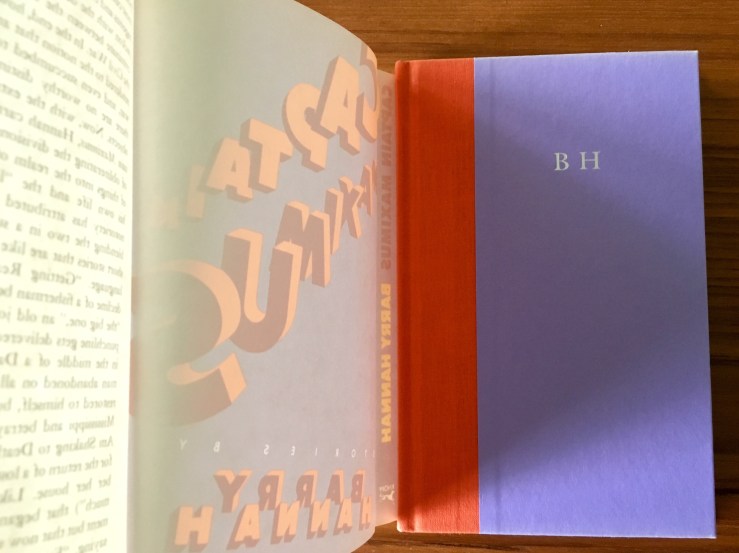
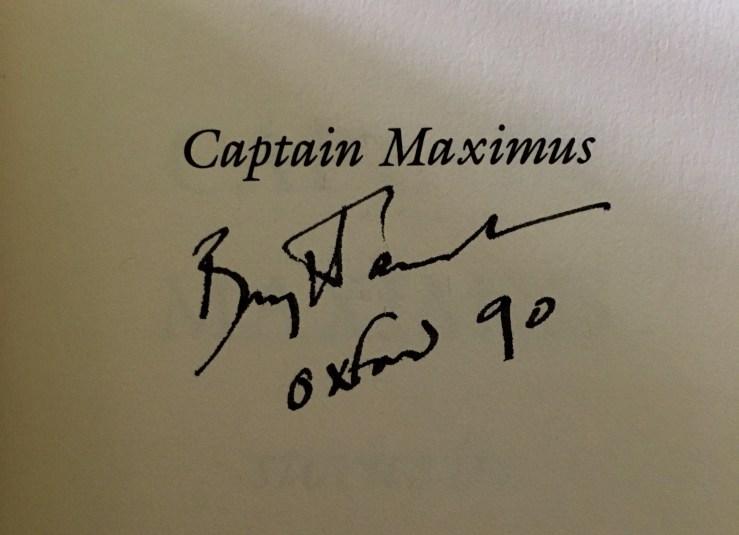
Earlier this summer I visited Alias East Books East in Los Angeles, where the clerk kindly let me handle a signed first edition of Barry Hannah’s novel Ray. It was like sixty bucks, so I didn’t handle it too fondly. But somehow the image of the signature rattled around in my silly skull all summer—probably because I spent a big chunk of July slurping up Long, Last, Happy. I wanted to find out some info about Hannah’s last quartet of stories—the last four stories in L, L, H—and doing a search of his name in Twitter led me to a link for a signed first-edition hardback copy of his slim 1985 collection Captain Maximus. (The title is a joke on his then-editor, Gordon “Captain Fiction” Lish, who apparently Hannah referred to as “Captain Minimus” in some of their letters). I might have had a scotch or two, but I bid on the book (eighteen bucks). No one else bid on it, so it’s mine now.

The cover is lovely, purple and orange, designed by Fred Marcellino, and under the bright shiny jacket is this:

img_7709

I love the reserved arrogance of those initials!

And of course the signature, dated five years after the book’s publication and geographically anchored to the town my grandfather and namesake attended college in—

img_7710

I didn’t actually own a copy of Captain Maximus beforehand, and I think the only stories from it included in Long, Last, Happy (which, by the way is a great starting place for Hannah) are “Fans,” “Ride, Fly, Penetrate, Loiter” and “Even Greenland” (you can read “Even Greenland” at Ben Marcus’s website). This particular copy has clearly never been read.  Which leads me to this afternoon. I went to my favorite used bookstore to pick up a copy of Ishmael Reed’s The Terrible Threes—I just finished The Terrible Twos, a novel that is too prescient and too funny and too cruel and you should read it read it read it—and well anyway, I went to see if maybe they had a copy of Yonder Stands Your Orphan, which they didn’t the last time I was there, but they did today. Under it was a well-thumbed 1986 Penguin paperback edition of Captain Maximus. I need to read Yonder (which hell by the way my god what a bad cover c’mon people) before I can write the Thing I want to write on the final stories in Long, Last, Happy (or at least I think I need to read it, or anyway, I want to). And the second copy of Captain Maximus, at three dollars in store credit, is something I don’t have to worry about cramming into a pocket or dropping into a bathtub or eventually giving away to a friend.

“Game” — Donald Barthelme

“Game”

by

Donald Barthelme


Shotwell keeps the jacks and the rubber ball in his attaché case and will not allow me to play with them. He plays with them, alone, sitting on the floor near the console hour after hour, chanting “onesies, twosies, threesies, foursies” in a precise, well-modulated voice, not so loud as to be annoying, not so soft as to allow me to forget. I point out to Shotwell that two can derive more enjoyment from playing jacks than one, but he is not interested. I have asked repeatedly to be allowed to play by myself, but he simply shakes his head. “Why?” I ask. “They’re mine,” he says. And when he has finished, when he has sated himself, back they go into the attaché case.

It is unfair but there is nothing I can do about it. I am aching to get my hands on them.

Shotwell and I watch the console. Shotwell and I live under the ground and watch the console. If certain events take place upon the console, we are to insert our keys in the appropriate locks and turn our keys. Shotwell has a key and I have a key. If we turn our keys simultaneously the bird flies, certain switches are activated and the bird flies. But the bird never flies. In one hundred thirty-three days the bird has not flown. Meanwhile Shotwell and I watch each other. We each wear a .45 and if Shotwell behaves strangely I am supposed to shoot him. If I behave strangely Shotwell is supposed to shoot me. We watch the console and think about shooting each other and think about the bird. Shotwell’s behavior with the jacks is strange. Is it strange? I do not know. Perhaps he is merely a selfish bastard, perhaps his character is flawed, perhaps his childhood was twisted. I do not know.

Each of us wears a .45 and each of us is supposed to shoot the other if the other is behaving strangely. How strangely is strangely? I do not know. In addition to the .45 I have a .38 which Shotwell does not know about concealed in my attaché case, and Shotwell has a .25 caliber Beretta which I do not know about strapped to his right calf. Sometimes instead of watching the console I pointedly watch Shotwell’s .45, but this is simply a ruse, simply a maneuver, in reality I am watching his hand when it dangles in the vicinity of his right calf. If he decides I am behaving strangely he will shoot me not with the .45 but with the Beretta. Similarly Shotwell pretends to watch my .45 but he is really watching my hand resting idly atop my attaché case, my hand resting atop my attaché case, my hand. My hand resting idly atop my attaché case. Continue reading ““Game” — Donald Barthelme” →

A review of Gisèle Prassinos’s collection of surreal anti-fables, The Arthritic Grasshopper

img_7667

I can’t remember which particular Surrealist I was googling when I learned about Gisèle Prassinos. I do know that it was just a few weeks ago, and I’ve had an interest in Surrealist art and literature since I was a kid, so I was a bit stunned that I’d never heard of her before now—strange, given the origin of her first publication. In 1934, when she was 14, Prassinos was “discovered” by André Breton, and the Surrealists delighted in what they called her “automatic writing.” (Prassinos would later reject that label, and go as far as to declare that she had never been a surrealist). Her first book, La Sauterelle arthritique (The Arthritic Grasshopper) was published just a year later.

1-work
Prassinos reading her work to the Surrealists; photograph by Man Ray


I somehow found a .pdf of one of her stories, “A Nice Family,” a bizarre little tale that runs on its own surreal mythology. The story struck me as simultaneously grandiose and miniature, dense but also skeletal. It was impossible. Surreal. I wanted more.

Luckily, just this spring Wakefield Press released The Arthritic Grasshopper: Collected Stories, 1934-1944, a new English translation of a 1976 compendium of Prassinos’s tales, Trouver sans checher. The translation is by Henry Vale and Bonnie Ruberg, whose introduction to the volume is a better review and overview than I can muster here. Ruberg offers a miniature biography, and shares details from her letters and visits with Prassinos. She situates Prassinos within the Surrealists’ gender biases: “For a young writer such as Prassinos, being involved with the surrealists would have meant gaining access to resources like publishers, but it also would have meant being fetishized and marginalized.” Ruberg characterizes Prassinos’s tales eloquently and accurately—no simple feat given the material’s utter strangeness:

Taken collectively, their effect is a piercing cackle, a complete disorientation, rather than an ethical lesson. The politics of these stories are absurdist. They upend the world by making children dangerous, by reanimating the dead, by letting the carefully tended domestic deform, foam, and melt. No social structure holds power in the world of these stories—not on the basis of gender, or nationality, or class. The force that reigns is chaos.

Let’s look at that reigning chaos.

In “The Sensitivity of Others,” one of the earliest tales in the volume, we get the sparest narrative action seemingly possible: A speaker walks forward. And yet dream-nightmare touches impinge on all sides and on all senses. The opening line shows a world that is never stable, and if monsters and other dangers lurk just on the margins of our narrator’s shifting path, so do wonders and the promise of strange knowledge. Here’s the tale in full:

img_7666

I still have no idea what to make of the punchline there at the end, but those final images—a father, a faulty library, a power failure—hang heavy against the narrator’s trembling walk.

Many of Prassinos’s anti-fables conclude with such apparent non sequiturs, and yet the final lines can also cast a weird light back over the previous sentences. In “Photogenic Quality,” a dream-tale about the act of writing itself, the final line at first appears as sheer absurdity. A man receives a pencil from a child, whittles it into powder, blots the powder on paper, and throws the paper in the river (more things happen, too). The tale concludes with the man declaring, “Brass is made from copper and tin.” It’s possible to enjoy the absurdity here on its own; however, I think we can also read the last line as a kind of Abracadabra!, magic words that describe an almost alchemical synthesis—a synthesis much like the absurd modes of transformative writing that “Photogenic Quality” outlines.

img_7664

You’ll see above one of Allan Kausch’s illustrations for The Arthritic Grasshopper. Kausch’s collages pointedly recall Max Ernst’s surreal 1934 graphic novel Une semaine de bonté (A Week of Kindness). Kausch’s work walks a weird line between horror and whimsy; images from old children’s books and magazines become chimerical figures, sometimes cute, sometimes horrific, and sometimes both. They’re lovely.

img_7663

Surreal figures shift throughout the book—monks and kings, daughters and mothers, deep sea divers and knights and salesmen and talking horses—all slightly out of place, or, rather, all making new places. Even when Prassinos establishes a traditional space we might think we recognize—often a fairy trope—she warps its contours, shaping it into something else. “A Marriage Proposal,” with its unsuspecting title, opens with “Once upon a time” — but we are soon dwelling in impossibility: “the garter snake appeared in the doorway, arm in arm with the snail, who was slobbering with happiness.” Other stories, like “Tragic Fanaticism,” immediately condense fairy tales into pure images, leaving the reader to suss out connections. Here is that story’s opening line: “A black hole, a little old woman, animals.” At five pages, “Tragic Fanaticism” is one of the collection’s longer stories. It ends with a four line poem, sung by five red cats to the old woman: “Go home and burn / Darling / You’re the only one we’ll love / Trash Bin.”

I still have a number of stories to read in The Arthritic Grasshopper. I’ve enjoyed its tales most when taken as intermezzos between sterner (or compulsory) reading. There’s something refreshing in Prassinos’s illogic. In longer stretches, I find that I tire, get lazy—Prassinos’s imagery shifts quickly—there’s something even picaresque to the stories—and keeping up with its veering rhythms for tale after tale can be taxing. Better not to gobble it all up at once. In this sense, The Arthritic Grasshopper reminds me strongly of another recently-published volume of surreal, imagistic stories that I’ve been slowly consuming this year: The Complete Stories of Leonora Carrington. In their finest moments, both of these writers can offer new ways of looking at art, at narrative, at the world itself.

I described Prassinos’s tales as “anti-fables” above—a description that I think is accurate enough, as literary descriptions go—but that doesn’t mean there isn’t something that we can learn from them (although, to be very clear, I do not think literature has to offer us anything to learn). What Prassinos’s anti-fables do best is open up strange impossible spaces—there’s a kind of radical, amorphous openness here, one that might be neatly expressed in the original title to this newly-translated volume—Trouver sans checher—To Find without Seeking.

In her preface (titled “To Find without Seeking”) Prassinos begins with the question, “To find what?” Here is a question that many of us have been taught we must direct to all the literature we read—to interrogate it so that it yields moral instruction. Prassinos answers: “The spot where innocence rejoices, trembling as it first meets fear. The spot where innocence unleashes its ferocity and its monsters.” She goes on to describe a “true and complete world” where the “earth and water have no borders and each us can live there if we choose, in just the same way, without changing our names.” Her preface concludes by repeating “To find what?”, and then answering the question in the most perfectly (im)possible way: “In the end, the mind that doesn’t know what it knows: the free astonishing voice that speaks, faceless, in the night.” Prassinos’s anti-fables offer ways of reading a mind that doesn’t know what it knows, of singing along with the free faceless astonishing voice. Highly recommended.

Flannery O’Connor on Carson McCullers

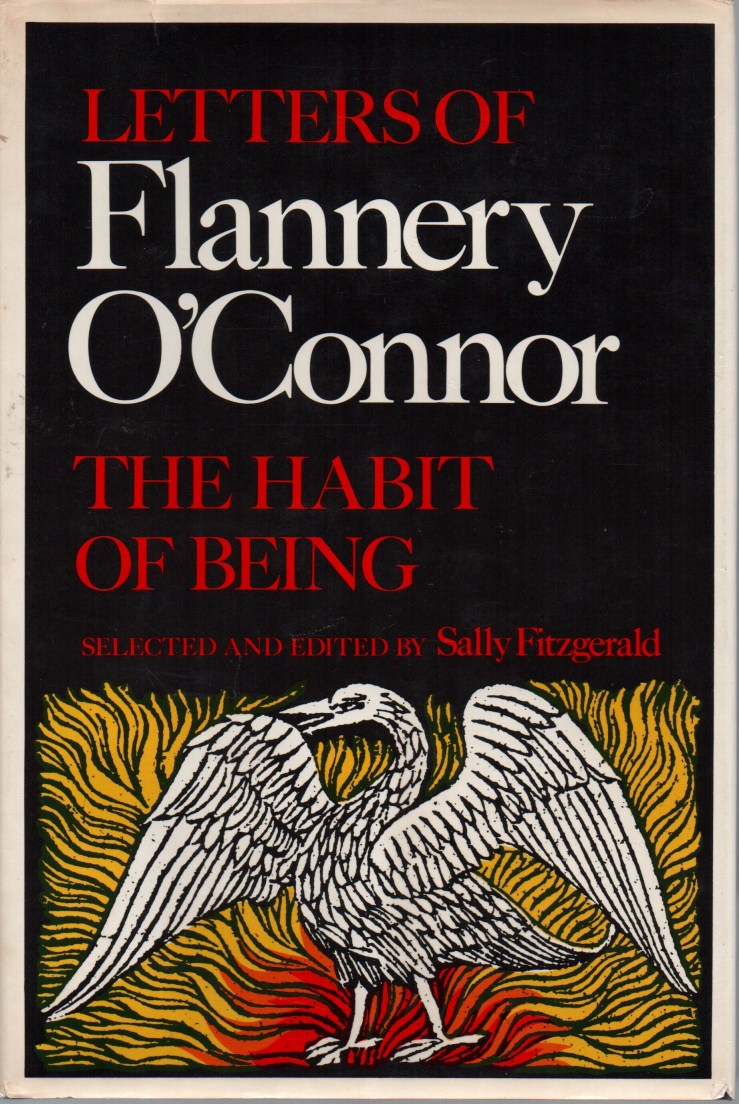
All of the times that Flannery O’Connor mentions Carson McCullers in her letters collected in The Habit of Being: Letters of Flannery O’Connor:

IMG_0525

I read in the paper that Carson McCullers is going to have a play shortly to be called The Square Root of Wonderful—a title that makes me cringe. (8 Oct. 1957)

…Paul Levine [is] preparing a book on 6 writers—McCullers, Capote, Buechner, Bellow, Salinger, and me… (25 June 1960)

I haven’t read [Frederick] Buechner myself, but if I was writing it I would throw out Capote in favor of Malamud and Carson McCullers in favor of [J.F.] Powers. (9 July 1960)

Last week Houghton Mifflin sent me a book called Clock Without Hands by Carson McCullers. This long-awaited-by-the-faithful book will come out in September. I believe it is the worst book I have ever read. It is incredible…It must signal the complete disintegration of this woman’s talent. I have forgotten how the other three were, but they were at least respectable from the writing standpoint. (26 July 1961)

If you ever go to the Albee-McCullers [play] let me know what you think about it? … Did you ever consider Wise Blood as a possibility for dramatizing? If the times were different I would suggest that, but I think it would just be taken for the super-grotesque sub-Carson McCullers sort of thing that I couldn’t stand the sight or sound of. (5 Nov. 1963)

I was interested in the reviews of the Carson McCullers adaptation. I dislike intensely the work of Carson McCullers but it is interesting to see what is made of it in the theatre, and by Edward Albee at that. (28 Nov. 1963)


Anxiety of influence (Barry Hannah’s “ideal inner voices”)

The fact is I wanted to write long before I had anything to say. I don’t find this condition at all unusual in young writers, good or bad. A sort of attuned restlessness. Often it is simply an overriding need to talk. A sort of transcribed logorrhea, worse than decent gossip. I’ve taught these people, forever blasting away in wretched detail, solidly in love with their own noise. I must say, I was never infatuated with my own voice. It was the ideal inner voices that took me, and they came from everywhere, especially Hemingway, Joyce, Henry Miller, and later, Flannery O’Connor. Like many Mississippians, I shied away from Faulkner, who was at once remote and right there in your own backyard, the powerful resident alien. Having read a little of him, I sensed I would be overcome by him, and had a dread, in fact, that he might be the last word. That I would wind up a pining third-rate echo, like many another Southerner. Then T.S. Eliot, especially “Prufrock.” But the earliest great howler who made me want to make the team was the badly forgotten Dylan Thomas, whose voice seemed available everywhere in English departments in the ’50s and ’60s. It seemed to me a fine thing to get drunk and just start being Welsh and crowing surrealism, as I perceived it. Put that against the sullen bitchery of Holden Caulfield, which charmed almost everybody my age, and you would be cooking. Miles Davis might one day shake your hand. He was God, and that would be very nice.

From Barry Hannah’s essay “Why I Write”; read the whole thing at The Oxford American.

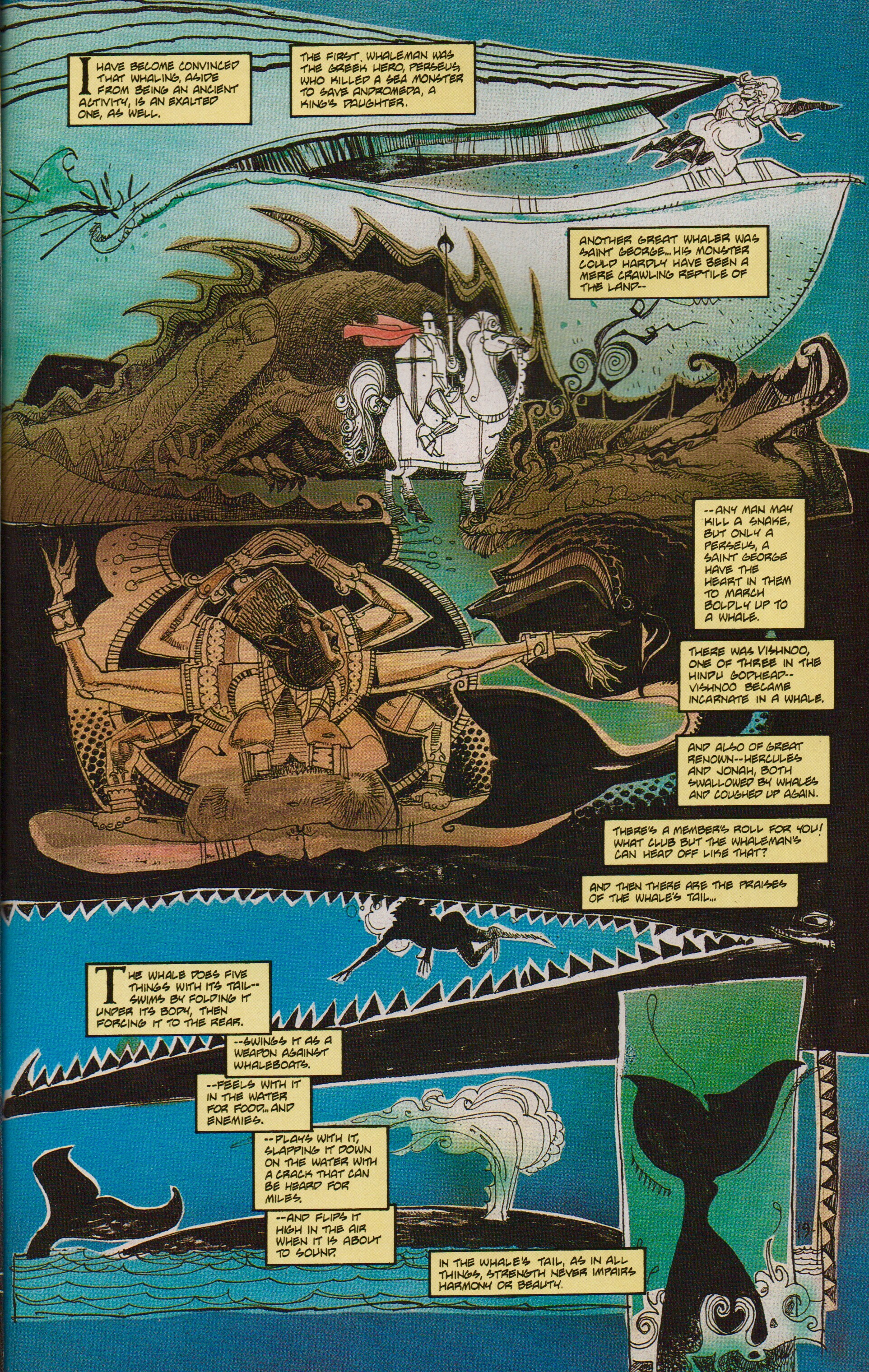
Perseus, whaleman (Melville/Sienkiewicz)

img_7584

From Bill Sienkiewicz’s adaptation of Herman Melville’s Moby-Dick. The Classics Illustrated edition (February 1990) is one of my favorite Moby-Dicks.

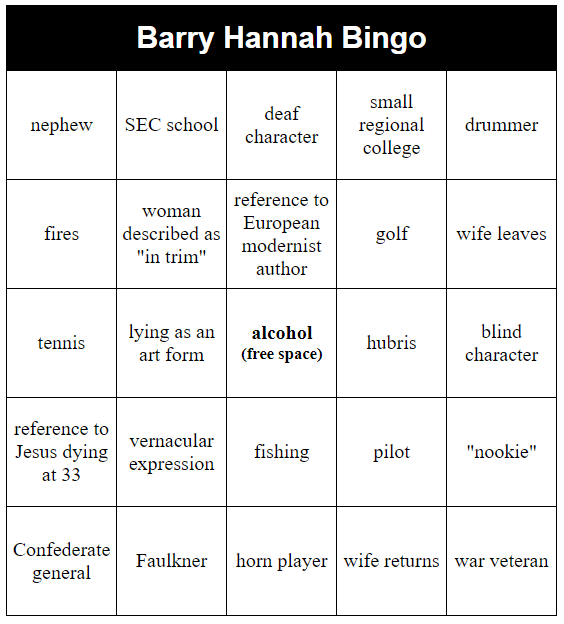
Barry Hannah Bingo

barry hannah bingo

Nathaniel Hawthorne’s journal entry for Thursday, July 20th, 1837

Thursday, July 20th.–A drive yesterday afternoon to a pond in the vicinity of Augusta, about nine miles off, to fish for white perch. Remarkables: the steering of the boat through the crooked, labyrinthine brook, into the open pond,–the man who acted as pilot,–his talking with B—- about politics, the bank, the iron money of “a king who came to reign, in Greece, over a city called Sparta,”–his advice to B—- to come amongst the laborers on the mill-dam, because it stimulated them “to see a man grinning amongst them.” The man took hearty tugs at a bottle of good Scotch whiskey, and became pretty merry. The fish caught were the yellow perch, which are not esteemed for eating; the white perch, a beautiful, silvery, round-backed fish, which bites eagerly, runs about with the line while being pulled up, makes good sport for the angler, and an admirable dish; a great chub; and three horned pouts, which swallow the hook into their lowest entrails. Several dozen fish were taken in an hour or two, and then we returned to the shop where we had left our horse and wagon, the pilot very eccentric behind us. It was a small, dingy shop, dimly lighted by a single inch of candle, faintly disclosing various boxes, barrels standing on end, articles hanging from the ceiling; the proprietor at the counter, whereon appear gin and brandy, respectively contained in a tin pint-measure and an earthenware jug, with two or three tumblers beside them, out of which nearly all the party drank; some coming up to the counter frankly, others lingering in the background, waiting to be pressed, two paying for their own liquor and withdrawing. B—- treated them twice round. The pilot, after drinking his brandy, gave a history of our fishing expedition, and how many and how large fish we caught. B—- making acquaintances and renewing them, and gaining great credit for liberality and free-heartedness,–two or three boys looking on and listening to the talk,–the shopkeeper smiling behind his counter, with the tarnished tin scales beside him,–the inch of candle burning down almost to extinction. So we got into our wagon, with the fish, and drove to Robinson’s tavern, almost five miles off, where we supped and passed the night In the bar-room was a fat old countryman on a journey, and a quack doctor of the vicinity, and an Englishman with a peculiar accent. Seeing B—-‘s jointed and brass-mounted fishing-pole, he took it for a theodolite, and supposed that we had been on a surveying expedition. At supper, which consisted of bread, butter, cheese, cake, doughnuts and gooseberry-pie, we were waited upon by a tall, very tall woman, young and maiden-looking, yet with a strongly outlined and determined face. Afterwards we found her to be the wife of mine host. She poured out our tea, came in when we rang the table-bell to refill our cups, and again retired. While at supper, the fat old traveller was ushered through the room into a contiguous bedroom. My own chamber, apparently the best in the house, had its walls ornamented with a small, gilt-framed, foot-square looking-glass, with a hair-brush hanging beneath it; a record of the deaths of the family written on a black tomb, in an engraving, where a father, mother, and child were represented in a graveyard, weeping over said tomb; the mourners dressed in black, country-cut clothes; the engraving executed in Vermont. There was also a wood engraving of the Declaration of Independence, with fac-similes of the autographs; a portrait of the Empress Josephine, and another of Spring. In the two closets of this chamber were mine hostess’s cloak, best bonnet, and go-to-meeting apparel. There was a good bed, in which I slept tolerably well, and, rising betimes, ate breakfast, consisting of some of our own fish, and then started for Augusta. The fat old traveller had gone off with the harness of our wagon, which the hostler had put on to his horse by mistake. The tavern-keeper gave us his own harness, and started in pursuit of the old man, who was probably aware of the exchange, and well satisfied with it.

Our drive to Augusta, six or seven miles, was very pleasant, a heavy rain having fallen during the night, and laid the oppressive dust of the day before. The road lay parallel with the Kennebec, of which we occasionally had near glimpses. The country swells back from the river in hills and ridges, without any interval of level ground; and there were frequent woods, filling up the valleys or crowning the summits. The land is good, the farms look neat, and the houses comfortable. The latter are generally but of one story, but with large barns; and it was a good sign, that, while we saw no houses unfinished nor out of repair, one man at least had found it expedient to make an addition to his dwelling. At the distance of more than two miles, we had a view of white Augusta, with its steeples, and the State-House, at the farther end of the town. Observable matters along the road were the stage,–all the dust of yesterday brushed off, and no new dust contracted,–full of passengers, inside and out; among them some gentlemanly people and pretty girls, all looking fresh and unsullied, rosy, cheerful, and curious as to the face of the country, the faces of passing travellers, and the incidents of their journey; not yet damped, in the morning sunshine, by long miles of jolting over rough and hilly roads,–to compare this with their appearance at midday, and as they drive into Bangor at dusk; two women dashing along in a wagon, and with a child, rattling pretty speedily down hill;–people looking at us from the open doors and windows;–the children staring from the wayside;–the mowers stopping, for a moment, the sway of their scythes;–the matron of a family, indistinctly seen at some distance within the house her head and shoulders appearing through the window, drawing her handkerchief over her bosom, which had been uncovered to give the baby its breakfast,–the said baby, or its immediate predecessor, sitting at the door, turning round to creep away on all fours;–a man building a flat-bottomed boat by the roadside: he talked with B—- about the Boundary question, and swore fervently in favor of driving the British “into hell’s kitchen” by main force.

Colonel B—-, the engineer of the mill-dam, is now here, after about a fortnight’s absence. He is a plain country squire, with a good figure, but with rather a heavy brow; a rough complexion; a gait stiff, and a general rigidity of manner, something like that of a schoolmaster. He originated in a country town, and is a self-educated man. As he walked down the gravel-path to-day, after dinner, he took up a scythe, which one of the mowers had left on the sward, and began to mow, with quite a scientific swing. On the coming of the mower, he laid it down, perhaps a little ashamed of his amusement. I was interested in this; to see a man, after twenty-five years of scientific occupation, thus trying whether his arms retained their strength and skill for the labors of his youth,–mindful of the day when he wore striped trousers, and toiled in his shirt-sleeves,–and now tasting again, for pastime, this drudgery beneath a fervid sun. He stood awhile, looking at the workmen, and then went to oversee the laborers at the mill-dam.

Nathaniel Hawthorne’s journal entry for Thursday, July 20th, 1837

Figures of Absence: On Austerlitz, Adorno; Quotation, Coincidence (Part 2)

This is Part 2 of my post on Adorno and Sebald’s Austerlitz. In Part 1, I talked about Sebald and Adorno’s (negative) aesthetics, and challenges the latter presents to the former. Here, I discuss quotational technique as a form of coincidence, and how Sebald uses coincidence to introduce history without being didactic. I discuss quotation’s use in a reading of the scene in the Liverpool Street station, Adorno’s Minima Moralia, and end with a reading of the Bibliotheque Nationale de France scene.


Part 2

It may seem like an obvious observation, but Sebald must disguise and compensate for authorial arbitration. The goal of liberating content from such arbitration, Adorno argues in Minima Moralia, is a necessary & impossible fictional standpoint the philosopher must take for the sake of resistant thought (MM 247). Both he and Adorno share the desire to reclaim for their subjects the capacity for experience, but an Adornian mode risks segregating Austerlitz from the present and thereby fixing him into the past and hence foreclosing that very capacity. We will return to the “Finale” of Minima Moralia shortly, but I would first like to talk about the emergence of history as coincidence in the opening passages of Austerlitz.

Coincidences, the unplanned contact between two mutually exclusive objects which does not promise meaning, are enigma’s second cousin, and enable the emergence of history to appear natural because they are especially adept at disguising arbitrary decision. Coincidences don’t occur in literature, but they are engineered to happen.

Continue reading “Figures of Absence: On Austerlitz, Adorno; Quotation, Coincidence (Part 2)” →