“…the amazing, world-reversing night of Fourth of July Eve 1899″ (Pynchon’s Against the Day)

For years after, there were tales told in Colorado of the amazing, world-reversing night of Fourth of July Eve 1899. Next day’d be full of rodeos, marching bands, and dynamite explosions—but that night there was man-made lightning, horses gone crazy for miles out into the prairie, electricity flooding up through the iron of their shoes, shoes that when they finally came off and got saved to use for cowboy quoits, including important picnic tourneys from Fruita to Cheyenne Wells, why they would fly directly and stick on to the spike in the ground, or to anything else nearby made of iron or steel, that’s when they weren’t collecting souvenirs on their way through the air—gunmen’s guns came right up out of their holsters and buck knives out from under pants legs, keys to traveling ladies’ hotel rooms and office safes, miners’ tags, fencenails, hairpins, all seeking the magnetic memory of that long-ago visit. Veterans of the Rebellion fixing to march in parades were unable to get to sleep, metallic elements had so got to humming through their bloodmaps. Children who drank the milk from the dairy cows who grazed nearby were found leaning against telegraph poles listening to the traffic speeding by through the wires above their heads, or going off to work in stockbrokers’ offices where, unsymmetrically intimate with the daily flow of prices, they were able to amass fortunes before anyone noticed. .

A passage from Thomas Pynchon’s novel Against the Day.

A review of Harold Brodkey’s First Love and Other Sorrows

One way to measure how great a work of literature is might be to ask how true (or “True,” if one is feeling particularly romantic) the writing is. We can find facts anywhere, but details and data are not the same as art. Great literature happens in the arrangement of that data, by presenting details with the right ear and eye for truth—and also, the good sense to know what to withhold from the audience, who, after all, are a part of the equation. The stories collected in Harold Brodkey’s First Love and Other Sorrows, both inspiriting and crushing, are some of the most psychologically true pieces of fiction I’ve ever read.

First Love collects nine stories, all composed and published in the 1950s; all but one was originally published in The New Yorker. Although discrete entities, the stories function together. First Love is very much a novel-in-stories, with recurring characters, themes, and motifs. Brodkey’s stories document the strange little bubble of time between WWII and the turmoil of the sixties, and his writing, a kind of late modernism, reflects this period, when the ideal of the American Dream began to be redefined in terms of new modes of class and education.

The first few stories in the collection are told from the first-person perspective of an adolescent, likely an iteration of Brodkey himself. Opener “State of Grace” serves as an overture to the collection, introducing a family that will be transposed throughout the tales. There’s the narrator, a sensitive, awkward boy, beginning to feel strains of alienation from his older sister and his mother. Dad is out of the picture, and with him, the family’s fortunes have fallen: big sis is expected to marry the right man for money—and for class.

These themes are explored in greater length in the very-long short story “First Love and Other Sorrows,” a compact little novella, really, that everyone should read at some point. The narrator, likely the same boy from the first story, describes his life at the end of his high school career in St. Louis, as he prepares to move on to college soon. Again, the major explicit conflict of the story revolves around his sister’s romances, as their mother pressures her to marry the right man. The real conflict though is the boy’s emerging realization of his own dramatic detachment from his family; or, more accurately, the young man is coming to realize the underlying instability that adults tend to hide from children. The boy observes his older sister, whom he reveres—

It occurred to me that she didn’t really know what she was doing; she was not really as sure of everything as she seemed. It was a painfully difficult thought to arrive at, and it clung to me. Why hadn’t I realized it before? Also, she sort of hated me, it seemed to me. I had never noticed that before, either. How could I have been so wrong, I wondered. Knowing how wrong I had been about this, I felt that no idea I had ever had was safe. For instance, we were not necessarily a happy family, with the most wonderful destinies for my sister and me. We might make mistakes and choose wrong. Unhappiness was real. It was even likely…

The narrator’s epiphany is articulate and crushing and wholly real: it documents the ugly realization that the fantasies of a middle class childhood — “happily ever after” — are, indeed, mere fantasies. Brodkey twins this moment in another epiphany at the end of the story that I would love to discuss but fear spoiling; suffice to say that the final line of the story, forever etched in my brain, is simply one of the finest and most fitting moments I’ve ever read.

The next story, “The Quarrel,” finds our young hero, a bit more jaded, off to Harvard, where he falls in with a bitter rich kid named Duncan; they quickly make it their business to despise everything, adopting (unearned) world-weary poses and contrarian natures. Against the advice of their families, the two take a semester off college to tour Europe, spending much of their time bicycling across France. The story documents the kind of friendships that many young people emerging from adolescence engage in: fierce, passionate, identity-defining relationships that always buckle under their own weight. Hence—

Duncan enjoyed Pernod. It made me sick. Duncan hated talking to people. I talked to everyone. My French vocabulary was better than Duncan’s. His pronunciation was better than mine. I became terribly adept at not irritating Duncan before breakfast. I couldn’t see that he appreciated any of this, or that he responded with any similar awareness. For the fiftieth time, I thought him unfair. The moment came when I could no longer stand the sound of his voice, or his ideas. After traveling with him day and night, without a break, for fifty-three days, I felt my senses suffocating in an awareness of Duncan.

“The Quarrel” perfectly captures the strange paradoxes of youthful, immature friendships that can’t survive; reading it forced me to remember myself at eighteen, and to recall a friendship similar to that between the narrator and Duncan, an intense friendship that burned out bitterly and quickly, yet nevertheless helped me to define myself.

“The Quarrel” is the last story in the collection written in first-person perspective; indeed, Brodkey’s narrative shift signals a shift in development; as his characters age (as they do through the collection), he allows himself to step outside of them a bit, as if the psychological pain he explores is almost too much to bear. “Sentimental Education” tells the story of an intense first love (the male lead seems like another iteration of the narrator from the first three stories). In a free indirect style, Brodkey glamorizes, valorizes, and satirizes the young lovers, all at once, exploring the passion and shame and confusion of early adulthood. Here, he describes what happens when the pair begin a sexual relationship—

Their first dip in sensual waters left them nonplussed. They didn’t know what to make of it. They tried to persuade themselves that something had really happened, but the minute it was over, they couldn’t believe they had ever done such a thing. They rushed into further experiences; they broke off in the middle of embraces and looked at each other, stunned and delighted. “Is this really happening?” they both asked at different times, and each time the other said, “No,” and they would laugh. They knew that nothing they did was real, was actual. They had received a blow on the head and were prey to erotic imaginings, that was all. But at the same time they half realized it was true, they were doing these things, and then the fact that they, Caroline and Elgin, shared such intimacy dazed and fascinated them; and when they were together, they tried to conceal it, but this indescribable attraction they felt for each other kept making itself known and draining all the strength from their bodies.

“Sentimental Education” retraces the fallout explored in “The Quarrel,” as the young lovers inevitably fall apart.

After this love story, Brodkey shifts his attention to a character named Laura (or, in one version, “Laurie”), who seems to be a version of the narrator’s sister from the first few stories. The five Laura stories are much shorter than the other narratives. These tightly detailed miniature portraits trace the development of Laura as she chooses the man her mother didn’t approve of; this plot is very much in the background of the stories, though, an implicit detail that nevertheless hangs over Laura’s psychological development. The Laura stories seem to trace what it means to grow old but not mature. They recall the narrator in “First Love and Other Stories” epiphany that adulthood might be a murky or unhappy place. “Laura” documents postpartum depression and “Trio for Three Gentle Voices” subtly explores the ways in which parents seek to avoid repeating their own parents’ mistakes. “Piping Down the Valley’s Wild” is a simple, elegant story about Laura’s husband’s college roommate coming over for dinner. Reading it, I experienced an uncanny transposition, as if I were observing a reinterpretation of something I experienced a few weekends ago. The story ends with another sad epiphany—

She just wanted this day to go on forever and ever, unending, with all its joys intact, and no one changing, nothing new happening, just these same things occurring over and over. Because how did you know happiness would come back? Or if it came back, that it would be as good as this? Laura sighed and wiped her eyes surreptitiously. The trouble with being happy was that it made you frightened.

This realization again encodes the paradox of adulthood, pointing toward its radical instability. To grow up, in Brodkey’s terms (terms I again point out strike me as utterly true) is to face irretrievable loss at every single moment, even as you gain new friends, new lovers, or new children. The joys of life are predicated on the necessary loss of these joys: existence costs.

First Love and Other Sorrows is a book that deserves more attention. In its spirit and art, it matches (and surpasses) other mid-century American narratives like The Catcher in the Rye or The Glass Menagerie, and in its spare, precise, minimal style, it points toward the later fiction of writers like Raymond Carver. This is a beautiful, sad book, the kind that leaves a deep impression. Very highly recommended.

[Ed. note: Biblioklept posted a version of this review in April of 2011].

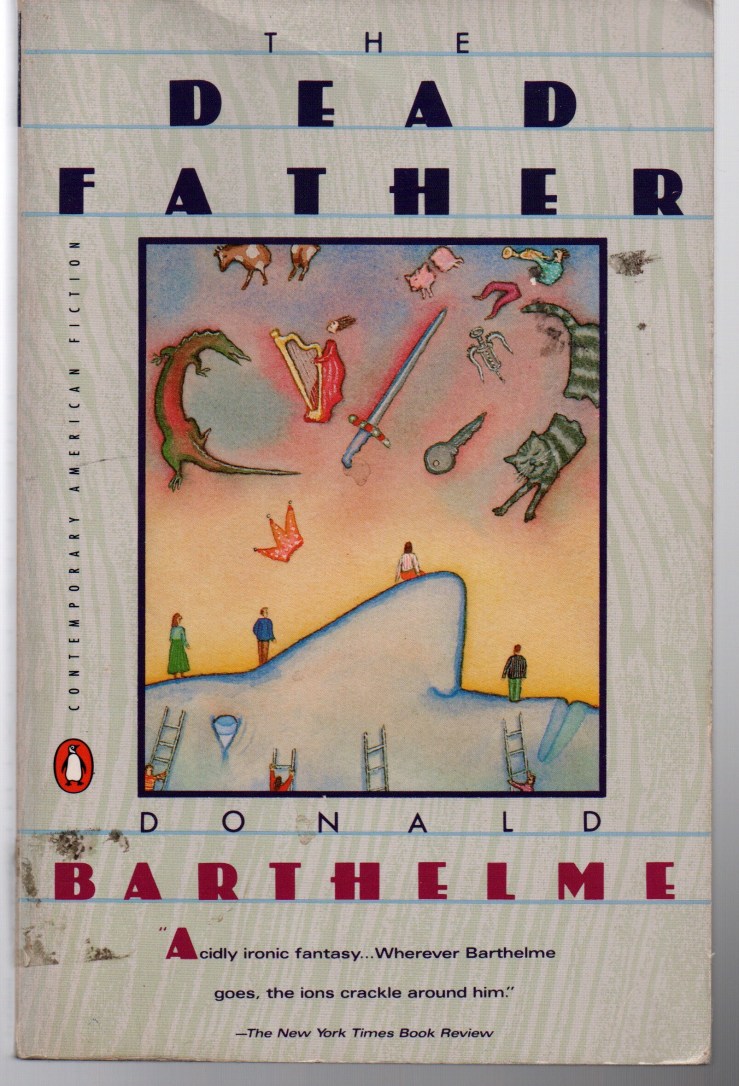
“Patricide: Patricide is a bad idea” (Donald Barthelme)

img_2676

Patricide: Patricide is a bad idea, first because it is contrary to law and custom and second because it proves, beyond a doubt, that the father’s every fluted accusation against you was correct: you are a thoroughly bad individual, a patricide! — member of a class of persons universally ill-regarded. It is all right to feel this hot emotion, but not to act upon it. And it is not necessary. It is not necessary to slay your father, time will slay him, that is a virtual certainty. Your true task lies elsewhere. Your true task, as a son, is to reproduce every one of the enormities touched upon in this manual, but in attenuated form. You must become your father, but a paler, weaker version of him. The enormities go with the job, but close study will allow you to perform the job less well than it has previously been done, thus moving toward a golden age of decency, quiet, and calmed fevers. Your contribution will not be a small one, but “small” is one of the concepts that you should shoot for. If your father was a captain in Battery D, then content yourself with a corporalship in the same battery. Do not attend the annual reunions. Do not drink beer or sing songs at the reunions. Begin by whispering, in front of a mirror, for thirty minutes a day. Then tie your hands behind your back for thirty minutes a day, or get someone else to do this for you. Then, choose one of your most deeply held beliefs, such as the belief that your honors and awards have something to do with you, and abjure it. Friends will help you abjure it, and can be telephoned if you begin to backslide. You see the pattern, put it into practice. Fatherhood can be, if not conquered, at least “turned down” in this generation — by the combined efforts of all of us together.

From Donald Barthelme’s novel The Dead Father.

and yes I said yes I will recycle this Bloomsday blog again Yes

Portrait of James Joyce by Djuna Barnes

How to read Ulysses

What did Leopold actually do on June 16th, 1904?

About Bloomsday 1.0

Ulysses art by Roman Muradov

Selections from one-star Amazon reviews of Ulysses


joyce_ulysses-p2

A list of Irish heroes (from “The Cyclops” episode of Ulysses)

Another page of Joyce’s notes, plus links to more

James Joyce talks dirty

Filming Finnegans

1a80324af65201cb680a96af1f9e7f1c

James Joyce’s eye glasses prescription

William Faulkner’s Joyce anxiety

Ezra Pound on James Joyce

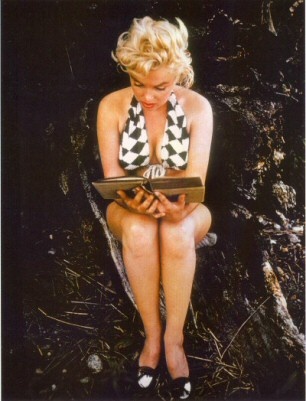
Marilyn Monroe reads Molly 

Biblioklept’s lousy review (the review is lousy, not the book) of Dubliners

Joyce’s entry on the 1901 Irish Census

Joyce’s caricature of Leopold Bloom

Biblioklept’s review (not so lousy, the review) of a superior full-cast audio recording of Ulysses

James Joyce explains why Odysseus is the most “complete man’ in literature

Leopold’s Bloom’s recipe for burnt kidney breakfast

“What in water did Bloom, waterlover, drawer of water, watercarrier, returning to the range, admire?”

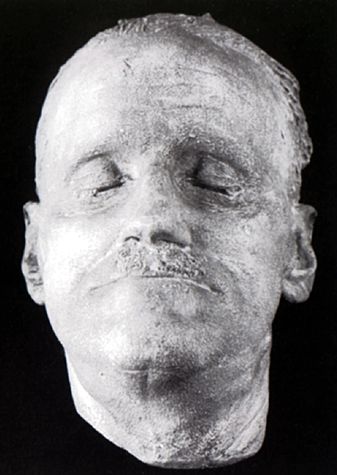
James Joyce’s death mask


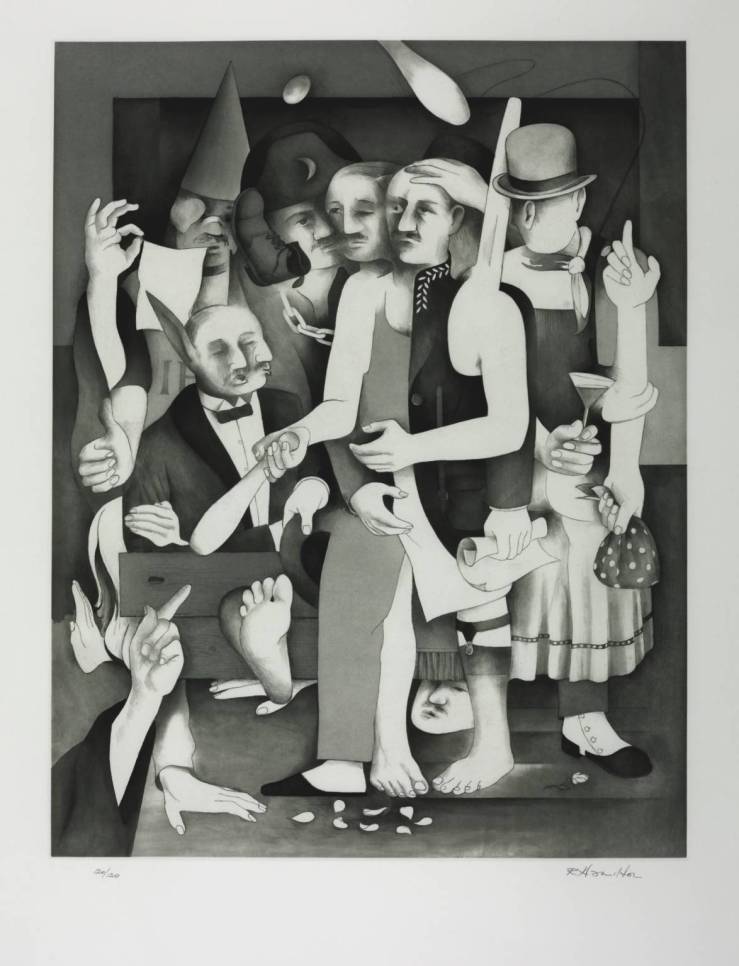
The Transmogrifications of Bloom — Richard Hamilton

P77484_10.jpg

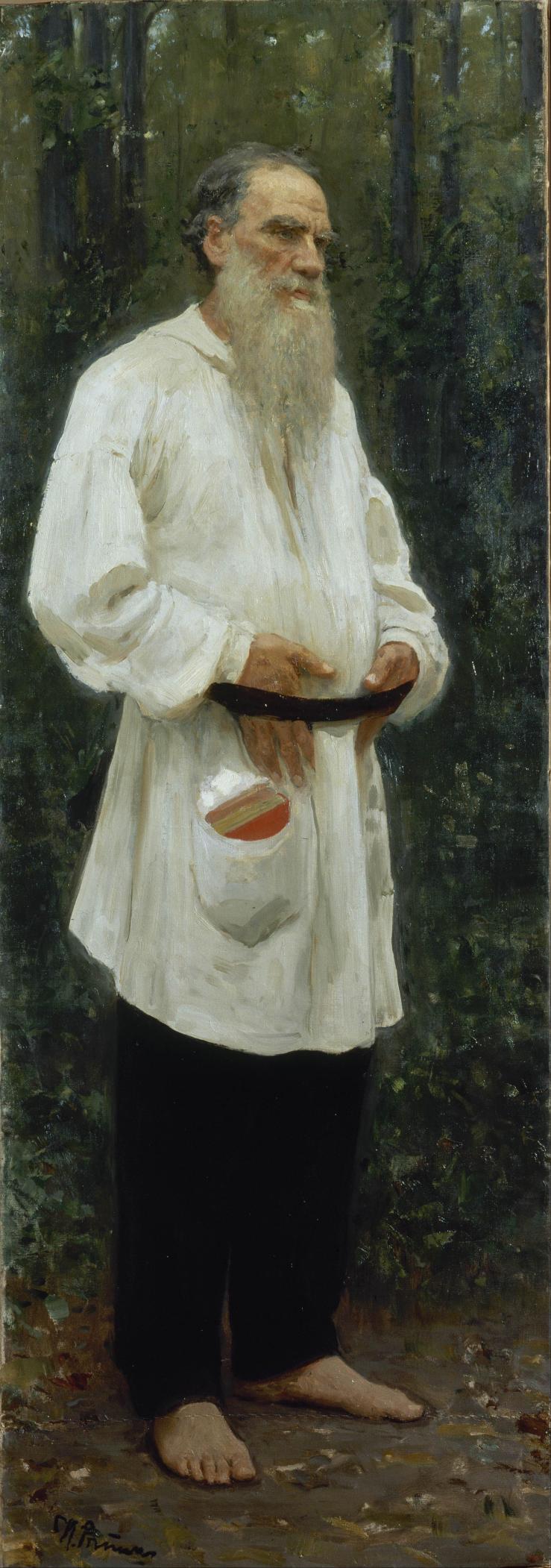
A review of Leo Tolstoy’s final work, Hadji Murad

ilya_repin_-_leo_tolstoy_barefoot_-_google_art_project-1457AC8C0DE4F21084B
Leo Tolstoy Barefoot, 1901 by Ilya Repin

Like many readers of Leo Tolstoy’s final work, Hadji Murad, I read the novella based on Harold Bloom’s praise in his work The Western Canon, where he declares it “my personal touchstone for the sublime of prose fiction, to me the best story in the world, or at least the best I have ever read.” It wasn’t just Bloom’s praise that attracted me to Hadji Murad—I had just finished Jonathan Littell’s bizarre opus The Kindly Ones, which devotes a lengthy section to WWII’s Eastern front in the Caucus mountains; Littell’s chapter traces the fallout after decades of Russian incursions. Hadji Murad takes place in 1851 and 1852 as the Caucasian people resist the encroaching Russian Empire. Littell’s book piqued my curiosity about a part of the world that still seems strange and alien, a genuinely multicultural place that signals the traditional border of East and West.

I’ll also admit that I’ve never really read Tolstoy, and the prospect of beginning with a novella was intriguing.

Hadji Murad tells the story of the real-life Caucasian Avar general Hadji Murad who fought under Imam Shamil, the leader of the Muslim tribes of the Northern Caucuses; Shamil was Russia’s greatest foe. The story begins in media res as Hadji Murad and two of his lieutenants flee from Shamil’s camp. Because of a feud born from familial drama, Shamil decides that Hadji Murad must die. The Imam captures and imprisons the rebel’s family. Hadji Murad begins the process of going over to the Russians; he plans to defect and then head a Russian-backed army to defeat Shamil. This is the basic plot—I will spoil no more.

In his essay “Leo Tolstoy, Two Hussars” (collected in Why Read the Classics?), Italo Calvino suggests—

It is not easy to understand how Tolstoy constructs his narratives. What other fiction writers make explicit – symmetrical patterns, supporting structures, counterbalances, link sequences — all remain hidden in Tolstoy. But hidden does not mean non-existent: the impression Tolstoy conveys of transferring ‘life’ just as it is on to the page (‘life’, that mysterious entity to define which we have to start from the written page) is actually merely the result of his artistry, that is to say an artifice that is more sophisticated and complex than many others.

Although Calvino writes of Two Hussars, his remarks are equally true of Hadji Murad. Tolstoy’s radical realism at times so disorients that it becomes hard to pick up the themes of the novella. Tolstoy, the grand director, shifts the action from his hero Hadji Murad to train his camera on an apparently insignificant character—for example, Butler, a happy-go-lucky Russian soldier with a Romantic outlook and a gambling problem. Then Tolstoy might focus on Prince Vorontsov and his wife Maria, who command at the Russian fortress Vozdvizhenskaya. In a wonderful setpiece, Tolstoy shows us a state dinner bristling with gossip and mannered energy. In another section, Tolstoy lets his camera follow bulky Czar Nicholas I, a vain womanizer who cannot see how disconnected he is from his subjects. The Czar cannot fathom the visceral consequences of his decisions. Yet Tolstoy makes no effort to connect the bloodshed in a massacre of a Chechen village to the Czar’s ambivalence or the richness of the dinner party. These connections are left to the reader.

The novella is almost a puzzle: the chapters are distinct setpieces that the reader must connect in order to see a bigger picture. This analysis should not suggest, however, any murkiness or ambiguity in Tolstoy’s chapters (let alone sentences). Hadji Murad is lucid, clear, and very sober, even when it depicts violence, confusion, and drunkenness. As Calvino points out, Tolstoy’s art replicates the messiness of “real life” in a way that seems mimetically appropriate to “real life’s” complexity, and at the same time to allow the reader to intellectually engage the narrative. Calvino again—

That fullness of life which is so much praised in Tolstoy by experts on the author is in fact — in this tale as much as in the rest of his oeuvre — the acknowledgement of an absence. As in the most abstract of narrators, what counts in Tolstoy is what is not visible, not articulated, what could exist but does not.

Again, Hadji Murad should not be taken for a work of abstraction. It is crushingly literal and historically concrete. What Calvino refers to then is the abstraction of narrative construction, the apparent invisibility of motive and meaning. And this is why wise readers will enjoy Hadji Murad. It’s one of those texts that confronts its readers with a problem to puzzle out. It’s one of those books that one finishes, feels a little stunned—cheated even!—and then wakes up the next morning thinking about, possibly having dreamed about it that night. And what does one do then? Why, pick it up again of course. Highly recommended.

[Editorial note: Biblioklept originally ran a version of this review in June, 2011. That review neglected to include the names of the translators, Aylmer and Louise Maude].

Read Anton Chekhov’s short story “The Husband”

“The Husband”

by

Anton Chekhov

English translation by Constance Garnett


IN the course of the maneuvres the N—— cavalry regiment halted for a night at the district town of K——. Such an event as the visit of officers always has the most exciting and inspiring effect on the inhabitants of provincial towns. The shopkeepers dream of getting rid of the rusty sausages and “best brand” sardines that have been lying for ten years on their shelves; the inns and restaurants keep open all night; the Military Commandant, his secretary, and the local garrison put on their best uniforms; the police flit to and fro like mad, while the effect on the ladies is beyond all description.

The ladies of K——, hearing the regiment approaching, forsook their pans of boiling jam and ran into the street. Forgetting their morning deshabille and general untidiness, they rushed breathless with excitement to meet the regiment, and listened greedily to the band playing the march. Looking at their pale, ecstatic faces, one might have thought those strains came from some heavenly choir rather than from a military brass band.

“The regiment!” they cried joyfully. “The regiment is coming!”

What could this unknown regiment that came by chance to-day and would depart at dawn to-morrow mean to them?

Afterwards, when the officers were standing in the middle of the square, and, with their hands behind them, discussing the question of billets, all the ladies were gathered together at the examining magistrate’s and vying with one another in their criticisms of the regiment. They already knew, goodness knows how, that the colonel was married, but not living with his wife; that the senior officer’s wife had a baby born dead every year; that the adjutant was hopelessly in love with some countess, and had even once attempted suicide. They knew everything. When a pock-marked soldier in a red shirt darted past the windows, they knew for certain that it was Lieutenant Rymzov’s orderly running about the town, trying to get some English bitter ale on tick for his master. They had only caught a passing glimpse of the officers’ backs, but had already decided that there was not one handsome or interesting man among them…. Having talked to their hearts’ content, they sent for the Military Commandant and the committee of the club, and instructed them at all costs to make arrangements for a dance.

Their wishes were carried out. At nine o’clock in the evening the military band was playing in the street before the club, while in the club itself the officers were dancing with the ladies of K——. The ladies felt as though they were on wings. Intoxicated by the dancing, the music, and the clank of spurs, they threw themselves heart and soul into making the acquaintance of their new partners, and quite forgot their old civilian friends. Their fathers and husbands, forced temporarily into the background, crowded round the meagre refreshment table in the entrance hall. All these government cashiers, secretaries, clerks, and superintendents—stale, sickly-looking, clumsy figures—were perfectly well aware of their inferiority. They did not even enter the ball-room, but contented themselves with watching their wives and daughters in the distance dancing with the accomplished and graceful officers.

Among the husbands was Shalikov, the tax-collector—a narrow, spiteful soul, given to drink, with a big, closely cropped head, and thick, protruding lips. He had had a university education; there had been a time when he used to read progressive literature and sing students’ songs, but now, as he said of himself, he was a tax-collector and nothing more.

He stood leaning against the doorpost, his eyes fixed on his wife, Anna Pavlovna, a little brunette of thirty, with a long nose and a pointed chin. Tightly laced, with her face carefully powdered, she danced without pausing for breath—danced till she was ready to drop exhausted. But though she was exhausted in body, her spirit was inexhaustible…. One could see as she danced that her thoughts were with the past, that faraway past when she used to dance at the “College for Young Ladies,” dreaming of a life of luxury and gaiety, and never doubting that her husband was to be a prince or, at the worst, a baron.

The tax-collector watched, scowling with spite….

It was not jealousy he was feeling. He was ill-humoured—first, because the room was taken up with dancing and there was nowhere he could play a game of cards; secondly, because he could not endure the sound of wind instruments; and, thirdly, because he fancied the officers treated the civilians somewhat too casually and disdainfully. But what above everything revolted him and moved him to indignation was the expression of happiness on his wife’s face.

“It makes me sick to look at her!” he muttered. “Going on for forty, and nothing to boast of at any time, and she must powder her face and lace herself up! And frizzing her hair! Flirting and making faces, and fancying she’s doing the thing in style! Ugh! you’re a pretty figure, upon my soul!”

Anna Pavlovna was so lost in the dance that she did not once glance at her husband.

“Of course not! Where do we poor country bumpkins come in!” sneered the tax-collector.

“We are at a discount now…. We’re clumsy seals, unpolished provincial bears, and she’s the queen of the ball! She has kept enough of her looks to please even officers … They’d not object to making love to her, I dare say!”

During the mazurka the tax-collector’s face twitched with spite. A black-haired officer with prominent eyes and Tartar cheekbones danced the mazurka with Anna Pavlovna. Assuming a stern expression, he worked his legs with gravity and feeling, and so crooked his knees that he looked like a jack-a-dandy pulled by strings, while Anna Pavlovna, pale and thrilled, bending her figure languidly and turning her eyes up, tried to look as though she scarcely touched the floor, and evidently felt herself that she was not on earth, not at the local club, but somewhere far, far away—in the clouds. Not only her face but her whole figure was expressive of beatitude…. The tax-collector could endure it no longer; he felt a desire to jeer at that beatitude, to make Anna Pavlovna feel that she had forgotten herself, that life was by no means so delightful as she fancied now in her excitement….

“You wait; I’ll teach you to smile so blissfully,” he muttered. “You are not a boarding-school miss, you are not a girl. An old fright ought to realise she is a fright!”

Petty feelings of envy, vexation, wounded vanity, of that small, provincial misanthropy engendered in petty officials by vodka and a sedentary life, swarmed in his heart like mice. Waiting for the end of the mazurka, he went into the hall and walked up to his wife. Anna Pavlovna was sitting with her partner, and, flirting her fan and coquettishly dropping her eyelids, was describing how she used to dance in Petersburg (her lips were pursed up like a rosebud, and she pronounced “at home in Pütürsburg”).

“Anyuta, let us go home,” croaked the tax-collector.

Seeing her husband standing before her, Anna Pavlovna started as though recalling the fact that she had a husband; then she flushed all over: she felt ashamed that she had such a sickly-looking, ill-humoured, ordinary husband.

“Let us go home,” repeated the tax-collector.

“Why? It’s quite early!”

“I beg you to come home!” said the tax-collector deliberately, with a spiteful expression.

“Why? Has anything happened?” Anna Pavlovna asked in a flutter.

“Nothing has happened, but I wish you to go home at once…. I wish it; that’s enough, and without further talk, please.”

Anna Pavlovna was not afraid of her husband, but she felt ashamed on account of her partner, who was looking at her husband with surprise and amusement. She got up and moved a little apart with her husband.

“What notion is this?” she began. “Why go home? Why, it’s not eleven o’clock.”

“I wish it, and that’s enough. Come along, and that’s all about it.”

“Don’t be silly! Go home alone if you want to.”

“All right; then I shall make a scene.”

The tax-collector saw the look of beatitude gradually vanish from his wife’s face, saw how ashamed and miserable she was—and he felt a little happier.

“Why do you want me at once?” asked his wife.

“I don’t want you, but I wish you to be at home. I wish it, that’s all.”

At first Anna Pavlovna refused to hear of it, then she began entreating her husband to let her stay just another half-hour; then, without knowing why, she began to apologise, to protest—and all in a whisper, with a smile, that the spectators might not suspect that she was having a tiff with her husband. She began assuring him she would not stay long, only another ten minutes, only five minutes; but the tax-collector stuck obstinately to his point.

“Stay if you like,” he said, “but I’ll make a scene if you do.”

And as she talked to her husband Anna Pavlovna looked thinner, older, plainer. Pale, biting her lips, and almost crying, she went out to the entry and began putting on her things.

“You are not going?” asked the ladies in surprise. “Anna Pavlovna, you are not going, dear?”

“Her head aches,” said the tax-collector for his wife.

Coming out of the club, the husband and wife walked all the way home in silence. The tax-collector walked behind his wife, and watching her downcast, sorrowful, humiliated little figure, he recalled the look of beatitude which had so irritated him at the club, and the consciousness that the beatitude was gone filled his soul with triumph. He was pleased and satisfied, and at the same time he felt the lack of something; he would have liked to go back to the club and make every one feel dreary and miserable, so that all might know how stale and worthless life is when you walk along the streets in the dark and hear the slush of the mud under your feet, and when you know that you will wake up next morning with nothing to look forward to but vodka and cards. Oh, how awful it is!

And Anna Pavlovna could scarcely walk…. She was still under the influence of the dancing, the music, the talk, the lights, and the noise; she asked herself as she walked along why God had thus afflicted her. She felt miserable, insulted, and choking with hate as she listened to her husband’s heavy footsteps. She was silent, trying to think of the most offensive, biting, and venomous word she could hurl at her husband, and at the same time she was fully aware that no word could penetrate her tax-collector’s hide. What did he care for words? Her bitterest enemy could not have contrived for her a more helpless position.

And meanwhile the band was playing and the darkness was full of the most rousing, intoxicating dance-tunes.
“The Wrong Direction” — Alain Robbe-Grillet

“The Wrong Direction”

by

Alain Robbe-Grillet

Translated by Richard Howard

from “Three Reflected Visions,” in The Evergreen Review, Vol. 1, No. 3


Rain water has accumulated in the bottom of a shallow depression, forming among the trees a great pool roughly circular in shape and about thirty feet across. The soil is black around the edges of the pool, without showing the slightest trace of vegetation between the straight, tall trunks. In this part of the forest there are no thickets, no underbrush of any kind. The ground is covered instead by an even layer of felt, composed of twigs and leaves crumbled to veiny skeletons upon which, here and there, a few patches of half-rotten moss are barely discernible. High above the boles the bare branches

stand out sharply against the sky.

The water is quite tranparent, although brownish in color. Tiny fragments that have fallen from the trees—twigs, empty pods, strips of bark—accumulate at the bottom and steep there all winter long. But nothing is floating on the water, nothing breaks the uniformly polished surface. There is not the slightest breath of wind to disturb its perfection.

The weather has cleared. The day is drawing to its close. The sun is low on the left, behind the tree trunks. Its weakly slanting rays describe a few narrow, luminous stripes across the surface of the pool, alternating with wider bands of shadow.

Parallel to these stripes, a row of huge trees stands at the edge of the water on the opposite bank; perfectly cylindrical, without any low branches, they extend themselves downward to meet their reflections which are far more vivid than the trunks themselves; by contrast the trees seem almost indistinct, perhaps even blurred. In the black water the symmetrical boles gleam as if they were varnished, and on the sides facing the setting sun a last touch of light confirms their contours.

However, this admirable landscape is not only upside down, but discontinuous as well. The rays of the sun that crosshatch the mirror-like surface interrupt the reflection at regular intervals perpendicular to the trunks; one’s vision is obscured by the very intensity of the light which reveals innumerable particles suspended in the upper layer of the water. It is only in the zones of shadow, where these tiny particles are invisible, that the brilliance of the reflection can now be remarked. Thus each trunk is interrupted at apparently equal intervals by a series of uncertain rings (something like the rings on the trees themselves), so that this whole forest “in depth” has the appearance of a checkerboard.

Within reach of one’s hand, near the southern bank, the branches of the reflection overlap some old, sunken leaves, rust-colored but still whole, whose perfect outlines contrast sharply with the background of mud—they are oak leaves.


Someone walking noiselessly on this carpet of humus has appeared at the right, heading for the water. He walks to the edge and stops. The sun is in his eyes and he has to step to
one side to be able to make out anything at all.

Then he sees the striped surface of the pool. But from where he is standing the reflection of the trunks coincides with their shadows—partially at least, for the trees in front of him are not perfectly straight. The light in his eyes keeps him from seeing anything clearly, and there are certainly no oak leaves at his feet.

This was the place toward which he was walking. Or has he just discovered that he came the wrong way? Afer a few uncertain glances around him, he turns back toward the east, walking through the woods as silently as before along the path by which he had come.


The place is deserted again. The sun is still at the same height on the left; the light has not changed. Across the pool, the sleek, straight boles are reflected in the unrippled water, perpendicular to the rays of the setting sun.

At the bottom of the bands of darkness gleam the truncated reflections of the columns upside down and black, miraculously washed.

“The Frog Prince,” a very short story by Robert Coover

“The Frog Prince” by Robert Coover 

At first, it was great. Sure. It always is. She cuddled a frog, wishing for more, and—presto! A handsome prince who doted on her. It meant the end of her marriage, of course, but her ex was something of a toad himself, who had a nasty habit of talking with his mouth full and a tongue good for nothing but licking stamps.

The prince was adorable—all the girls at the bridge club, squirming with envy, said so—though you could still see the effects his previous residence had had on him. He had heavy-lidded eyes and a wide mouth like a hand puppet’s, his complexion was a bit off, and his loose-fitting skin was thin and clammy. His semen had a muddy taste, like the pond he came from, and his little apparatus was disappointing, but his tongue was amazing. It could reach the deepest recesses, triggering sensations she’d never known before. His crown was not worn like a hat—it grew out of his head like horns and sometimes got in the way—but his tongue was long enough for detours and tickled other parts on the path in. It gave him not so much a lisp as a consonantal slurp, making gibberish out of his sweet nothings, but talking was never the main thing between them.

Read the rest of Robert Coover’s “The Frog Prince” at The New Yorker

RIP Denis Johnson

img_6273

Denis Johnson, one of the greatest American writers of the latter half of the 20th century, has died at the age of 67.

In books including Jesus’ SonAngelsTree of Smoke, and Fiskadoro, Johnson created vibrant, intense worlds, simultaneously tragic and hilarious, peopled with weirdos and druggies, criminals and soldiers, those who harm and those who cure. Describing Johnson’s prose style requires employing paradox: His prose seems spare, but it’s also incredibly rich; his narratives dwell in rough realism, but this description belies the refined magic of his writing. Johnson painted a damned and fallen world again and again in his novels, but made a space for his characters to earn redemption. His characters, in the hands of a lesser writer, might come off as cartoonish grotesques, but Johnson’s realism extended into their psyches. The man could create souls.

I cannot understate the impact Johnson’s writing made on my development as a reader. I think I first read Johnson’s story “Emergency” in a collection of stories edited by Tobias Wolff; it was on the reading list for a creative writing class I was taking my first semester of college, and I learned more from analyzing the way Johnson put sentences together than I did from anything else. I made a friend read the story; told another friend about it and he said, “Of course,” and made the mistake of loaning me his first edition hardback copy of Jesus’ Son, which had been out for maybe four or five years at the time. I never gave it back, and it remains one of the books I’ve read the most times over the past 20 years.

la-ca-jc-denis-johnson-20141102

Johnson’s novel-in-stories Jesus’ Son is the perfect gateway drug to hook 18-year olds on a particular kind of American literature forever. Those interested in Johnson should also check out his debut 1983 novel Angels, his perfect novella Train Dreams, or his Vietnam War opus, Tree of Smoke: All make excellent starting places.

I’ll close with one of my favorite paragraphs, the last lines of “Beverly Home,” the last story in Jesus’ Son. The lines encapsulate Johnson’s vision of his world, his characters’ place in that world, and the redemptive spirit that might guide us to create a place for people like us:

All these weirdos, and me getting a little better every day right in the midst of them. I had never known, never even imagined for a heartbeat, that there might be a place for people like us.


I’ll be reposting some of the stuff I’ve written on this blog about Johnson’s books all day today, but for anyone interested, here are a bunch of links:

A very short review of Denis Johnson’s new novel The Laughing Monsters

Denis Johnson’s Train Dreams Is a Perfect Audiobook

Denis Johnson’s Train Dreams Is a Perfect Novella

Angels — Denis Johnson

Denis Johnson’s Nobody Move and the Pleasures of Postmodern Crime Fiction

Tree of Smoke — Denis Johnson (second review)

Essential Short Story Collections: Jesus’ Son

Tree of Smoke–Denis Johnson (first review)

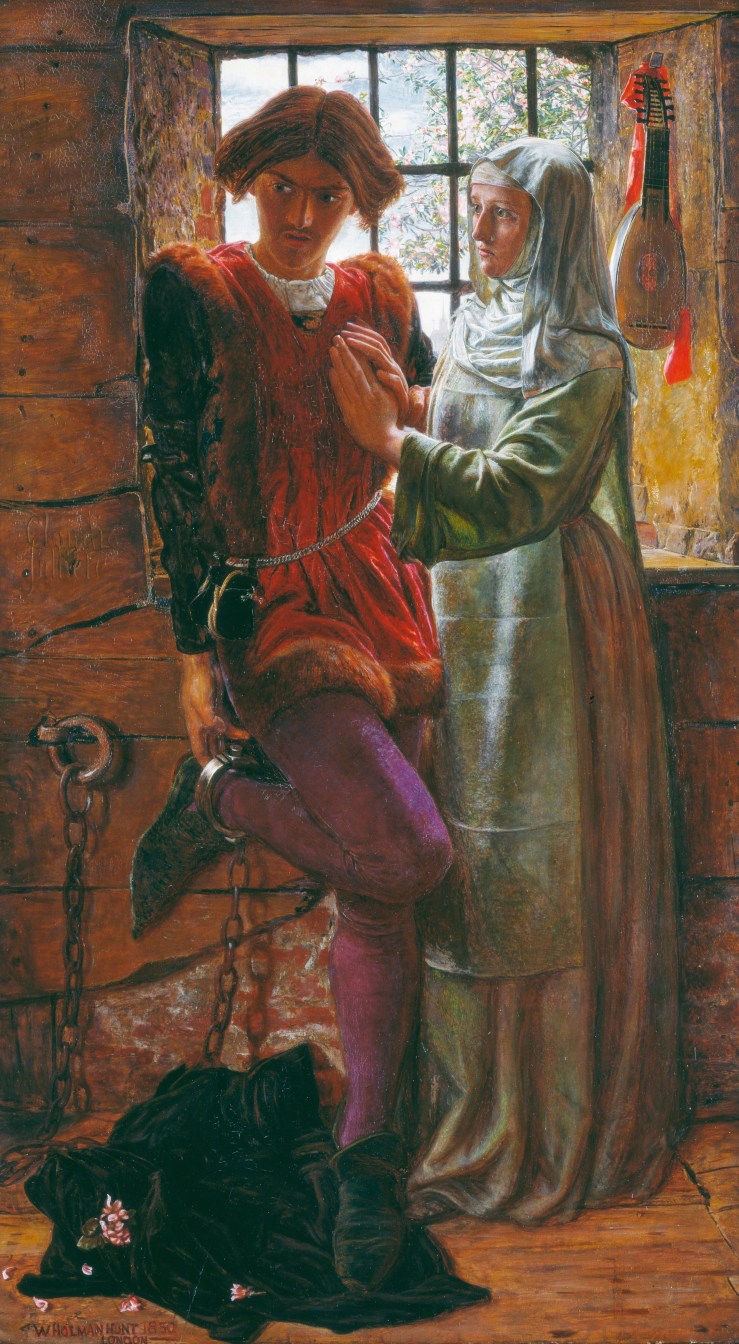
Claudio and Isabella — William Holman Hunt

Screenshot 2017-05-22 at 8.17.10 PMScreenshot 2017-05-22 at 8.17.40 PMgp01a201312081800

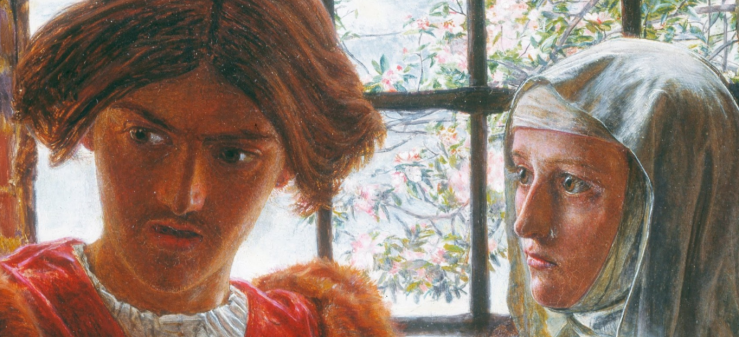
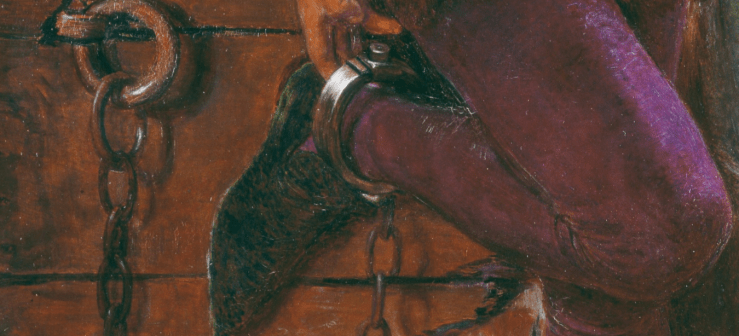
Claudio and Isabella, 1850 by William Holman Hunt (1827–1910)

From William Shakespeare’s Measure for Measure, Act 3, Scene 1:

ISABELLA

Be ready, Claudio, for your death tomorrow.

CLAUDIO

Yes. Has he affections in him,
That thus can make him bite the law by the nose,
When he would force it? Sure, it is no sin,
Or of the deadly seven, it is the least.

ISABELLA

Which is the least?

CLAUDIO

If it were damnable, he being so wise,
Why would he for the momentary trick
Be perdurably fined? O Isabel!

ISABELLA

What says my brother?

CLAUDIO

Death is a fearful thing.

ISABELLA

And shamed life a hateful.

CLAUDIO

Ay, but to die, and go we know not where;
To lie in cold obstruction and to rot;
This sensible warm motion to become
A kneaded clod; and the delighted spirit
To bathe in fiery floods, or to reside
In thrilling region of thick-ribbed ice;
To be imprison’d in the viewless winds,
And blown with restless violence round about
The pendent world; or to be worse than worst
Of those that lawless and incertain thought
Imagine howling: ’tis too horrible!
The weariest and most loathed worldly life
That age, ache, penury and imprisonment
Can lay on nature is a paradise
To what we fear of death.

Words may be a thick and darksome veil | Nathaniel Hawthorne’s journal entry for May 19th, 1840

May 19th.–. . . Lights and shadows are continually flitting across my inward sky, and I know neither whence they come nor whither they go; nor do I inquire too closely into them. It is dangerous to look too minutely into such phenomena. It is apt to create a substance where at first there was a mere shadow. . . . If at any time there should seem to be an expression unintelligible from one soul to another, it is best not to strive to interpret it in earthly language, but wait for the soul to make itself understood; and, were we to wait a thousand years, we need deem it no more time than we can spare. . . . It is not that I have any love of mystery, but because I abhor it, and because I have often felt that words may be a thick and darksome veil of mystery between the soul and the truth which it seeks. Wretched were we, indeed, if we had no better means of communicating ourselves, no fairer garb in which to array our essential being, than these poor rags and tatters of Babel. Yet words are not without their use even for purposes of explanation,–but merely for explaining outward acts and all sorts of external things, leaving the soul’s life and action to explain itself in its own way.

What a misty disquisition I have scribbled! I would not read it over for sixpence.

Nathaniel Hawthorne’s journal entry for May 19th, 1840. From Passages from the American Note-Books.

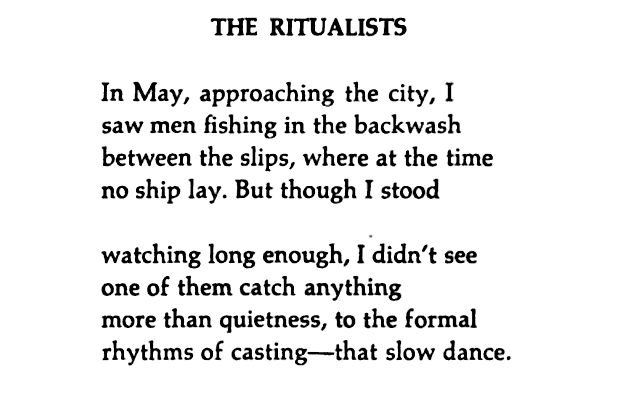
“The Ritualists” — William Carlos Williams

ritualists

Read “The Fqih,” a short story by Paul Bowles

“The Fqih”

by

Paul Bowles


ONE MIDSUMMER AFTERNOON a dog went running through a village, stopping just long enough to bite a young man who stood on the main street. It was not a deep wound, and the young man washed it at a fountain nearby and thought no more about it. However, several people who had seen the animal bite him mentioned it to his younger brother. You must take your brother to a doctor in the city, they said.

When the boy went home and suggested this, his brother merely laughed. The next day in the village the boy decided to consult the fqih. He found the old man sitting in the shade under the figtree in the courtyard of the mosque. He kissed his hand, and told him that a dog no one had ever seen before had bitten his brother and run away.

That’s very bad, said the fqih. Have you got a stable you can lock him into? Put him there, but tie his hands behind him. No one must go near him, you understand?

The boy thanked the fqih and set out for home. On the way he determined to cover a hammer with yarn and hit his brother on the back of the head. Knowing that his mother would never consent to seeing her son treated in this way, he decided that it would have to be done when she was away from the house.

That evening while the woman stood outside by the well, he crept up behind his brother and beat him with the hammer until he fell to the floor. Then he fastened his hands behind him and dragged him into a shed next to the house. There he left him lying on the ground, and went out, padlocking the door behind him. Continue reading “Read “The Fqih,” a short story by Paul Bowles”

Bolaño’s Borges

Jorge Luis Borges is first mentioned in the sixth paragraph of Roberto Bolaño’s masterful short story “The Insufferable Gaucho.” In this paragraph, the narrator tells us that the story’s hero, an ex-judge named Pereda, believed “the best Argentine writers were Borges and his son; any further commentary on that subject was superfluous.”

Several paragraphs later, Bolaño’s narrator explicitly references Borges’s short story “The South,” the precursor text for “The Insufferable Gaucho.” The reference to Borges is tied again to Pereda’s son, the writer Bebe.

Leaving tumultuous Buenos Aires, basically destitute from the Argentine Great Depression, Pereda heads to the countryside to take up residence in his family’s ancient ranch. Departing the train and arriving to a rural town, 

Inevitably, he remembered Borges’s story “The South,” and when he thought of the store mentioned in the final paragraphs his eyes brimmed with tears. Then he remembered the plot of Bebe’s last novel, and imagined his son writing on a computer, in an austere room at a Midwestern university. When Bebe comes back and finds out I’ve gone to the ranch . . . , he thought in enthusiastic anticipation.

Bolaño essentially appropriates the plot of “The South” for his tale “The Insufferable Gaucho” and inserts a version of himself into this revision. Bolaño is “Bebe” here, an author who “wrote vaguely melancholy stories with vaguely crime-related plots,” his name phonically doubling the series of mirrors and precursors that Bolaño, mystery man, leaves as clues: Bebe, B-B, Borges-Bolaño, Belano-Bolaño. (Is this too wild a conjecture, dear reader? Mea culpa). 

And Pereda then? A stand-in for Borges’s Juan Dahlmann (hero of “The South,” who “considered himself profoundly Argentinian”), surely, but also, maybe also—a stand-in for (a version of) Borges.

What I mean to say:

Bolaño, displaced Chilean, writes “The Insufferable Gaucho” as an intertextual love letter to his displaced father, the Argentine Jorge Luis Borges.

Bolaño then, to steal a line from Borges’s story, locates in Dahlmann/Borges “his romantic ancestor, his ancestor of the romantic death.” (English translation of the Borges here by Anthony Kerrigan; Chris Andrews translates Bolaño).

Bolaño’s retelling of Borges’s tale is initially marked by a heightened self-consciousness on the part of its hero Pereda, who, over time, gives over to an entirely different consciousness. Let me share a passage of some length; note the hazy dream-tone:

On the way back to his ranch, he dozed off a couple of times. He woke up from his second nap on one of the streets of Capitán Jourdan. He saw a corner store that was open. He heard voices, and someone strumming a guitar, tuning it but never settling on a particular song to play, just as he had read in Borges. For a moment, he thought that his destiny, his screwed-up American destiny, would be to meet his death like Dahlmann in “The South,” and it seemed unfair, partly because he now had debts to repay and partly because he wasn’t ready to die, although Pereda knew that death is an occurrence for which one is never ready. Seized by a sudden inspiration, he entered the store on horseback. Inside, he found an old gaucho, strumming the guitar, the owner, and three younger guys sitting at a table, who started when they saw the horse come in. Pereda was inwardly satisfied by the thought that the scene was like something from a story by di Benedetto. Nevertheless, he set his face and approached the zinc-topped bar. He ordered a glass of aguardiente, which he drank with one hand, while in the other he held his riding crop discreetly out of view, since he hadn’t yet bought himself the traditional sheath knife. He asked the owner to put the drink on his account, and on his way out, as he passed the young gauchos, he told them to move aside because he was going to spit. This was meant as affirmation of his authority, but before the gauchos could grasp what was happening the gob of phlegm had flown from his lips; they barely had time to jump. May the rain fall soft on you, he said, before disappearing into the darkness of Capitán Jourdan.

Is this insufferably romantic episode real or simply imagined by our hero? Borges perhaps would simply answer, Yes.

We can find that Yes in”The South,” which turns the binary of real/imagined on its metaphorical ear. The story is larded with examples, but I’ll share one where Dahlmann dozes on a train ride to the ranch (just as decades later Pereda will doze on his train ride to a ranch, and then (then?!) doze on a horse):

Tomorrow I’ll wake up at the ranch, he thought, and it was as if he was two men at a time: the man who traveled through the autumn day and across the geography of the fatherland, and the other one, locked up in a sanitarium and subject to methodical servitude. He saw unplastered brick houses, long and angled, timelessly watching the trains go by; he saw horsemen along the dirt roads; he saw gullies and lagoons and ranches; he saw great luminous clouds that resembled marble; and all these things were accidental, casual, like dreams of the plain. He also thought he recognized trees and crop fields; but he would not have been able to name them, for his actual knowledge of the country side was quite inferior to his nostalgic and literary knowledge. 

Two men at a time, Borges tells us; Bolaño will continue exploring that bifurcation decades later with Dahlmann’s doppelgänger Pereda. Do either of the men actually ever wake up? Are their journeys merely their own fictions—or, more Borgesian, the fictions they cobble from the fragments of precursor fictions, shot through the lens of “nostalgic and literary knowledge?”

The extent of Dahlmann’s literary knowledge is never quite clear, although Borges (of course) names a precursor text for “The South”: Weil’s The Thousand and One Nights, a book so intertextually fraught and metatextually overdetermined that I feel little need to remark on its Borgesian significance other than to point out that the tales in that volume are Scheherazade’s way of saving her own life. In “The South,” we are told that Dahlmann uses The Thousand and One Nights as a tool for “suppressing reality” and that during his intense illness it “served to illustrate nightmares.”

Does Dahlmann actually die then, or does he, through literature, imagination, and story-telling, like Scheherazade, stave off death for one more night? Again, I think that the Borgesian answer here is, Yes.

Although I’ve been citing Anthony Kerrigan’s early translation of “The South” here, I think Andrew Hurley’s more recent one makes a marvelous emendation that resonates with the spirit of the tale (and actually fits the original Spanish): He translates the last line into the present tense: “Dahlmann firmly grips the knife, which he may have no idea how to manage, and steps out into the plains.”  Dahlmann is still alive at the end of “The South.” Like the enormous sleeping cat that dozes in his memory, Dahlmann “lives in the present, in the eternity of the instant.”

Tellingly, Pereda doesn’t share my interpretation—for him, Dahlmann dies. Recall that “he thought that his destiny, his screwed-up American destiny, would be to meet his death like Dahlmann in ‘The South.’” Bolaño’s tale (typically Bolañoesque) radiates a cryptic, sinister morbidity, one saturated in dark humor. In a moment that seems both ironic and wholly earnest, Pereda fantasizes a death coded through “nostalgic and literary knowledge,” one modeled after “his romantic ancestor, his ancestor of the romantic death.”

I’ve plugged Borges’s lines into a different context here, but they work, and really the context isn’t so different. In “The South,” the specific ancestor alluded to is Dahlmann’s “maternal grandfather…Francisco Flores, of the Second Line Infantry Division, who  had died on the frontier of Buenos Aires, run through with a lance by Indians from Catriel.” Dahlmann figuratively or literally (Yes) repeats his ancestor’s romantic death.

And then Bolaño repeats his ancestor’s romantic death, reconfiguring the climax at the end of “The South,” in which Dahlmann faces off against the muchachones. I consulted three different translations of “The South”; each one does something a bit different with the youths who threaten Dahlmann: country louts, ruffiansyoung thugs.

How does Bolaño translate these young men? At the end of “The Insufferable Gaucho,” our quixotic hero, dirty, haggard, “attired like a cross between a gaucho and a rabbit trapper,” perhaps dreaming, perhaps insane, peers into a cafe, where he sees

. . . a group of writers who looked as if they worked in advertising. One of them, who had an adolescent air, although he was over fifty and maybe even over sixty, kept putting a white powder up his nose and holding forth on world literature. Suddenly, the eyes of the fake adolescent met Pereda’s. For a moment, their gazes locked, as if, for each of them, the presence of the other were a gash in the ambient reality. Resolutely and with surprising agility, the writer with the adolescent air sprang to his feet and rushed out into the street. Before Pereda knew what was going on, the writer was upon him.

Of course Bolaño, list-maker, canon-maker, curator, always registering the competitive anxieties of poets and authors, of course Bolaño will turn the threatening youth into a fucking writer!

Significantly, Pereda sees (or more likely believes he sees, although Bolaño doesn’t tip his hand here) “Bebe and an old man (An old man like me! Pereda thought)…presiding over one of the most animated tables.” The image betokens a fantastic displacement in Pereda’s warped mind, yes, but also perhaps signals Bolaño’s fantasy to hash out literary matters in a buzzing cafe with his father, Borges. In any case, this is the last we hear of Bebe, a detail that undercuts the reality of what happens next, as the coked-up writer advances on the insufferable gaucho:

Pereda realized that he had grasped his knife, then let himself go. He took a step forward and, without anyone noticing that he was armed, planted the point of the blade, though not deeply, in his opponent’s groin. Later, he would remember the look of surprise on the man’s face, in which terror blended with something like reproof, and the writer’s words as he groped for an explanation (Hey, what did you do, asshole?), as if there could be an explanation for fever and nausea.

Bolaño’s gaucho—the fantastic reconfiguration of Borges’s gaucho, son of Borges’s gaucho, but also doppelgänger to Borges’s gaucho—Bolaño’s gaucho performs a symbolic castration, an Oedipally-charged act of violence that seems to tip into visceral reality in the story’s last moments.

Bolaño turns the country louts into cosmopolitan poseurs, writers that look like yuppie admen, and then he has his hero cut one—right in the crotch.The gesture revises the ambiguous ending of “The South,” following through with the once-suspended knife fight.

Whether or not this final episode actually happens or happens only in the protagonist’s mind may or may not matter to you, reader. “The Insufferable Gaucho” is stocked with surreal Lynchian moments, from Pereda riding his horse into the country store, to a publisher being attacked by a feral rabbit (after which Pereda cauterizes the man’s neck wound with his knife!).

As the story progresses, Pereda shakes off nostalgia and literary reference. Like a bedraggled Quixote, he lives his romance. His consciousness, once informed by Borges and Antonio di Benedetto, becomes freer, asserts its own fantasy as self-generative and self-sufficient. When Pereda first entered the country store, “He heard voices, and someone strumming a guitar, tuning it but never settling on a particular song to play, just as he had read in Borges”; later in the tale, holding a party for his son, Pereda “sent for the foremost of Capitán Jourdan’s guitar-strumming gauchos, warning him beforehand that he was to do strictly that: strum, without playing any song in particular, in accordance with the country way.” Pereda omits Borges as the source of style here: Borges becomes the country way

The fantasy Bolaño constructs allows him to simultaneously posit Borges as his literary progenitor and then erase the evidence of that progenitor, even as his contours and essence remain. Bolaño-as-Bebe remains a marginal figure—Bolaño’s own stable consciousness, perhaps?—while knife-weilding Pereda enacts Borges’s revenge on all the poseurs and hacks. And if Pereda is too passionate, too romantic, too violent, too unstable—so be it. At least he thought enough of his son to class him with Borges the Great.

And it’s through this gesture—this literary trick—that Bolaño asserts and defends the literary lineage he lays his claims to: His romantic ancestor, Borges.

[Ed. note–Biblioklept published aversion of this essay in May of 2014].

Atticus Lish’s Preparation for the Next Life (Book acquired, 9 May 2017)

img_6089

The things that compelled my interest in Atticus Lish’s debut novel Preparation for the Next Life were the same things that made me initially wary. First, the book got a lot of buzz when it was published in 2014. Second, and bigger, Lish’s father Gordon Lish is a literary hero of mine. Indeed, Lish the Elder recommends his son’s talents in his (Gordon’s) last “novel,” Cess:

Atticus is, a, you know, a writer by Christ—is a novelist, by Christ, is indeed, if I, by Keerist, may say so myself, ever so proudly so, ever so rivalrously so, a novelist of nothing less than of rank.

Lish the Elder has impeccable taste, but, you know, c’mon. We all tend to think our kids are great at everything.

Anyway, I picked up a copy of Preparation for the Next Life a few days ago. I wasn’t looking for it; I was looking for another “L” novelist, but the spine popped out. I took it home and read the first few paragraphs. Then I just kept reading, consuming the first third in hungry gulps.

Lish’s prose is amazingly concrete. He renders New York City (and the other settings) with seemingly effortless thoroughness; the evocation of place is vivid and refined in its attention to detail, but reads raw somehow. There’s a flavor of prime Denis Johnson or Don DeLillo here, but these comparisons aren’t fair: Lish is original—the prose reads thoroughly real, real to and from the author. The novel so far strikes me as one of the most authentic “post-9/11” novels I’ve read. There’s almost something sci-fi to Preparation—Lish shows us our world through alien eyes that suck in every detail. I wish I’d read it sooner.

Here’s publisher Tyrant Books’ blurb:

Skinner hitchhikes to New York, newly returned from Iraq, hoping to exorcise his demons. Zou Lei, an undocumented immigrant from Central Asia, catches a bus into the city, searching for a way to get by—or at least stay out of jail. Their unlikely love story becomes the heart of one of the most compelling and widely acclaimed novels in years.

A clear-eyed illustration of life in New York City’s margins, Preparation For the Next Life evokes the unsettling realities of the American Dream for U.S. immigrants and unsupported veterans in stark, vivid detail. At once a nightmare and a love letter to New York City (a place one loves partly for its host of nightmares), Lish’s prose is disciplined yet always alive and taut with danger, rendered with the voice of a new and natural talent.

Lost in The Vorrh

img_6091-1

I got lost in Brian Catling’s expansive 2012 novel The Vorrh, a phantasmagorical critique of colonialism set in and around a massive, possibly infinite jungle called the Vorrh. Apparently God likes to stroll this primeval forest while he meditates, the original Adam (gray and shrunken) skulks about like Gollum, and anthropophagi lurk in the hopes of capturing a human or two to snack on.

These are just minor moments though in this shaggy opus. The Vorrh is larded with myth, religion, science, history, art, and literature. Catling, a sculptor by trade, synthesizes the nascent 20th-century’s ideas about all the centuries that came before it into what Alan Moore calls “Easily the current century’s first landmark work of fantasy.” Moore goes on to describe The Vorrh as

….a sprawling immaterial organism which leaves the reader filthy with its seeds and spores, encouraging new growth and threatening a great reforesting of the imagination.

Moore is enthusiastic (perhaps overly so), and his introduction to the novel serves as a far better review than anything I can muster here—like I said at the outset, I got lost in The Vorrh. It’s an overstuffed beast of a book, its storylines sprouting strangely (often from nowhere), tangling into other storylines, colliding in a kaleidoscope of blooms that often fall from their vine before bearing fruit.

There are a several main strands to The Vorrh’s plot though, and they do bear strange fruit. There’s a Cyclops named Ishmael, raised by robots underneath a haunted house in the colonial capital of Essenwald. He has sex with a blind woman named Cyrena during Carnival and she becomes sighted, an event that sparks a healing epidemic which in time turns into a plague. There’s Peter Williams, veteran of the Great War, who makes a bow out of his wife’s corpse in the novel’s opening section. (Don’t worry, she was a shaman who wanted him to do that). He treks into the Vorrh.  Tsungali, a warrior of the True People, tracks the trekker. Another warrior tracks him. There’s a shady doctor and a Scottish taskmaster who conspire to keep a hive-mind slave army happy (?) cutting down trees at the periphery of the Vorrh. There’s a knot of historical characters, including the photographer Eadweard Muybridge (the dude who photographed a horse in motion), Queen Victoria’s personal physician Sir William Withey Gull (whom Alan Moore posited as Jack the Ripper in From Hell), and a version of surrealist writer Raymond Roussel. I realize I began this paragraph with the phrase “several main strands” and then listed more than several without even getting to all of the plot points, let alone an articulation of how they come together—or don’t come together.

img_6090

The Vorrh has the feel and texture of grand great shaggy comic book, one rendered in my mind’s eye in the fabulous, expansive style of Moebius. Characters—so many characters!—come and go, and if someone dies, don’t worry—there’s every possibility of resurrection in The Vorrh. Catling delights in giving us the backstory on a pair of twin assassins even after he’s killed them off; he allows his free indirect style to enter the consciousness of a sleeping dog’s sex dream; he spends a few sentences on a charming cannibal’s dinner plans. The Vorrh’s in the details.

In its loose erudition and striking visuals, The Vorrh reminded me of the fiction of China Mieville or Neal Stephenson. In its shaggy weirdness it also reminded me of Chris Claremont’s run on The Uncanny X-Men. Its Victorian Gothicism and syntheses of adventure, horror, and Western tropes also recalls the late Showtime television series, Penny Dreadful. And The Vorrh’s prose style often harnesses some of the bombast we find in classic Weird Fiction of Lovecraft or Lord Dunsany.

If it’s lazy to simply trot out comparisons (and there are so many more I can make), mea culpa. The novel is big, and I’d have to read it again to figure out how its baroque features fit together to do any real proper decent analysis—and I’d rather read its sequel, The Erstwhile. I will say that I liked it despite (and maybe to an extent because of) its faults. I think you can suss out from my weak summary in the fourth paragraph if The Vorrh holds any interest for you.


[Ed. note–the image at the top of this review is a scan of a strange press booklet that publisher Vintage sent with original review copies of The VorrhIn addition to Alan Moore’s introduction, the slim, string-bound booklet contains an interview with Catling, and a portrait by Catling of Alan Moore as a cyclops. The cover of the booklet is a painting by Catling].