
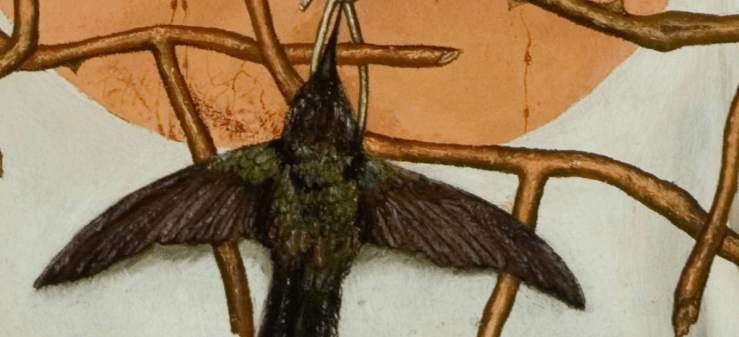
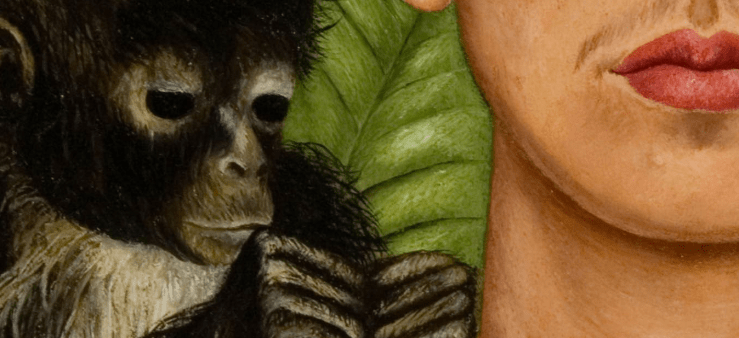
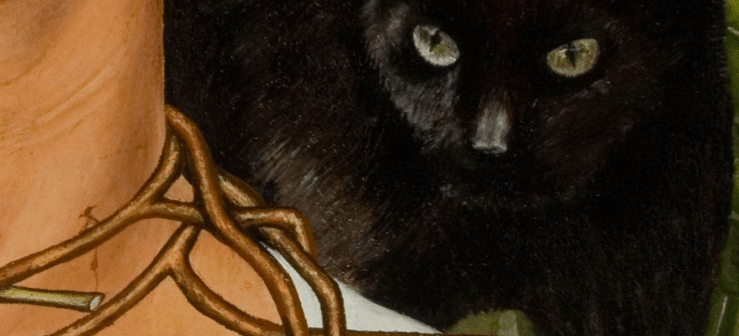

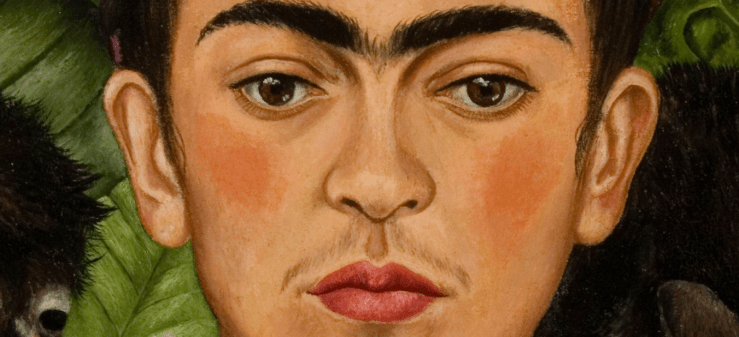
Autorretrato con Collar de Espinas (Self Portrait with Necklace of Thorns), 1940 by Frida Kahlo (1907-54)
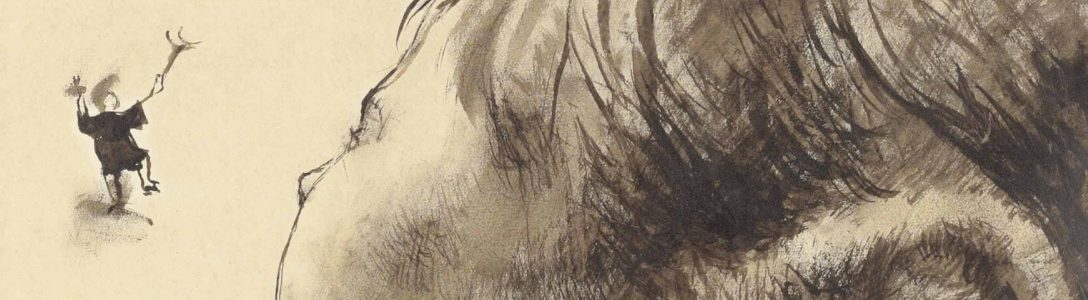
Autorretrato con Collar de Espinas (Self Portrait with Necklace of Thorns), 1940 by Frida Kahlo (1907-54)
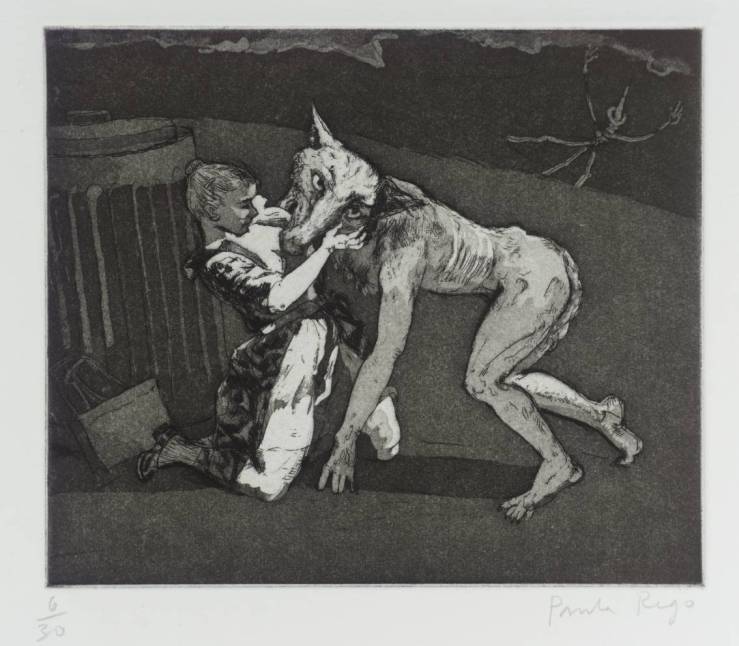
Him, 1996 by Paul Rego (b. 1935)

Red House, 1996 by Peter Doig (b. 1959)
I got lost in Brian Catling’s expansive 2012 novel The Vorrh, a phantasmagorical critique of colonialism set in and around a massive, possibly infinite jungle called the Vorrh. Apparently God likes to stroll this primeval forest while he meditates, the original Adam (gray and shrunken) skulks about like Gollum, and anthropophagi lurk in the hopes of capturing a human or two to snack on.
These are just minor moments though in this shaggy opus. The Vorrh is larded with myth, religion, science, history, art, and literature. Catling, a sculptor by trade, synthesizes the nascent 20th-century’s ideas about all the centuries that came before it into what Alan Moore calls “Easily the current century’s first landmark work of fantasy.” Moore goes on to describe The Vorrh as
….a sprawling immaterial organism which leaves the reader filthy with its seeds and spores, encouraging new growth and threatening a great reforesting of the imagination.
Moore is enthusiastic (perhaps overly so), and his introduction to the novel serves as a far better review than anything I can muster here—like I said at the outset, I got lost in The Vorrh. It’s an overstuffed beast of a book, its storylines sprouting strangely (often from nowhere), tangling into other storylines, colliding in a kaleidoscope of blooms that often fall from their vine before bearing fruit.
There are a several main strands to The Vorrh’s plot though, and they do bear strange fruit. There’s a Cyclops named Ishmael, raised by robots underneath a haunted house in the colonial capital of Essenwald. He has sex with a blind woman named Cyrena during Carnival and she becomes sighted, an event that sparks a healing epidemic which in time turns into a plague. There’s Peter Williams, veteran of the Great War, who makes a bow out of his wife’s corpse in the novel’s opening section. (Don’t worry, she was a shaman who wanted him to do that). He treks into the Vorrh. Tsungali, a warrior of the True People, tracks the trekker. Another warrior tracks him. There’s a shady doctor and a Scottish taskmaster who conspire to keep a hive-mind slave army happy (?) cutting down trees at the periphery of the Vorrh. There’s a knot of historical characters, including the photographer Eadweard Muybridge (the dude who photographed a horse in motion), Queen Victoria’s personal physician Sir William Withey Gull (whom Alan Moore posited as Jack the Ripper in From Hell), and a version of surrealist writer Raymond Roussel. I realize I began this paragraph with the phrase “several main strands” and then listed more than several without even getting to all of the plot points, let alone an articulation of how they come together—or don’t come together.

The Vorrh has the feel and texture of grand great shaggy comic book, one rendered in my mind’s eye in the fabulous, expansive style of Moebius. Characters—so many characters!—come and go, and if someone dies, don’t worry—there’s every possibility of resurrection in The Vorrh. Catling delights in giving us the backstory on a pair of twin assassins even after he’s killed them off; he allows his free indirect style to enter the consciousness of a sleeping dog’s sex dream; he spends a few sentences on a charming cannibal’s dinner plans. The Vorrh’s in the details.
In its loose erudition and striking visuals, The Vorrh reminded me of the fiction of China Mieville or Neal Stephenson. In its shaggy weirdness it also reminded me of Chris Claremont’s run on The Uncanny X-Men. Its Victorian Gothicism and syntheses of adventure, horror, and Western tropes also recalls the late Showtime television series, Penny Dreadful. And The Vorrh’s prose style often harnesses some of the bombast we find in classic Weird Fiction of Lovecraft or Lord Dunsany.
If it’s lazy to simply trot out comparisons (and there are so many more I can make), mea culpa. The novel is big, and I’d have to read it again to figure out how its baroque features fit together to do any real proper decent analysis—and I’d rather read its sequel, The Erstwhile. I will say that I liked it despite (and maybe to an extent because of) its faults. I think you can suss out from my weak summary in the fourth paragraph if The Vorrh holds any interest for you.
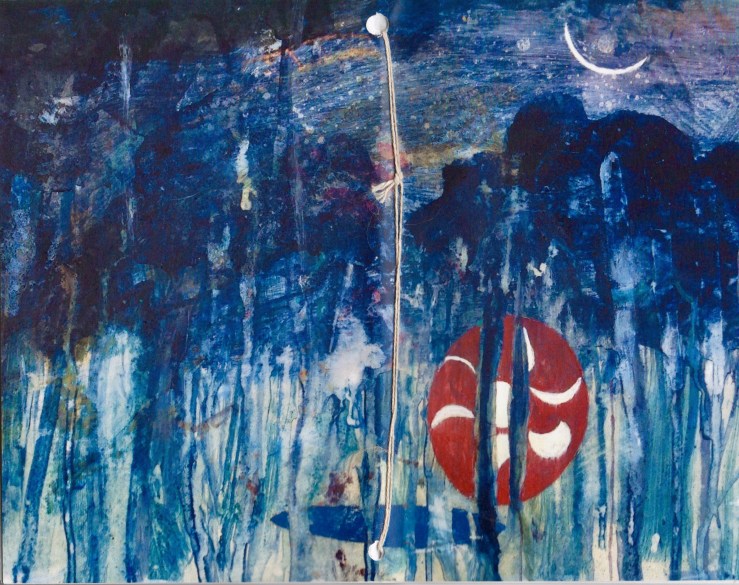
[Ed. note–the image at the top of this review is a scan of a strange press booklet that publisher Vintage sent with original review copies of The Vorrh. In addition to Alan Moore’s introduction, the slim, string-bound booklet contains an interview with Catling, and a portrait by Catling of Alan Moore as a cyclops. The cover of the booklet is a painting by Catling].
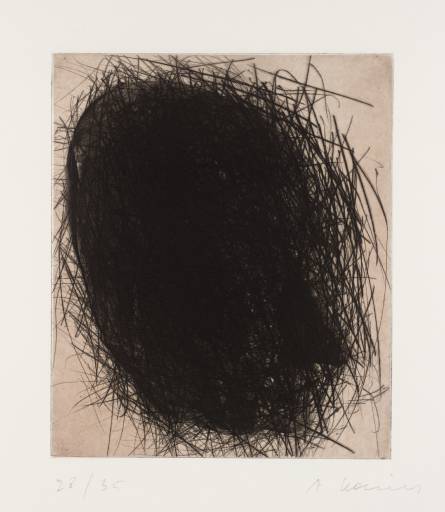
Johann Wolfgang von Goethe, 1982 by Arnulf Rainer (b. 1929)

Männerpflanze (Plant Men) by Arik Brauer (b. 1929)
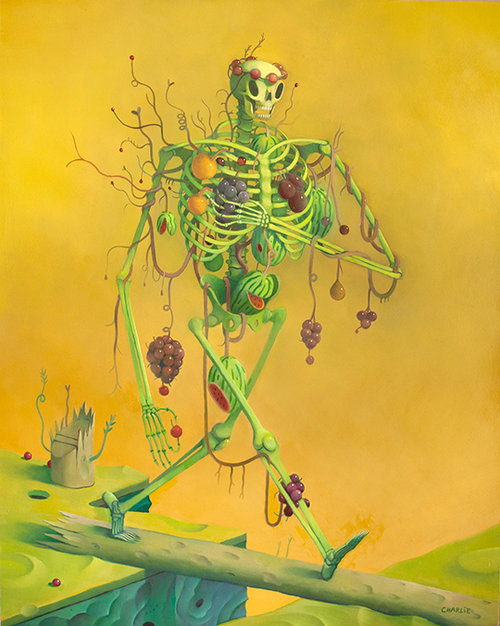
Fruity, 2017 by Charlie Immer (b. 1983).
“The Chemist’s Wife”
by
Anton Chekhov
English translation by Constance Garnett
The little town of B——, consisting of two or three crooked streets, was sound asleep. There was a complete stillness in the motionless air. Nothing could be heard but far away, outside the town no doubt, the barking of a dog in a thin, hoarse tenor. It was close upon daybreak.
Everything had long been asleep. The only person not asleep was the young wife of Tchernomordik, a qualified dispenser who kept a chemist’s shop at B——. She had gone to bed and got up again three times, but could not sleep, she did not know why. She sat at the open window in her nightdress and looked into the street. She felt bored, depressed, vexed . . . so vexed that she felt quite inclined to cry—again she did not know why. There seemed to be a lump in her chest that kept rising into her throat. . . . A few paces behind her Tchernomordik lay curled up close to the wall, snoring sweetly. A greedy flea was stabbing the bridge of his nose, but he did not feel it, and was positively smiling, for he was dreaming that every one in the town had a cough, and was buying from him the King of Denmark’s cough-drops. He could not have been wakened now by pinpricks or by cannon or by caresses.
The chemist’s shop was almost at the extreme end of the town, so that the chemist’s wife could see far into the fields. She could see the eastern horizon growing pale by degrees, then turning crimson as though from a great fire. A big broad-faced moon peeped out unexpectedly from behind bushes in the distance. It was red (as a rule when the moon emerges from behind bushes it appears to be blushing). Continue reading “Read Anton Chekhov’s short story “The Chemist’s Wife””

Visit with Uncle Albrecht, 2012 by Susannah Martin (b. 1964)

The review copy I got of Cow Eye Press’s Twelve Stories of Russia: A Novel, I Guess doesn’t bear author A.J. Perry’s name anywhere on the cover, spine, or back cover. His name does appear on the title page though. A.J. Perry is probably Adrian Jones Pearson, author of Cow Country, also published by Cow Eye. Adrian Jones Pearson is probably not Thomas Pynchon. Here’s Cow Eye’s blurb:
When an eager American moves to Moscow to teach Russians the difference between the and a, he begins what will ultimately become a six-and-a-half-year descent into the murky entrails of language, culture, and the world’s greatest metro system. Part surrealistic travelogue, part historical serendipity, Twelve Stories is at its most enduring as a fanciful rumination on the elusiveness of words.
Twelve Stories of Russia was originally published in Moscow by the independent publisher GLAS, where it quietly gained a following among expats and locals alike. Unique in its appeal to both sides of the linguistic and cultural divide, the work has remained largely unknown beyond Russia. Now, almost a generation after its narrator’s lively quest for the word that changes and is changed, this emphatic “novel, I guess” is being released to a wider audience for the first time, its subject matter as universal and its themes as timely as ever.
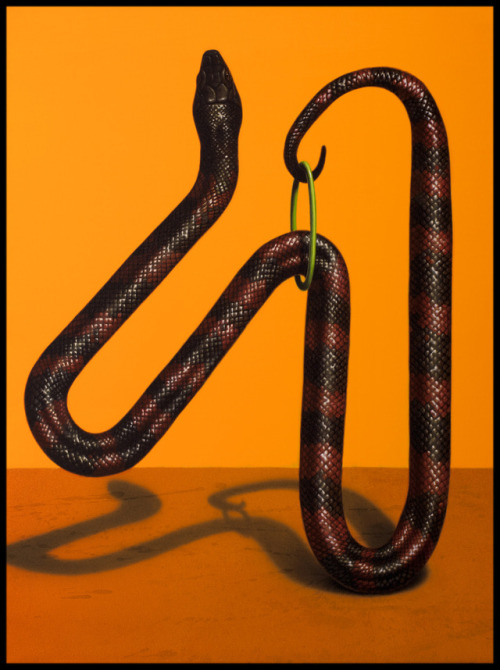
Disziplin (Discipline), 2017 by Eckhart Hahn (b. 1971)

Alvelek (Fairy Dream), 1909 by Theodor Severin Kittelsen (1857-1914)
A few years ago I posted a brief excerpt from Jules Siegel’s March 1977 Playboy profile “Who is Thomas Pynchon… And Why Did He Take Off With My Wife?” The excerpt came from an excerpt posted on the Pynchon-L forum, but most of the article had been removed at the (apparent) request by Siegel. A few people sent me the whole article though (thanks!) and I read it.
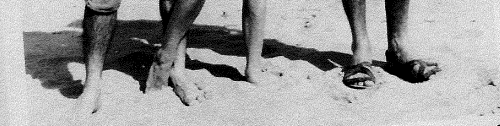
Jules Siegel was briefly a Cornell classmate of Pynchon’s in 1954, and they remained friends (in Siegel’s recollection) for at least two decades after. During this time, Siegel claims that Pynchon wrote him dozens of letters, which were ultimately sold at auction (along with much of Siegel’s property) to help pay for a hip replacement. Material from the letters soak into Siegel’s sketch of Pynchon’s progress, along with several stoned/drunken adventures that would not be out of place in V. or Mason & Dixon or Gravity’s Rainbow, or really, any person’s young life.
A competitive anxiety reverberates under the piece. “We were friends, maybe at some points best friends, very much alike in some important ways,” Siegel writes. “We were both writers,” he boldly writes. Siegel reminds us that “In Mortality and Mercy in Vienna, Pynchon’s first published short story, the protagonist is one Cleanth Siegel,” but protests he doesn’t see himself in that hero.
The competitive anxieties culminate in the big reveal that (spoiler!) Thomas Pynchon had an affair with Siegel’s second wife Chrissie. There’s probably a Freudian reading we can append to the details that Siegel offers about Pynchon’s sexual prowess: “He was a wonderful lover, sensitive and quick, with the ability to project a mood that turned the most ordinary surroundings into a scene out of a masterful film—the reeking industrial slum of Manhattan Beach would become as seen through the eye of Antonioni, for example.”
Or maybe these unsexy details are just a sign of Playboy’s editorial hand. Wedged gracelessly between ads for vibrators and nude greeting cards, Siegel’s lines often reek of 1970’s Playboy’s rhetorical house style, a kind of frank-but-(attempted)-sensual glossiness that contrasts heavily with Pynchon’s own sex writing. At times I found myself reading Siegel’s prose in one of Will Ferrell’s more pompous accents.
Even worse is the casual sexism of the piece—which again, may be attributable to Playboy’s editors. Siegel, on his first wife (sixteen when he married her): “She was so wonderful a lover, generous and easily aroused, but I was too callow then to appreciate her.” Of his second wife: “It is easy to underestimate her intelligence, but it is a mistake. She is obviously too pretty to be serious, conventional wisdom would have you believe.” Of one of Pynchon’s girlfriends: “Susan has red hair and is breathtakingly beautiful, with the voluptuous body of a showgirl. Like Chrissie, she is much brighter than she looks.”
More interesting, obviously, are the (supposedly) real-life details that inform Pynchon’s fiction. Siegel notes some of the contents of Pynchon’s Manhattan Beach apartment: “A built-in bookcase had rows of piggy banks on each shelf and there was a collection of books and magazines about pigs.” Pigs, of course, are a major motif of Gravity’s Rainbow. Another detail that seems to connect to GR: “On the desk, there was a rudimentary rocket made from one of those pencil-like erasers with coiled paper wrappers that you unzip to expose the rubber. It stood on a base twisted out of a paper clip.” Siegel lets us know that he knocked the rocket down. Pynchon puts it back together; Siegel knocks it down again.
(Parenthetically: Siegel’s evocation of Pynchon’s Manhattan Beach days fits neatly into my picture of Inherent Vice).
In accounting details of Pynchon’s alleged affair with his wife, Chrissie, Siegel shares the following:
Once, out on the freeway, she told him that we had all gone naked at the commune, he professed to find that incredible and dared her to take off her blouse right there. She did. A passing truck hooted its horn in lewd applause. He loved her Shirley Temple impersonations—On the Good Ship Lollipop sung and danced like a kid at a birthday party. They talked about running away together.
It is hardly possible here not to recall the episode early in Gravity’s Rainbow wherein Jessica Swanlake removes her blouse in the car on a dare from Roger Mexico. Is Siegel daring the reader to extrapolate further? Extrapolation, paranoid connections—isn’t this part of Pynchonian fun?
In that spirit, I’ll close with my favorite moment from the article.
“You know the W.A.S.T.E. horn in The Crying of Lot 49? The symbol of the secret message service? Every weirdo in the world is on my wave length. You cannot understand the kind of letters I get. Someone wrote to tell me that the very same horn was the symbol of a private mail system in medieval times. I checked it out at the library. It’s true. But I made it up myself before the book was ever published, before I ever got that letter.”
The lines are supposedly from Pynchon himself. Siegel even puts them in quotation marks—so they must be real, right?
[Ed. note: Biblioklept ran a version of this post in 2015].
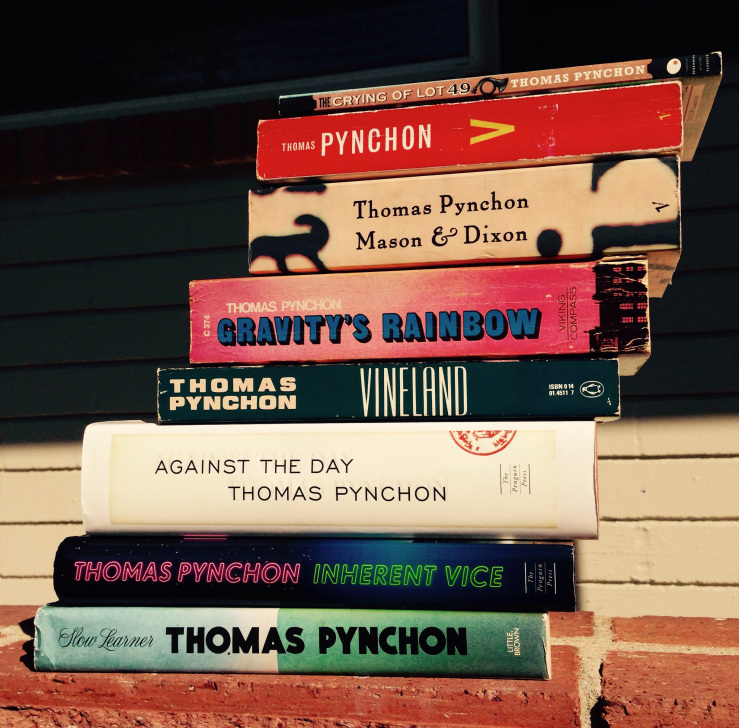
Today is Pynchon in Public Day, so here are three books that I think may make good entry points for those interested in, but perhaps unnecessarily daunted by, Thomas Pynchon. My intuition is that many readers’ first experiences reading Pynchon may have been like mine: I read The Crying of Lot 49 as a college assignment, found it bewildering and baffling, and despite understanding almost none of it, I then attempted Gravity’s Rainbow (the key word is attempted (failed will also do in a pinch)).
Many readers start with The Crying of Lot 49 because it’s short. While I like the novel (I wrote about it here), it’s also extraordinarily dense, a box so crammed with jokes and japes that some fail to spring out at full force. Lot 49 is a much better reading experience after you’ve read more of Pynchon.
Lots of readers new to Pynchon plunge into Gravity’s Rainbow, probably because it’s famous. I love love love Gravity’s Rainbow, but along with Mason & Dixon (which may be my favorite Pynchon novel), I do not think it is a good starting place for Pynchon. Gravity’s Rainbow is a rich, ringing vortex, a seven-hundred-and-something pager that almost necessitates that its reader immediately reread it. Gravity’s Rainbow is a very funny and very tragic book, and I think it is the work of genius that its reputation suggests—but it’s also one of the few books I can think of that get put on lists of Big Difficult Novels that is, actually, Difficult.
So here are my suggestions for starting places for Pynchon.

Against the Day, 2006.
Okay. So maybe you’re saying, Wait, isn’t that one, like, really long? Reader, you’re correct. At 1,085 pages Against the Day is Pynchon’s longest novel to date. But it’s also one of his most accessible, and, most importantly, it offers a condensation of Pynchon’s Big Ideas and Big Themes. (I wrote a list of 101 possible descriptors for Against the Day, if you’re interested in a short take; I also riffed on the book at some length in a series of posts).

V., 1963.
V. is Thomas Pynchon’s first novel. It’s also the first Pynchon novel I read and loved and (possibly) understood. Like Against the Day, V. lays out many of the themes and styles (and even a character or two) that appear elsewhere Pynchon’s oeuvre. In a loose sense, V. feels like a dress rehearsal for Gravity’s Rainbow. Oh, it’s also pretty discursive—in fact, you can read chunks of it almost as short stories. In fact, here’s a good way to break into Pynchon: Get V., and read Ch. 9–it stands on its own as a long short story, the tale of Kurt Mondaugen—and colonialism, siege paranoia, dark dread, etc.

Inherent Vice, 2009.
I’ve heard Inherent Vice dismissed as “Pynchon lite,” which may be true—I’ve read the book twice now and if its shaggy threads connect, I can’t see it (unlike, say, Gravity’s Rainbow, which resolves like a complicated math problem). Still, Inherent Vice makes a nice gateway drug to Pynchon—it’s funny and loose, and even though it rambles through an enormous cast of characters and settings, it’s ultimately far, far more contained than sprawling novels like Mason & Dixon and Gravity’s Rainbow. Paul Thomas Anderson’s film adaptation also makes an interesting visual counterpart to the novel—which it somehow simultaneously condenses and expands. Inherent Vice—the novel—also seems to me a kind of bookend or sequel to The Crying of Lot 49. (I wrote a bit about that here).
Last thought: Ignore my suggestions. Pick any novel that interests you by Pynchon and dive in. Don’t get too frustrated if you’re not sure what’s going on. A lot of the time, that’s the point of it all. Enjoy it.
[Ed. note–Biblioklept ran a version of this post on 8 May 2016].
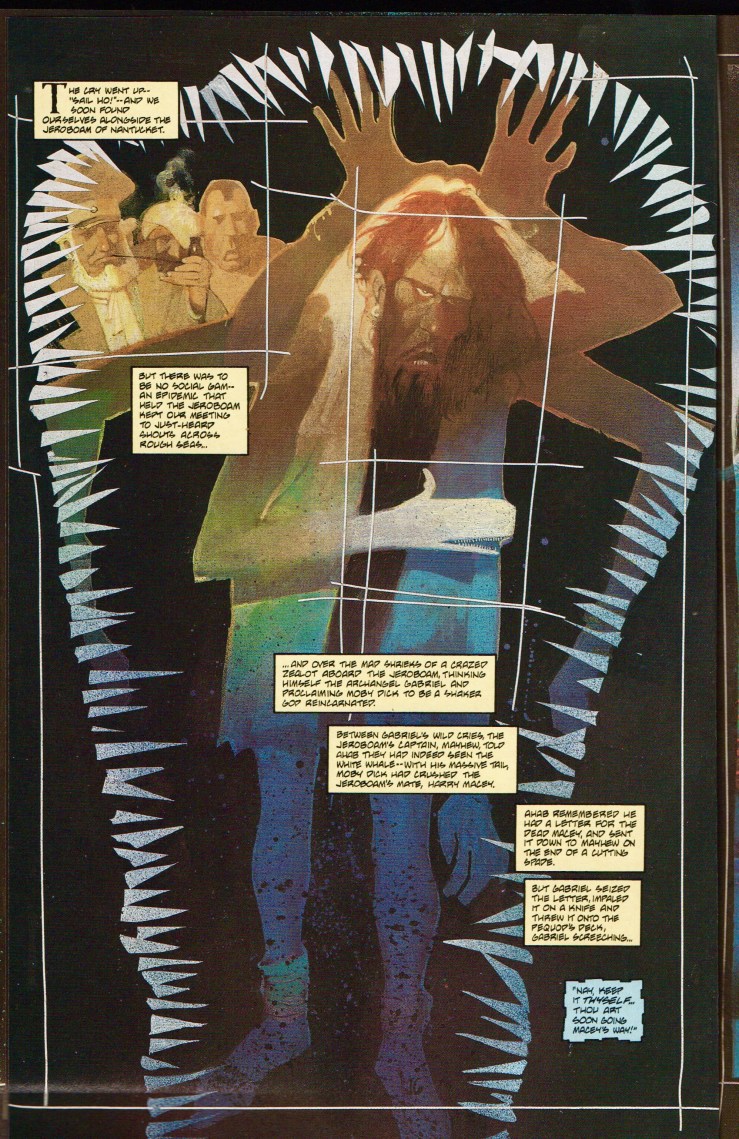
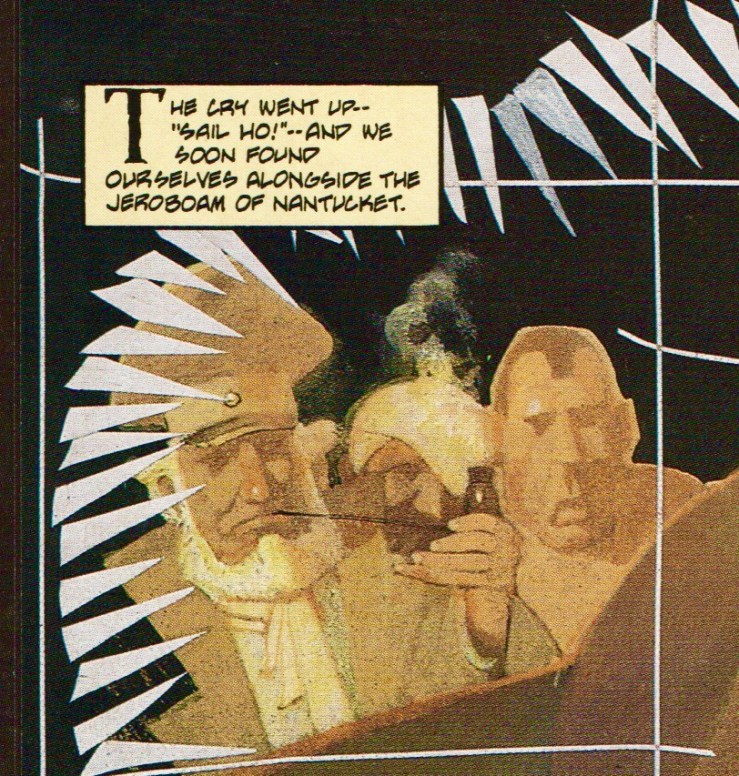
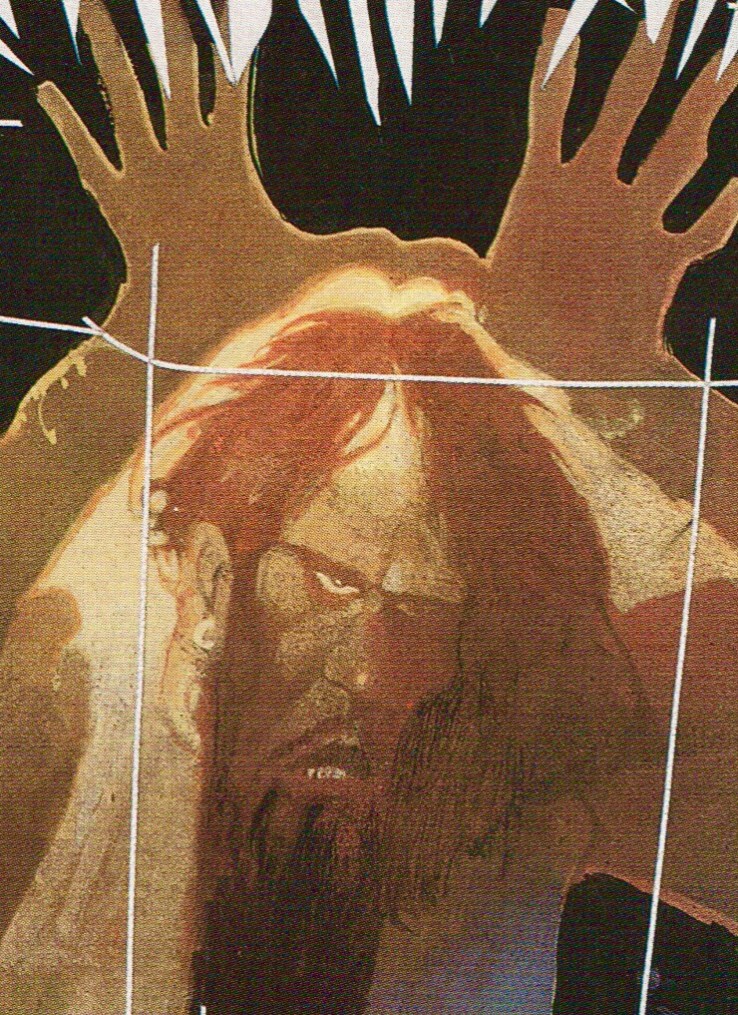
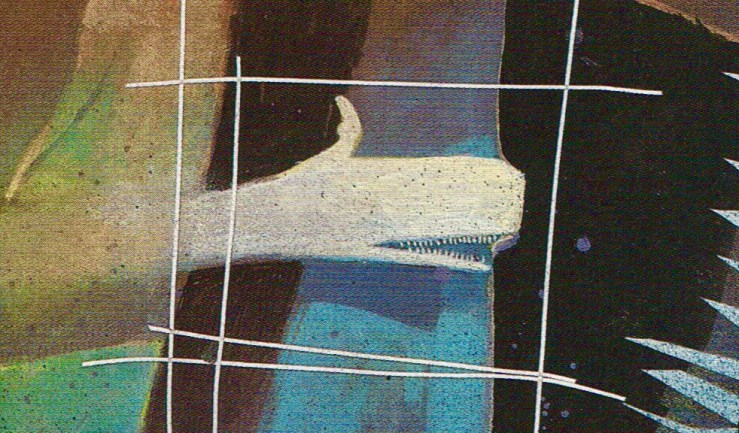
A page (and some details) from Bill Sienkiewicz’s adaptation of Herman Melville’s Moby-Dick. The Classics Illustrated edition (February 1990) is one of my favorite Moby-Dicks.
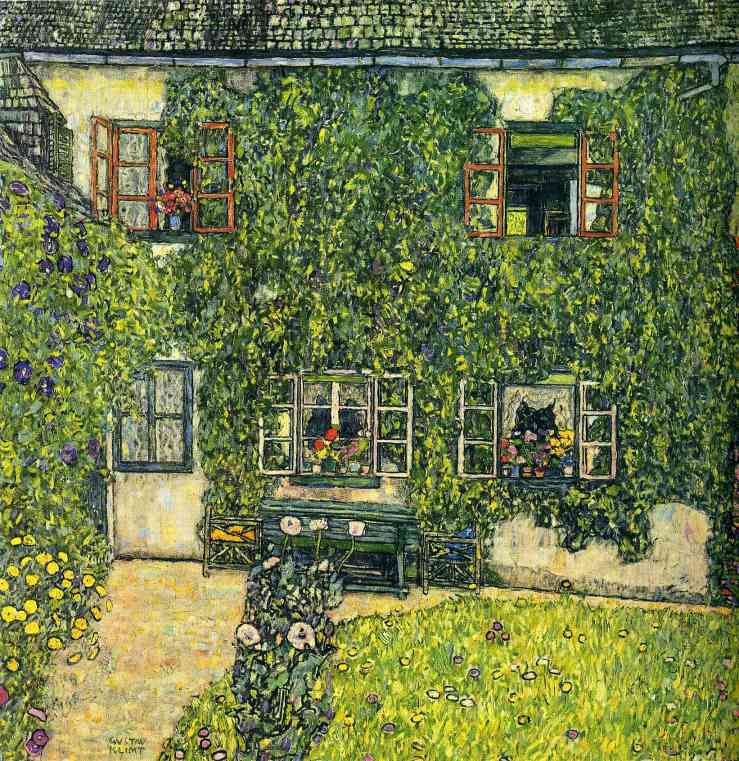
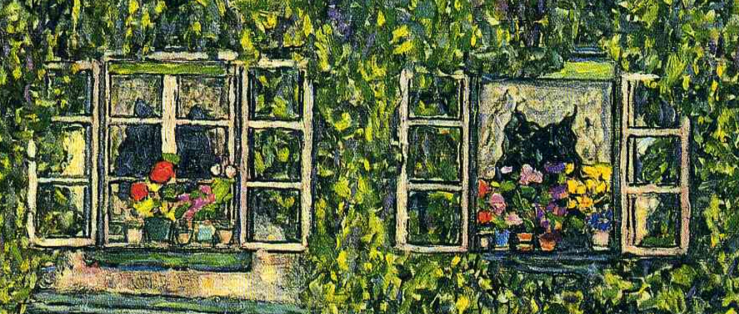
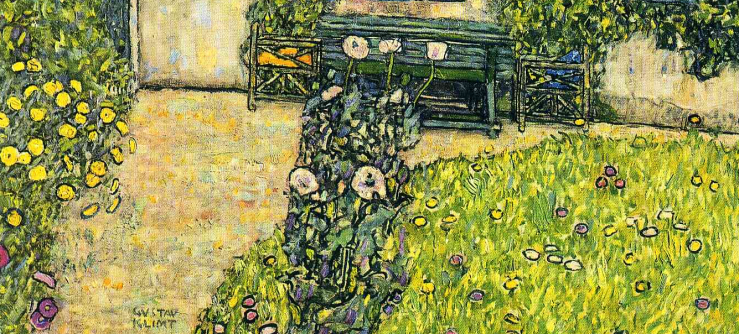
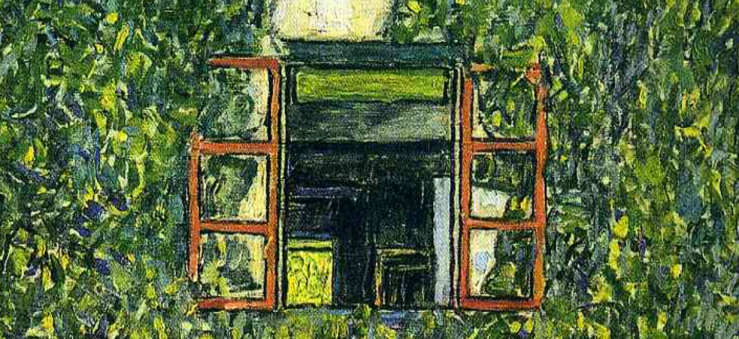
Das Haus von Guardaboschi (The House of Guardaboschi), 1912 by Gustav Klimt (1862-1912)
 Biblioklept