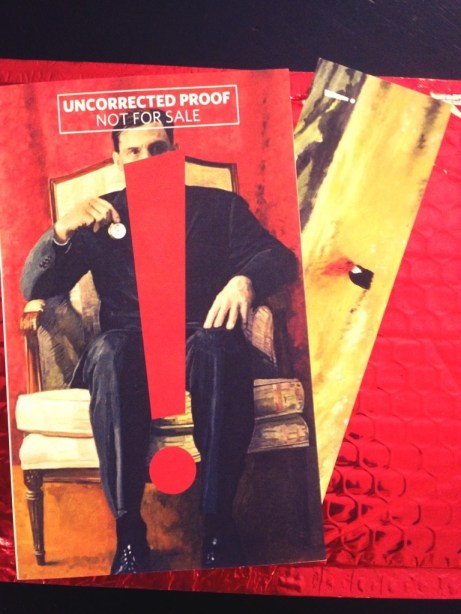
Sylwia Chrostowska’s novel Permission—got it in the mail on Saturday. I’d been swimming in the river, in the relentless August sun, for most of the day, and when I got home I just wanted to watch a film and drink some wine and pass out.
But I started reading. And reading. And then I looked up and and I was like fifty pages in.
Composed of anonymous e-mail messages sent by the author to an acclaimed visual artist over the course of a year, Permission is the record of an experiment: an attempt to forge a connection with a stranger through the writing of a book. Part meditation, part narrative, part essay, it is presented to its addressee as a gift that asks for no thanks or acknowledgment—but what can be given in words, and what received?Permission not only updates the “epistolary novel” by embracing the permissiveness we associate with digital communication, it opens a new literary frontier.
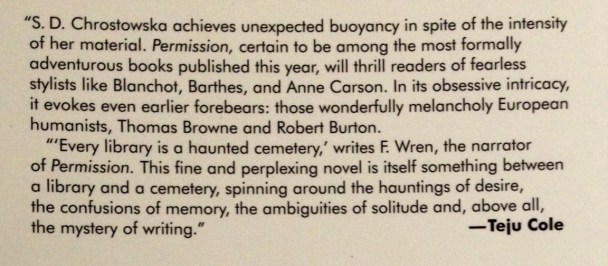
And here’s novelist Teju Cole’s blurb, from the back of the book (for some reason not posted at Dalkey):
Permission’s central premise (if such a work so soaked in deconstruction could be said to have a center) immediately recalled to me Jacques Derrida’s discussions of the paradox of giving:
To rephrase my experimental question: can I give away what is inalienable from me (my utterance, myself) without the faintest expectation or hope of authority, solidarity, reciprocity? Can my giving be unhinged from a sense of both investment and pointless expenditure?
The first few “chapters” — the narrator’s weekly missives to the unnamed artist — are thoroughly soaked in deconstruction and continental philosophy; this is a novel that cites Blanchot and Deleuze in its first twenty pages. However, the narrator promises that her book, “through its progressive dissolution, towards the final solution of this writing (my work) . . . becomes progressively less difficult, less obscure.”
This promise seems true, as subsequent passages flow into personal memory, reflection—storytelling. We get a brief tour of cemeteries, a snapshot of the narrator’s father (as a child) at a child’s funeral, a recollection of the narrator’s first clumsy foray into fiction writing, a miniature memoir of a failed painter, color theory, the sun, the moon.
Nothing is any more permitted in fiction like stage convention of keeping people on stage by coincidences.
Must listen for conversation style a la Joyce
Nevertheless value of Ernest’s feeling about the pure heart when writing—in other words the comparatively pure heart, the “house in order.”
Resent the attempt of the boys and girls who tried to bury me before I was dead.
Books are like brothers. I am an only child. Gatsby my imaginary eldest brother, Amory my younger, Anthony my worry. Dick my comparatively good brother but all of them far from home. When I have the courage to put the old white light on the home of my heart, then—
Shakespeare—whetting, frustrating, surprising and gratifying.
Forebearance, good word.
I can never remember the times when I wrote anything—This Side of Paradise time or Beautiful and Damned and Gatsby time for instance. Lived in story.
That Willa Cather’s poem shall stand at beginning of Mediaval and that it shall be the story of Ernest.
Just as Stendahl’s portrait of a Byronic man made Le Rouge et Noir so couldn’t my portrait of Ernest as Phillipe make the real modern man.
There never was a good biography of a good novelist. There couldn’t be. He is too many people if he’s any good.
And such condescension toward the creative life— Tolstoi caught the sense of the Napoleonic wars out in the street from the man in the street; his comments on fiction which would make any old 1864 copy of Leslie’s more humanly valuable than The Red Badge of Courage—the idealization of all that passes through his empty mind; his hatred of all people who formed the world in which he lives—a political Oscar Wilde peddling in the provinces the plums he took from our pudding; his role of Jesus cursing. You can see him going from prize fight to first night to baseball game-maybe even to women—trying to put back into movement the very things Lenin regretted that he might have destroyed—gracelessness and ugliness for its own sake. Gentlemen, proletarians—for a prize skunk I give you Mr. Forsite.
Like many (maybe most) Americans, my first impulse when I have to wait somewhere is to pull out my smart phone and dick around. I like to dick around on Twitter, which often leads me to stuff that I scan or gaze or graze through, with a kind of distracted, even half-hearted, attention. Because I’m also attending to something else—the waiting.
I had to wait, or be patient, or be a patient, or what have you several times last month, and each time I brought with me the newest or forthcomingest issue of theNewerYork—issue 3 (or III, depending on press materials). It fits neatly in my pocket and most of the pieces are a page at most—a perfect alternative to my iPhone, with none of the eye-deadening numbness that so often happens with long binges on a tiny screen.
theNewerYork describes itself as
a weird sort of literary mag. Our rule: no short stories, no poetry, no essays. We want to play around with literary form and narration, we want to screw with your mind! There will be personal letters, flash-fictions, glossaries, aphorisms, manuals, lists and other absurdities. We received over 600 submissions from all over the world. We’ve got flash fictions of sex and drugs, teenage romances, philosophical treatises, pretentious definitions, web forums, silly, sappy, scary stuff.
That’s a pretty apt description. To hijack and cannibalize my write-up of the last issue, theNewerYork’s “willingness to showcase experimentation in what goes on paper for people to look at and read is both a strength and a weakness.” This third issue sees an all-around increase in quality, from the production design, to the art, to the writing.
Highlights include Panayotis Pakos’s “Les Innumerables (A Binary Tale),” a Calvinoesque flash that imagines the dream-life of numbers, and Shane Jesse Christmass’s “My Delicate Response to a Child’s Writing Prompt Website” (quick sample: “If there were no television I’d beach my television set down within the dunes…”). Zach Davidson’s “Unstandardized Testing” claims (truthfully?) to present a set of scrambled questions from a trash bin; the testtaker is tasked with creating proper order (sample: “too lazy to do lazy something you are if you are still?”)
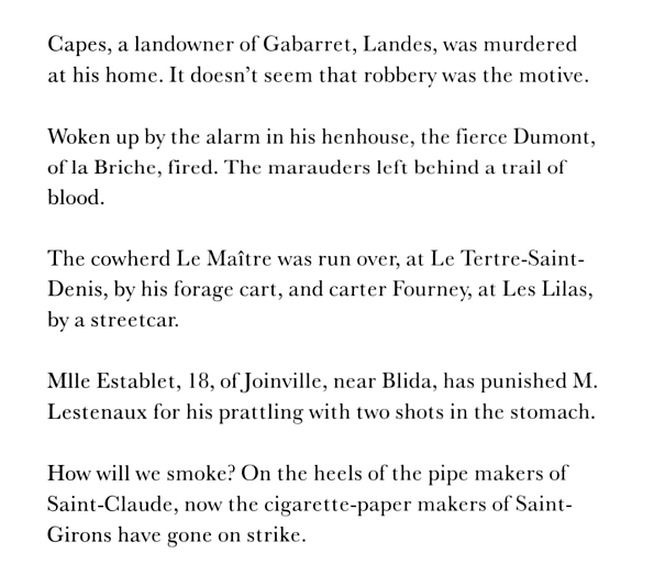
The most affecting piece in the collection is Anton Nimblett’s “Show & Tell: An American Game,” an analysis posing as a chronology. I’ll share only the nineteenth century portion, and, at the risk of spoiling, let you know that the story ends with the line “Show birth certificate (again, again, again).”
The list-form, along with (or combined with) the second-person POV seems a favorite for “experimental” fiction, which can occasionally be grating (but only when it doesn’t work)—but most of the pieces here work. And if they don’t, there’s something coming up that does.
Despite the disparate tones, approaches, and geographies of its contributors, theNewerYork coheres—the little magazine has a clear (if discursive vision). Good stuff. Check out their website for more.
“The Double” by Jorge Luis Borges (From Book of Imaginary Beings)
Suggested or stimulated by reflections in mirrors and in water and by twins, the idea of the Double is common to many countries. It is likely that sentences such as A friend is another self by Pythagoras or the Platonic Know thyself were inspired by it. In Germany this Double is called Doppelgänger, which means ’double walker’. In Scotland there is the fetch, which comes to fetch a man to bring him to his death; there is also the Scottish word wraith for an apparition thought to be seen by a person in his exact image just before death. To meet oneself is, therefore, ominous. The tragic ballad ‘Ticonderoga’ by Robert Louis Stevenson tells of a legend on this theme. There is also the strange picture by Rossetti (‘How They Met Themselves’) in which two lovers come upon themselves in the dusky gloom of a wood. We may also cite examples from Hawthorne (‘Howe’s Masquerade’), Dostoyevsky, Alfred de Musset, James (‘The Jolly Corner’), Kleist, Chesterton (‘The Mirror of Madmen’), and Hearn (Some Chinese Ghosts).
The ancient Egyptians believed that the Double, the ka, was a man’s exact counterpart, having his same walk and his same dress. Not only men, but gods and beasts, stones and trees, chairs and knives had their ka, which was invisible except to certain priests who could see the Doubles of the gods and were granted by them a knowledge of things past and things to come.
To the Jews the appearance of one’s Double was not an omen of imminent death. On the contrary, it was proof of having attained prophetic powers. This is how it is explained by Gershom Scholem. A legend recorded in the Talmud tells the story of a man who, in search of God, met himself.
In the story ‘William Wilson’ by Poe, the Double is the hero’s conscience. He kills it and dies. In a similar way, Dorian Gray in Wilde’s novel stabs his portrait and meets his death. In Yeats’s poems the Double is our other side, our opposite, the one who complements us, the one we are not nor will ever become.
Plutarch writes that the Greeks gave the name other self to a king’s ambassador.
Nanni Balestrini’s novella Sandokan, in English translation from Melville House, tells the story of the rise of the Camorra crime syndicate in the small, poverty-stricken cities around Naples. Balestrini’s unnamed narrator occupies a fascinating insider-outsider perspective: one one hand, he, unlike many of his peers, does not join the gang, or “clan,” as its called–in fact, their behavior repulses him. On the other hand, he’s a native of the small town where Francesco Schiavone (aka Sandokan), Antonio Bardellino, and their henchman rule mercilessly, an eye-witness to the brutality and inhumanity of organized crime. The narrator is a sensitive young man who delineates clearly how the crime cartel was able to achieve such economic prosperity and power in the 70s, 80s, and 90s, detailing the various rackets the clan imposed upon the town, like stealing elections, peddling drugs, and manipulating the agribusiness that is the main source of income for average Neapolitan peasants. The narrator also explores why these small towns fall so easily into the terror of organized crime. The main reason: boredom stemming from little or nothing to do.
Balestrini’s narrator’s description of the Camorra is systematic, detailing the awful history and brutal practices of the syndicate in spare, concrete terms. His explications of the clan’s violence is not so much thrilling as it is ugly, as the narrator always shows how “normal people” (his words) are cheated, killed, or otherwise harmed by the Camorra. The narrator’s tone is often journalistic but never clinical; he always shows what’s at stake for the “normal people,” how they are affected by these crimes. At times the narrator is wryly funny, a tone that results in large part from his observation that the townspeople, the people he grew up around, begin to normalize the violence. It becomes part of their daily lives and affects them so directly that it becomes casual, and the sensitive narrator is one of only a few not to bow to it, ignore it, or take part in it–yet the violence and crime is so overwhelming that to live with it is to live with absurdity. Balestrini employs a punctuation-free rhetorical style in Sandokan that captures the breathless energy and frustration of the narrator. While many readers might balk at the lack of commas, periods, or semi-colons, I found the technique quite liberating. It enhances the immediacy of the narrator’s voice, the rushed sense of importance to his tale. It also promotes sustained readings of the text–I read most of Sandokan in three enthralled sittings.
Sandokan has its cinematic twin in the 2008 film Gomorra, directed by Matteo Garrone. The film, like the book, illustrates the affect that crime has on a range of “normal people,” mostly occupants of a housing project outside of Naples. As in Sandokan, the ordinary citizens find that they have no choice but to choose between sides as an absurd, petty gang war ravages their already decimated landscape. Where Balestrini’s punctuation-free rhetoric allows readers closer access to his narrator’s pathos-driven story, Garrone lets his camera wander freely over the grim landscape without ever imposing any clear narrative structure. It is not until the film’s final third that the five disparate stories he tells coalesce, and even then, it remains unclear who is on whose side. What is clear is that the violence and crime is quickly stealing–and killing–another generation.
In an age where violence is sensationalized and glamorized, particularly in gangster films and TV shows (do I really need to list them?), Sandokan and Gomorra both lay bare the Darwinian cost of crime. In both narratives, the violence is mundane and inescapable, meaningless yet awful, and very, very dark. Neither narrative is didactic in the least–or even hopeful, for that matter–but their is an implicit suggestion that if only there were some alternative to the Camorra–libraries, social clubs, movie houses–there might be another prospect for the young people in this area.
I highly recommend both Sandokan and Gomorra. As an end note, I’d love to see more of Nanni Balestrini’s work come into English translation, perhaps via Antony Shugaar and Melville House, who’ve done a lovely job here.
[Ed. note: Biblioklept published a version of this review in January of 2010]
The substance of Hawthorne is so dripping wet with the supernatural, the phantasmal, the mystical—so surcharged with adventures, from the deeper picturesque to the illusive fantastic, one unconsciously finds oneself thinking of him as a poet of greater imaginative impulse than Emerson or Thoreau. He was not a greater poet possibly than they—but a greater artist. Not only the character of his substance, but the care in his manner throws his workmanship, in contrast to theirs, into a kind of bas-relief. Like Poe he quite naturally and unconsciously reaches out over his subject to his reader. His mesmerism seeks to mesmerize us—beyond Zenobia’s sister. But he is too great an artist to show his hand “in getting his audience,” as Poe and Tschaikowsky occasionally do. His intellectual muscles are too strong to let him become over-influenced, as Ravel and Stravinsky seem to be by the morbidly fascinating—a kind of false beauty obtained by artistic monotony. However, we cannot but feel that he would weave his spell over us—as would the Grimms and Aesop. We feel as much under magic as the “Enchanted Frog.” This is part of the artist’s business. The effect is a part of his art-effort in its inception. Emerson’s substance and even his manner has little to do with a designed effect—his thunderbolts or delicate fragments are flashed out regardless—they may knock us down or just spatter us—it matters little to him—but Hawthorne is more considerate; that is, he is more artistic, as men say.
Hawthorne may be more noticeably indigenous or may have more local color, perhaps more national color than his Concord contemporaries. But the work of anyone who is somewhat more interested in psychology than in transcendental philosophy, will weave itself around individuals and their personalities. If the same anyone happens to live in Salem, his work is likely to be colored by the Salem wharves and Salem witches. If the same anyone happens to live in the “Old Manse” near the Concord Battle Bridge, he is likely “of a rainy day to betake himself to the huge garret,” the secrets of which he wonders at, “but is too reverent of their dust and cobwebs to disturb.” He is likely to “bow below the shriveled canvas of an old (Puritan) clergyman in wig and gown—the parish priest of a century ago—a friend of Whitefield.” He is likely to come under the spell of this reverend Ghost who haunts the “Manse” and as it rains and darkens and the sky glooms through the dusty attic windows, he is likely “to muse deeply and wonderingly upon the humiliating fact that the works of man’s intellect decay like those of his hands” … “that thought grows moldy,” and as the garret is in Massachusetts, the “thought” and the “mold” are likely to be quite native. When the same anyone puts his poetry into novels rather than essays, he is likely to have more to say about the life around him—about the inherited mystery of the town—than a poet of philosophy is. Continue reading ““Hawthorne” — Charles Ives”→
Explore drafts of published and unpublished writings, recordings of his interviews and readings, photographs and scans of important documents and objects that have shaped his life. You will also find an essay, “My Memories of the Service,” which Gass wrote specifically for this digital exhibit.
So I have this other site, Gustave Doré’s Don Quixote, which simply runs, in more or less chronological order, Doré’s engravings for Miguel Cervantes’ Don Quixote. Updates four or five times a week. Check it out (or don’t).
2. So I read The Tramp Steamer’s Last Port of Call last week. At 66 pages (in a tiny font), it’s the shortest novella in the book. It’s also the first story where we don’t really get an adventure or misadventure of Maqroll, who more or less sits this one out. Instead, an unnamed narrator—a writer of mundane tracts but also poems—tells the story. And of course, because this is Mutis, there is a second storyteller embedded in this tale, a Basque sailor, captain of the titular steamer. The shifting, labyrinthine connections between the steamer, the narrator, the Basque sailor, and a Lebanese woman named Warda frame the plot of The Tramp Steamer’s Last Port of Call.
3. Even though Maqroll the Gaviero is on the margins of this tale, the text resonates with his weary, picaresque spirit. And even though his name doesn’t even appear until the novella’s second half, we nevertheless get one of the more lucid descriptions of our anti-hero thus far in the collection:
The other man, whose name he never understood clearly but who was also called Gaviero, was treated by Bashur with unreserved familiarity and listened to with the greatest attention in matters relating to commercial shipping and the operation of freighters in the most remote corners of the world. The Basque could not determine if Gaviero was a nickname, a surname, or simply a designation left over from the time he was a lookout in his youth. A man of few words, with a rather odd, corrosive sense of humor, he was extremely attentive and sensitive in his friendships, knowledgeable about the most unexpected professions, and, while not a womanize, very conscious of, one might say dependent on, a feminine presence.
4. As fate—and fate is the major theme of The Tramp Steamer’s Last Port of Call (and maybe all of Maqroll, and maybe all of Latin American literature, and maybe all of literature, but specifically the major theme of The Tramp Steamer’s Last Port of Call, which organizes itself around the interconnections between its narrator and the Basque captain)—as fate would have it, the narrator knows the Gaviero,
an old friend whose confidences and tales I have been collecting for many years, considering them of some interest to those who enjoy hearing about the unusual, contrary lives of people who do not follow the common path of gray routine in an age of mindless conformity.
(The above citation is, of course, a wonderful metatextual review of Mutis’s big book).
The narrator doesn’t reveal that he knows the Gaviero though; he doesn’t wish to pollute the Basque captain’s story.
5. Back to fate and chance for a moment: “Chance is always suspect, and much that is fraudulent imitates it.” This might be the thesis statement of The Tramp Steamer’s Last Port of Call. Maybe.
6. The Tramp Steamer’s Last Port of Call, much like the novellas that precede it, is very much a study of heterogeneity, depicting of a world of shifting identities and ever-changing motivations and outcomes. Words like labyrinth, maze, and intertwine repeat in the text, whether Mutis is describing rivers or cultures or individuals. The text is larded with blends and syntheses, but I’ll grab one simple example, one of the rare times this particular novella returns to the Gaviero. Talking to the narrator, the Basque captain says:
I realized that my own provincial and national prejudices had kept me from seeing the enormous wealth of experience and the solid, warm humanity of this man, whose nationality I never learned, as I never learned the correct pronunciation of his name, which sounded vaguely Scottish but could also have been Turkish or Iranian. I found out later that he carried a Cypriot passport. But that doesn’t mean anything, because he himself hinted I should not put too much faith in its authenticity.
7. What is most authentic in the ever-shifting world Mutis depicts? I think it’s food. I can’t think of another writer who depicts scenes of gustation with such sybaritic pleasure. Mutis never neglects to describe a meal, even on a humble tugboat:
Each tug had two cabins for passengers, who shared with the captain the food prepared by two Jamaican women whose culinary talents we never tired of celebrating. The pork in plum sauce, the rice with coconut and fried plantains, the succulent stews made of river fish, and, and indispensable and always welcome complement to the meals, the miraculously refreshing pear juice with vodka that left us splendidly disposed to enjoy the constantly changing panorama of the river and its banks; thanks to the magic of that imponderable drink, everything took place in a velvety, contented distance that we never attempted to decipher.
8. Okay, authentic might not be right word. Everything in Mutis’s novella is authentic, true even when it’s not true. I suppose I mean stable. But: Our narrator warns us that if we try to replicate the pear and vodka drink we’ll fail, like all the others who try.
9. Let me try again: What is most authentic—I realize I’ve already employed the superlative; mea culpa—what is most authentic in the world that Mutis depicts is the strange intersections of pleasure and sorrow, the way these modes intertwine the labyrinths of our lives.
The Tramp Steamer’s Last Port of Call is a beautiful, dark, sad love story.
Possibly alert to the dangers of doting on his hero, Mutis next provides a tale in which Maqroll hardly appears, except as a cherished acquaintance of the principals. In “The Tramp Steamer’s Last Port of Call,” the shortest of the lot and one of the best, the narrator relates an experience he himself has had, in a voice close to what we know of Mutis’s own life: “I had to go to Helsinki to attend a meeting of directors of internal publications for various oil companies.” In Helsinki, he asks to be driven to the point from which he can see across the Gulf of Finland to St. Petersburg, a shimmering sight passingly eclipsed by the transit of a decrepit tramp steamer:
The captain’s bridge, and the row of cabins on the deck for crew members and occasional passengers, had been painted white a long time before. Now a coat of grime, oil, and urine gave them an indefinite color, the color of misery, of irreparable decadence, of desperate, incessant use. The chimerical freighter slipped through the water to the agonized gasp of its machinery and the irregular rhythm of driving rods that threatened at any moment to fall silent forever.
He sees the wretched, plucky ship, which fragmentary letters on its bow identify as the Halcyon, three more times—in Costa Rica, in Jamaica, and in the delta of the Orinoco River. Its apparition invades his dreams. While on another errand for the oil company, travelling downriver to a strike-threatened seaport refinery, he occupies one of the two cabins in a small tugboat; the other is occupied by a Basque sea captain called Jon Iturri, who, it turns out, was the captain of the ghostly tramp steamer, which broke up and sank in the Orinoco. Its owner, Iturri relates, was a Lebanese woman, a younger sister of Abdul Bashur, named Warda. At their first meeting, he says, he was stunned by her “almost Hellenic” beauty:
“Her blue-black hair was as dense as honey and fell to shoulders as straight as those of the kouros in the Athens Museum. Her narrow hips, curving gently into long, somewhat full legs, recalled statues of Venus in the Vatican Museum and gave her erect body a definitive femininity that immediately dispelled a certain boyish air. Large, firm breasts completed the effect of her hips.”
As he got to know her better, his admiration intensified: “Warda, when she was naked, acquired a kind of aura that emanated from the perfection of her body, the texture of her moist, elastic skin, and that face: seen from above, when we were in bed, it took on even more of the qualities of a Delphic vision.” But the lovestruck captain was fifty, and a non-Muslim, and Warda was twenty-four and, the longer she lived in Europe, ever more approving of the conservative ways of her native Lebanon. The tramp steamer, which she inherited from an uncle, was financing her European sojourn with its hard-won profits; she flew to Iturri’s ports of call and spent rapturous days in hotels with him, but their romance could last only as long as the fragile tramp steamer did. Warda’s perfect, elastic, symmetrical beauty was one with the listing, disintegrating body of the ship as it conveyed her aging lover from port to port. The story, Mutis tells us at the outset, “has something of the eternal legends that have bewitched us over the centuries”; he ends by assuring us that “there has been only one love story since the beginning of time.” Not a happy one.
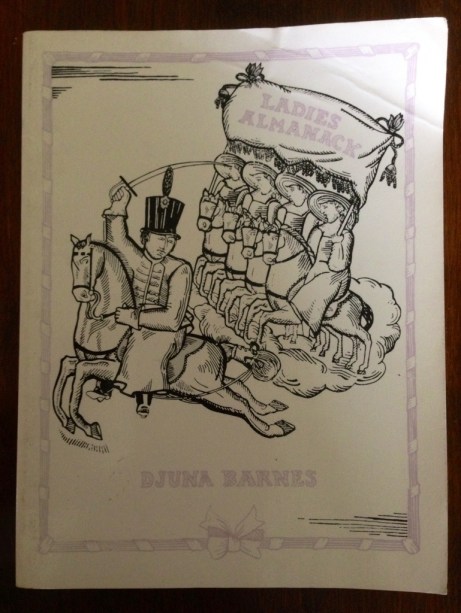
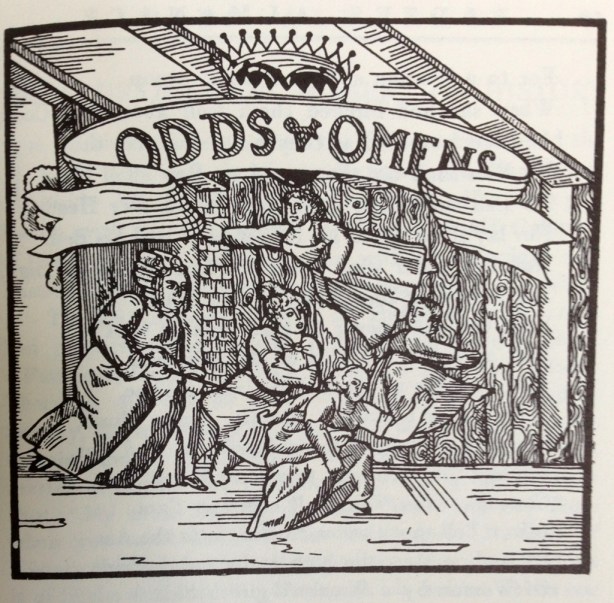
Like most Real Americans, I like to go to the bookstore on my birthday. At my favorite spot, I picked up Djuna Barnes’s Ladies Almanack, which intrigued me with its weird shape, odd typeset, strange conceit, and wonderful opening line: “Now this be a Tale of as fine a Wench as ever wet Bed.” Oh, and illustrated by Barnes too:
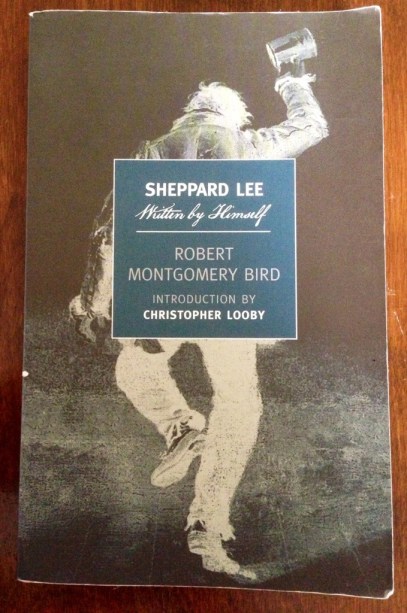
Sheppard Lee by Robert Montgomery Bird: This one looks fascinating. NYRB’s blurb:
Robert Montgomery Bird’s Sheppard Lee is a scathingly humorous and utterly original novel out of Andrew Jackson’s America, the story of an incorrigible loafer who inadvertently discovers the power to project his soul into dying men’s bodies and to take over their lives. So gifted, Sheppard Lee sets off in pursuit of happiness, only to find himself thwarted at every turn. In growing desperation he shifts from body to body, now a rich man and now poor man, now a madman and now a slave, a bewildered spirit trapped in the dark maze of American identity.
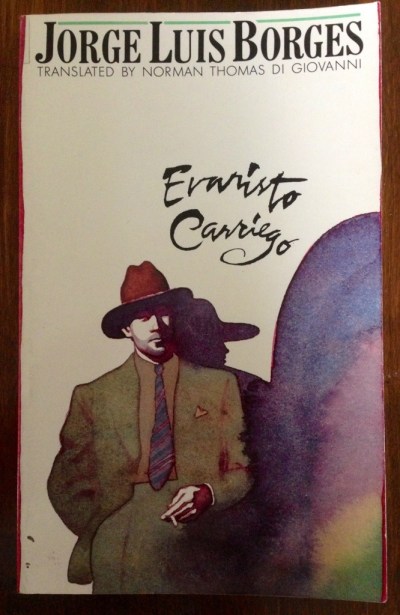
Also: Evaristo Carriego, a study of the poet by Jorge Luis Borges.
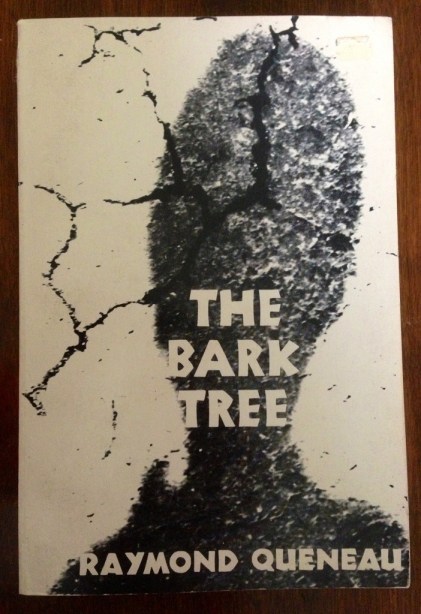
And The Bark Tree, also translated as Witch Grass. I don’t know if this is the right starting place for Queneau, but it was a nice used New Directions edition, so, hey.
“Fenimore Cooper’s Literary Offenses” by Mark Twain
“The Pathfinder” and “The Deerslayer” stand at the head of Cooper’s novels as artistic creations. There are others of his works which contain parts as perfect as are to be found in these, and scenes even more thrilling. Not one can be compared with either of them as a finished whole. The defects in both of these tales are comparatively slight. They were pure works of art.
–Professor Lounsbury
The five tales reveal an extraordinary fullness of invention. … One of the very greatest characters in fiction, Natty Bumppo… The craft of the woodsman, the tricks of the trapper, all the delicate art of the forest were familiar to Cooper from his youth up.
–Professor Matthews
Cooper is the greatest artist in the domain of romantic fiction in America.
–Wilkie Collins
It seems to me that it was far from right for the Professor of English Literature at Yale, the Professor of English Literature in Columbia, and Wilkie Collins to deliver opinions on Cooper’s literature without having read some of it. It would have been much more decorous to keep silent and let persons talk who have read Cooper.
Cooper’s art has some defects. In one place in “Deerslayer,” and in the restricted space of two-thirds of a page, Cooper has scored 114 offenses against literary art out of a possible 115. It breaks the record.
There are nineteen rules governing literary art in domain of romantic fiction — some say twenty-two. In “Deerslayer,” Cooper violated eighteen of them. These eighteen require:
1. That a tale shall accomplish something and arrive somewhere. But the “Deerslayer” tale accomplishes nothing and arrives in air.
2. They require that the episodes in a tale shall be necessary parts of the tale, and shall help to develop it. But as the “Deerslayer” tale is not a tale, and accomplishes nothing and arrives nowhere, the episodes have no rightful place in the work, since there was nothing for them to develop.
3. They require that the personages in a tale shall be alive, except in the case of corpses, and that always the reader shall be able to tell the corpses from the others. But this detail has often been overlooked in the “Deerslayer” tale.
4. They require that the personages in a tale, both dead and alive, shall exhibit a sufficient excuse for being there. But this detail also has been overlooked in the “Deerslayer” tale.
5. The require that when the personages of a tale deal in conversation, the talk shall sound like human talk, and be talk such as human beings would be likely to talk in the given circumstances, and have a discoverable meaning, also a discoverable purpose, and a show of relevancy, and remain in the neighborhood of the subject at hand, and be interesting to the reader, and help out the tale, and stop when the people cannot think of anything more to say. But this requirement has been ignored from the beginning of the “Deerslayer” tale to the end of it.
6. They require that when the author describes the character of a personage in the tale, the conduct and conversation of that personage shall justify said description. But this law gets little or no attention in the “Deerslayer” tale, as Natty Bumppo’s case will amply prove.
7. They require that when a personage talks like an illustrated, gilt-edged, tree-calf, hand-tooled, seven- dollar Friendship’s Offering in the beginning of a paragraph, he shall not talk like a negro minstrel in the end of it. But this rule is flung down and danced upon in the “Deerslayer” tale.
8. They require that crass stupidities shall not be played upon the reader as “the craft of the woodsman, the delicate art of the forest,” by either the author or the people in the tale. But this rule is persistently violated in the “Deerslayer” tale.
9. They require that the personages of a tale shall confine themselves to possibilities and let miracles alone; or, if they venture a miracle, the author must so plausibly set it forth as to make it look possible and reasonable. But these rules are not respected in the “Deerslayer” tale.
10. They require that the author shall make the reader feel a deep interest in the personages of his tale and in their fate; and that he shall make the reader love the good people in the tale and hate the bad ones. But the reader of the “Deerslayer” tale dislikes the good people in it, is indifferent to the others, and wishes they would all get drowned together.
11. They require that the characters in a tale shall be so clearly defined that the reader can tell beforehand what each will do in a given emergency. But in the “Deerslayer” tale, this rule is vacated.
In addition to these large rules, there are some little ones. These require that the author shall:
12. Say what he is proposing to say, not merely come near it.
13. Use the right word, not its second cousin.
14. Eschew surplusage.
15. Not omit necessary details.
16. Avoid slovenliness of form.
17. Use good grammar.
18. Employ a simple and straightforward style.
Even these seven are coldly and persistently violated in the “Deerslayer” tale.
Cooper’s gift in the way of invention was not a rich endowment; but such as it was he liked to work it, he was pleased with the effects, and indeed he did some quite sweet things with it. In his little box of stage-properties he kept six or eight cunning devices, tricks, artifices for his savages and woodsmen to deceive and circumvent each other with, and he was never so happy as when he was working these innocent things and seeing them go. A favorite one was to make a moccasined person tread in the tracks of a moccasined enemy, and thus hide his own trail. Cooper wore out barrels and barrels of moccasins in working that trick. Another stage-property that he pulled out of his box pretty frequently was the broken twig. He prized his broken twig above all the rest of his effects, and worked it the hardest. It is a restful chapter in any book of his when somebody doesn’t step on a dry twig and alarm all the reds and whites for two hundred yards around. Every time a Cooper person is in peril, and absolute silence is worth four dollars a minute, he is sure to step on a dry twig. There may be a hundred other handier things to step on, but that wouldn’t satisfy Cooper. Cooper requires him to turn out and find a dry twig; and if he can’t do it, go and borrow one. In fact, the Leatherstocking Series ought to have been called the Broken Twig Series. Continue reading ““Fenimore Cooper’s Literary Offenses” — Mark Twain”→
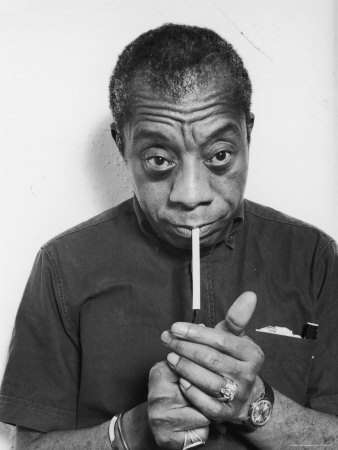
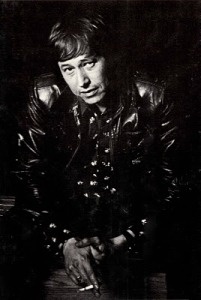
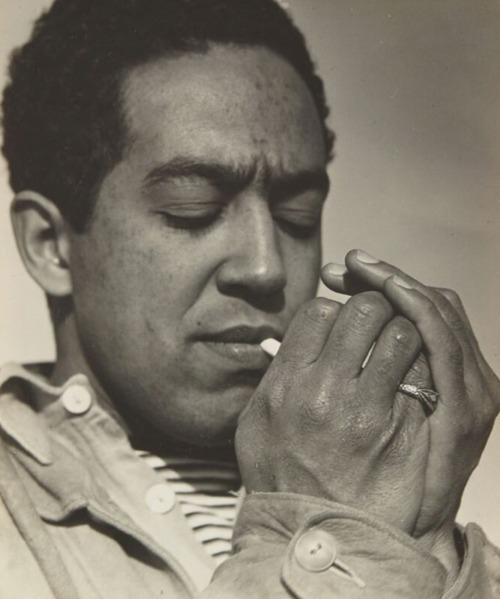
(Parts I and II (don’t worry, everyone already yelled at me re: “smoking unhealthy,” etc., and yes, whole post was probably just an excuse to run that pic of Lispector)).
Got a sweet bundle from Roman Muradov a few weeks ago: Yellow Zine #3 plus some other comix, including a take on Italo Calvino’s If on a Winter’s Night. Love the Joyce bookmark.
The comix themselves are funny, weird, and strangely heartfelt (why “strangely” — I suppose because there’s this weird cerebral/linguistic bent to them + literary allusion — these aren’t sad boy emo comics — but emotion and feeling comes through in Roman’s clean, expressive style).
Check out Roman’s site for more. I’m hoping for a graphic novel one day…











 Biblioklept