Another Dalloway

Virginia Woolf’s modernist classic Mrs Dalloway is getting a centennial update from publisher NYRB. The new edition is edited by literary critic Edward Mendelson, who makes a persuasive case for his version of the text in the book’s afterword, an essay with the appropriately flat title “The Text of This Edition.” “This edition is an attempt to provide the least bad, perhaps, among many possible editions,” Mendelson writes, before appending after a semicolon: “other editors will rank it more harshly.” I imagine it’s hard work to tidy a giant.

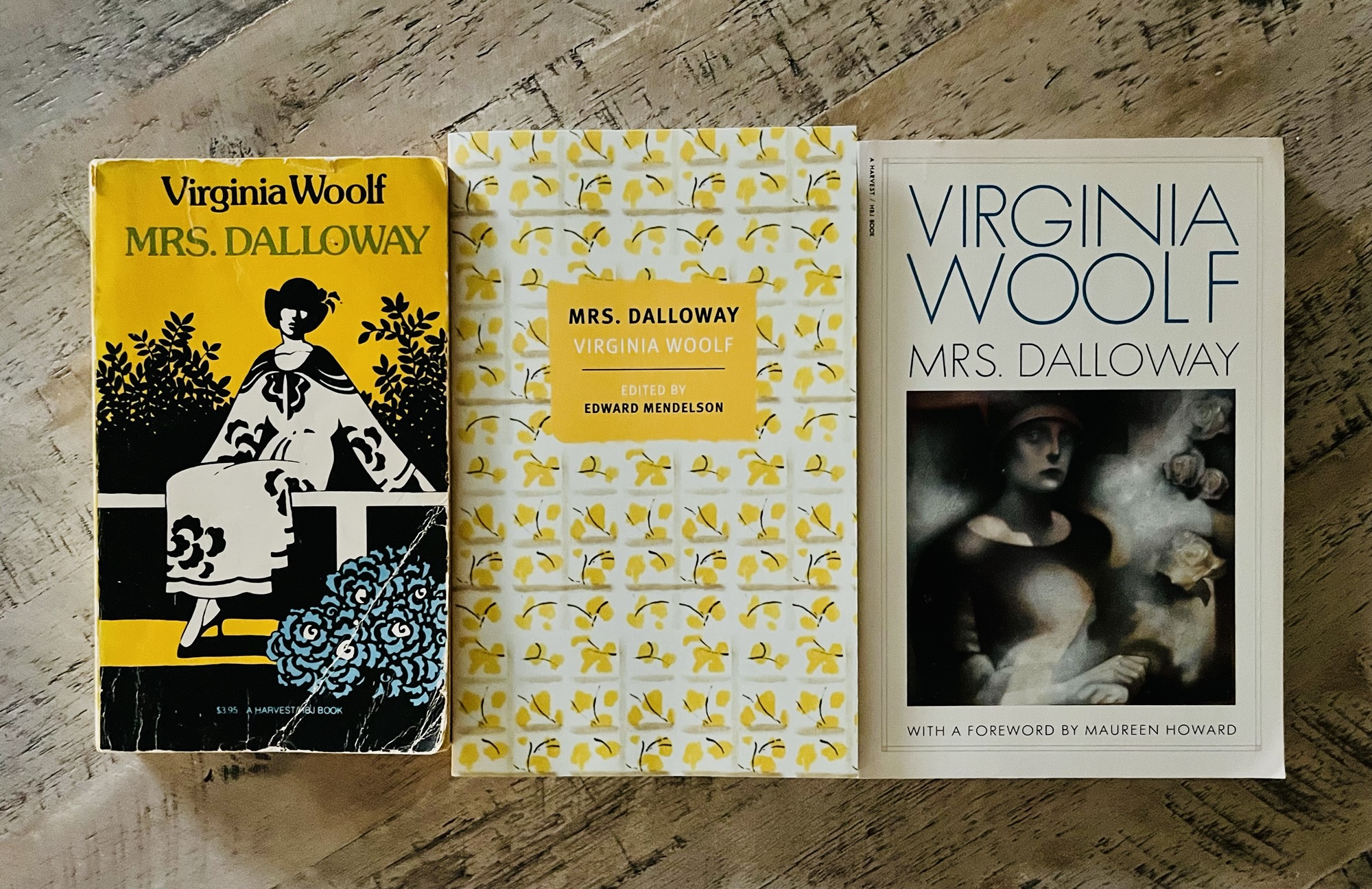
As a point of comparison, I pulled out the HBJ mass-market paperback of Mrs Dalloway that I read at least three times years and years ago; there’s no front or back matter, no intro or afterword, not even a credit for the lovely art. I (a version of myself) had scribbled “symbol is not universal” in the narrow margin of page 41; underlined “narrower and narrower” on page 45; boxed a paragraph catching salmon freely on page 152. Two photographs fell from the book — a picture of my wife and my infant daughter, c. 2008; the other, a picture of my wife and her eighteen-years-younger brother, also an infant in the picture, also held by wife, c. 1998. Those are probably the years I read the book. The older person made more scribbles, I think. What I most remember of the novel Mrs Dalloway is the WWI veteran, Septimus; I recall his anguish as a throbbing (organizing) pulse in the novel’s so-called stream-of-consciousness style. I remember generally enjoying the novel, but preferring Woolf’s Orlando; I remember a sort of sneer on the face of a fellow grad student after this declaration. Orlando is a more fun book, a picaresque sci-fi gender jaunt. I suppose Dalloway is more, like, important.

As another point of comparison, I pulled out the 1990 HBJ trade paperback of Mrs Dalloway that I picked up at the beginning of the summer at a Friends of the Library sale. I wrote in a post about those acquisitions that, “…I’ll be happy to trade out the cheap mass markets of Mrs. Dalloway and To the Lighthouse I’ve had forever in favor of these HBJ Woolfs (Wolves?)” — but that’s not true. I’ve decided I love the cheap mass market Dalloway. (A sixteen-year-old picture of my wife and daughter falling out of it didn’t hurt.) This 1990 edition features a 1981 introduction by novelist Maureen Howard. She voices her intro in the first-person plural, an unfortunate choice that we employed on this blog in our earlier years, insecure as we were. The occasion of Ms Howard’s introduction is, I think–we think, we mean–the fiftieth anniversary of the novel’s publication, although that math doesn’t add up. I dig Susan Gallagher’s cover art.

The cover for the new NYRB edition features a “specially commissioned” cover that pays “tribute to the original designs by Hogarth Press.” The publisher notes that forthcoming “new editions of To the Lighthouse and The Waves [reprinted] in celebration of their respective centenaries” will also get the cover updates. These editions are also Mendelson edits.

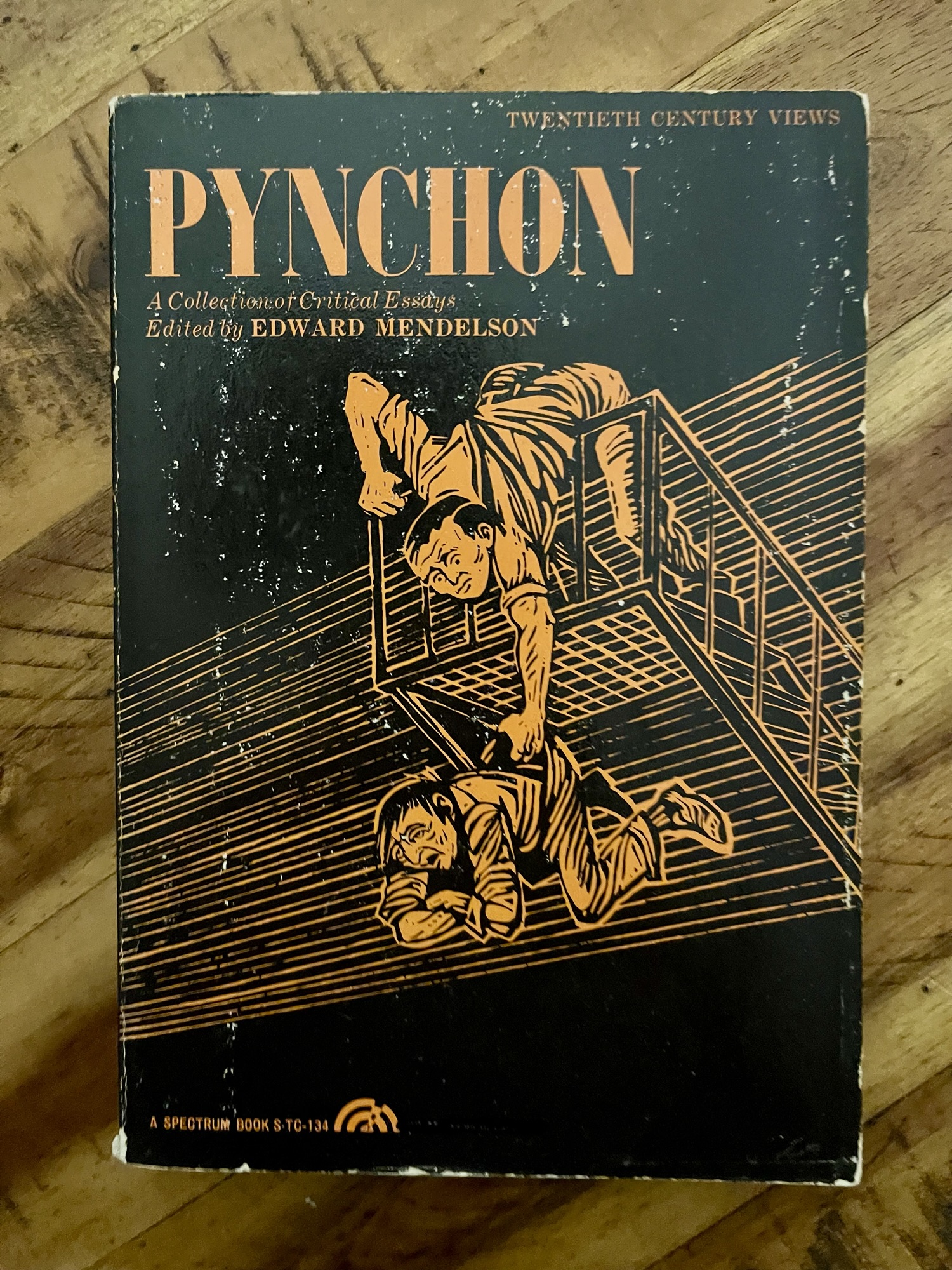
I mostly know Mendelson as the editor of Pynchon: A Collection of Critical Essays, and as the author of “The Sacred, the Profane, and The Crying of Lot 49.”

NYRB’s edition of Mrs Dalloway publishes next month.

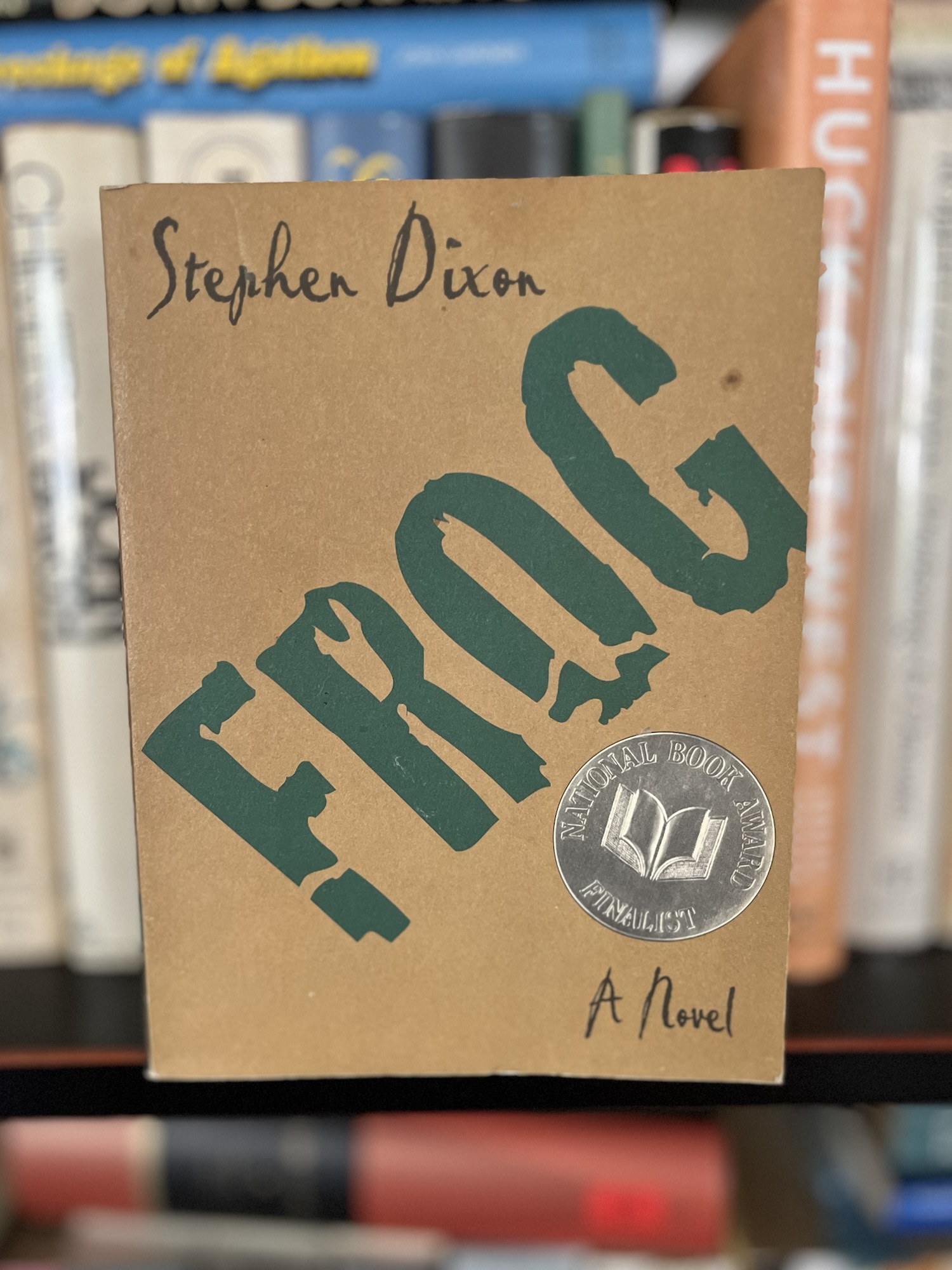
873 words from Stephen Dixon’s 1991 novel Frog, followed by 469 words on Stephen Dixon’s 1991 novel Frog

Here are 873 words from Stephen Dixon’s long looping loopy lucid antilaconic 1991 novel Frog; the words are a segment of the ninth chapter, “Frog’s Brother”:

Alex was the only passenger on the freighter. His father’s patient called his son in England and asked as a favor to the man who’s treated his family’s teeth for forty years if he could take Alex aboard free. Alex was in London then, wanted to get back home, had little money, could have borrowed plane or ocean liner fare from his parents or Jerry, wanted the experience of being on a freighter during a long crossing. Though he got free passage, he asked to work without pay at any job the captain wanted him to. He’ll clean latrines, even, he said in his last letter to Howard. Anything the lowest-grade seaman does, just to get the full feel of it and perhaps seaman’s papers for a paid trip later. He was a newsman turned fiction writer. Two months after the ship disappeared a parcel of manuscripts arrived at their parents’ apartment from England by surface mail. Maybe the manuscripts he didn’t much care about. Maybe the ones he cared most about he took with him on the ship. Howard read the stories and vignettes soon after and then some of them every three or four years till about ten years ago. He never found them very good, but Alex was just starting. Two diaries and some oriental figurines in the parcel also, and lots of letters from his parents, brothers, friends. He’d traveled around the world. Saved up for three years to do it. Did it for a year. A prostitute in a dilapidated hut in a small village outside Bangkok. Why’s that experience come to mind first? It was in a letter to Howard, not the diaries. He searched the diaries for it, thinking an elaboration of it might be interesting, revealing, sexually exciting. She was fourteen years old. That made Alex sad. She asked him to marry her. She said she’d be devoted, would learn to cook and make love American, bear him many children if he wanted, all boys if he wanted (she knew how), would return to grade school. He gave her his silver ID bracelet, pleaded with her to give up prostitution. Then he did it a third time with her the same day and came back the next. Talk about hypocrisy! he said. What’s the trick of turning a customer into a suitor? he asked. But one who’ll be good to her and an adequate provider. If he knew, he’d give it to her. Sent her a pearl necklace from Manila. If he got a venereal disease from her he’d worry more about her than himself. He might go back for her before he leaves for India, or send for her once he gets back to America, and maybe even marry her when she comes of age. Keep this between them just in case it does happen. Taught English to Malaysian businessmen for a month. Met two old men in New Guinea—Canadians—who were living the primitive jungle life. They were good friends of his till they tried to drug and rape him. He’s afraid he had to kick them both in the balls to get out of there and then steal their canoe to get back to town. Fell in love with a witch. Read Proust’s Remembrances in five nearly sleepless days, an experience that’s left him dreaming of the books every night for the last six weeks. A Goan fortuneteller told him his trip would end badly. He said to go home by plane, don’t sail. Remind him when the time comes, for the man wouldn’t take any money. Had a fifteen-year-old girl in Nairobi. What can he tell Howard?—he likes young girls. It’s more than just the way their hair blows and breasts point and bellybuttons dimple and thighs are so even. Maybe it’s because of all the girls who barely let him pet them when he was a teenager. Rode a camel through part of the Sahara. Ate lizard, locusts, grasshoppers, grubs. Never felt very Jewish before till he started hitting all the old synagogues and Jewish cemeteries he could find in the Orient and Middle East. Wait’ll he gets to Poland and Prague and also tries to look the old families up. He’s afraid it’s converted him, but not to the point of wearing a skullcap. Hitchhiked with a sixteen-year-old sabra through Turkey and Yugoslavia, though she might have been younger. When she had to go back she said she thinks he got her pregnant—her device wasn’t put in right a few times, she was so new at it. He told her he’s heard that one before, but if she has the baby and the calendrical configurations fix it as his, or just if she still says it is, he’ll love and provide for it, adopt it if she wishes and take it to America with or without her or emigrate to Israel if she prefers, marry her if that’s what she wants—she’s quite striking and clever and potentially very artistic and smart. He’s written what he thinks is fairly decent work recently, he said in his last letter. He’s glad he’s found something he wants to do for the next twenty to thirty years, has Howard?

The titular “Frog’s Brother” is Alex. (“Frog,” by the way, is “Howard,” the protagonist of Frog.) Alex’s freighter goes missing in the North Atlantic; the ship is never recovered nor are lifeboats. No bodies. The only evidence of the disaster is absence.

In this absence, Frog imagines and reimagines Alex’s death at sea in different looping cycles; these reimaginings are also framed within Frog’s attempt to accurately recall his receiving the news that his brother Alex is lost at sea–was it by phone, that he received this awful news? in his other brother’s apartment? what were the specific conditions of this heartbreak?

Imagining and then reimagining the specific details of a horrifying, horrible, horrendous event is the rhetorical gist of Dixon’s 1995 follow-up to Frog, Interstate, a fucked-up eight-way riff on the narrator’s daughter’s murder by way of random highway violence.

I have read around 120 of Fog’s near 800 pages, and many of those pages feature the same rhetorical and narratological techniques or repetitions with differences that were so off-centered in Interstate: fraying phrases, looping tics, paranoid passages. In the absence of the one thing, Dixon’s narrators pony up iteration after iteration, something after something. But the narrators know that there’s not enough somethings to ever even come close to approximating everything. The iterations sharpen and highlight the beauty of the absence’s abyss.

That abyss was real, or true, or True, for Stephen Dixon, whose brother “Jimmy, a magazine writer, died in 1960 when the freighter he was on in the North Atlantic disappeared,” as the New York Times reported in Dixon’s 2019 obituary. The Times obituary continued: “Mr. Dixon felt that he was continuing his brother’s work. Jimmy Dixon had a short story published after his death.” If Jimmy Dixon was prototype to Alex Frogbrother, what are we to make of the fantastic paraphrase of his letters, above? The passage reads like a bizarre failed adventure tale, something we might expect from William T. Vollmann, who, with his heart of gold, tried to “free” sex workers. It’s also quite queasy when it comes to sex (a constant I’ve noticed in Dixon): “What can he tell Howard?—he likes young girls,” our narrator flatly, grossly reports.

The saddest and realest bit might be this though, the admission that “Howard read the stories and vignettes soon after and then some of them every three or four years till about ten years ago. He never found them very good, but Alex was just starting.” But Alex was just starting. The last bit of the section, “He’s glad he’s found something he wants to do for the next twenty to thirty years, has Howard?” seems both boon and curse, a door that opens and shuts simultaneously, cursing our Stephen Dixon, our Frog, to write write write write write write write write write…


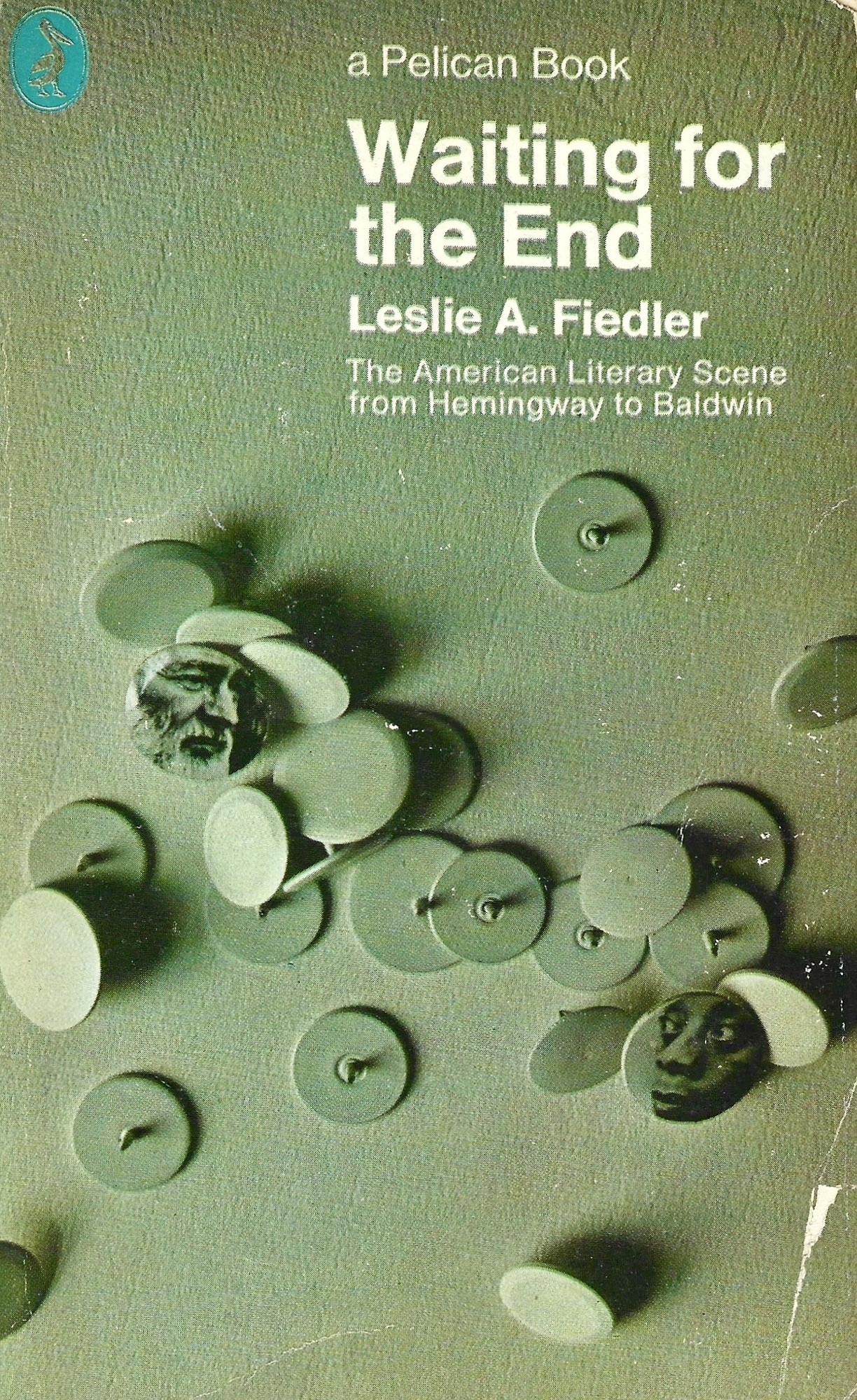
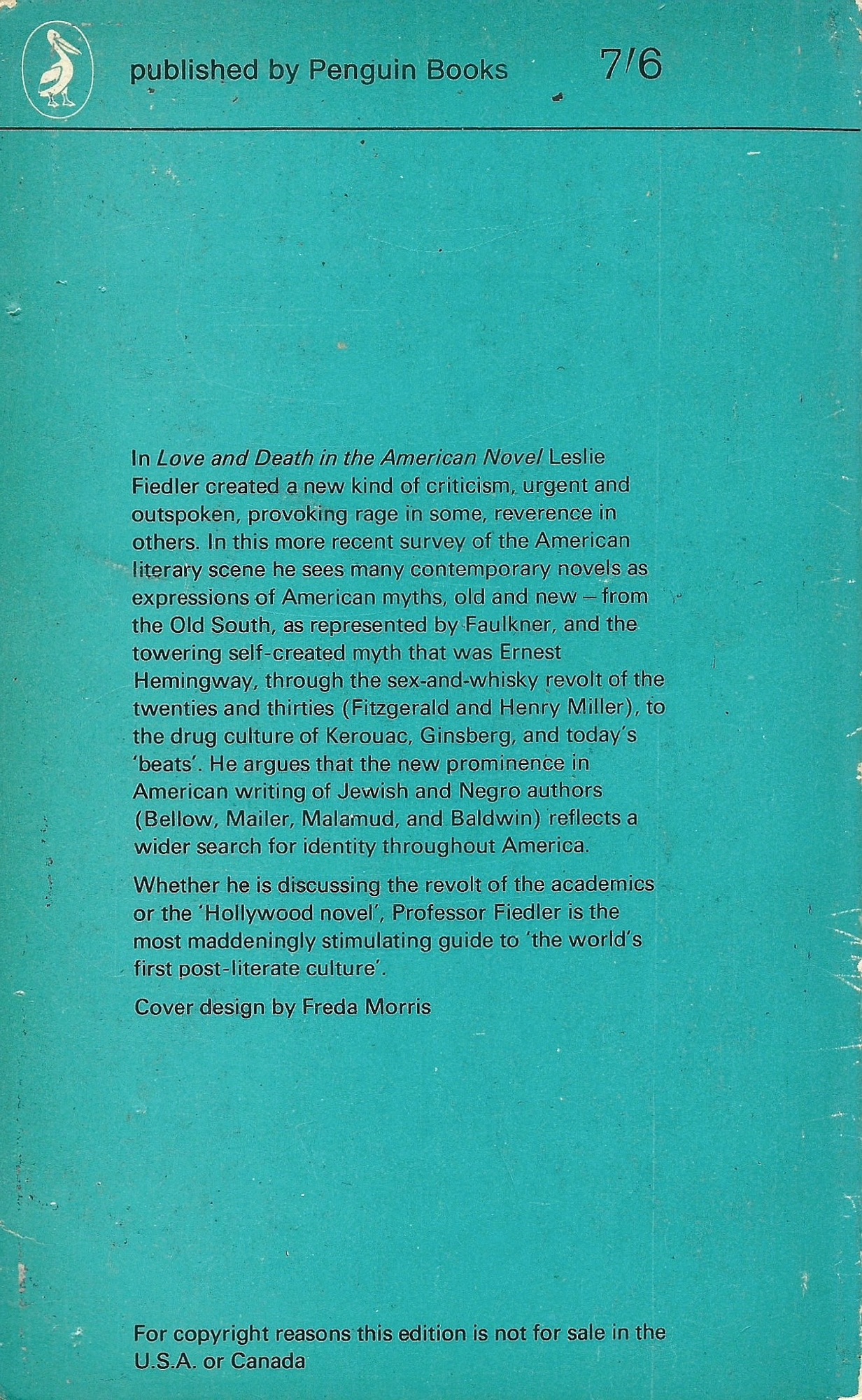
Mass-market Monday | Leslie A. Fiedler’s Waiting for the End

Waiting for the End, Leslie A. Fiedler. Penguin Books, Pelican imprint (1967). Cover design by Freda Morris. 274 pages.

From a riff a few years back:

Fiedler begins with the (then-recent) deaths of Hemingway and Faulkner. Fiedler uses the deaths of these “old men” to riff on the end of Modernism, although he never evokes the term. Neither does he use the term “postmodernism” in his book, although he edges towards it in his critiques of kitsch and middlebrow culture, and especially in his essay “The End of the Novel.” In parts of the book, he gets close to describing, or nearing a description of, an emergent postmodernist literature (John Barth and John Hawkes are favorite examples for Fiedler), but ultimately seems more resigned to writing an elegy for the avant garde. Other aspects of Waiting for the End, while well-intentioned, might strike contemporary ears as problematic, as the kids say, but Fiedler’s sharp and loose style are welcome over stodgy scholarship. Ultimately, I find the book compelling because of its middle position in its take on American literature. It’s the work of a critic seeing the beginnings of something that hasn’t quite emerged yet—but his eye is trained more closely on what’s disappearing into the past.

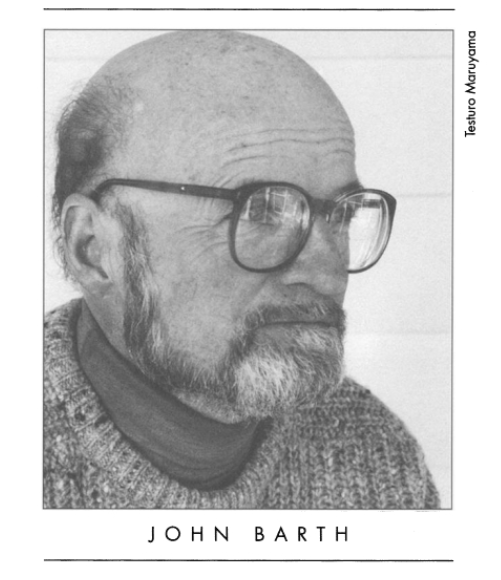
You don’t consciously see yourself as John Barth, the postmodernist?

Q: You don’t consciously see yourself as John Barth, the postmodernist?

JOHN BARTH: Oh no, no, and the term now has become so stretched out of shape. I did a good deal of reading on the subject for a postmodernist conference in Stuttgart back in 1991, and I think I had a fairly solid grasp of the term then. At the time, there seemed to be a general agreement that, whatever postmodernism was, it was made in America and studied in Europe. At my end, I would say the definitions advanced by such European intellectuals as Jean Baudrillard and Jean- Francois Lyotard have only a kind of a grand overlap with what I think I mean when I am talking about it.g about it. They apply the term to disciplines and fields other than art-their thoughts about postmodern science, for instance, are very interesting-but when the subject is postmodern American fiction, things get murkier. So often we’re told, “You know, it’s Coover, Pynchon, Barth, and Barthelme,” but that’s just pointing at writers. Perhaps that’s all you can do. It led me to say once, “If postmodern is what I am, then postmodernism is whatever I do.” You get a bit wary about these terms. When The Floating Opera came out, Leslie Fiedler called it “provincial American existentialism.” With End of the Road, I was most often described as a black humorist, and with The Sot-Weed Factor, Giles Goat-Boy, and Lost in the Funhouse, I became a fabulist. Bill Gass resists the term “postmodernist,” and I understand his resistance. But we need common words to talk about anything. “Impressionism” is a very useful term which helps describe the achievements of a number of important artists. But when you begin to look at individual impressionist painters, the term becomes less meaningful. You find yourself contemplating a group of artists who probably have as many differences as similarities. I recall a wonderful old philosophy professor of mine who used to talk about the difference between the synthetic temperament and the analytical temperament. With the synthetic, the similarities between things are more impressive than the differences; with the analytical, the differences are more impressive than the similarities. We need them both; you can’t do without either. In that context, once you’ve come up with some criteria that describe what has been going on in a certain type of fiction composed during the sixties, seventies, eighties, and nineties, I think the differences among Donald Barthelme, Angela Carter, and Italo Calvino are probably more interesting than the similarities.

From an interview with Barth conducted by Charlie Reilly in the journal Contemporary Literature, Vol. 41, No. 4 (Winter, 2000).

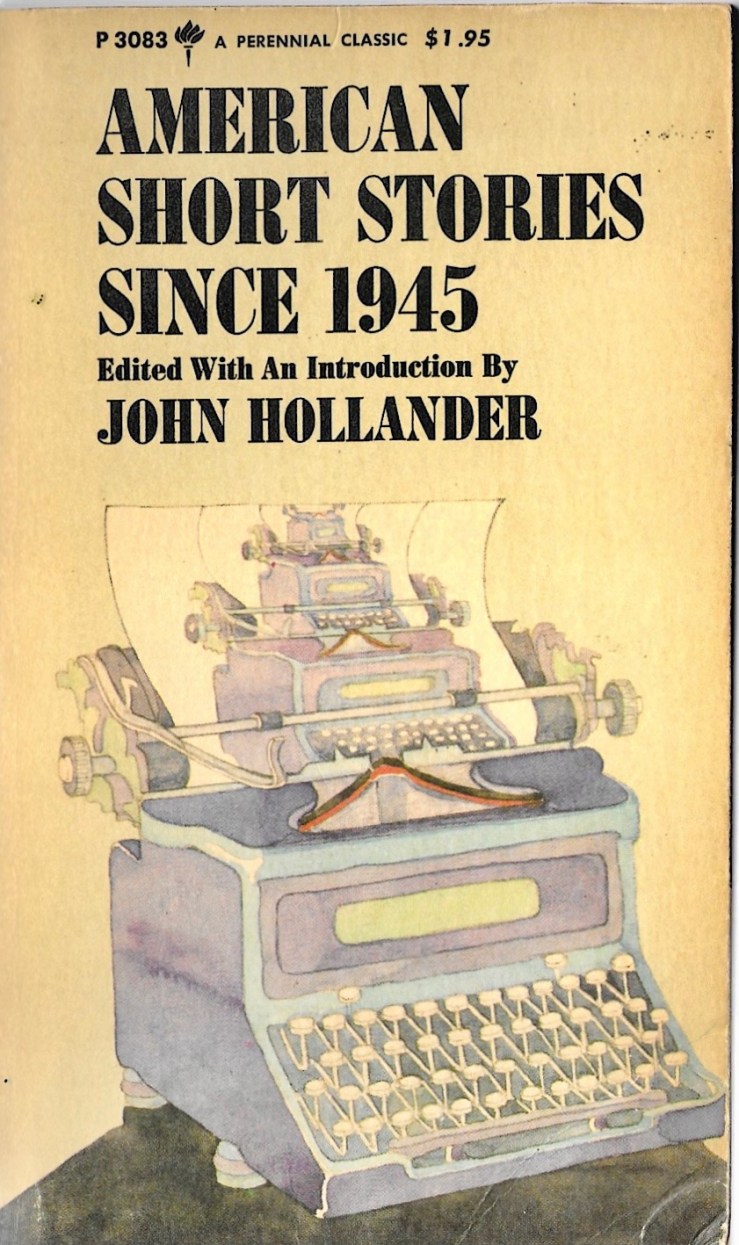
American Short Stories Since 1945 (Book published in 1968 and acquired, 30 April 2021)

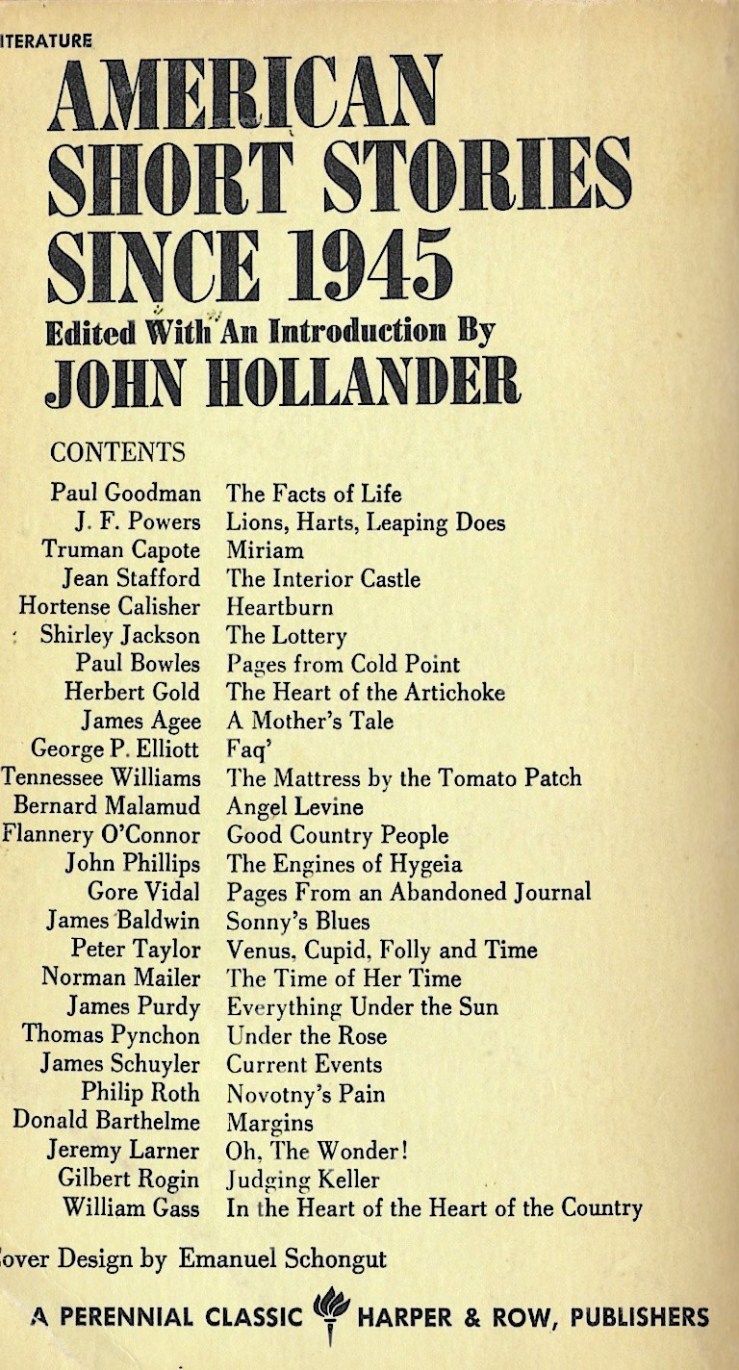
I was perusing the anthologies, looking for a book called Anti-Story: An Anthology of Experimental Fiction (1971). I didn’t find it, but the spine of American Short Stories Since 1945 interested me enough to pull it out, and the wonderful cover (by Emanuel Schongut) intrigued me more. The tracklist on the back cover is what got to me:

I’ve read seven of the stories and fourteen of the twenty-six authors here. You probably have too. But there are close to a dozen authors here I’ll admit I’ve never even heard of—authors rectangle-pressed in with favorites of mine like Barthelme, Gass, Jackson, and Pynchon, whose piece “Under the Rose”is part of V., which I recently re-read. (I opened the “Acknowledgements” page to see that “Under the Rose” was first published in Noble Savage 3, May 1961—I checked the “N” anthologies and found Noble Savage #2, but no three for me.)

Edited and introduced by the poet John Hollander, Since 1945 “aims to show the major shapes taken by shorter fiction in America since the end of World War II.” Published in 1968, it’s heavy on the white guys, but I think there’s an attempt here to point toward not just “major shapes,” but new shapes.

I couldn’t not pick it up (I’d brought in some paperbacks to trade, anyway). Maybe I’ll try to read it this summer, posting on each piece. I’m most interested in how the selection of authors shows a tipping over in to postmodernism, a postmodernism many of these guys never signed up for.


There’s no magic words. Not even I love you is magic enough | A short riff on (a short riff from) Thomas Pynchon’s first novel V.


img_2194

McClintic Sphere, an innovative jazz saxophonist, and Paolo Majistral, the Maltese “girl [who] lived proper nouns” are two minor characters in Thomas Pynchon’s first novel, V. I will get back to them in a second.

But—

A novel crammed with minor characters (hundreds of them, I’d guess) V. pulsates with intersections, drive-bys, concordances and discordance. Characters crisscross and quick-change in ways that both parody and honor the authorial sleight-of-hand in play in V.

Pynchon repeatedly challenges his readers’ credulity–while its intersections are never as neat and tidy as its titular vee angle might suggest, V. is still a confusion of happenstance that both confounds and sanctifies coincidence, even as it ironizes those winds of fate.

The mode is necessarily postmodern. Pynchon repeatedly evokes Modernist poets by name—Pound and Eliot, especially—but it’s the immediate postwar (post, war, world, two) that he’s most concerned with in V. The novel critiques Modernist critiques (through a double lens of a critique of colonialism).

The great concern here is for the divergent angle of the second half of the twentieth century. As such, much of V. is a loving parody of the Beat scene (much more loving than Gaddis’s sustained attack on art poseurs in The Recognitions). In V., Pynchon creates a non-chorus in The Whole Sick Crew, an outcast cast of losers and would-bes and pseudointellectuals.

The Whole Sick Crew lards V.’s enormous, hard-to-follow cast. Two members of the nebulous Crew are

McClintic Sphere, an innovative jazz saxophonist, and Paolo Majistral, the Maltese “girl [who] lived proper nouns.”

And so–

There’s a marvelous moment about two-thirds of the way through V. where McClintic and Paolo, erstwhile lovers (Paolo in the guise of “Ruby” — everyone here is a quick change artist)—where McClintic and Paolo transcend the quick-changing and irony and and sensory-cloggingness of the modern condition. They drive upstate, talk straight—the plot details don’t matter here, just read:

Maybe the only peace undisturbed that night was McClintic’s and Paola’s. The little Triumph forged along up the Hudson, their own wind was cool, taking away whatever of Nueva York had clogged ears, nostrils, mouths.

She talked to him straight and McClintic kept cool.

And then our man McClintic comes to something close to an epiphany, although epiphanies are always hedged, suspicious, constrained in Pynchon—but I think there’s something real here. Earlier in the novel, McClintic feels concern for the postwar “cool,” for the feeling that the world might flip or flop again, go from zero to binary in a weird heartbeat (that binary code theme pulsates through the rest of Pynchon’s work to date). Makes sense for machines, maybe, but people aren’t, or shouldn’t be, machines.

McClintic’s epiphany is a pragmatic resolution, and I take it to be Pynchon’s cautionary thesis:

…there came to McClintic something it was time he got around to seeing: that the only way clear of the cool/crazy flipflop was obviously slow, frustrating and hard work. Love with your mouth shut, help without breaking your ass or publicizing it: keep cool, but care. He might have known, if he’d used any common sense. It didn’t come as a revelation, only something he’d as soon not’ve admitted.

The epiphany is bitter, and Pynchon’s narrator refuses its epiphanic value (“It didn’t come as a revelation”), even as the narrative acknowledges its intrinsic power. A few lines later, McClintic addresses the Real Work to Be Done in the World:

Nobody is going to step down from Heaven and square away Roony and his woman, or Alabama, or South Africa or us and Russia. There’s no magic words. Not even I love you is magic enough. Can you see Eisenhower telling Malenkov or Khrushchev that? Ho-ho.”

“Keep cool but care,” he said. Somebody had run over a skunk a ways back. The smell had followed them for miles. “If my mother was alive I would have her make a sampler with that on it.”

The highway stinks, sticks skunky to fleeing motion, gummed up in the nostalgic emblems we’d imaginatively credit to our loving forebears. The grist, grit, and horror of the big postwar world will cling to the present. Nobody’s stepping down from heaven, or Heaven and there are no magic words—but there is a kind of love, a loving with your mouth shut, a kind of radical, earnest, transcendent love that Pynchon evokes, soils, and sanctifies here.

A review of William Melvin Kelley’s polyglossic postmodern novel Dunfords Travels Everywheres

William Melvin Kelley’s final novel Dunfords Travels Everywhere was published in 1970 to mixed reviews and then languished out of print for half a century. Formally and conceptually challenging, Dunfords contrasts strongly with the mannered modernism of Kelley’s first (and arguably most popular) novel A Different Drummer (1962). In A Different Drummer, Kelley offered the lucid yet Faulknerian tale of Caliban Tucker, a black Southerner who leads his people to freedom. The novel is naturalistic and ultimately optimistic. Kelley’s follow up, A Drop of Patience (1965), follows a similar naturalistic approach. By 1967 though, Kelley moved to a more radical style in his satire dem. In dem, Kelley enlarges his realism, injecting the novel with heavy doses of distortion. dem is angrier, more ironic and hyperbolic than the works that preceded it. Its structure is strange—not fragmented, exactly—but the narrative is parceled out in vignettes which the reader must synthesize himself. dem’s experimentation is understated, but its form—and its angry energy—point clearly towards Kelley’s most postmodern novel, Dunfords Travels Everywheres. Polyglossic, fragmented, and bubbling with aporia, Dunfords, now in print again, will no doubt baffle, delight, and divide readers today the same way it did fifty years ago.

Dunfords Travels Everywheres opens in a fictional European city. A group of American travelers meet for a softball game, only to learn that their president has been assassinated. They head to a cafe to console themselves. After some wine, the Americans toast their fallen president and begin singing “one of the two or three songs the people back home considered patriotic.” Chig Dunford, the sole black member of the travelers, refrains from singing, and when his patriotism is questioned and he is implored to sing, he explodes: “No, motherfucker!” The profane outburst alienates his companions, and Chig questions his language: “Where on earth had those words come from? He tried always to choose his words with care, to hold back anger until he found the correct words.”

It turns out that Chig’s motherfucker is a secret spell, a compound streetword that unlocks the dreamlanguage of Dunfords Travels Everywheres. After its incantation, Dunfords’ rhetoric pivots:

Witches oneWay tspike Mr. Chigyle’s Languish, n curryng him back tRealty, recoremince wi hUnmisereaducation. Maya we now go on wi yReconstruction, Mr. Chuggle? Awick now? Goodd, a’god Moanng agen everybubbahs n babys among you, d’yonLadys in front who always come vear too, days ago, dhisMorning We wddeal, in dhis Sagmint of Lecturian Angleash 161, w’all the daisiastrous effects, the foxnoxious bland of stimili, the infortunelessnesses of circusdances which weak to worsen the phistorystematical intrafricanical firmly structure of our distinct coresins: The Blafringro‐Arumericans.

So Chig, who has told us he looks always to choose the “correct words,” comes through languish/language “back tRealty,” to commence again his education and reconstruction. He’s given new names Mr. Chuggle and Mr. Chigyle. Renaming becomes a motif in the novel. Here in the dreamworld—or is it reality, as Chig’s dreamteachers seem to suggest?—there are multiple Chigs, a plot point emphasized in the novel’s strange title. Dunfords Travels Everwheres seems initially ungrammatical—shouldn’t the title be something like Dunford Travels Everywhere or Dunford’s Travels Everywhere? one wonders at first. Packed into the title though is a key to the novel’s meaning: There are multiple Dunfords, multiple travels, and, perhaps most significantly, multiple everywheres. The novel’s title also points to two of its reference points, Swift’s satire Gulliver’s Travels and James Joyce’s Finnegans Wake (famously absent an apostrophe).

Many readers will undoubtedly recognize the influence of Joyce’s Wake in Kelley’s so-called experimental passages. And while Finnegans is clearly an inspiration, Kelley’s prose has a different flavor—more creole, more pidgin, more Afrocentric than Joyce’s synthesis of European tongues. The passages can be difficult if you want them to be, or you can simply float along with them. I found myself reading them aloud, letting my ear make connections that my eyes might have missed. I’ll also readily concede that there’s a ton of stuff in the passages that I found inscrutable. Sometimes its best to go with the flow.

And where does that flow go? The title promises everywheres, and the central plot of Dunfords might best be understood as a consciousness traveling though an infinite but subtly shifting loop. Chig Dunford slips in and out of the dreamworld, traveling through Europe and then back to America. The final third of the novel is a surreal transatlantic sea voyage that darkly mirrors the Euro-American slave trade. It’s also a shocking parody of America’s sexual and racial hang-ups. It’s also really confusing at times, calling into question what elements of the book are “real” and what elements are “dream.” In my estimation though, the distinction doesn’t matter in Dunfords. All that matters is the language.

The language—specifically the so-called experimental language—transports characters and readers alike. We’re first absorbed into the dreamlanguage on page fifty, and swirl around in it for a dozen more pages before arriving somewhere far, far away from Chig Dunford in the European cafe. In the course of a paragraph, the narrative moves from linguistic surrealism to lucid realism to start a new thread in the novel:

Now will ox you, Mr. Chirlyle? Be your satisfreed from the dimage of the Muffitoy? Heave you learned your caughtomkidsm? Can we send you out on your hownor? Passable. But proveably not yetso tokentinue the candsolidation of the initiatory natsure of your helotionary sexperience, le we smiuve for illustration of chiltural rackage on the cause of a Hardlim denteeth who had stopped loving his wife. Before he stopped loving her, he had given her a wonderful wardrobe, a brownstone on the Hill, and a cottage on Long Island. Unfortunately, her appetite remained unappeased. She wanted one more thing—a cruise around the world. And so he asked her for a divorce.

This Harlem dentist employs Carlyle Bedlow, a minor but important character in dem, to seduce his wife. Bedlow then becomes a kind of twin to Chig, as the novel shifts between Chig’s story and Bedlow’s, always mediated via dreamlanguage. Bedlow’s adventures are somewhat more comical than Chig’s (he even outfoxes the Devil), and although he’s rooted in Harlem, he’s just as much an alien to his own country as Chig is.

Dunfords’ so-called experimental passages are a linguistic bid to overcome that alienation. While they clearly recall the language of Finnegans Wake, they also point to another of Joyce’s novels, A Portrait of the Artist as a Young Man. Kelley pulls the first of Dunfords’ three epigraphs from Joyce’s novel:

The language in which we are speaking is his before it is mine…I cannot speak or write these words without unrest of spirit. His language, so familiar and so foreign, will always be for me an acquired speech…My soul frets in the shadow of his language.

In Portrait, Stephen Dedalus realizes that he is linguistically inscribed in a conqueror’s tongue, but he will work to forge that language into something capable of expressing the “uncreated conscience of [his] race.” The linguistic play of Dunfords finds Kelley forging his own language, his own tongue of resistance.

The dreamlanguage overtakes the final pages of Dunfords, melting African folklore with Norse myths into something wholly new, sticky, rich. There’s more than a dissertation’s worth of parsing in those last fifteen pages. I missed in them than I caught, but I don’t mind being baffled, especially when the book’s final paragraph is so lovely:

You got aLearn whow you talking n when tsay whit, man. What, man? No, man. Soaree! Yes sayd dIt t’me too thlow. Oilready I vbegin tshift m Voyace. But you llbob bub aGain. We cdntlet aHabbub dfifd on Fur ever, only fo waTerm aTime tpickcip dSpyrate by pinchng dSkein. In Side, out! Good-bye, man: Good-buy, man. Go odd-buy Man. Go Wood, buy Man. Gold buy Man. MAN!BE!GOLD!BE!

You’ve got to learn how/who you are talking to and when to say what/wit, right? The line “Oilready I vbegin tshift m Voyace” points to shifting voices, shifting consciousnesses , but also the voice as the voyage, the tongue as a traveler.

The passages I’ve shared above should give you a sense of whether or not the ludic prose of Dunfords  is your particular flavor of choice. Initial reviews were critical of Kelley’s choices, including both the novel’s language and its structure. It received two contemporary reviews in The New York Times; in the first, Christopher Lehmann-Haupt praised Kelley’s use of “a black form of the dreamlanguage of James Joyce’s Finnegans Wake…to escape the strictures of the conventional (white) novel,” but concluded that “there are many things in the novel that don’t work, that seem curiously cryptic and incomplete.” Playwright Clifford Mason was far harsher in his review a few weeks later, writing that “the experimental passages offer little to justify the effort needed to decipher them. The endless little word games can only be called tiresome.”

I did not find the word games endless, little, or tiring, but I’m sure there are many folks who would agree with Mason’s sentiments from five decades ago. While American culture has slowly been catching up to Kelley’s politics and aesthetics, his dreamlanguage will no doubt alienate many contemporary readers who prefer their prose hardened into lucid meaning. Kelley understood the power of language shift. He coined the word “woke” in a 1962 New York Times piece that both lamented and celebrated the way that black language was appropriated by white folks only to be reinvented again by by black speakers. In some ways, Dunfords is his push into a language so woke it appears to be the language of sleep. But the subconscious talkers in Dunfords don’t babble. Their words pack—perhaps overpack—meaning.

The overpacking makes for a difficult read at times. Readers interested in Kelley—an overlooked writer, for sure—might do better to start with A Different Drummer or dem, both of which are more conventional, both in prose and plot. Thankfully, Anchor Books has reprinted all five of Kelley’s books, each with new covers by Kelley’s daughter. This new edition of Dunfords also features pen-and-ink illustrations that Kelley commissioned from his wife Aiki. These illustrations, which were not included in the novel’s first edition in 1970, add to the novel’s surreal energy. I’ve included a few in this review.

Dunfords Travels Everywheres is a challenging, rich, weird read. At times baffling, it’s never boring. Those who elect to read it should go with the flow and resist trying to impose their own logical or rhetorical schemes on the narrative. It’s a fantastic voyage—or Voyace?—check it out.

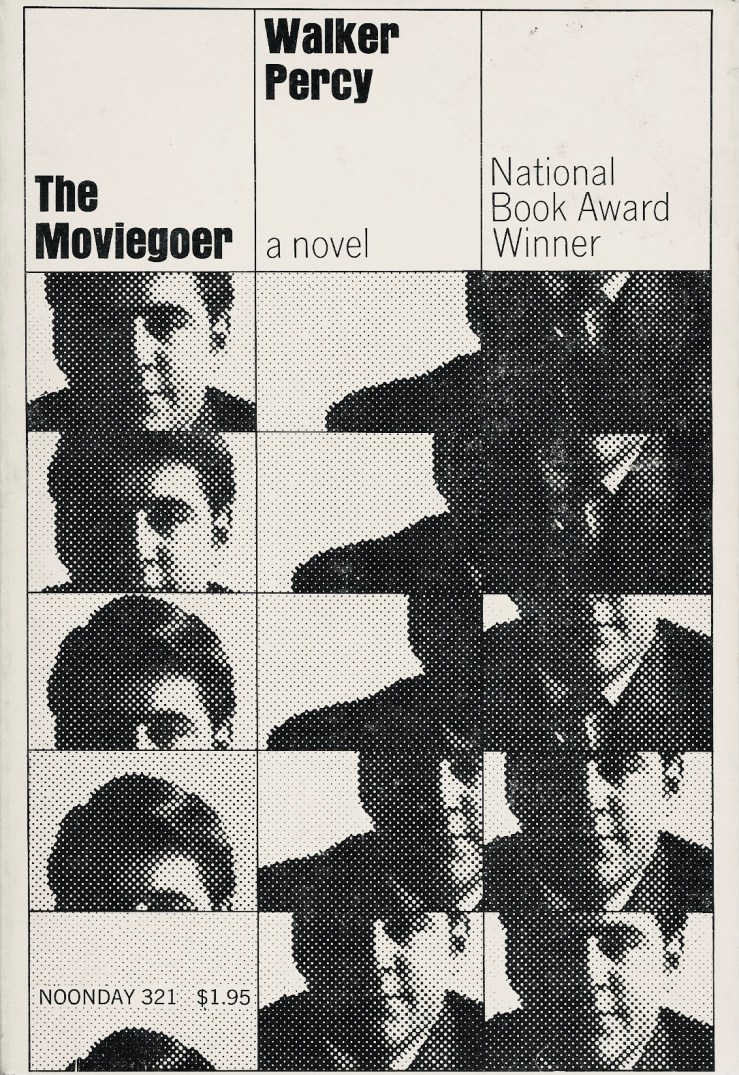
On The Moviegoer, Walker Percy’s existential novel of sad little happinesses and horny ennui

I jumped enthusiastically into Walker Percy’s first novel The Moviegoer (1961) last week. I read  his fourth novel Lancelot (1977) earlier this month. I loved Lancelot. I did not love The Moviegoer.

The Moviegoer is narrated by John Bickerson “Binx” Bolling, who works as a stockbroker in a suburb outside of New Orleans. A Korean War vet, Binx has never quite lived up to the aristocratic mantle his family expected of him. He should’ve been a doctor, a lawyer, that sort of thing. Instead, Binx ambles amiably (and sometimes not-so amiably) through a vague existence, searching for “the wonder.”

Binx is semi-determined not to be “distracted from the wonder,” an attendance to the possibility of spiritual transcendence. In Walker’s postwar American South, commercial culture and modern manners slowly suffocate spirit. Binx is a would-be philosopher attempting, usually unsuccessfully, to find a dram of wonder in a desacralized world. He fools around with his secretaries, reads novels, checks in on his earthy mother, and has drawn out philosophical conversations with the aunt who raised him after his father’s early death. His aunt too sees the fall of her world, her South—its long drawn out decline into the Big Modern New.

Binx is also deeply intimate with his aunt’s stepdaughter, his stepcousin Kate. (Note the Gothic tinge here, a semi-incestuous plot in this novel full of semi-themes and semi-plots.) Modern malaise is the theme of The Moviegoer, and Kate suffers her malaise far more intensely than Binx or anyone else. Semi-suicidal and prone to bouts of mania, she finds an anchor in Binx. But Binx is a loose anchor, a semi-anchor, a little anchor:

It is not a bad thing to settle for the Little Way, not the big search for the big happiness but the sad little happiness of drinks and kisses, a good little car and a warm deep thigh.”

The Moviegoer is full of sad little happinesses: bourbon in paper cups, dips in the Gulf of Mexico, moviegoing, natch. Binx’s post-aristocratic malaise is a privileged, horny malaise. A half-century after The Moviegoer’s publication, Binx’s ennui reads as blinkered, solipsistic, reactionary even. There’s a casual, even temperate sexism and racism to his worldview, which I suppose we might expect out of a midcentury novel by a white male. Binx seems unable or unwilling to regard the humanity of other humans as equal to his own deeply felt humanity. But he’s gentle (and even ironically genteel) in his outlook.

That outlook: the ennui in The Moviegoer is mostly polite and mostly well-mannered. And horny. Unlike the manic, dark, zany vitriol of his later novel Lancelot, the humor of Percy’s debut is lightly ironic, droll, even a touch whimsical at times. It’s almost lethargic. But I suppose a certain lethargy is to be expected from a novel that takes malaise as a theme.

Still, there are moments that puncture the malaise in The Moviegoer. In an earlyish section of the novel, Binx riffs on the classic This I Believe radio program (presumably the one hosted by Edward R. Murrow). Binx pokes gentle polite loving fun at the program in general, before proffering his own short essay:

“Here are the beliefs of John Bickerson Bolling, a moviegoer living in New Orleans,” it began, and ended, “I believe in a good kick in the ass. This—I believe.”

And yet just one line later Binx vacillates back, the conscience of tradition echoing in his grandfather’s phrase:

I soon regretted it, however, as what my grandfather would have called “a smart-alecky stunt” and I was relieved when the tape was returned. I have listened faithfully to This I Believe ever since.

Percy’s—excuse me Binx’s—anger immediately collapses—or maybe reconstitutes into—respect for for tradition and a resigned faithful commitment to listening.

But anger eventually boils over, even if Percy is quick to remove the pot from the burner. Very late in the novel, Binx delivers the closest thing in The Moviegoer to a rant:

Today is my thirtieth birthday and I sit on the ocean wave in the schoolyard and wait for Kate and think of nothing. Now in the thirty-first year of my dark pilgrimage on this earth and knowing less than I ever knew before, having learned only to recognize merde when I see it, having inherited no more from my father than a good nose for merde, for every species of shit that flies —my only talent—smelling merde from every quarter, living in fact in the very century of merde, the great shithouse of scientific humanism where needs are satisfied, everyone becomes an anyone, a warm and creative person, and prospers like a dung beetle, and one hundred percent of people are humanists and ninety-eight percent believe in God, and men are dead, dead, dead; and the malaise has settled like a fall-out and what people really fear is not that the bomb will fall but that the bomb will not fall—on this my thirtieth birthday, I know nothing and there is nothing to do but fall prey to desire.

The passage reads false to me, from the corny “dark pilgrimage” (Oh no! Your thirties!) to the aristocratic substitution merde to the complaint against humanism to the ultimate had-too-many-drinks-at-the-dinner-party pose that, Yeah, come come nuclear bomb. And does poor little rich boy Binx really want to fall prey to desire?

Ah! Prey to desire! Existential dread! A call to human feeling, an anxiety of the individual caught between the wonder and the flesh, the spirit and all that horny ennui. For a novel set in New Orleans at Mardi Gras, The Moviegoer is light on fun. Percy, via Binx, repeatedly insists that this is all serious business, even as the light irony drolly undercuts the novel’s core message. Binx comes off as a party guest eager to get along gently, afraid of the potential menace under his surface, but also incapable of accepting the menace under everyone else’s surface.

I wanted more menace. The Moviegoer, like its antecedent, Camus’s The Stranger, seems pointed toward howls of execration—but even if Binx might wish to howl at the absurd, he can’t.

From its opening paragraphs, The Moviegoer’s tone reminded me strongly of Camus’s 1942 novel The Stranger. I loved The Stranger when I was sixteen, appreciated it when I reread it at twenty for a course on existential literature, and have had the good sense to let it alone since. Those howls of execration at the end have always stuck with me. But I know I’ve changed over the past two decades, and I revere my memories of the book. I’d hate to find fault. 

The preceding paragraph is perhaps a rough draft of the following statement: I think I would’ve loved The Moviegoer if I had read it when I was much younger. This isn’t a knock on Percy’s prose, the novel’s voice, or the loose, lilting plot. I appreciated all those elements. The problem is me. The problem is that I already read The Stranger so long ago. And also so long ago—The Plague and The Fall and Nausea. And Waiting for Godot, and Invisible Man. And Hemingway and Salinger and Heller’s Catch-22, which The Moviegoer beat to win the 1962 National Book Award.

And then a few weeks ago, as a significantly older guy, I read Percy’s later novel, Lancelot.

Published in the late 1970s, Lancelot reads like a postmodern Gothic. It’s a parody of Southern gentility and movie-making, a riff on cultural incest, a howling execration of the century preceding it. It’s a ranting monologue worthy of Thomas Bernhard, more Notes from Underground than The Stranger, rough, mean, wild. It’s possible to read Lancelot as the weird dark cursed sequel to The Moviegoer, its sinister postmodern zaniness exploding the former novel’s mannered modernism.

If I was ultimately disappointed in The Moviegoer, it’s likely because I read Lancelot first. I wanted more of that dark weird flavor, that mad ranting fervor. The Moviegoer has its moments, and likely has more that I missed. I found the last line unexpectedly moving: “It is impossible to say.” (Nevermind the referent of that “It.” Suffice to say that we have found ourselves at Ash Wednesday.) But then Percy—or maybe his editors?—appended a goddamned epilogue to the whole affair, almost ruining the novel.

(It’s possible that I’ve fundamentally misread The Moviegoer, that I’ve missed something profound in it, that I’ve read in earnest what was meant in irony, that I’ve skated over wells of depth that seemed otherwise shallow.)

Anyway. Should I read another Percy novel? I’ll admit that Love in the Ruins (1971) seems far more interesting than the famous novel, this one, the one I’m ostensibly “reviewing.” Given the strength of Lancelot, I’ll give it a shot.


Blog about William Melvin Kelley’s first novel, A Different Drummer

img_5819

William Melvin Kelley’s 1962 debut novel A Different Drummer has eleven chapters. The first, and shortest, “The State,” opens like this:

AN EXCERPT from THE THUMB-NAIL ALMANAC . . . page 643;

An East South Central state in the Deep South, it is bounded on the north by Tennessee; east by Alabama; south by the Gulf of Mexico; west by Mississippi. 

I am a Southerner, and my brain turned into a wrangled wriggling squiggle trying to visualize where “the State” must be, before giving in to the next few lines that declare that “the  State’s” capital is Willson City (no such place of course), which is named after “Confederate General Dewey Willson…the chief architect of the two well-known victories at Bull’s Horn Creek and at Harmon’s Draw” (never happened).

And so well yeah Kelley has created his own Southern State, an amalgam of sin and poverty that sweats and skulks in the tradition of Faulkner’s Yoknapatawpha. Structurally, too, A Different Drummer recalls Faulkner’s work. Kelley makes his reader cobble the narrative together through myriad, rotating viewpoints—a white farmer, his son, porch talkers, and the members of the Willson family, the aristocratic descendants of Confederate General Dewey Willson, who make their living collecting rent.

We get the perspective of all four Willsons—daughter, brother, mother, and father—who put together a picture of a life entangled with the Calibans. The Calibans were the enslaved descendants of a mythical figure named “the African,” a kind of warrior-king who escapes slavery with his only child, only to be tracked for days and nights by Willson, who shoots him before he can dash the child’s brains to free him.

The Calibans work the Willsons’ land over decades, first as slaves and then as sharecroppers. This brings us to the novel’s central conceit. I’ll let the blurb of the Anchor reissue I read do the heavy lifting:

June, 1957. One hot afternoon in the backwaters of the Deep South, a young black farmer named Tucker Caliban salts his fields, shoots his horse, burns his house, and heads north with his wife and child. His departure sets off an exodus of the state’s entire black population, throwing the established order into brilliant disarray. Told from the points of view of the white residents who remained, A Different Drummer stands, decades after its first publication in 1962, as an extraordinary and prescient triumph of satire and spirit.

I had neglected the blurb until now, and had somehow missed the key idea of the second-to-last line: Told from the points of view of the white residents.

Kelley’s tactic here is extraordinary, and ultimately painful. We first get an “average” citizen of Sutton (the central setting of the novel in our unnamed “state,” Harry Leland, whose sentiments of race probably track with those of the hypothetical white moderate MLK warned us about. Leland’s not a bad guy and he’s trying to make his son a decent human being, but he doesn’t know what he doesn’t know.

We meet that son next, and see the narrative through his young eyes. Kelley’s satiric edge is perhaps sharpest here. The menfolk call the boy “Mister Leland,” an irony underlined when Tucker Caliban—whom Mister Leland counts as a friend—addresses the lad as such. It’s Mister Leland too who accompanies Bennett Bradshaw (excuse me, “THE REVEREND B.T. BRADSHAW [of] THE RESURRECTED CHURCH OF THE BLACK JESUS CHRIST OF AMERICA, INC., NEW YORK CITY,” as his business card attests)—it’s Mister Leland who accompanies Bradshaw (and his chauffeur) to the site of Tucker Caliban’s salted-and-abandoned farm. Unlike the various perspective characters, Bradshaw, an intellectual, understands Caliban’s motivation—and envies his spirit.

Caliban’s primal rejection and refusal of the Southern Way of Life is the novel’s central problem, a “problem” that Kelley addresses somewhat obliquely through primarily white eyes. The various Willsons attempt to reckon with both past and present, but their tools are limited, for the most part. The novel’s penultimate chapter is a series of journal entries by David Willson, starting when he’s a young man off to attend an Ivy up in New England.

Young David attends a socialist meeting, but is bored with “nothing but a bunch of fellows showing each other how much they knew about Marx.” He meets—guess who!—Bennett Bradshaw, and falls fast for the guy. (I might be spoiling too much of the plot here—look, it’s a strong book, skip this and read it.)

Willson’ friendship with Bennett adds a strange ballast late in the narrative, tipping the book in a different trajectory than the course it seemed to have previously been taking. Willson is a tragic Faulknerian figure, an intellect who wishes absolution from his namesake’s sins, from the Sins of the South, but who is also beholden to and limited by the dictates of his own time. Bennett too is limited and beholden. It’s Tucker Caliban who breaks the chains.

A Different Drummer is not the narrative I expected to read. I found Kelley’s name looking for works by black American postmodernists, which is how I found Fran Ross’s Oreo—an utterly postmodern novel, carnivalesque, polyglossic, metatextual. (In her essay on Ross’s novel, Harryette Mullen compares Oreo to Kelley’s last novel, 1970’s Dunfords Travels Everywheres.A Different Drummer’s rotating cast of viewpoint characters and its shifts in point of view point toward postmodern polyglossia, but Kelley’s novel is anchored in a kind of Faulknerian modernism. The great trick of it all though is the ironic layering here, where the only strong truth seems to be Tucker Caliban’s renunciation of white supremacy.

And this renunciation angers and ashames novel’s constituents, summed up in its final chapter, “The Men on the Porch.” Here we have a short, devastating exclamation point to the whole affair, which might be easily characterized by Flannery O’Connor, who said that

I have found that anything that comes out of the South is going to be called grotesque by the Northern reader, unless it is grotesque, in which case it is going to be called realistic.

Born in New York City and educated at Harvard, Kelley was nevertheless attuned to Southern rhythms, Southern voices, Southern eyes. To steal more from O’Connor, “we find that the writer” — here, Kelley— “has made alive some experience which we are not accustomed to observe every day, or which the ordinary man may never experience in his ordinary life.” Kelley’s realism, in the end, hurts—it’s too grotesque, too real. But it’s powerful and powerfully-written. Highly recommended.

Let me recommend Antonio di Benedetto’s overlooked novel Zama

Let me recommend a novel for you.

The novel is Antonio di Benedetto’s Zama.

Zama was first published in Argentina in 1956.

NYRB published Esther Allen’s English translation in 2016. It is excellent.

What is Zama about?

Zama tells the brutally funny and often sad story of Don Diego de Zama, a bored and horny americano wasting away in the provincial backwaters of Paraguay. It’s the end of the world at the end of the 18th century, and there’s not a lot to do. Zama fills his time with schemes of lust and petty pride, shirking his job as a nominal governmental authority. He longs to be reunited with his wife and family in Buenos Aires, but seems to sabotage every opportunity to get back to them. He also longs for his glory days as a corregidor, putting down “the native rebellion” in the service of Spain’s imperial project. Zama is a confusing and confused character, frequently frustrating but also oddly sympathetic. He is a loser who does not seem to see that he is a loser, although life gives him every opportunity to come to this conclusion. As South African novelist J.M. Coetzee’s  puts it in his excellent in-depth review of the novel:

[Zama] is vain, maladroit, narcissistic, and morbidly suspicious; he is prone to accesses of lust and fits of violence, and endowed with an endless capacity for self-deception.

He is also the author of himself, in a double sense. First, everything we hear about him comes from his own mouth, including such derogatory epithets as “swaggering” and “dogslayer,” which suggest a certain ironic self-awareness. Second, his day-to-day actions are dictated by the promptings of his unconscious, or at least his inner self, over which he makes no effort to assert conscious control. His narcissistic pleasure in himself includes the pleasure of never knowing what he will get up to next, and thus of being free to invent himself as he goes along.

Coetzee captures the joy of reading Zama in those last few lines: It’s the joy in watching a first-person perspective invent itself in shambling picaresque adventures born of sheer boredom. It’s the pleasure of seeing an asshole who refuses to acknowledge that he is an asshole try to pretend that he is not an asshole—all in a kind of language that is simultaneously romantic and flat.

Let me give you a taste of that language, reader. Here are the opening bars of the novel:

I left the city and made my way downriver alone, to meet the ship I awaited without knowing when it would come.

I reached the old wharf, that inexplicable structure. The city and its harbor have always been where they are, a quarter-league farther upriver.

I observed, among its pilings, the writhing patch of water that ebbs between them.

A dead monkey, still whole, still undecomposed, drifted back and forth with a certain precision upon those ripples and eddies without exit. All his life the water at forest’s edge had beckoned him to a journey, a journey he did not take until he was no longer a monkey but only a monkey’s corpse. The water that bore him up tried to bear him away, but he was caught among the posts of the decrepit wharf and there he was, ready to go and not going. And there we were.

There we were: Ready to go and not going.

The ship that won’t come in, the floating dead monkey, the state of unknowing—these abject and negative motifs are the paradoxical genesis of the novel. The clipped repetitions, culminating in “Ready to go and not going” recall Samuel Beckett, whom translator Esther Allen acknowledges as “a perfect counterpoint to the prose voice of Zama” in her introduction.

In addition to Beckett, easy points of comparison are Dostoevsky, Camus, Borges, and especially Kafka. In his perceptive analysis of Zama, critic Benjamin Kunkel points out the novel’s existential core, absurdist peripheries, and realistic contours:

As with novels by Kafka, Camus, Sartre, and Beckett, the story’s preoccupation is the tension between human freedom and constraining circumstance. Zama, a man as impetuous as he is stuck, resembles other existentialist antiheroes as he swings between spellbound passivity and sudden lunges into action. But Don Diego never seems like a figure in an allegory, like K. in The Castle; or an ambulatory philosophical argument, like Roquentin in Nausea. Zama induces a rare feeling—to put it as naïvely as possible—of the main character’s realness. Don Diego is consistently surprised by his own behavior, but not as much as he would like. His abrupt acts and swerving meditations have an air of unplotted inevitability about them. He is a character more convincing than coherent, and more persuasive than intelligible.

These lifelike moments of “unplotted inevitability” are enthralling. Di Benedetto doesn’t just show us Zama seeing, he shows us Zama seeing what he is seeing. He shows us consciousness at work—or rather, consciousness in distress. In a representative passage which can stand alone as a bizarre parable in search of a moral, Zama, having lost all his money betting on horses, awakes from a drunken stupor to witness a spider crawling on a fellow drunkard: 

The spider approached the drunk. From a quarter vara away, these spiders can leap and bite so that if taken by surprise, even a man who’s awake has no time to defend himself. I had no wish to move. I could crush it with my boot but would postpone until the last.

The spider moved toward the sleeping head and I watched to see whether anything out of the ordinary would transpire. Would the man—obedient to some mysterious warning instinct—suddenly awaken and kill it? He did not. Now the insect was crawling in his hair. I didn’t see it climb up; I saw it there on him and then I was quite certain I should do nothing.

The episode continues in this way, building in tension as the large spider crawls over the man’s face while Zama remains inert and fascinated by his own inertia—until the drunken man absently bats the spider from his face. Zama is paradoxically stunned by this anticlimax:

I reviewed the episode. At no point had I felt any emotion, except when I imagined the man had wakened and was about to deliver himself of an entirely justified diatribe against me.

The passage is representative of Di Benedetto’s rhetorical skill—he gives us a deceptively lucid first-person narrator who articulately elides key information, both from the reader and himself. Zama refuses to name his intense desire to see the spider bite the man. Additionally, his emotional identification is bound to righteous anger, the righteous anger appropriate to the would-be-bitten drunkard. Instead of genuine pathos, Zama would usurp this man’s self-righteous anger, the anger that he feels all the time at his (literal and figurative) position in life. But the spider bite that would license self-righteousness never comes. Basically, Zama just wants something to happen.

And that’s the plot of Zama, more or less. Our (anti-)hero’s picaresque jabs at adventure and romance are sent awry or thwarted, usually by his own loutish passions. Zama’s would-be escapades unravel, that is, until the book’s final section, 1799

–Okay, let me digress momentarily: Zama, a slim 200 pages, is structured into three sections: 17901794, and 1799. The connective tissue between these sections hangs transparent, nearly invisible, but nevertheless accessible via small clues, motifs, scant threads. Di Benedetto gives us modernism in the last decade of the 18th century, boredom that tiptoes around the abyss of insanity. Rereading the three sections is a joy. But let me return to the central thread—

Zama’s would-be adventures unravel or collapse until the book’s final section, 1799, when Di Benedetto puts our hero in genuine harm’s way (and cunningly exfiltrates any opportunity for overt heroism on Zama’s part). The novel earns its drive toward what I take to be its central question: “Do you want to live?”

Di Benedetto hides his answer to this question not so much in the central figure Zama, but rather in Zama’s put-upon secretary, his mozo Manuel Fernández. Fernández is, at least for me, the secret star of the novel. When we first meet Fernández, Zama joins in gently mocking him at the lead of their boss, the governor. They tease Fernández when he tells them that he is writing a novel. “Make sons, Manuel, not books,” admonishes the governor, but the clerk replies: “I want to realize myself in myself…Children realize themselves, but whether for good or ill we don’t know. Books are made only for truth and beauty.” Later, Zama, in more of a ruse than in good faith, asks Fernández to read some of his book. He finds the “entangled” prose “incomprehensible,” to which Fernández replies: “the first man and the first lizard were each incomprehensible, as well, to all those who surrounded them.” Fernández declares that he writes for “no master.” If he has no audience today, his pages will be understood by his “grandchildren’s grandchildren…Things will be different then.” Later, Fernández reveals that he’s given away his manuscript to an old man, a stranger suffering boredom while waiting for a delayed ship to take him somewhere other than the end of the world.

Fernández sees himself as an author doomed to obscurity in the present, an author who awaits a future that will catch up to his originary vision. Perhaps it’s a bit much to suggest he’s a stand-in for Di Benedetto, but there are traces here. Above, I cited Benjamin Kunkel’s essay on Zama“A Neglected South American Masterpiece,” and J.M. Coetzee’s review, “A Great Writer We Should Know.” Those titles point to the novel’s obscurity, an obscurity which I sense is now being (if in increments) reversed. Esther Allen’s English translation obviously opens Zama to an even wider audience, and Argentine director Lucrecia Martel is apparently adapting the novel to film. But it’s perhaps Roberto Bolaño, a writer who time caught up to, however too late, who helped guide new readers—however obscurely—to Zama. In Bolaño’s 1997 short story “Sensini,” the titular character is a clear transposition of Di Benedetto, a cult author, a writer’s writer:

The novel was the kind of book that circulates by word of mouth. Entitled Ugarte, it was about a series of moments in the life of Juan de Ugarte, a bureaucrat in the Viceroyalty of the Rio de la Plata at the end of the eighteenth century. Some (mainly Spanish) critics had dismissed it as Kafka in the colonies, but gradually the novel had made its way, and by the time I came across Sensini’s name in the Alcoy anthology, Ugarte had recruited a small group of devoted readers, scattered around Latin America and Spain, most of whom knew each other, either as friends or as gratuitously bitter enemies.

Thank goodness, or thank evil, or thank boredom: thanks for word of mouth, for friends and enemies alike (as long as they have good taste); thanks for writer’s writers (and writer’s writer’s writers) and the cult books they transmit to us—like Zama.

Zama is a cult novel that deserves a larger cult. After two false starts (I admit I misread the voice, missing the humor), I read Di Benedetto’s novel in a kind of hunger. Then I read it again. Then I wrote this thing, to tell you, dear reader, that you should read it too. Very highly recommended.

[Ed. note–Biblioklept originally ran this review in April, 2017.]
A riff on starting Robert Coover’s first novel, Origin of the Brunists

img_2280

Origin of the Brunists is Robert Coover’s first novel. First published in 1966, this long novel tells the story of an apocalyptic religious cult that forms around the sole survivor of a mining accident. The novel begins with the Brunists prepping for the upcoming end of the world (doomsday is scheduled for the weekend). After this somewhat bewildering prologue, the novel shifts back a few months in time, to lay out the cult’s genesis, a fatal mining accident.

Origin of the Brunist’s early chapters are an engrossing and unexpectedly smooth launch into a 500+ page novel. I read the first 70 pages in one night, rapt in the weird world of West Condon, the fictional midwesternish mining town where the Brunist cult originates. I woke up the next morning and continued to read in bed. I was, and am, enthusiastic. 

The second chapter of Origin of the Brunists is especially enthralling. Propulsive and engaging, the chapter zooms through the various consciousnesses of West Condon on the night of the novel’s originating disaster, the horrific mining collapse that imperils hundreds of miners. Coover inhabits the voices and minds of his characters with an easy if often grimy grace here. Evocation of consciousness has marked much of Coover’s work, from the early short story “The Brother” (1962) to his recent novel Huck Out West  (2017). The man can throw his voice around.  Origin of the Brunists overflows with voices. In small snatches of dialog and free-indirect speech, we get an aural and vivid picture of the miners, their children and spouses, as well as the other residents of West Condon.

The mining disaster chapter shuttles along with a filmic quality. Coover intercuts scenes of the miners escaping (or failing to escape) with a highschool basketball game, teenage lust in a parked car, and other odds and ends of West Condon life. The chapter builds in tension, reminding one of the climax of an epic movie, but one wedged unexpectedly at the narrative’s outset.

Indeed, Coover’s contest with film is something of a trademark. A signal example of this style can be found in the stories in his 1987 collection A Night at the Movies, or You Must Remember This. Stories like “The Phantom of the Movie Palace” and “Lap Dissolves” wrestle with film as a medium, deconstructing author and text, filmmakers and audiences, film reels and book pages. In the Night stories (and elsewhere, always elsewhere), Coover employs a host of metatextual techniques, dissolving one narrative into another, overlapping archetypes and synthesizing tropes, blending fables and history and commercial culture into a critique of American Pop mythology.

Coover’s metafiction always points back at its own origin, its own creation, a move that can at times take on a winking tone, a nudging elbow to the reader’s metaphorical ribs—Hey bub, see what I’m doing here? Coover’s metafictional techniques often lead him and his reader into cartoon landscapes, where postmodernly-plastic characters bounce manically off realistic contours. The best of Coover’s metafictions (like “The Babysitter,” 1969) tease their postmodern plastic into a synthesis of character, plot, and theme. However, in  large doses Coover’s metafictions can tax the reader’s patience and will—the simplest example that comes to mind is “The Hat Act” (from Pricksongs & Descants, 1969), a seemingly-interminable  Möbius loop that riffs on performance, trickery, and imagination. (And horniness).

I’m dwelling on Coover’s metafictional myth-making because I think of it as his calling card. And yet Origin of the Brunists bears only the faintest traces of Coover’s trademark metafictionalist moves (mostly, so far anyway, by way of its erstwhile hero, the journalist Tiger Miller). Coover’s debut reads rather as a work of highly-detailed, highly-descriptive realism, a realism that pushes its satirical edges up against the absurdity of modern American life. It reminds me very much of William Gass’s first novel Omensetter’s Luck (1966) and John Barth’s first two novels, The Floating Opera (1956) and The End of the Road (1958). (Barth heavily revised both of the novels in 1967). There’s a post-Faulknerian style here, something that can’t rightly be described as modern or postmodern. These novels distort reality without rupturing it in the way that the authors’ later works do. Later works like Barth’s Chimera (1973), Gass’s The Tunnel (1995), and Coover’s The Public Burning (1977) dismantle genre structures and tropes and rebuild them in new forms. (I might contrast here with the first novels of William Gaddis (The Recognitions, 1955), Thomas Pynchon (V., 1963), and Ishmael Reed (The Freelance Pallbearers, 1967), all of which employ postmodern and metafictional techniques right out of the gate—but that’s perhaps appropriate material for another riff).

While Origin of the Brunists doesn’t tip into Coover’s metatextual mode, it points towards his mythic style, but in a subtle, restrained way, as in this description of the moments preceding a high-school basketball game:

A ritual buzzer alerts the young athletes on the West Condon court and strikes a blurred roar from the two confronting masses of spectators. In a body, all stand. The mute patterns of run-pass-leap-thrust dissolve, congealing into two tight knots on either extremity of the court, each governed by a taut-faced dark-suited hierarch. Six young novices in black, breasts ablaze with the mark of their confession, discipline the brute roars into pulsing chants with soft loops of arm and skirt, while, at their backs, five acolytes of the invading persuasion pressed immodestly into sleek diabolic red, rattle talismans with red and white paper tails, seeking to neutralize the efficacy of the West Condon locomotive. Young peddlers circulate, selling condiments indiscriminately to all. A light oil of warm-up perspiration anoints the shoulders of the ten athletes chosen as they explode out of their respective rings to confront each other. Some of them cross themselves, some clap and cry oaths, others tweak their genitals.

These mythical touches are rare in the first section of Origin of the Brunists though. Instead, Coover seems to tease out the West Condoners’ building of their own mythology, one cobbled from the apocalyptic strands of rural American Christianity, a religion divined through signs and wonders.

Such signs have much of their origin in Ely Collins, a miner-cum-preacher who meets his fate in the disaster. In a shocking scene that plays out with frank realism, Collins loses his leg:

“It’s okay, boys,” Collins whispered up at them. “I kin take it.” And he took to praying again.

Strelchuk lifted the ax in the air and thought: Jesus! what if I miss, I’ve never swung a goddamn ax much, what if I hit the wrong leg, or—?

“Goddamn you, Mike!” Jinx screamed, losing control. “Quit messing around! This gas is knocking me out, man! We got to get us out of here!”

And while he was screaming away like that, Strelchuk came down with the ax, caught the leg right where he aimed, true and clean, just below the knee, and the blood flew everywhere, and Juliano was crying like a goddamn baby, and Bruno, his face blood-sprayed, went dumb, mouth agape, and broke away in a silent fit, but the leg was still hooked on, they couldn’t get him free. Preach was still praying to beat hell and never even whimpered. Mike raised the ax again and drove down with all the goddamn strength he had, felt the bone this time, heard the crack, felt the sickening braking of the ax in tough tissue, and he turned and vomited. He was gagging and hacking and crying and the blood was everywhere, and still that goddamn leg was hooked on. Mario ripped away Collins’ pant leg, took the wedge he had in his pocket, pressed it up against Collins’ thigh. Strelchuk whipped off his leather belt and, using it as a tourniquet against the wedge, they stopped the heavy bleeding. Pontormo whined Italian. Strelchuk grabbed up the ax once more. His hands were greasy with blood and it was wet on his chest and face. He was afraid of missing or losing hold, and the shakes were rattling him, so he took short hacking strokes, and at last it broke off. They dragged him free. And Preacher Collins, that game old sonuvabitch, he was still praying.

I’ve quoted at such length to give a sense of Coover’s meticulousness in Origin of the Brunists. The novel is thick with life, thick with voices, mimetic detail, shapes, smells, colors, sounds. West Condon feels utterly real, making the novel’s dramatic absurdities all the more pronounced. The characters tell stories, weep and pray, bury their desires. Coover’s command of character isn’t absolute, but if his West Condoners sometimes teeter on the edge of grotesquerie they are nevertheless real, or as real as words on a page can be. More to come.


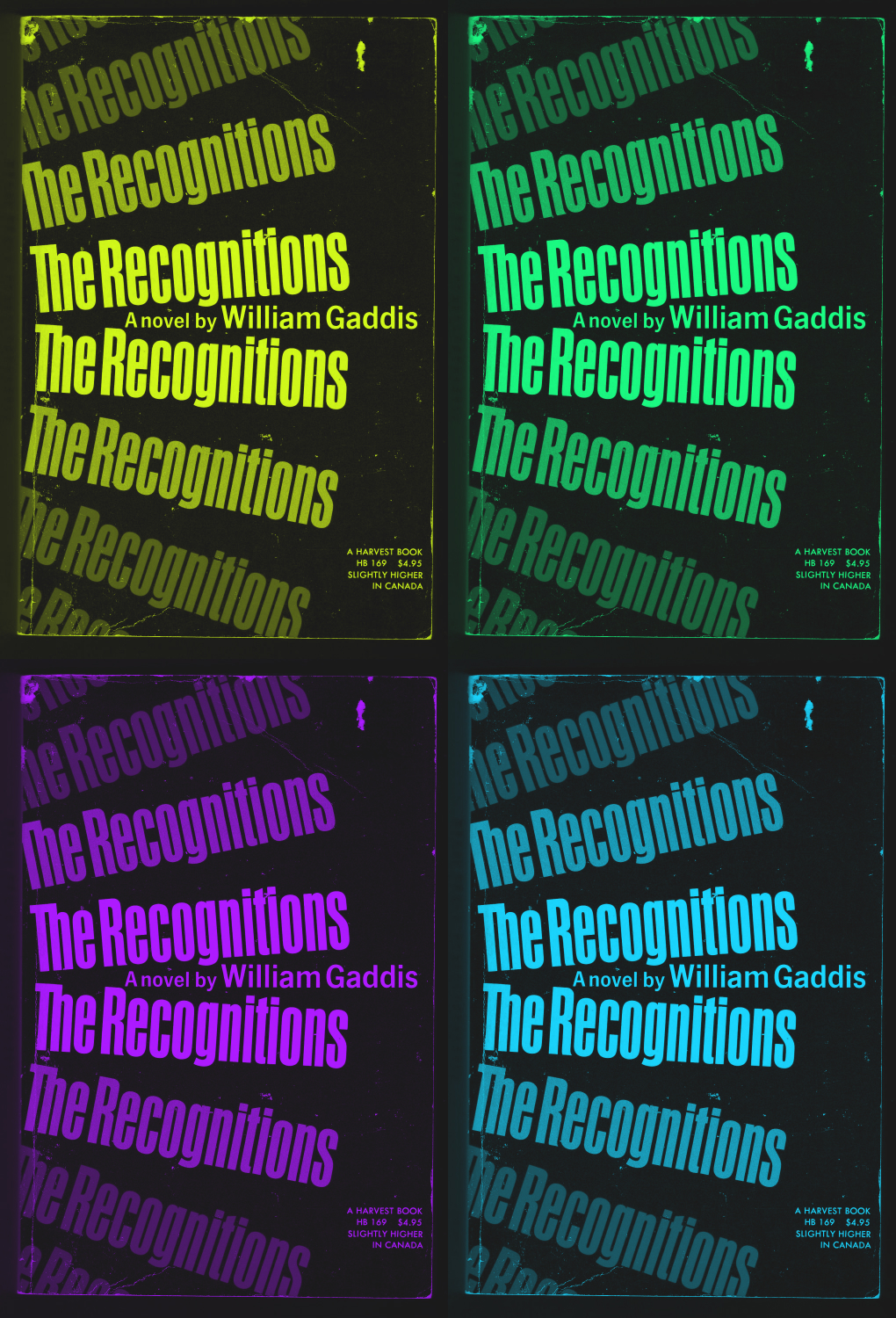
Novel factory | A passage from (and a short riff on) William Gaddis’s The Recognitions

In Ch. VII of Part I of William Gaddis’s 1955 novel The Recognitions, the erstwhile hero of the novel, Wyatt Gwyon—who has by this point disappeared into an anonymous he—meets Basil Valentine, a somewhat ambiguous and priestly art-world contact for Recktall Brown, the arch-capitalist Mephistophelean villain of the novel. Brown uses Valentine to arrange the forgeries that Gwyon executes. Here, Valentine and Wyatt discuss Brown, who has left the room. (Brown is the initial He; Valentine speaks first):

—He would absolutely have to have Alexander Pope in a box, to enjoy him. He is beyond anything I’ve ever come upon. Honestly, I never in my life could have imagined that business could live so powerfully independent of every other faculty of the human intelligence. Basil Valentine rested his head back, blowing smoke toward the ceiling, and watching it rise there. —Earlier, you know, he mentioned to me the idea of a novel factory, a sort of assembly line of writers, each one with his own especial little job. Mass production, he said, and tailored to the public taste. But not so absurd, Basil Valentine said sitting forward suddenly.

—Yes, I … I know. I know.

—When I laughed . . . but it’s not so funny in his hands, you know. Just recently he started this business of submitting novels to a public opinion board, a cross-section of readers who give their opinions, and the author makes changes accordingly. Best sellers, of course.

—Yes, good God, imagine if … submitting paintings to them, to a cross section? You’d better take out . . . This color . . . These lines, and . . . He drew his hand down over his face, —You can change a line without even touching it. No, he went on after a pause, and Valentine watched him closely, —nothing is funny in his hands. Everything becomes very . . . real.

Do you like the passage? I do.

I continue to enjoy re-reading Gaddis’s debut novel, aided in large part by an audiobook version read by Nick Sullivan. I’ve also been reading The Recognitions with/against Letters of William Gaddis (ed. Steven Moore, Dalkey Archive, 2013), which I do not recommend doing (especially for first-time readers). Gaddis, paraphrasing his own novel, said that the artist was simply “the dregs of his [own] work,” and much of The Recognitions reads like Gaddis polishing the material from his own early life and travels and readings, and then forcing that material—the nuggets and the morsels (and, let us be honest, the occasional duds)—into an angry demanding sustained attack on the Modern condition. But the material is good ammunition in that oh-so self-conscious attack on Modernism—an attack that in many ways engenders postmodernism, or at least builds a bridge to it, or perhaps sunders links to Modernism—

—look, I have way too many stupid metaphors cooking here, forgive me: What I mean to say, in simpler terms, is that The Recognitions diagnoses the end of big-em Modernism, that it describes something yet-to-emerge, and that it also, significantly, performs that something yet-to-emerge. Gaddis’s letters show the frustrations of a young man trying to cook up adventures in a modern world: a world already explored, mapped, tagged, and written about by other folks. And not just written about im histories and novels, but also in cheap guide books and cheap glossy magazines. This is the world after the age of mechanical reproduction, the world in which Gaddis’s hero Wyatt strives to forge a legitimate forgery of a place for himself.

Gaddis’s novel’s emergent postmodernism—more fully realized in his follow-up, J R—also presciently points to the post-postmodernist storytelling world of late capitalism. Gaddis’s villain Recktall Brown is a brute, but this philistine is perceptive, and he understands the economy of middlebrow aesthetics. As erudite Valentine laments, “I never in my life could have imagined that business could live so powerfully independent of every other faculty of the human intelligence.” Valentine should imagine harder. But this is America, where people frequently mistake wealth and the power to create wealth with creative intelligence.

Maybe I’m too hard here on Valentine, who eventually realizes that an appeal to the lowest common denominator is “not so absurd,” after he reflects on Recktall’s business idea “of a novel factory, a sort of assembly line of writers, each one with his own especial little job. Mass production…tailored to the public taste.” And we then learn that Recktall has already capitalized on his vision of masscult writing: “Just recently he started this business of submitting novels to a public opinion board, a cross-section of readers who give their opinions, and the author makes changes accordingly. Best sellers, of course.”

Reading this, I mentally annotated: Ah, Netflix-that’s the novel factory of 2018. And not just Netflix—I mean, clearly, not just Netflix, that’s simply a signal example—but rather the idea of the data-driven artefact, the non-artefact, the copy of a copy of a copy, the narrative entirely derived from atomizing the masscult nostalgia artefacts of 20, 30, 40 years ago, retrofitting them, repackaging them, and selling them as the real thing. Wyatt’s final observation in the passage laments that Recktall Brown, and the emerging late capitalism he represents, is winning a kind of war on culture and imagination. And nothing is funny in this devil’s busy hands: “Everything becomes very . . . real.” Even the fakes. Even the copies. Especially the copies.

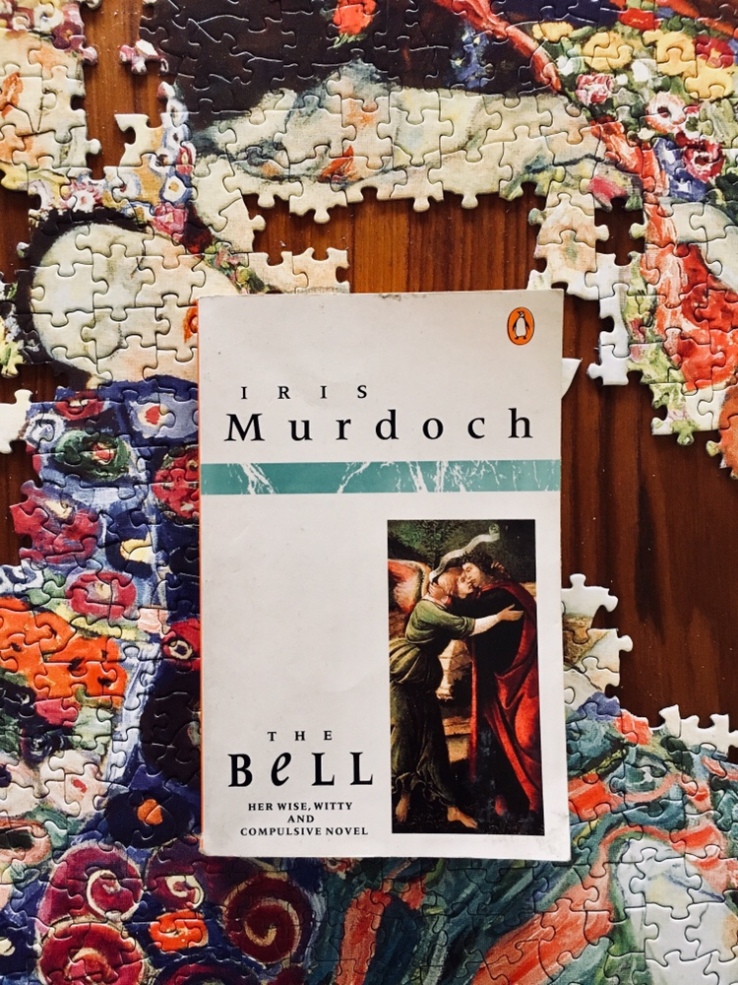
Blog about Iris Murdoch’s novel The Bell

img_9112

I have just finished Iris Murdoch’s 1958 novel The Bell. This is the first novel I have read by Murdoch and I now want to read more novels by Murdoch, which I suppose is the best praise I can offer the novel.

The Bell is set primarily in Imber House, a large old mansion in the English countryside. Imber House adjoins a Benedictine abbey; this nunnery is essentially closed off to the outside world. The residents of Imber House form a “brotherhood,” a laity of would-be acolytes who strive to find spiritual meaning in the commercial and often venal world of the postwar era. Various conflicts between these characters drive the plot of The Bell.

One of these conflicts, especially notable for a novel published in 1958, involves Michael, the leader of the Imber House community. A former schoolmaster who dreamed of joining the clergy, Michael lost his job in a small scandal for “seducing” one of his students, Nick, a teenage boy at the time. Over a decade later, circumstance brings Nick to Imber House, where his twin sister Katherine is staying. Katherine plans to join Imber Abbey; in the meantime, her family hopes that the religious solitude at Imber House will help Nick recover from his alcoholism. The conflict between Michael and Nick becomes further charged when the youngest member of Imber House, a teenager named Toby, befriends both of them.

I could go on about Michael and Nick and Toby and Katherine and etc., but the real star of The Bell is Dora Greenfield, a wonderfully complicatedly simple unassuming unpretentious flighty former art student who has recently left her demanding husband Paul. Through Murdoch’s precise free indirect style, we get to inhabit Dora’s constantly vacillating mind. Like many people, Dora does not know what she is going to do, and even when she thinks through a plan, she often ends up doing the opposite of what she had intended to do. There is a hilarious passage in the novel’s first chapter when Dora goes through a lengthy imaginative exercise about giving up her train seat to an elderly woman. Dora’s thought experiment ends like this:

She decided not to give up her seat.

She got up and said to the standing lady ‘Do sit down here, please. I’m not going very far, and I’d much rather stand anyway.’

The blank space between those sentences highlights a radical gap between contemplation and action.

The train-seat passage is one of many humorous episodes in The Bell, but Murdoch’s humor is underwritten by a deeper menacing anxiety, which can be neatly summed up in the novel’s opening sentences:

Dora Greenfield left her husband because she was afraid of him. She decided six months later to return to him for the same reason.

Those opening lines basically summarize the big thematic plot of The Bell—the conflict between controlling and ultimately abusive Paul and his much younger wife. (“She married him a little for his money,” Murdoch writes just a few paragraphs in, wedging the detail between more positive aspects of Paul’s character–the “a little” is just genius there, the slightest omission from Dora’s consciousness slipping into the third-person narrator for the briefest of moments). The opening lines of The Bell also showcase Murdoch’s rhetorical powers. Her comic precision here reverberates with a hazardous undertone.

Will Dora really return to her husband? Or will she become her own person—whatever that means? The Bell satisfies these questions with complex answers. The novel has every opportunity to veer toward pat conclusions. Murdoch fills her novel with images that suggest a conventional tragic conclusions, and then surpasses these conventions, turning them into something else. A death by drowning might be foreshadowed, but someone will learn to swim; an epiphany achieved in an art museum might not meet its achievement outside of aesthetic response; the Blakean contraries of innocence and experience might be synthesized into a new, original viewpoint. There’s something real about The Bell—it offers a realism that points outside of its own literary contours. The English novelist A.S. Byatt puts it far better than I can in her essay “Shakespearean Plot in the Novels of Irish Murdoch”:

 …The Bell seems to me arguably Miss Murdoch‘s most successful attempt at realism, emotional and social—the tones of voice of the members of the religious community are beautifully caught, the sexual, aesthetic and religious passions and confusions of the three main characters, Dora, Michael, and, to a lesser extent, Toby, are delicately analysed with the combination of intellectual grasp and sensuous immediacy of George Eliot.

Byatt’s comparison to Eliot reminds me that I had intended to read Middlemarch some time this year—but to be fair to myself, I put The Bell on the same list. I won’t be reading Middlemarch next though; The Bell, with its story of a would-be utopian community, strongly reminded me of Nathaniel Hawthorne’s The Blithedale Romance, which I haven’t read in ages. And after I read that, I’d like to read another one by Iris Murdoch. Any recommendations?

Air travel reminds us who we are. It’s the means by which we recognize ourselves as modern (Don DeLillo)

In this vast space, which seems like nothing so much as a container for emptiness, we sit with our documents always ready, wondering if someone will appear and demand to know who we are, someone in authority, and to be unprepared is to risk serious things.

The terminal at each end is full of categories of inspection to which we must submit, impelling us toward a sense of inwardness, a sense of smallness, a self-exposure we are never prepared for no matter how often we take this journey, the buried journey through categories and definitions and foreign languages, not the other, the sunlit trip to the east which we thought we’d decided to make. The decision we’d unwittingly arrived at is the one that brings us through passport control, through the security check and customs, the one that presents to us the magnetic metal detector, the baggage x-ray machine, the currency declaration, the customs declaration, the cards for embarkation and disembarkation, the flight number, the seat number, the times of departure and arrival.

It does no good to say, as I’ve done a hundred times, it’s just another plane trip, I’ve made a hundred. It’s just another terminal, another country, the same floating seats, the documents of admission, the proofs and identifications.

Air travel reminds us who we are. It’s the means by which we recognize ourselves as modern. The process removes us from the world and sets us apart from each other. We wander in the ambient noise, checking one more time for the flight coupon, the boarding pass, the visa. The process convinces us that at any moment we may have to submit to the force that is implied in all this, the unknown authority behind it, behind the categories, the languages we don’t understand. This vast terminal has been erected to examine souls.

It is not surprising, therefore, to see men with submachine guns, to see vultures squatting on the baggage vehicles set at the end of the tarmac in the airport in Bombay when one arrives after a night flight from Athens.

All of this we choose to forget. We devise a counter-system of elaborate forgetfulness. We agree on this together. And out in the street we see how easy it is, once we’re immersed in the thick crowded paint of things, the bright clothes and massed brown faces. But the experience is no less deep because we’ve agreed to forget it.

From Don DeLillo’s novel The Names.

William H. Gass on postmodernism

William Gass: I don’t know whether The Tunnel’s hole is a trope for the Postmodern because I never understood Postmodernism. I’m not a Postmodernist. I only understand that term as it is used in architecture, where it makes some sense to me, and I don’t find the movement of much interest even there, simply eclectic and superficial. My work is probably best characterized as late or decayed Modern end of the road sort of thing, last gasp. All of my principles and models and so forth come from modernism. People may call The Tunnel Postmodern because of certain elements—visual, mostly—but everything I do has been done previously by other people. Even the dislocation and fragmentation is old stuff. Labels reflect the desire many people apparently have to give new life to old ways by conferring upon them new names. All kinds of exciting things are going on in the novel all over the world, and no one work puts an end to the production of another kind.

Jan Castro: Maybe we should trade our definitions of Postmodern. My definition, based on studying a bit with Sartre scholar Michel Rybalka, is the French idea, drawing from the range of sources that have existed both in modernist and in premodernist literatures. Modernism is a fairly strong rejection of the past whereas postmodernism recycles the past without taking it too seriously. According to my definition, you would be in the camp. You evidently have a different definition.

WG: Modernists all rode the recycling bike. The modernist tradition certainly rejects certain parts of the past, but only certain parts. Even when you have someone like Ezra Pound saying “make it new,” he’s going back to Provençal troubadours, to the Greeks. At the same time he’s saying this, he’s off stealing something from Confucius. So you can call, let’s say, Picasso modern, but he’s borrowing from Japanese, African, or other sources. This always takes place. What is important is not whether you are looking back (you had better), but how and for what reason. When you go back as a modernist in architecture, you’re going back to see, for instance, in Palladio, what you can discover about the very foundation of architecture. You can find in an earlier writer like Sterne, the very foundations of fiction—its possibilities. You don’t reach back to imitate them, to use Sterne like little signatures later on so people will say “Sterne!” When an architect suddenly starts using columns or round windows or friezes to remind us of the past, he’s probably only employing pastiche. But to go back to somebody with the idea of discovering what the art is all about, not by copying their style or mode, but by discovering the fundamental principles which they may help you to wield, that is what modernists tried to do at their best. Corbusier goes back to earlier principles to find out what architecture is all about, not to dance the Palladian polka.

I find Postmodernists rarely interested in fundamental things, but only interested in finding qualities of the past which they can decorate a modernist shed with. Most Postmodern buildings are merely modernist buildings wearing a different skirt, to switch the image. There are a few exceptions. Sterling’s Museum in Stuttgart, for example, is a triumph.

So when one returns to an earlier model, it’s not to copy something, it’s to refine the essence of the whole task. You know Cervantes understood fiction more deeply than almost anybody. You go back to find out what he knew if you can. That’s one more reason why certain people like Calvino or Borges or Beckett are so wonderful. They’re wondering what’s fundamental to their art. I undercut certain traditional forms in order to discover that beneath those superficial forms there is something that my novel, as crazy at it may appear, can share with a very well-mannered Jane Austen novel. We’re doing the same thing, basically.

JC: You have been put into the Postmodern camp by your friend Heide Ziegler.

WG: Yes, Heide certainly does, and most critics do. But when a number of us—John Barth and John Hawkes and I—were in Germany some years ago, and the Germans kept calling us postmodernists, we all rejected the label.

From an interview with William H. Gass published in Bomb #51, Spring 1995.

And then here was Beckett and the drama was all about that he dropped his pencil (Lydia Davis)

Let me recommend Antonio di Benedetto’s overlooked novel Zama

Let me recommend a novel for you.

The novel is Antonio di Benedetto’s Zama.

Zama was first published in Argentina in 1956.

NYRB published Esther Allen’s English translation in 2016. It is excellent.

What is Zama about?

Zama tells the brutally funny and often sad story of Don Diego de Zama, a bored and horny americano wasting away in the provincial backwaters of Paraguay. It’s the end of the world at the end of the 18th century, and there’s not a lot to do. Zama fills his time with schemes of lust and petty pride, shirking his job as a nominal governmental authority. He longs to be reunited with his wife and family in Buenos Aires, but seems to sabotage every opportunity to get back to them. He also longs for his glory days as a corregidor, putting down “the native rebellion” in the service of Spain’s imperial project. Zama is a confusing and confused character, frequently frustrating but also oddly sympathetic. He is a loser who does not seem to see that he is a loser, although life gives him every opportunity to come to this conclusion. As South African novelist J.M. Coetzee’s  puts it in his excellent in-depth review of the novel:

[Zama] is vain, maladroit, narcissistic, and morbidly suspicious; he is prone to accesses of lust and fits of violence, and endowed with an endless capacity for self-deception.

He is also the author of himself, in a double sense. First, everything we hear about him comes from his own mouth, including such derogatory epithets as “swaggering” and “dogslayer,” which suggest a certain ironic self-awareness. Second, his day-to-day actions are dictated by the promptings of his unconscious, or at least his inner self, over which he makes no effort to assert conscious control. His narcissistic pleasure in himself includes the pleasure of never knowing what he will get up to next, and thus of being free to invent himself as he goes along.

Coetzee captures the joy of reading Zama in those last few lines: It’s the joy in watching a first-person perspective invent itself in shambling picaresque adventures born of sheer boredom. It’s the pleasure of seeing an asshole who refuses to acknowledge that he is an asshole try to pretend that he is not an asshole—all in a kind of language that is simultaneously romantic and flat.

Let me give you a taste of that language, reader. Here are the opening bars of the novel:

I left the city and made my way downriver alone, to meet the ship I awaited without knowing when it would come.

I reached the old wharf, that inexplicable structure. The city and its harbor have always been where they are, a quarter-league farther upriver.

I observed, among its pilings, the writhing patch of water that ebbs between them.

A dead monkey, still whole, still undecomposed, drifted back and forth with a certain precision upon those ripples and eddies without exit. All his life the water at forest’s edge had beckoned him to a journey, a journey he did not take until he was no longer a monkey but only a monkey’s corpse. The water that bore him up tried to bear him away, but he was caught among the posts of the decrepit wharf and there he was, ready to go and not going. And there we were.

There we were: Ready to go and not going.

The ship that won’t come in, the floating dead monkey, the state of unknowing—these abject and negative motifs are the paradoxical genesis of the novel. The clipped repetitions, culminating in “Ready to go and not going” recall Samuel Beckett, whom translator Esther Allen acknowledges as “a perfect counterpoint to the prose voice of Zama” in her introduction.

In addition to Beckett, easy points of comparison are Dostoevsky, Camus, Borges, and especially Kafka. In his perceptive analysis of Zama, critic Benjamin Kunkel points out the novel’s existential core, absurdist peripheries, and realistic contours:

As with novels by Kafka, Camus, Sartre, and Beckett, the story’s preoccupation is the tension between human freedom and constraining circumstance. Zama, a man as impetuous as he is stuck, resembles other existentialist antiheroes as he swings between spellbound passivity and sudden lunges into action. But Don Diego never seems like a figure in an allegory, like K. in The Castle; or an ambulatory philosophical argument, like Roquentin in Nausea. Zama induces a rare feeling—to put it as naïvely as possible—of the main character’s realness. Don Diego is consistently surprised by his own behavior, but not as much as he would like. His abrupt acts and swerving meditations have an air of unplotted inevitability about them. He is a character more convincing than coherent, and more persuasive than intelligible.

These lifelike moments of “unplotted inevitability” are enthralling. Di Benedetto doesn’t just show us Zama seeing, he shows us Zama seeing what he is seeing. He shows us consciousness at work—or rather, consciousness in distress. In a representative passage which can stand alone as a bizarre parable in search of a moral, Zama, having lost all his money betting on horses, awakes from a drunken stupor to witness a spider crawling on a fellow drunkard: 

The spider approached the drunk. From a quarter vara away, these spiders can leap and bite so that if taken by surprise, even a man who’s awake has no time to defend himself. I had no wish to move. I could crush it with my boot but would postpone until the last.

The spider moved toward the sleeping head and I watched to see whether anything out of the ordinary would transpire. Would the man—obedient to some mysterious warning instinct—suddenly awaken and kill it? He did not. Now the insect was crawling in his hair. I didn’t see it climb up; I saw it there on him and then I was quite certain I should do nothing.

The episode continues in this way, building in tension as the large spider crawls over the man’s face while Zama remains inert and fascinated by his own inertia—until the drunken man absently bats the spider from his face. Zama is paradoxically stunned by this anticlimax:

I reviewed the episode. At no point had I felt any emotion, except when I imagined the man had wakened and was about to deliver himself of an entirely justified diatribe against me.

The passage is representative of Di Benedetto’s rhetorical skill—he gives us a deceptively lucid first-person narrator who articulately elides key information, both from the reader and himself. Zama refuses to name his intense desire to see the spider bite the man. Additionally, his emotional identification is bound to righteous anger, the righteous anger appropriate to the would-be-bitten drunkard. Instead of genuine pathos, Zama would usurp this man’s self-righteous anger, the anger that he feels all the time at his (literal and figurative) position in life. But the spider bite that would license self-righteousness never comes. Basically, Zama just wants something to happen.

And that’s the plot of Zama, more or less. Our (anti-)hero’s picaresque jabs at adventure and romance are sent awry or thwarted, usually by his own loutish passions. Zama’s would-be escapades unravel, that is, until the book’s final section, 1799

–Okay, let me digress momentarily: Zama, a slim 200 pages, is structured into three sections: 17901794, and 1799. The connective tissue between these sections hangs transparent, nearly invisible, but nevertheless accessible via small clues, motifs, scant threads. Di Benedetto gives us modernism in the last decade of the 18th century, boredom that tiptoes around the abyss of insanity. Rereading the three sections is a joy. But let me return to the central thread—

Zama’s would-be adventures unravel or collapse until the book’s final section, 1799, when Di Benedetto puts our hero in genuine harm’s way (and cunningly exfiltrates any opportunity for overt heroism on Zama’s part). The novel earns its drive toward what I take to be its central question: “Do you want to live?”

Di Benedetto hides his answer to this question not so much in the central figure Zama, but rather in Zama’s put-upon secretary, his mozo Manuel Fernández. Fernández is, at least for me, the secret star of the novel. When we first meet Fernández, Zama joins in gently mocking him at the lead of their boss, the governor. They tease Fernández when he tells them that he is writing a novel. “Make sons, Manuel, not books,” admonishes the governor, but the clerk replies: “I want to realize myself in myself…Children realize themselves, but whether for good or ill we don’t know. Books are made only for truth and beauty.” Later, Zama, in more of a ruse than in good faith, asks Fernández to read some of his book. He finds the “entangled” prose “incomprehensible,” to which Fernández replies: “the first man and the first lizard were each incomprehensible, as well, to all those who surrounded them.” Fernández declares that he writes for “no master.” If he has no audience today, his pages will be understood by his “grandchildren’s grandchildren…Things will be different then.” Later, Fernández reveals that he’s given away his manuscript to an old man, a stranger suffering boredom while waiting for a delayed ship to take him somewhere other than the end of the world.

Fernández sees himself as an author doomed to obscurity in the present, an author who awaits a future that will catch up to his originary vision. Perhaps it’s a bit much to suggest he’s a stand-in for Di Benedetto, but there are traces here. Above, I cited Benjamin Kunkel’s essay on Zama“A Neglected South American Masterpiece,” and J.M. Coetzee’s review, “A Great Writer We Should Know.” Those titles point to the novel’s obscurity, an obscurity which I sense is now being (if in increments) reversed. Esther Allen’s English translation obviously opens Zama to an even wider audience, and Argentine director Lucrecia Martel is apparently adapting the novel to film. But it’s perhaps Roberto Bolaño, a writer who time caught up to, however too late, who helped guide new readers—however obscurely—to Zama. In Bolaño’s 1997 short story “Sensini,” the titular character is a clear transposition of Di Benedetto, a cult author, a writer’s writer:

The novel was the kind of book that circulates by word of mouth. Entitled Ugarte, it was about a series of moments in the life of Juan de Ugarte, a bureaucrat in the Viceroyalty of the Rio de la Plata at the end of the eighteenth century. Some (mainly Spanish) critics had dismissed it as Kafka in the colonies, but gradually the novel had made its way, and by the time I came across Sensini’s name in the Alcoy anthology, Ugarte had recruited a small group of devoted readers, scattered around Latin America and Spain, most of whom knew each other, either as friends or as gratuitously bitter enemies.

Thank goodness, or thank evil, or thank boredom: thanks for word of mouth, for friends and enemies alike (as long as they have good taste); thanks for writer’s writers (and writer’s writer’s writers) and the cult books they transmit to us—like Zama.

Zama is a cult novel that deserves a larger cult. After two false starts (I admit I misread the voice, missing the humor), I read Di Benedetto’s novel in a kind of hunger. Then I read it again. Then I wrote this thing, to tell you, dear reader, that you should read it too. Very highly recommended.