Ballard’s strong suit isn’t characterization. In his later writing, he transcends this apparent weakness, employing a style and rhetoric that dispenses with—or nakedly accepts, in some cases—the flatness of his characters. Ballard works in types: the scientist, the madman, the artist, the detective, the ingenue, the explorer, the has-been. Most of his characters are driven by very basic desires—curiosity, madness, revenge. There’s a thin line though between archetypal placeholders and hackneyed stereotypes, and Ballard occasionally stumbles over it in some of these early stories. “The Sound-Sweep” is one such story, plodding along over too many pages, asking its readers to care about characters that lack emotional or psychological depth. And while I don’t think we read Ballard for emotional depth, necessarily, we do read Ballard’s best work because it plumbs the contours of human psychology colliding into nascent technological changes that affect the most basic human senses.
As its title suggests, “The Sound-Sweep” is another early Ballard tale that takes on the sense of sound. The short version: This is a story about noise pollution, and also about how we might sacrifice an artistic way of listening in favor of apparent convenience. As is often the case in these early stories, Ballard constructs the tale to explore the fallout of one particular idea. In this case, that’s “ultrasonic music”:
Ultrasonic music, employing a vastly greater range of octaves, chords and chromatic scales than are audible by the human ear, provided a direct neural link between the sound stream and the auditory lobes, generating an apparently sourceless sensation of harmony, rhythm, cadence and melody uncontaminated by the noise and vibration of audible music. The re–scoring of the classical repertoire allowed the ultrasonic audience the best of both worlds. The majestic rhythms of Beethoven, the popular melodies of Tchaikovsky, the complex fugal elaborations of Bach, the abstract images of Schoenberg – all these were raised in frequency above the threshold of conscious audibility. Not only did they become inaudible, but the original works were re–scored for the much wider range of the ultrasonic orchestra, became richer in texture, more profound in theme, more sensitive, tender or lyrical as the ultrasonic arranger chose.
To tease out this idea, Ballard employs a washed-up opera singer, Madame Giaconda (a heavy base of Sunset Boulevard’s Norma Desmond with a heavy dash of Miss Havisham and cocaine), and Mangon, a mute orphan, the titular sound-sweep (should I wax on the Blakean undertones here? No? Okay).
“The Sound-Sweep” plods along over far too many pages, even divvying up the plot into chapters, asking us to care about the relationship between Giaconda and Mangon. The story would probably have made an excellent episode of The Twilight Zone, where performers might give life to some of the flat dialogue here and the constraints of television might compress the plot. The most interesting thing about “The Sound-Sweep”: The tale in some ways anticipates the mp3 and the ways in which music will be consumed:
But the final triumph of ultrasonic music had come with a second development – the short–playing record, spinning at 900 r.p.m., which condensed the 45 minutes of a Beethoven symphony to 20 seconds of playing time, the three hours of a Wagner opera to little more than two minutes. Compact and cheap, SP records sacrificed nothing to brevity. One 30–second SP record delivered as much neurophonic pleasure as a natural length recording, but with deeper penetration, greater total impact.
“Zone of Terror” (1960)
Edgar Allan Poe’s “William Wilson” is a much better doppelganger story. “Zone of Terror” reads like a very rough sketch for some of the stuff Ballard will do in his 1962 novel The Drowned World. (Both “Chronopolis” and “The Voices of Time” also clearly anticipate The Drowned World, eachwith much stronger results).
3. “Chronopolis” (1960)
“Chronopolis” offers an interesting central shtick: Clocks and other means of measuring and standardizing time have been banned. But this isn’t what makes the story stick. No, Ballard apparently tips his hand early, revealing why measuring time has been banned—it allows management to control labor:
‘Isn’t it obvious? You can time him, know exactly how long it takes him to do something.’ ‘Well?’ ‘Then you can make him do it faster.’
But our intrepid young protagonist (Conrad, his loaded name is), hardly satisfied with this answer, sneaks off to the city of the past, the titular chronopolis, where he works to restore the timepieces of the past. “Chronopolis” depicts a technologically-regressive world that Ballard will explore in greater depth with his novel The Drowned World, but the details here are precise and fascinating (if perhaps ultimately unconvincing if we try to apply them as any kind of diagnosis for our own metered age). Ending on a perfect paranoid note, Ballard borrows just a dab of Poe here, synthesizing his influence into something far more original, far more Ballardian. Let’s include it in something I’m calling The Essential Short Stories of J.G. Ballard.
“The Voices of Time” (1960)
“The Voices of Time” is easily the best of the early stories in the collection. Ballard allows himself to dispense almost entirely with plot, or at least the kind of plot he’s been thus-far constrained by. Instead of the neat concision of his nineteenth century forebears (Chekhov and Poe), Ballard moves to something far more Ballardian (excuse the repetition), opening his text to a range of images and phrases that will repeat throughout his career—the word terminal, drained vessels, cryptic designs and sequences, a kind of psychic detritus the reader is left to account for and monitor. The loose threads in “The Voices of Time” are too many to enumerate. There’s a mutant armadillo and a girl named Coma. Mass narcolepsy and cacti that absorb gold from the earth as a shield against radiation. And sleep. And de-evolution:
…thirty years ago people did indeed sleep eight hours, and a century before that they slept six or seven. In Vasari’s Lives one reads of Michelangelo sleeping for only four or five hours, painting all day at the age of eighty and then working through the night over his anatomy table with a candle strapped to his forehead. Now he’s regarded as a prodigy, but it was unremarkable then. How do you think the ancients, from Plato to Shakespeare, Aristotle to Aquinas, were able to cram so much work into their lives? Simply because they had an extra six or seven hours every day. Of course, a second disadvantage under which we labour is a lowered basal metabolic rate – another factor no one will explain. …
… It’s time to re–tool. Just as an individual organism’s life span is finite, or the life of a yeast colony or a given species, so the life of an entire biological kingdom is of fixed duration. It’s always been assumed that the evolutionary slope reaches forever upwards, but in fact the peak has already been reached, and the pathway now leads downward to the common biological grave. It’s a despairing and at present unacceptable vision of the future, but it’s the only one. Five thousand centuries from now our descendants, instead of being multi–brained star–men, will probably be naked prognathous idiots with hair on their foreheads, grunting their way through the remains of this Clinic like Neolithic men caught in a macabre inversion of time. Believe me, I pity them, as I pity myself. My total failure, my absolute lack of any moral or biological right to existence, is implicit in every cell of my body…
I harped on Ballard’s lack of characterization earlier, and “The Voices of Time” makes no strong case for its author’s ability to create deep, full characters. What Ballard does very very well though is harness, express, and communicate the intellect of his smart, smart characters—something many if not most other writers (contemporary or otherwise) can’t do, despite any technical prowess they may possess. “The Voices of Time” doesn’t just tell you that its heroes and antiheroes are brilliant (and/or mad)—it shows you.
Marvelous stuff. Include it in The Essential Short Stories of J.G. Ballard
“The Last World of Mr. Goddard” (1960)
More Twilight Zone stuff. God-dard. Lilliput, sort of. Doll’s house. Etc. A one-note exercise that I doubt is worth your time. Skip it.
On the horizon:
Ballard anticipates how hollow and stale contemporary writing will become in “Studio Five, The Stars.”
[Ed. note: Biblioklept originally ran a series of posts on The Complete Short Stories of J.G. Ballard between October 2013 and March 2014.]
I first read J.G. Ballard in high school. I found his work, somehow, after reading Burgess, Burroughs, and Vonnegut. I devoured many of his novels over the next few years, as well as several short story collections. One of these, The Best Short Stories of J.G. Ballard was particularly important to me. That collection—which I loaned to a friend who thought enough of it to never give it back—offers a concise overview of Ballard’s development as a writer, from the pulp sci-fi of his earliest days (“Chronopolis”) to his later evocations of ecological disaster and dystopia (“Billenium,” “The Terminal Beach”) to his more experimental work from The Atrocity Exhibition, stories that pointed toward one of his most famous books, Crash.
I hadn’t returned to Ballard since reading Super-Cannes when it came out a decade ago; at the time I recall being disappointed in the novel and filing it away with William Gibson’s recent efforts, which I found dull.
I’d been reading Donald Barthelme’s wonderful and strange short stories, and, rereading “Glass Mountain,” a story composed in a list, I remembered Ballard’s brilliant story “Answers to a Questionnaire” (from 1990’s War Fever). I tracked the story down in The Complete Short Stories of J.G. Ballard, read it, read a few more at random, and then decided to start at the beginning.
I’ll be reading and riffing on all 98 stories in the collection over the next few months—giving myself breaks for other stuff, of course (although Ballard’s stuff, especially the early stuff is really easy to read).
Another introduction
Martin Amis writes the introduction to the 2009 edition and of course manages to bring up his father Kingsley almost immediately. He talks about the times he (Martin) got to spend with Ballard. He points out that Ballard possessed “a revealingly weak ear for dialogue.” He suggests that Ballard could have been the love child of Saki and Jorge Luis Borges. He describes Ballard as “somehow uniquely unique.” He reminds me of why I usually skip introductions.
And Ballard’s introduction, from the 2001 first edition of the book
He situates his hero, his contemporary, and his forbear in the first paragraph:
Short stories are the loose change in the treasury of fiction, easily ignored beside the wealth of novels available, an over-valued currency that often turns out to be counterfeit. At its best, in Borges, Ray Bradbury and Edgar Allan Poe, the short story is coined from precious metal, a glint of gold that will glow for ever in the deep purse of your imagination.
He also tells us,
Curiously, there are many perfect short stories, but no perfect novels.
I agree, except for the adverb there.
Did Ballard’s sensibilities gel with the sci-fi fans who read the pulp mags his early stories were published in?
I was interested in the real future that I could see approaching, and less in the invented future that science fiction preferred.
In the final lines of his introduction he describes his oeuvre and addresses criticisms that there’s so much damn analog tech in his stuff:
Vermilion Sands isn’t set in the future at all, but in a kind of visionary present – a description that fits the stories in this book and almost everything else I have written. But oh for a steam-powered computer and a wind-driven television set. Now, there’s an idea for a short story.
Vermilion Sands, the strange resort town where Ballard set over a half-dozen of his tales, is the setting of the first and fourth tales in the collection.
“Prima Belladonna” (1956) / “Venus Smiles” (1957)
Ballard already had a distinct setting in mind to play out his future-nowisms. That early stories “Prima Belladonna” and “Venus Smiles” are both in set in Vermilion Sands is maybe the most interesting thing about them. “Prima Belladonna” is never better than its first line:
I first met Jane Ciracylides during the Recess, that world slump of boredom, lethargy and high summer which carried us all so blissfully through ten unforgettable years, and I suppose that may have had a lot to do with what went on between us.
Ballard has the good sense to leave that cryptic reference to “the Recess” unexplained, or at least underexplained throughout the story—exposition is usually the worst aspect of pulp sci-fi. Still, the story is hardly one of his best. I’m guessing Roger Corman must have read it though, as his film Little Shop of Horrors (1960) seems to owe it a certain debt.
“Venus Smiles” is also set in Vermilion Sands, and it also takes music—sound—as its major motif (several of Ballard’s early stories do). Ballard strives to do too much in the story—he wants to criticize public attitudes about art, sculpture, music, etc., and also name drop John Cage to bolster his avant garde bona fides. Both stories drag, weighed down by Ballard’s clunky similes and bad dialogue (dear lord I’m agreeing with Amis here!). What’s most frustrating is knowing that Ballard is just a decade away from finding a rhetorical style to match the content of his ideas.
“Escapement” (1956)
The story of a man who realizes he is stuck in a time loop, repeating the same actions, “Escapement” is particularly frustrating. The stakes are incredibly low—the domestic scene of a married couple watching TV on a couch begs for darker treatment—and the reader figures out what’s going on way before the narrator. Time is clearly a major motif for Ballard, but his earliest published treatment of it is not especially inspiring. (I realize writing this what an ass I sound like: look, I know this is early work, pulp fiction—my frustration is that I want it to be better—or at least more abbreviated.
“The Concentration City” (1957)
“The Concentration City” finally sees Ballard in stronger territory, here exploring one of his favorite dystopic tropes—overpopulation—via one of his favorite conceits—the intrepid and intellectually curious young man. “The Concentration City” also showcases some early experimental touches in its opening paragraphs:
Noon talk on Millionth Street:
‘Sorry, these are the West Millions. You want 9775335th East.’
‘Dollar five a cubic foot? Sell!’
‘Take a westbound express to 495th Avenue, cross over to a Redline elevator and go up a thousand levels to Plaza Terminal. Carry on south from there and you’ll find it between 568th Avenue and 422nd Street.’
‘There’s a cave–in down at KEN County! Fifty blocks by twenty by thirty levels.’
‘Listen to this – “PYROMANIACS STAGE MASS BREAKOUT! FIRE POLICE CORDON BAY COUNTY!”
‘It’s a beautiful counter. Detects up to .005 per cent monoxide. Cost me three hundred dollars.’
‘Have you seen those new intercity sleepers? They take only ten minutes to go up 3,000 levels!’
‘Ninety cents a foot? Buy!’
The story follows up on these early notes, using the initially-estranging material to tell the story of a seemingly-infinite city; our young hero of course wants to bust out. Ballard also gives us an early prototype of what will be one of his major conventions: the green-zone/danger-zone split:
‘City Authority are starting to seal it off,’ the man told him. ‘Huge blocks. It’s the only thing they can do. What happens to the people inside I hate to think.’ He chewed on a sandwich. ‘Strange, but there are a lot of these black areas. You don’t hear about them, but they’re growing. Starts in a back street in some ordinary dollar neighbourhood; a bottleneck in the sewage disposal system, not enough ash cans, and before you know it a million cubic miles have gone back to jungle. They try a relief scheme, pump in a little cyanide, and then – brick it up. Once they do that they’re closed for good.’
No exit!
“Manhole 69” (1957)
Despite its unfortunate name, “Manhole 69” is perfect early Ballard. The story follows three men in an experimental group who have undergone a surgery that eliminates their ability to sleep. The story is precise and concise; Ballard seems comfortable here (“comfortable” is not a very Ballardian word, but hey…)—he sets up his experiment and then lets his principals carry it out. The story’s heavy Jungian vibe resurfaces a few years later in Ballard’s early novel The Drowned World.
“Manhole 69” is the first of the 98 stories here I’d put in a collection I’ll tentatively call The Essential Short Stories of J.G. Ballard.
“Track 12” (1958)
While “Track 12” is hardly perfect, its concision and focus do it many favors. Again, we find Ballard playing with sound—particularly something called “microsonics”:
Amplified 100,000 times animal cell division sounds like a lot of girders and steel sheets being ripped apart – how did you put it? – a car smash in slow motion. On the other hand, plant cell division is an electronic poem, all soft chords and bubbling tones. Now there you have a perfect illustration of how microsonics can reveal the distinction between the animal and plant kingdoms.
As is often the case, Ballard has an idea that fascinates him (“microsonics,” here) and simply constructs a story to deliver that idea. Or, rather, rips off a story—and Ballard has the good sense to steal from the best. “Track 12” is a fairly straightforward Edgar Allan Poe ripoff, a revenge tale recalling “The Cask of Amontillado,” and if the reader seems to guess where everything is going before the victim, well, it works here.
“The Waiting Grounds” (1959)
Ballard is better at inner space than outer space. “The Waiting Grounds” seems like a bait and switch, or at least I imagine many meat and potatoes SF fans might have felt that way. Ballard has his hero head to some distant planet, only to spend most of that trip in his own mind. And oh what a trip! The story’s central set piece anticipates the final scenes of Kubrick’s 2001: A Space Odyssey as Ballard sends his hero through “deep time”:
Deep Time: 10,000,000,000 mega–years. The ideation–field has now swallowed the cosmos, substituted its own dynamic, its own spatial and temporal dimensions. All primary time and energy fields have been engulfed. Seeking the final extension of itself within its own bounds the mantle has reduced its time period to an almost infinitesimal 0.00000000… n of its previous interval. Time has virtually ceased to exist, the ideation–field is nearly stationary, infinitely slow eddies of sentience undulating outward across its mantles.
The frame Ballard builds to deliver his idea is clunky, but I suppose in those days one could make a sort of living writing stories for magazines, and maybe more words meant more moolah. Again, this story points to the Jungian themes that Ballard would explore in greater depth in The Drowned World.
“Now: Zero” (1959)
Here is the first paragraph of “Now: Zero,” the last story of Ballard’s to be published in the 1950s:
You ask: how did I discover this insane and fantastic power? Like Dr Faust, was it bestowed upon me by the Devil himself, in exchange for the deed to my soul? Did I, perhaps, acquire it with some strange talismanic object – idol’s eyepiece or monkey’s paw – unearthed in an ancient chest or bequeathed by a dying mariner? Or, again, did I stumble upon it myself while researching into the obscenities of the Eleusinian Mysteries and the Black Mass, suddenly perceiving its full horror and magnitude through clouds of sulphurous smoke and incense?
No doubt, dear reader, you immediately detect Edgar Allan Poe all over this piece, and you’re not wrong. The story is mostly interesting as a style exercise—namely, Ballard doing Poe—but its cheesiness and predictability drowns out any humor. But again, these are the complete short stories—not just the perfect exercises.
On the horizon:
The early 1960s! “Chronopolis”! “The Overloaded Man”! “Billenium”! You are encouraged to play along.
[Ed. note: Biblioklept originally ran a series of posts on The Complete Short Stories of J.G. Ballard between October 2013 and March 2014.]
I finished reading Thomas Pynchon’s 2013 novel Bleeding Edge a few minutes before I started typing up this blog. I’d jotted down a few notes as I was reading the book over the past two weeks, thinking about writing a review or an essay about the novel, but lately I seem to sit on such notes and never hatch them into anything real.
Today, 8 May 2020 is Thomas Ruggles Pynchon’s 83rd birthday. Folks online like to celebrate with something called Pynchon in Public Day, which this year, thanks to These Paranoid Times, has become Pynchon in Private Day. Instead of doing a big list of links, images, and excerpts, this blog about Bleeding Edge will be my minor contribution.
Reviews usually offer some kind of plot summary, right? Here’s a really short summary: Bleeding Edge is Pynchon’s New York novel, his 9/11 novel, his internet novel. Not enough? Well…
Bleeding Edge is nearly 500 pages long and seems to have almost as many subplots—but the gist of the novel is that Maxine Tarnow, a now-unlicensed fraud examiner, undertakes a sprawling investigation that leads her to what may-or-may-not-be evidence of unidentified conspirators collaborating in some way to facilitate the 9/11 World Trade Center attacks. As is the case with any Pynchon, the gist isn’t the point—the subplots are the real point, those threads that tangle off into some other invisible tapestry, unrevealed to protagonist and reader alike. I’ll lazily borrow from the jacket blurb to offer a smattering of those subplots:
She soon finds herself mixed up with a drug runner in an art deco motorboat, a professional nose obsessed with Hitler’s aftershave, a neoliberal enforcer with footwear issues, plus elements of the Russian mob and various bloggers, hackers, code monkeys, and entrepreneurs, some of whom begin to show up mysteriously dead.
Tellingly, there’s even a tangle in the blurb: The neoliberal enforcer is Nicholas Windust (who uses a cattle prod to enforce his ideology on citizens of developing nations); the guy with “footwear issues” is Eric Outfield, a hacker and podophiliac. There are so many characters in Bleeding Edge that we can forgive even the jacket’s condensing a few into each other.
And yet for all its myriad subplots, Bleeding Edge is one of Pynchon’s more cohesive novels. It’s plot is not as baggy as the behemoth Against the Day, or as complicated as Gravity’s Rainbow, or as confusing as Inherent Vice, the novel that preceded it.
Like Inherent Vice, and Pynchon’s second novel, The Crying of Lot 49, Bleeding Edge is a detective novel, albeit a highly unconventional one. Our detective Maxine Tarnow is a compelling central figure, and Pynchon sticks closely to her consciousness; indeed, Maxine is maybe the closest thing to a first-person-viewpoint Pynchon has given us. Maxine, who occasionally worries about her Yenta tendencies, is a mother of two near-adolescent boys, Otis and Ziggy. At the novel’s outset, she’s estranged from her husband Horst, but he soon re-enters the picture.
The domestic contours of Bleeding Edge are touching. Maxine plays video games with her children, tries to understand the culture that her boys are growing into, riffs on Beanie Babies and Pokemon and first-person shooters with them. (It’s hard not to map some of Pynchon’s bio here: Like Maxine, Pynchon lives on the Upper West Side, and his son Jackson is around the same age as Ziggy and Otis. I will refrain from more biographical speculation, mea culpa.) Bleeding Edge opens in the pre-tragic spring of 2001, with Maxine walking the boys to school. She wants to protect her boys, and in a telling image, she “drifts into a pick” to guard them from any hypothetical traffic.
That domestic theme resonates until the novel’s end—indeed, with its many tangled subplots, the most satisfying resolution happens in the last pages, when, a year later, Maxine’s boys walk to school by themselves. It’s a bittersweet moment, one in keeping with the novel’s balance of tragedy and comedy, zaniness and horror. Ultimately, Bleeding Edge is a comedy in the classical sense, signaling the restoration of family (families, really).
The domestic plot helps to frame Bleeding Edge, but it also stands in contrast to Maxine’s adventures after dark as her investigation into possible fraud at an internet startup leads her into ever-more bizarre territory. There are mysterious videotapes and immersive video games that may-or-may-not contain the souls of those who’ve departed “meatspace”: there are time-traveling soldiers and debauched internet launch parties. There is that “ideological enforcer,” Nick Windust, who Maxine finds herself imporbably drawn to. And, it’s a Pynchon novel, so there’s plenty of drugs, sex, and songs. Like New York City, Bleeding Edge is packed, crammed with details that evoke not just the city’s form, but also its ever-changing spirit.
Of course, the 9/11 World Trade Center attacks loom over the plot, especially the first two-thirds, where they are foreshadowed repeatedly. (Otis and Ziggy eat lunch with their father and his friend Jake at the top of the WTC early in the novel. It’s a windy day, and the boys are nervous as the building sways, but Jake assures them, ironically, that it’s “built like a battleship.”) Pynchon’s handling of the attacks is remarkably restrained—instead of pages and pages of those strange hours, he instead nimbly constructs the moments beforehand and the moments after. A few paragraphs before the attack, Horst, Ziggy, and Otis watch the Colts beat the Jets on Monday Night Football, a wonderfully banal detail that Pynchon explores in more sentences than the actual attack. The days after offer a New Yorker’s cold perspective on the swiftly-mutating jingoism that exploded across the nation after 9/11.
The 9/11 attacks, and America’s response to them, ultimately serve to recapitulate neoliberalism and late capitalism. Pynchon repeats these terms throughout Bleeding Edge, adding them to his lexicon of old standbys like paranoia, invisible, and convenience. Indeed, Bleeding Edge can be read as a sustained how against late capitalism. But the howl also repeatedly shows the complicity of all the howlers: Who doesn’t want convenience? Who doesn’t want the latest fad, the comfort of mass-produced “culture”? Bleeding Edge is littered with the detritus of late-nineties-early-oughts “culture”: Furbies, Britney Spears, Doom, Ambien sex, Bone Thugs-n-Harmony, Nas, the Mamma Mia! Broadway musical, Pokemon, etc. etc. etc. Pynchon has always compounded high and low culture into something new, but Bleeding Edge seems to insist that the twentieth century’s ideals of “high” culture no longer obtain.
Some of his characters find optimism of a new culture, one outside the proscriptions of late capitalism, in the internet. A “game” called DeepArcher takes on a mystical quality in Bleeding Edge, a dwelling place for lost souls. Yet some characters are not optimistic about the future of the internet, including Maxine’s father Ernie, who warns her that the internet was born from the military-industrial-complex, and to the military-industrial-complex it will return. Ernie’s elegy for the internet is prescient, and reads like Pynchon looking back from the future, back from 2010, 2011, 2012, when the money guys had already sewed the seeds of ruination.
Indeed, many of the characters in Bleeding Edge come off as mouthpieces for Pynchon’s own viewpoints, whether it’s Ernie riffing on ARPANET or the decline of labor in the US, or Maxine’s zen therapist Shawn, who rails that late capitalism is a scam headed towards its own exhaustion at the price of our planet. It’s the arrangement of these voices that makes the novel strong though—Pynchon shows the complicity of each voice, even as he shows their resistance to the ideological machine they were born into.
It’s really only Maxine that comes through as a fully-achieved, human, character. She’s complex as both a detective, and a mother. Like Doc Sportello of Inherent Vice, she’s already an outsider, having had her license revoked. Despite her general anti-establishment tendencies, she’s nevertheless attracted to the nefarious agent of neoliberal violence, Nicholas Windust. The attraction here echoes Frenesi Gates’ relationship with Brock Vond in Vineland (or even Doc Sportello’s “partnership” with Bigfoot in Inherent Vice), suggesting an ambiguous, amorphous delineation between “good” and “evil” in Pynchon’s characters. Windust is a villain, but Maxine—and Pynchon—try to redeem him.
Other villains are a bit more one-note, like the geek billionaire Gabriel Ice. It being his New York novel, Rudy Giuliani is a frequent target, as is “the paper of record,” the New York Times. George W. Bush and his gang are minor players here; keeping with its NYC theme, Bleeding Edge suggests the corruption of figures like Elliot Spitzer and Bernie Madoff are part and parcel of a corrupt and corrupting system. Maxine’s job is to search out that corruption, but she doesn’t have the tools to cure it.
I had two false starts over six years before finally finishing Bleeding Edge. I’ll admit that I didn’t think it was that good on those starts, but after finishing it today I’d say that it’s very good. It’s not Gravity’s Rainbow or Mason & Dixon, but what novels are? I also have to admit that the material in the book is maybe too close to many of us to fully assess. I was graduating college in the spring of 2001, when the novel begins. In early September, I was living in my parents’ house, waiting to move to my first “real” job in Tokyo. I was supposed to leave on 9/14. I ended up leaving a week later. Pynchon captures a time in America during which I was, at least theoretically, becoming an adult (a becoming which may or may not have happened yet). Reading Bleeding Edge helped evoke all the weirdness the 2000s were about to lay out for us. It made me angry again, or reminded me of the anger that I’d sustain for most of the decade. It reminded me of our huge ideological failure after 9/11, an ideological failure we are watching somehow fail even more today. But I also loved the novel’s unexpectedly sweet domestic plot, and found a kind of solace even in its affirmation of family, even as its final image pointed to the kind of radical inconclusiveness at the heart of being a parent.
There are about a million things I wanted to riff on in this blog about this book. I’ve failed to remark on how funny the book is, how insightful, and how, at times, frustrating. On one page Pynchon would make me laugh out loud, a page or two later I’d groan at one of his bad puns (Pynchon has no problem picking the lowest-hanging fruit), and then maybe I’d be cringing at something (like, a rap song he wrote!) a few pages later, before getting transfixed by a beautiful, strange prose sequence. It’s a big book.
Bleeding Edge isn’t Thomas Pynchon’s best novel, nor is it a great starting place for readers new to Pynchon, but I’m glad I finally read it. And I really, really hope that it isn’t his last one.
Machines in the Head, new from NYRB, compiles twenty-three Anna Kavan stories that were originally published between 1940 and 1975, as well as one previously unpublished story. The stories here, culled from five previous collections, show not so much a stylistic evolution over three decades of Kavan’s writing as they do a writer pushing herself into ever stranger territory. And while Kavan’s experimental forms shift from story to story, her modes of radical ambiguity, rattling paranoia, and sinister menace course through the collection, giving it a strange coherence.
Machines in the Head is arranged chronologically, with the first nine stories coming from Asylum Piece (1940). These storiesannounce themes and images that repeat throughout Kavan’s writing and this new NYRB collection: sleep, dreams, ice, sun (and the lack of sun), prisons, asylums, hospitals, lovers, friends (and the absence of friends), enemies, persecutors, mysterious patrons, strange summonses from abstract authorities, sentencing and judgment, windows, walls, doors.
“Going Up in the World” is a miniature study of cold anxiety in which the unnamed protagonist suffers alienation from the “Patrons” who seem to abandon her. “The Enemy” is five paragraphs of Kafkaesque persecution and paranoia. In “The Summons,” an ugly waiter ruins a meal with an old friend, and our narrator is soon taken away by an ambiguous authority, only to return to dinner to have her friend urge her to go back to the authority on her own volition. The nightmare-dream logic here is part and parcel of Kavan’s style, as is the the conclusion of “The Summons”:
…I began to wonder, as I have wondered ever since, whether the good opinion of anybody in the whole world is worth all that I have had to suffer and must still go on suffering — for how long; oh, for how long?
Pretty much every tale in Machines in the Head ends in existential suffering, inconclusive menace, our outright doom. The narrator of “The Summons” tells us at one point that “a feeling of dread slowly distilled itself in my veins,” a line that could fit neatly into any of the stories here.
Suffering and despair continue in “At Night,” where the narrator’s bedroom is a “jailer,” her bed her “coffin.” The story’s surrealist touches capture the all-too-real horror of insomnia. “Machines in the Head” continues the sleep motif, showing us the terror of that tyrant, the alarm clock. Kavan conveys the awful moment many of us experience upon awakening too early:
Roused in this brutal fashion, I jump up just in time to catch a glimpse of the vanishing hem of sleep as, like a dark scarf maliciously snatched away, it glides over the foot of the bed and disappears in a flash under the closed door.
“Asylum Piece II,” however, suggests that there is trouble in dream:
I had a friend, a lover. Or did I dream it? So many dreams are crowding upon me now that I can scarcely tell true from false: dreams like light imprisoned in bright mineral caves; hot, heavy dreams; ice-age dreams; dreams like machines in the head.
In “The End in Sight,” our narrator, having “received the official notification of my sentences,” experiences time’s passing “like shadows, like dreams,” again suggesting that dreams and sleep are not the solution to anxiety and unease. “The End in Sight” concludes with our narrator still in the grips of anxiety, waiting to be carted away by invisible and unnamed forces.
Reverie, 1948 by Gertrude Abercrombie (1909–1977)
Asylum Piece was the first collection that Kavan published under the name “Anna Kavan.” She previously had written under her legal name, Helen Ferguson, but took “Anna Kavan” (from a character in her 1930 novel Let Me Alone) first as a pen name and then later as her new personal identity. It’s hard not to read Kavan’s fiction as largely semi-autobiographical, while also recognizing that much of that biography was the result of imaginative invention and re-invention. Asylums and psych wards show up in her stories so much because she spent quite a lot of time in such places. Kavan suffered depression and attempted suicide several times in her life. Alienation and loneliness permeate her work: her characters can never seem to truly know each other, to truly communicate. Kavan was essentially alienated from her parents; her father abandoned the family (and later committed suicide), and she spent most of her youth at boarding schools. Both of her marriages failed before the publication of Asylum Piece, a fact that underscores her stories’ curves toward despair. She did have romantic relationships later, doomed as they were, and also was extremely close to Dr. Karl Bluth, the German psychiatrist who prescribed her heroin from the time that he met her until he died in 1964.
Iterations of Bluth—sympathetic doctors—-start to appear in some of Kavan’s stories stories starting with I Am Lazarus (1945). The stories here are longer, richer, and more focused than those in Asylum Piece (but still strange, strange, strange). The nightmare of the Blitz hangs over the tales, which are populated with doctors, nurses, and soldiers.
“Palace of Sleep” — the first third-person piece in the anthology is set in a mental hospital. “Palace” picks up the night shift motif of Asylum Piece, focusing on an unnamed patient undergoing treatment for narcosis. “The Blackout” continues the narcoleptic motif. In this story—one of the strongest in the collection—a soldier who had blacked out for five days talks to psychologist. The soldier parcels out bits of a tragic life story, redeemed in part by the aunt who eventually raises him after he’s orphaned. There’s an oedipal undercurrent to “The Blackout,” which circles around a profound horror without actually naming the crime at the heart of the tale. “Face of My People” is another psych ward piece, with a tone and development worthy of J.G. Ballard. (Ballard was a big fan of Kavan’s fiction.)
The Queen, 1954 by Gertrude Abercrombie (1909–1977)
“The Gannets” is another very strong piece. In five visceral paragraphs, Kavan condenses the horror of World War II into a strange allegory of terrible violence. “The Gannets” contains one of the strongest images in the whole collection. It’s shocking, really, when it happens—so much of her writing runs on unspecified dread and slow-motion menace, that when she does deploy concrete horror, the effect is devastating. I won’t spoil that devastation by quoting the image, but I will share the story’s final paragraph:
How did all this atrocious cruelty ever get into the world, that’s what I often wonder. No one created it, no one invoked it, and no saint, no genius, no dictator, no millionaire, no, not God’s son himself, is able to drive it out.
“Our City” is a longish Kafkaesque exercise that feels similar to the early short stories “Airing a Grievance” and “The Summons,” but with more absurd humor and more control. Kavan elides details that would allow us to identify the titular city as London during the Blitz. Instead of realism, we get something closer to a psychological portrait of a place under the most extreme duress. “Our City” is a slow-motion panic attack, a fever dream that sprawls outward but refuses to resolve.
Machines in the Head includes just three stories from A Bright Green Field (1957), but all are excellent. “A Bright Green Field” is the surreal story of a visitor (to where?!) who witnesses “prone half-naked human bodies, spreadeagled on the glistening bright green wall of grass.” The bodies are bound “by an arrangement of ropes and pulleys [with] semi-circular implements of some sort fastened to their hands.” The bizarre image has an even more bizarre explanation: These people are employed in the Sisyphean task of mowing the grass in this fashion. Why? Well, look, are you expecting a rational answer?–
That poison-green had to be fought; cut back, cut down; daily, hourly, at any cost. There was no other defence against the mad proliferation of grass blades, no other alternative to grass, blood-bloated, grown viciously strong, poisonous and vindictive, a virulent plague that would smother everything, everywhere, until grass and only grass covered the face of the globe
If “A Bright Green Field” is allegorical—and it really, really doesn’t have to be—perhaps it’s an ironic allegory of humanity’s perverse relationship to ecology.
The plot of “Ice Storm” is scant: a woman travels from New York City to Connecticut to visit some friends and decide whether or not to leave America. It turns out that she doesn’t really like her friends that much, and she’s ultimately unable to make a decision, “Because there were far too many decisions to make about everything and no permanent set of values by which to decide.” With its touches of realism, “Ice Storm” feels anchored in autobiography. (The title and much of the imagery suggest that “Ice Storm” might be the germ–or a germ—of Kavan’s 1967 novel Ice.) Kavan interposes newspaper headlines, seemingly at random, throughout the story, a device that might have come off as a gimmick; instead the headlines serve to highlight the narrator’s alienation from reality.
“All Saints” is the most avant-garde exercise in the collection. The story—story is probably not the right word—the story seems to drift between two or three consciousnesses that riff on decadent decline and imminent death. I’ve read it several times and still can’t puzzle it out, which is why I like it so much, I suppose. (I put a big star on the margin next to the line, “the end of every project comes down to the rat.”)
The stories from Julia and the Bazooka (published in 1970, two years after Kavan’s death) are the first to deal openly and frankly with drug addiction. “The Old Address” is a sad first-person number steeped in agoraphobia. Our addict-narrator, discharged from the clinic, ventures into an anonymous but teeming world which she murders in her imagination in an abject and revolting sequence:
Huge black clots, gouts, of whale blood shoot high in the air, then splash down in the mounting flood, soaking the nearest pedestrians. Everybody is slipping and slithering, wading in blood. It’s over their ankles. Now it’s up to their knees. All along the street, children start screaming, licking blood off their chins, tasting it on their tongues just before they drown.
The poison-blood-drowning-murder vision continues for several more paragraphs, before the narrator capitulates to her own panic, realizes that there’s “only one way of escape that I’ve ever discovered,” hops in a taxi, and tells “the man to drive to the old address.” Another sad ending.
White Cat, 1938 by Gertrude Abercrombie (1909–1977)
The magical realism of “A Visit” initially suggests the possibility of happy ending. Kavan gives us a rare tropical locale, where our narrator receives an erotic night visitant, gorgeous a leopard. She longs to meet the leopard again, but never sees him until he returns in a new form:
One day while I was on the shore, I saw, out to sea, a young man coming towards the land, standing upright on the crest of a a huge breaker, his red cloak blowing out in the wind, and a string of pelicans solemnly flapping in line behind him.
She glimpses the youth and leopard together just one more time, and lives the rest of her life in disappointed waiting. Sometimes the pair enter her dreams though, which only weighs her down with “the obscure bitterness of a loss” — which she blames on herself. Kavan doles out a magical epiphany, only to hobble it down to a kernel of disappointment, another machine in the head.
“Fog” tells the story of a woman high on heroin, driving her car at a dangerous speed through foggy streets. She tells us how peaceful she feels, then adds: “The feeling was injected, of course. She ends up committing a terrible crime on her joyride, and is soon brought in by the police. As the fog of the heroin wears off, the story skirts a bipolar line reminiscent of Edgar Allan Poe’s “The Tell-Tale Heart” In the end, the narrator wishes to nullify her consciousness—to “stay deeply asleep and be no more than a hole in space.”
The Ivory Tower, 1945 by Gertrude Abercrombie (1909–1977)
The hero of “Julia and the Bazooka” is unstuck in time. Kavan essentially tells a version of her own life story here, with its sad childhood, failed marriages, and heroin addiction. (The titular “bazooka” is a syringe.) In some paragraphs, Julia is a young child; in others, she is a new bride, or a young woman traveling the world, or meeting the doctor who advises her to stick with heroin — “Without it she could not lead a normal existence, her life would be a shambles, but with its support she is conscientious and energetic, intelligent, friendly.” In other paragraphs, Julia is dead. Indeed, like Katherine Anne Porter’s “The Jilting of Granny Weatherall,” “Julia and the Bazooka” shows us a consciousness unraveling towards death.
The final two stories in Machine in the Head, while as strange and disconcerting as anything in the collection, are notable for one major difference: both have happy endings. “Five More Days to Countdown” (the only story here from 1975’s posthumous My Soul in China) is a gleeful picaresque exploding in energy. The story centers around an experimental school run by a genius named Esmerelda and her hapless husband. Pretty soon the school is in the grips of a youth rebellion that turns into outright violent revolution—and all five days before Christmas:
A sack of mail, directed to Santa, was delivered later. Sifting through through the contents, through the requests for definitive trendy kaftans, avant-garde night caps, exciting fab fun-fur hoods, switched-on gear of all kinds, I found the more basic items. Junior practical fighting techniques. Guerrilla warfare for the under-sixteens, including training in hand-to-hand combat. Do-it-yourself weapons for schools: simple construction of mortars, flamethrowers, ballistic missiles. How to construct an ambush, a booby trap. Useful tips on terrorism, napalm, nuclear devices, with sections on robbery with violence, blackmail, piracy on the high seas, arson, karate.
The gleeful satire here makes me wish there were more Kavan pieces like this. While the energy of the story matches the picaresque energy of Ice, there’s nothing close to the humor of “Five Days to Countdown” in the rest of the collection. (I’m also a sucker for surreal British boarding school revolution stories, like Lindsay Anderson’s 1968 film if….) The absurd vivacity of the tale culminates in a surreal apotheosis of sorts:
Esmerelda and I are swinging high over the world, conveyed through a sky full of snow by eight polar bears, whose bells jingle. Gosh, I never expected a happy ending.
Gosh, neither did I.
The previously-unpublished “Starting a Career” also ends on a positive, if ironic, note. The narrator (yet again!) receives a summons. This time, Kavan names the summoner—it’s Lord Legion, a-not-quite-ousted relic of older times who contests the President (the narrator’s employer) for power. The narrator agrees to become a spy for Lord Legion, a thrilling idea that loads his imagination with all kinds of fantasies.
I was about to become the world’s best-kept secret; one that would never be told. What a thrilling enigma for posterity I should be!
The lines ironically point to Kavan’s own sense of her legacy. While she maintained some success in her lifetime as a writer, she knew that the experimental and avant-garde nature of her writing would guarantee that, well, if she wasn’t exactly “the worlds best-kept secret,” she was definitely bound to some measure of obscurity. The world has a way of catching up to the avant-garde though, and the recent Penguin reissue of Ice and this new NYRB collection suggest that Kavan has found a broader, if not exactly mainstream, audience. Her writing is still challenging today—which is what makes it so engaging. As the collection’s editor Victoria Walker puts it in her foreword—
Kavan’s writing is not to everyone’s taste. Reading her work can be disorienting and discomforting; her narratives shift disconcertingly between past and present tense, first and third person. Her characters are often disagreeable, misanthropic, self-absorbed, priggish or delusional, and the paranoia of her nameless narrators is infectious.
Walker acknowledges that it’s not possible to neatly situate Kavan into any one group of writers. She points out that Kavan is definitely from the Tree of Kafka, and also admired Joyce and Woolf. Walker does make a small canon of writers on Kavan’s wavelength though, and I think the group is is worth listing out: H.P. Lovecraft, Jean Rhys, Jane Bowles, Leonora Carrington, Unica Zurn, Ann Quin, and J.G. Ballard. (I’d also throw in João Gilberto Noll, Gisèle Prassinos, Edgar Allan Poe, and even Roberto Bolaño.)
Two Ladders, 1947 by Gertrude Abercrombie (1909–1977)
Walker’s editing of the anthology is commendable. Images echo earlier images, motifs build, themes swell, and Machines in the Head offers what I believe to be a close-to-comprehensive showcase of Kavan’s proclivities and range. At the same time, I would’ve loved just a few more stories from the mid to later volumes, A Bright Green Field, Julia and the Bazooka, and My Soul in China. It’s probable of course that Walker selected the more achieved pieces from those volumes, dispensing with sketches and experiments that didn’t quite come off—but I’d love to read, say “Lonely Unholy Shore” or “Mouse Shoes” from A Bright Green Field, or “Experimental” and “Obsessional” from Julia and the Bazooka, and really, just any other story from My Soul in China.
I would advise readers interested in Machines in the Head to start with the mid-late stuff. Maybe get into anything from A Bright Green Field and move forward a bit, before snacking on some of the shorter tales from Asylum Piece. You’ll get the full picture and also, perhaps, a more satisfying read. The selections from Asylum Piece are good but so chilly that they invoke a bit of brain freeze.
Machines in the Head provides a fantastic and surreal overview of an overlooked cult favorite, a writer whose work—long championed by those marvelous archivists, the sci-fi nerds—deserves a broader audience. The stories here will not comfort you and they won’t affirm any heroic sympathy for whatever-the-fuck the human condition is supposed to be. But they are terrifyingly, menacingly real in all their sinister surrealism. Recommended.
So I just finished auditing Drag City’s audiobook version of Rudolph Wurlitzer’s 1984 novel Slow Fade. I finished on yet-another-walk-around-the-block, this time for the express reason of ending it. The novel is read by Will Oldham with actor D.V. DeVincentis (who perhaps unfairly got left out of the headline—but no offense to DeVincentis, he has not been a hero of mine since I was like fourteen).
I read it because one of my heroes Thomas Pynchon blurbed it (do you sense a terrible propensity toward hero worship in me?). A bit of googling-it-up revealed that one of Wurlitzer’s later novels Slow Fade was reprinted by Drag City back in 2011, along with an audiobook version recorded by the singer/songwriter/actor/guy Will Oldham. This kind of shocked me—I’ve been a fan of Will Oldham and Drag City since 1994, when I and three other dudes pooled our money to order CDs, LPs, and 7″s from the fledgling label and tape the music for each other. (I got the Hey Drag City comp. I guess it must’ve been sophomore year of high school. I ended up using a line from “For the Mekons et. al.” by Will Oldham’s band Palace Brothers as my senior quote. (The quote was “If you can forget how to ride a book you have had a good teacher,” which I thought was like, super zen, but the yearbook staff fucked it up and rendered it as “If you can forget how to ride a book you have had a teacher.” My parents bought the yearbook declaring I would love to pore over it; I threw it away maybe 18 years ago and should’ve thrown it away years before that.))
Man! I’ve really gotten far without discussing the novel. Good for me. I started with the headline instead of the content, which seems a terrible thing to do to the reader. (Look, I’ve been drinking, which is not a good idea.)
Every one in Slow Fade is drinking (and drugging and fucking, and trying to get rock’n’rolling—but mostly they are despairing, grieving, blowing up what’s left of their lives.) The novel centers around a megalomaniac film director, Wesley Hardin, a kind of totemic holdover of Old Hollywood-into-New-Hollywood, a maker of rough Westerns likened to John Ford, Howard Hawks, and Sam Peckinpah. (Wurlitzer wrote the script for Peckinpah’s 1973 film Pat Garrett and Billy the Kid. Everything meaningful in this riff is probably parenthetical at this point.)
I marked the audiobook to quote from it but in the spirit of Wurlitzer’s novel and Our Uncertain Times I’m on my third tequila drink and I really can’t be bothered. He can turn a phrase or two or three, but there are some crutches in there, some clunkers. (And maybe some zappers: Okay—in the spirit of the parentheses doing the real work: Wurlitzer gives us the image of “a thin slice of moon that hung up in the sky like a whore’s earring,” a simile that is simultaneously terrible and great.)
Ah! But what is it about? you ask.
In the words of Hardin’s (much younger) wife Eveyln—
“It’s about a man and his wife looking for the man’s sister who has disappeared in India. So far they haven’t found her.
Well—okay—that’s actually Evelyn’s description of the screenplay that Wesley Hardin’s son Walker Hardin is writing with the opportunistic roadie/keyboardist/hustler AD Ballou (Assistant Director Balloo?), who gets shot in the eye with an arrow when he rides a stolen horse into Wesley Hardin’s current film at the beginning of Slow Fade. (Wesley and Walker both go on to blow up their lives after this moment, while AD saves his.)
In the meantime, opportunistic folk opportune around Wesley, who flames out in spectacular, globetrotting fashion. The novel plays out as a series of bad decisions, oedipal impulses, and drug-addled romps. Wesley’s treacherous cameraman Sidney tries to make his own film about the aging auteur’s implosion, leading to a postmodern film-within-a-film-within-a-film-script-within-a-novel structure that is hardly as cute as I might’ve just posited. There are heroes and villains, but mostly villains.
(Slow Fade mostly made me think of Orson Welles’ The Other Side of the Wind, Malcom Lowry’s Under the Volcano, and HBO’s Succession. My mental eye couldn’t decide if Wesley was Brian Cox or John Huston.)
Will Oldham’s narration is fantastic—honest and raw, unaffected but also acted with the achieved naturalism of a narrator who understands the novel and doesn’t need to ham it up. D.V. DeVincentis reads the sections of the novel that take the form of the film script that AD and Walker are writing, a production device that adds dynamism to the auditing experience.
I liked Slow Fade a lot more than Wurlitzer’s first novel Nog, which oozed with the abject excess of the sixties, always gazing inward. Slow Fade isn’t without its problems—the women have agency but are underwritten, and the sex scenes are at best plot points and at worst embarrassing. The novel seems a companion pieces to Pynchon’s Vineland, a riff on the failure of the Western Sixties. And also like Nog, Slow Fade reads like an encomium for the American Dream of the West. Here though, the Western dream of space, expansion, and destiny manifesting itself into the Hollywood dream seeks an Eastern outlet, a metaphysical escape hatch into India, Nepal, exotic enlightenment. But that’s all on the characters. Wurlitzer’s ultimate viewpoint sings far more cynical. Slow Fade depicts a world of opportunists trying to drape dreams over any dupe that steps in their general direction. The results are tragic, ugly, and cynical. Recommended.
I think I should have loved Nog, Rudolph Wurlitzer’s 1969 cult novel.
Nog is druggy, abject, gross, and shot-through with surreal despair, a Beat ride across the USA. Wurlitzter’s debut novel is told in a first-person I that constantly deconstructs itself, then reconstructs itself, then wanders out into a situation that atomizes that self again.
Nog reads like a hallucinatory accounting of the American literature before it, starting with a narrator who aims for transcendentalism, but is “wrenched out of two months of calm” by the sight of a young woman walking the beach:
There was something about her large breasts under her faded blue tee shirt, the quick way she bent down, her firm legs in their rolled-up white jeans, her thin ankles – it was her feet, actually; they seemed for a brief, painful moment to be elegant.
Right in the first paragraph, Wurlitzer announces themes of travel (feet) and weird oedipal angles (those “large breasts”) that will pulsate throughout the novel. The image of the young lady zaps our narrator:
I had to pull out, I thought, I was beginning to notice things, lists were forming, comparisons were on the way. And now I don’t have the octopus.
Nog is larded with comparisons and lists and octopuses (or octopi, if you prefer—our (un-)helpful narrator points out both are acceptable). The narrator lists beaches, lakes, and rivers, a motif of travel and horizons that underscores the novel’s surreal critique of Manifest Destiny. The octopuses fit more neatly with Nog’s pscyhosphere of bodies wrangling bodies, possessed limbs wriggling willy-nilly, groping, prodding, promising. Wurlitzer uses similes and metaphors that repeatedly compare both people and situations to squid or octopuses, and also evokes the image without naming it in imagery (including a really gross menage a trois).
I have not described the plot of Nog yet. Describing the plot would not be impossible, I guess, but it would involve typing out most of the novel. Nog is a surreal picaresque fueled on All Of The Drugs and All Of The Sex, both a product and critique of the End Of The Sixties that birthed it. (Forgive all that capitalization.) Here is the slim blurb from indie Two Dollar Radio, which republished the novel a decade ago:
In Wurlitzer’s signature hypnotic and haunting voice, Nog tells the tale of a man adrift through the American West, armed with nothing more than his own three pencil-thin memories and an octopus in a bathysphere.
Nog is certainly a surreal Western, one organized around three memories that Our Hero keeps reinventing (memories often anchored by an octopus).
There are characters, of course, but the characterization is vague, hazy, slip-sliding. Wurlitzer sticks to Narrator and his foils Meridith and Lockett for the most part. The pair are Ur-Parents and Ur-Partners who his narrator fucks, fucks over, and gets fucked over by. At times, the narrator—who may or may not be Nog his damnself—even becomes iterations of Meridith or Lockett. In an effort to share Wurlitzer’s prose style in Nog, here is a paragraph from late in the novel that comes close to summarizing it, but not really summarizing it, due to its surreal aporia:
I’m not cold or warm. I might be approaching both. I don’t remember when I’ve last fallen asleep. I’m not asleep or awake. I first met Meridith over a jar of artichoke hearts. But it’s Lockett now… There’s no possibility of an erection. The supermarket was crowded. The colors were warm. Lockett’s hands moved easily over the frozen-meat packages, slipping them into his army overcoat. We discovered each other stealing. I had four jars of artichoke hearts in my pocket. Lockett kept me from being busted. He straightened me out. He sold me a doctor’s bag and gave me connections.
“There’s no possibility of an erection” ! — of course Thomas Pynchon blurbed Nog. Wurlitzer’s novel is an unmediated riff on Manifest Destiny’s ugly horniness (or is it hornyness — Wurlitzer and other authorities won’t sing on this matter). There are buffalo shoots, rapes, and all that westward expansion. But by the Space Age Nineteen-Sixties, where were the borders? As the narrator comments/laments:
Nothing for it but to plunge on to the manufactured end. The Pacific is gone.
No place to go but into the surreal.
But Nog also exemplifies everything wrong with the late sixties—a kind of self-indulgent, (literally-)masturbatory psychoromp that frequently tests the patience of its audience. (By “its audience” I mean “me.”)
Nog is dark and foul, poisonous, an indictment of the End Of A Big Dream (forgive my capitalization). It’s not fun, nor did I find it funny—maybe because I read it right after Charles Wright’s much funnier novel The Wig (1966), a novel that collapses the horror and humor of the Dream Of The Sixties (eh, capitalization) into something far sharper, funnier, surrealer, and ecstaicer (or is it ecstackier—authorities diverge on this matter).
Or maybe I didn’t dig Nog the way I wanted to because I read it during The Weirdest Spring Break Of My Life, in the quarantine that we’re all going through, uncomforted by its abject digressions, its plasticity, its refusal to mean in a healthy, wholesome, unvirused way.
Maybe I should read it again, in Healthier Times.
Nog for now reads a bit-too-disturbing, which I guess is actually Good, according to the traditional rubric that I’ve used to measure novels—the whole disturb the comfortablemodel, right? Maybe I’m disturbed, anxious, agoraphobic, hypochondriac. But this is a Bad Trip.
Nog reads like a bad trip right to its end. Near the novel’s end, our narrator (who may-or-may-not-be Nog, or Lockett — or locket or lock it) takes a bad trip on a ship to “the manufactured end” — to Manifest Destiny Done Run Out. Here’s the authoritarian captain:
“The main thing,” he says, “is to be obedient for a long time, and in one and the same direction. Keep to the same space. Don’t try to go to new ports. Eight hundred Chinese were imported to build a railroad alongside the Canal. They committed suicide when they were deprived of their opium. They strangled or hanged themselves or sat down on the beach and waited for the tide to drown them. Let that be a lesson to you. Be kind to her.”
I have no idea what to make of the captain’s advice to the narrator. On one hand, it seems antithetical to the spirit of the novel—of movement, of going in new directions and mooring in new ports. At the same time, it highlights the cruelty of the American Project of Manifest Destiny (goddamn dude, all those Capital Letters!) as a kind of murder-suicide.
Not a dozen pages into Mervyn Peake’s 1959 novel Titus Alone something very strange happens: A man shows up in a car. The narrator simply uses the word “car,” and our hero Titus seems to accept the technological marvel in stride, using the word himself a bit later.
The strangeness of the car, a thing wholly banal in our own contemporary world, derives from its technological dissonance compared to the previous two Titus novels, Titus Groan (1946) and Gormenghast (1950).
These first two novels of the so-called “Gormenghast Trilogy” take place primarily in a strange, isolated castle called Gormenghast, and the limited terrain around it. The world of Gormenghast and environs seems medieval, stagnant, insular, but also wonderfully baroque, a world that centers on byzantine rituals that have been practiced and observed for at least seventy-seven generations. No one living knows what the rituals mean or from whence they derive; indeed, the rituals seem to be their own telos.
Tinged with fantastic and strange imagery, these first two novels are not fantasy per se, at least not in the traditional sense. They owe more to Charles Dickens’ novels than to the Nordic and Germanic myths that underwrite so much of Tolkien. The books are also wonderfully grotesque, full of weird mutants in varying stages of decay, imagery reflected in Peake’s illustrations for his books (which recall Leonardo’s caricatures). Peake’s prose style is singular as well: his syntax is thick, his vocabulary Faulknerian. Peake essentially creates an original idiom through which Gormenghast can exist. The world is so insular that it creates and sustains itself, both aesthetically and verbally.
Young Titus Groan is stifled by all of this insularity and apparently-meaningless ritual, however, and he escapes it at the end of Gormenghast. Somehow he arrives into a new world—the narrative logic is dreamy, perhaps because Titus arrives in this new world asleep in a boat, a positively mythic image. And then he’s picked up by the motorist Muzzlehatch, who feeds him and lets him rest and recover. Titus then witnesses a terrible battle between a camel and a mule, members of Muzzlehatch’s strange menagerie. After he leaves—he’s always leaving, always more or less alone, a word that repeats throughout Titus Alone—after Titus leaves Muzzlehatch, he arrives in a technologically-advanced city of glass and steel. He escapes flying surveillance drones and soon drops into a party (quite literally), where he meets Juno, a beautiful woman twice his age who will later take him as a lover. I should stop summarizing. Titus Alone is episodic, picaresque even, with one damn thing happening after another. The chapters are short and propulsive — most are no more than the front and back of a page. It’s just one damn thing happening after another, and happening with an energy and rapidity that seems the opposite of the methodical rhythm of the first two books. It reminds me of Voltaire’s Candide and Calvino’s The Baron in the Trees, both punchy picaresques, but also Carroll’s Through the Looking Glass or even Walter Murch’s 1985 film Return to Oz.
I passed a little over the half way mark of Titus Alone this afternoon. The book somehow has taken an even more surreal turn, as Titus enters the Under-River, a labyrinthine Hadean space under the city populated by outcasts and refugees. Peake’s overview of these underdwellers is cinematic and at times startling; he seems to point to a much larger universe, but one that Titus (and the reader) will never fully glimpse. And yet Titus Alone takes its hero (and the reader) into the new, into a world that must be rich and severe and stocked with lore—only Peake keeps us isolated from knowing. We are on the outside of knowing, alone.
This is a clipping of W.G. Rogers’ (circa 1973) review of Gravity’s Rainbow (click on the image to enlarge it). The marginal annotation is by William Gaddis:
Rogers’ review of Gravity’s Rainbow is eleven paragraphs long in two columns. The final three paragraphs are devoted to a comparison with The Recognitions (this comparison takes up about three quarters of the second column). Rogers refers to Gaddis’s novel as Recognitions.
The final paragraph reads:
Gaddis could have written Gravity’s Rainbow and Pynchon could have written Recognitions [sic].That two hearts can beat as one is no proof two minds can. Would we not expect Gaddis to use his own respected name? Could there be two separate master hands? I suppose so, but…
Gaddis published his second novel J R, two years later, in 1975.
926 Yearsis a collaboration between Kyle Coma-Thompson and Tristan Foster. The book consists of 22 stories, each a paragraph long, and each paragraph no longer than the front and back of a 4.5″ x 7″ page. Each story is titled after a character plus the character’s age (e.g. “Chaplain Blake, age 60”; “Sebastian, age 30”; “Marty Fantastic, age 81”). (I have not done the math to see if all the ages add up to 926.) Although the characters never meet in the book’s prose, key sentences suggest that they may be connected via the reader’s imagination.
Indeed, the blurb on the back of 926 Years describes the book as “twenty-two linked stories.” After reading it twice, I don’t see 926 Years so much as a collection of connected tales, but rather as a kind of successful experimental novel, a novel that subtly and reflexively signals back to its own collaborative origin. Coma-Thompson lives in Louisville, Kentucky and Foster lives in Sydney, New South Wales. They’ve never met in person. And yet they share a common language, of course, and other common cultural forces surely shape their prose. (Melville’s Ishmael refers to Australia as “That great America on the other side of the sphere” in Ch. 24 of Moby-Dick.)
The book’s prose offers a consistency to the apparently discontinuous narrative pieces that comprise 926 Years. My first assumption was that Coma-Thompson and Foster traded narratives, but as I read and re-read, the prose’s stylistic consistency struck me more as a work of synthesis, of two writers tuning to each other and humming a new frequency. The sentences of 926 Years are predominantly short, and often fall into fragmentation, or elide their grammatical subject. Here’s an example from “Shelley Valentine, age 34”:
A flare of sansho pepper on the tongue tip. Catch the tree at the right time of year and the fruit bursts, raining peppercorns down. Maybe like the season when pistachios open, the night snapping like broken locust song. Used for seasoning eel. Sansho leaves for garnishing fish. Clap it between the hands for aroma, make a wish, the finishing touch to the perfect soup. In Korea, the unripe fruit was used for fishing. Poisonous to the smallest ones. That was cheating wasn’t it? Or was pulling up the fish all that mattered?
Eventually we can attribute these fragmented thoughts to Shelley Valentine, now well out of her magic twenties, drinking sansho-peppered gin and tonics in a “New bar, same lost , of course.” She’ll leave alone.
The characters in 926 Years move between isolation and connection, between fragmentation and re-integration. Here’s Larry Hoavis (age 47, by the way), sitting in a lawn chair in his rural backyard:
Why does it feel lonely, sitting and watching? Nature in its subtle power and monotony, pre-Internet to the core, unconscious of its enormity. No one. No one knows he’s even here. The house at his back. Divorced. His ex elsewhere, how he loved her, hurt her, himself. Why’s it beautiful, why’s it comforting, that no one knows?
Hoavis’s lonely transcendental private (and tequila-tinged) reverie of disconnection reinforces 926 Years’ themes of interconnection coupled with disintegration. In one of my favorite tales, “Lew Wade Wiley, age 55,” we learn of the “Spoiled heir of the Prudential fortune” who collects other people’s lives. He has them brought to his Boston penthouse to offer
…their worst fears, desires, the messy embarrassments of their commonalities…these he worked into undead monotone prose, the diary of Lew Wade Wiley, and so lived fuller than anyone who’d opened a newspaper to read those advertisements, wrote to that listed address, knocked at his penthouse door.
The adjective “undead” above fits into a resurrection motif that floats through 926 Years, whether it be the lifeforce of currency or the proverbial powers of cats to cheat death. Sometimes the resurrection is a kind of inspiriting force, as one character, overwhelmed by aesthetic possibility that “knocked the air out of him” experiences: “It had reminded him of a moment in a childhood that wasn’t his.”
Elsewhere, we see resurrection at a genetic level, as in “Mrs. Anderson, age 67,” whose psychologist describes to her the “cherry blossom” experiment, the results of which suggest that fear and anxiety to specific aesthetic stimuli can be passed down from generation to generation.
Reincarnation becomes both figurative and literal in the case of the lounge star Marty Fantastic, “Eighty-one-year-old darling with ten faces (one for each lift)…The plague of identities—who to be tonight, Peggy Lee, Rod Stewart, Cole Porter, Journey?” The oldest (and penultimate) character in 926 Years, Marty reflects on his own death as he gazes at his audience: “The songs of their future–what about those? They lyrics set in stone, the melodies: unknown.” The lovely little couplet suggest a complex relationship of aesthetic substance and aesthetic spirit.
The final piece in 926 Years–well, I won’t spoil it, I’ll simply say it kept me thinking, made me happy in a strange, nervous way. It features the youngest character in the book, and it points clearly if subtly to the book’s affirmation of imaginative and aesthetic possibility as a kind of crucial lifeforce. I’ll close instead with something from the book’s third tale, a little moment early on when 926 Years clicked for me:
Much as the geese and other such birds at the beginning of winter months fly south towards more temperate climates, it’s the nature of human beings to move in unconscious arrow formation as well. They take turns, leading the pack. The burden of cutting resistance through the air, something they share. Others fly, you see, in the wake; and that is why they form a V. The wake makes for easy flying, particularly at the furthest, outermost edges. The ones in the rear work less, conserve strength, eventually make their way towards the top of the V, tip of the arrow, then when it’s time and the leader has tired, assume the vanguard position. It is written into them by instinct to share the effort, burrowing southwards through the sky; that nevertheless sky we all live below.
Frenetic, chaotic, and unceasingly energetic, the Safdie brothers’ 2019 film Uncut Gems plays out like a two-hour panic attack. Uncut Gems opens in the turbulent aftermath of a mining accident. An Ethiopian mine worker is borne up by his frenzied fellows, his leg a raw mangled bloody mess. The Ethiopian workers’ voices mix into the Chinese mine operators’ attempts to calm the situation. This initial cacophony signals the babble and buzz that will continue through the rest of the film, and the camera’s lingering on the destroyed leg signals the violent cost that underwrites the material splendor at the heart of Uncut Gems.
Two Ethiopian miners take a gamble and use the chaos as an opportunity to sneak away, back into the mine to make off with a rare black opal, the titular uncut gem. One of the miners peers into the gem, and the camera follows his gaze. We are taken into a kaleidoscope of shifting colors as Daniel Lopatin’s beautiful synth score kicks in. The camera swirls through the gem and, in an opening sequence that rivals Gaspar Noé’s Enter the Void, eventually enters the colon of our hero, Howard Ratner.
A title card informs us it is two years later. It is 2012 in New York City and Howard Ratner is getting a colonoscopy. There is probably some metaphor here—the aesthetic journey from the gem’s dazzle of color to the interior glistening-chewing-gum-pink flesh of Howard’s colon—but I’ll avoid remarking further upon it.
Here is the film’s premise: Howard owns and runs a jewelry store in the Diamond District. His associate Demany brings rappers and athletes to him to buy unique, high-end pieces. He is flush with cash all the time, but is also severely indebted to a loan shark named Arno (among other folks). However, his debts don’t stop him from continuing to place bets. He is also in the middle of an affair with one of his employees, Julia, whom he keeps in his Manhattan apartment, barely-concealed from his wife and children in Long Island.
Three things happen on the day we meet Howard: Arno’s henchmen come to prove good on their threats of violence towards him if he does not pay back his loans; Demany brings Boston Celtics power forward Kevin Garnett to Howard’s shop; and Howard receives the titular uncut black opal, which he plans to sell at auction for at least a million dollars. Seeking to impress Kevin Garnett (“KG!”), the jeweler shows off his opal, Ratner’s star. In one of the film’s most extraordinary visual sequences, KG gazes into the opal and undergoes a seismic epiphany. He demands to buy the gem, but Howard refuses—he needs the money from the auction to get clean of debt. However, Howard allows KG to borrow the gem for the night, taking Garnett’s 2008 NBA Championship ring as collateral for its return. KG is convinced that the gem will lead to his success in that night’s Eastern Conference Semifinals game against the Philadelphia ’76ers (it does).
From this early point in the film Howard goes on to make a series of increasingly-nerve-wracking decisions against the backdrop of his loan shark’s enforcers’ increasingly-violent promises of retribution. I will not spoil any more of the plot—my “premise” paragraph seems too long as it is—I’ll simply say that there were moments that I (and other audience members) audibly gasped (in shock, in exasperation, in frustrated disbelief) at Howard’s choices.
Uncut Gems never really lets up. There are a few moments of respite as well as moments of comedy, but they mostly serve to suspend the anxiety the film creates, not release it. Uncut Gems is a horror film posing as a crime thriller, an anxiety film equal to Aronofsky’s mother! or Polanski’s Repulsion. The Safdies conjure a hectic, bustling world in Uncut Gems, a world of babble and noise and beauty and ugliness. Characters crowd the frames, their voices colliding in a way reminiscent of the films of Altman, Cassavetes, or early Scorsese.
Under and through the noise of voices in Uncut Gems floats Daniel Lopatin’s wonderful score. Waves of synths swing between between evocations of romance and horror; menacing swells and whimsical melodies, simultaneously busy and calming, cascade over the film. Lopatin, better known as the electronic artist Oneohtrix Point Never, is a highlight of this film.
Another highlight of Uncut Gems is Darius Khondji’s cinematography . The not-overly-saturated shots are reminiscent of his work on Wong Kar-Wai’s under-rated 2007 film My Blueberry Nights (as well as his work the same year on Haneke’s equally-anxiety-producing black comedy/horror Funny Games). Khondji conjures a candy-colored Manhattan, lush and opulent. The painterly frames are seductive but also dangerous, recalling the neon-noir of films by Gaspar Noé and Nicolas Winding Refn.
And of course the acting. I have spent close to 800 words not pointing out that this is an Adam Sandler film. Sandler inhabits his role as Howard Ratner with a vibrating energy that is hard to capture in words. It’s hard to imagine any one else playing the part. Sandler’s Howard is a degenerate gambler, addicted to the thrills of his own confidence games, a trickster blowing up his life in real time. He’s in love with his own chaos, and it’s hard not to root for him, even as he destroys everything around him.
Kevin Garnett is fantastic as himself. His eyes are especially expressive, and his screen presence is utterly natural. His final scene with Sandler’s Howard is a highlight of the film, as he seems to deliver any sane person’s remarks to the gambling addict. Lakieth Stanfield is also excellent in the film as Demany, Howard’s procurer. He both balances and matches Howard’s energetic chaos, even if he can’t ground his erstwhile partner. Eric Bogosian brings ballast to the role of Arno, Howard’s loan shark, as does Judd Hirsch, playing his father-in-law. Idina Menzel plays Howard’s (soon-to-be-ex-) wife with an unflinching meanness that the character deserves. Newcomer Julia Fox is a standout as Julia, Howard’s mistress. She enables Howard, but in some ways she’s also the hero of the film.
Uncut Gems is a very good film and I was very relieved when it was over. The Safdie brothers have created something that sustains a feeling that many of us take SSRIs to avoid. “Wow, I really hated that,” the young woman next to me remarked to her date as the closing credits began. I can understand that reaction. Uncut Gems will not be entertaining for most folks, but I thought it was great. Its initial evocations of worldly violence as the cost of worldly pleasures are answered in its final moments. Catch it in the theater if you can.
Christmas is here, so let me recommend a Christmas novel for you: Ishmael Reed’s The Terrible Twos (1982). I read it back in unChristmasy August and dipped into it a bit again today, looking for a passage or two to share. Maybe the bit where Santa Claus starts an anti-capitalist riot in Times Square?, or where the First Lady is electrocuted while lighting the White House Christmas tree?, or where the idiot U.S. President meets Harry Truman in AChristmas Carol tour of hell? I scrounged for a big fat citation that works on its own, but I kept wanting to build a frame, set a stage, and ended up with this instead, a “review,” a recommendation. A stage setting. Of course, Ishmael Reed’s novels create their own stages, their own contexts and rhythms, and each paragraph, each sentence, each note fits into that context, blaring or humming or blasting the reader. Reed’s satire is simultaneously bitter and salty and sweet and sharp sharp sharp, the sort of strange rich dish you gobble up too fast and then, Hell!, it gives you weird dreams. For months.
But nice fat slices of Reed’s prose can be served on their own, as John Leonard’s 1982 NYT review of The Terrible Twos shows. Leonard’s review is ten paragraphs long and he quotes Reed in full for two of those paragraphs, including this one, the longest paragraph in the piece:
Two-year-olds are what the id would look like if the id could ride a tricycle. That’s the innocent side of 2, but the terrible side as well. A terrible world the world of 2-year-olds. The world of the witch’s door you knock on when your mother told you not to go near the forest in the first place. Pigs building houses of straw. Vain and egotistic gingerbread men who end up riding on the nose of a fox. Nightmares in the closet. Someone is constantly trying to eat them up. The gods of winter crave them – the gods of winter who, some say, are represented by the white horse that St. Nicholas, or St. Nick, rides as he enters Amsterdam, his blackamoor servant, Peter, following with his bag of switches and candy. Two-year-olds are constantly looking over their shoulders for the man in the shadows carrying the bag. Black Peter used to carry them across the border into Spain.
Leonard (who describes the paragraph as “a kind of jive transcendence”— I’ll settle for “transcendence”) offers up this nugget as a condensation of Reed’s themes and mythologies. The paragraph neatly conveys the central idea of Reed’s novel, that American capitalism refuses to allow its subjects to Grow Up. It’s a tidyish paragraph. Tidyish. Reed always sprawls into some new mumbo jumbo. The anarchic energy of his prose digs up old mythologies, boots skeletons out closets, and makes all the old ghosts of Western history sing and dance.
So there’s a lot going in The Terrible Twos’ not-quite 200 pages. Should I take a stab at unjumbling the plot? Okay, so: Reagan is elected president. Things are bad. Rough for, like, the people. Fast forward a few terms, to the early/mid-nineties (Reed’s future…this is a sci-fi fantasy). Former fashion model Dean Clift ascends to the Presidency. Only he’s just a puppet for his cabinet, a cabal of war-profiteering zealots secretly planning a genocidal operation that would not only destroy a nuclear-armed African nation, but also “rid America of surplus people.” Surplus = poor. After Clift’s wife dies in a freak (not-really-freak) Christmas-tree-lighting accident, his life changes, and Saint Nicholas (like, the real Santa) comes to visit him. Santa takes the President on a Dantean-cum-Dickensian trip through the hell of American past. The poor dumb idiot President transforms his soul. Hearing Truman lament the bombing of Hiroshima might do that (not that that’s the only horror that haunts this novel—but a nuclear winter is not a winter wonderland, and Reed’s characters, despite their verve, are all suffering from Cold War Blues). Clift goes on TV and advocates a Christmas Change—but too late. The conspiracy cabinet hits him with the 25th Amendment to the United States Constitution. Reed gives a history lesson to the highest office of the land, changes the man’s life, and then imprisons him in a sanatorium. Satire at its cruelest.
But hell, what am I doing here, foregrounding President Clift? Or even Santa? There’s so much more going on in The Terrible Twos: the secret sect of Nicolites who worship Saint Nick; devotees of Black Peter (a version of the Dutch tradition of “Zwarte Piet”); the North Pole syndicate; secret agents, thugs, and sundry assassins; punk rioters; a rasta dwarf (um, Black Peter). And somehow I’ve left out the novel’s semi-hapless hero, Nance Saturday…
Look, the plot—the picaresque, mumbo-jumbo, always-mutating plot of The Terrible Twos is, yes, fun—but it’s the prose, the energy, the commentary, and, yes, the prescience of the novel that makes it so engrossing and fun and terrifying. This is a book that begins: “By Christmas, 1980, the earth had had enough and was beginning to send out hints,” a book that has the American President meeting with the American Nazi Party in the Oval Office, a book that has one character comment to another, on the election of Reagan, that “It feels good to be a white man again with him in office.” The satire’s prescience is painful, but Reed’s wisdom—the ballast of this ever-shifting picaresque—anchors the commentary in a deeper condemnation: It has always been this way. Ishmael Reed seems so prescient because we keep failing the past. Same as it ever was. Thus The Terrible Twos plays out in a series of plots and schemes, retaliations and riots—but also wry comments and righteous resistance. And so if Reed’s analysis of American history is unbearably heavy, it also points towards a negation of that heavy history, towards a vision of something better.
I shall give the last words to Reed’s Santa:
Two years old, that’s what we are, emotionally—America, always wanting someone to hand us some ice cream, always complaining, Santa didn’t bring me this and why didn’t Santa bring me that…Nobody can reason with us. Nobody can tell us anything. Millions of people are staggering about and passing out in the snow and we say that’s tough. We say too bad to the children who don’t have milk….I say it’s time to pull these naughty people off their high chairs and get them to clean up their own shit. Let’s hit them where it hurts, ladies and gentlemen. In their pockets. Let’s stop buying their war toys, their teddy bears, their dolls, tractors, wagons, their video games, their trees. Trees belong in the forest.
A riot ensues.
Very highly recommended.
[Editorial note: Biblioklept ran a version of this review in December, 2017].
“Unbe-fucking-lievable,” interjects the ominvalent narrator of Alfred Döblin’s 1929 novel Berlin Alexanderplatz at one point. I’m not sure if the original German (Ist gar nicht zu glauben) conveys the amazed profanity here in Michael Hofmann’s 2018 translation, but “Unbe-fucking-lievable” nevertheless captures the raucous spirit and mutable form of Berlin Alexanderplatz. The novel is a polyglossic spree, an encyclopedic riot, a tragicomic masterpiece of syntax and diction, chopped and screwed, twisted and turned.
What is it about?
The first italicized page summarizes the entire novel in nine neat paragraphs, beginning with this one:
The subject of this book is the life of the former cement worker and haulier Franz Biberkopf in Berlin. As our story begins, he has just been released from prison, where he did time for some stupid stuff; now he is back in Berlin, determined to go straight.
For further clarification: It is the 1920s in Berlin, that slim decadent wedge between those two big wars, and the Weimar capital buzzes with working-class resentment and political unrest. (And drinking. Lots and lots of drinking.)
We soon find out the “stupid stuff” Biberkopf did that landed his ass in jail, and find that the stuff wasn’t so much stupid as stupid and horrific. But by the time we’ve discovered the crimes of Biberkopf, it’s too late: the narrator’s got his sharp teeth sunk into the bit of our brain that pumps sympathy for the supposed hero of the story.
But again: What is it about?
Well:
Biberkopf tries to play it straight, but life on the Alexanderplatz and its seedy environs ain’t easy. He slings newspapers, mixes it up with communists and Nazis alike, and tries to keep his nose clean. But, this being a picaresque tale, he falls in with old associates, falls into old petty crimes, and eventually loses his arm. (Like, literally.) He takes to pimping, thinking it easy, but pimping presents its own problems. There’s love, lust, murder, and betrayal. (And drinking. Lots and lots of drinking.)
What is it about? is not really the right question for Berlin Alexanderplatz. Instead: What is it?
Berlin Alexanderplatz is a literary montage, a vicious collage, an explosion of colors, a carnival of noise and chaos and entropy, told by a narrator who occasionally tries to sort the pieces out for the reader, but usually is more content to drop a metaphorical bomb on us and then spend a dozen or so pages explaining how the bomb got there and who planted it and why the saboteur was so hellbent on destruction in the first place.
Our narrator is a ventriloquist, popping into the consciousnesses and throats of characters major, minor, and peripheral (at best) alike. There’s a cinematic orality to the novel, a shuffling, skipping, vamping voiceyness to Döblin’s prose that Hofmann’s translation renders as a kind of cackling cockney English. It sparks and hoots and howls.
Döblin’s narrator might wander around in Biberkopf’s brain, and then end up in the voice of his girlfriend Mitzi (whom he pimps), or his friend and enemy Reinhold, or just some random cafe sitter or beer drinker at a bar. Döblin’s camera goes anywhere it likes; indeed, Berlin Alexanderplatz is crammed with flights into history, mythology, books of the Bible, math, industry, science. A riff on the First Newtonian Law? Sure. A lengthy treatise on industrial pork butchery? Why not. A retelling of the Book of Job? Of course. Ever wondered why berries sweeten in the cold of winter? Let Döblin’s narrator explain the relationship of temperature, starch, and sugar for you.
Berlin Alexanderplatz is voluminous, exhausting, exhaustive, ecstatic. Döblin’s narrator grabs a hold of a subject, picks at it, puts it down, picks up later. Sometimes these threads coalesce (the Books of Job and Ecclesiastes became refrains); other riffs seem to be included for no reason other than Döblin’s narrator finds them interesting. He gleefully steals from newspapers, injecting the narrative with tangential-at-best stories of the day: murders and plane crashes and invasions and assassination attempts and failures and successes and crimes, large and small. Döblin’s novel aims to be about everything, about both the small and the big worlds his petty criminal antihero Franz Biberkopf is a citizen of.
With its voracious, swirling, omnidirectional scope and undulating stylistic turns, Berlin Alexanderplatz readily recalls James Joyce’s big book Ulysses. Döblin’s novel seems less beholden to a series of correspondences than Joyce’s, however—it’s freer, more anarchic really, roiling around in its own entropy. Both novels are bawdy, smart, and very funny of course. With its celebratory attention to Berlin’s seedier side, Berlin Alexanderplatz also recalls the paintings of Otto Dix, Rudolf Schlichter, and George Grosz (whose 1919 painting Panorama adorns the cover of my NYRB edition). There are also notes of Kubrick here—there’s something of both A Clockwork Orange and Barry Lyndon to Berlin Alexanderplatz: the former’s energetic, horrific violence and pastiche-slang; the latter’s ironic and affecting treatment of the traditional bildungsroman. Döblin’s technique of stealing freely from newspapers also reminds me of Félix Fénéon’s Novels in Three Lines, as well as Doris Lessing’s The Golden Notebook, and segments of William Gaddis’s JR and The Recognitions. (All of these work belong in what the protagonist of William Gass’s novel Middle C dubbed “The Inhumanity Museum.”)
General comparisons of other works to Döblin’s great big fat novel don’t really do Berlin Alexanderplatz justice of course. There is simply no substitute for reading it. It is a novel about itself; it is a novel that one doesn’t so much read for plot (or worse, to learn something); rather, it is a novel that produces waves of feelings, confusions, problems in its reader. It is a novel packed with grotesquerie and excess, yes, and the turbulent humor does not leaven the novel’s core meanness. Berlin Alexanderplatz’s spine is a spike of ice, but lots of wonderful juicy rich fat hangs from that icy spine.
And through its meanness, the novel pushes its hero to a strange redemption of sorts, announced on the novel’s very first page: “The terrible thing that was his life acquires a purpose.”
And do I spoil the final line?
Why not: “We know what we know, we had to pay dearly enough for it.”
I did not pay dearly for Berlin Alexanderplatz, either in my money or in my time. I was rewarded. Very highly recommended.
The fourth of seven unnumbered chapters in William Gaddis’s Carpenter’s Gothic is set over the course of Halloween, moving from morning, into afternoon, and then night. Halloween is an appropriately Gothic setting for the midpoint of Gaddis’s postmodern Gothic novel, and there are some fascinating turns in this central chapter.
A summary with spoilers is not necessary here. Suffice to say that our heroine Elizabeth Booth is left alone on Halloween in the dilapidated Rural Gothic style house she and her awful husband Paul rent from mysterious Mr. McCandless. As Paul exits the house to go on one his many fruitless business trips, he notices that some neighborhood kids have already played their Halloween tricks:
He had the front door open but he stood there, looking out, looking up, —little bastards look at that, not even Halloween till tonight but they couldn’t wait… Toilet paper hung in disconsolate streamers from the telephone lines, arched and drooped in the bared maple branches reaching over the windows of the frame garage beyond the fence palings where shaving cream spelled fuck. —Look keep the doors locked, did this last night Christ knows what you’re in for tonight… and the weight of his hand fell away from her shoulder, —Liz? just try and be patient? and he pulled the door hard enough for the snap of the lock to startle her less with threats locked out than herself locked in, to leave her steadying a hand on the newel…
The kids’ Halloween antics take on a particularly sinister aspect here, set against the stark New England background Gaddis conjures. We get gloomy streamers, desolate trees, and the bald, ugly signification of one lone word: fuck. (Fuck and its iterations, along with Gaddis’s old favorite God damn, are bywords in Carpenter’s Gothic). Paul’s reading of this scene is also sinister; he underscores the Gothic motif in telling Elizabeth to “keep the doors locked” because she doesn’t know what she’s “in for tonight.” Tellingly, the aural snap of Paul’s exit shows us that Elizabeth is ultimately more paranoid about being locked in. Indeed, by the middle of the novel, we see her increasingly trapped in her (haunted) house. The staircase newel, an image that Gaddis uses repeatedly in the novel, becomes her literal support. Elizabeth spends the rest of the morning avoiding chores before eventually vomiting and taking a nap.
Then, Gaddis propels us forward a few hours with two remarkable paragraphs (or, I should say, two paragraphs upon which I wish to remark). Here is the first post-nap paragraph:
She woke abruptly to a black rage of crows in the heights of those limbs rising over the road below and lay still, the rise and fall of her breath a bare echo of the light and shadow stirred through the bedroom by winds flurrying the limbs out there till she turned sharply for the phone and dialed slowly for the time, up handling herself with the same fragile care to search the mirror, search the world outside from the commotion in the trees on down the road to the straggle of boys faces streaked with blacking and this one, that one in an oversize hat, sharing kicks and punches up the hill where in one anxious glimpse the mailman turned the corner and was gone.
What a fantastic sentence. Gaddis’s prose here reverberates with sinister force, capturing (and to an extent, replicating) Elizabeth’s disorientation. Dreadful crows and flittering shadows shake Elizabeth, and searching for stability she telephones for the time. (If you are a young person perhaps bewildered by this detail: This is something we used to do. We used to call a number for the time. Like, the time of day. You can actually still do this. Call the US Naval Observatory at 202-762-1069 if you’re curious what this aesthetic experience is like). The house’s only clock is broken, further alienating Elizabeth from any sense of normalcy. In a mode of “fragile care,” anxious Elizabeth glances in the mirror, another Gothic symbol that repeats throughout this chapter. She then spies the “straggle of boys” (a neat parallel to the “black rage of crows” at the sentence’s beginning) already dressed up in horrorshow gear for mischief night and rumbling with violence. The mailman—another connection to the outside world, to some kind of external and steadying authority—simply disappears.
Here is the next paragraph:
Through the festoons drifting gently from the wires and branches a crow dropped like shot, and another, stabbing at a squirrel crushed on the road there, vaunting black wings and taking to them as a car bore down, as a boy rushed the road right down to the mailbox in the whirl of yellowed rust spotted leaves, shouts and laughter behind the fence palings, pieces of pumpkin flung through the air and the crows came back all fierce alarm, stabbing and tearing, bridling at movement anywhere till finally, when she came out to the mailbox, stillness enveloped her reaching it at arm’s length and pulling it open. It looked empty; but then there came sounds of hoarded laughter behind the fence palings and she was standing there holding the page, staring at the picture of a blonde bared to the margin, a full tumid penis squeezed stiff in her hand and pink as the tip of her tongue drawing the beading at its engorged head off in a fine thread. For that moment the blonde’s eyes, turned to her in forthright complicity, held her in their steady stare; then her tremble was lost in a turn to be plainly seen crumpling it, going back in and dropping it crumpled on the kitchen table.
The paragraph begins with the Gothic violence of the crows “stabbing and tearing” at a squirrel. Gaddis fills Carpenter’s Gothic with birds—in fact, the first words of the novel are “The bird”—a motif that underscores the possibility of flight, of escape (and entails its opposite–confinement, imprisonment). These crows are pure Halloween, shredding small mammals as the wild boys smash pumpkins. Elizabeth exits the house (a rare vignette in Carpenter’s Gothic, which keeps her primarily confined inside it) to check the mail. The only message that has been delivered to her though is from the Halloween tricksters, who cruelly laugh at their prank. The pornographic image, ripped from a magazine, is described in such a way that the blonde woman trapped within it comes to life, “in forthright complicity,” making eye contact with Elizabeth. There’s an intimation of aggressive sexual violence underlying the prank, whether the boys understand this or not. The scrap of paper doubles their earlier signal, the shaving creamed fuck written on the garage door.
Elizabeth recovers herself to signify steadiness in return, demonstratively crumpling the pornographic scrap—but she takes it with her, back into the house, where it joins the other heaps of papers, scraps, detritus of media and writing that make so much of the content of the novel. Here, the pornographic scrap takes on its own sinister force. Initially, Elizabeth sets out to compose herself anew; the next paragraph finds her descending the stairs, “differently dressed now, eyeliner streaked on her lids and the
colour unevenly matched on her paled cheeks,” where she answers the ringing phone with “a quaver in her hand.” The scene that follows is an extraordinary displacement in which the phone takes on a phallic dimension, and Elizabeth imaginatively correlates herself with the blonde woman in the pornographic picture. She stares at this image the whole time she is on the phone while a disembodied male voice demands answers she cannot provide:
The voice burst at her from the phone and she held it away, staring down close at the picture as though something, some detail, might have changed in her absence, as though what was promised there in minutes, or moments, might have come in a sudden burst on the wet lips as the voice broke from the phone in a pitch of invective, in a harried staccato, broke off in a wail and she held it close enough to say —I’m sorry Mister Mullins, I don’t know what to… and she held it away again bursting with spleen, her own fingertip smoothing the still fingers hoarding the roothairs of the inflexible surge before her with polished nails, tracing the delicate vein engorged up the curve of its glistening rise to the crown cleft fierce with colour where that glint of beading led off in its fine thread to the still tongue, mouth opened without appetite and the mascaraed eyes unwavering on hers without a gleam of hope or even expectation, —I don’t know I can’t tell you!
Gaddis’s triple repetition of the verb burst links the phone to the phallus and links Elizabeth to the blonde woman. This link is reinforced by the notation of the woman’s “mascaraed eyes,” a detail echoing the paragraph’s initial image of Elizabeth descending the stairs with streaked eyeliner. The final identification between the two is the most horrific—Elizabeth reads those eyes, that image, that scrap of paper, as a work “without a gleam of hope or even expectation.” Doom.
Elizabeth is “saved,” if only temporarily, by the unexpected arrival of the mysterious Mr. McCandless, who quickly stabilizes the poor woman. Gaddis notes that McCandless “caught the newel with her hand…He had her arm, had her hand in fact firm in one of his.” When he asks why she is so upset, she replies, “It’s the, just the mess out there, Halloween out there…” McCandless chalks the mess up to “kids with nothing to do,” but Elizabeth reads in it something more sinister: “there’s a meanness.” McCandless counters that “it’s plain stupidity…There’s much more stupidity than there is malice in the world.” This phrase “Halloween out there” repeats three times in the chapter, suggesting a larger signification—it isn’t just Halloween tonight, but rather, as McCandless puts it, the night is “Like the whole damned world isn’t it.” It’s always Halloween out there in Carpenter’s Gothic, and this adds up to mostly malice of mostly stupidity in this world—depending on how you read it.
The second half of the chapter gives over to McCandless, who comes to unexpectedly inhabit the novel’s center. Elizabeth departs, if only for a few hours, leaving McCandless alone, if only momentarily. A shifty interlocutor soon arrives on the thresh hold of his Carpenter Gothic home, and we learn some of his fascinating background. It’s a strange moment in a novel that has focused so intently on the consciousness of Elizabeth, but coming in the novel’s center, it acts as a stabilizing force. I won’t go into great detail here—I think much of what happens when McCandless is the center of the narrative is best experienced without any kind of spoiler—but we get at times from him a sustained howl against the meanness and stupidity of the world. He finally ushers his surprise interlocutor out of his home with the following admonition: “It’s Halloween out there too.”
[Ed. note–Biblioklept first published this post in October of 2018.]
I got a copy of Drew Lerman’s Snake Creek strips a few weeks ago and have been reading a strip a day, or sometimes reading two or four strips a day, or sometimes reading no strips a day.
Snake Creek comprises the first volume of Snake Creek comix created by Lerman between the summers of ’18 and ’19. Lerman made one each day, as far as I can tell, which, like props.
The heroes of Snake Creek are maybe-human Dav (an altar-ego for Lerman?) and maybe walkin-talkin potato/maybe-mutant Roy, who spend their days and nights strolling the beaches, riffing on life, and extemporizing poems and songs. They take up with a dog and one point, and later encounter strange ducks. (I’m sure there’s more—I’ve been trying, like I said, to limit myself to a few strips a day.) It’s all a big anarchic kick.
Snake Creek has an absurdist and occasionally nihilist bent, flavors I love. Never too bitter, the strip’s sweetness is anchored in the weird friendship betwixt Dav and Roy, who wander and wonder along a Miami Beach that Lerman turns into a kind of desert island running on Prospero’s magic.
Snake Island’s chords and rhythms resonate with Walt Kelly’s Pogo, another Floridaish strip, as well as George Herriman’s zany strip Krazy Kat. Lerman seems like a willing descendant of Kelly and Herriman, but Snake Island is also wholly contemporary, a comic that begins with a discussion of old G-chats.
I’m really digging the collection, and I hope not to gobble it up too fast.
The Triumph of Death, Pieter Bruegel the Elder, c. 1562
Harold Bloom’s esteem for Blood Meridian may have done much to advance the novel’s reputation since its publication, especially in pre-social media outlets, like Goodreads, Twitter, or Facebook. His essay on the book, first published in his 2000 collection How to Read and Why and later included as the preface to Random House’s Modern Library edition, makes a strong case for Blood Meridian’s canonical status. Bloom begins, in typical Bloomian fashion–the anxiety of influence is always at work–by situating McCarthy’s book against other heavies:
Blood Meridian (1985) seems to me the authentic American apocalyptic novel, more relevant even in 2000 than it was fifteen years ago. The fulfilled renown of Moby-Dick and of As I Lay Dying is augmented by Blood Meridian, since Cormac McCarthy is the worthy disciple both of Melville and of Faulkner. I venture that no other living American novelist, not even Pynchon, has given us a book as strong and memorable as Blood Meridian . . .
The Garden of Earthly Delights — Hell, Hieronymus Bosch, 1503-1504
Bloom goes on to rate Blood Meridian over DeLillo’s Underworld, several books by Philip Roth, and even McCarthy’s own All the Pretty Horses. Indeed, Bloom proclaims Blood Meridian “the ultimate Western, not to be surpassed.” This doesn’t mean that Bloom is at home with the book’s violence; he confesses that it took him two attempts to read through its “overwhelming carnage.” Still, he makes a case for reading it in spite of its gore:
Nevertheless, I urge the reader to persevere, because Blood Meridian is a canonical imaginative achievement, both an American and a universal tragedy of blood. Judge Holden is a villain worthy of Shakespeare, Iago-like and demoniac, a theoretician of war everlasting. And the book’s magnificence–its language, landscape, persons, conceptions–at last transcends the violence, and converts goriness into terrifying art, an art comparable to Melville’s and to Faulkner’s.
Bloom repeatedly invokes Melville and Faulkner in his essay, arguing that Blood Meridian’s “high style” is one of its key strengths (unlike fellow aesthetic critic James Wood, who seems to think that McCarthy is a windbag). The trajectory of Bloom’s essay follows Melville and Shakespeare, finding in Judge Holden both a white whale (and not so much an Ahab) and an Iago. He writes:
Since Blood Meridian, like the much longer Moby-Dick, is more prose epic than novel, the Glanton foray can seem a post-Homeric quest, where the various heroes (or thugs) have a disguised god among them, which appears to be the Judge’s Herculean role. The Glanton gang passes into a sinister aesthetic glory at the close of chapter 13, when they progress from murdering and scalping Indians to butchering the Mexicans who have hired them.
I think that Bloom’s great insight here is to read the book as a prose epic as opposed to a linear novel. Bloom intuits that Blood Meridian foregrounds a deeply tragic and ironic reworking of the great American myth of Manifest Destiny. While hardly a pastiche, the book is somehow a collage—a massive, deafening collage that numbs, stuns, and overwhelms with its layers of thick, bloody prose. The effect is akin to the apocalyptic paintings of Hieronymus Bosch and Pieter Bruegel. Dense and full of allusion, paintings like The Triumph of Death and The Garden of Earthly Delights surge over the senses, destabilizing narrative logic. Like Blood Meridian, these paintings employ a graphic grammar that disorients and then reorients. They are apocalyptic in all senses of the word: both revelatory and portentously conclusive. And like Blood Meridian, they showcase “a sinister aesthetic glory” (to use Bloom’s term), a terrible, awful, awesome ugliness that haunts us with repulsive beauty.
[Ed. note–Biblioklept originally published a version of this post in September of 2010].
I watched Martin Scorsese’s 1982 film The King of Comedy last weekend and then added it to a list of examples for a much bigger Thing I’ve been working on for a few years (and hence will never likely finish, unlike these Blog about posts). The much bigger Thing is about the relationship between Comedy and Horror—not purely the formal characteristics that belong to specific genres of literature, film, and art, but rather the relationship between the emotions themselves (with special attention to how literature, film, and art evoke that relationship).
The short thesis for this bigger Thing is that I think that comedy relies strongly on horror, and that the best provocations of horror are tempered in humor. There is a long list of examples in support of this thesis, including Goya and Bolaño and Larry David and Don Quixote and Candide and Thomas Bernhard and Surrealism and Get Out and etc. —-but that’s all for said bigger Thing, and the title of this post seems to promise Something (not a big Thing) on Martin Scorsese’s 1983 film The King of Comedy, which I recently rewatched.
I first saw The King of Comedy in the spring of 1998. I was a freshman at the University of Florida and had quickly discovered their library of films on VHS, which I would imbibe over my four years there. I started with stuff I was already a bit familiar with though. Like every other stupid eighteen-year old, I thought Taxi Driver was A Work of Genius (without fully understanding it), and I’d seen Goodfellas and Casino approximately one thousand times by this point. I started UF’s collection of Scorsese tapes with the neo-neorealism of Raging Bull, a brutal and hence thoroughly comprehensible character study, an ugly film shot in gorgeous black and white. The King of Comedy was next.
The internet in 1998 was not the internet of 2018. What I mean is that we generally learned about films through books and journals and magazines, or really other films, or really, really by word of mouth. I don’t think I had any word of mouth on The King of Comedy—what I mean is that I think I thought the film was a comedy. Which it is. Sort of. I mean, it’s funny—-very funny sometimes. But it’s also very cruel, and often scary and off putting, and generally queasy.
The King of Comedy stars Robert De Niro as Rupert Pupkin. That ridiculous name is on one hand a running joke, but on the other hand a vein of horror that pulsates throughout the film—an aberrant twitching oddity, a sort of literal curse, both on poor Rupert (who bears that name) and on every person who encounters him. Rupert is a would-be comedian who dreams (literally and often from his mother’s basement) of stardom. He dreams that he’ll achieve this stardom through a spotlight gig on The Jerry Langford Show, a Carson-style late night show hosted by Jerry Langford, played by a wonderfully fed-up Jerry Lewis.
Rupert is an autograph hound, an obsessive type of fan who makes Jerry’s life a literal terror. Rupert’s foil is Masha, a trust-fund baby played by Sandra Bernhard. Masha stalks Jerry with extreme competitive anxiety; her stalking is a lifestyle elevated to art. When Masha goes too far early in the film and hijacks Jerry’s limo, Rupert sees an opening—he saves the day, ousting Masha, but then he invades the limo (proving himself stalker supreme over Masha). In the limo ride, Rupert asks Jerry for help in advancing his career, and Jerry gives generous if general advice, which amounts to Put the work in and pay your dues. Rupert complains that he simply doesn’t have time to invest in doing the real hard grinding work, and basically demands that Jerry give him a shortcut.
In showing a deranged would-be artist who feels he’s entitled to bypass the years of work involved in honing a skill, Scorsese anticipates our current zeitgeist. Rupert Pupkin desires fame, adoration, and applause, but he is far less interested in producing an art that would earn these accolades. The King of Comedy slowly shows us that Pupkin is mentally ill, and that his disease is radically exacerbated by a culture of mass media.
The King of Comedy’s most sarcastic biteis that Rupert is eventually rewarded for his deranged behavior. He and Masha kidnap Jerry as part of a plan to get Rupert an opening set of The Jerry Langford Show. The plan succeeds, and Rupert executes it so that he not only gets to land his dream gig, he also gets to watch himself do it in front of The Girl He Liked in High School:
Rupert’s audacious gambit is part and parcel of a postmodern mass media era that makes only the slightest distinction between fame and infamy. Rupert is famous for doing something famous—and something horrific, kidnapping a beloved TV host. It’s his one bit of work, but it’s enough to land him a book deal, celebrity, and money (and a fairly short prison sentence).
Parts of Rupert’s monologue are funny, but other parts read like the memoir of a damaged soul trying to recover from an abusive childhood. And maybe these parts mix. Again, horror underwrites comedy.
This horror repeats in Scorsese’s framing of Rupert’s routine. There’s a dream-like quality to the monologue, with its television tube frame. This is not the first time we’ve seen this framing in King of Comedy—we get similar TV fantasies via Rupert’s deranged mind—but this time the plot asks us to think of it as “real,” even as Scorsese’s aesthetics suggest that the ending of the film may all be in Pupkin’s warped mind, the unseen clapping audience just another delusion of grandeur.
The same gesture is present at the end of Taxi Driver, which is essentially the twin of The King of Comedy. Travis Bickle—another ridiculous name, another loser—improbably ends up the hero of the narrative. But the conclusion of Taxi Driver has always struck me as the internal fantasy of its reactionary (anti-)hero. Likewise, The King of Comedy concludes in yet another fantasy in Rupert Pupkin’s addled consciousness.
With its metatextual contours and its insinuations of reality-as-mediated-by-mass-media, The King of Comedy is perhaps Scorsese’s most formally postmodern film (although his smaller follow-up After Hours might be his most thematically postmodern). It’s no wonder that the film didn’t land with audiences in 1983. Beyond its postmodern rhythms, The King of Comedy is essentially repulsive—nothing good happens; there is no clear hero; the world it depicts is devoid of any meaning not centered in relation to fame. Its satire is so black no light escapes. In comparison, Scorsese’s later films like Goodfellas and The Wolf of Wall Street are laugh riots.
The genius of The King of Comedy is something best felt. The film disrupts genre conventions (and audience expectations), pushing a comedy into a horror. Or maybe The King of Comedy is a horror film with comedic overtones. Or, really—I mean, what I really want to say here is:
The King of Comedy isn’t a horror film or a comedy film—like many of Scorsese’s best films, it’s a character study—realistic and engrossing and grotesque in its utter realism. Time has caught up with it. If Rupert Pupkin seemed an extreme example of the kind of derangement and alienation that could be aggravated by a mass media culture in the early 1980s, by today’s standards he’s perhaps charming. And that’s horrifying.
[Ed. note: Biblioklept originally ran this post in April, 2018].
Let’s start with the title. Rat Time is a great title.
What is Rat Time? Rat Time is a graphic novel—or graphic autofiction, or graphic discursive memoir—I’m not really sure what genre it fits into, nor does that matter—Rat Time is a very funny and often moving book by cartoonist Keiler Roberts.
And so what is “rat time”? Rat time is the time that Keiler shares with her daughter Xia and their rats Sammy and Mateo Too. “We eat dinner, then rat time, then bed time,” Xia explains to her classmates during show and tell.
When poor Sammy dies though, “rat time” takes on a different meaning. “It’s not a time of day,” Xia declares. “It’s the time when had rats.” Keiler optimistically points out that “We still have Mateo Too.” (Care to guess what happened to Mateo One?)
The early vignettes in Rat Time intersplice rat time with riffs from Keiler’s therapy sessions, calls and visits with her parents, and child memories. Although Rat Time’s structure might be at times oblique and discursive, Roberts’ pacing and pages are often surprisingly traditional and darkly comic, as in this little episode, in which Keiler recalls a pet’s death:
Initially, Rat Time appears to have an elliptical structure. Vignettes and riffs and one-pagers succeed each other without the usual narrative linking devices we might expect from a traditional graphic novel. Roberts’ humor is so dry too that for the first few pages the tone of Rat Time may be difficult to comprehend. The more I read though, the more I laughed, and the more I cared about Keiler and her daughter.
Roberts’ mines her life for material, and the material is often painful, coming out in unexpected ways. We learn that rat time originated as a coping mechanism, a response to a recent diagnosis of multiple sclerosis:
Rat Time features scenes of Keiler going to the hospital for blood work, or visiting a chiropractor for treatment, all with a wonderfully droll humanity that resonates with just how damn specific the moments are. We also see Keiler in her therapist’s office, and see how her friends and family react to her bipolar disorder, as well as how she manages it. Making oatmeal seems to provide Keiler a lot of comfort, and while I’m not a fan of oatmeal myself, I deeply relate to her feelings on breakfast:
Some of my favorite parts of Rat Time hover around Keiler’s experiences as an art instructor. There’s an intense pathos to Keiler-as-teacher, even when she seems mean:
Keiler’s teaching vignettes are balanced with her own memories of teachers past. Roberts frames these moments with the clarity of detail that telegraphs raw honesty. There’s the gym teacher who humiliated her on the bus to the bowling alley, the art teacher who showed the class a cadaver, and the political science professor who earned Keiler’s admiration for “stating a truth so plainly” (namely, “I know this would be more interesting if I were entertaining, but it’s worse if I try.”)
Roberts’ spare, plain style is effective in achieving her punchlines, but it can also affect the reader with a strange poignancy:
At one point, Roberts includes a polished piece in Rat Time, which creates a wonderful moment of narrative dissonance, a strange reverberation between Keiler the hero-narrator of Rat Time and Roberts the author-illustrator of Rat Time.
Indeed, a major theme of Rat Time is storytelling itself. Keiler wants to be a writer of fiction, but it seems like her own life is far more interesting than the ideas she brainstorms. Rat Time is perhaps Roberts’ way of sussing out why her genre is ultimately autobiographical.
Rat Time, like any good autobiography, is crammed with life, brimming with vivid moments that feel authentic and real. Often funny and sometimes painful, Roberts’ book is sweet without sentimentality, sour without caustic meanness, and generous to both its subjects and its readers. Highly recommended.

 PREVIOUSLY: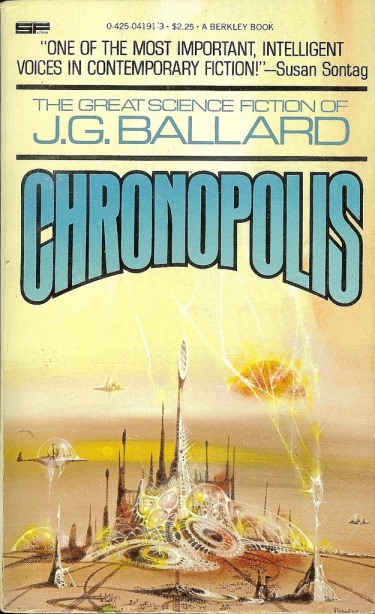

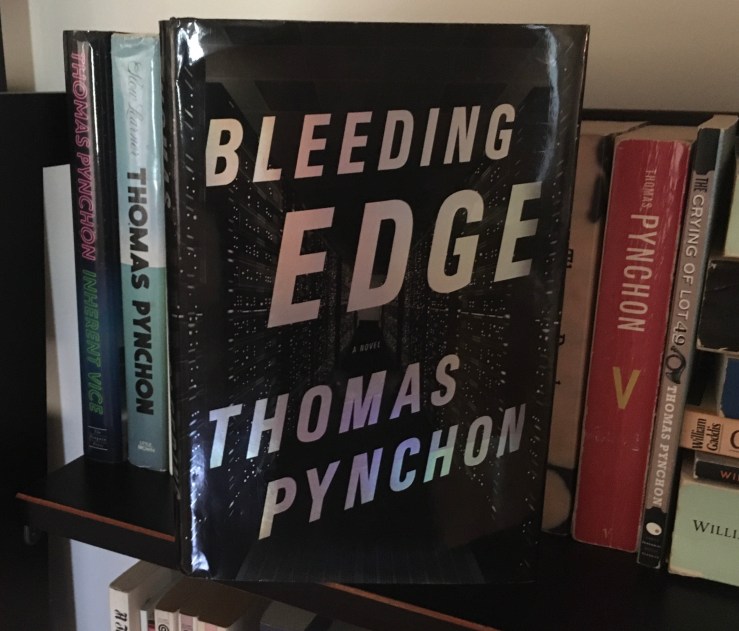
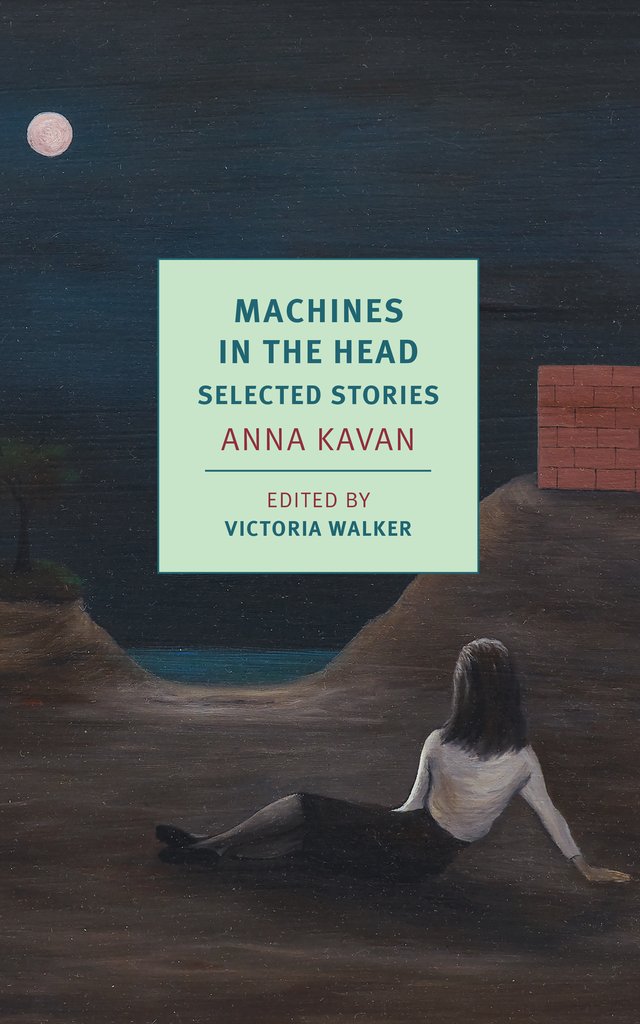
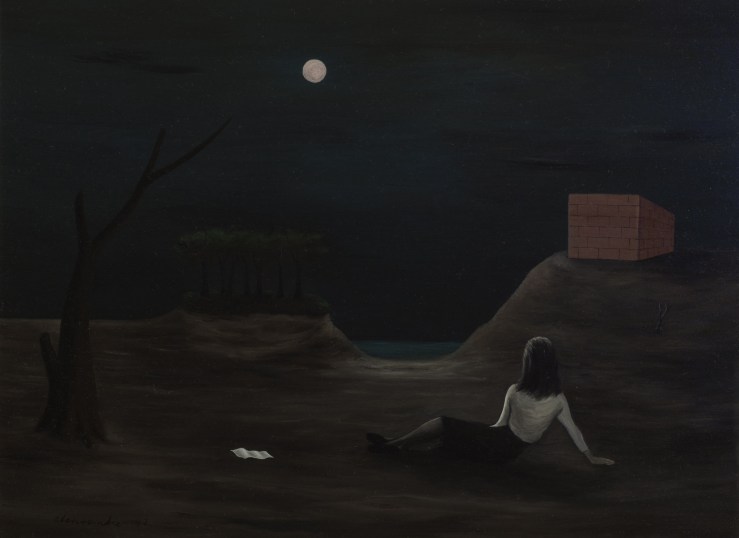
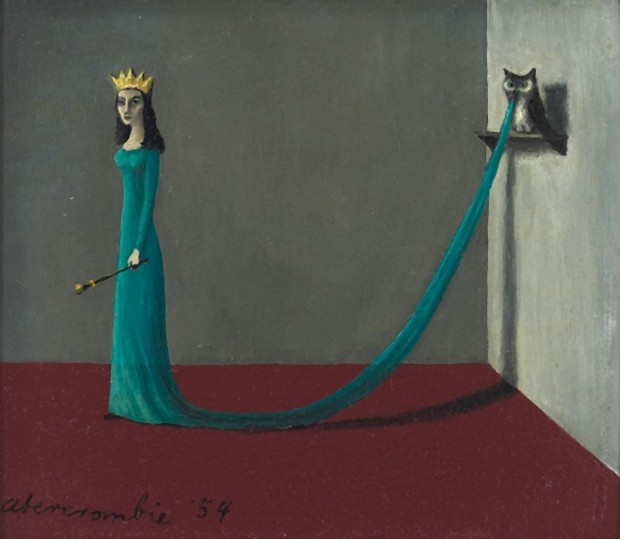
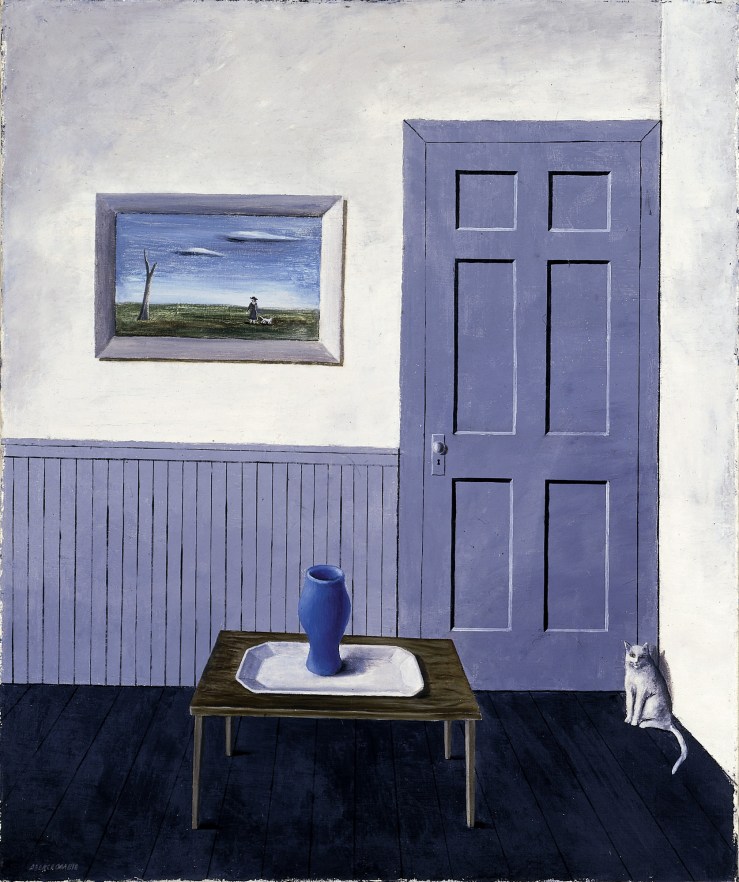
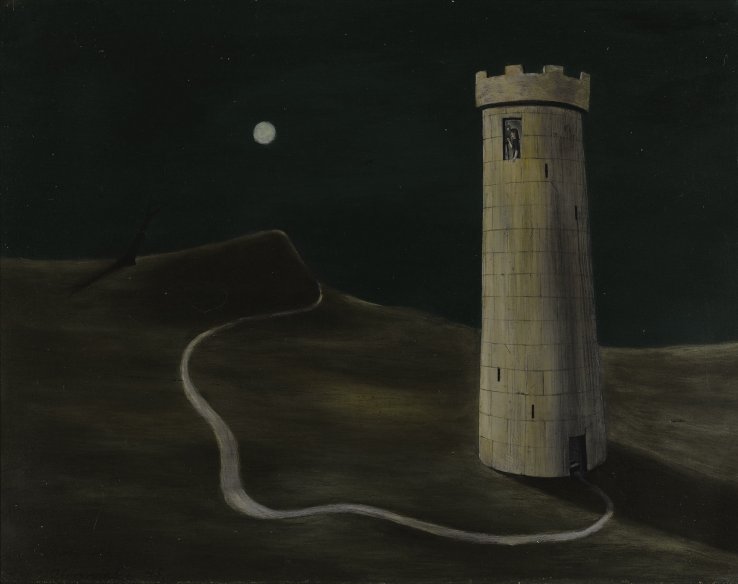

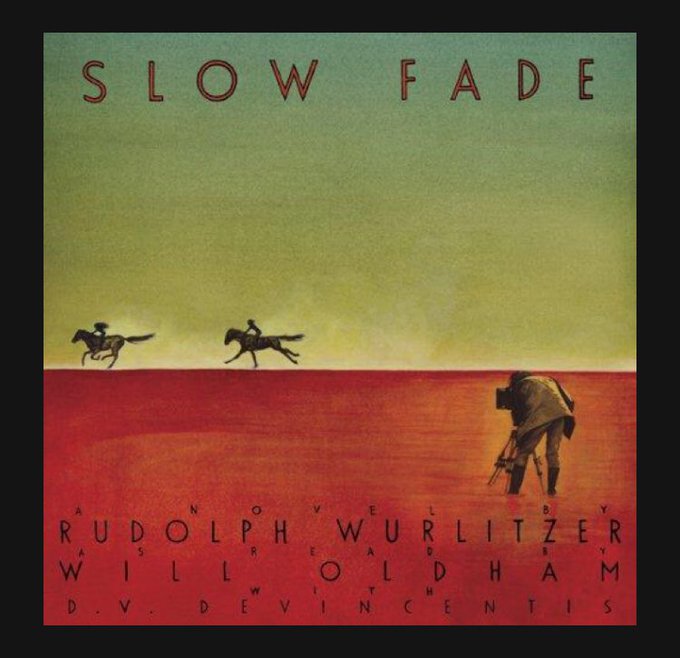

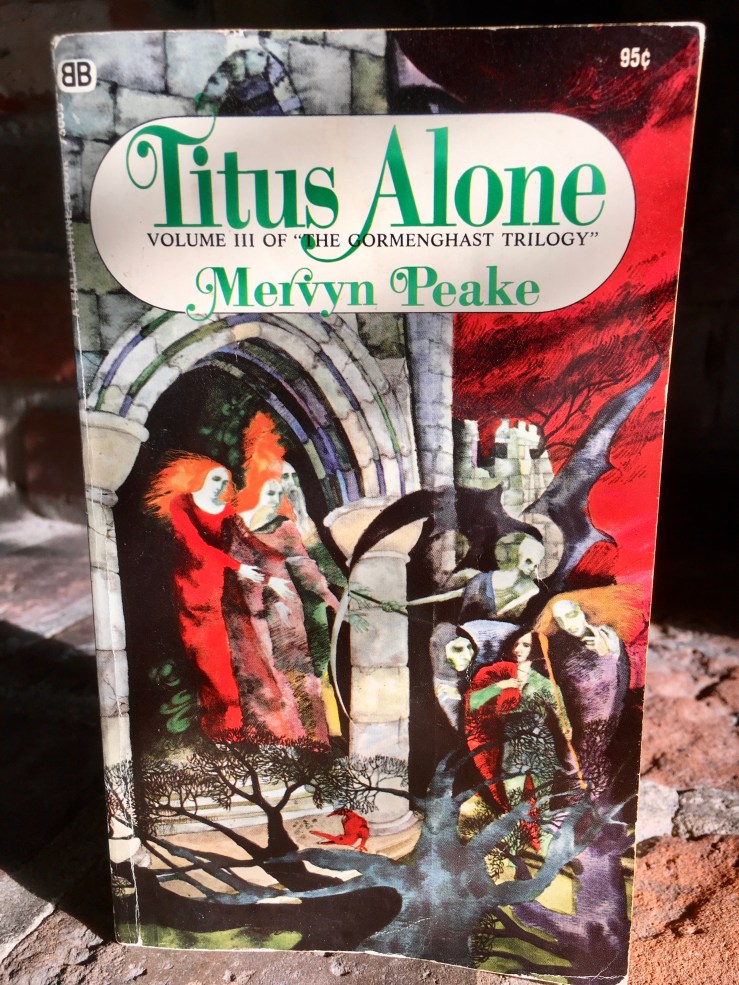


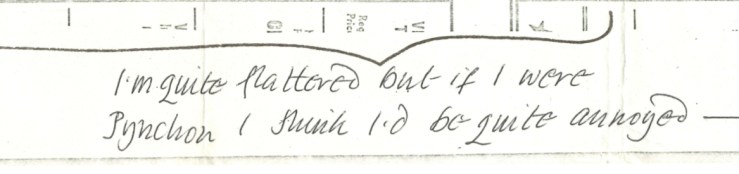
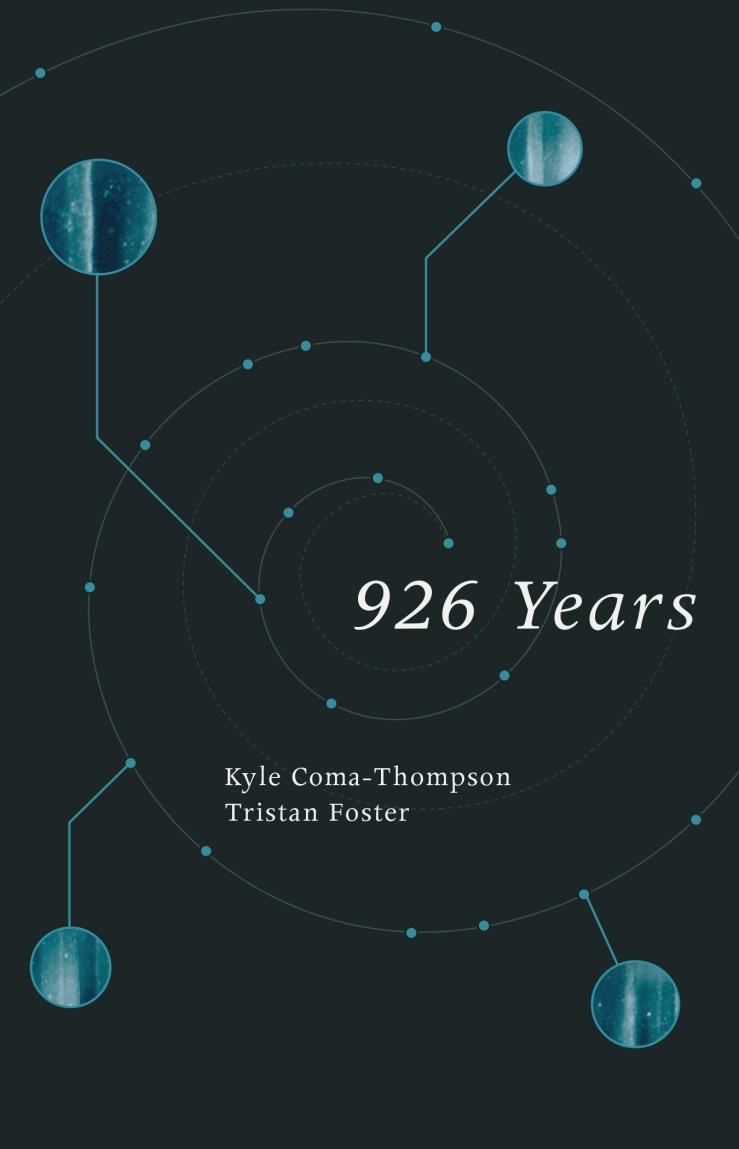

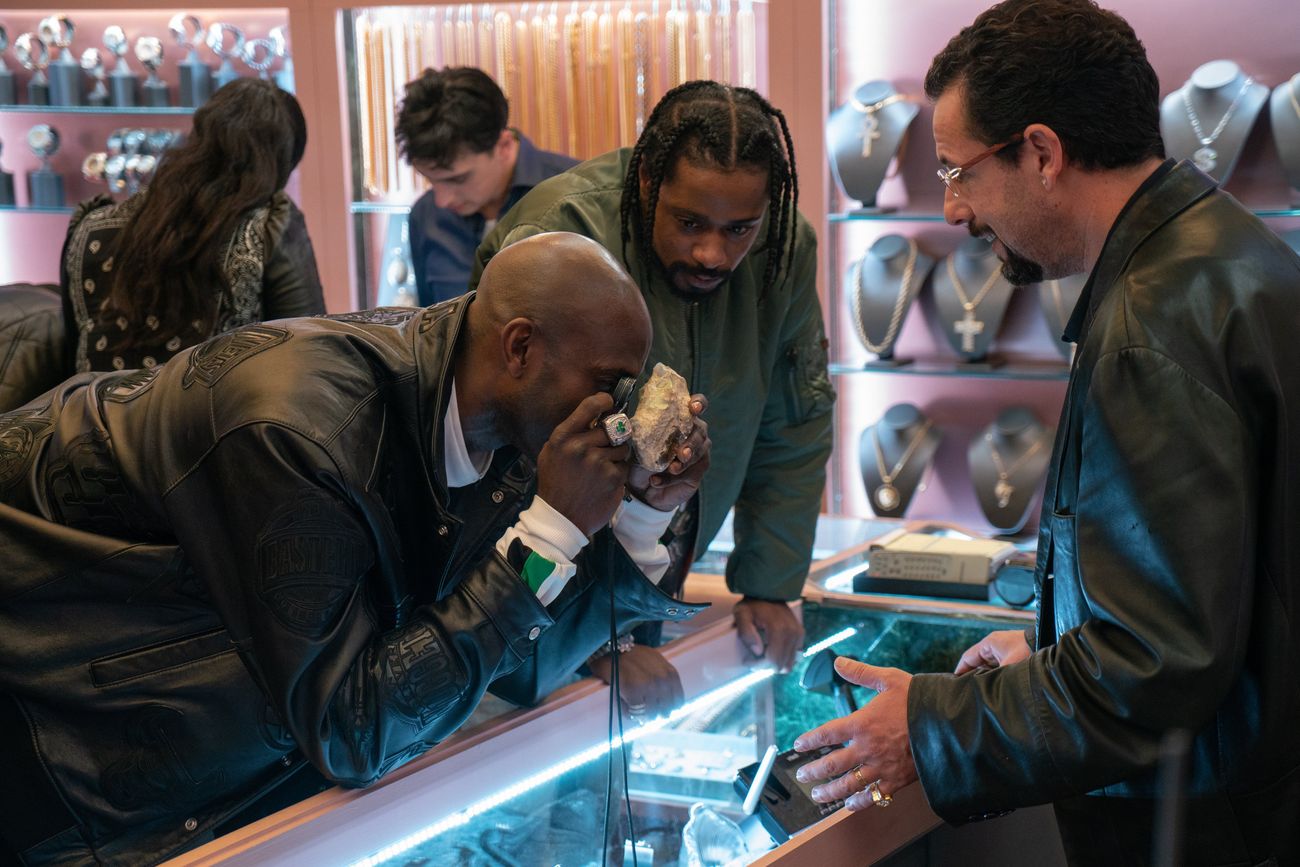


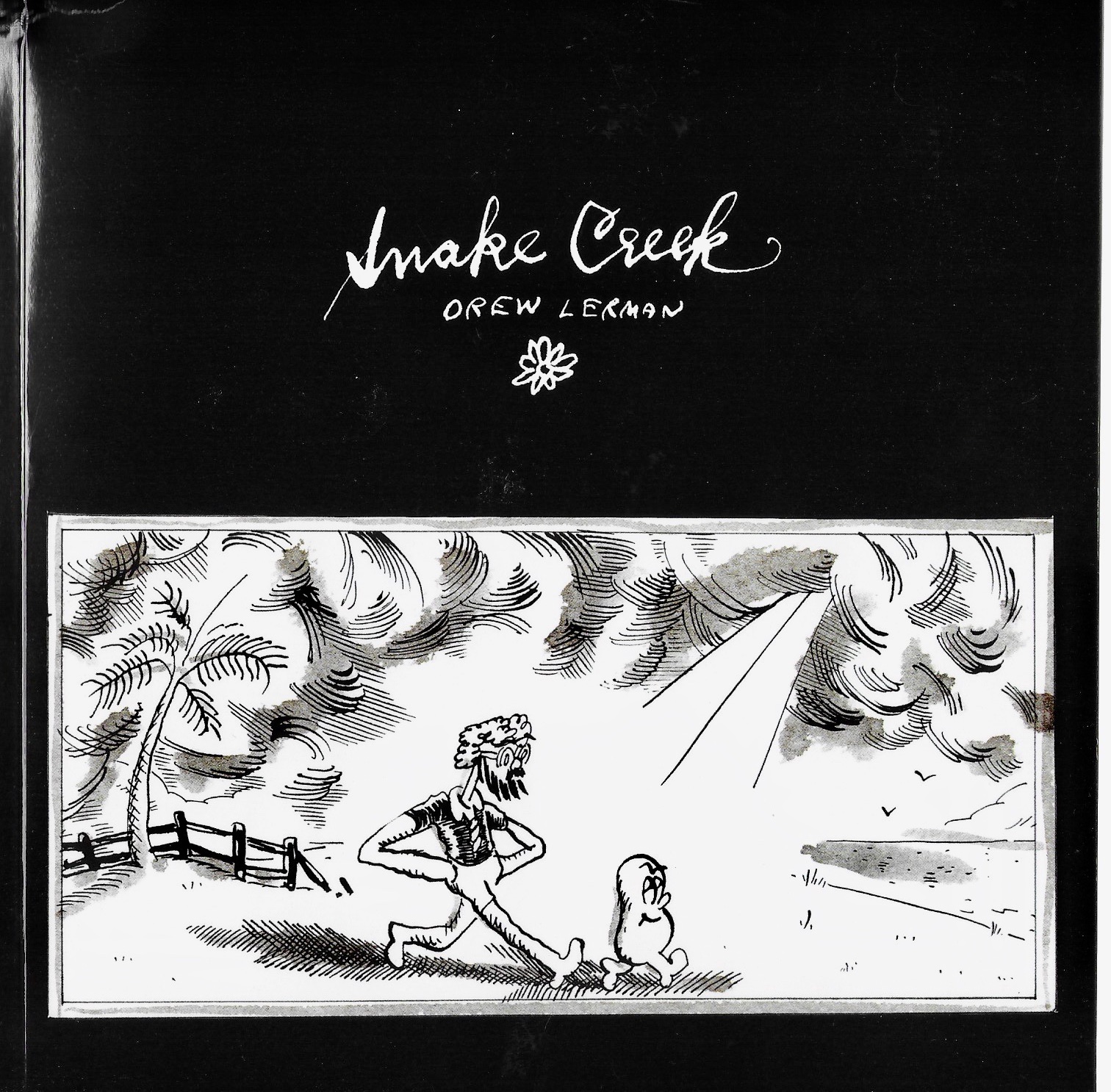
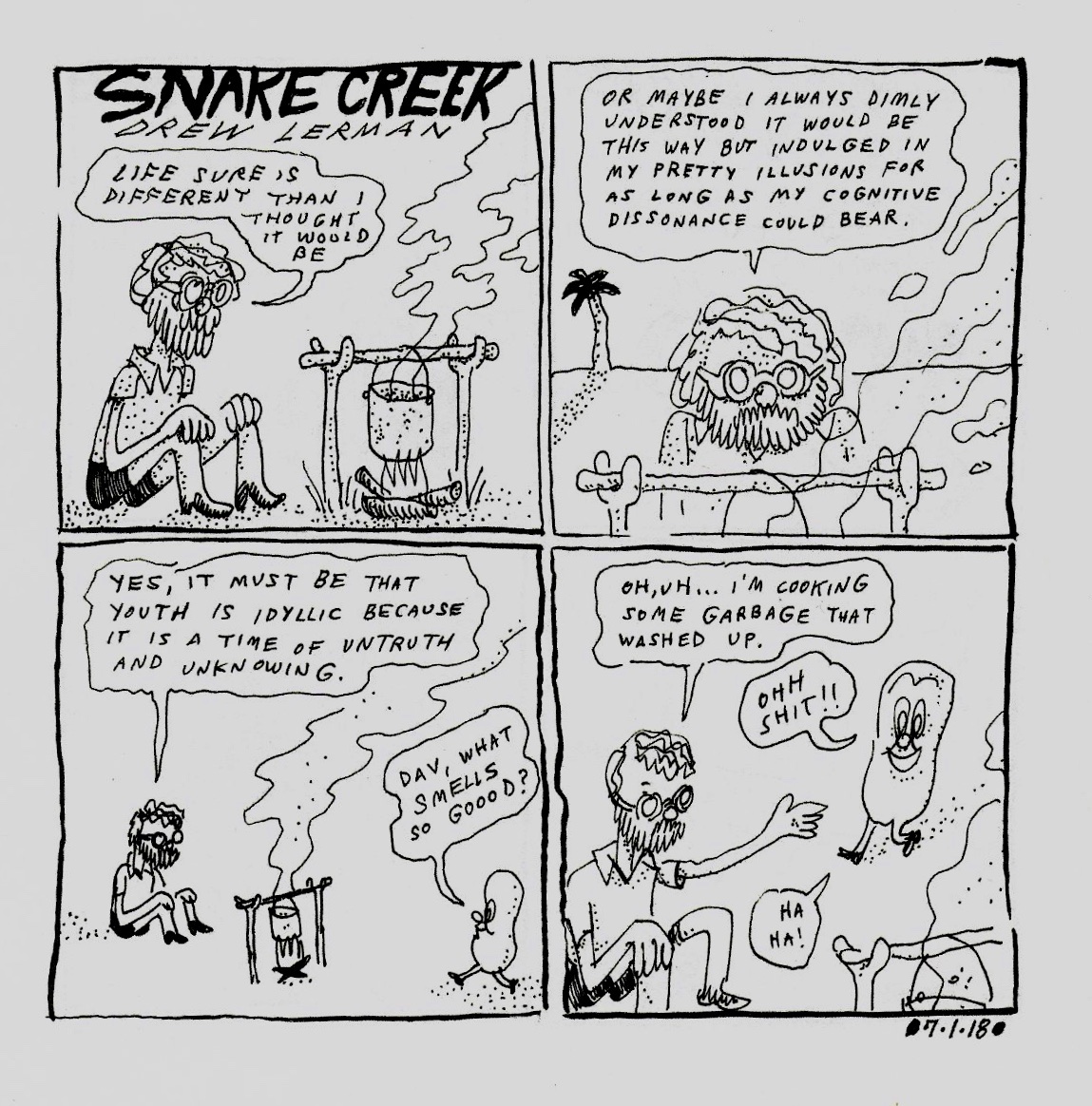

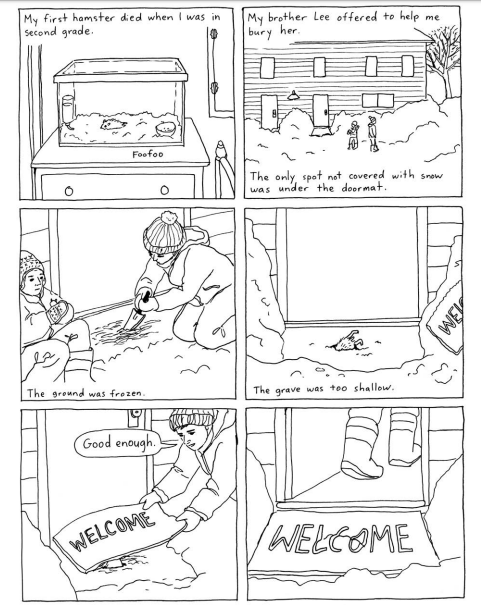
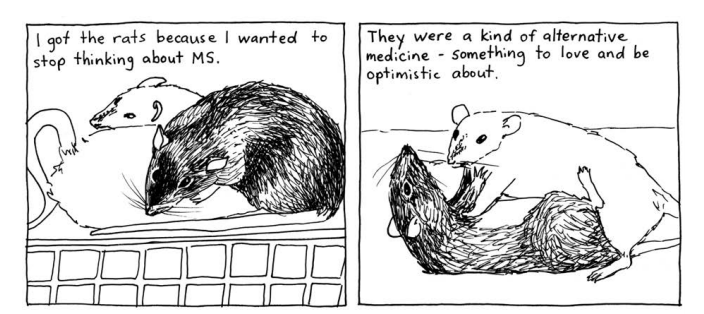

 Biblioklept