Suicide as a National Folk Art (Thomas Bernhard’s Correction)

Suicide, Luc Tymans

In this passage from Thomas Bernhard’s Correction we can see the strange, bleak, black humor that characterizes the novel:

It’s a folk art of sorts, I said to Hoeller, always longing to kill oneself but being kept by one’s watchful intelligence from killing oneself, so that the condition is stabilized in the form of lifelong controlled suffering, it’s an art possessed only by this people and those belonging to it. We’re a nation of suicides, I said, but only a small percentage actually kill themselves, even though ours is the highest percentage of suicides in the world, even though we in this country hold the world’s record for suicide, I said. What mainly goes on in this country and among these people is thinking about suicide, everywhere, in the big cities, in the towns, in the country, a basic trait of this country’s population is the constant thought of suicide, they might be said to take pleasure in thinking constantly, steadily, without allowing anything to distract them, about how to do away with themselves at any time. It is their way of keeping their balance, I said, to think constantly about killing themselves without actually killing themselves. But of course the rest of the world doesn’t understand, and so whatever they think about us and regardless of what they say about us and of how they always and invariably treat us, every single one of us, they are all wrong. It’s a simple fact, I said, that our country is misunderstood, no matter how well intentioned the rest of the world may appear, what it sees when it looks at Austria and its people is total madness as a stable state of mind, a constant.

(For those interested: Austria currently ranks 24th in the world in suicide per capita)


Three Notes on Thomas Bernhard’s Novel Correction (Plot, Prose, and a Riff)

1. Thomas Bernhard’s novel Correction is nominally the story of an unnamed narrator who leaves England after a severe illness to return to his native Austria to “sift and sort” the writings of his childhood friend Roithamer.

Roithamer, a brilliant but insane scientist, is the self-exiled son of an old, wealthy family. He uses an unexpected inheritance to fund an idealistic project: the building of a perfect Cone in the isolated heart of the Kobernausser forest. Roithamer envisions this Cone as the perfect home for his sister to live in (although he doesn’t bother to actually, y’know, talk to her about it). Roithamer’s sister dies almost immediately after taking up residence in the Cone. Roithamer then commits suicide.

Correction is divided into two sections, each a single, long, dense paragraph with no text break for the reader to rest upon. Bernhard’s sentences wind and unwind and rewind, sometimes snaking out for pages at a time; like Samuel Beckett, to whom he is often compared, Bernhard is a master of the comma splice. The effect is exhausting.

The first section of Correction is “Hoeller’s Garret,” named after the novel’s primary physical setting. Hoeller is a taxidermist who has built his own house in the Aurach gorge as a sort of dare to nature itself. Hoeller’s house inspires Roithamer’s Cone, and Hoeller’s garret becomes Roithamer’s work space—which is to say thinking space—for planning and executing his idealistic project.

Following Roithamer’s suicide, the unnamed narrator too moves into Hoeller’s garret, one of many formal repetitions in Correction (these formalizing plot repetitions are echoed in Bernhard’s syntactic repetitions).

In “Hoeller’s Garret” we learn about the childhood friendship between the narrator, Hoeller, and Roithamer. The paragraph (or chapter, if you will) includes details about Roithamer’s troubled family as well as an early horrific encounter with death, themes that will repeat throughout the novel.

The second section, “Sifting and Sorting,” finds the narrator working though Roithamer’s (mostly autobiographical) papers. The narrator appends a simple tag like “thus, Roithamer” or “so Roithamer” as attribution to Roithamer’s first-person statements, but this device pops up less and less as the book progresses, and it becomes clear that Roithamer has ventriloquized the narrative.

“Sifting and Sorting” focuses on Roithamer’s unhappy childhood, his endless fights with his mother, and his wish to perfect an idealization (namely, his Cone). The narrator channels Roithamer who channels the voices of his mother and father (and occasionally his detested brothers)—and of course, the reader channels all. The narrator slowly gives over to Roithamer’s voice as the novel’s final pages rush out in a series of diary entries, and Bernhard’s taxing syntax performs a mesmerist act on the reader, who, stunned, must return to the text in yet another repetition.

2. I’ve thus far failed to illustrate any of the above claims with an example of Bernhard’s prose.

It’s possible to plunder Correction for tight phrases, sharp, dark aphorisms, and other little bits of strange wisdom, but that doesn’t really convey the effect of what it’s like to read Bernhard’s sentences.

Better then to offer an example. Here’s the novel’s second sentence, via its English translator, Sophie Wilkins:

The atmosphere in Hoeller’s house was still heavy, most of all with the circumstances of Roithamer’s suicide, and seemed from the moment of my arrival favorable to my plan of working on Roithamer’s papers there, specifically in Hoeller’s garret, sifting and sorting Roithamer’s papers and even, as I suddenly decided, simultaneously writing my own account of my work on these papers, as I have here begun to do, aided by having been able to move straight into Hoeller s garret without any reservations on Hoeller’s part, even though the house had other suitable accommodations, I deliberately moved into that four-by-five-meter garret Roithamer was always so fond of, which was so ideal, especially in his last years, for his purposes, where I could stay as long as I liked, it was all the same to Hoeller, in this house built by the headstrong Hoeller in defiance of every rule of reason and architecture right here in the Aurach gorge, in the garret which Hoeller had designed and built as if for Roithamer’s purposes, where Roithamer, after sixteen years in England with me, had spent the final years of his life almost continuously, and even prior to that he had found it convenient to spend at least his nights in the garret, especially while he was building the Cone for his sister in the Kobernausser forest, all the time the Cone was under construction he no longer slept at home in Altensam but always and only in Hoeller’s garret, it was simply in every respect the ideal place for him during those last years when he, Roithamer, never went straight home to Altensam from England, but instead went every time to Hoeller’s garret, to fortify himself in its simplicity (Hoeller house) for the complexity ahead (Cone), it would not do to go straight to Altensam from England, where each of us, working separately in his own scientific field, had been living in Cambridge all those years, he had to go straight to Hoeller’s garret, if he did not follow this rule which had become a cherished habit, the visit to Altensam was a disaster from the start, so he simply could not let himself go directly from England to Altensam and everything connected with Altensam, whenever he had not made the detour via Hoeller’s house, to save time, as he himself admitted, it had been a mistake, so he no longer made the experiment of going to Altensam without first stopping at Hoeller’s house, in those last years, he never again went home without first visiting Hoeller and Hoeller’s family and Hoeller’s house, without first moving into Hoeller’s garret, to devote himself for two or three days to such reading as he could do only in Hoeller s garret, of subject matter that was not harmful but helpful to him, books and articles he could read neither in Altensam or in England, and to thinking and writing what he found possible to think and write neither in England nor in Altensam, here I discovered Hegel, he always said, over and over again, it was here that I really delved into Schopenhauer for the first time, here that I could read, for the first time, Goethe’s Elective Affinities and The Sentimental Journey, without distraction and with a clear head, it was here, in Hoeller’s garret, that I suddenly gained access to ideas to which my mind had been sealed for decades before I came to this garret, access, he wrote, to the most essential ideas, the most important for me, the most necessary to my life, here in Hoeller’s garret, he wrote, everything became possible for me, everything that had always been impossible for me outside Hoeller’s garret, such as letting myself be guided by my intellectual inclinations and to develop my natural aptitudes accordingly, and to get on with my work, everywhere else I had always been hindered in developing my aptitudes but in Hoeller’s garret I could always develop them most consistently, here everything was congenial to my way of thinking, here I could always indulge myself in exploring all my intellectual possibilities, here my intellectual possibilities, here in Hoeller’s garret my head, my mind, my whole constitution were suddenly relieved from all the outside world’s oppression, the most incredible things were suddenly no longer incredible, the most impossible (thinking!) no longer impossible.

If you’re interested, that’s 722 words (I wrote about 500 words before Bernhard’s sentence, if you need a point of contrast).

The repetition is easy to note even by absently gazing over the passage. The repeated phrase “Hoeller’s garret” stands out in particular, introducing the reader to the novel’s primary setting and establishing this “ideal place” in context against Altensam (the hated aristocratic home), England (self-imposed exile of a sort), and the Cone (the ideal ideal place).

We can also track a subtle shift in the final third of the sentence, as Roithamer’s voice ventriloquizes the narrator’s. Note how in the first third of the sentence, the narrator employs the first-person pronoun “I” which soon disappears in the middle third to be replaced by “he” (referring to Roithamer), until finally transforming into an “I” again in the final third—only this “I” is Roithamer’s “I.” This sentence demonstrates not only the demanding sentence structure that characterizes Correction as a whole, but also its narrative program of ventriloquism.

3. Okay. So I’ve offered plot summary, a lump of text, and a few comments on Bernhard’s prose—but I’ve hardly made a go of untangling the knotty density of Correction. (Although is that really what I came here to do? I don’t know. I hope not). Here are some stray, loose thoughts on Correction, offered here with little support (and the vague promise that I’ll write more about Correction in the future—shorter, more focused posts that hopefully expand on these ideas):

Correction shows how idealism, and specifically the will to create and perfect the ideal, leads to breakdown, death, insanity, suicide.

The Cone is a massive idealized phallus that reduces the agency of Roithamer’s sister, isolates her, and becomes her tomb.

Roithamer is part of a long tradition in literature of strange sister-lovers, dudes who dote on—and idealize—their sisters too much.

Roithamer seems to suffer from a sort-of reverse Oedipus complex, where he identifies with the strength of his father and hates his mother, who he sees as a cultural philistine, lower class, anti-intellectual. This complex leads to chauvinism against women in general, and possibly prevents him from better understanding his sister, who he essentially imprisons.

Correction reminded me often of Poe’s story “The Fall of the House of Usher.”

Correction reminded me often of W.G. Sebald’s novel Austerlitz, although Correction obviously came first, and Sebald clearly cited Bernhard as an influence.

At some of its rantier points, Correction reminded me of Notes from Underground.

Correction took me forever to read, mostly because every time I picked it back up I had to twist my way into its circular, repetitive rhythms anew. Lots of rereading.

My auditory imagination: In time, it was Werner Herzog’s voice that read Correction to me.

Correction performs its own deconstruction.

Correction is often so scathing and harsh in its treatment of humanity as to be difficult to swallow. One has to step back repeatedly and remind oneself that Roithamer is not sane.

Correction is also very, very funny at times—astonishingly so, even. Its humor is truly absurd, the absurdity of a parent’s funeral, or the absurdity of simply having to go on. I can’t help but cite a favorite line here—“waking up is the always frightening minimum of existence.”

The other side of “waking up is the always frightening minimum of existence” is of course death in general, or suicide in particular. Correction posits suicide as the ultimate correction, the final clearing gesture. The ideal.

And, not a thought on Correction, but a question for readers: What next? — ConcreteThe Loser, or Yes?

The First Sentences of Thomas Bernhard’s Novel Correction

After a mild pulmonary infection, tended too little and too late, had suddenly turned into a severe pneumonia that took its toll of my entire body and laid me up for at least three months at nearby Wels, which has a hospital renowned in the field of so-called internal medicine, I accepted an invitation from Hoeller, a so-called taxidermist in the Aurach valley, not for the end of October, as the doctors urged, but for early in October, as I insisted, and then went on my own so-called responsibility straight to the Aurach valley and to Hoeller’s house, without even a detour to visit my parents in Stocket, straight into the so-called Hoeller garret, to begin sifting and perhaps even arranging the literary remains of my friend, who was also a friend of the taxidermist Hoeller, Roithamer, after Roithamer’s suicide, I went to work sifting and sorting the papers he had willed to me, consisting of thousands of slips covered with Roithamer’s handwriting plus a bulky manuscript entitled “About Altensam and everything connected with Altensam, with special attention to the Cone.” The atmosphere in Hoeller’s house was still heavy, most of all with the circumstances of Roithamer’s suicide, and seemed from the moment of my arrival favorable to my plan of working on Roithamer’s papers there, specifically in Hoeller’s garret, sifting and sorting Roithamer’s papers and even, as I suddenly decided, simultaneously writing my own account of my work on these papers, as I have here begun to do, aided by having been able to move straight into Hoeller s garret without any reservations on Hoeller’s part, even though the house had other suitable accommodations, I deliberately moved into that four-by-five-meter garret Roithamer was always so fond of, which was so ideal, especially in his last years, for his purposes, where I could stay as long as I liked, it was all the same to Hoeller, in this house built by the headstrong Hoeller in defiance of every rule of reason and architecture right here in the Aurach gorge, in the garret which Hoeller had designed and built as if for Roithamer’s purposes, where Roithamer, after sixteen years in England with me, had spent the final years of his life almost continuously, and even prior to that he had found it convenient to spend at least his nights in the garret, especially while he was building the Cone for his sister in the Kobernausser forest, all the time the Cone was under construction he no longer slept at home in Altensam but always and only in Hoeller’s garret, it was simply in every respect the ideal place for him during those last years when he, Roithamer, never went straight home to Altensam from England, but instead went every time to Hoeller’s garret, to fortify himself in its simplicity (Hoeller house) for the complexity ahead (Cone), it would not do to go straight to Altensam from England, where each of us, working separately in his own scientific field, had been living in Cambridge all those years, he had to go straight to Hoeller’s garret, if he did not follow this rule which had become a cherished habit, the visit to Altensam was a disaster from the start, so he simply could not let himself go directly from England to Altensam and everything connected with Altensam, whenever he had not made the detour via Hoeller’s house, to save time, as he himself admitted, it had been a mistake, so he no longer made the experiment of going to Altensam without first stopping at Hoeller’s house, in those last years, he never again went home without first visiting Hoeller and Hoeller’s family and Hoeller’s house, without first moving into Hoeller’s garret, to devote himself for two or three days to such reading as he could do only in Hoeller s garret, of subject matter that was not harmful but helpful o him, books and articles he could read neither in Altensam or in England, and to thinking and writing what he found possible to think and write neither in England nor in Altensam, here I discovered Hegel, he always said, over and over again, it was here that I really delved into Schopenhauer for the first time, here that I could read, for the first time, Goethe’s Elective Affinities and The Sentimental Journey, without distraction and with a clear head, it was here, in Hoeller’s garret, that I suddenly gained access to ideas to which my mind had been sealed for decades before I came to this garret, access, he wrote, to the most essential ideas, the most important for me, the most necessary to my life, here in Hoeller’s garret, he wrote, everything became possible for me, everything that had always been impossible for me outside Hoeller’s garret, such as letting myself be guided by my intellectual inclinations and to develop my natural aptitudes accordingly, and to get on with my work, everywhere else I had always been hindered in developing my aptitudes but in Hoeller’s garret I could always develop them most consistently, here everything was congenial to my way of thinking, here I could always indulge myself in exploring all my intellectual possibilities, here my intellectual possibilities, here in Hoeller’s garret my head, my mind, my whole constitution were suddenly relieved from all the outside world’s oppression, the most incredible things were suddenly no longer incredible, the most impossible (thinking!) no longer impossible. It was in Hoeller’s garret that he found the conditions necessary and most favorable to thought, for getting the mechanism of his thought going in the most natural, most undistracted way, all he had to do was to come to Hoeller’s garret from wherever he might be, and the mechanism worked.

—The first sentences of Thomas Bernhard’s novel Correction.

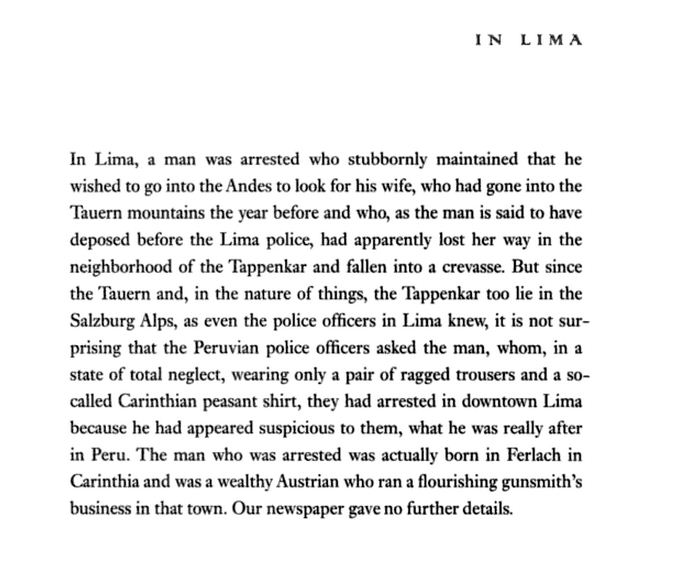
“In Lima” — Thomas Bernhard

List with No Name #8


  1. Robert Walser
  2. Franz Kafka
  3. Henry Miller
  4. Thomas Bernhard
  5. David Markson
  6. Renata Adler
  7. W.G. Sebald
  8. Lydia Davis
  9. Ben Marcus


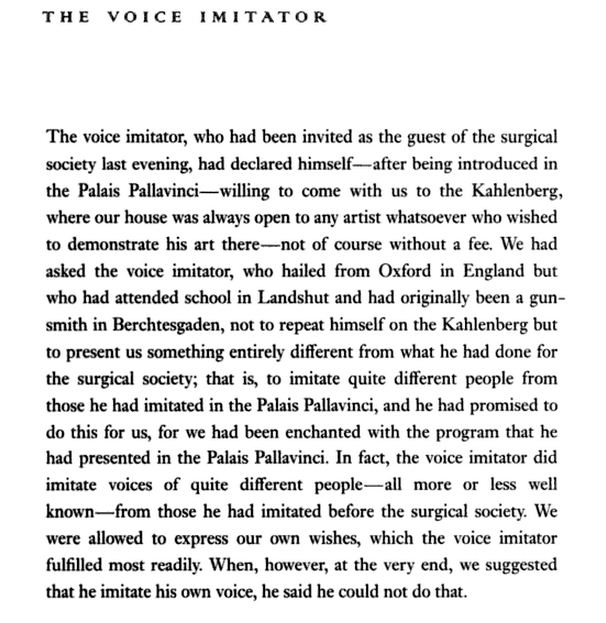
“The Voice Imitator” — Thomas Bernhard

Faulkner House/Crescent City Books (Books Acquired Some Time Last Week)

Had a wonderful if sweaty trip to New Orleans last week.

Great food, great music, and great bookstores.

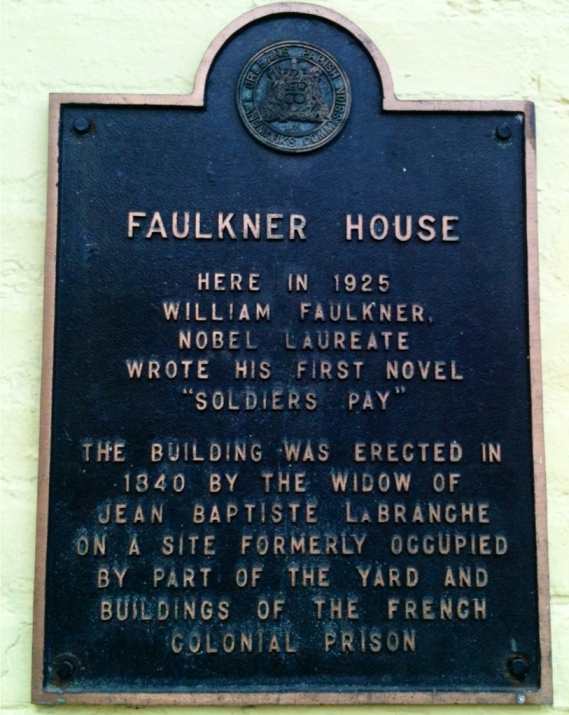
First up, Faulkner House:

20120808-163344.jpg

Faulkner House is a tiny little shop just off Jackson Square. Its two rooms (really, a main room and a hallway) are lined from bottom to top with literature, poetry, and philosophy. I can’t overstate the excellence of the collection in here—all kinds of rare and beautiful tomes, signed stuff, local and localish stuff, etc (local gal Anne Rice was the closest thing I saw to genre fiction). It’s great to walk into a bookshop and see a near-complete collection of new NYRB volumes stacked prominently upfront along with new novels by Richard Ford and Teju Cole.

I picked up this handsome illustrated edition of Thomas Bernhard’s Victor Halfwit, the handsomeness and bigness and luxuriousness of which simply doesn’t come across in this lousy iPhone pic:

20120808-163414.jpg

Random framed shot:

20120808-163426.jpg

And a random two-page shot with glare:

20120808-163432.jpg

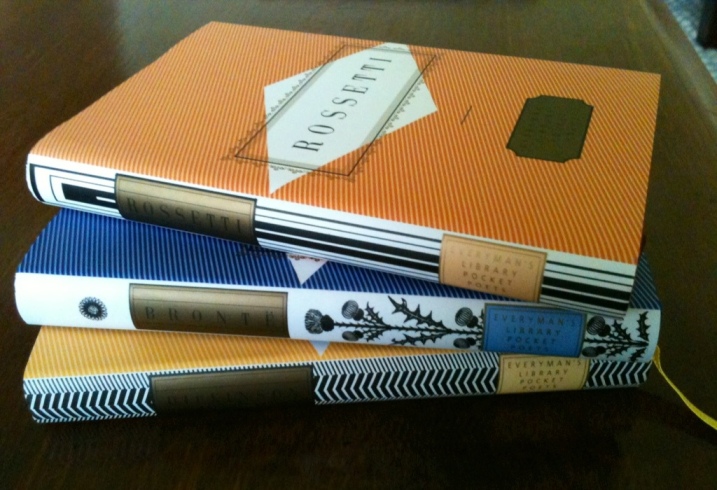
My wife picked out three lovely editions from Everyman’s Library Pocket series, poems from Christina Rosetti, Emily Dickinson, and Emily Brontë:

20120808-163439.jpg

The owner and the manager were very kind, knowledgeable, and tolerant of my questions about what kind of stock they moved (biggest seller, unsurprisingly, is Soldier’s Pay).

Info for Faulkner House, via bookmark (the manager put one in each book I bought):

20120808-163445.jpg

A few days later after a three-Bloody-Mary-breakfast I stumbled into Crescent City Books:

20120808-163523.jpg

This is a great shop that, like Faulkner House, doesn’t waste precious shelf space on glitter vampires or self-help books or novelty cookbooks. Lots of art volumes (many rare and in German, French, Italian, etc.), a large poetry section, philosophy, history, etc. Lots of great old prints too. And an old cat, who was basically boss of the place.

They also carry physical copies of Rain Taxi, which I haven’t seen in years.

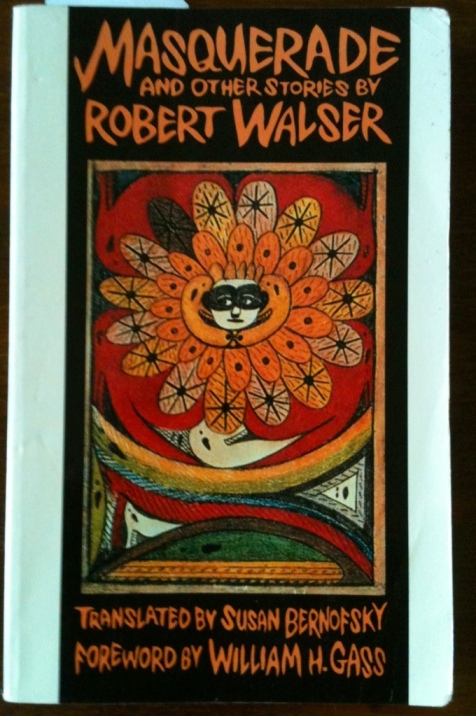
I picked up Masquerade and Other Stories after a Biblioklept commenter recommended Walser (by way of Kafka). I read about half of this over the next few days (full review to come):

20120808-163504.jpg

“True Love” — Thomas Bernhard


True Love

An Italian who owns a villa in Riva on Lake Garda and can live very comfortably on the interest from the estate his father left him has, according to a report in La Stampa, been living for the last twelve years with a mannequin. The inhabitants of Riva report that on mild evenings they have observed the Italian, who is said to have studied art history, boarding a glass-domed deluxe boat, which is moored not far from his home, with the mannequin to take a ride on the lake. Described years ago as incestuous in a reader’s letter addressed to the newspaper published in Desencano, he had applied to the appropriate civil authorities for permission to marry his mannequin but was refused. The church too had denied him the right to marry his mannequin. In winter he regularly leaves Lake Garda in mid-December and goes with his beloved, whom he met in a Paris shop-window, to Sicily, where he regularly rents a room in the famous Hotel Timeo in Taormina to escape from the cold, which, all assertions to the contrary, gets unbearable on Lake Garda every year after mid-December.

“True Love,” by Thomas Bernhard. From The Voice Imitator.


Thomas Bernhard/Mary Douglas/Clarice Lispector (Books Acquired, 7.19.2012)

20120724-194225.jpg

“The Tables Turned” — Thomas Bernhard


“The Tables Turned,” a microfiction from Thomas Bernhard’s The Voice Imitator:

Even though I have always hated zoological gardens and actually find that my suspicions are aroused by people who visit zoological gardens, I still could not avoid going out to Schönbrunn on one occasion and, at the request of my companion, a professor of theology, standing in front of the monkeys’ cage to look at the monkeys, which my companion fed with some food he had brought with him for the purpose. The professor of theology, an old friend of mine from the university, who had asked me to go to Schönbrunn with him had, as time went on, fed all the food he had brought with him to the monkeys, when suddenly the monkeys, for their part, scratched together all the food that had fallen to the ground and offered it to us through the bars. The professor of theology and I were so startled by the monkeys’ sudden behavior that in a flash we turned on our heels and left Schönbrunn through the nearest exit.


Waldhaus — Thomas Bernhard

“Waldhaus” by Thomas Bernhard:

We had no luck with the weather and the guests at our table were repellent in every respect. They even spoiled Nietzsche for us. Even after they had had a fatal car accident and had been laid out in the church in Sils, we still hated them.

Some Annotations on the First Sentence of William Gaddis’s Last Novel, Agapē Agape

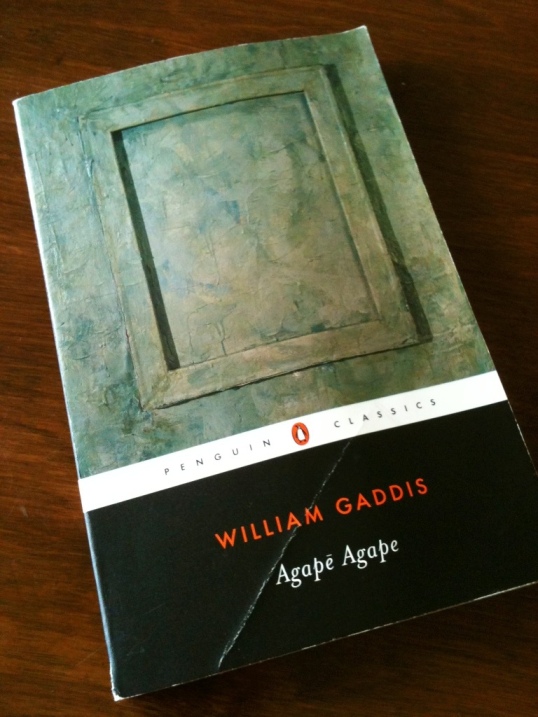
20120627-145321.jpg

1. Let’s start with the what:

Agapē Agape is the last novel by William Gaddis, that underread titan who gave us The Recognitions and J R. Agapē Agape was published in 2002, four years after Gaddis’s death. Agapē Agape is 96 pages in my Penguin Classics edition (the font is rather large, too)—almost exactly one-tenth the length of The Recognitions in my Penguin Classics edition, which is 956 pages (and in a smaller font).

2. And why?

Let’s say I’ve struggled with this review, perhaps more than I struggled with writing about J R (which I did here and here) or The Recognitions (which I did here and here), which seems nonsensical because those books are so big and this one is so short. But that’s a surface argument.

See, Agapē Agape is dense. It seems to compact and condense all of Gaddis’s themes and ideas and motifs into this little book that’s uranium heavy, too dense to allow for line breaks or paragraph breaks or indentations, let alone chapters. It’s one big block of text.

3. And so—

After reading the book twice I’ve marked every page (which is exactly like marking no pages), and at this point the only way that I can find to discuss it (I know there must be others) is to annotate the opening paragraph, its first sentence, really—which of course isn’t really a paragraph or a sentence in the traditional grammatical sense—I mean, there are a set of clauses, some fused sentences, perhaps a comma splice or two—but what marks it as a discrete sentence is that it’s punctuated by a question mark, a tiny caesura before the next onslaught of words. (Some of Agapē Agape’s sentences go on for pages).

4. The style of Agapē Agape recalls Thomas Bernhard, who Gaddis’s narrator accuses of having plagiarized the book that the narrator has yet to write. The accusation (ironic, purposefully, of course) points to Agapē Agape’s concern for synthesis, for transmitting some clear thesis statement out of the muddle of Western culture. Agapē Agape tries to suss out that muddle and as such is larded with discussions of Plato, Nietzsche, Melville, Hawthorne, Byron, Freud (“Sigi”!), Bach, Caesar, Joyce, Pulitzer, Tolstoy, Frankenstein, Huizinga, Pound, Philo T. Farnsworth, player-pianos . . . It overwhelms the narrator; it overwhelms the reader. But enough dithering—

5. —here is the opening sentence:

No but you see I’ve got to explain all this because I don’t, we don’t know how much time there is left and I have to work on the, to finish this work of mine while I, why I’ve brought in this whole pile of books notes pages clippings and God knows what, get it all sorted and organized when I get this property divided up and the business and worries that go with it while they keep me here to be cut up and scraped and stapled and cut up again my damn leg look at it, layered with staples like that old suit of Japanese armour in the dining hall feel like I’m being dismantled piece by piece, houses, cottages, stables orchards and all the damn decisions and distractions I’ve got the papers land surveys deeds and all of it right in this heap somewhere, get it cleared up and settled before everything collapses and it’s all swallowed up by lawyers and taxes like everything else because that’s what it’s about, that’s what my work is about, the collapse of everything, of meaning, of values, of art, disorder and dislocation wherever you look, entropy drowning everything in sight, entertainment and technology and every four year old with a computer, everybody his own artist where the whole thing came from, the binary system and the computer where technology came from in the first place, you see?

6. “No but you see I’ve got to explain all this because I don’t, we don’t know how much time there is left and I have to work on the, to finish this work of mine while I,”

Ulysses ends with a “Yes”; Agapē Agape begins with a “No.” This is a deeply negative book, cruel almost, bitter, caustic, acidic, but also erudite, funny, and even charming. We see right away the narrator—surely a version of Gaddis himself—concerned with the ancient problem of communication, the problem that occupied Plato and every philosopher since: “I’ve got to explain all this.” We also see here the same stream-of-consciousness technique here that Joyce used so frequently in Ulysses (putting aside Gaddis’s denials of a Joyce influence)—the suspended referent, the unnamed (the unnameable?): “I have to work on the, to finish this work of mine while I”—while I what? Still can? Still live? From the outset, Agapē Agape is a contest against time, death, and entropy.

7. “why I’ve brought in this whole pile of books notes pages clippings and God knows what, get it all sorted and organized”

Synthesis, synthesis, synthesis. Making books out of other books. Plugging literature into other literature. I am quite content to go down to posterity as a scissors-and-paste man, said someone once. And then others said it again. And then I cited it here, now.

I’m reminded here of a list that Gibbs (erstwhile Gaddis stand-in in J R) keeps in his pocket, a scrap paper crammed with ideas, fragments, citations:

Is it possible to get it sorted?

Recall now Gaddis’s hero Ezra Pound. From Tom McCarthy’s essay on synthesis, “Transmission and the Individual Remix”:

With the Cantos, he kept up this furious enterprise for five whole decades, ramping its intensity up and up until the overload destroyed him, blew his mind to pieces, leaving him to murmur, right toward the end: “I cannot make it cohere.”

It is the reader’s job to make Agapē Agape cohere.

8. “when I get this property divided up and the business and worries that go with it”

Agapē Agape may be said to have a few formalizing plots beyond its object of synthesizing Western culture vis-à-vis art and entertainment.

One of these formalizing elements is the idea of an old man divvying up his property to his daughters. Oh, hey, King Lear anyone? What’s most interesting to me about this plot (okay, more of a motif really) is that it’s the only allusive device that the narrator doesn’t remark upon. We have a narrator who’s trying to control all these notes and clippings, all these scraps of culture, a narrator with a sharp (if distracted intelligence) who nevertheless fails to remark upon the fact that his personal circumstances echo the great dismal swan song of English literature. King Lear: madness, unraveling, degeneracy, death, entropy.

9. “while they keep me here to be cut up and scraped and stapled and cut up again my damn leg look at it, layered with staples like that old suit of Japanese armour in the dining hall feel like I’m being dismantled piece by piece,”

Another formalizing element in Agapē Agape are the health issues the narrator faces, presumably a series of surgeries that involve at least one of his legs. The motif of surgeries, of transplants, and implants runs throughout The Recognitions and J R as well. In The Recognitions we get poor Stanley’s mother’s amputated leg, another strange reliquary trace floating through the text. In J R, we get Cates prepped for a heart transplant, yet another organ transferral for this massive man. There’s the idea here of borrowed parts, that humans might not be “natural,” cohesive entities but rather a collection of parts that may be swapped out. Again, synthesis in the face of break down; the surgeon as entropy repairman.

10. “houses, cottages, stables orchards and all the damn decisions and distractions I’ve got the papers land surveys deeds and all of it right in this heap somewhere, get it cleared up and settled before everything collapses and it’s all swallowed up by lawyers and taxes like everything else because that’s what it’s about,”

Here, the personal, the concrete, the immediate, and the real tips into what Gaddis took to be the grand subject of his corpus—collapse, chaos, entropy. Spelled out clearly in the next line:

11. “that’s what my work is about, the collapse of everything, of meaning, of values, of art, disorder and dislocation wherever you look, entropy drowning everything in sight,”

I don’t think commentary from me is necessary here. Instead, let me share a quote from Gibbs in J R, ranting to his young students:

Before we go any further here, has it ever occurred to any of you that all this is simply one grand misunderstanding? Since you’re not here to learn anything, but to be taught so you can pass these tests, knowledge has to be organized so it can be taught, and it has to be reduced to information so it can be organized do you follow that? In other words this leads you to assume that organization is an inherent property of the knowledge itself, and that disorder and chaos are simply irrelevant forces that threaten it from the outside. In fact it’s the opposite. Order is simply a thin, perilous condition we try to impose on the basic reality of chaos . . .

12. “entertainment and technology and every four year old with a computer, everybody his own artist where the whole thing came from, the binary system and the computer where technology came from in the first place, you see?”

The age of the amateur. Paint-by-numbers. Everyone wants to write a novel but no one wants to read one. Etc. When the narrator grumbles “where technology came from in the first place,” he means entertainment. That’s one thesis in Agapē Agape: that the technological progress we so value, that so underwrites the march of our grand civilization has its roots in toymaking and child’s play.

13. The novel that follows this addled, rattled opening line is remarkable for its brilliance, its cruelty, but most of all its sheer verbal force. Gaddis showed a mastery of voice in J R, a heteroglossic novel of speech, speech, speech, a grand dare to any reader, I suppose. Agapē Agape is even more stripped down, the monologue of a dying voice, a voice that’s been too-long ignored and under-appreciated. I don’t know if something so sad, so personally sad can be called perfect, but I can’t think of a more appropriate or fitting final statement from Gaddis.

William Gass on Gaddis, Calvino, Bernhard and More

In his Paris Review interview from 1977, William Gass riffs on the writers he admires:

INTERVIEWER

Who are some living novelists you respect?

GASS

Well, the question leaves out so many dead ones who are more alive. I think Barth is one of the great writers. I have admired his work since I first encountered it. I think he is incredible. Several of his books, in particular The Sot-Weed Factor, are the works which stand to my generation as Ulysses did to its. His habits of work are wholly unlike mine, and the kind of thing which engages him is quite different too. He is a great narrator, one of the best who ever plied the pen, as they used to say. He has been accused of being cold, purely mental, but I find him full of passion and excitement. And what I like about his work in great part is the unifying squeeze which that great intellectual grasp of his gives to his work, and the combination of enormous knowledge with fine feeling and artistic pride and energy and total control. I really admire a master. He’s one.

A lot of the work of Hawkes is extraordinary, breathtaking. Everybody likes Beckett. Now. It’s silly to mention Bellow, Borges, Nabokov—so obvious. And of course Stanley Elkin’s work I like enormously. Some of Coover’s, too, I find extraordinarily interesting. Control again. Gaddis. Control. Also Barthelme—a poet. A great many South American writers write rings around us. Infante’s Three Trapped Tigers is a great book. I taught Hopscotch once. I’ll never get over it. Márquez, Fuentes, Lima, Llosa . . . it is always an exciting time to be a reader. Lots of European writers are overblown, especially some of the French experimentalists, but Italo Calvino is wonderful. Thomas Bernhard’s The Lime Works is impressive. In general, I would think that at present prose writers are much in advance of the poets. In the old days, I read more poetry than prose, but now it is in prose where you find things being put together well, where there is great ambition, and equal talent. Poets have gotten so careless, it is a disgrace. You can’t pick up a page. All the words slide off.

“Words Ruin One’s Thoughts” — William Gaddis Quotes Thomas Bernhard

Late in his life, William Gaddis became a big fan of Thomas Bernhard who he quoted at length in a letter he sent to critic Gregory Comnes (that’s Gaddis’s handwriting). Via/more.

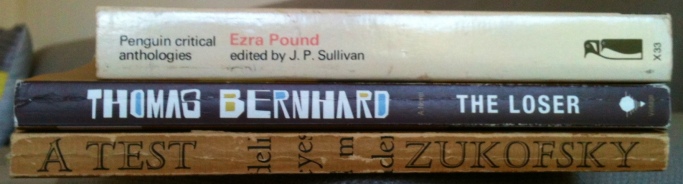
Books Acquired, 1.13.2012 (Ezra Pound, Thomas Bernhard, Louis Zukofsky)

20120115-163012.jpg

Picked up these three last Friday.

20120115-163023.jpg

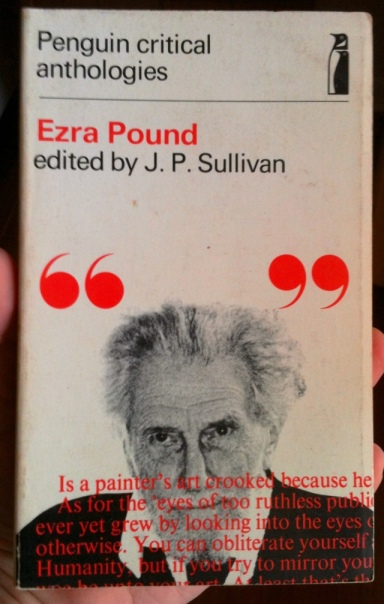
This is a collection of letters to and from Ezra Pound, as well as criticism, introductions, etc. I like the cover, which is a bit too busy.

20120115-163044.jpg

I picked up Thomas Bernhard’s Correction last year on reader recommendation (recommendation: read Bernhard). Saw The Loser in the shop used, so I picked it up. Any recommendation on which one to start with?

20120115-163114.jpg

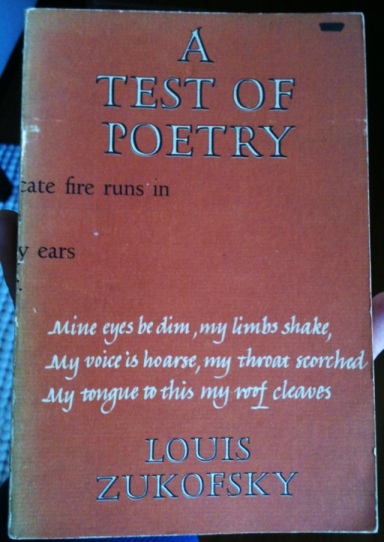
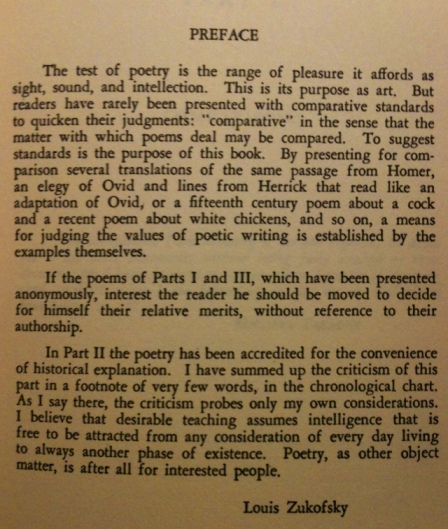
A midcentury paperback of Louis Zukofsky’s A Test of Poetry. This is a strange book. I’d better let Zukofsky explain it:

20120116-175731.jpg

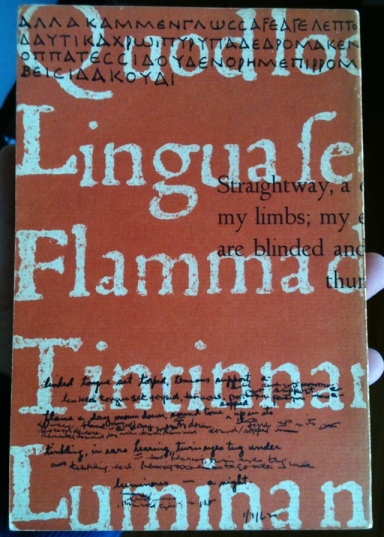
The back cover is lovely as well:

20120115-163132.jpg

David Markson: “Originally I Was Calling It Wittgenstein’s Niece”

More from David Markson’s interview at the Dalkey Archive:

DM: Originally I was calling it “Wittgenstein’s Niece.” Never knowing, of course, that Thomas Bernhard would eventually publish something called “Wittgenstein’s Nephew.” But even before I submitted it I knew I’d have enough trouble finding a publisher as was—hardly the amount I did have, but some—and so not wanting to compound the difficulty I changed it to “Keeper of the Ghosts.” Which is something I swiped from Lowry, by the way, from a character named Ghostkeeper. But once the manuscript wound up in the hands of a small press that wasn’t going to be worried about recognition value in Downers Grove, Illinois, or among the knuckleheads at a sales conference, I went back to Wittgenstein. “Mistress” had been on the same scratch sheet with “Niece,” and I decided I liked it better by then.

JT: And meaning basically that your heroine is mistress to Wittgenstein’s thought?

DM: Well, along with several other people’s yes. But as I started to say a few minutes ago, the Wittgenstein is frequently most obvious in the very way she questions so many of her own “propositions,” as it were.

Books I Didn’t Read in 2011 (And Books I Will Try to Read in 2012)

Okay. So obviously a list of the books I didn’t read in 2011 would be, y’know, long.

This post is about the books I set out to read, tried to read, wanted to read, abandoned, neglected, acquired and thought looked interesting, etc. It’s also about what I want to—what I plan to—read in 2012.

20111228-115819.jpg

A reasonable starting place: I wrote a post in early January of this year detailing the books I would try to read in 2011. I actually read most of the books I named in that post. But:

I failed to read past page 366 of Adam Levin’s incredibly long novel The Instructions, although I think I was a bit too harsh in my semi-review. Chalk it up to exhaustion.

I failed to even begin to try to read William Gaddis’s incredibly long novel JR. (But I swear to read it one year. Not next year, but maybe the year after?).

I failed to read past the first chapter of Katherine Dunn’s Geek Love.

I read most of the Tintin collections I picked up last year, but I didn’t get to volumes 5 or 6.

20111228-115848.jpg

Moving beyond that early post, books that I recall abandoning (although I’m sure there must be more):

I abandoned Nathaniel Hawthorne’s Italian romance The Marble Faun after about 30 pages.

I abandoned 334 by Thomas Disch after about 50 pages. Somehow simultaneously dense and loose, it struck me as intensely imagined and sloppily composed.

I abandoned John Williams’s Butcher’s Crossing after the first chapter; it was a great opening chapter, but I thought it was going to be, I don’t know, more like Blood Meridian.

I also abandoned Chad Harbach’s big book The Art of Fielding (after 100 pages) because it was lame (notice it’s not pictured above because I traded in that sucker), but I had a nice dialog with some readers who responded to a post I wrote about abandoning it, so that was a plus.

20111228-115828.jpg

Books I bought in 2011 that I aim to read in 2012:

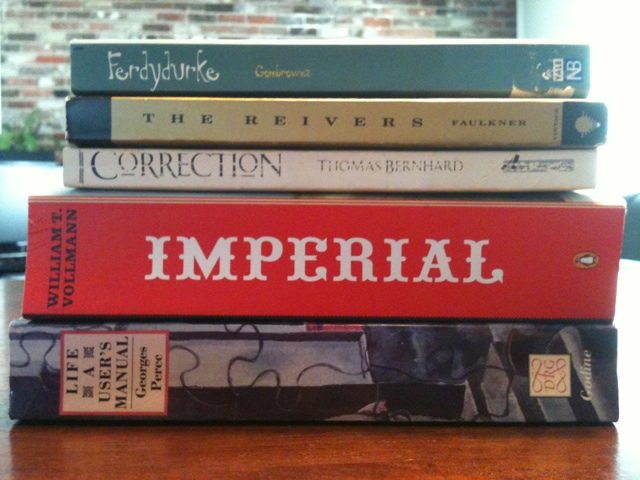
Correction by Thomas Bernhard. Bernhard was a repeated suggestion from readers in the aforementioned Harbach post/rant, and he was apparently a huge influence on W.G. Sebald, so, yes, looking forward to this.

The Reivers by William Faulkner. I read A Light in August this year and reread most of Go Down, Moses. My plan is to read one Faulkner a year for the next ten years.

Ferdydurke by Witold Gambrowicz. I struggled to make it through Gombrowicz’s bizarre jaunt Trans-Atlantyk, but once the novel taught me how to read it, I was enchanted by its strange humor and frenetic syntax. Over some beer and wine, I had a conversation about Ferdydurke with my father-in-law’s priest who is Polish. His pronunciation of Ferdydurke should win an award for charm.

I will read Georges Perec’s big book Life: A User’s Manual.

I have already promised to read William Vollmann’s Imperial.

There are many, many more, of course (too many, really).

20111228-115835.jpg

Books people sent me to read and review that look really cool that I will be reading and reviewing at some point in the very near future:

Satantango by László Krasznahorkai: I will read this and review this in the very near future.

The Funny Man by John Warner: Comedy, drugs, celebrity culture.

The Book on Fire by Keith Miller: This one is about a biblioklept. It’s been at the top of my stack for a few months now, but I keep letting myself get distracted.

Thirst by Andrei Gelasimov: Apparently this novella about a maimed alcoholic war vet is funny. (I hate the cover).

Mule by Tony D’Souza: Middle class man sells marijuana cross country. (I love the cover).

Various titles from Melville House’s Neversink line: I’ve got a few in the stack.

Also: I got a Kindle Fire for Christmas. I actually stayed up really late last night reading free public domain books from Hawthorne, Melville, Whitman, and Dickinson; I’ll read a contemporary novel on it this year—Neal Stephenson’s Snow Crash, perhaps? Suggestions welcome!—and try to review both novel and the process of reading the novel on a warm glowing machine.

And: I’m sure there are a ton of novels that will come out in 2012 that I’ll want to read; I’m already primed for Dogma, Lars Iyer’s sequel to Spurious.

So: What are you guys looking forward to reading in 2012? What did you fail to read in 2011?