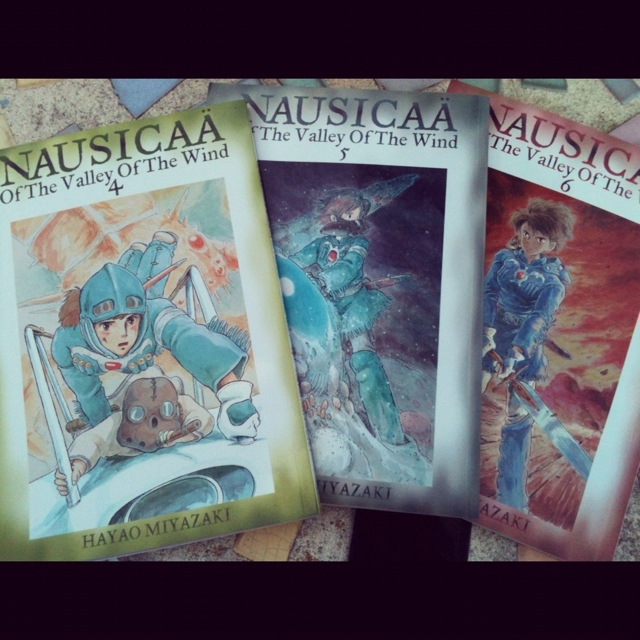
The Pale King Paperback (Book Acquired, 4.07.2012)

20120411-174813.jpg

I was happy to get a trade paperback of David Foster Wallace’s The Pale King this weekend (thanks Hachette!) for a few reasons. First, I detest hardback books — that didn’t stop me from picking up (and reviewingTPK when it debuted last year — but I know I’ll prefer this paperback for rereadings. More to the point, the paperback boasts four vignettes not published with the hardback last year, which I’m sure is in no way a cynical marketing ploy cooked up by the publishers. On those scenes:

20120411-172813.jpg

Okay, so yes, I read them. They’re short, and they don’t really add to the novel; actually, they probably take away from the Michael Pietsch’s fine editing work. Still, DFW fans will eat them up. I’ll try to reflect more later.

There’s also one of those reading group guide sections, which cracks me up. Are book clubs gonna read this book? I mean, I hope they do, but they’ll likely hate it. Here’s a question that caught my eye, mostly because I wrote a bit about §19 this summer.

20120411-174805.jpg

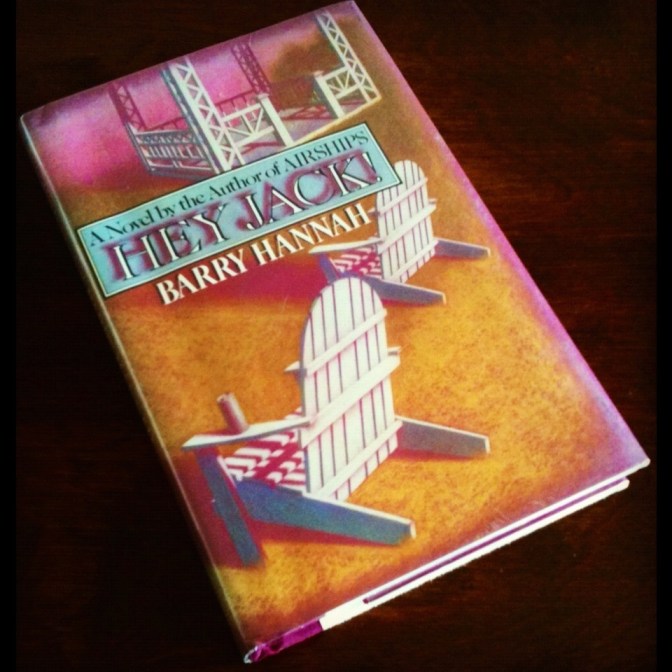
Barry Hannah’s Novella Hey Jack! Is a Loose, Hilarious Tragedy

20120410-174027.jpg

The loose, brief breeziness of Barry Hannah’s 1987 novella Hey Jack! belies the terror and rage at the heart of this hilarious tragedy. It’s a slim volume—133 pages in my hardback copy—with the same rambling flightiness that characterizes Hannah’s better known 1980 novel-in-vignettes, Ray.

Hey Jack! bears many comparisons with Ray: Like Ray, this novel is told from the perspective of a war vet (Korea this time, not ‘Nam); like the eponymous speaker of Ray, the narrator of Hey Jack!, Homer, finds himself frequently besotted, binged out, or horny; like Ray, Homer tries to make a marriage work; like Ray, Homer comes into conflict with a poor white trash family.

And like Ray, Hey Jack! tests the boundaries of what is and is not a “novel.” Hey Jack! is discontinuous and meandering; there’s a plot, sure, but Hannah’s apt to jump over place and time freely, tripping over months at a time, sparing not even a sentence to cue his readers in the right direction. No exposition here, folks. I suppose I should summarize the plot though: Homer, passing middle age, takes up a friendship with Jack, an older man, a former sheriff and fellow Korean War vet who runs a coffee shop popular with the college kids. Together, the pair (sort of) face off against Ronnie Foot, a local boy turned rock star who has the gall to begin an affair with Jack’s forty-year old daughter:

Ronnie Foot, the rock star had her. Or Jack thought he had her, he was sure he had her. Jack was mumbling. Jack was talking about ingratitude and pride and scum hanging on meat, things of that nature. It was astonishing to see him creep and rise suddenly, like a crazy old man. . . . “Nobody ever had a daughter like me. You want me to just her go, like a fart?” He was fingering the gun again.

Jack, once the lone bastion of sanity and order in Homer’s small, chaotic Mississippi town, begins to slide into the insanity and violence that marks the rest of the populace. Jack’s stability is the closest thing Hey Jack! offers as a slice of normalcy (to be clear though, Hannah’s characters skew grotesque, not quirky).

What unites the volume isn’t Jack’s slow slide to the dark side, but rather the narrative’s distinctive, ornery voice. It’s worth quoting Homer at length; here he condenses several of the novel’s themes in the sort of crazy-or-wise? rant indicative of the novella’s tone and rhythm:

In love, in love, in love. A mule can climb a tree if it’s in love. A man like me can look himself in the mirror and say, I’m all right, everything is beloved, I’m no stranger to anywhere any more. I’m a man full of life and a lot of time to kill, shoot every minute down with a straight blast of his eye across the bountiful landscape, from the minnow to the Alps. Something looks back at you with an eye of insane approval. Something looks back at you; out of belligerent ignorance of you it has come to a delighted focus on you and your love, together, sending up gasses of collision that make a rainbow over the poor masses who are changing a tire on the side of the road on a hot Saturday afternoon, felling like niggers. There is a law that every nigger spends a quarter of every weekend changing tires, my friend George, the biochemist, says. What do we know? What do we mere earthlings, unpublished and heaving out farts like puzzled sighs, know, but what is in our blood? I had broken up once with a woman who was in Europe, and coming out of the mall movie (I don’t even remember the movie) I gave out this private marvelous fart that was equal to a paragraph of Henry James, so churned were my guts and so lingering. And I was free. Free to discuss it. Delighted in the boundless ignorance and destruction that lay out there under the dumb lit cold moon. Enough about me and my poetry.

There’s so many shifts here. Hannah’s Homer comes off like a besotted barstool philosopher, gazing at his navel through an empty tumbler and finding both gut and abyss. We see the casual racism that so many of Hannah’s characters dip into; we see the conflation of art, spirit, and expulsion. Need I comment on the fart joke? It’s worth just repeating: “I gave out this private marvelous fart that was equal to a paragraph of Henry James” — if you don’t like that you’re not going to like Hey Jack!

Beyond that voice, there’s little to organize Hey Jack!—it’s a riff, sometimes a howl, often a jape, a joke, sometimes a verbal slap. This isn’t to say there isn’t a trajectory to the novella or a payoff at the end. Hannah seems unable to resist a tragic arc, the same one he pulls through the whiskey haze of  Ray. Perhaps he takes his cues from Edgar Allan Poe’s essay “The Philosophy of Composition“: ” . . . the death, then, of a beautiful woman is, unquestionably, the most poetical topic in the world.” (To be fair Poe is hardly the first fella to find a dead beauty such a worthy topic; also, I’ve never really been sure how to measure the tone of his essay—I can’t help but think he’s being somehow simultaneously tongue-in-cheek and deadly earnest. But enough about Poe).

But arcs be damned. The best bits of Hey Jack! are the stray little paragraphs that erupt from nowhere either to fizzle out or burn up in a bang. At its best, the novella offers bizarre little stories piecemeal that read equally absurd and true. To wit:

I began hollering at my wife for her shortcomings. She left the house, 11 P.M. I’d quit drinking and smoking. She brought me back a bottle of rye and a pack of Luckies, too. I hadn’t smoked for two weeks. I must have been a horrible nuisance.

I took a drink and a smoke.

Then I was normal. My lungs and my liver cried out: At last, again! The old abuse! I am a confessed major organ beater. I should turn myself in on the hotline to normalcy.

I hope by now that you have a sense of whether or not Hey Jack! is for you. It’s probably not going to gel with most readers: Too ugly, too loose, too nihilistic, perhaps; at heart a sloppy affair . . . but I loved it—it was the perfect book to riffle through over a few Saturday or Sunday afternoons on my back porch, its pages blotting up the condensation from a glass of sangria or can of beer, Homer’s consciousness as loose and discontinuous as my own. Not the best starting place for those interested in Hannah—that might be Airships—but great stuff.

Stuart Kendall’s New Translation of Gilgamesh Restores Poetic Strangeness to an Ancient Epic

Somewhere in his big and often laborious book The Western Canon, Harold Bloom defines canonical literature as that which possesses a “strangeness, a mode of originality that either cannot be assimilated, or that so assimilates us that we cease to see it as strange.” Gilgamesh strikes me as exemplary of that second clause: It’s a foundational epic that has assimilated its readers such that we can no longer easily perceive its strangeness. In many of the prose translations we encounter, Gilgamesh becomes smoothed-out, a document in which we find universal symbols, characters, and themes, all ordered into a narrative scheme that resonates with our conceptualizations of story-telling. And while Gilgamesh and his wild-man companion Enkidu are clearly archetypal figures, the version of their story most of us read in our high school English class is overtly familiar, fitting too-neatly into a literary tradition with Homer, the Bible, and Shakespeare.

Stuart Kendall’s new translation of Gilgamesh reintroduces us to the strangeness of Gilgamesh, juxtaposing the epic’s irreconcilable eruptions against the archetypes it helped to originate. By using language reminiscent of Modernist poets like Ezra Pound and William Carlos Williams, Kendall’s version calls attention to the strange discontinuities of Gilgamesh, even as it paints for us a bold, concrete vision of action. Kendall’s Gilgamesh highlights the psychological dimensions of the epic, situating its heroes’ dramas of consciousness against a physical world that blends into metaphysical spaces.

Here’s a sample of Kendall’s precise language; the scene is from late in the narrative, after the death of Enkidu, as Gilgamesh searches for Utnapishtim—and immortality:

20120331-142406.jpg

The language here forces us to recontextualize, and thus perhaps understand anew, a scene so archetypal as to have become commonplace in even the most banal Hollywood adventure film (that is, the hero seeking admittance to a sacred space). Kendall’s language points to the narrative links between the physical and metaphysical worlds, an unstable opposition that frames the existential crisis at the heart of Gilgamesh.

I interviewed Kendall last month, where he posed the psychological stakes of Gilgamesh more aptly than I am able to:

As a drama of consciousness, then, Gilgamesh is a strange book. It is intensely physical in the sense of describing things in the world, in the same moment as it is highly symbolic. The characters are themselves symbolic and they travel through a symbolic landscape. They are recognizably human, though, and the tale is so moving, I think, because of the drama of consciousness grappling with these different registers of experience. Put a little differently, it is not hard to see that the characters are anything but fixed. They undergo changes large and small and they suffer those changes.

Elsewhere in our interview, Kendall remarks that,

The characters’ moods alternate between dream, denial and delirium through the book. For heroes, they spend a great deal of time in abject fear of the animate cosmos. This is a startling portrait for scientifically minded contemporary readers, confident in a stable view of subjects and objects in the world. Gilgamesh shakes that confidence.

Kendall’s translation highlights the radical instability of human experience, an instability that first-person consciousness often attempts to organize (or otherwise give meaning to) through narrative. As such, Kendall’s translation is often far more ambiguous than many of the textbook versions we might have read. In particular, his ending refuses to specifically point toward redemptive wisdom or reconciliation with death. In this version, Gilgamesh’s quest does not stabilize his identity and square his relationship with mortality; rather, we see strange and discontinuous responses to the (unresolved) problem of death.

Kendall’s translation is an excellent opportunity to rediscover a text many of us assume that we already know and have mastered. His introduction and end notes are enlightening, but it’s the poetry that will surely engage readers’ sustained attention: it’s by turns energetic and mystifying, filled with strange adventure, pathos, and even humor. Recommended.

Gilgamesh is new from Contra Mundum Press. Read my interview with Stuart Kendall.

A Riff on William Gaddis’s The Recognitions

20120325-143631.jpg

  1. I finished reading William Gaddis’s enormous opus The Recognitions a few days ago. I made a decent first attempt at the book in the summer of 2009, but wound up distracted not quite half way through, and eventually abandoned the book. I did, however, write about its first third. I will plunder occasionally from that write-up in this riff. Like here:

In William Gaddis‘s massive first novel, The Recognitions, Wyatt Gwyon forges paintings by master artists like Hieronymous Bosch, Hugo van der Goes, and Hans Memling. To be more accurate, Wyatt creates new paintings that perfectly replicate not just the style of the old masters, but also the spirit. After aging the pictures, he forges the artist’s signature, and at that point, the painting is no longer an original by Wyatt, but a “new” old original by a long-dead genius. The paintings of the particular artists that Wyatt counterfeits are instructive in understanding, or at least in hoping to understand how The Recognitions works. The paintings of Bosch, Memling, or Dierick Bouts function as highly-allusive tableaux, semiotic constructions that wed religion and mythology to art, genius, and a certain spectacular horror, and, as such, resist any hope of a complete and thorough analysis. Can you imagine, for example, trying to catalog and explain all of the discrete images in Bosch’s triptych, The Garden of Earthly Delights? And then, after creating such a catalog, explaining the intricate relationships between the different parts? You couldn’t, and Gaddis’s novel is the same way.

I still feel the anxiety dripping from that lede, the sense that The Recognitions might be a dare beyond my ken. Mellower now, I’m content to riff.

  1. I read this citation in Friedrich Nietzsche’s Human, All Too Human, Part II the other night, mentally noting, “cf. Gaddis”:

188. The Muses as Liars. —“We know how to tell many lies,” so sang the Muses once, when they revealed themselves to Hesiod.—The conception of the artist as deceiver, once grasped, leads to important discoveries.

  1. The Recognitions: crammed with poseurs and fakers, forgers and con-men, artists and would-be artists.
  2. To recognize: To see and know again. Recognition entails time, experience, certitude, authenticity.

  3. Who would not dogear or underline or highlight this passage?:

That romantic disease, originality, all around we see originality of incompetent idiots, they could draw nothing, paint nothing, just so the mess they make is original . . .

  1. In many ways The Recognitions, or rather the characters in The Recognitions whom we might identify with genuine talent, genius, or spirit (to be clear, I’m thinking of Wyatt/Stephan, Basil Valentine, Stanley, Anselm, maybe, and Frank Sinisterra) are conservative, reactionary even; this is somewhat ironic considering Gaddis’s estimable literary innovations.

  2. Esme: A focus for the novel’s masculine gaze, or a critique of such gazes?

  3. The central problem of The Recognitions (perhaps): What confers meaning in a desacralized world?

Late in the novel, in one of its many party scenes, Stanley underlines the problem, working in part from Voltaire’s (in)famous quote that, “If there were no God, it would be necessary to invent him”:

. . . even Voltaire could see that some transcendent judgments is necessary, because nothing is self-sufficient, even art, and when art isn’t an expression of something higher, when it isn’t invested you might even say, it breaks up into fragments that don’t have any meaning . . .

Here we think of Wyatt: Wyatt who rejects the ministry, contemporary art, contemporary society, sanity . . .

  1. Wyatt’s quest: To find truth, meaning, authenticity in a modern world where the sacred does not, cannot exist, is smothered by commerce, noise, fakery . . .
  • The Recognitions conveys a range of tones, but I like it best when it focuses its energies on comic irony and dark absurdity to detail the juxtapositions and ironies between meaning and noise, authenticity and forgery.

  • (I like The Recognitions least when its bile flares up too much in its throat, when its black humor tips over into a screed of despair. A more mature Gaddis handles bitterness far better in JR, I think—but I parenthesize this note, as it seems minor even in a list of minor digressions).

  • Probably my favorite chapter of the book — after the very first chapter, which I believe can stand on its own — is Chapter V of Part II. This is the chapter where Frank Sinisterra reemerges, setting into motion a failed plan to disseminate his counterfeit money (“the queer,” as his accomplice calls it). We also meet Otto’s father, Mr. Pivner, a truly pathetic figure (in all senses of the word). This chapter probably contains more immediate or apparent action than any other in The Recognitions, which largely relies on implication (or suspended reference).

  • More on Part II, Chapter V: Here we find a savagely satirical and very funny discussion of Dale Carnegie’s How to Win Friends and Influence People, a book that seems to stand as an emblem (one of many in The Recognitions) of the degraded commercial world that Gaddis repeatedly attacks. The entire discussion of Carnegie’s book is priceless — it begins on page 497 of my Penguin edition and unfurls over roughly 10 pages—and the book is alluded to enough in The Recognitions to become a motif.

  • I’ll quote from page 499 a passage that seems to ironically situate How to Win Friends and Influence People against The Recognitions itself (this is one of the many postmodern moves of the novel):

    It was written with reassuring felicity. There were no abstrusely long sentences, no confounding long words, no bewildering metaphors in an obfuscated system such as he feared finding in simply bound books of thoughts and ideas. No dictionary was necessary to understand its message; no reason to know what Kapila saw when he looked heavenward, and of what the Athenians accused Anaxagoras, or to know the secret name Jahveh, or who cleft the Gordian knot, the meaning of 666. There was, finally, very little need to know anything at all, except how to “deal with people.” College, the author implied, meant simply years wasted on Latin verbs and calculus. Vergil, and Harvard, were cited regularly with an uncomfortable, if off-hand, reverence for their unnecessary existences . . . In these pages, he was assured that whatever his work, knowledge of it was infinitely less important that knowing how to “deal with people.” This was what brought a price in the market place; and what else could anyone possibly want?

    1. I’m not sure if Gaddis is ahead of his time or of his time in the above citation.

    The Recognitions though, on the whole, feels more reactionary than does his later novel JR, which is so predictive of our contemporary society as to produce a maddening sense of the uncanny in its reader.

    1. Even more on Part II, Chapter V (which I seem to be using to alleviate the anxiety of having to account for so many of the book’s threads): Here we find a delineation of (then complication of, then shuffling of) the various father-son pairings and substitutions that will play out in the text. (Namely, the series of displacements between Pivner, Otto, and Sinisterra, with the subtle foreshadowing of Wyatt’s later (failed) father-son/mentor-pupil relationship with Sinisterra).
  • Is it worth pointing out that the father-son displacements throughout the text are reminiscent of Joyce’s Ulysses, a book that Gaddis pointedly denied as an influence?

  • Ignorant of Gaddis’s deflections, I wrote the following in my review almost three years ago:

    Gaddis shows a heavy debt to James Joyce‘s innovations in Ulysses here (and throughout the book, of course), although it would be a mistake to reduce the novel to a mere aping of that great work. Rather, The Recognitions seems to continue that High Modernist project, and, arguably, connect it to the (post)modern work of Pynchon, DeLillo, and David Foster Wallace. (In it’s heavy erudition, numerous allusions, and complex voices, the novel readily recalls both W.G. Sebald and Roberto Bolaño as far as I’m concerned).

    1. But, hey, Cynthia Ozick found Joyce’s mark on The Recognitions as well (from her 1985 New York Times review of Carpenter’s Gothic):

    When ”The Recognitions” arrived on the scene, it was already too late for those large acts of literary power ambition used to be good for. Joyce had come and gone. Imperially equipped for masterliness in range, language and ironic penetration, born to wrest out a modernist masterpiece but born untimely, Mr. Gaddis nonetheless took a long draught of Joyce’s advice and responded with surge after surge of virtuoso cunning.

    1. We are not obligated to listen to Gaddis’s denials of a Joyce influence, of course. When asked in his Paris Review interview if he’d like to clarify anything about his personality and work, he paraphrases his novel:

    I’d go back to The Recognitions where Wyatt asks what people want from the man they didn’t get from his work, because presumably that’s where he’s tried to distill this “life and personality and views” you speak of. What’s any artist but the dregs of his work: I gave that line to Wyatt thirty-odd years ago and as far as I’m concerned it’s still valid.

    1. And so Nietzsche again, again from Human, All Too Human, Part II:

    140. Shutting One’s Mouth. —When his book opens its mouth, the author must shut his.

    1. And if I’m going to quote German aphorists, here’s a Goethe citation (from Maxims and Reflections) that illustrates something of the spirit of The Recognitions:

    There is nothing worth thinking but it has been thought before; we must only try to think it again.

    1. And if I’m going to quote Goethe, I’ll also point out then that Gaddis began The Recognitions as a parody of Goethe’s Faust. Peter William Koenig writes in his excellent and definitive essay “Recognizing Gaddis’ Recognitions” (published in the Winter Volume Contemporary Literature, 1975):

    To understand Gaddis’ relationship to his characters, and thus his philosophical motive in writing the novel, we are helped by knowing how Gaddis conceived of it originally. The Recognitions began as a much smaller and less complicated work, passing through a major evolutionary stage during the seven years Gaddis spent writing it. Gaddis says in his notes: “When I started this thing . . . it was to be a good deal shorter, and quite explicitly a parody on the FAUST story, except the artist taking the place of the learned doctor.” Gaddis later explained that Wyatt was to have all talent as Faust had all knowledge, yet not be able to find what was worth doing. This plight-of limitless talent, limited by the age in which it lives-was experienced by an actual painter of the late 1940s, Hans Van Meegeren, on whom Gaddis may have modeled Wyatt. The authorities threw Van Meegeren into jail for forging Dutch Renaissance masterpieces, but like Wyatt, his forgeries seemed so inspired and “authentic” that when he confessed, he was not believed, and had to prove that he had painted them. Like Faust and Wyatt, Van Meegeren seemed to be a man of immense talent, but no genius for finding his own salvation.

    The Faust parody remained uppermost in Gaddis’ mind as he traveled from New York to Mexico, Panama and through Central America in 1947, until roughly the time he reached Spain in 1948. Here Gaddis read James Frazer’s The Golden Bough, and the novel entered its second major stage. Frazer’s pioneering anthropological work demonstrates how religions spring from earlier myths, fitting perfectly with Gaddis’ idea of the modern world as a counterfeit-or possibly inspiring it. In any case, Frazer led Gaddis to discover that Goethe’s Faust originally derived from the Clementine Recognitions, a rambling third-century theological tract of unknown authorship, dealing with Clement’s life and search for salvation. Gaddis adapted the title, broadening the conception of his novel to the story of a wandering, at times misguided hero, whose search for salvation would record the multifarious borrowings and counterfeits of modern culture.

    1. Is Wyatt the hero of The Recognitions? Here’s Basil Valentine (page 247 of my ed.):

    . . . that is why people read novels, to identify projections of their own unconscious. The hero has to be fearfully real, to convince them of their own reality, which they rather doubt. A novel without a hero would be distracting in the extreme. They have to know what you think, or good heavens, how can they know that you’re going through some wild conflict, which is after all the duty of a hero.

    1. If Wyatt is the hero, then what is Otto? Clearly Otto is a comedic double of some kind for Wyatt, a would-be Wyatt, a different kind of failure . . . but is he a hero?

    When I first tried The Recognitions I held Otto in special contempt (from that earlier review of mine):

    Otto follows Wyatt around like a puppy, writing down whatever he says, absorbing whatever he can from him, and eventually sleeping with his wife. Otto is the worst kind of poseur; he travels to Central America to finish his play only to lend the mediocre (at best) work some authenticity, or at least buzz. He fakes an injury and cultivates a wild appearance he hopes will give him artistic mystique among the Bohemian Greenwich Villagers he hopes to impress. In the fifth chapter, at an art-party, Otto, and the reader, learn quickly that no one cares about his play . . .

    But a full reading of The Recognitions shows more to Otto besides the initial anxious shallowness; Gaddis allows him authentic suffering and loss. (Alternately, my late sympathies for Otto may derive from the recognition that I am more of an Otto than a Wyatt . . .).

    1. The Recognitions is the work of a young man (“I think first it was that towering kind of confidence of being quite young, that one can do anything,” Gaddis says in his Paris Review interview), and often the novel reveals a cockiness, a self-assurance that tips over into didactic essaying or a sharpness toward its subjects that neglects to account for any kind of humanity behind what Gaddis attacks. The Recognitions likes to remind you that its erudition is likely beyond yours, that it’s smarter than you, even as it scathingly satirizes this position.

    I think that JR, a more mature work, does a finer job in its critique of contemporary America, or at least in its characterization of contemporary Americans (I find more spirit or authentic humanity in Bast and Gibbs and JR than in Otto or Wyatt or Stanley). This is not meant to be a knock on The Recognitions; I just found JR more balanced and less showy; it seems to me to be the work of an author at the height of his powers, if you’ll forgive the cliché.

    I’ll finish this riff-point by quoting Gaddis from The Paris Review again:

    Well, I almost think that if I’d gotten the Nobel Prize when The Recognitions was published I wouldn’t have been terribly surprised. I mean that’s the grand intoxication of youth, or what’s a heaven for.

    (By the way, Icelandic writer Halldór Kiljan Laxness won the Nobel in lit in 1955 when The Recognitions was published).

    1. Looking over this riff, I see it’s lengthy, long on outside citations and short on plot summary or recommendations. Because I don’t think I’ve made a direct appeal to readers who may be daunted by the size or reputation or scope of The Recognitions, let me be clear: While this isn’t a book for everyone, anyone who wants to read it can and should. As a kind of shorthand, it fits (“fit” is not the right verb) in that messy space between modernism and postmodernism, post-Joyce and pre-Pynchon, and Gaddis has a style and approach that anticipates David Foster Wallace. (It’s likely that if you made it this far into the riff that you already know this or, even more likely, that you realize that these literary-historical situations mean little or nothing).

    26.Very highly recommended.

    Book Shelves #13, 3.25.2012

    20120325-104552.jpg

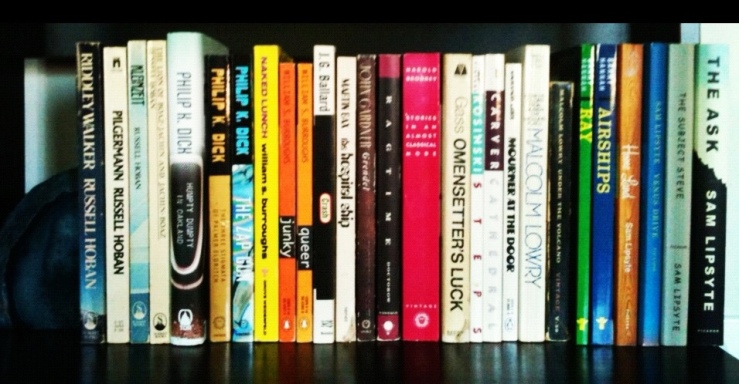
    Book shelves series #13, thirteenth Sunday of 2012: Four by the late great Russell Hoban. A few Philip K. Dick volumes, although it’s worth pointing out that most of the good stuff I’ve owned by him has been loaned out and never returned and/or exists in ratty coverless mass market editions. PK Dick transitions to William Burroughs to JG Ballard (another writer who I used to own other books by before they were dispersed . . .). Martin Bax’s The Hospital Ship is a thoroughly obscure volume in a Ballardian/Burroughsian vein; it deserves a reprint. Gardner, Brodkey, Gass, Kosinski. I’ve owned Raymond Carver’s Cathedral since high school, or maybe freshman year of college. It’s all the Carver that any library needs. Lish comma Gordon. Two by Malcolm Lowry. Two by Barry Hannah. Four from Sam Lipsyte.

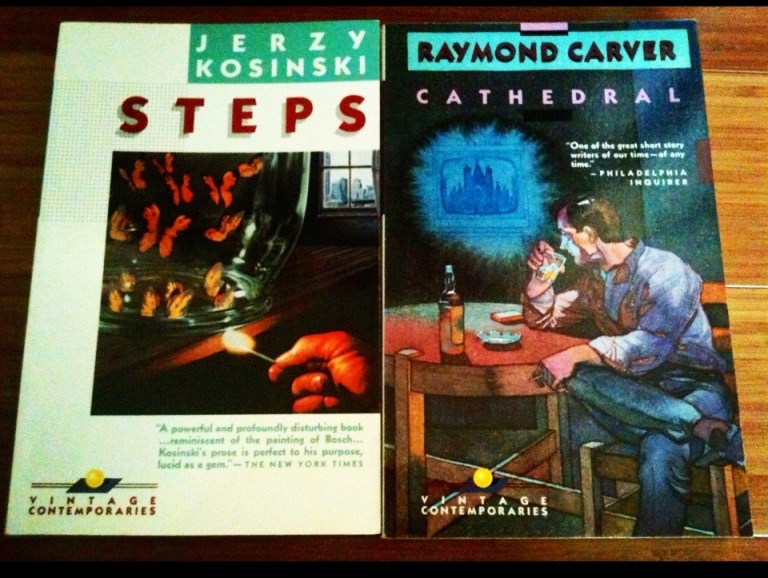
    The Carver and Kosinski volumes are part of the 1980s Vintage Contemporaries line that all feature awful, hyper-literal covers. I have about a dozen such volumes and I’m planning a piece on them in the future. Observe:

    20120325-104614.jpg

    A Review of David Markson’s The Last Novel (Composed Mostly in Citations from Said Novel)

    20120318-143327.jpg

    Unsure of how to “review” David Marson’s last novel The Last Novel, I here provide a series of citations from said novel with my own brief comments. The citations are organized not by theme or idea, but rather simply by the order in which they appear in the book, from first to last. My intention is to provide a clear picture of Markson’s method with some brief commentary on his themes.

    By way of recommendation: The Last Novel engrossed and obsessed me, commanding most of my attention for four days, during which time I read it twice and then picked at again and again, as one might return to the generous leftovers of a Thanksgiving meal.

    I hope I have not strained the limits of copyright law with my citations of Markson’s citations. To wit, from the colophon:

    Copyright © 2007 by David Markson

    All rights reserved. No part of this book may be used or reproduced in any manner whatsoever without written permission from the Publisher, except in the case of brief quotations embodied in critical articles and reviews.

    Library of Congress Cataloging-in-Publication Data

    Markson, David.

    The last novel / David Markson.

    p. cm.

    ISBN-13: 978-1-59376-143-1

    ISBN-10: 1-59376-143-0

    1. Novelists—Fiction. 2. Fiction—Authorship—Fiction.

    3. Psychological fiction. I. Title.

    Is The Last Novel fiction? Does this question matter? “Fiction–Authorship–Fiction” — this seems like a fair descriptor.

    Our author, by way of summary, announces his themes, his name, and his prophetic conclusion:

    Old. Tired. Sick. Alone. Broke.

    All of which obviously means that this is the last book Novelist is going to write.

    And now his method, followed by two examples of said method:

    Nonlinear. Discontinuous. Collage-like. An assemblage.

    I do not see why exposition and description are a necessary part of a novel.

    Said Ivy Compton-Burnett.

    I am quite content to go down to posterity as a scissors and paste man.

    Said Joyce.

    And a comment on that method, and Novelist’s textual place in it:

    A novel of intellectual reference and allusion, so to speak minus much of the novel.

    And thus in which Novelist will say more about himself only when he finds no way to evade doing so, but rarely otherwise.

    On the first theme announced, “Old”:

    Rereading a Raymond Chandler novel in which Philip Marlowe stops in for a ten-cent cup of coffee.

    Old enough to remember when the coffee would have cost half that.

    A citation that seems to hold all the themes, but especially “Sick” and “Broke”—-and then a Renard citation that fits Markson (or “Novelist,” if you prefer) into a grand tradition of starving artists:

    The bleak image Novelist is granted of himself as he asks a question of a local pharmacist — and becomes aware of the woman contemplating the conspicuously threadbare and even ragged ends of his coat sleeves.

    Writing is the only profession where no one considers you ridiculous if you earn no money.

    Said Jules Renard.

    On aging:

    Moments in which Novelist does something like leaving his desk to retrieve a book from across the room — and finding himself staring vacantly into the refrigerator.

    Or tossing his keys into a drawer — without having opened the drawer

    Markson instructs us how to read his work, and at the same time makes a grand grab at glory; he then moves to reflect on death, and perhaps a fear of going unread, before pointing out the sublime powers of art :

    Novelist’s personal genre. For all its seeming fragmentation, nonetheless obstinately cross-referential and of cryptic interconnective syntax.

    Wondering why one is surprised to realize that Thoreau was dead at forty-five.

    A lament of Schopenhauer’s:

    Over how frequently the mere purchase of a book is mistaken for the appropriation of its contents.

    Two pages of The Mill on the Floss are enough to start me crying.

    Said Proust.

    The intersection of commerce and art and madness (or, really, I just like this citation):

    Because bookshops are among the very few places where one can spend time without spending any money, George Orwell noted, any number of practically certifiable lunatics are guaranteed to be regularly found in most of them.

    My least favorite reading experience of all time is Clarissa:

    The endless commentary, and analysis, and even retelling, in Clarissa. Anyone reading it just for the story would hang himself, Johnson said.

    A good definition, but also a sideways description of entering The Last Novel:

    Thinking with someone else’s brain.

    Schopenhauer called reading.

    Markson is fond of the dependent clause as a stand-alone thought. He often lets the reader complete the sentence, or, as below, responds perhaps obliquely with another citation—his synthesis is subtle but always in play:

    Reviewers who have accused Novelist of inventing some of his anecdotes and/or quotations — without the elemental responsibility to do the checking that would verify every one of them.

    Asking a working writer what he thinks about critics is like asking a lamppost what it feels about dogs.

    Said John Osborne.

    The Last Novel is in part a work of canon-formation, one that situates Markson’s place in arts and letters; it is often angry or bitter, as he tries to situate being “Alone” and “Broke” into a historical tradition of suffering writers:

    Another of Novelist’s economic-status epiphanies:

    Walking four or five blocks out of his way, and back, to save little more than nickels on some common household item.

    While needing to stop to rest at least two or three times en route.

    Writers are the beggars of Western society.

    Said Octavio Paz.

    There is no way of being a creative writer in America without being a loser.

    Said Nelson Algren.

    Markson repeatedly reveals his anxiety of influence: Where and how will he be remembered when he dies?:

    Old enough to have started coming upon likenesses on postage stamps of other writers he had known personally or had at least met in passing.

    Occasionally in The Last Novel, because he doesn’t always attribute his citations, it’s unclear to me if a string of sentences are original to Markson or not. Markson describes his method again:

    A seminonfictional semifiction.

    And with its interspersed unattributed quotations at roughest count adding up to a hundred or more.

    A note on book theft, germane to (the original mission of) this website:

    Please return this book. I find that though many of my friends are poor mathematicians, they are nearly all good bookkeepers.

    Read Walter Scott’s bookplate.

    A dependent clause:

    Reviewers who protest that Novelist has lately appeared to be writing the same book over and over.

    Again, the intersection of economics, art, and how we honor and remember genius (with the implicit underlying anxiety over Markson’s own fate):

    Before the Euro, the portrait of Yeats on Ireland’s twenty-pound note.

    America’s Whitman twenty-dollar bill, when?

    The Melville ten?

    I think the Melville ten is a grand idea. I’d put Hawthorne on the twenty and Emerson on the penny.

    On death-dialing:

    A quirky new impulse of Novelist’s, at news of several recent deaths — Dialing the deceased, in the likelihood that no one would have yet disconnected their answering machines — and contemplating their voices one eerie final time.

    The voice of an agitated colleague? Friend? Student? Is the quote a composite of complaints? Is it verbatim?:

    Listen, I bought your latest book. But I quit after about six pages. That’s all there is, those little things?

    Many of us have wondered:

    Why did Harper Lee never write another novel?

    It is possible she never wrote that first one.

    Again, money and writers:

    America’s Emily Dickinson dime?

    We could put Thoreau on the nickel and Poe on the fifty.

    Conclusions as a kind of interception; the author offstage, off scene, ob skena — obscene:

    Novelist’s personal genre. In which part of the experiment is to continue keeping him offstage to the greatest extent possible — while compelling the attentive reader to perhaps catch his breath when things achieve an ending nonetheless.

    Conclusions are the weak point of most authors.

    George Eliot said.

    If you know what you’re doing, you don’t get intercepted.

    Said Johnny Unitas.

    I feel like I’ve skated over the book, failed to plumb it at all: But I also protest that the book is a work of autocriticism, a work that decenters its themes, bats them around, analyzes them, tosses them back to the reader, sometimes bitter, sometimes melancholy, always erudite and engaging.

    I cite from the end now. Can the end be spoiled? Markson tells us this is his last, that he will die (“Old. Tired. Sick. Alone. Broke.”). He dies a few years after the publication of The Last Novel. (He dies on the day my son is born, or, rather, his body is found on the day my son is born. He is very much alone. The New York Times publishes his obituary on my birthday). The novel ends with a series of citations that mull on death:

    Dispraised, infirm, unfriended age.

    Sophocles calls it.

    Unregarded age in corners thrown.

    Shakespeare echoes.

    And what it means to be an artist, a writer, a critic, to write in and on and through others’ books:

    The worn copy of Donne’s verses, inked throughout with notes in Coleridge’s handwriting. And at the rear:

    I shall die soon, my dear Charles Lamb, and then you will not be sorry that I bescribbled your book.

    Life as pain, death as transcendence:

    Then come kiss me, sweet-and-twenty,Youth’s a stuff will not endure. Be patient now, my soul, thou hast endured worse than this.

    Odysseus once says.

    Mais où sont les neiges d’antan? Is it true then, what they say — that we become stars in the sky when we die?

    Asks someone in Aristophanes.

    Banal signage or access to ascension?:

    Access to Roof for Emergency Only.

    Alarm Will Sound if Door Opened.

    To reiterate and move on:

    Old. Tired. Sick. Alone. Broke.

    The old man who will not laugh is a fool.

    Als ick kan.

    Chira-Mante-Kamui — George Boorujy

    20120313-161440.jpg

    I have a fantastic interview with artist George Boorujy coming up this week—we chat about shower beers and Swamplandia and beasts and men and George’s new show Blood Memoryand all manner of marvels. It’s great stuff and includes some studio shots. Only I can’t quite finish editing it yet because I’m on vaykay and have neglected to bring along a laptop. Posting this piece now on an iPhone has taken all the wine- and sun-soaked concentration I can muster … So enjoy the bear (and look forward to the interview).

    Book Shelves #11, 3.11.2012

    20120310-192648.jpg

    Book shelves series #11, eleventh Sunday of 2012. DeLillo, Denis Johnson, Pynchon (no, I have not read Against the Day nor finished Mason & Dixon). There’s also a hardback copy of Bolaño’s Between Parentheses; I have an ARC of the same shelved with the other Bolaños, which are on the shelf under—but the finished copy won’t fit on the shelf and it fits here. For now.

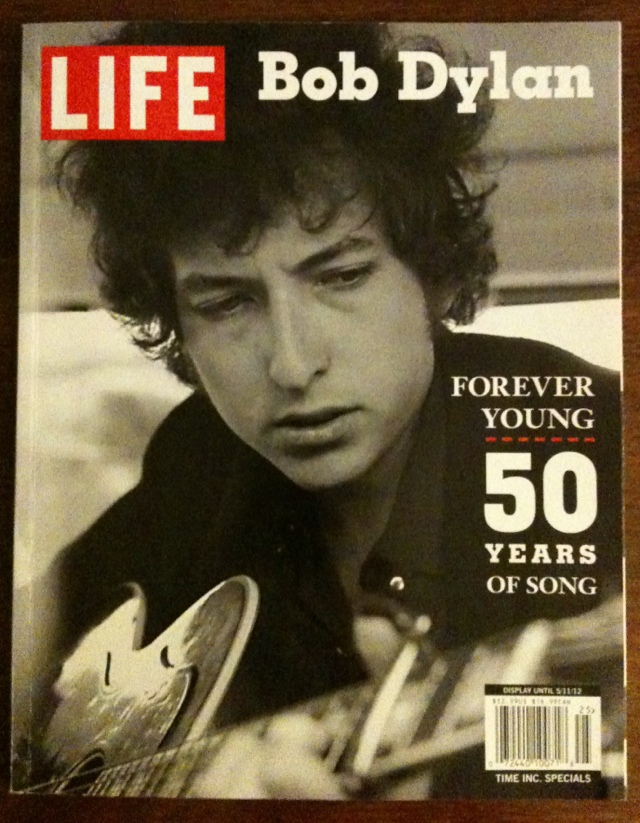
    Bob Dylan LIFE Retrospective (Not-Quite-A-Book Acquired, 2.29.2012)

    20120229-211910.jpg

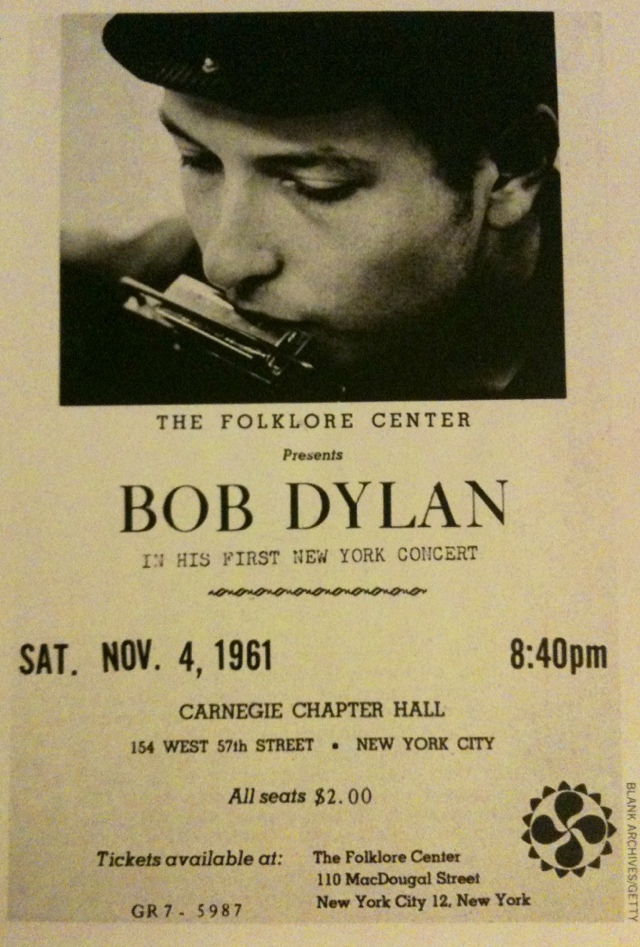
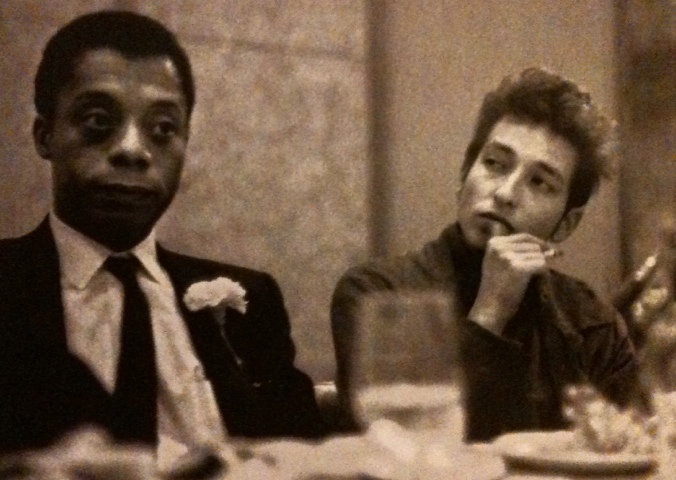
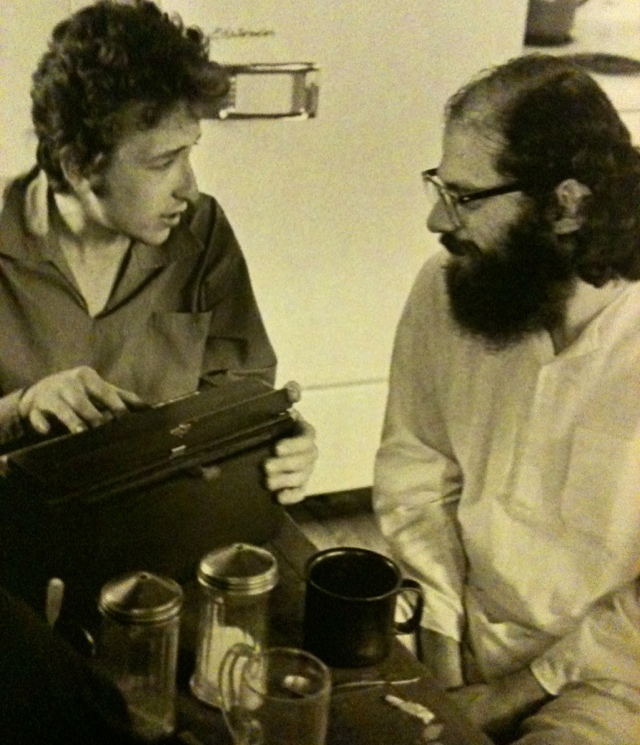
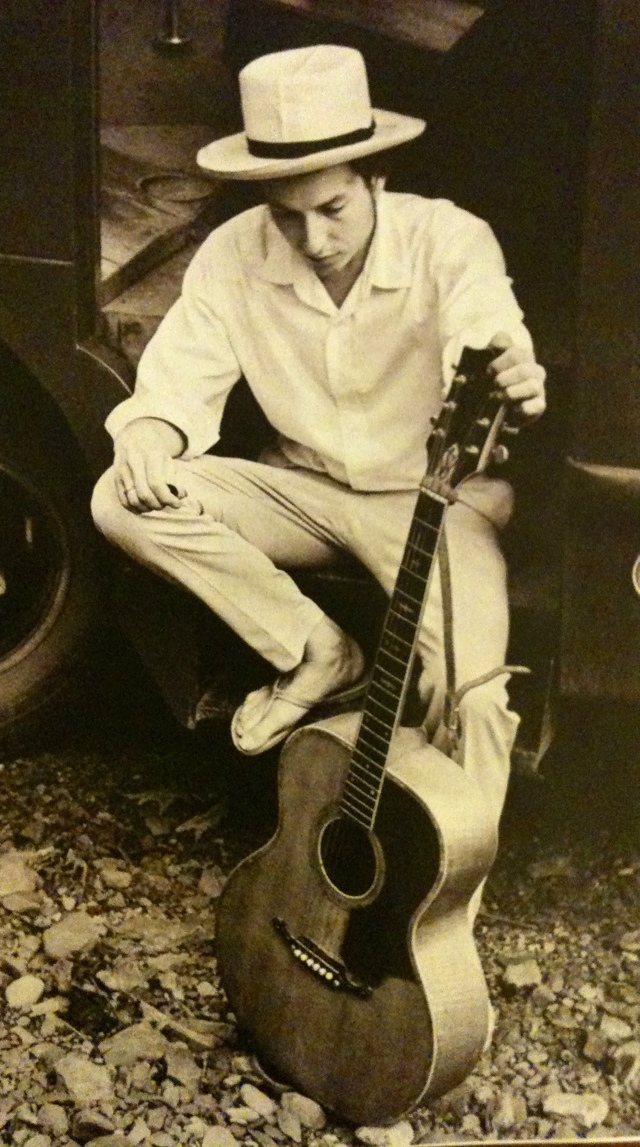
    My uncle has always aided and abetted my love for the music and mythos of Bob Dylan. He hooked me up with Anthony Scaduto’s 1972 biography Dylan, which I still consider a high point of musical biography and journalism. It’s a work that traces Dylan as a dialectical synthesis of the sources around him: Little Richard, the cold winters of Hibbing, Woody Guthrie, Charlie Chaplin, etc.
    So anyway, I was pleasantly surprised (but hardly shocked) to find a copy of LIFE’s Bob Dylan retrospective in the US mails, kindly sent by my uncle. It’s crammed with pictures I’d never seen before, and the copy is surprisingly well-written (if occasionally snarky). Anyway, good stuff. I share a few pics:

    20120229-211921.jpg

    20120229-211928.jpg

    20120229-211948.jpg

    20120229-211954.jpg

    20120229-212727.jpg

    John Cage’s A Year from Monday (Book Acquired 2.21.2012)

    20120228-172910.jpg

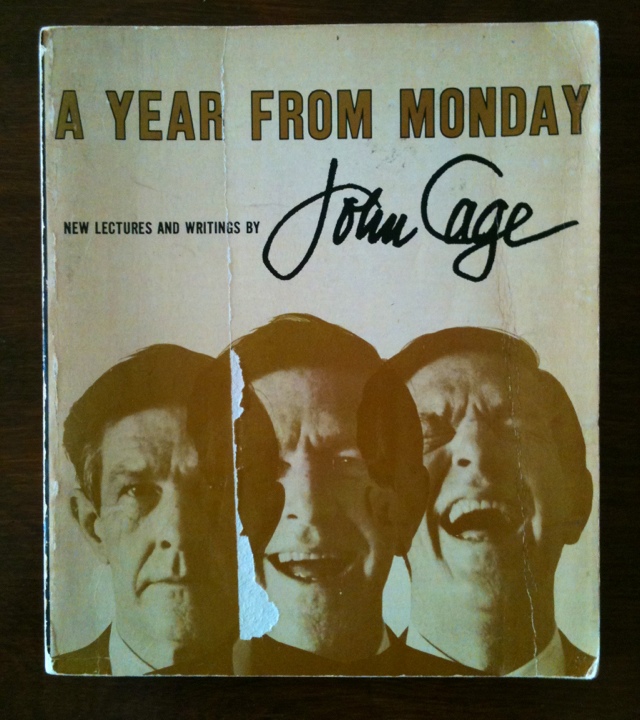
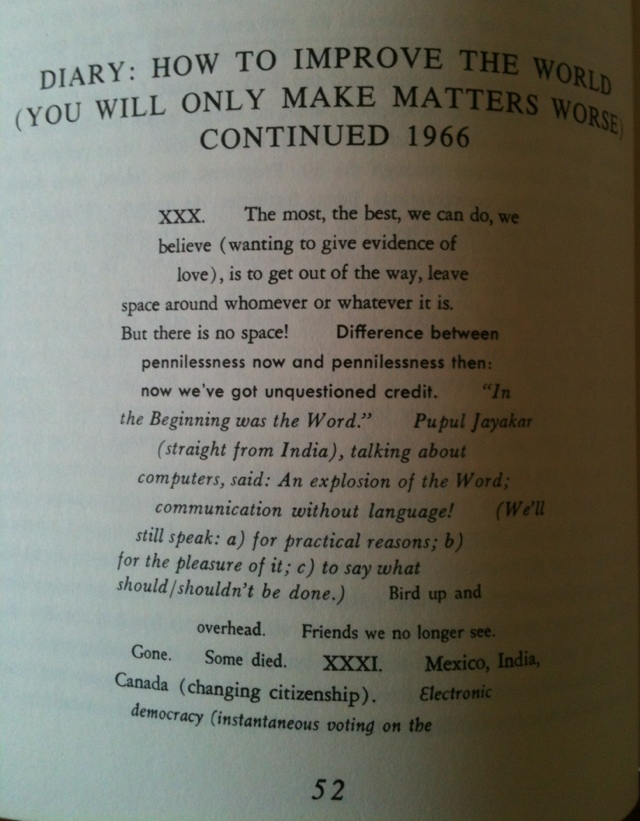
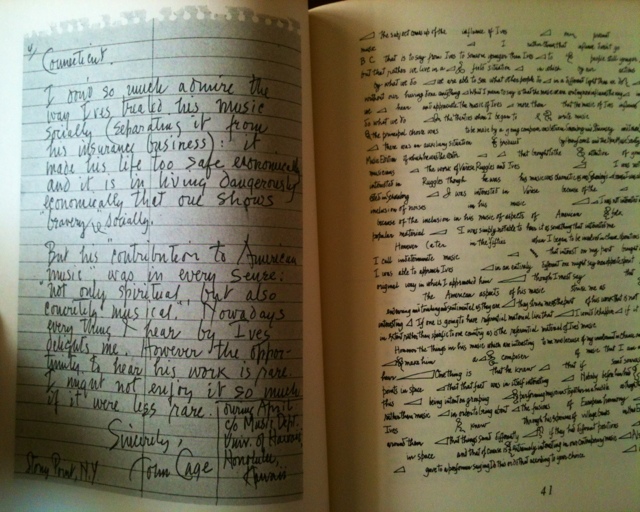
    I found this one at random in my favorite used bookshop last week. Had never heard of it before, but it’s really neato—Cage’s lectures, notes, letters, etc. on  a range of subjects, including Charles Ives, Marcel Duchamp, and making the world better. Cover’s in rough shape, but it’s a first edition paperback, so all’s well &c.

    A few pics from the strange interior (no worries, I will be plundering the book for posts in the months to come):

    20120228-172941.jpg

    20120228-172951.jpg

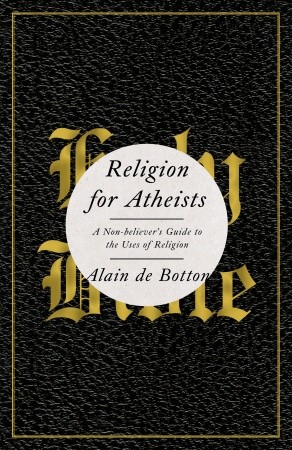
    Alain de Botton’s Religion for Atheists: A Facile Self-Help Book that Entirely Misses the Point of Free Thinking

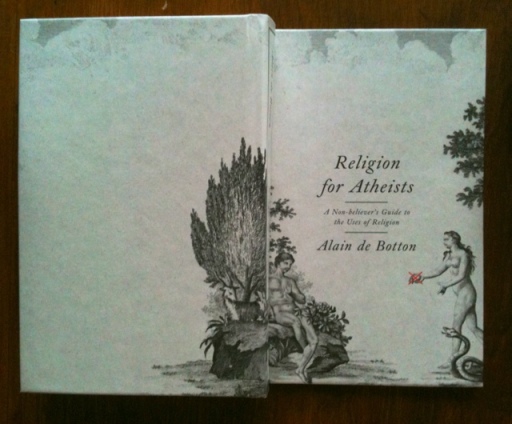
    I’m slightly familiar with Alain de Botton’s work, and I’ve taken something of an interest in the so-called “New Atheist” movement — Hitchens, Dawkins, et al — so when a review copy of Religion for Atheists showed up a few weeks ago, it piqued my interest. I found its cover playfully annoying—a hole in the holy book—and its subtitle—A Non-believer’s Guide to the Uses of Religion—downright obnoxious. Still, I gotta give props to the design team at Pantheon for the book that’s under the horrid jacket: 

    20120218-101910.jpg

    Unfortunately, an attractive hardback design sans jacket is the best this book has to offer.

    By way of explication (and my own laziness and indifference on this volume) here’s some copy on the book from de Botton’s website:

    What if religions are neither all true or all nonsense? The boring debate between fundamentalist believers and non-believers is finally moved on by Alain’s inspiring new book, which boldly argues that the supernatural claims of religion are of course entirely false – and yet that religions still have some very important things to teach the secular world.

    Religion for Atheists suggests that rather than mocking religions, agnostics and atheists should instead steal from them – because they’re packed with good ideas on how we might live and arrange our societies. Blending deep respect with total impiety, Alain (a non-believer himself) proposes that we should look to religions for insights into, among other concerns, how to:

    – build a sense of community

    – make our relationships last

    – overcome feelings of envy and inadequacy

    – escape the twenty-four hour media

    – go travelling

    – get more out of art, architecture and music

    – and create new businesses designed to address our emotional needs.

    For too long non-believers have faced a stark choice between either swallowing lots of peculiar doctrines or doing away with a range of consoling and beautiful rituals and ideas. At last, in Religion for Atheists, Alain has fashioned a far more interesting and truly helpful alternative.

    The tone of the copy gives one a sense of the utter glibness of de Botton’s pamphlet. The book smacks of crude self-helpery, a hodgepodge of faux-intellectual poses for those who can smugly dismiss the history of philosophy. It’s like The Purpose Driven Life for atheists. There is a picture or graphic on every other page; de Botton seems to include these in lieu of, say, providing verbal imagery, or meaningful context, or simply trusting the intellect of his audience.

    I suppose that I am fundamentally at odds with de Botton. I agree that religion has done much to initiate and facilitate (and in fairness, perhaps at times mitigate) atrocity; I agree that many (if not most) of the Big Problems in the world stem from the herd-mentality that organized religions impose on the people they indoctrinate. But de Botton would like to replace one herd with another.
    Here is the Swiss writer suggesting that the academy (which he too-readily identifies as a bastion of atheist mores) follow the practices of black Southern Baptist churches:

    The contrast with the typical lecture in the humanities could hardly be more damning. And unnecessary. What purpose can possibly be served by the academy’s primness? How much more expansive the scope of meaning in Montaigne’s essays would seem if a 100-strong and transported chorus were to voice its approval after every sentence. How much longer might Rousseau’s philosophical truths linger in our consciousness if they were structured around rhythmical verses of call-and-response. Secular education will never succeed in reaching its potential until humanities lecturers are sent to be trained by African-American Pentecostal preachers.

    What we see here is a romanticization and idealization of a particular part of a culture that I think de Botton in no way understands. What’s even more disturbing here is his elevation of groupthink and indoctrination practices (I hear, “Oh no, I don’t want to play with Delta children” humming in the background). We see here the same teleological thinking that marks much of religious dogma, the sense that truth has been attained; the search is over—we just need to repeat it rhythmically enough, soak our young in it, until they think just like we do. This position strikes me as potentially dangerous as any organized religion’s attempts at indoctrination.

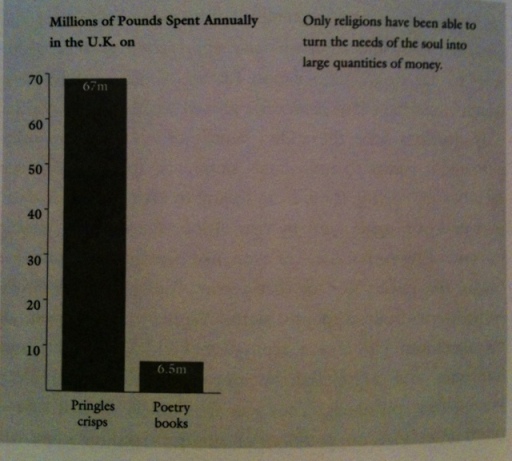
    Religion for Atheists is full of sloppy logic gussied up in rushed anecdotes and glossed over with barely-connected pictures and silly graphs. Look at the following example, a visual non sequitur masquerading as meaningful information:

    20120223-180200.jpg

    Are we supposed to be horrified that the British spend more on potato chips than poetry books? Apples and oranges, bro. But what’s really ridiculous is the stinky pious claim that “Only religions have been able to turn the needs of the soul into large quantities of money.” This claim is plain silly, or at least predicated on a too-singular definition for “needs of the soul.”

    Religion for Atheists seems to miss the point that many (if not most) atheists and agnostics are at heart free thinkers. De Botton romanticizes the mystery, awe, and grace of religion, even as he suggests that there is no metaphysical center from which these attributes emanate. His most basic argument really boils down to something like, “Hey, there is no God, no spirit, but religion does a good job of consoling people and keeping them in moral order, so, instead of TV and junk food, we should use the aesthetics of religion as consolation.” There is nothing revolutionary about this idea.

    Religion for Atheists is a smug little tract, the sort of book that a supermarket would sell along with Chicken Soup for the Soul if supermarkets had the guts to sell self-help books for atheists. Readers should not be duped into thinking that de Botton has taken any real stance or said anything new here. Instead, hiding behind the pasteboard mask of utility, he offers a crass dodge away from meaningful inquiry. Get thee to Nietzsche instead.

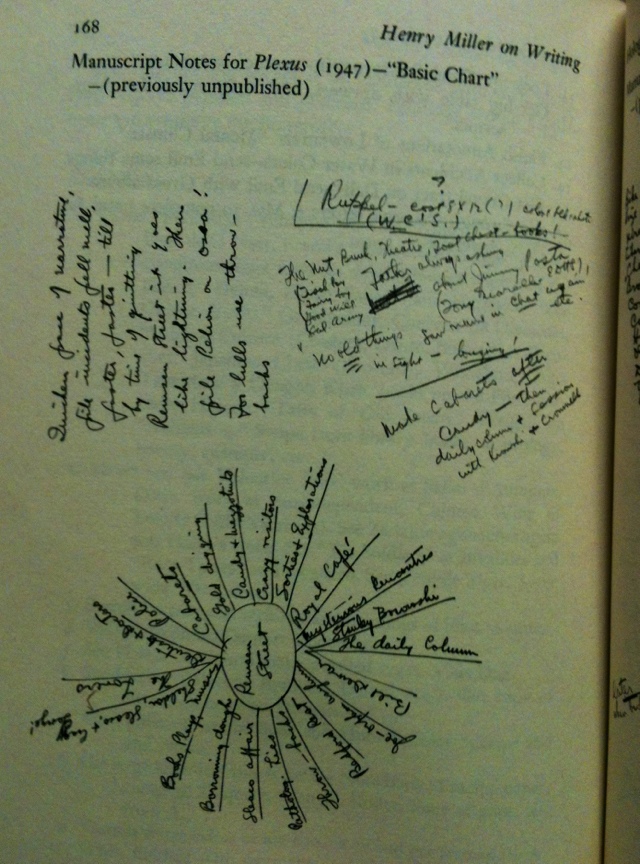
    Henry Miller’s Basic Chart of Plexus

    20120125-160448.jpg

    (From Henry Miller on Writing, New Directions).

    Books Acquired, 2.16.2012

    20120216-191500.jpg

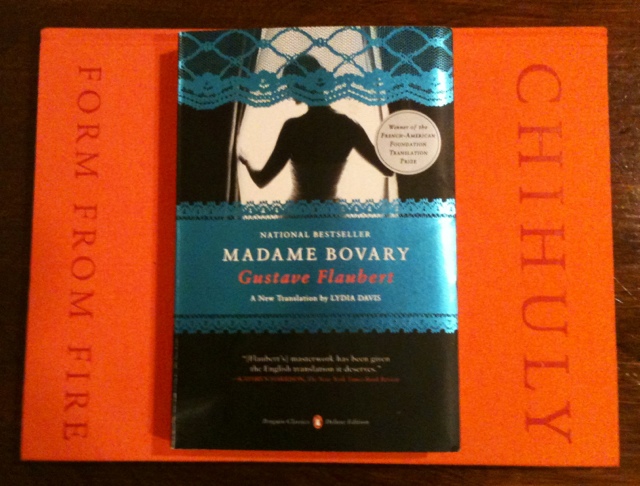
    The Chihuly book was too beautiful not to pick up for my wife—cloth bound and so orange. I picked it up along with Lydia Davis’s translation of Madame Bovary this afternoon at my fave used bookshop; ostensibly, I was searching for a copy of the Mutis book Noquar reviewed here this week, but who really needs a legit reason to browse the stacks?

    20120216-192716.jpg

    Valentine’s Books from My Sweetie (Books Acquired 2.14.2012)

    20120214-175013.jpg

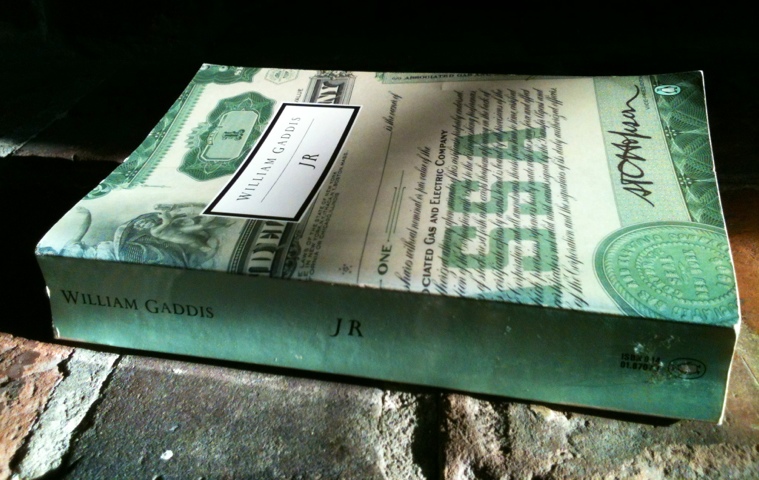
    I Riff–Again–on William Gaddis’s Enormous Novel JR (This Time After Finishing It)

    20120208-170956.jpg

    1. Let me point those of you who may care to my first riff on William Gaddis’s J R, which I wrote about half way into the book, and which will likely provide more context than I’m prepared to offer here. Also, there might be spoilers ahead.

    2. The end of J R is heartbreaking. We find some of our principal characters—Bast, Gibbs, and JR—in nebulous spaces, their plans and dreams and hopes crumbling or smoking or fizzing out or jettisoned (pick your verb as I’m too lazy or unequipped).

    3. The final face-to-face scene between Bast and JR, the one that begins with them riding in a limousine and ends with Bast’s psycho breakdown—heartbreaking. Little JR, we realize, is most motivated by his intense need for human connection, his desire for family, perhaps, or place, at least. Bast’s rejection of JR—really a rejection of contemporary consumer culture—is almost horrific, even more so because the reader (this reader, anyway) so readily identifies with Bast and JR simultaneously.

    4. Here’s Gaddis on his character JR (from The Paris Review interview):

    The boy himself is a total invention, completely sui generis. The reason he is eleven is because he is in this prepubescent age where he is amoral, with a clear conscience, dealing with people who are immoral, unscrupulous; they realize what scruples are, but push them aside, whereas his good cheer and greed he considers perfectly normal. He thinks this is what you’re supposed to do; he is not going to wait around; he is in a hurry, as you should be in America—get on with it, get going. He is very scrupulous about obeying the letter of the law and then (never making the distinction) evading the spirit of the law at every possible turn. He is in these ways an innocent and is well-meaning, a sincere hypocrite. With Bast, he does think he’s helping him out.

    5. And again:

    INTERVIEWER

    Which is the novel you care most for?

    GADDIS

    I think that I care most for JR because I’m awfully fond of the boy himself.

    6. In that same interview, Gaddis contends that JR is motivated by “good-natured greed,” which is probably true (see above re: letter vs. spirit). Despite his predatory capitalism, his willingness to strip company employees of basic safety nets, JR remains sympathetic.

    7. Why is JR a sympathetic character? He’s just a child, one who lives in a world without adult supervision let alone love and care. In a touching scene that telegraphs the bizarre black humor that runs through the novel, JR suggests that the Eskimos on display at a museum are the work of a taxidermist: That is, said Eskimos were once, like, alive, and are now on display. Amy Joubert, his social studies teacher (and the object of Gibbs’s and possibly Bast’s affection) is moved to both pity and terror by JR’s confusion, and clutches him to her breast.

    8. While we’re on Eskimos, which is to say Native Americans, which is to say, perhaps, Indians: The Indian plot in JR fascinates; it recapitulates a bloody, awful past, pointing to the brutal way the quote unquote invisible hand of the market might sweep entire people away and then come back (in a cheap costume) to offer modernity at a price.

    9. Ethnic minorities in general find themselves displaced in JR, or at least displaced in the language of JR (and is there a novel that is more language than JR, if such a statement might be permitted to exist (at least metaphorically)? No, I don’t think there is, or at least I don’t know of one). The casual racism of 1%ers like Zona Selk and Cates is ugly and bitter, but the PR man Davidoff is somehow worse—he sees race as something to use, to manipulate, to control.

    10. And, of course, JR’s infamous “Alsaka Report,” a connection to Manifest Destiny, to the valuation of our ecosystem in the most base and short-sighted terms (there’s a perhaps overlooked streak of environmentalism to JR):

    20120208-171005.jpg

    11. Sci-fi elements to JR: The Frigicom process, which promises to freeze noise. The Teletravel transmission process.

    12. At the end of JR, we learn that poor diCephalis is lost in Teletravel transmission.

    13. I couldn’t help but be reminded—repeatedly—of David Foster Wallace’s work during JR (diCephalis stuck in Teletravel recalls poor Orin in the giant glassjar at the end of Infinite Jest). In general, the loose threads of JR recall Wallace’s loose threads (other way round, I know).

    14. The phone motif alone might have led me to compare Wallace to Gaddis—but there’s also all that, y’know, thematic unity.

    15. And clearly, too, style. I’m sure that longtime readers of Gaddis have likely made the comparisons already, but throughout his work, Wallace repeatedly uses chapters or sections that comprise only dialogue. A good example is §19 of The Pale King (which I riffed on a bit this summer), a conversation between three IRS agents stuck in an elevator. In some ways, the scene, set only a few years after the publication of JR feels like a strange little sequel, or an echo of a shadow of a chapter of a sequel (or maybe not—just riffing here). Wallace’s concerns about civics, ethics, and compassion seem more straightforward than Gaddis’s angry vision of a desacralized world, a world where symphonies must be chopped into three minute segments to allow for commercial interruptions (or, rather, that symphonies must interrupt commercials). Wallace is obviously writing after the victory of Pop Art, of populism, of the slow sprawling stripmalling of America . . . but I’ve riffed off track (there is no track).

    16. ” . . . I mean they never lose these banks don’t, I mean where we’re getting screwed . . . ” — JR laments on page 653 of my Penguin Twentieth-Century Classics edition.

    17. The above quote as the briefest illustration that, published in 1975, JR is more relevant than ever.

    18. To wit, Gaddis again, again from The Paris Review interview, commenting on hollow, false values:

    . . . I’d always been intrigued by the charade of the so-called free market, so-called free enterprise system, the stock market conceived of as what was called a “people’s capitalism” where you “owned a part of the company” and so forth. All of which is true; you own shares in a company, so you literally do own part of the assets. But if you own a hundred shares out of six or sixty or six hundred million, you’re not going to influence things very much. Also, the fact that people buy securities—the very word in this context is comic—not because they are excited by the product—often you don’t know what the company makes—but simply for profit: The stock looks good and you buy it. The moment it looks bad you sell it. What had actually happened in the company is not your concern.

    19. Gaddis’s take on the “art” of capitalism: design mock ups for a potential logo for the JR Family of Companies:

    20120208-171016.jpg

    20. JR is one of the most prescient novels I’ve ever read—and not just in its illustration of the the chaos at the intersection of corporatism, Wall Street, government, and military, but also in its handling and treatment of education. Gaddis is way ahead of an ugly curve, showing us an educational system largely disinterested in intellectual, aesthetic, or even athletic development. Instead we get a storehouse for children, reliant on programmed lessons delivered via technology and assessment by standardized testing. It’s ugly and it’s more real than ever now.

    21. And here’s Gibb’s railing against it, in a way, in (what’s likely a half-drunken or at least hung-over) rant to his students:

    Before we go any further here, has it ever occurred to any of you that all this is simply one grand misunderstanding? Since you’re not here to learn anything, but to be taught so you can pass these tests, knowledge has to be organized so it can be taught, and it has to be reduced to information so it can be organized do you follow that? In other words this leads you to assume that organization is an inherent property of the knowledge itself, and that disorder and chaos are simply irrelevant forces that threaten it from the outside. In fact it’s the opposite. Order is simply a thin, perilous condition we try to impose on the basic reality of chaos . . .

    (That’s from page 20 of my Penguin Twentieth-Century Classics edition, by the bye).

    22. There are no happy families in JR. Just broken families.

    23. I said this at the top of the riff, but again–-heartbreaking.

    24. This is probably a direction out of this riff—to resuscitate the emotional dimension of the novel, which is too easily overlooked, perhaps, because Gaddis’s manipulations (and all novelists manipulate their audience) require so much active participation from the reader. JR is without exposition, without the overt imposition of the novelist telling us how to feel: instead there’s a thickness to it, a building of buzz and clatter, yes, but music under all that noise: even a kernel of love (and hope!) under the heavy folds of anger.

    25. Very highly recommended.

    Young Nietzsche (Detail)

    20120208-155542.jpg

    Books Acquired, 2.07.2012

    20120208-151957.jpg

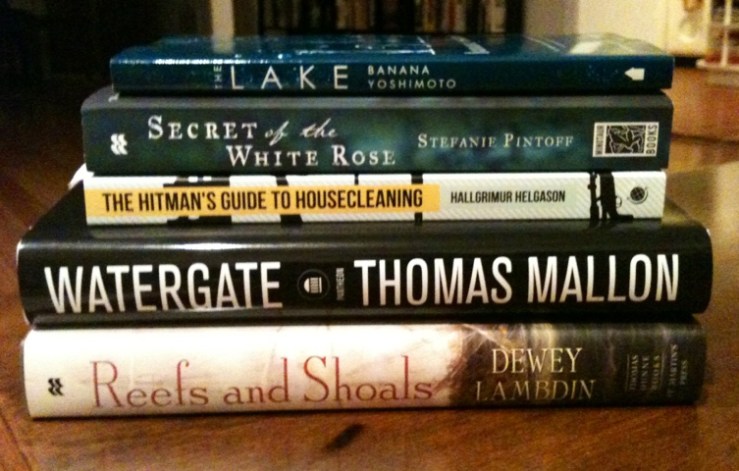
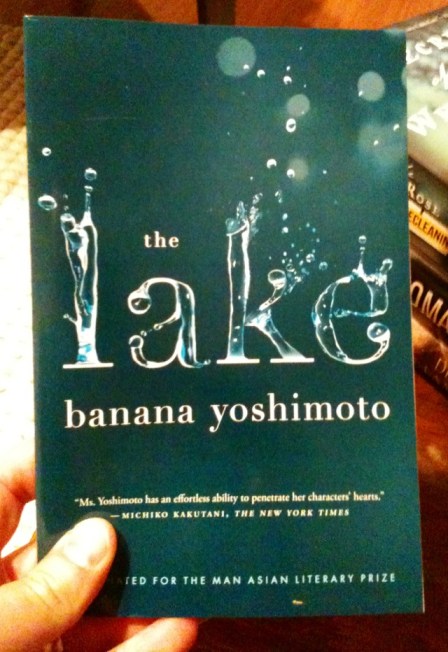
    Large pile accrued yesterday although some of these were sent to the old abode. First: Lake by Banana Yoshimoto:

    20120208-152021.jpg

    Publisher Melville House’s description:

    With its echoes of the infamous, real-life Aum Shinrikyo cult (the group that released poison gas in the Tokyo subway system), The Lake unfolds as the most powerful novel Banana Yoshimoto has written. And as the two young lovers overcome their troubled past to discover hope in the beautiful solitude of the lake in the country- side, it’s also one of her most moving.

    20120208-152033.jpg

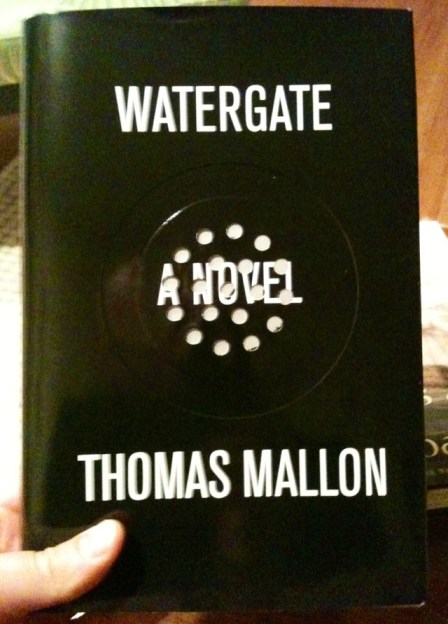
    Thomas Mallon’s novelization of a scandal: Watergate. From the author’s website:

    In Watergate: A Novel, Thomas Mallon conveys the drama and high comedy of the Nixon presidency through the urgent perspectives of seven characters we only thought we knew before now, moving readers from the private cabins of Camp David to the klieg lights of the Senate Caucus Room, from the District of Columbia Jail to the Dupont Circle mansion of Theodore Roosevelt’s sharp-tongued ninety-year-old daughter, and into the hive of the Watergate complex itself, home not only to the Democratic National Committee but also to the president’s attorney general, his recklessly loyal secretary, and the shadowy man from Mississippi who pays out hush money to the burglars. Mallon achieves with Watergate a scope and historical intimacy that surpasses even what he attained in his previous novels, as he turns a “third-rate burglary” into a tumultuous, first-rate entertainment.

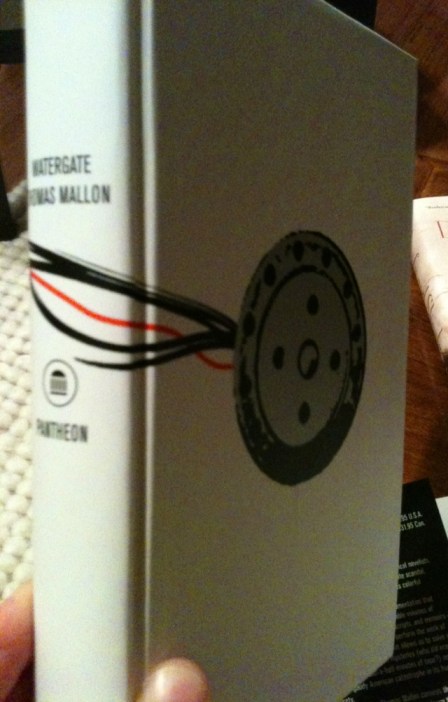
    Watergate gets big points for its cover: the book jacket (oh, how I loathe them!) is punctuated with holes suggesting one of those antique things your grandfather called a telephone; strip away the jacket and there’s this (far lovelier) cover:

    20120208-152041.jpg

    20120208-152054.jpg

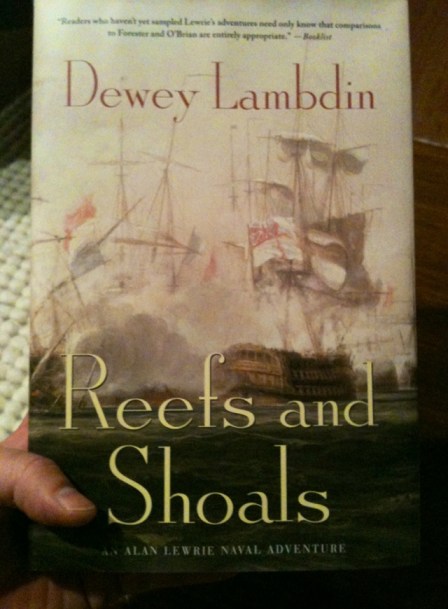
    Reefs and Shoals, a naval adventure historical thing from Dewey Lambdin. From publisher Macmillan:

    Pity poor Captain Alan Lewrie, Royal Navy! He’s been wind-muzzled for weeks in Portsmouth, snugly tucked into a warm shore bed with lovely, and loving, Lydia Stangbourne, a Viscount’s daughter, and beginning to enjoy indulging his idle streak, when Admiralty tears Lewrie away and order him to the Bahamas, into the teeth of ferocious winter storms. It’s enough to make a rakehell such as he weep and kick furniture!

    20120208-152245.jpg

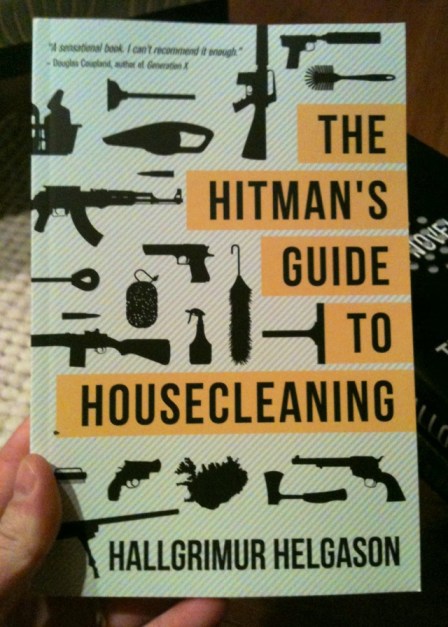
    The Hitman’s Guide to Housecleaning by Hallgrimur Helagason, from, uh, Amazon’s publishing imprint:

    Toxic, the hero of Hallgrimur Helgason’s The Hitman’s Guide to Housecleaning, had a record of 66 perfect kills. Then came the 67th–an undercover FBI agent–and suddenly he found himself in Iceland with a new identity. Oops. Avoid this kind of careless error by following Toxic’s handy tips.

    1. Don’t miss the target. People tend to get a bit upset if they notice you’re trying to kill them.
    2. Don’t waste a bullet. You have to think about the environment, too–you really shouldn’t add an unnecessary gunshot to an already noisy city.
    3. Morning is for murder. Nobody expects a bullet for breakfast.
    4. Don’t kill a priest. He who kills a man of the church will be killed by a church.
    5. Don’t confuse killing and murder. Murder is for amateurs, killing is for the professionals.
    6. If you have to take on another person’s identity, never let it be a priest. With that collar around your neck, your sex appeal is gone.
    7. When you’re dating, don’t talk about your job–unless you’re overseas. Foreign girls are crazy about guys who kill Americans.
    8. Embrace every new passport they give you. It’s always nice to get a new life now and then.
    9. Don’t kill the wrong guy. Or you’ll end up in Iceland.
    10. When in Iceland, stop the killing. There are so few of them.