A review of Ishmael Reed’s sharp satire The Last Days of Louisiana Red

img_2323

Ishmael Reed’s 1974 novel The Last Days of Louisiana Red is a sharp, zany satire of US culture at the end of the twentieth century. The novel, Reed’s fourth, is a sequel of sorts to Mumbo Jumbo (1972), and features that earlier novel’s protagonist, the Neo-HooDoo ghost detective Papa LaBas.

In Mumbo Jumbo, Reed gave us the story of an uptight secret society, the Wallflower Order, and their attempt to root out and eradicate “Jes’ Grew,” a psychic virus that spreads freedom and takes its form in arts like jazz and the jitterbug. The Last Days of Louisiana Red also employs a psychic virus to drive its plot, although this transmission is far deadlier. “Louisiana Red” is a poisonous mental disease that afflicts black people in the Americas, causing them to fall into a neo-slave mentality in which they act like “Crabs in the Barrel…Each crab trying to keep the other from reaching the top.”

The Last Days of Louisiana Red begins with Ed Yellings, “an american negro itinerant who popped into Berkeley during the age of Nat King Cole. People looked around one day and there he was.” Yellings is the West Coast counterpart to New-York-based Papa LeBas, a fellow Worker of Neo-HooDoo who fights against the secret forces of psychic slavery.

Sliding into the mythological motif that ripple through Louisiana Red, Reed writes,

When Osiris entered Egypt, cannibalism was in vogue. He stopped men from eating men. Thousands of years later when Ed Yellings entered Berkeley, there was a plague too, but not as savage. After centuries of learning how to be subtle, the scheming beast that is man had acquired the ability to cover up.

Yellings’ mission is to destroy the psychic cannibalism that afflicts his people. He gets to it, and earns “a reputation for being not only a Worker [of the voodoo arts] but a worker too.” Yellings’ working class bona fides helps solidify his sympathies and his mission:

Since he worked with workers, he gained a knowledge of the workers’ lot. He knew that their lives were bitter. He experienced their surliness, their downtroddenness, their spitefulness and the hatred they had for one another and for their wives and their kids. He saw them repeatedly go against their own best interests as they were swayed and bedazzled by modern subliminal techniques, manipulated by politicians and corporate tycoons, who posed as their friends while sapping their energy. Whose political campaigns amounted to: “Get the Nigger.”

As always, Reed’s diagnosis of late 20th-century American culture seems to belong, unfortunately, just as much to our own time, giving his novels a perhaps-unintended sheen of prescience. Reed’s work points to dystopia, even as his heroes work for freedom and justice. And yet Reed gives equal air time to the forces that oppress freedom and justice, forces that find expression in “Louisiana Red”:

Louisiana Red was the way they related to one another, oppressed one another, maimed and murdered one another., carving one another while above their heads, fifty thousand feet, billionaires few in custom-made jet planes equipped with saunas tennis courts swimming pools discotheques and meeting rooms decorated like a Merv Griffin Show set….

The miserable workers were anti-negro, anti-chicano, anti-puerto rican, anti-asian, anti-native american, had forgotten their guild oaths, disrespected craftsmanship; produced badly made cars and appliances and were stimulated by gangster-controlled entertainment; turned out worms in the tuna fish, spiders in the soup, inflamatory toys, tumorous chickens, d.d.t. in fish and the brand new condominium built on quicksand.

As a means to fight the culture of erosion, decay, and entropy, Yellings founds the Solid Gumbo Works. Here, he manufactures a gumbo—a spell, really—to combat “Louisiana Red.” In the process he manages to cure cancer, which pisses off a lot of big corporations, and pretty soon Yellings is murdered. Papa LeBas is sent in from New York to solve the case.

Papa LeBas runs into trouble pretty quickly, mostly by way of Yellings’ adult children: Wolf, Street, Sister, and the provocative and gifted Minnie, who leads a group of militants called the Moochers. Each of the children seem to embody an allegorical parallel to some aspect of the American counterculture of the late sixties and seventies, allowing Reed to mash up genres and skewer ideologies. There are a lot flavors in this gumbo: voodoo lore and California history bubble in the same pot as riffs on astrology and Cab Calloway’s hit “Minnie the Moocher.” Reed frequently compares and contrasts East with West, New York with California, underscoring the latter’s anxieties of influence about being the New World of the New World. Throughout the novel, we get routines on Amos & Andy, slapstick pastiches straight out of George Herriman’s Krazy Kat comix, hysterical nods to Kafka. Reed plays off early blaxploitation films like Sweet Sweetback’s Baadasssss Song and Superfly (not to mention Putney Swope), and synthesizes these tropes with kung fu imagery and neo-Nazi nostalgia garb. He turns Aunt Jemima into a loa at one point.

Reed’s prose ping-pongs between genres, skittering from pulp fiction noir to surrealist frenzies, from bizarre sex to raucous action, from political essaying to postmodernist mythologizing. Through these stylistic shifts, Reed satirizes a host of ideologies that feed into “Louisiana Red.” Aspects of the Berkeley youth movement, radical feminism, free love, and intellectual hucksterism all get skewered, but through an allegorical lens—Reed dares us, often explicitly (by way of a character named Chorus) to read Louisiana Red as an allegorical retelling of Sophocles’ Antigone.

This retelling is both tragic and comic though, premodern and postmodern, a carnival of varied voices. The chapters are short, the sentences sting, and the plot shuttles along, pivoting from episode to episode with manic picaresque glee. Reed’s narrator is always way out there in front of both the reader and the novel’s characters, hollering at us to keep up.

Ultimately, The Last Days of Louisiana Red is a bit of a shaggy dog. It’s not that it doesn’t have a climax—it does, it has lots of climaxes, some quite literal. And it’s not that the novel doesn’t have a point—it very much does. Rather, it’s that Reed employs his detective story as a frame for the larger argument he wants to make about American culture. Sure, Papa LaBas gets to the bottom of Yellings’ murder, but that’s not ultimately what the narrative is about.

When we get to the final chapter, we find LaBas, sitting alone “on a plain box” in the empty offices of the Solid Gumbo Works reflecting on the case in a way that, in short, sums up what The Last Days of Louisiana Red is about:

He thought of the eaters and the eaten of this parable on Gumbo…all ‘oppressed people’ who often, like Tod Browning ‘Freaks,’ have their own boot on their own neck. They exist to give the LaBases, Wolfs and Sisters of these groups the business, so as to prevent them from taking care of Business, Occupation, Work. They are the moochers who cooperate with their ‘oppression,’ for they have the mentality of the prey who thinks his destruction at the fangs of the killer is the natural order of things and colludes with his own death. The Workers exist to tell the ‘prey’ that they were meant to bring down killers three times their size, using the old morality as their guide: Voodoo, Confucianism, the ancient Egyptian inner duties, using the technique of camouflage, independent camouflages like the leopard shark, ruler of the seas for five million years. Doc John, ‘the black Cagliostro,’ rises again over the American scene. The Workers conjure and command the spirit of Doc John to walk the land.

So here, near the end of The Last Days of Louisiana Red, Papa LeBas—and Ishmael Reed, of course—conjures up the spirit of Doctor John, the voodoo healer who escaped slavery and brought knowledge of the hoodoo arts to his people. There’s a promise of hope and optimism here at the novel’s end, despite its many bitter flavors. But the passage cited above is not the final moments of Louisiana Red—no, the novel, ends, despite what I wrote about its being a shaggy dog story, with a marvelous punchline.

Ishmael Reed remains an underappreciated novelist whose early work seems as vital as ever. The Last Days of Louisiana Red is probably not the best starting place for him, but it’s a great novel to read right after Mumbo Jumbo, which is a great starting place to read Reed. In any case: Read Reed. Highly recommended.

A review of Lord, João Gilberto Noll’s abject novel of dissolving identity

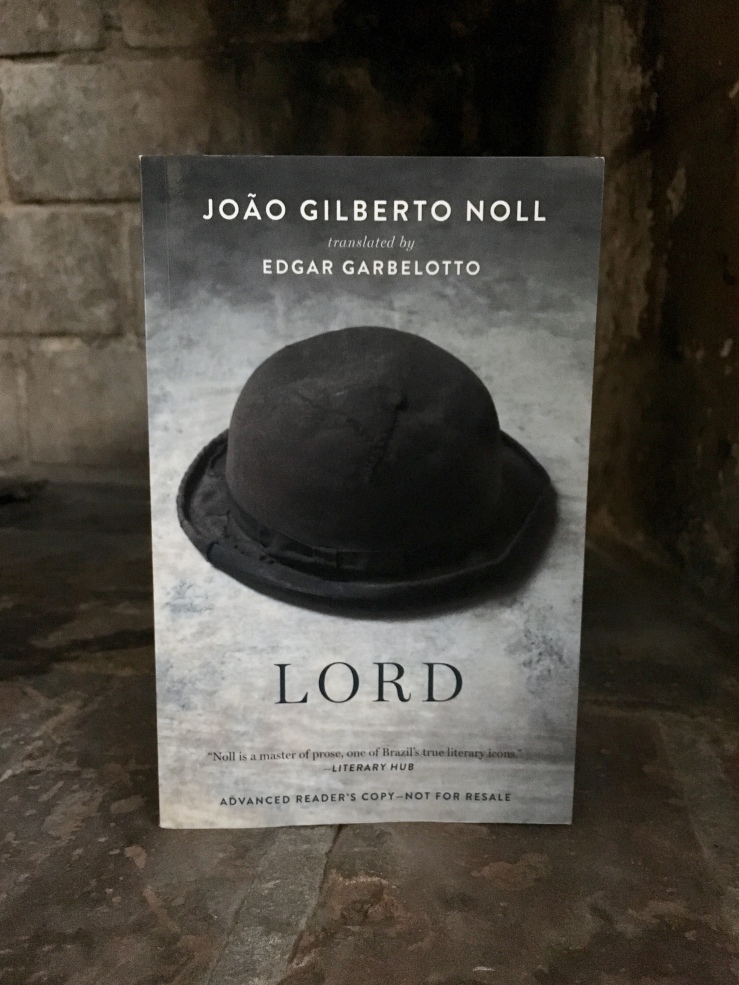
img_2336

João Gilberto Noll’s short novel Lord is an abject and surreal tale of madness. Madness is perhaps not the correct term, although it does point towards Lord’s gothic and abject modes. Perhaps it’s more accurate to say that in Lord, Noll gives us a consciousness dissolving and reconstituting itself, a first-person voice shifting from one reality to the next with absurdly picaresque energy.

That first-person voice is “a Brazilian who wrote books that were mostly well received by critics but not the public.” The Brazilian novelist travels to cold winter London on an unspecified “mission.” Indeed, the mission remains unspecified to both reader and narrator alike, although it does seem to involve an English university. The man who arranges for the narrator to come to London is himself a shifting cipher in Lord, transforming into different entities—at least in the narrator’s (often paranoid) view. We get the sense in Lord that consciousness is always under radical duress, that a state of being might collapse at any time or give way to some other, unknown state of being.

Throughout Lord, Noll dramatizes abject consciousness in turmoil. Early on, the narrator, already feeling uncertain about why he has moved halfway across the world, arrives at a university’s Portuguese department. In a book-lined office, he attempts to stabilize himself through the textual “reality” of printed matter:

The walls were covered with books. I trailed my hand over them as if to confirm the reality I was living in. Though I knew I was not living an unreality per se—like those born out of a simple dream and ending up in a nightmare, which we can only escape from when we wake up sweaty, trembling, and confused.

The irony is that the narrator has not fully comprehended yet that he is living an unreality, that he is actually narrating the nightmare. Noll’s hero is an unfixed voice, a voice that can’t square the signifiers around him with any stable signified meaning in his consciousness.

Slowly (but not too slowly—Lord moves at a steady clip), the narrator embraces this abjection and wills the dissolution of his self and its reformation into some new other. “My tiredness did not demand sleep, but, damn!, how I craved some indistinguishability between bodies, volumes, and formats,” he tells us.

The narrator carries his project of transformation even farther, applying cosmetics and hair dye to alter his appearance and “find a new source for [his] new formation”:

My lack of definition was already greater than me, although I had lost myself and begun to suspect that even my English boss couldn’t do anything to bring me back to me. I needed to keep up this task of being every- one somehow, because without it I wouldn’t even make it as far as the corner: without asking anyone, I happened to have overcome being the individual whom I had mechanically created for other people. I had to find a new source for my new formation, even now in my fifties, and that fountain would come from him, that light brown-haired man with makeup on, who lived in London for the time being without exactly remembering why.

Lord’s narrator takes this new version of himself on various London adventures, most of which are lurid and gross, and many of which are downright horny. Our Brazilian writer (who is slowly unbecoming a Brazilian writer) visits museums and has weird sex encounters, sleeps on the streets and takes a soapy bath with a Professor of Latin American Studies. Lord moves at a rapid and occasionally bewildering pace, giving the narrator’s quest a mock-ironic urgency. In Edgar Garbeletto’s capable English translation from the Portuguese, the paragraphs go on for pages but the sentences are choppy, riddled with colons and dashes, lurches and leaps, falls and stops.

Through this turbulent rhetoric, Lord’s narrator channels other voices, sublimating them into the text proper. The narrator absorbs bits and pieces of the other voices he encounters, dissolving his consciousness into and out of them as he strives for transformation. He also absorbs bits and pieces of bodies—fluids and other detritus, other abject bits of our human borders.

Our narrator is obsessed with borders, but his transgression of them has little to do with a moral framework. For the narrator, moral semblance is simply the result of an “individual…mechanically created for other people.” Rather, the narrator is fascinated by what makes a consciousness conscious. However, he’s not yet willing to cross the ultimate border, despite his fascination. In one little episode of Lord, our hero happens upon a dying man on the street. He watches the man pass from life:

I squeezed his hand. His mouth opened, and I could see the pool of blood that had overflowed his rotten teeth. That death, in some way, in some corner of my mind, gave me tremendous satisfaction. Someone was not afraid to go all the way to the end. To do for others what everyone tried to avoid. I wished I could follow him, but I didn’t have his bravery; I lacked the necessary elements to consummate the act. I needed that hug today.

A strange hug indeed!

The apparent finality of death as cessation-of consciousness holds a certain appeal to Lord’s narrator, whose quest is perhaps to overcome abjection via transformation. But it’s not easy,

It’s not just a snap, man: it’s being stuck in this limbo between staying in England and going back to South America that made me unrecognizable to myself anymore, it didn’t let me transfigure myself, it wouldn’t let me leave this stupid little body here, vomit myself out in disgust, or turn me into someone else.

Indeed, the quest in Lord might be summarized by that phrase: “vomit myself out in disgust.” While the voice in Lord remains untethered by the normal strictures of narrative (or even moral) logic, it is hardly free or disembodied. Indeed, the relationship between bodies and consciousness is perhaps the primary problem of Lord. Our narrator’s voice has a body that can’t catch up to what’s happening in its consciousness. Hence the novel’s preoccupation with the corporeal reality of bodies: blood, urine, semen, sweat, vomit…all the leaking stuff of humanity spurting out, transgressing the apparent borders and showing those borders are but a moral fiction.

In one abject episode, our narrator attempts to dispel London himself from his consciousness:

On a corner in Bloomsbury, a totally unexpected need to vomit hit me. I wiped myself with a sheet of newspaper that was fluttering by. But I couldn’t stop; I realized it was London I was throwing up, London with its ghosts and impossible missions, already entirely unsuccessful.

Tellingly, the narrator grasps a newspaper that just happens to be “fluttering by” to clean himself, to restore the moral fiction of an arranged, presentable self. The newspaper, like the books in the university office, is another nod to Lord’s metatextual motif. The written word proves to be illusory as an anchor in Noll’s novel—it cannot codify consciousness, it cannot fix meaning. Hence, the novel’s strange, disruptive rhetorical program, which takes first-person consciousness and literally deconstructs it.

The fact that Noll’s hero is/was a writer, “a Brazilian who wrote books that were mostly well received by critics but not the public,” suggests another metatextual nod. Lord’s narrator is a strange cipher of Noll himself. In 2004, the year Lord was published, Noll  served as writer-in-residence at the Centre for the Study of Brazilian Culture and Society at King’s College London. But the narrator is a cipher of Noll only—a voice that deconstructs and reconstructs itself, autofiction that dissolves the self.

This abject voice tries to reinvent itself from the outside in, only to vomit the inside back out again. Utter disintegration seems fatally imminent; madness seems inescapable. As one reaches the final pages of Lord, one senses that the narrative might fall apart into nothing—which, to be clear, it doesn’tLord sticks its ending a strangely and suitably satisfying way. I won’t give away the end, but instead reverse the course of my previous sentence: Lord falls apart into something.

Like Quiet Creature on the Corner and Atlantic Hotel (the other Noll books currently available in English translation),  Lord is propelled on its own dream-nightmare logic. It’s fucked-up, gross, abject, and surreal. It’s permeated by a vague horror. Reading it might make parts of your stomach hurt. I like these particular flavors, and I particularly like a book that doesn’t just upset me with its themes and its plot, but also with its style and its rhetoric. Lord certainly isn’t for everyone, but I loved it, and I think that there’s an audience of weirdos out there like me who will really dig this book too. Highly recommended.

João Gilberto Noll’s Lord is new from Two Lines Press. It is the third novel by Noll Two Lines has published. I hope they publish more. 


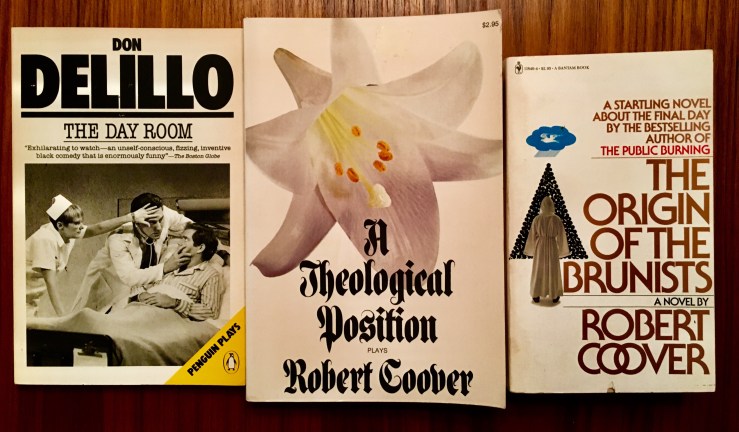
Two by Robert Coover and one by Don DeLillo (Books acquired—a few plays, unexpectedly—26 Jan. 2019)

img_2140

On Friday night we watched the first Hunger Games film with our daughter, who had finished the book this week. The movie isn’t that great, as I argued when I saw it seven years ago in the theater, but she seemed to like it, although she said she would have “done a lot of things differently.” She asked me to pick up the second book for her when I got a chance, and Not at the library, I want to own it, etc. So I figured that I’d use that as an excuse to browse my favorite used bookstore, so conveniently located 1.1 miles away (I swear I didn’t move into this neighborhood because of its proximity).

I went for a walk, got bitten rather viciously by a medium-sized dog, cleaned and dressed the wound, and went to browse books.

There are over two million books in this bookstore, a lot of them not really organized. While I usual mull around general fiction, literary criticism, art and art history, sci-fi, fantasy, and a section called “literary fiction,” I like to mix it up by going into areas I don’t know as well. Strolling through stack after stack in the drama section, an outward-turned collection of plays by Robert Coover caught my eye. I’d never heard of A Theological Position, but the cover and a few minutes browsing the four plays collected here—including one called Rip Awake, about Rip Van Winkle, which especially interested me—sealed the deal. That was before I turned the book over and saw this magnificent author photo, where a young Coover looks a bit like Jacques Derrida, in lieu of a tired blurb—

img_2142

A column over I spied a copy of Don DeLillo’s play The Day Room, 1986 joint I’d never heard of. The Penguin Plays edition with a black and white cover of a production recalled to me the four years of theater and drama I took in high school—we had plenty of these in the drama room, plays by Eugene O’Neil, Arthur Miller, Sam Shepard, etc. I was like the only one interested in these; it took me until the end of my sophomore year to realize that most of the drama kids were interested in fucking musicals and not literary drama. I probably belonged with the art kids but whatever.

I went and picked up the second Hunger Games book, and then browsed sci-fi a bit, hoping to find some more by the Strugatsky brothers or David Ohle’s Motorman, but not that day, friends! I also wanted to get a copy of Octavia Butler’s Parable of the Sower—and there were several—but they were all in these ridiculously well-kempt respectable and utterly literary cover editions that I can’t get down with. I’m sure I’ll find something I can live with sometime this year, but in the meantime, turning a corner, I found a massmarket paperback copy of Robert Coover’s novel The Origin of the Brunists, a novel I’ve been meaning to read for almost twenty years now. So.


Gaddis Contra Carnegie | How to Win Friends and Influence People in The Recognitions

img_1858

The second episode of Part II, Ch. 5 of William Gaddis’s 1955 novel The Recognitions returns to the consciousness of sadsack everyman Mr. Pivner. Through milquetoast Mr. Pivner (the long-lost father of poseur-supreme Otto), Gaddis critiques the banal emptiness and rank venality of post-war life in America. In this particular section of The Recognitions, Gaddis reinforces one of his novel’s central themes: modern commerce has supplanted culture in contemporary America. Indeed, commerce is culture in America.

The episode begins as Papa Pivner prepares to meet Otto for the first time (their estrangement has not yet been explained in the narrative). They arrange to meet in a hotel restaurant, their recognition of each other secured in a promise to wear matching green scarves. Gaddis weaves this father-son plot into the schemes of the counterfeiter Frank Sinisterra, who plans to offload his oh-so-artistic fraudulent currency to “a spreader” who will disseminate “the queer” bills. Ever the conman, Sinisterra disguises himself before heading to the meetup, which is to be held in a hotel restaurant. He dons a green scarf, by which his contact will recognize him. You get it: Sinisterra misrecognizes Otto for the spreader, Otto misrecognizes Sinisterra for his long-lost father, tragicomedy ensues, and Gaddis multiplies the strands of deferred and displaced father figures threaded through his bigass too-big too-long novel. This paternity motif is underlined even more when we remember Otto’s competition with Sinisterra’s son Chaby for the affections of Esme. But such deferrals and displacements are the material for a different riff. Let us shift back to Papa Pivner, sad soul, Gaddis’s little manikin-symbol-thing of paternal cultural authority cuckolded by commercial masscult modernity.

As he preps to meet his boy Otto, Mr. Pivner skims through Dale Carnegie’s 1936 utlrabestseller How to Win Friends and Influence People, a self-help book that Gaddis beats up for nearly ten straight pages in The Recognitions(Not incidentally, Gaddis had his students at Bard College read Carnegie’s book as part of a class he taught called “The Theme of Failure in American Literature”). Carnegie’s book is the AntiRecognitions, and Gaddis delights in savaging its self-help hucksterism by setting How to Win Friends against the Western canon:

Mr. Pivner sat staring through rimless glasses at a kindly book-jacket face which returned his amorphous gaze. He was preparing to meet his son, to win him as a friend, and influence him as a person. As Odysseus had Mentor, Jesus John the Baptist, Cesare Borgia Machiavelli, Faust Mephistopheles, Descartes Father Dinet, Schopenhauer’s dog Schopenhauer, and Schiller his drawerful of rotten apples, Mr. Pivner had Dale Carnegie: he and four million other individuals, that is…

The passage’s bathos exemplifies Gaddis’s techniques in the Pivner episodes. Gaddis inflates the rhetoric with rich allusion and haughty parallelism, only to puncture the verbal balloon with the banality of middlebrow midcentury American values. For Gaddis, Carnegie’s book represented a signal synthesis of these venal values. How to Win Friends and Influence People cannibalized millennia of writings on wisdom, philosophy, ethics—and the strange mystery vibrating underneath these disciplines—and distilled it all into a self-help book centered on selling yourself to others. The contempt is palpable in another bathetic passage:

True, Mr. Pivner might have read Descartes; and, with tutelage, understood from that energetic fellow, well educated in Jesuit acrobatics (cogitans, ergo sum-ing), that everything not one’s self was an IT, and to be treated so. But Descartes, retiring from life to settle down and prove his own existence, was as ephemeral as some Roger Bacon settling down to construct geometrical proofs of God: for Mr. Pivner, a potential buyer (on page 95) who was head of the Hotel Greeters of America (and president of the International Greeters too!) was far more real.

Cribbing and re-appropriating Carnegie’s own words, Gaddis’s narrator notes that How to Win Friends “was not a book of thought, or thoughts, or ideas, but an action book.” Gaddis then ironically resituates the value of such a book:

An action book; and herein lay the admirable quality of this work: it decreed virtue not for virtue’s sake (as weary Stoics had it); nor courtesy for courtesy (an attribute of human dignity, as civilized culture would have it); nor love for love (as Christ had it); nor a faith which is its own explanation and its own justification (as any faith has it); but all of these excellences oriented toward the market place.

Gaddis posits How to Win Friends as the cynical, terminal destination for the radical transcendental values of the previous century. The values of self-determination, self-reliance, and self-making upheld by Henry David Thoreau, whose writings are alluded to in The Recognitions, are converted into self-improvement, which translates into self-selling. Art and philosophy are simply commodities. Gaddis intuits the ways that capitalism glosses its venality over with the promises of culture and transcendence. Consider this passage, which begins with a quote from Carnegie:

“Let me repeat: the principles taught in this book will work only when they come from the heart. I am not advocating a bag of tricks. I am talking about a new way of life.” That was the wonderful thing about this book [. . .] if at first its approach seemed fraught with guile, subterfuge, duplicity, sophistry, and insidious artifice, that feeling soon disappeared, and one had . . . “Ah yes, you are attempting a new way of life.”

The litany of the huckster’s “bag of tricks” — “guile, subterfuge, duplicity, sophistry, and insidious artifice” — doubles back to The Recognitions’ motif of counterfeiting and also bites viciously into Carnegie’s core disingenuousness.

Gaddis not only attacks the content of Carnegie’s book, but also the form and style of the book. Carnegie’s hucksterism evinces in its very rhetoric. Gaddis seems to propose his own novel as the opposite of How to Win Friends and Influence People in both content (searching quest for meaning and authenticity in a degraded commercial world) and form (an unwieldy and often abstruse polyglossic beast of a book). In the following remarkable passage he decidedly (if obliquely) situates The Recognitions as a work contra Carnegie:

Here was no promise of anything so absurd as a void where nothing was, nor so delusive as a chimerical kingdom of heaven: in short, it reconciled those virtues he had been taught as a child to the motives and practices of the man, the elixir which exchanged the things worth being for the things worth having. It was written with reassuring felicity. There were no abstrusely long sentences, no confounding long words, no bewildering metaphors in an obfuscated system such as he feared finding in simply bound books of thoughts and ideas. No dictionary was necessary to understand its message; no reason to know what Kapila saw when he looked heavenward, and of what the Athenians accused Anaxagoras, or to know the secret name of Jahveh, or who cleft the Gordian knot, the meaning of 666. There was, finally, very little need to know anything at all, except how to “deal with people.”

Poor Pivner. He’s really just wanting to win the friendship of the son he’s only just learned he has. Gaddis uses Pivner to indict American culture’s commercially cruel contours, where any entity might be misappropriated and misused in the market place of ideas:

Here were Barnum and the Bible, Charles Schwab, Dutch Schultz and Shakespeare, two Napoleons, Pola Negri, and the National Credit Men’s Association, Capone, Chrysler, Two-Gun Crowley, and Jesus Christ, each in his own way posting the way to the market place. Even Jehovah appeared, if only in brief reversal…

The repeated bathos in II.5 of The Recognitions is wonderfully mean humor, but Pivner doesn’t seem like Gaddis’s main mark—rather, Gaddis shows us that Pivner is Carnegie’s mark. And for all the bathos here, there’s pathos too. We can find a certain sympathy in Pivner’s mild and foiled quest to meet with his progeny. A diabetic (like Chaby Sinisterra, he too uses needles), Pivner waits too long to take his insulin and conks out in the hotel lobby. He is briefly arrested and of course fails to meet Otto.

The next chapter, II.6 is set on Christmas Eve. Pivner receives a Christmas present from Otto, a beautiful and expensive robe (Otto is now flush with plenty of the counterfeit cash). Pivner is deeply moved by the gift, and elects to head back to the hotel to try to meet Otto again. The moment he dons the robe is rendered with disarming pathos. Gaddis’s narrator describes Pivner as a man “whose world was a series of disconnected images, his life a procession of faces reflecting his own anonymity in the street, and faces sharing moments of severe intimacy in the press.” If Pivner is prey to a conman like Carnegie, it is because Pivner is lonely and alienated. The modern condition is one of anxious anonymity, where “intimacy” boils down to reading the same gruesome news that others read. Human connection is mediated through mass media.

When Pivner returns to the hotel, he actually does encounter Otto. They stand next to each other, pissing into urinals in the hotel lobby men’s room, staring straight ahead at the obscene graffiti scrawled on the wall. A pornographic drawing so alarms Pivner that he turns and lowers his head, catching a glimpse of a green scarf poking from the proximal pisser’s pocket. The recognition remains incomplete though: Otto turns his “bloodshot eyes in a desolation of contempt” upon the older man and departs into the night. Pivner is unable to find confirmation of the younger man’s identity, and retreats to the bar to drink orange juice.

The final image of the chapter resonates with sympathetic and lonely despair. It is like something from an Edward Hopper painting. On one end of the bar sits a blonde; next to her Pivner; to his right, a newly-disguised Mr. Sinisterra, hoping too to catch Otto. When the blonde pays for her drink with one of his fake bills, Sinisterra gasps in a moment of recognition. The gasp draws Pivner’s attention and he looks to Sinisterra whose

sharp eyes gleamed at something beyond him, and with such intensity that his own were drawn in a reflex to look to where the blonde paid for her drink. But all Mr. Pivner saw, in the dim light, was a crisp twenty-dollar bill exchange hands: or so it looked to him, moonblind in the tinted gloom of that landscape where the three of them hung, asunder in their similarity, images hopelessly expectant of the appearance of figures, or a figure, of less transient material than their own.

In those final words and images we see the dream behind The Recognitions—the dream of recognizing the metaphysical, the original thing itself comprised of “less transient material” than our own. The final image seems to emanate from Pivner’s consciousness, and to emanate in a moment freed from the ironic bathos the narrator dragged him through before. There’s an emergent if subdued rejection of the market place figures that Dale Carnegie blithely promises his marks can attain, replaced, if fleetingly, for a longing after something more, something mysterious and unnameable. Gaddis conjures a small moment of strange, hopeless expectation—the wish for transcendent recognition.

Seek it like a dream | Another blog about Gaddis’s The Recognitions

Screenshot 2018-11-18 at 2.44.13 PM

Earlier this week, continuing my audit of William Gaddis’s 1955 novel The Recogntions, I felt a tingling sense of recognition in the following lines from which Basil Valentine reads from “a copy of Thoreau” (this is at the very end of Part I, on page 265):

What you seek in vain for, half your life, one day you come full upon, all the family at dinner. You seek it like a dream, and as soon as you find it you become its prey.

I attributed this tingling recognition to having read The Recognitions before (and to having read Part I once before that)—but then I realized that I’d read the line far, far more recently: It’s the epigraph to Gaddis’s fourth novel A Frolic of His Own, which I’d opened up again just a few weeks ago (and subsequently put back down).

This recognition is nothing special and certainly uninteresting to longtime Gaddis fans, but it motivated me enough to look more into the remark, so I plugged it into Google and quickly found  J. M. Tyree’s essay “Henry Thoreau, William Gaddis, and the Buried History of an Epigraph.” Tyree’s essay was originally published in New England Review but I found it, natch, on Steven Moore’s The Gaddis Annotations.

Tyree’s essay is a fascinating read, tracking the strange history of the line. Thoreau’s words, it turns out, are not exactly Thoreau’s words—rather, they are Emerson’s recollections of a conversation between the pair from a walk in the woods. Additionally, Emerson wrote and attributed these words after Thoreau’s death. The remark initially appeared in Emerson’s literary eulogy “Thoreau,” published in the August 1862 edition of Atlantic Monthly. As Tyree observes,

This detail, which seems highly trivial at first, in fact slyly reinforces the theme of original and copy supersaturating Gaddis’s novel. The very nature of authorship falls into question here, in a manner similar to the problem of Socrates and Plato: is Thoreau’s saying from Emerson or from Thoreau, or is it from both?

While issues of originality and authenticity of authorship clearly correlate to the themes of The Recognitions, Tyree’s essay is most interesting to me in the ways by which it situates Gaddis’s work with/against the American Renaissance tradition. Tyree gives us some of the flavor of that tradition, recontextualizing Gaddis’s epigraph in a full paragraph of Emerson’s. Here’s Emerson eulogizing his friend Thoreau:

It was a pleasure and a privilege to walk with him. He knew the country like a fox or a bird, and passed through it as freely by paths of his own. He knew every track in the snow or on the ground, and what creature had taken this path before him. One must submit abjectly to such a guide, and the reward was great . . . Presently he heard a note which he called that of the night-warbler, a bird he had never identified, had been in search of twelve years, which always, when he saw it, was in the act of diving down into a tree or bush, and which it was vain to seek; the only bird that sings indifferently by night and by day. I told him he must beware of finding and booking it, lest life should have nothing more to show him. He said, “What you seek in vain for, half your life, one day you come full upon, all the family at dinner. You seek it like a dream, and as soon as you find it you become its prey.”

Tyree situates the passage within the contrasting (and quickly diverging) philosophies of the old friends: “Emerson was essentially cosmic in his Transcendentalism, while Thoreau sought the divine in the actual empirical details of nature.”

Tyree’s essay becomes most interesting to me when he begins to interpret just what the hell the quote means. His analysis hovers around the word family, underlining an obsession of American literature: escape from domesticity. Here’s Tyree’s paraphrase of the Thoreau’s/Emerson’s line:

One finds the object of a long quest, quite suddenly, at the family dinner table. But in the moment of discovery, something seems to go wrong; rather than capturing the truth, one becomes its prey.  Clearly, the conversation here has expanded beyond night-warblers. Thoreau is now speaking of truth and its relationship to the family dinner table.

Tyree then susses out Thoreau’s complicated relationship with Emerson’s family:

It is possible to make too much of the fact that Thoreau’s intellectual life, as both a thinker and a man, developed in Emerson’s shade, in the shelter of Emerson’s house and family. But it is clear that Thoreau was often of two minds about living with or near Emerson. In a September 1841 letter….Thoreau told a friend that he was “living with Mr. Emerson in very dangerous prosperity.”

That “dangerous prosperity” of domestic life echoes one of the grand themes of American literature—namely, civilization is a blockade to be surpassed on the trek into wild nature, individuality, and freedom. Domestic duty interferes with such adventures. Just ask Rip Van Winkle, Ishmael, or Huck Finn. (Or perhaps Hawthorne’s cautionary figure, Young Goodman Brown).

Tyree underlines the point (final emphasis mine):

In the exchange over the night-warbler, the family is again identified in terms of danger; the quest is a danger to the family, or the family is a danger to the quest. One might read this as Thoreau’s critique of what would now be called Emerson’s “lifestyle.” A man who is the prey to truth must leave the dinner table to find it, but Emerson, in the comfort of his household, among his family, will never book the night-warbler. Thoreau does not say that having “all the family at dinner” stops one’s seeking, only that one becomes the prey of a protracted, half-conscious quest at mealtime. Then, one must decide what to do about it—whether to search out the night-warbler or not, and how to do it. The question seems to be whether the truth can be found through the life of the family, or whether one must leave it behind in some sense.

In The Recognitions, Wyatt circumvents the danger to his quest by not only removing himself from family (in the form of his wife Esther), but from removing himself from society in general. In J R (1975), most of Gaddis’s heroes find themselves unable to reconcile to Wyatt’s solution; their seeking fumbled out in half measures, neatly figured in the 96th Street apartment apartment shared by Gibbs, Eigen, and Bast. This hellhole is a transitory space, an inbetweeness of domesticity and city wilderness. Carpenter’s Gothic (1985) offers a more thorough critique of the impulse in American literature to send its (generally masculine) characters out into the wild spaces where they can transcend all the trappings of domesticity that bog them down. Carpenter’s Gothic confines its heroine to one haunted house, the men in her life flitting in and out if like silly birds on foiled quests. That domestic confinement reaches a kind of apotheosis in Gaddis’s posthumous novel Agapē Agape (2002), the stifling uninterrupted monologue of a man in a room, fighting against entropy.

And what about A Frolic of His Own (1994)? Well I haven’t read it yet.

Blog about Jindřich Štyrský’s Dreamverse

img_1161

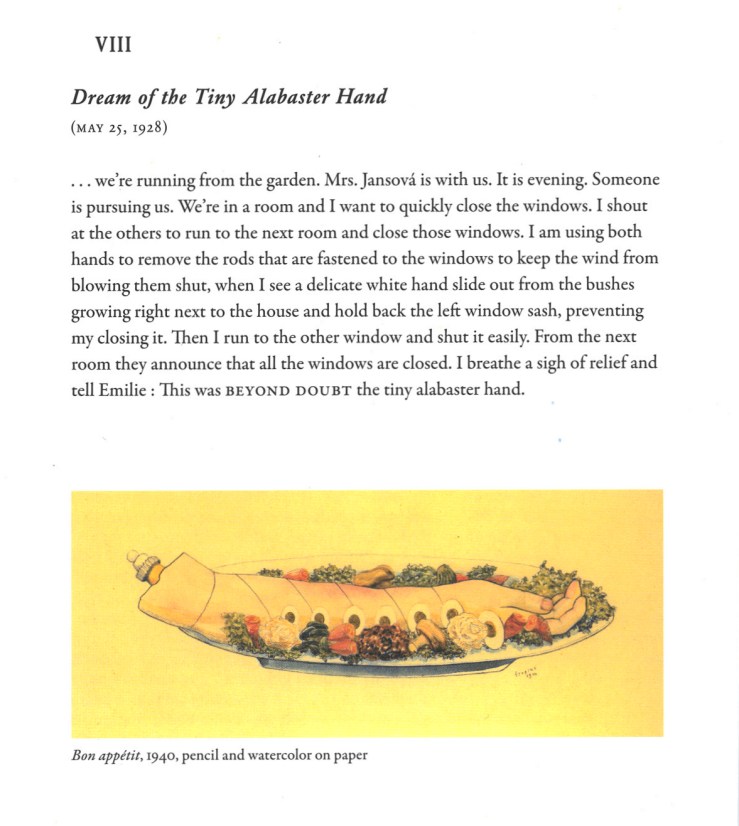
I have to admit that I had never heard of the Czech artist Jindřich Štyrský (1899-1942) until a review copy of something called Dreamverse arrived at Biblioklept World Headquarters a week or so ago. I was excited when I saw the package though—the book is from Twisted Spoon Press, and their books are always gorgeous and strange and fascinating. Dreamverse is no exception, collecting Štyrský’s paintings, collages, sketches, poems, essays, and prose in a baffling (and yet simultaneously accessible) compendium translated by Jed Slast. Here is Twisted Spoon’s blurb:

Published posthumously in 1970 as Dreams, Štyrský’s dream journal spanning the interwar years comprises prose, sketches, collages, and paintings. The present volume includes the complete series of texts and full-color and halftone images based on Štyrský’s layout for its publication in the 1940s, his sole volume of poetry (also published posthumously), as well as a selection of his most important essays, articles, manifestos, and assorted other texts. This edition presents in English for the first time the broad range of Štyrský’s contribution to the interwar avant-garde and Surrealism.

Dreamverse begins with an (overly academic) introduction by the Czech avant garde artist Karel Teige dated from 1948, which argues that the Štyrský is deeply underappreciated. Teige describes Štyrský’s gradual artistic shift into surrealism, an excursion Štyrský shared with his partner Toyen.

Teige writes like an art historian, fussily constructing a place for a displaced artist. Dreamverse really takes off when we get to Štyrský’s prose. Dreams (1925-1940) comprises about half of the book, and begins with this lucidly surreal self-description:

Work birthed in the wellsprings of hypnagogic mental models, via faithful representations of dream objects and authentic dream records.

Štyrský then offers a brief introduction in which he dedicates the work to “my CHIMERA, my PHANTOM OBJECT.” This particular chimera is a Freudian’s fantasy: Štyrský begins by discussing his prepubescent infatuation with “the image of a woman’s head, exquisite with golden hair” which he sees in a cheap magazine. This image somehow transmogrifies into “the head of Medusa, the whole of it in a pool of blood,” its hair a “cluster of vipers, erect, ready to penetrate the woman through her mouth, nose, and ears.” Štyrský then tells us that this “ghastly horror,” this “alluring horror” haunts his dreams, and he tries to “place the head” on his mother and sister. The head fits his sister: “So I was madly in love with her.” Štyrský then details his sister’s death in strange, alarmingly sensual language. (She died in 1905 when he was a young boy). His muse then, his chimera, foregrounds the dreamverse he creates: we get a mass media image reconverted into a mythological figure, then reconverted again, through creative imagination, into a sister, who is in turn transformed again into a mythic trope of some kind—a figure like Eurydice for Štyrský to play Orpheus to. Štyrský’s dreamverse is a writhing collage of contradictions. Hope and despair, sex and death, the beautiful and the lurid are all collapsed into surrealist expression.

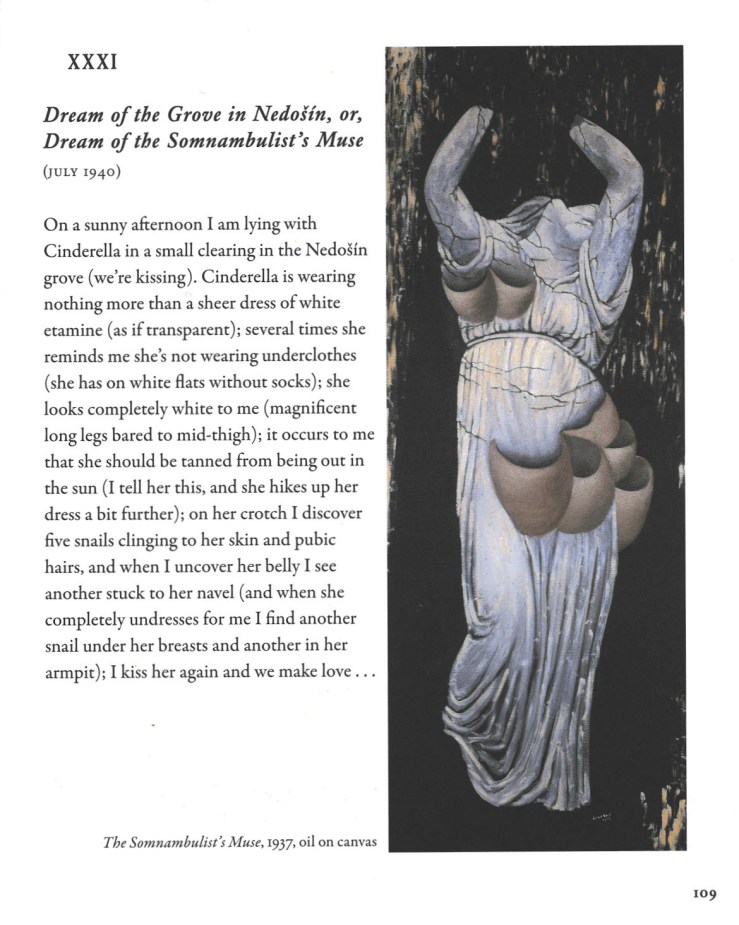
Take, for example, Dream XXXI:a

Štyrský’s dream—and its expression—excavates the sexuality suppressed just beneath the surface of our fairy tales. And while sexual abjection is typical in both Dreams (and in many of the poems collected in the Verse section of Dreamverse, sex is not always the dominant motif. Consider Dream VIII:


c

The vignette is a perfect slice of dread an horror, and the accompanying illustration—humorous and grotesque—is nightmare fuel.

I’ve been reading the Dreams somewhat slowly, a handful at a time, and then dipping deeper in the book, into the Verse, reading the Dreamverse as a sort of push-pull of image and word.

Štyrský’s writing is abject, evocative of a world that decays and regenerates at the same moment. A poem with the title “In the Swamps” of course stands out to me, a Florida boy always on the look out for abject images:

b

Štyrský’s imagery here is wonderful: The “fortune of blackcaps” pops out as an invented form of venery. Are the “blackcaps” actually little warblers—or just a surreal transformation of moorhens, the birds we would expect to find in the swamps? In either case, they are merely prey for “compassionate hunters,” susceptible to the arms of unseen brunettes and hunting dogs. The end of the poem is beautifully abject. The “horde of black swine” rumble in, neatly parallel to the “fortune of blackcaps” in the poems’s first line. These pigs slough through the swamp for “Sodden sacks of gold,” some kind of treasure there in the abject muck. Above it all is a speaker—a poet? Language hovers over the swamp.

Jed Slast deserves much praise for his translation, which seems tonally perfect and consistent over both the Dreams and the Verse sections. I’ll admit I haven’t gotten into any of the Writings at the end, which include lectures, essays, manifestos, and other fragments, but that gives me something to look forward to. So far though, Dreamverse has been an unexpected and strange joy, a dark and often perverse collection that plants its own dreamseeds in its reader.

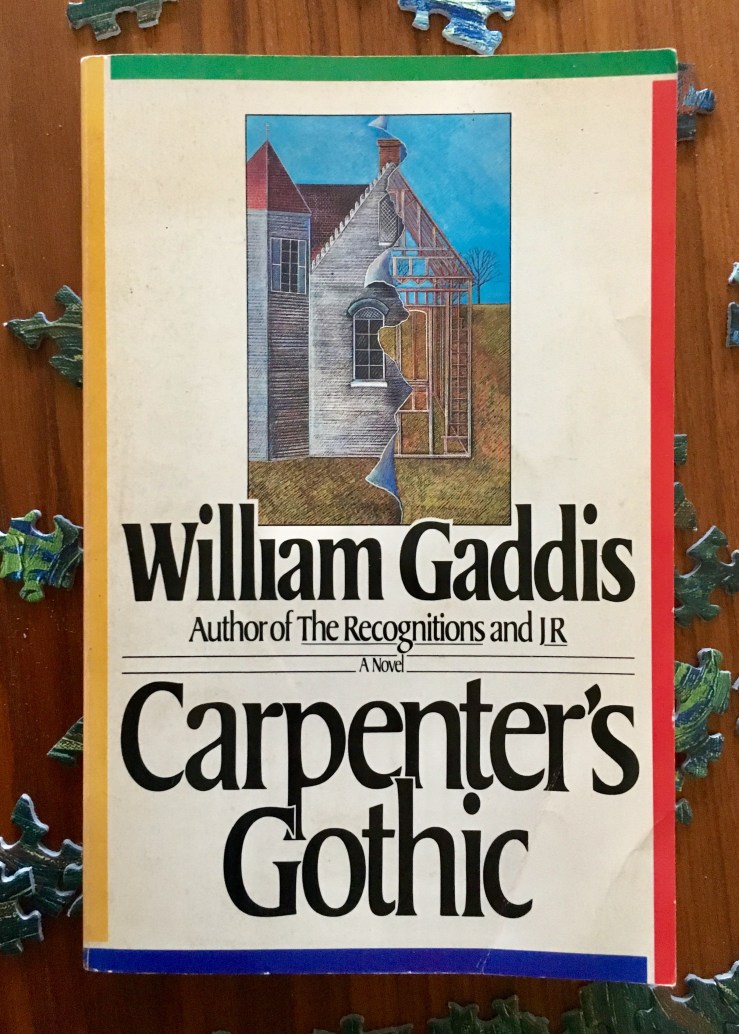
A patchwork of conceits, a hodgepodge of good intentions, another blog about William Gaddis’s novel Carpenter’s Gothic

img_1155

In its sixth (and penultimate chapter), William Gaddis’s 1985 novel Carpenter’s Gothic includes a rare scene. Our heroine Elizabeth Booth exits the house she spends most of the book confined in and actually looks at it from the outside. With her is the house’s owner, the mysterious Mr. McCandless:

—I’ve never really looked at it.

—At what… looking where she was looking.

—At the house. From outside I mean.

Carpenter’s Gothic is a novel of utter interiority—the reader never makes it but a few feet out of the house, and only then on rare occasions. This postmodern Gothic novel tingles with a smothering claustrophobia, its insularity underscored by continual references to other spaces outside the house. The possibility of an outside world waiting for Elizabeth is realized through dialogue with her husband Paul, her brother Billy, and mysterious Mr. McCandless, as well as the non-stop (and, from the reader’s perspective, one-sided) telephone conversations that make up so much of the novel’s material. And yet with all its references to traveling away to California, Africa, New York City, Acapulco, etc., Carpenter’s Gothic keeps Elizabeth locked away in the old house, tethered to the umbilical phone cord at the novel’s center.

McCandless is off in his own interior space—the shifting tortured howl of his own consciousness—when Elizabeth remarks that she has never really seen the house from the outside. Her observation raises him “to the surface” of concrete reality:

—Oh the house yes, the house. It was built that way yes, it was built to be seen from outside it was, that was the style, he came on, abruptly rescued from uncertainty, raised to the surface —yes, they had style books, these country architects and the carpenters it was all derivative wasn’t it, those grand Victorian mansions with their rooms and rooms and towering heights and cupolas and the marvelous intricate ironwork.

The house is built in the Carpenter Gothic style (sometimes called Rural Gothic style), which essentially amounts to an American imitation of European Gothic’s forceful elegance. McCandless continues:

That whole inspiration of medieval Gothic but these poor fellows didn’t have it, the stonework and the wrought iron. All they had were the simple dependable old materials, the wood and their hammers and saws and their own clumsy ingenuity bringing those grandiose visions the masters had left behind down to a human scale with their own little inventions, those vertical darts coming down from the eaves? and that row of bull’s eyes underneath?

McCandless, stand-in for Gaddis, performs a metatextual interpretation for the reader. The Carpenter Gothic is Carpenter’s Gothic, the American postGothic reinterpreation of the European form—namely, the Gothic novel. The materials Gaddis uses to build his book are the materials of mass media and mass textuality. He condenses high literature, lurid newspaper clippings, mail, textbook pages, scraps of illegible notes, pornographic centerfolds, and every other manner of paper into a postGothic synthesis. And not just paper, but also the telephone (always ringing) and the radio (always on, always tuned to inhuman human voices). And the television too, tuned to Orson Welles as Mr. Rochester in Jane Eyre (dir. Robert Stevenson, 1943),  a film which weaves its way in and out of Elizabeth’s consciousness in the beginning of the novel, planting seeds of romance and locked rooms and secrets and fire.

But I’ve cut off McCandless, who was just about to give us another neat description of the Carpenter Gothic, which is to say another neat description of Carpenter’s Gothic:

He was up kicking leaves aside, gesturing, both arms raised embracing —a patchwork of conceits, borrowings, deceptions, the inside’s a hodgepodge of good intentions like one last ridiculous effort at something worth doing even on this small a scale, because it’s stood here, hasn’t it, foolish inventions and all it’s stood here for ninety years…

 Carpenter’s Gothic is more than just a hodgepodge or patchwork; it is more than a ridiculous effort; it is more than the sum of its foolish inventions. Gaddis gives us something new, a postmodern Gothic analysis of the end of the American century.

McCandless, Gaddis’s stand-in, wants to put all the pieces together. He echoes Jack Gibbs, the (anti-)hero (and fellow Gaddis stand-in) of J R, and he prefigures the narrator of Gaddis’s last novel, Agapē Agape, who, like Gibbs, strives to stitch together something from the atomized scraps and remnants of the 20th century.  Gaddis’s protagonists contend with entropy and attempt to get the detritus of the modern world “sorted and organized.” The push-pull of hope and despair drives these protagonists, but often drives them too far.

And McCandless’s reverie takes him too far, again into the interiority of his skull:

…breaking off, staring up where her gaze had fled back with those towering heights and cupolas, as though for some echo: It’s like the inside of your head McCandless, if that was what brought him to add —why when somebody breaks in, it’s like being assaulted, it’s the…

In a moment of self-speech, McCandless realizes that the Carpenter Gothic is “like the inside of [his] head,” underscoring his connection to his creator, Gaddis, as well as the connection between the house and the novel.

The (always) ringing phone punctures the scene:

—Listen! The phone had rung inside and she started up at the second ring, sank back with the third. —All I meant was, it’s a hard house to hide in…

Elizabeth’s lines here emphasize Carpenter’s Gothic’s central Gothicism—the Carpenter Gothic and Carpenter’s Gothic is a hard place to hide in. Secrets will out.

And so well where does our hodgepodge of good intentions lead?

A review of Anders Nilsen’s comic Tongues

screenshot-2018-08-31-at-4-30-04-pm

Check out my review (at The Comics Journal) of Anders Nilsen’s new comic Tongues. First paragraph:

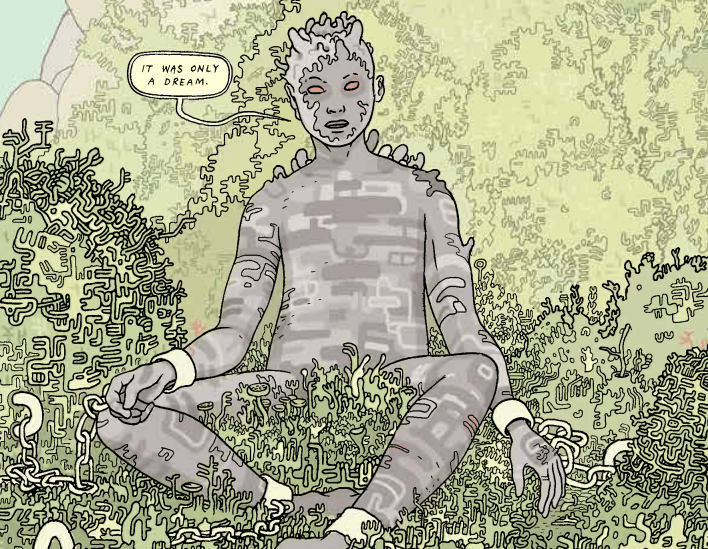
There’s a lot going on in the first two issues of Anders Nilsen’s new graphic novel-in-progress Tongues. A black eagle plays chess with Prometheus before tearing out the chained god’s liver. A young American ambles aimlessly through a Central Asian desert, a teddy bear strapped to his back. Stealing away from his lover’s tower window, a youth morphs into a black swan and flies into the desert, where he consumes the tongue and throat of a murder victim sprawled in the sand. A little girl chats in Swahili about her assassination plans with a black chicken. (There are lots of black birds in Tongues). There’s also some literal monkey business. It’s all really beautiful stuff.

Read the full review at The Comics Journal.

screenshot-2018-08-31-at-4-34-20-pm

A review of Olga Tokarczuk’s novel Flights

Olga Tokarczuk’s Flights,

being a book of diversions, of anything but the straight and narrow; a book bound by water, in that it is fluid, unfixed, and preoccupied with the very stuff, and the whales within; an interminable book, in which numerous stories never finish (for what is an ending but a wall to be destroyed or circumnavigated by time and other stories), but also a terminal book, in that it is “situated at the extremity of something” (New Oxford American Dictionary), like a book set on the eve of an important day, the day we leave, the day we make our move, the day we attack; and speaking of extremities, it is a book obsessed with fingers and toes and the blood vessels within, and all of the body’s parts, muscles in particular, and their preservation, long after the soul has left the body, submerged in anything from booze to Kaiserling III and held in a jar, transported across the world via horse and buggy or Russian galleon, to be placed on full display before students, kings, curious onlookers, and a grieving daughter, whose letters challenge the dubious practice of plastination; a book in which letters cross paths with lists, travelogues, tall tales, myths, ruminations on plastic bags and sanitary pads, dark matter and swastikas, stories that traverse the ruins of Athens, a boiler room in Moscow, the olive groves of Croatia, not to mention places without names, impossible to find on a map, without coordinates, all of it jumping from past to present and back again, if linear time is to be believed; a book of wandering women, who disappear and reappear on their own accord, slipping into the divine rhythms of circular time; a book about the temptation to make meaning out of any assortment of objects; a book made of 116 sections in all, which is the number of years the Hundred Years’ War actually lasted, and is the prefix for several European telephone helplines such as 116000, the hotline for missing children, or 116123, the emotional support helpline, according to Wikipedia, a site which may be, says Tokarczuk, “mankind’s most honest cognitive project,” except that it cannot index “its inverse, its inner lining, everything we don’t know”; a book populated by characters who either do not know, can’t figure it out, are lost, are trying to figure out what happened in that span of time that slipped their grasp, or those who know it all, who know the map like the back of their hand, or so they think; a book that anticipates the sovereignty of airports, those modern portals that make us time travelers, where you and I might collide, and if we do, will we talk to each other, tell our stories, move beyond the Three Travel Questions (where are you from, where are you coming from, where are you going) and into our ideas, those dangerous, viscous things, or will we simply utter apologies and head to our gates; a book that floods, that breaks at the seams and spills out into the world, so that fact and fiction get scrambled and mix in the deluge, becoming indistinguishable; a book with no answers, only arrows pointing in other directions, toward books yet to be written, histories to be retold, cities at the ends of the earth, or to the person nearest you; a book oriented, most importantly, toward other pilgrims…

…is masterfully translated from the Polish by Jennifer Croft, available from your English publisher of choice, and a magnificent read, one that travelled with me across Poland, Ireland, and the UK, and has convinced me, once and for all, that it is a crime never to read Moby-Dick.

(Image above, a map of Novaya Zemlya, via. Read an excerpt over at Asymptotein their January 2016 issue.)

On Herman Melville’s novella Benito Cereno

Near the middle of Herman Melville’s 1855 novella Benito Cereno, our erstwhile protagonist Captain Amasa Delano encounters an old sailor tying a strange knot:

For intricacy, such a knot he had never seen in an American ship, nor indeed any other. The old man looked like an Egyptian priest, making Gordian knots for the temple of Ammon. The knot seemed a combination of double-bowline-knot, treble-crown-knot, back-handed-well-knot, knot-in-and-out-knot, and jamming-knot.

At last, puzzled to comprehend the meaning of such a knot, Captain Delano addressed the knotter:—

“What are you knotting there, my man?”

“The knot,” was the brief reply, without looking up.

“So it seems; but what is it for?”

“For some one else to undo,” muttered back the old man…

This knot serves as a metaphor for the text of Benito Cereno itself. We readers (along with our hapless surrogate Captain Delano) are the ones tasked with unknotting the text’s central mystery.

Part of the great pleasure of reading Benito Cereno for the first time rests in Melville’s slow-burning buildup to the eventual unknotting. I was fortunate enough to have been ignorant of the plot (and eventual revelation) of Benito Cereno when I first read it over a dozen or so years ago (although even then I cottoned on to what was really happening earlier than Captain Delano did). I read the novella again last week and marveled at Melville’s narrative control, enjoying it anew by seeing it anew.

Benito Cereno is a sharply-drawn tale about the limits of first-person consciousness and the cultural blinders we wear that prevent us from seeing what is right in front of us. The book subtly critiques the notion of a naturally-ordered morality in which every person has a right and fitting place, whether that be a place of power or a place of servitude. Melville shows the peril and folly of intrinsically believing in the absolute rightness of such a system. There is comfort in belief, but unquestioning belief makes us radically susceptible to being wrong. When we most believe ourselves right is often when we are the most blinded to the reality around us. We cannot see that we cannot see. And Benito Cereno is about how we see—about how we know what we know. Melville’s novella is also about how seeing entails not seeing, and, further, not seeing what we are not seeing—all that we do not know that we do not know. Melville makes his readers eventually see these unknown unknowns, and, remarkably, shows us that they were right before our eyes the entire time.

Forgive me—much of the previous paragraph is far too general. I want you to read Benito Cereno but I don’t want to spoil the plot. Let’s attempt summation without revelation: The novella is set in 1799 off the coast of Chile. Amasa Delano, captain of the American sealing vessel the Bachelor’s Delight, spies a ship floating adrift aimlessly, apparently in distress. Captain Delano boards one of his whale boats and heads to the San Dominick, a Spanish slaving ship, and quickly sees that the enslaved Africans on board dramatically outnumber the Spanish sailors. Delano offers aid to the San Dominick’s captain, Benito Cereno, who tells Delano that most of the Spanish crew perished in a fever (along with the “owner” of the slaves, Alexandro Aranda). Benito Cereno himself seems terribly ill and not entirely fit to command, so Delano waits aboard the San Dominick while his men fetch food and water from the Bachelor’s Delight. In the meantime, he tours the ship and talks with Benito Cereno and Cereno’s enslaved valet Babo.

Delano is frequently troubled by what he sees on the ship, but his good nature always affords him a natural and acceptable answer that assuages the sinister tension tingling in the background. Even though he’s troubled by the “half-lunatic Don Benito,” Delano’s “good-natured” sense of moral authority can explain away what he sees with his own eyes:

At last he began to laugh at his former forebodings; and laugh at the strange ship for, in its aspect, someway siding with them, as it were; and laugh, too, at the odd-looking blacks, particularly those old scissors-grinders, the Ashantees; and those bed-ridden old knitting women, the oakum-pickers; and almost at the dark Spaniard himself, the central hobgoblin of all.

For the rest, whatever in a serious way seemed enigmatical, was now good-naturedly explained away by the thought that, for the most part, the poor invalid scarcely knew what he was about…

These paragraphs not only summarize some of the images that give Delano pause, they also show Melville’s remarkable prose style, which follow’s Delano’s psychological state: laughing dismissal returns back to anxious image; anxious image gives way again to relieved certitude. All that is “enigmatical” in life can be “good-naturedly explained away.” And yet as the narrative progresses, good-natured explanations will fail to answer to visceral reality. Melville’s slow burn catches fire, burning away the veils of pretense.

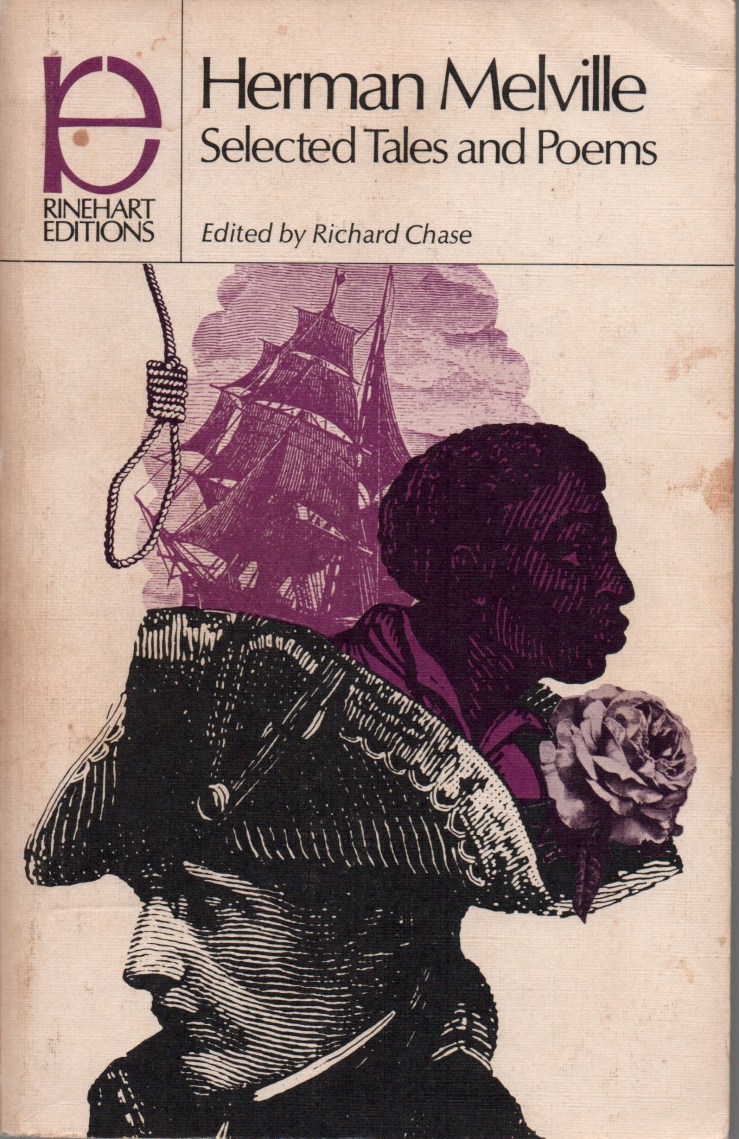
The rest of this post (after the image) contains significant spoilers. I highly recommend Benito Cereno, which is reprinted in any number of Melville collections (I read it again in Rinehart’s Selected Tales and Poems), including The Piazza Tales (which you can download for free at Project Gutenberg). While I think that Benito Cereno has gained more recognition in recent years, it remains under-read compared to Melville’s more famous novellas Bartleby and Billy Budd. Those are great books too, but I’d argue that Benito Cereno, with its critique of white supremacy, is more timely than ever. Check it out. (Again, spoilers ahead).

IMG_0160

Continue reading “On Herman Melville’s novella Benito Cereno”

Blog about Denis Johnson’s story “Strangler Bob”

Screenshot 2018-07-25 at 5.28.36 PM
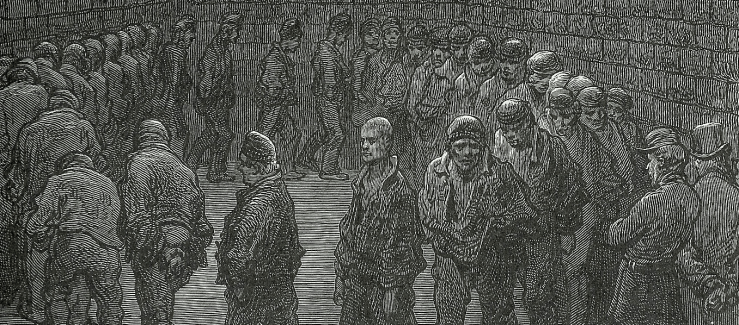
Detail from Newgate Exercise Yard by Gustave Dore, 1872

Denis Johnson’s story “Strangler Bob” is the third selection in The Largesse of the Sea Maiden. At about 20 pages, it’s also the shortest piece in the collection (the other four stories run between 40 and 50 pages). While still a bit longer than the stories in Johnson’s seminal collection Jesus’ Son, “Strangler Bob” nevertheless seems to pulse from that same vein, its narrator Dink another iteration of Jesus’ Son’s Fuckhead. Indeed, “Strangler Bob” feels a bit like an old sketch that’s been reworked by Johnson into something that fits thematically into Largesse.

Here’s the opening paragraph of “Strangler Bob” in full, which gives us the basic premise and setting (and you can’t beat those two opening sentences):

You hop into a car, race off in no particular direction, and blam, hit a power pole. Then it’s off to jail. I remember a monstrous tangle of arms and legs and fists, with me at the bottom gouging at eyes and doing my utmost to mangle throats, but I arrived at the facility without a scratch or a bruise. I must have been easy to subdue. The following Monday I pled guilty to disturbing the peace and malicious mischief, reduced from felony vehicular theft and resisting arrest because—well, because all this occurs on another planet, the planet of Thanksgiving, 1967. I was eighteen and hadn’t been in too much trouble. I was sentenced to forty-one days.

Those forty-one days take us from Thanksgiving to the New Year, with the story’s spiritual climax occurring on Christmas Eve.

Before we get to that climax Johnson builds an unexpectedly rich world in the county lockup, populating it with young toughs who can’t yet see how bad the paths they’ve chosen will be. The men of Johnson’s jail aren’t simply down on their luck or somehow morally misunderstood. They are jovial young fuck-ups who plan to continue fucking up their lives the minute they get out.

A lot of the stage-setting and background characterization in “Strangler Bob” reads like picaresque sketches that Johnson had lying about unused from decades ago. Much of the early part of the story is dedicated to “the blond sociopathic giant Jocko,” a sort of prince of the jail who saves a crazy kid from being murdered by the other inmates. Such scenes give the story a ballast of baroque energy and even an unexpectedly-comic realism, but they don’t fully fit into the main theme of the story, which is hunger.

On his first day in the jail the narrator Dink is warned not to oversleep or he will have his breakfast stolen. Hardheaded, he sleeps in anyway, but learns from his mistake:

After that I had no trouble rousing myself for the first meal, because other than the arrival of food we had nothing in our lives to look forward to, and the hunger we felt in that place was more ferocious than any infant’s. Corn flakes for breakfast. Lunch: baloney on white. For dinner, one of the canned creations of Chef Boyardee, or, on lucky days, Dinty Moore. The most wonderful meals I’ve ever tasted.

Hunger in “Strangler Bob” is an expression of the deep boredom the prisoners feel, and mealtimes become the only way these men measure the passing of time. The hunger in “Strangler Bob” is not just a desire for food, but rather something to fill up the void, the space, the empty feeling. In this world, romantic adventure is ironized into confined torpor:

Dundun, BD and I formed a congress and became the Three Musketeers—no hijinks or swashbuckling, just hour upon hour of pointless conversation, misshapen cigarettes, and lethargy.

Dundun and BD are perhaps unlikely friends for Dink—

Dundun was short and muscled, I was short and puny, and BD was the tallest man in the jail, with a thick body that tapered up toward freakishly narrow shoulders.

—but their fellowship holds together because they had “long hair and chased after any kind of intoxicating substance.” Thanks to BD they get their mitts on some LSD:

BD told us he had a little brother, still in high school, who sold psychedelic drugs to his classmates. This brother came to visit BD and left him a hotrod magazine, one page of which he’d soaked in what he told BD was psilocybin, but was likelier just, BD figured, LSD plus some sort of large-animal veterinary tranquilizer. In any case: BD was most generous. He tore the page from the magazine, divided it into thirds, and shared one third with me and one with Donald Dundun, offering us this shredded contraband as a surprise on Christmas Eve.

The ink from the newsprint turns their tongues black. Narrator Dink seems to think that the LSD was not evenly distributed on the page though—BD trips the hardest, seeing snow falling indoors, but Dink seems to think he’s mostly unaffected, while Dundun denies any effect at all. However, consider this exchange between Dink and Dundun, which suggests that they might be tripping harder than they think:

“I’m feeling all the way back to my roots. To the caves. To the apes.” He turned his head and looked at us. His face was dark, but his eyeballs gave out sparks. He seemed to be positioned at the portal, bathed in prehistoric memories. He was summoning the ancient trees—their foliage was growing out of the walls of our prison, writhing and shrugging, hemming us in.

A sloppy and unnecessary Freudian analysis of the three kids parcels them out easily as id (Dundun the apeman), super ego (BD the strange moralist), and ego, our narrator who rejects any kind of spirituality in a world where “Asian babies fried in napalm.”

Dink’s cellmate, the eponymous Strangler Bob, poses a challenge to the narrator’s easy nihilism though. Even though Dink believes that he’s not affected by the LSD, his encounter with Bob on Christmas Eve reads like a bad trip:

The only effect I felt seemed to coalesce around the presence of Strangler Bob, who laughed again—“Hah!”—and, when he had our attention, said, “It was nice, you know, it being just the two of us, me and the missus. We charcoaled a couple T-bone steaks and drank a bottle of imported Beaujolais red wine, and then I sort of killed her a little bit.”

To demonstrate, he wrapped his fingers around his own neck while we Musketeers studied him like something we’d come on in a magic forest.

Dundun then exclaims that Strangler Bob is “the man who ate his wife” — but Bob admonishes that his cannibalism was greatly exaggerated:

Strangler Bob said, “That was a false exaggeration. I did not eat my wife. What happened was, she kept a few chickens, and I ate one of those. I wrung my wife’s neck, then I wrung a chicken’s neck for my dinner, and then I boiled and ate the chicken.”

The hunger in Strangler Bob is perverse and abject; his crime is of a moral magnitude far more intense than the malicious hijinks the youthful Musketeers have perpetrated–it’s taboo, a challenge to all moral order. He’s also an oracle of strange dooms:

He said, “I have a message for you from God. Sooner or later, you’ll all three end up doing murder.” His finger materialized in front of him, pointing at each of us in turn—“Murderer. Murderer. Murderer”

We learn in the final melancholy paragraphs of the story that Bob’s prophecy comes true, more or less. In those paragraphs too there is a moment of grace, albeit a grace hard purchased. Of the latter part of his life, the Dink tells us:

I was constantly drunk, treated myself as a garbage can for pharmaceuticals, and within a few years lost everything and became a wino on the street, drifting from city to city, sleeping in missions, eating at giveaway programs.

It’s worth noting that if Dink were 18 in the fall of 1967, he would likely have been born in 1949, the year that Denis Johnson was born. The narrators of two other stories in Largesse are also born in or around 1949, and it’s my belief that all of the narrators are essentially the same age, and all are pseudoautofictional iterations of Johnson.

In “Strangler Bob,” Dink is an iteration that fails to thrive, that can’t survive addiction and recovery and enter into a new life. He does not heed Bob’s warning, and at the end of the story he laments that he is a poisoned person who has poisoned others:

When I die myself, B.D. and Dundun, the angels of the God I sneered at, will come to tally up my victims and tell me how many people I killed with my blood.

These final lines push the narrator into a place of bare remorse and regret, as he reflects back on his time in the jail, which he describes in retrospect as “some kind of intersection for souls.” Dink now sees that he’s failed to acknowledge the messengers that might have sent him on a better path. Angels come in strange forms.

Very early Christmas morning on the planet of 1967, after “the festival of horrors” that constituted the LSD trip, Strangler Bob gives one last message, a strange delivered in Dink’s grandmother’s voice:

I studied him surreptitiously over the edge of the bunk, and soon I could see alien features forming on the face below me, Martian mouth, Andromedan eyes, staring back at me with evil curiosity. It made me feel weightless and dizzy when the mouth spoke to me with the voice of my grandmother: “Right now,” Strangler Bob said, “you don’t get it. You’re too young.” My grandmother’s voice, the same aggrieved tone, the same sorrow and resignation.

“You’re too young” — wisdom is purchased through folly, pain, terrible mistakes, crimes and sins. The narrator’s grandmother ventriloquizes Strangler Bob, but she doesn’t have a moral message, just tired pain.

The voice here is Denis Johnson’s voice too, inhabiting a mad oracle, warning some version of himself that exists today.


You can read “Stranger Bob” online here.

I wrote about the title story in The Largesse of the Sea Maiden here.

I wrote about the second story, “The Starlight on Idaho” here.


Riff on finishing Middlemarch, George Eliot’s novel of consciousness

Screenshot 2018-06-12 at 8.35.14 PM
Detail of a portrait of Mary Ann Evans (George Eliot) at age 30 by François d’Albert Durade (1804–1886)

I finally finished George Eliot’s long and marvelous 1872 novel Middlemarch.

When I wrote about reading Middlemarch last month, from not-quite-the-middle of the book, I lamented that I’d rather be rereading the book than reading it. Rich and dense, it’s the kind of big book that clearly offers more on repeat readings. And yes, I will reread Middlemarch, but I’ll give it a year or three to mellow in the back of my consciousness.

Middlemarch is a novel about consciousness, and what the novel does best in my estimation is show how different kinds of consciousness mediate and are mediated by the social forces they inhabit (and are inhabited by).

(The word consciousness appears 90 times in Middlemarch. If we include similar iterations, like consciousconsciouslyunconscious, and unconsciously, the count grows to a total of 172 times. In contrast, iterations of the word conscience appear only 38 times).

Dorothea Brooke remained my favorite consciousness throughout the novel, and I missed her when she wasn’t there, when Eliot had us hovering around or even fully inhabiting another consciousness.

I’ll admit that in the final quarter of Middlemarch I found myself a bit weary of the Bulstrode disgrace plot—and yet I appreciate how Eliot inhabited that consciousness as well. Bulstrode provides Eliot a sharp tool to show how consciousness is blind, or even self-blinding—how consciousness massages conscience in order to survive. In a passage that illustrates this process, Eliot writes,

Bulstrode shrank from a direct lie with an intensity disproportionate to the number of his more indirect misdeeds. But many of these misdeeds were like the subtle muscular movements which are not taken account of in the consciousness, though they bring about the end that we fix our mind on and desire. And it is only what we are vividly conscious of that we can vividly imagine to be seen by Omniscience.

Consciousness cannot lay claim to conceiving of an absolute omniscient conscience, an absolute and ever-present moral consciousness. Too, earlier in the novel, Eliot’s narrator observes,

For the egoism which enters into our theories does not affect their sincerity; rather, the more our egoism is satisfied, the more robust is our belief.

Egoism is a central problem in Middlemarch; indeed, Eliot seems to posit egoism as the greatest threat to how individual consciousnesses navigate social reality. Here is here narrator again:

Will not a tiny speck very close to our vision blot out the glory of the world, and leave only a margin by which we see the blot? I know no speck so troublesome as self.

I cannot improve upon “no speck so troublesome as self” and will not adventure an attempt.

But back to the consciousness I liked best in Middlemarch: Dorothea.

Dorothea is a kind of genius of intention, and Eliot harnesses that genius—she shows us Dorothea’s consciousness-in-action. Eliot doesn’t just tell us what’s happening in Dorothea’s head; she makes that consciousness live in our own heads.

Dorothea’s life, like all lives, is beset with foiled plans and terrible mistakes. Still, Middlemarch grants Dorothea something of a happy ending in her marriage to Will Ladislaw, and yet refuses the conclusion of a classical comedy. There is no wedding scene. Indeed, the last time Dorothea speaks in the novel it is to reconcile with her sister Celia—a conclusion that confirms their love story the equal to that of Dorothea and Ladislaw’s love story.

Eliot’s novel is too sophisticated and too realistic for a simplistic happy or tragic conclusion, of course. In the novel’s “Finale,” the narrator reminds us that,

Every limit is a beginning as well as an ending…the fragment of a life, however typical, is not the sample of an even web.

The narrator then gives us broad details of the fates of the novel’s principal couples: Lydgate and Rosamond, skewing depressive; Mary and Fred, skewing comic; and finally Ladislaw and Dorothea. We learn of Ladislaw’s success as a reform politician and understand that Dorothea is an instrumental force in this success.

Eliot’s conclusion for this final pair skews neither comic nor tragic, but is something more complex—more realistic. Dorothea becomes a cautionary tale in the town of Middlemarch; her legacy is one of misspent potential in the eyes of society. The novel ends without indicating that any of the grand plans of Dorothea’s youth have been achieved. And yet the novel concludes with an oblique revelation about Dorothea’s misunderstood legacy.

In the second-to-final paragraph of Middlemarch, Eliot writes that,

those determining acts of [Dorothea’s] life were not ideally beautiful. They were the mixed result of young and noble impulse struggling amidst the conditions of an imperfect social state, in which great feelings will often take the aspect of error, and great faith the aspect of illusion. For there is no creature whose inward being is so strong that it is not greatly determined by what lies outside it.

Eliot refuses a simple happy ending here; her heroine is still a consciousness subject to the social forces around it. Dorothea’s great utopian ambitions are ultimately tempered by the cultural constraints her consciousness would otherwise seek to transcend.

But then the final paragraph of the novel points towards transcendence:

Her finely touched spirit had still its fine issues, though they were not widely visible. … But the effect of her being on those around her was incalculably diffusive: for the growing good of the world is partly dependent on unhistoric acts; and that things are not so ill with you and me as they might have been, is half owing to the number who lived faithfully a hidden life, and rest in unvisited tombs.

Dorothea—and, more significantly, the spirit of Dorothea—did real grand good in the world, an immeasurable good, “incalculably diffusive.” Even if she lived ultimately a “hidden life,” Eliot insists that it is people like Dorothea who have made the world better for “you and me.”

While “hidden life” and “unvisited tombs” may harbor negative connotations, these phrases are ultimately ironic: Eliot’s novel itself is the key to the hidden life of Dorothea Brooke. Middlemarch is a vivid and vivifying tomb for Dorothea, and we readers are the lucky visitors.

Reviews, riffs, anti-reviews, and interviews of Jan 2018-May 2018 (and an unrelated fruit bat)

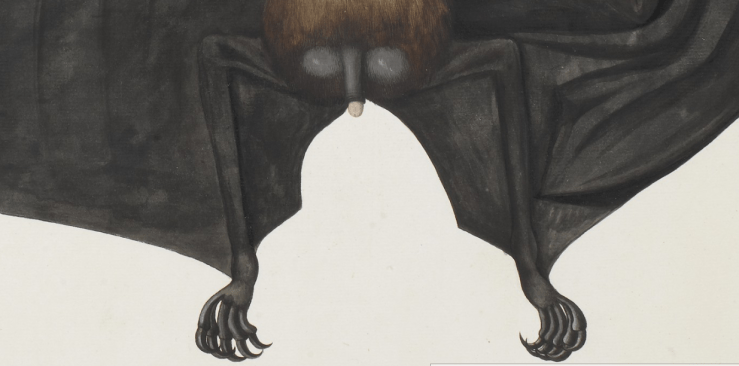
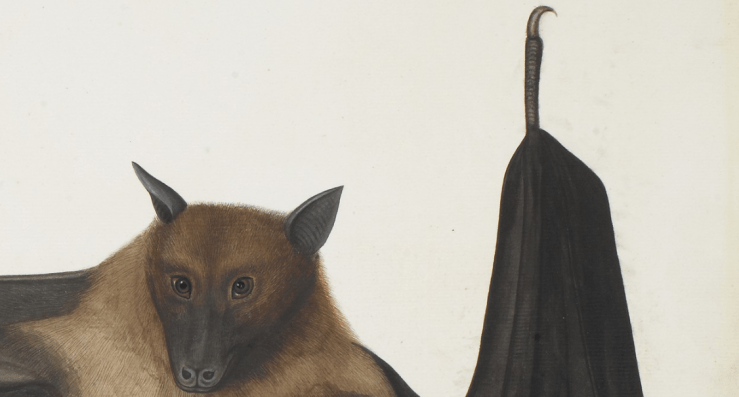
DP167067

These are links to some of the longer pieces I’ve written so far this year. The painting of the great Indian fruit bat (c. 1777-1782) is attributed to Bhawani Das or one of his followers.

The Last Jedi and the anxiety of influence

A review of Paul Thomas Anderson’s film Phantom Thread

A review of Paul Kirchner’s underground comix collection Awaiting the Collapse (at The Comics Journal)

A review of The Paris Review’s overproduced podcast

A review of Stanisław Ignacy Witkiewicz’s collection Narcotics

A few paragraphs on beginning Iris Murdoch’s novel The Bell

On a compelling Stephen Crane character

A review of Iris Murdoch’s novel The Bell

On a particular Gordon Lish sentence

On rereading Nathaniel Hawthorne’s The Blithedale Romance

Screenshot 2018-05-31 at 3.59.41 PM

On Goya’s painting The Straw Man

On Don DeLillo’s novel The Names

On the radical postmodernism of Ursula K. Le Guin’s short story “Schrödinger’s Cat” 

Polygamy as a metaphor in Nathaniel Hawthorne’s The Blithedale Romance

On Nathaniel Hawthorne’s “silvery veil” — and David Foster Wallace’s Madame Psychosis

An analysis of William Carlos Williams’s ekphrastic poem “The Wedding Dance in the Open Air”

A close reading of Lydia Davis’s very short story “Happiest Moment”

On a passage from Gerald Murnane’s short story “Stream System”

Something on a scene from Nathaniel Hawthorne’s The Blithedale Romance

Screenshot 2018-05-31 at 3.59.29 PM

On John Berryman’s Dream Song 265

On making a literary cocktail, the sherry cobbler

On Robert Coover’s short story “The Brother”

On Claire-Louise Bennett’s short story “Stir-Fry”

On Balthus’s portraits of young girls reading 

On the postmodern comedy-horror axis of Martin Scorsese’s The King of Comedy

An interview with the editors of Egress, a new literary magazine devoted to innovative writing

A completely subjective and thoroughly unnecessary ranking of Thomas Pynchon’s novels

Screenshot 2018-05-31 at 3.58.43 PM

Antoine Volodine’s Writers blows me away

A review of Dave Cooper’s queasy abject comic Mudbite (at The Comics Journal)

On Michael Radford’s film adaptation of 1984

Is The Running Man a good film?

On William Friedkin’s paranoid, claustrophobic horror flick Bug

Mary and the Witch’s Flower, a love letter to Studio Ghibli from director Hiromasa Yonebayashi

On Hayao Miyazaki’s film Porco Rosso

A review of Zora Neale Hurston’s Barracoon

A review of Lady Macbeth

Screenshot 2018-05-31 at 3.59.03 PM

A review of Zora Neale Hurston’s Barracoon

151835599518773205

Zora Neale Hurston’s 1931 book Barracoon: The Story of the Last “Black Cargo” has finally been published. The book is based on Hurston’s 1927 interviews with Cudjo Lewis, the last known survivor of the transatlantic slave trade. Barracoon went previously unpublished due in part to Hurston’s refusal to revise the prose into a “standard” English. Hurston wrote Barracoon in a phonetic approximation of Cudjo’s voice. While this vernacular style may pose (initial) challenges for many readers, it is the very soul of the book in that it transmits Cudjo’s story in his own voice, tone, and rhythm. Hurston used vernacular diction throughout her work, but Cudjo’s voice is singular; it bears a distinctly different sound than the characters of Their Eyes Were Watching God, Hurston’s most famous novel. It is hard to conceive a more compelling version of Barracoon than this one, the one Hurston refused to compromise, with its intense, vital orality.

What is Barracoon about? I shall liberally borrow my summary from the book’s introduction, penned by Hurston scholar and biographer Deborah G. Plant:

On December 14, 1927, Zora Neale Hurston took the 3:40 p.m. train from Penn Station, New York, to Mobile, to conduct a series of interviews with the last known surviving African of the last American slaver—the Clotilda. His name was Kossola, but he was called Cudjo Lewis. He was held as a slave for five and a half years in Plateau-Magazine Point, Alabama, from 1860 until Union soldiers told him he was free. Kossola lived out the rest of his life in Africatown (Plateau). Hurston’s trip south was a continuation of the field trip expedition she had initiated the previous year.

Oluale Kossola had survived capture at the hands of Dahomian warriors, the barracoons at Whydah (Ouidah), and the Middle Passage. He had been enslaved, he had lived through the Civil War and the largely un-Reconstructed South, and he had endured the rule of Jim Crow. He had experienced the dawn of a new millennium that included World War I and the Great Depression. Within the magnitude of world events swirled the momentous events of Kossola’s own personal world.

Zora Neale Hurston, as a cultural anthropologist, ethnographer, and folklorist, was eager to inquire into his experiences. “I want to know who you are,” she approached Kossola, “and how you came to be a slave; and to what part of Africa do you belong, and how you fared as a slave, and how you have managed as a free man?” Kossola absorbed her every question, then raised a tearful countenance. “Thankee Jesus! Somebody come ast about Cudjo! I want tellee somebody who I is, so maybe dey go in de Afficky soil some day and callee my name and somebody say, ‘Yeah, I know Kossula.’”

Those final sentences should give you a quick taste of Barracoon’s central rhetorical conceit. After her own introductory chapter (which details the historical circumstances of the Clotilda’s illegal journey to West Africa), Hurston lets Cudjo inspirit the text, telling his own story in his own voice. Hurston, who spent three months with Cudjo, initially interposes herself in the story, as we see early in the book’s first chapter:

“My grandpa, he a great man. I tellee you how he go.”

I was afraid that Cudjo might go off on a tangent, so I cut in with, “But Kossula, I want to hear about you and how you lived in Africa.”

He gave me a look full of scornful pity and asked, “Where is de house where de mouse is de leader? In de Affica soil I cain tellee you ’bout de son before I tellee you ’bout de father; and derefore, you unnerstand me, I cain talk about de man who is father (et te) till I tellee you bout de man who he father to him, (et, te, te, grandfather) now, dass right ain’ it?

This brief “cutting in” is one of the last moments in the narrative that Hurston attempts to steer Cudjo in a particular direction. Instead, she befriends the old man, bringing him watermelons, hams, peaches, and other treats. These little gifts serve to frame Cudjo’s narrative as he moves from one episode to the next. Otherwise, Hurston disappears into the background, an ear for Cudjo’s voice, a witness for his story.

Cudjo’s story is astounding. He describes life in his own West African village and the terrible slaughter of his people at the hands of “de people of Dahomey,” a tribe that eventually sells Cudjo and the other young people of his village to white men. Cudjo describes his early enslavement in Alabama, which took place in secret until the Civil War, and his eventual freedom from bondage. He tells Hurston about the founding of Africatown, a community of West Africans. He describes his life after capture and slavery—his marriage, his children, his near-fatal railroad accident. Cudjo’s life and his children’s lives were incredibly difficult. They were always othered:

“All de time de chillun growin’ de American folks dey picks at dem and tell de Afficky people dey kill folks and eatee de meat. Dey callee my chillun ig’nant savage and make out dey kin to monkey.

“Derefo’, you unnerstand me, my boys dey fight. Dey got to fight all de time. Me and dey mama doan lak to hear our chillun call savage. It hurtee dey feelings. Derefo’ dey fight. Dey fight hard. When dey whip de other boys, dey folks come to our house and tellee us, ‘Yo’ boys mighty bad, Cudjo. We ’fraid they goin’ kill somebody.”

Somehow most devastating in a narrative full of devastation are the deaths of Cudjo’s children. After his daughter dies in infancy, his namesake is killed by a sheriff, a scene that resonates with terrible pain in 2018:

Nine year we hurtee inside ’bout our baby. Den we git hurtee again. Somebody call hisself a deputy sheriff kill de baby boy now.

He say he de law, but he doan come ’rest him. If my boy done something wrong, it his place come ’rest him lak a man. If he mad wid my Cudjo ’bout something den he oughter come fight him face to face lak a man. He doan come ’rest him lak no sheriff and he doan come fight him lak no man.

Another of his sons is decapitated in a railroad accident. A third son, angry with the injustice of the world, simply disappears: “My boy gone. He ain’ in de house and he ain’ on de hill wid his mama. We both missee him. I doan know. Maybe dey kill my boy. It a hidden mystery.”

Cudjo, ever the survivor, went on to outlive his wife and all of his children.  In her foreword to Barracoon, Alice Walker captures the pain and pathos of this remarkable position:

And then, the story of Cudjo Lewis’s life after Emancipation. His happiness with “freedom,” helping to create a community, a church, building his own house. His tender love for his wife, Seely, and their children. The horrible deaths that follow. We see a man so lonely for Africa, so lonely for his family, we are struck with the realization that he is naming something we ourselves work hard to avoid: how lonely we are too in this still foreign land: lonely for our true culture, our people, our singular connection to a specific understanding of the Universe. And that what we long for, as in Cudjo Lewis’s case, is gone forever. But we see something else: the nobility of a soul that has suffered to the point almost of erasure, and still it struggles to be whole, present, giving.

I cannot improve on Walker’s phrase here. Hurston brings that “nobility of soul” to life via Cudjo’s own rich language.

While Barracoon is of a piece with Hurston’s anthropological collections Mules and Men and Tell My Horse, it does not read like an autoethnography. It is rather a compelling first-person narrative. Hurston collecteed stories from Cudjo–fables, parables, games—but these are included as an appendix, a wise narrative choice as any attempt to integrate them into the main narrative would hardly be seamless. The appendix adds to the text’s richness without imposing on it, and links it to Hurston’s work as a folklorist.

I’ve noted some of the additional material already—Walker’s foreword, the appendix of folklore, as well as Plant’s introduction. Included also is an afterword by Plant that contextualizes Barracoon within Hurston’s academic career, a list of the original residents of Africatown, a glossary, a bibliography, and a lengthy compendium of endnotes. This editorial material frames the historic and academic importance of Barracoon, and will be of great interest to anyone who wishes to study the subject more. However, Cudjo’s narrative stands on its own as a sad, compelling, essential story. It’s amazing it took this long to reach a wider audience. Recommended.


A review of Dave Cooper’s comic Mudbite

img_9627

My review of Dave Cooper’s new comic Mudbite is up at The Comics Journal. First two paragraphs:

In Mudbite, Dave Cooper conjures a perverse and lurid dreamworld that seethes and wriggles with its own nightmare logic. The erstwhile hero of this world is Eddy Table, an apparent alter-ego for Cooper himself. Mudbite collects two new Eddy Table adventures, “Mud River” and “Bug Bite”, abject fantasias of intense sexual anxiety rendered in Cooper’s compellingly repellent style.

The two tales are bound tête-bêche; after you finish “Bug Bites”, you can flip the book over and read “Mud River.” Or maybe you’ll read the stories in the other order. Mudbite’s playful design invites the reader to participate in ordering the relationship between the stories. Cooper’s inimitable aesthetic unifies the project’s themes of aberrant sexuality and libidinal anxieties.

Read the rest of the review at The Comics Journal.

A review of Stanisław Ignacy Witkiewicz’s Narcotics

dvsfm7rvwaaoolo

“The main difficulty with Stanisław Ignacy Witkiewicz,” writes Soren Gauger in his translator’s note for Narcotics, “is that no matter what he was writing, it seems he wished he were writing something else.” Witkiewicz’s playful (and occasionally frustrating) discursive style is on vivid display in the six essays that comprise most of Narcotics (new in hardback from Twisted Spoon Press)Witkiewicz’s stylistic twists are one of the joys of Narcotics. A moralizing diatribe might veer into medical discourse; private anecdotes might shift into a rant on class theory or a patchy precis of a book about physiognomy. (All delivered in a semi-ironic-yet-wholly-sincere tone). In the case of Witkiewicz’s essay “Peyote,” we go from “Elves on a seesaw. (Comedic number)” to “A battle of centaurs turned into a battle between fantastical genitalia.” This last note is preceded by the observation that “Goya must have known about peyote.”

img_9138

“Peyote” is the most vivid and surreal of the essays in Narcotics. Unlike the other sections, this chapter most closely resembles a conventional drug diary. “Peyote” begins with Witkiewicz taking his first of seven (!) peyote doses at six in the evening and culminating around eight the following morning with “Straggling visions of iridescent wires.” In increments of about 15 minutes, Witkiewicz notes each of his surreal visions. The wild hallucinations are rendered in equally surreal language: “Mundane disumbilicalment on a cone to the barking of flying canine dragons” here, “The birth of a diamond goldfinch” there. Gauger’s translation conveys not just the wild imagery, but also the wild linguistic spirit of Witkiewicz’s prose.

img_9142

The prose in “Peyote” most closely approximates the spirit of Witkiewicz’s wonderful paintings. Narcotics includes 34 full-color reproductions of Witkiewicz’s art, which is reason enough to pick up this volume. According to Narcotics’ blurb, Witkiewicz (or Witkacy as he is commonly known) “established rules and types for his portrait work, marking the paintings and pastels with corresponding symbols and abbreviations of the substances he had either taken or, in the case of alcohol and nicotine, not taken at the time.”

For example, we see that Witkiewicz has noted that he had ingested cocaine and eucodal (a semi-synthetic opioid) in order to paint the Portrait of Michal Jagodowski (below). Narcotics includes a helpful “List of Symbols” as a glossary for the shorthand Witkiewicz used both in the text of his writings and in his paintings. (Although “her (herbata): tea” is included in the gloss, this vice regretfully does not merit its own essay).

img_9139

In addition to peyote, we get essays on nicotine, alcohol, cocaine, morphine, and ether (a list that may remind you of a certain Queens of the Stone Age jam). In “Nicotine,” Witkiewicz despairs that “A person deadened by tobacco and alcohol…seeks even more mind-numbing entertainment to relax,” whether that be the “utterly depraved cinema with its vacuous attempts at artistry,” or the “sensory narcotization through music” achieved by “station surfing” on the radio. (Even worse is “chronic and brainless dancing, that most monstrous of modern society’s unacknowledged plagues”).

In “Alcohol,” Witkiewicz concedes that “alcohol lets you perform actions at a particular moment that otherwise would not have been possible right then,” before launching into a sustained attack on alcohol as a creative crutch. His most convincing (and depressing) line here is “alcohol is boring. Anyone who has abused it even mildly knows this to be true.” (If this were a different sort of review, I might riff here a bit on the fact that I drank no fewer than three glasses of Cabernet Sauvignon while writing about Narcotics).

Witkiewicz, despite his exorbitant indulgences, is a bit of a snob—a modernist snob though. From frenzied, enthusiastic experience he warns us that “cocaine is one of the worst kinds of filth,” before plugging his cocaine novel Farewell to Autumn and offering a synopsis of one of the novel’s chapters, a so-called “cocaine orgy.” (The editors of Narcotics graciously include a brief selection from Farewell to Autumn, as well as additional essays by Witkiewicz on hygiene and other matters).

In the last two essays, Wietkiewicz hands the reins over to friends (designated drivers?). In “Morphine,” Bohdan Filipowski warns that, “before you can taste the sweets of narcotic paradises you must first be miserable, you must first travel through all manner of hell and suffering in life, only then to find yourself in addled stupefaction, which ultimately is all there is.” The essay “Ether” — a drug that packs a “powerful metaphysical wallop” is attributed to “Dr. Dezydery Prokopowicz,” a pseudonym for Wietkiewicz’s friend, poet Stefan Glass.

img_9141

The admonition that “before you can taste the sweets of narcotic paradises you must first be miserable” is pretty much the thesis for Narcotics, a book that simultaneously celebrates and reviles drug use. Misery is the byword here, a word we find repeated in in Henri Michaux’s 1956 collection Miserable Miracle. Published a quarter century after Narcotics, the two volumes share much in common. Too, Narcotics picks up some of the threads that we find in Thomas De Quincey’s Confessions of an English Opium-Eater(1821)–that foregrounding of suffering, even if it also anticipates the (exhaustive) drug literature of the 1960s, which wasn’t nearly so reticent about banging the narcotic gong. And yet Witkiewicz seems to wink at us through all the moralizing and apologia, suggesting that, yes, narcotics, are, like, bad—they are a crutch, a shortcut, a substitute for true artistic inspiration—but he also shows how utterly modern the process of consuming mind-and-body-altering substances is. Witkiewicz comprehends the dangers of narcotics. He’s out there on the ledge, dancing around a bit, his foot wagging over the precipice, while he grins and says, “Hey, don’t try this at home.”

Try this at home. Stanisław Ignacy Witkiewicz’s Narcotics, translated from the Polish by Soren Guager is new in hardback from Twisted Spoon Press. Just Say Yes.

Max Frisch’s Bluebeard (Book acquired, 3 March 2018)

img_9131

When I saw a hardback copy of Max Frisch’s 1982 novel Bluebeard (in English translation by Geoffrey Skeleton) the other week at my favorite used bookstore, I picked it up and started reading. I loved the cover and was attracted by its slimness—under 150 pages and written almost entirely in Beckettian dialog—but more than anything it was the title. Is it creepy to admit that I have a slight obsession with the Bluebeard narrative? Yes? Chalk it up to a formative memory: When I was around five, a cousin, ten years older than I am, read an illustrated book of Charles Perrault fairy tales to me to tuck me in one night. He read read a few before getting to “Bluebeard,” a story both he and I were unfamiliar with. I know he didn’t know the story because I can vividly recall the shock it produced in him as it progressed, the sense of horror. I remember that he kept going through the story even after the awful violent secret at its core was revealed, simply in the hope that some kind of justice might happen. I remember him telling me, “That wasn’t a children’s story.” He’s right, of course—sample a few paragraphs from Andrew Lang’s translation of Perrault’s version:

Having come to the closet door, she made a stop for some time, thinking about her husband’s orders, and considering what unhappiness might attend her if she was disobedient; but the temptation was so strong that she could not overcome it. She then took the little key, and opened it, trembling. At first she could not see anything plainly, because the windows were shut. After some moments she began to perceive that the floor was all covered over with clotted blood, on which lay the bodies of several dead women, ranged against the walls. (These were all the wives whom Blue Beard had married and murdered, one after another.) She thought she should have died for fear, and the key, which she, pulled out of the lock, fell out of her hand.

After having somewhat recovered her surprise, she picked up the key, locked the door, and went upstairs into her chamber to recover; but she could not, so much was she frightened. Having observed that the key to the closet was stained with blood, she tried two or three times to wipe it off; but the blood would not come out; in vain did she wash it, and even rub it with soap and sand. The blood still remained, for the key was magical and she could never make it quite clean; when the blood was gone off from one side, it came again on the other.

It wasn’t so much the story but an older person’s reaction to the story that impacted me so much. I’m not sure if the book included an illustration that pertains to the images above, but I know that I remember an image of the scene, perhaps one I conjured all by myself—of a closet full of corpses.

The Bluebeard story seems to have largely fallen out of the canon of children’s “fairy tales”; it’s one of those stories that I remember trying to bring up to others as a reference point when I was young. The reference never seemed to land. My students have no knowledge of it. And yet it’s still soaked into the culture—the recent film Ex Machina was a take on Bluebeard, and elements of HBO’s Westworld also allude to the tale. Over the years I’ve read plenty of versions of the story: Kurt Vonnegut’s Bluebeard, Donald Barthelme’s “Bluebeard,” Edna St. Vincent Millay’s “Bluebeard,” Anne Sexton’s “The Golden Key,” Angela Carter’s “The Bloody Chamber,” Margaret Atwood’s “Bluebeard’s Egg” — but I’d never heard of Max Frisch’s until I saw it in the store the other day. I didn’t pick it up then—I was committed to getting and reading Iris Murdoch’s The Bell, and I didn’t want to pile up too many books—but the blue cover wormed around in the back of my brain and I gave in the other day. Plus, dig this author photo:

Instead of the blurb, here are a few paragraphs from Richard Gilman’s contemporary review in The New York Times:

“Bluebeard” is an extremely short “tale,” as Mr. Frisch calls it, even shorter than “Man in the Holocene.” Like Samuel Beckett, Mr. Frisch seems to be paring away his stock of expressiveness, moving toward a purer means as he nears his mid-70’s. The book is made up in large part of remembered excerpts from the transcript of a fictional murder trial, interspersed with remarks, comments and reflections by the accused man.

He is a 54-year old Zurich physician named Felix Schaad, who was charged with strangling one of his former wives with a necktie. She had been the sixth of his seven wives, and after their divorce, she had become a high-priced call girl whom he would sometimes visit, although apparently not for sexual purposes. At the time of her murder, Schaad had been married for a year to his seventh wife, and it was she who gave him the nickname Bluebeard, as a term of endearment. “He once said that he already had six wives in the cellar,” she said on the witness stand.

The press had siezed on this bit of testimony. The doctor remembers the headlines – “NO ALIBI FOR SCHAAD/BLUEBEARD IN COURT/DOCTOR’S SEVEN MARRIAGES” – and recalls how “I looked it up in the library: the tale of the knight who had killed his seven wives and concealed their corpses in the cellar was written by a Frenchman, Charles Perrault, in the seventeenth century.”