

Category: Books
Soldiers — Andrea Mantegna

Judge Holden Holds Forth on War (Blood Meridian)
From Chapter XVII of Cormac McCarthy’s novel Blood Meridian—
They grew gaunted and lank under the white suns of those days and their hollow burnedout eyes were like those of noctambulants surprised by day. Crouched under their hats they seemed fugitives on some grander scale, like beings for whom the sun hungered. Even the judge grew silent and speculative. He’d spoke of purging oneself of those things that lay claim to a man but that body receiving his remarks counted themselves well done with any claims at all. They rode on and the wind drove the fine gray dust before them and they rode an army of gray-beards, gray men, gray horses. The mountains to the north lay sunwise in corrugated folds and the days were cool and the nights were cold and they sat about the fire each in his round of darkness in that round of dark while the idiot watched from his cage at the edge of the light. The judge cracked with the back of an axe the shinbone on an antelope and the hot marrow dripped smoking on the stones. They watched him. The subject was war.
The good book says that he that lives by the sword shall perish by the sword, said the black.
The judge smiled, his face shining with grease.
What right man would have it any other way? he said.
The good book does indeed count war an evil, said Irving. Yet there’s many a bloody tale of war inside it.
It makes no difference what men think of war, said the judge. War endures. As well ask men what they think of stone. War was always here. Before man was, war waited for him. The ultimate trade awaiting its ultimate practitioner. That is the way it was and will be. That way and not some other way.
He turned to Brown, from whom he’d heard some whispered slur or demurrer. Ah Davy, he said. It’s your own trade we honor here. Why not rather take a small bow. Let each acknowledge each.
My trade?
Certainly.
What is my trade?
War. War is your trade. Is it not?
And it aint yours?
Mine too. Very much so.
What about all them notebooks and bones and stuff?
All other trades are contained in that of war.
Is that why war endures?
No. It endures because young men love it and old men love it in them. Those that fought, those that did not.
That’s your notion.
The judge smiled. Men are born for games. Nothing else. Every child knows that play is nobler than work. He knows too that the worth or merit of a game is not inherent in the game itself but rather in the value of that which is put at hazard. Games of chance require a wager to have meaning at all. Games of sport involve the skill and strength of the opponents and the humiliation of defeat and the pride of victory are in themselves sufficient stake because they inhere in the worth of the principals and define them. But trial of chance or trial of worth all games aspire to the condition of war for here that which is wagered swallows up game, player, all.
Suppose two men at cards with nothing to wager save their lives. Who has not heard such a tale? A turn of the card. The whole universe for such a player has labored clanking to this moment which will tell if he is to die at that man’s hand or that man at his. What more certain validation of a man’s worth could there be? This enhancement of the game to its ultimate state admits no argument concerning the notion of fate. The selection of one man over another is a preference absolute and irrevocable and it is a dull man indeed who could reckon so profound a decision without agency or significance either one. In such games as have for their stake the annihilation of the defeated the decisions are quite clear. This man holding this particular arrangement of cards in his hand is thereby removed from existence. This is the nature of war, whose stake is at once the game and the authority and the justification. Seen so, war is the truest form of divination. It is the testing of one’s will and the will of another within that larger will which because it binds them is therefore forced to select. War is the ultimate game because war is at last a forcing of the unity of existence. War is god. Brown studied the judge.
You’re crazy Holden. Crazy at last.
The judge smiled.
Book Shelves #46, 11.11.2012

Book shelves series #46, forty-sixth Sunday of 2012
Another double-stacked shelf. This one even has a stack of drifters.
This shelf is at my eye/arm level, and looking at it this way, I see that it gets a lot of shuffling—I can see where I started certain projects for the site.
I can see books that are in line, so to speak, for either proper shelving or for reading.
The mounding stack on the shelf below is a bit out of control, although most of what sits there comes from other places (I kinda sorta wrote about those here).
Below: Unsorted stuff that I’ve been reading of an afternoon:
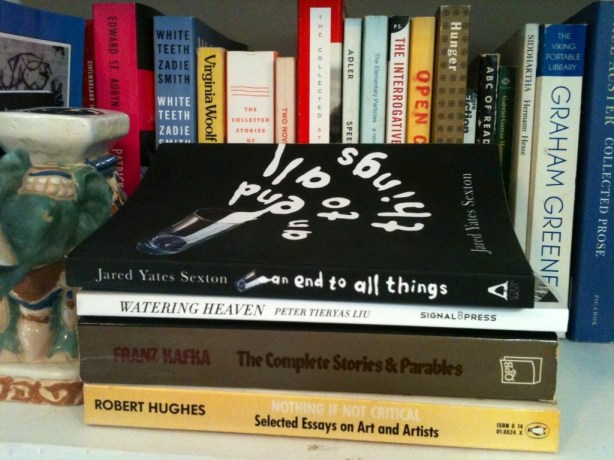
This is the front stack—books that need proper shelving elsewhere, books that I’ve read (and sometimes reviewed here) in the past few months, or meant to read, or in some other way consulted or read from:

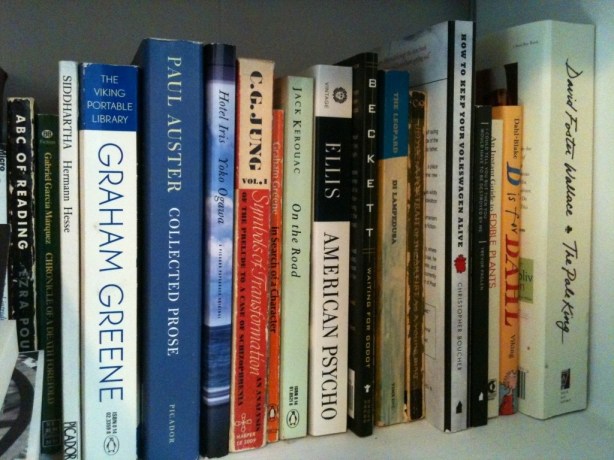
The far right side of the shelf—again, a very mixed bag. I think I originally intended to properly shelf everything here and then got sidetracked:
Moving left:
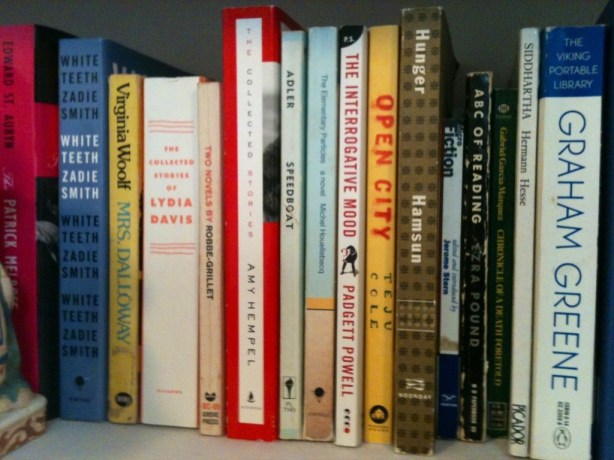
And here’s what’s behind the front stack—okay, I can see now the edges of an idea I had for shelving; I also see where I just abandoned that idea:
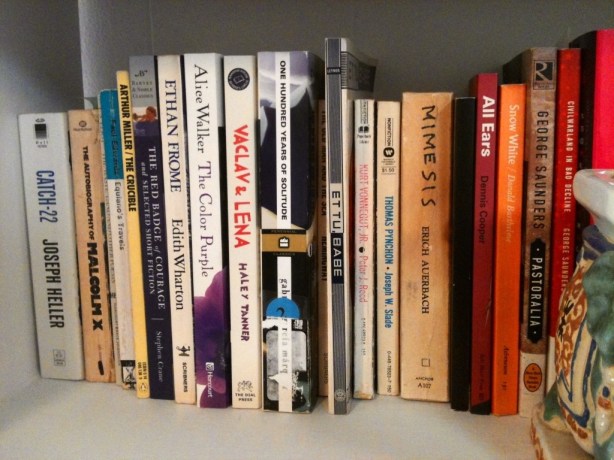
This whole project I blame on an essay by Georges Perec, collected in this one:
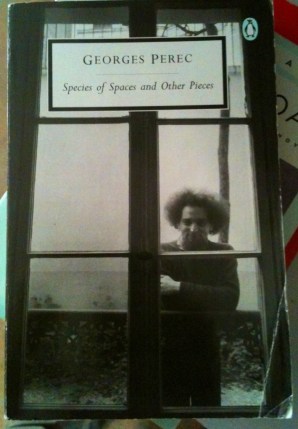
This is one of my favorite book covers:
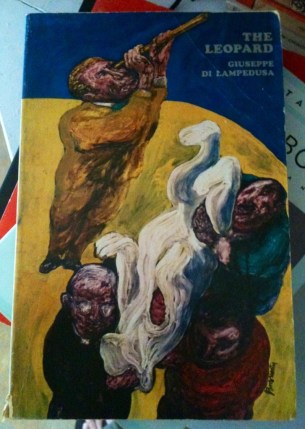
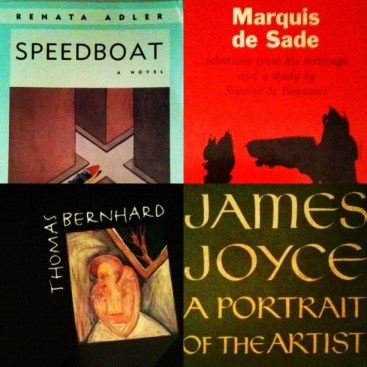
More covers I like from this shelf:
Eleven Authors Who Were Also Veterans of War
Eleven Authors Who Were Also Veterans of War
1. Stendahl (Napoleonic Wars)
2. Ambrose Bierce (Union Army, American Civil War)
3. Erich Maria Remarque (German Army, WWI)
4. George Orwell (Republican Army, Spanish Civil War)
5. Kurt Vonnegut (U.S. Army, WWII)
6. Joseph Heller (U.S. Air Force, WWII)
7. Eveyln Waugh (British Royal Marines, WWII)
8. Norman Mailer (U.S Army, WWII)
9. Gore Vidal (U.S. Army, WWII)
10. Tim O’Brien (U.S. Army, Vietnam War)
11. Anthony Swofford (U.S. Marine Corps, Persian Gulf War)
“Parable of Cervantes and Don Quixote” — Jorge Luis Borges

Destiny — John William Waterhouse

Waiting for Elmo — Sesame Street Does Beckett
Still Life with Fruit, Dead Game, Vegetables, a Live Monkey, Squirrel and Cat — Frans Snyders

Slavoj Žižek on Love, Belief, Snapple
Why I’m Not Particularly Interested in Reading a DFW Biography
(Think about it — the personal lives of most people who spend 14 hours a day sitting there alone, reading and writing, are not going to be thrill rides to hear about.)
–David Foster Wallace on literary biography in general and Edwin Williamson’s Borges: A Life in particular; from “Borges on the Couch,” a 2004 NYT piece republished this month in the David Foster Wallace collection Both Flesh and Not.
The First Lesson — Carl Larsson

Reading Chris Ware’s Building Stories / Untitled Wordless Loop

Continuing this project:
I’ve thus far titled the pieces I’ve been reading of Chris Ware’s Building Stories in a rather ad hoc fashion, but this entry is a wordless affair.
It continues the story of the “lonely girl,” the “cripple” who is the primary narrator of September 23rd, 2000.
Here, we see her raising her daughter in a series of wordless, precise panels that span roughly a decade.
Building Stories’s brilliance derives in large part from its precision and economy—Ware tells a story on every page, a chapter in every small panel:

I’m a parent (my daughter is five, my son is two), and so much of this untitled piece struck me as utterly real and authentic—so true in the details.
There’s a moment when our mother looks up to see her daughter reading—silently, to herself—that is bittersweet, a kind of gentle heartbreak:

There’s a fine line between the precise evocation of emotion and sentimental schlock, but Ware never comes close to treading it here—he’s always firmly on the side of the real.
And yet this doesn’t come at the expense of evocations of wonder, as we can see in the panels below:

As I’ve suggested a few times already, Building Stories is a sort of Möbius strip; this particular comic nearly literalizes this metaphor.
It begins with our mother drifting from sleep to waking memory, and ends thusly, a strange loop documenting how fast and how slow life changes.
“The Great Bridge Between Modernism and Post-modernism” — David Foster Wallace on Jorge Luis Borges
. . . Borges is arguably the great bridge between modernism and post-modernism in world literature. He is modernist in that his fiction shows a first-rate human mind stripped of all foundations in religious or ideological certainty — a mind turned thus wholly in on itself. His stories are inbent and hermetic, with the oblique terror of a game whose rules are unknown and its stakes everything.
And the mind of those stories is nearly always a mind that lives in and through books. This is because Borges the writer is, fundamentally, a reader. The dense, obscure allusiveness of his fiction is not a tic, or even really a style; and it is no accident that his best stories are often fake essays, or reviews of fictitious books, or have texts at their plots’ centers, or have as protagonists Homer or Dante or Averroes. Whether for seminal artistic reasons or neurotic personal ones or both, Borges collapses reader and writer into a new kind of aesthetic agent, one who makes stories out of stories, one for whom reading is essentially — consciously — a creative act. This is not, however, because Borges is a metafictionist or a cleverly disguised critic. It is because he knows that there’s finally no difference — that murderer and victim, detective and fugitive, performer and audience are the same. Obviously, this has postmodern implications (hence the pontine claim above), but Borges’s is really a mystical insight, and a profound one. It’s also frightening, since the line between monism and solipsism is thin and porous, more to do with spirit than with mind per se. And, as an artistic program, this kind of collapse/transcendence of individual identity is also paradoxical, requiring a grotesque self-obsession combined with an almost total effacement of self and personality. Tics and obsessions aside, what makes a Borges story Borgesian is the odd, ineluctable sense you get that no one and everyone did it.
—From “Borges on the Couch,” a 2004 NYT piece republished this month in the David Foster Wallace collection Both Flesh and Not.
The Connoisseur — Norman Rockwell

Read “A Tree, A Rock, A Cloud,” a Short Story by Carson McCullers
“A Tree, A Rock, A Cloud” by Carson McCullers
It was raining that morning, and still very dark. When the boy reached the streetcar café he had almost finished his route and he went in for a cup of coffee. The place was an all-night café owned by a bitter and stingy man called Leo. After the raw, empty street, the café seemed friendly and bright: along the counter there were a couple of soldiers, three spinners from the cotton mill, and in a corner a man who sat hunched over with his nose and half his face down in a beer mug. The boy wore a helmet such as aviators wear. When he went into the café he unbuckled the chin strap and raised the right flap up over his pink little ear; often as he drank his coffee someone would speak to him in a friendly way. But this morning Leo did not look into his face and none of the men were talking. He paid and was leaving the café when a voice called out to him:
“Son! Hey Son!”
He turned back and the man in the corner was crooking his finger and nodding to him. He had brought his face out of the beer mug and he seemed suddenly very happy. The man was long and pale, with a big nose and faded orange hair.
“Hey Son!”
The boy went toward him. He was an undersized boy of about twelve, with one shoulder drawn higher than the other because of the weight of the paper sack. His face was shallow, freckled, and his eyes were round child eyes.
“Yeah Mister?”
The man laid one hand on the paper boy’s shoulders, then grasped the boy’s chin and turned his face slowly from one side to the other. The boy shrank back uneasily.
“Say! What’s the big idea?”
The boy’s voice was shrill; inside the café it was suddenly very quiet.
The man said slowly. “I love you.”
All along the counter the men laughed. The boy, who had scowled and sidled away, did not know what to do. He looked over the counter at Leo, and Leo watched him with a weary, brittle jeer. The boy tried to laugh also. But the man was serious and sad.
“I did not mean to tease you, Son,” he said. “Sit down and have a beer with me. There is something I have to explain.”
Cautiously, out of the corner of his eye, the paper boy questioned the men along the counter to see what he should do. But they had gone back to their beer or their breakfast and did not notice him. Leo put a cup of coffee on the counter and a little jug of cream.
“He is a minor,” Leo said. Continue reading “Read “A Tree, A Rock, A Cloud,” a Short Story by Carson McCullers”
Jared Yates Sexton’s An End to All Things (Book Acquired Sometime Last Month)
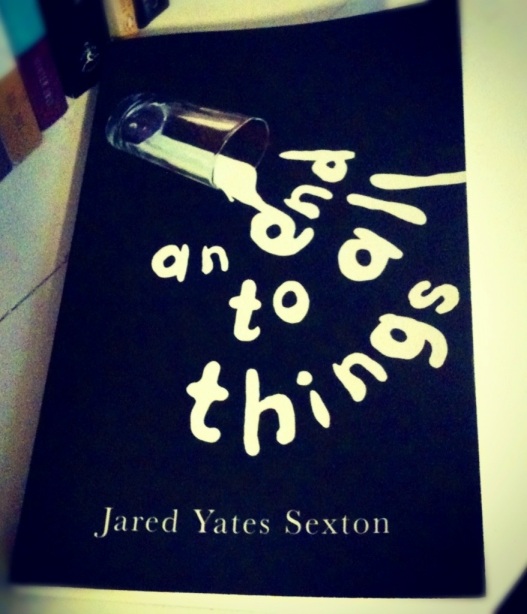
Jared Yates Sexton’s An End to All Things immediately appealed to me when it arrived last month. This collection is stocked with short, precise, unpretentious stories. Great sentences—shades of Hannah, Carver, Pancake. I’ve read about half a dozen so far, parceling them out over spare afternoon minutes and it’s good stuff—feels real without the strains of literary realism. You can read a story at publisher Atticus Books’ site, “You Never Ask Me About My Dreams” (great title). The first few paragraphs:
At that point things had been rough for a couple of months and I would’ve done anything to ease the tension. I set an alarm for half an hour earlier than usual. I thought if I had some breakfast going when Cathy got up she’d have to see that I cared.
After all, cooking wasn’t the easiest thing to do in our house. Both of us hated dishes so the kitchen was always a mess. There were pots and pans stacked on the counters and plates in the sink. Some still had clumps of food stuck to them. I even had to rinse out a bowl to use. Somehow there were a couple of clean forks and knives in the drawer. I got some eggs from the fridge and went to work scrambling the yolks.
 Biblioklept