 Repin
Repin

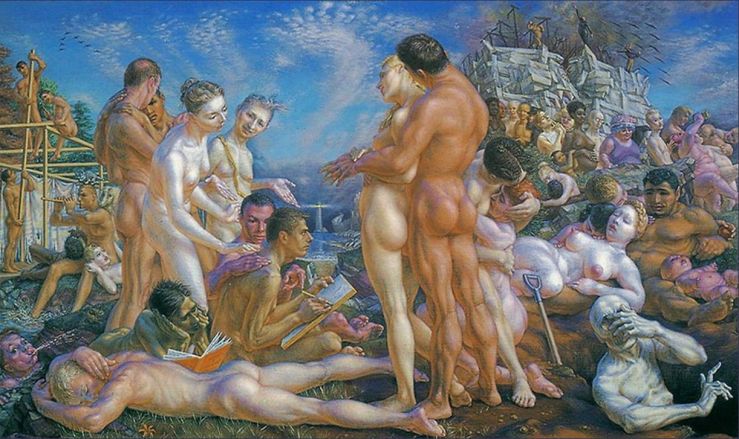
Degas

Escher
 Freud
Freud

It’s summer so maybe you need some books to read. Indie presses are the bestest.
Extinction by Ashley Dawson from OR Books. This is a devastating little big book about, a sustained attack on “capitalism’s global attack on the commons, the great trove of air, water, plants, and creatures that has been regarded traditionally as the inheritance of humanity as a whole.” We won’t be able to shop our way out of the apocalypse. (I wrote about it in more depth here).
American Candide by Mahendra Singh from Rosarium. I reviewed American Candide earlier this year on Biblioklept, writing:
Singh’s update-reboot-translation of Candide fittingly answers Voltaire’s pessimistic prescience with not just bitter affirmations of contemporary predation and evil, but also with an eye toward entertainment—to the affirmations of laughter.
Quiet Creature on the Corner by João Gilberto Noll (English translation by Adam Morris) from Two Lines Press. In my recent review, I wrote that
Quiet Creature on the Corner is a nightmarish, abject, kinetic, surreal, picaresque read, a mysterious prose-poem that resists allegorical interpretation. I read it and then I read it again. It’s a puzzle. I enjoyed it tremendously.
Vertigo by Joanna Walsh from Dorothy. The stories here hum and hang together, evoking consciousness—consciousness’s anxieties, desires, its imaginative consolations. Vertigo is simultaneously disorienting and familiar, often quite funny, and sometimes a bit sad.
Postal Child by Joey Truman from Whisk(e)y Tit. Not a “bit sad” but “sad sad.” Abject and cruel and terrifying. But also…funny? Maybe?
Crossing the Sea with Syrians on the Exodus to Europe by Wolfgang Bauer with photographs by Stanislav Krupar; (English translation by Sarah Prybus). From And Other Stories. Brutal and moving reportage.
Syrian Notebooks: Inside the Homs Uprising by Jonathan Littell (English translation by Charlotte Mandell). From Verso. Three weeks reporting from hell—terse, precise, and raw. Littell functions as eyes and ears and a body, a concrete sensing thing, an immediate thing, a thing that doesn’t try to synthesize or process or otherwise mediate what is happening to him.
Since I have grown older I have often gone back and tried to analyze the change that came into my life after that fateful day in school. There did come a radical change, and, young as I was, I felt fully conscious of it, though I did not fully comprehend it. Like my first spanking, it is one of the few incidents in my life that I can remember clearly. In the life of everyone there is a limited number of unhappy experiences which are not written upon the memory, but stamped there with a die; and in long years after, they can be called up in detail, and every emotion that was stirred by them can be lived through anew; these are the tragedies of life. We may grow to include some of them among the trivial incidents of childhood—a broken toy, a promise made to us which was not kept, a harsh, heart-piercing word—but these, too, as well as the bitter experiences and disappointments of mature years, are the tragedies of life.
And so I have often lived through that hour, that day, that week, in which was wrought the miracle of my transition from one world into another; for I did indeed pass into another world. From that time I looked out through other eyes, my thoughts were colored, my words dictated, my actions limited by one dominating, all-pervading idea which constantly increased in force and weight until I finally realized in it a great, tangible fact.
And this is the dwarfing, warping, distorting influence which operates upon each and every colored man in the United States. He is forced to take his outlook on all things, not from the viewpoint of a citizen, or a man, or even a human being, but from the viewpoint of a colored man. It is wonderful to me that the race has progressed so broadly as it has, since most of its thought and all of its activity must run through the narrow neck of this one funnel.
And it is this, too, which makes the colored people of this country, in reality, a mystery to the whites. It is a difficult thing for a white man to learn what a colored man really thinks; because, generally, with the latter an additional and different light must be brought to bear on what he thinks; and his thoughts are often influenced by considerations so delicate and subtle that it would be impossible for him to confess or explain them to one of the opposite race. This gives to every colored man, in proportion to his intellectuality, a sort of dual personality; there is one phase of him which is disclosed only in the freemasonry of his own race. I have often watched with interest and sometimes with amazement even ignorant colored men under cover of broad grins and minstrel antics maintain this dualism in the presence of white men.
I believe it to be a fact that the colored people of this country know and understand the white people better than the white people know and understand them.
From Ch. 2 of James Weldon Johnson’s novel The Autobiography of an Ex-Colored Man. First published anonymously in 1912, and later reissued in 1927 under Johnson’s (now famous) name, Autobiography is an under-read classic, a fascinating and complex condensation of racism, colorism, and class in early twentieth-century America. Johnson was born on this day in 1871 in Jacksonville, Florida.

What did Leopold actually do on June 16th, 1904?

Selections from one-star Amazon reviews of Ulysses
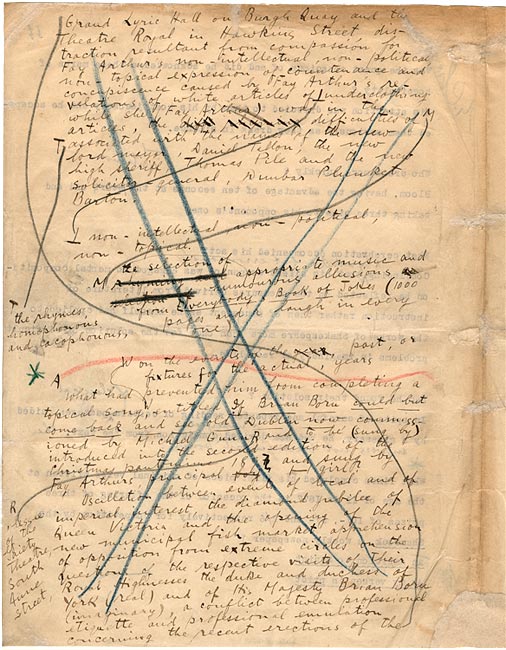
A list of Irish heroes (from “The Cyclops” episode of Ulysses)

Another page of Joyce’s notes, plus links to more

William Faulkner’s Joyce anxiety
Biblioklept’s lousy review (the review is lousy, not the book) of Dubliners
Joyce’s entry on the 1901 Irish Census

Biblioklept’s review (not so lousy, the review) of a superior full-cast audio recording of Ulysses
James Joyce explains why Odysseus is the most “complete man’ in literature

Leopold’s Bloom’s recipe for burnt kidney breakfast

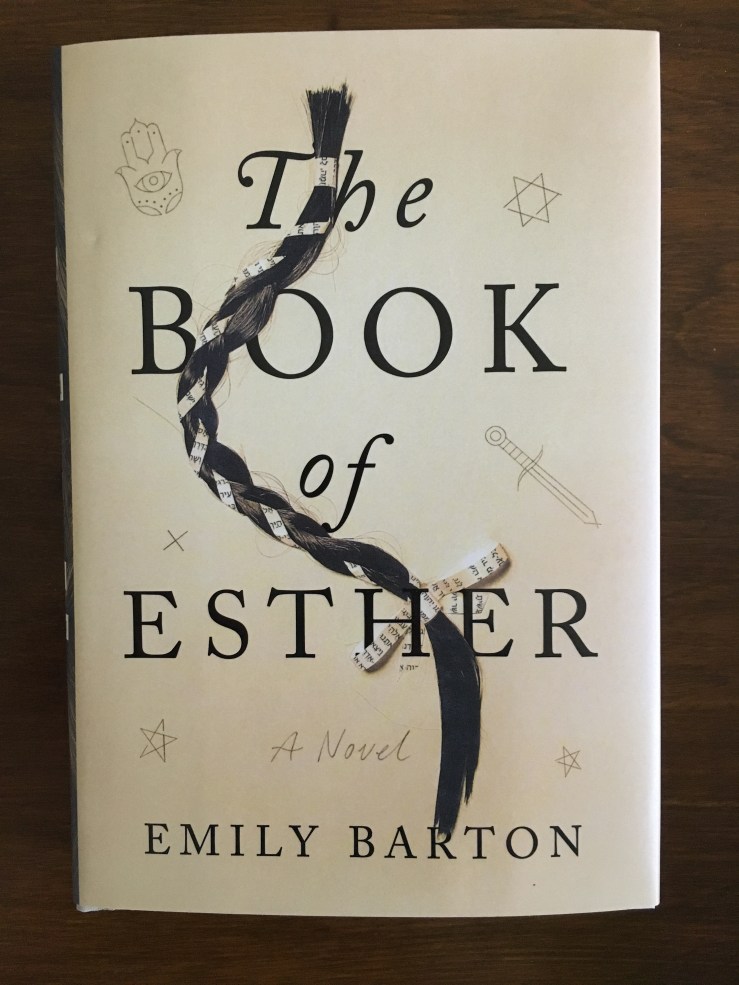
Emily Barton’s The Book of Esther is new from Crown (Penguin-Random House). Their blurb:
Eastern Europe, August 1942. The Khazar kaganate, an isolated nation of Turkic warrior Jews, lies between the Pontus Euxinus (the Black Sea) and the Khazar Sea (the Caspian). It also happens to lie between a belligerent nation to the west that the Khazars call Germania—and a city the rest of the world calls Stalingrad.
After witnessing the first foray of Germani warplanes into sovereign Khazar territory, Esther bat Josephus, daughter of Khazaria’s chief policy adviser, knows she must fight for her country. Germania is gaining ground and if they are successful, the Khazar kaganate will be wiped out. Only Esther sees the ominous implications of Germania’s disregard for Jewish lives. But as a woman she is prohibited from joining the war effort. Her one chance is to set out on her mechanical horse, Seleme, accompanied by Itakh, her adopted brother, to seek a fabled village of kabbalists. They may hold the key to her destiny: their rumored ability to change her into a man so that she may convince her entire nation to join in the fight for its very existence against an enemy like none Khazaria has faced before.
THE BOOK OF ESTHER is a genre-bending novel by a writer who invents worlds “out of Calvino or Borges” (The New Yorker). Reminiscent of Michael Chabon’s The Yiddish Policemen’s Union and Philip Roth’s The Plot Against America, readers will delight in this tour de force novel which blends rich steampunk fantasy, powerful feminism, and Jewish mysticism into a singular piece of fiction.
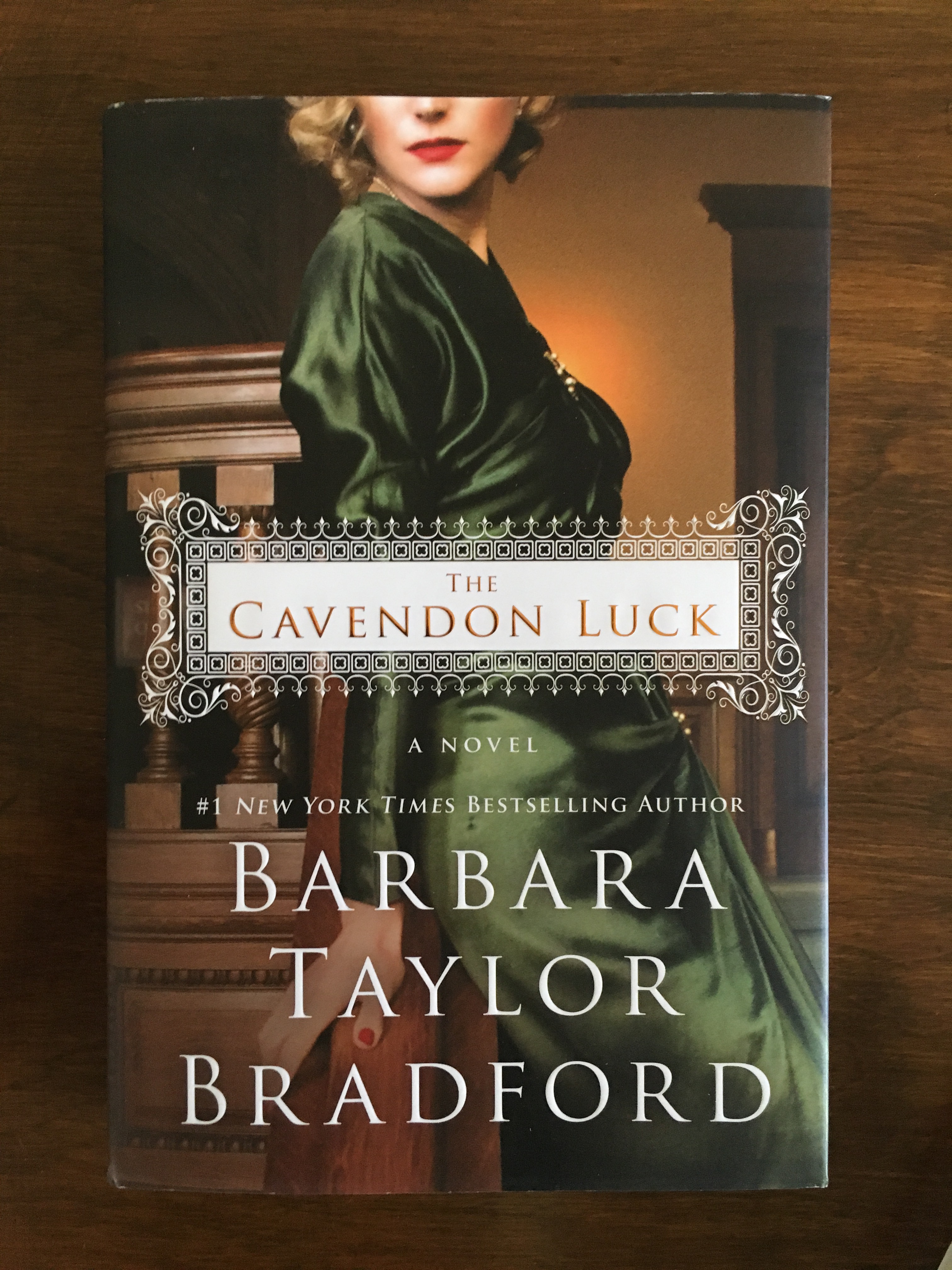
Barbara Taylor Bradford’s novel The Cavendon Luck is new from St. Martin’s. Their blurb:
It is 1938 in England, and Miles and Cecily Ingham have lead the family in bringing the Cavendon estate back from the brink of disaster. But now, with the arrival of World War II, Cavendon Hall will face its biggest challenge yet. It is a challenge that will push the Inghams and Swanns to protect each other and the villagers, and reveal their true capacity for survival and rebirth.
Told with Bradford’s deft, evocative prose and featuring a beloved cast of characters, The Cavendon Luck is a story of intrigue, romance, sorrow, and joy that readers won’t soon forget.

Queer by William S. Burroughs. Trade paperback by Penguin; copyrighted 1987 but no year of the actual printing, which I’m sure is sometime in the mid-nineties. Cover design by Daniel Rembert from a painting by Burroughs.
I bought Queer and Junkie at the Barnes & Noble where I spent too many Friday nights of my high school years. I was sophomore in high school, I think. My parents were concerned about the books, I recall, but in a vague, troubled way—a wrinkling of the temples, a look that I now know means, What does this mean? What are we supposed to do here? They asked me what the books were about and then told me not to do heroin.

O Pioneers! by Willa Cather. Hardback and cloth by Houghtin Mifflin, 31st printing, 1961. No designer is credited; the book may have had a dust jacket at one point.
The dark marks are from a librarian’s tape job. She gave me this book, and dozens others, which were being remaindered. I reread the novel a few years ago, noting some of its themes, “including the divide between the New World and the Old, alienation, and the ways in which conformity and routine are antithetical to the pioneer spirit that Americans like to trick themselves into believing they are heir to.”

My Sister’s Hand in Mine by Jane Bowles. Trade paperback by the Ecco Press, 7th printing, 1988. Cover design by Anna Demchick.
This collection includes the novel Two Serious Ladies, one of the best and strangest books I’ve read in years. I wrote about it last year on this blog, concluding:
The reading experience cannot be easily distilled. (Strike that adverb). Two Serious Ladies resists unfolding in the way we expect our narratives to unfold—to be about something—Bowles withholds exposition, clarification, and motivation—well, okay, not withholds, but rather hides, or obscures, or enshadows. (I don’t have the verbs for this book). I think of Harold Bloom’s rubric for canonical literature here. In The Western Canon, he argues that strong literature exemplifies a “strangeness, a mode of originality that either cannot be assimilated, or that so assimilates us that we cease to see it as strange.” Nearly three-quarters of a century after its publication, Two Serious Ladies is still strange, still strong, still ahead of its time. Its vignettes flow (or jerk or shift or pitch wildly or dip or soar or sneak) into each other with a wonderfully dark comic force that simultaneously alienates and invites the reader, who, bewildered by its transpositions, is compelled to follow into strange new territory. Very highly recommended.
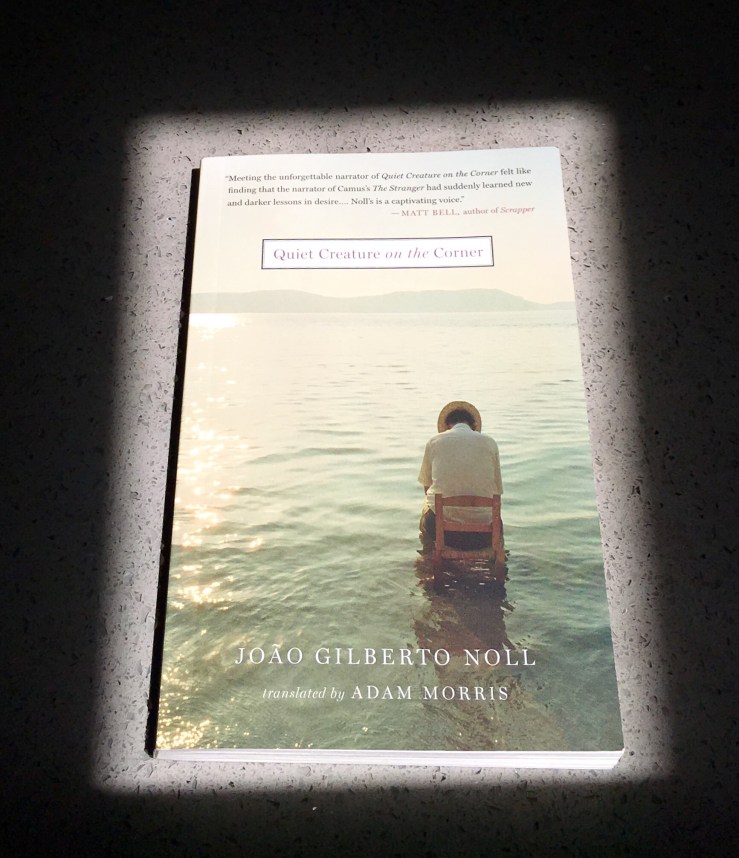
Brazilian writer João Gilberto Noll’s 1991 novella Quiet Creature on the Corner is new in English translation (by Adam Morris) from Two Lines Press.
The book is probably best read without any kind of foregrounding or forewarning.
Forewarning (and enthusiastic endorsement): Quiet Creature on the Corner is a nightmarish, abject, kinetic, surreal, picaresque read, a mysterious prose-poem that resists allegorical interpretation. I read it and then I read it again. It’s a puzzle. I enjoyed it tremendously.
So…what’s it about?
For summary, I’ll lazily cite the back of the book:
…Quiet Creature on the Corner throws us into a strange world without rational cause and effect, where everyone always seems to lack just a few necessary facts. The narrator is an unemployed poet who is thrown in jail after inexplicably raping his neighbor. But then he’s abruptly taken to a countryside manor where all that’s required of him is to write poetry. What do his captors really want from him?
There’s a lot more going on than that.
So…what’s it about? What’s the “a lot more”?
Okay then.
Maybe let’s use body metaphors. Maybe that will work here.
We are constantly leaking. Blood, sweat, tears. Piss, shit, decay. Cells sloughing off. Snot trickling. Vomit spewing. Shuffling of this mortal etc.
(—Are we off to a bad start? Have I alienated you, reader, from my request that you read Noll’s novella?—)
What I want to say is:
We are abject: there are parts of us that are not us but are us, parts that we would disallow, discard, flush away. We are discontinuous, rotten affairs. Bodies are porous. We leak.
We plug up the leaks with metaphors, symbols, tricks, gambits, recollections, reminiscences. We convert shame into ritual and ritual into history. We give ourselves a story, a continuity. An out from all that abjection. An organization to all those organs. We call it an identity, we frame it in memory.
What has this to do with Noll’s novella?, you may ask, gentle reader. Well. We expect a narrative to be organized, to represent a body of work. And Quiet Creature on the Corner is organized, it is a body—but one in which much of the connective tissue has been extricated from the viscera.
We never come to understand our first-person narrator, a would-be poet in the midst of a Kafkaesque anti-quest. And our narrator never comes to understand himself (thank goodness). He’s missing the connective tissue, the causes for all the effects. Quiet Corner exposes identity as an abject thing, porous, fractured, unprotected by stabilizing memory. What’s left is the body, a violent mass of leaking gases liquids solids, shuttling its messy consciousness from one damn place to the next.
Perhaps as a way to become more than just a body, to stabilize his identity, and to transcend his poverty, the narrator writes poems. However, apart from occasional brusque summaries, we don’t get much of his poetry. (The previous sentence is untrue. The entirety of Quiet Creature on the Corner is the narrator’s poem. But let’s move on). He shares only a few lines of what he claims is the last poem he ever writes: “A shot in the yard out front / A hardened fingernail scraping the tepid earth.” Perhaps Quiet Creature is condensed in these two lines: A violent, mysterious milieu and the artist who wishes to record, describe, and analyze it—yet, lacking the necessary tools, he resorts to implementing a finger for a crude pencil. Marks in the dirt. An abject effort. A way of saying, “I was here.” A way of saying I.
Poetry perhaps offers our narrator—and the perhaps here is a big perhaps—a temporary transcendence from the nightmarish (un)reality of his environs. In an early episode, he’s taken from jail to a clinic where he is given a nice clean bed and decides to sleep, finally:
I dreamed I was writing a poem in which two horses were whinnying. When I woke up, there they were, still whinnying, only this time outside the poem, a few steps a way, and I could mount them if I wanted to.
Rest, dream, create. Our hero moves from a Porto Alegre slum to a hellish jail to a quiet clinic and into a dream, which he converts into a pastoral semi-paradise. The narrator lives a full second life here with his horses, his farm, a wife and kids. (He even enjoys a roll in the hay). And yet sinister vibes reverberate under every line, puncturing the narrator’s bucolic reverie. Our poet doesn’t so much wake up from his dream; rather, he’s pulled from it into yet another nightmare by a man named Kurt.
Kurt and his wife Gerda are the so-called “captors” of the poet, who is happy, or happyish, in his clean, catered captivity. He’s able to write and read, and if the country manor is a sinister, bizarre place, he fits right in. Kurt and Gerda become strange parent figures to the poet. Various Oedipal dramas play out—always with the connective tissue removed and disposed of, the causes absent from their effects. We get illnesses, rapes, corpses. We get the specter of Brazil’s taboo past—are Germans Kurt and Gerda Nazis émigrés? Quiet Creature evokes allegorical contours only to collapse them a few images later.
What inheres is the novella’s nightmare tone and rhythm, its picaresque energy, its tingling dread. Our poet-hero finds himself in every sort of awful predicament, yet he often revels in it. If he’s not equipped with a memory, he’s also unencumbered by one.
And without memory the body must do its best. A representative passage from the book’s midway point:
Suddenly my body calmed, normalizing my breathing. I didn’t understand what I was doing there, lying with my head in a puddle of piss, deeply inhaling the sharp smell of the piss, as though, predicting this would help me recover my memory, and the memory that had knocked me to the floor appeared, little by little, and I became fascinated, as what had begun as a theatrical seizure to get rid of the guy who called himself a cop had become a thing that had really thrown me outside myself.
Here, we see the body as its own theater, with consciousness not a commander but a bewildered prisoner, abject, awakened into reality by a puddle of piss and threatened by external authorities, those who call themselves cops. Here, a theatrical seizure conveys meaning in a way that supersedes language.
Indeed our poet doesn’t harness and command language with purpose—rather, he emits it:
No, I repeated without knowing why. Sometimes a word slips out of me like that, before I have time to formalize an intention in my head. Sometimes on such occasions it comes to me with relief, as though I’ve felt myself distilling something that only once finished and outside me, I’ll be able to know.
And so, if we are constantly leaking, we leak language too.
It’s the language that propels Noll’s novella. Each sentence made me want to read the next sentence. Adam Morris’s translation rockets along, employing comma splice after comma splice. The run-on sentences rhetorically double the narrative’s lack of connecting tissue. Subordinating and coordinating conjunctions are rare here. Em dashes are not.
The imagery too compels the reader (this reader, I mean)—strange, surreal. Another passage:
Our arrival at the manor.
The power was out. We lit lanterns.
I found a horrible bug underneath the stove. It could have been a spider but it looked more like a hangman. I was on my knees and I smashed it with the base of my lantern. The moon was full. The low sky, clotted with stars, was coming in the kitchen window. December, but the night couldn’t be called warm—because it was windy. I was crawling along the kitchen tiles with lantern in hand, looking for something that Kurt couldn’t find. I was crawling across the kitchen without much hope for my search: he didn’t the faintest idea of where I could find it.
What was the thing Kurt and the narrator searched for? I never found it, but maybe it’s somewhere there in the narrative.
Quiet Creature on the Corner is like a puzzle, but a puzzle without a reference picture, a puzzle with pieces missing. The publishers have compared the novella to the films of David Lynch, and the connection is not inaccurate. Too, Quiet Creature evokes other sinister Lynchian puzzlers, like Roberto Bolaño’s 2666 (or Nazi Literature in the Americas, which it is perhaps a twin text to). It’s easy to compare much of postmodern literature to Kafka, but Quiet Creature is truly Kafkaesque. It also recalled to me another Kafkaesque novel, Alasdair Gray’s Lanark—both are soaked in a dark dream logic. Other reference points abound—the paintings of Francis Bacon, Leon Golub, Hieronymus Bosch, Goya’s etchings, etc. But Noll’s narrative is its own thing, wholly.
I reach the end of this “review” and realize there are so many little details I left out that I should have talked about–a doppelgänger and street preachers, an election and umbanda, Bach and flatulence, milking and mothers…the wonderful crunch of the title in its English translation—read it out loud! Also, as I reach the end of this (leaky) review, I realize that I seem to understand Quiet Creature less than I did before writing about it. Always a good sign.
João Gilberto Noll’s Quiet Creature on the Corner isn’t for everyone, but I loved it, and look forward to future English translations—Two Lines plans to publish his 1989 novel Atlantic Hotel in the spring of next year. I’ll probably read Quiet Creature again before then. Hopefully I’ll find it even weirder.
Stendhal’s The Red and the Black
Boston, 1943. I am about to go down to the submarine base to test out for the school there. I have come into possession of the Liveright Black and Gold edition. (What a wonderful series. I loved them all. There was Jules Romain’s The Body’s Rapture, a kooky, overwrought book, I know now, but it was sex, and it was French. There was Remy de Gourmont’s The Natural Philosophy of Love, more sex, more French. There was Balzac’s The Physiology of Marriage, more sex, more French. There was Stendhal’s own On Love, ditto. There was The Collected Works of Pierre Loüys, double dots, double ditto. There was Alexandre Dumas’s The Journal of Madame Giovanni, which was simply French, a disappointment. And The Red and the Black, like checker squares.) Anyway, I am lining up New London in my train table’s sights, and scanning the novel I have bought because of the series it is in, thinking that I’m not going to like climbing a rope through all that water, and thinking that the first chapter, a description of a small town, is commonplace, ho-hum, and will I be put in a pressure chamber at sub school like a canned tomato? When suddenly, I am suckered into Stendhal, and no longer read words (against all the rules of right reading I will later give myself), but barrel along like my own train, a runaway, holding my breath oftener and oftener, aware only of a insistently increasing tension, and it is not because I am underwater; it is because I am inside the magic of this narrative master. The Charterhouse of Parma would do exactly the same thing to me, except that I didn’t let a sub school come between us, but covered its lengthy length as nearly in one sitting as might be managed, snacking at the edge of it as though it were on a TV tray. That sort of gluttonous read is rare, and never happens to me now, when I read, because I read to write or teach or otherwise to talk, and not because I am a reading madman about to lose his soul to the seductions of a sentence.
From William H. Gass’s “Fifty Literary Pillars,” part of A Temple of Texts (2006). The essay in question is not so much an essay as it is/was a catalog to “inaugurate the International Writers Center” at Washington University.
The last sentence is what matters most to me; when I read it I nodded, or maybe didn’t nod, maybe just acquiesced in some other way, physically.
Who wouldn’t love to read like that again?
(Maybe persons young enough to not know that they are in fact reading like madpersons, seduced, etc.).
I tip my glass for gluttonous reads.
I would love to be a reading madman again, and not one who reads to write or read or otherwise talk.
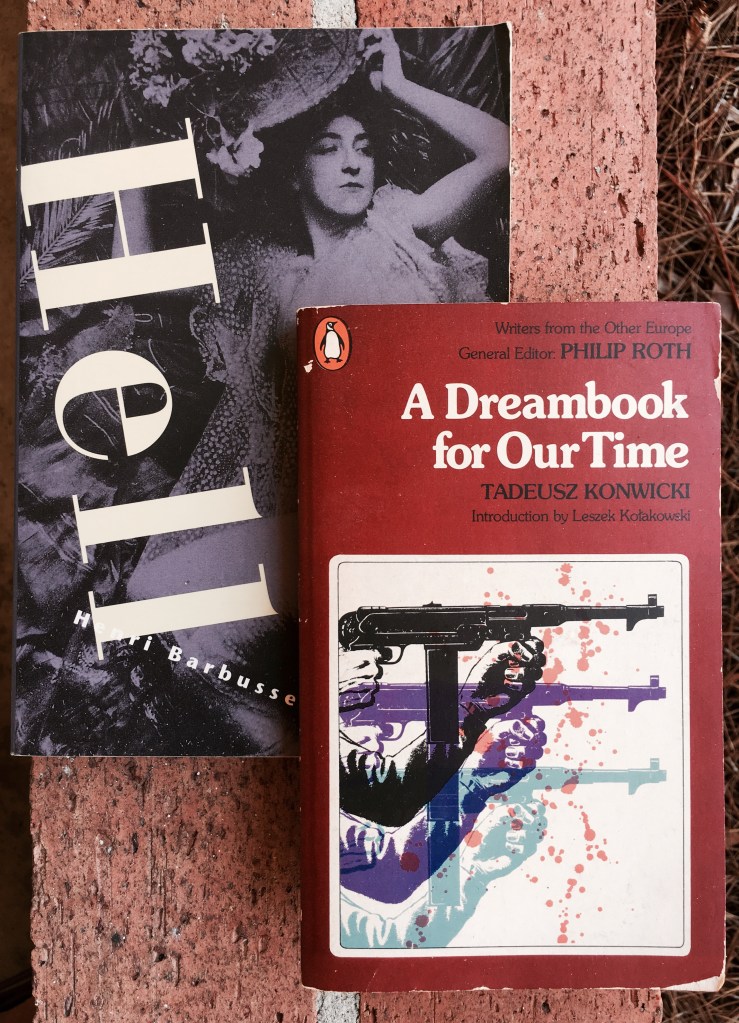
The Barbusse literally fell into my hands when I was pulling down a different book. I’d never heard of Hell until today but its title, cover, and blurb — “the most highly study of voyeurism” — sold me. Penguin’s Writers from Other Europe has always intrigued me and the cover alone on Tadeusz Konwicki’s A Dreambook for Our Time led to me picking it up.

The Sacred and Profane Love Machine by Iris Murdoch. First edition hardback, 1975 by The Book Club (Foyles Group of Book Clubs). Jacket design by Angela Maddigan.
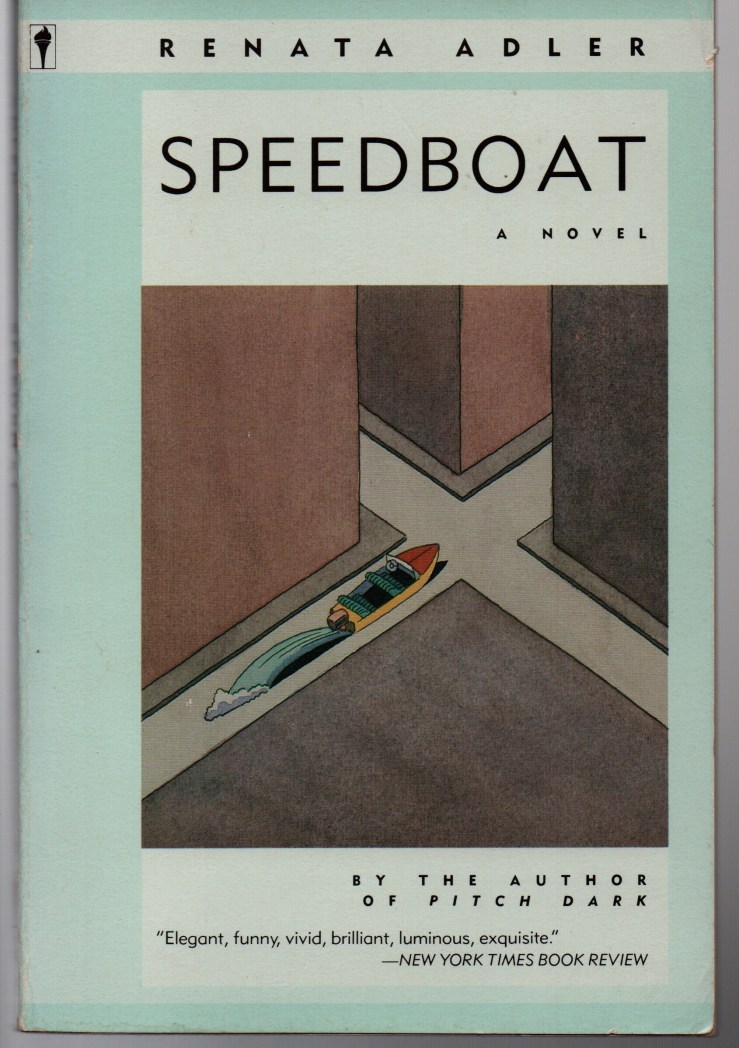
Speedboat by Renata Adler. First Perennial Library edition, 1988. Cover illustration by Steve Guarnaccia.

Snow White by Donald Barthelme. Mass market paperback by Atheneum, 1986 (7th printing). Cover illustration by William Steig.
They drove up to the Broadmoor, a pink Monaco castle at the foot of the Rockies, and he showed her the hotel in a proprietary way, taking her through the nifty Regency public rooms with their beautiful sofas, the striped, silken upholstery like tasteful flags. He showed her huge tiaras of chandelier, soft plush carpets. “Yes,” she said, “carpets were our first floors, our first highways.”
“I didn’t know that.”
“We call the rug in the hall a ‘runner.’ It’s where the runners or messengers waited in the days of kings and emperors.”
“I never made the connection.”
“It’s an insight. Chandeliers must have come in with the development of lens astronomy at the beginning of the seventeenth century. I should think it was an attempt to mimic rather than parody the order of the heavens, to bring the solar system indoors.”
“Really?”
“Well, where, to simple people, would the universe seem to go during the daylight hours, Ben?”
“But chandeliers give light.”
“Not during the daytime. The chandelier is a complex invention—a sculpture of the invisible stars by day, a pragmatic mechanism by night. But a much less daring device finally than carpeting.”
“Why, Patty?”
“Because carpeting—think of Oriental rugs—was always primarily ornamental and decorative. It was a deliberate expression of what ground—our first flooring, remember, and incidentally we have to regard tile, too, as a type of carpeting—ought to be in a perfect world. Order, symmetry, design. And since rugs came in before lens telescopy, how could they know? Oh, carpeting’s much more daring. A leap of will.”
“Of will?”
“Men will the laws of nature.”
From Stanley Elkin’s 1976 novel The Franchiser.
Hey, wow. Haven’t done one of these in a while.
I reread William Gaddis’s big big novel J R, writing—
Only a handful of novels are so perfectly simultaneously comic and tragic. Moby-Dick? Yes. Gravity’s Rainbow? Absolutely. (G R and J R, a duo published two years apart, spiritual twins, massive American novels that maybe America hardly deserves (or, rather: theses novels were/are totally the critique America deserves). I guess maybe what I’m saying is J R is the Great American Novel to Come (The Recognitions is perhaps overpraised and certainly not Gaddis’s best novel; J R is. The zeitgeist has been caught up to J R, the culture should (will) catch up).
I also read and wrote about Ashley Dawson’s Extinction: A Radical History, a scary little primer that argues mass species extinction is
…the product of a global attack on the commons, the great trove of air, water, plants and creatures, as well as collectively created cultural forms such as language, that have been regarded traditionally as the inheritance of humanity as a whole…capital of course depends on continuous commodification of this environment to sustain its growth.
My reading of Extinction—and hence my writing about it—is/was inextricably bound up in a viewing of Hayao Miyazaki’s 1997 eco-fable 1997 , Mononoke-hime. (The film’s title is usually rendered in English as Princess Mononoke, but I think Spirit-Monster Wolfchild is a more fitting translation). I also linked the book to Gilgamesh and Easter. And I used this gif:

I wrote a post about listening to audiobook versions of “difficult novels,” taking my lead and license from this big quote from William H. Gass’s essay “The Sentence Seeks Its Form”:
Breath (pneuma) has always been seen as a sign of life . . . Language is speech before it is anything. It is born of babble and shaped by imitating other sounds. It therefore must be listened to while it is being written. So the next time someone asks you that stupid question, “Who is your audience?” or “Whom do you write for?” you can answer, “The ear.” I don’t just read Henry James; I hear him. . . . The writer must be a musician—accordingly. Look at what you’ve written, but later … at your leisure. First—listen. Listen to Joyce, to Woolf, to Faulkner, to Melville.
99 reasons I didn’t read your novel.
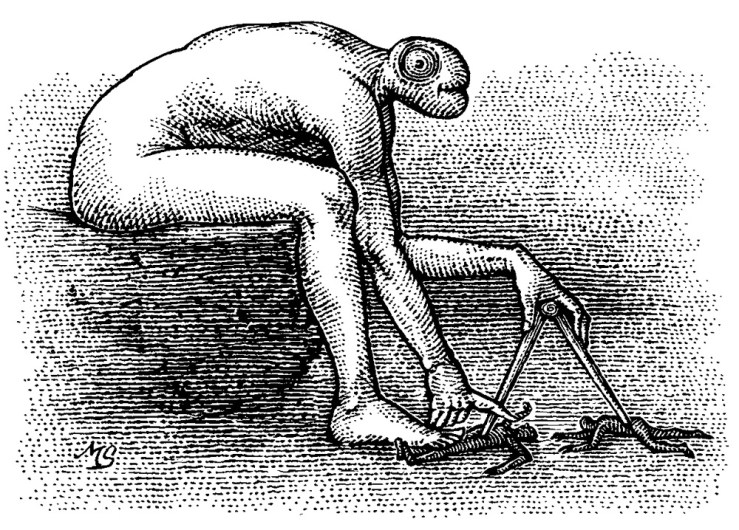
I reviewed Mahendra Singh’s marvelous satire American Candide. Far better than my measly review is a long interview I did with Singh, who is just a damn genius. I’m most grateful for the final exchange of our review, which was not really a part of the official q & a type thing we were doing—rather, I was bemoaning my ability to write anything lately, and Mahendra offered me the following, which I edited into the interview:
The hidden contempt that our culture harbors towards art will drive you nuts if you think about it … so don’t think too much … write instead! And if you can’t write, read smartly. I find great solace in the classics and have devoted most of my life to trying in whatever way I can to perpetuate the classical tradition (in concealment) and create situations where young people can gain access to the eternal truths and beauty of the classical world tradition. We are living in a time of imperial decline and must preserve the best of the past as our ancestors did in similar times of trouble. The pendulum will swing the other way in a few centuries.
I wrote about him in a Three Books post.
The three books had nothing to do with Prince.
Despite some fascinating images, I was not impressed by Ben Wheatley’s film adaptation of Ballard’s High-Rise. I concluded that,
While the High-Rise adaptation delivers Ballardian style, that Ballardian style only points at itself, and not at our Ballardian present, our Ballardian future.
And I wrote about Ferrante, Knausgaard, and their good/bad/ironic book covers.
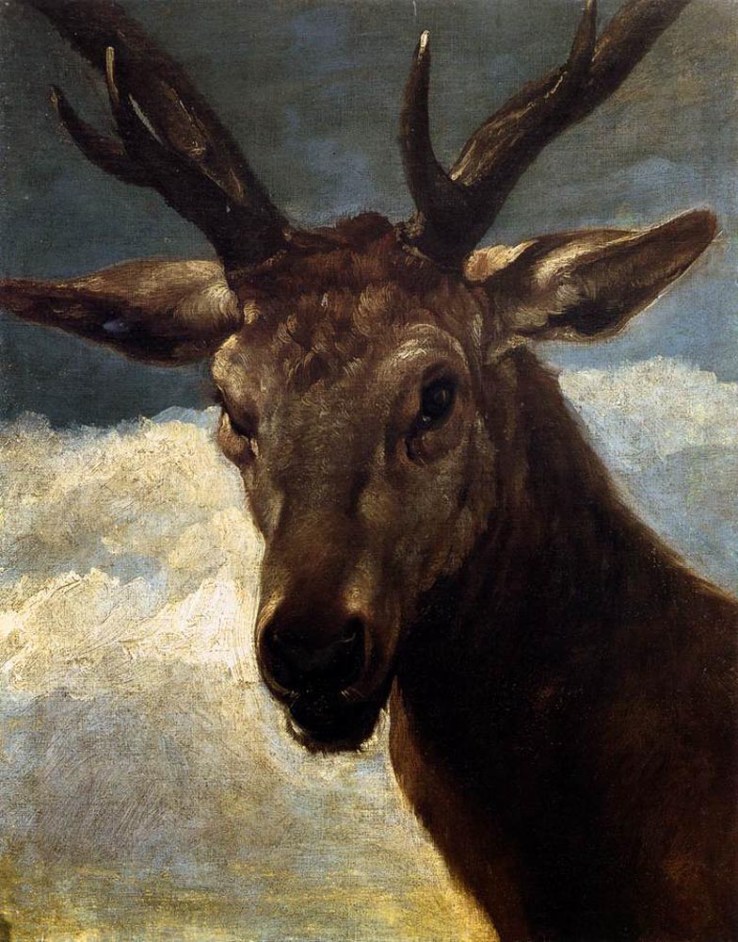
Here’s that promised stag (by Diego Velazquez):

My Struggle, Book 1 by Karl Ove Knausgaard. English translation by Don Bartlett. First edition trade paperback by FS&G, 2013. Cover design by Charlotte Strick and Bill Zindel, with cover art by Bill Zindel.
I couldn’t really get past page 80 of My Struggle, but I like Zindel’s zany design for the first volume enough to hold on to it. Kinda reminds me of those Vintage Contemporaries I so adore.
A lot of people didn’t like the design though, and FS&G didn’t end up publishing the rest of Zindel’s designs, which would’ve looked pretty neat as a complete set. As literary critic Scott Esposito put it at the time “the market has spoken, and it hates the original paperback.”
Instead, FS&G went with variations on this—
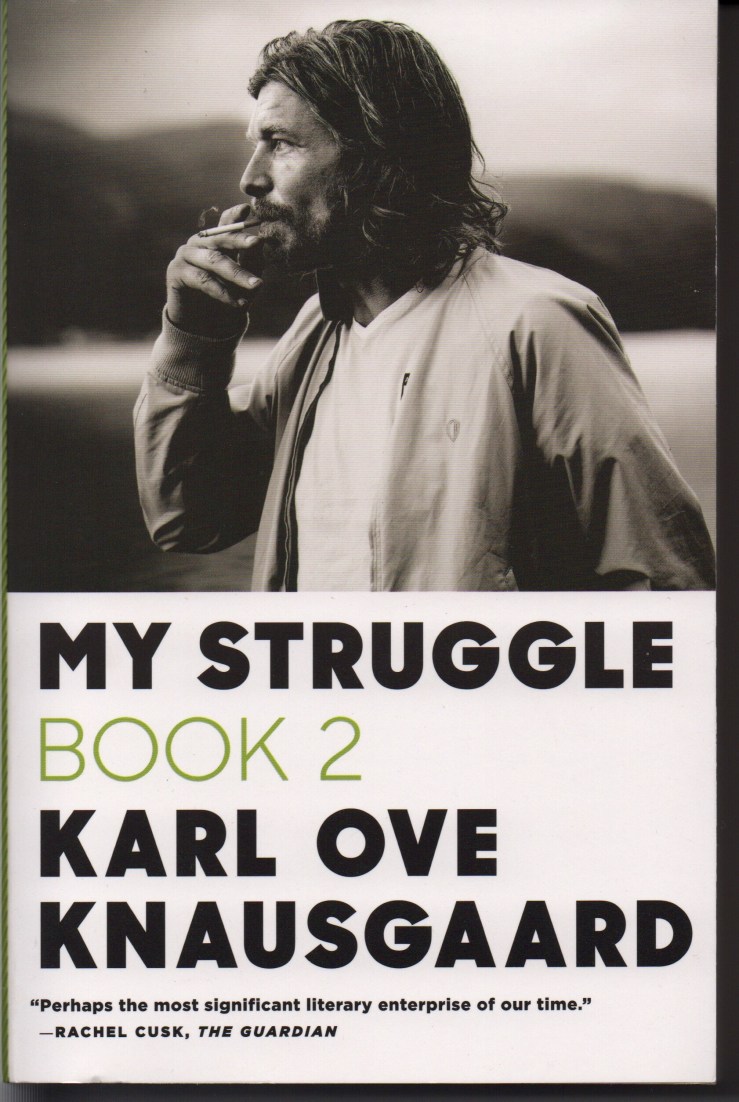
My Struggle, Book 2 by Karl Ove Knausgaard. English translation by Don Bartlett. First edition trade paperback by FS&G, 2014. Cover design by Charlotte Strick; photograph by Andreas Eikseth Nygjerd.
Look at our boy Knausgaard, smokin’ away! This cover is boring but not Bad, which makes it far less interesting than the Bad Knausgaard cover which is actually very Good. The Book 2 cover (and subsequent covers in the series) are safe and “stylish”—and when I write “stylish,” I use it in the way many writers use it—thoughtlessly, blankly—stylish as a word that points vaguely to the idea of style, the zeitgeistiness of style. Etc. (Again—I encourage you to check out Zindel’s vision for the whole series).
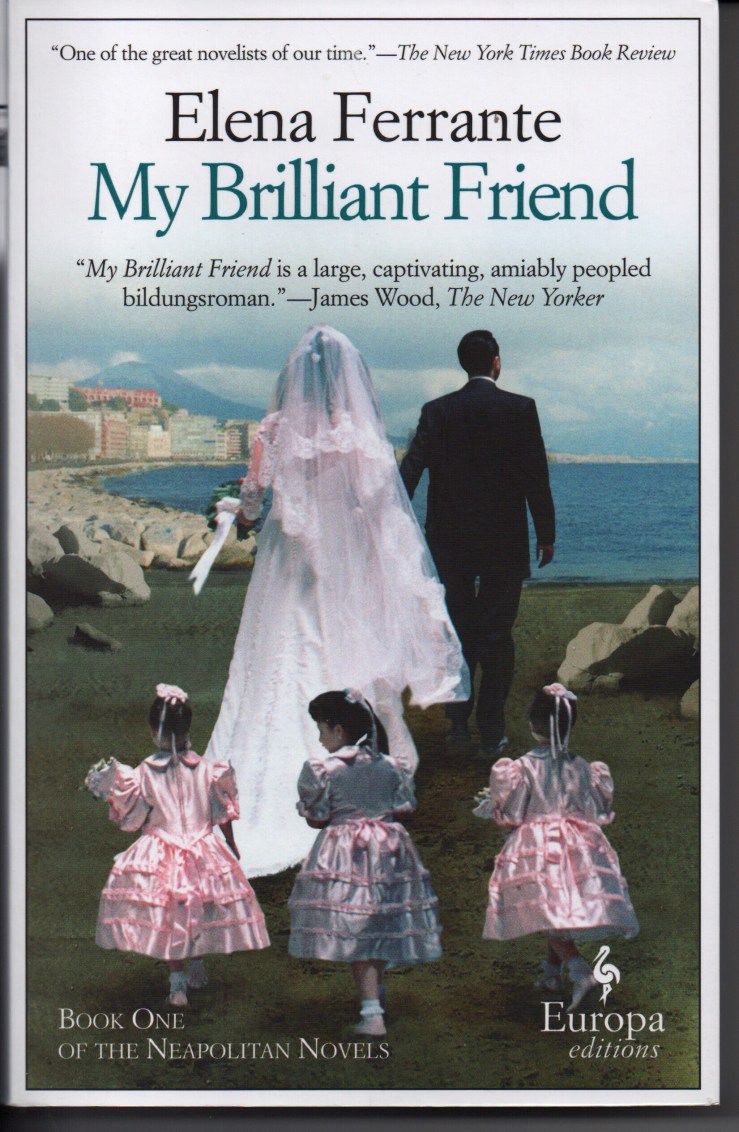
My Brilliant Friend by Elena Ferrante. English translation by Ann Goldstein. Fifteenth printing, Europa Editions, 2015. Book design by Emanuele Ragnisco; cover photo by Anthony Boccaccio.
My Brilliant Friend is brilliant, my friend.
Its cover is awful, and the subsequent covers in the so-called Neapolitan Novels quartet are somehow worse.
A good friend who’s never steered me wrong with a reading recommendation told me to read Ferrante last year, but I didn’t—it wasn’t the hype that put me off (although the hype put me off), but the covers. I finally acquiesced to an audiobook version, and after getting a few chapters in, wanted the text. So I caved.
But my god, the cover—why?
The publisher and art director(s) claim that the Ferrante covers are bad on purpose.
An article in Quartz that I found simply by googling “Ferrante covers awful” yields this nugget:
…Sandro Ferri, Europa Editions’ publisher, says the covers were not an accident of too many cooks in the design kitchen, but rather a conscious choice. Writes Ferri in an email to Quartz, “The ‘vulgarity’ is our intention. We don’t want to make the typical ‘literary’ cover designed for an audience of ultra-sophisticated readers. … Ferrante’s novels are a mix of popular literature and highbrow, intellectual writing. We want to communicate this though our covers as well.”
And in a Slate interview, EE co-founder/publisher Sandra Ozzola again asserts that the decision for tacky covers was, um, purposeful:
From the time of our first conversation with Elena Ferrante about her intention to write this novel, we knew the book’s title and that it would be the story of a long friendship between women—and that it would conclude with a scene of a very vulgar Neapolitan wedding. The wedding and Elena’s impression of it … is an extremely important moment in the book. That’s why I intentionally searched for a photo that was “kitsch.” This design choice continued in the subsequent books, because vulgarity is an important aspect of the books, of all that Elena wants to distance herself from.
If we take a book’s cover to be where the book “begins,” where we first start to read the text, then EE’s awful kitschy crappy ugly covers signal postmodern irony—a joke on perception, the marketplace, high-low aesthetics, etc. The covers work as a kind of metatextual critique, then, as Ozzola seems to suggest above—a critique that relies on the reader’s understanding of the novel’s central character’s aesthetic viewpoint.
Well so then: Are the covers indeed ironic critiques of book-cover-aesthetics? Are we to take these covers as pop art parodies of books that traffic in romantic aspirations, that are, like, marketed to women?
Or are these covers simply designed to appeal to the very market that they would claim to ironically mock?
The have-your-cake-and-eat-it-too postmodern answer to these questions is, of course, “Yes.”
To fully appreciate the aesthetic irony of the Ferrante novels of course requires reading the Ferrante novels. And undoubtedly, many people are put off reading these books because of the covers. So much so that Ferrante’s novels got new covers for their Australian release. The new covers were designed by W.H. Chong:
Mr Chong told The New Daily it can be dangerous to try irony on a book’s cover – especially if the joke isn’t clear to readers.
“You have to signal the irony really clearly otherwise the recipient doesn’t realise the irony,” Mr Chong said.
“You have to signal the irony really clearly” — okay, sure. But the finest satire never announces itself as such.
Chong’s new covers feature simple black-and-white photographs, and they have received praise. But in a sense, the Australian covers seem, at least to me, to echo those Knausgaard updates—safe, boring even. But I’d much rather be seen reading one of those, than, say, the original EE edition of The Story of the Lost Child, which has maybe the worst cover I’ve ever seen.
Europa Editions’ forthcoming Ferrante collection, Frantumaglia, has a great cover, by the way.

Juan Pablo Villalobos’s I’ll Sell You a Dog is forthcoming (this August) from And Other Books. English translation by Rosalind Harvey. Publisher’s blurb:
Long before he was the taco seller whose ‘Gringo Dog’ recipe made him famous throughout Mexico City, our hero was an aspiring artist: an artist, that is, till his would-be girlfriend was stolen by Diego Rivera, and his dreams snuffed out by his hypochondriac mother. Now our hero is resident in a retirement home, where fending off boredom is far more gruelling than making tacos. Plagued by the literary salon that bumps about his building’s lobby and haunted by the self-pitying ghost of a neglected artist, Villalobos’s old man can’t help but misbehave.
He antagonises his neighbours, tortures American missionaries with passages from Adorno, flirts with the revolutionary greengrocer, and in short does everything that can be done to fend off the boredom of retirement and old age . . . while still holding a beer.
A delicious take-down of pretensions to cultural posterity, I’ll Sell You a Dog is a comic novel whose absurd inventions, scurrilous antics and oddball characters are vintage Villalobos.
[Editorial note: The following citations come from one-star Amazon reviews Elena Ferrante’s novel My Brilliant Friend. I’ve preserved the reviewers’ original punctuation and spelling. I love Ferrante’s novel, by the way. More one-star Amazon reviews].
ugh
Odd book
too wordy
so violent
so bummed
Depressing
It’s a series
stupid critics
Maybe terrific
I was so board
Did outline it all
I loved this book
It simply ended!!
So many characters
Too many characters
Not so Good this time
like Twitter on steroids
angst-filled adolescence
I’m an uncultured swine
Everyone in our book club
reading it for my book club
the ending was a dirty trick
there are over 40 characters
Riddled with punctuation errors
Chick lit with no plot or substance
This book is an exercise in despair
I was looking forward to this trilogy
by far the worst book I have every read
Of course it’s a matter of personal taste
the characters were not very nice people
I consider family sagas my favorite genre
endless clusters of names, names, names
Italian names that are difficult to remember
the characters are unlikable (and confusing)
we finished it only because it was Book Club
I damned near tore out what’s left of my hair
too many characters none of whom are likable
a story of domestic violence and male dominance
This book could not have been written by a woman
the main characters are interdependent in a very sick way
Boring and couldn’t Finnish it despite raves from others.?
Just couldn’t get past the violence and disrespect of people
found myself having to look back to figure out who was who
the two central characters may have been intended to be complex and interesting (and may be across the series) they were boorish and flat
the narrator was dryly describing events, as opposed to us being shown what happens through her interaction with characters and the world around her
the struggle of two smart intelligent girls to escape their poor brutal neighborhood in vain
basically a long list of long Italian names and stereotypes
one of my favorite books is The Brothers Karamazov
Just one self-absorbed observation after another
This book could not have been written by a man
WAY too many characters to keep track of
One of the best books I have ever read!
discussing it at my book club this week
an indulgent description of characters
the words did not flow in an easy way
If there were a zero stars rating
I read a lot in a variety if genres
her prose is dry and impersonal
meandering, fancy Chick Lit
it is the first part of a series
I am an English teacher
the characters are dark
what a very long book
choppy and uneven
too many charactors
more of a YA book
tooooo long !!!’n
laborious at best
like a soap opera
wonderful book
my book club
dix no finish
pure drivel
Pure trash
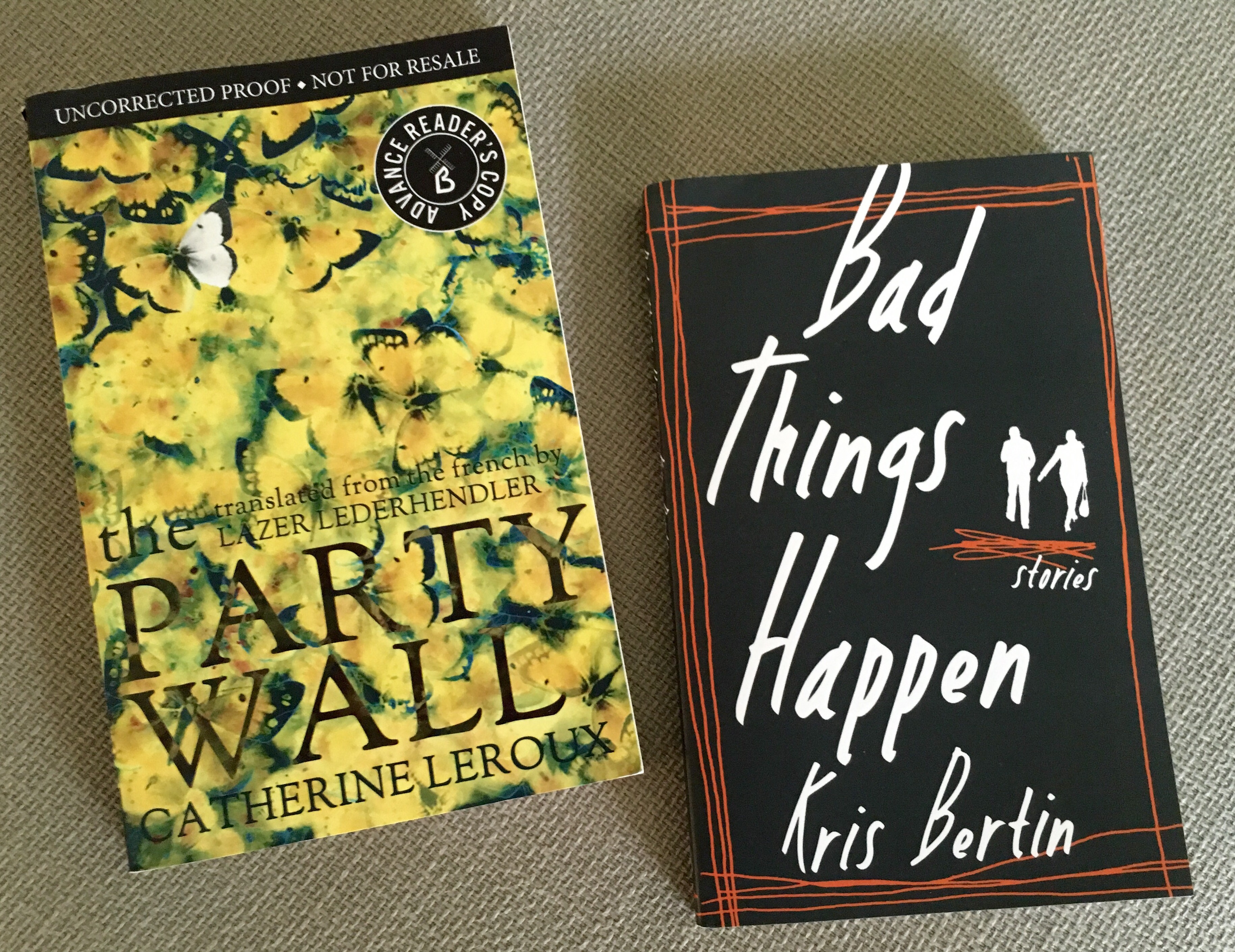
Two new ones from Biblioasis.
Party Wall is a novel by Catherine Leroux (English translation by Lazer Lederhendler). The blurb:
Catherine Leroux’s The Party Wall shifts between and ties together stories about pairs joined in surprising ways. A woman learns that she may not be the biological mother of her own son despite having given birth to him; a brother and sister unite, as their mother dies, to search for their long-lost father; two young sisters take a detour home, unaware of the tragedy that awaits; and a political couple—when the husband accedes to power in a post-apocalyptic future state—is shaken by the revelation of their own shared, if equally unknown, history.
Lyrical, intelligent, and profound, The Party Wall is luminously human, a surreally unforgettable journey through the barriers that can both separate us and bring us together.
And Bad Things Happen, a story collection by Kris Bertin. The blurb:
The characters in Bad Things Happen—professors, janitors, webcam models, small-time criminals—are between things. Between jobs and marriages, states of sobriety, joy and anguish; between who they are and who they want to be. Kris Bertin’s unforgettable debut introduces us to people at the tenuous moment before everything in their lives change, for better or worse.
 Biblioklept