Mental Places: A Conversation with Gerald Murnane

“The Man with the Pumpkin Head,” a very short story by Robert Walser

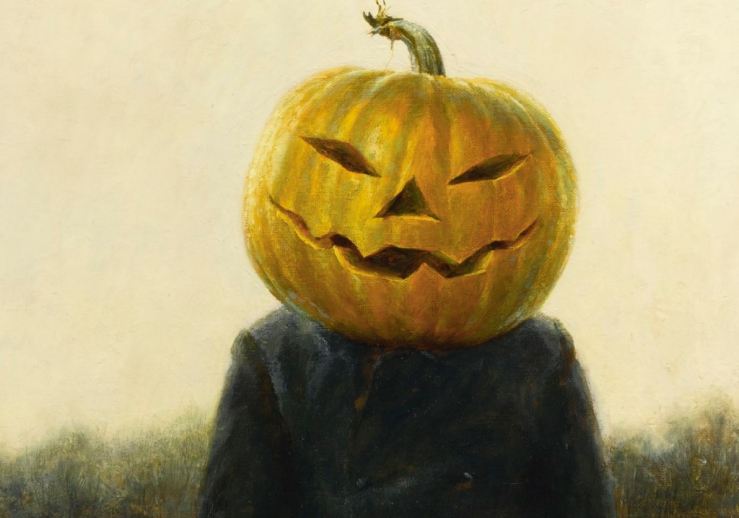
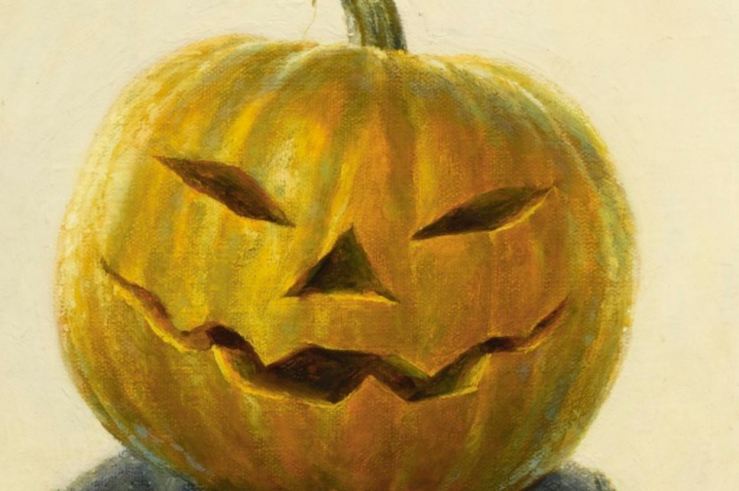
Pumpkinhead (Self-Portrait) — Jamie Wyeth

062N09503_8RXZWCapture

Capture

Pumpkinhead (Self-Portrait), 1972 by Jamie Wyeth (b. 1946)

Still juicy and healthy | Nathaniel Hawthorne’s journal entry for October 25th, 1836

October 25th.–A walk yesterday through Dark Lane, and home through the village of Danvers. Landscape now wholly autumnal. Saw an elderly man laden with two dry, yellow, rustling bundles of Indian corn-stalks,–a good personification of Autumn. Another man hoeing up potatoes. Rows of white cabbages lay ripening. Fields of dry Indian corn. The grass has still considerable greenness. Wild rose-bushes devoid of leaves, with their deep, bright red seed-vessels. Meeting-house in Danvers seen at a distance, with the sun shining through the windows of its belfry. Barberry-bushes,–the leaves now of a brown red, still juicy and healthy; very few berries remaining, mostly frost-bitten and wilted. All among the yet green grass, dry stalks of weeds. The down of thistles occasionally seen flying through the sunny air.

Nathaniel Hawthorne’s journal entry for October 25th, 1836. Collected in Passages from the American Note-Books.

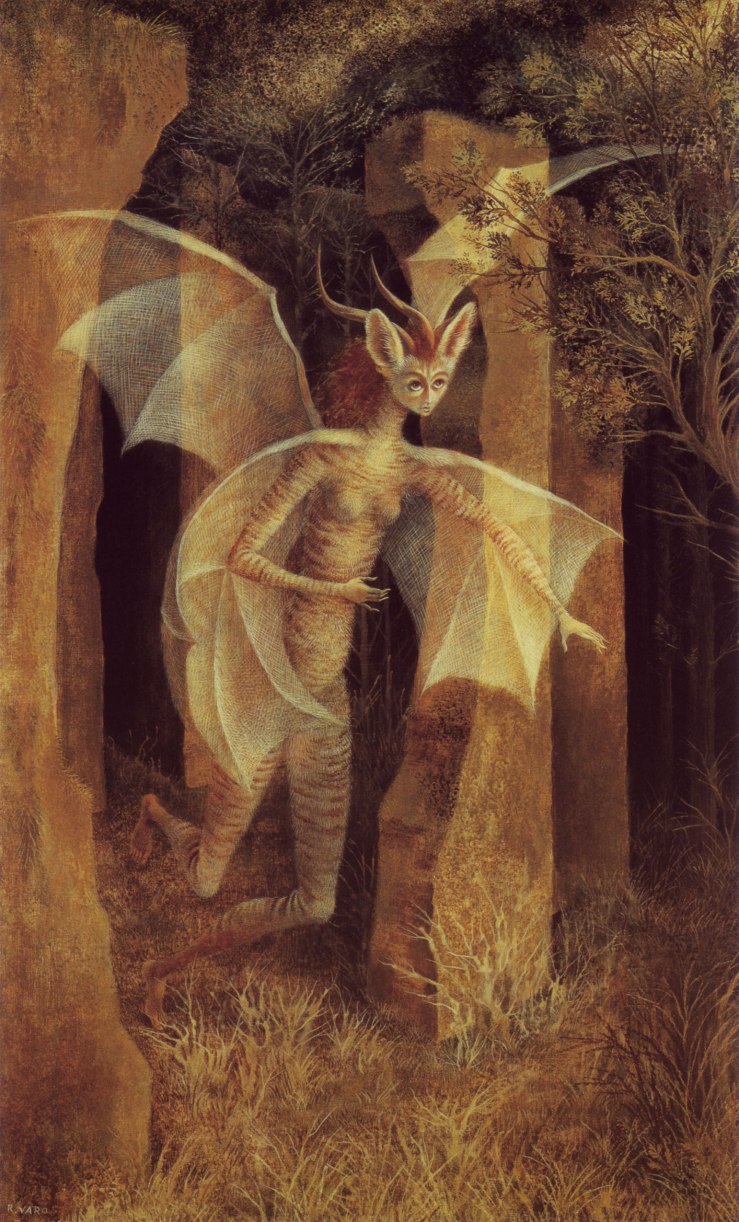
Personaje — Remedios Varo

personaje20-201958_615

a

Personaje (Character), 1958 by Remedios Varo (1908-1963)

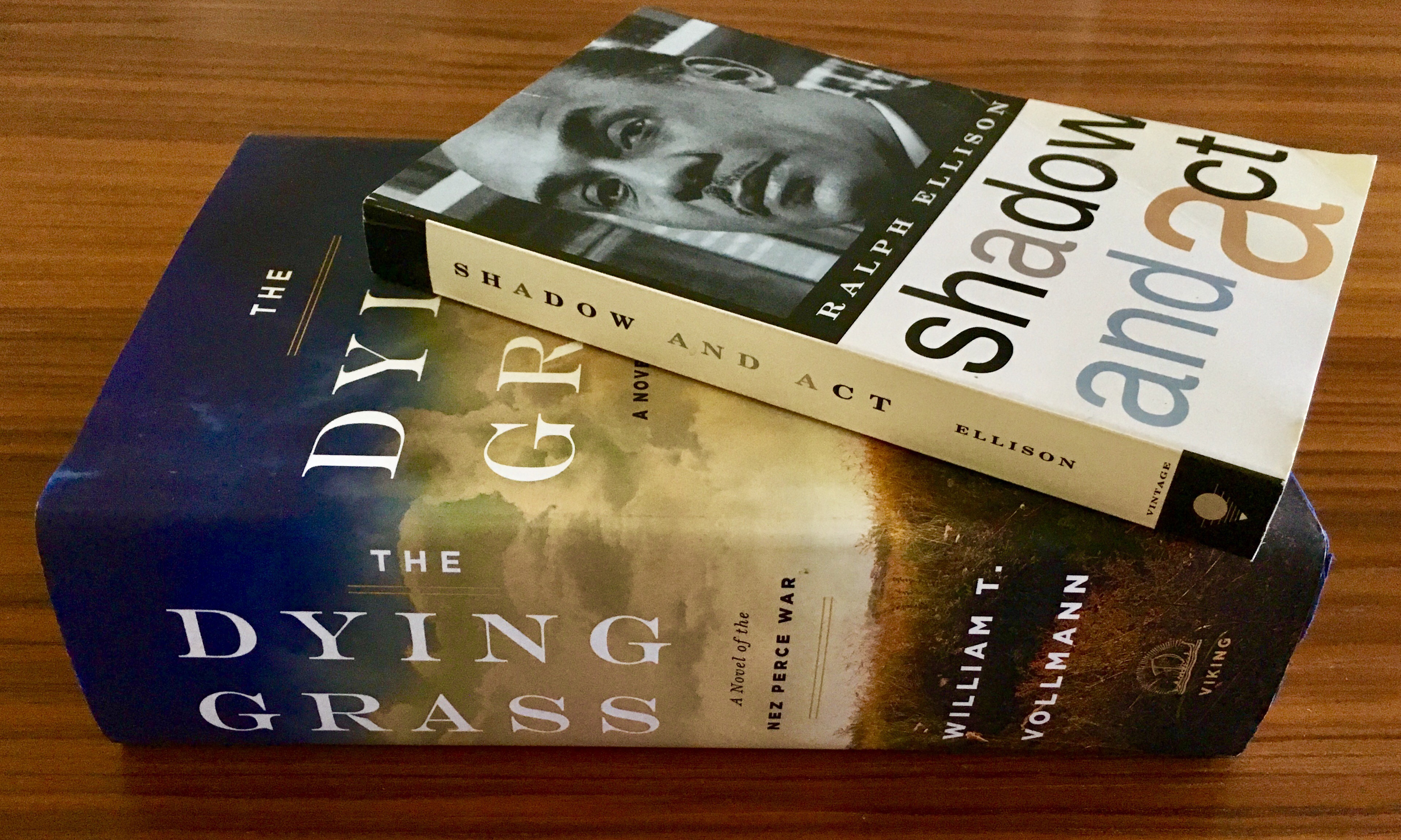
Ellison/Vollmann (Books acquired, 20 Oct. 2017)

I tried William Vollmann’s The Dying Grass a few times last year, both as an audiobook and as an ebook, but it got the best of me. Spotted it at my favorite used book store for a measly twelve bucks, so. Like, we’ll see—although it’s much, much more accessible in print than on screen—the form, the lines on the page—they makes more sense, evoke Whitman more than the ebook or the audio. I also picked up Ralph Ellison’s collection Shadow and Act somewhat randomly—just started reading it and got carried away. Great stuff.

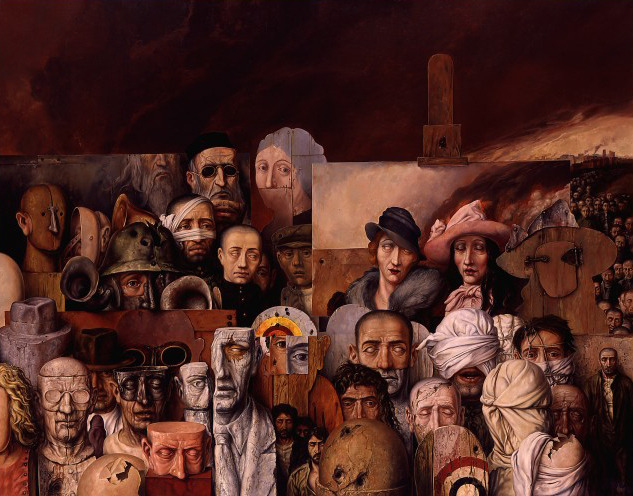
The Family — Samuel Bak

tumblr_ljls8fn9fb1qbbmero1_1280

The Family, 1974 by Samuel Bak (b. 1933)

Angela Carter’s short story “The Werewolf”

“The Werewolf”
by Angela Carter

It is a northern country; they have cold weather, they have cold hearts. Cold; tempest; wild beasts in the forest. It is a hard life. Their houses are built of logs, dark and smoky within. There will be a crude icon of the virgin behind a guttering candle, the leg of a pig hung up to cure, a string of drying mushrooms. A bed, a stool, a table. Harsh, brief, poor lives. To these upland woodsmen, the Devil is as reals as you or I. More so; they have not seen us nor even know that we exist, but the Devil they glimpse often in the graveyards, those bleak and touching townships of the dead where the graves are marked with portraits of the deceased in the naif style and there are no flowers to put in front of them, no flowers grow there, so they put out small votive offerings, little loaves, sometimes a cake that the bears come lumbering from the margins of the forests to snatch away. At midnight, especially on Walpurgisnacht, the Devil holds picnics in the graveyards and invites the witches; then they dig up fresh corpses, and eat them. Anyone will tell you that. Wreaths of garlic on the doors keep out the vampires. A blue-eyed child born feet first on the night of St. John’s Eve will have second sight. When they discover a witch – some old woman whose cheeses ripen when her neighbours’ do not, another old woman whose black cat, oh, sinister! follows her about all the time, they strip the crone, search for her marks, for the supernumerary nipple her familiar sucks. They soon find it. Then they stone her to death.

Winter and cold weather.

Go and visit grandmother, who has been sick. Take her the oatcakes I’ve baked for her on the hearthstone and a little pot of butter.

The good child does as her mother bids – five miles’ trudge through the forest; do not leave the path because of the bears, the wild boar, the starving wolves. Here, take your father’s hunting knife; you know how to use it.

The child had a scabby coat of sheepskin to keep out the cold, she knew the forest too well to fear it but she must always be on her guard. When she heard that freezing howl of a wolf, she dropped her gifts, seized her knife, and turned on the beast.

It was a huge one, with red eyes and running, grizzled chops; any but a mountaineer’s child would have died of fright at the sight of it. It went for her throat, as wolves do, but she made a great swipe at it with her father’s knife and slashed off its right forepaw.

The wolf let out a gulp, almost a sob, when it saw what had happened to it; wolves are less brave than they seem. It went lolloping off disconsolately between the trees as well as it could on three legs, leaving a trail of blood behind it. The child wiped the blade of her knife clean on her apron, wrapped up the wolf’s paw in the cloth in which her mother had packed the oatcakes and went on towards her grandmother’s house. Soon it came on to snow so thickly that the path and any footsteps, track or spoor that might have been upon it were obscured.

She found her grandmother was so sick she had taken to her bed and fallen into a fretful sleep, moaning and shaking so that the child guessed she had a fever. She felt the forehead, it burned. She shook out the cloth from her basket, to use it to make the old woman a cold compress, and the wolf’s paw fell to the floor.

But it was no longer a wolf’s paw. It was a hand, chopped off at the wrist, a hand toughened with work and freckled with old age. There was a wedding ring on the third finger and a wart in the index finger. By the wart, she knew it for her grandmother’s hand.

She pulled back the sheet but the old woman woke up, at that, and began to struggle, squawking and shrieking like a thing possessed. But the child was strong, and armed with her father’s hunting knife; she managed to hold her grandmother down long enough to see the cause of her fever. There was a bloody stump where her right hand should have been, festering already.

The child crossed herself and cried out so loud the neighbours heard her and come rushing in. They know the wart on the hand at once for a witch’s nipple; they drove the old woman, in her shift as she was, out into the snow with sticks, beating her old carcass as far as the edge of the forest, and pelted her with stones until she fell dead.

Now the child lived in her grandmother’s house; she prospered.
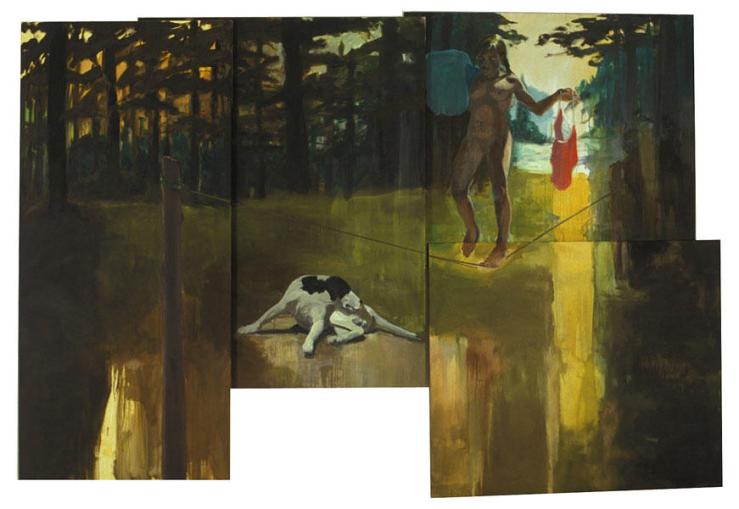
The Start of a Fairy Tale — Eric Fischl

eric-fischl-the-start-of-a-fairy-tale

The Start of a Fairy Tale, 1988 by Eric Fischl (b. 1948)

Posted in Art

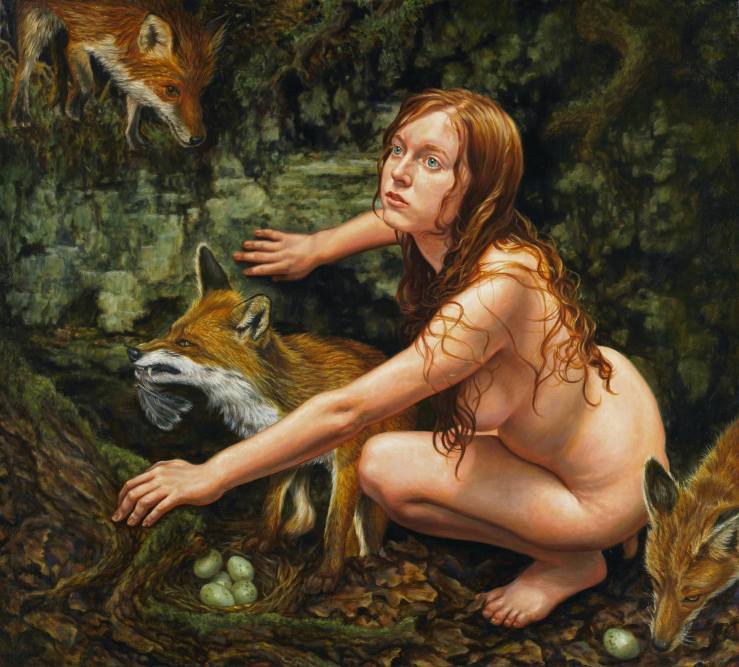
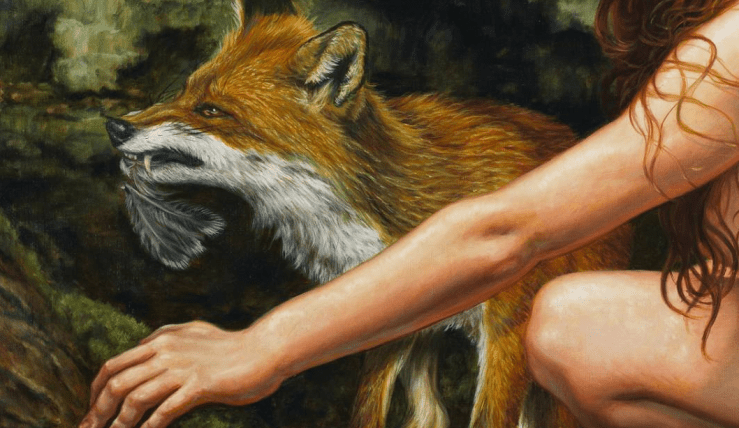
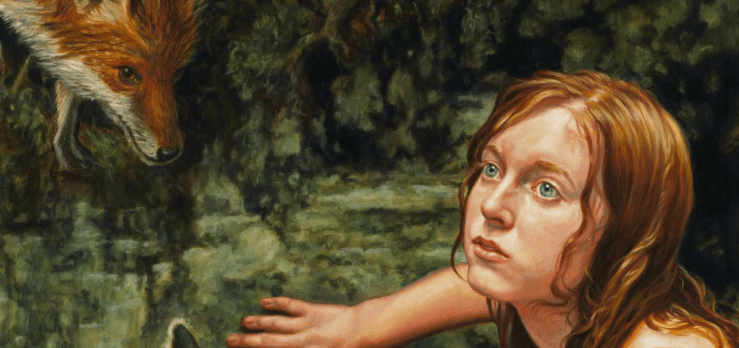
Hungry Little Things — Susannah Martin

2282385-kwfqvqkv-8

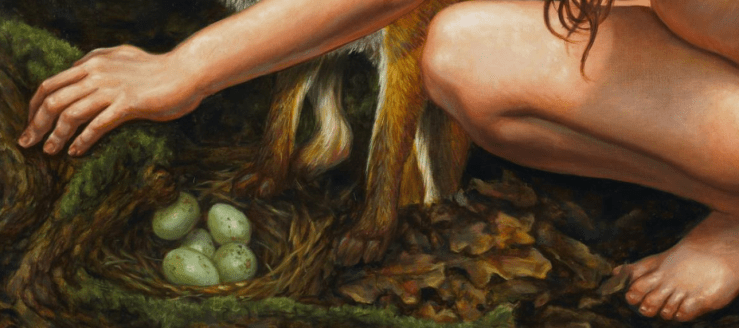
Screenshot 2017-10-23 at 7.51.56 PMScreenshot 2017-10-23 at 7.51.22 PMScreenshot 2017-10-23 at 7.50.58 PM

Hungry Little Things, 2015 by Susannah Martin (b. 1964)

You’ve probably already seen these Blade Runner short films, but I hadn’t because I’d been avoiding all coverage of the film before I could see it.

A review of Blade Runner 2049

vumoudl
Film poster for Blade Runner 2049 by James Jean

I don’t remember how old I was the first time I saw Blade Runner (dir. Ridley Scott, 1982), but I do remember that it had an instant and formative aesthetic impact on me. Blade Runner’s dark atmosphere and noir rhythms were cut from a different cloth than the Star Wars and Spielberg films that were the VHS diet of my 1980’s boyhood. Blade Runner was an utterly perplexing film, a film that I longed to see again and again (we didn’t have it on tape), akin to Dune (dir. David Lynch, 1984), or The Thing (dir. John Carpenter, 1982)—dark, weird sci-fi visions that pushed their own archetypes through plot structures that my young brain couldn’t quite comprehend.

By the time Scott released his director’s cut of the film in 1993, I’d read Philip K. Dick’s source novel Do Androids Dream of Electric Sheep? and enough other dystopian fictions to understand the contours and content of Blade Runner in a way previously unavailable to me. And yet if the formal elements and philosophical themes of Blade Runner cohered for me, the central ambiguities, deferrals of meaning, and downright strangeness remained. I’d go on to watch Blade Runner dozens of times, even catching it on the big screen a few times, and riffing on it in pretty much every single film course I took in college. And while scenes and set-pieces remained imprinted in my brain, I still didn’t understand the film. Blade Runner is, after all, a film about not knowing.

Like its predecessor, Blade Runner 2049 (dir. Denis Villeneuve, 2017) is also a film about not knowing. Moody, atmospheric, and existentialist, the core questions it pokes at are central to the Philip K. Dick source material from which it originated: What is consciousness? Can consciousness know itself to be real? What does it mean to have–or not have—a soul?

Set three decades after the original, Blade Runner 2049 centers on KD6-3.7 (Ryan Gosling in Drive mode). K is a model Nexus-9, part of a new line of replicants created by Niander Wallace and his nefarious Wallace Corporation (Jared Leto, who chews up scenery with tacky aplomb). K is a blade runner, working for the LAPD to hunt down his own kind. At the outset of the film, K doesn’t recognize the earlier model Nexuses (Nexi?) he “retires” as his “own kind,” but it’s clear that the human inhabitants of BR ’49’s world revile all “skinjobs” as the same: scum, other, less human than human. K, beholden to his human masters, exterminates earlier-model replicants in order to keep the civil order that the corporate police state demands. This government relies on replicant slave labor, both off-world—where the wealthiest classes have escaped to—and back here on earth, which is recovering from a massive ecological collapse. The recovery is due entirely to Niander Wallace’s innovations in synthetic farming—and his reintroduction of the previously prohibited replicants.

Our boy K “retires” a Nexus-8 at the beginning of the film. This event leads to the film’s first clue: a box buried under a dead tree. This (Pandora’s) box is an ossuary, the coffin for a (ta da!) female replicant (a Nexus-7 if you’re counting). Skip the next paragraph if you don’t want any plot spoilers.

Continue reading “A review of Blade Runner 2049”

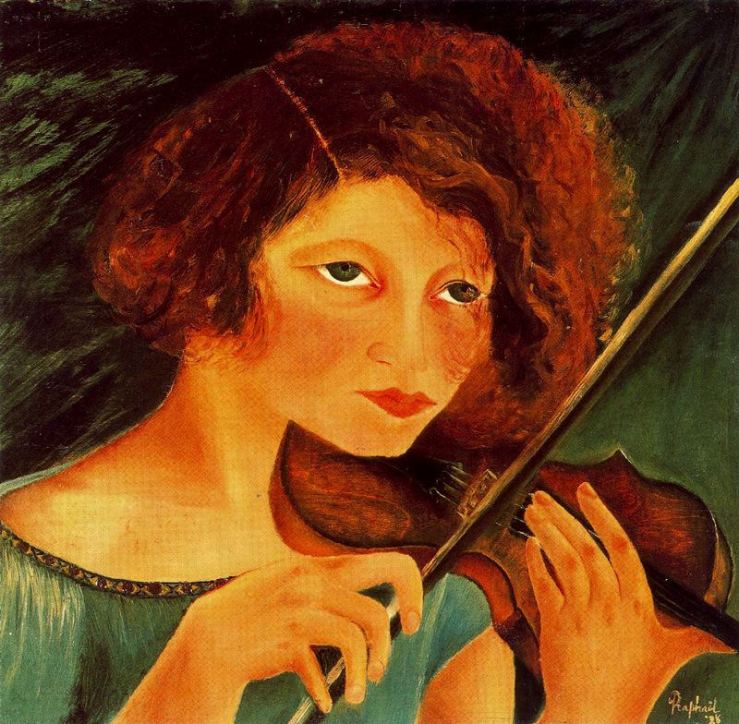
Self-Portrait with Violin — Antonietta Raphael

33909159032_af84c64f72_b

Self-Portrait with Violin, 1928 by Antonietta Raphael (1895-1975)

I want a funny face

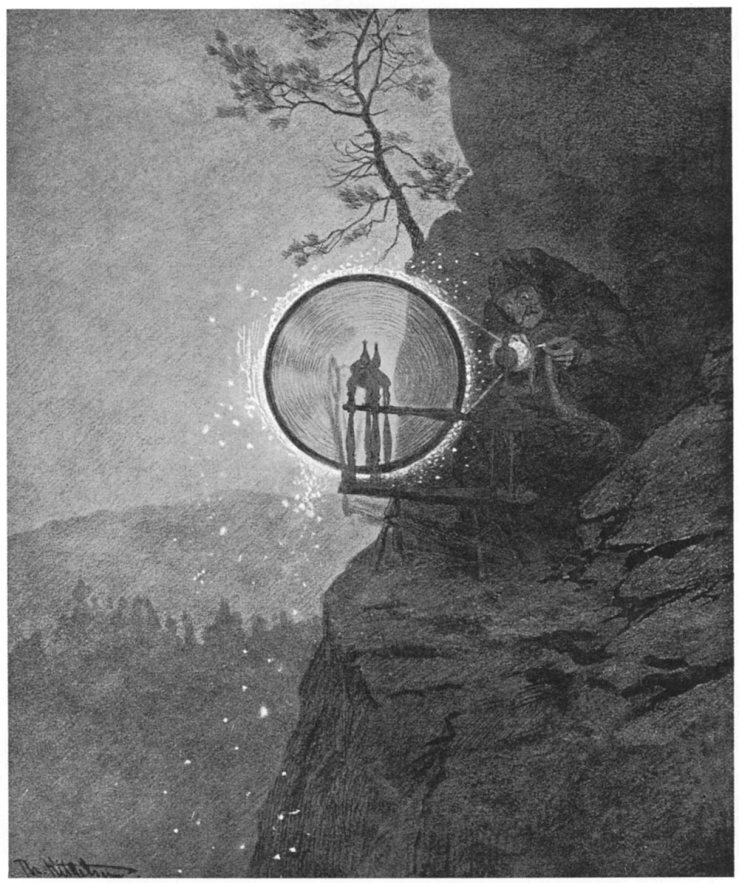
Witch — Theodor Severin Kittelsen

heksen-1892

Witch, 1892 by Theodor Severin Kittelsen (1857-1914)

Read “When I Was a Witch,” a short story by Charlotte Perkins Gilman

“When I Was a Witch”

by

Charlotte Perkins Gilman


If I had understood the terms of that one-sided contract with Satan, the Time of Witching would have lasted longer–you may be sure of that. But how was I to tell? It just happened, and has never happened again, though I’ve tried the same preliminaries as far as I could control them.

The thing began all of a sudden, one October midnight–the 30th, to be exact. It had been hot, really hot, all day, and was sultry and thunderous in the evening; no air stirring, and the whole house stewing
with that ill-advised activity which always seems to move the steam radiator when it isn’t wanted.

I was in a state of simmering rage–hot enough, even without the weather and the furnace–and I went up on the roof to cool off. A top-floor apartment has that advantage, among others–you can take a walk without the mediation of an elevator boy!

There are things enough in New York to lose one’s temper over at the best of times, and on this particular day they seemed to all happen at once, and some fresh ones. The night before, cats and dogs had broken my rest, of course. My morning paper was more than usually mendacious; and my neighbor’s morning paper–more visible than my own as I went down town–was more than usually salacious. My cream wasn’t cream–my egg was a relic of the past. My “new” napkins were giving out.

Being a woman, I’m supposed not to swear; but when the motorman disregarded my plain signal, and grinned as he rushed by; when the subway guard waited till I was just about to step on board and then slammed the door in my face–standing behind it calmly for some minutes before the bell rang to warrant his closing–I desired to swear like a mule-driver.

At night it was worse. The way people paw one’s back in the crowd! The cow-puncher who packs the people in or jerks them out–the men who smoke and spit, law or no law–the women whose saw-edged cart-wheel hats, swashing feathers and deadly pins, add so to one’s comfort inside.

Well, as I said, I was in a particularly bad temper, and went up on the roof to cool off. Heavy black clouds hung low overhead, and lightning flickered threateningly here and there.

A starved, black cat stole from behind a chimney and mewed dolefully. Poor thing! She had been scalded.

The street was quiet for New York. I leaned over a little and looked up and down the long parallels of twinkling lights. A belated cab drew near, the horse so tired he could hardly hold his head up.

Then the driver, with a skill born of plenteous practice, flung out his long-lashed whip and curled it under the poor beast’s belly with a stinging cut that made me shudder. The horse shuddered too, poor wretch, and jingled his harness with an effort at a trot.

I leaned over the parapet and watched that man with a spirit of unmitigated ill-will. Continue reading “Read “When I Was a Witch,” a short story by Charlotte Perkins Gilman”

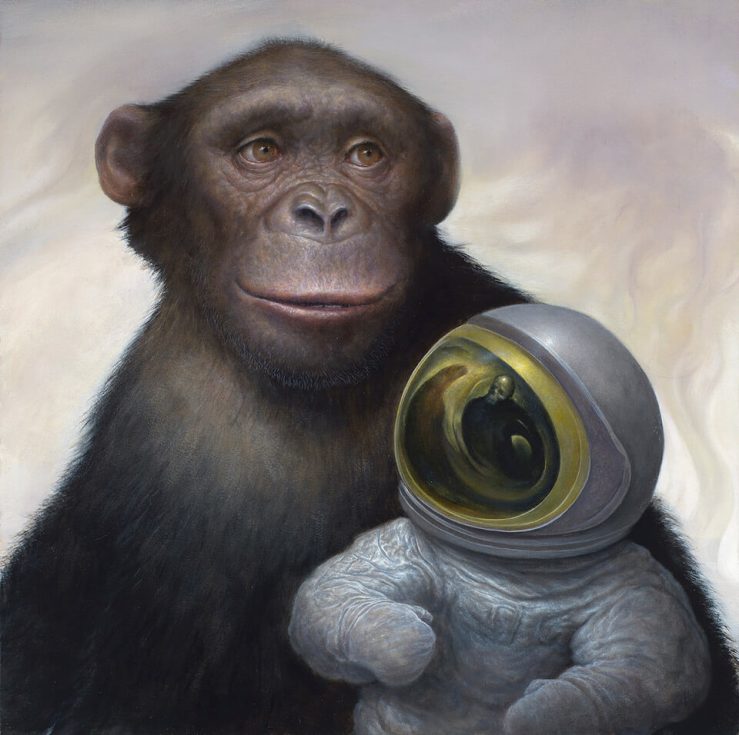
Grey Skies — Chris Leib

chris-leib-grey-skies

Grey Skies by Chris Leib.