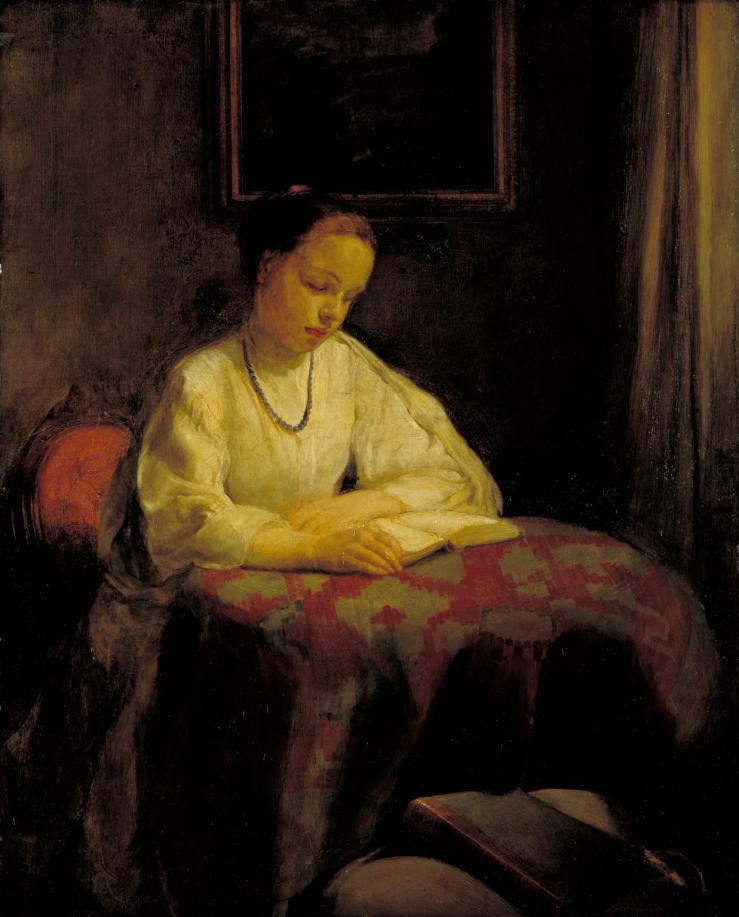
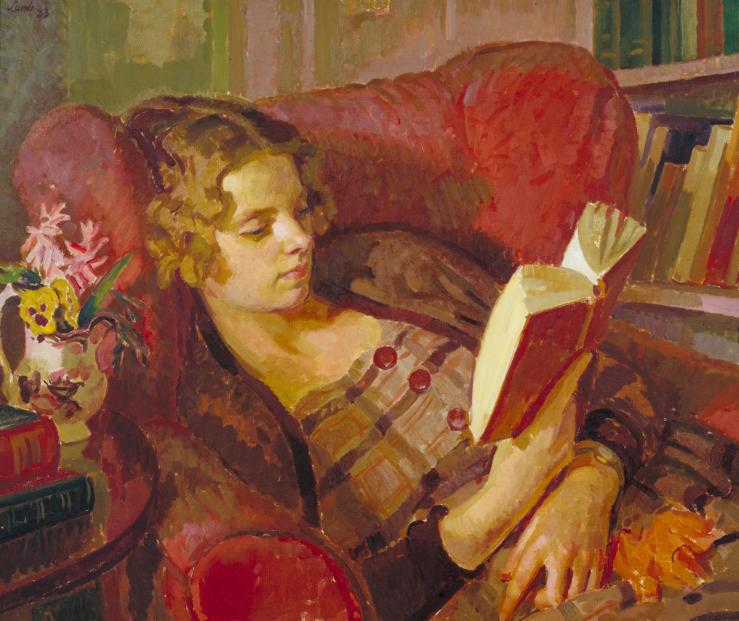
Interior: Girl Reading — Mary McEvoy

Interior: Girl Reading 1901 by Mary McEvoy 1870-1941

Interior: Girl Reading, 1901 by Mary McEvoy (1870–1941)

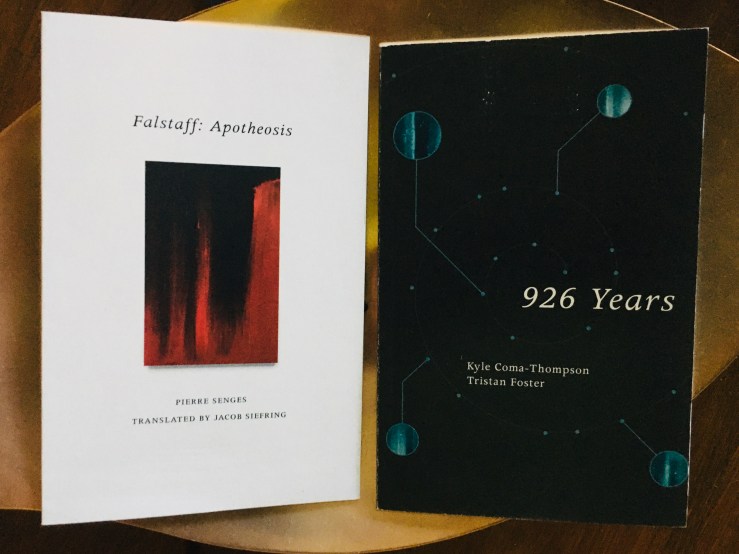
Two Sublunary Editions (Books acquired, 16 Dec. 2019)

img_4545

I was pysched to get to Sublunary Editions titles the other week.

I read the chapbook Falstaff: Apotheosis on 19 Dec. 2019. The story, a wonderful riff on Henry IV Part I, V.iv—the part where Falstaff flops on the battlefield, faking his death in an act of cowardly heroism—is by the French author Pierre Senges. It is the third translation of Senges’ work by Jacob Siefring that I’ve read, and I enjoyed it very much, reading it surreptitiously on the back of the dais, cloaked by my colleagues during our fall commencement. (I had to tune out the ramblings of the commencement speaker, a local judge afflicted with a conservative streak.) Here’s novelist S.D. Chrostowska’s blurb:

Like Falstaff’s coffin in Orson Welles’s Chimes at Midnight, Pierre Senges’s erudite fragments are broader than most, their depth befitting Shakespeare’s original. Here’s Falstaff the master thespian, never wiser or more human than when he plays dead to save his skin and takes a nap. Well-served by this limpid translation, Senges resurrects him as a hero for our time. Bravo!

I also got 926 Years, and intriguing title by Tristan Foster and Kyle Coma-Thompson. Here’s Sublunary’s blurb:

Through twenty-two linked stories, Tristan Foster and Kyle Coma-Thompson explore the creative potential of people’s native estrangement from themselves and each other. Two writers who have never met, who live on opposite sides of the globe—one in Australia, the other in the United States—tracking the pattern of probable lives and fates that co-exist between them, from Korea to England, Senegal to Argentina. Their conclusion/suspicion: imagination is stronger, and subtler, than God, and offers more than mere consolation for the difficulties of living.

And here’s what novelist Gary Lutz has to say:

The intimate, globe-spanning microportraits of human crisis in 926 Years are at once sobering and uplifting, clarifying and mystifying. Tristan Foster and Kyle Coma-Thompson’s collaboration is a nonpareil of short-form virtuosity.

More thoughts forthcoming!


A review of Ishmael Reed’s Christmas satire, The Terrible Twos

Christmas is here, so let me recommend a Christmas novel for you: Ishmael Reed’s The Terrible Twos (1982). I read it back in unChristmasy August and dipped into it a bit again today, looking for a passage or two to share. Maybe the bit where Santa Claus starts an anti-capitalist riot in Times Square?, or where the First Lady is electrocuted while lighting the White House Christmas tree?, or where the idiot U.S. President meets Harry Truman in A Christmas Carol tour of hell? I scrounged for a big fat citation that works on its own, but I kept wanting to build a frame, set a stage, and ended up with this instead, a “review,” a recommendation. A stage setting.  Of course, Ishmael Reed’s novels create their own stages, their own contexts and rhythms, and each paragraph, each sentence, each note fits into that context, blaring or humming or blasting the reader. Reed’s satire is simultaneously bitter and salty and sweet and sharp sharp sharp, the sort of strange rich dish you gobble up too fast and then, Hell!, it gives you weird dreams. For months.

But nice fat slices of Reed’s prose can be served on their own, as John Leonard’s 1982 NYT  review of The Terrible Twos shows. Leonard’s review is ten paragraphs long and he quotes Reed in full for two of those paragraphs, including this one, the longest paragraph in the piece:

Two-year-olds are what the id would look like if the id could ride a tricycle. That’s the innocent side of 2, but the terrible side as well. A terrible world the world of 2-year-olds. The world of the witch’s door you knock on when your mother told you not to go near the forest in the first place. Pigs building houses of straw. Vain and egotistic gingerbread men who end up riding on the nose of a fox. Nightmares in the closet. Someone is constantly trying to eat them up. The gods of winter crave them – the gods of winter who, some say, are represented by the white horse that St. Nicholas, or St. Nick, rides as he enters Amsterdam, his blackamoor servant, Peter, following with his bag of switches and candy. Two-year-olds are constantly looking over their shoulders for the man in the shadows carrying the bag. Black Peter used to carry them across the border into Spain.

Leonard (who describes the paragraph as “a kind of jive transcendence”— I’ll settle for “transcendence”) offers up this nugget as a condensation of Reed’s themes and mythologies. The paragraph neatly conveys the central idea of Reed’s novel, that American capitalism refuses to allow its subjects to Grow Up. It’s a tidyish paragraph. Tidyish. Reed always sprawls into some new mumbo jumbo. The anarchic energy of his prose digs up old mythologies, boots skeletons out closets, and makes all the old ghosts of Western history sing and dance.

So there’s a lot going in The Terrible Twos’ not-quite 200 pages. Should I take a stab at unjumbling the plot? Okay, so: Reagan is elected president. Things are bad. Rough for, like, the people. Fast forward a few terms, to the early/mid-nineties (Reed’s future…this is a sci-fi fantasy). Former fashion model Dean Clift ascends to the Presidency. Only he’s just a puppet for his cabinet, a cabal of war-profiteering zealots secretly planning a genocidal operation that would not only destroy a nuclear-armed African nation, but also “rid America of surplus people.” Surplus = poor. After Clift’s wife dies in a freak (not-really-freak) Christmas-tree-lighting accident, his life changes, and Saint Nicholas (like, the real Santa) comes to visit him. Santa takes the President on a Dantean-cum-Dickensian trip through the hell of American past. The poor dumb idiot President transforms his soul. Hearing Truman lament the bombing of Hiroshima might do that (not that that’s the only horror that haunts this novel—but a nuclear winter is not a winter wonderland, and Reed’s characters, despite their verve, are all suffering from Cold War Blues). Clift goes on TV and advocates a Christmas Change—but too late. The conspiracy cabinet hits him with the 25th Amendment to the United States Constitution. Reed gives a history lesson to the highest office of the land, changes the man’s life, and then imprisons him in a sanatorium. Satire at its cruelest.

But hell, what am I doing here, foregrounding President Clift? Or even Santa? There’s so much more going on in The Terrible Twos: the secret sect of Nicolites who worship Saint Nick; devotees of Black Peter (a version of the Dutch tradition of “Zwarte Piet”); the North Pole syndicate; secret agents, thugs, and sundry assassins; punk rioters; a rasta dwarf (um, Black Peter). And somehow I’ve left out the novel’s semi-hapless hero, Nance Saturday…

Look, the plot—the picaresque, mumbo-jumbo, always-mutating plot of The Terrible Twos is, yes, fun—but it’s the prose, the energy, the commentary, and, yes, the prescience of the novel that makes it so engrossing and fun and terrifying. This is a book that begins: “By Christmas, 1980, the earth had had enough and was beginning to send out hints,” a book that has the American President meeting with the American Nazi Party in the Oval Office, a book that has one character comment to another, on the election of Reagan, that “It feels good to be a white man again with him in office.” The satire’s prescience is painful, but Reed’s wisdom—the ballast of this ever-shifting picaresque—anchors the commentary in a deeper condemnation: It has always been this way. Ishmael Reed seems so prescient because we keep failing the past. Same as it ever was. Thus The Terrible Twos plays out in a series of plots and schemes, retaliations and riots—but also wry comments and righteous resistance. And so if Reed’s analysis of American history is unbearably heavy, it also points towards a negation of that heavy history, towards a vision of something better.

I shall give the last words to Reed’s Santa:

Two years old, that’s what we are, emotionally—America, always wanting someone to hand us some ice cream, always complaining, Santa didn’t bring me this and why didn’t Santa bring me that…Nobody can reason with us. Nobody can tell us anything. Millions of people are staggering about and passing out in the snow and we say that’s tough. We say too bad to the children who don’t have milk….I say it’s time to pull these naughty people off their high chairs and get them to clean up their own shit. Let’s hit them where it hurts, ladies and gentlemen. In their pockets. Let’s stop buying their war toys, their teddy bears, their dolls, tractors, wagons, their video games, their trees. Trees belong in the forest.

A riot ensues.

Very highly recommended.

[Editorial note: Biblioklept ran a version of this review in December, 2017].

New Accursed Art Club — Nigel Cooke

New Accursed Art Club 2007 by Nigel Cooke born 1973

New Accursed Art Club, 2007 by Nigel Cooke (b. 1973)

Leader of Legions of Literary Lunatics — Mike Davis

mike-davis-final_low-copy-1050x1126-540x579-1

Leader of Legions of Literary Lunatics by Mike Davis

Woman Reading with Peaches — Henri Matisse

woman-reading-with-peaches-1923.jpglarge

Woman Reading with Peaches, 1923 by– Henri Matisse (1869–1954)

Untitled (Le Quai des brumes) — Francine van Hove

1475134729-007

Untitled by Francine van Hove (b. 1942)

The Artist’s Wife — Henry Lamb

The Artist's Wife 1933 by Henry Lamb 1883-1960

The Artist’s Wife, 1933 by Henry Lamb (1883–1960)

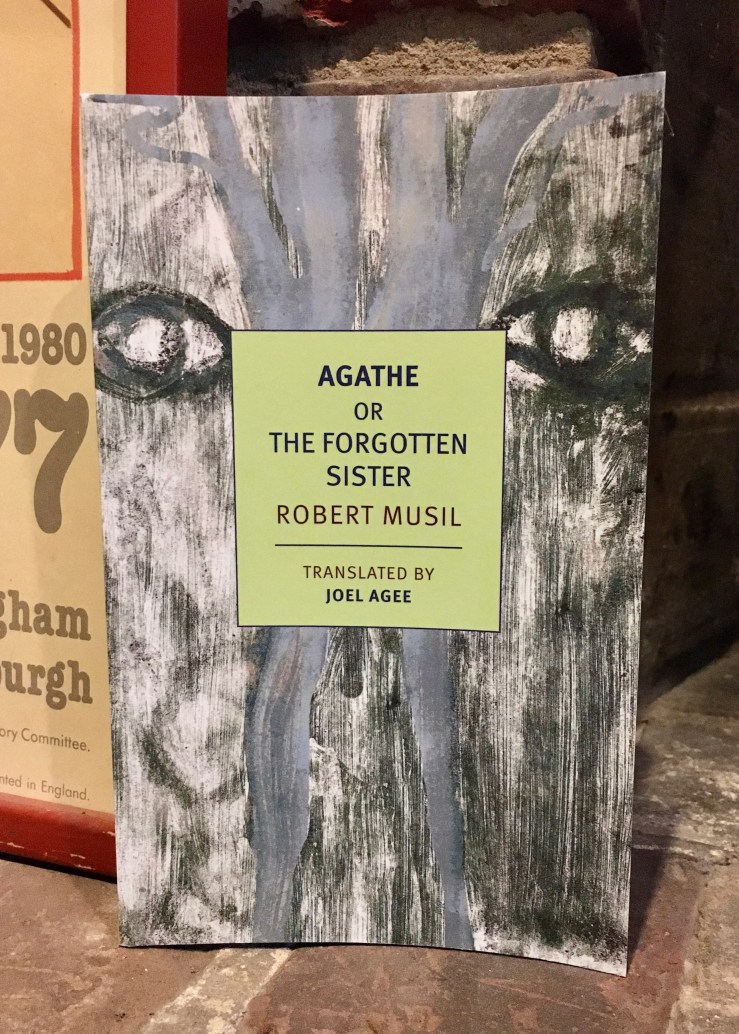
Robert Musil’s Agathe, or The Forgotten Sister (Book acquired like probably the last week of November 2019)

img_4474

In his introduction to Robert Musil’s Agathe, or The Forgotten Sister, NYRB editor Edwin Frank writes that,

Essay, in this quintessentially essayistic novel, is the mode for depicting a mind so active that it nearly constitutes a character independent of the man whose mind it is. That man is a thirty-two-year-old Austrian mathematician known to the reader only by his first name, Ulrich, who, disillusioned in his quest for intellectual glory after reading a newspaper about a racehorse of genius, decides to take a year-long ‘vacation from life,’ which he conceives of as an experiment in pure philosophic contemplation — ‘living essayistically,’ he calls it — in the hope of perhaps, by that pathless route, discovering an occupation better suited to his abilities. If he does not find it within a year, he will put an end to his life, because, to his fanatically logical and consequent mind, an unjustified life is not worth living.

I’ll confess I’ve never read Musil, despite two lukewarm milquetoast attempts, but I liked Frank’s introduction. Seems like I need to read The Man without Qualities before this. Here’s the NYRB blurb:

Agathe is the sister of Ulrich, the restless and elusive “man without qualities” at the center of Robert Musil’s great, unfinished novel of the same name. For years Agathe and Ulrich have ignored each other, but when brother and sister find themselves reunited over the bier of their dead father, they are electrified. Each is the other’s spitting image, and Agathe, who has just separated from her husband, is even more defiant and inquiring than Ulrich. Beginning with a series of increasingly intense “holy conversations,” the two gradually enlarge the boundaries of sexuality, sensuality, identity, and understanding in pursuit of a new, true form of being that they are seeking to discover.

Robert Musil’s The Man Without Qualities is perhaps the most profoundly exploratory and unsettling masterpiece of twentieth-century fiction. Agathe; or, The Forgotten Sister reveals with new clarity a particular dimension of this multidimensional book—the dimension that meant the most to Musil himself and that inspired some of his most searching writing. The outstanding translator Joel Agee captures the acuity, audacity, and unsettling poetry of a book that is meant to be nothing short of life-changing.

Agathe’s English translation is by Joel Agee.

A review of Alfred Döblin’s turbulent, encyclopedic riot of a novel, Berlin Alexanderplatz

2019-10-06_172844

“Unbe-fucking-lievable,” interjects the ominvalent narrator of Alfred Döblin’s 1929 novel  Berlin Alexanderplatz at one point. I’m not sure if the original German (Ist gar nicht zu glauben) conveys the amazed profanity here in Michael Hofmann’s 2018 translation, but “Unbe-fucking-lievable” nevertheless captures the raucous spirit and mutable form of Berlin Alexanderplatz. The novel is a polyglossic spree, an encyclopedic riot, a tragicomic masterpiece of syntax and diction, chopped and screwed, twisted and turned.

What is it about?

The first italicized page summarizes the entire novel in nine neat paragraphs, beginning with this one:

The subject of this book is the life of the former cement worker and haulier Franz Biberkopf in Berlin. As our story begins, he has just been released from prison, where he did time for some stupid stuff; now he is back in Berlin, determined to go straight.

For further clarification: It is the 1920s in Berlin, that slim decadent wedge between those two big wars, and the Weimar capital buzzes with working-class resentment and political unrest. (And drinking. Lots and lots of drinking.)

We soon find out the “stupid stuff” Biberkopf did that landed his ass in jail, and find that the stuff wasn’t so much stupid as stupid and horrific. But by the time we’ve discovered the crimes of Biberkopf, it’s too late: the narrator’s got his sharp teeth sunk into the bit of our brain that pumps sympathy for the supposed hero of the story.

But again: What is it about?

Well:

Biberkopf tries to play it straight, but life on the Alexanderplatz and its seedy environs ain’t easy. He slings newspapers, mixes it up with communists and Nazis alike, and tries to keep his nose clean. But, this being a picaresque tale, he falls in with old associates, falls into old petty crimes, and eventually loses his arm. (Like, literally.) He takes to pimping, thinking it easy, but pimping presents its own problems. There’s love, lust, murder, and betrayal. (And drinking. Lots and lots of drinking.)

What is it about? is not really the right question for Berlin Alexanderplatz. Instead: What is it?

Berlin Alexanderplatz is a literary montage, a vicious collage, an explosion of colors, a carnival of noise and chaos and entropy, told by a narrator who occasionally tries to sort the pieces out for the reader, but usually is more content to drop a metaphorical bomb on us and then spend a dozen or so pages explaining how the bomb got there and who planted it and why the saboteur was so hellbent on destruction in the first place.

Our narrator is a ventriloquist, popping into the consciousnesses and throats of characters major, minor, and peripheral (at best) alike. There’s a cinematic orality to the novel, a shuffling, skipping, vamping voiceyness to Döblin’s prose that Hofmann’s translation renders as a kind of cackling cockney English. It sparks and hoots and howls.

Döblin’s narrator might wander around in Biberkopf’s brain, and then end up in the voice of his girlfriend Mitzi (whom he pimps), or his friend and enemy Reinhold, or just some random cafe sitter or beer drinker at a bar. Döblin’s camera goes anywhere it likes; indeed, Berlin Alexanderplatz is crammed with flights into history, mythology, books of the Bible, math, industry, science. A riff on the First Newtonian Law? Sure. A lengthy treatise on industrial pork butchery? Why not. A retelling of the Book of Job? Of course. Ever wondered why berries sweeten in the cold of winter? Let Döblin’s narrator explain the relationship of temperature, starch, and sugar for you. 

Berlin Alexanderplatz is voluminous, exhausting, exhaustive, ecstatic. Döblin’s narrator grabs a hold of a subject, picks at it, puts it down, picks up later. Sometimes these threads coalesce (the Books of Job and Ecclesiastes became refrains); other riffs seem to be included for no reason other than Döblin’s narrator finds them interesting. He gleefully steals from newspapers, injecting the narrative with tangential-at-best stories of the day: murders and plane crashes and invasions and assassination attempts and failures and successes and crimes, large and small. Döblin’s novel aims to be about everything, about both the small and the big worlds his petty criminal antihero Franz Biberkopf is a citizen of. 

With its voracious, swirling, omnidirectional scope and undulating stylistic turns, Berlin Alexanderplatz readily recalls James Joyce’s big book Ulysses. Döblin’s novel seems less beholden to a series of correspondences than Joyce’s, however—it’s freer, more anarchic really, roiling around in its own entropy. Both novels are bawdy, smart, and very funny of course. With its celebratory attention to Berlin’s seedier side, Berlin Alexanderplatz also recalls the paintings of Otto Dix, Rudolf Schlichter, and George Grosz (whose 1919 painting Panorama adorns the cover of my NYRB edition). There are also notes of Kubrick here—there’s something of both A Clockwork Orange and Barry Lyndon to Berlin Alexanderplatz: the former’s energetic, horrific violence and pastiche-slang; the latter’s ironic and affecting treatment of the traditional bildungsroman. Döblin’s technique of stealing freely from newspapers also reminds me of Félix Fénéon’s Novels in Three Lines, as well as Doris Lessing’s The Golden Notebook, and segments of William Gaddis’s JR and The Recognitions. (All of these work belong in what the protagonist of William Gass’s novel Middle C dubbed “The Inhumanity Museum.”)

General comparisons of other works to Döblin’s great big fat novel don’t really do Berlin Alexanderplatz justice of course. There is simply no substitute for reading it. It is a novel about itself; it is a novel that one doesn’t so much read for plot (or worse, to learn something); rather, it is a novel that produces waves of feelings, confusions, problems in its reader. It is a novel packed with grotesquerie and excess, yes, and the turbulent humor does not leaven the novel’s core meanness. Berlin Alexanderplatz’s spine is a spike of ice, but lots of wonderful juicy rich fat hangs from that icy spine.

And through its meanness, the novel pushes its hero to a strange redemption of sorts, announced on the novel’s very first page: “The terrible thing that was his life acquires a purpose.”

And do I spoil the final line?

Why not: “We know what we know, we had to pay dearly enough for it.”

I did not pay dearly for Berlin Alexanderplatz, either in my money or in my time. I was rewarded. Very highly recommended.

Three Books

2019-10-13_181512

Don Quixote by Kathy Acker. Grove Press trade paperback, 1986. Cover design by Neil Stuart. Cover illustration by Catherine Denvir.

A messy punkpostmodern cartoon, a big long jazz howl at the moon.

2019-11-03_163857

The Egghead Republic by Arno Schmidt; English translation by Michael Horowitz. Marion Boyars trade paperback, 1982. Cover design by Imre Reiner, who likely drew the illustration (although he is not explicitly credited).

I found the first 50 pages utterly exhausting, and there were 100 more. I tried. The cover designer Imre Reiner is most famous for his font designs, but he also illustrated many many books, including a 1941 edition of Cervantes’ Don Quixote.

2019-11-03_163857_1

Sanatorium under the Sign of the Hourglass by Bruno Schulz; English translation by Celina Wieniewska. Cover design by Neil Stuart. Cover illustration by Bruno Schultz. (The novel includes thirty black and white illustrations by Schultz.)

A gross, surreal, dispiriting nightmare. I recall “enjoying” it.

On the Halloween chapter of William Gaddis’s novel Carpenter’s Gothic

Mischief Night, Jamie Wyeth

The fourth of seven unnumbered chapters in William Gaddis’s Carpenter’s Gothic is set over the course of Halloween, moving from morning, into afternoon, and then night. Halloween is an appropriately Gothic setting for the midpoint of Gaddis’s postmodern Gothic novel, and there are some fascinating turns in this central chapter.

A summary with spoilers is not necessary here. Suffice to say that our heroine Elizabeth Booth is left alone on Halloween in the dilapidated Rural Gothic style house she and her awful husband Paul rent from mysterious Mr. McCandless. As Paul exits the house to go on one his many fruitless business trips, he notices that some neighborhood kids have already played their Halloween tricks:

He had the front door open but he stood there, looking out, looking up, —little bastards look at that, not even Halloween till tonight but they couldn’t wait… Toilet paper hung in disconsolate streamers from the telephone lines, arched and drooped in the bared maple branches reaching over the windows of the frame garage beyond the fence palings where shaving cream spelled fuck. —Look keep the doors locked, did this last night Christ knows what you’re in for tonight… and the weight of his hand fell away from her shoulder, —Liz? just try and be patient? and he pulled the door hard enough for the snap of the lock to startle her less with threats locked out than herself locked in, to leave her steadying a hand on the newel…

The kids’ Halloween antics take on a particularly sinister aspect here, set against the stark New England background Gaddis conjures. We get gloomy streamers, desolate trees, and the bald, ugly signification of one lone word: fuck. (Fuck and its iterations, along with Gaddis’s old favorite God damn, are bywords in Carpenter’s Gothic). Paul’s reading of this scene is also sinister; he underscores the Gothic motif in telling Elizabeth to “keep the doors locked” because she doesn’t know what she’s “in for tonight.” Tellingly, the aural snap of Paul’s exit shows us that Elizabeth is ultimately more paranoid about being locked in. Indeed, by the middle of the novel, we see her increasingly trapped in her (haunted) house. The staircase newel, an image that Gaddis uses repeatedly in the novel, becomes her literal support. Elizabeth spends the rest of the morning avoiding chores before eventually vomiting and taking a nap.

Then, Gaddis propels us forward a few hours with two remarkable paragraphs (or, I should say, two paragraphs upon which I wish to remark). Here is the first post-nap paragraph:

She woke abruptly to a black rage of crows in the heights of those limbs rising over the road below and lay still, the rise and fall of her breath a bare echo of the light and shadow stirred through the bedroom by winds flurrying the limbs out there till she turned sharply for the phone and dialed slowly for the time, up handling herself with the same fragile care to search the mirror, search the world outside from the commotion in the trees on down the road to the straggle of boys faces streaked with blacking and this one, that one in an oversize hat, sharing kicks and punches up the hill where in one anxious glimpse the mailman turned the corner and was gone.

What a fantastic sentence. Gaddis’s prose here reverberates with sinister force, capturing (and to an extent, replicating) Elizabeth’s disorientation. Dreadful crows and flittering shadows shake Elizabeth, and searching for stability she telephones for the time. (If you are a young person perhaps bewildered by this detail: This is something we used to do. We used to call a number for the time. Like, the time of day. You can actually still do this. Call the US Naval Observatory at 202-762-1069 if you’re curious what this aesthetic experience is like). The house’s only clock is broken, further alienating Elizabeth from any sense of normalcy. In a mode of “fragile care,” anxious Elizabeth glances in the mirror, another Gothic symbol that repeats throughout this chapter. She then spies the “straggle of boys” (a neat parallel to the “black rage of crows” at the sentence’s beginning) already dressed up in horrorshow gear for mischief night and rumbling with violence. The mailman—another connection to the outside world, to some kind of external and steadying authority—simply disappears.

Here is the next paragraph:

Through the festoons drifting gently from the wires and branches a crow dropped like shot, and another, stabbing at a squirrel crushed on the road there, vaunting black wings and taking to them as a car bore down, as a boy rushed the road right down to the mailbox in the whirl of yellowed rust spotted leaves, shouts and laughter behind the fence palings, pieces of pumpkin flung through the air and the crows came back all fierce alarm, stabbing and tearing, bridling at movement anywhere till finally, when she came out to the mailbox, stillness enveloped her reaching it at arm’s length and pulling it open. It looked empty; but then there came sounds of hoarded laughter behind the fence palings and she was standing there holding the page, staring at the picture of a blonde bared to the margin, a full tumid penis squeezed stiff in her hand and pink as the tip of her tongue drawing the beading at its engorged head off in a fine thread. For that moment the blonde’s eyes, turned to her in forthright complicity, held her in their steady stare; then her tremble was lost in a turn to be plainly seen crumpling it, going back in and dropping it crumpled on the kitchen table.

The paragraph begins with the Gothic violence of the crows “stabbing and tearing” at a squirrel. Gaddis fills Carpenter’s Gothic with birds—in fact, the first words of the novel are “The bird”—a motif that underscores the possibility of flight, of escape (and entails its opposite–confinement, imprisonment). These crows are pure Halloween, shredding small mammals as the wild boys smash pumpkins. Elizabeth exits the house (a rare vignette in Carpenter’s Gothic, which keeps her primarily confined inside it) to check the mail. The only message that has been delivered to her though is from the Halloween tricksters, who cruelly laugh at their prank. The pornographic image, ripped from a magazine, is described in such a way that the blonde woman trapped within it comes to life, “in forthright complicity,” making eye contact with Elizabeth. There’s an intimation of aggressive sexual violence underlying the prank, whether the boys understand this or not. The scrap of paper doubles their earlier signal, the shaving creamed fuck written on the garage door.

Elizabeth recovers herself to signify steadiness in return, demonstratively crumpling the pornographic scrap—but she takes it with her, back into the house, where it joins the other heaps of papers, scraps, detritus of media and writing that make so much of the content of the novel. Here, the pornographic scrap takes on its own sinister force. Initially, Elizabeth sets out to compose herself anew; the next paragraph finds her descending the stairs, “differently dressed now, eyeliner streaked on her lids and the
colour unevenly matched on her paled cheeks,” where she answers the ringing phone with “a quaver in her hand.” The scene that follows is an extraordinary displacement in which the phone takes on a phallic dimension, and Elizabeth imaginatively correlates herself with the blonde woman in the pornographic picture. She stares at this image the whole time she is on the phone while a disembodied male voice demands answers she cannot provide:

The voice burst at her from the phone and she held it away, staring down close at the picture as though something, some detail, might have changed in her absence, as though what was promised there in minutes, or moments, might have come in a sudden burst on the wet lips as the voice broke from the phone in a pitch of invective, in a harried staccato, broke off in a wail and she held it close enough to say —I’m sorry Mister Mullins, I don’t know what to… and she held it away again bursting with spleen, her own fingertip smoothing the still fingers hoarding the roothairs of the inflexible surge before her with polished nails, tracing the delicate vein engorged up the curve of its glistening rise to the crown cleft fierce with colour where that glint of beading led off in its fine thread to the still tongue, mouth opened without appetite and the mascaraed eyes unwavering on hers without a gleam of hope or even expectation, —I don’t know I can’t tell you!

Gaddis’s triple repetition of the verb burst links the phone to the phallus and links Elizabeth to the blonde woman. This link is reinforced by the notation of the woman’s “mascaraed eyes,” a detail echoing the paragraph’s initial image of Elizabeth descending the stairs with streaked eyeliner. The final identification between the two is the most horrific—Elizabeth reads those eyes, that image, that scrap of paper, as a work “without a gleam of hope or even expectation.” Doom.

Elizabeth is “saved,” if only temporarily, by the unexpected arrival of the mysterious Mr. McCandless, who quickly stabilizes the poor woman. Gaddis notes that McCandless “caught the newel with her hand…He had her arm, had her hand in fact firm in one of his.” When he asks why she is so upset, she replies, “It’s the, just the mess out there, Halloween out there…” McCandless chalks the mess up to “kids with nothing to do,” but Elizabeth reads in it something more sinister: “there’s a meanness.” McCandless counters that “it’s plain stupidity…There’s much more stupidity than there is malice in the world.” This phrase “Halloween out there” repeats three times in the chapter, suggesting a larger signification—it isn’t just Halloween tonight, but rather, as McCandless puts it, the night is “Like the whole damned world isn’t it.” It’s always Halloween out there in Carpenter’s Gothic, and this adds up to mostly malice of mostly stupidity in this world—depending on how you read it.

The second half of the chapter gives over to McCandless, who comes to unexpectedly inhabit the novel’s center. Elizabeth departs, if only for a few hours, leaving McCandless alone, if only momentarily. A shifty interlocutor soon arrives on the thresh hold of his Carpenter Gothic home, and we learn some of his fascinating background. It’s a strange moment in a novel that has focused so intently on the consciousness of Elizabeth, but coming in the novel’s center, it acts as a stabilizing force. I won’t go into great detail here—I think much of what happens when McCandless is the center of the narrative is best experienced without any kind of spoiler—but we get at times from him a sustained howl against the meanness and stupidity of the world. He finally ushers his surprise interlocutor out of his home with the following admonition: “It’s Halloween out there too.”

[Ed. note–Biblioklept first published this post in October of 2018.]

D.H. Lawrence’s The Bad Side of Books (Book acquired 16 Oct. 2019)

img_4071

NRYB has compiled a collection of essays from D.H. Lawrence entitled The Bad Side of Books. I’ve always appreciated Lawrence’s nonfiction (particularly Apocalypse) more than his fiction, so this collection (with its great title) piques my interest. NYRB’s blurb:

You could describe D.H. Lawrence as the great multi-instrumentalist among the great writers of the twentieth century. He was a brilliant, endlessly controversial novelist who transformed, for better and for worse, the way we write about sex and emotions; he was a wonderful poet; he was an essayist of burning curiosity, expansive lyricism, odd humor, and radical intelligence, equaled, perhaps, only by Virginia Woolf. Here Geoff Dyer, one of the finest essayists of our day, draws on the whole range of Lawrence’s published essays to reintroduce him to a new generation of readers for whom the essay has become an important genre. We get Lawrence the book reviewer, writing about Death in Venice and welcoming Ernest Hemingway; Lawrence the travel writer, in Mexico and New Mexico and Italy; Lawrence the memoirist, depicting his strange sometime-friend Maurice Magnus; Lawrence the restless inquirer into the possibilities of the novel, writing about the novel and morality and addressing the question of why the novel matters; and, finally, the Lawrence who meditates on birdsong or the death of a porcupine in the Rocky Mountains. Dyer’s selection of Lawrence’s essays is a wonderful introduction to a fundamental, dazzling writer.

Come, you, I want to show you something | From Alfred Döblin’s Berlin Alexanderplatz 

2019-10-06_172844

Come, you, I want to show you something. The harlot Babylon, the great harlot, that sitteth upon many waters. I saw a woman sit upon a scarlet-coloured beast, full of names of blasphemy, having seven heads and ten horns. And the woman was arrayed in purple and scarlet colour, and decked with gold and precious stones and pearls, having a golden cup in her hand full of abominations and filthiness of her fornication: And upon her forehead was a name written, Mystery, Babylon the Great, The Mother of Harlots and Abominations of the Earth. And I saw the woman drunken with the blood of the saints.

Franz Biberkopf drifts through the streets, trots his trot and doesn’t stop, he’s getting his strength back. It is warm summer weather, Franz schlepps himself from bar to bar.

He steers clear of the heat. In the bar they are just drawing the first beers.

The first beer says: I come from the cellar, from hops and malt. I am cool, how do I taste?

Franz says: Bitter, good, cool.

Yes, I’ll cool you down. I cool the men, then I make them warm, and then I take away their superfluous thoughts.

Superfluous thoughts?

Yes, most thoughts are superfluous. Am I right or am I right? – Right.

A small schnapps stands bright yellow before Franz. Where did you spring from? – They burnt me, man. – You have a bite to you, fellow, you’ve got claws. – Well, that’s what makes me a schnapps. Expect you haven’t seen one in a while. – No, I was almost dead, little schnapps, I was almost dead and done for. Gone without a return ticket. – You look like it too. – Look like it, cut the cackle. Let’s try you again, come here. Ah, you’re good, good and fiery. – The schnapps trickles down the back of his throat: fire.

The smoke from the fire rises in Franz, it scorches his throat, he needs another beer: you’re my second beer, I’ve already had one, what have you got to say to me? – Taste me first, fatso, then we can talk. – All right.

Then the beer says: now listen, you, if you drink another couple of beers, and another kummel, and another grog, then you’ll swell up like dried peas. – So? – Yes, then you’ll be fat again, and then what will that look like? Can you be seen among people like that? Have another swallow.

And Franz grabs his third: I’m swallowing. One after the other. All in nice order.

He asks the fourth: what do you know, darling? – She just growls back blissfully. Franz knocks her back: I believe yer. Whatever you say, my darling, I believe yer. You’re my little sheep, and you and me are going up to the meadow together.

From Berlin Alexanderplatz by Alfred Döblin. English translation by Michael Hoffmann. (NRYB trade paperback, 2018).


Drew Lerman’s Snake Creek

2019-10-14_163321

I got a copy of Drew Lerman’s Snake Creek strips a few weeks ago and have been reading a strip a day, or sometimes reading two or four strips a day, or sometimes reading no strips a day.

Snake Creek comprises the first volume of Snake Creek comix created by Lerman between the summers of ’18 and ’19. Lerman made one each day, as far as I can tell, which, like props.

The heroes of Snake Creek are maybe-human Dav (an altar-ego for Lerman?) and maybe walkin-talkin potato/maybe-mutant Roy, who spend their days and nights strolling the beaches, riffing on life, and extemporizing poems and songs. They take up with a dog and one point, and later encounter strange ducks. (I’m sure there’s more—I’ve been trying, like I said, to limit myself to a few strips a day.) It’s all a big anarchic kick.

2019-10-14_163456

Snake Creek has an absurdist and occasionally nihilist bent, flavors I love. Never too bitter, the strip’s sweetness is anchored in the weird friendship betwixt Dav and Roy, who wander and wonder along a Miami Beach that Lerman turns into a kind of desert island running on Prospero’s magic.

2019-10-14_163605

Snake Island’s chords and rhythms resonate with Walt Kelly’s Pogo, another Floridaish strip, as well as George Herriman’s zany strip Krazy Kat. Lerman seems like a willing descendant of Kelly and Herriman, but Snake Island is also wholly contemporary, a comic that begins with a discussion of old G-chats.

I’m really digging the collection, and I hope not to gobble it up too fast.

2019-10-14_163713

The authentic American apocalyptic novel | Harold Bloom and Blood Meridian

The Triumph of Death, Pieter Bruegel the Elder, c. 1562

Harold Bloom’s esteem for Blood Meridian may have done much to advance the novel’s reputation since its publication, especially in pre-social media outlets, like Goodreads, Twitter, or Facebook. His essay on the book, first published in his 2000 collection How to Read and Why and later included as the preface to Random House’s Modern Library edition, makes a strong case for Blood Meridian’s canonical status. Bloom begins, in typical Bloomian fashion–the anxiety of influence is always at work–by situating McCarthy’s book against other heavies:

Blood Meridian (1985) seems to me the authentic American apocalyptic novel, more relevant even in 2000 than it was fifteen years ago. The fulfilled renown of Moby-Dick and of As I Lay Dying is augmented by Blood Meridian, since Cormac McCarthy is the worthy disciple both of Melville and of Faulkner. I venture that no other living American novelist, not even Pynchon, has given us a book as strong and memorable as Blood Meridian . . .

The Garden of Earthly Delights — Hell, Hieronymus Bosch, 1503-1504

Bloom goes  on to rate Blood Meridian over DeLillo’s Underworld, several books by Philip Roth, and even McCarthy’s own All the Pretty Horses. Indeed, Bloom proclaims Blood Meridian “the ultimate Western, not to be surpassed.” This doesn’t mean that Bloom is at home with the book’s violence; he confesses that it took him two attempts to read through its “overwhelming carnage.” Still, he makes a case for reading it in spite of its gore:

Nevertheless, I urge the reader to persevere, because Blood Meridian is a canonical imaginative achievement, both an American and a universal tragedy of blood. Judge Holden is a villain worthy of Shakespeare, Iago-like and demoniac, a theoretician of war everlasting. And the book’s magnificence–its language, landscape, persons, conceptions–at last transcends the violence, and converts goriness into terrifying art, an art comparable to Melville’s and to Faulkner’s.

Bloom repeatedly invokes Melville and Faulkner in his essay, arguing that Blood Meridian’s “high style” is one of its key strengths (unlike fellow aesthetic critic James Wood, who seems to think that McCarthy is a windbag). The trajectory of Bloom’s essay follows Melville and Shakespeare, finding in Judge Holden both a white whale (and not so much an Ahab) and an Iago. He writes:

Since Blood Meridian, like the much longer Moby-Dick, is more prose epic than novel, the Glanton foray can seem a post-Homeric quest, where the various heroes (or thugs) have a disguised god among them, which appears to be the Judge’s Herculean role. The Glanton gang passes into a sinister aesthetic glory at the close of chapter 13, when they progress from murdering and scalping Indians to butchering the Mexicans who have hired them.

I think that Bloom’s great insight here is to read the book as a prose epic as opposed to a linear novel. Bloom intuits that Blood Meridian foregrounds a deeply tragic and ironic reworking of the great American myth of Manifest Destiny. While hardly a pastiche, the book is somehow a collage—a massive, deafening collage that numbs, stuns, and overwhelms with its layers of thick, bloody prose. The effect is akin to the apocalyptic paintings of Hieronymus Bosch and Pieter Bruegel. Dense and full of allusion, paintings like The Triumph of Death and The Garden of Earthly Delights surge over the senses, destabilizing narrative logic. Like Blood Meridian, these paintings employ a graphic grammar that disorients and then reorients. They are apocalyptic in all senses of the word: both revelatory and portentously conclusive. And like Blood Meridian, they showcase “a sinister aesthetic glory” (to use Bloom’s term), a terrible, awful, awesome ugliness that haunts us with repulsive beauty.

[Ed. note–Biblioklept originally published a version of this post in September of 2010].

Girl Reading a Newspaper — Louis Anquetin

Girl Reading a Newspaper 1890 by Louis Anquetin 1861-1932

Girl Reading a Newspaper, 1890 by Louis Anquetin (1861–1932)