The Complete Short Stories of J.G. Ballard (Fourth Riff: Stories of 1962)

jgb_complete_ss400

PREVIOUSLY:

Introductions + stories 1956-1959

Stories of 1960

Stories of 1961

IN THIS RIFF:

Nine stories published in 1962:

“The Insane Ones”

“The Garden of Time”

“The Thousand Dreams of Stellavista”

“Thirteen to Centaurus”

“Passport to Eternity”

“The Cage of Sand”

“The Watch Towers”

“The Singing Statues”

“Man on the 99th Floor”

“The Insane Ones” (1962)

Psychology, and particularly subliminal psychology, remained a major theme throughout Ballard’s writing career. “The Insane Ones” is a thought-experiment that examines what might happen if libertarianism were taken to its most extreme:

The Mental Freedom legislation enacted ten years earlier by the ultraconservative UW government had banned the profession outright and enshrined the individual’s freedom to be insane if he wanted to, provided he paid the full civil consequences for any infringements of the law. That was the catch, the hidden object of the MF laws. What had begun as a popular reaction against ‘subliminal living’ and the uncontrolled extension of techniques of mass manipulation for political and economic ends had quickly developed into a systematic attack on the psychological sciences. Overpermissive courts of law with their condoning of delinquency, pseudo–enlightened penal reformers, ‘Victims of society’, the psychologist and his patient all came under fierce attack. Discharging their self–hate and anxiety onto a convenient scapegoat, the new rulers, and the great majority electing them, outlawed all forms of psychic control, from the innocent market survey to lobotomy. The mentally ill were on their own, spared pity and consideration, made to pay to the hilt for their failings. The sacred cow of the community was the psychotic, free to wander where he wanted, drooling on the doorsteps, sleeping on sidewalks, and woe betide anyone who tried to help him.

“The Insane Ones” isn’t a particularly good story—as is the case with many of the tales in The Complete Stories, it’s mostly an excuse to tease out a speculative notion—but its conceit of a lack of adequate health care set against the backdrop of reactionary politics seems particularly germane today. 

“The Garden of Time” (1962)

“The Garden of Time” is an oddity in Ballard’s oeuvre. Most of his short stories take cues from Edgar Allan Poe, but “The Garden of Time,” a direct allegory, is pure-Hawthorne territory, a dark fairy tale with fantasy tropes unusual for Ballard. Count Axel and his darling wife live in a perfect Edenic space that they maintain by picking flowers that “freeze” time. At the periphery, a mechanized mob approaches:

At first glance, the long ranks seemed to be progressing in orderly lines, but on closer inspection, it was apparent that, like the obscured detail of a Goya landscape, the army was composed of a vast throng of people, men and women, interspersed with a few soldiers in ragged uniforms, pressing forward in a disorganized tide. Some laboured under heavy loads suspended from crude yokes around their necks, others struggled with cumbersome wooden carts, their hands wrenching at the wheel spokes, a few trudged on alone, but all moved on at the same pace, bowed backs illuminated in the fleeting sun.

I’m not sure how to read the tale—it seems that Ballard identifies the horde, the mob, as a dumb, dim force of history, a consumer society that will destroy the last vestiges of High Culture embodied by the graceful Count and his wife, the aristocrats who understand Truth and Beauty and Art &c. I think there’s a streak of conservatism here, a tendency that we might not immediately think of when we think of Ballard the futurist.

 “The Thousand Dreams of Stellavista” (1962)

Another Vermilion Sands story, “Stellavista” takes on architecture. This is basically a haunted house story; the Ballardian trick here is the psychotropic house, dwellings that echo “every shift of mood and position of the occupants.” Young couple buys house, house is haunted, etc. The conceit is interesting, but again, Ballard’s not particularly inclined to write it in anything outside of a standard pulp fiction (or doesn’t seem to know how to yet).

Ballard’s treatment of his female characters is what I find most interesting here. As always, they seem to be divided into just a few classes: The wife, an unimaginative nag; the mysterious (and impossible to understand) ingenue; the mad, abandoned old woman (shades of Miss Havisham); and the abject, consuming Villain-Woman. Ballard often combines the last three types, but they are always set in opposition to the housewife. More on this in a moment.

“Thirteen to Centaurus” (1962)

“Thirteen to Centaurus” belongs in what I’ve been calling The Essential Short Stories of J.G. Ballard, a collection of the best stuff here. Each Ballard story is essentially a trick or a thought experiment—the tale is just a delivery system, a frame. Ballard here employs a metaframe; sure, the story is still composed in the tropes and language of pulp fiction, but Ballard shows signs of breaking out. In some ways, “Thirteen to Centaurus” is a rewrite of “Manhole 69” (which I also suggested is Essential). I haven’t described the plot and won’t—I think the story is probably better read without preview or explication.

“Passport to Eternity” (1962)

“Passport to Eternity” highlights Ballard’s greatest imaginative failure. This is a guy who can conceive of every kind of fantasy trip—extraterrestrial adventures, private-war-as-vacation, space safari (the occasion for the story here is a list of surreal vacations; the story would read much, much better as just that list). Yes, Ballard can conceive of any kind of future, except one where a woman is something other than a house wife:

For several centuries now the managerial and technocratic elite had been so preoccupied with the work of government that they relied on the Templars of Aphrodite not merely to guard their wives from any marauding suitors but also to keep them amused and contented. By definition, of course, their relationship was platonic, a pleasant revival of the old chivalrous ideals…

Even if Ballard is poking ironic fun here (and I don’t think that’s the case), his framing is aggressively chauvinistic; not only does the “managerial and technocratic elite” appear to exclude women, the underlying anxiety of cuckoldry manifests in a social structure that must manage (and contain) women’s passions and sexualities. There’s something aggressively misogynistic here, a streak that finds its twin in Ballard’s abjectification of women elsewhere in the stories (I wrote above that he only conceives women as house wives—not quite true—they can also be consuming monsters in the Ballardverse).

“The Cage of Sand” (1962)

Astronauts. Ecology. Etc. Pass.

“The Watch-Towers” (1962)

“The Watch Towers” is basically an extended riff on how churches institutionalize power and regulate behavior. Ballard’s trick here is to elide or omit any language that would directly evoke religion or spirituality though. The story also gets its power comes from its bare simplicity, its lack of ornamentation—one can sense Ballard’s restraint here. The story would likely be more successful stripped even further—something closer to Shirley Jackson’s “The Lottery,” which it echoes. There are also shades here of a particularly English brand of hauntology—The Prisoner and The Wicker Man come to mind.

 “The Singing Statues” (1962)

“The Singing Statues” feels like a rewrite of several of Ballard’s Vermilion Sands stories. I suppose collected together in their own volume, the Vermilion Sands tales might read like a novel-in-stories, a work through of central themes, images, and ideas—but dispersed in The Collected Stories they get swallowed. They read like repetitions. Stale.

“Man on the 99th Floor” (1962)

Ballard handles subliminal suggestion much better in the next tale, “The Subliminal Man.” So I’ll take a pass on this one in anticipation of one of Ballard’s best.

[Ed. note: Biblioklept originally ran a series of posts on The Complete Short Stories of J.G. Ballard between October 2013 and March 2014.]
The Complete Short Stories of J.G. Ballard (Third Riff: Stories of 1961)

jgb_complete_ss400

PREVIOUSLY:

Introductions + stories 1956-1959

Stories of 1960

IN THIS RIFF:

Stories published in 1961:

“Studio 5, The Stars”

“Deep End”

“The Overloaded Man”

“Mr. F Is Mr. F”

“Billennium”

“The Gentle Assassin”

“Studio 5, The Stars” (1961)

“Studio 5, The Stars” takes poetry as its subject and is the first story in The Complete Short Stories to focus on writing. Ballard’s tales usually concern some aspect of art, but up until now he’s been mainly concerned with music (and to a lesser extent visual art).

“Studio 5, The Stars” is the third tale in the collection set in “the crazy season at Vermilion Sands.” Our narrator is the editor of “Wave IX, an avant–garde poetry review.” Ballard constructs his story around the conceit that writing poetry has become (quite literally) a soulless, mechanical activity. Our narrator explains to his interlocutor:

I used to write a fair amount myself years ago, but the impulse faded as soon as I could afford a VT set. In the old days a poet had to sacrifice himself in order to master his medium. Now that technical mastery is simply a question of pushing a button, selecting metre, rhyme, assonance on a dial, there’s no need for sacrifice, no ideal to invent to make the sacrifice worthwhile –

Our narrator’s interlocutor is Aurora Day, a femme fatale who either is or believes she is “Melander,” an archetypal muse of poetry (invented  by Ballard, of course). Aurora is distraught over the state of poetry. And no wonder. Verse is now composed on a “VT set”:

‘Hold on,’ I told him. I was pasting down one of the Xero’s satirical pastiches of Rupert Brooke and was six lines short. I handed Tony the master tape and he played it into the IBM, set the metre, rhyme scheme, verbal pairs, and then switched on, waited for the tape to chunter out of the delivery head, tore off six lines and passed them back to me. I didn’t even need to read them.

The story can perhaps be condensed into this wonderful line:

Fifty years ago a few people wrote poetry, but no one read it. Now no one writes it either. The VT set merely simplifies the whole process.

In his introduction to the collection, Ballard insisted that he “was interested in the real future” he saw coming, not an invented one. The notion of machines recording art that no one will bother to read seems particularly resonant today. Reading “Studio 5, The Stars,” I was reminded of Kenneth Goldsmith’s recent “art” project/stunt of printing the internet. There’s also something in the VT that recalls Slavoj Žižek’s riff on VCRs, machines recording and storing films that the viewer will never actually watch.

“Studio 5, The Stars” takes aim at a commercial culture that pays lip service to the high ideals of “culture” while simultaneously insuring that “culture” can be consumed at no sacrifice—no work—on the part of the consumer.

“Deep End” (1961)

Humanity migrates to Mars after sucking all the resources from the Earth. “Deep End” is a brief tale (and another in the collection to feature one of Ballard’s signature images, the drained swimming pool). An ecological dystopia, “Deep End” feels like a sketch for something bigger—but it gains power from its brevity, and Ballard is content to focus his energies on just a few characters and one core idea here. The restraint pays off in the story’s nihilistic punchline, which I won’t spoil here.

The Overloaded Man

“The Overloaded Man” (1961)

“Faulkner was slowly going insane” is an excellent way to begin a story, and Ballard delivers on his promise. Faulkner can no longer stand his cookie-cutter life in a cookie-cutter house. To alleviate his alienation from modern living, Faulkner builds a strange defense mechanism—he learns that he can dissociate himself from objective reality:

Steadily, object by object, he began to switch off the world around him. The houses opposite went first. The white masses of the roofs and balconies he resolved quickly into flat rectangles, the lines of windows into small squares of colour like the grids in a Mondrian abstract. The sky was a blank field of blue. In the distance an aircraft moved across it, engines hammering. Carefully Faulkner repressed the identity of the image, then watched the slim silver dart move slowly away like a vanishing fragment from a cartoon dream.

How to overcome alienation in a Ballardian world? Even more radical alienation. While “The Overloaded Man” points to a nihilism even bleaker than that in “Deep End,” it also demonstrates a marked improvement in Ballard’s writing from the earlier stories in the collection. We see Ballard controlling metaphor and imagery with a much stronger command than in the first half-dozen stories of his career. He sets out his poor hero’s mechanized domestic milieu in one savage line:

Her kiss was quick and functional, like the automatic peck of some huge bottle–topping machine.

There’s perhaps a slight streak of misogyny in “The Overloaded Man,” which at its core might be described as a story of a man whose nagging wife depresses him. Any ambivalence or fear of the female body that we’ve seen so far in the collection—in the dull, bothersome wives of “The Overloaded Man” or “Escapement,” or the powerful femme fatales of “Prima Belladonna,” “Venus Smiles,” or “Studio 5, The Stars”—any such hint burns vividly in the next story in the collection.

“Mr. F Is Mr. F” (1961)

“Mr. F Is Mr. F” tells the story of Charles Freeman and his pregnant wife, a woman presented with an almost-bovine simplicity that quickly escalates into horror. Charles Freeman grows younger and younger until he’s eventually absorbed into the maternal body.

The story is so nakedly Freudian that even its narrator has no problem spelling out the subtext for readers slow on the uptake:

He was forty when he married Elizabeth, two or three years her junior, and had assumed unconsciously that he was too old to become a parent, particularly as he had deliberately selected Elizabeth as an ideal mother–substitute, and saw himself as her child rather than as her parental partner.

“Mr. F Is Mr. F” is, by my count, the first Ballard story that explicitly takes the human body as its major object of study. Time, of course, is the ever-present grand theme of Ballard’s work, but up until now he’s concentrated his attention on time’s impact on geology, psychology, and culture—but not the human body. The story doesn’t so much analyze a fear of the maternal body so much as it uses that trope to generate fear and abject disgust.

There’s a teleological neatness to “Mr. F Is Mr. F” that  one senses Ballard was trying to pull off in some of his stories of the late 1950s, but couldn’t quite achieve. His chops are stronger here, and, paradoxically perhaps, less slavishly beholden to Edgar Allen Poe, he actually turns in a tale worthy of his hero.

“Billennium” (1961)

“Billennium” sees Ballard returning to the themes of overpopulation and overcrowding that he began exploring in 1957’s “The Concentration City.” The world Ballard imagines is horrifying—moreso because his representation of it is in some ways so terribly banal:

As for the streets, traffic had long since ceased to move about them. Apart from a few hours before dawn when only the sidewalks were crowded, every thoroughfare was always packed with a shuffling mob of pedestrians, perforce ignoring the countless ‘Keep Left’ signs suspended over their heads, wrestling past each other on their way to home and office, their clothes dusty and shapeless. Often ‘locks’ would occur when a huge crowd at a street junction became immovably jammed. Sometimes these locks would last for days. Two years earlier Ward had been caught in one outside the stadium, for over forty–eight hours was trapped in a gigantic pedestrian jam containing over 20,000 people, fed by the crowds leaving the stadium on one side and those approaching it on the other. An entire square mile of the local neighbourhood had been paralysed, and he vividly remembered the nightmare of swaying helplessly on his feet as the jam shifted and heaved, terrified of losing his balance and being trampled underfoot. When the police had finally sealed off the stadium and dispersed the jam he had gone back to his cubicle and slept for a week, his body blue with bruises.

“Billennium,” like many of the stories of 1961, benefits from Ballard’s increasing restraint. While “The Concentration City” is overfreighted with too many ideas to succeed as a perfect short story, Ballard maintains a focus in “Billennium” that pays off. And if the story is predictable—and predictably nihilistic—it nevertheless offers a chilling vision of the future that could very likely come to pass.

“The Gentle Assassin” (1961)

“The Gentle Assassin” is basically Ballard’s mechanism to discuss the so-called “Grandfather Paradox,” a time-travel conundrum of causality and intent. The tale is as neat and tidy as “Mr. F,” but it also showcases a patience and restraint; Ballard slowly builds an ominous, ironic atmosphere before executing his narrative trick. “The Gentle Assassin” isn’t particularly memorable, and there are dozens and dozens of versions of it to be found throughout sci-fi. Still, we see here–and in the other stories of 1961—that Ballard is more confident and able in his prose and plotting.

On the horizon:

We’re still a long way out from the formal experimentation of “1966’s The Assassination of John Fitzgerald Kennedy Considered as a Downhill Motor Race” or 1968’s “Why I Want to Fuck Ronald Reagan,” but Ballard’s pulp fiction gets tighter—and weirder—as we go.

[Ed. note: Biblioklept originally ran a series of posts on The Complete Short Stories of J.G. Ballard between October 2013 and March 2014.]

“A Guide to Virtual Death” — J.G. Ballard

“A Guide to Virtual Death”

by

J.G. Ballard


For reasons amply documented elsewhere, intelligent life on earth became extinct in the closing hours of the 20th Century. Among the clues left to us, the following schedule of a day’s television programmes transmitted to an unnamed city in the northern hemisphere on December 23, 1999, offers its own intriguing insight into the origins of the disaster.

6.00 am Porno–Disco. Wake yourself up with his–and–her hard–core sex images played to a disco beat.

7.00 Weather Report. Today’s expected micro–climates in the city’s hotel atriums, shopping malls and office complexes. Hilton International promises an afternoon snow–shower as a Christmas appetiser.

7.15 News Round–up. What our news–makers have planned for you. Maybe a small war, a synthetic earthquake or a famine–zone! charity tie–in.

7.45 Breakfast Time. Gourmet meals to watch as you eat your diet cellulose.

8.30 Commuter Special. The rush–hour game–show. How many bottoms can you pinch, how many faces can you slap?

9.30 The Travel Show. Visit the world’s greatest airports and under ground car parks.

10.30 Home–makers of Yesterday. Nostalgic scenes of old–fashioned housework. No.7 – The Vacuum Cleaner.

11.00 Office War. Long–running serial of office gang–wars.

12.00 Newsflash. The networks promise either a new serial killer or a deadly food toxin.

1.00 pm Live from Parliament. No .12 – The Alcoholic MP.

1.30 The Nose–Pickers. Hygiene programme for the kiddies.

2.00 Caress Me. Soft–porn for the siesta hour.

2.30 Your Favourite Commericials. Popular demand re–runs of golden oldie TV ads.

3.00 Housewives’ Choice. Rape, and how to psychologically prepare yourself.

4.00 Count–down. Game show in which contestants count backwards from one million.

5.00 Newsflash. Either an airliner crash or a bank collapse. Viewers express preference.

6.00 Today’s Special. Virtual Reality TV presents ‘The Kennedy Assassination.’ The Virtual Reality head–set takes you to Dallas, Texas, on November 22, 1963. First you fire the assassin’s rifle from the Book Depository window, and then you sit between Jackie and JFK in the Presidential limo as the bullet strikes. For premium subscribers only – feel the Presidential brain tissue spatter your face OR wipe Jackie’s tears onto your handkerchief.

8.00 Dinner Time. More gourmet dishes to view with your evening diet–cellulose.

9.00 Science Now. Is there life after death? Micro–electrodes pick up ultra–faint impulses from long–dead brains. Relatives question the departed.

10.00 Crime–Watch. Will it be your home that is broken into tonight by the TV Crime Gang?

11.00 Today’s Special. Tele–Orgasm. Virtual Reality TV takes you to an orgy. Have sex with the world’s greatest movie–stars. Tonight: Marilyn Monroe and Madonna OR Warren Beatty and Tom Cruise. For premium subscribers only – experience transexualism, paedophiia, terminal syphilis, gang–rape, and bestiality (choice: German Shepherd or Golden Retriever).

1.00 am Newsflash. Tonight’s surprise air–crash.

2.00 The Religious Hour. Imagine being dead. Priests and neuroscientists construct a life–like mock–up of your death.

3.00 Night–Hunter. Will the TV Rapist come through your bedroom window?

4.15 Sex for Insomniacs. Soft porn to rock you to sleep.

5.00 The Charity Hour. Game show in which Third–World contestants beg for money.


The Complete Short Stories of J.G. Ballard (First Riff: Introductions + Stories 1956-1959)

jgb_complete_ss400

IN THIS RIFF:

Introductions

Stories published between 1956 and 1959:

“Prima Belladonna”

“Escapement”

“The Concentration City”

“Venus Smiles”

“Manhole 69”

“Track 12”

“The Waiting Grounds”

“Now: Zero”

Introduction

I first read J.G. Ballard in high school. I found his work, somehow, after reading Burgess, Burroughs, and Vonnegut. I devoured many of his novels over the next few years, as well as several short story collections. One of these, The Best Short Stories of J.G. Ballard was particularly important to me. That collection—which I loaned to a friend who thought enough of it to never give it back—offers a concise overview of Ballard’s development as a writer, from the pulp sci-fi of his earliest days (“Chronopolis”) to his later evocations of ecological disaster and dystopia (“Billenium,” “The Terminal Beach”) to his more experimental work from The Atrocity Exhibition, stories that pointed toward one of his most famous books, Crash.

I hadn’t returned to Ballard since reading Super-Cannes when it came out a decade ago; at the time I recall being disappointed in the novel and filing it away with William Gibson’s recent efforts, which I found dull.

I’d been reading Donald Barthelme’s wonderful and strange short stories, and, rereading “Glass Mountain,” a story composed in a list, I remembered Ballard’s brilliant story “Answers to a Questionnaire” (from 1990’s War Fever). I tracked the story down in The Complete Short Stories of J.G. Ballard, read it, read a few more at random, and then decided to start at the beginning.

I’ll be reading and riffing on all 98 stories in the collection over the next few months—giving myself breaks for other stuff, of course (although Ballard’s stuff, especially the early stuff is really easy to read).

Another introduction

Martin Amis writes the introduction to the 2009 edition and of course manages to bring up his father Kingsley almost immediately. He talks about the times he (Martin) got to spend with Ballard. He points out that Ballard possessed “a revealingly weak ear for dialogue.” He suggests that Ballard could have been the love child of Saki and Jorge Luis Borges. He describes Ballard as “somehow uniquely unique.” He reminds me of why I usually skip introductions.

And Ballard’s introduction, from the 2001 first edition of the book

He situates his hero, his contemporary, and his forbear in the first paragraph:

Short stories are the loose change in the treasury of fiction, easily ignored beside the wealth of novels available, an over-valued currency that often turns out to be counterfeit. At its best, in Borges, Ray Bradbury and Edgar Allan Poe, the short story is coined from precious metal, a glint of gold that will glow for ever in the deep purse of your imagination.

He also tells us,

Curiously, there are many perfect short stories, but no perfect novels.

I agree, except for the adverb there.

Did Ballard’s sensibilities gel with the sci-fi fans who read the pulp mags his early stories were published in?

I was interested in the real future that I could see approaching, and less in the invented future that science fiction preferred.

In the final lines of his introduction he describes his oeuvre and addresses criticisms that there’s so much damn analog tech in his stuff:

Vermilion Sands isn’t set in the future at all, but in a kind of visionary present – a description that fits the stories in this book and almost everything else I have written. But oh for a steam-powered computer and a wind-driven television set. Now, there’s an idea for a short story.

Vermilion Sands, the strange resort town where Ballard set over a half-dozen of his tales, is the setting of the first and fourth tales in the collection.

“Prima Belladonna” (1956) / “Venus Smiles” (1957)

Ballard already had a distinct setting in mind to play out his future-nowisms. That early stories “Prima Belladonna” and “Venus Smiles” are both in set in Vermilion Sands is maybe the most interesting thing about them. “Prima Belladonna” is never better than its first line:

I first met Jane Ciracylides during the Recess, that world slump of boredom, lethargy and high summer which carried us all so blissfully through ten unforgettable years, and I suppose that may have had a lot to do with what went on between us.

Ballard has the good sense to leave that cryptic reference to “the Recess” unexplained, or at least underexplained throughout the story—exposition is usually the worst aspect of pulp sci-fi. Still, the story is hardly one of his best. I’m guessing Roger Corman must have read it though, as his film Little Shop of Horrors (1960) seems to owe it a certain debt.

vermilion_sands

“Venus Smiles” is also set in Vermilion Sands, and it also takes music—sound—as its major motif (several of Ballard’s early stories do). Ballard strives to do too much in the story—he wants to criticize public attitudes about art, sculpture, music, etc., and also name drop John Cage to bolster his avant garde bona fides. Both stories drag, weighed down by Ballard’s clunky similes and bad dialogue (dear lord I’m agreeing with Amis here!). What’s most frustrating is knowing that Ballard is just a decade away from finding a rhetorical style to match the content of his ideas.

“Escapement” (1956)

The story of a man who realizes he is stuck in a time loop, repeating the same actions, “Escapement” is particularly frustrating. The stakes are incredibly low—the domestic scene of a married couple watching TV on a couch begs for darker treatment—and the reader figures out what’s going on way before the narrator. Time is clearly a major motif for Ballard, but his earliest published treatment of it is not especially inspiring. (I realize writing this what an ass I sound like: look, I know this is early work, pulp fiction—my frustration is that I want it to be better—or at least more abbreviated.

“The Concentration City” (1957)

“The Concentration City” finally sees Ballard in stronger territory, here exploring one of his favorite dystopic tropes—overpopulation—via one of his favorite conceits—the intrepid and intellectually curious young man. “The Concentration City” also showcases some early experimental touches in its opening paragraphs:

Noon talk on Millionth Street:

‘Sorry, these are the West Millions. You want 9775335th East.’

‘Dollar five a cubic foot? Sell!’

‘Take a westbound express to 495th Avenue, cross over to a Redline elevator and go up a thousand levels to Plaza Terminal. Carry on south from there and you’ll find it between 568th Avenue and 422nd Street.’

‘There’s a cave–in down at KEN County! Fifty blocks by twenty by thirty levels.’

‘Listen to this – “PYROMANIACS STAGE MASS BREAKOUT! FIRE POLICE CORDON BAY COUNTY!”

‘It’s a beautiful counter. Detects up to .005 per cent monoxide. Cost me three hundred dollars.’

‘Have you seen those new intercity sleepers? They take only ten minutes to go up 3,000 levels!’

‘Ninety cents a foot? Buy!’

The story follows up on these early notes, using the initially-estranging material to tell the story of a seemingly-infinite city; our young hero of course wants to bust out. Ballard also gives us an early prototype of what will be one of his major conventions: the green-zone/danger-zone split:

‘City Authority are starting to seal it off,’ the man told him. ‘Huge blocks. It’s the only thing they can do. What happens to the people inside I hate to think.’ He chewed on a sandwich. ‘Strange, but there are a lot of these black areas. You don’t hear about them, but they’re growing. Starts in a back street in some ordinary dollar neighbourhood; a bottleneck in the sewage disposal system, not enough ash cans, and before you know it a million cubic miles have gone back to jungle. They try a relief scheme, pump in a little cyanide, and then – brick it up. Once they do that they’re closed for good.’

No exit!

“Manhole 69” (1957)

Despite its unfortunate name, “Manhole 69” is perfect early Ballard. The story follows three men in an experimental group who have undergone a surgery that eliminates their ability to sleep. The story is precise and concise; Ballard seems comfortable here (“comfortable” is not a very Ballardian word, but hey…)—he sets up his experiment and then lets his principals carry it out. The story’s heavy Jungian vibe resurfaces a few years later in Ballard’s early novel The Drowned World

“Manhole 69” is the first of the 98 stories here I’d put in a collection I’ll tentatively call The Essential Short Stories of J.G. Ballard

“Track 12” (1958)

While “Track 12” is hardly perfect, its concision and focus do it many favors. Again, we find Ballard playing with sound—particularly something called “microsonics”:

Amplified 100,000 times animal cell division sounds like a lot of girders and steel sheets being ripped apart – how did you put it? – a car smash in slow motion. On the other hand, plant cell division is an electronic poem, all soft chords and bubbling tones. Now there you have a perfect illustration of how microsonics can reveal the distinction between the animal and plant kingdoms.

As is often the case, Ballard has an idea that fascinates him (“microsonics,” here) and simply constructs a story to deliver that idea. Or, rather, rips off a story—and Ballard has the good sense to steal from the best. “Track 12” is a fairly straightforward Edgar Allan Poe ripoff, a revenge tale recalling “The Cask of Amontillado,” and if the reader seems to guess where everything is going before the victim, well, it works here.

“The Waiting Grounds” (1959)

Ballard is better at inner space than outer space. “The Waiting Grounds” seems like a bait and switch, or at least I imagine many meat and potatoes SF fans might have felt that way. Ballard has his hero head to some distant planet, only to spend most of that trip in his own mind. And oh what a trip! The story’s central set piece anticipates the final scenes of Kubrick’s 2001: A Space Odyssey as Ballard sends his hero through “deep time”:

Deep Time: 10,000,000,000 mega–years. The ideation–field has now swallowed the cosmos, substituted its own dynamic, its own spatial and temporal dimensions. All primary time and energy fields have been engulfed. Seeking the final extension of itself within its own bounds the mantle has reduced its time period to an almost infinitesimal 0.00000000… n of its previous interval. Time has virtually ceased to exist, the ideation–field is nearly stationary, infinitely slow eddies of sentience undulating outward across its mantles.

The frame Ballard builds to deliver his idea is clunky, but I suppose in those days one could make a sort of living writing stories for magazines, and maybe more words meant more moolah. Again, this story points to the Jungian themes that Ballard would explore in greater depth in The Drowned World.

“Now: Zero” (1959)

Here is the first paragraph of “Now: Zero,” the last story of Ballard’s to be published in the 1950s:

You ask: how did I discover this insane and fantastic power? Like Dr Faust, was it bestowed upon me by the Devil himself, in exchange for the deed to my soul? Did I, perhaps, acquire it with some strange talismanic object – idol’s eyepiece or monkey’s paw – unearthed in an ancient chest or bequeathed by a dying mariner? Or, again, did I stumble upon it myself while researching into the obscenities of the Eleusinian Mysteries and the Black Mass, suddenly perceiving its full horror and magnitude through clouds of sulphurous smoke and incense?

No doubt, dear reader, you immediately detect Edgar Allan Poe all over this piece, and you’re not wrong. The story is mostly interesting as a style exercise—namely, Ballard doing Poe—but its cheesiness and predictability drowns out any humor. But again, these are the complete short stories—not just the perfect exercises.

On the horizon:

The early 1960s! “Chronopolis”! “The Overloaded Man”! “Billenium”! You are encouraged to play along.

[Ed. note: Biblioklept originally ran a series of posts on The Complete Short Stories of J.G. Ballard between October 2013 and March 2014.]
Thomas Pynchon beats J.G. Ballard to win the 2020 Tournament of Zeitgeisty Writers

2020-03-31_183554

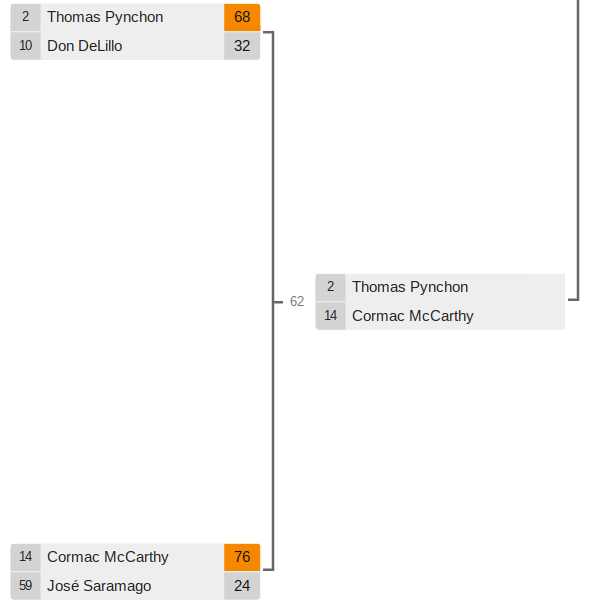
Thomas Pynchon beat out J.G. Ballard, earning 61% of 337 votes of my totally-scientific and not-at-all arbitrary twitter poll to become the Champion of the 2020 Tournament of Zeitgeisty Writers. Mr. Pynchon’s trophy is at Biblioklept World Headquarters here in Florida. After this whole quarantine business is over I’m sure he’ll arrange to pick it up.

My gut feeling is that the people who follow me on twitter are skewed toward Pynchon more than Ballard. Either of the pair could have taken the prize and I’d have been happy.

FG2744-3-14a

J.G. Ballard described the late twentieth century as good as anyone, and anticipated almost every aspect of our zeitgeist. The dude not only understood the intersection of commerce and politics and sex and art, but he could convey it in wild (and wildly-entertaining, forgive the cliche) stories and novels of the blackest and bleakest humor. There are any number of great starting places for Ballard, but if you haven’t read him yet, I’d recommend High-Rise or Concrete Island before jumping into the more challenging Crash. Then: The Atrocity Exhibition, the earlier novels (1962’s The Drowned World is particularly prescient) and the early stories of Vermilion Sands. Actually, if you can get a hold of The Complete Short Stories of J.G. Ballard, go for it. (I riffed on reading all the stories back in 2014.) I don’t recommend starting with the later novels—Ballard’s descriptions are so prescient that there’s this weird drop off in quality when reality catches up to him. In the meantime, why not read “The Secret Autobiography of  J G B”? (It was composed in 1981 but published in 2009; it took autofiction a few decades to catch up with the Notorious JGB.) Ballard is great.

Thomas Pynchon’s novels are famously byzantine, shaggy, esoteric, and paranoid. He captures both the zaniness and the menace of our zeitgeist. His protagonists are often straight figures who go crooked, insiders pushed to the outside through maladventure and adventure alike. Pynchon places a premium on the underdog who resists the Them—the technocracy, the war machine, the military-industrial-entertainment complex. His most famous (and probably best) novel Gravity’s Rainbow is an indictment of war and capitalism; although it’s set in WW2, it also addresses itself, ultimately, to that war’s hangover and the Nixonian evil contemporary with its publication. Pynchon’s loose California trilogy—The Crying of Lot 49Vineland, and Inherent Vice—document, describe, and deconstruct the myth of the American cultural revolution of the 1960s. Pynchon’s “historical novels,” Mason & Dixon and Against the Day are probably my favorites. Both analyze American history as a series of strange mistakes, big blunders, and minor foibles. His longest (and strangely, most accessible) novel Against the Day is also his clearest attack on the nebulous Them who oppose freedom, progress, and, ultimately, love. The humor and intelligence of Pynchon’s writing often softens the core anger of his work, an anger directed at the invisible forces that cry out, to steal from the Dead Kennedys, “Give me convenience or give me death!” He is a national treasure and I hope he lives forever—which he will, through his works.

Finally: I hope that everyone who participated in this thing had (at least the tiniest of sliver of) fun. I don’t think pitting writers against each other has anything to do with literature. I missed college basketball in March, so this is what I did. It also helped me drift off into other places for a while. Ballard is gone but I would love to read his quarantine novel. And I’ll read anything else we get from Pynchon.

Peace to all.


Final Round: The 2020 Tournament of Zeitgeisty Writers)

zeitgeisty


What’s there to say?

We’ve hit the final round of the 2020 Tournament of Zeitgeisty Writers.

Top-seeded Aldous Huxley fell to number five seed J.G. Ballad in a match that was never close for a second.

The stranger and more divisive match, at least for my metaphorical money, was between Thomas Pynchon and Cormac McCarthy.

Pynchon’s comic zaniness beat out McCarthy’s wryer apocalypticism (or maybe just more people on Twitter dig Pynchon).

I hope everyone had dumb stupid distracting fun with all of this.


The Final Four(horsemen of the Apocalypse) match-ups and Round Four results for the 2020 Tournament of Zeitgeisty Writers)

The Elite Armageddon Eight of the 2020 Tournament of Zeitgeisty Writers is all wrapped up, and we now have our Final Four(horsemen of the Apocalypse).

Let’s go bracket by bracket:

Margaret Atwood kept it close with Aldous Huxley, but lost in the end. I was rooting for her. I’m a huge fan of Huxley’s under-read apocalyptic pre-postmodernist Ape and Essence, but I have to admit I was rooting for Atwood.

I was torn between Ballard and LeGuin in the second bracket—both authors described and diagnosed our zeitgeist. Ballard prevailed.

Ballard will square off against Huxley in the Dead British Writers bracket of the Final Four.

Screenshot 2020-03-29 at 8.31.31 PM

Pynchon and DeLillo both had tough roads to the Final Four. Pynchon beat out Anna Kavan and David Foster Wallace to get to the Elite Eight; DeLillo bested Pat Frank and Philip K. Dick. All of these writers are great, and, more importantly to our rubric, seemed to presciently capture the current dystopia the 20th century was brewing. (Okay, Frank isn’t great, but.)

Pynchon beat DeLillo easily though.

Like Pynchon, Cormac McCarthy pretty much thumped everyone he was matched against, including low seed José Saramago in the Elite Eight. While I’m sure a ton of folks will cite The Road as his zeitgeistiest novel, I’d argue it’s Blood Meridian (or even No Country for Old Men).

Pynchon will contend with McCarthy in the White American Authors in Their Eighties bracket of the Final Four. I’m not sure how to vote. In some ways, this is like, the final bracket for me.

Screenshot 2020-03-29 at 8.32.00 PM


Blog about the first books I bought in 2020 (Books acquired, 2 Jan. 2020)

img_4686

Since the last time I’ve done one of these stupid “books acquired” posts, I’ve had at least six review copies show up at Biblioklept World Headquarters, Joy Williams’ 1988 Florida Keys novel Breaking and Entering, and a signed first-edition hardback copy of Ishmael Reed’s 1976 neo-hoodoo novel Flight to Canada—which I finished yesterday morning—and I’ve yet to do one of these stupid “books acquired posts” on any of them.

I had intended to do write about Flight to Canada today—a very Reedesque romp, overstuffed with characters and capers and motifs and themes, a zany satire of not just the Civil War, but also the American 1970s. Anyway, I’d intended to write about it today (or maybe riff on Greta Gerwig’s Little Women, which I saw last night and adored), but I ended up having to do a bunch of post-Xmas chores. The last few weeks have been busy.

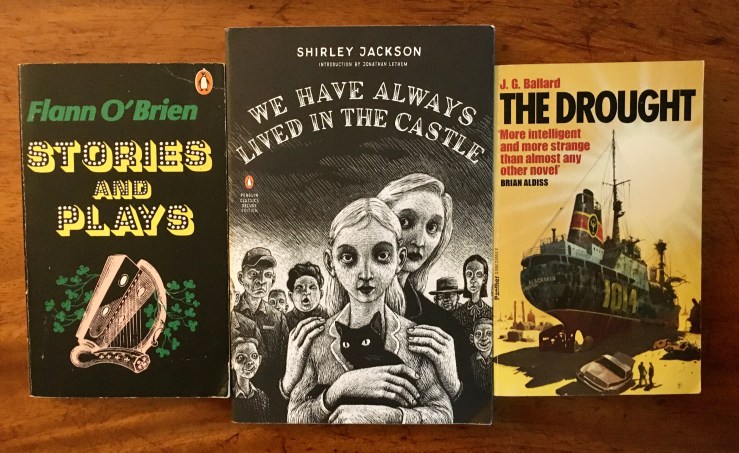
In between post-Xmas chores, I dropped my daughter off at my in-law’s, which necessitates driving past my favorite used bookstore. I couldn’t resist stopping by, even though I need another book like I need another hole in my head. I mean, I had intended to start Charles Portis’s latest (and hopefully not last!) novel Gringos today. Instead, I started Shirley Jackson’s We Have Always Lived in the Castle.

Jackson’s novel The Haunting of Hill House was an unexpected highlight for me in 2019—I’ll admit I’d never really thought to read anything of hers after filing her under Eighth grade lit after reading “The Lottery” (I made a similar stupid mistake with William Golding (filed under Tenth grade lit), corrected by good people who told me to read The Inheritors). I didn’t really know anything about We Have Always Lived in the Castle until today, but I love the title and really dig this Penguin edition’s cover (by comix artist Thomas Ott). Like Hill House, Castle also has a fantastic opening paragraph:

My name is Mary Katherine Blackwood. I am eighteen years old, and I live with my sister Constance. I have often thought that with any luck at all I could have been born a werewolf, because the two middle fingers on both my hands are the same length, but I have had to be content with what I had. I dislike washing myself, and dogs, and noise. I like my sister Constance, and Richard Plantagenet, and Amanita phalloides, the death-cup mushroom. Everyone else in my family is dead.

The first sentence is a bit banal, a little bit of exposition, right? And then by the time you get to the “I could have been a werewolf,” well, what the hell? And then there’s a because, lovely, before a nice lists of dislikes (first!) and then likes (including a deadly mushroom, which Jackson’s narrator Mary (purposefully?) misnames as the “death-cup” instead of the death cap. The last line is a hell of a zinger.

I skipped Jonathan Lethem’s introduction of course, but I did have to go figure out if he also wrote the introduction to the edition of Hill House I read last year. (He didn’t Jonny Lethe wrote the intro to the copy of Anna Kavan’s Ice that I read last year. I’ll read J-Lethz intro after I finish.)

I also picked up a 1973 Penguin edition of a collection of Flann O’Brien’s stories and plays. (Neil Stuart’s cover was worth the two bucks.) The bulk of the collection is devoted to an unfinished novel called Slattery’s Sogo Saga and a play called Faustus Kelly, attributed to O’Brien’s pseudonym Myles na gCopaleen (rendered in this edition as Myles Na Gopaleen—Flann O’Brien was actually a pseudonym too, for Brian O’Nolan).

Like the O’Brien collection, picking up a clearly-unread pristine massmarket paperback edition of J.G. Ballard’s 1965 novel The Drought was more an I have to type situation than anything else, although I’m sure I’ll read it this year (I’m always looking to scarf down a Philip K. Dick or Ballard I haven’t read, and I haven’t read The Drought). Initially, I was perplexed—I thought I knew all Ballard titles, even the ones I haven’t read—but it turns out that The Drought was initially published in 1964 as The Burning World (which I was aware of). In any case, The Drought is probably horrifyingly prescient novel as we enter the New Twenties. Happy New Year!

J.G. Ballard’s “The Subliminal Man,” John Carpenter’s They Live, and Black Friday

Today is Black Friday in America. I don’t think it’s necessary to remark at length on the bizarre disjunction between this exercise in consumerism-as-culture and the intended spirit of the Thanksgiving holiday that precedes it. Indeed, I think that the cognitive dissonance that underwrites Black Friday—the compulsion to suffer (and cause suffering), both physically and mentally,  to “save” money on “consumer goods” (sorry for all the scare quotes, but these terms are euphemisms and must be placed under suspicion)—I think that this cognitive dissonance is nakedly apparent to all who choose to (or are forced to) actively engage in Black Friday. The name itself is dark, ominous, wonderfully satanic.

Rereading “The Subliminal Man,” I was struck by how presciently J.G. Ballard anticipated not only the contours of consumerist culture—urban sprawl, a debt-based economy, the mechanization of leisure, the illusion of freedom of choice—but also how closely he intuited the human, psychological responses to the consumerist society he saw on the horizon. Half a century after its publication, “The Subliminal Man” seems more relevant than ever.

The premise of the tale is fairly straightforward and fits neatly with the schema of many other early Ballard stories: Franklin, an overworked doctor, is approached by Hathaway, a “crazy beatnik,” who refuses to take part in the non-stop consumerism of contemporary society. Hathaway can “see” the subliminal messages sent through advertising. He asks for Franklin’s help in stopping the spread of these messages. Hathaway reasons that the messages are intended to enforce consumerist society:

Ultimately we’ll all be working and spending twenty–four hours a day, seven days a week. No one will dare refuse. Think what a slump would mean – millions of lay–offs, people with time on their hands and nothing to spend it on. Real leisure, not just time spent buying things . . .

The fear of a slump. You know the new economic dogmas. Unless output rises by a steady inflationary five per cent the economy is stagnating. Ten years ago increased efficiency alone would raise output, but the advantages there are minimal now and only one thing is left. More work. Subliminal advertising will provide the spur.

Franklin is unconvinced, even though he is already working Saturdays and Sunday mornings to payoff TVs, radios, and other electronic goods that he and his wife replace every few months. Soon, however, he realizes that something is wrong:

He began his inventory after hearing the newscast, and discovered that in the previous fortnight he and Judith had traded in their Car (previous model 2 months old) 2 TV sets (4 months) Power mower (7 months) Electric cooker (5 months) Hair dryer (4 months) Refrigerator (3 months) 2 radios (7 months) Record player (5 months) Cocktail bar (8 months)

Franklin finally sees the truth, but only after Hathaway takes to blowing up signs’ switch boxes (the word “terrorism” is of course not used in the text, although it surely would be today):

Then the flicker of lights cleared and steadied, blazing out continuously, and together the crowd looked up at the decks of brilliant letters. The phrases, and every combination of them possible, were entirely familiar, and Franklin knew that he had been reading them for weeks as he passed up and down the expressway.

BUY NOW BUY NOW BUY NOW BUY NOW BUY NEW CAR NOW NEW CAR NOW NEW CAR NOW

YES YES YES YES YES YES YES YES YES YES

Like many Ballard stories, “The Subliminal Man” ends on a pessimistic note, with Franklin choosing to ignore his brief enlightenment and give in. Ballard drives his criticism home in the final image of the story, with Franklin and his wife heading out to shop:

They walked out into the trim drive, the shadows of the signs swinging across the quiet neighbourhood as the day progressed, sweeping over the heads of the people on their way to the supermarket like the blades of enormous scythes.

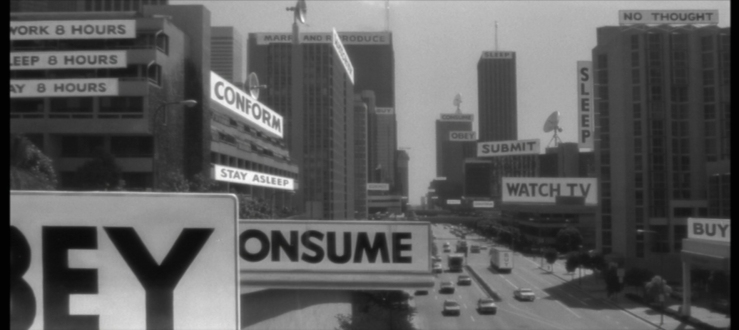
“The Subliminal Man” offers a critique of consumerism that John Carpenter would make with more humor, violence, and force in his 1988 film They Live. In Carpenter’s film, the hero John Nada (played by Roddy Piper) finds a pair of sunglasses that allow him to see through the ads, billboards, and other commercials he’s exposed. What’s underneath? Naked consumerism:

they-live-billboard

The images here recall the opening lines of “The Subliminal Man”: ‘The signs, Doctor! Have you seen the signs?’ Like Ballard’s story, Carpenter’s film is about waking up, to seeing the controlling messages under the surface.

In his film The Pervert’s Guide to Ideology, Slavoj Žižek offers a compelling critique of just how painful it is to wake up to these messages:

It’s worth pointing out that Carpenter offers a far more optimistic vision than Ballard. Ballard’s hero gives in—goes back to sleep, shuts his eyes. Carpenter’s hero Nada resists the subliminal messages—he actually takes up arms against them. This active resistance is possible because Carpenter allows his narrative an existential escape hatch: In They Live, there are real, genuine bad guys, body-snatching ugly-assed aliens—others that have imposed consumerism on humanity to enslave them. That’s the big trick to They Live: It’s not us, it’s them.

Ballard understands that there is no them; indeed, even as the story skirts around the idea of a conspiracy to dupe consumers into cycles of nonstop buying, working, and disposing, it never pins that conspiracy on any individual or group. There’s no attack on corporations or government—there’s not even a nebulous “them” or “they” that appears to have controlling agency in “The Subliminal Man.” Rather, Ballard’s story posits ideology as the controlling force, with the only escape a kind of forced suicide.

I don’t think that those who engage in consumerism-as-sport, in shopping-as-a-feeling are as blind as Ballard or Carpenter represent. I think they are aware. Hell, they enjoy it. What I think Ballard and Carpenter (and others, of course) really point to is the deep dissatisfaction that many of us feel with this dominant mode of life. For Ballard, we have resistance in the form of the beatnik Hathaway, an artist, a creator, a person who can perceive what real leisure would mean. For Carpenter, Nada is the resister—an outsider, a loner, a weirdo too. It’s somehow far more satisfying to believe that those who engage in spectacle consumerism are brainwashed by aliens than it is to have to come to terms with the notion that these people are acting through their own agency, of their own will and volition. Happy shopping everyone!

Ed. note: Biblioklept published a version of this post a few years ago. It is offered again now in the spirit of Thanksgiving leftovers.

Blog about some books and some book covers and acquiring some books and not acquiring some books

img_1179

I went to the book store this afternoon to pick up a copy of the latest graphic novel in by Kazu Kibuishi’s Amulet series for my kids, and of course I browsed a while. Looking for a copy of Anne Carson’s Plainwater, I ended up finding Angela Carter’s 1972 novel Infernal Desire Machines of Doctor Hoffman. It’s a British edition, 1985, Penguin, with a lovely Boschian cover by James Marsh. Here’s a detail from the cover:

img_1180

I’ve wanted to pick up Carter’s novel since I read about it on a silly good dystopian fiction list last year, and I’m thrilled that I was able to get one with a Marsh cover. This particular cover, along with Marsh’s cover for The Bloody Chamber, are included in Phil Baines lovely book Penguin by Design.

Baines’s book doesn’t include any of Marsh’s fantastic covers of J.G. Ballard novels, opting instead to include Dave Pelham’s versions. I love both Pelham and Marsh’s Ballard covers, and would love to get my mitts on one at some point. I always browse for old mass market paperbacks of sci-fi authors I like — Philip K. Dick, Ursula K. LeGuin, the Strugatsky Brothers, J.G. Ballard — hoping to find an interesting cover, something inventive and fun, something from before their works were, under the cloak of awful respectability, given safe, boring literary covers. I didn’t find any Ballard editions with Marsh or Pelham covers, but I did come across this lovely pair of mass market paperback:

img_1176

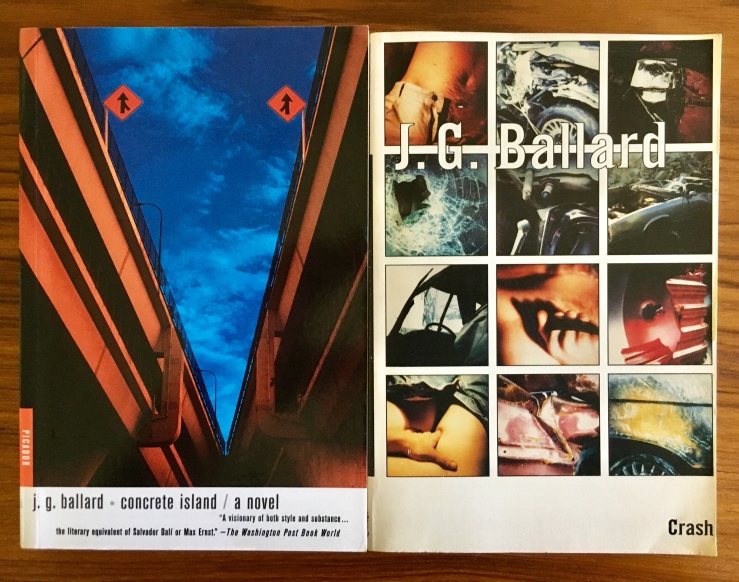
They’re US Vintage versions, 1985, with covers by Chris Moore. There’s like a proto-Cherry 2000 thing going on here that I kinda love, but I already own these novels, and I don’t love the covers quite enough. So instead, this post. Here are the covers of my copies of Crash and Concrete Island:

img_1181

While Henry Sene Yee’s cover design for my copy of Concrete Island (using a photograph by Kevin Laubacher) isn’t terrible, it is a good example of what I mean by boring respectable literary covers. Still, this trade edition (Picador, 2001) is really readable—I mean, it’s easy to read. The pages are nice, the typeset is great, etc. (And the book is killer). I actually like the cover of my copy of Crash, a lot (design by Michael Ian Kaye and Melissa Hayden), but it’s also trying just a little too hard. (Again—very readable version from FS&G’s Noonday Press imprint, 1994).

While I had to pass today on the mass market copies of Crash and Concrete Island today—not because they would have set me back five bucks in store credit, but because I don’t need them, because I hope some kid goes in there and picks them up—while I had to pass on those lurid beauties, I did pick up a mass market 1967 copy of The Crystal World. Publisher Berkley Medallion didn’t bother to name the cover designer/artist, and I haven’t been able to track it down, but it is, I admit, a bit disappointing—an early pulp bid for literary respectability. At least I can be on the look out for a weirder one in the future.

Books acquired, 27 and 28 June 2017

A highlight of an unexpected trip to Los Angeles a few weeks ago was getting to meet “in real life” with some people I’ve gotten to know over the internet. I met up with Ryan Chang, who’s written a number of excellent reviews for Biblioklept, and Adam Novy, whose novel The Avian Gospels is one of the best contemporary novels of the last decade. The weirdest part about hanging out was that it wasn’t weird at all.

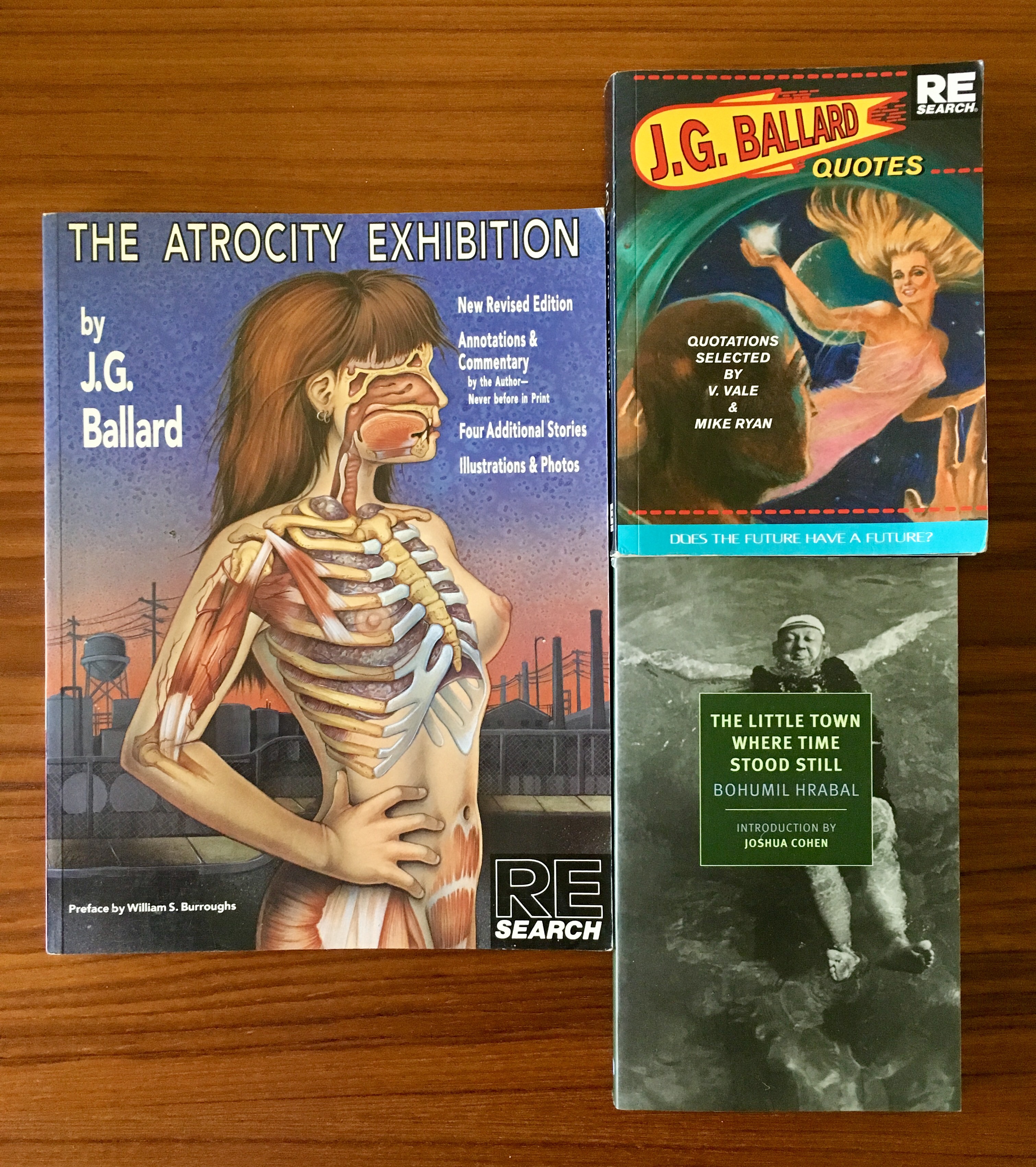
After lunch and coffee, Ryan and I visited Alias Books East, a small but well-stocked book shop in Atwater Village. Plenty of books on art and film, and lots of literature in translation. I asked Ryan to pick out something for me to buy, and he chose Bohumil Hrabal’s The Little Town Where Time Stood Still, a title that had grabbed his attention when we first entered the store. Here’s NYRB’s blurb for the Hrabal:

The Little Town Where Time Stood Still contains two linked narratives by the incomparable Bohumil Hrabal, whom Milan Kundera has described as “Czechoslovakia’s greatest writer.” “Cutting It Short” is set before World War II in a small country town, and it relates the scandalizing escapades of Maryška, the flamboyant wife of Francin, who manages the local brewery. Maryška drinks. She rides a bicycle, letting her long hair fly. She butchers pigs, frolics in blood, and leads on the local butcher. She’s a Madame Bovary without apologies driven to keep up with the new fast-paced mechanized modern world that is obliterating whatever sleepy pieties are left over from the defunct Austro-Hungarian Empire. “The Little Town Where Time Stood Still” is told by Maryška and Francin’s son and concerns the exploits of his Uncle Pepin, who holds his own against the occupying Nazis but succumbs to silence as the new post–World War II Communist order cements its colorless control over daily life. Together, Hrabal’s rousing and outrageous yarns stand as a hilarious and heartbreaking tribute to the always imperiled sweetness of lust, love, and life.

Ryan picked up a first edition hardback of an Edward St. Aubyn novel and something else I can’t remember. The clerk also let us check out some of the signed hardbacks behind the counter, and I somehow didn’t spend sixty bucks on a copy of Ray with Barry Hannah’s signature.

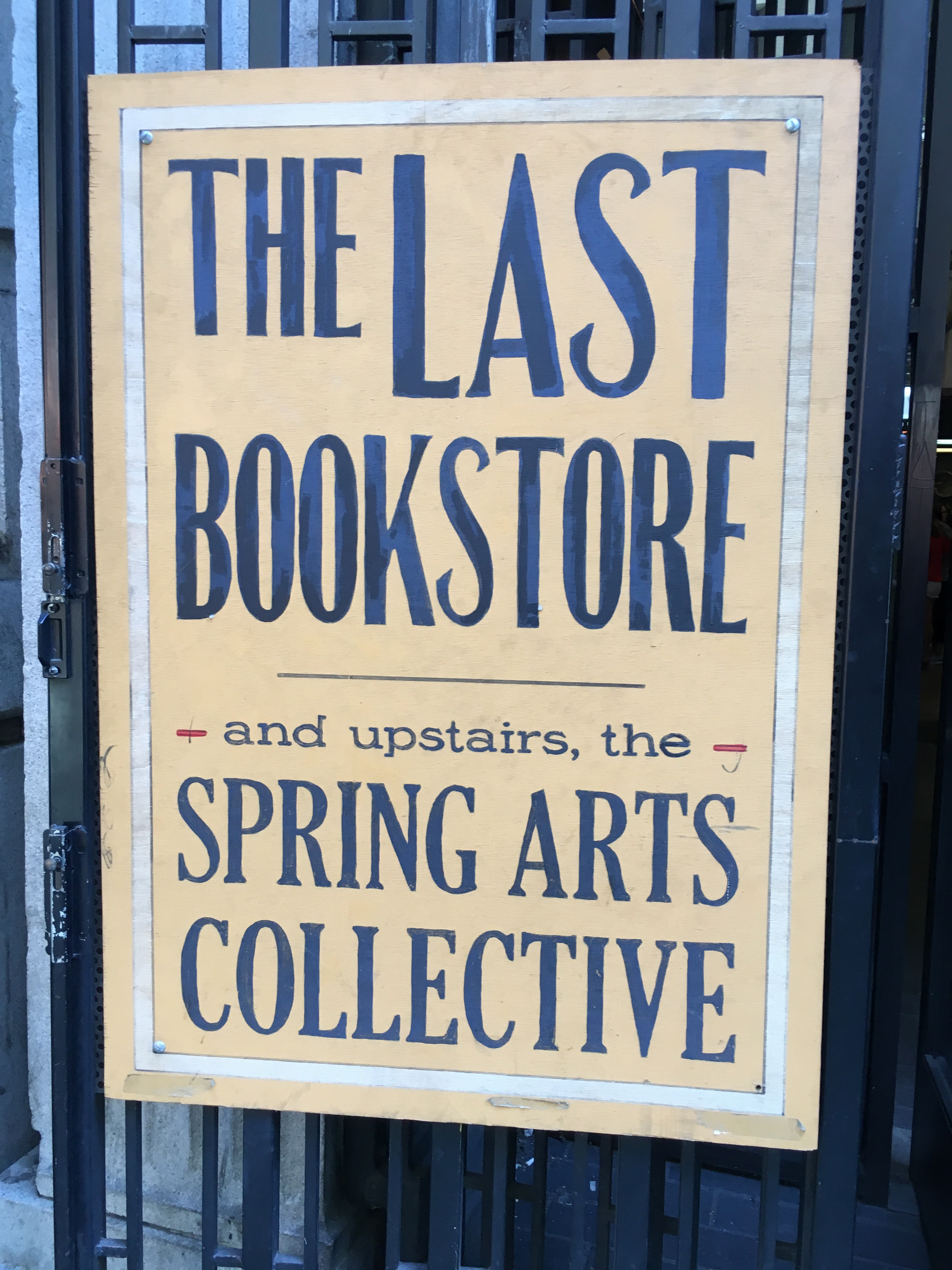
I spent most of the next day wandering around downtown Los Angeles. Everyone had told me to check out The Last Bookstore, and I wasn’t disappointed. I spent over an hour browsing the huge space, wishing I had more time to linger, especially in the upstairs labyrinth and the wonderful little annex of art books and monographs.

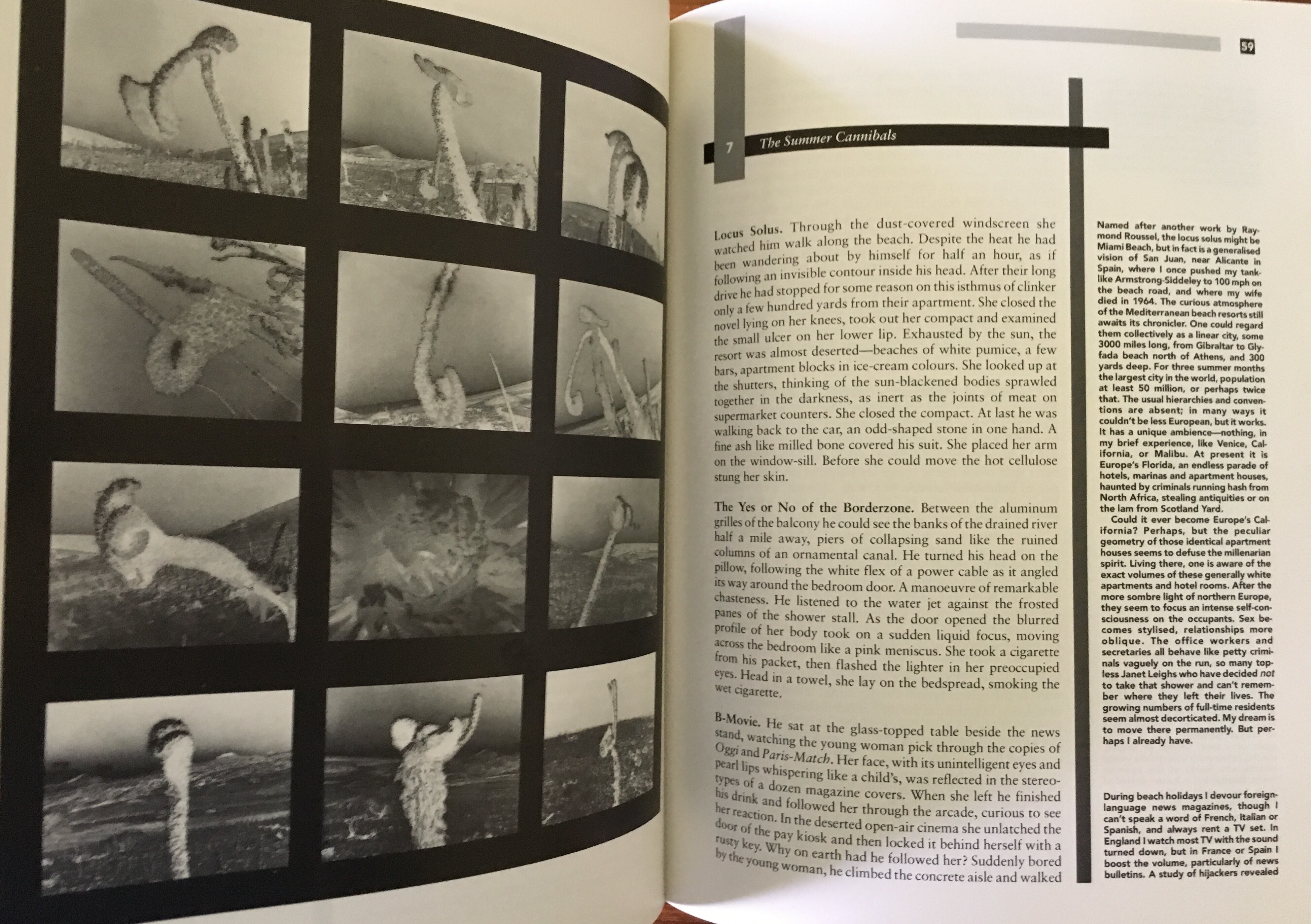
I ended up buying the first book I handled at The Lost Bookstore, RE/Search’s 1990 oversized and illustrated edition of J.G. Ballard’s The Atrocity Exhibition. This is one of the first Ballard books I read, actually—a good friend of mine collected RE/Search titles throughout the nineties and let me borrow them. (I always returned them).

Opener:

And a random two-pager:

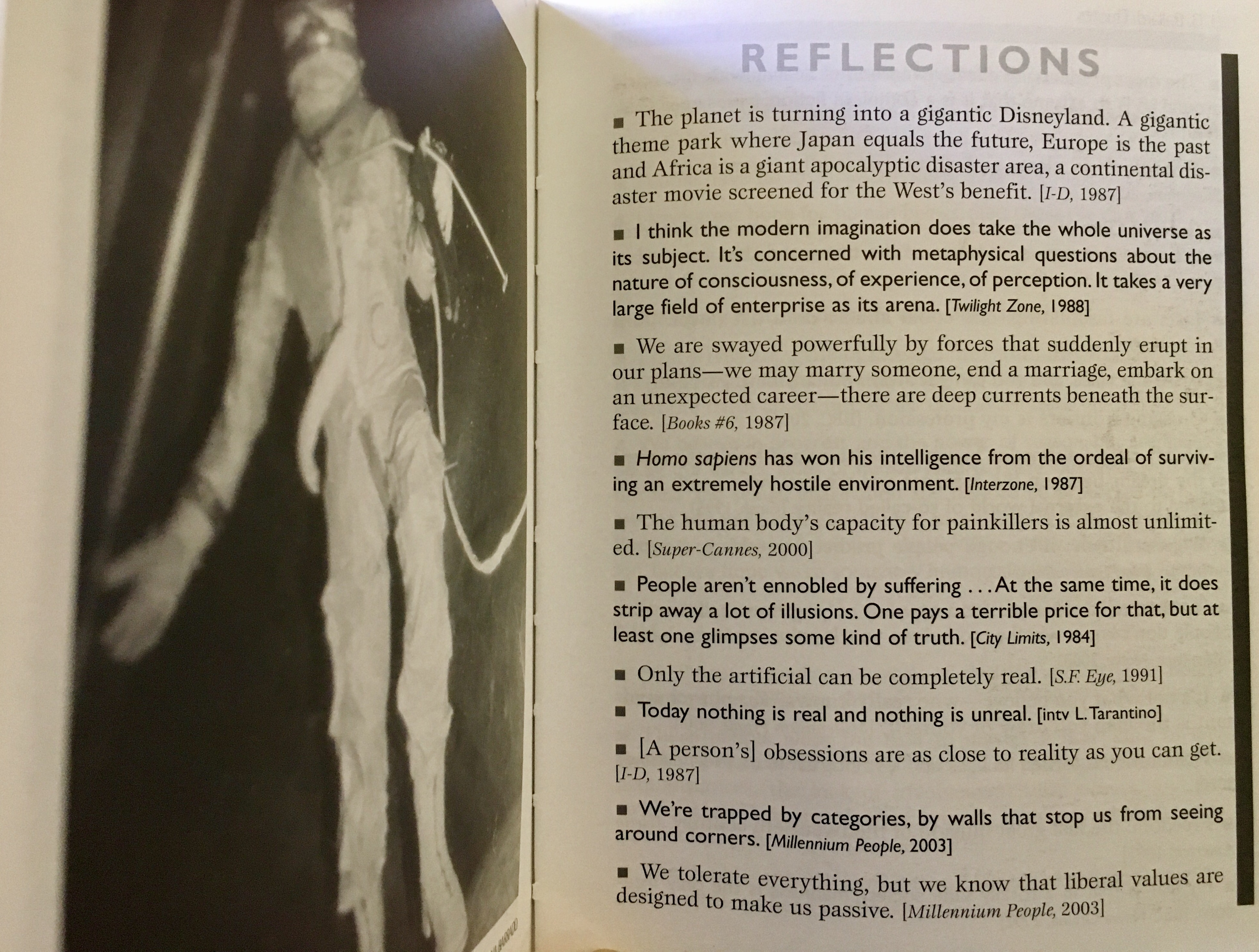
I also picked up another Ballard RE/Search title, a fat little book I’d never seen before named Quotes. Perfect airport reading. (And of course, being Ballard, there’s a whole section on airports). Random page:

I didn’t make it to the Iliad Bookshop in North Hollywood, but, hey, save something for next time, right?

J.G. Ballard’s “The Subliminal Man,” John Carpenter’s They Live, and Black Friday

Today is Black Friday in America. I don’t think it’s necessary to remark at length on the bizarre disjunction between this exercise in consumerism-as-culture and the intended spirit of the Thanksgiving holiday that precedes it. Indeed, I think that the cognitive dissonance that underwrites Black Friday—the compulsion to suffer (and cause suffering), both physically and mentally,  to “save” money on “consumer goods” (sorry for all the scare quotes, but these terms are euphemisms and must be placed under suspicion)—I think that this cognitive dissonance is nakedly apparent to all who choose to (or are forced to) actively engage in Black Friday. The name itself is dark, ominous, wonderfully satanic.

Rereading “The Subliminal Man,” I was struck by how presciently J.G. Ballard anticipated not only the contours of consumerist culture—urban sprawl, a debt-based economy, the mechanization of leisure, the illusion of freedom of choice—but also how closely he intuited the human, psychological responses to the consumerist society he saw on the horizon. Half a century after its publication, “The Subliminal Man” seems more relevant than ever.

The premise of the tale is fairly straightforward and fits neatly with the schema of many other early Ballard stories: Franklin, an overworked doctor, is approached by Hathaway, a “crazy beatnik,” who refuses to take part in the non-stop consumerism of contemporary society. Hathaway can “see” the subliminal messages sent through advertising. He asks for Franklin’s help in stopping the spread of these messages. Hathaway reasons that the messages are intended to enforce consumerist society:

Ultimately we’ll all be working and spending twenty–four hours a day, seven days a week. No one will dare refuse. Think what a slump would mean – millions of lay–offs, people with time on their hands and nothing to spend it on. Real leisure, not just time spent buying things . . .

The fear of a slump. You know the new economic dogmas. Unless output rises by a steady inflationary five per cent the economy is stagnating. Ten years ago increased efficiency alone would raise output, but the advantages there are minimal now and only one thing is left. More work. Subliminal advertising will provide the spur.

Franklin is unconvinced, even though he is already working Saturdays and Sunday mornings to payoff TVs, radios, and other electronic goods that he and his wife replace every few months. Soon, however, he realizes that something is wrong:

He began his inventory after hearing the newscast, and discovered that in the previous fortnight he and Judith had traded in their Car (previous model 2 months old) 2 TV sets (4 months) Power mower (7 months) Electric cooker (5 months) Hair dryer (4 months) Refrigerator (3 months) 2 radios (7 months) Record player (5 months) Cocktail bar (8 months)

Franklin finally sees the truth, but only after Hathaway takes to blowing up signs’ switch boxes (the word “terrorism” is of course not used in the text, although it surely would be today):

Then the flicker of lights cleared and steadied, blazing out continuously, and together the crowd looked up at the decks of brilliant letters. The phrases, and every combination of them possible, were entirely familiar, and Franklin knew that he had been reading them for weeks as he passed up and down the expressway.

BUY NOW BUY NOW BUY NOW BUY NOW BUY NEW CAR NOW NEW CAR NOW NEW CAR NOW

YES YES YES YES YES YES YES YES YES YES

Like many Ballard stories, “The Subliminal Man” ends on a pessimistic note, with Franklin choosing to ignore his brief enlightenment and give in. Ballard drives his criticism home in the final image of the story, with Franklin and his wife heading out to shop:

They walked out into the trim drive, the shadows of the signs swinging across the quiet neighbourhood as the day progressed, sweeping over the heads of the people on their way to the supermarket like the blades of enormous scythes.

“The Subliminal Man” offers a critique of consumerism that John Carpenter would make with more humor, violence, and force in his 1988 film They Live. In Carpenter’s film, the hero John Nada (played by Roddy Piper) finds a pair of sunglasses that allow him to see through the ads, billboards, and other commercials he’s exposed. What’s underneath? Naked consumerism:

they-live-billboard

The images here recall the opening lines of “The Subliminal Man”: ‘The signs, Doctor! Have you seen the signs?’ Like Ballard’s story, Carpenter’s film is about waking up, to seeing the controlling messages under the surface.

In his film The Pervert’s Guide to Ideology, Slavoj Žižek offers a compelling critique of just how painful it is to wake up to these messages:

It’s worth pointing out that Carpenter offers a far more optimistic vision than Ballard. Ballard’s hero gives in—goes back to sleep, shuts his eyes. Carpenter’s hero Nada resists the subliminal messages—he actually takes up arms against them. This active resistance is possible because Carpenter allows his narrative an existential escape hatch: In They Live, there are real, genuine bad guys, body-snatching ugly-assed aliens—others that have imposed consumerism on humanity to enslave them. That’s the big trick to They Live: It’s not us, it’s them.

Ballard understands that there is no them; indeed, even as the story skirts around the idea of a conspiracy to dupe consumers into cycles of nonstop buying, working, and disposing, it never pins that conspiracy on any individual or group. There’s no attack on corporations or government—there’s not even a nebulous “them” or “they” that appears to have controlling agency in “The Subliminal Man.” Rather, Ballard’s story posits ideology as the controlling force, with the only escape a kind of forced suicide.

I don’t think that those who engage in consumerism-as-sport, in shopping-as-a-feeling are as blind as Ballard or Carpenter represent. I think they are aware. Hell, they enjoy it. What I think Ballard and Carpenter (and others, of course) really point to is the deep dissatisfaction that many of us feel with this dominant mode of life. For Ballard, we have resistance in the form of the beatnik Hathaway, an artist, a creator, a person who can perceive what real leisure would mean. For Carpenter, Nada is the resister—an outsider, a loner, a weirdo too. It’s somehow far more satisfying to believe that those who engage in spectacle consumerism are brainwashed by aliens than it is to have to come to terms with the notion that these people are acting through their own agency, of their own will and volition. Happy shopping everyone!

Ed. note: Biblioklept published a version of this post a few years ago. It is offered again now in the spirit of Thanksgiving leftovers.

The most effective method of dealing with the world around us is to assume that it is a complete fiction (J.G. Ballard)

In the past we have always assumed that the external world around us has represented reality, however confusing or uncertain, and that the inner world of our minds, its dreams, hopes, ambitions, represented the realm of fantasy and the imagination. These roles, it seems to me, have been reversed. The most prudent and effective method of dealing with the world around us is to assume that it is a complete fiction – conversely, the one small node of reality left to us is inside our own heads. Freud’s classic distinction between the latent and manifest content of the dream, between the apparent and the real, now needs to be applied to the external world of so-called reality.

From J.G. Ballard’s 1995 introduction to the Vintage reprint of his 1973 novel Crash.

Three Books

img_3030

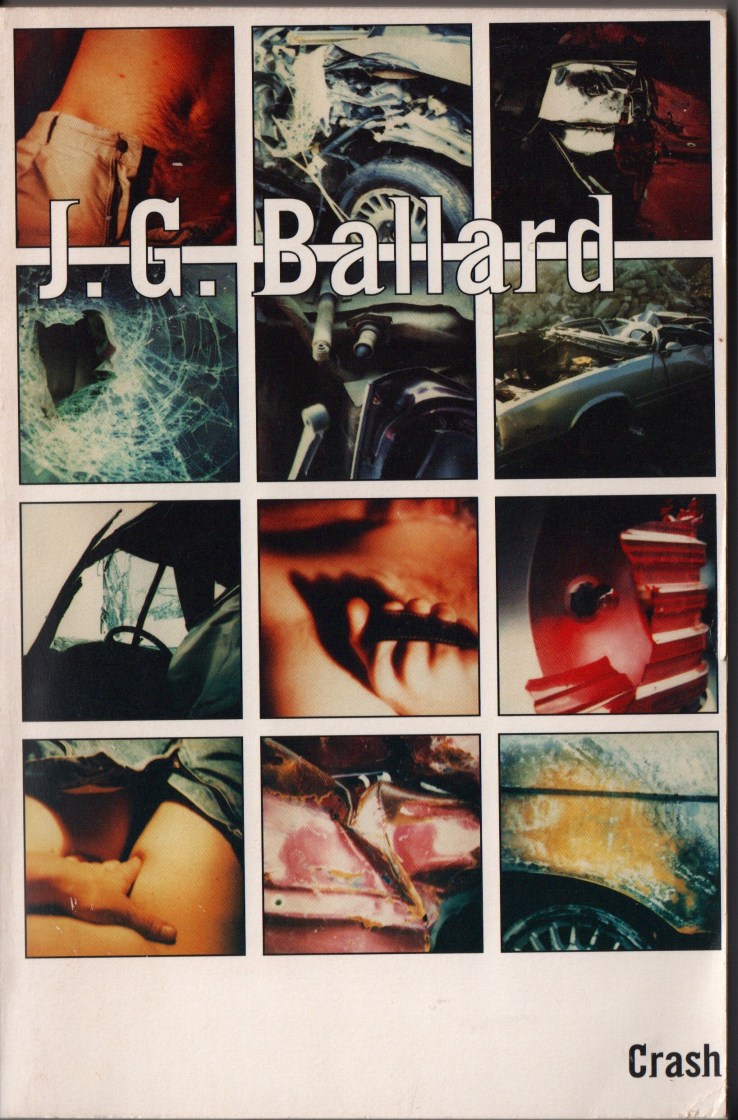
Crash by J.G. Ballard. 1994 trade paperback by Noonday (FS&G). Cover design by Michael Ian Kaye and Melissa Hayden.

I had a redneckish college roommate who was way into cars, so I encouraged him to watch Cronenberg’s adaptation of Crash with me, which he did. He was a nice guy. He watched all of it with me and our other roommate. The rest of the year he would joke, “Hey, let’s go crash this car and have sex!”

img_3031

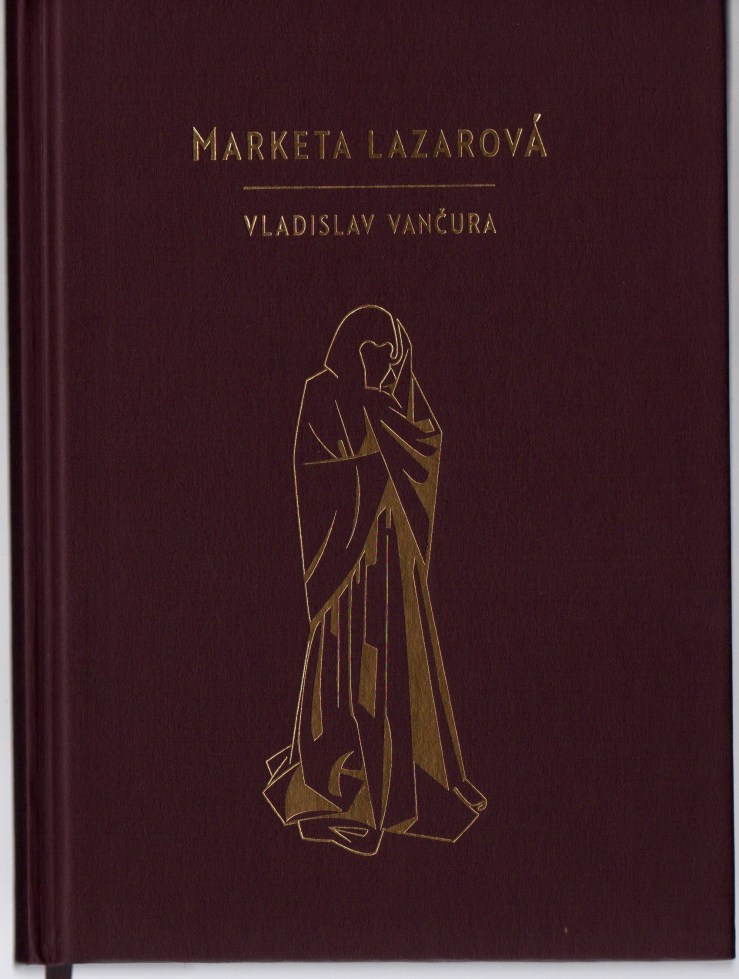
Marketa Lazarova by Vladislav Vančura. (First) English translation by Carleton Bulkin. First edition hardback by Twisted Spoon Press, 2016. Cover by Dan Mayer. A strange and often violent tale of multiple kidnappings and medieval intrigues, Marketa Lazarova reminds me of Le Morte D’Arthur, Nanni Balestrini’s Sandokan (both in its evocations of brutality and in its marvelous poetic prose), Aleksei German’s film Hard to Be a God, Bergman’s film The Virgin Spring, Bolaño’s sweetly ironic narrators, and, uh, Game of Thrones.

img_3029

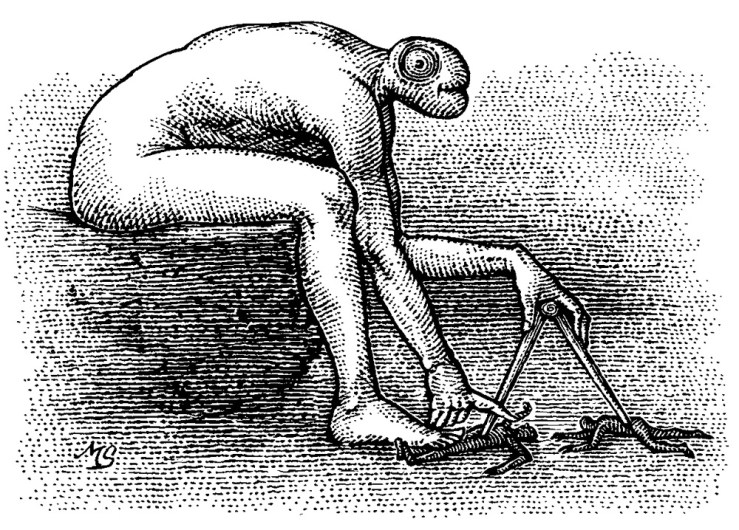
Masquerade by Kit Wiliams. Eighth edition hardback from Shocken, 1981. While no designer is credited, the cover is obviously one of Williams’s lovely paintings. A puzzle book, a treasure hunt.

Reviews and riffs of February-May, 2016 (and an unrelated stag)

Hey, wow. Haven’t done one of these in a while.


I reread William Gaddis’s big big novel J R, writing

Only a handful of novels are so perfectly simultaneously comic and tragic. Moby-Dick? Yes. Gravity’s Rainbow? Absolutely. (G R and J R, a duo published two years apart, spiritual twins, massive American novels that maybe America hardly deserves (or, rather: theses novels were/are totally the critique America deserves). I guess maybe what I’m saying is J  R is the Great American Novel to Come (The Recognitions is perhaps overpraised and certainly not Gaddis’s best novel; J R is. The zeitgeist has been caught up to J R, the culture should (will) catch up).


I also read and wrote about Ashley Dawson’s Extinction: A Radical History, a scary little primer that argues mass species extinction is

…the product of a global attack on the commons, the great trove of air, water, plants and creatures, as well as collectively created cultural forms such as language, that have been regarded traditionally as the inheritance of humanity as a whole…capital of course depends on continuous commodification of this environment to sustain its growth.

My reading of Extinction—and hence my writing about it—is/was inextricably bound up in a viewing of Hayao Miyazaki’s 1997 eco-fable 1997 , Mononoke-hime. (The film’s title is usually rendered in English as Princess Mononoke, but I think Spirit-Monster Wolfchild is a more fitting translation). I also linked the book to Gilgamesh and Easter. And I used this gif:

tumblr_inline_o1qoyqk5ln1t6t6sv_500


I wrote a post about listening to audiobook versions of “difficult novels,” taking my lead and license from this big quote from William H. Gass’s essay “The Sentence Seeks Its Form”:

Breath (pneuma) has always been seen as a sign of life . . . Language is speech before it is anything. It is born of babble and shaped by imitating other sounds. It therefore must be listened to while it is being written. So the next time someone asks you that stupid question, “Who is your audience?” or “Whom do you write for?” you can answer, “The ear.” I don’t just read Henry James; I hear him. . . . The writer must be a musician—accordingly. Look at what you’ve written, but later … at your leisure. First—listen. Listen to Joyce, to Woolf, to Faulkner, to Melville.


99 reasons I didn’t read your novel.


tumblr_o71467dk931s4y9aso1_1280

I reviewed Mahendra Singh’s marvelous satire American Candide. Far better than my measly review is a long interview I did with Singh, who is just a damn genius. I’m most grateful for the final exchange of our review, which was not really a part of the official q & a type thing we were doing—rather, I was bemoaning my ability to write anything lately, and Mahendra offered me the following, which I edited into the interview:

The hidden contempt that our culture harbors towards art will drive you nuts if you think about it … so don’t think too much … write instead! And if you can’t write, read smartly. I find great solace in the classics and have devoted most of my life to trying in whatever way I can to perpetuate the classical tradition (in concealment) and create situations where young people can gain access to the eternal truths and beauty of the classical world tradition. We are living in a time of imperial decline and must preserve the best of the past as our ancestors did in similar times of trouble. The pendulum will swing the other way in a few centuries.


Prince died.

I wrote about him in a Three Books post.

The three books had nothing to do with Prince.


Despite some fascinating images, I was not impressed by Ben Wheatley’s film adaptation of Ballard’s High-Rise. I concluded that,

While the High-Rise adaptation delivers Ballardian style, that Ballardian style only points at itself, and not at our Ballardian present, our Ballardian future.


And I wrote about Ferrante, Knausgaard, and their good/bad/ironic book covers.


Here’s that promised stag (by Diego Velazquez):

reproduction_painting5cspain5cvelc3a1zquez20diego20rodriguez20de20silva20159920-2016605chead20of20a20stag

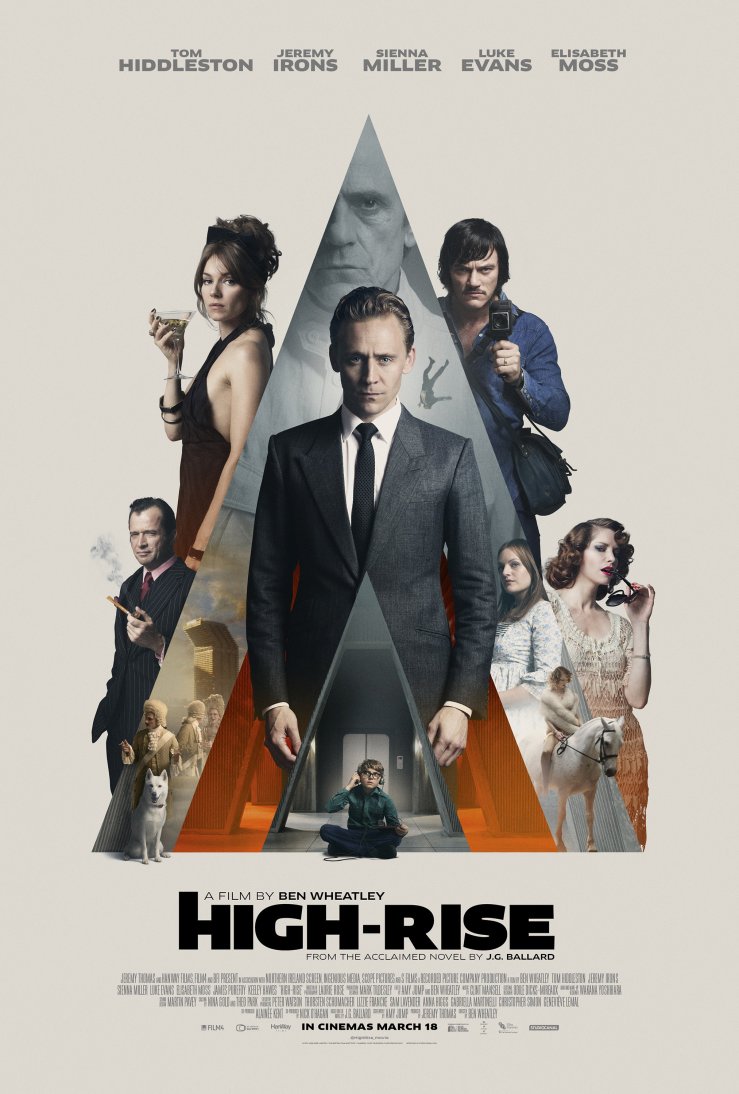
Despite our Ballardian present, the High-Rise film adaptation is a nostalgia piece

high-rise-poster

  1. Our present is utterly Ballardian.
  2. Our present is so utterly Ballardian that our present is actually our (unevenly distributed) future.
  3. Like, what is the 2016 U.S. presidential election but a short story Ballard might have written in 1983 (and hopefully thrown in the trash)?
  4. Ballard’s 1975 novel High-Rise is particularly concerned with this present-future condition: the phrase to come (as in a future to come) repeats throughout the novel, a key dissonant note.
  5. Near the end of the novel, Ballard’s free indirect style drifts into the mind of protagonist Robert Laing:

    ...he found it difficult not to believe that they were living in a future that had already taken place, and was now exhausted.

  6. A version of this line shows up in the first minutes of director Ben Wheatley’s 2015 film adaptation of High-Rise.
  7. While Ballard’s satire evokes the post-future’s psychological (ir)reality, Wheatley’s film adaptation feels like a nostalgic period piece for a future that came and skedaddled. Perhaps he (and his fellow filmmakers—screenwriter Amy Jump, the editor, the set designers and costumers, etc.) found it impossible to do more than stylistically recapitulate the Modernist contours that Ballard transcended.
  8. Critic Tasha Robinson lays it out neatly in her proper review at The Verge:

    The retro cars, suits, and architecture all put High-Rise more in a quaint, remote past than a dystopian future. They also add to the sense of otherworldliness that hangs over the film.

    And so does the sense that High-Rise is driven more by Wheatley’s poster-ready striking images —€” a suicide falling from a high balcony in ultra slow motion, Laing expressionless and spattered with paint — than by any sort of human drives.

  9. (I modify “review” in the above with “proper” because Robinson wrote a real review; I’m not doing that here. I think her take on the film is far more detailed and broad than what I’m doing here, and certainly attends more to the, like, plot of the film—even as she acknowledges that the plot basically gets put on the back-burner for long stretches).
  10. So probably my biggest quibble with the High-Rise film adaptation is its nostalgia, its obsession with midcentury modernism and Brutalism and style—by which I mean the idea of style—over, like, ideas. 
  11. Those ideas: Ballard’s central critiques of capitalism, consumerism, and class do come through in the film, but Wheatley and his team resist giving them any air to breathe, let alone room to stretch their legs. (My god. Forgive me these metaphors, this terrible personification).
  12. There are very, very few scenes in the film where people exchange ideas.
  13. Instead, ideas are wedged in, often in snippets lifted directly from the book, crammed quickly into a frame that will surely veer back into the film’s main technique: Montage!
  14. The first chapter of Ballard’s novel is titled “Critical Mass.” As I pointed out in my review of the novel, “Ballard dispenses with any simmering in his tale of depraved debauchery,” and gets his pot boiling in a hurry.
  15. In contrast, Wheatley’s film gets a slower—but strong—start. (The first 50 or so minutes are actually pretty great).
  16. At its midway point though, the High-Rise film tries to pick up the pace—dramatically. The solution is montage after montage.
  17. Indeed, the final hour of the film slips into a state of near-constant montage. The big set piece scenes (y’know—dance parties and food riots and orgies and the like) dissolve into the film’s frenetic technique. It often feels as if Wheatley is more interested in making a bunch of cool music videos than a film. While this jumpy method might have been the filmmakers’ intention—y’know, to evoke paranoia, anxiety, exhaustion, claustrophobia, etc.—the result, at least for me, was a kind of paradoxical lethargy, a creeping dullness.
  18. Key moments, like the first encounter between Wilder and Royal for example, fly by in rushed blips. It’s as if Wheatley was afraid that if he let two people talk on-screen for more than 30 seconds the viewers would not, y’know, pick up on the fact that we are witnessing the thin veneer of society crack open revealing an abject tumult of sex and violence underneath.
  19. (Wilder—the Id man! Royal the Superego. So much of Ballard’s psychological stuff gets lost in the film, which foregrounds class hierarchy instead of synthesizing the two. But that’s a separate quibble).
  20. What were likely great performances (and much potential for humor) get lost in all the short cuts and montage.
  21. Still:  Sienna Miller is great as Charlotte Melville, and Tom Hiddleston is charming enough.
  22. But best in the film—at least for me—is Elizabeth Moss as Wilder’s pregnant wife Helen.
  23. Still, the filmmakers insist on mining her pregnancy for cheap nostalgic jokes—she’s always smoking, always finishing a drink or pouring a new one.
  24. Which brings me back to: Why a period piece? Why not update High-Rise—or, even better take it outside of time completely?
  25. (It will be interesting to look at the film in twenty years: Oh! These were the aesthetic obsessions of the 2010’s, these were the nostalgic totems of that silly decade).
  26. (And while I’m wedging points in parenthetically in a rush: The ending. I read the novel’s conclusion ironically—the high-rise is a phallic failure, and as its patriarchy devolves into chaos and death, a matriarchy arises (or maybe coalesces is the verb I want). But the film concludes more ambiguously—sure, it points to the idea of a matriarchy (or harem)—but it leaves Laing in the kind of alpha male position that the novel had sought to ironize).
  27. And, to return to point 24: Did the filmmakers underestimate the currency of Ballard’s satire? We live in an era of radical wealth inequality, where the richest in our society are rapidly establishing their own private greenzones away from the plebeians. High-Rise is more timely now than ever.
  28. (A short list of (non-)adaptations of J.G. Ballard’s High-Rise: Pete Travis’s Dredd (2012), Matteo Garrone’s Gomorra (2008), and George Romero’s Land of the Dead (2005)).
  29. (And re: point 27 w/r/t adaptations—in a sense, Ballard adapted/revised the novel himself in his 2003 novel Millennium People).
  30. Reading back over this riff, briefly, I see that there’s so much I left out—on stuff the filmmakers left out (why change the key plot point of Laing’s sister?)—on stuff I should’ve praised more (great soundtrack; good cinematography)—but most of all, what doesn’t come through is my admiration that the filmmakers tried. And they tried hard, successfully evoking a Ballardian style. But while the High-Rise adaptation delivers Ballardian style, that Ballardian style only points at itself, and not at our Ballardian present, our Ballardian future.

Another trailer for that High-Rise film

Not sure about this one…but I love the Ballard novel, so…