In Yoko Ogawa’s new collection Revenge, eleven stories of fascinating morbidity intertwine at oblique angles. Tale extends into tale: characters, settings, and images float intertextually from chapter to chapter, layering and reticulating themes of death, crime, consumption, and creation. (And revenge, of course. Let’s not forget revenge). Not quite a story cycle or a novel-in-tales, Revenge’s sum is nevertheless greater than its parts. It’s a brisk, engaging read, and as I worked my way to the final story, I already anticipated returning to the beginning to pull at the motifs threading through the book.
The book’s dominant motifs of death and food arrive in the first tale, “Afternoon Bakery,” where a mother tries to buy strawberry shortcakes for her dead son’s birthday—only the baker is too busy bawling to attend to sales. We learn why this baker is crying in “Fruit Juice,” the second story, a tale that ends inexplicably with an abandoned post office full of kiwi fruit. The third story, “Old Mrs. J” (one of Revenge’s stand-outs) perhaps answers where those kiwis came from. More importantly, “Old Mrs. J,” with its writer-protagonist, elegantly introduces the thematic textual instability of the collection. There’s a haunting suspicion here that the characters who glide from one tale to the next aren’t necessarily the silent extras they seem to be on the surface. Our characters, background and fore, are doppelgängers, ghost writers, phantoms.
The penultimate tale “Tomatoes and the Full Moon” lays the ghosting bare. Its protagonist is a magazine writer, whose “articles” really amount to little more than advertising. Staying at a seaside resort, he’s pestered by an old woman, one of the many witches who haunt Revenge. The old woman claims to be a novelist, and points out one of her books in the resort’s library:
Later, in my room, I read ‘Afternoon at the Bakery.’ It was about a woman who goes to buy a birthday cake for her dead son. That was the whole story. I should have gone back to my article, but I read her novel through twice, finishing for the second time at 3:00 a.m. The prose was unremarkable, as were the plot an characters, but there was an icy current running under her words, and I found myself wanting to plunge into it again and again.
The final line is perhaps a description of Revenge’s haunting intertextual program—although to be clear, Ogawa’s plot and characters are hardly “unremarkable,” and her prose, in Stephen Snyder’s English translation, is lucid and descriptive. It’s the “icy current running under her words” that makes Ogawa’s tales stick so disconcertingly in the reader’s psychic gullet. And if her prose is at times “unremarkable,” it’s all in the service of creating a unifying tone. All eleven tales are narrated in first-person, and each narrator is bound to the limits of his or her own language.
These limitations of language bump up against the odd, the spectacular, the alien, as in “Sewing for the Heart”:
She had explained that she was born with her heart outside of her chest—as difficult as that might be to imagine.
The line is wonderful in its mundane trajectory: Our narrator, an artisan bagmaker, witnesses this woman who lives with her heart outside her chest and concedes that such a thing might be “difficult . . . to imagine”! There’s something terribly paltry in this, but it’s also purposeful and controlled: Here we find the real in magical realism.
But this bagmaker can imagine, as we see in an extraordinary passage that moves from the phenomenological world of sight and sound and into the realm of our narrator’s strange desires:
She began to sing, but I could not make out the words. It must have been a love song, to judge from the slightly pained expression on her face, and the way she tightly gripped the microphone. I noticed a flash of white skin on her neck. As she reached the climax of the song, her eyes half closed and her shoulders thrown back, a shudder passed through her body. She moved her arm across her chest to cradle her heart, as though consoling it, afraid it might burst. I wondered what would happen if I held her tight in my arms, in a lovers’ embrace, melting into one another, bone on bone . . . her heart would be crushed. The membrane would split, the veins tear free, the heart itself explode into bits of flesh, and then my desire would contain hers—it was all so painful and yet so utterly beautiful to imagine.
Painful and utterly beautiful: Another description of Revenge.
Sometimes the matter-of-fact tone of the stories accounts for marvelous little eruptions of humor, as in “The Last Hour of the Bengal Tiger”:
At fifteen, I took an overdose of sleeping pills. I must have had a good reason for wanting to kill myself, but I’ve forgotten what it was. Perhaps I was just fed up with everything. At any rate, I slept for eighteen hours straight, and when I woke up I was completely refreshed. My body felt so empty and purified that I wondered whether I had, in fact, died. But no one in my family even seemed to have noticed that I had attempted suicide.
The scene is simultaneously devastating and hilarious, an evocation of abyssal depression coupled with mordant irony. The scene also underscores the dramatic uncertainty that underpins so many of the tales, where the possibility that the narrator is in fact a ghost or merely a character in someone else’s story is always in play.
There’s no postmodern gimmickry on display here though. Ogawa weaves her tales together with organic ease, her control both powerful and graceful. Her narrators contradict each other; we’re offered perspectives, glimpses, shades and slivers of meaning. A version of events recounted differently several stories later seems no more true than an earlier version, but each new detail adds to the elegant tangle. Like David Lynch and Roberto Bolaño, Ogawa traffics in beautiful, venomous, bizarre dread. Like those artists, she offers a discrete world we sense is complete and unified, even as our access to it is broken and discontinuous. And like Angela Carter, Ogawa channels the icy current seething below the surface of our darkest fairy tales, those stories that, with their sundry murders and crimes, haunt readers decades after first readings.
What I like most about Revenge is its refusal to relieve the reader. The book can be grisly at times, but Ogawa rarely goes for the lurid image. Instead, the real horror (and pleasure) of Revenge is the anxiety it produces in the reader, who becomes implicated in the crimes cataloged in the text. Witness to first-person narratives that often omit key clues, the reader plays detective—or perhaps accomplice. Recommended.
Revenge is new in handsome trade paperback from Picador; Picador also released Ogawa’s novel Hotel Iris in 2010.
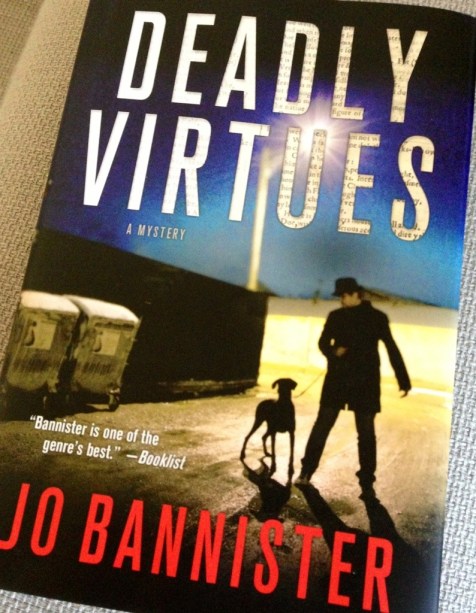
Deadly Virtues, a new mystery from Jo Bannister. Publishers Weekly review:
Stubborn morality and acid-tinged whimsy drive this superior stand-alone from British author Bannister (Liars All and eight other Brodie Farrell mysteries). Recovering mental patient Gabriel Ash looks pathetic and vulnerable as he rambles through the town of Norbold while talking to his dog. One day, at the local police station, where he’s recovering from a beating, Gabriel receives a cryptic message from a man who’s then killed by a crazed prisoner. Gabriel forces himself back into contact with normal humanity because he feels he ought to do something about the crime. Rookie policewoman Hazel Best is also dissatisfied with the official explanation of the tragedy. And so the three—the traumatized beating victim, the idealistic young cop, and the dog—begin sniffing under the pristine surface of the virtually crime-free town. They have no idea how dangerous good intentions can be. Bannister’s plotting is neat and her characterization smooth, with just enough irony to keep people from seeming ostentatiously noble
The Reverend Murdoch Soulis was long minister of the moorland parish of Balweary, in the vale of Dule. A severe, bleak-faced old man, dreadful to his hearers, he dwelt in the last years of his life, without relative or servant or any human company, in the small and lonely manse under the Hanging Shaw. In spite of the iron composure of his features, his eye was wild, scared, and uncertain; and when he dwelt, in private admonitions, on the future of the impenitent, it seemed as if his eye pierced through the storms of time to the terrors of eternity. Many young persons, coming to prepare themselves against the season of the holy communion, were dreadfully affected by his talk. He had a sermon on I Pet. V. 8, “The devil as a roaring lion,” on the Sunday after every 17th of August, and he was accustomed to surpass himself upon that text both by the appalling nature of the matter and the terror of his bearing in the pulpit. The children were frightened into fits, and the old looked more than usually oracular, and were, all that day, full of those hints that Hamlet deprecated. The manse itself, where it stood by the water of Dule among some thick trees, with the Shaw overhanging it on the one side, and on the other many cold, moorish hilltops rising toward the sky, had begun, at a very early period of Mr. Soulis’s ministry, to be avoided in the dusk hours by all who valued themselves upon their prudence; and guidmen sitting at the clachan alehouse shook their heads together at the thought of passing late by that uncanny neighbourhood. There was one spot, to be more particular, which was regarded with especial awe. The manse stood between the highroad and the water of Dule, with a gable to each; its bank was toward the kirktown of Balweary, nearly half a mile away; in front of it, a bare garden, hedged with thorn, occupied the land between the river and the road. The house was two stories high, with two large rooms on each. It opened not directly on the garden, but on a causewayed path, or passage, giving on the road on the one hand, and closed on the other by the tall willows and elders that bordered on the stream. And it was this strip of causeway that enjoyed among the young parishioners of Balweary so infamous a reputation. The minister walked there often after dark, sometimes groaning aloud in the instancy of his unspoken prayers; and when he was from home, and the manse door was locked, the more daring school-boys ventured, with beating hearts, to “follow my leader” across that legendary spot.
This atmosphere of terror, surrounding, as it did, a man of God of spotless character and orthodoxy, was a common cause of wonder and subject of inquiry among the few strangers who were led by chance or business into that unknown, outlying country. But many even of the people of the parish were ignorant of the strange events which had marked the first year of Mr. Soulis’s ministrations; and among those who were better informed, some were naturally reticent, and others shy of that particular topic. Now and again, only, one of the older folk would warm into courage over his third tumbler, and recount the cause of the minister’s strange looks and solitary life. Continue reading ““Thrawn Janet” — Robert Louis Stevenson”→
A passel of unsolicited reader copies arrived in the middle of February, including a trio of strange birds from Akashic Books. Preston L. Allen’s Every Boy Should Have a Man seems especially (and wonderfully) weird. First, there’s that title, which is, you know, strange, and then the blurb:
A riveting, poignant satire of societal ills, with an added dose of fantasy, Every Boy Should Have a Man takes place in a post-human world where creatures called oafs keep humanlike “mans” as beloved pets. One day, a poor boy oaf brings home a man whom he hides under his bed in the hopes his parents won’t find out. When the man is discovered, the boy admits it is not his—but the boy is no delinquent. Despite the accusations being hurled at him, he’s telling the truth when he says he found the man aimlessly wandering in the bramble. Nevertheless, he must return the man to his rightful owner. But when the heartbroken boy comes home from school one afternoon, he finds wrapped up in red ribbon a female man with a note around her neck: Every boy should have a man. You’re a fine son. Love, Dad.
Thus begins Every Boy Should Have a Man, Preston L. Allen’s picaresque journey into uncharted territory in earth, sky, and firmament. With echoes of Margaret Atwood and Jack and the Beanstalk, Jonathan Swift’s Gulliver’s Travels and Octavia Butler’s Kindred, it traces the story of the boy and his three “mans,” Brown Skin who is not his, the tragic Red Sleeves who has no voice, and her quick-witted daughter Red Locks whose epic journey takes her from the backbreaking drudgery of the mines to the perils of the battlefield to the savagery of cannibalism.
Oafs and mans each gain insight and understanding into one another’s worlds, and the worlds that touch theirs—ultimately showing that oafs and mans alike share a common “humanity.” Filled with surprising twists and turns, the novel is in part a morality tale that takes on many of today’s issues including poverty, the environment, sexism, racism, war, and religion, all in lighthearted King James prose.
Seems to have shades of Fantastic Planet — but “in lighthearted King James prose”!
Next up, The Roving Tree, the first novel from Elsi Augustave, which seems like it might be happily at home on a contemporary postcolonial studies syllabus:
Elsie Augustave’s debut novel, The Roving Tree, explores multiple themes: separation and loss, rootlessness, the impact of class privilege and color consciousness, and the search for cultural identity. The central character, Iris Odys, is the offspring of Hagathe, a Haitian maid, and Brahami, a French-educated mulatto father who cares little about his child.
Hagathe, who had always dreamt of a better life for her child, is presented with the perfect opportunity when Iris is five years old. Adopted by a white American couple, an anthropologist and art gallery owner, Iris is transported from her tiny remote Haitian village, Monn Neg, to an American suburb.
The Roving Tree illuminates how imperfectly assimilated adoptees struggle to remember their original voices and recapture their personal histories and cultural legacy. Set between two worlds, suburban America and Haiti under the oppressive regime of Papa Doc’s Tanton Macoutes, the novel offers a unique literary glimpse into the deeply entrenched class discrimination and political repression of Haiti during the Duvalier era, along with the subtle but nonetheless dangerous effects of American racism.
Told from beyond the grave, Iris seamlessly shares her poignant and pivotal life experiences. The Roving Tree, underscored by the spiritual wisdom of Haitian griots, offers insightful revelations of the importance of significant relationships with family and friends. Years later, we see how these elements are transformative to Iris’s intense love affair, and her personal and professional growth. Universal truths resonate beyond the pages of this work.
Also on the colonial-historical tip: Anthony C. Winkler’s The Family Mansion:
The Family Mansion is a historical novel that tells the story of Hartley Fudges, whose personal destiny unfolds against the backdrop of 19th-century British culture, a time when English society was based upon the strictest subordination and stratification of the classes. As the second son of a hereditary duke and his father’s favorite, Hartley, under different circumstances, might have inherited the inside track to his father’s estate and titles. But the English law of succession was rigidly dictated by the principle of male primogeniture, with all the property, assets, titles, and debts devolving to the firstborn son and his issue, leaving nothing for the other sons.
Like many second sons, Hartley decides to migrate to Jamaica at the age of twenty-three. This at first seems sensible: in the early 1800s Jamaica was far and away the richest and most opulent of all the crown colonies, and the single greatest producer of sugar in the world. But for all its fabulous wealth, Jamaica was a difficult and inhospitable place for an immigrant. The mortality rate for new immigrants was over 50% for the first year of residence. Some immigrant groups fared even worse. The island’s white population that ran the lucrative sugarcane industry was outnumbered 10-to-1 by the largely enslaved black population. Slave revolts were common with brutal reprisals such as the decapitation of ringleaders and nailing the severed heads to trees.
The complex saga of Hartley’s life is revealed in vivid scenes that depict the vicissitudes of 19th-century English and Jamaican societies. Aside from violent slave revolts, newcomers had to survive the nemesis of the white man in the tropics—namely, yellow fever. With Hartley’s point of view as its primary focus, the narrative transports readers to exotic lands, simultaneously exploring the brutality of England’s slavery-based colonization.
Akashic, a label I was ignorant of up until now, seems to be publishing some pretty cool stuff.
1. I finally saw Paul Thomas Anderson’s 2012 film The Master last night. I’m going to riff on the film. Fair warning:this riff will contain spoilers—I’ll talk about the film’s final scene, for instance (and if you just want to read about the ending, scroll down to point 23, after the embedded video).
2. The first hour of The Master is probably the best thing PTA has done.
3. The Master begins on a beach somewhere in the South Pacific. These are the final days of WWII. Navy boy Freddie Quell (portrayed by Joaquin Phoenix), solitary from his fellows, pours from a can of the mystic moonshine he brews into a coconut he’s hacked open with a machete. He then drinks the potion and mimes chopping off his hand with the machete. After this, he humps a woman made of sand and jerks off into the ocean.
4. The idyll of the Pacific beach contrasts strongly with Quell’s tortured psyche—it’s clear from the film’s first few moments that he’s borderline deranged, a sex-obsessed alcoholic who was damaged long before the war.
5. Quell is also a profoundly talented chemist (or alchemist) capable of brewing strange cocktails mixed from whatever’s at hand. These potions intrigue Lancaster Dodd (henceforth Master, played by Philip Seymour Hoffman), who samples a flask and asks Quell to brew more. Quell says he’ll make Master something different from that first batch, asking him, “How do you want to feel?”
6. “How do you want to feel?”
This question governs The Master, and the film is at its best when probing and plumbing these depths.
7. Back to my second statement: The first hour or so of The Master is probably the best thing PTA has done. Freddie Quell is an intriguing figure, a desperate madman who recapitulates the crimes of Oedipus where ever he goes.
He is The Misfit of Flannery O’Connor’s story “A Good Man Is Hard to Find,” trying to match faith to the phenomenal world.
He is Jonah, fleeing angry Yaweh, stowing away on a ship.
8. The first scenes of The Master borrow liberally from the Terrence Malick playbook:
The opening scene on the beach strongly recalls the opening of The Thin Red Line, and the subsequent scenes where Quell maybe murders a man and then must run feel like the opening minutes of Days of Heaven.
Like Malick, PTA lets the gorgeous cinematography convey meaning; dialog passes through the background of the film.
9. The dialog begins when Quell meets Master, charismatic leader of “The Cause.” You know of course that Master is based on L. Ron Hubbard, founder of Scientology. It’s worth pointing out that the film isn’t really about Scientology, or cults, or charlatans—although these points are explored, for sure—it’s really about the search for meaning, for stability. For some kind of peace.
10. The friendship—and friendship-as-dialog—between Master and Quell is by far the most compelling part of The Master, and the film’s best scene is a long episode where Master initiates “Processing” with Quell—delving into the man’s founding traumas to purify his spirit. I usually hate to laud actors, but Hoffman and Phoenix are sublime here, fully inhabiting the characters through the scenes deep emotional shifts.
The Master never surpasses this scene.
11. Indeed, the biggest failure of the film is that there’s no moment in its back half that can respond to the Processing scene. The film’s final scene attempts to mirror it in some ways, but the attempt lacks the weight. It’s off balance.
12. I feel the need to preface what I’m about to write by saying very clearly:
Paul Thomas Anderson is an extremely gifted auteur, a filmmaker who has, moreso than perhaps any of his contemporaries, continued in the (anti-)tradition of the New Hollywood films of the seventies. I would rather watch a PTA film than a film by just about anybody.
But:
The guy has a real problem sticking the ending. His films fail to cohere, to transcend the sum of their parts. This might be an editing issue or a plotting issue or something more commercially-driven, like running time. I don’t know.
13. Exceptions to PTA not sticking the ending:
Punch Drunk Love, easily his most concise and focused film, a long short story from a filmmaker who works in sprawling novels.
Possibly Boogie Nights, which sags in the final third but is nevertheless buoyed by an energetic scene featuring Alfred Molina, a mixtape, some cocaine, and fireworks. (This scene is lifted from Robert Downey Sr.’s Putney Swope, by the way).
14. For the most part though, PTA’s films swell outside of the margins that their own narratives establish in the beginning of each film (I’m not sure if this sentence makes sense—what I mean is that the films’ endings fall apart w/r/t the films’ beginnings).
In There Will Be Blood, PTA uses a stunning, violent, unforgettable final moment as a punchline to the film. It’s probably what most of us remember, and it’s certainly a great way to close the epic. Still: When I rewatch Blood, I start to become impatient with the film’s meandering after its thrilling opening hour. I start to anticipate the horrific punchline.
15. The easiest example to point to of PTA’s undisciplined sprawl is Magnolia. I can’t think of a film with a stronger opening that so quickly devolves into Altmanesque chaos. Which is the point, yes, I get—but Magnolia, again, is a PTA film which can’t live up to its first hour. (Again, PTA covers over the back end’s sloppiness with a marvelous final scene).
16. So, to return to The Master: I went into the film with high expectations—hoping that this would be the film by PTA that coheres, that is more than just a collection of fantastic performances and amazing scenes. And for the first hour, I was enthralled: I cared deeply about Freddie Quell, found his strange passions heartbreaking, was moved by his bizarre relationship with Master.
And the film is great—it really is—but it’s not as great as I wanted it to be. (Which, yes, I know, says nothing about the film and everything about me).
17. The film’s seams start to show after the magical sea voyage from California to New York. The first few scenes in New York are fascinating (especially when Master is confronted by a skeptic at a party), but as the The Cause moves back West over land, PTA increasingly relies on montages and shorter scenes that seem like placeholders to cobble together the film’s longer sections.
18. The last truly transcendent scene is where Master sings “I’ll Go No More A-Roving,” and it comes at almost exactly the half-way point of the film’s 138 minute running time.
19. All kinds of interesting stuff happens after the “Roving” scene—and PTA seems content to raise more mysteries than he resolves, which I’m fine with—but a long montage showcasing the different Processing techniques of The Cause sucks the energy right out of the film.
20. What follows is a lot of meandering, a lot of unexplained—or worse, unexplored—moments between characters that shift focus away from the relationship between Master and Quell.
21. Maybe I want a longer edit of The Master.
22. Here’s a 20 minute reel of cut footage:
23. And what about the ending of The Master? As I tried to convey in points 13-15, PTA usually closes with a very strong scene or image. With the exception of There Will Be Blood, I’d argue that the final moments of PTA’s films generally depict moments of love, redemption, or reconciliation. The Master fits into this trend. How so?
24. Okay: So The Master is in some ways formally Oedipal.
Quell’s crimes are two-fold: He kills a man who he says reminds him of his father and he has sex with his aunt. The film leaves open the possibility that both of these crimes—crimes he confesses to Master during Processing—are simply displacements for the more direct sins of killing his real father and fucking his real mother.
The Oedipal tensions that underwrite the film are strongly on display in the relationship between Master and Quell: Master is in love with Quell; Quell needs a father figure. All sorts of weird familial displacements ensue between Master’s family members and Quell.
The Oedipal theme also evinces in the film’s motif of breasts, bellies, and other pregnancy images. While not many of The Cause’s ideas are expressed clearly in The Master, the idea that all founding traumas are recorded in/on the soul is made plain several times. Put another way, all people are subjected to traumas that exist in pre-Oedipal, pre-lingual, pre-conscious states.
Quell wants to return to the womb to correct or ameliorate or avoid these traumas. The impossibility of achieving this desire drives him to self-medicate with his homemade brews and to see sex in everything.
The film ends with Quell having sex with a stranger he picks up in a bar. They laugh heartily—another of the film’s motifs—laughter as a measurement of joy, but also dejection, also hysteria, also fear, also irrationality, also no language, just laughter—they laugh heartily, and in a shot that foregrounds his sex partner’s large breasts, Quell begins Processing her.
25. We then get the film’s last line, delivered with laughter: “Stick it back in, it fell out.”
The referent of the “it” is, on the surface level, Quell’s penis, but it also serves as a substitution for Quell himself, who would like to return to a mother, to start again in a new life. (The scene, a riff on Quell’s first Processing with Master, can also be read as the displaced sexual consummation between the two men).
The film’s final image gives us Quell lying down next to the woman made of sand, her huge breasts erect, dominating the shot; he curls into her, peaceful, serene, fetal. The shot is deceptive: It suggests reconciliation or even redemption, but the memory of peace is just one fragment of Quell’s terribly fragmented life. Significantly, the moment comes from the beginning of the film. If Quell is to be reborn and live again—as Master believes all people are—it is clear that he has not transcended his base animal urges.
When Quell awakes, he awakes to trauma.
26. Having riffed on the film’s end, I think the film is probably better than I gave it credit for earlier. It’s a cold Sunday. I think I’ll watch The Master again.
In the old days Hortons Bay was a lumbering town. No one who lived in it was out of sound of the big saws in the mill by the lake. Then one year there were no more logs to make lumber. The lumber schooners came into the bay and were loaded with the cut of the mill that stood stacked in the yard. All the piles of lumber were carried away. The big mill building had all its machinery that was removable taken out and hoisted on board one of the schooners by the men who had worked in the mill. The schooner moved out of the bay toward the open lake, carrying the two great saws, the travelling carriage that hurled the logs against the revolving, circular saws and all the rollers, wheels, belts and iron piled on a hull-deep load of lumber. Its open hold covered with canvas and lashed tight, the sails of the schooner filled and it moved out into the open lake, carrying with it everything that had made the mill a mill and Hortons Bay a town.
The one-story bunk houses, the eating-house, the company store, the mill offices, and the big mill itself stood deserted in the acres of sawdust that covered the swampy meadow by the shore of the bay.
Ten years later there was nothing of the mill left except the broken white limestone of its foundations showing through the swampy second growth as Nick and Marjorie rowed along the shore. They were trolling along the edge of the channel-bank where the bottom dropped off suddenly from sandy shallows to twelve feet of dark water. They were trolling on their way to set night lines for rainbow trout.
“There’s our old ruin, Nick,” Marjorie said.
Nick, rowing, looked at the white stone in the green trees.
“There it is,” he said.
“Can you remember when it was a mill?” Marjorie asked.
“I can just remember,” Nick said.
“It seems more like a castle,” Marjorie said.
Nick said nothing. They rowed on out of sight of the mill, following the shore line. Then Nick cut across the bay.
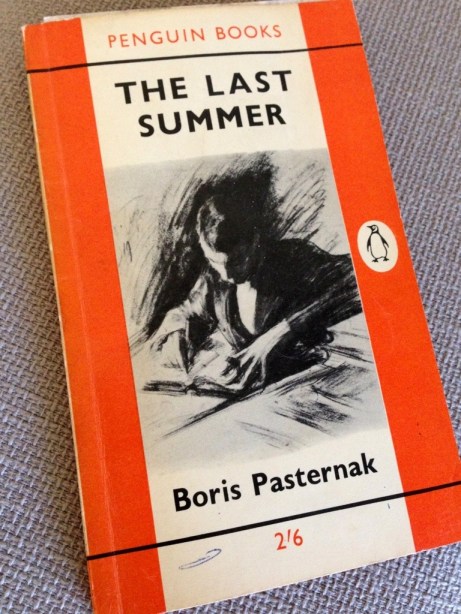
Big thanks again to Ryan Mihaly for sending me another Penguin edition. This time, Ryan sent me Boris Pasternak’s The Last Summer. (Ryan writes reviews of merit at Flying Object, btw). Ryan also sent me a bookmark he illustrated himself:
This unlikely story begins on a sea that was a blue dream, as colorful as blue-silk stockings, and beneath a sky as blue as the irises of children’s eyes. From the western half of the sky the sun was shying little golden disks at the sea—if you gazed intently enough you could see them skip from wave tip to wave tip until they joined a broad collar of golden coin that was collecting half a mile out and would eventually be a dazzling sunset. About half-way between the Florida shore and the golden collar a white steam-yacht, very young and graceful, was riding at anchor and under a blue-and-white awning aft a yellow-haired girl reclined in a wicker settee reading The Revolt of the Angels, by Anatole France.
She was about nineteen, slender and supple, with a spoiled alluring mouth and quick gray eyes full of a radiant curiosity. Her feet, stockingless, and adorned rather than clad in blue-satin slippers which swung nonchalantly from her toes, were perched on the arm of a settee adjoining the one she occupied. And as she read she intermittently regaled herself by a faint application to her tongue of a half-lemon that she held in her hand. The other half, sucked dry, lay on the deck at her feet and rocked very gently to and fro at the almost imperceptible motion of the tide.
The second half-lemon was well-nigh pulpless and the golden collar had grown astonishing in width, when suddenly the drowsy silence which enveloped the yacht was broken by the sound of heavy footsteps and an elderly man topped with orderly gray hair and clad in a white-flannel suit appeared at the head of the companionway. There he paused for a moment until his eyes became accustomed to the sun, and then seeing the girl under the awning he uttered a long even grunt of disapproval.
If he had intended thereby to obtain a rise of any sort he was doomed to disappointment. The girl calmly turned over two pages, turned back one, raised the lemon mechanically to tasting distance, and then very faintly but quite unmistakably yawned.
“Ardita!” said the gray-haired man sternly.
Ardita uttered a small sound indicating nothing.
“Ardita!” he repeated. “Ardita!”
Ardita raised the lemon languidly, allowing three words to slip out before it reached her tongue.
“Oh, shut up.”
“Ardita!”
“What?”
“Will you listen to me—or will I have to get a servant to hold you while I talk to you?”
The lemon descended very slowly and scornfully.
“Put it in writing.”
“Will you have the decency to close that abominable book and discard that damn lemon for two minutes?”
“Oh, can’t you lemme alone for a second?”
“Ardita, I have just received a telephone message from the shore——”
“Telephone?” She showed for the first time a faint interest.
“Yes, it was——”
“Do you mean to say,” she interrupted wonderingly, “‘at they let you run a wire out here?”
“Yes, and just now——”
“Won’t other boats bump into it?”
“No. It’s run along the bottom. Five min——”
“Well, I’ll be darned! Gosh! Science is golden or something—isn’t it?”
“Will you let me say what I started to?”
“Shoot!”
“Well it seems—well, I am up here—” He paused and swallowed several times distractedly. “Oh, yes. Young woman, Colonel Moreland has called up again to ask me to be sure to bring you in to dinner. His son Toby has come all the way from New York to meet you and he’s invited several other young people. For the last time, will you——”
“No,” said Ardita shortly, “I won’t. I came along on this darn cruise with the one idea of going to Palm Beach, and you knew it, and I absolutely refuse to meet any darn old colonel or any darn young Toby or any darn old young people or to set foot in any other darn old town in this crazy state. So you either take me to Palm Beach or else shut up and go away.”
“Very well. This is the last straw. In your infatuation for this man.—a man who is notorious for his excesses—a man your father would not have allowed to so much as mention your name—you have rejected the demi-monde rather than the circles in which you have presumably grown up. From now on——”
“I know,” interrupted Ardita ironically, “from now on you go your way and I go mine. I’ve heard that story before. You know I’d like nothing better.”
“From now on,” he announced grandiloquently, “you are no niece of mine. I——”
“O-o-o-oh!” The cry was wrung from Ardita with the agony of a lost soul. “Will you stop boring me! Will you go ‘way! Will you jump overboard and drown! Do you want me to throw this book at you!”
“If you dare do any——”
Smack! The Revolt of the Angels sailed through the air, missed its target by the length of a short nose, and bumped cheerfully down the companionway.
The gray-haired man made an instinctive step backward and then two cautious steps forward. Ardita jumped to her five feet four and stared at him defiantly, her gray eyes blazing.




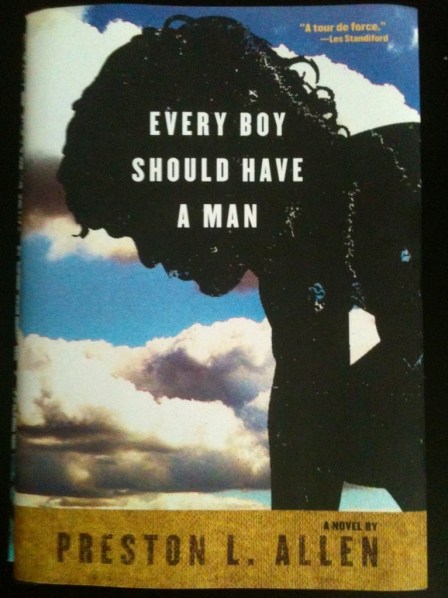 A riveting, poignant satire of societal ills, with an added dose of fantasy, Every Boy Should Have a Man takes place in a post-human world where creatures called oafs keep humanlike “mans” as beloved pets. One day, a poor boy oaf brings home a man whom he hides under his bed in the hopes his parents won’t find out. When the man is discovered, the boy admits it is not his—but the boy is no delinquent. Despite the accusations being hurled at him, he’s telling the truth when he says he found the man aimlessly wandering in the bramble. Nevertheless, he must return the man to his rightful owner. But when the heartbroken boy comes home from school one afternoon, he finds wrapped up in red ribbon a female man with a note around her neck: Every boy should have a man. You’re a fine son. Love, Dad.
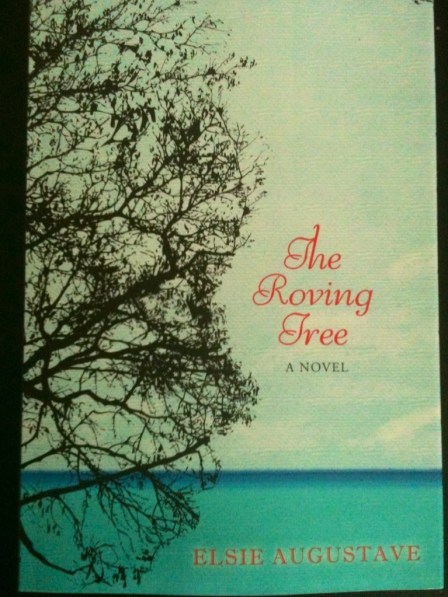 Elsie Augustave’s debut novel, The Roving Tree, explores multiple themes: separation and loss, rootlessness, the impact of class privilege and color consciousness, and the search for cultural identity. The central character, Iris Odys, is the offspring of Hagathe, a Haitian maid, and Brahami, a French-educated mulatto father who cares little about his child.
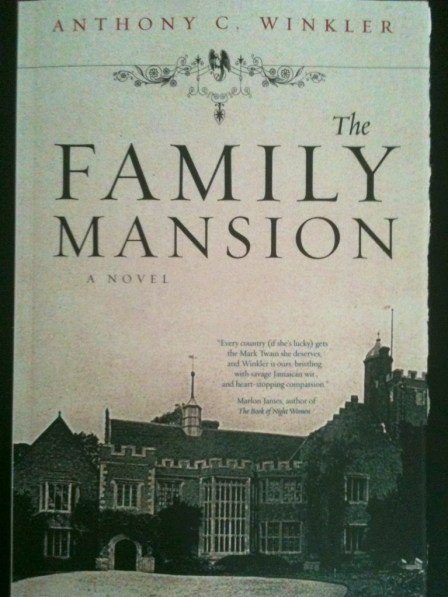 The Family Mansion is a historical novel that tells the story of Hartley Fudges, whose personal destiny unfolds against the backdrop of 19th-century British culture, a time when English society was based upon the strictest subordination and stratification of the classes. As the second son of a hereditary duke and his father’s favorite, Hartley, under different circumstances, might have inherited the inside track to his father’s estate and titles. But the English law of succession was rigidly dictated by the principle of male primogeniture, with all the property, assets, titles, and debts devolving to the firstborn son and his issue, leaving nothing for the other sons.




 Biblioklept