I am in a mood that gets more and more familiar: words lose their meaning suddenly. I find myself listening to a sentence, a phrase, a group of words, as if they are in a foreign language—the gap between what they are supposed to mean, and what in fact they say seems unbridgeable. I have been thinking of the novels about the breakdown of language, like Finnegans Wake. And the preoccupation with semantics. The fact that Stalin bothers to write a pamphlet on this subject at all is just a sign of a general uneasiness about language. But what right have I to criticize anything when sentences from the most beautiful novel can seem idiotic to me?
… I made tea, and then I remembered a story that was sent to me last week. By a comrade living somewhere near Leeds. When I first read it, I thought it was an exercise in irony. Then a very skilful parody of a certain attitude. Then I realized it was serious—it was at the moment I searched my memory and rooted out certain fantasies of my own. But what seemed to me important was that it could be read as parody, irony or seriously. It seems to me this fact is another expression of the fragmentation of everything, the painful disintegration of something that is linked with what I feel to be true about language, the thinning of language against the density of our experience.
At nightfall once in the olden time, on the rugged side of one of the Crystal Hills, a party of adventurers were refreshing themselves after a toilsome and fruitless quest for the Great Carbuncle. They had come thither, not as friends nor partners in the enterprise, but each, save one youthful pair, impelled by his own selfish and solitary longing for this wondrous gem. Their feeling of brotherhood, however, was strong enough to induce them to contribute a mutual aid in building a rude hut of branches and kindling a great fire of shattered pines that had drifted down the headlong current of the Amonoosuck, on the lower bank of which they were to pass the night. There was but one of their number, perhaps, who had become so estranged from natural sympathies by the absorbing spell of the pursuit as to acknowledge no satisfaction at the sight of human faces in the remote and solitary region whither they had ascended. A vast extent of wilderness lay between them and the nearest settlement, while scant a mile above their heads was that bleak verge where the hills throw off their shaggy mantle of forest-trees and either robe themselves in clouds or tower naked into the sky. The roar of the Amonoosuck would have been too awful for endurance if only a solitary man had listened while the mountain-stream talked with the wind.
The adventurers, therefore, exchanged hospitable greetings and welcomed one another to the hut where each man was the host and all were the guests of the whole company. They spread their individual supplies of food on the flat surface of a rock and partook of a general repast; at the close of which a sentiment of good-fellowship was perceptible among the party, though repressed by the idea that the renewed search for the Great Carbuncle must make them strangers again in the morning. Seven men and one young woman, they warmed themselves together at the fire, which extended its bright wall along the whole front of their wigwam. As they observed the various and contrasted figures that made up the assemblage, each man looking like a caricature of himself in the unsteady light that flickered over him, they came mutually to the conclusion that an odder society had never met in city or wilderness, on mountain or plain.
The eldest of the group—a tall, lean, weatherbeaten man some sixty years of age—was clad in the skins of wild animals whose fashion of dress he did well to imitate, since the deer, the wolf and the bear had long been his most intimate companions. He was one of those ill-fated mortals, such as the Indians told of, whom in their early youth the Great Carbuncle smote with a peculiar madness and became the passionate dream of their existence. All who visited that region knew him as “the Seeker,” and by no other name. As none could remember when he first took up the search, there went a fable in the valley of the Saco that for his inordinate lust after the Great Carbuncle he had been condemned to wander among the mountains till the end of time, still with the same feverish hopes at sunrise, the same despair at eve. Near this miserable Seeker sat a little elderly personage wearing a high-crowned hat shaped somewhat like a crucible. He was from beyond the sea—a Doctor Cacaphodel, who had wilted and dried himself into a mummy by continually stooping over charcoal-furnaces and inhaling unwholesome fumes during his researches in chemistry and alchemy. It was told of him—whether truly or not—that at the commencement of his studies he had drained his body of all its richest blood and wasted it, with other inestimable ingredients, in an unsuccessful experiment, and had never been a well man since. Another of the adventurers was Master Ichabod Pigsnort, a weighty merchant and selectman of Boston, and an elder of the famous Mr. Norton’s church. His enemies had a ridiculous story that Master Pigsnort was accustomed to spend a whole hour after prayer-time every morning and evening in wallowing naked among an immense quantity of pine-tree shillings, which were the earliest silver coinage of Massachusetts. The fourth whom we shall notice had no name that his companions knew of, and was chiefly distinguished by a sneer that always contorted his thin visage, and by a prodigious pair of spectacles which were supposed to deform and discolor the whole face of nature to this gentleman’s perception. The fifth adventurer likewise lacked a name, which was the greater pity, as he appeared to be a poet. He was a bright-eyed man, but woefully pined away, which was no more than natural if, as some people affirmed, his ordinary diet was fog, morning mist and a slice of the densest cloud within his reach, sauced with moonshine whenever he could get it. Certain it is that the poetry which flowed from him had a smack of all these dainties. The sixth of the party was a young man of haughty mien and sat somewhat apart from the rest, wearing his plumed hat loftily among his elders, while the fire glittered on the rich embroidery of his dress and gleamed intensely on the jewelled pommel of his sword. This was the lord De Vere, who when at home was said to spend much of his time in the burial-vault of his dead progenitors rummaging their mouldy coffins in search of all the earthly pride and vainglory that was hidden among bones and dust; so that, besides his own share, he had the collected haughtiness of his whole line of ancestry. Lastly, there was a handsome youth in rustic garb, and by his side a blooming little person in whom a delicate shade of maiden reserve was just melting into the rich glow of a young wife’s affection. Her name was Hannah, and her husband’s Matthew—two homely names, yet well enough adapted to the simple pair who seemed strangely out of place among the whimsical fraternity whose wits had been set agog by the Great Carbuncle. Continue reading ““The Great Carbuncle,” a story by Nathaniel Hawthorne”→
Rainer J. Hanshe is the translator of My Heart Laid Bare & Other Texts, a collection of writings by Charles Baudelaire, new from Contra Mundum Press. Over a series of emails, Hanshe was kind enough to talk to me about My Heart Laid Bare, Baudelaire, dandyism, translation, art, stealing books, and all other manner of topics.
Biblioklept: What is My Heart Laid Bare? Did Baudelaire envision its publication in his lifetime?
Rainer J. Hanshe: The title My Heart Laid Bare is Edgar Allan Poe’s, and it’s he who conceives of a book that, if daring enough, if ‘bare’ enough, could revolutionize human thought, opinion, and sentiment. This could be achieved, Poe said, “by writing and publishing a very little book. Its title should be simple — a few plain words — ‘My Heart Laid Bare.’ But this little book must be true to its title.” Baudelaire took up Poe’s provocation and his Mon cœur mis à nu is one of a number of different books that he dreamt up and hoped to write “without lassitude — in a word to be in good heart day after day.” Others Baudelaire mentioned along with it in an 1864 letter included Histoires grotesques et sérieuses, Les fleurs du Mal, Le spleen de Paris, Les paradis artificiels, Contemporaines, and Pauvre Belgium! The first notes for Mon cœur mis à nu begin in 1859, two years after the initial publication of The flowers of Evil, if not possibly somewhat earlier, and continue until 1865, ceasing only due to Baudelaire’s severe health condition (he would die in 1867 at just 46 years of age), hence they comprise the final decade of his writing life.
Aside from the more direct root of Poe, Rousseau was another of Baudelaire’s models, albeit a negative one to surpass. Baudelaire said that “all the targets of [his] rage” would be collected in Mon cœur mis à nu. “Ah! if ever that sees the light of day, J-J’s Confessions will seem pale.” As I describe in the synopsis, it is an apodictic work of aphorism, maxim, note, and extended reflection. It is not however some memoir-like spewing of Baudelaire’s bios; rather, it is the baring of his l’esprit, and as a crystallization of such, it isn’t some kind of ‘tell-all exposé’ (Rousseau’s notion of absolute transparency, an indulgence we could well do without, especially considering its pernicious ramifications), but to me a much higher form of ‘confession,’ for it is the arc of thought, the play of the mind in its every breadth that is bared. It contains Baudelaire’s exhortations on work, faith, religion, and politics, excoriating sociological analyses, diatribes on literature, the arts (George Sand receives some choice malicious arrows), and love (women, prostitution, sadomasochism, erotics en générale), and outlines of his conception of the dandy and the Poet.
The Poet for Baudelaire is I would say a figure similar in kind to Nietzsche’s untimely personage, the posthumous human, a kind of philosophical anthropologist who hovers over the earth, examining the human species both from within and externally, from a sub species aeternitatis perspective, diagnosing it like a physician (much of the book’s terminology is medical taxonomy).
In 1861, two years after beginning Mon cœur mis à nu, sieged by resignation, calumny, and ill health (nervous disorders, vomiting, insomnia, fainting fits, recurrent syphilitic outbreaks), Baudelaire expresses doubt that he will ever complete his various projects. “My situation as regards my honor, frightful — and that’s the greatest evil. Never any rest. Insults, outrages, affronts you can’t imagine, which corrupt the imagination and paralyze it.” Three years later, it was against the continuing extremities of an exacerbated solitude, frayed nerves, self-described terrors, and constant hounding by creditors that Baudelaire implored himself to remain stalwart (“I must pull myself together, take heart! This may well bring rewards.”) and write.
Clearly, he did envision publishing the book in his lifetime, and he diligently worked at it, steeling himself against his trials to the degree within his power, but it was never completed. The obstructions he faced were abundant; the somatic afflictions inordinately taxing. The threat of his impending decline or decay is sharply articulated in one passage wherein he speaks of “feeling the wind of the wing of imbecility” passing over him. Various translators have rendered that as “the wing of madness,” but Baudelaire says “imbécillité,” not folie or démence. The notion of “the wing of madness” has greater Gothico-Romantic cache, but it’s not what Baudelaire says, and in this case, there’s a relatively exact equivalence of terms. It was more physical weakness and feebleness that he feared, and experienced, and believed would finally incapacitate him, as it did, not madness. His aphasia and heart attacks led to his losing his ability to speak and thereafter, his ability to read and write — the death of the writer.
We have only the existing fragments then, which have been translated in full, but they were published posthumously. Despite no such title existing in the text, or any related material, French editors originally published the work as “Journaux intime” (Intimate Journals), which included two other sections, “Fusées” and “Hygiène.” Translations into English followed suite, and they adopted the false title, which must at last be discarded. If Baudelaire hadn’t been besieged by illnesses as he was, he would have imaginably given us a definitive version of Mon cœur mis à nu considering that he did complete other books he began around the same period (Le spleen de Paris, Les paradis artificiels, et cetera). It remains a fragmentary work then, in both senses, yet one that is substantive enough to merit our continued attention.
Biblioklept: For me, the fragmentary nature of My Heart Laid Bare is in some ways more appealing than the cohesion of a more polished philosophical or poetic text. It’s a discursive read, and there’s joy in tying (or failing to tie) the fragments together. This reading experience is perhaps as close as we can get to seeing Baudelaire thinking (and feeling). At the same time, there’s perhaps a risk of the average reader’s misreading or misinterpreting some of Baudelaire’s riffs, quips, and jabs here. How tempting was it to footnote the hell out of My Heart Laid Bare?
Hanshe: In his poet’s notebook, Paul Valéry said that “a work is never necessarily finished, for he who has made it is never complete, and the power and agility he has drawn from it confer on him just the power to improve it […]. He draws from it what is needed to efface and remake it. This is how a free artist, at least, should regard things.” Similarly, he says elsewhere that, “in the eyes of lovers of anxiety and perfection, a work is never finished but abandoned.” Since Baudelaire never prepared a definitive version of the book, we cannot know what he would have changed, or not, yet as a work closely aligned with his self, it’s something that could never have been completed, only abandoned. Hence, it would always remain fragmentary. Think of Schlegel’s poetics of the fragment where even ‘incompleteness’ is exceptionally refined, an architecturally precise aesthetic form (sculpturally, this calls to mind Giacometti). In his essay on German Romanticism, Walter Benjamin pointed out that aphoristic writing is not proof against systematic intentions (an accurate insight made about Nietzsche’s work in fact, albeit one lost on many of his later readers…), that one can write aphoristically and still think through one’s philosophy or writing “in a comprehensive and unitary manner in keeping with one’s guiding ideas.” In this way, it’s not that Baudelaire’s book lacks cohesiveness; it’s deliberately fragmentary to eschew finality, and because the self, the ‘heart’ being laid bare, is never complete. That Baudelaire worked on it for nearly ten years though makes it probable that its character was quite well defined before illness permanently disrupted his voluntarily abandoning it.
There are certainly unities, or thoughts that overlap and intertwine within the book, as there are with other books of Baudelaire’s, and when I began translating it, I kept track of those I was aware of while also benefitting from the extensive and exemplary notes that the French editors amassed. The critical addendum was therefore unfurling like an infinite papyrus, threatening to end in it being as long, if not longer, than the book itself. In a way, that kind of critical gesture is an act of usurpation and domination, just as overly lengthy introductions can be (consider the grand effrontery of Foucault’s introduction to Binswanger’s Dream & Existence, which is twice the length of the book). At a certain point, I felt that continuing to amass notes would have made the book extremely cumbersome, one unpleasant to read, merely due to sheer volume. There’s also something about a massive critical addendum that’s imposing, if not intrusive, to many readers. Additionally, it was a question of elegance: I didn’t want to litter the book with footnote numbers; alternative methods to that could have easily been devised but, ultimately, I opted against including extensive notes. While as readers we can disavow them altogether, not having them makes for a more comfortable book to wield. Finally, encountering it would be more like coming upon Baudelaire’s own notebook, free of editorial invasiveness, thereby leaving the reader to his or her own rapturous encounter with it, however intractable it may be. As for misreading or misinterpreting, I don’t think such can ever be definitively foreclosed. While errant and contentious readings exist, to fear risking them is to argue that we can fathom authorial intention, or that there are definitive and absolute interpretations. Reading should be dangerous, risky, volatile, something that threatens to undermine, overwhelm, and mutate us, if not put the world into metamorphosis, as books can and have done, though hardly as much in our depleted and toothless epoch. Otherwise, reading is just entertainment, a diversionary narcotic, and we have to be willing to be shattered by books, to undergo both subtle and emphatic shocks.
Self-Portrait by Charles Baudelaire, 1863-64
Biblioklept: What is Flares?
Hanshe: Quite simply, it’s a writer’s notebook; as such, it doesn’t have a single focus but is more motley, something of a hybrid entity. To paraphrase, we could call it The Poet Laid Bare (of poetic form). Nonetheless, I believe it has two principal nerve centers: critique and meditation.
The critique is many-tendrilled, with its points of observation being the craft of the writer, art and aesthetics, love, pleasure, and intoxication (numerous types), religion and theology, politics, etc. The writer’s smelting room and sometimes place of furious venting. As with Mon cœur mis à nu, there is a root in Poe, who in his Marginalia spoke of “a peculiar type of criticism” that “can only be designated by the ‘German ‘Schwarmerei’ — not exactly ‘humbug’ but ‘sky-rocketing’…” Baudelaire took up this idea, naming his work fusées, which is an expansive translation of the English skyrockets. A fusée is a pyrotechnical device (rocket, flare, or firework), musket, or heraldic emblem, hence the title corresponds well with the work’s variegated character. It is something incendiary, combative, and elegant. The manifold subtitles peppered throughout “Flares” offer us a provisional overview of its character, too: Plans, Projects, Suggestions, Notes, Hygiene, Morality, Conduct, Method. Here we see the writer’s notebook, the critique, and the meditation.
In speaking of intellectual gymnastics, the altar of the will, moral dynamics, the great deed, perfect health, the hygiene of the soul, political harmony of character, eurhythmy of character and faculties, self-purification, mastery of time, and accomplishing one’s duties, Baudelaire enumerates a concentration of terms and concepts related to self-cultivation. The book thus contains a kind of technology of the self, the outline of Baudelaire’s martial praxis for the artist — intellectual gymnastics and the sanctification of the will both bespeak an agonistic sensibility, as does his paean to greatness and his call to achieve it in contradistinction to the tremendous oppositional force of nothing less than an entire nation. What is this but Baudelaire’s Miltonic-Satanic typology. “The man of letters rends foundations…” (Flares §6) Such terminology, and the repeated invocations to himself to master his will and to work diligently to become who he is, are part of a regimen of poetic self-shaping. “Want every day to be the greatest of men!!!” (My Heart… §70) The references to Emerson and his Conduct of Life further reinforce that, which is but one reason why in the book’s synopsis I made a parallel to Marcus Aurelius, characterizing the book as Baudelaire’s meditations, which I see as its second nerve center. The poet is clearly concerned with self-government, and this shaping or cultivation of the self is meant to strengthen him, thereby aiding his accomplishing his artistic tasks, of which the book is in part a record.
These notions can be woven together with other parts of the work, i.e. §16 of “Flares,” where Baudelaire speaks of the most perfect type of virile Beauty (the Miltonic Satan), or the Emersonian hero (he who is immovably centered), giving us the supreme artistic model of Satan, that is, Satan as the light-bringer, the visionary, he who is anti-human (“Let us defy the people, common sense, the heart, inspiration, and evidence.” §47; “The man of letters is the enemy of the world.” §53). In §21 of ”Flares” Baudelaire asks, “To give oneself to Satan, what is it?” The book provides us with some answers, as does his poetry (the “Litanies of Satan” et alia), and his Dandy (a superior figure) is another type with similarly sublime aspirations. It is the onset of the anti-Christian hyperanthropos. “The poet, the priest, and the soldier are the only great men among men: … the rest are made for the whip” (§47). Continue reading ““Translation is an act of risk” | An interview with Rainer J. Hanshe on translating Baudelaire’s My Heart Laid Bare”→
May 1st.–. . . Every day of my life makes me feel more and more how seldom a fact is accurately stated; how, almost invariably, when a story has passed through the mind of a third person, it becomes, so far as regards the impression that it makes in further repetitions, little better than a falsehood, and this, too, though the narrator be the most truth-seeking person in existence. How marvellous the tendency is! . . . Is truth a fantasy which we are to pursue forever and never grasp?
My cold has almost entirely departed. Were it a sunny day, I should consider myself quite fit for labors out of doors; but as the ground is so damp, and the atmosphere so chill, and the sky so sullen, I intend to keep myself on the sick-list this one day longer, more especially as I wish to read Carlyle on Heroes.
There has been but one flower found in this vicinity,–and that was an anemone, a poor, pale, shivering little flower, that had crept under a stone-wall for shelter. Mr. Farley found it, while taking a walk with me.
. . . This is May-Day! Alas, what a difference between the ideal and the real!
We tend to pathologize the ultimate no—suicide—as a shameful failure, the worst kind of failure. The shame of not having assimilated into normative culture, of not bootstrapping the self into a legible narrative of success. Of being merely unable. Melville’s Bartleby teaches us this lesson all too well. Those around Bartleby can’t read his preference to merely not be as such. They want to know why he doesn’t want to be a good bureaucrat. And they string him up for it. But saying no can be an assertion of power, freedom and will, as Bartelby teaches us. The choice to merely not be is simply that. It frustrates everyone around it because it defies the most naturalized assumption in existence: that consciousness is a gift, a privilege, a precious unit of time not to be squandered or frivolously wasted. We are urged to make good with life.
But this attitude comes with the privilege of choices. One who can say that things can be different, that one only need to work a bit harder, shift her perception, to “be the change she wishes to see in the world” doesn’t wake up on Skid Row every morning, is not black in Baltimore or Ferguson, does not live in a body policed by the law and popular culture. Moreover, this attitude assumes that whatever prevents this different life, where one doesn’t have to say no, is conquerable, fixable. Often, the sensation that things cannot be different appears insurmountable. Whatever is assaulting you cannot be removed with a simple shift in perception and attitude.
Such is the dilemma of Yeong-hye in Han Kang’s The Vegetarian. The flap copy describes Yeong-hye’s turn towards vegetarianism as a decision, as does her tyrannical husband and everyone around her, but Yeong-hye’s plant-like turn is only a decision in the most technical sense. Yes, she does decide to become a vegetarian, but not because of preference, or political/ethical commitment. Yeong-hye’s vegetarianism is vital; for her, vegetarianism is her only out from the violent misogyny that she has been born into. But to also say that she wants death and, in turn, that Kang’s novel is a reconfiguration of the normative narrative of suicide would be a double injustice. I know nothing of South Korean culture, and I can only speak confidently of the misogyny that frames The Vegetarian because it is terrifyingly normal in the mouths of its narrators; the first injustice is that I only know this misogyny through western narratives. The second, to assert that Yeong-hye wants death, falls into the trap of romanticizing suicide. None of Yeong-hye’s life is decision, or choice, or freedom, except her desire to become more plant-like—even that is a stretch to say it is a desire. For Yeong-hye, a plant-like existence approaches a state of supreme serenity and disaffection from her world – a position where she cannot be read as a sexual being and, in turn, under the hands of a violent culture. Vegetarianism hangs the human body and self between what we understand and project onto the outside world as life and death. Vegetarianism asymptotically kisses death.
‘…I thought trees stood up straight … I only found out just now. They actually stand with both arms in the earth, all of them. … Do you know how I found out? Well, I was in a dream, and I was standing on my head … leaves were growing from my body, and roots were sprouting from my hands … so I dug down into the earth. On and on…I wanted flowers to bloom from my crotch so I spread my legs; I spread them wide…’
What’s peculiar about the novel, apart from the quiet horror of Kang’s prose, the quiet violence of Yeong-hye’s world and its casual presentation thereof, and actually a lot of things that are wonderfully disquieting, is that none of its three acts are narrated by Yeong-hye herself. I expected more time with and inside Yeong-hye in a book about the murderously aloof self-satisfaction of the men in power that orchestrate her destruction. But I even wince at the word “inside” of Yeong-hye. It sounds like I’m participating in a certain kind of violence. The important thing to remember is that Yeong-hye’s perceived disability is only so in the eyes of the narrators, Yeong-hye’s husband, brother-in-law, and sister. Her family insists, and then demands, that Yeong-hye provide a rational reason for her vegetarianism, but they only want to hear her say that it’s for the sake of her health, or for her appearance. They might even tolerate an ethical argument. Instead, Yeong-hye only offers, like our Bartleby, a frustration. Drunk and sleepy, Yeong-hye’s husband finds his wife staring intently into the white light of the fridge.
Dark woods. No people. The sharp-pointed leaves on the trees, my torn feet. This place, almost remembered, but I’m lost now. Frightened. Cold. Across the frozen ravine, a red barn-like building. Straw matting flapping limp across the door. Roll it up and I’m inside, it’s inside. A long bamboo stick strung with great blood-red gashes of meat, blood still dripping down. Try to push past but the meat, there’s no end to the meat, and no exit. Blood in my moth, blood-soaked clothes sucked onto skin.
The repetition of the word meat has a certain violence to it, and metaphorizes the ways in which the category of “meat” is embedded even in the writing itself, how deeply it penetrates. Yeong-hye is treated like meat; pigs and cattle raised for consumption are referred to as pork and beef, even before they’re slaughtered; meat is a violently rendered, aestheticized experience. Soon, Yeong-hye does remember the places that are lost in her dreams inside of actual memories. The haunting repetition of the word “meat” transforming what was once familiar into paralyzing strangeness.
While Father ties the dog to the tree and scorches it with a lamp, he says it isn’t to be flogged. He says he heard somewhere that driving a dog to keep running until the point of death is considered a milder punishment. The motorcycle engine starts, and Father begins to drive in a circle. […] Once it has gone five laps, the dog is frothing at the mouth. Blood drips from its throat, which is being choked with the rope. Constantly groaning through its damaged throat, the dog is dragged along the ground.
Punishment and thus justice isn’t swift, but an exercise in pushing one’s ability to endure physical shame. Like when her father, incredulous and domineering, forces her family to hold Yeong-hye back as he shoves a “lump of meat” into Yeong-hye’s wailing body. Or when Yeong-hye is forced to endure the public shaming at an obligatory business dinner. Her vegetarianism unhinges the normative narrative of her family’s reality, and they take it personally. To them, it is an invitation to rape, to control, and to punish.
But it was no easy thing for a man in the prime of his life, for whom married life had always gone entirely without a hitch, to have his physical needs go unsatisfied for such a long period of time. So yes, one night when I returned home late and somewhat inebriated after a meal with colleagues, I grabbed hold of my wife and pushed her to the floor. Pinning down her struggling arms and tugging off her trousers, I became unexpectedly aroused. She put up a surprisingly strong resistance and, spitting out vulgar curses all the while, it took me three attempts before I managed to insert myself successfully. Once that had happened she lay there in the dark staring up at the ceiling, her face blank, as though she were a ‘comfort woman’ dragged in against her will, and I was the Japanese soldier demanding her services.
Rape doesn’t apply to Yeong-hye because she is called a wife, her refusal to play the role erases the violence of rape in the rules of this reality. Yeong-hye’s renunciation of subservience, and the subsequent violence, highlights the underlying rage of male culture presented in this novel. More striking than the appalling behavior of Yeong-hye’s husband is his nonchalance, a result of Kang’s cool, distending prose, brilliantly translated by into English by Deborah Smith. We’re not meant to be unhinged by the drapes of meat in Yeong-hye’s dreams, but the coolness in which Yeong-hye’s family preclude empathy and default to insult and violence. Even before empathy, they preclude curiosity—their questions only seek answers for which they are already disappointed. What we are supposed to be horrified by is how bereft they are of compassion.
Where they shame a woman supposedly acting out of character, Yeong-hye simply wants the dreams to stop. But where do the dreams come from? This tension sustains the entirety of the novel, and drives Yeong-hye deeper into plant-like behavior. Yeong-hye is eventually committed to a mental hospital after the staff find her shirtless, looking up into the sun with eyes clenched, as if in the grip of photosynthesis. Later, after a divorce, in a second mental hospital, something akin to the sanatoriums of Kafka’s and Bernhard’s worlds, far away from Seoul, she refuses to eat and spends hours in a hand-stand, emulating the trees of the mountains. Yeong-hye can’t do anything about the dreams because they are the signature of her conscription into humanity.
Yeong-hye cut her off. ‘They say my insides have all atrophied, you know.’ In-hye was lost for words. Yeong-hye moved her emaciated face closer to her sister. ‘I’m not an animal anymore, sister,’ she said, first scanning the empty ward as if about to disclose a momentous secret. ‘I don’t need to eat, now now. I can live without it. All I need is sunlight.’
Becoming vegetarian isn’t a choice, but a last resort. Yeong-hye is compelled towards plant-like existence because it’s her only method of control and, ironically, affirming her humanity. Yeong-hye doesn’t elect vegetarianism; her family conditioned her for this transformation, her refusal to play this version of humanity. But this is the humanity under which all of us are prescribed. When Yeong-hye recoils at the sight of meat, she sees herself. Yeong-hye turns to vegetarianism because she projects onto plants a freedom of being non-human, non-woman, non-sexualized. The possibility of existing without violence or domination, of being in the world without the risk of knowing what one is, but just being. Vegetarianism in The Vegetarian isn’t a religious requirement, nor the fancy of first-world privilege, but anti-human. It is an affirmation that says not only is the culture a problem, but people are the problem.
[Ed. note: Ryan Chang’s review of The Vegetarian was originally published by Biblioklept in May of 2015].
Margaret Atwood’s 1985 novel The Handmaid’s Tale has been adapted into a television series by Hulu, a fact which you probably already knew if you are on the internet and are interested in these sorts of things.
Initial clips of the show seem promising enough. Elisabeth Moss, who I loved in Top of The Lake, plays the novel’s protagonist Offred, and Margaret Atwood, a consulting producer, has been a vocal supporter of the adaptation. And, as many have pointed out lately, the story’s backdrop—a patriarchal theocratic regime—seems, uh, timely. (Hell, there’s even a Wall).
In anticipation of Hulu’s adaptation, I decided to reread The Handmade’s Tale a third time in a third decade. I found it subtler, more personally intense than the broad, voluminous epic my memory had concocted. My memory had filled in some of Atwood’s strategic gaps; one of her rhetorical gambits is to deliver the so-called “worldbuilding” common to sci-fi novels in tiny morsels and incomplete glimpses. She refuses to give us a big picture. We see this world like one of the handmaids, who view it through a veil of white wings around their heads.
Our narrator Offred is one of those, whatchamacallit, unreliable narrators (as she frequently, subtly reminds us), and her picture of the Republic of Gilead is necessarily incomplete. My memory filled in huge swaths of backstory—a caste system, forced breeding, a plague of infertility, civil wars, ecological collapse, mutations, religious infighting, spy networks and underground railroads. There’s something of an epic scale there, no? But the The Handmaid’s Tale actually elides much of the its genre’s heavy baggage. Exposition hides in bits and pieces for the reader to scrabble together. Even in some of its more straightforward expository passages, as when Offred describes the theocratic regime’s coup d’etat, we still only get the events from her perspective. We experience the effects of the revolution as the effects on her life. There’s no big picture geopolitical analysis. The causes aren’t clear.
Indeed, the lack of clear causality between events is one of the scariest aspects of The Handmaid’s Tale. Our narrator emphasizes how quickly norms can change in a culture, which is, from a plot-standpoint, quite important. Nineteen Eighty-Four has long been a point of comparison to The Handmaid’s Tale, but in Orwell’s novel the totalitarian regime has presumably been in power for decades (although of course, the protagonist’s job in that novel is to revise historical documents so that they align with the past, making “history” suspect).
In The Handmaid’s Tale, crucially, the protagonist is still connected to the pre-Revolutionary, pre-theocratic world. We’re reminded again and again that she’s one of the first generation of handmaids; we’re reminded again and again that after the first generation takes hold, the practice of forced breeding will become completely normalized. The Handmaid’s Tale is the preamble to dystopia. Offred remembers life in the U.S., life before her role was absolutely proscribed by a patriarchal theocracy. The narrator’s disconnection between that life and her new one drives the narrative.
This radical disconnection threatens the narrator’s sanity. It’s not just the wings of her habit that obstruct her vision, but also a veil of creeping instability. The unraveling of history, the sense that she is dislocated in time threaten to undo her. Her way of seeing the world and her self in the world is completely destabilized. Consider the following passage, in which our heroine gazes at the “smile” of a dead man hung from the Wall as a warning:
I look at the one red smile. The red of the smile is the same as the red of the tulips in Serena Joy’s garden, towards the base of the flowers where they are beginning to heal. The red is the same but there is no connection. The tulips are not tulips of blood, the red smiles are not flowers, neither thing makes a comment on the other. The tulip is not a reason for disbelief in the hanged man, or vice versa. Each thing is valid and really there. It is through a field of such valid objects that I must pick my way, every day and in every way. I put a lot of effort into making such distinctions. I need to make them. I need to be very clear, in my own mind.
The protagonist’s defense against the threat of dislocation, displacement, and insanity is her power to tell her tale. In this sense, The Handmade’s Tale has as much in common with Charlotte Perkins Gilman’s“The Yellow Wallpaper” as it does with Orwell’s dystopian classic.
Our narrator’s need “to be very clear [in her] own mind” carries (what many readers will consider) the main thread of The Handmaid’s Tale on a straightforward, linear path: Offred is pressed into the service of the Commander (Fred, from whom she receives her patronymic) so that he can impregnate her, become a father, and perpetuate his class tier. If she can’t produce a child in a certain time frame, it’s off to the colonies! (Never mind that the Commander is likely sterile).
The narrative’s linear sequence will provide a sturdy frame for Hulu’s adaptation, and the constant flashbacks that interweave through the novel will also likely help to flesh out the series, both in tone and characterization. The ways in which the novel’s narrator weaves and unweaves these story strands might be much more difficult for the show to capture though. Indeed, Atwood’s rhetorical technique here is something native to literature itself. Atwood evokes consciousness under duress. She shows us a heroine trying to weave strands of a story together into something meaningful, to make a story where there is none, to find a space to speak where there is only the specter of mute doom. The Handmaid’s Tale is a story about storytelling as resistance and self-preservation:
I would like to believe this is a story I’m telling. I need to believe it. I must believe it. Those who can believe that such stories are only stories have a better chance.
If it’s a story I’m telling, then I have control over the ending. Then there will be an ending, to the story, and real life will come after it. I can pick up where I left off.
It isn’t a story I’m telling.
It’s also a story I’m telling, in my head, as I go along.
Tell, rather than write, because I have nothing to write with and writing is in any case forbidden. But if it’s a story, even in my head, I must be telling it to someone. You don’t tell a story only to yourself. There’s always someone else.
Even when there is no one.
A story is like a letter. Dear You, I’ll say. Just you, without a name. Attaching a name attaches you to the world of fact, which is riskier, more hazardous: who knows what the chances are out there, of survival, yours? I will say you, you, like an old love song. You can mean more than one.
You can mean thousands.
Our storyteller—we are her You—is finely attuned to language. She constantly points out old phrases, commonplaces, and cliches, and remarks on what they used to mean in “the time before.” In some of these moments of linguistic mulling, Atwood calls attention to language’s destructive potential, of its ability to unravel the very meaning we seek to pin to it. If language connects, it can also disconnect. Consider the following passage:
It’s strange, now, to think about having a job. Job. It’s a funny word. It’s a job for a man. Do a jobbie, they’d say to children, when they were being toilet-trained. Or of dogs: he did a job on the carpet. You were supposed to hit them with rolled-up newspapers, my mother said. I can remember when there were newspapers, though I never had a dog, only cats.
The Book of Job.
Language can protect, but it can also threaten. It can slipslide from a random memory to an existentialist myth in the span of a breath. It can turn tulips into bloody smiles and bloody smiles into explanations for executions. Language can turn into stories, but stories can swallow up whole lives, whole cultures. That’s the threat of theocracy.
Atwood highlights the novel’s attention to storytelling itself in the final chapter, which reads almost like an appendix. Called “Historical Notes,” and separated from the text proper by its own title page, the final (unnumbered) chapter purports to be the transcript of a speech given at an academic conference on “Gileadean Studies” in the year 2195. There is much exposition and analysis here. Our anthropologist lecturer informs us that what is known as The Handmaid’s Tale is the composite of a number of audiocassettes. Furthermore, we learn that the narrator Offred (apparently) fabricated or synthesized elements of the story, either to protect certain persons’ anonymity, or for her own pleasure—or simply in the service, of, y’know, good storytelling. The lecturer laments that Offred failed to give future listeners more details about politics and war and the culture of Gilead at large. In a sense, the lecturer’s complaint is the one that many readers who go to Atwood’s novel expecting “worldbuilding” might have. The narrator isn’t telling a story about dystopian Gilead. She’s telling a story about storytelling. She’s making herself a story. Speaking to a You helps to preserve her I.
The “Historical Notes” on The Handmaid’s Tale are an example of a particular trope I generally dislike—the “expert shows up at the end and explains everything” device. However, Atwood’s final chapter is successful, and perhaps even essential to the novel’s critique of patriarchy and of how institutions tell and what they tell. The key, of course, is to recognize the layers of irony in this “explainer” chapter, in which a male authority arrives and asks all the wrong questions about Offred and criticizes some of her narrative choices. Even though he’s an expert on her text, he manages to miss that she’s woven her true name into the story. It’s right there at the end of the first chapter.
“Historical Notes” shows the problems and limitations in telling “the truth,” highlighting that all tales are constructions, syntheses of pre-existing elements. At the same time, the chapter points towards a narrative future, and a fairly stable future at that. “Historical Notes” thus provides the “happy ending” that the text proper—The Handmaid’s Tale—refuses to offer.
After finishing Atwood’s novel, I indulged in a favorite treat: sifting through one-star Amazon reviews with the express purpose of rearranging lines and fragments into…something. A complaint that arose again and again about The Handmaid’s Tale was the novel’s ambiguous ending. Only “ambiguous” wasn’t a word I saw used—our stalwart reviewers insisted that the novel had no conclusion. Such an interpretation is either a misreading or a failure to see that ambiguity is its own opening to adventure.
Our heroine concludes her tale: “And so I step up, into the darkness within; or else the light.” The line might frustrate many readers and even license them to accuse Atwood of simply not knowing how to finish her story. The final line’s ambiguity is structural though, part and parcel of the narrative itself. The heroine crosses a threshold. She’s pregnant, both literally and figuratively. The novel’s final ambiguity opens a space for our heroine to “step up” into. As Scheherazade understood, storytelling isn’t about closing off, but opening up. When the narrator walks out into either darkness or light, she’s entering a new narrative possibility—one that can be imagined by the auditors of her tale, her future You.
So much for endings. Beginnings are always more fun. True connoisseurs, however, are known to favor the stretch in between, since it’s the hardest to do anything with.
That’s about all that can be said for plots, which anyway are just one thing after another, a what and a what and a what.
Now try How and Why.
The Handmaid’s Tale succeeds in answering How and Why.
The evolution of language would begin with the names of things. After that would come descriptions of these things and descriptions of what they do. The growth of languages into their present shape and form—their syntax and grammar—has a universality that suggests a common rule. The rule is that languages have followed their own requirements. The rule is that they are charged with describing the world. There is nothing else to describe.
All very quickly. There are no languages whose form is in a state of development. And their forms are all basically the same.
We dont know what the unconscious is or where it is or how it got there—wherever there might be. Recent animal brain studies showing outsized cerebellums in some pretty smart species are suggestive. That facts about the world are in themselves capable of shaping the brain is slowly becoming accepted. Does the unconscious only get these facts from us, or does it have the same access to our sensorium that we have? You can do whatever you like with the us and the our and the we. I did. At some point the mind must grammaticize facts and convert them to narratives. The facts of the world do not for the most part come in narrative form. We have to do that.
John Williams’s 1965 novel Stoner documents the quiet and often painful life of William Stoner, an English professor at the University of Missouri. In a direct, lucid style, the novel follows Stoner from the time he first enters the University of Missouri as a freshman, to his old age and eventual death.
The son of poor farmers, Stoner is sent to school to study agriculture, only to become quickly bewildered by a required survey course of English literature. Obsessed by the affecting mysteries literature presents, Stoner pursues English as a major (never a smart move, young people) and in time becomes a teacher, safe in the university’s protection from the bustle and toil of the real world—he even neglects to enlist to serve in the Great War.
Stoner’s love of literature, learning, and the university itself cannot, however, protect him from the pain and despair of an unfulfilled life. This is a very sad book, and one made even sadder by the plainness and smallness of its tragedies. These tragedies seem all the more real in Williams’s simple, unadorned style, which we see (or, more accurately, don’t see—Williams’s technique is never on show) here in the novel’s opening paragraph:
William Stoner entered the University of Missouri as a freshman in the year 1910. Eight years later, during the height of World War I, he received his Doctor of Philosophy degree and accepted an instructorship at the same University, where he taught until his death in 1956. He did not rise above the rank of assistant professor, and few students remembered him with any sharpness after they had taken his courses. When he died his colleagues made a memorial contribution of a medieval manuscript to the University library. This manuscript may still be found in the Rare Books Collection, bearing the inscription: “Presented to the Library of the University of Missouri, in memory of William Stoner, Department of English. By his colleagues.’
As its beginning suggests, Stoner recounts one man’s professional failures. To steal a line from Dylan Thomas, Stoner’s words forked no lightning — he writes one mediocre book and is clearly no one’s favorite teacher. Even worse, he’s fated to teach scattered freshman composition courses for most of his career instead of the senior seminars most academics crave for intellectual stimulation. Who blocks him? His biggest professional enemy is Lomax, a vengeful hunchback who becomes chair of the English department and then makes Stoner’s professional life hell. Lomax retaliates Stoner’s attempt to prevent Lomax’s protégé—a poseur and an intellectual hack—from completing his degree. It’s the sort of dastardly, petty politics that won’t be unfamiliar to teachers.
It’s not just Stoner’s professional life that languishes in sad, decaying inertia. Stoner’s marriage is also a terrible failure, doomed from the outset. It’s not exactly clear why Stoner falls so hard for Edith, a brittle, neurotic rich girl; it’s even more unclear why she agrees to marry him. Their marriage is doomed before it even begins. Williams writes:
Years later it was to occur to him that in that hour and a half on that December evening of their first extended time together, she told him more about herself than she ever told him again. And when it was over, he felt that they were strangers in a way that he had not thought they would be, and he knew that he was in love.
Stoner’s idealistic love for Edith matches his idealistic love for reading and study, which at times becomes his sole reason for being:
Having come to his studies late, he felt the urgency of study. Sometimes, immersed in his books, there would come to him the awareness of all that he did not know, of all that he had not read; and the serenity for which he labored was shattered as he realized the little time he had in life to read so much, to learn what he had to know.
Stoner’s love for his subject does not translate into his being an inspiring teacher though (just as his initial love for Edith does not lead him to being a successful marriage partner):
He was ready to admit to himself that he had not been a good teacher. Always, from the time he had fumbled through his first classes of freshman English, he had been aware of the gulf that lay between what he felt for his subject and what he delivered in the classroom.
Stoner is very much a novel about that gulf between feeling and form, ideal and expression, and if Williams plumbs Stoner’s frequent failures to cross that gulf, there are still small moments of triumph, ones that brought a broad smile to my face, albeit a smile tempered by irony and pained by the general tone of doom that pervades the book.
Particularly painful is Stoner’s relationship with his daughter Grace. After Grace’s birth, Edith becomes emotionally paralyzed from postpartum depression and even moves out of the house. Undisturbed, Stoner finds great joy in becoming his infant daughter’s primary caretaker. However, when Edith returns, she slowly drives a wedge between Stoner and Grace.
The disintegration of Stoner’s relationship with his only child was by far the most frustrating plot point of the book for me to endure. There were many times when I wished to grab him by his stooped shoulders, shake him hard, and cry, “Look, man, your life is passing you by! Wake up!” Stoner’s inattention and Edith’s neurotic behavior all but destroy their daughter, who becomes pregnant in high school, moves away from home, and eventually becomes a hardcore alcoholic. Here’s a heartbreaking passage from late in the book; Grace has made a rare visit to her aging parents, and stays up to talk with her father:
They talked late into the night, as if they were old friends. And Stoner came to realize that she was, as she had said, almost happy with her despair; she would live her days out quietly, drinking a little more, year by year, numbing herself against the nothingness her life had become. He was glad that she had that, at least; he was grateful that she could drink.
It’s not the great gulf between Stoner and Grace that is most painful—it is the sense of lost opportunity, of unfulfilled love that hurts the most. Stoner chooses paralysis; sure, the narrative is highly realistic, achingly aware of his limited options—but at the same time Stoner’s inaction and inertia can be maddening. He doesn’t even try.
Late in life, sick and approaching death — am I spoiling too much of the novel? — late in life, Stoner reflects (via Williams’s impeccable and unobtrusive free indirect style):
And he had wanted to be a teacher, and he had become one; yet he knew, he had always known, that for most of his life he had been an indifferent one. He had dreamed of a kind of integrity, of a kind of purity that was entire; he had found compromise and the assaulting diversion of triviality. He had conceived wisdom, and at the end of the long years he had found ignorance. And what else? he thought. What else?
What did you expect? he asked himself.
It’s a small epiphany I suppose, and one achieved at great price—it’s also crushingly realistic, even if Stoner is, say, 40 odd years late to a realization most of us make by our mid-twenties. Stoner’s near-death epiphany is wrapped in futility and resignation; there’s no rage against the dying of the light here. Still, Williams’s depiction of the end of his character’s life is one of the most stunning and moving portrayals of death that I’ve read in all of fiction. Here, I was reminded of Katherine Anne Porter’s fantastic story “The Jilting of Granny Weatherall.” Williams’s style is unlike Porter’s stream-of-consciousness technique—he’s far more lucid, yet keenly attuned to the changing of his protagonist’s consciousness. And while I’m comparing Williams to other writers, I should point out how strongly Stoner reminded me of Harold Brodkey’s sad and moving collection First Love and Other Sorrows.
Stoner’s straightforward style and direct, linear plot make itan unlikely candidate for a cult novel (a status it has achieved thanks in large part to a reissue from the NYRB a few years ago). Stoner flaunts none of the stylistic innovations (or gimmicks) of its postmodern contemporaries and Modernist forbears. It does not obsess over strange or marginalized figures. Its discourse never bristles with dramatic allusion or mythical and archetypal overtones. Nevertheless, it’s the sort of overlooked novel whose dedicated, vocal admirers like to press on others. And with good reason of course: this is a deeply moving, engaging, and often exasperating novel. It will make you truly, deeply sad. Highly recommended.
[Ed. note: Biblioklept originally published a version of this review on 20 April 2012].
It was late at night, and a fine rain was swirling softly down, causing the pavements to glisten with hue of steel and blue and yellow in the rays of the innumerable lights. A youth was trudging slowly, without enthusiasm, with his hands buried deep in his trouser’s pockets, towards the down-town places where beds can be hired for coppers. He was clothed in an aged and tattered suit, and his derby was a marvel of dust-covered crown and torn rim. He was going forth to eat as the wanderer may eat, and sleep as the homeless sleep. By the time he had reached City Hall Park he was so completely plastered with yells of “bum” and “hobo,” and with various unholy epithets that small boys had applied to him at intervals, that he was in a state of the most profound dejection. The sifting rain saturated the old velvet collar of his overcoat, and as the wet cloth pressed against his neck, he felt that there no longer could be pleasure in life. He looked about him searching for an outcast of highest degree that they too might share miseries, but the lights threw a quivering glare over rows and circles of deserted benches that glistened damply, showing patches of wet sod behind them. It seemed that their usual freights had fled on this night to better things. There were only squads of well-dressed Brooklyn people who swarmed towards the bridge.
The young man loitered about for a time and then went shuffling off down Park Row. In the sudden descent in style of the dress of the crowd he felt relief, and as if he were at last in his own country. He began to see tatters that matched his tatters. In Chatham Square there were aimless men strewn in front of saloons and lodging-houses, standing sadly, patiently, reminding one vaguely of the attitudes of chickens in a storm. He aligned himself with these men, and turned slowly to occupy himself with the flowing life of the great street.
Through the mists of the cold and storming night, the cable cars went in silent procession, great affairs shining with red and brass, moving with formidable power, calm and irresistible, dangerful and gloomy, breaking silence only by the loud fierce cry of the gong. Two rivers of people swarmed along the side walks, spattered with black mud, which made each shoe leave a scar-like impression. Overhead elevated trains with a shrill grinding of the wheels stopped at the station, which upon its leg-like pillars seemed to resemble some monstrous kind of crab squatting over the street. The quick fat puffings of the engines could be heard. Down an alley there were sombre curtains of purple and black, on which street lamps dully glittered like embroidered flowers. Continue reading “Read “An Experiment in Misery,” a short story by Stephen Crane”→
NYRB published Esther Allen’s English translation in 2016. It is excellent.
What is Zama about?
Zama tells the brutally funny and often sad story of Don Diego de Zama, a bored and horny americano wasting away in the provincial backwaters of Paraguay. It’s the end of the world at the end of the 18th century, and there’s not a lot to do. Zama fills his time with schemes of lust and petty pride, shirking his job as a nominal governmental authority. He longs to be reunited with his wife and family in Buenos Aires, but seems to sabotage every opportunity to get back to them. He also longs for his glory days as a corregidor, putting down “the native rebellion” in the service of Spain’s imperial project. Zama is a confusing and confused character, frequently frustrating but also oddly sympathetic. He is a loser who does not seem to see that he is a loser, although life gives him every opportunity to come to this conclusion. As South African novelist J.M. Coetzee’s puts it in his excellent in-depth review of the novel:
[Zama] is vain, maladroit, narcissistic, and morbidly suspicious; he is prone to accesses of lust and fits of violence, and endowed with an endless capacity for self-deception.
He is also the author of himself, in a double sense. First, everything we hear about him comes from his own mouth, including such derogatory epithets as “swaggering” and “dogslayer,” which suggest a certain ironic self-awareness. Second, his day-to-day actions are dictated by the promptings of his unconscious, or at least his inner self, over which he makes no effort to assert conscious control. His narcissistic pleasure in himself includes the pleasure of never knowing what he will get up to next, and thus of being free to invent himself as he goes along.
Coetzee captures the joy of reading Zama in those last few lines: It’s the joy in watching a first-person perspective invent itself in shambling picaresque adventures born of sheer boredom. It’s the pleasure of seeing an asshole who refuses to acknowledge that he is an asshole try to pretend that he is not an asshole—all in a kind of language that is simultaneously romantic and flat.
Let me give you a taste of that language, reader. Here are the opening bars of the novel:
I left the city and made my way downriver alone, to meet the ship I awaited without knowing when it would come.
I reached the old wharf, that inexplicable structure. The city and its harbor have always been where they are, a quarter-league farther upriver.
I observed, among its pilings, the writhing patch of water that ebbs between them.
A dead monkey, still whole, still undecomposed, drifted back and forth with a certain precision upon those ripples and eddies without exit. All his life the water at forest’s edge had beckoned him to a journey, a journey he did not take until he was no longer a monkey but only a monkey’s corpse. The water that bore him up tried to bear him away, but he was caught among the posts of the decrepit wharf and there he was, ready to go and not going. And there we were.
There we were: Ready to go and not going.
The ship that won’t come in, the floating dead monkey, the state of unknowing—these abject and negative motifs are the paradoxical genesis of the novel. The clipped repetitions, culminating in “Ready to go and not going” recall Samuel Beckett, whom translator Esther Allen acknowledges as “a perfect counterpoint to the prose voice of Zama” in her introduction.
In addition to Beckett, easy points of comparison are Dostoevsky, Camus, Borges, and especially Kafka. In his perceptive analysis of Zama, critic Benjamin Kunkel points out the novel’s existential core, absurdist peripheries, and realistic contours:
As with novels by Kafka, Camus, Sartre, and Beckett, the story’s preoccupation is the tension between human freedom and constraining circumstance. Zama, a man as impetuous as he is stuck, resembles other existentialist antiheroes as he swings between spellbound passivity and sudden lunges into action. But Don Diego never seems like a figure in an allegory, like K. in The Castle; or an ambulatory philosophical argument, like Roquentin in Nausea. Zama induces a rare feeling—to put it as naïvely as possible—of the main character’s realness. Don Diego is consistently surprised by his own behavior, but not as much as he would like. His abrupt acts and swerving meditations have an air of unplotted inevitability about them. He is a character more convincing than coherent, and more persuasive than intelligible.
These lifelike moments of “unplotted inevitability” are enthralling. Di Benedetto doesn’t just show us Zama seeing, he shows us Zama seeing what he is seeing. He shows us consciousness at work—or rather, consciousness in distress. In a representative passage which can stand alone as a bizarre parable in search of a moral, Zama, having lost all his money betting on horses, awakes from a drunken stupor to witness a spider crawling on a fellow drunkard:
The spider approached the drunk. From a quarter vara away, these spiders can leap and bite so that if taken by surprise, even a man who’s awake has no time to defend himself. I had no wish to move. I could crush it with my boot but would postpone until the last.
The spider moved toward the sleeping head and I watched to see whether anything out of the ordinary would transpire. Would the man—obedient to some mysterious warning instinct—suddenly awaken and kill it? He did not. Now the insect was crawling in his hair. I didn’t see it climb up; I saw it there on him and then I was quite certain I should do nothing.
The episode continues in this way, building in tension as the large spider crawls over the man’s face while Zama remains inert and fascinated by his own inertia—until the drunken man absently bats the spider from his face. Zama is paradoxically stunned by this anticlimax:
I reviewed the episode. At no point had I felt any emotion, except when I imagined the man had wakened and was about to deliver himself of an entirely justified diatribe against me.
The passage is representative of Di Benedetto’s rhetorical skill—he gives us a deceptively lucid first-person narrator who articulately elides key information, both from the reader and himself. Zama refuses to name his intense desire to see the spider bite the man. Additionally, his emotional identification is bound to righteous anger, the righteous anger appropriate to the would-be-bitten drunkard. Instead of genuine pathos, Zama would usurp this man’s self-righteous anger, the anger that he feels all the time at his (literal and figurative) position in life. But the spider bite that would license self-righteousness never comes. Basically, Zama just wants something to happen.
And that’s the plot of Zama, more or less.Our (anti-)hero’s picaresque jabs at adventure and romance are sent awry or thwarted, usually by his own loutish passions. Zama’s would-be escapades unravel, that is, until the book’s final section, 1799—
–Okay, let me digress momentarily: Zama, a slim 200 pages, is structured into three sections: 1790, 1794, and 1799. The connective tissue between these sections hangs transparent, nearly invisible, but nevertheless accessible via small clues, motifs, scant threads. Di Benedetto gives us modernism in the last decade of the 18th century, boredom that tiptoes around the abyss of insanity. Rereading the three sections is a joy. But let me return to the central thread—
Zama’s would-be adventures unravel or collapse until the book’s final section, 1799, when Di Benedetto puts our hero in genuine harm’s way (and cunningly exfiltrates any opportunity for overt heroism on Zama’s part). The novel earns its drive toward what I take to be its central question: “Do you want to live?”
Di Benedetto hides his answer to this question not so much in the central figure Zama, but rather in Zama’s put-upon secretary, his mozo Manuel Fernández. Fernández is, at least for me, the secret star of the novel. When we first meet Fernández, Zama joins in gently mocking him at the lead of their boss, the governor. They tease Fernández when he tells them that he is writing a novel. “Make sons, Manuel, not books,” admonishes the governor, but the clerk replies: “I want to realize myself in myself…Children realize themselves, but whether for good or ill we don’t know. Books are made only for truth and beauty.” Later, Zama, in more of a ruse than in good faith, asks Fernández to read some of his book. He finds the “entangled” prose “incomprehensible,” to which Fernández replies: “the first man and the first lizard were each incomprehensible, as well, to all those who surrounded them.” Fernández declares that he writes for “no master.” If he has no audience today, his pages will be understood by his “grandchildren’s grandchildren…Things will be different then.” Later, Fernández reveals that he’s given away his manuscript to an old man, a stranger suffering boredom while waiting for a delayed ship to take him somewhere other than the end of the world.
Fernández sees himself as an author doomed to obscurity in the present, an author who awaits a future that will catch up to his originary vision. Perhaps it’s a bit much to suggest he’s a stand-in for Di Benedetto, but there are traces here. Above, I cited Benjamin Kunkel’s essay on Zama, “A Neglected South American Masterpiece,” and J.M. Coetzee’s review, “A Great Writer We Should Know.” Those titles point to the novel’s obscurity, an obscurity which I sense is now being (if in increments) reversed. Esther Allen’s English translation obviously opens Zama to an even wider audience, and Argentine director Lucrecia Martel is apparently adapting the novel to film. But it’s perhaps Roberto Bolaño, a writer who time caught up to, however too late, who helped guide new readers—however obscurely—to Zama. In Bolaño’s 1997 short story “Sensini,” the titular character is a clear transposition of Di Benedetto, a cult author, a writer’s writer:
The novel was the kind of book that circulates by word of mouth. Entitled Ugarte, it was about a series of moments in the life of Juan de Ugarte, a bureaucrat in the Viceroyalty of the Rio de la Plata at the end of the eighteenth century. Some (mainly Spanish) critics had dismissed it as Kafka in the colonies, but gradually the novel had made its way, and by the time I came across Sensini’s name in the Alcoy anthology, Ugarte had recruited a small group of devoted readers, scattered around Latin America and Spain, most of whom knew each other, either as friends or as gratuitously bitter enemies.
Thank goodness, or thank evil, or thank boredom: thanks for word of mouth, for friends and enemies alike (as long as they have good taste); thanks for writer’s writers (and writer’s writer’s writers) and the cult books they transmit to us—like Zama.
Zama is a cult novel that deserves a larger cult. After two false starts (I admit I misread the voice, missing the humor), I read Di Benedetto’s novel in a kind of hunger. Then I read it again. Then I wrote this thing, to tell you, dear reader, that you should read it too. Very highly recommended.
Monday, April 10th.–I sat till eight o’clock, meditating upon this world and the next, . . . and sometimes dimly shaping out scenes of a tale. Then betook myself to the German phrase-book. Ah! these are but dreary evenings. The lamp would not brighten my spirits, though it was duly filled, . . . This forenoon was spent in scribbling, by no means to my satisfaction, until past eleven, when I went to the village. Nothing in our box at the post-office. I read during the customary hour, or more, at theAthenæum, and returned without saying a word to mortal. I gathered from some conversation that I heard, that a son of Adam is to be buried this afternoon from the meeting-house; but the name of the deceased escaped me. It is no great matter, so it be but written in the Book of Life.
My variegated face looks somewhat more human to-day; though I was unaffectedly ashamed to meet anybody’s gaze, and therefore turned my back or my shoulder as much as possible upon the world. At dinner, behold an immense joint of roast veal! I would willingly have had some assistance in the discussion of this great piece of calf. I am ashamed to eat alone; it becomes the mere gratification of animal appetite,–the tribute which we are compelled to pay to our grosser nature; whereas, in the company of another it is refined and moralized and spiritualized; and over our earthly victuals (or rather vittles, for the former is a very foolish mode of spelling),–over our earthly vittles is diffused a sauce of lofty and gentle thoughts, and tough meat is mollified with tender feelings. But oh! these solitary meals are the dismallest part of my present experience. When the company rose from table, they all, in my single person, ascended to the study, and employed themselves in reading the article on Oregon in the “Democratic Review.” Then they plodded onward in the rugged and bewildering depths of Tieck’s tale until five o’clock, when, with one accord, they went out to split wood. This has been a gray day, with now and then a sprinkling of snow-flakes through the air. . . . To-day no more than yesterday have I spoken a word to mortal. . . . It is now sunset, and I must meditate till dark.
Saturday, April 8th.–After journalizing yesterday afternoon, I went out and sawed and split wood till teatime, then studied German (translating “Lenore”), with an occasional glance at a beautifulsunset, which I could not enjoy sufficiently by myself to induce me to lay aside the book. After lamplight, finished “Lenore,” and drowsed over Voltaire’s “Candide,” occasionally refreshing myself with a tune from Mr. Thoreau’s musical-box, which he had left in my keeping. The evening was but a dull one.
I retired soon after nine, and felt some apprehension that the old Doctor’s ghost would take this opportunity to visit me; but I rather think his former visitations have not been intended for me, and that I am not sufficiently spiritual for ghostly communication. At all events, I met with no disturbance of the kind, and slept soundly enough till six o’clock or thereabouts. The forenoon was spent with the pen in my hand, and sometimes I had the glimmering of an idea, and endeavored to materialize it in words; but on the whole my mind was idly vagrant, and refused to work to any systematic purpose. Between eleven amid twelve I went to the post-office, but found no letter; then spent above an hour reading at the Athenæum. On my way home, I encountered Mr. Flint, for the first time these many weeks, although he is our next neighbor in one direction. I inquired if he could sell us some potatoes, and he promised to send half a bushel for trial. Also, he encouraged me to hope that he might buy a barrel of our apples. After my encounter with Mr. Flint, I returned to our lonely old abbey, opened the door without the usual heart-spring, ascended to my study, and began to read a tale of Tieck. Slow work, and dull work too! Anon, Molly, the cook, rang the bell for dinner,–a sumptuous banquet of stewed veal and macaroni, to which I sat down in solitary state. My appetite served me sufficiently to eat with, but not for enjoyment. Nothing has a zestin my present widowed state. [Thus far I had written, when Mr. Emerson called.] After dinner, I lay down on the couch, with the “Dial” in my hand as a soporific, and had a short nap; then began to journalize.
Mr. Emerson came, with a sunbeam in his face; and we had as good a talk as I ever remember to have had with him. He spoke of Margaret Fuller, who, he says, has risen perceptibly into a higher state since their last meeting. [There rings the tea-bell.] Then we discoursed of Ellery Channing, a volume of whose poems is to be immediately published, with revisions by Mr. Emerson himself and Mr. Sam G. Ward. . . . He calls them “poetry for poets.” Next Mr. Thoreau was discussed, and his approaching departure; in respect to which we agreed pretty well, . . . We talked of Brook Farm, and the singular moral aspects which it presents, and the great desirability that its progress and developments should be observed and its history written; also of C. N—-, who, it appears, is passing through a new moral phasis. He is silent, inexpressive, talks little or none, and listens without response, except a sardonic laugh and some of his friends think that he is passing into permanent eclipse. Various other matters were considered or glanced at, and finally, between five and six o’clock, Mr. Emerson took his leave. I then went out to chop wood, my allotted space for which had been very much abridged by his visit; but I was not sorry. I went on with the journal for a few minutes before tea, and have finished the present record in the setting sunshine and gathering dusk. . . .
I left the city and made my way downriver alone, to meet the ship I awaited without knowing when it would come.
I reached the old wharf, that inexplicable structure. The city and its harbor have always been where they are, a quarter-league farther upriver.
I observed, among its pilings, the writhing patch of water that ebbs between them.
A dead monkey, still whole, still undecomposed, drifted back and forth with a certain precision upon those ripples and eddies without exit. All his life the water at forest’s edge had beckoned him to a journey, a journey he did not take until he was no longer a monkey but only a monkey’s corpse. The water that bore him up tried to bear him away, but he was caught among the posts of the decrepit wharf and there he was, ready to go and not going. And there we were.
There we were: Ready to go and not going.
These are the opening sentences of Antonio di Benedetto’s 1956 novel Zama; English translation by Esther Allen (NYRB 2016). I finished it last night and then started it again.
I took my small hoard of coins to the horse races with a mind to enlarge it or be left destitute.
I went very early, in midafternoon. The sun was brutal. Only the riders and the judges ventured out under its rays, and even they withdrew every two or three races to be replaced by others.
Those of us with money at stake lay sprawled under the trees at the forest’s edge. None but men were in attendance so there was no limit to the consumption of aguardiente and many stripped down until only their lower parts were covered.
I lost twice, won once, and then, in a subsequent race, lost everything I had won.
Out of prudence, I called a temporary halt to the gambling. I had reason to fear that my wagers might be ill-advised; I was unable to get a good view of the horses from so far away. It behooved me to wait till the sun was lower in the sky. As the afternoon waned, I could go to the edge of the track, which would make it easier to assess the possibilities.
With nothing at stake in the contests to come, I strolled about among the groups and whiled away the time in idle talk. Finally, at some remove from all the others, I stretched out under a palm tree.
Only one man lay on the ground nearby, drunk and fast asleep, his breath whistling. He was an acquaintance of mine: a wealthy man.
I observed the start and first leg of another race. Then I grew drowsy and my eyelids closed.
By my calculation, I slept no more than moment. When I opened my eyes, the same horses were just trotting back from the finish line. But there followed an instant of bewilderment. Disoriented, I needed to take stock of everything that had surrounded me before I fell asleep.
I sought to focus on what was there: in front of me, the test races: I myself, seated here with my back against a tree trunk; the rest of them over to the side; nearby, the drunk. …Something indefinable was alive in the grass next to him, moving toward him. A spider, I intuited, and one of considerable dimensions. My thought was not for the sleeping man but for myself, though I judged the distance between us too great for any such vermin, however quick, to cross—particularly since I was forewarned.
Then I saw it more clearly. I made out its legs, long and very slender, which barely bent the thin blades of grass. Whether spiders with long thin legs were poisonous I did not know. I told myself that they were not.
The spider approached the drunk. From a quarter vara away, these spiders can leap and bite so that if taken by surprise, even a man who’s awake has no time to defend himself. I had no wish to move. I could crush it with my boot but would postpone until the last.
The spider moved toward the sleeping head and I watched to see whether anything out of the ordinary would transpire. Would the man—obedient to some mysterious warning instinct—suddenly awaken and kill it? He did not. Now the insect was crawling in his hair. I didn’t see it climb up; I saw it there on him and then I was quite certain I should do nothing.
It stepped down the forehead, edged along the nose and mouth, extending its legs along the right cheek, then proceeded onto the neck. This is when it bites, I said to myself. It did not bite. It stretched up a leg and perched on the beard. The man’s snoring rustled the hair of his beard. This man’s snoring rustled the hair of his beard, which moved up and down, and I was certain that now the spider, feeling under attack, would bite. There it was, rising and falling on the tips of the beard.
The situation could not go on. It ended in the way I’d least imagined: The drunk gave a swift swipe of his great paw and sent the spider flying at least a vara through the air.
He might be awake now, I thought, and feared some rebuke for not having defended him. But his arm fell back in its former position, his whole body slack with pleasure in its repose. The snoring went on as loudly as before.
I got up to find the spider’s corpse. It had fallen on a patch of smooth red sand, not dead but crippled; the adventure had cost it four or five legs. I contemplated it for a moment then destroyed it with my heel.
I reviewed the episode. At no point had I felt any emotion, except when I imagined the man had wakened and was about to deliver himself of an entirely justified diatribe against me.
From Antonio di Benedetto’s 1956 novel Zama; English translation by Esther Allen (NYRB 2016).
Zama is the brutally funny story of Don Diego de Zama, a bored and horny americano wasting away in the provincial backwaters of Paraguay—the end of the world at the end of the 18th century. Zama fills his time with schemes of lust and petty pride, shirking his job as a nominal authority as much as possible. The passage above is, I think, representative of Di Benedetto’s rhetorical skill—he gives us a deceptively lucid first-person narrator who articulately elides key information—both from the reader and himself. We see here Zama’s continual slip into a Kafkaesque abyss. Lovely stuff.
I like to shuffle around my favorite used bookstore on Fridays if I have a loose hour. This afternoon, I picked up three: A first-ed. U.S. hardback Bulgakov, an Ecco-Press-imitating-Black-Sparrow-Press Paul Bowles, and a stately-but-too-stately-too-prestigish-(as-opposed-to-“prestigious”) copy of William H. Gass’s In the Heart of the Heart of the Country.
I read the devastating “The Pedersen Kid,” the first novella in the In the Heart of the Heart of the Country collection of collected novellas a few years ago when I checked this book out of the library. Some helpful joker inscribed a map in this copy:
Said joker also appended three ball pen inked cursive notes to the end of the tale:
“Coming-of age
Christ / resurrection
Oedipal”
I think I read the next story (it’s much shorter), “Mrs. Mean,” but I confess I can’t recall it right now. I do remember returning the book to the library though.
The design of the Paul Bowles Ecco Press edition of The Spider’s House kinda sorta matches the design of In the Heart of the Heart of the Heart of the Heart (Nonpareil Books, btw). I recently finished Up Above the World (after reading and being slightly-disappointed in the more-lauded debut The Sheltering Sky). I liked Up Above the World’s sinister slow-burn. My understanding is that The Spider’s House is considered superior, so we’ll see. (2017 is turning into The Year I Finally Read Paul Bowles).
Anyway, I couldn’t pass up on this first-edition U.S. copy (1968 Harcourt, Brace & World) of Bulgakov’s novel The Heart of a Dog (English translation by Michael Glenny, with jacket design by Applebaum & Curtis, Inc.).
I also took note of this cover for Edges, a 1980 sci-fi anthology edited by Ursula K. Le Guin and Virginia Kidd (and featuring authors like Thomas Disch and Gene Wolfe)—but I didn’t pick it up, mostly because I didn’t particularly have any desire to read it, even though a much younger version of me out there would’ve loved to read it. I mean, I was thinking about that younger version of me out there; maybe that version—a different version of course—will find it.
Brazilian writer João Gilberto Noll’s 1991 novella Quiet Creature on the Corner is new in English translation (by Adam Morris) from Two Lines Press.
The book is probably best read without any kind of foregrounding or forewarning.
Forewarning (and enthusiastic endorsement): Quiet Creature on the Corner is a nightmarish, abject, kinetic, surreal, picaresque read, a mysterious prose-poem that resists allegorical interpretation. I read it and then I read it again. It’s a puzzle. I enjoyed it tremendously.
So…what’s it about?
For summary, I’ll lazily cite the back of the book:
…Quiet Creature on the Corner throws us into a strange world without rational cause and effect, where everyone always seems to lack just a few necessary facts. The narrator is an unemployed poet who is thrown in jail after inexplicably raping his neighbor. But then he’s abruptly taken to a countryside manor where all that’s required of him is to write poetry. What do his captors really want from him?
There’s a lot more going on than that.
So…what’s it about? What’s the “a lot more”?
Okay then.
Maybe let’s use body metaphors. Maybe that will work here.
We are constantly leaking. Blood, sweat, tears. Piss, shit, decay. Cells sloughing off. Snot trickling. Vomit spewing. Shuffling of this mortal etc.
(—Are we off to a bad start? Have I alienated you, reader, from my request that you read Noll’s novella?—)
What I want to say is:
We are abject: there are parts of us that are not us but are us, parts that we would disallow, discard, flush away. We are discontinuous, rotten affairs. Bodies are porous. We leak.
We plug up the leaks with metaphors, symbols, tricks, gambits, recollections, reminiscences. We convert shame into ritual and ritual into history. We give ourselves a story, a continuity. An out from all that abjection. An organization to all those organs. We call it an identity, we frame it in memory.
What has this to do with Noll’s novella?, you may ask, gentle reader. Well. We expect a narrative to be organized, to represent a body of work. And Quiet Creature on the Corner is organized, it is a body—but one in which much of the connective tissue has been extricated from the viscera.
We never come to understand our first-person narrator, a would-be poet in the midst of a Kafkaesque anti-quest. And our narrator never comes to understand himself (thank goodness). He’s missing the connective tissue, the causes for all the effects. Quiet Corner exposes identity as an abject thing, porous, fractured, unprotected by stabilizing memory. What’s left is the body, a violent mass of leaking gases liquids solids, shuttling its messy consciousness from one damn place to the next.
Perhaps as a way to become more than just a body, to stabilize his identity, and to transcend his poverty, the narrator writes poems. However, apart from occasional brusque summaries, we don’t get much of his poetry. (The previous sentence is untrue. The entirety of Quiet Creature on the Corner is the narrator’s poem. But let’s move on). He shares only a few lines of what he claims is the last poem he ever writes: “A shot in the yard out front / A hardened fingernail scraping the tepid earth.” Perhaps Quiet Creature is condensed in these two lines: A violent, mysterious milieu and the artist who wishes to record, describe, and analyze it—yet, lacking the necessary tools, he resorts to implementing a finger for a crude pencil. Marks in the dirt. An abject effort. A way of saying, “I was here.” A way of saying I.
Poetry perhaps offers our narrator—and the perhaps here is a big perhaps—a temporary transcendence from the nightmarish (un)reality of his environs. In an early episode, he’s taken from jail to a clinic where he is given a nice clean bed and decides to sleep, finally:
I dreamed I was writing a poem in which two horses were whinnying. When I woke up, there they were, still whinnying, only this time outside the poem, a few steps a way, and I could mount them if I wanted to.
Rest, dream, create. Our hero moves from a Porto Alegre slum to a hellish jail to a quiet clinic and into a dream, which he converts into a pastoral semi-paradise. The narrator lives a full second life here with his horses, his farm, a wife and kids. (He even enjoys a roll in the hay). And yet sinister vibes reverberate under every line, puncturing the narrator’s bucolic reverie. Our poet doesn’t so much wake up from his dream; rather, he’s pulled from it into yet another nightmare by a man named Kurt.
Kurt and his wife Gerda are the so-called “captors” of the poet, who is happy, or happyish, in his clean, catered captivity. He’s able to write and read, and if the country manor is a sinister, bizarre place, he fits right in. Kurt and Gerda become strange parent figures to the poet. Various Oedipal dramas play out—always with the connective tissue removed and disposed of, the causes absent from their effects. We get illnesses, rapes, corpses. We get the specter of Brazil’s taboo past—are Germans Kurt and Gerda Nazis émigrés? Quiet Creature evokes allegorical contours only to collapse them a few images later.
What inheres is the novella’s nightmare tone and rhythm, its picaresque energy, its tingling dread. Our poet-hero finds himself in every sort of awful predicament, yet he often revels in it. If he’s not equipped with a memory, he’s also unencumbered by one.
And without memory the body must do its best. A representative passage from the book’s midway point:
Suddenly my body calmed, normalizing my breathing. I didn’t understand what I was doing there, lying with my head in a puddle of piss, deeply inhaling the sharp smell of the piss, as though, predicting this would help me recover my memory, and the memory that had knocked me to the floor appeared, little by little, and I became fascinated, as what had begun as a theatrical seizure to get rid of the guy who called himself a cop had become a thing that had really thrown me outside myself.
Here, we see the body as its own theater, with consciousness not a commander but a bewildered prisoner, abject, awakened into reality by a puddle of piss and threatened by external authorities, those who call themselves cops. Here, a theatrical seizure conveys meaning in a way that supersedes language.
Indeed our poet doesn’t harness and command language with purpose—rather, he emits it:
No, I repeated without knowing why. Sometimes a word slips out of me like that, before I have time to formalize an intention in my head. Sometimes on such occasions it comes to me with relief, as though I’ve felt myself distilling something that only once finished and outside me, I’ll be able to know.
And so, if we are constantly leaking, we leak language too.
It’s the language that propels Noll’s novella. Each sentence made me want to read the next sentence. Adam Morris’s translation rockets along, employing comma splice after comma splice. The run-on sentences rhetorically double the narrative’s lack of connecting tissue. Subordinating and coordinating conjunctions are rare here. Em dashes are not.
The imagery too compels the reader (this reader, I mean)—strange, surreal. Another passage:
Our arrival at the manor.
The power was out. We lit lanterns.
I found a horrible bug underneath the stove. It could have been a spider but it looked more like a hangman. I was on my knees and I smashed it with the base of my lantern. The moon was full. The low sky, clotted with stars, was coming in the kitchen window. December, but the night couldn’t be called warm—because it was windy. I was crawling along the kitchen tiles with lantern in hand, looking for something that Kurt couldn’t find. I was crawling across the kitchen without much hope for my search: he didn’t the faintest idea of where I could find it.
What was the thing Kurt and the narrator searched for? I never found it, but maybe it’s somewhere there in the narrative.
Quiet Creature on the Corner is like a puzzle, but a puzzle without a reference picture, a puzzle with pieces missing. The publishers have compared the novella to the films of David Lynch, and the connection is not inaccurate. Too, Quiet Creature evokes other sinister Lynchian puzzlers, like Roberto Bolaño’s 2666 (or Nazi Literature in the Americas, which it is perhaps a twin text to). It’s easy to compare much of postmodern literature to Kafka, but Quiet Creature is truly Kafkaesque. It also recalled to me another Kafkaesque novel, Alasdair Gray’s Lanark—both are soaked in a dark dream logic. Other reference points abound—the paintings of Francis Bacon, Leon Golub, Hieronymus Bosch, Goya’s etchings, etc. But Noll’s narrative is its own thing, wholly.
I reach the end of this “review” and realize there are so many little details I left out that I should have talked about–a doppelgänger and street preachers, an election and umbanda, Bach and flatulence, milking and mothers…the wonderful crunch of the title in its English translation—read it out loud! Also, as I reach the end of this (leaky) review, I realize that I seem to understand Quiet Creature less than I did before writing about it. Always a good sign.
João Gilberto Noll’s Quiet Creature on the Corner isn’t for everyone, but I loved it, and look forward to future English translations—Two Lines plans to publish his 1989 novel Atlantic Hotel in the spring of next year. I’ll probably read Quiet Creature again before then. Hopefully I’ll find it even weirder.

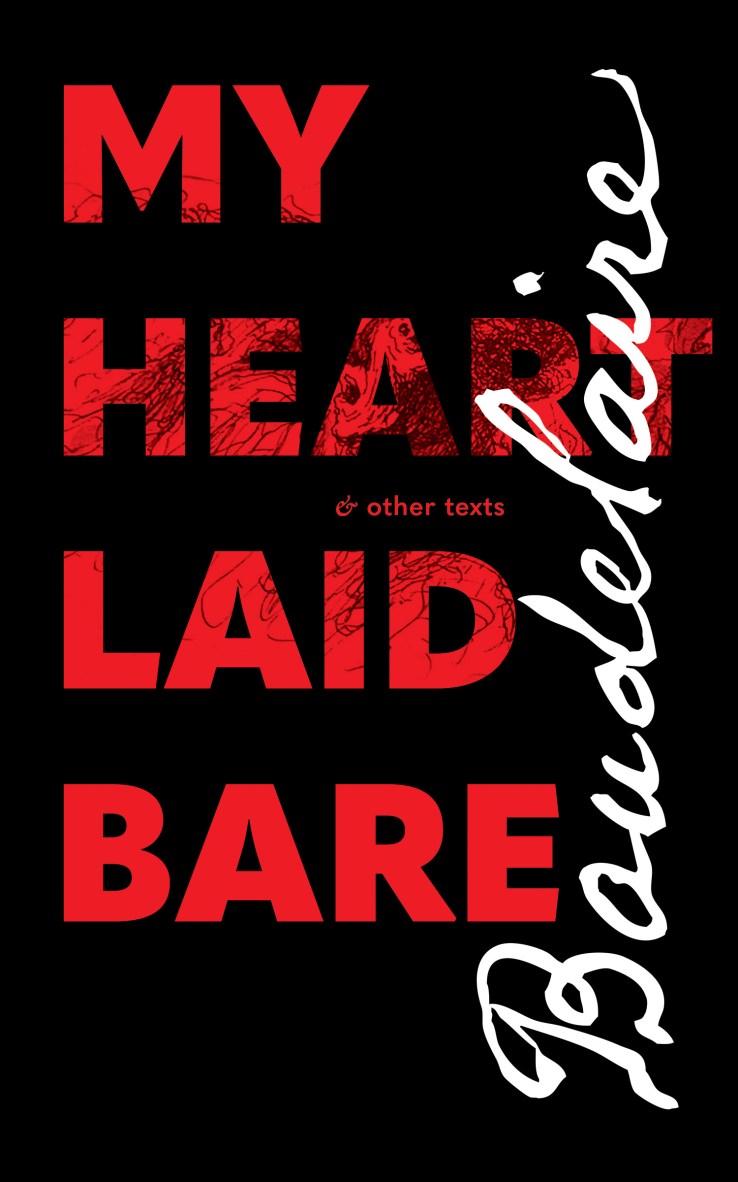
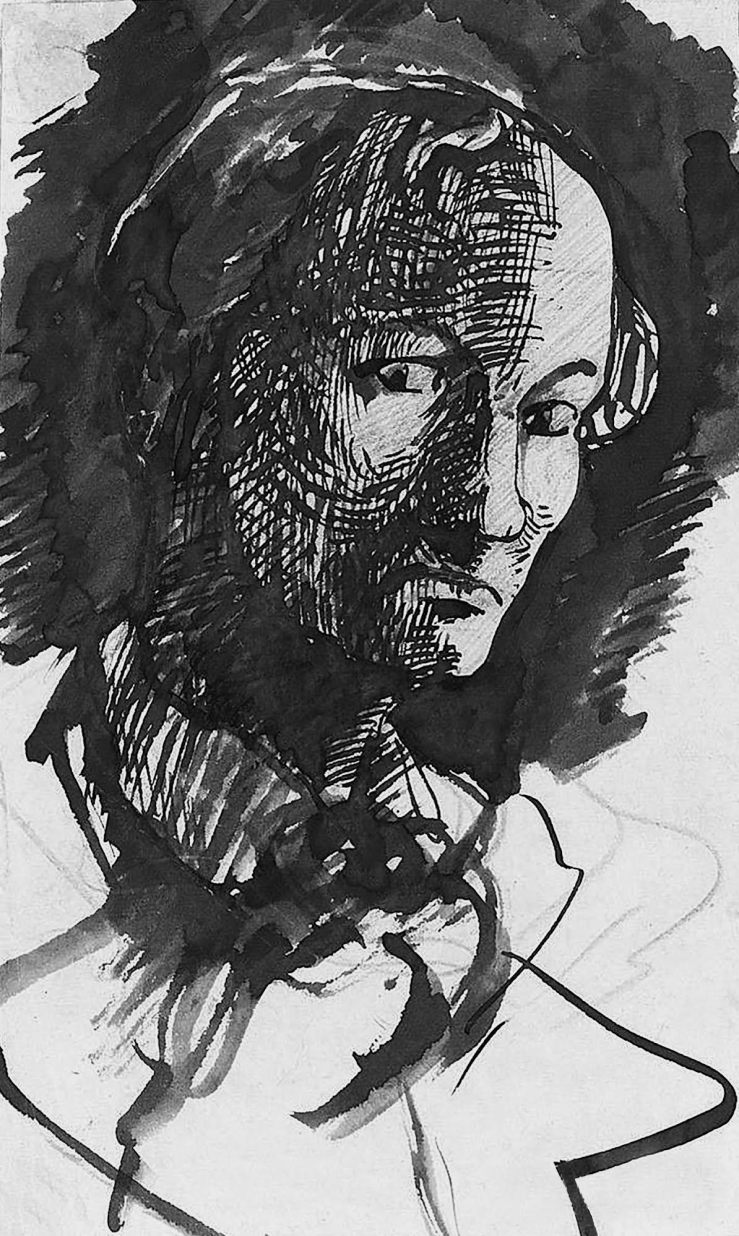

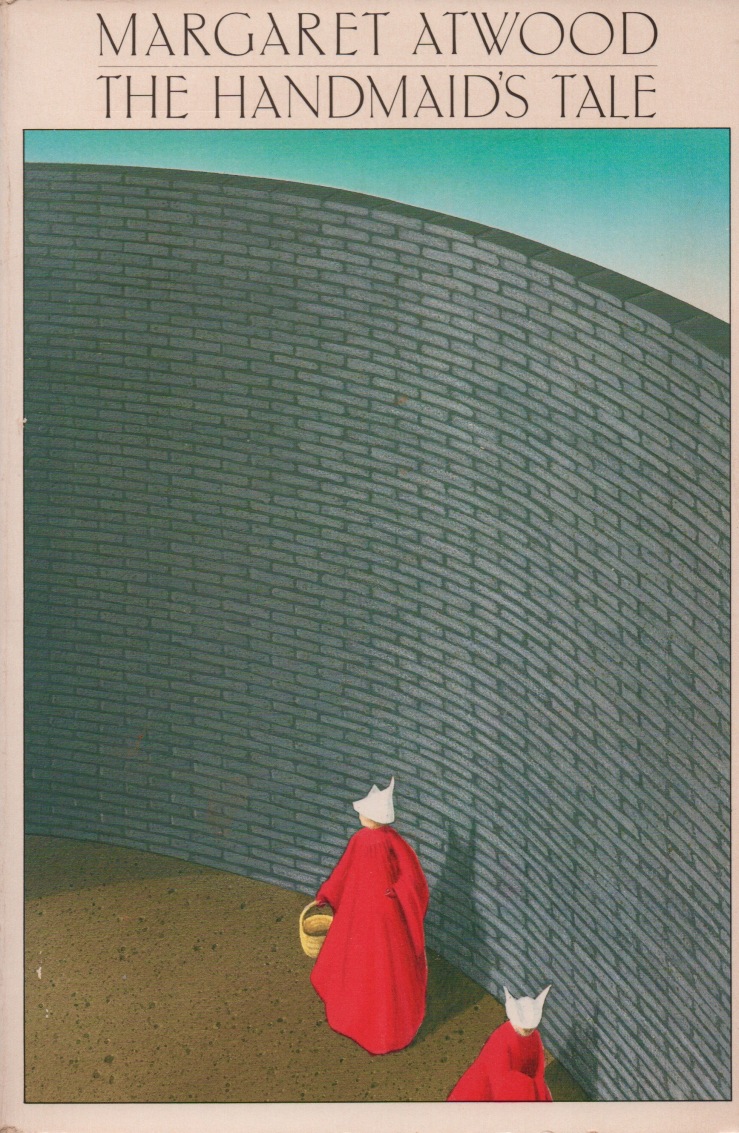



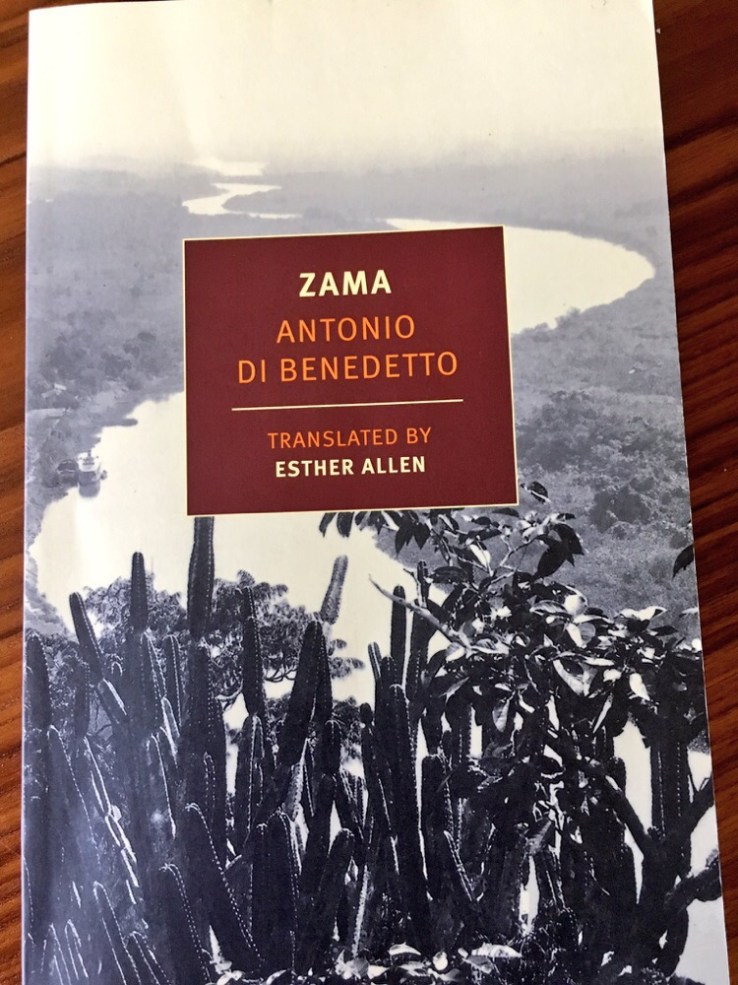

 Biblioklept