A review of Lucia Berlin’s short story collection Evening in Paradise

img_2216

Evening in Paradise is the second posthumously-published collection of short stories by the American writer Lucia Berlin. The book collects twenty-two stories originally published between 1981 and 1999. Most of the stories center around a semi-autobiographical version of Berlin herself. Like the excellent compendium A Manual for Cleaning Women which preceded it, Evening in Paradise is crammed with life. These stories teem with electric energy—even when their immediate subject matters might seem banal on the surface. Evening in Paradise shows an artist shaping the events of her life, big and small, wild and tragic, sharp and dull, into an impressionistic and urgent patchwork of tales that add up to a fictional memoir of sorts. As Berlin’s eldest son Mark Berlin noted in a 2005 essay on his mother (which serves as an introduction to Evening in Paradise),

Ma wrote true stories; not necessarily autobiographical, but close enough for horseshoes. Our family stories and memories have been slowly reshaped, embellished and edited to the extent that I’m not sure what really happened all the time. Lucia said this didn’t matter: the story is the thing.

The first stories in the collection feel sharply autobiographical. Both “The Musical Vanity Boxes” and “Sometimes in the Summer” are told by a first-person narrator named “Lucia” who details the small adventures of her childhood early 1940s in El Paso, Texas. Lucia and her friend slip over borders of all sorts, passing not only into Juarez, but also into a more complicated version of themselves as they mature. There’s a subtle menace rumbling under these stories. A mature Berlin looks back, knows what her girl protagonist does not yet know about the world and its dark joys and sinister terrors. The writer shows us a narrator gazing on life’s bright lights, even as she—the writer—draws our attention to the edge of those lights, to the threatening shadows on the margin.

Like A Manual for Cleaning Women, the stories in Evening in Paradise follow an arc of maturation—they are organized not chronologically by dates of composition or publication, but organized rather around the age of the central protagonist, the Berlin stand-in.

We find this protagonist simultaneously struggling and thriving in her teenage years. “Anando: A Gothic Romance” lives up to its subtitle. Set in Chile in an ex-pat community, “Andado” features a version of Berlin’s own teenage family—the father, a somewhat-absent mining engineer; the mother a depressed alcoholic. It’s no wonder then that our hero “Laura” is so easily seduced — “ruined” — by an older man. In one telling aside, the third-person narrator assesses a subtle moment of the seduction from the distance of time:

She was simply enveloped.

This would never happen to her again. When she grew older she would always be in control, even when being submissive. This would be the first and the last time anyone took over herself.

In “Itinerary,” another fictionalized-version of Berlin departs Chile for college in New Mexico. She leaves on her own, taking a series of planes and being greeted by a series of hosts, each of which reveals, inadvertently, something about her family which she had not previously seen, something that would be obvious though to any mature eyes settling on the family with objective distance. Berlin’s first-person narrator never quite names what is revealed to her; instead, she takes us up to the moment where we see her seeing what she has previously been blind to, yet still does not quite have the language to name. The final lines of “Itinerary” are a sort of negative epiphany:

It was sunset as we circled Albuquerque. The Sandias and the miles of rocky desert were a deep coral pink. I felt old. Not grown up, but the way I do now. That there was so much I did not see or understand, and now it is too late. The air was cold in New Mexico. No one met me.

The middle section of Evening in Paradise gives way to a series of stories focusing on young wives and young mothers different iterations of Berlin in the fifties. “Lead Street, Albuquerque” is particularly fascinating. Here, Berlin splits the material of her life into two different characters—the narrator, a somewhat hapless housewife who’s relegated to washing the dishes while her artist-husband and his artist-friends chat about hepcat stuff—and “Maria” — “seventeen, American, but grew up in South America, acts foreign, shy. English major.” A mature narrator looks back, half-mockingly and half-lovingly, at an ingénue-muse version of herself, the pair framed in the same tale. And our narrator turns toward her own life in the same attitude in turn:

Is there a word opposite of déjà vu? Or a word to describe how I saw my whole future flash before my eyes? I saw that I’d stay at the Albuquerque National Bank and Bernie would get his doctorate and keep on painting bad paintings and making muddy pottery and would get tenure. We would have two daughters and one would a dentist and the other a cocaine addict. Well, of course I didn’t know all that, but I saw how things would be hard. And I knew that years and years from then Bernie would probably leave me for one of his students and I’d be devastated but then would go back to school and when I was fifty I’d finally do things I wanted to do, but I would be tired.

The push-pull of artistic ambition against domestic life’s constraints ripple through these middle stories, where women raise kids and clean houses while men pursue their muses—writing, jazz, painting. There are small resentments and sordid affairs, banal routines and burgeoning substance abuse problems. Threaded through these stories is a common theme though, summed up in the last line of “Cherry Blossom Time,” when the hero Cassandra addresses her husband: “David. Please talk to me.”

The collection’s title story marks a shift in the trajectory of the Berlinverse, and stands out as a bit of an oddity. “Evening in Paradise” is the only piece here that doesn’t feature a straightforward Berlin stand-in; indeed, the story doesn’t have a strong central persona at all. Rather, “Evening” plays like a series of elegiac vignettes centered around the Oceano hotel–notably its bar—in Puerto Vallarta, Mexico. It’s 1963 and cast and crew of The Night of the Iguana are causing a ruckus in the small fishing town, drinking heavily, taking up with beach gigolos, smoking reefers—and even shooting heroin and snorting coke. Richard Burton and Elizabeth Taylor burst in and out; Ava Gardner looms larger than life. Director John Huston sits in the bar’s corner, drinking homemade mescal from a mayonnaise jar. There’s scheming and screaming, and generally famous times—but, like the title declares, the scene announces the end of an era.

“Evening in Paradise,” without a Berlin-protagonist, resets the stage, moving us to Mexico for a while, and introducing heroin as a major trope. In the next tale, “La Barca de la Ilusion,” Maya and her husband Buzz move to Yelapa (in Jalisco, Mexico) so that Buzz can kick heroin. “La Barca” is a standout in the collection, a slow burn of a tale, but one packed with lifetimes of storytelling. Buzz, born to a wealthy Boston family, drops out of Harvard to play saxophone in jazz clubs. He marries an heiress named Circe (I know, right?), starts a Volkswagen franchise, becomes a millionaire, has an affair with Maya, divorces Circe, etc. The problem remains though: “Heroin is easy to hide if you are rich, because you always have it.” That problem transgresses the paradise of Yalapa in the form of Victor, a menacing drug dealer who’s had his hooks in Buzz for years. Victor is a creature from the shadows, the sinister specter that haunted the background of the earlier tales of Evening in Paradise finally made manifest. I won’t spoil the rest of the story, but it swells to a startling, cinematic climax.

Characters like Victor and Buzz and Circe show up in different iterations in successive stories, like “My Life Is an Open Book” and “The Wives,” before Evening in Paradise gives over to Berlin’s Oakland years. Stories like “Noël, 1974” feature Berlin’s sons—excuse me, Berlin’s stand-in’s sons. These stories also feature her alter-ego’s high-functioning alcoholism. (Again, features that will be familiar to fans of the stories in A Manual for Cleaning Women).

The one-pager “The Pony Bar, Oakland” serves as something of a summary of the material that preceded it, delivered in Berlin’s economical prose. “There are certain perfect particular sounds. A tennis ball, a golf ball hit just right….Pool is erotic any way you look at it” the narrator begins, perched on a bar stool, as the sounds of billiards take her back in time to a cricket match in Chile:

Cricket in Santiago. Red parasols, green grass, white Andes. Red and white striped canvas chairs at the Prince of Wales Country Club. I signed chits for lemonade, tipped the tuxedoed waiters, applauded John Wells. Perfect crack of the cricket bat. I wore white, was careful of the grass stains, flirted with the boys who wore Grange school gray flannels, blue blazers in summertime. Cucumber sandwiches with tea, plans for Sunday at Viña del Mar.

The narrator remarks that she felt like an alien in that privileged childhood, just as she feels like an alien here at the Pony Bar in Oakland, sitting next to a tattooed biker. Berlin—or hey, sorry, Berlin’s stand-in—is never at home, but also at home every where. The tale ends as she glances at the hinges tattooed on the biker’s wrists, elbows, knees. The story ends in a wry punchline:

“You need a hinge on your neck,” I said.

“You need a screw up your ass.”

The smoky bar reverberating with the erotic sounds of pool transmutes into expatriate pastimes and then lands back into unglamorous Oakland, to culminate in a dirty joke. “Pony Bar, Oakland” condenses Evening in Paradise’s themes of memory, sensation, and life into a spare but evocative tale.

Later stories, like “Our Brother’s Keeper,” “Lost in the Louvre,” and “Luna Nueva” work in much the same way, filling a few slim pages with full fat life. These late stories are reflective and fully mature—still questioning and questing, but also shining with a strange peace, a strange reconciling to the sinister forces that vibrate under life’s vivid contours of family, work, culture, persona. I’ll confess that there’s something in these stories that I don’t fully appreciate—something beyond my forty years, something that their narrators see that I don’t maybe—maybe not yet, maybe not ever. But I’ll be happy to revisit them—and Berlin’s work in general—in years to come. Highly recommended.


A review of Yevgeny Zamyatin’s prescient dystopian novel We

img_2163

Set millennia in the future, Yevgeny Zamyatin’s 1921 dystopian novel We tells the story of a man whose sense of self shatters when he realizes he can no longer conform to the ideology of his totalitarian government. Zamyatin’s novel is a zany, prescient, poetic tale about resisting the forces of tyranny, conformity, and brute, unimaginative groupthink.

We is narrated by D-503. D-503 is an engineer building a spacecraft, the Integral, which will expand the domain of OneState. Although OneState has conquered earth (after the apocalyptic Two Hundred Years War), they seek to expand their empire of conformity to the stars, perhaps replicating their giant city-state on planets yet unknown. In its physical form, OneState is a glass panopticon surrounded by a great Glass Wall that keeps the wild natural world out. In its ideological form, OneState mandates uniformity, mechanization, and mathematical precision. The denizens of OneState conform to this ideology at all times. They wear uniforms — “yunies” — that bear the numbers that serve as their names. Indeed, they are “Numbers,” not people. The Numbers wake and sleep at the exact same hour. They march in unison and live and work in glass buildings. They “vote” to elect the same Benefactor each year, who runs unchallenged. They eat foods made from petroleum and produce children in a machine-like process that follows a system of “Maternal and Paternal Norms.” Numbers that don’t meet these Norms are forbidden from reproducing, but any Number can register for intercourse with another Number on Sex Day. A secret police force, the Bureau of Guardians, monitors the population, but it’s ultimately groupthink that keeps the Numbers in line.

One-State’s groupthink ideology is neatly summed up in propaganda that D-503 shares late in the novel:

Here’s the headline that glowed from page one of the State Gazette:

REJOICE!

For henceforth you are perfect! Up until this day your offspring, the machines, were more perfect than you.

IN WHAT WAY?

Every spark of the dynamo is a spark of purest reason. Every stroke of the piston is an immaculate syllogism. But do you not also contain this same infallible reason? The philosophy of the cranes, the presses, and the pumps is as perfect and clear as a circle drawn with a compass. But is your philosophy any less perfect? The beauty of the mechanism is in the precise and invariable rhythm, like that of the pendulum. …But think of this: The mechanism has no imagination.

Imagination is the ultimate enemy of the machine, and the Benefactor and his Guardians have a plan to finally root it out and exterminate it.

Throughout much of We, D-503 is very much attuned to this ideology. D-503 thinks of OneState as “our glass paradise.” What we see as dystopia he sees as utopia, he initially constructs We as a testament to OneState’s glory that he will include as part of the cargo of the Integral. However, as the narrative unfolds, D-503 unravels. His sense of self divides as signs of mental illness emerge–first dreams, then an imagination, and then—gasp!—a soul.

D-503’s internal conflict stems from discovering his own innate irrationality—namely, a soul which cannot be measured in numbers or weighed in physical facts. This internal conflict drives much of the narrative of We. Zamyatin delivers this conflict in D-503’s first-person consciousness, a consciousnesses that contracts and expands, a consciousness that would love to elide its own first-person interiority completely and subsume itself wholly to a third-person we—but he can’t. Consider the following passage;

I lie in the bed thinking … and a logical chain, extraordinarily odd, starts unwinding itself.

For every equation, every formula in the superficial world, there is a corresponding curve or solid. For irrational formulas, for my √—1, we know of no corresponding solids, we’ve never seen them…. But that’s just the whole horror—that these solids, invisible, exist. They absolutely inescapably must exist. Because in mathematics their eccentric prickly shadows, the irrational formulas, parade in front of our eyes as if they were on a screen. And mathematics and death never make a mistake. And if we don’t see these solids in our surface world, there is for them, there inevitably must be, a whole immense world there, beneath the surface.

I jumped up without waiting for the bell and began to run around my room. My mathematics, up to now the only lasting and immovable island in my entire dislocated life, had also broken loose and floated whirling off. So does this mean that that stupid “soul” is just as real as my yuny, as my boots, even though I can’t see them now (they’re behind the mirror of the wardrobe door)? And if the boots are not a disease, why is the “soul” a disease?

What initiates D-503’s anti-quest for a soul? It is a woman of course. I-330 interrupts D-503’s routine life, puncturing his logic with irrational passions, taking him on transgressive trips to the Old House—and eventually, leading him to the greatest transgression of all. You see, there’s an underground movement, a secret resistance force—one that not uncoincidentally needs access to the Integral—and this resistance plans to…but I shouldn’t spoil more.

Or really, could I even spoil the plot of We? So many novels and films have borrowed heavily from (or at least echoed) its premise that you already know what it’s about. The major examples are easy—Huxley’s Brave New World (1932), Lang’s Metropolis (1927), Orwell’s 1984 (1949), Vonnegut’s Player Piano (1955), etc. Then there are all their followers—the cheap sci-fi paperbacks of the sixties and seventies, their corresponding films—Logan’s RunSoylent Green–and so on and so on, well into our Now (Running ManTotal RecallThe Matrix, The Hunger Games, etc. forever).

You get the point: We is a generative text. And after reading We, I couldn’t immediately think of a clear generative text that generated it. From what materials did Zamyatin craft his tale?  The closest predecessor I could initially think of was Jack London’s The Iron Heel (1907), or maybe bits of H.G. Wells’ The Time Machine (1895), neither of which feel as thoroughly modern as We does. However, cursory research (uh, skimming Wikipedia) turned up Jerome K. Jerome’s 1891 short story, “The New Utopia,” which does feature some of the tropes we find in We. Set in city of the future, “The New Utopia” features uniformed, nameless, numbered people whose government attempts to destroy the human imagination. Here, the “Destiny of Humanity” has become an egalitarian nightmare.

While it’s likely that “The New Utopia” furnished Zamyatin some of the tropes he needed to construct We, Jerome’s story simply doesn’t have the same epic themes of underground resistance to technological bureaucracy that have became the stock of so much 20th and 21st-century science fiction. (I rewatched Terry Gilliam’s Brazil (1985) while reading We, and the parallels are remarkable—but the same can be said for any number of sci-fi films of the last sixty or so years).

More significantly, Jerome’s “The New Utopia” is beholden to a rhetorical scheme that makes it feel closer to an essay than a finished work of art. The story is essentially a one-sided dialogue—a man falls asleep, wakes up a few thousand years later, and gets the skinny on the utopian nightmare city he’s awoken in from an enthusiastic Future Person. Reading “The New Utopia” reminded me of reading London’s The Iron Heel, which essentially works in the same way—London’s plot often feels like an excuse to stitch together Marxist readings into monologues posing as dialogues.

Zamyatin’s book, in contrast, is Something New. We is a work of Modernism, not just a collection of new tropes, but a new configuration of those tropes. Zamyatin’s D-503 is a consciousness in crisis, a self that simultaneously dissovles and resolves into something new—a creature with a soul. Consider D-503’s recollection of a nightmare:

It’s night. Green, orange, blue; a red “royal” instrument; a yellow-orange dress. Then, a bronze Buddha; suddenly it raised its bronze eyelids and juice started to flow, juice out of the Buddha. Then out of the yellow dress, too: juice. Juices ran all over the mirror, and the bed began to ooze juice, and then it came from the children’s little beds, and now from me, too—some kind of fatally sweet horror….

The prose here showcases Zamyatin’s vivid style. We, crammed with colors, often evokes Expressionist and Futurist paintings. We get here a painterly depiction of D-503’s abjection, his sense of a self leaking out in “some kind of fatally sweet horror” — his boundaries overflowing. The dream-synthesis here is at once joyful, terrifying, and utterly bewildering to our poor hero. It is also poetic in his rendering. D-503 laments early in his narrative that he is not a poet so that he cannot properly celebrate OneState in writing for his readers. But later, his friend R-13—a poet himself—tells him that he has “no business being a mathematician. You’re a poet…a poet!”

R-13 is correct: D-503 is a poet, a poet who cannot abide all the metaphysics gumming up his mathematical mind. This poetry is rendered wonderfully in the English translation I read by Clarence Brown (1993), and is showcased in the very “titles” of each chapter (or “Record,” in the book’s terms). Each “Record” begins with phrases culled from the chapter. Here are a few at random:

An Author’s Duty

Swollen Ice

The Most Difficult Love


Through Glass

I Died

Hallways


Fog

Familiar “You”

An Absolutely Inane Occurrence


Letter

Membrane

Hairy Me

These are the titles of four random chapters, but I suppose we could string together the whole series and arrive at a Dadaist poem, one that might also serve as an oblique summary of We.

And yet for all its surrealist tinges and techno-dystopian themes, the poem that We most reminded me of was, quite unexpectedly, Walt Whitman’s Song of Myself (1855). Whitman’s poem sought a new language and a new form to tell the story of a new land, a new people. He wanted to be everyone and no one at the same time, himself a kosmos, form and void, an I, a you, a we. Whitman addressed his poem to both the you of his readership, an immortal future readership beyond him (“Listener up there!”) as well as himself, famously declaring: “I loaf and invite my soul.”

D-503 presents almost as an anti-Whitman. He directly addresses his “unknown readers” in nearly every chapter, and with a Whitmanesque turn, like this one: “You, my unknown readers, you will be told everything (right now you are just as dear, as close, and as unapproachable…).” His ebullience and optimism are ironic of course—they are honest performances that crack under the increasing reality of his emerging soul. Unlike Walt Whitman, D-503 cannot loaf and invite his soul. He can’t sustain the negative capabilities Whitman’s poem engenders. His we cannot reconcile with an I, even as it seeks a mediating you in its dear readers.

And yet for all its bitter ironies and for all its hero’s often feckless struggle, We is a comedy. The book is a cartoon-poem-satire, its comedy sustained in the careening voice of D-503. It’s somewhat well known that George Orwell used We as a template for 1984 (he began that novel less than a year after penning a review of a French translation of We). Orwell’s novel though falls into the same essaying that we see in The Iron Heel and “The New Utopia.” It’s also awfully dour. In contrast, We shuttles along with zany elan, inviting us to laugh at modern absurdity. Indeed, Zamyatin posits laughter as resistance to tyranny, myopia, and brutish closed-mindedness. Late in the novel, D-503 arrives at the following epiphany:

And that was when I learned from my own experience that a laugh can be a terrifying weapon. With a laugh you can kill even murder itself.

I could end by cataloging the various parallels that might be drawn between We and our own dystopian age, but I think that they are too obvious, and, as I’ve noted, have been repeated (with degrees of difference) throughout the body of dystopian narratives that We has helped generate. What the book does though—or I should say, what it did for me—is offer the strange comfort. A century after Zamyatin diagnosed the emergence of another modern world, the human position remains essentially unchanged, and in times of despair we can remember to laugh—and imagine to imagine. Very highly recommended.

A review of Paul Kirchner’s Hieronymus & Bosch, a slapstick comedy set in Hell

hb

My review of Paul Kirchner’s latest collection Hieronymus & Bosch is up at The Comics Journal. Here is the first paragraph of the review:

Paul Kirchner’s Hieronymus & Bosch collects over eighty comic strips that riff on the afterlife of a “shameless ne’er-do-well named Hieronymus” and his faithful wooden toy duck, Bosch. The hapless pair are trapped in Hell, the primary setting for most of the strips (although we do get a bit of heaven and earth thrown in here and there). Kirchner’s Hell is a paradise of goofy gags. The one-pagers in Hieronymus & Bosch cackle with burlesque energy, propelled by a simple plot: our hero Hieronymus tries to escape, fails, and tries again.

Read the whole review.

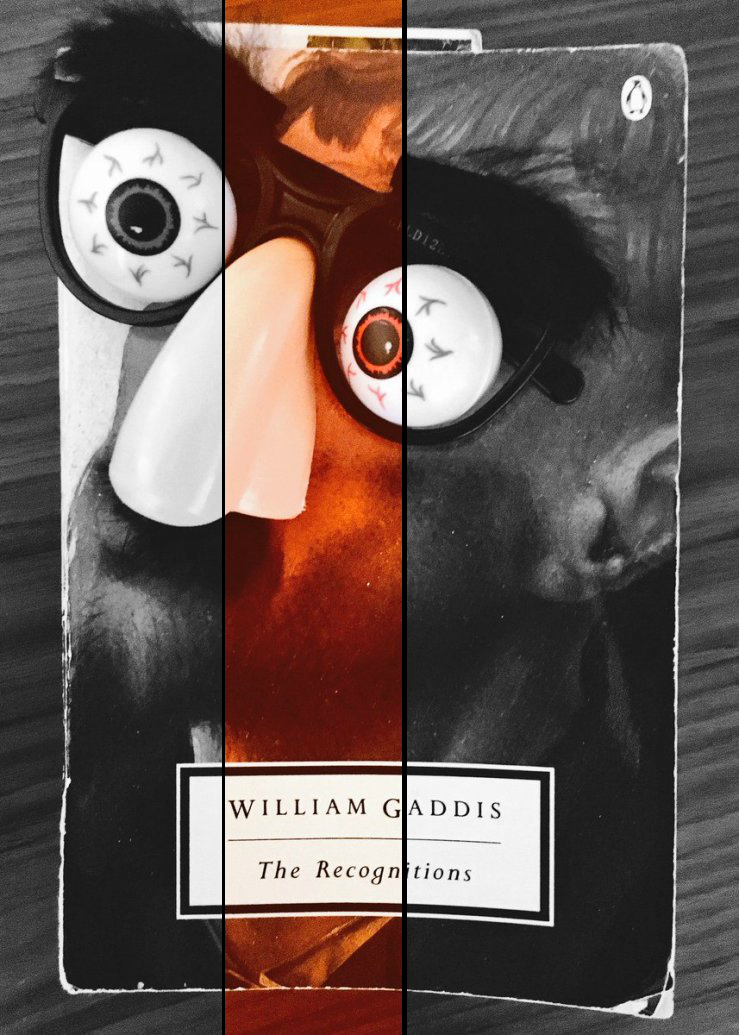
Blog about a metatextual moment at the end of William Gaddis’s novel The Recognitions

dqx3nv9u0aaq8m4

In the epilogue of his 1955 novel The Recognitions, William Gaddis checks in on the book’s enormous background cast, tying up loose ends, but also leaving many of the characters frayed, burned out, or destroyed. There’s a remarkable metatextual moment in this epilogue in which two minor characters are revealed to be carrying copies of a book that bears more than a passing resemblance to The Recognitions itself. These characters are both literary counterfeiters—Mr. Feddle, a faker who forges book jackets with his name in the author’s position and slips them over classic novels, and “the critic in the green wool shirt,” who doesn’t bother to read the books he reviews.

Meeting at a tailor’s shop, Feddle and the critic peer at each other, “fix[ing] the book the other was carrying with a look of myopic recognition.” The passage continues with the following acerbically ironic exchange:

—You reading that? both asked at once, withdrawing in surprise. —No. I’m just reviewing it, said the taller one, hunching back in his green wool shirt.

—A lousy twenty-five bucks. It’ll take me the whole evening tonight. You didn’t buy it, did you? Christ, at that price? Who the hell do they think’s going to pay that much just for a novel. Christ, I could have given it to you, all I need is the jacket blurb to write the review.

The exchange here accurately anticipates exactly how The Recognitions would be received by its contemporary critics—or “hacks,” as Jack Green repeatedly calls them in his infamous 1962 screed Fire the Bastards! For almost 80 pages, Green details the failures of the 55 critics who reviewed the book upon its release. Some of these major failures include—

failing to recognize the greatness of the book

failing to convey to the reader what the book is like, what its essential qualities are

counterfeiting this with stereotyped preconceptions—the standard cliches about a book that is “ambitious,” “erudite,” “long,” “negative,” etc

counterfeiting competence with inhuman jargon

Green’s repeated use of the word “counterfeit” not just here but throughout his tract demonstrates the essential realism of The Recognitions: Gaddis conceived how his novel of counterfeiters, poseurs, plagiarists, and hacks would be misread, misremembered, and misrecognized by counterfeiters, poseurs, plagiarists, and hacks. The green-wool-shirted critic’s declaration that all he needs “is the jacket blurb to write the view” transcends its original satirical contours—it is a prophecy that comes true.

This satirical metatextual prognostication finds fruition in the review of The Recognitions published in The Louisville Courier-Journal. In Fire the Bastards!, Green details how the reviewer plagiarized his review of The Recognitions from the novel’s jacket blurb. The metatextuality here is magical: Gaddis conjures the character of an unnamed counterfeiter critic who will (not-)review a book that appears to be The Recognitions itself; this character becomes real by (not-)reviewing the book in an unsigned review in The Louisville Courier-Journal that plagiarizes the book’s blurb.

But perhaps I’ve neglected to demonstrate that the book that Feddle the faker and the critic in the green wool shirt are both not reading is in fact a version of The Recognitions itself. Here is the next paragraph in the episode:

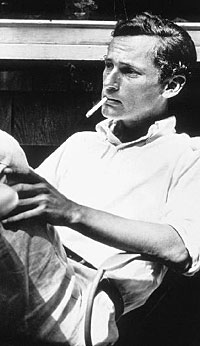
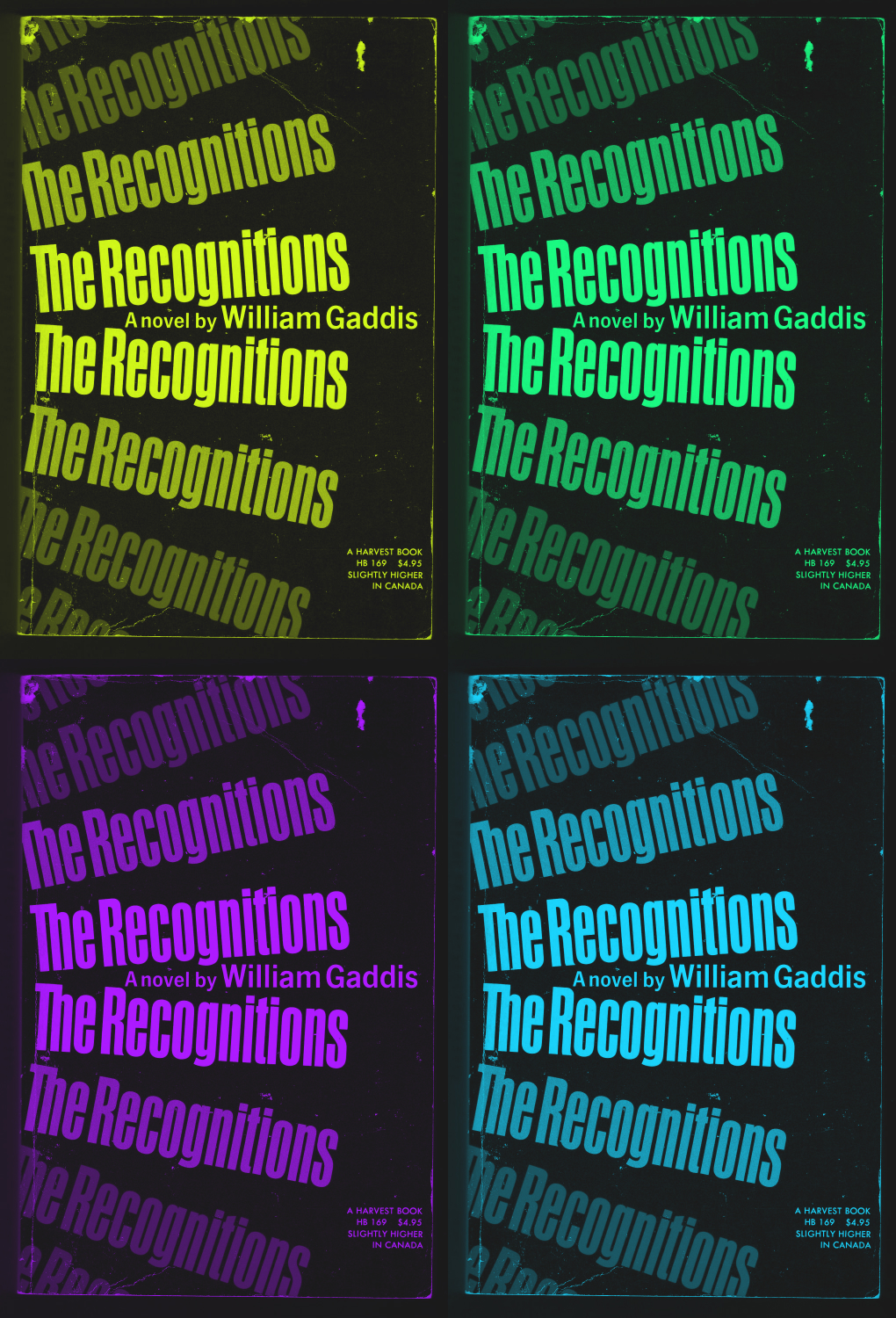
It was in fact quite a thick book. A pattern of bold elegance, the lettering on the dust1M5vpxx wrapper stood forth in stark configurations of red and black to intimate the origin of design. (For some crotchety reason there was no picture of the author looking pensive sucking a pipe, sans gêne with a cigarette, sang-froid with no necktie, plastered across the back.)



In his invaluable work A Reader’s Guide to William Gaddis’s The Recognitions, Steven Moore gives the following annotation to these lines:

 the description is of the first edition of R [The Recognitions]. Martin Dworkin’s photograph of Gaddis “sans gêne with a cigarette, sang-froid with no necktie” appeared in both the Time and Newsweek reviews.

Jack Green is more succinct in Fire the Bastards!: “the book the stubby
poet [Feddle] has is the recognitions [sic] itself.” And what is “the stubby poet” doing with such a bigass book? Reading it?

—Reading it? Christ no, what do you think I am? I just been having trouble sleeping, so my analyst told me to get a book and count the letters, so I just went in and asked them for the thickest book in the place and they sold me this damned thing, he muttered looking at the book with intimate dislike.

At least Feddle’s dislike is “intimate.” If he’d bothered to read it he might have gotten some weird alarming joy from this (meta)Recognitions. Or, even better, he might reread it—which is really the only way to read The Recognitions, I’m convinced, after my second full read. The book is more precise, more artfully constructed—more stuffed with motifs and symbols, doubled, tripled, quadrupled—than I had realized on first reading.

Jack Green made rereading The Recognitions a significant part of his life. He was an evangelist for the text, going so far as to take out a full page ad in The Village Voice in 1962 when the book was reprinted in paperback. His advertisement is five short paragraphs. The second paragraph is a proper, original blurb. The second paragraph is an argument for rereading. Here they are:

“The Recognitions” is a 956-page novel whose main theme is vanity or forgery—of Old Masters, $20 bills, slings, personality, everything. It is like a painting with a few primary figures presented in depth and an army of caricatures in the background. The main characters are unforgettable and, as is usually true, give the book most of its greatness. The minor characters, including the author himself who has a bit part, are very funny.

Like “Ulysses,” Gaddis’s book can be read the first time with enjoyment (my advice: don’t work at it) and then reread for years with increasing fascination. It has an intricate network of thousands of cross-references which give it a unique time-sense: as the connections are gradually recognized on rereading, the book appears to grow like a living being.

“Grow like a living being.” I think that’s about right.

A review of Hayao Miyazaki’s film Porco Rosso

porco-rosso

Hayao Miyazaki’s Porco Rosso (1992) is one of my favorite films, and I was able to see it this summer for the first time on the big screen thanks to Studio Ghibli Fest 2018. Although I’ve seen Porco Rosso maybe a dozen times, seeing its rich, deep, bold animation on an enormous screen felt like seeing it for the first time.

Porco Rosso takes place in and around various islands in the Adriatic Sea during the thin slice of years between the First and Second World Wars. Italy, like much of the world, is in the midst of a severe economic depression, and is slowly sliding into fascism. World War II is clearly on the horizon. Miyazaki pushes these problems to the margins of his film, conjuring instead a romanticized Mediterranean. However, this romantic space is always under the pressure of a coming disaster—fascism and a new war.

porcorosso5

The hero of Porco Rosso is Marco Pagot (called Marco Rossolini in the American dub). Marco is an ex-military pilot, an aviation ace who fought with honor for the Italian air force in the Great War. He now spends his days drinking red wine and smoking cigarettes on a beautiful deserted island, occasionally taking jobs as a bounty hunter, retrieving hostages and other stolen goods from the nefarious and unwashed air pirates who plunder the ships of the Adriatic. Marco makes occasional concessions to civilization by taking a meal at the Hotel Adriano, a charming resort run by his oldest friend Gina. Gina is love with Marco and we come to realize Marco is in love with Gina, but he cannot come out and say this. Marco is a pig.

20130812-161255

Marco is literally a pig. He is the victim of a curse that the film never explicitly names or addresses, although a late scene late in which Marco essentially survives an attack that should have killed him—an event that gives him a dramatic glimpse of a heaven of pilots—may be a clue to the origins of Marco’s porcine curse. In any case, Marco’s pigman existence is the film’s only concession to the kind of mythical and magical fantasy that otherwise permeates Miyazaki’s canon (with the notable exception of The Wind Rises (2013), which in some ways is a sequel to Porco Rosso).

This isn’t to say that Porco Rosso isn’t a fantasy though. Miyazaki’s world of air pirates and bounty hunters, attractive hoteliers and hotshot engineers, and seaplanes dueling in a radiant sky, brims with an effervescent energy that counterbalances the grim specter of the Great War that preceded the film’s narrative action and the Second World War—and a Fascist Italy—that the narrative’s “real” time must eventually intersect. Ever the lone pig, Marco seeks to fly away from the social and historical forces that would constrain him.

Unfortunately for Marco, luxurious isolation remains an impossibility. The air pirates hire a hotshot American to take out the damned Crimson Pig once and for all. Donald Curtis (hailing from Alabama in the Japanese version and Texas in the American) exemplifies American cockiness. His enormous jaw precedes the rest of his swaggering body, he falls in love at first sight with any beautiful woman he sees, and he’s brash and impetuous. He wants to transition to Hollywood and eventually become the President of the United States! Curtis shoots up Marco’s plane early in the film, but our porcine hero escapes to Milan, where he rebuilds his plane with the help of a whiskered mechanic named Piccolo and his charming granddaughter Fio. Fio redesigns the plane and eventually becomes Marco’s sidekick, traveling with him back to the Adriatic and helping him face Curtis and the air pirates.

2_porco_rosso

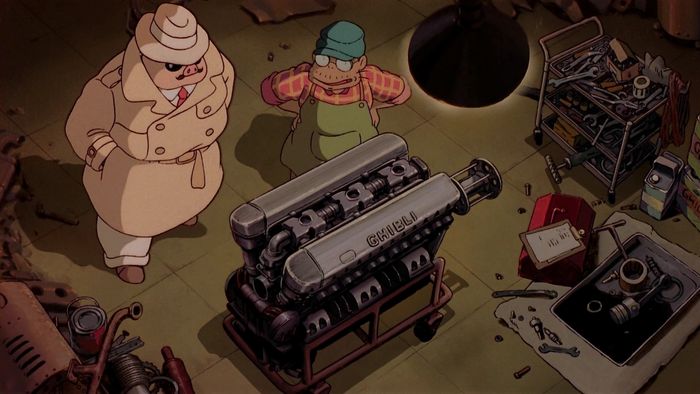
Fio, whose character design recalls Nausicaa of Nausicaä of the Valley of the Wind (1984), is another of Miyazaki’s prominent female protagonists. In some ways she is the secret hero of the film; she takes over the narration at the end, implicitly assuming Porco Rosso’s mantle. Fio has earned Marco’s trust after he is initially dubious of her ability because of her age and his sexism. Fio leads an all-female team of builders and engineers to recreate a superior version of Marco’s plane. This workshop sequence is one of the film’s finest. Miyazaki often foregrounds labor in his films, but Porco Rosso explicitly shows how a complex work—whether it’s a plane, or, y’know, a film—is never the singular work of a gifted genius, but rather the concentrated effort of a team. Miyazaki underscores the connection between the creative process of plane-building and film-making, stamping his studio’s name on Marco’s new engine. (Studio Ghibli was named after an Italian war plane, the Caproni Ca.309, which was nicknamed Ghibli—“Desert Wind”).

85268fc75512cda8cc331109c81ec95c

While in Milan, Marco realizes that the fascist secret police are after him. The Fascists in Porco Rosso (who want to conscript Marco—or take his plane) are far more ominous than Curtis. Curtis serves as an actual antagonist for Marco to face, and the fight between the two at the end of Porco Rosso, although violent, plays with a light comic touch. Miyazaki references the “gentlemen pilots” of World War I here. The Fascists, in contrast, are a spectral force lurking behind the narrative, threatening Marco’s individuality and autonomy. The film affirms itself as a comedy that resists encroaching fascism in a conclusion that sees Marco, Fio, Gina Curtis, the air pirates, and every other member of this strange Adriatic paradise working together to escape their approaching air force.

The film’s denouement is a retreat into the romantic Adriatic community, a kind of gauzy, rosy vision of an isolated paradise untouched by war or fascism. The fantasy reminds one of an island from some lost book of The Odyssey, a tranquil paradise unbothered by Trojans or Greeks. Marco—Porco—too feels like a figure from the margins of The Odyssey, a hero transfigured into a pig. The end of Porco Rosso refuses to give us a direct answer as to what happens to Porco. Does he regain his human form? Or, perhaps more importantly, is there a happy ending for Porco and Gina? The film offers a number of clues, some explicit and some implicit, but a first viewing may feel ambiguous for many viewers. However, subsequent viewings reveal a clearer picture as to what happens to Gina and Marco. Why the ambiguity then? Porco Rosso is (apart from The Wind Rises) the Miyazaki film with the strongest historicity. The historical reality of a looming World War II threatens to devour the romance of Gina and Porco—so Miyazaki and the inhabitants of his secret Adriatic world conspire to hide it. Lovely stuff.


[Ed. note–Biblioklept ran a version of this review in the summer of 2018].

Gaddis Contra Carnegie | How to Win Friends and Influence People in The Recognitions

img_1858

The second episode of Part II, Ch. 5 of William Gaddis’s 1955 novel The Recognitions returns to the consciousness of sadsack everyman Mr. Pivner. Through milquetoast Mr. Pivner (the long-lost father of poseur-supreme Otto), Gaddis critiques the banal emptiness and rank venality of post-war life in America. In this particular section of The Recognitions, Gaddis reinforces one of his novel’s central themes: modern commerce has supplanted culture in contemporary America. Indeed, commerce is culture in America.

The episode begins as Papa Pivner prepares to meet Otto for the first time (their estrangement has not yet been explained in the narrative). They arrange to meet in a hotel restaurant, their recognition of each other secured in a promise to wear matching green scarves. Gaddis weaves this father-son plot into the schemes of the counterfeiter Frank Sinisterra, who plans to offload his oh-so-artistic fraudulent currency to “a spreader” who will disseminate “the queer” bills. Ever the conman, Sinisterra disguises himself before heading to the meetup, which is to be held in a hotel restaurant. He dons a green scarf, by which his contact will recognize him. You get it: Sinisterra misrecognizes Otto for the spreader, Otto misrecognizes Sinisterra for his long-lost father, tragicomedy ensues, and Gaddis multiplies the strands of deferred and displaced father figures threaded through his bigass too-big too-long novel. This paternity motif is underlined even more when we remember Otto’s competition with Sinisterra’s son Chaby for the affections of Esme. But such deferrals and displacements are the material for a different riff. Let us shift back to Papa Pivner, sad soul, Gaddis’s little manikin-symbol-thing of paternal cultural authority cuckolded by commercial masscult modernity.

As he preps to meet his boy Otto, Mr. Pivner skims through Dale Carnegie’s 1936 utlrabestseller How to Win Friends and Influence People, a self-help book that Gaddis beats up for nearly ten straight pages in The Recognitions(Not incidentally, Gaddis had his students at Bard College read Carnegie’s book as part of a class he taught called “The Theme of Failure in American Literature”). Carnegie’s book is the AntiRecognitions, and Gaddis delights in savaging its self-help hucksterism by setting How to Win Friends against the Western canon:

Mr. Pivner sat staring through rimless glasses at a kindly book-jacket face which returned his amorphous gaze. He was preparing to meet his son, to win him as a friend, and influence him as a person. As Odysseus had Mentor, Jesus John the Baptist, Cesare Borgia Machiavelli, Faust Mephistopheles, Descartes Father Dinet, Schopenhauer’s dog Schopenhauer, and Schiller his drawerful of rotten apples, Mr. Pivner had Dale Carnegie: he and four million other individuals, that is…

The passage’s bathos exemplifies Gaddis’s techniques in the Pivner episodes. Gaddis inflates the rhetoric with rich allusion and haughty parallelism, only to puncture the verbal balloon with the banality of middlebrow midcentury American values. For Gaddis, Carnegie’s book represented a signal synthesis of these venal values. How to Win Friends and Influence People cannibalized millennia of writings on wisdom, philosophy, ethics—and the strange mystery vibrating underneath these disciplines—and distilled it all into a self-help book centered on selling yourself to others. The contempt is palpable in another bathetic passage:

True, Mr. Pivner might have read Descartes; and, with tutelage, understood from that energetic fellow, well educated in Jesuit acrobatics (cogitans, ergo sum-ing), that everything not one’s self was an IT, and to be treated so. But Descartes, retiring from life to settle down and prove his own existence, was as ephemeral as some Roger Bacon settling down to construct geometrical proofs of God: for Mr. Pivner, a potential buyer (on page 95) who was head of the Hotel Greeters of America (and president of the International Greeters too!) was far more real.

Cribbing and re-appropriating Carnegie’s own words, Gaddis’s narrator notes that How to Win Friends “was not a book of thought, or thoughts, or ideas, but an action book.” Gaddis then ironically resituates the value of such a book:

An action book; and herein lay the admirable quality of this work: it decreed virtue not for virtue’s sake (as weary Stoics had it); nor courtesy for courtesy (an attribute of human dignity, as civilized culture would have it); nor love for love (as Christ had it); nor a faith which is its own explanation and its own justification (as any faith has it); but all of these excellences oriented toward the market place.

Gaddis posits How to Win Friends as the cynical, terminal destination for the radical transcendental values of the previous century. The values of self-determination, self-reliance, and self-making upheld by Henry David Thoreau, whose writings are alluded to in The Recognitions, are converted into self-improvement, which translates into self-selling. Art and philosophy are simply commodities. Gaddis intuits the ways that capitalism glosses its venality over with the promises of culture and transcendence. Consider this passage, which begins with a quote from Carnegie:

“Let me repeat: the principles taught in this book will work only when they come from the heart. I am not advocating a bag of tricks. I am talking about a new way of life.” That was the wonderful thing about this book [. . .] if at first its approach seemed fraught with guile, subterfuge, duplicity, sophistry, and insidious artifice, that feeling soon disappeared, and one had . . . “Ah yes, you are attempting a new way of life.”

The litany of the huckster’s “bag of tricks” — “guile, subterfuge, duplicity, sophistry, and insidious artifice” — doubles back to The Recognitions’ motif of counterfeiting and also bites viciously into Carnegie’s core disingenuousness.

Gaddis not only attacks the content of Carnegie’s book, but also the form and style of the book. Carnegie’s hucksterism evinces in its very rhetoric. Gaddis seems to propose his own novel as the opposite of How to Win Friends and Influence People in both content (searching quest for meaning and authenticity in a degraded commercial world) and form (an unwieldy and often abstruse polyglossic beast of a book). In the following remarkable passage he decidedly (if obliquely) situates The Recognitions as a work contra Carnegie:

Here was no promise of anything so absurd as a void where nothing was, nor so delusive as a chimerical kingdom of heaven: in short, it reconciled those virtues he had been taught as a child to the motives and practices of the man, the elixir which exchanged the things worth being for the things worth having. It was written with reassuring felicity. There were no abstrusely long sentences, no confounding long words, no bewildering metaphors in an obfuscated system such as he feared finding in simply bound books of thoughts and ideas. No dictionary was necessary to understand its message; no reason to know what Kapila saw when he looked heavenward, and of what the Athenians accused Anaxagoras, or to know the secret name of Jahveh, or who cleft the Gordian knot, the meaning of 666. There was, finally, very little need to know anything at all, except how to “deal with people.”

Poor Pivner. He’s really just wanting to win the friendship of the son he’s only just learned he has. Gaddis uses Pivner to indict American culture’s commercially cruel contours, where any entity might be misappropriated and misused in the market place of ideas:

Here were Barnum and the Bible, Charles Schwab, Dutch Schultz and Shakespeare, two Napoleons, Pola Negri, and the National Credit Men’s Association, Capone, Chrysler, Two-Gun Crowley, and Jesus Christ, each in his own way posting the way to the market place. Even Jehovah appeared, if only in brief reversal…

The repeated bathos in II.5 of The Recognitions is wonderfully mean humor, but Pivner doesn’t seem like Gaddis’s main mark—rather, Gaddis shows us that Pivner is Carnegie’s mark. And for all the bathos here, there’s pathos too. We can find a certain sympathy in Pivner’s mild and foiled quest to meet with his progeny. A diabetic (like Chaby Sinisterra, he too uses needles), Pivner waits too long to take his insulin and conks out in the hotel lobby. He is briefly arrested and of course fails to meet Otto.

The next chapter, II.6 is set on Christmas Eve. Pivner receives a Christmas present from Otto, a beautiful and expensive robe (Otto is now flush with plenty of the counterfeit cash). Pivner is deeply moved by the gift, and elects to head back to the hotel to try to meet Otto again. The moment he dons the robe is rendered with disarming pathos. Gaddis’s narrator describes Pivner as a man “whose world was a series of disconnected images, his life a procession of faces reflecting his own anonymity in the street, and faces sharing moments of severe intimacy in the press.” If Pivner is prey to a conman like Carnegie, it is because Pivner is lonely and alienated. The modern condition is one of anxious anonymity, where “intimacy” boils down to reading the same gruesome news that others read. Human connection is mediated through mass media.

When Pivner returns to the hotel, he actually does encounter Otto. They stand next to each other, pissing into urinals in the hotel lobby men’s room, staring straight ahead at the obscene graffiti scrawled on the wall. A pornographic drawing so alarms Pivner that he turns and lowers his head, catching a glimpse of a green scarf poking from the proximal pisser’s pocket. The recognition remains incomplete though: Otto turns his “bloodshot eyes in a desolation of contempt” upon the older man and departs into the night. Pivner is unable to find confirmation of the younger man’s identity, and retreats to the bar to drink orange juice.

The final image of the chapter resonates with sympathetic and lonely despair. It is like something from an Edward Hopper painting. On one end of the bar sits a blonde; next to her Pivner; to his right, a newly-disguised Mr. Sinisterra, hoping too to catch Otto. When the blonde pays for her drink with one of his fake bills, Sinisterra gasps in a moment of recognition. The gasp draws Pivner’s attention and he looks to Sinisterra whose

sharp eyes gleamed at something beyond him, and with such intensity that his own were drawn in a reflex to look to where the blonde paid for her drink. But all Mr. Pivner saw, in the dim light, was a crisp twenty-dollar bill exchange hands: or so it looked to him, moonblind in the tinted gloom of that landscape where the three of them hung, asunder in their similarity, images hopelessly expectant of the appearance of figures, or a figure, of less transient material than their own.

In those final words and images we see the dream behind The Recognitions—the dream of recognizing the metaphysical, the original thing itself comprised of “less transient material” than our own. The final image seems to emanate from Pivner’s consciousness, and to emanate in a moment freed from the ironic bathos the narrator dragged him through before. There’s an emergent if subdued rejection of the market place figures that Dale Carnegie blithely promises his marks can attain, replaced, if fleetingly, for a longing after something more, something mysterious and unnameable. Gaddis conjures a small moment of strange, hopeless expectation—the wish for transcendent recognition.

J.G. Ballard’s “The Subliminal Man,” John Carpenter’s They Live, and Black Friday

Today is Black Friday in America. I don’t think it’s necessary to remark at length on the bizarre disjunction between this exercise in consumerism-as-culture and the intended spirit of the Thanksgiving holiday that precedes it. Indeed, I think that the cognitive dissonance that underwrites Black Friday—the compulsion to suffer (and cause suffering), both physically and mentally,  to “save” money on “consumer goods” (sorry for all the scare quotes, but these terms are euphemisms and must be placed under suspicion)—I think that this cognitive dissonance is nakedly apparent to all who choose to (or are forced to) actively engage in Black Friday. The name itself is dark, ominous, wonderfully satanic.

Rereading “The Subliminal Man,” I was struck by how presciently J.G. Ballard anticipated not only the contours of consumerist culture—urban sprawl, a debt-based economy, the mechanization of leisure, the illusion of freedom of choice—but also how closely he intuited the human, psychological responses to the consumerist society he saw on the horizon. Half a century after its publication, “The Subliminal Man” seems more relevant than ever.

The premise of the tale is fairly straightforward and fits neatly with the schema of many other early Ballard stories: Franklin, an overworked doctor, is approached by Hathaway, a “crazy beatnik,” who refuses to take part in the non-stop consumerism of contemporary society. Hathaway can “see” the subliminal messages sent through advertising. He asks for Franklin’s help in stopping the spread of these messages. Hathaway reasons that the messages are intended to enforce consumerist society:

Ultimately we’ll all be working and spending twenty–four hours a day, seven days a week. No one will dare refuse. Think what a slump would mean – millions of lay–offs, people with time on their hands and nothing to spend it on. Real leisure, not just time spent buying things . . .

The fear of a slump. You know the new economic dogmas. Unless output rises by a steady inflationary five per cent the economy is stagnating. Ten years ago increased efficiency alone would raise output, but the advantages there are minimal now and only one thing is left. More work. Subliminal advertising will provide the spur.

Franklin is unconvinced, even though he is already working Saturdays and Sunday mornings to payoff TVs, radios, and other electronic goods that he and his wife replace every few months. Soon, however, he realizes that something is wrong:

He began his inventory after hearing the newscast, and discovered that in the previous fortnight he and Judith had traded in their Car (previous model 2 months old) 2 TV sets (4 months) Power mower (7 months) Electric cooker (5 months) Hair dryer (4 months) Refrigerator (3 months) 2 radios (7 months) Record player (5 months) Cocktail bar (8 months)

Franklin finally sees the truth, but only after Hathaway takes to blowing up signs’ switch boxes (the word “terrorism” is of course not used in the text, although it surely would be today):

Then the flicker of lights cleared and steadied, blazing out continuously, and together the crowd looked up at the decks of brilliant letters. The phrases, and every combination of them possible, were entirely familiar, and Franklin knew that he had been reading them for weeks as he passed up and down the expressway.

BUY NOW BUY NOW BUY NOW BUY NOW BUY NEW CAR NOW NEW CAR NOW NEW CAR NOW

YES YES YES YES YES YES YES YES YES YES

Like many Ballard stories, “The Subliminal Man” ends on a pessimistic note, with Franklin choosing to ignore his brief enlightenment and give in. Ballard drives his criticism home in the final image of the story, with Franklin and his wife heading out to shop:

They walked out into the trim drive, the shadows of the signs swinging across the quiet neighbourhood as the day progressed, sweeping over the heads of the people on their way to the supermarket like the blades of enormous scythes.

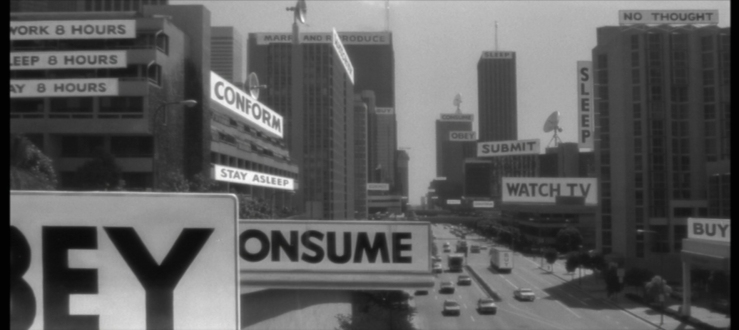
“The Subliminal Man” offers a critique of consumerism that John Carpenter would make with more humor, violence, and force in his 1988 film They Live. In Carpenter’s film, the hero John Nada (played by Roddy Piper) finds a pair of sunglasses that allow him to see through the ads, billboards, and other commercials he’s exposed. What’s underneath? Naked consumerism:

they-live-billboard

The images here recall the opening lines of “The Subliminal Man”: ‘The signs, Doctor! Have you seen the signs?’ Like Ballard’s story, Carpenter’s film is about waking up, to seeing the controlling messages under the surface.

In his film The Pervert’s Guide to Ideology, Slavoj Žižek offers a compelling critique of just how painful it is to wake up to these messages:

It’s worth pointing out that Carpenter offers a far more optimistic vision than Ballard. Ballard’s hero gives in—goes back to sleep, shuts his eyes. Carpenter’s hero Nada resists the subliminal messages—he actually takes up arms against them. This active resistance is possible because Carpenter allows his narrative an existential escape hatch: In They Live, there are real, genuine bad guys, body-snatching ugly-assed aliens—others that have imposed consumerism on humanity to enslave them. That’s the big trick to They Live: It’s not us, it’s them.

Ballard understands that there is no them; indeed, even as the story skirts around the idea of a conspiracy to dupe consumers into cycles of nonstop buying, working, and disposing, it never pins that conspiracy on any individual or group. There’s no attack on corporations or government—there’s not even a nebulous “them” or “they” that appears to have controlling agency in “The Subliminal Man.” Rather, Ballard’s story posits ideology as the controlling force, with the only escape a kind of forced suicide.

I don’t think that those who engage in consumerism-as-sport, in shopping-as-a-feeling are as blind as Ballard or Carpenter represent. I think they are aware. Hell, they enjoy it. What I think Ballard and Carpenter (and others, of course) really point to is the deep dissatisfaction that many of us feel with this dominant mode of life. For Ballard, we have resistance in the form of the beatnik Hathaway, an artist, a creator, a person who can perceive what real leisure would mean. For Carpenter, Nada is the resister—an outsider, a loner, a weirdo too. It’s somehow far more satisfying to believe that those who engage in spectacle consumerism are brainwashed by aliens than it is to have to come to terms with the notion that these people are acting through their own agency, of their own will and volition. Happy shopping everyone!

Ed. note: Biblioklept published a version of this post a few years ago. It is offered again now in the spirit of Thanksgiving leftovers.

She was the poem | Another riff on William Gaddis’s The Recognitions

An intriguing and confounding section of Chapter 1 of Part II of William Gaddis’s 1955 novel The Recognitions focuses heavily on Esme, the poet who models for Wyatt Gwyon as he paints his forgeries. The episode eventually reveals Esme as one of the heroes of The Recognitions. It begins with Esme cloistering herself, pinning a sign to her door that reads: “Do Not Disturb Me I Am Working Esme.” She begins her “work” in a manic blur, “delighted to be alone.” As her energy shifts, she sews for a bit, before finally switching to attend to her small library:

But before that sewing was done she was up, rearranging her books with no concern but for size. There was, really, little else their small ranks held in common (except color of the bindings, and so they had been arranged, and so too the reason often enough she’d bought them). Their compass was as casual as books left behind in a rooming house; and this book of stories by Stevenson, with no idea where she’d got it, she hadn’t looked into it for years, now could not put it down, and to her now it was the only book she owned.

Esme’s bookshelving is purely aesthetic, and the aesthetic seems arbitrary (and likely temporary). In this little scene she moves from arrangement by color to arrangement by size. Her aesthetic arrangement leads her back to a collection of Robert Louis Stevenson stories (likely The Merry Men, and Other Tales), her current (arbitrary, temporary) aesthetic obsession. The “Esme working” section of II.1 of The Recognitions actually begins with an entire paragraph a Stevenson story, presumably read aloud by Esme. This long quote goes unattributed, but Steven Moore identifies it in his annotations for The Recognitions as part of the Gothic short story “Olalla.”

Screenshot 2018-11-20 at 7.03.40 PM

The passage from “Olalla” quoted in The Recognitions begins with the phrase “What is mine, then, and what am I?” Olalla poses these questions to the narrator of Stevenson’s tale, a nameless Scottish soldier who recuperates from wounds in a Spanish hospital and then in the home of a fallen noble family (Gaddis cribs from this plot in the first chapter of The Recognitions, where Wyatt’s father, the Reverend Gwyon, recovers in a Spanish monastery).

Olalla’s questions are quite literal. She recognizes herself in the paintings of her ancestors, which line the walls of her family’s house, and claims a part of herself in those paintings in a haunting phrase: “Others, ages dead, have wooed other men with my eyes.” Olalla recognizes something in herself that antecedes her ancestors, some essential element that surpasses death and transcends time. She describes herself as “a transitory eddy” in a stream of time (lines not included in Gaddis’s graft from the story): not the original, but the wave that carries the impulse of origination. Her words challenge the notion of a stable, self-present self.

Screenshot 2018-11-20 at 7.04.01 PM

Olalla’s questions — “What is mine, then, and what am I?” — are essentially Esme’s questions. Esme fragments as the novel progresses, and Gaddis rhetorically highlights her looming madness by employing a daunting elliptical prose style in the sections that wander into her consciousness. Consider here, where we learn about Esme the reader:

Even so she had never read for the reasons that most people give themselves for reading. Facts mattered little, ideas propounded, exploited, shattered, even less, and narrative nothing.

This sentence is fairly straightforward—we see how Esme’s reading might differ from the way most of us read. But let’s see where we go next—what does Esme read for?

Only occasional groupings of words held her,

Esme reads discontinuously, perhaps arbitrarily, aesthetically—but let’s let that sentence unwind:

Only occasional groupings of words held her, and she entered to inhabit them a little while, until they became submerged, finding sanctuary in that part of herself which she looked upon distal and afraid, a residence as separate and alien, real or unreal, as those which shocked her with such deep remorse when the features of others betrayed them. An infinite regret, simply that she had seen, might rise in her then, having seen too much unseen; and it brought her eyes down quick.

I’ll admit I find the lines baffling. Esme inhabits the words, which then, strangely, become submerged within her, or a part of her that she has disassociated from her self-present self. The paragraph ends with a shock of recognition. Is this Esme gazing into the abyss? In any case, we see here Gaddis’s rhetorical skill at conjuring complex instability in his subject.

Let’s continue by moving from Esme the aesthetic reader to Esme the aesthetic writer:

The sole way, it seemed to her often enough when she was working at writing a poem, to use words with meaning, would be to choose words for themselves, and invest them with her own meaning: not her own, perhaps, but meaning which was implicit in their shape, too frequently nothing to do with dictionary definition.

And yet it would be too simple to suggest that Esme’s poetry is utterly meaningless, pure sound and shape without content. Rather, her writing is a writing against: A writing against the cheapness of language in a masscult zeitgeist, against newspapers and memos and comic books and flyers and stock ticker tape and museum guides and informational pamphlets and millions and millions of copies of How to Win Friends and Influence People. The paragraph continues, highlighting Gaddis’s fascination with entropy:

The words which the tradition of her art offered her were by now in chaos, coerced through the contexts of a million inanities, the printed page everywhere opiate, row upon row of compelling idiocies disposed to induce stupor, coma, necrotic convulsion; and when they reached her hands they were brittle, straining and cracking, sometimes they broke under the burden which her tense will imposed, and she found herself clutching their fragments, attempting again with this shabby equipment her raid on the inarticulate.

Esme is one of Gaddis’s heroes. Like Jack Gibbs in J R or McCandless in Carpenter’s Gothic or the narrator of Agapē Agape, she forces her will against an entropic dissolving world, and she does so to make art. And in her art she makes her self, or a version of her self, a self apart from the self-present self that might have to haggle and bustle in the tumult of the masscult midcentury metropolis. Esme strives for transcendence from language through language toward a place of pure recognition:

It was through this imposed accumulation of chaos that she struggled to move now: beyond it lay simplicity, unmeasurable, residence of perfection, where nothing was created, where originality did not exist: because it was origin; where once she was there work and thought in causal and stumbling sequence did not exist, but only transcription: where the poem she knew but could not write existed, ready-formed, awaiting recovery in that moment when the writing down of it was impossible: because she was the poem.

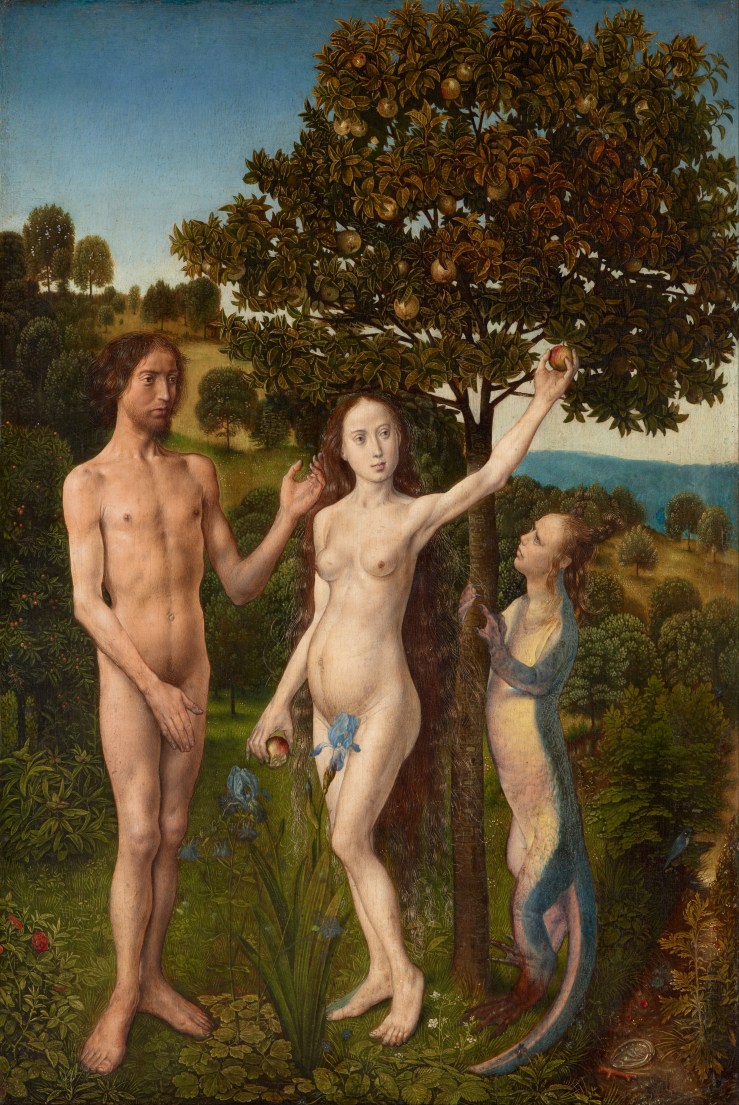
hugo_van_der_goes_-_the_fall_of_man_and_the_lamentation_-_google_art_project
The Fall of Man, Hugo van der Goes


Seek it like a dream | Another blog about Gaddis’s The Recognitions

Screenshot 2018-11-18 at 2.44.13 PM

Earlier this week, continuing my audit of William Gaddis’s 1955 novel The Recogntions, I felt a tingling sense of recognition in the following lines from which Basil Valentine reads from “a copy of Thoreau” (this is at the very end of Part I, on page 265):

What you seek in vain for, half your life, one day you come full upon, all the family at dinner. You seek it like a dream, and as soon as you find it you become its prey.

I attributed this tingling recognition to having read The Recognitions before (and to having read Part I once before that)—but then I realized that I’d read the line far, far more recently: It’s the epigraph to Gaddis’s fourth novel A Frolic of His Own, which I’d opened up again just a few weeks ago (and subsequently put back down).

This recognition is nothing special and certainly uninteresting to longtime Gaddis fans, but it motivated me enough to look more into the remark, so I plugged it into Google and quickly found  J. M. Tyree’s essay “Henry Thoreau, William Gaddis, and the Buried History of an Epigraph.” Tyree’s essay was originally published in New England Review but I found it, natch, on Steven Moore’s The Gaddis Annotations.

Tyree’s essay is a fascinating read, tracking the strange history of the line. Thoreau’s words, it turns out, are not exactly Thoreau’s words—rather, they are Emerson’s recollections of a conversation between the pair from a walk in the woods. Additionally, Emerson wrote and attributed these words after Thoreau’s death. The remark initially appeared in Emerson’s literary eulogy “Thoreau,” published in the August 1862 edition of Atlantic Monthly. As Tyree observes,

This detail, which seems highly trivial at first, in fact slyly reinforces the theme of original and copy supersaturating Gaddis’s novel. The very nature of authorship falls into question here, in a manner similar to the problem of Socrates and Plato: is Thoreau’s saying from Emerson or from Thoreau, or is it from both?

While issues of originality and authenticity of authorship clearly correlate to the themes of The Recognitions, Tyree’s essay is most interesting to me in the ways by which it situates Gaddis’s work with/against the American Renaissance tradition. Tyree gives us some of the flavor of that tradition, recontextualizing Gaddis’s epigraph in a full paragraph of Emerson’s. Here’s Emerson eulogizing his friend Thoreau:

It was a pleasure and a privilege to walk with him. He knew the country like a fox or a bird, and passed through it as freely by paths of his own. He knew every track in the snow or on the ground, and what creature had taken this path before him. One must submit abjectly to such a guide, and the reward was great . . . Presently he heard a note which he called that of the night-warbler, a bird he had never identified, had been in search of twelve years, which always, when he saw it, was in the act of diving down into a tree or bush, and which it was vain to seek; the only bird that sings indifferently by night and by day. I told him he must beware of finding and booking it, lest life should have nothing more to show him. He said, “What you seek in vain for, half your life, one day you come full upon, all the family at dinner. You seek it like a dream, and as soon as you find it you become its prey.”

Tyree situates the passage within the contrasting (and quickly diverging) philosophies of the old friends: “Emerson was essentially cosmic in his Transcendentalism, while Thoreau sought the divine in the actual empirical details of nature.”

Tyree’s essay becomes most interesting to me when he begins to interpret just what the hell the quote means. His analysis hovers around the word family, underlining an obsession of American literature: escape from domesticity. Here’s Tyree’s paraphrase of the Thoreau’s/Emerson’s line:

One finds the object of a long quest, quite suddenly, at the family dinner table. But in the moment of discovery, something seems to go wrong; rather than capturing the truth, one becomes its prey.  Clearly, the conversation here has expanded beyond night-warblers. Thoreau is now speaking of truth and its relationship to the family dinner table.

Tyree then susses out Thoreau’s complicated relationship with Emerson’s family:

It is possible to make too much of the fact that Thoreau’s intellectual life, as both a thinker and a man, developed in Emerson’s shade, in the shelter of Emerson’s house and family. But it is clear that Thoreau was often of two minds about living with or near Emerson. In a September 1841 letter….Thoreau told a friend that he was “living with Mr. Emerson in very dangerous prosperity.”

That “dangerous prosperity” of domestic life echoes one of the grand themes of American literature—namely, civilization is a blockade to be surpassed on the trek into wild nature, individuality, and freedom. Domestic duty interferes with such adventures. Just ask Rip Van Winkle, Ishmael, or Huck Finn. (Or perhaps Hawthorne’s cautionary figure, Young Goodman Brown).

Tyree underlines the point (final emphasis mine):

In the exchange over the night-warbler, the family is again identified in terms of danger; the quest is a danger to the family, or the family is a danger to the quest. One might read this as Thoreau’s critique of what would now be called Emerson’s “lifestyle.” A man who is the prey to truth must leave the dinner table to find it, but Emerson, in the comfort of his household, among his family, will never book the night-warbler. Thoreau does not say that having “all the family at dinner” stops one’s seeking, only that one becomes the prey of a protracted, half-conscious quest at mealtime. Then, one must decide what to do about it—whether to search out the night-warbler or not, and how to do it. The question seems to be whether the truth can be found through the life of the family, or whether one must leave it behind in some sense.

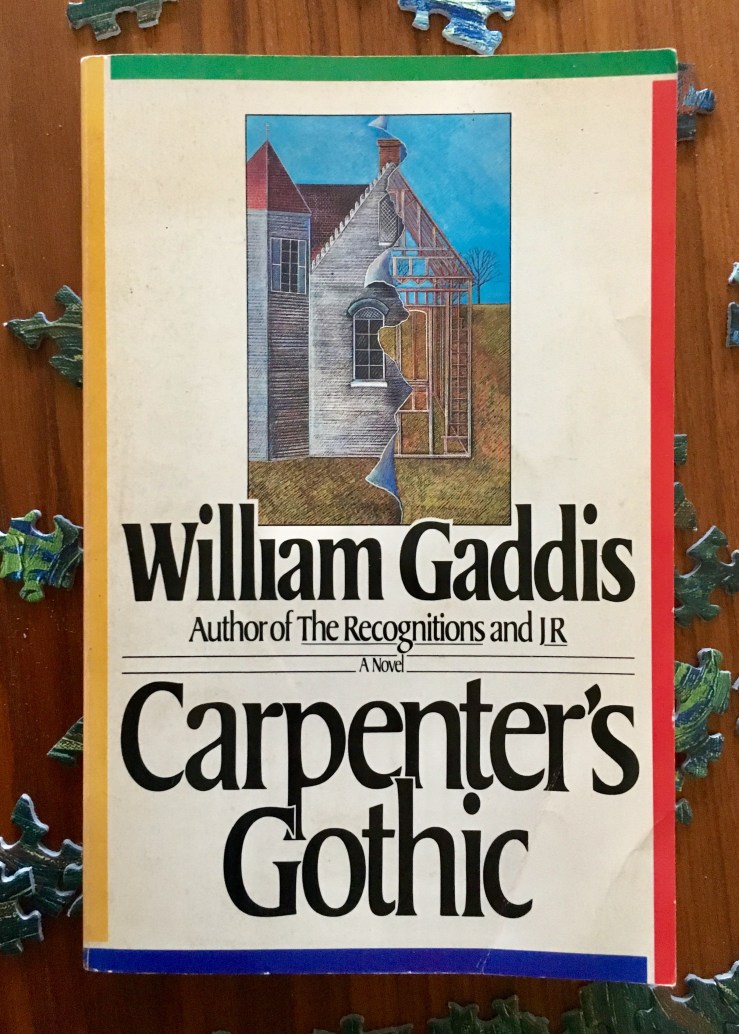
In The Recognitions, Wyatt circumvents the danger to his quest by not only removing himself from family (in the form of his wife Esther), but from removing himself from society in general. In J R (1975), most of Gaddis’s heroes find themselves unable to reconcile to Wyatt’s solution; their seeking fumbled out in half measures, neatly figured in the 96th Street apartment apartment shared by Gibbs, Eigen, and Bast. This hellhole is a transitory space, an inbetweeness of domesticity and city wilderness. Carpenter’s Gothic (1985) offers a more thorough critique of the impulse in American literature to send its (generally masculine) characters out into the wild spaces where they can transcend all the trappings of domesticity that bog them down. Carpenter’s Gothic confines its heroine to one haunted house, the men in her life flitting in and out if like silly birds on foiled quests. That domestic confinement reaches a kind of apotheosis in Gaddis’s posthumous novel Agapē Agape (2002), the stifling uninterrupted monologue of a man in a room, fighting against entropy.

And what about A Frolic of His Own (1994)? Well I haven’t read it yet.

Novel factory | A passage from (and a short riff on) William Gaddis’s The Recognitions

In Ch. VII of Part I of William Gaddis’s 1955 novel The Recognitions, the erstwhile hero of the novel, Wyatt Gwyon—who has by this point disappeared into an anonymous he—meets Basil Valentine, a somewhat ambiguous and priestly art-world contact for Recktall Brown, the arch-capitalist Mephistophelean villain of the novel. Brown uses Valentine to arrange the forgeries that Gwyon executes. Here, Valentine and Wyatt discuss Brown, who has left the room. (Brown is the initial He; Valentine speaks first):

—He would absolutely have to have Alexander Pope in a box, to enjoy him. He is beyond anything I’ve ever come upon. Honestly, I never in my life could have imagined that business could live so powerfully independent of every other faculty of the human intelligence. Basil Valentine rested his head back, blowing smoke toward the ceiling, and watching it rise there. —Earlier, you know, he mentioned to me the idea of a novel factory, a sort of assembly line of writers, each one with his own especial little job. Mass production, he said, and tailored to the public taste. But not so absurd, Basil Valentine said sitting forward suddenly.

—Yes, I … I know. I know.

—When I laughed . . . but it’s not so funny in his hands, you know. Just recently he started this business of submitting novels to a public opinion board, a cross-section of readers who give their opinions, and the author makes changes accordingly. Best sellers, of course.

—Yes, good God, imagine if … submitting paintings to them, to a cross section? You’d better take out . . . This color . . . These lines, and . . . He drew his hand down over his face, —You can change a line without even touching it. No, he went on after a pause, and Valentine watched him closely, —nothing is funny in his hands. Everything becomes very . . . real.

Do you like the passage? I do.

I continue to enjoy re-reading Gaddis’s debut novel, aided in large part by an audiobook version read by Nick Sullivan. I’ve also been reading The Recognitions with/against Letters of William Gaddis (ed. Steven Moore, Dalkey Archive, 2013), which I do not recommend doing (especially for first-time readers). Gaddis, paraphrasing his own novel, said that the artist was simply “the dregs of his [own] work,” and much of The Recognitions reads like Gaddis polishing the material from his own early life and travels and readings, and then forcing that material—the nuggets and the morsels (and, let us be honest, the occasional duds)—into an angry demanding sustained attack on the Modern condition. But the material is good ammunition in that oh-so self-conscious attack on Modernism—an attack that in many ways engenders postmodernism, or at least builds a bridge to it, or perhaps sunders links to Modernism—

—look, I have way too many stupid metaphors cooking here, forgive me: What I mean to say, in simpler terms, is that The Recognitions diagnoses the end of big-em Modernism, that it describes something yet-to-emerge, and that it also, significantly, performs that something yet-to-emerge. Gaddis’s letters show the frustrations of a young man trying to cook up adventures in a modern world: a world already explored, mapped, tagged, and written about by other folks. And not just written about im histories and novels, but also in cheap guide books and cheap glossy magazines. This is the world after the age of mechanical reproduction, the world in which Gaddis’s hero Wyatt strives to forge a legitimate forgery of a place for himself.

Gaddis’s novel’s emergent postmodernism—more fully realized in his follow-up, J R—also presciently points to the post-postmodernist storytelling world of late capitalism. Gaddis’s villain Recktall Brown is a brute, but this philistine is perceptive, and he understands the economy of middlebrow aesthetics. As erudite Valentine laments, “I never in my life could have imagined that business could live so powerfully independent of every other faculty of the human intelligence.” Valentine should imagine harder. But this is America, where people frequently mistake wealth and the power to create wealth with creative intelligence.

Maybe I’m too hard here on Valentine, who eventually realizes that an appeal to the lowest common denominator is “not so absurd,” after he reflects on Recktall’s business idea “of a novel factory, a sort of assembly line of writers, each one with his own especial little job. Mass production…tailored to the public taste.” And we then learn that Recktall has already capitalized on his vision of masscult writing: “Just recently he started this business of submitting novels to a public opinion board, a cross-section of readers who give their opinions, and the author makes changes accordingly. Best sellers, of course.”

Reading this, I mentally annotated: Ah, Netflix-that’s the novel factory of 2018. And not just Netflix—I mean, clearly, not just Netflix, that’s simply a signal example—but rather the idea of the data-driven artefact, the non-artefact, the copy of a copy of a copy, the narrative entirely derived from atomizing the masscult nostalgia artefacts of 20, 30, 40 years ago, retrofitting them, repackaging them, and selling them as the real thing. Wyatt’s final observation in the passage laments that Recktall Brown, and the emerging late capitalism he represents, is winning a kind of war on culture and imagination. And nothing is funny in this devil’s busy hands: “Everything becomes very . . . real.” Even the fakes. Even the copies. Especially the copies.

A riff on my favorite ghost story, Roberto Bolaño’s “The Return”

spectrum
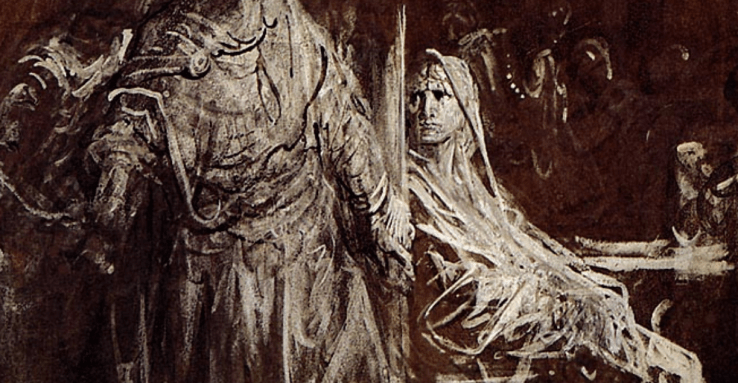
Detail from Spectrum Appearance of Banquo by Gustave Doré.

Roberto Bolaño’s short story “The Return” is so good that it has two perfect opening paragraphs:

I have good news and bad news. The good news is that there is life (of a kind) after this life. The bad news is that Jean-Claude Villeneuve is a necrophiliac.

That’s a hell of a way to start a story! Bolaño lays out his two themes—the afterlife and necrophilia—in a jovial, almost cavalier, but dare I say sweet, even charming way. And then this paragraph:

Death caught up with me in a Paris disco at four in the morning. My doctor had warned me, but some things are stronger than reason. I was convinced, mistakenly (and even now it’s something I regret), that drinking and dancing were not the most hazardous of my passions. Another reason I kept going out every night to the fashionable places in Paris was my routine as a middle manager at Fracsa; I was after what I couldn’t find at work or in what people call the inner life: the buzz that you get from a certain excess.

Those are the first two paragraphs, and maybe they’ll entice you to read the story. However, the following riff includes what some people might consider spoilers; my hope is that if you’ve never read it before, you’ll take it on faith that “The Return” is a great, great story and you’ll go read it and stop reading this riff now. (Maybe come back later though after you’ve read it).

“The Return” is a ghost story that transmutes the horror of death and the abjection of the corpse into love, empathy, and communication—and art. It’s a beautiful ghost tale in the Romantic, Gothic tradition of Edgar Allan Poe, from whom Bolaño drew heavily. However, while Poe’s tales of necrophilia (like the poem “Annabel Lee,” “The Fall of the House of Usher,” and “Berenice” to name just a few) obsess over repression, loss, burial, and imperfect and violent attempts at restoration, Bolaño’s “The Return” offers its readers a peaceful reconciliation with death. It’s collected in The Return (New Directions, English translation by Chris Andrews), which is a perfect introduction to Bolaño—so many great stories there (“Buba,” “Clara,” “William Burns,” etc.). So go read it.

So but and anyway: a close reading continued for those inclined.

Our narrator is a ghost, a man who died on the dance floor. Bolaño’s next move is so ridiculous that it almost seems unbelievable at first:

Like just about everyone else, I went to see Ghost, I don’t know if you remember it, a box office hit, with Demi Moore and Whoopi Goldberg, the one where Patrick Swayze gets killed and his body is left lying on a Manhattan street, or in an alley, maybe, on a dirty pavement anyway, while in a special-effects extravaganza (they were special for the time, anyway) his soul comes out of his body and stares at it in astonishment. Well, apart from the special effects, I thought it was idiotic. A typical Hollywood cop-out, inane and unbelievable.

But when my turn came, that’s exactly what happened.

The narrator is quick to accept the conceit—he’s quick to accept a lot in this story. He concedes of Hollywood artifice that there’s “more to American naiveté than meets the eye; it can hide something that we Europeans can’t or don’t want to understand.” This acceptance quickly turns into a new affect: strange joy: “Once I was dead, I felt like bursting out laughing.” (Forgive me, but it’s impossible for me not to note that “The Return” was composed very late in Bolaño’s too-short life, that its composition strikes me as a kind of love letter to his audience, more than a consolation prize: a gift).

Our ghost-narrator, not quite sure what to do, follows his corpse to the morgue: “What a paltry thing it seemed, my body or my ex-body (I’m not sure how to put it), confronted with the labyrinthine bureaucracy of death.” The labyrinthine bureaucracy of death!

The (metaphysical) narrator then starts to reflect on metaphysical matters:

The feeling of dizziness gradually abated, although at one point I got to thinking about heaven and hell, reward and punishment, and I had a panic attack, but that bout of irrational fear was soon over. And, in fact, I was starting to feel better.

Bolaño’s narrator quickly overcomes a religious tradition of “irrational fear” and guilt; here, death–by which I mean ghosthood—is life anew. In his new life|death, the narrator comes to understand the “insomnia and pervasive insecurity” (note here the language of Poe) he once felt over his “being a toy (or less than a toy) for [his lover] Cécile.” The ghost-narrator can find a certain grace in his one-time desire to be desired, his desire for solidity.

So. The plot, yes? Well, Bolaño’s already announced his theme of necrophilia, yes? How do we get there?

Two orderlies from the morgue sneak the body away, transporting it to the most beautiful house (mansion!) that the narrator has ever seen. The orderlies are described variously as hipsters, poseurs, and (significantly) “pseudo-artists.” Despite employing these terms, the narrator is ultimately sympathetic to the orderlies. (As an aside, I can’t help reading the two as figurations of those romantic dogs Ulises Lima and Arturo Belano, strivers, would-be greats, youth).

The orderlies deliver the body to a famous fashion designer, Jean-Claude Villeneuve. And:

I didn’t know what his intentions were—I’ve always been an innocent. If I’d known, I would have been nervous. But I didn’t, so I sat down in one of the comfortable leather armchairs in the room and waited.

Our narrator is again identified with innocence and naïveté (one senses that it preceded his rebirth)—but Bolaño lets his tale play out in an unexpected way. The abjection that follows doesn’t corrupt innocence; rather, it allows for empathetic communication.

But, reader, thou art forewarned—Bolaño literalizes the necrophilia that is merely metaphorical in Poe:

…after a quarter of an hour of cuddling in the semi-darkness I noticed that he had an erection. My god, I thought, now he’s going to sodomize me. But that’s not what happened. To my surprise, the designer rubbed himself against one of my thighs till he came. I would have liked to shut my eyes at that point but I couldn’t. My reactions were contradictory; I felt disgusted by what I was seeing, grateful for not having been sodomized, surprised to discover Villeneuve’s secret, angry at the orderlies for having rented out my body, and even flattered to have served, unwillingly, as an object of desire for one of the most famous men in France.

What a paragraph!—shocking, humorous, human. 

Our narrator immediately judges the taboo-breaking that has occurred as abject: “You should be ashamed, I said.”

But then something supernatural happens—the designer responds to the ghost.

I knew at once that he had heard me. It seemed like a miracle. Suddenly I felt so happy that I forgave him his act of depravity.

Human recognition—contact—becomes a “miracle” here (recalling the word “grace” from before), transmuting abject depravity into radical forgiveness. And then the narrator declares aloud:

It’s not a problem, I said in a conciliatory tone, You’re forgiven.

These are the words so many of us long to hear—but maybe most of all we wish to hear them when we are most wrapped up in our private abject sins. It’s as if Bolaño here absolves all the mad aesthetes of the Gothic tradition in one empathetic quip.

But of course, our necrophiliac-designer must worry that he’s going mad, mustn’t he? He searches for speakers, bugs—any physical explanation for that metaphysical voice. Again, our narrator is empathetic; again the language here points to Poe, but also to a reversal of Poe’s abject pain:

From experience I know that trying to wrench yourself out of a nightmare is futile and simply adds pain to pain or terror to terror.

The narrator then sets about proving that he’s real (or if not “real,” then at least that the narrator isn’t insane) by describing the various beautiful objects in the designer’s home. Aesthetic sensation confirms shared perception.

This tour of proof concludes in the style of Poe, in a tomb-space, all aesthetic objects removed, like something from “Usher”:

…we came to a little room, covered inside with a layer of cement, in which there was nothing, not one piece of furniture, not a single light, and we shut ourselves in that room, in the dark. An embarrassing situation, on the face of it, but for me it was like a second or a third birth; that is, it was like hope beginning and with it the desperate awareness of hope.

The abject embarrassment of the human body in close contact with a stranger is converted into rebirth and hope.

As the story ends, the fake-artist orderlies arrive in the morning to retrieve the narrator’s corpse. He realizes that he could continue haunting his body, but makes the choice to let it go:

But I mustn’t give in to sentimentality, I thought, and when the orderlies’ car left the garden and vanished down that elegant, tree-lined street, I didn’t feel the slightest twinge of nostalgia or sadness or melancholy.

In accepting the loss of his body without “nostalgia or sadness or melancholy,” our narrator affirms his new life.

The tale concludes with the narrator returning to the designer’s living room to discover that the man has been talking aloud—to the narrator, whom he believed was still with him. The story ends with this beautiful line:

I let him go on talking as long as he liked.

Reconciliation and acceptance rule in the end. Bolaño turns Gothic horror and abject pain into human empathy here.

Am I reading too much into the tale if I find in it a declaration of Bolaño’s acceptance of his own impending death? Perhaps. In any case, those who’ve formed an opinion of the man’s work based solely on the grisly reputation of 2666 would do well to check out “The Return.”

[Ed. note–Biblioklept originally ran this review in October of 2015].

A patchwork of conceits, a hodgepodge of good intentions, another blog about William Gaddis’s novel Carpenter’s Gothic

img_1155

In its sixth (and penultimate chapter), William Gaddis’s 1985 novel Carpenter’s Gothic includes a rare scene. Our heroine Elizabeth Booth exits the house she spends most of the book confined in and actually looks at it from the outside. With her is the house’s owner, the mysterious Mr. McCandless:

—I’ve never really looked at it.

—At what… looking where she was looking.

—At the house. From outside I mean.

Carpenter’s Gothic is a novel of utter interiority—the reader never makes it but a few feet out of the house, and only then on rare occasions. This postmodern Gothic novel tingles with a smothering claustrophobia, its insularity underscored by continual references to other spaces outside the house. The possibility of an outside world waiting for Elizabeth is realized through dialogue with her husband Paul, her brother Billy, and mysterious Mr. McCandless, as well as the non-stop (and, from the reader’s perspective, one-sided) telephone conversations that make up so much of the novel’s material. And yet with all its references to traveling away to California, Africa, New York City, Acapulco, etc., Carpenter’s Gothic keeps Elizabeth locked away in the old house, tethered to the umbilical phone cord at the novel’s center.

McCandless is off in his own interior space—the shifting tortured howl of his own consciousness—when Elizabeth remarks that she has never really seen the house from the outside. Her observation raises him “to the surface” of concrete reality:

—Oh the house yes, the house. It was built that way yes, it was built to be seen from outside it was, that was the style, he came on, abruptly rescued from uncertainty, raised to the surface —yes, they had style books, these country architects and the carpenters it was all derivative wasn’t it, those grand Victorian mansions with their rooms and rooms and towering heights and cupolas and the marvelous intricate ironwork.

The house is built in the Carpenter Gothic style (sometimes called Rural Gothic style), which essentially amounts to an American imitation of European Gothic’s forceful elegance. McCandless continues:

That whole inspiration of medieval Gothic but these poor fellows didn’t have it, the stonework and the wrought iron. All they had were the simple dependable old materials, the wood and their hammers and saws and their own clumsy ingenuity bringing those grandiose visions the masters had left behind down to a human scale with their own little inventions, those vertical darts coming down from the eaves? and that row of bull’s eyes underneath?

McCandless, stand-in for Gaddis, performs a metatextual interpretation for the reader. The Carpenter Gothic is Carpenter’s Gothic, the American postGothic reinterpreation of the European form—namely, the Gothic novel. The materials Gaddis uses to build his book are the materials of mass media and mass textuality. He condenses high literature, lurid newspaper clippings, mail, textbook pages, scraps of illegible notes, pornographic centerfolds, and every other manner of paper into a postGothic synthesis. And not just paper, but also the telephone (always ringing) and the radio (always on, always tuned to inhuman human voices). And the television too, tuned to Orson Welles as Mr. Rochester in Jane Eyre (dir. Robert Stevenson, 1943),  a film which weaves its way in and out of Elizabeth’s consciousness in the beginning of the novel, planting seeds of romance and locked rooms and secrets and fire.

But I’ve cut off McCandless, who was just about to give us another neat description of the Carpenter Gothic, which is to say another neat description of Carpenter’s Gothic:

He was up kicking leaves aside, gesturing, both arms raised embracing —a patchwork of conceits, borrowings, deceptions, the inside’s a hodgepodge of good intentions like one last ridiculous effort at something worth doing even on this small a scale, because it’s stood here, hasn’t it, foolish inventions and all it’s stood here for ninety years…

 Carpenter’s Gothic is more than just a hodgepodge or patchwork; it is more than a ridiculous effort; it is more than the sum of its foolish inventions. Gaddis gives us something new, a postmodern Gothic analysis of the end of the American century.

McCandless, Gaddis’s stand-in, wants to put all the pieces together. He echoes Jack Gibbs, the (anti-)hero (and fellow Gaddis stand-in) of J R, and he prefigures the narrator of Gaddis’s last novel, Agapē Agape, who, like Gibbs, strives to stitch together something from the atomized scraps and remnants of the 20th century.  Gaddis’s protagonists contend with entropy and attempt to get the detritus of the modern world “sorted and organized.” The push-pull of hope and despair drives these protagonists, but often drives them too far.

And McCandless’s reverie takes him too far, again into the interiority of his skull:

…breaking off, staring up where her gaze had fled back with those towering heights and cupolas, as though for some echo: It’s like the inside of your head McCandless, if that was what brought him to add —why when somebody breaks in, it’s like being assaulted, it’s the…

In a moment of self-speech, McCandless realizes that the Carpenter Gothic is “like the inside of [his] head,” underscoring his connection to his creator, Gaddis, as well as the connection between the house and the novel.

The (always) ringing phone punctures the scene:

—Listen! The phone had rung inside and she started up at the second ring, sank back with the third. —All I meant was, it’s a hard house to hide in…

Elizabeth’s lines here emphasize Carpenter’s Gothic’s central Gothicism—the Carpenter Gothic and Carpenter’s Gothic is a hard place to hide in. Secrets will out.

And so well where does our hodgepodge of good intentions lead?

Blog about about the Halloween chapter of William Gaddis’s novel Carpenter’s Gothic

Mischief Night, Jamie Wyeth

The fourth of seven unnumbered chapters in William Gaddis’s Carpenter’s Gothic is set over the course of Halloween, moving from morning, into afternoon, and then night. Halloween is an appropriately Gothic setting for the midpoint of Gaddis’s postmodern Gothic novel, and there are some fascinating turns in this central chapter.

A summary with spoilers is not necessary here. Suffice to say that our heroine Elizabeth Booth is left alone on Halloween in the dilapidated Rural Gothic style house she and her awful husband Paul rent from mysterious Mr. McCandless. As Paul exits the house to go on one his many fruitless business trips, he notices that some neighborhood kids have already played their Halloween tricks:

He had the front door open but he stood there, looking out, looking up, —little bastards look at that, not even Halloween till tonight but they couldn’t wait… Toilet paper hung in disconsolate streamers from the telephone lines, arched and drooped in the bared maple branches reaching over the windows of the frame garage beyond the fence palings where shaving cream spelled fuck. —Look keep the doors locked, did this last night Christ knows what you’re in for tonight… and the weight of his hand fell away from her shoulder, —Liz? just try and be patient? and he pulled the door hard enough for the snap of the lock to startle her less with threats locked out than herself locked in, to leave her steadying a hand on the newel…

The kids’ Halloween antics take on a particularly sinister aspect here, set against the stark New England background Gaddis conjures. We get gloomy streamers, desolate trees, and the bald, ugly signification of one lone word: fuck. (Fuck and its iterations, along with Gaddis’s old favorite God damn, are bywords in Carpenter’s Gothic). Paul’s reading of this scene is also sinister; he underscores the Gothic motif in telling Elizabeth to “keep the doors locked” because she doesn’t know what she’s “in for tonight.” Tellingly, the aural snap of Paul’s exit shows us that Elizabeth is ultimately more paranoid about being locked in. Indeed, by the middle of the novel, we see her increasingly trapped in her (haunted) house. The staircase newel, an image that Gaddis uses repeatedly in the novel, becomes her literal support. Elizabeth spends the rest of the morning avoiding chores before eventually vomiting and taking a nap.

Then, Gaddis propels us forward a few hours with two remarkable paragraphs (or, I should say, two paragraphs upon which I wish to remark). Here is the first post-nap paragraph:

She woke abruptly to a black rage of crows in the heights of those limbs rising over the road below and lay still, the rise and fall of her breath a bare echo of the light and shadow stirred through the bedroom by winds flurrying the limbs out there till she turned sharply for the phone and dialed slowly for the time, up handling herself with the same fragile care to search the mirror, search the world outside from the commotion in the trees on down the road to the straggle of boys faces streaked with blacking and this one, that one in an oversize hat, sharing kicks and punches up the hill where in one anxious glimpse the mailman turned the corner and was gone.

What a fantastic sentence. Gaddis’s prose here reverberates with sinister force, capturing (and to an extent, replicating) Elizabeth’s disorientation. Dreadful crows and flittering shadows shake Elizabeth, and searching for stability she telephones for the time. (If you are a young person perhaps bewildered by this detail: This is something we used to do. We used to call a number for the time. Like, the time of day. You can actually still do this. Call the US Naval Observatory at 202-762-1069 if you’re curious what this aesthetic experience is like). The house’s only clock is broken, further alienating Elizabeth from any sense of normalcy. In a mode of “fragile care,” anxious Elizabeth glances in the mirror, another Gothic symbol that repeats throughout this chapter. She then spies the “straggle of boys” (a neat parallel to the “black rage of crows” at the sentence’s beginning) already dressed up in horrorshow gear for mischief night and rumbling with violence. The mailman—another connection to the outside world, to some kind of external and steadying authority—simply disappears.

Here is the next paragraph:

Through the festoons drifting gently from the wires and branches a crow dropped like shot, and another, stabbing at a squirrel crushed on the road there, vaunting black wings and taking to them as a car bore down, as a boy rushed the road right down to the mailbox in the whirl of yellowed rust spotted leaves, shouts and laughter behind the fence palings, pieces of pumpkin flung through the air and the crows came back all fierce alarm, stabbing and tearing, bridling at movement anywhere till finally, when she came out to the mailbox, stillness enveloped her reaching it at arm’s length and pulling it open. It looked empty; but then there came sounds of hoarded laughter behind the fence palings and she was standing there holding the page, staring at the picture of a blonde bared to the margin, a full tumid penis squeezed stiff in her hand and pink as the tip of her tongue drawing the beading at its engorged head off in a fine thread. For that moment the blonde’s eyes, turned to her in forthright complicity, held her in their steady stare; then her tremble was lost in a turn to be plainly seen crumpling it, going back in and dropping it crumpled on the kitchen table.

The paragraph begins with the Gothic violence of the crows “stabbing and tearing” at a squirrel. Gaddis fills Carpenter’s Gothic with birds—in fact, the first words of the novel are “The bird”—a motif that underscores the possibility of flight, of escape (and entails its opposite–confinement, imprisonment). These crows are pure Halloween, shredding small mammals as the wild boys smash pumpkins. Elizabeth exits the house (a rare vignette in Carpenter’s Gothic, which keeps her primarily confined inside it) to check the mail. The only message that has been delivered to her though is from the Halloween tricksters, who cruelly laugh at their prank. The pornographic image, ripped from a magazine, is described in such a way that the blonde woman trapped within it comes to life, “in forthright complicity,” making eye contact with Elizabeth. There’s an intimation of aggressive sexual violence underlying the prank, whether the boys understand this or not. The scrap of paper doubles their earlier signal, the shaving creamed fuck written on the garage door.

Elizabeth recovers herself to signify steadiness in return, demonstratively crumpling the pornographic scrap—but she takes it with her, back into the house, where it joins the other heaps of papers, scraps, detritus of media and writing that make so much of the content of the novel. Here, the pornographic scrap takes on its own sinister force. Initially, Elizabeth sets out to compose herself anew; the next paragraph finds her descending the stairs, “differently dressed now, eyeliner streaked on her lids and the
colour unevenly matched on her paled cheeks,” where she answers the ringing phone with “a quaver in her hand.” The scene that follows is an extraordinary displacement in which the phone takes on a phallic dimension, and Elizabeth imaginatively correlates herself with the blonde woman in the pornographic picture. She stares at this image the whole time she is on the phone while a disembodied male voice demands answers she cannot provide:

The voice burst at her from the phone and she held it away, staring down close at the picture as though something, some detail, might have changed in her absence, as though what was promised there in minutes, or moments, might have come in a sudden burst on the wet lips as the voice broke from the phone in a pitch of invective, in a harried staccato, broke off in a wail and she held it close enough to say —I’m sorry Mister Mullins, I don’t know what to… and she held it away again bursting with spleen, her own fingertip smoothing the still fingers hoarding the roothairs of the inflexible surge before her with polished nails, tracing the delicate vein engorged up the curve of its glistening rise to the crown cleft fierce with colour where that glint of beading led off in its fine thread to the still tongue, mouth opened without appetite and the mascaraed eyes unwavering on hers without a gleam of hope or even expectation, —I don’t know I can’t tell you!

Gaddis’s triple repetition of the verb burst links the phone to the phallus and links Elizabeth to the blonde woman. This link is reinforced by the notation of the woman’s “mascaraed eyes,” a detail echoing the paragraph’s initial image of Elizabeth descending the stairs with streaked eyeliner. The final identification between the two is the most horrific—Elizabeth reads those eyes, that image, that scrap of paper, as a work “without a gleam of hope or even expectation.” Doom.

Elizabeth is “saved,” if only temporarily, by the unexpected arrival of the mysterious Mr. McCandless, who quickly stabilizes the poor woman. Gaddis notes that McCandless “caught the newel with her hand…He had her arm, had her hand in fact firm in one of his.” When he asks why she is so upset, she replies, “It’s the, just the mess out there, Halloween out there…” McCandless chalks the mess up to “kids with nothing to do,” but Elizabeth reads in it something more sinister: “there’s a meanness.” McCandless counters that “it’s plain stupidity…There’s much more stupidity than there is malice in the world.” This phrase “Halloween out there” repeats three times in the chapter, suggesting a larger signification—it isn’t just Halloween tonight, but rather, as McCandless puts it, the night is “Like the whole damned world isn’t it.” It’s always Halloween out there in Carpenter’s Gothic, and this adds up to mostly malice of mostly stupidity in this world—depending on how you read it.

The second half of the chapter gives over to McCandless, who comes to unexpectedly inhabit the novel’s center. Elizabeth departs, if only for a few hours, leaving McCandless alone, if only momentarily. A shifty interlocutor soon arrives on the thresh hold of his Carpenter Gothic home, and we learn some of his fascinating background. It’s a strange moment in a novel that has focused so intently on the consciousness of Elizabeth, but coming in the novel’s center, it acts as a stabilizing force. I won’t go into great detail here—I think much of what happens when McCandless is the center of the narrative is best experienced without any kind of spoiler—but we get at times from him a sustained howl against the meanness and stupidity of the world. He finally ushers his surprise interlocutor out of his home with the following admonition: “It’s Halloween out there too.”


Blog about the first 96 pages of William Gaddis’s novel Carpenter’s Gothic

img_1155

I have blazed through the first three (unnumbered) chapters of William Gaddis’s third novel Carpenter’s Gothic (1985) this weekend, consuming the prose with an urgency I did not expect. After all, Gaddis is (at least according to Jonathan Franzen) “Mr. Difficult,” right?

But Carpenter’s Gothic is not especially difficult, or does not feel that way to me, anyway—although I’m sure I find it so readable in large part because I’ve read Gaddis’s second novel  J R twice already, and Carpenter’s Gothic is written in the same style as J R. The first time I read J R did find its style tremendously challenging. Gaddis strips almost all exposition and scene-setting in J R. The novel’s 726 pages are comprised primarily in dialogue, often unattributed, leaving the reader to play director, producer, and cinematographer. Reading it a second time was, in a way, like reading it for the first time, revealing one of the best and arguably most important American novels of the second-half of the twentieth century.

In any case, reading J R has taught me how to read Carpenter’s Gothic, which is told in the same style. Carpenter’s Gothic is a smaller novel though, both literally (around 250 pages) and figuratively. While J R sports a large cast, sprawling and interlinked plots, divergent tones, and a wide array of themes, Carpenter’s Gothic is restrained to a few talking characters, whom Gaddis keeps confined to an isolated house somewhere in New England. (It is from this house’s architectural design that the novel gets its title).

The central character is Elizabeth Booth, 33, an heiress locked out of her inheritance. Elizabeth is married to an awful abusive man named Paul, a racist Vietnam Veteran who embodies almost every characteristic of what we now think of as toxic masculinity. Elizabeth is recovering from an as-yet-unspecified accident, and spends most of her time confined to her rented house, fielding phone calls. Some of these phone calls are from folks related to her husband’s latest scheme with a televangelist. Other calls are from her friend Edith who has run off to sunny Jamaica—a prospect of escape that entices Elizabeth. Even more calls come for the mysterious owner of the house, McCandless, who eventually shows up in the third chapter.

McCandless’s visit sparks something in Elizabeth. She gets to glance into his locked study, crammed with papers and books and even a piano, and she takes him for a writer, but he claims he’s a geologist. His short visit inspires Elizabeth to dig up the draft of a book, or something like a book, she’s been working on, and add a few notes. The romantic impulse is eventually punctured by her husband’s return.

Carpenter’s Gothic’s relentless interiority and inherent bitterness can give the novel a claustrophobic feeling, and reading it often reminds me of the scenes in J R that are set in the ramshackle 96th Street apartment shared by Bast and Gibbs. And yet its interiority always branches outward, evoking an exotic and pulsating world that Elizabeth might love to experience. There’s Montego Bay, there’s Orson Welles in Jane Eyre, there’s the nomadic Masai of central east Africa. Etc. But Elizabeth’s experiences are mediated by newspapers, magazine articles, phone calls, and old movies on television. It’s quite sad and frustrating.

Elizabeth thus far fits neatly into American literature’s motif of the confined woman: Walt Whitman’s 29th bather, Kate Chopin’s Mrs. Mallard, William Carlos Williams’ young housewife, Charlotte Perkins Gilman’s distressed and nervous heroine. There are many, many more, of course.  I’m not quite half way through Carpenter’s Gothic–no spoilers from you please, readers!—and curious what Gaddis will do with his heroine. Will there be an escape? Freedom? A happy ending?

So many 19th and 20th century American writers seemed unsure of what to do with their heroines, even after they had freed them (Kate Chopin’s Edna Pontellier is a particularly easy go-to example, but again: there are more). Carpenter’s Gothic seems set on a tragic track, but Gaddis has a way of making his readers recognize the farcical contours in tragedy.

I haven’t given a taste of Gaddis’s prose yet. I will share, as a closing, the novel’s opening two-sentence paragraph, which I think is simply marvelous, and which I had to read at least three times before I could turn to the novel’s second page. Here it is:

The bird, a pigeon was it? or a dove (she’d found there were doves here) flew through the air, its colour lost in what light remained. It might have been the wad of rag she’d taken it for at first glance, flung at the smallest of the boys out there wiping mud from his cheeks where it hit him, catching it up by a wing to fling it back where one of them now with a broken branch for a bat hit it high over a bough caught and flung back and hit again into a swirl of leaves, into a puddle from rain the night before, a kind of battered shuttlecock moulting in a flurry at each blow, hit into the yellow dead end sign on the corner opposite the house where they’d end up that time of day.

Blog about Evan Dara’s two-act play Provisional Biography of Mose Eakins

Screenshot 2018-10-06 at 1.38.52 PM

Evan Dara’s latest work is a two-act play called Provisional Biography of Mose Eakins. Set “c. 2015” on a stage “As bare as you can stand it,” Dara’s play follows Mose Eakins, “35-ish and spry,” as he becomes afflicted with a condition that “has come to be known as imparlence.”

Mose’s imparlence erodes his ability to communicate with others. He loses his job, his home, and eventually his girlfriend Zina, from whom he initially hides his condition. Though his life deteriorates, Mose eventually lands a job as the maitre d’ of an overpriced French restaurant. Here, his sympathies extend to the overworked kitchen staff, and he takes a stand against the unjust working conditions, trying to make meaning through his actions, even as his words fail to communicate.

Dara keeps Provisional Biography spare but active, using a device he calls “the swirl” as a kind of Greek Chorus to keep the play shuttling along, even as the narrative threatens to fall apart. And because Mose is our viewpoint character, and because Mose is afflicted with “imparlence,” the narrative of Provisional Biography is under constant threat of its own linguistic erasure. As the swirl helpfully informs the audience, “people with imparlence lose the capacity to infuse their words with intelligible significance.”

Provisional Biography’s opening lines are an especially baffling affront to “intelligible significance.” When we meet Mose, he’s already imparlent, although he does not know it yet. Consider the play’s opening lines:

MOSE: Tell me something, Jeff. Those numbers convincing to you?

(to someone else)

Bring me the swordfish. Not blackened. You got that? Not blackened. Go.

(to someone else, jauntily)

Well, you know what they say…

(to someone else)

Nice, Zina – the chart is really good. Zina, your students will love it!

(to someone else, laughing)

Tell him that and he’s totally going to have a kitten!

The first few pages of the play continue in this line, Mose’s utterances disconnected from any context that might anchor their meaning. A swirl member eventually appears on stage to push the narrative into more traditional territory:

SWIRL MEMBER 1: Hear it here! Mose Eakins (born June 10, 1978) is an American
field-risk analyst working for Concord Oil. Specializing in mid-level hard-soil
extractions, he won the Kamden Prize for his research into adjacent fauna protection and occasionally lectures in his field.

As Mose’s imparlence worsens, the tension between Mose and the world he cannot communicate with increases, erupting in moments both tragic and comic (and farcical and tragicomic). The swirl is often there to assuage him (and the audience), armed with a humorous (and occasionally ironic) quiver of quotes from the likes of Melanie Klein, William H. Gass, Jean Jacques Rousseau, St. Augustine, and television personality Doctor Oz.

The swirl advises our poor hero, suggesting treatments and support groups—and also offering up punchlines when there’s no real hope in sight:

SWIRL MEMBER: There is no known cure. Imparlence is untreatable—

MOSE: But the doctor – the doctor recommended medicine!

(Mose pulls out the paper given by Doctor Mazlane, shows it to the swirl.)

He told me to take this and come see him again! It’s a prescription…

(reads the paper)

…a prescription…to pay him five hundred and twenty dollars… And I thought bleeding patients went out in the nineteenth century.

SWIRL MEMBER: There’s been a strong return to traditional medicine.

(Other jokes don’t land so neatly—in a segment mocking TV drug commercials, a swirl member offers up an absolute groaner with the phrase “irregular vowel movements.” Who knows though? Maybe the joke plays well on the stage).

With all of its humor, Provisional Biography is ultimately a sad, even tragic story, and nowhere is it sadder than in Mose’s revelation that he can communicate to other humans through one medium: economic exchange. He takes to desperately buying Tic Tacs from street vendors simply to communicate intelligibly, and eventually resorts to buying phrases from a fellow homeless person.

And yet these purchased utterances are not true linguistic exchanges—they do not mean outside of their inherent economic content. Mose Eakins despairs:

MOSE: So – so that’s it? That’s it for me? I can only just flapgaggle by myself for the
rest of my days – flapgaggle and hope?

SWIRL MEMBER: Perhaps inevitable. According to Robert Nozick of Harvard, imparlence is just the latest expression of the ownership society.

SWIRL MEMBER: Meaning has been privatized. It’s been made part of the private
sphere.

SWIRL MEMBER: Significance is no longer a publicly-owned utility, a service
provided by a command and control center.

SWIRL MEMBER: This will vastly increase our linguistic productivity—

SWIRL MEMBER: —liberate our potential as creators of meaning—

SWIRL MEMBER: —freeing us from the restrictions and inefficiencies of the nanny
dictionary!

MOSE: But…

The swirl here satirizes the newspeak of late capitalism, imagining language—a thing that makes us inherently human—as yet another commodity to be consumed and sold back to us by a dehumanizing system that seems to operate on its own inscrutable logic. While there’s humor in the little scene, it’s also quite painful.

The idea that late capitalism reduces linguistic exchange to only an economic (and thus inauthentic) exchange is repeated again in a far more painful scene later in the play. Mose pleads for “Something real…A real response – something that speaks from the heart!” from the homeless man he has been buying phrases from, to which the man simply puts out his hand for a coin. “Is that the only thing left?” cries Mose. The swirl is there to offer an out to this existentialist despair: “Salvation–only through action! Guided by further philosophical slivers proffered by the swirl, Mose converts his despair into radical action by the end of the play. The conclusion is fittingly moving and movingly strange.

Provisional Biography of Mose Eakins, in showing a human communication dissolve, follows Dara’s 2013 novel Flee, which shows a town dissolve. Flee is an oblique but devastating address to the 2008 economic collapse in America, and Provisional Biography is a fitting follow-up, continuing Dara’s critique of the human position in the late-capitalist landscape.

Significantly, Dara’s critique of the relationship between language and commerce extends to accessing his play, which can be downloaded for free at his publisher Aurora’s website.  You simply have to give them your email address. Under the “Download” button and above the PayPal button is the following message:

“If you please, reciprocation accepted only after reading. Thank you.”

And what would “reciprocation” mean, in the end? Write your own two-act play about the relationship between language and commerce in the early 21st century and send it to Evan Dara?

I PayPal’d Aurora $11.11.

Blog about not seeing Darren Aronofsky’s seventh film Mother! in the theater

120171105173333

I did not see Darren Aronofsky’s seventh feature film Mother! in the theater.

***

I saw director Darren Aronofsky’s first feature film Pi at the Reitz Union theater at the University of Florida in the fall semester of my sophomore year of college. In my four years attending the University of Florida, I always made a point to go watch the free films the Union’s theater screened. I saw The Big Lebowski and Fear and Loathing in Las Vegas there. I saw Christopher Nolan’s film Memento there, and Harmony Korine’s follow-up to Gummo, the unfortunate Julien Donkey-Boy (Chloe Sevigny ice-skating to Oval’s skittering soundtrack left a permanent mark on my memory). I saw Austin Powers: The Spy Who Shagged Me there. I saw a hypnotist there, also. (It was all free, in the sense that no money was required). And, like I said, I saw director Darren Aronofsky’s first feature film Pi there.

***

I saw Pi with my girlfriend and her roommate and her roommate’s boyfriend, who I was starting to be friends with. We—by which I mean my girlfriend and I—loved it; roommate and roommate’s boyfriend hated it. We found this out minutes after leaving the theater. I might have argued for it, using terms like claustrophobia and paranoia and German expressionism; I am the kind of asshole who might have brought up, like, The Cabinet of Dr. Caligari at this point of my life. The roommate’s boyfriend—who turned out to be and remains to this day one of the greatest friends I’ve ever made—pointed out that the film was silly–self-important, muddled, vague. He may or may not have used the word histrionic.

(He could be entirely right. I’ve never rewatched Pi).

***

(I’ve never rewatched any film directed by Darren Aronofsky).

***

The same roommate’s boyfriend, at this point broken up with the roommate (also no longer the roommate) would have been present at the small-screen screening of Requiem for a Dream held in The House Where We Always Drank Excessively some time in the fall of 2000. We–the ten or maybe twelve of us—did not Drink Excessively during the film, leaving bottles and bongs and etc. largely untouched after the first half hour, our horror slowly growing. This was No Fun. We didn’t talk after, slinking off in the humid Gainesville night. We tacitly agreed not to see each other for at least a week or two.

***

Aronofsky’s film The Fountain arrived in the mail on DVD via the mail-DVD service Netflix some time at my house in 2007. The film had a certain mystique to it—it was a boondoggle, an interesting failure, a trial balloon that popped. I recall liking it quite a bit, as I told my wife after she woke up after having fallen asleep thirty minutes into the film.

***

(I might have actually watched The Fountain a few times).

***

My daughter was an infant when The Wrestler was in theaters. I watched it too via a mail-ordered DVD from Netflix, and thought it was Pretty Good, but no My Cousin Vinny or By the Time the Devil Knows You’re Dead. (Marisa Tomei Forever).

***

My son was an infant when Black Swan was in theaters. So again: Netflix DVD, no big screen. My wife liked this one—we both laughed and laughed. At some point, maybe, one of us, getting up to pee or pour another glass of wine or check that a child was tidily asleep—well, I guess we took to it as a kind of histrionic comedy, a comedy-horror. This could be an entirely wrong take, but I don’t know. (I’ve never rewatched any film directed by Darren Aronofsky).

***

By the time I watched Aronofsky’s sixth film Noah, I had essentially given up on him: I found his films a remarkable mix of camp, melodrama, and repulsion—hard to read, searingly original, visually compelling areas I couldn’t wait to leave. I reviewed Noah on this blog, writing,

Aronofksy is an auteur, and like most auteurs, I’m sure rewatching his films would enrich an understanding of the themes and problems he’s trying to address. However, I find his films repulsive, by which I mean the opposite of compelling. I have never wanted to exit a fictional world as much as I wanted to escape Requiem for a Dream. I found The Wrestler depressing and empty. I’m afraid if I watch Black Swan again it will turn out that Aronofsky was actually not attempting to make a comedy about psychosis, but was rather actually serious about his melodrama’s tragic scope.

***

When Mother! (or mother!, as it is sometimes stylized) came out last year I was intrigued, first by the film’s marvelous posters (by James Jean), and then by the advance word on it. Mother! sounded Rosemary’s Baby, but also something like Salo or Irreversible or even Ichi the Killer—something scary and a bit psychotic and divisive and depraved. Something that some folks would certainly hate. But two kids and a job and etc. make a movie hard to grab on the go, and we wanted to see PT Anderson’s Phantom Thread, of course, which is what I think we ended up seeing instead of Mother! Maybe a week or two later at a party, a friend immediately asked me if I had seen Mother! yet. She wanted to talk about it very much. She told me to go see it.

***

Mother!: I should have gone to the theater to see Mother!

***

We watched Mother! via a streaming service in a very dark room on the largest TV we have ever owned, and I’m sure that this is not even close to what it was like to see the film in the theater. It was great. Great! I should have gone to see Mother! in the theater.

***

This blog began with the bestest of best intentions. I was going to write a proper review of Mother!, or not a review so much as a riff, or not so much a riff, really, but rather an appreciation, a take on the feeling of watching Mother!—but when I started writing I realized that I had these other thousand words to write first. And now that I’ve written them, I hate to just delete them—and anyway, it’s only blog. But I mostly see that I’d like to  watch Mother! again before I write about it again.

w3jbjps3wbmz


On Herman Melville’s novella Benito Cereno

Near the middle of Herman Melville’s 1855 novella Benito Cereno, our erstwhile protagonist Captain Amasa Delano encounters an old sailor tying a strange knot:

For intricacy, such a knot he had never seen in an American ship, nor indeed any other. The old man looked like an Egyptian priest, making Gordian knots for the temple of Ammon. The knot seemed a combination of double-bowline-knot, treble-crown-knot, back-handed-well-knot, knot-in-and-out-knot, and jamming-knot.

At last, puzzled to comprehend the meaning of such a knot, Captain Delano addressed the knotter:—

“What are you knotting there, my man?”

“The knot,” was the brief reply, without looking up.

“So it seems; but what is it for?”

“For some one else to undo,” muttered back the old man…

This knot serves as a metaphor for the text of Benito Cereno itself. We readers (along with our hapless surrogate Captain Delano) are the ones tasked with unknotting the text’s central mystery.

Part of the great pleasure of reading Benito Cereno for the first time rests in Melville’s slow-burning buildup to the eventual unknotting. I was fortunate enough to have been ignorant of the plot (and eventual revelation) of Benito Cereno when I first read it over a dozen or so years ago (although even then I cottoned on to what was really happening earlier than Captain Delano did). I read the novella again last week and marveled at Melville’s narrative control, enjoying it anew by seeing it anew.

Benito Cereno is a sharply-drawn tale about the limits of first-person consciousness and the cultural blinders we wear that prevent us from seeing what is right in front of us. The book subtly critiques the notion of a naturally-ordered morality in which every person has a right and fitting place, whether that be a place of power or a place of servitude. Melville shows the peril and folly of intrinsically believing in the absolute rightness of such a system. There is comfort in belief, but unquestioning belief makes us radically susceptible to being wrong. When we most believe ourselves right is often when we are the most blinded to the reality around us. We cannot see that we cannot see. And Benito Cereno is about how we see—about how we know what we know. Melville’s novella is also about how seeing entails not seeing, and, further, not seeing what we are not seeing—all that we do not know that we do not know. Melville makes his readers eventually see these unknown unknowns, and, remarkably, shows us that they were right before our eyes the entire time.

Forgive me—much of the previous paragraph is far too general. I want you to read Benito Cereno but I don’t want to spoil the plot. Let’s attempt summation without revelation: The novella is set in 1799 off the coast of Chile. Amasa Delano, captain of the American sealing vessel the Bachelor’s Delight, spies a ship floating adrift aimlessly, apparently in distress. Captain Delano boards one of his whale boats and heads to the San Dominick, a Spanish slaving ship, and quickly sees that the enslaved Africans on board dramatically outnumber the Spanish sailors. Delano offers aid to the San Dominick’s captain, Benito Cereno, who tells Delano that most of the Spanish crew perished in a fever (along with the “owner” of the slaves, Alexandro Aranda). Benito Cereno himself seems terribly ill and not entirely fit to command, so Delano waits aboard the San Dominick while his men fetch food and water from the Bachelor’s Delight. In the meantime, he tours the ship and talks with Benito Cereno and Cereno’s enslaved valet Babo.

Delano is frequently troubled by what he sees on the ship, but his good nature always affords him a natural and acceptable answer that assuages the sinister tension tingling in the background. Even though he’s troubled by the “half-lunatic Don Benito,” Delano’s “good-natured” sense of moral authority can explain away what he sees with his own eyes:

At last he began to laugh at his former forebodings; and laugh at the strange ship for, in its aspect, someway siding with them, as it were; and laugh, too, at the odd-looking blacks, particularly those old scissors-grinders, the Ashantees; and those bed-ridden old knitting women, the oakum-pickers; and almost at the dark Spaniard himself, the central hobgoblin of all.

For the rest, whatever in a serious way seemed enigmatical, was now good-naturedly explained away by the thought that, for the most part, the poor invalid scarcely knew what he was about…

These paragraphs not only summarize some of the images that give Delano pause, they also show Melville’s remarkable prose style, which follow’s Delano’s psychological state: laughing dismissal returns back to anxious image; anxious image gives way again to relieved certitude. All that is “enigmatical” in life can be “good-naturedly explained away.” And yet as the narrative progresses, good-natured explanations will fail to answer to visceral reality. Melville’s slow burn catches fire, burning away the veils of pretense.

The rest of this post (after the image) contains significant spoilers. I highly recommend Benito Cereno, which is reprinted in any number of Melville collections (I read it again in Rinehart’s Selected Tales and Poems), including The Piazza Tales (which you can download for free at Project Gutenberg). While I think that Benito Cereno has gained more recognition in recent years, it remains under-read compared to Melville’s more famous novellas Bartleby and Billy Budd. Those are great books too, but I’d argue that Benito Cereno, with its critique of white supremacy, is more timely than ever. Check it out. (Again, spoilers ahead).

IMG_0160

Continue reading “On Herman Melville’s novella Benito Cereno”