Riff on finishing Middlemarch, George Eliot’s novel of consciousness

Screenshot 2018-06-12 at 8.35.14 PM
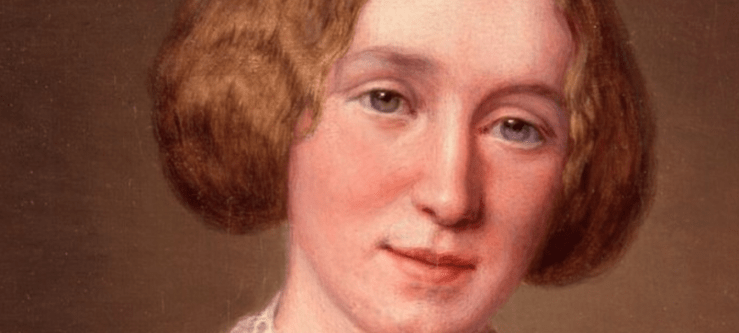
Detail of a portrait of Mary Ann Evans (George Eliot) at age 30 by François d’Albert Durade (1804–1886)

I finally finished George Eliot’s long and marvelous 1872 novel Middlemarch.

When I wrote about reading Middlemarch last month, from not-quite-the-middle of the book, I lamented that I’d rather be rereading the book than reading it. Rich and dense, it’s the kind of big book that clearly offers more on repeat readings. And yes, I will reread Middlemarch, but I’ll give it a year or three to mellow in the back of my consciousness.

Middlemarch is a novel about consciousness, and what the novel does best in my estimation is show how different kinds of consciousness mediate and are mediated by the social forces they inhabit (and are inhabited by).

(The word consciousness appears 90 times in Middlemarch. If we include similar iterations, like consciousconsciouslyunconscious, and unconsciously, the count grows to a total of 172 times. In contrast, iterations of the word conscience appear only 38 times).

Dorothea Brooke remained my favorite consciousness throughout the novel, and I missed her when she wasn’t there, when Eliot had us hovering around or even fully inhabiting another consciousness.

I’ll admit that in the final quarter of Middlemarch I found myself a bit weary of the Bulstrode disgrace plot—and yet I appreciate how Eliot inhabited that consciousness as well. Bulstrode provides Eliot a sharp tool to show how consciousness is blind, or even self-blinding—how consciousness massages conscience in order to survive. In a passage that illustrates this process, Eliot writes,

Bulstrode shrank from a direct lie with an intensity disproportionate to the number of his more indirect misdeeds. But many of these misdeeds were like the subtle muscular movements which are not taken account of in the consciousness, though they bring about the end that we fix our mind on and desire. And it is only what we are vividly conscious of that we can vividly imagine to be seen by Omniscience.

Consciousness cannot lay claim to conceiving of an absolute omniscient conscience, an absolute and ever-present moral consciousness. Too, earlier in the novel, Eliot’s narrator observes,

For the egoism which enters into our theories does not affect their sincerity; rather, the more our egoism is satisfied, the more robust is our belief.

Egoism is a central problem in Middlemarch; indeed, Eliot seems to posit egoism as the greatest threat to how individual consciousnesses navigate social reality. Here is here narrator again:

Will not a tiny speck very close to our vision blot out the glory of the world, and leave only a margin by which we see the blot? I know no speck so troublesome as self.

I cannot improve upon “no speck so troublesome as self” and will not adventure an attempt.

But back to the consciousness I liked best in Middlemarch: Dorothea.

Dorothea is a kind of genius of intention, and Eliot harnesses that genius—she shows us Dorothea’s consciousness-in-action. Eliot doesn’t just tell us what’s happening in Dorothea’s head; she makes that consciousness live in our own heads.

Dorothea’s life, like all lives, is beset with foiled plans and terrible mistakes. Still, Middlemarch grants Dorothea something of a happy ending in her marriage to Will Ladislaw, and yet refuses the conclusion of a classical comedy. There is no wedding scene. Indeed, the last time Dorothea speaks in the novel it is to reconcile with her sister Celia—a conclusion that confirms their love story the equal to that of Dorothea and Ladislaw’s love story.

Eliot’s novel is too sophisticated and too realistic for a simplistic happy or tragic conclusion, of course. In the novel’s “Finale,” the narrator reminds us that,

Every limit is a beginning as well as an ending…the fragment of a life, however typical, is not the sample of an even web.

The narrator then gives us broad details of the fates of the novel’s principal couples: Lydgate and Rosamond, skewing depressive; Mary and Fred, skewing comic; and finally Ladislaw and Dorothea. We learn of Ladislaw’s success as a reform politician and understand that Dorothea is an instrumental force in this success.

Eliot’s conclusion for this final pair skews neither comic nor tragic, but is something more complex—more realistic. Dorothea becomes a cautionary tale in the town of Middlemarch; her legacy is one of misspent potential in the eyes of society. The novel ends without indicating that any of the grand plans of Dorothea’s youth have been achieved. And yet the novel concludes with an oblique revelation about Dorothea’s misunderstood legacy.

In the second-to-final paragraph of Middlemarch, Eliot writes that,

those determining acts of [Dorothea’s] life were not ideally beautiful. They were the mixed result of young and noble impulse struggling amidst the conditions of an imperfect social state, in which great feelings will often take the aspect of error, and great faith the aspect of illusion. For there is no creature whose inward being is so strong that it is not greatly determined by what lies outside it.

Eliot refuses a simple happy ending here; her heroine is still a consciousness subject to the social forces around it. Dorothea’s great utopian ambitions are ultimately tempered by the cultural constraints her consciousness would otherwise seek to transcend.

But then the final paragraph of the novel points towards transcendence:

Her finely touched spirit had still its fine issues, though they were not widely visible. … But the effect of her being on those around her was incalculably diffusive: for the growing good of the world is partly dependent on unhistoric acts; and that things are not so ill with you and me as they might have been, is half owing to the number who lived faithfully a hidden life, and rest in unvisited tombs.

Dorothea—and, more significantly, the spirit of Dorothea—did real grand good in the world, an immeasurable good, “incalculably diffusive.” Even if she lived ultimately a “hidden life,” Eliot insists that it is people like Dorothea who have made the world better for “you and me.”

While “hidden life” and “unvisited tombs” may harbor negative connotations, these phrases are ultimately ironic: Eliot’s novel itself is the key to the hidden life of Dorothea Brooke. Middlemarch is a vivid and vivifying tomb for Dorothea, and we readers are the lucky visitors.

George Saunders’ “Little St. Don” and the limits of contemporary satire

Screenshot 2018-06-27 at 6.48.39 PM

George Saunders has a new story called “Little St. Don” in this week’s New Yorker. A satirical hagiography of Donald Trump, “Little St. Don” is a pastiche told in little vignettes, parables roughly allegorical to today’s horrorshow headlines. Here’s an example from early in the story:

Little St. Don was once invited to the birthday party of his best friend, Todd. As the cake was being served, a neighbor, Mr. Aryan, burst in, drunk, threw the cake against the wall, insulted Todd’s mother, and knocked a few toddlers out of their seats, requiring them to get stitches. Then Todd’s dad pushed Mr. Aryan roughly out the front door. Again, Little St. Don mounted a chair, and began to speak, saying what a shame it was that those two nice people had both engaged in violence.

Here, Saunders transposes the racist rally at Charlottesville into a domestic affair, a typical move for the writer. Saunders’ heroes are often hapless fathers besieged by the absurdities of a postmodern world. These figures try to work through all the violence and evil and shit toward a moral redemption, a saving grace or mystical love. Collapsing history and myth into the personal and familiar makes chaos more manageable.

The vignettes in “Little St. Don” follow a somewhat predictable pattern: Little St. Don incites racial violence, Little St. Don makes up juvenile nicknames for his enemies, Little St. Don radically misreads Christ’s central message. Etc.

The story’s ironic-parable formula is utterly inhabited by Donald Trump’s verbal tics and rhythms. Here is Saunders’ Little St. Don channeling Donald Trump:

Gentle, sure, yeah, that’s great. Jesus sounds like a good guy. Pretty famous guy. Huh. Maybe kind of a wimp? Within our school, am I about as famous as Jesus was when alive? Now that he’s dead, sure, he’s super-famous. But, when alive, how did he do? Not so great, I bet. Anyway, I like Saviours who weren’t crucified.

We all know these terrible tics and rhythms too well by now—indeed they have ventriloquized the discourse. In repeating Trump’s rhetorical style, Saunders attempts to sharpen the contrast between the narrative’s hagiographic style and the amorality of the narrative’s central figure. Saunders inserts this absurd language into a genre usually reserved for moral instruction to achieve his satire. The reader is supposed to note the jarring disparity between our culture’s moral ideals and our current political reality. The result though is simply another reiteration of Trump’s rhetoric. George Saunders is not the ventriloquist here. He is being ventriloquized. “Little St. Don” redistributes the very rhetoric it seeks to deride. It spreads the virus.

“Little St. Don” exemplifies just how limited contemporary literature’s toolkit is when it comes to acutely skewering our zeitgeist. Trump’s rhetoric purposefully surpasses absurdity; indeed, Trump’s rhetoric is nihilistically absurd, the ur-huckster’s argot that distills over two centuries of American con-artist culture for a 21st-century mass media environment. Ahistorical and amoral, Trump’s rhetoric oozes outside the bounds of allegorical satire. His rhetoric is already kitsch, part and parcel of a self-ironizing aesthetic that is always only-joking-but-hey-not-really-joking. This rhetorical aesthetic is post-postmodern, and Saunders’ postmodern techniques in “Little St. Don” cannot lance it, deflate it, or expose it—Trump’s rhetoric is already exposed. Saunders here is simply describing it, repeating it, and reframing it within  preëxisting literary genres.

Mashing up these genres is a typical 20th-century postmodernist move, one that Saunders’ audience in The New Yorker could expect. Indeed, it seems that connecting with an audience is Saunders’ main concern. But he’s preaching to the choir. The story is like a mediocre cover band’s copy of a terrible greatest hits record. In his mash-up we already know all the tunes, all the rhythms, and all the tones. Hell, we even know the mash-up’s not-so-secret formula. Saunders simply confirms the emotional and intellectual gestures that  preëxist in his New Yorker audience. His story is there to assure us of our own moral rectitude.

Screenshot 2018-06-27 at 6.48.07 PM

There is nothing wrong with a writer writing to please his audience. However, Saunders, who won the Booker Prize last year for his novel Lincoln in the Bardo, is frequently praised as the greatest satirist of his generation. “Little St. Don” is not great satire, but that is not exactly Saunders’ fault. Again, what the little story does well (and why I find it worth writing about) is show us the limitations of literary fiction’s power to satirize our ultra-absurd age. Reality runs a lap or two on fiction, trampling it a little.

This is not to say that fiction is (or has been) powerless to properly target absurd demagoguery and creeping fascism. A number of fiction writers in the late 20th century anticipated, diagnosed, and analyzed our current zeitgeist. Philip K. Dick, JG Ballard, Don DeLillo, Thomas Pynchon, Octavia Butler, Ishmael Reed, and Margaret Atwood all come easily to mind. To be fair, these writers were anticipating a new zeitgeist and not always specifically tackling one corroded personality, which is what Saunders is doing in “Little St. Don.” Thomas Pynchon had 700 pages or so of Gravity’s Rainbow to get us to Richard Nixon, night manager of the Orpheus Theater—that’s a pretty big stage of context to skewer the old crook. But Pynchon’s satire is far, far sharper, and more indelible in its strangeness than “Little St. Don.” Pynchon’s satire offers no moral consolation. Similarly, Ishmael Reed’s sustained attack on a postmodern presidency in The Terrible Twos never tries to comfort its audience by suggesting that the reader is in a position of moral superiority to any of the characters. And I don’t know how anyone can top JG Ballard’s “Why I Want to Fuck Ronald Reagan.”

It might be more fair to look at another short piece from The New Yorker which engaged with the political horrors of its own time. I’m thinking here of Donald Barthelme’s 1968 story “The Indian Uprising.”  Barthelme creates his own rhetoric in this weird and unsettling story. While “The Indian Uprising” is “about” the Vietnam War and the Civil Rights movement, it is hardly a simple allegory. To match the chaos and disruption of his time, Barthelme repeatedly disorients his audience, making them feel a host of nasty, contradictory, and often terrible feelings. The story requires critical participation, and its parable ultimately refuses to comfort the reader. None of this is particularly easy.

If Saunders’ “Little St. Don” is particularly easy, perhaps that’s because the moral response to Trump’s rhetoric should be particularly easy. That a moral response (and not a rhetorical response anchored in “civility”) is somehow not easy for certain people—those in power, say—is the real problem here. Saunders tries to anchor Trump’s rhetoric to a ballast that should have a moral force, but the gesture is so self-evident that it simply cannot pass for satire, let alone political commentary. Saunders offers instead a kind of mocking (but ultimately too-gentle) scolding. He doesn’t try to disrupt the disruptor, but rather retreats to the consolations of good old-fashioned postmodern literature.

But postmodern perspectives have thoroughly soaked our culture (whether we recognize this our not), and good old-fashioned postmodernism-by-numbers isn’t going to work. “Little St. Don” reveals nothing new to its audience, it simply amplifies what they already know and believe, and does so in the very rhetoric that we need to overpower. Literary satire needs to do more than confirm our own morality while lambasting those who perpetrate evil—it needs to invent its own rhetoric, its own form, its own new language.

Ultimately, Saunders’ genre distortions end up doing the opposite of what I think he intends to do. He wants the reader to look through a lens that turns history into fable, but that perspective assuages through distance, rather than alarming us. The ironic lens detaches us from the immediacy of the present—it mediates what should be slippery, visceral, ugly, vital, felt. Separating children from their parents and detaining them in concentration camps, banning entire groups of people from entering the country, fostering reckless xenophobia and feeding resurgent nativism—logging these atrocities as events that “happened” in a hagiographical history—no matter how ironic—promises a preëxisting, preordained history to come.

There’s a teleological neatness to this way of thinking (History will record!) that is wonderfully comforting in the face of such horror. Throughout his career George Saunders has moved his characters through horror and pain to places of hope and redemption. He loves the characters, and he wants us to love them too. And here, I think, is perhaps the biggest failure of “Little St. Don” — Saunders loves his reader too much. The story wants to make us feel comfortable now, comfortable, at minimum, in our own moral agency and our own moral righteousness. But comfort now will not do.

Screenshot 2018-06-27 at 6.48.21 PM

Blog about reading Middlemarch (and wishing I was rereading Middlemarch)

Screenshot 2018-06-12 at 8.35.14 PM
Detail of a portrait of Mary Ann Evans (George Eliot) at age 30 by François d’Albert Durade (1804–1886)

There should be a word in some language (perhaps not yet invented—word or language) to describe the feeling of Having pushed far enough into a very long novel (a novel that one has cracked into more than once) to the point that one now feels one can finally finish it.

I have felt this specific feeling a number of times in my life after finally sinking into long novels like Moby-DickGravity’s Rainbow, and Infinite Jest. There’s a sort of relief mixed into this (as-yet-unnamed?) feeling, a letting go even, where the reader (me, I mean) surrenders to the novel’s form and content. Finally freed from the idea of reading the novel, I am able to read the novel.

There are 86 numbered chapters in George Eliot’s 1872 novel Middlemarch (not counting a “Prelude” and a “Finale”). I have just finished Chapter XXXV—not exactly a half-way point, but far enough in to finally feel like the story and the style are sticking with me. I’ve been reading a public domain copy on my iPad, after having abandoned my 1977 Norton Critical Edition—the Norton’s print is too cramped (and maybe my eyes are starting to go as I approach 40). Also, the Norton annotations are useful but too intrusive for a first read. I found myself utterly distracted by the Norton footnotes after about 50 pages; switching to a footnote-free version has alleviated a lot of the anxiety I initially felt about trying to fully comprehend Eliot’s novel in its own historical context. Dispensing with the footnotes allowed me to finally sink into Middlemarch and appreciate its wonderful evocation of consciousness-in-action.

So far, my favorite character in Middlemarch is Dorothea Brooke. In part my allegiance to her is simply a matter of the fact that she initially appears to be the novel’s central character—until Eliot swerves into new narratives near the end of Book I (Book I of VIII, by the way). But beyond traditional formal sympathies, it’s the way that Eliot harnesses Dorothea’s consciousness that I find so appealing. Eliot gives us in Dorothea an incredibly intelligent yet palpably naive young woman who feels the world around her a smidge too intensely. Dorothea is brilliant but a bit blind, and so far Middlemarch most interests me in the way that Eliot evokes this heroine’s life as a series of intellectual, emotional, and aesthetic revelations. We see Dorothea seeing—and then, most remarkably, we see Dorothea seeing what she could not previously see.

There are other intriguing characters too, like Dr. Tertius Lydgate, the wastrel Fred Vincy, and the would-be-Romantic Will Ladislaw (who has like, totally smoked opium, just so you know). I’m particularly fond of Dorothea’s goofy uncle Arthur Brooke.

I won’t bother summarizing the plot thus far of the novel, which is really a bunch of plate spinning, but rather offer this sentence from the novel itself:

Scenes which make vital changes in our neighbors’ lot are but the background of our own, yet, like a particular aspect of the fields and trees, they become associated for us with the epochs of our own history, and make a part of that unity which lies in the selection of our keenest consciousness.

There’s also another self-summarizing passage a few chapters before this one, worth citing here:

Your pier-glass or extensive surface of polished steel made to be rubbed by a housemaid, will be minutely and multitudinously scratched in all directions; but place now against it a lighted candle as a centre of illumination, and lo! the scratches will seem to arrange themselves in a fine series of concentric circles round that little sun. It is demonstrable that the scratches are going everywhere impartially and it is only your candle which produces the flattering illusion of a concentric arrangement, its light falling with an exclusive optical selection. These things are a parable. The scratches are events, and the candle is the egoism of any person now absent…

Each of us is a reader reading other lives as scratches on a mirror or trees in the distance, and in our reading we incorporate them into our own consciousness, our own narrative. Middlemarch is very good at evoking this social reality.

I started this blog post by trying to describe a very specific feeling for which I don’t have a word—namely, and again: Having pushed far enough into a very long novel to the point that one now feels one can finally finish it. I suspect that this is a not-uncommon feeling. I’m not so sure though of how common the other feeling I have while reading Middlemarch is. I keep feeling (feeling, not thinking): I wish that I was rereading Middlemarch and not reading Middlemarch. If I were rereading Middlemarch I could make much more sense of those mirror scratches and those trees in the distance; if I were rereading Middlemarch, I could feel the feeling of reading Middlemarch more. There is an obvious answer to this desire, of course. I can finish reading Middlemarch. Then I can reread Middlemarch. 

A review of Zora Neale Hurston’s Barracoon

151835599518773205

Zora Neale Hurston’s 1931 book Barracoon: The Story of the Last “Black Cargo” has finally been published. The book is based on Hurston’s 1927 interviews with Cudjo Lewis, the last known survivor of the transatlantic slave trade. Barracoon went previously unpublished due in part to Hurston’s refusal to revise the prose into a “standard” English. Hurston wrote Barracoon in a phonetic approximation of Cudjo’s voice. While this vernacular style may pose (initial) challenges for many readers, it is the very soul of the book in that it transmits Cudjo’s story in his own voice, tone, and rhythm. Hurston used vernacular diction throughout her work, but Cudjo’s voice is singular; it bears a distinctly different sound than the characters of Their Eyes Were Watching God, Hurston’s most famous novel. It is hard to conceive a more compelling version of Barracoon than this one, the one Hurston refused to compromise, with its intense, vital orality.

What is Barracoon about? I shall liberally borrow my summary from the book’s introduction, penned by Hurston scholar and biographer Deborah G. Plant:

On December 14, 1927, Zora Neale Hurston took the 3:40 p.m. train from Penn Station, New York, to Mobile, to conduct a series of interviews with the last known surviving African of the last American slaver—the Clotilda. His name was Kossola, but he was called Cudjo Lewis. He was held as a slave for five and a half years in Plateau-Magazine Point, Alabama, from 1860 until Union soldiers told him he was free. Kossola lived out the rest of his life in Africatown (Plateau). Hurston’s trip south was a continuation of the field trip expedition she had initiated the previous year.

Oluale Kossola had survived capture at the hands of Dahomian warriors, the barracoons at Whydah (Ouidah), and the Middle Passage. He had been enslaved, he had lived through the Civil War and the largely un-Reconstructed South, and he had endured the rule of Jim Crow. He had experienced the dawn of a new millennium that included World War I and the Great Depression. Within the magnitude of world events swirled the momentous events of Kossola’s own personal world.

Zora Neale Hurston, as a cultural anthropologist, ethnographer, and folklorist, was eager to inquire into his experiences. “I want to know who you are,” she approached Kossola, “and how you came to be a slave; and to what part of Africa do you belong, and how you fared as a slave, and how you have managed as a free man?” Kossola absorbed her every question, then raised a tearful countenance. “Thankee Jesus! Somebody come ast about Cudjo! I want tellee somebody who I is, so maybe dey go in de Afficky soil some day and callee my name and somebody say, ‘Yeah, I know Kossula.’”

Those final sentences should give you a quick taste of Barracoon’s central rhetorical conceit. After her own introductory chapter (which details the historical circumstances of the Clotilda’s illegal journey to West Africa), Hurston lets Cudjo inspirit the text, telling his own story in his own voice. Hurston, who spent three months with Cudjo, initially interposes herself in the story, as we see early in the book’s first chapter:

“My grandpa, he a great man. I tellee you how he go.”

I was afraid that Cudjo might go off on a tangent, so I cut in with, “But Kossula, I want to hear about you and how you lived in Africa.”

He gave me a look full of scornful pity and asked, “Where is de house where de mouse is de leader? In de Affica soil I cain tellee you ’bout de son before I tellee you ’bout de father; and derefore, you unnerstand me, I cain talk about de man who is father (et te) till I tellee you bout de man who he father to him, (et, te, te, grandfather) now, dass right ain’ it?

This brief “cutting in” is one of the last moments in the narrative that Hurston attempts to steer Cudjo in a particular direction. Instead, she befriends the old man, bringing him watermelons, hams, peaches, and other treats. These little gifts serve to frame Cudjo’s narrative as he moves from one episode to the next. Otherwise, Hurston disappears into the background, an ear for Cudjo’s voice, a witness for his story.

Cudjo’s story is astounding. He describes life in his own West African village and the terrible slaughter of his people at the hands of “de people of Dahomey,” a tribe that eventually sells Cudjo and the other young people of his village to white men. Cudjo describes his early enslavement in Alabama, which took place in secret until the Civil War, and his eventual freedom from bondage. He tells Hurston about the founding of Africatown, a community of West Africans. He describes his life after capture and slavery—his marriage, his children, his near-fatal railroad accident. Cudjo’s life and his children’s lives were incredibly difficult. They were always othered:

“All de time de chillun growin’ de American folks dey picks at dem and tell de Afficky people dey kill folks and eatee de meat. Dey callee my chillun ig’nant savage and make out dey kin to monkey.

“Derefo’, you unnerstand me, my boys dey fight. Dey got to fight all de time. Me and dey mama doan lak to hear our chillun call savage. It hurtee dey feelings. Derefo’ dey fight. Dey fight hard. When dey whip de other boys, dey folks come to our house and tellee us, ‘Yo’ boys mighty bad, Cudjo. We ’fraid they goin’ kill somebody.”

Somehow most devastating in a narrative full of devastation are the deaths of Cudjo’s children. After his daughter dies in infancy, his namesake is killed by a sheriff, a scene that resonates with terrible pain in 2018:

Nine year we hurtee inside ’bout our baby. Den we git hurtee again. Somebody call hisself a deputy sheriff kill de baby boy now.

He say he de law, but he doan come ’rest him. If my boy done something wrong, it his place come ’rest him lak a man. If he mad wid my Cudjo ’bout something den he oughter come fight him face to face lak a man. He doan come ’rest him lak no sheriff and he doan come fight him lak no man.

Another of his sons is decapitated in a railroad accident. A third son, angry with the injustice of the world, simply disappears: “My boy gone. He ain’ in de house and he ain’ on de hill wid his mama. We both missee him. I doan know. Maybe dey kill my boy. It a hidden mystery.”

Cudjo, ever the survivor, went on to outlive his wife and all of his children.  In her foreword to Barracoon, Alice Walker captures the pain and pathos of this remarkable position:

And then, the story of Cudjo Lewis’s life after Emancipation. His happiness with “freedom,” helping to create a community, a church, building his own house. His tender love for his wife, Seely, and their children. The horrible deaths that follow. We see a man so lonely for Africa, so lonely for his family, we are struck with the realization that he is naming something we ourselves work hard to avoid: how lonely we are too in this still foreign land: lonely for our true culture, our people, our singular connection to a specific understanding of the Universe. And that what we long for, as in Cudjo Lewis’s case, is gone forever. But we see something else: the nobility of a soul that has suffered to the point almost of erasure, and still it struggles to be whole, present, giving.

I cannot improve on Walker’s phrase here. Hurston brings that “nobility of soul” to life via Cudjo’s own rich language.

While Barracoon is of a piece with Hurston’s anthropological collections Mules and Men and Tell My Horse, it does not read like an autoethnography. It is rather a compelling first-person narrative. Hurston collecteed stories from Cudjo–fables, parables, games—but these are included as an appendix, a wise narrative choice as any attempt to integrate them into the main narrative would hardly be seamless. The appendix adds to the text’s richness without imposing on it, and links it to Hurston’s work as a folklorist.

I’ve noted some of the additional material already—Walker’s foreword, the appendix of folklore, as well as Plant’s introduction. Included also is an afterword by Plant that contextualizes Barracoon within Hurston’s academic career, a list of the original residents of Africatown, a glossary, a bibliography, and a lengthy compendium of endnotes. This editorial material frames the historic and academic importance of Barracoon, and will be of great interest to anyone who wishes to study the subject more. However, Cudjo’s narrative stands on its own as a sad, compelling, essential story. It’s amazing it took this long to reach a wider audience. Recommended.


Blog about the first half of Antoine Volodine’s Writers

img_9711

Antoine Volodine’s collection of loosely-connected stories Writers (2010; English translation by Katina Rogers, Dalkey Archive, 2014) is 108 pages. I have read the first four of the seven stories here—the first 54 pages. This is the first book by Volodine that I have read. Antoine Volodine is in fact a pseudonym, I know, but I don’t know much else about the writer. I’ve been meaning to read him for a few years, after some good folks suggested I do so, but I’ve never come across any of his books in the wild until this weekend. After I finish Writers I will read more about Volodine, but for now I am enjoying (?) how and what this book teaches me about the bigger project Volodine seems to be working towards.

That bigger project evinces in the first story in the collection, “Mathias Olbane,” which centers on the titular character, a writer who tries to hypnotize himself into a suicide attempt. Poor Mathias goes to prison for twenty-six years — “He had assassinated assassins.” Like most of the figures in Writers (so far anyway—you see by the title of this post that I am reporting from half way through, yes?) — like most of the figures in Writers, Mathias is a revolutionary spirit, resisting capitalist power and conformist order through radical violence. Before prison, Mathias wrote two books. The first, An Autumn at the Boyols’ “consisted of eight short texts, inspired by fantasy or the bizarre, composed in a lusterless but impeccable style. Let’s say that it was a collection that maintained a certain kinship with post-exoticism…” The description of the book approximates a description of Writers itself; notably, Volodine identifies his own genre as post-exoticism. Autumn at the Boyols’ doesn’t sell at all, and its sequel, Splendor of the Skiff (which “recounted a police investigation, several episodes of a global revolution, and traumatizing incursions into dream worlds”) somehow fares even worse. Mathias begins a new kind of writing in prison:

…after twenty-six years in captivity, he had forged approximately a hundred thousand words, divided as follows:

  • sixty thousand first and last names of victims of unhappineess
  • twenty thousand names of imaginary plants, mushrooms, and herbs
  • ten thousand names of places, rivers, and localities
  • and ten thousand various words that do not belong to any language, but have a certain phonetic logic that makes them sound familiar

I love the mix of tones here: Mathias Olbane’s grand work is useless and strange and sad and ultimately unknowable, and Volodine conveys this with both sinister humor and dark pathos. Once released from prison, our hero immediately becomes afflicted with a rare and incurable and painful disease. Hence, the suicide urge. But let’s move on.

The second tale in Writers, “Speech to the Nomads and the Dead,” offers another iteration of post-exotic writing, both in form and content. The story plays out like a weird nightmare. Linda Woo, isolated and going mad in a prison cell, conjures up an audience of burn victims, an obese dead man, Mongolian nomads, and several crows. She delivers a “lesson” to her auditors (a “lesson,” we learn, is one of post-exoticism’s several genres). The lesson is about the post-exotic writers themselves. She names a few of these post-exotic writers (Volodine is addicted to names, especially strange names), and delivers an invective against the modern powers that the post-exotic writers write against:

Post-exoticism’s writers…have in their memory, without exception, the wars and the ethnic and social exterminations that were carried out from one end of the 20th century to the other, they forget none and pardon none, they also keep permanently in mind the savageries and the inequalities that are exacerbated among men…

The above excerpt is a small taste of Woo’s bitter rant, which goes on for long sentence after long sentence (Volodine is addicted to long sentences). Like Mathias Olbane, Linda Woo writes in the face of futility, creating the “post-exotic word,” a word that creates an “absurd magic” that allows the post-exotic writers to “speak the world.”

Linda Woo’s name appears in the next story in Writers, “Begin-ing,” if only in passing. This story belongs to an unnamed writer, yet another prisoner. Wheelchair-bound, he is interrogated and tortured by two insane inmates who have taken over their prison, having killed their captors. The pair, Greta and Bruno Khatchatourian, are thoroughly horrific, spouting abject insanities that evoke Hieronymus Boschs’s hell. They are terrifying, and I had a nightmare the night that I read “Begin-ing.” It’s never quite clear if Greta and Bruno Khatchatourian are themselves post-exotic writers gone mad or just violent lunatics on the brink of total breakdown. In any case, Volodine affords them dialogue that veers close to a kind of horror-poetry. “We can also spew out the apocalypse,” Greta defiantly sneers. They torture the poor writer. Why?

They would like it, in the end, if he came around to their side, whether by admitting that he’s been, for a thousand years, a clandestine leader of dark forces, or by tracing for them a strategy that could lead them to final victory. … They would like above all for him to help them to drive the dark forces out from the asylum, to prepare a list of spies, they want him to rid the world of the last nurses, of Martians, of colonialists, and of capitalists in general.

The poor writer these lunatics torture turns inward to his own formative memories of first writings, of begin-ing, when he created his own worlds/words in ungrammatical misspelled scrawlings, filling notebook after notebook. Volodine unspools these memories in sentences that carry on for pages, mostly centering on the writer’s strange childhood in an abject classroom where he engages in depravities that evoke Pasolini’s Salò. And yet these memories are the writer’s comfort—or at least resistance—to the lunatics’ violence. Volodine’s prose in “Begin-ing” conjures Goya’s various lunatics, witches, demons, and dogs. It’s all very upsetting stuff.

Courtyard with Lunatics, 1794 by Francisco Goya (1746-1828)

After the depravity of “Begin-ings,” the caustic comedy of the next story “Acknowledgements” is a welcome palate cleanser. In this story’s twelve pages (I wish there were more!) Volodine simultaneously ridicules and exults the “Acknowledgements” page that often appends a novel, elevating the commonplace gesture to its own mock-heroic genre. The story begins with the the hero-writer thanking “Marta and Boris Bielouguine, who plucked me from the swamp that I had unhappily fallen into along with the bag containing my manuscript.” The “swamp” here is not a metaphor, but a literal bog the writer nearly drowned in. And the manuscript? A Meeting at the Boyols’, a title that recalls poor Mathias Olbane’s first book  An Autumn at the Boyols’. Each paragraph of “Acknowledgments” is its own vignette, a miniature adventure in the form of a thank-you note to certain parties. Most of the vignettes end in sex or death, or an escape from one of the two. “Grad Litrif and his companion Lioudmila” as well as “the head of the Marbachvili archives” (oh the names in this story!) are thanked for allowing the writer

…to access the notebooks of Vulcain Marbachvili, from which I was able, for my story Long Ago to Bed Early, to copy several sentences before the earthquake struck that engulfed the archives. My thanks to these three people, and apologies to the archivist, as I was sadly unable to locate either her name or her body in the rubble.

“Acknowledgments” is littered with such bodies—sometimes victims of disasters and plagues, and elsewhere the bodies of the married or boyfriended women the writer copulates with before escaping into some new strange circumstances (he often thanks the husbands and the boyfriends, and in one inspired moment, thanks a gardener “who one day had the presence of mind to detain Bernardo Balsamian in the orchard while Grigoria and I showered and got dressed again”). He thanks a couple who shows him their collection of 88 stuffed guinea pigs; he thanks “the leader of the Muslim Bang cell” who, during his “incarceration in Yogyakarta…forbid the prisoners on the floor from sodomizing” him; he thanks the “Happy Days” theater troupe who “had the courage” to perform his play Djann’s Awakening three times “before a rigorously empty room.” Most of the acknowledgments connect the writer’s thank-you to a specific book he’s written. I’m tempted to list them all (oh the names!), but just a few—Tomorrow the OttersEve of PandemicJournal of PandemoniumGoodbye CloudsGoodbye RomeoMlatelpopec in ParadiseMacbeth in ParadiseHell in Paradise…Without exaggeration: “Acknowledgements” is one of the funniest stories I’ve ever read.

With its evocations of mad and obscure writers, Volodine’s books strongly reminds me of Roberto Bolaño’s work. And yet reading it is not like reading an attempt to copy another writer—which Volodine is in no way doing—but rather like reading a writer who has filtered much of the same material of the 20th century through himself, and has come to some of the same tonal and thematic viewpoints—Volodine’s labyrinth is dark and weird and sinister and abject, but also slightly zany and terribly funny. More to come.


An interview with the editors of Egress, a new literary magazine devoted to innovative writing

egress1

Biblioklept: What is Egress?

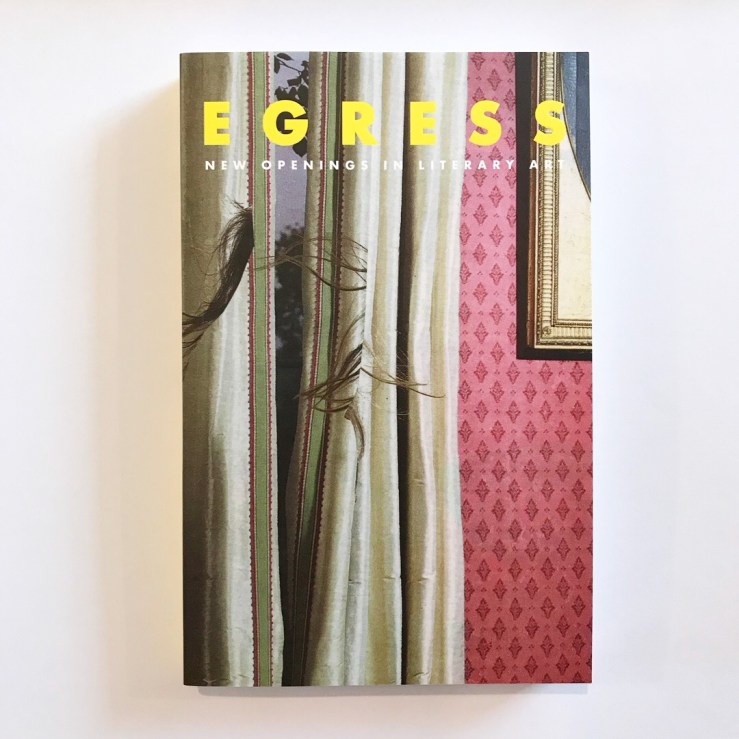
David Winters: Literally: the act or way of leaving a place; an emergence, opening or exit. Egress is also a biannual literary magazine devoted to showcasing the most innovative writers on both sides of the Atlantic today. Our first issue features, among others, Gordon Lish, Diane Williams, Sam Lipsyte, Kathryn Scanlan, David Hayden and Kimberly King Parsons.

Biblioklept: How long has Egress been incubating? How did the magazine come about?

DW: Incubation began in May 2017, over a lunch of okonomiyaki in Bloomsbury, London. We met through Gordon Lish. Little Island had published Lish’s White Plains, as well as books by his students Russell Perrson and Jason Schwartz. I’d also alerted Andrew to the work of David Hayden, author of Darker with the Lights On, who has two new stories in Egress #1So, there was a sense of shared tastes. A sense, too, that UK literary magazines–despite the efforts of a few pioneers—lacked the avant-garde spirit of US publications like NOON and New York Tyrant. We both saw a space for something new. Okonomiyaki, for the benefit of your readers, are a type of savoury Japanese pancake.

Andrew Latimer: Through David and Gordon Lish, I’d discovered writers like Christine Schutt and Sam Lipsyte (both in Egress #1) and desperately wanted a vehicle for engaging this type of work here, in the UK. Egress – the name, the style, the design – all came about quite naturally from a desire to bring writing like this into one place.

Biblioklept: For readers unfamiliar, can you describe the Lishian aesthetic, at least as you see it?

DW: Well, in a sense, there’s no such thing. Journalists in the eighties harped on about ‘minimalism’—a stupid label, with little purchase on the writers in question. Sven Birkerts once claimed there was a ‘School of Gordon Lish’. But Lish’s influence can’t be reduced in that way. Over the decades, hundreds of very different writers have worked with him, learned from him, bounced off him, swerved away from him. What the best of them have in common is an acute sensitivity to the power of language, and a commitment to creating new and lasting art—art that stands apart from the marketplace. Those are also the qualities we prize at Egress. But they are hardly restricted to “Lishian” fiction.

Biblioklept: That “acute sensitivity to the power of language” is on display in the two fictions from Lish in Egress #1, “Jawbone” and “Court of the Kangaroo.” The first Lish story, “Jawbone,” is about this seemingly unimportant minuscule moment, but Lish turns the whole thing into a drama about language itself. There’s this line in “Jawbone” that I kept tripping over, rereading and rereading: “Like lucky thing for the local citizenry someone on your side was there in there on duty on the nightbeat last night in the crapper last night.” The line is simultaneously gorgeous and ugly, elegant and clunky—rapturous really.

AL: Rereading is the key here. We’re familiar with rereading whole stories that we like or ones with endings that puzzle us. But what Lish, and writers of this ilk, ask us to do is to reread sentences in the course of making our first reading. This assumes a reader, a listener even, with the patience to linger over the page, its construction. (Gary Lutz prefers a “page-hugging” to a page-turning reader.)

DW: “Gorgeous and ugly” — exactly, yes. Donald Barthelme once said, “every writer in the country can write a beautiful sentence, or a hundred. What I am interested in is the ugly sentence that is also somehow beautiful.” Lish, when he was teaching, called this “burnt tongue”: “God only listens to those whose tongues are burnt, twisted, crippled.” Writers of fiction can achieve extraordinary power by attending to everything wrong, skewed, erratic in their natural speech — and, rather than being afraid of that wrongness, amplifying it on the page. But power of this kind needn’t be purely spontaneous; it can also be elicited by editing. The sentence you mention went through multiple revisions; Lish reworks his stories obsessively, right up to the final proof stage. When I edit fiction, in my lesser way, I often look out for those off-kilter sentences, isolate them, tweak them, try to increase their tension and pressure.

Biblioklept: How much and what kind of editing did you guys do with Egress #1. I mean, were the authors submitting finished pieces, or were you working with them through the process?

DW: It varies. Some stories are, with the authors’ approval, heavily edited. Some authors come to us in such command of their material that no editing is necessary. Sometimes, editing is simply about discovery: finding the new. Sometimes it’s about reinvention: getting stuck in and making it new. Between these extremes, there’s a whole spectrum of interventions.

egress 2

Biblioklept: I’ll admit that I opened Egress with the idea that I’d probably go straight to Lish and then maybe read Christine Schutt or Evan Lavender-Smith—some of the writers I’d already read before—before reading ones that were new to me. However, the first story in Egress #1, which is by Kimberly King Parsonhad a title that grabbed my attention: “Mr. Corpulent Wants Polaroid Proof.” So I started there, and all the sentences made me want to keep reading, and then read into her second story. Then I read the next story, Grant Maierhofer’s “Everybody’s Darling.” (The opening line “I suppose I took to mother’s unders when the end became too sure” sort of insisted Keep going).  How important is sequencing the stories (and essays) of Egress and what was that process like? How much of your editorial mission involves opening up a place for newer voices?

DW: Openings are important. Andrew and I share the view that stories should command attention from their very first sentence–what some would call the ‘attack’. Again, though, an attack doesn’t have to be nailed down straight away; it can emerge in the process of revision. However they’re made, the best openings astonish, seduce, compel us, as you say, to ‘keep going’.

And if literary art is about attention, so too is the art of the literary magazine. Drawing attention to unknown writers has long been the mission of little magazines, ever since the heyday of modernism. Incidentally, this has also been my mission as a critic. When I started writing about Christine Schutt, Evan Lavender-Smith and others, they were largely overlooked and unpublished in the UK. Both in mainstream literary journalism and in the academy, critical attention often fixates on the famous and commercially successful. This is especially true of prose fiction, which inhabits a different institutional ecosystem to, say, poetry. With the current renaissance of small presses, the pendulum is starting to swing the other way. Even so, the writers who make the Booker Prize shortlist or get reviewed in The Guardian are not, by and large, the writers who’ll be remembered decades from now. The market exerts a powerful pull on our collective attention. Good publishing, like good criticism, resists that pull. The task is to look away from what everyone else is looking at–look at what they’re not looking at–and then make them see.

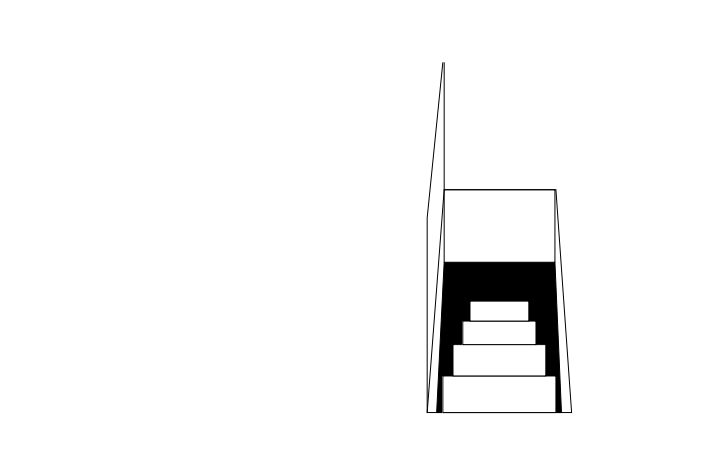
AL: Absolutely – and the sequencing of the stories and essays plays a huge part in showcasing those new voices. As a reader, there is always that pull to go to the names you know and love first. (It’s part of why you pick up a magazine.) But, as an editor, you can’t just rely on the big names; you’ve got to be in the business of making new ones. You have a responsibility to disrupt the reader’s expectations, to put things in their way. Beyond names and reputations, there’s also a careful and deliberate counterpointing of the work in Egress. David and I think about how one story or essay speaks to another, how it’s placement can enrich another’s meaning, its rhythms. This kind of editorial work, the imposition of an overarching rhythm to the issue, wills the reader to ‘keep going’. Catrin Morgan’s illustrations (of various egresses – trapdoors and staircases) are a neat visual cue to the reader to push on, to explore what’s round the corner.

Screenshot 2018-05-02 at 7.40.55 PM
Illustration for Egress #1 by Catrin Morgan

Biblioklept: Some of this blog’s readers might know Catrin Morgan from her illustrated version of Ben Marcus’s The Age of Wire and String. How did you get her involved with Egress? Do you plan for each issue to have a different artist?

AL: Originally we asked her for an image for the front cover, but she ended up drawing all these bizarre stairs and exits that were so compelling I just had to use them. I’d like to continue using her illustrations throughout the text for the future, but there will be a new artist featured in the colour plates each issue. The “artist” for this issue is Hob Broun.

egress 3

Biblioklept: I know David has been enthusiastic about Hob Broun’s writing for a few years. Broun is sort of a “writer’s writer’s writer,” if that makes sense. The first issue of Egress features a section titled “Remembering Hob Broun: 1950-1987”; in addition to remembrances from the novelist Sam Lipsyte and Kevin McMahon, who befriended Broun when they attended Reed College together in the late sixties, you include a full color selection from one of Broun’s journals. Can you describe some of the journal for readers, and talk a bit about how the Broun section came together? For readers unfamiliar with Broun, what’s the appeal?

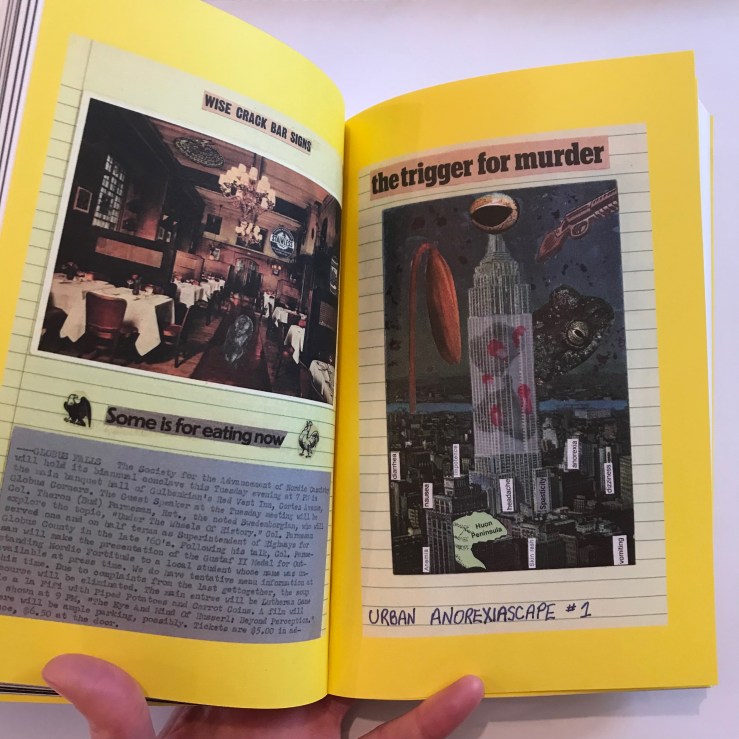
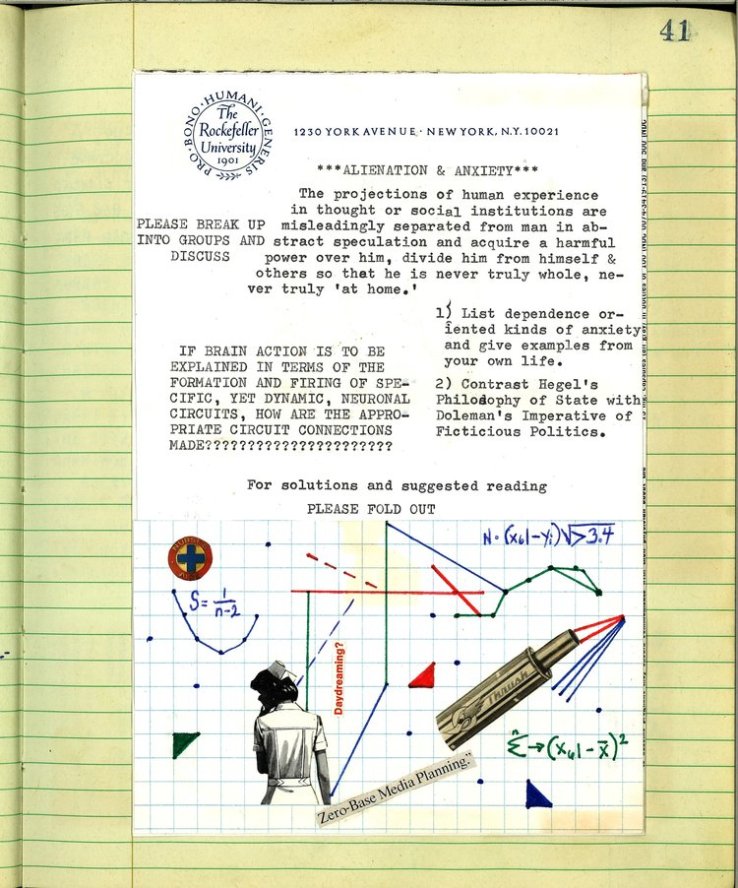
DW: Broun is a ‘writer’s (writer’s) writer’ only in that he isn’t well-known–his work isn’t at all opaque or aloof. He published three books in his lifetime, the novels Odditorium (1983) and Inner Tube (1985), and the superb short story collection Cardinal Numbers (1988). While writing Inner Tube, Broun underwent emergency surgery to remove a spinal tumour. He was left paralysed from the neck down. Remarkably, he finished the novel–and wrote the stories in Cardinal Numbers–using a kind of writing-machine: an oral catheter (or ‘sip-and-puff device’) connected to a customised word processor, triggered by his breath whenever a letter flashed on the screen. This aspect of Broun’s life lends itself to mythologization: what better image of writerly dedication? At the same time, it risks obscuring what really matters: the work itself. I was delighted, then, when Kevin McMahon got in touch. Kevin’s essay only glances at Broun’s illness, giving us, instead, a vivid portrait of the man behind the myth. Best of all, Kevin sent us Broun’s personal journal. It’s an extraordinary artefact–a scrapbook of doctored magazine clippings and miniature, fragmentary narratives–unmistakably Brounian in its pulpy, screwball surreality. Broun’s journal is continuous with his fiction (Cardinal Numbers contains the manifesto-like statement, ‘modus operandi: montage, collage, bricolage’), but, unlike his fiction, it wasn’t created for public consumption. Not unlike the art of, say, Ray Johnson or Joseph Cornell, it gives us a glimpse of a private world, a game played for inscrutable reasons—what Don DeLillo calls “the pure game of making up”. Our celebration of Broun ends with a wonderful essay by Sam Lipsyte–a writer Andrew and I both revere–who captures his essence far better than either of us ever could.

egress 3

Biblioklept: Which of Broun’s three books do you think is the best starting place for folks interested in his work after reading about him in Egress?

DWCardinal Numbers, without a doubtOpen Road recently reissued all three titles as e-books, but I’d recommend picking up the old Knopf hardbacks, which can be had for as little as a dollar. Another Broun novel–a previously unpublished manuscript–might be out in a year or two.

Biblioklept: Maybe Egress could get a hold of a few pages.

DW:  We’ve been looking at some of his unpublished work, yes.

Biblioklept: Why is it necessary to publish Egress in a physical, print form?

AL: Why is Egress in print? There are so many reasons, but I’ll focus on one. The role of curation has never been more important as it is now. We are distracted: information, entertainment, stuff causes our attention to bleed from one thing to the next. Egress, like all the best journals and mags, is a highly curated affair. David and I wanted there to be a palpable sensation derived from receiving and reading each issue of the magazine. The style of writing, the artwork, the design. Much of that effect relies on all the pieces being enclosed between covers – simultaneously held together and also cut off, if only briefly, from everything else that’s going on. It’s hard, likely impossible, to get that same sense of quietude, to enforce focus, when reading on a screen as infinite worlds suggest themselves merely clicks away. As well as this, there’s an indispensable sense of occasion one gets from a print magazine: ‘when is it out?’ The magazine, as a format, craves temporality.

Biblioklept: Do you envision future issues of Egress publishing some of the authors featured in the first issue?

AL: Yes, definitely.

Biblioklept: There’s an obvious aesthetic value to a literary journal or magazine publishing the same authors frequently, but are there any risks?

DW: There are risks and rewards. Magazines like Egress serve two roles in the culture. Our primary role is to discover and promote new writers. Often unpublished, unagented, and lacking industry connections, these writers reside at the margins. But we believe in them, fervently, and we believe they deserve to be heard. This gives rise to a second role. You might even call it a moral responsibility. Newness needs to be nurtured, protected, given a space in which it can grow. One contributor to Egress #1 only began writing fiction six months ago. She’d published nothing before she came to us. But what she’s doing is truly unique. Will we publish her again? You bet. We’ll do everything in our power to support her work. The same goes for any writer we believe in. If you do that and keep doing it–if you keep bringing new writers together–you become something more than a magazine. You become a community. Look at the best literary magazines of recent decades–from The Quarterly through to elimaeNOONTyrant and Unsaid–and that’s what you’ll see: artistic communities. Temporary autonomous zones; bubbles in which innovation can flourish. The risk, of course–and here I could name several lesser litmags–is that such communities can solidify into coteries, stables, ‘closed shops’. We’ll champion writers as long as they need us, but we’ll never close ourselves off in that way. After all, the real thrill is when someone comes to you from out of nowhere–no publications, no social media accounts, no ‘platform’, fuck, even no cover letter–just power on the page.

Biblioklept: Have you ever stolen a book?

DW: Sure, when they’re overpriced or out of print. Worse, I’ve had others steal them for me. Years ago, a friend went to great lengths to liberate Ilya Prigogine and Isabelle Stengers’ Order Out of Chaos from a university library for me. And a contributor to Egress #2 once smuggled an exorbitantly priced theology monograph out of a bookshop on my behalf. (Sorry Julie—see you in prison!)

AL: I’m bad for stealing books from places I’m staying at — friends’, hostels, BnBs — especially if I think I’d appreciate the book more myself. My favourite steal so far has been Epitaph of a Small Winner by Machado de Assis, which I’ve read the covers off so can’t return that now (not that I would).

Screenshot 2018-05-02 at 7.41.34 PM
Illustration for Egress #1 by Catrin Morgan


The first issue of Egress is out now in the UK. It will be available in the US on 21 June 2018.

David Winters is a literary critic. He has written for the Times Literary Supplement, the Los Angeles Review of Books, BookforumThe Brooklyn Rail and elsewhere. He currently holds a postdoctoral research fellowship at the University of Cambridge, where he is writing a book about Gordon Lish. He co-edits both Egress and 3:AM Magazine, and can be found online at www.davidwinters.uk.

Andrew Latimer is editorial director at Little Island Press.

This interview was conducted via email during the month of April, 2018.

Blog about Martin Scorsese’s film The King of Comedy

Screenshot 2018-04-27 at 7.41.03 PM

I watched Martin Scorsese’s 1982 film The King of Comedy last weekend and then added it to a list of examples for a much bigger Thing I’ve been working on for a few years (and hence will never likely finish, unlike these Blog about posts). The much bigger Thing is about the relationship between Comedy and Horror—not purely the formal characteristics that belong to specific genres of literature, film, and art, but rather the relationship between the emotions themselves (with special attention to how literature, film, and art evoke that relationship).

The short thesis for this bigger Thing is that I think that comedy relies strongly on horror, and that the best provocations of horror are tempered in humor. There is a long list of examples in support of this thesis, including Goya and Bolaño and Larry David and Don Quixote and Candide  and Thomas Bernhard and Surrealism and Get Out and etc. —-but that’s all for said bigger Thing, and the title of this post seems to promise Something (not a big Thing) on Martin Scorsese’s 1983 film The King of Comedy, which I recently rewatched.

I first saw The King of Comedy in the spring of 1998. I was a freshman at the University of Florida and had quickly discovered their library of films on VHS, which I would imbibe over my four years there. I started with stuff I was already a bit familiar with though. Like every other stupid eighteen-year old, I thought Taxi Driver was A Work of Genius (without fully understanding it), and I’d seen Goodfellas and Casino approximately one thousand times by this point. I started UF’s collection of Scorsese tapes with the neo-neorealism of Raging Bull, a brutal and hence thoroughly comprehensible character study, an ugly film shot in gorgeous black and white. The King of Comedy was next.

The internet in 1998 was not the internet of 2018. What I mean is that we generally learned about films through books and journals and magazines, or really other films, or really, really by word of mouth. I don’t think I had any word of mouth on The King of Comedy—what I mean is that I think I thought the film was a comedy. Which it is. Sort of. I mean, it’s funny—-very funny sometimes. But it’s also very cruel, and often scary and off putting, and generally queasy.

The King of Comedy stars Robert De Niro as Rupert Pupkin. That ridiculous name is on one hand a running joke, but on the other hand a vein of horror that pulsates throughout the film—an aberrant twitching oddity, a sort of literal curse, both on poor Rupert (who bears that name) and on every person who encounters him. Rupert is a would-be comedian who dreams (literally and often from his mother’s basement) of stardom. He dreams that he’ll achieve this stardom through a spotlight gig on The Jerry Langford Show, a Carson-style late night show hosted by Jerry Langford, played by a wonderfully fed-up Jerry Lewis.

Rupert is an autograph hound, an obsessive type of fan who makes Jerry’s life a literal terror.  Rupert’s foil is Masha, a trust-fund baby played by Sandra Bernhard. Masha stalks Jerry with extreme competitive anxiety; her stalking is a lifestyle elevated to art. When Masha goes too far early in the film and hijacks Jerry’s limo, Rupert sees an opening—he saves the day, ousting Masha, but then he invades the limo (proving himself stalker supreme over Masha).  In the limo ride, Rupert asks Jerry for help in advancing his career, and Jerry gives generous if general advice, which amounts to Put the work in and pay your dues. Rupert complains that he simply doesn’t have time to invest in doing the real hard grinding work, and basically demands that Jerry give him a shortcut.

In showing a deranged would-be artist who feels he’s entitled to bypass the years of work involved in honing a skill, Scorsese anticipates our current zeitgeist. Rupert Pupkin desires fame, adoration, and applause, but he is far less interested in producing an art that would earn these accolades. The King of Comedy slowly shows us that Pupkin is mentally ill, and that his disease is radically exacerbated by a culture of mass media.

The King of Comedy’s most sarcastic bite is that Rupert is eventually rewarded for his deranged behavior. He and Masha kidnap Jerry as part of a plan to get Rupert an opening set of The Jerry Langford Show. The plan succeeds, and Rupert executes it so that he not only gets to land his dream gig, he also gets to watch himself do it in front of The Girl He Liked in High School:

Rupert’s audacious gambit is part and parcel of a postmodern mass media era that makes only the slightest distinction between fame and infamy. Rupert is famous for doing something famous—and something horrific, kidnapping a beloved TV host. It’s his one bit of work, but it’s enough to land him a book deal, celebrity, and money (and a fairly short prison sentence).

Parts of Rupert’s monologue are funny, but other parts read like the memoir of a damaged soul trying to recover from an abusive childhood. And maybe these parts mix. Again, horror underwrites comedy.

This horror repeats in Scorsese’s framing of Rupert’s routine. There’s a dream-like quality to the monologue, with its television tube frame. This is not the first time we’ve seen this framing in King of Comedy—we get similar TV fantasies via Rupert’s deranged mind—but this time the plot asks us to think of it as “real,” even as Scorsese’s aesthetics suggest that the ending of the film may all be in Pupkin’s warped mind, the unseen clapping audience just another delusion of grandeur.

The same gesture is present at the end of Taxi Driver, which is essentially the twin of The King of Comedy. Travis Bickle—another ridiculous name, another loser—improbably ends up the hero of the narrative. But the conclusion of Taxi Driver has always struck me as the internal fantasy of its reactionary (anti-)hero. Likewise, The King of Comedy concludes in yet another fantasy in Rupert Pupkin’s addled consciousness.

With its metatextual contours and its insinuations of reality-as-mediated-by-mass-media, The King of Comedy is perhaps Scorsese’s most formally postmodern film (although his smaller follow-up After Hours might be his most thematically postmodern). It’s no wonder that the film didn’t land with audiences in 1983. Beyond its postmodern rhythms, The King of Comedy is essentially repulsive—nothing good happens; there is no clear hero; the world it depicts is devoid of any meaning not centered in relation to fame. Its satire is so black no light escapes. In comparison, Scorsese’s later films like Goodfellas and The Wolf of Wall Street are laugh riots.

The genius of The King of Comedy is something best felt. The film disrupts genre conventions (and audience expectations), pushing a comedy into a horror. Or maybe The King of Comedy is a horror film with comedic overtones. Or, really—I mean, what I really want to say here is:

The King of Comedy isn’t a horror film or a comedy film—like many of Scorsese’s best films, it’s a character study—realistic and engrossing and grotesque in its utter realism. Time has caught up with it. If Rupert Pupkin seemed an extreme example of the kind of derangement and alienation that could be aggravated by a mass media culture in the early 1980s, by today’s standards he’s perhaps charming. And that’s horrifying.

Blog about William Carlos Williams’ poem “The Wedding Dance in the Open Air”

800px-pieter_bruegel_de_oude_-_de_bruiloft_dans_28detroit29

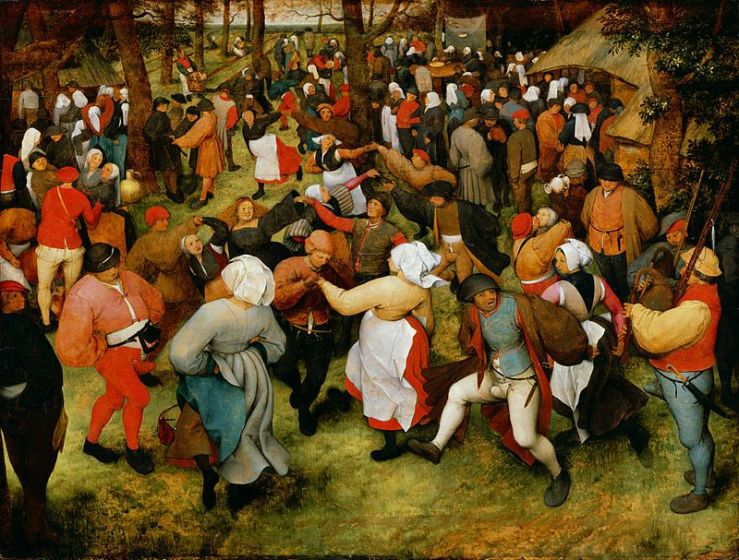
William Carlos Williams’ final and posthumous book Pictures from Brueghel and Other Poems (1962) opens with a cycle of ten ekphrastic poems that describe (and subtly interpret) ten paintings by the sixteenth-century Flemish painter Pieter Brueghel the Elder.

These poems are, in my estimation, some of Williams’ finest. Possibly the most famous of these poems is “Landscape with the Fall of Icarus,” a devastating observation of how inclined we are to look away from miracles.

Another of Williams’ Brueghel poems, “The Dance,” which takes The Peasant Dance as its subject, is also widely-anthologized; however Williams’ poem “The Dance” was published in The Wedge (1944). Williams’ “The Dance,” which begins “In Breughel’s great picture, The Kermess, / the dancers go round,” is frequently and incorrectly cited to have been published in Pictures from Brueghel (a cursory internet search shows this misinformation appears in Harper’s, as well as the last resort of lazy high school students, Shmoop). Williams did publish a poem called “The Dance” in Pictures from Brueghel and Other Poems, but this “Dance” is very much one of those other poems (this “Dance” begins “When the snow falls the flakes / spin upon the long axis,” for the record). That The Peasant Wedding is another subject of Pictures of Brueghel may also account for the spread of this misinformation (which can be resolved simply by opening the second volume of The Collected Poems of William Carlos Williams, which includes both The Wedge and Brueghel). But I find myself going on a bit too much about this simple mistake.

Let’s get to the poem:

“The Wedding Dance in the Open Air”

by

William Carlos Williams


Disciplined by the artist
to go round
& round

in holiday gear
a riotously gay rabble of
peasants and their

ample-bottomed doxies
fills
the market square

featured by the women in
their starched
white headgear

they prance or go openly
toward the wood’s
edges

round and around in
rough shoes and
farm breeches

mouths agape
Oya !
kicking up their heels

“The Wedding Dance in the Open Air” echoes the sensual depth of Williams’ earlier poem “The Dance” (1944), which emphasized the hips and bellies and shanks of those dancers who are “swinging their butts” (!) to “the squeal and the blare and the / tweedle of bagpipes” as they prance about.

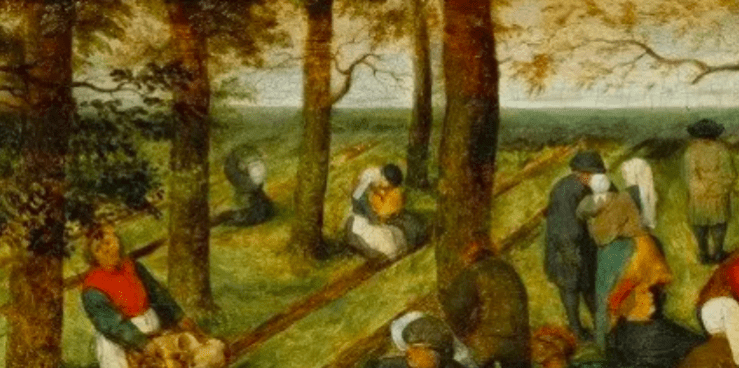
The word “prance” is repeated too in “Wedding Dance” — and not only do our partygoers prance, they even “go openly / toward the wood’s / edges,” the edge of civilization where civilization gets made.

Screenshot 2018-04-11 at 8.52.09 PM

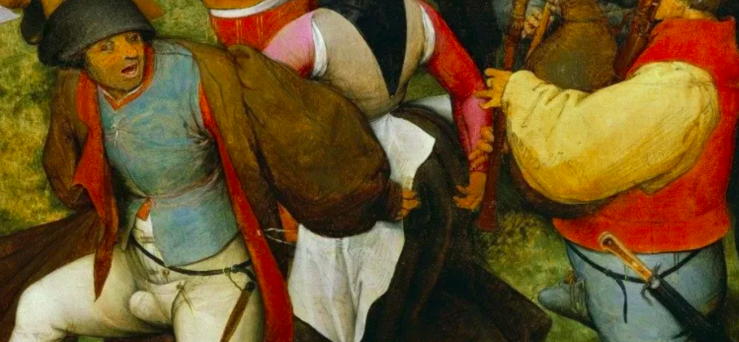
At the other edge of the painting, the foreground, are some of the boldest of Williams’ “riotously gay rabble.” But should I call them “Williams’ ‘riotously gay rabble'” or Brueghel’s? I think that it is Williams’ interpretation that matters here, but Brueghel gives him the material with which to grapple.

Look at those colors, look at those codpieces! Look at the hands, twisting, gripping, artfully fingering!

Screenshot 2018-04-11 at 8.53.37 PM

Williams captures the painting’s sexual energy not just in lines that highlight the “ample-bottomed doxies” who fill this market square, but also in the vivacious images of “mouths agape” and heels a’ kicking. The poem pulses with an energy proximal to the painting, an energy simultaneously alien and native, highlighting not only the difference in the two art forms—poetry and painting—but also the space between the viewer and the thing being viewed.

Screenshot 2018-04-11 at 9.02.03 PM

Enhancing the poem’s ekphrastic powers of imagery and feeling are the subtle rhymes of Williams’ “The Wedding Dance.” While one can find the odd (very odd) rhyme or three in WCW’s poetry, “The Wedding Dance” makes for one of the poet’s more direct concessions to poetry’s most common formal feature. The second stanza gives us “gear” slipping into “their,” picked up again in the fourth stanza’s “headgear,” and more subtly touched on in the final lines of stanzas six and seven, “breeches” and “heels.” Hell, “edges” in the fifth stanza basically rhymes with “breeches.” This thread of slant rhymes approximates the off-kilter, elliptical dance Brueghel depicts. Williams kneads guttural g sounds and harsh rs into his poem, roughening his poetry to match his rustic subject. And yet there’s just the right measure of sensuality that slips through the poem, just enough to get the rough words wet.

Like any successful ekphrasis, Williams’ poem transcends a mere physical description of art. He does describe The Wedding Dance in Open Air, yes, but the description does more than relay the physical contours of Brueghel’s art, or Williams’ analysis of Brueghel’s art—William gives us something of the painting’s spirit, captured in language, sound—another way of feeling something beautiful. Oya!

Blog about Ursula K. Le Guin’s short story “Schrödinger’s Cat”

Screenshot 2018-04-08 at 7.02.26 PM

Ursula K. Le Guin’s 1982 short story “Schrödinger’s Cat” is a tale about living in radical uncertainty. The story is perhaps one of the finest examples of postmodern literature I’ve ever read. Playful, funny, surreal, philosophical, and a bit terrifying, the story is initially frustrating and ultimately rewarding.

While I think “Schrödinger’s Cat” has a thesis that will present itself to anyone who reads it more than just once or twice, the genius of the story is in Le Guin’s rhetorical construction of her central idea. She gives us a story about radical uncertainty by creating radical uncertainty in her reader, who will likely find the story’s trajectory baffling on first reading. Le Guin doesn’t so much eschew as utterly disrupt the traditional form of a short story in “Schrödinger’s Cat”: setting, characters, and plot are all presented in a terribly uncertain way.

The opening line points to some sort of setting and problem. Our first-person narrator tells us: “As things appear to be coming to some sort of climax, I have withdrawn to this place.” The vagueness of “things,” “some sort,” and “this place” continues throughout the tale, but are mixed with surreal, impossible, and precise images.

The first characters the narrator introduces us to are a “married couple who were coming apart. She had pretty well gone to pieces, but he seemed, at first glance, quite hearty.” The break up here is literal, not just figurative—this couple is actually falling apart, fragmenting into pieces. (Although the story will ultimately place under great suspicion that adverb actually). Le Guin’s linguistic play points to language’s inherent uncertainty, to the undecidability of its power to fully refer. As the wife’s person falls into a heap of limbs, the husband wryly observes, “My wife had great legs.” Horror mixes with comedy here. The pile of fragmented parts seems to challenge the reader to put the pieces together in some new way. “Well, the couple I was telling you about finally broke up,” our narrator says, and then gives us a horrific image of the pair literally broken up:

The pieces of him trotted around bouncing and cheeping, like little chicks; but she was finally reduced to nothing but a mass of nerves: rather like fine chicken wire, in fact, but hopelessly tangled.

Nothing but a mass of nerves hopelessly tangled: one description of the postmodern condition.

The bundle of tangled nerves serves as something that our narrator must resist, and resistance takes the form of storytelling: “Yet the impulse to narrate remains,” we’re told. Narration creates order—a certain kind of certainty—in a radically uncertain world. The first-time reader, meanwhile, searches for a thread to untangle.

Like the first-time reader, our poor narrator is still terribly awfully apocalyptically uncertain. The narrator briefly describes the great minor uncertain grief she feels, a grief without object: “…I don’t know what I grieve for: my wife? my husband? my children, or myself? I can’t remember. My dreams are forgotten…”  Is grief without object the problem of the postmodern, post-atomic world? “Schrödinger’s Cat” posits one version of uncertainty as a specific grief , a kind of sorrow for a loss that cannot be named. The story’s conclusion offers hope as an answer to this grief—another kind of uncertainty, but an uncertainty tempered in optimism.

This optimism has to thrive against a surreal apocalyptic backdrop of speed and heat—a world that moves too fast to comprehend, a world in which stove burners can’t be switched Off—we have only heat, fire, entropy. How did folks react? —

In the face of hot stove burners they acted with exemplary coolness. They studied, they observed. They were like the fellow in Michelangelo’s Last Judgment, who has clapped his hands over his face in horror as the devils drag him down to Hell—but only over one eye. The other eye is looking. It’s all he can do, but he does it. He observes. Indeed, one wonders if Hell would exist, if he did not look at it.

Screenshot 2018-04-08 at 7.02.50 PM

—Hey, like that’s Le Guin’s mythological take on Erwin Schrödinger’s thought experiment!—or at least, part of it.

(Hell exists because we keep one eye on it, folks. Look away, maybe).

I have failed to mention the titular cat thus far. Schrödinger’s cat is the Cheshire cat, the ultimate escape artist and trickster par excellence who triggers this tale (tail?!). He shows up to hang out with the narrator.

Le Guin peppers her story with little cat jokes that highlight the instability of language: “They reflect all day, and at night their eyes reflect.” As the thermodynamic heat of the universe cools around our narrator and the feline, the narrator remarks that the story’s setting is cooler— “Here as I said it is cooler; and as a matter of fact, this animal is cool. A real cool cat.” In “Schrödinger’s Cat,” Le Guin doubles her meanings and language bears its own uncertainty.

A dog enters into the mix. Le Guin’s narrator initially thinks he’s a mailman, but then “decides” he is a small dog. The narrator quickly decides that not only is the non-mailman a dog, she also decides that his name is Rover. In naming this entity, the narrator performs an act of agency in a world of entropy—she makes certain (at least momentarily) an uncertain situation.

Our boy Rover immediately calls out Schrödinger’s cat, and gives the narrator (and the reader) a fuzzy precis of the whole experiment, an experiment that will definitely give you a Yes or No answer: The cat is either alive or the cat is not alive at the end of our little quantum boxing. Poor Rover gives us a wonderful endorsement of the experiment: “So it is beautifully demonstrated that if you desire certainty, any certainty, you must create it yourself!” Rover gives us an unintentionally ironic definition of making meaning in a postmodern world. Agency falls to the role of the reader/agent, who must decide (narrate, choose, and write) in this fragmented world.

For Rover, Schrödinger’s thought experiment offers a certain kind of certitude: the cat is alive or dead, a binary, either/or. Rover wants to play out the experiment himself—force the cat into the box and get, like, a definitive answer. But the curious playful narrator pricks a hole in the experiment: “Why don’t we get included in the system?” the narrator questions the dog. It’s too much for him, a layer too weird on an already complex sitch. “I can’t stand this terrible uncertainty,” Rover replies, and then bursts into tears. (Our wordy-clever narrator remarks sympathy for “the poor son of a bitch”).

The narrator doesn’t want Rover to carry out the experiment, but the cat itself jumps into the box. Rover and narrator wait in a moment of nothingness before the somethingness of revelation might happen when they lift the lid. In the meantime, the narrator thinks of Pandora and her box:

I could not quite recall Pandora’s legend. She had let all the plagues and evils out of the box, of course, but there had been something else too. After all the devils were let loose, something quite different, quite unexpected, had been left. What had it been? Hope? A dead cat? I could not remember.

Le Guin tips her hand a bit here, like Nathaniel Hawthorne, the great dark romantic she is heir to; she hides her answer in ambiguous plain sight. Hope is the answer. But hope is its own radical uncertainty, an attitudinal answer to the postmodern problem—but ultimately a non-answer. The only certainty is non-certainty.

What of the conclusion? Well, spoiler: “The cat was, of course, not there,” when Rover and narrator open the box. But that’s not the end. The last lines of Le Guin’s story see “the roof of the house…lifted off just like the lid of a box” — so the setting of our tale this whole time, as we should have guessed, was inside the apocalyptic thought experiment of Schrödinger. Apocalyptic in all sense of the word—in the connotation of disaster, but also revelation. The revelation though is a revelation of uncertainty. In the final line, the narrator, musing that she will miss the cat, wonders “if he found what it was we lost.”

What I think Le Guin points to here as the “it” that we lost in these hot and fast times is the radical uncertainty of hope.

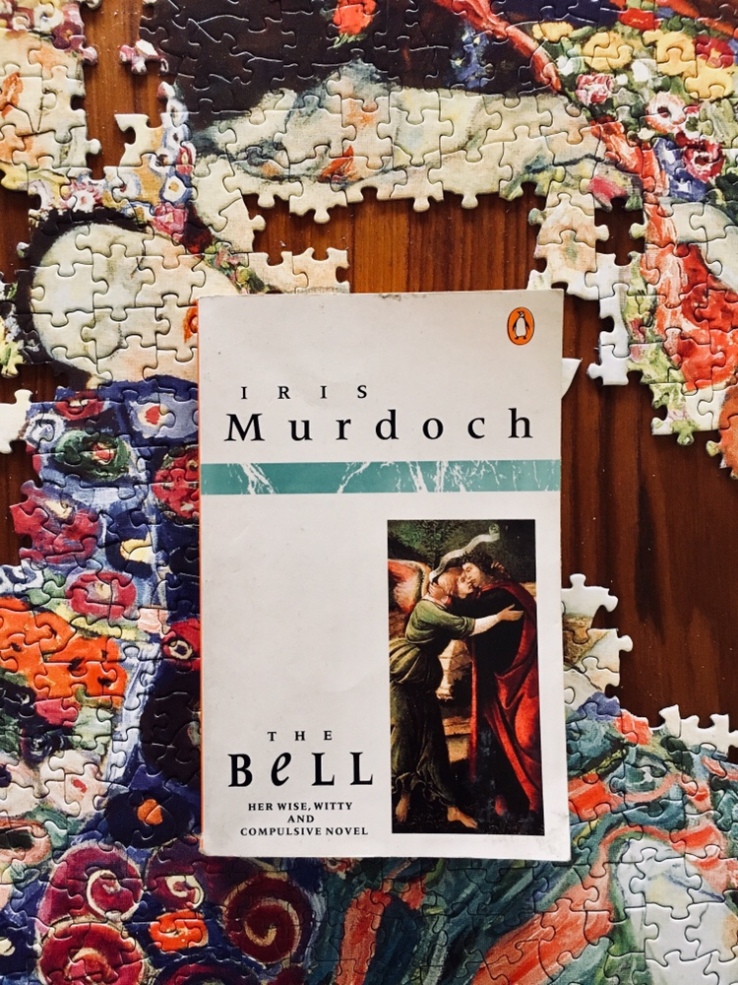
Blog about Iris Murdoch’s novel The Bell

img_9112

I have just finished Iris Murdoch’s 1958 novel The Bell. This is the first novel I have read by Murdoch and I now want to read more novels by Murdoch, which I suppose is the best praise I can offer the novel.

The Bell is set primarily in Imber House, a large old mansion in the English countryside. Imber House adjoins a Benedictine abbey; this nunnery is essentially closed off to the outside world. The residents of Imber House form a “brotherhood,” a laity of would-be acolytes who strive to find spiritual meaning in the commercial and often venal world of the postwar era. Various conflicts between these characters drive the plot of The Bell.

One of these conflicts, especially notable for a novel published in 1958, involves Michael, the leader of the Imber House community. A former schoolmaster who dreamed of joining the clergy, Michael lost his job in a small scandal for “seducing” one of his students, Nick, a teenage boy at the time. Over a decade later, circumstance brings Nick to Imber House, where his twin sister Katherine is staying. Katherine plans to join Imber Abbey; in the meantime, her family hopes that the religious solitude at Imber House will help Nick recover from his alcoholism. The conflict between Michael and Nick becomes further charged when the youngest member of Imber House, a teenager named Toby, befriends both of them.

I could go on about Michael and Nick and Toby and Katherine and etc., but the real star of The Bell is Dora Greenfield, a wonderfully complicatedly simple unassuming unpretentious flighty former art student who has recently left her demanding husband Paul. Through Murdoch’s precise free indirect style, we get to inhabit Dora’s constantly vacillating mind. Like many people, Dora does not know what she is going to do, and even when she thinks through a plan, she often ends up doing the opposite of what she had intended to do. There is a hilarious passage in the novel’s first chapter when Dora goes through a lengthy imaginative exercise about giving up her train seat to an elderly woman. Dora’s thought experiment ends like this:

She decided not to give up her seat.

She got up and said to the standing lady ‘Do sit down here, please. I’m not going very far, and I’d much rather stand anyway.’

The blank space between those sentences highlights a radical gap between contemplation and action.

The train-seat passage is one of many humorous episodes in The Bell, but Murdoch’s humor is underwritten by a deeper menacing anxiety, which can be neatly summed up in the novel’s opening sentences:

Dora Greenfield left her husband because she was afraid of him. She decided six months later to return to him for the same reason.

Those opening lines basically summarize the big thematic plot of The Bell—the conflict between controlling and ultimately abusive Paul and his much younger wife. (“She married him a little for his money,” Murdoch writes just a few paragraphs in, wedging the detail between more positive aspects of Paul’s character–the “a little” is just genius there, the slightest omission from Dora’s consciousness slipping into the third-person narrator for the briefest of moments). The opening lines of The Bell also showcase Murdoch’s rhetorical powers. Her comic precision here reverberates with a hazardous undertone.

Will Dora really return to her husband? Or will she become her own person—whatever that means? The Bell satisfies these questions with complex answers. The novel has every opportunity to veer toward pat conclusions. Murdoch fills her novel with images that suggest a conventional tragic conclusions, and then surpasses these conventions, turning them into something else. A death by drowning might be foreshadowed, but someone will learn to swim; an epiphany achieved in an art museum might not meet its achievement outside of aesthetic response; the Blakean contraries of innocence and experience might be synthesized into a new, original viewpoint. There’s something real about The Bell—it offers a realism that points outside of its own literary contours. The English novelist A.S. Byatt puts it far better than I can in her essay “Shakespearean Plot in the Novels of Irish Murdoch”:

 …The Bell seems to me arguably Miss Murdoch‘s most successful attempt at realism, emotional and social—the tones of voice of the members of the religious community are beautifully caught, the sexual, aesthetic and religious passions and confusions of the three main characters, Dora, Michael, and, to a lesser extent, Toby, are delicately analysed with the combination of intellectual grasp and sensuous immediacy of George Eliot.

Byatt’s comparison to Eliot reminds me that I had intended to read Middlemarch some time this year—but to be fair to myself, I put The Bell on the same list. I won’t be reading Middlemarch next though; The Bell, with its story of a would-be utopian community, strongly reminded me of Nathaniel Hawthorne’s The Blithedale Romance, which I haven’t read in ages. And after I read that, I’d like to read another one by Iris Murdoch. Any recommendations?

A review of Stanisław Ignacy Witkiewicz’s Narcotics

dvsfm7rvwaaoolo

“The main difficulty with Stanisław Ignacy Witkiewicz,” writes Soren Gauger in his translator’s note for Narcotics, “is that no matter what he was writing, it seems he wished he were writing something else.” Witkiewicz’s playful (and occasionally frustrating) discursive style is on vivid display in the six essays that comprise most of Narcotics (new in hardback from Twisted Spoon Press)Witkiewicz’s stylistic twists are one of the joys of Narcotics. A moralizing diatribe might veer into medical discourse; private anecdotes might shift into a rant on class theory or a patchy precis of a book about physiognomy. (All delivered in a semi-ironic-yet-wholly-sincere tone). In the case of Witkiewicz’s essay “Peyote,” we go from “Elves on a seesaw. (Comedic number)” to “A battle of centaurs turned into a battle between fantastical genitalia.” This last note is preceded by the observation that “Goya must have known about peyote.”

img_9138

“Peyote” is the most vivid and surreal of the essays in Narcotics. Unlike the other sections, this chapter most closely resembles a conventional drug diary. “Peyote” begins with Witkiewicz taking his first of seven (!) peyote doses at six in the evening and culminating around eight the following morning with “Straggling visions of iridescent wires.” In increments of about 15 minutes, Witkiewicz notes each of his surreal visions. The wild hallucinations are rendered in equally surreal language: “Mundane disumbilicalment on a cone to the barking of flying canine dragons” here, “The birth of a diamond goldfinch” there. Gauger’s translation conveys not just the wild imagery, but also the wild linguistic spirit of Witkiewicz’s prose.

img_9142

The prose in “Peyote” most closely approximates the spirit of Witkiewicz’s wonderful paintings. Narcotics includes 34 full-color reproductions of Witkiewicz’s art, which is reason enough to pick up this volume. According to Narcotics’ blurb, Witkiewicz (or Witkacy as he is commonly known) “established rules and types for his portrait work, marking the paintings and pastels with corresponding symbols and abbreviations of the substances he had either taken or, in the case of alcohol and nicotine, not taken at the time.”

For example, we see that Witkiewicz has noted that he had ingested cocaine and eucodal (a semi-synthetic opioid) in order to paint the Portrait of Michal Jagodowski (below). Narcotics includes a helpful “List of Symbols” as a glossary for the shorthand Witkiewicz used both in the text of his writings and in his paintings. (Although “her (herbata): tea” is included in the gloss, this vice regretfully does not merit its own essay).

img_9139

In addition to peyote, we get essays on nicotine, alcohol, cocaine, morphine, and ether (a list that may remind you of a certain Queens of the Stone Age jam). In “Nicotine,” Witkiewicz despairs that “A person deadened by tobacco and alcohol…seeks even more mind-numbing entertainment to relax,” whether that be the “utterly depraved cinema with its vacuous attempts at artistry,” or the “sensory narcotization through music” achieved by “station surfing” on the radio. (Even worse is “chronic and brainless dancing, that most monstrous of modern society’s unacknowledged plagues”).

In “Alcohol,” Witkiewicz concedes that “alcohol lets you perform actions at a particular moment that otherwise would not have been possible right then,” before launching into a sustained attack on alcohol as a creative crutch. His most convincing (and depressing) line here is “alcohol is boring. Anyone who has abused it even mildly knows this to be true.” (If this were a different sort of review, I might riff here a bit on the fact that I drank no fewer than three glasses of Cabernet Sauvignon while writing about Narcotics).

Witkiewicz, despite his exorbitant indulgences, is a bit of a snob—a modernist snob though. From frenzied, enthusiastic experience he warns us that “cocaine is one of the worst kinds of filth,” before plugging his cocaine novel Farewell to Autumn and offering a synopsis of one of the novel’s chapters, a so-called “cocaine orgy.” (The editors of Narcotics graciously include a brief selection from Farewell to Autumn, as well as additional essays by Witkiewicz on hygiene and other matters).

In the last two essays, Wietkiewicz hands the reins over to friends (designated drivers?). In “Morphine,” Bohdan Filipowski warns that, “before you can taste the sweets of narcotic paradises you must first be miserable, you must first travel through all manner of hell and suffering in life, only then to find yourself in addled stupefaction, which ultimately is all there is.” The essay “Ether” — a drug that packs a “powerful metaphysical wallop” is attributed to “Dr. Dezydery Prokopowicz,” a pseudonym for Wietkiewicz’s friend, poet Stefan Glass.

img_9141

The admonition that “before you can taste the sweets of narcotic paradises you must first be miserable” is pretty much the thesis for Narcotics, a book that simultaneously celebrates and reviles drug use. Misery is the byword here, a word we find repeated in in Henri Michaux’s 1956 collection Miserable Miracle. Published a quarter century after Narcotics, the two volumes share much in common. Too, Narcotics picks up some of the threads that we find in Thomas De Quincey’s Confessions of an English Opium-Eater(1821)–that foregrounding of suffering, even if it also anticipates the (exhaustive) drug literature of the 1960s, which wasn’t nearly so reticent about banging the narcotic gong. And yet Witkiewicz seems to wink at us through all the moralizing and apologia, suggesting that, yes, narcotics, are, like, bad—they are a crutch, a shortcut, a substitute for true artistic inspiration—but he also shows how utterly modern the process of consuming mind-and-body-altering substances is. Witkiewicz comprehends the dangers of narcotics. He’s out there on the ledge, dancing around a bit, his foot wagging over the precipice, while he grins and says, “Hey, don’t try this at home.”

Try this at home. Stanisław Ignacy Witkiewicz’s Narcotics, translated from the Polish by Soren Guager is new in hardback from Twisted Spoon Press. Just Say Yes.

A review of The Paris Review’s overproduced podcast

64100a01b64641e5115c2c856d12fd7e_89081506

In his introduction to the first episode of The Paris Review Podcast, former editor Lorin Stein tells us that we’re going to hear some great writing. He then claims, “what you won’t hear is much in the way of hosting from me or anyone else. We’re just going to let the writing speak for itself, the way it always has in the magazine.” The first two parts are true—there’s plenty of great writing here from The Paris Review archive, and there’s no one hosting the pieces. The last part of Stein’s claim is the problem though: The Paris Review Podcast repeatedly refuses to simply let the writing speak for itself. Prose and poems alike are slathered in distracting and silly sound effects and busy musical cues. This is a shame, because the estimable voice talents the producers have enlisted do a marvelous job conveying the tones, mood, and rhythms of the pieces the producers have selected (most of which are excellent). Perhaps the podcast’s producers simply don’t trust their readers enough to stay engaged without all the buzzing clutter—but for me the overproduction is too much.

There are ten episodes of The Paris Review Podcast to date. I have listened to half of them: episodes 10, 1, 5, 2, and 3 (in that order). Episode 10, “The Occasional Dream,” was perhaps an unfortunate starting point, as it contains some of the most overproduced segments I heard in the series.

The problem wasn’t the first selection, a fantastic Frank O’Hara poem called “A True Account of Talking to the Sun at Fire Island” which I’d never read before. David Sedaris’s reading conveys the poem’s wit and depth, and the musical cues are only mildly intrusive, bleeding in at beginning and end. Then we get to Roberto Bolaño’s poem “When Lisa Told Me,” read by Dakota Johnson. The poem is set in a phone booth, so the producers, not trusting Bolaño’s powers of mimesis, or the auditor’s imagination (or both), include phone booth sound effects, like change dropping into a slot, buttons being punched, a dial tone. There’s also some distracting music. All of this takes away from Bolaño’s music (and Johnson’s capable reading).

By the time I got to Mary-Louis Parker reading Joy Williams’s story “Making Friends” I was dismayed. Cheesy calypso music crawls all over the story. When Williams notes a dog panting, the producers employ the sound effect of a dog panting. This is not how fiction works. In my distracted consternation, I forgot to pay attention to the story itself.

The worst offender by far though is an archival recording of John Ashberry reading his poem “Soonest Mended” which has been, for some reason I do not understand, accompanied by a new guitar composition by Steve Gunn. Gunn’s music is wonderful, his guitar evocative of fingerpickers like John Fahey and Leo Kottke, and I would be happy to listen to it on its own. Mashing it up with Ashberry’s poem adds nothing—or rather, we have subtraction by addition.

Archival recordings fare better elsewhere. In Episode 2, Jack Kerouac tells the story of the Buddha without any fussy interruptions. Kerouac’s unadorned riff showcases the podcast’s potential to present wonderful little moments, stitching them to other wonderful moments, without any overproduced impositions. Similarly, the inaugural episode, “Times of Cloud,” gives us Maya Angelou and Paris Review founder George Plimpton in conversation. The producers choose an apt moment; Angelou essentially offers a raison dêtre for The Paris Review Podcast:

I want to hear how English sounds; how Edna St. Vincent Millay heard English. I want to hear it, so I read it aloud. It is not so that I can then imitate it. It is to remind me what a glorious language it is.

The most “glorious language” in Episode 1 of The Paris Review Podcast comes from Wallace Shawn reading Denis Johnson’s classic story “Car-Crash While Hitchhiking.” A really good reader—and Wallace Shawn is a really good reader—can help us hear a story we’ve read a dozen times in a new way. It’s a testament to both Shawn’s reading and Johnson’s prose that they withstand the goofy sound effects and needless music the producers daub all over the story. Johnson’s narrator has already told us that it is raining; we do not need a canned rain shower murking up the audio.

The mimetic cloudiness of sound effects can be cheesy, but the unneeded musical cues are often the more damaging imposition. In Episode 5, Alison Fraser reads Lucia Berlin’s  “B.F. and Me,” conveying the story’s odd flirty energy with aplomb. The bluesy vamping soundtrack adds nothing though—again, it takes away from the auditor’s experience of the prose. In the same episode, Caleb Crain reads his wonderful short story “Envoy.” The tale’s strange poignant climax manages to survive the unnecessary intrusion of a heavy-handed musical cue that could easily have disrupted the ambiguities in the last few sentences. A Dorothea Lasky poem in Episode 3 begins well enough. Its imagistic contours of concrete reality unfurl without any noisy claptrap. But when the poem’s second half steers toward abstraction, the producers add a piano étude to compete with Lasky’s own music. And in the climactic moment in Raymond Carver’s “Why Don’t You Dance?” (also in Episode 3)—you know, the part where the characters, um, dance—the producers actually add a fucking country waltz.

The Paris Review Podcast perhaps suffers from an anxiety of influence. I imagine the show wishes to separate itself from The New Yorker’s no-frills Fiction Podcast, where one author reads another author’s story, and then discusses the story with New Yorker fiction editor Deborah Treisman. The Paris Review Podcast veers far more closely to the busy buzziness of Radiolab, with a dash of This American Life. I can understand the appeal there, the attempt to capture some of that ole timey radio Foley stage energy. But Radiolab is its own medium with its own formal innovations. The Paris Review is a mixtape, yes, but it’s a mixtape of poetry, prose, and interviews. A poem that John Ashberry wrote and read aloud in his own voice does not need the innovation of a contemporary guitar score. We do not need the sound of shallots simmering in a pan to convey that someone is cooking, as happens in Shelly Oria’s story “My Wife, In Converse.” We do not need a bluesy-guitar bend or the sustain of melancholy piano chords to convey the emotion that the writer has already conveyed through the language.  The effect of such impositions is like someone doing shadow puppets over an oil painting, or talking during a film, or pouring soup over a really good salad.

And yet you’ll note above that I listened to half of the podcasts. I listened while walking or driving or doing small household chores or yard chores. The stories, the poems, the interviews are quite good. There’s so much potential here. But it often seems like The Paris Review Podcast is content to present the material as an ambient backdrop, an aural texture that might compete with a commute. This is wholly unnecessary. The form is already there, embedded in the content—the language itself. And the language is best—most glorious, Angelou might say—when it is naked.


Paul Kirchner’s comix collection Awaiting the Collapse reviewed

img_8914-1

My review of Paul Kirchner’s collection Awaiting the Collapse is up now at The Comics Journal.

From the review:

Tanibis has now published Awaiting the Collapse: Selected Works 1974-2014, a gorgeous compendium of some of Kirchner’s finest work over the past four decades. Many of Kirchner’s Dope Rider strips are here, along with a handful of his covers for Screw, as well as miscellaneous comics in different genres. Despite the range of years and variety in genres here, Kirchner’s surrealist spirit dominates. His comics poke at the weird worlds that vibrate beneath the surface of our own routine reality, offering new ways of seeing old things, to see the real as surreal.

Kirchner’s Dope Rider strips are particularly surreal. Dope Rider, a psychedelic skeleton cowboy, embarks on adventures that transcend time, space, and psyche. In “Beans for All”, Dope Rider rescues Pancho Villa, busts his revolutionary army out of the hoosegow, and opens the U.S. border, leading the revolution to Las Vegas, a psychedelic city floating over an astral desert. In “Loco Motive”, Dope Rider crosses the border again to smuggle good dope back into the mother country. “Crescent Queen” finds Dope Rider on a quest to find mythical Tucumcari. In this episode, Kirchner transmutes the Battle of Little Bighorn into a Pop Art mandala where Plains Indians morph into centaurs. And in “Meanwhile, Back at the Ranch…” our hero… well, our hero smokes some really, really good dope, resulting in a vision that allows Kirchner to show off his estimable visual talents.

Check out the full review.

unnamed

Omelette à la Alma | Phantom Thread riff


title2bcard

Rambling Preamble 

Phantom Thread (2017) is the eighth feature film by writer-director Paul Thomas Anderson. I have been a fan of Anderson’s work since I saw Boogie Nights (1997) in my freshman year of college, and have watched each of his subsequent films in the theater. The theater is the proper place to watch Anderson’s lush, luscious films, although they are also so strong as narratives that they hold up just fine on, say, a 19″ Toshiba television with a built-in VCR, which is how I repeatedly watched Blockbuster-remaindered cassettes of Boogie Nights and Magnolia (1999) circa 1998-2001. But again: The theater is the proper place to see an Anderson film, and Phantom Thread is exceptionally lovely on the big screen—one doesn’t so much watch it as imbibe it, or perhaps, in a reversal of that metaphor, sink into it. What I’m saying is: Watch Phantom Thread in the theater.

Is “Watch it in the theater” not enough in the way of argument, reader? Perhaps you want, like, details?

Here are some details I knew going in to the film (I generally try to avoid reviews and any press on any film I plan to see): The film was written and directed by Paul Thomas Anderson; the film stars Daniel Day-Lewis portraying a fashion designer; the film is set sometime in the 1950s.

My wife and I went to see the film yesterday afternoon and we loved it, then discussed it at length at dinner, and then again this morning over breakfast (perhaps prompted by “breakfast” itself, one of the film’s motifs). It’s a strange, beautiful, perplexing romantic comedy that will disarm and unsettle audiences. I can’t wait to see it again.


Screenshot 2018-02-04 at 3.27.03 PM

The Plot and the Major Characters

1950s. London and countryside environs. Reynolds Jeremiah Woodcock (Daniel Day-Lewis) is a famous fashion designer who dresses the highest of high in European society. He and his sister Cyril (Lesley Manville) run the House of Woodcock, following a precise, obsessive routine. At the film’s outset, Reynolds meets Alma (Vicky Krieps), a waitress in a countryside restaurant. He asks her to dinner that night, and from there the two enter into a strange relationship. The film’s trajectory explores the conflicts and confluences of that strange relationship, tracing how Reynolds’ and Alma’s romance intertwines with Cyril, business, design, and art. (Oh. And Reynolds’ and Cyril’s dead mother).


Cinematography, Score, Costume Design and Set Design

Gorgeous. Like I said, go see the film—the aesthetics are marvelous, rich, sumptuous. I’ve been writing about Paul Thomas Anderson as an auteur (and will continue to do so), but his production team is fantastic, and I think there’s an implicit argument in Phantom Thread itself against the whole auteur concept. (If you listen to or read interviews with Anderson, he will often use the pronoun “We” when discussing his work).


Screenshot 2018-02-04 at 3.26.09 PM

Phantom Thread’s Place in Paul Thomas Anderson’s Filmography

Phantom Thread might be Anderson’s “best” film to date: it is certainly one of the best-acted, best-shot, and best-directed, and its editing and pace move with a more precise rhythm than his looser and more sprawling films. I loved it, but it’s not necessarily my favorite Anderson film. If pressed to choose a favorite, I might point to the weird sprawl of Inherent Vice (2014) or the perfect imperfection of The Master (2012)—or just settle on There Will Be Blood (2007). Many Anderson fans point to Anderson’s shortest film, Punch-Drunk Love (2002) as his best.

In some ways, Phantom Thread has more in common with Punch-Drunk Love than his other films. They are both romantic comedies featuring emotionally-challenged leads who find their way to a strange resolution. In any case, Phantom Thread is an engaging character study focused on just a few intense personalities—like The MasterPunch-Drunk Love, or There Will Be Blood. It’s more focused in its vision than Boogie Nights or Magnolia, and more emotionally “true” than Anderson’s first feature, Hard Eight (1996). Those first three films seem to me particularly beholden to Martin Scorsese and Robert Altman, but Phantom Thread continues to show Anderson overcoming his anxiety of influence. (Although I’ll admit that I was occasionally reminded of Scorsese’s The Age of Innocence (1993) while watching Phantom Thread—probably because of the luxuriant imagery. And Daniel Day-Lewis. Anderson’s film is superior).


The Goddamn Movie Trailer


The discussion of the film that follows contains spoilers, including descriptions of the film’s ending 

Continue reading “Omelette à la Alma | Phantom Thread riff”

The Last Jedi and the Anxiety of Influence

58f13f34dd0895d2098b4814-1888

Let me start by erasing my own anxieties about “reviewing” The Last Jedi (2017, dir. Rian Johnson). I saw it over a month ago in a packed theater with my wife and two young children. We loved it. I haven’t seen it since then, although I’d like to. Because I’ve only seen it once, this “review” will be far lighter on specific illustrating examples than it should be. Now, with some of those (writing) anxieties dispersed, if not exactly erased:

The Last Jedi strikes me as one of the best Star Wars films to date, of a piece with The Empire Strikes Back (1980, dir. Irvin Kershner) and Revenge of the Sith (2005, dir. George Lucas).

Not everyone agrees with me. Clearly, a lot of people hated Rian Johnson’s take on Star Wars. I won’t repeat the laundry list of gripes about The Last Jedi, but instead offer this: the numerous noisy denunciations of The Last Jedi can be rebutted via the terms, tropes, and tones of any of the previous films themselves. Put another way, anything “wrong” (tone choices, plot devices, casting, etc.) with The Last Jedi can be found to be “wrong” with any of the previous films. Furthermore, I don’t intend to directly rebut gripes about The Last Jedi here. Most attacks on the film simply amount to iterations of, “This film did not do what I wanted this film to do,” to which my reply would be, “Well, good.”

“Well, good” — the passionate reactions to The Last Jedi show the film’s power—both narratively and more importantly, aesthetically—to disturb a cultural sense of what the Star Wars franchise “is” or “is not.” In burning down much of the mythos (again, both narratively and aesthetically) of the films that preceded it, The Last Jedi opens up new space for the series to grow.

I enjoyed The Last Jedi’s most immediate predecessor,  The Force Awakens (2015, dir. J.J. Abrams), but was critical of its inability to generate anything truly new. Riffing on The Force Awakens, I wrote that the film “is a fun entertainment that achieves its goals, one of which is not to transcend the confines of its brand-mythos. . . [the film] takes Star Wars itself (as brand-mythos) as its central subject. The film is ‘about’ Star Wars.” And, more to the point:

Isn’t there a part of us…that wants something more than the feeling of (the feeling of) a Star Wars film? That wants something transcendent—something beyond that which we have felt and can name? Something that we don’t know that we want because we haven’t felt it before?

The Last Jedi transcends the narrative stasis of The Force Awakens. “Stasis” is probably not a fair word to describe TFA. Abrams’s film excited viewers, roused emotions, offered engaging new characters, and even killed off a classic character via the classic Star Wars trope of Oedipal anxiety erupting in violent rage. TFA’s stasis is the static-but-not-stagnant excitement of having expectations confirmed. In contrast, Rian Johnson’s The Last Jedi punctures viewer expectations at almost every opportunity, aesthetically restaging tropes familiar to the series but then spinning them out in new, unforeseen directions.

The Last Jedi echoes visual tropes from The Empire Strikes Back in particular. Indeed, many fans believed that Rian Johnson’s TLJ would (or even should) reinterpret Irvin Kershner and Lawrence Kasdan’s entry into the series, much as J.J. Abrams had restaged A New Hope (1977, dir. George Lucas) with The Force Awakens. Instead, Johnson pushes the Star Wars narrative into new territory, with an often playful (and sometimes absurd) glee that has clearly upset many fans.

Johnson’s (successful) attempt to reinvent Star Wars might best be understood in terms of what the literary critic Harold Bloom has called the anxiety of influence. Bloom uses the anxiety of influence to describe an artist’s intense unease with all strong precursors. To succeed, new artists must overcome their aesthetic progenitors. Bloom compares the anxiety of influence to the Oedipal complex. An artist has to symbolically kill what has come before in order to thrive.

An apt description of franchise filmmaking’s inherent anxiety of influence can be found in Dan Hassler-Forest’s essay “The Last Jedi: Saving Star Wars from Itself,”  published last year in the Los Angeles Review of Books:

An overwhelming anxiety of influence predictably permeates any new director’s attempt to elaborate on the world’s most famous entertainment franchise. In J. J. Abrams’s hands, this anxiety was clearly that of a fan-producer struggling to meet other fans’ expectations while also establishing a viable template for future installments. In doing so, his cinematic points of reference never seemed to extend far beyond the Spielberg-Lucas brand of Hollywood blockbusters that shaped his generation of geek directors, and he tried desperately to make up for what he lacks in auteurist vision with energy, self-deprecating humor, and generous doses of fan service.

But Rian Johnson is a filmmaker of an entirely different caliber. Just as Irvin Kershner and Lawrence Kasdan once added complexity, wit, and elegance to Lucas’s childish world of spaceships and laser swords, Johnson makes his whole film revolve around characters’ fear of repeating the past, and both the attraction and the risk of breaking away from tradition.

A break with any tradition, however, paradoxically confirms the power of that tradition. Johnson understands and clearly respects the Star Wars tradition. Despite what his detractors may believe, Johnson hasn’t erased or trampled upon the Star Wars mythos in The Last Jedi; rather, as the Modernist manifesto commanded, he’s made it new. Continue reading “The Last Jedi and the Anxiety of Influence”

On Ursula K. Le Guin’s Hainish novels


img_1190

“Are we not Men?”

— The Island of Dr. Moreau, H.G. Wells (1896)

“A country, a people…Those are strange and very difficult ideas.”

— Four Ways to Forgivenss, Ursula K. Le Guin (1995)

—Each of the novels in Ursula K. Le Guin’s so-called Hainish cycle obliquely addresses Wells’s question by tackling those strange and very difficult ideas of “a country, a people.” The best of these Hainish books do so in a manner that synthesizes high-adventure sci-fi fantasy with dialectical philosophy.

—What am I calling here “the best”? Well—

The Left Hand of Darkness

Planet of Exile/City of Illusions (treat as one novel in two discursive parts)

The Dispossessed

—(How oh how oh how dare I rank The Dispossessed—clearly a masterpiece, nay?—so low on that little list? It’s too dialectical, maybe? Too light on the, uh, high adventure stuff, on the fantasy and romance and sci-fi. Its ideas are too finely wrought, well thought out, expertly cooked (in contrast to the wonderful rawness of Rocannon’s World, for example). None of this is to dis The Dispossessed—it’s probably the best of the Hainish books, and the first one casual readers should attend to. (It was also the first one I read way back when in high school)).

—The novels in Le Guin’s so-called Hainish cycle are

Rocannon’s World (1966)

Planet of Exile (1966)

City of Illusions (1967)

The Left Hand of Darkness (1969)

The Dispossessed (1974)

The Word for World is Forest (1976)

Four Ways to Forgiveness (1995)

The Telling (2000)

—Okay, so I decided to include For Ways to Forgiveness in the above list even though most people wouldn’t call it a “novel” — but its four stories (novellas, really) are interconnected and tell a discrete story of two interconnected planets that are part of the Hainish world. And I pulled a quote from it above. So.

—I read, or reread, Le Guin’s so-called Hainish cycle close to the chronological order proposed by the science fiction writer Ian Watson. I don’t necessarily recommend this order.

—(I keep modifying “Hainish cycle” with “so-called” because the books aren’t really a cycle. Le Guin’s world-building isn’t analogous to Tolkien’s Middle Earth or Faulkner’s Yoknapatawpha County. (Except when her world-building is analogous). But let us return to order).

Le Guin on the subject:

People write me nice letters asking what order they ought to read my science fiction books in — the ones that are called the Hainish or Ekumen cycle or saga or something. The thing is, they aren’t a cycle or a saga. They do not form a coherent history. There are some clear connections among them, yes, but also some extremely murky ones. And some great discontinuities (like, what happened to “mindspeech” after Left Hand of Darkness? Who knows? Ask God, and she may tell you she didn’t believe in it any more.)

OK, so, very roughly, then:

Rocannon’s World, Planet of Exile, City of Illusions: where they fit in the “Hainish cycle” is anybody’s guess, but I’d read them first because they were written first. In them there is a “League of Worlds,” but the Ekumen does not yet exist.

—I agree with the author. Read this trilogy first. Read it as one strange book.

—(Or—again—pressed for time and wanting only the essential, read The Dispossessed and The Left Hand of Darkness—but you already knew that, no?).

Continue reading “On Ursula K. Le Guin’s Hainish novels”

Thirty-point riff on Star Wars: The Force Awakens

Rey-Star-Wars-Episode-7-Force-Awakens

  1. Star Wars: The Force Awakens is a fun entertainment that achieves its goals, one of which is not to transcend the confines of its brand-mythos.
  2. SW: TFA takes Star Wars itself (as brand-mythos) as its central subject. The film is “about” Star Wars.
  3. To this end, SW: TFA is basically a remake of A New Hope. My saying this is not insightful and cannot be insightful.
  4. In the first Star Wars film, A New Hope (aka Episode IV, aka simply Star Wars), George Lucas synthesized Flash Gordon and Kurosawa, Joseph Campbell and WWII serials into a cultural product that was simultaneously new and old, hokey and profound, campy and heroic.
  5. SW: TFA is not a synthesis (and does not seek to be a synthesis); rather it is a transcription, repetition, and  replication of the previous Star Wars films—particularly the so-called “original trilogy” (Episodes IV, V, and VI).
  6. Hence, SW: TFA often feels like a greatest hits collection, its sequences and visuals (engaging and visually spectacular) cribbed from the previous films. I could spend the rest of the riff outlining the correspondences—major and minor—but why? The correspondences are intentionally obvious to anyone who has seen the film; furthermore, they are not allusions, but the formal structure of the film.
  7. And this formal technique, this replication—it’s all very enjoyable and often warm and unexpectedly humorous and at times awfully sad even.
  8. And I liked the new characters very much, which I was of course supposed to. They are all in some ways replications of previously existing characters, just as the set pieces and sequences they act in/out/upon are replications.
  9. Let’s consider Rey, the heroine of The Force Awakens really quickly: She is, in some ways, a synthesis, but only a synthesis of the principals of the Star Wars brand-mythos: She is at once Han, Luke, and Leia: A figuration in the foreground: A childhood fantasy.
  10. A childhood fantasy: Watching SW: TFA feels like watching a Star Wars film—which is the film’s intention, obviously.
  11. But not obviously and really quickly and not a gripe: Isn’t there a part of us, by which us I mean me, that wants something more than the feeling of (the feeling of) a Star Wars film? That wants something transcendent—something beyond which we have felt and can name? Something that we don’t know that we want because we haven’t felt it before?
  12. Re: Point 11: I already made an (awfully) oblique argument at some length almost three years ago about franchise films in general and Star Wars films in particular, arguing (maybe arguing) for, say, Wong Kar Wai to direct the next Star Wars film.
  13. In that riff I wrote that, “J.J. Abrams is a safe bet. I can more or less already imagine the movie he’ll make.” That prediction was incorrect only in that I enjoyed the product that he made more than I thought I would. That prediction was wholly correct in that I could imagine the product Abrams made. It was easy to imagine. I’d already seen the film dozens of times before he even made it.
  14. So, to return to point 11, the “not a gripe” point: Is the argument then that film as an art form allows us (the illusion of) a transcendent perspective? That film at its best, at its strongest and strangest, offers us a new way of seeing?
  15. (Yes).
  16. The Force Awakens is strong but not strange. Its major advancement (by which I mean break from previous films) evinces in its casting choices—but these reflect the progress of our own era, not the brand-mythos of Star Wars itself, which was of course always diverse.
  17. The Force Awakens is fun. Entertaining. Like I wrote in point 1.
  18. And, to repeat point 2 after repeating point 1: SW: TFA is “about” Star Wars.
  19. So what do I mean by this? Consider for a minute what the other Star Wars films are “about.”
  20. A New Hope is about escape and rescue, both in the literal, romantic, and metatextual sense.
  21. The Empire Strikes Back is about Oedipal anxieties and Oedipal violence, family entanglements, friendships and loyalties.
  22. Return of the Jedi is about restoration and redemption, a film about the genius of ecology over mechanization.
  23. And while the (so-called) prequels are generally reviled, I like them: They are “about” something.
  24. For example, Revenge of the Sith is about democracy and fascism, community and ego—and more of that Oedipal violence.
  25. Indeed the entire series is Oedipally structured—which The Force Awakens replicates and continues.
  26. Yet Abrams’s reverence for Star Wars bears no clear trace (at least on my first viewing) of Oedipal anxiety towards Lucas. No attempt to transcend or surpass—as such a move would entail a kind of critical (if metaphorical) violence directed at Lucas’s vision. (Notably, many of the criticisms of the so-called prequels rest on the way those films look beyond their predecessors (in a way that Abrams’s film doesn’t)).
  27. “In order to criticize a movie, you have to make another movie,” said Jean-Luc Goddard.
  28. And Harold Bloom: “Every poem is a misinterpretation of a parent poem. A poem is not an overcoming of anxiety, but is that anxiety…There are no interpretations but only misinterpretations, and so all criticism is prose poetry.”
  29. Abrams’s goal was not to criticize Star Wars or poetically engage it; his goal was to praise it—to praise it as stasis, to replicate its comforts, to avow and vindicate its forms and tropes. And he succeeded.
  30. And of course the biggest success of the film: I want to watch it again.


Ed. note–Biblioklept originally ran this riff in December, 2015. I’ll see the new film on Saturday.