There are 30 days in April. On 1 April 2018—Easter Sunday and/or April Fool’s Day—I declared on my cursed blog that I would write something on the blog every day this month. I failed to write every day on the blog in the month of April; specifically, I did not post stuff on April 13, April 20, or April 24.
(Not a reason for not posting on any of these dates but fun: April 13 was a Friday the 13th; April 20 is 4/20; April 24 is my cousin’s birthday).
On the 1 April Blog about post I specifically hunted down the Fool card in the Rider-Waite tarot deck that I keep out for fun. I always thought tarot was foolish silliness, even if I found some of the aesthetics attractive, before a third or maybe fourth rereading of Gravity’s Rainbowprompted my buying a deck for research purposes. The deck figures heavily in Pynchon’s novel, providing a mystical and indeterminate contrast to the novel’s motif of mathematical precision. At some point I start flipping a card every day—not as some kind of superstitious soothsaying totem, but rather for fun. I don’t know. I scattered some of those cards into these posts when I photographed books; every card was a card I flipped that day, aside from The Fool.
This morning I flipped the Two of Wands, a card I like. I like most of the Wands suit (and generally dislike the Swords suit; the Cups are my thing though). It’s in the pic above, which is a lazy attempt at an organizing principle for this post, which is not The Last Blog about post, but the last one for April 2018. (Tomorrow is May 2018).
I mean what I mean is, Trying to blog every day was rewarding but also exhausting. I was surprised at some of what I wrote, even a little tiny small bit happy with some of it, and I still have a slim deck of ideas on deck. I think I’ll try to do one or two of these a week, and at least do one on Sundays.
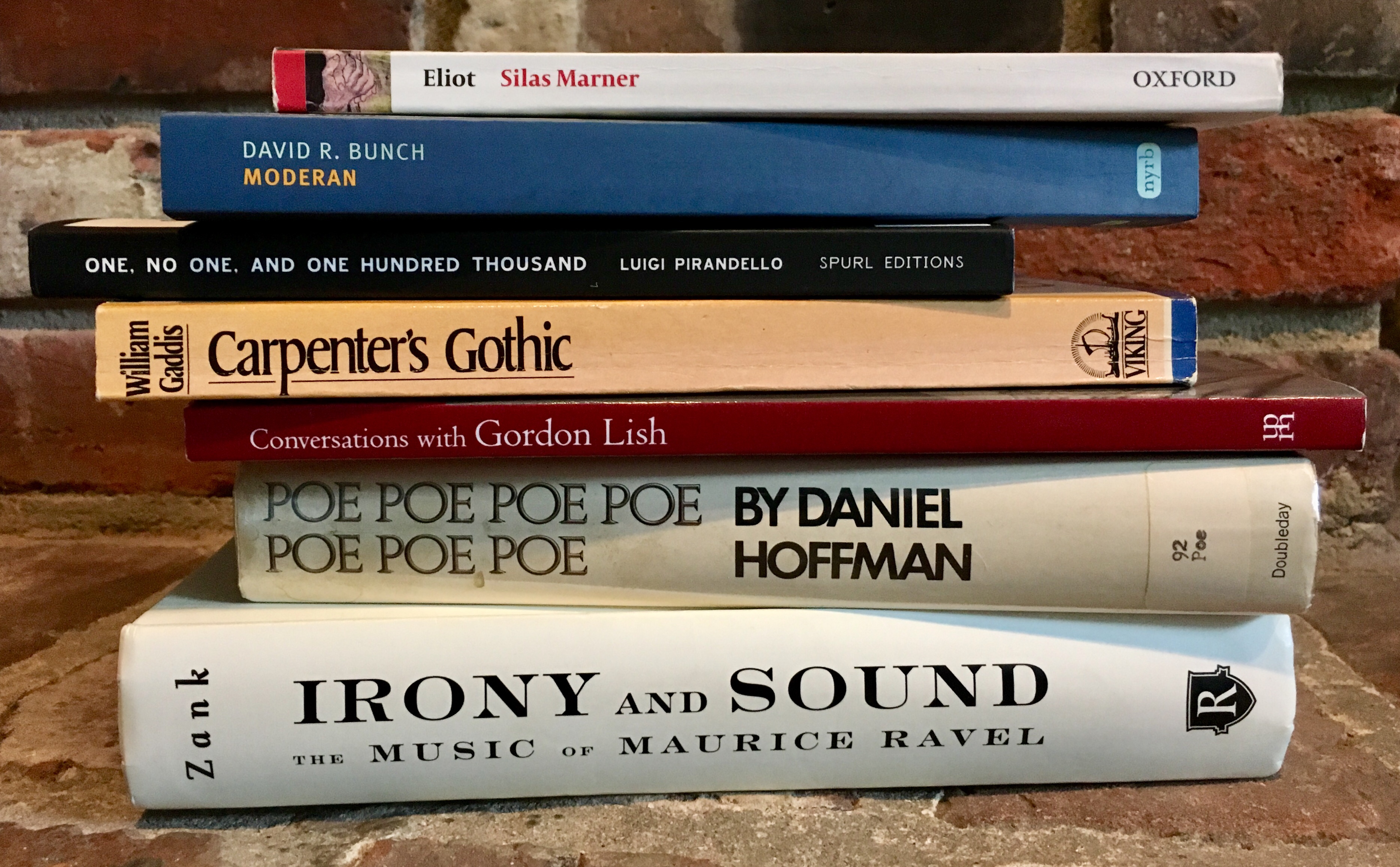
So I said above (by said I mean wrote) that I used a picture as an organizing principle for this disorganized post. The pic is of a loose stack of books that I’ve read or am reading or intend to read or have maybe halfway sorta given up on. It’s a pile that needs organizing. So, from top to bottom:
I said I’d finally read Middlemarch this year, but I find myself unwilling to commit after two or three chapters and am irritated with myself in my constantly transferring it from room to room without reading it or shelving it. Maybe I’m only interested in it because it is monstrous. (I love big fat monsters; make me read Middlemarch).
I wrote one of these Blog about posts about Gerald Murnane’s story “Stream System.” I have another thing sketched out for his story “Stone Quarry” which is like this wonderfully satirical take on metafiction. I’m mostly enjoying reading this book slowly. I hate the drive to read too fast.
I read The Passion According to G.H. by Clarice Lispector maybe five or six years ago and I pulled it out the other day because I think I’d like to reread it, because that’s what I like—rereading—I mean, I’ d prefer to reread Middlemarch without all the hard labor of, like, reading it first. But then I realized I’d never actually finished it. So I need to read it so I can reread it.
I got the Hob Broun in the mail today and I’m going to quit writing this stupid fucking blog and go read it now.
I’ll do another one of these tomorrow if I feel like it, but not if I don’t feel like it, and if I don’t not feel like it, maybe.
Between the first Sunday of September 2015 and the first Sunday of September 2016 I ran a series of posts—every Sunday that year—I called “Three Books.” I would scan the covers of the books, and I generally tried to find books with interesting design elements to them; I would also try to find a thread between the books (but not always). The posts allowed me to write about the design and aesthetics of covers, as well as other elements of the books (y’know, like, what was actually between the covers). The posts also gave me a regular goal on a Sunday. After a year, I moved on to another series of Sunday posts I called Sunday Comics; before the Three Books thing, I posted pics of my bookshelves on Sundays and wrote about that; and before that, I posted images of death masks on Sundays. A themed post of some kind every Sunday seemed to give this accursed blog a sense of direction, however false. I don’t remember how or why I quit posting Sunday comics, but searching the tag shows me I stopped at the end of June in 2017. This whole paragraph seems like a long and rambling preamble to saying something like, Maybe I should do these Blog about posts on Sundays? Huh? What do you think?
But the title said “Three Books”…so—Three Books, chosen somewhat at random:
Captain Maximus by Barry Hannah. First edition hardback by Knopf, 1985. Cover design by Fred Marcellino.
Last summer I visited Alias East Books East in Los Angeles, where, along with sometime-Biblioklept contributor Ryan Chang, I fondly fondled a signed first edition of Barry Hannah’s novel Ray. I couldn’t bring myself to pay sixty dollars for it, but one night, after a few drinks, broke down and bid on eBay for a signed Hannah—Captain Maximus. I wound up paying six dollars more than what Knopf wanted to charge folks for an unsigned edition back in ’85. This particular copy clearly has never been read. I ended up picking up the Penguin Contemporary Classics paperback version of Captain Maximus (for three dollars of used bookstore credit) and reading that instead. The signed Hannah’s spine is still pristine, and I realize that I am something awful.
The book is purple.
The Heart of a Dog by Mikhail Bulgakov. English translation by Michael Kenny. First edition hardback, Harcourt, Brace, & World, 1968. Design by Applebaum & Curtis Inc.
The World within the Word by William H. Gass. Trade paperback by Basic Books. Cover design by Rick Pracher.
Just a wonderful collection of essays. His essay on Stein is required reading, and “Carrots, Noses, Snow, Rose, Roses” is perfect metafiction posing as criticism. Lovely stuff.
I watched Martin Scorsese’s 1982 film The King of Comedy last weekend and then added it to a list of examples for a much bigger Thing I’ve been working on for a few years (and hence will never likely finish, unlike these Blog about posts). The much bigger Thing is about the relationship between Comedy and Horror—not purely the formal characteristics that belong to specific genres of literature, film, and art, but rather the relationship between the emotions themselves (with special attention to how literature, film, and art evoke that relationship).
The short thesis for this bigger Thing is that I think that comedy relies strongly on horror, and that the best provocations of horror are tempered in humor. There is a long list of examples in support of this thesis, including Goya and Bolaño and Larry David and Don Quixote and Candide and Thomas Bernhard and Surrealism and Get Out and etc. —-but that’s all for said bigger Thing, and the title of this post seems to promise Something (not a big Thing) on Martin Scorsese’s 1983 film The King of Comedy, which I recently rewatched.
I first saw The King of Comedy in the spring of 1998. I was a freshman at the University of Florida and had quickly discovered their library of films on VHS, which I would imbibe over my four years there. I started with stuff I was already a bit familiar with though. Like every other stupid eighteen-year old, I thought Taxi Driver was A Work of Genius (without fully understanding it), and I’d seen Goodfellas and Casino approximately one thousand times by this point. I started UF’s collection of Scorsese tapes with the neo-neorealism of Raging Bull, a brutal and hence thoroughly comprehensible character study, an ugly film shot in gorgeous black and white. The King of Comedy was next.
The internet in 1998 was not the internet of 2018. What I mean is that we generally learned about films through books and journals and magazines, or really other films, or really, really by word of mouth. I don’t think I had any word of mouth on The King of Comedy—what I mean is that I think I thought the film was a comedy. Which it is. Sort of. I mean, it’s funny—-very funny sometimes. But it’s also very cruel, and often scary and off putting, and generally queasy.
The King of Comedy stars Robert De Niro as Rupert Pupkin. That ridiculous name is on one hand a running joke, but on the other hand a vein of horror that pulsates throughout the film—an aberrant twitching oddity, a sort of literal curse, both on poor Rupert (who bears that name) and on every person who encounters him. Rupert is a would-be comedian who dreams (literally and often from his mother’s basement) of stardom. He dreams that he’ll achieve this stardom through a spotlight gig on The Jerry Langford Show, a Carson-style late night show hosted by Jerry Langford, played by a wonderfully fed-up Jerry Lewis.
Rupert is an autograph hound, an obsessive type of fan who makes Jerry’s life a literal terror. Rupert’s foil is Masha, a trust-fund baby played by Sandra Bernhard. Masha stalks Jerry with extreme competitive anxiety; her stalking is a lifestyle elevated to art. When Masha goes too far early in the film and hijacks Jerry’s limo, Rupert sees an opening—he saves the day, ousting Masha, but then he invades the limo (proving himself stalker supreme over Masha). In the limo ride, Rupert asks Jerry for help in advancing his career, and Jerry gives generous if general advice, which amounts to Put the work in and pay your dues. Rupert complains that he simply doesn’t have time to invest in doing the real hard grinding work, and basically demands that Jerry give him a shortcut.
In showing a deranged would-be artist who feels he’s entitled to bypass the years of work involved in honing a skill, Scorsese anticipates our current zeitgeist. Rupert Pupkin desires fame, adoration, and applause, but he is far less interested in producing an art that would earn these accolades. The King of Comedy slowly shows us that Pupkin is mentally ill, and that his disease is radically exacerbated by a culture of mass media.
The King of Comedy’s most sarcastic biteis that Rupert is eventually rewarded for his deranged behavior. He and Masha kidnap Jerry as part of a plan to get Rupert an opening set of The Jerry Langford Show. The plan succeeds, and Rupert executes it so that he not only gets to land his dream gig, he also gets to watch himself do it in front of The Girl He Liked in High School:
Rupert’s audacious gambit is part and parcel of a postmodern mass media era that makes only the slightest distinction between fame and infamy. Rupert is famous for doing something famous—and something horrific, kidnapping a beloved TV host. It’s his one bit of work, but it’s enough to land him a book deal, celebrity, and money (and a fairly short prison sentence).
Parts of Rupert’s monologue are funny, but other parts read like the memoir of a damaged soul trying to recover from an abusive childhood. And maybe these parts mix. Again, horror underwrites comedy.
This horror repeats in Scorsese’s framing of Rupert’s routine. There’s a dream-like quality to the monologue, with its television tube frame. This is not the first time we’ve seen this framing in King of Comedy—we get similar TV fantasies via Rupert’s deranged mind—but this time the plot asks us to think of it as “real,” even as Scorsese’s aesthetics suggest that the ending of the film may all be in Pupkin’s warped mind, the unseen clapping audience just another delusion of grandeur.
The same gesture is present at the end of Taxi Driver, which is essentially the twin of The King of Comedy. Travis Bickle—another ridiculous name, another loser—improbably ends up the hero of the narrative. But the conclusion of Taxi Driver has always struck me as the internal fantasy of its reactionary (anti-)hero. Likewise, The King of Comedy concludes in yet another fantasy in Rupert Pupkin’s addled consciousness.
With its metatextual contours and its insinuations of reality-as-mediated-by-mass-media, The King of Comedy is perhaps Scorsese’s most formally postmodern film (although his smaller follow-up After Hours might be his most thematically postmodern). It’s no wonder that the film didn’t land with audiences in 1983. Beyond its postmodern rhythms, The King of Comedy is essentially repulsive—nothing good happens; there is no clear hero; the world it depicts is devoid of any meaning not centered in relation to fame. Its satire is so black no light escapes. In comparison, Scorsese’s later films like Goodfellas and The Wolf of Wall Street are laugh riots.
The genius of The King of Comedy is something best felt. The film disrupts genre conventions (and audience expectations), pushing a comedy into a horror. Or maybe The King of Comedy is a horror film with comedic overtones. Or, really—I mean, what I really want to say here is:
The King of Comedy isn’t a horror film or a comedy film—like many of Scorsese’s best films, it’s a character study—realistic and engrossing and grotesque in its utter realism. Time has caught up with it. If Rupert Pupkin seemed an extreme example of the kind of derangement and alienation that could be aggravated by a mass media culture in the early 1980s, by today’s standards he’s perhaps charming. And that’s horrifying.
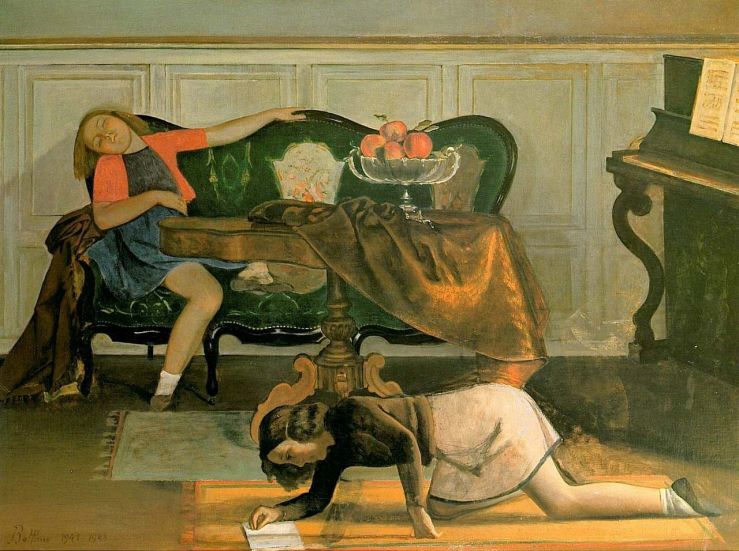
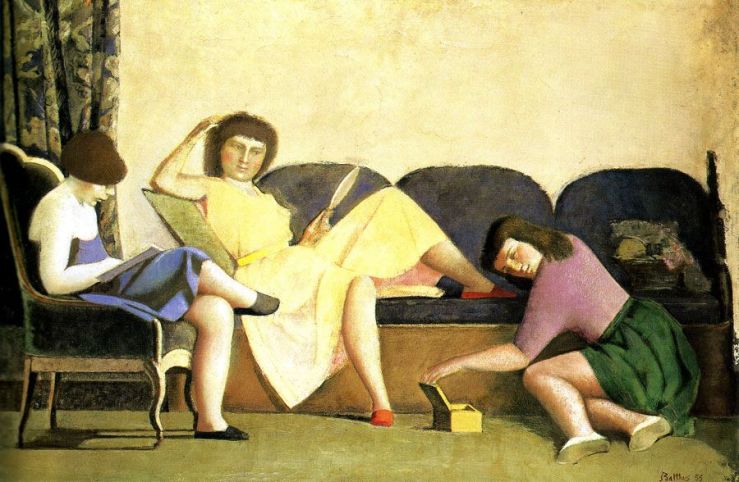
My young girls who read in dreaming poses are escaping from fleeting, harmful time: Katia, Frederique, and The Three Sisters. Fixing them in the act of reading or dreaming prolongs a privileged, splendid, and magic glimpsed-at time. A suddenly opened curtain sheds light from a window and is seen only by those who know how. Thus a book is a key to open a mysterious trunk containing childhood scents; we rush to open it like the child with butterflies, or the young girl with a moth. It is a gold-sprinkled time that avoids worldly alteration, time nimbused by a magic halo, time fixed in terms of what the smiling, dreaming girls see. It is surreal time in the true sense of the term.
—From Balthus’ 2001 memoir Vanished Splendors, “as told to” Alain Vircondelet. English translation by Benjamin Ivry.
The first Balthus painting I saw was The Bedroom. I saw it in Edward Lucie-Smith’s Movements in Art since 1945. I was maybe 17, and I found the painting not so much shocking as disturbing. It upset something in me, but I also found myself enchanted by it. In the painting an aesexual woman of dwarfish proportions, scowling and stern, pulls a black curtain to its side to allow sunlight to flood over the nude body of a young woman whose posture is simultaneously sexually vibrant and alarmingly comatose. A cat perched on a book glances out the window. There’s a dark fairy tale embedded in the painting. In its color, light, staging, subject, and theme, it’s of a piece with much of Balthus’ work. I didn’t know that over 20 years ago when I first saw it, but I did know that it intrigued me. I wanted to see more.
As a teenager, Balthus’ visions disturbed and engaged me. My response was aesthetic, but I also found a narrative even in his most static paintings. There’s an eerie peace to his reading girls that I saw then and see now. The rooms he painted were little dreams.
Now that I am older I find Balthus’ depictions of girls far, far more disturbing than I did two decades ago. Or rather, I find his paintings disturbing in a different way.
(I think here of rereading Lolita as an adult. I think I first read the book at 15 or 16, and was floored by its language; I read it again in my early 20s—and then in my late twenties. It was a different book).
And yet when I look at Balthus’ paintings of girls reading what emanates most strongly for me is that “gold-sprinkled time that avoids worldly alteration, time nimbused by a magic halo.” He captures something about the private world of reading that I identify with—what I mean is that I feel the feeling of the girls who read in his paintings.
Elsewhere in his memoir, Balthus declares—
…I completely reject the erotic interpretations that critics and other people have usually made of my paintings. I’ve accomplished my work, paintings and drawings, in which undressed young girls abound, not by exploiting an erotic vision in which I’m a voyeur and surrender unknowingly (above all, unknowingly) to some maniacal or shameful tendencies, but by examining a reality whose profound, risky, and unpredictable unreadability might be shed, revealing a fabulous nature and mythological dimension, a dream world that admits to its own machinery.
Balthus here gives us a fitting description of the “unreadability” of the visions he depicts. Key here is that both his negation (“not by”) and its parallel divergent conjunction (“but by”) frame a perfectly apt analysis of his own work—he is a voyeur, yes, and ushers in a voyeuristic eye—but he also stages a dream world that his viewers can feel.
I listened to an audiobook of Claire-Louise Bennett’s 2016 book Pond a few weeks ago, and then wound up getting a digital copy so that I could reread the stories in it.
Pond did something electric to me.
I audited most of it over the course of a weekend. This particular weekend was the first weekend of March. We had an unusually cold February in North Florida, and I’d more or less let my lawn and gardens go to hell. I audited most of Pond while gardening—cutting back dead branches, pulling thorny vines, clipping bushes, etc. I even dug a hole or two.
I had not read a review of Pond before auditing and then reading it; I’d just heard (probably on Twitter) that it was good and odd. I point out that I did not know anything about Pond before getting in to it because I mistakenly thought that Pond was a novel for most of the auditing experience. I realized only toward the end that it was not, properly speaking, a novel—or at least not a novel in the sense that we think of novels as “novels.” Pond is more like a series of related vignettes about a young woman’s life in a remote village in Ireland. And I’m not even sure what I mean by “young woman’s life” in that previous sentence. Let it stand that the book won me over very quickly with “Morning, Noon & Night,” an episode that begins with the aesthetics of breakfast, includes an ill-advised gardening adventure, a hostile academic conference, some sexy emails, and culminates in chopping. It’s wonderful.
Pond does so many things that I always want a book to do, by which I mean that Pond does things that I didn’t know I wanted a book to do until the book has done them.
Pond is unique (are we allowed to use that word?) and thus reminds me of other innovative prose I love: William Carlos Williams’ poetry, Lydia Davis’s stuff, the fictions Jason Schwartz and Gary Lutz, David Markson’s Wittgenstein’s Mistress.
But the title of this post is “Blog about Claire-Louise Bennett’s short story ‘Stir-fry,'” and I have produced a few hundred words thus far, none about Claire-Louise Bennett’s short story “Stir-fry.”
(I chose to blog about “Stir-fry”not because it is my favorite in the collection or because it is an especially representative sample of Bennett’s prose, but because it is short. The longer piece “Morning, Noon & Night” offers a richer sample of Bennett’s powers and you can click on that link and read it for free and see for yourself).
Okay, “Stir-fry.”
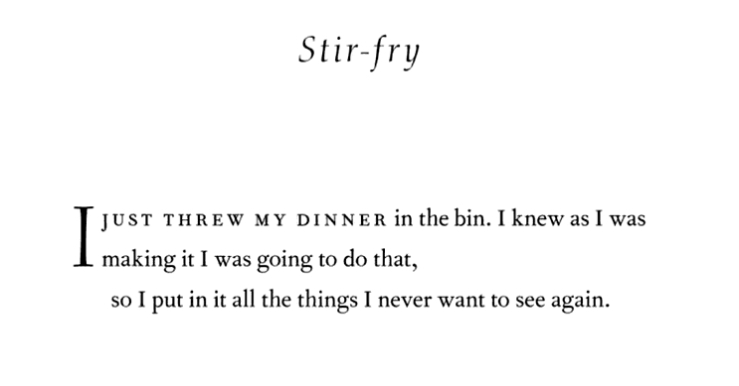
The story is a title and two sentences.
The title specifies the ostensible subject of the story, dinner.
But the story is not about dinner; the story is about throwing dinner away.
But is the story even about throwing dinner away? I suppose that’s the central action that takes place in “Stir-fry” — tossing food away — but the story is also about consciousness in the creative process.
Our narrator creates something that she knows she intends to throw away immediately after its creation.
Hence, the key line to the story is the one that begins with the coordinating conjunction so. Bennett emphasizes the line by typographically isolating it; the effect on the page approximates poetry rather than traditional prose.
“so I put in it all the things I never want to see again”: A stir-fry is usually made at least in part from leftovers or food that must be eaten soon or tossed. If we read the story literally (which we should of course), we can fill in the details with our sympathetic imaginations: A bit of rice from three days ago. That last onion. A solitary carrot going to rubber. A stub of ginger. Two small peppers, their skin now papery. The last bit of Sunday’s roast chicken. Etc.
There is something deeply satisfying for some of us in using all the food in our refrigerator.
But I think our sympathetic imagination could extend that phrase “things I never want to see again” even farther than the last few stray vegetables or half of a leftover pork loin or an egg clearly reaching its expiration: What else might have our narrator mixed into her stir-fry? The last little bits of blackberry jam that cling to a jar? Pickles she made two years ago? A questionable yogurt? Pine nuts past their prime? Those turnips? Why did we buy those turnips?
And we can push the phrase even farther if we want: If we are creating something that we know that we will immediately discard and not use for its ostensible purpose (in this case, sustenance, life force), what else might we stir in there? What are all the things we “never want to see again”? All our feeble faults and deficiencies? Our terrible creeping anxieties? Even the bad ambitions we so often trip over? Could we throw war, prejudice, avarice into our stir-fry, and then throw those away too?
Maybe I have pushed an interpretation of “Stir-fry” far too far. But I do read the vignette as a fantasy of sorts. Our narrator consciously creates something she intends to uncreate. This creative uncreation allows her to eliminate all the things she never wants to see again. The fantasy here is about opening up a new way of seeing, one unencumbered by the stale, the musty, the rancid. The desire I see is to see and taste with a fresh spirit.
Or maybe “Stir-fry” is just about throwing away dinner.
This weekend I picked up a new audiobook collection of Robert Coover short stories which has been titled Going for a Beer (presumably because “Going for a Beer” is a perfect short story). The audiobook contains 30 stories and is read by Charlie Thurston, a more than capable as an orator.
The opening story is one of Coover’s earliest published stories. “The Brother” (1962) retells the Noah narrative from the book of Genesis. I just wrote “retells,” but that’s not really the right term. Instead of retelling the story of Noah and the ark and YHWH’s flood, Coover imagines the apocalyptic affair from the perspective of Noah’s younger brother, who narrates this tale.
Noah’s unnamed brother is an earthy, sensual fellow who loves his wife and loves his wine. His wife—a sympathetic and endearing figure—is pregnant with their first child. They’re already picking out names (“Nathaniel or Anna”). Brother Noah keeps taking the narrator from his own familial duties to help build a boat though:
right there right there in the middle of the damn field he says he wants to put that thing together him and his buggy ideas and so me I says “how the hell you gonna get it down to the water?” but he just focuses me out sweepin the blue his eyes rollin like they do when he gets het on some new lunatic notion and he says not to worry none about that just would I help him for God’s sake and because he don’t know how he can get it done in time otherwise and though you’d have to be loonier than him to say yes I says I will of course I always would crazy as my brother is I’ve done little else since I was born and my wife she says “I can’t figure it out I can’t sec why you always have to be babyin that old fool he ain’t never done nothin for you God knows and you got enough to do here fields need plowin it’s a bad enough year already my God and now that red-eyed brother of yours wingin around like a damn cloud and not knowin what in the world he’s doin buildin a damn boat in the country my God what next? you’re a damn fool I tell you” but packs me some sandwiches just the same and some sandwiches for my brother
That’s kinda-sorta the opening paragraph—although no it’s not, because the whole story is just one big paragraph, a big oral fragment really, which begins with a lower-case r and keeps going in a verbal rush whose only concessions to punctuation are question marks and quotation marks. No periods or commas here folks. On the page, “The Brother” perhaps approximates the blockish brickish look of a Gutenberg Bible or even the Torah, neither of which give the reader a nice period to rest on, let alone a friendly pause between paragraphs.
“The Brother” might be typographically daunting, but the apparent thickness of verbal force on the page belies its oral charms. The story is meant to be read out loud. Hell, it’s biblical, after all—a witnessing. Read aloud, “The Brother” shows us a deeply sympathetic pair of characters, a husband and wife whose small pleasures, telegraphed in naturalistic speech, might remind the auditor of real persons living today. And yet there’s an apocalyptic backdrop here. Noah’s brother and Noah’s brother’s wife—and their unborn child, and all the unborn children—will not survive YHWH’s flood.
Coover does not paint Noah as anything but a shrugging reluctant weirdo. He’s no prophet who warns and helps his brother, but rather a defeated man:
and it ain’t no goddamn fishin boat he wants to put up neither in fact it’s the biggest damn thing I ever heard of and for weeks wee\s I’m tellin you we ain’t doin nothin but cuttin down pine trees and haulin them out to his field which is really pretty high up a hill and my God that’s work lemme tell you and my wife she sighs and says I am really crazy r-e-a-l-l-y crazy and her four months with a child and tryin to do my work and hers too and still when I come home from haulin timbers around all day she’s got enough left to rub my shoulders and the small of my back and fix a hot meal her long black hair pulled to a knot behind her head and hangin marvelously down her back her eyes gentle but very tired my God and I says to my brother I says “look I got a lotta work to do buddy you’ll have to finish this idiot thing yourself I wanna help you all I can you know that but” and he looks off and he says “it don’t matter none your work” and I says “the hell it don’t how you think me and my wife we’re gonna eat I mean where do you think this food comes from you been puttin away man? you can’t eat this goddamn boat out here ready to rot in that bastard sun” and he just sighs long and says “no it just don’t matter” and he sits him down on a rock kinda tired like and stares off and looks like he might even for God’s sake cry
Noah’s dismissing his brother’s work strikes me as utterly cruel—he makes no attempt to explain why his brother’s efforts at creating a better world are in vain. I shared the passage at length again in part because I hope you’ll read it aloud gentle reader, but also that you’ll note that maybe you didn’t note all its blasphemies—Coover’s story is larded with “my Gods” and “damns” and “goddamns,” no different than the speech of 1962, no different than the speech of 2018.
Coover gives us a narrator like us, human, earthly, driven by simple pleasures and a basic sense of love. Noah comes off like a prick. The Bible loves its heroes, but the ordinary folks don’t even get to live in the margins. There’s more morality in orality though—in conversation and communication and talk.
You don’t have to buy the audiobook though to hear “The Brother.” Here is Coover reading it himself:
In the final third of Nathaniel Hawthorne’s 1852 novel The Blithedale Romance, the narrator, having departed the titular would-be utopian farm, enjoys some city time in a hotel. He takes a voyeuristic pleasure in watching people from his window, and elects to deepen the pleasure by ordering a drink: “Just about this time a waiter entered my room. The truth was, I had rung the bell and ordered a sherry-cobbler.” The explanatory end note for my Penguin Classics copy of Blithedale gives the following recipe: “A drink made with sherry, lemon juice, sugar, and cracked ice.” I decided to make a few.
A brief internet search resulted in dozens and dozens of recipes, all more or less the same iteration: long glass, crushed ice, sherry, simple syrup, citrus (oranges cited most frequently), fresh berries if you have ’em, and a straw. The straw is the kicker here. Here is a passage from Charles Dickens’ 1844 novel Life and Adventures of Martin Chuzzlewitthat shows the titular hero’s delight with his first sherry cobbler (note Chuzzlewit’s ecstasy when he gets “the reed” to his lips):
‘I wish you would pull off my boots for me,’ said Martin, dropping into one of the chairs ‘I am quite knocked up—dead beat, Mark.’
‘You won’t say that to-morrow morning, sir,’ returned Mr Tapley; ‘nor even to-night, sir, when you’ve made a trial of this.’ With which he produced a very large tumbler, piled up to the brim with little blocks of clear transparent ice, through which one or two thin slices of lemon, and a golden liquid of delicious appearance, appealed from the still depths below, to the loving eye of the spectator.
‘What do you call this?’ said Martin.
But Mr Tapley made no answer; merely plunging a reed into the mixture—which caused a pleasant commotion among the pieces of ice—and signifying by an expressive gesture that it was to be pumped up through that agency by the enraptured drinker.
Martin took the glass with an astonished look; applied his lips to the reed; and cast up his eyes once in ecstasy. He paused no more until the goblet was drained to the last drop.
‘There, sir!’ said Mark, taking it from him with a triumphant face; ‘if ever you should happen to be dead beat again, when I ain’t in the way, all you’ve got to do is to ask the nearest man to go and fetch a cobbler.’
‘To go and fetch a cobbler?’ repeated Martin.
‘This wonderful invention, sir,’ said Mark, tenderly patting the empty glass, ‘is called a cobbler. Sherry cobbler when you name it long; cobbler, when you name it short. Now you’re equal to having your boots took off, and are, in every particular worth mentioning, another man.’
Anyway. Where was I? Oh, yeah—so I looked around for recipes. David Wondrich’s 2007 cocktail history Imbibe! gives a helpful baseline recipe by citing Jerry Thomas’s 1862 classic, How to Mix Drinks. From Thomas’s book:
Thomas doesn’t mention muddling the oranges, although pretty much every online recipe I read called for muddling.
So reader, I muddled.
Here is my variation on the sherry cobbler (or Sherry Cobbler, or sherry-cobbler). In the loose spirit of the cocktail, I made ours entirely of ingredients I already had at the house. These were for each cocktail:
–4 oz of sherry
–1/2 oz of simple syrup
–1/2 oz of maraschino syrup
–1 oz of sparkling water
–1 clementine (muddled)
–sprigs of mint
–blueberries
–crushed ice
The maraschino syrup was an afterthought after I’d mixed the cocktail and was about to pour it over ice—I wanted to get a pop of color at the bottom of the glass. The mint and blueberries were from our garden. The pic above is lousy; sorry—not sure why I didn’t move the dishcloth and maybe photograph the cocktails like, uh, not in front of my wife’s kombucha hotels.
So how was it? Pretty refreshing. My wife enjoyed it more than I did, although I’m not a huge cocktail guy. (I think it’s pretty hard, for example, to improve upon neat scotch , although I do like bourbon straight up in the hotter months).
I’ve always been fascinated by literary recipes, so I’m a bit surprised the sherry cobbler has evaded my attention until now, despite its having shown up in various novels I’ve read (including Nicholson Baker’s House of Holes, as Troy Patterson pointed out in a remarkably thorough literary history of the cocktail at Slate years ago). I’m not sure I’d go out of my way to make a sherry cobbler again (not that I went out of my way to make these ones), but the basic cobbler recipe’s spirit is very close to my approach to making cocktails at home anyway—use what you have. In fact, the major difference between the sherry cobblers I made yesterday and the kind of cocktail I’d normally cobble together for my wife on a Saturday afternoon is the sherry—I’d usually use rum or maybe vodka. Anyway, the whole thing was fun, which is like, the point of cocktails.
There are, to date, seven songs by the British rock group Electric Light Orchestra that contain the word “blue” in the title. A few of these are among ELO’s finest songs. I have put a lot of thought into this matter (by which I mean maybe five minutes), and decided that these are the correct rankings of ELO’s “blue” songs, from the not-best to the very-best:
#7. “Midnight Blue,” from Discovery (1979)
“Midnight Blue” isn’t a bad song, but it feels like a rehash of ELO’s better down-tempo ballad, “Can’t Get It Out of My Head” (from Eldorado, a much better album than Discovery). Lynne’s synthesized background vocals near the beginning point to a weirder, more-interesting tune than the standard pop song that emerges.
#6. “Birmingham Blues,” from Out of the Blue (1977)
“Birmingham Blues” is the first of two tracks from the album Out of the Blue on this list of songs with the word “blue” in the title. Out of the Blue is the only ELO album to date with the word “blue” in the title. Again, “Birmingham Blues” isn’t a bad song, but it feels like filler on an album that features songs like “Turn to Stone,” “Sweet Talkin’ Woman,” and “Mr. Blue Sky.”
#5. “Blue,” from Alone in the Universe (2015)
Technically, “Blue” is by Jeff Lynne’s ELO, but c’mon. It’s basically Jeff Lynne’s show after 1974 anyway. Alone in the Universe is a surprisingly good album—most of the songs clock in around three minutes, showing a restraint and focus not always present in the seventies stuff. “Blue” is actually a bonus track. It’s a sweet little ditty, beholden to the Beatles in the best possible way. (Lynne’s best Beatlesesque numbers synthesize the signature traits of McCartney, Lennon, Harrison—and hell, even Ringo—into something new and different).
#4. “Bluebird Is Dead,” from On the Third Day (1973)
On the Third Day is kind of the album where ELO starts to become, like ELO. “Bluebird Is Dead” is probably the loosest and rawest song on this list, and I think it’s Lynne’s vocal that puts it so high up here for me.
#3. “Mr. Blue Sky,” from Out of the Blue (1977)
“Mr. Blue Sky” is basically a perfect song. It closes out the “Concerto for a Rainy Day” side of Out of the Blue perfectly, bouncing along in a Beatles-beholden bop that unloads in not one but two—and arguably three endings.
#2. “Bluebird,” from Secret Messages (1983)
Secret Messages is a bit underrated—Jeff Lynne has some great ideas on the record (a lot of them showcased in “Bluebird”), but the ideas often fail to cohere. (For example, “Loser Gone Wild” offers a pastiche of the best and worst aspects of this era of ELO—a big contrast to the pastiche of “Mr. Blue Sky,” where everything works). “Bluebird” is a gorgeous song that has to grow on any listener. It’s corny as hell—hell, most of ELO is extremely corny, which is something I love about the band. They are Not Cool, a topic for another post. Anyway, “Bluebird” is a sweet, sad, wonderfully-overproduced song about loss. At about a minute into the jam, Lynne includes an infectious sample of himself simply repeating “work work work” — and one senses that “Bluebird” isn’t just about a human relationship, but Lynne’s own relationship to his songwriting and production.
#1. “Boy Blue,” from Eldorado (1974)
Eldorado is my favorite ELO album and “Boy Blue” is my favorite song on Eldorado. The song is another pastiche, Beatlesesque pop mixed up with orchestral flourishes, but edged around with an almost-menacing motortik drive. (In another life, ELO could have been the Great English Krautrock band). Lyrically, the song is one ELO’s most focused. Boy Blue is our hometown hero, lately at war with some heathen or another, returns: “Hey, Boy Blue is back,” the town/chorus exclaims. They make a lot of noise for their boy, and ask where he’s been for so many years in the first verse. The second verse is Boy Blue’s reply, wherein he describes the hell of war, where he saw “bold knights, dropping down like flies, “kings, rolling in the mire,” and even God pointing “the finger of doom to our foes.” Lynne’s greatest couplet is surely in this song: “I have fought in the holiest wars/ I have smashed, some of the holiest jaws.” The violence Boy Blue has experienced (he’s been jailed and impaled, among other ordeals) has made him reflect that “no man should be stricken with fear.” He ends his verse by declaring, “no man, shall cause me to take up arms again.” Lynne’s delivery of these lyrics is what really makes the song soar though—his Boy Blue persona becomes more intense even as he builds to his promise of peace.
And here is a Spotify playlist of the songs; the sequencing has nothing to do with the rankings above:
This is a bait and switch. The bait was a promise in the title of the post for a Blog about John Berryman’s Dream Song 265, “I don’t know one damned butterfly from another.” Hey, I’m sorry, but the switch is that I have nothing to add here—I mean what could I add here?—-like what hey I want to say, is, just read Berryman’s poem—-
I don’t know one damned butterfly from another
my ignorance of the stars is formidable,
also of dogs & ferns
except that around my house one destroys the other
When I reckon up my real ignorance, pal,
I mumble “many returns”—
next time it will be nature & Thoreau
this time is Baudelaire if one had the skill
and even those problems O
At the mysterious urging of the body or Poe
reeled I with chance, insubordinate & a killer
O formal & elaborate I choose you
but I love too the spare, the hit-or-miss,
the mad, I sometimes can’t always tell them apart
As we fall apart, will you let me hear?
That would be good, that would be halfway to bliss
You said will you answer back? I cross my heart
& hope to die but not this year.
Hey, okay. I encourage you to quit now, or better yet, reread our boy Berryman. But I’ll add a little, even though I said I wouldn’t.
I don’t know one damned butterfly from another
—but I think you know about beautiful fragile transmuting things
my ignorance of the stars is formidable,
—same
also of dogs & ferns
–I know a bit about dogs; less about ferns
except that around my house one destroys the other
–I hope it’s the dogs destroying the ferns if I have to pick a side, although I’m not unsympathetic to ferns.
When I reckon up my real ignorance, pal,
I mumble “many returns”—
–This is a great rhyme. I feel like I’m the speaker’s pal here too—maybe it’s all the wine I’ve put down my fat throat, but I feel like I get what he’s doing here. I have some fat real ignorance my ownself.
next time it will be nature & Thoreau
–Oh give us a Transcendentalist vamp Johnny! (Or is it Henry?)
this time is Baudelaire if one had the skill
–Oh if one had the skill oh (I think you have the skill Johnny Henry)
and even those problems O
–Oh Oh O Ho oH O hO
At the mysterious urging of the body or Poe
–I’m reminded here of Dream Song 384 where Henry digs up his dead suicide father’s corpse from the grave: “I’d like to scrabble till I got right down / away down under the grass / and ax the casket open ha to see / just how he’s taking it, which he sought so hard / we’ll tear apart the mouldering grave clothes ha.” The manic ha is more indebted to Poe though than any grave openings or casket axings.
reeled I with chance, insubordinate & a killer
O formal & elaborate I choose you
–Hey but this is about Berryman’s art, his poetry, always his fucking poetry. Formal and elaborate? Out here choosing?
but I love too the spare, the hit-or-miss,
–Oh hey me too. I mean that’s my jam too Henry John.
the mad, I sometimes can’t always tell them apart
–I can’t either.
As we fall apart, will you let me hear?
That would be good, that would be halfway to bliss
–I think we’d all like to be let to hear.
You said will you answer back? I cross my heart
& hope to die but not this year.
I am glad I reread Nathaniel Hawthorne’s 1852 novel for many reasons. One of those reasons is because I had completely forgotten to remember a marvelous scene near the end of the novel, in Ch. XXV — “The Masqueraders.” This episode happens near the end of the chapter. Hawthorne’s stand-in Miles Coverdale has decided to return to Blithedale after spending some time out in, like, the world.
Coverdale’s return to the utopian project he half-heartedly abandoned is thoroughly coded in Hawthorne’s signature ambivalence: He notes “a sickness of the spirits kept alternating with my flights of causeless buoyancy” as he walks through the wood. Approaching the Blithedale farm, and feels an “invincible reluctance” in his return, which causes him to linger in the forest. By and by, as the lovely transitional phrase goes, Coverdale winds his way back to his “hermitage, in the heart of the white-pine tree.” (The white-pine reference strikes me as an oblique reference here to Hawthorne himself—or rather, a nod to a distinction between white pine and black hawthorn trees, alter egos).
Here in his hermitage he rests among grapes dangling in “abundant clusters of the deepest purple, deliciously sweet to the taste.” Coverdale’s hermitage is an idealized, natural—transcendental—version of Blithedale, the grapevines (a prefiguration of communication in the American parlance) a kind of perfectly polygamous knot of communal existence.
Taken up in solo-bacchanalia, Coverdale begins devouring the grapes. Always the loner, always the voyeur, he checks out the house from his arboreal perch and notes its emptiness. He decides, drunken on sweet grapes, to skulk through the woods, where he hears “Voices, male and feminine; laughter, not only of fresh young throats, but the bass of grown people.” He continues—
The wood, in this portion of it, seemed as full of jollity as if Comus and his crew were holding their revels in one of its usually lonesome glades. Stealing onward as far as I durst, without hazard of discovery, I saw a concourse of strange figures beneath the overshadowing branches. They appeared, and vanished, and came again, confusedly with the streaks of sunlight glimmering down upon them.
“Comus and his crew” — what a lovely evocation! Comus, cup-bearer and heir of Bacchus, is a figuration of erotic chaos. Hawthorne ushers his hero into a scene of pastoral American anarchy, a strange Arcadia that Walt Whitman would try to replicate in Leaves of Grass a few years later. Note the admixture of cultures here in Hawthorne’s transcendentalist Halloween:
Among them was an Indian chief, with blanket, feathers, and war-paint, and uplifted tomahawk; and near him, looking fit to be his woodland bride, the goddess Diana, with the crescent on her head, and attended by our big lazy dog, in lack of any fleeter hound. Drawing an arrow from her quiver, she let it fly at a venture, and hit the very tree behind which I happened to be lurking. Another group consisted of a Bavarian broom-girl, a negro of the Jim Crow order, one or two foresters of the Middle Ages, a Kentucky woodsman in his trimmed hunting-shirt and deerskin leggings, and a Shaker elder, quaint, demure, broad-brimmed, and square-skirted. Shepherds of Arcadia, and allegoric figures from the “Faerie Queen,” were oddly mixed up with these. Arm in arm, or otherwise huddled together in strange discrepancy, stood grim Puritans, gay Cavaliers, and Revolutionary officers with three-cornered cocked hats, and queues longer than their swords. A bright-complexioned, dark-haired, vivacious little gypsy, with a red shawl over her head, went from one group to another, telling fortunes by palmistry; and Moll Pitcher, the renowned old witch of Lynn, broomstick in hand, showed herself prominently in the midst, as if announcing all these apparitions to be the offspring of her necromantic art.
Again though, in classic Hawthorne fashion, our author hedges all bets, tempering his mythical romantic flight in skepticism, here embodied by Silas Foster, the only real farmer (real earthworker) of Blithedale:
But Silas Foster, who leaned against a tree near by, in his customary blue frock and smoking a short pipe, did more to disenchant the scene, with his look of shrewd, acrid, Yankee observation, than twenty witches and necromancers could have done in the way of rendering it weird and fantastic.
Our narrator Coverdale also spies some men “with portentously red noses…spreading a banquet on the leaf-strewn earth; while a horned and long-tailed gentleman” tuning up a fiddle. The end result:
So they joined hands in a circle, whirling round so swiftly, so madly, and so merrily, in time and tune with the Satanic music, that their separate incongruities were blended all together, and they became a kind of entanglement that went nigh to turn one’s brain with merely looking at it.
The entanglement here—which eventually explodes in riotous communal laughter—recalls the polygamous knot of grapevines that shrouded Coverdale’s hermitage.
The great laughter prompts Coverdale to explode in his own laughter, whereupon the Bacchic party sets out after him with comic-murderous intent:
“Some profane intruder!” said the goddess Diana. “I shall send an arrow through his heart, or change him into a stag, as I did Actaeon, if he peeps from behind the trees!”
Coverdale flees.
He eventually happens upon an old rotting woodpile covered in moss, where he daydreams about “the long-dead woodman, and his long-dead wife and children, coming out of their chill graves, and essaying to make a fire with this heap of mossy fuel!” — this before finally giving himself up to the Blithedale crew.
The episode strikes me very much as a sequel or reboot of Hawthorne’s 1835 story “Young Goodman Brown,” in which a Puritan naif wonders into the woods dark and deep and witnesses all the horrors of his young country made real—he sees the dark heart of his community beating naked and bloody and raw and Satanic—and it changes him forever, essentially dulling his soul unto a living death. The American Arcadia episode of Blithedale though is a bit richer in its mythos, its paganism more complex and inclusive, its perspective character more attuned to the vibrant possibilities of a transcendental community, even as he stands on its outside—and what is an outsider but the most vital secret ingredient of any community?
Ten or twelve years ago my aunt, who is the best home cook I can think of and who has made some of the best meals I have ever eaten, shared her recipe for oven rice for me. This is not a complex recipe, but rather a simple take on cooking rice that (at least for me) always turns out perfect. My aunt gave me this recipe after I tried her rice and remarked on how perfect it was—not too wet or too dry, certainly not mushy or crispy or any other texture that wasn’t perfectly pleasantly perfect. I complained that my rice often turned out too soft or too hard or too sticky or too dry. She asked how I cooked it (standard boiling and then simmering on the stove top), and then told me to start cooking it in the oven. I’ve never gone back.
This is my standard rice dish—like, if I’m going to make rice as a side, or make rice to go with beans or chicken gravy, etc., this is the go to. I generally use long grain white rice, but I’ve used the exact same recipe with various brown rices, as well as japonica, jasmine, basmati, and even middlins. I’ve had the best results when I never vary the steps that I follow; when I’ve tried to follow (or in most cases adapt) a particular rice’s cooking directions instead of following my aunt’s process, the results have never been quite as good.
Here’s the basic recipe.
You will need—
An oven
A stove top
A heavy bottomed pan, preferably enameled cast iron (I’ve found a 3.5 quart round dutch oven is ideal)
One cup of rice
Two cups of liquid—I like chicken stock or chicken broth, but do what you feel
Salt
Olive oil
This isn’t that complicated to make:
Preheat the oven to 350°F (or your oven’s equivalent of that idealized temperature—I think you get what I mean. I mean, Know thy oven).
Coat a heavy-bottomed pan (one that can go in the oven) with good olive oil, then stir in a cup of rice. Salt the pan, but, hey, don’t put too much salt in there.
Heat up the pan on your favorite stove eye (or at least your second favorite—if you have another dish under way—maybe some greens, maybe chicken innards and onions, maybe red beans—don’t be afraid to set it aside for a moment. The rice only needs to set on the eye for less than the length of one song by the American punk rock band The Ramones. You can get your black eyed peas back to their spot in no time).
Keep stirring until the rice is translucent but not the least bit browned. (Hey, don’t stop stirring like I did to take this pic earlier tonight. You can see on my spoon that the rice is almost there—some grains are not translucent yet though).
Add your two cups of liquid (preferably chicken broth or stock). I like to take the rice off the heat when I do this, and give it maybe 30 seconds so that it’s not too hot when I add the liquid. Avoid adding cold liquid to the dish. (You can also add alcohol before the two cups of liquid—sherry or white wine are both good, or even red if you’re feeling adventurous—but keep it to just a few ounces and cook it out before you add the broth).
Bring the rice and broth to a not-quite boil. Like, I hope you preheated that oven like you were supposed to, because it should be good to go. Put a lid on your dish and stick that sucker in the oven for 30 minutes. Set a timer, because you’re going to forget!
Take the dish out after 30 minutes and don’t open it until you plan to serve it (it should be fine for a while if you’ve used a heavy dish). You don’t need to fluff it if you’ve done it right.
The title of this blog post is Blog about a devastating passage from Gerald Murnane’s story “Stream System,“ but I admit that I wanted to put the word story under a bit of suspicion—rein it in with quotation marks, call it a “story.”
See, “Stream System” isn’t really a “story” — except that it is — “Stream System” is, like, a kind of biographical excerpt, less fictionalized (Yeah but how do you know that?) than the other pieces I’ve thus far read in the 2018 collection of Gerald Murnane’s fiction (“fiction”?) Stream System.
In Stream System the story “Stream System” gets a little asterisk next to its title. The initial asterisk’s twin in the footnote informs the reader:
“‘Stream System’ was written to be be read aloud at a gathering in the Department of English at La Trobe University in 1988.”
(The original campus of La Trobe University is in Melbourne, Australia, a city I visited three times as a boy between 1987 and 1991; during this time my family lived in Papua New Guinea and New Zealand (but never Australia). The city of Melbourne, Florida is 177 miles south of where I currently live, and although I have driven past it, I have never visited it).
So “Stream System” is not a fiction but a speech, a written speech, but really a “story,” I guess—a story (sort of) about Murnane’s boyhood in the southeastern Australian state of Victoria.
In any case, in titling this blog post Blog about a devastating passage from Gerald Murnane’s story “Stream System,” I found myself wanting to put quotation marks around “story,” but realizing that those quotation marks would butt up against the quotation marks of “Stream System” (quotation marks indicating, This is the title of a short work—perfectly logical quotation marks in a shared punctuation system). And well yeah so I realized that the two sets of quotation marks did not belong to the same logical system. One set of quotation marks are so-called “scare quotes”; the other set of quotation marks are simply the basic English punctuation for indicating the title of a short work—whether the work is an essay, speech, poem, or short story. Even more importantly, putting the two sets of quotation marks together looked ugly as hell.
I started with the title for the post and seem to not have gotten past it. This has been a bad start, but I’ll keep blogging.
I’m not going to summarize “Stream System” — unpacking it would be too much, like drawing a diagram of an intricate memory map. I mean, really it’s better to just read it. I’ll just say that it condenses memory into the concrete reality of place, and makes those memories bristle with sharp, strange meaning.
I just said I’ll just say, but I’ll also just say — “Stream System” is deeply unsettling: Its repetitive tics are addictive; its compulsions compel the reader along into the speaker’s reflective labyrinth. And yet for all its coercive power, Murnane’s anamnesis is also extraordinarily discomforting. Murnane’s prose never editorializes, yet its concrete prowess, its evocation of surfaces, contours, true and real details—all of this leads the reader towards an emotional epiphany that the narrator refuses to name, directly invoke, or otherwise dramatize.
And yet so but well really “Stream System” does dramatize its epiphany, or one of its epiphanies, but in this really oblique and elliptical way that walks and talks through the story’s central trauma, walks through it in such a way that it seems like the narrator has kept going, leaving the reader a bit winded and left behind, holding a stitch in his side, saying, Hey, wait, what about this, what about this really really devastating thingyou just evoked?
I realize that I titled this post Blog about a devastating passage from Gerald Murnane’s story “Stream System,” but I admit that I’m not really going to write about that devastating passage—not really. Maybe I should have titled it Blog leading up to a devastating passage from Gerald Murnane’s story “Stream System” — I mean, that’s what I should have titled this post, and I could easily go back and rewrite the title and revise this whole thing. But I won’t. Here are those four paragraphs that so very much got to me:
My brother spoke to nobody but he often looked into the face of a person and made strange sounds. My mother said that the strange sounds were my brother’s way of learning to speak and that she understood the meaning of the sounds. But no one else understood that my brother’s strange sounds had a meaning. Two years after my parents and my brother and I had left the house of red bricks my brother began to speak, but his speech sounded strange.
When my brother first went to school I used to hide from him in the schoolground. I did not want my brother to speak to me in his strange speech. I did not want my friends to hear my brother and then to ask me why he spoke strangely. During the rest of my childhood and until I left my parents’ house, I tried never to be seen with my brother. If I could not avoid travelling on the same train with my brother I would order him to sit in a different compartment from mine. If I could not avoid walking in the street with my brother I would order him not to look in my direction and not to speak to me.
When my brother first went to school my mother said that he was no different from any other boy, but in later years my mother would admit that my brother was a little backward.
My brother died when he was forty-three years old and I was forty-six. My brother never married. Many people came to my brother’s funeral, but none of those people had ever been a friend to my brother. I was certainly never a friend to my brother. On the day before my brother died I understood for the first time that no one had ever been a friend to my brother.
Two weeks ago, on Easter Sunday/April Fools’ Day, I wrote a blog post I titled “Blog about Blog about” declaring a goal to blog — like, to write words about something — every day in the month of April 2018. The basic idea was to free myself from some of the anxiety that has built up into a genuine fear of writing over the past few years, which has led to me simply not to write as much as I used to.
It is now half way through the month of April and I have written fourteen (including this one) of my intended thirty posts. I failed to write on Friday the 13th.
Here are the things I’ve written about so far and my reflections on forcing myself to write about them in a fast and loose spirit:
April 2, on Iris Murdoch’s novel The Bell: I finished The Bell the day after I started the Blog about project. Had I not been doing the project, I probably would have sketched a few notes toward a review that I’d never end up actually finishing. It would hang out in the blog’s drafts folder forever. I’m strangely and probably unduly happy with what I ended up writing.
April 5, on Goya’s painting The Straw Man: I was very tired and did not want to write. I pulled down Robert Hughes’ biography Goya and thumbed through it, landing on a page I’d dogeared. Then I wrote the post. This method—grabbing a book somewhat at random—-also seems like a good way to write a post.
April 6, on the etymology of the word “blog”: I don’t even remember writing this one. I guess that’s why we write, to remember. I think that’s one of Socrates’ observations (or at least I think Plato wrote it down that Socrates observed this).
April 7, on Don DeLillo’s novel The Names: I often feel a bizarre and unnecessary guilt when I do not write about a novel I’ve read. I read The Names earlier this year and had intended to write about it and then didn’t. Or rather, I did write a bit about it, but I got bogged down in a kind of silly accounting of the novel’s approach to linguistics, which isn’t really what interested me about it that much anyway. The Blog about approach freed me to the extent that I didn’t even bother to quote from the novel, which is like, a bad approach to writing reviews—but a blog isn’t a review.
April 10, on the“ The Silvery Veil” tale that’s embedded in The Blithedale Romance: I also made some connections here to Madame Psychosis, a character in David Foster Wallace’s novel Infinite Jest. I’m sure someone’s already made those connections and written about them somewhere, but most of my Google searches led me back to, like, my own blog, which says more about my search strategies than anything else I guess.
April 13: Didn’t write. Couldn’t get it out. Make up post? How about this picture I took of a stack of books I’m reading that I thought I might write about it and then thought, Nah…
April 15 is today. I saw Wes Anderson’s film Isle of Dogs with my wife and kids and thought I would write about it, but then I didn’t. I wrote this post instead.
In the novel’s second chapter, the Hawthorne-figure (Coverdale) arrives at Blithedale on “an April day, as already hinted, and well towards the middle of the month.” He complains that though the morning could be described as “balmy,” by noon it was snowing. Hawthorne’s corresponding journal entry (composed over a decade before he published Blithedale) perhaps-mockingly refers to Brook Farm as a “polar Paradise”; some of this language finds its way into the protagonist’s description of Blithdale: “Paradise, indeed! Nobody else in the world, I am bold to affirm—nobody, at least, in our bleak little world of New England,—had dreamed of Paradise that day except as the pole suggests the tropic.”
There are twenty-four chapters to Blithedale, and Hawthorne devotes the first five to that first day (presumably April 13th, 1841). The novel’s sixth chapter, “Coverdale’s Sick Chamber,” begins the next morning with our narrator too sick to attend to his first day of farm work. However, Hawthorne’s journal makes clear that the real-life Hawthorne did not fall ill until a few weeks later, around April 28th, and that he recovered around May 4th (“My cold no longer troubles me, and all the morning I have been at work under the clear, blue sky, on a hill-side”).
(I know my audience—you come to this site to read about Nathaniel Hawthorne’s head colds, right?).
Unlike his stand-in Coverdale, Hawthorne went to work at Brook Farm almost immediately. He recounts his first morning’s work in his journal entry for April 14, which I have annotated via footnotes:
April 14th, 10 A.M.–. . . I did not milk thecows last night, 1 because Mr. Ripley 2 was afraid to trust them to my hands, or me to their horns 3, I know not which. But this morning I have done wonders. 4 Before breakfast, I went out to the barn and began to chop hay for the cattle, and with such “righteous vehemence,” as Mr. Ripley says, did I labor, that in the space of ten minutes I broke the machine. 5 Then I brought wood and replenished the fires; and finally went down to breakfast, and ate up a huge mound of buckwheat cakes. 6 After breakfast, Mr. Ripley put a four-pronged instrument into my hands, which he gave me to understand was called a pitchfork 7; and he and Mr. Farley being armed with similar weapons, we all three commenced a gallant attack upon a heap of manure. This office being concluded 8, and I having purified myself, I sit down to finish this letter. . . .
Miss Fuller’s 9 cow hooks the other cows, and has made herself ruler of the herd, and behaves in a very tyrannical manner. . . . I shall make an excellent husbandman,–I feel the original Adam 10 reviving within me.
1 Coverdale’s first night at Blithedale ends with Slias Foster (the only real farmer there) telling everyone to go to sleep early as they have “nine cows to milk, and a dozen other things to do, before breakfast.”
2 George Ripley, a Unitarian minister and charter member of the Transcendentalist Club, founded Brook Farm in 1840. Following Charles Fourier’s brand of communal socialism, Brook Farm was intended to put transcendentalist idealism into concrete action. Ripley has no clear corollary in Blithedale as far as I can tell.
3 Never fear—Hawthorne reports in his journal a few days later (April 16th): “I have milked a cow!!!” What charming enthusiasm! Not two !! but three exclamation marks!!! Hawthorne only deploys a triple exclamation one other time in the journals collected as The American-Notebooks: On May 31st, 1844, he joyously notes, “P.S. 3 o’clock.–The beef is done!!!” Dude got excited for bovines.
4 I genuinely love Hawthorne’s ironic humor, which I think is often overlooked by some readers.
5 Good job breaking the farm equipment there, city boy! The reference to “machine” here is vague; you can read more about 19th-century feed-cutters (and see some images of them) here.
6 A contemporaryish recipe for buckwheat cakes from S. S. Schoff and B. S. Caswell’s 1867 cookbook The People’s Own Book of Recipes and Information for the Million: Containing Directions for the Preservation of Health, for the Treatment of the Sick and the Conduct of the Sick-room : with a Full Discussion of the More Prominent Diseases that Afflict the Human Family, with Full Directions for Their Rational Treatment : Also, 1000 Practical and Useful Recipes, Embracing Every Department of Domestic Economy and Human Industry : with Copious Notes and Emendations, Explanatory and Suggestive:
7 If you haven’t caught on, Hawthorne (and the rest of these fops too) is going to be a terrible farmer.
8 Hawthorne’s phrase “a gallant attack upon a heap of manure” is a wonderfully poetic turn, but his referring to finishing his shit-shoveling as “this office being concluded” straight up kills me.
9 Margaret Fuller was the author of Woman in the Nineteenth Century, one of American feminism’s earliest works. She was also the first editor of The Dial, (first a transcendentalist journal, and later a vehicle for modernist literature). Fuller spent time at Brook Farm, although she was never a full member. Many critics and historians suggest that Fuller is in part the inspiration for Zenobia, the soul of Hawthorne’s Blithedale.
10 The biblical Adam was of course the first gardener. Hawthorne’s romantic turn of phrase points to the idealism of Brook Farm’s utopian experiment—but also underscores the eventual fall.
I’m not sure exactly how many nested layers there are to Lydia Davis’s short story “Happiest Moment.” Sometimes I count as many as nine frames to the tale, sometimes only four or five. Sometimes the story seems its own discrete entity. A matryoshka doll could look like one thing or lots of things, I guess, and this matryoskha doll points back at herself: When you open the final doll, the minutest level of narrative, you find that you’ve found the source of the story. The biggest doll is there nesting in the belly of the smallest doll.
But I’m getting ahead, maybe. Break it down:
“Happiest Moment”
The title is the first frame, the big doll that declares: This is a story.
If you
The second-person pronoun here is general, sure, but also points directly at you, you reader you. We have here another frame, one outside of the story (because you are the reader) but also bounded inside of it (as the character you).
ask her what is a favorite story she has written,
We’re not into the next frame yet, but we’ve got a new character, a her—a story writer! Like Lydia Davis! The author of this particular story!
she will hesitate for a long time
Still no new frame, but rather the space between layers, the hesitation, the drawing together of thought, judgment, analysis, reflection—Davis doesn’t make the reader feel any of that rhetorically, instead snappily snapping to the point of this whole deal.
and then say
Okay here’s the next frame. I’m not counting though.
it may be this story that she read in a book once:
Good lord, where to start here. Okay, so, we have another frame, but even more significantly, we have this verbal shift: Our her, our she, our hero-author, who has been asked (hypothetically by interlocutor you) about a favorite story she’s written avers that the favorite story she’s written is a story that she read in a book once.
(To save me the trouble of coming back later: Of course our hero-author is writing the story she read in a book once now; “Happiest Moment” is this performance, kinda, sorta, kindasorta).
an English language teacher in China
There’s a frame.
asked his Chinese student
Another frame (and a second ask).
to say what was the happiest moment in his life.
The student, like the hero-author-has to say his answer (not write it).
The student hesitated for a long time.
(Like the hero-author—note the precise repetition of verbs in this tale).
At last he smiled with embarrassment
(God I love this guy).
and said that his wife had once gone to Beijing and eaten duck there,
(We’re getting to our climax folks).
and she often told him about it,
Another frame, another telling.
and he would have to say
Our verb, our answer—
that the happiest moment of his life was her trip and the eating of the duck.
What a sweet, sweet ending.
The Chinese English language student’s wife’s enjoyment of duck in Beijing is his favorite memory, despite it not being a memory at all, but rather the story of a memory, not his own, but his beloved’s. He relays this memory of someone else’s to his English teacher and the memory somehow ends up in a book, which the hero-author of “Happiest Moment” somehow reads, and then attests to be the most favorite story she has written, despite the fact that she makes it clear that this is a story she read and didn’t write—although of course, she wrote it, because it is the story “Happiest Moment.”
William Carlos Williams’ final and posthumous book Pictures from Brueghel and Other Poems (1962) opens with a cycle of ten ekphrastic poems that describe (and subtly interpret) ten paintings by the sixteenth-century Flemish painter Pieter Brueghel the Elder.
These poems are, in my estimation, some of Williams’ finest. Possibly the most famous of these poems is “Landscape with the Fall of Icarus,” a devastating observation of how inclined we are to look away from miracles.
Another of Williams’ Brueghel poems, “The Dance,” which takes The Peasant Dance as its subject, is also widely-anthologized; however Williams’ poem “The Dance” was published in The Wedge (1944). Williams’ “The Dance,” which begins “In Breughel’s great picture, The Kermess, / the dancers go round,” is frequently and incorrectly cited to have been published in Pictures from Brueghel (a cursory internet search shows this misinformation appears in Harper’s, as well as the last resort of lazy high school students, Shmoop). Williams did publish a poem called “The Dance” in Pictures from Brueghel and Other Poems, but this “Dance” is very much one of those other poems (this “Dance” begins “When the snow falls the flakes / spin upon the long axis,” for the record). That The Peasant Wedding is another subject of Pictures of Brueghel may also account for the spread of this misinformation (which can be resolved simply by opening the second volume of The Collected Poems of William Carlos Williams, which includes both The Wedge and Brueghel). But I find myself going on a bit too much about this simple mistake.
Let’s get to the poem:
“The Wedding Dance in the Open Air”
by
William Carlos Williams
Disciplined by the artist
to go round
& round
in holiday gear
a riotously gay rabble of
peasants and their
ample-bottomed doxies
fills
the market square
featured by the women in
their starched
white headgear
they prance or go openly
toward the wood’s
edges
round and around in
rough shoes and
farm breeches
mouths agape
Oya !
kicking up their heels
“The Wedding Dance in the Open Air” echoes the sensual depth of Williams’ earlier poem “The Dance” (1944), which emphasized the hips and bellies and shanks of those dancers who are “swinging their butts” (!) to “the squeal and the blare and the / tweedle of bagpipes” as they prance about.
The word “prance” is repeated too in “Wedding Dance” — and not only do our partygoers prance, they even “go openly / toward the wood’s / edges,” the edge of civilization where civilization gets made.
At the other edge of the painting, the foreground, are some of the boldest of Williams’ “riotously gay rabble.” But should I call them “Williams’ ‘riotously gay rabble'” or Brueghel’s? I think that it is Williams’ interpretation that matters here, but Brueghel gives him the material with which to grapple.
Look at those colors, look at those codpieces! Look at the hands, twisting, gripping, artfully fingering!
Williams captures the painting’s sexual energy not just in lines that highlight the “ample-bottomed doxies” who fill this market square, but also in the vivacious images of “mouths agape” and heels a’ kicking. The poem pulses with an energy proximal to the painting, an energy simultaneously alien and native, highlighting not only the difference in the two art forms—poetry and painting—but also the space between the viewer and the thing being viewed.
Enhancing the poem’s ekphrastic powers of imagery and feeling are the subtle rhymes of Williams’ “The Wedding Dance.” While one can find the odd (very odd) rhyme or three in WCW’s poetry, “The Wedding Dance” makes for one of the poet’s more direct concessions to poetry’s most common formal feature. The second stanza gives us “gear” slipping into “their,” picked up again in the fourth stanza’s “headgear,” and more subtly touched on in the final lines of stanzas six and seven, “breeches” and “heels.” Hell, “edges” in the fifth stanza basically rhymes with “breeches.” This thread of slant rhymes approximates the off-kilter, elliptical dance Brueghel depicts. Williams kneads guttural g sounds and harsh rs into his poem, roughening his poetry to match his rustic subject. And yet there’s just the right measure of sensuality that slips through the poem, just enough to get the rough words wet.
Like any successful ekphrasis, Williams’ poem transcends a mere physical description of art. He does describe The Wedding Dance in Open Air, yes, but the description does more than relay the physical contours of Brueghel’s art, or Williams’ analysis of Brueghel’s art—William gives us something of the painting’s spirit, captured in language, sound—another way of feeling something beautiful. Oya!
This afternoon I got to Ch. XIII of Nathaniel Hawthorne’s novel The Blithedale Romance. Titled “Zenobia’s Legend,” most of the chapter is given over to the titular heroine’s tale “The Silvery Veil,” a wonderfully pre-postmodern moment in Hawthorne’s novel.
Let’s look lookingly at the layers: The Blithdale Romance is Hawthorne’s ironic-but-sincere dark-romantic semi-autobiographical account of his time at Brook Farm, a failed utopian community of Transcendentalists who maybe didn’t quite, uh, transcend. Zenobia is based partially on the great American feminist Margaret Fuller (who also did time on Brook Farm). Taking center stage here in (the aptly-numbered) thirteenth chapter of Blithedale, Zenobia extemporizes a story about The Veiled Lady. This Veiled Lady is a local celebrity, a clairvoyant of some renown who (we learn in the opening chapter of the novel) has recently disappeared. Zenobia’s yarn is a leisure-time amusement, one she contends that she’ll spin to get out of an apparent rut:
“I am getting weary of this,” said she, after a moment’s thought. “Our own features, and our own figures and airs, show a little too intrusively through all the characters we assume. We have so much familiarity with one another’s realities, that we cannot remove ourselves, at pleasure, into an imaginary sphere. Let us have no more pictures to-night; but, to make you what poor amends I can, how would you like to have me trump up a wild, spectral legend, on the spur of the moment?”
Ironically however, Zenobia clearly relies on her “own features” as well as the features of Blithedale’s spectral ingenue Priscilla to inform her performance. Despite her declaration to “remove” herself and her auditors “into an imaginary sphere,” Zenobia essentially recasts poor Priscilla’s waifery into a supernatural ultraromantic mode. The story’s basic conceit is thus: There is a famous veiled lady who may be extraordinarily beautiful or who may be extraordinarily ugly. No one knows what she looks like because like the the veil obviously hides her face, preventing any viewer’s agency to interpret for himself.
Zenobia’s legend is a tale within a tale within a tale—a performance that each member of the small Blithedale community will recode into their own readings. However, Zenobia guides her audience toward a certain conclusion, all but declaring that meek Priscilla is in fact the Veiled Lady—hell, Zenobia even throws a bit of gauze she’d been vamping with over the poor dear’s head at the climax of her tale.
“The Silvery Veil,” in another pre-postmodern layer, is a thin but clear echo of Hawthorne’s famous allegory “The Minister’s Black Veil,” which was published 15 years before The Blithedale Romance, and would clearly have been known to Hawthorne’s intended audience of Transcendentalites. (There’s perhaps a more clear connection between “The Silvery Veil” and “The Minister’s Black Veil” : Hawthorne likely based the titular minister on the real-life preacher Joseph Moody, who wore a handkerchief over his face. Blithedale features a character named “Old Moodie” who we eventually learn is Pricilla’s secret father).
So Hawthorne overloads the allegory with meaning and misdirection—is Zenobia’s legend “The Silvery Veil” the secret key to Priscilla’s identity? A clue to Blithedale’s destiny? A watery paraphrase of Hawthorne’s own stronger story, “The Minister’s Black Veil”? Simply a Saturday night’s entertainment?
The trick of the tale I think rests in the undecidability of what’s under the veil, in the not knowing, which is neatly summed up in a paragraph:
Some upheld that the veil covered the most beautiful countenance in the world; others,—and certainly with more reason, considering the sex of the Veiled Lady,—that the face was the most hideous and horrible, and that this was her sole motive for hiding it. It was the face of a corpse; it was the head of a skeleton; it was a monstrous visage, with snaky locks, like Medusa’s, and one great red eye in the centre of the forehead. Again, it was affirmed that there was no single and unchangeable set of features beneath the veil; but that whosoever should be bold enough to lift it would behold the features of that person, in all the world, who was destined to be his fate; perhaps he would be greeted by the tender smile of the woman whom he loved, or, quite as probably, the deadly scowl of his bitterest enemy would throw a blight over his life.
Hawthorne’s description here immediately reminded me of Joelle van Dyne aka Madame Psychosis aka the P.G.O.A.T., a character in David Foster Wallace’s novel Infinite Jest who wears a veil either because she’s too beautiful to behold and/or because she bears a physical deformity to abject to bear. I can’t actually remember if it’s the “and” or the “or” in that previous sentence that’s correct, even though I’ve read IJ a few times (and even not that long ago). Which is like, maybe the point of this literary veiling—what I mean is that we read faces, we read expressions, and the veil covers over what we would read directly, giving us a blank space to interpret through the lens of our wild (or not so wild) imaginations. Hawthorne’s veils (and maybe Wallace’s veils) require an inward reading, asking us to interpret a signifier that does not bear a clear signified—a most puzzling sign.