A few years ago, spurred by a conversation with a colleague, I decided to blog about the best books from half a century ago. I enjoyed riffing on the possible “Best Books of 1972” so much that I did repeated the project last year with the possible “Best Books of 1973.”
As in the previous two posts, I’m again primarily interested in novels here, or books of a novelistic/artistic scope. I’ve also focused on books published in English in 1974, and will not be including books published in their original language in 1974 that did not appear in English translation until years later. (For example, while Georges Perec’s excellent Species of Spaces was first published in 1974, it was not published in English translation until the late nineties, and thus will not appear in this blog post, other than in this parenthetical example.)
I also will not be counting English-language books published before 1974 that were published that year in the U.S. So, for example, Richard Adams’s wonderful novel Watership Down dominated The New York Times bestsellers list in the summer of 1974, when it was released in U.S.—but the book was first published in the U.K. in 1972 (and thus appears in my “Best Books of 1972” post). Richard Adams’s follow-up Shardik was released in 1974 though. I tried reading it in my teens and never finished.
I brought up the NYT bestsellers list. I think it’s an interesting barometer to consider a book’s value fifty years after publication. Just four titles dominated the 1974 list: Gore Vidal’s Burr (published in the previous year), followed by Watership Down, then John le Carré’s Tinker, Tailor, Soldier, Spy, and finally James Michener’s Centennial. Two of these titles I think have made their case over the decades.
While the four novels essentially split the NYT fiction bestsellers list by season, the nonfiction list was dominated by Carl Bernstein and Bob Woodward’s All the President’s Men, a work that still remains culturally important (despite Woodward’s best efforts to ruin his legacy).
In their year-end round up of 1974, the editors of The New York Times include plenty of titles that didn’t sniff the bestsellers list, like John Hawkes’s Death, Sleep & the Traveler, Donald Barthelme’s collection Guilty Pleasures (“Barthelme’s easiest book,” the editors suggest), Grace Paley’s collection Enormous Changes at the Last Minute. The English translation of Italo Calvino’s Invisible Cities makes the list, but translator William Weaver is left out. James Baldwin’s If Beale Street Could Talk makes the cut, as do Patrick White’s The Eye of the Storm, Iris Murdoch’s The Sacred and Profane Love Machine, and Joseph Heller’s Catch-22 follow-up, Something Happened. My favorite pick from their list is Robert Stone’s Dog Soldiers. (The editors also include Toni Morrison’s Sula, which was actually published in 1973—likely a make-up call for its absence from the previous year’s round-up.)
Some of the strongest entries from the NYT 1974 notables list come in the “Young Readers” section, which boast three bona fide classics: Robert Cormier’s The Chocolate War, Virginia Hamilton’s M.C. Higgins the Great, and Shel Silverstein’s Where the Sidewalk Ends.
In his personal round-up at the NYT, critic John Leonard discusses how the book review section came to their selections before adding some of his favorites, including works by his critical brethren (Elizabeth Hardwick’s Seduction and Betrayal, Irving Howe’s The Critical Point, and Dwight Macdonald’s Discriminations). For fiction, Leonard includes heavy hitters like Vladimir Nabokov (Look at the Harlequins) and Philip Roth’s My Life as a Man, two novels I haven’t ever heard of until now. He also praises James Welch’s Winter in the Blood and Gail Godwin’s The Odd Woman.
Godwin’s The Odd Woman also appears on the American Library Associations’s list of notable books for 1974, along with other titles duplicated in the NYT list. The ALA list also includes Wendell Berry’s The Memory of Old Jack in their slim fiction selection, and Robert M. Pirsig’s Zen and the Art of Motorcycle Repair in their nonfiction selection. (I don’t think we would count Zen as a work of nonfiction today, right?)
The Booker Prize winners and finalists for 1974 offer a less USAcentric list: Nadine Gordimer (The Conservationist) and Stanley Middleton (Holiday) split the prize for the first time ever. The shortlist included Kingsley Amis’s Ending Up, Beryl Bainbridge’s The Bottle Factory Outing, and C.P. Snow’s In Their Wisdom.
In other literary prize news of the day, Michael Shaara’s 1974 Civil War novel The Killer Angels won the Pulitzer for Fiction in 1975. In 1974, no Pulitzer was awarded; infamously, the Pulitzer board opted not to follow the jury’s recommendation to give the prize to Thomas Pynchon’s 1973 novel Gravity’s Rainbow.
Like the Booker, the 1975 National Book Award split its fiction prize as well: Robert Stone’s Dog Soldiers shared the prize with Thomas Williams’ The Hair of Harold Roux. Virginia Hamilton’s M.C. Higgins, The Great won the NBA for children’s literature. Hamilton’s book also won the Newberry Medal that year.
The Nebula Awards short list for the best novels of 1974 included Philip K. Dick’s Flow My Tears, The Policeman Said, T.J. Bass’s The Godwhale, and Ursula K. Le Guin’s The Dispossessed—which won top honors. (I am likely to give The Dispossessed top honors too by the time I get to the end of this post.)
J.G. Ballard’s 1974 novel Concrete Island did not make Nebula’s short list, but to be fair it’s not really sci-fi. But it is pretty good. (Also, not a sci-fi, but an island book, Gary Snyder’s Turtle Island was published in 1974). Leonora Carrington’s excellent surrealist novel The Hearing Trumpet also is sci-fi adjacent, but is again overlooked. Oddball novels in general I suppose have to find their way to a cult—fifty years later, novels like Gerald Murnane’s Tamarisk Row, Ishmael Reed’s The Last Days of Louisiana Red, and Fran Ross’s Oreo have all found wider and more dedicated audiences in the last half century.
Speaking of cult books: Vincent Bugliosi’s Helter Skelter: The True Story of the Manson Murders was published in 1974. Bugliosi’s book was part of a select library we passed surreptitiously around in high school (along with Stephen Davis’s Led Zeppelin biography Hammer of the Gods, William Burroughs’ Naked Lunch, Go Ask Alice, and Thompson’s Fear and Loathing in Las Vegas—the aforementioned Zen and the Art of Motorcycle Repair and Kerouac’s On the Road were part of the underground informal book loan, but I never really cottoned to them). Eve Babitz’s Eve’s Hollywood—published too in 1974—could have been in that secret library if we had known about it.
And 1974 spit out some books would-be hipsters would likely eschew, Peter Benchley’s beach read Jaws and Stephen King’s Carrie. (Both novels spawned fantastic films.)
As I mentioned above, 1974 was a standout year it seems for children and adolescent literature–Robert Cormier’s The Chocolate War, Virginia Hamilton’s M.C. Higgins the Great, and Shel Silverstein’s Where the Sidewalk Ends, of course, but also James Lincoln Collier’s My Brother Sam Is Dead, Madeleine L’Engle’s A Wind in the Door, and Judy Blume’s Blubber. I loved all of these.
A few other books of note: J. M. Coetzee’s debut Dusklands (haven’t read it), Muriel Spark’s The Abbess of Crewe by Muriel Spark (read it when I was devouring Spark in 2020), Annie Dillard’s Pilgrim at Tinker Creek (haven’t read it), and James Herbert’s The Rats (guess who read their mom’s copy of this novel in secret when he was about ten years old?).
I have undoubtedly missed many, many books of note that were published in 1974. I wonder how available, say in 1999 at the 25-year mark, a novel like Ross’s Oreo or Carrington’s The Hearing Trumpet might have been. Again, my fun in this project comes down to a basic idea I have about literature—we really don’t know what books will retain their importance (or gain importance) until decades after their publication. None of this is to discount year-end lists of new books—I had four on my list this year!—I just aim to say something like: Books aren’t time capsules, they are time machines.
My list of the best books of 1974:
Blubber, Judy Blume
The Chocolate War, Robert Cormier
Concrete Island, J.G. Ballard
The Dispossessed, Ursula K. Le Guin
Dog Soldiers, Robert Stone
Enormous Changes at the Last Minute, Grace Paley
Flow My Tears, The Policeman Said, Philip K. Dick
Guilty Pleasures, Donald Barthelme
The Hearing Trumpet, Leonora Carrington
Invisible Cities, Italo Calvino, trans. William Weaver
In some cases, I’ve self-plagiarized some descriptions and evaluations from my old tweets and blog posts.
Night Business, Benjamin Marra
Sleazy, crude violent fun cribbed from the best seventies and eighties action flix you vaguely remember watching in a closet-sized room with six other kids you didn’t know while the adults drank themselves into merriment.
Terror Assaulter: O.M.W.O.T., Benjamin Marra
One of the better satires on The War on Terror™ I’ve read, Marra’s comic assaults the flimsy veil of morality that the neocons threw over their two-front Near Eastern misadventures in mass death.
Benjamin Marra, from Terror Assaulter: O.M.W.O.T.
A Funny Little Dirty War, Osvaldo Soriano, trans. Nick Caistor
A Funny Dirty Little War will in no way explain the Dirty War to those unfamiliar with its history. The causes and effects here unfold in the most basic way (all in a neat Aristotelian unity of action, place, and time). There is no introspection, no analysis—the violence just escalates. Absurd farce hurtles into absurd tragedy. Yet for all their outlandish, grotesque contours, Soriano’s characters are ultimately sympathetic. Or at least pathetic. In any case, this short novel will reward those who don’t mind their black humor extra bitter, with a heavy dose of violence.
The Crossing, Cormac McCarthy☉☆
Cormac McCarthy published his last two novels in the Fall of 2022 and died in the Summer of 2023. Over the last twelve months I’ve reread pretty much all of his novels (going through a fourth or fifth reread of Suttree just a few weeks ago). The Crossing is one of his best, and it might be understood as the bridge piece of a literary career from the acme of Suttree to the capstone of The Passenger. I also think that The Crossing is the perfect starting place for those interested in McCarthy’s oeuvre. I wrote about rereading it here.
A.V. Marraccini’s book is generative, creative, fruitful, a hybrid that points to something beyond the lyric essay. It is stuffed with art and poetry and life; it is erudite and frequently fun; it is moody and sometimes melodramatic, but tonally consistent.
CardinalNumbers, Hob Broun☆
I picked up Hob Broun’s underread, underappreciated 1988 collection Cardinal Numbers a few years ago, ate up most of the stories, and then shelved it with just two tales left, a move I’ve done many times in the past for reasons I can’t fully explain. I guess that I want to leave something in the bag, so to speak. Anyway, I read the whole thing straight through earlier this year—Broun is one of the funniest writers I’ve ever read. Fans of Barry Hannah, David Berman, and Charles Portis will appreciate his stuff.
Cities of the Plain, Cormac McCarthy☉
About thirty pages into the final book of his so-called “Border Trilogy,” McCarthy devotes two entire pages to a description of changing a tire. Beautiful.
The Road, Cormac McCarthy☉
Blood Meridian, Cormac McCarthy☉☆
Child of God, Cormac McCarthy☉
The Orchard Keeper, Cormac McCarthy☉
Like I mentioned above, I spent a lot of the last year rereading McCarthy. I did not find his death a shock or especially sad, or even really, a loss, I think, because of this fact: I was so grounded in all that he’d given us. The man really left all that he had out there, I believe. In an appreciation written after his death, I wrote that I had recently reread so much McCarthy because
The Passenger left me wanting more McCarthy–not in an unsatisfied way, but rather to confirm my intimations about its status as a career capstone. I reread All the Pretty Horses in the lull before Stella Maris arrived. I went on to reread The Crossing (much, much stronger than I had remembered), Cities of the Plain (weaker than I had remembered), The Road (about exactly as I remembered), Child of God (ditto), and The Orchard Keeper (as funny as I had remembered but also much sadder than I had remembered).
Gina Siciliano, from I Know What I Am
I Know What I Am, Gina Siciliano☆
Siciliano’s comix biography of Artemisia Gentileschi is a wonderful achievement—a rich, evocation of genius at work, genius in defiance against the social dicta that sought to suppress her light. Lovely stuff.
The Letters of William Gaddis, William Gaddis, ed. Steven Moore
I read most of the Dalkey edition a few years back; NYRB’s updated edition prompted a full read. I had initially planned to cover the book in a series of posts, but only managed one, covering our man’s youth. The Letters prompted me to finally read A Frolic of His Own, which I’d been “saving” for over a decade now.
Solenoid, Mircea Cărtărescu, trans. Sean Cotter
Unwieldy, uneven, wonderfully surreal and gross at times, simultaneously encyclopedic and introspective, plodding and thrilling, abject and ecstatic. The conclusion splits the elect from the preterite in a literary trick ultimately made ambiguous by everything that’s preceded it. It’s satisfying unless you think too hard about it.
Our Band Could Be Your Life, Michael Azerrad☉
An entire generation passed between my first reading of Azerrad’s well-researched semi-oral history of 1980s American indie rock and listening to a newish audiobook recording of it, read primarily by people inspired these bands. The conceit for the audiobook is gimmicky but works: a different musician reads a chapter on bands they love (Dirty Projectors’ Dave Longstreth reads the Black Flag chapter; Jeff Tweedy does The Minutemen; Jon Wurster does The Replacements, etc.) What most fascinated me was how my tastes have changed—mellowed maybe? I still love Sonic Youth, Fugazi, and Hüsker Dü, but I’m more inclined to listen to The Replacements these days.
Blood and Guts in High School, Kathy Acker☉☆
Fever dreaming holds up.
The Stronghold, Dino Buzzati, trans. Lawrence Venuti
…takes place in an unidentified time in an unidentified country. The novel’s eerie, fable-like quality—a quality that resists historicity—is what most engages me. Buzzati’s book captures the paradox of a modern life that valorizes the pursuit of glory (or at least happiness) while simultaneously creating a working conditions that crush the human spirit. We can find this paradox in Herman Melville’s Bartleby or Mike Judge’s Office Space; we can find it in Antonio di Benedetto’s Zama or Mike Judge’s Enlightened; we can find if in David Foster Wallace’s The Pale King or Dan Erickson’s recent show Severance. I could go on of course.
My Stupid Intentions, Bernardo Zannoni, trans. Alex Andriesse☆
Absolutely loved My Stupid Intentions. It’s a coming-of-age novel narrated by a stone marten, a picaresque howl that seeks to find meaning in being a creature. It’s full of cruelty and heroism and humor and pathos, and, like I said, I absolutely loved it.
Escape from the Great American Novel, Drew Lerman☆
Escape from the Great American Novel is the latest collection of Drew Lerman’s Snake Creek strips, and the most cohesive collection to date. The strips collected here span August 2019 through August 2021; it ends up being an unintentional pandemic novel (while not about the Covid-19 pandemic at all, to be clear). In my review, I wote:
The strips collected in Escape from the Great American Novel span two years that often felt in “real time” like an eternity. Many of us were separated from friends and family over these months. Lerman’s gambit, intentional or otherwise, is to keep his central characters separated, which adds real tension to a comic novel that otherwise might be a loose collection of funny riffs. As I stated before, Roy and Dav are the heart of Snake Creek, so when Lerman finally reunites them the moment is not just cathartic, it’s literarily metaphysical. For all its sardonic jags, ribald japes, and erudite allusions, Escape from the Great American Novel is in the end a sweet, even heartwarming read (Dav and Roy would find a way to mock this sentiment, I’m sure). I loved it. Highly recommended.
Drew Lerman, from Escape from the Great American Novel
The Books of Jacob, Olga Tokarczuk, trans. Jennifer Croft ☆
I’d been interested in Tokarczuk’s historical fiction 900-pager since hearing about it in English translation a few years ago (via Fitzcarraldo Editions). The US edition came out in 2022, but I never came across it used. I have a habit of browsing my campus library before the end of each term though, and at the end of our Spring session there it was, big and fat and propped outward. I didn’t expect to sink into the book the way I did, but quickly gave into its many characters, its simultaneous alienating qualities and deep humanity. Fantastic stuff.
Platitudes, Trey Ellis
Ishmael Reed praised Ellis’s 1988 debut as “delightfully rad,” noting that he was zapped by it. I felt the same. My review here.
Great Expectations, Kathy Acker☉
Bits and bobs, bites and pieces, unpeaceful, savage, a splatterpunk recapitulation of Dickens’ classic.
The River and the Child, Henri Bosco, trans. Joyce Zonana☆
If someone were to have described the simple plot of Henri Bosco’s 1945 novel The River and the Child to me, I might have passed on it—too rustic, too naive, too tender. But, having been sent a review copy of Joyce Zonana’s new translation, I opened it, began reading, and just kept reading. From my review:
I loved reading The Child and the River; I loved the feeling of reading it. It took me back to books I’d loved as a child: Arthur Ransome’s Swallows and Amazons, abridged and bowdlerized versions of Moby-Dick and Huckleberry Finn, and countless Robinsades. In a letter to a friend, Bosco suggested that The Child and the River was “a novel very good, I think, for children, adolescents, and poets.” Is there a better audience?
Inside the Dream Palace, Sherill Tippins☆
This summer, my wife and I celebrated our anniversary by staying at the venerable Hotel Chelsea in Manhattan. There, we were lucky to enjoy a visit and brief tour of room 629, the former residence of the artist Vali Myers. The current resident, photographer Tony Notarberardino was hosting a party later that night, and the theater curtains outside of his door, accompanied by ethereal music, attracted us to peer in as we were looking around the hotel. Tony graciously invited us for a brief peek before his party, and the rooms are simply otherworldy, covered in murals by Myers along with beautiful paintings, furniture, and other sundries. Among other books, he recommended Sherill Tippins’ history of the hotel, Inside the Dream Palace. Tippins’ book can be read as a history 20th c. modernism focused around one locale. Heroes include Harry Smith, Patti Smith, and Andy Warhol. Fantastic stuff.
This Is Not Miami, Fernanda Melchor
This is not to say that I was disappointed by This Is Not Miami, but in my not review of the collection, I wrote that
This Is Not Miami reads like a minor work, but one nonetheless vital to its creator’s artistic maturation. For me, This Is Not Miami is most appreciable as an apprenticeship work that points toward the Bigger Thing to come. And of course I want more.
Excellent and slight. Did Williams mean to mix Kafka and David Markson, or just arrive at her own place? (She arrived at her own place.) From her collection, a piece called “Nevertheless”:
At some point, Kafka became a vegetarian.
Afterwards, visiting an aquarium in Berlin, he spoke to the fish through the glass.
“Now at last I can look at you in peace, I don’t eat you anymore.”
I saw a very interesting-looking person reading an actor’s edition of Philip Ridley’s play Mercury Fur on a train. The title of the play was interesting too, so I picked it up and read it (not the interesting-looking person’s edition.) The play was fine; perhaps actors might have enlivened its dystopian hysterics. Maybe my inner-voice was a poor director. I worked with the script I had.
Mockingbird, Walter Tevis
Tevis’s dystopian novel, published in 1980 and set centuries in the future, posits a future where humanity has basically forgotten everything, letting cyborgs and robots run the world for them. The premise and sentiment exceed the prose and execution.
Rubicon Beach, Steve Erickson
Three strange strands tangle together in a surreal mess. The parts together do not synthesize, exactly; the whole is not greater than the parts. But Rubicon Beach is vital and odd and singular.
A Frolic of His Own, William Gaddis☆
After a few years of false starts, I finally finished the last Gaddis I hadn’t yet read. I wrote a kinda long riffed onA Frolic, concluding that,
Many contemporary reviewers suggested that A Frolic of His Own was Gaddis’s most accessible novel to date, and it might be. Whereas J R and Carpenter’s Gothic are composed almost entirely in dialogue, Gaddis provides more stage direction and connective tissue in A Frolic. There are also the fragments of other forms: legal briefs, depositions, TV news clips, Oscar’s play… A Frolic of His Own is not the best starting point for anyone interested in William Gaddis’s fiction, although I don’t think that’s where most people start. It is rewarding though, especially read contextually against his other works, in which it fits chaotically but neatly, underscoring the cranky themes in a divergent style that still feels fresh three decades after its original publication. Highly recommended.
Stone Junction, Jim Dodge☆
I just went back and read the review of Stone JunctionI wrote this summer. I put the little star guy up there, because my impression of the novel was that it was one of the best things I read this year—I remember the plot, the imaginative contours that it opened up; I remember the paths it took me on—rereading The Once in Future King, in particular, as well as Riddley Walker. But my actual review hedges a bit more: “In its strongest moments, Stone Junction reads like a YA Pynchon novel; in its weakest moments, it reminded me of Tom Robbins,” I wrote. I think it’s stronger than YA Pynchon, I think I think! But I continued:
The stronger moments prevail, however—Stone Junction is a fun, flighty, and at times unexpectedly heavy summer read. The novel might also be read in (stoned) conjunction with Pynchon’s 1990 twin Vineland. Both novels diagnose the fallout of the 1960s counterculture wave crashing against the Reagan eighties; both seem attempts to, at least in the world of letters, check the burgeoning nostalgic romanticization of that turbulent decade. Pynchon’s is the more flawed, sillier, and better-written effort; Dodge’s is likely his magnum opus… I called Stone Junction “YA Pynchon” above, but I didn’t mean it as an insult—it’s YA in an older sense, in the sense of the novels handed me when I was young, hardly adult, novels that etched their own versions of reality onto our own banal reality; realities more real: Adventures of Huckleberry Finn, The Outsiders, The Once and Future King, The Lord of the Rings, Hatchet…Stone Junction is about youth, but it’s also about maturation, and the ache and melancholy of aging out of the game…
The Wind’s Twelve Quarters is not a great starting place for anyone interested in Le Guin’s worlds. Interested parties would do better to start with The Dispossessed, The Lathe of Heaven, or The Left Hand of Darkness—but interested parties are probably aware of that. The book is better suited for folks like me—folks who tore through the Hainish cycle and the Earthsea books and collections, and still wanted a little more. The Wind’s Twelve Quarters is ultimately most interesting as a document of a writer coming into the prime of her powers, and, as such, is indispensable for hardcore Le Guin fans.
Family Lexicon, Natalia Ginzburg, trans. Jenny McPhee
Listened to the audiobook; great stuff, my first Ginzburg.
The Once and Future King, T.H. White☉☆
A perfect book, made perfectly imperfect when capped with its posthumous footnote, The Book of Merlyn—a didactic screed tacked on to a grand Modernist epic, which I hadn’t previously read. It’s probably been thirty years since I’d read The Once and Future King in full; I’d read the first book, The Sword in the Stone, to both of my children when they were young, and before that in my teens, and before that as a kid (big thank you to my cousin Tripp who gave me a paperback copy for Christmas decades ago). But reading the four + one epic (I don’t think Merlyn counts) as a “real” adult was a different matter—I missed so much of what makes The Ill-Made Knight so tragic and what makes the final moments of The Candle in the Wind so unbearably sad and moving. I urge anyone who remembers the contours of this book to return to its rich prose.
Beasts is little big: each of its nine chapters might be read as a short story in which we get a glimpse from one perspective at a balkanized, dystopian post-USA. A species of genetic hybrid called leos are corralled on reservations or outright hunted by the militant Union for Social Engineering; what remains of the Federal Government vies for control with various Autonomous zones; utopian cultists try to hide from the world; slavery has returned under the guise of contractual indentured servitude. A mutant fox, the trickster Reynard, plays kingmaker behind the scenes. The nine chapters refuse to explicitly connect the pieces of the world the present; that is the job of the reader.
Episode in the Life of a Landscape Painter, César Aira, trans. Chris Andrews☆
A perfect little book, which ends, or nearly ends, with this lovely little line: “The artist, as artist, could always be already dead.”
My Death, Lisa Tuttle
A creepy, cozy literary mystery that blooms into an abyssal loop. I reviewed it here.
Based on a True Story, Norm Macdonald☆
I was not expecting Norm Macdonald’s fake-not-fake-memoir-cum-novel Based on a True Story to be as good as it was. I listened to Norm read his book, which in its finest moments is painfully funny and terribly sad, and in its worst, just goofy—the kind of self-sabotage one might expect from a genius who made sure to derail every track he was otherwise sailing along.
I love how it’s written; I love its themes, its layering, its construction. It’s a dense book that feels light; it’s serious and erudite but also psychologically drawn. Ford eschews exposition. In fact, at times he even sets the reader up to look the wrong way. And this fits with a lot of the themes and motifs and bits of the novels—illusionists, forgers, secret agents, disguises, spies, thieves, and so on. So it’s not just happening in the plot; it’s also happening at the rhetorical level.
Schattenfroh, Michael Lenz, trans. Max Lawton ☆
…
….
…..
…….
…
…
Sonic Life, Thurston Moore☆
“I really loved reading Sonic Life. It’s not a perfectly-written or balanced book, but it feels real,” I wrote in my review of Moore’s memoir.
Yaroslav Schwarzstein, from The Sugar Kremlin
The Sugar Kremlin, Vladimir Sorokin, trans. Max Lawton
This forthcoming collection of Sorokin’s novel-in-stories unfolds like a horror-comedy on power, coercion, and Russian soul.
Atticus Lish, from Life Is with People
Life Is with People, Atticus Lish
Doodles.
Poor Things, Alasdair Gray☉
A nice reread. Still haven’t seen the film. My review here.
Aladair Gray, from Poor Things
Suttree, Cormac McCarthy☉☆
Possibly the best book.
(Or at least the best book by an American published in 1979.)
A late year reread—I can’t believe how many connections to The Passenger I’d missed (for example, Sutt has an Aunt Alice he visits in a mental ward). Such a rich, fertile thing, this novel, especially in the way it refuses to be grander than it is, but also is much, much grander than it pretends not to be.
Lapvona, Ottessa Moshfegh
I listened to the audiobook of Moshfegh reading her 2022 novel over my Xmas break. I hadn’t read anything by Moshfegh before; I was aware of her hit novel My Year of Rest and Relaxation though. A colleague had suggested I read Lapvona though, promoting it in the most enticing way: “I really, really hated this, Ed, but I think you’d like it a lot.” She was right—Lapvona is a grimy mix of faux-medieval evil fabulism and insane comedy (I think?) — and wholly abject. A story where Nothing Good Happens—except that’s not right. I loved the end.
The Norm, Vladimir Sorokin, trans. Max Lawton ☆
An intense abject antitotalitarian antiauthoritarian howl against language itself. Fun, funny, gross, grand.
Inside the bowl, the two goldfish are making a Pisces sign, head-to-tail and very still. Penelope sits and peers into their world. There is a little sunken galleon, a china diver in a diving suit, pretty stones and shells she and her sisters have brought back from the sea.
Aunt Jessica and Uncle Roger are out in the kitchen, hugging and kissing. Elizabeth is teasing Claire in the hallway. Their mother is in the W.C. Sooty the cat sleeps in a chair, a black thundercloud on the way to something else, who happens right now to look like a cat. It’s Boxing Day. The evening’s very still. The last rocket bomb was an hour ago, somewhere south. Claire got a golliwog, Penelope a sweater, Elizabeth a frock that Penelope will grow into.
The pantomime Roger took them all to see this afternoon was Hansel and Gretel. Claire immediately took off under the seats where others were moving about by secret paths, a flash of braid or of white collar now and then among the tall attentive uncles in uniform, the coat-draped backs of seats. On stage Hansel, who was supposed to be a boy but was really a tall girl in tights and smock, cowered inside the cage. The funny old Witch foamed at the mouth and climbed the scenery. And pretty Gretel waited by the Oven for her chance. . . .
Then the Germans dropped a rocket just down the street from the theatre. A few of the little babies started crying. They were scared. Gretel, who was just winding up with her broom to hit the Witch right in the bum, stopped: put the broom down, in the gathering silence stepped to the footlights, and sang:
Oh, don’t let it get you,
It will if they let you, but there’s
Something I’ll bet you can’t see—
It’s big and it’s nasty and it’s right over there,
It’s waiting to get its sticky claws in your hair!
Oh, the greengrocer’s wishing on a rainbow today,
And the dustman is tying his tie . . .
And it all goes along to the same jolly song,
With a peppermint face in the sky!
“Now sing along,” she smiled, and actually got the audience, even Roger, to sing:
With a peppermint face in the sky-y,
And a withered old dream in your heart,
You’ll get hit with a piece of the pie-ie,
With the pantomime ready to start!
Oh, the Tommy is sleeping in a snowbank tonight,
And the Jerries are learning to fly—
We can fly to the moon, we’ll be higher than noon,
In our polythene home in the sky. . . .
Pretty polythene home in the sky,
Pretty platinum pins in your hand—
Oh your mother’s a big fat machine gun,
And your father’s a dreary young man. . . .
(Whispered and staccato):
Oh, the, man-a-ger’s suck-ing on a corn-cob, pipe,
And the bank-ers are, eat-ing their, wives,
All the world’s in a daze, while the orchestra plays,
So turn your pockets and get your surprise—
Turn your pockets and get-your surpri-ise,
There was nobody there af-ter all!
And the lamps up the stairway are dying,
It’s the season just after the ball . . .
Oh the palm-trees whisper on the beach somewhere,
And the lifesaver’s heaving a sigh,
And those voices you hear, Boy and Girl of the Year,
Are of children who are learning to die. . . .
From Thomas Pynchon’s 1973 novel Gravity’s Rainbow.
Maybe an hour ago, browsing in a used bookstore, I opened a worn and some might say dirty copy of Iain Banks’s 1985 novel Walking on Glass. The very first page of this old book was inscribed with the following:
Have a weird Xmas ’90
John
This copy of Iain Banks’s 1985 novel Walking on Glass—a 1990 Abacus trade paperback printed in London, the embossing on its cover yellowed by wear on its cover and back near its spine—this particular copy was addressed to no named person, its inscription signed by a name so anonymous we apply it to unidentified cadavers and prostitute clients.
I take myself to be the unidentified person being addressed by the identified generic John, wishing me weird wellness, a ghost of Xmas past.
Earlier this year I made the tragic mistake of not pulling the trigger on first-edition hardbacks of Banks’s first two novels, The Wasp Factory and Walking on Glass. I hadn’t read Banks at that point, and my familiarity with his work came almost entirely of his proximity to the J.G. Ballard titles I routinely perused. I ended up reading and loving The Wasp Factory this summer (reviewed it here), and the blurb on the back of Walking on Glass promising further perversions intrigues me too, of course.
Today, I also came across a first-edition, first-U.S.-printing of Roberto Bolaño’s opus 2666. It was marked at a third of the original cover price and has never been read. I could not leave it behind.
Maybe a week after that, I was browsing with my son, who wanted a collection of Harlan Ellison short stories. I was shocked that we couldn’t find any—I had given away two mass market collections to some students maybe seven or eight years ago in a purge. Apparently a lot of it is out of print, but a “greatest hits” collection is coming out this spring. Anyway, I ended up finding hardback editions of Robert Coover’s Whatever Happened to Gloomy Gus of the Chicago Bears? Denis Johnson’s novel Fiskadaro.
The Johnson is a British edition, Chatto & Windus, and while it’s hardly my favorite novel by him, I found its form too attractive to pass (and it was, like, cheaper than a beer in the same bookstore). I also picked up a book by Lewis Nordan, a slim collection of short stories called Welcome to the Arrow-Catcher Fair. I picked it up because I love those horrid lovely wonderful gross stylish Vintage Contemporaries editions, and then acquired it based on the blurb, which compared it to Flannery O’Connor, Ellen Gilchrist, and Harry Crews. Here it is next to my Vintage Contemporaries copy of Denis Johnson’ Fiskadaro:
I hope you have a weird Xmas. And I hope that John, wherever they are, has a weird Xmas too.
Somnolent city, cold and dolorous in the rain, the lights bleeding in the streets. Cutting through the alley off Commerce he saw a man huddled among the trash and he knelt to see about him. The face came up and the eyes closed. An oiled mask in black against the bricks.
Suttree took him by one arm. Ab, he said.
Can you get me home? A voice from the void, dead and flat and divested of every vanity. Suttree raised up one of the great arms and got it across his shoulder and braced his feet to rise. Sweat stood on his forehead. Ab, he said. Come on.
He opened his eyes and looked about. Are they huntin me? he said.
I dont know. Come on.
He lurched to his feet and stood there reeling while Suttree steadied him by one arm. Their shadows cast by the lamp at the end of the alley fell long and narrow to darkness. As they tottered out of the mouth of the alley a prowlcar passed. Ab sagged, swung back and slammed against the building.
Goddamnit Ab. Straighten up now. Ab.
The cruiser had stopped and was backing slowly. The spotlight came on and sliced about and pinned them against the wall.
Go on, Youngblood.
No.
I aint goin.
You’ll be all right in a minute.
With them I aint goin. Go on.
No damnit. Ab. I’ll talk to them.
But the black had begun to come erect with a strength and grace contrived out of absolute nothingness and Suttree said: Ab, and the black said: Go on.
All right, said the officer. What’s this?
I’m just getting him home, said Suttree. He’s all right.
Is that so? He dont look so all right to me. What are you doin with him? He your daddy?
Fuck you, said Ab.
What?
There were two of them now. Suttree could hear the steady guttering of the cruiser’s exhaust in the empty street.
What? said the officer.
The black turned to Suttree. Go on now, he said. Go on while ye can.
Officer this man’s sick, said Suttree.
He’s goin to be sicker, said the cop. He gestured with his nightstick. Get his ass in there.
Bullshit on that, said the other one. Let me call the wagon. That’s that big son of a bitch …
Jones lurched free and swung round the corner of the alley at a dead run. The two cops tore past Suttree and disappeared after him. The flat slap of their shoes died down the alley in a series of diminishing reports and then there was only the rough drone of the idling cruiser at the curb. Suttree stepped to the car, eased himself beneath the wheel and shut the door. He sat there for a moment, then he engaged the gearbox and pulled away.
He drove to Gay Street and turned south and onto the bridge. The radio crackled and a voice said: Car Seven. He turned left at the end of the bridge, past the abandoned roller rink, a rotting wooden arena that leaned like an old silo. He went down Island Home Pike toward the river. The radio fizzled and crackled. Calling any car in area B. Area B. Come in.
We’ve got a report of some kind of disturbance at Commerce and Market.
Suttree drove along the lamplit street. There was no traffic. The lights at Rose’s came up along his left and the lights from the packing company. The radio said: Car Nine. Car Nine. Suttree turned off down an old ferry road, going slowly, the car rocking and bumping over the grou
nd, out across a field, the headlights picking up a pair of rabbits that froze like plaster lawn figures. The dead and lightly coiling back of the river moving beyond the grass. The sparsely lit silhouette of the city above. The headlights failed somewhere out over the water in a gauzy smear. He brought the car to a stop and shifted it into neutral and stepped out into the wet grass. He pulled the hoodlatch under the dash and walked to the front of the cruiser and raised the hood. He came back to the car and sat in the seat and removed his shoelace. He looked out at the river and the city. One of the rabbits began to lope slowly through the light ground mist toward the dark of the trees.
The radio popped. Wagner? What’s the story down there?
Suttree got out and walked around to the front of the car and bent into the motor compartment and pulled back the throttle linkage. The motor rose to a howl and he tied the linkage back with the shoelace, fastening it to the fuel line where it entered the pump. Live flame was licking from the end of the tailpipe. He climbed in and pushed the clutch to the floor and shifted the lever hard up into second in a squawk of gearteeth. The rabbits were both gone. He eased off the seat and stood with one foot on the ground and the other on the clutch. Then he leaped back and slapped the door shut.
For a moment it didnt move. The tires cried in the grass and smoking clods went rifling off through the dark. Then it settled slightly sideways, dished back again, and in a shower of mud and grass moved out across the field. It went low and fast, the headlights rigid and tilting. It tore across the field and ripped through the willows at the river’s edge and went planing out over the water in two great wings of spray that seemed pure white and fanned upward twenty feet into the air. When it came to rest it was far out in the river. The headlights began to wheel about downstream. Then they went out. For a while he could see the dark hump of it in the river and then it slowly subsided and was gone. He squatted in the damp grass and looked out. There was no sound anywhere along the river. After a while he rose and started home.
A clear night over south Knoxville. The lights of the bridge bobbed in the river among the small and darkly cobbled isomers of distant constellations. Tilting back in his chair he framed questions for the quaking ovoid of lamplight on the ceiling to pose to him: Supposing there be any soul to listen and you died tonight?
They’d listen to my death.
No final word?
Last words are only words.
You can tell me, paradigm of your own sinister genesis construed by a flame in a glass bell.
I’d say I was not unhappy.
You have nothing.
It may be the last shall be first.
Do you believe that?
No.
What do you believe?
I believe that the last and the first suffer equally. Pari passu.
Equally?
It is not alone in the dark of death that all souls are one soul.
Of what would you repent?
Nothing.
Nothing?
One thing. I spoke with bitterness about my life and I said that I would take my own part against the slander of oblivion and against the monstrous facelessness of it and that I would stand a stone in the very void where all would read my name. Of that vanity I recant all.
From Cormac McCarthy’s novel Suttree.
I first read Suttree around thirteen years ago. I’m not sure how many times I’ve waded into it since then. At least two more times in full, plus another two times on audiobook, via Richard Poe’s marvelous narration. I checked the audiobook out from my library again (via Hoopla, which has about everything Audible has, I reckon) a few weeks ago, and fell asleep to Buddy Suttree’s various McAnally misadventures, often not falling asleep as quickly as I planned to. The novel is incredibly rich and fertile, filled with pockets that seem to reverberate stronger from the past viewed through the strange glass of having read McCarthy’s final novel The Passenger late last year, a capstone novel, a novel of insane sobriety that answers to Suttree’s oversoul drunkenness. The Passenger is perhaps Suttree’s secret sequel. Poe’s Suttree narration dipped into my daytime hours—drives and chores, and then just listening and doing nothing else. I forgot so many things: How fucking funny the novel is (I knew this but forgot it, remembering all its bumbling and baffling tragedies); all the shenanigans Suttree and his boys get into (he, I suspect the deferred narrator of his own manic enterprises, always allows himself a measure of impartiality as a witness). I forgot how many of Suttree’s McAnally pals die. I forgot how sad the novel is. Anyway. I was finishing up some domestic chore—let’s call it squeezing the late fall lemons from the lemon tree into a concentrate to freeze, we’ve given all we can away, and they’ll spoil otherwise; or maybe I was finishing kneading a loaf of bread; or maybe something mundane as folding towels and rags hot from the dryer—anyway, I was finishing some or other chore when this passage floated through my ears, caught a bit of purchase, seemed worth sharing. Read Suttree!
After hearing some positive murmurs praising its erudite maximalism and general zaniness, I caved and bought a copy of Robert S. Stickley’s 2020 novel A Bended Circuity. My copy arrived with a ballpoint flower and the front page signed with a scrawled “R S S.” I can’t really find anything about Big Box Publishing, the purported publisher of this edition, but I do know that the copies of the European reprint at Corona Samizdat sold out pretty quickly. (They have a second printing under way).
Here is the copy from the back of my edition:
There are screams in the night. Interlopers are afoot, have taken hold. Wildfires are burning the countryside and the gentry are running for cover. Fortunes are at stake. The South will not sleep.
A Bended Circuity opens on a midsummer’s afternoon with preparations being made for a soirée at the glamorous Hobcaw Barony. But not all goes according to plan. We soon find Charleston abruptly aroused from her slumber by the playful first smites of an unknown enemy waging a heinous prank war.
Calling his confederates to arms, one Bradley Pinçnit — heir to Marigold Manor and writer for revived southern mouthpiece, The Mercury — afternoon with preparations being made for a soirée at the glamorous Hobcaw Barony. But not all goes according to plan. We soon find Charleston abruptly aroused from her slumber by the playful first smites of an unknown enemy waging a heinous prank war.
Calling his confederates to arms, one Bradley Pinçnit — heir to Marigold Manor and writer for revived southern mouthpiece, The Mercury – organizes and helms a “Junto of Condign Men” then drives them to action. Offsetting her husband’s violent movement is Gabuirdine Lee, a housewife struggling to find her voice as the din of war encompasses her.
Ciphered into everything — the new roadways, the scars of the people, the tracts torn through ravaged plantations — there emerges one clear symbol: The Red Radical. Following the hints offered up by this cryptic motif, an army is mustered and pointed toward north so as to seek justice for the pernicious acts being committed upon an old way of life. But the army will first have to get out of its own way if it is to stand a chance of making it out of the South.
Four books by Dr. McCandless apart from this one were printed in his lifetime at his own expense. Unlike Poor Things he sent copies of the following works to the Scottish National Library in Edinburgh where they are catalogued under his pseudonym, “A Gallowa’ Loon”.
1886 Whaur We Twa Wandered
Verses inspired by places in Glasgow associated with the courtship of his wife. One of these (headed “The West End Park Loch Katrine Waterworks Memorial Fountain”) is quoted in Chapter 7 of Poor Things and is by far the best.
1892 The Resurrectionists
This five-act play about the Burke and Hare murders is no better than the many other nineteenth-century melodramas based on the same very popular theme. Robert Knox, the surgeon who bought the corpses, is treated more sympathetically than usual, so the play may have influenced James Bridie’s The Anatomist.
1897 Whauphill Days
Reminiscences of childhood on a Galloway farm. Though purporting to be autobiography, this says so little about the author’s father, mother and friends that the reader is left with the impression that he never had any. The only character to be described in affectionate detail is an atrociously harsh “dominie” whose approval of the author’s scholastic abilities never mitigated the severity of the beatings inflicted on him. The bulk of the book describes the delights of “guddling” trout, “running down” rabbits and smaller vermin, and “harrying” birds’ nests.
1905 The Testament of Sawney Bean
This long poem in “Habbie” stanzas opens with Bean lying in the heather on the summit of the Merrick, from which he surveys the nation which has both enticed and driven him into cannibalism. The year is 1603, shortly before the union of the crowns. Bean is suffering from food poisoning, for he has recently eaten part of an Episcopalian tax-collector on top of a Calvinist gaberlunzie. The symbolism, not the comedy of this intestinal broil is emphasized. In his delirium Bean harangues apparitions of every Scottish monarch from Calgacus to James the Sixth. Figures from Scotland’s past and future appear: Fingal, Jenny Geddes, James Watt, William Ewart Gladstone et cetera, with finally, “a poet of futuritee, | Who loses, seeks, finds Scotland just like me, | Upon that day.” Here it becomes plain that Bean and his hungry family (soon to be arrested by the royal army and burned alive in the Grassmarket, Edinburgh) symbolize the Scottish people. The main difficulty with the poem (apart from its great length and dull language) is knowing what the cannibalism symbolizes. It may represent bad eating-habits which Dr. McCandless thought were once common in Scotland, for he addresses the reader as if the Bean clan had existed. A little research would have shown him it is neither in Scottish history or legend, folk tale or fiction. It first appeared in the Newgate Calendar or Bloody Malefactors’ Register printed in London around 1775. The other stories in the book were factual accounts of gruesome English murders committed in what was then living memory. The Sawney Bean story was told in the same factual style but set upon a wild Scottish coast nearly two centuries earlier. It was a fiction based on English folk tales: tales told by the English about the Scots during centuries when these peoples were at war with each other, or on the verge of it.
I have described these four worthless books in detail to discourage others from wasting time on them. They do, however, prove that Dr. McCandless had no creative imagination or ear for dialogue, so must have copied Poor Things out of highly detailed diary notes. The manuscript burned by his wife would certainly have proved this.
In the final third of Nathaniel Hawthorne’s 1852 novel The Blithedale Romance, the narrator, having departed the titular would-be utopian farm, enjoys some city time in a hotel. He takes a voyeuristic pleasure in watching people from his window, and elects to deepen the pleasure by ordering a drink: “Just about this time a waiter entered my room. The truth was, I had rung the bell and ordered a sherry-cobbler.” The explanatory end note for my Penguin Classics copy of Blithedale gives the following recipe: “A drink made with sherry, lemon juice, sugar, and cracked ice.” I decided to make a few.
A brief internet search resulted in dozens and dozens of recipes, all more or less the same iteration: long glass, crushed ice, sherry, simple syrup, citrus (oranges cited most frequently), fresh berries if you have ’em, and a straw. The straw is the kicker here. Here is a passage from Charles Dickens’ 1844 novel Life and Adventures of Martin Chuzzlewitthat shows the titular hero’s delight with his first sherry cobbler (note Chuzzlewit’s ecstasy when he gets “the reed” to his lips):
‘I wish you would pull off my boots for me,’ said Martin, dropping into one of the chairs ‘I am quite knocked up—dead beat, Mark.’
‘You won’t say that to-morrow morning, sir,’ returned Mr Tapley; ‘nor even to-night, sir, when you’ve made a trial of this.’ With which he produced a very large tumbler, piled up to the brim with little blocks of clear transparent ice, through which one or two thin slices of lemon, and a golden liquid of delicious appearance, appealed from the still depths below, to the loving eye of the spectator.
‘What do you call this?’ said Martin.
But Mr Tapley made no answer; merely plunging a reed into the mixture—which caused a pleasant commotion among the pieces of ice—and signifying by an expressive gesture that it was to be pumped up through that agency by the enraptured drinker.
Martin took the glass with an astonished look; applied his lips to the reed; and cast up his eyes once in ecstasy. He paused no more until the goblet was drained to the last drop.
‘There, sir!’ said Mark, taking it from him with a triumphant face; ‘if ever you should happen to be dead beat again, when I ain’t in the way, all you’ve got to do is to ask the nearest man to go and fetch a cobbler.’
‘To go and fetch a cobbler?’ repeated Martin.
‘This wonderful invention, sir,’ said Mark, tenderly patting the empty glass, ‘is called a cobbler. Sherry cobbler when you name it long; cobbler, when you name it short. Now you’re equal to having your boots took off, and are, in every particular worth mentioning, another man.’
Anyway. Where was I? Oh, yeah—so I looked around for recipes. David Wondrich’s 2007 cocktail history Imbibe! gives a helpful baseline recipe by citing Jerry Thomas’s 1862 classic, How to Mix Drinks. From Thomas’s book:
Thomas doesn’t mention muddling the oranges, although pretty much every online recipe I read called for muddling.
So reader, I muddled.
Here is my variation on the sherry cobbler (or Sherry Cobbler, or sherry-cobbler). In the loose spirit of the cocktail, I made ours entirely of ingredients I already had at the house. These were for each cocktail:
–4 oz of sherry
–1/2 oz of simple syrup
–1/2 oz of maraschino syrup
–1 oz of sparkling water
–1 clementine (muddled)
–sprigs of mint
–blueberries
–crushed ice
The maraschino syrup was an afterthought after I’d mixed the cocktail and was about to pour it over ice—I wanted to get a pop of color at the bottom of the glass. The mint and blueberries were from our garden. The pic above is lousy; sorry—not sure why I didn’t move the dishcloth and maybe photograph the cocktails like, uh, not in front of my wife’s kombucha hotels.
So how was it? Pretty refreshing. My wife enjoyed it more than I did, although I’m not a huge cocktail guy. (I think it’s pretty hard, for example, to improve upon neat scotch , although I do like bourbon straight up in the hotter months).
I’ve always been fascinated by literary recipes, so I’m a bit surprised the sherry cobbler has evaded my attention until now, despite its having shown up in various novels I’ve read (including Nicholson Baker’s House of Holes, as Troy Patterson pointed out in a remarkably thorough literary history of the cocktail at Slate years ago). I’m not sure I’d go out of my way to make a sherry cobbler again (not that I went out of my way to make these ones), but the basic cobbler recipe’s spirit is very close to my approach to making cocktails at home anyway—use what you have. In fact, the major difference between the sherry cobblers I made yesterday and the kind of cocktail I’d normally cobble together for my wife on a Saturday afternoon is the sherry—I’d usually use rum or maybe vodka. Anyway, the whole thing was fun, which is like, the point of cocktails.
In Roberto Bolaño’s sprawling opus 2666 (specifically, in “The Part About Fate”), founding member of the Black Panthers/cookbook author Barry Seaman offers the following recipe during a lecture at a Detroit church–
The name of the recipe is: Brussels Sprouts with Lemon. Take note, please. Four servings calls for: two pounds of brussels sprouts, juice and zest of one lemon, one onion, one sprig of parsley, three tablespoons of butter, black pepper, and salt. You make it like so. One: Clean sprouts well and remove outer leaves. Finely chop onion and parsley. Two: In a pot of salted boiling water, cook sprouts for twenty minutes, or until tender. Then drain well and set aside. Three: Melt butter in frying pan and lightly sauté onion, add zest and juice of lemon and salt and pepper to taste. Four: Add brussels sprouts, toss with sauce, reheat for a few minutes, sprinkle with parsley, and serve with lemon wedges on the side. So good you’ll be licking your fingers, said Seaman. No cholesterol, good for the liver, good for the blood pressure, very healthy.
Thurston Moore’s memoir Sonic Life kicks off in 1963 with his older brother Gene bringing home a 45 of the Kingsmen’s “Louie Louie,” blowing open five-year-old Moore’s mind to the sonic possibilities of raw guitar power.
Moore describes the primal garage hit as the introduction to “a new current of electricity,” one that rewrites the “soundworld” of his earlier suburban life. Our narrator chases that current, finding it in its purest form in The Stooges’ “I Wanna Be Your Dog,” a pre-punk anthem Moore’s band Sonic Youth would cover on their first full-length album, 1983’s Confusion Is Sex. Sonic Youth would also play “I Wanna Be Your Dog” live throughout their career and eventually perform it with Moore’s hero Iggy Pop.
Moore meets many of his heroes in his Sonic Life. It’s a goddamn rock n’ roll fantasy, albeit a fantasy filtered through the gritty reality of punk, No Wave, and smelly indie rock touring vans.
Sure, Moore meets some of the biggies, especially late in the memoir, as Sonic Youth reaches their sonic majority. He chats with Paul McCartney, professing a preference for McCartney’s brother Mike McGear’s stuff to the Beatles. Sonic Youth gets to back David Bowie on “I’m Afraid of Americans.” (Bowie later coos to Moore’s toddler daughter Coco). Moore tours and records with Yoko Ono.
But Moore’s eyes star starrier for the rough luminaries of the New York seventies scene he thrust himself into: Patti Smith, Joey Ramone, Richard Hell, Alan Vega, Tom Verlaine, Lenny Kaye, et al. He’s just as hot for contemporaries like the Minutemen, Black Flag, and Dinosaur Jr., and maybe even hotter for the bands that took Sonic Youth’s squeal to heart, like Pavement, Royal Trux, and My Bloody Valentine.
Sonic Life is larded with people, vibrations, art, life, a love of the weird. Sonic Youth were always as important as curators of the underground, channeling it to seekers of the strange, as they were as a musical act, and Sonic Life is the literary summation of that career.
Thurston’s Literary Fantasy
Any fan who followed Sonic Youth closely, especially in their nineties heyday, would attest that Thurston Moore was the band’s loquacious mouthpiece, a bit of tall charmed ADHD in verbal action, chatting up the world. Sonic Life is liquid, loquacious, loving. Literary protopunk hero Patti Smith populates the pages from the earliest chapters through the last.
Moore also works his decades-long sightings and meetings of William S. Burroughs into the book. Moore first spies Burroughs in 1977 in NYC at a Patti Smith show; decades later the band gets to hang with him a bit. (It’s unclear if Burroughs registers any of this.)
Kathy Acker’s spirit occasionally pops up; it’s clear she was a hero to Moore and his band, but she ghosts them at a planned joint performance in Rotterdam in 1985. The band reads passages of Blood and Guts in High School between songs, tearing out the pages and destroying the book.
Longtime Sonic Youth fans will anticipate Moore’s prose. Seemingly-oblique psychedelic expressions explode, artful phrases dash into each other, ultimately cushioned carefully into a comfortable syntactic register. The effect is not unlike much of Sonic Youth’s post-Sister output, which by turns twisted avant-garde experimentation into pop sugar and deconstructed classic rock riffs into punk scuzz.
Moore’s punchy prose is best summed up in the titles of his 71 chapters, most of them cribbed from song titles and lyrics (including his own): “Flaming Telepaths,” “Mere Animal in a Pre-Fact Clamour,” “Ecstatic Stigmatic,” “Secret Knowledge of Backroads,” “Latex Gold,” etc. The chapter titles are wonderful clues, sometimes direct, sometimes cryptic, always evocative. The prose generally hurtles along, with Moore’s verbal tricks wedged into easy, flowing configurations, but some of the tricks get tired. Particularly, Moore is particularly fond of “Particularly” as a linking expression. Too, we find the book peopled by characters who “could only laugh” at whatever absurdity life has conjured. An editor might have attended these repetitions, but I’m not sure if Moore’s best stuff ever came about via the hands of an editor. The book is generally well-written.
Experimental New York, Seventies and No Wave
Sonic Life begins in 1963, blasting the Kingsmen’s “Louie Louie,” and ends in 2009 with Moore naming Sonic Youth’s last album The Eternal. There are moments outside of this neat chronology though. Discussing his family, Moore goes back a few generations, if only for a paragraph or two. He touches briefly on the dissolution of both Sonic Youth and his marriage to Kim Gordon in 2011. That’s not what the book’s about. Sonic Life compresses events before 1977 and events after 1994. The book is almost 500 pages long; Steve Shelley, who joined the band in 1985 and who most fans think of as “the drummer of Sonic Youth,” shows up around page 300. This isn’t a tour diary or a tell-all.
Instead, much of Moore’s narrative focuses on New York in the scummy seventies and early eighties. Dirt, crime, and drone rock rules. Glenn Branca, Teenage Jesus and the Jerks, the last days of Sid Vicious. Difficulty making even the cheapest rents. No phones, No Wave, and his first stolen guitar. Moore documents an interstitial period in NYC history. He arrives after punk’s (non-)glory daze, too young to partake, too old to really fit in with the emerging wave of hardcore. Along with Kim Gordon and Lee Ranaldo, Moore shapes the noise and grime and angles and raw hope into something new–Sonic Youth.
Kim Gordon
Kim Gordon is a huge part of Thurston Moore’s life and a huge part of Sonic Life. She’s not exactly Moore’s muse, but he clearly looks up to her, as he, tall boy, looks up to so many of the people who people this memoir. Moore is frank in his description of Gordon as an artistic and musical partner, one whom he sometimes clearly grated on and at other times found himself astounded by.
In Moore’s telling, Gordon often felt outside of the band. Moore relates that when the band (working with Mike Watt under the name Ciccone Youth) were putting together the noises that eventually became The White(y) Album, Gordon felt herself out of sync with the band. She went to a mall and recorded a video karaoke cover of Robert Palmer’s “Addicted to Love,” an artistic gesture that confounded and impressed Moore and the rest of the band, lending ironic license to their Pop Art leanings.
Fans looking for anything gossipy in Moore’s memoir about his marriage and divorce from Gordon won’t find it. His focus is on Gordon as an artist and musician. Indeed, much of duo’s communication was rooted in the actual songs they wrote and played. In one of the book’s stronger passages, Moore details creating a punk poster that appropriated the image of a naked young Latina from a calendar he’d found. He scrawled some would-be feminist slogans over the image and hung it in their house. Gordon didn’t say anything at the time. However, when the band rehearsed their new song “Flower” (which would appear on 1985’s Bad Moon Rising), Gordon began singing Moore’s slogans as lyrics: “Support the power of women / Use the power of man.” But Moore then added her own words:
There’s a new girl in your life Long red wavy hair Green, green lips and purple eyes Skinny hips and big round breasts Hanging on your wall
Moore ends the chapter by noting that “the two of us never talked about it outright, only through our songwriting. It wouldn’t be the last time that music was the mode of dialogue in our relationship.” Throughout Sonic Life, he heaps praise on his ex-wife as an artist, intellect, musician, and mother, but she ultimately remains a cipher–like the other members of Sonic Youth.
Lee Ranaldo
Moore credits Ranaldo as the better musician and guitar player throughout his memoir, but for the most part he’s a blip in a book of nearly five hundred pages. Maybe that was Ranaldo’s choice—maybe he asked his musical partner of three decades if it was okay to share certain stories and Ranaldo said No.
Richard Edson
Richard Edson was the first drummer of Sonic Youth. Moore credits him with suggesting “the music would be far more effective if there was some semblance of an arrangement, guitars locking into a rhythm so changes could be audibly established.” Moore seems to receive this basic concept of songwriting as a revelation.
Edson went on to star in Stranger Than Paradise and Do the Right Thing, although most people would probably recognize him from a bit part as one of the garage guys in Ferris Bueller’s Day Off. He also had a bit part in Desperately Seeking Susan, a film featuring Madonna.
Madonna
Madonna wasn’t in Sonic Youth, but she floated in the same circles (and even briefly dated Swans frontman Michael Gira).
Moore brings up Madonna more than Lee Ranaldo or Steve Shelley.
Bob Bert
Moore spends a paragraph or two of Sonic Life implicitly apologizing to Bob Bert, whom Sonic Youth as a whole treated pretty shabbily. They fired and rehired him a few times. He gets more air time than Richard Edson or Steve Shelley (but not as much as Madonna).
Steve Shelley
Steve Shelley’s drumming made Sonic Youth Sonic Youth. He continues to play and record with Thurston Moore, so maybe the lack of words on Shelley in Sonic Life was by way of Shelley’s own request.
Our Band Could Be Your Sonic Life
Michael Azerrad’s 2001 book Our Band Could Be Your Life devotes a skeptical chapter to Sonic Youth. The editorial position of that history of indie bands in the eighties seems to posit that Sonic Youth were art rock prima donnas who eventually yoked a bevy of underground bands into major label harnesses. Azerrad’s book is really about real-life social networks and overlaps and DIY—Black Flag, SST, The Minutemen, Dischord, seven inches and tapes, and touring! touring! touring! Sonic Life doesn’t exactly duplicate Azzerad’s indie serial, but it does further authenticate it.
Range Life
Michael Azerrad’s 2001 book Our Band Could Be Your Life, at least in my memory, tends to dwell on touring: stinky vans, unpaid gigs, hard lodging. Moore doesn’t elide this aspect of the band’s identity, but neither does he dwell on it. Moore focuses on the energies on the stage, calling the band a “sonic democracy” — and really, here, I take back what I said above. They are not ciphers but sonics, musicians making the vibrations come alive. What else could we want?
Einstein A Go-Go
Thurston Moore includes the Einstein a Go-Go in a very short list of “clubs that welcomed the underground scene into their chambers, each with [their] own distinct environment.”
Einstein’s was an all-ages club that existed from 1985 to 1997 in Jacksonville Beach, FL. You could go there and dance to wild music for like a five buck cover, and you could see all kinds of cool bands play for maybe eight or ten bucks. I was there pretty much every Friday and Saturday night between ’95-’97 (and sometimes just hung out outside and walked the beach if I didn’t have the cover). Kids wept when it closed. I got to move, leave for college, words that now, as I type them, seem so cruel.
Sonic Youth played Einstein’s with fIREHOSE in the fall of 1986. This performance left a weird little dent in the city that could be felt a decade later by bands who had seen (or at least claimed they had seen) Thurston, Watt, Kim. There were always the older kids who had seen the band, or they had heard about it from older kids who had seen the band…this was called “a scene.”
The Faircloth family who ran Einstein’s were great people. Bands didn’t want to come to Florida; still don’t, really. The Faircloths made sure the bands were comfortable, had good lodging, good food (fried chicken!), leading to a pipeline of bands coming through — 10,000 Maniacs, Flaming Lips, They Might Be Giants, Alex Chilton, Ween, Soundgarden, Mudhoney, Meat Puppets, Dinosaur Jr., Primus, The Replacements, Jane’s Addiction, Nirvana…
By the time I was old enough to go to the all-ages club, the major indie acts that had passed through had graduated to Bigger Times. But I got to see so many great second-wave indie bands: Archers of Loaf, Polvo, Sebadoh, Thinking Fellers Union Local 282, Luna, the Swirlies, Superchunk, and so many, many more.
My stupid high school band got to play there a few times too. We were too loud and used weird tunings on the cheap guitars that we kept swapping between songs in lieu of actual songwriting.
Better than that, at Einstein’s I got to dance to the music I wanted to dance to through an incredibly loud speaker system, including Sonic Youth “hits” like “Teenage Riot,” “100%,” and “Bull in the Heather.” Some of that feeling of fucked up dancing reverberates still in Sonic Life.
Punk Breaks, Major $$$, Nirvana, Ecstatic Peace
Where does it all go? Well, you know. Punk breaks. Nirvana breaks. Sonic Youth signs to a major label, opens for Neil Young, and later makes enough money touring on Lollapalooza to build their Echo Canyon studio on Murray Street. They start their own label, SYR, releasing some of their more avant-garde projects. Opportunities expand. All of their equipment gets stolen. Moore and Gordon have a kid and move to the burbs. They still keep an apartment in NYC; Gordon is there the morning of the September 11, 2001 attacks on the Twin Towers. A plane engine crashes on Murray Street; thankfully, Sonic Youth producer and bassist Jim O’Rourke escapes, though not unharrowed. O’Rourke leaves the band and is replaced by Pavement’s Mark Ibold. Sonic Youth releases their last studio record, The Eternal, on indie Matador, having fulfilled their contract with Geffen. Moore begins an affair with Eva Prinz, an editor at Rizzoli. In 2011 he and Gordon divorce and Sonic Youth is kaput. Moore and Prinz marry and start a poetry imprint, Ecstatic Peace Library. He claims to have found his own ecstatic peace.
Radical Compression
As I mentioned above, Moore’s memoir focuses on the late seventies and the eighties. He condenses the band’s last twenty years (and the last ten of their sixteen studio albums) into about 100 pages, just a fifth of the book. And that’s probably for the better; Sonic Youth, while not exactly overexposed, were pretty well documented in print and film and web by the onset of the mid-nineties.
The radical compression is wonderfully effective at times, giving the book a clipped, propulsive rhythm and allowing Moore’s humor to shine through. A standout is Ch. 66, “Latex Gold,” the first chapter of the book’s final sixth section. It begins in 1996 with a Pacific Rim tour with the Beastie Boys and Foo Fighters. Moore and Gordon have enlisted Thurston’s sweet mother Eleanor to help out with Coco (and see a bit of the world). She gets hurt in the mosh pit, trying to take photographs, and ends up wheelchair-bound, but ex-Germs, ex-Nirvana Foo Fighter Pat Smear takes up her cause, making sure she doesn’t get left behind when everyone heads to a flea market in Jakarta. A page later, the band plays Late Night with Conan O’Brien; a few paragraphs later, Moore is remixing Yoko Ono, then playing guitar with Patti Smith. Then the band is on The Simpsons: “It was the single mainstream cultural event that we’d find ourselves identified with across the world.” A paragraph later, Moore is seated on a couch between Lou Reed and Jim Carroll watching a rough cut of The Basketball Diaries. Moore praises DiCaprio’s performance; Reed describes the film as “Fucking terrible” and leaves immediately. On the next page, Moore is driving an aging, overweight, and likely insane John Fahey around a series of gigs in the northeast. Fahey greets Moore at his motel room door one morning, fully nude, Fahey’s cracked CDs strewn across the floor. Moore tells Fahey he could be selling the CDs at their gigs. Fahey offers Moore to take as many CDs he wants. By the end of the ten-page chapter, Sonic Youth are backing up David Bowie at the Thin White Duke’s Madison Square Garden birthday bash.
End Hits
I really loved reading Sonic Life. It’s not a perfectly-written or balanced book, but it feels real. Moore forges a fascinating tone, at times deeply apologetic, particularly to the best friend of his teenage years, Harold Paris, whom he eventually alienates to the point of a break up in the mid eighties. The memoir is filled with conciliatory gestures and admissions of punk snottiness, whether it’s Moore apologizing for a nasty music review he wrote in his one semester of college, conceding that his brattiness to mentor Glenn Branca was likely misplaced, or expressing regret at getting in Dee Snider’s face to flip the bird at a Twisted Sister concert. Moore doesn’t try to spin his divorce from Kim Gordon; his recollection of his affair with Eva Prinz is brief, blunt, and frankly loving. Perhaps the most fascinating example of his zen reflection in the memoir is his take on the 1999 theft of all of Sonic Youth’s musical equipment while on tour in California. The band relied on racks of guitars in alternate tunings for their sound; the theft struck me as devastating at the time. Moore affords the episode just a few spare paragraphs, concluding that although he would miss his Fender Jazzmaster, he “embraced the liberation of losing things, being stripped of attachments” — a chance to “reignite” their musical mission. What did Moore feel at the time though? He doesn’t tell us, but the outlook he provides suggests wisdom and emotional maturity.
Mixtape
I made a mixtape based on the chapter titles and content of Sonic Life. I enjoyed listening to the music as I read Moore’s memoir, revisiting old gems and hearing cuts I haven’t heard in ages, along with a few tracks and artists new to me. And that’s what I think Moore and Sonic Youth always did best—expand a taste of the weird and the noisy, share the sonic love.
Photography by Chris Buck and Brian Hamill; art by Nick Van Der Grinten
It’s been half a day and no one has taken a hit of anything stronger than the vodka and Coke Burroughs is nursing. These days, at seventy-seven and post-triple bypass, Burroughs is taking a break from the opiates. The conversation, however, is free to range where Burroughs no longer does.
It takes a brave man to try and trade drug stories toe-to-toe with William Burroughs, and Cronenberg makes only a perfunctory attempt. “I tried opium once, in Turkey, and there I felt like I had a hideous flu, you know? It was like I was sick.”
“You probably were! It can be very nauseating. You had just taken more than you could assimilate.”
“I did take LSD once,” Cronenberg responds. “It was a great trip. It was a very revealing experience to me, because I had intuited that what we consider to be reality is just a construct of our senses. It shows you, in no uncertain terms, that there are any number of realities that you could live, and you could change them and control them. It’s very real, the effects it left.”
Burroughs nods patronizingly, although he was more of an opiate man.
Talk then shifts to over-the-counter drugs one could abuse, which included the availability of codeine in Canada, opium cold-and-flu tablets in France, and “in England,” says Burroughs, “they used to sell Dr. Brown’s Chlorodine. It was morphine, opium, and chloroform. I used to boil out the chloroform.”
“I was chloroformed once,” says Cronenberg, “as a kid, when they took out my tonsils. I still remember what happened when they put this mask over my face. I saw rockets shooting. Streamers of flame, rockets. . . . I can still see it. And that sickly smell.” He makes a face. After discussing insects, gunshot wounds, and snake bites all day, were finally onto something that can gross out Cronenberg.
“I hate general anesthesia,” says Burroughs. “Scares the hell out me. I had to have it when they did the bypass, but I knew where I was. I knew I was in the hospital having an operation, and there was this gas coming into my face like a gray fog. When I cracked my hip, they put a pin in with a local. A spinal. Of course, it ran out and I started screaming.”
“I was in a motorcycle accident where I separated my shoulder,” says Cronenberg. “They took me into the operating room and gave me a shot of Demerol.”
“Demerol,” says Burroughs, brightening a bit. “Did it help?”
“I loved it. It was wonderful.”
“It helps. I had a shot of morphine up here somewhere,” he says, pointing to the top of his shoulder near his neck, “from my bypass operation. She said, ‘This is morphine.’ And I said, ‘Fine!’ ” Burroughs drags out the word in a sigh of bliss. He closes his eyes in an expression of rapt anticipation. “Shoot it in, my dear, shoot it in.” I ask Burroughs if the doctors and nurses at the hospital knew who he was. “Certainly,” he drawls. “The doctor wrote on my chart, ‘Give Mr. Burroughs as much morphine as he wants.’”
A moth joke from Norm Macdonald’s memoir Based on a True Story
A moth goes into a podiatrist’s office. The podiatrist says, “What’s the problem?”
The moth says, “Where do I begin with my problems? Every day I go to work for Gregory Vassilievich, and all day long I toil. But what is my work? I am a bureaucrat, and so every day I joylessly move papers from one place to another and then back again. I no longer know what it is that I actually do, and I don’t even know if Gregory Vassilievich knows. He only knows that he has power over me, and this seems to bring him much happiness. And where is my happiness? It is when I awake in the morning and I do not know who I am. In that single moment I am happy. In that single moment, before the memory of who I am strikes me like a cane. And I take to the streets and walk, in a malaise, here and then there and then here again. And then it is time for work. Others stopped asking me what I do for a living long ago, for they know I will have no answer and will fix my empty eyes upon them, and they fear my melancholia might prove so deep as to be contagious. Sometimes, Doc, in the deepest dark of night, I awake in my bed and I turn to my right, and with horror I see some old lady lying on my arm. An old lady that I once loved, Doc, in whose flesh I once found splendor and now see only decay, an old lady who insults me by her very existence.
“Once, Doc, when I was young, I flew into a spiderweb and was trapped. In my panic, I smashed my wings till the dust flew from them, but it did not free me and only alerted the spider. The spider moved toward me and I became still, and the spider stopped. I had heard many stories from my elders about spiders, about how they would sink their fangs into your cephalothorax and you would be paralyzed but aware as the spider slowly devoured you. So I remained as still as possible, but when the spider again began moving toward me, I smashed my wing again into my cage of silk, and this time it worked. I cut into the web and freed myself and flew skyward. I was free and filled with joy, but this joy soon turned to horror: I looked down and saw that in my escape I had taken with me a single strand of silk, and at the end of the strand was the spider, who was scrambling upward toward me. Was I to die high in the sky, where no spider should be? I flew this way, then that, and finally I freed myself from the strand and watched as it floated earthward with the spider. But days later a strange feeling descended upon my soul, Doc. I began to feel that my life was that single strand of silk, with a deadly spider racing up it and toward me. And I felt that I had already been bitten by his venomous fangs and that I was living in a state of paralysis, as life devoured me whole.
“My daughter, Alexandria, fell to the cold of last winter. The cold took her, as it did many of us. And so my family mourned. And I placed on my countenance the look of grief, Doc, but it was a masquerade. I felt no grief for my dead daughter but only envy. And so I have one child now, a boy, whose name is Stephan Mikhailovitch Smokovnikov, and I tell you now, Doc, with great and deep shame, the terrible truth. I no longer love him. When I look into his eyes, all I see is the same cowardice that I see when I catch a glimpse of my own eyes in a mirror. It is this cowardice that keeps me living, Doc, that keeps me moving from place to place, saying hello and goodbye, eating though hunger has long left me, walking without destination, and, at night, lying beside the strange old lady in this burlesque of a life I endure. If only the cowardice would abate for the time needed to reach over and pick up the cocked and loaded pistol that lies on my bedside table, then I might finally end this façade once and for all. But, alas, the cowardice takes no breaks; it is what defines me, it is what frames my life, it is what I am. And yet I cannot resign myself to my own life. Instead, despair is my constant companion as I walk here and then there, without dreams, without hope, and without love.”
“Moth,” says the podiatrist, “your tale has moved me and it is clear you need help, but it is help I cannot provide. You must see a psychiatrist and tell him of your troubles. Why on earth did you come to my office?”
Drew Lerman’s comic strip Snake Creek takes us into the world of best pals Roy and Dav, weirdos among weirdos in Weirdest Florida. Their adventures and misadventures are both absurdly comic and zanily tragic, calling to mind George Herriman’s Krazy Kat strips and Samuel Beckett’s pessimism, Walt Kelly’s primeval Pogo and Robert Coover’s jivetalk, all rendered in kinetic black ink four-panel doses. I’ve been a big fan of the strip for a few years now, and Lerman’s latest collection Escape from the Great American Novelis his best work to date, a fun, messy, spirited send-up of the relationship between art, nature, and commerce.
Escape from the Great American Novel is a novel in just over 150 strips, spanning the end of August, 2019 through the beginning of August, 2021. If you reflect on those dates for a minute, you might recall that we squeezed in a lot of history there. Many of the (so-called) real-life tensions of that tumultuous time bubble up (and occasionally erupt) in the zany, myth-elastic world of Snake Creek.
Things begin simply enough, with Dav seeking to reclaim his “status as a reader of books.” Our protagonist simply wants to dig in to fine literature, but news of approaching Hurricane Dorian blocks his book time. Lerman is a Miamian (a Floridian like myself), and although the world of Snake Creek reverberates with massive streaks of irreality, it is nevertheless also beholden to real-life forces of nature. Ever the slackers, Dav and Roy are ill-prepared for an impending Cat 5. Lerman lays out a comedic scene that might be familiar to anyone who’s tried to buy batteries and water and plywood at the last minute:
The early Dorian episodes of Escape usher in a critique of capitalism-as-religion, or capitalism-as-philosophy (as opposed to, say, the naked reality of exploitation both of people, animals, and natural resources). Short on capital or material, Dav and Roy concoct a plan to forge receipts, totems of capital that might ward off the angry Nature God Dorian. Lerman sneaks in a reference to the erstwhile hero of William Gaddis’s 1955 novel The Recognitions, the forger Wyatt Gwyon:
The storm passes, post-hurricane sobriety settles in, and Dav finds himself reflective: Just what is he doing with his life? And, maybe more to the point, what can he do to extend that life into immortality? His solution, immediately ridiculed by friend Roy, is to commit himself to writing The Great American Novel:
Dav’s quest takes a solipsistic turn. He plays the tortured artist, his ambition a block to his actual progress in writing The Great American Novel. Lerman satirizes the over-inflated but self-defeating ego of the artist who aspires to surpass all the great works came before him. While the pratfalls of a would-be tortured artist is not a particularly fresh subject matter, Lerman brings vitality to his depiction of Dav’s struggle against the anxiety of influence. If we enjoy mocking Dav, it’s because we understand and empathize with him. Who doesn’t want to contend with the greats?
Dav’s quest also takes a turn away from his shenanigans with Roy. The pair’s riffing has always been the heart of Snake Creek, but Lerman keeps his partners apart for much of Escape. Dav’s dive into writing (or preparing to write, or preparing to prepare to write) distract him from Roy time. Initially, Dav chugs out reams of pages in the thrill of early enterprise. His ego swells, inflated by the grandeur of his illusions:
Only a few strips later, we find Dav’s illusions deflated. “S’all trash!” he declares over the mess of his nascent manuscript. Roy tries to help Dav. Snake Creek folk are all riled up over the plans of some “ollie garx” and the people are protesting. Roy rightfully recognizes potential inspiration here. He can bring his pal back to earth. “Sum sorter politicka thing” is happening, and that might be the inspirational grist Dav needs, right? But Dav rejects him: “I do not wish to know about anything that happened on this earth.” It might be hard to change the course of earthly life with that attitude. Instead of heeding Roy’s advice, Dav falls deeper into navel-gazing, imagining his future success, and generally doing anything except writing.
Dav’s dithering with the typewriter leaves Roy loose and “roving.” An amiable fellow, Roy soon takes up with two Russian oligarchs, Lev and Igor. This nefarious pair wishes to drill for oil in Snake Creek, destroying the weird paradise for profit. They plan to use charismatic, naïve Roy as their mouthpiece, a trusted liaison to the Creek community who can convince the locals on board to “drill baby drill.”
Lerman’s satire of these “ollie garx” and their relations with Roy is riddled with great gags. The oligarchs give Roy bald eagle eggs, which he proceeds to fry up to Dav’s dismay. They take him golfing and try to get him into Ayn Rand. They explain their anti-nature views—Mother Earth isn’t a caring mother but a devouring father who must, in oh-so Freudian terms, be eliminated. (Lerman, who always sneaks literary allusions into his strips, can’t resist referencing Faulkner’s As I Lay Dying during this exchange.) In one of my favorite exchanges in Escape, the oligarchs try to explain to Roy why his main talking point to convince the Snake Creek denizens to drill should be the promise of jobs:
“But people hate jobs” — yes. And it is ideology, but you’re not stupid, reader, although the oligarchs might think you are. Their attempted seduction of sweet Roy plays out against Dav’s egotistical self-seduction into a fantasy of literary greatness in the twin threads of Escape from the Great American Novel. There are meditations on art, immortality, capitalism, and the role of our native environs. There are throwaway jokes on Harold Bloom and arguments over the better English translation of Camus’ L’Etranger. There are drones and fecal preoccupations and a nice ACAB reference; there are anarchist swamp folk and bombs! And there are puns. I hope you like puns.
The strips collected in Escape from the Great American Novel span two years that often felt in “real time” like an eternity. Many of us were separated from friends and family over these months. Lerman’s gambit, intentional or otherwise, is to keep his central characters separated, which adds real tension to a comic novel that otherwise might be a loose collection of funny riffs. As I stated before, Roy and Dav are the heart of Snake Creek, so when Lerman finally reunites them the moment is not just cathartic, it’s literarily metaphysical. For all its sardonic jags, ribald japes, and erudite allusions, Escape from the Great American Novel is in the end a sweet, even heartwarming read (Dav and Roy would find a way to mock this sentiment, I’m sure). I loved it. Highly recommended.
I finished John Crowley’s 1976 novel Beasts this morning. Loved it.
Beasts is not quite 200 pages, each of its nine chapters centering on a different character’s perspective. Crowley’s writing is rich and poetic here, as readers of his 1981 opus Little, Big might expect. In that novel, likely his most famous, Crowley conjures a vast, deep, detailed world; Little, Big is big big.
Beasts is little big: each of its nine chapters might be read as a short story in which we get a glimpse from one perspective at a balkanized, dystopian post-USA. A species of genetic hybrid called leos are corralled on reservations or outright hunted by the militant Union for Social Engineering; what remains of the Federal Government vies for control with various Autonomous zones; utopian cultists try to hide from the world; slavery has returned under the guise of contractual indentured servitude. A mutant fox, the trickster Reynard, plays kingmaker behind the scenes. The nine chapters refuse to explicitly connect the pieces of the world the present; that is the job of the reader. As Joachim Boaz puts it in his excellent, thorough review of the novel,
Beasts embodies a fascinating dialogue between nature and civilization, man and animal… Do not expect a straightforward narrative for many chapters function more as mood pieces. Each is part of a mosaic of images, characters, and philosophies that struggle to survive, or are altogether snuffed out, in a rapidly collapsing Old Order.
That imminent collapse is where Beasts leaves us, its final line a utopian promise: Shall we begin?
The day after that he experienced what at first he thought might be some variation of déjà vu. He’d finished lunch and stood at the door of a corner restaurant, able to see, at a severe angle, the lean elderly man who frequently appeared outside Federal Hall holding a hand-lettered political placard over his head for the benefit of those gathered on the steps. He, Lyle, was cleaning his fingernails, surreptitiously, using a toothpick he’d taken from a bowl near the cash register inside the restaurant. The paradox of material flowing backward toward itself. In this case there was no illusion involved. He had stood on this spot, not long ago, at this hour of the day, doing precisely what he was doing now, his eyes on the old man, whose body was aligned identically with the edge of a shadow on the façade of the building he faced, his sign held at the same angle, it seemed, the event converted into a dead replica by means of structural impregnation, the mineral replacement of earlier matter. Lyle decided to scatter the ingredients by heading directly toward the man instead of back to the Exchange, as he was certain he’d done the previous time. First he read the back of the sign, the part facing the street, recalling the general tenor. Then he sat on the steps, with roughly a dozen other people, and reached for his cigarettes. Burks was across the street, near the entrance to the Morgan Bank. People were drifting back to work. Lyle smoked a moment, then got up and approached the sign-holder. The strips of wood that steadied the edges of the sign extended six inches below it, giving the man a natural grip. Burks looked unhappy, arms folded across his chest.
“How long have you been doing this?” Lyle said. “Holding this sign?”
The man turned to see who was addressing him.
“Eighteen years.”
Sweat ran down his temples, trailing pale outlines on his flushed skin. He wore a suit but no tie. The life inside his eyes had dissolved. He’d made his own space, a world where people were carvings on rock. His right hand jerked briefly. He needed a haircut.
“Where, right here?”
“I moved to here.”
“Where were you before?”
“The White House.”
“You were in Washington.”
“They moved me out of there.”
“Who moved you out?”
“Haldeman and Ehrlichman.”
“They wouldn’t let you stand outside the gate.”
“The banks sent word.”
Lyle wasn’t sure why he’d paused here, talking to this man. Dimly he perceived a strategy. Perhaps he wanted to annoy Burks, who obviously was waiting to talk to him. Putting Burks off to converse with a theoretical enemy of the state pleased him. Another man moved into his line of sight, middle-aged and heavy, a drooping suit, incongruous pair of glasses—modish and overdesigned. Lyle turned, noting Burks had disappeared.
“Why do you hold the sign over your head?”
“People today.”
“They want to be dazzled.”
“There you are.”
Lyle wasn’t sure what to do next. Best wait for one of the others to move first. He took a step back in order to study the front of the man’s sign, which he’d never actually read until now.
RECENT HISTORY
OF THE WORKERS OF THE WORLD
CIRCA 1850–1920 Workers hands cut off on Congo rubber plantations, not meeting work quotas. Photos in vault Bank of England. Rise of capitalism.
THE INDUSTRIAL AGE Child labor, accidents, death. Cruelty = profits. Workers slums Glasgow, New York, London. Poverty, disease, separation of family. Strikes, boycotts, etc. = troops, police, injunctions. Bitter harvest of Ind. Revolution.
MAY 1886 Haymarket Riot, Chicago, protest police killings of workers, 10 dead, 50 injured, bomb blast, firing into crowd.
SEPT 1920 Wall St. blast, person or persons unknown, 40 dead, 300 injured, marks remain on wall of J. P. Morgan Bldg. Grim reminder.
FEB 1934 Artillery fire, Vienna, shelling of workers homes, 1,000 dead inc. 9 Socialist leaders by hanging/strangulation. Rise of Nazis. Eve of World War, etc.
There was more in smaller print fitted onto the bottom of the sign. The overweight man, wilted, handkerchief in hand, was standing five feet away. Lyle, stepping off the sidewalk, touched the old man, the sign-holder, as he walked behind him, putting a hand on the worn cloth that covered his shoulder, briefly, a gesture he didn’t understand. Then he accompanied the other man down to Bowling Green, where they sat on a bench near a woman feeding pigeons.




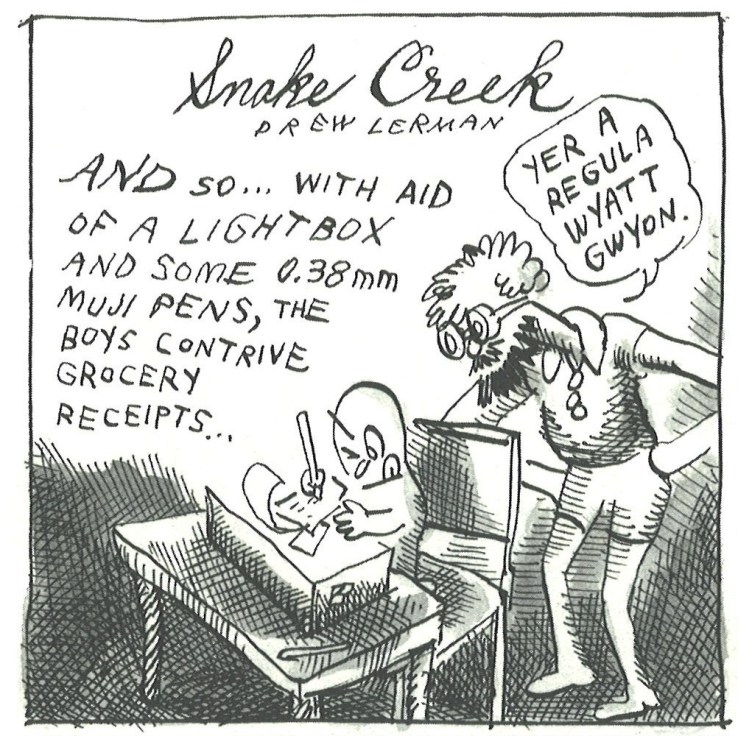

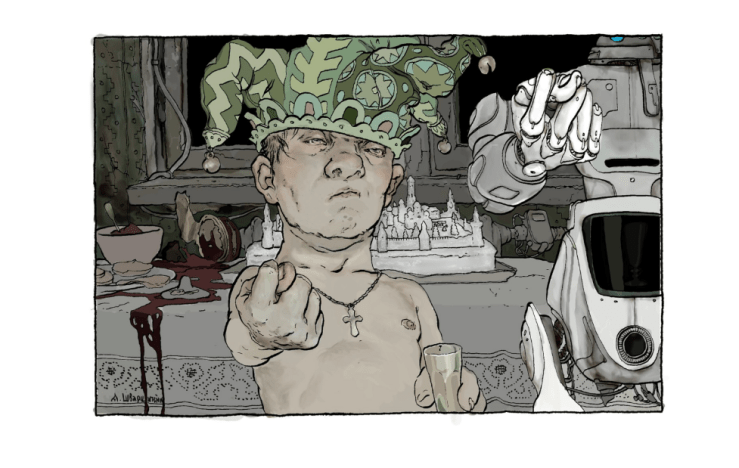




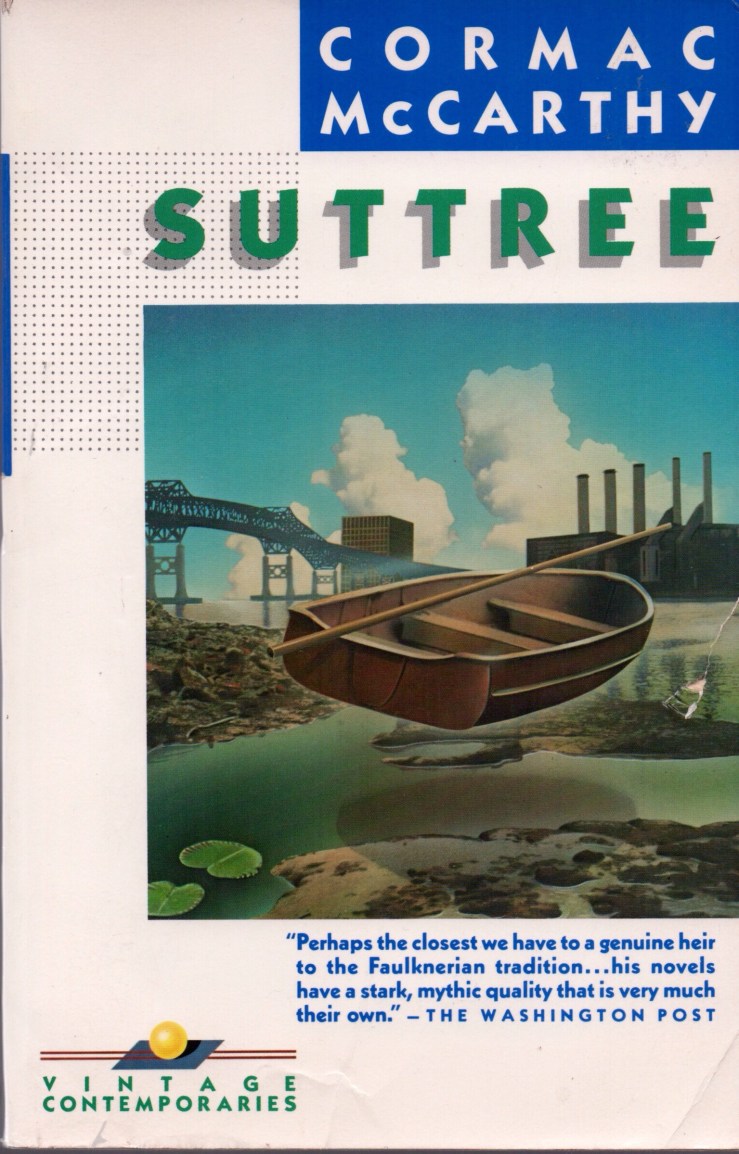
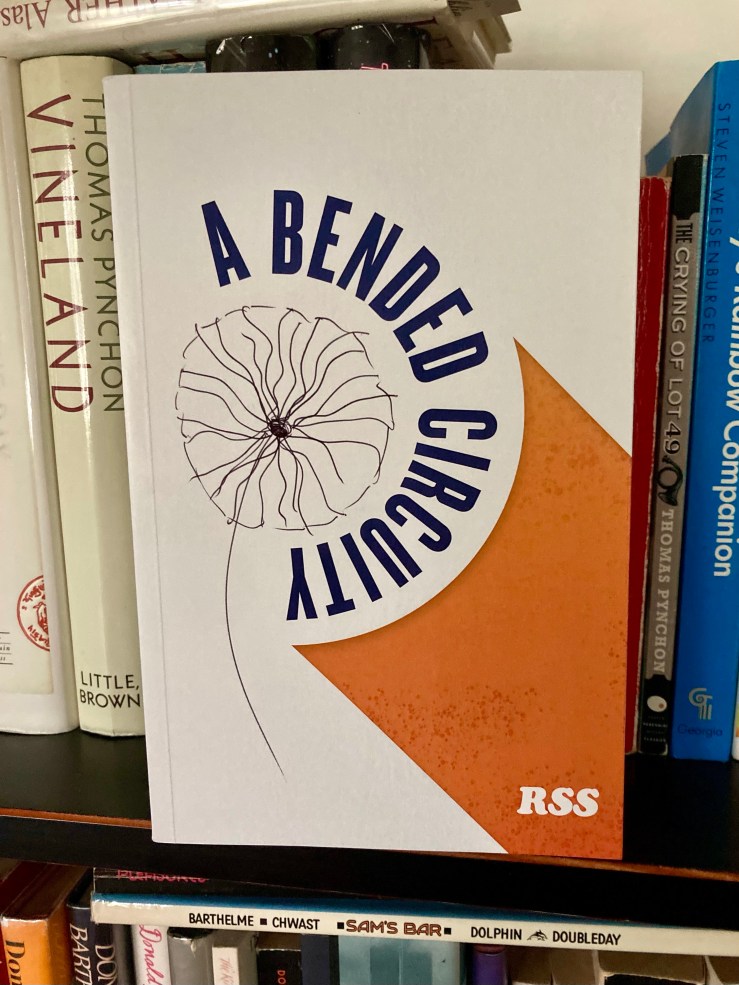

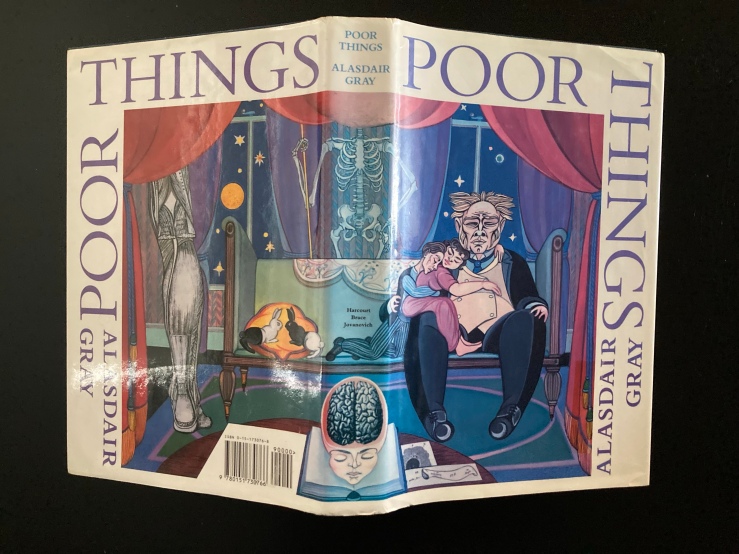




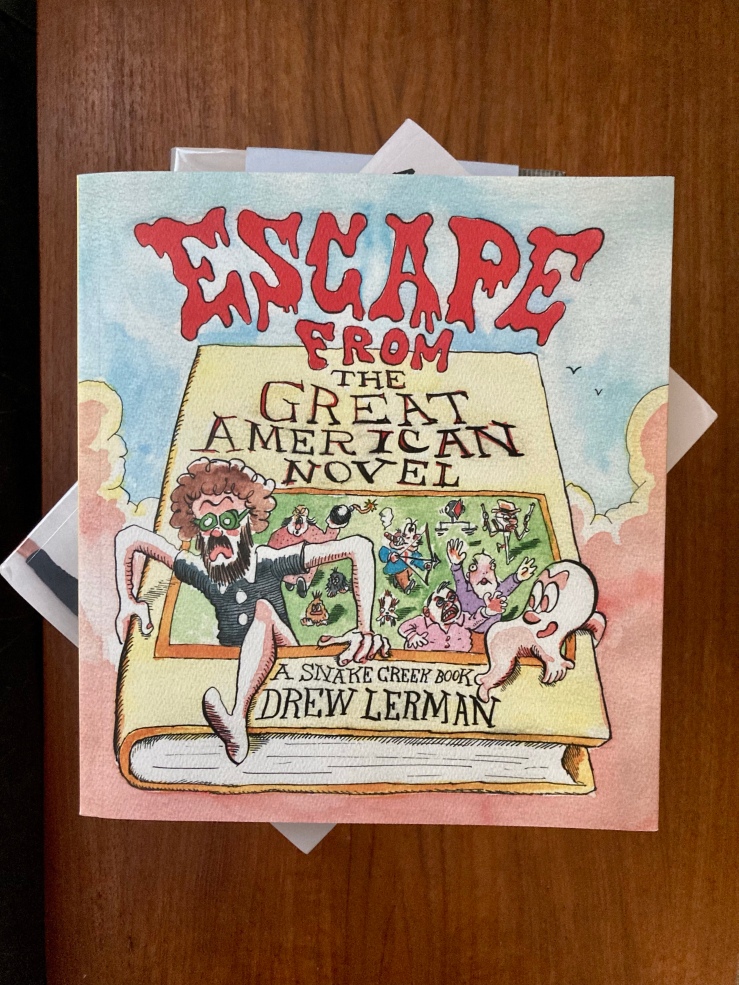
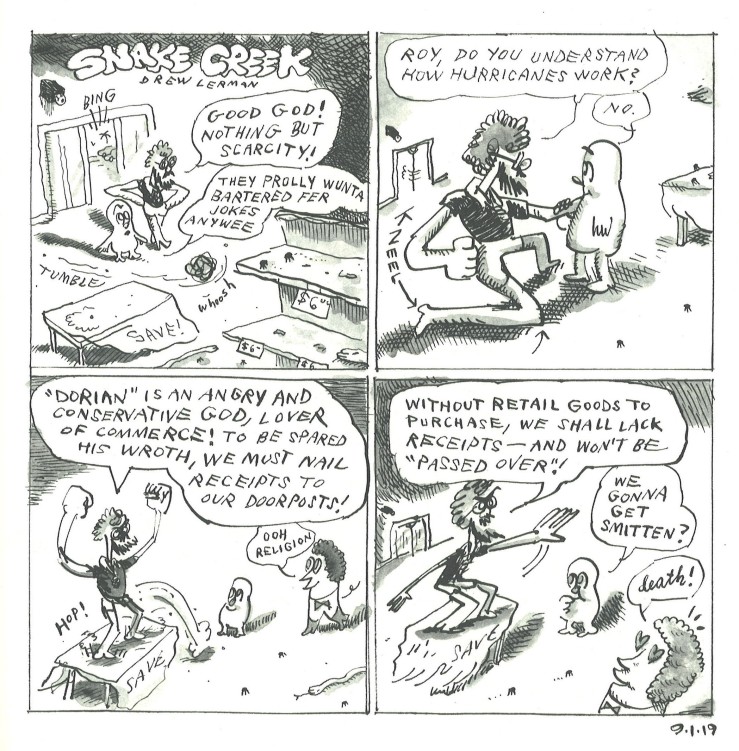
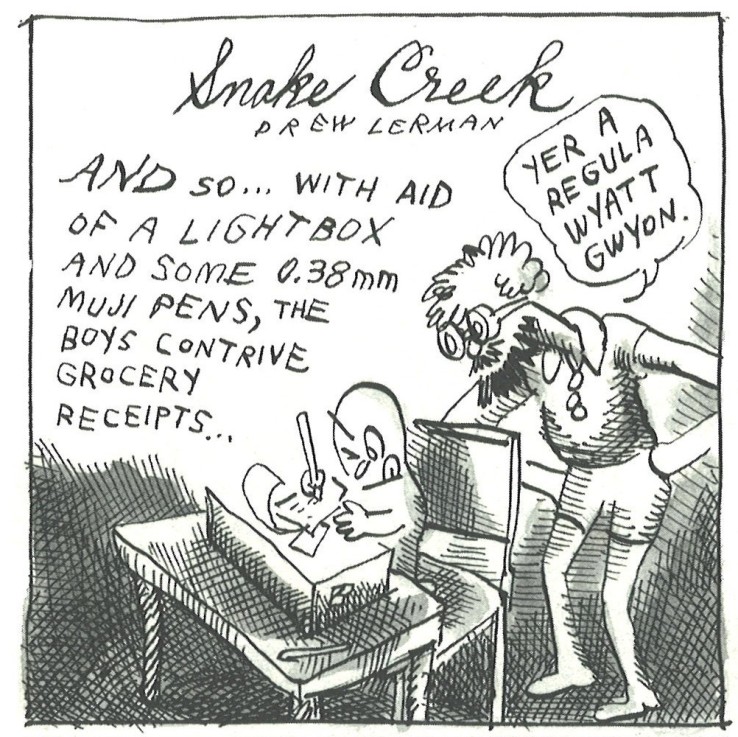
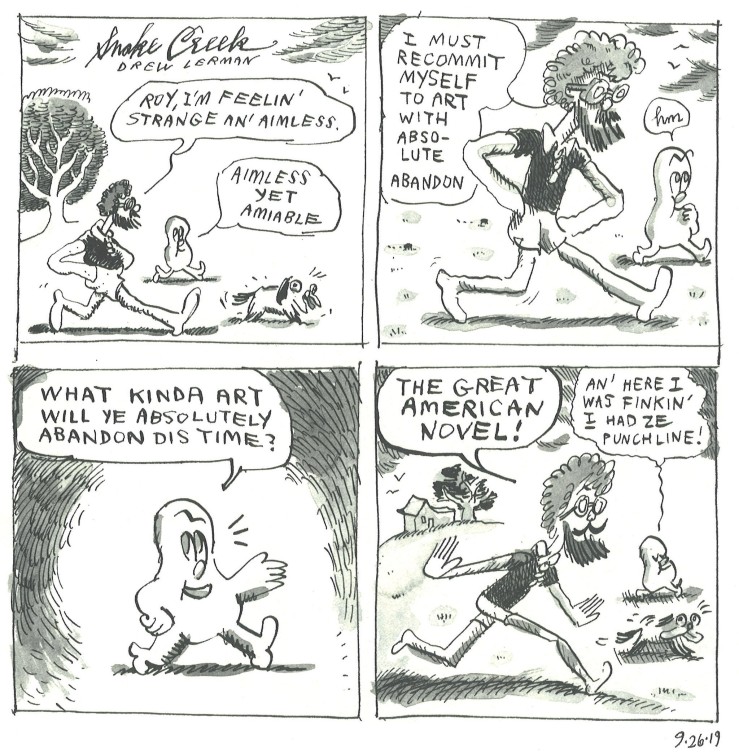
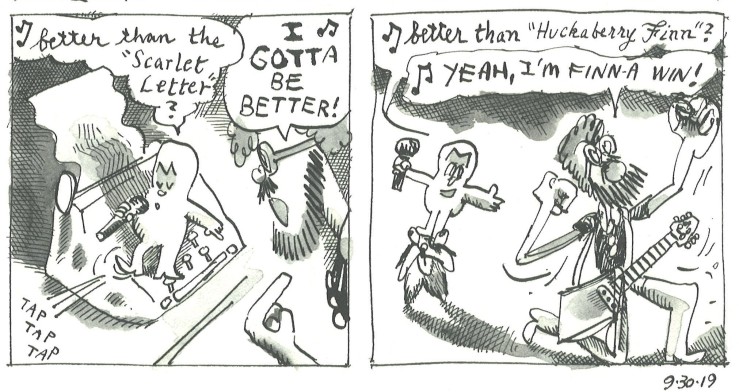
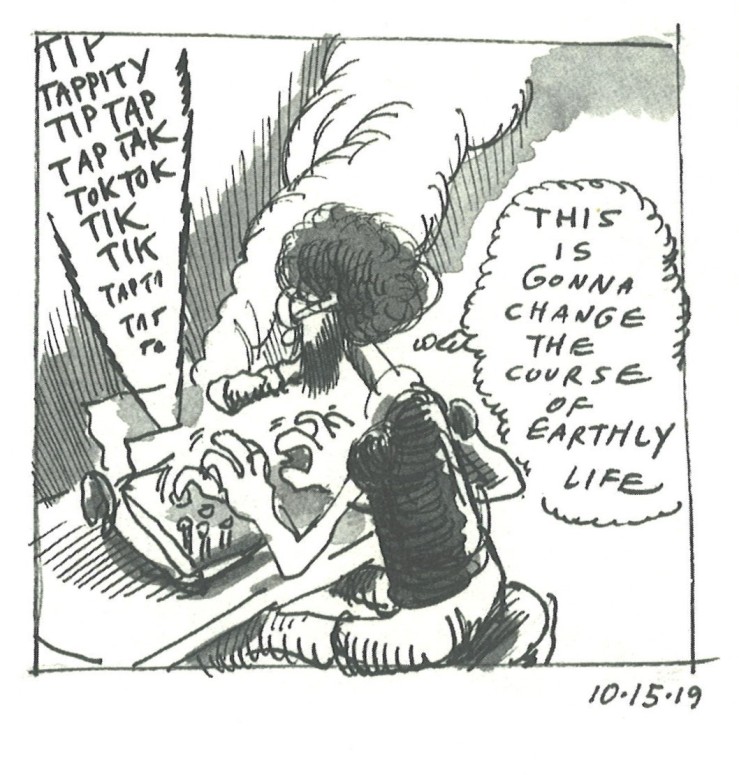
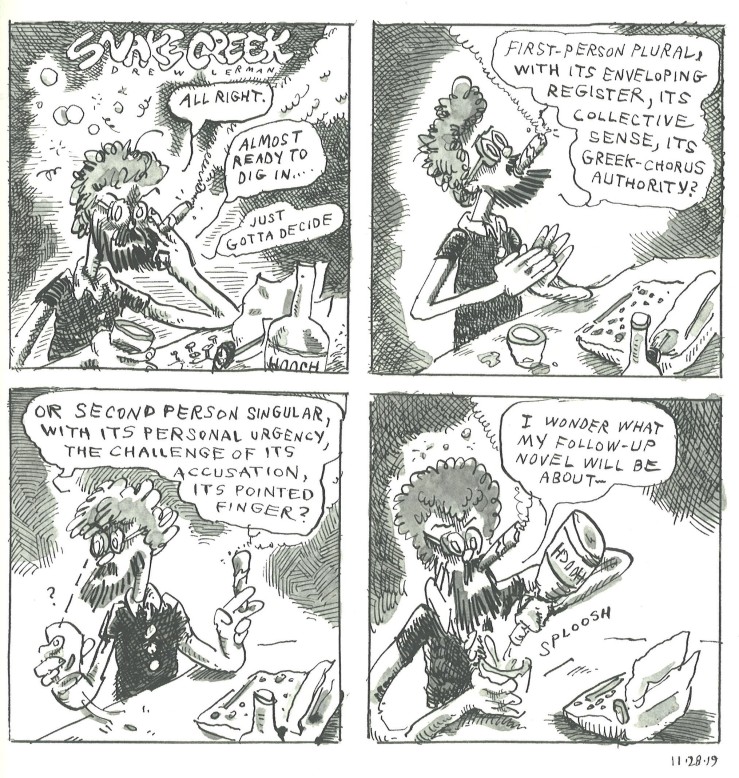
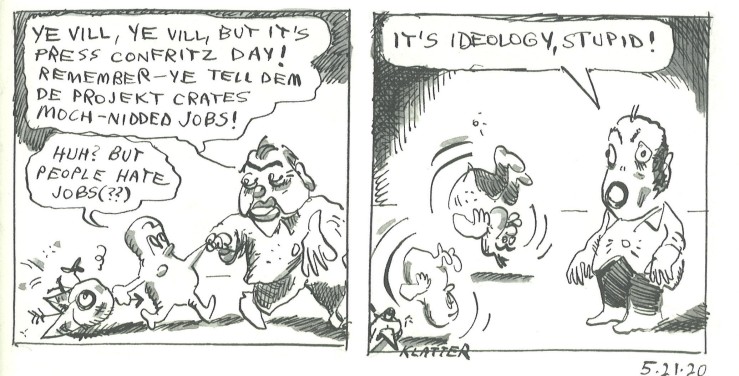
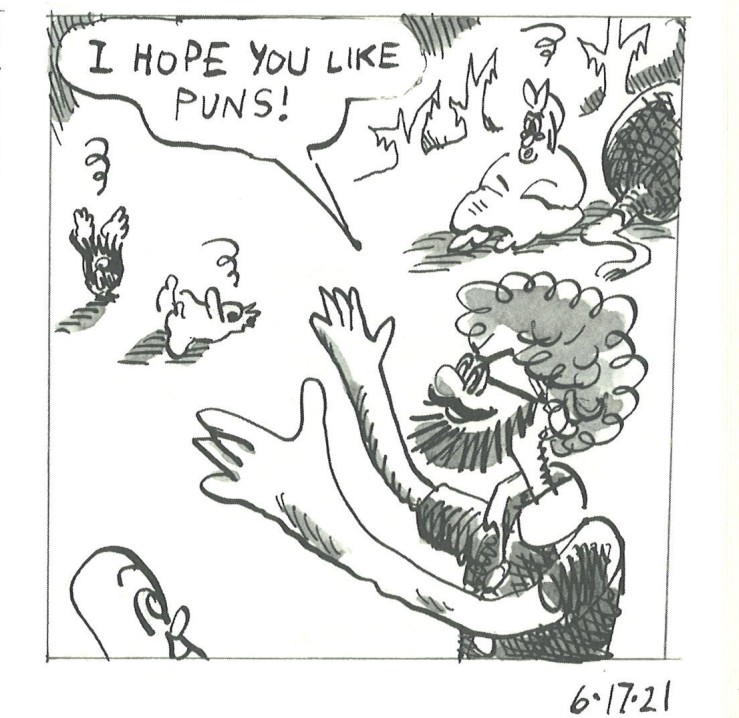
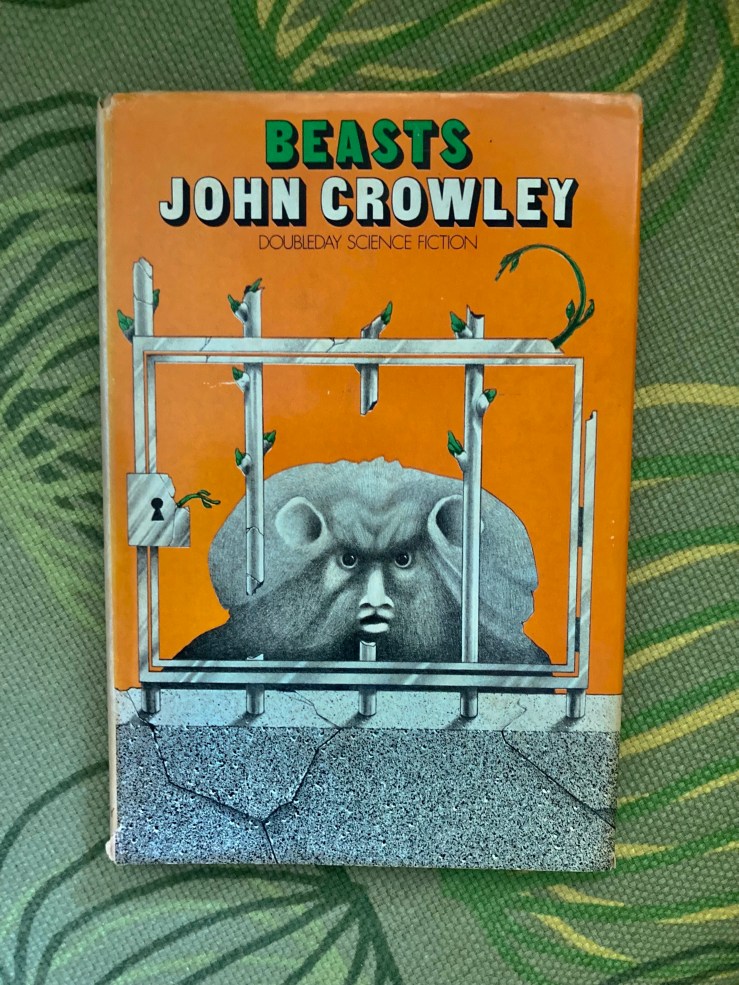
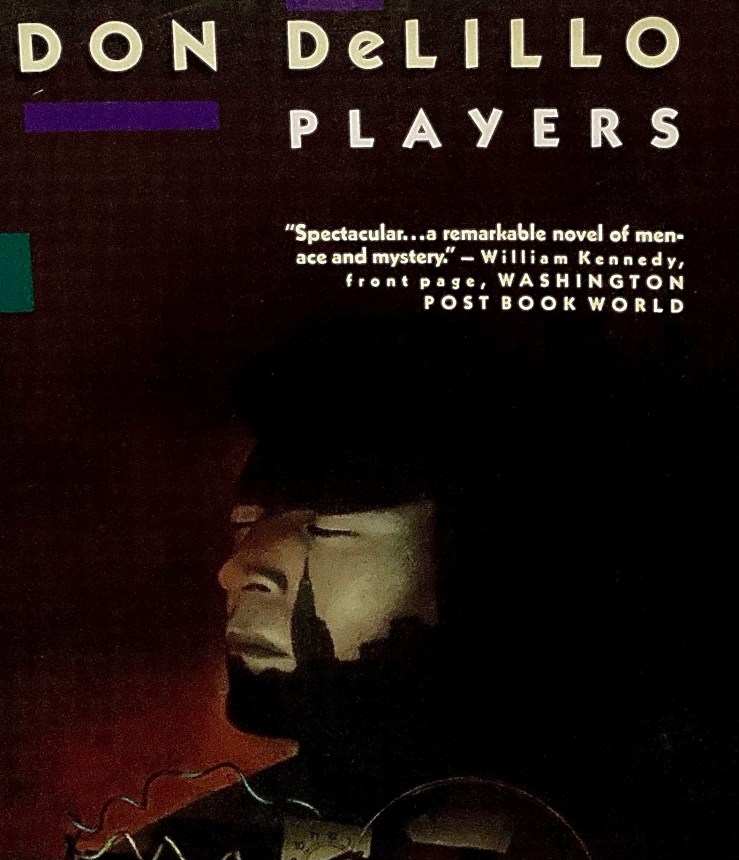
 Biblioklept