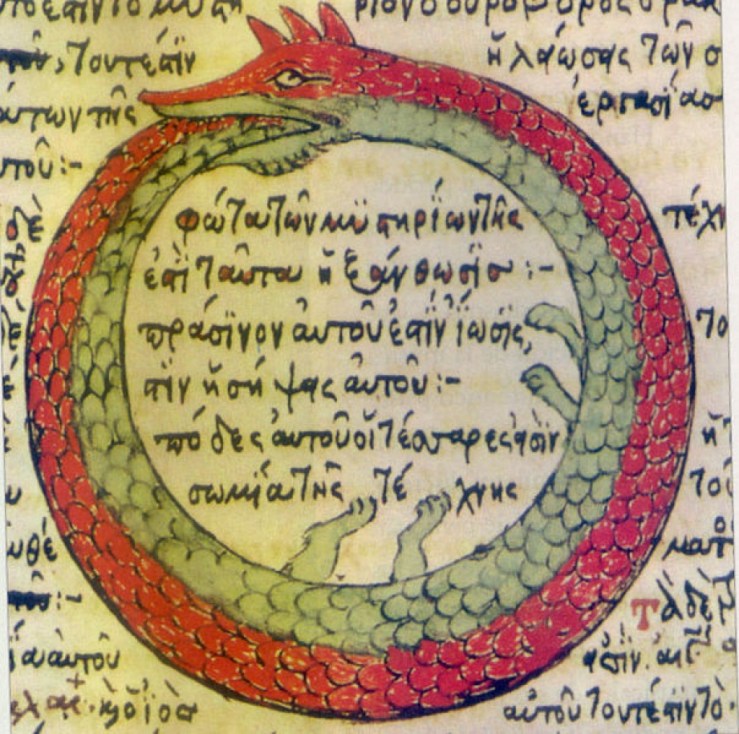
The Great Serpent holding its own tail in its mouth | Gravity’s Rainbow, annotations and illustrations for page 412-13

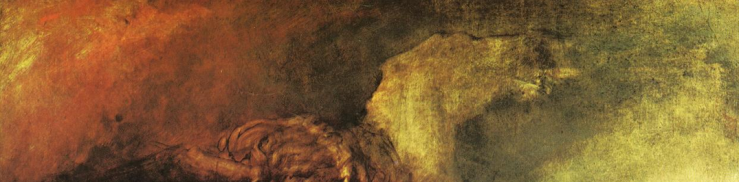
Ouroboros, Codex Parisinus, 1478

Kekulé 1 dreams 2 the Great Serpent holding its own tail in its mouth, the dreaming Serpent which surrounds the World 3. But the meanness, the cynicism with which this dream is to be used 4. The Serpent that announces, “The World is a closed thing, cyclical, resonant, eternally-returning,” 5 is to be delivered into a system 6 whose only aim is to violate the Cycle. Taking and not giving back, demanding that “productivity” and “earnings” keep on increasing with time, the System removing from the rest of the World these vast quantities of energy to keep its own tiny desperate fraction showing a profit: and not only most of humanity—most of the World, animal, vegetable and mineral, is laid waste in the process 7 . The System may or may not understand that it’s only buying time. And that time is an artificial resource to begin with, of no value to anyone or anything but the System, which sooner or later must crash to its death, when its addiction to energy has become more than the rest of the World can supply 8 , dragging with it innocent souls all along the chain of life. Living inside the System is like riding across the country in a bus driven by a maniac bent on suicide… though he’s amiable enough, keeps cracking jokes 9 back through the loudspeaker, “Good morning folks, this is Heidelberg 10  here we’re coming into now, you know the old refrain, ‘I lost my heart in Heidelberg,’ 11 well I have a friend who lost both his ears here! Don’t get me wrong, it’s really a nice town, the people are warm and wonderful—when they’re not dueling. Seriously though, they treat you just fine, they don’t just give you the key to the city, they give you the bung-starter!” 12  u.s.w. 13  On you 14 roll, across a countryside whose light is forever changing 15 —castles, heaps of rock, moons of different shapes and colors come and go. There are stops at odd hours of the mornings, for reasons that are not announced: you get out to stretch in lime-lit courtyards where the old men sit around the table under enormous eucalyptus trees you can smell in the night, shuffling the ancient decks oily and worn, throwing down swords and cups 16 and trumps major in the tremor of light while behind them the bus is idling, waiting—passengers will now reclaim their seats and much as you’d like to stay, right here, learn the game, find your old age around this quiet table, it’s no use 17 : he is waiting beside the door of the bus in his pressed uniform, Lord of the Night he is checking your tickets, your ID and travel papers 18 , and it’s the wands of enterprise 19 that dominate tonight… as he nods you by, you catch a glimpse of his face, his insane, committed eyes, and you remember then, for a terrible few heartbeats, that of course it will end for you all in blood, in shock, without dignity 20 —but there is meanwhile this trip to be on… over your own seat, where there ought to be an advertising plaque, is instead a quote from Rilke: “Once, only once…” 21 One of Their favorite slogans. No return, no salvation, no Cycle—that’s not what They, nor Their brilliant employee Kekulé, have taken the Serpent to mean. No: what the Serpent means is—how’s this—that the six carbon atoms of benzene are in fact curled around into a closed ring, just like that snake with its tail in its mouth, GET IT? 22

From pages 412-13 of Thomas Pynchon’s novel Gravity’s Rainbow.

Friedrich August Kekulé, 1829–1896, German chemist—the “father of organic chemistry.” (Our arts and sciences must be fathered, it seems).

East German Kekulé, postage stamp (with the benzene compound), 1979

Actually, let me bother to set the stage a little better, by piggybacking (are pigs not a motif of GR?) off Michael Davitt Bell’s invaluable “Some Things that ‘Happen’ (More or Less) in Gravity’s Rainbow:

[11], 397-433. This long chapter, consisting mostly of one long recollection, narrated in the past tense, tells the story of Franz Pökler […] Pökler dreamed about the history of Friedrich August Kekulé, father of organic chemistry (410-13), and about Kekulé’s dream: a serpent with its tail in its mouth. We learn how this dream was misused by the System, as the foundation for understanding the benzine ring. All this is lectured on by “Pökler’s old prof,” Laszlo Jamf.

A neat little summary, yes.

Kekulé’s most notable contribution to chemistry—and capitalism!—is in his work on describing the structure of that valuable petrochemical benzene.

Formule chimique développée du benzène inscrite dans le dessin de l'Ouroboros (serpent qui se mord la queue), Haltopub, 2013
Formule chimique développée du benzène inscrite dans le dessin de l’Ouroboros (serpent qui se mord la queue), Haltopub, 2013

2 Receiving an honor in 1890, Kekulé, told the German Chemical Society that he had discovered benzene’s ringed shape in a daydream about the ouroboros, the serpent that eats its own tail (tale?!).

Kekulé’s dream-image-symbol is clearly compelling for both the reader and, I think, for Pynchon. Gravity’s Rainbow is very much about the overlap between physical and metaphysical, and Kekulé’s vision points to the convergence of dream and experience, magic and science.

3 Ouroboros is literally tail-devouring in Greek, but through surreal etymological phonological dream-time leaps, we can get to tale-devouring (why not?—okay, I guess maybe that’s mythosboros or something like that, but hell—–).

In any case, the serpent, or Serpent, here strikes me as one of Pynchon’s Moves Against Them—he taps into an older myth, one that elevates the Scaly and Low—the Preterite?—into an Elect position that the Christian Tradition simply doesn’t care for, what with the Tempting Serpent and all. No, no shedding of the skin, no eternal return…no, no return at all. Cf. a few lines later in the passage cited above: “No return, no salvation, no Cycle—that’s not what They, nor Their brilliant employee Kekulé, have taken the Serpent to mean.”

The anonymous author of Ophiolatreia, or Serpent Worship (1889) offers the following:

Horapollo, referring to the serpent symbol, says of it:— ‘When the Egyptians would represent the Universe they delineate a serpent bespeckled with variegated scales, devouring its own tail, the scales intimating the stars in the Universe. The animal is extremely heavy, as is the earth, and extremely slippery like the water, moreover, it every year puts off its old age with its skin, as in the Universe the annual period effects a corresponding change and becomes renovated, and the making use of its own body for food implies that all things whatever, which are generated by divine providence in the world, undergo a corruption into them again.’

4 Used by Them.

Gravity’s Rainbow is clearly about paranoia of Them, and as such (necessarily), Pynchon’s targets are…nebulous. (Although technology and the Military-Industrial-Entertainment Complex that technology works through might be a manifest if not wholly concrete villain in GR.). Pynchon’s big novel Against the Day offers a more specific locus for everything wrong with Them in its awful villain Scarsdale Vibe and his henchmen and lackeys.

5 You are of course familiar with the concept of eternal recurrence, no?

6 Oligarchial capitalism.

7  Pynchon seems to describe the past few centuries here, and probably the future.

8  Gravity’s Ranbow was published in 1973, folks…

9 …but of course, Pynchon is also describing now, which is to say, his narrative’s own future.

10 A charming German city famous for its university.

11 A German song composed by Fred Raymond in 1925. Hear a 1932 English-language version by Arthur Lally and His Orchestra here.

12 A wooden mallet for opening the bung of a cask (or wine or beer). I visited Heidelberg when I was 16 and drank copious quantities of ale.

13 “u.s.w.” — German acronym for und so weiter; translates to etcetera. Pynchon allows the tape to roll on in his reader’s head.

14 Always beware Gravity’s Rainbow’s shifts into second-person! Look at this ride that Pynchon’s put us on…but wait…we’re already on the ride.

15 A rainbow image.

16 Tarot references abound in Gravity’s Rainbow.

3 of Swords, Sola-Busca Tarot (1491; reprint by Wolfgang Mayer, 1998)

17 The preterite’s complaint: Wisdom shall not be found, order will not reveal itself, meaning will be suspended indefinitely.

18 Our wacky busdriver is actually “the Lord of the Night,” an ominous and perhaps self-explanatory title (and one that resonates with the passage’s mythological overtones and tarot motif). The Lords of the Night are figures in both the Mayan and Aztec calendars, but I’m not sure if Pynchon’s referencing them here—although this passage is deeply concerned with the apprehension and management of time. This Lord of the Night, you’ll note—a stickler for paperwork—is awfully bureaucratic.

19 Oligarchial capitalism. The wands are another suit in the tarot deck. (The upright three of wands is associated with enterprise).

20 The strange trip here echoes Gravity’s Rainbow’s bewildering opening “evacuation” sequence, and the line I’ve noted recalls to me a line I’ve cited at least twice now in these annotations.

From the novel’s sixth paragraph:

“You didn’t really believe you’d be saved. Come, we all know who we are by now. No one was ever going to take the trouble to save you, old fellow. . . .”

21 In A Gravity’s Rainbow Companion, Weisenburger provides the following context for the Rilke quote:
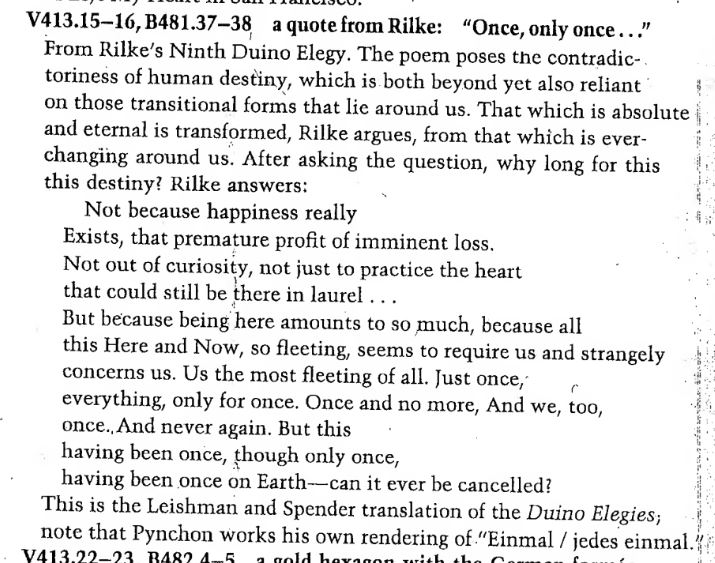
1

22 Well? Do you?

Wherein I Suggest Dracula Is a Character in Roberto Bolaño’s Novel 2666

The Self Seers (Death and Man), Egon Schiele

I. Here’s my thesis:

Dracula is a character in Roberto Bolaño’s dark opus 2666.

Specifically, I’m suggesting that Dracula (like, the Count Dracula) is the unnamed SS officer in “The Part About Archimboldi” who hosts a strange party in a Romanian castle.

II.  I’m willing to concede that my idea is probably full of holes and more than a little silly, but I think there’s some textual support for such a claim.

III. I’ve already suggested on this blog that 2666 is full of lycanthropic transformations, and in that earlier essay, I linked werewolves to vampires (using the work of mythologist Sabine Baring-Gould).

I also suggested on this blog that 2666 is a dark ventriloquist act, full of forced possessions and psychic hauntings.

It’s a work of mesmerism and transformation—vampire powers. Dracula showing up is a winking sick joke, a satire.

IV. In his post “Castle Dracula” at Infinite Zombies, Daryl L. L. Houston connects the many strands of vampirism that run through 2666, suggesting that “Bolaño is using the vampirism in the story, and Dracula in particular, to tie together some of the threads he’s been unwinding pertaining to insiders and outsiders, parasitism and consumption of people, and a sort of larger parasitism of nations.” Hence Aztec blood rituals, the Holocaust, the murder of helpless, marginalized women in Santa Teresa . . .

V. Okay, so back to that thesis. Let’s start with the first appearance of the unnamed SS officer:

At midmorning they came to a castle. The only people there were three Romanians and an SS officer who was acting as butler and who put them right to work, after serving them a breakfast consisting of a glass of cold milk and a scrap of bread, which some soldiers left untouched in disgust. Everyone, except for four soldiers who stood guard, among them Reiter, whom the SS officer judged ill suited for the task of tidying the castle, left their rifles in the kitchen and set to work sweeping, mopping, dusting lamps, putting clean sheets on the beds.

Fairly banal, right? Also, “midmorning” would entail, y’know, sunlight, which is poison for most vampires. Let me chalk this up to the idea that the SS officer is inside the castle, which is sufficiently gloomy and dark enough to protect him (I’m not going to get into any vampire rules that might spoil my fun, dammit!). In any case, hardly noteworthy. Indeed, the SS officer—a butler commanding house chores—seems hardly a figure of major importance.

VI. Next, we get the Romanian castle explicitly identified as “Dracula’s castle” and meet the actors for this milieu:

“And what are you doing here, at Dracula’s castle?” asked the baroness.

“Serving the Reich,” said Reiter, and for the first time he looked at her.

He thought she was stunningly beautiful, much more so than when he had known her. A few steps from them, waiting, was General Entrescu, who couldn’t stop smiling, and the young scholar Popescu, who more than once exclaimed: wonderful, wonderful, yet again the sword of fate severs the head from the hydra of chance.

(I love Popescu’s line here).

VII. Our principals soon take a tour of castle and environs, led by the SS officer (boldface emphasis is mine):

Soon they came to a crypt dug out of the rock. An iron gate, with a coat of arms eroded by time, barred the entrance. The SS officer, who behaved as if he owned the castle, took a key out of his pocket and let them in. Then he switched on a flashlight and they all ventured into the crypt, except for Reiter, who remained on guard at the door at the signal of one of the officers.

So Reiter stood there, watching the stone stairs that led down into the dark, and the desolate garden through which they had come, and the towers of the castle like two gray candles on a deserted altar. Then he felt for a cigarette in his jacket, lit it, and gazed at the gray sky, the distant valleys, and thought about the Baroness Von Zumpe’s face as the cigarette ash dropped to the ground and little by little he fell asleep, leaning on the stone wall. Then he dreamed about the inside of the crypt. The stairs led down to an amphitheater only partially illuminated by the SS officer’s flashlight. He dreamed that the visitors were laughing, all except one of the general staff officers, who wept and searched for a place to hide. He dreamed that Hoensch recited a poem by Wolfram von Eschenbach and then spat blood. He dreamed that among them they had agreed to eat the Baroness Von Zumpe.

He woke with a start and almost bolted down the stairs to confirm with his own eyes that nothing he had dreamed was real.

When the visitors returned to the surface, anyone, even the least astute observer, could have seen that they were divided into two groups, those who were pale when they emerged, as if they had glimpsed something momentous down below, and those who appeared with a half smile sketched on their faces, as if they had just been reapprised of the naivete of the human race.

Bolaño concludes the crypt passage by highlighting an essential ambiguity that courses throughout the entire “Castle Dracula” episode, a strange axis of horror/humor, romance/banality. What has been revealed in the crypt? We don’t know, of course, but our surrogate Reiter allows us access to a few visions of what might have happened, including terror and fear and cannibalism. (He employs Hawthorne’s escape hatch too—it was all a dream).

The Knight of Death, Salvador Dali

VIII. Then, supper time:

That night, during dinner, they talked about the crypt, but they also talked about other things. They talked about death. Hoensch said that death itself was only an illusion under permanent construction, that in reality it didn’t exist. The SS officer said death was a necessity: no one in his right mind, he said, would stand for a world full of turtles or giraffes. Death, he concluded, served a regulatory function.

Clearly it’s easy to link any of the dinnertime comments about death to Dracula, but note that the SS officer’s idea that death is a “regulatory function” is terribly banal, is quite literally regular—this idea contrasts with Hoensch’s more poetic notion that death is an illusion (an illusion that the SS officer, if he is in fact Count Dracula, would realize in a perfectly mundane way that foreclosed the necessity of metaphor).

IX. Dinner conversation turns to murder—obviously one of the central themes of 2666:

The SS officer said that murder was an ambiguous, confusing, imprecise, vague, ill-defined word, easily misused.

Again, ambiguity: on one hand, sure, an SS officer’s job was in large part about coordinating and executing mass murder. At the same time, we might appreciate that murder is a vague term if people are one’s lunch.

X. Then conversation turns to culture:

The SS officer said culture was the call of the blood, a call better heard by night than by day, and also, he said, a decoder of fate.

I’m pretty sure that this was the moment I started entertaining the fancy that the SS officer might be Dracula.

XI. Popescu the intellectual also seems to reconsider the SS officer:

The intellectual Popescu remained standing, next to the fireplace, observing the SS officer with curiosity.

XII. Then, they finally riff on Dracula. Significantly, the SS officer believes that Dracula is a good German (bold emphasis mine):

First they praised the assortment of little cakes and then, without pause, they began to talk about Count Dracula, as if they had been waiting all night for this moment. It wasn’t long before they broke into two factions, those who believed in the count and those who didn’t. Among the latter were the general staff officer, General Entrescu, and the Baroness Von Zumpe. Among the former were Popescu, Hoensch, and the SS officer, though Popescu claimed that Dracula, whose real name was Vlad Tepes, aka Vlad the Impaler, was Romanian, and Hoensch and the SS officer claimed that Dracula was a noble Teuton, who had left Germany accused of an imaginary act of treason or disloyalty and had come to live with some of his loyal retainers in Transylvania a long time before Vlad Tepes was born, and while they didn’t deny Tepes a real historical or Transylvanian existence, they believed that his methods, as revealed by his alias or nickname, had little or nothing to do with the methods of Dracula, who was more of a strangler than an impaler, and sometimes a throat slitter, and whose life abroad, so to speak, had been a constant dizzying spin, a constant abysmal penitence.

The SS officer is the noble Teuton. More importantly, we get language that connects Dracula to the murders in Santa Teresa, most of which are stranglings; we also get the idea that Dracula has had a “life abroad”—one outside of time—a life that might see his spirit inhabit and ventriloquize an industrial city in the north of Mexico. (Or not. I know. Look, I’m just riffing here).

We also get the idea of an abyss (this is the structure of 2666), as well as the idea of Dracula as a penitent of sorts.

So, let us recall that early in “The Part About the Crimes,” detective Juan de Dios Martinez is searching for a criminal dubbed The Penitent who desecrates churches and has committed a few murders in the process. He goes to psychologist Elvira Campos for help:

Sacraphobia is fear or hatred of the sacred, of sacred objects, especially from your own religion, said Elvira Campos. He thought about making a reference to Dracula, who fled crucifixes, but he was afraid the director would laugh at him. And you believe the Penitent suffers from sacraphobia? I’ve given it some thought, and I do. A few days ago he disemboweled a priest and another person, said Juan de Dios Martinez.

This is the first mention of Dracula in 2666, and he’s explicitly likened to the Penitent; later, as we see above, Dracula will be explicitly linked to penitence.

(I’m not suggesting that the Penitent is Dracula traveled to Mexico to piss in churches. What I want to say is that Dracula’s dark spirit ventriloquizes the text of 2666).

(I’m also suggesting, again, that 2666 be read intertextaully).

Riding with Death, Jean-Michel Basquiat

XIII. Our other principals continue to discuss Dracula, but I won’t belabor that discussion (I’d prefer you, dear reader, to return to the text).

I will summarize though: Popescu sees Dracula in nationalistic terms (“a Romanian patriot” who repels the Turks), and General Entrescu goes on a long rant about heroism and villainy and history, culminating in a lengthy digression on Jesus Christ (recall now that Entrescu will be crucified JC-style by his men).

One aside on the SS officer bears mentioning: we learn that “the fastidious SS officer” is the most sober conversant as he “scarcely wet his lips with alcohol.” (Because he’s a vampire who prefers blood! Muahahahaha!)

XIV. Fast forward a few hours. Our man Reiter, among fellow soldiers, sets out to explore the secret crannies and passageways of Castle Drac and play voyeur:

The room they came to was empty and cold, as if Dracula had just stepped out. The only thing there was an old mirror that Wilke lifted off the stone wall, uncovering a secret passageway.

Dracula’s spirit leaves the room, creating an opening, behind the ever-symbolic mirror. (Muahahahaha!). (2666: Mirror, tunnels, chambers, labyrinths).

They enter the passageway and come first upon our supposed Dracula, the SS officer:

And so they were able to look into the room of the SS officer, lit by three candles, and they saw the SS officer up, wrapped in a robe, writing something at a table near the fireplace. The expression on his face was forlorn. And although that was all there was to see, Wilke and Reiter patted each other on the back, because only then were they sure they were on the right path. They moved on.

XV. Dracula, the epistolary novel. Count Dracula, troubled writer of letters, will author the following scenes, his spirit ventriloquizing the principals all: Here, we find Reiter and his homeboy Wilke, lurking in a secret passage, jerking off to werewolf-cum-Jesus-Christ-figure Gen. Entrescu screwing the lovely Baroness Von Zumpe and reciting poetry (emphasis per usual mine):

Then Wilke came on the wall and mumbled something too, a soldier’s prayer, and soon afterward Reiter came on the wall and bit his lips without saying a word. And then Entrescu got up and they saw, or thought they saw, drops of blood on his penis shiny with semen and vaginal fluid, and then Baroness Von Zumpe asked for a glass of vodka, and then they watched as Entrescu and the baroness stood entwined, each with a glass in hand and an air of distraction, and then Entrescu recited a poem in his tongue, which the baroness didn’t understand but whose musicality she lauded, and then Entrescu closed his eyes and cocked his head as if to listen to something, the music of the spheres, and then he opened his eyes and sat at the table and set the baroness on his cock, erect again (the famous foot-long cock, pride of the Romanian army), and the cries and moans and tears resumed, and as the baroness sank down onto Entrescu’s cock or Entrescu’s cock rose up into the Baroness Von Zumpe, the Romanian general recited a new poem, a poem that he accompanied by waving both arms (the baroness clinging to his neck), a poem that again neither of them understood, except for the word Dracula, which was repeated every four lines, a poem that might have been martial or satirical or metaphysical or marmoreal or even anti-German, but whose rhythm seemed made to order for the occasion, a poem that the young baroness, sitting astride Entrescu’s thighs, celebrated by swaying back and forth, like a little shepherdess gone wild in the vastness of Asia, digging her nails into her lover’s neck, scrubbing the blood that still flowed from her right hand on her lover’s face, smearing the corners of his lips with blood, while Entrescu, undeterred, continued to recite his poem in which the word Dracula sounded every four lines, a poem that was surely satirical, decided Reiter (with infinite joy) as Wilke jerked off again.

I contend that the poem is the work of the SS officer, psychic mesmerist, the poet Dracula, a poem no one in the scene can understand, a dark satire that might also be a war poem or a love poem or an elegy, but definitely a dark satire, written in violence and sex and blood, a poem that ventriloquizes not only Entrescu, phallic delivery device, but also the baroness, and also Reiter and Wilke. And perhaps the reader.

XVI. Where to go after such a climax? Maybe point out that Dracula infects Reiter and Wilke, of whom we learn:

Some of their battalion comrades dubbed them the vampires.

(But better to return I think to our strange figure, the SS officer).

XVII. Here, his last appearance:

The next morning the detachment left the castle after the departure of the two carloads of guests. Only the SS officer remained behind while they swept, washed, and tidied everything. Then, when the officer was fully satisfied with their efforts, he ordered them off and the detachment climbed into the truck and headed back down to the plain. Only the SS officer’s car—with no driver, which was odd—was left at the castle. As they drove away, Reiter saw the officer: he had climbed up to the battlements and was watching the detachment leave, craning his neck, rising up on tiptoe, until the castle, on the one hand, and the truck, on the other, disappeared from view.

Dracula stays in Dracula’s castle; his spirit, his seed, his blood seeps out.

A riff on my favorite ghost story, Roberto Bolaño’s “The Return”

Roberto Bolaño’s short story “The Return” is so good that it has two perfect opening paragraphs:

I have good news and bad news. The good news is that there is life (of a kind) after this life. The bad news is that Jean-Claude Villeneuve is a necrophiliac.

That’s a hell of a way to start a story! Bolaño lays out his two themes—the afterlife and necrophilia—in a jovial, almost cavalier, but dare I say sweet, even charming way. And then this paragraph:

Death caught up with me in a Paris disco at four in the morning. My doctor had warned me, but some things are stronger than reason. I was convinced, mistakenly (and even now it’s something I regret), that drinking and dancing were not the most hazardous of my passions. Another reason I kept going out every night to the fashionable places in Paris was my routine as a middle manager at Fracsa; I was after what I couldn’t find at work or in what people call the inner life: the buzz that you get from a certain excess.

Those are the first two paragraphs, and maybe they’ll entice you to read the story. However, the following riff includes what some people might consider spoilers; my hope is that if you’ve never read it before, you’ll take it on faith that “The Return” is a great, great story and you’ll go read it and stop reading this riff now. (Maybe come back later though after you’ve read it).

“The Return” is a ghost story that transmutes the horror of death and the abjection of the corpse into love, empathy, and communication—and art. It’s a beautiful ghost tale in the Romantic, Gothic tradition of Edgar Allan Poe, from whom Bolaño drew heavily. However, while Poe’s tales of necrophilia (like the poem “Annabel Lee,” “The Fall of the House of Usher,” and “Berenice” to name just a few) obsess over repression, loss, burial, and imperfect and violent attempts at restoration, Bolaño’s “The Return” offers its readers a peaceful reconciliation with death. It’s collected in The Return (New Directions, English translation by Chris Andrews), which is a perfect introduction to Bolaño—so many great stories there (“Buba,” “Clara,” “William Burns,” etc.). So go read it.

Continue reading “A riff on my favorite ghost story, Roberto Bolaño’s “The Return””

Phantoms and ghosts in David Foster Wallace’s novel The Pale King

a

The narrator of David Foster Wallace’s posthumous novel The Pale King assures us at one point that “phantoms are not the same as real ghosts.”

Okay.

So what’s a phantom then, at least in the universe of The Pale King?

Phantom refers to a particular kind of hallucination that can afflict rote examiners at a certain threshold of concentrated boredom.

The “rote examiners” are IRS agents who perform Sisyphean tasks of boredom. They are also placeholders for anyone who works a boring, repetitive job.

(We might even wax a bit here on the phrase rote examiner—the paradox in it—that to examine should require looking at the examined with fresh eyes, a fresh spirit—a spirit canceled out by the modifier rote).

In The Pale King, phantoms visit the rote examiners who toil in wiggle rooms. The “phantoms are always deeply, diametrically different from the examiners they visit,” suggesting two simultaneous outcomes: 1) an injection of life-force, a disruption of stasis that serves to balance out the examiner’s personality and 2) in the novel’s own language, “the yammering mind-monkey of their own personality’s dark, self-destructive side.”

In one scene, desperate Lane Dean contemplates suicide on the job, until he’s visited by a phantom.

“Yes but now that you’re getting a taste, consider it, the word. You know the one.”

The word is boredom, and the phantom proceeds to give a lecture on its etymology:

Word appears suddenly in 1766. No known etymology. The Earl of March uses it in a letter describing a French peer of the realm. He didn’t cast a shadow, but that didn’t mean anything. For no reason, Lane Dean flexed his buttocks. In fact the first three appearances of bore in English conjoin it with the adjective French, that French bore, that boring Frenchman, yes? The French of course had malaise, ennui. See Pascal’s fourth Pensée, which Lane Dean heard as pantsy.

(Thank you, narrator—who are you?!—for mediating the phantom’s speech and Dean’s misauditing of that speech). Continue reading “Phantoms and ghosts in David Foster Wallace’s novel The Pale King”

No knightly hero | Gravity’s Rainbow, annotations and illustrations for page 364

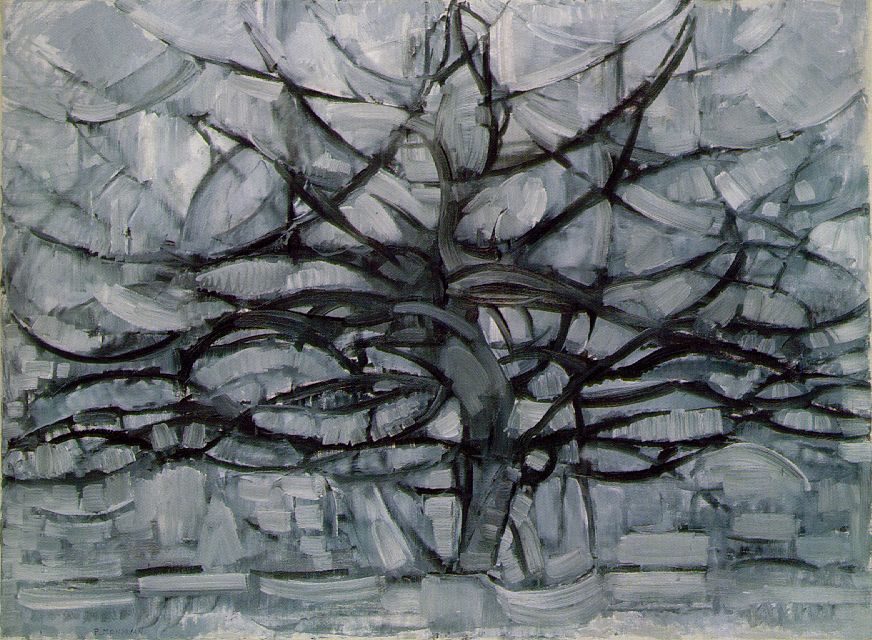
The Gray Tree, Piet Mondrian (1911)

Toward dusk, the black birds descend, millions 1  of them, to sit in the branches of trees nearby. The trees grow heavy with black birds, branches like dendrites of the Nervous System 2  fattening, deep in twittering nerve-dusk, in preparation for some important message… . 3

Later in Berlin, down in the cellar among fever-dreams with shit leaking out of him at gallons per hour, too weak to aim more than token kicks at the rats 4 running by with eyes fixed earnestly noplace, trying to make believe they don’t have a newer and dearer status among the Berliners, at minimum points on his mental health chart, when the sun is gone so totally it might as well be for good, Slothrop’s dumb idling heart 5 sez: The Schwarzgerät is no Grail, Ace, that’s not what the G in Imipolex G stands for. And you are no knightly hero 6. The best you can compare with is Tannhäuser 7, the Singing Nincompoop—you’ve been under one mountain at Nordhausen, been known to sing a song or two with uke accompaniment, and don’tcha feel you’re in a sucking marshland of sin out here, Slothrop? maybe not the same thing William Slothrop, vomiting a good part of 1630 away over the side of that Arbella 8, meant when he said “sin.” . . . But what you’ve done is put yourself on somebody else’s voyage 9—some Frau Holda, some Venus in some mountain—playing her, its, game… you know that in some irreducible way it’s an evil game. You play because you have nothing better to do 10, but that doesn’t make it right. And where is the Pope whose staff’s gonna bloom for you? 11
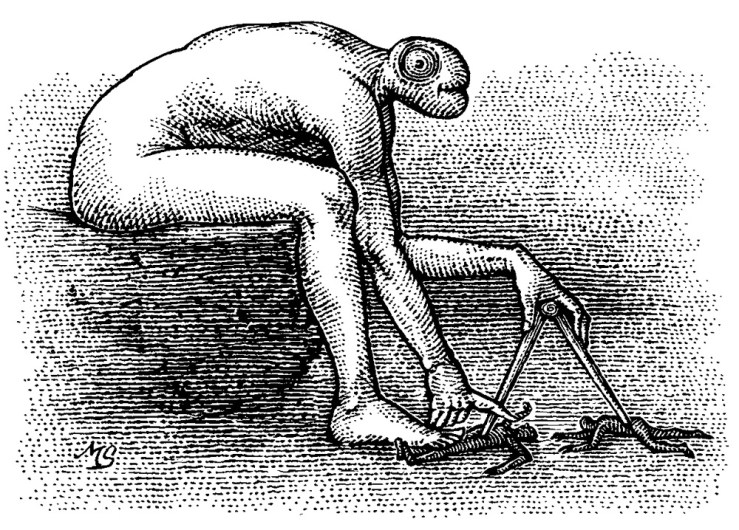
From page 364 of Thomas Pynchon’s novel Gravity’s Rainbow.

1 A million black birds sounds like a hyperbole of crows, but Berlin 1945, post-V-E Day—which is like, where we are here—I mean, it’s a desperate deathly ghastly place. So maybe buzzards and dreadful crows abound.

2 Cf. the discussion between nerve cells in pages 148-49.

Drawing of Purkinje cells (A) and granule cells (B) from pigeon cerebellum, Santiago Ramón y Cajal (1899)

3  What’s the important message? Oh wait, we’re still in the marvelous tree-crow-dendrite simile—the “twittering nerve-dusk”—so the “message” the crow-tree-branches awaits is just part of the, uh, metaphor. Or not? I mean, this is a novel in large part about expectation—about waiting for the bomb to fall, waiting for the Sword of Damocles to descend. And also: awaiting a message of Return.
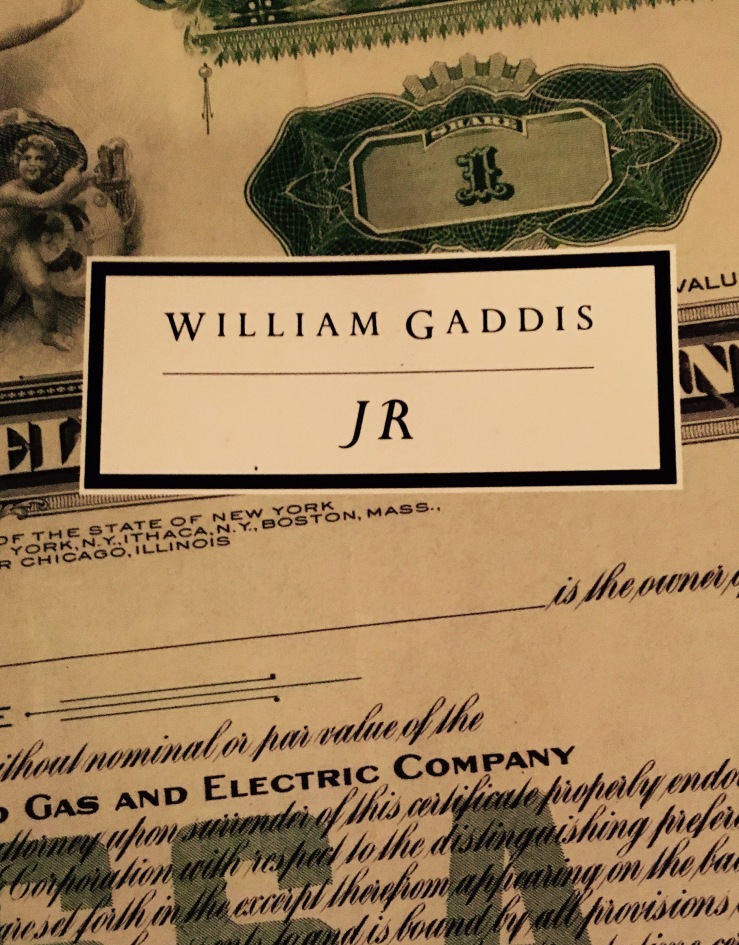
But: What a lovely little simile. Pynchon’s powers as a prose stylist seem under-remarked upon.

4 Cf. page 359: “Last week, in the British sector someplace, Slothrop, having been asshole enough to drink out of an ornamental pond in the Tiergarten, took sick.”

The cellar, the diarrhea, the rats….I’ve written it before: Gravity’s Rainbow is a thoroughly abject novel—full of assholes (literal) and shit (literal) and toilets (literal). (And oh, also: metaphorical too, metaphorical too). Slothrop here is sick, literally evacuating—but also figuratively evacuating. A few pages later he’ll evacuate into his next identity, Rocket Man.

Cf. page 553, from Slothrop’s “Partial List of Wishes on Evening Stars for This Period”:

“Let me be able to take a shit soon.”

5  I counted 75 words in the dependent clause that precedes Pynchon’s finally introducing the independent clause—which is to say subject and verb

“Slothrop’s dumb idling heart sez”

(My count is likely off; I counted once and I’ve had some bourbon. I counted “fever-dreams” as two words, although I think you’re not supposed to do that).

Anyway: That’s a lot of dependent-clauseauge before, like, the main idea—which I guess, from a prose/aesthetic analysis, is the, uh, main idea—ascent, suspension—and then an immediate divergence (and note how Pynchon simultaneously deflates and invigorates his predicate verb “sez” with colloquial zeal).

6  Many of Gravity’s Rainbow’s motifs almost cohere here. Pynchon highlights two of Slothrop’s ostensible “quests” — the Schwarzgerät (the mysterious “black device” that will be installed in rocket 00000 (present), and the sexy sinister plastic Imipolex G (past). (But also both, obviously: Future).

Slothrop’s dumb heart denies any knightly virtue, rejects Romanticism—and, perhaps, Modernism’s ironic obsessions with Romanticism.

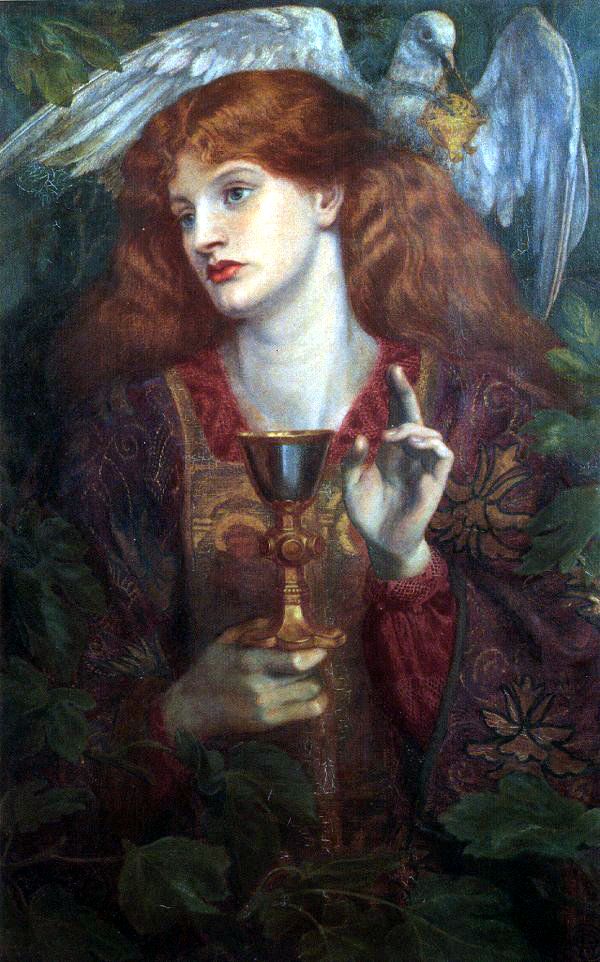
(I think the passage above, what with its ravens and Venus-denial and grail-refusal, is a tidy antonym to Rossetti’s depiction of the Grail…and yet I’d argue Pynchon’s writing bears a Pre-Raphaelite streak)—

The Damsel of the Holy Grail, Dante Gabriel Rossetti (1874)

The episode strikes me as utterly true, a moment of honest self-speech. As Emily Dickinson put it: “I like a look of Agony / Because I know it’s true.” (One of Slothrop’s ancestor’s plagiarized Ms. Dickinson on his gravestone). And yet and yet and yet…Perhaps Tyrone S. is being a bit too harsh on himself (who among us hasn’t cast a harsh gaze into the mirror?).

Slothrop expels the old identity here, the old dreams, the old, evacuating space for the arrival of “Raketemensch,” — Rocketman!

Rocketman points to an emerging postmodern hero—a comic bookish hero, perhaps—totemic, sure, but also Pop, cartoonish, textual—framed (literally) in the conventions of previous centuries’ conceptions of “heroism.”

7  Cf. page 299: “There is that not-so-rare personality disorder known as Tannhäuserism. Some of us love to be taken under mountains, and not always with horny expectations.” I annotated the page here.  Slothrop seems to accept the abject mantle of a bard, a laze, a loaf, a lingerer. I think of Whitman here, proud to lean and loafe at his ease at the beginning of Song of Myself, only to “effuse [his] flesh in eddies, and drift it in lacy jags” in the poem’s closing lines. Like Whitman’s persona, Slothrop will dissipate.

8 Cf. pages 203-04 (annotations here), wherein Slothrop’s vomiting ancestor William Slothrop, in a remarkable passage of hysteron proteron, travels backwards from the New World to the Old.

9 One of the central paranoias of Gravity’s Rainbow is that you might be on their voyage. How much agency do you have in your own life? And what’s the cost of asserting that agency? How many identities do you have to evacuate? And in the end—what’s left?

10 Boredom strikes me as one of (if not the) central theme connecting Modernism, postmodernism, and post-postmodernism.

11 Cf. the Tannhäuser story/footnote 7.

Or: Simply note the motif of bloom, of fruition, of phallic life, of promise. In fuller context though—it’s a bloom too late. The question blooms from Slothrop’s self-speech, but also extends to you and me, reader.

Or: Cf. the opening of Gravity’s Rainbow. From the sixth paragraph:

“You didn’t really believe you’d be saved. Come, we all know who we are by now. No one was ever going to take the trouble to save you, old fellow. . . .”

>intoxication o’r dizziness< | On "starting" Arno Schmidt's enormous novel Bottom's Dream

img_3817

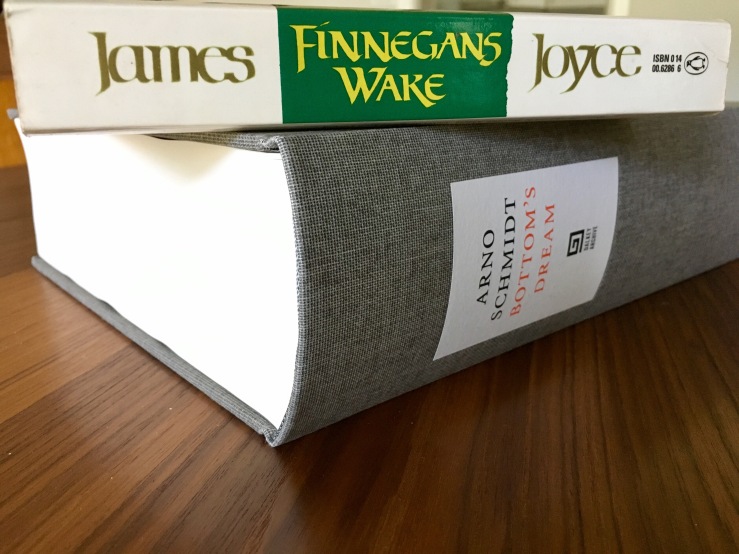
Arno Schmidt’s 1970 novel Bottom’s Dream is finally available in English translation by John E. Woods. The book has been published by the Dalkey Archive.

It is enormous.

As you can see in the picture above: Enormous.

But what’s Bottom’s Dream about? (This is the wrong question).

Dalkey’s blurb:

“I have had a dream past the wit of man to say what dream it was,” says Bottom. “I have had a dream, and I wrote a Big Book about it,” Arno Schmidt might have said. Schmidt’s rare vision is a journey into many literary worlds. First and foremost it is about Edgar Allan Poe, or perhaps it is language itself that plays that lead role; and it is certainly about sex in its many Freudian disguises, but about love as well, whether fragile and unfulfilled or crude and wedded. As befits a dream upon a heath populated by elemental spirits, the shapes and figures are protean, its protagonists suddenly transformed into trees, horses, and demigods. In a single day, from one midsummer dawn to a fiery second, Dan and Franzisca, Wilma and Paul explore the labyrinths of literary creation and of their own dreams and desires.

And Wikipedia’s summary:

The novel begins around 4 AM on Midsummer’s Day 1968 in the Lüneburg Heath in northeastern Lower Saxony in northern Germany, and concludes twenty-five hours later. It follows the lives of 54-year-old Daniel Pagenstecher, visiting translators Paul Jacobi and his wife Wilma, and their 16-year-old daughter Franziska. The story is concerned with the problems of translating Edgar Allan Poe into German and with exploring the themes he conveys, especially regarding sexuality.

Did I mention that it’s enormous?

Look, I know that dwelling on a book’s size probably has nothing to do with literary criticism, but Bottom’s Dream poses something of a special case. As an article on Bottom’s Dream at The Wall Street Journal points out, Schmidt’s opus is 1,496 pages long, contains over 1.3 million words, and weighs 13 pounds.

It’s a physical challenge as well as a mental challenge.

And, Oh that mental challenge!

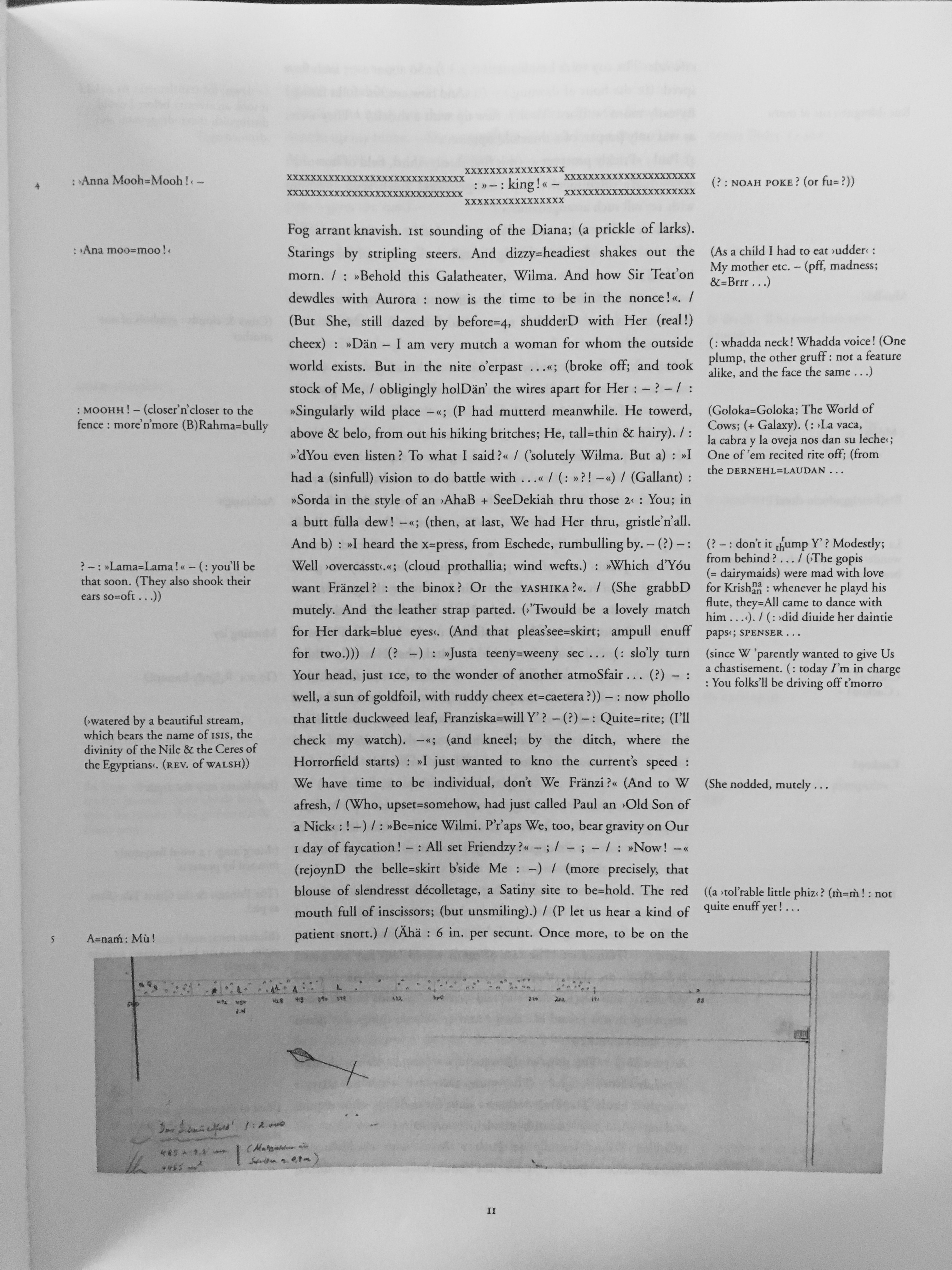
Here’s the first page of Bottom’s Dream (the pic links to a much larger image):

img_3901

Hmmm…? What do you think?

The obvious easy reference point here is Joyce’s Finnegans Wake, which indeed Schmidt was actively following, both in form and style: competing columns, a fragmentary and elusive/allusive style, collage-like metacommentary, an etymological explosion—words as paint, text as meaning. Etc.

(Did I mention it’s a lot longer than Finnegans Wake? Did I mention it’s enormous?)

img_3841

Here’s a glimpse at two random pages (don’t be afraid to click on that image and get the full, y’knoweffect):

img_3811

I’ll never forget one of my graduate school professors warning us not to “peer too long into Finnegans Wake.” He called it an abyss. (The man loved Joyce’s work, by the way, and had studied under Hugh Kenner. I’m not sure if he meant abyss pejoratively. It was, like I say, a warning).

Bottom’s Dream seems like an abyss. As its title (a reference to A Midsummer Night’s Dream) suggests, “it hath no bottom.”

After nine days, I’m “on” page 21 of Schmidt’s novel now, and I have no idea what’s going on. And not just because it’s a primal gobbledygook wordmass. No, part of my incomprehension results from a very strong physical reaction to “reading” Bottom’s Dream. This physical reaction goes beyond the size of the volume—although there’s certainly something to the size. I more or less have to read the thing on my dining room table; it’s dreadfully uncomfortable on a couch, and probably impossible on my hammock or in the bathtub. I can’t really hold it while I read it. I think this matters, although I can’t really say how right now. The multiple columns, marginalia, images, etc. are engaging but also fragment my attention—and I generally find myself flicking through Bottom’s Dream, rather than sustaining the will to follow the “plot.” Right now, anyway, I find myself wrapped up in the aesthetics of reading Bottom’s Dream. It’s a tactile read. I enjoy it most when I smooth my hands over it, jump out of the stream, 20, 30, 100 pages forward, backwards. Relax a little.

Otherwise, Bottom’s Dream becomes a bit of a nightmare for me: I get all dizzy, thirsty, my eyes seem to thrum. Something going on in the inner-ear. It’s like a slow-motion panic attack. When that abyss-stress comes on, I jump ahead.

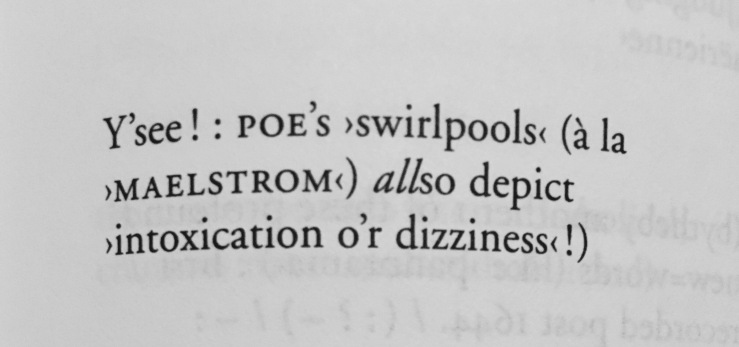
Which is how I found this bit of marginalia (I wish I’d recorded the page when I photographed it; but, also: the iPhone camera is a better recorder of Bottom’s Dream’s aesthetic textuality than any word-processing program. Even a scanner might straighten some of its bends and arcs, its voluminous volume):

img_3818

Yes! Poe’s >swirlpools<! >intoxication o’r dizziness<! — there’s a description for me of my own reaction to reading Bottom’s Dream.

Poe might be something of a guide for me if I do try to stick out wandering through Bottom’s Dream, and his story “A Descent into the Maelstrom,” referenced above, seems a particularly nice parallel to Schmidt’s bigass book.

“Descent” relates the tale of a sailor (a voyager!–a, like, metaphorical reader, y’know) transformed by his encounter with the “Moskoestrom” —a swirling abyss from which no one returns. This vortex, “absurd and unintelligible,” breaks the sailor, “body and soul.” He can’t comprehend the storm. It’s unknowable, un-nameable. At best, he is able to make a sidelong glance at it, but can never plumb its depths. And not only is his glance broken, but all of his senses are fragmented. He escapes the maelstrom, but is unrecognizable to the sailors who rescue him. He becomes the voice of the vortex, the metonymy of a force he can perceive but can’t comprehend.

The maelstrom—the vortex, the abyss—this, for Poe, was language.

I’m not sure how deep I’ll travel into Schmidt’s maelstrom. I managed large sections of Finnegans Wake—but I had a guide in Joseph Campbell’s Skeleton Key. Someone to map out the terrain, show me the ropes, etc.

Obviously, there isn’t much English-language scholarship on Bottom’s Dream right now (and in a very real and radical sense that I’m not touching on here, Woods’s translation is its own separate book). There are a few blogs taking on Schmidt’s monster though. The Untranslated has been writing (in English) about the original German text for over a year now. At Messenger’s Booker, Tony Messenger has been writing about Woods’s translation. There might be some other folks out there attempting the same—if you know let me know. For now, my updates from this maelstrom will be sporadic at best.

Gravity’s Rainbow, annotations and illustrations for page 299 | Some of us love to be taken under mountains, and not always with horny expectations

In the Venusburg, John Collier (1901)

There is that not-so-rare personality disorder known as Tannhäuserism 1 . Some of us love to be taken under mountains, and not always with horny expectations 2 .—Venus, Frau Holda, her sexual delights—no, many come, actually, for the gnomes , the critters smaller than you, for the sepulchral way time stretches along your hooded strolls down here, quietly through courtyards that go for miles, with no anxiety about getting lost… no one stares, no one is waiting to judge you… out of the public eye… even a Minnesinger needs to be alone…4  long cloudy-day indoor walks… the comfort of a closed place, where everyone is in complete agreement about Death 5. Slothrop knows this place. Not so much from maps he had to study at the Casino 6 as knowing it in the way you know someone is there… .

Plant generators are still supplying power. Rarely a bare bulb will hollow out a region of light 7 . As darkness is mined and transported from place to place like marble, so the light bulb is the chisel that delivers it from its inertia, and has become one of the great secret ikons of the Humility, the multitudes who are passed over by God and History 8. When the Dora prisoners 9  went on their rampage, the light bulbs in the rocket works were the first to go: before food, before the delights to be looted out of the medical lockers and the hospital pharmacy in Stollen Number 1, these breakable, socketless (in Germany the word for electric socket is also the word for Mother—so, motherless too 10 ) images were what the “liberated” had to take… .

From Thomas Pynchon’s Gravity’s Rainbow, page 299. All ellipses are Pynchon’s

1 Tannhäuser was a 13th-century German Minnesinger, a troubadour—a knight-poet. A bard, I guess. Is Slothrop a bard, a knight-poet—a knight-errant? Not sure. (He’ll later deny he’s on a grail-quest).

In German legend, Tannhäuser falls from grace when he discovers Venusberg, the underground home of Venus. He stays there a year, neglecting his betrothed and indulging in erotic delights. Teutonic Christian knight that he is, Tannhäuser leaves Vensuberg (Hörselberg) for Rome to beg forgiveness from Pope Urban IV, who denies him, saying absolution would be as impossible as his papal staff flowering in bloom. The staff does bloom—but not until Tannhäuser has disappeared back into the Venusian underworld (and his gal Lisaura has killed herself in grief).

2006au1525_jpg_l
Title page to ‘The Story of Venus and Tannhäuser’ Aubrey Beardsley (1895)

Cf. the sonnet on pages 532-33 of Gravity’s Rainbow:

Where is the Pope whose staff will bloom for me?
Her mountain vamps me back, with silks and scents,
Her oiled, athletic slaves, her languid hints
Of tortures transubstantiate to sky,
To purity of light-of bonds that sing,
And whips that trail their spectra as they fall.
At weather’s mercy now, I find her call
At every turn, at night’s foregathering.

I’ve left no sick Lisaura’s fate behind.
I made my last confession as I knelt,
Agnostic, in the radiance of his jewel…
Here, underneath my last and splintering wind,
No song, no lust, no memory, no guilt:
No pentacles, no cups, no holy Fool…

The Tannhäuser myth connects to Gravity’s Rainbow’s Orphean motif, and readers may take note of the hero’s descent played against the mystical “blooming” of a staff…eh, what with the sexy phallic overtones and all.

And we can use the third line of Gravity’s Rainbow here to describe the bloom on the staff: “It is too late” (3).

2 “Some of us love to be taken under mountains, and not always with horny expectations” — one problem with reading Gravity’s Rainbow only once or twice is that it is too full of great sentences and you’ll likely miss them. Pynchon continues to deflate what he has inflated (only to inflate it again)—sex will give over to death—or, an un-death (an un-sex) here. Slothrop inert, underground, in the tombs.

3 Cf. Pynchon’s 2006 novel Against the Day, wherein (briefly, too briefly), the heroic Chums of Chance take on “the increasingly deranged attentions of the Legion of Gnomes, the unconscionable connivings of a certain international mining cartel, the sensual wickedness pervading the royal court of Chthonica, Princess of Plutonia, and the all-but-irresistible fascination that subterranean monarch would come to exert, Circelike, upon the minds of the crew of Inconvenience [ETC.]”

4 . “…out of the public eye… even a Minnesinger needs to be alone…”

pynchon-simpsons-0-01

5 A perhaps puzzling line, if only because I think I get what everyone’s in “agreement about Death” here—Death as a kind of cozy promise that we all say “Fuck off” too in lieu of “long cloudy-day indoor walks” (and the horny expectations of underground sexbergs). I’m interested on anyone else’s ideas, of course.

6 The Casino Hermann Goering—Slothrop’s last “official” assigned post.

7 We privilege light over darkness; Pynchon inverts the image here: light is a violent “chisel”; darkness is a commodity to be mined.

The bulb becomes one of GR’s most powerful motifs, culminating in the late (and essential) episode “Byron the Bulb” (find Harold Bloom’s essay on Byron the Bulb if ye can).

References to Byron, via the indispensable folks at References to Byron, via the indispensable Pynchon Wiki:

“a bulb over his head burning all night long. He dreamed that the bulb was a representative of Weissmann, a creature whose bright filament was its soul” 426-27; “a theatre marquee whose sentient bulbs may have looked on […] witnesses to grave and historical encounters” 464; “The Story of” 647-55; “Someday he will know everything, and be just as impotent as before” 654; “electrical tidal wave” 665; “young Jack may have had one of them Immortal Lightbulbs then go on overhead” 688; screwed into Gustav’s kazoo hashpipe, 745

8 Pynchon loves to underline his big theme of “preterite vs elect” in Gravity’s Rainbow. There’s something sweet and even sad in the idea of the Humiliated, the preterite, finding an “ikon” in a lightbulb—a self-spark, a fragment of light. (I riffed a bit a while ago on GR’s theme of fragmentation and the dream of wholeness, the redemption of total light).

9 Laborers in the Mittelbau-Dora concentration camp who were forced to work toward producing V-2 rockets for the Nazis. Myth—Venus, gnomes, etc.—tips back into the horrific reality of slave labor. Pynchon seems to cast the Dora laborers as the preterite, grasping at their own spark of redemption by looting lightbulbs…and then reframes their preterite condition in the ironic quotation marks around “freedom.”

10  I don’t think the German word for electric socket, steckdose, corresponds so much to the word for “mother,” but maybe…it does? In any case, the etymology does seem to correspond to the concept of absence, or cavity, which permeates this episode of GR.

I looked for the root of “socket” in Josepth T. Shipley’s The Origins of English Words: A Discursive Dictionary of Indo-European Roots, and while I didn’t find anything about mothers or Venus or lightbulbs, I did find a connection to another of Gravity’s Rainbow’s big motifs: Pigs!—-

img_3852


“A wild dream of a witch-meeting” | Westworld episode two reviewed

img_0415

Had Goodman Brown fallen asleep in the forest, and only dreamed a wild dream of a witch-meeting?

“Young Goodman Brown,” Nathaniel Hawthorne (1835)

Nathaniel Hawthorne’s “Young Goodman Brown” was thrumming through my head the second time I watched “Chestnut,” the second episode of Westworld. In Hawthorne’s classic American tale, a naive youth ventures into the dark evil woods—for reasons never fully expressed—and witnesses his community’s Satanic inversion: Witches and wizards and a “devilish Indian behind every tree.” The narrator’s gambit (Was it all just a dream?) doesn’t ultimately matter—Brown’s experience irrevocably change him. He crosses the threshold of his domestic door, traipses into unknown terrors, and becomes a new person.

Last week, in my review of Westworld’s pilot, I wrote that the series engages “that mythic American promise: The Frontier, the Territory that Huck Finn swears to light out to in order to duck the constraints of those who would ‘sivilize’ him.” For Twain the territory is freedom; for dark Hawthorne the frontier is freedom’s dark twin terror. We find a bit of both in this episode of Westworld. (Along with wizards and Indians).

Our naive youth here is William (Jimmi Simpson). William arrives at Westworld for the first time, “guided” by his loutish friend Logan, who chooses to “go straight evil” (if I may echo a guest’s line from last week). Westworld’s pilot episode pulled a bait-and-switch last week, presenting Teddy Flood (James Marsden) as the naive youth, new to town, only to reveal that he is actually an automaton, a “host.” William provides a more traditional audience surrogate, and his opening sequences are closer to what we might expect from a traditional pilot episode. William’s entering Westworld also feels a bit like the beginning of a video game. (Westworld often feels like a video game. I mean that as a compliment).

We enter the Westworld with William; we savor the bespoke attire he’s offered; we glance with apprehension and desire at the guns on display. In a pivotal shot, William—and perhaps the audience—must make an important choice: White hat—or black?

img_0412

William chooses white, and much of his narrative in “Chestnut” is spent establishing his contrast to his “friend” Logan, who has donned a black hat, of course. William shows empathy, restraint, and civil humanity to the park’s automaton hosts, whereas Logan uses and abuses them with sadistic abandon. While Logan engages in an orgy (thanks HBO!), William rejects sex, declaring that he has “someone real waiting at home.” William hence represents a “family man” archetype. Perhaps he’s like Young Goodman Brown who just wanted to get home to his wife Faith.

Will crossing the threshold change William too? Yes. Of course. It’s a television show. For Hawthorne’s hero the results were dire: “A stern, a sad, a darkly meditative, a distrustful, if not a desperate man, did he become, from the night of that fearful dream.” Maybe Westworld will find a more optimistic path for William.

But this isn’t a show that’s generally optimistic about domesticity. In the pilot episode, we saw that one android father can simply be swapped out for another android father. (Mothers, android or otherwise, remain absent). In the one glimpse of a full family we get in that episode, we hear the father advise that crossing the river is “too adult” for the son. The Territory is a wild space ripe for masculine domination. Westworld continues the American fantasia of exploration and destiny-manifestin’.

“Chestnut” continues Westworld’s breaking down of familial order in two plot lines that seem to converge. In one such plot, The Man in Black (Ed Harris) kills the cousins and then the wife of a host he claims is an “old friend.” (More on the Man in the Black in a moment). In a second plot line, told mostly in nightmare-flashback mode, Thandie Newton’s character Maeve is a mother whose family is apparently killed by Indians. (More on the convergence of these plotlines in a moment too).

I was happy to see Maeve get screentime this week. Her nightmares throughout “Chestnut” echo Hawthorne’s observation that our dreams alter our realities, that our night-consciousness is vital, real. (Perhaps this is Dr. Ford’s design when he injects “reveries” into his automaton’s new programming system in Westworld’s pilot). Maeve’s dreams begin to affect her work performance, so she’s hauled repeatedly into Westworld’s underground body shop for reconditioning—and a possible decommissioning. Maeve delivers the same monologue three times to different guests in the episode. Each segment feels like a separate audition, the producers leering offstage. Westworld again draws attention to its own form, its metatextuality, its “TV-showness,” as it were.

img_0419

Maeve’s “truest” performance comes underground—she somehow bypasses “sleep mode” and wakes up in the middle of the (real) nightmare: the Westworld labs and body shops. In an echo of the scalping motif that slices through the episode, Maeve grabs a scalpel and takes off, running deeper into the nightmare. The sequence is aesthetically arresting, wonderfully weird, and ultimately devastating when she finally happens upon the heaped bodies of her android fellows. Maeve’s underground odyssey furthers the Big Plot of Westworld thus far: How much consciousness–and self-consciousness –do these androids have? I’m digging how the series takes on memory, dream, and reality.

img_0420

Maeve’s performance is under pressure specifically because Lee Sizemore, Westworld’s narrative director (ahem, head writer), wants to cull dead weight to make room for his new campaign, “Odyssey on the Red River.” Sizemore, who we’re invited to view as a kind of Hollywood hack asshole, assures the assembled management team that this new storyline’s grotesque savagery (meta meta meta) will make it look like “”Hieronymous Bosch was doodling kittens.” Sizemore’s smugly assured that Dr. Ford, who hasn’t commented on the story in years, won’t interfere. So of course Ford shoots him down.

Ford is the true magician of Westworld. He regards Sizemore as a huckster, a fraud peddling cheap tricks. Ford blasts Sizemore’s claim that Westworld will “tell the guests who they are,” arguing that Westworld’s true potential is to transform and transmute the guests into what they can be. Ford notes at one point in the episode that the guests crave nuance, subtlety, mystery. They want witchcraft; they want a spell that transmogrifies chaos into magic.

Where does Ford’s magic come from? Boredom! In a wonderful discussion with (what I’m assuming simply has to be) a replicant version of himself as a child, Ford twists the old idiom and suggests that “only boring people cannot conceive of boredom.” He guides the replicant child to a desert vision of the “Town with the White Church,” pointing to the imaginative possibility of the Territory—to the frontier’s magic. The Black Sabbath in the wilderness is all in the wizard’s mind. “You see what a bored mind can conjure,” Ford tells the boy, and then charms a snake, declaring, perhaps a bit glumly, that, “Everything in this world is magic, except to the magician.” Ford dismisses the boy, and later brings Bernie Lowe (Jeffrey Wright) up to the surface to survey the desert terrain, the rocks where he will build this church. (Bernie dons a brown baseball cap. No black or white stetson for Bernie).

img_0414

But The Man in Black: He’s pure Black Hat. Compellingly, Dr. Ford’s thoughts on subtlety and magic parallel The Man in Black’s. (White wizard/Black wizard?). “When you’re suffering, that’s when you’re most real” he snarls at an automaton he’s interrogating, echoing Emily Dickinson’s “I like a look of agony / Because I know it’s true.”

The Man in Black’s back in town, not a stranger, in search of something called The Maze, willing to scalp androids, smash families, kill cousins, wives, daughters, etc. to get clues—ah but wait, I’m forgetting, They’re just androids, right?

Is The Man in Black an android too?

“I’ve been coming here for 30 years,” he reminds us. (Westworld  wants us to remember this three-decade benchmark—recall that the last time the park faced trouble was thirty years ago). But then, and perhaps without much of that magic subtlety, he tells us: “In a sense, I was born here.” Egads! 

img_0418

Black’s plot converges with Maeve’s nightmare in a Satanic reverie. Indian marauders have chased Maeve and her (dream)daughter into a cabin corner; one enters and shape-shifts into The Man in Black, knife out, ready to scalp her.

Is this now? Is this then? Is this real? Is this dream?

I started with Hawthorne’s “Young Goodman Brown,” so I’ll end with it. The Man in Black—but also Dr. Ford, perhaps—recall to me Brown’s traveling companion into the woods (lovely dark and deep), an old wizard who bears “a considerable resemblance” to the young (good?)man. The old mage steers YGB deeper into the Frontier, into the Territory, into the Weird, and he protests about going over the line:

“Too far, too far!” exclaimed the goodman, unconsciously resuming his walk. “My father never went into the woods on such an errand, nor his father before him. We have been a race of honest men and good Christians, since the days of the martyrs. And shall I be the first of the name of Brown, that ever took this path and kept–”

“Such company, thou wouldst say,” observed the elder person, interrupting his pause. “Well said, Goodman Brown! I have been as well acquainted with your family as with ever a one among the Puritans; and that’s no trifle to say. I helped your grandfather, the constable, when he lashed the Quaker woman so smartly through the streets of Salem. And it was I that brought your father a pitch-pine knot, kindled at my own hearth, to set fire to an Indian village, in King Philip’s War. They were my good friends, both; and many a pleasant walk have we had along this path, and returned merrily after midnight. I would fain be friends with you, for their sake.”

Hawthorne here lays out an American history of religious persecution, the murder of indigenous peoples, and hypocrisy, themes that find their echo in Westworld’s continuation of the American myth.

Or maybe it’s the Territory itself, the dream/nightmare of the Frontier:

America is not a young land: it is old and dirty and evil before the settlers, before the Indians. The evil is there waiting.

Naked Lunch, William Burroughs (1959)

Gravity’s Rainbow, annotations and illustrations for pages 257-58

The War has been reconfiguring time and space into its own image 1. The track runs in different networks now. What appears to be destruction is really the shaping of railroad spaces to other purposes, intentions he can only, riding through it for the first time, begin to feel the leading edges of… .2

He checks in to the Hotel Nimbus 3, in an obscure street in the Niederdorf or cabaret section of Zürich. The room’s in an attic, and is reached by ladder. There’s also a ladder outside the window, so he reckons it’ll be O.K. 4 When night comes down he goes out looking for the local Waxwing rep, finds him farther up the Limmatquai, under a bridge, in rooms full of Swiss watches, clocks and altimeters 5. He’s a Russian named Semyavin. Outside boats hoot on the river and the lake. Somebody upstairs is practicing on a piano: stumbling, sweet lieder. Semyavin pours gentian brandy 6 into cups of tea he’s just brewed. “First thing you have to understand is the way everything here is specialized. If it’s watches, you go to one café. If it’s women, you go to another. Furs are subdivided into Sable, Ermine, Mink, and Others. Same with dope: Stimulants, Depressants, Psychomimetics… . What is it you’re after?”

“Uh, information?” Gee, this stuff tastes like Moxie… .

“Oh. Another one.” Giving Slothrop a sour look. “Life was simple before the first war. You wouldn’t remember. Drugs, sex, luxury items. Currency in those days was no more than a sideline, and the term ‘industrial espionage’ was unknown. But I’ve seen it change—oh, how it’s changed. The German inflation, that should’ve been my clue right there, zeros 7 strung end to end from here to Berlin. I would have stern talks with myself. ‘Semyavin, it’s only a temporary lapse away from reality 8. A small aberration, nothing to worry about. Act as you always have—strength of character, good mental health. Courage, Semyavin! Soon all will be back to normal.’ But do you know what?”

“Let me guess.”

A tragic sigh. “Information. What’s wrong with dope and women? 9 Is it any wonder the world’s gone insane, with information come to be the only real medium of exchange?”

“I thought it was cigarettes.”

“You dream.” He brings out a list of Zürich cafés and gathering spots. Under Espionage, Industrial, Slothrop finds three. Ultra, Lichtspiel, and Sträggeli 10. They are on both banks of the Limmat, and widely spaced.

“Footwork,” folding the list in an oversize zoot-suit pocket 11.

“It’ll get easier. Someday it’ll all be done by machine. Information machines. You are the wave of the future.” 12

If there is a central thread through these Gravity’s Rainbow annotations—and I’m not claiming that there is one—but if there is a central thread I’ve been trying to tease out, it’s that GR, despite being a complex and confounding conundrum, repeatedly clarifies its thesis. The narrator spells out another summary of the tale, this time in a dozen words.

The “he” here is Our Main Man Tyrone Slothrop en route to Zurich. It’s the spring of 1945, and we’re at the end of the second part of Gravity’s Rainbow, “Un Perm ‘au Casino Hermann Goering,” and riding into part three, “In the Zone.” Here, the war—excuse me, The War—is an entropy pushing out into “other purposes.”

Weisenburger notes in A Gravity’s Rainbow Companion that “The Nimbus appears to be a fictional hotel.”

You, dear reader, of course know that a “nimbus” is a cloud. I’ve always been partial to Magritte’s clouds.

black-magic-1945
Black Magic, Rene Magritte, 1945

“Nimbus” is also a term for the halo or aureola that often surrounds sacred or supernatural figures in artistic representation, like the rainbow that shimmers around Albion in Blake’s Albion Rose.

Albion Rose, William Blake, 1793-1796

Later, in his hot air balloon escape from Marvy’s Mothers, Slothrop and his pirate pilot Schnorp will try to hide in a cloud.

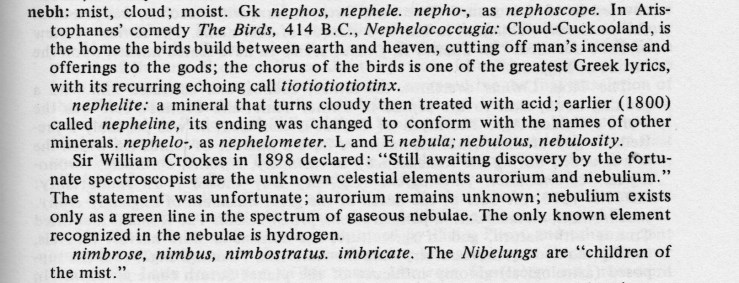
From Joseph T. Shipley’s The Origin of English Words: A Discursive Dictionary of Indo-European Roots (1984). Check his last notation (the Nibelungen are a motif in Gravity’s Rainbow):

img_3681

As GR progresses, Our Free Agent Slothrop gets better and better at spotting means of escape (he’ll note the keys left in an unattended car later in Peenemünde, for example). A ladder up, a ladder down. Rise, ascend, escape. Repeat.

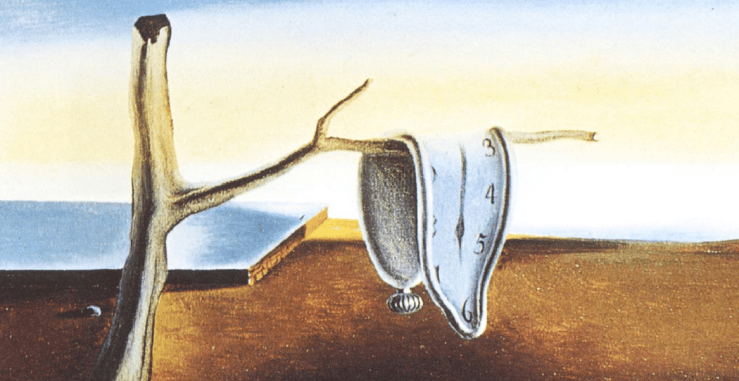
All devices for measuring, obviously—ones and zeroes and all that. Slothrop is a disruptive force to traditional means of measurement, natch.

screenshot-2016-09-30-at-5-56-54-pm
The Persistence of Memory (detail), Salvador Dali, 1931

6 “French and Swiss liqueur distilled from the roots of gentian plants; also called Enzian” (Weisenburger, A Gravity’s Rainbow Companion).

Cf. Oberst Enzian, introduced on page 100—Enzian meets Slothrop a few dozen pages later and pushes Marvy from a train.

7 The inflation, the zeros…Pynchon intricately repeats his motifs, ever-threading them throughout the novel.

8 And who among us has not assured themselves that “it’s only a temporary lapse away from reality”? Semyavin’s complaint seems to be the default position of the 20th century. It’s downright quaint or naive in the 21st.

Reality is not a stable story, a progress, a culmination, but rather a entropic mess, a shuffling chaos, one big etc.

9 Nothing.

10 Weisenburger gives “Ultra, Lichtspiel, and Sträggeli” as nightclubs, and offers that Sträggeli means “‘specter,’ a ‘play of light’ (or Lichtspiel); in the same context, ‘Ultra’ refers to the very high frequency light waves in any spectrum of illumination.” Synonyms.

11 The zoot suit is another motif in GR (another kind of uniform that Slothrop dons—a non-uniform? a uniform of resistance?), and Pynchon’s evocation of the Los Angeles Zoot Suit Riots of 1943 (roughly 10 pages earlier) is a superb little number of storytelling.

M.2011.94a-b
Zoot Suit (1940-1942), Los Angeles County Museum of Art

The zoot suit received an unnecessary revival in the 1990s. I was then an impressionable lad in my very-late teens/early twenties, yet still had the sense to find this attire revolting. It’s possible now to see that the zoot suit revival gelled with the zeitgeist’s preference for baggy garb—hip-hop, mall goth, and skate culture clothes in particular.

12 Clearly prescient lines—both in the spring of 1945 and in 1973 when GR was published. Pynchon explores the idea of these information ideas in his 2009 novel Inherent Vice.

I love the metaphorical evocation of Slothrop as “the wave of the future” — a cliche that the narrative literalizes.

Hearing America as it must sound to a non-American | Gravity’s Rainbow, annotations for page 256

Just before dawn knocking comes very loud, hard as steel. Slothrop has the sense this time to keep quiet.1

“Come on, open up.”

“MPs 2 , open up.”

American voices, country voices, high-pitched and without mercy. He lies freezing, wondering if the bedsprings will give him away. For possibly the first time he is hearing America as it must sound to a non-American 3. Later he will recall that what surprised him most was the fanaticism, the reliance not just on flat force but on the rightness 4 of what they planned to do… he’d been told long ago to expect this sort of thing from Nazis, and especially from Japs —we were the ones who always played fair—but this pair outside the door now are as demoralizing as a close-up of John Wayne (the angle emphasizing how slanted his eyes are, funny you never noticed before) screaming “BANZAI!” 6.

“Wait a minute Ray, there he goes—”

“Hopper! You asshole, come back here—”

“You’ll never get me in a strait jacket agaaaaain… .” Hopper’s voice goes fading around the corner as the MPs take off in pursuit.

It dawns on Slothrop, literally, through the yellowbrown window shade, that this is his first day Outside. His first free morning. He doesn’t have to go back. Free? What’s free? He falls asleep at last. A little before noon a young woman lets herself in with a passkey and leaves him the papers. He is now an English war correspondent named Ian Scuffling 7.

1 Slothrop has fled the clutches of The White Visitation and made out for Nice, where he hooks up with Blodgett Waxwing’s contacts in a squalid safehouse…the safehouse is actually closer to a madhouse though, or a halfway house.

2 Military Police—a concept that perplexed me when I was five or six, watching MASH reruns with my father. MASH is kinda sorta (slightly) Pynchonian, actually.

3 A fascinating notation.

Some jingoists would insist, of course, that no decent American (i.e., a Real American) ought to hear America the way it must sound to a non-American. Slothrop has already posed as an Englishman, but there’s a bit of a conversion here, I think—a shift for our shifter, who’s moving from not simply performing a double-agency to actually existing (or non-existing) one.

Cf. Walt Whitman’s 1860 poem “I Hear America Singing”:

I hear America singing, the varied carols I hear,
Those of mechanics, each one singing his as it should be blithe and strong,
The carpenter singing his as he measures his plank or beam,
The mason singing his as he makes ready for work, or leaves off work,
The boatman singing what belongs to him in his boat, the deckhand singing on the steamboat deck,
The shoemaker singing as he sits on his bench, the hatter singing as he stands,
The wood-cutter’s song, the ploughboy’s on his way in the morning, or at noon intermission or at sundown,
The delicious singing of the mother, or of the young wife at work, or of the girl sewing or washing,
Each singing what belongs to him or her and to none else,
The day what belongs to the day—at night the party of young fellows, robust, friendly,
Singing with open mouths their strong melodious songs.
To which, Langston Hughes, in 1926 replied in “I Too”:
I, too, sing America.
I am the darker brother.
They send me to eat in the kitchen
When company comes,
But I laugh,
And eat well,
And grow strong.
Tomorrow,
I’ll be at the table
When company comes.
Nobody’ll dare
Say to me,
“Eat in the kitchen,”
Then.
Besides,
They’ll see how beautiful I am
And be ashamed—
I, too, am America.

4 When we most believe we are right we are most susceptible to being wrong. Unconsidered belief is terrifying.

5 Pynchon is too often accused of obscurity; his critique of blind patriotism and government propaganda is so clear that it hardly warrants this footnote. So I’ll comment, rather, on his brilliant modernist style—note the shift here, via free indirect speech, from third-person to first-person, from “he” to “we.”

I’m admittedly confused here—does the narrator attribute the expression BANZAI! to the MPs, or to John Wayne? I think what we have here is a conflation of both (which is to say a conflation of the third-person “he” with the first-person “I”—in other words, Slothrop, now attuned (or detuned) to “hearing America as it must sound to a non-American” can recast his country’s jingoistic martial fantasies and see/hear the Hero of the Military-Industrial-Entertainment Complex (John Wayne) as a cartoonish, racialized war trope).

In Japanese, the term banzai translates as ten thousand years, but basically means, as I’m sure you know, something like “Hooray.” During WWII, banzai was an attack cry for Japanese soldiers (review the independent clause after the ellipses in Pynchon’s original sentence).

Is BONZAI! here a strange transposition of GERONIMO!, an exclamation cribbed by U.S. Army parachutists from a 1939 film of the same name?

The ironic notation of John Wayne’s “slanted…eyes”seems like a nod to the notorious 1956 flop The Conqueror, which featured John Wayne as…Genghis Khan.


And speaking of BANZAI

Have you seen the Pynchonesque 1984 film The Adventures of Buckaroo Banzai Across the 8th Dimension? It is good fun.


(W.D. Richter, director of Buckaroo Banzai, also co-wrote Big Trouble in Little China, in which Kurt Russell did a good/bad John Wayne impression).

Slothrop’s always shuffling off identities—or shuffling into them. Here, we get Ian Scuffling, his English journalist identity (for a few dozen pages). Scuffling…shuffling…? Let’s get the etymology.

From Joseph T. Shipley’s The Origin of English Words: A Discursive Dictionary of Indo-European Roots (1984):

img_3672

Another short report from The Charterhouse of Parma

img_3114
Robert Andrew Parker’s ilustration to Ch. 4 of The Charterhouse of Parma

After many, many false starts, I’ve finished Stendhal’s 1839 cult classic The Charterhouse of Parma.  (I read Richard Howard’s 1999 Modern Library translation).

I really, really wanted to quit around Ch. 25 (of 28). I’ll admit at times I broke a rule I’d made nearly two decades ago, now: I allowed my mind to wander. I thought of other things: A variation on a muffin recipe I was planning to make for my kids. A possible review of William Friedkin’s 1977 film Sorcerer. Lunch. What book I might read next as an antidote to Charterhouse.

The end of the novel is an utter slog. No duels, no escapes. Just courtly intrigues and courtly romances. And ironic sermons. Then, in the last chapter, a new character shows up! Some dandy named Gonzo! Out of nowhere! To move the plot along! (Stendhal pulls a similar stunt in the back half of the novel, when it first starts to really drag—he brings in a lunatic-bandit-poet-assassin named Ferrante).

And then—okay, maybe this is something close to a spoiler, but I don’t think so—and then, Stendhal seems to get bored with his novel. In the last chapter, he skips a few years in a few sentences (this, in a novel where every damn decision each character frets over goes on and on for paragraphs) and then kills everyone (not really. But really, sorta. I mean, the last chapter of The Charterhouse of Parma almost feels like season six of Game of Thrones, where the action is accelerated at a pace that seems to ironize all the previous scheming and plotting).

Stendhal supposedly dictated Charterhouse over 50-something days (I think I read that somewhere…I’ve yet to read Howard’s afterword to the novel, or Balzac’s study…I’ll save those for later, after I remember the best bits of the novel more fondly). But where was I? Oh, yeah: Stendhal supposedly dictated Charterhouse over a two-month period, and I get the feeling he was getting bored with it there at the end. Which is in some ways appropriate, as The Charterhouse of Parma is all about boredom. Phrases like “boring,” “bored,” and “boredom” pop up again and again. There’s something wonderfully modernist (or Modernist) about that.

img_3115
Robert Andrew Parker’s ilustration to Ch. 11 of The Charterhouse of Parma

Of course all that boredom is punctuated with moments of wonderful action—battles and duels! Indeed, Charterhouse never really surpasses its fourth chapter, a strikingly modern depiction of the Battle of Waterloo.

Stendhal is great at conveying action and violence while stripping it from Romantic illusions—and at the same time, he presents those Romantic illusions, making them ironic (again—this is probably one of the first Modern novels, and I’m sure someone has already said that somewhere, but hey).

Stendhal is also wonderfully adept at capturing a human mind thinking. Whether it’s the Machiavellian machinations of Count Mosca, or our (ever)greenhorn hero Fabrizio, or the real hero of Charterhouse, Fabrizio’s aunt Gina, Stendhal takes pains to show his characters thinking through their problems and schemes. Not only do the heroes and villains of The Charterhouse of Parma think, they think about what other characters will think (about what they have thought…). The novel in some ways is about metacognition. But thought about thought may be a product of boredom. And it often produces boredom.

Balzac was a great admirer of Charterhouse, as was Italo Calvino, and countless writers too. Indeed, the novel is, I suppose, a cult favorite for writers, which makes sense: Stendhal crowds each page with such psychological realism, such rich life, that every paragraph seems its own novel. I’ll admit that by page 400 or so I was exhausted though.

I’ve noted here a few times that Charterhouse is a “Modernist” novel; perhaps “proto-Modernist” is the term I need. (Again—I’m sure that countless lit critics have sussed over this; pardon my ignorant American ass). And yet Charterhouse also points back at the novels before it, the serialized novels, the epistolary novels, the romances and histories and etceteras of the seventeenth and sixteenth centuries. My favorite lines of the novel were often our ironic narrator’s brief asides like, “Doubtless the reader grows tired…” or “The conversation went on for hours more in trivial detail…” or “The letter went on for pages more after the same fashion…” (These aren’t actual quotes, dear reader, but I think I offer a fair paraphrase here). Stendhal’s modernism, or Modernism, or proto-Modernism, or whatever, is his wily irony, his winking at the novel’s formal characteristics. My own failing, then, is to perhaps want more of this. As I wrote last time I riffed on it, what I suppose I want is a postmodern condensation of The Charterhouse of Parma, such as Donald Barthelme’s 1968 story “Eugénie Grandet,” which parodied Honoré de Balzac’s 1833 novel Eugénie Grandet. 

Screenshot 2016-07-25 at 5.08.00 PM

How much of Balzac’s novel is lovingly leapt through right here?!

This wish of mine is of course my failure, not the novel’s.

The Charterhouse of Parma is undoubtedly an oddity, a work of genius, often thrilling, and often an utter slog. I suppose I’m glad that I finally finished it after so many years of trying, but I’m not sure if I got what I wanted out of it. The failure is mine.

I’ll close with the novel’s final line though, which I adore:

TO THE HAPPY FEW

A short report from The Charterhouse of Parma

img_2734

Have you read Honoré de Balzac’s 1833 novel Eugénie Grandet?

I haven’t, but I’ve read the Wikipedia summary.

I’ve also read, several times, Donald Barthelme’s 1968 parody, “Eugénie Grandet,” which is very very funny.

Have you read  Stendhal’s 1839 novel The Charterhouse of Parma?

After repeated false starts, I seem to be finishing it up (I’m on Chapter 19 of 28 of Richard Howard’s 1999 Modern Library translation).

I brought up Eugénie Grandet (Balzac’s) to bring up “Eugénie Grandet” (Barthelme’s). Stendhal’s (1830’s French) novel Charterhouse keeps reminding me of Barthelme’s (1960’s American) short story “Eugénie Grandet,” which is, as I’ve said, a parody of Honoré de Balzac’s (1830’s French) novel Eugénie Grandet. Balzac and Stendhal are pre-Modernists (which is to say they were modernists, I suppose). Donald Barthelme wanted to be a big em Modernist; his postmodernism was inadvertent. By which I mean— “postmodernism” is just a description (a description of a description really, but let me not navelgaze).

Well and so: I find myself often bored with The Charterhouse of Parma and wishing for a condensation, for a Donald Barthelme number that will magically boil down all its best bits into a loving parody that retains its themes and storylines (while simultaneously critiquing them)—a parody served with an au jus of the novel’s rich flavor.

My frequent boredom with the novel—and, let me insert here, betwixt beloved dashes, that one of my (many) favorite things about Charterhouse is that it is about boredom! that phrases like “boredom,” boring,” and “bored” repeat repeatedly throughout it! I fucking love that! And Stendhal, the pre-Modernist (which is to say “modernist”), wants the reader to feel some of the boredom of court intrigue (which is not always intriguing). The marvelous ironic earnest narrator so frequently frequents phrases like, “The reader will no doubt tire of this conversation, which went on for like two fucking hours” (not a direct quote, although the word “fuck” shows up a few times in Howard’s translation. How fucking Modern!)—okay—

My frequent boredom with the novel is actually not so frequent. It’s more like a chapter to chapter affair. I love pretty much every moment that Stendhal keeps the lens on his naive hero, the intrepid nobleman Fabrizio del Dongo. In love with (the idea of) Napoleon (and his aunt, sorta), a revolutionist (not really), a big ell Liberal (nope), Fabrizio is a charismatic (and callow) hero, and his chapters shuttle along with marvelous quixotic ironic energy. It’s picaresque stuff. (Fabrizio reminds me of another hero I love, Candide). Fabrizio runs away from home to join Napoleon’s army! Fabrizio is threatened with arrest! Fabrizio is sorta exiled! Fabrizio fucks around in Naples! Fabrizio joins the priesthood! Fabrizio might love love his aunt! Fabrizio fights a duel! Fabrizio kills a man! (Not the duel dude). Fabrizio is on the run (again)! Fabrizio goes to jail! Fabrizio falls in love!

When it’s not doing the picaresque adventure story/quixotic romance thing (which is to say, like half the time) Charterhouse is a novel of courtly intrigues and political machinations (I think our boy Balzac called it the new The Prince). One of the greatest strengths of Charterhouse is its depictions of psychology, or consciousness-in-motion (which is to say Modernism, (or pre-modernism)). Stendhal takes us through his characters’ thinking…but that can sometimes be dull, I’ll admit. (Except when it’s not). Let me turn over this riff to Italo Calvino, briefly, who clearly does not think the novel dull, ever—but I like his description here of the books operatic “dramatic centre.” From his essay “Guide for New Readers of Stendhal’s Charterhouse:

All this in the petty world of court and society intrigue, between a prince haunted by fear for having hanged two patriots and the ‘fiscal général’ (justice minister) Rassi who is the incarnation (perhaps for the first time in a character in a novel) of a bureaucratic mediocrity which also has something terrifying in it. And here the conflict is, in line with Stendhal’s intentions, between this image of the backward Europe of Metternich and the absolute nature of those passions which brook no bounds and which were the last refuge for the noble ideals of an age that had been overcome.

The dramatic centre of the book is like an opera (and opera had been the first medium which had helped the music-mad Stendhal to understand Italy) but in The Charterhouse the atmosphere (luckily) is not that of tragic opera but rather (as Paul Valéry discovered) of operetta. The tyrannical rule is squalid but hesitant and clumsy (much worse had really taken place at Modena) and the passions are powerful but work by a rather basic mechanism. (Just one character, Count Mosca, possesses any psychological complexity, a calculating character but one who is also desperate, possessive and nihilistic.)

I disagree with Calvino here. Mosca is an interesting character (at times), but hardly the only one with any psychological complexity. Stendhal is always showing us the gears ticking clicking wheeling churning in his characters’ minds—Fabrizio’s Auntie Gina in particular. (Ahem. Excuse me–The Duchessa).

But Duchess Aunt Gina is a big character, perhaps the secret star of Charterhouse, really, and I’m getting read to wrap this thing up. So I’ll offer a brief example rather from (what I assume is ultimately) a minor character, sweet Clélia Conti. Here she is, in the chapter I finished today, puzzling through the puzzle of fickle Fabrizio, who’s imprisoned in her dad’s tower and has fallen for her:

Fabrizio was fickle; in Naples, he had had the reputation of charming mistresses quite readily. Despite all the reserve imposed upon the role of a young lady, ever since she had become a Canoness and had gone to court, Clélia, without ever asking questions but by listening attentively, had managed to learn the reputations of the young men who had, one after the next, sought her hand in marriage; well then, Fabrizio, compared to all the others, was the one who was least trustworthy in affairs of the heart. He was in prison, he was bored, he paid court to the one woman he could speak to—what could be simpler? What, indeed, more common? And this is what plunged Clélia into despair.

Clélia’s despair is earned; her introspection is adroit (even as it is tender). Perhaps the wonderful trick of Charterhouse is that Stendhal shows us a Fabrizio who cannot see (that he cannot see) that he is fickle, that Clélia’s take on his character is probably accurate—he’s just bored! (Again, I’ve not read to the end). Yes: What, indeed, could be more common? And one of my favorite things about Charterhouse is not just that our dear narrator renders that (common) despair in real and emotional and psychological (which is to say, um Modern) terms for us—but also that our narrator takes a sweetly ironic tone about the whole business.

Or maybe it’s not sweetly ironic—but I wouldn’t know. I have to read it post-Barthelme, through a post-postmodern lens. I’m not otherwise equipped.

Bored of Hell

img_3055

I am bored of Hell, Henri Barbusse’s 1908 novel of voyeurism.

Maybe I should blame the 1966 English translation (from the French) by Robert Baldick, which often feels stuffily stuffy for a book about “childbirth, first love, marriage, adultery, lesbianism, illness, religion and death” (as our dear translator puts it in his brief preface). Maybe I should blame it on Baldick, but that seems rash and wrong, and I have no basis of comparison, do I?

So I blame it on myself, this boredom of Hell.

Why write then? Why not write it off, rather, which is to say, do not write—I don’t know.

I’m bored with Hell and there are half a dozen novels I’ve recently  read (or am reading) that I should commend, recommend, attempt to write about—but here I am bored of Hell, and writing about it. Maybe it’s—and the it here refers to writing about Hell, a book I confesss a boredom of—maybe it’s because I’ve allowed myself over the last few days to good lord skim the goddamned infernal thing, not skimming for a replenishing sustenance, but rather looking for the juicy fat bits, the best bits, in the same way a teenaged version of myself skimmed Henry Miller and Anaïs Nin in a powerful sweat.

(I was a teenage cliché).

Maybe it’s that the best bits of Hell weren’t juicy enough. (In this novel, an unnamed narrator espies all sorts of sensual (and nonsensual) shenanigans through a small hole in his hotel room). Or maybe the juicy bits were juicy, but the translation dried them out. So many of the sentences made me want to close the book. But it’s unfair for me to write this, I suppose, without offering a sample. Here, from early in the novel, is an excerpt that did make me want to keep going:

The mouth is something naked in the naked face. The mouth, which is red with blood, which is forever bleeding, is comparable to the heart: it is a wound, and it is almost a wound to see a woman’s mouth.

And I begin trembling before this woman who is opening a little and bleeding from a smile. The divan yields warmly to the embrace of her broad hips; her finely-made knees are close together, and the whole of the centre of her body is in the shape of a heart.

…Half-lying on the divan, she stretches out her feet towards the fire, lifting her skirt slightly with both hands, and this movement uncovers her black-stockinged legs.

And my flesh cries out…

Those last ellipses were mine. Did you want more? I did, I admit. And yet after 50 pages, I grew bored. The voyeurism was boring—sprawling. Perhaps I’m lazy. Perhaps I want my voyeurism condensed. Maybe…weirder. I don’t know. Reader, I skimmed. I skimmed, like I said, for morsels—but also to the end, the the final chapter, to the final exquisite not boring paragraph, which I’ll share with you now before “I have done,” as the narrator states in this final section. Promised paragraph:

I believe that confronting the human heart and the human mind, which are composed of imperishable longings, there is only the mirage of what they long for. I believe that around us there is only one word on all sides, one immense word which reveals our solitude and extinguishes our radiance: Nothing! I believe that the word does not point to our insignificance or our unhappiness, but on the contrary to our fulfillment and our divinity, since everything is in ourselves.

Reviews and riffs of February-May, 2016 (and an unrelated stag)

Hey, wow. Haven’t done one of these in a while.


I reread William Gaddis’s big big novel J R, writing

Only a handful of novels are so perfectly simultaneously comic and tragic. Moby-Dick? Yes. Gravity’s Rainbow? Absolutely. (G R and J R, a duo published two years apart, spiritual twins, massive American novels that maybe America hardly deserves (or, rather: theses novels were/are totally the critique America deserves). I guess maybe what I’m saying is J  R is the Great American Novel to Come (The Recognitions is perhaps overpraised and certainly not Gaddis’s best novel; J R is. The zeitgeist has been caught up to J R, the culture should (will) catch up).


I also read and wrote about Ashley Dawson’s Extinction: A Radical History, a scary little primer that argues mass species extinction is

…the product of a global attack on the commons, the great trove of air, water, plants and creatures, as well as collectively created cultural forms such as language, that have been regarded traditionally as the inheritance of humanity as a whole…capital of course depends on continuous commodification of this environment to sustain its growth.

My reading of Extinction—and hence my writing about it—is/was inextricably bound up in a viewing of Hayao Miyazaki’s 1997 eco-fable 1997 , Mononoke-hime. (The film’s title is usually rendered in English as Princess Mononoke, but I think Spirit-Monster Wolfchild is a more fitting translation). I also linked the book to Gilgamesh and Easter. And I used this gif:

tumblr_inline_o1qoyqk5ln1t6t6sv_500


I wrote a post about listening to audiobook versions of “difficult novels,” taking my lead and license from this big quote from William H. Gass’s essay “The Sentence Seeks Its Form”:

Breath (pneuma) has always been seen as a sign of life . . . Language is speech before it is anything. It is born of babble and shaped by imitating other sounds. It therefore must be listened to while it is being written. So the next time someone asks you that stupid question, “Who is your audience?” or “Whom do you write for?” you can answer, “The ear.” I don’t just read Henry James; I hear him. . . . The writer must be a musician—accordingly. Look at what you’ve written, but later … at your leisure. First—listen. Listen to Joyce, to Woolf, to Faulkner, to Melville.


99 reasons I didn’t read your novel.


tumblr_o71467dk931s4y9aso1_1280

I reviewed Mahendra Singh’s marvelous satire American Candide. Far better than my measly review is a long interview I did with Singh, who is just a damn genius. I’m most grateful for the final exchange of our review, which was not really a part of the official q & a type thing we were doing—rather, I was bemoaning my ability to write anything lately, and Mahendra offered me the following, which I edited into the interview:

The hidden contempt that our culture harbors towards art will drive you nuts if you think about it … so don’t think too much … write instead! And if you can’t write, read smartly. I find great solace in the classics and have devoted most of my life to trying in whatever way I can to perpetuate the classical tradition (in concealment) and create situations where young people can gain access to the eternal truths and beauty of the classical world tradition. We are living in a time of imperial decline and must preserve the best of the past as our ancestors did in similar times of trouble. The pendulum will swing the other way in a few centuries.


Prince died.

I wrote about him in a Three Books post.

The three books had nothing to do with Prince.


Despite some fascinating images, I was not impressed by Ben Wheatley’s film adaptation of Ballard’s High-Rise. I concluded that,

While the High-Rise adaptation delivers Ballardian style, that Ballardian style only points at itself, and not at our Ballardian present, our Ballardian future.


And I wrote about Ferrante, Knausgaard, and their good/bad/ironic book covers.


Here’s that promised stag (by Diego Velazquez):

reproduction_painting5cspain5cvelc3a1zquez20diego20rodriguez20de20silva20159920-2016605chead20of20a20stag

Extinction, Gilgamesh, Miyazaki’s Wolfchild, etc. (A Riff)

img_1916

Reading the introduction to Ashley Dawson’s Extinction: A Radical History this afternoon (forthcoming from OR Books), I felt a surreal yet nevertheless familiar twinge of apocalypse anxiety creeping into my right eye, where it tussled around. Is unnerved the metaphor I look for, here? Or is my response more literal? “Extinction is the product of a global attack on the commons, the great trove of air, water, plants and creatures, as well as collectively created cultural forms such as language, that have been regarded traditionally as the inheritance of humanity as a whole,” writes Dawson, and I nod my head. Dawson continues: “capital of course depends on continuous commodification of this environment to sustain its growth.” I nod some more. “Indeed, there is no clearer example of the tendency of capital accumulation to destroy its own conditions of reproduction than the sixth extinction.” More nodding, more anxiety.

Chapter 2 of Extinction, “An Etiology of the Present Catastrophe,” assuages (not its intent, thank gawd) some of my anxiety by beginning with a passage from old ancient historical literature. Dawson gives us a passage from The Epic of Gilgamesh; we get Gilgamesh and his homeboy Enkidu killing the forest guardian spirit Humbaba. I’m more at home in literature, in history, outside of the awful present (I’m thinking that later in the book, in chapters titled “Anti-Extinction” and “Radical Conservation,” that Dawson might like call on me to do something other than to extol the virtues of Thoreau and Emerson to college sophomores. (And nod in agreement with him)).

But so and anyway, reading this prefatory paragraph from Gilgamesh, I made the immediate imaginative leap that literature licenses me: the episode that Dawson has invoked, this city-statesman vs. nature narrative featuring Gilgamesh straight up beheading the forest protector—well, that’s the central conflict/plot in Hayao Miyazki’s 1997 film Mononoke-hime (rendered in English as Princess Mononoke, but I think better translated as Spirit-Monster Wolfchild or something like that, although no one asked me).

More on that in a second, but first, Dawson again, from the middle of “An Etiology of the Present Catastrophe,” wherein we move from literature to history to the present:

The violence generated by what geologists call the Holocene epoch was directed not just at other human beings but also at nature. Indeed what is perhaps humanity’s first work of literature, the Epic of Gilgamesh (1800 BCE), hinges on a mythic battle with natural forces. In the epic, the protagonist Gilgamesh, not content with having built the walls of his city-state, seeks immortality by fighting and beheading Humbaba, a giant spirit who protects the sacred cedar groves of Lebanon. Gilgamesh’s victory over Humbaba is a pyrrhic one, for it causes the god of wind and storm to curse Gilgamesh. We know from written records of the period that Gilgamesh’s defeat of the tree god reflects real ecological pressures on the Sumerian empire of the time. As the empire expanded, it exhausted its early sources of timber. Sumerian warriors were consequently forced to travel to the distant mountains to the north in order to harvest cedar and pine trees, which they then ferried down the river to Sumer. These journeys were perilous since tribes who populated the mountains resisted the Sumerians’ deforestation of their land.

Dawson goes on to to detail how the Sumerians’ short-sighted, expansion-oriented agricultural methods led to the downfall of their empire: A scarcity of timber and farming practices that led to a “salt-soaked earth” led to Iraq’s modern deserts.

Before my eye starts twitching again let me return (retreat) to Miyazaki—

111

—well, I watched Princess Mononoke just this Saturday, the Saturday before Easter—for like the first time in a decade. (We watch his films all the time with our kids (PonyoTotoro, and Spirited Away especially), but not Mononoke, which is too abject and violent yet for their tender years. And not Porco Rosso, which isn’t really for kids. Or The Wind Rises).

Anyway: So: Mononoke, I was thinking, rewatching it, was/is this wonderfully, beautiful, aesthetically astonishing take on the beginning of industrialization, and the weaponization of industry, and, like man vs nature, in a primordial sense. It’s also a Japanese Western, a meditation on purity and defilement, and a study of sorts on a feral child. Not having seen it in some time, I was perhaps most struck by how complex, brave, and intriguing I found the industrialist arms-designer/manufacturer Lady Eboshi (voiced by Minnie Driver). She fights against the forest gods, she destroys and pollutes nature, she creates new weapons capable of killing people with a proficiency not yet seen on this earth. And yet at the same time, she finds a home for lepers and prostitutes—and not just a home, but a reason to be, an agency, an existential calling outside of the feudal system that would otherwise reject them. She’s the most human character in the film, perhaps. Miyazaki’s villains are rarely absolute. They are gray, human. And in their complicated, seemingly realistic humanity, I find the consolation of fantasy, yes?

So in viewing Mononoke this Easter eve—well maybe it was the wine I drank transubstantiating (or do I mean consubstantiating?) my blurred vision toward something more (an aesthetic illusion)—

—or and but anyway, so in Mononoke, I found some kind of synthesis, some kind of reconciliation between the wolfchild (Princess Mononoke, human-divine emissary of the old gods, the human not in nature but of and for nature) and the film’s protagonist (the self-exiled marked man Ashitaka—a cursed wanderer like Cain).

tumblr_inline_o1qoyqk5ln1t6t6sv_500

But no redemption. Or maybe only aesthetic redemption—which is ultimately anaesthetic, no? The rebirth in Mononoke—spoilers, maybe sorry—well the rebirth is predicated on the same sacrifices (same same but different) detailed in the Easter story.  Self-sacrifice: Obliteration of self. The tree-god-guardian—as in Gilgamesh—is beheaded. But Miyazaki contrives a heroic restoration of the godhead, one that turns the literal megafauna creature into a metaphor, an idea—a concept of nature to be attended to—stewarded by—humankind. This is wish-fulfillment, of course.

But hey and so: that fantastic wonderful megafauna, eh? They range and lumber and speak and act and assert agency throughout Mononoke. Boars, wolves, elk. A kirin. Hell, apes. In Extinction, Dawson takes us through the mass extinction of the megafauna that once trudged and bounded over the earth, detailing the “Pleistocene wave of megadeath.” (Should I note that saber tooth tigers and giant sloths and wooly mammoths populated my childhood fantasies more than any T-rex or triceratops?). We—that is humans—we are the big animals now, elephants be damned! (Dawson opens his book with the shocking line “His face was hacked off.” This, in reference to the elephant Satao, felled by poachers). Is it my dreams and fantasies that I find consolation in? In aesthetics? In the crusty rime of religion that sticks to my consciousness?

Extinction frightens me—wait, I said that already, forgive me, I’ve been applying anaesthetics, okay—Dawson’s take is realurgentvital. It makes me face that I prefer my ecological criticism couched in the fantasy of the fantasy-past (Mononoke) or the doomed-but-hey-maybe-not-so-doomed-future (I’ll call here on Mononoke’s twin, Miyazaki’s 1984 epic Nausicaä of the Valley of the Windas an example). But prefer is not the right mode/verb here (and neither is the spirit of this riff, a solipsistic navel-gazing blog of myself). This failure is my failure.

Maybe skip ahead, eh?— “The struggle to preserve global biodiversity must be seen as an integral part of a broader fight to challenge an economic and social system based on feckless, suicidal, expansion,” Dawson writes later. And skimming ahead more, I see notes on regenesis, ideas toward rewilding. Dawson’s last paragraphs—damn me, I skipped way ahead, looking for rhetorical solace—point toward “a human capacity to dream and to build a more just, more biologically diverse world.” A rhetorical flourish is easy but Dawson’s claim here is real—a future requires imagination, but an imagination beyond solace, beyond consolation. Miyazaki’s ecoverses perhaps point toward an imaginative collective future—or perhaps don’t. I don’t have a rhetorical flourish to finish off this riff.

William Gaddis’s J R (A short riff on a long book)

img_1659

1.

I reread William Gaddis’s 1975 novel J R this February and, as is usually the case with a reread, I was pleasantly unsurprised by all its unremembered surprises—the jokes and japes, riffs and routines that had oozed from my brain-sieve since that first read back in 2012.

How could I forget about a scheme to freeze sound, or an art theft subplot, or the Indian uprising? How could I forget that in J R, Gaddis anagrammatically parodies the critical rejections of his first novel The Recognitions? (I did remember the stuffed Eskimo).

2.

What I was surprised surprised surprised about in my rereading of J R was how much of the first reading had stuck. And stuck hard, soaked in, saturated—the sign of a great grand thing, the em-word thing, the masterpiece thing.

3.

Only a handful of novels are so perfectly simultaneously comic and tragic. Moby-Dick? Yes. Gravity’s Rainbow? Absolutely. (G R and J R, a duo published two years apart, spiritual twins, massive American novels that maybe America hardly deserves (or, rather: theses novels were/are totally the critique America deserves). I guess maybe what I’m saying is J  R is the Great American Novel to Come (The Recognitions is perhaps overpraised and certainly not Gaddis’s best novel; J R is. The zeitgeist has been caught up to J R, the culture should (will) catch up).

4.

So I already wrote on J R on this blog: A misfire of sorts from halfway through (in which I offer more description of the novel’s plot and form than I intend to here, maybe), and a thing I wrote after finishing it which (this thing I wrote before, I mean) might be better than anything I can muster here, in terms of analysis, of like, theme. I’ll limit myself to, I don’t know, eleven points in this riff, yes? (Why 11? Why not? Why not go to 11? 11 for Chapter 11, for bankruptcy, for the moral artistic intellectual bankruptcy that the novel J R skewers). So, having limited myself to eleven points, and having not gotten to the damn point yet, which is—

5.

J R is so good, y’all. The book is a performance, an opera, an essay on America, a howl, a condemnation, a farce, a romance, a tragedy. When I read it in 2012 I couldn’t believe how prescient it was, a feeling reconfirmed with force four years later. J R diagnoses and describes and ridicules American corporatism, the industrial-military-entertainment-banking-education-etc. -complex. And then it weeps.

6.

But wait—what I wanted to say is J R is so good—so, uh, entertaining. It’s fucking funny. And sweet.

7.

(And bitter).

8.

And J R’s not as hard a read as some dudes would have you believe. Sure, it’s composed almost entirely in unattributed dialogue—and that can be tough, to start, but you can learn to hear it very quickly.

In his essay “William Gaddis and His Goddamn Books,” William Gass writes that, “J R takes time. J R takes patience. J R takes faith.” But Gass also points out the payoff of J R “unlike other faiths…is immediately and continuously redeeming.”

It is redeeming (continuously), and I don’t just echo Gass here as some kind of rhetorical flourish—reading J R again was a reminder that the novel posits redemption through Bast’s call to action, to his resolve to, as the failed writer (or stymied writer) Eigen puts it, “go do what [he has] to do” to make real art—or, in our hero Bast’s own terms: “…until a performer hears what I hear and can make other people hear what hears it’s just trash isn’t it…”

9.

And in J R the reader becomes the performer, making the voices, singing the voices, (muttering the voices), navigating all the trash, the entropy—J R is a novel of unraveling, where art trips over commercial trash and literal trash–old ads, betting tickets, stock ticker tape, phone book pages, train tickets, scraps. Is there another American novel so aware of its own textuality, its own metatextuality—I mean one that doesn’t goddamn wink all the time at its readers like so much clever postmodern slop?

Gass again: “[J R] is written in speech scraps, confetti-like wiggles of brightly colored cliché. As a medium, it would appear to be as unpromising as might be imagined. And the reader has to ride in the parade and organize all that fluttering that’s come down from on high.” High and low.

10.

And all the heroes of J R—Bast and Gibbs and Amy Joubert, but also the titular J R his own goddamn self (and maybe, if we’re feeling charitable examining this novel of capitalism, Eigen)–they’re falling apart and trying to put themselves back together (even their clothes unraveling, their shoes falling apart). Chaos, entropy.

The whole deal is best summed up in an early episode in which Gibbs rants against the modern education system: “Order is simply a thin, perilous condition we try to impose on the basic reality of chaos…”

Or maybe it’s best summed up (not the right phrasal verb—maybe described by the chaos of, but gee-dee that’s clunky) in the scraps Gibbs keeps wadded in his pocket or in his folders, scraps toward something bigger

img_1658

Gibbs’s novel is Agapē Agape, which is also Gaddis’s last novel. And to go back to whatever thrust this riff had re: rereading—J R coheres, perhaps (it doesn’t have to cohere) after a reading of Agapē Agape (which also, Agapē Agape, works to dismantle coherence, or to emphasize the chaos of thought, or to highlight entropy, or to you know what goddamn it pick your own phrase). What I mean to say is I think it’s a good move to read Agapē Agape after J R.

(What I mean to say is that I care and cry for Jack Gibbs, and find in Agapē Agape for him a redemption and resurrection (and dissolution, of course…)).

11.

So I get to point 11 and fail to say so many things I intended to say—about the novel’s sexiness (it’s sexy!)—about its wit (goddamn!)—

——-about its repetition of phrases like god damn and its unrelenting use of forms of the verb threaten—and ——– and

—–and here I see/read/hear that I’ve been referring to the novel as its own agency, its own its, as if it were its own beast independent of its master Gaddis—

—-which I guess, like any Great Novel (American or otherwise), it is.

Independent, I mean.

And great, I mean.

And, <enthusiasm> You should read read it! </enthusiasm>.

I mean, I love it.

A conversation on Ursula K. Le Guin’s first novel, Rocannon’s World

After I posted a review on this site of Ursula K. Le Guin’s novel The Lathe of Heaven, the novelist Adam Novy recommended that I check out her under-read first novel, Rocannon’s World. So I did. Our email exchanges about the book developed over a few weeks (during which time I ended up reading all of Le Guin’s so-called Hainish novels), and Adam’s analysis of the novel is, I think, especially perceptive. An edit of our conversation is below.

Adam Novy’s novel The Avian Gospels is fantastic. Buy it from Hobart.

img_1534

Edwin Turner: Thanks for suggesting Rocannon’s World, Adam. I’m not really sure how I missed it in my first few forays into Le Guin—when I was younger it might not have been in my school library—but I’m glad I read it. Very vivid stuff. You told me it was your favorite Le Guin. Why?

Adam Novy: There are many reasons why I love Rocannon’s World. The beautiful and exact descriptive writing, and the syntax. Le Guin can really sing. The sadness of the heroes for their vanished civilizations. The way so many passages evoke the feel of hiking. The flying cats. The incomparable ending.

But it’s the way Le Guin explores the idea of agency sets the book apart for me. The protagonists, Semley and Rocannon, take decisive action they believe in, which sets in motion plots that spiral out of control and annihilate their intentions. Rocannon and Semley end up being massive historical figures, yet also tiny cogs in galaxy-sized machines. This comparison of the massive and the tiny is not a calculated stalemate—not the cultivated balance I think a lot of writers feel we must produce these days, as if our calculations will be checked and we might get partial credit—but an ambivalence that’s immune to human desire or even narrative. It’s one of the things I love about Le Guin. Her idea of a human being’s influence in the world is like the ancients’.

This is fascinating to me in a lot of ways, first at the level of plot. How much should a character affect the world around her? Too much power can seem unserious and thrillery, like a fantasy, like competence porn. (A possible new definition of literary fiction is “incompetence porn.”)  Le Guin is just so elegant with this. Semley and Rocannon may be important figures in their communities—Semley is a kind of Duchess and Rocannon is a government anthropologist with administrative dominion over half the galaxy—and yet, by merely performing their own social roles, they ruin everything they care about, including the context in which their identities exist. Le Guin’s formula is magical: a central figure in a community commits a deliberate act, and the consequences are massive, unforeseen, accidental, and diminish this central figure to almost nothing. And yet, despite their total disempowerment, their influence endures in major ways. But even this is misconstrued by people in the future, who tell the history. There is no linear connection between intention and result. The reader feels the ages passing every time Rocannon takes a step.

This leads to the other aspect of the plot I really love, which is political. Rocannon is a bureaucrat in a colonial hegemony, and by honestly yet patronizingly trying to protect the subjects he administrates, he initiates a plot that will destroy them, and himself. He’s a kind of blinkered, well-meaning liberal who does not know what the hell he’s really doing, or how power works, since the force that does the destroying—an anti-government entity called “the enemy”—seems to emanate from the government Rocannon works for. In the end, his people simply don’t belong on the planet, which he only learns when he, too, is a refugee.

ET: But there’s also the sense that Rocannon integrates into the planet—he marries into the Angyar at the end, although we don’t really hear that story. It’s an epilogue that fulfills the legend-structure of the tale. So, on one hand Le Guin’s written this story that’s highly ironic—especially in the ironic title, Rocannon’s World—a title that points to the novel’s themes of colonialism. On the other hand, there’s a sense of discovery and exploration—a kind of High Adventure narrative à la Verne, where our viewpoint character ascends, peers down over the planet from his flying machine (in this case a winged cat).

And then Rocannon sort of achieves his Romantic quest of attaining Semley, or rather the idea of Semley—the exotic, the beautiful, the aristocratic—by marrying into her ancestral chain, and becoming a sort of Duke. This is all very much Fairy Tale stuff, Fantasy stuff. And Le Guin isn’t really synthesizing fantasy tropes with sci-fi in Rocannon’s World. It’s more like she’s tapping into a deeper, mythic vein—so on some level, I think that the novel is really about storytelling itself. There’s something oral and episodic about it, with its riffs on Eurydice and winged men and Valhalla. I reread The Dispossessed after Rocannon’s World. The Dispossessed strikes me as more deliberately structured than Rocannon’s World—more dialectical, more focused, but also centered much more on dialogue-monologue (similar to The Lathe of Heaven). Rocannon’s World is literally more fantastical than The Dispossessed. Do you think that Le Guin’s first novel has been overlooked as a book of ideas? Continue reading “A conversation on Ursula K. Le Guin’s first novel, Rocannon’s World”