Gass read his peers’ work and commented on it regularly, in interviews, guest lectures, critical articles, and book reviews. Gaddis, on the other hand, was not inclined to read his contemporaries. Steven Moore writes that “[h]e seemed to have little interest in the novels of those contemporaries with whom he is most often associated,” including Barth, Donald Barthelme, Robert Coover, Don DeLillo, John Hawkes, Cormac McCarthy, and Thomas Pynchon. “William H. Gass was an exception,” says Moore, “whom he admired both personally and professionally.” At the tribute to her father in 1999, Sarah Gaddis said, “William Gass was important to Gaddis. . . . He held Gass in the highest esteem for his work, and no other writer made him feel so understood.” ( This respect for Gass and his opinions, literary and otherwise, is made clear by Gaddis’s frequently quoting or paraphrasing his friend in letters to others over the years; and his admiration for Gass’s abilities as a writer is put plainly in an April 13, 1994, letter to Michael Silverblatt, host of the literary radio program Bookworm: “Gass is for me our foremost writer, a magician with the language.”
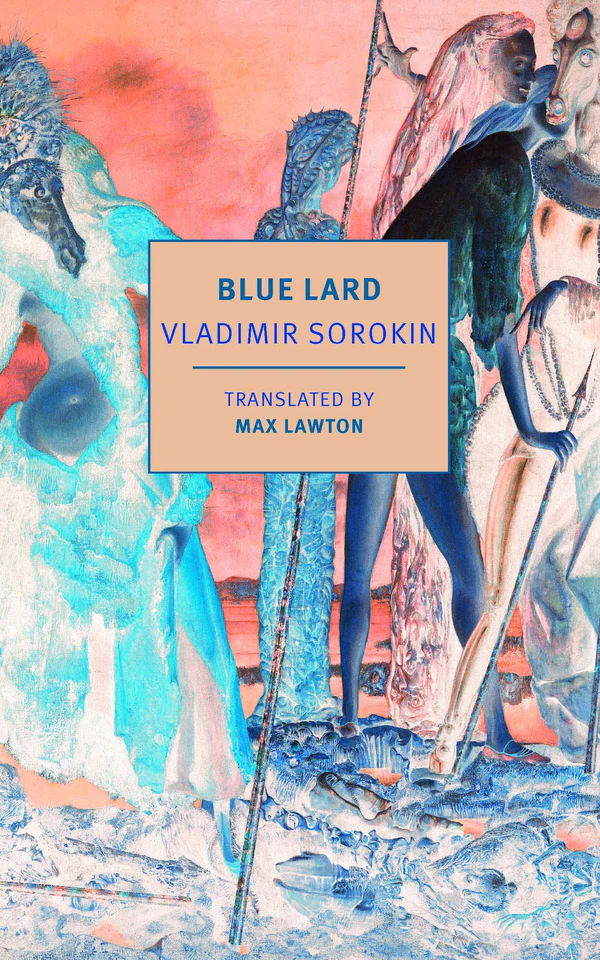
The following discussion of Vladimir Sorokin’s novel Blue Lard (in translation by Max Lawton) is intended for those who have read or are reading the book. It contains significant spoilers; to be very clear, I strongly recommend entering Blue Lard cold.
Previously on Blue Lard…We enjoyed the first of our clone narratives, Dostoevsky-2’s “Count Reshetovsky” (our dear correspondent Boris brag’s that the tale’s composition will yield “up to 6 kg. of blue lard”).
It is now Akhmatova-2’s turn to whip up some blue lard. Boris reports that “During the script-process, the object didn’t become at all deformed. Just heavy bleeding: vaginal and nasal.” Sorokin mixes abjection with creation. The Anna Akhmatova clone composes the song-poem “Three Nights.” I confess much of my idea of Ann Akhmatova’s poetry is informed by her sympathetic characterization in William T. Vollmann’s novel Europe Central—I’ve read fewer than a dozen of her poems, I’d guess—but nevertheless I found “Three Nights” very, very funny. Sorokin skewers Akhmatova in his parodic evocation of her earnest declaiming, perhaps lovingly, perhaps not, but with a fine ear, as telegraphed in Max Lawton’s translation. The plaintive sincerity of Akhmatova-2’s poem culminates in a riff on the old “farmer’s daughters” joke:
They rubbed sheep’s fat over his hard plow,
So that he could better plow the girls,
The three kolkhoznitsas-in-arms stripped down to their skin,
They lay down next to Comrade Akhmat.
Oh my!
Comrade Akhmat plowed them all night,
Gaptieva––three times,
Gazmanova––three times,
Khabibulina––three times.
Oh my!
Oh my! (A few pages later we’re treated (treated?) to the image of Lenin’s “heavy balls…crimson balls…shaggy balls… his hunchbacked balls.)
The clone narratives take over the text proper of Blue Lard (at least for now) and Boris’s tender letters to his tender bastard dwindle in length. (Boris does note in a letter dated 15 January that he’s reading Romance of the Three Kingdoms (attributed to Luo Guanzhong); perhaps the 14th-century historical novel , with its real-life figures and its epic sweep, signals a precursor text for Blue Lard.)
Our next clone is Platonov-3. Of all the cloned writers, Andrei Platonov was the one with whom I was most unfamiliar. That didn’t stop me from enjoying the scenario the first time I encountered it. It’s an actioner, featuring fight scenes on a train—uh, excuse me, a proletarian lumpomotive. Our hero is Bubnov, a stoker, machinist, engineer (and fighter) who takes on a new mission. The passenger who gives him this mission has to yell these new orders over “the class roar of the furnace with his bourgeois voice.” Such satirical lines riddle Platonov-3’s episode; later after digging a mass grave (I suppose such a scene shouldn’t be so slapstick, but it is), Bubnov’s comrade “got ready to say something sentimental, but was only able to growl because of the poverty of a human language that had entirely dried up in revolutionary winds.” I won’t spoil the trick of Platonov-3’s story, but it’s of a piece with Snowpiercer or The Train to Busan; one can easily reimagine Sorokin’s cloned Platonov-3’s riff as a sci-fi horror flick.
Another letter from Boris to bastard transitions to our next clone narrative, a one-act play by Chekhov-3 called “The Burial of Attis” (I should clarify that Boris includes the clone compositions in his letters). On my first reading of Blue Lard, I tuned into the depravity and linguistic difficulty of Boris’s letters. In the letter of 16 January that precedes Chekhov-3’s story, for instance, he complains that the colonel makes a pass at him while they are both drunk, tempting him to “test” some drug called “3 plus Caroline.” Boris’s letters are filled with futurese along with Chinese slang (he describes the colonel as a “hangkong mujian,” for example). A reread reveals more straightforward plotting elements–the letter of the 19th reminds us that this isn’t just a science mission but a military operation; the base is loaded with soldiers. And guns!
But on to Chekhov-3’s play, “The Burial of Attis.” The titular character is a beloved borzoi, now deceased. Attis belonged to Viktor Nikolayevich Polozov, a young aristocrat who seems to be barely maintaining his ancestral estate. He’s aided Anton, an aging footman. A former lover shows up at the burial, but he shouts her away in disgust after she declares that unlike dead people, “Dead dogs look just like dogs that are alive.” Later, an alcoholic neighbor, Dr. Schtange comes by to tie one on; in his drunkenness he urges Polozov to sell the ancestral manse: “Sell everything, sell it all! And as soon as possible! All this junk, all this decay, all this graveside garbage. A Chinese vase, a stuffed shark, these crystal goblets, what the devil are they to you?!” He does recommend keeping the weapons collection though, including a certain Mexican throwing knife. Chekhov-3’s Mexican throwing knife? Again, no spoilers, but the monologue that Polozov delivers at the end of the play is something else. A selection:
All things correspond to their names. The Chinese vase was, is, and shall always be a Chinese vase. Crystal is crystal and shall be thus until the day the moon falls to earth. You stood amidst these dead things––a living, warm-blooded man––and you alone did not correspond to your name. It wasn’t to do with the properties of your soul, not because of your decency or your wickedness, your honesty or your deceitfulness, not because of the good or the evil that was inside of you. You simply did not have a name… A person cannot have a name… They’re mere titles. We have no name. And never shall.
“There’s something M-unpleasant in this script,” muses Boris, “But I can’t figure out just what.” Something to return to later?
Nabokov-7’s “Kardosso’s Way” is up next. The clone has composed this text “in blood,” which, as Boris archly notes, “the original [Nabokov] couldn’t quite manage.” The linguistic fussiness of Nabokov-7’s composition is soaked in some of the foulest culinary abjection since Roger Mexico and Pig Bodine served snot soup, vomit vichyssoise wart waffles in Gravity’s Rainbow. “I only eat white meat!” the golddigger Svetalana exclaims before digging into a “silver dish filled with the prostates of catamites baked in grated cheese and generously sprinkled with lemon juice.” Later, “having nepresnified herself,” Svetlana “immersed her feet in a vase filled with ferret pâté.” And what to order when dining out?
The spouses never betrayed their gastronomic preferences, as they always ordered an 1889 Tokay, a swamp grass salad, the roots of elderly proletarians’ wisdom teeth, marengo made from bolonkas, parchment with toad caviar, and the menisci of third league Belarussian football players under a pile of vomit. For dessert, Svetlana would have rock crystal with whipped bull saliva or “Lair.” Having eaten their fill, they would move on to the jointer-inlaid tabernacle, wipe the prisms and trample the hamsters for forty minutes, then slide down the larded chute into the cloakroom.
The diction above is obscure, to be sure, but it’s possible to figure out what a marengo made of bolonkas might look like (you might not want to imagine what it would taste like, natch). Beyond obscurantism though, Nabokov-7 lards his narrative with terms that seem utterly alien to any known language: geobnorobdy, sodictio, nepresenified, half-gronzezily… In his recent interview on this blog, translator Max Lawton stated that he “worked in a few of Nabokov’s pet words,” but I’m not sure if jebraifying was one of those.
“I’m sending this one without comment,” Boris begins his letter of 18 January, referring to Pasternak-1’s 13-stanza poem “Pussy.” “You know I can’t stand Russcenities. Because of this, I offer no commentary,” he appends. I too will withhold commentary on the Pasternak pastiche, but will note that Boris’s brief letter reminds us that their experiment is part of a military operation: a certain Sgt. Prut allows him to shoot off a Cyclops-238 MC, a “slaughtersome thing” that Boris notes “could easily hew a clearing into our taiga all the way to the ocean.”
The last of the clone narratives, Tolstoy-4’s, is my favorite of the group. We get three chapters from the middle of an unnamed novel set in what seems to be 17th-century Russia. In media res, we find out that, “Having spent the whole winter in Pospelov, the old prince Mikhail Savvich found out about Boris’s duel too late, after his son’s wound had already closed up, and, along with it, so too had the whole business of his quarrel with Nesvitsky closed up and scabbed over.” So prodigal Boris returns home, where he will relax by bear hunting with his father and his father’s retainers. These scenes are richly-detailed and wonderful to walk through. Sorokin doesn’t seem to parody or skewer Tolstoy, nor does he mimic or mock him (at least to my ear)—instead the Tolstoy-4 passages evoke what I sense is a tempered if contested respect for the old master. Of all the clones, this narrative points to Sorokin’s intertextual competition with Tolstoy, which Sorokin enters into not with barbed neologisms or depraved abjection (although there is a bit of that here!), but with strange pop-fantasy eruptions. Accompanying the aristocrats and their retinue on their hunt are three “crushers,” a bizarre Cerberus troop of beasts who also seem to be men. The crushers speak in cracked, harsh voices and possess hands, yet walk leashed and lick their master’s lardshined boots. (Tatyana Tolstoya’s 2000 novel The Slynx (in English translation by Jamey Gambrell) would expand on these “crushers,” reinventing them as “degenerators,” human hybrid slaves used as beasts of burden.) Later, as Boris recuperates in a bathhouse, the wound he received in the duel reopens and one of the crushers gently licks it clean. Sorokin weaves abjection and purity in this strange bathhouse tableaux. The wound/scabbing motif here at the end of Tolstoy-4’s narrative echoes a remarkable passage from the section’s outset:
How does an awakened person differ from one who is awakened a s i t w e r e ? An awakened individual, that is to say, an individual who has been awakened by their conscience once and for all, has shaken off the evil of indifference to the lives of other people, as if it were a scab strongly and tightly clinging to the body, which, like a shell or suit of armor, clings to the conscience of every contemporary person living in contemporary society, which is based on the lawful oppression of certain people, the weak and the poor, by other people, the strong and the rich; this awakened individual will always evaluate all his deeds and misdeeds based on his new, young conscience, which has just awoken from its slumber. A person who is awakened, a s i t w e r e, shall continue to evaluate his deeds and misdeeds based not on his conscience, but on the shape of the scab of socially legitimized deception that clings to his conscience, continuing to flatter himself as before.
I would read an entire novel by Tolstoy-4; at the same time, I love that we only get three chapters, reifying Blue Lard’s apparently discontinuous structure. The writing of the section is evocative enough that we can imagine our own befores and afters if we like.
The first six clone narratives included linguistic aberrations–mechanical repetitions, scatological eruptions, perverted interludes, abject impossibilities–but the only real syntactical tic throughout Tolstoy-4’s story are three iterations of a sentence that might best be understood as “Sonya, get the hammer out of the cupboard” — although we see those words recombined, repeated, and inverted. Is this the Sonya of War and Peace? A version of Sofiya Tostoya? Is this Sonya merely (merely!) the verbal tic of cloned version of a nineteenth-century Russian realist whose erregen object is a stuffed albino panther? Does it matter?
Ahead: cocktail hour, dance party, armed combat, earthfuckers, THE SWIM, THE INDIGO PILL…
It is the responsibility of society to let the poet be a poet
It is the responsibility of the poet to be a woman
It is the responsibility of the poets to stand on street corners giving out poems and beautifully written leaflets also leaflets they can hardly bear to look at because of the screaming rhetoric
It is the responsibility of the poet to be lazy, to hang out and prophesy
It is the responsibility of the poet not to pay war taxes
It is the responsibility of the poet to go in and out of ivory towers and two-room apartments on Avenue C and buckwheat fields and Army camps
It is the responsibility of the male poet to be a woman
It is the responsibility of the female poet to be a woman
It is the poet’s responsibility to speak truth to power, as the Quakers say
It is the poet’s responsibility to learn the truth from the powerless
It is the responsibility of the poet to say many times: There is no freedom without justice and this means economic justice and love justice
It is the responsibility of the poet to sing this in all the original and traditional tunes of singing and telling poems
It is the responsibility of the poet to listen to gossip and pass it on in the way storytellers decant the story of life
There is no freedom without fear and bravery. There is no freedom unless earth and air and water continue and children also continue
It is the responsibility of the poet to be a woman, to keep an eye on this world and cry out like Cassandra, but be listened to this time.
Picked up Christine Brooke-Rose’s 1984 postmodern novel Amalgamemnon and the Grove Press collection of Three Exemplary Novels by Miguel de Unamuno the other day. Those three exemplary novels are Marquis of Lubria; Two Mothers; and Nothing Less Than a Man, in translation by Angel Flores. It’s an older edition; Grove Press’s contemporary copy offers the following:
In Two Mothers, the demonic will of a woman runs amok in a whirlwind of maternal power, and in The Marquis of Lumbria, another unforgettable heroine steers a violent course through the dense sea of tradition. By contrast, Nothing Less Than a Man, Unamuno’s most forceful piece of writing, focuses on a truly Nietzchean hero, a man who embodies human will deprived of spiritual strength.
While the title signals possible mythic revisions of Aeschylus’s play Agamemnon, such anticipations on the reader’s part prove to be utterly unfounded. To begin with, there is no “story” as such, there are no “characters,” no “plot,” no “conflict,” and certainly no “climax.” In addition, the fiction is cast entirely in the future and conditional tenses with a few imperatives and subjunctives thrown in. Although Amalgamemnon exhibits few remnants of a traditional narrative desire for unity, presence, psychological accuracy, closure, and so forth, it does do what most innovative writing should do: it challenges the audience in terms of accustomed modes of perception, interpretation, and reading strategies – in short, challenges readerly ideology. In part, this text enacts such a challenge by performing itself, by “being about” language, by being a performance. The text becomes a space in which a cacophony of voices, or discursive amplifications, or babble, or little stories – whichever term best suits — enact their own sounding.
Max Lawton is the translator of many, many works, including a number of books by the Russian writer Vladimir Sorokin. The recent publication of two of those translations, Blue Lard and Red Pyramid was the occasion for my email-based interview with Max. We began in earnest late last fall and finished up on Leap Day, 2024. While Blue Lard was our starting place, we meandered, discussing future translations of Sorokin’s work, like The Norm and Dispatches from the District Committee, as well as some of Max’s other translation projects, books like Michael Lentz’s Schattenfroh and Stefano D’Arrigo’s Horcynus Orca. We also got into Max’s own fiction, which I anticipate seeing in bookstores soon. I want to express my gratitude to Max for generously sharing his time in this interview, and more importantly, making more Good Weird Stuff available to monolingual slobs like me.
Biblioklept: Max! Congrats on the publication of Blue Lardand Red Pyramid. I want to start with Blue Lard, because I think it’s a big deal that it’s getting an English language publication. It’s also my favorite Vladimir Sorokin book that I’ve read, and I know that it’s one of yours as well. The novel is perhaps Sorokin’s most (in)famous one, and I think it’ll attract new readers. What can readers expect when approaching the novel?
Max Lawton: Like TELLURIA, BLUE LARD is all about textures: literary, historical, ideological… However, unlike TELLURIA, BLUE LARD has a telos to it—an endpoint. I am firmly of the belief that BLUE LARD is Vladimir’s best novel. He had taken a long break from prose (about 7 years) before writing it, so this text simply burst forth from him and ended up as a neat showcase of all of his aesthetic preoccupations, butheld together by an edifice that has proportions none too short of classically harmonious. What should readers expect… hmm… the first section is rather challenging. One needs to surf its wave and not expect full comprehension. There is a glossary of Chinese words and neologisms at the back of the book, but I’m not sure it’s worth consulting in the expectation of further understanding. The middle section of the book—characterized by a faux-archaic language—is also terribly strange, but with fewer neologisms. The last section of the book—an alternate iteration of Post-WWII Europe—is formally very smooth, but insanely transgressive in terms of content. And I haven’t even mentioned the rather unorthodox parodies of Russian classics in the novel’s first section! What should readers expect? In short: to have their minds blown!
Max Lawton, Hollywood, California. Photog. by Ecem Lawton.
Biblioklept: Yeah, Blue Lard zapped me in the wildest way, and you’re right when you suggest the reader should “surf its wave and not expect full comprehension.” The first section is disorienting, but I think it also orients the reader to the radical disorientation to come. And the parodies of Chekhov, Tolstoy, Akhmatova, et al. are fantastic; there’s something really joyful in these deviant mutant performances. Sorokin constantly shifts linguistic registers in his work, which I know poses challenges and opportunities for you as a translator. For example, you’ve stated that in translating the polyglossia of Telluria you tapped into a range of voices including Chaucer, Faulkner, and Mervyn Peake. I’m curious about your process in translating Sorokin’s Russian classics parodies in Blue Lard.
ML: This is a fantastic question. The fundamental issue, however, is that Vladimir isn’t really interested in parody. If the clone-texts were a neat pastiche of Russian greats, that would be one thing. But Vladimir describes them as “essence hunts.” Oftentimes, they do not read like the authors they are “imitating.” This is especially so for Nabokov and Pasternak. Tolstoy and Akhmatova are in the middle. Then Dostoevsky, Platonov, and Chekhov are right on the money; their essence seems to line up with their outer form––their noumena are no different from their phenomena. For Dostoevsky, Platonov, and Chekhov, I did appeal to previous translations of their work, as not to do so seemed like a grave error. But, for the others, I had to think more outside of the box. With Nabokov, the one thing I “added” to the translation was recommended by a couple of professors and approved by Vladimir: I worked in a few of Nabokov’s pet words in English, as he is actually more famous for his writing in English than in Russian. For this reason, the insanely bizarre Nabokov “essence-hunt” reads more like a parody in English than in Russian––not that it isn’t very alienating in both languages. The Dostoevsky parody was especially fun to translate, as it allowed me to indulge the worst instincts of a Dostoevsky translator. I leave it to you to figure out what that might mean. The fundamental question posed by these parodies and the way they both resemble the texts of the original authors and not is: what does it mean, aesthetically speaking, when phenomena do not align with noumena?
Biblioklept: That seems like a central thread of what I’ve read from Sorokin in general—this aesthetic disarrangement of what we know, or what we think we know, and what might actually, I don’t know, be. To go back to Blue Lard: it reads like the work of someone joyfully detonating and reinventing realities. The “plot” of the novel is a series of displacements that culminate in this fucked up and hilarious reinvention of Postwar Europe. But as you mention above, that section is composed in a really precise, lucid, “smooth” manner, which only serves to highlight its transgressive content. The tonal shift isn’t exactly jarring, because by this point the reader has been through a linguistic gauntlet—but it does imbue the “alternate history” at the end of Blue Lard with an uncanny tinge.
ML:I actually think that the second half of the novel was more difficult to translate than the first. There’s a specific rhythm of Russian speech that is pun-filled and, I guess you’d say, overripe. This is how Russians speak in a sophisticated milieu even now. And I think it comes across as if it were wearing a fedora, so to speak, when it’s translated too directly. For that reason, I went back to the rhythms of dialogue at play in Old Hollywood films to find something that felt stilted but didn’t simply register as dissonance to the Anglophone ear. Of course, translating the narration of the book’s second half was more a question of reduction—making it as transparent as possible so that the horrors at its bottom would be visible. This wasn’t difficult, but was a good exercise in Hemingwayesque (or Sadean) style—Vladimir loves Old Man Ham and doesn’t much like Sade. As somebody who has written a lot of screenplays, Vladimir does sometimes enter a mode of narrative prose that seems to owe a lot to the way that screenplays are composed. With reference to the first half of the book with its constant destabilizing, I would say that it can be easier to translate things that sound utterly deranged because the question of normalcy goes out the window. As you will see in 2025, this is why the Soviet rhythms of THE NORM were a particular pain to render… we simply don’t have that register!
Biblioklept: Okay, so the fact that you drew from Old Hollywood patter actually makes a lot of sense to my ear. There’s like a heightened artificiality to the section, but one grounded in “realism,” which, again, lends to this uncanny rhythm.
ML: Yes, exactly. I have made this comparison before, but it bears repeating: Sorokin is a bit like a Russian hybrid of David Lynch and Quentin Tarantino. I very much hope that the dialogue in my translations of his work falls onto the Tarantino side of that spectrum. It should be crisp patter––highly rhythmic. Not stilted and highly unreal like Lynch’s screenplays. But, as with Tarantino and Old Hollywood films, something in Sorokin’s crispness eventually begins to limp, cloy, gum up the works… to glitch!
Max Lawton and Vladimir Sorokin, NYC.
Biblioklept:The Norm is Sorokin’s first novel, right?
ML: THE NORM is more or less Sorokin’s first novel. Things are a bit complicated at the beginning because he was simply writing “into his desk” with no prospect of publication. So, the early novels were sort of composed alongside one another. THE NORM is a Soviet Disneyland of abject horror: eight rides, each representing a different aspect of the USSR’s shittiness. Everyone knows it’s the book in which people eat shit, but it actually goes way deeper than that. The section people most love in Russia is a deranged epistolatory one, in which the distant relation managing an intelligentsia family’s dacha loses his mind with rage at having been saddled with its maintenance. Part 5––the best.
Actually, here’s a fun spoiler-free preview of the book––this diagram-thing will be included in the edition coming out from NYRB Classics in 2025.
TRANSLATOR’S LINATI SCHEMA FOR THE NORM
I. Contemporary dialogue. For a Soviet person, the same shock an Irish person might have had upon reading Dubliners. No point foraging through the American ‘80s. Therefore: the NOW.
II. Critical exegesis. These are mere words. American slang when necessary––then to explain the original by way of scholarly apparatus.
III. A thesis: Russian’s rhythms are generally quite defined by rurality. The agrarian empire was industrialized too quickly––couldn’t do away with the rurality of speech. But, so as not to exaggerate, to make the dialogue in “The Scourge” sound like a film noir about louche characters. Again: contemporary speech when necessary (esp. with the editors interrupting the text). Pilfering phrases from Constance Garnett for the Anton frame-narrative.
IV. Making the poems as perfect as any poems can be in translation. Total metrical adequacy.
V. No contractions. A dash of Benjy Compson. Instead of rhyming insults, total obscenity (“dickass professor” instead of the more literal “dickessor”).
VI. The occasional need to make a slogan more grammatical in English than in Russian.
VII. Not perfect lines, but shattered fragments. A meta-commentary on the clunkiness of official poetry (of poetry an sich as well?). The main thing: that the reader feels the clunky, contorted poetry when it supplants the prose, but that I not give into Miltonic excess entirely. Impossible to translate these as perfect poems as in Part V.
VIII. To occasionally add syntax to the gibberish so that it scans. “Jabberwocky.”
Biblioklept: I’m about halfway through The Norm—haven’t gotten to Part 5, which I’ll read tonight. The first section was, uh, hard to swallow, but also very funny. And once it told me how to read it, I was quite taken with how even in some of his earliest stuff, Sorokin has already found this strange, mutating form, a kind of narrative hot potato (or “hot norm” if we’re feeling extra abject today). I loved the third section, especially the sinister shift it takes.
ML: THE NORM is a highly compressed preview of all the tendencies Sorokin would be working out in the first half of his career—all the way up until BLUE LARD. Of course, you have the binary bomb structure of the short stories, in which a highly ordinary situation that would typically make up the raw material of Soviet official prose is ruptured and gives way to something abject. This will be explored a great deal more in the short stories of DISPATCHES FROM THE DISTRICT COMMITTEE, coming out from Dalkey next year. ROMAN and MARINA’S THIRTIETH LOVE, also binary bombs, but novels rather than stories, belong to the NORM-universe as well. Sorokin’s imitation of the world of Russian classics in ROMAN is as precise as his immersion in Soviet shit. Indeed, in THE NORM, one cannot help but note the intense specificity of Sorokin’s engagement with the Soviet Life-World. His prose would not be quite as specific in and after BLUE LARD—it would be more imaginative and less grounded in any one reality. Perhaps what tortured Sorokin during the first half of his career was his inability to imagine a world other than the Soviet Union. In all books after THEIR FOUR HEARTS (so BLUE LARD AND all that follows), though he may be haunted by the Russian past, the worlds he imagines are light and free—defined by his own language alone. After BLUE LARD, it is only his short stories that are weighted down by the gritty details of Russianness.
Biblioklept: You mentioned Russians love the fifth section, the “deranged epistolatory.” I loved the section too—it’s a kind of linguistic unraveling, but a strangely sympathetic one. Why do you think this chapter resonates with Sorokin’s native audience? Can you tell us a bit about translating it—was it fun? Difficult?
ML: That part was only tricky when Soviet-houseware vocab would pop up—obviously not my area of expertise. But, beyond that, in the sections where Sorokin is exploring a very pronounced directionality, I find it somehow easier to ride along with him. Translation is more about translating intent than individual words, so when the intent is very legible, it makes the translator’s job easier. That section is so beloved because it depicts a Soviet archetype of resentment and envy—wasn’t all of that meant to have gone away? Isn’t this the Shining Future? Well, it turns out that people are still animated by precisely the same sorts of petty evil. The idea of this section is a lot like what Dostoevsky wants to convey with the Underground Man: human beings are immutably illogical, petty… From that perspective, there is something divine about the gibberish at the section’s end—as divine as Dostoevsky’s 2+2=5.
Biblioklept: I really enjoy the gibberish and jabberwocky that infiltrates The Norm (particularly the lulling but clunky rhyming in the seventh section). That polyglossic strand seems woven throughout Sorokin’s work but is more palpable in this early novel than his later stuff. (Not sure if novel is the right word for The Norm but I don’t really care.) In Blue Lard and other later works, Sorokin employs neologisms and a range of non-Russian-language terms, but these are deployed in a more narratively-coherent manner than what’s happening in The Norm. In your estimation, is this simply an evolution in style? Is it purposeful, or just a writer doing his thing? Is this a stupid question?
ML: THE NORM is what all of Sorokin’s later works emerge from. In that sense, it’s undoubtedly true that this “narrative experiment” (you’re also right that it’s not a novel in any real sense) is less laser-focused than books like BLUE LARD, in which tropes like gibberish or corporeal-mutilation-as-metaphor have been worked out to a precise science. Sorokin wrote the book when he was a young man, passing around pamphlets of each part to his friends in the Moscow Conceptualist Underground. They were over the moon about it. In fact, there’s no meaningful way in which THE NORM can be differentiated from MY FIRST WORKING SATURDAY (mostly collected in Dalkey Archive’s forthcoming DISPATCHES FROM THE DISTRICT COMMITTEE), ROMAN, or MARINA’S THIRTIETH LOVE. All these books are a singular meta-work that deconstructs the ideological and literary languages of the Soviet Union, during the period when Sorokin was coming of age as an artist.
Biblioklept: Can you tell us a little more about Dispatches from the District Committee? Also, if this is something you can get into, how do you go about placing Sorokin’s work with the U.S. publishers—is there a thought into which titles go to Dalkey and which go to NYRB?
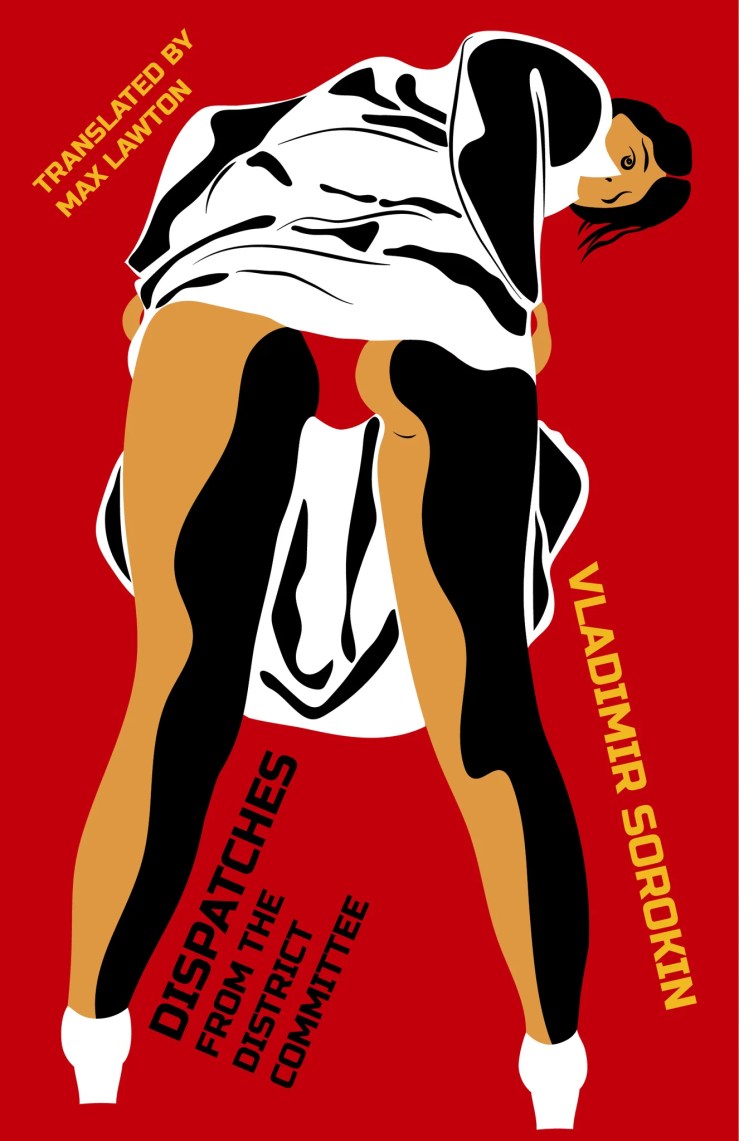
ML: DISPATCHES FROM THE DISTRICT COMMITTEE is the dark Dale Cooper to the RED PYRAMID’s sweet pie-eating FBI man. Whereas the latter was structured in accordance with a certain sort of classical form (yes, it’s fucked, but its stories are fucked (and fuck) in a harmonious way, as it were), DISPATCHES is a collection of early binary bombs from Sorokin’s famous MY FIRST WORKING SATURDAY collection, along with a few bits of juvenilia and a few late-period stories. Without exception, these are woolly and insane tales, some of my favorite things Sorokin has ever written. And it is in this collection that we truly learn the meaning of the “binary bomb” of which he so often speaks: in such stories, the first half is the technically-accomplished outlining of a typical Soviet situation or Soviet literary mode, but, about halfway through the story, the pin of the grenade is pulled and all that which is “normal” about the tale we’ve been reading gives way to the abject and the obscene––to Joycean gibberish and Bataillean acts of violence. In a way, this collection is the ninth part of THE NORM, and I wouldn’t object to readers approaching it in that way.
The publishers themselves divided the books, but I do think there was a certain logic to how it shook out. The Dalkey books tend to be the cult-classic Sorokin novels that are particularly beloved by people in Russia: by his “cult readers.” And the NYRB books are the books foreign readers tend to come to first. This narrative might become a bit stranger in coming years with NIGHTINGALE GROVE and THE SUGAR KREMLIN, but I’d say that’s how the chips have fallen for the time being.
Art by artist Yaroslav Schwartzstein from ОПРИЧНАЯ КНИГА, a collaboration with Vladimir Sorokin
Biblioklept: Speaking of The Sugar Kremlin and different publishers: the manuscript I have includes wonderful color illustrations by Yaroslav Schwarzstein. If I understand correctly, these illustrations have appeared with other editions of the book? Is the plan to include the illustrations in a U.S. edition? The Dalkey edition of Their Four Hearts includes illustrations by Gregory Klassen—has he collaborated with Sorokin on other works? Can you give us some background on Sorokin’s relationship with visual artists?
ML: I’m not sure those illustrations are going to be in THE SUGAR KREMLIN, alas… But Greg Klassen’s wonderful frontispieces for DISPATCHES are going to be included. Sorokin was a visual artist before he was a writer, so his texts are profoundly visual. He also has a lot of love for illustrated editions of his novels and stories––especially the deluxe editions put out by ciconia, ciconia in Berlin. In the future, I would love to put out English editions of Sorokin’s illustrated works that are just as deluxe as the German ones. In a sense, Sorokin writes like a painter. When I read his books, I can always see exactly what’s happening on the page in my mind’s eye. But it’s funny to imagine an illustrated edition of something like BLUE LARD––his linguistic abilities outpace those of any theoretical artist. I am also working to get a couple of American film adaptations of Sorokin’s books and stories off the ground here in LA. Cinema is very dear to him––and he’s written quite a few scripts.
Sanke’s Love by Gregory Klassen. From Dispatches from the Central Committee.
Biblioklept: Yeah, Sorokin’s writing is very imagistic, photographic, cinematic—for all the wild unreal shit that happens, it’s anchored in highly visual, sensual prose. I think that imagistic quality is important to the storytelling, especially when he drops these “binary bombs” as you put it (or is that Sorokin’s term?). I think the term is appropriate; I also like how novelist Will Self describes this signature structure in his introduction to Red Pyramid: “Each of his stories is a sort of mutant Mobius strip, in which to follow the narrative is to experience the real and fantastic as simultaneously opposed and coextensive.” I’m curious how Self’s introduction came about—can you tell us a little bit about that process?
ML: The binary bomb is Sorokin’s term of art for his own early stories, not my own. In fact, the term in Russian is closer to “lil’ binary bomb”. Will’s introduction is just so beautifully written—Vladimir and I think it’s one of the best texts ever written about him. I’d met Will a long time ago—first when he did a reading from Shark at Columbia when I was doing my undergrad there, then when he debated Zizek in London when I was at Oxford (Will won the debate by a wide margin, you can still find it on YouTube). Will has always been one of my heroes—one of the writers whose books showed me a possible path forward with my own writing when I was starting high school. In fact, for contemporary English-language prose, one couldn’t do better than his “technology trilogy”—UMBRELLA, SHARK, and PHONE. Anyways… I’d emailed Will a few times about my writing and received polite replies, but, when I was in London on the eve of the release of THEIR FOUR HEARTS and TELLURIA, he tried to meet up with me, didn’t succeed, then we met up in NYC, where he was doing a bit of research for his new novel. We became fast friends and, just as Will has become a big fan of Sorokin, so too has he become a mentor to me. To my mind, Will represents all that which is glorious about the English literary tradition: its irreverence, wildness, erudition, biting wit… It means a great deal to both me and Vladimir to have him “coming out to meet the reader”—and doing such a damn fine job of introducing the book! To all those readers who haven’t yet touched Sorokin, I would recommend starting out your odyssey with Will’s intro to RED PYRAMID, then reading the collection itself, then reading BLUE LARD.
Biblioklept: You’ve touched on the timeline for publication for some of your Sorokin translations. Any news on when we might expect to see Roman or The Sugar Kremlin on anglophone shelves? What about your translation of Michael Lentz’s surreal opus, Schattenfroh?
ML: The Sorokin timeline is still a bit unclear. ROMAN and THE SUGAR KREMLIN will be coming out in the next two or three years, I would say. Actually, I take that back: THE SUGAR KREMLIN will be coming out in 2025, but ROMAN is a little bit more unclear. There is some discussion of ROMAN and MARINA’S THIRTIETH LOVE being released together in a slipcase.
SCHATTENFROH is the novel. I am most excited about having translated after BLUE LARD. It is such an incredible, strange masterpiece, and I really don’t think the Anglosphere is ready for it. That will be coming out in 2025 and in fact, my translation, or rather, the very final draft of my translation is due at the beginning of the fall, and my editor Matthias and I are thinking a lot about how much work that will be to get done.
Biblioklept: Who’s publishing Schattenfroh? I’m going to ask you an unfair and stupid question: What is Schattenfroh?
ML: I can’t reveal who will be publishing it, but a press release about all these books is coming within the month. In brief, SCHATTENFROH is about a man named Nobody, who, coincidentally, bears a great deal of resemblance to Michael Lentz, being forced to write a book called SCHATTENFROH by his father’s ghost, whose name is also Schattenfroh. The process of the book’s composition—the journeys undertaken during its composition and the technical elements of its assembly (and deconstruction)—are what it’s about. It also deals with family history, metaphysics, World War II, Hegel, the baroque, German urban planning, incest, the apocalypse, death, and much else. It is one of my favorite novels without question.
Biblioklept: Can you touch briefly on some of what went into translating Schattenfroh? The book is formally daunting; at times reading in it is like walking through a surreal nightmare; other times the prose is austere, even spare…
ML: In certain respects, I felt the inherent affinity to SCHATTENFROH I have felt to other texts I am deeply infatuated with as a translator (BLUE LARD, Antonio Moresco’s trilogy, Céline…). On the other hand, the technical vocabulary that crops up from time to time as a conceptual gag was absolutely brutal to work with and I am indebted to my editor Matthias Friedrich for the good work he’s done, of which there is still much to do. The printing press vocab will require a specialist in medieval printing technology to give it a rather intensive read, just as the section in which a museum guard quizzes the protagonist about a technical architecture article from an East German architecture journal will require an intensive edit by a perfectly bilingual scholar conversant in architecture and physics. Lentz has the luxury of using texts as found objects––we, alas, do not! Matthias has also been a great help with identifying quotes, which we then have to translate or find extant translations of. The latter option is preferable, as it safeguards the encyclopedic quality of the book––you see a quote, Google it, and dive deeper into the world of the novel. The most problematic translation question is what to do with historical quotes from Luther and others like him that have been translated into English, but into modern English, whereas the German is dense as hell and difficult to read due to its archaicism. Translations of Luther from the era he lived would be ideal, otherwise I’m left attempting to kitschify the English into an approximation of the archaic German.
Biblioklept: I expect Schattenfroh to become a cult novel for anglophones after your translation comes out. Do you know if it has a similar reputation in Germany?
ML: The fascinating thing about SCHATTENFROH is that it doesn’t have too much of an audience in Germany. It’s very much a cult novel. Its release in English will provide a new opportunity for more German readers to discover it. With that said, those German readers who have read the book have, for the most part, fallen in love with it. It’s the sort of novel one can’t believe is still being written. On the other hand, there’s a way in which SCHATTENFROH is the sort of book that might find an audience in America more readily than it has in Germany—this is just my suspicion.
ML: Yes, I’m very excited to dredge the depths of its pornographic scatology. It’s one of the most metaphysical projects I’ve ever encountered––moving from Moresco’s own lived experience as a monk and revolutionary to the most distant reaches of interstellar space in a frozen Steinian mode that is as gorgeous as it is infuriating. This trilogy is on the level of SCHATTENFROH and BLUE LARD and will be adored by all readers of 2666, THE 120 DAYS OF SODOM, and SOLENOID. The second book in the trilogy in particular, CANTI DEL CAOS, will be an event in English publishing that I hope will reach the heights of the reception to Bolaño’s masterpiece. I am also translating HORCYNUS ORCA and am still terrified of the Sicilian therein. The great writer and translator Francesco Pacifico will be editing these translations.
ML: It’s thanks to Andrei that I’m going to be translating SCHATTENFROH, Moresco’s trilogy, HORCYNUS ORCA, and, in a few years, Palol’s BOÖTES. He’s a great friend and mentor to me and there are few things in the world I appreciate as much as his taste and total aesthetic honesty. He is a source of great guidance to me, and I am deeply, deeply grateful that I stumbled on his blog and that he responded to me when I sent him the illustrated manuscript of THEIR FOUR HEARTS back in 2019. A true OG.
Biblioklept: Amazing. Andrei is a champion reader. Reading is such a private, internal process; it’s easy to overlook that great writers need great readers. And translators are clearly in the vanguard of great readers.
This is probably a really stupid question, but when you’re writing your own fiction, like your novel The Abode, are you in, like, a totally different zone than the translation sphere?
ML: Will Self always asks me about this and expresses concern that I’m being over-influenced by the fiction I translate, but, for whatever reason, I have found that translation is a self-contained system in my literary life. The words of the original enter me, then are flushed out like water turning into piss. I have the capacity to be influenced by texts, but the very fact of translating means that I also exorcise the influence. The commonality between my own prose and translation is the focus on style, but the difference is the question of what to write that must necessarily plague any original writer. That is the most difficult part of writing––ontological doubts. I have a good feeling that the Anglosphere will soon get to read my first novel PROGRESS, my short-story collection THE WORLD, and my second novel THE ABODE. These three books represent the first era of my writing. After I’m done with THE ABODE, the autofictional monstrosity I’m writing now, I’m going to stop writing for a while––just play black metal with my new band here in LA and read. Then see when I’m driven back to the blank page (though, to be honest, I’m half-lying: I already have two new novels planned out––they’re just very different from the first three books).
Biblioklept: To your parenthetical post-dash clause: When you write that your plans for these two new books differ from the first three, what do you mean? Style? Subject? Did this difference come from a conscious choice?
ML: Yeah, the first three are very selfish books in a sense. MAX LAWTON looms over them rather heavily. For the follow-ups, I’ve been thinking about certain American styles that are generous, biblical: Cormac McCarthy, Marilynne Robinson, etc. I want to write a few books from which I am utterly absent, and I want them to be shorter, with the sentences screwed in tight. In brief, I want to write grown-up books. These first three are my graphomaniacal youth-culture books––Bret Easton Ellis casts a long shadow over them too.
Here are links to a few of my short stories that have recently been published:
Biblioklept: There’s that line near the end of the prologue of The Abode, where the third-person narrator tells us that “Max wasn’t interested in the ups and downs of a typical Bildungsroman or campus novel”…
ML: Yeah, I’ve always wanted to write a massive slab of autofiction but am keenly aware of the clichés that dog the form. This is the sort of cheeky line that might get thrown out in further revisions of the text but represents my desire to combine disparate tendencies: the neuroticism of Proust, the hedonism of Bret Easton Ellis, and the metaphysics of William Blake. Though my German reader says it reminds him of THE CORRECTIONS… In a sense, THE ABODE is all about wanting my cake and eating it too.
Biblioklept: I liked the line, especially in its context, which I hope you don’t mind if I share here with some readers:
“Max wasn’t interested in the ups and downs of a typical Bildungsroman or campus novel, didn’t believe he’d ever end up with a single woman to whom he would pledge his affections––he was the plinks of the second synth coming in over the washes of the first and each click of the metronome showed him something else––something he was meant to see, something pure and visionary that had been vomited up from the very center of the earth.”
The synth metaphor is lovely.
ML: Thanks so much! I tried to make the language chewy and specific without losing the pellucid quality of 19th-century narrative prose. My first novel PROGRESS is very dense stylistically in a way I strived to move away from.
Biblioklept: The style of Progress seems to rhetorically approximate the narrator’s attempt to register the material world he is moving through with his sense of interiority, selfhood, whatever. (That inside/outside distinction manifests in a number of the book’s motifs, including all the pissing and shitting.) I don’t know if I think of the style as dense, necessarily. The clauses stack up, but they also flow and move. I mean, I think the book is quite readable; it’s not like, Oh fuck another giant paragraph! Maybe that’s because Progress is, at least in part, about, “Y’know, like, apocalyptic stuff,” to quote one character out of context.
ML: I wrote PROGRESS during Covid and the lack that seemed to inform it was my feeling that narrative prose had ceased to describe the world as it exists (I was also reading a lot of Heidegger at the time). The conceptual sci-fi narrative is an excuse to describe the freeways and all that exists around them as if it were a natural idyll. The book is a beach on which the detritus of our age washes up––I catalog it.
Ralph Hubbell and Max Lawton pose before the house where Atay wrote The Disconnected (photog. unknown)
Biblioklept: So, besides your novel Progress, your short story collection The World, your autofiction-in-progress The Abode, the Moresco trilogy, Horcynus Orca, Schattenfroh, and a slew of Sorokin–what other projects are you cooking up?
ML: There are a couple of others (as if I didn’t have enough on my plate!). First is my new translation of GUIGNOL’S BAND in a single volume––the previous translations of the book’s two parts were done by two translators and put out by two publishers. It is my contention that GUIGNOL’S BAND may be Céline’s greatest novel. The extremity of his style increased all throughout his career, but,by the time it reached its point of extremity, the content had, alas, curdled (here, I’m thinking of the final trilogy recounting his years spent as a Nazi). GUIGNOL’S BAND, on the other hand, is a showcase of the way Céline would blow up his own idiom, but in the context of a propulsive London novel with a lot of crime and capers. It is my hope that a new translation of GUIGNOL’S BAND will truly bring home to the Anglosphere the quiddity of Céline’s “musical orality.”
My friend Ralph Hubbell and I are also hoping to translate Oğuz Atay’s great novel THE DISCONNECTED, which has already been translated into English, but, speaking delicately, needs to be redone if it is to be published (Ralph and I have written a lot about this and gotten into hot water for what we’ve said). The book is akin to a mix of ULYSSES and CATCHER IN THE RYE. It’s the best novel ever written in Turkish, and I sincerely hope we get good news from Istanbul in the near future––the offer from the Anglophone publisher that wants the two of us to retranslate the book still stands.
Biblioklept: The last time I interviewed you, I ended with my standard last question, Have you ever stolen a book? and you admitted that you hadn’t. Any updates there?
ML: I still haven’t stolen any physical books, but I hope that my work continues to be another kind of theft: stealing great books out of the maw of Anglophone oblivion and putting them into the hands of readers eager for fiction that is dense, extreme, and difficult. I am of the sincere conviction that the demand for these books is high and, to any Anglophone publishers reading this, I say this: take a chance, publish something that pushes the envelope, and you might just be surprised by the reaction…
I first read Max Lawton’s translation of Vladimir Sorokin’s novel Blue Lard in the summer of 2022. It totally fucked me up. I was in the middle of a nice fat interview with Max at the time, ostensibly about his translation of Telluria. He sent his digital manuscript of Blue Lard and insisted I read it asap. To say it zapped me is an understatement. I’d loved the polyglossic twists and turns and the hypercolored surrealism of Telluria—and still do—but Blue Lard was something different. Reading it late into the night on my oldass iPad I’d sometimes find myself breaking into a weird sweat. Sometimes I’d disrupt my sweet wife’s sweet sleep when something Sorokin conjured made me get up out of the bed and walk around my house in the dark, agitated and anxious. I’d go back to the screen in morning’s light, maybe making a few notes, maybe reading some of its stranger passages aloud just to hear the sound Max had made from Sorokin’s prose.
By the time I got to the end, I was pretty sure I’d read a real masterpiece, some beast that had invented its own skeleton and scales, its own stripes, claws and tusks. A muscular beast distilling sci-fi tropes, Soviet history, nineteenth and twentieth-century Russian-language literature, and aesthetic taste in general into glowing pulp fiction, searing satire, something new. I was and am in love.
Max was kind enough to undertake a second interview with me; the occasion this time the red/blue NYRB publications of Blue Lard and his translation of a collection of Sorokin’s stories published under the name Red Pyramid. During that interview process, I was lucky enough again to sample some of Max’s forthcoming Sorokin translations (The Norm is particularly far out, while The Sugar Kremlin will appeal to anyone who dug Telluria). That interview needs a few edits, but it’ll run in a day or so. In it, Max suggests that when approaching Blue Lard, we should “surf its wave and not expect full comprehension.”
As a reading experience Blue Lard offers a hell of a wave: strange image after strange image; strange word after strange word; surreal sequences snaking into even more surreal sequences, often presented in the clearest of detail—pristine or sharp or ugly or beautiful, collapsing feelings and flavors and rhythms and registers. It coos and howls and jabs and tickles. It spits and prances.
When I started rereading Blue Lard—that is, reading the finished, printed NYRB edition of Max’s translation; that is reading, or rereading, in anticipation of reviewing or blogging about or riffing on or otherwise writing about Blue Lard—
—when I started rereading Blue Lard, I realized that not only am I not capable of distilling my thoughts (or maybe more accurately impressions, feelings) into a review or blog post, but also that I did not want to even approach the text in that way. There will be reviews in the proper places. I will keep Biblioklept messy.
In that spirit, I will be writing about Blue Lard in sections, none of these sections especially defined or neat or parceled out (unless that happens by chance), but rather when I am so moved or motivated to write. My goal is not to summarize, analyze, or explain Blue Lard, but rather to surf its wave, share some of its flavor, riff a little, blog a bit. And so—
Blue Lard is prefaced by two epigraphs: the first from Rabelais’ Gargantua and Pantagruel, the second from Nietzsche’s Twilight of the Idols. The epigraph from Rabelais (in Burton Raffel’s translation) finds Pantagruel tossing “handfuls of frozen words” to his companions as they travel the frozen northern sea. The words thaw and the crew can hear them—but they do not understand them. The epigraph from Nietzsche (in English translation by Kaufmann and Hollingdale) is brief enough to share in full: “There are more idols than realities in the world: that is my ‘evil eye’ upon this world; that is also my ‘evil ear.'”
Blue Lard proper is then underway. The first section might be summarized, which I said I wouldn’t be doing, as “letters n’ clones.” Pages 5-30 comprises seven letters from a certain “Boris” to his presumable lover, his “heavy little boy,” his “tender bastard,” his “divine and vile top-direct.” Not sure what the term “top-direct” might mean, nestled there in only the second sentence of the novel? Rips laowi, honey, don’t fret—fretting’s bad for your L-harmony. You don’t wanna get your M-balance out of whack (not to mention your BORBO-LIDE). If the verbiage confuses, don’t worry—I’m sure the helpful glossary in the back of the book will help you parse meaning.
Boris’s letters to his tender bastard might be encountered as a linguistic barrier to be hurdled, but again, and forgive my mixing metaphors–-surf the wave. The letters are funny, and we can quickly glean basic context from them if we just relax a little: setting (way way up there in northeast Siberia sometime in a future January–we’ll find out exactly when much later in the book, but for now, we’re several generations removed from now), characters (a cadre of scientists with a military escort), and a purpose (the cadre is harvesting a mysterious substance from a bunch of clones). But need we fuss too much with plot when Sorokin gives us such evocative imagery and characterization? Here’s our letter writer Boris describing some of the crew:
“The geneticists: Bochvar is a ruddy, prolix Russkiy with about a dozen marmalon plates around his lips, Witte is a gray German, Martha Karpenkoff is a corpulent woman with a history of TEO-Amazonianism who loves: horse-clones, old-hero-techno, aeroslalom, and conversations about M-balance.”
Do you too love horse-clones and aeroslalom?
Sorokin continues to parcel out the cloning motif in small doses. Sharing the daily dining details of their Siberian science base life, Boris reports that “Yesterday at lunch they served turkey-clone with red ants, which provoked a fit of violet nostalgia in me.” Is this food satisfactory? “The L-harmony coefficient of such a menu is between 52 and 58 units on the Gerashenko scale. Not bad, huh?” our hero informs us. A few paragraphs later he praises the sleepless clone-pigeon for its tenacity and ferocity.
And then: the clones: “There are seven objects: Tolstoy-4, Chekov-3, Nabokov-7, Pasternak-1, Dostoevsky-2, Akhmatova-2, and Platonov-3.” We will soon enjoy some of these clones blue-lard-producing narratives; Doestoevsky-2’s begins on p. 31, and hence falls into this riff—so let’s enjoy Boris’s description of our cloned author:
Dostoevsky-2.
An individual of indeterminate gender, medium height, with a pathology of the rib cage (it sticks out like a fin) and of the face (the temporal bone is fused with the nose in the shape of a saw handle). His felt cubicle is illuminated with soffit. His erregen-object is a jasper casket filled with diamond dust.
Oh! To have a jasper casket filled with diamond dust! I’m tempted to share some of the other clone’s erregen-objects, but, like: read the book. Enjoy Blue Lard’s highly-imagistic pop-art distortions. Its larder is full, crammed with improbable figments that nevertheless spring to life. It transmutes the old materials, casts the frozen words in a primal cauldron, sets them bubbling.
But before we get to the business of those marvelous clones and their drafts (let alone a “BL-business-trip,” as our Boris puts it—have I mentioned that he’s a “biophilologist,” some kind of linguist I suppose, studying that, uh, what did WS Burroughs call it?—virus from outer space was it?)—where was I?—
Before we get to the business of clones and their drafts (really, Dostoevsky-2 and his/its draft), there’s a bit of pop cinematic set piecing to attend to. Scientists and soldiers, off duty, do a bit of hard drinking in their cool arctic lair, bickering and bantering in Sorokin’s late-21st-century patois. The futurey room buzzes with Chinese slang and jabberwocky jargon. Such scenes recall the techno-militarist fantasies of late-twentieth century Hollywood films; one could mentally transpose such episodes through the lens of an imaginary James Cameron shooter, its dialogue and set design translated through Alejandro Jodorowsky’s frontal lobe.
But back to our Boris’s biophilological games—our letter writer informs us (and, uh, his “tender little boy”) that Dostoevsky-2 has successfully completed the “script-process” which should yield “up to 6 kg. of blue lard.” Hurrah! (Do not worry, surf the wave.)
We are then treated to “Count Reshetovsky,” a 14-page story by Dostoevsky-2. The clone’s tale begins with this paragraph:
At the very end of July, past two in the afternoon, during a spell of extremely rainy weather that was all too dank for summer, a shabby carriage with a removable roof, spattered in dirt from the road and harnessed to a pair of homely horses, rolled over A– Bridge and stopped on G– Street in front of the entrance to a gray, three-story home, and all of this was, to the point of extremity, as if by no means, sir, and about the chicken’s word about the chicken’s word already by no means good.
Notice those odd avian tics at the end? Fear not: our clone jerks and spins but doesn’t completely unravel. I won’t add more, except to offer up another nugget from my interview with Max: “The Dostoevsky parody was especially fun to translate, as it allowed me to indulge the worst instincts of a Dostoevsky translator. I leave it to you to figure out what that might mean.”
You don’t really have to figure it out to surf the wave. Lots more to come.
At the next class meeting, Everett informed us that we would be taking an essay examination that day.
“You said ‘no tests,’ ” one of the women said.
“This is an examination,” Everett said.
“That doesn’t make sense,” she said.
“Well, be that as it may.” He passed around the exam. “There are three questions, and I urge you to divide your time unevenly on them, as they are of equal value. Since one hundred is not divisible by three, there is no way for you to achieve a perfect score. Unless of course we decide that ninety-nine is a perfect score, and I wouldn’t mind that at all.”
The examination:
1) Imagine a radical and formidable contextualism that derives from a hypostatization of language and that it anticipates a liquefied language, a language that exists only in its mode of streaming. How is a speaker to avoid the pull into the whirl of this nonoriented stream of language?
2) Is the I one’s body? Is fantasy the specular image? And what does this have to do with the Borromean knot? In other words, why is there no symptom too big for its britches?
3) How might it feel to burn with missionary zeal? Don’t be shy in your answer.
We students looked at each other with varying degrees of confusion, panic, and anger. And like idiots, we set to work. At least they did. I read the questions over and over and after the numbers 1 and 2 on my paper I wrote, I don’t know. After the number 3 I wrote, Awful, then added, damn it.
From Percival Everett’s novel I Am Not Sidney Poitier.
In the twilight of life, a black ribbon emerges from a frame and coils itself inside the mind of one of the great French chroniclers of the internal. Across the world, a young girl stares at an image in a book: a woman, naked but for slippers, jewels, and the same ribbon which so captivates the writer. At opposite poles of experience, one follows the ribbon as it winds its way round longings, regrets, and contemplations; the other, at the beginning of development and yet to discover the world, traces the ribbon with a finger, not realising how it will imprint itself upon her.
Years later, the girl—now woman—encounters the ribbon face to face and on the page. Manet’s Olympia and the words of Michel Leiris come together, and an imaginary conversation ensues. It will be a collision and collaboration of sensorial memories and observations on everything from desire and illness to writing and grief. These frames are used to examine both interlocutors; simultaneously, a frame of another sort is removed from Olympia and her artistic kin. Everything from her flowers, Louise Bourgeois’s Sainte Sébastienne, and Francis Bacon’s Henrietta Moraes are reimagined and given new regard.
Songs for Olympia, written in the form of a response to Michel Leiris’s The Ribbon at Olympia’s Throat, itself a highly personal response to Manet’s painting, is an ode to the both the ribbon and the memory: what leads us to constantly rediscover ourselves and a world so easily assumed as viewed through a single frame.
1. And it came to pass in those days that one dwelt in the land of the Harlemites who thought that he knew all the law and the prophets.
2. Also when he arose in the morning and at noonday his mouth flew open and he said, “Verily, I am a wise guy. I knoweth all about women.”
3. And in the cool of the evening he saith and uttereth, “I know all that there is about the females. Verily, I shall not let myself be married.”
4. Thus he counselled within his liver for he was persuaded that merry maidens were like unto death for love of him.
5. But none desired him.
6. And in that same year a maiden gazeth upon his checkbook and she coveted it.
7. Then became she coy and sweet with flattery and he swalloweth the bait.
8. And in that same month they became man and wife.
9. Then did he make a joyful noise saying, “Behold, I have chosen a wife, yea verily a maiden I have exalted above all others, for see I have wed her.”
10. And he gave praises loudly unto the Lord saying, “I thank thee that I am not as other men—stupid and blind and imposed upon by every female that listeth. Behold how diligently I have sought and winnowed out the chaff from the wheat! Verily have I chosen well, and she shalt be rewarded for her virtue, for I shall approve and honor her.”
11. And for an year did he wooed her with his shekels and comfort her with his checkbook and she endured him.
12. Then did his hand grow weary of check signing and he slackened his speed.
13. Then did his pearl of great price form the acquaintance of many men and they prospered her.
14. Then did he wax wrathful in his heart because other men posed the tongue into the cheek and snickered behind the hand as he passed, saying, “Verily his head is decorated with the horns, he that is so wise and knoweth all the law and the profits.”
16. And he chided his wife saying, “How now dost thou let others less worthy bite thy husband in the back? Verily now I am sore and I meaneth not maybe.”
17. But she answered him laughingly saying, “Speak not out of turn. Thou wast made to sign checks, not to make love signs. Go now, and broil thyself an radish.”
18. Then answered he, “Thy tongue doth drip sassiness and thy tonsils impudence, know ye not that I shall leave thee?”
19. But she answered him with much gall, “Thou canst not do better than to go—but see that thou leave behind thee many signed checks.”
20. And when he heard these things did he gnash his teeth and sweat great hunks of sweat.
21. And he answered, “Verily I am through with thee—thou canst NOT snore in my ear no more.
22. Then placeth she her hands upon the hip and sayeth, “Let not that lie get out, for thou art NOT through with me.”
23. And he answered her saying, “Thou has flirted copiously and surely the backbiters shall sign thy checks henceforth—for I am through with thee.”
24. But she answered him, “Nay, thou art not through with me—for I am a darned sweet woman and thou knowest it. Don’t let that lie get out. Thou shalt never be through with me as long as thou hath bucks.”
25. “Thou art very dumb for now that I, thy husband, knoweth that thou art a flirt, making glad the heart of back-biters, I shall support thee no more—for verily know I ALL the law and the profits thereof.”
26. Then answered she with a great sassiness of tongue, “Neither shalt not deny me thy shekels for I shall seek them in law, yea shall I lift up my voice and the lawyers and judges shall hear my plea and thou shalt pay dearly. For, verily, they permit no turpitudinous mama to suffer. Selah and amen.”
27. But he laughed at her saying hey! hey! hey! many times for verily he considered with his kidneys that he knew his rights.
28. Then went she forth to the market place and sought the places that deal in fine raiment and bought much fine linen, yea lingerie and hosiery of fine silk, for she knew in her heart that she must sit in the seat of a witness and hear testimony to many things lest she get no alimony.
29. Even of French garters bought she the finest.
30. Then hastened she away to the houses where sat Pharisees and Sadducees and those who know the law and the profits, and one among them was named Miles Paige, him being a young man of a fair countenance.
31. And she wore her fine raiment and wept mightily as she told of her wrongs.
32. But he said unto her, “Thou has not much of a case, but I shall try it for thee. But practice not upon me neither with tears nor with hosiery—for verily I be not a doty juryman. Save thy raiment for the courts.”
33. But her husband sought no counsel for he said, “Surely she hath sinned against me—even cheated most vehemently. Shall not the court rebuke her when I shall tell of it. For verily I know also the law.”
34. Then came the officer of the court and said, “Thou shalt give thy wife temporary alimony of fifty shekels until the trial cometh.”
35. And he was wrathful but he wagged the head and said, “I pay now, but after the trial I shall pay no more. He that laughest last is worth two in the bush.”
36. And entered he boldly into the courts of law and sat down at the trial. And his wife and her lawyer came also.
37. But he looked upon the young man and laughed for Miles Paige had yet no beard and the husband looked upon him with scorn, even as Goliath looked upon David.
38. And the judge sat upon the high seat and the jury sat in the box and many came to see and to hear, and the husband rejoiced within his heart for the multitude would hear him speak and confound the learned doctors.
39. Then called he witnesses and they did testify that the wife was an flirt. And they sat upon the stand again and the young Pharisee, even Paige questioned them, and verily they were steadfast.
40. Then did the husband rejoice exceedingly and ascended the stand and testified of his great goodness unto his spouse.
41. And when the young lawyer asked no questions he waxed stiff necked for he divined that he was afraid.
42. And the young man led the wife upon the stand and she sat upon the chair of witnesses and bear testimony.
43. And she gladdened the eyes of the jury and the judge leaned down from his high seat and beamed upon her for verily she was some brown.
44. And she turned soulful eyes about her and all men yearned to fight for her.
45. Then did she testify and cross the knees, even the silk covered joints, and weep. For verily she spoke of great evils visited upon her.
46. And the young Pharisee questioned her gently and the jury leaneth forward to catch every word which fell from her lips.
47. For verily her lips were worth it.
48. Then did they all glare upon the husband; yea, the judge and jury frowned upon the wretch, and would have choked him.
49. And when the testimony was finished and she had descended from the stand, did the young man, even Miles Paige stand before the jury and exhort them.
50. Saying, “When in the course of human events, Romeo, Romeo, wherefore art thou and how come what for?” And many other sayings of exceeding wiseness.
51. Then began the jury to foam at the mouth and went the judge into centrance. Moreover made the lawyer many gestures which confounded the multitude, and many cried, “Amen” to his sayings.
52. And when he had left off speaking then did the jury cry out “Alimony (which being interpreted means all his jack) aplenty!”
53. And the judge was pleased and said “An hundred shekels per month.”
54. Moreover did he fine the husband heavily for his cruelties and abuses and his witnesses for perjury.
55. Then did the multitude rejoice and say “Great is Miles Paige, and mighty is the judge and jury.”
56. And then did the husband rend his garments and cover his head with ashes for he was undone.
57. But privately he went to her and said, “Surely, thou has tricked me and I am undone by thy guile. Wherefore, now should I not smite thee, even mash thee in the mouth with my fist?”
58. And she answered him haughtily saying, “Did I not say that thou wast a dumb cluck? Go to, now, thou had better not touch this good brown skin.”
59. And he full of anger spoke unto her, “But I shall surely smite thee in the nose—how doth old heavy hitting papa talk?”
60. And she made answer unto him, “Thou shalt surely go to the cooler if thou stick thy rusty fist in my face, for I shall holler like a pretty white woman.”
61. And he desisted. And after many days did he receive a letter saying “Go to the monkeys, thou hunk of mud, and learn things and be wise.”
A few weeks ago, I picked up Anthony Kerrigan’s translation of Miguel de Unamuno’s Abel Sanchez and Other Stories based on its cover and the blurb on its back. I wound up reading the shortest of the three tales, “The Madness of Dr. Montarco,” that night. The story’s plot is somewhat simple: A doctor moves to a new town and resumes his bad habit of writing fiction. He slowly goes insane as his readers (and patients) query him about the meaning of his stories, and he’s eventually committed to an asylum. The tale’s style evokes Edgar Allan Poe’s paranoia and finds an echo in Roberto Bolaño’s horror/comedy fits. The novella that makes up the bulk of the collection is Abel Sanchez, a Cain-Abel story that features one of literature’s greatest haters, a doctor named Joaquin who grows to hate his figurative brother, the painter Abel. Sad and funny, this 1917 novella feels contemporary with Kafka and points towards the existentialist novels of Albert Camus. (I’m saving the last tale, “Saint Manuel Bueno, Martyr,” for a later day.)
I’m near the end of Iain Banks’s second novel, Walking on Glass (1985), which so far follows three separate narrative tracks: one focusing on an art student pining after an enigmatic beauty; one following an apparent paranoid-schizophrenic who believes himself to be a secret agent of some sort from another galaxy, imprisoned on earth; and one revolving around a fantastical castle where two opposing warriors, trapped in ancient bodies, play bizarre table top games while they try to solve an unsolvable riddle. I should finish later tonight, I think, and while there are some wonderful and funny passages, I’m not sure if Banks will stick the landing here. My gut tells me his debut novel The Wasp Factory is a stronger effort.
I’ve been soaking in Sorokin lately, thanks to his American translator Max Lawton, with whom I’ve been conducting an email-based interview over the past few months. Max had kindly shared some of his manuscripts with me, including an earlier draft of the story collection published as Red Pyramid. I’ve found myself going through the collection again now that it’s in print from NYRB—skipping around a bit (but as usual with most story collections, likely leaving at least one tale for the future.)
I very much enjoyed Gerhard Rühm’s Cake & Prostheses (in translation by Alexander Booth)—sexy, surreal, silly, and profound. Lovely little thought experiments and longer meditations into the weird.
I really enjoyed Debbie Urbanski’s debut novel After World. The novel’s “plot,” such as it is, addresses the end of the world: Or not the end of the world, but the end of the world of humans: Or the beginning of a new world, where consciousness might maybe could who the fuck actually can say be uploaded to a virtual after world. After World is a pastiche of forms, but dominated by the narrator [storyworker] ad39-393a-7fbc whose task is to reimagine the life of Sen Anon, one of the final humans to live and die on earth—and the last human to be archived/translated/transported into the Digital Human Archive Project. This ark will carry humanity…somewhere. [storyworker] ad39-393a-7fbc creates Sen’s archive through a number of sources, including drones, cameras, Sen’s own diary, and a host of ancillary materials. [storyworker] ad39-393a-7fbc also crafts the story, drawing explicitly on the tropes and forms of dystopian and post-apocalyptic literature. After World is thus explicitly and formally metatextual; [storyworker] ad39-393a-7fbc archives the life of Sen Anon, last witness to the old world and Urbanski archives the dystopian and post-apocalyptic pop narratives that populate bestseller lists and serve as the basis for Hollywood hits. [storyworker] ad39-393a-7fbc namechecks a number of these authors and novels, including Octavia Butler, Margaret Atwood, and Ann Leckie, while Sen Anon holds tight to two keystone texts: Mark Z. Danielewski’s House of Leaves and Emily St. John Mandel’s Station Eleven. But the end-of-the-world novel it most reminded me of was David Markson’s Wittgenstein’s Mistress. Even as it works to a truly human finale, Urbanski’s novel is spare: post-postmodern, post-apocalyptic, and post-YA. Good stuff.
Speaking of: Carole Masso’s 1991 novel Ava also strongly reminded me of Markson’s Wittgenstein’s Mistress. Its controlling intelligence is the titular Ava, dying too young of cancer. The novel is an elliptical assemblage of quips, quotes, observations, dream thoughts, and other lovely sad beautiful bits. Masso creates a feeling, not a story; or rather a story felt, intuited through fragmented language, experienced.
I continue to pick my way through Frederick Karl’s American Fictions. He is going to make me buy Joseph McElroy’s 1974 novel Lookout Cartridge.










 Biblioklept