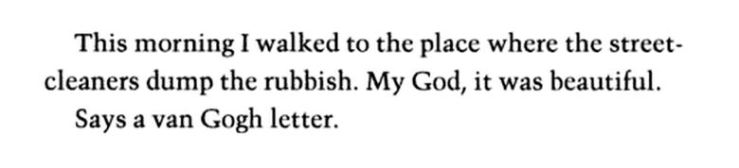
Van Gogh Anecdote (David Markson)

Capture

An Interview with Evan Lavender-Smith

Evan Lavender-Smith is an American writer who has published two books, Avatar and From Old Notebooks.

I really really really like his anti-novel (or whatever you want to call it) From Old Notebooks, which has recently been reissued by the good people at Dzanc Books.

(Here is my review of FON). I still haven’t read Avatar.

Evan talked with me about his writing, his reading, and other stuff over a series of emails. He was generous in his answers and I very much enjoyed talking with him.

Evan lives in New Mexico with his wife, son, and daughter. He has a website. Read his books.

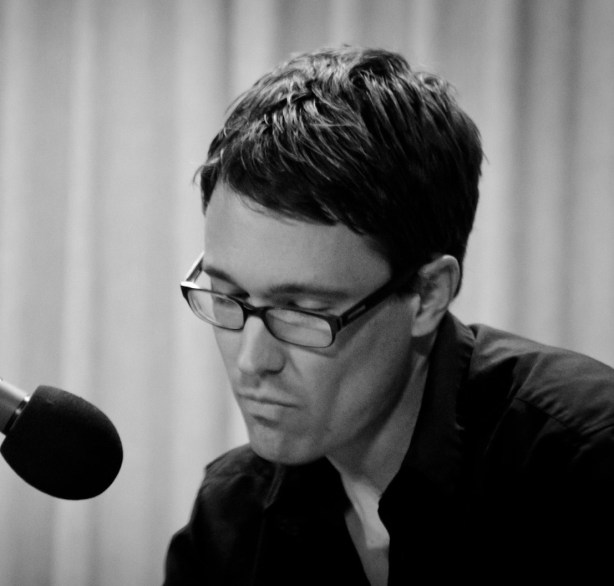
author-photo2

Biblioklept: Do you know that first editions of From Old Notebooks are going for like three hundred dollars on Amazon right now?

ELS: Here at the house I have a whole drawer full of them. That’s how I’m planning to pay for the kids’ college.

Biblioklept: I read that Cormac McCarthy won’t sign his books anymore because he has this reserve of signed editions that are for his son to sell and corner the market on. Or I think I read that.

Speaking of your kids: the parts in From Old Notebooks about them are some of my favorites, perhaps because the moments you describe seem so real to me, or that I relate so strongly to the feelings that you express. (My own kids, a daughter and son, are about the same age as your kids are in the book). Is it weird if I ask how your kids are?

ELS: Glad to hear some of that stuff resonates with you. No, I don’t think it’s weird. I believe the book even sort of self-consciously anticipates a certain reader’s empathetic engagement with it. There’s that passage somewhere, for example, in which we get something like an interview answer, something like “The real Evan Lavender-Smith has never made it past the first section of Ulysses, the real Evan Lavender-Smith has no children,” which I think maybe winks at the possibility of that type of readerly engagement. So no, it’s encouraging to hear that parts of the book seemed to work for you. My kids are great, by the way. Sofia’s at her violin lesson, Jackson’s doing an art project with his mom.

Biblioklept: The faux-interview answers crack me up. I think we’ve all done that in some way—that we go through these little experiments of interviewing ourselves, performing ourselves, imagining how others perceive us. You write your own obituary; at one point we get: ” ‘With my first book I hope to get all the cult of personality stuff out of the way’.” You remark that you don’t put dates on anything as “an act of defiance” against your “literary executors.” Moments like these seem simultaneously ironic and sincere.

I’m curious as to how closely you attended to these disjunctions—From Old Notebooks seems incredibly, I don’t know, organic.

ELS: At a certain point I became very aware that I was performing some version or versions of myself in the book, and I think the book tries to find ways of grappling with problems I perceived as bound up with that performance. One way was to insist on a narrative tone or mode somewhere in between irony and sincerity, or to regularly oscillate between or conflate these competing modes. Something like “I am the greatest writer in the history of the world!” might later be countered by “Gosh, my writing really blows, doesn’t it?”; or “My kids are so beautiful, I love them so much,” might be followed by “I wish those little fuckers were never born.” While the function of this variability is, in From Old Notebooks, probably mostly an apology or a mask for a kind of subjectivity I worry might come off as cliche and naive, that particular representation of the thinking subject — cleaved, inconsistent, heterogeneous — does strike me as truer of human experience and perception than the more streamlined consistency of expression and behavior we tend to associate with the conventional narratological device called “character.” When I try to look deep down inside myself, to really get a handle on my thinking, for example, or on my understanding of truth, I end up facing a real mess of disjunctive, contradictory forces competing for my attention. For me — and likely for the book, as well — the most immediate figure for this condition might be the confluence of sincerity and irony, the compossibility of taking a genuine life-affirming pleasure in, and exhibiting a kind of cynical hostility toward, the fact of my own existence.

Biblioklept: That contest between sincerity and irony seems present in many works of post-postmodern fiction. It’s clearly a conflict that marks a lot of David Foster Wallace’s stuff. You invoke Wallace a number of times in From Old Notebooks, but the style of the book seems in no way beholden to his books. Can you talk about his influence on you as a reader? A writer?

ELS: Wallace hugely influenced the way I think about any number of things. I think his most immediate influence on my writing is this blending of hieratic and demotic modes of language when I’m dealing with pretty much anything that requires the serious application of my writing mind; the hip nerdiness of his language was and still is very empowering to me. He made it seem super cool to geek out on books — “The library, and step on it,” says Hal in Infinite Jest — and back in high school and college that example was so vital for me, as someone entirely too obsessed with being both cool and well read. He served to guide my reading of other writers in a way that only John Barth and Brian Evenson have come close to matching; I poured over his essays for names, then went to the library and checked out and read all the books he mentioned, then reread his essays. His fiction’s most common subject matter — addiction, depression, the yearning for transcendence, the incommensurability of language and lived experience, problems of logic vis-a-vis emotion, metafiction’s values and inadequacies — all of this stuff hit very close to home. To my mind there’s little doubt that Infinite Jest is the best English-language novel published in the last 25 years. His advocacy for David Markson has got to be up there among the greatest literary rescue missions of the 20th century. In “Good Old Neon” he wrote what may be the most haunting long short story since “The Death of Ivan Ilych.” He galvanized young writers everywhere right when the internet was taking off and unwittingly served as a touchstone for emerging online literary communities that thrive today. I think for a lot of young writers, myself included, he was, maybe next to the emergence of the internet, the most important force in the language’s recent history. The list goes on and on. And also he helped me out personally, providing encouragement and advice that was so generous and inspiring. I was extremely troubled by his suicide and wasn’t able to write much or think about much else for quite a while.

With all that said, there are some things he says that bother me a bit. The synthesis of art and entertainment he espouses as it pertains to the role of the writer in the age of television — which I think in many ways corresponds to his striving for a new aesthetic in which the cerebral effects associated with 60s and 70s postmodernist fiction are complemented by or synthesized with the more visceral effects associated with 70s and 80s realist fiction — strikes me now as existing very much in opposition to what I believe in most passionately about writing: that it can and in the most important cases should exist in a state of absolute opposition to our entertainments. I’ve come to better appreciate, years after reading Wallace, the writing of people like Woolf and Beckett and Gaddis, those writers who are uncompromising in their vision of narrative art’s most radical and affecting possibilities and who necessarily, I believe, pay very little attention to any sort of entertainment imperative. The books I love most make me feel things strongly, and think things strongly, but rarely do they entertain me. If I want to be entertained, I know exactly where to go: a room without books. I’ve come to think of certain books as my life’s only source of intellectual solace; when I’m not despairing over the futility of everything under the sun, that unflagging commitment to a truly rigorous and uncompromising art that I perceive in a writer like Beckett seems to me a matter of life and death, just as serious as life can ever get. When Wallace talks that shit about art and entertainment, or about the need to add more heart or greater complexity of character to Pynchon or whatever, it makes me feel like I want to throw up. I heard him say once in an interview that he felt he couldn’t write the unfiltered stuff in his head, that it would be too radical or something, and the admission really upset me; it felt like in some serious way he had allowed his projection of an imaginary target audience’s desire to determine the form of his writing. I often feel something similar in the essays; I find many of them to be merely entertaining. I suppose I often judge the essays in relation to the fictions, which I find far superior in their attempt to overcome the strictures and conventions of language and form. Wallace was always at his best, to my reading, when he was really bearing down — when he was at his most difficult.

But no doubt he’s been monumentally important to me, more so than any other recent fiction writer, and in more ways than I can name. There’s something in From Old Notebooks where the methodical awkwardness and wordiness of so many of his sentences is likened to the affectation of bumping up against the limits of language. That’s probably what I take away from him more than anything: when I sit down at the laptop to face the language, I often feel myself struggling with the words as well as struggling to demonstrate that I’m struggling with the words. That’s pure Wallace: word-by-word, letter-by-letter self-consciousness. (There’s another thing in From Old Notebooks about how I’m always talking shit because I care for him so deeply … which is why the paragraph before this one). Continue reading “An Interview with Evan Lavender-Smith”

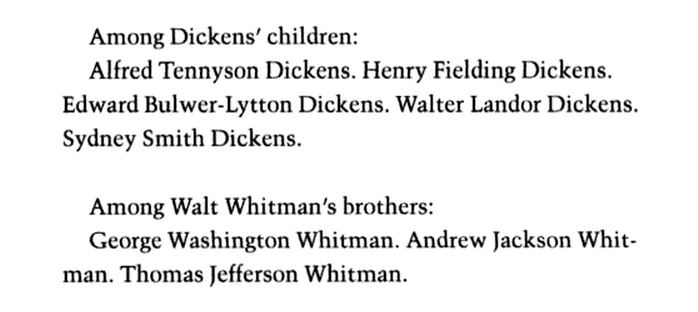
Dickens’ Children // Whitman’s Brothers — David Markson

Capture

Ben Marcus Doing His David Markson Impression

In his early writings, Thoreau called the alphabet the saddest song. Later in life he would renounce this position and say it produced only dissonant music.

Letters, Montaigne said, are a necessary evil.

But are they? asked Blake, years later. I shall write of the world without them.

I would grow mold on the language, said Pasteur. Except nothing can grow on that cold, dead surface.

Of words Teresa of Avila said, I did not live to erase them all.

They make me sick, said Luther. Yours and yours and yours. Even sometimes my own.

If it can be said, then I am not interested, wrote Schopenhauer.

When told to explain himself, a criminal in Arthur’s court simply pointed at the large embroidered alphabet that hung above the king.

Poets need a new instrument, said Shelley.

If I could take something from the world, said Nietzsche, and take with it even the memory of that thing, so that the world might carry on ever forward with not even the possibility that thing could exist again, it would be the language that sits rotting inside my mouth.

I am a writer, said Picasso. I make my own letters.

Shall I destroy this now, or shall I wait for you to leave the room, said his patron to Kadmos, the reputed inventor of the alphabet.

Kadmos is a fraud, said Wheaton. Said Nestor. Said William James.

Do not read this, warned Plutarch.

Do not read this, warned Cicero.

Do not read this, begged Ovid.

If you value your life. Bleed a man, and with that vile release spell out his name in the sand, prescribed Hippocrates.

No alphabet but in things, said Williams.

Correction. No alphabet at all.

The entirety of Chapter 35 of Ben Marcus’s novel The Flame Alphabet. It’s a departure of style from the novel that seems to owe more than a passing nod to David Markson’s notecard novels.


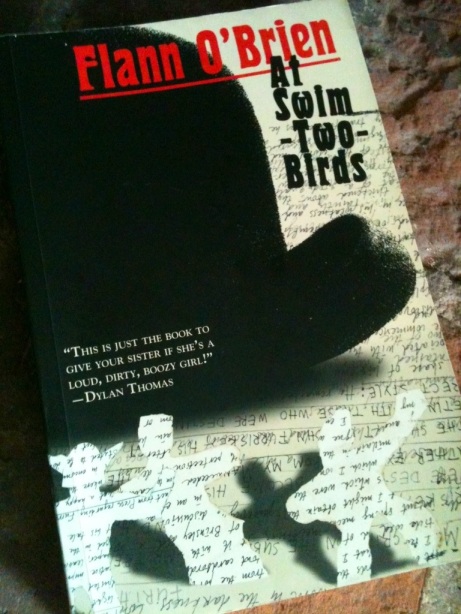
Flann O’Brien’s Novel At Swim-Two-Birds Is a Postmodernist Masterpiece of Comic Storytelling

20130210-161617.jpg

The vibrant force of storytelling in Flann O’Brien’s excellent first novel At Swim-Two-Birds threatens to overwhelm reader and narrator alike—and what a strange joy it is to be overwhelmed. This novel overflows with stories; its plot threads twist into each other, break out of each other, erupt into new ideas, characters, riffs, sketches. First published in 1939—the same year as James Joyce’s Finnegans WakeAt Swim-Two-Birds seems light years ahead of its time—indeed, this is a book that is still ahead of its time.

Summarizing At Swim-Two-Birds is difficult but worth attempting. We have an unnamed narrator, a student living with his uncle who doesn’t think much of how his nephew spends his time. Our narrator likes to imbibe large quantities of porter and wax philosophical with his friends about his literary projects. These projects, our narrator’s riffs and scribblings, begin to take on lives of their own: they intersect, overlap, intermarry, degenerate and regenerate.

The book’s opening paragraph announces the novel’s intention to disregard the classical unities of action, place, and time:

Having placed in my mouth sufficient bread for three minutes’ chewing, I withdrew my powers of sensual perception and retired into the privacy of my mind, my eyes and face assuming a vacant and preoccupied expression. I reflected on the subject of my spare-time literary activities. One beginning and one ending for a book was a thing I did not agree with. A good book may have three openings entirely dissimilar and inter-related only in the prescience of the author, or for that matter one hundred times as many endings.

First, we meet “Pooka MacPhellimey, a member of the devil class,” a hobgoblin of Irish folklore (he turns out to be a thoughtful and polite fellow). Then, there’s John Furriskey, who “was born at the age of twenty-five and entered the world with a memory but without a personal experience to account for it.” Furriskey is the literary creation of another of the narrator’s literary creations, one Dermot Trellis, a grumpy old man who writes Westerns; Trellis (an author, it’s worth reiterating) is the eventual antagonist of the novel, the target for all of the other characters’ vengeance. The third opening offers up Finn Mac Cool, “a legendary hero of old Ireland.”

Much of the early part of At Swim-Two-Birds features Finn Mac Cool holding forth on all matters Irish in wonderfully baroque and hyperbolic passages. Here’s a snippet (a long one!), featuring Finn on the ideal man:

When pursued by a host, he must stick a spear in the world and hide behind it and vanish in its narrow shelter or he is not taken for want of sorcery. Likewise he must hide beneath a twig, or behind a dried leaf, or under a red stone, or vanish at full speed into the seat of his hempen drawers without changing his course or abating his pace or angering the men of Erin. Two young fosterlings he must carry under the armpits to his jacket through the whole of Erin, and six arm-bearing warriors in his seat together. If he be delivered of a warrior or a blue spear, he is not taken. One hundred head of cattle he must accommodate with wisdom about his person when walking all Erin, the half about his armpits and the half about his trews, his mouth never halting from the discoursing of sweet poetry. One thousand rams he must sequester about his trunks with no offence to the men of Erin, or he is unknown to Finn. He must swiftly milk a fat cow and carry milk-pail and cow for twenty years in the seat of his drawers. When pursued in a chariot by the men of Erin he must dismount, place horse and chariot in the slack of his seat and hide behind his spear, the same being stuck upright in Erin. Unless he accomplishes these feats, he is not wanted of Finn. But if he do them all and be skillful, he is of Finn’s people.

It’s hard not to feel something of Joyce in the passage (I’m particularly reminded of the Cyclops episode of Ulysses), and O’Brien’s narrator name-checks Joyce (along with Aldous Huxley) in the first few pages of the book. The narrator’s comically mechanical and precise descriptions also recall Joyce. Joyce and O’Brien drew from the same well of mythology, but O’Brien more keenly attunes his focus on Irish legend and folklore in At Swim-Two-Birds, while Joyce’s project skews to archetypes. Similarities and divergences aside, there’s something strangely fitting about O’Brien’s Finn Mac Cool dreaming his way into other characters’ lives in At Swim-Two-Birds, as if this Finn is the psychic twin of Joyce’s Finn.

Indeed, such a reading would fit neatly into our young narrator’s ideas about the function of character in literature:

Characters should be interchangeable as between one book and another. The entire corpus of existing literature should be regarded as a limbo from which discerning authors could draw their characters as required, creating only when they failed to find a suitable existing puppet. The modern novel should be largely a work of reference. Most authors spend their time saying what has been said before – usually said much better. A wealth of references to existing works would acquaint the reader instantaneously with the nature of each character, would obviate tiresome explanations and would effectively preclude mountebanks, upstarts, thimble-riggers and persons of inferior education from an understanding of contemporary literature.

This decree strikes me as wonderfully post-postmodernist. That the “modern novel should be largely a work of reference” finds its suitable echo over half a century later in the note-card novels of David Markson (and other reality smugglers). The citation above serves as a metatextual description of At Swim-Two-Birds itself: O’Brien’s narrator framing the various tales that erupt in the novel, but also undoing the frames, allowing his characters to converge, to tell their own stories (and within those stories characters tell other stories…).

In its finest moments (of which there are many), At Swim-Two-Birds operates on an ad hoc logic that it creates and describes in motion, a kind of improvised dream response pattern. Most books, particularly postmodern books, teach the reader how to read them—that is, most novels provide keys, hints, and reading rules early enough in the text to allow perceptive readers to interpret (subjectively, of course) what the novel is doing. O’Brien’s novel in toto, with its discontinuities, gaps, eruptions, and juxtapositions, paradoxically is its own discrete, unified key.

But I seem to be getting bogged down in a bit of literary theory, which is not my intent at all.

Instead, let me draw attention to a wonderful extended jaunt in the middle of At Swim-Two-Birds where the Pooka MacPhellimey enters into an ersatz quest with the Good Fairy, two cowboyish thugs (or thuggish cowboys) named Slug and Shorty, the poet Jem Casey, and the mad King Sweeny. This ragtag band sets out to bequeath gifts to the forthcoming child of Miss Lamont (the creation of a creation of a creation). These episodes unfold in comic bravado, their slapstick rhythms recalling the manic but precise energy of Buster Keaton and Charlie Chaplin and the linguistic brio of the Marx brothers. This miniature picaresque is tempered in sweet pathos for poor crazy Sweeny who must be plied forward with the promise of a feast. The poor man, broken, starving, and living solely on watercress, falls into despair. What eventually moves him? The force of language:

And getting around the invalid in a jabbering ring, they rubbed him and cajoled and coaxed, and plied him with honey-talk and long sweet-lilted sentences full of fine words, and promised him metheglin and mugs of viscous tarblack mead thickened with white yeast and the spoils from hives of mountain-bees, and corn-coarse nourishing farls of wheaten bread dipped in musk-scented liquors and sodden with Belgian sherry, an orchard and a swarm of furry honey-glutted bees and a bin of sun-bronzed grain from the granaries of the Orient in every drop as it dripped at the lifting of the hand to the mouth, and inky quids of strong-smoked tabacca with cherrywood pipes, hubble-bubbles, duidins, meerschaums, clays, hickory hookahs and steel-stemmed pipes with enamel bowls, the lot of them laid side by side in a cradle of lustrous blue plush, a huge pipe-case and pipe-rack ingeniously combined and circumscribed with a durable quality of black imitation leather over a framework of stout cedarwood dovetailed and intricately worked and made to last, the whole being handsomely finished and untouched by hand and packed in good-quality transparent cellophane, a present calculated to warm the cockles of the heart of any smoker. They also did not hesitate to promise him sides of hairy bacon, the mainstay and the staff of life of the country classes, and lamb-chops still succulent with young blood, autumn-heavy yarns from venerable stooping trees, bracelets and garlands of browned sausages and two baskets of peerless eggs fresh-collected, a waiting hand under the hen’s bottom. They beguiled him with the mention of salads and crome custards and the grainy disorder of pulpy boiled rhubarb, matchless as a physic for the bowels, olives and acorns and rabbit-pie, and venison roasted on a smoky spit, and mulatto thick-tipped delphy cups of black-strong tea. They foreshadowed the felicity of billowy beds of swansdown carefully laid crosswise on springy rushes and sequestered with a canopy of bearskins and generous goatspelts, a couch for a king with fleshly delectations and fifteen hundred olive-mellow concubines in constant attendance against the hour of desire. Chariots they talked about and duncrusted pies exuberant with a sweat of crimson juice, and tall crocks full of eddying foam-washed stout, and wailing prisoners in chains on their knees for mercy, humbled enemies crouching in sackcloth with their upturned eye-whites suppliant. They mentioned the leap of a fire on a cold night, long sleeps in the shadows and leaden-eyed forgetfulness hour on hour – princely oblivion. And as they talked, they threaded through the twilight and the sudden sun-pools of the wild country.

I’ve perhaps overshared here, let our characters babble on too long—but the verbal dexterity of the passage above illustrates O’Brien’s rhetorical force, the force he lends his characters in order that they should move their insane and desperate friend forward. There’s a sublime alchemy at work here, where imagination turns into words and words turn into food and drink.

I also fear these big chunks of text I’ve pulled from At Swim-Two-Birds don’t highlight O’Brien’s extraordinary talent at rendering speech. The dialogue in this novel is hilarious but nuanced, its ironies rarely if ever remarked upon by intrusive attributions. That O’Brien’s narrator’s characters (and their characters…) speak through the layers of texts adds to the book’s juxtapositions.

These juxtapositions will perhaps confuse or even alienate many readers. At Swim-Two-Birds can be read as an attack on the classical unities of action, place, and time. O’Brien’s novel is a send-up of stability, order, and tradition. Some of the novel’s best moments are its strangest indulgences, as when O’Brien (or his narrator) gives the novel over to citations from imaginary antique texts, or allows his characters to indulge in a seemingly endless recitation of obscure facts, or satirizes the moral dangers of tea-tasting. These moments seem to erupt from nowhere, bizarre, wonderful, joyous.

At Swim-Two-Birds lacks the cohesion of theme and voice that characterizes O’Brien’s other masterpiece, The Third Policeman, but this is hardly a deficiency. At Swim-Two-Birds is one of those rare books that actually deserves to be called dazzling, a critic’s crutch-word that mars too many blurbs. Its dazzle derives from its rhetorical force, its humor, and its openness to experiment with not just the novelistic form, but the form of storytelling itself. And it’s here that O’Brien’s novel is most real—he captures the strangeness of storytelling, its mutability, its crazy rhythms. Ultimately, this is a novel unconcerned with providing pat answers and clear solutions. I loved this book, loved reading it—and then immediately rereading it. I’ll let O’Brien get the last word:

Answers do not matter so much as questions, said the Good Fairy. A good question is very hard to answer. The better the question the harder the answer. There is no answer at all to a very good question.
I Anti-Review Evan Lavender-Smith’s Anti-Novel, From Old Notebooks

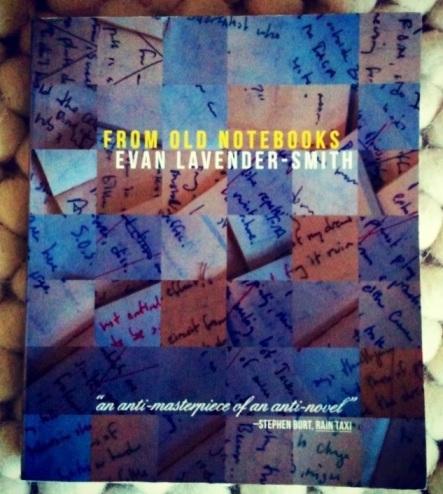
20130202-121935.jpg

The style of this review is probably a bad idea.

In fact, it’s such a bad idea that it’s probable someone has already done it. Or considered doing it but had the good sense to refrain.

From Old Notebooks as the presentation of a subject through his daily jotting downs.

To clarify: All block quotes—like the one above—belong to Evan Lavender-Smith’s From Old Notebooks.

Which I read twice last month.

And am writing about here.

From Old Notebooks: A Novel: An Essay.

From Old Notebooks: An Essay: A Novel.

From Old Notebooks blazons its anxiety of influence: Ulysses, Infinite Jest, Nietzsche, Wittgenstein. Shakespeare.

Joycespeare.

References, critiques, ideas about Joyce, DFW, Wittgenstein, Nietzsche repeatedly evince in From Old Notebooks—and yet David Markson, whose format E L-S so clearly borrows, is evoked only thrice—and not until page 74 (this in a book of 201 pages):

I count David Markson’s literary-anecdote books among the few things I want to read over and over again, yet I have no idea whether they are actually any good. They’re like porn for English majors.

And then again on page 104:

If David Markson hadn’t written his literary-anecdote novels, would I have ever thought to consider F.O.N. a novel? Would I have ever thought to write such a book?

(I should point out that the page numbers I cite are from Dzanc Book’s first edition of From Old Notebooks; Dzanc’s 2012 printing puts the book back in print).

Like Markson’s anti-novels (Reader’s Block, This Is Not a Novel, Vanishing Point, The Last Novel), E L-S’s F.O.N. is constantly describing itself.

There may be some question as to F.O.N.’s status as fiction, poetry, philosophy, nonfiction, etc., but hopefully there will be no question about its status as a book.

Is E L-S’s book postmodern? Post-postmodern?

Perhaps there is nothing quintessentially postmodern about the self-reflexivity, fragmentation and pastiche of F.O.N., if only because all of it follows from form.

From Old Notebooks as a document constantly performing its self-critique:

If there were a Viking Portable Lavender-Smith containing an abridgment of F.O.N., I would be very interested to read it, because there’s no reason that the total value of the book wouldn’t be gained, through editorial happenstance, with much greater efficiency.

From Old Notebooks as a document of authorial anxiety.

A reader could make a case that there are a number of elided texts within or suggested by From Old Notebooks, including the one that gives the author the authority to write such a book.

F.O.N. is also a generative text, bustling with ideas for short stories, novels, plays, films, pamphlets, somethings—it is E L-S’s notebook after all (maybe). Just one very short example—

Novel about a haunted cryonics storage facility.

F.O.N.’s story ideas reminded me of my favorite Fitzgerald text, his Notebooks.

Reading From Old Notebooks is a pleasurable experience.

Personal anecdote on the reading experience:

Reading the book in my living room, my daughter and wife enter and begin doing some kind of mother-daughter yoga. My wife asks if they are distracting me from reading. I suggest that the book doesn’t work that way. The book performs its own discursions.

I shared the tiniest morsel here of my family; E L-S shares everything about his family in F.O.N.:

I know that the reconciliation of my writing life and my family life is one of the things that F.O.N. is finally about, but I can’t actually see it in the book; I don’t imagine I could point to an entry and say, Here is an example of that.

It would be impossible for me not to relate to the character of the author or novelist or narrator of F.O.N. (let me call him E L-S as a simple placeholder): We’re about the same age, we both have a son and a daughter (again of similar ages); we both teach composition. Similar literary obsessions. Etc. After reading through F.O.N. the first time I realized how weird it was that I didn’t feel contempt and jealousy for what E L-S pulls off in F.O.N.—that I didn’t hate him for it. That I felt proud of him (why?) and liked him.

There are moments where our obsessions diverge; the E L-S of F.O.N. is preoccupied with death to an extent that I simply don’t connect to. He:

1) Think always about sex. 2) Have a family. 3) Think always about death.

I:

1) Think always about sex. 2) Have a family. 3) Think always about sex.

But generally I get and feel and empathize with his descriptions of his son and daughter and wife.

And his work. Big time:

Getting up the motivation to grade student essays is like trying to pass a piece of shit through the eye of a needle.

Or

I have perfected my lecture after giving it for the third time, but my fourth class never gets to realize it because my voice is hoarse and I’m so tired from giving the same lecture four times in one day, so their experience of my perfect lecture at 8-9:40 PM is of approximately equal value to that of my students receiving my imperfect lecture at 8-9:40 AM, as well as my students at 2:30-3:55 and 5:30-7:10—and it all evens out to uniform mediocrity in the end.

The novel is not jaded or cynical or death-obsessed though (except when it is).

What E L-S is trying to do is to remove as much of the barrier between author and reader as possible:

Contemporary authors who construct a thick barrier between themselves and their readers such that authorial vulnerability is revealed negatively, i.e., via the construction of the barrier.

Perhaps my suggestion that E L-S tries to remove the barrier is wrong. Maybe instead: E L-S’s F.O.N. maps the barrier, points to the barrier’s structure, does not try to deny the barrier, but also tries to usher readers over it, under it, through its gaps—-and in this way channels a visceral reality that so much of contemporary fiction fails to achieve.

I really, really liked this book and will read it again.


Anecdote on W.H. Auden’s Hygiene, Via David Markson

Capture

Ben Marcus’s The Flame Alphabet (Book Acquired, 1.11.2013)

20130115-162753.jpg

Ben Marcus’s The Flame Alphabet is newish in trade paperback from the nice people at Vintage. I’ve been wanting to read it after absorbing Marcus’s The Age of Wire and String last year. I hear that The Flame Alphabet is more conventional than that earlier work, although a breakfast-menu-as-novel would be more conventional, really. Anyway, this one is up on deck, so no blurbage this time.

In place of the normal blurb I offer with these “book acquired” posts, here’s Marcus on David Markson (from “The Genre Artist,” published in a 2003 issue of The Believer):

 . . . when, for example, David Markson, an expository novelist who fired the starting gun for fictions of information and proved that pure exposition can be alarmingly moving, who purposefully tells instead of shows, is dismissed in The New York Times for failing to provide a story in his novel Reader’s Block, no discussion follows about why, exactly, fiction must have one (at 150 words in the book review, how could any discussion follow?). Nor do we learn what a story might have looked like in such an exquisitely felt book that, to summarize, catalogs the various ways historical figures have hated whole races of people and/or died by their own hands. (Yes, you should read this book.)

Markson should have presumably, under the fiction-must-have-a-story criteria, zeroed in on one of his hundreds of characters and gone deep, doing that good old-time psychological work, the person-making stuff, dramatizing how such an interesting fellow had gone on to hate Jews and/or kill himself. Markson should have used more words like “then.” He should have sequenced. He seems to have forgotten that literature is supposedly a time-based art.

Markson’s amnesia is one of the happy accidents of the last decade of fiction writing. By eschewing a fetishistic, conventional interest in character, or a dutiful allegiance to moment creation, to occurrence itself, Markson accomplishes what a story, slogging through time and obedient to momentum, arguably could not: a commanding, obsessive portrait of single behaviors throughout history, a catalog of atrocity that overwhelms through relentless example. In truth, it’s a novel that can be read as an essay, but unlike most essays, it’s lyrically shrewd, poetry in the form of history, and it’s brave enough to provide creepy, gaping holes where we normally might encounter context (the burden of the conventional essayist).

From Old Notebooks/The Freak Chronicles (Books Acquired, 1.04.2013)

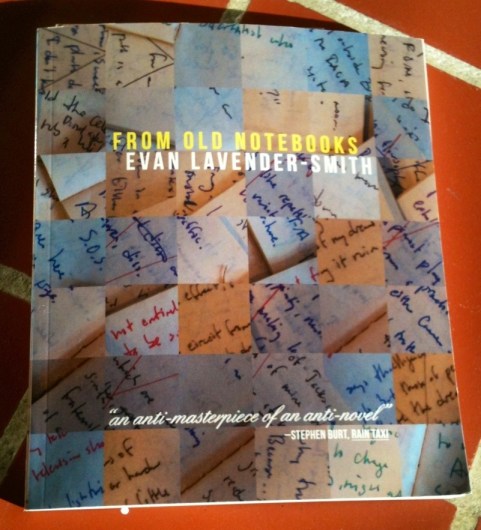
20130107-202041.jpg

A few weeks back, Matt Bucher (via Twitter) suggested that because I enjoyed David Markson’s “notecard” novels so much, I should get a hold of Evan Lavender-Smith’s anti-novel From Old Notebooks. I went to order it from my bookstore, promptly found out it was out of print, and was bummed. And then like maybe a week after this, Matt let me know that the book was back in print from the good people at Dzanc. Anyway, it’s good stuff, and I’ll have a full write-up later this month.

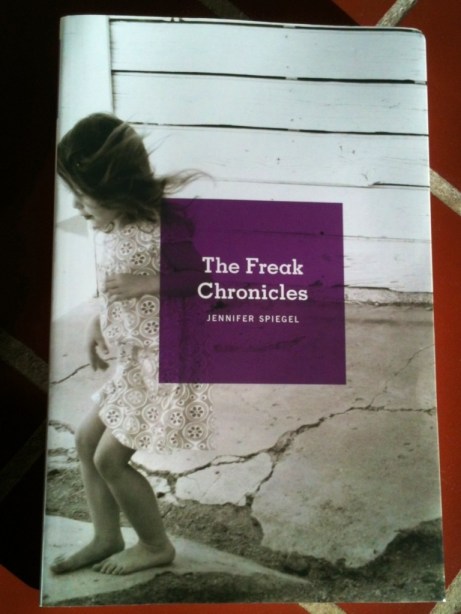
Because of a postage screw-up, my original order was lost. When I let Dzanc know my book hadn’t arrived yet, they promptly sent another copy of the book, along with Jennifer Spiegel’s story collection The Freak Chronicles:

20130107-202048.jpg

Dzanc’s blurb:

An American missionary sleeps on the dung floor in a witch doctor’s hut in South Africa. Two women contemplate “poverty porn” while trying to start a nonprofit in China. An heiress locks eyes with a whore on the streets of Cape Town. A college girl stalks Mickey Rourke. A professor from New Jersey gets scammed in Old Havana before Castro’s demise. A mom obsesses about the fate of Sesame Street characters. A study abroad student goes home with a Russian street artist. Backpackers question their global idealism. Terrain, both ordinary and extraordinary, work on the imaginations and perceptions of people on the run, freaks in the making, eccentrics by choice.

The short stories in this collection explore, both implicitly and explicitly, the notion of freakiness. They worry over eccentricity, alienation, normalcy, and intimacy. What is it that makes one a freak, makes one want to embrace quirkiness, have the fortitude to cultivate oddity? Is there a fine line between abnormality and the extraordinary? Jennifer Spiegel’s stories delve into these questions and others.

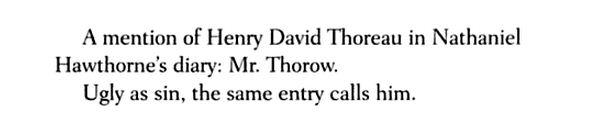
Nathaniel Hawthorne Insults Henry David Thoreau, as Related by David Markson

dmvp

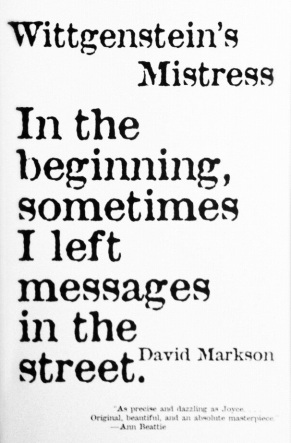
Something on David Markson’s Wittgenstein’s Mistress, Shamelessly Plagiarized and Rearranged from One-Star Amazon Reviews

20121129-203833.jpg

This is not a review.

This book was recommended to me.

An experimental, philosophical novel.

I really wanted to like this book.

I had read the reviews & after being unable for a few years to buy it secondhand, I bit the bullet & bought it new.

The beginning is intriguing.

The concept of the book is dead simple.

The idea is this: Kate is a painter; she is the last person on earth, maybe; she is alone in a house on the Long Island beach

Markson picks up Kate’s dialogue in media res and trusts the reader enough to piece together what the heck is going on: she is the last person left on earth and is making her way through it as best she can, telling us her story as she goes.

Short declarative sentences loop feverishly around her brain, repeating themselves, correcting themselves, contradicting themselves, and filling in missing information many pages later.

The narrator’s voice rings true.

It is frustrating, repetitive, and does not offer much in the way of style and language.

No chapter breaks, no real paragraphs even.

Read at random.

This book received 54 rejections before finding a publisher. This I can believe.

Her little apercus are all about observation and remembrance, the real and the false, blah, blah.

(Joyce, Baldwin, Pynchon, Cortazar).

The book was meandering, rambling & jumped all over the place.

Not that oddness is bad.

It never centers on anything.

It’s the type of book best discussed in groups, since it does bring up some interesting themes—the fragility of memory and sanity, the ineffectiveness of language, the impact of philosophy and literature.

There’s nothing for the reader to latch onto and follow, other than the voice.

What about the subtext?

Like Wittgenstein said, “Whereof we cannot speak, thereof we must be silent.”

I am mad. I am crazy. Yesterday I died but returned in time to write this.

A Seven Point Riff on David Foster Wallace’s David Markson Essay

20121119-170748.jpg

1. Like many David Foster Wallace fans, I’d already read many of the essays collected in the posthumous Both Flesh and Not. I hadn’t read “The Empty Plenum: David Markson’s Wittgenstein’s Mistress” though, originally published in a 1990 issue of The Review of Contemporary Fiction.

I suspect that the Markson essay hasn’t been collected up until now because it is so focused on Wittgenstein’s Mistress—this in contrast to, say “How Tracy Austin Broke My Heart” (Consider the Lobster) which is nominally about Austin’s autobiography but really about much bigger frying fish, like fan-idol relationships and ghostwriting and genre, or “Greatly Exaggerated,” which, again is nominally a review of Dix’s Morte d’Author: An Autopsy but is really more about postmodernism in general. I can’t recall exactly—maybe in his Charlie Rose interview—but Wallace said that he wanted the pieces in his books to be about more than just the ephemeral surface-level topic at hand; like most writers, he was contending for posterity. Wallace’s Markson essay is about Wittgenstein’s philosophy and the state of postmodern or experimental writing in the late 1980s and certain feminist analytic approaches to literature—but mostly it’s a detailed review of Markson’s novel—and it’s not trying to be anything more—which is actually really nice.

2. I read Wittgenstein’s Mistress on David Foster Wallace’s recommendation (I could add the modifier “like many David Foster Wallace fans” here again, I suspect). (That recommendation– “Five direly underappreciated U.S. novels >1960”—is also reprinted in Flesh (perhaps superfluously)). (While I’m getting all parenthetical: I read all five books Wallace recommended and all were excellent).

Here’s Wallace’s recommendation:

“W’s M” is a dramatic rendering of what it would be like to live in the sort of universe described by logical atomism. A monologue, formally very odd, mostly one-sentence 6s. Tied with “Omensetter’s Luck” for the all-time best U.S. book about human loneliness. These wouldnt constitute ringing endorsements if they didnt happen all to be simultaneously true — i.e., that a novel this abstract and erudite and avant-garde that could also be so moving makes “Wittgenstein’s Mistress” pretty much the high point of experimental fiction in this country.

—This is in some ways a condensation of his essay “The Empty Plenum,” where he writes:

Markson’s is not a pop book, and it’s not decocted philosophy or a docudrama-of-the-week. Rather, for me, the novel does artistic & emotional justice to the politico-ethical implications of Ludwig Wittgenstein’s abstract mathematical metaphysics , makes what is designed to be a mechanism pulse, breathe, suffer, live, etc. In so doing, it pays emotional tribute to a philosopher who by all evidence lived in a personal spiritual torment over the questions too many of his academic followers have made into elaborate empty exercises.

3. After Wittgenstein’s Mistress, Markson wrote four more novels, or anti-novels, if you like, sometimes called the note-card novels, novels “of intellectual reference and allusion, so to speak minus much of the novel,” as Novelist puts it in The Last Novel. I read these novels after WM: better-if-not-as-precise (in its metaphoricity) verb: I devoured them. Refinement isn’t exactly the right word, but Markson’s last four novels distill the elliptical and monotone style that he began in WM into a kind of word collage, a frieze of loops, motifs, ideas that the reader has the privilege/burden to construct meaning from. At the beginning of his essay on WM, Wallace posits that the novel is an “INTERPRET-ME” novel; the four novels after WM go beyond INTERPRET-ME—they ask the reader to construct-me, build-me, make-me. These late novels cast away the onus of a narrator; they jettison the already-jettisoned figure of Kate, narrator of Wittgenstein’s Mistress, the last person on earth. And perhaps because of all this, I’ve come to think that they are in many ways superior to WM (or at least showcase a clear evolution in Markson’s style)—that they more purely enact the canon-making, curatorial process that I take to be the core of Markson’s last five books.

4. Here’s Wallace on Markson’s curatorial curve:

The curator’s job—to recall, choose, arrange: to impose order & so communicate meaning—is marvelously synechdochic of the life of the solipsist, of the survival strategies apposite one’s existence as monad in a world of diffracted fact.

Except a big question is: whence facts, if the world is “empty”?

And then Wallace goes about answering this question w/r/t (am I borrowing too many Wallacian shortcuts here?) Wittgenstein’s philosophy. (And this I will not attempt to summarize here).

5. But I will quote Wallace again:

[Wittgenstein] never actually wrote anything about the exquisite tensions between atomism & attendant solipsism on the one hand & distinctively human values & qualities on the other. But, see, this is exactly what Mr. Markson does in WM; and in this way Markson’s novel succeeds in speaking where Wittgenstein is mute, weaving Kate’s obsession with responsibility (for the world’s emptiness) gorgeously into the character’s mandala of cerebral conundrum & spiritual poverty.

6. The greatest weaknesses of Wallace’s essay:

a). He doesn’t do a great job of explicating specifically how Wittgensteinian philosophy—or even themes—are alluded to by Markson in WM. (Or maybe I’m just a weak reader).

b). He gets bogged down in a long discussion of WM as a male-authored text featuring a female narrator w/r/t passivity vs. agency and object vs. subject and Helen vs. Eve (etc.) that I think is ultimately the kind of business far better sorted out in the novel itself.

7. The greatest strength of Wallace’s essay:

He made me want to reread Wittgenstein’s Mistress.

David Foster Wallace on INTERPRET-ME Novels

Certain novels not only cry out for what we call “critical interpretations” but actually try to help direct them . . .  Books I tend to associate with this INTERPRET-ME phenomenon include stuff like Candide, Witold Gombrowicz’s Cosmos, Hesse’s The Glass Bead Game, Sartre’s Nausea, Camus’s The Stranger. These five are works of genius of a particular kind: they shout their genius. Mr. Markson, in Wittgenstein’s Mistress, tends rather to whisper, but his w.o.g.’s no less successful . . . Clearly the book was/is in some way “about” Wittgenstein, given the title. This is one of the ways an INTERPRET-ME fiction clues the critical reader in about what the book’s to be seen as on a tertiary level “about”: the title: Ulysses’s title, its structure as Odyssean/Telemachean map (succeeds); Goldstein’s The Mind-Body Problem (really terrible); Cortázar’s Hopscotch (succeeds exactly to the extent that one ignores the invitation to hop around in it); Burroughs’s Queer and Junkie (fail successfully (?)). 

From David Foster Wallace’s essay “The Empty Plenum: David Markson’s Wittgenstein’s Mistress,” which is collected in Both Flesh and Not.

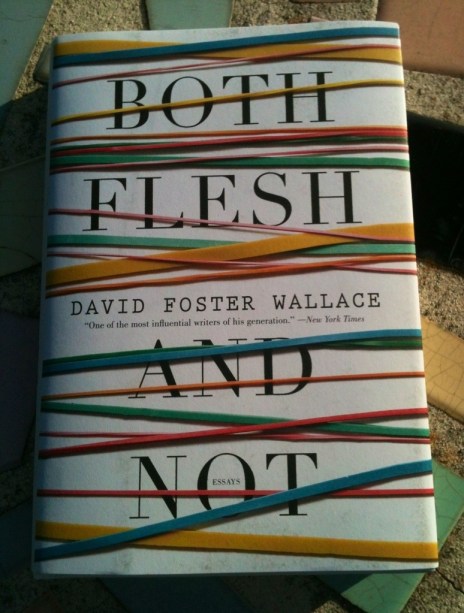
I Try to Riff on Both Flesh and Not, DFW’s New Essay Collection, Which I Haven’t Read, as I Drink Red Wine to Numb the Election Coverage (Book Acquired, 11.06.2012)

20121106-203121.jpg

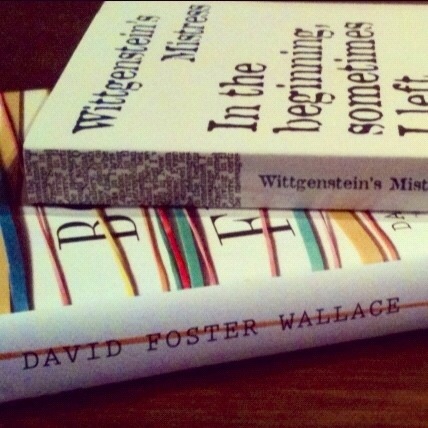
1. Today, I picked up Both Flesh and Not, a collection of David Foster Wallace essays and short pieces. I specifically ordered this book from my local bookstore (I didn’t get a review copy), and I bought it in hardback (I generally dislike hardbacks).

2. I should be reading it now—I’d like to be reading it—but I’m flicking between the five or six channels I have, usually stopping on PBS, and then scanning Twitter and other online media, because, hey, it’s Election Day in America.

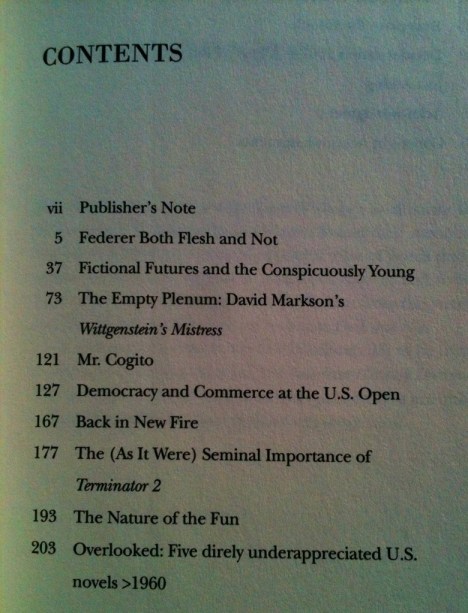
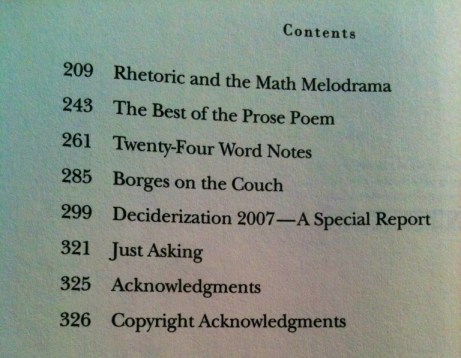
3. I’ve already read several of the pieces in Both Flesh. You might have too. Here’s the table of contents:

20121106-203459.jpg

20121106-203507.jpg

4. But a lot of it I haven’t read. I’m eager to dig into the piece on David Markson, and the piece on Brat Pack writers, “Fictional Futures,” which was later repurposed in “E Unibus Pluram.”

5. I spent most of the afternoon riffling through it, trying not to think about the election results that would be coming in the next few years. I played outside with my kids, building a strange hut out of giant elephant leaves and then a small nest out of pine straw. I photographed the planes that daily fly over our neighborhood, slow, heavy supply planes that drift in lazy routine arcs from the nearby naval base, not loud as jets, but bulky. Elephant mothers, pregnant.

20121106-211636.jpg

6. I remembered that Wallace killed himself in an election year, in September. I remember how I felt.

7. (Please don’t think this riff is really about anything. I’m distracted. I’ve imbibed some wine. Some Xanax might be involved).

8. Speaking of posts in 2008—

I went back just now, and riffled through the site’s archives from November of 2008. (Back when I’d post like three, maybe four times a week. Once a day at most).

A lot of vitriol there. A lot of vitriol for Palin, and a lot of vitriol for the emerging sentiment that would galvanize in what would become the Tea Party movement.

I wrote about the Election Night too. About Jesse Jackson’s tears. I even wrote about finding some respite from cynicism in Obama’s election. (Don’t worry, I’m as cynical as ever. Moreso—

9. —but

I remember watching the inauguration in 2009. I was still teaching high school. I had third period planning and I watched the whole shebang in an empty lab on the school’s third floor with my friend Derek, a black Muslim who taught history in the classroom next to mine. It was cold up there and empty. I remember he asked me if the election poem was good and I asked him what he thought (I thought it was good). I remember we cried a little in spite of ourselves and clutched at each other. The world seemed so much more possible. I’m clutching to this memory now, which is deep and rich and I hope to keep forever. It presents through pinot and Xanax).

10. Is this a bait and switch? I apologize. Look, I love you reader. Really, I do. I do.

11. So, another detail from the Wallace collection:

The selections are intercut with definitions from his vocabulary list for The American Heritage Dictionary. Like so:

20121106-203548.jpg

12. What was I doing here? I don’t know. Let me just wrap it up. I should be writing about DFW and the book but I can’t. Distracted. I’ll schedule the post. Let it stand. Let it roll at 11:11am tomorrow? (To clarify–it’s 9:55pm on 11/06/2012).

Okay, I’ll do that. Finish the rest in the comments? Sure. And some more, of course, about the book.

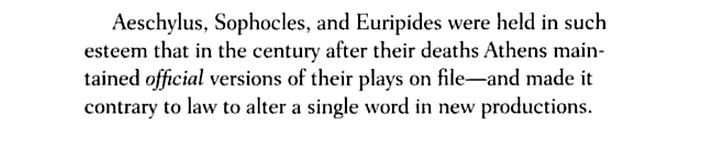
David Markson Comments on Some Athenian Playwrights

David Markson Describes the Physical Limitations of Three Philosophers

List with No Name #8


  1. Robert Walser
  2. Franz Kafka
  3. Henry Miller
  4. Thomas Bernhard
  5. David Markson
  6. Renata Adler
  7. W.G. Sebald
  8. Lydia Davis
  9. Ben Marcus