The Worst Poetry I Have Ever Read

At the home of some good friends this past weekend, reclined nicely in a warm armchair, the warmth of various ales coursing through me, I picked off the shelf by my right hand a crumbling first edition of Modern Library’s A Comprehensive Anthology of Modern Poetry, edited by Conrad Aiken. I opened at random and found a small and perhaps undue joy that my stochastic flipping led to sections 10 and 11 of Song of Myself—maybe my favorite parts of Walt Whitman’s longassed poem.

Do you recall these bits? The trapper’s wedding? The runaway slave? The twenty-eight bathers and the woman who spies on them? I read them aloud to the room, ostensibly to the people in the room, but maybe just to myself. Walt Whitman’s storytelling is at its best when he moves most away from himself, when he puts on different hats, wears different ears, strolls around America a bit. I love his free verse in spite of—or even maybe because of—its swollen scope, its tendency toward bombast or even hamminess. O Walt! Get over yourself!—but not really, never change! Song of Myself is one of my favorite novels, or one of my favorite epics, or one of my favorite monologues—whatever it is, it’s one of my favorites (especially taken with doses of Emily Dickinson’s strange potions).

I don’t really know a lot about poetry, despite teaching the study of it in certain literature survey classes.

But hang on, it seems I was telling a story, or at least teasing out an anecdote, or at least going somewhere with all this: So, after riffling through the anthology a bit more, my friend says, Hey, if you want to read some really terrible poetry, check out that book to your right. Here is the book:

20130120-102401.jpg

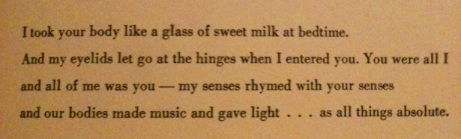
I had never heard of Walter Benton or his (unintentionally) hilarious volume This Is My Beloved until that moment. So what is it? Combining the worst elements of Whitmanesque free verse with a downright silly conceit that these are diary entries, This Is My Beloved attempts to be the erotic record of a passionate love affair. Benton tries to keep his language sultry, sexy, and sensuous without veering into pornography, but the results are bizarre and grotesque. Here’s an entire page as evidence:

20130120-102411.jpg

“Your breasts are snub like children’s faces”?!

“…your lips match your teats beautifully”?!

And my favorite: “The hair of your arm’s hollow and where your thighs meet / agree completely, being brown and soft to look at like a nest of field mice.” A nest of field mice! Women love to be complimented on their matching pits and pubes, followed by a simile comparing said regions to a rodent’s hovel.

Indeed, Benton loves animal similes for his lady—later he writes: “Yes, your body makes eyes at me from every salient, / promises warm, lavish promises— / curved, colored . . . finished in a warm velvet like baby rabbits.”

But it’s not just the rabbits and mice that are gross. Lines like “We had loved hard—it’s all over your throat and hair” are simply queasy, bad writing. Or this nugget: “The white full moon like a great beautiful whore / solicits over the city, eggs the lovers on / the haves . . . walking in twos to their beds and to their mating. / I walk alone. Slowly. No hurry. Nobody’s waiting.”

Or this snippet:

20130120-102418.jpg

It’s just really, really bad—I mean, at least when Henry Miller is gross, he’s deeply, earnestly gross, abject even, depraved perhaps (recall the famous lines: “I have set the shores a little wider. I have ironed out the wrinkles. After me you can take on stallions, bulls, rams, drakes, St. Bernards. You can stuff toads, bats, lizards up your rectum. You can shit arpeggios if you like, or string a zither across your navel”).

So, to return to my little story, we read most of Benton’s book aloud, doubling over laughing at times at just how wonderfully awful it is. And, wiping the tears from my eyes, I went to my trusty dusty iPhone to do a little background research—surely the world knew of this awful, awful poetry? Surely folks were getting the same giggly fun as happy we from poor Benton’s lurid verse?

And here, really, comes the occasion for this post, the real reason I write: It turns out that folks love this book—in a sincere, earnest, serious way. No fewer than four audio recordings were made of the book, all set to music (the most famous seems to be by Arthur Psyrock); the book has near-perfect five star review averages on both Amazon and Goodreads; and, perhaps most shocking of all, the book has been continuously in print since it was first published in 1949—it’s in its 34th edition (prestigious hardback with prestigious deckle edges, by the way). And of course you can buy an ebook version! (Unlike, say, Georges Perec’s Life A User’s Manual). Even worse, hack crooner Rod McKuen cites Benton as a major influence, so we have that to thank him for as well.

I don’t know. Am I wrong? Is Benton’s stuff actually good? I mean, I’ll concede that I enjoyed reading the book, but only inasmuch as it made me laugh so much. I don’t know. I already admitted I don’t know much about poetry. (As I write this, I pause to watch and listen to Richard Blanco read his inauguration poem “One Day”; I have no idea if it’s good or not). Benton’s verse seems so hammy, clumsy, indelicate; too earnest, too priapic, tripping over its own boners. It reads like a bad cribbing of Whitman and Miller, with an occasional lift from Hemingway. Even worse, it strikes me as amateurish, as the sort of thing that a teen might scrawl in his Moleskine only to cringe at later before hiding it somewhere. I just can’t believe that this book has been in continual publication from a major house (Knopf) for more than a half-century.

But maybe I’m misreading. Maybe I’m cynical. Maybe the poem is beautiful and profound and not icky solipsistic dreck. But I doubt it.

theNewerYork #2 Reviewed

20130106-104720.jpg

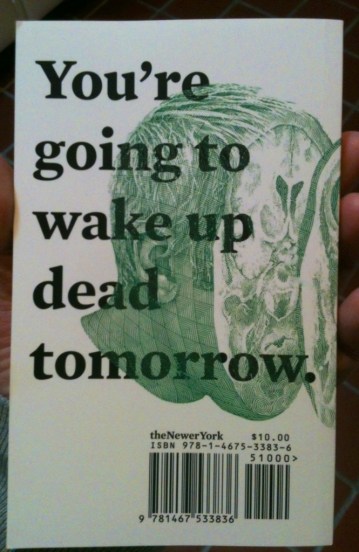
TheNewerYork is a new little magazine or journal or whatever you want to call it, featuring short fiction, poetry, art, lists, labels, fake reviews, and other stuff. Issue #2, clocking in at just over 80 pages fits neatly into a man’s jacket pocket and can be read in queues or at red lights or in between other readings or discreetly during end of semester faculty meetings. (I’m pretty sure you could read it in other occasions but I didn’t). You can see the front cover above; here’s the back cover, featuring this worrisome promise:

20130106-105947.jpg

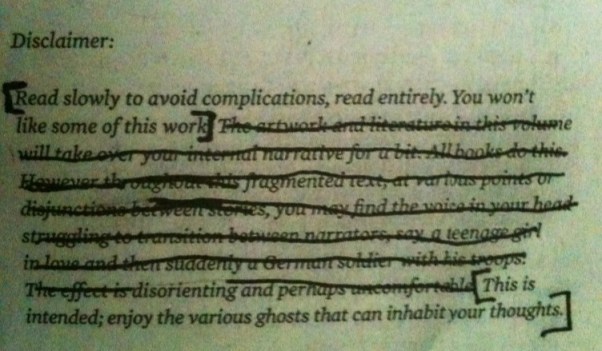
Maybe the best way to summarize (what I take to be) theNewerYork’s aesthetic/literary mission is to show off the issue’s disclaimer (which is preceded by a fancy Foucault quote):

20130106-105653.jpg

“You won’t like some of this work” seems like a fair warning, but theNewerYork is more hit than miss, starting with its excellent opener, ‘The Thank You War” by Elliot L. Ackerman, a four-paragraph flash that tackles how would-be patriotic citizens bungle human relationships with returning soldiers. Also very good is Jamie Grefe’s list “Over Thirteen,” which is a lovely little horror story that makes meaningful use of the reader’s imagination. Another list, Bruce Harris’s “Nearly A Dozen Things Sherlock Holmes Never Said” made me laugh (sample: “Watson, you’re right.”)

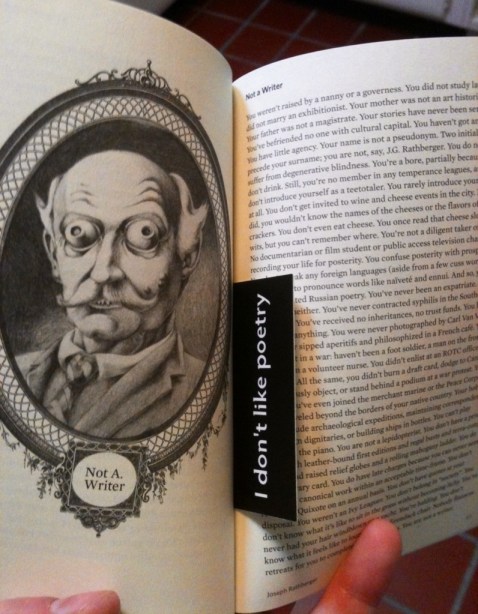
One of my favorite pieces in the volume is “Not a Writer” by Joseph Rathberger (indexed as “A Put Down”). You can see it below, filling up a page; you can also see the art that precedes it and the nifty bookmark that comes with the issue:

20130106-104746.jpg

Most of the art in the issue is black and white and all of it is varied (in style and in quality). Here is Food Poop by Shaina Yang:

20130106-104753.jpg

TheNewerYork’s willingness to showcase experimentation in what goes on paper for people to look at and read is both a strength and a weakness. Most of the pieces succeed, even when they shouldn’t (why is a Google translation from “Baby Got Back” from English to Latin and then back into English so funny?). The pieces in the issue that don’t succeed fail on their own terms: half-formed or poorly executed ideas, the occasionally gimmicky experiment, and, thankfully more rarely, pieces that feel too imitative. But like I said, most of the texts in theNewerYork’s second issue succeed, which is to say they entertain or amuse or baffle or occasionally move the reader. What I like most about theNewerYork is its spirit, which is daring and experimental without the heavy robes of irony that often cloak these sorts of operations. A promising beginning.

A Lazy Riff on the First Three of Álvaro Mutis’s Maqroll Novellas

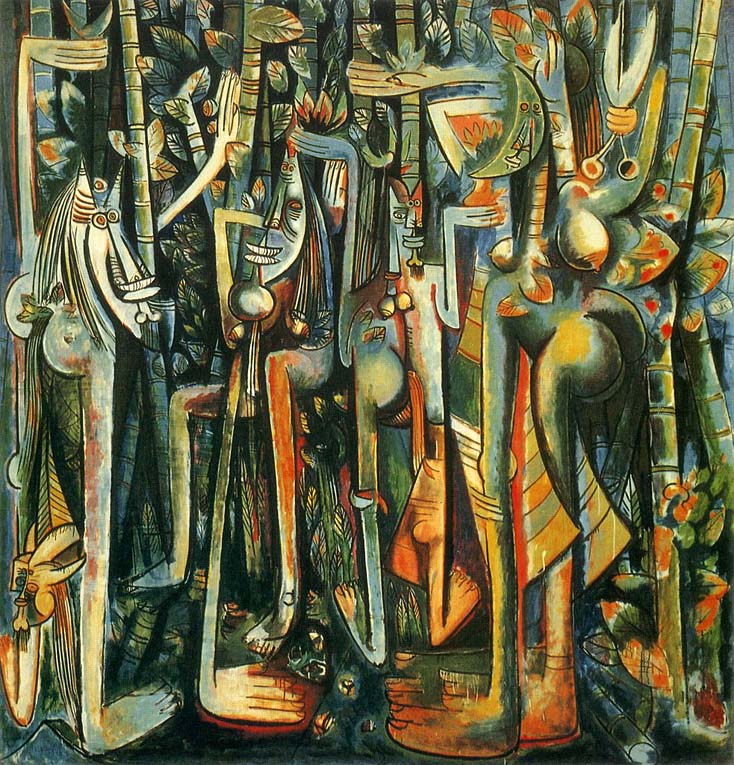
The Jungle by Wilfredo Lam

1. Last year on this blog, my friend Dave Cianci reviewed Álvaro Mutis’s collection of seven novellas, The Adventures and Misadventures of Maqroll. That review got me to eventually pick up the book and start reading. That review is better written and more accomplished than what I’ll likely end up doing here.

2. There are seven Maqroll novellas; I’ve read the first three. They are excellent.

3. Let me steal from Cianci’s review. He describes Maqroll the Gaviero as

a fleshed-out character, as well as the embodiment of an ideal: the knife fighters and Viking poets idolized by Borges, a mixture of Robinson Crusoe, Sam Spade, and Don Quixote. He indulges fantasy but prepares for disappointment. He lives between lawlessness and acceptability.

4. The Gaviero—the lookout—is a picaro, a roguish but poetical sailor. Mutis’s book is picaresque, carnivalesque, a river—or maybe a maze—of storytelling.

5. This is maybe what Maqroll is about: storytelling. Each Maqroll novella is framed as another’s story, or a found document—you know this trick, you’ve read Borges, right? 

6. The book is crammed with stories, stories that lead to other stories, that recall other stories, that tell their own stories—or cover over other stories.

7. A line that might instructively illustrate point 6: In Ilona Comes with the Rain, Mutis unpacks the life of a minor character, a sea captain named Wito. Consider his opening gambit:

His life deserves an entire book. It was so full of adventures, some of which he hurried over as if they were hot coals, that one became lost in their labyrinthine complexity.

The life described here could just as well be the Gaviero’s.

8. Well of course, that’s what Mutis is doing, channeling and conveying and expressing Maqroll’s life, a life of picaresque adventures (and titular misadventures), of loss and gain, of love and despair, drinking, sailing, scheming and plotting—a life full of allusions and hints and digressions. Mutis’s technique is marvelous (literally; he made this reader marvel): he gives us an aging (anti-)hero, a hero whose life is overstuffed with stories and mishaps and feats and enterprises and hazards; he gives us one strand of that life at a time in each novella—but then he points to the other adventures, the other serials of Maqroll that we would love to tune into if only we could.

9. To illustrate point 8: Consider Maqroll in Un Bel Morir, doing some time in prison: His consciousness floats to other prisons, other countries: Afghanistan, British Columbia: And then we get those stories, miniature epics—and nested within them, their own characters tell stories.

10. There’s a wonderful timelessness to Maqroll, a sense that the adventures exist somehow before the postmodern world, that they belong to the pulp fictions of jungle adventure…

11. (Indeed, re: point 10: In Ilona, we find one character who is unstuck in time, taking a Naopleonic lover during a transcontinental voyage…)

12. I’ve already noted the Borgesian quality of Mutis’s tales, brought up their picaresque scope (a la Cervantes), so let me lazily compare Mutis to others: let me note the sprawl of his storytelling, which recalls García Márquez—only more compact, more precise. Let me suggest that there’s something of Kafka in there too—indeed, the first novella, The Snows of the Admiral seems to me a reworking of “Before the Law.” (The tale is also conspicuously quixotic; tilting at windmills and all that). Conrad of course, but also something of Melville—the grand (Moby-Dick) and the sly (The Confidence Man). And hell, also something of Edgar Rice Burroughs’s high adventure, or even, dare I say it, the better parts of the Indiana Jones films.

13. Lazy as I am, I’ve failed to quote Mutis at any length—a shame, because it’s wonderful prose (translated by Edith Grossman, by the way). So here’s a little morsel—one that I think captures why we tell stories—from the appendix to Un Bel Morir, the last of the three novellas I read; before I offer it up I’ll conclude my riff by saying how happy I am that there are four more of these Maqroll novellas to read:

All the stories and lies about his past accumulating until they formed another being, always present and naturally more deeply loved than his own pale, useless existence composed of nausea and dreams.

Reading Chris Ware’s Building Stories / It All Happened So Fast

20121213-185225.jpg

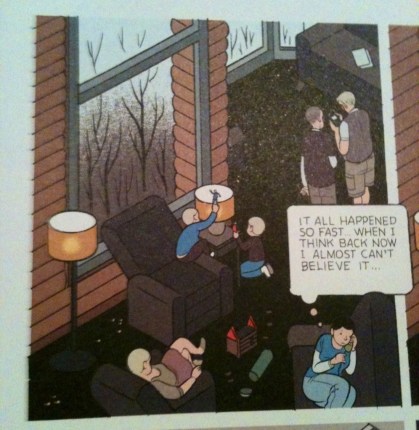
As seems to be the case more often than not in this series of write-ups on reading Chris Ware’s Building Stories, I’ve taken the title from the first line of the first panel (below); you can see the scale of this chapter in folded broadside in the pic above (which also reveals the heart of this episode).

20121213-185234.jpg

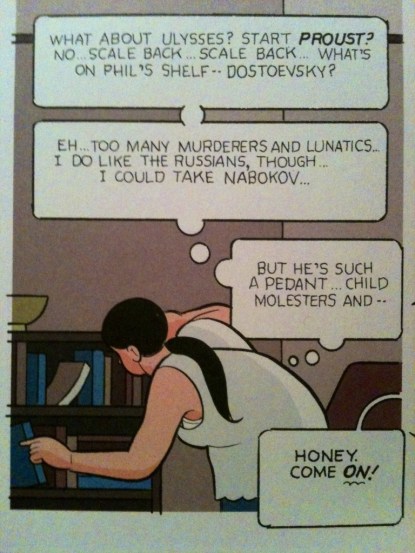
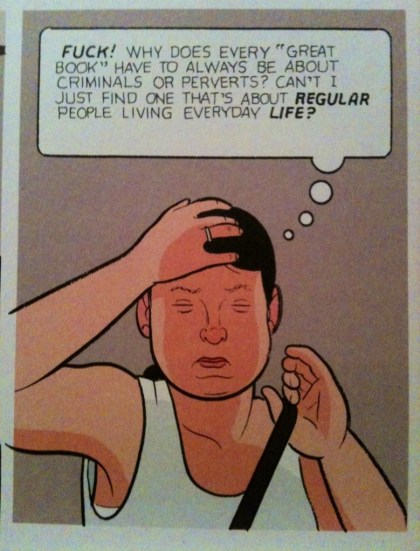
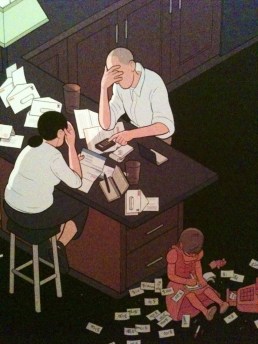
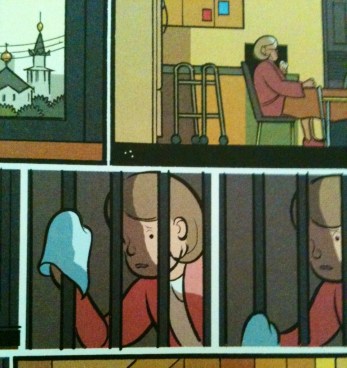
This particular episode focuses again on Lonely Girl/Married Mom/The Amputee, who has slowly emerged as the protagonist of Ware’s novel. Here, she deals with the news of her father’s illness, an event that brings her back to her childhood home repeatedly. The motif of homes and buildings evinces again too, of course—it’s a subtle but omnipresent device in Building Stories:

20121213-185305.jpg

20121213-185312.jpg

And as always, Ware’s genius shows in the way he conveys so much truth in the smallest detail. Below he illustrates Lonely Girl’s disconnected relationship with her architect husband in just a panel:

20121213-185243.jpg

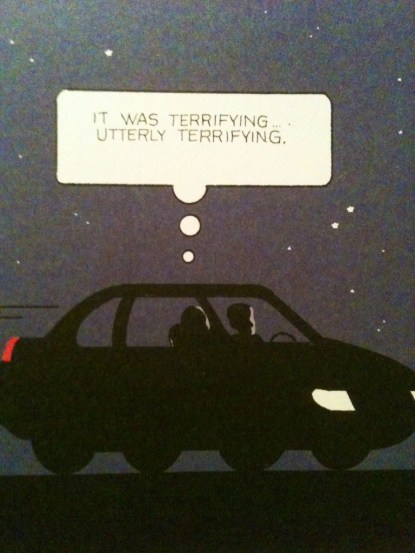
“It All Happened So Fast” is a fair name for this chapter—Ware’s panels illustrate the way that our lives (and the narrativizing of those lives) can become radically compressed, how our memories fail us, how seemingly trivial details anchor themselves to the emotional strata of our personalities even as concrete fact slips away. Still, another title could come from this panel:

20121213-185256.jpg

I’ll close this out by offering three panels that strike me as so utterly real, so wonderfully truthful, that I won’t bother to comment further:

20121213-185321.jpg

20121213-185328.jpg

20121213-185336.jpg

Reading Chris Ware’s Building Stories / Disconnect

20121206-181909.jpg

“Disconnect,” one of the longer episodes in Chris Ware’s novel Building Stories, serves as a reminder of Ware’s strength as a prose writer. Wordiness tends to kill illustrated storytelling, at least in my estimation. Sure, there are exceptions—Joe Sacco and Harvey Pekar come to mind—but in general, I think comics are at their best when thought and word bubbles are uncluttered (or nonexistent).  Ware clearly understands the economy of his medium, and some of Building Stories’ finest moments have been wordless ones where Ware constructs the story in pure imagery. We can see so much of the plot and themes of  “Disconnect” in this full page, for instance:

20121206-181944.jpg

But Ware also packs plenty of storytelling into his prose in “Disconnect,” where he continues the story of Lonely Girl, who it’s probably better to now call Married Mom—I still think of her as Lonely Girl though, after first really meeting her in “September 23rd, 2000,” an episode ostensibly narrated by her diary. “Disconnect” is a second diary of sorts, her internal narration guiding us subtly through episodes in her life over a series of years. “Disconnect” focuses on LG/MM raising her young daughter against the backdrop of a strained marriage.

Lonely Girl/Married Mom’s observations ring particularly true. She points out that “When your children aren’t around, you miss them with every fiber of your being—but when they are, you just want to get them to bed so you can go read the news or something,” an observation simultaneously profound, disturbing, and banal. When our heroine recalls how her relationship to her pet cat changed after her child was born, I also saw shades of myself:  “The day we brought Lucy home, almost to the minute, all applied personality to Miss Kitty evaporated, and we saw her for what she was—an animal—and an animal who we were beholden to feed and house, with, suddenly it seemed, little to offer in return.”

Through Lonely Girl/Married Mom, Ware paints a portrait of modern disconnection and alienation, and, even as we sympathize with the heroine, Ware also allows us to see through her—or rather, to see what she can’t see, or to see what she refuses to see. The effect is an irony that tips into small, banal tragedy.

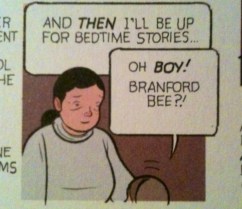
Ware’s prose is usually overshadowed by his gifts as a draftsman, an architect—he’s the builder of Building Stories, a fact that this chapter alludes to, both internally, intertextually, and metatextually. We learn, for example, that Branford the Bee is a story within a story:

20121206-181917.jpg

This nesting of stories emerges in the final part of “Disconnect,” wherein our aged narrator—addressing her grown daughter—relates a dream:

20121206-181924.jpg

The scene culminates so beautifully that it brought a little tear to my eye. Most postmodern novels contain (often more than once) their own descriptions, and Building Stories is no exception:

20121206-181934.jpg

And yet what we see here isn’t postmodern cleverness or empty gimmickry, but the evocation of dream and imagination and desire and creation—the spirit of the book, of what it means to build stories. Reading the final panels of “Disconnect,” I immediately recalled the epigraph to Building Stories (it’s on the interior of the box lid, by the colophon and dedication):

20121206-181951.jpg


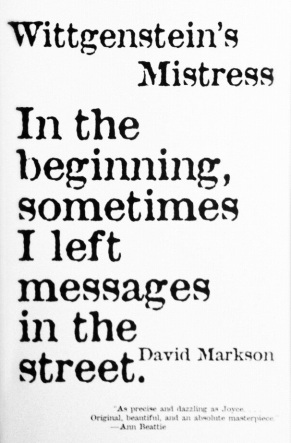
Something on David Markson’s Wittgenstein’s Mistress, Shamelessly Plagiarized and Rearranged from One-Star Amazon Reviews

20121129-203833.jpg

This is not a review.

This book was recommended to me.

An experimental, philosophical novel.

I really wanted to like this book.

I had read the reviews & after being unable for a few years to buy it secondhand, I bit the bullet & bought it new.

The beginning is intriguing.

The concept of the book is dead simple.

The idea is this: Kate is a painter; she is the last person on earth, maybe; she is alone in a house on the Long Island beach

Markson picks up Kate’s dialogue in media res and trusts the reader enough to piece together what the heck is going on: she is the last person left on earth and is making her way through it as best she can, telling us her story as she goes.

Short declarative sentences loop feverishly around her brain, repeating themselves, correcting themselves, contradicting themselves, and filling in missing information many pages later.

The narrator’s voice rings true.

It is frustrating, repetitive, and does not offer much in the way of style and language.

No chapter breaks, no real paragraphs even.

Read at random.

This book received 54 rejections before finding a publisher. This I can believe.

Her little apercus are all about observation and remembrance, the real and the false, blah, blah.

(Joyce, Baldwin, Pynchon, Cortazar).

The book was meandering, rambling & jumped all over the place.

Not that oddness is bad.

It never centers on anything.

It’s the type of book best discussed in groups, since it does bring up some interesting themes—the fragility of memory and sanity, the ineffectiveness of language, the impact of philosophy and literature.

There’s nothing for the reader to latch onto and follow, other than the voice.

What about the subtext?

Like Wittgenstein said, “Whereof we cannot speak, thereof we must be silent.”

I am mad. I am crazy. Yesterday I died but returned in time to write this.

Reading Chris Ware’s Building Stories / Two Short Loops

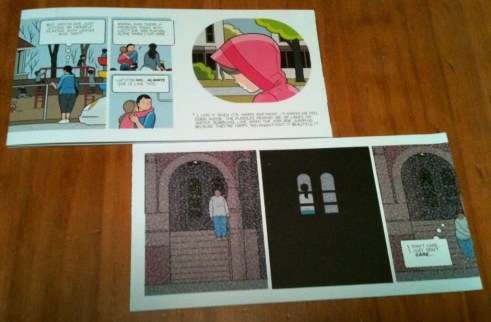
20121201-162412.jpg

These two shorties in Chris Ware’s Building Stories showcase the novel’s thematic recursion, a recursion doubled in both its metastructure (14 pieces that the reader can read in any order) as well as the structure of many of the individual pieces. In the case of the two parts pictured above, we get Möbius strips that become richer with rereading. The strips seem to twin each other not just in their format, but also in their theme.

Both strips feature Lonely Girl, who perhaps emerges as the dominant protagonist of Building Stories. The one pictured at the top gives a voice to her daughter, a girl who seems to repeat some of her mother’s tendencies toward isolation and depression.

20121201-162435.jpg

Ware’s strength here (and always elsewhere) is the economy of storytelling: He packs entire short stories into just a few panels, coloring his narrative:

20121201-162443.jpg

The second loop features a solitary Lonely Girl who trudges through the snowy night in a near-suicidal despair:

20121201-162451.jpg

Read recursively, the strip dooms Lonely Girl to an endless loop of despair—and it’s at moments like these that I’m happy there are other parts to Building Stories—some kind of existential “out” for our poor heroine.


Holy Motors Is A Strange Cinematic Prayer

“Beauty! Beauty! Beauty!” a photographer coos as he snaps shots of supermodel Kay M in a crowded graveyard. A manic beastman interrupts the shoot, knocking down onlookers, chomping on flowers, and quickly diverting the photographer’s attention, lens, and mantra: Turning his camera on the little goatman, enthralled, he repeats, “Weird! Weird! Weird!”

For many viewers, this might be all that French director Leos Carax’s latest film Holy Motors boils down to: “Beauty! Beauty! Beauty! Weird! Weird! Weird!” (And, of course, all the unsettling space along that strange axis). However, it would be a mistake to think that Holy Motors is simply an excursion into the bizarre. The film’s initial scenes pile on absurdity after absurdity with no context (or recognizable film grammar) for audiences to latch to, but that absurdity eventually coheres into a profound essay on what it means to be actors in a life where both audience and director remain unseen to us. Ultimately, Holy Motors asks viewers to consider what it means to have agency: Are we subjects? Do we drive ourselves? Or are we  driven?
Like many films that create their own idiom (or even genre), Holy Motors isn’t for everyone, but I think it rewards (or confounds) viewers who are willing to submit to its alienating grammar long enough to pick up enough of the lingo to engage in what is really a very rewarding, funny, and moving story. And, like many films that create their own idiom, Holy Motors is probably best experienced cold, with no forewarning. In that spirit, I’ll present the trailer (all that I knew of the film going in, aside from atmospheric buzz); my comments after the trailer will contain spoilers and are aimed more at those who’ve already seen the film (although everyone is welcome of course).

Most of the reviews of Holy Motors have focused on the way the film comments on filmmaking itself. In his review at AV Club, Mike D’Angelo establishes the context for HM-as-state-of-film pretty clearly:

Jean-Luc Godard famously suggested that the best way to criticize a movie is to make another movie. With Holy Motors, the year’s most electrifying whatsit, Godard’s fellow French filmmaker Leos Carax has taken that idea one delightfully absurd step further. On its surface, this absurdist ode to analog’s death at digital’s hands seems to echo a number of recent essays eager to perform the last rites on cinema, or at least on its status as our dominant dream factory. Yet Holy Motors is such a bravura, go-for-broke exploration of what movies can do—is so thrillingly, defiantly alive—that it contradicts its own mournful thesis at every turn.

I’m not going to argue that Holy Motors isn’t about films—it’s very clearly about directors, audiences, cameras, watching, and, most of all, acting. Indeed, this is the most visible, surface-level plot of Holy Motors: a man, Monsieur Oscar (a superb Denis Lavant) , is driven over the course of one day in a white limousine to a series of “appointments” where he acts out bewildering scenes in the service of god-knows-what. The opening scene of Holy Motors shows a film audience; significantly they are all asleep. Then a man awakes—it’s the director Leos Carax himself—in a hotel room that slowly shifts into a faux-forest in a dream-logic shot worthy of Lynch. The man inserts a key into the wall/forest and enters the cinema. So, yes, Holy Motors organizes itself around cinema-as-trope.

But I think Holy Motors is far more profound than a metatextual, postmodern gimmick: It’s not really a film about filmmaking (although, of course it is)—it’s really a film about spirituality in a world where people seem to be increasingly disconnected and alienated from each other. Where people are asleep, like the audience at the beginning of the film. Where people do not see.

This theme becomes evident in the first of Oscar’s appointments. When we first meet him, he appears to be an extremely wealthy businessman with a loving family. (Viewers who cling to the idea that the first Oscar we meet is the stabletrue version or identity of Oscar will find themselves too confused to trace meaning from Holy Motors; this was the case with the unfortunate gentleman behind me during the screening, who, at film’s close, asked his friends Hey, why do you think he didn’t go back to his house?). Oscar is picked up by Céline, who drives him in an enormous white limousine from appointment to appointment. In his first appointment, Oscar takes on the role of a crippled crone, who says that for years all she’s seen are feet and cobblestones; her eyes downcast, she does not see the faces in the crowd she begs from, just as they, in turn, do not see her. Significantly, she wonders if she will die—but her thought is not a piece of dialogue, but perhaps Oscar’s own sentiment. We will come to see that although he can feel weary, sick, and tired, Oscar is apparently immortal

Oscar’s potent life force is on prominent display in the next two episodes. In one appointment, he plays an acrobat in a CGI studio, showing off extreme physical prowess, which soon slides into a writhing, monstrous sexuality in a scene that is simultaneously icky and sexy—a comment on modern filmmaking techniques yes, but also an illustration of creative power, fecund and wild.

These themes carry over into the next appointment, where he turns into a sewer-creeping Pan-figure, an underground spirit that recalls forest creatures from antiquity, but mythic and nightmarish. On a hilarious rampage in a Paris graveyard, he comes upon super model Kay M (Eva Mendes), who figures here as an idealized woman-as-object. The little goblin/Oscar steals her of course. The segment plays out as a series of bizarre mythic allusions, moving through (and inverting and disrupting) Beauty and the Beast (Beauty! Beauty! Beauty! Weird! Weird! Weird!) to Cinderella to Bluebeard to Sleeping Beauty to a riff on the Pietà. The imp redesigns Kay M’s outfit, fashioning it into a burqa, then disrobes to show off his proud erection. The episode condenses so much of the mythic-historic-allegorical relationships between men and women—and in particular, how narratives present (and amplify) those relationships.

Holy Motors is very much about male-female relationships, a facet of the film probably ripe for a much more detailed critique than I’m going to offer here, other than to suggest that these relationships fall squarely into the film’s rubric of subject-object relations. Suffice to say that almost all of Oscar’s appointments are with women or girls (and to boot, his most “real” relationship is with his driver Céline).

After his goatman episode, Oscar plays a cruel father picking up his daughter after a party. Juxtaposed against the absurd violence and bizarre sexuality of the preceding episode, the father-daughter scene’s simple realism unfolds with throbbing menace that’s difficult to bear. (The guy next to me walked out at this part, never to return).  Up until this moment, Carax has used absurdity almost as a bludgeon—but the emotional connection between the daughter and her father/Oscar ups the ante considerably: the daughter seems to genuinely, emotionally believe that Oscar is her real father. It’s here that the structuring grammar of the film becomes more available to the audience: Is the girl just another actor? And if so, what does that say about the family we thought was Oscar’s? 

We’re also given more clues to Holy Motor’s mystery when an unidentified man appear’s in Oscar’s limo. Their conversation implies that Oscar is an actor who performs these scenes for an audience he will never see; not only that, he cannot see the cameras, and he will never see the director. He is an actor completely severed from agency, let alone stable identity. He is driven from assignment to assignment, unable to step back and see the bigger picture of his work, let alone make lasting connections with other people.

Then we get a spirited entr’acte, an accordion jam led by Oscar that builds and swells into a march that reinvigorates the film into its second half. The halfway mark finds Oscar meeting his only male appointment, a gangster named Theo he must assassinate. We see immediately that Theo is yet another character played by Denis Lavant; the murder that ensues is a bizarre piece of almost vaudevillian humor, culminating in both Theo and Oscar, dressed alike, dying from matching stab wounds. One of the two men returns though, and seems, after a few minutes of replenishing rest, no worse for wear despite a life-ending wound to the jugular. Oscar’s identity is thus even more complicated—is it really Theo that returns? Or does that even matter at this point?

The film then reemphasizes Oscar’s apparent immortality; he spies a banker—the man he was when we first meet him in the film—and makes an unscheduled appointment, jumping out of the limousine to kill the man (again, played by Lavant). After this unscheduled murder he’s gunned down by the banker’s bodyguards who riddle him with bullets. (“Aim for the crotch!” one exclaims in a hilarious line that picks up on the film’s motif of male sexual power). The back-to-back murders clearly figure as a type of self-erasure, but they also highlight the strange fact that Oscar cannot die.

Oscar then starts to break down a bit. He’s tired. He starts drinking heavily. He also abandons his American Spirits for what appear to be marijuana cigarettes. In this state of decay he soon takes on the role of a man on his deathbed attended by his loving niece—his “angel” (the pet name recalls the father-daughter appointment—the daughter was also Oscar’s “angel”). The scene plays out like a melodrama, but we also see that Oscar is genuinely touched by his interaction with the niece—he even asks for her real name. Again, we get the sense that these actors are playing parts in someone else’s story, little fragmentary bits that they cannot comprehend, scenes that fail to add up to something more, something lasting. The scene so deeply affects Oscar because it represents his fantasy perhaps—to quit, to die, but also to have mattered, to have been loved, to have led a meaningful existence. Carax punctures the sentiment with the radically absurd moment of Oscar getting up right after his character has died.

Oscar’s need to connect becomes most evident in what may or may not be an unscheduled appointment. He runs into a another Holy Motors operative—literally; their two white limousines collide under the bright lights of the abandoned La Samaritaine department store. This other operative, or agent (or angel?—perhaps) is Eva Grace, or Jean in her upcoming role. The two share a spare half hour before their next appointments, walking through the decay of La Samaritaine up to the roof top. The store is littered with mannequins, suggesting the disposable nature of identity in Holy Motors. Eva Grace and Oscar emerge on the rooftop into a decayed garden, where she sings a song in the old Hollywood musical style. With her cropped blonde wig, Eva Grace strongly recalls Julie Andrews in The Sound of Music here. The song touches on what I take to be a past scene between Oscar and Eva Grace—a shared moment, a shared scenario, but one spiked with the loss of a child. What’s really lost though is a shared future.

Now’s as good a time as any to bring up the dense religious allusions here—Oscar and Eva are Adam and Eve in fallen Eden, in the decayed world. The failed Samaritaine alludes to the parable of the good Samaritan Jesus tells in the Gospel of Luke, recalling Oscar’s first appointment as a homeless crone who receives no charity—not even a sympathetic look—from the people around her. And while I’m riffing on allusions and names: Oscar is parceled from the director’s name (Leos Carax), but it also (intentionally or not) recalls the bald statue awarded to films. The name Theo clearly echoes God, tapping into the film’s religious/metaphysical theme, as does Eva GraceCéline, Oscar’s driver (and best and maybe only friend) means of heaven or heavenly—again a religious allusion—but it also echoes the bitter misanthropist Louis-Ferdinand Céline.

The scene with Eva Grace plays out to its tragic end and Oscar rushes headlong into the stability of his limousine, and then breaks down in despair. “We have to laugh before the night is over, because who knows if we’ll laugh in the next life,” he tells a sympathetic Céline. The message seems plain, even pedestrian, but it’s also set against the backdrop of intense existential despair. Laughter—momentary, brief, and ultimately ephemeral—is the only medicine that might help Oscar in a world where he has no agency. Carax allows Oscar and Céline to share a simple laugh before he’s driven to his last appointment.

Oscar walks up to a house to meet his last appointment of the day; it’s clear that he will sleep there that night with his “wife and child” and leave again in the morning in his limousine—a loop that repeats with difference. The scene unfolds to a hyperbolic torch song that spells out the film’s questions of immortality and what it might mean to live a life again (and again and again). The song introduces extreme sentimentality to the narrative, but just as it threatens to overwhelm the tone of Holy Motors, Carax delivers the best punchline I’ve seen in a film in years. The final image of Oscar with his “new family” is absurd, moving, and hilarious—it also underscores the film’s questions of human agency.

We then see Céline—along with dozens of other drivers—returning their limos to Holy Motors headquarters. Céline dons a mask and makes a phone call to announce that she’s “coming home” — she apparently has an identity outside of Holy Motors, one not afforded to Oscar. The final scene at first appears as another absurd, even silly moment—the limousines talk to each other. Their dialogue though quickly becomes philosophical, as they dwell on their own impending obsolescence, their own ties to humanity will be severed. In near-unison, they agree, and close the film with an “Amen” — Holy Motors is a prayer.

A prayer for what and to whom then? To a director—a god—who won’t reveal the big picture? To the things that drive us, that move us to places and situations beyond control? To the sleeping audience, the would-be mirror that greets us (or, more to the point, can’t greet us) at the film’s opening? I’ve over-summarized Holy Motors here in an attempt perhaps to see it again—to reimagine what I saw last night. (Had the theater offered a second showing I would have sat through it). I don’t have an answer to the questions I’ve just posed, and I’m not sure if seeing it a second time (or a third or a fourth . . . ) will yield more. But Carax has given us the kind of film that warrants repeated viewings. Holy Motors is destined to be a cult classic not just because of its wild absurdity and visual flair, but also because it presents a dramatic and compelling—and perhaps maddening—puzzle for its viewers. Very highly recommended.

The Problems of Bartleby

20121112-120230.jpg

What are the problems of Herman Melville’s story “Bartleby, the Scrivener: A Story of Wall Street”?

This question seems like a bad starting place.

Let me share an anecdote instead.

—I was in the tenth grade the first time I read “Bartleby.”

At the time, I thought I was a teacher’s dream—a sharp reader, someone who loved English class, someone with opinions about the texts we read. Lots and lots of opinions. In retrospect, I realize that I was a nightmare for poor Ms. Hall, a wonderful teacher who I’m sure dreaded our meetings (there were like 15 guys in the class, all unruly).

Simply put, I didn’t want to do things her way.

So she gave me a copy of Billy Budd, Sailor and Other Stories and told me to read “Bartleby,” suggesting that there was something I might learn from it.

I don’t know if backfired is exactly the right term for the results of this experiment. I do know that “Bartleby” offered me a brilliant retort—a literary allusion!—to refuse any task I didn’t feel like undertaking in 10th grade English:

“I would prefer not to.”

—While we’re here—

“I would prefer not to”

So, this is clearly one of the problems of “Bartleby,” if not the core problem condensed into one utterance: Why would? Why the conditional?

Consider, vs. I prefer not to, a constative (or maybe even performative) utterance.

But Bartleby “would prefer not to.”

Contrast this with the imperative must that the narrator employs:

At the expiration of that period, I peeped behind the screen, and lo!
Bartleby was there.

I buttoned up my coat, balanced myself; advanced slowly towards him, touched his shoulder, and said, “The time has come; you must quit this place; I am sorry for you; here is money; but you must go.”

“I would prefer not,” he replied, with his back still towards me.

“You must.”

He remained silent.

Now I had an unbounded confidence in this man’s common honesty. He had frequently restored to me sixpences and shillings carelessly dropped upon the floor, for I am apt to be very reckless in such shirt-button affairs. The proceeding then which followed will not be deemed extraordinary.

“Bartleby,” said I, “I owe you twelve dollars on account; here are thirty-two; the odd twenty are yours.—Will you take it?” and I handed the bills towards him.

These brief lines perhaps serve to summarize Melville’s tale.

We see here the basic plot—our titular scrivener will not leave the lawyer’s office after weeks of refusing (although refusing is not quite the right word) to work.

We also see here what I take to be the theme of “Bartleby,” the strange ethical position Bartleby’s (conditional) would prefer not to places the narrator’s (imperative) must set against the moral backdrop of do unto others: namely, an impossible ethical position for a Wall Street lawyer especially and most of us in general.

And “Bartleby,” as you’ll no doubt recall, is in some ways Melville trying to work out the problems of Matthew 25:35-39—

For I was an hungred, and ye gave me meat: I was thirsty, and ye gave me drink: I was a stranger, and ye took me in:

Naked, and ye clothed me: I was sick, and ye visited me: I was in prison, and ye came unto me.

Then shall the righteous answer him, saying, Lord, when saw we thee an hungred, and fed thee? or thirsty, and gave thee drink?

When saw we thee a stranger, and took thee in? or naked, and clothed thee?

Or when saw we thee sick, or in prison, and came unto thee?

Perhaps our narrator tries to do these things—tries to feed and clothe and help this stranger Bartleby—but he can’t. Because Bartleby won’t give him an agency to relate to.

Because Bartleby’s utterance “I would prefer not to” denies the performative or constantive or declarative—indeed, it suspends or disrupts its own conditionality, the relation of the subject to its predicate verb.

Or consider one of Bartleby’s only other lines: “What is wanted?” His grammar again suspends agency, disrupts the notion of a stable I (let alone objective case me) that the narrator can interface with, dictate to, interrogate, see his own narcissistic reflection in).

—Hang on though, I was telling an anecdote. It was about the first time I read “Bartleby,” when I was fourteen or fifteen. This is the book:

20121112-150751.jpg

I stole it of course, or never returned it. Yes, that’s duct tape on its side. It is more or less falling apart. Here’s the back, barcode and all.

20121112-150740.jpg

Over the years, like many readers, I returned many times to “Bartleby,” reading it again in high school, then in college, then in grad school. I read it unassigned too, of course—when I read Kafka and it recalled itself to me, and when I read Moby-Dick for the first time. I read it when compelled. And then I read it with my own students. (I read most of the other stuff in the collection too, of course — Billy Budd and then later (why so much later?!) Benito Cereno).

I scrawled through so much of the book that my annotations are basically worthless, virtually everything underlined or circled:

20121112-151659.jpg

So we butt up against the problems of “Bartleby”—the problems of interpretation. How to figure an eponymous “hero” who is no more than a phantom, a trace, a lack? How to hash out a narrator who presents himself in relatively admirable terms and yet is so clearly an ethical failure? Why oh why would Bartleby prefer not to? Is the story a tragedy or a comedy? Does it present a world with rules, codes, ethics, or is all absurd here—nihilistic even? Is Bartleby a Christ figure? An ascetic monk? A ghost? Is the story just about Melville’s own anger over the poor reception of Pierre? How much of contemporary transcendentalist thought can we find in the story?

—Slight shift:

The kind people of Melville House were sporting enough to send a copy of “Bartleby” my way. The book is part of their HybridBooks project; these books offer “digital illuminations” along with traditional (uh, paper) books.

I’d requested a HybridBook—any one of them, really—because I now read about half the time on a Kindle Fire—so I was particularly interested in what a “hybrid” had to offer. What is the reading experience like?

First, the book itself is part of Melville House’s Art of the Novella series—beautiful, minimal design with French flaps. I read it on my porch the afternoon it arrived, enjoying its pristine, white, unmarked pages. Then, I checked out the “Digital Illuminations.”

The illuminations are available in several device-specific options, all easy to download with the QRC that comes with the book. I read most of the illuminations on my Kindle, but I also put them on my iPhone and my laptop. I had originally intended this post to be specifically about the digital illuminations, but hell, “Bartleby” is just too damn freighted a read for me at this point. Anyway, there’s a lot of good stuff in there, including “The Transcendentalist” by Ralph Waldo Emerson, selections from Jonathan Edwards and Joseph Priestly, Thoreau’s “Civil Disobedience,” and several excerpts from Melville himself, including letters, other books, and reviews. What I found must, uh, illuminating was “Of Some of the Sources of Poetry Amongst Democratic Nations” from Democracy in America by Alexis de Tocqueville. There are also illustrations, including a map; there’s even a recipe for ginger nuts. I wish that MH had included a digital copy of the book though. From a practical, concrete standpoint, I found it easier to switch between the free public domain version of “Bartleby” on my Kindle and MH’s illuminations than it would have been to pick up the physical book.

Now, to shift back (perhaps):

Do the digital illuminations help to answer or solve or address some of the problems of “Bartleby,” some of the issues posed above?

Should they?

—I suppose the hedging answer is yes and no.

The additional material illuminates some of the philosophical, political, historical, and even personal context for “Bartleby.” The material is edited with minimal intrusion, but with enough explication to clearly connect the various selections to Melville’s story. If I’m reading with my teacher hat on (this is a metaphor; there is no literal hat), I’d say you probably couldn’t do better than what Melville House has put together here. The digital illuminations provide a strong foundation for an informed reading, a range of texts that speak (obliquely or otherwise) to “Bartleby.”

Does it all add up to a deeper or richer understanding of “Bartleby”?

Should it?

—Well. No. And then no.

I mean, would we want a series of essays that would provide the missing pieces that would allow us to puzzle out “Bartleby”? Could we even trust such pieces, let alone trust ourselves to trust such pieces? Isn’t this strange uncertainty why “Bartleby” endures—and endures apart from Moby-Dick or Billy Budd, strange texts themselves, but also not nearly as confounding?

“Bartleby” simultaneously wriggles and plays dead; it burns with apparent wit but then reminds us that we might not be in on the joke. It is Kafkaesque thirty years before Kafka was even born. It shakes off its allegorical idiom the minute we think we might limn its contours. It makes us read it again because we cannot pin it down.

—But maybe you want to pin it down, tickle it, torture it, make it solve its problems (or at least respond, damn it!).

And maybe I claimed that “Bartleby” was about something—that it was about ethical relations, about duty to one’s fellows—especially when a fellow isn’t a fellow but rather the trace of a fellowthe idea of a fellowa ghost.

So, look, here’s a take on it:

The narrator—let’s call him Lawyer—Lawyer, see he’s a dick, in the parlance of our times. He’s a dick because he doesn’t know that he’s a dick, which is one of the constituting factors of the ontological state of being a dick. He also does not want to see himself as being a dick (this is another factor in the ontological state of being a dick). He wants to see himself as a good guy, this Wall Street dickhead, but Bartleby won’t let him do that. Bartleby won’t even let him see himself at all: Bartleby doesn’t reflect back. He prefers not to.

Our Lawyer, see, he’s all buttoned up, he’s snug (these are his words). He tells us upfront that he possesses “a profound conviction that the easiest way of life is the best”; he repeatedly points out the way that people are “useful” to him (or to others). He sees no possibility of an ethics outside of usefulness; on top of that, he cannot see that he cannot see any possibility of an ethics based on anything but “usefulness” (or the negative economy of obstruction figured in Bartleby).

And ah Bartleby, ah humanity: One time model employee, once apparently free from the eccentricities that plague the Lawyer’s other scriveners, Turkey and Nippers. Machinelike.

Bartleby mechanically completes large quantities of copies without comment or complaint.  But when asked to simply read in unison with Lawyer and his scriveners, Bartleby replies: “I would prefer not to.” Bartleby will not read with others—he is literally not on the same page as his colleagues.

Lawyer confronts Bartleby with his noncompliance; Bartleby repeats his mantra. Fuck mantra though because it’s not a mantra. It’s only repeated for Lawyer, to Lawyer, really, who can’t schematize/name/pin down Bartleby’s response. In fact, I would prefer not to so startles Lawyer that he says he’s  “unmanned” by the words. So he rationalizes Bartleby’s odd response, internalizes it, paraphrases it, if you like.

And then Bartleby ceases to even do his copying work. Oh the anarchy! But wait, there’s not even anarchy. There’s not even protest. There’s just big nothing. But not even big nothing—instead the smallest nothing (which proves that big nothing is possible).

So Lawyer attempts to “help” Bartleby. Lawyer believes doing so is his “Christian duty.” And to know that this duty has been met, Lawyer needs Bartleby to be his echo. But Bartleby’s I prefer not to denies this narcissistic exchange. He empties his I of ego (shades of Emerson’s Transparent Eyeball).

Confused, Lawyer tries to pay off Bartleby. When that doesn’t work, Lawyer actually packs up and moves to a new office. But even here he can’t cut off Bartleby. The office’s landlord comes to Lawyer to remove Bartleby.

And when Bartleby refuses to leave the office he is taken to “the Tombs”—prison.

Here, Lawyer tries to provide comfort for Bartleby (hearken ye back to Matthew 25:35-39). He arranges for Bartleby to receive good food in the prison. Bartleby prefers not to eat though, and dies curled up in the fetal position during a visit by Lawyer.

Lawyer is the first reader of Bartleby. But like many readers of “Bartleby,” he is confused.

Lawyer’s confusion results from his need for safety—for ease, for comfort, for a snug, buttoned-upness—and that safety is bought through an affirmation of first-person experience: namely, in the affirmation of the self in the other. That security is bought through assimilating another person’s first-person perspective. But Bartleby is empty of I, of self, of ego.

Bartleby would prefer not to: He will not be ventriloquized: He will not echo: He will not read from the same script: He will not be “of use,” as Lawyer puts it.

So Bartleby dissipates and dissolves: He goes down in the Tombs: a ghost, and impossibility, presence coupled with absence.

— And the epilogue:

We all recall the epilogue, yes?

Lawyer offers up “one little item of rumor,” a morsel, a “vague report . . . that Bartleby had been a subordinate clerk in the Dead Letter Office at Washington.” The idea tears the narrator up inside: “Dead letters! does it not sound like dead men?”

For Lawyer, Bartleby is a dead letter, a failed letter.

Did Melville worry that “Bartleby” would be a failed letter? That it would not find an audience? That his work would not be delivered? If he did, it seems too then that Bartleby’s negations foreclose or reject this concern. Not sure of how to wrap up this riff, I’ll retreat to the safety of my title.

We find the final problems (in basic narrative chronology, that is) of “Bartleby” in its final line. Has Lawyer learned from his experience? Can he empathize, finally feel something for Bartleby beyond the confines of a perceived ethical duty? Is Bartleby a place holder for all humanity? Or is Bartleby in opposition to humanity? What does it mean—-

Ah Bartleby! Ah humanity!

?

Reading Chris Ware’s Building Stories / Untitled Wordless Loop

20121109-140907.jpg

Continuing this project:

I’ve thus far titled the pieces I’ve been reading of Chris Ware’s Building Stories in a rather ad hoc fashion, but this entry is a wordless affair.

It continues the story of the “lonely girl,” the “cripple” who is the primary narrator of September 23rd, 2000.

Here, we see her raising her daughter in a series of wordless, precise panels that span roughly a decade.

Building Stories’s brilliance derives in large part from its precision and economy—Ware tells a story on every page, a chapter in every small panel:

20121109-140920.jpg

I’m a parent (my daughter is five, my son is two), and so much of this untitled piece struck me as utterly real and authentic—so true in the details.

There’s a moment when our mother looks up to see her daughter reading—silently, to herself—that is bittersweet, a kind of gentle heartbreak:

20121109-140926.jpg

There’s a fine line between the precise evocation of emotion and sentimental schlock, but Ware never comes close to treading it here—he’s always firmly on the side of the real.

And yet this doesn’t come at the expense of evocations of wonder, as we can see in the panels below:

20121109-140934.jpg

As I’ve suggested a few times already, Building Stories is a sort of  Möbius strip; this particular comic nearly literalizes this metaphor.

It begins with our mother drifting from sleep to waking memory, and ends thusly, a strange loop documenting how fast and how slow life changes.

Charles Burns Enriches His Wonderfully Weird Trilogy with The Hive

20121104-183159.jpg

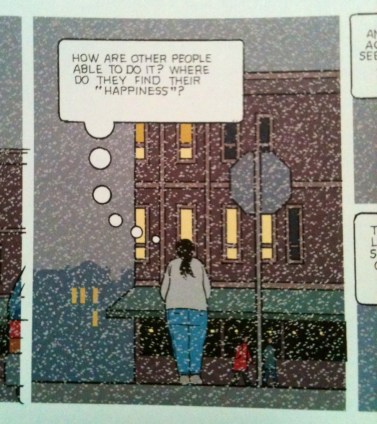
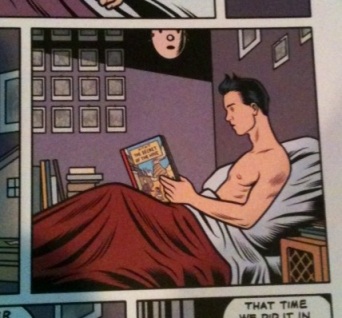
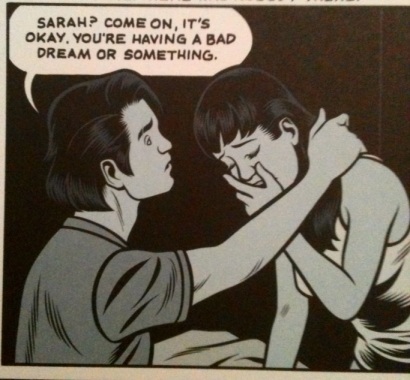
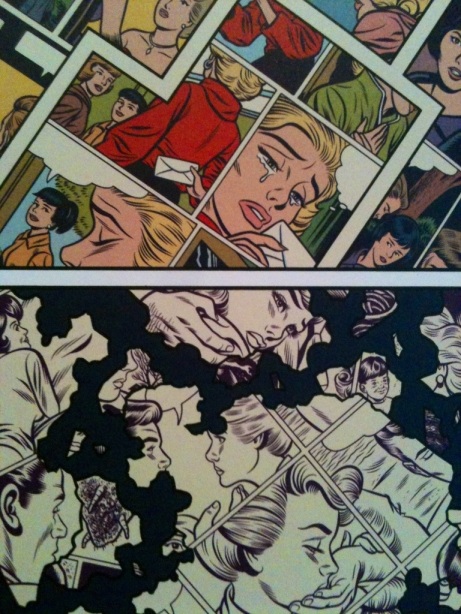
In X’ed Out, Charles Burns created a rich and strangely layered world focusing on Doug, a confused and injured young man. In his parents’ suburban basement, Doug parcels out the last of his late father’s painkillers, slipping from haunted memories of his relationship with Sarah into fevered nightmares of abject horror and then into a wholly other world, a realm that recalls William Burroughs’s Interzone. In this alien world, Doug takes on the features of Nitnit (an inversion of Tintin), the alter-ego he adopts when performing spoken word cut-ups as the opening act for local punk rock bands. What made X’ed Out so compelling (apart from Burns’s thick, precise illustration, of course), was the sense that this Interzone was a reality equal to Doug’s own “real world” — that it was somehow more real than Doug’s dreams.

20121104-165518.jpg

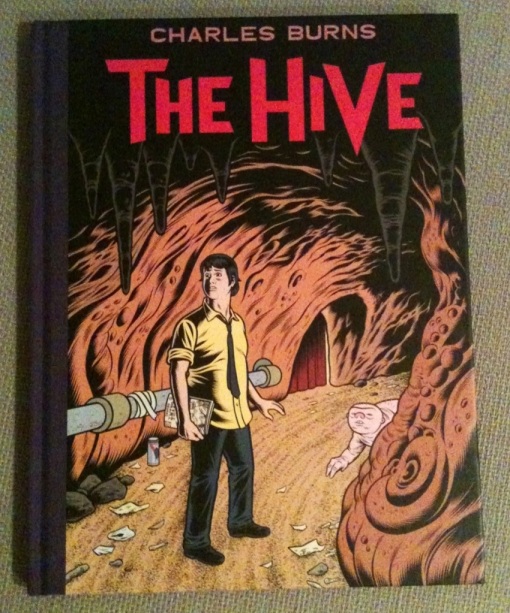
The Hive (part two of the proposed trilogy) deepens the richness and complexity of the world Burns has imagined. The title refers to a location in Interzone. Doug (or Nitnit) has found employment in The Hive as a kind of mail clerk or janitor. His primary role though is secret librarian, catering to the reading needs of the breeders of The Hive. One breeder seems to be a version of Doug’s ex-girlfriend; the other is a double of Sarah, who asks Doug/Nitnit to bring her romance comics—which he does—only he skips a few issues. These missing issues stand in for the information Doug (and Burns) withholds from the reader, the missing fragments that have been x’ed out.

20121104-165548.jpg

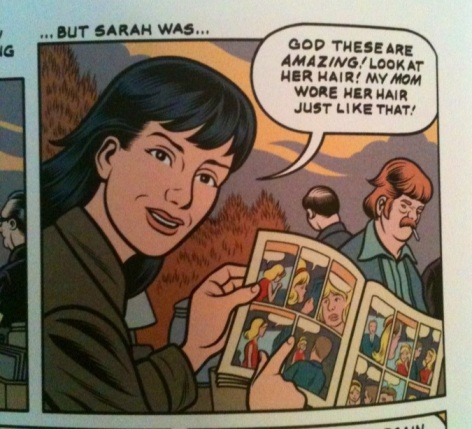
Burns uses romance comics as a framing or organizing device, a motif linking the disparate worlds of his narrative. In the “real world” — which is to say the world of Doug’s memory — we learn that he buys a stack of old romance comics for Sarah on their first date.

20121104-165537.jpg

Throughout the narrative, Burns plays his characters against the extreme, often hysterical dramas of 1950s and ’60s romance comics; his strong lines and heavy inks readily recall the early works of Simon and Kirby, but more precise and careful—something closer to Roy Lichtenstein, only more sincere, more emotional.

In The Hive, we learn more about Doug’s troubled relationship with Sarah, who has problems out the proverbial yingyang (not the least of which is a violent psychopathic ex-boyfriend).

20121104-165554.jpg

Burns weaves the story of Sarah and Doug’s relationship into the fallout of Doug’s father’s death—a death Doug was completely shuttered to, we realize. Doug’s drug-dreams dramatize the missing pieces of these narratives, and the Interzone set-pieces propel the mystery aspects of the narrative forward, as Doug’s alter-ego plumbs the detritus of his psychic fallout. Through the metatextual motif of reading-comic-books-as-detective-works, Burns explores themes of trauma, abjection, and distance. Images of pigs and cats, freaks and punks, portals and holes litter The Hive.

20121104-165603.jpg

Burns has always been a perfectionist of dark lines and strange visions, and his last full graphic novel Black Hole was a triumph of atmosphere and mood. With the first two entries of his trilogy, however, Burns has showed a significant maturation in storytelling, characterization, and dialogue. I often thought parts of Black Hole seemed forced or rushed (no doubt because Burns faced daunting production troubles during the decade he worked on the novel—including his original publisher Kitchen Sink folding). With X’ed Out and now The Hive we can see a more patient artist, working out an emotionally complex and compelling story in rich, symbolic layers.

I reread X’ed Out and then read The Hive in one greedy sitting; then I went through The Hive again, more slowly, more attendant to its details and nuances. We had to wait two years between X’ed Out and The Hive—and it was worth the two year wait. So if we must wait another two years—or more—for the final entry, Sugar Skull, so be it.

Reading Chris Ware’s Building Stories / September 23rd, 2000

20121101-205324.jpg

September 23rd, 2000 is one of the longer pieces in Chris Ware’s box set, Building Stories. Part of the joy and frustration of Building Stories is its free form—the possibility of reading one piece before another, of getting one tale or perspective before another. I started with Branford, which seems in retrospective a fairly neutral opening—it introduces many of the themes that develop in Building Stories but none of the major characters. I then read I just met, which introduces a couple suffering a sour relationship.

September introduces (to me, anyway), two major “new” (again, “new” to me; these characters appear central in other books and pamphlets of the collection and obliquely in others): The “lonely girl,” a would-be artist sporting a prosthetic leg, and the “old lady,” landlord of the building. Most of September takes the form of lonely girl’s diary entries.

20121101-205339.jpg

I noted two characters (again, new to me), but the building itself also gets a voice and prominent role in September; its thoughts and memories frame the narrative:

20121101-205351.jpg

September frames the repetitions, the loops, the patterns that undoubtedly will resurface throughout Building Stories. We get access to the characters dreams, which seem to overlap and echo each other—and then repeat in real life, albeit in other forms. The landlady, recalling her youth, seems to echo the loneliness and despair of the lonely girl, as well as the pain of the woman in the sour relationship. We see that the building has in fact been a kind of prison for her, preventing her from forming real relationships:

20121101-205408.jpg

Other echoes are more subtle—a close up of a bee, for instance, either foreshadows or calls back to (or both, of course) Branford, the Best Bee in the World.

20121101-205429.jpg

We can see the Branford episode again, here in the tiny detail of a soda can, a major setting for that episode. I was more fascinated by the newspaper though, particularly the colorful squares of a comics section, a reference Ware’s medium and perhaps a visual suggestion of Building Stories itself. The detail is tiny, but meaningful:

20121101-205421.jpg

In a later part of September, we see a direct reference to the end of I just met:

20121101-205436.jpg

I imagine that there were other references, call backs, and echoes in September that I won’t get until later.

The story—well, it’s beautiful, a perfect short story, self-contained but thematically resonant with the larger project. The ending is so damn sweet and perfect that it brought a little tear to my eye. And yet: Was that the ending? Of course not. The sense of rhetorical resolution—that is to say the so-called happy ending—will almost surely be punctured, deflated, or otherwise complicated by one of the next texts I read. More to come.

I Review The Mundane History of Lockwood Heights, a Chapbook by Allen Kechagiar

20121029-143421.jpg

“The Mundane History of Lockwood Heights” is a lovely little chapbook, new from Pilotless Press, an Athenian  outfit (uh, Greek, not Georgian) that  knows how to put together an aesthetically-pleasing text. “Lockwood Heights” is their first release. It’s by Allen Kechagiar, who, full disclosure, I’ve been email-friendly with for a several years now.

What’s “Lockwood Heights” about?

An unnamed narrator, a young man, returns to his hometown in California, the titular Lockwood Heights, “another far station, another dead end valley prone to fire, another far suburb with no other cause than the profit it would generate for its contractors.” With little going for it in a depressed economy, the citizens of Lockwood Heights allow porn production to become their town’s raison d’etre. Studios move in and the girls of Lockwood Heights soon find they can essentially auction off their virginity on camera:

They struggle to keep their virginity intact (or at any rate their parents struggle to keep it so) and hope that they will be chosen as the royal heir’s queen consort. Here, at Lockwood Heights, we had our very own race: at its finish line there was no prince to greet the winners, but a whole menagerie, or more accurately a bestiary, comprising of artificially tanned Californian would-have-beens, barely legal girls with gigantic strap-ons, transvestites and hermaphrodites, midgets and giants, obese, anorexic, effeminate, silicon-enhanced or not, all of them with a ticket to her body, standing in a metaphorical queue. A body that wasn’t hers to control anymore. The studio owned it from then on, through the unwritten contracts of promised fame that is rarely delivered.

They were also called the Treasurers or The Knights Who Say No. Their motto was non numquam. Their herald was a locked gate.

The various histories of these girls fill most of “The Mundane History of Lockwood Heights,” and as the narrator often uses the first-person plural “we” (that is, the high school boys), the story sometimes takes on a melancholy and wistful tone similar to Eugenides’s The Virgin Suicides. These are the finest moments of “Heights,” compact and precise narratives that relate the sad (and sometimes not-so-sad) lives of these girls who make porn (or, in some cases, refuse to).

It’s not just the girls of Lockwood Heights who sell their bodies on film—our protagonist comes home to sell all he has left, his “twin virginity” to be lost for a director who is sometimes called the Stanley Kubrick of porn. Scenes of the narrator meeting the casting director, his costar, and other workers on the film’s production are interspersed with the girl stories, as well as the backdrop of the narrator’s homecoming. His father has died, his mother is absent, and a strange little ersatz closet has been constructed in one of the house’s corridors. The interrelationship between these three elements is not as fully developed as it could be; I found myself wanting more. I also wanted more of the strange, aphoristic asides the narrator occasionally offers, like this one:

When we sleep we do not live in the full sense of the word. We rehearse death. Our dreams, the fallout of our daily lives, can only be remembered. They cannot be lived.

When they happen, we do not exist.

In its best moments (and there are plenty of those), “Heights” commands the reader’s attention with its bizarre mix of pathos and the pathetic, with sharp humor that threatens to tip into something more sinister. The southern California exurb Kechagiar crafts recalls the slightly off dystopias of George Saunders—the kind of place we wish were more removed from our immediate reality. “The Mundane History of Lockwood Heights” feels like the starting point of something bigger, more expansive, more detailed—and I’d want to read that something. Recommended.

I Didn’t Like Joshua Cody’s Memoir [sic]

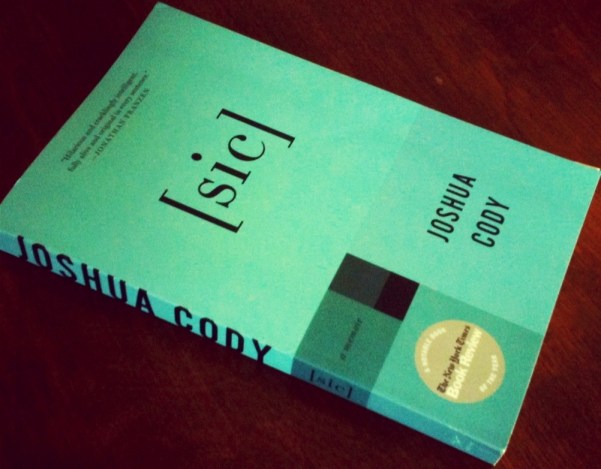
20121023-160233.jpg

Joshua Cody’s memoir [sic] showed up at Biblioklept World Headquarters a few weeks ago and despite my prejudices, I coasted through it over a few afternoons.

Those prejudices:

1) It’s a memoir.

2) There’s a Jonathan Franzen blurb on the cover.

3) The title [sic] is an unbearably too-clever pun (and this from a guy who loves puns).

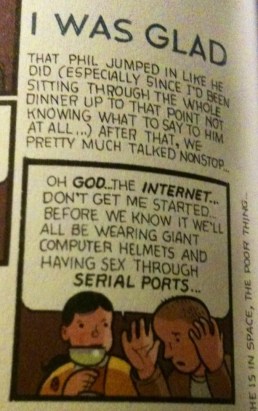
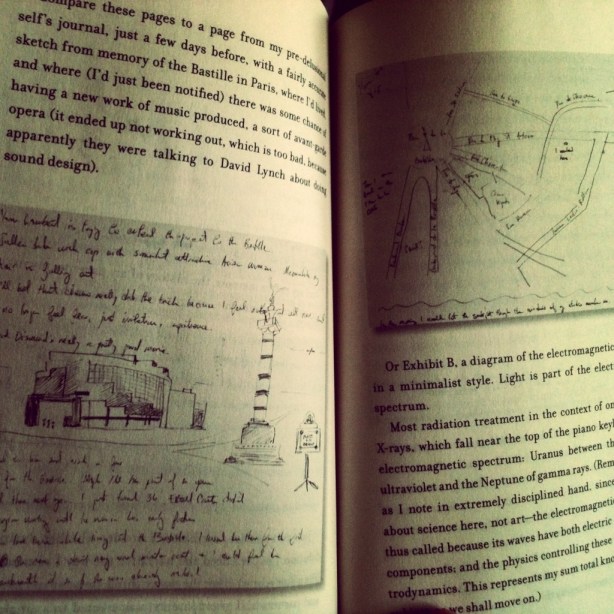
The first thing I noticed about [sic] were the pictures : paintings, maps, charts, sketches, lists, collages, other texts, and so on interspersed throughout the text. I like pictures in books.

20121023-160240.jpg

The way that Cody uses these illustrations at first reminded me of  W.G. Sebald, who employed pictures in novels like Austerlitz and The Rings of Saturn in an oblique, documentary approach.

Cody is less oblique than Sebald, and perhaps flippant too. He doesn’t namecheck Sebald, at any rate, unlike David Byrne, who openly admitted to following Sebald’s path in his 2008 memoir Bicycle Diaries. (Cody does namecheck David Byrne though).

Then I edged my way into the plot, such as it is. I’ll lazily let publisher W.W. Norton summarize:

Joshua Cody, a brilliant young composer, was about to receive his PhD when he was diagnosed with an aggressive form of cancer. Facing a bone marrow transplant and full radiation, he charts his struggle: the fury, the tendency to self-destruction, and the ruthless grasping for life and sensation; the encounter with beautiful Ariel, who gives him cocaine and a blow job in a Manhattan restaurant following his first treatment; the detailed morphine fantasy complete with a bride called Valentina while, in reality, hospital staff are pinning him to his bed.

Moving effortlessly between references to Don Giovanni and the Rolling Stones, Ezra Pound and Buffalo Bill, and studded with pages from his own diaries and hospital notebooks, [sic] is a mesmerizing, hallucinatory glimpse into a young man’s battle against disease and a celebration of art, language, music, and life.

20121023-160248.jpg

As Norton’s summary suggests, Cody’s memoir is highly discursive and playful, loaded with references to art, music, and literature. Digressions on figures like David Foster Wallace, Orson Welles, or Alexander Theroux lard the book—indeed, they often seem to edge out the story Cody intends to tell, his cancer memoir. He seems reticent to fully engage his own feelings, instead layering reference upon reference. These references become insufferable at times—are we supposed to care that Cody met David Lynch and would like to be his friend, or that Cody briefly studied ancient Greek? Cody is so busy trying to impress the reader that he forgets to express meaning.

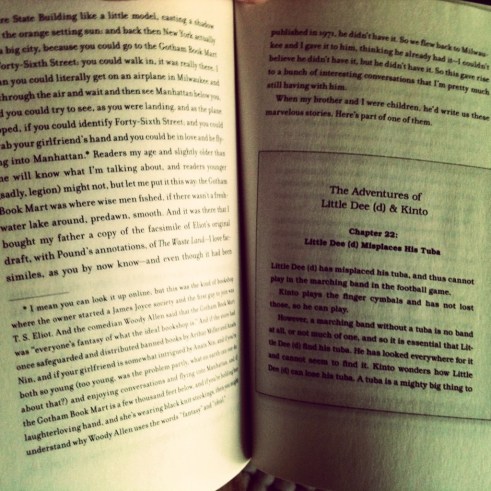
We see this reticence, this turning away from, here over two pages: Cody moves from a story about buying a facsimile copy of Pound’s notes on the original draft of The Wasteland to a lengthy footnote that manages to name drop James Joyce, T.S. Eliot, Woody Allen, Anaïs Nin, and Henry Miller (in just two sentences!) and then into a facsimile reproduction of one of the stories his brother would write for him as a child:

20121023-160254.jpg

The big problem with Cody’s memoir is that it never feels particularly real. I enjoy discursive referential postmodernism as much as the next fella, but [sic] often fails to cohere around a central idea, let alone an emotion. When Cody describes dating a stripper/dominatrix, it feels like a party trick, an inflated anecdote—there’s no emotional core, no contemplative connection to his illness. Other sexual episodes read like a parody of Henry Miller.

As its title suggests, [sic] is a dodge, a bait-and-switch, an evasion. Cody is clearly very clever—but a dazzling display of cleverness can’t sustain a narrative.

Three Notes on Thomas Bernhard’s Novel Correction (Plot, Prose, and a Riff)

1. Thomas Bernhard’s novel Correction is nominally the story of an unnamed narrator who leaves England after a severe illness to return to his native Austria to “sift and sort” the writings of his childhood friend Roithamer.

Roithamer, a brilliant but insane scientist, is the self-exiled son of an old, wealthy family. He uses an unexpected inheritance to fund an idealistic project: the building of a perfect Cone in the isolated heart of the Kobernausser forest. Roithamer envisions this Cone as the perfect home for his sister to live in (although he doesn’t bother to actually, y’know, talk to her about it). Roithamer’s sister dies almost immediately after taking up residence in the Cone. Roithamer then commits suicide.

Correction is divided into two sections, each a single, long, dense paragraph with no text break for the reader to rest upon. Bernhard’s sentences wind and unwind and rewind, sometimes snaking out for pages at a time; like Samuel Beckett, to whom he is often compared, Bernhard is a master of the comma splice. The effect is exhausting.

The first section of Correction is “Hoeller’s Garret,” named after the novel’s primary physical setting. Hoeller is a taxidermist who has built his own house in the Aurach gorge as a sort of dare to nature itself. Hoeller’s house inspires Roithamer’s Cone, and Hoeller’s garret becomes Roithamer’s work space—which is to say thinking space—for planning and executing his idealistic project.

Following Roithamer’s suicide, the unnamed narrator too moves into Hoeller’s garret, one of many formal repetitions in Correction (these formalizing plot repetitions are echoed in Bernhard’s syntactic repetitions).

In “Hoeller’s Garret” we learn about the childhood friendship between the narrator, Hoeller, and Roithamer. The paragraph (or chapter, if you will) includes details about Roithamer’s troubled family as well as an early horrific encounter with death, themes that will repeat throughout the novel.

The second section, “Sifting and Sorting,” finds the narrator working though Roithamer’s (mostly autobiographical) papers. The narrator appends a simple tag like “thus, Roithamer” or “so Roithamer” as attribution to Roithamer’s first-person statements, but this device pops up less and less as the book progresses, and it becomes clear that Roithamer has ventriloquized the narrative.

“Sifting and Sorting” focuses on Roithamer’s unhappy childhood, his endless fights with his mother, and his wish to perfect an idealization (namely, his Cone). The narrator channels Roithamer who channels the voices of his mother and father (and occasionally his detested brothers)—and of course, the reader channels all. The narrator slowly gives over to Roithamer’s voice as the novel’s final pages rush out in a series of diary entries, and Bernhard’s taxing syntax performs a mesmerist act on the reader, who, stunned, must return to the text in yet another repetition.

2. I’ve thus far failed to illustrate any of the above claims with an example of Bernhard’s prose.

It’s possible to plunder Correction for tight phrases, sharp, dark aphorisms, and other little bits of strange wisdom, but that doesn’t really convey the effect of what it’s like to read Bernhard’s sentences.

Better then to offer an example. Here’s the novel’s second sentence, via its English translator, Sophie Wilkins:

The atmosphere in Hoeller’s house was still heavy, most of all with the circumstances of Roithamer’s suicide, and seemed from the moment of my arrival favorable to my plan of working on Roithamer’s papers there, specifically in Hoeller’s garret, sifting and sorting Roithamer’s papers and even, as I suddenly decided, simultaneously writing my own account of my work on these papers, as I have here begun to do, aided by having been able to move straight into Hoeller s garret without any reservations on Hoeller’s part, even though the house had other suitable accommodations, I deliberately moved into that four-by-five-meter garret Roithamer was always so fond of, which was so ideal, especially in his last years, for his purposes, where I could stay as long as I liked, it was all the same to Hoeller, in this house built by the headstrong Hoeller in defiance of every rule of reason and architecture right here in the Aurach gorge, in the garret which Hoeller had designed and built as if for Roithamer’s purposes, where Roithamer, after sixteen years in England with me, had spent the final years of his life almost continuously, and even prior to that he had found it convenient to spend at least his nights in the garret, especially while he was building the Cone for his sister in the Kobernausser forest, all the time the Cone was under construction he no longer slept at home in Altensam but always and only in Hoeller’s garret, it was simply in every respect the ideal place for him during those last years when he, Roithamer, never went straight home to Altensam from England, but instead went every time to Hoeller’s garret, to fortify himself in its simplicity (Hoeller house) for the complexity ahead (Cone), it would not do to go straight to Altensam from England, where each of us, working separately in his own scientific field, had been living in Cambridge all those years, he had to go straight to Hoeller’s garret, if he did not follow this rule which had become a cherished habit, the visit to Altensam was a disaster from the start, so he simply could not let himself go directly from England to Altensam and everything connected with Altensam, whenever he had not made the detour via Hoeller’s house, to save time, as he himself admitted, it had been a mistake, so he no longer made the experiment of going to Altensam without first stopping at Hoeller’s house, in those last years, he never again went home without first visiting Hoeller and Hoeller’s family and Hoeller’s house, without first moving into Hoeller’s garret, to devote himself for two or three days to such reading as he could do only in Hoeller s garret, of subject matter that was not harmful but helpful to him, books and articles he could read neither in Altensam or in England, and to thinking and writing what he found possible to think and write neither in England nor in Altensam, here I discovered Hegel, he always said, over and over again, it was here that I really delved into Schopenhauer for the first time, here that I could read, for the first time, Goethe’s Elective Affinities and The Sentimental Journey, without distraction and with a clear head, it was here, in Hoeller’s garret, that I suddenly gained access to ideas to which my mind had been sealed for decades before I came to this garret, access, he wrote, to the most essential ideas, the most important for me, the most necessary to my life, here in Hoeller’s garret, he wrote, everything became possible for me, everything that had always been impossible for me outside Hoeller’s garret, such as letting myself be guided by my intellectual inclinations and to develop my natural aptitudes accordingly, and to get on with my work, everywhere else I had always been hindered in developing my aptitudes but in Hoeller’s garret I could always develop them most consistently, here everything was congenial to my way of thinking, here I could always indulge myself in exploring all my intellectual possibilities, here my intellectual possibilities, here in Hoeller’s garret my head, my mind, my whole constitution were suddenly relieved from all the outside world’s oppression, the most incredible things were suddenly no longer incredible, the most impossible (thinking!) no longer impossible.

If you’re interested, that’s 722 words (I wrote about 500 words before Bernhard’s sentence, if you need a point of contrast).

The repetition is easy to note even by absently gazing over the passage. The repeated phrase “Hoeller’s garret” stands out in particular, introducing the reader to the novel’s primary setting and establishing this “ideal place” in context against Altensam (the hated aristocratic home), England (self-imposed exile of a sort), and the Cone (the ideal ideal place).

We can also track a subtle shift in the final third of the sentence, as Roithamer’s voice ventriloquizes the narrator’s. Note how in the first third of the sentence, the narrator employs the first-person pronoun “I” which soon disappears in the middle third to be replaced by “he” (referring to Roithamer), until finally transforming into an “I” again in the final third—only this “I” is Roithamer’s “I.” This sentence demonstrates not only the demanding sentence structure that characterizes Correction as a whole, but also its narrative program of ventriloquism.

3. Okay. So I’ve offered plot summary, a lump of text, and a few comments on Bernhard’s prose—but I’ve hardly made a go of untangling the knotty density of Correction. (Although is that really what I came here to do? I don’t know. I hope not). Here are some stray, loose thoughts on Correction, offered here with little support (and the vague promise that I’ll write more about Correction in the future—shorter, more focused posts that hopefully expand on these ideas):

Correction shows how idealism, and specifically the will to create and perfect the ideal, leads to breakdown, death, insanity, suicide.

The Cone is a massive idealized phallus that reduces the agency of Roithamer’s sister, isolates her, and becomes her tomb.

Roithamer is part of a long tradition in literature of strange sister-lovers, dudes who dote on—and idealize—their sisters too much.

Roithamer seems to suffer from a sort-of reverse Oedipus complex, where he identifies with the strength of his father and hates his mother, who he sees as a cultural philistine, lower class, anti-intellectual. This complex leads to chauvinism against women in general, and possibly prevents him from better understanding his sister, who he essentially imprisons.

Correction reminded me often of Poe’s story “The Fall of the House of Usher.”

Correction reminded me often of W.G. Sebald’s novel Austerlitz, although Correction obviously came first, and Sebald clearly cited Bernhard as an influence.

At some of its rantier points, Correction reminded me of Notes from Underground.

Correction took me forever to read, mostly because every time I picked it back up I had to twist my way into its circular, repetitive rhythms anew. Lots of rereading.

My auditory imagination: In time, it was Werner Herzog’s voice that read Correction to me.

Correction performs its own deconstruction.

Correction is often so scathing and harsh in its treatment of humanity as to be difficult to swallow. One has to step back repeatedly and remind oneself that Roithamer is not sane.

Correction is also very, very funny at times—astonishingly so, even. Its humor is truly absurd, the absurdity of a parent’s funeral, or the absurdity of simply having to go on. I can’t help but cite a favorite line here—“waking up is the always frightening minimum of existence.”

The other side of “waking up is the always frightening minimum of existence” is of course death in general, or suicide in particular. Correction posits suicide as the ultimate correction, the final clearing gesture. The ideal.

And, not a thought on Correction, but a question for readers: What next? — ConcreteThe Loser, or Yes?

I Review Object Lessons, Where 20 Contemporary Authors Select and Introduce 20 Short Stories from The Paris Review

20120902-135314.jpg

Object Lessons anthologizes 20 stories published in the Paris Review over the past fifty years. “It is not a greatest hits anthology,” advises the brief editor’s note, “Instead, we asked twenty masters of the genre to choose a story from the Paris Review archives—a personal favorite—and to describe the key to its success as a work of fiction.” Hence, we get Ann Beattie introducing Craig Nova’s “Another Drunk Gambler,” Amy Hempel introducing Bernard Cooper’s “Old Birds,” and Sam Lipsyte introducing Mary Robinson’s “Likely Lake.”

Most of the introductions are short—most are fewer than three pages—and each author approaches his or her selection differently. Ben Marcus, prefacing “Several Garlic Tales,” tells us that, “Donald Barthelme was a magician of language, and it would be most respectful, perhaps even ethical, not to look too closely into the workings of his magic.” Marcus proposes a few approaches to find meaning in Barthelme’s surreal tale, but never over-explicates. In contrast, Lydia Davis’s surprisingly long intro to Jane Bowles’s “Emmy Moore’s Journal” is a sentence-to-paragraph close reading; Davis interrogates Bowles’s diction and syntax and concludes her little essay by situating Bowles’s (underappreciated) place in the canon. Davis’s insights are compelling, but one wonders if they wouldn’t be better appreciated after reading the story.

Davis also appears as author of one of the selected stories—Ali Smith picks Davis’s excellent number “Ten Stories from Flaubert.” Smith’s intro is wonderful, explaining the genesis of “Ten Stories,” which “came about when Davis (who is also a translator) was working on a a new translation of Madame Bovary and reading through Flaubert’s letters to his friend and lover Louise Colet.” I’m a huge fan of Lydia Davis, whose work defies easy definition. Smith wonders about her selection: “Are they translations? Are they by Flaubert? Are they by Davis?” The questions are better than answers.

Occasionally an author veers close to spoiling the story he introduces, as does Jeffrey Eugenides when he gracelessly steps all over Denis Johnson’s already-much-anthologized classic “Car Crash While Hitch Hiking.” Elsewhere, Jonathan Lethem mashes and minces misplaced metaphors in his confusing and forgettable introduction to Thomas Glynn’s story “Except for the Sickness I’m Quite Healthy Now. You Can Believe That.” Lethem’s sloppy, unrestrained attempt to dazzle is regrettable. He’s like the warm-up act that tries too hard to show up the headliner and winds up falling on his face.

For the most part though, the introductions simply allow readers new ways to see a story they’ve perhaps read before, as in Aleksandar Hemon’s preface to Jorge Luis Borges’s “Funes the Memorious” or David Means’s preface to Raymond Carver’s “Why Don’t You Dance.” Means suggests that “A great story is like an itch that has to be scratched eternally . . . We’re left with more questions than answers, and more answers than questions; therefore, the paradoxical quality of a good story is that it seems to give us everything we need and yet not quite enough to fulfill a sense of having been shown a full life.” Surprisingly good is Dave Eggers’s intro to James Salter’s “Bangkok,” which reads almost like a loose riff of notes that a harried but talented adjunct might bring to his Creative Writing 101 workshop. Eggers showcases keen intuition about Salter’s narrative coupled with an eagerness that makes one want to read the story.

And what about those stories? If I’ve focused more on the introductions than the stories themselves, it’s perhaps because I’ve taken for granted that the selections are solid for an anthology. Sure, any reader might have his or her gripes, but the range of talent here is undeniable, and the spectrum of stories is satisfying. Object Lessons would make a fine addition to the syllabus of any beginning writing course, and any young person interested in honing her craft could do worse than attending the examples collected here. To be clear, Object Lessons is in no way some master course in How to Write a Short Story, but it does provide the most valuable writer’s tool—good reading.

Children Left Behind (I Riff on Season Four of The Wire)

1. I’ve been rewatching David Simon’s Baltimore epic The Wire, generally regarded as one of the best if not the best, TV series ever. I’ve been watching with my wife, who’s never seen the show before. I’m going to riff on a few of the themes of season four of The Wire here, and there will be spoilers.

If you’ve never seen The Wire and you think that some day you want to see it (it’s as good as everyone says it is, so you should want to see it) you shouldn’t read this post because of the spoilers.

2. Season four of The Wire takes education as its central subject. Specifically, it examines the different ways in which personal circumstance and chance (and maybe fate) intersect with institutions. The simplest example of one of these institutions might be Edward J. Tilghman Middle School, but there are other institutions too—the city’s political core, including the Mayor and his advisers, the police and their various detention centers, and even the criminal organizations that foster their own trainees.

3. Season four gives us four eighth graders to care about. The first episode of the season, “The Boys of Summer,” establishes these characters as they prepare to head from childhood into a more complex—and violent—world:

Childish joy and youthful agitation mixes with real territorial violence here; everything that follows in the season shades this scene with a bleak irony.

4. Season four presents a series of possible mentor relationships, wherein various principal characters contend to steward, foster, educate, or otherwise help these four kids turn into four men.

Roland Pryzbylewski, one-time detective-cum-fuck-up, becomes the teacher Mr. Presbo. He idealistically tries to help the four kids, who all take his class together. Parallel to Pryzbylewski’s efforts in the classroom are Dennis “Cutty” Wise’s efforts in the boxing gym; he hopes to take these kids off the corners as well. Initially, Presbo fosters Randy and Dukie while Cutty tries to make headway with Namond and Michael.

As the season develops, different mentors present themselves for each of the kids. Almost all fail.

Cutty loses whatever inroads he had on mentoring Michael, who comes under the tutelage of the dark assassin Chris. Tellingly, Michael enlists Chris in killing off his brother Bug’s father; the assassination is Oedipal.

Mr. Presbo helps Dukie in real and meaningful ways, making sure that the indigent child has clean clothes and a place to shower, but also showing him a kind of loving respect wholly absent in his relationship with “his people,” hopeless, horrible drug addicts. However, after Dukie is promoted to high school early, Mr. Presbo realizes that he will have to limit his involvement with the boy. He sees that there will always be another Dukie to come along, and that he can’t “keep” the boy—only steward him for a year or two.

After a series of institutional bungles, Carver tries to protect Randy, but loses him to a group home. The last time we see Randy he receives a savage beating at the hands of his roommates.

5. (I should now bring up Sherrod, a dim bulb of maybe 15 who seems to have dropped out of school years ago. Homeless, he’s “schooled” by Bubbles, who first tries to make him return to Tilghman, and then, seeing the boy won’t go, tries to teach him some basic survival skills. Sherrod ends up dead though, and Bubbles, feeling that the death is his fault (which it is in part), attempts suicide. Another failed mentor.

We can also bring up Bodie, whom McNulty attempts to help, albeit the relationship here is hardly on the mentor/avuncular (which is to say, displaced father/son) axis that the other five boys experience. Still, McNulty tries to steer Bodie to a path that would help absolve the young man’s conscience. The path leads to the young man’s murder).

6. And Namond?

Namond is perhaps the most fascinating figure in season four, at least for me. He’s a spoiled brat, hood rich, the son of infamous Barksdale enforcer Wee-Bey Brice who is doing life for multiple murders. Namond is petulant and mean and immature. He bullies Dukie, yet he doesn’t have the “heart” (in the series’s parlance) to manage selling drugs on his corner, a weakness that comes to harsh light when a child of no more than eight steals his package of drugs. Namond is a mama’s boy, but bullied by an overbearing mother, a woman who encourages him to drop out of school to sell drugs for her own material comfort. He is not made of the same stuff as his father.

Namond is also creative, funny, charismatic, individualistic, and intelligent. Bunny Colvin sees these qualities and sees an opportunity to help—to really help—one person. And here is the moment of consolation in season four. It’s a consolation for Colvin, who has experimented twice now with programs that bucked the institutional path (Hamsterdam in season three; the corner kids project in season four), and perhaps it’s a consolation for Cutty, who is instrumental in connecting Colvin with Wee-Bey. But it’s also a consolation for the audience, who perhaps will concede that one out of four ain’t bad. (Although clearly, three out of four children are left behind).

7. The Wire’s emphasis on Baltimore locations, specific regional dialects, and its use of local, semi-professional actors afforded the show a strong sense of realism. Straightforward shots and short scenes added to this realism. What I perhaps like most about The Wire’s realism is its near-complete lack of musical cues: other than the opening song and closing credits soundtrack, the only music that appears in any scene in The Wire is internal to the scene, i.e., we only hear music if the characters are hearing it (in their cars, on their stereos, etc. — a la rule two of Dogme 95).

The Wire breaks from these formal realistic conventions at the end of each season, using a montage—a device it almost always avoids—overlaid with a song. Here’s the montage from the end of season four:

8. I include the montage as a means to return to point 6, Namond. The images unfold, giving a sense of where our characters (those who survive season four) will go next (the universe of The Wire is never static; our characters are always in motion). The montage settles (about 4:40 in the video above) to rest on Namond, working on his homework, clearly more comfortable if not at ease in his new life with the Colvins. A family embraces on the porch of the house behind the Colvin house, signaling that Namond has finally arrived in an institution that can protect and foster and nourish him—a loving family. A reminder of his old life as a corner boy enters  the scene as the young car thief Donut pulls up, smiling; there’s an implicit offer to return to the corner life here. Then Donut blazes through a stop sign, almost causing a wreck. Namond’s troubled face signals that he’s learned something, but it also twists into a small grin. The shot lingers on the crossroads: open possibility, but also the burden of choice.

9. (Parenthetical personal anecdote that illustrates why season four is, for me, easily the most emotionally affecting entry in The Wire:

For seven years I taught at an inner city high school that was plagued by low test scores, low student interest, and violence. The school’s population was about 95% black, with most students receiving free or reduced lunch. I was still working at this school when I first saw The Wire’s Edward J. Tilghman Middle School, and although the depiction was hyperbolic in places, the general tone of chaos and apathy was not at all unfamiliar to me. There were fights at my school. Brawls. Gang violence. Murders even—student-on-student murders that still haunt me today (these didn’t happen on campus, but they were still our students). I recall one day leaving early—I had fourth period planning and my principal allowed me to leave once a week to attend a graduate school course—and being stunned to see two swat trucks pull up around the school and unload teams of militarized police.

Most of our students were good people trying to get a good education despite very difficult circumstances that were beyond their own control—poverty, unstable family environments, severe deficits in basic skills like reading and math. And most of our teachers were good people trying to help these students as best as they knew how in spite of a draconian, top-heavy management structure that emphasized the  Florida Comprehensive Assessment Test (FCAT) as the end-all be-all of education.

I’m tempted here to rant about tests like the FCAT and legislation like the No Child Left Behind Act, rant about how they drain schools of resources, rob children of a true education, and limit teachers’ and schools’ ability to differentiate instruction—but that’s not the point of this riff.

Probably more productive to let The Wire illustrate. I’ve sat in meetings like this one (I imagine many educators have):

The primary goal of the institution is always to maintain the institution, no matter what the mission statement might be.

What I’m trying to say here is that The Wire’s  Edward J. Tilghman Middle School strikes me as very, very real).

10. I’ll conclude by returning to Namond and Colvin and suggest that this is the closest thing to a happy ending that The Wire could possibly produce. The Wire perhaps boils down to the evils of institutionalism (of any kind); Colvin (and, to be fair, Cutty and Wee-Bey to a certain extent) must take an individualistic response to bypass institutional evils. (In season five, McNulty will carry out an individualistic response to institutional apathy—which is to say practical evil—on a whole new level).

The Wire plainly shows us that life costs, that all decisions cost, and that decisions cost in ways that we cannot calculate or measure or foresee. Namond’s future comes at the cost, perhaps, of Michael, Dukie, and Randy, the children who are left behind. And here is the real evil of a mantra like “no child left behind”—its sheer meaningless as a philosophy inheres in its essentially paradoxical nature, whereby if no single child can be left behind then all children can be left behind—the institution simply redefines or “jukes” what “behind” means. Colvin’s solution, on one hand, is to pragmatically assess the costs and payoffs of managing his interest in education, in being “a teacher of sorts” (as he calls it). (This pragmatic side echoes his Hamsterdam experiment in season three). Colvin’s pragmatism is successful though not only because he realizes his limitations—he cannot help just any child, and certainly not every child—it is also successful because it is tempered in love.