Keith Miller’s The Book on Fire, A Tale of Biblioklepts, Bibliophiles, and Bibliomania

Balthazar, the hero of Keith Miller’s agile and trippy novel The Book on Fire, is a biblioklept. He comes to Alexandria to rob the famous library, a cavernous, labyrinthine complex that still exists–under heavy guard—in Miller’s mystical version of that ancient Egyptian city. Miller’s Alexandria is a byzantine maze, humming with a turn-of-the-century buzz, a kaleidoscope world that strongly reminded me of the strange cityscapes of William Gibson or William Burroughs. Here, Balthazar describes his attraction to Alexandria:

This is the city of books, where children are admonished if they don’t bring a book to the breakfast table, where they’re ordered by their mothers to drop their books and go play on the street, where bedtime tales sometimes continue, chapter after chapter, till well after midnight, parents pinching their children to keep them awake. This is a city where men beat their wives with books, the women shielding their heads with books. A city of book-whores, who fuck for books, and their bibliogiglios. A city of book-beggars, who spit on your money, gesturing with their stumps to the paperback in your hand.

What a town for a book thief! Balthazar plans to rob the Library of Alexandria, but he spends his early months stealing rare books from private homes. Soon, he’s trailed by Zeinab, a book prostitute who burns each volume she’s paid with. After a sexual interlude (“like fucking a wounded ferret,” Balthazar tells us), Zeinab introduces our hero to a guild of thieves and helps guide him through Alexandria’s frenetic underworld. In time, Balthazar breaches the forbidden, intoxicating library:

I read impossibly gorgeous scripts. Scripts in which each hieroglyph filled a page and took a day to write, but could express an entire philosophy. Scripts in which each letter stood for a notion, so the writing dictated thought patterns rather than words. Scripts that had no meaning at all, or that started out meaningfully but then, as the author was caught up in the physical act of writing, became relationships of lines and shapes on paper, beautiful and abstract. Private scripts, the authors long dead, so the script stood isolated, unreadable precious nonetheless. Rainforest scripts of samara and turaco crest. Marine scripts of shark tooth and sand dollar. I passed through rooms of books the size of doors, each cover the death of an eland, and rooms of books dainty as ladybirds. Books written on communion wafers, grains of rice, sheets of ice.

For Balthazar, books are a drug, and the Library of Alexandria is the heady nexus point for his addiction. No wonder then that he becomes obsessed with the young librarian Shireen, whom he plots to free (or perhaps steal) from the library—a plan that comes into conflict with Zeinab’s own designs. And while The Book of Fire does have the strong, page turning plot of a thriller, that plot exists mostly as the bones for Miller to hang rapturous descriptions of reading and books and, best of all, his strange Alexandria, a city of marvels. Good stuff.

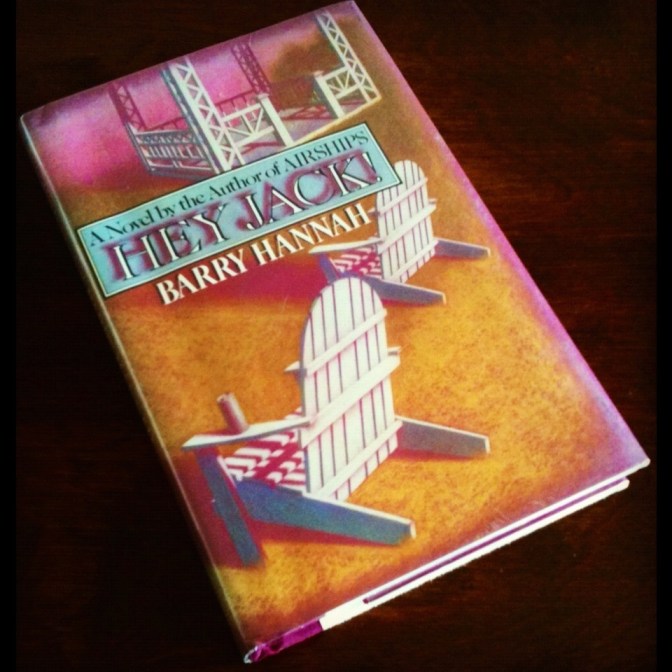
Barry Hannah’s Novella Hey Jack! Is a Loose, Hilarious Tragedy

20120410-174027.jpg

The loose, brief breeziness of Barry Hannah’s 1987 novella Hey Jack! belies the terror and rage at the heart of this hilarious tragedy. It’s a slim volume—133 pages in my hardback copy—with the same rambling flightiness that characterizes Hannah’s better known 1980 novel-in-vignettes, Ray.

Hey Jack! bears many comparisons with Ray: Like Ray, this novel is told from the perspective of a war vet (Korea this time, not ‘Nam); like the eponymous speaker of Ray, the narrator of Hey Jack!, Homer, finds himself frequently besotted, binged out, or horny; like Ray, Homer tries to make a marriage work; like Ray, Homer comes into conflict with a poor white trash family.

And like Ray, Hey Jack! tests the boundaries of what is and is not a “novel.” Hey Jack! is discontinuous and meandering; there’s a plot, sure, but Hannah’s apt to jump over place and time freely, tripping over months at a time, sparing not even a sentence to cue his readers in the right direction. No exposition here, folks. I suppose I should summarize the plot though: Homer, passing middle age, takes up a friendship with Jack, an older man, a former sheriff and fellow Korean War vet who runs a coffee shop popular with the college kids. Together, the pair (sort of) face off against Ronnie Foot, a local boy turned rock star who has the gall to begin an affair with Jack’s forty-year old daughter:

Ronnie Foot, the rock star had her. Or Jack thought he had her, he was sure he had her. Jack was mumbling. Jack was talking about ingratitude and pride and scum hanging on meat, things of that nature. It was astonishing to see him creep and rise suddenly, like a crazy old man. . . . “Nobody ever had a daughter like me. You want me to just her go, like a fart?” He was fingering the gun again.

Jack, once the lone bastion of sanity and order in Homer’s small, chaotic Mississippi town, begins to slide into the insanity and violence that marks the rest of the populace. Jack’s stability is the closest thing Hey Jack! offers as a slice of normalcy (to be clear though, Hannah’s characters skew grotesque, not quirky).

What unites the volume isn’t Jack’s slow slide to the dark side, but rather the narrative’s distinctive, ornery voice. It’s worth quoting Homer at length; here he condenses several of the novel’s themes in the sort of crazy-or-wise? rant indicative of the novella’s tone and rhythm:

In love, in love, in love. A mule can climb a tree if it’s in love. A man like me can look himself in the mirror and say, I’m all right, everything is beloved, I’m no stranger to anywhere any more. I’m a man full of life and a lot of time to kill, shoot every minute down with a straight blast of his eye across the bountiful landscape, from the minnow to the Alps. Something looks back at you with an eye of insane approval. Something looks back at you; out of belligerent ignorance of you it has come to a delighted focus on you and your love, together, sending up gasses of collision that make a rainbow over the poor masses who are changing a tire on the side of the road on a hot Saturday afternoon, felling like niggers. There is a law that every nigger spends a quarter of every weekend changing tires, my friend George, the biochemist, says. What do we know? What do we mere earthlings, unpublished and heaving out farts like puzzled sighs, know, but what is in our blood? I had broken up once with a woman who was in Europe, and coming out of the mall movie (I don’t even remember the movie) I gave out this private marvelous fart that was equal to a paragraph of Henry James, so churned were my guts and so lingering. And I was free. Free to discuss it. Delighted in the boundless ignorance and destruction that lay out there under the dumb lit cold moon. Enough about me and my poetry.

There’s so many shifts here. Hannah’s Homer comes off like a besotted barstool philosopher, gazing at his navel through an empty tumbler and finding both gut and abyss. We see the casual racism that so many of Hannah’s characters dip into; we see the conflation of art, spirit, and expulsion. Need I comment on the fart joke? It’s worth just repeating: “I gave out this private marvelous fart that was equal to a paragraph of Henry James” — if you don’t like that you’re not going to like Hey Jack!

Beyond that voice, there’s little to organize Hey Jack!—it’s a riff, sometimes a howl, often a jape, a joke, sometimes a verbal slap. This isn’t to say there isn’t a trajectory to the novella or a payoff at the end. Hannah seems unable to resist a tragic arc, the same one he pulls through the whiskey haze of  Ray. Perhaps he takes his cues from Edgar Allan Poe’s essay “The Philosophy of Composition“: ” . . . the death, then, of a beautiful woman is, unquestionably, the most poetical topic in the world.” (To be fair Poe is hardly the first fella to find a dead beauty such a worthy topic; also, I’ve never really been sure how to measure the tone of his essay—I can’t help but think he’s being somehow simultaneously tongue-in-cheek and deadly earnest. But enough about Poe).

But arcs be damned. The best bits of Hey Jack! are the stray little paragraphs that erupt from nowhere either to fizzle out or burn up in a bang. At its best, the novella offers bizarre little stories piecemeal that read equally absurd and true. To wit:

I began hollering at my wife for her shortcomings. She left the house, 11 P.M. I’d quit drinking and smoking. She brought me back a bottle of rye and a pack of Luckies, too. I hadn’t smoked for two weeks. I must have been a horrible nuisance.

I took a drink and a smoke.

Then I was normal. My lungs and my liver cried out: At last, again! The old abuse! I am a confessed major organ beater. I should turn myself in on the hotline to normalcy.

I hope by now that you have a sense of whether or not Hey Jack! is for you. It’s probably not going to gel with most readers: Too ugly, too loose, too nihilistic, perhaps; at heart a sloppy affair . . . but I loved it—it was the perfect book to riffle through over a few Saturday or Sunday afternoons on my back porch, its pages blotting up the condensation from a glass of sangria or can of beer, Homer’s consciousness as loose and discontinuous as my own. Not the best starting place for those interested in Hannah—that might be Airships—but great stuff.

Stuart Kendall’s New Translation of Gilgamesh Restores Poetic Strangeness to an Ancient Epic

Somewhere in his big and often laborious book The Western Canon, Harold Bloom defines canonical literature as that which possesses a “strangeness, a mode of originality that either cannot be assimilated, or that so assimilates us that we cease to see it as strange.” Gilgamesh strikes me as exemplary of that second clause: It’s a foundational epic that has assimilated its readers such that we can no longer easily perceive its strangeness. In many of the prose translations we encounter, Gilgamesh becomes smoothed-out, a document in which we find universal symbols, characters, and themes, all ordered into a narrative scheme that resonates with our conceptualizations of story-telling. And while Gilgamesh and his wild-man companion Enkidu are clearly archetypal figures, the version of their story most of us read in our high school English class is overtly familiar, fitting too-neatly into a literary tradition with Homer, the Bible, and Shakespeare.

Stuart Kendall’s new translation of Gilgamesh reintroduces us to the strangeness of Gilgamesh, juxtaposing the epic’s irreconcilable eruptions against the archetypes it helped to originate. By using language reminiscent of Modernist poets like Ezra Pound and William Carlos Williams, Kendall’s version calls attention to the strange discontinuities of Gilgamesh, even as it paints for us a bold, concrete vision of action. Kendall’s Gilgamesh highlights the psychological dimensions of the epic, situating its heroes’ dramas of consciousness against a physical world that blends into metaphysical spaces.

Here’s a sample of Kendall’s precise language; the scene is from late in the narrative, after the death of Enkidu, as Gilgamesh searches for Utnapishtim—and immortality:

20120331-142406.jpg

The language here forces us to recontextualize, and thus perhaps understand anew, a scene so archetypal as to have become commonplace in even the most banal Hollywood adventure film (that is, the hero seeking admittance to a sacred space). Kendall’s language points to the narrative links between the physical and metaphysical worlds, an unstable opposition that frames the existential crisis at the heart of Gilgamesh.

I interviewed Kendall last month, where he posed the psychological stakes of Gilgamesh more aptly than I am able to:

As a drama of consciousness, then, Gilgamesh is a strange book. It is intensely physical in the sense of describing things in the world, in the same moment as it is highly symbolic. The characters are themselves symbolic and they travel through a symbolic landscape. They are recognizably human, though, and the tale is so moving, I think, because of the drama of consciousness grappling with these different registers of experience. Put a little differently, it is not hard to see that the characters are anything but fixed. They undergo changes large and small and they suffer those changes.

Elsewhere in our interview, Kendall remarks that,

The characters’ moods alternate between dream, denial and delirium through the book. For heroes, they spend a great deal of time in abject fear of the animate cosmos. This is a startling portrait for scientifically minded contemporary readers, confident in a stable view of subjects and objects in the world. Gilgamesh shakes that confidence.

Kendall’s translation highlights the radical instability of human experience, an instability that first-person consciousness often attempts to organize (or otherwise give meaning to) through narrative. As such, Kendall’s translation is often far more ambiguous than many of the textbook versions we might have read. In particular, his ending refuses to specifically point toward redemptive wisdom or reconciliation with death. In this version, Gilgamesh’s quest does not stabilize his identity and square his relationship with mortality; rather, we see strange and discontinuous responses to the (unresolved) problem of death.

Kendall’s translation is an excellent opportunity to rediscover a text many of us assume that we already know and have mastered. His introduction and end notes are enlightening, but it’s the poetry that will surely engage readers’ sustained attention: it’s by turns energetic and mystifying, filled with strange adventure, pathos, and even humor. Recommended.

Gilgamesh is new from Contra Mundum Press. Read my interview with Stuart Kendall.

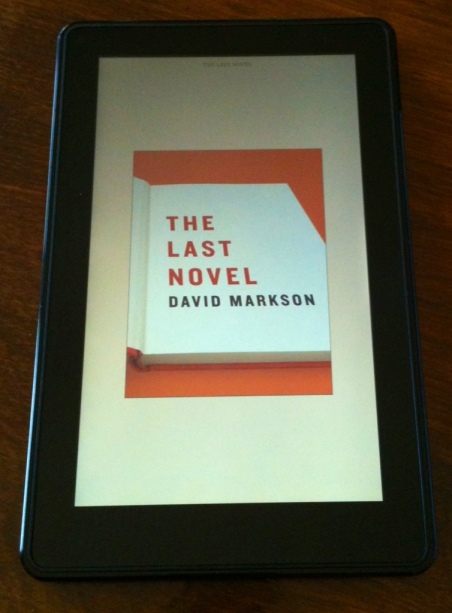
A Review of David Markson’s The Last Novel (Composed Mostly in Citations from Said Novel)

20120318-143327.jpg

Unsure of how to “review” David Marson’s last novel The Last Novel, I here provide a series of citations from said novel with my own brief comments. The citations are organized not by theme or idea, but rather simply by the order in which they appear in the book, from first to last. My intention is to provide a clear picture of Markson’s method with some brief commentary on his themes.

By way of recommendation: The Last Novel engrossed and obsessed me, commanding most of my attention for four days, during which time I read it twice and then picked at again and again, as one might return to the generous leftovers of a Thanksgiving meal.

I hope I have not strained the limits of copyright law with my citations of Markson’s citations. To wit, from the colophon:

Copyright © 2007 by David Markson

All rights reserved. No part of this book may be used or reproduced in any manner whatsoever without written permission from the Publisher, except in the case of brief quotations embodied in critical articles and reviews.

Library of Congress Cataloging-in-Publication Data

Markson, David.

The last novel / David Markson.

p. cm.

ISBN-13: 978-1-59376-143-1

ISBN-10: 1-59376-143-0

1. Novelists—Fiction. 2. Fiction—Authorship—Fiction.

3. Psychological fiction. I. Title.

Is The Last Novel fiction? Does this question matter? “Fiction–Authorship–Fiction” — this seems like a fair descriptor.

Our author, by way of summary, announces his themes, his name, and his prophetic conclusion:

Old. Tired. Sick. Alone. Broke.

All of which obviously means that this is the last book Novelist is going to write.

And now his method, followed by two examples of said method:

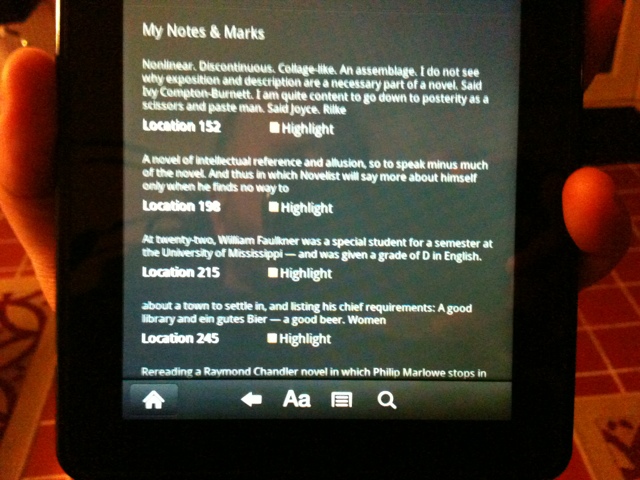
Nonlinear. Discontinuous. Collage-like. An assemblage.

I do not see why exposition and description are a necessary part of a novel.

Said Ivy Compton-Burnett.

I am quite content to go down to posterity as a scissors and paste man.

Said Joyce.

And a comment on that method, and Novelist’s textual place in it:

A novel of intellectual reference and allusion, so to speak minus much of the novel.

And thus in which Novelist will say more about himself only when he finds no way to evade doing so, but rarely otherwise.

On the first theme announced, “Old”:

Rereading a Raymond Chandler novel in which Philip Marlowe stops in for a ten-cent cup of coffee.

Old enough to remember when the coffee would have cost half that.

A citation that seems to hold all the themes, but especially “Sick” and “Broke”—-and then a Renard citation that fits Markson (or “Novelist,” if you prefer) into a grand tradition of starving artists:

The bleak image Novelist is granted of himself as he asks a question of a local pharmacist — and becomes aware of the woman contemplating the conspicuously threadbare and even ragged ends of his coat sleeves.

Writing is the only profession where no one considers you ridiculous if you earn no money.

Said Jules Renard.

On aging:

Moments in which Novelist does something like leaving his desk to retrieve a book from across the room — and finding himself staring vacantly into the refrigerator.

Or tossing his keys into a drawer — without having opened the drawer

Markson instructs us how to read his work, and at the same time makes a grand grab at glory; he then moves to reflect on death, and perhaps a fear of going unread, before pointing out the sublime powers of art :

Novelist’s personal genre. For all its seeming fragmentation, nonetheless obstinately cross-referential and of cryptic interconnective syntax.

Wondering why one is surprised to realize that Thoreau was dead at forty-five.

A lament of Schopenhauer’s:

Over how frequently the mere purchase of a book is mistaken for the appropriation of its contents.

Two pages of The Mill on the Floss are enough to start me crying.

Said Proust.

The intersection of commerce and art and madness (or, really, I just like this citation):

Because bookshops are among the very few places where one can spend time without spending any money, George Orwell noted, any number of practically certifiable lunatics are guaranteed to be regularly found in most of them.

My least favorite reading experience of all time is Clarissa:

The endless commentary, and analysis, and even retelling, in Clarissa. Anyone reading it just for the story would hang himself, Johnson said.

A good definition, but also a sideways description of entering The Last Novel:

Thinking with someone else’s brain.

Schopenhauer called reading.

Markson is fond of the dependent clause as a stand-alone thought. He often lets the reader complete the sentence, or, as below, responds perhaps obliquely with another citation—his synthesis is subtle but always in play:

Reviewers who have accused Novelist of inventing some of his anecdotes and/or quotations — without the elemental responsibility to do the checking that would verify every one of them.

Asking a working writer what he thinks about critics is like asking a lamppost what it feels about dogs.

Said John Osborne.

The Last Novel is in part a work of canon-formation, one that situates Markson’s place in arts and letters; it is often angry or bitter, as he tries to situate being “Alone” and “Broke” into a historical tradition of suffering writers:

Another of Novelist’s economic-status epiphanies:

Walking four or five blocks out of his way, and back, to save little more than nickels on some common household item.

While needing to stop to rest at least two or three times en route.

Writers are the beggars of Western society.

Said Octavio Paz.

There is no way of being a creative writer in America without being a loser.

Said Nelson Algren.

Markson repeatedly reveals his anxiety of influence: Where and how will he be remembered when he dies?:

Old enough to have started coming upon likenesses on postage stamps of other writers he had known personally or had at least met in passing.

Occasionally in The Last Novel, because he doesn’t always attribute his citations, it’s unclear to me if a string of sentences are original to Markson or not. Markson describes his method again:

A seminonfictional semifiction.

And with its interspersed unattributed quotations at roughest count adding up to a hundred or more.

A note on book theft, germane to (the original mission of) this website:

Please return this book. I find that though many of my friends are poor mathematicians, they are nearly all good bookkeepers.

Read Walter Scott’s bookplate.

A dependent clause:

Reviewers who protest that Novelist has lately appeared to be writing the same book over and over.

Again, the intersection of economics, art, and how we honor and remember genius (with the implicit underlying anxiety over Markson’s own fate):

Before the Euro, the portrait of Yeats on Ireland’s twenty-pound note.

America’s Whitman twenty-dollar bill, when?

The Melville ten?

I think the Melville ten is a grand idea. I’d put Hawthorne on the twenty and Emerson on the penny.

On death-dialing:

A quirky new impulse of Novelist’s, at news of several recent deaths — Dialing the deceased, in the likelihood that no one would have yet disconnected their answering machines — and contemplating their voices one eerie final time.

The voice of an agitated colleague? Friend? Student? Is the quote a composite of complaints? Is it verbatim?:

Listen, I bought your latest book. But I quit after about six pages. That’s all there is, those little things?

Many of us have wondered:

Why did Harper Lee never write another novel?

It is possible she never wrote that first one.

Again, money and writers:

America’s Emily Dickinson dime?

We could put Thoreau on the nickel and Poe on the fifty.

Conclusions as a kind of interception; the author offstage, off scene, ob skena — obscene:

Novelist’s personal genre. In which part of the experiment is to continue keeping him offstage to the greatest extent possible — while compelling the attentive reader to perhaps catch his breath when things achieve an ending nonetheless.

Conclusions are the weak point of most authors.

George Eliot said.

If you know what you’re doing, you don’t get intercepted.

Said Johnny Unitas.

I feel like I’ve skated over the book, failed to plumb it at all: But I also protest that the book is a work of autocriticism, a work that decenters its themes, bats them around, analyzes them, tosses them back to the reader, sometimes bitter, sometimes melancholy, always erudite and engaging.

I cite from the end now. Can the end be spoiled? Markson tells us this is his last, that he will die (“Old. Tired. Sick. Alone. Broke.”). He dies a few years after the publication of The Last Novel. (He dies on the day my son is born, or, rather, his body is found on the day my son is born. He is very much alone. The New York Times publishes his obituary on my birthday). The novel ends with a series of citations that mull on death:

Dispraised, infirm, unfriended age.

Sophocles calls it.

Unregarded age in corners thrown.

Shakespeare echoes.

And what it means to be an artist, a writer, a critic, to write in and on and through others’ books:

The worn copy of Donne’s verses, inked throughout with notes in Coleridge’s handwriting. And at the rear:

I shall die soon, my dear Charles Lamb, and then you will not be sorry that I bescribbled your book.

Life as pain, death as transcendence:

Then come kiss me, sweet-and-twenty,Youth’s a stuff will not endure. Be patient now, my soul, thou hast endured worse than this.

Odysseus once says.

Mais où sont les neiges d’antan? Is it true then, what they say — that we become stars in the sky when we die?

Asks someone in Aristophanes.

Banal signage or access to ascension?:

Access to Roof for Emergency Only.

Alarm Will Sound if Door Opened.

To reiterate and move on:

Old. Tired. Sick. Alone. Broke.

The old man who will not laugh is a fool.

Als ick kan.

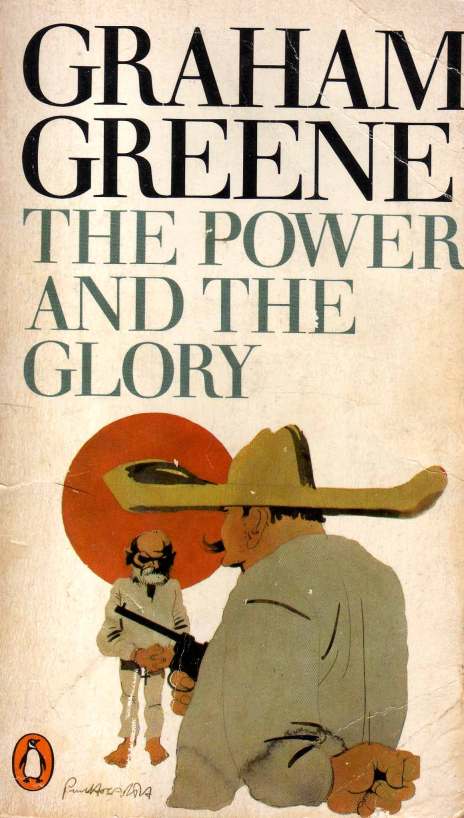
“The Priest Is Us”: The Power and The Glory, Graham Greene’s Adventure of Religion and Faith

The Gospels are powerful not simply because Christ performed miracles and taught kindness, strength, and humility. Humanity has long attributed to certain individuals impossible deeds, tremendous suffering, and inordinate wisdom. We survey the collective memory and search for meaning in the lives of renowned teachers so that they might serve as an example during our own unpredictable, harrowing journey. What separates the story of Jesus from the stories of other merely great people in history is the idea that God manifested itself to humans as a human: wracked with doubt, vulnerable to temptation, victim of unimaginable pain.  Although he taught that love is the first commandment, Christ was flailed, tortured, left to die on a cross between two thieves, all ostensibly for no benefit but our own.  Wasn’t it Borges who said that every story is either the Odyssey or the Crucifixion?  The stories we tell each other, in their reflection, become the same nothing cycle of words, told again and again, a record of our inadequacy and cowardice.

Graham Greene, in his short and powerful novel The Power and the Glory, considers the life and death of Jesus as he narrates the life of a man brought low by pride and circumstances. The last priest someplace in southwestern Mexico flees from the authorities.  His hunters seek to free the peasant farmers who populate the land from exploitation and superstition with their own imperfect liberation theologies: the abolition of superstition and private property; the self-sufficiency that follows honest labor.  The men in red shirts ride horses and believe in the impending, always near, revolution.  On the back of a mule, the father sneaks from town to town, trying to fulfill his duty, but without understanding the significance of the words that tumble clumsily from his mouth in Latin. He performs sacred rites in exchange for sanctuary until even a hiding spot is denied to him. The police have started to execute men and boys in villages who they believe have colluded to shelter this wayward man of God.

As the priest travels, he finds himself stripped not only of the vestments of his profession: his chalice, his incense, his robes, and his bible, but his own air of invincibility, privilege and comfort. Exposed, fearful, living in a state of mortal sin and unable to confess, this fallen man of God, like Christ himself, is destroyed.  The priest is, by his own admission, a bad one. He drinks heavily and thinks too much of his own comfort. Led to his profession not so much by attention to the divine will but by a desire for status and privilege, during his exile he recalls fondly dinners lavish dinners with wealthy members of his assembly and the gifts they gave him. While he may have seen that the most of his flock made a meager living on small farms after taxes and fees paid to local bosses, he never stopped to consider the meaning of his own observations, busying himself instead with ambitions for his own greater glory. He is, for the first half of the book, greedy, proud, and self-concerned.

But, as he eludes the authorities and traverses the country, he becomes, in Greene’s capable hands, a symbol of redemption and an affirmation of a full but unrealized life.  Words that lacked meaning help to ameliorate the strongest pain he has ever felt. He is jailed, extorted, and rejected by the people who love him the most, but in humiliation finds real faith.  Performing the sacred rites of his profession, he confronts the banality of evil and comes to finally realize the true power of the promise he brought to those who came to him:

He had an immense self-importance; he was unable to picture a world in which he was only a typical part — a world of treachery, violence, and lust in which his shame was altogether insignificant. How often the priest had heard the same confession — Man was so limited he hadn’t even the ingenuity to invent a new vice: the animals knew as much. It was for this world that Christ had did; the more evil you saw and heard about you, the greater glory lay around the death. It was too easy to die for what was good or beautiful, for home or children or a civilization — it needed a God to die for the half-hearted and the corrupt.

This is a book about religion and faith, but The Power and the Glory doesn’t require its reader to have an inclination towards either.  It is an adventure story, recounted in bold, confident sentences, about a normal man who fears that incorrect choices will cause him to suffer. This fear is real and it manifests itself in the priest’s moral and ethical dilemmas.  We are asked to ponder those things that lead from sadness to strength.  The priest is us: we see ourselves completely in him and give him our sympathy.

I Review House of Holes, Nicholson Baker’s Ovidian Raunchfest

In his Paris Review interviewNicholson Baker says that “one of the questions House of Holes is trying to answer” is: is “there still a point to writing words about sex when you can see anything you want, and a lot of things you don’t want to see, on the Web?” The book answers a goofy, gooey, bright-hearted “yes” to this question, unfolding its pornographic vignettes in a surreal Ovidian holiday, a midsummer’s night sexfest that sails lusty and smiling over the borders of morality, social convention, and plain old biology. Baker creates an organic, oozing world where genitalia is swapped freely between lovers, where one might exchange an arm for a bigger dick, where old tattoos get fucked away, where a woman and a tree can make sweet, sweet love:

She looked out from her high-splayed vantage and she said, “I’m a treefucking woman!” Dappled sunlight shone and emptied itself onto her. She squeezed her Kegeling love muscle around the smooth, thickened branch within, and when the wind came up again all the leaves twittered and shook. The tree itself shuddered: It was having some kind of orgasm.

If it seems like I’m getting ahead of myself, citing text before outlining plot, I assure you I’m not: There really isn’t much of a plot to House of Holes. Well, if there is one, it’s something like this: Lila, a large-breasted madame runs The House of Holes, an equal-opportunity brothel/fantasy factory that can only be accessed through portals that appear in strange spaces. This pornographic Arcadia operates on slippery wet-dream logic in which strangers cheerfully and eagerly engage in all sorts of raunch. Characters of varying physical attributes screw their way through a surreal holiday. There are a few conflicts, most of which are too light to touch on (this is a light book, for sure).

Two conflicts stand out with some (slight) weight though:

First, there’s the Pornmonster, “a personification of polymorphousness unlike anything the world of human suck-fuckery has ever known.” The Pornmonster is the mutant offspring of all the bad porn slurry collected on a pornsucking mission (don’t ask). The Pornmonster is typical of Baker’s tone throughout House of Holes, and its polymorphousness embodies the book’s depictions of sexual metamorphoses. This monster is tamed through playful, loving lust, and becomes a good guy, its raw sexual energy redirected for the forces of good (i.e., good sex). This is a book full of good guys.

Second, there’s the Pearloiner, an embittered, sexually-jealous TSA agent who steals clitorises (two of our heroines are afflicted by this heinous crime). The Pearloiner is a product of post-Homeland Security draconian measures, and her inclusion is about as close to contemporary culture criticism that House of Holes approaches. Sexy fun times interest Baker more.

Like the Pornmonster, the Pearloiner finds herself redeemed at the end of the book; moral shifts of allegiance are as easy as physical transformations in House of Holes. The Pearloiner and the Pornmonster alike atone their sins with a facile simplicity that fits the ludic silliness of Baker’s book. They are invited to participate in the handjob contest that (quite literally) climaxes the book. It’s an easy, orgasmic end to an easy, orgasmic book.

In some ways, House of Holes is more remarkable for what it’s not. Most of the so-called pornographic literature (or literature of pornography, if you prefer) that I’ve read has a darker streak. (I’m thinking of Anaïs Nin, Henry Miller, de Sade,The Story of O, Alan Moore’s The Lost Girls, etc.). Holes shares Willliam Burroughs’s sense of surreal transmogrification and picaresque rambling and J.G. Ballard’s infatuation with the bizarre intersections of sex and technology, but it’s never sinister or cruel, or honestly, even disturbing.

House of Holes is a fundamentally good-natured book,” suggests Baker in his Paris Review interview, also pointing out that it’s a work of “crazy joy”—and he’s absolutely right: The book is joyous, good-natured, affable even. When Baker approaches a remotely Sadean cuckold fantasy he punctures it with a politeness that’s humorous—but he also dramatically lowers any stakes that may have been in play. In short, this is a novel of pure fun, of infinite gain and no loss (quite literally—Lose an arm? Get it back. Lose a clit? Get it back). Holes is silky and slippery and light, more ephemeral than ethereal in the end.

But shame on me. I seem to be faulting the book for not doing something it never sets out to do (namely, I seem to be faulting Holes for a lack of depravity and depth and darkness, three “d’s” the book’s rubric never sets out to register). It’s pure fantasy stuff, reminiscent of the partner-swapping exercise A Midsummer Night’s Dream (I am not saying Baker is Shakespeare) or the erotic shifts in Metamorphoses (ditto: Baker is no Ovid) or the voluptuous Victorian serial The Pearl: dreamy, and perhaps (small r) romantic, but not turbulent—sure, Holes will ruffle unwitting feathers (let’s be clear, it’s pointedly sexually graphic), but it’s unlikely to damage anyone’s soul. (If you’re worried about soul-damage, check out the editorial style-sheet for Holes, which lays out Baker’s invented porn-lexicon).

Is House of Holes a novel or a flimsy pornographic riff? Baker is less interested in ideas than he is in sensations, or rather representations of sensations (which is the most literature can do anyway, I suppose). Holes is unwilling to offer any answers or explications about the deep mysteries behind human desire, but it does pose questions about those desires, and it poses those questions with shameless glee. A fun, breezy read.

Alain de Botton’s Religion for Atheists: A Facile Self-Help Book that Entirely Misses the Point of Free Thinking

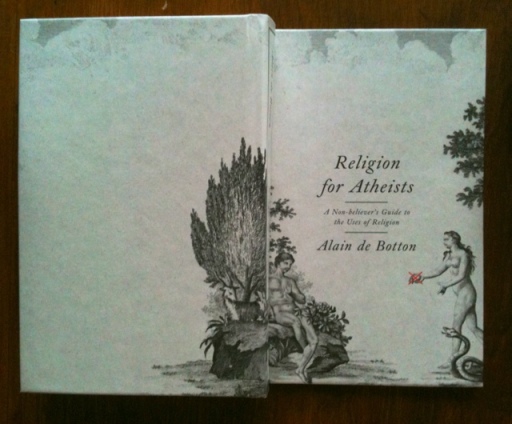
I’m slightly familiar with Alain de Botton’s work, and I’ve taken something of an interest in the so-called “New Atheist” movement — Hitchens, Dawkins, et al — so when a review copy of Religion for Atheists showed up a few weeks ago, it piqued my interest. I found its cover playfully annoying—a hole in the holy book—and its subtitle—A Non-believer’s Guide to the Uses of Religion—downright obnoxious. Still, I gotta give props to the design team at Pantheon for the book that’s under the horrid jacket: 

20120218-101910.jpg

Unfortunately, an attractive hardback design sans jacket is the best this book has to offer.

By way of explication (and my own laziness and indifference on this volume) here’s some copy on the book from de Botton’s website:

What if religions are neither all true or all nonsense? The boring debate between fundamentalist believers and non-believers is finally moved on by Alain’s inspiring new book, which boldly argues that the supernatural claims of religion are of course entirely false – and yet that religions still have some very important things to teach the secular world.

Religion for Atheists suggests that rather than mocking religions, agnostics and atheists should instead steal from them – because they’re packed with good ideas on how we might live and arrange our societies. Blending deep respect with total impiety, Alain (a non-believer himself) proposes that we should look to religions for insights into, among other concerns, how to:

– build a sense of community

– make our relationships last

– overcome feelings of envy and inadequacy

– escape the twenty-four hour media

– go travelling

– get more out of art, architecture and music

– and create new businesses designed to address our emotional needs.

For too long non-believers have faced a stark choice between either swallowing lots of peculiar doctrines or doing away with a range of consoling and beautiful rituals and ideas. At last, in Religion for Atheists, Alain has fashioned a far more interesting and truly helpful alternative.

The tone of the copy gives one a sense of the utter glibness of de Botton’s pamphlet. The book smacks of crude self-helpery, a hodgepodge of faux-intellectual poses for those who can smugly dismiss the history of philosophy. It’s like The Purpose Driven Life for atheists. There is a picture or graphic on every other page; de Botton seems to include these in lieu of, say, providing verbal imagery, or meaningful context, or simply trusting the intellect of his audience.

I suppose that I am fundamentally at odds with de Botton. I agree that religion has done much to initiate and facilitate (and in fairness, perhaps at times mitigate) atrocity; I agree that many (if not most) of the Big Problems in the world stem from the herd-mentality that organized religions impose on the people they indoctrinate. But de Botton would like to replace one herd with another.

Here is the Swiss writer suggesting that the academy (which he too-readily identifies as a bastion of atheist mores) follow the practices of black Southern Baptist churches:

The contrast with the typical lecture in the humanities could hardly be more damning. And unnecessary. What purpose can possibly be served by the academy’s primness? How much more expansive the scope of meaning in Montaigne’s essays would seem if a 100-strong and transported chorus were to voice its approval after every sentence. How much longer might Rousseau’s philosophical truths linger in our consciousness if they were structured around rhythmical verses of call-and-response. Secular education will never succeed in reaching its potential until humanities lecturers are sent to be trained by African-American Pentecostal preachers.

What we see here is a romanticization and idealization of a particular part of a culture that I think de Botton in no way understands. What’s even more disturbing here is his elevation of groupthink and indoctrination practices (I hear, “Oh no, I don’t want to play with Delta children” humming in the background). We see here the same teleological thinking that marks much of religious dogma, the sense that truth has been attained; the search is over—we just need to repeat it rhythmically enough, soak our young in it, until they think just like we do. This position strikes me as potentially dangerous as any organized religion’s attempts at indoctrination.

Religion for Atheists is full of sloppy logic gussied up in rushed anecdotes and glossed over with barely-connected pictures and silly graphs. Look at the following example, a visual non sequitur masquerading as meaningful information:

20120223-180200.jpg

Are we supposed to be horrified that the British spend more on potato chips than poetry books? Apples and oranges, bro. But what’s really ridiculous is the stinky pious claim that “Only religions have been able to turn the needs of the soul into large quantities of money.” This claim is plain silly, or at least predicated on a too-singular definition for “needs of the soul.”

Religion for Atheists seems to miss the point that many (if not most) atheists and agnostics are at heart free thinkers. De Botton romanticizes the mystery, awe, and grace of religion, even as he suggests that there is no metaphysical center from which these attributes emanate. His most basic argument really boils down to something like, “Hey, there is no God, no spirit, but religion does a good job of consoling people and keeping them in moral order, so, instead of TV and junk food, we should use the aesthetics of religion as consolation.” There is nothing revolutionary about this idea.

Religion for Atheists is a smug little tract, the sort of book that a supermarket would sell along with Chicken Soup for the Soul if supermarkets had the guts to sell self-help books for atheists. Readers should not be duped into thinking that de Botton has taken any real stance or said anything new here. Instead, hiding behind the pasteboard mask of utility, he offers a crass dodge away from meaningful inquiry. Get thee to Nietzsche instead.

Teju Cole’s Open City Is a Strange, Marvelous Novel That Captures the Post-9/11 Zeitgeist

“And so when I began to go on evening walks last fall . . .” begins Julius, the perspicacious narrator of Teju Cole’s admirable and excellent début Open City. That opening “And” is significant, an immediate signal to the reader that this novel will refuse to align itself along (or even against) traditional arcs of plot and character development. We will meet Julius in media res, and we will leave him there, and along the way there will be learning and suffering and compassion and strange bubbles of ambiguity that threaten to burst out of the narrative.

As noted, Open City begins with Julius’s peripatetic voyages; he walks the night streets of New York City to ostensibly relieve the “tightly regulated mental environment of work.” Julius is completing his psychiatry fellowship at a hospital, and the work takes a toll on him, whether he admits it or not. In these night walks—and elsewhere and always throughout the novel—Julius shares his sharp observations, both concrete and historical. No detail is too small for his fine lens, nor does he fail to link these details to the raw information that rumbles through his mind: riffs on biology, history, art, music, philosophy, and psychology interweave the narrative. Julius maps the terrain of New York City against its strange, mutating history; like a 21st century Ishmael, he attempts to measure it in every facet—its architecture, its rhythms, its spirit. And if there is one thread that ties Julius’s riffs together it is the nightmare of history:

But atrocity is nothing new, not to humans, not to animals. The difference is that in our time it is uniquely well organized, carried out with pens, train carriages, ledgers, barbed wire, work camps, gas. And this late contribution, the absence of bodies. No bodies were visible, except the falling ones, on the day America’s ticker stopped.

Open City is the best 9/11 novel I’ve read, but it doesn’t set out to be a 9/11 novel, nor does it dwell on that day. Instead, Cole captures something of the post-9/11 zeitgeist, and at the same time situates it in historical context. When Julius remarks on the recent past, the concrete data of history writhes under the surface. He remarks that the 9/11 attack on the World Trade Center “was not the first erasure on the site,” and goes on to detail the 1960s cityscapes that preceded the WTC. Before those, there was Washington Market. Then Julius embarks, via imagination, into the pre-Colombian space of the people we now call Indians or Native Americans. “I wanted to find the line that connected me to my own part in these stories,” he concludes, peering at the non-site that simultaneously anchors these memory-spaces.

Julius’s line, like the lines that comprise New York City (and perhaps, if we feel the spirit of its democratic project, America itself) is a mixed one, heterogeneous and multicultural. Julius’s father, now dead, was an important man in Nigeria, where Julius enjoyed a relatively privileged childhood. Julius’s mother—they are now estranged—is German. He remarks repeatedly about his German grandmother’s own displacements during WWII, reflecting at one point that, from a historical perspective, it was likely impossible that she escaped Cossack rape.

Even though he sometimes seems reticent to do so, Julius delves into the strange violence that marks his lineage. He recalls a childhood fascination with Idi Amin; as a boy, he and his cousins would watch the gory film The Rise and Fall of Idi Amin repeatedly: ” . . . we enjoyed the shock of it, its powerful and stylized realism and each time we had nothing to do, we watched the film again.”

Fascinated horror evinces repeatedly in Open City. In just one example, Julius believes he sees “the body of a lynched man dangling from a tree”; as he moves closer to inspect, he realizes that it is merely canvas floating from a construction scaffold. Perhaps so attuned to history’s grand catalog of spectacular atrocity, Julius finds it lurking in places where it does not necessarily evince.

In turn, despite his profession as psychiatrist, Julius is wary of human sympathy. Throughout the novel, dark-skinned men engage him by calling him “brother.” He almost always deflects these attempts at connection, and internally remarks them as fatuous, or naïve, or false. This is not to say though that Julius doesn’t make significant (if often transitory) connections.

One of the organizing principles of Open City comes in the form of Julius’s infrequent visits to the home of his former English professor, Dr. Saito, who is slowly dying. Saito’s own memories float into Julius—this technique repeats throughout the novel—and we learn that he was interned as a young man during WWII; the sad fact is another ugly kink in the line of American history that Julius attempts to trace.

Julius also befriends Dr. Maillotte, an aging surgeon on a flight to Brussels, where he spends a few weeks of Christmas vacation, ostensibly looking for his oma (a task he performs half-heartedly at best). As Julius daydreams, Dr. Maillotte, European émigré, finds a place within his vision of family members and friends:

I saw her at fifteen, in September 1944, sitting on a rampart in the Brussels sun, delirious with happiness at the invaders’ retreat. I saw Junichiro Saito on the same day, aged thirty-one or thirty-two, unhappy, in internment, in an arid room in a fenced compound in Idaho, far away from his books. Out there on that day, also, were all four of my own grandparents: the Nigerians, the Germans. Three were gone by now, for sure. But what of the fourth, my oma? I saw them all, even the one I had never seen in real life, saw all of them in the middle of that day in September sixty-two years ago, with their eyes open as if shut, mercifully seeing nothing of the brutal half century ahead and better yet, hardly anything at all of all that was happening in their world, the corpse-filled cities, camps, beaches, and fields, the unspeakable worldwide disorder that very moment.

In Brussels, Julius meets Farouq, an angry young man with intellectual, Marxist tendencies. Farouq believes in a theory of “difference” and finds himself at odds with both the dominant Belgian culture and with Western culture in general. Julius’s conversations with Farouq are a highlight of the novel; they help to further contextualize the drama of diaspora in the post-9/11 world. Later, Julius finds a counterweight to some of Farouq’s extreme positions over a late lunch with Dr. Maillotte, who suggests that “For people to feel that they alone have suffered, it is very dangerous.” There’s a sense of reserved moderation to her critique—not outright dismissal nor condemnation, but simply a recognition that there are “an endless variety of difficulties in the world.”

Julius seems to tacitly agree with Maillotte’s assessment. His reluctance to accept brotherhood based on skin color alone speaks to a deeper rejection of simplicity, of tribe mentality, of homogeneity; it also highlights his essential alienation. At the same time, he’s acutely aware of how skin color matters, how identity can be thrust upon people, despite what claims to agency we might make. In search of the line that will connect him to his part of the American story, Julius finds unlikely “brothers” in Farouq, Maillotte, and Saito.

But let us not attribute to Julius a greater spirit than Cole affords him: Open City is a novel rich in ambiguity, with Julius’s own personal failures the most ambiguous element of all. While this is hardly a novel that revolves on plot twists, I hesitate to illustrate my point further for fear of clouding other readers’ perceptions; suffice to say that part of the strange, cruel pleasure of Open City is tracing the gaps in Julius’s character, his failures as a professional healer—and his failures to remark or reflect upon these failures.

But isn’t this the way for all of us? If history is a nightmare that we try to awake from—or, more aptly in a post-9/11 world, a nightmare that we awake to, to paraphrase Slavoj Žižek—then there is also the consolation and danger that time will free us from the memory of so much atrocity, that our collective memory will allow those concrete details to slip away, replaced with larger emblems and avatars that neatly smooth out all the wrinkles of ambiguity. “I wondered if indeed it was that simple, if time was so free with memory, so generous with pardons, that writing well could come to stand in the place of an ethical life,” Julius wonders at one point; later, Saito points out that “There are towns whose names evoke a real horror in you because you have learned to link those names with atrocities, but, for the generation that follows yours, those names will mean nothing; forgetting doesn’t take long.” Julius’s mission then is to witness and remark upon the historical realities, the nitty-gritty details that we slowly edge out of the greater narrative. And Cole? Well, he gives us a novel that calls attention to these concrete details while simultaneously exploring the dangerous subjectivity behind any storytelling.

If it needs to be said: Yes, Open City recalls the work of W.G. Sebald, who crammed his books with riffs on history and melancholy reflections on memory and identity. And yes, Open City is flâneur literature, like Sebald (and Joyce, and Bolaño, perhaps). But Cole’s work here does not merely approximate Sebald’s, nor is it to be defined in its departures. Cole gives us an original synthesis, a marvelous and strange novel about history and memory, self and other. It’s a rich text, the sort of book one wants to immediately press on a friend, saying, Hey, you there, read this, we need to talk about this. Very highly recommended.

Open City is new in trade paperpack from Random House.

A Riff on the Kindle Fire

20120131-201536.jpg

1. I got a Kindle Fire for Christmas this year, and have been using it for about a month now. I’m not sure how to go about “reviewing” this product, so I’m going to riff a bit.

2. Let’s get the whole Amazon-as-Evil-Empire thing out of the way up front: Yes, Amazon’s business practices are unsavory; yes, attempting to decimate the publishing industry as it currently exists is Not Good; yes, their practices threaten brick-and-mortar stores (the kind that actually pay local and state taxes!); yes their practices work to undermine key figures in the publishing industry—y’know, people like editors.

3. Picking up on that last clause: self-publishing (and the self-publishing “revolution” that e-readers like the Kindle Fire entail) may seem fine and dandy cotton candy, but there’s a reason that editors (and publishers and publicists, etc.) exist. These people make books better. These people make books. (And no, by the way, I’m not interested in reading your self-published ebook, so quit sending me email blasts).

4. Seems like I’m riffing out a lot of context, so let’s keep going: Perhaps you read whinypants Jonathan Franzen decrying the impending moral failures/societal breakdown that will result from ebooks replacing print editions. Franzen’s position is, of course, reactionary and conservative, and deeply rooted in the fear that the perfect Platonic permanence of books will be subverted or decimated.

5. Franzen’s reaction is rooted in part against a (common, teleological, utopian) misconception about the longevity and stability of digital content. Simply put, many people are operating under a dramatic misunderstanding of just how unstable digital content is. Where will all these books be stored, and in what format? Who will be responsible for archiving these materials?

6. A simple thought experiment, germane to item 5 above: Think back on all the obsolete media that you have used in your lifetime. I am in my thirties; my list would include cassette tapes, VHS tapes, laser disks, floppy disks, minidiscs, CDRs . . . (I don’t include vinyl records in this list. I still own hundreds of them and play them regularly).

7. To recontextualize: Printed books are a far more stable format than ebooks.

8. To wit: Ursula LeGuin in her essay “Staying Awake” from a 2008 issue of Harper’s:

The book itself is a curious artifact, not showy in its technology but complex and extremely efficient: a really neat little device, compact, often very pleasant to look at and handle, that can last decades, even centuries. It doesn’t have to be plugged in, activated, or performed by a machine; all it needs is light, a human eye, and a human mind. It is not one of a kind, and it is not ephemeral. It lasts. It is reliable. If a book told you something when you were fifteen, it will tell it to you again when you are fifty, though you may understand it so differently that it seems you’re reading a whole new book.

9. Points 2-8 seem like so much hemming and hawing, so much reticence to discuss what I seemed to promise at the outset: Some sense of what reading on the Kindle Fire is like.

10. Some things I like very much about reading on the Kindle Fire:

It creates its own light for night reading.

It’s easy to highlight and annotate passages (and then open up a new screen to look at just those highlights and annotations, isolated from the text proper).

It’s lightweight and ergonomic and, when I read with it over my head, my wrists don’t constrict and go tingly.

It holds a lot of books.

20120131-194740.jpg

11. Some things I like about the Kindle Fire that I would think I wouldn’t like about the Kindle Fire, were I to read such a list from another person:

I can determine how far I have read into a book as a percentage.

I can stop and browse the internet in the middle of reading.

I can look up words or even wikis as I go by simply hovering a finger over a word or phrase.

12. My daughter loves the thing. Loves loves loves it. She is probably the primary user. She is four and a half. I think the interactive books she adores are marvelous.

13. Some things I don’t like about the Kindle Fire:

No book smell.

One texture for all books: This is probably the biggest problem I can see with the Kindle Fire.

It requires a battery charge, so there’s a built in level of accessibility; a sense that one must needs “prepare” ahead of time to read, perhaps (unlike our old friend the print book, which only requires a light source).

No bath time reading.

I can’t read it around my daughter, because she will attempt to take it, or, at minimum, curl up in my lap.

It is not possible to have like three or four books open at once.

Can’t read .cbr files. Why? Why?

I had to buy a USB micro B cable to connect the Kindle to the computer that I use to store digital content. Why not include this cable, Amazon? (It’s almost as if the company wants consumers to be solely reliant on Amazon’s services as a content provider . . .)

14. I’ve found it nearly impossible to read an electronic book on the Kindle that I started as a print book. For example, I’m about half-way through Teju Cole’s novel Open City; the kind publicist who sent it to me also sent me an electronic version of the text. I began the print copy in earnest, but the other night, after reading a bit of Hawthorne on the Kindle, I found myself wanting to sink back into Cole’s Sebaldian orbit. When I found my place in the text though, I felt alienated, bleak even, as if I were not reading the definitive version of Cole’s book but instead its cheap ghost. There is no intellectual or objective justification for this feeling. Call it a vibe or a habit.

20120131-194747.jpg

15. Books that I enjoy reading on the Kindle Fire:

David Markson’s The Last Novel, which perhaps begs to be read on such a device.

Anything by Nietzsche, but his aphoristic works especially.

A .pdf version of Luigi Serafini’s rare and expensive book The Codex Seraphinianus (one of many verboten tomes on my Kindle, but remember the name of this site if you please . . .)

Anything by Whitman, especially letters and other non-essentials that I would not normally pursue.

Ditto Hawthorne.

Ditto Dickinson.

Ditto Melville.

Oh, and beyond the overlooked and underfamous works of certain American Renaissance faves: Moby-Dick too, which seems looser, freer, more aphoristic on the Kindle. (Why?)

Neal Stephenson’s novel Snow Crash, which seems simultaneously dated and futuristic. Like William Gibson with a strong streak of Pynchonian sillies.

And Gibson: Rereading Burning Chrome. Had forgotten how good some of these shorts are.

Houellebecq’s Whatever: its brevity, its succinctness gels with my nascent Kindle habits, or perhaps instructs my Kindle habits, or more likely creates my Kindle habits.

16. To return to a point in #13 above: The Kindle Fire necessarily imposes a uniform texture on every book that one reads on it; this would be true of any e-reader. Sure, you can change the background (white, black, or a sepia color, which is what I prefer), fonts, sizes, spacing, etc. — but there is no sense of physicality, of individual identity, of, dare I say it, specialness, to the texts. I am aware that these are terribly subjective and overtly Romantic terms, but hell, I like physical books. I like their covers and their smells and their discolorations. I like leaving bookmarks in every book that I finish or abandon—I almost always find a new bookmark for every book that I read (the autobookmark on the Kindle is useful, but how can it compare with a photograph of my son or drawing by my daughter or a postcard from a stranger or a scrap of poetry from a discontinued textbook or an old grocery list of my wife’s from years before we were married?).

17. I titled this post “A Riff on the Kindle Fire,” but that’s a bit ambiguous I suppose: I did not compose the post on the Kindle Fire, which I find awkward re: blogging/wordprocessing. I used a laptop (with some help from an iPhone). Maybe the preposition “about” would be more suitable.

18. By way of closing, after four weeks with the thing:

It’s light.

It’s convenient for night reading, but you probably shouldn’t take it in the bath.

No book smell.

Riff on Recent Reading, 1.09.2012 (Gaddis, Vollmann, Dragons, Nausicaä, Patti Smith)

20120110-181813.jpg

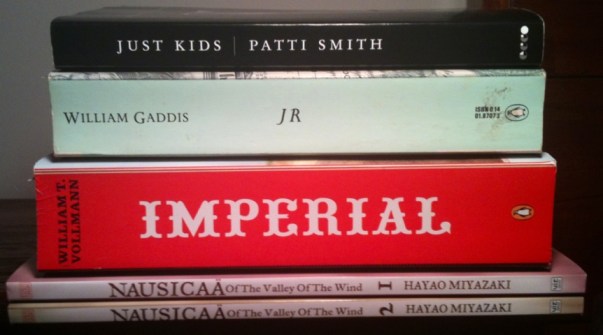
1. Just Kids, Patti Smith

Really slowed down on this one, mostly because the spring semester hath begun, wreaking all sorts of destabilizing tasks on me. Momentum and reading habits will inevitably return. Anyway, Smith’s book is more or less a litany of famous meetings and infamous moments with lots and lots of descriptions of talismanic objects. The scene where she meets Allen Ginsberg is pretty cool. Smith presents herself as earnest, passionate, but also somehow at odds (or at least outs) with the whole Chelsea Hotel scene.

2. Nausicaä of the Valley of the Wind, Vol 1, Hayao Miyazaki

Completed the first volume of Miyazaki’s groundbreaking manga and started the second. The art is well crafted and distinct, but often extremely busy and even frenetic. It sometimes feels squashed in the panels, like it needs room to breathe. I can’t help but compare it to the film that followed, which is visually richer and more expansive. The film, in a sense, helps me to fill out the scope signaled in Miyazki’s inky illustrations.

The story in the manga so far differs subtly but significantly from the film; without adding spoilers (I think fans of the film will enjoy the book), the political dimension of the plot is heightened and gender roles are explored with greater concern. Nausicaä’s initial rashness is also presented with greater intensity (read: violent consequences). More to come.

3. Imperial, William T. Vollmann

Chapter 3 of Imperial, “The Water of Life,” is some of the best gonzo journalism I’ve ever read. Vollmann (along with an improbably game ex-Marine/hotel clerk) takes a raft—a cheap rubber dinghy, really—down the infamous New River, purportedly one of the most polluted waterways in North America. This river is filled with dead birds, dead fish, probably dead humans, lots and lots of garbage, industrial runoff, and lots and lots of human shit.

Of course, Vollmann can find beauty and strangeness and ugliness all at once:

The chapter does everything one wants from the book, and if you’re at all intrigued, there’s a version in the excellent Vollmann reader Expelled from Eden, which is a good starting point for his work.

The next chapter, “Sublineations: Lovescapes,” is this awful emo exploration of a bad breakup and the following heartbreak Volls feels after. It was torturous to get through, the sort of thing that screams for an editor. It also underscores how deeply deeply deeply personal the book is to him, though. More to come.

4. A Dance with Dragons, George R. R. Martin (audiobook read by Roy Dotrice)

Well goddam if I didn’t finally finish it. As I’ve lamented elsewhere in these e-pages, Martin’s fourth and fifth books in the A Song of Ice and Fire series (I hate that name, by the way: Game of Thrones (without the indefinite article) is way cooler sounding) are bloated, sagging, overfilled beasts sorely in need of an enema. Still, Dragons picks up in its final third, and ends with some shockers that, if I remember them 12 years from now when he finally finishes the next one, I may want to read it. Roy Dotrice = a very gifted reader. A great audiobook (still, I can’t believe this one topped so many year end lists).

5. JR, William Gaddis  (tandem reading with audiobook read by Nick Sullivan)

Big thanks to Dwight at A Common Reader for suggesting the audiobook of JR read by Sullivan. I’m a few hours in; I’ve also been rereading bits immediately when I get home (I listen mostly in the car or on walks), retracing the lines that I’ve mentally underlined. Sullivan is a gifted voice actor who brings the many, many voices of JR to vivid life (that line seems hackneyed but it is in no way insincere. If I weren’t riffing I’d revise. If I weren’t riffing I’d edit parenthetical excuses. I’m gonna drink more red zin now). I’m reminded in some ways of RTE’s full-cast unabridged recording—performance really—of Joyce’s Ulysses. I’d read Ulysses twice before, but I feel like the full-cast production was an equally definitive version to the one in my head. Like Ulysses—especially the Sirens episode—JR is extremely aural; it’s mostly dialogue.

I’ve laughed out loud several times so far—had no idea the book would be this funny. Also, reading/hearing it, I can’t help but see how profoundly David Foster Wallace was influenced by Gaddis here: the bizarre corporate-speak, the disjunctive rhythms, the absurd humor, the satire on modernity, the ironic-earnest axis—even the passages of naturalistic description.

On deck: The Orphan Master’s Son by Adam Johnson, Open City by Teju Cole, Smut by Alan Bennett and more more more.

Books I Didn’t Read in 2011 (And Books I Will Try to Read in 2012)

Okay. So obviously a list of the books I didn’t read in 2011 would be, y’know, long.

This post is about the books I set out to read, tried to read, wanted to read, abandoned, neglected, acquired and thought looked interesting, etc. It’s also about what I want to—what I plan to—read in 2012.

20111228-115819.jpg

A reasonable starting place: I wrote a post in early January of this year detailing the books I would try to read in 2011. I actually read most of the books I named in that post. But:

I failed to read past page 366 of Adam Levin’s incredibly long novel The Instructions, although I think I was a bit too harsh in my semi-review. Chalk it up to exhaustion.

I failed to even begin to try to read William Gaddis’s incredibly long novel JR. (But I swear to read it one year. Not next year, but maybe the year after?).

I failed to read past the first chapter of Katherine Dunn’s Geek Love.

I read most of the Tintin collections I picked up last year, but I didn’t get to volumes 5 or 6.

20111228-115848.jpg

Moving beyond that early post, books that I recall abandoning (although I’m sure there must be more):

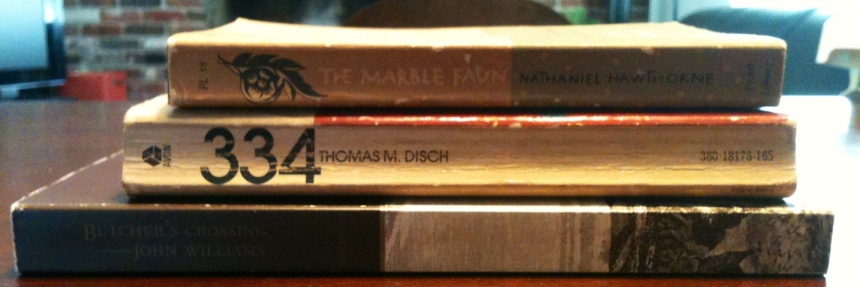
I abandoned Nathaniel Hawthorne’s Italian romance The Marble Faun after about 30 pages.

I abandoned 334 by Thomas Disch after about 50 pages. Somehow simultaneously dense and loose, it struck me as intensely imagined and sloppily composed.

I abandoned John Williams’s Butcher’s Crossing after the first chapter; it was a great opening chapter, but I thought it was going to be, I don’t know, more like Blood Meridian.

I also abandoned Chad Harbach’s big book The Art of Fielding (after 100 pages) because it was lame (notice it’s not pictured above because I traded in that sucker), but I had a nice dialog with some readers who responded to a post I wrote about abandoning it, so that was a plus.

20111228-115828.jpg

Books I bought in 2011 that I aim to read in 2012:

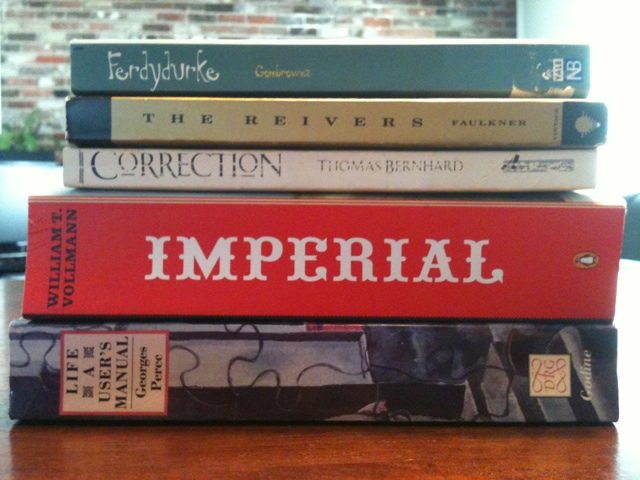
Correction by Thomas Bernhard. Bernhard was a repeated suggestion from readers in the aforementioned Harbach post/rant, and he was apparently a huge influence on W.G. Sebald, so, yes, looking forward to this.

The Reivers by William Faulkner. I read A Light in August this year and reread most of Go Down, Moses. My plan is to read one Faulkner a year for the next ten years.

Ferdydurke by Witold Gambrowicz. I struggled to make it through Gombrowicz’s bizarre jaunt Trans-Atlantyk, but once the novel taught me how to read it, I was enchanted by its strange humor and frenetic syntax. Over some beer and wine, I had a conversation about Ferdydurke with my father-in-law’s priest who is Polish. His pronunciation of Ferdydurke should win an award for charm.

I will read Georges Perec’s big book Life: A User’s Manual.

I have already promised to read William Vollmann’s Imperial.

There are many, many more, of course (too many, really).

20111228-115835.jpg

Books people sent me to read and review that look really cool that I will be reading and reviewing at some point in the very near future:

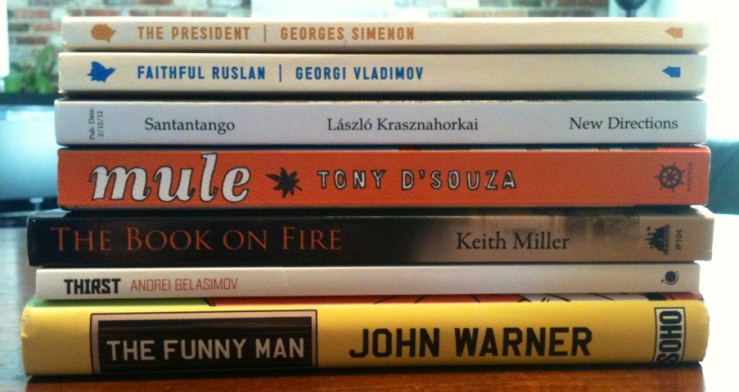
Satantango by László Krasznahorkai: I will read this and review this in the very near future.

The Funny Man by John Warner: Comedy, drugs, celebrity culture.

The Book on Fire by Keith Miller: This one is about a biblioklept. It’s been at the top of my stack for a few months now, but I keep letting myself get distracted.

Thirst by Andrei Gelasimov: Apparently this novella about a maimed alcoholic war vet is funny. (I hate the cover).

Mule by Tony D’Souza: Middle class man sells marijuana cross country. (I love the cover).

Various titles from Melville House’s Neversink line: I’ve got a few in the stack.

Also: I got a Kindle Fire for Christmas. I actually stayed up really late last night reading free public domain books from Hawthorne, Melville, Whitman, and Dickinson; I’ll read a contemporary novel on it this year—Neal Stephenson’s Snow Crash, perhaps? Suggestions welcome!—and try to review both novel and the process of reading the novel on a warm glowing machine.

And: I’m sure there are a ton of novels that will come out in 2012 that I’ll want to read; I’m already primed for Dogma, Lars Iyer’s sequel to Spurious.

So: What are you guys looking forward to reading in 2012? What did you fail to read in 2011?

I Review The Avian Gospels, Adam Novy’s Dystopian Novel About Family, Torture, Rebellion, and Birds

20111127-205427.jpg

Adam Novy’s novel The Avian Gospels synthesizes dystopian themes with magical realism to tell the story of an unnamed city, in an unnamed time, afflicted by plagues of birds and bands of Gypsies. The novel is marvelous, surreal and very strange, disorienting in its tones and unnerving in its subjects; it’s at once a confounding allegory of torture, suppression, and rebellion, and at the same time a study in intrafamily relationships.

There are two families at the heart of The Avian Gospels. The aristocratic Giggs are led by the Judge, a ruthless patriarch who is both inheritor and perpetrator of endless war. Judge Giggs controls the city through fear, torture, and his fascist personal guard, the RedBlacks. While Judge Giggs seems to hold illimitable power in the city, it isn’t enough to retain the love or even respect of his family. His wife veers into a manic depressive breakdown, brought on in large part by the death of her elder son, who was killed during the last (foolish) war. His second son, Mike, is a loutish ne’er-do-well, a bully who fails to win his father’s approval. The Judge’s daughter Katherine is the apple of his eye, but as she matures in her adolescence, she begins to perceive the violent disconnect between her privileged life and the suppression and poverty forced on the city’s Gypsy population.

The other family (perhaps more of a duo, really) comprises Zvominir, an immigrant claiming to hail from Sweden, and his son Morgan, a petulant teen of an age with Katherine. Routinely beaten bloody by Mike Giggs and his RedBlack goons, Morgan develops a visceral hatred of the Judge’s regime, one that leads the lad to repeatedly (and rashly) lash out against the violent injustice he perceives around him. Zvominir and Morgan live in sad, motherless squalor, separated not only from the suburban greenzoned upper-class, but also from the Gypsies; Zvominir, who leads most of his life genuflecting to or cowering from power, will not even allow his son the joy of partaking in the Gypsies vibrant customs (like rowdy ska music and barbecues).

Most of all, Zvominir tries to contain his son’s bizarre power, a power that he shares with the boy: they can telepathically control the birds. This gift becomes both blessing and curse as the city is overrun by flocks of birds that block out the sun and make roads unnavigable. Zvominir, always kowtowing to power, agrees to employ his gift to “sweep” the city (particularly the area where the rich folks live) of the bird hordes; Morgan agrees to help, but only under the condition that he be allowed to show off his talent in the public square, where eager crowds (of Gypsies and suburbanites alike) gather to marvel at the spectacle of his “birdshows.” In time, Morgan begins writing dissent into his performances:

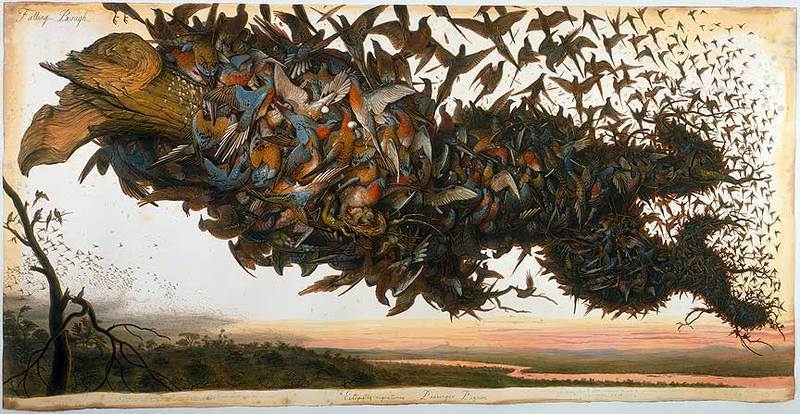
Birdshows were generally narrative, and featured a bird-made Morgan being chased through the streets by a soldier who was torn to bits by swans, though the swans were made of pigeons, and the soldier of flesh-colored plovers, his uniform of cardinals and crows. Swans would also be pursued through ghetto canyons by flying tigers made of orioles. These were his intentions for the birdshows, at any rate, but Zvominir would censor when the images betrayed but a hint of dangerous content, obscuring Morgan’s work with birdclouds, or worse, laughing babies made of birds. The audience found these touches psychedelic, and weren’t pacified so much as confused, so their passion turned to mumbles. The elder’s power over birds was superior, and Morgan couldn’t stop his father from suppressing the transgressive. It infuriated him.

Falling Bough -- Walton Ford

Zvominir isn’t the only authority figure prone to parental censorship; as the poor old man tries to keep his son safe by “suppressing the transgressive,” the Judge in turn does all in his power to keep his precious daughter Katherine blind and ignorant to the violence and inequality that has purchased her material comfort. However, Katherine meets and becomes fascinated by Morgan, just as the young man’s rebellious attitude comes to find definition and ideology thanks to the Gypsy rebel Jane. Jane harnesses Morgan’s raw anger, turning him into the figurehead of a Gypsy resistance against the Judge’s terrible regime. She literally ushers him into the Gypsy underworld, a surreal setting of nightplants and black markets and ecstatic ska music and donkeys, sprawling in a labyrinthine network of caves and caverns and tunnels under the unnamed city. From this subterranean site, Jane becomes mastermind of a terrorist plot to overthrow the fascist Judge:

They—we—were helpless, and we knew it. She would do to us what Hungary had done, but with stealth; this terror stuff is easy, she mused. Who needs armies? She was poor, and lived in sewers, so nothing could be taken but her life, while we had homes, jobs, children, hopes, dreams and possessions we adored, which all gave meaning to our lives. There was no end to that of which she could deprive us. Our privilege made us vulnerable.

Now seems as reasonable a time as any to remark upon the narrator of The Avian Gospels, as its pronouns color much of the passage I just cited. A first-person plural “we” tells the story, a “we” whose contours and guts alike become more evident as the book unfolds. Much of the joy (and bewilderment and occasional frustration) I felt reading The Avian Gospels came from puzzling out just who this “we” is. As the book progresses, it becomes clear that, like the collective first plural person who narrates, say, William Faulkner’s “A Rose for Emily,” the narrator is part and parcel of the storyis the story, perhaps—and that Novy’s dystopian vision is realized not just in the book’s content, but also in the telling of that content. Calling the narrator unreliable is beside the point; the narrator is the ideology itself that Novy critiques. Rebel Jane provides a very real ideological anesthesia to the narrator’s methods, the Judge’s power, and Morgan’s artistic ambitions:

. . . Jane felt suspicious of beauty, which trafficked in desire, not in justice, and left you lonelier and sadder. It made you feel worse in the guise of feeling better, and left you hungry for more beauty. Further. It enfeebled you politically, by pointing at some hypothetical catharsis, a transcendence that could not be achieved, for who could really say they had communed with a non-religious paradise of aesthetics? The beauty effect: a crescendo of nothing. Beauty distracted from things that were important—the rights of disadvantaged people—in the name of something it claimed was more important, and which didn’t actually exist. It was a cognitive conspiracy, a con that disempowered.

If Jane seems a bit shrewish—and what zealot isn’t?—it’s worth pointing out that her ideas might be the novel’s thesis, a thesis ironically couched in the very beauty that Jane would make us wary of. She’s the cold conscience in a book filled with passions. And she’s a terrorist.

While The Avian Gospels surpasses any allegorical schema we might try to impose upon it, it’s still very much a response to America’s post-9/11 zeitgeist. Novy’s Judge is a figure of malevolence glossed in benevolence. If he’s a sicko who takes dull delight in torturing Gypsies in his Boom Boom Room, he’s also a family man with problems that most of us can relate to. He’s an authoritarian who maintains order in a fractured society through violence and suppression—but he delivers what the suburban greenzoners want from a leader. So what if security comes at the expense of justice, and on the backs of a displaced population to boot?

The Gypsies, refugees from countless wars afflicting the world of The Avian Gospels, aren’t the only displaced persons in the narrative. Novy displaces the readers as well. The Avian Gospels erupts with uncanny moments where the material of our recognizable world overlaps with the crumbled reality of the narrative. Social structures, attitudes, cultural norms and ideals—these remain, more or less. But how to puzzle out a world where China, Bolivia, Angloa, and Oklahoma are among the nations that surround the unnamed city? Or where technology has regressed to the point that the automobile is a thing of the past? (Guns remain). And, uh, the birds, of course.

Novy’s dystopian novel skews more fantasy (or, more properly, magical realism) than sci-fi, but it’s the novel’s strange, shifting tones that most likely will paradoxically estrange and engage most readers. There’s a violent zaniness to The Avian Gospels, but the zaniness is never tinted with even a hint of whimsy. The first-person plural “we” that narrates the text juxtaposes dense, poetic images against the teenspeak of the street. At times, the narrator staggers into a mordant lament, only to retreat into cruel, blackly ironic prose. The effect is disorienting and compelling. Novy’s writing moves rhythmically with a complex energy that I’m faltering to describe. You should probably just read the book.

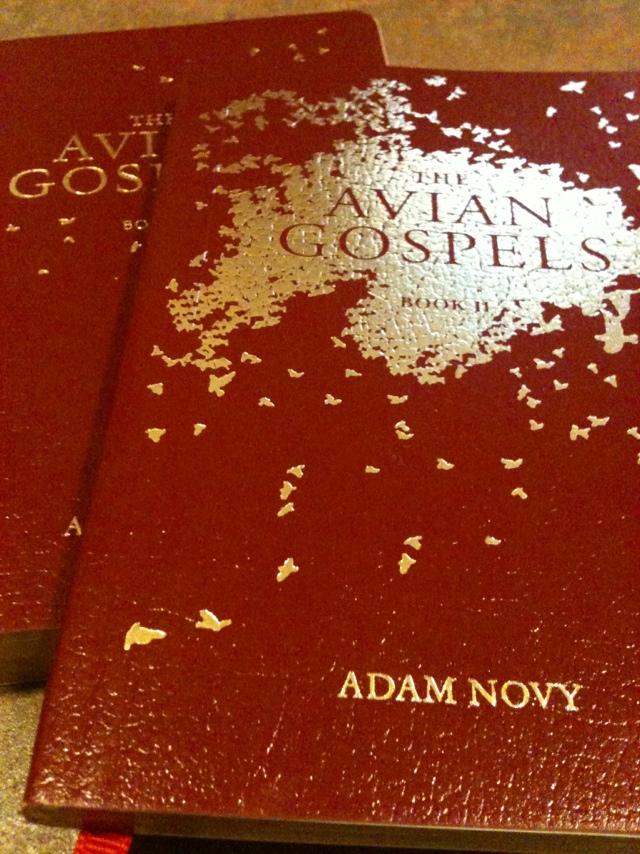
I’ve neglected thus far to comment on the actual physical books that comprise The Avian Gospels. They are beautiful, compact, oxblood volumes with gilded edges and bookmarks, reminiscent of Gideon bibles, I suppose, but more lovely. They’re also very small, the sort of thing that fits easily into a pocket or a purse. I love books like that.

The Avian Gospels deserves a place on the shelf (or in the pocket) of any fan of cult or dystopian novels. It’s a story about cyclical violence, power and powerlessness, and political and cultural repression. It’s also a story about family and parent-child relationships and what it means to love another person in the face of radical danger, a novel that foregrounds the very real stakes of rebellion, both Oedipal and political. It’s a strange book, one that offers little comfort to its readers and certainly proffers no simple answers. Deeply moving and highly original, I strongly recommend this book.

The Avian Gospels is available now from Hobart. Read my interview with Adam Novy.

Pastoralia — George Saunders

I read Pastoralia, George Saunders’s 2000 collection of stories very quickly, consuming one or two of the book’s six stories a night, usually wedged between other readings. There was a flavor of respite to these readings, a sense of ease or relaxation or—dare I say it—simple pleasure. Frankly, I’m suspicious of any book that I’m able to read very quickly; perhaps I’m prejudiced against any book that doesn’t pose (or impose) its own learning curve on the reader.
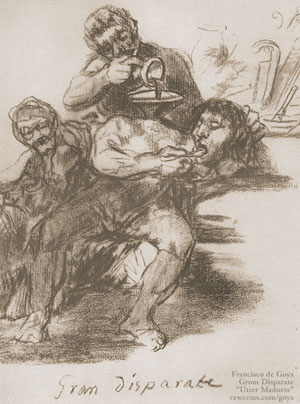
I’m perhaps off to a very bad start in this review, veering on the appearance of condescension (when, to be clear, I think that Pastoralia is sharp and wise and wicked and well-written and very, very funny)—but I feel like I have to get this out of the way up front: George Saunders’s prose, plots, and dialogue all reminded me very much of the prose, plots, and dialogue of David Foster Wallace.

A bit of objective data: DFW and Saunders are/were of a similar age (born in ’62 and ’58, respectively) and Infinite Jest and Saunders’s first collection, CivilWarLand in Bad Decline were published the same year (’96). But, because of the simple mechanical truth that I read Wallace much, much earlier than Saunders, I find his influence unduly there. No doubt that when I detect Wallacian curves and contours and rhythms in Saunders—the coupling of officialese with imaginary slang, the depiction of a postmodern America which is slightly (but only slightly) not our own, the analyses of power and fear and duty—when I find these points of comparison, what I am really finding is the shared influences of Wallace and Saunders (no doubt postmodernists like Pynchon, Barth, Barthelme, et al). In short, if I find a suspicious ease or comfort in Saunders, it’s because Wallace already taught me to read him. But like I said before, this is not a great start. I should just review the book.

Short review: the six tales in Pastoralia are hilarious, tender, and depressingly predictive of the decade that came after their composition (not to mention the strange dark horizon ahead of us). The long opener “Pastoralia” features a hapless man who works long hours apart from his wife and children in a failing history park. His job is to simulate a caveman, but his partner, an older woman with a troubled son, makes the job difficult to perform with any level of, uh, historical accuracy. When employees must be downsized, one of the managers tries to convince the narrator to rat out his partner’s shortcomings. “Pastoralia”  is a study in how corporate power uses dehumanizing tactics to exploit workers. The communications the narrator receives from a nebulous plurality of managers are both hilarious and horrific, each one a contortion of logic that serves to strip the rights (and self-worth) of the workers. The story, depressingly, is more relevant than ever. (Readers familiar with CivilWarLand in Bad Decline will recognize “Pastoralia” as a revision of sorts to that earlier collection’s title story).

The next tale, “Winky,” moves along the same lines, exploring the clash between the Darwinian drives of self-protection and self-satisfaction set against the needs of others. In this story, the protagonist attends a self-help seminar (the scene is something so contemporaneous with Wallace that I’s tempted to write “straight out of DFW”), where the psychobabble and rationalizing of the speaker persuades him to ditch his weird, needy sister. Like the complex and funny managerial rhetoric we find in “Pastoralia,” the motivational lingo lulls and persuades not just the protagonist, but also the reader, into the easy trap of contemporary consumerism that centers the self as the ultimate telos of existence.

“Sea Oak” is the possible high point in the collection. It depicts an ersatz family living in a housing project that at one point we might have described as “on the margins of America” — only in Saunder’s vision (a vision increasingly realized) such housing projects are the reality for the majority of Americans. The middle class is not the norm. The (male) narrator strips to help bring money into the crappy apartment he shares with his aunt and two cousins and their two kids. A sample—

Sea Oak’s not safe. There’s an ad hoc crackhouse in the laundry room and last week Min found some brass knuckles in the kiddie pool. If I had my way I’d move everybody up to Canada. It’s nice there. Very polite. We went for a weekend last fall and got a flat tire and these two farmers with bright red faces insisted on fixing it, then springing for dinner, then starting a college fund for the babies. They sent us stock certificates a week later, along with a photo of all of us eating cobbler at a diner.

The hyperbolic vision of a Canada that cares for all of its citizens stands in sharp relief to the predatory Darwinism of the Sea Oak projects. As the story unfolds, Saunders uses his characters to examine just what exactly economic struggle in American is for—what does the American Dream mean when subsistence living alone is so difficult?

“The End of FIRPO in the World” is perfection, a sad, funny, rambling stream of consciousness that plumbs the mind of an alienated boy who imagines his future glories and the revenge that he will have for all the slights done him. “FIRPO,” sitauted in the middle of collection, moves the book from the familial and corporate to the individual, as the last few tales (“The Barber’s Unhappiness” and “The Falls”) inhabit the strange sad consciousness of ordinary, awful people. These are beautiful portraits, ones that explore the gravity of failure and the small glowing sparks of redemption that might be available to us.

If, as I remarked earlier, there’s a comfort in Saunders’s prose, it’s the strange uncomfortable comfort that there’s a perceptive and wise intelligence out there that can apprehend and satirize the sheer horrific injustice that pervades the modern condition. Pastoralia is great, and I picked up CivilWarLand in Bad Decline right after finishing it, so there’s an endorsement. Recommended.

The Third Reich: Part III — Roberto Bolaño

As a means of plot summary, here’s an excerpt from my review of the second part of Roberto Bolaño’s novel The Third Reich (serialized this year by The Paris Review and forthcoming in hardback from FSG (uh, the Bolaño’s book, not my review, of course))—
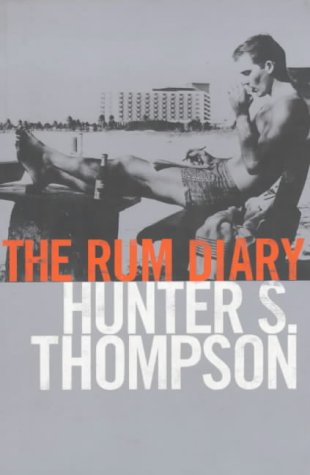

If 2666 impossibly haunts The Third Reich from the future, then paranoid Poe haunts it from the past. Last time we checked in, Udo Berger and his beautiful girlfriend Ingeborg had made tentative friends with another German couple while spending the summer at a seaside resort in Spain. Through this pair, they meet up with two nefarious locals, the Wolf and the Lamb; Udo also begins obsessing over a man named El Quemado, a burn victim who rents paddle boats to tourists. For Udo, the holiday is meant to be a working vacation—he’s a wargame enthusiast, and he plans to write a defining strategy for a new game called “The Third Reich” (implicitly, he plays the Nazi’s side). In the meantime, he’s also taken with the hotel’s owner, Frau Else, a German transplant who mysteriously disappears to take care of an ill husband who no one seems to see.

The third installment of The Third Reich amplifies Udo’s paranoia and isolation. He spends most of his time playing Third Reich with El Quemado, and although he assures his best friend Conrad, via telephone, that he’s beating the burned man, we see his control (and sanity) slipping away. Udo seems unconcerned that Conrad has been comforting Ingeborg, probably because Udo is still trying to bed Frau Else, who has mysteriously disappeared in this third chapter. When he’s not busy sleeping nightmarish sleep or lurking around the hotel at night, Udo picks fights with the night-watchman; clearly, he’s outlasted his welcome in this tourist town.

This section of The Third Reich is shorter than the first two, and although I’ve enjoyed reading the novel in pieces, it’s with this section that the strain of serialization begins to show. Bolaño’s slow-burn Lynchian dread is clearly climaxing here, and it’s unsatisfying to have that suspense interrupted. It’s also unclear how The Third Reich will resolve, or if it will resolve—Bolaño isn’t exactly one to neatly tie up loose ends—but I’m hoping that we’ll get to learn more about El Quemado’s strange motivations, and get another glimpse of Frau Else’s husband. We’ll see soon—the winter issue is out soon with the final installment.

Hey, We Reviewed That Book The Rum Diary by Hunter S. Thompson, the One That Hollywood Turned into a Johnny Depp Movie

Set in the 1950s, Hunter S. Thompson’s second novel The Rum Diary chronicles the drunken misadventures of Paul Kemp, a journalist who moves from New York City to Puerto Rico to write for a small newspaper. While there, Kemp gets involved with a crazy couple who fight all the time (he develops a serious crush on the girl), attends a rum festival, and winds up in jail. Along the way there’s enough drinking to put Hemingway’s characters to shame, and plenty of nude swimming to boot.

Although The Rum Diary was written in the early sixties, it wasn’t published until 1998, long after the infamous gonzo godfather had made his indelible mark on the American literary consciousness. Thompson was 22 when he wrote The Rum Diary, a significant eight years younger than his stand-in in the novel, jaded journalist Paul Kemp. And while it’s easy to imagine that HST was born a cranky old man, at times Kemp’s world-weariness reads more like an affected pose rather than an earned cynicism.

The novel works best when HST focuses on denigrating the cretins, phonies, perverts, and degenerates that are never in short supply in his sick universe. Where the average travel writer might see a joyous festival throbbing with life and humanity, HST finds dread and disgust, fear and loathing. His frenzied yet steady prose moves quickly, adding to the general manic tone of the novel, and, despite its 200+ pages, The Rum Diary is an easy weekend read. Additionally, HST’s reflections on American imperialism and tourism in general remain relevant and fresh over forty years later.

The Rum Diary is hardly the HST starting place, but this is quite obvious (if, dear reader, this is not obvious to you, get thee to a bookstore posthaste and obtain Fear and Loathing in Las Vegas). However, for casual fans The Rum Diary will make an interesting beach read. Apparently a movie featuring HST friend-alum Johnny Depp (as Paul Kemp) is slated to come out next year, so stay one step ahead of Hollywood by reading this now. Recommended. [Editorial note: Yes, this review is a few years old. There’s a movie now, clearly].

Why I Abandoned Chad Harbach’s Over-Hyped Novel The Art of Fielding After Only 100 Pages

Genre fiction gets a bad rap from some readers and critics because it often rigidly follows a set of formal conventions, from plot to character to prose, to satisfy reader expectations. One mark of literary fiction, in opposition to genre fiction, might be that the literary work disrupts or destabilizes these conventions (works that get called experimental tend to explode these conventions or radically recombine them). Harold Bloom, in The Western Canon (and elsewhere), argues that it is the strangeness and originality of a work that confers its literary power; in some cases, he argues, this strangeness assimilates us (the readers, the culture) to the point that we can no longer recognize its strangeness. While Bloom may be a pompous windbag (and really, what literary critic worth his salt isn’t?), and I don’t always agree with him (especially in his unrelenting agon with “The School of Resentment”), I think he’s given us a good rubric by which to measure or understand what sets great literature apart from the ordinary, the conventional, the ephemeral.

I bring all of this up because it seems to me that literary fiction is its own genre, one with its own conventions, tropes, and formulations. The genre of literary fiction is as much a marketing tool, of course, as it is a set of conventions, and publishers release these books because the author’s Great Ambition and Sterling Prose and Big Ideas (in theory) cast esteem back on the publisher. And while there are plenty of great books with major houses behind them, many books claiming to be “literary fiction” are simply conventional retreads of an antiquated formula, outfitted in the grand themes of the day (these days, that tends to “identity”). These books offer no strangeness, make no attempt to open the realm of literary possibility. They are intellectual comfort food. And there’s nothing wrong with that, just as there’s nothing wrong with a good mystery novel. But I think we lie to ourselves when we overinflate the powers of our “literary” novelists. I enjoyed Jeffrey Eugenides’s middlebrow Middlesex as much as the next lad, for example, but still find it wildly overrated. Another example: Michael Chabon is not my cup of tea, but I wouldn’t argue against his talent. Still, even when he attempts the strange (The Yiddish Policemen’s Union, for example), he’s blandly trying territory already colonized by others. Give me Philip K. Dick or George V. Higgins any day.

My favorite novels tend toward strangeness; they upset or confound or baffle me. I love it when I have no idea what the novelist is doing. And while reckless innovation or experimentation for its own sake can sometimes fall flat (or fall apart), an interesting failure is better than another complacent, forgettable entry in the non-canon of contemporary “literary fiction.”

Which brings me to Chad Harbach’s wildly over-hyped novel The Art of Fielding.

Let me be up front: Yes, this is backlash. The acclaim directed at this novel deserves backlash—although I’d like to be clear up front that I’m not trying to attack the novel itself; that would be like attacking a run-of-the-mill sci-fi novel for indulging in run-of-the-mill sci-fi tropes. My aim is simply to point out that Harbach’s book is no great feat of literature, no work of astounding genius—it’s just run-of-the-mill literary fiction. And yes, I didn’t read past page 100, which conveniently is the last page of chapter 11. Why would I slog it out through 400 more pages when there are so many great books in the world that I haven’t read and precious little time in which to read them? And that’s the point of the rant that follows.

The book is not entirely terrible. It just isn’t very good, certainly not good enough to warrant the excessive praise that’s been heaped upon it. Cardboard characters, cliché after cliché (plot, character, prose), and plenty of bad writing. The dialogue is particularly heinous; I’m fine with unrealistic speech, but Harbach lacks subtlety or style. In fact, the book lost me on page 18, when the character Owen Dunne introduces himself to the protagonist Henry Skrimshander with this groan-inducing nugget: “My name’s Owen Dunne. I’ll be your gay mulatto roommate.” I suppose that the line is meant to be heard in a perhaps ironically self-reflexive sense—a metafictive gesture that extends from Dunne to the audience, like a knowing wink (and bypassing poor boring Henry), but it strikes me instead as utterly tone-deaf, showing us nothing about Dunne and his (supposed hip) cleverness and everything about Harbach’s inability to create concrete, real characters.

Dunne is a particularly grating character in a novel full of grating characters. The worst aspect of this character is that he is presented as an intellectual, but Harbach fails to harness his intellect in the text. We are told the names of some of the authors in his library; we hear some of his pretentious speech; he tells us how smart he is, and one senses that Harbach would have us believe him—only at no point in the first 100 pages are we treated to any real aspect of his intelligence. Critics, or people who write about books, have bent over backwards to call Fielding a smart book, to liken it to Jonathan Franzen or David Foster Wallace or, Jesus Christ, even Herman Melville. But Dunne is the simplest illustration that Harbach’s bench isn’t very deep; there is nothing here to approximate the mind of Hal Incandenza or the heart of Don Gately; there’s certainly no one here on par with Ishmael. But this is hardly Harbach’s fault, of course. Who can make an Ishmael?

If I appear to be attacking Harbach, please let me clarify: I think that he’s written a passable novel in the genre of “literary fiction” (which I contrast here now, for the sake of clarity, with strong literature or even canonical literature, if you like). But this book isn’t another Infinite Jest or Moby-Dick (as if one could even speak of “another” Moby-Dick); it isn’t even in the same league, and its champions do it no favors in overpraising it.

Let’s take a peek at some of that purple praise:

Here’s Michiko Kakutani in The New York Times, who, granted, manages to be wrong about almost everything all the time, but her gushing here is especially egregious—

Chad Harbach’s book “The Art of Fielding” is not only a wonderful baseball novel — it zooms immediately into the pantheon of classics, alongside “The Natural” by Bernard Malamud and “The Southpaw” by Mark Harris — but it’s also a magical, melancholy story about friendship and coming of age that marks the debut of an immensely talented writer.

Mr. Harbach, a co-founder and co-editor of the literary journal n + 1, has the rare abilities to write with earnest, deeply felt emotion without ever veering into sentimentality, and to create quirky, vulnerable and fully imagined characters who instantly take up residence in our own hearts and minds. He also manages to rework the well-worn, much-allegorized subject of baseball and make us see it afresh, taking tired tropes about the game (as a metaphor for life’s dreams, disappointments and hopes of redemption) and injecting them with new energy. In doing so he has written a novel that is every bit as entertaining as it is affecting.

She gets a few things right: Harbach’s characters are “quirky,” in the completely-unrealistic-and-totally-annoying sense; also, yes, the book is full of “tired tropes.” But the rest? I metaphorically throw up in my brain when I read her claim that these “vulnerable and fully imagined characters . . .  instantly take up residence in our own hearts and minds.” Get me the fuck out of your pronouns, Kakutani. Because Kakutani’s honeyed spewing was not enough, for some reason, the Times ran another glowing review just a few days later, where Gregory Clowes suggests—

Measured against other big, ambitious debuts by striving young writers (Harbach is a founder and editor of the literary magazine n+1), “The Art of Fielding” is surprisingly old-fashioned and almost freakishly well behaved. There’s some strained humor in the early going, when Harbach seems unsure of his register, but once he settles into a mildly satiric mode of psychological realism — the mode of latter-day Jonathan Franzen, rather than the high turbulence of David Foster Wallace — the book assumes an attractive, and fitting, 19th-century stateliness.

Franzen, whose blurb blazons Fielding’s cover, is an apt comparison (over-hyped, turgid, boring, middle class, middlebrow). And even though Wallace’s The Pale King was over-hyped in the wake of his suicide, I think the Franzen/Wallace disjunction is informative here: Wallace’s work is challenging, disruptive, strange.

When Clowes points out how “old-fashioned and almost freakishly well behaved” Fielding is, he signals the same sense of comfort that Kakutani finds in the work: Like most middling works of the “literary fiction” genre, Fielding provides its audience a sense of comfort, a confirmation that the literary constructions (and worldviews) of yore still exist.

Clowes then brings up the Herman Melville references in Fielding, which aren’t so much allusions as they are lazy infodumps about more interesting books. At least Clowes has the good sense not to find parallels between Melville’s grand, strange writing and Harbach’s bland business, unlike Ellen Wernecke at The AV Club, who wrote—

Harbach takes plenty of cues from other great baseball novels, like Bernard Malamud’s The Natural and Philip Roth’s The Great American Novel, but more so from Melville, in a display of cleverness that wraps around Westish life.

Harbach’s “display of cleverness” is absolutely the problem. Who wants a display of cleverness? To me, the first fifth of Fielding reads like a self-congratulatory wankfest of cleverness, where the audience is invited to alternately smirk or nod sagely (blankly), with protagonist Henry playing the small town rube (butt of the joke) and the fish out of water (audience surrogate in what is supposed to be the fascinating world of Westish, a stand-in for Harvard in the Midwest, which, let me just stop to say, is one of the more unconvincing settings I’ve ever read). There is no challenge to the reader; even worse, Harbach seems to rely on some sense of fellow-feeling or shared common ground from his readers to land his points. Home games are always easier. The reward Harbach offers seems to be a simple reconfirmation of the forms and tropes and tired language of the “literary fiction” genre.

I detest negative book reviews as much as I hate overpraise, so let me conclude by offering a short list of relatively contemporary books (past thirty or fifty years) that I think will challenge readers who want more from their novels than a retread of the old-fashioned and well behaved: Roberto Bolaño’s 2666, Renata Adler’s Speedboat, David Foster Wallace’s novels and short stories, Cormac McCarthy’s novels (especially Blood Meridian and Suttree), Russell Hoban’s Riddley Walker or Kleinzheit, Barry Hannah’s Airships and Ray, anything by W.G. Sebald, William T. Vollmann’s The Rifles or Butterfly Stories, Sam Lipsyte’s The Ask,  Lars Iyer’s Spurious, PK Dick’s The Man in the High Castle, Gordon Lish’s short stories, Denis Johnson’s Angels, Thomas Pynchon’s V, Don DeLillo’s Underworld or White Noise . . . but now I am riffing wankerishly—never my intent here. Just didn’t want to end on a negative note. I’d love to hear what I missed on this list.

Trans-Atlantyk — Witold Gombrowicz

Witold Gombrowicz’s semi-autobiographical novel Trans-Atlantyk is a slim, bristling work that dances out over a mere 122 pages with a force that simultaneously exhausts and engages. Our hero is the eponymous Gombrowicz, a Polish intellectual who travels via pleasure cruise to visit Argentina. The ship arrives to the near-immediate news that the Nazis have occupied Poland. Most of the dutiful, patriotic Poles clamber back on the ship; Gombrowicz, doubling the real-life author, elects to stay in a self-imposed exile. None of the reasoning or rationale behind these decisions is made especially clear (indeed, I had to glean much of the reasoning for these events from the book’s introduction). Here is how the scene plays out in Gombrowicz’s strange syntax—

Then would I fain have fallen on my knees! Albeit I did not fall at all, just quietly began to Curse, Damn mightily but only to Myself: “Sail, sail, you Compatriots, to your People! Sail to that holy Nation of yours haply Cursed! Sail to that St. Monster Dark, dying for ages yet unable to die! Sail to your St. Freak, cursed by all Nature, ever being born and still Unborn! Sail, sail, so he will not suffer you to Live or Die but keep you for ever between Being and Non-being. Sail to your St. Slug that she may ever the more Enslime you.” The ship turned aslant now and was moving off so this I likewise say: “Sail to that Madman, to that St. Bedlamite of yours—oh, haply Cursed—so that he may Torment, Torture you by those leaps and frenzies of his, drown you in blood, howl at you and by his Howling howl you out, by Torturing torture you, Children of yours, wives, to Death, to Agony—in agony himself, in the agonies of Madness Madden you, O’ermadden you!” With this Curse, turning my back on the ship, I entered the Town.

The passage, which I encourage you, gentle reader, to read again (go ahead, I’ll wait), showcases much of Trans-Atlantyk’s strange power: the archaisms, the snaky syntax (Gombrowicz repeatedly delays his predicate verb or even his subject, burying them at the end of the sentence), the bizarre capitalization, the acid humor, the bloody pathos, the impossible tone. So many of the book’s conflicts are laid bare in this passage. We see the essential conflict of an individual vs. the culture and society that would claim him as its mouthpiece; we find Poland, “that St. Monster Dark,” that cursed “St. Slug” forever trailing behind the rest of Europe, playing out the fight between tradition and modernism; we find the conflict of the exile, projected through the distortion of a fun house mirror, smacking back on our narrator who himself is now cursed “for ever between Being and Non-being.”

Trans-Atlantyk was composed during and after WWII, and much of the madness inherent in its themes became normalized during this time. As if to call attention to these psychic disjunctions, Gombrowicz writes Trans-Atlantyk in the mode of the gawęda, an antiquated form of Polish folk narrative popular with the rural nobility. Gawęda, oral in scope and tradition, emphasizes inner-textual creation, randomness, digression, alliteration, and, above all, energetic narrative freeplay—features Trans-Atlantyk displays with remarkable force. Gombrowicz uses this idiom in a celebratory mode, showcasing the possibility and liveliness of language, but he also ironizes language itself: Trans-Atlantyk might be read as a sustained attack on Poland’s obsessions with archaic tradition, as well as an attack on patriotism and patriarchal authority in general. In the 1994 translation I read, Carolyn French and Nina Karsov render Gombrowicz’s pseudo-gawęda in a kind of 17th or 18th century English style—and they do so to grand effect. Their “Translator’s Note” is perhaps the most instructive piece of scholarship on how translation happens that I have ever read. It’s worth the price of admission alone. And while I do not possess the skills to read the book in its original Polish, I imagine that French and Karsov have accurately and faithfully telegraphed the spirit of Gombrowicz’s novel.

If we return briefly, kind reader, to the excerpt above, we find our hero penniless and cursed, heading into town. Here he finds an odd non-home among the Polish ex-pats, who humorously call the Argentinians “aliens.” (Gombrowicz repeatedly stages scenes that show the extreme disconnection between the Poles and their New World surroundings; it is as if these Europeans are unable to comprehend that they are in the midst of a culture other than their own). Unsure of what to do and fearing the stigma of being a traitor (and, honestly, broke), Gombrowicz heads to the Polish Legate, essentially to turn himself in, but also in the hopes of gaining some kind of employment. He meets with the Polish Minister in a scene that is hilarious but, in its historical irony, also shocking and sad. The Minister is something of a mouthpiece for the Polish attitude that Gombrowicz satirizes—

He drew a breath. Did flash his eye. Did say: “We will, by my troth. I say this to you, and I say this so you cannot say that I was saying that we would not Vanquish, since I say to you that we will Vanquish, will Win, for we will reduce to dust with our mighty, gracious hand—smash, crush to dust, powder, with Sabres, Lances, anatomize, annihilate, and under our Colours and in our Majesty, oh Jesus Maria, oh Jesus, oh Jesus . . . we will grind, Kill! Oh, we will kill, anatomize, demolish! And why are you staring so? I tell you indeed, we will annihilate! Indeed you can see, you can hear the Minister himself, the Gracious Envoy is telling you we will Annihilate; perchance you can see that the Envoy himself, the Minister, is pacing here before you, waving his hands and telling you that we will Annihilate! And don’t you dare bark thus: that I didn’t Pace before you, that I didn’t Say, as you see that I do Pace and Say!”

The minister’s phallic aggression, bound in two of the book’s motifs—walking and speaking—reveals the deep paranoia that seethes under the surface of the ex-pat community; indeed, it’s this very paranoia that drives Gombrowicz to the Legate in the first place. In any case, Gombrowicz soon finds a job as a bank clerk, although the specifics here are a bit murky. The real-life Gombrowicz worked as a bank clerk for years in Argentina, famously saying that the job gave him the freedom to write while his boss wasn’t looking. Thankfully, Trans-Atlantyk spends little time in its protagonist’s workplace, but I think it’s worth sharing one of the few passages about office life in the book. There’s a Kafkaesque scope to Gombrowicz’s observations about the modern office, an innate realization of the dehumanizing aspects inherent in bureaucracy, but also a strong vein of absurd humor—

Amidst these rustlings I slightly opened the door that led to the next Room. A big room, long and Darkish, and a row of tables at which clerks sit, over Promissory Notes, Ledgers, Folios studiously bent; and such a number of Papers, so lumped, Swamped that you can hardly move, for likewise on the floor there a multitude of papers and old scribblings; and Ledgers from a cupboard protrude and even to the ceiling heave, out onto the windowsills bulge and swamp the Office. So if any of the clerks moves, he rustles as a Mouse in these papers.

The description continues, Gombrowicz marking the ways  in which the clerks remain at their desks even to eat. As the passage reaches its conclusion, the scene described might take place in any contemporary office—

Whereupon Tea was brought in, viz. Mugs with coffee and buns on a tray, and then all the clerks, having paused in their work, set upon the food. And anon, as usual, discourse sounded. I was overcome by laughter at the sight of that Coffee Drinking of those clerklets! Since at first sight one could see that, for years, sitting together in this Office, every day the eternal Coffee drinking and the eternal Bun munching, with these same old jokes treating themselves, they at once all there was of theirs was comprehended.

So much of contemporary life is there: its mundane rituals, its mechanical repetitions, its pathetic consolations. If Gombrowicz feels contempt for the idea that an individual owes a duty to society, that contempt extends right into the workplace.

Yet I’m barely scratching the surface here. The real plot of Trans-Atlantyk—and bear in mind, kind reader, that this plot hurtles or waltzes or jerks through its motions, rarely employing conventional narrative sequencing signals; rather, we have here a picaresque of sorts, a constant deferral of clear meaning—the real plot of Trans-Atlantyk (if such a thing exists) careens around a good old-fashioned duel. Somehow our hero falls into this intrigue, which results when a senior Polish man finds his honor assaulted. What assaults his honor? The lascivious intentions of a notorious and wealthy homosexual Argentinian on said senior Pole’s son. It’s easy here to frame the conflict in any number of dualities: Euorpean vs. New World, patriarchal tradition vs. homosexual outsider, familial order vs. alien anarchy. But there’s more to the conflict than mere duality. The homosexual Gonzalo, with his predatory designs on the Pole’s teenage son, comes to embody himself that core conflict of “Being and Non-being,” a figure whose conceptual impossibility reflexively engenders new and untold possibilities. Here’s our narrator’s description—

Ergo methinks: And what is’t? Where am I? What do I do? And from him would I have fled long ago, yet sorrowful sore was I to desert my only companion. For a Companion he was. Yet, when by the Tree he so together with me, I feel somewhat discomfited as neither Fish nor Fowl. Viz. hairs black, manly he had on his hand, but this hand—Dimpled, White, dainty Hand . . . and likewise perchance foot . . . and although a Cheek dark with shaven hairs, this Cheek of his charms and coquettes as if ’twere not Dark but indeed white . . . and likewise Leg though Manly as if ‘twould be a Dainty leg and Charms in curious caprices . . . and though head of a man in his prime, bald at the brow, Wrinkled, this head as if slips off a head, seeking to be a dainty head . . . So he as if fain would not himself Transforms in the silence of the night, and now you wit not whether ’tis He or She . . . and perchance, being neither this nor that, he has the aspect of a Creature and not a human . . . He lurks, the rascal, stands, says naught, and only at his Boy silently gazes. So I think, what the Devil, Werewolf, and wherefore I here with him . . .”

Notice how this in-betweener, this “Werewolf” recapitulates the perception of his own indeterminacy back on our narrator, who feels “discomfited as neither Fish nor Fowl.” This radical ambiguity plays out through the remainder of the novel, which alternately writhes, skips, and dances in an exploration of a world without fixed meaning, or, perhaps more accurately, a world where all meaning must be questioned, weighed not just in words and books but also in blood. Trans-Atlantyk ends in an explosion of radically ambiguous laughter, a gesture of hilarity and violence, joy and ridicule—it is a laughter that might claim the reader as its object or, perhaps, invite the reader to laugh along.

Trans-Atlantyk is a marvelous dare to readers, a work of language invention on par with the best in late modernism. Like any work that creates and enacts its own idiom, Trans-Atlantyk poses a learning curve that will doubtless frustrate or intimidate many readers. But its rewards are plentiful for those willing to trek through its anarchy and slip unresisting into its chaos. Recommended.