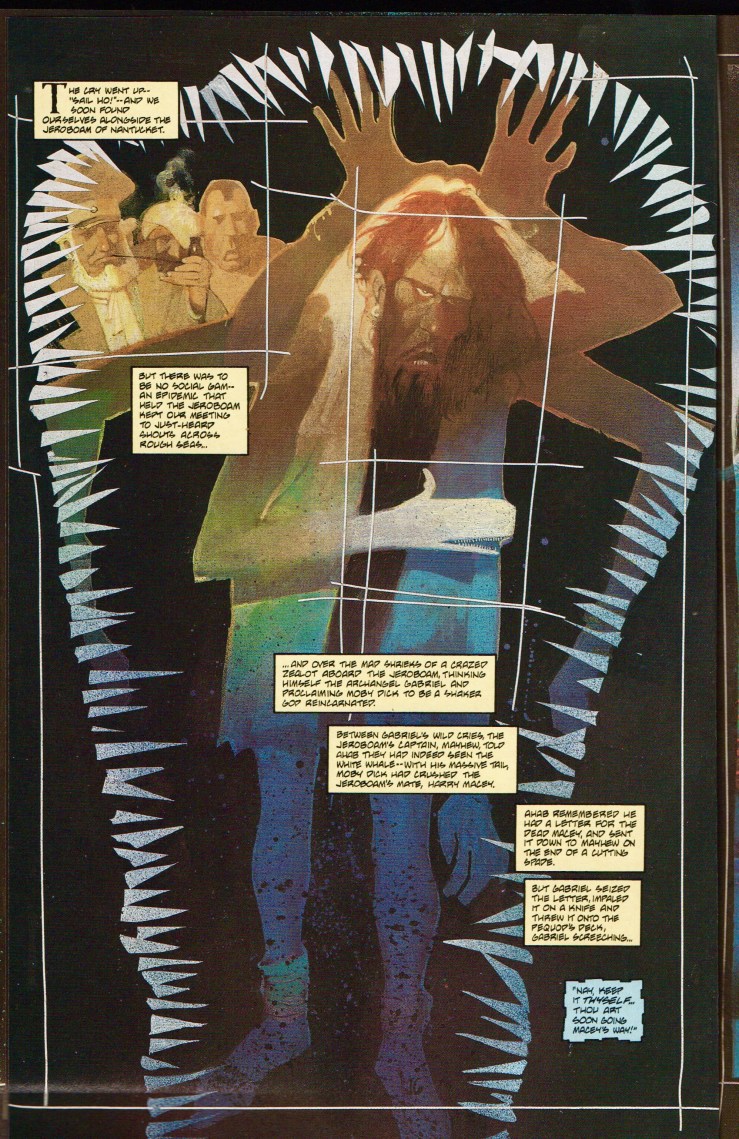
A page (and some details) from Bill Sienkiewicz’s adaptation of Herman Melville’s Moby-Dick. The Classics Illustrated edition (February 1990) is one of my favorite Moby-Dicks.
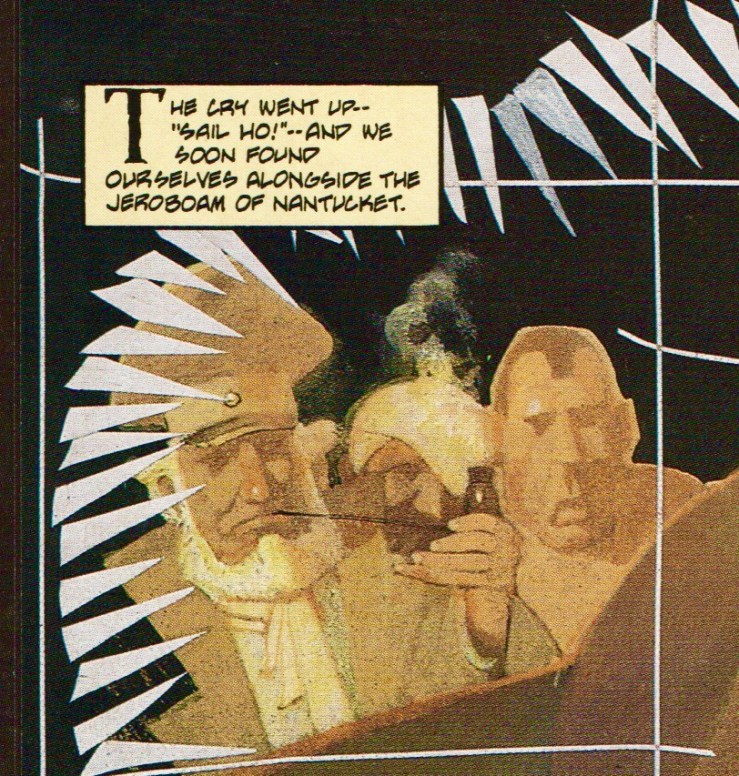
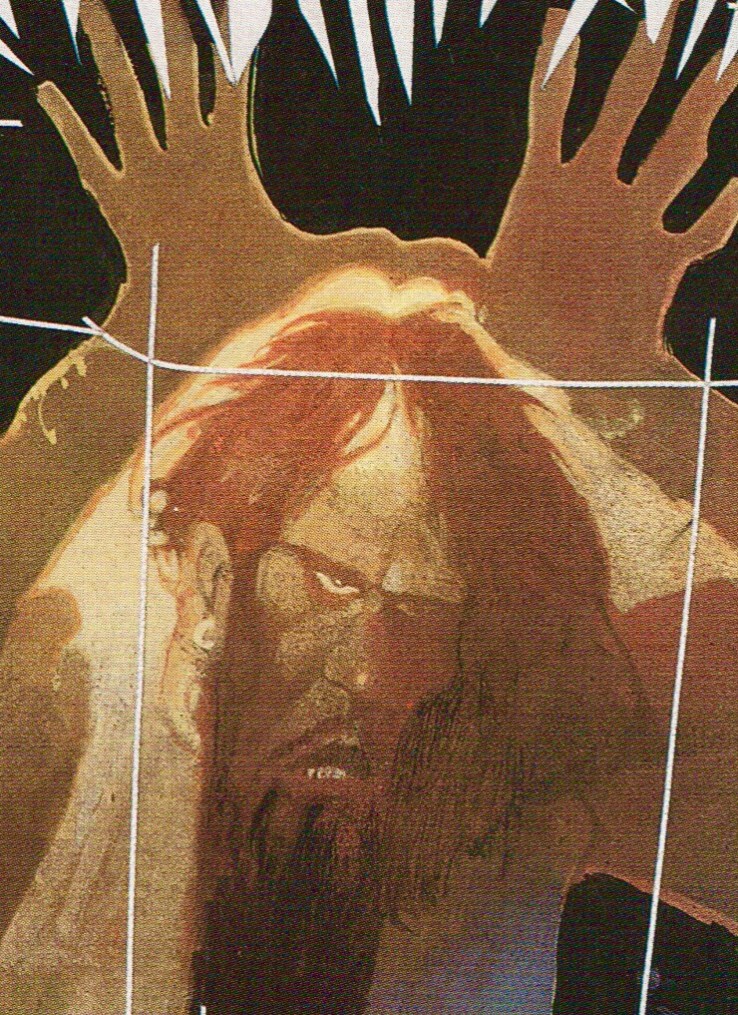
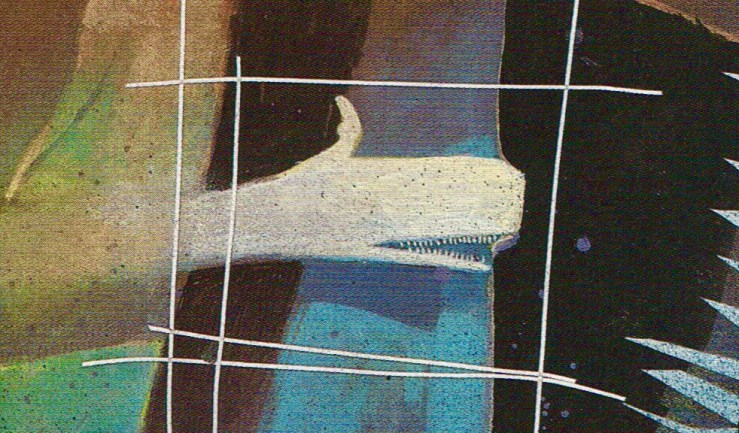

A page (and some details) from Bill Sienkiewicz’s adaptation of Herman Melville’s Moby-Dick. The Classics Illustrated edition (February 1990) is one of my favorite Moby-Dicks.
I am in a mood that gets more and more familiar: words lose their meaning suddenly. I find myself listening to a sentence, a phrase, a group of words, as if they are in a foreign language—the gap between what they are supposed to mean, and what in fact they say seems unbridgeable. I have been thinking of the novels about the breakdown of language, like Finnegans Wake. And the preoccupation with semantics. The fact that Stalin bothers to write a pamphlet on this subject at all is just a sign of a general uneasiness about language. But what right have I to criticize anything when sentences from the most beautiful novel can seem idiotic to me?
… I made tea, and then I remembered a story that was sent to me last week. By a comrade living somewhere near Leeds. When I first read it, I thought it was an exercise in irony. Then a very skilful parody of a certain attitude. Then I realized it was serious—it was at the moment I searched my memory and rooted out certain fantasies of my own. But what seemed to me important was that it could be read as parody, irony or seriously. It seems to me this fact is another expression of the fragmentation of everything, the painful disintegration of something that is linked with what I feel to be true about language, the thinning of language against the density of our experience.
From Doris Lessing’s novel The Golden Notebook.
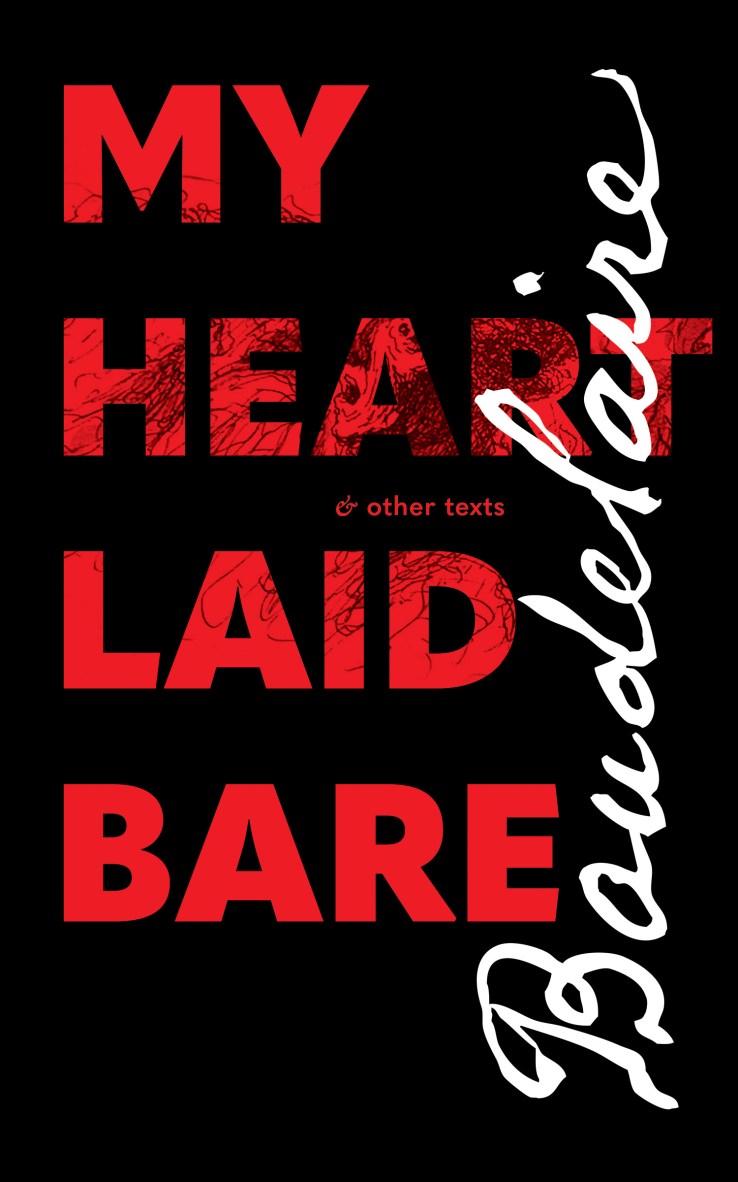
Rainer J. Hanshe is the translator of My Heart Laid Bare & Other Texts, a collection of writings by Charles Baudelaire, new from Contra Mundum Press. Over a series of emails, Hanshe was kind enough to talk to me about My Heart Laid Bare, Baudelaire, dandyism, translation, art, stealing books, and all other manner of topics.
Biblioklept: What is My Heart Laid Bare? Did Baudelaire envision its publication in his lifetime?
Rainer J. Hanshe: The title My Heart Laid Bare is Edgar Allan Poe’s, and it’s he who conceives of a book that, if daring enough, if ‘bare’ enough, could revolutionize human thought, opinion, and sentiment. This could be achieved, Poe said, “by writing and publishing a very little book. Its title should be simple — a few plain words — ‘My Heart Laid Bare.’ But this little book must be true to its title.” Baudelaire took up Poe’s provocation and his Mon cœur mis à nu is one of a number of different books that he dreamt up and hoped to write “without lassitude — in a word to be in good heart day after day.” Others Baudelaire mentioned along with it in an 1864 letter included Histoires grotesques et sérieuses, Les fleurs du Mal, Le spleen de Paris, Les paradis artificiels, Contemporaines, and Pauvre Belgium! The first notes for Mon cœur mis à nu begin in 1859, two years after the initial publication of The flowers of Evil, if not possibly somewhat earlier, and continue until 1865, ceasing only due to Baudelaire’s severe health condition (he would die in 1867 at just 46 years of age), hence they comprise the final decade of his writing life.
Aside from the more direct root of Poe, Rousseau was another of Baudelaire’s models, albeit a negative one to surpass. Baudelaire said that “all the targets of [his] rage” would be collected in Mon cœur mis à nu. “Ah! if ever that sees the light of day, J-J’s Confessions will seem pale.” As I describe in the synopsis, it is an apodictic work of aphorism, maxim, note, and extended reflection. It is not however some memoir-like spewing of Baudelaire’s bios; rather, it is the baring of his l’esprit, and as a crystallization of such, it isn’t some kind of ‘tell-all exposé’ (Rousseau’s notion of absolute transparency, an indulgence we could well do without, especially considering its pernicious ramifications), but to me a much higher form of ‘confession,’ for it is the arc of thought, the play of the mind in its every breadth that is bared. It contains Baudelaire’s exhortations on work, faith, religion, and politics, excoriating sociological analyses, diatribes on literature, the arts (George Sand receives some choice malicious arrows), and love (women, prostitution, sadomasochism, erotics en générale), and outlines of his conception of the dandy and the Poet.
The Poet for Baudelaire is I would say a figure similar in kind to Nietzsche’s untimely personage, the posthumous human, a kind of philosophical anthropologist who hovers over the earth, examining the human species both from within and externally, from a sub species aeternitatis perspective, diagnosing it like a physician (much of the book’s terminology is medical taxonomy).
In 1861, two years after beginning Mon cœur mis à nu, sieged by resignation, calumny, and ill health (nervous disorders, vomiting, insomnia, fainting fits, recurrent syphilitic outbreaks), Baudelaire expresses doubt that he will ever complete his various projects. “My situation as regards my honor, frightful — and that’s the greatest evil. Never any rest. Insults, outrages, affronts you can’t imagine, which corrupt the imagination and paralyze it.” Three years later, it was against the continuing extremities of an exacerbated solitude, frayed nerves, self-described terrors, and constant hounding by creditors that Baudelaire implored himself to remain stalwart (“I must pull myself together, take heart! This may well bring rewards.”) and write.
Clearly, he did envision publishing the book in his lifetime, and he diligently worked at it, steeling himself against his trials to the degree within his power, but it was never completed. The obstructions he faced were abundant; the somatic afflictions inordinately taxing. The threat of his impending decline or decay is sharply articulated in one passage wherein he speaks of “feeling the wind of the wing of imbecility” passing over him. Various translators have rendered that as “the wing of madness,” but Baudelaire says “imbécillité,” not folie or démence. The notion of “the wing of madness” has greater Gothico-Romantic cache, but it’s not what Baudelaire says, and in this case, there’s a relatively exact equivalence of terms. It was more physical weakness and feebleness that he feared, and experienced, and believed would finally incapacitate him, as it did, not madness. His aphasia and heart attacks led to his losing his ability to speak and thereafter, his ability to read and write — the death of the writer.
We have only the existing fragments then, which have been translated in full, but they were published posthumously. Despite no such title existing in the text, or any related material, French editors originally published the work as “Journaux intime” (Intimate Journals), which included two other sections, “Fusées” and “Hygiène.” Translations into English followed suite, and they adopted the false title, which must at last be discarded. If Baudelaire hadn’t been besieged by illnesses as he was, he would have imaginably given us a definitive version of Mon cœur mis à nu considering that he did complete other books he began around the same period (Le spleen de Paris, Les paradis artificiels, et cetera). It remains a fragmentary work then, in both senses, yet one that is substantive enough to merit our continued attention.
Biblioklept: For me, the fragmentary nature of My Heart Laid Bare is in some ways more appealing than the cohesion of a more polished philosophical or poetic text. It’s a discursive read, and there’s joy in tying (or failing to tie) the fragments together. This reading experience is perhaps as close as we can get to seeing Baudelaire thinking (and feeling). At the same time, there’s perhaps a risk of the average reader’s misreading or misinterpreting some of Baudelaire’s riffs, quips, and jabs here. How tempting was it to footnote the hell out of My Heart Laid Bare?
Hanshe: In his poet’s notebook, Paul Valéry said that “a work is never necessarily finished, for he who has made it is never complete, and the power and agility he has drawn from it confer on him just the power to improve it […]. He draws from it what is needed to efface and remake it. This is how a free artist, at least, should regard things.” Similarly, he says elsewhere that, “in the eyes of lovers of anxiety and perfection, a work is never finished but abandoned.” Since Baudelaire never prepared a definitive version of the book, we cannot know what he would have changed, or not, yet as a work closely aligned with his self, it’s something that could never have been completed, only abandoned. Hence, it would always remain fragmentary. Think of Schlegel’s poetics of the fragment where even ‘incompleteness’ is exceptionally refined, an architecturally precise aesthetic form (sculpturally, this calls to mind Giacometti). In his essay on German Romanticism, Walter Benjamin pointed out that aphoristic writing is not proof against systematic intentions (an accurate insight made about Nietzsche’s work in fact, albeit one lost on many of his later readers…), that one can write aphoristically and still think through one’s philosophy or writing “in a comprehensive and unitary manner in keeping with one’s guiding ideas.” In this way, it’s not that Baudelaire’s book lacks cohesiveness; it’s deliberately fragmentary to eschew finality, and because the self, the ‘heart’ being laid bare, is never complete. That Baudelaire worked on it for nearly ten years though makes it probable that its character was quite well defined before illness permanently disrupted his voluntarily abandoning it.
There are certainly unities, or thoughts that overlap and intertwine within the book, as there are with other books of Baudelaire’s, and when I began translating it, I kept track of those I was aware of while also benefitting from the extensive and exemplary notes that the French editors amassed. The critical addendum was therefore unfurling like an infinite papyrus, threatening to end in it being as long, if not longer, than the book itself. In a way, that kind of critical gesture is an act of usurpation and domination, just as overly lengthy introductions can be (consider the grand effrontery of Foucault’s introduction to Binswanger’s Dream & Existence, which is twice the length of the book). At a certain point, I felt that continuing to amass notes would have made the book extremely cumbersome, one unpleasant to read, merely due to sheer volume. There’s also something about a massive critical addendum that’s imposing, if not intrusive, to many readers. Additionally, it was a question of elegance: I didn’t want to litter the book with footnote numbers; alternative methods to that could have easily been devised but, ultimately, I opted against including extensive notes. While as readers we can disavow them altogether, not having them makes for a more comfortable book to wield. Finally, encountering it would be more like coming upon Baudelaire’s own notebook, free of editorial invasiveness, thereby leaving the reader to his or her own rapturous encounter with it, however intractable it may be. As for misreading or misinterpreting, I don’t think such can ever be definitively foreclosed. While errant and contentious readings exist, to fear risking them is to argue that we can fathom authorial intention, or that there are definitive and absolute interpretations. Reading should be dangerous, risky, volatile, something that threatens to undermine, overwhelm, and mutate us, if not put the world into metamorphosis, as books can and have done, though hardly as much in our depleted and toothless epoch. Otherwise, reading is just entertainment, a diversionary narcotic, and we have to be willing to be shattered by books, to undergo both subtle and emphatic shocks.
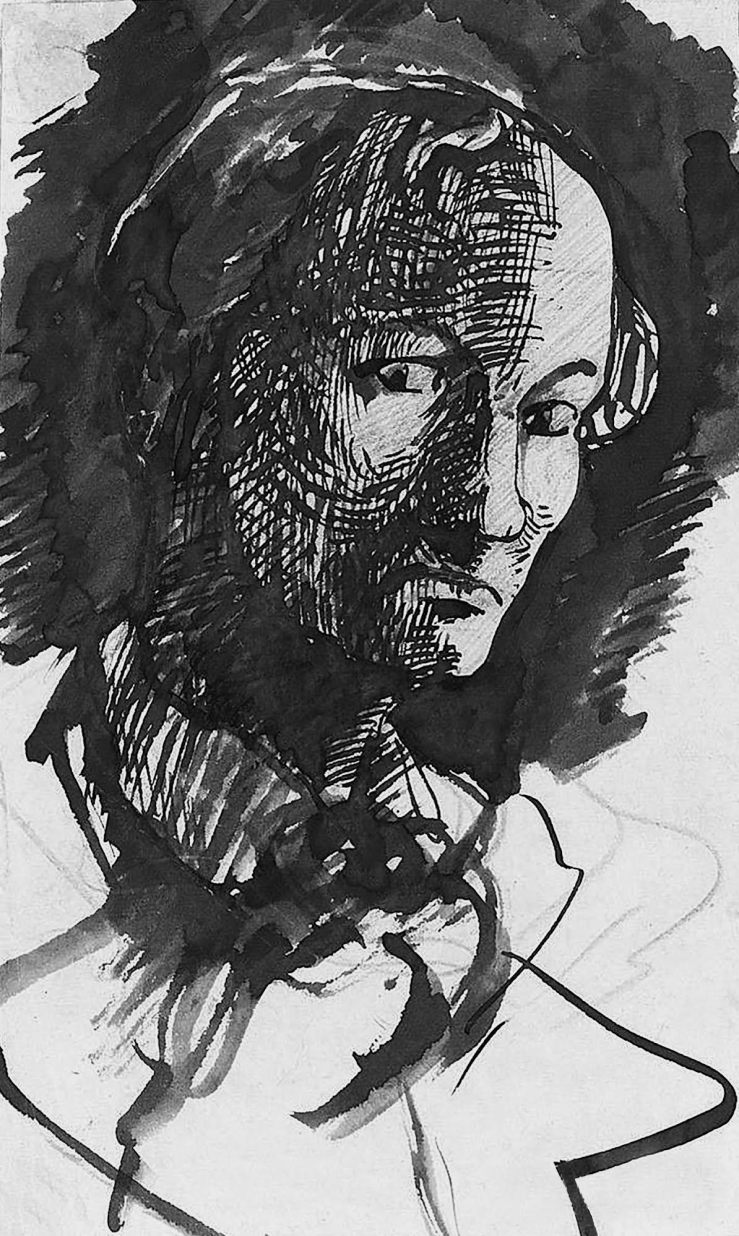
Biblioklept: What is Flares?
Hanshe: Quite simply, it’s a writer’s notebook; as such, it doesn’t have a single focus but is more motley, something of a hybrid entity. To paraphrase, we could call it The Poet Laid Bare (of poetic form). Nonetheless, I believe it has two principal nerve centers: critique and meditation.
The critique is many-tendrilled, with its points of observation being the craft of the writer, art and aesthetics, love, pleasure, and intoxication (numerous types), religion and theology, politics, etc. The writer’s smelting room and sometimes place of furious venting. As with Mon cœur mis à nu, there is a root in Poe, who in his Marginalia spoke of “a peculiar type of criticism” that “can only be designated by the ‘German ‘Schwarmerei’ — not exactly ‘humbug’ but ‘sky-rocketing’…” Baudelaire took up this idea, naming his work fusées, which is an expansive translation of the English skyrockets. A fusée is a pyrotechnical device (rocket, flare, or firework), musket, or heraldic emblem, hence the title corresponds well with the work’s variegated character. It is something incendiary, combative, and elegant. The manifold subtitles peppered throughout “Flares” offer us a provisional overview of its character, too: Plans, Projects, Suggestions, Notes, Hygiene, Morality, Conduct, Method. Here we see the writer’s notebook, the critique, and the meditation.
In speaking of intellectual gymnastics, the altar of the will, moral dynamics, the great deed, perfect health, the hygiene of the soul, political harmony of character, eurhythmy of character and faculties, self-purification, mastery of time, and accomplishing one’s duties, Baudelaire enumerates a concentration of terms and concepts related to self-cultivation. The book thus contains a kind of technology of the self, the outline of Baudelaire’s martial praxis for the artist — intellectual gymnastics and the sanctification of the will both bespeak an agonistic sensibility, as does his paean to greatness and his call to achieve it in contradistinction to the tremendous oppositional force of nothing less than an entire nation. What is this but Baudelaire’s Miltonic-Satanic typology. “The man of letters rends foundations…” (Flares §6) Such terminology, and the repeated invocations to himself to master his will and to work diligently to become who he is, are part of a regimen of poetic self-shaping. “Want every day to be the greatest of men!!!” (My Heart… §70) The references to Emerson and his Conduct of Life further reinforce that, which is but one reason why in the book’s synopsis I made a parallel to Marcus Aurelius, characterizing the book as Baudelaire’s meditations, which I see as its second nerve center. The poet is clearly concerned with self-government, and this shaping or cultivation of the self is meant to strengthen him, thereby aiding his accomplishing his artistic tasks, of which the book is in part a record.
These notions can be woven together with other parts of the work, i.e. §16 of “Flares,” where Baudelaire speaks of the most perfect type of virile Beauty (the Miltonic Satan), or the Emersonian hero (he who is immovably centered), giving us the supreme artistic model of Satan, that is, Satan as the light-bringer, the visionary, he who is anti-human (“Let us defy the people, common sense, the heart, inspiration, and evidence.” §47; “The man of letters is the enemy of the world.” §53). In §21 of ”Flares” Baudelaire asks, “To give oneself to Satan, what is it?” The book provides us with some answers, as does his poetry (the “Litanies of Satan” et alia), and his Dandy (a superior figure) is another type with similarly sublime aspirations. It is the onset of the anti-Christian hyperanthropos. “The poet, the priest, and the soldier are the only great men among men: … the rest are made for the whip” (§47). Continue reading ““Translation is an act of risk” | An interview with Rainer J. Hanshe on translating Baudelaire’s My Heart Laid Bare”
April 30th.–. . . I arose this morning feeling more elastic than I have throughout the winter; for the breathing of the ocean air has wrought a very beneficial effect, . . . What a beautiful, most beautiful afternoon this has been! It was a real happiness to live. If I had been merely a vegetable,–a hawthorn-bush, for instance,–I must have been happy in such an air and sunshine; but, having a mind and a soul, . . . I enjoyed somewhat more than mere vegetable happiness. . . . The footsteps of May can be traced upon the islands in the harbor, and I have been watching the tints of green upon them gradually deepening, till now they are almost as beautiful as they ever can be.
Nathaniel Hawthorne’ journal entry for April 30th, 1840. From Passages from the American Note-Books.
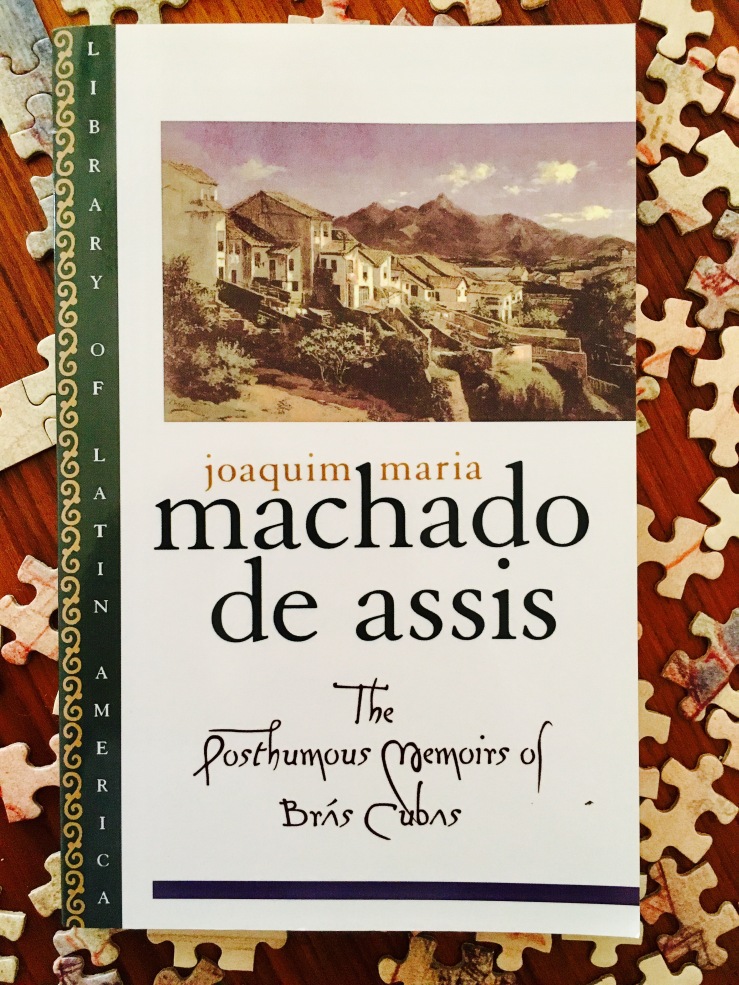
I picked up Brazilian author Joaquim Maria Machado de Assis’s 1881 novel The Posthumous Memoirs of Brás Cubas today. I picked it up because of an oblique recommendation via Twitter a few weeks ago when I was raving about Antonio di Benedetto’s novel Zama.
I got Gregory Rabassa’s translation (I dipped my toe into his translation of Miguel Ángel Asturias’s 1963 novel Mulata a few weeks ago).
Brás Cubas reminds me a lot of Tristram Shandy so far—short sharp funny chapters that bop forward and backward. The 1881 novel anticipates anticipates a style and form that we now describe as “postmodern.” I’ll share a few excerpts in the future, but for now, here’s the Wikipedia summary (lazy, I know, but I think it’s a bit better than this Oxford UP edition’s blurb):
The novel is narrated by the dead protagonist Brás Cubas, who tells his own life story from beyond the grave, noting his mistakes and failed romances.
The fact of being already deceased allows Brás Cubas to sharply criticize the Brazilian society and reflect on his own disillusionment, with no sign of remorse or fear of retaliation. Brás Cubas dedicates his book to the first worm that gnawed his cold body: “To the worm who first gnawed on the cold flesh of my corpse, I dedicate with fond remembrance these Posthumous Memoirs” (Portuguese: Ao verme que primeiro roeu as frias carnes do meu cadáver dedico com saudosa lembrança estas Memórias Póstumas). Cubas decides to tell his story starting from the end (the passage of his death, caused by pneumonia), then taking “the greatest leap in this story”, proceeding to tell the story of his life since his childhood.
The novel is also connected to another Machado de Assis work, Quincas Borba, which features a character from the Memoirs (as a secondary character, despite the novel’s name), but other works of the author are hinted in chapter titles. It is a novel recalled as a major influence by many post-modern writers, such as John Barth or Donald Barthelme, as well as Brazilian writers in the 20th century
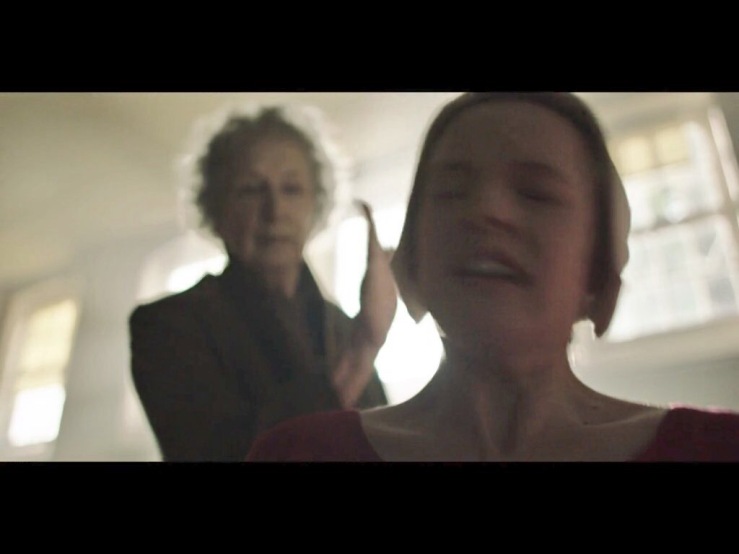
From Margaret Atwood’s essay of 10 March 2017 in The New York Times:
In this series I have a small cameo. The scene is the one in which the newly conscripted Handmaids are being brainwashed in a sort of Red Guard re-education facility known as the Red Center. They must learn to renounce their previous identities, to know their place and their duties, to understand that they have no real rights but will be protected up to a point if they conform, and to think so poorly of themselves that they will accept their assigned fate and not rebel or run away.
The Handmaids sit in a circle, with the Taser-equipped Aunts forcing them to join in what is now called (but was not, in 1984) the “slut-shaming” of one of their number, Jeanine, who is being made to recount how she was gang-raped as a teenager. Her fault, she led them on — that is the chant of the other Handmaids.
Although it was “only a television show” and these were actresses who would be giggling at coffee break, and I myself was “just pretending,” I found this scene horribly upsetting. It was way too much like way too much history. Yes, women will gang up on other women. Yes, they will accuse others to keep themselves off the hook: We see that very publicly in the age of social media, which enables group swarmings. Yes, they will gladly take positions of power over other women, even — and, possibly, especially — in systems in which women as a whole have scant power: All power is relative, and in tough times any amount is seen as better than none. Some of the controlling Aunts are true believers, and think they are doing the Handmaids a favor: At least they haven’t been sent to clean up toxic waste, and at least in this brave new world they won’t get raped, not as such, not by strangers. Some of the Aunts are sadists. Some are opportunists. And they are adept at taking some of the stated aims of 1984 feminism — like the anti-porn campaign and greater safety from sexual assault — and turning them to their own advantage. As I say: real life.
Which brings me to three questions I am often asked.
First, is “The Handmaid’s Tale” a “feminist” novel? If you mean an ideological tract in which all women are angels and/or so victimized they are incapable of moral choice, no. If you mean a novel in which women are human beings — with all the variety of character and behavior that implies — and are also interesting and important, and what happens to them is crucial to the theme, structure and plot of the book, then yes. In that sense, many books are “feminist.”
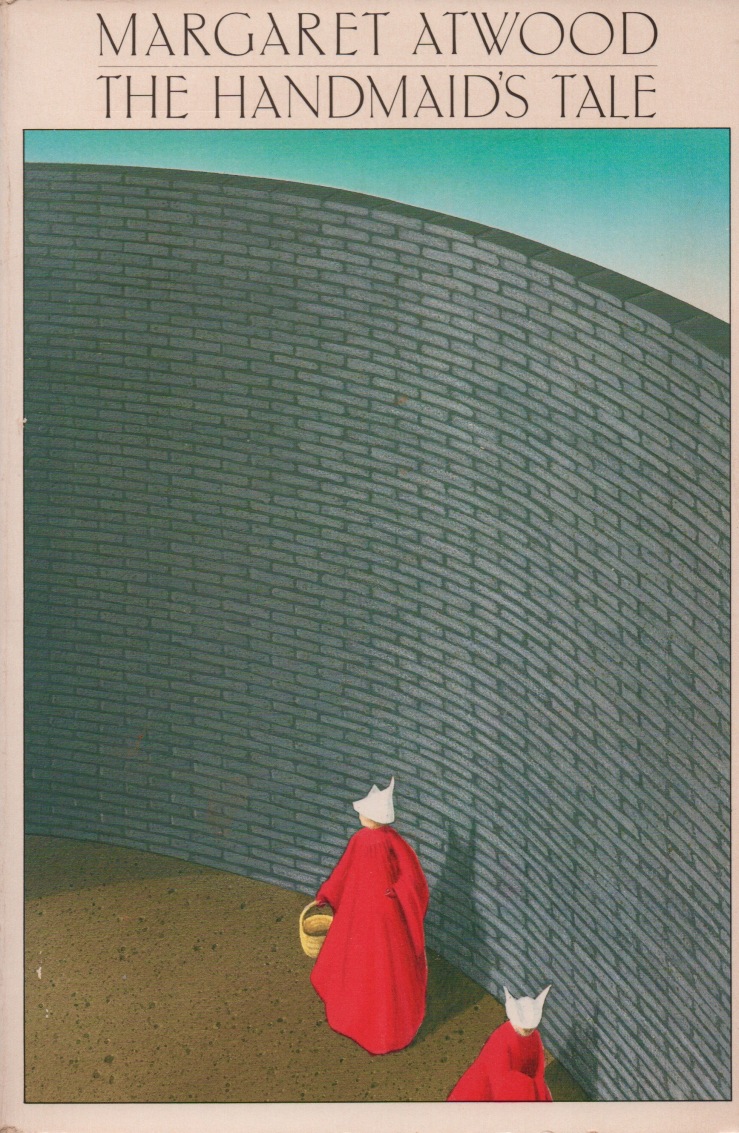
Margaret Atwood’s 1985 novel The Handmaid’s Tale has been adapted into a television series by Hulu, a fact which you probably already knew if you are on the internet and are interested in these sorts of things.
Initial clips of the show seem promising enough. Elisabeth Moss, who I loved in Top of The Lake, plays the novel’s protagonist Offred, and Margaret Atwood, a consulting producer, has been a vocal supporter of the adaptation. And, as many have pointed out lately, the story’s backdrop—a patriarchal theocratic regime—seems, uh, timely. (Hell, there’s even a Wall).
In anticipation of Hulu’s adaptation, I decided to reread The Handmade’s Tale a third time in a third decade. I found it subtler, more personally intense than the broad, voluminous epic my memory had concocted. My memory had filled in some of Atwood’s strategic gaps; one of her rhetorical gambits is to deliver the so-called “worldbuilding” common to sci-fi novels in tiny morsels and incomplete glimpses. She refuses to give us a big picture. We see this world like one of the handmaids, who view it through a veil of white wings around their heads.
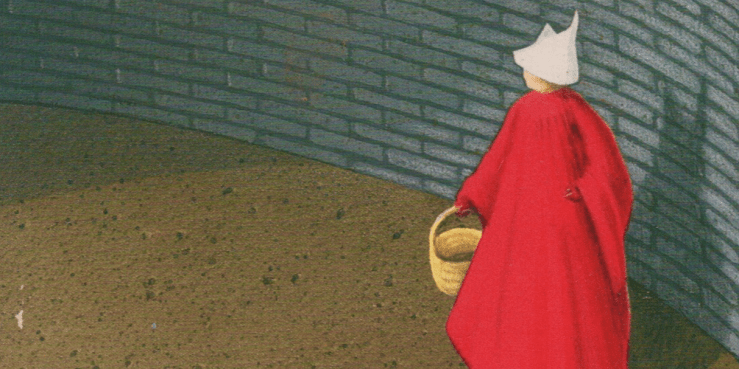
Our narrator Offred is one of those, whatchamacallit, unreliable narrators (as she frequently, subtly reminds us), and her picture of the Republic of Gilead is necessarily incomplete. My memory filled in huge swaths of backstory—a caste system, forced breeding, a plague of infertility, civil wars, ecological collapse, mutations, religious infighting, spy networks and underground railroads. There’s something of an epic scale there, no? But the The Handmaid’s Tale actually elides much of the its genre’s heavy baggage. Exposition hides in bits and pieces for the reader to scrabble together. Even in some of its more straightforward expository passages, as when Offred describes the theocratic regime’s coup d’etat, we still only get the events from her perspective. We experience the effects of the revolution as the effects on her life. There’s no big picture geopolitical analysis. The causes aren’t clear.
Indeed, the lack of clear causality between events is one of the scariest aspects of The Handmaid’s Tale. Our narrator emphasizes how quickly norms can change in a culture, which is, from a plot-standpoint, quite important. Nineteen Eighty-Four has long been a point of comparison to The Handmaid’s Tale, but in Orwell’s novel the totalitarian regime has presumably been in power for decades (although of course, the protagonist’s job in that novel is to revise historical documents so that they align with the past, making “history” suspect).
In The Handmaid’s Tale, crucially, the protagonist is still connected to the pre-Revolutionary, pre-theocratic world. We’re reminded again and again that she’s one of the first generation of handmaids; we’re reminded again and again that after the first generation takes hold, the practice of forced breeding will become completely normalized. The Handmaid’s Tale is the preamble to dystopia. Offred remembers life in the U.S., life before her role was absolutely proscribed by a patriarchal theocracy. The narrator’s disconnection between that life and her new one drives the narrative.
This radical disconnection threatens the narrator’s sanity. It’s not just the wings of her habit that obstruct her vision, but also a veil of creeping instability. The unraveling of history, the sense that she is dislocated in time threaten to undo her. Her way of seeing the world and her self in the world is completely destabilized. Consider the following passage, in which our heroine gazes at the “smile” of a dead man hung from the Wall as a warning:
I look at the one red smile. The red of the smile is the same as the red of the tulips in Serena Joy’s garden, towards the base of the flowers where they are beginning to heal. The red is the same but there is no connection. The tulips are not tulips of blood, the red smiles are not flowers, neither thing makes a comment on the other. The tulip is not a reason for disbelief in the hanged man, or vice versa. Each thing is valid and really there. It is through a field of such valid objects that I must pick my way, every day and in every way. I put a lot of effort into making such distinctions. I need to make them. I need to be very clear, in my own mind.
The protagonist’s defense against the threat of dislocation, displacement, and insanity is her power to tell her tale. In this sense, The Handmade’s Tale has as much in common with Charlotte Perkins Gilman’s “The Yellow Wallpaper” as it does with Orwell’s dystopian classic.
Our narrator’s need “to be very clear [in her] own mind” carries (what many readers will consider) the main thread of The Handmaid’s Tale on a straightforward, linear path: Offred is pressed into the service of the Commander (Fred, from whom she receives her patronymic) so that he can impregnate her, become a father, and perpetuate his class tier. If she can’t produce a child in a certain time frame, it’s off to the colonies! (Never mind that the Commander is likely sterile).

The narrative’s linear sequence will provide a sturdy frame for Hulu’s adaptation, and the constant flashbacks that interweave through the novel will also likely help to flesh out the series, both in tone and characterization. The ways in which the novel’s narrator weaves and unweaves these story strands might be much more difficult for the show to capture though. Indeed, Atwood’s rhetorical technique here is something native to literature itself. Atwood evokes consciousness under duress. She shows us a heroine trying to weave strands of a story together into something meaningful, to make a story where there is none, to find a space to speak where there is only the specter of mute doom. The Handmaid’s Tale is a story about storytelling as resistance and self-preservation:
I would like to believe this is a story I’m telling. I need to believe it. I must believe it. Those who can believe that such stories are only stories have a better chance.
If it’s a story I’m telling, then I have control over the ending. Then there will be an ending, to the story, and real life will come after it. I can pick up where I left off.
It isn’t a story I’m telling.
It’s also a story I’m telling, in my head, as I go along.
Tell, rather than write, because I have nothing to write with and writing is in any case forbidden. But if it’s a story, even in my head, I must be telling it to someone. You don’t tell a story only to yourself. There’s always someone else.
Even when there is no one.
A story is like a letter. Dear You, I’ll say. Just you, without a name. Attaching a name attaches you to the world of fact, which is riskier, more hazardous: who knows what the chances are out there, of survival, yours? I will say you, you, like an old love song. You can mean more than one.
You can mean thousands.
Our storyteller—we are her You—is finely attuned to language. She constantly points out old phrases, commonplaces, and cliches, and remarks on what they used to mean in “the time before.” In some of these moments of linguistic mulling, Atwood calls attention to language’s destructive potential, of its ability to unravel the very meaning we seek to pin to it. If language connects, it can also disconnect. Consider the following passage:
It’s strange, now, to think about having a job. Job. It’s a funny word. It’s a job for a man. Do a jobbie, they’d say to children, when they were being toilet-trained. Or of dogs: he did a job on the carpet. You were supposed to hit them with rolled-up newspapers, my mother said. I can remember when there were newspapers, though I never had a dog, only cats.
The Book of Job.
Language can protect, but it can also threaten. It can slipslide from a random memory to an existentialist myth in the span of a breath. It can turn tulips into bloody smiles and bloody smiles into explanations for executions. Language can turn into stories, but stories can swallow up whole lives, whole cultures. That’s the threat of theocracy.
Atwood highlights the novel’s attention to storytelling itself in the final chapter, which reads almost like an appendix. Called “Historical Notes,” and separated from the text proper by its own title page, the final (unnumbered) chapter purports to be the transcript of a speech given at an academic conference on “Gileadean Studies” in the year 2195. There is much exposition and analysis here. Our anthropologist lecturer informs us that what is known as The Handmaid’s Tale is the composite of a number of audiocassettes. Furthermore, we learn that the narrator Offred (apparently) fabricated or synthesized elements of the story, either to protect certain persons’ anonymity, or for her own pleasure—or simply in the service, of, y’know, good storytelling. The lecturer laments that Offred failed to give future listeners more details about politics and war and the culture of Gilead at large. In a sense, the lecturer’s complaint is the one that many readers who go to Atwood’s novel expecting “worldbuilding” might have. The narrator isn’t telling a story about dystopian Gilead. She’s telling a story about storytelling. She’s making herself a story. Speaking to a You helps to preserve her I.
The “Historical Notes” on The Handmaid’s Tale are an example of a particular trope I generally dislike—the “expert shows up at the end and explains everything” device. However, Atwood’s final chapter is successful, and perhaps even essential to the novel’s critique of patriarchy and of how institutions tell and what they tell. The key, of course, is to recognize the layers of irony in this “explainer” chapter, in which a male authority arrives and asks all the wrong questions about Offred and criticizes some of her narrative choices. Even though he’s an expert on her text, he manages to miss that she’s woven her true name into the story. It’s right there at the end of the first chapter.
“Historical Notes” shows the problems and limitations in telling “the truth,” highlighting that all tales are constructions, syntheses of pre-existing elements. At the same time, the chapter points towards a narrative future, and a fairly stable future at that. “Historical Notes” thus provides the “happy ending” that the text proper—The Handmaid’s Tale—refuses to offer.
After finishing Atwood’s novel, I indulged in a favorite treat: sifting through one-star Amazon reviews with the express purpose of rearranging lines and fragments into…something. A complaint that arose again and again about The Handmaid’s Tale was the novel’s ambiguous ending. Only “ambiguous” wasn’t a word I saw used—our stalwart reviewers insisted that the novel had no conclusion. Such an interpretation is either a misreading or a failure to see that ambiguity is its own opening to adventure.
Our heroine concludes her tale: “And so I step up, into the darkness within; or else the light.” The line might frustrate many readers and even license them to accuse Atwood of simply not knowing how to finish her story. The final line’s ambiguity is structural though, part and parcel of the narrative itself. The heroine crosses a threshold. She’s pregnant, both literally and figuratively. The novel’s final ambiguity opens a space for our heroine to “step up” into. As Scheherazade understood, storytelling isn’t about closing off, but opening up. When the narrator walks out into either darkness or light, she’s entering a new narrative possibility—one that can be imagined by the auditors of her tale, her future You.
Perhaps its best to assess Atwood’s ending using her own rubric. Here are the last lines of her 1983 short story “Happy Endings”:
So much for endings. Beginnings are always more fun. True connoisseurs, however, are known to favor the stretch in between, since it’s the hardest to do anything with.
That’s about all that can be said for plots, which anyway are just one thing after another, a what and a what and a what.
Now try How and Why.
The Handmaid’s Tale succeeds in answering How and Why.

I couldn’t pass up this 1958 illustrated edition of Ambrose Bierce’s caustic classic The Devil’s Dictionary. It’s published by The Peter Pauper Press, with art by Joseph Low. I took the matching dust jacket off for the scan above. A sample of the innards:

[Editorial note: The following citations come from one-star Amazon reviews of Margaret Atwood’s novel The Handmaid’s Tale. (For the record, I think The Handmaid’s Tale is pretty great).
I’ve preserved the reviewers’ original punctuation and spelling. More one-star Amazon reviews].
shrill
Strange
no hope
anti male story
boring and odd
Feminist dogma
anti-religious zeal
poorly researched
futuristic yet dated
no good verses evil
Political propaganda
socialist point of view
Too many adjectives!!
extremely depressing
It all-around too much
tries to be all futuristic
I’m not a Christian, but
Overuse of punctuation
Sorry but no one liked it
a lot of words were used
twisted grossness and blah
Not a feminist novel for sure
Actually, it is about infertility
Written by a 12-year-old shut in
It’s hard to glean what happened
Not realistic as a futuristic fantasy
pointless exercise in self-contempt
annoying stream-of-consciousness style
these fertile women aren’t treated badly
an academic’s paranoid bondage fantasy
a lot of sexual situations and foul language
The reader is always in a confused state of mind
The main character doesn’t grow or learn anything
The author created a lot of terms but didn’t explain them
literally fills the pages by talking about grocery shopping
obviously has an ax to grind with Judeo-Christian principle
There isn’t much focus on what women are not allowed to do
Mostly just someone running errands in an American dystopia
an author who obviously doesn’t understand the passages from the Bible
main character is weak, conviction less and incapable of making any exciting moves
I’m going to bury it in the ground and let the worms eat all those words unfit for human consumption
drones on and on about brick sidewalks and rays of sunlight and tulips and blue stripes on kitchen towels
Is this supposed to be 1984, Brave New World, or even Hunger Games? If you compare it to any of those books, it is utter fail.
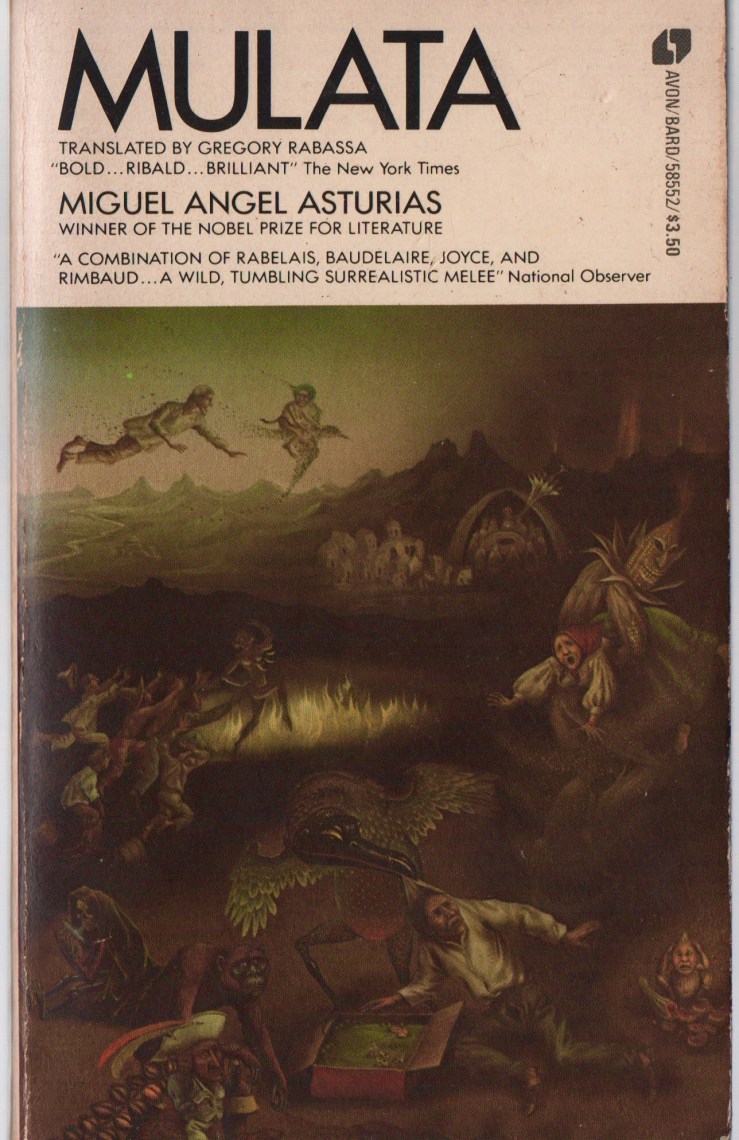
I admit that I picked up Miguel Ángel Asturias’s 1963 novel Mulata de Tal because of the cover and blurb alone. This 1982 translation is by Gregory Rabassa, and part of a series of Latin American authors that Avon/Bard put out in really cool attractive mass market paperbacks in the 1980s. The titles can be hit or miss, but I like the energy of the first two chapters of Mulata. Back cover blurb:

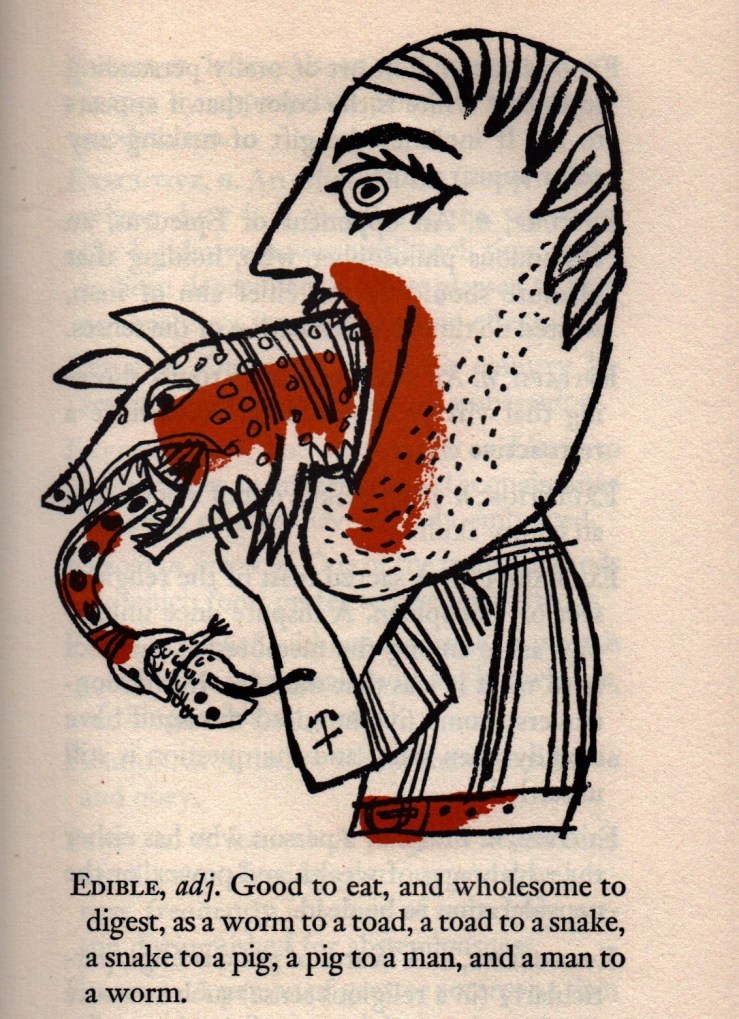
From Ambrose Bierce’s The Devil’s Dictionary.
Originally published in 1906; the image is from The Peter Pauper Press’s 1958 illustrated edition, with art by Joseph Low.

John Williams’s 1965 novel Stoner documents the quiet and often painful life of William Stoner, an English professor at the University of Missouri. In a direct, lucid style, the novel follows Stoner from the time he first enters the University of Missouri as a freshman, to his old age and eventual death.
The son of poor farmers, Stoner is sent to school to study agriculture, only to become quickly bewildered by a required survey course of English literature. Obsessed by the affecting mysteries literature presents, Stoner pursues English as a major (never a smart move, young people) and in time becomes a teacher, safe in the university’s protection from the bustle and toil of the real world—he even neglects to enlist to serve in the Great War.
Stoner’s love of literature, learning, and the university itself cannot, however, protect him from the pain and despair of an unfulfilled life. This is a very sad book, and one made even sadder by the plainness and smallness of its tragedies. These tragedies seem all the more real in Williams’s simple, unadorned style, which we see (or, more accurately, don’t see—Williams’s technique is never on show) here in the novel’s opening paragraph:
William Stoner entered the University of Missouri as a freshman in the year 1910. Eight years later, during the height of World War I, he received his Doctor of Philosophy degree and accepted an instructorship at the same University, where he taught until his death in 1956. He did not rise above the rank of assistant professor, and few students remembered him with any sharpness after they had taken his courses. When he died his colleagues made a memorial contribution of a medieval manuscript to the University library. This manuscript may still be found in the Rare Books Collection, bearing the inscription: “Presented to the Library of the University of Missouri, in memory of William Stoner, Department of English. By his colleagues.’
As its beginning suggests, Stoner recounts one man’s professional failures. To steal a line from Dylan Thomas, Stoner’s words forked no lightning — he writes one mediocre book and is clearly no one’s favorite teacher. Even worse, he’s fated to teach scattered freshman composition courses for most of his career instead of the senior seminars most academics crave for intellectual stimulation. Who blocks him? His biggest professional enemy is Lomax, a vengeful hunchback who becomes chair of the English department and then makes Stoner’s professional life hell. Lomax retaliates Stoner’s attempt to prevent Lomax’s protégé—a poseur and an intellectual hack—from completing his degree. It’s the sort of dastardly, petty politics that won’t be unfamiliar to teachers.
It’s not just Stoner’s professional life that languishes in sad, decaying inertia. Stoner’s marriage is also a terrible failure, doomed from the outset. It’s not exactly clear why Stoner falls so hard for Edith, a brittle, neurotic rich girl; it’s even more unclear why she agrees to marry him. Their marriage is doomed before it even begins. Williams writes:
Years later it was to occur to him that in that hour and a half on that December evening of their first extended time together, she told him more about herself than she ever told him again. And when it was over, he felt that they were strangers in a way that he had not thought they would be, and he knew that he was in love.
Stoner’s idealistic love for Edith matches his idealistic love for reading and study, which at times becomes his sole reason for being:
Having come to his studies late, he felt the urgency of study. Sometimes, immersed in his books, there would come to him the awareness of all that he did not know, of all that he had not read; and the serenity for which he labored was shattered as he realized the little time he had in life to read so much, to learn what he had to know.
Stoner’s love for his subject does not translate into his being an inspiring teacher though (just as his initial love for Edith does not lead him to being a successful marriage partner):
He was ready to admit to himself that he had not been a good teacher. Always, from the time he had fumbled through his first classes of freshman English, he had been aware of the gulf that lay between what he felt for his subject and what he delivered in the classroom.
Stoner is very much a novel about that gulf between feeling and form, ideal and expression, and if Williams plumbs Stoner’s frequent failures to cross that gulf, there are still small moments of triumph, ones that brought a broad smile to my face, albeit a smile tempered by irony and pained by the general tone of doom that pervades the book.
Particularly painful is Stoner’s relationship with his daughter Grace. After Grace’s birth, Edith becomes emotionally paralyzed from postpartum depression and even moves out of the house. Undisturbed, Stoner finds great joy in becoming his infant daughter’s primary caretaker. However, when Edith returns, she slowly drives a wedge between Stoner and Grace.
The disintegration of Stoner’s relationship with his only child was by far the most frustrating plot point of the book for me to endure. There were many times when I wished to grab him by his stooped shoulders, shake him hard, and cry, “Look, man, your life is passing you by! Wake up!” Stoner’s inattention and Edith’s neurotic behavior all but destroy their daughter, who becomes pregnant in high school, moves away from home, and eventually becomes a hardcore alcoholic. Here’s a heartbreaking passage from late in the book; Grace has made a rare visit to her aging parents, and stays up to talk with her father:
They talked late into the night, as if they were old friends. And Stoner came to realize that she was, as she had said, almost happy with her despair; she would live her days out quietly, drinking a little more, year by year, numbing herself against the nothingness her life had become. He was glad that she had that, at least; he was grateful that she could drink.
It’s not the great gulf between Stoner and Grace that is most painful—it is the sense of lost opportunity, of unfulfilled love that hurts the most. Stoner chooses paralysis; sure, the narrative is highly realistic, achingly aware of his limited options—but at the same time Stoner’s inaction and inertia can be maddening. He doesn’t even try.
Late in life, sick and approaching death — am I spoiling too much of the novel? — late in life, Stoner reflects (via Williams’s impeccable and unobtrusive free indirect style):
And he had wanted to be a teacher, and he had become one; yet he knew, he had always known, that for most of his life he had been an indifferent one. He had dreamed of a kind of integrity, of a kind of purity that was entire; he had found compromise and the assaulting diversion of triviality. He had conceived wisdom, and at the end of the long years he had found ignorance. And what else? he thought. What else?
What did you expect? he asked himself.
It’s a small epiphany I suppose, and one achieved at great price—it’s also crushingly realistic, even if Stoner is, say, 40 odd years late to a realization most of us make by our mid-twenties. Stoner’s near-death epiphany is wrapped in futility and resignation; there’s no rage against the dying of the light here. Still, Williams’s depiction of the end of his character’s life is one of the most stunning and moving portrayals of death that I’ve read in all of fiction. Here, I was reminded of Katherine Anne Porter’s fantastic story “The Jilting of Granny Weatherall.” Williams’s style is unlike Porter’s stream-of-consciousness technique—he’s far more lucid, yet keenly attuned to the changing of his protagonist’s consciousness. And while I’m comparing Williams to other writers, I should point out how strongly Stoner reminded me of Harold Brodkey’s sad and moving collection First Love and Other Sorrows.
Stoner’s straightforward style and direct, linear plot make it an unlikely candidate for a cult novel (a status it has achieved thanks in large part to a reissue from the NYRB a few years ago). Stoner flaunts none of the stylistic innovations (or gimmicks) of its postmodern contemporaries and Modernist forbears. It does not obsess over strange or marginalized figures. Its discourse never bristles with dramatic allusion or mythical and archetypal overtones. Nevertheless, it’s the sort of overlooked novel whose dedicated, vocal admirers like to press on others. And with good reason of course: this is a deeply moving, engaging, and often exasperating novel. It will make you truly, deeply sad. Highly recommended.
[Ed. note: Biblioklept originally published a version of this review on 20 April 2012].

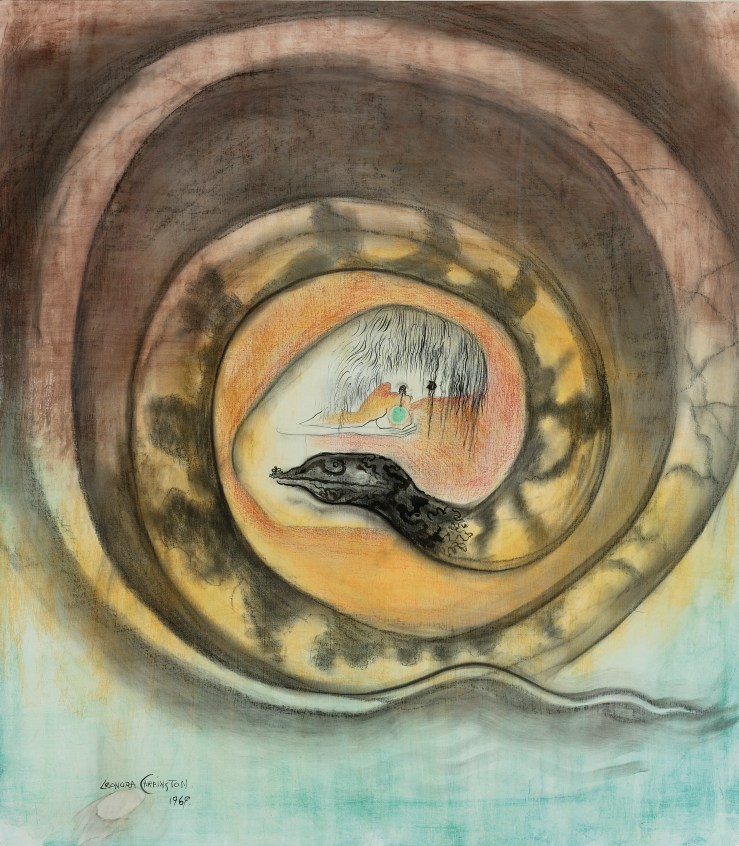
You probably know Leonora Carrington for her rich, wry surrealist paintings, sculptures, drawings, and sketches. She also wrote rich, wry surrealist tales, which the good people at Dorothy have collected in The Complete Stories of Leonora Carrington.
I kind of flipped out when I first saw the publication announcement for this collection. Her work has been out of print for ages. Years ago, I found a samizdat copy of The Oval Lady (1975) on the internet (and shared some of the stories on this blog), and consumed it in an hour or two. Witty and weird, Carrington’s stuff defies easy allegory or staid symbolism. Her stories are fun but dark, paragraph unfurling into paragraph in a strange dream-logic that recalls her visual skill as a painter.
The Complete Stories is so complete that it contains a pawful of unpublished stories, including “Mr. Gregory’s Fly,” which you can read on LitHub. I’ve dipped into the stories a few times, reading slowly—Carrington’s sentences are loaded with imagery, rich, but somehow light and not dense. Full review to come, but for now, here’s Dorothy’s blurb (and a few paintings):
Surrealist writer and painter Leonora Carrington (1917-2011) was a master of the macabre, of gorgeous tableaus, biting satire, roguish comedy, and brilliant, effortless flights of the imagination. Nowhere are these qualities more ingeniously brought together than in the works of short fiction she wrote throughout her life.
Published to coincide with the centennial of her birth, The Complete Stories of Leonora Carrington collects for the first time all of her stories, including several never before seen in print. With a startling range of styles, subjects, and even languages (several of the stories are translated from French or Spanish), The Complete Stories captures the genius and irrepressible spirit of an amazing artist’s life.
Concurrent with The Complete Stories, the NYRBooks will be publishing Carrington’s memoir Down Below and her children’s book The Milk of Dreams.



I surprised myself by picking up and rapidly reading Mikhail Bulgakov’s 1925 Soviet satire The Heart of a Dog this week. I read Michael Glenny’s translation (Harcourt Brace, 1968) at a quick clip, finding the novel propulsive and zany. I didn’t know anything about the plot beforehand, which I think helped me to enjoy the novel all the more. I liked The Heart of a Dog more than Bulgakov’s posthumously-published classic, The Master and Margarita. I had a rough idea of Master’s plot, whereas my ignorance of the events in The Heart of a Dog allowed me to ride along its zany track without loaded expectations. Perhaps this first paragraph is a way of saying: The Heart of a Dog is a quick, fun, funny read, probably better read without too much foregrounding.
A bit of foregrounding—not too much—The Heart of a Dog begins with the sad howl of a street mutt in Moscow. We’ll first get to know this dog as Sharik, and then later Poligraf Poligrafovich Sharikov. Sharik opens the novel: “Ooow-ow-ooow-owow! Oh, look at me, I’m dying.” The line is prescient and ironic: Our pup will, in time, be reborn as a human. The basic plot of The Heart of a Dog is a riff on Frankenstein. Eminent surgeon (and vocal critic of the Communist Party) Dr. Philip Philippovich Preobrazhensky finds the poor beast and restores him to the fattest health. Dr. Phil’s scheme though is a bit nefarious though. The not-quite-mad scientist, securing a thief’s corpse, trepans his poor dog’s skull and inserts the rogue’s pituitary gland. He then transplants the human’s testicles into the dog. Hormones and testes turn Sharik into a terrible shape-shifting speechifying brute, a mannerless boor who cannot be trained and who will not abstain from vodka. In time, Sharik (in the guise of Poligraf Poligrafovich) makes Dr. Phil’s life hell, leading the brief novel to its zany climax.
As with The Master and Margarita, I’m sure there was a lot that I missed in The Heart of a Dog. Undoubtedly, some of Bulgakov’s allusive jokes and jabs couldn’t land on my ignorant skull. What did come through though was a mean-but-fun satirical streak, a howling and yapping and biting at power, groupthink, philistinism, and hypocrisy. I liked the book.
I’ve just now (after having written that paragraph) gone back and read Michael Glenny’s April 1968 introduction to the novel (I always skip prefaces and intros). His final paragraph is far finer analysis than I can muster—but I can share it with you:
Like all the best satire, The Heart of a Dog can be read and relished in several ways: On one level it is a comic story of splendid absurdity; it also pokes fun at the discomforts, shortages, and anomalies of life in the Moscow of the twenties. But it has more profound meanings. It is a fierce parable about the Russian Revolution. The “dog” of the story is the Russian people, brutalized and exploited for centuries—treated, in fact, like animals instead of human beings. The weird surgeon, a specialist in rejuvenation (for “rejuvenation” read “revolution”), is the embodiment of the Communist Party—perhaps of Lenin himself—and the drastic transplant operation that he performs in order to transform the dog into the simulacrum of a human being is the revolution itself. In the story this modern Frankenstein is so appalled by the unredeemable beastliness of the creature he has conjured up that he reverses the process and turns his “new man” back into a dog. With this ending Bulgakov implies that he would like to see the whole ghastly experiment of the Revolution canceled out; unfortunately, successful revolutionaries, even when they realize their mistake, cannot reverse history by a stroke of the pen as an artist can with his fictional creatures. The bitter message is that the Russian intelligentsia, which made the Revolution, is hence-forth doomed to live with—and eventually be ruled by—the crude, unstable, and potentially brutal race of hominids—homo sovieticus—which it has called into being. Bulgakov saw the Revolution as a hideously misguided attempt to achieve the impossible—to change humankind. Man is brutish by nature, and “Soviet man,” he warns, is little more than a lout who has been led to believe he is the very pinnacle of creation. The results of giving power to such men will be disastrous; in fact, Stalin’s terror was carried out ten years later by exactly the sort of callous, brutal cretins that Bulgakov satirizes in this grimly prophetic story.

Let me recommend a novel for you.
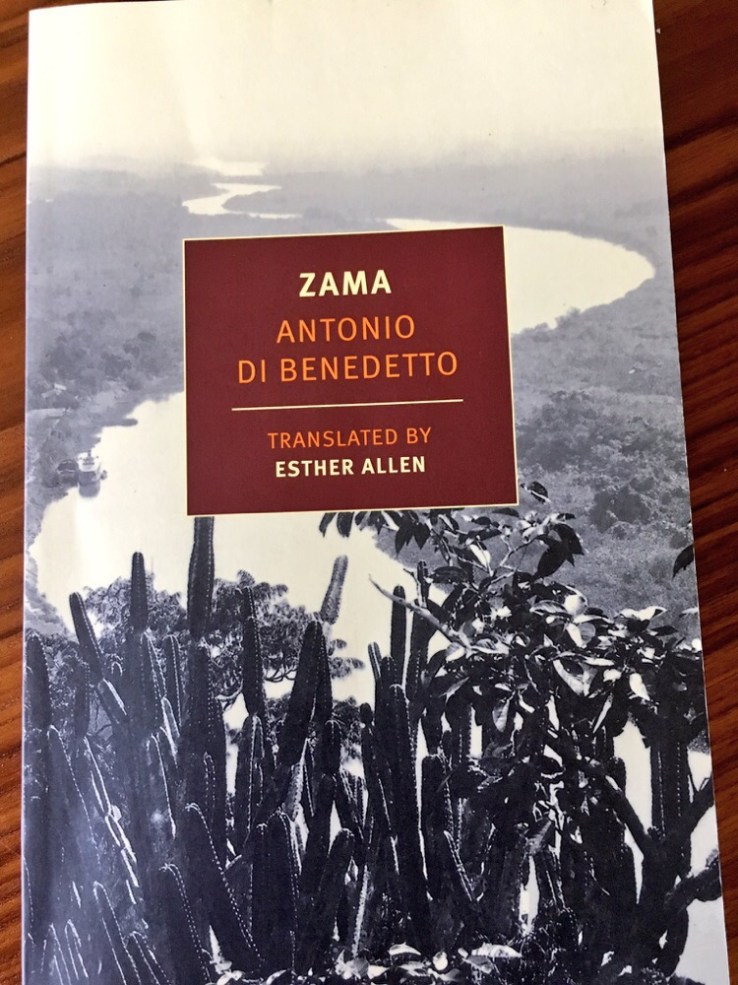
The novel is Antonio di Benedetto’s Zama.
Zama was first published in Argentina in 1956.
NYRB published Esther Allen’s English translation in 2016. It is excellent.
What is Zama about?
Zama tells the brutally funny and often sad story of Don Diego de Zama, a bored and horny americano wasting away in the provincial backwaters of Paraguay. It’s the end of the world at the end of the 18th century, and there’s not a lot to do. Zama fills his time with schemes of lust and petty pride, shirking his job as a nominal governmental authority. He longs to be reunited with his wife and family in Buenos Aires, but seems to sabotage every opportunity to get back to them. He also longs for his glory days as a corregidor, putting down “the native rebellion” in the service of Spain’s imperial project. Zama is a confusing and confused character, frequently frustrating but also oddly sympathetic. He is a loser who does not seem to see that he is a loser, although life gives him every opportunity to come to this conclusion. As South African novelist J.M. Coetzee’s puts it in his excellent in-depth review of the novel:
[Zama] is vain, maladroit, narcissistic, and morbidly suspicious; he is prone to accesses of lust and fits of violence, and endowed with an endless capacity for self-deception.
He is also the author of himself, in a double sense. First, everything we hear about him comes from his own mouth, including such derogatory epithets as “swaggering” and “dogslayer,” which suggest a certain ironic self-awareness. Second, his day-to-day actions are dictated by the promptings of his unconscious, or at least his inner self, over which he makes no effort to assert conscious control. His narcissistic pleasure in himself includes the pleasure of never knowing what he will get up to next, and thus of being free to invent himself as he goes along.
Coetzee captures the joy of reading Zama in those last few lines: It’s the joy in watching a first-person perspective invent itself in shambling picaresque adventures born of sheer boredom. It’s the pleasure of seeing an asshole who refuses to acknowledge that he is an asshole try to pretend that he is not an asshole—all in a kind of language that is simultaneously romantic and flat.
Let me give you a taste of that language, reader. Here are the opening bars of the novel:
I left the city and made my way downriver alone, to meet the ship I awaited without knowing when it would come.
I reached the old wharf, that inexplicable structure. The city and its harbor have always been where they are, a quarter-league farther upriver.
I observed, among its pilings, the writhing patch of water that ebbs between them.
A dead monkey, still whole, still undecomposed, drifted back and forth with a certain precision upon those ripples and eddies without exit. All his life the water at forest’s edge had beckoned him to a journey, a journey he did not take until he was no longer a monkey but only a monkey’s corpse. The water that bore him up tried to bear him away, but he was caught among the posts of the decrepit wharf and there he was, ready to go and not going. And there we were.
There we were: Ready to go and not going.
The ship that won’t come in, the floating dead monkey, the state of unknowing—these abject and negative motifs are the paradoxical genesis of the novel. The clipped repetitions, culminating in “Ready to go and not going” recall Samuel Beckett, whom translator Esther Allen acknowledges as “a perfect counterpoint to the prose voice of Zama” in her introduction.
In addition to Beckett, easy points of comparison are Dostoevsky, Camus, Borges, and especially Kafka. In his perceptive analysis of Zama, critic Benjamin Kunkel points out the novel’s existential core, absurdist peripheries, and realistic contours:
As with novels by Kafka, Camus, Sartre, and Beckett, the story’s preoccupation is the tension between human freedom and constraining circumstance. Zama, a man as impetuous as he is stuck, resembles other existentialist antiheroes as he swings between spellbound passivity and sudden lunges into action. But Don Diego never seems like a figure in an allegory, like K. in The Castle; or an ambulatory philosophical argument, like Roquentin in Nausea. Zama induces a rare feeling—to put it as naïvely as possible—of the main character’s realness. Don Diego is consistently surprised by his own behavior, but not as much as he would like. His abrupt acts and swerving meditations have an air of unplotted inevitability about them. He is a character more convincing than coherent, and more persuasive than intelligible.
These lifelike moments of “unplotted inevitability” are enthralling. Di Benedetto doesn’t just show us Zama seeing, he shows us Zama seeing what he is seeing. He shows us consciousness at work—or rather, consciousness in distress. In a representative passage which can stand alone as a bizarre parable in search of a moral, Zama, having lost all his money betting on horses, awakes from a drunken stupor to witness a spider crawling on a fellow drunkard:
The spider approached the drunk. From a quarter vara away, these spiders can leap and bite so that if taken by surprise, even a man who’s awake has no time to defend himself. I had no wish to move. I could crush it with my boot but would postpone until the last.
The spider moved toward the sleeping head and I watched to see whether anything out of the ordinary would transpire. Would the man—obedient to some mysterious warning instinct—suddenly awaken and kill it? He did not. Now the insect was crawling in his hair. I didn’t see it climb up; I saw it there on him and then I was quite certain I should do nothing.
The episode continues in this way, building in tension as the large spider crawls over the man’s face while Zama remains inert and fascinated by his own inertia—until the drunken man absently bats the spider from his face. Zama is paradoxically stunned by this anticlimax:
I reviewed the episode. At no point had I felt any emotion, except when I imagined the man had wakened and was about to deliver himself of an entirely justified diatribe against me.
The passage is representative of Di Benedetto’s rhetorical skill—he gives us a deceptively lucid first-person narrator who articulately elides key information, both from the reader and himself. Zama refuses to name his intense desire to see the spider bite the man. Additionally, his emotional identification is bound to righteous anger, the righteous anger appropriate to the would-be-bitten drunkard. Instead of genuine pathos, Zama would usurp this man’s self-righteous anger, the anger that he feels all the time at his (literal and figurative) position in life. But the spider bite that would license self-righteousness never comes. Basically, Zama just wants something to happen.
And that’s the plot of Zama, more or less. Our (anti-)hero’s picaresque jabs at adventure and romance are sent awry or thwarted, usually by his own loutish passions. Zama’s would-be escapades unravel, that is, until the book’s final section, 1799—
–Okay, let me digress momentarily: Zama, a slim 200 pages, is structured into three sections: 1790, 1794, and 1799. The connective tissue between these sections hangs transparent, nearly invisible, but nevertheless accessible via small clues, motifs, scant threads. Di Benedetto gives us modernism in the last decade of the 18th century, boredom that tiptoes around the abyss of insanity. Rereading the three sections is a joy. But let me return to the central thread—
Zama’s would-be adventures unravel or collapse until the book’s final section, 1799, when Di Benedetto puts our hero in genuine harm’s way (and cunningly exfiltrates any opportunity for overt heroism on Zama’s part). The novel earns its drive toward what I take to be its central question: “Do you want to live?”
Di Benedetto hides his answer to this question not so much in the central figure Zama, but rather in Zama’s put-upon secretary, his mozo Manuel Fernández. Fernández is, at least for me, the secret star of the novel. When we first meet Fernández, Zama joins in gently mocking him at the lead of their boss, the governor. They tease Fernández when he tells them that he is writing a novel. “Make sons, Manuel, not books,” admonishes the governor, but the clerk replies: “I want to realize myself in myself…Children realize themselves, but whether for good or ill we don’t know. Books are made only for truth and beauty.” Later, Zama, in more of a ruse than in good faith, asks Fernández to read some of his book. He finds the “entangled” prose “incomprehensible,” to which Fernández replies: “the first man and the first lizard were each incomprehensible, as well, to all those who surrounded them.” Fernández declares that he writes for “no master.” If he has no audience today, his pages will be understood by his “grandchildren’s grandchildren…Things will be different then.” Later, Fernández reveals that he’s given away his manuscript to an old man, a stranger suffering boredom while waiting for a delayed ship to take him somewhere other than the end of the world.
Fernández sees himself as an author doomed to obscurity in the present, an author who awaits a future that will catch up to his originary vision. Perhaps it’s a bit much to suggest he’s a stand-in for Di Benedetto, but there are traces here. Above, I cited Benjamin Kunkel’s essay on Zama, “A Neglected South American Masterpiece,” and J.M. Coetzee’s review, “A Great Writer We Should Know.” Those titles point to the novel’s obscurity, an obscurity which I sense is now being (if in increments) reversed. Esther Allen’s English translation obviously opens Zama to an even wider audience, and Argentine director Lucrecia Martel is apparently adapting the novel to film. But it’s perhaps Roberto Bolaño, a writer who time caught up to, however too late, who helped guide new readers—however obscurely—to Zama. In Bolaño’s 1997 short story “Sensini,” the titular character is a clear transposition of Di Benedetto, a cult author, a writer’s writer:
The novel was the kind of book that circulates by word of mouth. Entitled Ugarte, it was about a series of moments in the life of Juan de Ugarte, a bureaucrat in the Viceroyalty of the Rio de la Plata at the end of the eighteenth century. Some (mainly Spanish) critics had dismissed it as Kafka in the colonies, but gradually the novel had made its way, and by the time I came across Sensini’s name in the Alcoy anthology, Ugarte had recruited a small group of devoted readers, scattered around Latin America and Spain, most of whom knew each other, either as friends or as gratuitously bitter enemies.
Thank goodness, or thank evil, or thank boredom: thanks for word of mouth, for friends and enemies alike (as long as they have good taste); thanks for writer’s writers (and writer’s writer’s writers) and the cult books they transmit to us—like Zama.
Zama is a cult novel that deserves a larger cult. After two false starts (I admit I misread the voice, missing the humor), I read Di Benedetto’s novel in a kind of hunger. Then I read it again. Then I wrote this thing, to tell you, dear reader, that you should read it too. Very highly recommended.
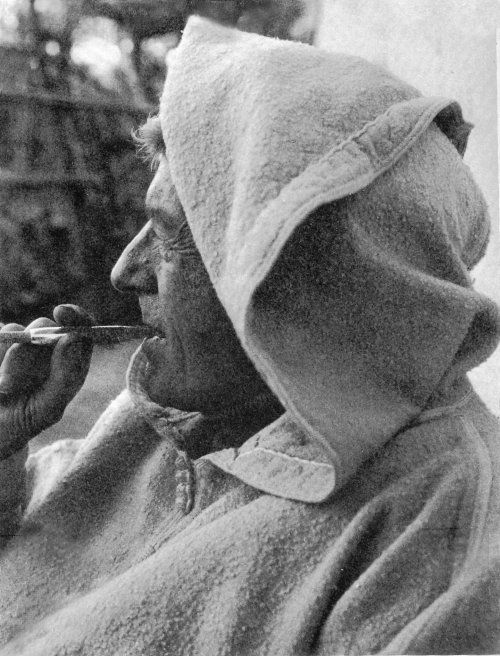
I was too young the first time I took a crack at Paul Bowles’ 1949 debut novel The Sheltering Sky. I was maybe 15 or 16 I think, reading a lot of Hemingway, Vonnegut, and William Burroughs at the time. I couldn’t click with Bowles.
Two decades later—by which I mean this January—I read/audited The Stories of Paul Bowles and fell in a weird love with them: Spare but sharp, wild but obscure, his fables refuse to square with our expectations. They are menacing, awful, loaded with strangers and travelers and outcasts. The characters do not know what is happening to them—indeed, they do not even know that they do not know what is happening to them. Sometimes the story’s narrator does not seem to know what is happening, and if the narrator does know what is happening, he’s not going to throw anything but the barest bones to the reader to piece together.
The best of the stories are wonderfully confusing, like “Tapiama,” the surreal, abject tale of a photographer’s picaresque journey into a mad foreign night. Bowles’ style succeeds in lucidly conveying the murk of a crashing consciousness:
The photographer had begun to suspect that something had gone very wrong inside him. He felt sick, but since he was no longer a living creature he could not conceive it in those terms. He had shut his eyes and put his hand over his face. “It’s going around backward,” he said. The undrunk cumbiamba was in his other hand.
Saying the sentence had made it more true. It was definitely going around backward. The important thing was to remember that he was alone here and that this was a real place with real people in it. He could feel how dangerously easy it would be to go along with the messages given him by his senses, and dismiss the whole thing as a nightmare in the secret belief that when the breaking-point came he could somehow manage to escape by waking himself up.
“Tapiama” is probably my favorite thing by Bowles, or at least the tale that best exemplifies what I like best in Bowles—the alienation of a stranger in a strange land, the creepy ickiness of realizing the unreal. Bowles’ characters are frequently tourists who wish to be more than tourists, who make ironic-romantic claims towards becoming travelers. He awakens these travelers to reality’s nightmare. There’s a quality here that I love, that dread noir thing that other storytellers like David Lynch and Roberto Bolaño evoke so well.
Bowles’ early stories succeed in evoking anxious, uncanny dread — “The Scorpion,” “By the Water,” “You Are Not I” are all easy go-to examples. I found the later tales in The Stories of Paul Bowles less intriguing, but emotionally richer. Sadder. Bowles’ later stuff grows more bitter, more resentful. The earlier tales are strange, sharp, and driven by weird nightmare alienation and sinister surrealism. But they also open into possibility, exploration, and radical newness. The later tales, composed in the 1980s, seem to me a closing off, not just in themes and tone, but also in style. They retreat into formalist modernism. There’s a palpable resistance to postmodernism in the later stories, an elegiac tone that romanticizes (even through multiple ironies) the post-War colonial past.
After I read The Stories of Paul Bowles, I read The Sheltering Sky, the fan favorite of this cult author. I’ll admit I was disappointed, although I probably failed the novel, not the other way around. I liked it best in its rawest moments, its looser strands creeping out like tendrils in another direction; often these tendrils were cut off in the service of a more formally organized novel—a novel that sags heavily in the middle, but explodes into a weird nightmare in the end as Kit, the book’s true hero, travels in a way her husband Port fails to.
The Sheltering Sky is larded with fantastic moments and meditations though, like the one below. Here, Bowles shows that to be human is to invest an aesthetic (and simultaneously anesthetic) viewpoint into one’s daily life—and that to invest in this viewpoint is to calculate psychic and emotional costs and payoffs:
He did not look up because he knew how senseless the landscape would appear. It takes energy to invest life with meaning, and at present this energy was lacking. He knew how things could stand bare, their essence having retreated on all sides to beyond the horizon, as if impelled by a sinister centrifugal force. He did not want to face the intense sky, too blue to be real, above his head, the ribbed pink canyon walls that lay on all sides in the distance, the pyramidal town itself on its rocks, or the dark spots of oasis below. They were there, and they should have pleased his eye, but he did not have the strength to relate them, either to each other or to himself, he could not bring them into any focus beyond the visual. So he would not look at them.
While I was admittedly disappointed in The Sheltering Sky, I found much in it to propel me on into more of Bowles’ writing. I next read Up Above the World—mostly because of its title. Phrases and iterations of “out in the world” repeat through Bowles’ writing, so it intrigued me. This 1966 novel has a reputation as being one of Bowles’ lesser novels, but I enjoyed it more than The Sheltering Sky—perhaps my expectations were lower.
Up Above the World’s reputation as a slighter work might have to do with the fact that it’s something of a genre fiction—a slow-burn thriller, a crime story really. There’s a cinematic structure to it, and a plainness to its tone that belies a murderous intensity. I won’t spoil the trick of the novel, but it twists in sinister, delightful ways, leaving loose threads for the reader to tie together.
I’ll close by sharing my favorite passage from Up Above the World. This moment comes in the crux of the novel, in its middle when Dr. Slade—a tourist who perhaps had the pretensions of being a traveler—shifts from one dimension to the next:
He reached out his hand and pressed the door handle, took two or three steps on the spongy grass, and raised his head. In front of him, not three feet away, there was a face—a muzzle, rather, for it surely belonged to an animal—looking at him with terrible intensity. It was unmoving, fashioned from a nameless, constantly dripping substance. Unmoving, yet it must have moved, for now the mouth was much farther open; long twisted tendons had appeared in each cheek. He watched, frozen and unbelieving, while the whole jaw swiftly melted and fell away, leaving the top part of the muzzle intact. The eyes glared more savagely than before; they were telling him that sooner or later he would have to pay for having witnessed that moment of its suffering. He took a step backward and looked again. There were only leaves and shadows of leaves, no muzzle, no eyes, nothing. But the leaves were pulsating with energy. At any moment they could could swell and become something other than what they were.
At any moment they could could swell and become something other than what they were: This is the monstrous power of Bowles’ best moments—his ability to evoke visceral reality, his ability to show how consciousness transforms the real into the surreal, even as it tries to navigate that reality. He shows that we are all tourists in our own heads.
I left the city and made my way downriver alone, to meet the ship I awaited without knowing when it would come.
I reached the old wharf, that inexplicable structure. The city and its harbor have always been where they are, a quarter-league farther upriver.
I observed, among its pilings, the writhing patch of water that ebbs between them.
A dead monkey, still whole, still undecomposed, drifted back and forth with a certain precision upon those ripples and eddies without exit. All his life the water at forest’s edge had beckoned him to a journey, a journey he did not take until he was no longer a monkey but only a monkey’s corpse. The water that bore him up tried to bear him away, but he was caught among the posts of the decrepit wharf and there he was, ready to go and not going. And there we were.
There we were: Ready to go and not going.
These are the opening sentences of Antonio di Benedetto’s 1956 novel Zama; English translation by Esther Allen (NYRB 2016). I finished it last night and then started it again.
 Biblioklept