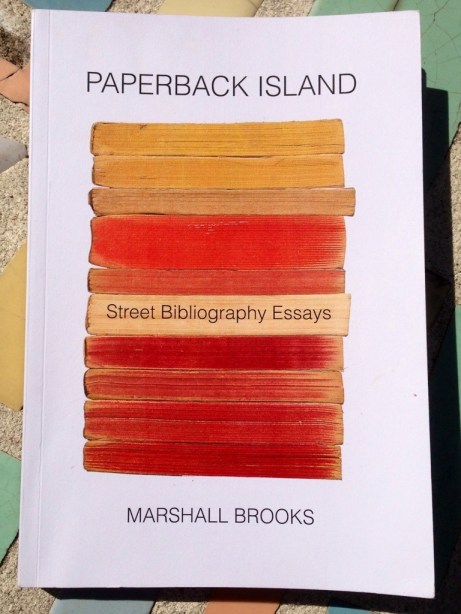
Marshall Brooks’s recent collectionof memoir-essays Paperback Island explores the ways that friendship and place influence what we read, how we read, and how we make—and keep—books. Marshall began his career in publishing in 1971, reading manuscripts for Harry Smith at his legendary publishing house The Smith. In 1979 he created Arts End Press. Subtitled Street Bibliography Essays, Marshall’s latest book provides fascinating insights into a world of post-Beat publishing that is slowly slipping away (that is, aside from in memories and books). Marshall was kind enough to talk to me over a series of emails. He was generous and thoughtful, and also interested in my own life—in my kids, in my reading and teaching, but also in the bookstores in my community. It was a pleasure to talk with him. The end of our email exchange found him in NYC, attending a memorial for Harry Smith. Marshall lives in Vermont with his wife and two sons. Check out his website and read my review of Paperback Island.
Biblioklept: Will you tell us a little bit about how Paperback Island came together?
MB: My original idea was to write about the books that a friend and I shared in our youth and on into our early twenties. My friend was a champion reader. I had recently published a piece about this reading friendship. A strictly “about books” piece related to the story sounded like a good idea, but I quickly became bored with just writing about the books alone. In the end, it was not a challenging enough assignment. A recently completed piece about attending Tuli Kupferberg’s funeral and another piece celebrating sub-underground journalist Sid Bernard more ably filled the bill in terms of complementing the first story. From there, the book took on a life of its own. By the end, I was hard put to keep up with its various twists and turns. It was unlike any other writing experience that I have ever had. Owing to my wife’s keen editorial encouragement, I persisted — for the better part of a year. It is really a book about people whose lives are, or were, inextricably intertwined with books. I love books, but I love people more. My journalist friend Bill Ruehlmann pointed this out in his review of the book. He’s right. Ultimately, PAPERBACK ISLAND is all about love.
Biblioklept: The opener about that “champion reader,” Liam O’Dell, resonated strongly with me, as I imagine it will with other people who love books and reading—most of us have had someone in our lives who pushes us to read new stuff, different stuff.
In the same essay, you talk about how the early 1970s was a kind of information age that prefigured the internet. At the time were you aware of a shift in access to information, books, etc., or was this change something you only noticed after reflection?
MB: I was very conscious of the shift at the time. It was intoxicating.
Biblioklept: What was that shift like, as a reader? What sources were most important to you?
MB: Beginning in public school — ca. 1966 – 1971 — new paperbacks were for sale in the schools, courtesy of a special program to encourage independent reading. A lot of Signet books to begin with, and, later in high school, Vintage Books, among others. These books had all been designed (or, in many cases, redesigned) with an entirely new, young hip readership in mind. (E.g., 1984 and ANIMAL FARM.) They were not the drear-looking relics of my parents’ generation. The new, fresh book design suggested possibility to me. Genuine potential, plus limitless variety. Memorable reads: THE MYTH OF SISYPHUS (with cover art by Leo Lionni — Leo’s son, Mannie is a fan of PAPERBACK ISLAND, by the way); Dos Passos’s USA trilogy (with pen & ink illus. by Reginald Marsh); A CONTROVERSY OF POETS contemporary poetry anthology (Anchor Books, 1965, ed. by Paris Leary and Robert Kelly); EXPRESSWAYS, poems by J.D. Reed (Simon & Schuster, 1969, pb ed.); STUDS LONIGAN, by James T. Farrell (Signet). The underground / alternative press was also an important influence (these papers being highly visible in Boston — they were hawked on the sidewalk all over town). The underground press scene dramatically symbolized that just anything could be written about and printed. Indeed, thought. The papers’ contents often made little or no positive impression on me, but the overall freewheelingness of the papers certainly did. Society, obviously, was becoming much more fluid, looser — Richard Nixon or no. Impossible for a teenager to miss. There were also two reliably good sources for small press publications in Cambridge: the Grolier and Pangloss bookshops. The former only sold — sells — poetry. Most of the time, I did not know what to make of the little magazines that I bought. But this was a good thing — something I looked forward to — being another instance of where you had to make up your own mind about something owing to its relative strangeness, its resistance to categorization. I put a great deal by being able to do this.
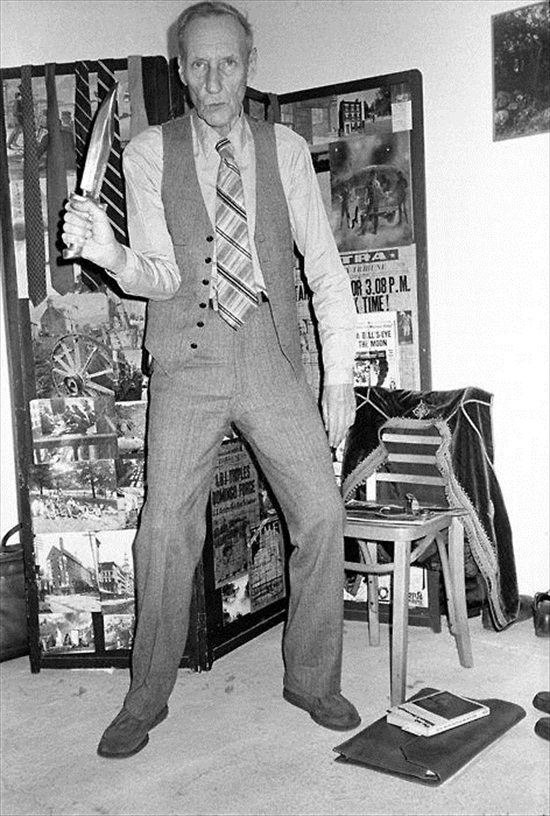
Portrait of the Writer Posing by the Grave of Fruitlands Communard Joseph Palmer
Biblioklept: You bring up James T. Farrell here—there’s a fascinating chapter of Paperback Island about how you came to possess a large number of his paperback books. It’s one of several microlibraries discussed in the book. Why are microlibraries important in the age of digital archives?
MB: As you know, children’s books — in traditional book form — remain popular with both children and their parents. In the same vein, I believe that micro libraries fulfill a similar need. The physical surprise quality of the book is married with other special elements and the experience of the book (or books) becomes very much more than simply its contents. In the case of the JTF Paperback Library, Farrell himself is physically detectable. For all that I know, his DNA may well be present (he left enough fingerprints). For some people, myself included, having an author’s library — either whole or in part — can be a stirring experience. Humbling, too. Digital archives have their place, but I don’t think you can savor them in quite the same way that you can a cache of books — a collection you feel privileged to either own or borrow from. I think we all need a form of savor. Bibliophiles, notoriously, know where to find theirs.
Biblioklept: Do you feel antipathy toward e-readers like the Kindle or Nook?
MB: Not at all. My wife just returned from a writer’s conference in Boston (theme: using social media). The breaking word in Boston was that all sales are up — e-books, traditional books, and so on. If there are more readers everywhere, great. I also think that many books should only be available electronically or are best served this way.
Biblioklept: What kind of books are best served electronically?
MB: To return briefly to the idea of the 1970s prefiguring the internet and related developments, I remember well the 1971 publication of the COMPACT EDITION OF THE OXFORD ENGLISH DICTIONARY being hailed as revolutionary at the outset. William Buckley reviewed the, then, space-age OED in the NY TIMES and shared with everyone how he was customizing his copy with Scotch-taped tabs so as to facilitate his word searches. 12 volumes, 150 pounds worth of books, shot down to two crisply printed volumes (slipcased, replete with a high-end Bausch & Lomb magnifying glass in its own drawer). All this via the miracle of offset printing technology. 21 years later, the cd-rom version of the OED arrived. I still have my copy of the two volume OED, by the way, purchased for a dollar from the Book of the Month Club 30 years ago. But I honestly don’t know if the BOMC, itself, still exists. Well, easily enough clarified — I’ll Google it. [Ans.: It exists. M.B.]
It is difficult to imagine the OED not being served well by the latest technology in light of e-media’s enhanced cross-referencing and search powers, for example, or the ability to present a practically limitless amount of information, which, previously, had to be squelched. All sorts of books, could benefit, really, via the e-book format including guilty pleasure reads. Why sacrifice — or recycle, even — wood pulp on their account? But in the instance of Sid Bernard’s THIS WAY TO THE APOCALYPSE, designed by Stephen Dwoskin — who so deftly exploited both “hot” and “cold” type in his design work, and was, later, a noted underground filmmaker as well — I’ll opt for the original letterpress edition over any other. Likewise, the companionably funky, pocket-size 3rd edition of the AMC NEW ENGLAND CANOEING GUIDE (1971), with its map pockets fore and aft within the inside covers. (THE AMC GUIDE — Liam O’Dell’s bible, by the way.) The new stuff can be great — and lead to wonderful things — but let us not disparage good, traditional book design either.
Biblioklept: How did you meet Harry Smith? What were some of your early experiences at The Smith?
MB: I met Harry Smith in June 1971. After having written him earlier in the year inquiring after work — of any kind — Harry offered me a part-time editorial job doing a little of this and that. It was a decidedly free-form proposition. I went to The Smith in lieu of attending my high school graduation in Massachusetts. Located at 5 Beekman Street, in Downtown, NYC, The Smith office was a dream come true. Both atmospherically speaking and in every other conceivable way. Prior to my arrival at The Smith, I had never been in the company of adults whose main objectives in life centered on poetry and writing, exclusively. This was another world entirely. One of good humor, too, I should add. Harry, himself, had a fine sense of humor. He and I laughed a lot together, practically non-stop. All sorts of people dropped by the office. Menke Katz, the first poet that I was ever introduced to. Novelist Clancy Sigal, just in, no doubt, from London (where he was based). Bob Reinhold, who wrote Stanley Kubrick’s first movie script. Harry knew a lot of people like Bob. Obscure writers and literary personalities that only a place like NYC could sustain in bulk. Practically within minutes of our meeting, Harry gave me keys to the amply cluttered two-room office to have copied so that I could let myself in and out; he also gave me mss. to read. I continued to read mss. throughout my time at The Smith as part of my job. (The absolutely infinite variety of typing styles and stationery was fascinating to me, by the way.) I was to put aside anything that might be of interest to Harry. News gathering for the muckraking THE NEWSLETTER (On the State of the Culture) was something that went on all of the time. If you are lucky enough to find copies of THE NEWSLETTER (in a university special collection, say), they form a uniquely excellent record of both mainstream and alternative publishing from that era. Essential, as well as being a tearjerker — that world is entirely vanished.
Biblioklept: I like that you bring up the mechanics, the physicality of working for a publisher — the “infinite variety of typing styles and stationery” — which I think plays a key part of Paperback Island. You talk about your first hand press, and how it allowed you to become a maker. Why do you think the physical experience of reading—of touching the material—has such an impact on some readers?
MB: Happily, I don’t really know the answer to your question. What Jessie Sheeler wrote about the “undiscoverable, inevitable prospect” of Caspar David Friedrich’s painting — in her discussion of Scottish poet Ian Finlay’s sea inscriptions — may have to suffice here: “not to be explained, but only acknowledged” (LITTLE SPARTA, THE GARDEN OF IAN HAMILTON FINLAY, Jessie Sheeler). Ever since 1995, when I edited a book about books, people have always 1) asked me what I think the fate of the physical book will be (short ans.: it will survive) and 2) shared with me how much it means to them to hold a book in hand. When I received the proof copy of PAPERBACK ISLAND I was thrilled to see it at long last, but it also felt a bit off. For one thing, it hadn’t bulked up in quite the way that I had anticipated. Come to find out, 30 or so pages were missing from the book. The corrected version arrived a few days later. I could tell without even opening the package that the book was as it should be — by its weight — it felt exactly right. Corrected, its spine is a good sixteenth of an inch wider. Within that fraction of difference (a 2.25 oz difference in terms of weight) dwells a better book, and not just because the missing pages have been restored. “Better proportions” Joseph Beuys might have said, who in 1964 once proposed elevating the Berlin Wall by 5 cm for just this reason. Beuys’s subversiveness aside, we live in a world where the Golden Ratio and like phenomena appear to count for something deep within us.
Biblioklept: What do you think about contemporary self-publishing?
MB: Regarding “self-publishing” — I am very glad that I came up when I did, when traditional publishing was unquestionably dominant and independent publishing was just about to manifest itself as a bona fide mass movement. (Another phenomenon of the 1970s, the proliferation of small presses. Compare the size of the 7th ed. of the INTERNATIONAL DIRECTORY OF LITTLE MAGAZINES & SMALL PRESSES, 1971-72, some 100 pp., to that of the 11th ed., 1975-1976, which is 304 pp. long. The 40th ed., 2004-05, is 790 pp.) My main concern regarding contemporary self-publishing is that it we may lose sight of the positive chemistry that can, in fact, exist between an author and a publisher. And who, really, keeps the designation “self-publishing” alive these days? I often wonder. Many people and businesses (including schools) who couldn’t be bothered with a small independent press — much less a self-published author — a few short years ago, are only too happy nowadays to service a prospective self-publishing author for a handsome fee.
One of my favorite publishing stories, ever, is as follows. Bern Porter, nuclear scientist, bibliographer, publisher, and promulgator of “founds” . . . for his Bern Porter Books listing in the DIRECTORY OF LITTLE MAGAZINES & SMALL PRESSES, 2004-2005, gave the founding year of his press as 1911 — his birth year. For the number of books his press published, or anticipated publishing: “467 titles 2003; expects 482 titles 2004, 493 titles 2005.” In the end, brilliant publishing is brilliant publishing.
Biblioklept: Growing up in the early nineties, there was this whole undergroundish traffick in zines, some professionally produced, some made via copy machines out of local 7-11 stores; a lot of the zines were connected to indie and punk music, but also comix and poetry and art. I love blogging and other internet platforms that allow for a “publication” of sort, but I sometimes wonder about the local connections that might be lost.
One of the things I like about Paperback Island is the evocation of place, of setting, of how physical places influence reading. The story about Susanna Cuyler letting you stay in her apartment so that you could read her book is really fascinating.
MB: You’ve hit the nail on the head — place is, in fact, important. Who can, for example, think of City Lights Books and not think of City Lights Bookstore and San Francisco? (When I was 16, I took a Greyhound Bus cross country from Boston, to see City Lights for myself. Incidentally, it was the first bookshop that I ever encountered that provided its own map for the purposes of navigating its offerings.) Likewise, Shakespeare & Co. and Paris. And on. One of the main reasons that I began submitting poetry to The Smith was that I was intrigued by its address: 5 Beekman St., NYC. (Quite a place it turns out — just Google it!). I believe that a good book sets you on an endless journey. So, these associative qualities are, in fact, critical. And, it seems to me, form the very foundation for a site such as Biblioklept’s. To come back to something that I said earlier, though, in the end it’s about people. And making connections with people.
As a bibliographic note, a master of celebrating place was Dick Higgins with his Something Else Press. Across bottom of Daniel Spoerri’s THE MYTHOLOGICAL TRAVELS OF A MODERN SIR JOHN MANDEVILLE (1970) the title page reads: “Something Else, Inc. / in New York City, by the Parking Lot of the Chelsea Hotel.” Locales would change from one Something Else title to another, by the way. Earlier, in 1968, the dateline read: “New York / Cologne / Paris.” Time, place, and beyond. Everything is possible. Dick was having his fun, but it was provocative, meaningful fun, too.
Biblioklept: Have you ever stolen a book?
MB: No, I have never stolen a book per se. Certainly not from a bookstore. I do have several library books that were never checked out — once upon a time, decades ago, back in college — for one reason or another (e.g., extreme laziness) and need to be returned. Of this I am guilty. (Guiltier than, apparently, Keith Richards, and his decades-overdue library books, which at least he bothered to check out as a youth. See the NY TIMES, 24 May 2013, p. C2.). I am terribly slow reader, by the way. I am still working my way through ULYSSES, the same copy that I bought in my teens in Liam O’Dell’s company, at the Book Clearing House in Boston. It took me years to get beyond the first page owing to the arresting Ernst Reichl typographic book design. To this day, I have never seen a display type letterpress “s” to match Reichl’s (full-page in size, as you may recall; appropriately enough, Leopold Bloom, himself, was knowledgeable about printing and the “specing” of type). On a distant note, the loaning of books and records to friends (and vice versa): I can’t think of anything finer. One of Life’s stronger points.
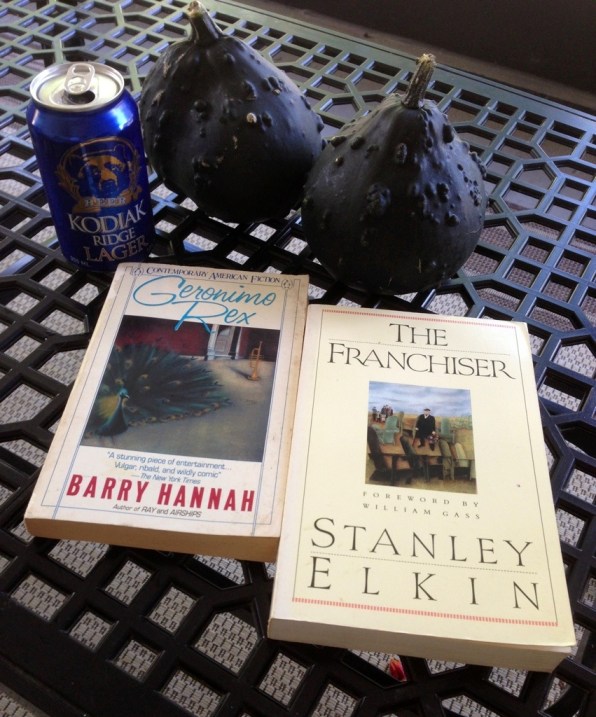
I was thrilled to find a somewhat tattered copy of Barry Hannah’s Geronimo Rex, after trolling the [huge, unorganized] “HA” section of my favorite used bookstore. Years ago, I found like seven of Hannah’s books used there and picked up only one. I devoured it, returned, the rest were gone. Regrets, regrets. I will review this maybe at the end of the summer (?) — until then: reviews of Hannah’s Airshps, Hey Jack!, and Ray.
I’ve never read Stanley Elkin, but sort of feel like I should. Mr. BLCKDGRD (-a, -o, -e) suggested The Franchiser as a good starting point (although he said that The Magic Kingdom is his pers. fav. {disney fan?}). Some dude named Billy Gass wrote the forward.
Also pictured: Two weird black gourds that grew in my garden, right in the midst of my cucumber patch. Also: Kodiak Ridge Lager, a weak lager with a beautiful blue an’ gold can.
My aunts told wonderful stories. Not to me, but to each other. We had a very strong family. My mother’s sisters loved each other intensely. The uncles loved each other intensely. Those were the days when it meant something to travel, when people were still grinning because you could drive a car over a hundred miles. So when they got together they really narrated. Children were supposed to be quiet, so we’d all go to bed, but I’d still hear these stories going into the night and people’s laughter. It was a delightful way to go to sleep on Christmas or Thanksgiving. They had huge senses of humor. Humor meant everything to them because they had all been through the war and the depression, and now they had decent work and jobs. I think there’s no kind of happiness and laughter as after you’ve made something after a tough grade.
I was born in Clinton, Mississippi, which had 1,500–2,500 people when I was growing up—a village. Now it’s impossible to go back to these places because they’re not there anymore. My generation, we were the war children, and so there’s just hurt all over the continent because there’s no place to go home to.
Today, there’s no present to people. Nobody wants to listen for very long to anybody talking, except in certain places—in a bar, in a confessional, or maybe a shrink’s office. All they say is, Yeah, yeah, yeah. Men don’t even tell dirty jokes much anymore.
Nobody stops to talk except the instructors at college who’re paid for it. So it was a much more primitive time back then. More heartfelt. A more patient time, and I was the beneficiary of that.
Lorenzo Dow rode the Old Natchez Trace at top speed upon a race horse, and the cry of the itinerant Man of God, “I must have souls! And souls I must have!” rang in his own windy ears. He rode as if never to stop, toward his night’s appointment.
It was the hour of sunset. All the souls that he had saved and all those he had not took dusky shapes in the mist that hung between the high banks, and seemed by their great number and density to block his way, and showed no signs of melting or changing back into mist, so that he feared his passage was to be difficult forever. The poor souls that were not saved were darker and more pitiful than those that were, and still there was not any of the radiance he would have hoped to see in such a congregation.
“Light up, in God’s name!” he called, in the pain of his disappointment.
Then a whole swarm of fireflies instantly flickered all around him, up and down, back and forth, first one golden light and then another, flashing without any of the weariness that had held back the souls. These were the signs sent from God that he had not seen the accumulated radiance of saved souls because he was not able, and that his eyes were more able to see the fireflies of the Lord than His blessed souls.
“Lord, give me the strength to see the angels when I am in Paradise,” he said. “Do not let my eyes remain in this failing proportion to my – loving heart always.”
He gasped and held on. It was that day’s complexity of horse- trading that had left him in the end with a Spanish race horse for which he was bound to send money in November from Georgia. Riding faster on the beast and still faster until he felt as if he were flying he sent thoughts of love with matching speed to his wife Peggy in Massachusetts. He found it effortless to love at a distance. He could look at the flowering trees and love Peggy in fullness, just as he could see his visions and love God. And Peggy, to whom he had not spoken until he could speak fateful words (“Would she accept of such an object as him?”), Peggy, the bride, with whom he had spent a few hours of time, showing of herself a small round handwriting, declared all in one letter, her first, that she felt the same as he, and that the fear was never of separation, but only of death.
Lorenzo well knew that it was Death that opened underfoot, that rippled by at night, that was the silence the birds did their singing in. He was close to death, closer than any animal or bird. On the back of one horse after another, winding them all, he was always riding toward it or away from it, and the Lord sent him directions with protection in His mind.
Just then he rode into a thicket of Indians taking aim with their new guns. One stepped out and took the horse by the bridle, it stopped at a touch, and the rest made a closing circle. The guns pointed.
“Incline!” The inner voice spoke sternly and with its customary lightning-quickness.
Lorenzo inclined all the way forward and put his head to the horse’s silky mane, his body to its body, until a bullet meant for him would endanger the horse and make his death of no value. Prone he rode out through the circle of Indians, his obedience to the voice leaving him almost fearless, almost careless with joy.
But as he straightened and pressed ahead, care caught up with him again. Turning half-beast and half-divine, dividing himself like a heathen Centaur, he had escaped his death once more. But was it to be always by some metamorphosis of himself that he escaped, some humiliation of his faith, some admission to strength and argumentation and not frailty? Each time when he acted so it was at the command of an instinct that he took at once as the word of an angel, until too late, when he knew it was the word of the Devil. He had roared like a tiger at Indians, he had submerged himself in water blowing the savage bubbles of the alligator, and they skirted him by. He had prostrated himself to appear dead, and deceived bears. But all the time God would have protected him in His own way, less hurried, more divine.
Even now he saw a serpent crossing the Trace, giving out knowing glances.
He cried, “I know you now!,” and the serpent gave him one look out of which all the fire had been taken, and went away in two darts into the tangle.
He rode on, all expectation, and the voices in the throats of the wild beasts went, almost without his noticing when, into words. “Praise God,” they said. “Deliver us from one another.” Birds especially sang of divine love which was the one ceaseless protection. “Peace, in peace,” were their words so many times when they spoke from the briars, in a courteous sort of inflection, and he turned his countenance toward all perched creatures with a benevolence striving to match their own.
There’s something gently elegiac about Marshall Brooks’s Paperback Island, which collects over a dozen essays on reading. While Brooks’s essays on books, libraries, publishers, and the friendships that hold all of them together are never dour, they nevertheless evoke a world now shifting into the realm of memory alone.
It’s fitting then that the starting point for the book is beat legend Tuli Kupferberg’s funeral. Here, Brooks runs into Susanna Cuyler, who lends him her apartment in New York just so he can read her book Not Just Another Voice there: “There was no overlooking the fact that her apartment and her book are virtually one,” writes Brooks. This early detail hooked me, encapsulating so much of the themes of time, place, and friendship that Paperback Island emphasizes.
The lead essay in the collection is “Paperback Island.” Here, Brooks relates an adolescent friendship codified in books: “Besides symbolizing the excitement of what books can mean to people, especially young people who are in the process of formulating their own world, these books are all that remain to me of this once close friendship.” Brooks renders the transformative power that this bookswapping friendship had on him, set against the backdrop of the culture shift of the late sixties and early seventies:
Informationally, and in other ways as well, the early 1970s prefigured the Internet. Vast amounts of information, heretofore beyond the reach of the masses, became available. The visually compartmentalized newsprint portions of Harper’s Magazine and the encyclopedic paperbound Whole Earth Catalog come immediately to mind, as does the collectively-produced—via the Boston Women’s Health Collective—1970 paperback, Our Bodies, Ourselves. Design-wise, they all accelerated the absorption of information from off the printed page in completely innovative ways, which today’s web pages perforce echo. In conjunction with FM radio, foreign films, Super 8 film, Swinger cameras, stereo records, tape cassettes , early video, offset printing, the 1976 Freedom of Information Act, and such empowering movements as Women’s Lib, etc. , they revolutionized the lives of everyone, and youth culture in particular.
It would perhaps be easy for Brooks to have crammed his book with anecdotes illustrating the effects of these changes, but instead Paperback Island focuses on something much more personal, following the tone of its eponymous essay. There are memory-essays for Tuli Kupferberg, James T. Farrell, and Sidney Bernard, whose rogue journalism collection This Way to the Apocalypse I am now on the lookout for. In the background of all of this looms Harry Smith, the poet-publisher and founder of The Smith, where Brooks cut his teeth in the seventies. Smith’s influence on Brooks resonates in loving passages like this one:
A legendary figure in the American small press movement, Harry more than fulfilled the role of patron-protector for countless contributors to his press. He impressively looked the role, too, nowhere more so than when he grandly made the circuit at small press fair . . . The Smith published scores of unknown and neglected writers . . . The press resembled nothing else in the publishing world large or small partly for this reason. I had always assumed that a place exactly like it existed, somewhere. That it had to. (Why else write, really?) A place where poetry counted for everything. Fate, in its greatness, encouragingly provided for its existence, and Harry Smith supplied that place.
It’s that sense of place that comes through so strongly in Paperback Island, whether Brooks is describing the offices of The Smith or the hotels that James T. Farrell adored. Brooks also captures the strange ways that microlibraries evolve from place, time, and friendship (he inherited many of Farrell’s paperbacks). I think most bibliophiles will instantly understand Brooks’s impulse to collect, catalog, keep the tomes.
And of course there are the bookshops, the wanderings, the meanderings, the notes on books and how we find them. A late riff on visiting a Boston Barnes & Noble finds Brooks picking up a Nook and reading a passage from Austen’s Pride & Prejudice—his first time with an e-reader. The moment is not couched in resentment or alienation but simply experience—encountering an old book in a new way.
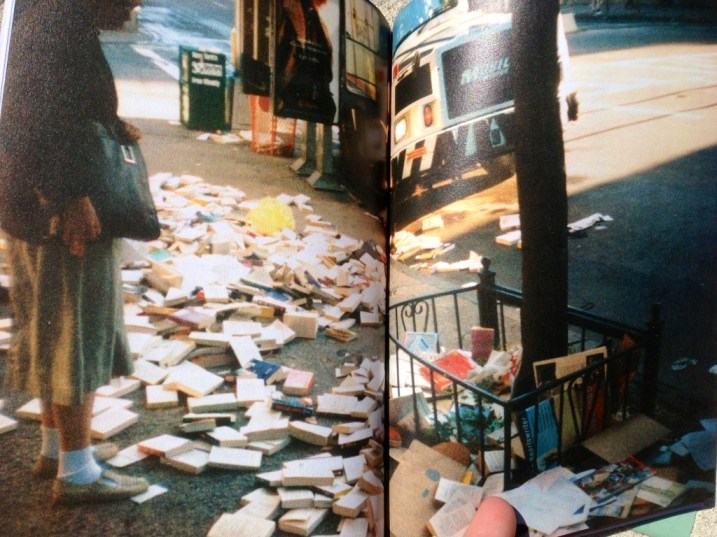
I should point out that Brooks has illustrated Paperback Island with photographs—of people, places, books—the things that make the book. (Books are made out of other books, some writer said). The photos are printed in rich color and add a documentary dimension to the book. Here’s a striking image of the closing of the Upper West Side branch of Shakespeare & Company—an image that perhaps captures more of the elegiac underpinnings of Paperback Island than I can do in words:
Paperback Island is shot-through with bibliophilia, a love of books that encompasses writers, readers, libraries, and publishers, yes—but also the mechanics of the book, the physical properties. It’s a love letter to books and the people who make them—and not just the writers and publishers, but the readers who make them, preserve them—and the friends who pass them on, make sure that others read them.
In a latter essay, “Physical Allure of the Book,” Brooks writes, “My friend Roger Skillings became a writer on account of picking up a Penguin edition of James Joyce’s Dubliners in a train station in Rome.” I’ll end this write-up in what I take to be the spirit of Brooks’s book, sharing a little anecdote of my own about a book I can’t part with.
In 2002 I was wandering Jimbocho, an area of Tokyo crammed with nearly 200 bookshops. I found, lying in the gutter but unsullied, a paperback Penguin Book — The Essential James Joyce, edited by Harry Levin. I glanced around, trying to see if the book was somehow connected to a nearby vendor, but it didn’t seem to be for sale. In any case, I surreptitiously slipped the book into my bag and walked on. I read “The Dead” on the train ride home. I’ve kept the book to this day, even though I have no need of a Joyce digest. I can’t help it. I love it.
She was an old woman and lived on a farm near the town in which I lived. All country and small-town people have seen such old women, but no one knows much about them. Such an old woman comes into town driving an old worn-out horse or she comes afoot carrying a basket. She may own a few hens and have eggs to sell. She brings them in a basket and takes them to a grocer. There she trades them in. She gets some salt pork and some beans. Then she gets a pound or two of sugar and some flour.
Afterwards she goes to the butcher’s and asks for some dog-meat. She may spend ten or fifteen cents, but when she does she asks for something. Formerly the butchers gave liver to any one who wanted to carry it away. In our family we were always having it. Once one of my brothers got a whole cow’s liver at the slaughter-house near the fairgrounds in our town. We had it until we were sick of it. It never cost a cent. I have hated the thought of it ever since.
The old farm woman got some liver and a soup-bone. She never visited with any one, and as soon as she got what she wanted she lit out for home. It made quite a load for such an old body. No one gave her a lift. People drive right down a road and never notice an old woman like that.
There was such an old woman who used to come into town past our house one Summer and Fall when I was a young boy and was sick with what was called inflammatory rheumatism. She went home later carrying a heavy pack on her back. Two or three large gaunt-looking dogs followed at her heels.
The old woman was nothing special. She was one of the nameless ones that hardly any one knows, but she got into my thoughts. I have just suddenly now, after all these years, remembered her and what happened. It is a story. Her name was Grimes, and she lived with her husband and son in a small unpainted house on the bank of a small creek four miles from town.
The husband and son were a tough lot. Although the son was but twenty-one, he had already served a term in jail. It was whispered about that the woman’s husband stole horses and ran them off to some other county. Now and then, when a horse turned up missing, the man had also disappeared. No one ever caught him. Once, when I was loafing at Tom Whitehead’s livery-barn, the man came there and sat on the bench in front. Two or three other men were there, but no one spoke to him. He sat for a few minutes and then got up and went away. When he was leaving he turned around and stared at the men. There was a look of defiance in his eyes. “Well, I have tried to be friendly. You don’t want to talk to me. It has been so wherever I have gone in this town. If, some day, one of your fine horses turns up missing, well, then what?” He did not say anything actually. “I’d like to bust one of you on the jaw,” was about what his eyes said. I remember how the look in his eyes made me shiver. Continue reading ““Death in the Woods” — Sherwood Anderson”→
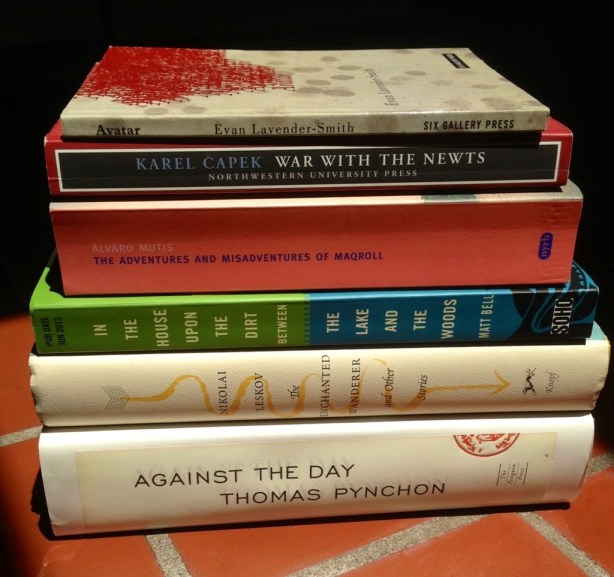
First, I’ll finish Mikhaíl Bulgakov’s The Master & Margarita, not pictured here because I’m reading it on the Kindle. No new novels until I finish this novel! (Will break this rule).
I just finished another trip through Ulysses, again via audiobook plus tandem-rereading on the Kindle. I like big audiobooks (and I cannot lie), so I’ll get into Against the Day on mp3.
This weekend I read “The Lady Macbeth of Mtsenk,” the first story in a freshly translated collection from Nikolai Leskov. The Enchanted Wanderer is new in translation by Richard Pevear and Larissa Volokhonsky. I’ll be reading it in chunks this summer.
Speaking of reading in chunks: I devoured the first three novellas in Álvaro Mutis’s Maqrollseries and then took a break to get some other stuff in. Break over.
Also: Matt Bell’s novel In the House Upon the Dirt Between the Lake and the Woods.
And I still haven’t read Karel Čapek’s War with the Newts, so I’ll try to fix that this summer.
I also plan to read Evan Lavender-Smith’s Avatar, but I’d like to do it in one sitting, which means I need to free up a few hours.
Finally: Who knows. Reading lists are kind of ridiculous.
A week before the thirtieth of May, three friends—John Stover and Henry Merrill and Asa Brown—happened to meet on Saturday evening at Barton’s store at the Plains. They were ready to enjoy this idle hour after a busy week. After long easterly rains, the sun had at last come out bright and clear, and all the Barlow farmers had been planting. There was even a good deal of ploughing left to be done, the season was so backward.
The three middle-aged men were old friends. They had been school-fellows, and when they were hardly out of their boyhood the war came on, and they enlisted in the same company, on the same day, and happened to march away elbow to elbow. Then came the great experience of a great war, and the years that followed their return from the South had come to each almost alike. These men might have been members of the same rustic household, they knew each other’s history so well.
They were sitting on a low wooden bench at the left of the store door as you went in. People were coming and going on their Saturday night errands,—the post-office was in Barton’s store,—but the friends talked on eagerly, without being interrupted, except by an occasional nod of recognition. They appeared to take no notice at all of the neighbors whom they saw oftenest. It was a most beautiful evening; the two great elms were almost half in leaf over the blacksmith’s shop which stood across the wide road. Farther along were two small old-fashioned houses and the old white church, with its pretty belfry of four arched sides and a tiny dome at the top. The large cockerel on the vane was pointing a little south of west, and there was still light enough to make it shine bravely against the deep blue eastern sky. On the western side of the road, near the store, were the parsonage and the storekeeper’s modern house, which had a French roof and some attempt at decoration, which the long-established Barlow people called gingerbread-work, and regarded with mingled pride and disdain. These buildings made the tiny village called Barlow Plains. They stood in the middle of a long narrow strip of level ground. They were islanded by green fields and pastures. There were hills beyond; the mountains themselves seemed very near. Scattered about on the hill slopes were farmhouses, which stood so far apart, with their clusters of out-buildings, that each looked lonely, and the pine woods above seemed to besiege them all. It was lighter on the uplands than it was in the valley, where the three men sat on their bench, with their backs to the store and the western sky.
“Well, here we be ‘most into June, an’ I ‘ain’t got a bush-bean above ground,” lamented Henry Merrill.
“Your land’s always late, ain’t it? But you always catch up with the rest on us,” Asa Brown consoled him. “I’ve often observed that your land, though early planted, was late to sprout. I view it there’s a good week’s difference betwixt me an’ Stover an’ your folks, but come first o’ July we all even up.”
“‘Tis just so,” said John Stover, taking his pipe out of his mouth, as if he had a good deal more to say, and then replacing it, as if he had changed his mind.
“Made it extry hard having that long wet spell. Can’t none on us take no day off this season,” said Asa Brown; but nobody thought it worth his while to respond to such evident truth.
“Next Saturday’ll be the thirtieth o’ May—that’s Decoration Day, ain’t it?—come round again. Lord! how the years slip by after you git to be forty-five an’ along there!” said Asa again. “I s’pose some o’ our folks’ll go over to Alton to see the procession, same’s usual. I’ve got to git one o’ them small flags to stick on our Joel’s grave, an’ Mis’ Dexter always counts on havin’ some for Harrison’s lot. I calculate to get ’em somehow. I must make time to ride over, but I don’t know where the time’s comin’ from out o’ next week. I wish the women folks would tend to them things. There’s the spot where Eb Munson an’ John Tighe lays in the poor-farm lot, an’ I did mean certain to buy flags for ’em last year an’ year before, but I went an’ forgot it. I’d like to have folks that rode by notice ’em for once, if they was town paupers. Eb Munson was as darin’ a man as ever stepped out to tuck o’ drum.” Continue reading ““Decoration Day” — Sarah Orne Jewett”→
Got a sweet bundle from Roman Muradov a few weeks ago: Yellow Zine #3 plus some other comix, including a take on Italo Calvino’s If on a Winter’s Night. Love the Joyce bookmark.
The comix themselves are funny, weird, and strangely heartfelt (why “strangely” — I suppose because there’s this weird cerebral/linguistic bent to them + literary allusion — these aren’t sad boy emo comics — but emotion and feeling comes through in Roman’s clean, expressive style).
Check out Roman’s site for more. I’m hoping for a graphic novel one day…

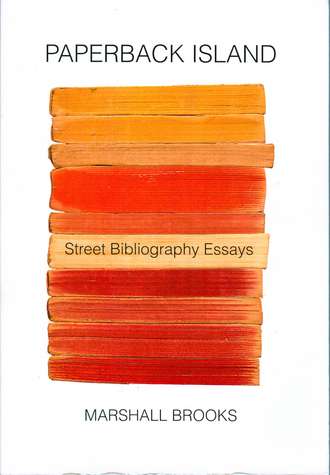 Marshall Brooks’s recent collection of memoir-essays Paperback Island explores the ways that friendship and place influence what we read, how we read, and how we make—and keep—books. Marshall began his career in publishing in 1971, reading manuscripts for Harry Smith at his legendary publishing house The Smith. In 1979 he created Arts End Press. Subtitled Street Bibliography Essays, Marshall’s latest book provides fascinating insights into a world of post-Beat publishing that is slowly slipping away (that is, aside from in memories and books). Marshall was kind enough to talk to me over a series of emails. He was generous and thoughtful, and also interested in my own life—in my kids, in my reading and teaching, but also in the bookstores in my community. It was a pleasure to talk with him. The end of our email exchange found him in NYC, attending a memorial for Harry Smith. Marshall lives in Vermont with his wife and two sons. Check out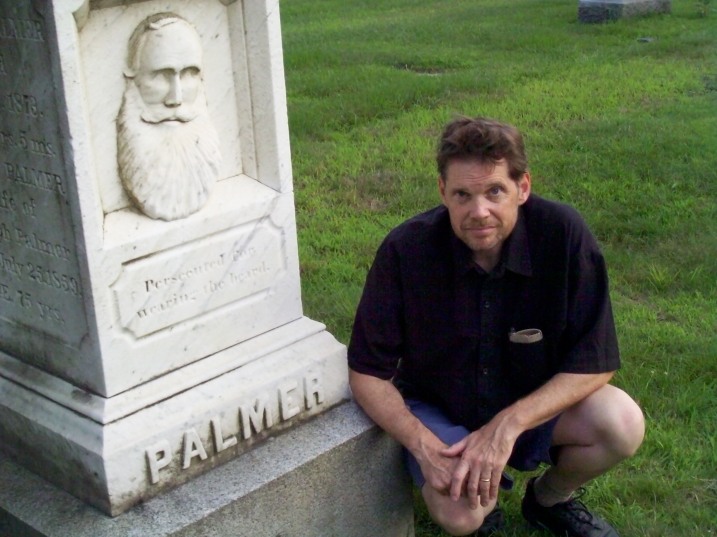




 Biblioklept