The Never-Ending Torture of Unrest | Georg Büchner’s Lenz Reviewed

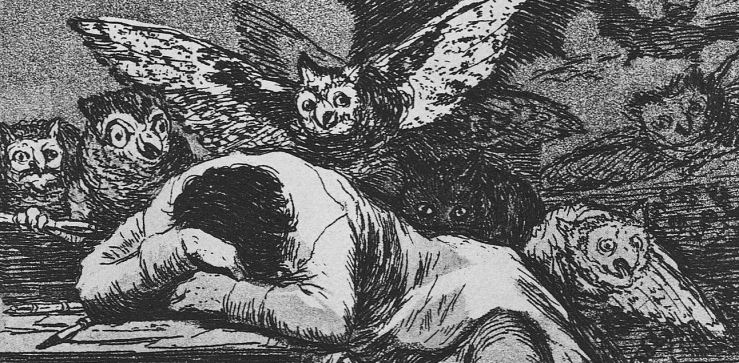
sleep of reason
The Sleep of Reason Produces Monsters (detail), Francisco Goya

Composed in 1836, Georg Büchner’s novella-fragment Lenz still seems ahead of its time. While Lenz’s themes of madness, art, and ennui can be found throughout literature, Büchner’s strange, wonderful prose and documentary aims bypass the constraints of his era.

Let me share some of that prose. Here is the opening paragraph of Lenz:

The 20th, Lenz walked through the mountains. Snow on the peaks and upper slopes, gray rock down into the valleys, swatches of green, boulders, firs. It was sopping cold, the water trickled down the rocks and leapt across the path. The fir boughs sagged in the damp air. Gray clouds drifted across the sky, but everything so stifling, and then the fog floated up and crept heavy and damp through the bushes, so sluggish, so clumsy. He walked onward, caring little one way or another, to him the path mattered not, now up , now down. He felt no fatigue, except sometimes it annoyed him that he could not walk on his head. At first he felt a tightening in his chest when the rocks skittered away, the gray woods below him shook, and the fog now engulfed the shapes, now half-revealed their powerful limbs; things were building up inside him, he was searching for something, as if for lost dreams, but was finding nothing. Everything seemed so small, so near, so wet, he would have liked to set the earth down behind an oven, he could not grasp why it took so much time to clamber down a slope, to reach a distant point; he was convinced he could cover it all with a pair of strides.

Büchner sets us on Lenz’s shoulder, moving us through the estranging countryside without any exposition that might lend us bearings. The environment impinges protagonist and reader alike, heavy, damp, stifling. Büchner’s syntax shuffles along, comma splices tripping us into Lenz’s manic consciousness, his mind-swings doubled in the path that is “now up, now down.” We feel the “tightening” in Lenz’s chest as the “rocks skittered away,” as the “woods below him shook” — the natural world seems to envelop him, cloak him, suffocate him. It’s an animist terrain, and Büchner divines those spirits again in the text. The claustrophobia Lenz experiences then swings to another extreme, as our hero, his consciousness inflated, feels “he could cover [the earth] with a pair of strides.

And that baffling line: “He felt no fatigue, except sometimes it annoyed him that he could not walk on his head.” Well.

The end notes to the Archipelago edition I read (translated by Richard Sieburth) offer Arnold Zweig’s suggestion that “this sentence marks the beginning of modern European prose,” as well as Paul Celan’s observation that “whoever walks on his head has heaven beneath him as an abyss.”

Celan’s description is apt, and Büchner’s story repeatedly invokes the abyss to evoke its hero’s precarious psyche. Poor Lenz, somnambulist bather, screamer, dreamer, often feels “within himself something . . . stirring and swarming toward an abyss toward which he was being swept by an inexorable force.” Lenz is the story of a young artist falling into despair and madness.
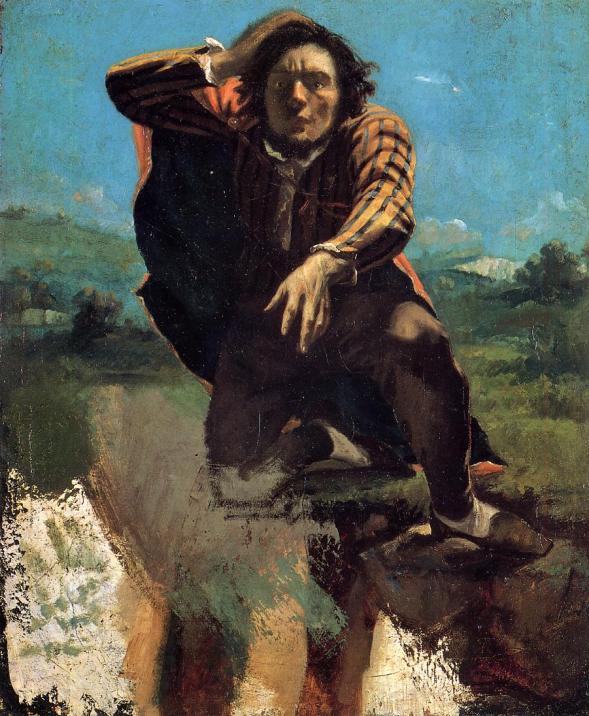
The Man Made Mad by Fear, Gustave Courbet

But perhaps I should offer a more lucid summary. I’ll do that in the next paragraph, but first: Let me just recommend you skip that paragraph. Really. What I perhaps loved most about Lenz was piecing together the plot through the often elliptical or opaque experiences we get via Büchner’s haunting free indirect style. The evocation of a consciousness in turmoil is probably best maintained when we read through the same confusion that Lenz experiences. I read the novella cold based on blurbs from William H. Gass and Harold Bloom and I’m glad I did.

Here is the summary paragraph you should skip: Jakob Lenz, a writer of the Sturm and Drung movement (and friend and rival to Goethe), has recently suffered a terrible episode of schizophrenia and “an accident” (likely a suicide attempt). He’s sent to pastor-physician J.F. Oberlin, who attends to him in the Alsatian countryside in the first few weeks of 1778. During this time Lenz obsesses over a young local girl who dies (he attempts to resurrect her), takes long walks in the countryside, cries manically, offers his own aesthetic theory, prays, takes loud late-night bath in the local fountain, receives a distressing letter, and, eventually, likely—although it’s never made entirely explicit—attempts suicide again and is thusly shipped away.

Büchner bases his story on sections of Oberlin’s diary, reproduced in the Archipelago edition. In straightforward prose, these entries fill in the expository gaps that Büchner has so elegantly removed and replaced with the wonder and dread of Lenz’s imagination. The diary’s lucid entries attest to the power of Büchner’s speculative fiction, to his own art and imagination, which so bracingly take us into a clouded mind.

In Sieburth’s afterword (which also offers a concise chronology of Lenz’s troubled life), our translator points out that “Like De Quincey’s “The Last Days of Immanuel Kant” or Chateaubriand’s Life of Rancé, Büchner’s Lenz is an experiment in speculative biography, part fact, part fabrication—an early nineteenth-century example of the modern genre of docufiction.” Obviously, any number of postmodern novels have explored or used historical figures—Public Burning, Ragtime, and Mason & Dixon are all easy go-to examples. But Lenz is more personal than these postmodern fictions, more an exploration of consciousness, and although we are treated to Lenz’s ideas about literature, art, and religion, we access this very much through his own skull and soul. He’s not just a placeholder or mouthpiece for Büchner.

Lenz strikes me as something closer to the docufiction of W.G. Sebald. Perhaps it’s all the ambulating; maybe it’s the melancholy; could be the philosophical tone. And, while I’m lazily, assbackwardly comparing Büchner’s book to writers who came much later: Thomas Bernhard. Maybe it’s the flights of rant that Lenz occasionally hits, or the madness, or the depictions of nature, or hell, maybe it’s those long, long passages. The comma splices.

Chronologically closer is the work of Edgar Allan Poe, whose depictions of manic bipolar depression resonate strongly with Lenz—not to mention the abysses, the torment, the spirits, the doppelgängers. Why not share another sample here to illustrate this claim? Okay:

The incidents during the night reached a horrific pitch. Only with the greatest effort did he fall asleep, having tried at length to fill the terrible void. Then he fell into a dreadful state between sleeping and waking; he bumped into something ghastly, hideous, madness took hold of him, he sat up, screaming violently, bathed in sweat, and only gradually found himself again. He had to begin with the simplest things in order to come back to himself. In fact he was not the one doing this but rather a powerful instinct for self preservation, it was as if he were double, the one half attempting to save the other, calling out to itself; he told stories, he recited poems out loud, wracked with anxiety, until he came to his sense.

Here, Lenz suspends his neurotic horror through storytelling and art—but it’s just that, only a suspension. Büchner doesn’t blithely, naïvely suggest that art has the power to permanently comfort those in despair; rather, Lenz repeatedly suggests that art, that storytelling is a symptom of despair.

The Last Judgment (detail), Rogier van der Weyden

What drives despair? Lenz—Lenz—Büchner (?)—suggests repeatedly that it’s Langeweile—boredom. Sieburth renders the German Langeweile as boredom, a choice I like, even though he might have been tempted to reach for its existentialist chain-smoking cousin ennui. When Lenz won’t get out of bed one day, Oberlin heads to his room to rouse him:

Oberlin had to repeat his questions at length before getting an answer: Yes, Reverend, you see, boredom! Boredom! O, sheer boredom, what more can I say, I have already drawn all the figures on the wall. Oberlin said to him he should turn to God; he laughed and said: if I were as lucky as you to have discovered such an agreeable pastime, yes, one could indeed wile away one’s time that way. Tedium the root of it all. Most people pray only out of boredom; others fall in love out of boredom, still others are virtuous or depraved, but I am nothing, nothing at all, I cannot even kill myself: too boring . . .

Lenz fits in neatly into the literature of boredom, a deep root that predates Dostoevsky, Camus, and Bellow, as well as contemporary novels like Lee Rourke’s The Canal and David Foster Wallace’s The Pale King.

Ultimately, the boredom Lenz circles around is deeply painful:

The half-hearted attempts at suicide he kept on making were not entirely serious, it was less the desire to die, death for him held no promise of peace or hope, than the attempt, at moments of excruciating anxiety or dull apathy bordering on non-existence bordering on non-existence, to snap back into himself through physical pain. But his happiest moments were when his mind seemed to gallop away on some madcap idea. This at least provided some relief and the wild look in his eye was less horrible than the anxious thirsting for deliverance, the never-ending torture of unrest!

The “never-ending torture of unrest” is the burden of existence we all carry, sloppily fumble, negotiate with an awkward grip and bent back. Büchner’s analysis fascinates in its refusal to lighten this burden or ponderously dwell on its existential weight. Instead, Lenz is a character study that the reader can’t quite get out of—we’re too inside the frame to see the full contours; precariously perched on Lenz’s shoulder, we have to jostle along with him, look through his wild eyes, gallop along with him on the energy of his madcap idea. The gallop is sad and beautiful and rewarding. Very highly recommended.
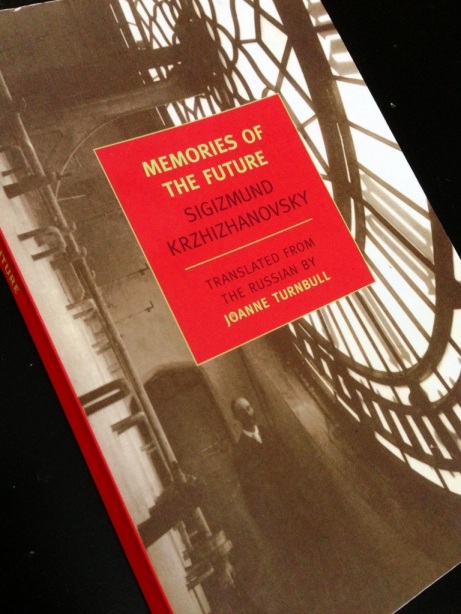
“All Our Figments and Alogisms” | The Kafkaesque, Borgesian, Phildickian Worlds of Sigizmund Krzhizhanovsky

20130602-142757.jpg

At some point I acquired the notion, probably a fair one, that comparing writers to other writers is critically lazy. At the same time, writers write after other writers, through other writers, to other writers, against other writers, in other writers, out of other writers, on top of other writers, and so on. Literature is archaeological. And if I’m honest, a lot of the time it’s the comparison to another writer that prompts my interest in a writer I haven’t read.

Let me get to what I was getting at:

Sigizmund Krzhizhanovsky: Russian, 1887-1950: His collection Memories of the Future: Seven stories in spirited translation by Joanne Turnbull: Available in English from the good folks at NYRB: It’s the sort of book that deserves its own book. Etc.

In lieu of writing that book, quite beyond my power, I’ll compare Sigizmund Krzhizhanovsky to some other writers in the hope of piquing your interest in this neglected master.

***

KAFKAESQUE

You knew I would start here.

Four years senior to Krzhizhanovsky, Mr. Kafka of Prague was our Russian writer’s contemporary (if we want to use our postmodern imaginations). I was tempted to simply type “K” for Kafka, but they are both K. Kafkaesque is invoked frequently enough to potentially sap the adjective’s potency, but consider that the same nebulous yet very real forces that shaped (warped?) Kafka (which, in turn Kafka shaped (warped) in his own writing) shaped (warped?) Krzhizhanovsky. Unseen, displaced authority, alienation, and absurdity, yes, but also humor, the line of hysteria, the constraining order that induces madness. The nightmare of modernity.

From “The Branch Line”:

“Speaking in more modern terms,” the fine print went on, “our nightmares, weighing as they do on the brain, gradually form a sort of moral ceiling that is always about to come crashing down on one’s head: some of our customer’s call this ‘world history.’ But that’s not the point. The point is the durability, unwakeability, high depressiveness, and wide availability of our nightmares: mass-market products good for all eras and classes, nighttime and daytime, moonlight and sunlight, closed eyes and open.”

BULGAKOVIAN

If Kafka was Krzhizhanovsky’s psychical contemporary, Mikhail Bulgakov (Russian, b. 1891) is his geographic one. Both men were writing through (and to some extent, against) the Russian Revolution, rendering the crowded buzz of new Moscow in manic strokes. Humming under the surface of Bulgakov’s masterpiece The Master and Margarita is the threat of disappearance, the loss of personal space, but also absurd humor. These themes run through the seven stories collected in Memories of the Future, but perhaps evince most strongly in “Quadraturin” (maybe Krzhizhanovsky’s most famous story), where furtive bachelor Sutulin obtains a samizdat device that expands his tiny apartment—ad infinitum into limitless space and terror.

From “Quadraturin”:

In their sleep and in their fear, the occupants of the quadratures adjacent to citizen Sutulin’s eighty-six square feet couldn’t make head or tail of the timbre and intonation of the cry that woke them in teh middle of the night and compelled them to rush to the threshold of the Sutulin cell: for a man who is lost and dying in the wilderness to cry out is both futile and belated: but if even so—against all sense—he does cry out, then, most likely, thus.

BORGESIAN

So much of Kafkaesque applies to Borgesian, and perhaps I’ve quickly run up against one of the central problems of comparison: The originary: The source of the source: Primary (etc.). No matter. Krzhizhanovsky’s modernism is Borgesian: Tale-telling: nested tales, circular tales, winding tales, labyrinths and mirrors, trap doors and hidden texts (motives), narrators who tell us a story as if it’s just a distraction in the middle of some bigger story we won’t get to hear—yet. Could there be a more Borgesian title than “The Bookmark,” a tale loaded with hundreds of tales. (Okay, maybe not hundreds, but still loaded with that Scheherazade programming, that infinite looping…).

From “Someone Else’s Theme”:

And an invented person makes the greatest impression, naturally, on the seemingly not-invented, real person who, upon finding his reflection in a book, feels replaced and redoubled. This person cannot forgive his feeling of double insult: here I, a real, not-invented person, shall go to my grave and nothingness in ten or twenty years, whereas this fabricated, not-real “almost I” shall go on living and living as though it were the most natural thing in the world; more unforgivable still is the awareness that someone, some author, made you up like an arithmetic problem, what’s more he figured you out, arrived at an answer over which you struggled your entire life in vain, he divined your existence without ever having met you, he penned his way into your innermost thoughts, which you tried so hard to hide from yourself. One must refute the author and vindicate oneself. At once!

HAWTHORNESQUE

It might be easy to go to Poe for a comparison: He’s famous for his tales, and Krzhizhanovsky is a tale-master—whereas Hawthorne’s estimable short stories are often overlooked because he happened to write what may or may not be The Great American Novel. But Hawthorne’s dark romantic imagination, his weird sci-fi streak, and his wry sense of humor offer a better frame of reference for Krzhizhanovsky’s contours. Krzhizhanovsky is also fond of Hawthorne’s closing gambit, the “It-was-all-a-dream-or-hey-was-it?” maneuver. Both writers practice allegorical destabilization in their deeply darkly ironic parables. Soul detectives.

From “The Branch Line”:

He knew from experience that dreams, like the thieves in the parable, come unseen, they slip under foreheads, trying to avoid the eyes, and only there—under the cranial roof, safe and sound, sprawled the brain—do they throw off their invisibility.

DOSTOEVSKIAN

Krzhizhanovsky directly invokes several Russian writers by name, including Gogol and Turgenev, but Fyodor Dostoevsky seems to pop up the most. This makes sense. Dostoevsky is Krzhizhanovsky’s parent-writer. Or maybe Raskolnikov is. Or maybe the Underground Man is. Like Dostoevsky, Krzhizhanovsky crafts alienated loners and thrusts them into absurd moral quandaries.

From “Red Snow”:

Resignation to one’s fate takes practice. Like any art. Or so citizen Shushashin maintains. He begins every day—after putting on his shoes and washing his face, before throwing on his jacket—with an exercise. Again, the expression is his. This expression works like this: he walks over to the wall, puts his back up against it and stands there in an attitude of utter resignation. For a minute or two. And that’s all. The exercise is over. He can begin to live.

O’BRIENESQUE

Flann O’Brien’s The Third Policeman channels Crime and Punishment via the dream machines of Hawthorne, Wells, Verne et al—all elements we might find in Memories of the Future. And of course O’Brien is Kafkaesque, Borgesian, etc. The stories-within-stories, the fake philosophers, the hefty strawmen, the dreams, the nightmares…Must I draw this out?

From “The Bookmark”:

‘I remember I tossed all night, my elbows bumping against the hard theme that layers our entire life. My pen, as soon as I dipped it in ink, wrote Animal Disputans. That was the title. Next came…Perhaps this doesn’t interest you?’

‘Please go on.’

‘I took the title and the first verses of my song, if you will, from an old and long-forgotten book by the Danish humorist Holberg. This book—Nicolai Klimmi Her subterraneum, I believe it’s called—describes the fantastic adventures of a traveler who winds up, I can’t remember how, inside the Earth. The traveler is astonished to find that inside the planet, as inside a hermetically sealed vessel, lives a race with its own hermetically sealed State system, way of life, culture, everything that is customary in such cases. Over time the life of these undergroundlings—once rife with wars and conflict, cut off, hidden away beneath miles of crust—sorted itself out and settled into a harmonious routine. The problems of the hermetically sealed were all solved, everything ironed out and agreed upon. But in memory of those long-ago wars, Nicolai Klimmi tells us—no, please listen, it’s rather touching—the land’s noblest and richest magnates raised animal disputans. There isn’t anything to argue about in an isolated country where everything has been determined and predetermined in saecula saculorum but these disputants were trained for the purpose, fed a special diet that irritated the liver and sublingual nerve, then pitted against one another and forced to argue till they were hoarse and foaming at the mouth—to unanimous laughter and merry halloos from the lovers of old traditions…

PHILDICKIAN

I think we can all agree that Memories of the Future could be the title of a Philip K. Dick story, right? The story of the same title (the longest in the collection, a novella, really) strongly recalls Dick, channeling him through time travel, and Phildickian themes course throughout the book: Paranoia, identity crisis, cynicism, the realization that the waking life might conceal alternative consciousness…

From “The Branch Line”:

Haven’t we managed to unify dreams? Haven’t we hoodwinked humanity with that sweet million-brain dream of brotherhood, a united dream about unity? Flags the color of poppy petals flutter above the crowds. Reality is fighting back. But its blazing suns don’t frighten the newly ascendant underground. Sleepers’ eyes are shielded by eyelids. Yesterday’s utopia has become today’s science. We’ll break the backs of facts. We’ll rout their status quos: you’ll see those status quos turn tail and run. If an ‘I’ should rise up against our ‘we’, we’ll hurl him down a well of nightmares headfirst. We’ll hide the sun behind black blots, we’ll plunge the whole world into a deep, static slumber. We’ll even put the idea of waking to sleep, and if it resists, we’ll gouge out its eyes.

BOLAÑOESQUE

While reading Memories of the Future, I sometimes pretended that Krzhizhanovsky (and his doppelganger writer-protagonists) were versions of Boris Abramovich Ansky, the dissident Russian writer who appears (via diaries and fragments) in “The Part About Archimboldi” in Roberto Bolaño’s 2666. Sure, I brought some of that metatextual layering with me, but Krzhizhanovsky’s Borgesian stories repeatedly destabilize the notion of an authoritative narrator or storyteller, like matryoshka dolls that open into eggs that open into dreams and nightmares. Like Bolaño’s work, Krzhizhanovsky’s writing skates across an abyss of horror. The Krzhizhanovskian milieu shares psychic space with the Bolañoverse—in particular, both writers seem to love to walk their characters through graveyards.

From “The Thirteenth Category of Reason”:

That’s how it always is: first you call on your friends, and then—when the hearses have delivered them—on their graves. Now my turn too has come to exchange people for graves. The cemetery where I go more and more often lies behind high crenelated walls and looks from the outside like a fortress: only when the fighters have all fallen will the gates open. You walk in—first past a chaos of crosses, then past the inner wall—to the new crossless cemetery: gone are the monumental statics of the old human sepulchers, the massive family vaults and stone angels with their penguin-like wings grazing the earth: red metal starts on thin wire stems fidget nervously in the wind.

***

By way of conclusion, I’ll submit that Krzhizhanovsky is just as notable for his divergences from the writers I’ve listed above as he is for any similarities. There are also plenty of names that could be added to the list above, and readers of Krzhizhanovsky will likely protest that I’ve failed to underscore the political underpinnings of his writing (for the record, the seven stories in Memories of the Future clearly respond to (and in many ways protest and satirize) early Soviet politics and lifestyle, but Krzhizhanovsky’s approach is coded, oblique, and in this sense, timeless).

I’ll end with with another citation from “The Thirteenth Category of Reason,” a story that plays with Kant’s twelve categories of conception. Krzhizhanovsky’s work is always dialogic; he’s always performing voices, but occasionally one slips through that I take to be a more direct version of the author’s own. Here, Krzhizhanovsky offers a possible thesis statement for his project—his desire to write outside the confines of reason, his desire to find meaning in “all our figments and alogisms”:

For you see, all those who are off (I won’t look for another definition) or, rather, out of their heads, evicted, so to speak, from all twelve Kantian categories of reason, must naturally seek refuge in a thirteenth category, a sort of logical lean-to slouched against objective obligatory thinking. Given that the thirteenth category of reason is where we entertain, in essence, all our figments and alogisms, the old gravedigger may be useful to my projected cycle of “fantastic” stories.

That projected cycle of fantastic stories is Memories of the Future.

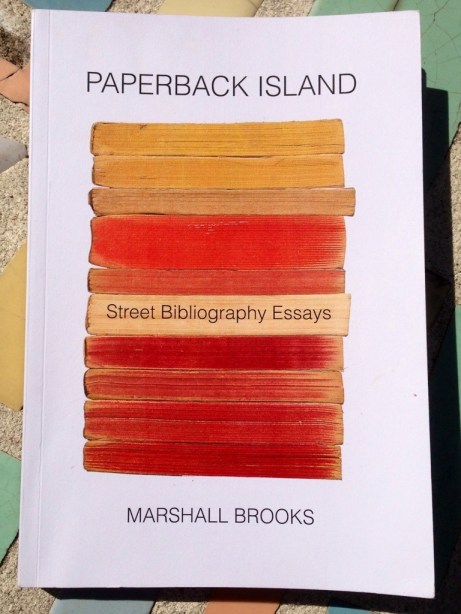
I Review Paperback Island, Marshall Brooks’s Love Letter to Books and the People Who Make Them

20130526-164356.jpg

There’s something gently elegiac about Marshall Brooks’s Paperback Island, which collects over a dozen essays on reading. While Brooks’s essays on books, libraries, publishers, and the friendships that hold all of them together are never dour, they nevertheless evoke a world now shifting into the realm of memory alone.

It’s fitting then that the starting point for the book is beat legend Tuli Kupferberg’s funeral. Here, Brooks runs into Susanna Cuyler, who lends him her apartment in New York just so he can read her book Not Just Another Voice there: “There was no overlooking the fact that her apartment and her book are virtually one,” writes Brooks. This early detail hooked me, encapsulating so much of the themes of time, place, and friendship that Paperback Island emphasizes.

The lead essay in the collection is “Paperback Island.” Here, Brooks relates an adolescent friendship codified in books: “Besides symbolizing the excitement of what books can mean to people, especially young people who are in the process of formulating their own world, these books are all that remain to me of this once close friendship.” Brooks renders the transformative power that this bookswapping friendship had on him, set against the backdrop of the culture shift of the late sixties and early seventies:

Informationally, and in other ways as well, the early 1970s prefigured the Internet. Vast amounts of information, heretofore beyond the reach of the masses, became available. The visually compartmentalized newsprint portions of Harper’s Magazine and the encyclopedic paperbound Whole Earth Catalog come immediately to mind, as does the collectively-produced—via the Boston Women’s Health Collective—1970 paperback, Our Bodies, Ourselves. Design-wise, they all accelerated the absorption of information from off the printed page in completely innovative ways, which today’s web pages perforce echo. In conjunction with FM radio, foreign films, Super 8 film, Swinger cameras, stereo records, tape cassettes , early video, offset printing, the 1976 Freedom of Information Act, and such empowering movements as Women’s Lib, etc. , they revolutionized the lives of everyone, and youth culture in particular.

It would perhaps be easy for Brooks to have crammed his book with anecdotes illustrating the effects of these changes, but instead Paperback Island focuses on something much more personal, following the tone of its eponymous essay. There are memory-essays for Tuli Kupferberg, James T. Farrell, and Sidney Bernard, whose rogue journalism collection This Way to the Apocalypse I am now on the lookout for. In the background of all of this looms Harry Smith, the poet-publisher and founder of The Smith, where Brooks cut his teeth in the seventies. Smith’s influence on Brooks resonates in loving passages like this one:

A legendary figure in the American small press movement, Harry more than fulfilled the role of patron-protector for countless contributors to his press. He impressively looked the role, too, nowhere more so than when he grandly made the circuit at small press fair . . . The Smith published scores of unknown and neglected writers . . . The press resembled nothing else in the publishing world large or small partly for this reason. I had always assumed that a place exactly like it existed, somewhere. That it had to. (Why else write, really?) A place where poetry counted for everything. Fate, in its greatness, encouragingly provided for its existence, and Harry Smith supplied that place.

It’s that sense of place that comes through so strongly in Paperback Island, whether Brooks is describing the offices of The Smith or the hotels that James T. Farrell adored. Brooks also captures the strange ways that microlibraries evolve from place, time, and friendship (he inherited many of Farrell’s paperbacks). I think most bibliophiles will instantly understand Brooks’s impulse to collect, catalog, keep the tomes.

And of course there are the bookshops, the wanderings, the meanderings, the notes on books and how we find them. A late riff on visiting a Boston Barnes & Noble finds Brooks picking up a Nook and reading a passage from Austen’s Pride & Prejudice—his first time with an e-reader. The moment is not couched in resentment or alienation but simply experience—encountering an old book in a new way.

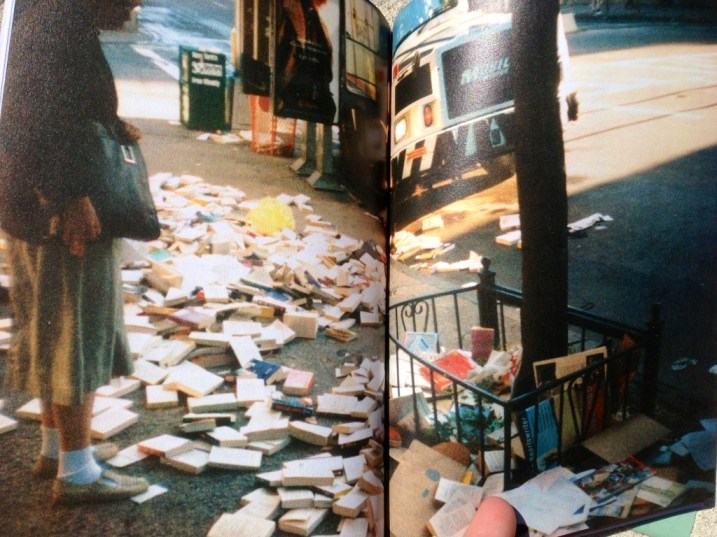
I should point out that Brooks has illustrated Paperback Island with photographs—of people, places, books—the things that make the book. (Books are made out of other books, some writer said). The photos are printed in rich color and add a documentary dimension to the book. Here’s a striking image of the closing of the Upper West Side branch of Shakespeare & Company—an image that perhaps captures more of the elegiac underpinnings of Paperback Island than I can do in words:

20130526-164401.jpg

Paperback Island is shot-through with bibliophilia, a love of books that encompasses writers, readers, libraries, and publishers, yes—but also the mechanics of the book, the physical properties. It’s a love letter to books and the people who make them—and not just the writers and publishers, but the readers who make them, preserve them—and the friends who pass them on, make sure that others read them.

In a latter essay, “Physical Allure of the Book,” Brooks writes, “My friend Roger Skillings became a writer on account of picking up a Penguin edition of James Joyce’s Dubliners in a train station in Rome.” I’ll end this write-up in what I take to be the spirit of Brooks’s book, sharing a little anecdote of my own about a book I can’t part with.

In 2002 I was wandering Jimbocho, an area of Tokyo crammed with nearly 200 bookshops. I found, lying in the gutter but unsullied, a paperback Penguin Book — The Essential James Joyce, edited by Harry Levin. I glanced around, trying to see if the book was somehow connected to a nearby vendor, but it didn’t seem to be for sale. In any case, I surreptitiously slipped the book into my bag and walked on. I read “The Dead” on the train ride home. I’ve kept the book to this day, even though I have no need of a Joyce digest. I can’t help it. I love it.

20130526-164407.jpg

A Short Riff on Shane Carruth’s Film Upstream Color

tumblr_mii1iuUhjR1qzdglao1_500

1. I managed to avoid reading anything about Shane Carruth’s new film Upstream Color before I saw it.

I just knew that this was the guy who did Primer, this was his new film, and I wanted to see it because Primer was so strange and engaging.

2. Two immediate responses after viewing Upstream Color:

i). The desire to see Upstream Color again and

ii). The desire to read what other people thought about Upstream Color.

3. (My wife and I, reading the credits, pausing the credits, reassessing the film against the backdrop of the credits, arguing about the film, discussing the film, etc.).

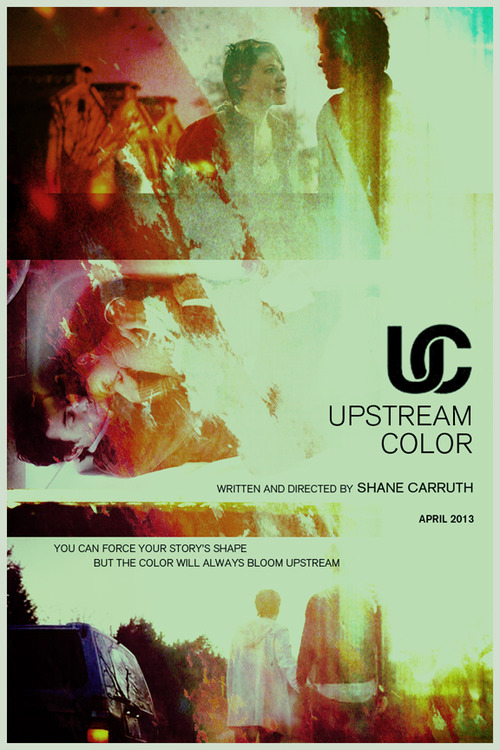
4. I think it’s better that if you have any interest at all in Upstream Color that you just see it cold [update/warning: the comments section of this post is full of spoilers]. But I know that 100 minutes is an investment of time, so maybe you’d like some kind of précis or at least description. So, a loose attempt, which surely will devolve into fragments and references:

Upstream Color is a sci-film, sort of.

Or maybe its a mystery film about ethics and biology.

Maybe a nature film, sort of.

Henry David Thoreau’s Walden.

Worms—parasites.

Theft.

Pigs.

Shades of Philip K. Dick, David Cronenberg, Terence Malick, but also something utterly original.

Mind control.

Trauma.

Ambient music.

Orchids.

Sampling nature.

Memory.

Swimming.

Drowning.

Creation: knitting, paper chains, music, seeds, life, children, etc.

A film that can and should be described as poetic.

It’s a love story, too.

5. It occurs to me that there’s a trailer for the film. I haven’t seen it yet. Should we watch it?

6. Does that do it for you? I don’t know how to do this anymore. Recommend things. I don’t know, the trailer makes the film perhaps look more pretentious than it is. It isn’t pretentious. It isn’t even confusing—just perplexing, haunting, troubling.

7. (Wanted: Quinoa Valley Record Co., complete discography).

8. My take on Upstream Color, spoiler-free, supporting-detail-free:

The film is about agency, about drive, about how the characters (and, implicitly, uswe, the audience, who identify with the characters on the screen) may be driven by something beyond us, something controlling us like a parasite (internal) or from afar like a ventriloquist (external). That even when we do assert agency the effect, the fallout, the shape lays beyond us, upstream.

9. (This morning, my wife telling me about her dream, a nightmare that our young daughter had ingested hallucinogenic mushrooms, clearly a response to the film).

10. I haven’t done a good job of really saying anything about the film. So, lazily:

I think Caleb Crain provides a perceptive and persuasive reading of the film in his essay “The Thoreau Poison.” He reads the film through the American transcendentalists, particularly Thoreau, of course, but also Emerson and Hawthorne. 

There’s also a piece at Slate by Forrest Wickman that perhaps over-explicates but nonetheless offers perspective, including elements of Carruth’s own take.

11. (I will avoid Carruth’s explanation of the film until I’ve seen it a second time. Maybe I’ll avoid his explanation forever).

12. A take on Upstream Color that I don’t quite buy into (the take is my own): The film perhaps invites us to find metaphysical entities in two of its secondary characters, both of whom exert influence (creative and destructive) over the primary characters. Something something godlike, something something devillike.

I like that the film offers this simple duality and then crushes it, shows something far more complicated, suggests a cycle far more strange.

13. (White orchid. Blue orchid. Yellow orchid).

14. Upstream Color features minimal dialogue and nothing approaching traditional exposition, but we still learn about its characters, come to feel for them, feel their desires and traumas. The film is cerebral and philosophical, but it’s also emotional, offering an aesthetic that sublimely overwhelms the viewer.

15. Carruth wrote, produced, directed, scored, photographed, cast and starred in Upstream Color. (I’m sure he did a lot of other stuff too). He also distributed the film himself. The entire filmmaking process was untouched by the Hollywood system. There’s so much hope for film as an art form in this knowledge.

16. Parting thoughts: See Upstream Color. Resist imposing whatever film grammar you usually bring with you to the movies. Resist the temptation to see the film as a puzzle to figure out. See Upstream Color.

Carl Shuker’s Anti Lebanon Reviewed

al

I’m tempted to say that Carl Shuker’s novel Anti Lebanon is full of twists, but twists isn’t the right word—it’s more like the novel’s trajectory repeatedly escapes the reader’s expectations, driving into increasingly alien terrain.

Anti Lebanon begins as a somewhat traditional novel focused on Leon Elias, “thirty years old, East Beiruti Greek Orthodox.” Leon has dropped out of university, leaving his degree in hydrogeology unfinished. Leon has since taken a job as the security guard of an abandoned amusement park, a symbolic stand-in for Lebanon’s tourist economy. The Arab Spring has destabilized Lebanon, leaving its Christian population in a precarious position as Hezbollah dominates the government—and the streets. After dropping out of school, Leon creates an experimental short film, In the anti Lebanon,  a film “about his family and his sister and their history” — a history of mixed cultures (Leon’s mother is Japanese) and pain (his sister, a soldier, was assassinated).

The early parts of Anti Lebanon seem to set the stage for a fairly conventional novel with strong political overtones, one that explores Leon’s guilt over his sister’s violent death and his conflicted place as a sensitive and artistic soul who’s the son an infamous warrior, all set against the backdrop of Christian Lebanon in the tumult of the Arab Spring. But then Shuker takes us other places. Lots of other places.

The crucible for this change comes after a night of drinking ends in violence and theft. I don’t want to spoil too much—this is a novel that constantly had me rereading entire passages, asking, Wait, what?—but let’s just say Leon, complicit in a crime, ends up moving a body by motorcycle. Let me share some of Shuker’s prose in a passage that reveals the novel’s major metaphysical gambit:

This time there was no crash and it probably was the alcohol but the pain of the thing’s biting was gristly and sharp and also distant and allied with the shock of the fall so he rode though it for it seemed several dozen feet— the most important thing was not to fall again. He came to a controlled halt, stopped the bike, and then over his shoulder punched the thing’s face several times, his knuckle hitting soft then hitting helmet, and it bit again and this time harder and it stung and went deeper, a popping sound or feeling in his neck that suddenly got desperately deep and he punched again and then he rolled violently and writhed in the grasp of the thing they had created and he fell over deliberately, twisting so as to topple over sideways upon and hurt and stop the thing, and he hit the ground landing on its arm and this dislodged the biting helmeted head and he pulled up its hands and wriggled away over the concrete like his sister palming herself away from her disappeared foot and he scrambled up, and the thing just lay there inert and still, wired to the scooter in a position absurd, all tied up and crooked and ruined and wrong. He stood and held his hot neck looking at the fallen boy and then knew that someone else was there.

Is Leon now a vampire? The novel answers this question clearly even as it refuses to explain or define what, exactly, being a vampire means.  Anti Lebanon at times threatens to become an allegory of Mideast politics and history, using vampirism as its major trope, but then Shuker shifts us into new, weird territory. An appropriately Borgesian chapter titled “Labyrinth” moves Leon and the reader into a propulsive engine of dream logic; we’re never quite sure exactly what is happening as Leon gives over to dark, primal violence.

Such violence inheres from history and geography and mythology. It’s worth sharing another passage at length to see how Shuker traces these contours, plunging character and reader into history’s strange tangles. Here, vampire Leon drinks a guard’s lifeblood—the beginning of an oblique spree—and tunnels into mythos, plumbing the history of his land to arrive at his sister’s murder:

Semi-unhinged single Christian men, living alone in brutalist concrete boxes on the borderlands with their rage and a shrieking TV, a simonized gun and a cross on the wall, were approached and made use of. Aries, Andromeda, and Perseus slowly wheeled across the dead guard’s sunglasses. Christian snipers took positions around Mar Mikhael overlooking Electricité du Liban. A secret. Leon, labyrinthine, tunneled from shadow to shadow. The criminal and the victim alike return to the scene of the crime. Would the Israelis come? The taste of blood was hot: There was juniper, vetyver, and chypres too, copper drying down to a powder, wealth and breadth of deathless rivers in endless cycle, over centuries, aeons, untouched and untouchable: Nahr al Kalb, the dog river, collecting on its rock walls the signatures of dead empires: the steles of Ramses II, Nebuchadnezzar, Napoleon III and Caracalla, General Gouraud and The XXI British Army Corps with Le Détachement Français de Palestine et Syrie occupied Beirut and Tripoli: October 1918 AD; and Nahr Ibrahim, the blood river, which flows red: iron-rich soil rusting, seeding red anemones of the rebirth along its banks. The land still bearing the imprint of its creator, still running with the blood of Adonis in cascades; cataracts of rust. The march crossed the exact point on the Green Line where the Black Saturday ID checkpoints were erected once upon a time and to cross was to have your ID checked for religion and your throat cut in the passenger seat, watched over by Phalange HQ, past Makhlouf’s sandwich store— his weakness, his frailty. He told her about the last shot, what he alone saw: that the assassin didn’t even look as he ruined her; as he ruined him.

From here—well, let’s just say that Leon goes, and that the book moves into a picaresque rhythm, erupting with Bolañoesque moments of horror and strange shifts into the unreal (there’s a moment at the end of an episode in Israel that confounded everything I’d read so far in the book, the effect approaching alterity). It would spoil too much of Anti Lebanon to delineate all its movements; suffice to say its unsettling shifts are grounded in motifs of dogs, water, film, art, crashes, the peri, the vampire.

Shuker’s book isn’t for everyone. Those looking for a classic Gothic horror or a sexy vampire romp will likely be disappointed (and probably confused). Shuker also throws his reader into the metaphorical deep end of Mideast politics and history, offering little exposition that might help explain some of the complexity. There’s a trust in the reader there that I admire (even as I often headed to Wikipedia to learn about Lebanon’s civil wars, the Druze, its relationship to Syria, Palestine, Israel…). That trust is best returned to the author—a trust to follow him where he goes, because frankly you won’t be able to see ahead. Anti Lebanon is unpredictable, strange, and very rewarding.

Anti Lebanon is new from Counterpoint Press.

A Creole Bovary — Willa Cather Reviews Kate Chopin’s Novella The Awakening

A Creole “Bovary” is this little novel of Miss Chopin’s. Not that the heroine is a creole exactly, or that Miss Chopin is a Flaubert—save the mark!—but the theme is similar to that which occupied Flaubert. There was, indeed, no need that a second “Madame Bovary” should be written, but an author’s choice of themes is frequently as inexplicable as his choice of a wife. It is governed by some innate temperamental bias that cannot be diagrammed. This is particularly so in women who write, and I shall not attempt to say why Miss Chopin has devoted so exquisite and sensitive, well-governed a style to so trite and sordid a theme. She writes much better than it is ever given to most people to write, and hers is a genuinely literary style; of no great elegance or solidity; but light, flexible, subtle and capable of producing telling effects directly and simply. The story she has to tell in the present instance is new neither in matter nor treatment. “Edna Pontellier,” a Kentucky girl, who, like “Emma Bovary,” had been in love with innumerable dream heroes before she was out of short skirts, married “Leonce Pontellier” as a sort of reaction from a vague and visionary passion for a tragedian whose unresponsive picture she used to kiss. She acquired the habit of liking her husband in time, and even of liking her children. Though we are not justified in presuming that she ever threw articles from her dressing table at them, as the charming “Emma” had a winsome habit of doing, we are told that “she would sometimes gather them passionately to her heart, she would sometimes forget them.” At a creole watering place, which is admirably and deftly sketched by Miss Chopin, “Edna” met “Robert Lebrun,” son of the landlady, who dreamed of a fortune awaiting him in Mexico while he occupied a petty clerical position in New Orleans. “Robert” made it his business to be agreeable to his mother’s boarders, and “Edna,” not being a creole, much against his wish and will, took him seriously. “Robert” went to Mexico but found that  fortunes were no easier to make there than in New Orleans. He returns and does not even call to pay his respects to her. She encounters him at the home of a friend and takes him home with her. She wheedles him into staying for dinner, and we are told she sent the maid off “in search of some delicacy she had not thought of for herself, and she recommended great care in the dripping of the coffee and having the omelet done to a turn.”

Only a few pages back we were informed that the husband, “M. Pontellier,” had cold soup and burnt fish for his dinner. Such is life. The lover of course disappointed her, was a coward and ran away from his responsibilities before they began. He was afraid to begin a chapter with so serious and limited a woman. She remembered the sea where she had first met “Robert.” Perhaps from the same motive which threw “Anna Keraninna” under the engine wheels, she threw herself into the sea, swam until she was tired and then let go.

“She looked into the distance, and for a moment the old terror flamed up, then sank again. She heard her father’s voice, and her sister Margaret’s. She heard the barking of an old dog that was chained to the sycamore tree. The spurs of the cavalry officer clanged as he walked across the porch. There was a hum of bees, and the musky odor of pinks filled the air.”

“Edna Pontellier” and “Emma Bovary” are studies in the same feminine type; one a finished and complete portrayal, the other a hasty sketch, but the theme is essentially the same. Both women belong to a class, not large, but forever clamoring in our ears, that demands more romance out of life than God put into it. Mr. G. Barnard Shaw would say that they are the victims of the over-idealization of love. They are the spoil of the poets, the Iphigenias of sentiment. The unfortunate feature of their disease is that it attacks only women of brains, at least of rudimentary brains, but whose development is one-sided; women of strong and fine intuitions, but without the faculty of observation, comparison, reasoning about things. Probably, for emotional people, the most convenient thing about being able to think is that it occasionally gives them a rest from feeling. Now with women of the “Bovary” type,  this relaxation and recreation is impossible. They are not critics of life, but, in the most personal sense, partakers of life. They receive impressions through the fancy. With them everything begins with fancy, and passions rise in the brain rather than in the blood, the poor, neglected, limited one-sided brain that might do so much better things than badgering itself into frantic endeavors to love. For these are the people who pay with their blood for the fine ideals of the poets, as Marie Delclasse paid for Dumas’ great creation, “Marguerite Gauthier.” These people really expect the passion of love to fill and gratify every need of life, whereas nature only intended that it should meet one of many demands. They insist upon making it stand for all the emotional pleasures of life and art, expecting an individual and self-limited passion to yield infinite variety, pleasure and distraction, to contribute to their lives what the arts and the pleasurable exercise of the intellect gives to less limited and less intense idealists. So this passion, when set up against Shakespeare, Balzac, Wagner, Raphael, fails them. They have staked everything on one hand, and they lose. They have driven the blood until it will drive no further, they have played their nerves up to the point where any relaxation short of absolute annihilation is impossible. Every idealist abuses his nerves, and every sentimentalist brutally abuses them. And in the end, the nerves get even. Nobody ever cheats them, really. Then “the awakening” comes. Sometimes it comes in the form of arsenic, as it came to “Emma Bovary,” sometimes it is carbolic acid taken covertly in the police station, a goal to which unbalanced idealism not infrequently leads. “Edna Pontellier,” fanciful and romantic to the last, chose the sea on a summer night and went down with the sound of her first lover’s spurs in her ears, and the scent of pinks about her. And next time I hope that Miss Chopin will devote that flexible, iridescent style of hers to a better cause.

Pittsburg Leader, July 8, 1899

Selections from One-Star Reviews of Fitzgerald’s The Great Gatsby

[Ed. note: The following citations come from one-star Amazon reviews of F. Scott Fitzgerald’s novel The Great Gatsby. While I think that Gatsby is probably the most overrated book in the American canon, I do think it’s an important book (overrated  ≠ bad). I’ve read it many, many times and used it in the classroom. Some of the selections here are silly, some actually make valid points, all intrigued me. I’ve preserved the reviewers’ unique styles of punctuation and spelling. (More one-star samplers: Orwell’s 1984,  Melville’s Moby-Dick, Joyce’s Ulysses and Markson’s Wittgenstein’s Mistress)].

Gatsby was obviously drunk, or smoking marijuana when he was writing this book, and must have thougth that this book was pretty clever.

Hey everyone! Lookit me! I’m a rich little snot and I can throw a big party in my mansion!

O.K. the first red flag was that this book isn’t part of any series. In my experience if a book isn’t part of a series it probably didn’t turn out too well and the author probably didn’t really know what he was doing. I’m sorry, but if something’s good people want more, you know? Like Fiddle Faddle (5 Stars!) Or Vicodin.

All the characters did was moan about their lives and do stupid things.

It was too “wordy”.

Lets just say that I created my own “Valley of Ashes”, its called a burnt up copy of The Great Gatzby in my dumpster outside my house.

Gatsby is the miz an and daisy is a sliz to the iz ut. Scott Fitzgerald i wish u were alive so i could kill u.

I hated this book with a passion.

The love story was predictable and the characters were obnoxious.

The Great Gatsby is a soap opera with depth.

There are murders, but not very unique ones.

(Nick Carraway; even his >name< is mediocre)

What’s “great” about this Gabsty fellow exactly? Write something about people who work for a living, not this junk.

As anyone who’s read this book knows, it’s a relatively short book.

The language is vulgar and archaic, with words such as “gay” and “excitement” used completely erroneously.

I don’t understand. This book is called the Great Gatsby, but everyone in the book treats Gatsby like he’s regular size.

Maybe it’s a book for an older crowd, I don’t know, but it was a complete waste of my time.

IT IS VERY COMPLICATED TO UNDERSTAND AND THERE ARE A LOT OF CHARACTERS.
I AM STILL READING THE BOOK SO MAYBE IT WILL GET BETTER.

this booke is very stupid, just like all the other secular writers out in the world.

Gatsby is living a seventeen-year-old’s dream whichwould be fine, if he were seventeen rather than thirty, but is total folly at his age.

The secret is: the author was a drunk.

it was so “boring”, that I failed my test on the computer!

So it’s a great story about the Jazz era. It wasn’t that great an era.

There is also plenty of *PREJUDICE* and *RACISM* in this book.

I think a bunch of divorced intellectuals have perpetuated this book through time and perpetrated it upon young adults.

Walking into a room of pseudo-intellectuals and proclaiming “Gatsby sucks!” isn’t the best idea these days, it seems.

This books its for people who stand 1 ft tall.  incredibly small book….it should say so in the title!!!!!!

If I wanted to read about lame, rich, full of themself people going to parties, I’d pick up People magazine.

omg i really had no sympathy for any of the characters, especially Gatsby. honestly, he had it coming. i’m sure a lot of older people will enjoy this book but if your under 21 i’d stay far far away

Mr. Fitzgerald just got lazy and decided to end the book at that.

It’s boring.

It’s futile.

It’s dumb.

I’d give it negative infinity stars if i could.

The plot line resembles an episode of Beverly Hills 90210 (namely “Let’s sit around and whine about being rich. Next we’ll get drunk and call each other names, fight, and run each other over!” SHUT UP ALREADY!)

I think I misunderstood the main point of the book. Since i found there to be none.

If you are rich and money if no object to you then you would see it as a non-fiction story. But if you are like the majority of other people around the United States, then it would be fiction. F. Scott Fitzgerald wrote this “great” novel that everyone proclaims it to be, which by some and sometimes many will tell you the opposite.

Gatsby was a very wealthy man.

Boring! Boring! Boring! Boring! Boring! Boring! Boring! Boring! Boring! Boring! Boring! Boring! Boring! Boring! Boring! Boring! Boring! Boring! Boring! Boring! Boring! Boring! Boring! Boring! Boring! Boring! Boring! Boring! Boring! Boring! Boring! Boring! Boring! Boring! Boring! Boring!

but i have to read it for school so what can you do?

Something on Georges Perec’s La Boutique Obscure

georges-perec-la-boutique-obscure-124-dreams

1. Listening to someone’s dreams is usually pretty boring. Reading about someone’s dreams is even worse.

Except when it’s not, of course.

2. Perec, describing his dream journal La Boutique Obscure:

I thought I was recording the dreams
I was having; I have realized that it was
not long before I began having dreams
only in order to write them.

These dreams—overdreamed, overworked,
overwritten—what could I then
expect of them, if not to make them into
texts, a bundle of texts left as an o)ering
at the gates of that “royal road” I still
must travel with my eyes open?

3. La Boutique Obscure is new in English translation by Daniel Levin Becker, published by the good people at Melville House.

4. The dreams in La Boutique Obscure, rendered in fairly concrete prose (Perec avoids analysis), were recorded between 1968-1972.

5. I’ve been slowly reading the essays and riffs and lists collected in Perec’s Species of Spaces and Other Pieces over the past few years. There’s something wonderful about picking the book up at random and finding some little quip or note (or entire essay) that illuminates some fascinating aspect of what we might initially take to be a dull topic.

La Boutique Obscure works the same way.

6. Sample:

Capture

7. Many of the elements that we see in Dream No. 24 / “Cats” run throughout the collection: Friends, doors, streets, houses, apartments, disasters, performances, lists, etc. etc. Note also Perec’s refusal to analyze or contextualize or otherwise attempt to make meaning out of the dream.

8. My favorite pieces in the collection are the ones that convey more plot—adventures, chases, fragments of films and plays—but there’s also pleasure in Perec’s shortest pieces, which often resemble imagist poems—like “The stone bridge”:

Capture

9. A good review, a responsible review, might try to situate Perec’s dream journal against his role as Oulipo gamesmaster, or set the entries against Perec’s biography, or maybe compare it to other dream journals. Or maybe even try to tackle it as a novel, or a novelish book.

10. But I’m more interested in the aesthetic experience of reading La Boutique Obscure. The book is fun, distracting, and divergent. Perec’s refusal to interpret his dreams leaves plenty of space for the reader to make his own connection—and if need be, interpretations—but to be clear, the same banal anxieties that inform our own dreams are what Perec traces the contours of in La Boutique Obscure. The book’s greatest strength is its imagery, its evocation of place, space, movement. To fault it for lacking depth would be to entirely miss the point.

11. Reading La Boutique Obscure provides another nagging reminder that I have yet to read Life A User’s Manual.

12. Finally: Roman Muradov’s response to the book is better than any review:

tumblr_mkghmeCTMk1qzxelgo1_1280

I Riff on the Cloud Atlas Movie

Cloud-Atlas-Poster

1. Cloud Atlas is neither the bizarre trainwreck I thought it might be, nor is it a disastrously wrong-headed reinterpretation of David Mitchell’s novel.

2. It’s actually about as faithful an adaptation as one could expect.

3. A major deviation from the novel:

The filmmakers (the Wachowskis and Tom Tykwer) of Cloud Atlas chop up and rearrange the novel’s six sections such that each section’s individual arc (e.g. exposition, climax, dénouement, etc.) runs concurrently with the other narrative arcs—like braided strands—whereas the novel nests them—like matryoskha dolls.

It’s very clear why the filmmakers would wish to use a more traditional grammar, but the effect is often more taxing than rewarding—the work’s themes of eternal recurrence are overstated (yet somehow underdeveloped), pressed repeatedly on the viewer. There’s little breathing room.

4. Another (possible) deviation from Mitchell’s novel:

The filmmakers cast their company (including Tom Hanks, Halle Berry, Jim Broadbent, and Hugo Weaving) in multiple roles, so that each actor portrays a new character in each section. Mitchell’s novel played with the idea of eternal recurrence subtly, using a comet-shaped birthmark as a linking signifier. The film adaptation overloads the theme, creating the impression of a system that simply doesn’t inhere through the plot unless the viewer chooses to impose it (granted, certain actors tend to be cast in villainous roles or heroic roles—but there isn’t a coherent system of correspondences between the actors and the characters, despite what snippets of dialog would wish the viewer to believer).

5. The biggest problem with casting actors across a variety of roles:

The effect is extremely distracting—especially when actors are playing characters across gender or across race (especially the film’s notorious use of “yellow face,” which is problematic on many levels, not the least of which is that the make-up and prosthetics just look awful—and the part of the yellow face that’s worst to me (and perhaps the least-remarked-upon) is the awful fake “Asian” accents that the white actors use, with mangled intonations, etc. Disastrous).

The gambit may have worked (only may) if the filmmakers had cast actors who could actually pull it off. Denis Lavant, Tilda Swinton, and Gary Oldman all come to mind as actors who inhabit their roles to such a degree that the character transcends them (in plainer language: Gary Oldman is excellent at not looking like Gary Oldman). Tom Hanks—well, Hanks is wonderful at balancing charm with profound gazes—but he looks just like Tom Hanks in every damn scene he’s in, whether he’s playing a contemporary British gangster (maybe the low point of the film) or a post-apocalyptic tribesman (which, let me just shoehorn this in here real quickly—I imagined the Zachry of the novel to be like, much, much younger than mid-fifties). Halle Berry looks like Halle Berry, even in white face. And Hugo Weaving doing his Nurse Ratchet impression…well, leave it alone, leave it alone.

6. One thing the film does very well:

Stylized action sequences. We might expect this—the Wachowskis gave us The Matrix trilogy—but I was surprised at how well these moments fit into the film. There must have been a temptation to wedge shootouts and battles and cool cityscape sequences into the film, but these pockets of action are used sparingly, effectively buoying the film.

7. Another thing the film does well:

Explore the themes of slavery (and slave-master dynamics) that are central to Mitchell’s text.

8. The biggest thematic short-coming of the Cloud Atlas film:

Its muddled handling of eternal recurrence. In my review of Mitchell’s novel, I suggested that the book was overtly investigating the relationship between Nietzsche’s concept of eternal recurrence and his infamous and often misunderstood übermensch. Granted, the film does posit history as a cycle of domination and submission, and also suggests that figures who wish to break or disrupt or upset this cycle will be assassinated or martyred—but the film elides the novel’s Nietzschean impulses in favor of New Age contours. There’s a broad, hippy-dippy streak of faux-spiritualism to the film that’s too syrupy to swallow. (In full disclosure, dear reader—I prefer a healthy dose of bitter with any sweets).

9. Another problem:

The music. It’s not that the score by director Tom Tykwer and two collaborators is bad—it’s fine, I suppose—it’s that the filmmakers rely too heavily on music to stitch their story strands together. The effect is at times simultaneously dulling and claustrophobic.

10. An extension of the previous point:

This is perhaps the biggest shortcoming of Cloud Atlas: Its compression. The film runs to an epic three hours, but somehow feels rushed.

There’s not enough space for characters to develop, and because the film has created a system through which characters are essentially reiterations of previous “selves,” the changes that the characters do undergo seem like fore drawn conclusions. Perhaps the most drastic example comes in the fabricant Sonmi-451. She’s an emblematic character to the narrative, a messianic figure, and her catechism provides the novel’s perhaps strongest exploration of what it means to be human and free. While the film hardly botches the Sonmi-451 segment, it doesn’t devote enough time to showing her revolutionary arc.

11. I know, I know—the film is already three hours, and here I am asking for more.

Suggestion: Cloud Atlas might have been much stronger as a twelve part miniseries, giving its characters and themes room to breathe and grow.

Another suggestion: Cloud Atlas as a one-man theatrical show starring, I don’t know, Gary Oldman (?). 75 minutes tops.

12. My criticisms might seem overly nitpicky, and to be clear, they are from the perspective of someone who read and enjoyed the book first. Still, I hate to fault the Wachowskis and Tykwer for their ambition, scope, technical prowess, and, oddly, their restraint. The film is far more focused and coherent than it has any right to be and its themes come through clearly. The filmmakers show a deep respect for Mitchell’s novel as well as the film’s audience while at the same time offering their own personal interpretation of the source material. When Cloud Atlas stumbles or outright fails, it does so on its own terms—which is why I think the film ultimately succeeds.

Jangly George Saunders — Tenth of December Reviewed

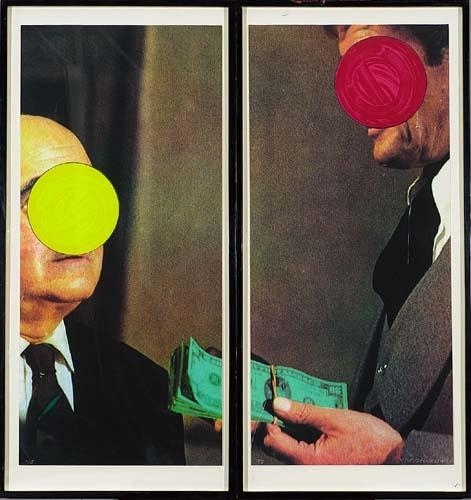
Money, With Space Between by John Baldessari

“For me, the litmus test is always language,” George Saunders told Charlie Rose in a recent interview. “If the sentences are kind of jangly and interesting, then I know how to proceed.”

Saunders composes stories syntactically: his themes and plots and characters emerge from the right jangle, the right discordant note that simultaneously pleases and disturbs. This technique shows in his latest collection Tenth of December, a showcase for Saunders’s estimable verbal prowess and a reminder that he is one of America’s preeminent satirists.

Tenth of December also reveals some of Saunders’s limitations, the biggest of which is that he seems to write the same few stories again and again. Granted, these stories are sharp, funny, puncturing criticisms of American life—satires of corpocracy and the ways commerce infests language (and hence thought); satires of how late capitalism engenders cycles of manufactured desire and very-real despair; satires, ultimately, of how we see ourselves seeing others seeing us in ways that we don’t wish to be seen. Perhaps Saunders writes the same plots repeatedly because he thinks we need to read them repeatedly—and there’s certainly pleasure and humor and pathos in Tenth of December—but there isn’t any territory explored here that would be unfamiliar to anyone who read CivilWarLand in Bad Decline or Pastoralia.

Take “Escape from Spiderhead,” one of the stronger entries in December. This is pure Saundersville, a story nudging weirdly into a skewed future that might come too-true too soon. Said spiderhead is a prison command center where wardens subject their inmates to language and desire experiments, using drugs like “Verbaluce™, VeriTalk™, ChatEase™” (lord does Saunders love incaps) to manipulate the prisoners’ minds and bodies alike (all with consent, of course).

The story is a biting and often painful exploration of how our desires and actions might be constrained and controlled by others. It’s also an excellent excuse for Saunders to flex some of those verbal muscles of his:

He added some Verbaluce™ to the drip, and soon I was feeling the same things but saying them better. The garden still looked nice. It was like the bushes were so tight-seeming and the sun made everything stand out? It was like any moment you expected some Victorians to wander in with their cups of tea. It was as if the garden had become a sort of embodiment of the domestic dreams forever intrinsic to human consciousness. It was as if I could suddenly discern, in this contemporary vignette, the ancient corollary through which Plato and some of his contemporaries might have strolled; to wit, I was sensing the eternal in the ephemeral.

“Escape from Spiderhead” is one of several tales in December that ultimately posit selflessness and empathy as a metaphysical escape hatch, an out to all the post-postmodern awful.  It’s a near-perfect little story, which is why it’s too bad when Saunders essentially repeats it (right down to the Verbaluce™/amplified language conceit) in “My Chivalric Fiasco.” (Perhaps “My Chivalric Fiasco” was necessary though; it provides the sole “weird theme park” story requisite to any Saunders collection).

An equal to “Spiderhead” is “The Semplica Girl Diaries,” the collection’s strongest condemnation of how capitalism engenders bizarre ethical positions within families, between neighbors—and even countries. The longest story in the collection, “The Semplica Girl Diaries” purports to be a harried middle class father’s diary, a conceit which gives Saunders plenty of space to jangle.

Our poor narrator just wants to keep up with the Joneses, a serious character flaw that often results in hilarious hyperbole. He takes his family to the birthday party of his daughter’s classmate. This classmate’s family is wealthy, perfect, glowing, healthy, innovative, happy:

Just then father (Emmett) appears, holding freshly painted leg from merry-go-round horse, says time for dinner, hopes we like sailfish flown in fresh from Guatemala, prepared with a rare spice found only in one tiny region of Burma, which had to be bribed out, and also he had to design and build a special freshness-ensuring container for the sailfish.

Set against such a pristine backdrop our hapless narrator’s own life seems stressful and shabby:

Household in freefall, future reader. Everything chaotic. Kids, feeling tension, fighting all day. After dinner, Pam caught kids watching “I, Gropius,” (forbidden) = show where guy decides which girl to date based on feeling girls’ breasts through screen with two holes. (Do not actually show breasts. Just guy’s expressions as he feels them and girl’s expression as he feels them and girl’s expression as guy announces his rating. Still: bad show.) Pam blew up at kids: We are in most difficult period ever for family, this how they behave?

I love how Saunders works I, Gropius in there—his dystopian touches work best when they are simultaneously over-the-top (idea) and graceful (delivery of idea). These moments of humor don’t deflate the extreme anxieties that “The Semplica Girl Diaries” produces; rather, the humorous, hyperbolic eruptions add to what turns out to be a horror story.

Like the narrator of “The Semplica Girl Diaries,” the eponymous would-be hero of “Al Roosten” is painfully attuned to how others might/do see him. “Al Roosten” is one of several of December’s exercises in how we see others seeing us (set against the backdrop of how we desire others to see us, etc.). The story starts at a charity auction where local businessmen are being auctioned off (including Roosten’s rival Donfrey—an echo of Emmett) and then heads precisely nowhere (or rather, remains entirely in poor Roosten’s skull). First paragraph:

Al Roosten stood waiting behind the paper screen. Was he nervous? Well, he was a little nervous. Although probably a lot less nervous than most people would be. Most people would probably be pissing themselves by now. Was he pissing himself? Not yet. Although, wow, he could understand how someone might actually—

That sentence-interrupting final dash precedes the intrusion of the “real,” phenomenological world into Roosten’s consciousness. There’s much of James Thurber’s “Walter Mitty” in “Al Roosten”—and, indeed, much of Mitty in Saunders generally—perhaps because Saunders’s jangles lead him to explore the strange gaps between thought and action, reality and imagination. It’s worth sharing a few paragraphs of Saunders’s technique:

Frozen in the harsh spotlight, he looked so crazy and old and forlorn and yet residually arrogant that an intense discomfort settled on the room, a discomfort that, in a non-charity situation, might have led to shouted insults or thrown objects but in this case drew a kind of pity whoop from near the salad bar.

Roosten brightened and sent a relieved half wave in the direction of the whoop, and the awkwardness of this gesture—the way it inadvertently revealed how terrified he was—endeared him to the crowd that seconds before had been ready to mock him, and someone else pity-whooped, and Roosten smiled a big loopy grin, which caused a wave of mercy cheers.

Roosten was deaf to the charity in this. What a super level of whoops and cheers. He should do a flex. He would. He did. This caused an increase in the level of whoops and cheers, which, to his ear, were now at least equal in volume to Donfrey’s whoops/cheers. Plus Donfrey had been basically naked. Which meant that technically he’d beaten Donfrey, since Donfrey had needed to get naked just to manage a tie with him, Al Roosten. Ha ha, poor Donfrey! Running around in his skivvies to no avail.

We can note here the transitions between what the world sees (in those first two paragraphs) to how Roosten sees the world seeing him. This is Saunders at perhaps his finest, showcasing a meticulous control of free indirect style; Roosten is simultaneously pathetically endearing and loathsome. He is attractive and repellent precisely because we understand him—what it is to see him, but also what it is to be seen in the way he is being seen.

The titular story, which closes the collection, also offers a Walter Mittyish figure, a “pale boy with unfortunate Prince Valiant bangs and cublike mannerisms” who sneaks off into the woods to fantasize about the Lilliputian “Nethers” who might try to kidnap his crush Suzanne (whom he’s never addressed, of course). “Somewhere there is a man who likes to play and hug, Suzanne said,” the poor boy imagines. Again, this is Saundersville, where we laugh out loud and then reprimand ourselves for our cruelty and then engage, empathize, say, Hey kid, I’ve been there too…

“Tenth of December” is a sort of rewrite of two stories from Pastoralia, “The End of FIRPO in the World” and “The Falls.” I suppose I don’t mind, but I wish that Saunders’s jangles might lead him to new plots. Despite its rehashing of these earlier stories, “Tenth of December” delivers possibly the strongest case for empathy-as-transcendence in the collection. Our boy gets a shot at actually living up to his haircut—he’ll valiantly help a suicidal terminally ill man, who will, in turn, help him.  What the story illustrates best though is how impulse precedes action and action precedes thought, how action can be shot through with memory:

He was on his way down before he knew he’d started. Kid in the pond, kid in the pond, ran repetitively through his head as he minced. Progress was tree to tree. Standing there panting, you got to know a tree well. This one had three knots: eye, eye, nose. This started out as one tree and became two.

Suddenly he was not purely the dying guy who woke nights in the med bed thinking, Make this not true make this not true, but again, partly, the guy who used to put bananas in the freezer, then crack them on the counter and pour chocolate over the broken chunks, the guy who’d once stood outside a classroom window in a rainstorm to see how Jodi was faring with that little red-headed shit who wouldn’t give her a chance at the book table, the guy who used to hand-paint birdfeeders in college and sell them on weekends in Boulder, wearing a jester hat and doing a little juggling routine he’d—

There’s that dash again. Dare I liken it to the dashes of Poe, of Dickinson? Maybe, maybe not.

I’ve shared some highlights of December, which I believe outweigh its weaker spots, unremarkable pieces like “Puppy,” a transparent exercise in how class in America inheres through a system of seeing/not-seeing others, or “Exhortation,” an amusing but forgettable memorandum that reads like Saunders-doing-Saunders.

“Home” is really the only story I would’ve left out of December. It’s the story of a war veteran trying to reintegrate into a society that flatly reiterates “Thank you for your service” while doing precisely nothing to actually thank the vet. Saunders’s sentiments are clearly in the right place, but the story rings false and hollow, its authorial anger overriding the humanity of its characters. At its worst moments, “Home” gives us a world of shuffling grotesques whose quirks preëmpt any possibility for genuine pathos. Saunders, usually in command of language, seems strained here. And it’s not a strain of venturing into new territory; no, all of Saunders’s tricks and traps are on display here (including an unexplained/unexplored substance called MiiVOXmax). Perhaps that’s the problem. Perhaps there’s too much of the author in the story.

And maybe that’s why I like the short, visceral two-paragraph perfection of “Sticks” so much–it seems freer, sharper. At fewer than four hundred words it’s easily the shortest piece in the collection (and the shortest thing I’ve read by Saunders). “Sticks” condenses the harried middle class hero of almost every Saunders tale into one ur-Dad, stunning, sad, majestic. It’s also the oldest story in the collection, originally published by Harper’s in 1995, which means it predates the publication of all his other collections. I don’t know why Saunders included it in December but I’m glad he did. It breaks up some of his rut.

That rut, by the way, is a pleasure to roll through—a fast, funny pleasure, but a pleasure nonetheless. Saunders is very good at highlighting our culture’s ugly absurdities, and he usually does so with moving pathos. And if his jangly sentences are their own raison d’être, then so be it. They are harmonious and sour, soaring and searing. Recommended.

Tenth of December is new in hardback from Random House. You can read many of his stories online for free.

Selections from One-Star Amazon Reviews of Orwell’s 1984

[Ed. note: The following citations come from one-star Amazon reviews of George Orwell’s novel 1984. I think 1984 is an important dystopian work (although I think Huxley gave us a better book and a more accurate vision in his novel Brave New World). Anyway, I find myself fascinated by one-star Amazon reviews for some reason (see also: See also: Melville’s Moby-Dick, Joyce’s Ulysses and Markson’s Wittgenstein’s Mistress) and to be clear, I think some of the one-star reviews of 1984–including ones I cite here—make some pretty valid points (others are atrocious, of course). I’ve preserved the reviewers’ unique styles of punctuation and spelling].

1984 is a fictional novel by George Orwell.

I don’t really like futuristic based books…

1984 might have been scary 100 years ago, but not now.

…the plot is fairly simplistic but with redundant lines. “Oceania has always been war with Eastasia.” “Freedom is slavery.” “Big Brother is watching you.” In other words, it was nothing but a lot of nonsensical fillers.

I truly believe that Orwell’s sole purpose for writing this novel was to encourage anarchy, and to convince his readers to be subordinate to authority.

The text was so long and unelaborate.

George Orwell is no wordsmith and his style of writing stinks and flows like verbal diarrhea.

i give this book one star i had to read it for class and i know it’s suposed to be a “classic” but god itis awful. first of all its NOTHING like the future is probly going to turn out. second of all every one says the aurthor george orwell is so trippy and wierd but i think he’s just trying to cover up for the fact that HE CAN’T WRITE. please george do us all a faver and stop writing books.

I am not at all intrested in the goverment. This may be part of the reason that I didnt like it.

I personally think big brother is the man.

It is crude, heavy-handed, superficial propaganda.

…a boring, unoriginal one-hit wonder who wanted to make a buck rehashing much-talked-of, much-written-of themes.

It is dark, depressing, and I finished reading it feeling like less of a human than when I started.

Quote from “1984”: “Humanity is nothing more than one man shoving another man’s face in the mud.” So, “1984” tells us that humans are completely useless and we have no reason to exist.

It was just thoughts of a sad man with perverse and suspicouis thoughts. The main character constantly dwelled on how horrible everything was and eventually how he was going to fight against it. But never did, unless you count having an affair and writing in a journal or buying an old paperweight.

Keep your dictionary handy.

I was greatly dissapointed with the redundent and unecessary words.

For me the book took a downword turn during the time where Winston started having a love affair with some girl.

…it doesn’t make any sense to think that a novel like this one is really any better than say, Michael Crichton or Stephen King.

The main character, Winston, daydreams about raping Julia, who later becomes his dirty mistress. Then about a hundred pages later, they get caught by the Thought Police, thrown into “prison,” and are brain washed. That’s pretty much what happens.

…and must we really keep reading in full detail the horror and disgust of Winston’s vericose veins?!

Today, his book is the modern bible of the paranoid disgruntled white male and other conspiracy nutcases.

Human beings are BETTER than this…

In addiction, the contradictions throughout the novel were frustrating.

On the surface it seems to be an interesting glance at the “future” that our grandparents envisioned. This however could not be farther from the truth. 1984 is in fact a lame, boring, and novel that attempts to be philosophical.

…a monumental ode to nothingness, an ideologically streamlined state of unbelievable being.

And please for the love of God don’t read that “Brave New World” book by Hoxley. It is twice as worse as 1984.

Last time I ever read a history book by this Orwell scrub. He doesn’t know a thing about the 80s. Not ONCE did he mention Def Leppard or Karma Chameleon.

I Review Michael Kimball Writes Your Life Story (On a Postcard)

Kimball final cover copy

“I never expected strangers to tell me so much about themselves, so many things they have never told anybody else, but I found an unexpected intimacy in the postcard life story project,” writes Michael Kimball in the introduction to his new book, the aptly titled Michael Kimball Writes Your Life Story (On a Postcard). Kimball continues: “It tapped into something human and humane. I was continually amazed by what people told me.”

Kimball’s respect for the people whose stories he is telling comes through in his spare but descriptive prose, an economical rhetoric undoubtedly necessitated by the confines of his small canvasses. When I interviewed Kimball about the project, he told me:

There are difficult things at different stages of the process. The first difficult thing is asking the right questions for the particular participant. The second difficult thing is being representative when condensing what I’ve been told. The third difficult thing is writing small enough to squeeze six hundred words or so onto a single postcard.

Through that asking, condensing, and squeezing, Kimball distills his subject’s lives into compact but moving stories.

Michael Kimball Writes Your Life Story (On a Postcard) began as a performance piece at the Transmodern Performance Festival and then continued as a blog. Kimball eventually wrote over three hundred postcards; over fifty of these are collected in the new book. A not-insubstantial number of these are devoted to the biographies of contemporary writers, including folks like Tao Lin, Matt Bell, and Blake Butler:

By 4 years old, Blake was performing considered monologues, crazy dances, music videos, and both sides of talk shows. It’s all on video (his mother will show you, if you want). Despite these performances, Blake was a fat child by the 4th grade. He liked comic books and video games. By 10th grade, he weighed 250 pounds and felt disregarded. His bedroom walls were covered with pictures of women that he tore out of magazines at the grocery store and took home.

There’s also a first-person POV bio of Edgar Allan Poe, the last few paragraphs of which I can’t help sharing:

In 1831, my foster father and I had a terrible disagreement, after which I was court-martialed and kicked out of West Point. In 1834, my foster father died and did not leave me any of his money. To console myself, I married my 14-year-old cousin, Virginia Clemm.

For years, I published poems and stories and criticism, but it did not make me happy or money. In 1837, I was fired from a newspaper job for drinking. After that, I published a novel, but that didn’t help much either. Readers are sick. That’s why Virginia got tuberculosis and died in 1847. I was so lonely and so cold. I could not stop drinking.

It was 1849 when I stopped in Baltimore. I remember going down in the street, and, later, two hazy men taking me someplace white. I don’t remember dying, but I was glad I didn’t have to keep trying.

The mix of empathy and humor we see here resonates throughout the collection, whether Kimball is telling the life story of a U.S. President, or an ex-crack addict who met his wife at an all-you-can-eat buffet, or a rooster. Kimball handles his subjects with an intense honesty appropriate to the often tragic trajectory these tales take—even a piece like “Red Delicious Apple,” which takes metaphysical license of a sort, leads to a sad end:

The first thing Red Delicious Apple remembered was being a flower and the way the birds sounded in the trees. Later, Apple remembered the wind and losing his petals. Apple wanted to jump down after them, but stayed on the branch, in the tree. … Not long after that, Hand delivered Apple to the teeth. Apple could feel the teeth cutting through his skin and into his meat, what was left of his insides turning brown. Afterward, he sickened, softened. The last thing Apple remembered was the trashcan, the lid, the rotting darkness.

Or the fate of “Chair”:Chair thought, Wood and glue.

Chair thought, Next time, I’m letting go.
Chair cracked. He broke one of his legs and then his back.
Chair thought, That didn’t even hurt.

Update : Chair was thrown into a dumpster.

But perhaps I bring up “Chair” and “Red Delicious Apple” because their tragic contours are easier to allude to quickly than many of the biographies here, which often involve missing parents,  mental illness, and suicidal thoughts, all delivered in the spare, striking prose that the confines of Kimball’s project necessitate. The stories are sometimes shocking and sometimes sad and usually very moving. As the titular anonym of “G” suggests, “tragedy can be beautiful.”

Michael Kimball Writes Your Life Story (On a Postcard) is new from Mud Luscious Press.

I Try to Review Ben Marcus’s Novel The Flame Alphabet

Bulgarian Child Eating a Rat, Salvador Dali

1. I don’t know.

I spent most of this day—Sunday that is—swamping out my garden shed, recently rat-infested. Big wood rats, or river rats as we sometimes call them here, some of us.

This meant sterilizing the whole deal, spraying a bleach solution, wearing appropriate eye and nose and mouth protection, because getting older and having kids I now seem to care about my oh-so-important sensory organs more than I did in my twenties. This meant removing rat feces and a few dead rats. Just fucking gross, really.

I don’t know.

2. Point 1 has almost nothing to do with Ben Marcus’s novel The Flame Alphabet. It’s just that I told myself I’d finally write about it here, after finishing it a few weeks ago and all. The farther out it gets, the harder it is to write about.

3. But really, there is some kind of corollary between my rat business and The Flame Alphabet: Both were repellent experiences. Now, to be fair, the rat purging dealie was wholly repellent and in no way intriguing, whereas Marcus’s book was simultaneously attractive and repellent. The novel’s ugliness hit me hard sometimes, and the final chapters were a sludgy slog.

4. Maybe you’re just like, Hey, c’mon, cut it out with the rats, nobody came here for that, get with the program, tell us the plot:

Okay:

So, language becomes toxic. First in kids, who hold an immunity of some kind, but the toxicity spreads to all elements of language and just kills people and makes them sick &c. In this mix our (reliably unreliable) narrator Sam kinda sorta tries to protect/save/help his family, wife Claire and daughter Esther. He undertakes home experiments, his “smallwork,” and keeps up the old time religion of the forest Jews (you’ll have to read the book for clues to this mysticism; I am too exhausted from rat-swamping to further explicate).

Society falls apart, sort of. (This is one of the major maybe-problems with The Flame Alphabet: There’s this hideous apocalypse underway but there also seems to be authority somewhere, external to the narrative, a government or scientific cadre or just really a they who keep the system moving, bread baking, electricity crackling &c).

There’s our narrator’s nemesis LeBov (the name undoubtedly borrowed from William Labov, who you learned about in your linguistics classes, I’m sure).

Midway through the novel our feckless hero starts new smallwork for Labov. LeBov is my favorite character—whenever he shows up the novel is alchemically invigorated.

Other stuff happens.

La Grande Roue Orthochromatique…, Max Ernst

5. Really though, The Flame Alphabet is an apocalypse novel, filled with mounds of salt and despair and isolation and probably madness, rarely energized by action, but hardly ponderous.

6. (Here’s a paltry criticism for me to critically make: I wish The Flame Alphabet was shorter. Like significantly shorter. Maybe a novella. Maybe a long short story).

7. Finishing the novel, I sketched out a list, which hey why not just cut and paste here:

    1. Joseph Cornell’s boxes.
    2. Much of J.G. Ballard, especially the stuff in the ’70s and ’80s.
    3. The Residents.
    4. The films of the Brothers Quay.
    5. Charles Burns’s stuff.
    6. Wm. Burroughs, or the idea of Wm. Burroughs.
    7. Joseph Beuys and his goddamn fat and felt.

This is the stuff that The Flame Alphabet reminded me of—this and David Cronenberg’s films, which Jesus, how did they not make the list?

8. I mean, really, I think Ben Marcus has given us a sort of lost Cronenberg film here. Maybe what the book most reminded me of, language plot aside, was Cronenberg’s underrated icky 1999 effort eXistenZ, a film that seems to take place in several worlds at once (including the imaginations of the protagonist and the viewer). 

9. Actually, comparing Marcus’s novel to a film is stupid.

Really, I think what The Flame Alphabet most resembles—its best parts, I mean—are directions to some kind of far-out art installation.

Which may be a way of saying The Flame Alphabet is best—or really, I like The Flame Alphabet best—when it recalls Ben Marcus’s older, more “experimental” stuff.

10. To wit:

The practice of language smoking originates in Bolivia but quickly travels north. In Mexico City it is perfected. Words and sentences tested by a delegate in a smoke-filled tube, at the end of which is stationed a sacrificial listener called, for unknown reasons, the bell.

The bell’s brain, when he dies, is pulled and separated into loaves. The loaves are tagged and named. Only drawings survive.

11. Or maybe you want some textual evidence of TFA’s Cronenbergian contours:

Ruptured mattresses littered the floor, sleeping bags with the bottoms kicked through. A brittle pillow bore the facial welt of the last patient who slept here. A man’s work shirt had been chewed, swallowed, spit up in a glaze of bile.

Mesh baggies of hair hung from the ceiling, repelling flies. Possibly the hair attracted them instead.

The Pack, Joseph Beuys

12. Or a Joseph Beuys moment. Our narrator in his language lab:

To test this I created white text on white paper, gray on gray, froze water into text-like shapes and allowed it to melt on select surfaces—slate, wood, felt—which it scarred so gently, you’d need a magnifying glass to spot the writing.

13. And a passage that showcases our narrator’s smallwork as an act of love (of sorts):

On Esther’s final birthday in our house I went to the kitchen to get to work on the cake. There wasn’t much food left in the cupboard, just some pancake mix and a blend of baking powders I’d dumped into a bag. From the meaty, mineral smell I figured this would give a lift to the cake, at least if I got the batter down to room temperature and shocked it into a hot oven so it might have some spring.

For liquids I had an egg and some buttermilk, the custardy sludge from the bottom of the carton.

I could boil the buttermilk to kill off bacteria, then flash freeze it before dumping it into the batter. The egg, too, would need flame, because it was likely spoiled by now.

I broke it into a pan, stifled a gag, then whisked it over a simmer until it frothed up, sputtered, and grew clear again. Mostly it did not congeal. The hardened parts were easy to flick out. When the pan cooled I slid it into the freezer, went to work on sifting the powders.

For sugar I reduced the last of the orange juice until it thickened into a syrup, then whipped in a thread of honey. This would have to do, because I needed the last of the sugar for frosting. I liked to feather it on lightly, then comb it up while hardening it with the medical cold blower, as if the cake had a fright wig.

The frosting I colored silver with a bead of food-grade aluminum.

14. These are all great fragments. Let’s keep going:

15. Desire—need—predicates language:

Presumably if you wanted nothing, you’d have no occasion to speak.

16. And Beckett:

“Failures have their place in our work,” he admitted, after hearing me out. “I’ve had my flirtations with failure. There is a small allure there. I commend you for seeking out failure so aggressively. But this idea people have of failing on purpose, failing better? Look at who says that. Just look at them. Look at them very carefully.”

17. Failure: Failure to imagine (better):

The linguist held forth, smugly dismissing an idea that had recently come into its own. It interested me that the linguist’s inability to imagine something constituted a sound rejection of its possibility.

Hotel Eden, Joseph Cornell

18. And:

We kept believing it couldn’t get any worse, as if our imaginations held sway in the natural world. We should have known that whatever we couldn’t imagine was exactly what was coming next.

19. I think I’ve shared a nice slice of Marcus’s prose. Dude can sling it. Seriously. I think he’s a great writer. I just wish more was stripped away from The Flame AlphabetFeels overtly novelly at times—I mean, yes, it’s a novel, but this seems to be its biggest weakness: Marcus’s concessions to the form.  

20. ( Let me parenthetically insert here what might be my biggest problem with The Flame Alphabet: I felt the ghost of Sam Lipsyte working under its contours. And I love Lipsyte’s stuff, seriously—but I often felt like Marcus was copping Lipsyte’s syntax, rhythms etc. as a means to a more, I dunno, normal narrative.

And while I’m here, in these parentheses, maybe I should direct you to a good and proper and real review. David Winters does a marvelous job at The Millions. And he brings  up the Lipsyte thing that I just brought up, but he does a better job parsing the two styles than I.

Oh, and there’s also this chapter where Marcus totally imitates/pays homage to David Markson).

21. The biggest tussle I had with TFA though is undoubtedly my agon (look how I make myself protagonist!) with its confounding reading rules.

The novel’s overtly parricidal/infantical scope, its estranging metaphors of language and extinctions, its remote anxieties of parenting—all of these pop up like red flags.

I wanted to—no, I set out to–deny the book as an allegory. I sought to resist metaphor, symbolism, analogy. But it’s hard, you know?

22. “Mythology is the lowest temptation,” our narrator tells us at one point.

And then Marcus wedges fairy tales and fables into the mixology.

23. And then our narrator:

I grew so alert to its obvious meanings that they sickened me, leading me to secondary, ironic intentions, disguises of rhetoric I would not normally notice. But soon these, too, felt fraudulent and then I returned to the literal meanings, which had gained more force now that I’d spurned them. That, however, did not last, and by the end the words had shucked their meaning entirely and evolved into a language of groaning, beyond interpretation. Or susceptible to the most obvious interpretation of all.

Language! Language! The problem of language!

24. And hence, what I take to be the book’s thesis, a two-sentence manifesto:

Explanations of any kind, in fact, were simply extinct.

Among the many rhetorical modes that had perished.

25. Does The Flame Alphabet enact its own holocaust, its own perishing; does it self-immolate? I don’t think so—although maybe that’s not what it sets out to do, maybe that’s just what I think it should do. I see a stronger book writhing there under the language, eager to consume some of the unnecessary pages, paragraphs, sentences, words. A book that would consume itself. (This is a silly metaphysical conceit; please move on).

Two Rats, Vincent van Gogh

26. So maybe I’ve knocked on the book a bit, rated it low even, you  may perceive, dear reader: Let me be clear then: The Flame Alphabet is the sort of burning ugly vibrant affecting blazing grueling confounding bizarre novels that we need more of. It’s stronger than most of the contemporary stuff out there, definitely the stuff coming from the major houses. And if I seem to pick at it, it’s only because I see in it concessions to a so-called reading public; I wished to see Marcus pull publishing and readers closer to him.

I won’t forget cleaning the dead rats from the shed anytime soon; neither will I forget reading The Flame Alphabet. 

Yoko Ogawa’s Revenge Is an Elegant Collection of Creepy Intertextual Tales

revenge

In Yoko Ogawa’s new collection Revenge, eleven stories of fascinating morbidity intertwine at oblique angles. Tale extends into tale: characters, settings, and images float intertextually from chapter to chapter, layering and reticulating themes of death, crime, consumption, and creation. (And revenge, of course. Let’s not forget revenge). Not quite a story cycle or a novel-in-tales, Revenge’s sum is nevertheless greater than its parts. It’s a brisk, engaging read, and as I worked my way to the final story, I already anticipated returning to the beginning to pull at the motifs threading through the book.

The book’s dominant motifs of death and food arrive in the first tale, “Afternoon Bakery,” where a mother tries to buy strawberry shortcakes for her dead son’s birthday—only the baker is too busy bawling to attend to sales. We learn why this baker is crying in “Fruit Juice,” the second story, a tale that ends inexplicably with an abandoned post office full of kiwi fruit. The third story, “Old Mrs.  J” (one of Revenge’s stand-outs) perhaps answers where those kiwis came from. More importantly, “Old Mrs. J,” with its writer-protagonist, elegantly introduces the thematic textual instability of the collection. There’s a  haunting suspicion here that the characters who glide from one tale to the next aren’t necessarily the silent extras they seem to be on the surface. Our characters, background and fore, are doppelgängers, ghost writers, phantoms.

The penultimate tale “Tomatoes and the Full Moon” lays the ghosting bare. Its protagonist is a magazine writer, whose “articles” really amount to little more than advertising. Staying at a seaside resort, he’s pestered by an old woman, one of the many witches who haunt Revenge. The old woman claims to be a novelist, and points out one of her books in the resort’s library:

Later, in my room, I read ‘Afternoon at the Bakery.’ It was about a woman who goes to buy a birthday cake for her dead son. That was the whole story. I should have gone back to my article, but I read her novel through twice, finishing for the second time at 3:00 a.m. The prose was unremarkable, as were the plot an characters, but there was an icy current running under her words, and I found myself wanting to plunge into it again and again.

The final line is perhaps a description of Revenge’s haunting intertextual program—although to be clear, Ogawa’s plot and characters are hardly “unremarkable,” and her prose, in Stephen Snyder’s English translation, is lucid and descriptive. It’s the “icy current running under her words” that makes Ogawa’s tales stick so disconcertingly in the reader’s psychic gullet. And if her prose is at times “unremarkable,” it’s all in the service of creating a unifying tone. All eleven tales are narrated in first-person, and each narrator is bound to the limits of his or her own language.

These limitations of language bump up against the odd, the spectacular, the alien, as in “Sewing for the Heart”:

She had explained that she was born with her heart outside of her chest—as difficult as that might be to imagine.

The line is wonderful in its mundane trajectory: Our narrator, an artisan bagmaker, witnesses this woman who lives with her heart outside her chest and concedes that such a thing might be “difficult . . . to imagine”! There’s something terribly paltry in this, but it’s also purposeful and controlled: Here we find the real in magical realism.

But this bagmaker can imagine, as we see in an extraordinary passage that moves from the phenomenological world of sight and sound and into the realm of our narrator’s strange desires:

She began to sing, but I could not make out the words. It must have been a love song, to judge from the slightly pained expression on her face, and the way she tightly gripped the microphone. I noticed a flash of white skin on her neck. As she reached the climax of the song, her eyes half closed and her shoulders thrown back, a shudder passed through her body. She moved her arm across her chest to cradle her heart, as though consoling it, afraid it might burst. I wondered what would happen if I held her tight in my arms, in a lovers’ embrace, melting into one another, bone on bone . . . her heart would be crushed. The membrane would split, the veins tear free, the heart itself explode into bits of flesh, and then my desire would contain hers—it was all so painful and yet so utterly beautiful to imagine.

Painful and utterly beautiful: Another description of Revenge.

Sometimes the matter-of-fact tone of the stories accounts for marvelous little eruptions of humor, as in “The Last Hour of the Bengal Tiger”:

At fifteen, I took an overdose of sleeping pills. I must have had a good reason for wanting to kill myself, but I’ve forgotten what it was. Perhaps I was just fed up with everything. At any rate, I slept for eighteen hours straight, and when I woke up I was completely refreshed. My body felt so empty and purified that I wondered whether I had, in fact, died. But no one in my family even seemed to have noticed that I had attempted suicide.

The scene is simultaneously devastating and hilarious, an evocation of abyssal depression coupled with mordant irony. The scene also underscores the dramatic uncertainty that underpins so many of the tales, where the possibility that the narrator is in fact a ghost or merely a character in someone else’s story is always in play.

There’s no postmodern gimmickry on display here though. Ogawa weaves her tales together with organic ease, her control both powerful and graceful. Her narrators contradict each other; we’re offered perspectives, glimpses, shades and slivers of meaning. A version of events recounted differently several stories later seems no more true than an earlier version, but each new detail adds to the elegant tangle. Like David Lynch and Roberto Bolaño, Ogawa traffics in beautiful, venomous, bizarre dread. Like those artists, she offers a discrete world we sense is complete and unified, even as our access to it is broken and discontinuous. And like Angela Carter, Ogawa channels the icy current seething below the surface of our darkest fairy tales, those stories that, with their sundry murders and crimes, haunt readers decades after first readings.

What I like most about Revenge is its refusal to relieve the reader. The book can be grisly at times, but Ogawa rarely goes for the lurid image. Instead, the real horror (and pleasure) of Revenge is the anxiety it produces in the reader, who becomes implicated in the crimes cataloged in the text. Witness to first-person narratives that often omit key clues, the reader plays detective—or perhaps accomplice. Recommended.

Revenge is new in handsome trade paperback from Picador; Picador also released Ogawa’s novel Hotel Iris in 2010.

Moby-Dick: A Short Riff on a Long Book

Green and White, Georgia O'Keeffe
Green and White, Georgia O’Keeffe

1. Prompted by Call Me Ishmael, Charles Olson’s marvelous study of Moby-Dick, I took a fifth trip through Melville’s massive opus this past month.

2. Every time I read Moby-Dick it seems funnier and sadder. Richer. Thicker.

3. I cobbled together my reading over different media and spaces: I listened to William Hootkins‘ outstanding unabridged audiobook version, and then reread on my Kindle key passages I’d mentally underlined; I then checked those passages against the copy of Moby-Dick I annotated the hell out of in grad school.

As I read, I posted some of my favorite excerpts on this blog.

4. I posted some of my favorite excerpts of Moby-Dick here on Biblioklept because I knew that I wouldn’t be able to write about the book—not really—that I wouldn’t be able to handle all of its language. (My riff on Olson’s book obsesses over Olson’s ability to write after Melville and Melville’s ability to write after Shakespeare).

5. Really, in posting so many fragments of Moby-Dick, I suppose that I’ve attempted to abrogate any kind of critical duty to describe the book under discussion in terms of its own language.

6. Point 5 is really a way of saying: Moby-Dick, like any sublime work of literature, is a self-defining, self-describing, and even self-deconstructing text.

7. Or, another way of making such a claim:

Let me (mis)appropriate Samuel Beckett’s description of Finnegans Wake and contend that the description fits Moby-Dick just as aptly:

Here form is content, content is form. You complain that this stuff is not written in English. It is not written at all. It is not to be read – or rather it is not only to be read. It is to be looked at and listened to. His writing is not about something, it is that something itself.

8. So here circumnavigate back to my own recent reading and auditing of the book:

Hootkins’ audio recording would make a great starting point for anyone (unnecessarily) daunted by Melville’s big book. He performs the book, commanding his audience’s attention. He unpacks the humor that might otherwise hide from untuned 21st century ears; he communicates the book’s deep, profound sorrow. His Ishmael is perceptive, clever, generous. His Stubb, hilarious. His Ahab a strange philosophical terror.

After listening to Hootkins on my commute, I’d return to key passages on my Kindle, and then finally review the notes I wrote in the cheap hardback Signet edition I read in grad school.

But why bring this up?

9. I don’t know.

Maybe: Unpacking Moby-Dick is too hard, too much—would require its own book, a book that would cite the entirety of Melville’s book.

But discussing the book this way seems a disservice to potential readers; it’s as if we would cloak the book in a mystic veil.

White Figure, Wassily Kandinsky

10. If I have a point to all of this: Moby-Dick is wonderful, funny, moving, engaging; a genre-bender that tackles philosophy, history, science; an adventure tale; a psychological novel brimming with ideas, allusions—but one delivered in sonorous, poetic language. It’s good, great, grand. Read it, if you haven’t. Reread it.

11. So I’ve failed to even try to begin to attempt to pretend to describe the plot.

Here: Ishmael, depressed, suicidal perhaps, decides to go to sea. To go whaling.

He tries to measure the whale, and by measuring the whale, maybe measure the world. But this is not really possible, certainly not in language. Certainly not in first-person perspective.

In Chapter 86, “The Tail,” Ishmael tells us:

The more I consider this mighty tail, the more do I deplore my inability to express it. At times there are gestures in it, which, though they would well grace the hand of man, remain wholly inexplicable. … Dissect him how I may, then, I but go skin deep. I know him not, and never will. But if I know not even the tail of this whale, how understand his head? much more, how comprehend his face, when face he has none? Thou shalt see my back parts, my tail, he seems to say, but my face shall not be seen. But I cannot completely make out his back parts; and hint what he will about his face, I say again he has no face.

(I don’t suppose I need to remark that Melville here lets one mighty tail stand in for another mighty tale—a tale he cannot face).

12. “Call me Ishmael”: our protagonist hails us.

But these famous opening lines aren’t really the beginning of the book. First we have the section titled “Extracts,” and before that “Etymology.” The first entry on the etymology of the whale, from  Hackluyt, warns us not to leave out “the letter H, which almost alone maketh up the signification of the word.”

Whaling. Hailing. Wailing.

The whiteness of the whale.

The witness of the wail.

13. How, just how, does Ishmael witness? How does he manage to tell this story? Did I obsess over this in earlier readings? I don’t think so—I was too concerned with absorbing the what and the why of the story to closely attend the how of its telling.

14. The novel begins in standard first-person point-of-view territory, Ishmael guiding us through Manhattan, New Bedford, Nantucket—but by the time he’s boarded the Pequod and set out into the wide watery world, this first-person perspective transcends the limits of physics: Our narrator not only attends the private conversations of Ahab, his mates, his harpooners, his men—but also the very interior of those men, their minds, their dreams, their imaginations.

Is Ishmael a ghost?

Leviathan-Job 40-21, Salvador Dali

15. And to return to Ahab for a moment: My godwhat a voice! His infecting, addicting insanity. His agon with Moby Dick, with the sun, with himself.

16. And Starbuck: Starbuck comes across weaker and weaker each time I read the book. We’re to believe he’s a man of convictions, but he moves in half-measures. In his final moments he tries to match or feign or approximate Ahab’s insanity: tragicomedy.

17. And Stubb: Despite his cruelties, he may be my favorite character in the book.

18. While I’m riffing: Is there a novel more phallic in the American canon than Moby-Dick? All that sperm: All that life-force.

19. This is maybe what Moby-Dick is about: Life-force. The attempt to to resurrect and die and resurrect again. The coffin that serves as life-buoy. The life-line that connects men that might also be their death. A counterpane to counter pain. A condensation of oppositions.

A yarn, a rope, a series of knots, layered, layering, self-contextualizing.

An attempt to put into language what cannot be put into language.

20. Twenty points: Maybe too long for the “short riff” promised in the title, but also surely too short to even begin to start to approach to pretend to say something adequate about the novel. So a parting thought: Moby-Dick is better—richer, fuller, deeper—each time I read it, and I look forward to reading it again.

Seven-Inch Sundays #1 // Archers of Loaf — “Harnessed in Slums”

20130216-150618.jpg

Before mp3s, we used to buy these things called seven-inches, small disks of vinyl, usually played at 45rpm, usually offering an a-side with the band or singer’s single, and backed with (b/w) a b-side offering a song (or songs!) that probably wouldn’t be on the album. A lot of times, 7″s would consist of songs that wouldn’t be on any album. Or that would be it for the band—just the one 7″. I bought many, many of these little disks between 1992 and 1999, and I still have three boxes full of them gathering dust in a utility room.

Anyway, new feature: I’ll pull out one each Sunday, listen to it, photograph it, share some thoughts on it, etc.

For this week, I pulled out the closest box and then pulled out the first 7″ in the stack: Archers of Loaf’s 1995 single for “Harnessed in Slums,” b/w “Telepathic Traffic.”

20130216-150634.jpg

“Harnessed in Slums” is the second track from the band’s second album, 1996’s album Vee Vee.

Vee Vee came out shortly after the 1995 EP Vs. the Greatest of All Time, which I think might be the Archers’ best work—or at least, that’s how I remember it. Anyway, I loved this early arc of the band’s career, which kicked off with Icky Mettle, a basically perfect glob of nineties indie rock.

I haven’t listened to Archers of Loaf in years. I lost interest in what the band was doing by the late nineties, and like many of the albums I listened to thousands of times in my teens, I find their music too intertwined in intense memories and feelings to listen to again. I have a hard time extricating the psychic detritus of my youth from certain albums.

20130216-150656.jpg

The crunchy warbled opening  of “Harnessed in Slums” brought back a strange rush of the past. I remembered seeing the band—on a school night!—in support of Icky Mettle. My friend Wayne brought a paper headband to the show and guitarist Eric Johnson wore it through most of the set. They gave us the set list (on a paper plate) and autographed stuff. I wonder if they thought it was weird that we wanted their autographs—think it’s weird now. (By the time I was 17 I had almost no interest in talking to anyone in a band, let alone getting an autograph).

“Harnessed in Slums” is a perfect Archers track, poppy, proggy, fake-sloppy, a punk anthem channeled through the crunchy trademark sound of the 1990s NC Triangle. Weirder and darker than Superchunk, tighter and more metallic than Pavement, Archers of Loaf hit a not-too-sweet spot somewhere between prog virtuosity and DIY punk aesthetic. The lyrics are bizarre, maybe meaningless, a shout-along that could have come from a Burroughs cut up (“I want waste / We want waste / They want waste / Slaves want waste”; “Strip the color from the meat of my eye”).

20130216-150643.jpg

The b-side is “Telepathic Traffic,” a jam that swells with acoustic guitars and snaky, snarly guitar lines—there’s almost something crime noir about the song. It’s sinister anyway. Eric Bachmann’s opening barks are almost comical, as if he’s imitating some British post-punk hero, before clustering into a pogoing chorus. “Telepathic Traffic” bears a few too many conventions that can become tiresome over an album—the track slows and speeds up unnecessarily when it should plow straight ahead (or perhaps just get faster).

Listening to these tracks again doesn’t make me want to pull out Icky Mettle as much as it makes me want to check out Erich Bachmann’s latest stuff. Has he mellowed out? Added more/different instrumentation? Complicated or simplified his sound? I remember being perplexed by his 1995 solo album Barry Black, which I recall having chamber arrangements. Maybe I should check it out.

Franchise Films, Alternate Worlds, and Why Wong Kar Wai Should Direct the Next Star Wars Film

STAR WARS 3 hartter

News that J.J. Abrams will direct the seventh Star Wars film almost broke the internet yesterday. It’s easy to see why anyone who nerds out over franchise properties would take interest. After all, Abrams helmed the 2009 big-screen reboot of Star Trek, a film that shook the camp and cheese from the franchise’s previous films, replacing it with hip humor, thrilling action, and lots and lots of lens flare. Abrams’s sequel, Star Trek Into Darkness is perhaps the most anticipated franchise film of the year. 

I won’t speculate whether an Abrams Star Wars film will be successful or not—you probably wouldn’t want me to, because I hold the extreme minority opinion that Lucas’s Revenge of the Sith is a deeply profound and moving work of cinema art—but I do think that the choice to hand the next big film in the Star Wars franchise over to Abrams represents the worst in corporate thinking. This goes beyond the playground logic of Abrams swiping all the marbles—he gets both the “Star” franchises!—what it really points to is the bland, safe commercial mindset that guides the corporations who own these franchises. J.J. Abrams is a safe bet. I can more or less already imagine the movie he’ll make.

Star Wars: A New Hope came out in 1977, perhaps at the exact moment that the innovations of the “New Hollywood” movement crested (before Heaven’s Gate crashed the whole damn thing in 1980). The films of this decade—Badlands, The Godfather films, Bonnie & Clyde, Chinatown, Nashville, Dr. Strangelove, etc.—helped to redefine film as art; they also captured and illustrated a zeitgeist that’s almost impossible to define. And while plenty of filmmakers today continue in this spirit, their films are often pushed into the margins. The Hollywood studio system is tangled up in big budget spectacle. I have no problem with this, but at the same time I think that there’s something sad in it all—in the bland safety of having Abrams turn out Star Wars and Star Trek films—it all points to a beige homogeneity.

The problem I’m talking about is neatly summed up by Gus Van Sant in a 2008 interview with The Believer:

So, there were some projects I never really could get going, and one of them was Psycho. It was a project that I suggested earlier in the ’90s. It was the first time that I was able to actually do what I suggested. And the reason that I suggested Psycho to them was partly the artistic appropriation side, but it was also partly because I had been in the business long enough that I was aware of certain executives’ desires. The most interesting films that studios want to be making are sequels. They would rather make sequels than make the originals, which is always a kind of a funny Catch-22.

They have to make Bourne Identity before they make Bourne Ultimatum. They don’t really want to make Bourne Identity because it’s a trial thing. But they really want to make Bourne Ultimatum. So it was an idea I had—you know, why don’t you guys just start remaking your hits.

Lately it seems that the studios trip over themselves to reboot their franchises—the latest Spider-Man film (the one you probably forgot existed) being a choice example of corporate venality. In a way, it’s fascinating that Sam Raimi, something of an outsider director, was allowed to do the first Spider-Man films at all. Of course, now and then a franchise film (or potential franchise film) winds up in the hands of an auteur—take Harry Potter and the Prisoner of Azkaban, for example. Alfonso Cuarón’s third entry in the franchise can stand on its own (it certainly saved the franchise from the tepid visions of Chris Columbus). Even stranger, take Paul Verhoeven’s films RoboCop and Starship Troopers. These films were brilliant subversive satires, and what did Hollywood do to the movies that came after them? These franchises devolved into flavorless, flawed, run of the mill muck.

Of course, entertainment conglomerates have good (economic) reasons to “protect” their product. David Lynch’s Dune remains one of the great cautionary tales in recent cinema history. What could have reinvigorated “New Hollywood” instead proved a disastrous flop.  Dune never panned out as the blockbuster franchise that it could have been; instead, it gets to hang out in a strange limbo, greeting newer arrivals like Chris Weitz’s atrocious adaptation of The Golden Compass and Andrew Stanton’s underrated John Carter from Mars. It’s actually sort of surreal that we even gotDune film by David Lynch, complete with Kyle MacLachlan, Brad Dourif, Jack Nance, and fucking Sting.

What’s even weirder is that Alejandro Jodorowsky tried to adapt Dune, working with artists H.R. Geiger and Moebius. (Jodorowsky also planned to involve Orson Welles, Mick Jagger, and  Karlheinz Stockhausen among others in the film). What a Jodorowsky Dune film might have looked like is a constant source of frustrated fun for film buffs.

But what about a Star Wars film by Jodorowsky? What might that look like?

the star wars hartter

Sean Hartter imagines such prospects in his marvelous posters for films from an alternative universe. Hartter’s posters—most of which include not just cast and director but also specific studios, producers, and soundtrack composers and musicians—conjure up wonderful could-have-beens. They posit the kind of daring spirit and experimentalism I’d like to see more of from Hollywood franchises.

Most Hollywood franchises revere the illusion of stability in the property—the idea of a constancy of character throughout film to film. Even a franchise like the James Bond films, with its ever-rotating leads, tries to create the guise of a stable aesthetic along with narrative continuity. I would love to see something closer to the Alien franchise, the only line of films I can think of where each film bears the distinctive mark of its respective filmmaker; even if I don’t think Fincher’s Alien 3 is a particularly good film, at least it feels and looks and sounds like a Fincher film and not a weak approximation of a Cameron blockbuster or a stock repetition of Scott’s space horror (and Jeunet’s Resurrection—how weird is that one!).

But back to Bond for a moment—wouldn’t it be great to see Wes Anderson do James Bond, but as a Wes Anderson film? Or Werner Herzog? Or Cronenberg? What would Jane Campion do with Bond? (I’m tempted to add Jim Jarmusch, but he already made an excellent James Bond film called The Limits of Control). I’d love to see a range of auteur versions of the franchise. (Similarly, I’ve recently been fascinated by the way certain cult artists render major corporate franchise characters, like Dave Sim doing Iron Man, or Moebius doing Spider-Man, or Jaime Hernandez doing Wonder Woman). Obviously this fantasy will never happen—the auteur would have to have complete control—a Coen brothers’ Bond film would have to be first and foremost a Coen brothers film, not a 007 film—but hey, just like with Hartter’s posters, it’s fun to pretend.

Imagine a year of James Bond movies, one a month, featuring different directors, actors, studios, production designs. 007 films from Spike Lee, Tarantino, Almodavar, Lynne Ramsay, Lynch, Wong Kar Wai.

What would a Wong Kar Wai James Bond film look like?

What would a Wong Kar Wai Star Wars film look like?

I don’t know. I imagine it would be beautiful and moody and at times impressionistic. I imagine its narrative would tend toward obliqueness. I imagine it might infuriate die-hard fans (I imagine this last part with a big grin). I imagine that it would easily be the most human Star Wars film.

But beyond that, it’s hard to imagine what a Wong Kar Wai Star Wars film might look and sound and feel like because his films are powerful and moving and evoke the kind of imaginative capacity that marks great art, great original and originating art. Put another way, I can’t really imagine what a Wong Kar Wai Star Wars film would look like—which is precisely why I’d love to see one.