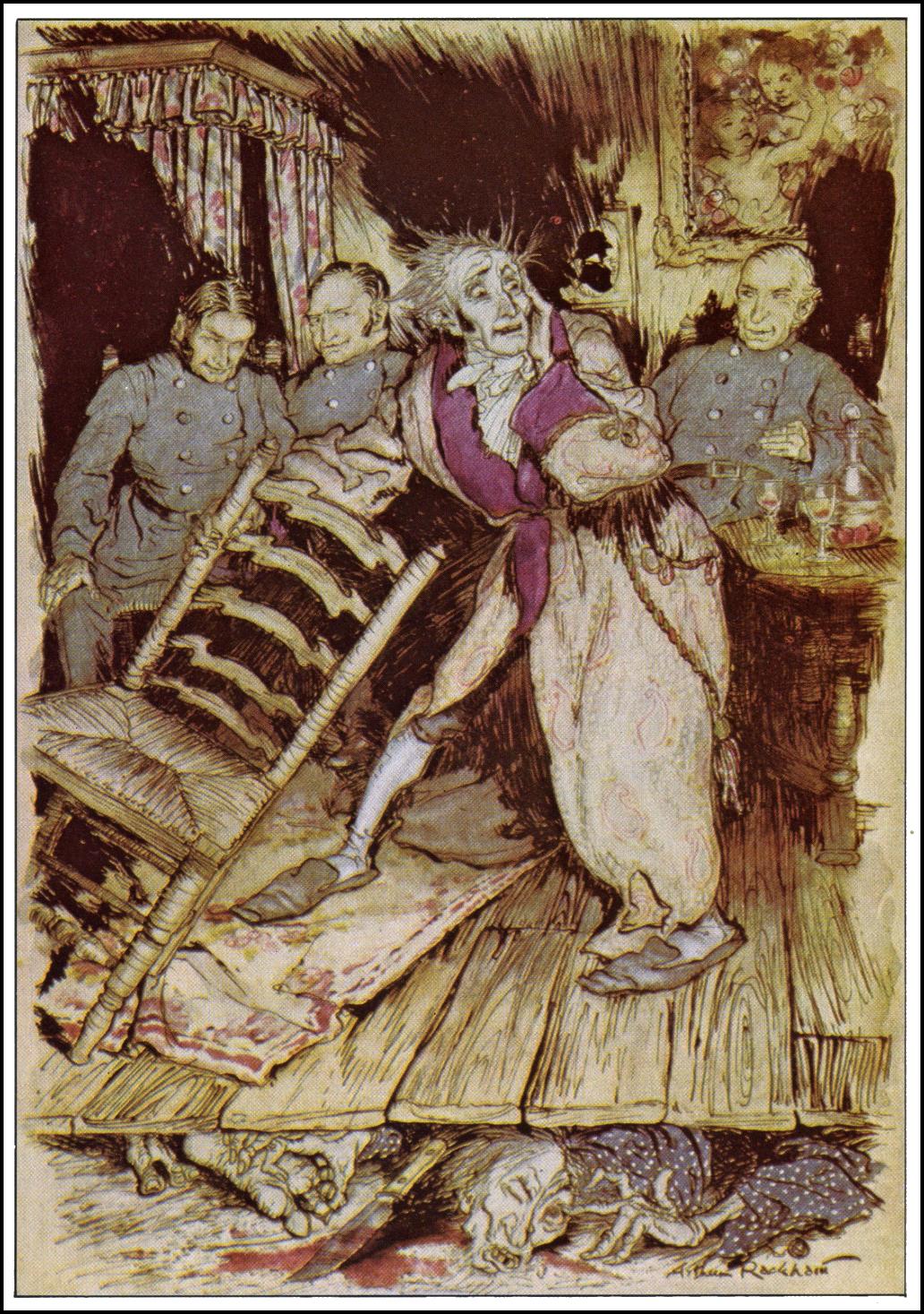
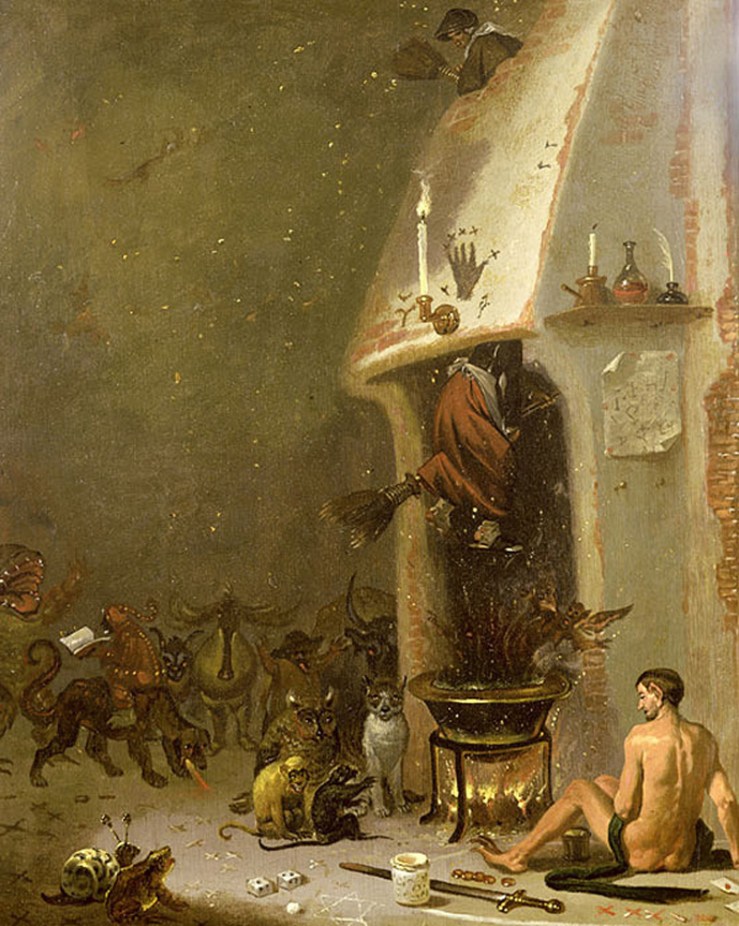
Illustration for Poe’s”The Tell-Tale Heart,” Arthur Rackham (1935)
“The Tell-Tale Heart”
by
Edgar Allan Poe
TRUE!—nervous—very, very dreadfully nervous I had been and am; but why will you say that I am mad? The disease had sharpened my senses—not destroyed—not dulled them. Above all was the sense of hearing acute. I heard all things in the heaven and in the earth. I heard many things in hell. How, then, am I mad? Hearken! and observe how healthily—how calmly I can tell you the whole story.
It is impossible to say how first the idea entered my brain; but once conceived, it haunted me day and night. Object there was none. Passion there was none. I loved the old man. He had never wronged me. He had never given me insult. For his gold I had no desire. I think it was his eye! yes, it was this! He had the eye of a vulture—a pale blue eye, with a film over it. Whenever it fell upon me, my blood ran cold; and so by degrees—very gradually—I made up my mind to take the life of the old man, and thus rid myself of the eye forever. Continue reading ““The Tell-Tale Heart” — Edgar Allan Poe”→
In Yoko Ogawa’s new collection Revenge, eleven stories of fascinating morbidity intertwine at oblique angles. Tale extends into tale: characters, settings, and images float intertextually from chapter to chapter, layering and reticulating themes of death, crime, consumption, and creation. (And revenge, of course. Let’s not forget revenge). Not quite a story cycle or a novel-in-tales, Revenge’s sum is nevertheless greater than its parts. It’s a brisk, engaging read, and as I worked my way to the final story, I already anticipated returning to the beginning to pull at the motifs threading through the book.
The book’s dominant motifs of death and food arrive in the first tale, “Afternoon Bakery,” where a mother tries to buy strawberry shortcakes for her dead son’s birthday—only the baker is too busy bawling to attend to sales. We learn why this baker is crying in “Fruit Juice,” the second story, a tale that ends inexplicably with an abandoned post office full of kiwi fruit. The third story, “Old Mrs. J” (one of Revenge’s stand-outs) perhaps answers where those kiwis came from. More importantly, “Old Mrs. J,” with its writer-protagonist, elegantly introduces the thematic textual instability of the collection. There’s a haunting suspicion here that the characters who glide from one tale to the next aren’t necessarily the silent extras they seem to be on the surface. Our characters, background and fore, are doppelgängers, ghost writers, phantoms.
The penultimate tale “Tomatoes and the Full Moon” lays the ghosting bare. Its protagonist is a magazine writer, whose “articles” really amount to little more than advertising. Staying at a seaside resort, he’s pestered by an old woman, one of the many witches who haunt Revenge. The old woman claims to be a novelist, and points out one of her books in the resort’s library:
Later, in my room, I read ‘Afternoon at the Bakery.’ It was about a woman who goes to buy a birthday cake for her dead son. That was the whole story. I should have gone back to my article, but I read her novel through twice, finishing for the second time at 3:00 a.m. The prose was unremarkable, as were the plot an characters, but there was an icy current running under her words, and I found myself wanting to plunge into it again and again.
The final line is perhaps a description of Revenge’s haunting intertextual program—although to be clear, Ogawa’s plot and characters are hardly “unremarkable,” and her prose, in Stephen Snyder’s English translation, is lucid and descriptive. It’s the “icy current running under her words” that makes Ogawa’s tales stick so disconcertingly in the reader’s psychic gullet. And if her prose is at times “unremarkable,” it’s all in the service of creating a unifying tone. All eleven tales are narrated in first-person, and each narrator is bound to the limits of his or her own language.
These limitations of language bump up against the odd, the spectacular, the alien, as in “Sewing for the Heart”:
She had explained that she was born with her heart outside of her chest—as difficult as that might be to imagine.
The line is wonderful in its mundane trajectory: Our narrator, an artisan bagmaker, witnesses this woman who lives with her heart outside her chest and concedes that such a thing might be “difficult . . . to imagine”! There’s something terribly paltry in this, but it’s also purposeful and controlled: Here we find the real in magical realism.
But this bagmaker can imagine, as we see in an extraordinary passage that moves from the phenomenological world of sight and sound and into the realm of our narrator’s strange desires:
She began to sing, but I could not make out the words. It must have been a love song, to judge from the slightly pained expression on her face, and the way she tightly gripped the microphone. I noticed a flash of white skin on her neck. As she reached the climax of the song, her eyes half closed and her shoulders thrown back, a shudder passed through her body. She moved her arm across her chest to cradle her heart, as though consoling it, afraid it might burst. I wondered what would happen if I held her tight in my arms, in a lovers’ embrace, melting into one another, bone on bone . . . her heart would be crushed. The membrane would split, the veins tear free, the heart itself explode into bits of flesh, and then my desire would contain hers—it was all so painful and yet so utterly beautiful to imagine.
Painful and utterly beautiful: Another description of Revenge.
Sometimes the matter-of-fact tone of the stories accounts for marvelous little eruptions of humor, as in “The Last Hour of the Bengal Tiger”:
At fifteen, I took an overdose of sleeping pills. I must have had a good reason for wanting to kill myself, but I’ve forgotten what it was. Perhaps I was just fed up with everything. At any rate, I slept for eighteen hours straight, and when I woke up I was completely refreshed. My body felt so empty and purified that I wondered whether I had, in fact, died. But no one in my family even seemed to have noticed that I had attempted suicide.
The scene is simultaneously devastating and hilarious, an evocation of abyssal depression coupled with mordant irony. The scene also underscores the dramatic uncertainty that underpins so many of the tales, where the possibility that the narrator is in fact a ghost or merely a character in someone else’s story is always in play.
There’s no postmodern gimmickry on display here though. Ogawa weaves her tales together with organic ease, her control both powerful and graceful. Her narrators contradict each other; we’re offered perspectives, glimpses, shades and slivers of meaning. A version of events recounted differently several stories later seems no more true than an earlier version, but each new detail adds to the elegant tangle. Like David Lynch and Roberto Bolaño, Ogawa traffics in beautiful, venomous, bizarre dread. Like those artists, she offers a discrete world we sense is complete and unified, even as our access to it is broken and discontinuous. And like Angela Carter, Ogawa channels the icy current seething below the surface of our darkest fairy tales, those stories that, with their sundry murders and crimes, haunt readers decades after first readings.
What I like most about Revenge is its refusal to relieve the reader. The book can be grisly at times, but Ogawa rarely goes for the lurid image. Instead, the real horror (and pleasure) of Revenge is the anxiety it produces in the reader, who becomes implicated in the crimes cataloged in the text. Witness to first-person narratives that often omit key clues, the reader plays detective—or perhaps accomplice. Recommended.
Revenge is new in handsome trade paperback from Picador; Picador also released Ogawa’s novel Hotel Iris in 2010.
After my father died, I began to wonder whether my turn might come sooner rather than later. What a pity! Later would have been so much more convenient! And what if my time might be even sooner than soon? Before I knew it, I would recognize death by its cold shining as of brass. Hence in those days, I do confess, I felt sometimes angry that the treasures of sunlight escaped my hands no matter how tightly I clenched them. I loved life so perfectly, at least in my own estimation, that it seemed I deserved to live forever, or at least until later rather than sooner. But just in case death disregarded my all-important judgments, I decided to seek out a ghost, in order to gain expert advice about being dead. The living learn to weigh the merits of preparation against those of spontaneity, which is why they hire investment counselors and other fortune-tellers. And since I had been born an American, I naturally believed myself entitled to any destiny I could pay for. Why shouldn’t my postmortem years stretch on like a lovely procession of stone lamps?
If you believe, as H.P. Lovecraft asserted, that all cemeteries are subterraneously connected, then it scarcely matters which one you visit; so I put one foot before the other, and within a half-hour found myself allured by the bright green moss on the pointed tops of those ancient stone columns of the third Shogun’s loyally suicided retainers. Next I found, glowing brighter than the daylight, more green moss upon the stone railings and torii enclosing these square plots whose tombstones strained upward like trees, each stone engraved with its undertenant’s postmortem Buddhist name.
The smell of moss consists of new and old together. Dead matter having decayed into clean dirt, the dirt now freshens into green. It is this becoming-alive that one smells. I remember how when my parents got old, they used to like to walk with me in a certain quiet marsh. The mud there smelled clean and chocolate-bitter. I now stood breathing this same mossy odor, and fallen cryptomeria-needles darkened their shades of green and orange while a cloud slid over the sun. Have you ever seen a lizard’s eyelid close over his yellow orb? If so, then you have entered ghostly regions, which is where I found myself upon the sun’s darkening. All the same, I had not gone perilously far: On the other side of the wall, tiny cars buzzed sweetly, bearing living skeletons to any number of premortem destinations. Reassured by the shallowness of my commitment, I approached the nearest grave.
The instant I touched the wet moss on the railing, I fell into communication with the stern occupant, upon whose wet dark hearthstone lay so many dead cryptomeria-tips. To say he declined to come out would be less than an understatement. It was enough to make a fellow spurn the afterlife! I experienced his anger as an electric shock. To him I was nothing, a rootless alien who lacked a lord to die for. Why should he teach me?
Humiliated, I turned away, and let myself into the lower courtyard behind the temple. Here grew the more diminutive ovoid and phallic tombs of priests. Some were incised with lotus wave-patterns. One resembled a mirror or hairbrush stood on end. I considered inviting myself in, but then I thought: If that lord up there was so cross, wouldn’t a priest have even less use for me?
So I pulled myself up to the temple’s narrow porch and sat there with my feet dangling over, watching cherry blossoms raining down on the tombs. The gnarled arms of that tree pointed toward every grave, and afternoon fell almost into dusk.
A single white blossom sped down like a spider parachuting down his newest thread. Then my ears began to ring—death’s call.
So I ran away. I sat down in my room and hid. Looking out my window, I spied death up boards and pouring vinegar on nails. Death killed a dog. What if I were next?
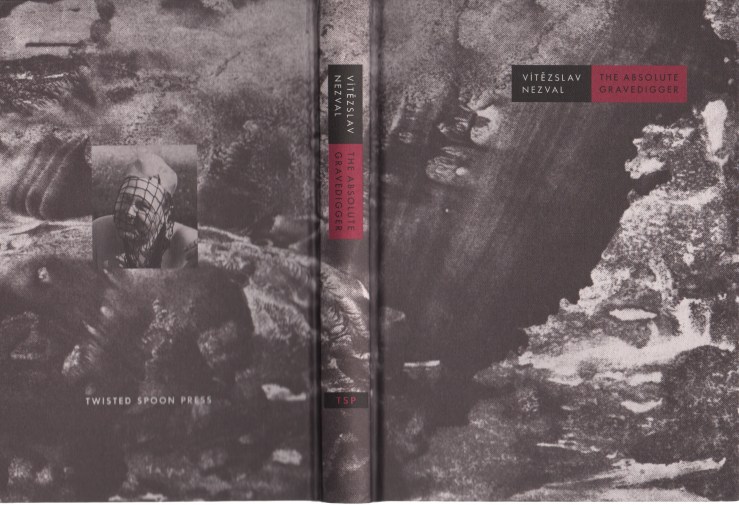
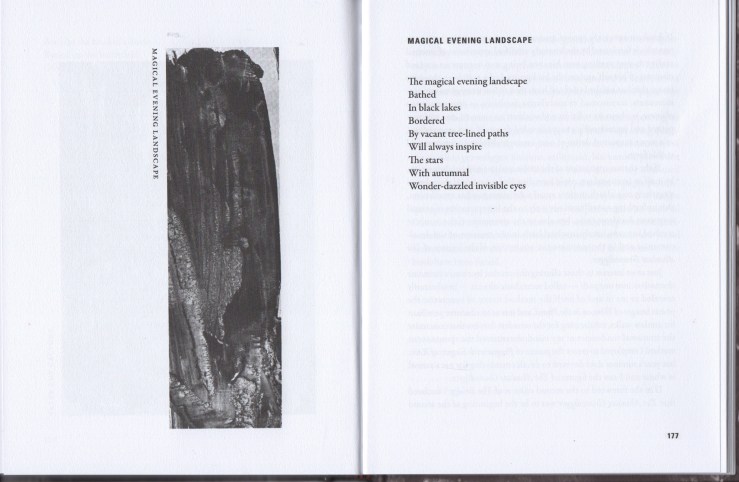
Vítězslav Nezval’s 1937 poetry collection The Absolute Gravedigger is new in English translation by Stephan Delbos and Tereza Novická, thanks to Twisted Spoon Press. As usual, Twisted Spoon’s edition is a beauty, including some of Nezval’s original illustrations.
The Absolute Gravedigger seems comprised of seven “books,” and I ended up barreling through one of them, Bizarre Town, in one sitting. Nezval’s surrealist poems are seemingly spare, but the parts jar against each other in unsettling ways; Bizarre Town evokes Bosch, or Goya’s etchings.
You might know Nezval as the author of Valerie and Her Week of Wonders, which was adapted into a marvelously disturbing 1970 film by Jaromil Jireš.
More to come as I read more, but for now, here’s Twisted Press’s blurb:
The Absolute Gravedigger, published in 1937, is in many ways the culmination of Vítězslav Nezval’s work as an avant-garde poet, combining the Poetism of his earlier work and his turn to Surrealism in the 1930s with his political concerns in the years leading up to World War II. It is above all a collection of startling verbal and visual inventiveness. And while a number of salient political issues emerge from the surrealistic ommatidia, Nezval’s imagination here is completely free-wheeling and untethered to any specific locale, as he displays mastery of a variety of forms, from long-limbed imaginative free verse narratives to short, formally rhymed meditations in quatrains, to prose and even visual art (the volume includes six of his decalcomania images).
Together with Nezval’s prior two collections, The Absolute Gravedigger forms one of the most important corpora of interwar Surrealist poetry. Yet here his wild albeit restrained mix of absolute freedom and formal perfection has shifted its focus to explore the darker imagery of putrefaction and entropy, the line breaks in the shorter lyric poems slicing the language into fragments that float in the mind with open-ended meaning and a multiplicity of readings. Inspired by Salvador Dalí’s paranoiac-critical method, the poems go in directions that are at first unimaginable but continue to evolve unexpectedly until they resolve or dissolve – like electron clouds, they have a form within which a seemingly chaotic energy reigns. Nezval’s language, however, is under absolute control, allowing him to reach into the polychromatic clouds of Surrealist uncertainty to form shapes we recognize, though never expected to see, to meld images and concepts into a constantly developing and dazzling kaleidoscope.
Roberto Bolaño’s short story “The Return” is so good that it has two perfect opening paragraphs:
I have good news and bad news. The good news is that there is life (of a kind) after this life. The bad news is that Jean-Claude Villeneuve is a necrophiliac.
That’s a hell of a way to start a story! Bolaño lays out his two themes—the afterlife and necrophilia—in a jovial, almost cavalier, but dare I say sweet, even charming way. And then this paragraph:
Death caught up with me in a Paris disco at four in the morning. My doctor had warned me, but some things are stronger than reason. I was convinced, mistakenly (and even now it’s something I regret), that drinking and dancing were not the most hazardous of my passions. Another reason I kept going out every night to the fashionable places in Paris was my routine as a middle manager at Fracsa; I was after what I couldn’t find at work or in what people call the inner life: the buzz that you get from a certain excess.
Those are the first two paragraphs, and maybe they’ll entice you to read the story. However, the following riff includes what some people might consider spoilers; my hope is that if you’ve never read it before, you’ll take it on faith that “The Return” is a great, great story and you’ll go read it and stop reading this riff now. (Maybe come back later though after you’ve read it).
“The Return” is a ghost story that transmutes the horror of death and the abjection of the corpse into love, empathy, and communication—and art. It’s a beautiful ghost tale in the Romantic, Gothic tradition of Edgar Allan Poe, from whom Bolaño drew heavily. However, while Poe’s tales of necrophilia (like the poem “Annabel Lee,” “The Fall of the House of Usher,” and “Berenice” to name just a few) obsess over repression, loss, burial, and imperfect and violent attempts at restoration, Bolaño’s “The Return” offers its readers a peaceful reconciliation with death. It’s collected in The Return (New Directions, English translation by Chris Andrews), which is a perfect introduction to Bolaño—so many great stories there (“Buba,” “Clara,” “William Burns,” etc.). So go read it.
The narrator of David Foster Wallace’s posthumous novel The Pale King assures us at one point that “phantoms are not the same as real ghosts.”
Okay.
So what’s a phantom then, at least in the universe of The Pale King?
Phantom refers to a particular kind of hallucination that can afflict rote examiners at a certain threshold of concentrated boredom.
The “rote examiners” are IRS agents who perform Sisyphean tasks of boredom. They are also placeholders for anyone who works a boring, repetitive job.
(We might even wax a bit here on the phrase rote examiner—the paradox in it—that to examine should require looking at the examined with fresh eyes, a fresh spirit—a spirit canceled out by the modifier rote).
In The Pale King, phantoms visit the rote examiners who toil in wiggle rooms. The “phantoms are always deeply, diametrically different from the examiners they visit,” suggesting two simultaneous outcomes: 1) an injection of life-force, a disruption of stasis that serves to balance out the examiner’s personality and 2) in the novel’s own language, “the yammering mind-monkey of their own personality’s dark, self-destructive side.”
In one scene, desperate Lane Dean contemplates suicide on the job, until he’s visited by a phantom.
“Yes but now that you’re getting a taste, consider it, the word. You know the one.”
The word is boredom, and the phantom proceeds to give a lecture on its etymology:
Word appears suddenly in 1766. No known etymology. The Earl of March uses it in a letter describing a French peer of the realm. He didn’t cast a shadow, but that didn’t mean anything. For no reason, Lane Dean flexed his buttocks. In fact the first three appearances of bore in English conjoin it with the adjective French, that French bore, that boring Frenchman, yes? The French of course had malaise, ennui. See Pascal’s fourth Pensée, which Lane Dean heard as pantsy.
The scene amidst which Clayton told his last story comes back very vividly to my mind. There he sat, for the greater part of the time, in the corner of the authentic settle by the spacious open fire, and Sanderson sat beside him smoking the Broseley clay that bore his name. There was Evans, and that marvel among actors, Wish, who is also a modest man. We had all come down to the Mermaid Club that Saturday morning, except Clayton, who had slept there overnight—which indeed gave him the opening of his story. We had golfed until golfing was invisible; we had dined, and we were in that mood of tranquil kindliness when men will suffer a story. When Clayton began to tell one, we naturally supposed he was lying. It may be that indeed he was lying—of that the reader will speedily be able to judge as well as I. He began, it is true, with an air of matter-of-fact anecdote, but that we thought was only the incurable artifice of the man.
“I say!” he remarked, after a long consideration of the upward rain of sparks from the log that Sanderson had thumped, “you know I was alone here last night?”
“Except for the domestics,” said Wish.
“Who sleep in the other wing,” said Clayton. “Yes. Well—” He pulled at his cigar for some little time as though he still hesitated about his confidence. Then he said, quite quietly, “I caught a ghost!”
“Caught a ghost, did you?” said Sanderson. “Where is it?”
And Evans, who admires Clayton immensely and has been four weeks in America, shouted, “CAUGHT a ghost, did you, Clayton? I’m glad of it! Tell us all about it right now.”
Clayton said he would in a minute, and asked him to shut the door.
He looked apologetically at me. “There’s no eavesdropping of course, but we don’t want to upset our very excellent service with any rumours of ghosts in the place. There’s too much shadow and oak panelling to trifle with that. And this, you know, wasn’t a regular ghost. I don’t think it will come again—ever.”
“You mean to say you didn’t keep it?” said Sanderson.
“I hadn’t the heart to,” said Clayton.
And Sanderson said he was surprised.
We laughed, and Clayton looked aggrieved. “I know,” he said, with the flicker of a smile, “but the fact is it really WAS a ghost, and I’m as sure of it as I am that I am talking to you now. I’m not joking. I mean what I say.”
Sanderson drew deeply at his pipe, with one reddish eye on Clayton, and then emitted a thin jet of smoke more eloquent than many words.
Clayton ignored the comment. “It is the strangest thing that has ever happened in my life. You know, I never believed in ghosts or anything of the sort, before, ever; and then, you know, I bag one in a corner; and the whole business is in my hands.”
He meditated still more profoundly, and produced and began to pierce a second cigar with a curious little stabber he affected.
“You talked to it?” asked Wish.
“For the space, probably, of an hour.”
“Chatty?” I said, joining the party of the sceptics.
“The poor devil was in trouble,” said Clayton, bowed over his cigar-end and with the very faintest note of reproof.
“Sobbing?” some one asked.
Clayton heaved a realistic sigh at the memory. “Good Lord!” he said; “yes.” And then, “Poor fellow! yes.”
“Where did you strike it?” asked Evans, in his best American accent.
“I never realised,” said Clayton, ignoring him, “the poor sort of thing a ghost might be,” and he hung us up again for a time, while he sought for matches in his pocket and lit and warmed to his cigar.
“I took an advantage,” he reflected at last.
We were none of us in a hurry. “A character,” he said, “remains just the same character for all that it’s been disembodied. That’s a thing we too often forget. People with a certain strength or fixity of purpose may have ghosts of a certain strength and fixity of purpose—most haunting ghosts, you know, must be as one-idea’d as monomaniacs and as obstinate as mules to come back again and again. This poor creature wasn’t.” He suddenly looked up rather queerly, and his eye went round the room. “I say it,” he said, “in all kindliness, but that is the plain truth of the case. Even at the first glance he struck me as weak.”
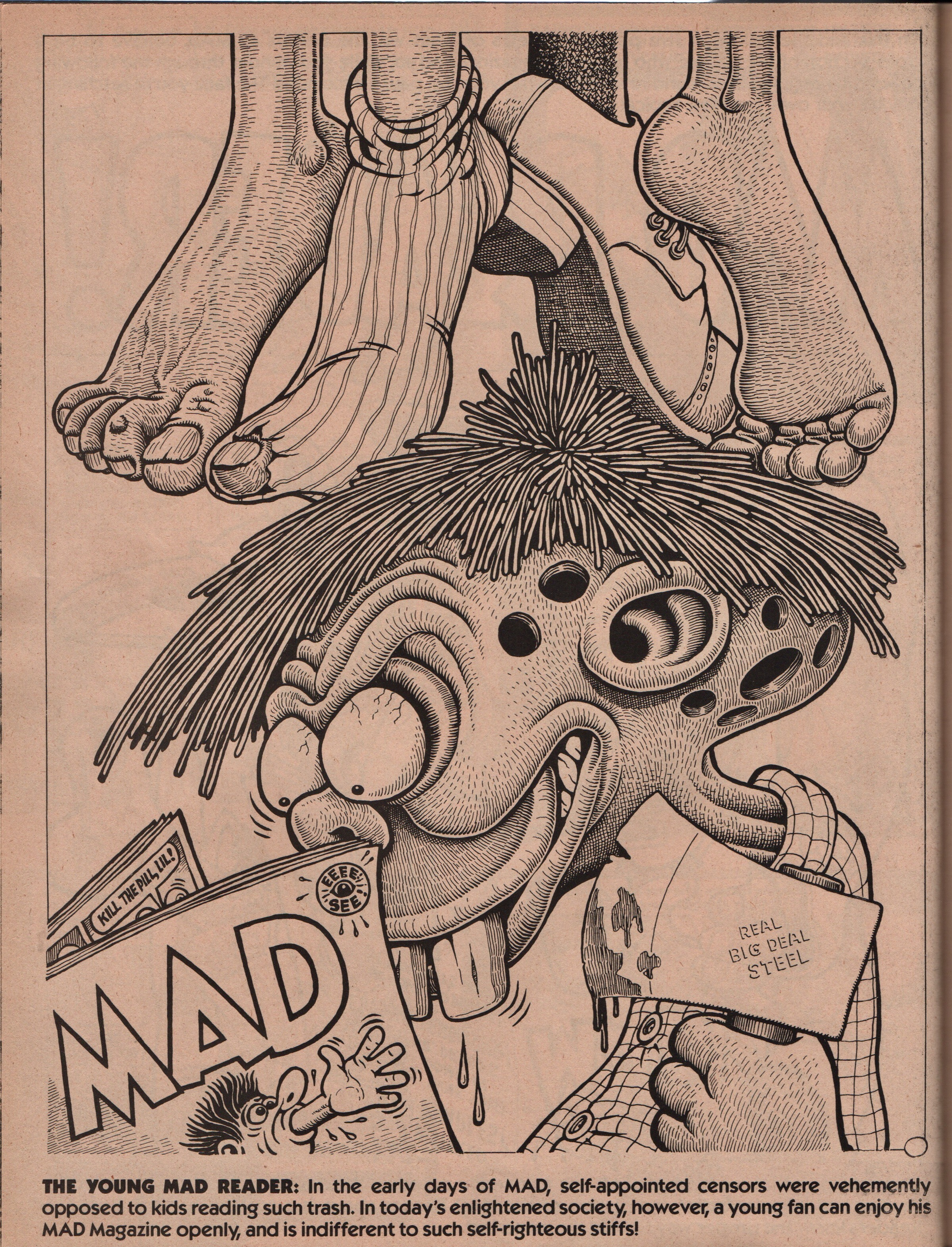
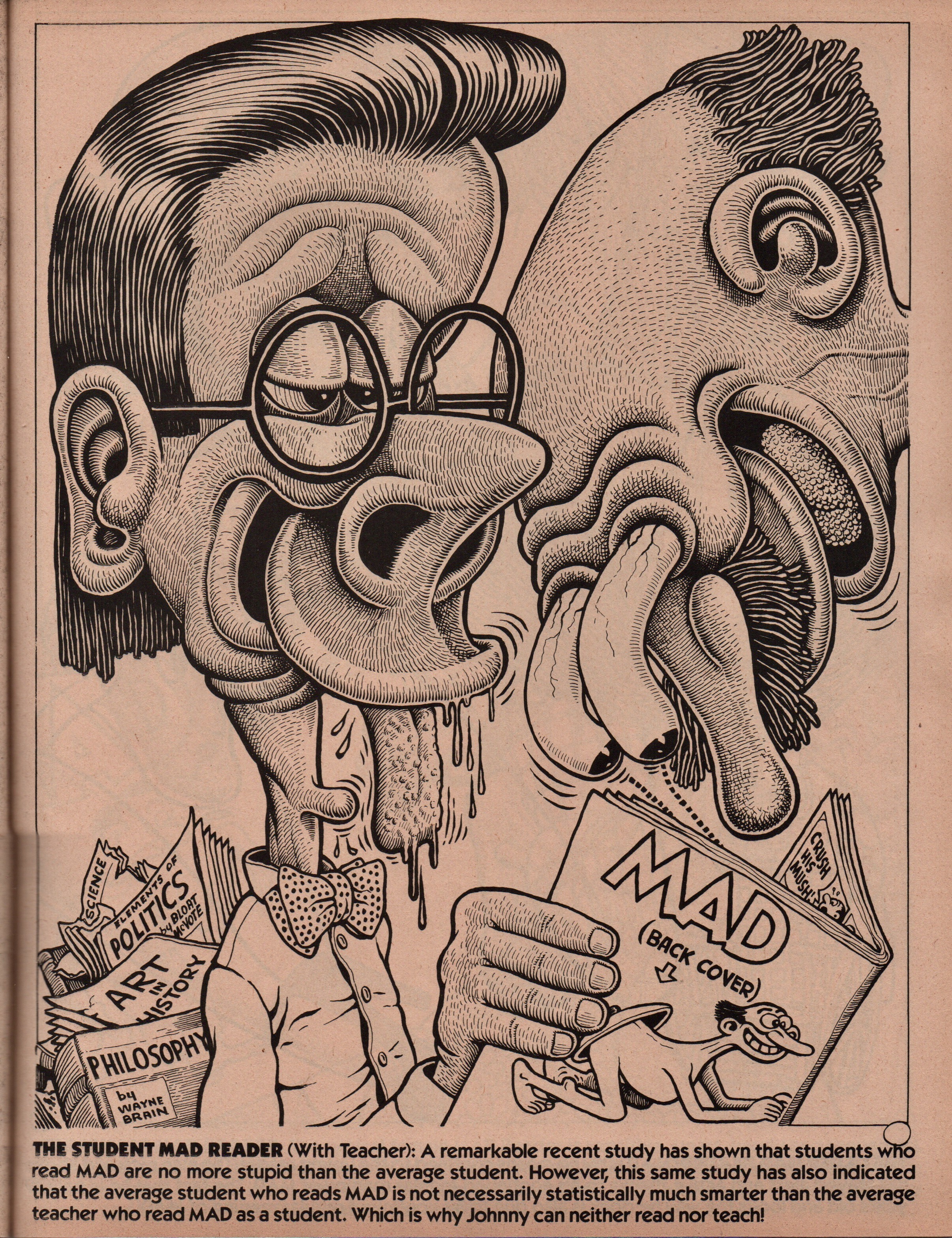
I might occasionally talk shit about my old man (what boy doesn’t?) but he always picked me up an issue of MAD.
I’m not sure when these wonderfully weird Basil Wolverton drawings were originally done/published, but they come from the Fall 1990 “Super Special” of weirdness. Note that the “Vote for Nixon” button on the cover illustration is likely an update to the “Vote for Landon” button below (Alf Landon lost in a landslide to FDR in 1936). The other internal/meta-textual differences are obvious too.
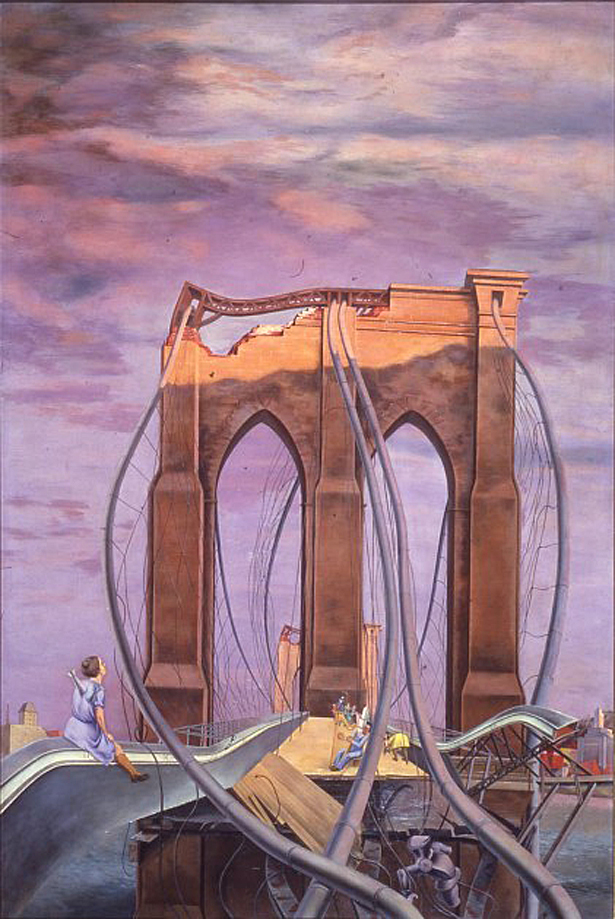
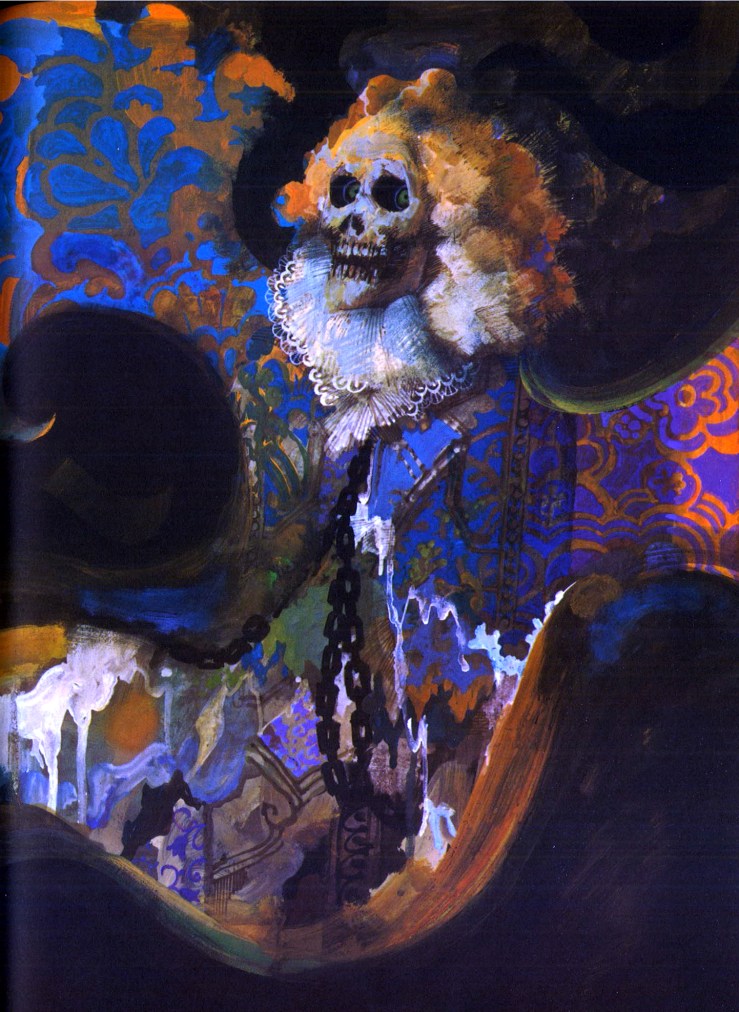
James Hill’s illustration for The Canterville Ghost by Oscar Wilde. From The Short Stories of Oscar Wilde, Heritage Press, 1968.
The Canterville Ghost
by
Oscar Wilde
When Mr. Hiram B. Otis, the American Minister, bought Canterville Chase, every one told him he was doing a very foolish thing, as there was no doubt at all that the place was haunted. Indeed, Lord Canterville himself, who was a man of the most punctilious honour, had felt it his duty to mention the fact to Mr. Otis when they came to discuss terms.
“We have not cared to live in the place ourselves,” said Lord Canterville, “since my grandaunt, the Dowager Duchess of Bolton, was frightened into a fit, from which she never really recovered, by two skeleton hands being placed on her shoulders as she was dressing for dinner, and I feel bound to tell you, Mr. Otis, that the ghost has been seen by several living members of my family, as well as by the rector of the parish, the Rev. Augustus Dampier, who is a Fellow of King’s College, Cambridge. After the unfortunate accident to the Duchess, none of our younger servants would stay with us, and Lady Canterville often got very little sleep at night, in consequence of the mysterious noises that came from the corridor and the library.”
“My Lord,” answered the Minister, “I will take the furniture and the ghost at a valuation. I have come from a modern country, where we have everything that money can buy; and with all our spry young fellows painting the Old World red, and carrying off your best actors and prima-donnas, I reckon that if there were such a thing as a ghost in Europe, we’d have it at home in a very short time in one of our public museums, or on the road as a show.”
“I fear that the ghost exists,” said Lord Canterville, smiling, “though it may have resisted the overtures of your enterprising impresarios. It has been well known for three centuries, since 1584 in fact, and always makes its appearance before the death of any member of our family.”
“Well, so does the family doctor for that matter, Lord Canterville. But there is no such thing, sir, as a ghost, and I guess the laws of Nature are not going to be suspended for the British aristocracy.”
“You are certainly very natural in America,” answered Lord Canterville, who did not quite understand Mr. Otis’s last observation, “and if you don’t mind a ghost in the house, it is all right. Only you must remember I warned you.”
Toward dusk, the black birds descend, millions 1of them, to sit in the branches of trees nearby. The trees grow heavy with black birds, branches like dendrites of the Nervous System 2 fattening, deep in twittering nerve-dusk, in preparation for some important message… . 3
Later in Berlin, down in the cellar among fever-dreams with shit leaking out of him at gallons per hour, too weak to aim more than token kicks at the rats 4 running by with eyes fixed earnestly noplace, trying to make believe they don’t have a newer and dearer status among the Berliners, at minimum points on his mental health chart, when the sun is gone so totally it might as well be for good, Slothrop’s dumb idling heart 5 sez: The Schwarzgerät is no Grail, Ace, that’s not what the G in Imipolex G stands for. And you are no knightly hero 6. The best you can compare with is Tannhäuser 7, the Singing Nincompoop—you’ve been under one mountain at Nordhausen, been known to sing a song or two with uke accompaniment, and don’tcha feel you’re in a sucking marshland of sin out here, Slothrop? maybe not the same thing William Slothrop, vomiting a good part of 1630 away over the side of that Arbella8, meant when he said “sin.” . . . But what you’ve done is put yourself on somebody else’s voyage 9—some Frau Holda, some Venus in some mountain—playing her, its, game… you know that in some irreducible way it’s an evil game. You play because you have nothing better to do 10, but that doesn’t make it right. And where is the Pope whose staff’s gonna bloom for you? 11
From page 364 of Thomas Pynchon’s novel Gravity’s Rainbow.
1A million black birds sounds like a hyperbole of crows, but Berlin 1945, post-V-E Day—which is like, where we are here—I mean, it’s a desperate deathly ghastly place. So maybe buzzards and dreadful crows abound.
Drawing of Purkinje cells (A) and granule cells (B) from pigeon cerebellum, Santiago Ramón y Cajal (1899)
3 What’s the important message? Oh wait, we’re still in the marvelous tree-crow-dendrite simile—the “twittering nerve-dusk”—so the “message” the crow-tree-branches awaits is just part of the, uh, metaphor. Or not? I mean, this is a novel in large part about expectation—about waiting for the bomb to fall, waiting for the Sword of Damocles to descend. And also: awaiting a message of Return.
But: What a lovely little simile. Pynchon’s powers as a prose stylist seem under-remarked upon.
4Cf. page 359: “Last week, in the British sector someplace, Slothrop, having been asshole enough to drink out of an ornamental pond in the Tiergarten, took sick.”
The cellar, the diarrhea, the rats….I’ve written it before:Gravity’s Rainbow is a thoroughly abject novel—full of assholes (literal) and shit (literal) and toilets (literal). (And oh, also: metaphorical too, metaphorical too). Slothrop here is sick, literally evacuating—but also figuratively evacuating. A few pages later he’ll evacuate into his next identity, Rocket Man.
Cf. page 553, from Slothrop’s “Partial List of Wishes on Evening Stars for This Period”:
“Let me be able to take a shit soon.”
5I counted 75 words in the dependent clause that precedes Pynchon’s finally introducing the independent clause—which is to say subject and verb—
“Slothrop’s dumb idling heart sez”
(My count is likely off; I counted once and I’ve had some bourbon. I counted “fever-dreams” as two words, although I think you’re not supposed to do that).
Anyway: That’s a lot of dependent-clauseauge before, like, the main idea—which I guess, from a prose/aesthetic analysis, is the, uh, main idea—ascent, suspension—and then an immediate divergence (and note how Pynchon simultaneously deflates and invigorates his predicate verb “sez” with colloquial zeal).
6Many of Gravity’s Rainbow’s motifs almost cohere here. Pynchon highlights two of Slothrop’s ostensible “quests” — the Schwarzgerät (the mysterious “black device” that will be installed in rocket 00000 (present), and the sexy sinister plastic Imipolex G (past). (But also both, obviously: Future).
Slothrop’s dumb heart denies any knightly virtue, rejects Romanticism—and, perhaps, Modernism’s ironic obsessions with Romanticism.
(I think the passage above, what with its ravens and Venus-denial and grail-refusal, is a tidy antonym to Rossetti’s depiction of the Grail…and yet I’d argue Pynchon’s writing bears a Pre-Raphaelite streak)—
The Damsel of the Holy Grail, Dante Gabriel Rossetti (1874)
The episode strikes me as utterly true, a moment of honest self-speech. As Emily Dickinson put it: “I like a look of Agony / Because I know it’s true.” (One of Slothrop’s ancestor’s plagiarized Ms. Dickinson on his gravestone). And yet and yet and yet…Perhaps Tyrone S. is being a bit too harsh on himself (who among us hasn’t cast a harsh gaze into the mirror?).
Slothrop expels the old identity here, the old dreams, the old, evacuating space for the arrival of “Raketemensch,” — Rocketman!
Rocketman points to an emerging postmodern hero—a comic bookish hero, perhaps—totemic, sure, but also Pop, cartoonish, textual—framed (literally) in the conventions of previous centuries’ conceptions of “heroism.”
7 Cf. page 299: “There is that not-so-rare personality disorder known as Tannhäuserism. Some of us love to be taken under mountains, and not always with horny expectations.” I annotated the page here. Slothrop seems to accept the abject mantle of a bard, a laze, a loaf, a lingerer. I think of Whitman here, proud to lean and loafe at his ease at the beginning of Song of Myself, only to “effuse [his] flesh in eddies, and drift it in lacy jags” in the poem’s closing lines. Like Whitman’s persona, Slothrop will dissipate.
8Cf. pages 203-04 (annotations here), wherein Slothrop’s vomiting ancestor William Slothrop, in a remarkable passage of hysteron proteron, travels backwards from the New World to the Old.
9One of the central paranoias of Gravity’s Rainbow is that you might be on their voyage. How much agency do you have in your own life? And what’s the cost of asserting that agency? How many identities do you have to evacuate? And in the end—what’s left?
10Boredom strikes me as one of (if not the) central theme connecting Modernism, postmodernism, and post-postmodernism.
Or: Simply note the motif of bloom, of fruition, of phallic life, of promise. In fuller context though—it’s a bloom too late. The question blooms from Slothrop’s self-speech, but also extends to you and me, reader.
Or: Cf. the opening of Gravity’s Rainbow. From the sixth paragraph:
“You didn’t really believe you’d be saved. Come, we all know who we are by now. No one was ever going to take the trouble to save you, old fellow. . . .”










 Biblioklept